A beach basement transforms a below-grade room into a sun-washed retreat using whitewashed wood, weathered textures, and ocean-inspired color palettes — no windows required. This guide gives you 25 ideas for turning a dark, underused basement into a relaxed coastal escape that feels miles from its actual location.
A coastal basement feels like exhaling after a long day: light, airy, and unhurried, even without a single window. Whitewashed wood catches whatever light exists and bounces it around the room, while woven textures and salt-worn colors bring in warmth without weight. There’s a quiet, breezy energy here — the kind that makes you want to kick off your shoes and stay a while. Here are 25 ideas worth saving—and stealing.
Why Coastal Basement Design Works So Well
Coastal design draws from Nantucket cottages, California surf shacks, and Mediterranean beach houses — a blend of New England restraint and laid-back West Coast ease, distinct from nautical themes’ heavier anchor-and-rope motifs. In a basement, it solves a real problem: bringing lightness to a naturally dim, enclosed space.
Core materials include whitewashed shiplap, weathered oak, jute, and rattan, paired with colors like driftwood gray, sea glass green, sandy beige, and soft sky blue. Textures lean matte and sun-bleached rather than glossy, mimicking materials that have spent years near salt air.
Basement renovations have surged as more households convert underused square footage into livable space, and coastal palettes specifically address basements’ biggest challenge — the absence of natural light — by using pale, reflective tones instead of dark, moody ones that would make a windowless room feel like a cave.
Small basements handle coastal style well, but success depends on prioritizing light-reflective surfaces and low-profile furniture first, since heavy dark pieces or busy patterns will make a compact space feel cramped rather than breezy.
| Element | Core Trait 1 | Core Trait 2 |
| Philosophy | Light-first design | Relaxed, uncluttered layouts |
| Materials | Whitewashed wood, jute, rattan | Linen, weathered oak, sea glass |
| Color palette | Driftwood gray, sandy beige | Sea glass green, soft sky blue |
25 Beach Basement Ideas
1. Whitewashed Shiplap Accent Wall
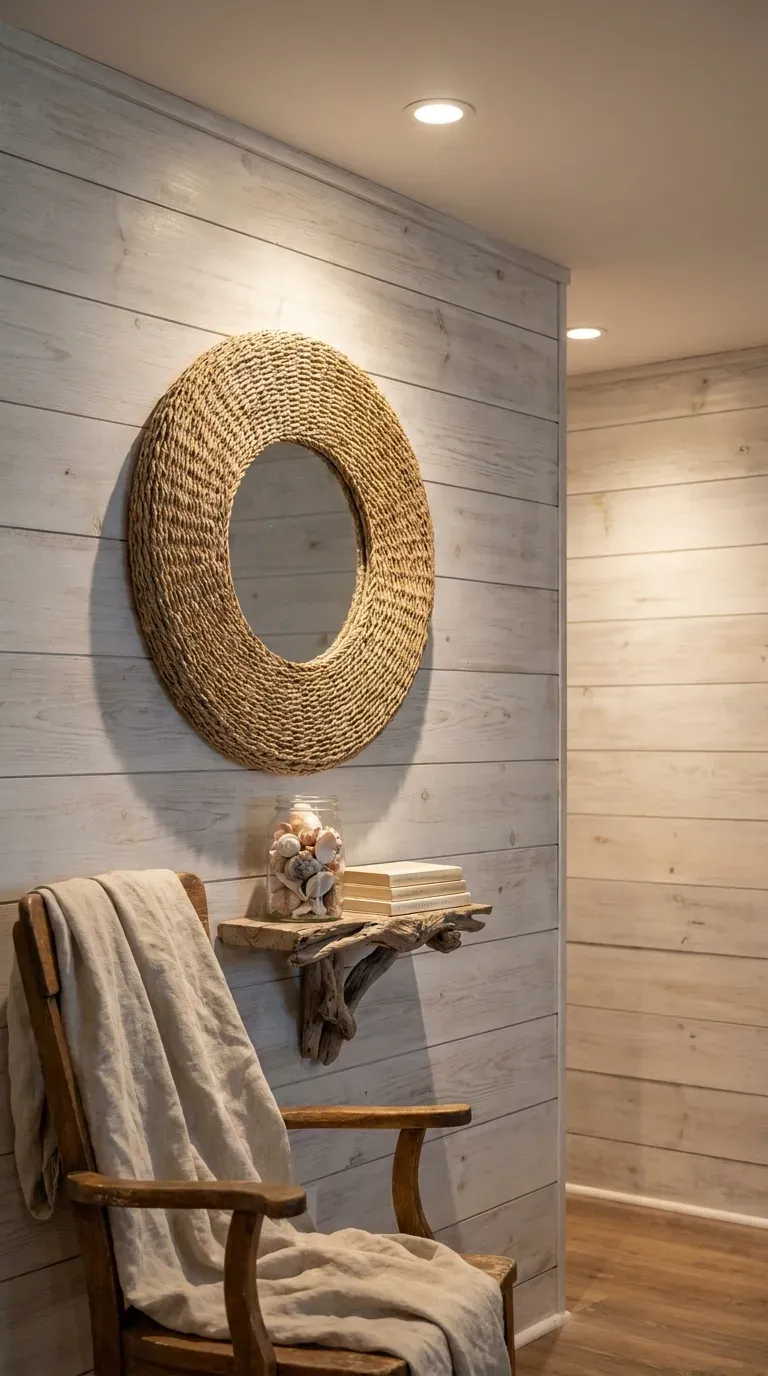
Vibe: Luminous and calm.
Why it works: Whitewash lets wood grain show through while reflecting far more light than solid paint, a material principle that directly counters a basement’s lack of windows.
How to get it: Apply a 50/50 mix of white paint and water over pine shiplap boards, wiping excess before it dries so the grain stays visible underneath.
💡 Quick Win: Pre-primed shiplap panels from a home center skip the sanding step entirely.
Shop the Look
| Product |
| Whitewashed shiplap wall panel kit |
| Woven seagrass round mirror |
| Driftwood floating wall shelf |
| Natural linen throw blanket |
| Glass apothecary jar coastal decor |
2. Sea Glass Green Accent Sofa
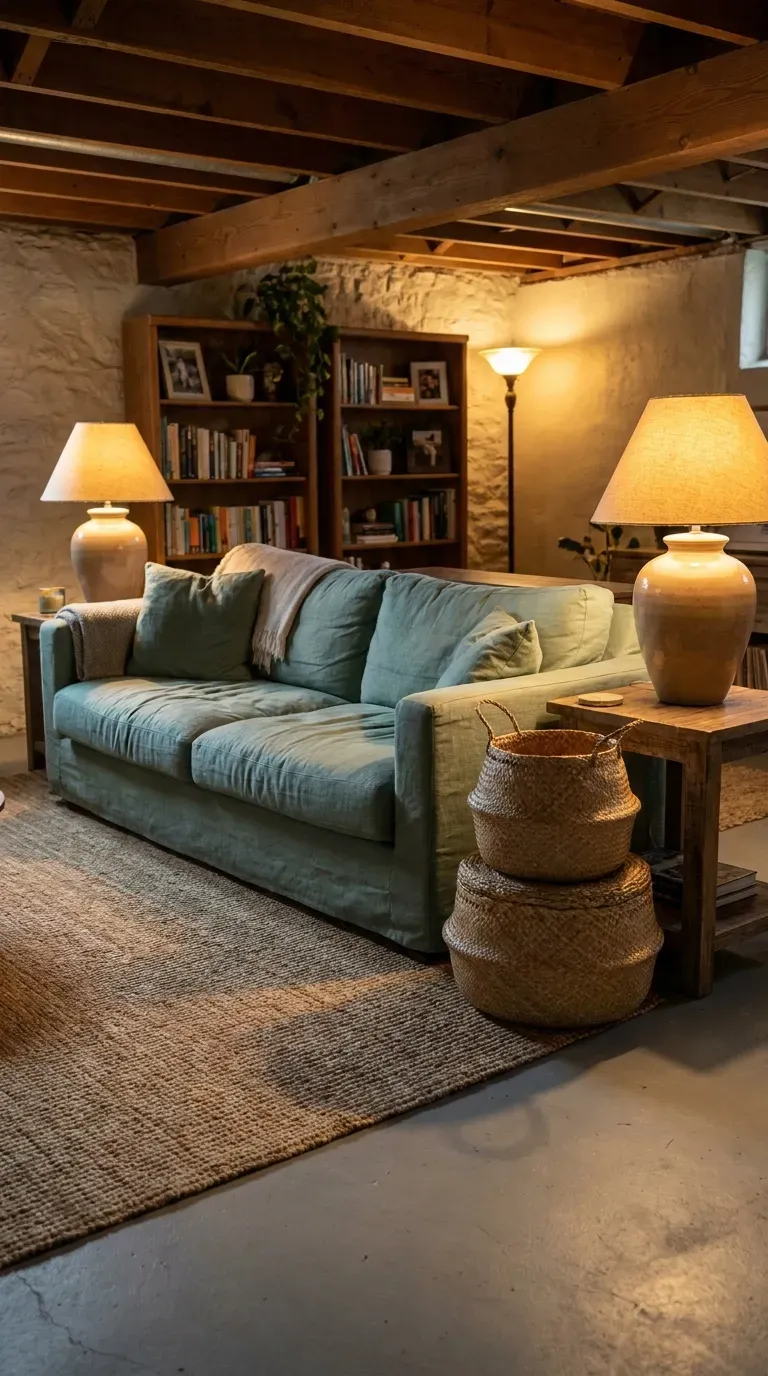
Vibe: Soft and inviting.
Why it works: A muted green anchors the room in color without overwhelming a low-light space — a saturation principle where mid-tone hues read as calm rather than heavy under artificial lighting.
How to get it: Choose a sea glass green in a matte linen or performance fabric, keeping walls and floors light so the sofa remains the room’s single strongest color statement.
Shop the Look
| Product |
| Sea glass green linen sofa |
| Natural jute area rug 8×10 |
| Woven seagrass storage baskets set |
| Ceramic table lamp coastal white |
| Round wood coffee table light oak |
3. Sandy Beige Concrete Floor Finish
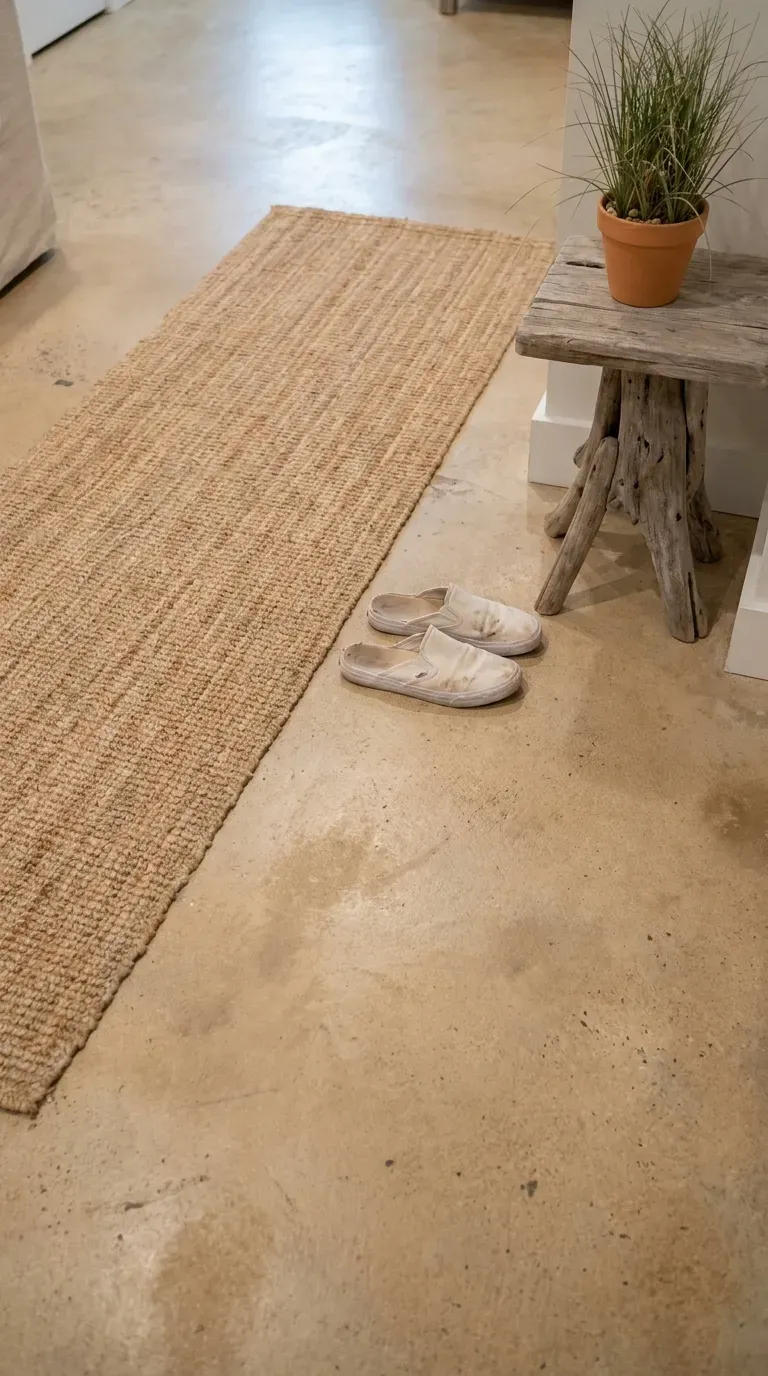
Vibe: Warm and sun-bleached.
Why it works: A sandy-toned concrete stain mimics beach sand underfoot, a color-grounding principle where the floor’s warmth balances cooler wall tones above it.
How to get it: Use an acid-based concrete stain in a warm tan tone, sealing with a matte topcoat to avoid the glossy sheen that reads more “garage” than “beach house.”
💡 Quick Win: Stain samples on a small test patch first — basement concrete absorbs unevenly and colors shift once sealed.
Shop the Look
| Product |
| Concrete floor stain sandy tan |
| Matte concrete sealer topcoat |
| Natural jute floor runner |
| Driftwood accent side table |
| Potted artificial beach grass |
4. Rattan Pendant Lighting Cluster
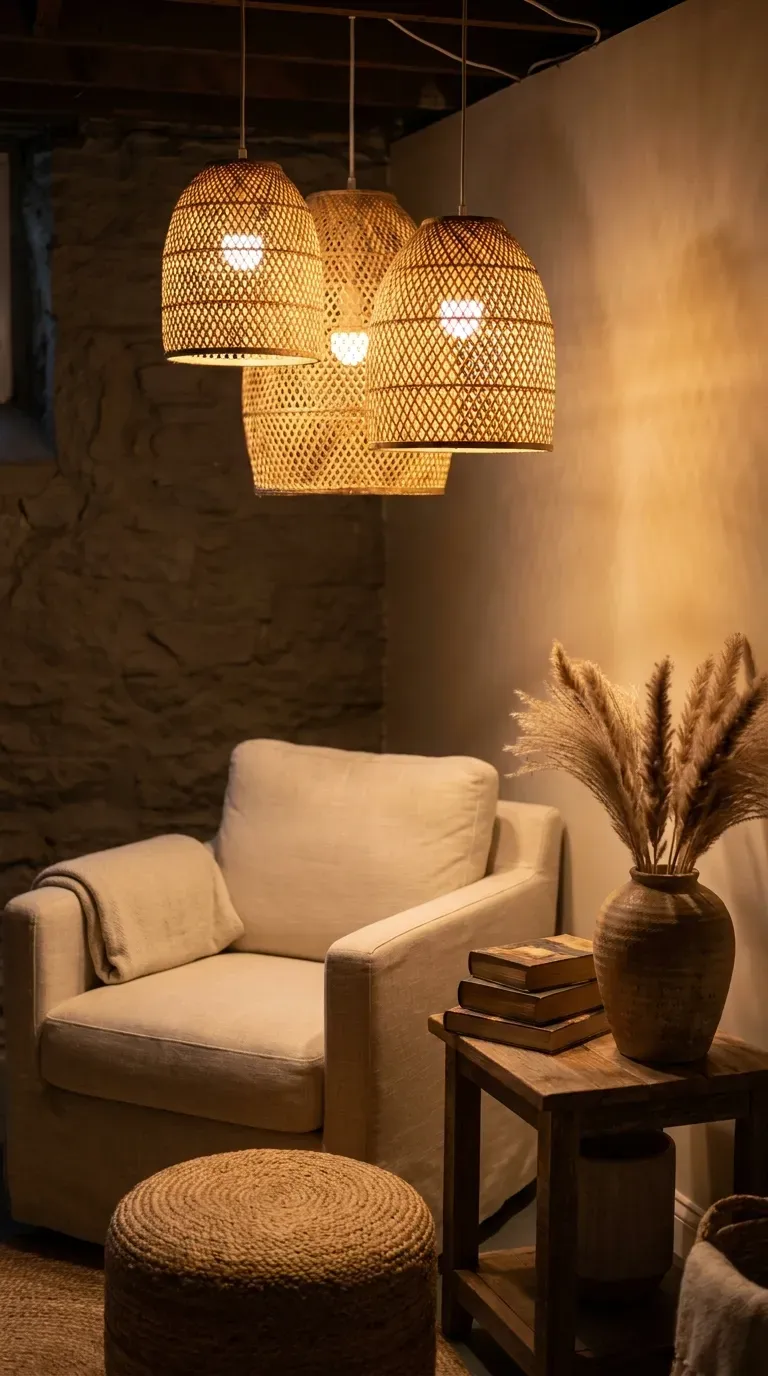
Vibe: Warm and textural.
Why it works: Woven pendant shades cast dappled shadow patterns that mimic dappled sunlight, a lighting principle that adds visual movement a basement’s static overhead cans can’t achieve alone.
How to get it: Cluster three pendants at staggered heights over a seating area, wiring them to a dimmer switch so brightness can shift from task light to evening ambiance.
Shop the Look
| Product |
| Woven rattan pendant light set |
| Linen upholstered armchair coastal |
| Round woven storage ottoman |
| Ceramic vase with dried pampas grass |
| Dimmer switch light kit |
5. Weathered Oak Built-In Shelving
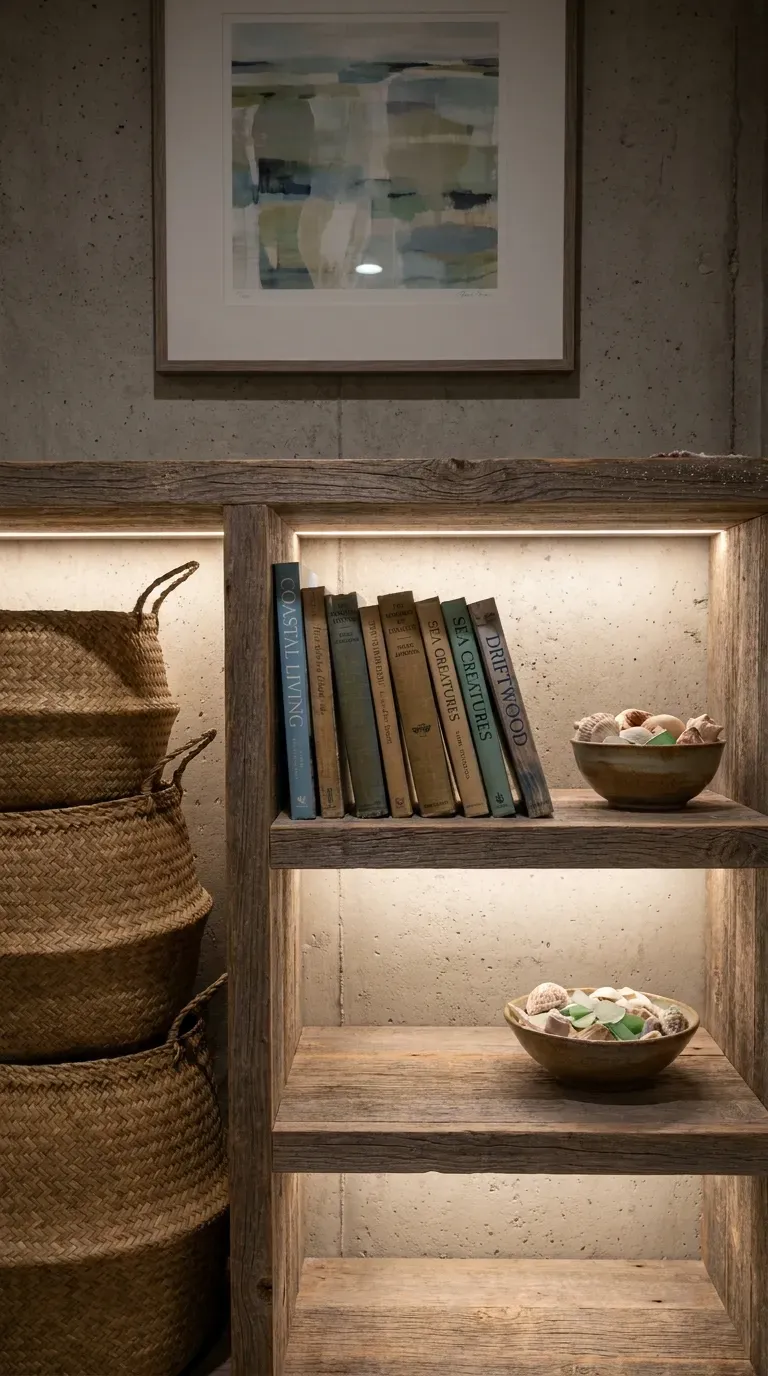
Vibe: Grounded and collected.
Why it works: Weathered oak’s visible grain and gray undertone provides texture contrast against smooth painted walls, a material-layering principle central to coastal design.
How to get it: Build shelving from rough-sawn oak treated with a gray weathering stain, leaving open backs so the wall color shows through for added depth.
💡 Quick Win: A weathering stain kit applied over standard pine achieves the same aged look for a fraction of oak’s cost.
Shop the Look
| Product |
| Weathered oak floating shelf set |
| Woven storage basket coastal |
| Ceramic seashell display bowl |
| Framed abstract coastal wall art |
| Gray wood weathering stain kit |
6. Soft Sky Blue Ceiling Treatment
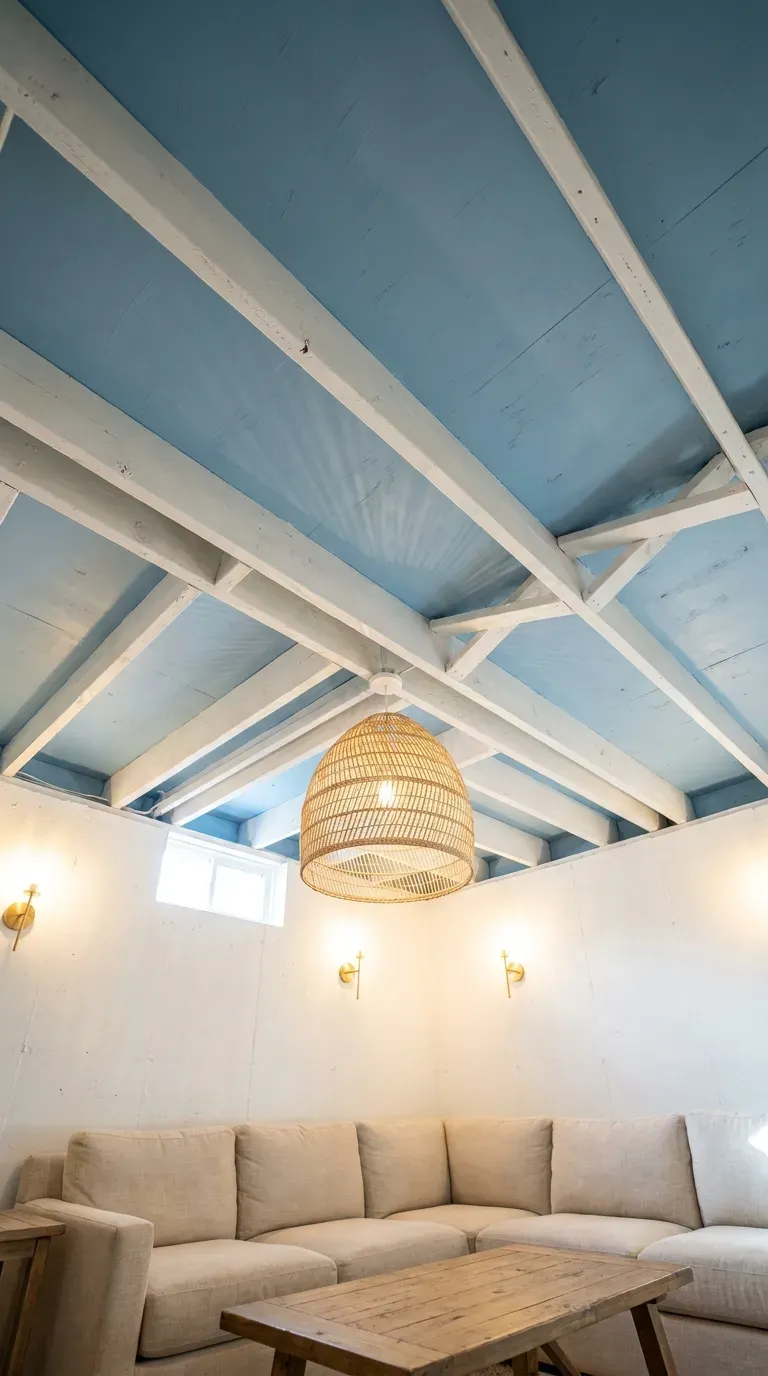
Vibe: Open and sky-like.
Why it works: Painting a low basement ceiling a pale blue rather than stark white creates the illusion of sky overhead, a color-perception trick that pushes the ceiling plane visually upward.
How to get it: Choose a soft, desaturated sky blue in a flat or matte finish, extending the color slightly down onto the top few inches of wall to blur the ceiling line.
Shop the Look
| Product |
| Soft sky blue ceiling paint flat |
| Exposed joist white paint kit |
| Woven pendant ceiling fixture |
| Wall sconce warm white coastal |
| Linen sectional sofa light gray |
7. Driftwood Coffee Table Centerpiece
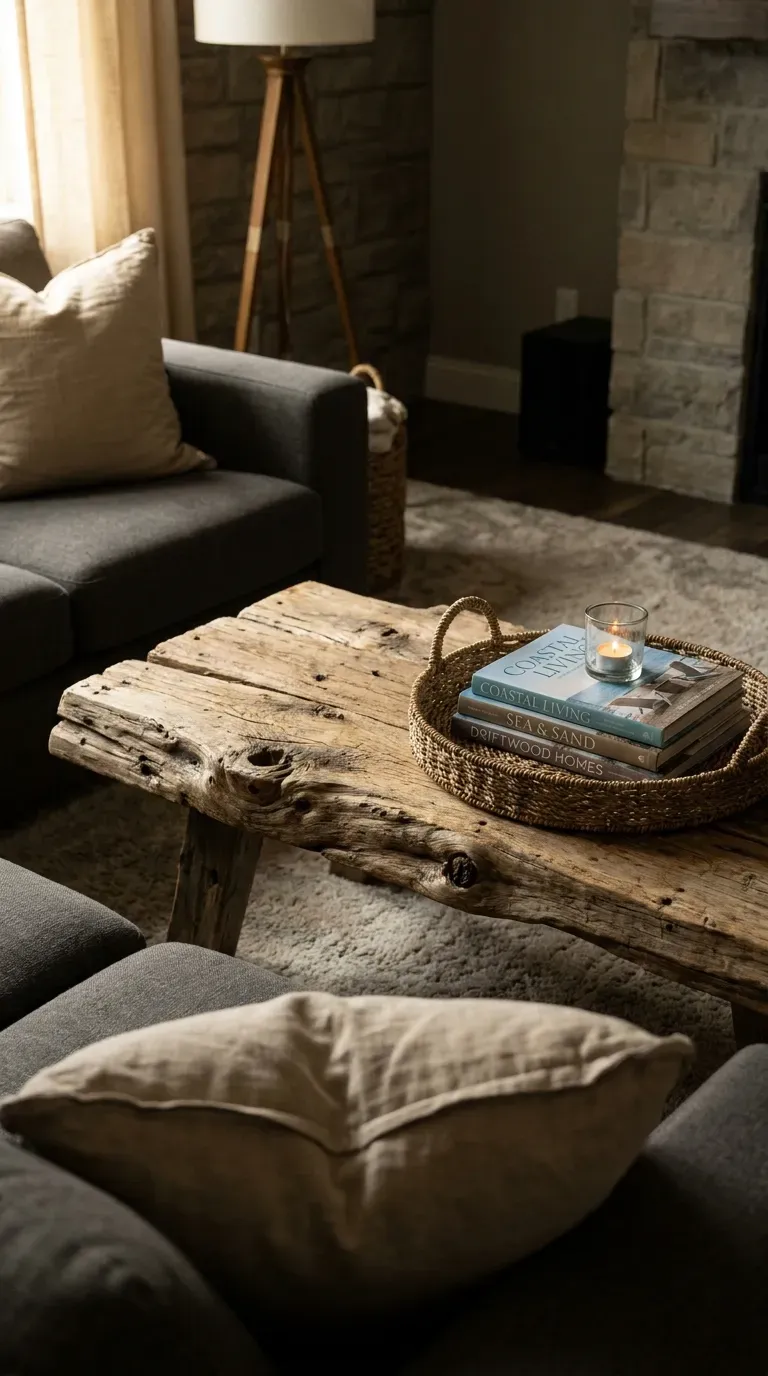
Vibe: Sculptural and grounded.
Why it works: A driftwood slab’s irregular, organic shape breaks up the boxiness of surrounding furniture, a furniture-profile principle where one sculptural piece anchors an otherwise symmetrical layout.
How to get it: Look for a live-edge driftwood or reclaimed wood slab table, pairing it with straight-lined furniture around it so the table’s organic shape stands out rather than competes.
💡 Quick Win: A single driftwood log slice used as a side table achieves the same effect at a smaller scale and price.
Shop the Look
| Product |
| Driftwood slab coffee table |
| Woven serving tray natural |
| Coastal coffee table book set |
| Glass hurricane candle holder |
| Linen throw pillow covers set |
8. Layout: Open Sightline Basement Zoning
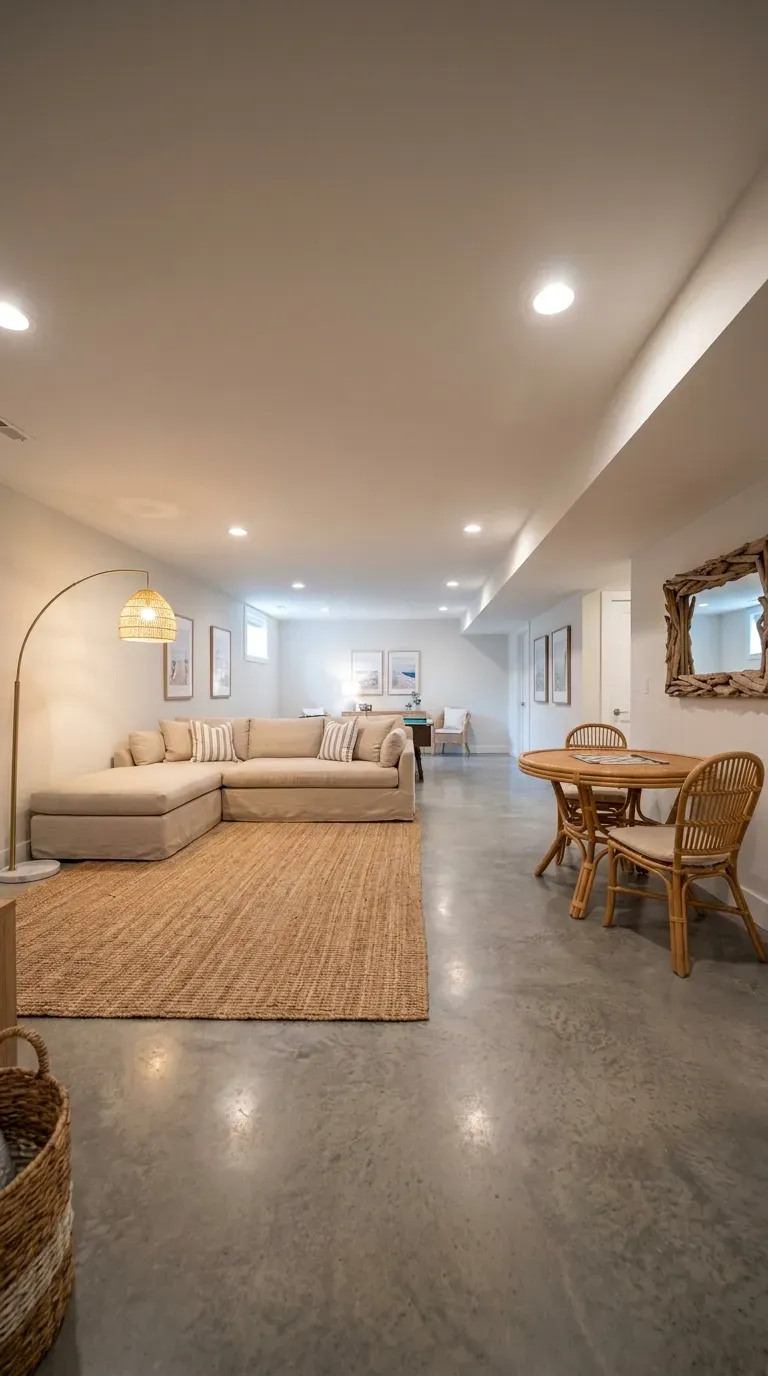
Vibe: Open and unhurried.
Why it works: Using rugs rather than walls to define zones keeps sightlines open across the basement, a layout principle that prevents a below-grade space from feeling chopped up and closed in.
How to get it: Place a jute rug under each functional zone — seating, games, media — keeping furniture low-profile so eye level stays clear across the whole room.
Shop the Look
| Product |
| Low-profile linen sectional sofa |
| Rattan game table with chairs |
| Natural jute zone-defining rug |
| Coastal floor lamp white shade |
| Woven basket storage side table |
9. Linen Slipcovered Sectional
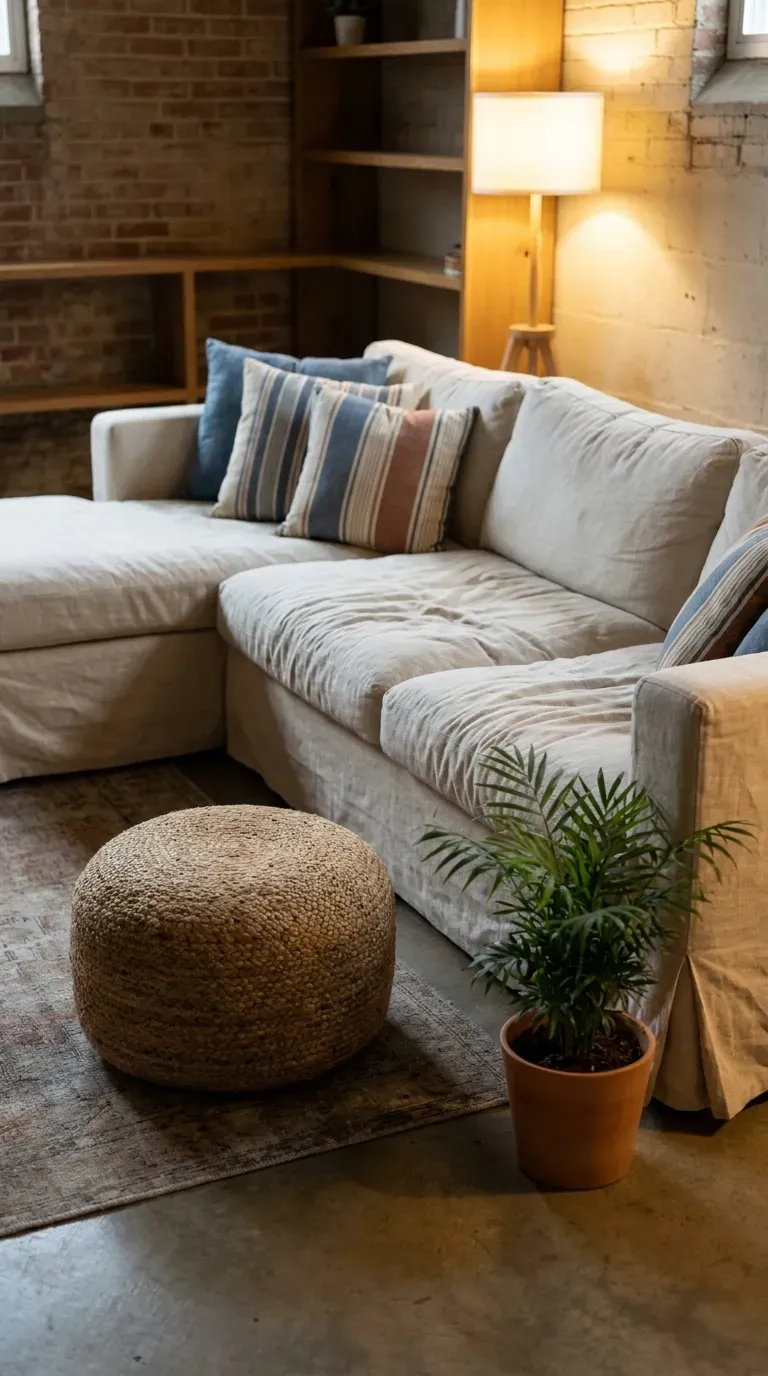
Vibe: Loose and lived-in.
Why it works: Slipcovered furniture’s relaxed, unstructured drape contrasts with tightly upholstered pieces, a texture principle where visible looseness signals comfort over formality.
How to get it: Choose a natural or off-white linen slipcover in a washable fabric, since basements run humid and machine-washable covers hold up better long term.
💡 Quick Win: Removable slipcovers let you swap in a deeper coastal blue for seasonal refreshes without buying new furniture.
Shop the Look
| Product |
| Linen slipcovered sectional sofa |
| Striped coastal throw pillow set |
| Woven rattan floor pouf |
| Small potted artificial palm |
| Natural fiber floor lamp base |
10. Woven Wall Basket Gallery

Vibe: Textural and layered.
Why it works: Grouping baskets by varying size and weave pattern creates visual rhythm through repetition and variation, a composition principle borrowed from traditional gallery walls but executed in texture instead of frames.
How to get it: Arrange 7–9 baskets in a loose asymmetrical cluster, mixing flat and dimensional shapes, using removable adhesive hooks to avoid excess wall damage.
Shop the Look
| Product |
| Woven wall basket set assorted |
| Adhesive wall hooks heavy-duty |
| Ceramic coastal vase small |
| Linen upholstered entry bench |
| Floating wood accent shelf |
11. Small Space Fold-Flat Beach Bar Cart
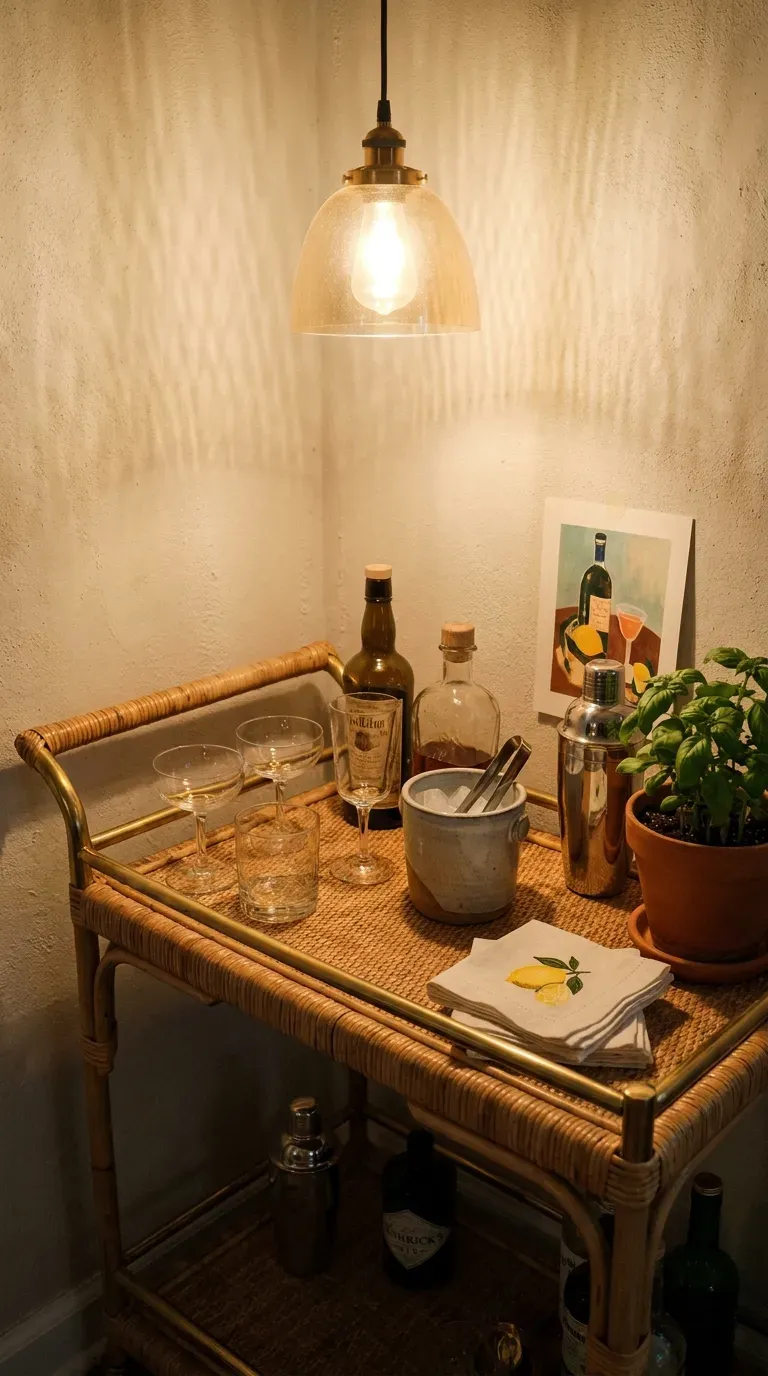
Vibe: Compact and hospitable.
Why it works: A narrow-profile cart on wheels adds entertaining function without consuming permanent floor space, a small-space principle where mobility substitutes for square footage.
How to get it: Choose a two-tier rattan or rope-wrapped cart under 18 inches wide, rolling it against the wall when not in use to keep walkways clear.
💡 Quick Win: A cart under $80 with locking wheels tucks into a stair nook other furniture can’t reach.
Shop the Look
| Product |
| Rattan bar cart two-tier |
| Coastal glassware set |
| Small ceramic ice bucket |
| Linen cocktail napkin set |
| Small potted herb planter |
12. Striped Canvas Window Treatment Illusion
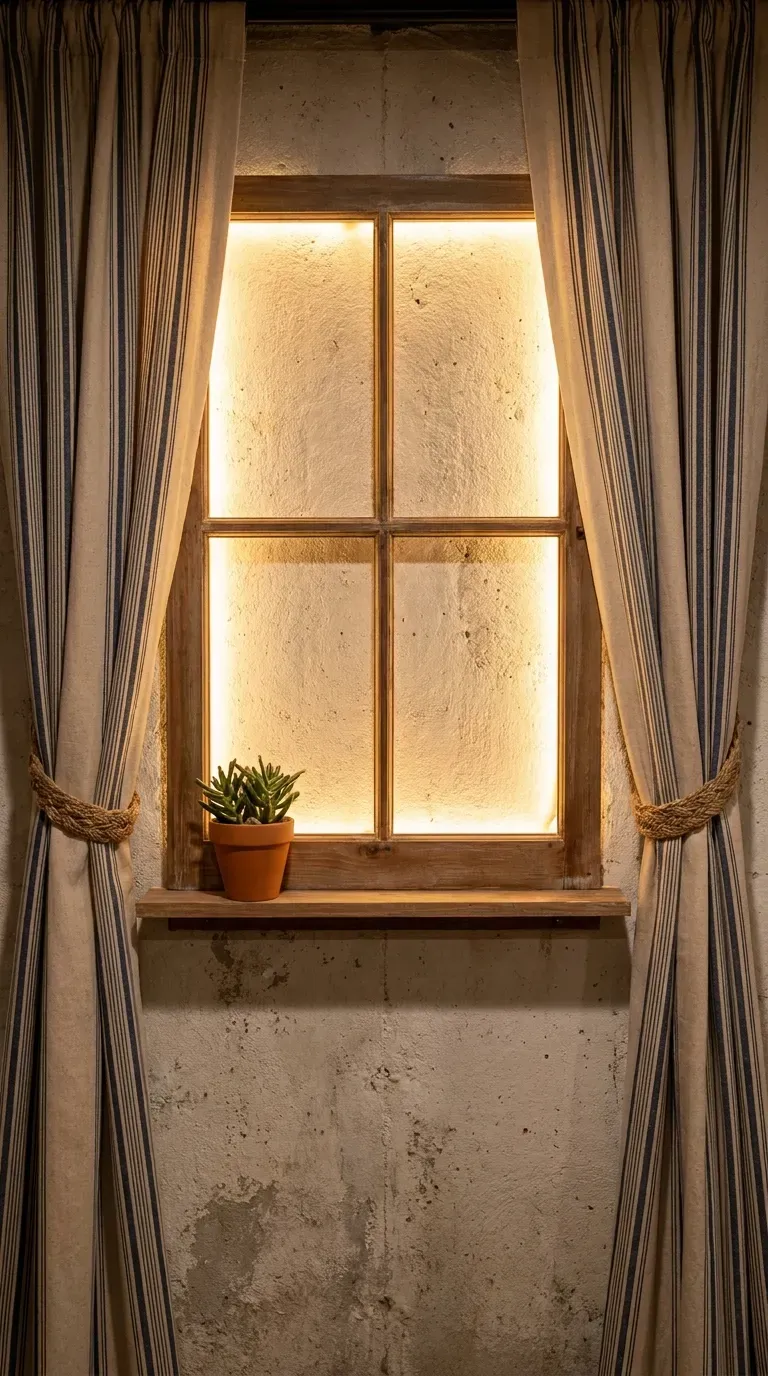
Vibe: Clever and sunlit.
Why it works: A faux window with LED backlighting tricks the eye into perceiving daylight, an illusion principle that directly addresses the single biggest limitation of basement rooms.
How to get it: Mount a simple wood window frame on the wall, install warm-white LED strips behind a diffusing panel, and flank it with striped canvas curtains on a working rod.
Shop the Look
| Product |
| Faux window frame kit wood |
| Warm white LED strip backlight |
| Striped canvas curtain panel set |
| Woven curtain tieback pair |
| Small potted windowsill plant |
13. Rope-Wrapped Stair Railing
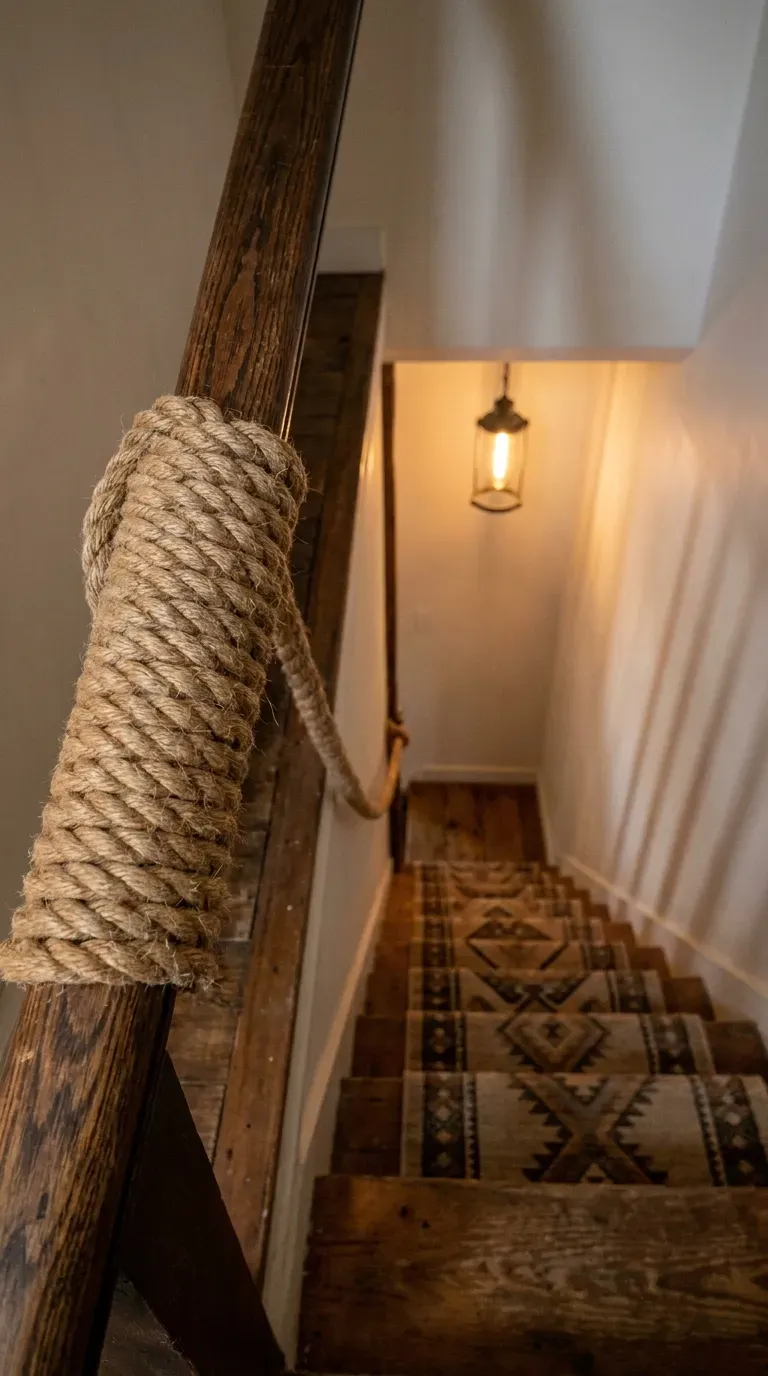
Vibe: Detailed and nautical-adjacent.
Why it works: Wrapping an existing railing in rope adds tactile, natural texture to a typically overlooked architectural element, a material principle that extends coastal detailing beyond furniture and walls.
How to get it: Use marine-grade jute or manila rope, wrapping tightly and securing ends with wood glue and finishing nails at the top and bottom of the railing.
💡 Quick Win: Rope wrapping a railing costs under $30 and takes about an hour with no special tools.
Shop the Look
| Product |
| Marine-grade jute rope roll |
| Wood stair runner natural fiber |
| Small pendant light stairwell |
| Wood glue finishing kit |
| Stair tread rug grippers |
14. Sunwashed Blue-Gray Accent Wall
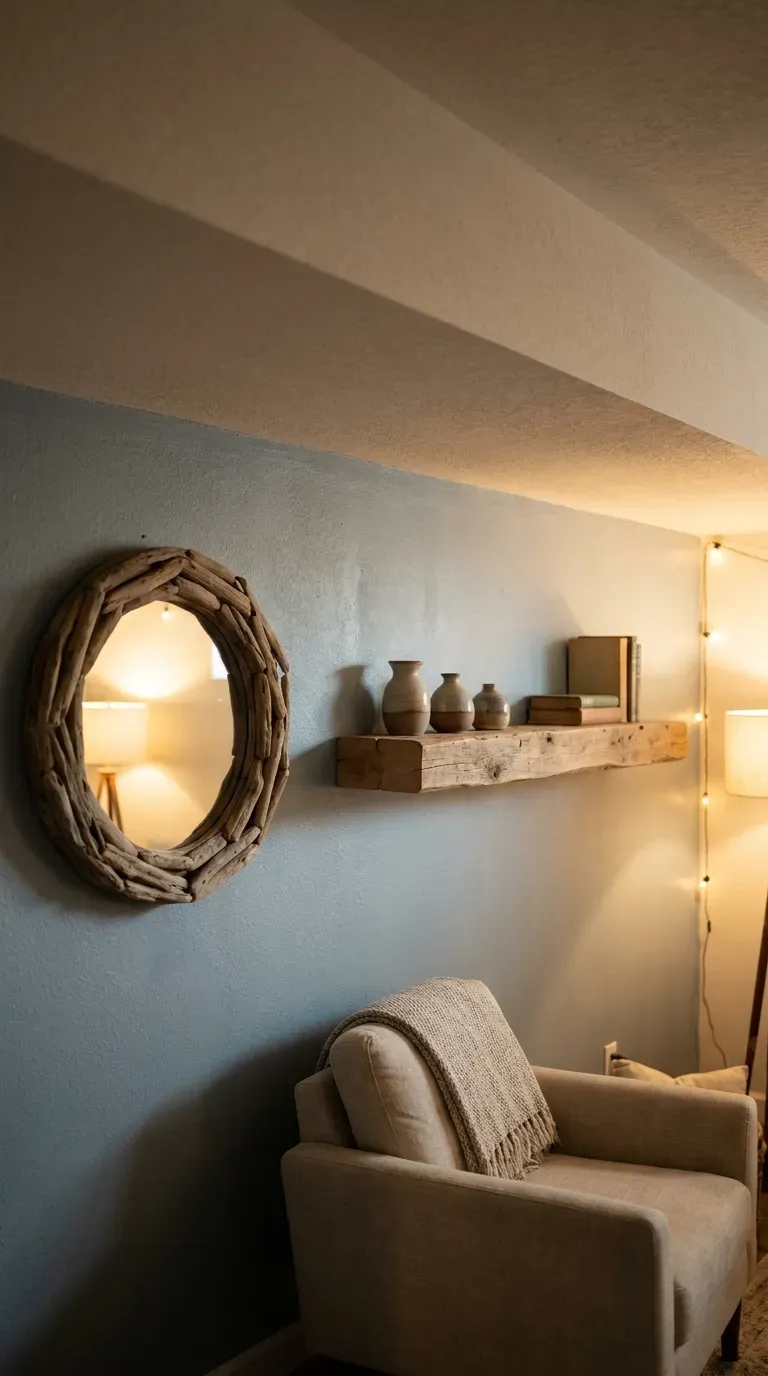
Vibe: Calming and weathered.
Why it works: A desaturated blue-gray reads as sun-faded rather than saturated, a color principle where lower chroma tones feel more relaxed and less visually demanding in low light.
How to get it: Choose a paint with gray undertones rather than pure blue, testing swatches under the basement’s actual lighting since artificial light shifts color perception significantly.
Shop the Look
| Product |
| Sunwashed blue-gray wall paint |
| Driftwood framed round mirror |
| Floating shelf with ceramic decor |
| Linen upholstered armchair |
| Wall paint sample swatch kit |
15. Layered Textile Throw Pillow Mix
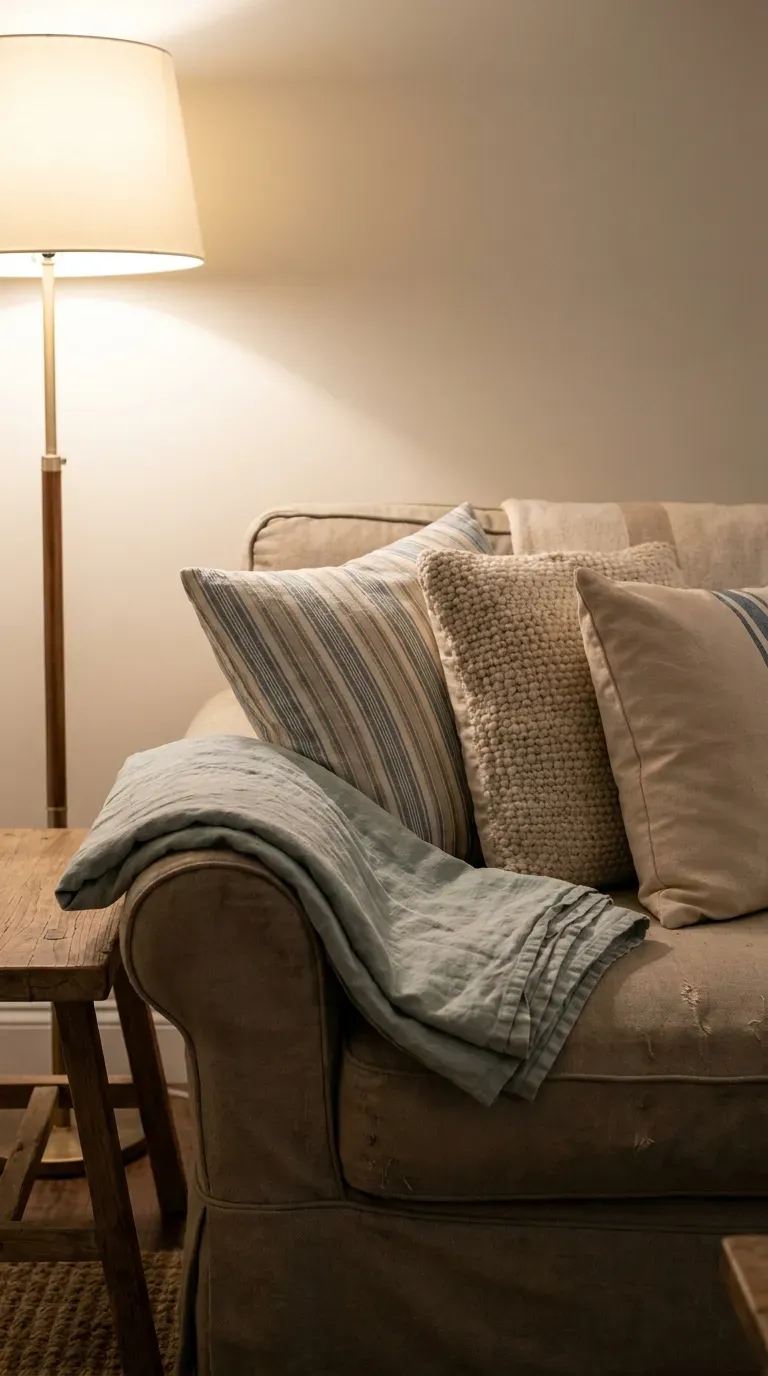
Vibe: Layered and tactile.
Why it works: Mixing textures — linen, woven jute, canvas — rather than matching a single pattern creates depth through touch, a texture-layering principle that substitutes for pattern variety in a neutral coastal palette.
How to get it: Combine three to five pillow covers in different textures but the same tonal family (sand, sea glass, driftwood gray), avoiding matching sets that read as flat.
💡 Quick Win: Swap pillow covers seasonally rather than buying new pillow forms — covers cost a fraction of full pillows.
Shop the Look
| Product |
| Linen throw pillow cover set |
| Woven jute textured pillow cover |
| Canvas striped throw pillow |
| Folded cotton throw blanket |
| Pillow insert forms down-alternative |
16. Reclaimed Boat Wood Media Console
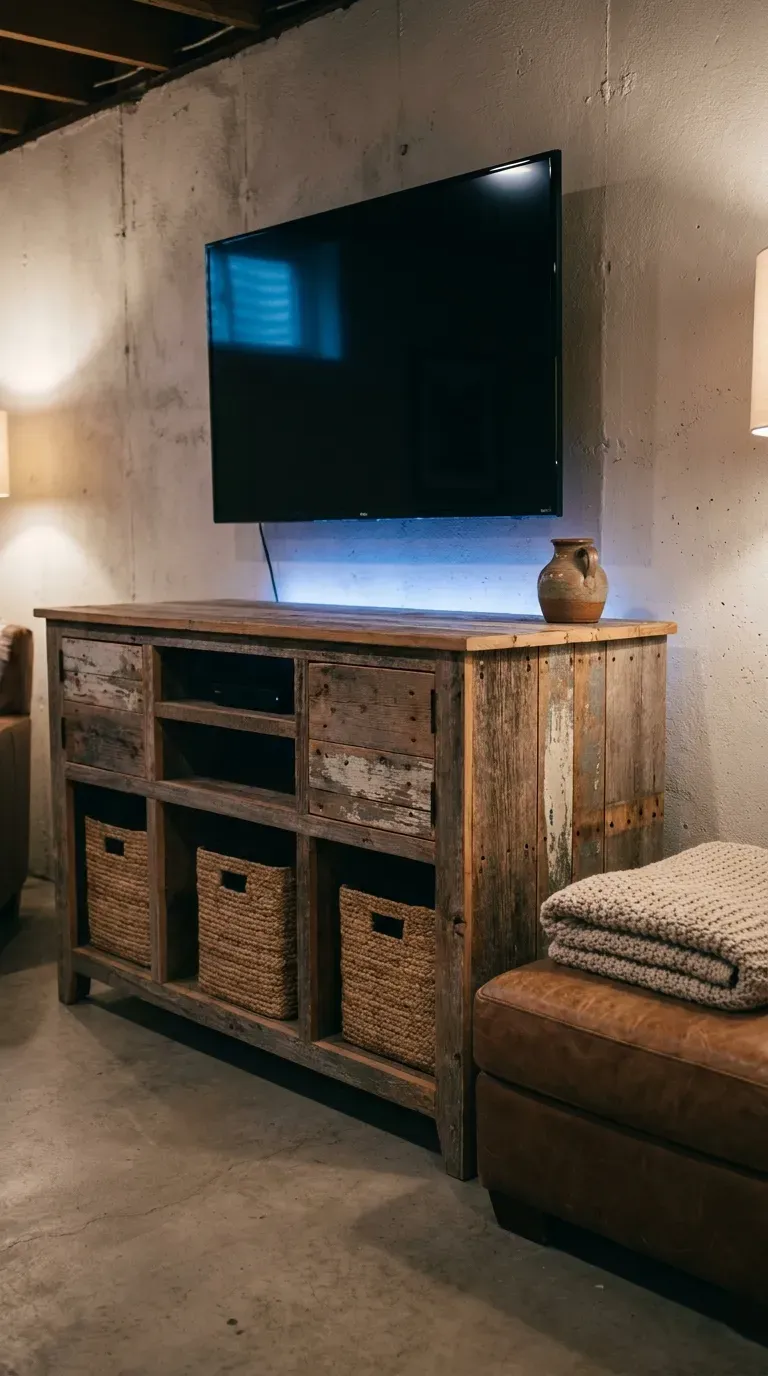
Vibe: Weathered and storied.
Why it works: Reclaimed boat wood carries authentic salt-worn texture and history, a material-authenticity principle that grounds the room’s coastal theme in something genuinely weathered rather than manufactured to look aged.
How to get it: Source reclaimed boat or dock wood from a salvage supplier, building a simple box frame console with open cubby storage rather than closed cabinet doors.
Shop the Look
| Product |
| Reclaimed boat wood console |
| Woven storage basket cubby-fit |
| Ceramic coastal decor accent |
| Round woven ottoman |
| Cotton knit throw blanket |
17. Furniture: Low-Profile Rattan Armchair Pair
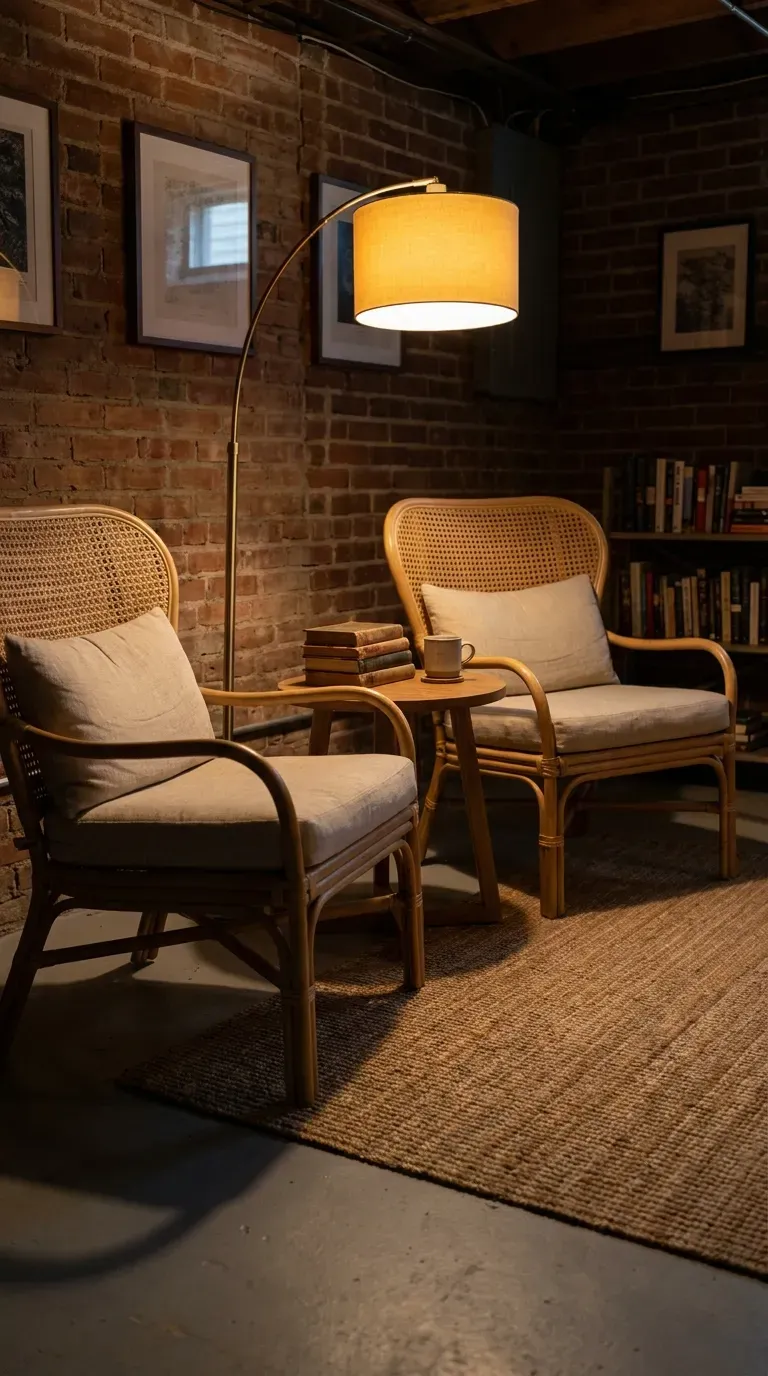
Vibe: Inviting and airy.
Why it works: Rattan’s open weave lets light and sightlines pass through the chair frame itself, a furniture-profile principle where visual weight stays low even with two chairs occupying the same nook.
How to get it: Pair identical rattan chairs with cushions in a solid neutral fabric, angling them slightly toward each other to create a natural conversation nook.
💡 Quick Win: Add a lumbar cushion in sea glass green to break up an otherwise all-neutral seating area.
Shop the Look
| Product |
| Low-profile rattan armchair pair |
| Linen seat cushion replacement set |
| Round rattan side table |
| Coastal floor lamp natural shade |
| Sea glass green lumbar cushion |
18. Ceramic Coastal Table Lamp Duo
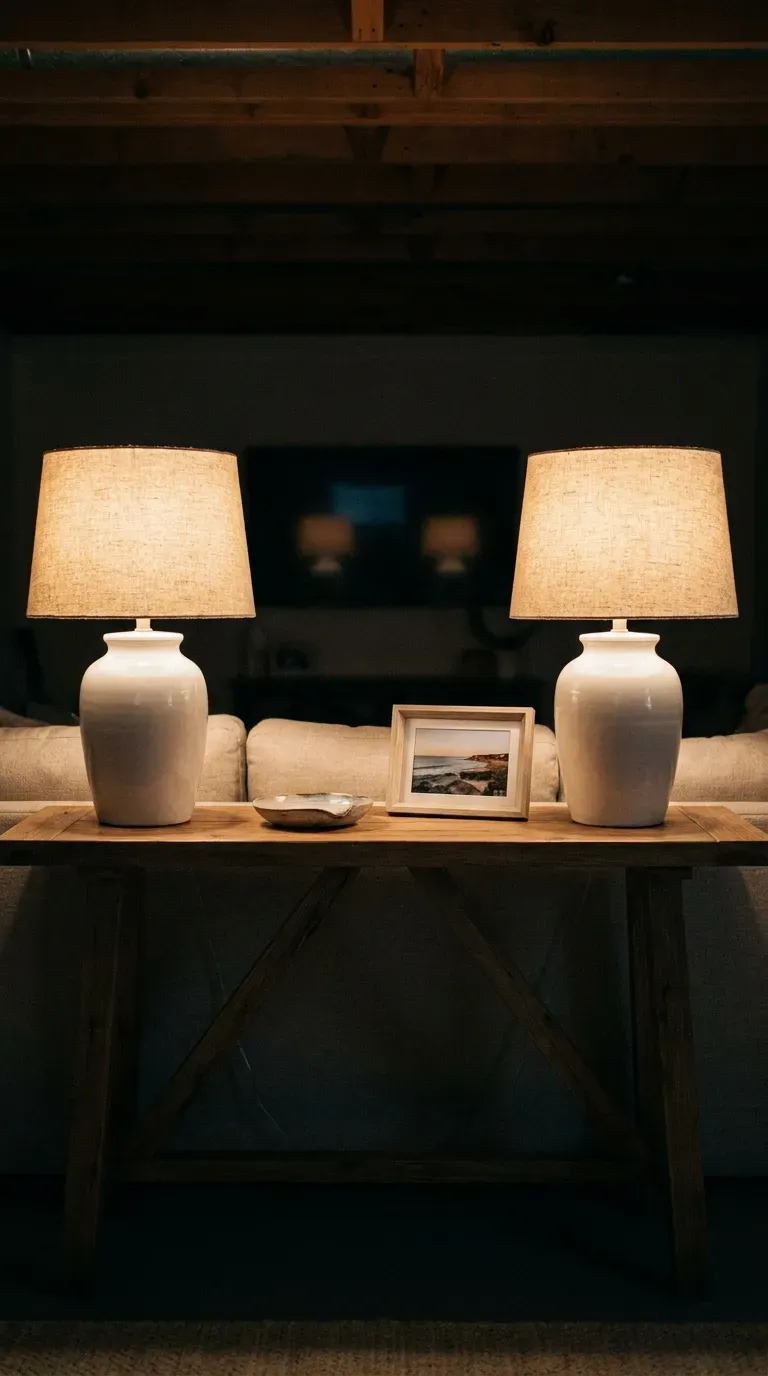
Vibe: Warm and symmetrical.
Why it works: Matched lamp pairs create balanced ambient lighting on either side of a room’s focal point, a lighting-composition principle that reduces harsh shadows common in basements with limited overhead fixtures.
How to get it: Choose ceramic bases in white or sandy beige with linen drum shades, using warm-toned bulbs (2700K) rather than cool white to keep the glow beach-house warm.
Shop the Look
| Product |
| White ceramic table lamp pair |
| Linen drum lamp shade set |
| Wood console table light oak |
| Warm white 2700K LED bulbs |
| Framed coastal photograph print |
19. Painted Beadboard Wainscoting
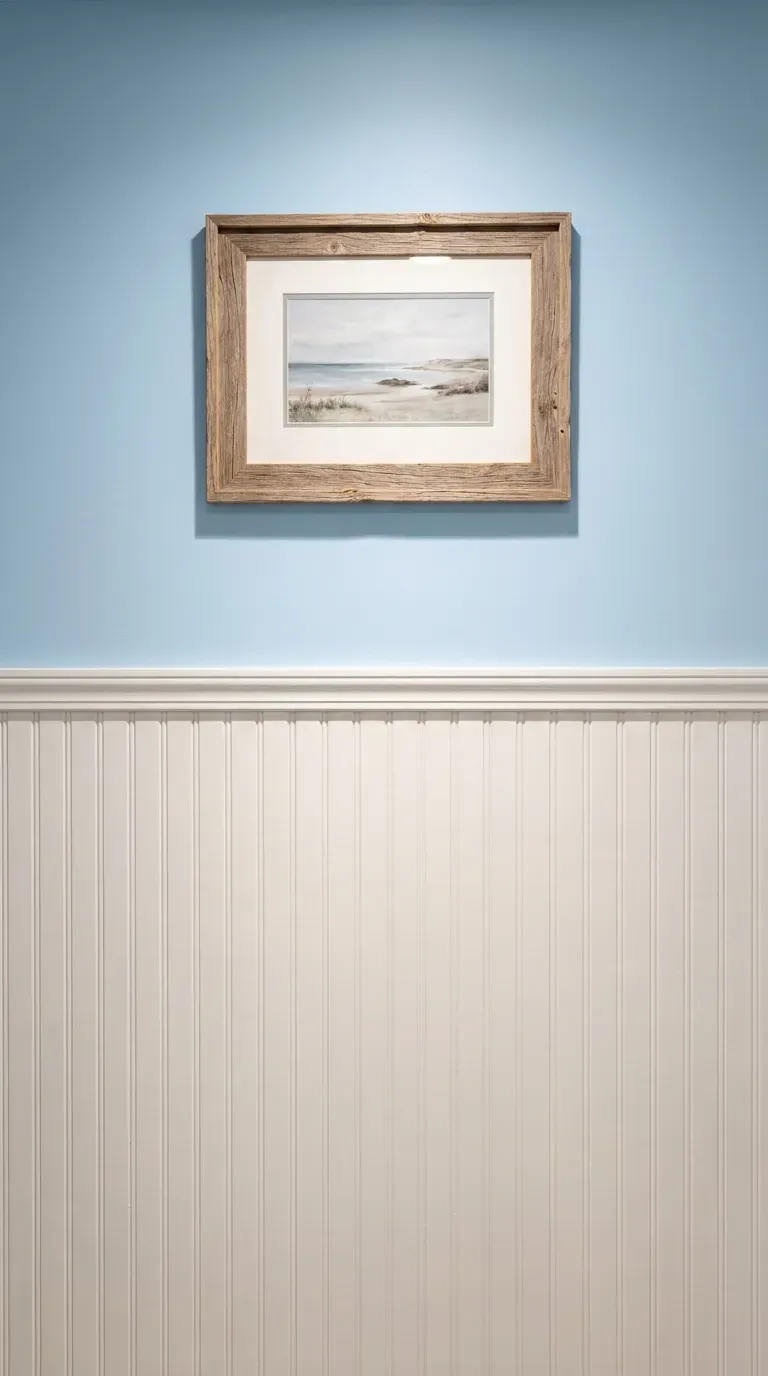
Vibe: Crisp and classic.
Why it works: Beadboard’s vertical grooves add subtle architectural texture without pattern, a material principle that references New England coastal cottages while staying visually quiet enough for a basement.
How to get it: Install beadboard panels to 36 inches, capping with a simple chair rail, and painting the upper wall a contrasting soft blue to create horizontal division that visually lowers the ceiling less than a single flat color would.
💡 Quick Win: Pre-primed MDF beadboard panels install faster than individual tongue-and-groove boards.
Shop the Look
| Product |
| White beadboard panel kit |
| Chair rail trim molding |
| Soft sky blue wall paint |
| Driftwood framed art piece |
| Paintable caulk trim finishing |
20. Small Space Nesting Coffee Table Set
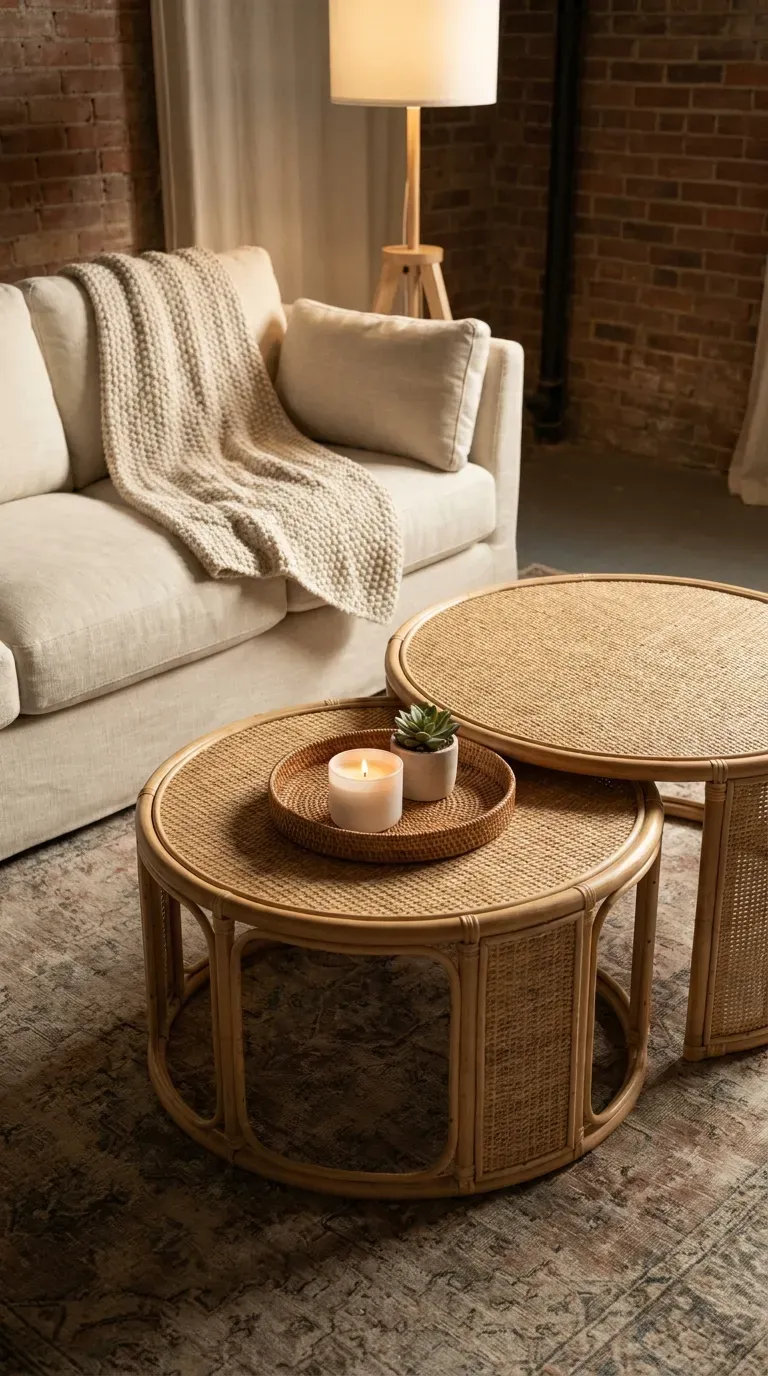
Vibe: Flexible and light.
Why it works: Nesting tables collapse into a single footprint when not both needed, a small-space principle where furniture flexibility substitutes for square footage the basement doesn’t have.
How to get it: Choose a two-piece rattan or rope-wrapped nesting set, pulling the smaller table out for extra surface only when entertaining.
Shop the Look
| Product |
| Rattan nesting coffee table set |
| Woven serving tray small |
| Glass pillar candle coastal scent |
| Linen slipcovered sofa |
| Jute rug small footprint |
21. Accessories: Framed Botanical Coastal Grass Prints
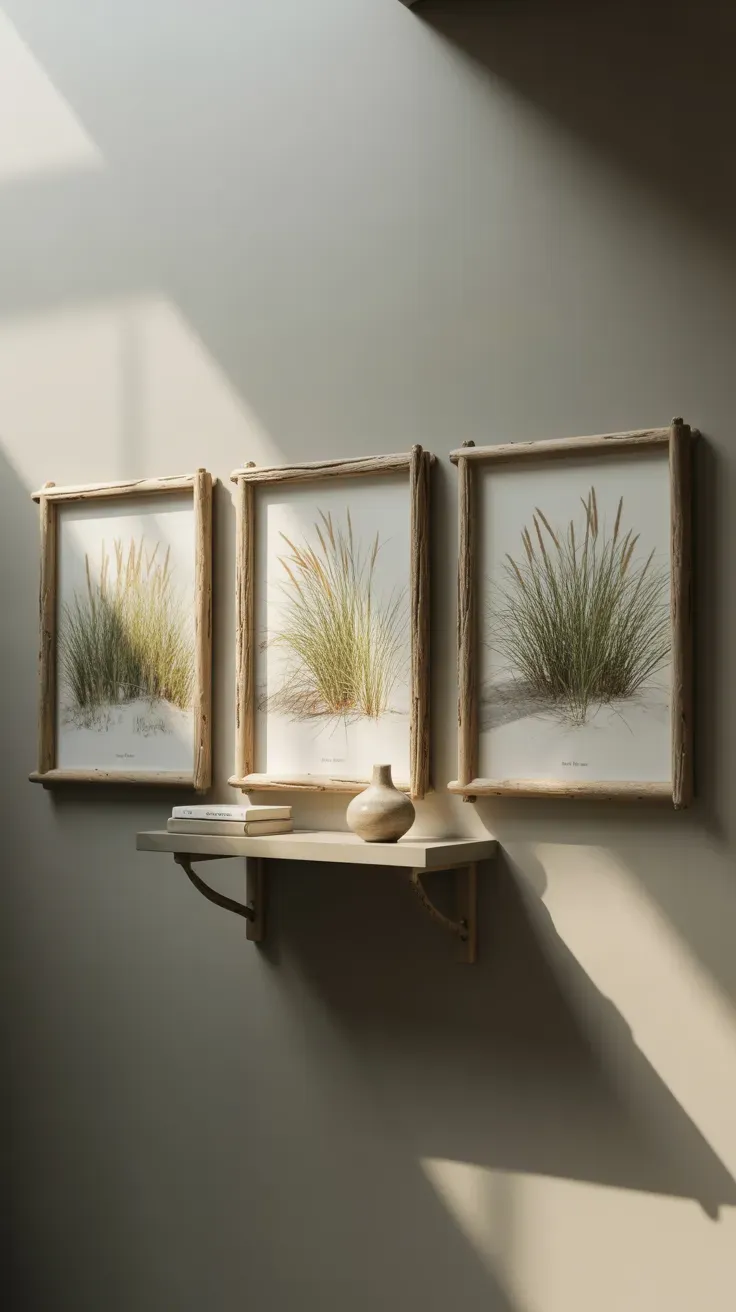
Vibe: Refined and quiet.
Why it works: Botanical line prints add visual interest without competing colors, a restraint principle where subject matter (not color) carries the coastal theme in an otherwise neutral gallery.
How to get it: Choose three prints in matching driftwood or whitewashed frames, spacing them evenly at eye level along a single horizontal line.
💡 Quick Win: Printable botanical art downloads let you frame prints for under $15 each including frames.
Shop the Look
| Product |
| Framed botanical coastal print set |
| Driftwood picture frame natural |
| Floating wood shelf small |
| Ceramic bud vase coastal |
| Picture hanging level kit |
22. Whitewashed Barn Door Room Divider
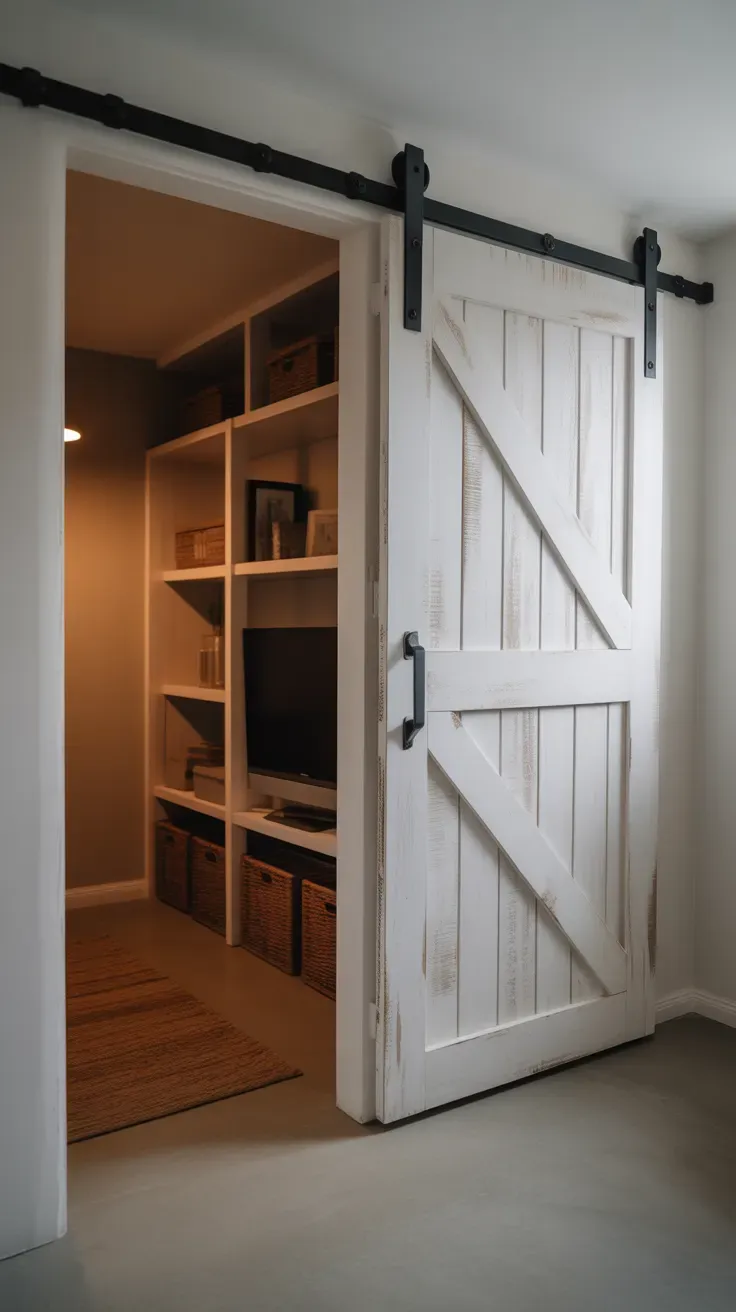
Vibe: Structural and breezy.
Why it works: A sliding door divides space without a permanent wall, a layout principle preserving the open, airy feel coastal basements depend on while still separating functional zones.
How to get it: Whitewash a reclaimed or new barn door panel, mounting it on a black iron track so the door can slide fully open when zone separation isn’t needed.
Shop the Look
| Product |
| Whitewashed barn door panel |
| Black iron barn door track kit |
| Woven floor runner natural |
| Door pull handle black iron |
| Floor guide roller barn door |
23. Cotton Rope Wall Hanging Art
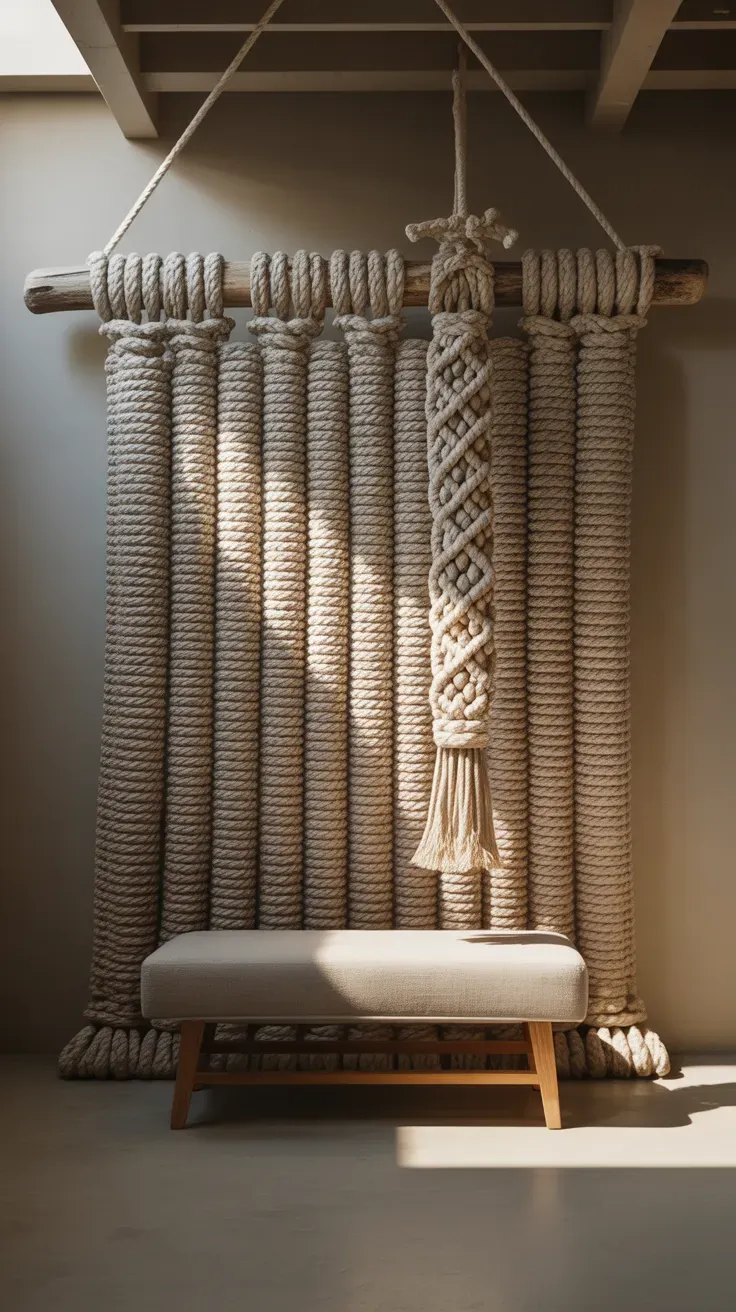
Vibe: Textural and handcrafted.
Why it works: A large-scale woven hanging fills wall space with texture rather than color or framed imagery, a material principle offering visual interest that photographs and paint alone can’t replicate.
How to get it: Choose natural undyed cotton rope on a driftwood dowel, sizing the piece to at least 36 inches wide so it reads as intentional rather than incidental on a large basement wall.
💡 Quick Win: Position the hanging where accent lighting can cast shadow texture onto the wall for added depth.
Shop the Look
| Product |
| Woven cotton rope wall hanging |
| Driftwood mounting dowel natural |
| Linen upholstered accent bench |
| Adjustable wall accent light |
| Picture hanging wire heavy-duty |
24. Furniture: Slatted Rattan Bed Frame Guest Nook
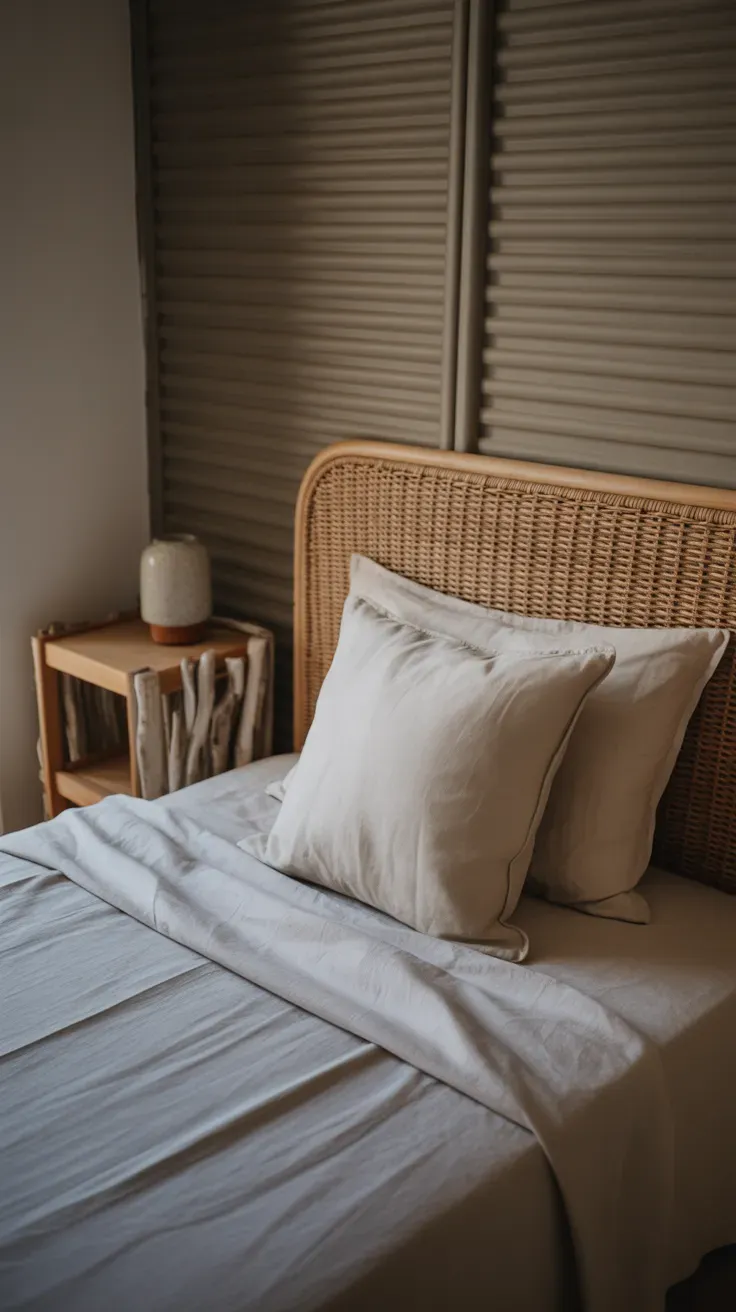
Vibe: Restful and open.
Why it works: An open rattan headboard frame keeps sightlines clear behind it, a furniture-profile principle useful in basement guest rooms where a solid, heavy headboard would visually shrink the space.
How to get it: Choose a rattan or cane headboard frame, dressing the bed in all-white or ivory linen so the frame’s texture stays the visual focus rather than competing patterns.
Shop the Look
| Product |
| Slatted rattan bed frame queen |
| White linen bedding set |
| Driftwood nightstand small |
| Ceramic bedside reading lamp |
| Woven lumbar headboard cushion |
25. Small Space Corner Reading Nook
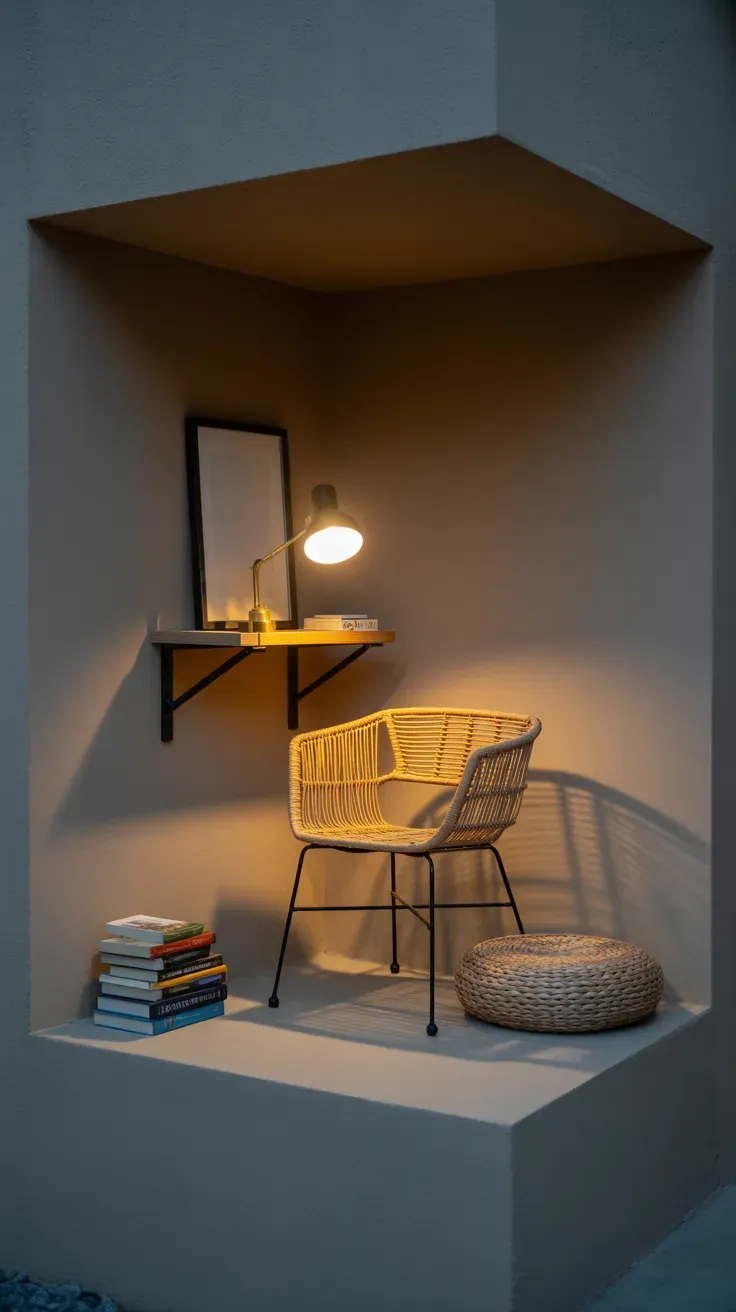
Vibe: Cozy and tucked-away.
Why it works: Using an unused corner rather than open floor space preserves the room’s overall flow, a small-space principle where a single dedicated nook satisfies a function without requiring a full-room layout change.
How to get it: Fit a slim rattan chair into the corner with a wall-mounted fold-down shelf for a lamp and books, skipping a side table entirely to save floor space.
💡 Quick Win: A clip-on reading lamp attached to the chair frame eliminates the need for any table or outlet nearby.
Shop the Look
| Product |
| Compact rattan corner chair |
| Fold-down wall shelf small |
| Clip-on reading lamp warm light |
| Woven floor cushion coastal |
| Small stackable book crate |
How to Start Your Coastal Basement Transformation
Start with the walls — choose one warm white or driftwood gray paint color and apply it throughout before adding any furniture. Wall color determines how much light the whole basement reflects, so it anchors every other decision that follows.
The most common mistake is choosing furniture and decor that’s too dark or saturated, like navy velvet or heavily varnished mahogany. In a windowless room, dark tones absorb what little artificial light exists and make the space feel smaller and moodier than intended. Fix it by sticking to light woods, matte finishes, and mid-tone rather than deep-saturated colors.
Three items under $50 that create immediate impact: a natural jute area rug runner (~$45), a set of three woven storage baskets (~$30), and a driftwood-framed mirror (~$40).
A single-wall refresh — paint plus one furniture piece — can be done in a weekend for under $200. A full basement transformation, including flooring, lighting, and furniture, typically takes 3–6 weekends and runs $1,500–4,000 depending on scope.
Frequently Asked Questions About Coastal Basement Design
What is the difference between coastal and nautical basement design?
Coastal design uses soft, sun-bleached colors like sandy beige and sea glass green with natural materials like jute and rattan, while nautical design leans on bolder navy-and-white stripes, rope, and anchor motifs. Coastal reads as relaxed and airy; nautical reads as more themed and graphic.
What color makes a basement feel most like a beach house?
Warm white and driftwood gray on walls create the strongest beach-house effect because they reflect the most available light in a windowless space. Sea glass green or soft sky blue work well as single accent colors on furniture or one wall, ideally paired with a Sherwin-Williams or Benjamin Moore driftwood-toned neutral base.
How much does it cost to turn a basement into a coastal-style space?
A partial refresh with paint, textiles, and accessories runs $200–800, while a full basement renovation with new flooring, built-in shelving, and furniture typically costs $1,500–4,000. Costs rise significantly if structural lighting changes like recessed fixtures or a faux window installation are added.
Can coastal basement design work without natural light?
Yes — coastal style is particularly well-suited to basements because its core palette of pale, reflective tones and warm-white lighting was designed to counter the absence of daylight. Faux windows with LED backlighting and layered lamp lighting (rather than a single overhead fixture) further compensate for the lack of real sunlight.
What flooring works best for a coastal basement?
Stained concrete in a sandy beige tone or light engineered wood/vinyl plank in a whitewashed finish both work well, since basements need moisture-resistant flooring. Natural jute or sisal rugs layered on top add warmth and texture without introducing moisture-sensitive materials.
Ready to Create Your Dream Coastal Basement?
From whitewashed shiplap walls to rattan lighting and rope-wrapped railings, these 25 ideas cover the full range of colors, materials, and layouts for turning your basement into a genuine coastal retreat. You don’t need every element at once — repainting one wall this weekend is a real, meaningful start. Pick your base wall color today and get a sample swatch tested under your basement’s actual lighting before committing to a full gallon. Once the palette and textures come together, you’ll walk downstairs into a space that feels like it exhales the moment you enter — light, unhurried, and quietly sun-warmed even without a single window. Save your favorite ideas now, especially the ones that lean into your basement’s natural quirks, so you’re ready when the renovation itch hits.