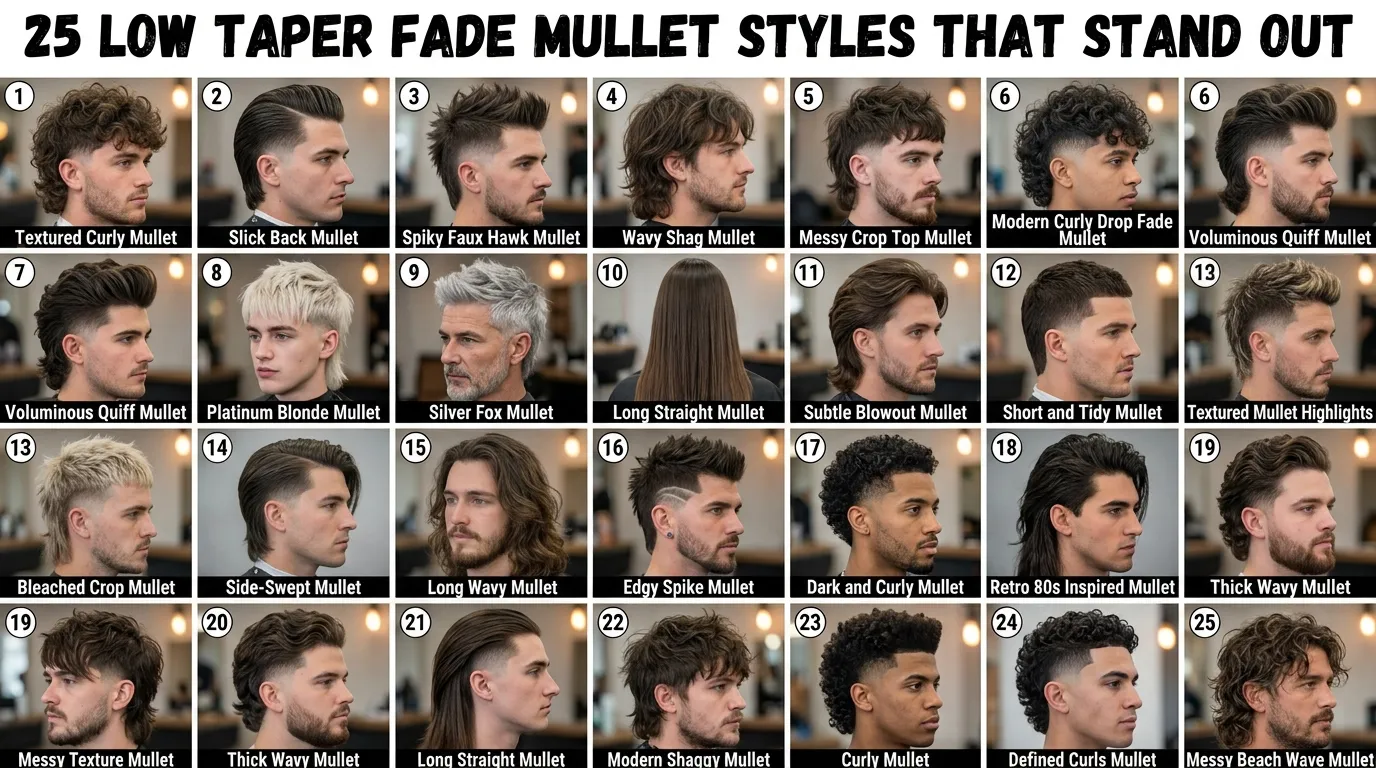
A low taper fade mullet keeps the sides tight and close to the ear while the back grows out long, trading the mullet’s old boxy sides for a clean, gradual blend. This article breaks down 25 low taper fade mullet ideas — different fade techniques, top textures, finishes, and details — built around the modern version of this once-divisive cut.
Worn right, a low taper fade mullet feels like the best parts of two eras colliding — the sharpness of a barbershop fade up front, the freedom of length in the back. The sides stay controlled and close, the tail moves when you do, and the whole shape reads as confident rather than retro-costume. It’s a cut that turns heads without trying too hard, whether you’re styling it slicked back or leaving it shaggy and undone. Here are 25 ideas worth saving — and showing your barber.
Why the Low Taper Fade Mullet Works So Well
The low taper fade mullet pairs a fade that starts low, near the ear and nape, with a mullet’s signature short-to-long structure — shorter at the front and sides, noticeably longer at the back. It descends from the classic 1970s–80s mullet but replaces the original’s often blunt, unblended sides with a modern taper fade, which is what separates today’s version from the mullet that had a reputation problem for decades. A traditional mullet used scissors throughout; this version uses clippers on the sides and length in the back for sharper contrast.
Technically, the low taper starts with a 1 or 1.5 guard at the nape and sideburns, blending into a 2 or 3 within an inch of rising, while the back is left to grow past the collar and often shaped with texturizing shears to avoid a blunt, flat edge. Matte clay or a light sea salt spray tends to finish the top and front, while the back is frequently left product-free to keep its natural movement.
It’s trending now largely because of a broader 90s-and-2000s style revival across music and streetwear, plus a wave of athletes and musicians bringing the mullet back into mainstream barbershop requests after years of it being an ironic joke cut. Social platforms have amplified this — mullet transformation videos consistently perform well, which has pushed barbers to refine the fade-mullet pairing into something sharper than the style’s original reputation.
It works on straight, wavy, and curly hair alike, since the length differential does most of the visual work regardless of texture — though very fine, thin hair may need a perm or texturizing spray to keep the back from looking stringy. Face shape matters less here than in most cuts, since the length at the back draws attention downward and away from jaw or cheek width.
Style at a Glance
| Element | Classic Approach | Modern Approach |
| Philosophy | Fade contrast up front, length preserved at the back | Sharp taper paired with deliberately shaggy, textured length |
| Technique | 1.5 guard blending to 2.5, scissor-shaped back | Skin-out taper with texturized, point-cut mullet tail |
| Best for | Straight to wavy hair, most face shapes | Any texture with added product for fine hair |
25 Low Taper Fade Mullet Ideas
1. Classic Skin Fade Mullet

Vibe: Sharp and unmistakably intentional.
Why it works: The skin-out nape gives maximum contrast right where the fade meets the mullet’s length, so the transition from bare skin to flowing hair reads as a deliberate design choice rather than an accidental grow-out.
How to get it: Ask your barber for “a skin fade low taper, 0 at the nape blending to a 2, leave the back mullet length untouched.” Book a touch-up on the sides every 2–3 weeks while letting the back grow uninterrupted.
💡 Quick Win: A small handheld trimmer with a 0-guard lets you clean up the nape edge yourself between full barbershop visits without disturbing the mullet length.
Shop the Look
| Product |
| Cordless clipper with skin-out blade |
| Matte texturizing clay for the top |
| Neckline edger for at-home touch-ups |
| Detangling brush for mullet length |
| Lightweight leave-in for the back section |
2. Shaggy Textured Mullet Top

Vibe: Rugged and unbothered.
Why it works: Point-cutting the top and crown into uneven pieces gives the mullet its signature shag texture, and the low taper on the sides keeps that intentional messiness from tipping over into looking unkempt.
How to get it: Ask your barber to “texturize the top with point-cutting shears, don’t blunt-cut the ends.” Finish at home by scrunching a matte texturizing spray through damp hair instead of combing it smooth.
Shop the Look
| Product |
| Matte texturizing spray |
| Point-cutting shears (barber-grade) |
| Sea salt texture spray |
| Wide-tooth wooden comb |
| Lightweight sculpting paste |
3. Hard Part Mullet

Vibe: Sharp and deliberate.
Why it works: A hard part gives the front of the cut a crisp anchor point, which contrasts sharply with the loose, flowing length at the back — the combination of one very structured element and one very loose one is what gives this mullet its edge.
How to get it: Ask for “a hard part above the low taper on the sides, but leave the mullet length untouched.” Because the line grows out within a week, plan on a touch-up every seven to ten days to keep it crisp.
Shop the Look
| Product |
| Straight razor for line touch-ups |
| Edge control gel for hairline definition |
| Small precision trimmer |
| Barber cape and neck duster set |
| Aftershave balm for razor-sensitive skin |
4. Drop Fade Mullet

Vibe: Rugged with a custom edge.
Why it works: Curving the fade line downward behind the ear instead of keeping it straight follows the natural curve of the skull, which tends to flatter rounder head shapes better than a straight taper line paired with mullet length.
How to get it: Request “a drop fade low taper mullet — curve the line behind the ear, keep the back length as is.” This shape is freehanded, so it takes longer in the chair, especially on a first visit.
💡 Quick Win: Bring a reference photo of the exact curve angle you want — drop fades vary a lot barber to barber, and a photo removes the guesswork.
Shop the Look
| Product |
| Dual-blade clipper for curved lines |
| Matte styling clay for the top |
| Neck brush for post-cut cleanup |
| Barbershop-grade clipper oil |
| Texturizing sea salt spray |
5. Matte Clay Textured Mullet

Vibe: Clean-cut with zero shine.
Why it works: Matte clay dries down to a flexible hold without gloss, keeping the front and top understated so the length at the back stands out as the mullet’s focal point instead of competing with a shiny top.
How to get it: Rub a pea-sized amount of matte clay between palms until slightly warm, then work it through the damp top and front, leaving the back mostly product-free for natural movement.
Shop the Look
| Product |
| Strong-hold matte clay |
| Curl or texture-separating cream |
| Boar bristle detail brush |
| Mattifying dry shampoo spray |
| Travel-size clay tin for touch-ups |
6. Curly Mullet Top

Vibe: Bold and naturally textured.
Why it works: Curly hair gives the mullet’s back section extra volume and bounce without any styling effort, and the low taper on the sides keeps that natural fullness from reading as bulky or shapeless.
How to get it: Apply a curl-defining cream to damp hair after washing and let curls air-dry or diffuse naturally, asking your barber to keep the taper subtle so the curl pattern stays the visual focus.
Shop the Look
| Product |
| Curl-defining cream |
| Wide-tooth detangling comb |
| Sulfate-free curl-friendly shampoo |
| Diffuser attachment for curl drying |
| Satin-lined cap for overnight curl protection |
7. Hairline Design Mullet

Vibe: Bold and detail-driven.
Why it works: A single thin line traced parallel to the hairline adds a graphic accent to the front of the cut, giving the eye a sharp anchor point that balances against the loose, undone length at the back.
How to get it: Ask for “one thin line along the hairline, nothing elaborate, low taper mullet on the sides and back.” Simple single-line designs need a touch-up roughly every five to seven days since the fine detail grows out fastest.
Shop the Look
| Product |
| T-blade trimmer for fine line work |
| Design stencil kit for hairline art |
| Antiseptic aftercare spray |
| Precision edge control gel |
| Handheld mirror for design touch-ups |
8. Burst Fade Mullet

Vibe: Edgy with a custom finish.
Why it works: A burst fade wraps around the ear in a semicircle instead of continuing in a straight taper line down the neck, adding an extra layer of detail to the front half of a cut that’s already doing a lot with its back length.
How to get it: Ask your barber to “burst the fade around the ear, keep it low, and don’t touch the mullet length in back.” This freehand shape needs a barber experienced with burst fades specifically.
💡 Quick Win: This fade holds its shape slightly longer than a straight taper since the curved line disguises early regrowth better.
Shop the Look
| Product |
| Cordless detail trimmer for ear curves |
| Texturizing spray for the top |
| Light-hold styling cream |
| Clipper guard set (0.5 to 3) |
| Aftercare healing balm for razor lines |
9. Slicked-Back Mullet

Vibe: Polished and commanding.
Why it works: Slicking the top back with a strong gel creates a sleek, controlled front that plays against the mullet’s naturally loose back length, giving the whole cut a “business up front” formality that the original mullet joke was built on — done seriously this time.
How to get it: Apply a strong-hold water-based gel to damp hair and comb straight back, letting the mullet length at the back stay loose and untouched for contrast.
Shop the Look
| Product |
| Strong-hold water-based styling gel |
| Fine-tooth pocket comb |
| Blow dryer with concentrator nozzle |
| Anti-humidity hold spray |
| Silk durag for overnight lay-down |
10. Glossy Pomade Mullet

Vibe: Polished and camera-ready.
Why it works: A water-based pomade gives the top a controlled, glossy finish without the stiffness of gel, letting the front hold its shape while the mullet’s back length still moves naturally instead of getting stiff along with it.
How to get it: Work a dime-sized amount of pomade through damp hair on top only, combing lightly for shine, and leave the back section product-free so its natural texture and shine come through untouched.
Shop the Look
| Product |
| High-shine water-based pomade |
| Fine-tooth styling comb |
| Microfiber towel for gentle drying |
| Light-hold finishing spray |
| Silk pillowcase for shine retention |
11. Long Flowing Mullet Tail

Vibe: Rugged with dramatic movement.
Why it works: Growing the back section well past the collar maximizes the length contrast that defines a mullet in the first place, and keeping the sides at a tight low taper is what stops the extra length from reading as simply “long hair” instead of a shaped cut.
How to get it: Trim only the ends of the back section every 10–12 weeks to maintain length while removing split ends, and ask your barber to keep the sides sharply tapered so the contrast stays dramatic.
Shop the Look
| Product |
| Deep conditioning treatment for length |
| Wide-tooth detangling comb |
| Leave-in conditioner for the tail |
| Heat protectant spray for occasional styling |
| Silk pillowcase for length protection |
12. Mullet with Beard Pairing

Vibe: Rugged and fully framed.
Why it works: A full, shaped beard adds visual weight to the front of the face, balancing out the extra length and volume the mullet carries at the back so the whole look feels proportioned front to back.
How to get it: Ask your barber to “line up the beard at the same intensity as the taper — nothing sharper on one than the other.” A beard oil applied nightly keeps the connecting hair along the jaw soft enough to blend cleanly into the fade.
Shop the Look
| Product |
| Beard trimmer precision edge kit |
| Beard oil for jawline blending |
| Beard shaping template/guide |
| Boar bristle beard brush |
| Beard balm for shape hold |
13. Temple Fade Mullet

Vibe: Sharp in a subtle way.
Why it works: Confining the tightest fade to a small triangle at the temple keeps most of the sides at a gentler taper, making this one of the more understated mullet variations — good for anyone easing into the style without a dramatic fade.
How to get it: Ask for “a small temple fade only, keep the rest of the sides at a low taper without much contrast, leave the back mullet length as is.”
💡 Quick Win: Because the fade area is small, a compact detail trimmer works well for at-home upkeep between barbershop visits.
Shop the Look
| Product |
| Compact detail trimmer |
| Light-hold styling cream |
| Curved nape guard attachment |
| Fade-line highlighting comb |
| Soothing post-shave balm |
14. Round Face Mullet Adaptation

Vibe: Sharp with intentional height.
Why it works: Rounder face shapes benefit from vertical volume on top rather than width on the sides, so building height at the crown while keeping the low taper tight visually elongates the face — the mullet’s back length then draws the eye further downward, reinforcing the elongated line.
How to get it: Ask for “extra length at the crown, styled upward with a matte clay for lift, low taper kept close on the sides.” Avoid brushing the top flat or wide, since that reintroduces roundness.
Shop the Look
| Product |
| High-lift matte clay |
| Round barrel brush for volume |
| Root-lifting spray |
| Blow dryer with diffuser |
| Light-hold finishing spray |
15. Sea Salt Spray Beach Mullet

Vibe: Effortless and lived-in.
Why it works: A sea salt spray adds grit and texture without weighing hair down, giving the top and back a naturally tousled, “just came from outside” look that suits the mullet’s inherently casual, undone character better than a smoothed or gelled finish.
How to get it: Spray sea salt spray onto damp hair and scrunch throughout the top and back, letting it air-dry for a textured, matte finish rather than blow-drying it smooth.
Shop the Look
| Product |
| Texturizing sea salt spray |
| Lightweight matte styling cream |
| Wide-tooth detangling comb |
| Microfiber towel for gentle drying |
| Dry shampoo for added grip |
16. Wavy Mullet Top

Vibe: Clean-cut with natural movement.
Why it works: Wavy hair holds a soft, rolling shape without much product, and the low taper on the sides gives that natural wave pattern a defined edge so it reads as styled rather than simply grown out.
How to get it: Apply a light styling cream to damp waves and let them air-dry undisturbed, asking your barber to keep the sides at a subtle 1.5-to-2 taper so the wave pattern stays the visual focus.
Shop the Look
| Product |
| Lightweight wave-defining cream |
| Wide-tooth detangling comb |
| Curl or wave enhancing spray |
| Diffuser attachment for wave drying |
| Silk pillowcase for wave retention |
17. Curtain Bangs Mullet

Vibe: Bold and framing.
Why it works: Curtain bangs parted at the center frame the face on both sides, adding a distinct front detail that pairs with the mullet’s back length to create a cut with a clear, deliberate shape from every angle.
How to get it: Ask your barber to “cut curtain bangs that part naturally at the center, low taper on the sides, keep the mullet length at the back.” Style bangs daily with a light texturizing spray and a round brush for shape.
Shop the Look
| Product |
| Lightweight texturizing spray |
| Small round brush for bangs |
| Flat iron for curtain bang shaping |
| Anti-frizz smoothing serum |
| Fine-tooth comb for center parting |
18. High-Contrast Low Taper Mullet

Vibe: Sharp and high-impact.
Why it works: Dropping the starting guard lower than a standard low taper creates a steeper, more dramatic contrast line at the nape, making this version read bolder than the classic low taper mullet without changing the fade’s height.
How to get it: Ask your barber to “drop the guard to a 0.5 at the nape instead of a 1, keep the fade height the same, just sharper contrast, mullet length untouched.” This version needs slightly more frequent touch-ups since the steep line grows out faster.
Shop the Look
| Product |
| Precision clipper with adjustable taper lever |
| Matte styling clay for the top |
| Fade comb for blend touch-ups |
| Clipper guard set (0.5 to 2) |
| Curl or texture sheen spray |
19. Side-Part Mullet

Vibe: Polished and put-together.
Why it works: A defined side part gives the front of the cut a formal, structured shape, which contrasts deliberately against the mullet’s loose, unstructured back length — the tension between the two is the whole appeal of this variation.
How to get it: Comb a light-hold pomade through damp hair, then use a fine comb to carve a straight or slightly angled part before the product sets. Ask your barber to keep the taper subtle so it doesn’t pull focus from the part.
Shop the Look
| Product |
| Light-hold pomade for side part |
| Fine-tooth parting comb |
| Ceramic flat iron for smoothing |
| Anti-frizz smoothing serum |
| Hairspray for all-day part hold |
20. Low-Maintenance Grow-Out Mullet

Vibe: Effortless and forgiving.
Why it works: Because the low taper’s blend zone is small and close to the ear, it grows out more gracefully than a higher fade — the line softens gradually instead of leaving an obvious grown-out band, which matters since mullets are already meant to be worn a bit loose.
How to get it: Ask your barber to leave slightly more length in the initial blend guard (a 2 instead of a 1.5) so regrowth softens the line naturally rather than creating a hard demarcation within days.
💡 Quick Win: A light leave-in conditioner keeps the grown-out sides soft enough to brush down and blend by hand between cuts.
Shop the Look
| Product |
| Lightweight daily leave-in conditioner |
| Soft-bristle blending brush |
| Texture refresher spray |
| Travel trimmer for emergency touch-ups |
| Wide-tooth comb for gentle detangling |
21. Short Cropped Mullet Fringe

Vibe: Clean-cut with a modern edge.
Why it works: A short, blunt fringe up front keeps the styled portion of the cut minimal and low-effort, throwing all the visual interest onto the mullet’s back length instead of splitting attention between two statement elements.
How to get it: Ask your barber to “keep the fringe short and blunt, low taper on the sides, don’t touch the back length.” A small amount of matte cream worked through the fringe keeps it from looking flat.
Shop the Look
| Product |
| Matte finishing cream for fringe |
| Small precision shears |
| Detail trimmer for fringe edges |
| Lightweight hold spray |
| Wide-tooth comb for the back length |
22. Texturizing Powder Mullet

Vibe: Rugged with instant texture.
Why it works: Texturizing powder adds grip and root lift in seconds without the weight or shine of a cream or gel, making it the fastest way to add volume to the top of a mullet on days when you don’t want to wet-style.
How to get it: Sprinkle a small amount of texturizing powder at the roots, work it in with your fingertips, and tousle for lift — this takes under a minute and works best on second- or third-day hair.
Shop the Look
| Product |
| Texturizing volume powder |
| Wide-tooth detangling comb |
| Dry shampoo for grip and freshness |
| Lightweight matte paste for the ends |
| Boar bristle brush for even distribution |
23. Wet-Look Mullet Finish

Vibe: Polished and camera-ready.
Why it works: A wet-look gel finish on the top and front creates a controlled, glossy contrast against the mullet’s naturally looser back section, giving the whole cut a styled-front, undone-back visual split that photographs well from any angle.
How to get it: Apply a small amount of high-shine gel to damp hair on top only, combing for a smooth finish, and leave the back length product-free so it keeps its natural texture.
Shop the Look
| Product |
| High-shine wet-look gel |
| Fine-tooth styling comb |
| Spray bottle for re-wetting the top |
| Microfiber towel for gentle drying |
| Silk pillowcase for shine retention |
24. Long Face Mullet Adaptation

Vibe: Polished and proportioned.
Why it works: Longer face shapes are balanced by width rather than added height, so styling the top outward instead of upward keeps the face from looking stretched further, while the mullet’s back length adds visual interest without adding more length to the silhouette’s vertical line.
How to get it: Ask your barber to “keep the top width-focused, not lifted, low taper on the sides to balance proportion.” A texturizing cream worked through damp hair and styled outward with fingers achieves this without heat tools.
Shop the Look
| Product |
| Texturizing cream for outward styling |
| Wide-tooth pick for shaping |
| Lightweight anti-frizz serum |
| Flexible-hold finishing spray |
| Detangling brush for the mullet tail |
25. Wash-and-Wear Mullet

Vibe: Effortless and low-fuss.
Why it works: Letting the entire cut air-dry without heat tools or lengthy styling relies on the low taper’s clean lines and the mullet’s inherent shape to do all the visual work, making this the lowest-effort version of the style day to day.
How to get it: Towel-dry hair after washing, apply a lightweight leave-in conditioner, and let it air-dry completely without touching it — the low taper on the sides keeps this simple routine from looking unfinished.
💡 Quick Win: Running fingers through the hair once it’s fully dry adds just enough separation to avoid a flat, helmet-like finish.
Shop the Look
| Product |
| Lightweight leave-in conditioner |
| Sulfate-free daily shampoo |
| Soft-bristle detangling brush |
| Texture refresher spray |
| Silk pillowcase for overnight care |
How to Ask Your Barber for a Low Taper Fade Mullet
Start with one clear reference point: a close-up photo showing exactly where the taper should sit on the sides and how much length to preserve at the back, since “mullet” alone can mean anything from subtle to extreme depending on the shop. Naming the guard numbers directly — for example, “1.5 blending to 2.5 on the sides, don’t touch the back” — anchors the conversation and prevents a barber from trimming more length off the back than you wanted.
The most common mistake is not being specific enough about the back length, which often results in the mullet’s signature length getting trimmed down during a routine side cleanup. Fix this by pointing to an exact length marker, like “keep the back at collarbone length,” so there’s no ambiguity during future touch-ups.
Three budget entry points under $20 that create immediate impact: a 2oz tin of matte texturizing clay, a compact cordless detail trimmer for at-home side touch-ups, and a texturizing sea salt spray for the mullet’s back section.
Realistically, the sides of a low taper fade mullet need a barbershop refresh every 2–3 weeks to keep the blend crisp, typically running $25–$45 per visit, while the back length only needs a trim every 8–12 weeks to maintain shape. Daily styling — texturizing the top, adding sea salt spray to the back — can be done entirely at home, but the fade line itself should be left to a barber.
Frequently Asked Questions About Low Taper Fade Mullet Styles
What’s the difference between a low taper fade mullet and a classic mullet?
A classic mullet traditionally used scissors throughout with a shorter, often blunt cut on the sides, while a low taper fade mullet replaces those sides with a clipper-blended fade that stays close to the ear and nape. The result is a sharper, more modern contrast between the sides and the preserved length at the back.
Does a low taper fade mullet work on all hair types?
Yes, it works on straight, wavy, and curly hair, since the length difference between the sides and back does most of the visual work regardless of texture. Very fine, thin hair is the one exception where the back section can look stringy without a texturizing spray or occasional perm for added body.
How much does a low taper fade mullet cost?
Most barbershops charge between $25 and $45 for the fade portion of the cut, since the back length typically just needs shaping rather than a full haircut. At-home upkeep between visits — a detail trimmer, texturizing spray, and leave-in conditioner — typically costs under $60 total to set up.
How often does a low taper fade mullet need a touch-up?
The sides need a refresh every 2 to 3 weeks to keep the low taper crisp, while the back length only needs trimming every 8 to 12 weeks to maintain its shape and remove split ends. This split maintenance schedule is one of the more practical aspects of the style once you get used to it.
What’s the best product for styling a low taper fade mullet?
For the top and front, a matte texturizing clay or spray gives the cleanest daily finish without weighing hair down, while the back section usually looks best with minimal to no product so its natural movement and length can show. For a more polished version, a water-based pomade on the front paired with a product-free back creates the sharpest contrast.
Ready to Try a Low Taper Fade Mullet?
Between fade techniques, top textures, and finishing styles, these 25 ideas cover a lot more ground than a single “mullet” search usually turns up. Finding your version is rarely a one-visit decision — plenty of guys start with a subtle temple fade and shaggy top, then work up to a bolder skin-out taper with a longer tail a few cuts later, and that’s a completely normal way to land on what actually suits you. Start today by saving your two or three favorite reference photos so you have them ready the next time you’re in the chair. Whichever version you land on, a clean low taper fade mullet has a way of making the whole look feel deliberate instead of accidental — sharp where it counts, loose where it matters. Pin the ones that caught your eye so your barber can see exactly what “mullet” means to you.