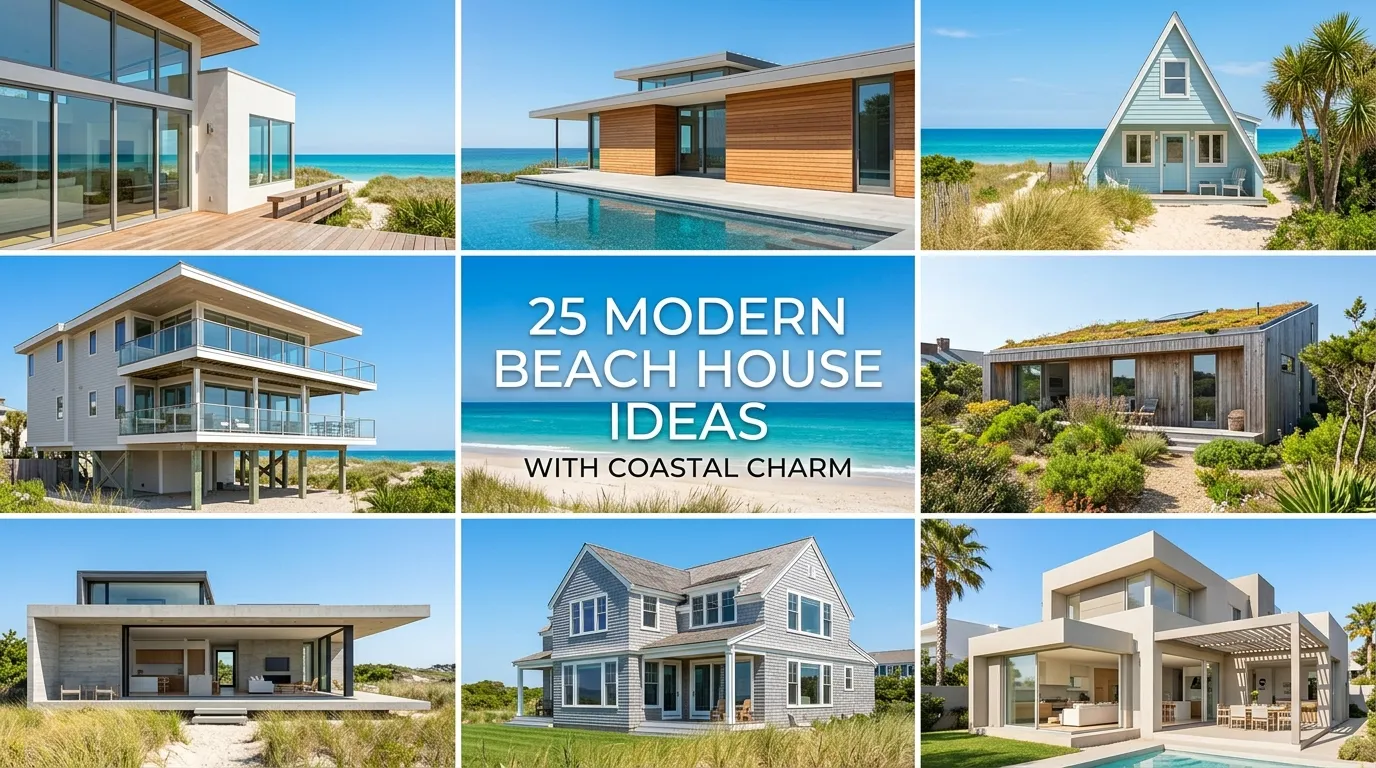
Modern beach house design blends relaxed coastal living with clean architectural lines — it’s the sweet spot between barefoot ease and thoughtful, intentional style. This article gives you exactly 25 modern beach house ideas packed with material inspiration, layout strategies, color direction, and room-by-room ideas you can actually use.
Imagine salt air drifting through open windows. Linen curtains catching an afternoon breeze. Light that moves across whitewashed walls all day, warm and liquid and unhurried. This is coastal living stripped of kitsch and rediscovered as something genuinely livable — where the ocean is the wallpaper and every room feels like an exhale. Here are 25 ideas worth saving — and stealing.
Why Modern Beach House Design Works So Well
Modern beach house style is rooted in mid-century California modernism and Scandinavian minimalism, shaped by the practical demands of coastal living — sun bleaching, humidity, salt air, and the need for spaces that flow between indoors and outdoors without friction. Unlike traditional coastal décor (nautical ropes, anchors, seashell collections), the modern interpretation strips away nostalgia and lets the architecture and natural light do the heavy lifting. It owes as much to Neutra and Rudolph Schindler as it does to any trend cycle.
The material palette is elemental and specific: whitewashed or wire-brushed white oak flooring, Venetian plaster or limewash walls in shades of warm white or bleached driftwood, linen and bouclé upholstery, rattan and cane furniture frames, honed limestone or Calacatta marble countertops, and brushed nickel or matte black hardware. The color story lives in a tight band — shell white, warm greige, sea-glass sage, soft coastal blue, and sun-bleached sand. Nothing shouts. Everything breathes.
The current surge in modern coastal popularity isn’t accidental. Post-pandemic, people redesigned their homes as restorative environments rather than status symbols. Pinterest searches for “modern coastal living room” tripled between 2021 and 2024. The aesthetic maps perfectly onto the wellness-driven, biophilic design movement — natural materials, soft light, and negative space all actively reduce visual stress.
Small spaces can absolutely achieve this style — with one important priority: light over layering. In a compact beach cottage or apartment, a limewash wall treatment and a single oversized linen sofa will deliver more coastal impact than a room crowded with “ocean-themed” accessories. The palette creates the atmosphere; the room size is secondary.
Style at a Glance
| Element | Coastal Trait | Modern Trait |
| Philosophy | Ease, flow, connection to nature | Restraint, intention, clean form |
| Materials | Rattan, linen, whitewashed oak, limestone | Plaster walls, concrete, cane, brushed metal |
| Color Palette | Shell white, sea-glass sage, sand | Warm greige, bleached driftwood, soft coastal blue |
25 Modern Beach House Ideas With Coastal Charm
1. Limewash Walls in Driftwood White

Vibe: Still — the way a room feels at six in the morning before anyone is awake.
Why it works: Limewash paint is one of the few wall treatments that genuinely mimics the organic, time-worn texture of coastal architecture. Unlike flat paint, it creates micro-depth by absorbing and reflecting light differently across the day — so your wall at noon looks different from your wall at golden hour. That movement reads as life, not decoration. The driftwood white tone (slightly warm, slightly chalky) avoids the sterility of bright white without pulling toward cream or yellow.
How to get it: Apply Portola Paints’ “Lime Wash” in Roman Clay or a similar two-coat technique with a wide masonry brush in overlapping, crosshatch strokes. Don’t aim for uniformity — the variation is the point. One 5-gallon bucket covers approximately 400 square feet.
💡 Quick Win: A sample jar of limewash paint costs under $15. Test on a 2×3 ft section of your existing wall this weekend before committing to the full room.
Shop The Look
| Product |
| Limewash interior wall paint matte white driftwood |
| Oversized linen sofa slipcover natural white |
| White oak floating console table entryway |
| Dried pampas grass arrangement coastal decor |
| Matte ceramic bud vase set neutral tones |
2. Rattan Bed Frame With Linen Bedding

Vibe: Sun-warmed — the texture of a lazy Sunday with nowhere to be.
Why it works: Rattan brings organic material warmth to a room without adding visual weight, which is essential in coastal spaces where lightness is the entire point. The open weave of a rattan headboard allows the wall behind it to remain part of the composition — it doesn’t block or dominate. Paired with washed linen (not cotton percale, which reads as crisp and urban), the bed becomes a textural anchor that still feels relaxed.
How to get it: Source a rattan or cane bed frame in natural, unsealed finish — avoid the painted or lacquered versions, which lose the material’s warmth. Layer bedding in two-tone linen: a warm white duvet with an oat-colored linen flat sheet folded over the top edge, European shams in the same oat.
Shop The Look
| Product |
| Natural rattan bed frame queen with headboard |
| Washed linen duvet cover set oat queen |
| European linen pillow shams warm white |
| Stone lamp base table lamp bedroom |
| Jute rope basket nightstand storage |
3. Open-Plan Living With Sliding Glass Walls

Vibe: Luminous — the feeling of the outside coming in without asking permission.
Why it works: The defining spatial move of modern beach house architecture is the dissolution of the wall between interior and exterior. Full-height sliding glass panels do this with a specificity that French doors can’t match — they disappear completely, removing the visual frame and making the deck, garden, or ocean view a literal extension of the living room floor. The principle at play is borrowed threshold: the interior and exterior share a single continuous material (concrete or white oak flooring that runs unbroken from inside to out).
How to get it: If a structural renovation isn’t on the table, simulate this effect with oversized glass-paned steel or aluminum French doors — at minimum, 8 feet tall — and continue your interior floor material onto a covered outdoor patio. The continuity creates the illusion of the expanded threshold even in a rented space.
💡 Quick Win: An outdoor rug that matches your interior rug’s color family, placed just outside the door, optically extends your living room onto the patio for under $80.
Shop The Look
| Product |
| Oversized jute area rug natural 9×12 |
| Low-profile white oak coffee table living room |
| Fiddle leaf fig artificial plant tall indoor |
| Polished concrete effect floor paint grey |
| Outdoor area rug sand neutral weather resistant |
4. Sea-Glass Sage Green Accent Wall

Vibe: Grounded — like the room took one long, slow breath.
Why it works: Sea-glass sage is one of the most light-intelligent colors in the coastal palette. It reads blue-green in morning light, purely green at noon, and shifts toward warm grey-green in evening — meaning the room changes mood across the day without changing a thing. The color principle here is chromatic neutrality: it’s saturated enough to feel intentional but unsaturated enough to harmonize with wood tones, white trim, and natural textiles simultaneously.
How to get it: Benjamin Moore’s “Saybrook Sage” or Farrow & Ball’s “Mizzle” in flat matte finish are the closest off-the-shelf matches. Apply to a single architectural feature wall — not all four walls, which tips the balance from accent to overwhelm. Pair with warm white (not cool white) trim to keep the room from reading cold.
Shop The Look
| Product |
| Sage green accent wall paint sample matte finish |
| White oak dining table modern coastal 6-person |
| Woven rattan pendant light dining room |
| Linen napkin set sage and ivory 6-pack |
| Tall glass cylinder vase clear 18-inch |
5. Honed Limestone Countertops in the Kitchen

Vibe: Raw — the kitchen version of clean hands and salt air.
Why it works: Limestone is the anti-marble: where marble performs luxury, limestone performs authenticity. The honed (non-polished) finish absorbs light rather than reflecting it, giving the kitchen a matte, almost chalky quality that reads as naturally coastal. Limestone’s slight porosity means it patinas over time, which in a beach house context is a feature, not a flaw — it ages the way the house itself ages, with character. White oak cabinetry picks up the warm undertones in the stone without fighting it.
How to get it: If a full limestone countertop is outside the current budget, use a honed limestone tile in a 24×24 format as a kitchen island top only. Seal with a penetrating stone sealer before use and reseal annually. Avoid acidic cleaners — lemon juice and vinegar will etch the surface.
Shop The Look
| Product |
| Honed limestone effect ceramic tile countertop white |
| White oak shaker cabinet door fronts |
| Matte black kitchen hardware pulls set |
| Ceramic utensil holder crock kitchen neutral |
| Penetrating stone countertop sealer natural finish |
6. Oversized Sheer Linen Curtains Floor to Ceiling

Vibe: Hushed — the way light sounds when it filters through something soft.
Why it works: Floor-to-ceiling sheer linen curtains perform a critical optical function: they raise the perceived ceiling height while softening the hard edge where glass meets wall. The principle is vertical line exaggeration — when fabric falls in a continuous line from ceiling to floor, the eye reads the room as taller than it is. The sheer weight also diffuses harsh coastal light into something atmospheric, cutting glare without blocking the view.
How to get it: Mount curtain rods at ceiling height (not 4 inches above the window frame), and let the panels pool slightly on the floor — a 1–2 inch puddle adds intentional softness. Choose natural, undyed linen in “raw linen” or “warm white” — avoid bright white which reads artificial in coastal light.
💡 Quick Win: IKEA’s LISELOTT sheer curtain panels, at under $30 per pair, read as convincingly linen from across the room and hang beautifully when mounted at ceiling height.
Shop The Look
| Product |
| Sheer linen curtain panels ivory floor to ceiling |
| Ceiling mount curtain rod gold adjustable |
| White ceramic large floor vase coastal |
| Driftwood coffee table rustic modern living room |
| Neutral linen throw blanket sofa coastal |
7. Concrete-Look Bathroom With Teak Accents

Vibe: Raw — a bathroom that feels more like a spa you found than one you designed.
Why it works: Concrete-look large-format porcelain (60×120 cm tiles with minimal grout lines) creates a seamless, industrial-meets-coastal mood without concrete’s maintenance demands — no sealing, no cracking risk from salt air humidity. Teak introduces natural warmth where the cold of tile and stone would otherwise dominate. The material contrast between matte concrete grey and oiled teak wood grain creates visual tension that is the design principle of studied contrast — two materials that shouldn’t work together, working perfectly.
How to get it: Use the same concrete-look tile on both walls and floors (not just floor) to create a wrapped, cave-like effect that reads as more architectural. Cut the tile vertically on the walls with horizontal format on the floor — it subtly pushes the walls apart and the ceiling up.
Shop The Look
| Product |
| Large format concrete look porcelain tile grey |
| Teak wood bath mat shower solid |
| Brushed nickel bathroom accessories set |
| White waffle weave bath towel set |
| Concrete look soap dispenser bathroom |
8. Vintage-Style Rattan Pendant Lights in Clusters

Vibe: Layered — the warmth of a meal that went on longer than planned.
Why it works: A single centered pendant is conventional; a cluster of three at varying heights is compositional. The varying drop lengths create rhythm — a vertical movement that leads the eye up and around rather than straight across. Open-weave rattan shades throw dappled light patterns onto the ceiling and table surface, mimicking the way light filters through palm fronds or open ocean water. This is the principle of decorative light behavior: the shade matters as much as the bulb.
How to get it: Install a three-canopy ceiling adapter plate (available at most lighting suppliers) to allow three separate pendant cords from a single junction box. Set the drops at 22, 26, and 30 inches from the ceiling to create intentional asymmetry. Use 2200K warm amber LED bulbs — not cool white, which reads clinical.
Shop The Look
| Product |
| Rattan pendant light globe woven natural set of 3 |
| Edison style warm LED bulb 2200K |
| White oak dining bench modern coastal |
| Linen placemat set natural 6-pack |
| White ceramic serving bowl large centerpiece |
9. Weathered White Oak Flooring Throughout

Vibe: Grounded — the floor that makes every other decision easier.
Why it works: Wide-plank white oak flooring (5-inch planks minimum, wire-brushed finish) is the single most impactful material decision in a coastal interior. The wire-brushed texture catches light while hiding scratches — critical in a high-traffic beach environment where sand is a permanent resident. The whitewashed or weathered tone reflects light upward, brightening the room from the floor up, which is the principle of reflective base plane: when your floor is light, the entire room lifts.
How to get it: Look for European white oak in a “whitewash” or “frost” stain, wire-brushed finish, in 5–7 inch widths. Run the planks perpendicular to your main light source to maximize the reflective effect. For renters, rigid-core LVP (luxury vinyl plank) in “weathered white oak” format now achieves 85% of the visual effect at 30% of the cost.
💡 Quick Win: A wire-brushed white oak peel-and-stick sample tile from a flooring showroom costs nothing and tells you immediately whether the undertone works with your existing walls and trim.
Shop The Look
| Product |
| White oak wire brushed hardwood flooring wide plank |
| Whitewash wood effect luxury vinyl plank flooring |
| Natural fiber jute rug large area coastal |
| White linen sectional sofa coastal modern |
| Woven textile wall hanging natural fibers |
10. Vintage Coastal Map as Statement Art

Vibe: Considered — the kind of room that reveals more the longer you look.
Why it works: A vintage nautical chart or coastal survey map brings narrative depth without coastal cliché. The aged paper tones — ivory, warm beige, faded ink blues — work harmoniously within a neutral coastal palette, and the cartographic detail reads as intellectual rather than decorative. The design principle at play is singular focal point: one large, meaningful piece of art reads as more confident and curated than a gallery wall of smaller pieces competing for attention.
How to get it: Size the frame to at least two-thirds the width of the sofa or piece of furniture below it. Source vintage Admiralty charts or NOAA coastal survey prints through Etsy or antique dealers. For a modern version, custom map print services allow you to order any coastal region in aged-paper colorways at large format.
Shop The Look
| Product |
| Large vintage nautical map print coastal framed |
| White oak frame large 24×36 gallery |
| Pair of ceramic table lamps white linen shade |
| Sand linen throw pillow cover 20×20 |
| Small marble sculptural object decorative |
11. Built-In Window Bench With Coastal Storage

Vibe: Still — a corner that earns its place by doing three things at once.
Why it works: A built-in window bench solves a layout problem that trips up many beach houses: the awkward space below a large window that’s too valuable for a sofa and too specific for a standard chair. The bench activates the zone by giving it purpose — seating, storage, and a display shelf — while the built-in millwork (painted the same color as the wall) makes the addition feel architectural rather than added-on. This is the design principle of purposeful built-ins: every inch pulls its weight.
How to get it: If full millwork is beyond the budget, create the same look using two Billy bookcases (IKEA) flanking a window, topped with a custom cushion in oat or sand linen. Paint everything — including the bookcases — the same wall color for the seamless, built-in effect.
💡 Quick Win: A foam seat cushion cut to window sill depth, wrapped in outdoor performance fabric (which resists beach humidity), costs under $45 from a fabric supplier and transforms a plain window ledge into a proper reading bench.
Shop The Look
| Product |
| Oat linen window seat cushion custom window bench |
| White bookcase with doors storage living room |
| Tongue and groove wood paneling wall white |
| Small succulent plant set indoor coastal |
| Ceramic mug white minimalist coastal |
12. Outdoor Shower as Architectural Feature

Vibe: Raw — the first thing a beach house should have and the last thing most people add.
Why it works: An outdoor shower is both practical and architectural. In a modern beach house, it solves the tracked-sand problem while becoming a design feature that signals that the house is seriously coastal. Teak slat enclosures are ideal: the vertical lines read as clean and contemporary, and teak’s natural oils make it one of the few hardwoods that thrives in perpetual wet/dry cycling without rot. The material principle here is site-specific material logic — choosing materials because they belong in this environment, not because they’re fashionable.
How to get it: If a permanent outdoor shower requires permits in your area, a freestanding outdoor shower kit with a teak frame and adjustable garden hose connector achieves the same visual effect without any plumbing work.
Shop The Look
| Product |
| Freestanding outdoor shower kit teak wood |
| Rainfall shower head brushed stainless outdoor |
| White river pebble stone decorative garden |
| Outdoor teak shower bench storage |
| White Turkish cotton beach robe hooded |
13. Bouclé Sofa in Warm Cream

Vibe: Tactile — a sofa you want to sit in before you’ve even properly seen it.
Why it works: Bouclé’s looped, textured surface creates visual warmth through texture rather than color — it’s the same tone as linen but reads as dramatically more dimensional. In a modern coastal interior where the palette is intentionally restrained (whites, sands, naturals), bouclé introduces the tactile layering that stops the room from feeling flat. The design principle is textural hierarchy: smooth walls + rough jute + looped bouclé = a room that rewards touch as much as sight.
How to get it: Choose a low-profile sofa (seat height 15–16 inches) rather than a standard sofa height — the lower silhouette reads as more intentionally modern and connects the seating to the floor in a way that suits open-plan coastal rooms. Look for performance bouclé fabric if the house sees beach use — it’s bouclé woven with stain-resistant fibers.
Shop The Look
| Product |
| Bouclé sofa cream modern low profile |
| Brushed brass sofa legs replacement set |
| Sand wool throw blanket sofa accent |
| Oat linen pillow covers set 18×18 |
| Driftwood tone coffee table modern coastal |
14. Shou Sugi Ban Feature Wall Indoors

Vibe: Moody — the unexpected depth that makes a coastal room unforgettable.
Why it works: Shou sugi ban — the Japanese technique of charring cedar or cypress to create a deeply textured, weather-resistant surface — brings sophisticated contrast into a coastal palette that can otherwise trend toward sameness. The charred wood reads as almost oceanic: dark, deep, complex in the light. The design principle at play is tonal anchoring: in a room of lights and naturals, one deeply dark material element creates the visual gravity everything else orbits around.
How to get it: Use shou sugi ban panels (available pre-charred from specialty suppliers) on a single fireplace wall or the wall behind a media console. Do not cover more than one wall — the visual power comes from restraint. In humid coastal environments, finish with a penetrating tung oil to protect against salt air.
💡 Quick Win: Artificial shou sugi ban wallpaper or peel-and-stick textured panels in charcoal wood grain achieve 70% of the visual effect for under $3 per square foot.
Shop The Look
| Product |
| Charcoal wood grain wallpaper textured shou sugi ban |
| Driftwood wall sculpture art natural wood |
| Concrete side table modern indoor |
| White ceramic tall table lamp coastal modern |
| Tung oil wood finish penetrating natural |
15. Layered Area Rugs for Texture and Zone Definition

Vibe: Layered — texture building the room from the floor up.
Why it works: Layering two rugs solves one of the most common layout problems in open-plan coastal homes: how to define a seating zone in a large, undivided space without walls or furniture arrangement alone. The base layer (a large, flat-weave natural jute) establishes the zone’s footprint; the top layer (a smaller, hand-knotted wool or kilim in a complementary tone) marks the seating cluster specifically. This is the principle of hierarchical zone definition: two materials doing what one cannot.
How to get it: Size the base jute rug to extend 18 inches beyond the outer legs of all seating. Place the smaller rug centrally, between sofa and coffee table, oriented in the same direction as the base rug. Both rugs must share at least one color — use the palette bridge principle to avoid visual clash.
Shop The Look
| Product |
| Natural jute area rug flat weave 10×14 |
| Hand-knotted ivory wool rug 6×9 |
| Rattan side table round coastal modern |
| Oversized linen floor pillow pouf natural |
| Bouclé accent chair cream modern |
16. Wabi-Sabi Ceramics as Coastal Accessories

Vibe: Considered — objects that look like they were found rather than bought.
Why it works: Wabi-sabi ceramics — hand-thrown, intentionally imperfect, with irregular rims and uneven glazes — align philosophically with coastal design’s reverence for natural imperfection. Where machine-made objects feel out of place in a coastal interior, hand-thrown ceramics feel inevitable. The irregular shapes catch light differently from every angle, creating gentle visual movement on a static shelf. This is the principle of material authenticity: objects that show their making process are inherently more at home in a nature-informed interior.
How to get it: Group in threes — an odd number creates visual rhythm. Vary heights by at least 4 inches between objects. Keep the glazes within a two-tone family (e.g., matte sandy beige and warm white) to avoid the arrangement reading as a collection rather than a composition.
💡 Quick Win: Thrift stores consistently stock hand-thrown ceramic mugs and bowls — often from local potters — for $3–$8 each. Repurpose as vases by removing any handles with a rotary cutting disc.
Shop The Look
| Product |
| Hand-thrown ceramic vase set wabi sabi matte |
| White oak floating shelf wall-mounted set |
| Dried sea lavender bunch coastal decor |
| River stone decorative set natural grey |
| Dried botanical branch arrangement natural |
17. Compact Coastal Bathroom With Vertical Storage

Vibe: Airy — a small bathroom that doesn’t know it’s small.
Why it works: In a compact coastal bathroom, the biggest mistake is horizontal clutter — vanity trays, counter objects, and low shelving that spread the eye sideways and shrink the perceived space. The solution is vertical storage: wall-mounted rattan shelves stacked at 18-inch intervals draw the eye upward, visually expanding ceiling height while getting towels and products off the counter entirely. Shiplap paneling reinforces this vertical line, repeating it across the full wall height and creating a unified, architectural surface.
How to get it: Mount the highest shelf at least 72 inches from the floor — this forces the eye to travel the full height of the room rather than stopping at counter level. Use rattan or woven baskets on the shelves to keep storage visible but organized.
Shop The Look
| Product |
| Rattan wall shelf set bathroom storage |
| Shiplap peel and stick paneling white |
| Wall-mounted bathroom cabinet with mirror |
| Rolled cotton towel set white bathroom |
| Small orchid plant artificial white |
18. Coastal Blue Kitchen Island as a Color Anchor

Vibe: Confident — a kitchen that knows exactly what it is.
Why it works: A painted island in a contrasting tone while keeping perimeter cabinets white is a strategic use of color blocking — it creates visual hierarchy in the kitchen, telling the eye where the center of activity is. Muted coastal blue (desaturated, grey-tinged) reads as sophisticated rather than nautical, especially when paired with warm wood (not cool quartz) and unlacquered brass hardware that will patina over time. The island becomes the room’s color anchor without reading as an accent.
How to get it: Paint the island in Benjamin Moore “Van Deusen Blue” or Farrow & Ball “Stone Blue” in an eggshell finish (not satin — eggshell handles kitchen proximity better without looking plastic). Top with a white oak butcher block and seal with food-safe mineral oil quarterly.
Shop The Look
| Product |
| Butcher block countertop white oak kitchen island |
| Brushed brass bar pulls cabinet hardware set |
| Linen kitchen apron natural coastal |
| Hanging copper pot rack ceiling mount |
| Food safe mineral oil butcher block treatment |
19. Statement Cane Armchair in the Reading Corner

Vibe: Warm — a chair that makes an invitation and means it.
Why it works: A cane armchair functions as a sculptural element as much as seating — the open weave allows the wall behind it to remain visually present, so the chair doesn’t block light or create visual weight the way upholstered chairs do. This is the principle of transparent mass: furniture that occupies space without consuming it. Cane’s natural, woven character bridges the gap between the room’s hard surfaces (wood floor, plaster wall) and soft elements (linen, bouclé sofa), acting as a material mediator.
How to get it: Position the chair at a 45-degree angle to the wall (never flush against it) — the diagonal creates a sense of conversation between the chair and the room rather than parking it like furniture in storage. Add a floor lamp angled from behind and slightly above for the classic “reading light” positioning.
💡 Quick Win: A loose linen seat cushion for an existing wooden or cane chair, cut from a half-yard of unbleached linen canvas and stuffed with buckwheat fill, costs under $25 in materials and transforms a hard chair into a reading chair.
Shop The Look
| Product |
| Cane armchair natural modern coastal curved |
| Drum shade floor lamp modern warm white |
| Low white oak side table round modern |
| Sand linen loose chair cushion |
| Trailing pothos plant small ceramic pot |
20. Modern Coastal Entryway With Hooks and Baskets

Vibe: Welcoming — a space that prepares you to either leave or arrive, never just pass through.
Why it works: The entryway in a beach house carries a specific functional load: it must handle wet towels, sandy shoes, beach bags, sun hats, and surfboards while still feeling like part of the home’s design rather than its utility closet. The solution is considered utility — matte black hooks (hardware with intentional visual presence), deep seagrass baskets (storage that reads as décor), and a driftwood mirror (both functional and atmospheric). The design principle is form-follows-function elevated: the practical items become the decorative items.
How to get it: Mount hooks at three heights — 72 inches for tall items (bags, coats), 52 inches for mid (towels, hats), and 36 inches for children or shorter items. Space them 8 inches apart. This tiered arrangement creates an organized visual rhythm rather than a utilitarian row.
Shop The Look
| Product |
| Matte black wall hooks set modern farmhouse |
| Seagrass storage basket with handle large |
| Driftwood frame wall mirror coastal |
| Natural fiber entryway runner rug |
| Dried lavender bundle wall decor |
21. Outdoor Living Room With Weatherproof Linen

Vibe: Relaxed — the reason the indoor room sometimes feels unnecessary.
Why it works: Outdoor rooms fail when they use outdoor furniture that looks outdoor — plastic resin wicker, neon UV-resistant cushions, metal tables that feel like patio furniture. The modern beach house approach uses performance fabric in indoor-feeling tones (warm white, sand, greige), concrete or teak surfaces, and soft lighting (never fluorescent) to create a room that happens to be outside. The principle is material continuity: the outdoor room uses the same material vocabulary as the indoor room, erasing the hierarchy between them.
How to get it: Sunbrella or similar Solution-dyed acrylic performance fabrics now come in linen-look weaves with a matte surface that reads as authentic linen from 10 feet away. Choose covers in “sand,” “warm white,” or “oat” for outdoor cushions. Avoid polyester alternatives — they pill and fade unevenly.
💡 Quick Win: Replace existing garish outdoor throw pillows with neutral performance-fabric covers (under $25 each) before adding anything else to the outdoor space — it changes the entire mood instantly.
Shop The Look
| Product |
| Outdoor performance fabric sectional warm white |
| Concrete outdoor coffee table modern |
| Outdoor string lights warm white LED |
| Glass hurricane candle holders set outdoor |
| Neutral outdoor throw pillow covers set |
22. Micro Coastal Studio With Lofted Sleeping

Vibe: Ingenious — the space that proves square footage is a mindset.
Why it works: In a coastal micro-space (under 400 square feet), the lofted sleeping platform is the most efficient single architectural move available. It separates sleeping from living without a wall, preserves the open-plan feeling, and adds a dramatic vertical element that makes a small cottage feel layered rather than cramped. A skylight positioned directly above the loft solves the light deficit that always threatens elevated sleeping areas. The design principle is vertical zoning: stacking programs instead of spreading them.
How to get it: If a lofted sleeping area isn’t structurally possible, create the same sense of vertical layering with a four-poster canopy bed at standard height — the canopy frame defines the sleeping zone overhead, borrowing the same spatial logic at a smaller scale.
Shop The Look
| Product |
| Four poster canopy bed frame white oak modern |
| Linen canopy bed curtain set ivory |
| Wall-mounted folding table space saver |
| Built-in banquette cushion bench linen |
| Hanging macramé plant holder indoor |
23. Bleached Driftwood Bathroom Vanity

Vibe: Raw — the bathroom equivalent of a stone you picked up on a walk and couldn’t put down.
Why it works: A driftwood-finish vanity does what no tile or painted cabinet can: it brings the material story of the coast literally into the room. Bleached timber (achieved with liming wax or a grey-white exterior wash on raw white oak or pine) creates a surface that reads simultaneously weathered and intentional — the same quality as genuine driftwood, but structurally sound and sealed for moisture. The principle is material narrative: when a material tells a story, the room doesn’t need decoration to feel layered.
How to get it: Apply Rubio Monocoat “White” to unfinished white oak timber vanity blanks, then seal with two coats of a water-resistant topcoat. The result is indistinguishable from genuine bleached driftwood and handles bathroom humidity without warping when properly sealed.
Shop The Look
| Product |
| Liming wax wood finish white natural timber |
| Undermount white ceramic sink bathroom modern |
| Brushed nickel bathroom faucet modern |
| Brushed nickel wall sconce pair bathroom |
| Air plant tillandsia set small indoor |
24. Coastal Color Drenching in Shell White

Vibe: Luminous — the feeling of being inside a shell.
Why it works: Color drenching — applying a single paint tone to all surfaces including walls, ceiling, trim, and built-ins — is a technique that paradoxically makes a small room feel larger by eliminating the visual interruption of contrasting trim lines. In a coastal interior, shell white (a warm off-white with a barely-there ivory undertone, like Benjamin Moore “White Dove” or Farrow & Ball “All White”) maximizes light reflection while reading as warmer and more intentional than pure white. The technique works on the principle of visual continuity: when boundaries disappear, so does the sense of enclosure.
How to get it: Use the same paint color in a flat finish on walls and ceiling, and a semi-gloss version on trim only — the subtle sheen difference reveals the architecture without breaking the tonal unity. Every piece of furniture and textile should then contrast in natural materials (dark linen, raw oak, charcoal canvas) to prevent the room from reading as blank.
💡 Quick Win: Test color drenching in a closet or powder room first — the transformation in perceived spaciousness is immediately convincing and the commitment is small.
Shop The Look
| Product |
| Warm white interior paint shell white matte |
| Dark linen loveseat small sofa modern |
| Natural oak side table round minimalist |
| Charcoal sketch artwork framed neutral |
| Off-white semi-gloss trim paint |
25. Glass Block Wall for Light Without Sacrifice

Vibe: Luminous — the wall that isn’t a wall, the light that doesn’t know a boundary.
Why it works: In a coastal home where natural light is the primary design material, any interior wall that blocks it is a missed opportunity. A glass block partition — used as a bathroom-bedroom divider, a shower wall, or a stairwell accent — solves the privacy problem without sacrificing light transmission. The prismatic scatter from glass blocks creates moving light patterns on adjacent surfaces throughout the day, an effect that no window or mirror can replicate. The design principle is light as a shared resource: it crosses boundaries without making them disappear.
How to get it: Use glass blocks in a horizontal band at shoulder height on a bathroom wall that faces a primary window — this keeps privacy at body level while allowing light to pass freely above. Modern glass block panels (pre-assembled in modular frames) can be installed without wet mortar in a weekend.
Shop The Look
| Product |
| Glass block window panel modular indoor |
| White glass block mortar thin-set |
| Frosted glass interior door panel privacy |
| Minimal chrome towel bar bathroom modern |
| Clear coastal accent mirror frameless round |
How to Start Your Modern Beach House Transformation
The single best first move is replacing your existing wall color with a limewash or Venetian plaster treatment in warm white. Not painting — limewashing. The textured, light-absorbing surface of a properly applied limewash wall (try Portola Paints “Roman Clay” in “Sea Salt” or similar) transforms the room’s atmosphere before a single piece of furniture changes. It anchors the entire coastal palette and makes every subsequent decision — flooring, textiles, furniture — easier, because the wall is doing the atmospheric heavy lifting.
The most common mistake beginners make with modern coastal style is using too much bright, saturated blue. The instinct makes sense — it’s the ocean — but saturated cobalt or turquoise reads as nautical theme, not modern coastal living. The fix is desaturation: if you want blue in the room, use it in its greyed, muted form — dusty coastal blue, not sky blue. Think the color of sea glass or a foggy ocean morning, not a Caribbean postcard.
Three items under $50 that create immediate coastal impact: (1) A bunch of dried pampas grass in a matte ceramic bud vase from a thrift store — $12–$18 total. (2) A set of linen pillow covers in “oat” or “warm sand” for your existing sofa — $24–$35 on Amazon. (3) A single large, smooth white river stone as a decorative object on a coffee table or shelf — free from any beach, or $8 from a garden supplier.
Realistic timeline and budget: A weekend refresh (new cushion covers, a limewash wall treatment in one room, rearranged furniture) runs $80–$200. A full living room transformation — new sofa, rug, curtains, lighting — realistically runs $2,000–$5,000 for mid-market quality pieces. A complete whole-home coastal renovation with white oak floors and built-ins starts at $15,000 and up. Most people achieve a convincing modern coastal feel within 6–12 months by refreshing one room at a time.
Frequently Asked Questions About Modern Beach House Design
What’s the difference between modern coastal and traditional nautical décor?
Traditional nautical décor leans into overt ocean symbolism — anchors, ropes, seashell collections, navy and red striped textiles. Modern coastal design strips those references away entirely and instead borrows from the ocean’s material qualities: bleached driftwood tones, the matte texture of sea-worn stone, the soft grey-green of sea glass. The result is a style that evokes the coast through atmosphere rather than imagery. If you walked into a room and couldn’t tell if it was a beach house or a design-forward city apartment, it’s probably modern coastal done right.
What are the best paint colors for a modern beach house interior?
The strongest performers in the modern coastal palette are warm whites with low LRV (light reflectance value), not pure whites. Benjamin Moore “White Dove” (warm white, slightly ivory), Farrow & Ball “Pointing” (warm chalky white), and Sherwin-Williams “Sea Salt” (muted sea-glass green — best in bathrooms or feature walls) are consistently reliable. Avoid cool-toned whites like “Chantilly Lace” or “Decorator’s White” — in coastal light they can read lavender or blue, which fights with natural materials.
How much does it cost to decorate a modern beach house living room?
A mid-market coastal living room — including a linen sofa, jute area rug, rattan lighting, and basic accessories — runs $3,000–$6,500. A budget version, using IKEA furniture, thrifted ceramics, peel-and-stick limewash paint, and DIY curtains, can deliver a convincing coastal aesthetic for $800–$1,500. The investment that creates the most impact per dollar is the rug — a large, quality jute rug ($200–$400) does more for a room’s coastal feeling than almost any other single purchase.
Can modern coastal design work with darker furniture I already own?
Yes — with strategic integration. Dark wood or black metal furniture can function as the “tonal anchor” pieces in a coastal interior, provided everything surrounding them reads as light and natural. Place a dark piece (a walnut sideboard, a black metal bed frame) against a white or limewash wall, surround it with light linen textiles, and add one or two natural material objects (a rattan side table, a ceramic vase) nearby. The contrast actually enhances the coastal aesthetic by preventing it from feeling overly bleached or flat.
Do modern beach houses use hardwood or tile flooring?
Modern beach houses overwhelmingly favor wide-plank hardwood — specifically white oak in weathered, wire-brushed, or whitewashed finishes — for living areas. For bathrooms, kitchens, and outdoor transition zones, large-format porcelain in concrete or stone finishes is the practical choice. The key principle is material continuity: wherever possible, use the same flooring material (or a visually close match) across multiple connected spaces to avoid the “patchwork” look that breaks the sense of open, flowing coastal living. For high-humidity zones, choose a quality rigid-core LVP that mimics the white oak tone.
Ready to Create Your Dream Modern Beach House?
These 25 ideas span the full vocabulary of the style — from the material choices (limewash, wire-brushed oak, honed limestone, bouclé) to the color strategy (drenching, accent walls, driftwood tones), layout principles (vertical zoning, built-ins, borrowed thresholds), and the small-space moves that make even a compact cottage feel expansive. Transformation doesn’t require doing everything at once — one room, one material, one considered choice builds toward the whole more reliably than a full renovation impulse.
Start today with one concrete action: purchase a sample pot of limewash paint in warm white, brush it on a test section of your most-lived-in wall, and live with it for 48 hours in both morning and evening light. Connect each decision you make to what the style is actually about — ease, honesty of materials, reverence for natural light — and the space that results will feel less like a design project and more like somewhere you genuinely want to be. Save the ideas that stopped you mid-scroll, because the ones you keep coming back to are the ones that are already yours.