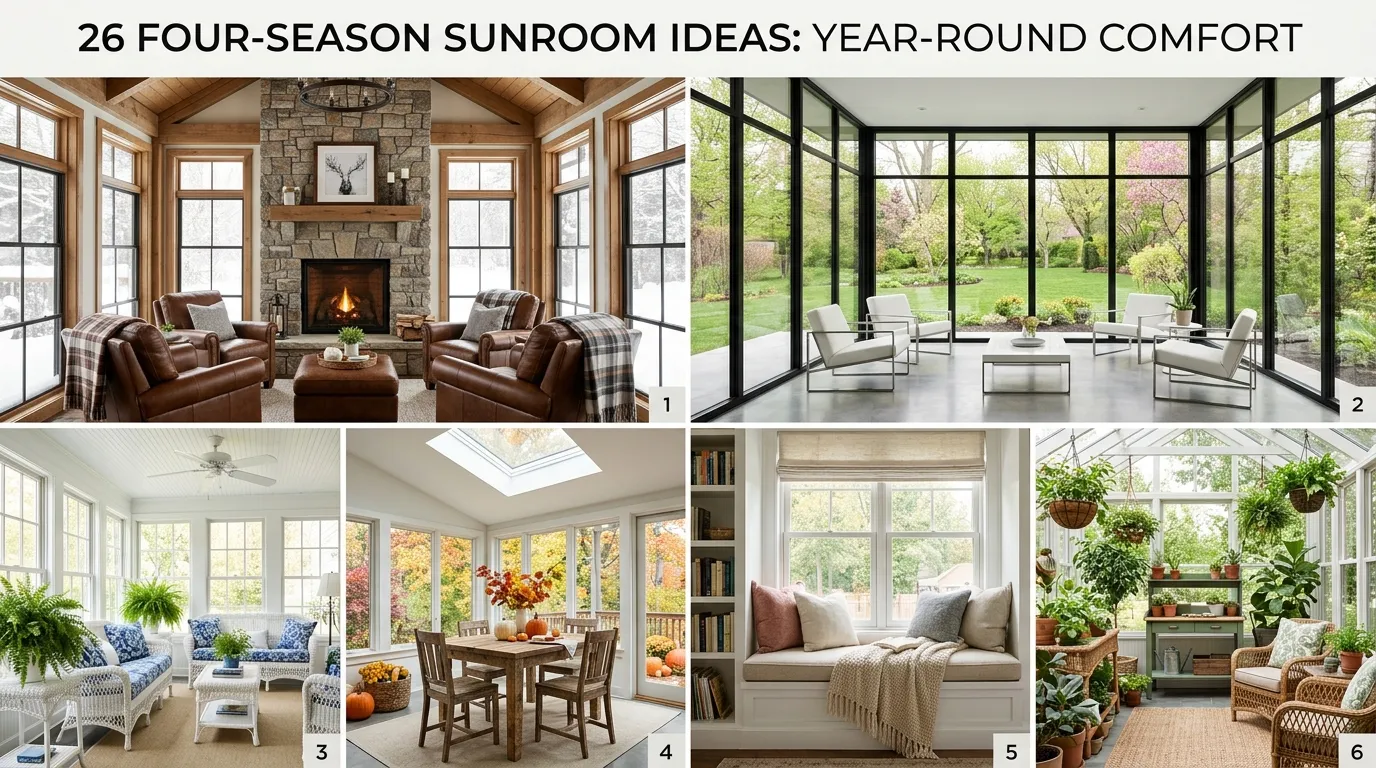
A four season sunroom is a fully insulated, climate-controlled glass enclosure designed to be lived in comfortably during every month of the year — not just mild days. This article delivers exactly 26 four season sunroom ideas spanning furniture arrangements, material choices, lighting strategies, heating solutions, and small-space adaptations that make year-round comfort genuinely achievable.
There is something quietly extraordinary about sitting inside glass while snow falls or rain sheets down — warm, unhurried, connected to the season without being subject to it. A four season sunroom is where the boundary between inside and outside softens without disappearing. Light moves across the floor in long arcs. Plants lean toward the glass. The room breathes with the weather. Here are 26 ideas worth saving — and stealing.
Why the Four Season Sunroom Works So Well
The four season sunroom as a dedicated architectural space has roots in the Victorian-era conservatory tradition — glass-and-iron structures originally designed for cultivating exotic plants through northern winters. Over the twentieth century, that horticultural impulse evolved into a domestic living preference: the desire for a room that maximizes natural light and visual connection to the outdoors while providing genuine thermal comfort. Today’s four season sunroom draws from that lineage while incorporating modern insulated glazing, radiant floor systems, and flexible furniture thinking.
The materials and colors that work best in a four season sunroom honor the room’s dual identity — part interior, part exterior. Flooring runs toward natural stone, porcelain tile in travertine or slate tones, warm-stained concrete, or wide-plank white oak. Furniture favors performance wicker in warm espresso or natural honey, powder-coated aluminum with all-weather cushions in Sunbrella fabric, and teak or eucalyptus wood that tolerates the humidity fluctuations a glass room experiences. Color palettes lean toward what the view outside already contains — warm sage, sky blue, earthy terracotta, warm greige, and deep forest green.
The four season sunroom is experiencing a sustained design renaissance because it answers a post-pandemic cultural shift toward home investment and year-round outdoor connection. Pinterest search data shows “sunroom ideas” searches increasing more than 60% since 2021, and residential addition data confirms that sunroom additions have among the highest homeowner satisfaction ratings of any renovation category. People want a room that earns its square footage every day of the year, not just during summer.
Small homes can absolutely achieve the four season sunroom aesthetic without a full addition — a well-insulated bay window expansion, a converted screened porch, or even a glass-enclosed corner of an existing room creates the same perceptual qualities: abundant light, connection to outdoors, and the sense of living within the weather rather than sealed from it. In compact spaces, the priority is maximizing glass area first and keeping furniture low-profile to preserve sightlines.
| Element | Trait 1 | Trait 2 |
| Philosophy | Year-round outdoor connection | Light as a living material |
| Materials | Performance wicker, teak, stone tile | Sunbrella fabric, insulated glass |
| Color palette | Warm sage, sky blue, terracotta | Warm greige, forest green, ivory |
26 Four Season Sunroom Ideas: Year Round Comfort by Design
1. Radiant Heated Stone Floor for Winter Warmth
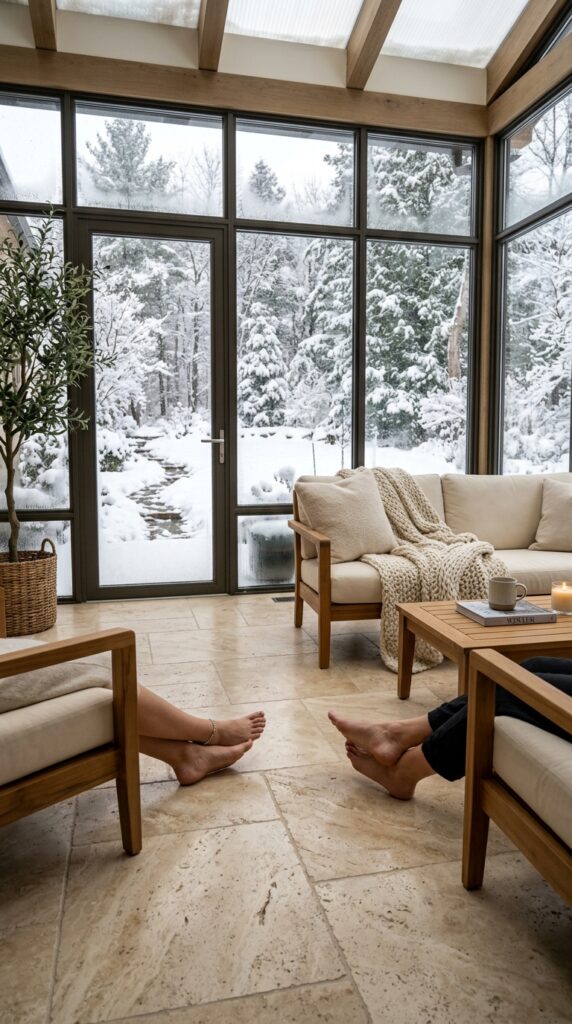
Vibe: Sun-warmed from the ground up — the particular luxury of bare feet on warm stone while snow presses against the glass.
Why it works: Radiant floor heating is the ideal thermal system for a sunroom because it heats the room from the lowest point — warm air rises naturally, creating an even temperature gradient from floor to ceiling rather than the hot-top, cold-bottom layering that forced-air systems produce. Stone flooring is the optimal surface for this system because its thermal mass absorbs and retains heat far longer than wood or tile, releasing it slowly and keeping the floor warm even during heating cycles. The visual and tactile warmth of natural travertine — with its cream and warm honey veining — reinforces the sensation of warmth before you even step down.
How to get it: Specify an electric radiant mat system beneath stone tile — it installs in the mortar bed during tile installation and requires no additional floor height. Choose a large-format tile of 24×24 inches or larger to minimize grout lines, which interrupt the clean warmth of the stone surface.
💡 Quick Win: A plug-in radiant floor mat ($80–$150 on Amazon) placed beneath an area rug creates the sensation of heated flooring in an existing sunroom without any installation — effective for a seating area or reading zone.
🛍️ Shop the Look — Amazon Product Ideas
| # | Product Search Phrase | Why It Fits |
| 1 | Electric radiant floor heating mat 120V kit | In-floor heat system starter |
| 2 | Large format travertine look porcelain tile | Warm stone floor surface |
| 3 | Thermostat floor heating programmable smart | Temperature control system |
| 4 | Wool throw blanket chunky cream natural | Cold day textile layer |
| 5 | Teak outdoor indoor bench seat cushion | Warm wood furniture companion |
2. Wall-to-Wall Glass with Thermally Broken Frames
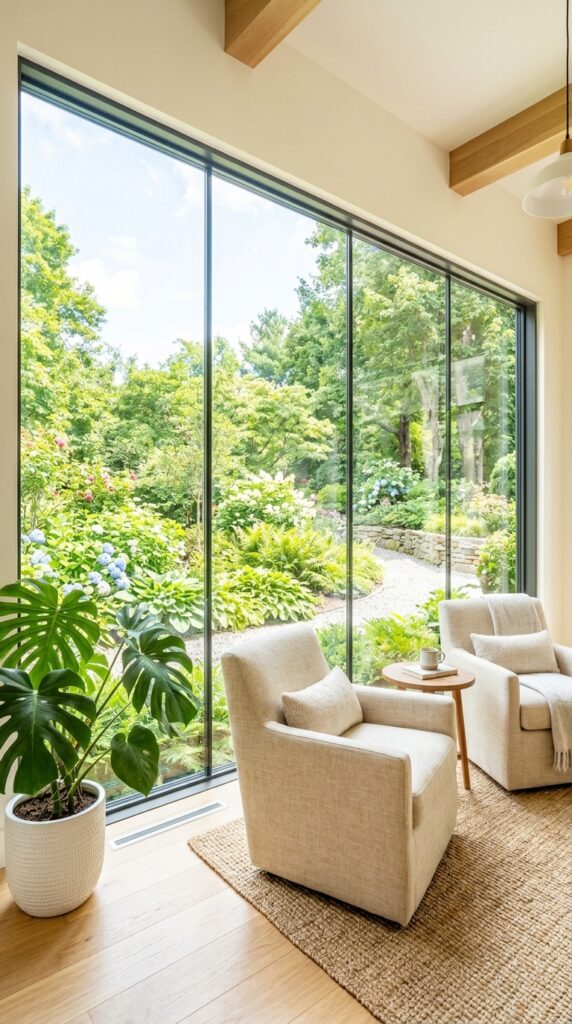
Vibe: Luminous and frameless — a room that persuades you the glass isn’t there at all.
Why it works: Thermally broken aluminum frames are the engineering solution that makes floor-to-ceiling glass viable in four season use — a thermal break is a non-conductive material inserted into the aluminum frame that interrupts the heat transfer path between inside and outside glass surfaces. Without it, a glass wall becomes a refrigeration unit in winter as cold migrates directly through the metal frame. The slim profile of modern thermally broken frames (some as narrow as 1.5 inches) maximizes the glass-to-frame ratio, which is the defining visual quality of a contemporary sunroom: the sense that the view is unobstructed.
How to get it: Specify triple-pane glass with low-E coating for maximum thermal performance — the low-E layer reflects infrared heat back into the room in winter while blocking solar heat gain in summer. A U-value of 0.20 or lower is the threshold for genuine four season comfort in cold climates.
🛍️ Shop the Look — Amazon Product Ideas
| # | Product Search Phrase | Why It Fits |
| 1 | Large monstera deliciosa live indoor plant | Statement plant at glass wall |
| 2 | White ceramic planter large 14 inch | Clean container for statement plant |
| 3 | Linen armchair performance fabric indoor outdoor | Seating facing glass wall |
| 4 | Low E window insulation film interior | Budget thermal improvement |
| 5 | Matte charcoal window frame touch up paint | Frame color maintenance |
3. Wicker and Rattan Furniture in Warm Honey Tones
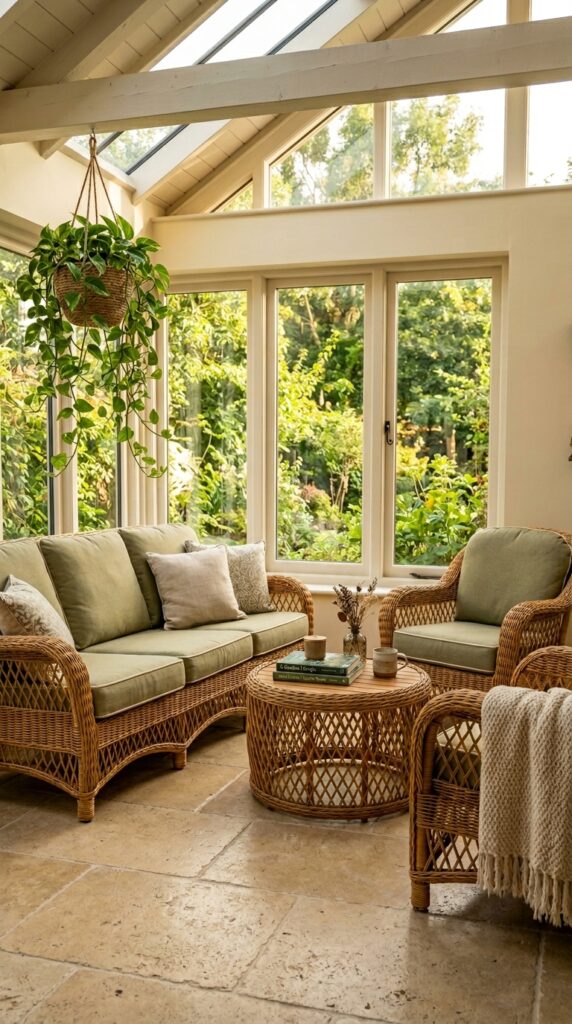
Vibe: Organic and unhurried — furniture that looks like it grew into its arrangement rather than being placed.
Why it works: Natural rattan and wicker bring the organic warmth of plant material into a room that is already defined by glass and structure — it’s a material bridge between the garden outside and the interior. Honey-toned rattan specifically has warm yellow-brown undertones that respond to changing natural light throughout the day, appearing golden in afternoon sun and deeper amber in evening warmth. Thick Sunbrella cushions in sage or cream provide the softness and color that raw rattan lacks, while the performance fabric handles the humidity fluctuations that sunroom environments create.
How to get it: Choose all-weather rattan rated for indoor-outdoor use rather than standard interior wicker — all-weather resin wicker handles the temperature and humidity swings of a glass room far better than natural cane, which can crack and loosen with seasonal changes. Look for a powder-coated aluminum internal frame, which prevents rust.
🛍️ Shop the Look — Amazon Product Ideas
| # | Product Search Phrase | Why It Fits |
| 1 | All-weather wicker sofa set honey rattan outdoor | Core furniture grouping |
| 2 | Sunbrella cushion set sage green outdoor | Performance fabric cushions |
| 3 | Round rattan coffee table woven base | Central furniture piece |
| 4 | Hanging planter basket macramé trailing plant | Organic overhead accent |
| 5 | Wicker side table round all weather | Companion surface piece |
4. In-Ceiling Recessed Infrared Heaters for Cold Months
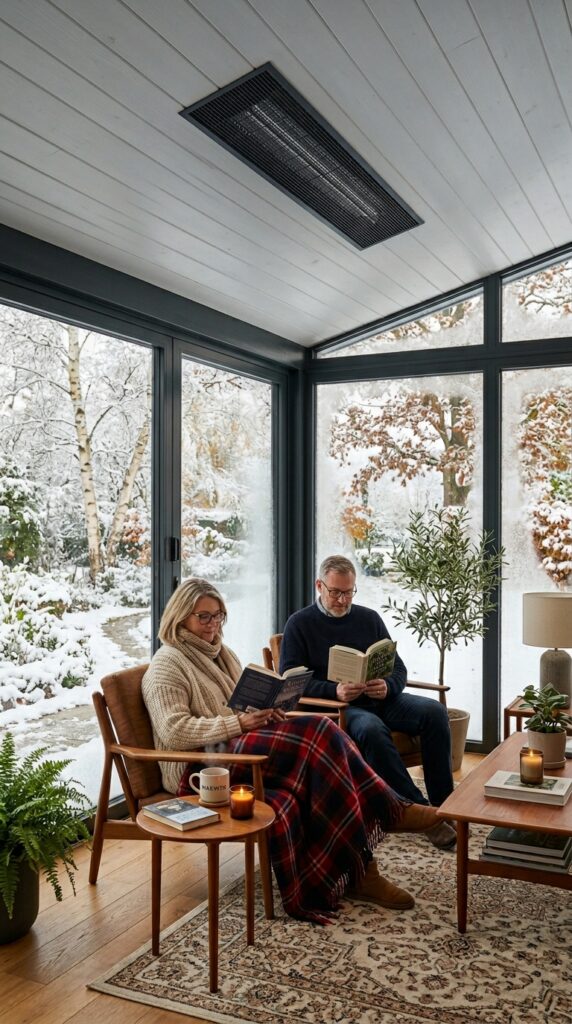
Vibe: Sheltered and quietly warm — the comfort of sitting under an invisible sun.
Why it works: Infrared ceiling heaters work on a fundamentally different principle than convective heaters — rather than warming the air (which escapes quickly through glass), they warm objects and people directly through radiant energy, the same mechanism as sunlight. This makes them dramatically more efficient in a sunroom environment where air temperature is harder to maintain than object temperature. Ceiling-mounted models are virtually invisible in use and create zero noise, zero airflow, and zero disruption to the visual quality of the glass room.
How to get it: A 1500-watt ceiling-mounted infrared panel covers approximately 150 square feet of sunroom space — one panel is sufficient for a small room, two for a medium-sized room of 250–350 square feet. Hardwired installation is preferred for a clean look, though plug-in pendant versions are available for renters or temporary setups.
💡 Quick Win: A plug-in infrared space heater positioned under a side table or beside a chair ($45–$85) delivers targeted radiant warmth at the sitting level — the most immediate upgrade for a cold sunroom without any installation.
🛍️ Shop the Look — Amazon Product Ideas
| # | Product Search Phrase | Why It Fits |
| 1 | Ceiling mount infrared panel heater 1500W | Primary four season heat source |
| 2 | Plug-in infrared space heater indoor portable | No-install heat solution |
| 3 | Tongue and groove ceiling plank white paintable | Sunroom ceiling material |
| 4 | Wool plaid throw blanket red navy classic | Cold season textile accent |
| 5 | Ceramic travel mug insulated 12oz warm | Warm drink companion detail |
5. Sage Green Accent Wall on the Interior Side
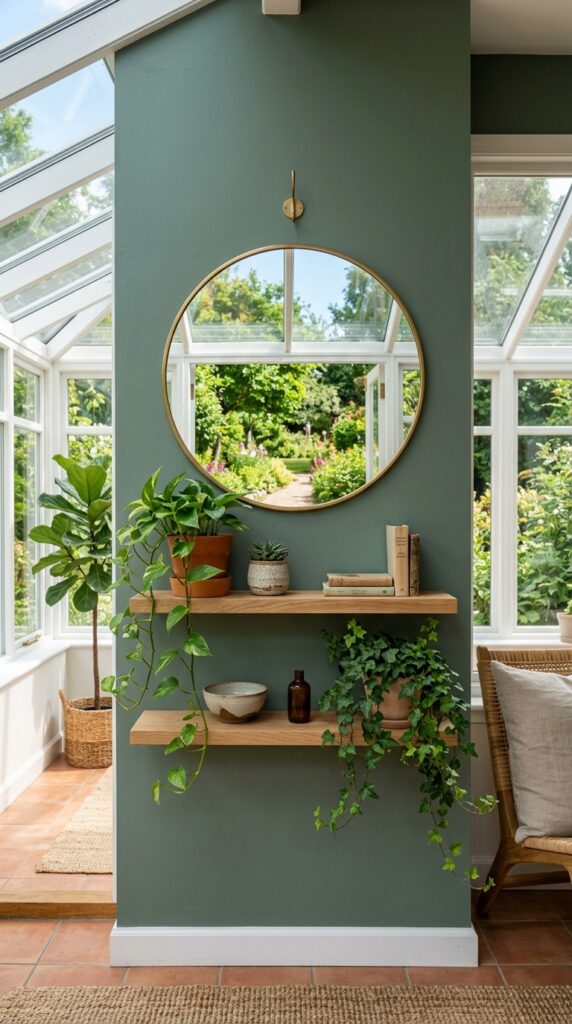
Vibe: Fresh and rooted — an accent wall that brings the garden inside before you even look through the glass.
Why it works: In a room defined by glass, the single solid interior wall becomes the room’s anchor — it needs to do the visual work that four walls of paint would do in a conventional room. Dusty sage green is the optimal color for this wall because it echoes the tones of the garden beyond the glass, creating a color continuity between inside and outside that reinforces the sunroom’s identity as a transitional space. A large round mirror on this wall also captures and redirects the garden view, effectively giving the interior wall the same visual quality as a window.
How to get it: Paint the interior wall in Farrow & Ball “Mizzle” or Benjamin Moore “Aganthus Green” — both are dusty, sophisticated sages that read as plant-adjacent without looking like a painted garden shed. Mount white oak floating shelves at two heights for display and plant staging.
🛍️ Shop the Look — Amazon Product Ideas
| # | Product Search Phrase | Why It Fits |
| 1 | Dusty sage green interior matte wall paint | Interior accent wall color |
| 2 | Round mirror brass frame 30 inch | Garden-view redirector |
| 3 | White oak floating shelf 10 inch natural | Display and plant staging |
| 4 | Trailing ivy pothos plant 4 inch nursery | Living green shelf accent |
| 5 | Brass wall plant hook indoor ceiling mount | Overhead trailing plant hanger |
6. Ceiling Fan with Light Kit for Year-Round Air Circulation
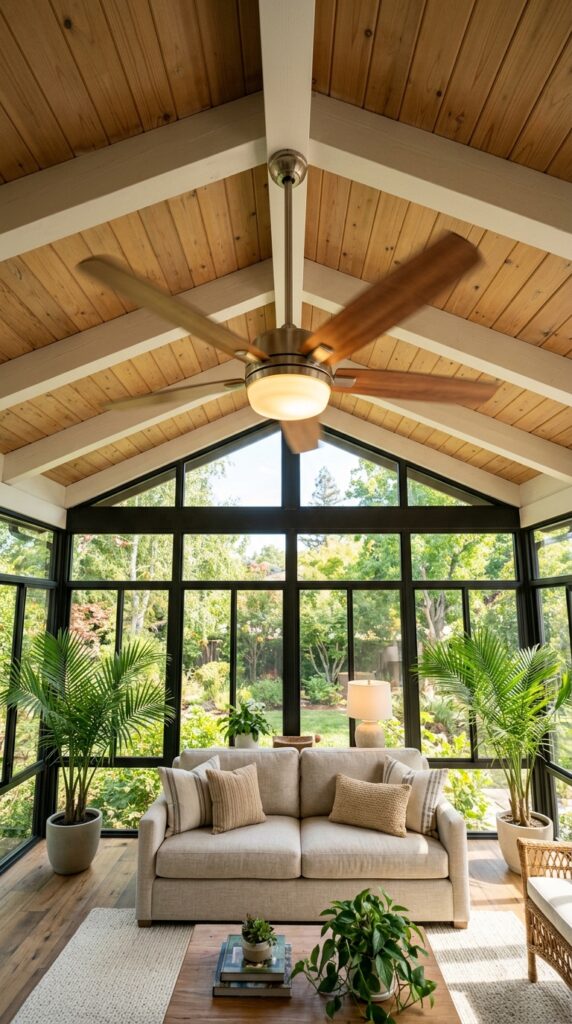
Vibe: Breezy and even — the air moving just enough to remind you the room is alive.
Why it works: A reversible ceiling fan is one of the most cost-effective year-round comfort investments in a sunroom — in summer, counter-clockwise rotation pushes air downward to create a cooling breeze effect; in winter, clockwise rotation at low speed pulls the warm air that rises to the ceiling back down along the walls. In a glass room where solar heat gain can create dramatic temperature stratification (hot at ceiling, cool at floor), this air redistribution function is functionally significant, not just a comfort preference. A fan with a warm light kit also reduces the room’s dependence on supplemental lighting on overcast days.
How to get it: Specify a ceiling fan with a blade span of at least 52 inches for a sunroom — undersized fans produce airflow that feels weak and targeted rather than the even, whole-room circulation that a sunroom needs. Outdoor-rated fans (UL Damp or UL Wet listed) are the better choice for sunrooms, which experience higher humidity than standard interior rooms.
🛍️ Shop the Look — Amazon Product Ideas
| # | Product Search Phrase | Why It Fits |
| 1 | Outdoor rated ceiling fan 52 inch wood blade | Four season air circulation |
| 2 | Ceiling fan remote control universal kit | Convenience control add-on |
| 3 | Ceiling fan light kit warm LED 2700K | Integrated warm light source |
| 4 | Ceiling fan canopy extension down rod | High ceiling mounting solution |
| 5 | Ceiling fan balancing kit wobble fix | Installation refinement tool |
7. Bohemian Maximalist Plant Wall
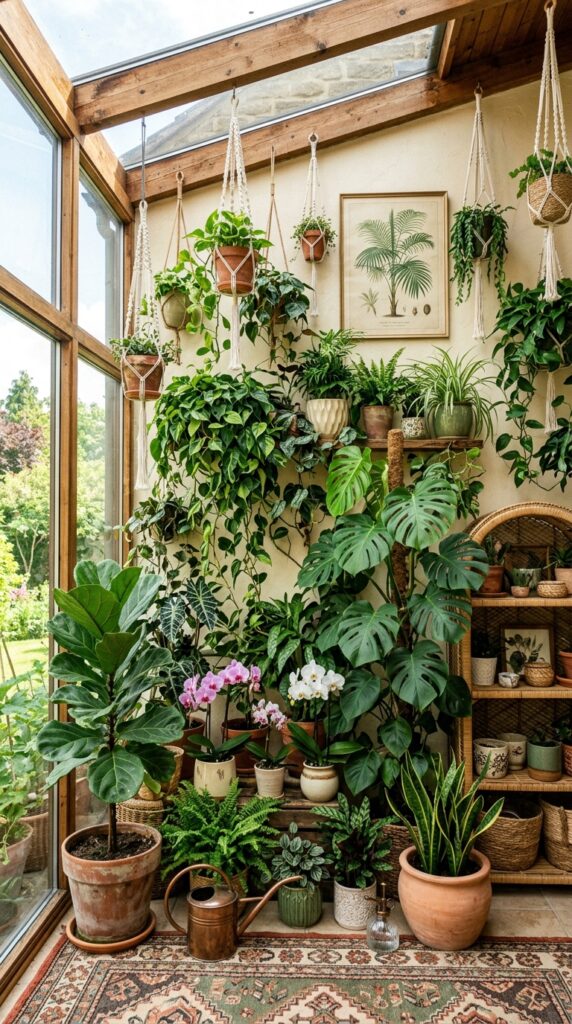
Vibe: Lush and breathing — a wall that seems to grow outward as you look at it.
Why it works: A maximalist plant wall in a sunroom is one of the rare design choices that improves with time rather than aging out — as plants grow, the wall becomes more impressive, not more dated. The design principle is biophilic immersion: surrounding the occupant with living material on the interior wall while the glass walls provide a second layer of garden connection creates a sense of being inside a greenhouse, which activates a deeply human affinity for natural environments. The variety of leaf shapes, textures, and heights creates the visual complexity that a static gallery wall would require art to achieve.
How to get it: Build the plant wall on a modular shelving unit (IKEA Kallax works well) rather than mounting individual shelves — this allows the entire arrangement to be reconfigured as plants grow. Mix plant heights so the tallest plants anchor the corners, mid-height plants occupy the middle shelves, and trailing varieties cascade from the top.
🛍️ Shop the Look — Amazon Product Ideas
| # | Product Search Phrase | Why It Fits |
| 1 | Modular shelving unit white 4×2 bookcase | Plant wall structural base |
| 2 | Terracotta planter set graduated sizes | Cohesive container family |
| 3 | Macramé plant hanger set three sizes | Overhead hanging planters |
| 4 | Pothos golden devil’s ivy live trailing | Easy-care trailing plant |
| 5 | Watering can indoor copper long spout | Practical and decorative tool |
8. Teak Dining Table for Year-Round Outdoor Dining In
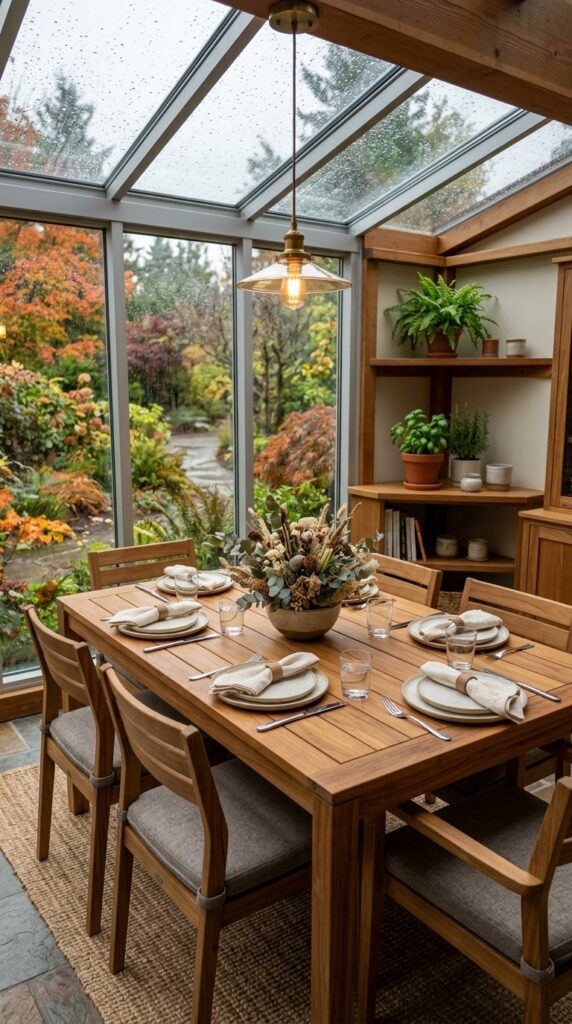
Vibe: Convivial and unhurried — a table that makes rain feel like perfect dinner company.
Why it works: Teak is uniquely suited to sunroom dining furniture because its natural silica and oil content make it one of the few woods that resists both moisture and temperature fluctuation without warping, splitting, or requiring seasonal sealing. A teak dining table in a sunroom creates a functional dining zone that feels dramatically different from an interior dining room — the surrounding glass and natural light transform even a simple meal into an experience of being connected to the weather outside. The design principle is experiential dining: the setting changes the perception of the meal.
How to get it: Choose teak with a Grade A certification — Grade A teak comes from the heartwood of mature trees and has the highest density and natural oil content. Avoid Grade B or C teak furniture for a sunroom application where it will face humidity variation — lower grades dry out faster and require more frequent oiling. Apply teak oil annually to maintain the warm honey color; if left untreated, teak weathers to a beautiful silver-gray.
🛍️ Shop the Look — Amazon Product Ideas
| # | Product Search Phrase | Why It Fits |
| 1 | Teak dining table indoor outdoor 6 person | Primary dining anchor piece |
| 2 | All-weather dining chair cushion gray Sunbrella | Performance seat cushion |
| 3 | Teak oil furniture conditioner food safe | Annual maintenance product |
| 4 | Linen napkin set natural undyed six pack | Table setting in natural tone |
| 5 | Ceramic bowl low centerpiece natural white | Simple dining table decor |
9. Sky Blue Ceiling for the Illusion of Endless Sky
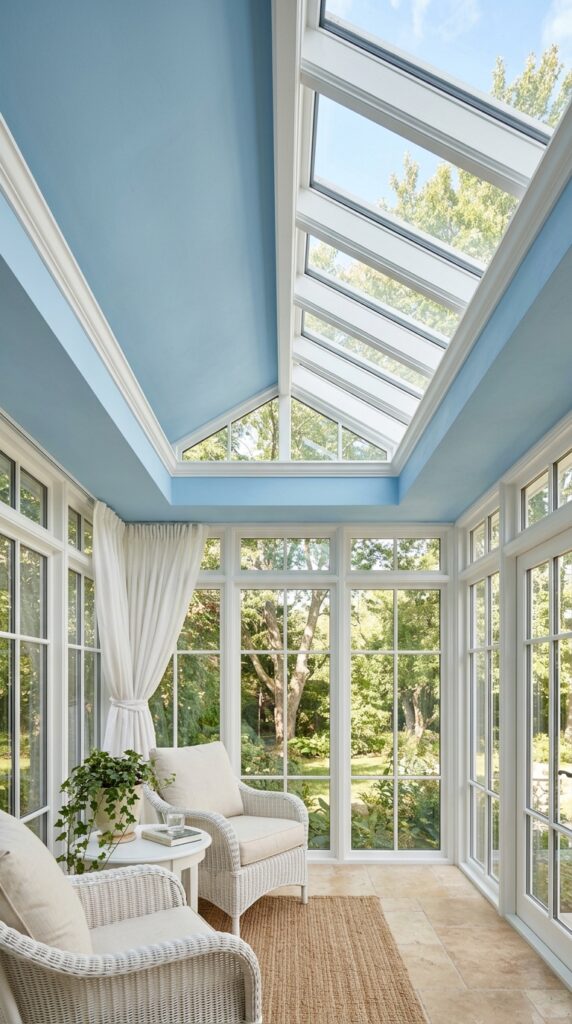
Vibe: Airy and horizon-wide — a ceiling that convinces you the room has no top.
Why it works: A sky blue ceiling in a sunroom extends the visual continuity of the outdoor sky into the interior ceiling plane — on a clear day, the painted ceiling and the actual sky beyond the glass read as a single continuous expanse. This is the design principle of perceptual extension: tricking the eye into perceiving the room as larger and more open by eliminating the visual boundary between ceiling and exterior. Matte finish is essential — any sheen on the ceiling creates visible reflections that immediately break the illusion.
How to get it: Benjamin Moore “Breath of Fresh Air” and Sherwin-Williams “Misty” are both soft blue-whites that read as sky rather than cornflower or baby blue — the key is choosing a blue with enough gray to avoid looking saturated or childlike. Paint the ceiling only, keeping walls white to prevent the room from reading as all-over blue.
💡 Quick Win: A single quart of sky blue flat ceiling paint costs $15–$22 and covers a 10×12-foot ceiling — a one-afternoon transformation that changes the room’s entire emotional character.
🛍️ Shop the Look — Amazon Product Ideas
| # | Product Search Phrase | Why It Fits |
| 1 | Sky blue flat ceiling paint matte finish | Core ceiling color treatment |
| 2 | White ceiling trim paint semi-gloss quart | Crisp trim contrast finish |
| 3 | White wicker armchair all weather indoor | Furniture that reads in palette |
| 4 | Sheer white curtain panel linen sunroom | Soft glass wall dressing |
| 5 | Foam ceiling painting roller 9 inch | Even application tool |
10. Built-In Window Seat Spanning the Glass Wall
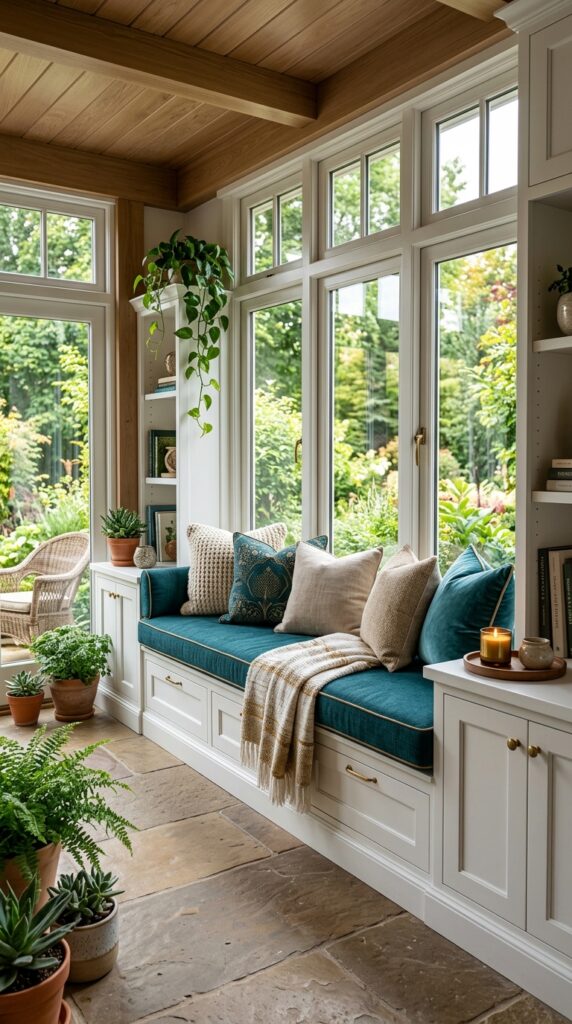
Vibe: Generous and grounded — a seat that claims the whole view as its own.
Why it works: A full-width built-in window seat transforms one glass wall from a surface to cross to a destination — it creates a behavioral magnet that draws people to the best vantage point in the room and keeps them there. The design principle is destination seating: when a seat faces the primary view and fills the entire available width, it makes the view feel like a feature rather than an accident of the building’s placement. Storage cabinets at each end complete the built-in relationship and store outdoor throw blankets and seasonal cushions.
How to get it: Build the window seat base from 3/4-inch plywood at 18 inches high and 22 inches deep — the standard dimensions for comfortable seating. Use a 4-inch foam cushion with a waterproof inner liner before the performance fabric — sunrooms experience condensation that will eventually reach any unprotected cushion core.
🛍️ Shop the Look — Amazon Product Ideas
| # | Product Search Phrase | Why It Fits |
| 1 | Performance outdoor fabric teal blue yard | Cushion upholstery material |
| 2 | High density foam cushion 4 inch sheet | Seat cushion core material |
| 3 | Waterproof cushion liner inner cover | Moisture protection layer |
| 4 | Scatter pillow set mixed textures outdoor | Layered seat styling |
| 5 | Storage cabinet white shaker style base | Built-in end storage unit |
11. Terracotta Tile Floor with Geometric Pattern

Vibe: Sun-warmed and artisanal — a floor that tells you where you are before you look out the window.
Why it works: Terracotta tile in a sunroom works on multiple levels simultaneously — its warm orange-brown tones glow in sunlight in a way that porcelain or stone cannot replicate, its thermal mass stores solar heat during the day and releases it slowly at night (a passive solar advantage), and its handmade variation gives the floor a texture and depth that manufactured tile lacks. The geometric pattern creates visual interest at the floor plane that allows the walls and furniture to remain simpler without the room feeling sparse.
How to get it: Seal terracotta tile with a penetrating stone sealer before grouting and again after — unsealed terracotta stains permanently within days of first use. Use a sandy cream grout rather than white (which makes the pattern look too graphic) or a matching terracotta grout (which loses the pattern entirely). Reapply sealant annually.
🛍️ Shop the Look — Amazon Product Ideas
| # | Product Search Phrase | Why It Fits |
| 1 | Terracotta encaustic tile geometric patterned | Patterned floor statement tile |
| 2 | Penetrating stone sealer terracotta tile | Essential sealing protection |
| 3 | Sandy buff grout sanded tile color | Pattern-defining grout tone |
| 4 | Terracotta planter large floor indoor | Coordinating floor accent |
| 5 | Rattan low profile coffee table natural | Furniture complementing tile |
12. Concealed Roller Shade System for Summer Sun Control
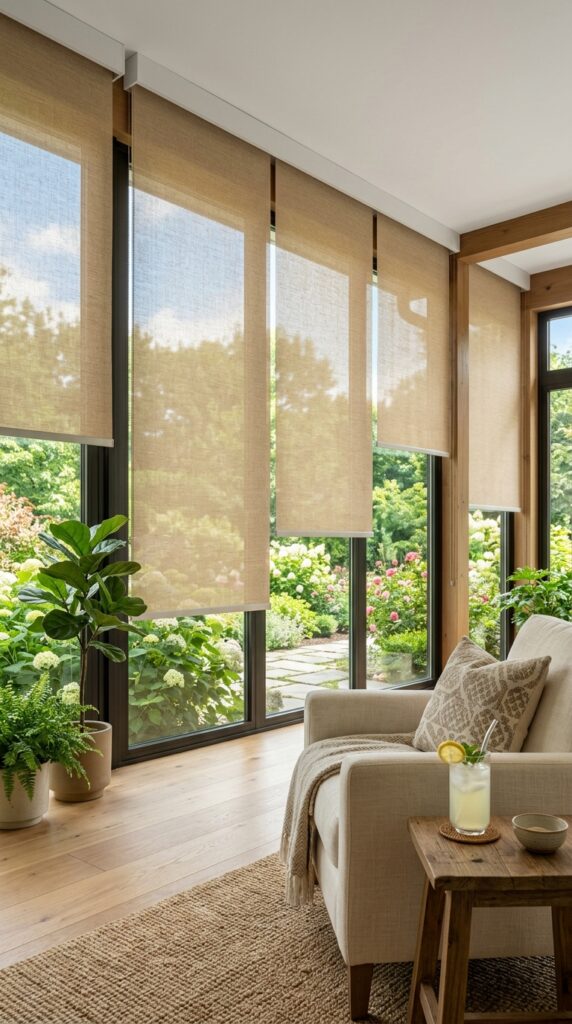
Vibe: Filtered and even — sun present without its heat, light present without its glare.
Why it works: Solar roller shades are the most functional window treatment for a four season sunroom because they reduce solar heat gain (critical in summer) while maintaining the view and diffusing light into a warm, even glow rather than blocking it entirely. The openness factor — a measurement from 1% (nearly opaque) to 14% (nearly transparent) — allows precise tuning: a 3% openness factor blocks approximately 97% of UV while preserving a view of the garden beyond. Concealing the shade cassette in a ceiling pocket eliminates the visual interruption of the hardware, which is the detail that separates a designed sunroom from an improvised one.
How to get it: Motorized solar shades with a smart home integration (Somfy or Lutron systems) can be programmed to lower automatically at peak sun hours — 11am to 3pm — and raise again in late afternoon when direct sun shifts. This automation eliminates the manual habit that most homeowners abandon within weeks.
💡 Quick Win: Cordless solar roller shades in a warm linen color are available on Amazon for $35–$75 per panel and install in any window using tension-mount brackets with no drilling — an afternoon installation that immediately reduces summer heat gain.
🛍️ Shop the Look — Amazon Product Ideas
| # | Product Search Phrase | Why It Fits |
| 1 | Solar roller shade linen 3 percent openness | Primary sun control treatment |
| 2 | Cordless roller shade tension mount no drill | Renter-friendly shade option |
| 3 | Motorized roller shade battery smart home | Automated sun control upgrade |
| 4 | Shade cassette ceiling track mount header | Concealed hardware system |
| 5 | UV blocking window film clear low heat | Permanent glass UV layer |
13. White-Painted Tongue-and-Groove Cathedral Ceiling
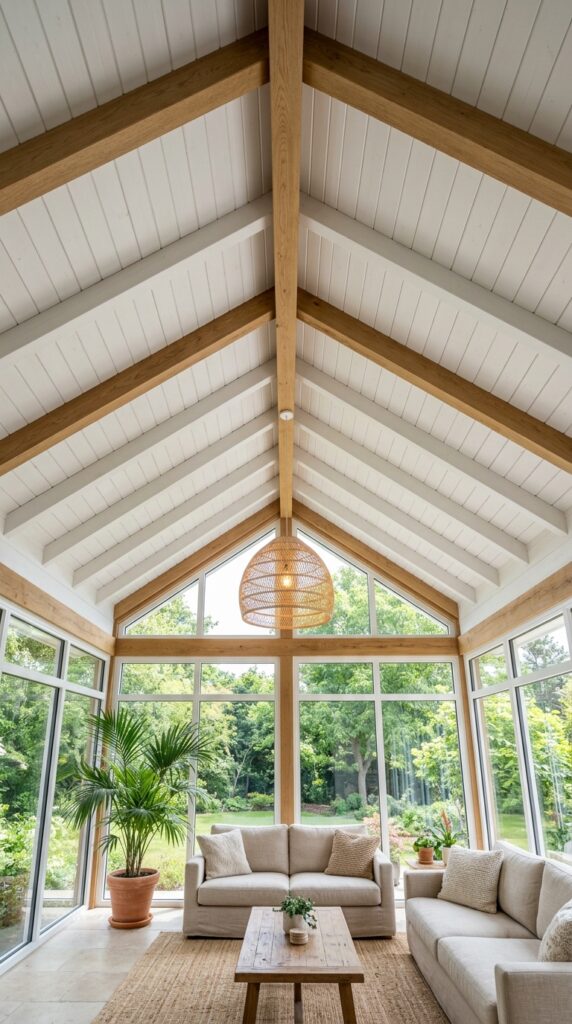
Vibe: Architectural and airy — a ceiling that gives the room its most important dimension.
Why it works: A cathedral ceiling in a sunroom dramatically amplifies the room’s perceived connection to the outdoors because it mirrors the expansive quality of open sky — a vaulted ceiling feels more like being outside than a flat ceiling does, regardless of how much glass surrounds it. White-painted tongue-and-groove planks give the vaulted ceiling warmth and texture without heaviness, while the natural wood beam at the ridge introduces the structural honesty that prevents the ceiling from reading as a decorated surface rather than a genuine architectural element.
How to get it: Paint tongue-and-groove ceiling planks in Benjamin Moore “White Dove” rather than a stark white — the warm undertone prevents the wood from reading as clinical under the variable light conditions of a glass room. Install the planks perpendicular to the ridge beam so the direction of the planks draws the eye toward the peak.
🛍️ Shop the Look — Amazon Product Ideas
| # | Product Search Phrase | Why It Fits |
| 1 | Tongue and groove ceiling plank pine 6 inch | Cathedral ceiling material |
| 2 | White wood ceiling paint flat warm white | Warm ceiling paint tone |
| 3 | Faux wood ridge beam hollow polyurethane | Structural-look beam accent |
| 4 | Rattan pendant light oversized ceiling mount | Peak-hung pendant light |
| 5 | Indoor palm tree floor planter large | Corner botanical statement |
14. Hammock Chair or Swing in the Sunroom Corner
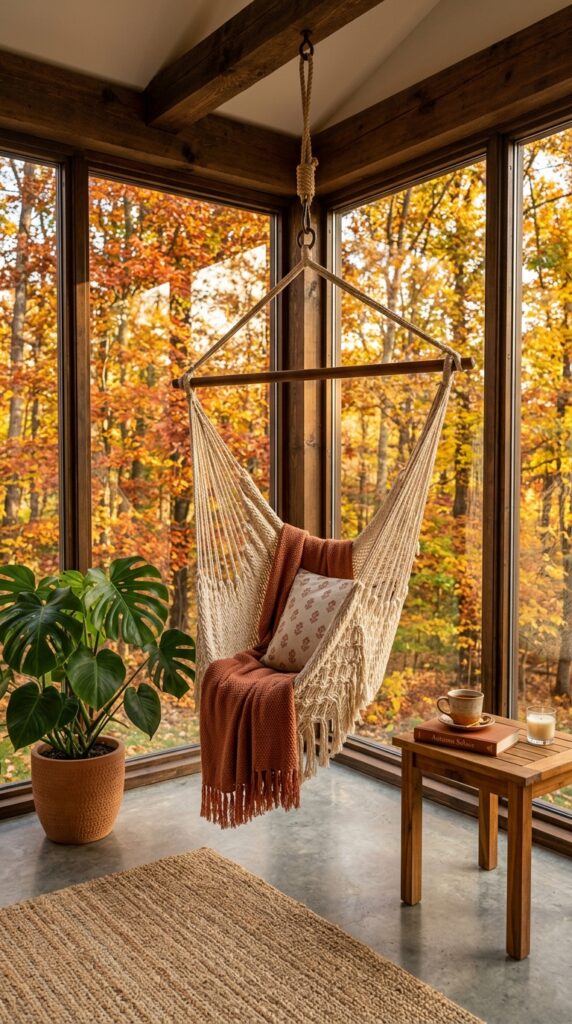
Vibe: Playful and anchored — a chair that invites you to stay longer than you intended.
Why it works: A hanging hammock chair introduces gentle movement into a sunroom — the slight swaying engages the vestibular system in a calming way that static seating cannot, and its suspension from the ceiling rather than the floor eliminates floor footprint entirely. This is the design principle of volumetric furniture: using ceiling-mounted pieces to free the floor plane while still occupying the room’s volume. In a sunroom corner, a hammock chair also occupies what is often the most awkward space (corners are rarely functional with conventional furniture) and transforms it into the most desirable seat in the room.
How to get it: Install a heavy-duty ceiling hook rated for at least 300 pounds — a steel eye bolt through a ceiling joist with a toggle bolt is the minimum safe installation. Test the joist location with a stud finder before drilling. The hook should be positioned so the hammock chair hangs 18–20 inches from the nearest wall.
🛍️ Shop the Look — Amazon Product Ideas
| # | Product Search Phrase | Why It Fits |
| 1 | Macramé hanging hammock chair natural cotton | Corner swing seat |
| 2 | Heavy duty ceiling hook eye bolt 300lb | Safe structural mount |
| 3 | Ceiling joist stud finder electronic | Installation safety tool |
| 4 | Throw blanket hammock chair boho cream | Soft comfort layer |
| 5 | Round teak side table small low profile | Companion surface beside swing |
15. Deep Navy Accent Wall on the Interior Boundary
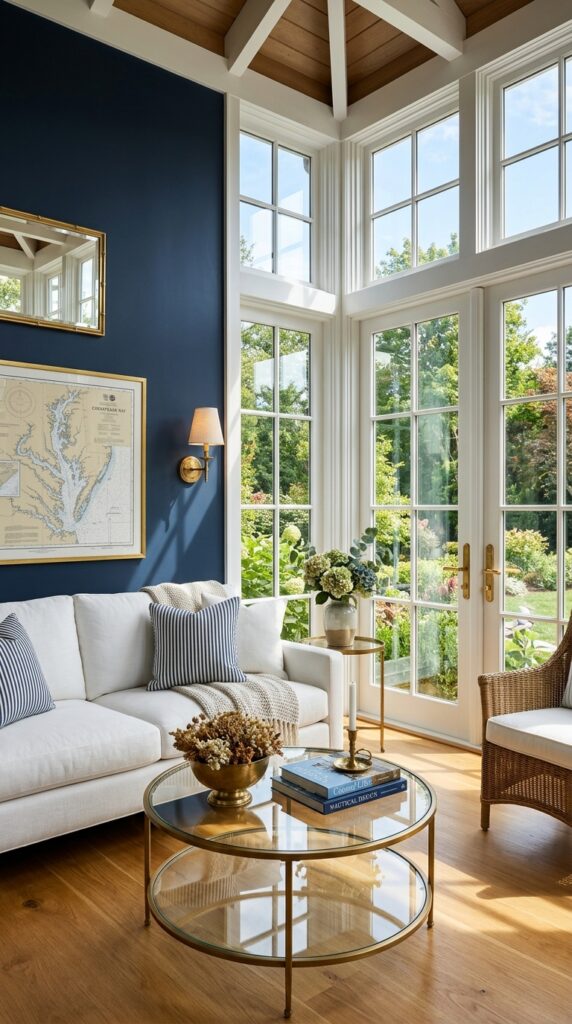
Vibe: Dramatic and composed — a wall that commands attention without asking for it.
Why it works: A deep navy interior wall in a sunroom works through the principle of maximum contrast: navy is the darkest color that still reads as a color rather than a void, and against the light-flooded glass walls, it creates a visual tension that makes both the dark wall and the bright glass more vivid by comparison. The dark surface also visually recedes, making the glass walls appear to advance — pushing the garden view closer and more present. Brass accessories against navy are a classic warm-cool pairing where the warmth of the brass is amplified by the cool depth of the navy.
How to get it: Benjamin Moore “Hale Navy” in a flat or matte finish is the most versatile deep navy for this application — its warm undertone prevents it from reading as corporate or cold under natural light. Limit the navy to the single solid interior wall only — extending it to window trim or the ceiling would compress the room.
🛍️ Shop the Look — Amazon Product Ideas
| # | Product Search Phrase | Why It Fits |
| 1 | Deep navy flat interior wall paint matte | Bold interior wall color |
| 2 | Brass wall sconce plug-in warm light | Glowing warm metal against navy |
| 3 | Nautical chart framed art print large | Thematic wall art in palette |
| 4 | White linen sofa performance fabric | Crisp light contrast seating |
| 5 | Aged brass picture frame set thin | Gallery hardware in warm metal |
16. Mixed Metal and Glass Coffee Table
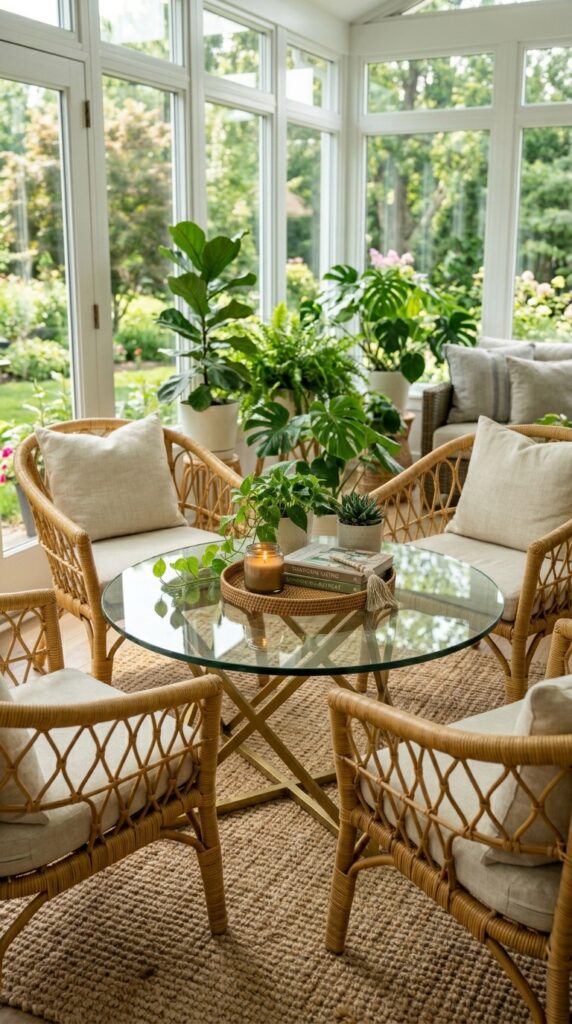
Vibe: Light and effortless — a coffee table that takes up visual space without occupying it.
Why it works: A glass-top coffee table in a sunroom applies the same principle as the floor-to-ceiling mirror in a bedroom — transparency preserves sightlines. In a room where the floor, the rug, and the view are all important visual elements, a solid coffee table interrupts three planes simultaneously. A glass top allows the eye to travel through it to the floor below, which is the principle of visual continuity: uninterrupted sightlines make a room feel larger and more coherent. The geometric brushed gold base is visible through the glass, which adds sculptural interest at floor level rather than at eye height.
How to get it: Choose a tempered glass top of at least 3/8-inch thickness for a coffee table — thinner glass flexes slightly under weight, which feels unstable. Round or oval glass tops are safer in a sunroom setting than square or rectangular edges, which chip more easily in a room with fluctuating furniture movement.
💡 Quick Win: A round glass table top replacement ($40–$75 on Amazon in standard sizes) can be placed on any existing base — a simple way to introduce the transparency principle without purchasing a new table.
🛍️ Shop the Look — Amazon Product Ideas
| # | Product Search Phrase | Why It Fits |
| 1 | Glass top round coffee table brushed gold | Transparent surface centerpiece |
| 2 | Tempered glass table top round 36 inch | Replacement or DIY table surface |
| 3 | Geometric metal base coffee table brushed gold | Sculptural base option |
| 4 | Small decorative tray glass surface gold | Surface organizer vignette |
| 5 | Low profile candle set glass votive | Transparent surface accents |
17. Scandinavian Minimal Sunroom with White and Wood
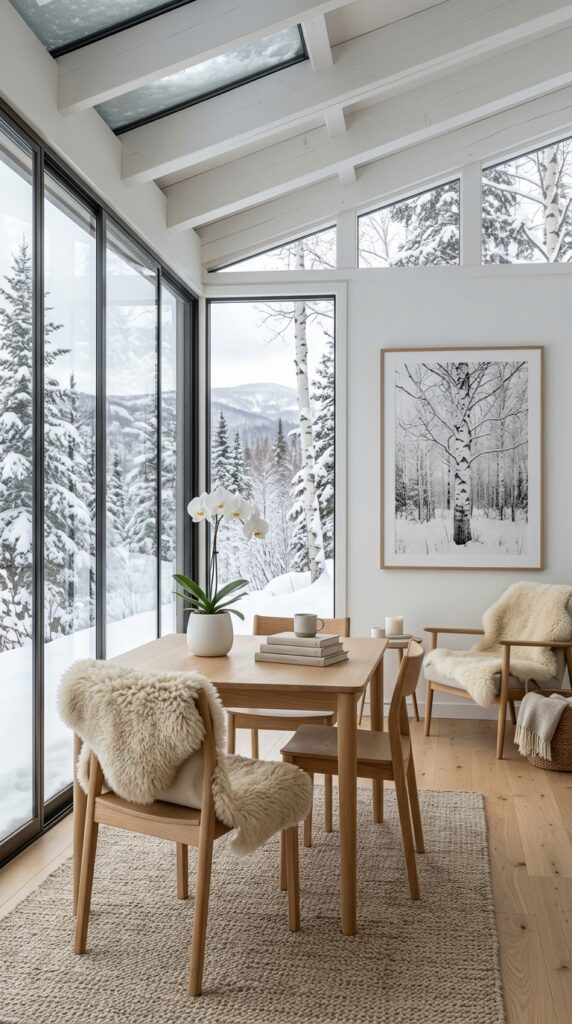
Vibe: Still and luminous — a room where the snow outside and the white inside become the same silence.
Why it works: Scandinavian minimal design in a sunroom works because both aesthetics share the same core principle: the primacy of natural light. White surfaces in a Scandinavian interior are not a color choice — they are a light amplification strategy, reflecting and bouncing every photon that enters the room. White oak furniture introduces warmth at the material level without introducing color, keeping the tonal palette clean while preventing the room from reading as sterile. Sheepskin and linen provide tactile warmth that prevents the cool visual palette from feeling cold.
How to get it: Maintain the white and wood palette by keeping accessories within the same tonal family — cream, ivory, warm white, and natural wood only. Introduce black only as a very thin line (a picture frame edge, a furniture leg) — it reads as a grounding detail rather than a color in a near-monochromatic room.
🛍️ Shop the Look — Amazon Product Ideas
| # | Product Search Phrase | Why It Fits |
| 1 | White oak dining chair Scandi minimal | Signature Nordic furniture |
| 2 | Sheepskin throw genuine natural cream | Tactile warmth layer |
| 3 | White orchid live plant pot | Monochromatic botanical |
| 4 | Birch tree large art print black white | Thematic wall anchor |
| 5 | White linen bound hardcover journal set | Styled surface object |
18. Converted Screened Porch Made Four Season
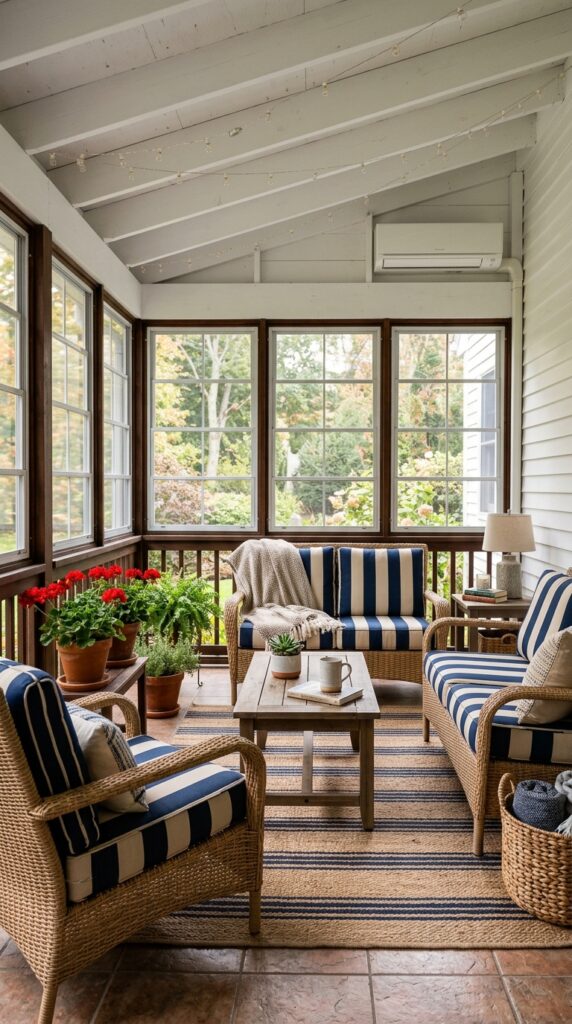
Vibe: Resourceful and genuinely warm — the triumph of a space that refused to be seasonal.
Why it works: Converting an existing screened porch to four season use is the most cost-effective path to a sunroom — the structure, roof, and foundation already exist. The critical upgrades are thermal: interior storm window inserts clip into existing screen frames to create a double-air-gap insulation layer, and a ductless mini-split system provides both heating and cooling without ductwork. The design principle is adaptive reuse: working with the existing architectural language rather than against it. Keeping the original wood porch rail and ceiling rather than replacing them with conventional interior finishes preserves the room’s outdoor character.
How to get it: Interior storm window inserts (Indow brand being the most widely available) are custom-cut to fit existing window openings and create an R-4 to R-5 insulation improvement — enough for three-season use in most climates, and four-season with mini-split supplemental heating. A 9,000 BTU mini-split handles a 300-square-foot porch space.
🛍️ Shop the Look — Amazon Product Ideas
| # | Product Search Phrase | Why It Fits |
| 1 | Mini split heat pump 9000 BTU ductless | Primary climate control system |
| 2 | Interior storm window insert acrylic | Screened porch thermal upgrade |
| 3 | Outdoor stripe cushion navy cream wicker | Weather-appropriate seating |
| 4 | Solar string light outdoor porch warm | No-wire overhead ambient light |
| 5 | Indoor outdoor layered rug polypropylene | Durable floor covering |
19. Dark and Moody Sunroom with Deep Charcoal and Brass

Vibe: Moody and intimate — a dark room that makes the glass walls glow like paintings.
Why it works: A deeply moody charcoal sunroom works through the principle of contrast amplification: when the interior surfaces are dark, the bright view through the glass becomes dramatically more vivid — the garden beyond reads as luminous rather than merely visible. This is the same principle that makes art galleries paint their walls dark gray when displaying bright photographs. The dark interior also reduces glare and reflected light from the glass surfaces, which can be visually fatiguing in an all-white or light-colored sunroom on bright days.
How to get it: Paint both the interior walls and the ceiling in the same deep charcoal — Sherwin-Williams “Peppercorn” or Benjamin Moore “Wrought Iron” — to create an enveloping effect. The junction where wall meets glass frame should be painted continuously with no break, which prevents the dark paint from reading as a separate element from the structural glass.
🛍️ Shop the Look — Amazon Product Ideas
| # | Product Search Phrase | Why It Fits |
| 1 | Deep charcoal matte interior wall paint | Moody interior foundation color |
| 2 | Brass cluster pendant light set three | Warm glow above dark room |
| 3 | Dark botanical art print large dramatic | Thematic wall art in palette |
| 4 | Black rattan sofa all-weather indoor | Dark furniture in dark room |
| 5 | Dark green velvet outdoor throw pillow | Deep color textile accent |
20. Herb and Vegetable Growing Station in Glass Enclosure
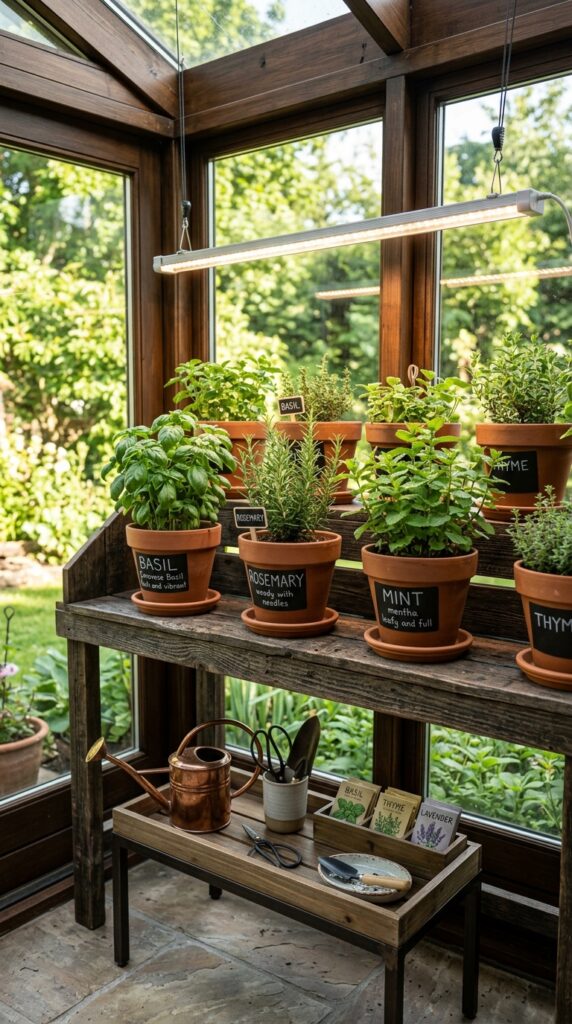
Vibe: Productive and earthy — a kitchen garden that stays year-round because it moved inside.
Why it works: A sunroom herb garden works on the most practical possible principle: the room’s primary assets — abundant natural light and climate control — are precisely what food plants require. Positioning the growing station along the glass wall maximizes south-facing light exposure for winter growing, and supplementing with a full-spectrum LED grow light bar ensures consistent 14–16 hours of light regardless of winter overcast. Tiered wooden shelves create a vertical growing system that maximizes the glass wall’s light exposure across multiple plant levels simultaneously.
How to get it: Use terracotta pots exclusively on the growing station — terracotta’s porosity allows soil to breathe and prevents the overwatering that kills more indoor herbs than anything else. Install drainage trays at each shelf level and choose a full-spectrum LED grow light rated for 2–3 square feet of coverage per herb shelf.
💡 Quick Win: A $25–$40 full-spectrum LED grow light bar on Amazon with a built-in timer delivers the 14 hours of daily light that basil, rosemary, and mint need to thrive through winter — one purchase that keeps fresh herbs available all year.
🛍️ Shop the Look — Amazon Product Ideas
| # | Product Search Phrase | Why It Fits |
| 1 | Full spectrum LED grow light bar timer indoor | Winter herb growing essential |
| 2 | Tiered wood plant stand shelf indoor | Growing station structure |
| 3 | Terracotta herb pot set with drainage tray | Herb growing containers |
| 4 | Chalkboard plant label stake set | Organized plant identification |
| 5 | Indoor herb growing kit starter seeds | Ready-to-grow herb collection |
21. Outdoor-Inspired Striped Rug Grounding the Space

Vibe: Warm and grounded — a rug that organizes the whole room without trying.
Why it works: A striped indoor-outdoor rug does specific work in a sunroom that a solid rug cannot — the directional lines of the stripe create a visual axis that organizes the furniture arrangement around it and guides the eye toward the glass wall and the view beyond. Running the stripe perpendicular to the glass wall (rather than parallel) draws the eye outward toward the garden, reinforcing the room’s primary visual intention. Indoor-outdoor polypropylene rugs are the practical right choice for a sunroom because they resist moisture, UV fading, and heavy foot traffic, and they can be hosed clean on the patio when needed.
How to get it: Size the rug at 8×10 feet minimum for a full furniture grouping — all four furniture legs should sit on the rug, not just the front two. Terracotta and cream, navy and white, or sage and natural are the three stripe combinations that work across the widest range of sunroom styles.
🛍️ Shop the Look — Amazon Product Ideas
| # | Product Search Phrase | Why It Fits |
| 1 | Indoor outdoor striped rug terracotta cream | Primary floor anchor piece |
| 2 | Polypropylene flat weave rug 8×10 outdoor | Moisture-resistant material |
| 3 | Non-slip outdoor rug pad 8×10 | Safety and grip layer |
| 4 | Terracotta stripe outdoor cushion set | Matching cushion palette |
| 5 | Outdoor rug cleaner spray stain resistant | Maintenance product for longevity |
22. Smart Glass or Switchable Film for Privacy Control
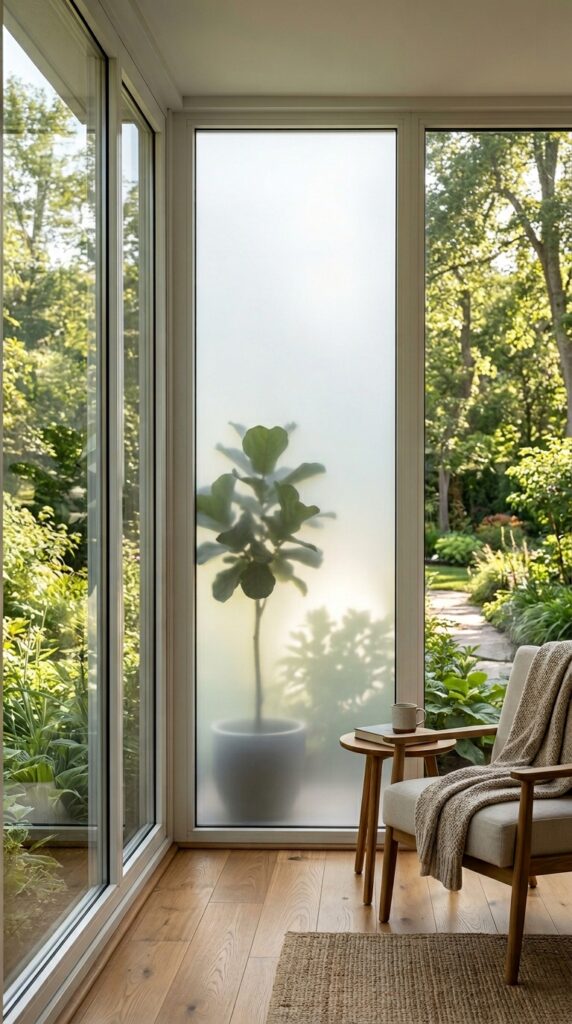
Vibe: Modern and controlled — a room that decides its own transparency.
Why it works: Switchable smart film on glass panels applies the design principle of programmable privacy: the sunroom can be fully transparent when the view and light are the priority, and opaque on demand when privacy is needed — at night, when neighbors are present, or when the room is being used for a video call. Unlike permanent frosted glass, smart film allows the transition between states on a switch or schedule. This technology is particularly valuable in an urban or suburban sunroom where full glass exposure is desirable during the day but not in the evening.
How to get it: Adhesive smart film (PDLC technology) is available in self-adhesive rolls for DIY application onto existing glass — it applies like window film and connects to a standard wall switch or smart home system. A 110V AC connection per panel is required, which means running a low-voltage wire to each glass panel during installation.
🛍️ Shop the Look — Amazon Product Ideas
| # | Product Search Phrase | Why It Fits |
| 1 | Smart film PDLC switchable privacy glass | Privacy-on-demand glass film |
| 2 | Frosted window film static cling privacy | Non-electric frosted alternative |
| 3 | Low voltage wire fish tape install kit | Wiring installation tool |
| 4 | Smart switch wall dimmer programmable | Film control interface |
| 5 | Window film squeegee application tool kit | Film installation tool |
23. Compact Four Season Sunroom as Home Office
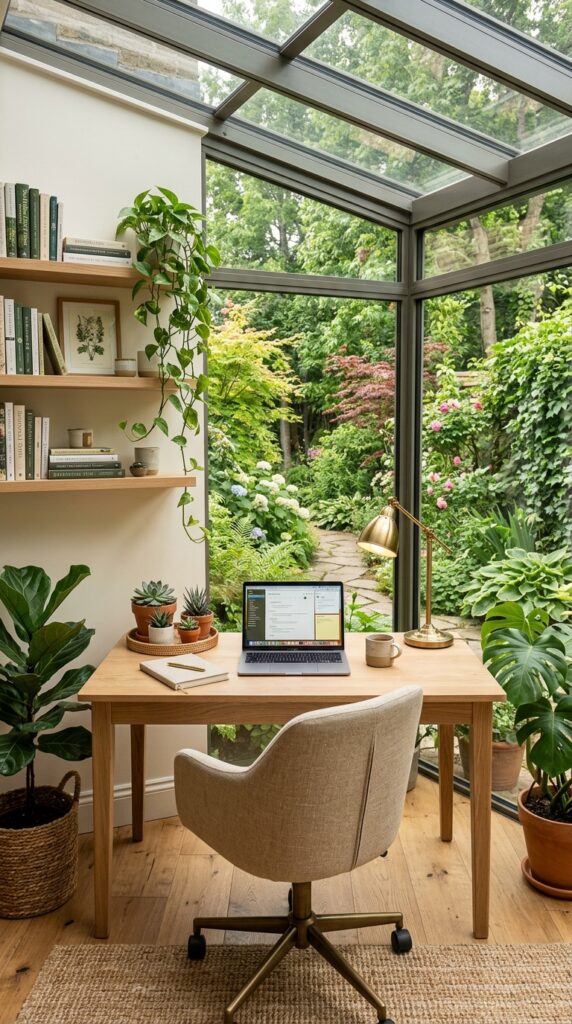
Vibe: Productive and alive — a workspace that makes sitting at a desk feel like a privilege.
Why it works: A sunroom home office exploits the most well-documented environmental productivity factor: natural light. Research consistently shows that workers in naturally lit environments sleep better, have higher energy levels, and report significantly higher job satisfaction than those in artificially lit spaces. Positioning the desk to face the glass wall (rather than a solid wall) provides a visual distance break — the ability to rest the eye on a far focus point (the garden) reduces the eye strain associated with prolonged screen use. The surrounding plants create a biophilic workspace that further reduces stress markers.
How to get it: Manage the screen glare challenge — which is the primary workspace problem in a glass-fronted room — with a matte screen protector on your monitor and by positioning the screen perpendicular to the glass wall rather than parallel to it. Morning and afternoon light angles change dramatically through a glass wall; perpendicular positioning eliminates most direct glare.
🛍️ Shop the Look — Amazon Product Ideas
| # | Product Search Phrase | Why It Fits |
| 1 | White oak desk minimal 60 inch home office | Primary workspace furniture |
| 2 | Linen task chair ergonomic warm neutral | Comfortable long-use seating |
| 3 | Matte monitor screen protector anti-glare | Glare management solution |
| 4 | Desk lamp aged brass adjustable arm | Warm task light at workspace |
| 5 | Small succulent collection 2 inch pot set | Desk-edge botanical detail |
24. Wide-Plank White Oak Flooring Extending from Interior
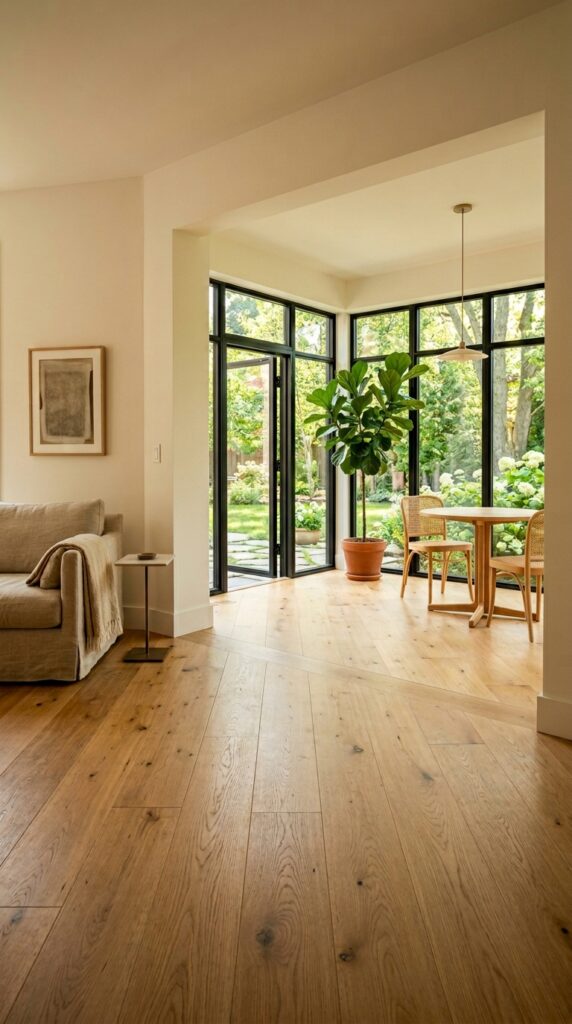
Vibe: Unified and generous — two rooms that have decided to be one.
Why it works: Continuous flooring across the sunroom threshold is the most powerful single decision for making a sunroom feel integrated rather than tacked on. When the floor material, direction, and finish match exactly, the eye reads both spaces as a single room — eliminating the threshold as a boundary and making the total space feel dramatically larger. This is the design principle of material continuity: the fewer material changes the eye encounters moving through a space, the more expansive that space feels.
How to get it: Specify the same white oak plank in the same width and finish direction in both spaces — matching plank direction is as important as matching species. If the sunroom floor is already a different material, a large-format porcelain tile in a convincing oak-look pattern achieves nearly the same visual continuity effect at lower cost and with better moisture tolerance.
💡 Quick Win: A wood-look luxury vinyl plank in a wide 5-inch format, laid in the same direction as the interior floor, costs $2–$4 per square foot installed and creates convincing material continuity between a sunroom and adjacent room without the moisture risk of real wood.
🛍️ Shop the Look — Amazon Product Ideas
| # | Product Search Phrase | Why It Fits |
| 1 | Wide plank white oak look LVP flooring 5 inch | Continuous floor material |
| 2 | Wood floor transition strip reducer bar | If threshold strip is needed |
| 3 | White oak floor oil finish natural hardwax | Matching finish product |
| 4 | Floor buffer pad applicator kit | Finish application tool |
| 5 | Seamless floor patching compound wood | Threshold gap repair material |
25. Festoon String Lights for Evening Ambiance
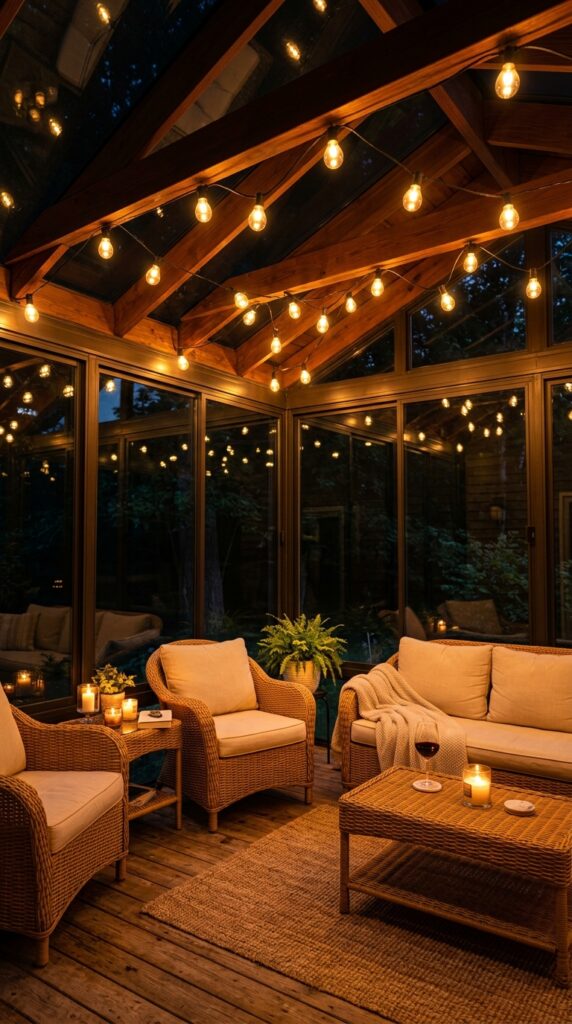
Vibe: Magical and amber-warm — the sunroom at night becomes its own kind of lantern.
Why it works: Festoon string lights in a sunroom solve the evening light problem that glass-walled rooms create: standard overhead lighting reflects off glass panels at night, creating a distracting mirror effect rather than a view. String lights positioned low and interior — draped between ceiling beams rather than mounted at the ceiling plane — keep the light source below the glass reflection point, which dramatically reduces glass glare while creating a warm, intimate ambient layer. The Edison globe bulbs at 2200K produce the deepest amber light available in a standard bulb format.
How to get it: Drape the string lights in catenary curves between ceiling hooks or beam-mounted screw-eyes, with the lowest point of each curve at approximately 7 feet — below the top of the glass panels. Use a plug-in dimmer between the lights and the outlet so the amber warmth can be dialed down to near-candlelight intensity for evening use.
🛍️ Shop the Look — Amazon Product Ideas
| # | Product Search Phrase | Why It Fits |
| 1 | Festoon string lights Edison globe outdoor 25ft | Primary evening atmosphere light |
| 2 | String light dimmer plug-in control | Intensity adjustment control |
| 3 | Ceiling beam screw eye hook set | String light suspension hardware |
| 4 | Large glass globe bulb 2200K warm amber | Deep amber light source |
| 5 | Rechargeable LED table candle flameless | Supplemental surface warmth |
26. Small Sunroom with Corner Banquette and Bistro Table
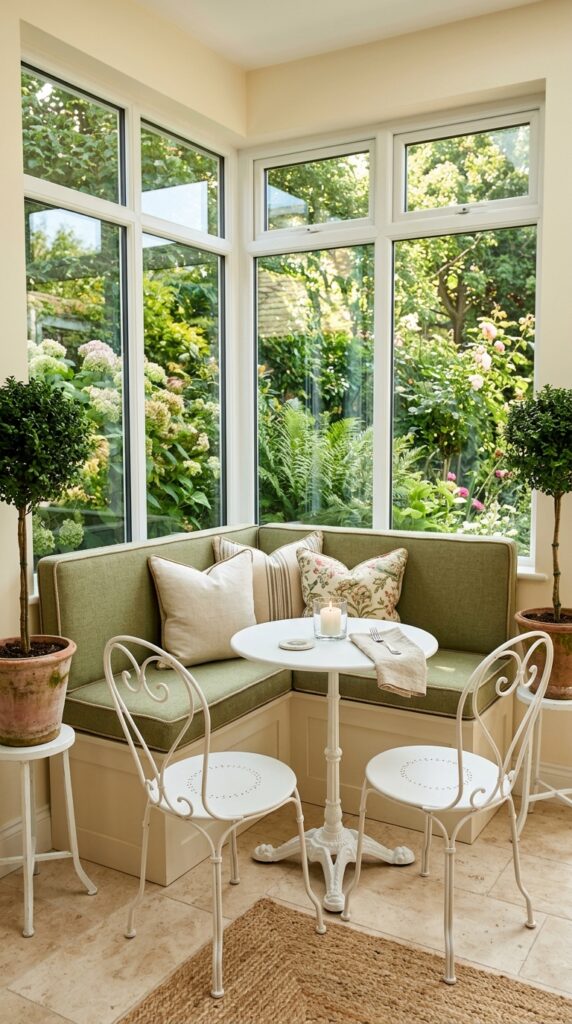
Vibe: Intimate and charming — a small space that makes you feel like you’re in a Parisian garden café that decided to move inside.
Why it works: A corner banquette with a bistro table is the definitive small sunroom solution because it does more with less floor area than any conventional furniture configuration can achieve — the corner banquette fits into the 90-degree junction of two glass walls where no standard sofa or chair could sit comfortably, and its L-shaped form seats three to four people in a footprint of roughly 36×36 inches per side. The small round bistro table occupies minimal floor space while maintaining full table functionality. This is the principle of corner activation: the room’s least-used zones become its most social.
How to get it: Build the banquette base at 18 inches high and 22 inches deep, with a lift-top storage compartment inside for sunroom accessories. Upholster in a Sunbrella or similar performance fabric — sage green, deep teal, or warm terracotta all work well against glass. Choose a bistro table with a diameter of 24–28 inches — the minimum comfortable size for two people dining.
🛍️ Shop the Look — Amazon Product Ideas
| # | Product Search Phrase | Why It Fits |
| 1 | Round bistro table white iron 28 inch | Compact dining surface |
| 2 | Bistro chair white metal outdoor foldable | Space-efficient dining seating |
| 3 | Sage performance fabric outdoor upholstery | Banquette cushion material |
| 4 | Boxwood topiary ball potted indoor outdoor | Flanking formal garden accent |
| 5 | Corner banquette storage bench cushion kit | DIY banquette foundation |
How to Start Your Four Season Sunroom Transformation
Your single first move: Address the heating. Before choosing furniture, paint, or accessories, solve the thermal problem — a four season sunroom that isn’t genuinely warm in winter is a room you’ll avoid for six months a year, and every other design decision will feel wasted. Install a ductless mini-split heat pump as your first investment: it provides both heating and cooling, handles humidity, and is quiet enough that you’ll forget it’s running. A 9,000–12,000 BTU unit covers most sunrooms and can be installed by an HVAC technician in a single day.
The most common mistake: Buying indoor furniture for a glass room. Standard interior sofas, upholstered in regular fabric with wood frames that aren’t moisture-treated, will warp, mold, and fade within two seasons of sunroom use. The temperature and humidity swings in a glass room — even a well-insulated one — exceed what conventional interior furniture is engineered to handle. Specify only all-weather wicker with powder-coated aluminum frames and Sunbrella or performance fabric cushions. It costs the same as mid-range interior furniture and lasts decades rather than seasons.
Three items under $50 for immediate impact: A set of two large terracotta planters with trailing pothos ($18–$28 for the plants, $12–$20 for the pots), a strand of festoon string lights in 2200K amber for evening atmosphere ($22–$35), and a solar roller shade for a single glass panel to test sun control ($35–$55). These three additions address light, plants, and ambiance — the three sensory pillars of the sunroom experience.
Realistic expectations: A furnished sunroom with performance furniture, a rug, plants, and lighting costs $2,500–$6,000 for a 150–250 square foot space using quality all-weather pieces. Adding radiant floor heating to an existing concrete slab runs $800–$1,500 installed. A full four season conversion of an existing screened porch — including storm window inserts, mini-split installation, new flooring, and furniture — typically ranges from $8,000 to $18,000 depending on size and climate requirements. A new custom sunroom addition with thermally broken glazing starts at $30,000 and commonly reaches $60,000–$80,000 for a premium installation.
Frequently Asked Questions About Four Season Sunrooms
What makes a sunroom “four season” versus a three season room?
The critical difference is thermal performance. A three season room uses single-pane glass or screen panels with no climate control system — it’s comfortable from spring through fall but unlivable in winter cold or summer extreme heat. A four season sunroom requires at minimum: double- or triple-pane insulated glass, thermally broken frames (which prevent cold transfer through the metal frame structure), a dedicated heating and cooling system (typically a ductless mini-split or radiant floor heat), and insulated walls, floor, and roof. In cold climates like the northern United States or Canada, triple-pane glass with a U-value of 0.20 or lower is the threshold for genuine four season comfort.
What colors work best in a four season sunroom?
The most successful sunroom palettes borrow from the colors visible through the glass. Warm sage and forest green echo garden foliage, sky blue echoes the literal sky, terracotta echoes warm soil and brick, and warm greige bridges all natural settings. Avoid cool grays and pure whites as dominant wall colors in a sunroom — under the variable and often intense light conditions of a glass room, cool neutrals can shift toward clinical or washed-out. The interior wall (the single non-glass surface) benefits from a more committed color — dusty sage, deep navy, or warm charcoal — to provide visual depth against all that light.
How much does a four season sunroom cost to build or convert?
A full new-construction four season sunroom addition ranges from $30,000 to $80,000 for a 150–300 square foot space, depending on glazing quality, insulation specification, and finishing level. Converting an existing screened porch to four season use is the most economical path: storm window inserts plus a mini-split heat pump costs $5,000–$15,000 for a complete conversion. A prefabricated sunroom kit — which includes the glass panels and frame but not the foundation, roof, or HVAC — runs $15,000–$35,000 for supply only, plus installation labor.
Can I use regular furniture in a four season sunroom?
Not comfortably or durably. A sunroom experiences higher UV exposure, greater temperature swings, and higher relative humidity than any standard interior room — even with climate control. Standard interior upholstery fabrics fade and mildew within one to two seasons. Wood furniture without moisture treatment warps and cracks. The correct approach is all-weather furniture with powder-coated aluminum frames, all-weather resin wicker (not natural cane), and Sunbrella or equivalent solution-dyed acrylic cushion fabric. This category of furniture is widely available, aesthetically comparable to interior furniture, and engineered to handle exactly the conditions a sunroom creates.
What plants grow best in a four season sunroom year-round?
The best-performing year-round sunroom plants are those that thrive in high light and tolerate temperature fluctuation: fiddle-leaf figs (dramatic silhouette, tolerates 60–85°F range), bird of paradise (large tropical leaves, thrives in direct sun), trailing pothos (tolerates lower light in winter, incredibly durable), dwarf citrus trees (lemon or kumquat, which actually require a cool winter rest period — a sunroom’s seasonal temperature variation is ideal), and herbs including rosemary, basil, and mint with supplemental grow light in winter. Avoid succulents in a humid sunroom and any plant labeled “low light” — the intensity of direct sunroom light will scorch them quickly.
Ready to Create Your Dream Four Season Sunroom?
From the thermal intelligence of radiant stone floors and smart solar shades to the visual drama of a dark charcoal accent wall glowing against a bright winter garden, these 26 four season sunroom ideas cover the full spectrum of comfort, material, color, and layout thinking that makes year-round sunroom living genuinely achievable. Start with one specific decision — the heater, the rug, the string lights — rather than waiting to transform everything at once. Tonight, order a strand of amber festoon lights and one large terracotta planter: hang the lights across your sunroom ceiling and put a trailing pothos in the corner, and you’ll have the two elements that most immediately communicate warmth, life, and intention. When the whole room comes together — thermally comfortable in January, shaded and breezy in July, always filled with the quality of natural light that no interior room can replicate — you’ll have the room in your home you use the most and leave the latest. Pin the ideas that made you look twice — the hammock chair corner and the bohemian plant wall tend to disappear from boards before you get back to them.