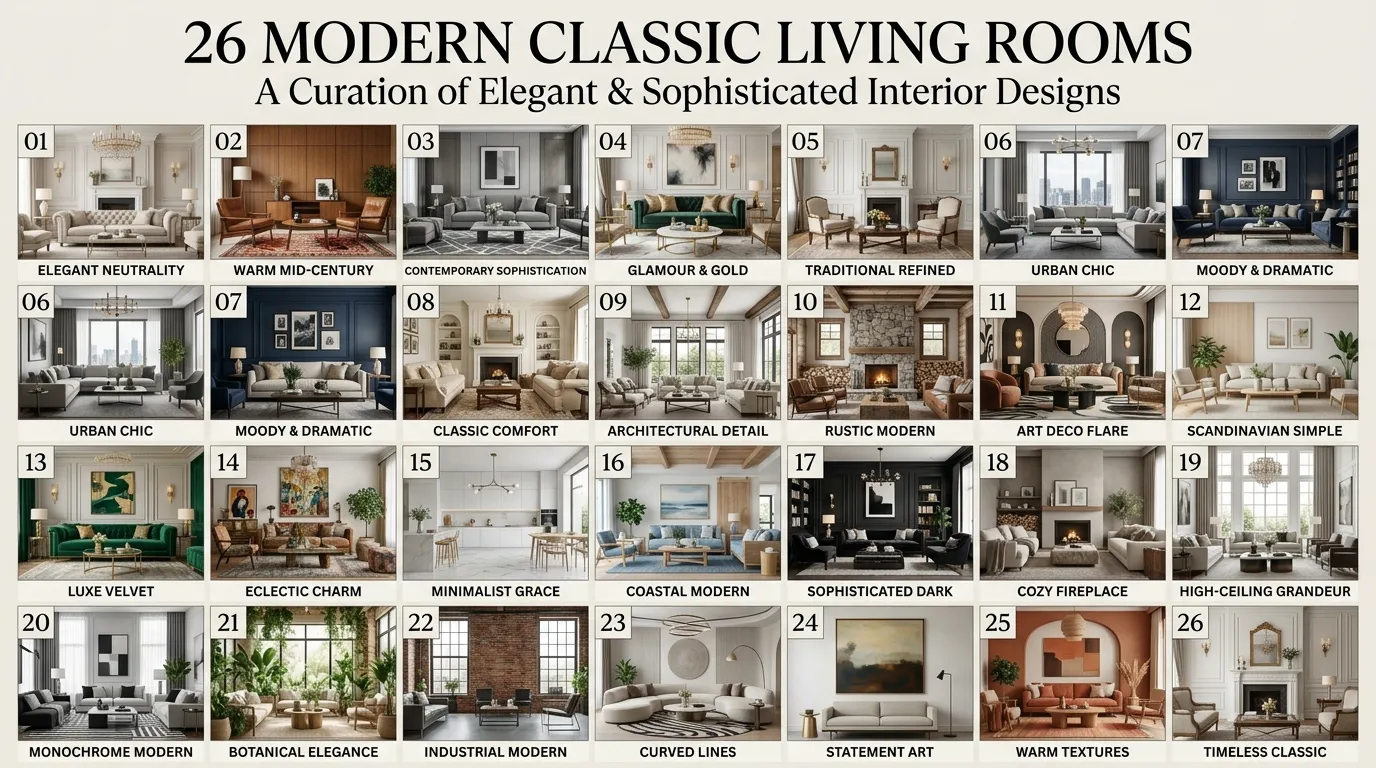
A modern classic living room blends timeless design principles—symmetry, quality materials, restrained color palettes, and refined furnishings—with contemporary comfort and functionality, creating spaces that feel both collected and current. This article delivers 26 modern classic living rooms ideas—from minimalist approaches to layered traditional-meets-contemporary spaces—proving that enduring elegance and today’s lifestyle can inhabit the same room.
Modern classic feels like quiet confidence: the satisfaction of recognizing a well-made chair across a room, the ease of conversation in a perfectly proportioned space, the comfort of materials that age beautifully rather than trend urgently. It’s the aesthetic of people who know their taste and trust it. There’s no strain in a modern classic room—no overcurated Pinterest performance, no dated styling decisions waiting to embarrass you in five years. The movement draws from mid-century modernism, early 20th-century minimalism, and the restraint of Scandinavian design, anchored by the permanence of classic furniture silhouettes and honest materials. Here are 26 ideas worth saving—and stealing.
Why Modern Classic Living Rooms Work So Well
Modern classic design emerges from the conviction that good design doesn’t require novelty—it requires intention. Originating in the aftermath of mid-century modernism (1950s–1960s) and refined through decades of design wisdom, modern classic rejects both maximalism and trend-chasing in favor of timeless principles: clean lines, functional beauty, and quality over quantity. It borrows from Bauhaus (form follows function), Scandinavian minimalism (honest materials, light-filled spaces), and traditional restraint (symmetry, proportion, understatement). What distinguishes modern classic from generic “traditional” is its refusal to perform heritage—it’s traditional thinking applied to contemporary living.
Core materials are uncompromising: solid wood (white oak, walnut, cherry) finished to show grain, natural linen and wool textiles, leather that develops patina, polished concrete or natural stone, steel in minimal profiles, and brass or bronze hardware that ages visibly. Colors emerge from these materials themselves—warm whites, soft grays, warm blacks, the honey tones of natural wood, and accent colors chosen for depth rather than trend (deep sage, dusty blue, warm charcoal). Texture comes from material authenticity: linen weave visible in upholstery, wood grain in furniture, stone variation in flooring. These materials improve visually with time, resisting the false perfection of plastic or high-gloss finishes.
Modern classic trends now because it answers three contemporary desires simultaneously: fatigue with fast furniture and trend cycles (people want pieces they’ll own for decades), anxiety about cluttered homes (minimalist restraint soothes), and the search for authenticity in a digital world (real materials and honest construction feel grounding). Post-pandemic, homeowners rejected performance-focused interiors for spaces designed around actual living—conversation, reading, rest—rather than Instagram-ability. The aesthetic aligns with climate consciousness: investing in quality pieces that last decades is inherently more sustainable than replacing trendy furnishings every few years.
Small living rooms are modern classic’s native language. The style’s restraint—fewer, better pieces; open sightlines; refined color palettes—makes compact spaces feel intentional rather than constrained. A 250-square-foot living room can feel luxurious with one excellent sofa, a coffee table in proportion, controlled color, and good lighting. Larger rooms achieve modern classic through spatial planning, not accumulation—defining zones through furniture arrangement rather than walls, using negative space as design principle.
| Element | Core Trait 1 | Core Trait 2 |
| Philosophy | Timeless over trendy, quality over quantity | Functional beauty, intentional restraint |
| Key Materials | Solid wood, natural linen, leather | Stone, polished concrete, brass hardware |
| Key Colors | Warm white, soft gray, warm black | Honey wood tones, deep sage, dusty blue |
26 Modern Classic Living Rooms Ideas
1. The Neutral Foundation — Warm White Walls with Natural Wood
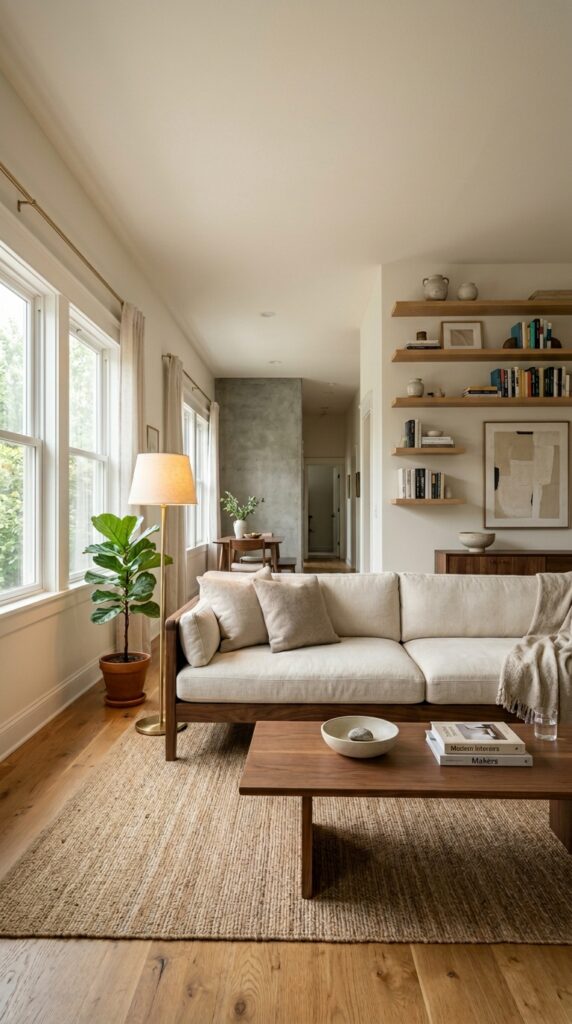
Vibe: Serene and grounded, where simplicity becomes sophistication.
Why it works: The neutral foundation—warm white walls paired with natural wood—is the foundational strategy of modern classic design. Warm white (not cool white, which reads sterile) provides clean backdrop while honey-toned wood brings warmth and organic texture. This pairing creates visual calm that allows high-quality furnishings to speak for themselves. The walls become invisible, making the room feel larger and more focused on objects that matter.
How to get it: Specify warm white paint (Benjamin Moore Swiss Coffee, Farrow & Ball Old White, or Sherwin-Williams Alabaster—check undertone swatches in your actual lighting). Install solid-wood flooring in medium-tone oak or walnut (avoid overly dark or overly light finishes, which read trendy). Keep wall decoration minimal: one art piece, open shelving, or a single accent wall. This restraint is the discipline that makes modern classic work.
💡 Quick Win: If budget doesn’t allow new flooring, paint existing hardwood in warm white—this creates visual expansion and allows the wood furniture to become the focus. Cost: $500–$1,000 for a room-sized area.
Shop The Look
- Warm white interior paint Benjamin Moore Swiss Coffee or equivalent
- Solid wood sofa frame linen upholstery cream
- Natural walnut wood coffee table clean-line design
- Floating wood shelves walnut or oak wall-mounted
- White painted window trim casings
- Brass tripod floor lamp modern silhouette
- Linen throw pillow covers cream or warm white
- Potted plant fiddle leaf fig neutral ceramic pot
- Abstract art print neutral tones 24×36
- Ceramic vessels for shelving display various sizes
2. Leather Statement Sofa — Rich Patina Over Time
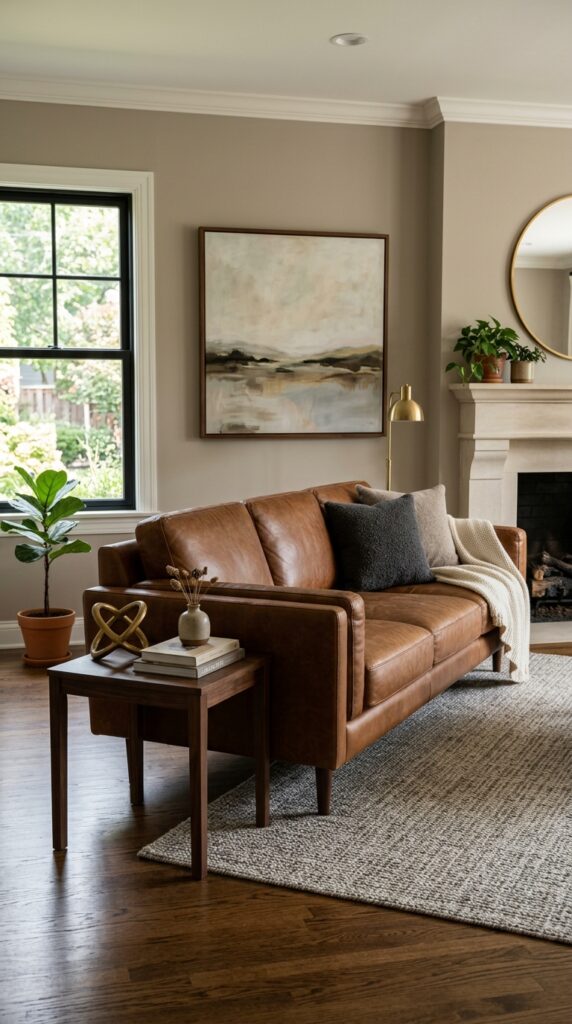
Vibe: Warm and luxurious, where leather becomes patina-rich history.
Why it works: A quality leather sofa is perhaps the single best investment a modern classic room can make. Unlike trendy upholstery, leather improves visually with age—creasing and patina develop character rather than deterioration. A deep caramel or cognac leather in a simple mid-century modern silhouette reads sophisticated and timeless. The leather’s warmth anchors the room emotionally; it invites sitting and conversation rather than visual admiration from a distance.
How to get it: Invest in full-grain leather (not corrected grain, which is treated and artificial-looking). Specify a sofa with tapered wood legs, clean arms, and no excessive detailing. Expect $2,500–$5,000 for a quality leather sofa; this is a 20-year piece. Choose a warm neutral leather tone (caramel, cognac, chocolate, warm gray) that will complement your wall color. Avoid black, which reads harsh, and bright tan, which reads trendy.
How to get it: Position the sofa to anchor the room’s seating arrangement—this is the piece everything else organizes around. Don’t position it against a wall; float it if space permits, creating a sense of intentionality and spatial generosity.
Shop The Look
- Quality leather sofa full-grain caramel or cognac
- Leather sofa with tapered wood legs mid-century
- Solid wood side table walnut or oak
- Contemporary area rug warm gray 8×10
- Brass or bronze sculptural object décor
- Cream linen throw blanket tasseled edges
- Warm white interior paint walls
- Brass table lamp beside sofa simple design
- Natural wood end table matching legs
- Leather care conditioner maintenance kit
3. Asymmetrical Seating Arrangement — Mix of Furniture Types
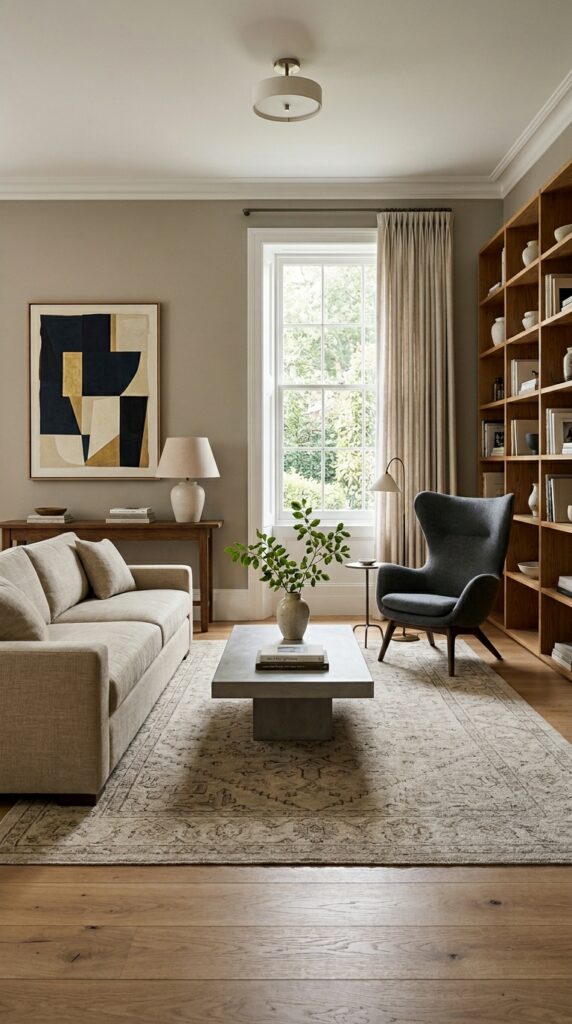
Vibe: Intentional and sophisticated, where imbalance creates visual interest.
Why it works: Symmetrical furniture arrangement (identical chairs flanking a sofa, matching end tables) reads formal and potentially stiff. Asymmetrical arrangement—mixing sofa, single chair, varying table heights—feels more collected and contemporary. This approach requires careful proportion (don’t let one side feel visually heavier), but the payoff is a room that feels thoughtfully curated rather than matched-set purchased. The eye moves with visual interest rather than resting on predictability.
How to get it: Start with your sofa as the anchor, then add seating from different sources: a vintage wingback chair, a modern lounge chair, a simple wooden bench. Position these at angles (45 degrees to the sofa) rather than parallel, creating conversation zones. Vary table heights (low coffee table, tall console behind sofa) to add visual rhythm. Keep color and material cohesive (all natural wood legs, all neutral upholstery tones) to prevent the variety from feeling chaotic.
💡 Quick Win: Use a single statement chair (a beautiful mid-century wingback or modern lounge piece) positioned opposite the sofa—this single focal piece creates visual balance without matching-set symmetry.
Shop The Look
- Mid-century modern wingback chair neutral upholstery
- Modern lounge chair simple silhouette taupe or gray
- Floating marble or concrete coffee table
- Wooden console table behind sofa walnut
- Contemporary area rug warm gray or beige 8×10
- Natural wood bookshelves wall-mounted open
- Abstract art print one statement piece
- Potted plant sculptural ceramic pot
- Simple wooden bench seating functional
- Brass side table small accent occasional
4. Fireplace as Focal Point — Symmetry Around the Heat
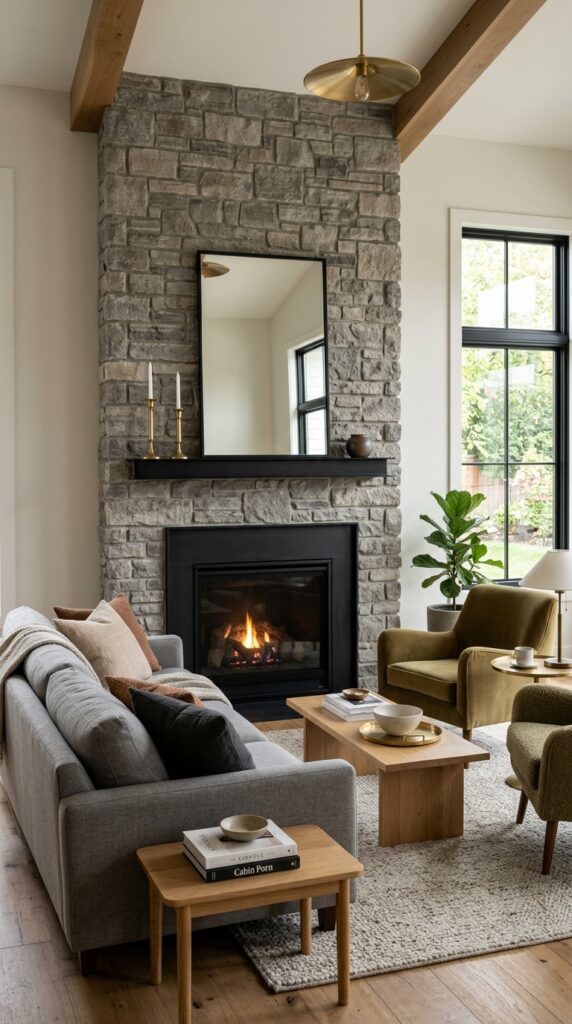
Vibe: Warm and gathered, where heat becomes the room’s heartbeat.
Why it works: A fireplace is the ultimate modern classic focal point—it’s functional (actual heat), visually compelling (flame movement), and emotionally resonant (gathering point). Even in mild climates, a fireplace becomes the room’s anchor. The principle: keep the mantel and wall around it minimal (avoid fussy décor collections)—the fireplace itself is enough visual interest. Symmetrical mantel styling (mirror or art centered, candlesticks equidistant) creates calm and intentionality.
How to get it: Arrange seating in a modified circle around the fireplace—sofa on one side, chairs on others—allowing conversation and fireplace viewing simultaneously. Keep mantel styling restrained: one centered mirror or art piece, two matching candlesticks, nothing else. Paint the wall surrounding the stone in warm white to maximize light reflection and prevent the fireplace from reading as a dark cave. If budget doesn’t allow a new fireplace, a simple existing fireplace can be updated with new black metal surround hardware (cost: $400–$800).
How to get it: Ensure the fireplace has adequate clearance around it (typically 18 inches minimum from combustibles)—this protective space also creates visual breathing room, making the fireplace feel intentional rather than cramped.
Shop The Look
- Fireplace surround stone stacked natural neutral
- Black metal fireplace frame minimalist design
- Simple black-frame mirror mantel wall
- Brass candlesticks pair mantel styling
- Substantial modern sofa perpendicular arrangement
- Wooden coffee table clean-line design
- Modern accent chairs fireplace-facing
- Natural wood flooring warm tone
- Warm white interior paint fireplace wall
- Fireplace tools black metal minimalist
5. Layered Lighting — Natural, Ambient, Task, Accent
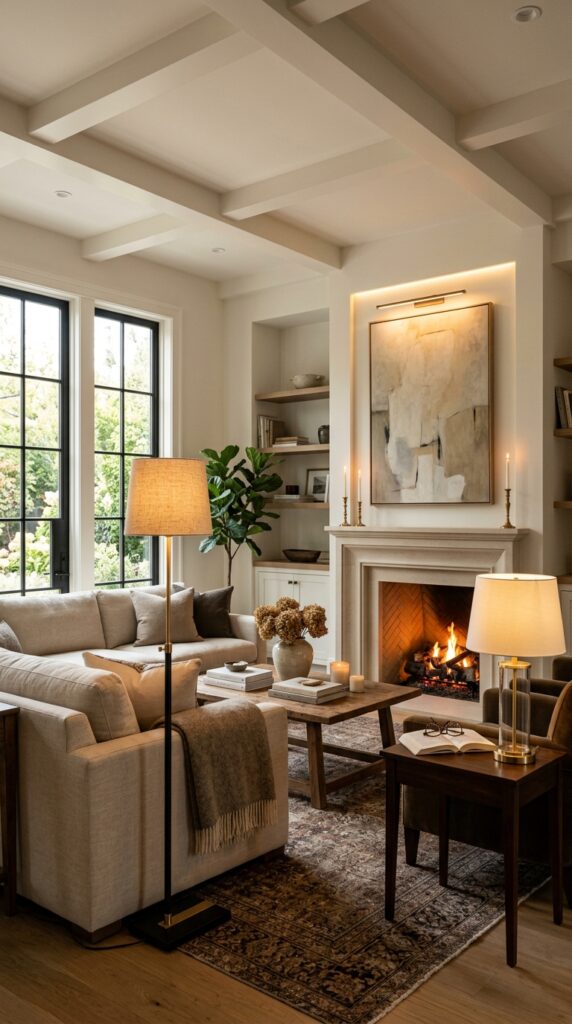
Vibe: Warm and intentional, where light becomes a design material.
Why it works: Modern classic rooms are sophisticated about lighting because bad lighting ruins everything—it’s the single highest-impact design decision. Layering multiple light sources (natural windows, floor lamps, table lamps, accent lighting, fireplace) creates flexibility and depth impossible with a single overhead fixture. Each source has a purpose: natural light for daytime, floor lamp for ambient evening glow, table lamp for reading task, fireplace or accent light for atmosphere. The room feels different and equally beautiful at different times.
How to get it: Specify warm-temperature artificial light (2700K color temperature—this is warm and forgiving). Invest in quality floor and table lamps with linen shades (not plastic, which looks cheap) in brass or matte black finishes matching your hardware. Add one accent light source: hidden uplighting on a wall, picture rail lighting on art, or a simple recessed ceiling fixture in task locations. Budget: $1,500–$2,500 for a complete lighting plan in one room including fixtures and installation.
💡 Quick Win: Add one excellent brass or matte-black floor lamp with a linen shade (cost: $300–$600) positioned beside the sofa—this single addition transforms evening ambiance more dramatically than any other single purchase.
Shop The Look
- Contemporary floor lamp brass or matte-black frame
- Linen lampshade natural fiber large diameter
- Simple table lamp wood or metal base
- Recessed ceiling lights warm 2700K temperature
- Picture rail lighting system artwork
- Brass or bronze candle holders fireplace mantel
- Window treatments optional minimal frame
- Natural light from large windows primary
- Floor lamp dimmer switch optional
- Task lighting over reading chair area
6. Textural Layering — Linen, Wool, Leather Combination
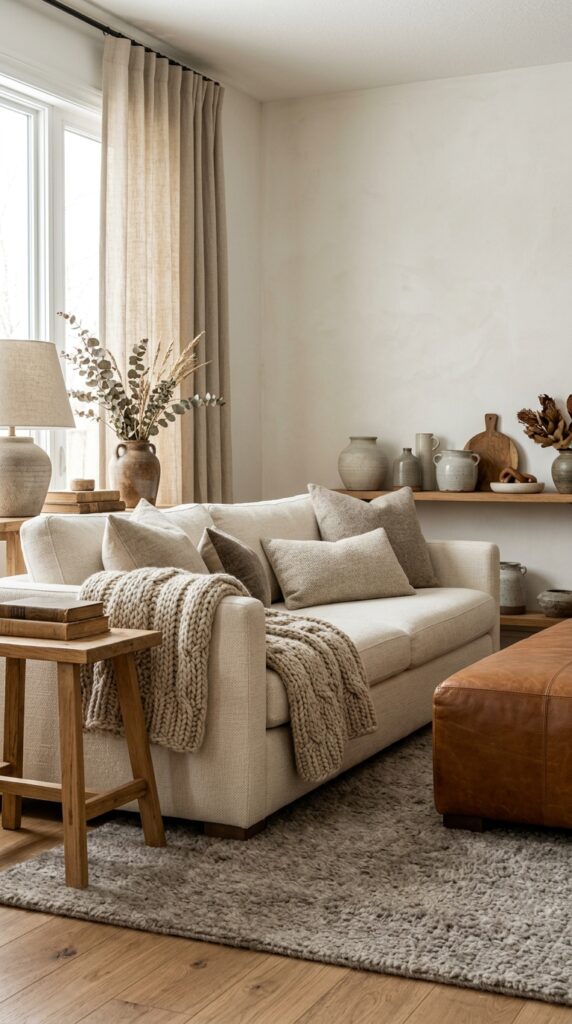
Vibe: Warm and tactile, where texture substitutes for pattern and color.
Why it works: Modern classic rooms avoid pattern and color complexity in favor of textural richness—linen weave, wool nap, leather grain, wood grain, ceramic variation. This approach creates visual and tactile interest without visual clutter or dated pattern. The room feels sophisticated and collected because the eye has something to rest on at every scale: from the room’s overall proportions down to the visible texture of individual materials. Neutrality becomes an opportunity for material honesty rather than blandness.
How to get it: Select a neutral color palette (warm white, warm gray, cream, honey wood, caramel leather) and vary only the texture. Choose a linen sofa (visible weave), wool area rug (visible nap), leather accessories (visible grain), and natural fiber pillows. Add a chunky knit blanket and linen curtains. The textural variety prevents monotony; the neutral palette prevents chaos.
How to get it: Include at least one high-tactile element that invites touching: a chunky wool throw, a leather ottoman, a linen-upholstered ottoman. These pieces should be positioned accessibly, not as distant décor.
Shop The Look
- Linen upholstered sofa cream visible weave
- Wool area rug warm gray 8×10 natural nap
- Leather ottoman caramel or cognac grain
- Chunky knit throw blanket oatmeal or cream
- Linen curtains simple drape window treatment
- Cushions multiple linen-wool blend natural
- Wooden side table walnut or oak grain
- Ceramic vessels various natural clay tones
- Wool felt wall hanging textural optional
- Simple woven baskets natural fiber storage
7. Symmetrical Spatial Planning — Balanced Arrangement
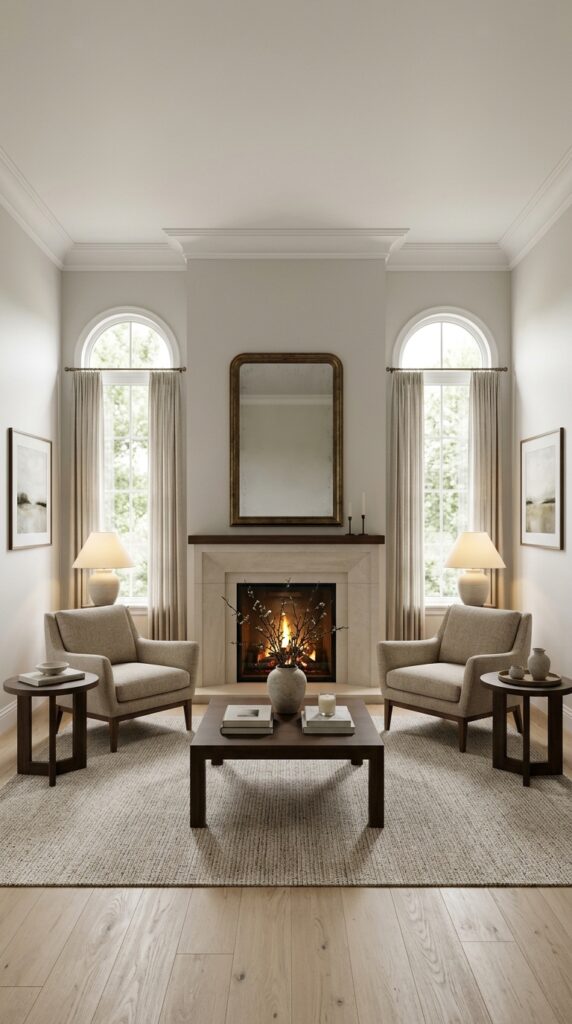
Vibe: Calm and intentional, where balance creates restfulness.
Why it works: Symmetrical arrangement creates psychological calm—our brains find symmetry restful and soothing. A modern classic room can use symmetry as a design strategy without reading as overly formal if the furniture is contemporary in silhouette and the decoration is minimal. Matching chairs on either side of a fireplace, balanced lamps, centered art—these elements create harmony without fussiness.
How to get it: Choose a central focal point (fireplace, window, wall) and build the arrangement around it. Position pairs of chairs or sofas equidistant from center. Use matching or similar side tables and lamps. Balance wall decoration (one centered artwork or mirror, or pairs of smaller pieces). The key is restraint: symmetry with minimal decoration feels calm; symmetry with excessive accessories feels overdone.
How to get it: Use symmetry as the room’s organizational principle, not decoration. The beauty is in the balance itself, not in matching objects—two different chairs in the same upholstery tone positioned symmetrically feels more modern than two identical matched chairs.
Shop The Look
- Pair of modern lounge chairs matching silhouette
- Matching wooden side tables walnut or oak
- Matching brass or black table lamps
- Centered marble or wood coffee table
- Contemporary area rug symmetrically positioned
- Centered artwork or mirror on focal wall
- Fireplace as symmetric anchor if available
- Matching cushions neutral upholstery
- Simple wooden console optional behind sofa
- Matching brass candlesticks mantel or sideboard
8. Mixed Wood Tones — Warm Walnut and Light Oak Coexistence
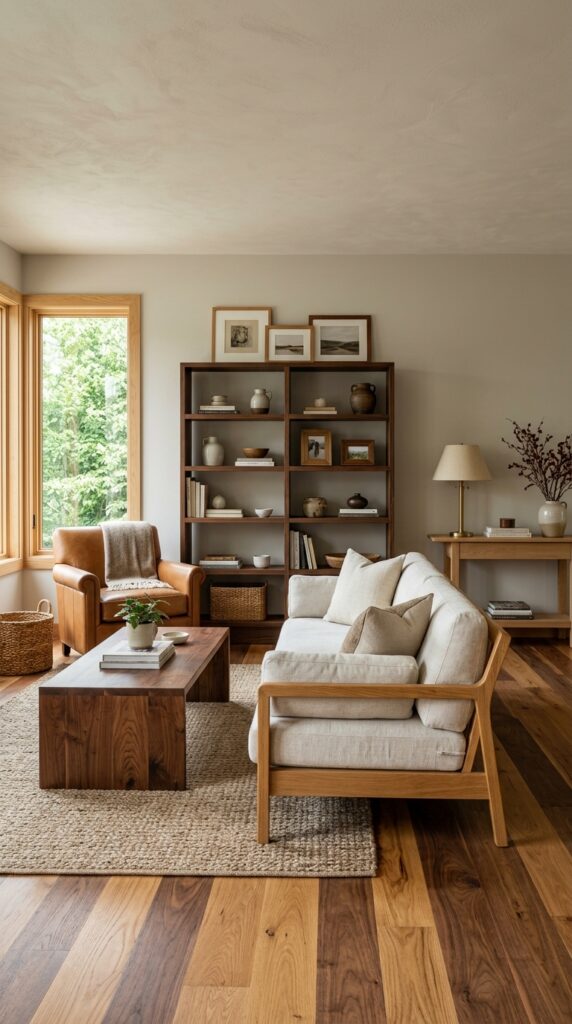
Vibe: Warm and collected, where wood tones tell a story of gathering.
Why it works: Modern classic rooms often mix wood tones—light oak, medium walnut, dark cherry—rather than attempting to match everything. This approach feels collected (as if pieces were gathered over time from different sources) and sophisticated (it requires confidence to mix tones intentionally). The key: all pieces must share a warm undertone. Cool-toned woods (gray oak, whitewashed finishes) mixed with warm woods (honey oak, walnut) feels chaotic; warm tones mixed together feel intentional.
How to get it: Gather wood pieces in varied tones but consistent warmth: honey oak flooring or sofa frame, walnut coffee table, light maple shelving, cherry side table. Allow natural finishes to show grain variation rather than staining everything identically. The variation in tone becomes the design interest. Pair with leather in caramel or cognac to bridge the wood tones and add warmth.
How to get it: If you can’t see the wood grain clearly, the finish is wrong for modern classic design. Specify matte or satin finishes (not high-gloss) and request “natural” or “honey” stains rather than amber or golden, which read dated.
Shop The Look
- Sofa frame solid oak or maple light tone
- Coffee table walnut wood darker tone
- Open shelving walnut or cherry
- Console table light oak or maple
- Hardwood flooring mixed warm tones
- Wooden window trim warm tone
- Leather chair or ottoman caramel
- Picture frames mixed wood finishes
- Side table cherry or walnut
- Natural wood stain finishing
9. Minimalist Wall Décor — One Statement Piece

Vibe: Calm and intentional, where absence becomes presence.
Why it works: Modern classic embraces the principle that empty walls are not failures—they’re intentional design. A single substantial artwork (36×48 inches minimum) positioned at eye level (center 60 inches from floor) becomes a focal point without clutter. The empty wall space around it amplifies the artwork’s presence; multiple smaller pieces would diminish it. This approach requires confidence but creates sophistication that rooms crammed with décor cannot match.
How to get it: Choose one artwork that genuinely moves you—a large abstract print, a photography series on metal, a modern textile art piece. Position it alone on a primary wall (the wall you see first upon entering the room). Leave surrounding walls empty. Allow the artwork to define the room’s color story (if it includes sage green, pull that tone into pillows; if it’s charcoal and white, echo that contrast in other elements).
💡 Quick Win: Commission a large custom photography print (a landscape, a detail photograph, a personal memory enlarged) from a local photographer—this creates uniqueness impossible with purchased art. Cost: $400–$800 for a 36×48-inch print in a simple frame.
Shop The Look
- Large abstract art print 36×48 or larger
- Contemporary photography metal print
- Modern textile art fiber on wall
- Simple black or natural wood frame
- Minimal picture hanging hardware
- Neutral wall paint warm white
- One small accent table for styling below art
- Natural light from nearby window
- Potted plant positioned to complement art
- Simple wooden shelving secondary focus
10. Defined Seating Zones — Multiple Conversation Areas

Vibe: Functional and intentional, where space becomes flexible lived territory.
Why it works: Modern classic rooms in larger spaces (300+ sq ft) benefit from defined zones: a main conversation seating area, a reading nook, a window seat. Rather than one large open room feeling empty, zoning creates multiple functional areas. The zones should be defined through furniture grouping and area rugs, not walls—maintaining the open, connected aesthetic while allowing different activities simultaneously.
How to get it: Define zones through area rugs (each zone has its own rug, not a single large one) and furniture arrangement. Place a conversation sofa and chairs around a coffee table in one zone, position a reading chair with side table and lamp in another zone, create a window seat with cushions in a third zone. Ensure clear pathways between zones and visible separation (not adjacent). Keep color and material consistent across all zones to prevent fragmentation.
How to get it: Each zone should be self-contained enough that two people could occupy it without overlapping—this is the functional definition of a separate zone.
Shop The Look
- Sectional sofa or grouped seating primary zone
- Reading chair wingback or modern lounge
- Window seat bench with cushions
- Area rug primary zone 8×10
- Area rug secondary zone 5×7
- Coffee table primary zone
- Side table reading zone
- Floor lamp reading zone
- Window seat cushions outdoor-quality
- Varied furniture in consistent material tone
11. Open Shelving Display — Collected Objects and Books

Vibe: Collected and intentional, where display becomes a living document.
Why it works: Open shelving in modern classic design differs from maximalist styling: objects are curated, grouped, and spaced with intention. Books are organized by color or size (not haphazardly), ceramics are grouped in sets of three or five, sculptural objects are given breathing room. This approach celebrates what you own while maintaining the restraint that defines the style. The shelving becomes a visual journal of your aesthetic and interests.
How to get it: Begin with a clear wall and floating shelves (5–6 shelves at varying heights). Populate slowly: add books you’ve actually read and value, ceramics you love visually, objects that have meaning to you. Group items in odd numbers (three books standing together, five ceramic vessels), leave space between groups, and position taller objects toward back with shorter items in front. Maintain a 40% empty shelf space ratio—this prevents clutter.
💡 Quick Win: Paint the wall behind the shelving a slightly deeper tone (soft sage, dusty blue, warm gray) rather than the same white as surrounding walls—this frames the display and makes objects appear to float.
Shop The Look
- Floating wooden shelves walnut or white
- Wall paint warm white or soft tone behind shelves
- Book organization by color or size
- Ceramic vessels neutral tones various sizes
- Brass or wooden sculptural objects
- Potted plants green foliage at varying heights
- Framed art or photography minimal
- Negative space intentionally maintained
- Bookends simple metal or wood
- Shelf brackets minimal profile hardware
12. Low-Profile Furniture — Sight-Lines and Spatial Expansion

Vibe: Open and expansive, where sight-lines create spaciousness.
Why it works: Low-profile furniture (sofas 32 inches or shorter, coffee tables 16 inches or shorter) is perhaps the single most powerful tool for making rooms feel larger. When furniture doesn’t block sight-lines and your view extends beneath pieces to visible walls and floors beyond, the space feels immediately more generous. The principle: expose legs on all furniture, avoid skirted or upholstered-base pieces, maintain consistent furniture height around the room (variation makes spaces feel chaotic).
How to get it: Specify sofas with exposed tapered legs (mid-century modern silhouettes inherently have this). Choose coffee tables and side tables with visible bases (not solid tops sitting directly on the floor). Arrange furniture to maximize visible floor—position a sofa floating in the room rather than against a wall. The visual payoff is worth any psychological discomfort about “floating” furniture in a compact space.
How to get it: If you have lower ceilings (8 feet or less), low-profile furniture becomes even more important because it emphasizes horizontal rather than vertical space, preventing the room from feeling cramped.
Shop The Look
- Low sofa 32-inch height tapered legs
- Mid-century modern chair exposed legs
- Low coffee table 16-inch height
- Low side tables visible base
- Ottoman with legs not skirted base
- Console table on visible supports
- Floating arrangement furniture placement
- Natural hardwood flooring visible
- Warm white walls emphasizing height
- Brass or wood legs consistent finish
13. Monochromatic Color Scheme — Tonal Variation Within One Color

Vibe: Calm and cohesive, where restraint becomes richness.
Why it works: A monochromatic color scheme (warm whites and grays, or warm taupes and caramels, or soft greiges) creates sophisticated calm impossible with multiple colors. The room reads as one unified space rather than separate color zones. Visual interest comes entirely from texture—linen weave, wood grain, leather patina, ceramic variation—which becomes more prominent when not competing with color. This approach suits modern classic perfectly: restrained, intentional, timeless.
How to get it: Choose your color family (warm whites/creams, warm grays/taupes, or soft greiges) and commit to it across all major surfaces: walls, flooring, upholstery. Vary tonal darkness: light sofa, medium rug, darker shelving creates visual rhythm while maintaining cohesion. Allow natural wood tones to add warmth rather than additional color. Introduce minimal accent color through one object or plant rather than throughout.
How to get it: Within your chosen color family, you can include materials that technically aren’t the same hue but share the same undertone—warm gray and caramel and cream all share warm undertones and feel cohesive together even though they’re technically different colors.
Shop The Look
- Warm white interior paint walls
- Cream linen sofa upholstery
- Gray wool area rug 8×10
- Light gray or taupe wood flooring
- Walnut gray-tone wooden shelving
- Caramel-taupe leather ottoman
- Throw pillows cream-to-taupe tones
- Chunky knit blanket cream or oatmeal
- Warm wood coffee table honey tone
- Single brass object or green plant accent
14. Curved Furniture — Softness Against Architecture

Vibe: Soft and modern, where curves bring humanness to geometry.
Why it works: Modern classic furniture is typically rectilinear (straight lines, right angles, clean edges), but introducing gentle curves—a curved sofa arm, a rounded chair back, a curved console table—adds organic softness that makes spaces feel more inviting and human-scaled. Unlike vintage-style curves (ornate, decorative), modern curves are subtle and functional, following the form of the body or creating visual flow.
How to get it: Introduce curves through one or two statement pieces: a curved sectional sofa, a round accent chair, a curved console table. Keep other elements rectilinear to prevent visual chaos. A single curved mirror or curved-edge bookcase can soften a room without overwhelming. Position curved pieces to show their silhouette clearly—a curved sofa floating in the room is beautiful; the same sofa pushed against a wall loses its impact.
💡 Quick Win: Replace a rectilinear mirror with a curved or rounded mirror frame (cost: $200–$400)—this single change softens a wall significantly and costs less than replacing furniture.
Shop The Look
- Curved sectional sofa neutral upholstery
- Rounded-back accent chair modern
- Curved glass coffee table organic form
- Curved console table wood or metal base
- Curved mirror frame rounded or organic shape
- Curved shelving brackets or shelves
- Curved arm chairs pair for seating
- Soft area rug defining curved zone
- Curved side table accent occasional
- Rounded table lamps modern base
15. Gallery Wall — Curated Prints and Photography
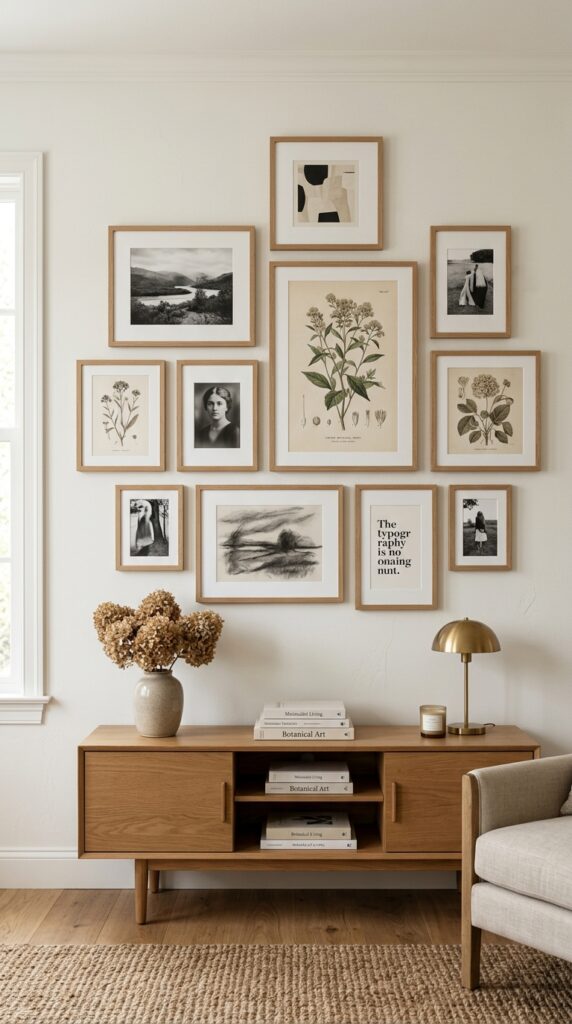
Vibe: Curated and intentional, where collection becomes composition.
Why it works: A gallery wall—multiple artworks arranged as a unified composition—brings personality and curated intent to a space. Modern classic gallery walls use consistent frame finishes (all black, all natural wood, or all white) with varied art sizes and styles, creating cohesion through framing rather than visual matching. The arrangement should feel intentional, not randomly hung—a focal point (typically one large print) with supporting pieces surrounding it.
How to get it: Choose your frame finish (black metal, natural wood, or white) and commit to it across all pieces. Gather art in a coordinated palette: black-and-white photography, botanical prints, abstract pieces in your room’s color story. Plan your arrangement on paper first (or on the wall using painter’s tape), ensuring consistent spacing (2–3 inches between frames) and a clear hierarchy (one larger anchor piece). Position the arrangement at eye level (center approximately 60 inches from floor).
How to get it: Mix art sources—purchase some prints, commission some custom photography, frame some meaningful pieces you already own. The gallery’s power comes from the cohesion of framing and spacing, not from matching expensive art.
Shop The Look
- Black or natural wood frame 8–12 pieces varied sizes
- Gallery wall hanging hardware picture rails
- Gallery wall template arrangement tool
- Black and white photography prints
- Botanical prints vintage or modern
- Abstract art prints neutral palette
- Picture frame matting custom sizing
- Painter’s tape arrangement planning
- Simple picture hanging hooks
- Gallery wall spacing consistency tool
16. Window Seating — Built-in or Furniture Arrangement
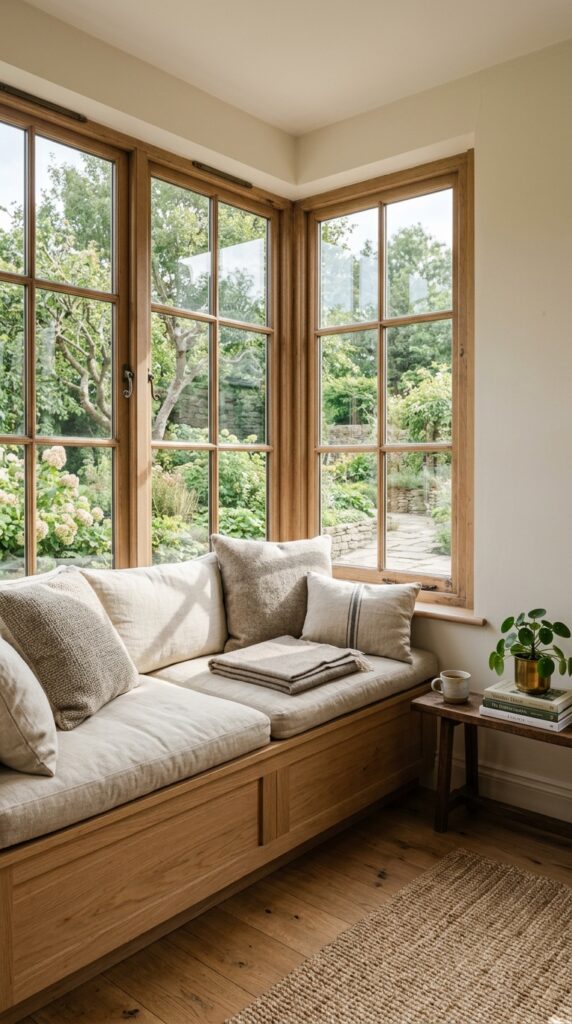
Vibe: Peaceful and contemplative, where light and view become the room’s focus.
Why it works: A window seating area—whether built-in or created with a simple bench—is a luxury in modern classic design. It reorients the room’s focus from interior-facing (watching the room) to exterior-facing (watching light and views change throughout the day). The seating area becomes a meditation zone, a reading nook, a quiet refuge. Functionally, it uses otherwise wasted window space; aesthetically, it celebrates natural light and connection to landscape.
How to get it: If building new, specify a built-in bench with storage underneath and a back cushion. If working with existing windows, position a wooden bench (tapered legs, 48–60 inches long) in front of the window with cushions and pillows. Ensure the seating face the windows and view, not the room. Position a small side table for books and beverages. Specify window treatments that block light minimally when not in use (simple white linen panels on a minimal rod rather than heavy curtains).
How to get it: The most important aspect: position the seating to genuinely enjoy the window view. A window seat facing away from windows defeats the purpose.
Shop The Look
- Built-in bench seating custom or kit
- Wooden window bench tapered legs
- Back cushions linen neutral fill
- Throw pillows various neutral textiles
- Small side table wood adjacent seating
- Window treatment minimal white linen
- Potted plant positioned for view
- Books and magazines organized nearby
- Bench storage underneath if built-in
- Soft task lighting one small lamp
17. Negative Space — Intentional Empty Wall and Floor Area
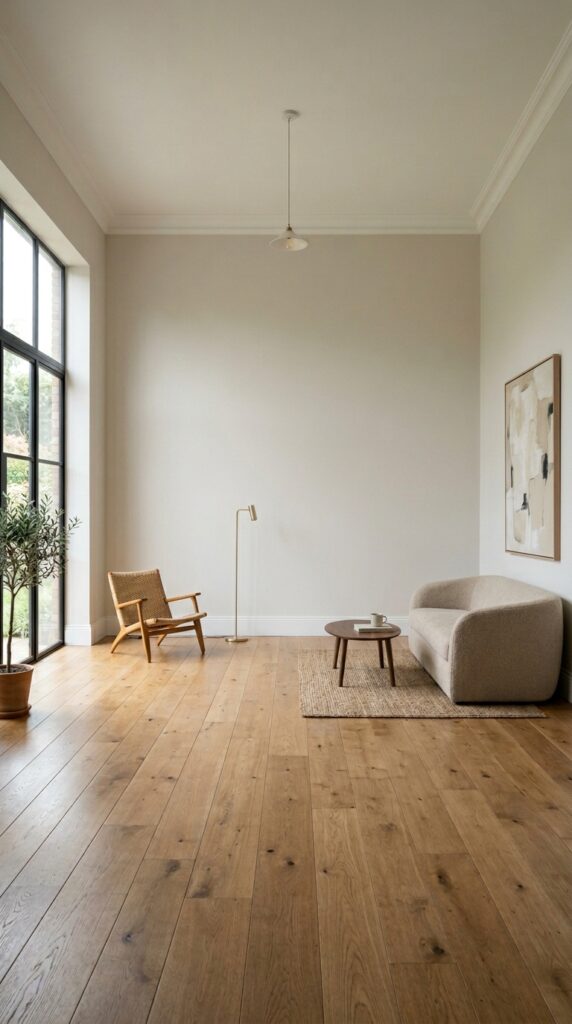
Vibe: Calm and spacious, where emptiness speaks.
Why it works: Modern classic design understands that negative space (empty walls, visible floor, distance between furniture) is a design material as valuable as any object. Empty space creates psychological calm, makes rooms feel larger, and emphasizes quality of individual pieces. A room with empty walls and thoughtfully spaced furniture feels infinitely more sophisticated than a room crammed with decoration, regardless of quality.
How to get it: Practice restraint. Resist the urge to fill every wall and surface. Position furniture with 2–3 feet of space between pieces rather than adjacent. Leave walls empty or with single focal points. Use area rugs strategically to define zones, not cover every inch of floor. The discipline required to maintain negative space is the work of modern classic design.
How to get it: Negative space creates the appearance of spaciousness—even a small room feels generous with empty walls and purposeful furniture placement.
Shop The Look
- Warm white interior paint walls
- Minimal furniture thoughtfully spaced
- Single focal point artwork one wall
- Natural wood flooring visible majority
- Area rug defining zones not full coverage
- Low-profile furniture showing floor beneath
- Minimal accessories no surface clutter
- Floating furniture arrangement spacious
- High ceiling allowing vertical space
- Potted plant green only accent color
18. Wooden Coffee Table — Sculptural Function
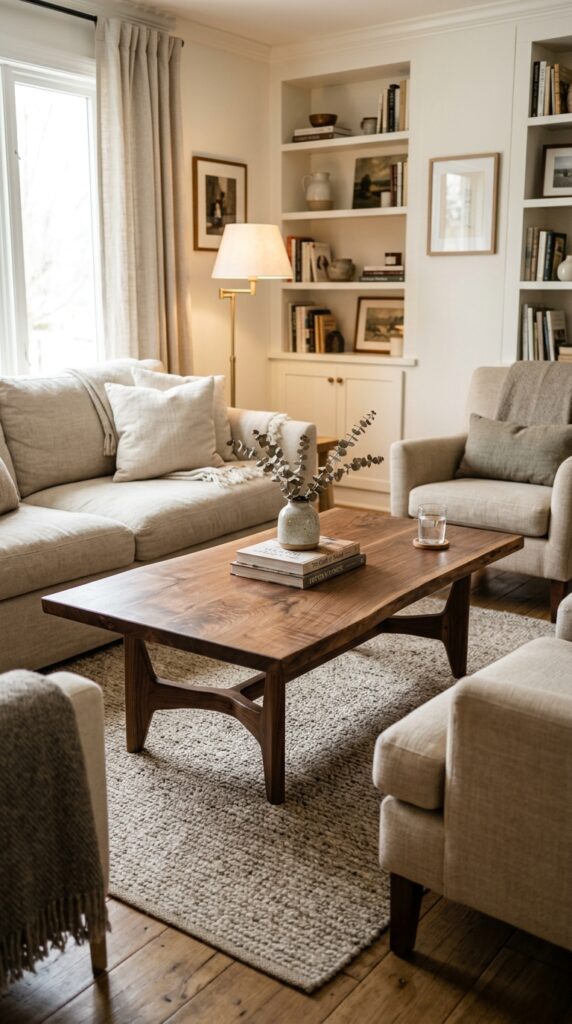
Vibe: Warm and crafted, where function becomes art.
Why it works: The coffee table is modern classic’s quiet anchor—it’s the piece everyone relates to physically (placing feet, setting beverages, reading from) and aesthetically. A beautiful wooden coffee table in a simple contemporary form becomes a sculptural object that justifies its central position. The wood grain, natural finish, and visible craftsmanship elevate it beyond utilitarian furniture into art.
How to get it: Invest in a quality wooden coffee table with visible grain—solid walnut, oak with live edge, or mixed wood (walnut top with lighter wood base). Choose contemporary form over ornate detailing. Tapered legs maintain modern simplicity while showing craftsmanship. Expect $800–$2,000 for a table that will age beautifully and remain relevant for decades.
💡 Quick Win: If budget doesn’t allow a custom table, purchase a mid-century modern coffee table from a vintage seller or online marketplace (Craigslist, Etsy, Facebook Marketplace)—these tables were designed for longevity and cost significantly less than new contemporary pieces.
Shop The Look
- Solid wood coffee table walnut or oak
- Contemporary design clean lines
- Tapered wooden legs sculptural
- Live-edge or mixed wood option
- Natural finish showing grain
- Low height (16 inches) visual lightness
- Coffee table styled with minimal objects
- Books stacked minimal arrangement
- Small ceramic vessel sculptural
- Simple wood stain maintenance sealer
19. Area Rug — Foundation of the Seating Zone
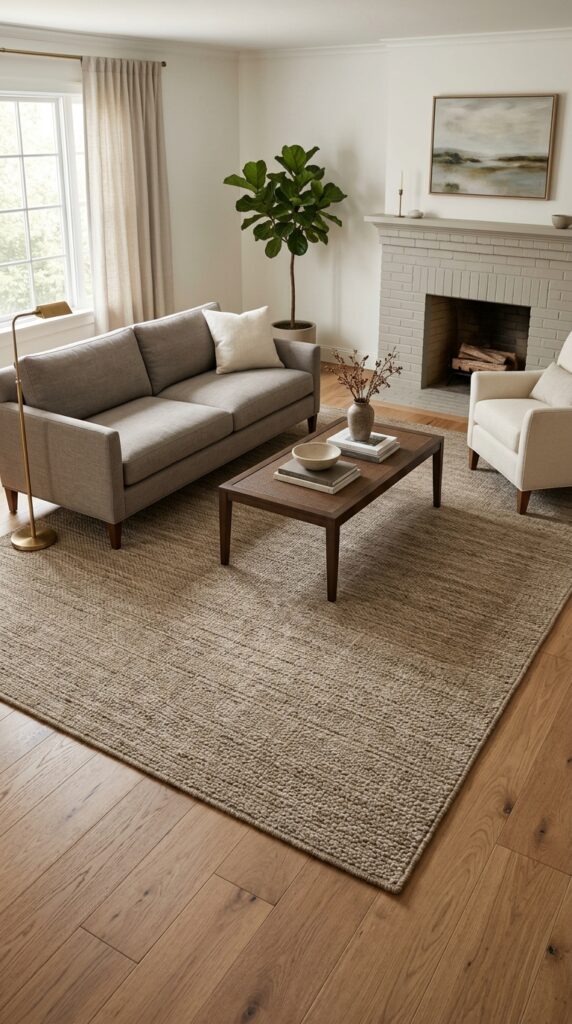
Vibe: Grounded and unified, where foundation becomes framework.
Why it works: An area rug in modern classic design is a foundational design element, not décor. A large, neutral-toned rug in natural fiber (wool, jute) anchors the seating arrangement, defines the spatial zone, and adds textural richness. The rug’s size is critical—it must be large enough that furniture legs sit on it (typically 8×10 or 9×12 feet for a standard living room). Small rugs that only partially cover the seating zone feel tentative and unintentional.
How to get it: Invest in a quality natural fiber area rug (wool, jute, sisal) in a warm neutral tone. Size it generously—front sofa legs and coffee table should sit on the rug. Specify minimal pattern (solid, simple geometric, or subtle stripe) to maintain modern classic restraint. Budget: $800–$1,500 for a quality 8×10 rug.
How to get it: Position the rug early in planning—its size and placement determine furniture arrangement. The rug defines your seating zone spatially and visually; everything else organizes around it.
Shop The Look
- Natural wool area rug 8×10 warm neutral
- Jute or sisal area rug natural fiber
- Minimal pattern subtle geometric optional
- Rug pad non-slip underneath
- Rug cleaning professional service
- Rug placement furniture legs on rug
- Visible rug edges defining zone
- Natural wood flooring outside rug perimeter
- Rug in warm gray taupe or beige
- Textured surface visible in natural light
20. Symmetrical Accessory Styling — Balanced Mantel or Console
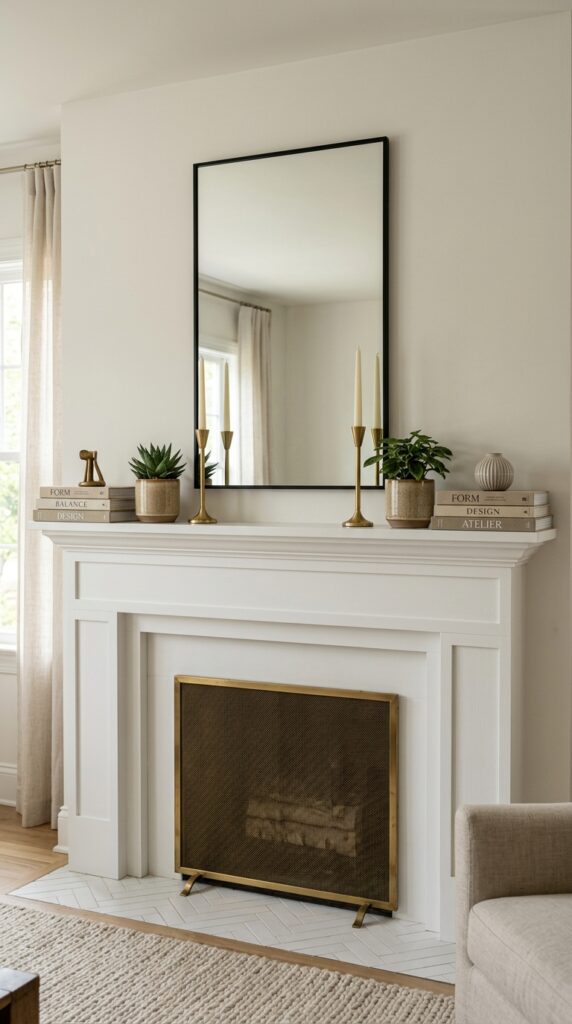
Vibe: Calm and intentional, where balance creates restfulness.
Why it works: Styling a mantel or console with symmetrical balance is the modern classic approach—objects are arranged symmetrically around a centered focal point (mirror, art, or tall object), creating psychological calm through balance. The number of objects is minimal (never more than 7 on a console), and negative space between objects prevents visual clutter. Each object is chosen for function or beauty; nothing purely decorative.
How to get it: Start with a centered focal point (black-frame mirror or artwork). Flank it with matching objects (pair of brass candlesticks, matching potted plants, equal height stacks of books). Keep the total object count low (5–7 items for a console, 3–4 for a mantel). Vary object heights slightly to prevent monotony. Clean and dust regularly—styling only works if objects are pristine.
How to get it: Space objects so that visual weight is distributed evenly—a tall object on the left might be balanced by a short object plus a wider object on the right, creating visual equilibrium even without exact matching.
Shop The Look
- Black-frame mirror centered focal point
- Pair of brass candlesticks matching
- Potted plants matching pair ceramic pots
- Stacked books organized by height
- Wooden objects sculptural accent
- Ceramic vessels neutral tones
- Console table or mantel base
- Negative space between objects intentional
- Simple vase minimal styling optional
- Decorative objects minimal quantity
21. Integrated Media and Technology — Hidden or Minimal Visibility
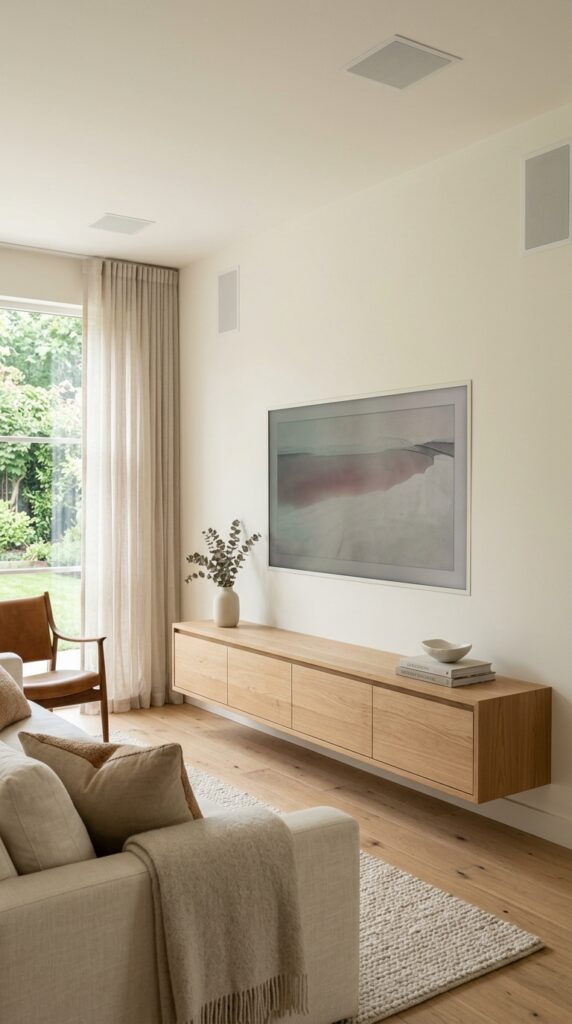
Vibe: Clean and timeless, where technology serves rather than dominates.
Why it works: Modern classic design doesn’t exclude technology—it integrates it invisibly. A television mounted on a wall colored to match the frame, hidden behind a wooden panel, or positioned in a closed cabinet becomes invisible when not in use. Speaker systems are hidden or minimalist in profile (no visible towers). Cables are concealed. The room reads as timeless and uncluttered; technology appears only when activated.
How to get it: Install television on a wall with professional-quality cable concealment (running wires inside the wall or through baseboards). Specify a TV with a minimal bezel and mount it with a minimal profile bracket. Position a simple wooden media console below the TV for device storage. If a closed cabinet is preferred, specify a wooden door that swings open to reveal the screen. Assign one drawer or shelf for remotes and devices so nothing is visible on surfaces.
💡 Quick Win: Mount the TV higher than typical (57–60 inches from floor to center) and slightly angled downward—this creates a more elegant viewing angle and makes the TV read as a prominent wall element rather than a floating box.
Shop The Look
- Television mounted minimal bezel
- Wall-mount bracket minimalist profile
- In-wall cable management system
- Media console wooden closed storage
- Wooden doors cabinet TV hidden
- Minimal speaker system hidden placement
- Streaming devices hidden in cabinet
- Cable hider wall raceway
- Simple wooden shelving media storage
- Remote storage drawer assignment
22. Accessible Art Lighting — Subtle Illumination
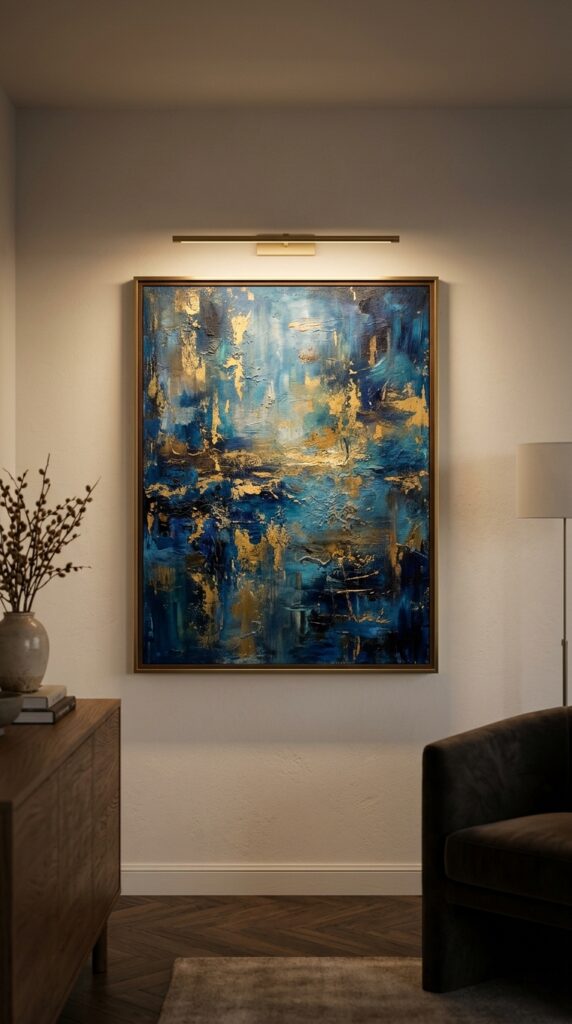
Vibe: Gallery-like and refined, where light serves the art.
Why it works: Subtle artwork lighting elevates a room from residential to gallery-quality. A simple picture light (warm color temperature, dimmable) mounted above or within a frame creates focused illumination that emphasizes the artwork without glare. The lighting becomes nearly invisible; the artwork appears to glow subtly. This professional touch makes statement artwork even more impactful.
How to get it: Specify a picture rail light or frame-mounted light in warm color temperature (2700K). Choose a minimal-profile fixture in black, brass, or match your hardware finish. Install with a dimmer switch allowing adjustment throughout the day. Expect $400–$800 per light fixture including installation. This investment is worthwhile if you have statement artwork.
How to get it: The light should illuminate the artwork without creating glare on the frame glass or casting harsh shadows—professional installation ensures proper angle and intensity.
Shop The Look
- Picture rail light warm 2700K color temperature
- Museum-quality frame light minimal profile
- Dimmer switch light control
- Warm brass or matte black fixture finish
- Installation wiring concealed
- Artwork frame or canvas as focal point
- Subtle illumination creating focus
- Professional gallery aesthetic lighting
- Optional motion sensor dimming
- Pendant fixture alternative minimal design
23. Natural Wood Tone Progression — Floor to Furniture to Ceiling
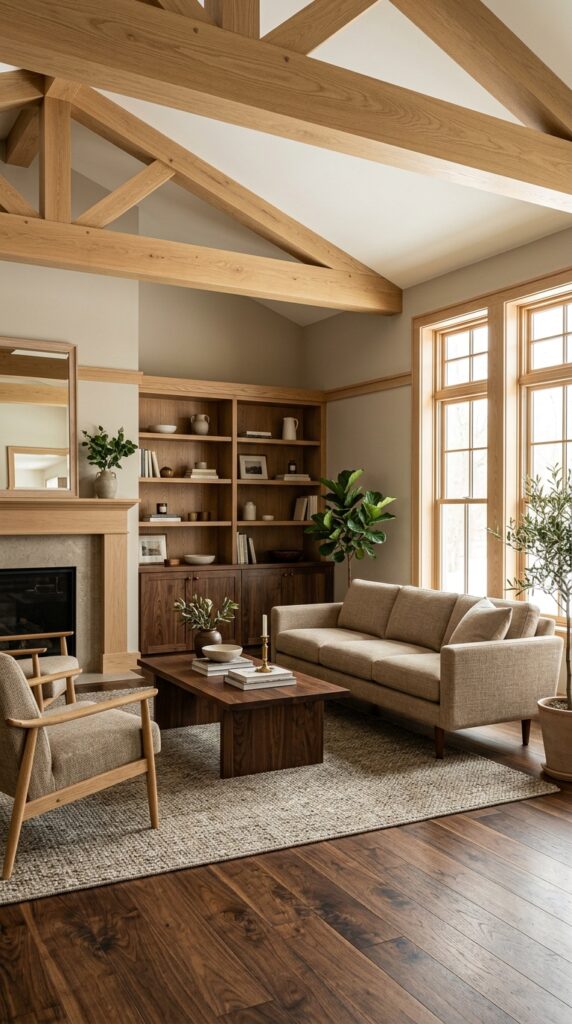
Vibe: Sophisticated and harmonious, where tones create visual depth.
Why it works: A deliberate progression of wood tones (darkest at the floor grounding the room, progressively lighter toward ceiling and details) creates visual hierarchy and sophistication. The eye naturally reads this progression as intentional design rather than random material gathering. All tones must share the same undertone (warm or cool) to feel cohesive.
How to get it: Select flooring in medium-dark tone (walnut, dark oak, or mix). Choose furniture in varied medium tones (some darker, some lighter, all warm undertone). Incorporate ceiling details (beams, crown molding, or picture rails) in lighter wood tone. Keep walls neutral (warm white or soft greige) to allow wood tones to define the visual hierarchy.
How to get it: Paint wooden elements if necessary to achieve tonal progression—wood stain in progressively lighter shades creates the planned progression even if wood types are the same.
Shop The Look
- Hardwood flooring medium-dark walnut or oak
- Wooden furniture varied warm tones
- Wooden ceiling beams lighter tone optional
- Picture rail or crown molding light wood
- Wooden shelving medium tone
- Walnut wood coffee table dark tone
- Light oak shelving lighter tone
- Warm white or greige wall paint
- Natural finish on all wood warm undertone
- Wood stain progression if needed
24. Personal Collections Display — Curated and Organized
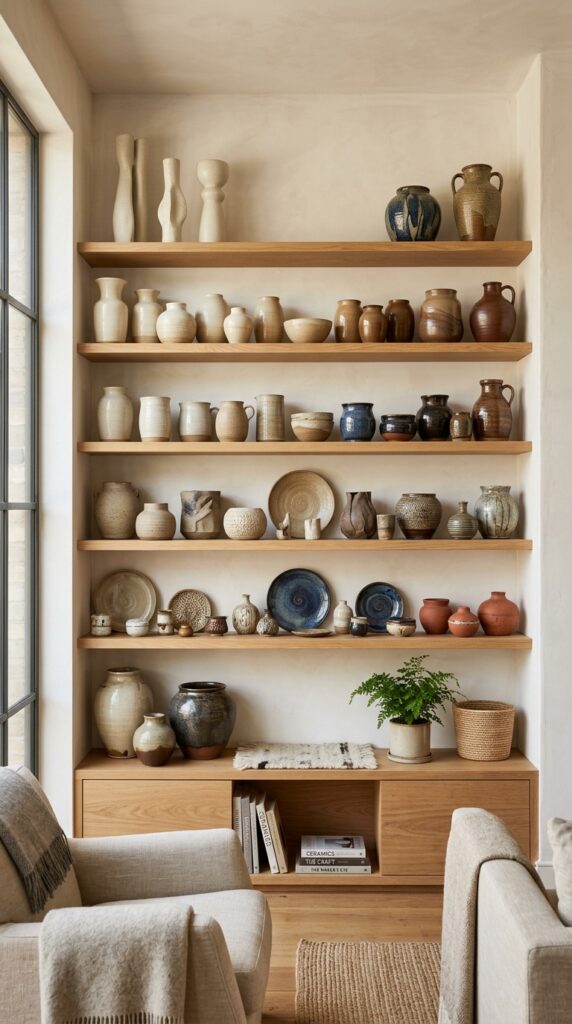
Vibe: Personal and thoughtful, where collections become autobiography.
Why it works: Modern classic embraces personal collections as long as they’re curated and displayed with intention. A collection of ceramic vessels, vintage photographs, or textile art tells the story of your aesthetic development and interests. The display is disciplined—objects are organized logically and given breathing room—preventing it from reading as clutter and instead reading as curator’s exhibition.
How to get it: Choose one collection that genuinely interests you and display it on a dedicated wall or shelving unit. Organize with clear visual logic: group by type, size, or color. Ensure spacing between objects—no crowding. Cull the collection regularly, removing objects that no longer resonate. The collection should reflect your current taste, not be a historical archive of every object ever owned.
How to get it: Frame your collection story—what draws you to these objects? Why are they meaningful? This narrative prevents the display from feeling arbitrary and makes it feel intentional and personal.
Shop The Look
- Open shelving wall-mounted natural wood
- Ceramic vessel collection various sizes
- Vintage photography prints framed
- Textile art displays wall-hung
- Sculptural objects meaningful collection
- Shelf styling spacing between items
- Neutral background walls warm white
- Lighting highlighting collection objects
- Simple organization visual logic
- Curatorial intent clear grouping
25. Textural Layering Through Textiles — Multiple Soft Elements
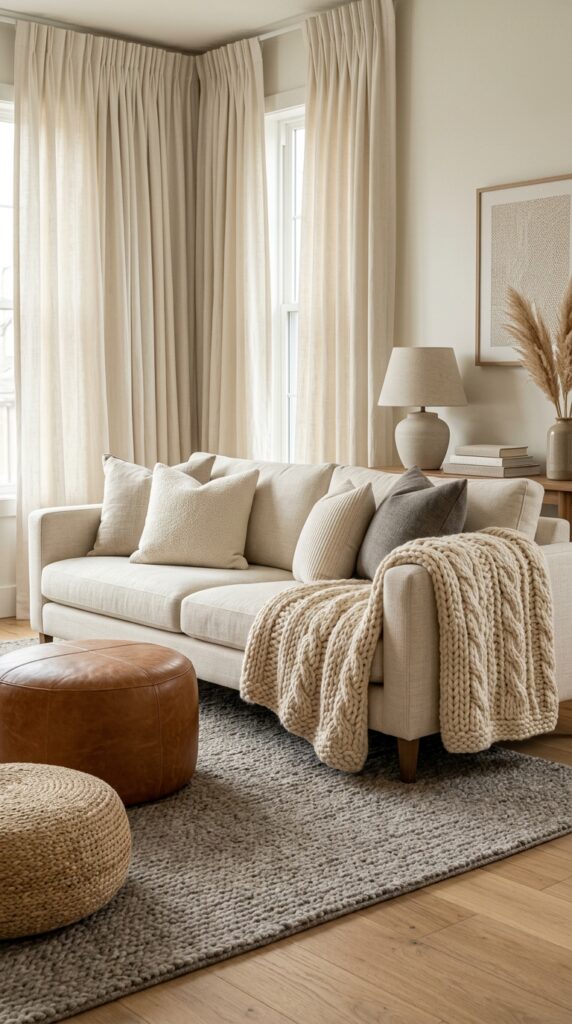
Vibe: Warm and tactile, where texture substitutes for pattern and complexity.
Why it works: Textile layering through multiple materials (linen upholstery, wool rug, cotton throws, leather accents) creates richness and luxury without color variation or pattern complexity. Each material’s visible texture—linen weave, wool nap, leather grain, cotton softness—provides visual and tactile interest. The neutral color palette allows texture to be the primary material.
How to get it: Select one or two main upholstery pieces (linen sofa, leather ottoman). Add a wool area rug. Layer throws and cushions in varied neutral textiles. Include one luxury textile (cashmere throw, silk curtains) if budget allows. All should be in warm neutrals (cream, warm white, warm gray, caramel). The key: each textile should show its material honestly (no synthetic-looking finishes).
💡 Quick Win: Upgrade one element to a luxury textile—a cashmere throw or high-quality linen curtains—this single investment creates perceptible richness and luxury throughout the room.
Shop The Look
- Linen upholstered sofa cream
- Wool area rug warm gray 8×10
- Chunky knit throw blanket oatmeal
- Linen curtains simple drape
- Cushion covers linen-wool blend
- Leather ottoman cognac or caramel
- Cotton floor pouf optional natural
- Cashmere throw optional luxury
- Textile varied materials tactile
- Neutral palette cream white gray
26. Personal Style Confidence — Curated Over Trendy
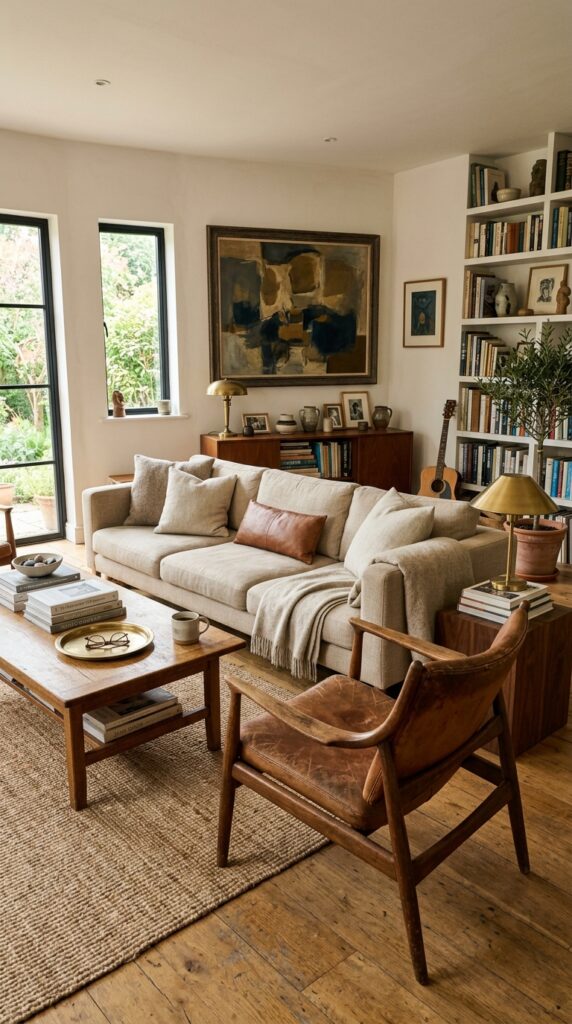
Vibe: Confident and authentic, where taste becomes home.
Why it works: The final and most important modern classic principle is confidence—designing around what you genuinely love rather than what trending sources suggest you should love. A room assembled from multiple sources (vintage finds, contemporary purchases, inherited pieces, custom elements) unified through consistent materials and color palette reads far more sophisticated than a matched-set living room purchased from one retailer. The room should show signs of actual living: worn leather patina, well-read books, personal artwork, meaningful collected objects.
How to get it: Trust your taste. Buy what genuinely appeals to you, not what’s trending. Gather pieces over time rather than purchasing everything at once. Include inherited or vintage pieces that have meaning. Display personal objects—books you’ve read, artwork you made, ceramics you’ve collected. Let the room show authentic life rather than staged perfection. This is the essence of modern classic: real people living well in thoughtfully curated spaces.
How to get it: Modern classic ages beautifully—your room today should look equally good in five years, with no regrets about following trends. This is the test of real taste: does the room still feel right when the trend has passed?
Shop The Look
- Vintage or pre-owned furniture furniture sources varied
- Contemporary pieces new from trusted sources
- Inherited or family pieces meaning
- Custom-made elements commissioning artisans
- Mix of furniture styles unified through material
- Personal artwork meaningful selections
- Books genuine collection
- Ceramic collection curated gathering
- Leather furniture showing patina time
- Mix of sources unified palette
How to Start Your Modern Classic Living Rooms Transformation
THE ONE FIRST MOVE: Invest in one excellent sofa in quality leather or linen upholstery—this single piece becomes the room’s anchor and justifies itself for 20+ years. The sofa is where you’ll spend most time; it sets the visual tone; it establishes the quality standard. Choose a neutral tone (cream, warm gray, caramel, cognac), a simple mid-century silhouette, and quality construction from a maker known for longevity (Rove, Article, West Elm premium line, or vintage mid-century). Budget: $2,000–$4,500. This first move establishes that modern classic isn’t about quantity—it’s about choosing one genuinely excellent thing over many mediocre ones.
THE MOST COMMON MISTAKE: Misunderstanding “minimalist” as “empty.” Beginners often create sparse, cold rooms assuming minimalism means removing everything. Modern classic minimalism is curated, not empty—you’re removing clutter and filling the space with quality pieces and meaningful objects. A room with nothing but a sofa and table feels abandoned; a room with one excellent sofa, carefully selected art, meaningful objects, and warm lighting feels like a home. The discipline is in curation, not deprivation.
BUDGET ENTRY POINTS UNDER $50: (1) A single substantial potted plant (fiddle leaf fig or similar 4–5 feet tall, $20–$40)—this adds living element and organic texture. (2) Quality throw pillow covers in linen or linen-blend in cream or warm white ($30–$40 for a set of two)—layered on a sofa they create textural richness and comfort. (3) A beautiful coffee table book in your aesthetic interest ($15–$30)—stacked on the coffee table these add personality and create visual weight without clutter.
REALISTIC EXPECTATIONS: A modern classic living room built gradually is a 12–24 month process if starting from a blank space. Initial investment for foundational elements (quality sofa, area rug, coffee table, basic lighting) runs $4,000–$7,000. Adding secondary elements (chairs, shelving, accent pieces) adds another $2,000–$4,000 over 12 months. Achieving a genuinely complete modern classic room (with personal collections, meaningful artwork, accumulated objects) takes years—this is the advantage of the style. You’re building slowly with intention, not rushing to furnish by moving day. A minimal starter version (one sofa, one chair, coffee table, rug, lamp, basic wall color) achieves modern classic aesthetic in 4–6 weeks for $2,500–$4,000.
Frequently Asked Questions About Modern Classic Living Rooms
What’s the difference between modern classic and minimalism, and can you have too much style in a modern classic room? Modern classic and minimalism are related but distinct. Minimalism emphasizes reduction—fewer objects, emptier spaces, stripped-down aesthetics. Modern classic emphasizes curation—quality over quantity, meaningful objects over decorative clutter, restrained selection but with personality and warmth. A modern classic room includes personal artwork, collected ceramics, meaningful books, and comfortable furnishings. Minimalism would eliminate these as “unnecessary.” The difference: minimalism removes; modern classic curates. You can definitely have personality in modern classic—display your collections, hang meaningful art, show your taste—just do it thoughtfully without visual clutter.
How do you choose a neutral color palette without the room feeling boring or cold? Neutral doesn’t mean bland. The key is choosing warm neutrals (warm whites, warm grays, soft greiges, warm taupes) rather than cool ones. Warm undertones feel inviting; cool undertones feel sterile. Layer warm neutrals with varied textures (linen weave, wool nap, leather grain, wood variation) and visible materials—the textural richness prevents any coldness. Introduce one accent color through accessories (a single plant, one throw pillow in soft sage, one brass object) if desired. The neutral palette creates visual calm that allows quality materials and careful curation to be the focus, not background for color complexity.
Is modern classic design expensive, and can you achieve it on a budget? Modern classic is expensive if you purchase all pieces at once from high-end retailers. It’s affordable if you build gradually and source wisely. The strategy: invest significantly in foundational pieces that will last decades (sofa, quality flooring if possible, a beautiful coffee table, one excellent chair). Purchase secondary pieces on budget (IKEA, Facebook Marketplace, estate sales) and upgrade gradually. Allow at least one year to build a complete room. The style rewards patience and thoughtful curation over quick purchases.
Can you mix modern classic with other styles, or does consistency matter? Modern classic works best with high consistency in materials and color palette—mixing with drastically different styles (bohemian maximalism, glam, heavy traditional) creates visual chaos. That said, thoughtful variation is desirable: vintage mid-century chair paired with contemporary sofa is beautiful; maximalist bohemian patterns throughout modern classic space creates conflict. The principle: consistency in material honesty, color warmth, and restraint, with variation in specific pieces and eras acceptable as long as everything shares these core principles.
How do you style a modern classic room that photographs well but also lives authentically without looking staged? This is the fundamental tension. The answer: modern classic should look good both ways—authentic living with people and books and objects present and clean and organized when photographed. The solution is restraint: never have more than you genuinely use or love, keep surfaces relatively clear (books neatly stacked, not scattered; objects grouped intentionally, not randomly), and create storage for things in current use. A lived-in room is beautiful; a chaotic room is not. Authenticity isn’t synonymous with messiness—it’s about genuine comfort arranged with intention.
Ready to Create Your Dream Modern Classic Living Room?
You now have 26 specific ideas spanning color strategies, spatial planning, material selections, furniture curation, and the philosophy underlying modern classic design. Whether you’re drawn to the restraint of minimal color palettes, the richness of layered textures, the visual honesty of exposed materials, or the collected confidence of mixed pieces, there’s an approach here that matches your vision.
Transformation doesn’t require a complete overhaul before the room becomes livable—it builds iteratively. Start with one foundational decision (choose your wall color, invest in a quality sofa, or plan your material palette), then layer additional elements as time and budget allow. Modern classic rewards the slow approach; it improves over time as you gather pieces, display meaningful objects, and refine your aesthetic.
Your one concrete action for today: Choose your primary wall color—warm white, soft greige, or warm gray. This single decision anchors everything else: furniture selection, materials, lighting approach. Visit a paint supplier, request undertone swatches in your actual room lighting (natural north light and evening light), and observe which tone feels warm and inviting to you. This 30-minute decision prevents months of indecision later.
Once complete, your modern classic living room will feel exactly right—not staged, not trendy, but genuinely collected and lived-in. The room will improve as you add pieces thoughtfully, as leather patinas with use, as wood aged naturally, as your collected objects accumulate meaning. Modern classic design trusts that good things endure. Your room will be one of them.
Save the approaches that resonate—the layering strategies you love, the spatial arrangements that match your life, the color stories that feel like home. Your specific modern classic living room is unique to your aesthetic and genuine needs. Build from there.