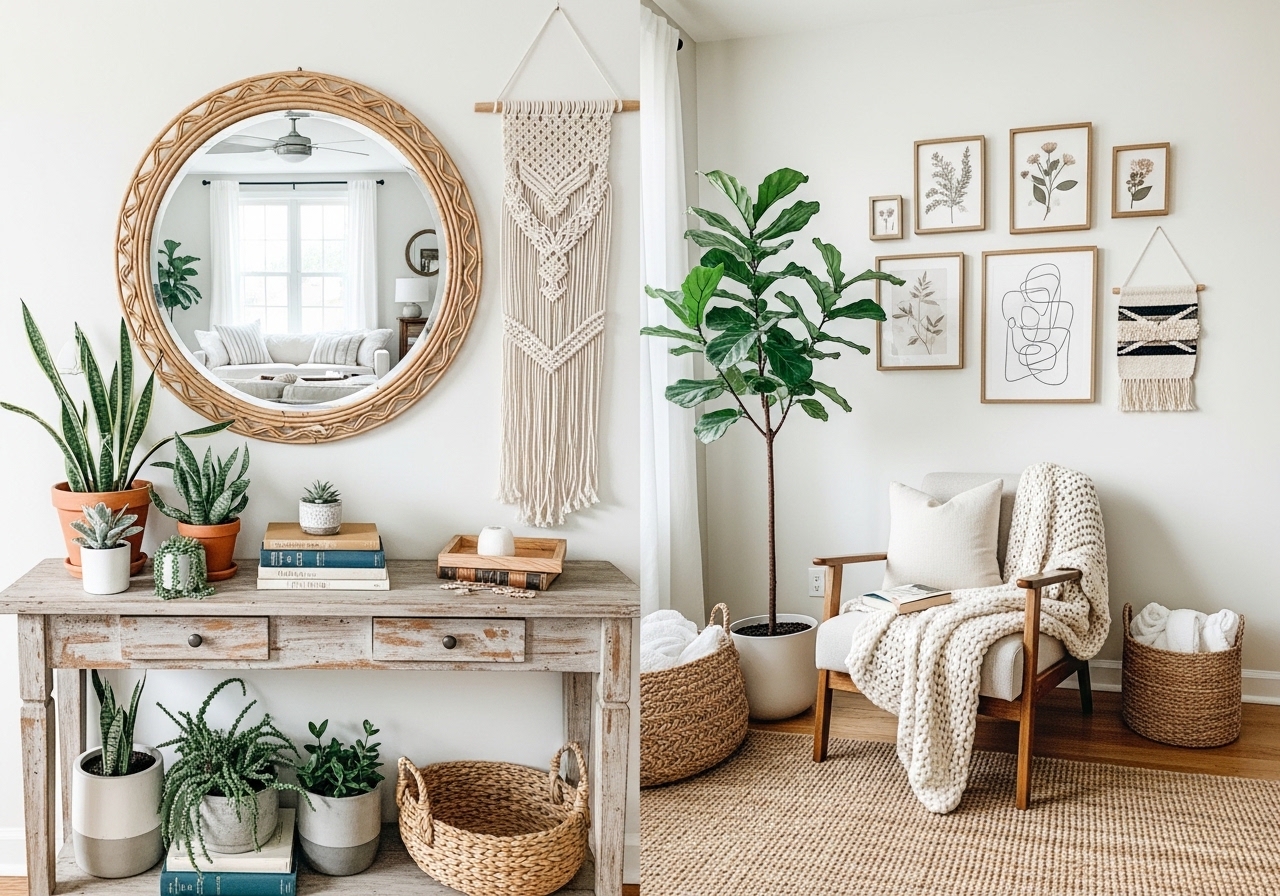
Boho farmhouse is the art of blending free-spirited bohemian layering with the grounded, unpretentious warmth of rustic farmhouse style — the result is a home that feels lived-in, collected, and deeply personal. These 27 ideas show you exactly how to build that feeling, from palette to furniture to the smallest ceramic on your shelf.
There’s a particular kind of energy in a boho farmhouse room — sun coming through linen curtains, a macramé piece catching the light, a reclaimed wood table holding a mismatched collection of vessels that somehow all belong together. It’s not a style you “install.” It grows. It layers. It forgives imperfection and rewards instinct. Here are 27 ideas worth saving — and stealing.
Why Boho Farmhouse Works So Well
Boho farmhouse emerged from two distinct design movements colliding in the most natural way possible. Bohemian style draws from 19th-century artist and traveler culture — maximalist, eclectic, globally influenced, unapologetically personal. Farmhouse style, rooted in American rural pragmatism, prioritizes function, raw materials, and unpretentious beauty. Together, they cancel out each other’s extremes: boho tames farmhouse’s austerity, while farmhouse keeps boho’s chaos grounded. The result is something neither style achieves alone — warmth with depth.
The material palette is deeply tactile. Think unfinished white oak, reclaimed pine, jute, undyed Belgian linen, rattan, hand-thrown terracotta, and weathered iron. Colors lean toward warm neutrals — creamy white, beeswax, dusty blush, muted terracotta, soft sage, and warm charcoal — punctuated by deeper boho accents like rust, indigo, or faded ochre. Nothing is bright. Nothing is synthetic. Every surface has history or texture, and often both.
This hybrid style is surging precisely because it meets a post-pandemic cultural need: homes that feel like sanctuary and self-expression simultaneously. People spent years inside and realized sterile spaces don’t restore them. Pinterest data reflects this — searches for “cozy boho living room” and “farmhouse boho bedroom” have grown year over year since 2021. The style also aligns with the sustainability movement; its preference for vintage, handmade, and natural materials fits the way conscious shoppers want to live and buy.
Small spaces can absolutely achieve this style — but the key is editing ruthlessly. In a compact room, choose three hero textures instead of seven, and let negative space breathe between your layers. A single rattan pendant, a linen throw, and one meaningful ceramic piece create the feeling without overwhelming a small footprint. The mistake isn’t going boho farmhouse in a small space — it’s forgetting that restraint is part of the style too.
Style at a Glance
| Element | Bohemian Influence | Farmhouse Influence |
| Philosophy | Collected, personal, globally layered | Functional, unpretentious, rooted |
| Materials | Rattan, macramé, mixed textiles, ceramics | Reclaimed pine, shiplap, iron, linen |
| Color Palette | Terracotta, ochre, indigo, dusty blush | Creamy white, warm charcoal, beeswax |
1. Warm White Shiplap With Layered Textile Accents
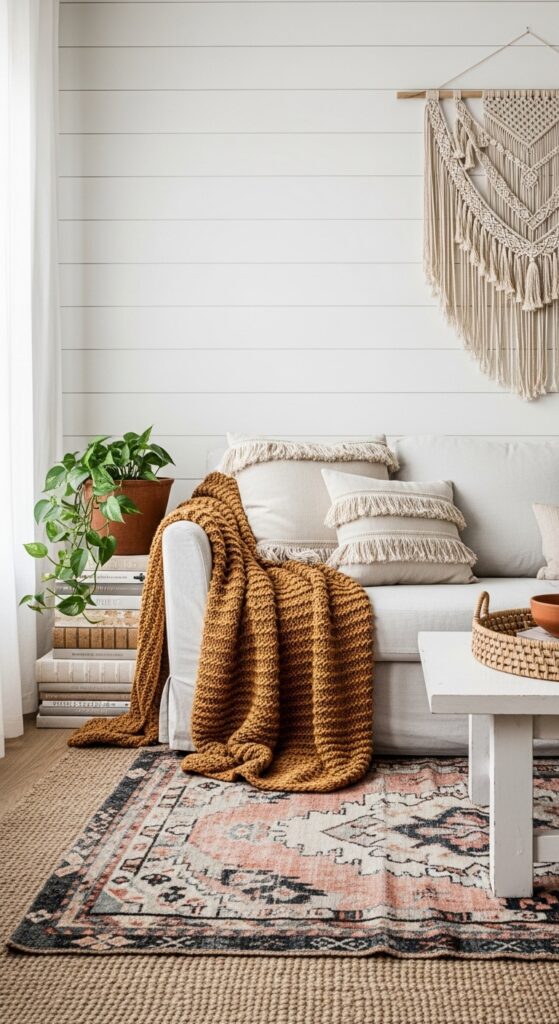
Vibe: This room feels grounded — the kind of space where the layers tell a story rather than shout for attention.
Why it works: Shiplap’s horizontal lines create visual rhythm across the wall, but in warm white (not stark white), it reads rustic rather than nautical. Layering a kilim rug over jute introduces pattern through textile rather than paint — a softer, more forgiving way to add color that can be swapped seasonally. The macramé anchors the boho element without competing with the wall’s texture, because both are light in tone.
How to get it: Paint your shiplap in Benjamin Moore ‘White Dove’ rather than pure white — its warm undertone keeps the room from reading cold under artificial light. Then build your textile layers starting with the largest (rug), then the sofa throw, then pillow covers. Stick to a maximum of three pattern scales.
💡 Quick Win: A faded vintage-style kilim rug from Ruggable starts around $89 and is machine-washable — it’s the fastest single move toward this layered look.
2. Rattan Pendant Light Over a Reclaimed Wood Table
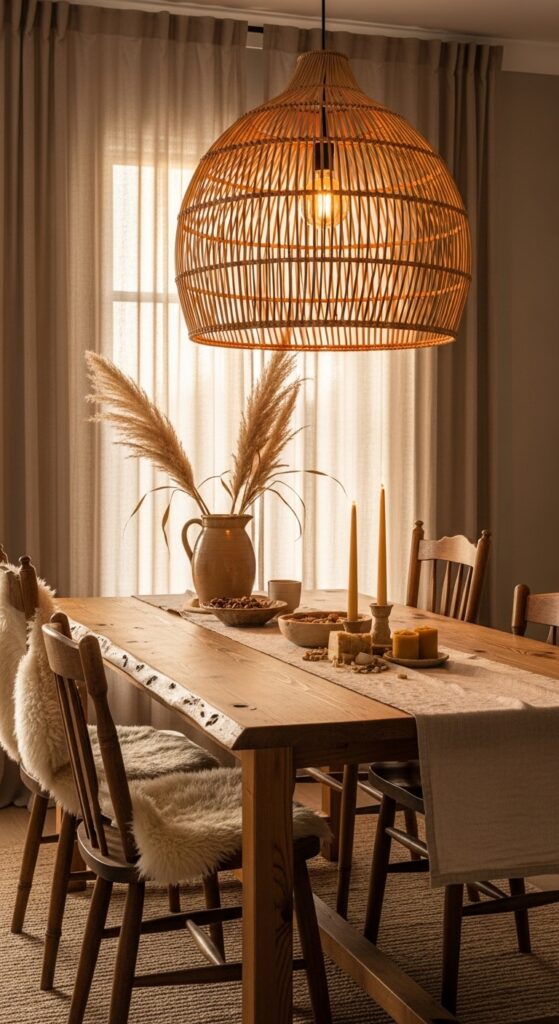
Vibe: The room feels sun-warmed — like it’s always just after a long, unhurried lunch.
Why it works: Rattan’s open weave diffuses light rather than blocking it, creating a dappled, organic glow that no glass or metal pendant can replicate. When hung low over a reclaimed wood table — ideally 30–34 inches above the surface — the pendant creates an intimate pool of warmth that draws people inward. The natural tones of the rattan and the wood exist on the same warm-honey spectrum, so they harmonize without matchy-matching.
How to get it: Source a woven rattan pendant at least 18 inches in diameter for a standard dining table — anything smaller reads decorative rather than architectural. IKEA’s SINNERLIG pendant ($49) is a reliable starting point that photographs beautifully without the designer price tag.
3. Terracotta Accent Wall With Boho Gallery Grid
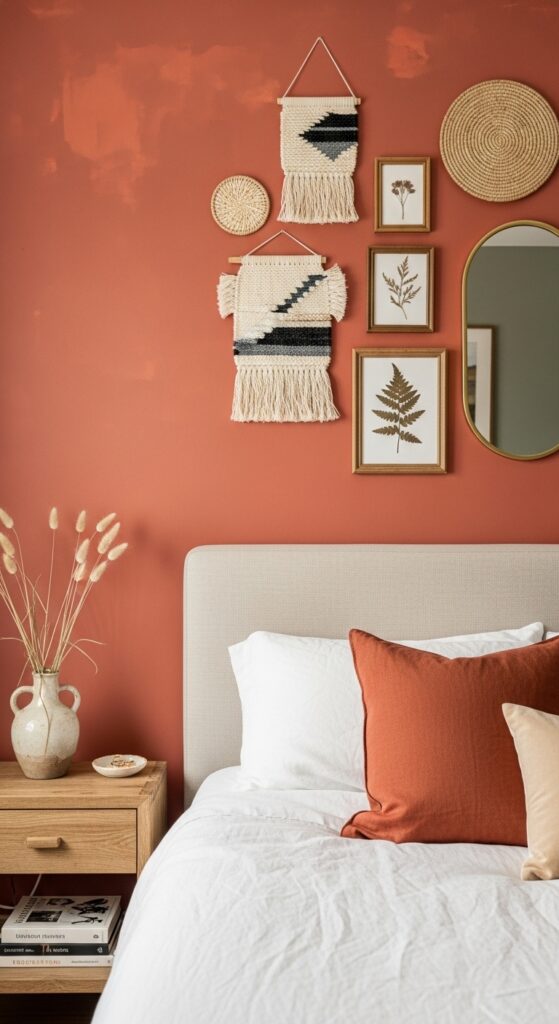
Vibe: This wall feels layered — like a mood board that became a room.
Why it works: Terracotta is boho farmhouse’s most natural accent color because it bridges both styles — earthy enough for farmhouse, warm and globally-influenced enough for boho. A gallery wall on a colored ground works because the wall itself becomes the frame, unifying mismatched pieces visually. The key design principle here is varied scale: mix a large woven hanging with small framed prints and one mirror to create movement without chaos.
How to get it: Use Farrow & Ball ‘Red Earth’ or Sherwin-Williams ‘Cavern Clay’ (SW 7701) for that dusty, matte terracotta — both have the slightly muted finish that reads boho rather than southwestern. Arrange your gallery pieces on the floor first and photograph the layout before committing a single nail to the wall.
💡 Quick Win: Pressed botanical prints from Etsy shops start at $4–$8 per digital download — print at your local copy shop on matte cardstock and frame in simple oak frames from IKEA’s RIBBA line.
4. Open Shelf Styling With Handmade Ceramics
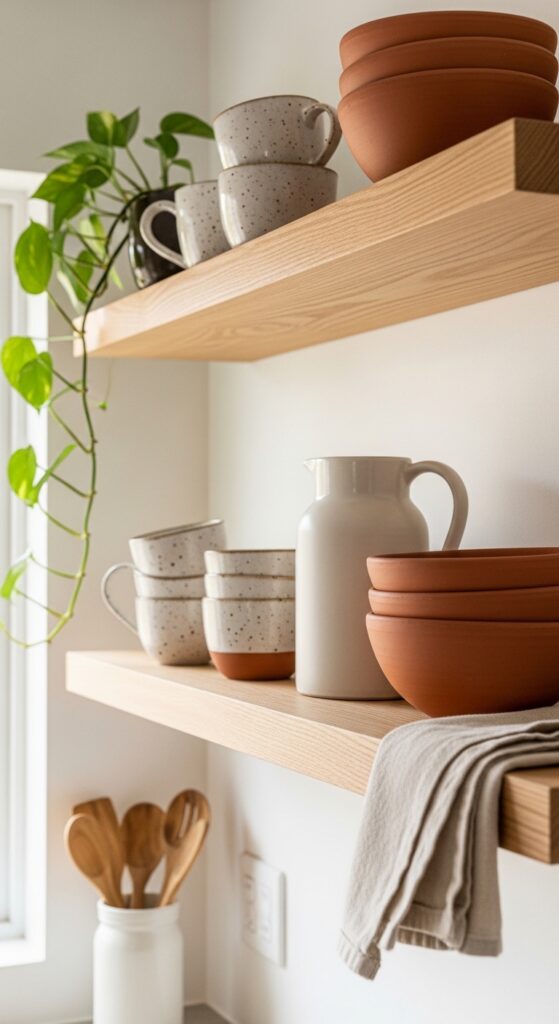
Vibe: These shelves feel collected — each piece placed like it has somewhere to be.
Why it works: Open shelving is a commitment — it makes your everyday objects part of the room’s design. The trick is using a three-texture rule: something smooth (glazed ceramics), something rough (raw wood or woven), and something living (a trailing plant). This layering prevents the shelves from reading flat or staged. Handmade ceramics work particularly well because their slight imperfections — uneven rims, variation in glaze — carry the boho spirit into a functional kitchen space.
How to get it: Style in odd numbers: three mugs clustered together, five bowls stacked in two groups. Leave deliberate gaps — negative space on shelving reads as curation, not emptiness. Shop Etsy ceramics makers or check TJ Maxx’s handmade section for speckled stoneware at a fraction of boutique pricing.
5. Jute Rug Layering for Texture Underfoot
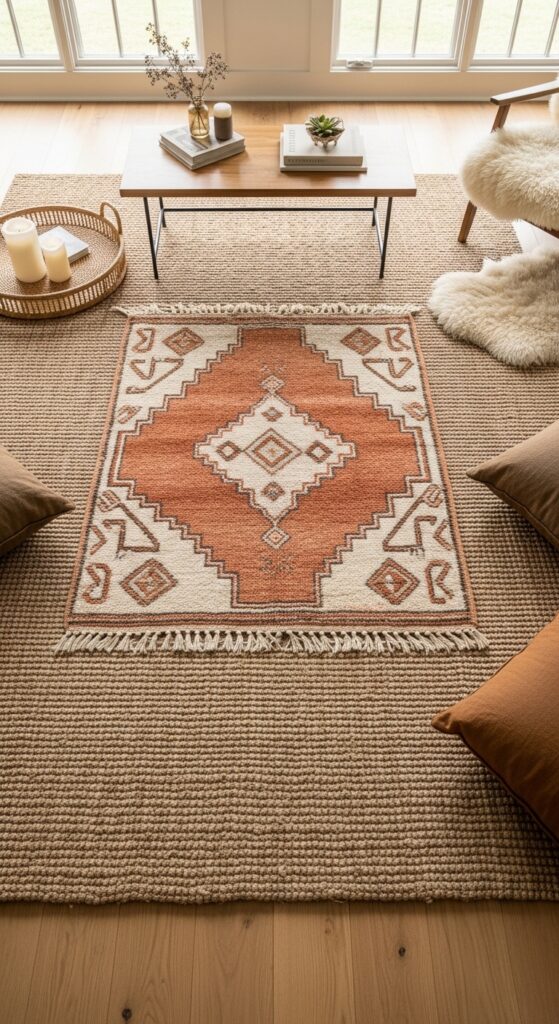
Vibe: The floor feels layered — unhurried and worn-in, the way a well-loved room always does.
Why it works: Layering rugs is a core boho technique, and jute is the ideal base because its flat, neutral texture lets the top rug become the star without visual competition. The contrast between the rough, natural jute and the softer pile of a Moroccan or kilim rug creates tactile interest that a single rug can’t achieve. It also adds acoustic warmth — layered textiles significantly soften sound in hard-floored rooms.
How to get it: Size your jute base rug so at least 18 inches of it show beyond the top rug on all sides. Use a non-slip rug pad between both layers — this keeps the top rug from creeping and extends both rugs’ lives. Wayfair and Rugs USA both carry affordable natural jute in sizes up to 9×12 under $120.
💡 Quick Win: A 5×7 vintage-style Moroccan rug from Amazon or Overstock, layered over a $60 jute base, creates the boho farmhouse rug look for under $150 total.
6. Low-Profile Linen Sofa as a Room Anchor
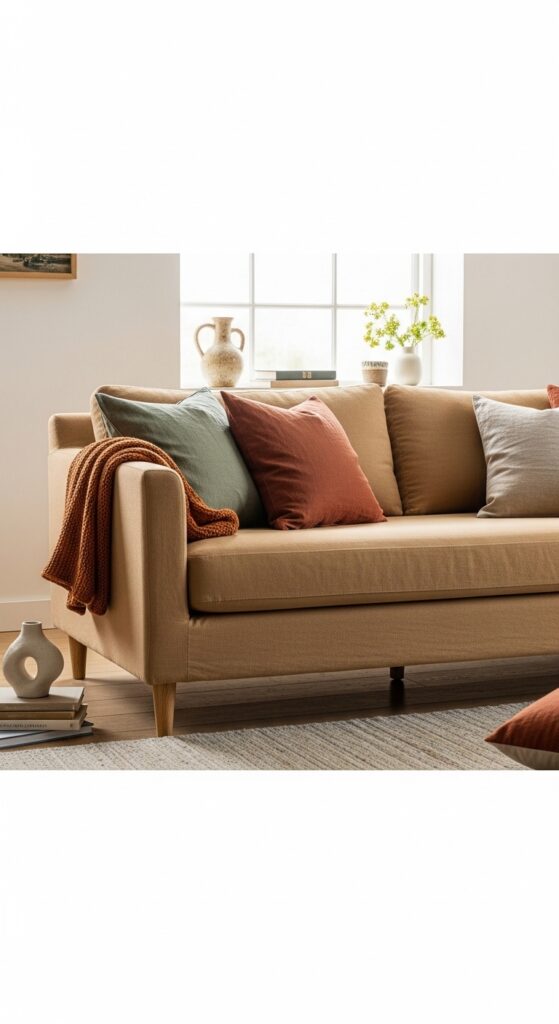
Vibe: This sofa feels unhurried — the kind of piece that invites you to stay longer than you planned.
Why it works: Low-profile furniture is a deliberate design choice that lowers the visual center of gravity in a room, creating an immediate sense of ease and informality — two qualities central to boho farmhouse. Linen slipcovers reinforce this by softening the silhouette of the sofa’s frame; the fabric’s natural wrinkle is part of the aesthetic, not a flaw. A rumpled linen sofa reads lived-in by design, not by accident.
How to get it: Look for sofas with a seat height of 15–17 inches rather than the standard 18–20 inches. IKEA’s ÄPPLARYD and McGee & Co’s Henley sofa both nail this low-slung profile in linen-blend slipcovers. Choose a slipcover in a warm white or natural oat — avoid cool-toned greys, which fight the boho palette’s warmth.
7. Macramé Wall Hanging as Focal Architecture
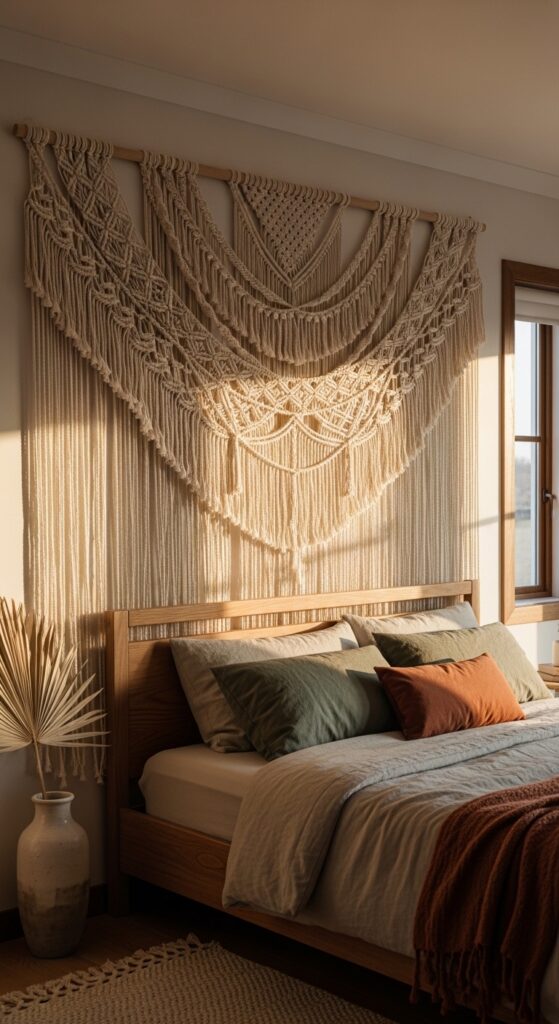
Vibe: The room feels hushed — like the walls are softening the sound as well as the light.
Why it works: A large macramé piece functions as architectural texture — it adds visual weight and warmth to a wall the way paneling or wallpaper would, but with dimension and air. Hung behind a bed, it replaces the need for a traditional headboard while still defining the sleeping zone. The undyed cotton rope sits at the exact intersection of boho craft and farmhouse neutrality — it’s maximalist in texture but minimal in color.
How to get it: Scale matters enormously here. A macramé piece should span at least two-thirds of the wall width to read as a design decision rather than a decoration. Search Etsy for handmade pieces (budget $80–$200 for a bed-width hanging) or try Urban Outfitters’ Home section for ready-made options in the $60–$90 range.
💡 Quick Win: Hang your macramé on a raw wooden dowel or a trimmed branch from your yard rather than a curtain rod — the natural wood element adds farmhouse authenticity at zero cost.
8. Black Iron Hardware Against Warm Wood Cabinetry
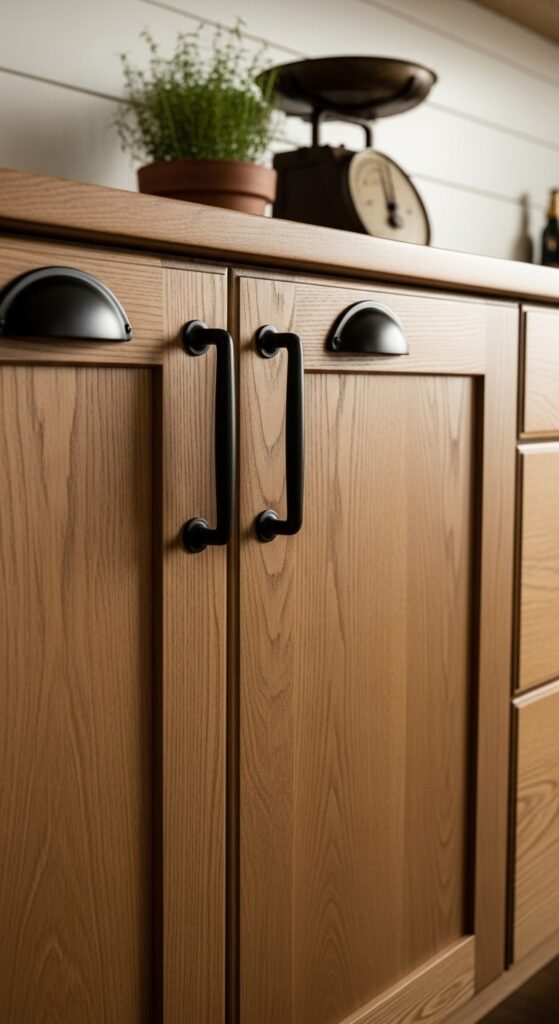
Vibe: This kitchen feels raw — functional and unpolished in exactly the right way.
Why it works: Matte black iron hardware against warm wood creates one of the most effective contrast pairings in farmhouse design — the dark metal grounds the honey warmth of the wood without competing with it. “Matte” is non-negotiable here; polished black reads contemporary rather than rustic. The slight variation in iron cup pulls, especially handcrafted ones, carries the boho spirit of imperfection into an otherwise structured space.
How to get it: Replace cabinet hardware before anything else in a kitchen refresh — it’s the highest-return small upgrade available. Rejuvenation and House of Antique Hardware both carry authentic iron cup pulls in the $6–$12 per-piece range. Install cup pulls on lower cabinets and bar pulls on upper drawers for visual variety.
9. Dried Botanicals as Year-Round Boho Decor
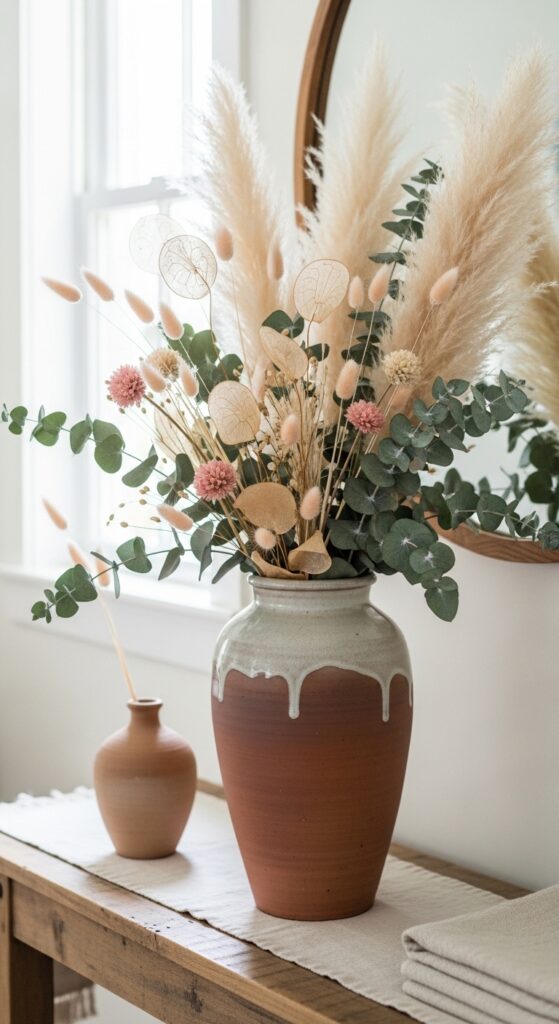
Vibe: The arrangement feels still — like the room exhaled.
Why it works: Dried botanicals solve a problem fresh flowers create: impermanence. Pampas grass, bunny tails, and dried lunaria hold their form and color for months, making them one of the most practical accessories in a boho farmhouse home. They work on the same neutral-warm color spectrum as the rest of the palette, so they integrate rather than punctuate. A full, generous arrangement reads more intentional than a sparse one — volume is part of the aesthetic.
How to get it: Buy dried pampas grass from a local florist or Amazon ($15–$25 for a bundle), and pair it with dried bunny tail stems and a few eucalyptus branches for tonal variety. Place in a vessel that’s wider at the base than the neck — this lets the arrangement fan naturally rather than collapsing inward.
💡 Quick Win: Spritz pampas grass lightly with hairspray after arranging to prevent shedding — a florist trick that keeps the plumes intact for 6–12 months.
10. Open Floor Plan Zones Defined by Rugs and Lighting
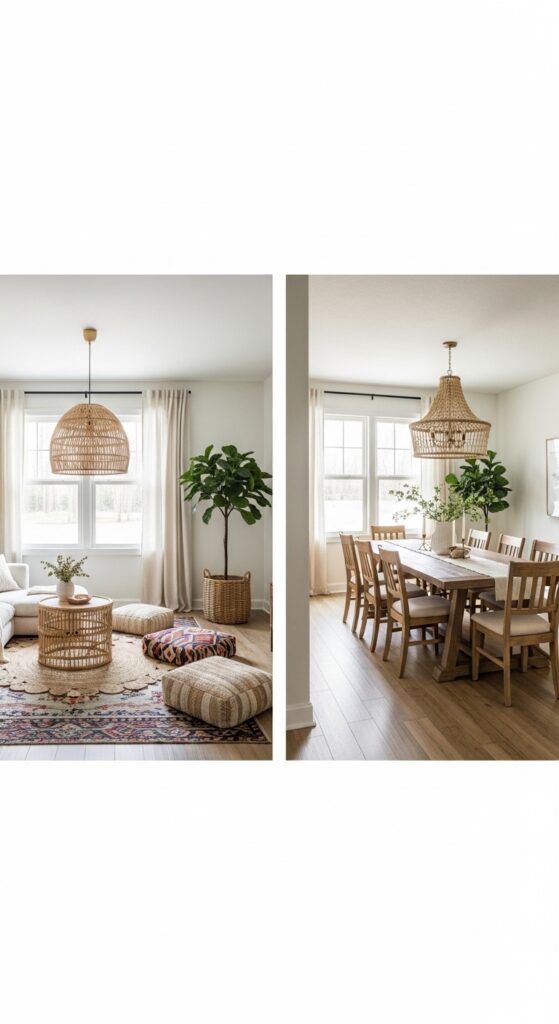
Vibe: The space feels purposeful — open but never aimless.
Why it works: In an open floor plan, rugs and pendant lights are the two most powerful zone-defining tools available — they communicate “this area has a specific purpose” without requiring walls or partitions. The key is ensuring both zones share a common thread: same color family, similar material warmth, consistent rug scale. Boho farmhouse is particularly well-suited to open plans because its layered, eclectic nature fills large spaces without making them feel sparse or under-decorated.
How to get it: Position your pendants centered over each zone’s functional anchor — the sofa grouping or the dining table — not centered in the room architecturally. This is the single most important layout decision for defining zones with light.
11. Whitewashed Brick With Warm Amber Accents
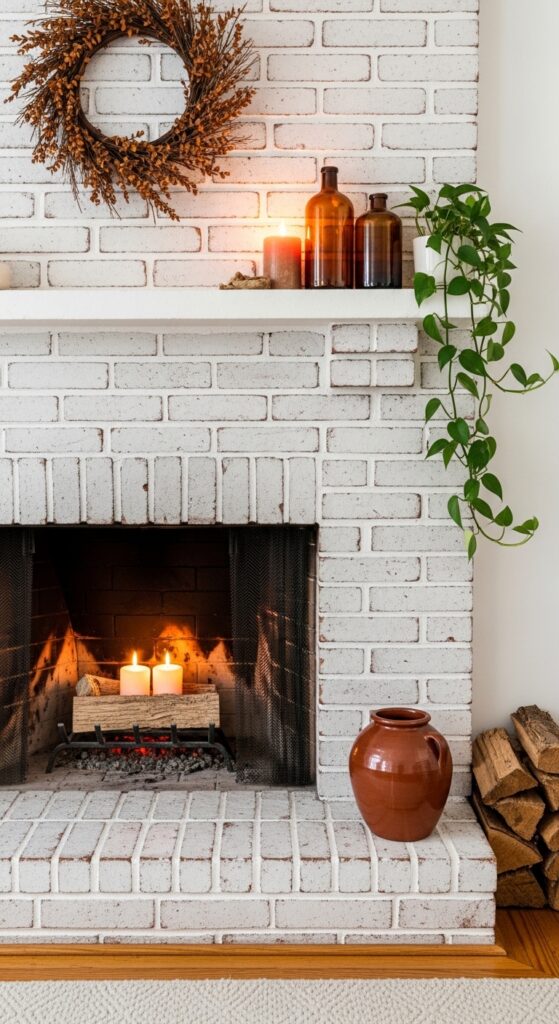
Vibe: The fireplace wall feels raw and deeply alive — the kind of surface that improves with age.
Why it works: Whitewashing brick is a technique that preserves the texture and dimension of the brick while neutralizing its orange-red undertone, which can clash with boho farmhouse’s warmer, earthier palette. The thin wash lets the brick’s natural variation show through — no two bricks read exactly the same, which is central to the style’s love of imperfection. Amber glass accents on the mantle catch firelight in a way that adds warmth without adding clutter.
How to get it: Mix one part white latex paint with one part water and apply with a wide brush, working in sections and wiping back with a damp cloth immediately for a more translucent wash. Practice on a hidden area first — you can always add more white, but you can’t easily remove it once it’s dried into the mortar.
💡 Quick Win: A set of vintage amber glass bottles from a thrift store ($1–$4 each) grouped in odd numbers on a mantle or shelf creates the warm, collected look of expensive artisan glassware.
12. Woven Basket Wall as Boho Farmhouse Art
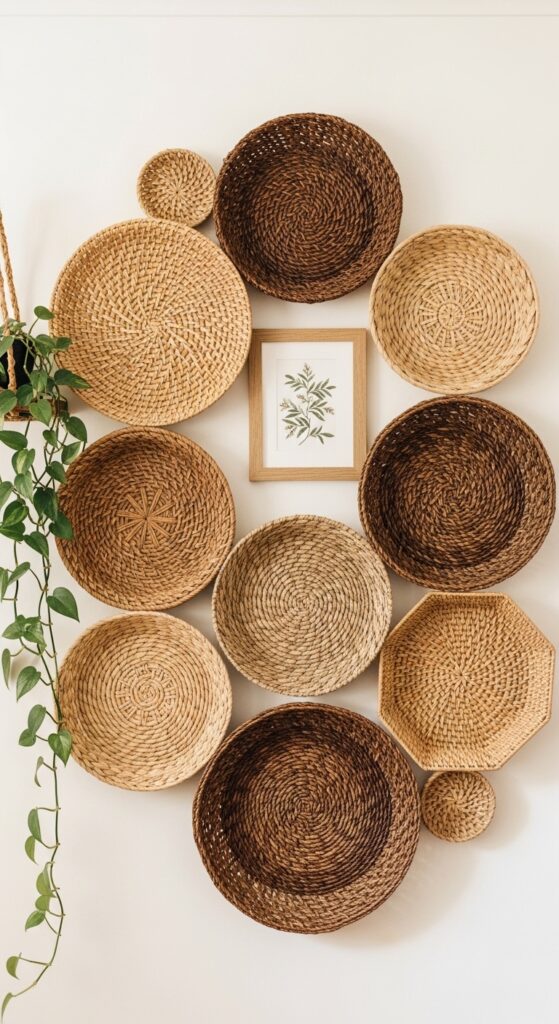
Vibe: The wall feels earthy — dimensional and organic in a way that framed art simply can’t match.
Why it works: A basket gallery wall introduces three-dimensional texture to a vertical surface — it catches light and casts shadows in a way that flat art never does. The varying shapes and weave patterns create visual interest through repetition of a single material category, which is more cohesive than mixing art styles. This technique works on virtually any wall: a hallway, living room, or dining room all benefit from the warmth baskets bring.
How to get it: Hang your largest basket first, centered at eye height (approximately 57 inches from floor to basket center). Build outward from there, leaving 2–3 inches between each basket. Mix at least three different weave materials — seagrass, rattan, and water hyacinth — for tonal range within the same neutral family.
13. Sage Green Linen Curtains for Soft Color Infusion
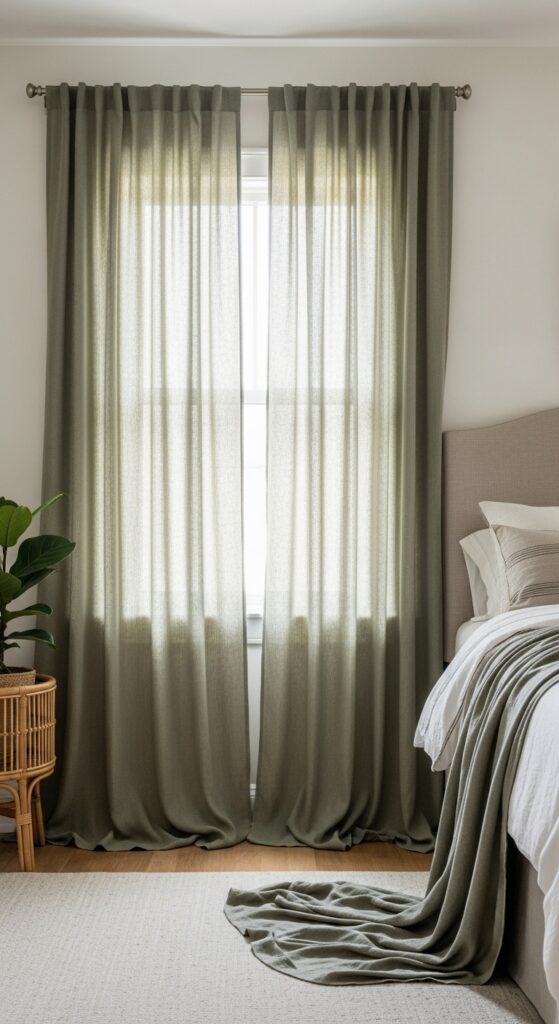
Vibe: The room feels serene — sage and linen together create a quiet that reads as luxurious without trying.
Why it works: Sage green is the ideal boho farmhouse accent color because it exists at the intersection of natural and vintage — it reads neither too modern nor too rustic. In linen fabric, the color gains a slightly faded, organic quality that synthetic fabrics can’t replicate. Hanging curtains high (close to the ceiling) and letting them pool slightly on the floor is a styling trick that makes any ceiling feel taller and any window feel larger — two effects that matter enormously in bedrooms.
How to get it: Source unlined linen curtains in muted (not bright) sage — H&M Home and IKEA’s DYTÅG line both offer linen-blend panels in earthy greens under $60 per pair. Avoid blackout lining, which kills the diffused-light effect that makes linen curtains magical.
💡 Quick Win: Mount your curtain rod 4–6 inches above the window frame (or as close to the ceiling as possible) and buy panels 12 inches longer than the window’s drop. This floor-pooling length costs nothing extra and transforms the entire room’s proportions.
14. Reclaimed Wood Floating Shelves in the Bathroom
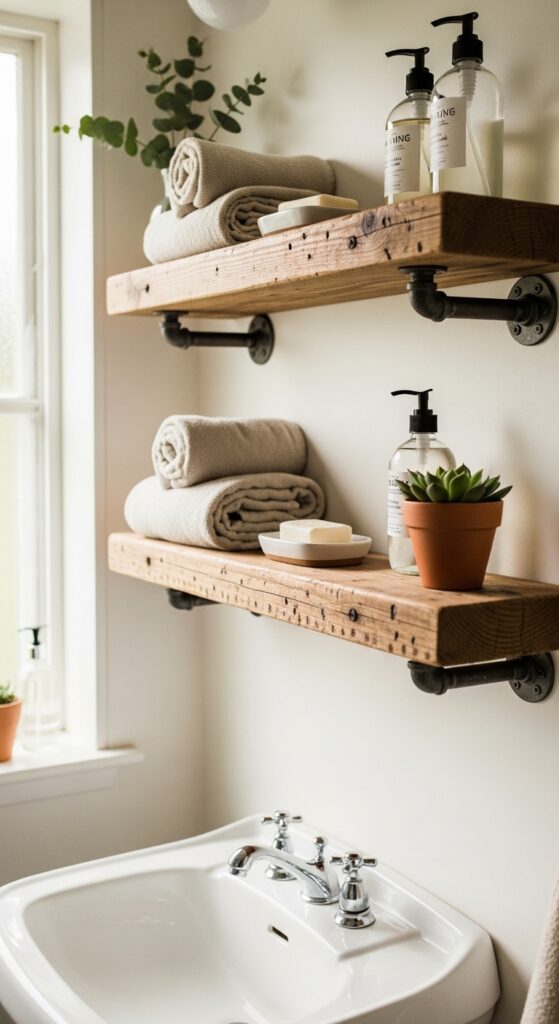
Vibe: The bathroom feels collected — like the objects on these shelves were gathered slowly, with care.
Why it works: Reclaimed pine introduces warmth and history into a bathroom — a space that often defaults to cold tile and chrome. The visible knots and grain variation aren’t flaws; they’re the point. Iron pipe brackets are structurally honest (the support is visible, not hidden) and reinforce the farmhouse industrial edge within the boho aesthetic. In a small bathroom especially, open shelving prevents the visual compression that upper cabinets create.
How to get it: Source reclaimed pine planks from a local architectural salvage shop or Habitat for Humanity ReStore — boards run $2–$8 per linear foot and usually only need a light sand and a coat of raw linen-tinted Danish oil to finish. Pair with iron pipe flanges and threaded pipe from any hardware store for authentic industrial brackets.
15. Warm Charcoal Limewash Paint for Moody Depth
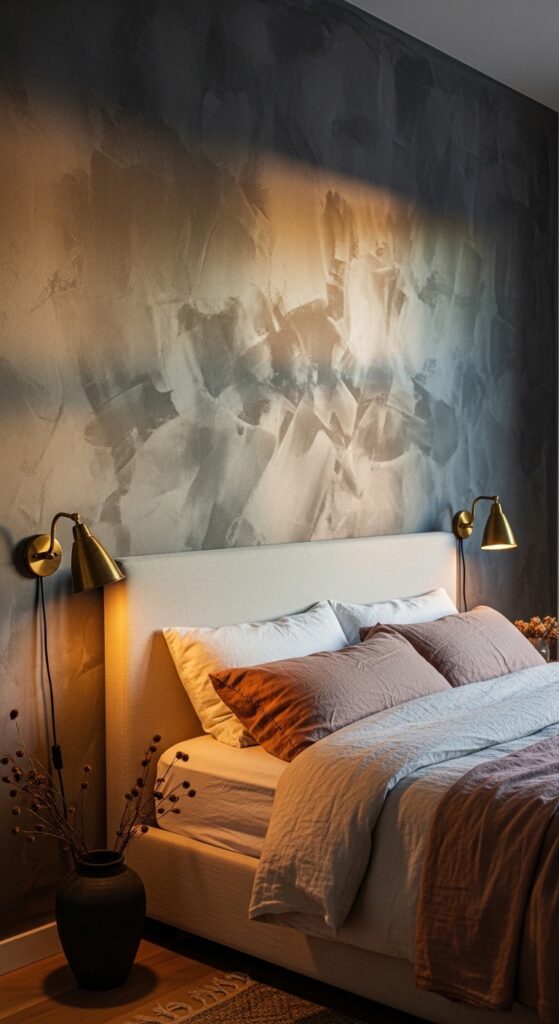
Vibe: The room feels moody — layered and intimate in the way only textured walls can achieve.
Why it works: Limewash paint is experiencing a well-deserved resurgence because it does something no flat paint can: it creates the appearance of depth on a flat wall. The trowel application leaves natural variation — lighter where the wash thins, darker where it builds — that mimics aged plaster walls in Tuscan villas or old farmhouses. In warm charcoal (not cool grey), this finish grounds the room without making it feel heavy.
How to get it: Apply limewash in two thin coats using a wide natural-bristle brush or masonry brush, working in irregular cross directions to build variation. Portola Paints’ Lime Wash line and Romabio both offer premixed options. For a charcoal tone, try Romabio’s ‘Volcano Grigio’ — it has exactly the right warm undertone that separates it from cold industrial grey.
💡 Quick Win: Limewash a single wall — just one — rather than committing the whole room. A single limewash wall behind the bed is more impactful than four flat-painted walls anyway.
16. Vintage Wooden Ladder as a Textile Display
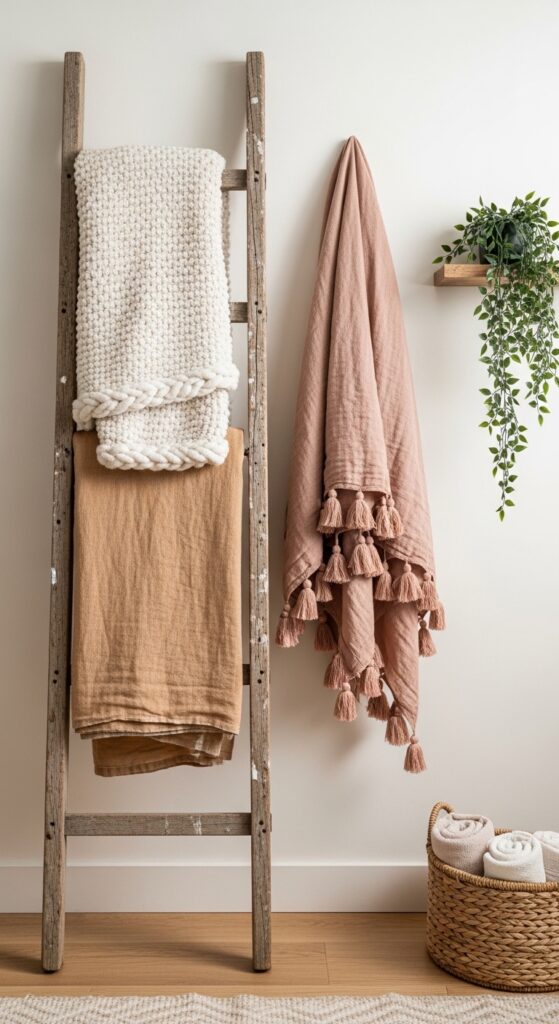
Vibe: The corner feels casual — function and beauty in exactly equal measure.
Why it works: A leaning ladder solves an invisible design problem: where do you store throws and extra blankets without hiding them in a closet or piling them on furniture? A ladder displays them as part of the room’s visual composition. The varying lengths of draped textiles create an organic, asymmetric silhouette against the wall — more interesting than a straight vertical line. It also introduces a vertical element into a space that might otherwise be dominated by horizontal furniture.
How to get it: A real wooden ladder from an antique market ($15–$40) has immediate authentic patina. Sand lightly if needed but resist the urge to fully refinish it — the worn grain is the point. Alternatively, Pottery Barn and Target both sell decorative blanket ladders in similar profiles for $60–$90 new.
17. Earthenware and Stoneware Vignette Styling
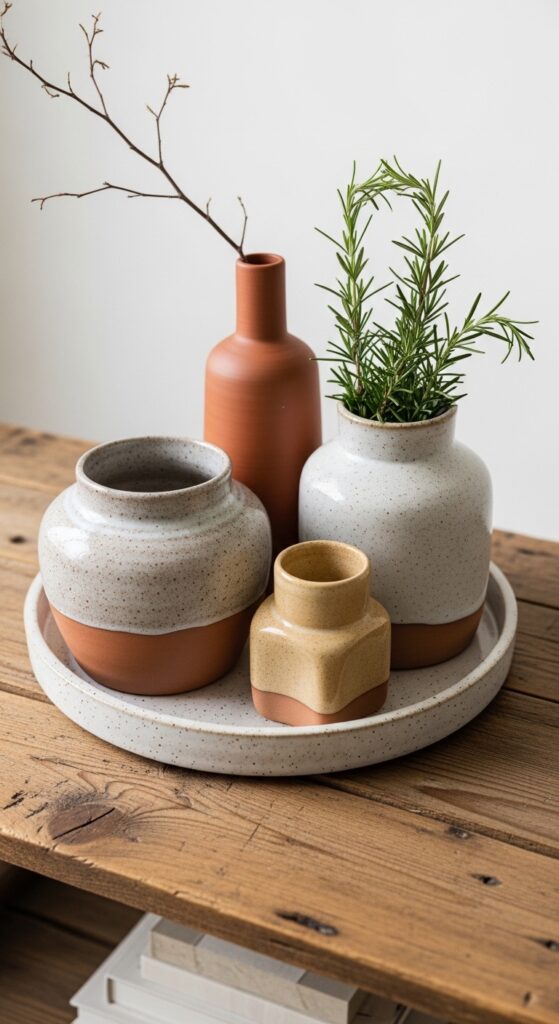
Vibe: The grouping feels grounded — each piece imperfect and entirely itself.
Why it works: Grouping ceramics in varied heights (tall, medium, low) follows the fundamental design rule of visual triangle composition — the eye travels between the three heights in a natural triangular path, which creates movement and rest simultaneously. Stoneware and earthenware earn their place in boho farmhouse because their craft-made quality carries the texture and humanity that mass-produced objects can’t replicate. The key is grouping by material family, not by matching set.
How to get it: Shop ceramics from individual makers on Etsy or local markets — look for pieces with matte or satin finishes rather than glossy glazes, which read more contemporary than rustic. Arrange your group on a natural linen runner or inside a shallow wooden tray to give the vignette a boundary and prevent it from looking random.
💡 Quick Win: A grouping of three unmatched matte ceramics from TJ Maxx’s HomeGoods section — typically $6–$18 each — creates a designer-level vignette when arranged by height in a cluster of three.
18. Natural Light Maximization Through Sheer Linen Layers
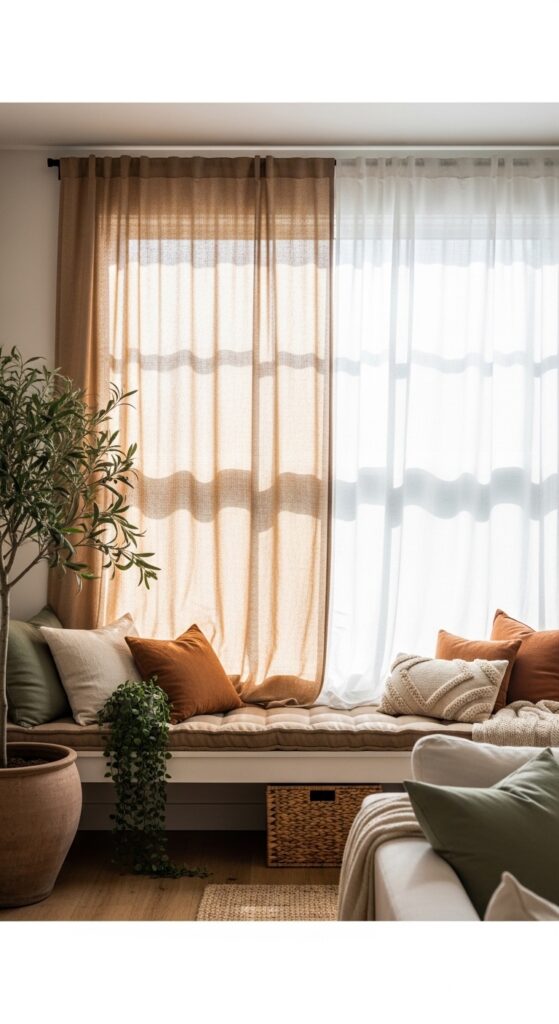
Vibe: The room feels luminous — bright without being harsh, warm without being dim.
Why it works: Layering two sheer linen panels on a single window creates a diffusion effect that’s significantly warmer and more interesting than a single panel — the light passes through two slightly different weave densities, creating the kind of soft, layered glow that photographers call “magic hour” and decorators call the difference between a good room and a great one. This technique works especially well in south- and west-facing rooms where unfiltered light would otherwise be too intense.
How to get it: Hang your outer panels on a standard rod and your inner panels on a tension rod mounted inside the window frame itself. Use two different weights of linen — a standard 200gsm for the outer and a very sheer 90gsm for the inner. The visual layering reads beautifully even when both panels are pulled closed.
19. Freestanding Clawfoot Tub With Boho Accessories
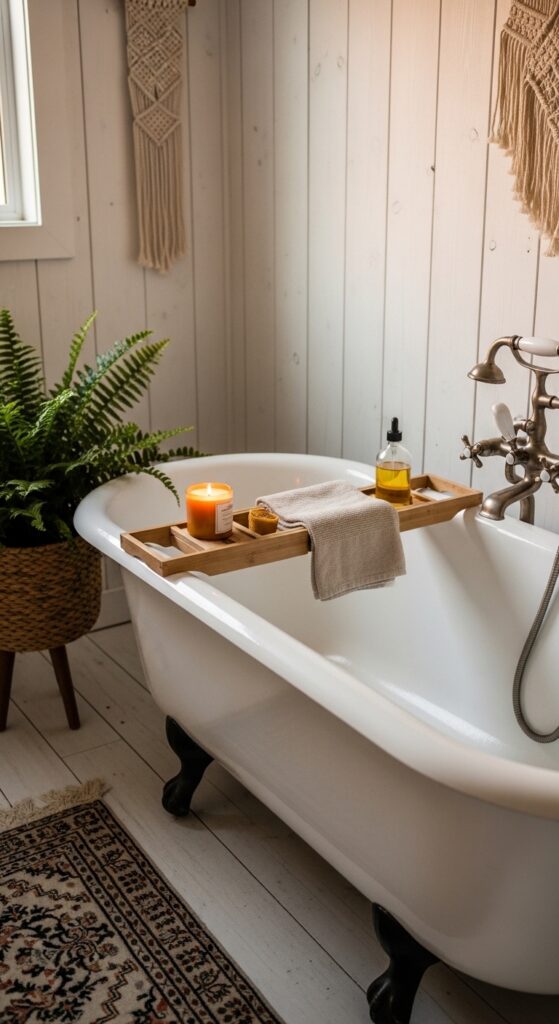
Vibe: The bathroom feels romantic — the good kind, where beauty and simplicity are indistinguishable.
Why it works: A clawfoot tub is a freestanding sculptural object as much as it is a fixture — it anchors a bathroom the way a sofa anchors a living room, commanding the space and establishing the room’s personality. In a boho farmhouse context, the key is resisting the urge to over-style it. A single wooden bath caddy, one plant, one candle. The restraint makes the tub’s form the star rather than burying it in accessories.
How to get it: If a full clawfoot is outside your budget, look for vintage cast iron tubs at architectural salvage shops — they often run $300–$600 unrestored versus $1,500+ new. Refinish the interior in bright white enamel paint (Rust-Oleum’s Tub & Tile kit works well) and paint the feet in matte black for a crisp contrast.
💡 Quick Win: A simple wooden bath caddy ($25–$45 on Amazon or Umbra) transforms even a standard bathtub into a styled moment — place one beeswax candle, one rolled linen washcloth, and one small ceramic dish on it.
20. Exposed Wooden Ceiling Beams for Farmhouse Drama
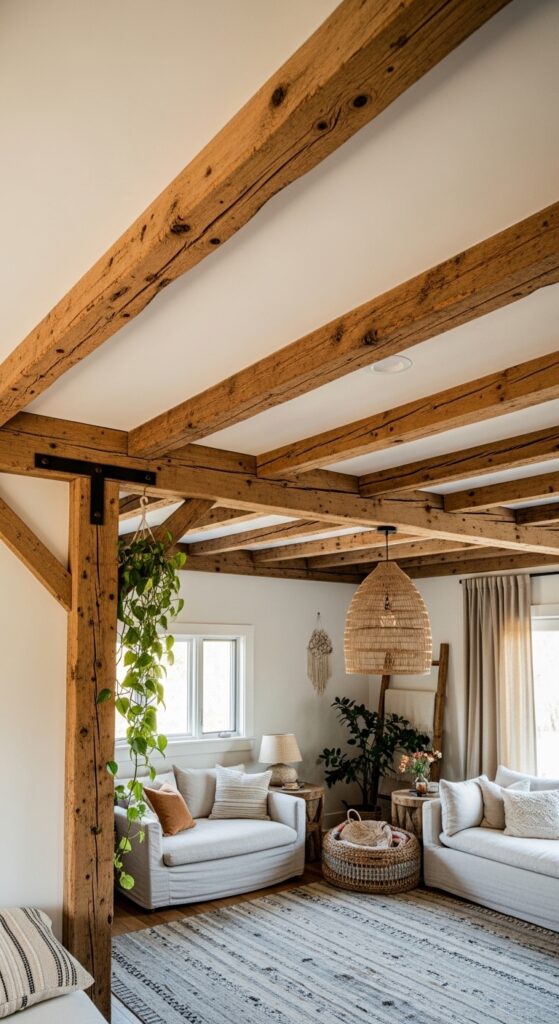
Vibe: The room feels warm — the ceiling itself becoming part of the room’s texture.
Why it works: Exposed ceiling beams work on the principle of authentic structure made visible — the architecture tells the truth about how the space is built, and that honesty reads as warmth rather than decoration. In boho farmhouse interiors, beams bridge both aesthetics perfectly: they’re the farmhouse’s structural grounding and the boho’s love of raw, natural material. They also draw the eye upward, making rooms feel taller even when the beams themselves reduce the visible ceiling height slightly.
How to get it: If your home doesn’t have existing beams, faux beam wraps made from reclaimed wood or high-quality polyurethane (by companies like Timber Creek Beams) install with construction adhesive and look convincing. Sand and oil them before installation so the color integrates with the ceiling rather than appearing pasted on.
21. Boho Farmhouse Bedroom With Canopy of Dried Flowers
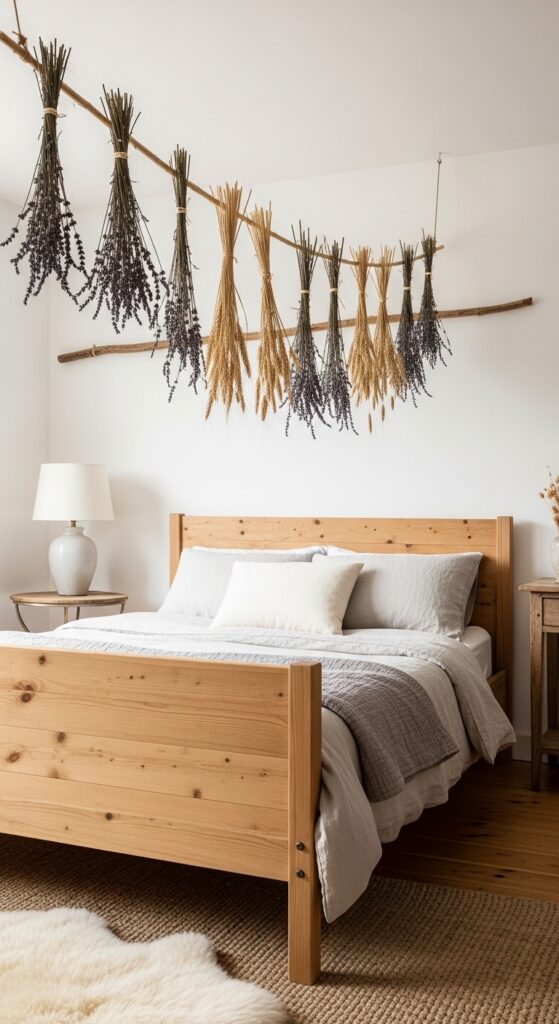
Vibe: The bedroom feels organic — like the outside world wandered in and decided to stay.
Why it works: A dried flower canopy introduces the garden into the bedroom in the most textural, delicate way possible. Grouping bundles of dried lavender, wheat, and bunny tails from a single wooden dowel creates an effect that’s simultaneously maximalist (abundant botanical material) and minimal (only one material category, one mounting point). The scent of dried lavender also carries into the room — the one design element that engages a sense beyond vision.
How to get it: Mount a raw wooden dowel or a simple curtain rod parallel to the wall, 12–18 inches above the headboard. Bundle dried stems with natural twine and hang them from the rod with a simple overhand knot, staggering lengths slightly. Dried bundles from Michael’s or a local florist market cost $6–$14 per bundle — five bundles is enough for a full visual effect.
💡 Quick Win: Dried lavender bundles are consistently the most affordable dried botanical ($4–$8 per bunch) and have the added sensory bonus of a calming fragrance. They hold color and shape for 12–18 months indoors.
22. Warm-Toned Kitchen With Open Pot Display
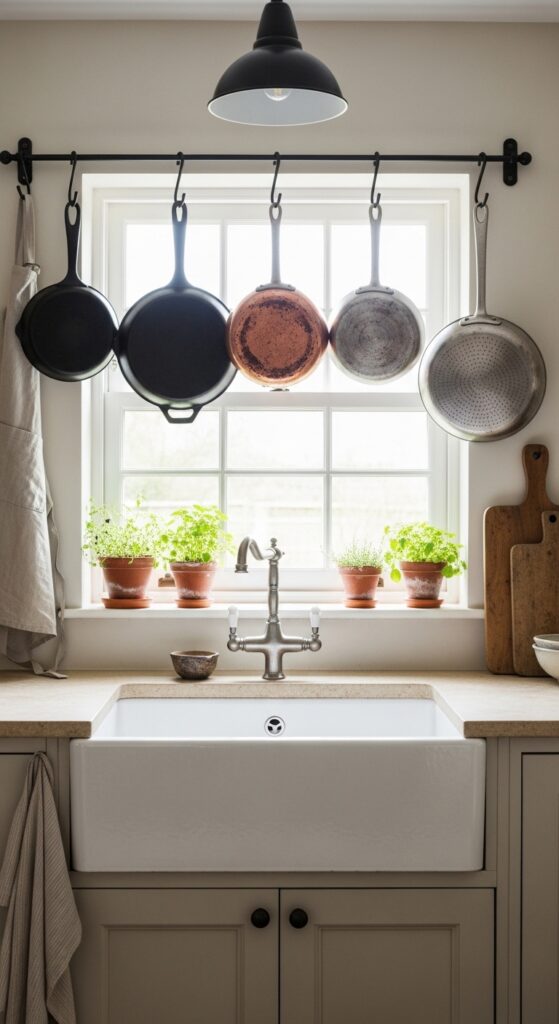
Vibe: The kitchen feels functional and alive — everything visible has a purpose, and it all adds up to warmth.
Why it works: Hanging cookware turns everyday tools into decorative elements — a farmhouse move that’s entirely practical. Cast iron, copper, and steel have naturally warm, varied patinas that function as metallic accents without requiring separate decorative pieces. The visual weight of hanging cookware above a farmhouse sink also creates a focal point on what is often the most visually prominent wall in a kitchen: the window-above-sink wall.
How to get it: Install a wall-mounted iron pot rail (not a ceiling rack, which requires structural anchoring) at a height that keeps your tallest pot clear of your head. Schoolhouse Electric offers simple iron rails in several widths from $45. Use iron S-hooks in two sizes: large for pots, small for utensils and ladles.
23. Stone Fireplace Hearth With Boho-Layer Mantle
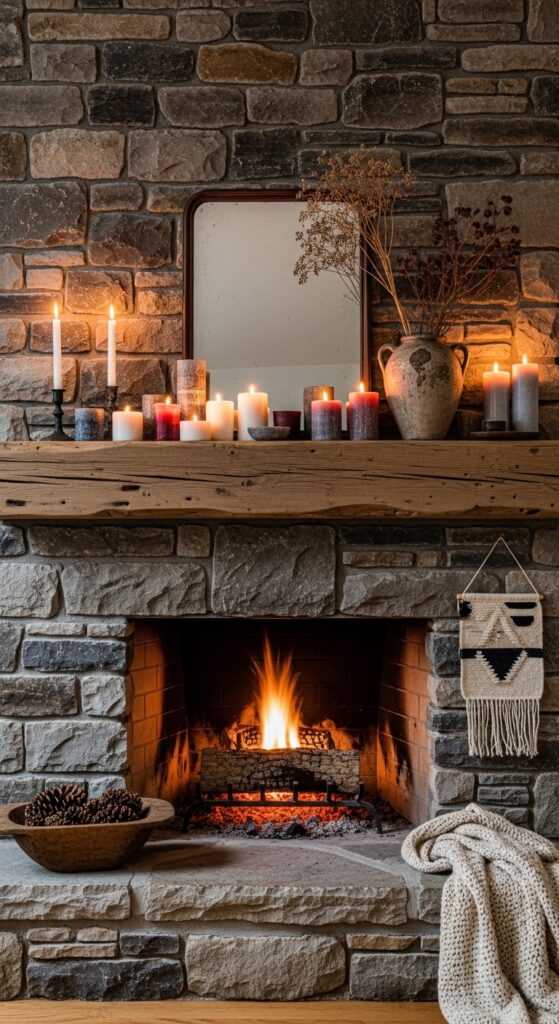
Vibe: The fireplace feels gathered — a hearth in the original sense, drawing everything toward it.
Why it works: A stone fireplace provides the most powerful farmhouse anchor a room can have — raw, structural, permanent. The boho layer is added through the mantle styling: mismatched candles at varied heights, a leaning mirror rather than a hung one, a small woven piece pinned directly to the stone. This combination of stable structure and loose, personal styling is the essential tension at the heart of the boho farmhouse aesthetic.
How to get it: Style your mantle using the rule of thirds — divide it mentally into three sections and ensure each section has at least one tall element, one medium element, and one small or flat element. The arrangement should look like it evolved organically, even when it’s been carefully considered.
💡 Quick Win: Lean a vintage mirror against the back wall of the mantle instead of hanging it — this immediately adds the casual, collected energy of boho farmhouse styling and costs nothing beyond finding the right mirror.
24. Earthy Tonal Bedding Layers for Deep Comfort
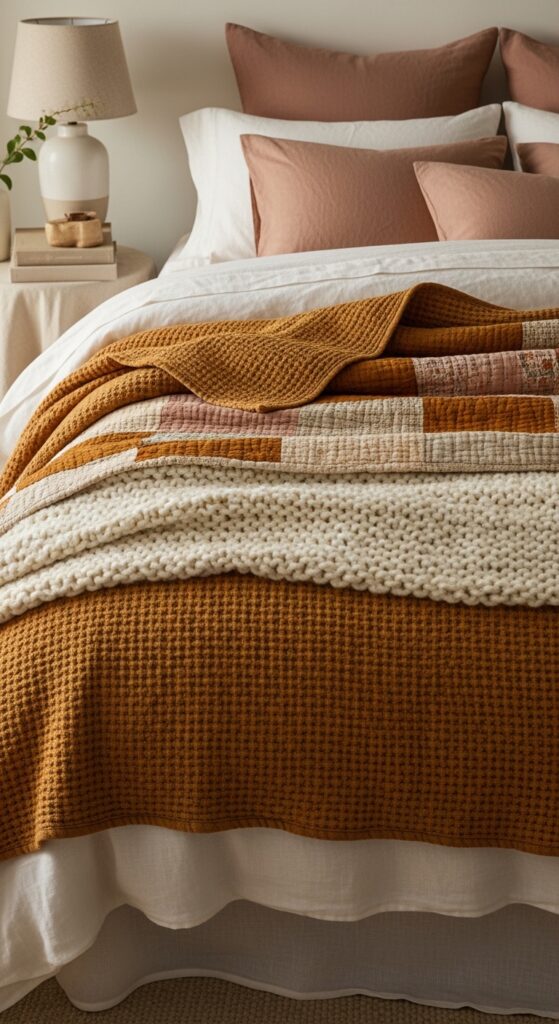
Vibe: The bed feels layered — not just physically warm but emotionally so, the kind of bed you think about all day.
Why it works: Tonal bedding layering works because it creates depth without contrast — each layer is in the same warm family (white, oatmeal, ochre, blush) but with enough tonal difference that they read as distinct. The boho principle here is that more is more — but only when “more” maintains material quality and tonal cohesion. A chunky-knit at the foot adds the final textural dimension that differentiates a designed bed from simply a made one.
How to get it: Build from lightest to heaviest: sheets, then a waffle or matelassé blanket, then your quilt or coverlet, then the throw. Keep all layers in the same warm color family — whites with yellow or red undertones, not cool blue-whites. Parachute Home and Brooklinen both offer pre-coordinated earthy linen bedding sets that take the guesswork out of tonal matching.
25. Indoor Climbing Plants for Living Wall Effect
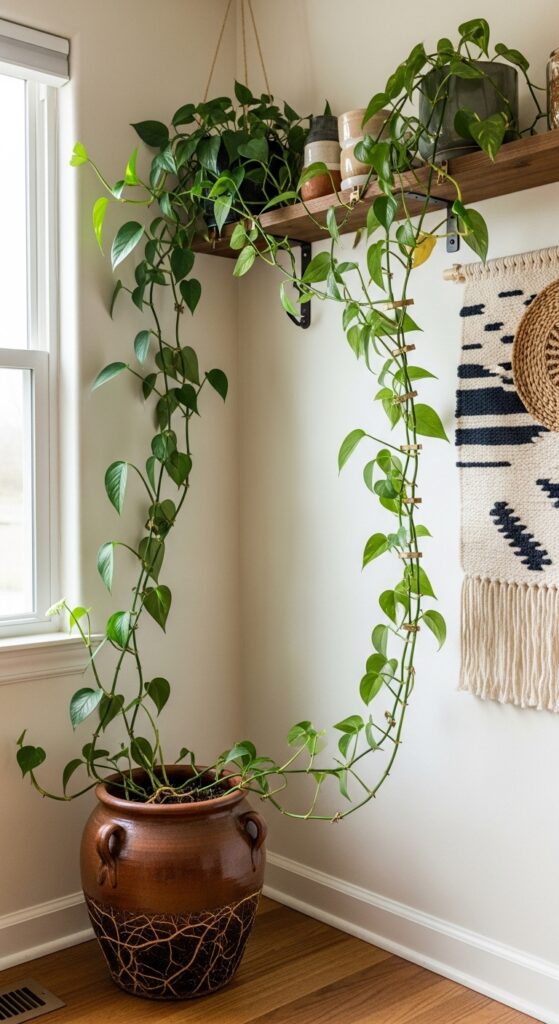
Vibe: The corner feels alive — the plant so integrated into the room’s design that removing it would leave a gap nothing else could fill.
Why it works: A trained climbing plant is one of the few design elements that becomes more beautiful with time rather than less — it rewards patience and care with visual abundance. In boho farmhouse interiors, plants aren’t accessories; they’re structural elements. A floor-based pothos or heartleaf philodendron guided up a wall with small brass clips creates the impression of a living wall without requiring a built-in planter system. The green against warm white wall also creates a color relationship that feels both natural and considered.
How to get it: Use 3M Command strips or small adhesive brass hooks to guide trailing stems along the wall — this method leaves no permanent holes and is fully adjustable as the plant grows. A golden pothos (Epipremnum aureum) is the most forgiving variety: fast-growing, low-light tolerant, and nearly impossible to kill.
💡 Quick Win: A 6-inch pothos in a $4 terracotta pot from a garden center is the most affordable starting point for this look — within 18 months in a reasonably bright room, it will trail 4–6 feet and completely change the room’s energy.
26. Vintage Wooden Furniture With Fresh Linen Upholstery
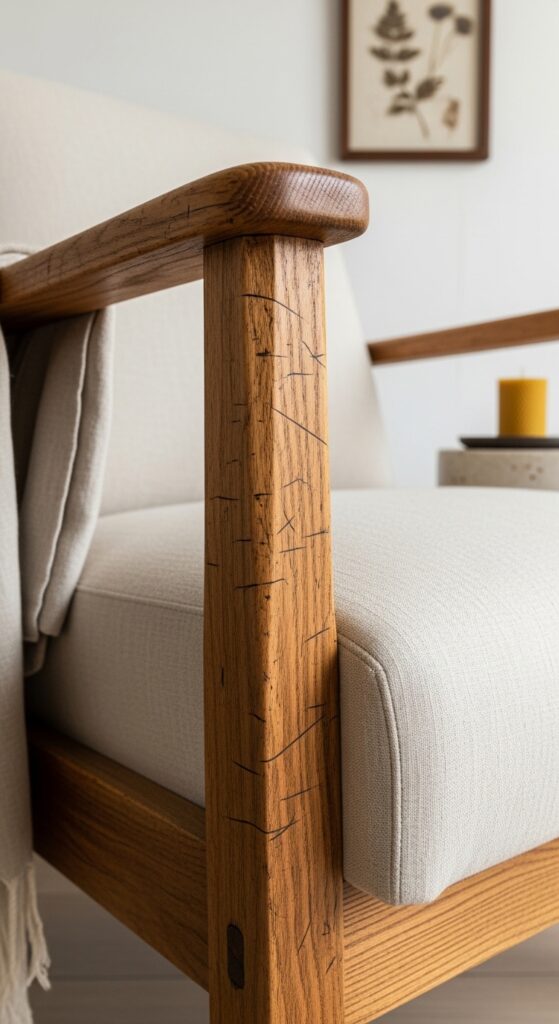
Vibe: The chair feels unhurried — like it carries the memory of everywhere it’s been.
Why it works: Pairing vintage wooden furniture frames with new linen upholstery is a fundamental boho farmhouse technique because it honors both influences simultaneously. The aged wood carries history and imperfection — boho values — while the clean, neutral linen upholstery keeps the piece feeling current and farmhouse-fresh. The contrast between the worn wood frame and the crisp textile creates a visual tension that makes the piece more interesting than a fully vintage or fully new chair could achieve alone.
How to get it: Source vintage armchairs from estate sales, Facebook Marketplace, or Craigslist ($20–$80 for solid frames in need of upholstery). Have a local upholstery shop recover them in undyed Belgian linen — this service typically costs $150–$300 for a chair and extends the piece’s life by decades. The total investment remains far below the cost of a new quality armchair.
27. Boho Farmhouse Entryway With Functional Warmth
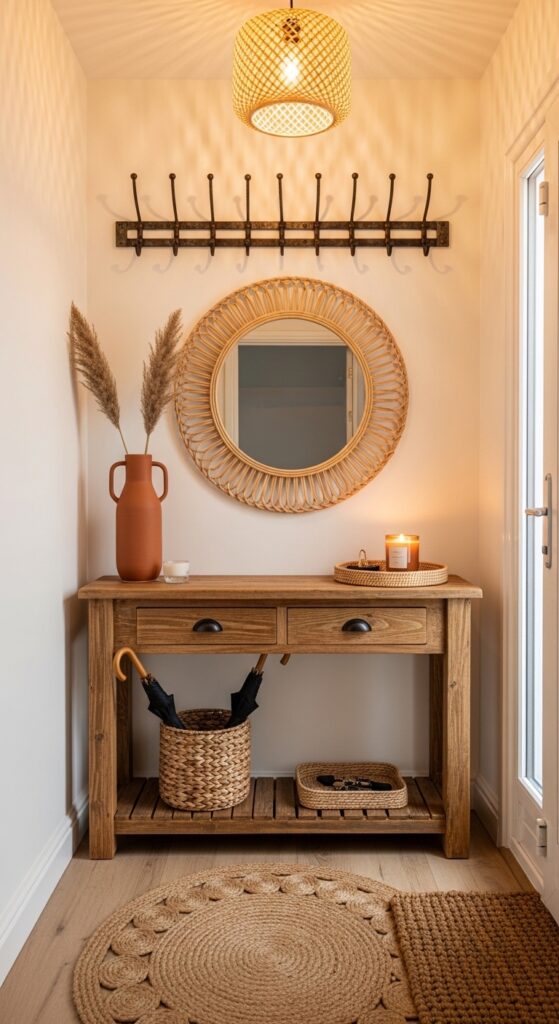
Vibe: The entryway feels welcoming in a way that costs nothing to manufacture — it’s just completely, authentically itself.
Why it works: An entryway sets the tonal promise of everything that follows. In boho farmhouse, that promise is: warmth, layers, imperfection, intention. A round rattan mirror rather than a rectangular framed one immediately signals the style. The reclaimed console grounds it in farmhouse practicality. A woven basket beneath provides the invisible storage that makes a small entry feel curated rather than cluttered. Every element is functional AND beautiful — which is the core value of boho farmhouse in miniature.
How to get it: In a narrow entry (under 4 feet wide), choose a console no deeper than 12 inches so the path remains clear. Place your pendant light centered over the console, not centered in the entry ceiling — this draws the eye to the styled surface rather than to the ceiling. A round rattan mirror from World Market or Target (typically $45–$85) and a single tall dried botanical arrangement creates the full boho farmhouse entry look in two pieces.
How to Start Your Boho Farmhouse Transformation
Start with paint. Choose Sherwin-Williams ‘Antique White’ (SW 6119) — not stark white, not off-white, but this specific warm, slightly yellowed tone that makes every wood piece, every rattan accessory, and every linen textile you add afterwards look like it belongs exactly where you put it. This one color decision anchors the entire palette and prevents the “random collected” look from tipping into actual randomness.
The most common mistake beginners make is mixing warm and cool-toned whites in the same space — painting the wall in a warm white but choosing cool-grey linen curtains or a blue-white bedding set. These undertones fight each other at every light level, and the result reads as unresolved rather than eclectic. Before purchasing any textile or large piece, hold it against your painted wall in both natural and artificial light. If it looks greenish or bluish against the wall, it’s too cool.
Three items under $50 that create immediate boho farmhouse impact: a bundle of dried pampas grass from Amazon ($15–$20) placed in any tall vessel you already own; a set of rattan basket liners from IKEA’s KAKTUSFIKON line ($12) to transform any plain shelf into a styled storage moment; and a single raw linen throw pillow cover from H&M Home ($18–$25) to introduce natural textile texture to your sofa today.
A realistic single-room transformation takes 3–6 months done gradually, with a starter version achievable in a weekend for $150–$300 (paint, one rug, two textile pieces). A fully furnished boho farmhouse room runs $800–$2,500 depending on whether you source vintage (far less) or buy new. The style rewards patience — pieces that arrive slowly, from different sources, look more collected and authentic than a room purchased all at once.
Frequently Asked Questions About Boho Farmhouse Design
What is the difference between boho farmhouse and regular farmhouse style?
Traditional farmhouse design prioritizes function, clean lines, and a restrained material palette — shiplap, white paint, iron, and simple furniture. Boho farmhouse adds the layered, globally-influenced, maximalist-in-texture elements of bohemian style: macramé, rattan, kilim rugs, mixed ceramics, and dried botanicals. The result is significantly warmer and more personal than traditional farmhouse, and deliberately less structured. If pure farmhouse is a well-organized barn, boho farmhouse is a well-loved home where someone with great instincts has lived for decades.
What colors work best in boho farmhouse rooms?
The most effective boho farmhouse palettes center on warm neutrals — creamy white, beeswax, warm oatmeal, and natural greige — with accent colors drawn from the earth: terracotta blush, muted sage, dusty ochre, faded rust, and warm charcoal. Avoid anything bright, cool-toned, or synthetic. A specific color combination that photographs and lives beautifully: Sherwin-Williams ‘Antique White’ walls, sage linen curtains, and terracotta ceramic accents. The palette should feel like it was mixed from soil, stone, and sunlight.
Is boho farmhouse design expensive to achieve?
It’s one of the most budget-friendly styles available, precisely because vintage, thrifted, and handmade pieces are part of the aesthetic rather than compromises. A single rattan pendant ($30–$60), a jute rug ($60–$120), dried botanicals ($20–$40), and a layered throw ($25–$45) create the essential look for under $250. The style actually improves with found and imperfect pieces — an estate sale chair, a thrifted ceramic, a handmade textile from a local market. Full-room budgets of $500–$1,500 are entirely realistic and produce results that look twice that investment.
Can I mix boho farmhouse with other styles?
Yes — boho farmhouse is one of the most compatible hybrid styles precisely because its layered, collected nature absorbs elements from adjacent aesthetics without losing coherence. It pairs particularly well with Scandinavian minimalism (shared love of natural materials and warm whites), with coastal decor (rattan, linen, and light tones overlap), and with Mediterranean warmth (terracotta, limewash, and botanicals are common to both). The rule is to ensure the new influence shares the same material warmth and color temperature — introduce cool metals, grey tones, or highly polished finishes and the harmony breaks down quickly.
What textiles work best in a boho farmhouse room?
Natural, undyed, or naturally-dyed textiles are the foundation: undyed Belgian linen for curtains and upholstery, jute and sisal for rugs, cotton macramé for wall hangings, chunky wool or cotton knit for throws, and hand-woven kilim or Moroccan rugs for layered floor coverage. Avoid polyester, microfiber, or highly synthetic textiles — they don’t hold light the way natural fibers do, and the slight flatness they introduce undermines the organic warmth the style depends on. If budget is a concern, prioritize natural fiber in the largest items (curtains, primary rug) and allow synthetic blends in smaller pieces like throw pillows.
Ready to Create Your Dream Boho Farmhouse Space?
These 27 ideas cover the full spectrum of what makes this style work — from the color and material foundation to lighting choices, furniture scale, layout logic, and the small accessories that give a room its soul. Transformation doesn’t require doing all of this at once — in fact, the rooms that feel most authentically boho farmhouse are the ones that grew one intentional layer at a time, never rushed. This week, bring one piece of natural wood into your space — a small tray, a wooden bowl, a reclaimed cutting board propped on a shelf — and notice how immediately the room’s warmth shifts. When this style is fully realized, you’ll feel it the moment you walk through the door: grounded, layered, completely at ease in a space that feels unmistakably yours. Save the ideas that spoke to you — especially the ones that made you think that’s the exact feeling I’ve been trying to name — because those are the ones that will build your most honest room.