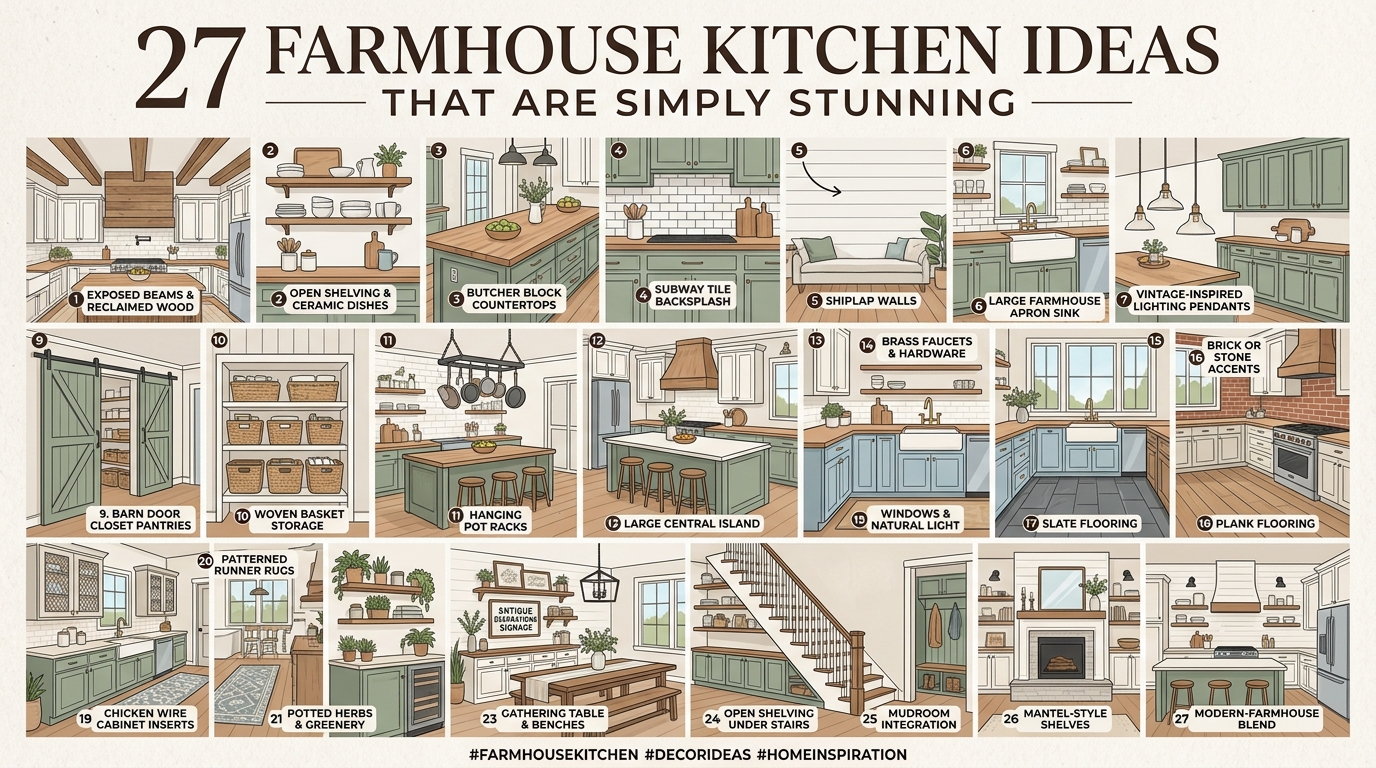
Farmhouse style is a design approach rooted in American rural tradition — characterized by honest materials, unpretentious silhouettes, and spaces that prioritize warmth over perfection. This article gives you exactly 27 farmhouse kitchen ideas spanning color, lighting, furniture, materials, layout, accessories, and small-space solutions.
There’s a particular hush that settles over a farmhouse kitchen — the kind you feel before the coffee finishes brewing, when morning light catches the grain of a worn oak table. It’s a style that doesn’t try too hard. Shiplap walls, apron-front sinks, worn linen curtains that drift in a cracked window — these are not decorations, they’re decisions about how you want to live. Here are 27 ideas worth saving — and stealing.
Why Farmhouse Style Works So Well
Farmhouse kitchen design traces its roots to the working kitchens of 18th- and 19th-century American rural homes — spaces built not for aesthetics, but for function. Over decades, that utilitarian honesty evolved into a distinct visual language: open shelving that displayed daily-use ceramics, butcher block counters that bore the scars of real cooking, and apron sinks large enough to wash a season’s harvest. It draws from Shaker minimalism, English country warmth, and Scandinavian practicality, distinguishing itself from “rustic” style through its cleaner lines and deliberate restraint.
The material palette is tactile and specific. Think white oak flooring with visible grain, painted beadboard or shiplap in warm white (Benjamin Moore’s “White Dove” or “Chantilly Lace”), brushed nickel or unlacquered brass hardware, soapstone or honed marble countertops, and open shelving in aged pine. Accent colors range from dusty sage and muted sage green to warm cream, terracotta blush, and slate blue. Linen, cotton, and jute dominate textiles — nothing synthetic, nothing high-sheen.
Farmhouse kitchens are having a measurable cultural moment right now, driven by what designers call the “nesting impulse” — a post-pandemic desire to make home feel genuinely safe, slower, and more intentional. Pinterest reports consistent year-over-year growth in searches for “warm farmhouse kitchen” and “modern farmhouse kitchen ideas,” and interior designers cite a clear consumer shift away from cold, high-gloss contemporary spaces toward kitchens that feel lived-in. Authenticity is the new luxury.
Small kitchens can absolutely achieve this look — with a few honest caveats. Prioritize apron sink + open shelving first; these two elements do more visual work than anything else. Avoid dark shiplap in genuinely cramped spaces unless you have substantial natural light. A single statement pendant light, a well-placed butcher block island, and warm white walls are enough to build a convincing farmhouse kitchen in under 100 square feet.
Style at a Glance
| Element | Detail |
| Philosophy | Functional beauty; imperfection as character |
| Key Materials | White oak, shiplap, linen, soapstone, brushed brass |
| Key Colors | Warm white, dusty sage, warm cream, terracotta blush, slate blue |
27 Farmhouse Kitchen Ideas
1. Warm White Shiplap Walls with Open Wood Shelving
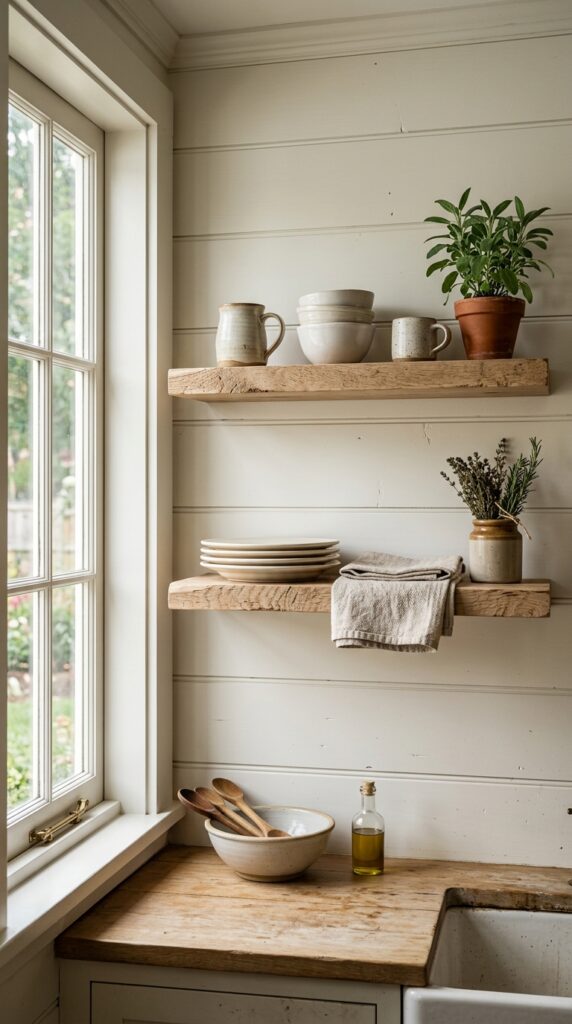
Vibe: Still — the kind of quiet that comes from surfaces that have nothing to prove.
Why it works: Shiplap’s horizontal lines create a strong visual rhythm that draws the eye across the full width of a kitchen, making narrow spaces feel wider through forced perspective. The contrast between the matte painted wall and the raw grain of unsealed oak shelving is a deliberate texture play — two different kinds of natural, speaking the same language. Keeping the wall color in a warm white (not a cool blue-white) ensures the wood reads as gold rather than orange.
How to get it: Install pre-primed shiplap planks at 3½-inch width, then paint in Benjamin Moore “White Dove” — it reads white in bright light but holds a creamy warmth in shadow. Float shelves at 14-inch depth minimum to hold full-sized dinner plates without feeling like a narrow ledge.
💡 Quick Win: Purchase a set of three graduated white ironstone canisters for under $40 and place them in descending order on the lowest shelf — instant farmhouse vibe with zero styling effort.
🛍️ Shop the Look — Amazon Product Ideas
| # | Product Search Phrase | Why It Fits |
| 1 | Floating wood wall shelf rustic white oak | Core open shelf element |
| 2 | White ironstone ceramic canister set farmhouse | Instant shelf styling |
| 3 | Shiplap peel and stick wall panels white | Budget DIY wall treatment |
| 4 | Farmhouse kitchen wall hook rail wood | Functional wall accent |
| 5 | Dried lavender stem bundle natural decor | Organic shelf accent |
2. Apron-Front Sink with Unlacquered Brass Faucet
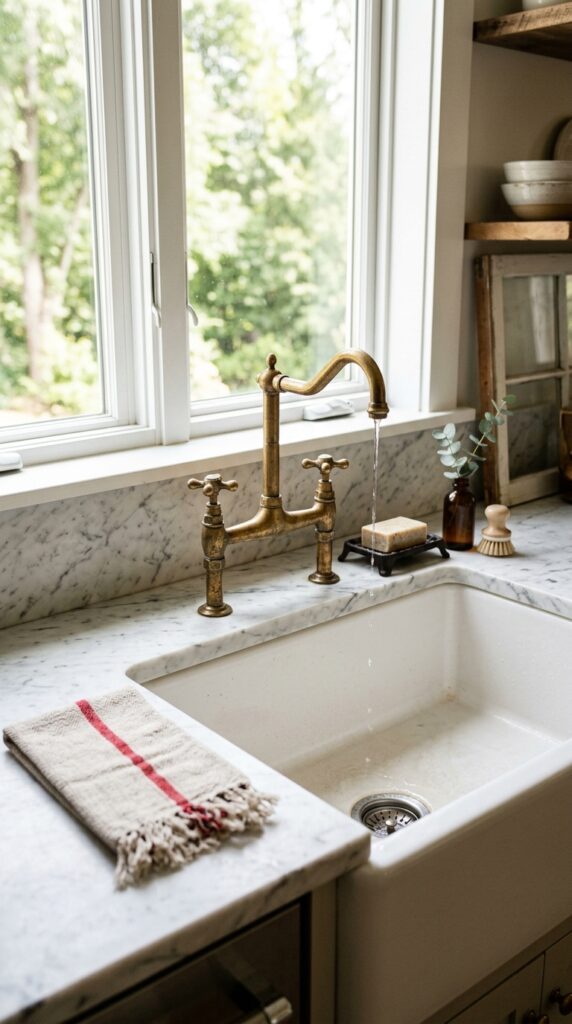
Vibe: Sun-warmed — like something that’s been used lovingly every morning for twenty years.
Why it works: The apron-front (or farmhouse) sink is arguably the single most iconic element of the style, and its design is rooted in pure function: the exposed front face allows the user to stand closer, reducing back strain during long prep sessions. Pairing white fireclay with unlacquered brass hardware creates a visual temperature contrast — cool white against warm amber — that prevents the space from reading as sterile. Unlacquered brass will patina naturally over time, which only deepens the farmhouse character.
How to get it: Source a fireclay apron sink in 30- or 33-inch single basin — the single basin is the more authentic farmhouse choice. Pair with a bridge-style faucet in unlacquered or living brass finish; Rohl and Kingston Brass offer accessible options. Do not seal the brass — let it age.
🛍️ Shop the Look — Amazon Product Ideas
| # | Product Search Phrase | Why It Fits |
| 1 | Farmhouse apron front kitchen sink white fireclay | Hero sink element |
| 2 | Bridge kitchen faucet unlacquered brass vintage | Authentic brass hardware |
| 3 | Cast iron farmhouse soap dish kitchen | Sink-side accent |
| 4 | Red stripe linen kitchen hand towel farmhouse | Classic farmhouse textile |
| 5 | Eucalyptus stem bundle dried natural greenery | Organic sink styling |
3. Dusty Sage Green Lower Cabinets with Cream Uppers
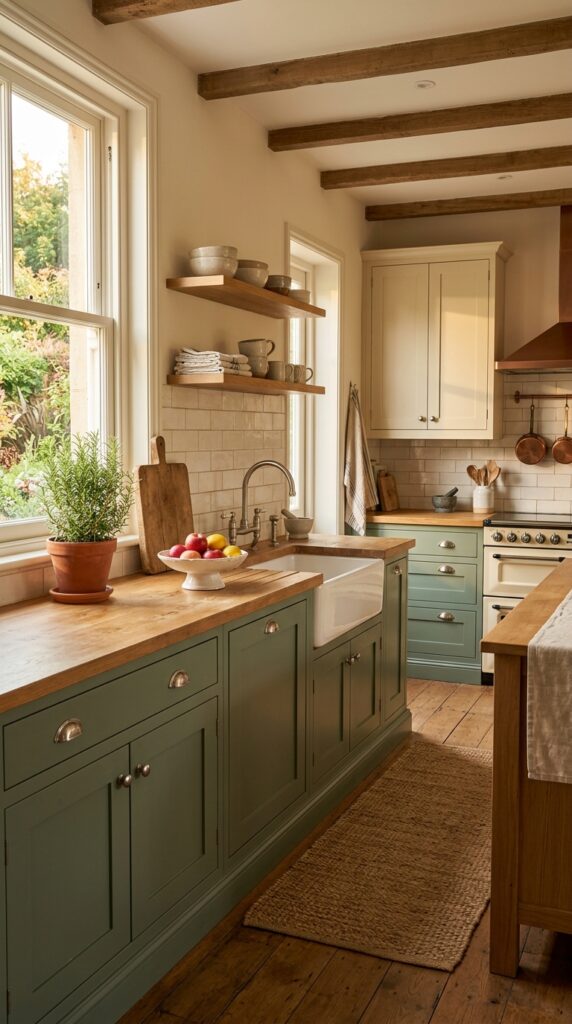
Vibe: Layered — the kind of color story that takes a minute to read and rewards you for it.
Why it works: Two-tone cabinetry grounds the lower half of the kitchen in a richer color while keeping the upper half visually light, effectively lowering the room’s perceived visual weight — a critical technique in kitchens with average 9-foot ceilings. Dusty sage (think Sherwin-Williams “Rosemary” or Benjamin Moore “Saybrook Sage”) sits in the grey-green family, meaning it reads as neutral enough for daily living while still delivering strong color character. Cream uppers in Benjamin Moore “Navajo White” create warmth without the sharpness of pure white.
How to get it: Paint lower cabinets in Sherwin-Williams “Rosemary” SW-6187, uppers in Benjamin Moore “Navajo White.” Use brushed nickel bin pulls on lowers, and simple round knobs on uppers to distinguish the two zones through hardware as well as color.
💡 Quick Win: If full cabinet repainting feels daunting, start with just the kitchen island in dusty sage — it’s a single piece, lower commitment, and immediately proves the color.
🛍️ Shop the Look — Amazon Product Ideas
| # | Product Search Phrase | Why It Fits |
| 1 | Brushed nickel bin pull cabinet hardware farmhouse | Lower cabinet hardware |
| 2 | Round ceramic cabinet knob cream vintage | Upper cabinet knob |
| 3 | White ceramic fruit bowl farmhouse kitchen | Counter accent |
| 4 | Rosemary herb pot terracotta kitchen windowsill | Live counter greenery |
| 5 | Worn end-grain cutting board walnut maple | Counter leaner accent |
4. Beadboard Ceiling for Unexpected Texture Overhead
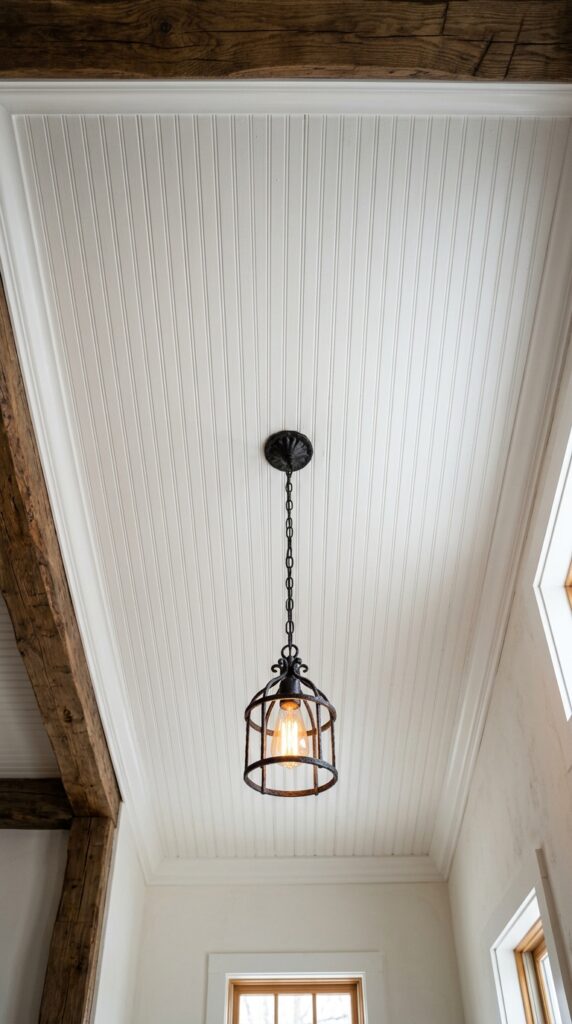
Vibe: Hushed — like the inside of a beach cottage that’s been there longer than you.
Why it works: Ceilings are the most underused surface in a kitchen, and beadboard overhead does something most designers overlook: it creates a subtle visual envelope that makes a kitchen feel complete rather than merely furnished. The fine vertical lines of beadboard draw the eye upward, adding perceived height even as they add texture. Beadboard is historically accurate to American vernacular architecture from roughly 1880–1940, which means it earns its farmhouse credentials without feeling like a trend.
How to get it: Install ⅛-inch tongue-and-groove beadboard paneling directly to the ceiling drywall using construction adhesive and finish nails. Paint in the same warm white as the walls for a seamless, enveloping effect. Do not introduce a contrasting color overhead — it will visually lower the room.
🛍️ Shop the Look — Amazon Product Ideas
| # | Product Search Phrase | Why It Fits |
| 1 | White wainscoting beadboard peel stick ceiling panels | Budget ceiling treatment |
| 2 | Wrought iron pendant light farmhouse kitchen | Overhead anchor light |
| 3 | Edison vintage filament light bulb warm white | Warm pendant bulb |
| 4 | Crown molding white paintable farmhouse trim | Ceiling edge finishing |
| 5 | Matte white spray paint ceiling touch-up | Surface maintenance |
5. Butcher Block Island with Turned Leg Detail
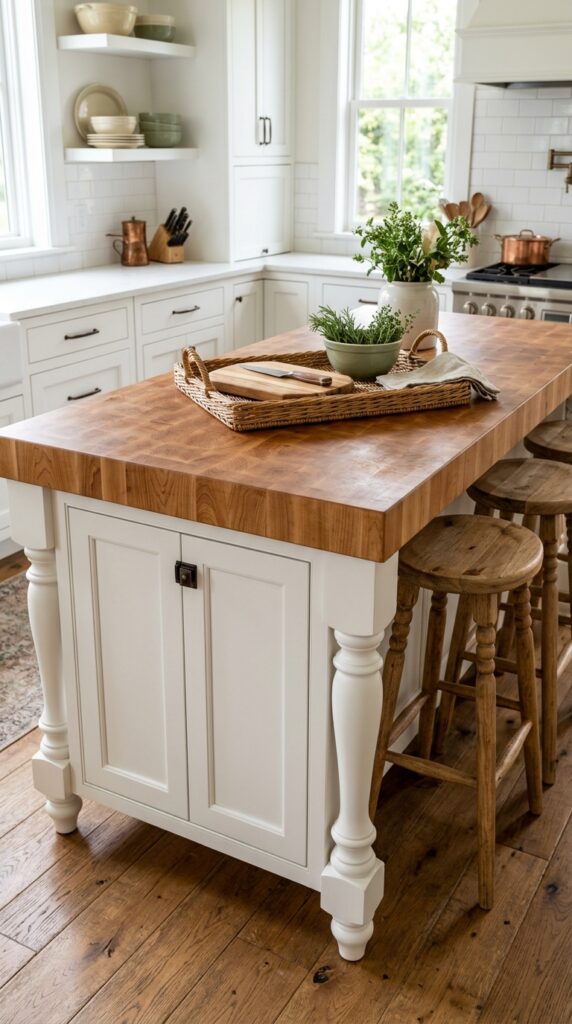
Vibe: Raw — solid and unhurried, built to outlast every trend that passes through.
Why it works: A butcher block island introduces warmth that no other counter material matches, due to the way natural wood absorbs and reflects warm-spectrum light rather than bouncing it back cold like stone or laminate. Turned leg details — derived from Colonial and Shaker furniture traditions — anchor the island aesthetically as a piece of furniture rather than a built-in, which is exactly the farmhouse philosophy: kitchens that feel furnished, not constructed. The visual weight of an end-grain top on a white base creates ideal contrast without introducing another color.
How to get it: Source a freestanding kitchen island with turned legs in 36–42 inch lengths to suit your space. Seal the butcher block top with food-safe mineral oil monthly for the first six months, then quarterly. This prevents cracking and deepens the honey tone.
💡 Quick Win: Buy a wooden serving tray in natural finish (under $30) and style it with a small olive wood cutting board and a ceramic salt cellar — it transforms your island into a styled vignette in under three minutes.
🛍️ Shop the Look — Amazon Product Ideas
| # | Product Search Phrase | Why It Fits |
| 1 | Freestanding kitchen island butcher block white farmhouse | Hero island piece |
| 2 | End grain cutting board maple walnut large | Island surface accessory |
| 3 | Food safe mineral oil butcher block conditioner | Wood care essential |
| 4 | Wicker serving tray rectangular natural handles | Island tray styling |
| 5 | Wood counter stool black backless farmhouse | Island seating |
6. Rattan Pendant Lights Over the Kitchen Island
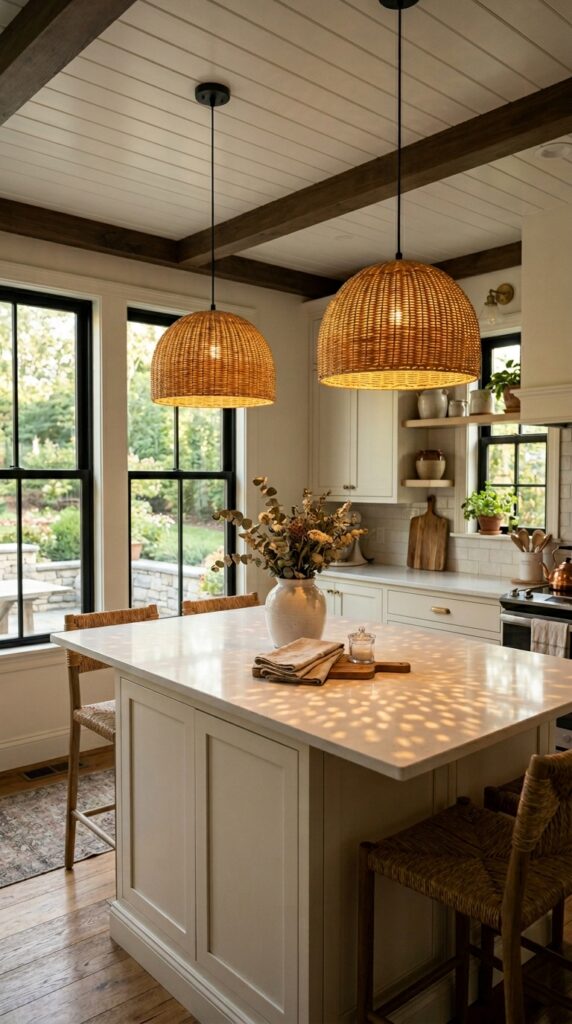
Vibe: Layered — warm at the core, textured at every edge.
Why it works: Rattan pendants do double duty: they introduce organic texture into a space dominated by flat painted surfaces, and they scatter light beautifully due to the irregular gaps in the weave — creating a warm dappled effect on countertops below that no solid pendant can replicate. The material is historically connected to colonial and island-influenced American interiors, making it stylistically coherent with farmhouse design. Two pendants hung in line over an island create stronger visual rhythm than a single centered fixture.
How to get it: Hang two pendants at 30–36 inches above the countertop surface for ideal task and ambient light. Space them roughly 24–30 inches apart, centered over the island’s long axis. Choose rattan with a woven (not solid) shade for maximum light scatter.
🛍️ Shop the Look — Amazon Product Ideas
| # | Product Search Phrase | Why It Fits |
| 1 | Rattan woven pendant light farmhouse kitchen | Hero lighting element |
| 2 | Black braided pendant cord 10 foot adjustable | Pendant hardware finish |
| 3 | White ceramic bud vase matte minimal | Island surface accent |
| 4 | Linen napkin set natural undyed farmhouse | Counter textile styling |
| 5 | Dimmer switch rotary compatible pendant light | Ambiance control |
7. Open Pantry Wall with Labeled Mason Jar Storage
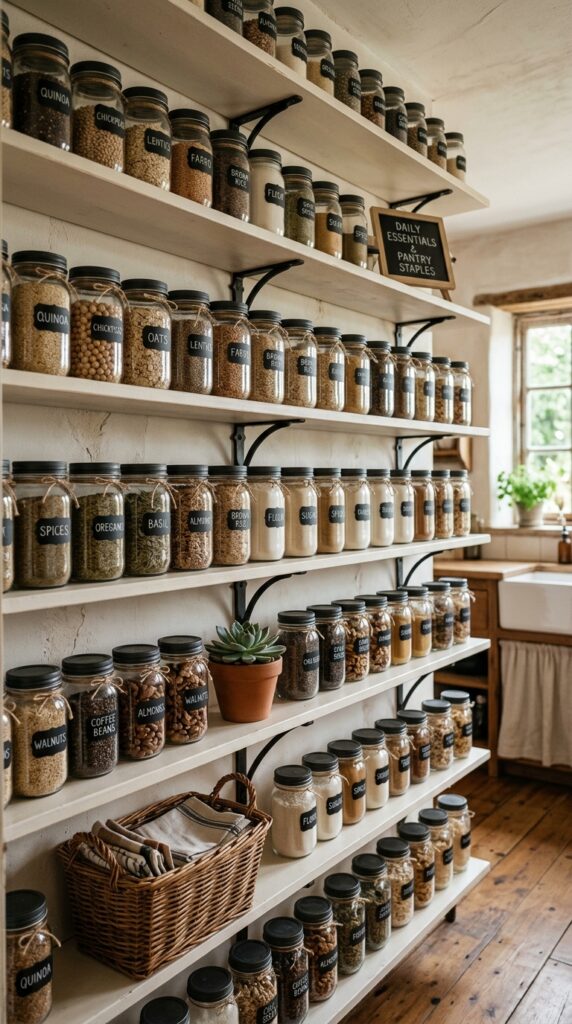
Vibe: Still — the calm of a space where everything is exactly where it belongs.
Why it works: An open pantry wall expresses the farmhouse philosophy most directly: there’s nothing hidden, nothing pretentious. The repetition of uniform glass jars creates visual rhythm — a design principle called “repetitive element order” — which transforms storage into display. Handwritten or printed labels add an artisanal quality that resists the uniformity of modern organization. The matte black iron shelf brackets against white painted wood shelves create a strong linear graphic that holds the wall composition together.
How to get it: Source wide-mouth glass mason jars in 32-oz and 16-oz sizes for dry goods. Print labels on kraft paper and tie with natural cotton twine rather than using stick-on labels — the tied tag reads as handmade. Install black iron pipe shelf brackets at 12–16 inch spacing for proper shelf support.
💡 Quick Win: A 12-pack of wide-mouth Ball mason jars with chalkboard labels costs under $25 on Amazon and immediately transforms any shelf into a farmhouse storage display.
🛍️ Shop the Look — Amazon Product Ideas
| # | Product Search Phrase | Why It Fits |
| 1 | Wide mouth mason jar set 12 pack glass storage | Core storage element |
| 2 | Black chalkboard label sticker mason jar set | Label system |
| 3 | Black iron pipe shelf bracket 10 inch | Shelf structural detail |
| 4 | Woven seagrass basket pantry storage bin | Lower shelf organizer |
| 5 | Natural cotton twine roll craft kitchen | Label tie finishing |
8. White Subway Tile Backsplash in Running Bond Pattern
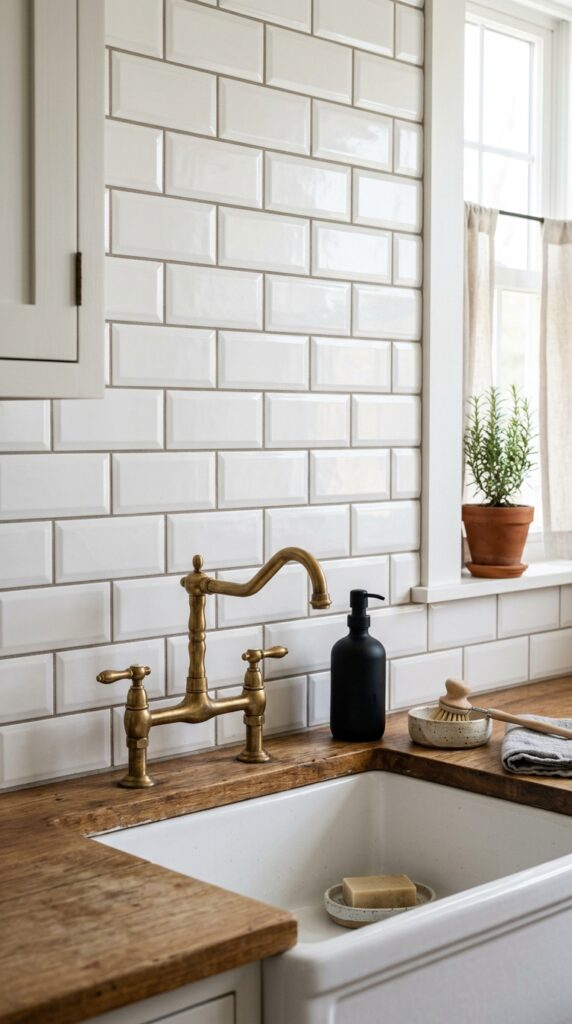
Vibe: Clean — but warm enough to live in without feeling clinical.
Why it works: White subway tile is one of the oldest design workhorses in American vernacular interiors — originally installed in New York City subway stations in the early 1900s, it migrated to domestic kitchens for the same reasons: durable, reflective, easy to clean. In a farmhouse kitchen, the key is the grout color: warm grey grout (not white) introduces shadow lines that prevent the backsplash from disappearing into the wall. Beveled subway tile adds a subtle light-catching edge that flat tiles lack, increasing surface dimension without adding visual busyness.
How to get it: Install 3×6 beveled white ceramic subway tile in horizontal running bond (each tile offset by half). Use “Warm Gray” sanded grout from Custom Building Products. Do not use white grout — it will erase the tile lines and flatten the entire surface.
🛍️ Shop the Look — Amazon Product Ideas
| # | Product Search Phrase | Why It Fits |
| 1 | White beveled subway tile 3×6 ceramic backsplash | Backsplash tile element |
| 2 | Warm grey sanded tile grout kitchen backsplash | Grout color essential |
| 3 | Matte black ceramic soap dispenser kitchen | Sink counter accent |
| 4 | Handthrown ceramic small dish farmhouse | Beside-sink trinket dish |
| 5 | Tile grout float trowel kit wall installation | DIY installation tool |
9. Vintage-Inspired Open Shelving with Corbel Brackets
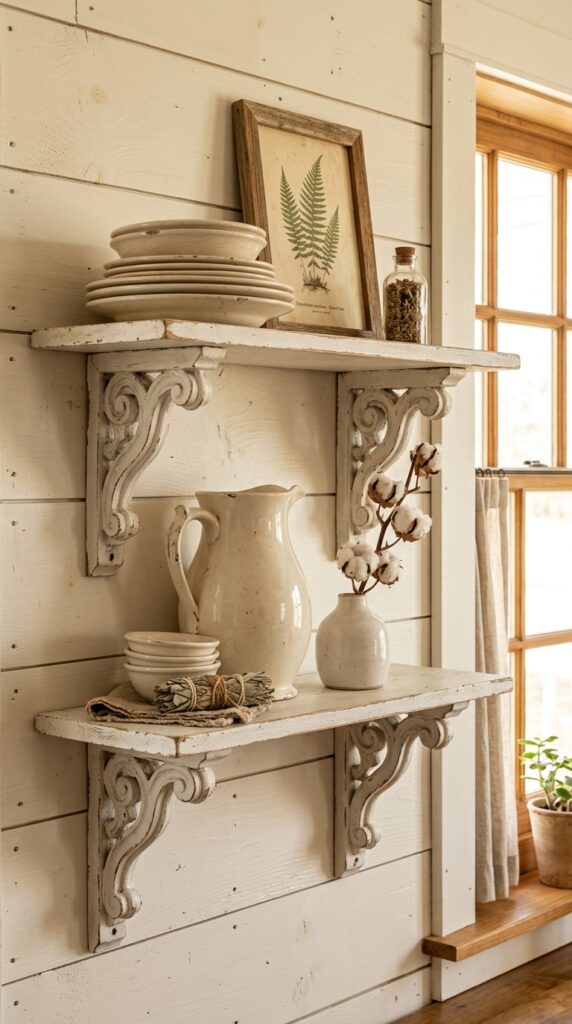
Vibe: Nostalgic — as though it was inherited, not installed.
Why it works: Corbel brackets carry a specific historical reference — they appear in American homes from the Victorian era through the Craftsman period, and their decorative profile creates visual interest at the shelf joint that a plain flat bracket never achieves. The key design principle here is purposeful imperfection: corbels in painted white with visible brushstroke variation look more authentic than overly factory-finished ones. Grouping a ceramic pitcher, stacked plates, and a single small botanical print uses the “rule of three” — odd-numbered groupings read as more natural and less arranged than even pairs.
How to get it: Source wooden corbel brackets in the 7–9 inch size range, prime and paint in the same white as your wall for a built-in look. Style shelves using three visual heights — tall, medium, small — at each shelf rather than uniformly sized objects.
💡 Quick Win: A single white ceramic pitcher (under $20) placed at one end of an open shelf anchors the entire display and immediately reads as intentionally farmhouse-styled.
🛍️ Shop the Look — Amazon Product Ideas
| # | Product Search Phrase | Why It Fits |
| 1 | White wood corbel bracket wall shelf support | Architectural shelf bracket |
| 2 | White ceramic farmhouse pitcher large | Shelf anchor piece |
| 3 | Vintage ironstone plate set white farmhouse | Stacked shelf display |
| 4 | Small framed botanical print farmhouse kitchen art | Shelf wall art accent |
| 5 | Dried cotton stem bunch natural white decor | Organic shelf filler |
10. Galley Kitchen with Black Window Frames and White Walls
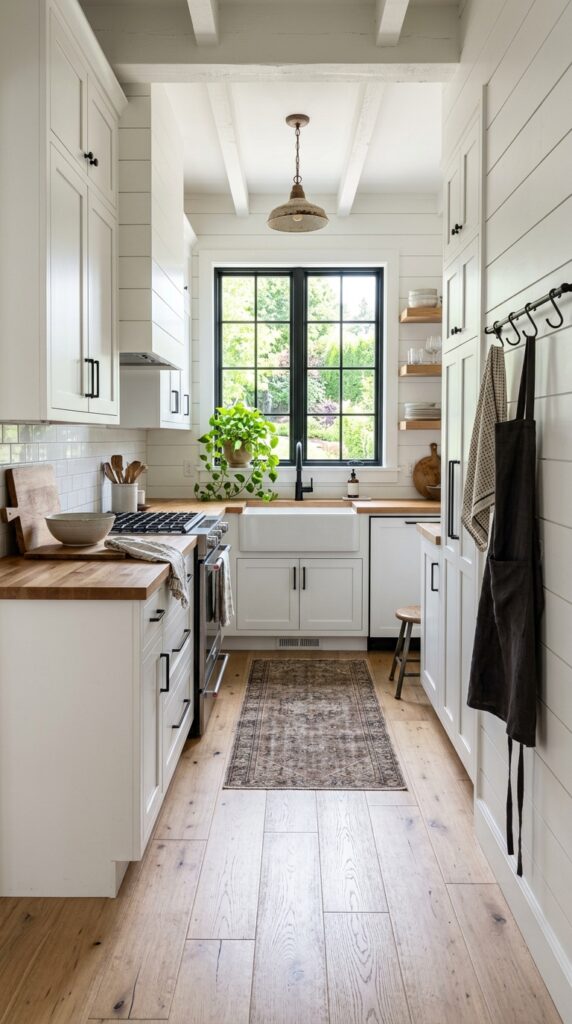
Vibe: Architectural — the bones are doing all the work.
Why it works: Matte black window frames in a white kitchen are one of the most effective graphic design moves available to a homeowner — black frames create a picture-frame effect around the view outside, turning the window itself into art. In a galley layout, this draws the eye directly toward the end of the corridor, visually elongating the space through forced perspective. The contrast of matte black against bright white is the highest-contrast combination available; it works because both elements are at opposite ends of the value scale, with nothing muddying the middle.
How to get it: If replacing windows isn’t in the budget, repaint existing white window frames in Rust-Oleum “Matte Black” spray paint or a satin alkyd enamel. Two coats, light sanding between coats. The transformation is dramatic and costs under $30.
🛍️ Shop the Look — Amazon Product Ideas
| # | Product Search Phrase | Why It Fits |
| 1 | Matte black window frame trim paint alkyd enamel | Frame color treatment |
| 2 | Trailing pothos plant small pot window ledge | Live window greenery |
| 3 | Iron hook rail wall mount black 5 hook | Functional wall accent |
| 4 | Natural linen kitchen apron full coverage | Hook rail textile |
| 5 | Wide plank white oak peel stick floor tile | Budget floor treatment |
11. Terracotta Accents Against Warm White Walls
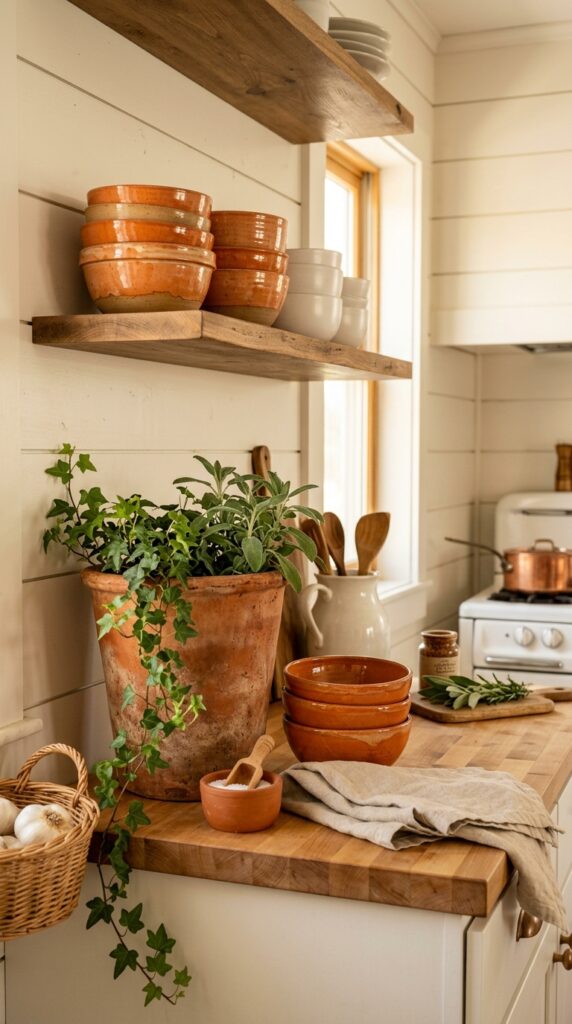
Vibe: Grounded — earthy in the way that good bread smells earthy.
Why it works: Terracotta introduces a warm orange-red tone that sits on the opposite side of the color wheel from sage green and blue-grey — both common farmhouse accents — creating a complementary contrast that energizes a white kitchen without disrupting its calm. Unglazed terracotta also brings raw texture that resists the polish of overly styled spaces; its surface irregularities are a visual cue that something was made by hand. Even three small terracotta pieces clustered together have enough color mass to register as an intentional accent.
How to get it: Start with a single large unglazed terracotta planter (8–10 inch diameter) on the countertop and plant it with trailing herbs — thyme or sage work aesthetically and practically. Layer in a terracotta serving bowl and a small trinket dish to build the palette gradually.
💡 Quick Win: A 6-inch unglazed terracotta pot from a garden center costs under $5 and immediately reads as a farmhouse accent when placed on a wooden cutting board on the counter.
🛍️ Shop the Look — Amazon Product Ideas
| # | Product Search Phrase | Why It Fits |
| 1 | Unglazed terracotta planter large kitchen counter | Earthy accent anchor |
| 2 | Terracotta glazed ceramic bowl set kitchen | Color-matched tableware |
| 3 | Terracotta small trinket dish handmade artisan | Counter detail piece |
| 4 | Sage herb plant small terracotta starter pot | Live herb counter plant |
| 5 | Linen hand towel natural undyed farmhouse kitchen | Counter textile companion |
12. Farmhouse Kitchen with Reclaimed Wood Floating Shelves
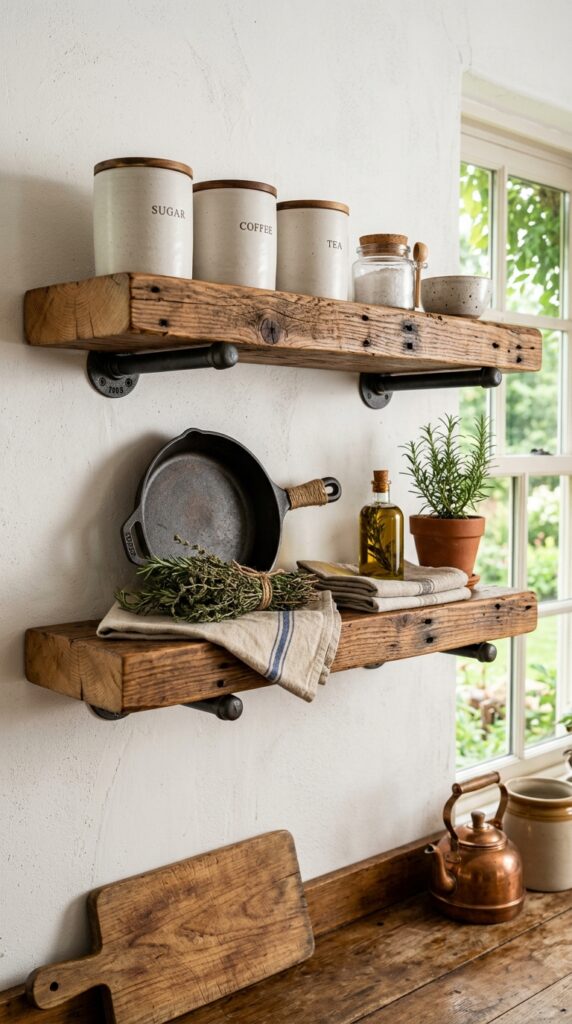
Vibe: Raw — the kind of material that carries its history in every knot.
Why it works: Reclaimed wood shelves bring a visual age to a kitchen that no new material can fake — grain variations, old nail holes, checking cracks, and saw marks all tell a story of prior use, adding layers of history that connect the space to something larger than its current occupants. The industrial contrast of black iron pipe shelf brackets against warm aged wood is a classic material pairing — the harshness of metal softened by the warmth of organic fiber. Mounting thick (2.5–3 inch) shelves signals quality and substance; thin shelves feel afterthought.
How to get it: Source reclaimed lumber from architectural salvage yards or Etsy sellers who specialize in barn wood planks. Sand only lightly — enough to remove splinters, not enough to remove character. Seal with a matte polyurethane (not gloss) to preserve the color without creating unwanted sheen.
🛍️ Shop the Look — Amazon Product Ideas
| # | Product Search Phrase | Why It Fits |
| 1 | Reclaimed wood floating shelf rustic barnwood | Hero shelf material |
| 2 | Black iron pipe shelf bracket industrial farmhouse | Structural bracket detail |
| 3 | Matte polyurethane clear coat wood sealant | Shelf finishing product |
| 4 | White ceramic kitchen canister set matte | Shelf storage styling |
| 5 | Dried thyme herb bundle kitchen decor | Organic shelf accent |
13. Small Farmhouse Kitchen with a Statement Range Hood
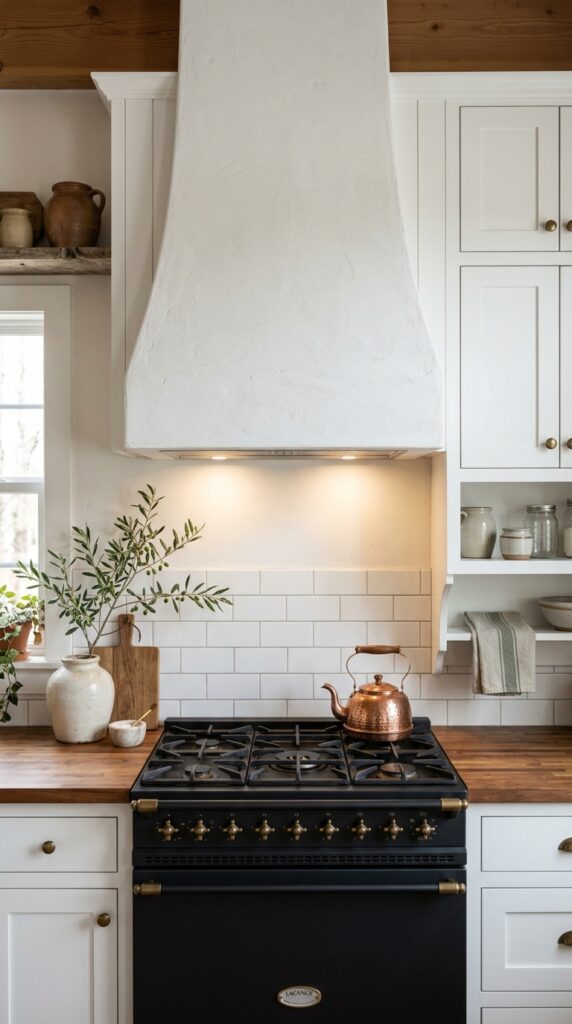
Vibe: Focal — the moment a small kitchen stops apologizing for its size.
Why it works: In a small kitchen, the range hood is the most effective tool for creating a focal point without taking up floor space — it builds vertically, drawing the eye upward and creating the illusion of higher ceilings through visual emphasis at height. A shiplap-clad or hand-plastered hood in warm white adds serious architectural presence for relatively low cost. This technique works in small kitchens specifically because it concentrates design energy at one point rather than spreading it thinly across every surface — a principle called “focal point concentration.”
How to get it: Construct the hood surround from MDF, then clad in shiplap strips before priming and painting. Install a vent insert behind the decorative surround — Broan and Zline both offer affordable under-cabinet inserts that mount inside a custom surround.
💡 Quick Win: A single copper kettle on the back burner of any range costs under $40 and immediately introduces the warm metal accent that makes farmhouse kitchens look professionally styled.
🛍️ Shop the Look — Amazon Product Ideas
| # | Product Search Phrase | Why It Fits |
| 1 | Farmhouse range hood insert vent under cabinet | Functional hood element |
| 2 | Copper stovetop tea kettle farmhouse kitchen | Stove styling accent |
| 3 | Shiplap mdf panel white pre-primed wall cladding | Hood surround material |
| 4 | Olive branch stem faux botanical ceramic vase | Range-side vignette |
| 5 | Venetian plaster wall texture kit white | Hood plaster surface |
14. Mix of Matte Black and Brushed Brass Hardware
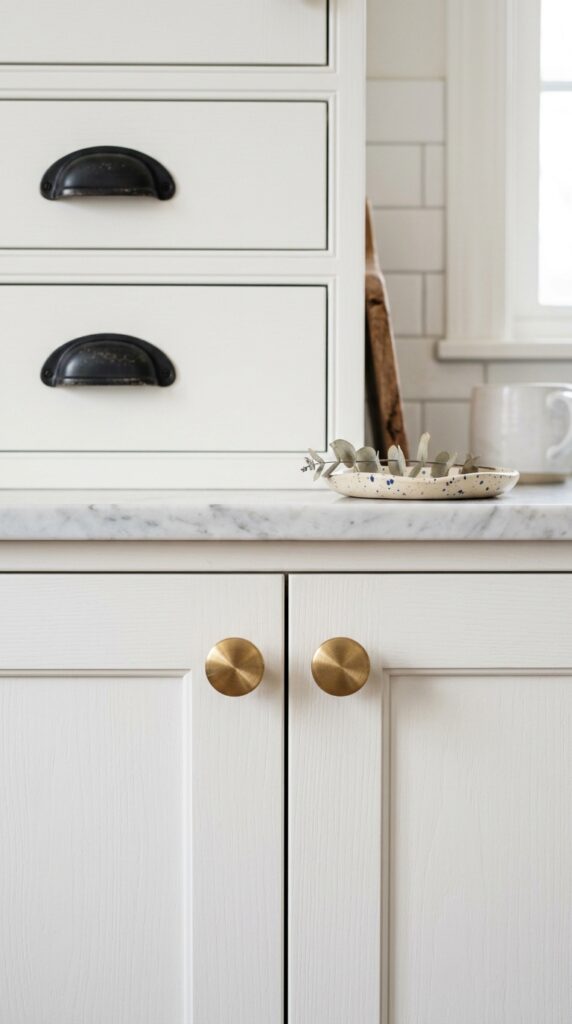
Vibe: Intentional — as though every choice was considered twice.
Why it works: Mixing metals is the most debated topic in hardware selection, and the answer is simple: mixing two metals works when they share the same undertone temperature. Matte black and brushed brass are both warm-leaning (black absorbs warmth from its surroundings; brushed brass is warm amber-gold), so they coexist without visual tension. The key is to assign each metal a clear role: matte black for pulls on drawers (horizontal hardware on horizontal surfaces), brushed brass for knobs on cabinet doors (vertical hardware on vertical surfaces). This gives the mix a logic that prevents it from reading as accidental.
How to get it: Install matte black 3.75-inch bin pulls on all drawers, and brushed brass round knobs (1.25-inch diameter) on all cabinet doors. Source both from Amerock or Liberty Hardware for consistent quality finish.
🛍️ Shop the Look — Amazon Product Ideas
| # | Product Search Phrase | Why It Fits |
| 1 | Matte black bin pull cabinet hardware drawer 3.75 inch | Drawer hardware element |
| 2 | Brushed brass round cabinet knob 1.25 inch | Door hardware element |
| 3 | Cabinet hardware template installation jig tool | Hardware installation aid |
| 4 | White ceramic trinket dish kitchen counter | Counter accent detail |
| 5 | Shaker door cabinet panel insert white MDF | Cabinet door material |
15. Honed Black Granite Countertops with White Cabinets
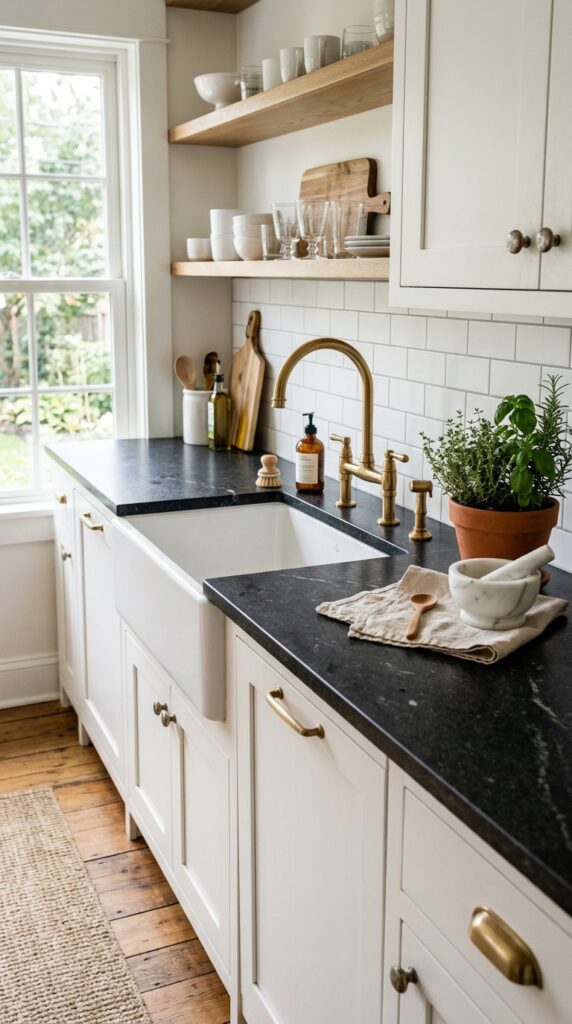
Vibe: Grounded — high contrast that somehow stays completely unpretentious.
Why it works: Honed black granite (specifically honed, not polished) is the high-contrast farmhouse choice that reads as grounded rather than glamorous. The matte finish absorbs light instead of reflecting it, which keeps the surface visually calm and prevents the kitchen from feeling like a showroom. Against white shaker cabinets, honed black countertops create a near-maximally contrasted composition — but the natural mineral variation in the stone prevents it from feeling stark, the way that a synthetic black laminate would. The key specification is honed: polished black granite is a different style category entirely.
How to get it: Specify “honed finish” explicitly when ordering from a stone supplier — this is not the default. Seal honed black granite quarterly with a penetrating stone sealer to prevent water spotting, which shows more on matte surfaces than polished ones.
💡 Quick Win: Place a white marble mortar and pestle (available for under $35) on dark countertops — the light-on-dark contrast creates immediate visual depth on the counter surface.
🛍️ Shop the Look — Amazon Product Ideas
| # | Product Search Phrase | Why It Fits |
| 1 | Black marble contact paper countertop peel stick | Budget counter update |
| 2 | White marble mortar pestle small kitchen | Counter contrast accent |
| 3 | Granite stone sealer penetrating countertop | Counter maintenance |
| 4 | Linen farmhouse dish cloth set natural | Counter textile accent |
| 5 | Small terracotta herb pot kitchen window trio | Window counter plant |
16. Woven Jute Runner Rug Under Kitchen Island
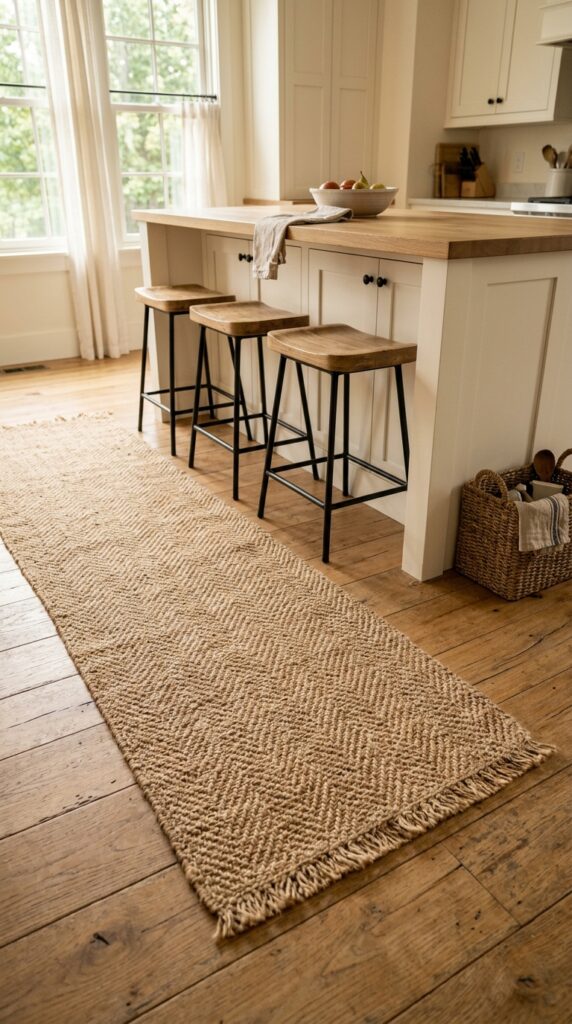
Vibe: Sun-warmed — a layer of texture that makes bare feet feel intentional.
Why it works: A jute runner under a kitchen island solves a compositional problem that many homeowners miss: without a rug, an island floats visually in the middle of a floor, unanchored. A runner grounds it — defining the island zone as its own contained space within the larger kitchen, a technique called “zone definition.” Jute in particular is ideal for farmhouse kitchens because its natural, undyed fiber color (warm tan to gold-brown) bridges white painted cabinets and wood floors without introducing a third color. Its rough texture also provides important contrast in a kitchen full of smooth painted surfaces.
How to get it: Size the runner to extend 18–24 inches beyond each end of the island, and wide enough to sit partly under the stool legs when stools are pulled out (typically 2.5–3 feet wide). Use a non-slip rug pad underneath — kitchen floors and runners without padding are a safety issue.
🛍️ Shop the Look — Amazon Product Ideas
| # | Product Search Phrase | Why It Fits |
| 1 | Natural jute herringbone runner rug 2×6 kitchen | Zone-defining rug element |
| 2 | Non-slip rug pad runner kitchen hardwood floor | Safety underlay |
| 3 | Oak wood bar stool black metal legs counter height | Island seating companion |
| 4 | Wicker round basket kitchen storage small | Island foot accent |
| 5 | Wide plank hardwood floor cleaner natural wood | Floor maintenance |
17. Vintage-Style Glass-Front Upper Cabinets
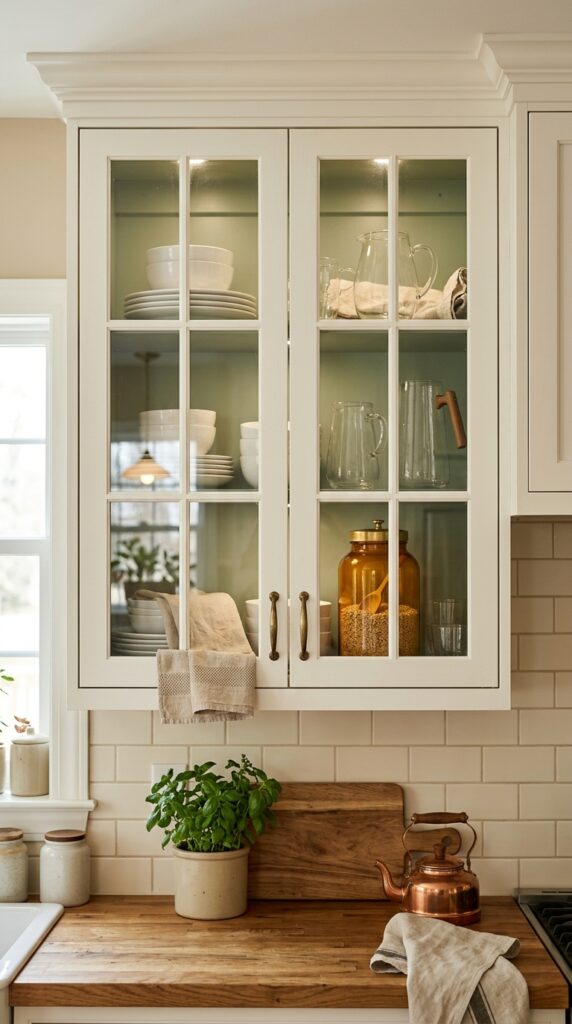
Vibe: Nostalgic — the cabinet your grandmother’s house would have had if it were in a magazine.
Why it works: Glass-front cabinets perform a specific visual function: they break the visual mass of a full run of solid cabinet doors, which can feel heavy and flat in a kitchen. The glass introduces transparency that allows the wall to breathe behind it, while the interior contents become a curated display. Painting the interior of the glass cabinet in a contrasting tone — soft sage or warm grey — creates depth and makes the displayed items pop against a colored background rather than a plain white box. This technique is borrowed from retail display design.
How to get it: If your existing upper cabinets have solid doors, a carpenter can replace the center door panel with glass for roughly $50–$100 per door. Choose seeded glass or reeded glass for more visual interest than plain flat glass — and a stronger farmhouse character.
🛍️ Shop the Look — Amazon Product Ideas
| # | Product Search Phrase | Why It Fits |
| 1 | Glass cabinet door insert kit reeded farmhouse | Cabinet conversion hardware |
| 2 | Amber glass jar large kitchen storage decorative | Interior cabinet display |
| 3 | White ceramic dinner plate set stackable display | Cabinet display tableware |
| 4 | Cabinet interior paint sample soft sage green | Interior cabinet accent color |
| 5 | Seeded glass panel replacement cabinet door | Authentic glass texture |
18. Layered Lighting: Pendants, Under-Cabinet, and Task
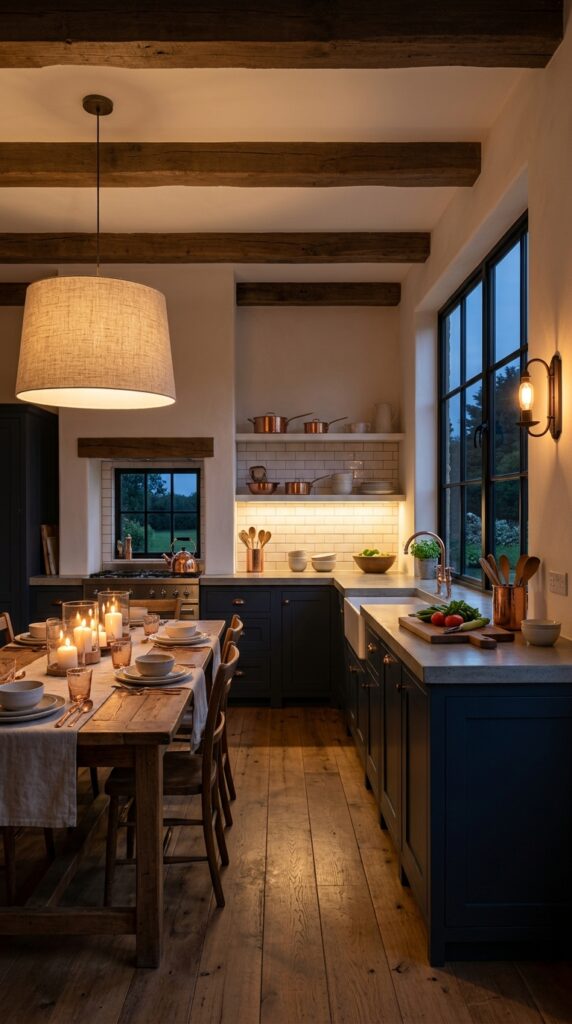
Vibe: Romantic — light that makes everything in the room look like it belongs.
Why it works: The biggest lighting mistake in kitchens is relying on a single overhead fixture — this creates harsh downward shadows and eliminates the warmth that makes any space feel inviting. Layered lighting works by distributing light sources at multiple heights: pendants or ceiling fixtures provide ambient fill, under-cabinet LEDs provide task light directly on work surfaces, and wall sconces or table lamps provide low warm light that balances the overhead. All sources should be 2700K color temperature — this is “warm white,” the standard for residential farmhouse spaces. Anything cooler reads as clinical.
How to get it: Install peel-and-stick 2700K LED strip lights under all upper cabinets (under $40 for a full kitchen run). Connect them to a dimmer switch. This single addition changes the evening mood of any kitchen regardless of what else you do.
💡 Quick Win: A set of LED under-cabinet peel-and-stick light strips in 2700K warm white, installed in under an hour, immediately creates the layered warm glow that professional kitchen photos always show. Total cost: under $35.
🛍️ Shop the Look — Amazon Product Ideas
| # | Product Search Phrase | Why It Fits |
| 1 | Under cabinet LED strip light warm white 2700K peel stick | Task lighting layer |
| 2 | Linen drum pendant light farmhouse dining | Ambient pendant element |
| 3 | Black iron wall sconce farmhouse kitchen | Accent wall light |
| 4 | Dimmer switch compatible LED plug-in rotary | Light control essential |
| 5 | Copper votive candle holder set farmhouse | Supplemental warm light |
19. Wainscoting Below a Plate Rail for Classic Kitchen Character
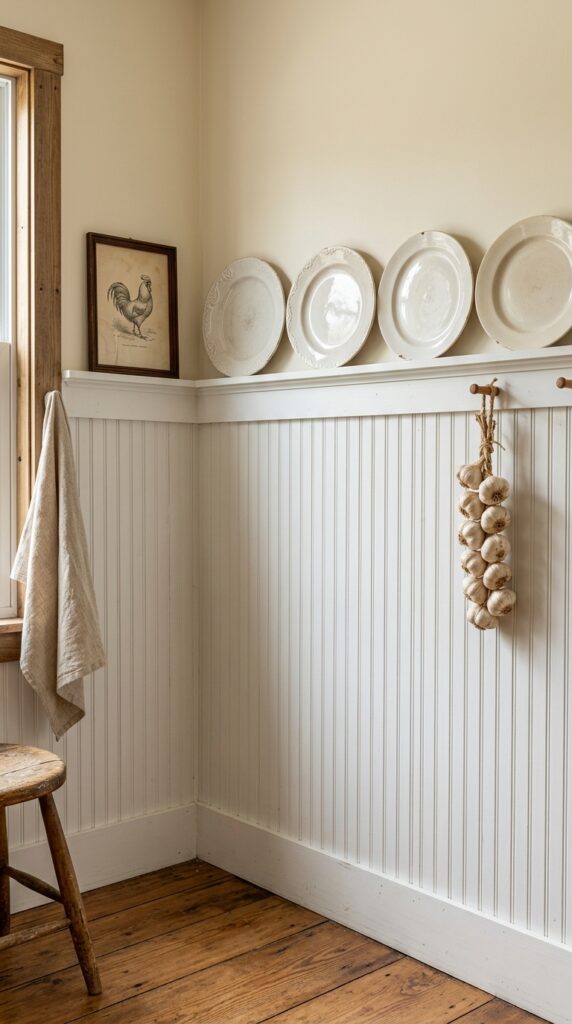
Vibe: Nostalgic — the kind of kitchen detail that makes you think of church potlucks and handwritten recipes.
Why it works: Wainscoting with a plate rail is one of the oldest domestic interior techniques in American homes — it served both practical functions (protecting lower walls from chair backs) and display functions (the plate rail was the precursor to the modern open shelf). Together, they divide the wall into three compositional zones — floor-to-wainscot, wainscot-to-rail, and rail-to-ceiling — which creates visual rhythm that flat painted walls entirely lack. Plates displayed vertically in a plate rail also work as functional art, using everyday objects as the decoration.
How to get it: Install 36-inch tall beadboard wainscoting panels, cap with a 3.5-inch base cap molding, then add a plate rail at 60 inches from the floor. The plate rail groove depth should be ⅛ inch — enough to secure a plate without concealing it.
🛍️ Shop the Look — Amazon Product Ideas
| # | Product Search Phrase | Why It Fits |
| 1 | Beadboard wainscoting panel white paintable MDF | Wainscoting panel material |
| 2 | Plate rail shelf white wood display kitchen | Plate display rail |
| 3 | White ironstone dinner plate farmhouse set | Plate rail display pieces |
| 4 | Dried garlic braid decorative kitchen hanging | Rail hanging accent |
| 5 | Small framed botanical print farmhouse wall art | Above-wainscot art |
20. Open-Concept Farmhouse Kitchen with Dining Bench Seating
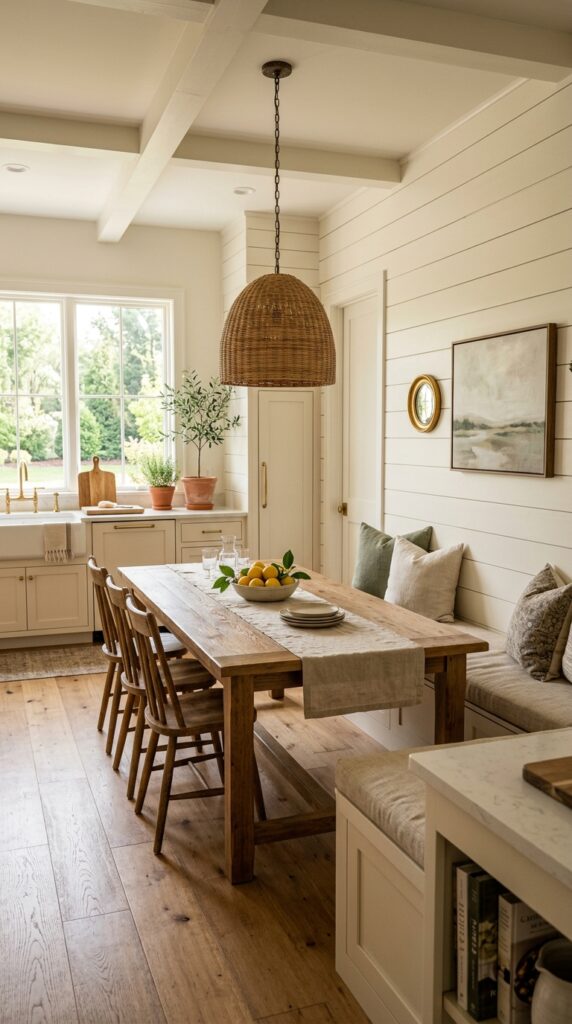
Vibe: Airy — the kind of space where Sunday morning lasts until afternoon.
Why it works: A built-in bench along a dining wall solves one of the most common kitchen-dining layout challenges: it maximizes seating in a tight footprint while reading as a designed architectural element rather than crowded furniture. The bench’s upholstered linen seat introduces softness and textile warmth at floor level, balancing the harder surfaces of wood and painted walls above. A shiplap accent wall behind the bench creates a deliberate backdrop — the dining zone reads as a room within a room, which improves flow and visual organization of the open plan.
How to get it: Build the bench from ¾-inch plywood with a simple butt-jointed box construction, then upholster the seat cushion in a natural linen or Sunbrella linen-look fabric. Size the cushion at 4–5 inches thick for adequate comfort during long meals.
💡 Quick Win: Place a linen table runner (under $20) diagonally across a wood farm table with a simple ceramic bowl of seasonal fruit at center — a complete tablescape in under two minutes.
🛍️ Shop the Look — Amazon Product Ideas
| # | Product Search Phrase | Why It Fits |
| 1 | Farmhouse dining bench upholstered linen natural | Bench seating element |
| 2 | Natural linen table runner farmhouse dining | Table styling textile |
| 3 | White farmhouse dining chair wood spindle back | Opposite bench seating |
| 4 | White oak farmhouse dining table rectangular | Dining anchor furniture |
| 5 | Large ceramic bowl fruit display farmhouse | Table center accent |
21. Slate Blue Kitchen Island as a Bold Accent Piece
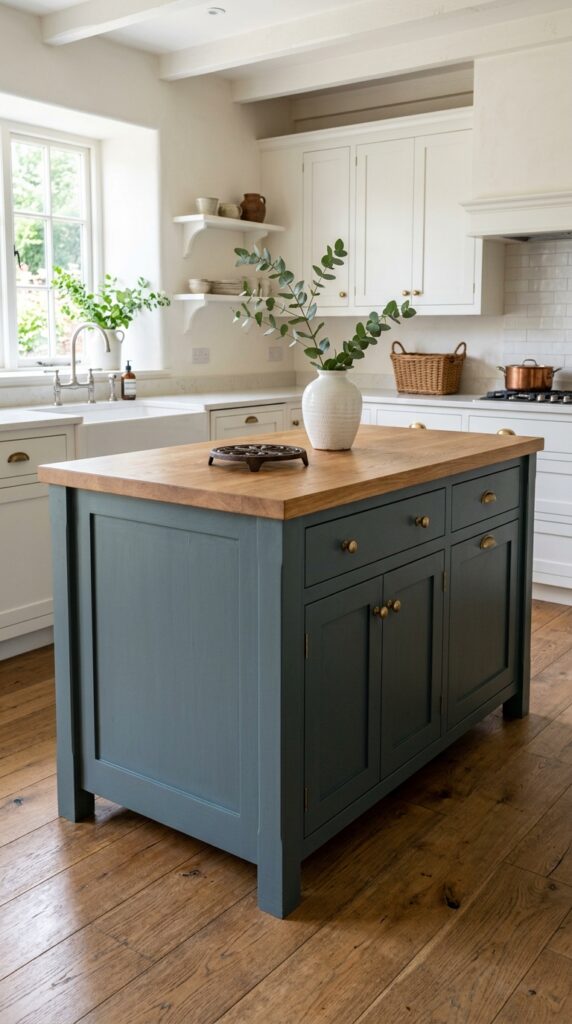
Vibe: Sophisticated — the single decision that makes every other white surface look intentional.
Why it works: Painting only the island in a contrasting color is the most effective way to introduce a second color in a kitchen without committing the entire room to it. The island becomes a piece of furniture in its own right — separate from the built-in cabinetry — which is entirely consistent with the farmhouse philosophy of “furnished, not constructed.” Slate blue-grey (Sherwin-Williams “Mineral” or Benjamin Moore “Van Deusen Blue”) contains enough grey to read as neutral while being clearly blue — which means it works with both warm whites and cream without clashing. Brass hardware on the island ties it back to the perimeter cabinetry if brass appears elsewhere in the space.
How to get it: Paint the island in Benjamin Moore “Van Deusen Blue” HC-156, using a cabinet-specific satin alkyd paint for durability. Roll large flat door panels, brush inside profiles — two coats minimum with light 220-grit sanding between coats.
🛍️ Shop the Look — Amazon Product Ideas
| # | Product Search Phrase | Why It Fits |
| 1 | Cabinet paint sample slate blue grey satin alkyd | Island color material |
| 2 | Brushed brass bin pull 3.75 inch kitchen island | Island hardware detail |
| 3 | White ceramic minimalist vase small farmhouse | Island surface vignette |
| 4 | Cast iron trivet round farmhouse kitchen | Functional surface accent |
| 5 | Eucalyptus stem dried bunch natural grey-green | Vase organic element |
22. Farmhouse Kitchen with Concrete-Look Tile Floors
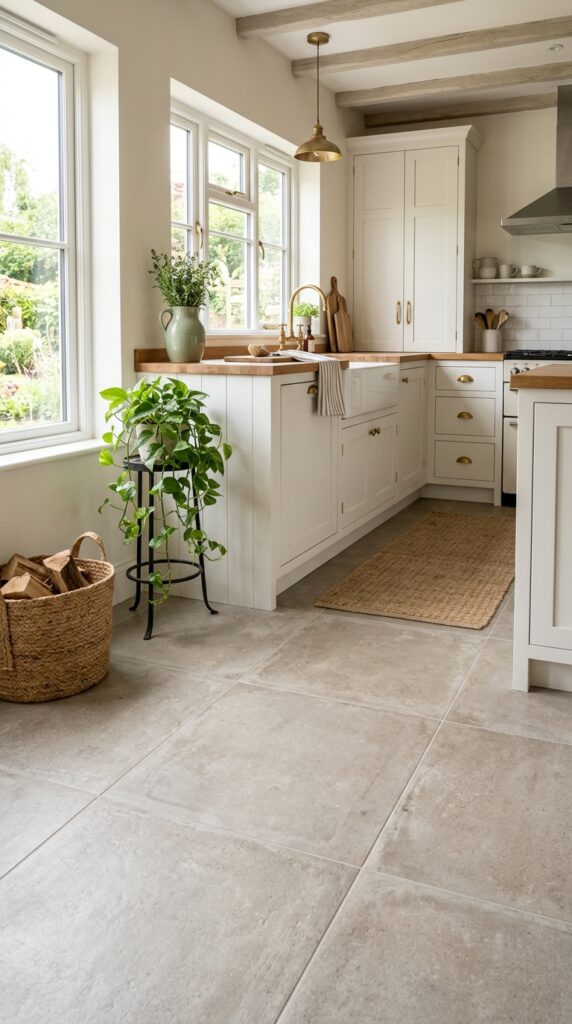
Vibe: Airy — the kind of floor that makes a space feel twice its actual size.
Why it works: Large-format porcelain tile in a concrete look achieves something unique in a farmhouse kitchen: it introduces the grounded, industrial quality of concrete without the maintenance burden, and its large format dramatically reduces the number of grout lines — which in turn reduces visual busyness and makes the floor plane read as more expansive. Specifying warm greige (warm-toned grey-beige) is critical; cool grey tiles in a warm farmhouse kitchen fight against everything else in the room. The warm undertone bridges the wood and white-painted elements seamlessly.
How to get it: Specify 24×24 porcelain tile in “warm concrete” or “warm greige” colorway. Install with a ⅛-inch grout joint in warm grey sanded grout for the flattest, most contemporary-farmhouse result. Avoid white grout — it shows every drop of daily use.
🛍️ Shop the Look — Amazon Product Ideas
| # | Product Search Phrase | Why It Fits |
| 1 | Concrete look porcelain floor tile large format greige | Floor tile element |
| 2 | Warm grey unsanded grout tile floor joint | Grout color selection |
| 3 | Woven seagrass storage basket cabinet base kitchen | Base cabinet accent |
| 4 | Black iron plant stand indoor trailing plant | Floor greenery accent |
| 5 | Porcelain tile sealer indoor floor maintenance | Floor care product |
23. Farmhouse Eat-In Kitchen Nook with Built-In Corner Bench
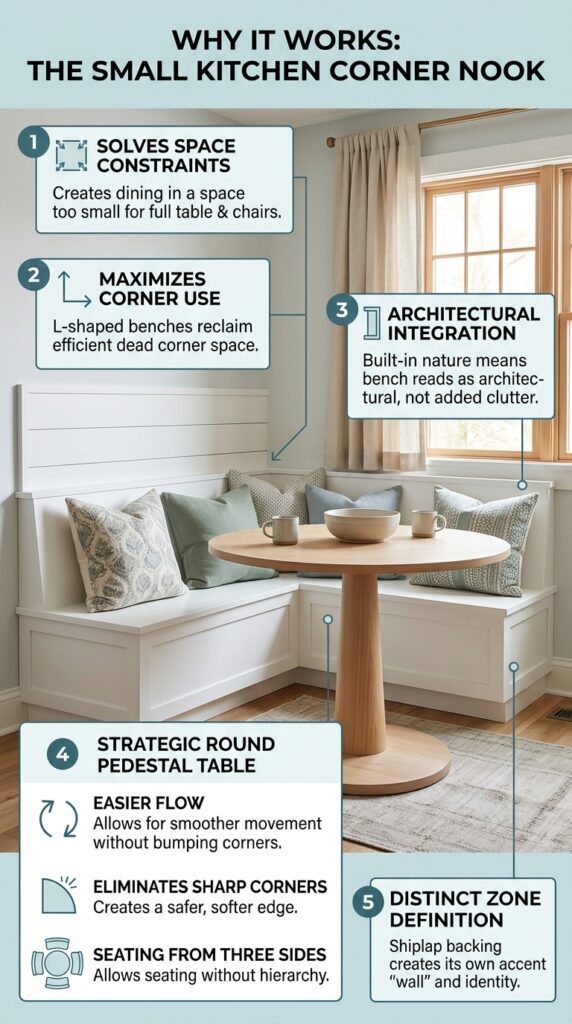
Vibe: Intimate — the corner of the house where everything slows down.
Why it works: A built-in corner nook solves a persistent small kitchen problem: how to create a dining area in a space that can’t accommodate a full table and chairs setup. L-shaped benches reclaim dead corner space that furniture can never efficiently occupy, and the built-in nature means the bench reads as architectural rather than furniture-scale. The round pedestal table is deliberate — a round table in a corner nook creates easier flow, eliminates sharp corners, and allows seating from three sides without hierarchy. Shiplap behind the bench creates the nook’s own accent “wall,” reinforcing its identity as a distinct zone.
How to get it: Frame the corner bench from 2×4 lumber and ¾-inch plywood, then upholster the seat with a 4-inch foam pad covered in a durable, cleanable linen-look fabric. Finish the bench surround in the same white as the kitchen walls to integrate it architecturally rather than distinguish it.
💡 Quick Win: Stack two or three vintage hardcover cookbooks (sourced at any thrift store for $1–$3 each) at one end of the nook table — immediate warmth and authenticity for under $10.
🛍️ Shop the Look — Amazon Product Ideas
| # | Product Search Phrase | Why It Fits |
| 1 | Round white pedestal dining table small farmhouse | Nook table anchor piece |
| 2 | Linen stripe upholstery fabric cream bench seat | Bench cushion material |
| 3 | White linen curtain panel farmhouse window | Nook window treatment |
| 4 | Potted lavender small plant indoor kitchen | Table top live plant |
| 5 | Linen napkin set stripe farmhouse dining | Table textile styling |
24. Antique Finish Brass Cabinet Hardware Throughout
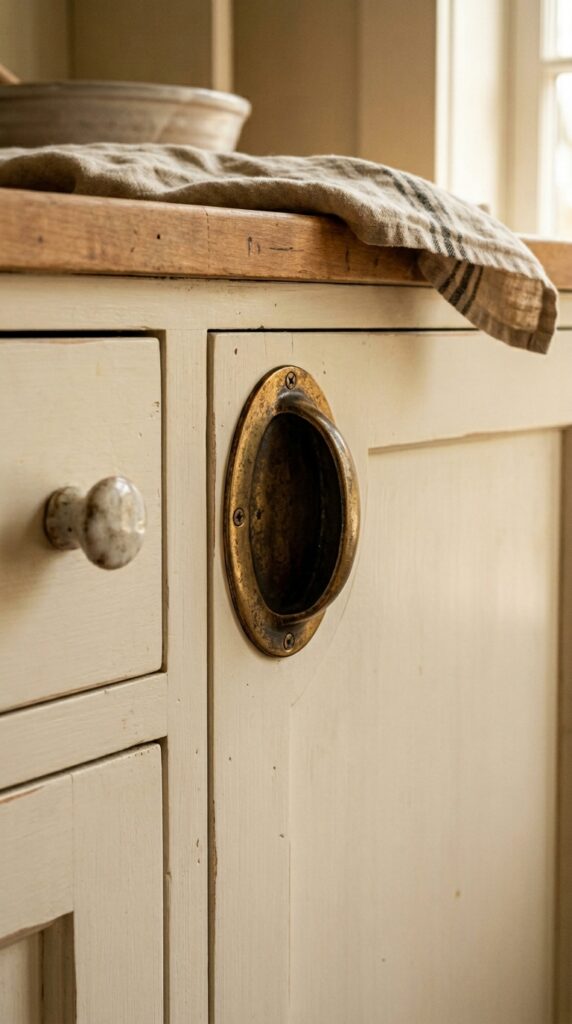
Vibe: Aged — the warmth that only time, or the appearance of it, can produce.
Why it works: Antique brass differs critically from brushed or polished brass: it carries a patinated, hand-finished quality that immediately references age and craft. In a new kitchen, antique brass hardware is one of the fastest ways to add visual history — it contradicts the newness of everything around it in a way that reads as “collected over time” rather than “purchased together.” Bin pulls in antique brass on shaker-style doors combine two historically grounded elements — the Shaker door profile from the 1800s and brass hardware from American Colonial tradesman work — creating a layered historical narrative with a single material choice.
How to get it: Source antique brass hardware from Rejuvenation, House of Antique Hardware, or search Amazon for “antique brass bin pull” — specify “hand-finished” or “living finish” to ensure the patina is genuine rather than sprayed on. Avoid lacquered antique brass — the coating will chip and look cheap.
🛍️ Shop the Look — Amazon Product Ideas
| # | Product Search Phrase | Why It Fits |
| 1 | Antique brass bin pull cabinet hardware hand-finished | Hero hardware element |
| 2 | Living brass round knob cabinet vintage unlacquered | Secondary hardware piece |
| 3 | White shaker door profile MDF cabinet insert | Cabinet door element |
| 4 | Handthrown ceramic drawer pull artisan farmhouse | Eclectic hardware variation |
| 5 | Metal hardware polish cloth antique brass care | Hardware maintenance |
25. Hanging Pot Rack Over the Island for Function and Farmhouse Drama
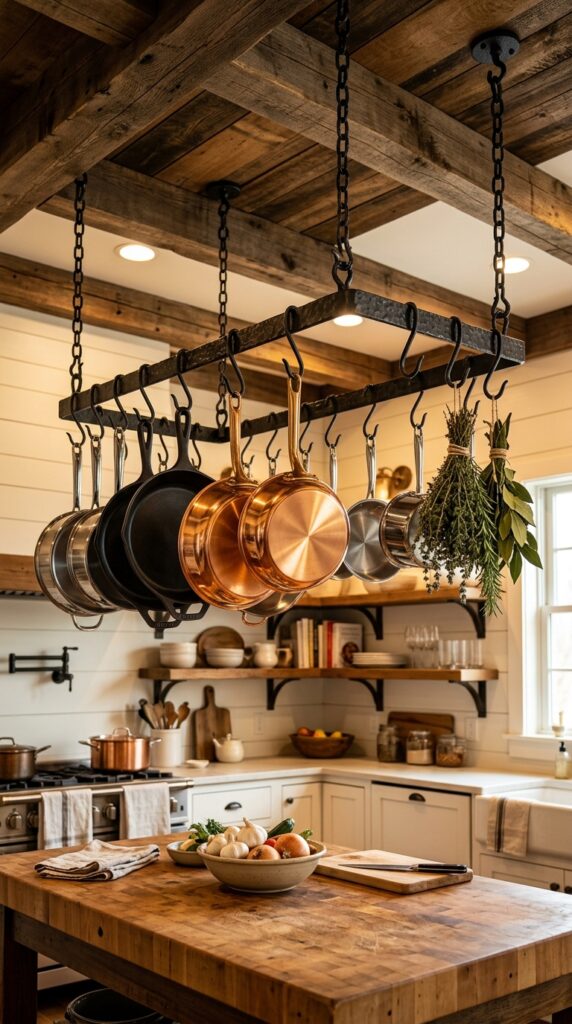
Vibe: Dramatic — a working kitchen that’s not afraid to look like one.
Why it works: A ceiling-mounted pot rack solves the farmhouse kitchen’s inherent tension between function and aesthetics: it puts the most visually interesting items in the kitchen — the pots themselves — on intentional display while freeing up cabinet storage below. The visual weight of a pot rack overhead anchors the kitchen’s vertical space, filling the often-empty zone between counter height and ceiling. Hanging copper pots alongside cast iron and stainless steel creates a natural metal mix that tells a story of accumulated use — exactly the patina of time that farmhouse design prizes.
How to get it: Install a wrought iron ceiling pot rack with proper ceiling joist anchoring — this is non-negotiable for safety; a full rack of pots can weigh 60–80 lbs. Size the rack at minimum 24×36 inches; smaller racks read as under-scaled. Use S-hooks rated for 15+ lbs per hook.
🛍️ Shop the Look — Amazon Product Ideas
| # | Product Search Phrase | Why It Fits |
| 1 | Wrought iron ceiling pot rack rectangular farmhouse | Hero storage element |
| 2 | Cast iron skillet set kitchen cooking display | Rack display cookware |
| 3 | Copper saucepan set kitchen display rack | Warm metal rack accent |
| 4 | Heavy duty S hook pot rack steel 15lb rated | Rack hanging hardware |
| 5 | Dried herb bundle hanging kitchen wreath | Organic rack accent |
26. Painted Brick Accent Wall Behind the Range
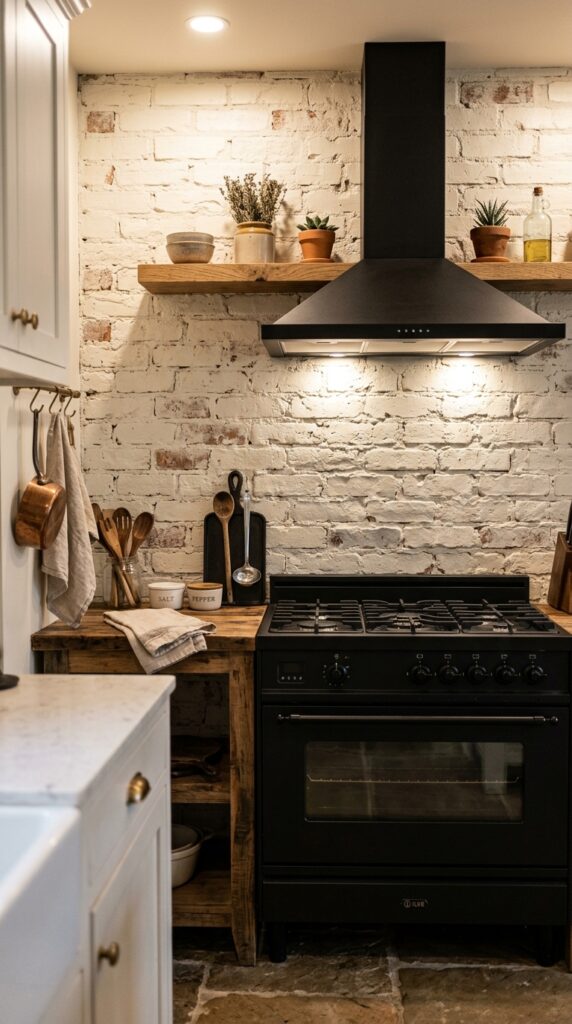
Vibe: Raw — history in the walls, not just in the furniture.
Why it works: Exposed brick behind a range solves the visual problem of the range hood area: it’s the visual centerpiece of a kitchen, and a flat painted surface there makes it feel unresolved. Brick introduces a textured, aged surface that absorbs light differently than any other wall treatment — the varying depths of mortar joints and brick face create micro-shadows that make the wall appear to shift slightly with the light. Painting the brick in warm white rather than leaving it natural keeps the texture but removes the heaviness, allowing it to serve as backdrop rather than competing focal point.
How to get it: Use a thick-nap roller to apply two coats of Romabio Classico Limewash paint or standard latex paint to brick — thick-nap rollers force paint into crevices while leaving some brick texture visible. Do not use a brush or foam roller; both will either fully coat or partially coat unevenly.
💡 Quick Win: If you don’t have brick, German Smear mortar technique applied to painted drywall with a trowel creates a convincing brick-look texture for under $50 in materials and a weekend’s work.
🛍️ Shop the Look — Amazon Product Ideas
| # | Product Search Phrase | Why It Fits |
| 1 | Limewash paint white brick wall interior Romabio | Brick paint treatment |
| 2 | Thick nap roller brick wall painting 3/4 inch | Brick painting tool |
| 3 | Cast iron spoon rest range stove farmhouse | Range surface accent |
| 4 | Small floating wood shelf above range natural | Above-range styling shelf |
| 5 | White ceramic oil dispenser kitchen counter | Range-side cooking accent |
27. Studio Apartment Farmhouse Kitchen with Vertical Space Strategy
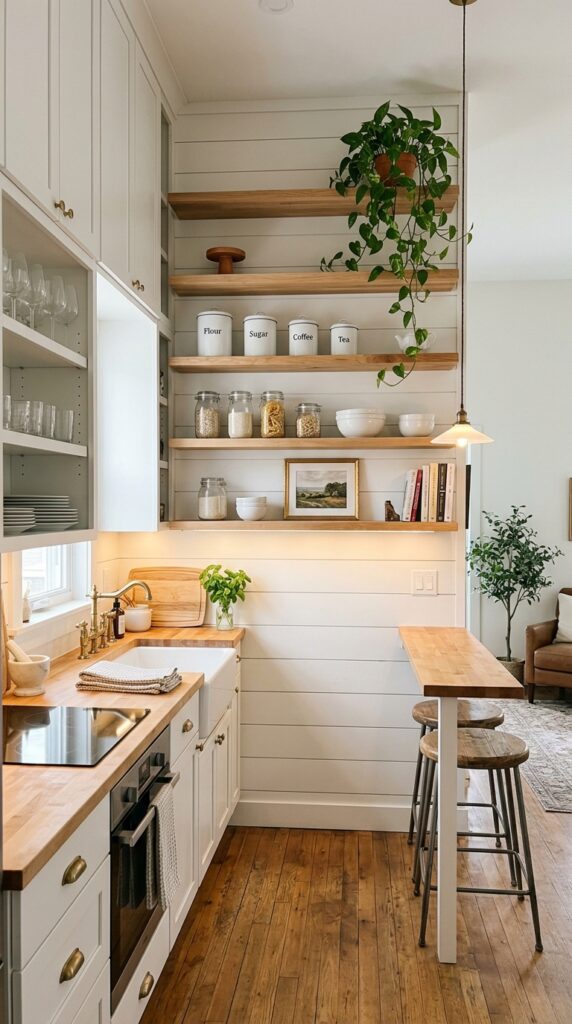
Vibe: Luminous — a small space that insists on being taken seriously.
Why it works: Small farmhouse kitchens succeed or fail on their use of vertical space. Ceiling-height cabinetry eliminates the awkward dead zone above standard 36-inch upper cabinets — a zone that typically collects grease-coated dust and makes kitchens feel unfinished. Taking storage and display all the way to the ceiling creates a complete, intentional composition rather than a half-finished one. A narrow butcher block peninsula (as little as 12 inches deep) creates a counter workspace and breakfast bar without requiring the footprint of a full island — this single addition transforms a galley from “cooking corridor” to “designed kitchen.”
How to get it: Order ceiling-height cabinets in 42-inch or 48-inch upper heights rather than standard 30-inch. If extending existing 30-inch uppers, add 12-inch open shelves above them — painted the same color as the cabinets — to complete the run to the ceiling. The visual continuity reads as one tall cabinet even though it’s two separate elements.
🛍️ Shop the Look — Amazon Product Ideas
| # | Product Search Phrase | Why It Fits |
| 1 | Narrow kitchen peninsula breakfast bar butcher block | Small space island solution |
| 2 | Wall-mounted pot lid organizer vertical narrow | Vertical storage solution |
| 3 | Small hanging planter pothos ceiling indoor | High shelf live plant |
| 4 | Uniform white ceramic canister set 5 piece | Minimal counter storage |
| 5 | Under cabinet warm white LED strip adhesive | Small kitchen lighting |
How to Start Your Farmhouse Kitchen Transformation
Start with paint — but be specific about which paint. Choose Benjamin Moore “White Dove” OC-17 for your walls and repaint your existing cabinets in the same color before you buy a single new piece of hardware or shelving. This is the single most important first move because White Dove’s warm undertone is the tonal foundation that everything else — wood, brass, linen — builds on correctly. A cool white wall makes warm wood look orange and brass look cheap. Get the base right first, and every subsequent purchase becomes easier to evaluate.
The most common mistake in farmhouse kitchens is mixing too many wood tones — light pine open shelving, medium oak floors, and a dark walnut island all in the same space. This looks accidental rather than layered. Pick one dominant wood tone (warm oak or natural pine) and use it consistently throughout. Introduce the second wood only as a deliberate accent, clearly different enough from the first to read as intentional contrast rather than a purchasing mistake.
Three items under $50 that create immediate farmhouse impact: a set of three white ironstone canisters (around $35, available on Amazon) for your countertop, a natural jute basket under the sink ($15–$20) to replace the under-sink clutter, and a single large dried pampas grass stem in a matte black or terracotta bud vase ($12–$18) on the counter or a shelf.
Realistic expectations: a weekend and under $200 gets you paint + hardware replacement — and that alone transforms a kitchen noticeably. A “starter farmhouse kitchen” with open shelving, new hardware, and textile updates can be achieved for $500–$1,200. A full transformation including new countertops, tile backsplash, and new fixtures typically runs $5,000–$15,000 and takes three to six months from planning to completion.
Frequently Asked Questions About Farmhouse Kitchens
What’s the difference between farmhouse style and rustic kitchen design?
Farmhouse and rustic kitchen design share many materials — wood, stone, linen — but differ fundamentally in their level of polish and restraint. Farmhouse style draws from Shaker design and American Colonial interiors, favoring clean lines, painted cabinetry, and a deliberate tidiness alongside its natural elements. Rustic design tends toward darker, heavier wood, more rough-hewn surfaces, and a deliberately raw, unfinished quality. Think of it this way: a farmhouse kitchen could have appeared in a catalog from the 1950s, while rustic design evokes a mountain cabin. The clearest distinguishing feature is painted cabinets — farmhouse has them; pure rustic rarely does.
What colors work best in a farmhouse kitchen?
The core farmhouse kitchen palette centers on warm white as the dominant color, with accent tones in dusty sage green, slate blue, terracotta blush, and warm cream. Avoid cool whites with blue or grey undertones — they fight against warm wood tones and brass hardware. Benjamin Moore’s “White Dove” OC-17 and “Chantilly Lace” OC-65 are the two most reliable warm whites for cabinets and walls respectively. For accent cabinet colors, Sherwin-Williams “Rosemary” SW-6187 (a dusty sage) and Benjamin Moore “Van Deusen Blue” HC-156 (a slate blue) are both widely used and historically consistent with the style.
How much does a farmhouse kitchen renovation cost?
The cost range is wide depending on scope. A cosmetic update — new hardware, paint, open shelving, and textiles — typically runs $300–$1,500 and can be completed in a weekend to two weeks. A mid-range renovation that includes countertop replacement, backsplash, and new fixtures typically runs $5,000–$12,000. A full kitchen renovation including new cabinetry, flooring, appliances, and structural changes can range from $20,000 to $50,000+. The highest-impact, lowest-cost moves are always cabinet hardware replacement (roughly $150–$400 for a full kitchen) and an apron-front sink ($300–$800 for a fireclay option).
Can farmhouse style work in a modern kitchen or new construction home?
Yes — and in fact, some of the most compelling farmhouse kitchens are in new construction homes because the clean architectural shell makes the designed elements stand out more clearly. The key is to resist the builder-grade defaults: swap hollow-core cabinet doors for shaker-style profiles, replace standard nickel hardware with brushed brass or matte black, and install a single run of open shelving in place of upper cabinets on one wall. These three substitutions in a new-build kitchen introduce enough farmhouse character to anchor the style without requiring a full renovation.
What type of sink is most authentic for a farmhouse kitchen?
The apron-front (farmhouse) sink is the single most iconic element of the style, and it remains the most historically authentic choice. White fireclay is the traditional material — it’s fired at high temperatures, making it extremely durable, resistant to chipping, and non-porous. A 30- or 33-inch single-basin configuration is the most common farmhouse choice; double basins are more contemporary. Expect to pay $400–$900 for a quality fireclay apron sink. Cast iron is the alternative — slightly less expensive, but heavier and requiring cabinet reinforcement. Avoid acrylic farmhouse sinks — they look convincing in photos but lack the dense visual quality of fireclay at close range.
Ready to Create Your Dream Farmhouse Kitchen?
These 27 ideas cover the full range of what makes this style work — from the bold contrast of slate blue islands and honed black countertops to the quieter moves of layered lighting, woven textures, and terracotta accents. Know that transformation doesn’t require doing everything at once — in fact, the most authentically “collected” farmhouse kitchens are the ones that grew one good decision at a time. Today, you could start with one specific paint color sample from your local hardware store: pick up a Benjamin Moore “White Dove” chip and hold it against your current cabinets in morning light. See how it reads with your floor, your hardware, your window — that’s the beginning of a decision, not a commitment. When the work is done, the result is a kitchen that doesn’t just look a certain way — it slows you down a little, makes you want to linger over coffee, makes cooking feel less like a task and more like the day’s first ritual. Save the ideas that made you pause, especially the ones that felt more like memory than aspiration — those are the ones worth pinning.