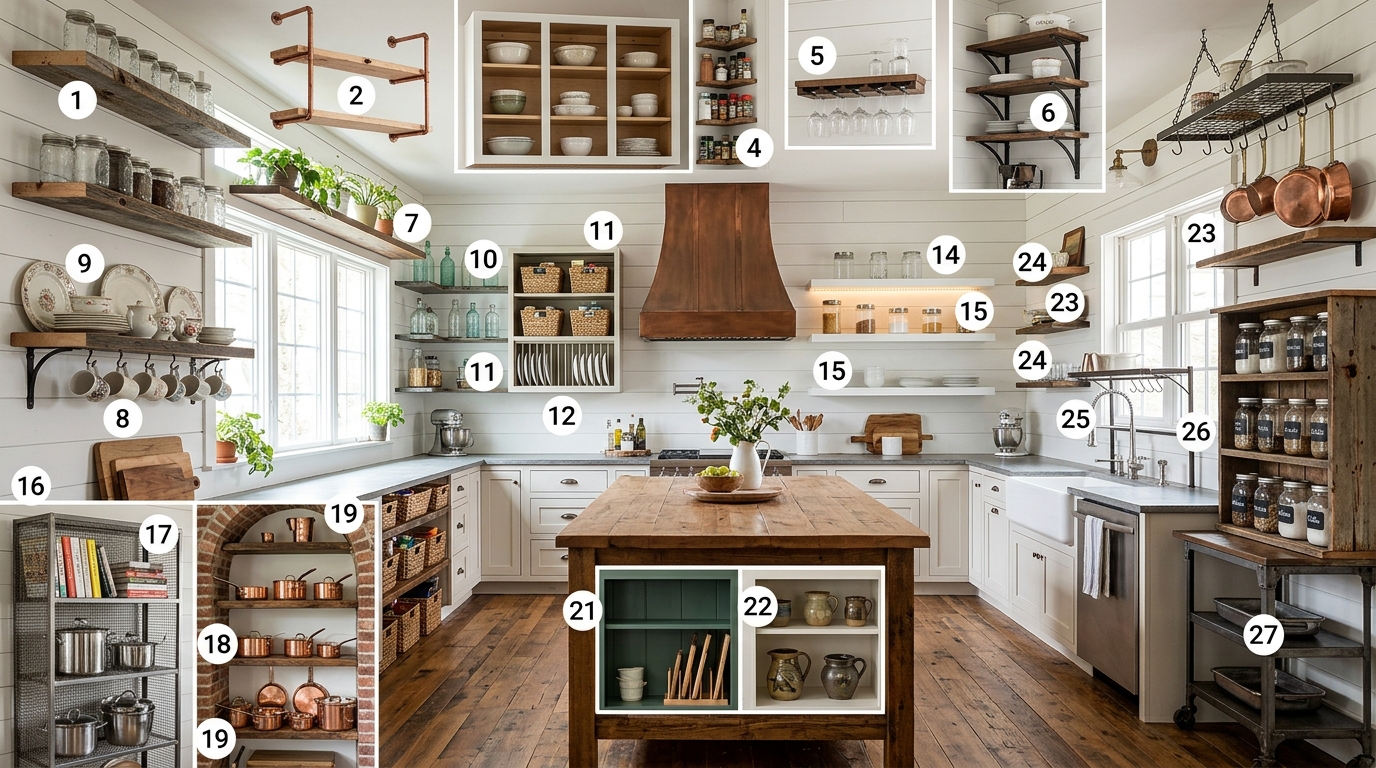
Farmhouse kitchen shelves combine rustic warmth with practical open storage — wooden planks, iron brackets, and handpicked everyday objects displayed with intentional charm. This article delivers exactly 27 farmhouse kitchen shelf ideas, from floating reclaimed wood to corner arrangements and styled mason jar displays.
There’s something deeply settling about a kitchen where nothing is hidden. Where the flour jar lives beside a sprig of dried lavender, where mismatched mugs tell a quiet story, where shelves aren’t just storage — they’re a slow exhale. Farmhouse open shelving invites you to edit your kitchen down to what’s actually loved. Here are 27 ideas worth saving — and stealing.
Why Farmhouse Kitchen Shelves Work So Well
Farmhouse style grew out of American vernacular architecture — the practical, unadorned aesthetic of working farmhouses from the 18th and 19th centuries. It draws from Shaker design principles (form follows function), colonial American woodworking traditions, and the European cottage sensibility brought by immigrant craftspeople. What distinguishes it from “rustic” is its restrained palette and its insistence on usefulness: nothing purely decorative, nothing artificially aged. Every piece earns its place.
The material vocabulary is precise: unfinished white oak or knotted pine for shelves, wrought or raw matte-black iron for brackets, aged brass for hardware, hand-thrown stoneware in cream and warm grey. Colors sit in the warm neutrals — antique linen, aged cream, greige, dusty sage, faded terracotta, and smoky charcoal for contrast. These aren’t cold greys or clinical whites; they carry the warmth of flour-dusted aprons and morning light through cotton curtains.
Farmhouse kitchens are resurging because they directly answer the post-pandemic nesting impulse: a desire for spaces that feel earned rather than designed, permanent rather than trendy. Pinterest searches for “open kitchen shelving farmhouse” grew over 60% since 2022, driven by a broader cultural pivot toward visible simplicity — the antidote to cluttered cabinetry and the all-white minimalist kitchen that felt cold by 2021.
Small kitchens can absolutely achieve farmhouse open shelving — but with discipline. In compact spaces, limit shelves to one wall only, keep no more than two bracket styles, and curate objects ruthlessly. The visual breathing room created by restraint actually reads as more farmhouse, not less.
Style at a Glance
| Element | Value |
| Philosophy | Functional beauty, earned simplicity |
| Key Materials | Unfinished white oak, matte-black iron, hand-thrown stoneware |
| Key Colors | Antique linen, greige, dusty sage, warm charcoal |
27 Farmhouse Kitchen Shelves Ideas for Open Storage
1. Reclaimed Wood Floating Shelves with Black Iron Pipe Brackets
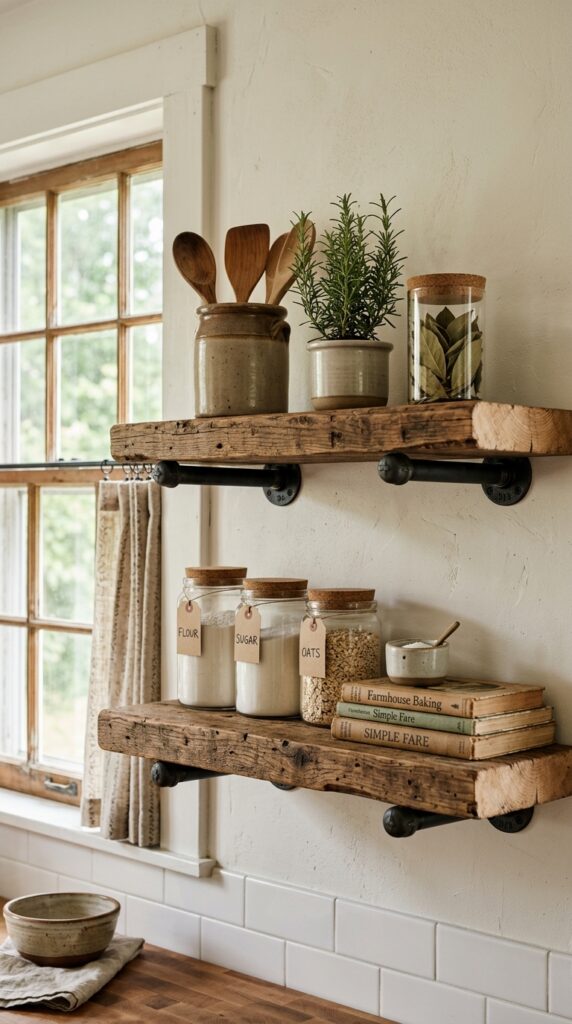
Vibe: Raw. The exposed pipe bracket is honest about what it’s doing — no pretense, just structure.
Why it works: The visual tension between rough-hewn reclaimed wood and precision-engineered black iron pipe is pure farmhouse logic: old and new, organic and industrial, each making the other look better. The horizontal grain of the plank draws the eye across the wall, creating length in even a narrow kitchen. Pipe brackets also have genuine visual weight, so they ground shelves that might otherwise float too lightly.
How to get it: Source reclaimed pine or Douglas fir slabs at local salvage yards — aim for 2-inch thickness minimum to prevent sagging under stoneware. Pre-drill your pipe flanges into wall studs (not just drywall), and finish the wood with a single coat of Rubio Monocoat in “Pure” to seal without obscuring the grain’s character.
💡 Quick Win: Buy pre-cut pipe shelf kits on Amazon — they include flanges, nipples, and screws. Pair with a single untreated pine board from a hardware store for an under-$60 shelf that looks expensive.
🛍️ Shop the Look — Amazon Product Ideas
| # | Product Search Phrase | Why It Fits |
| 1 | Black iron pipe shelf bracket set wall mount | Core structural element |
| 2 | Reclaimed wood floating shelf rustic natural edge | Main shelf surface |
| 3 | Farmhouse stoneware canister set cream | Styled storage vessels |
| 4 | Potted rosemary herb plant small ceramic pot | Live greenery accent |
| 5 | Glass jar with cork lid set kitchen storage | Functional open storage |
2. Shiplap Accent Wall with Built-In White Painted Shelves
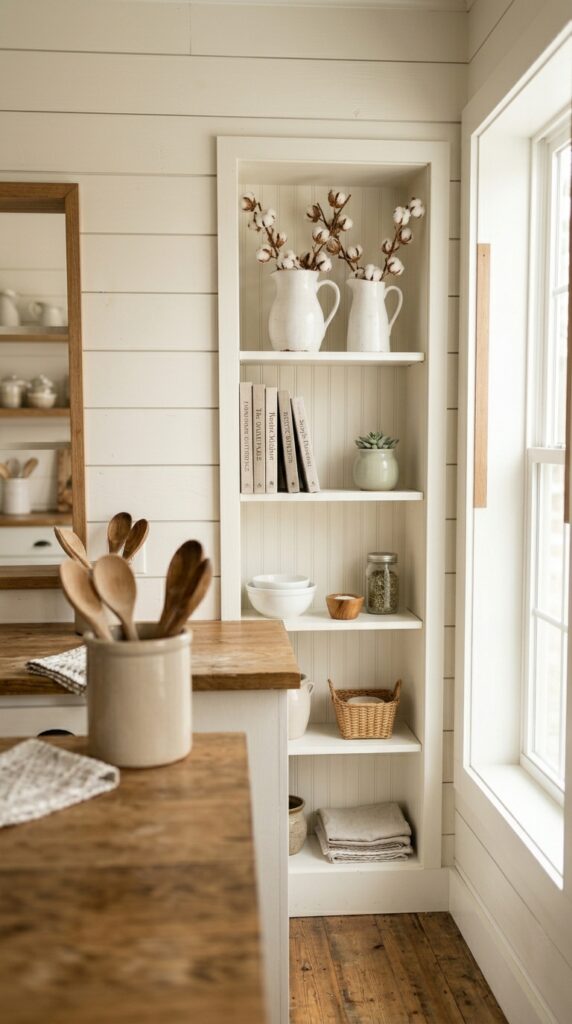
Vibe: Hushed — like a kitchen that’s been lived in gently for a very long time.
Why it works: Painting both the shiplap wall and the shelf the same antique white creates a tone-on-tone effect that reads as architectural rather than decorative — the shelves appear to grow from the wall itself. The horizontal lines of the shiplap provide rhythm and texture without competing with displayed objects. This is a masterclass in visual cohesion through restraint.
How to get it: Paint shiplap and shelves in the same color — Benjamin Moore “White Dove” OC-17 works perfectly here — but apply a semi-gloss to the shelf surface for cleanability and eggshell to the shiplap for warmth. The slight sheen difference reads as intentional and adds subtle depth.
🛍️ Shop the Look — Amazon Product Ideas
| # | Product Search Phrase | Why It Fits |
| 1 | Shiplap wall paneling white peel stick | Affordable wall texture base |
| 2 | White ceramic farmhouse pitcher vase | Tonal shelf accent |
| 3 | Dried cotton stem bundle arrangement | Textural neutral decor |
| 4 | Linen-covered cookbook set neutral | Styled functional display |
| 5 | Floating shelf white wood wall mounted | Matching shelf surface |
3. Open Corner Shelves for Dead-Space Storage
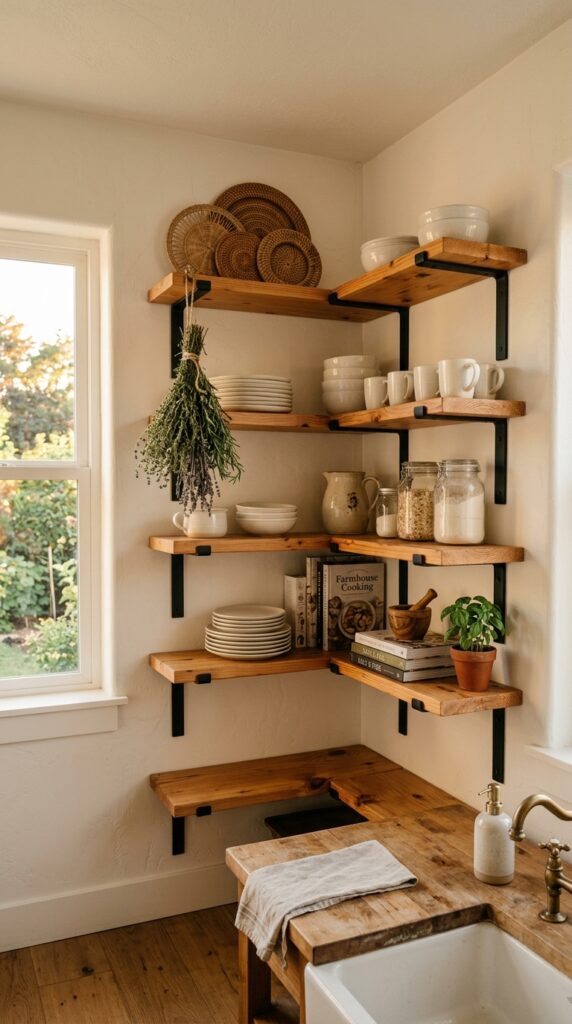
Vibe: Layered — as if the corner has quietly accumulated a year of good living.
Why it works: Corners are often sacrificed to dead space in kitchens, but open corner shelves exploit the vertical dimension of that geometry. By using slightly different shelf depths on each face (12 inches on one side, 8 on the other), you can accommodate both plates and small jars without the shelves visually colliding. The right-angle arrangement also creates a natural vignette — objects on both faces are always visible from somewhere in the room.
How to get it: Stagger the shelf heights by 2 inches as they wrap the corner — this prevents the jarring visual step that makes corner shelves look like an afterthought. Use the same bracket style on both walls to unite the installation.
💡 Quick Win: IKEA’s BERGSHULT shelf board in a 24×12 inch size, paired with SANDSHULT brackets in black, creates a clean corner shelf setup for under $40 per level.
🛍️ Shop the Look — Amazon Product Ideas
| # | Product Search Phrase | Why It Fits |
| 1 | Corner floating shelf wood rustic farmhouse | Core corner shelf unit |
| 2 | Dried herb bundle kitchen wall hanging | Organic aromatic accent |
| 3 | Stacked white dinner plate set ceramic | Functional shelf display |
| 4 | Rattan trivet set round natural fiber | Textural layering element |
| 5 | Small black L bracket heavy duty shelf | Structural corner hardware |
4. Sage Green Painted Shelves Against White Subway Tile
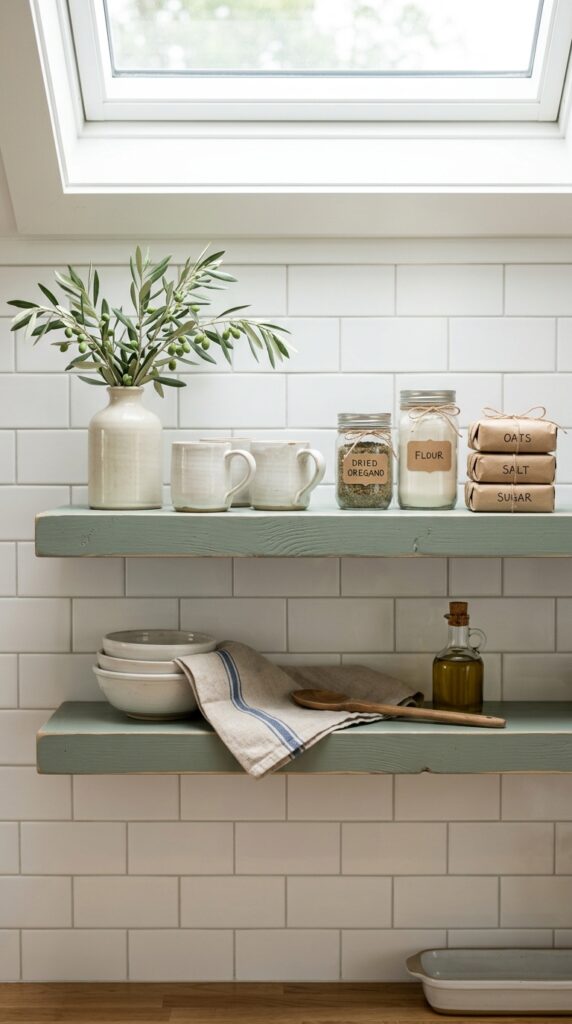
Vibe: Sun-warmed — the green of a kitchen garden brought quietly indoors.
Why it works: Sage green against white subway tile is one of the most harmonious color pairings in farmhouse design because both tones sit in the warm spectrum — the greenish grey of sage and the slightly cream-leaning white of subway tile are pulled from the same natural source palette. The color provides personality without drama, which is exactly what open shelving needs: enough visual interest to anchor the wall without upstaging the objects on display.
How to get it: Paint shelves in Farrow & Ball “Mizzle” No. 266 or the more accessible Behr “Dusty Miller” for a tone that photographs warmly in both natural and artificial light. Apply two coats of satin finish — matte chips on kitchen shelves within weeks.
🛍️ Shop the Look — Amazon Product Ideas
| # | Product Search Phrase | Why It Fits |
| 1 | Sage green floating wood shelf painted | Core color element |
| 2 | Cream stoneware mug set handmade style | Tonal neutral display |
| 3 | Small olive branch faux stem bud vase | Natural botanical accent |
| 4 | Kraft paper pantry label set jar | Organized open storage |
| 5 | White subway tile backsplash peel stick | Background wall texture |
5. Mason Jar Display Shelf with Built-In Spice Storage
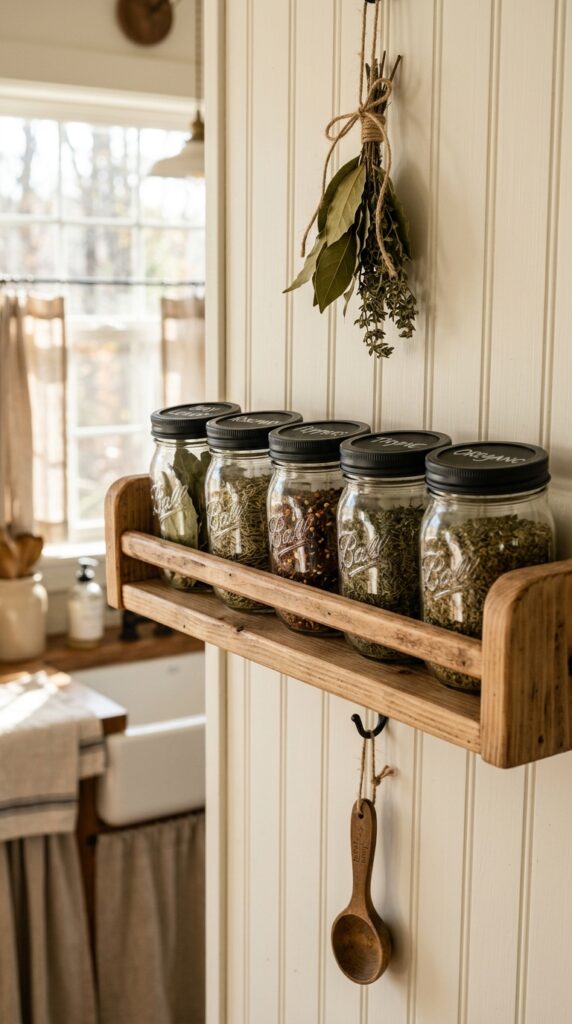
Vibe: Still — the organized quiet of a kitchen that knows exactly where everything lives.
Why it works: The repeating rhythm of uniform mason jars creates order through repetition — one of the most effective visual organizing principles in open shelving. Transparent glass jars are also dual-purpose: they reveal their contents (making cooking faster) while simultaneously looking intentional and styled. The slight imperfection of handwritten chalkboard labels is precisely what makes this feel farmhouse rather than clinical.
How to get it: Use wide-mouth Ball mason jars in quart and half-pint sizes for a consistent height line. Add a 1/2-inch wooden dowel lip glued to the shelf front to prevent jars from sliding during door-open vibration. Chalkboard labels peel off cleanly when contents change.
💡 Quick Win: A 12-pack of Ball wide-mouth mason jars costs around $15. Add a $6 chalkboard label set and you have a complete styled spice shelf for under $25 — no bracket hardware needed if you use a tension-mounted shelf system.
🛍️ Shop the Look — Amazon Product Ideas
| # | Product Search Phrase | Why It Fits |
| 1 | Wide mouth mason jar set 12 pack Ball | Core storage vessel |
| 2 | Chalkboard labels round self-adhesive | Farmhouse labeling system |
| 3 | Wall spice rack shelf narrow floating | Shelf unit for jars |
| 4 | Dried bay leaf bunch kitchen herb | Aromatic styling detail |
| 5 | Small S-hook set black metal kitchen | Hanging utensil accent |
6. Rustic Open Shelving Under a Window
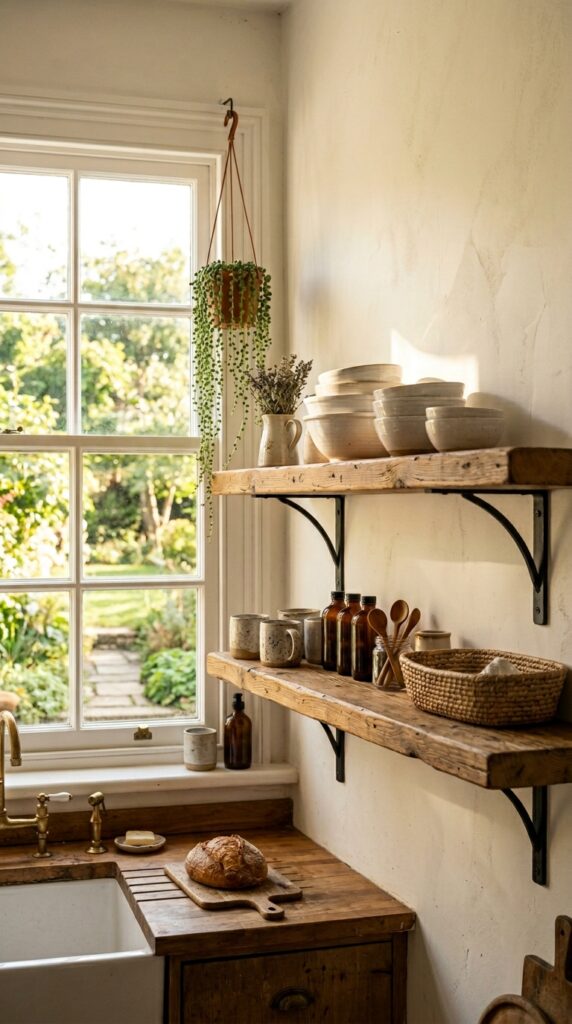
Vibe: Luminous — objects here seem lit from within because they genuinely are, from the window above.
Why it works: Natural light behavior is everything in this placement. Objects on under-window shelves receive beautiful backlighting and diffused fill light simultaneously, making even humble white ceramics glow. This is a lighting principle borrowed from photography — the window acts as a large soft box, and the shelf becomes the subject’s natural stage. The placement also keeps the window unobstructed, preserving the light source.
How to get it: Mount shelves no higher than 12 inches below the window sill to maintain the visual connection with the natural light. Avoid dark-colored objects here — terracotta, navy, or deep wood tones absorb the light; white, cream, and clear glass objects amplify it.
🛍️ Shop the Look — Amazon Product Ideas
| # | Product Search Phrase | Why It Fits |
| 1 | White ceramic bowl set nesting stackable | Luminous light-catching display |
| 2 | Hanging succulent planter wall mounted | Window-adjacent plant display |
| 3 | Washed linen dish towel set neutral | Loose textile styling touch |
| 4 | Knotted pine shelf board 24 inch natural | Under-window shelf surface |
| 5 | Simple black floating shelf bracket set | Clean minimal hardware |
7. Two-Tone Wood Shelf: Natural Edge Meets Painted Base
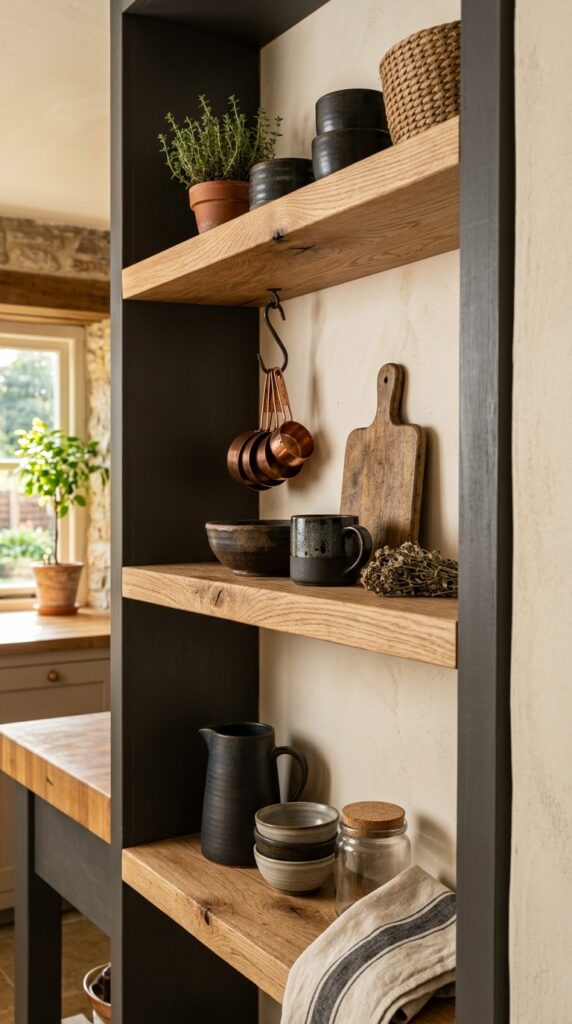
Vibe: Grounded — this shelf has weight; it belongs in the room rather than floating on it.
Why it works: The two-tone technique works on the principle of contrast through material honesty — the natural oak grain reads as organic and tactile while the charcoal-painted supports read as architectural and deliberate. This pairing prevents the common farmhouse pitfall of “too much wood” on a wood shelf — the painted component gives the eye a neutral anchor. Charcoal specifically (rather than black) reads as warm rather than harsh under kitchen lighting.
How to get it: Use Sherwin-Williams “Urbane Bronze” SW 7048 for the painted components — it’s a warm charcoal with slight brown undertones that bridges wood grain and painted surface without creating stark contrast. Apply to shelf sides and any backing panels, leaving the shelf surfaces raw and sealed.
💡 Quick Win: This technique works with any existing bookshelf — paint only the back panel and side supports in charcoal, leaving shelves their natural wood. A $12 quart of paint transforms a generic shelf into a custom piece in an afternoon.
🛍️ Shop the Look — Amazon Product Ideas
| # | Product Search Phrase | Why It Fits |
| 1 | White oak floating shelf natural edge live | Two-tone shelf surface |
| 2 | Dark stoneware bowl set matte charcoal | Tonal accent vessels |
| 3 | Copper measuring cup set hanging | Warm metallic contrast |
| 4 | Small cutting board wood walnut serve | Leaned styling prop |
| 5 | Charcoal matte chalk paint quart interior | Two-tone paint solution |
8. LED Strip-Lit Shelves for Evening Warmth
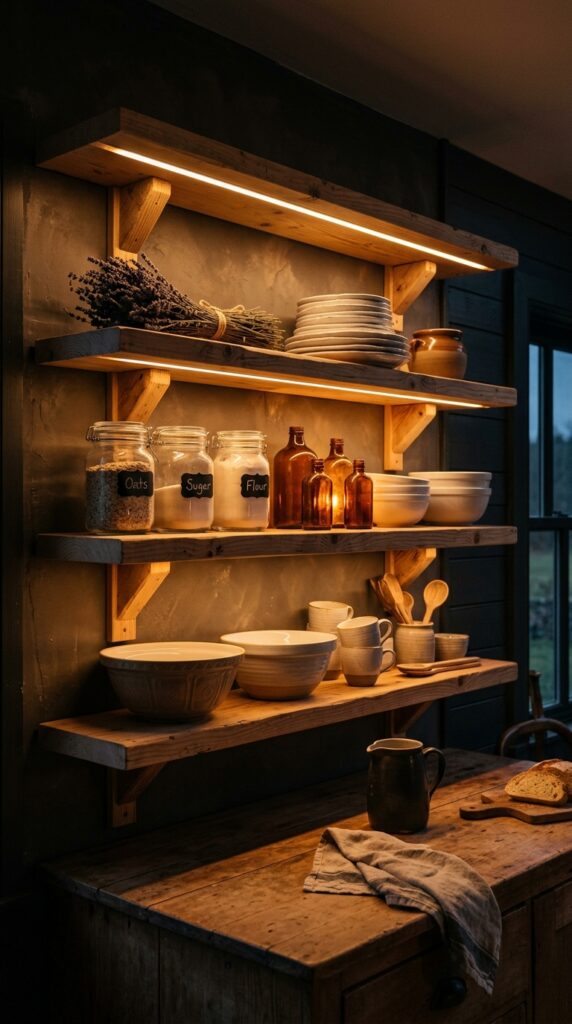
Vibe: Romantic — the kitchen shifts character completely after dark, from workroom to hearth.
Why it works: Under-shelf LED lighting exploits a fundamental lighting principle: objects placed between a light source and the eye appear highlighted against shadow, creating a three-dimensional effect that flat overhead lighting never achieves. The warm 2700K color temperature mimics candlelight, which is why this looks so unmistakably farmhouse rather than modern kitchen. It’s task lighting and mood lighting simultaneously.
How to get it: Install 2700K warm white LED strip lights (not 3000K or above — too clinical) in a shallow channel routed into the underside of each shelf, or behind a 1-inch wood lip glued to the front shelf edge. Dimmer-compatible LED drivers let you shift the mood from working kitchen to dinner ambiance with one switch.
🛍️ Shop the Look — Amazon Product Ideas
| # | Product Search Phrase | Why It Fits |
| 1 | Warm white LED strip lights 2700K dimmable | Core lighting element |
| 2 | Amber glass bottle set kitchen display | Light-catching glass accent |
| 3 | Dried lavender bundle tied twine | Aromatic shelf accent |
| 4 | White porcelain salad plate set stackable | LED-lit shelf display |
| 5 | Under cabinet LED light bar plug-in warm | Simpler lighting alternative |
9. Floating Shelves with Woven Basket Storage Beneath
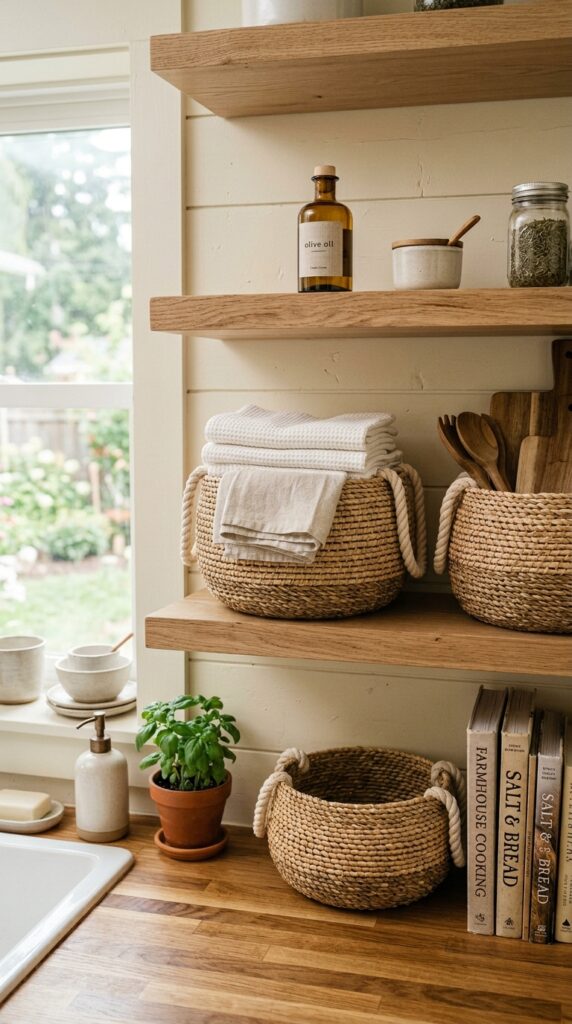
Vibe: Tactile — there are three different textures visible before your eye even reaches an object.
Why it works: Layering textures vertically — smooth wood shelf above, woven basket below — creates visual depth through material contrast rather than color. This works because rattan and oak occupy different points on the roughness scale but share the same warm brown palette, so they harmonize without matching. The baskets also solve a functional problem: they’re closed storage that looks like open storage, giving you the visual warmth of a curated shelf without exposing every item.
How to get it: Size matters with baskets — choose baskets that are at least 80% of the shelf depth to read as intentional rather than adrift. Seagrass and water hyacinth baskets hold their shape better than cheap woven polypropylene and age into a richer tone over months of kitchen use.
🛍️ Shop the Look — Amazon Product Ideas
| # | Product Search Phrase | Why It Fits |
| 1 | Seagrass belly basket natural woven set | Core textural storage |
| 2 | Rattan storage basket with cotton rope handle | Handled basket variation |
| 3 | Folded linen napkin set natural undyed | Soft basket-filler textile |
| 4 | Small olive oil bottle glass kitchen | Open shelf functional display |
| 5 | Water hyacinth storage basket rectangle | Contained shelf storage |
10. Plate-Display Shelves with Groove Ledges
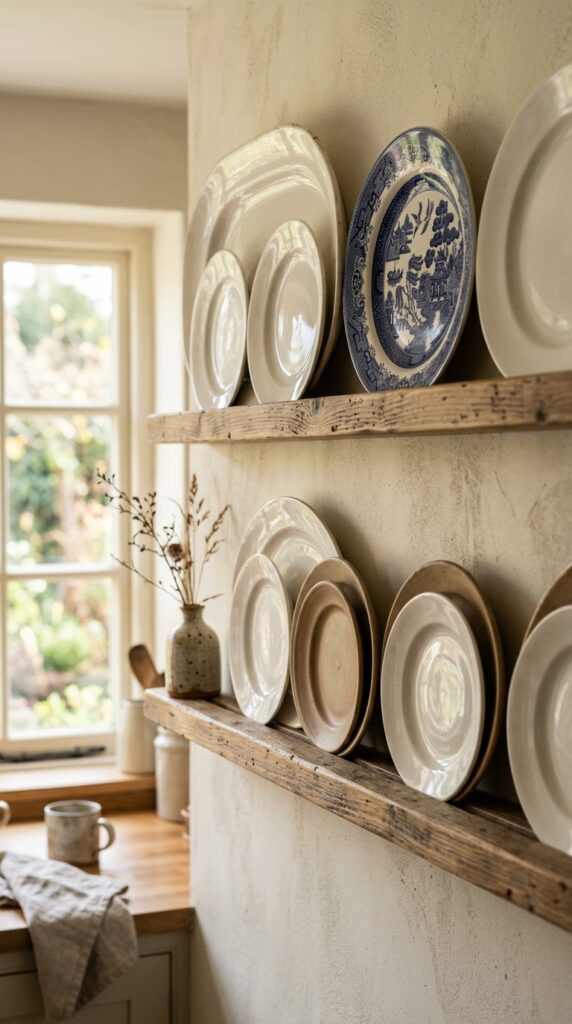
Vibe: Curated — the plates are arranged like small paintings on a gallery rail.
Why it works: Plate-groove ledge shelves exploit vertical plate display as a design element, turning functional objects into wall art through repetition and scale variation. The routed groove keeps plates stable and at a consistent forward lean, which catches light differently than a flat surface — the curve of each plate creates a soft shadow beneath it, adding sculptural depth to what is essentially a flat wall. Mixing one or two pattern plates (blue transferware, for example) among plain white breaks the monotony without disrupting the palette.
How to get it: Route a 1/4-inch groove 1 inch from the back edge of a 3-4 inch deep pine ledge. Sand smooth, finish with Rubio Monocoat “Smoked Oak” for warmth, and install with flush-mount hidden brackets — the floating appearance makes the plates look even more gallery-like.
💡 Quick Win: IKEA’s MOSSLANDA picture ledge (available in 55-inch length for under $20) works perfectly as a plate-display shelf with a thin bead of clear museum putty in the groove to secure plates — no routing required.
🛍️ Shop the Look — Amazon Product Ideas
| # | Product Search Phrase | Why It Fits |
| 1 | White ironstone dinner plate set vintage style | Main plate display element |
| 2 | Blue transferware plate accent decorative | Pattern accent among white |
| 3 | Narrow wall plate display ledge shelf wood | Purpose-built plate ledge |
| 4 | Small dried twig branch bundle natural | Textural ledge accent |
| 5 | Museum putty adhesive display non-damaging | Plate-securing solution |
11. Open Pantry Shelf Wall with Labeled Canisters
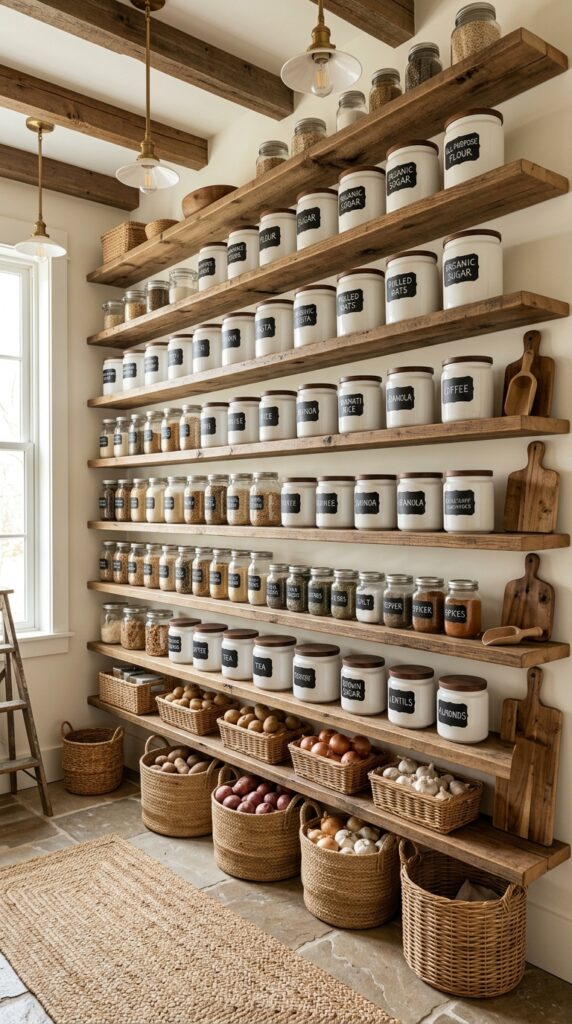
Vibe: Generous — the full wall of shelves reads like a well-stocked larder, which is exactly what it is.
Why it works: Repetition of identical containers is the most powerful single tool in open pantry styling. When every jar, canister, and bin matches in color and material, the eye registers the overall wall as a single organized composition rather than dozens of individual objects — visual noise collapses into visual rhythm. This is the design principle behind professional kitchen staging, and it’s achievable for anyone who simply replaces mismatched packaging with uniform white ceramic or glass.
How to get it: Start with your dry pantry goods: flour, sugar, coffee, rice, oats, pasta. Decant into matching wide-mouth ceramic canisters with airtight lids — a 10-piece set from Amazon covers most pantry staples. Chalkboard labels let you reorganize contents seasonally without re-purchasing labels.
🛍️ Shop the Look — Amazon Product Ideas
| # | Product Search Phrase | Why It Fits |
| 1 | White ceramic canister set airtight lid kitchen | Uniform pantry storage |
| 2 | Chalkboard label set kitchen pantry canister | Label system for canisters |
| 3 | Tall floating shelf set pantry wall storage | Full-height shelf system |
| 4 | Wood cutting board set serve display | End-of-shelf leaned display |
| 5 | Wire basket pantry storage shelf insert | Secondary open storage |
12. Repurposed Ladder Shelf for Vertical Kitchen Storage
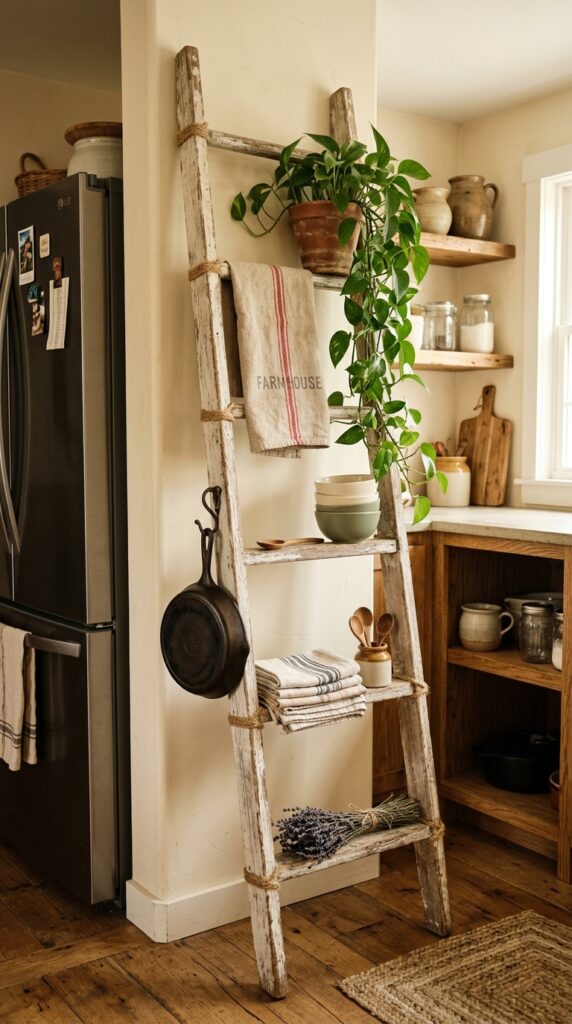
Vibe: Relaxed — the slight lean of a ladder shelf signals ease, not effort.
Why it works: A leaning ladder shelf solves the “no drill” problem for rental kitchens or apartment dwellers while delivering full farmhouse texture and vertical storage. The diagonal angle creates dynamic visual interest in what is typically a flat-against-wall zone. Ladder rungs naturally space objects at irregular heights, which prevents the rigid uniformity that makes standard shelving look commercial rather than collected.
How to get it: Look for old wooden orchard ladders at antique markets, or buy a pre-made ladder shelf and distress it with coarse sandpaper and a diluted white wash (1 part white paint, 3 parts water, applied and wiped). The DIY distress takes 30 minutes and looks more authentic than factory distressing.
💡 Quick Win: A 5-tier blanket ladder shelf (widely available on Amazon for $35–$55) with a quick white wash transforms into a fully functional farmhouse kitchen display in under two hours — no tools required.
🛍️ Shop the Look — Amazon Product Ideas
| # | Product Search Phrase | Why It Fits |
| 1 | Rustic ladder shelf 5 tier leaning wood | Core furniture piece |
| 2 | Cast iron skillet wall hanging display | Hanging rung accent |
| 3 | Grain sack stripe kitchen towel set | Draped textile detail |
| 4 | Trailing pothos plant small hanging pot | Cascading greenery |
| 5 | White wash wood stain quart farmhouse finish | DIY distress medium |
13. Dark Walnut Shelves Against a Shiplap Accent Wall
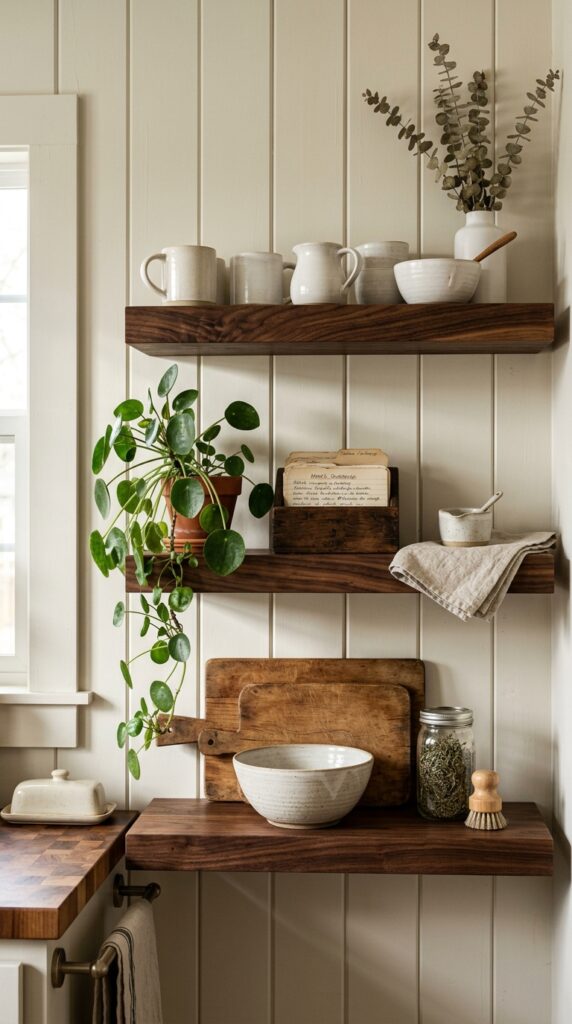
Vibe: Rich — this is a farmhouse kitchen that has clearly been considered rather than assembled.
Why it works: Dark walnut against a light wall is a study in tonal contrast: the dark horizontal shelf acts as a strong visual line that anchors the wall and frames everything placed on it, much like a picture frame elevates its subject. Shiplap’s vertical or horizontal shadow lines multiply the visual texture without adding color, allowing the walnut and the ceramics on the shelf to carry all the warmth in the composition. The combination avoids the “blonde wood everywhere” monotony of basic farmhouse.
How to get it: Use actual American black walnut for shelves if budget allows ($80–$120 for a 48-inch slab) — the grain is irreplaceable. For a budget version, use pine boards stained with Minwax “Dark Walnut” stain; apply two coats without sealing first for deeper penetration. Top with matte polyurethane for a non-reflective surface that won’t read as contemporary.
🛍️ Shop the Look — Amazon Product Ideas
| # | Product Search Phrase | Why It Fits |
| 1 | Dark walnut floating shelf thick slab | Core shelf material |
| 2 | White vertical shiplap paneling wall | Background wall texture |
| 3 | Cream stoneware bud vase set small | Light accents on dark shelf |
| 4 | Minwax dark walnut wood stain quart | DIY dark stain option |
| 5 | Small trailing herb pot terracotta | Organic shelf accent |
14. Open Shelf Styled Like a Coffee Station
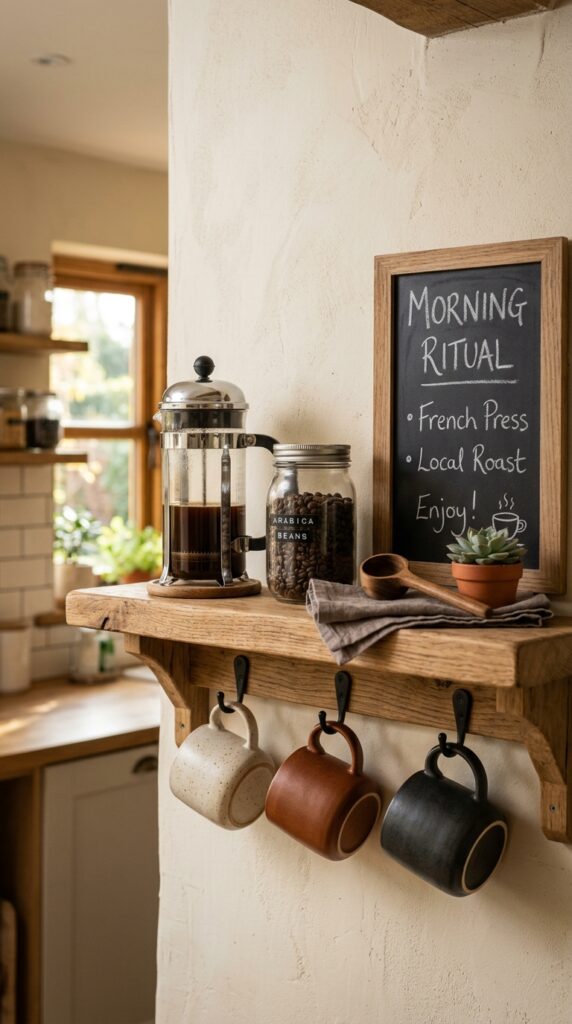
Vibe: Ritual — this shelf exists to make mornings feel deliberate rather than rushed.
Why it works: Dedicated function zones within open shelving create visual narratives — a coffee station shelf communicates daily rhythm and curated living in a single glance. Installing mug hooks on the shelf underside doubles the storage footprint and adds vertical layering: the eye moves from shelf surface down to suspended mugs, then back up, naturally scanning the full composition. This zone-within-a-shelf technique is borrowed from commercial café design.
How to get it: Install five matte-black mug hooks in a single horizontal line on the underside of the shelf, spaced 4 inches apart. Use wall-anchored J-hooks for mugs rather than screw-in hooks if your shelf is 3/4 inch pine — they load-distribute better and won’t strip from the wood over time.
💡 Quick Win: A small chalkboard sign (3×5 inches) with handwritten coffee offerings leaned against the back of the shelf adds instant café personality for under $5 — available in a pack of 6 on Amazon for around $12.
🛍️ Shop the Look — Amazon Product Ideas
| # | Product Search Phrase | Why It Fits |
| 1 | Matte black mug hooks wall mount set | Under-shelf mug display |
| 2 | Ceramic coffee mug farmhouse style set | Core coffee station display |
| 3 | Glass coffee bean canister metal lid | Styled functional storage |
| 4 | Mini chalkboard sign kitchen display set | Coffee station labeling |
| 5 | French press coffee maker glass copper | Functional styled object |
15. Exposed Brick Wall with Raw Wood Shelf Brackets
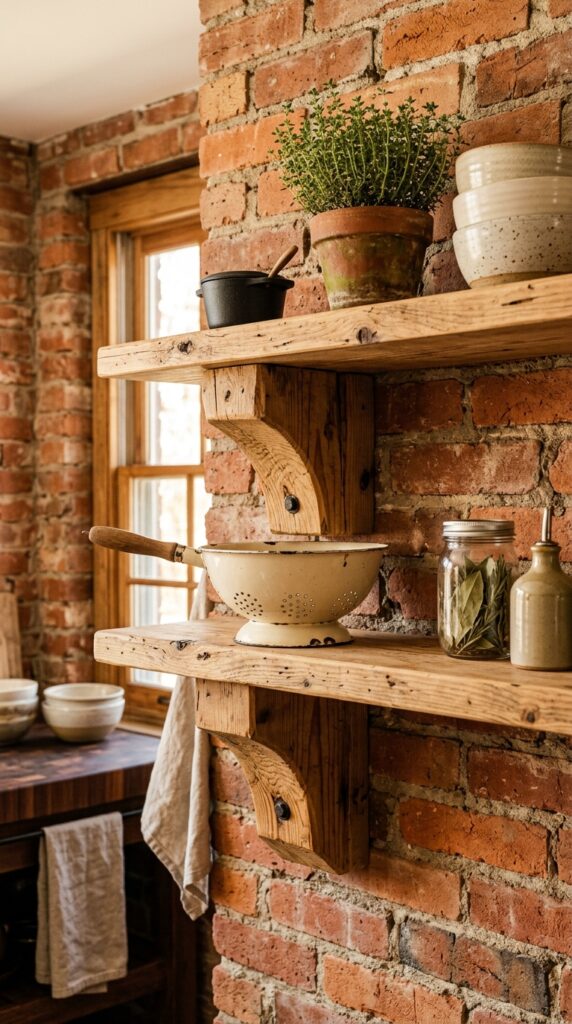
Vibe: Raw — the wall does half the work; the shelf just holds things in front of it.
Why it works: Exposed brick is the original farmhouse texture — it predates the style name by centuries — and it creates the richest possible backdrop for open shelving because it provides color, texture, and material history all at once. The key is choosing wooden corbel brackets that match the brick’s rough register rather than smooth metal brackets that would feel anachronistic. Terracotta and cast iron accessories pick up the brick’s warm red undertone without repeating it identically.
How to get it: Mount shelves to brick using red-head masonry anchors (not drywall plugs — they’ll pull from mortar) and 3/8-inch lag screws. Choose corbel brackets at least 2/3 the depth of the shelf for proper visual and structural proportion — thin brackets on deep shelves look precarious even when they’re perfectly safe.
🛍️ Shop the Look — Amazon Product Ideas
| # | Product Search Phrase | Why It Fits |
| 1 | Wooden corbel shelf bracket set rustic | Rustic bracket for brick wall |
| 2 | Cast iron salt cellar pig farmhouse | Antique-style shelf accent |
| 3 | Small terracotta pot herb garden set | Brick-toned plant accent |
| 4 | Antique enamel colander white display | Vintage functional display |
| 5 | Masonry wall anchor screw set heavy duty | Brick-wall mounting hardware |
16. Minimalist Two-Shelf Kitchen Display with Negative Space
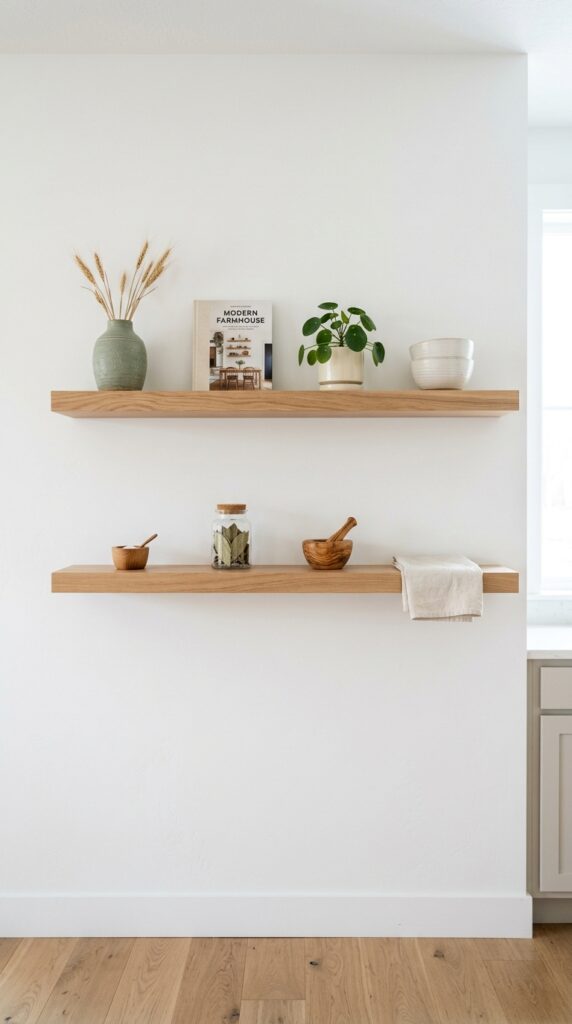
Vibe: Still — this is a kitchen wall that has learned when to stop.
Why it works: Negative space in open shelving is one of the most underused design tools in farmhouse kitchens. When shelves are sparse, each object gains prominence and the wall itself becomes part of the composition. This applies the Japanese design principle of ma — meaningful emptiness — to a Western farmhouse context, resulting in shelves that feel edited and deliberate rather than merely unfilled. It also reduces visual fatigue in small kitchens where too much stimulation on every wall is exhausting.
How to get it: Apply the “rule of five”: limit each shelf to no more than five objects, always including at least one organic element (a plant or dried stem), one functional item (a bowl, jar, or pitcher), and one book or flat object for height variety. Remove objects until the arrangement feels slightly underdressed — that’s exactly right.
🛍️ Shop the Look — Amazon Product Ideas
| # | Product Search Phrase | Why It Fits |
| 1 | White oak floating shelf smooth minimalist | Clean minimal shelf |
| 2 | Single stem dried pampas grass tall vase | Organic focal point object |
| 3 | Stacked ceramic bowl set small white | Minimal functional display |
| 4 | Linen hardcover recipe journal blank | Flat styling object |
| 5 | Single small succulent pot matte white | Compact plant accent |
17. Farmhouse Kitchen Shelf Styling with Seasonal Botanicals
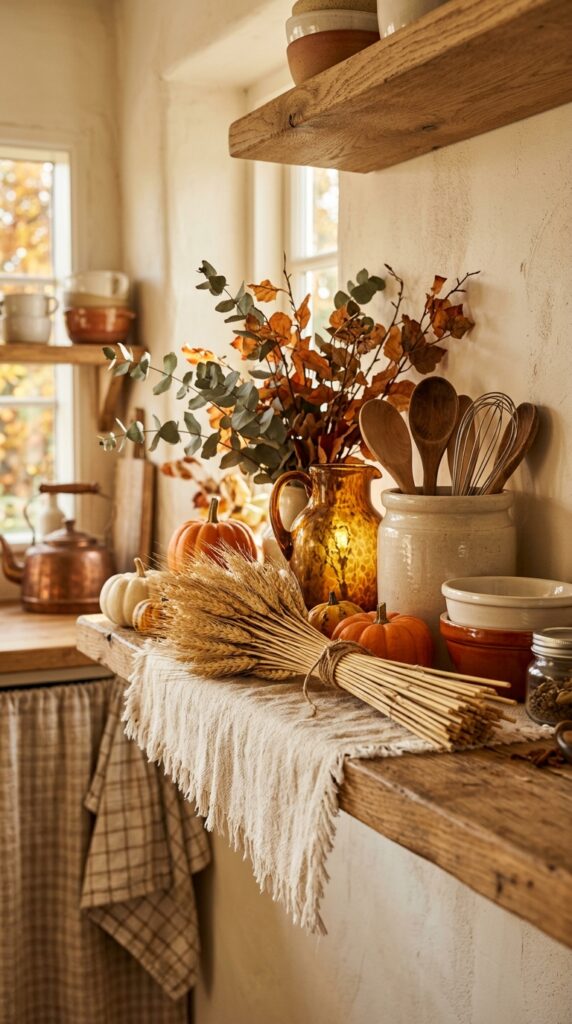
Vibe: Harvest-warm — the kitchen smells of dried herbs and beeswax, even through a screen.
Why it works: Seasonal botanical styling is the farmhouse shelf technique that most directly connects a kitchen to the rhythm of the natural year — which is, historically, exactly what farm kitchens were attuned to. Rotating botanicals by season (cotton and berries in autumn, evergreen and preserved berries in winter, wildflowers and greenery in spring) keeps shelves feeling alive and never stale. The cost is minimal — dried botanicals hold their form for months — and the impact is disproportionately large.
How to get it: Group botanicals in odd numbers (three stems, five pumpkins) and vary heights by at least 4 inches between each grouping. Place the tallest element at one end of the shelf and let it anchor a cascade down to the lowest — this creates directional flow that makes the arrangement feel naturally composed rather than symmetrically placed.
💡 Quick Win: A $9 bundle of dried wheat from a crafts supplier or Amazon, tied with a 6-inch length of natural jute twine, is the single easiest seasonal farmhouse shelf accent. Stand it in a stoneware crock and add nothing else for a complete vignette.
🛍️ Shop the Look — Amazon Product Ideas
| # | Product Search Phrase | Why It Fits |
| 1 | Dried wheat bundle natural stem arrangement | Core seasonal botanical |
| 2 | Small sugar pumpkin set faux artificial | Seasonal shelf accent |
| 3 | Dried eucalyptus bundle preserved green | Long-lasting botanical |
| 4 | Amber glass jug vintage bottle display | Warm-toned glass accent |
| 5 | Natural jute twine spool crafts farmhouse | Bundle-tying detail |
18. Open Shelf with Hidden Outlet for Appliance Storage
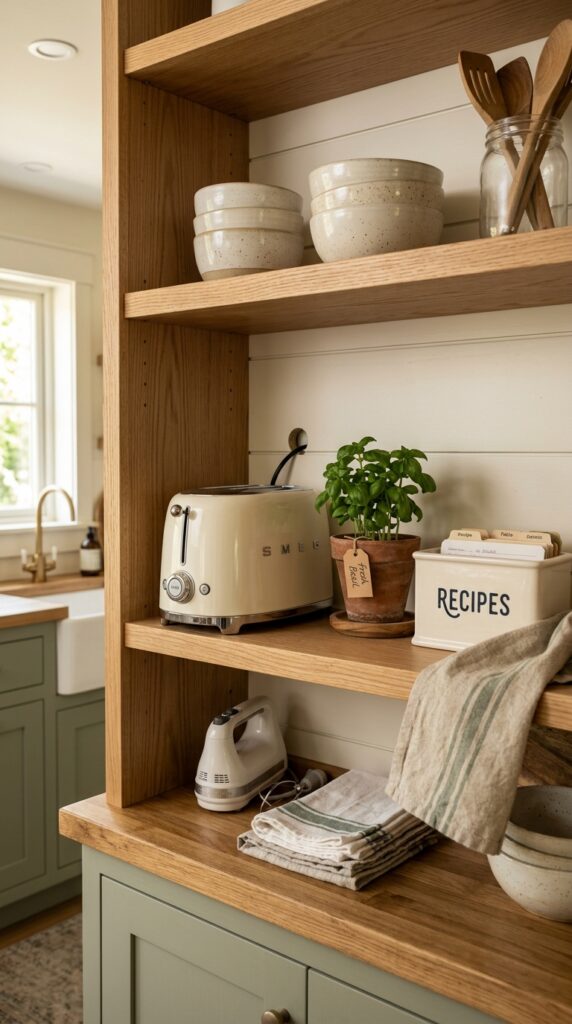
Vibe: Practical — the best farmhouse kitchen knows that function and form share the same shelf.
Why it works: Appliance shelves succeed when the styling logic extends to the appliances themselves — choosing cream or matte-finish small appliances rather than chrome or black ones means they can coexist with ceramics and botanicals without breaking the visual palette. The hidden outlet and cord management are a modern concession that preserves the aesthetic; they acknowledge that real farmhouse kitchens were working spaces, not museum installations.
How to get it: Route a 2-inch hole in the shelf’s back panel near one side (not centered — off-center reads as intentional, centered reads as an oversight). Purchase a plastic grommet insert for a clean edge. Store the outlet strip inside the shelf frame against the wall so only the grommet hole is visible from the front.
🛍️ Shop the Look — Amazon Product Ideas
| # | Product Search Phrase | Why It Fits |
| 1 | Retro toaster 2 slice cream vintage look | Palette-matching appliance |
| 2 | Shelf cord management grommet hole insert | Functional hidden detail |
| 3 | Linen recipe box card holder farmhouse | Styled functional storage |
| 4 | Small basil herb pot ceramic white | Living plant on working shelf |
| 5 | Power strip surge protector flat low profile | Shelf hidden outlet solution |
19. Full-Height Shelving Tower for Small Kitchens
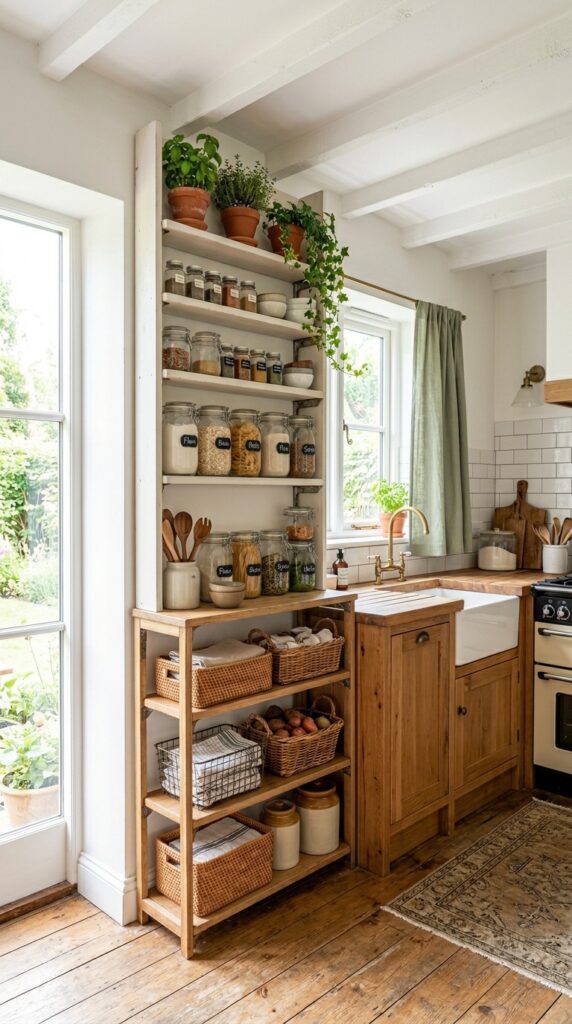
Vibe: Airy — it takes up almost no floor space but fills the vertical dimension completely.
Why it works: Full-height shelves exploit the most underused dimension in small kitchens: height. By drawing the eye upward, a vertical shelf tower creates an illusion of greater ceiling height while dramatically increasing storage without expanding the floor footprint. This is the compact-kitchen application of a classical proportion principle — elongated vertical forms make both rooms and furniture appear larger. The key is maintaining the same pale color for shelf and wall to prevent visual weight from accumulating at the tower.
How to get it: Choose shelves no deeper than 10 inches for a tower in a galley kitchen — this allows the unit to function without intruding on the work aisle. Style the top two shelves with lightweight objects (small plants, light ceramic pieces) and reserve the bottom two shelves for heavy baskets and pantry staples, which lowers the center of gravity and makes the unit feel visually stable.
🛍️ Shop the Look — Amazon Product Ideas
| # | Product Search Phrase | Why It Fits |
| 1 | Tall narrow freestanding shelf tower kitchen | Core small-space furniture |
| 2 | Small rattan storage basket set lower shelf | Lower-shelf basket storage |
| 3 | Mini succulent pot set top shelf display | Lightweight top-shelf plant |
| 4 | Glass pantry jar set clear airtight lid | Middle-shelf pantry storage |
| 5 | White ladder bookshelf narrow 5 tier | Alternative vertical option |
20. Beadboard Backing on Open Kitchen Shelves
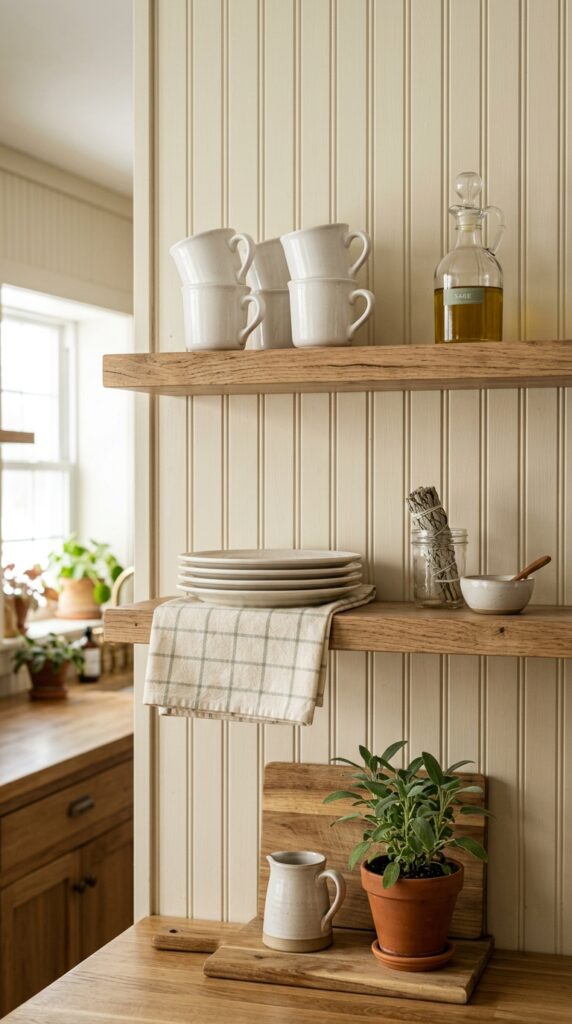
Vibe: Cottage-warm — every vertical groove in the beadboard catches a slightly different shade of light.
Why it works: Beadboard backing solves a practical and aesthetic problem simultaneously: it gives open shelves a defined back boundary (preventing the “floating objects in front of a bare wall” effect) and adds tactile texture that makes white-on-white styling readable. The vertical groove lines of beadboard also elongate displayed objects visually — placing a set of mugs in front of vertical lines makes the mugs read as taller and more substantial. This is a borrowed principle from retail display design.
How to get it: Install 1/4-inch MDF beadboard panels directly to the wall before mounting shelves — this means shelves appear to mount through the panel. Paint the beadboard the same color as the wall but in a satin finish; the slight sheen differential makes the grooves visible at a gentle angle without being obvious head-on.
💡 Quick Win: Peel-and-stick beadboard wallpaper (available on Amazon for $20–$35 per roll) creates the same visual effect with no cutting or nailing — perfect for renters who want the farmhouse texture without commitment.
🛍️ Shop the Look — Amazon Product Ideas
| # | Product Search Phrase | Why It Fits |
| 1 | Peel stick beadboard wallpaper white wall panel | Renter-friendly backdrop |
| 2 | White ironstone mug set vintage style | Beadboard-backdrop display |
| 3 | Glass cruet bottle oil vinegar kitchen | Clear functional accent |
| 4 | Cotton dish towel flour sack folded white | Flat shelf textile prop |
| 5 | MDF beadboard panel sheet 4×8 interior | Permanent beadboard option |
21. Open Shelf Herb Garden with Terra Cotta Pots
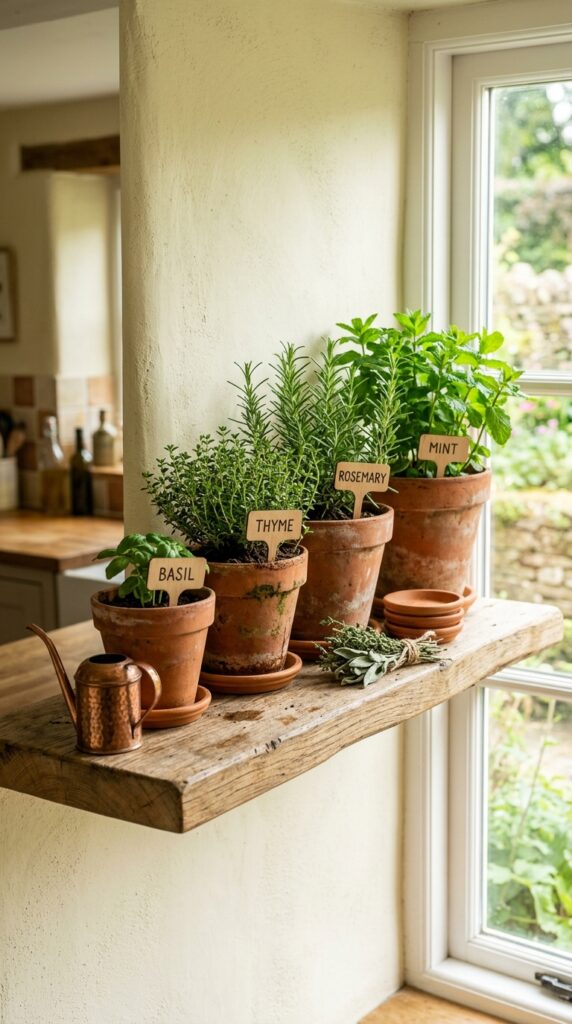
Vibe: Alive — this is a shelf that actually breathes.
Why it works: A dedicated herb shelf brings the farmhouse’s agricultural heritage directly into the kitchen in its most literal form. Terra cotta pots are the correct material choice here — not ceramic, not plastic — because the clay’s porous surface weathers into a naturally aged patina within weeks of regular watering, developing white mineral efflorescence that looks better, not worse, with time. The graduated heights of different herbs create a natural asymmetry that no arrangement could achieve with inorganic objects.
How to get it: Place the herb shelf within 24 inches of a south or east-facing window — most culinary herbs need direct or bright indirect light for at least 4 hours daily. Choose shallow saucers one size smaller than each pot (they disappear visually) and line the shelf with a waterproof tray beneath all pots to protect the wood from drainage.
🛍️ Shop the Look — Amazon Product Ideas
| # | Product Search Phrase | Why It Fits |
| 1 | Terra cotta herb pot set graduated sizes | Core material element |
| 2 | Herb garden starter seed kit kitchen | Living plant content |
| 3 | Copper watering can small kitchen plant | Warm metallic accent |
| 4 | Wooden herb label stake set hand painted | Identifying farmhouse labels |
| 5 | Waterproof shelf liner tray wood protector | Functional plant protection |
22. Open Shelving Styled Around a Kitchen Window Frame
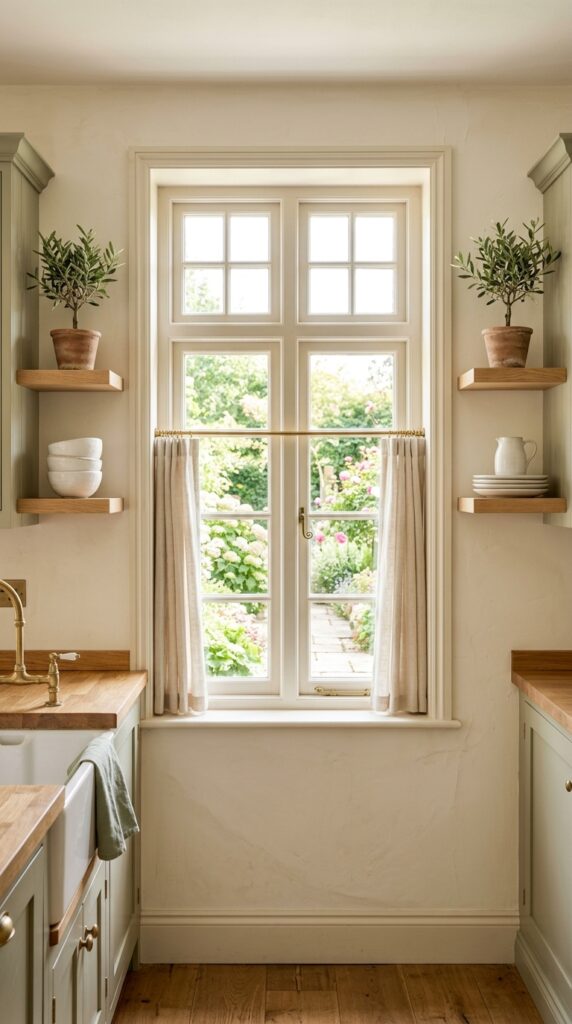
Vibe: Architectural — the shelves make the window look like it was planned into the room from the beginning.
Why it works: Flanking a window with matched shelves at identical heights creates bilateral symmetry — one of the oldest compositional devices in architecture and design. The window becomes the focal axis, and the shelves become framing elements rather than storage intrusions. This layout also maximizes natural light access: the shelves are lit from the window’s diffused glow rather than competing with it, giving displayed objects a naturally soft, flattering illumination throughout the day.
How to get it: For this to work, both shelves must be identical in depth, finish, and bracket style — even a slight mismatch in shelf tone or bracket size breaks the symmetry and makes the arrangement look accidental. Mount both shelves on the same horizontal plane using a single level line taped across the window as your guide.
🛍️ Shop the Look — Amazon Product Ideas
| # | Product Search Phrase | Why It Fits |
| 1 | Matching pair floating shelf set symmetrical | Core symmetry element |
| 2 | Small matching plant pot set window sill | Symmetrical plant accent |
| 3 | Sheer linen curtain panel farmhouse light | Window framing textile |
| 4 | Matching white vase set pair small | Symmetrical ceramic display |
| 5 | Floating shelf hidden bracket set flush | Invisible bracket option |
23. Industrial-Farmhouse Pipe Shelf with Reclaimed Pallet Wood
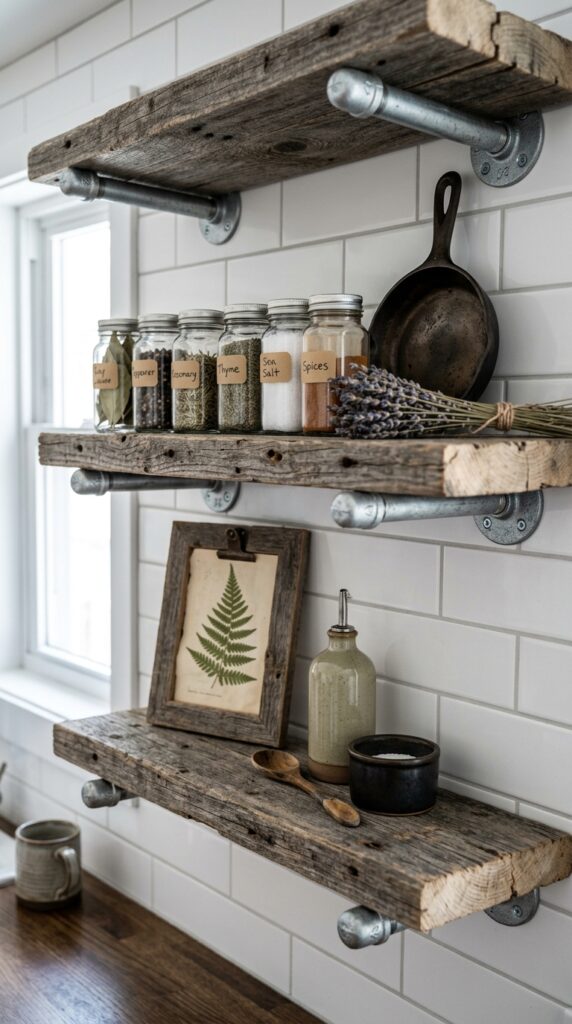
Vibe: Industrial-raw — the kind of shelf that looks like it was built on a Saturday with materials from a dumpster dive and a hardware store.
Why it works: Industrial-farmhouse is a hybrid style that works because both aesthetics share a reverence for honest materials — neither tries to hide what things are made of. The pairing of galvanized steel pipe (utilitarian, urban) with reclaimed pallet wood (agricultural, weathered) creates productive tension that reads as sophisticated rather than random. The key is using the same patina scale: both materials should show age at the same intensity — neither should look too new.
How to get it: Sand pallet boards lightly with 80-grit sandpaper (not smooth — you want the grain open) and seal with a single coat of Minwax Finishing Wax in “Clear” applied with a cloth. This protects from moisture and gives the wood a soft sheen without obscuring its weathered character. Do not stain over pallet wood — the natural variation is the entire point.
🛍️ Shop the Look — Amazon Product Ideas
| # | Product Search Phrase | Why It Fits |
| 1 | Galvanized pipe shelf bracket set industrial | Core industrial bracket |
| 2 | Reclaimed wood floating shelf rustic grey | Weathered shelf surface |
| 3 | Cast iron mini pan small display skillet | Industrial kitchen accent |
| 4 | Pressed botanical fern frame wall art | Organic detail in clip frame |
| 5 | Clear finishing wax wood sealant furniture | Pallet wood protective finish |
24. Display-Ready Shelf for Heirloom Crockery and Vintage Finds
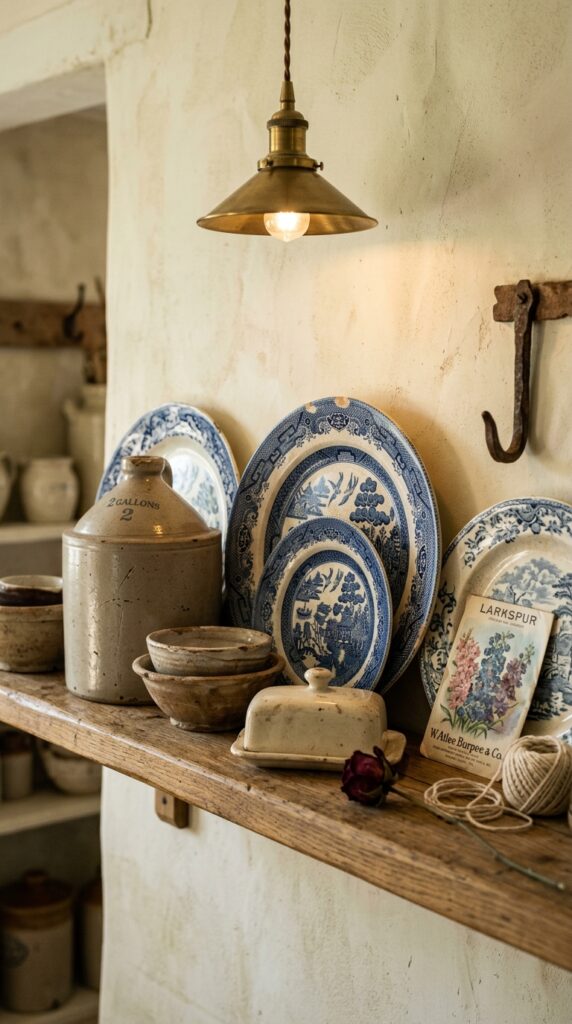
Vibe: Nostalgic — these objects remember something you haven’t experienced, and they carry it quietly.
Why it works: A dedicated display shelf for heirlooms and vintage finds works because it contextualizes age as an asset rather than an imperfection. Grouping objects by shared material (all stoneware) or shared provenance (all the grandmother’s kitchen) rather than shared color creates depth — the eye is drawn to subtle differences in glaze, form, and patina rather than surface matching. This is the design principle of wabi-sabi applied to display: the cracks, chips, and fading are precisely what make these objects worth looking at.
How to get it: Arrange heirlooms in a triangular composition: one tall piece at the back left, one medium at the back right, and one flat or short piece at the front. This creates depth even on a shallow shelf. Leave at least 3 inches of breathing space around the group rather than filling the entire shelf.
💡 Quick Win: Even one thrift-store stoneware crock — $3–$8 at most charity shops — placed among new objects instantly reads as a collected farmhouse find. Look for pieces with simple cream or grey glazes and slight imperfections.
🛍️ Shop the Look — Amazon Product Ideas
| # | Product Search Phrase | Why It Fits |
| 1 | Antique stoneware crock jug farmhouse display | Heirloom-style display vessel |
| 2 | Blue transferware plate vintage style decor | Patterned heirloom accent |
| 3 | Dried rose stem bundle natural display | Nostalgic organic accent |
| 4 | Vintage butter dish ceramic farmhouse style | Antique-look functional display |
| 5 | Aged cream stoneware pitcher set | Heirloom palette ceramics |
25. Organized Open Shelf with Matching Linen Bin Pulls
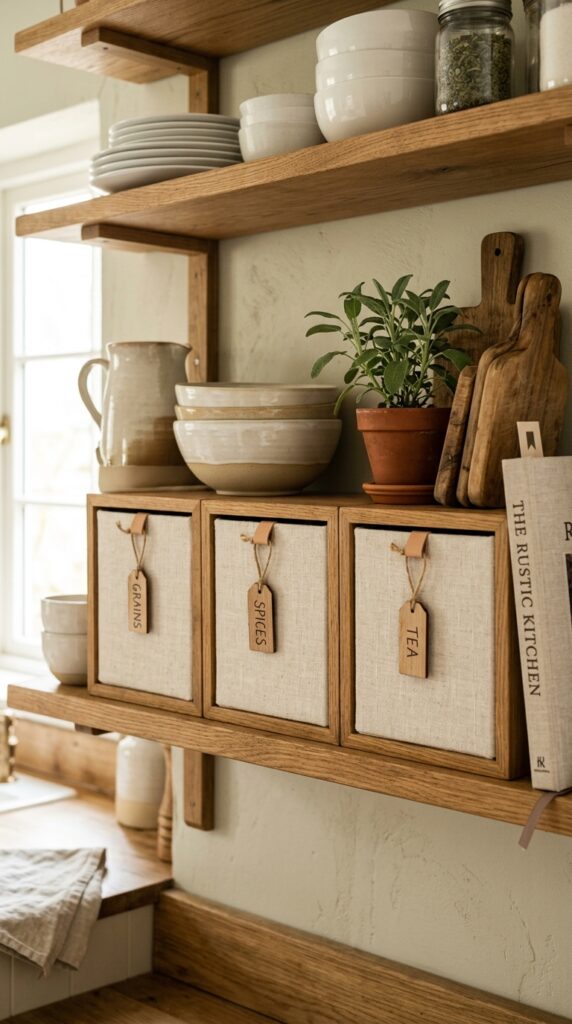
Vibe: Organized — there is clearly a system here, but it wears its system lightly.
Why it works: Mixing open display with partially concealed linen-bin storage is the most practical approach to farmhouse shelving for real kitchens where not everything is photogenic. The linen bins create visual breathing room — the eye stops at the soft, matte surface rather than traveling into the bin’s contents — while the open ceramics and plants between them provide the styled moments. This approach accepts that a working kitchen needs storage, and routes that storage through the aesthetic rather than around it.
How to get it: Use linen bins for: charging cables, takeout menus, spare batteries, kids’ items, pet food bags — anything functional that would disrupt the styled look. Size the bins at shelf height minus 1 inch so they sit flush but can be easily removed. Label them with simple tag labels on natural twine.
🛍️ Shop the Look — Amazon Product Ideas
| # | Product Search Phrase | Why It Fits |
| 1 | Linen fabric storage bin shelf basket label | Core storage-meets-styling bin |
| 2 | Natural twine tag label set farmhouse | Bin labeling detail |
| 3 | Small cream linen basket open storage | Smaller bin variation |
| 4 | Wooden shelf divider kitchen organizer | Between-item structure |
| 5 | Woven seagrass bin with linen liner | Hybrid texture bin |
26. Hanging Shelf from Ceiling with Rope Hardware
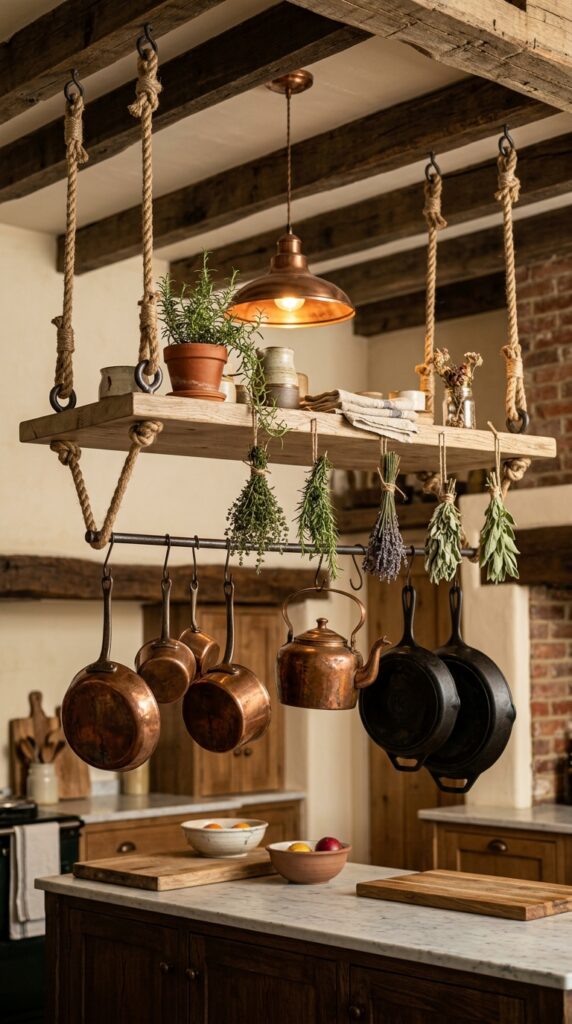
Vibe: Dramatic — it is the only shelf in the room that takes up airspace, and it earns every inch of it.
Why it works: A ceiling-suspended hanging shelf is the most architecturally bold farmhouse shelf option: it occupies the center of the room’s visual field and transforms the ceiling plane from dead space into active composition. The hanging rope introduces an organic material at the highest point in the room, visually connecting the ceiling to the organic materials below. The slight movement of a hanging shelf — any shift of air in the kitchen makes it very gently rotate — is a kinetic quality no wall-mounted shelf can offer.
How to get it: Suspend the shelf from ceiling joists only — not just drywall — using 3/8-inch lag eyes bolted into structural lumber. Use 1-inch diameter manila or hemp rope (not sisal, which sheds and deteriorates quickly in kitchens). Tie the rope using a timber hitch at the shelf and a figure-eight stopper at the ceiling eye — both are adjustable and load-rated for this application.
🛍️ Shop the Look — Amazon Product Ideas
| # | Product Search Phrase | Why It Fits |
| 1 | Ceiling hanging shelf rope wood farmhouse | Core suspended shelf piece |
| 2 | Natural hemp rope 1 inch thick craft | Rope suspension material |
| 3 | S-hook set black metal hanging pot rack | Hanging pot hooks |
| 4 | Copper pot and pan set hanging display | Hanging pot display |
| 5 | Dried herb bundle hanging kitchen ceiling | Ceiling herb display accent |
27. Floating Shelf Unit with Integrated Chalkboard Wall Panel
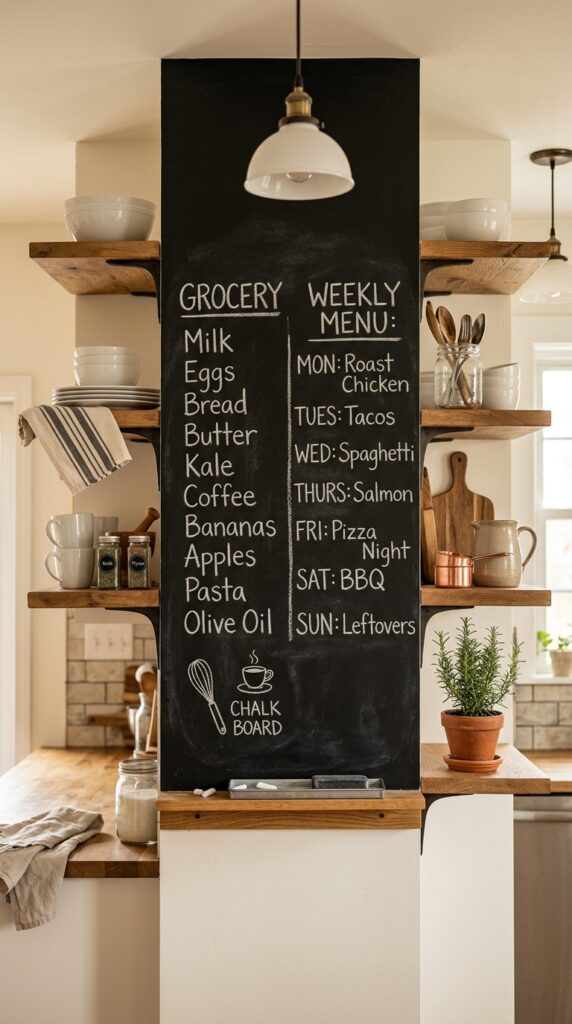
Vibe: Lived-in — a kitchen wall that actually participates in daily life.
Why it works: The chalkboard-plus-shelving wall is a layout idea that combines two farm-kitchen traditions: the message board and the larder display. The matte black chalkboard surface creates a high-contrast anchor between the shelves, making both the written content and the flanking displayed objects more legible. The handwritten text on the chalkboard introduces a human element — no two days this wall looks exactly the same — which is the opposite of the staged, static quality that can make open shelving feel like a prop rather than a lived space.
How to get it: Paint the chalkboard section in Rust-Oleum Chalkboard Paint in “Black” — two coats on a primed wall. After the paint cures (48 hours), “season” the surface by rubbing the flat side of a piece of chalk across the entire area and erasing it; this fills the micro-grain of the surface and prevents ghost impressions from the first writing. Mount shelves on the outer walls 4 inches from the chalkboard edge.
💡 Quick Win: Rust-Oleum Chalkboard Spray Paint ($8–$12) lets you create a small chalkboard section on a 12×12 inch area of existing wall with no brush or roller — ideal for testing the concept before committing to a larger panel.
🛍️ Shop the Look — Amazon Product Ideas
| # | Product Search Phrase | Why It Fits |
| 1 | Chalkboard paint quart matte black wall | Core chalkboard element |
| 2 | Chalk stick set white dust-free thick | Writing surface supply |
| 3 | Small chalk tray ledge shelf wood | Chalk storage on shelf |
| 4 | Natural oak floating shelf flanking set | Flanking shelf pair |
| 5 | White ceramic utensil holder farmhouse | Functional shelf accent |
How to Start Your Farmhouse Kitchen Shelf Transformation
The single most impactful first move is replacing every cabinet knob and drawer pull in your kitchen with matte-black iron hardware — specifically, a simple circular or bar-pull profile in raw or aged black finish. This one change anchors the entire farmhouse palette and makes even white IKEA cabinetry read as intentional and styled. Hardware is the punctuation of a kitchen; change the punctuation and the whole sentence reads differently. It also costs $2–$5 per piece, making it the highest-ROI farmhouse investment available.
The most common beginner mistake is mixing too many wood tones on open shelves — pine shelves with walnut cutting boards, oak brackets with cherry-stained accents, and light grey-washed boards all on the same wall. Farmhouse style is built on warmth and coherence; mismatched wood tones fracture the palette and make shelves look like they were assembled from a thrift-store bargain bin rather than curated. Pick one wood tone as your primary (warm honey pine, cool grey-washed oak, or dark walnut) and let everything else defer to it.
Three items under $50 that create immediate farmhouse shelf impact: (1) A matte-black iron trivet in a traditional round or geometric form, leaned casually against the back of a shelf — around $12–$18. (2) A single bunch of dried pampas grass in a 6-inch stoneware vase, which delivers both height and organic texture for around $20–$30 combined. (3) A flour-sack dish towel in natural white with a thin grey stripe, folded once and draped over a shelf edge or through an S-hook — under $10.
Realistic expectations: A single styled shelf can be completed in a weekend for $50–$150 in materials and objects. A full kitchen open-shelving wall with installed floating shelves runs $300–$700 for a DIY approach; a contractor installation adds $200–$500. A complete farmhouse kitchen transformation — new hardware, shelves, paint, ceramics, and styled accessories — realistically takes 4–8 weekends of phased work and $800–$2,500 depending on how much existing furniture adapts.
Frequently Asked Questions About Farmhouse Kitchen Shelves
What is the difference between farmhouse and rustic kitchen shelves?
Farmhouse and rustic shelving share similar materials but diverge in execution. Rustic style embraces roughness without resolution — raw edges, uneven spacing, reclaimed wood used as found. Farmhouse style curates that roughness: the reclaimed wood gets a clean edge and a sealer coat, the brackets are chosen for visual symmetry, and the objects on display are edited to a considered few. Think of farmhouse as rustic with art direction. Specifically, farmhouse kitchens favor warm neutrals (antique linen, greige, dusty sage) while rustic interiors lean into deeper, earthier tones like bark brown, slate, and forest green.
What color should farmhouse kitchen shelves be?
The most versatile farmhouse shelf color is natural unfinished white oak with a single coat of clear matte sealer — it photographs warmly, works against both white and painted walls, and ages beautifully. If you prefer painted shelves, Benjamin Moore “White Dove” OC-17 (a warm, slightly creamy white) is the most reliable farmhouse choice: it reads as white without the clinical blue-grey undertone that makes standard bright whites feel cold. Sage green (Behr “Dusty Miller” or Farrow & Ball “Mizzle”) is the most popular painted-shelf accent color, offering personality without drama.
How much does it cost to add open farmhouse shelves to a kitchen?
DIY open shelf installation ranges from $40–$150 per shelf depending on wood species and bracket type. A reclaimed pine plank with black iron pipe brackets runs approximately $60–$90 for a single 48-inch shelf including all hardware. A pair of matching floating shelves (without visible brackets) costs $80–$200 for materials. The most significant variable is wood species: common pine is $10–$20 per board, while white oak slabs run $40–$80. Budget an additional $30–$80 for stoneware, dried botanicals, and styling accessories per shelf to complete the look.
Can open farmhouse shelves work in a modern or contemporary kitchen?
Yes, with editing. The key is restraint in the number of shelves and extreme discipline in what’s displayed. In a modern kitchen, limit farmhouse shelving to one accent wall only and choose a cleaner bracket profile — flat steel plate brackets rather than ornate corbels or visible pipe. Keep displayed objects limited to three categories: functional (ceramics, jars), organic (plants, dried stems), and one personal object (a cookbook, a small piece of art). The result is a modern kitchen with warmth rather than a farmhouse kitchen that feels dated in a contemporary space.
What should you put on farmhouse kitchen open shelves?
The best farmhouse open shelf styling combines three layers: functional items that are also attractive (white stoneware, glass mason jars, wooden cutting boards), organic elements (potted herbs, dried botanicals, a single stem in a bud vase), and one textural anchor (a folded linen towel, a woven basket, or a stack of cloth napkins). Always include at least one item with height (a tall jar, a pitcher, a plant) and one item with depth (a stacked set of plates or bowls). The common mistake is displaying only pretty objects and none of the functional ones — a shelf that looks too styled loses the honest, working-kitchen quality that is farmhouse’s entire appeal.
Ready to Create Your Dream Farmhouse Kitchen?
These 27 ideas span every dimension of farmhouse open shelving — from material choices like reclaimed pallet wood and dark walnut to layout strategies like corner installations and ceiling-hung rope shelves, from color approaches in sage green and charcoal to small-space solutions with full-height towers and minimalist two-shelf arrangements. Transformation doesn’t require a complete kitchen renovation — and beginning with a single shelf styled with three objects is not a compromise, it’s the correct strategy. Start today by ordering a set of wide-mouth mason jars, one bundle of dried eucalyptus, and a piece of clear-sealed pine board: that is a complete first shelf. When the space feels done — when you walk into your kitchen and it exhales rather than overwhelms — you’ll recognize the farmhouse promise kept: a kitchen that looks like it belongs to someone who actually cooks in it. Save your favorites now, especially the ideas where the material choices surprised you — those are usually the ones worth stealing first.