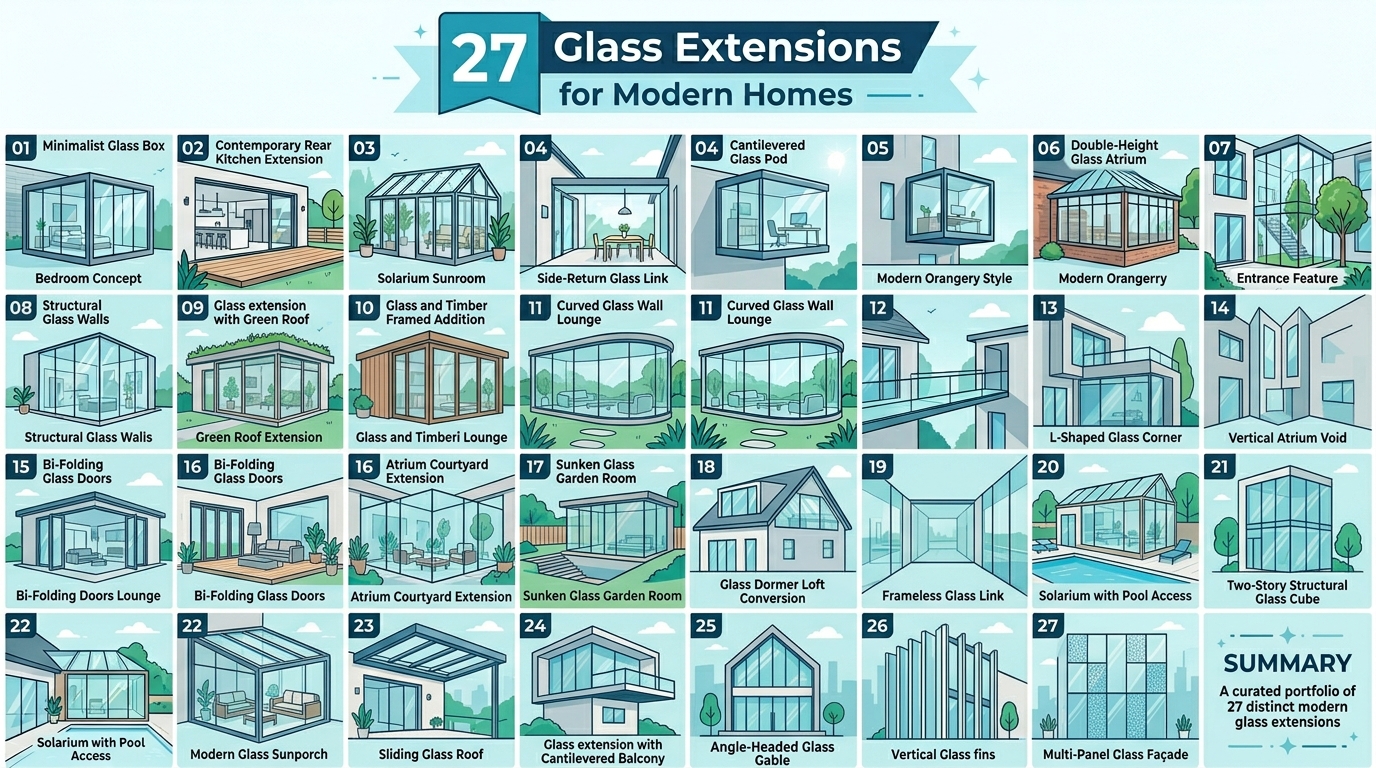
A glass extension is a purpose-built structural addition to an existing home that uses floor-to-ceiling or predominantly glazed walls and roof panels to create a light-flooded living space seamlessly connected to the garden or landscape beyond. This article gives you 27 specific, detailed ideas covering every type of glass extension — from rear kitchen additions and wraparound garden rooms to rooflight-topped orangeries and frameless corner glazing — with design principles, material guidance, and product suggestions for each.
There is a quality of light that only glass architecture delivers — the kind that shifts through the day, that makes you aware of weather as a visual event rather than an inconvenience, that dissolves the boundary between the warmth inside and the cool world just beyond the pane. A glass extension doesn’t just add square footage. It changes how the original house breathes, how the kitchen reads in the morning, how a grey November afternoon feels from the sofa. Here are 27 ideas worth saving — and stealing.
Why Glass Extension Design Works So Well for Modern Homes
The glass extension as a residential building typology has deep roots in the 19th-century tradition of the conservatory and orangery — structures built to bring the garden inside and extend the season of outdoor living. Contemporary glass extension design draws from three overlapping movements: the International Style’s belief in structural transparency and the dissolution of the interior-exterior boundary; Scandinavian functionalism’s insistence that daylighting is a health and wellbeing necessity rather than a luxury; and the current sustainability movement’s embrace of passive solar gain as a heating strategy. What distinguishes a modern glass extension from a traditional conservatory is the quality of the frame — the shift from white-painted Victorian ironwork to slim-profile thermally broken aluminium that achieves near-invisible structural lines.
The material vocabulary of the contemporary glass extension is precise. Frames are almost universally powder-coated aluminium in RAL 9005 (jet black), RAL 7016 (anthracite grey), or warm bronze — all colours that recede visually against glazing rather than asserting themselves. Glass is typically 28mm argon-filled double glazing or 44mm triple glazing for roof panels, specified to achieve a U-value of 1.0 W/m²K or better. Structural silicone joints replace visible frame profiles at corners, creating the frameless detail that defines the premium end of the market. Internally, polished concrete, large-format porcelain tile, and white-oiled oak are the flooring materials most frequently specified because they carry passive solar heat effectively and read as continuous planes with the garden threshold.
The cultural momentum behind glass extensions has never been stronger — a convergence of planning policy reform (many single-storey rear extensions now proceed under permitted development rights in the UK and equivalent approvals pathways elsewhere), a post-pandemic revaluation of home as a working, living, and socialising environment, and the rising cost of moving driving homeowners to transform rather than relocate. Architectural searches for “rear glass extension,” “kitchen glass extension,” and “frameless glass box” have grown dramatically across Pinterest, Houzz, and architectural practice websites over the past four years.
Even modestly sized properties — terraced houses, bungalows, compact semi-detached homes — can achieve genuine architectural quality with a glass extension. The key principle for smaller structures is to prioritise the quality of the glazing over the quantity. A 15-square-metre glass addition with frameless corners, a structural glass roof, and seamless floor continuity delivers more spatial transformation per pound spent than a 30-square-metre extension with visible white uPVC frames and a polycarbonate roof panel.
| Element | Core Trait 1 | Core Trait 2 |
| Philosophy | Structural transparency, dissolved boundaries | Passive solar, biophilic connection |
| Materials | Thermally broken aluminium, argon-filled glass | Concrete, white oak, large-format porcelain |
| Color palette | RAL 9005 jet black, anthracite grey, warm bronze | White oak, polished concrete, warm stone |
27 Glass Extension Ideas
1. Rear Kitchen Glass Box with Rooflight Strip
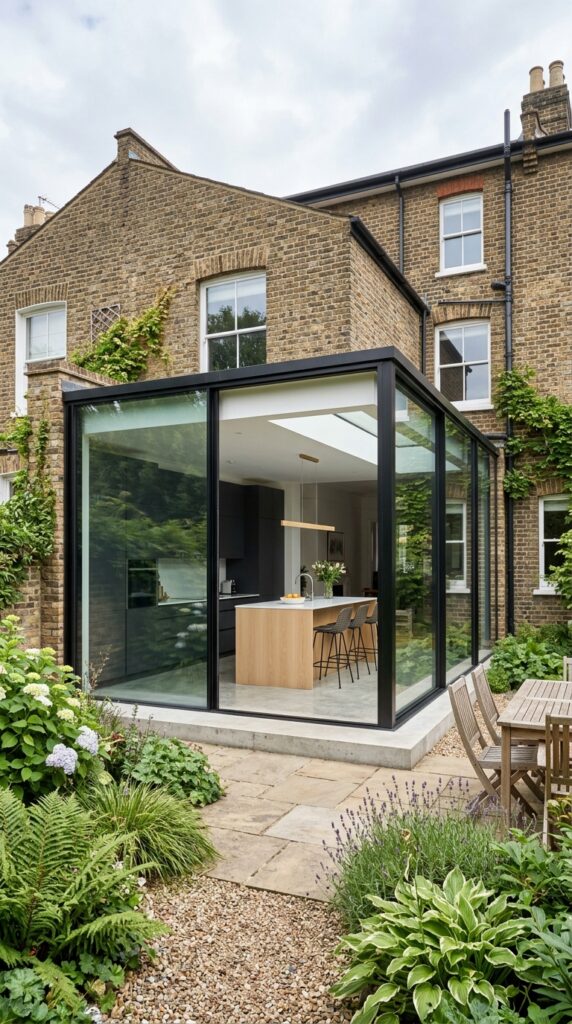
Vibe: Airy and architecturally resolute — a kitchen that belongs to the garden as much as to the house.
Why it works: The rooflight strip running the full ridge of the extension is the defining element — it delivers overhead zenithal light that no side window can replicate, illuminating the kitchen from above at the angle that makes food preparation, surface textures, and material tones most visually clear. The black aluminium frame creates deliberate contrast against the buff brick of the existing Victorian house, signalling the extension as a contemporary addition rather than an attempt to mimic the original fabric — an honest architectural approach that reads better with age than colour-matching does. Floor-to-ceiling glazing on three sides eliminates the visual wall between the kitchen and garden, making the room feel three to four times larger than its footprint.
How to get it: Specify a thermally broken aluminium system with a minimum frame profile of 50mm — slimmer profiles are available but require careful structural calculation in large spans. The rooflight strip should be double-glazed with a solar control coating (typically a low-e coating on surface 2 of the outer pane) to prevent summer overheating without reducing winter light gain. Combine with underfloor heating beneath the polished concrete to offset heat loss through the large glazed area.
💡 Quick Win: A single continuous rooflight strip in an existing flat-roof extension — retrofitted into the existing roof structure by a glazing specialist — typically costs £2,500–4,500 and transforms the quality of light in the space more dramatically than any other single intervention.
🛍️ Shop the Look — Amazon Product Ideas
| # | Product Search Phrase | Why It Fits |
| 1 | thermally broken aluminium rooflight 1000x2000mm | Ridge light source |
| 2 | underfloor heating mat electric 3.5m2 | Glass room floor warming |
| 3 | polished concrete microcement floor kit | Seamless indoor-outdoor floor |
| 4 | solar control window film low-e self adhesive | Overheating prevention |
| 5 | matte charcoal kitchen cabinet handle bar pull | Frame-matching hardware |
2. Frameless Glass Corner Extension
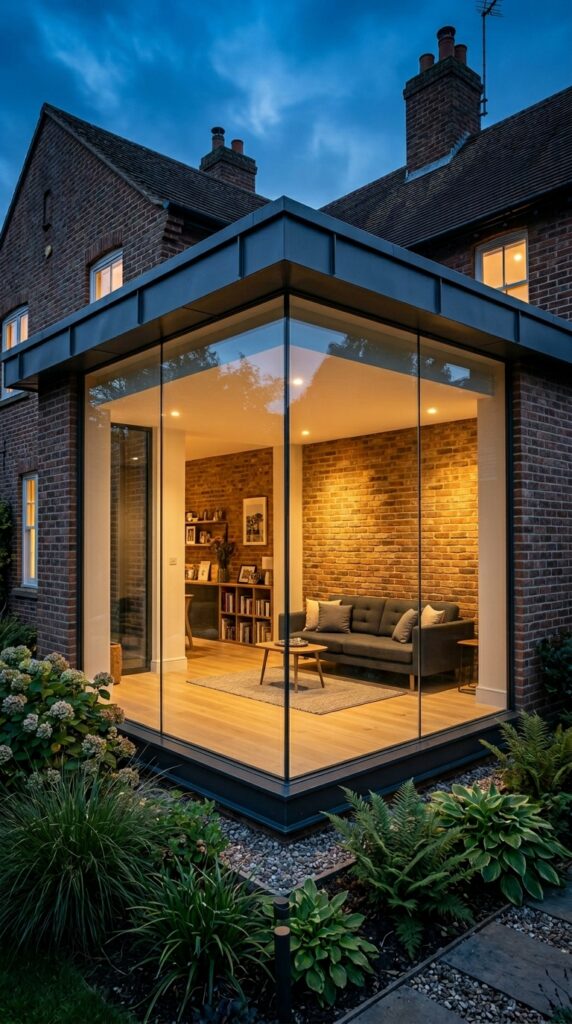
Vibe: Quietly dramatic and architecturally precise — the kind of detail that makes other architects stop and look.
Why it works: The frameless glass corner is the single most technically demanding and visually impactful detail in contemporary residential glazing. Eliminating the corner post requires each glass panel to be bonded to a thin structural steel fin concealed within the floor and ceiling construction, with the silicone joint carrying the structural lateral load at the corner. The design principle is structural minimalism: when the frame disappears, the view becomes the architecture. At dusk, the contrast between the warm interior glow and the cool exterior sky makes the frameless corner glow like a cut gemstone — the silicone joint becomes a glinting line rather than a post.
How to get it: Frameless corner glazing requires toughened laminated safety glass of at least 17.5mm thickness — typically a 8.8.4 or 10.10.4 laminate specification. The structural silicone must be specified to the glazing manufacturer’s load tables for the exact panel dimensions. This is a specialist installation requiring an approved glazing contractor — not a standard double-glazing company. Budget significantly above standard framed glazing; the frameless corner premium typically adds 40–60% to the glass cost alone.
🛍️ Shop the Look — Amazon Product Ideas
| # | Product Search Phrase | Why It Fits |
| 1 | structural silicone sealant clear UV stable | Corner joint bonding |
| 2 | glass fin bracket stainless spider fitting | Structural glass support |
| 3 | toughened laminated glass panel custom cut | Safety glass specification |
| 4 | warm white LED recessed downlight IP65 | Interior evening lighting |
| 5 | pale oak engineered floor plank 190mm | Interior floor coordination |
3. Wraparound Single-Storey Glass Extension
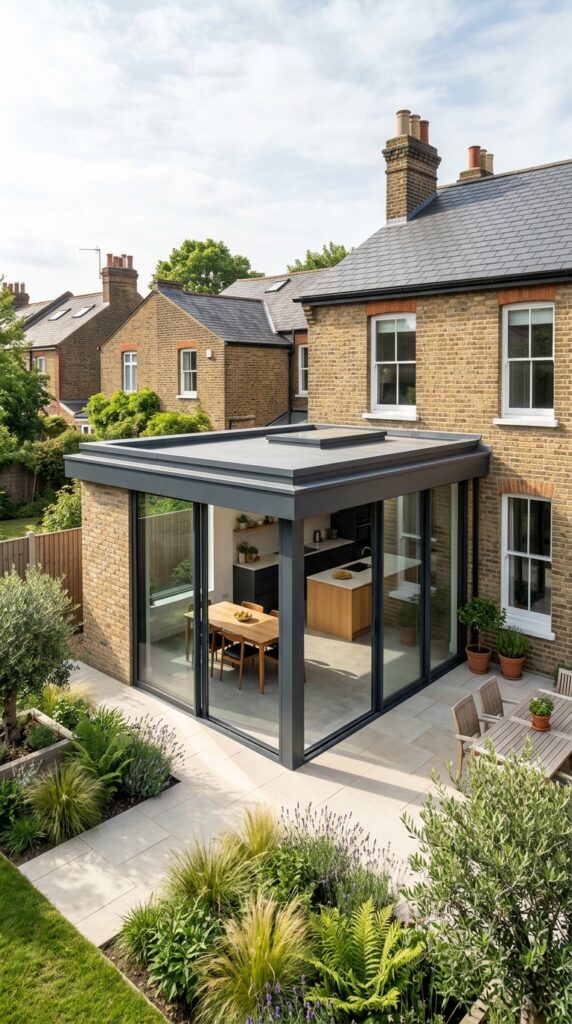
Vibe: Resolved and generous — a house that has finally been given the ground floor it always needed.
Why it works: The wraparound extension that fills both the rear footprint and the side return of a Victorian terrace is the most spatially transformative single-storey addition available to this house type. By incorporating the typically narrow and dark side return passage into the extension volume, it creates a kitchen-dining space that is wide enough for an island and a full dining table while maintaining garden access through full-height sliding doors. The anthracite grey frame (RAL 7016) is a deliberate tonal bridge between the black mortar joints of the original buff brick and the new structure — it coordinates without matching.
How to get it: A wraparound extension on a semi-detached house typically requires a Party Wall Agreement with the neighbouring property before work can begin, in addition to planning permission or permitted development notification. The box gutter at the junction of the flat roof and the existing house wall is the most critical waterproofing detail — specify an EPDM rubber liner rather than felt in the gutter channel, as it has a 50-year service life versus 20 years for traditional felt.
🛍️ Shop the Look — Amazon Product Ideas
| # | Product Search Phrase | Why It Fits |
| 1 | EPDM rubber roofing membrane flat roof kit | Flat roof waterproofing |
| 2 | anthracite grey aluminium bifold door 3m | Wraparound garden access |
| 3 | limestone paving slabs 600x900mm | Threshold continuation |
| 4 | box gutter aluminium outlet 110mm | Rainwater drainage |
| 5 | LED strip light warm white 3000K waterproof | Soffit downlighting |
4. Black Steel and Glass Garden Room Extension
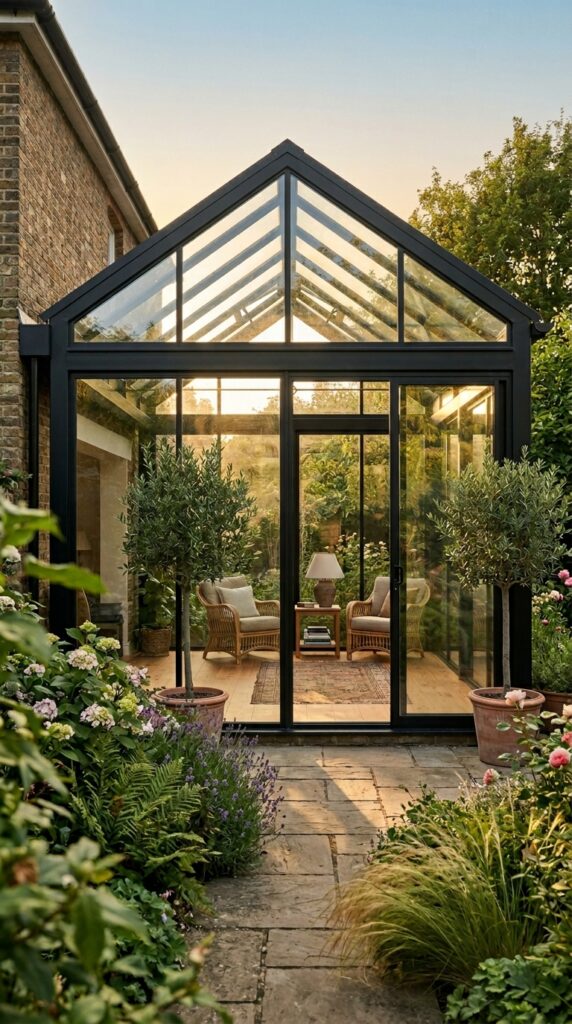
Vibe: Warm and crafted — a garden room that sits at the intersection of greenhouse and library.
Why it works: The steel-framed garden room extension occupies a different design register than aluminium-framed systems — where aluminium reads as precision-engineered and contemporary, mild steel reads as hand-fabricated and artisanal. The visible structural logic of the steel frame (uprights, transoms, a pitched ridge) references the 19th-century glasshouse tradition while the RAL 9005 matt black finish grounds it firmly in the contemporary. Douglas fir flooring inside is a deliberate material choice — its warm orange-brown tone contrasts with the black frame and complements rattan and linen furnishings that define the garden room aesthetic.
How to get it: Mild steel used for structural glazing must be hot-dip galvanised before painting to prevent rust progression behind the paint film — this is non-negotiable for longevity in a structure that will experience significant condensation cycling. The galvanising adds cost but prevents the rusting-from-inside failure mode that plagued Victorian conservatories. Apply a zinc-rich primer over the galvanised surface before the final RAL topcoat.
💡 Quick Win: A prefabricated steel-framed garden room kit (available from specialist UK suppliers in standard widths of 3m, 4m, and 5m) includes the structural frame, glazing, and roof as a flat-pack system that experienced builders can erect in 5–7 days, at significantly lower cost than a fully bespoke commission.
🛍️ Shop the Look — Amazon Product Ideas
| # | Product Search Phrase | Why It Fits |
| 1 | RAL 9005 matte black metal paint spray | Steel frame finishing |
| 2 | zinc rich primer galvanised steel | Rust prevention primer |
| 3 | Douglas fir solid wood flooring 18mm | Warm interior floor |
| 4 | rattan lounge chair indoor outdoor | Garden room furnishing |
| 5 | steel door handle bar pull matte black | Frame-matching hardware |
5. Pitched Glass Roof Extension on a Flat Roof Base
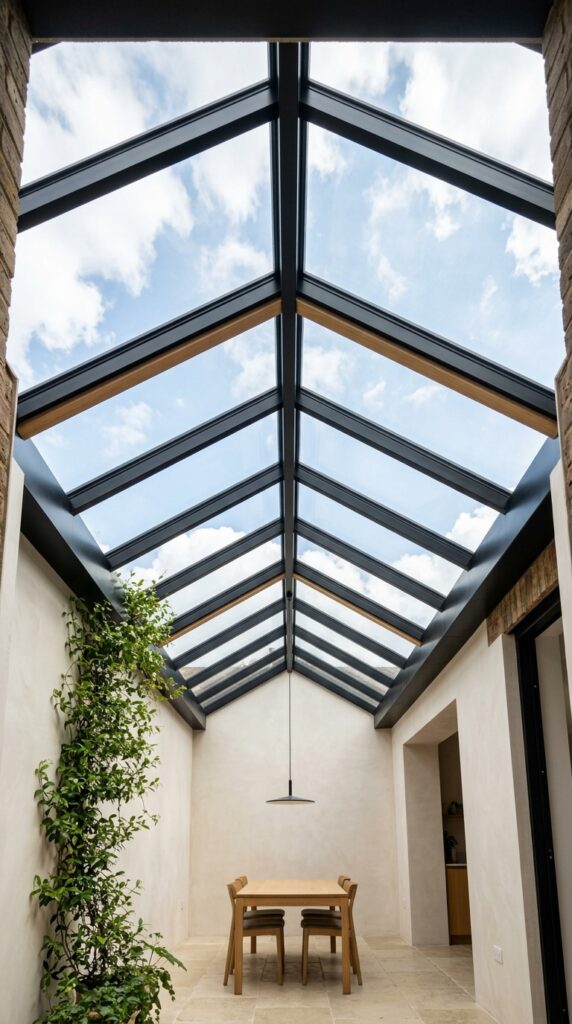
Vibe: Luminous and still — the feeling of dining under the sky while remaining completely inside.
Why it works: A pitched glass roof extension — the modern incarnation of the Victorian orangery — delivers the most dramatic overhead light experience available in residential design while maintaining the solid masonry walls that provide thermal mass, acoustic privacy, and structural simplicity. The pitch angle (25 degrees) is the optimal balance between maximising winter sun penetration (low sun angle requires steeper pitch) and limiting summer solar gain (flatter pitches are more forgiving). The solid brick side walls also allow for concealed electrical and services runs that a fully glazed extension cannot accommodate without exposed conduit.
How to get it: Specify self-cleaning glass for the roof panels — a photocatalytic coating breaks down organic deposits in UV light and allows rain to sheet off cleanly, reducing roof-cleaning maintenance to an annual inspection rather than a seasonal task. The ridge beam must be sized by a structural engineer — a 25-degree pitched glass roof in a 4m × 4m plan generates significant lateral thrust at the eaves that the side walls and ridge connection must be designed to resist.
🛍️ Shop the Look — Amazon Product Ideas
| # | Product Search Phrase | Why It Fits |
| 1 | self-cleaning glass coating spray UV active | Roof panel maintenance |
| 2 | black aluminium ridge beam section 3m | Roof structural element |
| 3 | pendant light industrial style adjustable cable | Ridge beam hanging light |
| 4 | polished plaster venetian finish kit | Interior wall surface |
| 5 | limestone floor tile 600x600mm natural | Interior floor material |
6. Glass Extension with Exposed Concrete Structural Frame
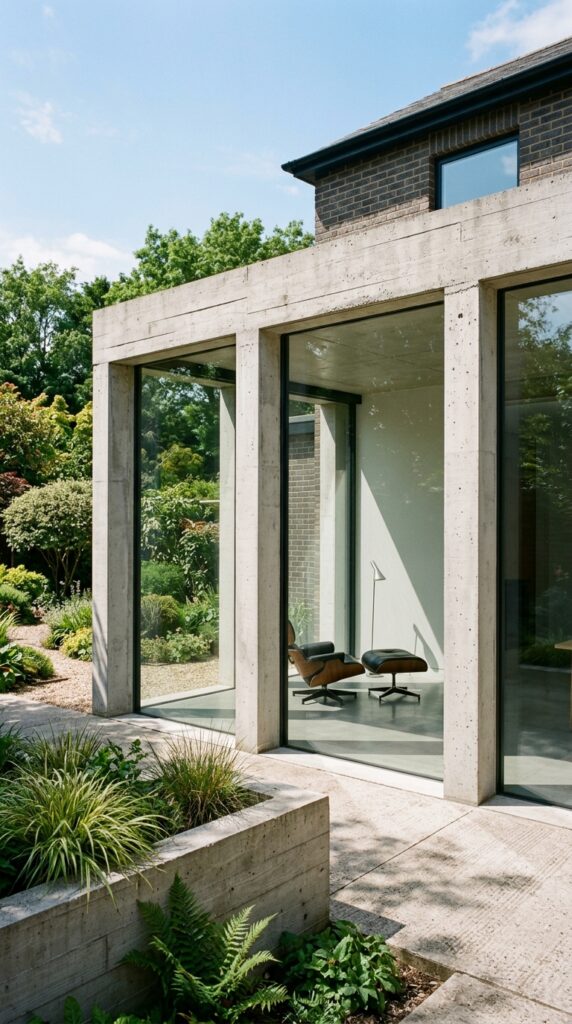
Vibe: Raw and architecturally serious — a glass extension that makes no apologies for what it is made of.
Why it works: Using board-marked fair-face concrete as the visible structural frame of a glass extension is the Brutalist tradition applied to a domestic scale — the material is the architecture, and its making is legible in the finished surface. Board-marked concrete (poured against rough-sawn timber formwork that leaves a wood-grain impression in the set concrete) introduces warmth and texture into what could be a cold material. The concrete columns define the bay widths of the glazing without requiring aluminium frames — the glass is fixed directly into metal channels cast into the concrete face, eliminating the frame-within-frame layering of conventional glazed extensions.
How to get it: Board-marked fair-face concrete requires careful formwork construction and a skilled concrete pour — surface defects (honeycombing, colour variation) are difficult to correct after striking the formwork. Specify a test pour panel before the structural concrete is poured to confirm the board pattern, concrete mix colour, and release agent combination that achieves the desired finish.
🛍️ Shop the Look — Amazon Product Ideas
| # | Product Search Phrase | Why It Fits |
| 1 | concrete sealer matte penetrating fair face | Surface protection finish |
| 2 | glass channel section 25mm aluminium | Glass-to-concrete fixing |
| 3 | Eames lounge chair replica walnut leather | Interior design anchor |
| 4 | low concrete outdoor planter large | Threshold accent piece |
| 5 | polished concrete self-levelling floor compound | Interior floor finish |
7. Bifold Door Wall Opening Kitchen to Garden
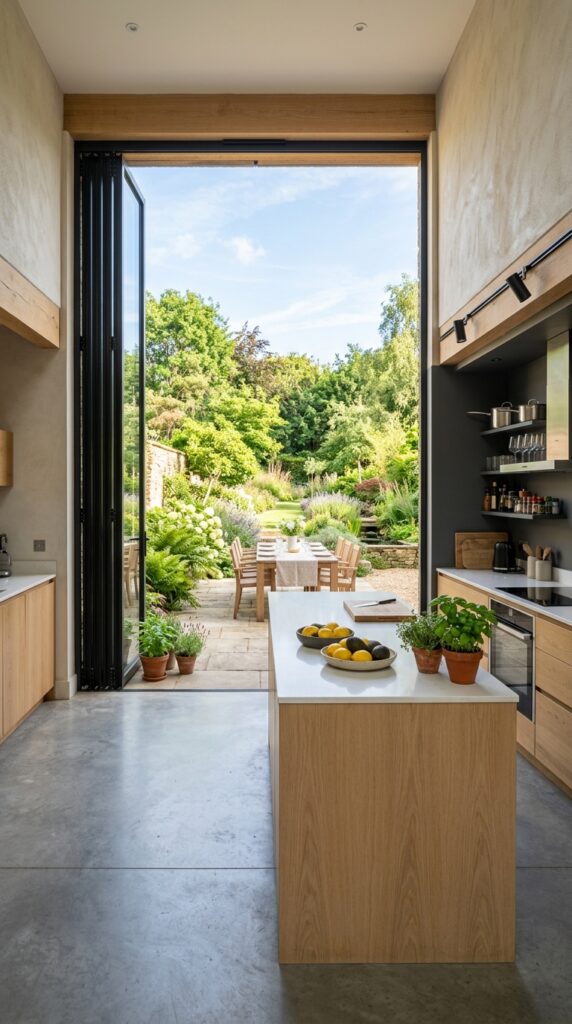
Vibe: Open and luminous — the kitchen and garden becoming a single room that breathes.
Why it works: A full-width bifold door wall achieves what no fixed glazing system can — the complete physical removal of the boundary between interior and exterior. When all six panels are folded and stacked, the kitchen becomes an open-sided pavilion with no threshold interruption beyond the flush stone step. The design principle is spatial continuity: the eye and body read inside and outside as one zone, which psychologically expands the perceived size of the kitchen to include the full patio depth. The single flush limestone threshold step (rather than a raised track) is critical — raised tracks create a trip hazard and a visual interruption that reinstates the boundary the bifold system is meant to dissolve.
How to get it: A 6-panel bifold door system in a 4.8-metre opening requires a structural steel beam above the opening to carry the wall load — this is non-negotiable regardless of what a door supplier might suggest. Specify a thermally broken aluminium system with a multipoint locking mechanism on the traffic door (the hinged leaf that operates as a normal door without opening the full system) for security when only partial opening is needed.
🛍️ Shop the Look — Amazon Product Ideas
| # | Product Search Phrase | Why It Fits |
| 1 | black aluminium bifold door 4800mm 6 panel | Full-width wall system |
| 2 | flush door threshold bar low profile aluminium | Trip-free transition |
| 3 | structural steel RSJ beam 4m 127×76 | Opening support beam |
| 4 | limestone patio slab 600x900mm natural | Threshold continuation |
| 5 | multipoint lock handle bifold door | Security traffic door |
8. Glass Extension as a Garden-Facing Dining Room
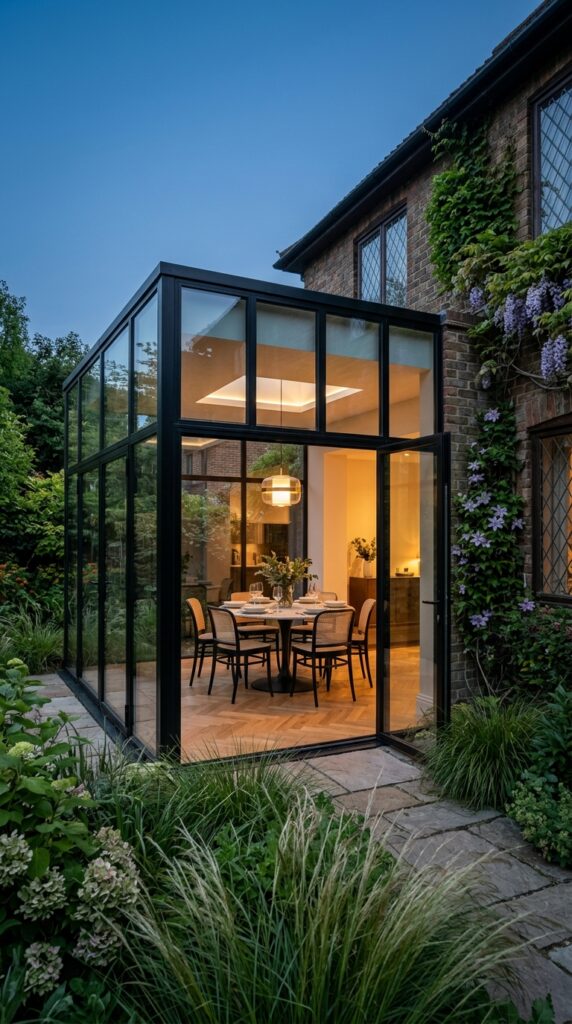
Vibe: Warm and intimate — a dining room where the garden is always a guest at the table.
Why it works: Separating the dining function from the kitchen into a dedicated glass pavilion resolves the acoustic and olfactory conflict of combined kitchen-dining spaces while maximising each room’s relationship to the garden. The dining extension, used for the longest seated durations of any room in the home, benefits most from all-round garden connection — the biophilic effect of dining with views to planted landscape on three sides is measurably different from eating in a room with one garden-facing window. Centring a rooflight directly over the dining table creates a natural celestial focal point above the table that reinforces the sense of gathering below light.
How to get it: The rooflight above the dining table requires a blackout blind — morning or summer sun directly overhead on a table is functionally uncomfortable. Specify a remote-controlled pleated blind fitted within the rooflight frame (most quality rooflight manufacturers offer this as a factory-fitted option) so it can be deployed without needing to reach the ceiling. The blind should be a warm linen tone rather than white to maintain the amber quality of the interior light when it is closed.
🛍️ Shop the Look — Amazon Product Ideas
| # | Product Search Phrase | Why It Fits |
| 1 | rooflight pleated blackout blind remote control | Overhead glare control |
| 2 | round marble dining table 1200mm diameter | Dining room anchor piece |
| 3 | rattan dining chair indoor set of 4 | Warm dining seating |
| 4 | herringbone engineered oak floor 90mm | Interior floor pattern |
| 5 | pendant light adjustable cable black brass | Table overhead lighting |
9. Glass Extension with Living Green Wall on the Return
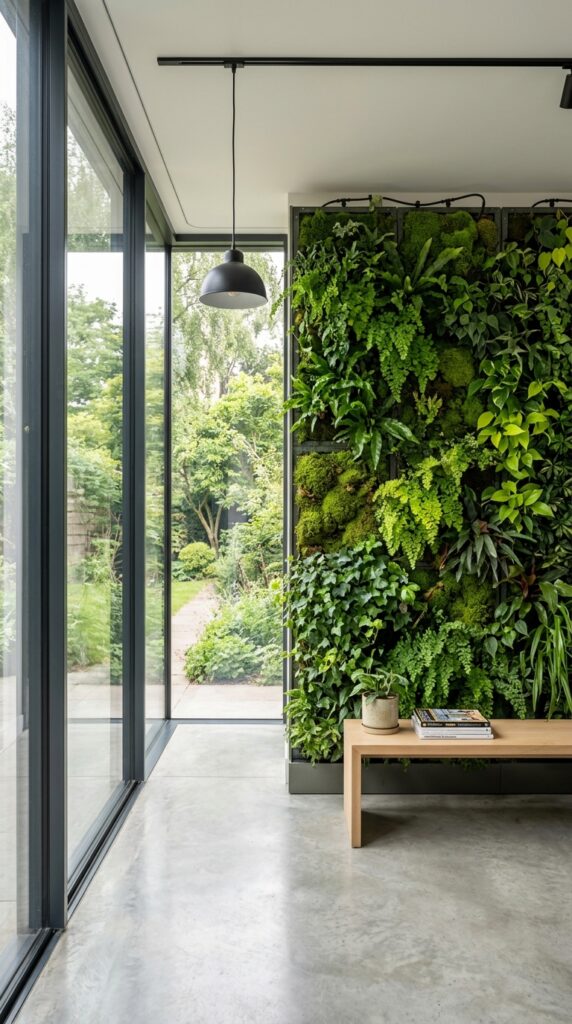
Vibe: Lush and serene — a room where the outside has successfully invaded and won.
Why it works: Placing a living green wall on the solid return wall of a glass extension creates a counterpoint between the man-made transparency of the glazed walls and the organic depth of the planted surface — transparency versus texture, manufactured versus grown. The living wall introduces biophilic depth into the one solid surface of an otherwise all-glass room, which prevents the space from reading as a void. It also provides acoustic benefit — the planted substrate and leaf surfaces absorb sound significantly better than hard plaster, reducing the echo that glass-dominant rooms often generate.
How to get it: A modular panel living wall system (brands such as ANS Global or Mobilane) is more practically reliable than direct-planted felt pocket systems — the modular approach allows individual panels to be replaced if a section fails without dismantling the entire wall. Specify a drip-tray system with a drain connection rather than a recirculating system in an interior application — recirculating systems require more maintenance and can develop odour if the pump cycles intermittently.
🛍️ Shop the Look — Amazon Product Ideas
| # | Product Search Phrase | Why It Fits |
| 1 | modular living wall planter panel indoor | Green wall system base |
| 2 | automatic drip irrigation kit wall planter | Living wall watering |
| 3 | fern mixed assortment indoor plant set | Green wall planting |
| 4 | moss panel preserved wall art large | Low-maintenance green accent |
| 5 | grow light LED full spectrum strip | Supplementary plant lighting |
10. Slim-Line Side Extension with Rooflight Gallery
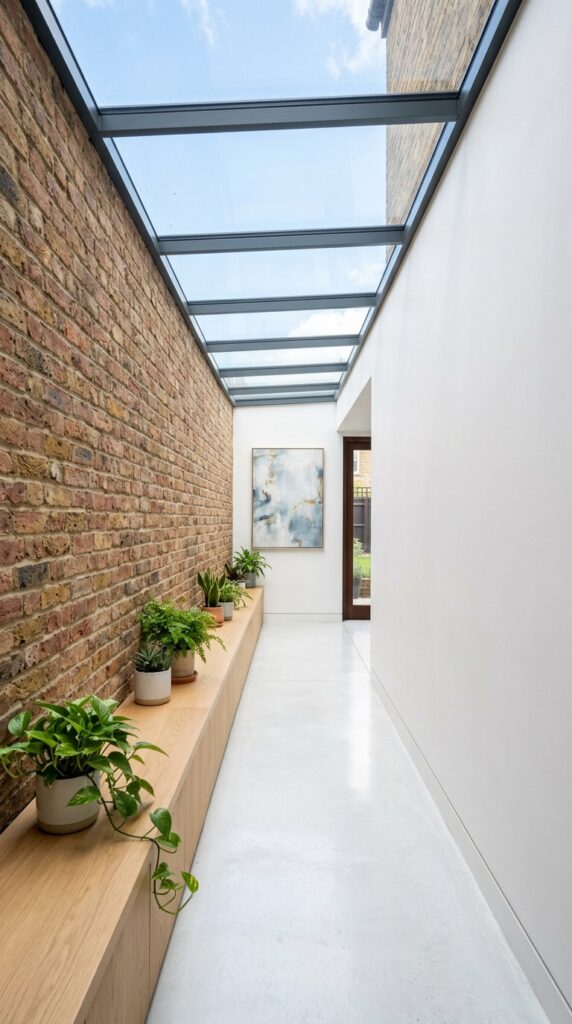
Vibe: Luminous and quietly transformative — a narrow passage that becomes the most light-filled room in the house.
Why it works: The side-return infill with a full-length rooflight is the definitive transformation for the Victorian terrace typology — it converts what was a dark and narrow external passage into the brightest interior space in the home. The principle at work is zenithal lighting: overhead light from a rooflight running perpendicular to the original floor level creates a quality of illumination that no lateral window can replicate, flooding the space with light that reaches the full depth of the extension regardless of the time of day. Exposing and sealing the original brick on one wall introduces the building’s material history into the new space, creating a conversation between old and new.
How to get it: A full-length rooflight in this configuration sits at a low pitch above the side-return (typically 3–5 degrees for drainage) and requires a separate structural frame to carry the glazing loads independent of the original party wall. Do not assume the party wall can carry roof loads — commission a structural engineer to assess the original wall condition and design the new roof independently if necessary.
💡 Quick Win: In an existing side return that already has a polycarbonate or felt roof, replacing only the roof covering with a quality rooflight system while retaining the existing walls costs £8,000–15,000 and delivers a transformation that reads as a full architectural renovation at a fraction of the cost.
🛍️ Shop the Look — Amazon Product Ideas
| # | Product Search Phrase | Why It Fits |
| 1 | full length rooflight flat glass 2000x4000mm | Gallery roof light source |
| 2 | brick sealer clear matte penetrating | Exposed brick interior |
| 3 | built-in bench cushion custom linen | Gallery seating surface |
| 4 | white microcement plaster wall kit | Smooth wall finish |
| 5 | Velux rooflight electric opening remote | Ventilation in roof light |
11. Glass Box Study Extension with Planted Surround
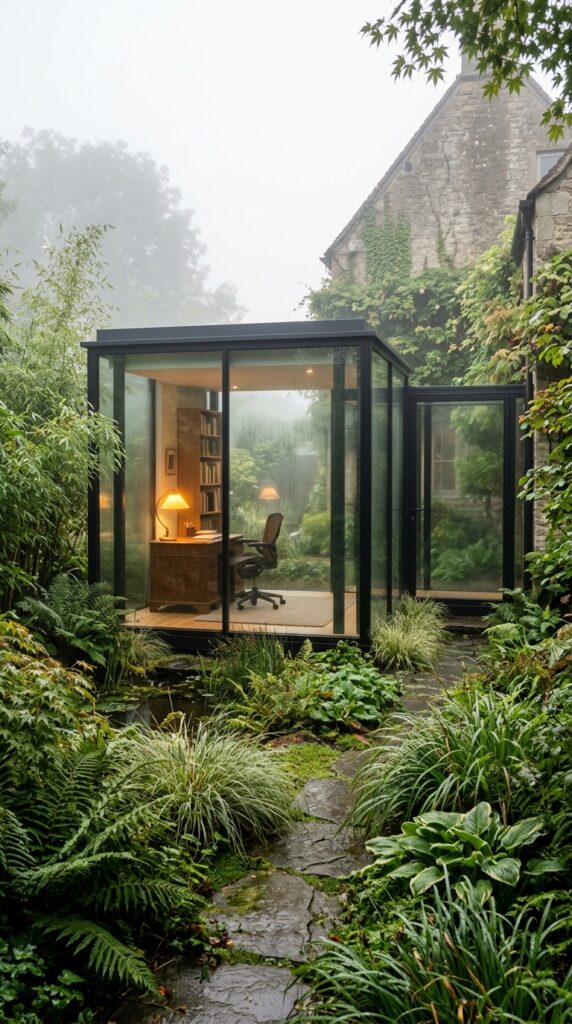
Vibe: Serene and contemplative — a workspace where distraction is structurally impossible.
Why it works: The detached glass garden study — a small pavilion connected by a glazed link — physically separates the workspace from the domestic life of the house while maintaining weather-protected connection, resolving the fundamental contradiction of working from home. Surrounding the glass box with dense planting on three sides solves the exposure problem of four-sided glazing — the planted perimeter provides privacy from neighbours while creating a botanical surround that changes character across the seasons, making the view from the desk a living screen rather than a static backdrop.
How to get it: A glazed link connector between house and garden room must be designed for differential movement — the house foundation and the garden room foundation will settle and move independently, and a rigid connection will crack. Specify a flexible silicone expansion joint at both connection points rather than a rigid bond, and ensure the link roof has its own independent drainage.
🛍️ Shop the Look — Amazon Product Ideas
| # | Product Search Phrase | Why It Fits |
| 1 | garden room glass office kit 3x4m | Study pavilion base unit |
| 2 | bamboo plant screening tall outdoor pot | Privacy planting screen |
| 3 | architect desk lamp LED adjustable arm | Warm study task light |
| 4 | silicone expansion joint sealant flexible | Link movement allowance |
| 5 | floating wall shelf oak 800mm | Interior book storage |
12. Glass Extension with Exposed Steel Roof Trusses
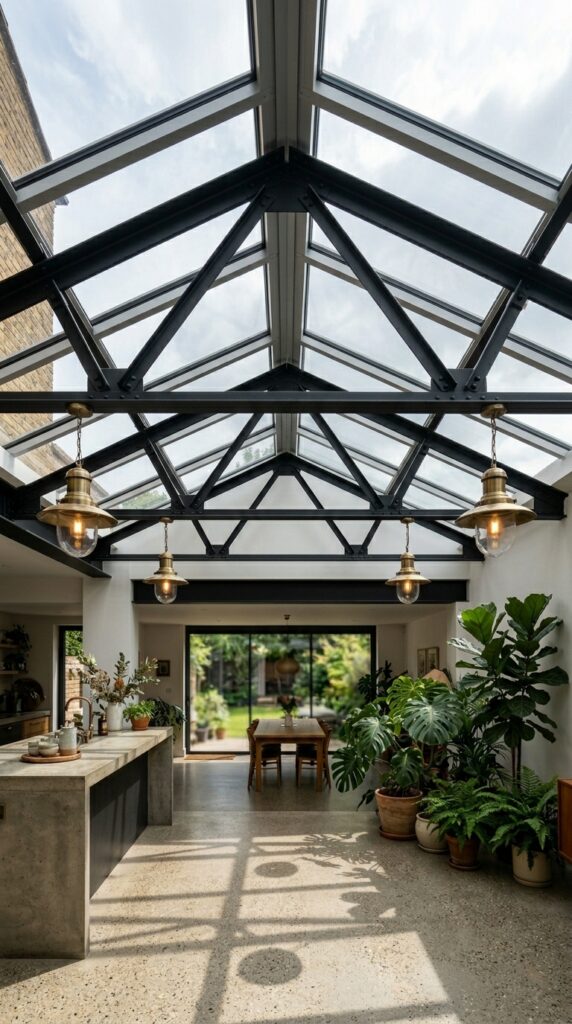
Vibe: Industrially beautiful and warmly human — a glass extension that feels like a converted factory and a home simultaneously.
Why it works: Exposed structural steel trusses above a glass roof create a secondary spatial layer — the eye reads the truss geometry as an interior ceiling plane that defines the room before it reaches the glazing above. The geometric shadow patterns cast by the truss members on the interior floor change throughout the day as the sun angle shifts, making the floor a sundial that passively marks the passing of time. Hanging pendant lights from the lower truss chord brings the lighting to a comfortable height without requiring a suspended ceiling and allows the industrial quality of the space to remain legible above.
How to get it: Roof trusses specified to span a glass roof must be designed as a primary structural system independent of the glazing — the glazing frame carries only its own weight and wind loads and must not be relied upon for any structural contribution to the truss span. This requires a structural engineer’s design for both the truss system and the connection details at the eaves walls.
🛍️ Shop the Look — Amazon Product Ideas
| # | Product Search Phrase | Why It Fits |
| 1 | industrial pendant light aged brass 3 pack | Truss hanging lights |
| 2 | matte black paint spray metal heat resistant | Truss frame finishing |
| 3 | concrete counter top mix self-pour kit | Kitchen surface material |
| 4 | large indoor plant fiddle leaf fig 1.5m | Floor botanical accent |
| 5 | floor standing concrete planter large | Plant display base |
13. Glass Extension with Anthracite Frame and Bronze Accents
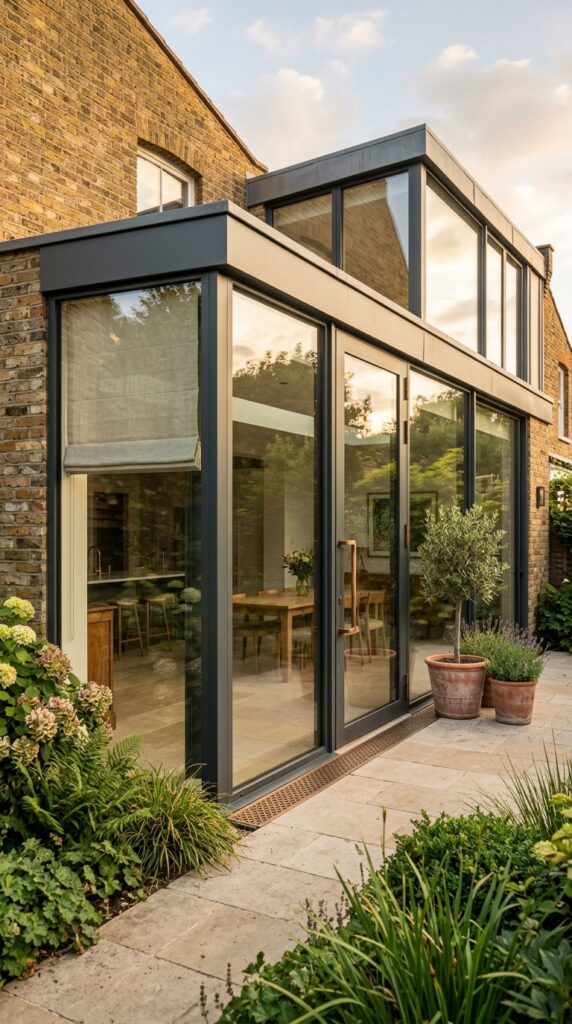
Vibe: Warm and considered — an extension that gets more interesting the closer you stand to it.
Why it works: The anthracite frame with bronze hardware accents is a materials pairing that operates on the design principle of tonal warmth within a cool primary palette — the grey frame recedes while the bronze details advance, creating a foreground layer of warmth that prevents the anthracite from reading as cold or corporate. Bronze patinates naturally over time, developing a warm, irregular surface that becomes more beautiful with age — unlike chrome or stainless steel finishes that simply become dull. The full-height pivot door is the critical theatrical element: it creates a door experience that is entirely different from a hinged door, one that announces the extension’s quality through the mechanism of entry.
How to get it: Solid bronze door furniture (handles, hinges, letterplates) is available from specialist architectural ironmongers — specify unlacquered bronze so the natural patination process can proceed. Living finish bronze develops a darker, more complex surface tone within 12–18 months of outdoor exposure, shifting from the initial bright gold-brown toward a richer reddish-brown.
🛍️ Shop the Look — Amazon Product Ideas
| # | Product Search Phrase | Why It Fits |
| 1 | solid bronze door lever handle unlacquered | Living finish hardware |
| 2 | full height pivot door hinge floor spring | Theatrical entry mechanism |
| 3 | linear shower drain channel bronze cover | Threshold drainage detail |
| 4 | natural linen Roman blind made to measure | Solar control textile |
| 5 | terracotta pot large tall outdoor | Threshold accent planting |
14. Double-Height Glass Extension with Mezzanine
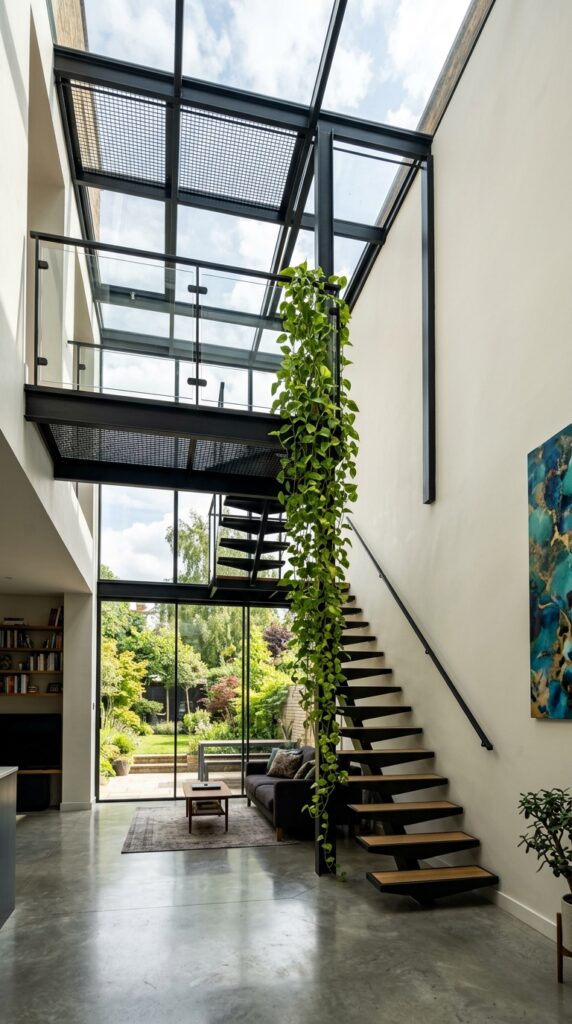
Vibe: Dramatically luminous — a space that makes you aware of the full height of the building as you’ve never been before.
Why it works: A double-height glass extension with a mezzanine creates what architects call a section experience — the vertical dimension of a building becomes the primary spatial event. The mezzanine at mid-height creates a destination within the volume and a viewing platform that makes the garden and interior simultaneously legible from above, a perspective normally unavailable within domestic architecture. The full-height glass wall at 6 metres generates a quality of light that changes dramatically with the sun’s position — morning sun at a low angle floods the full floor area while high summer sun creates a dramatic overhead quality that no lower-height glazing replicates.
How to get it: Glass panels at 6-metre height must be engineered as structural elements — they carry significant wind loads at this height and require a minimum glass specification of 21.5mm heat-soaked toughened laminated glass. Thermal performance at this scale is critical: specify triple glazing for the upper third of the wall to compensate for the increased heat loss at the higher zone where warm air accumulates.
🛍️ Shop the Look — Amazon Product Ideas
| # | Product Search Phrase | Why It Fits |
| 1 | floating steel staircase kit industrial black | Mezzanine access element |
| 2 | open mesh steel mezzanine deck panel | Mezzanine floor surface |
| 3 | large canvas art abstract warm tones | Double height wall art |
| 4 | trailing indoor plant 1.5m drop length | Mezzanine to ground plant |
| 5 | industrial ceiling fan black 1500mm blade | Double-height air movement |
15. Glass Extension Floor Continuity with External Paving
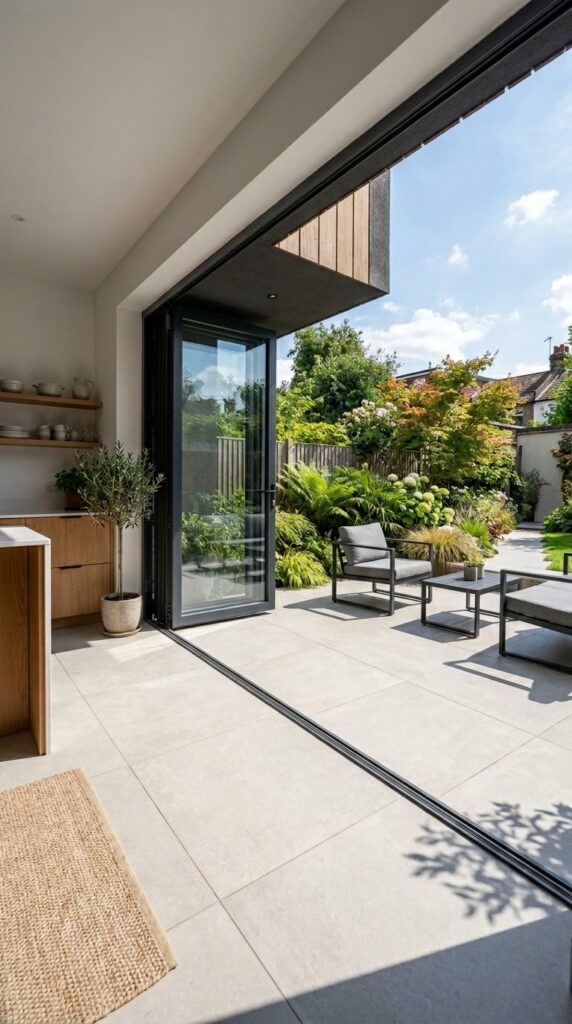
Vibe: Open and spatially continuous — inside and outside negotiating the terms of their union.
Why it works: Matching the interior and exterior floor material — the same tile, the same format, the same joint pattern — at the same level is the single most powerful floor-level intervention available in glass extension design. It applies the design principle of material continuity: when the floor surface does not change at the threshold, the brain does not register a transition and reads the patio as an extension of the interior floor plane, dramatically expanding the perceived size of the space. This effect only works when the levels are matched precisely — a step of any height reinstates the boundary the material continuity is designed to dissolve.
How to get it: The external tile specification must differ from the internal one in one critical way: the external tile must have a slip-resistance rating of R11 or higher (for sloped surfaces) or a minimum DCOF of 0.42 — most interior porcelain tiles are R9 or R10, which is inadequate for wet exterior surfaces. Source an external-grade version of the same tile from the manufacturer — most major porcelain tile brands offer matched exterior grades in their collections.
🛍️ Shop the Look — Amazon Product Ideas
| # | Product Search Phrase | Why It Fits |
| 1 | large format porcelain tile 1200x1200mm light grey | Interior-exterior floor continuity |
| 2 | external grade anti-slip porcelain tile R11 | Safe outdoor version |
| 3 | tile levelling clip spacer system | Perfect joint alignment |
| 4 | flush threshold expansion bar aluminium | Level transition strip |
| 5 | flex tile adhesive grey exterior grade | Large format bonding |
16. Glass Extension with Heated Polished Concrete Floor
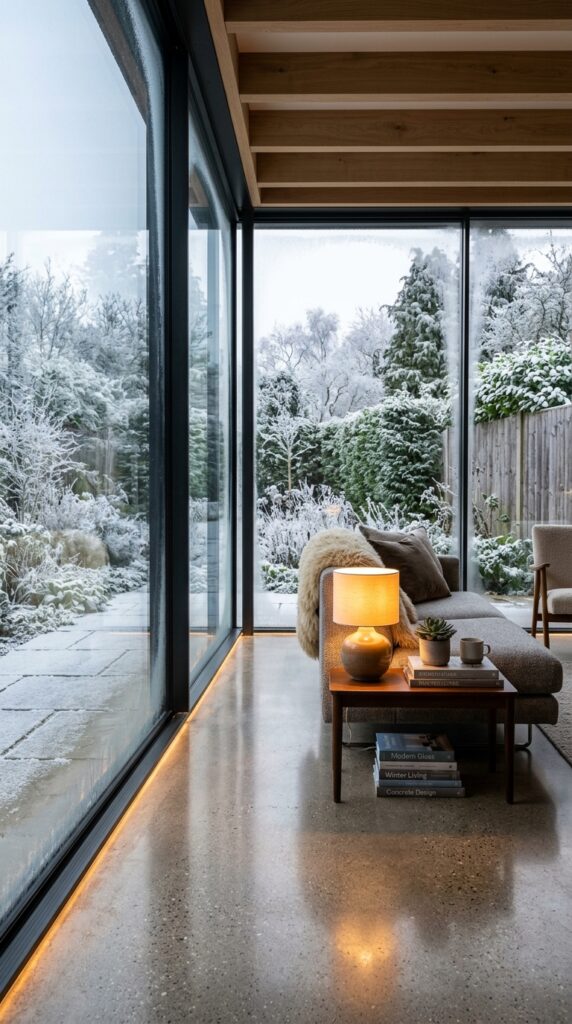
Vibe: Warm and resolved — the glass extension that works in January as well as July.
Why it works: Polished concrete with embedded underfloor heating is the material and services pairing most perfectly suited to glass extension use. Concrete has a thermal mass of approximately 2,000 kJ/m³K — one of the highest of any building material — meaning it stores heat from the underfloor circuit and releases it slowly and evenly throughout the day, eliminating the temperature swings that poorly designed glass rooms suffer from. The polished surface also acts as a passive solar receiver when winter sun strikes it at low angles — the concrete absorbs the heat during the day and releases it in the evening, extending the useful warmth of winter solar gain.
How to get it: Specify a wet underfloor heating system (hydronic, connected to the boiler) rather than electric mat heating for a glass extension — electric mats are suitable for smaller areas but hydronic systems are 3–4 times more efficient to run in a space with the heat loss profile of a glass-walled room. The concrete slab should be a minimum 100mm thickness over 50mm of rigid insulation to limit downward heat loss into the ground.
🛍️ Shop the Look — Amazon Product Ideas
| # | Product Search Phrase | Why It Fits |
| 1 | hydronic underfloor heating pipe kit 20m | Glass room floor heating |
| 2 | concrete floor sealer polish high gloss | Thermal mass floor finish |
| 3 | rigid floor insulation board 50mm PIR | Downward heat loss prevention |
| 4 | programmable underfloor heating thermostat | Zone temperature control |
| 5 | sheepskin genuine throw rug natural | Warmth textile accent |
17. Glass Extension with Vaulted Timber and Glass Roof
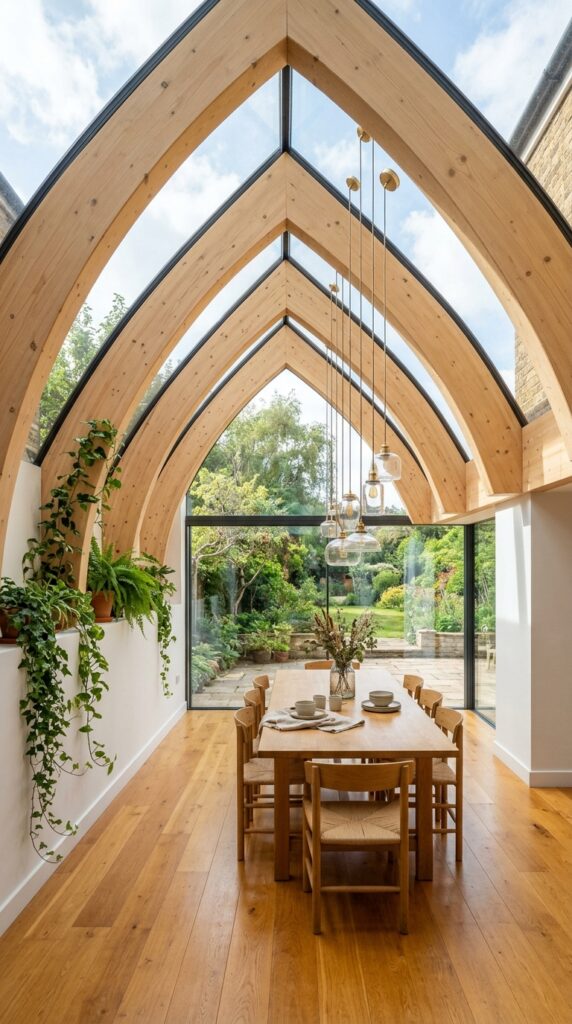
Vibe: Warm and cathedral-like — a domestic space with the emotional register of a much larger building.
Why it works: The glulam timber arch roof combines two design principles: the emotional power of the vault (a structural form that humans have associated with elevated experience — religious, civic, cultural — for millennia) and the biophilic warmth of natural timber in a glass-dominant structure. Glulam (glue-laminated timber) allows large-span curved forms that solid timber cannot achieve — spruce glulam arches can span 8–10 metres without intermediate support, creating the clear uninterrupted vault that gives the space its dramatic quality. The glass infill between the arches maintains the transparency of the roof while the timber grid provides the human-scaled visual rhythm that prevents an all-glass vault from feeling overwhelming.
How to get it: Glulam arch fabrication requires workshop manufacturing — the arches are CNC-machined from laminated blanks to exact geometry before delivery and craned or manually lifted into position on site. The springing points at the base of each arch must be connected to a concrete or steel foundation capable of resisting the horizontal thrust generated at the arch foot — this is a critical structural calculation for the engineer.
💡 Quick Win: A single glulam timber ridge beam (rather than a full arch system) in an otherwise standard pitched glass roof costs £3,000–6,000 more than an aluminium ridge and introduces the warmth of natural timber without requiring the complexity of full arch fabrication.
🛍️ Shop the Look — Amazon Product Ideas
| # | Product Search Phrase | Why It Fits |
| 1 | glulam timber beam structural 120x200mm | Visible structural timber |
| 2 | timber beam hanging pendant light hook | Arch-mounted lighting |
| 3 | polished white oak floor 180mm engineered | Interior floor warm tone |
| 4 | wood oil natural osmo finish | Glulam surface treatment |
| 5 | vining indoor plant climbing hoya | Side wall botanical accent |
18. Compact Glass Side Extension for a Bathroom
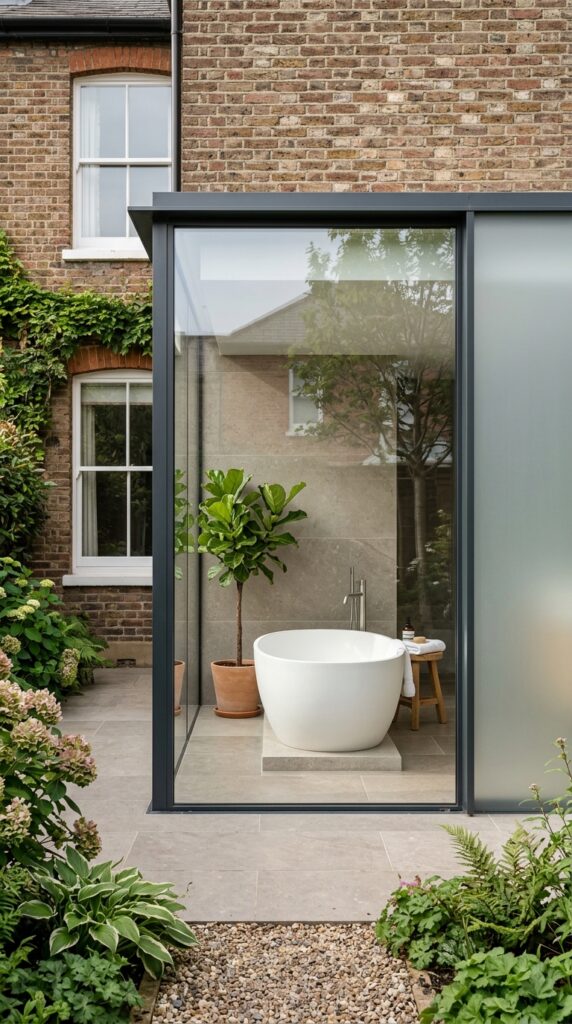
Vibe: Serene and unexpectedly private — a bathroom that opens to the garden in a way that feels audacious but utterly calm.
Why it works: A glass-walled bathroom that faces a private garden is one of the most experientially distinctive uses of a glass extension — the contrast between the intimacy of the bathroom function and the openness of the glass wall creates a space that feels simultaneously exposed and completely protected. Acid-etched glass (which scatters light while obscuring view) on the street-facing wall provides privacy from the public realm while the clear garden-facing wall opens the bathroom to planting, sky, and light in a way that transforms bathing from a utilitarian act into an experiential one.
How to get it: A glass bathroom extension in a garden requires planning permission in most jurisdictions — the unusual use and visibility requires a pre-application discussion with the planning authority. Specify toughened acid-etched glass (not a film applied to standard glass) for the privacy panels — applied films peel and bubble in the humidity of a bathroom environment within 2–3 years.
🛍️ Shop the Look — Amazon Product Ideas
| # | Product Search Phrase | Why It Fits |
| 1 | freestanding bath 1700mm white double ended | Garden bathroom centrepiece |
| 2 | acid etched privacy glass film permanent | Opaque panel alternative |
| 3 | stone bath mat natural travertine | Material floor continuation |
| 4 | outdoor shower head wall mount chrome | Garden-adjacent bathing |
| 5 | waterproof LED strip IP68 warm white | Bathroom ambient lighting |
19. Glass Extension with Solar Photovoltaic Roof Panels
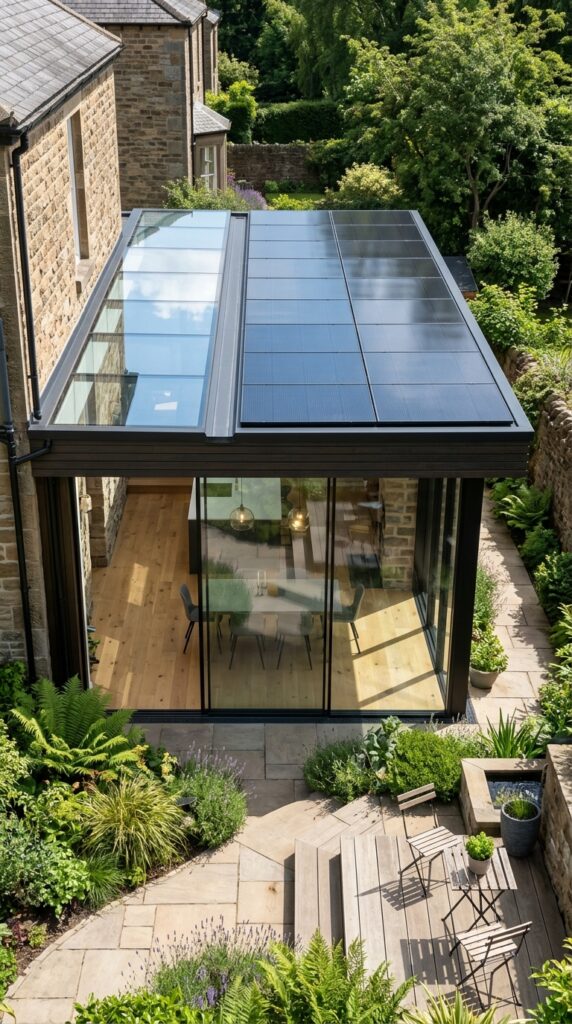
Vibe: Quietly sustainable and architecturally resolved — an extension that produces as much as it consumes.
Why it works: Integrating solar photovoltaic panels into the roof plane of a glass extension — using the same black frame system so panels and glazing read as a unified roof composition — is the built form of passive-active design synthesis. The roof simultaneously admits daylight through the glazed section and generates electricity through the solar section, using the same south-facing orientation for both functions. The design principle is dual-purpose surface: every square metre of roof is doing work, either admitting light or generating power. Frameless flush-mounting (BIPV — Building Integrated PhotoVoltaics) is the key specification that achieves the architectural result — surface-mounted rail systems create a visual step that makes the panels read as applied rather than integral.
How to get it: BIPV glass-glass solar modules (where the cell is laminated between two glass panels) can be specified to match the same aluminium framing system as the rooflight glazing — several BIPV manufacturers offer modules in standard rooflight frame dimensions. A structural engineer must confirm the roof structure can carry the additional weight of the solar modules (typically 20–25 kg/m² more than standard glazing).
🛍️ Shop the Look — Amazon Product Ideas
| # | Product Search Phrase | Why It Fits |
| 1 | solar panel monocrystalline 400W black frame | Integrated roof generation |
| 2 | solar micro inverter rooftop each panel | Per-panel power conversion |
| 3 | BIPV mounting frame aluminium flush | Flush integration hardware |
| 4 | solar battery storage 5kWh home wall | Generated energy storage |
| 5 | solar generation monitor display home | Energy output tracking |
20. Glass Extension with Perforated Metal Privacy Screen
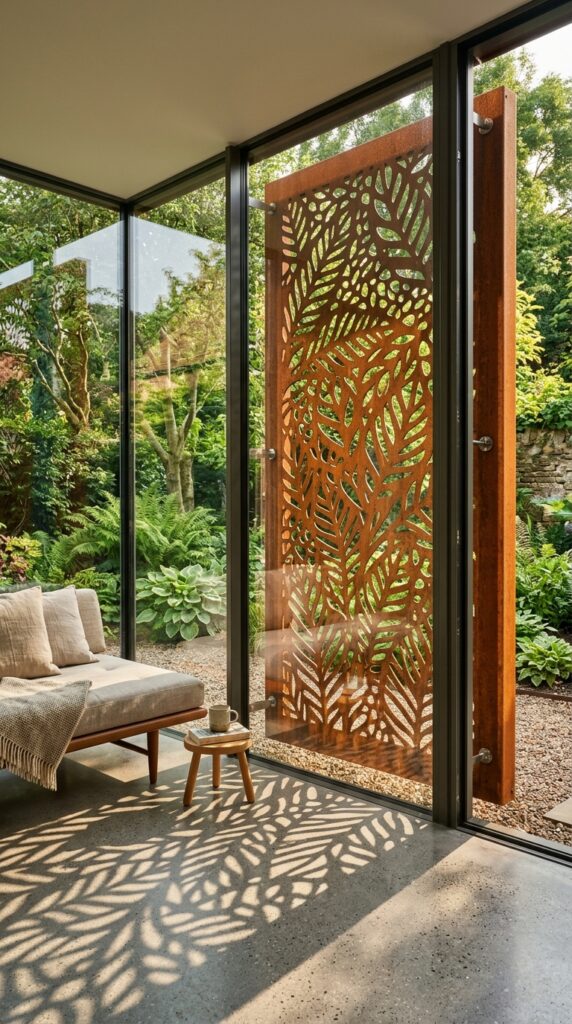
Vibe: Warm and unexpectedly layered — a glass extension that has found a way to be both open and intimate.
Why it works: A perforated Corten steel screen positioned in front of a glass wall creates a layered facade — the screen, the air gap, the glass, the room — that gives the extension visual depth and privacy without losing light or garden connection. The perforated pattern casts geometric shadows on the interior floor that shift through the day, making the room’s light quality dynamic rather than static. Corten’s warm rust-orange surface is a deliberate material contrast against black aluminium frames — the two metals age in opposite directions (Corten becomes more complex with time, aluminium remains stable) creating a relationship that evolves over the life of the building.
How to get it: Corten steel for external use should be allowed to weather for 6–12 months before the stable oxide layer fully forms — in the first months it will weep rust-coloured water from the surface. Install Corten screens with a concrete base or stainless steel fixings (never mild steel fixings — the galvanic coupling between Corten and mild steel accelerates corrosion at the connection point). Specify a drainage channel below the screen to prevent rust staining on the paving.
🛍️ Shop the Look — Amazon Product Ideas
| # | Product Search Phrase | Why It Fits |
| 1 | Corten weathering steel sheet panel 2mm | Privacy screen material |
| 2 | laser cut metal garden screen botanical | Perforated pattern panel |
| 3 | stainless steel fixing bolt M8 A4 grade | Corrosion-proof fastener |
| 4 | linear drain channel stainless 1000mm | Rust water drainage |
| 5 | daybed indoor outdoor linen cushion | Interior relaxation piece |
21. Glass Extension with Bespoke Joinery Kitchen Island
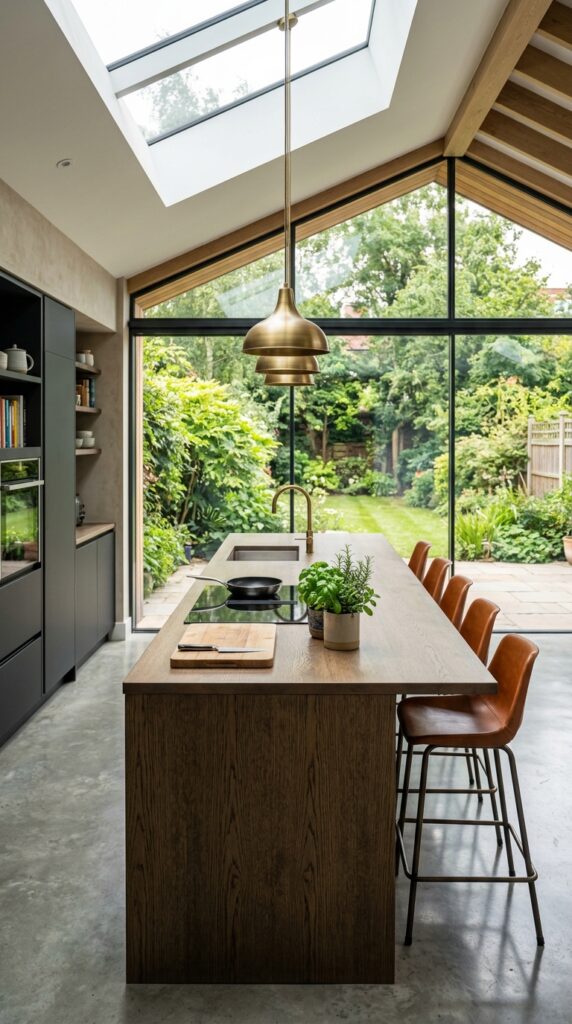
Vibe: Warm and considered — an island that earns the space the glass room creates around it.
Why it works: A glass extension creates a quality of space — light-flooded, garden-connected, ceiling height generous — that standard kitchen joinery consistently fails to match. A bespoke island in smoked oak, at 4 metres long, is the piece of joinery that fills the extension’s spatial ambition. Smoked oak (oak subjected to an ammonia fuming process that darkens the tannins) achieves a warm grey-brown that is lighter than walnut but more complex than natural oak — it reads as aged and resolved without being dark or heavy. The 300mm overhang with bar stools makes the island a social surface as well as a functional one, creating a reason to be in the kitchen even when you’re not cooking.
How to get it: Specify the island cabinetry in 18mm birch plywood carcass rather than MDF — the additional weight and rigidity of plywood prevents the long span from racking or flexing over time. The smoked oak veneer should be specified in a bookmatched pattern on the island face panels so the grain symmetry is visible — a detail that reads as furniture-grade quality rather than kitchen-grade.
🛍️ Shop the Look — Amazon Product Ideas
| # | Product Search Phrase | Why It Fits |
| 1 | smoked oak veneer sheet A4 sample | Material confirmation sample |
| 2 | bar stool leather seat warm tan | Island seating element |
| 3 | pendant light aged brass three-in-row | Island overhead lighting |
| 4 | integrated induction hob 60cm black | Island cooking appliance |
| 5 | undermount kitchen sink 400mm stainless | Island sink integration |
22. Glass Extension with Pivoting Glass Door Wall
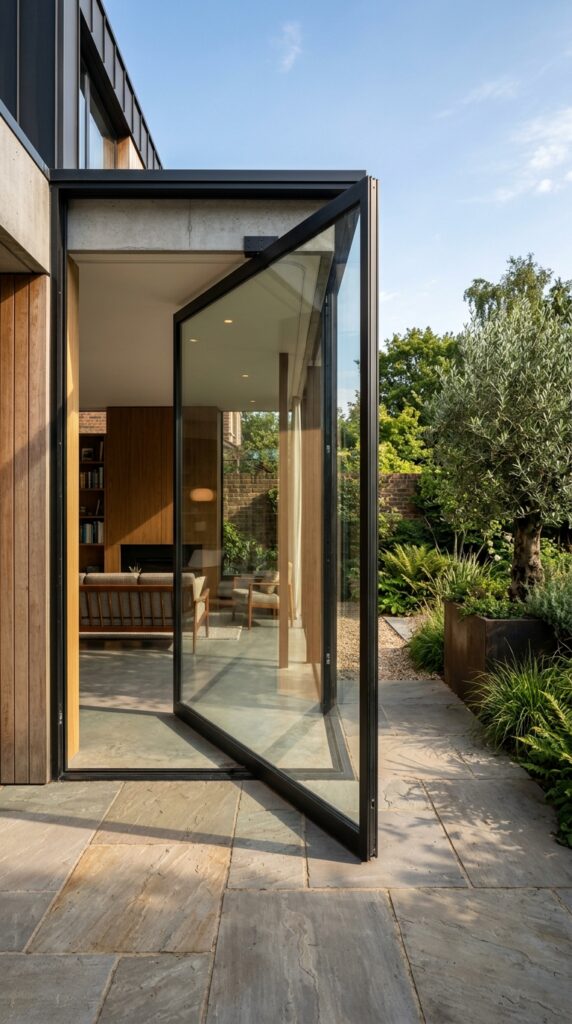
Vibe: Theatrically open — a wall that opens with the ceremony the moment deserves.
Why it works: The central-pivot floor-to-ceiling glass door is the most architecturally dramatic single door type available in residential design — where a conventional hinged door creates a partial opening at one side of its frame, the pivot door rotates from the centre, simultaneously opening two apertures (front edge and back edge) that together provide a near-full-width access. When open at 90 degrees, a 2.4-metre-wide pivot door creates a 4.8-metre combined opening — more than a standard bifold without the stacked panel bulk. The visual drama of a monolithic glass panel rotating on a floor spring is unmatched by any other door typology.
How to get it: A 2400×2800mm glass pivot panel weighs approximately 250–300 kg — the floor spring must be engineered to carry this load through the full rotation cycle and the floor structure beneath it must be reinforced to accept the point load. Specify a concealed overhead pivot point as well as the floor spring to prevent the top edge of the panel from swinging laterally under wind load.
🛍️ Shop the Look — Amazon Product Ideas
| # | Product Search Phrase | Why It Fits |
| 1 | floor spring pivot door hardware heavy duty | Pivot door mechanism |
| 2 | overhead concealed door closer pivot | Top edge stabilisation |
| 3 | glass door pull handle bar 600mm | Pivot panel grip |
| 4 | floor spring housing cover stainless | Mechanism concealment |
| 5 | point load floor reinforcement plate | Structural weight distribution |
23. Glass Extension with Deep Roof Overhang
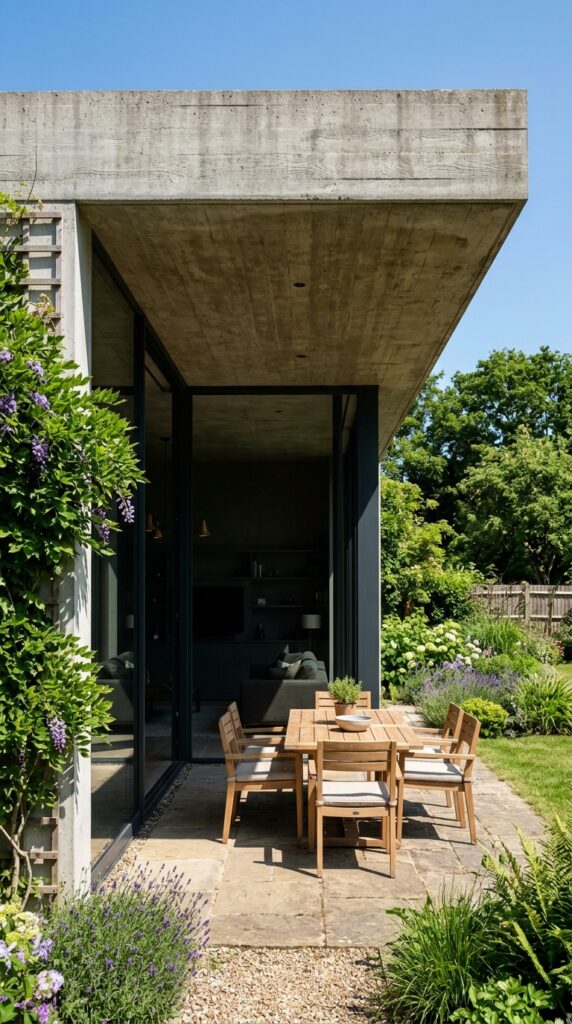
Vibe: Sheltered and architecturally resolved — the extension that has thought about summer as seriously as winter.
Why it works: A deep roof overhang is a passive solar design device — by projecting the roof 1,200mm beyond the glass wall, it shades the glass during the high summer sun angle (when the sun is approximately 60 degrees above the horizon in northern latitudes) while allowing the low winter sun (at approximately 20 degrees) to pass under the overhang and into the room. This is solar geometry applied to architecture: the overhang length is calibrated to the specific latitude of the building so it performs as a seasonal solar filter rather than simply a shade canopy. The shaded zone beneath the overhang also creates a transitional external space — neither fully inside nor fully outside — that is one of the most valuable domestic environments in a warm climate.
How to get it: The overhang projection depth should be calculated for the building’s specific latitude — in southern UK (51°N), a 1,200mm overhang over a 2,400mm-high glazed wall provides full summer shading and 70% winter solar admission. In more northerly latitudes, the projection should be reduced. This calculation takes a structural engineer 20 minutes and costs nothing to include in their engagement.
💡 Quick Win: Adding a removable powder-coated steel pergola structure extending from an existing flat-roof extension edge — without structural connection to the building — creates an overhang effect for external shading at a fraction of the cost of a structural concrete cantilever and requires no building control application.
🛍️ Shop the Look — Amazon Product Ideas
| # | Product Search Phrase | Why It Fits |
| 1 | aluminium pergola kit flat roof modern | Overhang shade structure |
| 2 | outdoor teak dining table 1800mm | Shaded threshold furniture |
| 3 | soffit board cladding composite grey | Overhang underside finish |
| 4 | concrete overhang formwork release agent | Board-mark concrete finish |
| 5 | climbing plant support wire stainless | Facade planting system |
24. Glass Extension with Colour-Matched Frame and House
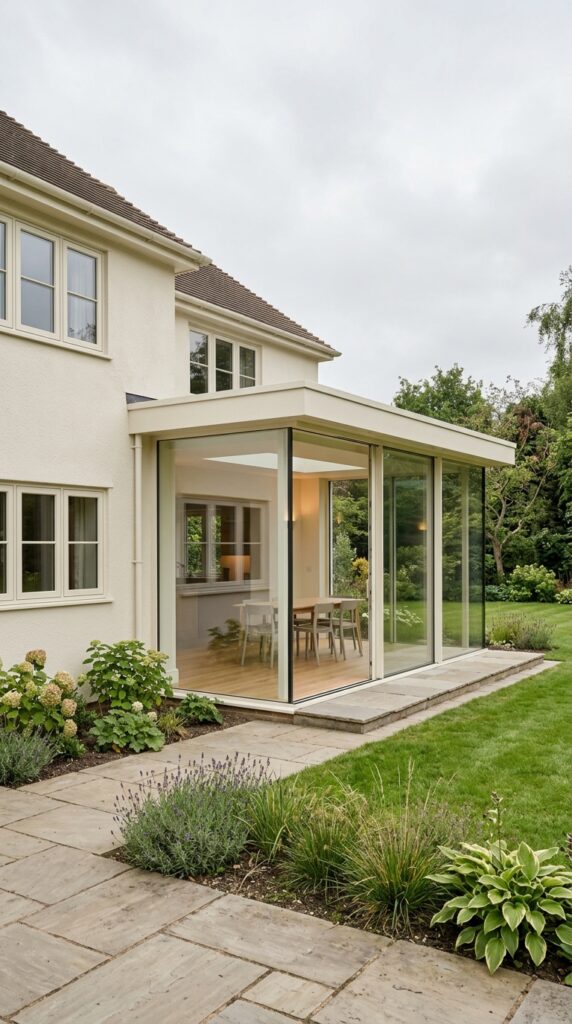
Vibe: Quiet and resolved — an extension that has the confidence to disappear.
Why it works: Colour-matching the extension frame to the existing house material is a strategy of visual integration rather than architectural contrast — where the black-frame approach announces the extension as a new element, the colour-matched approach makes the extension appear to have always been there. The design principle is contextual absorption: the glazing becomes a neutral interruption in the wall plane rather than a competing element. This approach works best on rendered houses where a true RAL colour match is achievable, and on buildings where the architecture is strong enough that adding contrast would compete with rather than complement the original form.
How to get it: Achieve an exact RAL match by taking a freshly painted render sample (2cm×2cm) to an aluminium glazing supplier and requesting a spectrophotometer colour match — the digital colour measurement produces a custom powder coat batch that matches the render within 1–2 ΔE units (imperceptible to the human eye from normal viewing distances). Specify the same finish (matte or satin) on both the render and the frame for maximum visual unity.
🛍️ Shop the Look — Amazon Product Ideas
| # | Product Search Phrase | Why It Fits |
| 1 | exterior render smooth white bag 25kg | House material match |
| 2 | RAL 9001 cream white frame powder coat | Extension frame colour |
| 3 | spectrophotometer colour matching tool | Precise colour matching |
| 4 | render primer bonding coat exterior | Render preparation |
| 5 | silicone sealant neutral cure off-white | Colour-matched joint |
25. Glass Extension with Sunken Living Floor
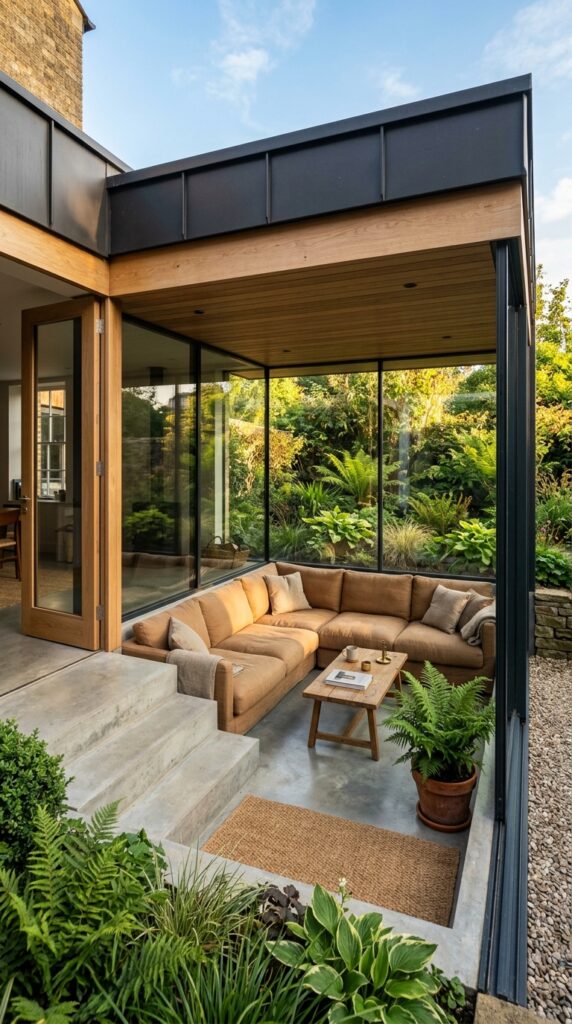
Vibe: Warm and deeply intimate — a room that surrounds you rather than containing you.
Why it works: Sinking the floor of a glass extension 400–600mm below the external garden level creates a spatial condition unique in domestic architecture — the occupant is seated below grade, eye-level with the garden ground plane, creating an immersive visual relationship with planting and landscape that no above-grade room can replicate. The glass walls, rising from garden level to ceiling, appear taller from the sunken interior (the effective height from sunken floor to ceiling is greater), amplifying the sense of enclosure and the drama of the garden connection. The sunken floor also provides acoustic separation from the house above — sound from the main living area reads as coming from a different level rather than the same room.
How to get it: A sunken floor in a glass extension requires a tanked (waterproofed) concrete slab below the external ground level — this is essential to prevent groundwater ingress. Specify a cavity drain membrane system (such as Newton Basedrain) on the inner face of the below-grade concrete walls, channelling any water ingress to a sump pump rather than relying on the waterproofing membrane alone.
🛍️ Shop the Look — Amazon Product Ideas
| # | Product Search Phrase | Why It Fits |
| 1 | cavity drain membrane 8mm stud roll | Below-grade waterproofing |
| 2 | sump pump automatic float switch submersible | Groundwater management |
| 3 | large modular sectional sofa linen | Sunken seating zone |
| 4 | low profile coffee table concrete top | Sunken room furniture |
| 5 | concrete repair floor levelling compound | Sunken floor finishing |
26. Glass Link Extension Connecting House to Garden Building
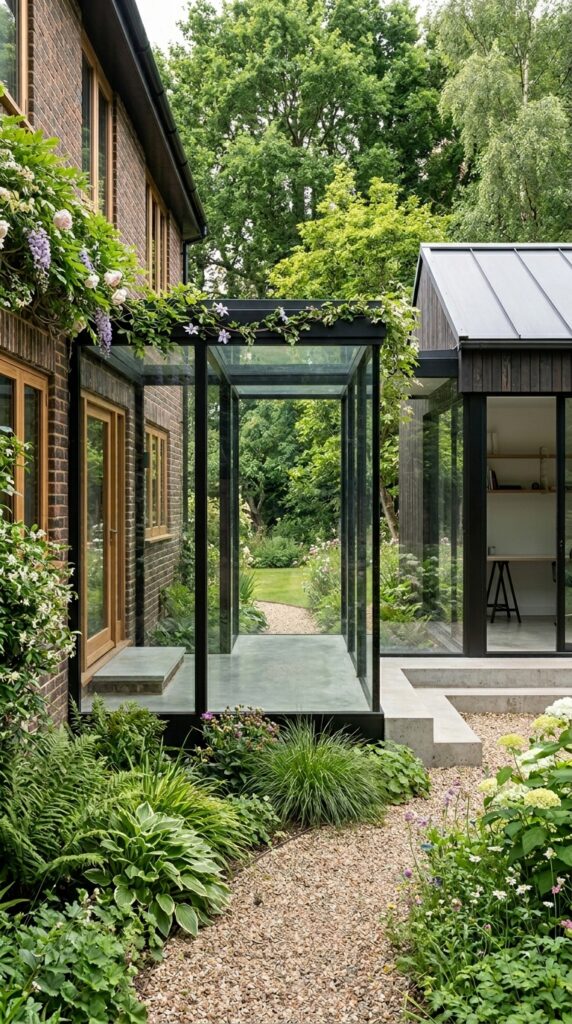
Vibe: Airy and purposeful — a connector that becomes the most beautiful part of the journey between two buildings.
Why it works: A glazed link corridor is architecturally distinct from both buildings it connects — it reads as a threshold rather than a room, a curated transition that makes the experience of moving between house and garden building deliberate and weather-protected without closing the garden out. The narrowness of the link (1,200mm is the minimum comfortable walking width) is intentional — the compressed width heightens the spatial relief of arriving in the wider buildings at each end. Glass on both sides of the link means the garden is visible on both faces simultaneously, creating a cross-landscape view that no standard corridor achieves.
How to get it: A glass link between two structures with independent foundations must be designed to allow differential movement — both ends of the link must connect via flexible joints to the adjacent buildings, not rigid connections. Specify a 10mm expansion gap at each building connection, sealed with a compatible silicone sealant, to allow the link to float independently as seasonal ground movement occurs.
🛍️ Shop the Look — Amazon Product Ideas
| # | Product Search Phrase | Why It Fits |
| 1 | structural glass canopy lean-to kit 1200mm wide | Link glazing system |
| 2 | movement joint silicone neutral cure 310ml | Expansion joint sealing |
| 3 | polished concrete sealer interior exterior | Continuous floor finish |
| 4 | trailing plant outdoor shade tolerant | Link exterior planting |
| 5 | black aluminium flat cap coping strip | Link roof edge trim |
27. Glass Extension Integrating an Indoor Swimming Pool
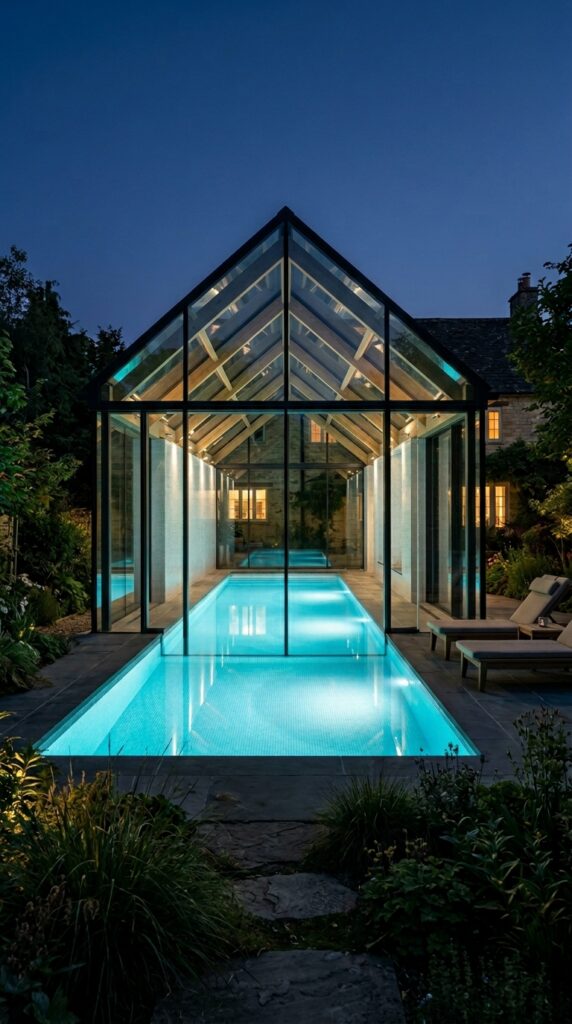
Vibe: Quietly extraordinary — the extension that changed what the house is capable of being.
Why it works: An indoor pool in a glass extension is the ultimate application of the transparency principle — it pairs the most sensory and embodied domestic experience (swimming) with the most visually open architectural environment possible. At dusk, when the pool lighting illuminates the water from below and the garden outside is dark, the glass walls become a mirror that reflects the aqua-toned interior back into the pool space, creating a doubled luminous world that is unlike any other domestic interior. The glass enclosure also solves the fundamental challenge of indoor pool environments — humidity and condensation — by specifying a negative pressure ventilation system that draws moist air out through discreet grilles at low level before it reaches the glass surfaces.
How to get it: An indoor pool glass extension requires a humidity control system (typically a dehumidification unit with a heat recovery element) sized to the pool surface area — an uncontrolled pool environment will cause condensation on all glass surfaces and structural damage to adjacent building fabric within 2–3 years. Specify a heated glass specification (electrically heated glass panels) for the roof glazing to prevent condensation on the internal surface of the roof glass, which cannot be wiped and will permanently stain if left untreated.
🛍️ Shop the Look — Amazon Product Ideas
| # | Product Search Phrase | Why It Fits |
| 1 | pool dehumidifier indoor swimming pool unit | Humidity control system |
| 2 | white mosaic pool tile sheet 300x300mm | Pool lining material |
| 3 | LED pool light underwater RGB colour | Water illumination |
| 4 | teak sun lounger outdoor weather resistant | Poolside furniture |
| 5 | heated glass panel film 12V electric | Roof condensation prevention |
How to Start Your Glass Extension Transformation
The single most effective first move before commissioning any glass extension is to appoint an architect for a feasibility study — not a glazing company, not a builder, an architect. The feasibility study (typically £500–1,500 for a single-storey rear extension scope) produces a measured drawing of the existing building, a massing diagram of the proposed extension, a planning assessment, and a preliminary specification. This document is the tool that allows you to approach multiple contractors and glazing suppliers with a defined scope, obtaining comparable quotations rather than incomparable ones. Without it, every supplier you approach will design something different to sell you, and you will have no basis for comparison.
The most common mistake beginners make when commissioning a glass extension is specifying the glazing system before resolving the structural strategy. The glazing system — aluminium or steel frame, bifold or sliding or pivot door, flat or pitched roof — must be selected after the structural engineer has defined the beam, column, and foundation requirements, because these constraints determine what glazing spans are achievable and what threshold conditions are possible. Choosing a glazing system first and asking the structural engineer to make it work backwards produces compromised results and cost overruns.
For under £500 of immediate progress: a measured survey of your existing house by a surveyor (£250–350) establishes the accurate dimensions that any architect or glazing supplier needs before they can design anything; a pre-application planning enquiry to your local authority (£0–120) confirms whether your proposed extension is within permitted development rights or requires full planning permission; and a glass sample board from a glazing manufacturer (usually free on request) allows you to assess solar control coating options, frame colours, and glass specifications in your actual light conditions before committing to a specification.
A realistic timeline from first appointment to occupation is 12–18 months for a straightforward single-storey rear extension: 2 months for architect’s design and specification, 8 weeks for planning determination, 4 weeks for tender and contractor appointment, and 16–24 weeks for construction depending on complexity. Budget £2,500–3,500 per square metre for a quality single-storey glass extension including structure, glazing, floor finishes, and fit-out — with premium frameless or structural glass systems adding 40–60% to the glazing cost alone.
Frequently Asked Questions About Glass Extensions for Modern Homes
What is the difference between a glass extension and a conservatory?
A conservatory is a specific building typology — typically a room with a translucent polycarbonate or glass roof and uPVC or aluminium frame walls, originally designed as a garden room for overwintering plants. In planning terms, a conservatory is defined as a structure where more than 75% of the roof area and 50% of the wall area is translucent glazing. A contemporary glass extension, by contrast, is an architecturally designed addition that may use full structural glazing, solid elements, rooflight strips, or a combination — it is not bound by the conservatory typology and is typically designed to meet the same thermal, acoustic, and structural standards as the main house. The practical distinction matters for planning: conservatories are specifically exempt from building regulations in most UK jurisdictions, while glass extensions that are designed to habitable room standard must comply with full building regulations including Part L (thermal performance) and Part B (fire safety).
What glass specification should I use for a glass extension roof?
For flat or shallow-pitch rooflight applications, specify 28mm argon-filled double glazing with a low-e coating on surface 3 (inner pane, outer face) to achieve a centre-pane U-value of approximately 1.0–1.1 W/m²K. For pitched glass roofs in colder climates, or for any roof application where thermal performance is critical, upgrade to 44mm triple glazing with two low-e coatings, achieving a centre-pane U-value of 0.6–0.7 W/m²K. All roof glass must be specified as laminated safety glass — typically a 8.8.2 or 10.10.4 laminate — so that in the event of breakage the glass retains its position in the roof rather than falling. Solar control coatings (typically a silver-sputter coating on surface 2 of the outer pane) reduce solar heat gain by 40–60% and should be specified for any south or west-facing roof glass to prevent summer overheating.
Do glass extensions require planning permission?
In England, a single-storey rear glass extension may fall within Permitted Development rights if it meets specific dimensional criteria: it must not extend more than 3 metres (semi-detached or terraced house) or 4 metres (detached house) beyond the original rear wall, must not exceed 4 metres in height, and must not cover more than 50% of the curtilage. Extensions that exceed these dimensions, face the highway, or affect a listed building require full planning permission. The Prior Approval process — a lighter-touch application available for extensions between 3–6 metres (semi/terraced) and 4–8 metres (detached) — requires a neighbour consultation period but is typically approved within 42 days. Always confirm with your local planning authority before work begins — Permitted Development rights are site-specific and can be removed by Article 4 Directions in conservation areas or from individual properties by previous planning conditions.
How do I prevent a glass extension from overheating in summer?
Overheating in glass extensions is managed through a combination of four complementary strategies, used in combination rather than individually. Solar control glass (a low-e coating on the outer pane) reduces heat gain before it enters the room. External shading — a roof overhang, a planted pergola, or an external blind — intercepts direct solar radiation before it reaches the glass surface (more effective than internal blinds, which allow heat to enter and be trapped). Ventilation — either through openable rooflights, tilt-and-turn windows, or a mechanical ventilation system — allows hot air to be purged from the space when it accumulates. Thermal mass — a polished concrete or stone floor, or a masonry wall within the glass room — absorbs heat during the day and releases it slowly in the evening, moderating peak temperatures. An extension designed with all four strategies in combination can achieve summer peak temperatures within 3–5°C of the main house even in full south-facing orientation.
What is the realistic budget for a glass extension in the UK in 2026?
A quality single-storey rear glass extension in the UK currently costs £2,200–3,500 per square metre for the full project including structure, glazing, foundations, floor finishes, mechanical and electrical services, and internal fit-out. A 20-square-metre rear kitchen extension therefore ranges from £44,000 to £70,000 in total project cost. Premium specifications — frameless corners, structural glass roofs, bespoke joinery, underfloor heating with polished concrete — push toward and beyond the upper figure. Glazing system cost alone accounts for £400–900 per square metre of glazed area depending on specification, making it the most significant single material line in the budget. Architect fees add 8–12% of construction cost, structural engineer fees £800–2,500, and planning/building control fees £500–1,200 depending on application type. These figures reflect 2026 UK construction costs and should be verified with local contractors — regional variation of ±25% is typical between London and other regions.
Ready to Create Your Dream Glass Extension?
These 27 ideas span every typology of glass extension — from the compact side-return rooflight strip to the double-height garden-facing pavilion, from the Corten-screened privacy extension to the sunken conversation pit — because the most successful glass extension designs emerge from a specific conversation between a building’s existing character, its site geometry, its occupants’ way of living, and the quality of light available at that precise orientation and latitude. Starting with one clearly resolved idea — a rooflight strip above an existing flat roof, a set of quality bifolds replacing a standard patio door — is the correct approach, building confidence and experience with the material language before committing to the larger structural interventions. Today, stand in the room you want to transform and observe the light at three different times: early morning, midday, and late afternoon. The extension you need will reveal itself in that sequence. Pin the ideas that changed how you see your home’s potential — and return with your measured drawings when you are ready to build.