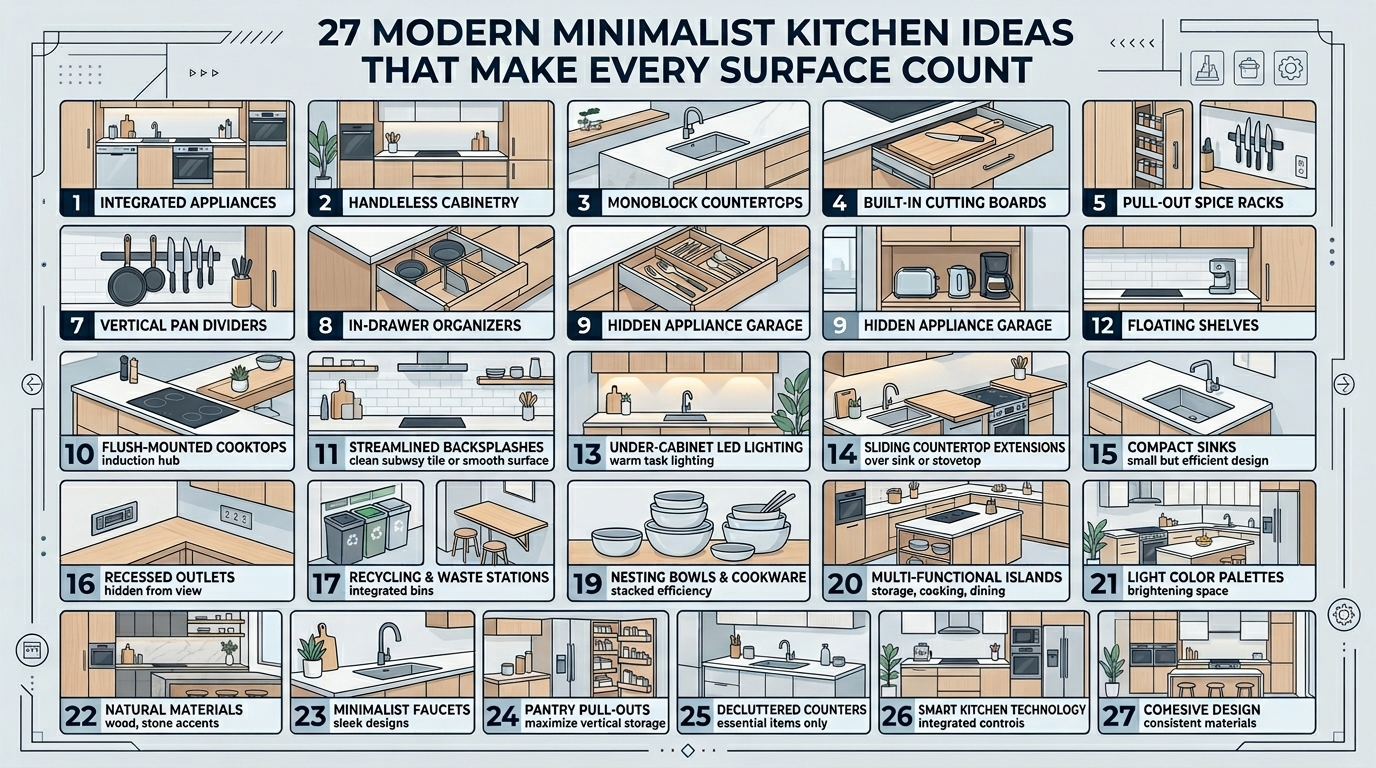
Modern minimalist kitchen design is the discipline of reducing a kitchen to its most functional, visually resolved form — flat-front cabinetry, honest materials, zero unnecessary hardware, and a palette where every surface earns its presence. This article gives you 27 distinct modern minimalist kitchen ideas spanning color, material, lighting, furniture, accessories, layout, and small-space solutions.
There’s a particular kind of clarity that a well-edited kitchen produces — the counter is clear, the lines are unbroken, and the only things visible are the ones you actually use. Modern minimalist kitchens don’t feel cold or clinical when they’re done right; they feel focused. Every drawer closes flush. Every material rewards close inspection. Here are 27 ideas worth saving — and stealing.
Why Modern Minimalist Kitchen Design Works So Well
Modern minimalist kitchen design draws from two converging traditions: the Bauhaus principle that a kitchen is fundamentally a precision work environment — a laboratory for food — and Scandinavian functionalism’s insistence that utility and beauty are not competing values. What distinguishes a genuinely minimalist kitchen from simply an undecorated one is the quality of every decision made at the material and construction level. The style emerged from post-war European modernism and was codified by designers like Bulthaup and Arclinea in the 1970s and 80s — manufacturers who treated the kitchen as a single architectural object rather than a collection of furniture pieces.
The material vocabulary is exact. Think flat-front cabinetry in matte lacquer, wire-brushed white oak, or concrete-effect laminate for door surfaces; honed Calacatta or Pietra Serena stone for countertops; and brushed stainless, matte black, or warm brass for hardware and fittings. Paint references for walls in a minimalist kitchen: Farrow & Ball Wimborne White (No. 239) for a warm white, Benjamin Moore Stonington Gray (HC-170) for a cool mid-tone, and SW Repose Gray (SW 7015) for a greige that reads neutral under both warm and cool light conditions.
The cultural momentum behind minimalist kitchens has only strengthened. Open-plan living made the kitchen a room people look at all day — not just cook in — which fundamentally changed the calculus of kitchen design. Visual noise that was tolerable in a closed kitchen becomes genuinely disruptive in an open-plan space. Pinterest data reflects this: searches for “flat front kitchen,” “handleless cabinet,” and “minimalist kitchen countertop” have grown every year since 2020 as homeowners respond to kitchens that must function as living spaces as well as cooking spaces.
Compact kitchens are, in many ways, the natural home of this style. The minimalist kitchen’s insistence on concealment, integration, and surface continuity turns the constraints of a small galley or studio kitchen into design assets. A 10-foot run of continuous flat-front cabinetry in a narrow kitchen reads as more intentional than an equivalent length of mixed-profile cabinetry with visible hardware. Prioritize one quality countertop material and integrated appliances before everything else.
Style at a Glance
| Element | Trait 1 | Trait 2 |
| Philosophy | Function as form | Visual continuity over decoration |
| Materials | Matte lacquer, honed stone, wire-brushed oak | Brushed stainless, concrete, linen |
| Color palette | Warm white, greige, warm charcoal | Matte black, dusty sage, warm brass |
27 Modern Minimalist Kitchen Ideas
1. Flat-Front Handleless Cabinetry in Matte White
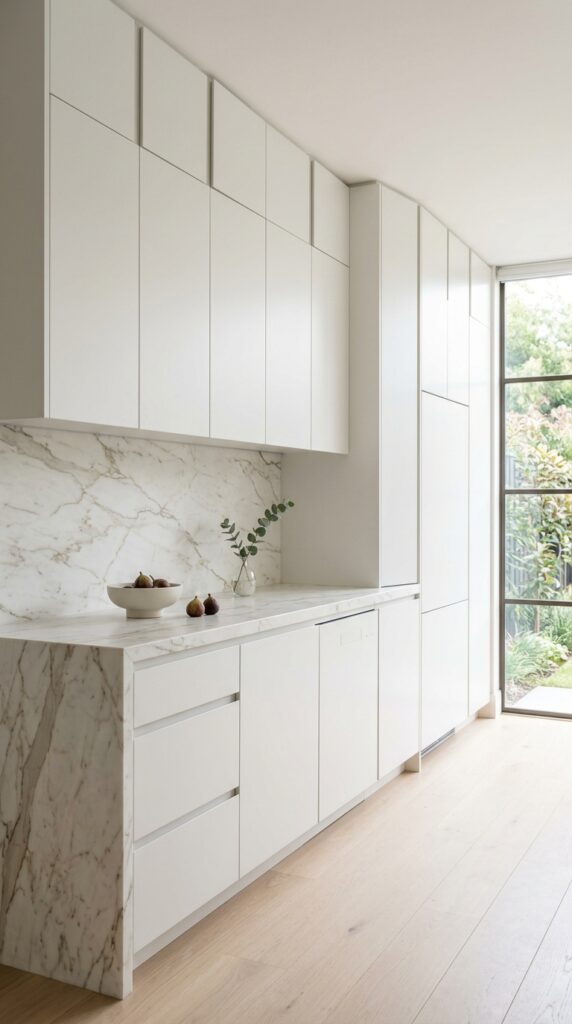
Vibe: Serene and resolved — a kitchen that looks as though someone made one decision and kept it.
Why it works: Flat-front handleless cabinetry applies the principle of surface continuity — the entire cabinet run reads as a single unbroken plane rather than a collection of individual door-and-drawer units. Push-to-open mechanisms eliminate the visual interruption of hardware entirely, and the touch-latch gap at the top door edge provides the finger pull invisibly. Warm matte white lacquer is the correct finish because it absorbs light rather than reflecting it, preventing the harshness that gloss white produces under kitchen task lighting while maintaining brightness.
How to get it: Specify matte rather than semi-gloss or high-gloss lacquer — the surface should read as flat from all angles. Two-pack polyurethane lacquer in a warm white (RAL 9010 Pure White or NCS S 0502-Y is the standard reference) applied by spray in a factory finish is significantly more durable than brush-applied paint.
💡 Quick Win: Replacing existing cabinet hardware with push-to-open soft-close mechanisms ($8 to $15 per door at hardware retailers) immediately advances the handleless minimalist aesthetic without replacing cabinetry.
| Shop The Look |
| Push to open soft close cabinet mechanism minimalist |
| Flat front cabinet door replacement matte white |
| Honed marble countertop slab Calacatta white |
| Single stem ceramic bud vase minimal kitchen |
| Integrated dishwasher panel overlay kit |
2. Warm Greige and White Oak Two-Tone Cabinet Palette
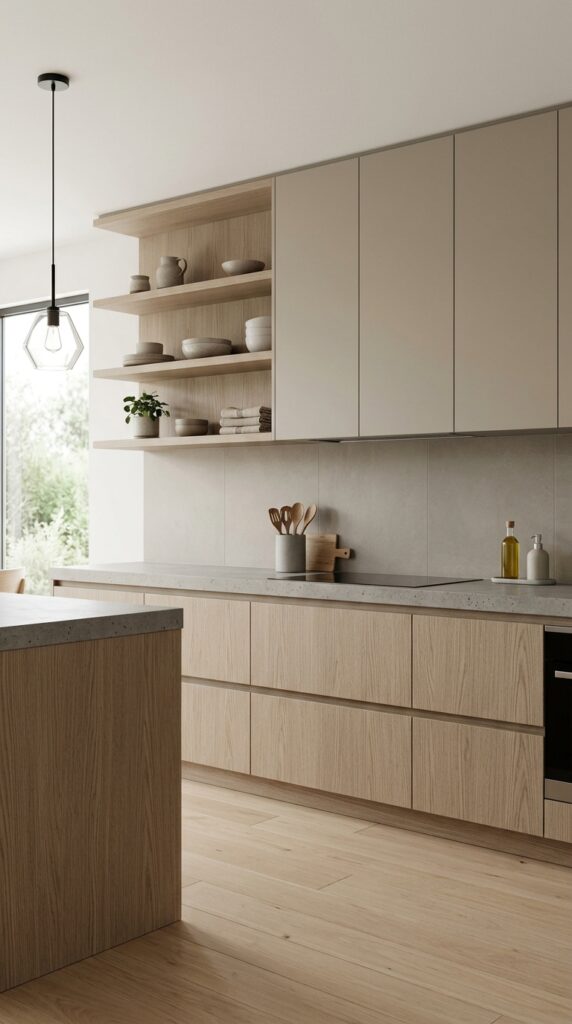
Vibe: Architecturally layered and warm — the kitchen that proves two materials used consistently is always enough.
Why it works: A two-tone kitchen succeeds on the principle of visual grounding — darker or warmer material at the lower cabinet zone and lighter at the upper creates a spatial logic that mirrors how buildings are constructed: heavier at the base, lighter at the top. Wire-brushed white oak at counter level introduces natural material warmth and tactile texture precisely where hands interact with the kitchen most often, while the greige upper cabinets keep the upper visual plane calm and recessive. The honed concrete countertop occupies the threshold between the two materials, bridging them in tone.
How to get it: Match the greige upper cabinet tone to the grey undertone of the concrete countertop — request a concrete sample alongside the lacquer swatch and adjust the lacquer formulation until they read as related rather than competing. The two-tone logic depends on the transition being intentional, not coincidental.
| Shop The Look |
| Wire brushed white oak cabinet door veneer |
| Greige matte lacquer cabinet paint two-tone |
| Honed concrete countertop slab kitchen |
| White oak open kitchen shelf wall mount |
| Minimal pendant light kitchen brushed brass |
3. Full-Height Stone Slab Backsplash
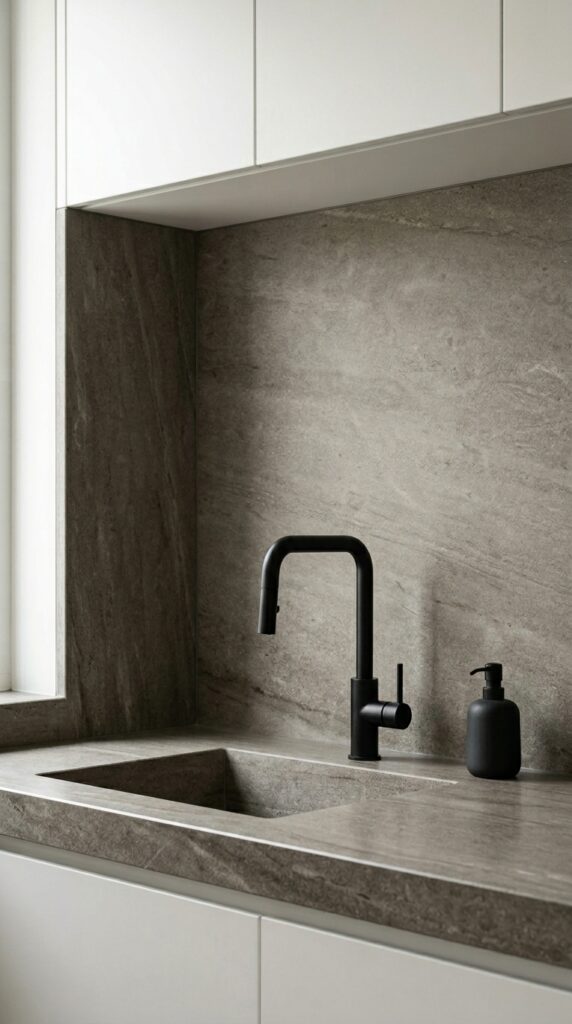
Vibe: Monolithic and refined — one material, one plane, no interruption.
Why it works: A full-height stone slab backsplash eliminates the most visually busy element in a traditional kitchen — the tiled or grouted backsplash — by replacing multiple small units with a single continuous surface. The design principle is material continuity carried vertically: the countertop and backsplash become one geological plane rather than two separate design decisions. Pietra Serena, a fine-grained grey-brown sandstone quarried in Tuscany, is the ideal choice because its surface variation is subtle enough to read as near-uniform from a distance while rewarding close inspection with genuine natural character.
How to get it: Specify a single slab cut for both counter and backsplash sections, with the book-matching orientation maintained — the natural vein pattern should flow continuously from horizontal to vertical at the wall junction. A 20mm slab thickness provides adequate depth for the countertop while remaining light enough for the vertical wall section.
💡 Quick Win: A large-format porcelain tile in a Pietra Serena or concrete look in 48×48-inch panels replicates the continuous slab effect at one-third the material cost, with only the thin grout joint revealing the seam.
| Shop The Look |
| Honed stone look porcelain slab tile 48×48 kitchen |
| Full height backsplash stone effect panel large |
| Matte black kitchen faucet minimal integrated |
| Flush undermount sink stainless steel minimalist |
| Stone sealer matte honed surface kitchen |
4. Integrated Appliances Behind Panel Doors
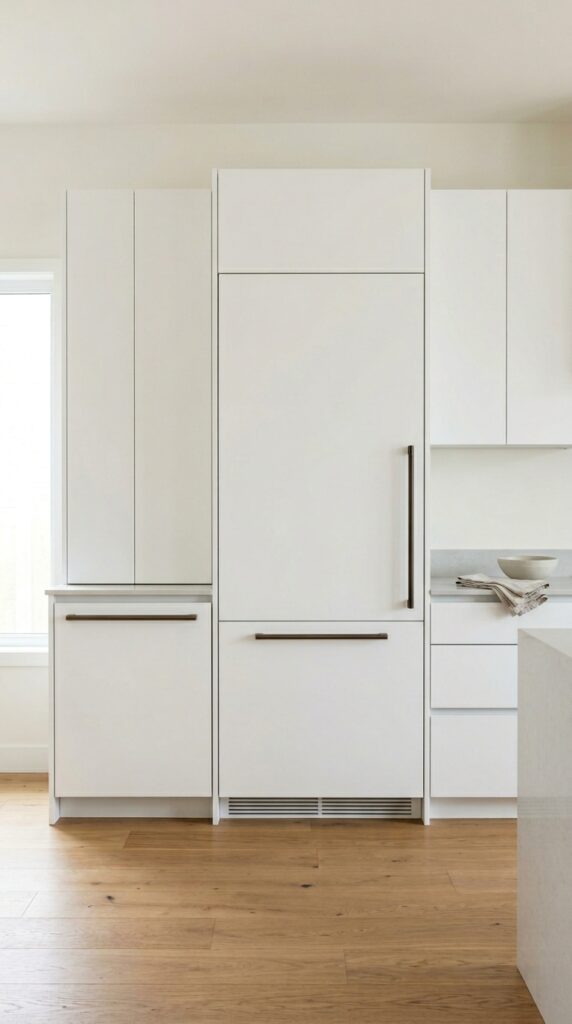
Vibe: Seamless and architectural — the appliances that disappeared into the wall.
Why it works: Panel-ready appliances eliminate the visual interruption of stainless steel or colored appliance bodies in a minimalist kitchen, allowing the cabinetry run to read as a continuous architectural wall rather than a sequence of appliances separated by cabinets. The design principle is visual noise reduction at the largest scale — appliances are typically the most visually assertive objects in a kitchen, and concealing them behind matching panels reduces the room’s visual complexity by 30 to 40%. The refrigerator, as the tallest and most prominent appliance, produces the greatest impact when paneled.
How to get it: Specify panel-ready or counter-depth appliances before finalizing cabinetry dimensions — the panel frame dimensions are appliance-specific and must be incorporated into the cabinet carcass design from the outset. Retrofitting panel doors to non-panel-ready appliances is possible but produces visible misalignment at the door edge.
| Shop The Look |
| Panel ready refrigerator integrated minimalist |
| Cabinet overlay panel kit appliance cover |
| Panel ready dishwasher integrated flat front |
| Flush vent grille kick plate cabinet base |
| Custom cabinet door overlay panel hardware |
5. Matte Black Faucet and Fitting Framework
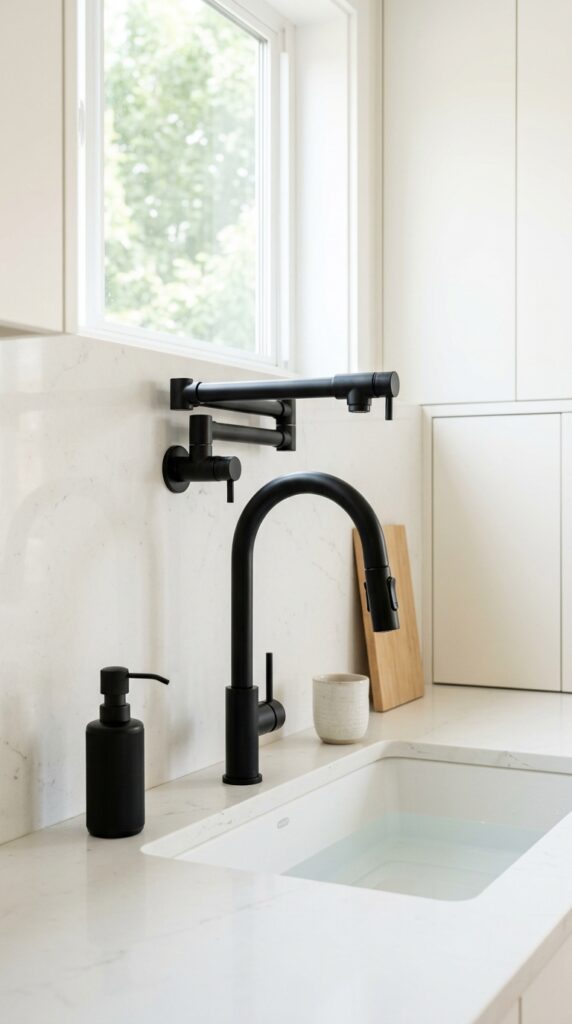
Vibe: Precise and confident — the dark lines that make the pale surfaces feel brighter.
Why it works: Matte black kitchen fittings operate on the principle of graphic accent at the functional zone — the sink area is the most-used surface in a kitchen and the natural focus of the room’s activity, which makes it the correct location for the room’s only strong color contrast. Matte rather than gloss black is critical: gloss black shows water spots instantly, which defeats the minimalist goal of visual cleanliness; matte black’s non-reflective surface conceals water marks and fingerprints far more effectively. Restricting the matte black to fittings only — faucet, soap dispenser, pot filler — keeps the hardware as a composed framework rather than a dominant palette element.
How to get it: Specify all sink-area fittings from the same manufacturer and product family — mixing matte black across different brands produces subtle variation in the black finish (some warm-toned, some cool) that reads as inconsistency at close range.
| Shop The Look |
| Matte black pull down kitchen faucet minimal |
| Matte black soap dispenser countertop kitchen |
| Matte black pot filler wall mount kitchen |
| White undermount kitchen sink stainless minimal |
| Matte black cabinet pull bar minimal kitchen |
6. Open Shelf Island Breakfast Bar
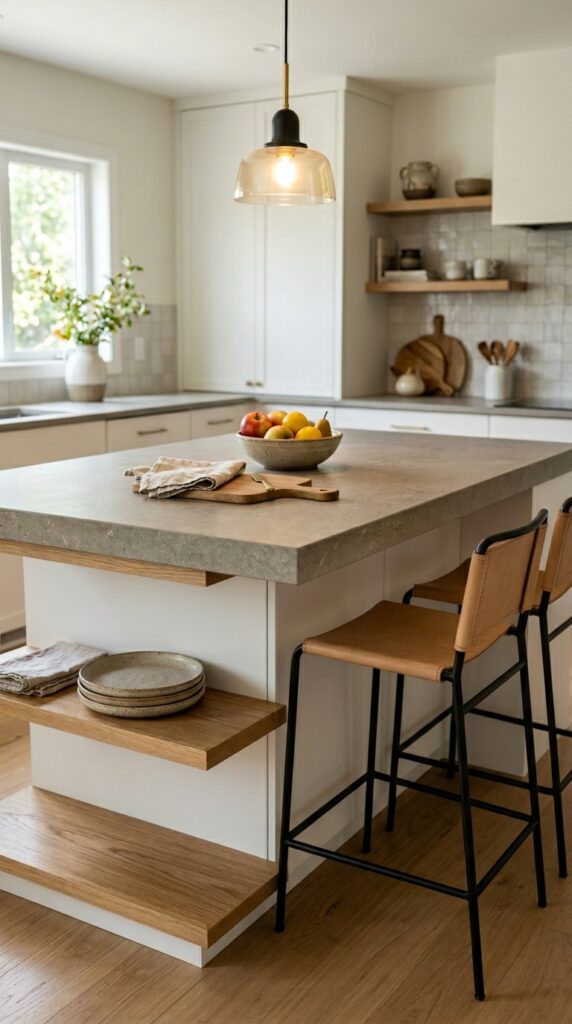
Vibe: Functional and warm — the island that makes a kitchen feel like the room the house centers on.
Why it works: An island with open lower shelving on the seating side serves the minimalist principle of visible storage as design — the stacked ceramic plates and bowls visible through the open shelf are the kitchen’s decorative layer, which means they serve two functions simultaneously. The thick stone top (60mm or more) is the correct proportion for an island because it reads as a geological slab rather than a surface — visual weight that gives the island architectural presence rather than furniture-like lightness. Bar stools with slim profiles and a minimal leg structure keep the visual plane below the island counter clear.
How to get it: Overhang the island countertop by 12 to 15 inches on the seating side to provide knee clearance for bar stool seating — less than 12 inches forces sitters to angle sideways; more than 15 inches creates a cantilever that requires structural reinforcement of the stone slab.
| Shop The Look |
| Thick honed stone kitchen island top custom |
| White oak open shelf island cabinet base |
| Slim bar stool leather seat minimalist |
| Ceramic bowl set stacked kitchen minimal display |
| Island pendant light minimal brushed brass |
7. Warm Sage Lower Cabinet Accent
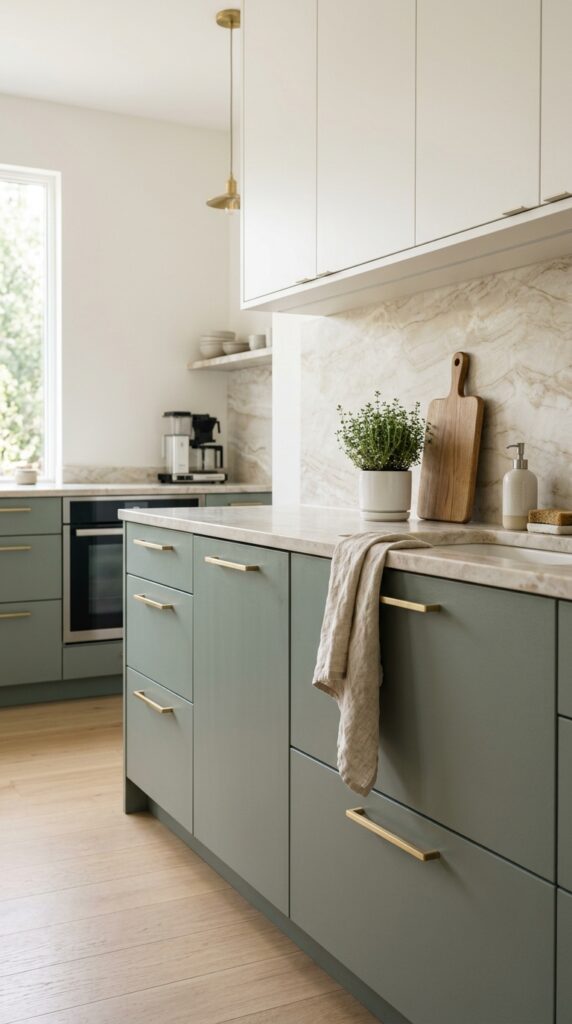
Vibe: Calm and quietly alive — color used at base level where it grounds without overwhelming.
Why it works: Dusty sage at the lower cabinet zone follows the principle of earthed color — applying the room’s only hue at floor level where it visually roots the kitchen and connects it to the natural tones of stone and earth. The Taj Mahal quartzite countertop bridges the sage and white beautifully because its warm cream base carries both green and gold undertones that read in harmony with both cabinet tones. Brushed brass hardware introduces the third warm element — brass, cream, and sage form a triad of natural tones that coheres without requiring a fourth accent color.
How to get it: Select the sage cabinet color after choosing the countertop material — countertop stone samples pull the undertones that should guide the lacquer specification. A sage that reads too yellow beside your stone becomes olive; one too blue becomes grey-green. The quartzite undertone dictates the correct sage.
| Shop The Look |
| Dusty sage matte lacquer kitchen cabinet paint |
| Honed quartzite countertop slab kitchen warm |
| Brushed brass cabinet pull bar minimalist |
| White ceramic herb pot small kitchen counter |
| Linen kitchen dish towel natural neutral |
8. Concrete Island Bench with Waterfall Edge
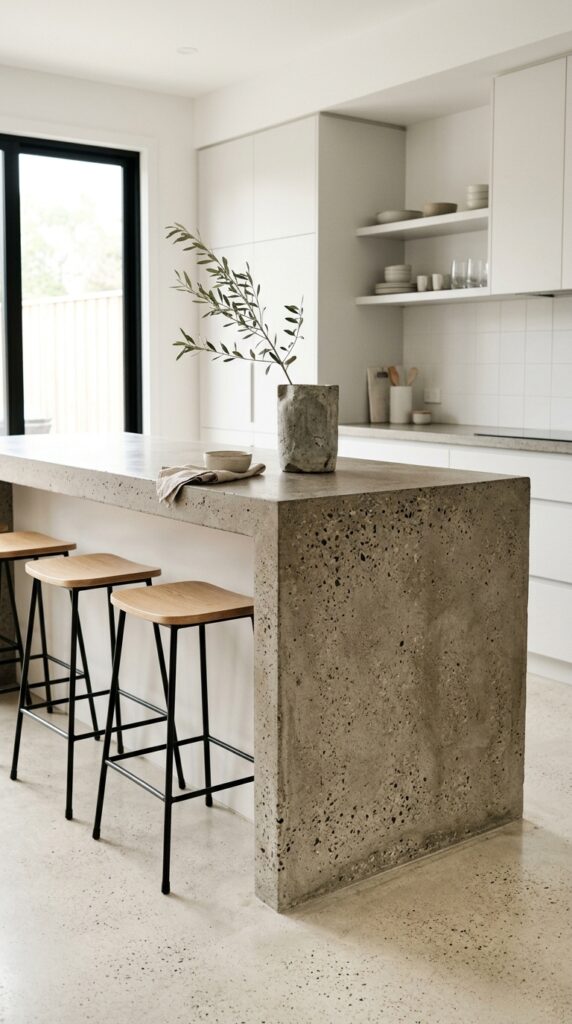
Vibe: Architectural and grounded — the island that looks like it was cast as part of the building.
Why it works: A waterfall edge countertop — where the stone or concrete surface turns 90 degrees and flows continuously down the island’s vertical face to the floor — treats the island as a monolithic architectural object rather than a piece of furniture with a top. The design principle is material singularity: one material, one geometric gesture, complete. Poured-in-place concrete is the optimal material for a waterfall application because the aggregate and surface character of a cast slab continues seamlessly around the corner without the miter line that stone slabs require, which is inherently more resolved for a minimalist context.
How to get it: Seal honed concrete countertops with a penetrating siloxane sealer rather than a topical epoxy — topical sealers build a film on the surface that scratches and peels over kitchen use; penetrating sealers enter the concrete matrix and protect without altering the matte surface quality.
💡 Quick Win: A concrete-effect quartz surface in a waterfall profile delivers the monolithic visual of a cast slab at lower cost and with factory-sealed durability — Dekton Kreta and Caesarstone Cloudburst Concrete are the two most convincing facsimiles.
| Shop The Look |
| Concrete effect quartz countertop slab waterfall |
| Concrete island base cabinet minimalist kitchen |
| Wood and metal bar stool slim profile set 3 |
| Concrete floor vase minimalist kitchen accent |
| Penetrating stone sealer matte kitchen surface |
9. Under-Cabinet LED Lighting Strip
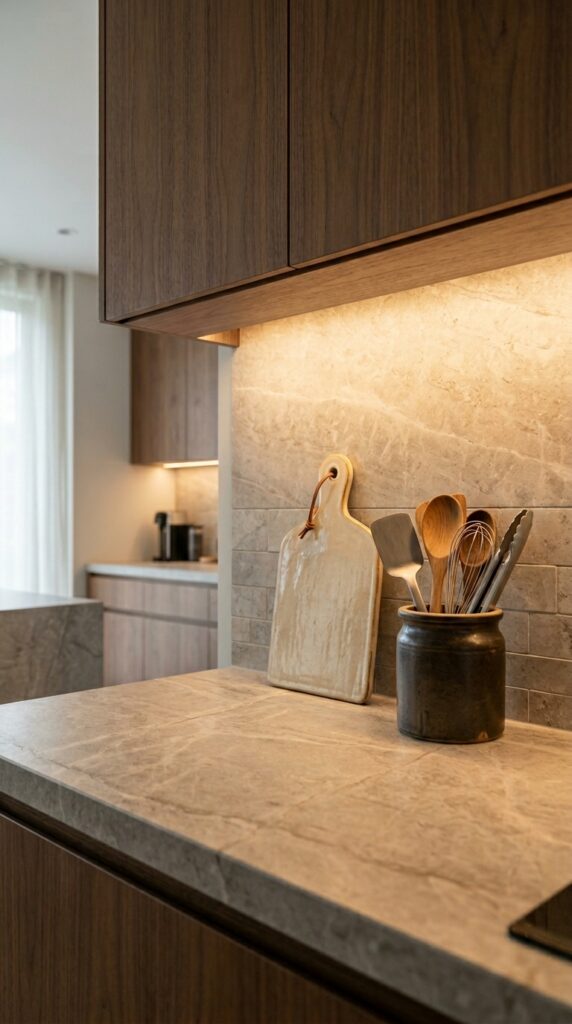
Vibe: Warm and functional — light that makes the counter the most inviting surface in the room.
Why it works: Under-cabinet lighting serves the minimalist kitchen at two levels simultaneously: it provides precise task illumination exactly where food preparation happens, and it eliminates the need for visible countertop or decorative lighting that would otherwise interrupt the clean surface. The light wash across a stone or tile backsplash also reveals material texture — the raking angle of under-cabinet light catches surface variation that overhead or ambient sources miss, making the material more interesting. LED strips recessed behind a small aluminum channel mounted flush to the underside of the upper cabinet are completely invisible from standing height.
How to get it: Specify warm white LEDs at 2700K color temperature for under-cabinet installation — cooler temperatures (3000K and above) produce a clinical light quality on countertops and make food appear less appetizing. Install the channel at the back edge of the cabinet underside to push the light forward onto the work surface rather than backward onto the wall.
| Shop The Look |
| Under cabinet LED strip light warm white 2700K |
| Aluminum LED channel recessed cabinet mount |
| Warm LED under cabinet lighting kit dimmable |
| LED dimmer switch in-wall minimal |
| Concealed under cabinet light lens diffuser |
10. Floating Open Shelves in White Oak
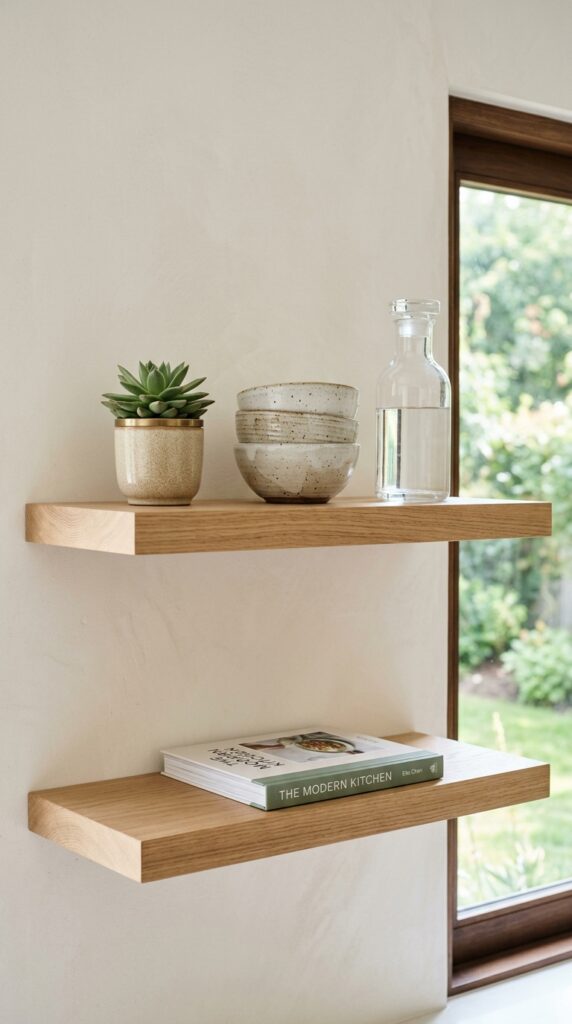
Vibe: Composed and warm — open shelves edited to the point where every object is worth looking at.
Why it works: Open shelves in a minimalist kitchen succeed only through radical curation — the rule is that each shelf should hold 25 to 30% of its maximum capacity, with each object placed in deliberate relation to its neighbors. White oak is the preferred shelf material because its open grain provides visual warmth and natural texture while its light honey tone stays within the kitchen’s neutral palette. The invisible bracket system (recessed steel rod brackets embedded in the wall) removes all visible hardware, making the shelf appear to float from the wall surface — an effect that amplifies the negative space below and around each shelf.
How to get it: Use hidden floating shelf brackets rated for at least 50 pounds per linear foot — kitchen shelves holding ceramics and glass are heavier than most shelf applications, and visible bracket failure or deflection destroys the minimalist intent of the floating system entirely.
| Shop The Look |
| White oak floating shelf kitchen wall mount |
| Hidden floating bracket steel rod recessed |
| Ceramic bowl set stacked neutral kitchen shelf |
| Glass carafe kitchen shelf minimal clear |
| Small kitchen shelf plant ceramic pot minimal |
11. Monochromatic All-White Kitchen
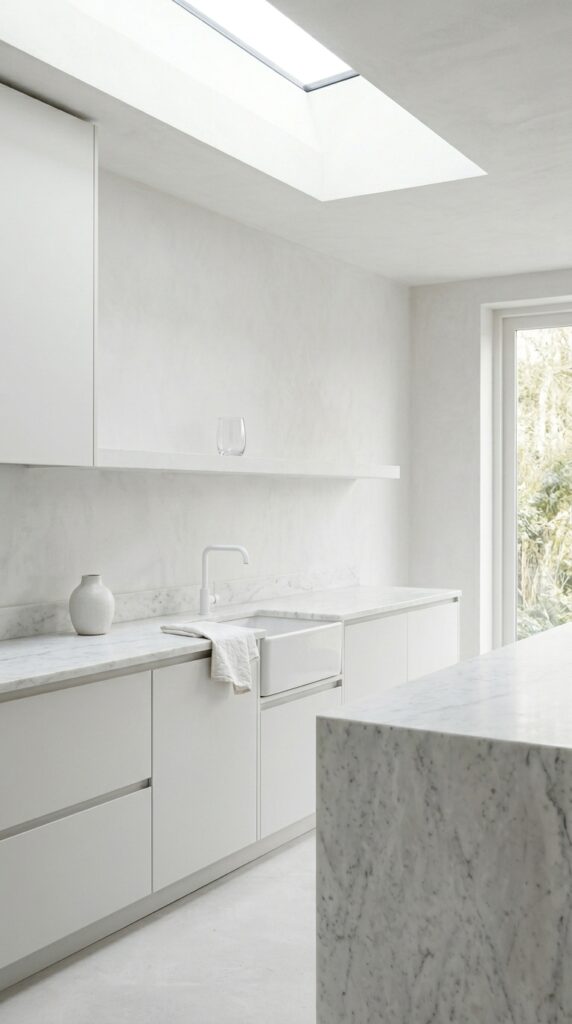
Vibe: Luminous and unified — the kitchen where every surface is white and the room is never monotonous.
Why it works: An all-white kitchen succeeds through the principle of material texture as the sole source of visual variation — when color is removed entirely, the eye reads the difference between matte lacquer, honed marble, smooth plaster, and woven linen as sufficient visual complexity. This requires discipline: each white surface must be genuinely different in sheen, texture, or undertone from its neighbor, or the room collapses into a flat undifferentiated plane. Warm whites (those carrying yellow-beige undertones, like Benjamin Moore White Dove) are significantly more successful in all-white kitchens than cool or pure whites, which produce a clinical, institutional feeling under natural light.
How to get it: Introduce material variation across at least four different white surfaces: matte lacquer (no sheen), honed stone (low sheen, textured), smooth plaster (flat but tactile), and woven textile (directional texture). Without all four material registers present, the all-white kitchen loses its depth.
| Shop The Look |
| White flat front cabinet door matte lacquer |
| White honed marble slab countertop kitchen |
| White ceramic undermount kitchen sink |
| White linen kitchen dish towel set |
| White ceramic vase minimal kitchen counter |
12. Matte Charcoal Kitchen Drama
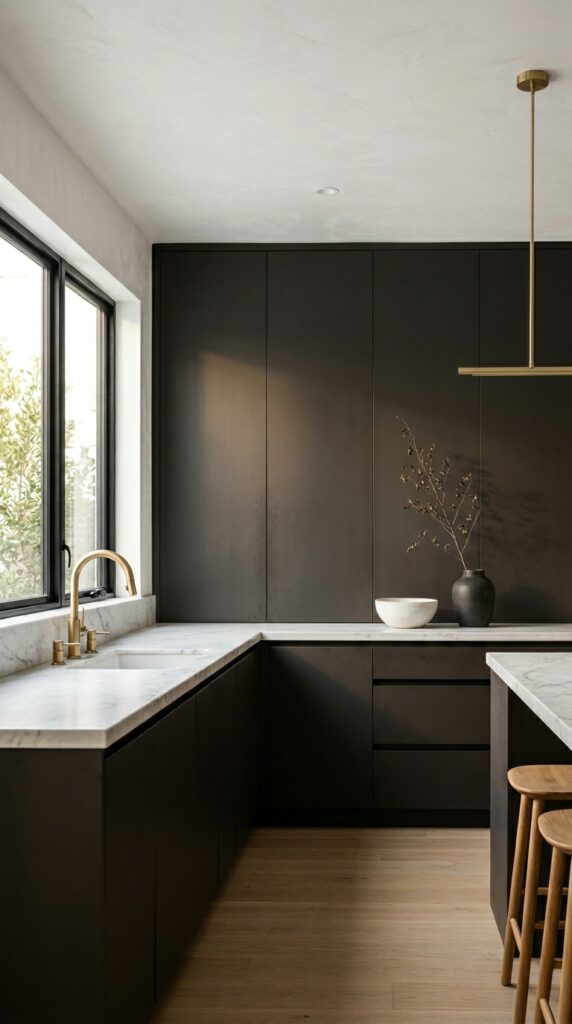
Vibe: Grounded and dramatic — dark cabinetry that absorbs light and makes the marble glow.
Why it works: Deep charcoal cabinetry applies the design principle of chromatic inversion — placing the room’s darkest tone at the largest surface (the cabinet fronts) and its lightest at the counter and ceiling creates a composition that reads as bold and considered rather than heavy or oppressive. The key is the warm undertone: charcoal with brown-grey rather than blue-grey undertones prevents the kitchen from feeling cold, particularly in kitchens without abundant natural light. White Calacatta marble against matte charcoal creates maximum tonal contrast at the counter zone, which makes the stone’s vein pattern appear more dramatic than it would against a lighter cabinet color.
How to get it: Remove all upper cabinets on at least one wall and leave the plaster above the countertop open — in a dark-cabinet kitchen, upper cabinets amplify the sense of enclosure. An open wall above the countertop keeps the upper half of the room light and prevents the dark lower zone from feeling oppressive.
| Shop The Look |
| Matte charcoal cabinet paint lacquer kitchen |
| White Calacatta marble countertop honed slab |
| Brushed brass kitchen faucet pull down |
| Dark ceramic vase kitchen minimal counter |
| Open wall kitchen shelf white oak charcoal |
13. Skylight Over the Kitchen Work Zone
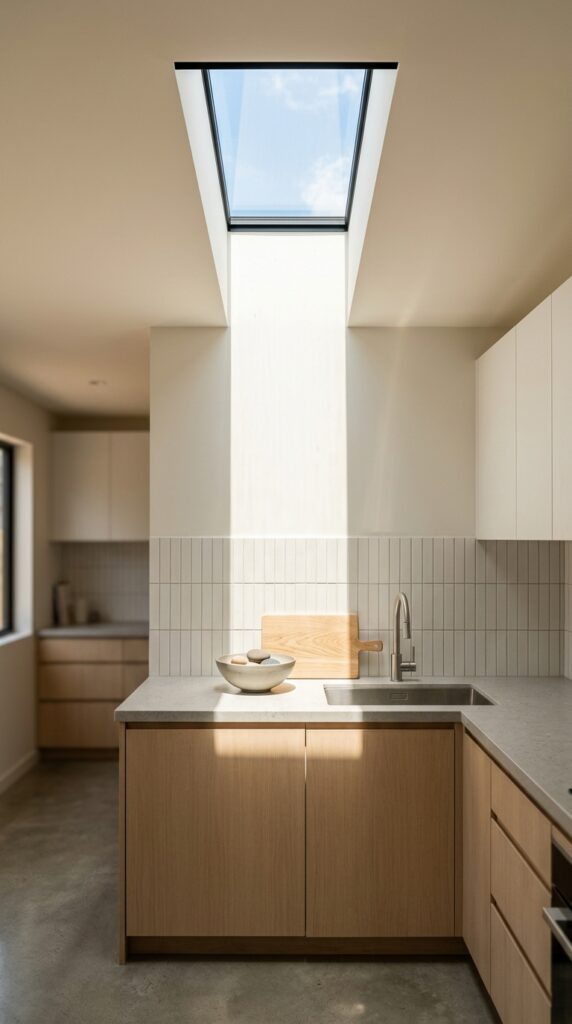
Vibe: Luminous and focused — vertical light from above makes any surface feel like it was designed to receive it.
Why it works: A skylight positioned over the primary work zone creates what designers call a “light event” — a defined zone of illumination that makes the kitchen’s functional center immediately apparent and draws occupants toward it. In minimalist design, natural light is treated as a material in its own right, and a skylight is its most concentrated delivery. The vertical quality of skylight illumination is distinct from lateral window light: it eliminates shadows in bowls and deep pots (where window light produces dramatic shadow), making food preparation more accurate and the space feel more alive throughout the day.
How to get it: A tubular skylight (Solatube is the benchmark product, 10 or 14-inch diameter) can be installed in a single day without structural modification for most roof configurations and delivers skylight-quality light through a highly reflective tube — a viable solution for kitchens where a full structural skylight is not feasible.
💡 Quick Win: A tubular skylight kit installed over a kitchen work zone costs $300 to $600 in materials and immediately transforms the quality of natural light on the counter surface without any cabinetry modification.
| Shop The Look |
| Tubular skylight kit 14 inch natural light |
| Skylight flashing kit flat roof installation |
| Velux fixed skylight double pane minimal |
| Skylight blind interior blackout minimal |
| Light diffuser ceiling plate minimal flush |
14. Integrated Rangehood in Cabinetry
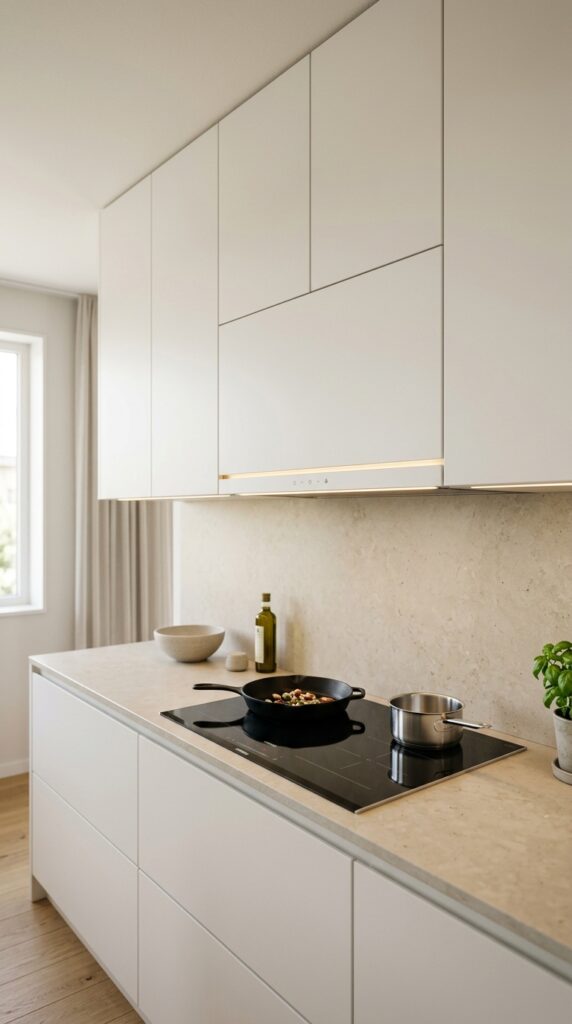
Vibe: Seamless and resolved — the cooking zone that doesn’t announce itself from across the room.
Why it works: A traditional rangehood chimney stack is one of the most visually disruptive elements in an open-plan kitchen because it breaks the continuous cabinet line with a projecting architectural form. An integrated rangehood recessed behind a cabinet panel eliminates this interruption entirely, maintaining the flat plane of the cabinetry wall from floor to ceiling. The design principle is concealment at the functional element level — the rangehood is still fully present and operational, but its visual footprint is reduced to a slim illuminated lower edge. This also removes the chimney as a grease-collection surface, simplifying kitchen maintenance.
How to get it: Specify a ceiling-ducted integrated rangehood rather than recirculating — recirculating models require charcoal filter changes every 3 to 6 months and produce less effective odor and grease extraction, which defeats the kitchen’s functional purpose. Ceiling duct installation requires coordination with the structural ceiling layer above the cabinet run.
| Shop The Look |
| Integrated cabinet rangehood minimal flush panel |
| Ceiling duct kit rangehood kitchen installation |
| Induction cooktop flush surface minimal black |
| Cabinet panel kit rangehood overlay |
| Touch control rangehood minimal interface |
15. Deep Navy and Brass Minimalist Kitchen
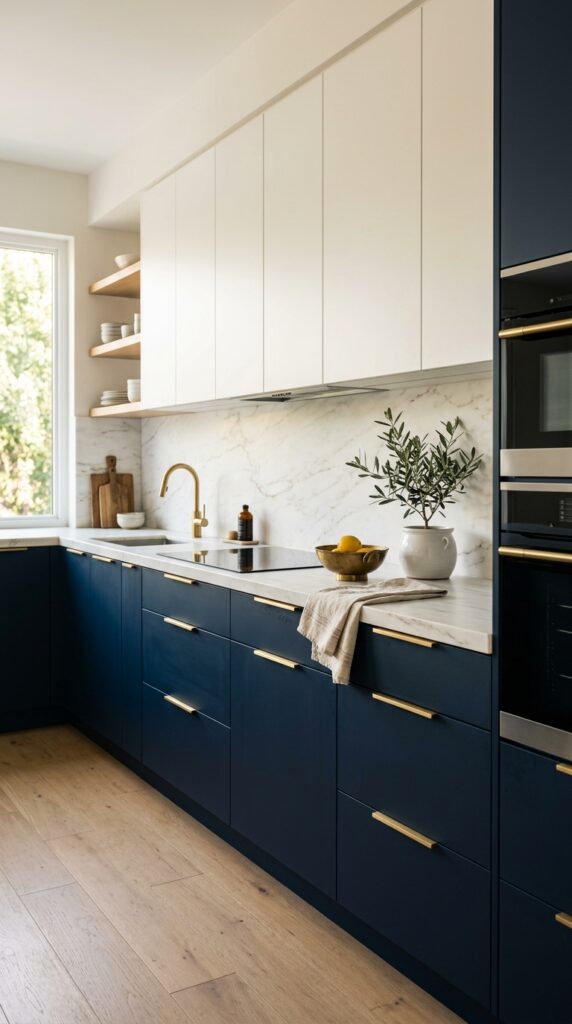
Vibe: Bold and warm — the kitchen that commits to color and earns it through restraint everywhere else.
Why it works: Deep navy in a minimalist kitchen works on the principle of concentrated color — when a genuinely dark, saturated color is applied only to lower cabinets and paired with white above and white marble at the counter, the navy reads as a bold architectural choice rather than an overwhelming palette. The critical proportion is 30-60-10: 60% white (upper cabinets, walls, ceiling), 30% navy (lower cabinets), 10% brass (all hardware). This keeps the bold color from dominating while allowing it to be unmistakably present. Navy with yellow-undertoned brass is the functional equivalent of a classic navy suit with a gold button — inherently resolved.
How to get it: Choose a navy with a blue-black rather than a purple undertone — Farrow & Ball Hague Blue (No. 30) and Benjamin Moore Hale Navy (HC-154) both read as true deep navy without veering toward purple under kitchen lighting. Avoid navy lacquers with white in the formulation — they grey out under certain light conditions rather than maintaining depth.
| Shop The Look |
| Deep navy matte cabinet paint kitchen lacquer |
| Brushed brass cabinet hardware bar pull set |
| Honed white marble countertop kitchen slab |
| Brass kitchen faucet brushed warm minimal |
| White ceramic pot olive branch kitchen accent |
16. Induction Cooktop Flush with Countertop
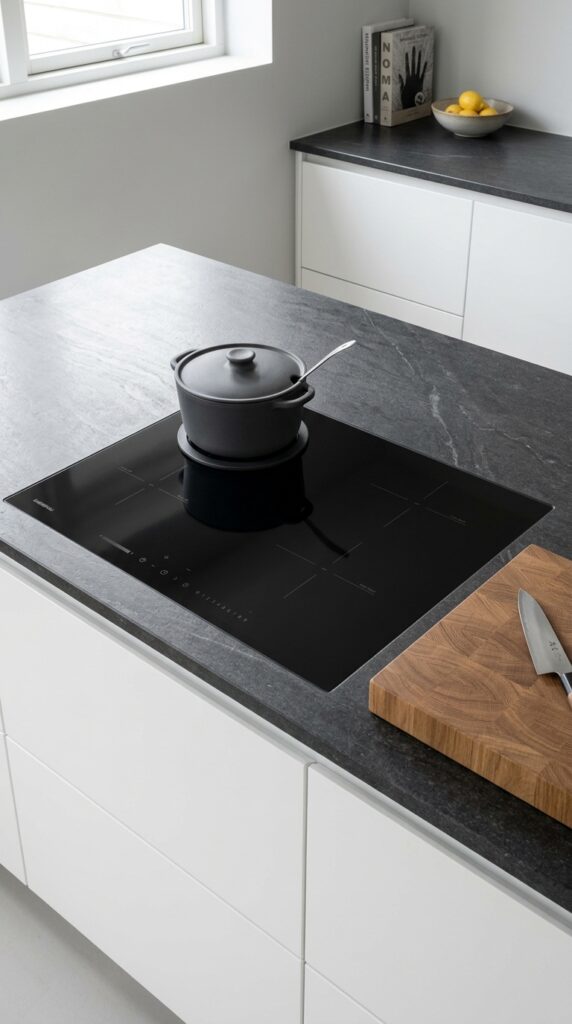
Vibe: Resolved and functional — a countertop that becomes a single continuous surface from wall to wall.
Why it works: A flush-mounted induction cooktop achieves the minimalist kitchen’s highest formal ambition: the unbroken countertop plane. Traditional drop-in cooktops sit proud of the counter surface by 10 to 15mm, creating a visual step and a hygiene-problematic grease-trapping edge. A flush-mounted induction cooktop — requiring a countertop rebate machined to the exact depth of the cooktop’s rim — eliminates both problems. The continuous horizontal surface reads as a single architectural element, making the kitchen’s work zone feel more expansive and significantly easier to clean.
How to get it: Flush mounting requires precise CNC countertop rebating to ±0.5mm tolerance — this is a factory process for stone and quartz surfaces, not a field-cut operation. Specify the exact cooktop model before finalizing the countertop order so the fabricator can machine the rebate to the correct dimension.
| Shop The Look |
| Induction cooktop flush mount frameless minimal |
| CNC stone countertop rebate service cooktop |
| Dark honed stone countertop slab kitchen |
| Ceramic kitchen pot minimal induction compatible |
| Flush countertop cooktop trim kit minimal |
17. Pegboard Storage System in Matte Finish
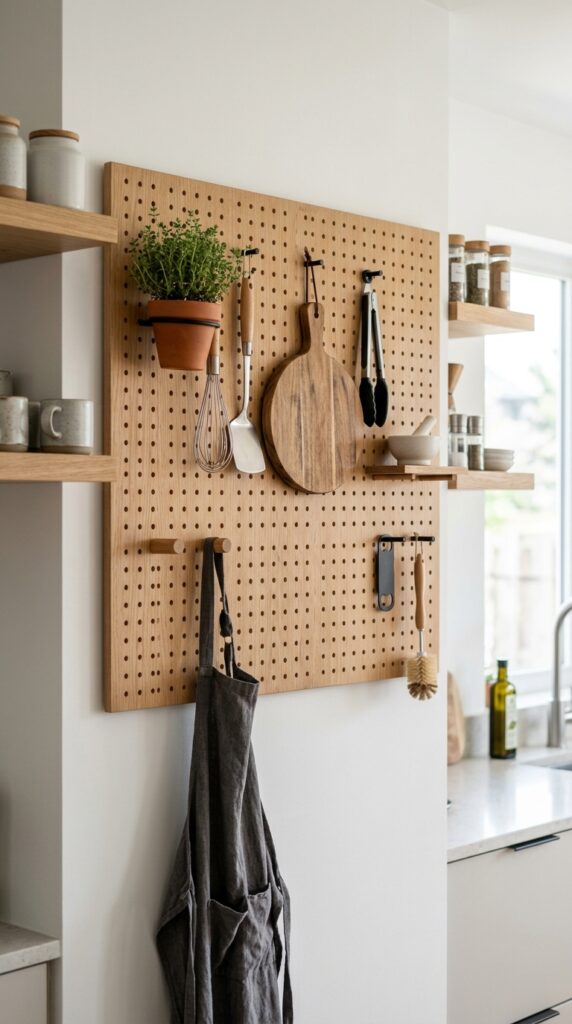
Vibe: Functional and considered — storage that makes the tools part of the room’s visual order.
Why it works: A pegboard wall system in a minimalist kitchen applies the principle of visible organization — rather than concealing kitchen tools entirely (which requires abundant cabinet depth) or leaving them loose on the counter (which creates clutter), a pegboard creates a defined vertical plane where every hung object has an assigned position. The grid of the pegboard creates a graphic order that makes even a loaded tool wall read as composed. In matte white, the pegboard integrates with a white kitchen background; in natural oak, it functions as a warm material accent.
How to get it: Mount the pegboard on 20mm standoff spacers from the wall rather than flush — this provides the necessary clearance for hook insertion and also creates a clean shadow line around the panel that makes it read as an intentional architectural insert rather than a utility addition.
💡 Quick Win: A 24×48-inch natural oak or painted pegboard panel ($30 to $55 at hardware stores) with eight to twelve minimal metal hooks transforms an unused kitchen wall into organized open storage with a deliberate graphic quality.
| Shop The Look |
| Matte white pegboard panel kitchen wall storage |
| Natural oak pegboard panel kitchen minimal |
| Slim metal pegboard hook set kitchen |
| Kitchen utensil set minimal stainless pegboard |
| Pegboard standoff mounting kit wall panel |
18. Handle-Free Toe-Kick Drawer System
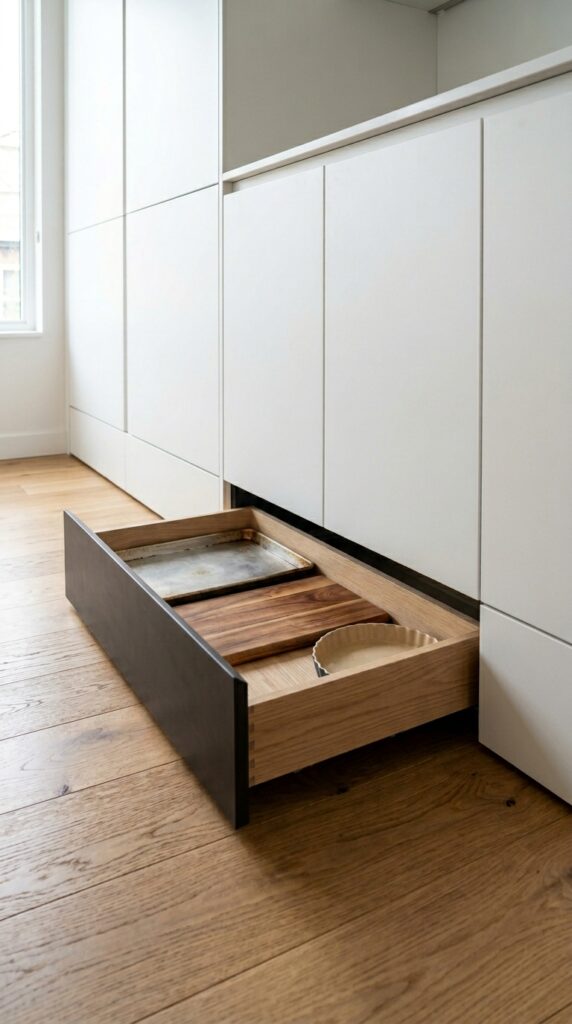
Vibe: Ingenious and resolved — the storage that no one sees until they need it and it changes everything.
Why it works: The toe-kick area — the 4-to-5-inch recessed base beneath all base cabinets — is standard wasted space in conventional kitchens. Converting it to a pull-out or push-to-open drawer recovers approximately 2 to 3 linear feet of shallow storage per run, ideal for baking trays, chopping boards, placemats, and flat items that otherwise occupy prime cabinet depth. In a minimalist kitchen where counter and cabinet surface reduction is the goal, toe-kick drawers are among the most functionally effective space additions available, and they are entirely invisible when closed.
How to get it: Toe-kick drawers require 4 inches of height minimum — most European-style kitchen base cabinets provide exactly this. They are specified at the cabinet factory stage; retrofitting them into existing cabinet bases requires the removal of the toe-kick panel and custom drawer box fabrication.
| Shop The Look |
| Toe kick drawer cabinet base storage minimal |
| Push to open drawer mechanism base cabinet |
| Shallow pull out drawer organizer kitchen flat |
| Baking tray organizer cabinet storage minimal |
| Base cabinet toekick panel replacement minimal |
19. Small Galley Kitchen with Mirror Backsplash
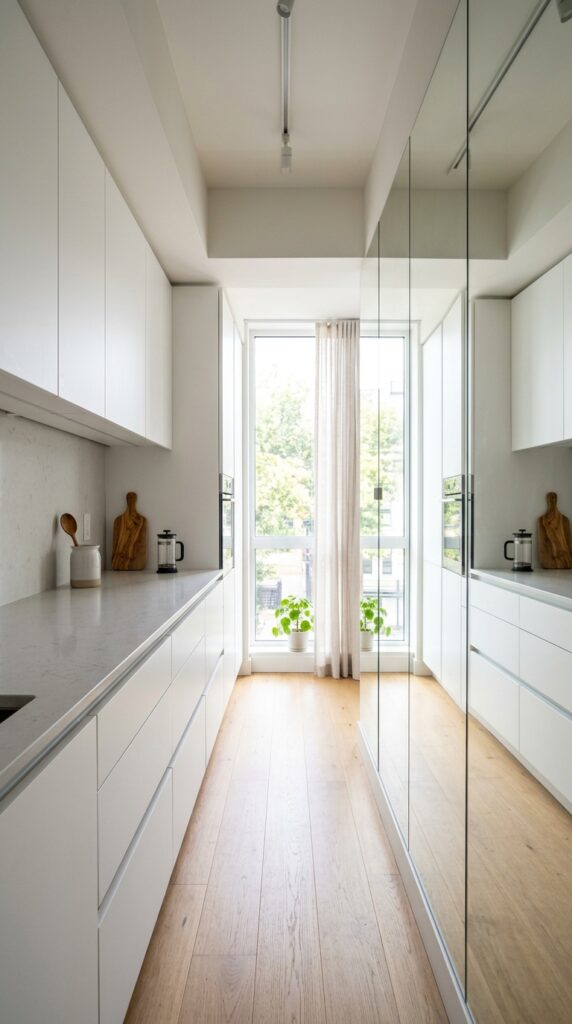
Vibe: Airy and expanded — the small kitchen that refuses to acknowledge its own dimensions.
Why it works: A mirror backsplash in a narrow galley kitchen applies the principle of reflected depth — the perceived width and length of the space nearly doubles because the mirror introduces a second vanishing point that extends the room beyond the physical wall surface. In a minimalist context, the mirror also performs a functional decorating role: it reflects the opposite cabinet run and window, meaning the mirror itself is always “showing” the most designed elements of the kitchen back at the viewer. Frameless mirror panels installed with construction adhesive directly to the wall behind the counter read as a single architectural surface rather than a decorative element.
How to get it: Use low-iron mirror glass (also called starfire or ultra-clear mirror) rather than standard mirror for a kitchen backsplash — standard mirror has a slight green tint that is visible at long reflections and disrupts the clean, accurate reflection that makes this technique work.
| Shop The Look |
| Low iron frameless mirror panel backsplash kitchen |
| Mirror adhesive construction panel mount |
| Narrow galley kitchen flatware organizer minimal |
| Galley cabinet door handle bar minimal |
| Counter edge mirror trim strip minimal |
20. Recessed Appliance Garage with Tambour Door
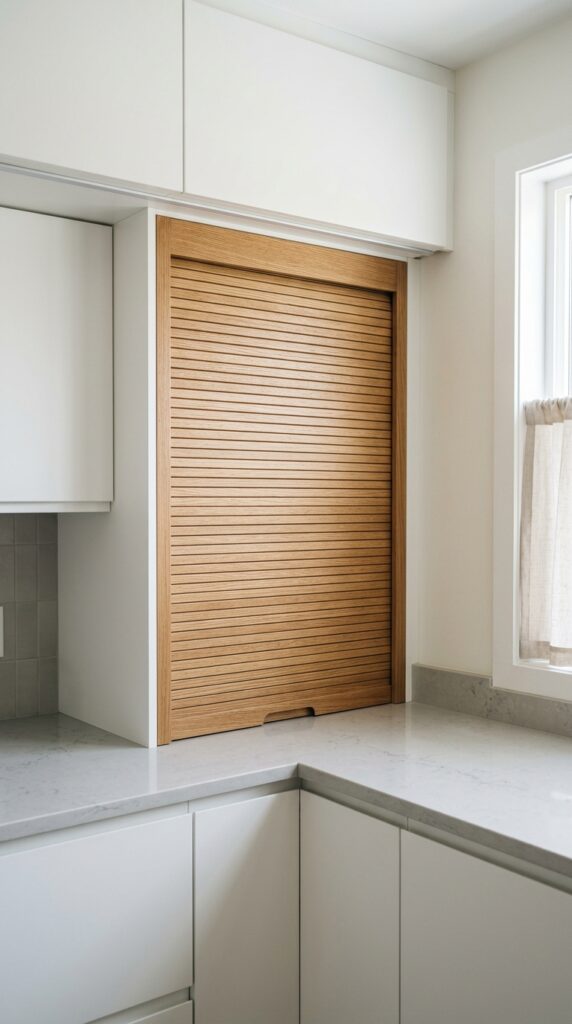
Vibe: Seamless and clean — the counter that hides everything and shows nothing.
Why it works: The appliance garage solves the most persistent enemy of the minimalist kitchen: small countertop appliances. A coffee machine, toaster, blender, and kettle together occupy 8 to 12 linear feet of counter space and represent the kitchen’s highest-density visual clutter. A recessed niche with a tambour door conceals all of them behind a surface that reads as cabinetry when closed, restoring the unbroken counter plane that is the minimalist kitchen’s primary formal goal. The tambour door — a flexible roll-up surface of narrow horizontal slats — conceals and reveals in a single smooth gesture.
How to get it: Build the appliance garage niche with a 14-inch minimum height clearance (to accommodate a coffee machine under a standard upper cabinet) and wire the niche with a switched power strip inside — appliances remain plugged in permanently and activate from the concealed position.
| Shop The Look |
| Tambour door appliance garage cabinet roll up |
| Appliance garage niche kit under cabinet |
| In-cabinet power strip switched kitchen minimal |
| Tambour door replacement kit cabinet minimal |
| Appliance garage hinge hardware roll up |
21. Warm White Limewash Kitchen Walls
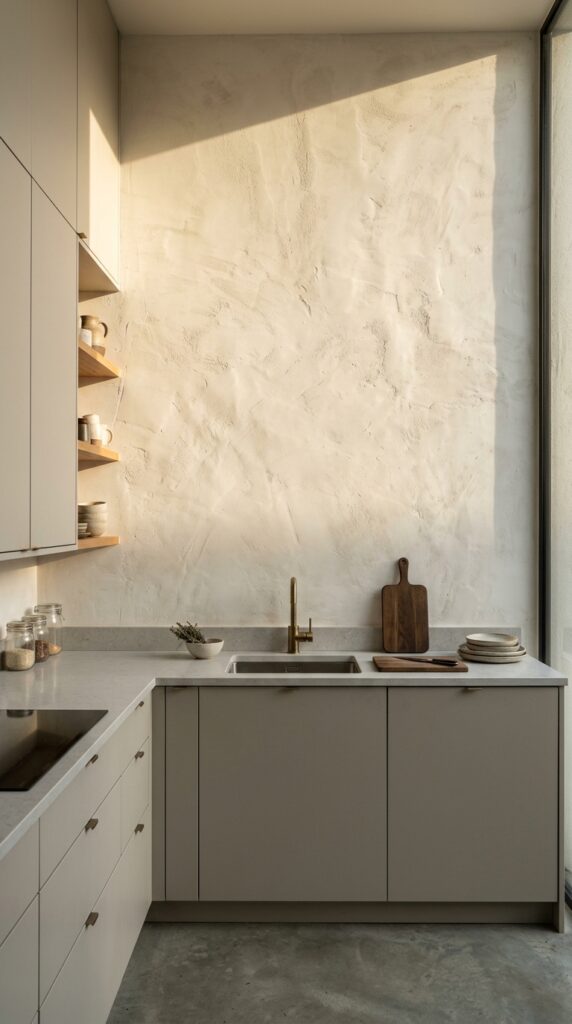
Vibe: Warm and materially rich — the wall that makes a precision kitchen feel genuinely inhabited.
Why it works: Limewash on kitchen walls introduces the principle of material counterpoint — placing an organic, hand-applied wall surface in deliberate contrast with the machine precision of flat-front cabinetry and honed stone. The rough-smooth dialogue between a limewash wall and polished kitchen surfaces creates visual interest that neither material generates alone. Limewash also ages gracefully in kitchen conditions — humidity and minor grease contact patinate a limewash wall rather than damaging it, producing a richer surface over time.
How to get it: Apply limewash to kitchen walls only — not to the backsplash behind the cooking zone, which requires a cleanable surface. A clear matte sealer applied over the limewash in the area directly behind the cooktop (one meter wide, counter to mid-cabinet height) makes the limewash washable without changing its visual quality.
| Shop The Look |
| Warm white limewash wall paint mineral kitchen |
| Limewash application brush natural bristle wide |
| Clear matte sealer limewash wall kitchen safe |
| Limewash wall texture guide application kit |
| Mineral wall paint matte white kitchen |
22. Kitchen Island with Built-In Herb Garden
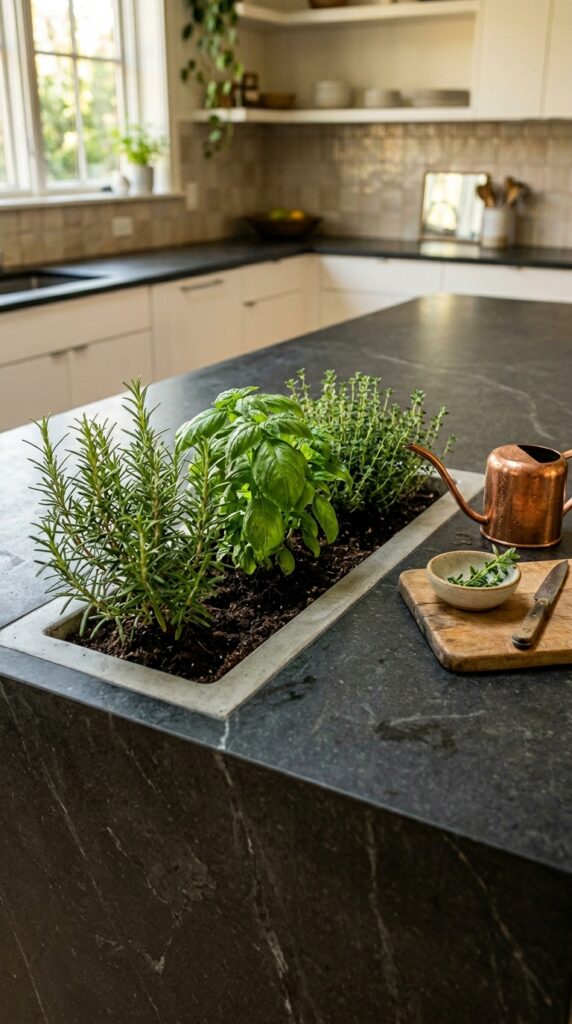
Vibe: Functional and quietly alive — the kitchen where the ingredient is growing six inches from where you cook it.
Why it works: A built-in herb trough in the kitchen island applies the principle of integrated function — the planter is not a decorative addition to the kitchen but a functional element built into the kitchen’s primary work surface, reflecting the minimalist preference for objects that perform rather than simply appear. A recessed trough flush with the counter surface maintains the horizontal plane continuity of the island while introducing the one element that a minimalist kitchen genuinely benefits from: living plant material. Three herbs (rosemary, thyme, basil) provide both visual green and daily culinary utility.
How to get it: Line the trough with a waterproof membrane and install a concealed drain connected to the building’s plumbing — unsealed stone or concrete planters leach moisture into the structural island over time and cause irreversible damage. A stainless steel liner insert is the most maintenance-free solution.
💡 Quick Win: A ceramic herb pot tray — three small matching white matte pots on a single wooden or concrete base — placed at the island’s end replicates the visual of a built-in herb zone for under $30 total without construction.
| Shop The Look |
| Built in island planter trough concrete kitchen |
| Stainless steel liner trough insert planter |
| Culinary herb set rosemary thyme basil live |
| Ceramic herb pot set matching white minimal |
| Small kitchen watering can minimal copper |
23. Vertical Storage Tower Cabinet
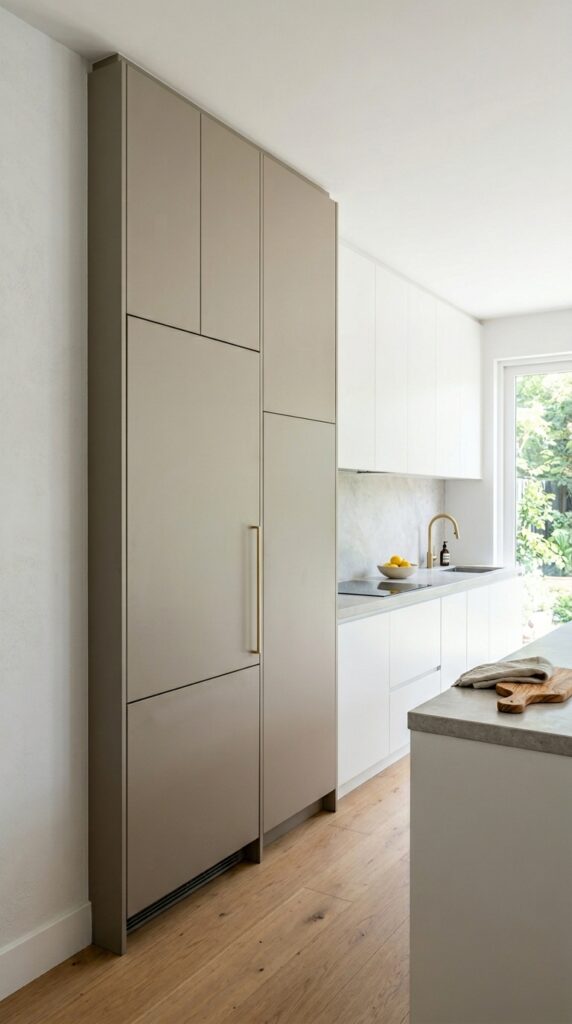
Vibe: Resolved and organized — a column of storage that looks like a decision rather than a necessity.
Why it works: A floor-to-ceiling vertical storage tower concentrates the kitchen’s highest-volume storage — pantry shelving, tall appliances, refrigerator — into a single architectural column that reads as one object rather than a collection of kitchen units. The design principle is vertical unity: running continuous flat-front panels from floor to ceiling in a single material and color creates a tower that functions as an architectural element, like a pillar, rather than as assembled furniture. The tower also frees the horizontal cabinet runs on adjacent walls from pantry and refrigerator functions, allowing them to focus on cooking-zone and prep-zone tasks.
How to get it: Inset the vertical tower 20mm proud of the surrounding base cabinet run — a slight projection from the wall plane creates a shadow gap that defines the tower as a distinct architectural element rather than simply a taller section of the same cabinet run.
| Shop The Look |
| Floor to ceiling pantry tower cabinet minimal |
| Tall pantry pull out shelf system interior |
| Full height flat front cabinet door set |
| Vertical storage column cabinet base kit |
| Integrated refrigerator panel tall tower |
24. Minimal Kitchen with One Piece of Art
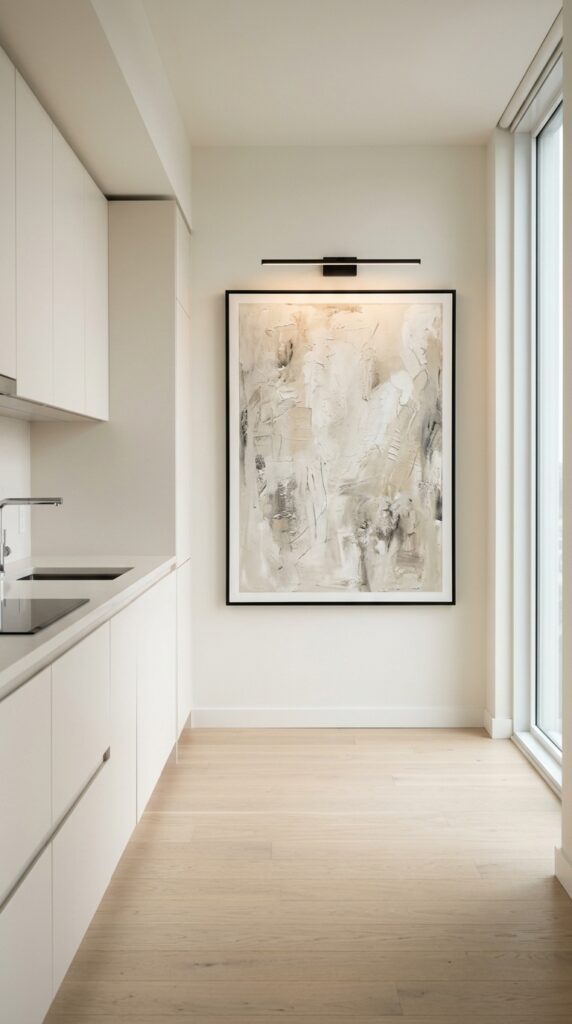
Vibe: Gallery-like and resolved — one piece of art in a kitchen says more than ten pieces anywhere else.
Why it works: Art in a minimalist kitchen works on the principle of singular emphasis — because the kitchen contains no other decorative objects (no accessories, no open shelf collections, no visible clutter), a single framed artwork receives the full visual attention of the room. This is the exact dynamic of gallery presentation: white walls and empty space amplify the artwork rather than competing with it. The kitchen is actually an ideal gallery context because its occupants spend extended time in the space at counter height — close reading distance — where the painting’s surface detail is fully visible.
How to get it: Place the artwork on the wall at the end of the longest visual axis in the kitchen — the wall you look toward from the primary prep zone. This ensures the painting is always within the natural field of vision during kitchen activity without being positioned where grease or steam from the cooking zone could reach it.
| Shop The Look |
| Large abstract art print framed kitchen minimal |
| Thin matte black frame gallery kitchen wall |
| Picture light brushed brass minimal kitchen |
| Art hanging kit gallery wall minimal |
| Canvas stretcher print large neutral kitchen |
25. Seamless Flush Skirting and Base Detail
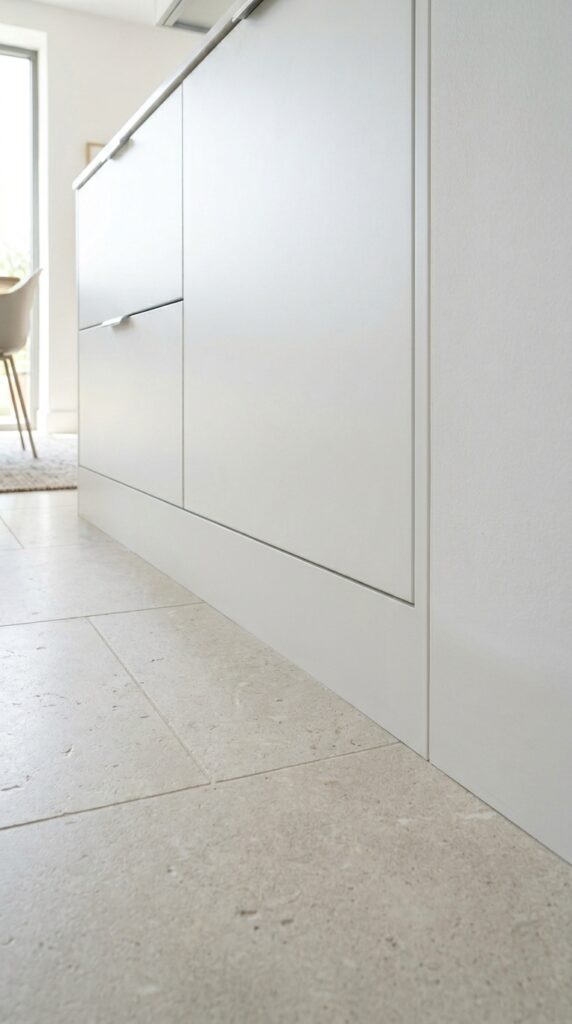
Vibe: Architectural and precise — the detail that only reveals itself when you look down, and rewards it.
Why it works: The base zone of a kitchen — where cabinet meets floor meets wall — is typically a visual accumulation of mismatched materials: a chrome toe-kick trim strip, a painted timber skirting board, a grout line at the tile edge. In a minimalist kitchen, resolving all of these transitions into a single flush channel creates what architects call “base continuity” — the floor plane appears to run without interruption to the cabinet face, which makes rooms appear both larger and more precisely constructed. This detail is invisible in a crowded kitchen but immediately apparent in a spare one.
How to get it: Specify that the toe-kick and skirting board be finished in the same material as the cabinet doors — matte lacquer or thin stone panel — and installed flush with the cabinet face plane. The floor should butt directly to the toe-kick face with a 1mm expansion gap sealed with matching silicone rather than a metal trim strip.
| Shop The Look |
| Flush toe kick panel cabinet base minimal |
| Continuous skirting board matte white kitchen |
| Stone effect floor tile large format minimal |
| Base channel aluminum continuous floor minimal |
| Matching silicone sealant matte white cabinet |
26. Slim Minimalist Kitchen Pendant in Brushed Brass
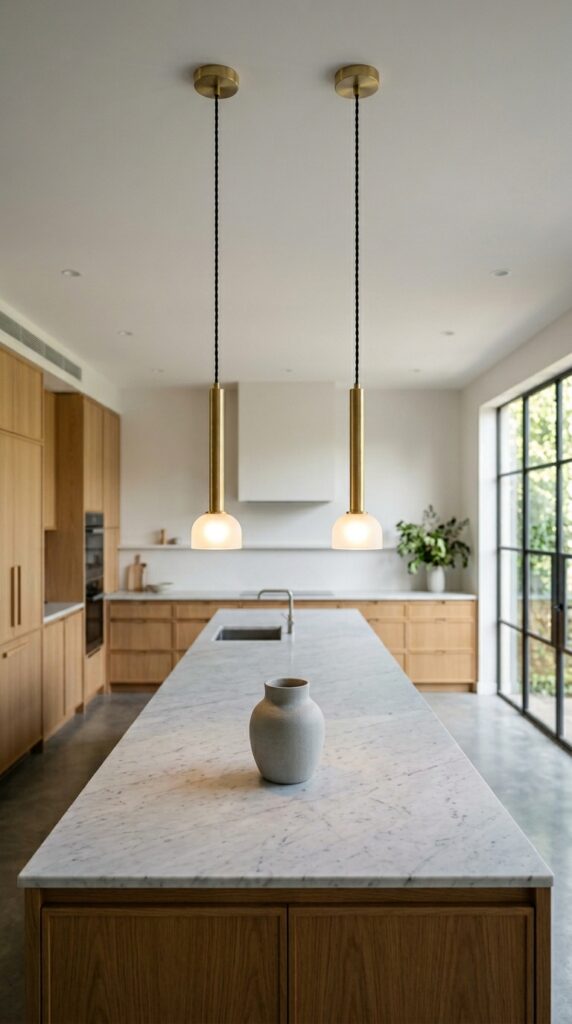
Vibe: Warm and precise — two small lights that hold the whole island in their attention.
Why it works: Pendant lighting over a kitchen island works on the principle of visual anchoring — the pendant drops establish a vertical connection between the ceiling plane and the work surface below, framing the island as the kitchen’s primary functional zone. Two pendants rather than three or one is the correct number for an island of standard length (48 to 60 inches): two creates a paired symmetry that reads as composed, while three can feel busy and one reads as insufficient for the island’s length. Slim bullet or dome pendants in brushed brass maintain a modest visual footprint while providing the warm metallic accent the kitchen needs.
How to get it: Hang the pendants 28 to 32 inches above the island countertop surface — this positions the light source above head height when standing (preventing glare) while keeping it close enough to the work surface to provide effective task illumination.
| Shop The Look |
| Slim brushed brass dome pendant light kitchen |
| Pendant light cord adjustable ceiling mount |
| Frosted glass shade pendant replacement |
| Island pendant light set of 2 minimal brass |
| Ceiling canopy pendant mount minimal brushed |
27. Studio Kitchen with Fold-Down Dining Ledge
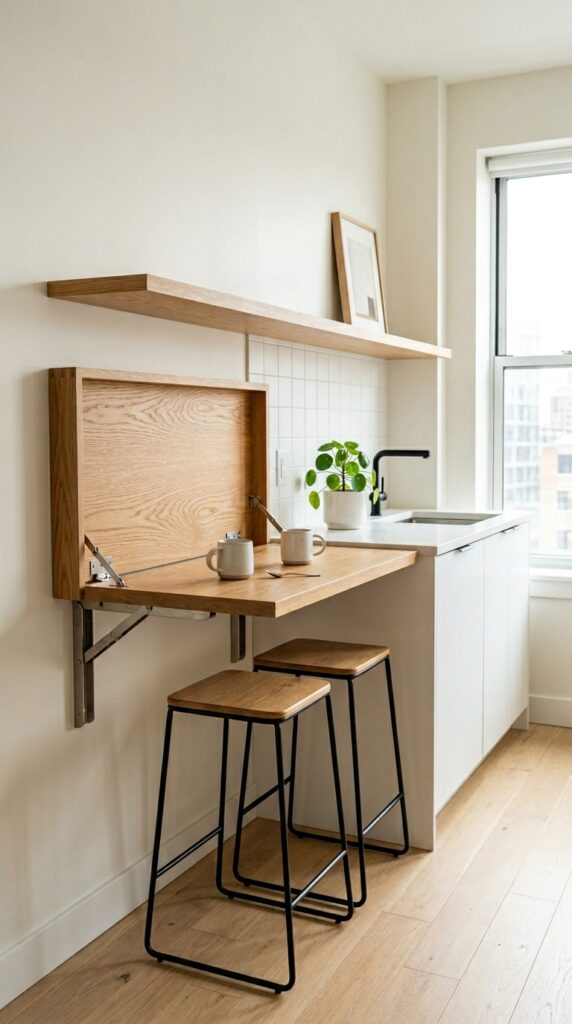
Vibe: Compact and resolved — the kitchen that does everything in the space of one wall and apologizes for nothing.
Why it works: A wall-mounted fold-down dining ledge in a studio kitchen applies the minimalist principle of dual-function design — the ledge serves as additional prep surface when needed and as a dining surface when deployed, without occupying permanent floor space. In the folded position, the ledge is flush with the wall and visually disappears — the kitchen wall reads as a continuous surface uninterrupted by furniture. Two slim bar stools stored under the kitchen counter (seat height 60 to 65cm, which fits under a standard 90cm counter) vanish into the kitchen run when not in use.
How to get it: Mount the fold-down ledge at exactly 90cm from the floor — consistent with the standard kitchen counter height — so that the ledge and counter form a continuous work surface when both are deployed, maximizing usable prep area in a small kitchen before the ledge is needed for dining.
💡 Quick Win: A wall-mounted fold-down oak shelf bracket system from IKEA’s NORBERG or similar ($35 to $65) achieves this entire concept with off-the-shelf components and an afternoon of installation.
| Shop The Look |
| Wall mounted fold down dining ledge oak bracket |
| Slim bar stool set 2 counter height minimal |
| Fold down shelf bracket heavy duty wall mount |
| Small kitchen counter stool storage seat |
| Compact kitchen dining ledge white oak panel |
How to Start Your Modern Minimalist Kitchen Transformation
Your single first move is this: replace every piece of visible cabinet hardware with push-to-open soft-close mechanisms and remove the hardware entirely. This one change — which costs $120 to $250 for a standard kitchen and takes a weekend — advances the handleless aesthetic more dramatically than any accessory or material addition. The absence of hardware allows the cabinet door surface to read as a continuous plane, which is the foundational visual condition that every other minimalist kitchen decision builds on.
The most common mistake in minimalist kitchen renovation is choosing the wrong white — specifically, selecting a cool or pure white cabinet lacquer that reads as blue-toned under the warm lighting that kitchens require. Farrow & Ball’s All White (No. 2005) or Benjamin Moore Chantilly Lace (OC-17) produce this cool-reading problem in kitchens that use warm-white LED bulbs, making the cabinetry appear slightly grey-blue in evening light. The correct reference is RAL 9010 Pure White with a warm undertone, or an off-white with a clear yellow-beige undertone. Request a large paint sample (at least A3 size) and assess it in the kitchen under both natural and artificial light before committing.
Three specific items under $50 that create immediate minimalist kitchen impact: a set of matte black soft-close cabinet hinges to replace existing chrome or nickel hardware ($18 to $25 for a 10-pack); a natural linen dish towel set in undyed or natural cream, replacing patterned or colored kitchen textiles ($12 to $20 for a set of four); and a single large handthrown ceramic bowl in warm neutral glaze placed on the counter as the kitchen’s only displayed object ($15 to $35 from a ceramics market or online potter).
Realistic expectations: a meaningful minimalist kitchen refresh — hardware replacement, new cabinet paint, and a single quality surface addition — costs $400 to $1,200 and takes two to three weekends. A full minimalist kitchen renovation with new cabinetry, countertops, integrated appliances, and lighting runs $18,000 to $45,000 depending on size and specification. The highest-return investment at any budget level is the countertop material — a quality honed stone or concrete-effect surface elevates the entire kitchen’s perceived quality more than any cabinet change, and it is the surface you interact with most.
Frequently Asked Questions About Modern Minimalist Kitchens
What is the difference between a modern kitchen and a minimalist kitchen?
A modern kitchen refers to a broad stylistic period (post-1950s, clean-lined, contemporary) that encompasses many different aesthetics. A minimalist kitchen is a specific design philosophy applied to kitchen design that prioritizes surface continuity, concealed storage, integrated appliances, and reduction of visible objects to their functional minimum. All minimalist kitchens are modern in style, but not all modern kitchens are minimalist — a modern kitchen can include open shelving loaded with colorful objects, visible appliances, and decorative hardware. The distinction is that minimalism is an active discipline of subtraction, not simply the absence of traditional decorative elements.
What colors work best for a modern minimalist kitchen?
Warm whites and warm neutrals consistently outperform cool whites and grey-tones in minimalist kitchens because they remain visually clean under both daylight and warm artificial lighting. Specific references: Benjamin Moore White Dove (OC-17) for a warm white that reads as neutral across lighting conditions; Farrow & Ball Elephant’s Breath (No. 229) for a warm greige that bridges white and grey; and SW Urbane Bronze (SW 7048) for a warm charcoal that reads as deeply grounded without veering blue. If a single accent color is introduced, dusty sage (Farrow & Ball Mizzle No. 266) and deep navy (F&B Hague Blue No. 30) are the two most resolved minimalist kitchen accent choices because both read as natural pigments with clear historical precedent in kitchen design.
How much does a minimalist kitchen renovation cost?
A cosmetic minimalist refresh — new hardware (or hardware removal), cabinet repainting, and accessory editing — costs $600 to $2,500 for a standard kitchen. A mid-range renovation with new flat-front cabinetry, a quality stone countertop, and integrated appliances runs $15,000 to $30,000. A fully resolved minimalist kitchen with custom cabinetry, full-height stone slab backsplash, integrated rangehood, flush cooktop, and architectural modifications costs $40,000 to $80,000 and above at the premium end. The countertop is the single investment with the highest visual return — a honed Calacatta or Pietra Serena stone surface costs $150 to $400 per square foot installed and transforms the kitchen’s perceived quality more than any other individual material choice.
Can a minimalist kitchen work for families with children?
Yes — with two specific design adaptations. First, choose cabinet finishes that tolerate handling: a matte two-pack polyurethane lacquer in a warm white is significantly more durable than painted cabinets and can be spot-cleaned without leaving sheen variation. Avoid gloss finishes, which show fingerprints constantly and require daily maintenance to meet the minimalist standard of visual cleanliness. Second, build abundant concealed storage — maximizing interior cabinet depth with pull-out organizers and adding a dedicated zone for children’s tableware at accessible height. The minimalist kitchen’s visual discipline depends on clear counters, which in a family kitchen requires more total storage capacity, not less.
What is the most important single investment in a minimalist kitchen?
The countertop. In a minimalist kitchen where the counter surface is the largest visible horizontal plane and the primary working surface, countertop material quality has a disproportionate influence on the room’s overall perceived quality. A honed natural stone countertop — Calacatta marble, Pietra Serena, or Taj Mahal quartzite — at $200 to $400 per square foot installed transforms the kitchen’s material register in a way that no cabinet finish, lighting choice, or accessory edit can replicate. For budget-constrained kitchens, Dekton or Silestone in a honed concrete-effect finish at $80 to $150 per square foot installed delivers a convincing facsimile of poured concrete with the durability advantage of engineered quartz — the single most effective quality-to-cost ratio available in minimalist kitchen surfaces.
Ready to Create Your Dream Modern Minimalist Kitchen?
These 27 concepts cover the full range of what modern minimalist kitchen design can achieve — from the material choices and color strategies that define the visual palette, to the hardware decisions, lighting integrations, and spatial arrangements that give the style its distinctive resolved quality. A minimalist kitchen transformation always begins with subtraction: the first weekend should be spent removing objects from counters and hardware from cabinets rather than adding anything new, because the underlying material logic of the kitchen only becomes visible when the visual noise is cleared. The single most concrete action you can take today is to clear every object from your kitchen counter, place back only what you use daily, and live with that reduced surface for one week — the objects that go back are the only ones the counter needs. When the kitchen finally coheres — when the counter is clear and the surfaces earn their presence and the one ceramic bowl sits exactly where it belongs — the room will feel less like a renovation and more like a decision that was always available, waiting to be made. Save the ideas where the material logic made you stop scrolling, and return to the ones built on surface continuity and honest materials — those are the choices that compound in quality every year you live with them.