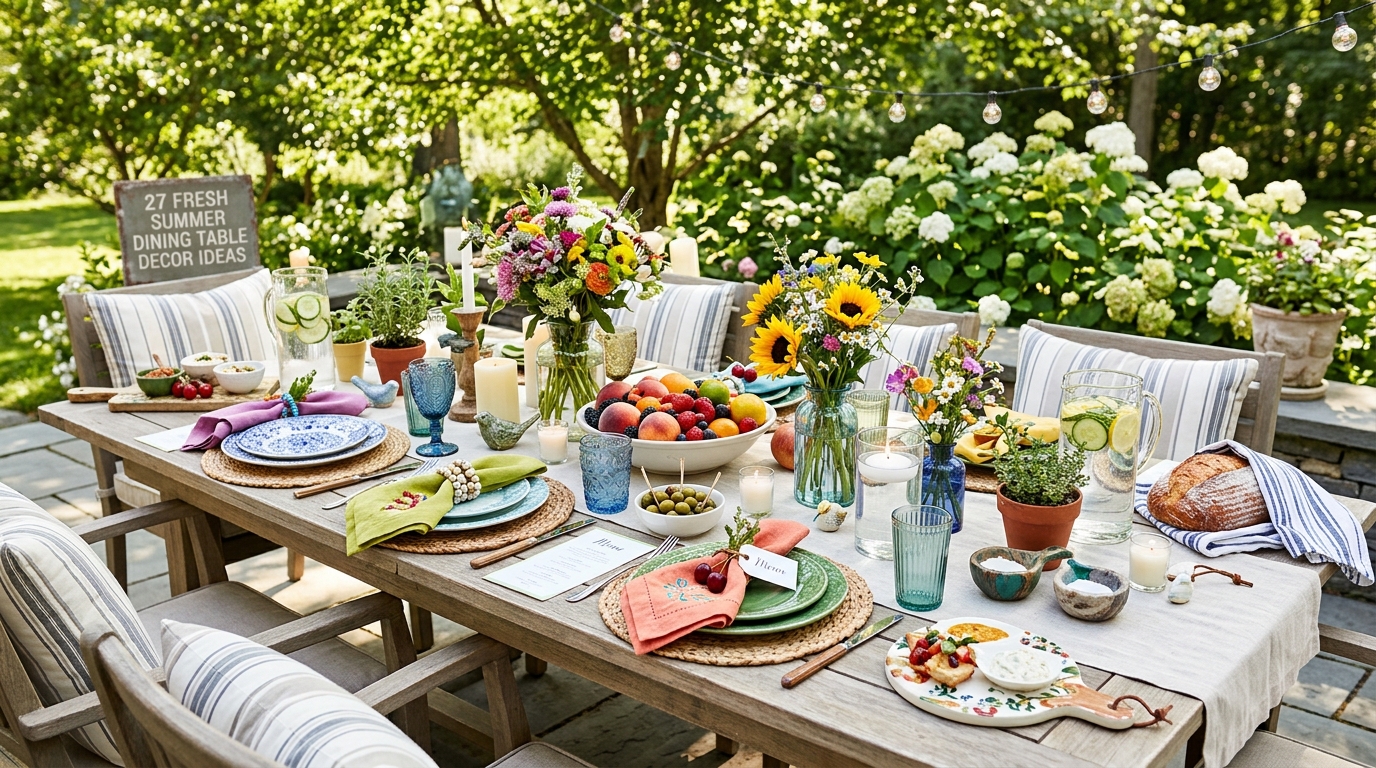
Summer dining table decor uses seasonal textures, warm tones, and organic elements to transform your table into an alfresco-inspired gathering space — indoors or out. This article gives you exactly 27 fresh, actionable ideas spanning color, materials, lighting, and layout so you can style your dining table for summer with confidence.
There’s a particular kind of ease that settles over a summer table done right. The light catches a linen runner. A cluster of citrus sits unassumingly in a bowl. The whole thing feels put-together without trying — cool, unhurried, alive. That’s the energy summer dining table decor does best: abundant but uncluttered, warm but not heavy. Here are 27 ideas worth saving — and stealing.
Why Summer Dining Table Decor Works So Well
Summer dining table decor is rooted in a design philosophy borrowed from Mediterranean and coastal living — the idea that the table should feel like an extension of the outdoors. It draws from Provençal farmhouse traditions, relaxed coastal California styling, and the kind of effortless entertaining culture seen across Scandinavia in summer months. What sets it apart from other seasonal approaches is its emphasis on organic imperfection: nothing too symmetrical, nothing too stiff, everything grounded in nature.
The core materials are natural and tactile. Think undyed linen in warm white or oat, unfinished teak, hand-thrown ceramics in dusty sage or creamy bone, rattan charger plates, and beeswax candles with irregular drips. Color palettes lean into sun-bleached, earthy territory: warm terracotta, faded coral, sea-glass green, sandy taupe, and muted cobalt blue. These tones don’t compete — they settle.
The style is trending hard right now for a clear cultural reason: post-pandemic life pushed people toward intentional gathering. Dining became ceremonial again. Pinterest search data shows consistent year-over-year growth for “summer tablescape,” “linen table decor,” and “organic modern dining.” People want their tables to feel like destinations — not just a surface where food lands.
Small dining spaces can absolutely achieve this aesthetic. The key move is restraint: one strong centerpiece element (a long wooden board or a trio of bud vases), a cohesive linen base, and negative space doing the heavy lifting. Less is genuinely more here.
Style at a Glance
| Element | Trait |
| Philosophy | Relaxed abundance, nature-led |
| Materials | Linen, teak, rattan, hand-thrown ceramic |
| Color palette | Warm white, terracotta, sage, sandy taupe |
27 Summer Dining Table Decor Fresh Ideas
1. The Terracotta and Linen Layered Foundation
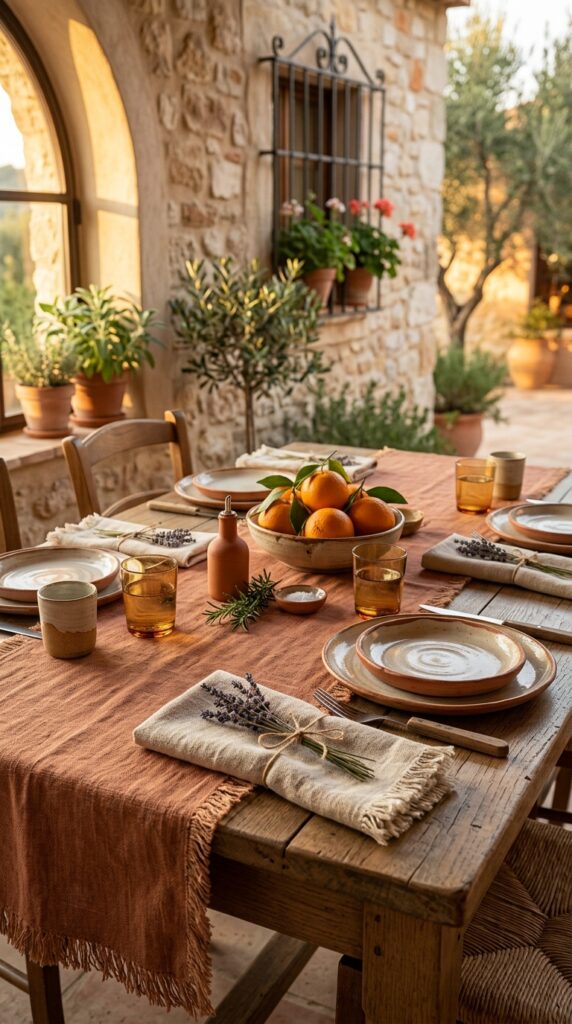
Vibe: Sun-warmed, in the best possible way — like the table has absorbed an entire afternoon of golden light.
Why it works: Layering terracotta tones with undyed linen creates a tonal relationship grounded in the warm-cool contrast principle. The earthiness of clay-colored ceramics reads as weight and substance, while the pale linen lightens the composition and keeps the eye moving. The visual texture of woven linen against the smooth glaze of ceramics adds tactile depth without introducing pattern or color complexity.
How to get it: Start with a linen runner in warm white or oat — not crisp white, which reads cold — and layer terracotta ceramic side plates over it. Use rattan or woven charger plates underneath to add a third texture. Keep all tones within two shades of each other for a seamless, editorial feel.
💡 Quick Win: A bundle of 3 dried orange slices tied with twine costs under $5 to DIY and immediately anchors the terracotta palette as a napkin accent.
🛍️ Shop the Look — Amazon Product Ideas
| # | Product Search Phrase | Why It Fits |
| 1 | Terracotta ceramic dinner plate set handmade | Core color anchor |
| 2 | Natural linen table runner fringe edge | Warm base layer |
| 3 | Rattan charger plates set of 4 | Texture beneath plates |
| 4 | Dried orange slice garland natural | Palette accent detail |
| 5 | Undyed linen dinner napkins set of 6 | Cohesive tone layering |
2. A Citrus Centerpiece Bowl That Earns Its Place
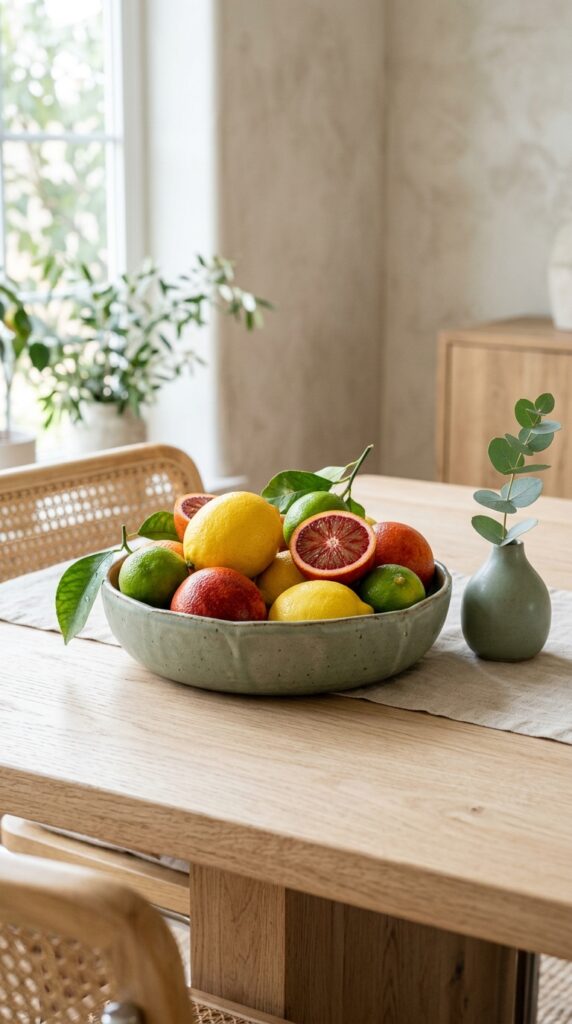
Vibe: Fresh and grounded — the kind of centerpiece that smells as good as it looks.
Why it works: A citrus bowl works because it collapses the distinction between food and decor, which is a defining move of summer table styling. The irregular shapes and varying sizes of mixed citrus create organic visual interest without formal arrangement. The matte ceramic bowl acts as a neutral container that highlights rather than competes with the fruit’s warm yellows and oranges — this is the principle of supporting contrast at work.
How to get it: Use a wide, shallow bowl — not a tall fruit bowl — so the citrus reads as a composed cluster rather than a pile. Mix at least three citrus varieties for color range, and leave a few with their leaves attached. A sage, stone, or warm white glaze on the bowl keeps the palette cohesive.
🛍️ Shop the Look — Amazon Product Ideas
| # | Product Search Phrase | Why It Fits |
| 1 | Matte sage ceramic fruit bowl wide | Central anchor vessel |
| 2 | Preserved lemon leaf garland natural | Extends citrus theme |
| 3 | Eucalyptus stems artificial realistic | Fresh green accent |
| 4 | Handmade stoneware bud vase set small | Secondary vessel detail |
| 5 | Cream ceramic serving bowl shallow modern | Alternative neutral bowl |
3. Warm Candlelight With Beeswax Tapers
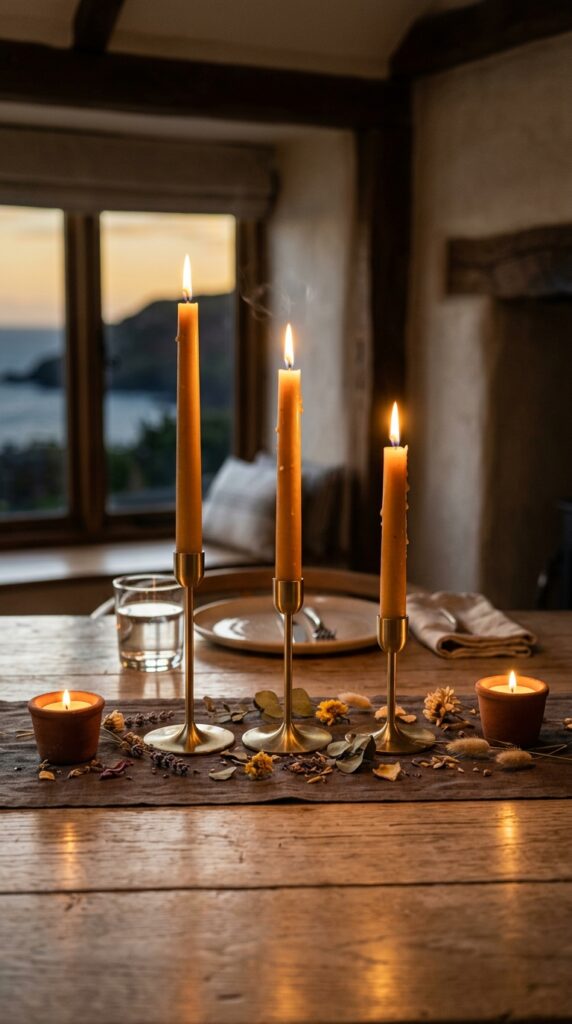
Vibe: Hushed and golden — like the last hour of a long summer evening.
Why it works: Vertical candle arrangements exploit the principle of varying heights to create visual rhythm without horizontal spread. Beeswax specifically matters here: its natural honey tone reads warmer than white paraffin, and the slight translucency of the wax glows in a way that synthetic candles simply don’t replicate. Brushed brass holders reflect candlelight softly, adding warmth without the hard glare of polished metal.
How to get it: Use three tapers in heights of roughly 20cm, 28cm, and 35cm set in slim brass holders. Space them unevenly — not equidistant — to feel relaxed rather than formal. Always use beeswax or natural soy tapers in warm ivory; stark white reads clinical at a dinner table.
💡 Quick Win: Three unscented beeswax taper candles from a craft store or Amazon cost under $15 and immediately shift your table into evening-ready territory without any other changes.
🛍️ Shop the Look — Amazon Product Ideas
| # | Product Search Phrase | Why It Fits |
| 1 | Beeswax taper candles natural honey set 12 | Warm glow source |
| 2 | Brushed brass candlestick holders thin modern | Elegant minimal base |
| 3 | Terracotta votive candle holders set | Warm secondary light |
| 4 | Dried wildflower bundle for table decor | Organic scatter detail |
| 5 | Soy wax pillar candle warm ivory unscented | Alternative warm candle |
4. Rattan Placemats Layered With Ceramic Chargers
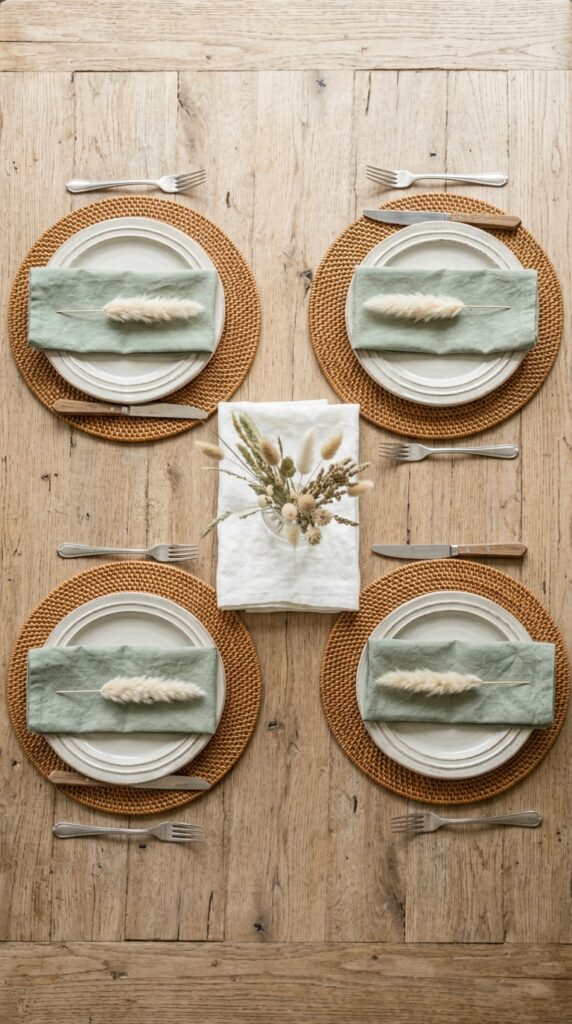
Vibe: Layered and relaxed — the table equivalent of effortless dressing.
Why it works: Rattan placemats beneath ceramic chargers exploit the texture-on-texture layering principle that’s fundamental to organic modern styling. The visual weight difference between the woven rattan and the smooth ceramic creates depth at the place setting level without relying on color contrast. This kind of tonal layering — where everything is in the same warm neutral family — is what gives summer tables their cohesive, editorial quality.
How to get it: Choose round rattan placemats in a diameter at least 2cm larger than your charger plates so the rattan rim is clearly visible. Pair with off-white or bone ceramic chargers rather than stark white. The single pampas stem across the napkin takes under ten seconds per setting and immediately elevates the overall styling.
🛍️ Shop the Look — Amazon Product Ideas
| # | Product Search Phrase | Why It Fits |
| 1 | Round rattan placemats set of 6 natural | Textural base layer |
| 2 | Off-white ceramic charger plates set 4 | Smooth contrast layer |
| 3 | Pampas grass stems dried small bundle | Napkin accent detail |
| 4 | Sage green linen napkins set of 8 | Color bridge element |
| 5 | Woven seagrass table placemat oval | Alternative natural mat |
5. A Trailing Greenery Runner
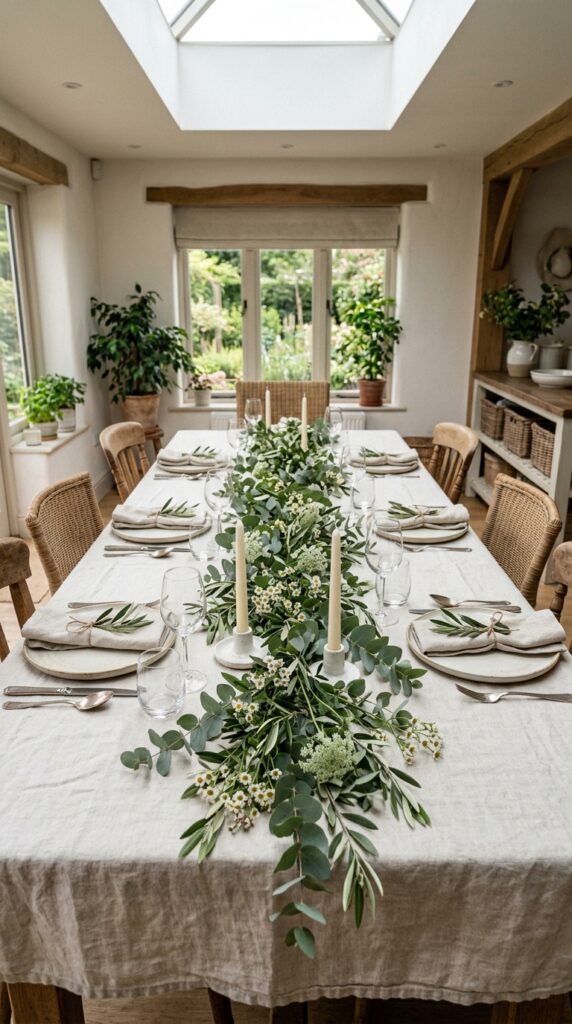
Vibe: Still and living at once — like the garden reached in through the window and stayed.
Why it works: Laying greenery directly on the tablecloth rather than arranging it in a vase uses the principle of organic line — the trailing stems create a natural visual axis down the length of the table that draws the eye from end to end. This is particularly effective for long rectangular tables where a single centerpiece often feels isolated. Eucalyptus and olive branches hold their shape for days without water, making this as practical as it is visually powerful.
How to get it: Buy two large bunches of eucalyptus and one of olive branches from a florist or grocery store. Lay them overlapping in alternating directions down the table center, letting stems extend a little past the table edges. Tuck in small white ranunculus or dried flowers at irregular intervals. No floral foam, no vessels — just stems on linen.
💡 Quick Win: Artificial eucalyptus garlands from Amazon (under $20) mimic this look for a centerpiece you can reuse all summer without any maintenance.
🛍️ Shop the Look — Amazon Product Ideas
| # | Product Search Phrase | Why It Fits |
| 1 | Eucalyptus garland artificial realistic dining | Reusable green runner |
| 2 | Olive branch faux stem arrangement | Organic trailing accent |
| 3 | Dried white wildflower stems bundle | Floral color contrast |
| 4 | Raw linen tablecloth natural large | Neutral surface base |
| 5 | White ceramic taper candlestick holder simple | Light within greenery |
6. Sea Glass Blue Glassware as the Color Statement
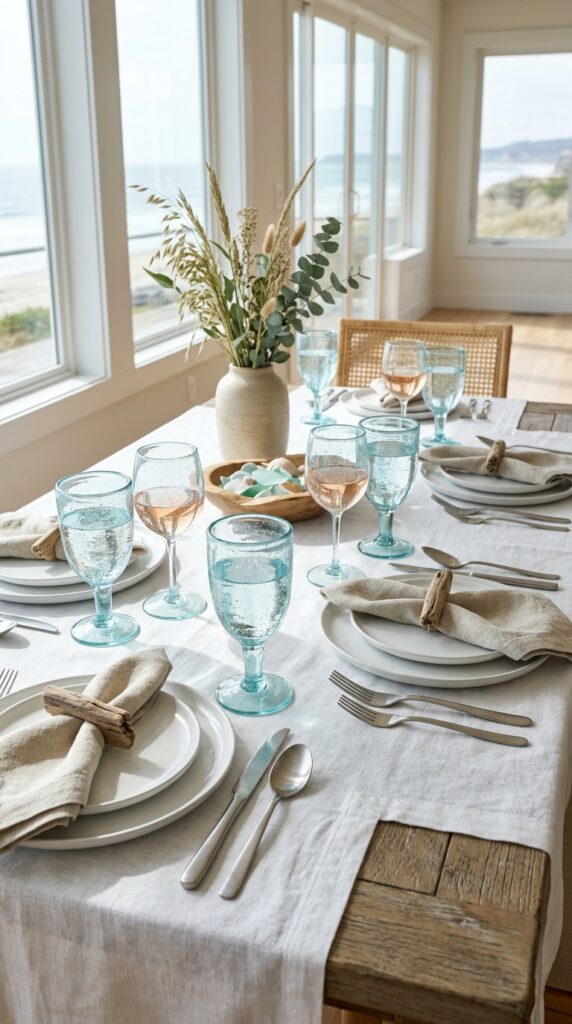
Vibe: Luminous — like sunlight hitting shallow water.
Why it works: Using colored glassware as the single color statement in an otherwise neutral table is a sophisticated application of the design principle of focused accent: one element carries all the color weight, which makes it feel intentional rather than busy. Sea glass blue-green sits in the cool-warm middle — not aggressively coastal, not cold — so it reads elegantly against warm linen and bone ceramic without requiring a fully coastal theme.
How to get it: The key is committing to glassware as your only color element — keep everything else white, linen, or natural. Even one set of sea glass goblets (four pieces) is enough to define the palette for the whole table. Place water goblets first; wine glasses can match or be clear crystal for a more layered look.
🛍️ Shop the Look — Amazon Product Ideas
| # | Product Search Phrase | Why It Fits |
| 1 | Sea glass blue hand blown water goblets set 4 | Color statement piece |
| 2 | Teal green wine glasses set modern | Complementary glassware |
| 3 | Driftwood napkin ring holders natural | Coastal accent detail |
| 4 | White ceramic dinner plates simple modern | Neutral backdrop plate |
| 5 | Linen tablecloth white ivory natural | Neutral surface layer |
7. A Wooden Breadboard as the Centerpiece Base
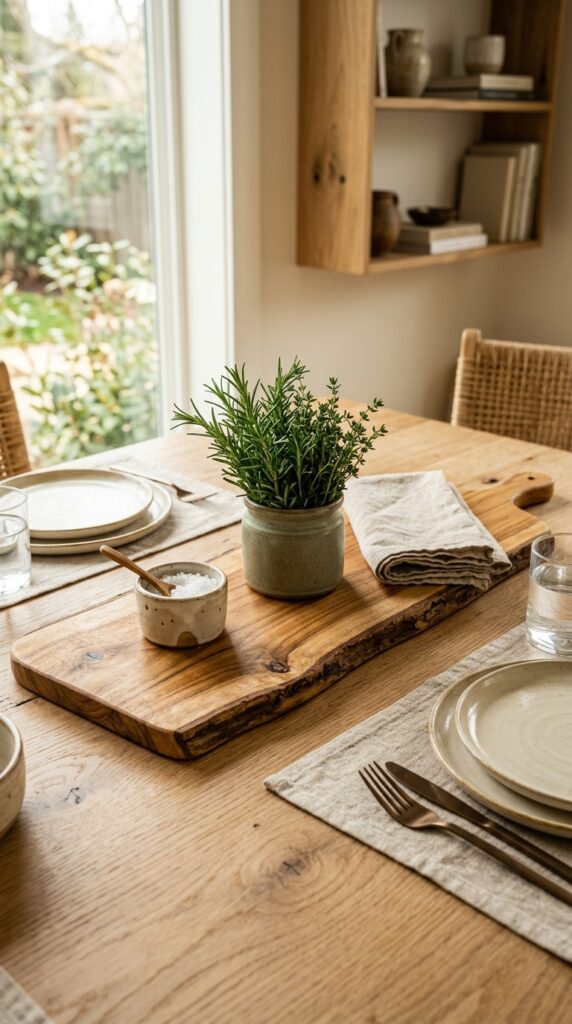
Vibe: Raw and grounded — the table version of a kitchen that actually gets used.
Why it works: A wooden board used as a styling tray applies the principle of visual grouping: by corralling smaller elements onto a single surface, you create a composed vignette that reads as one intentional object rather than scattered pieces. The live or irregular edge of acacia or walnut wood also introduces organic line, which softens the formality of a set table without sacrificing order.
How to get it: Choose a board at least 45cm long — short boards look like an afterthought. Style it with odd-numbered groupings: three small objects work better than two or four. A salt cellar, a small herb crock, and a folded napkin is a classic trio. Keep items low so sightlines across the table remain clear for conversation.
💡 Quick Win: A $25–35 acacia wood serving board doubles as your centerpiece tray all summer and goes straight to the cheese board when guests arrive.
🛍️ Shop the Look — Amazon Product Ideas
| # | Product Search Phrase | Why It Fits |
| 1 | Acacia wood charcuterie board live edge long | Centerpiece tray base |
| 2 | Stoneware salt cellar with wooden spoon | Rustic styling accent |
| 3 | Small ceramic herb pot planter kitchen | Fresh herb vessel |
| 4 | Linen cocktail napkins small set 12 | Folded detail accent |
| 5 | Walnut wood serving board handle | Alternative wood option |
8. Mismatched Chairs as a Design Intention
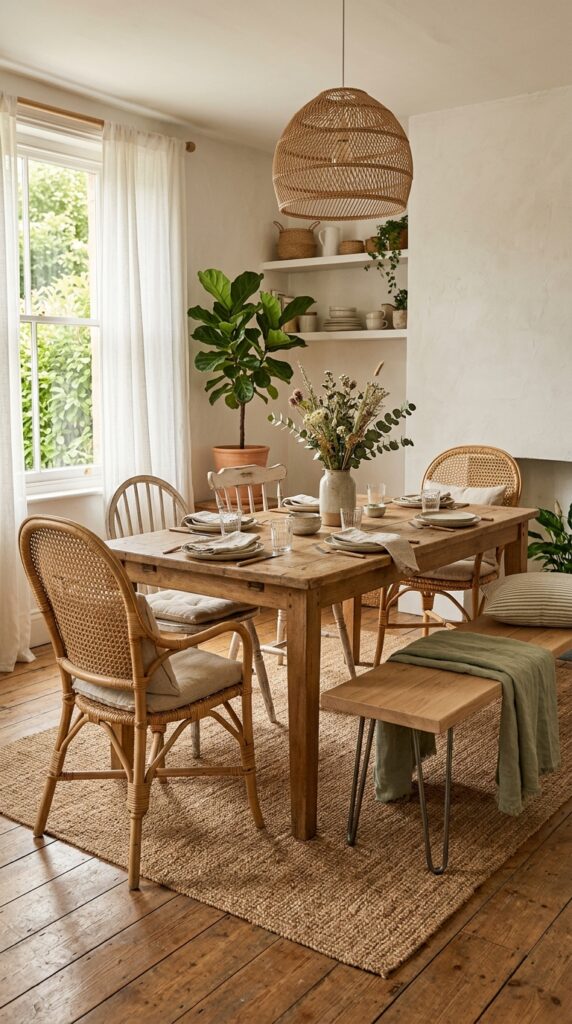
Vibe: Layered and collected — the table that tells a story.
Why it works: Intentionally mismatched seating uses the design principle of controlled variety: unifying different chair styles through a shared material family (all natural wood tones, all rattan, all whitewashed) creates cohesion without uniformity. This approach has the practical advantage of solving the “odd chair” problem by reframing it as a curatorial choice. The key is that each chair style must belong to the same tonal family — mixing raw oak, rattan, and whitewashed wood reads as deliberate; mixing chrome with pine reads as accidental.
How to get it: Start with your existing chairs as the anchor, then add one or two complementary styles that share the same undertone (warm or cool wood, never both). A long bench on one side immediately reads as intentional and adds casual ease. Tie the look together with matching seat cushions in a single linen color across all chairs.
🛍️ Shop the Look — Amazon Product Ideas
| # | Product Search Phrase | Why It Fits |
| 1 | Natural rattan dining chair bistro style | Signature mixed chair |
| 2 | Farmhouse bench dining wooden seat | Long side bench option |
| 3 | Spindle back dining chair whitewashed set 2 | Complementary chair style |
| 4 | Linen chair cushion dining tie-on set 4 | Unifying cushion layer |
| 5 | Hairpin leg dining bench natural wood | Modern bench alternative |
9. Slim Bud Vases in Odd-Numbered Clusters
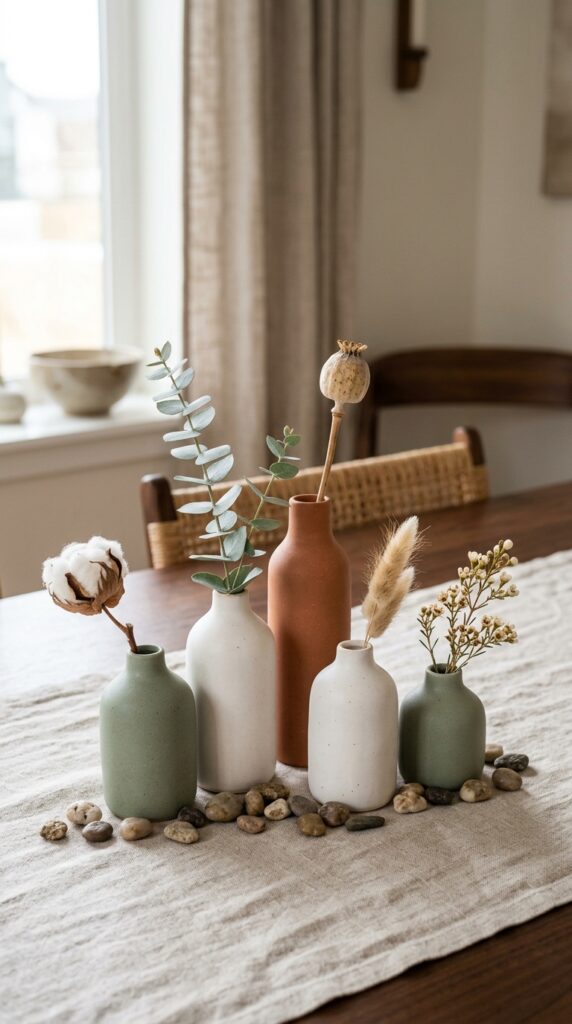
Vibe: Still and considered — the kind of arrangement that rewards a slow look.
Why it works: Odd-numbered groupings (three, five, seven) exploit a foundational visual principle: asymmetric clusters feel naturally composed because the eye doesn’t divide them into equal halves. Varying the heights of slim bud vases creates a skyline-style silhouette that reads as organic, while using a restricted palette of matte ceramics in two or three tones keeps the cluster cohesive. Each stem should be visually distinct — mixing dried and living materials adds temporal depth.
How to get it: Choose bud vases in three complementary matte finishes — sage, warm white, and terracotta are the classic summer trio. Vary heights by at least 5cm between each. Fill each with a single stem type: never repeat the same stem in more than one vase. The rule is: one stem per vase, maximum variety across the cluster.
🛍️ Shop the Look — Amazon Product Ideas
| # | Product Search Phrase | Why It Fits |
| 1 | Matte ceramic bud vase set 5 assorted heights | Core vase cluster |
| 2 | Dried cotton stems bouquet natural | Textural single stem |
| 3 | Dried poppy seed head stems bundle | Sculptural dried accent |
| 4 | Dried pampas grass small stems bunch | Feathery contrast stem |
| 5 | Dried floral stems assorted for vases | Versatile stem variety |
10. The All-White Table With One Warm Texture
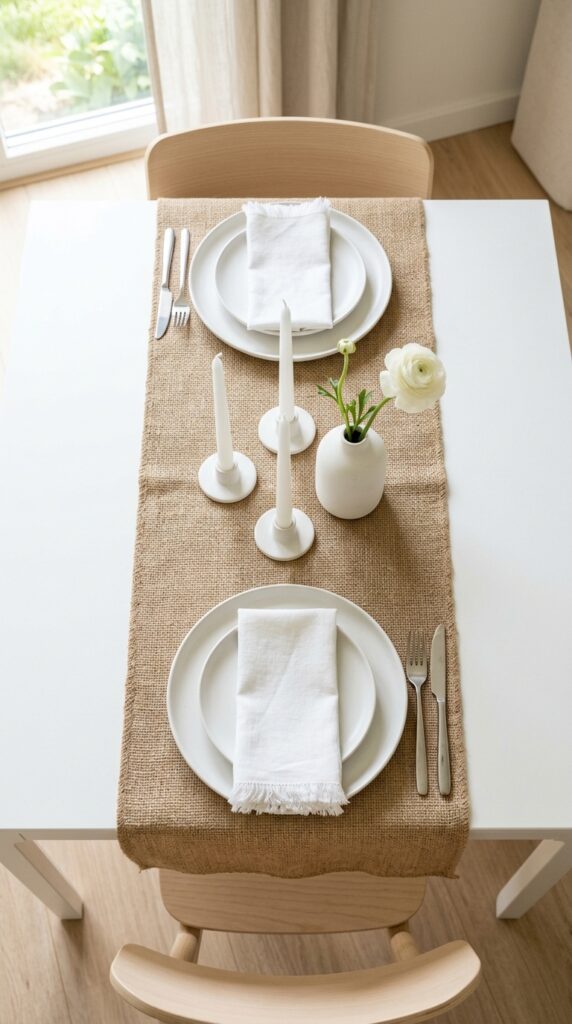
Vibe: Serene — the visual equivalent of a deep exhale.
Why it works: The all-white table with a single textural element uses the principle of radical restraint: by eliminating all color competition, texture becomes the entire visual story. The coarse jute runner against smooth white ceramic creates a strong tactile contrast that reads more sophisticatedly than any color combination could. This approach is particularly effective in summer when natural light amplifies the tonal differences within an all-white composition.
How to get it: Every surface element must be white, warm white, or natural linen — including candles. The jute runner is the only departure. Choose jute with a chunky, clearly visible weave rather than fine burlap, which disappears visually. A single floral stem in white (ranunculus, garden rose, or white cosmos) maintains the palette while adding organic form.
💡 Quick Win: A coarse jute table runner from Amazon ($12–18) instantly creates this look on any table you already have, with zero additional purchases required.
🛍️ Shop the Look — Amazon Product Ideas
| # | Product Search Phrase | Why It Fits |
| 1 | Coarse woven jute table runner natural | Sole textural element |
| 2 | White matte ceramic dinner plates set 4 | Color palette anchor |
| 3 | White ceramic taper candle holder set | Monochrome lighting |
| 4 | White linen napkins fringe edge set 6 | Tonal texture layer |
| 5 | Small white ceramic vase minimalist | Single floral vessel |
11. Sun-Bleached Linen Tablecloth With Relaxed Drape
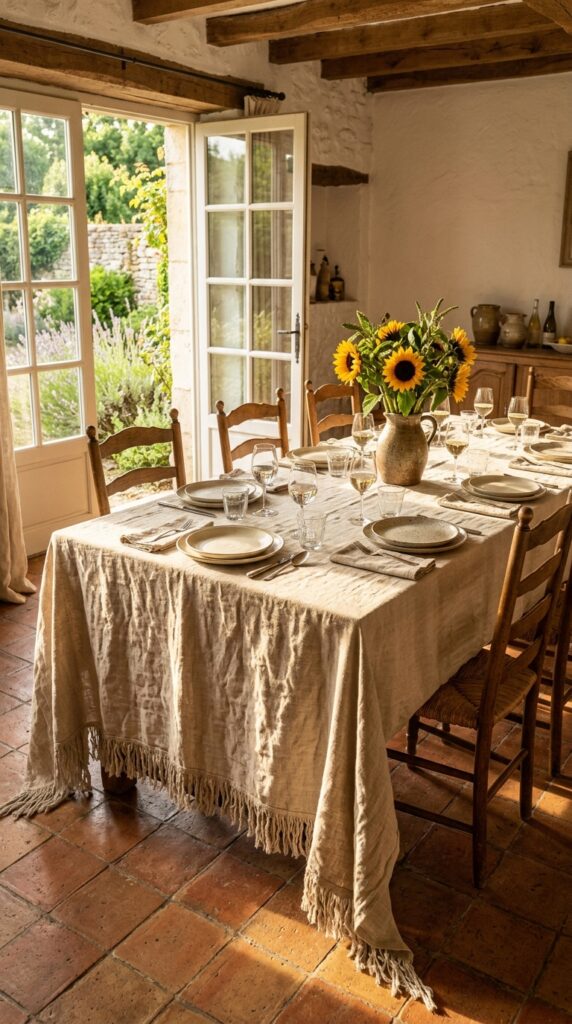
Vibe: Unhurried — the table that doesn’t ask you to hurry up.
Why it works: The deliberate imperfection of a wrinkled linen tablecloth with generous drape communicates the design principle of lived ease — the visual language of “this table has been enjoyed before and will be enjoyed again.” Choosing linen that is a size too large (so it pools slightly at the corners) adds romantic, off-duty elegance that crisp tablecloths simply can’t achieve. The material also softens sound, which subtly changes how a dining room feels during conversation.
How to get it: Buy a tablecloth one size larger than your table and skip the ironing entirely — just wash, shake out, and lay. True linen (not a linen-cotton blend) wrinkles beautifully and has a warm, organic texture blends can’t replicate. Wash with a tiny amount of white vinegar to enhance the natural sun-bleached effect.
🛍️ Shop the Look — Amazon Product Ideas
| # | Product Search Phrase | Why It Fits |
| 1 | 100 percent linen tablecloth natural washed | Core draping surface |
| 2 | Stonewashed linen tablecloth oversized rectangular | Relaxed drape version |
| 3 | Tall stoneware pitcher vase for flowers | Rustic floral vessel |
| 4 | Fresh sunflower faux stems tall realistic | Yellow accent element |
| 5 | Linen napkin set wheat yellow natural | Coordinating napkins |
12. Pendant Lighting as the Table’s Crown
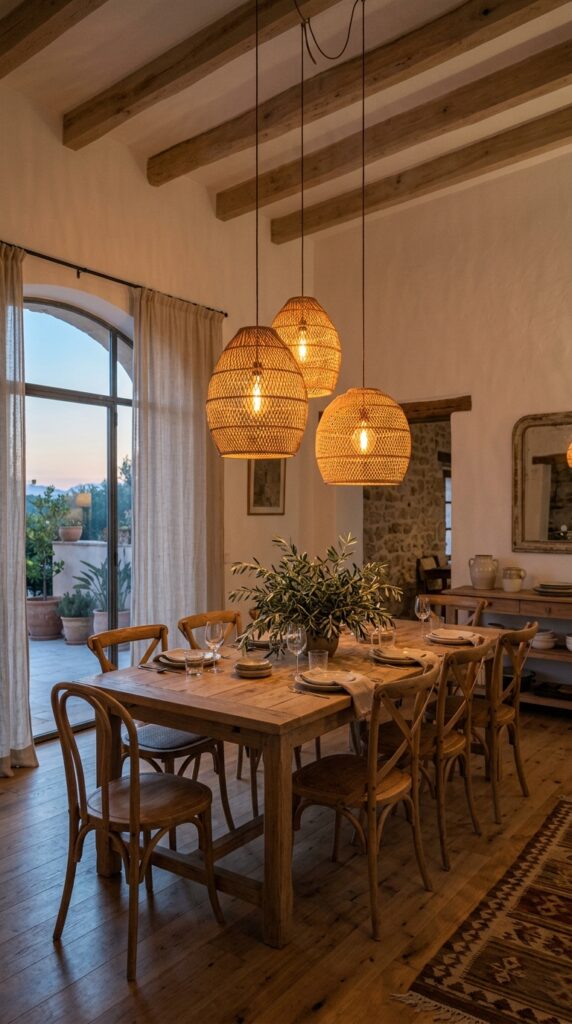
Vibe: Intimate and warm — the kind of light that makes everyone look like they’re on a patio somewhere in Umbria.
Why it works: The drop height of pendant lights is one of the most underestimated variables in dining room design. A pendant hung 70–80cm above the table surface creates a cone of light that defines the table as a destination — a visual room-within-a-room. Rattan pendants specifically cast dappled, patterned light through their weave, which adds atmospheric texture to every surface below and transforms ordinary summer evenings into something worth lingering over.
How to get it: If you already have a ceiling light, you can add a rattan pendant shade over an existing pendant kit. The ideal drop for dining is 70–80cm from table surface to bulb. Use a warm 2700K LED bulb — the color temperature matters enormously; anything above 3000K reads too cool and clinical.
💡 Quick Win: A plug-in rattan pendant (available for $30–55 on Amazon) requires no electrician — simply hang from a ceiling hook and plug in for an instant atmosphere upgrade.
🛍️ Shop the Look — Amazon Product Ideas
| # | Product Search Phrase | Why It Fits |
| 1 | Rattan woven pendant light shade dining | Atmospheric overhead light |
| 2 | Edison bulb E26 warm white 2700K set 4 | Correct warm color temp |
| 3 | Plug-in pendant light cord rattan boho | No-electrician option |
| 4 | Bamboo pendant light shade natural weave | Alternative woven shade |
| 5 | Pendant light canopy kit ceiling DIY | DIY pendant installation |
13. Compact Summer Table for Small Dining Spaces
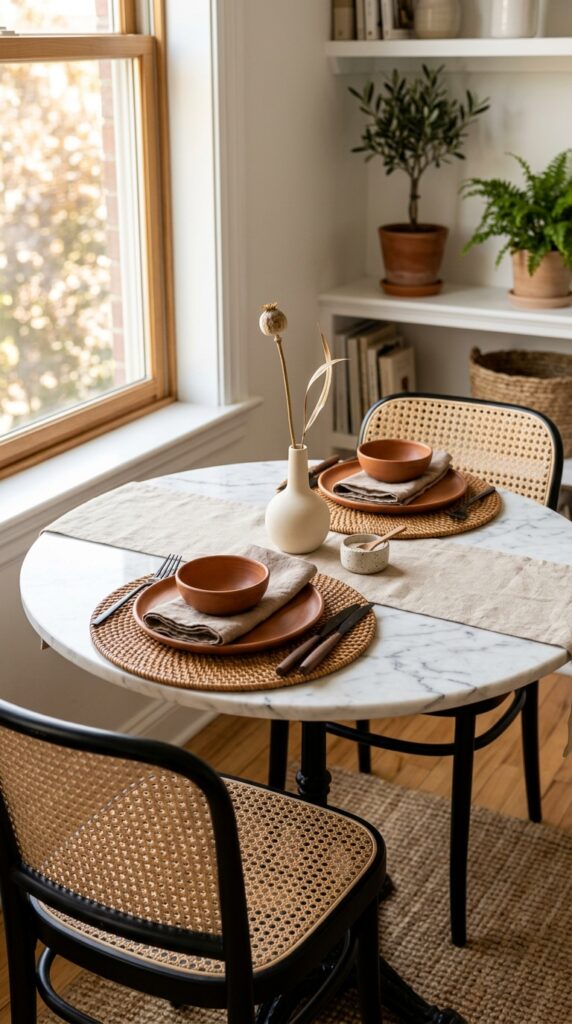
Vibe: Intimate — the kind of table that makes a meal feel like a private event.
Why it works: Small dining tables benefit enormously from the single-focal-point principle: one standout element (a bud vase, a small centerpiece bowl) set slightly off-center, with everything else kept low and minimal. Round tables are particularly forgiving — without corners to crowd, every seat feels equidistant from the center. The key small-space rule is to never cover more than 60% of the surface area with decor; visible table surface reads as spacious breathing room.
How to get it: Choose a single bud vase with a single stem as your only centerpiece — don’t attempt a cluster on a small table. Use mini placemats rather than a full tablecloth, which makes a small table look overwhelmed. A round bistro table in marble or painted wood instantly elevates a corner into a dining destination.
🛍️ Shop the Look — Amazon Product Ideas
| # | Product Search Phrase | Why It Fits |
| 1 | Round bistro table marble top small | Small space dining table |
| 2 | Mini linen table runner short 90cm | Compact surface layer |
| 3 | Small rattan placemat round set 2 | Two-person setting mat |
| 4 | Slim ceramic bud vase single stem | Minimal centerpiece |
| 5 | Small salt cellar ceramic minimalist | Detail styling accent |
14. Warm Amber Glassware as a Sunset Reference
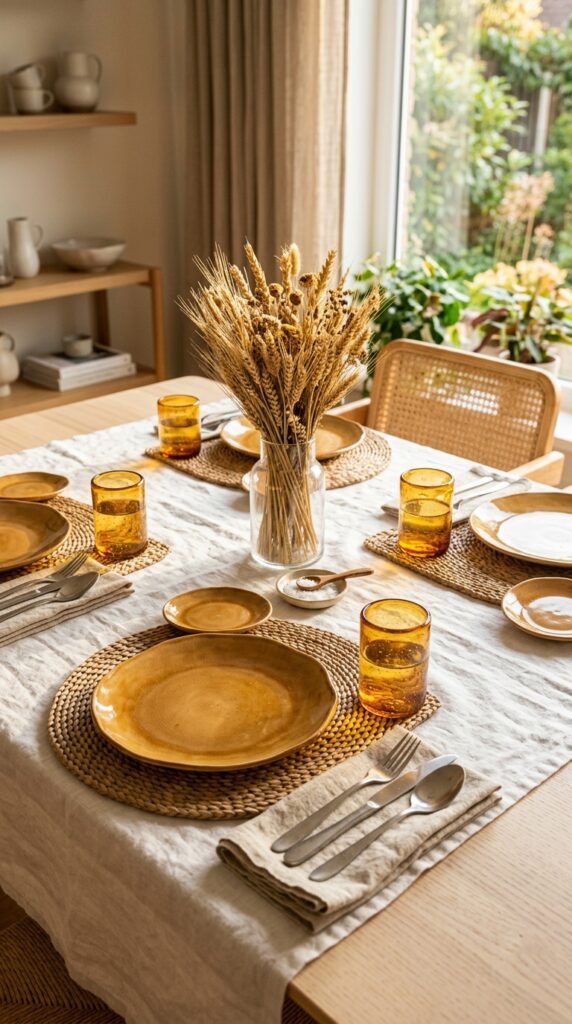
Vibe: Glowing — like the table itself has absorbed a July sunset.
Why it works: Amber glass uses the principles of warm color saturation and light transmission together: when natural light passes through amber glass, it casts warm golden tones onto the surface beneath, essentially adding candlelight without candles. This is particularly effective for summer lunches or afternoon gatherings where the light is naturally angled and abundant. The color also works as a sophisticated nod to harvest and warmth without being overtly autumnal.
How to get it: Amber glassware works best on white, linen, or light wood surfaces where the warmth of the glass is visible. Avoid pairing with dark tablecloths or dark wood — the tones merge and the glow effect disappears. Four matching amber tumblers are enough; you don’t need a full glassware set to read the palette.
🛍️ Shop the Look — Amazon Product Ideas
| # | Product Search Phrase | Why It Fits |
| 1 | Amber drinking glasses hand blown set 4 | Warm color palette piece |
| 2 | Dried wheat stems bundle natural decor | Coordinating warm accent |
| 3 | Light ash wood serving board rectangular | Tone-matching surface |
| 4 | Clear glass vase cylindrical modern | Transparent contrast vessel |
| 5 | White linen placemats rectangular set 4 | Neutral glow backdrop |
15. Herbs in Terracotta Pots as Living Centerpieces
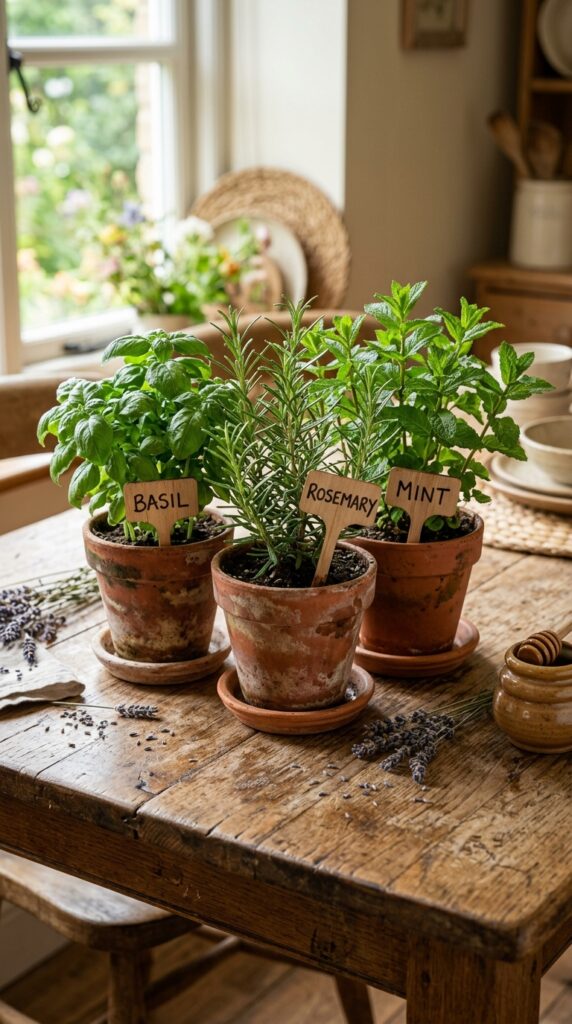
Vibe: Alive and fragrant — the centerpiece that actually earns its place by being useful.
Why it works: Living herb plants as centerpieces collapse the boundary between table styling and the meal itself, which is the defining gesture of relaxed summer entertaining. The irregular growth habit of herbs (basil leaning one way, rosemary reaching upward) creates natural asymmetry that no artificial arrangement can replicate. Small terracotta pots develop mineral deposits and patina quickly, which gives them the aged, collected quality that more expensive decorative objects spend years achieving.
How to get it: Use an odd number of pots — three is the sweet spot for most table lengths. Choose herbs with contrasting growth habits: upright rosemary, mounding basil, and trailing mint create natural height variation. Keep pots in saucers to protect the table surface. Pinch herbs regularly to maintain bushy growth and prevent flowering.
💡 Quick Win: Three small herb plants from a grocery store, repotted into terracotta pots (under $20 total), create a centerpiece that lasts all summer and gets used in cooking.
🛍️ Shop the Look — Amazon Product Ideas
| # | Product Search Phrase | Why It Fits |
| 1 | Small terracotta pots with saucers set 6 | Living centerpiece vessel |
| 2 | Wooden herb plant markers set of 20 | Handwritten label detail |
| 3 | Ceramic honey pot with wooden dipper | Coordinating dining accent |
| 4 | Dried lavender bundle fragrant decor | Fragrant scatter element |
| 5 | Terracotta succulent planters small set | Alternative living plant |
16. Mixed Metals in Matte Finishes
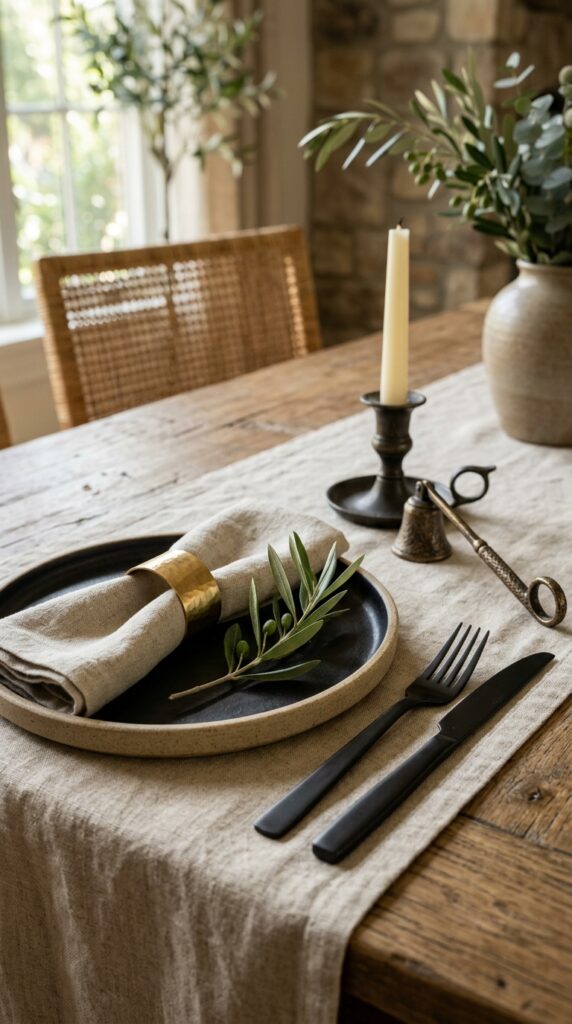
Vibe: Grounded and considered — the kind of table that rewards people who look closely.
Why it works: Mixing metals works when all metals share the same undertone temperature — warm metals (brass, bronze, copper) always pair with each other, and cool metals (chrome, silver, gunmetal) do the same. Matte finishes specifically matter because they eliminate reflective glare, which allows multiple metal tones to coexist without visual competition. On a summer table, matte black cutlery with brushed brass napkin rings creates quiet contrast: modern versus antique, dark versus warm.
How to get it: The rule is warm undertones only — matte black with warm brass or bronze, never with silver or chrome. Replace your current cutlery with matte black stainless (available from many Amazon sellers for under $40 for a set of four) and add a single brushed brass accent — napkin rings are the easiest, lowest-cost entry point.
🛍️ Shop the Look — Amazon Product Ideas
| # | Product Search Phrase | Why It Fits |
| 1 | Matte black flatware set stainless 20 piece | Core metal anchor |
| 2 | Brushed brass napkin rings set 6 simple | Warm metal contrast |
| 3 | Antique bronze candle holder patina finish | Aged metal accent |
| 4 | Dark ceramic dinner plate sand rim modern | Plate to complement metals |
| 5 | Brass taper candle holder set 2 modern | Warm lighting extension |
17. The Long Farmhouse Table With a Bench and Open Layout
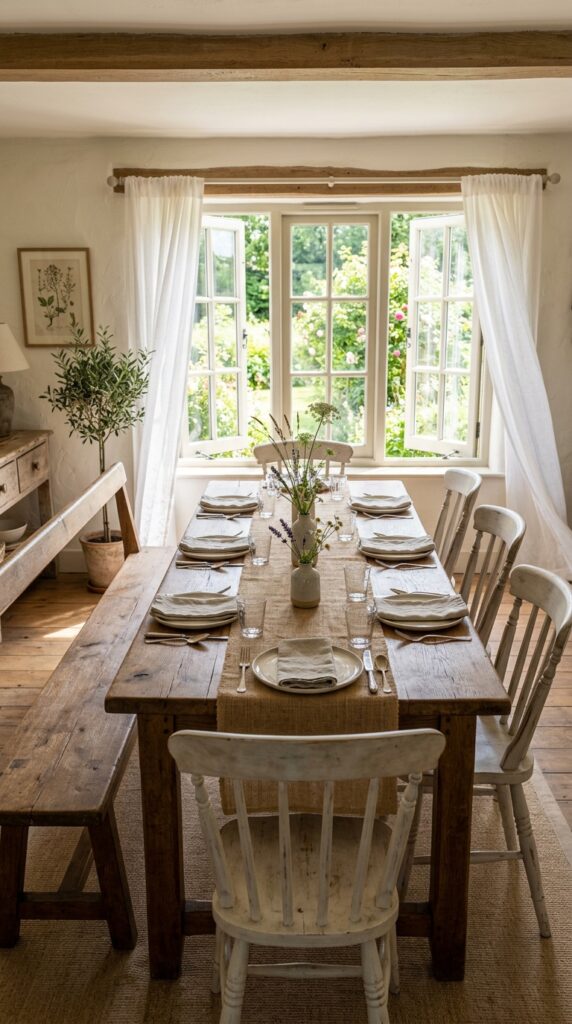
Vibe: Open and generous — the table that says everyone fits, always.
Why it works: Placing a bench on one side of a farmhouse table is one of the most effective layout decisions for summer entertaining: it adds two to three seats without adding chair bulk, keeps one side visually lighter, and creates an informal dynamic that makes guests feel at ease. From a proportion standpoint, the horizontal line of the bench balances the vertical interest of individual chairs on the opposite side — a classic use of visual weight distribution across an asymmetric arrangement.
How to get it: Keep the table decor minimal when using a long bench — the bench itself is a strong visual statement. A long jute or linen runner down the center with a simple row of bud vases is all you need. The rule for bench placement is to allow at least 45cm of clearance from bench front to the wall or any furniture behind it so guests can slide in and out comfortably.
🛍️ Shop the Look — Amazon Product Ideas
| # | Product Search Phrase | Why It Fits |
| 1 | Farmhouse wood dining bench natural finish | Layout-defining seating |
| 2 | Long jute table runner 72 inch natural | Minimal runner centerpiece |
| 3 | Reclaimed wood look dining table rectangular | Rustic table anchor |
| 4 | Sheer white window curtains panel linen | Airy background softener |
| 5 | Whitewashed dining chair spindle back set 2 | Mixed chair complement |
18. Dried Floral Arrangements in Apothecary Bottles
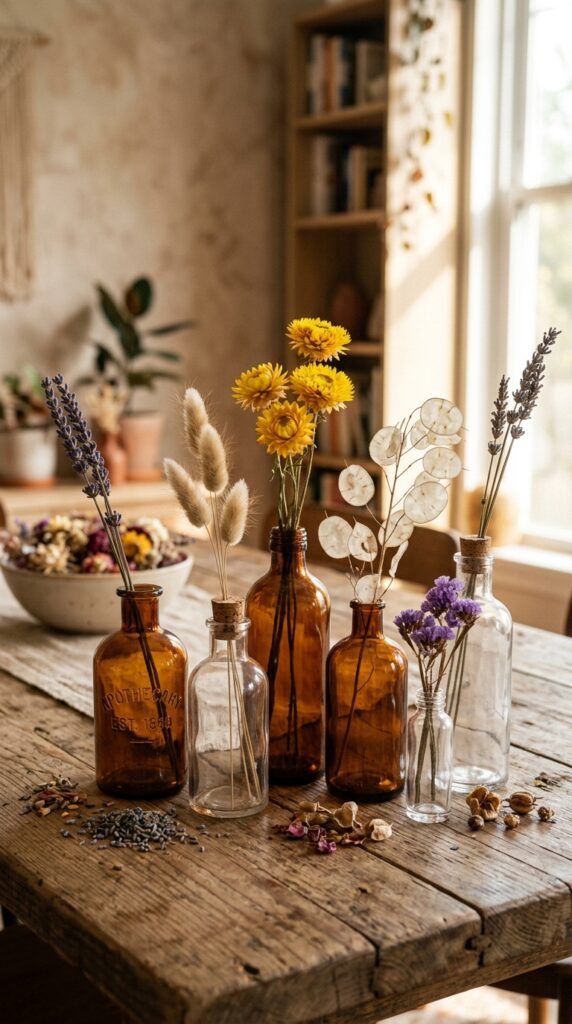
Vibe: Layered and warm — the centerpiece that was clearly assembled with care and zero effort.
Why it works: Dried stems in apothecary bottles use the design principle of found-object styling: the vessels feel repurposed and collected, which communicates a relaxed sensibility that makes a dining table feel personal rather than staged. The varied height and width of mismatched bottles creates a cluster with natural visual complexity, and dried stems eliminate the need for water changes or fresh flower replacements — the arrangement holds its form all summer.
How to get it: Source amber apothecary bottles from Amazon or craft stores in assorted sizes. Use one stem type per bottle, and limit the cluster to five or seven bottles to avoid visual congestion. Choose dried flowers in muted, dusty tones — avoid anything dyed, which reads artificial. Lunaria, statice, bunny tail grass, and lavender are all widely available and hold beautifully.
🛍️ Shop the Look — Amazon Product Ideas
| # | Product Search Phrase | Why It Fits |
| 1 | Amber glass apothecary bottles assorted set | Mismatched vessel base |
| 2 | Dried bunny tail grass stems bulk | Textural small-stem accent |
| 3 | Dried lavender bunch fragrant purple | Color and fragrance |
| 4 | Dried lunaria silver dollar stems | Translucent stem contrast |
| 5 | Dried strawflower stems assorted colors | Bold dried color accent |
19. The Ombre Table Runner in Sandy Coastal Tones
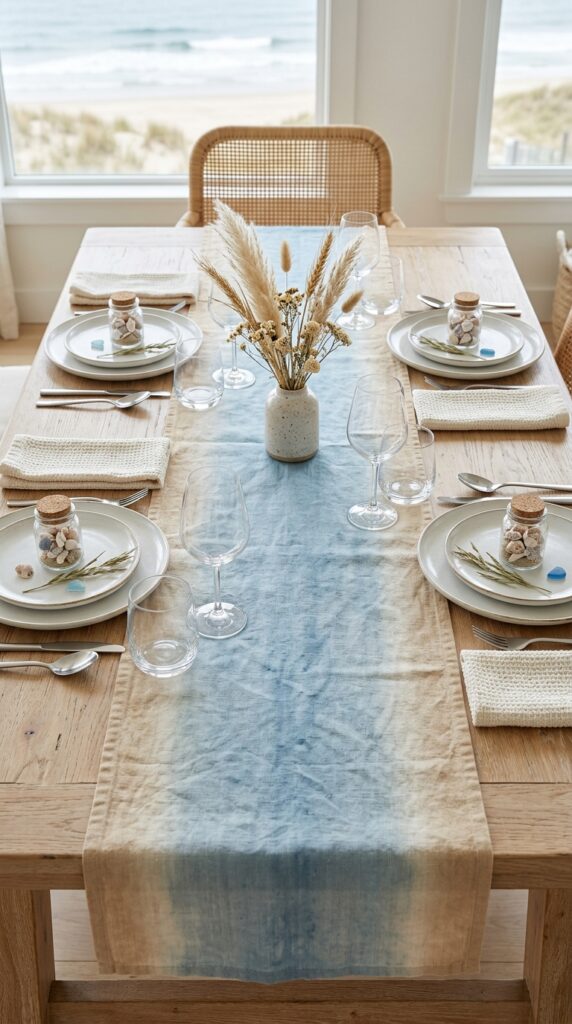
Vibe: Airy — like looking at a shoreline from above.
Why it works: An ombre runner uses the principle of color graduation to create visual movement along the table’s length, which is particularly effective at elongating the appearance of shorter dining tables. The sand-to-dusty-blue shift references the actual color transition of a beach — sand underfoot, water ahead — without requiring any coastal accessories. This is color storytelling at its quietest: the palette does all the work so the accessories don’t have to.
How to get it: Hand-dyed ombre linen runners are available on Etsy and from artisan sellers on Amazon. Look for linen specifically (not cotton), as linen absorbs dye unevenly in ways that create the natural, irregular graduation the look requires. Keep all other table elements in white or clear to let the runner carry the full visual weight.
💡 Quick Win: A basic tie-dye kit ($12) and a plain linen runner ($18) lets you create a custom ombre runner in an afternoon — no prior experience needed.
🛍️ Shop the Look — Amazon Product Ideas
| # | Product Search Phrase | Why It Fits |
| 1 | Ombre linen table runner hand dyed coastal | Color gradient centerpiece |
| 2 | Small glass jar with lid tiny seashells | Coastal detail per setting |
| 3 | White ceramic dinner plate round modern | Neutral backdrop plate |
| 4 | Clear glass tumbler set 6 modern | Transparent contrast piece |
| 5 | Woven cream napkin set cotton textured | Warm neutral napkin |
20. Sculptural Candleholders as Functional Art
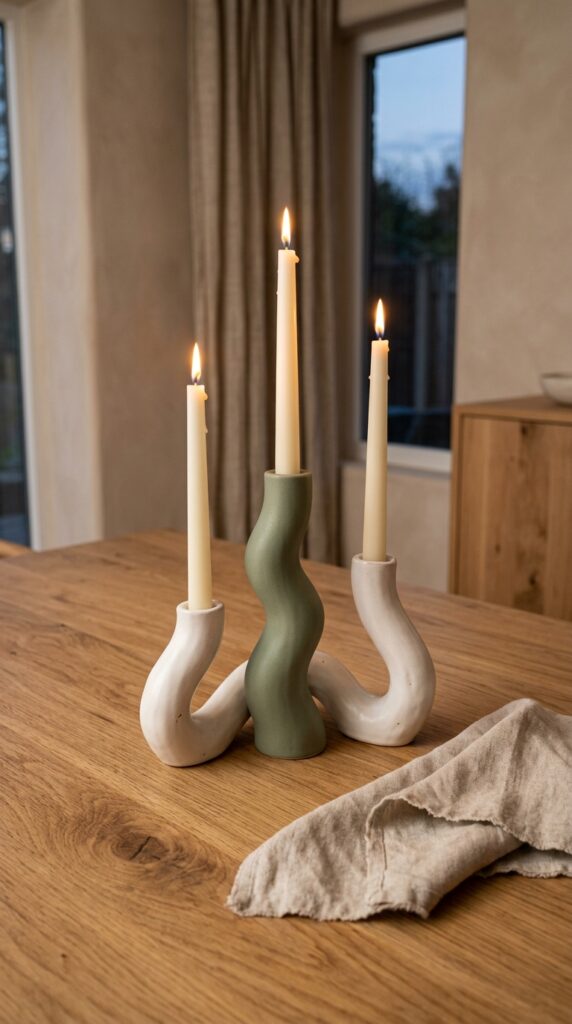
Vibe: Warm and artful — the table that has one very good thing on it and doesn’t need anything else.
Why it works: Sculptural candleholders as a centerpiece apply the principle of functional art: objects that serve a purpose (holding a candle) while standing as compositions in their own right. The organic, hand-formed quality of wavy or asymmetric ceramic holders introduces sculptural interest that flat or geometric holders can’t achieve. On a summer table, these objects carry the visual weight of a centerpiece while keeping the table surface airy and open.
How to get it: Source organic ceramic candleholders from independent makers on Etsy or contemporary homeware retailers. If buying from Amazon, search specifically for “wavy” or “sculptural” forms rather than standard candlestick profiles. Group three in a loose triangle, not a straight line — the triangle creates a stable, architectural composition.
🛍️ Shop the Look — Amazon Product Ideas
| # | Product Search Phrase | Why It Fits |
| 1 | Sculptural ceramic candlestick holder wavy modern | Functional art centerpiece |
| 2 | Matte sage taper candle holder ceramic | Color accent holder |
| 3 | Ivory taper candles unscented set 12 slim | Core candle supply |
| 4 | White oak serving board for table styling | Bare wood surface base |
| 5 | Organic form bud vase set ceramic | Complementary sculptural accent |
21. Napkin Rings That Double as Mini Bouquets
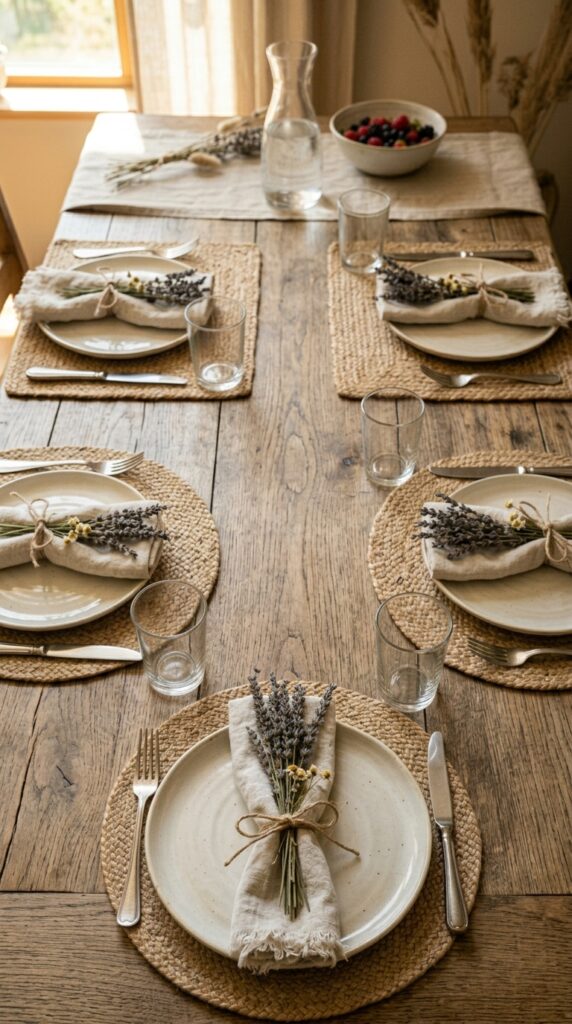
Vibe: Warm and considered — the small detail that makes guests feel genuinely welcomed.
Why it works: Replacing napkin rings with a small botanical bundle uses the principle of layered meaning: the napkin becomes both a functional object and a small gift, and the fragrance of dried lavender adds a sensory layer that purely visual decor cannot. From a composition standpoint, the horizontal napkin bundles create a repeated motif across all place settings that unifies the table design and makes individual settings feel equally valued.
How to get it: Cut a dried lavender bundle to roughly 10–12cm, fold a linen napkin in thirds lengthwise, then roll loosely and tie with twine, tucking the lavender underneath the knot. Make all bundles the same day from one lavender source so the color is consistent. The whole process takes under two minutes per setting.
🛍️ Shop the Look — Amazon Product Ideas
| # | Product Search Phrase | Why It Fits |
| 1 | Dried lavender bundles fragrant bulk set | Botanical napkin accent |
| 2 | Natural jute twine roll craft decor | Tying element |
| 3 | Undyed linen dinner napkins fringe set 8 | Core napkin base |
| 4 | Dried chamomile flowers bulk craft decor | Secondary botanical detail |
| 5 | Pressed flower paper card place setting | Written place name option |
22. A Statement Tablecloth in Dusty Sage
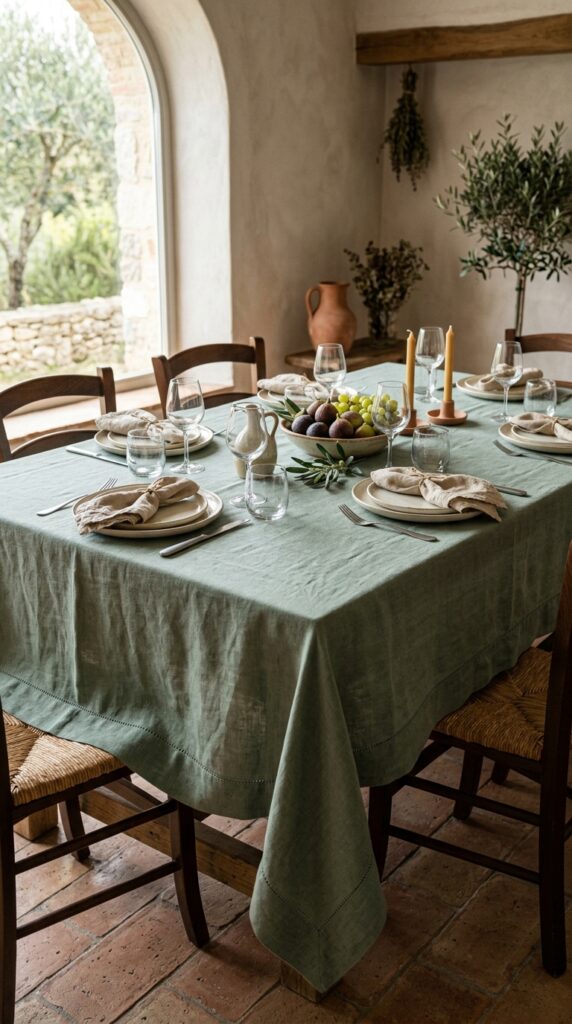
Vibe: Grounded and serene — the table that feels like it’s already been transported somewhere slower.
Why it works: A colored tablecloth creates a base-level color field that unifies every element placed on top of it — essentially, it becomes the background of a curated composition. Dusty sage is one of the most versatile summer colors because it reads as both warm (the grey in it) and cool (the green), making it compatible with terracotta, cream, warm wood, and clear glass simultaneously. The tablecloth as the color carrier means everything else can be neutral, which simplifies the entire styling process.
How to get it: Choose 100% linen in dusty sage or moss green with a stonewashed finish — avoid bright or yellow-toned greens, which read more spring than summer. Layer cream or bone ceramic plates on top rather than white, which can look cold against green. A low ceramic bowl of figs or green grapes at the center picks up the sage tone and adds organic color depth.
💡 Quick Win: A single dusty sage linen tablecloth ($28–45) does more styling work than any collection of small accessories — it defines the palette for the entire table in one purchase.
🛍️ Shop the Look — Amazon Product Ideas
| # | Product Search Phrase | Why It Fits |
| 1 | Dusty sage linen tablecloth stonewashed rectangular | Palette-defining base |
| 2 | Cream ceramic dinner plate set 4 | Warm neutral on sage |
| 3 | Low ceramic bowl sage green matte | Tonal centerpiece bowl |
| 4 | Clear crystal wine glass set 4 modern | Transparent glassware |
| 5 | Cream hemstitched linen napkin set 6 | Coordinating tonal napkin |
23. A Chandelier-Style Wax Drip Candelabra
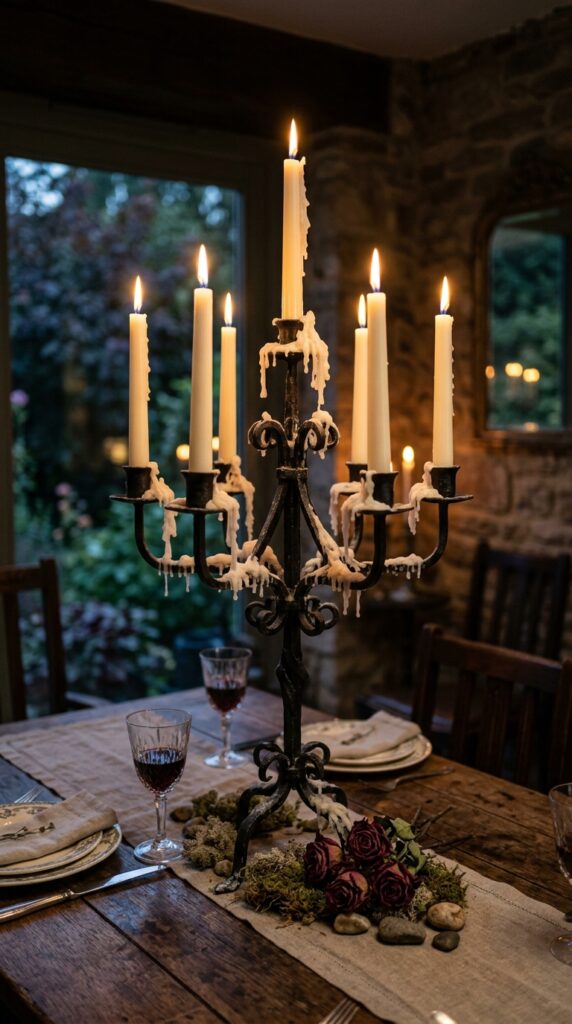
Vibe: Moody and romantic — the dining table that makes dinner feel like an occasion.
Why it works: A tall multi-taper candelabra as a centerpiece introduces vertical scale to the table, which is one of the most effective ways to create drama in a flat horizontal surface. The accumulated wax drips are not a flaw — they are the point: they communicate time and use, giving the piece an organic, lived quality that a clean candelabra simply cannot replicate. Evening summer dinners in this light feel like theatre.
How to get it: Use ivory or cream tapers exclusively — colored tapers read theatrical in the wrong way. Allow wax to drip deliberately by using candles without a dripless coating. The base of the candelabra can be scattered with a few small smooth pebbles or a ring of dried moss for a grounded, earthy base. Always ensure the candelabra is stable on an uneven tablecloth surface before lighting.
🛍️ Shop the Look — Amazon Product Ideas
| # | Product Search Phrase | Why It Fits |
| 1 | Iron candelabra tall multi taper black antique | Dramatic vertical centerpiece |
| 2 | Ivory taper candles drippy non-dripless set | Intentional wax drip source |
| 3 | Sheet moss preserved decoration flat | Candelabra base ground cover |
| 4 | Dried rose stems burgundy bundle | Dark romantic accent |
| 5 | Small smooth river stones black natural | Grounding base scatter |
24. Gallery of Place Cards as Styling Moments
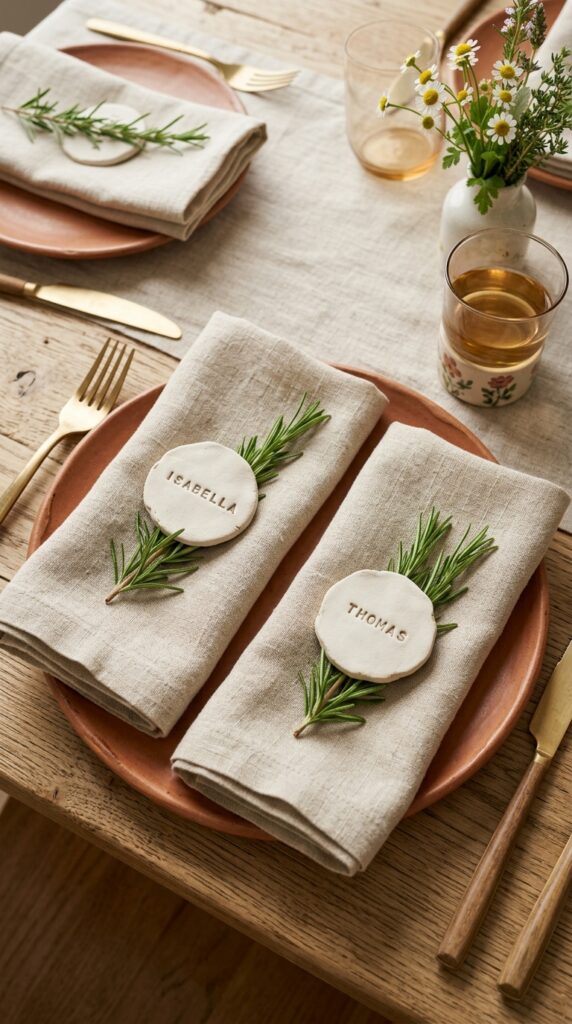
Vibe: Considered — the kind of table where someone clearly thought about who would sit where and why.
Why it works: Place cards serve a dual design function: they distribute the table’s visual interest across every setting rather than concentrating it at the center, and they communicate to guests that the table was specifically prepared for them. Handmade clay cards in organic, irregular forms embody the imperfect-craft aesthetic that is central to summer table styling. They also function as guest keepsakes, which extends the meaning of the table beyond the meal.
How to get it: Roll air-dry clay to 3mm thickness, cut into circles or ovals with a cookie cutter, stamp or inscribe names while wet, then air dry overnight. A 500g block of white air-dry clay costs under $10 and makes 15–20 place cards. Tuck a short herb sprig beneath each card for a fragrant, botanical touch.
🛍️ Shop the Look — Amazon Product Ideas
| # | Product Search Phrase | Why It Fits |
| 1 | White air dry clay block modeling 500g | DIY place card material |
| 2 | Letter stamp set alphabet clay jewelry | Name imprinting tool |
| 3 | Rosemary herb stems artificial realistic | Per-setting herb detail |
| 4 | Small oval clay tag set natural blank | Pre-made tag alternative |
| 5 | Calligraphy pen set black ink fine tip | Hand-lettering place cards |
25. Natural Stone Trivets and Coasters as Decor Elements
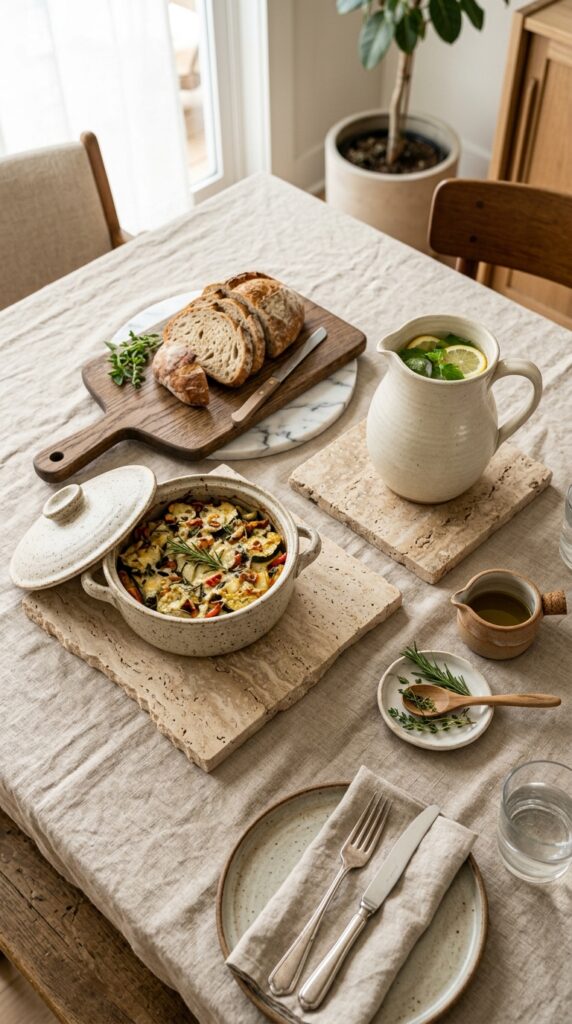
Vibe: Grounded and considered — the table where even the functional pieces feel like design decisions.
Why it works: Treating stone trivets and coasters as visible decor elements rather than hiding them applies the principle of functional beauty: every object on the surface earns its place by being both useful and visually considered. Natural travertine and marble introduce the coolest material in the summer palette — stone — which creates tactile and visual contrast against warm linen and wood. The natural veining of each stone piece ensures no two are identical, adding that organic, collected quality that mass-produced decor cannot replicate.
How to get it: Position stone trivets before serving dishes arrive — they should be visible as part of the composed table, not produced at the last minute when a hot dish appears. Choose travertine over pure white marble for a warmer, earthier look that integrates better with linen and wood surfaces. Pair with matching stone coasters at each place setting.
💡 Quick Win: A set of four travertine coasters ($15–22) adds genuine natural stone to any table setting and eliminates the need for coaster holders, which always look temporary.
🛍️ Shop the Look — Amazon Product Ideas
| # | Product Search Phrase | Why It Fits |
| 1 | Travertine stone trivet set natural | Functional stone decor |
| 2 | Marble coaster set 4 natural veining | Per-setting stone detail |
| 3 | Travertine coasters set 6 round | Cohesive stone surface layer |
| 4 | Ceramic spoon rest kitchen modern | Functional serving accent |
| 5 | Olive wood small cutting board serving | Natural material pairing |
26. Lush Overhanging Foliage From a Hanging Planter
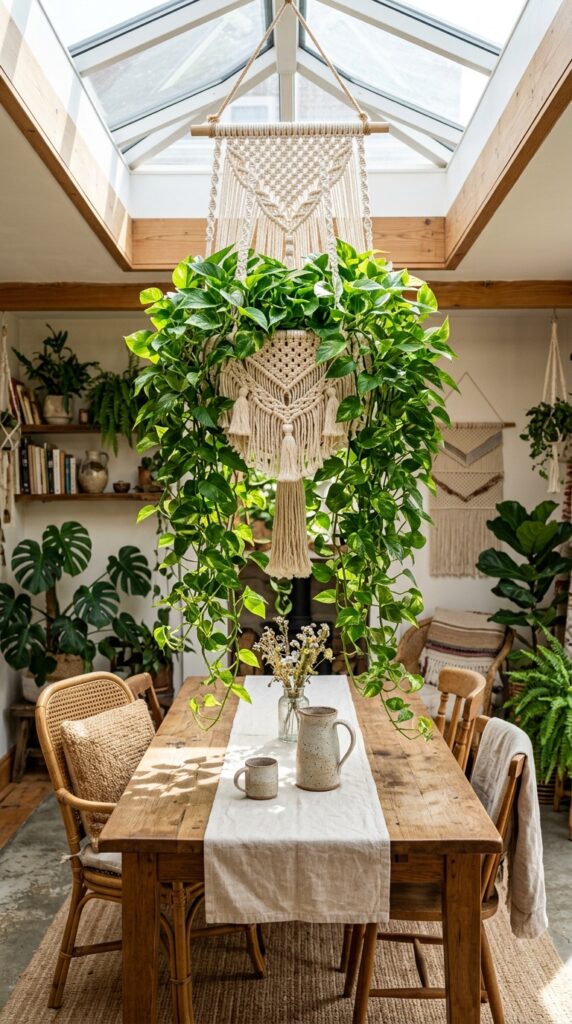
Vibe: Lush and alive — the room where the plants are clearly in charge.
Why it works: A hanging planter positioned above the dining table introduces vertical greenery that doesn’t occupy table surface area, which is the key advantage of this approach for summer styling. The trailing habit of pothos or ivy creates an organic curtain of green that frames the table from above, making the dining space feel enclosed and intimate without walls. Dappled shadow from leaves falling across the table surface at lunch is one of summer dining’s most atmospheric details.
How to get it: Hang a planter approximately 80–100cm above the table surface so trailing vines don’t interfere with conversation lines or candle flames. Use a macramé planter rather than a hard basket for a softer, more bohemian look. Pothos (Epipremnum aureum) is the ideal choice — it thrives in indirect light, tolerates neglect, and trails dramatically within weeks.
🛍️ Shop the Look — Amazon Product Ideas
| # | Product Search Phrase | Why It Fits |
| 1 | Macramé hanging plant holder cream boho large | Above-table planter vessel |
| 2 | Ceiling hook anchor for hanging plants | Installation hardware |
| 3 | Trailing pothos artificial plant realistic | Low-maintenance trailing option |
| 4 | Ceramic wall planter hanging moon shape | Alternative wall-mount planter |
| 5 | Natural linen table runner 90 inch long | Under-planter table base |
27. An Heirloom-Style Table With Vintage-Found Pieces

Vibe: Warm and layered — the table that holds the memory of every summer before this one.
Why it works: Mixing mismatched vintage pieces applies the design principle of tonal unity across visual variety: individual pieces are different in pattern and origin, but they’re held together by a consistent color story (blue-and-white ceramics with warm linen and aged silver). The key rule of vintage mixing is the two-palette limit: never introduce more than two base colors across all mismatched pieces, or the table reads as chaotic rather than curated. The visible patina on silver cutlery and aged surfaces communicates authenticity that no new piece can replicate.
How to get it: Start at charity shops, estate sales, or eBay with a specific search filter: “blue-and-white transferware” or “blue-and-white serving plate.” Collect only pieces within that pattern family. Pair with genuine (not reproduction) silver-plate cutlery found secondhand — its patina is its virtue, not a flaw. The embroidered tablecloth can be sourced from linen specialists or made with a basic hand-embroidery kit.
🛍️ Shop the Look — Amazon Product Ideas
| # | Product Search Phrase | Why It Fits |
| 1 | Blue and white transferware dinner plate | Vintage pattern anchor |
| 2 | Vintage style silver plate cutlery set aged | Patina metal flatware |
| 3 | Hand embroidered linen tablecloth vintage | Heirloom surface detail |
| 4 | Amber glass bud vase small vintage style | Warm glass floral vessel |
| 5 | Antique brass candlestick holder single | Aged warm metal accent |
How to Start Your Summer Dining Table Transformation
Your single best first move is to replace your current tablecloth with a washed linen one in warm white or natural oat. Not a runner, not a placemat — a full tablecloth. It is the surface everything else sits on, and its material and tone establish the entire palette. Washed linen in a warm neutral reads as expensive, relaxed, and cohesive simultaneously. Once the surface is right, every accessory you add lands in a prepared context.
The most common mistake beginners make is over-accessorizing the centerpiece while neglecting the place settings. A $200 centerpiece surrounded by plastic charger plates and mismatched napkins will always look unresolved. Instead, allocate your budget evenly: spend as much on napkins and placemats as you do on the centerpiece. The table reads as a whole composition, not a series of separate purchases.
Three items under $50 that create immediate summer impact: a set of four rattan charger plates ($18–25 on Amazon), a bundle of dried pampas stems in a single tall ceramic vase ($15–22 combined), and a box of beeswax taper candles in ivory ($12–16). These three elements together shift any dining table toward the summer organic aesthetic without any other changes.
A single place setting refresh (two new ceramic plates, four napkins, a set of glassware) takes one afternoon and costs $60–120. A full room transformation — tablecloth, chairs, pendant light, centerpiece, and all accessories — realistically takes 4–8 weeks of staged purchasing and $300–600 at the accessible end. Set yourself up for success by starting with the tablecloth this week and building outward.
Frequently Asked Questions About Summer Dining Table Decor
What’s the difference between summer dining table decor and regular everyday table styling?
Summer dining table decor prioritizes organic, nature-led materials and a warmer, more relaxed approach than everyday table styling. Everyday tables tend toward practicality — matching sets, easy-clean surfaces, minimal accessories. Summer styling introduces seasonal elements like fresh or dried botanicals, rattan and linen textures, warm color palettes (terracotta, sage, warm cream), and atmospheric lighting like beeswax tapers. The core distinction is intentionality: summer table decor treats the table as a seasonal destination rather than a functional surface.
What colors work best for summer dining table decor?
The most versatile summer palette centers on warm neutrals with one or two seasonal accent tones. Warm white, oat linen, and sandy taupe form the base; terracotta, dusty sage, sea-glass blue, or amber work as accent colors. Avoid cool greys and stark whites, which fight the warm seasonal energy. If you want a single color to carry the whole table, dusty sage linen is the most forgiving — it works with terracotta, cream, warm wood, rattan, and clear glass simultaneously.
How much does a complete summer table decor refresh cost?
A starter refresh covering the essentials — a new linen tablecloth, four rattan placemats, a bud vase cluster with dried stems, and a set of beeswax tapers — typically costs $60–100 sourced from Amazon. A more complete overhaul adding ceramic chargers, new napkins, glassware, and a quality centerpiece piece sits in the $150–300 range. Full dining room transformation including new pendant lighting and additional seating runs $400–700 depending on quality level. Vintage sourcing can significantly reduce costs.
Can I achieve summer dining table decor with furniture I already have?
Yes — the surface materials you layer on top of the table do far more visual work than the table itself. A plain IKEA dining table with a washed linen tablecloth, rattan placemats, terracotta ceramic plates, and a cluster of bud vases with dried stems reads as completely transformed. The one scenario where the table itself matters: if your dining table has a very dark finish (ebony, dark walnut), go with a full tablecloth rather than a runner, as dark tables visually absorb lighter accessories and can undermine the airy summer palette.
What are the best centerpiece options that won’t block conversation across the table?
The ideal summer centerpiece stays below 25cm in height — roughly the height of a standard wine bottle — so it doesn’t create a visual barrier between seated guests. Best low-profile options: a cluster of three to five slim bud vases with single stems, a wide shallow bowl of citrus or fruit, a wooden breadboard styled with small accessories, or a flat trailing greenery arrangement laid directly on the tablecloth. Candelabras and tall centerpieces are better suited to one-sided or end-of-table placement where they don’t obstruct sightlines.
Ready to Create Your Dream Summer Dining Table?
These 27 ideas span the full range of what summer dining table decor can do — from color palette choices like sea glass glassware and sage tablecloths to material decisions involving linen, rattan, and hand-thrown ceramics, to layout thinking about benches, bench lighting, and small-space editing. A full transformation doesn’t have to happen at once, and starting with one strong element — a linen tablecloth, a beeswax candle cluster, a single bud vase with a pampas stem — is not just acceptable, it’s the right approach. Today, try laying a few eucalyptus stems directly onto your current tablecloth, no vase needed, and notice how quickly the table shifts. Summer table styling is ultimately about honoring slowness and ease — and when it’s done, you’ll feel it every time you sit down: the room is ready, the light is right, and the meal hasn’t even started yet. Save your favorites from this list now — the linen, the rattan, the terracotta — because the best summer tables are the ones assembled with a little patience and a very good eye.