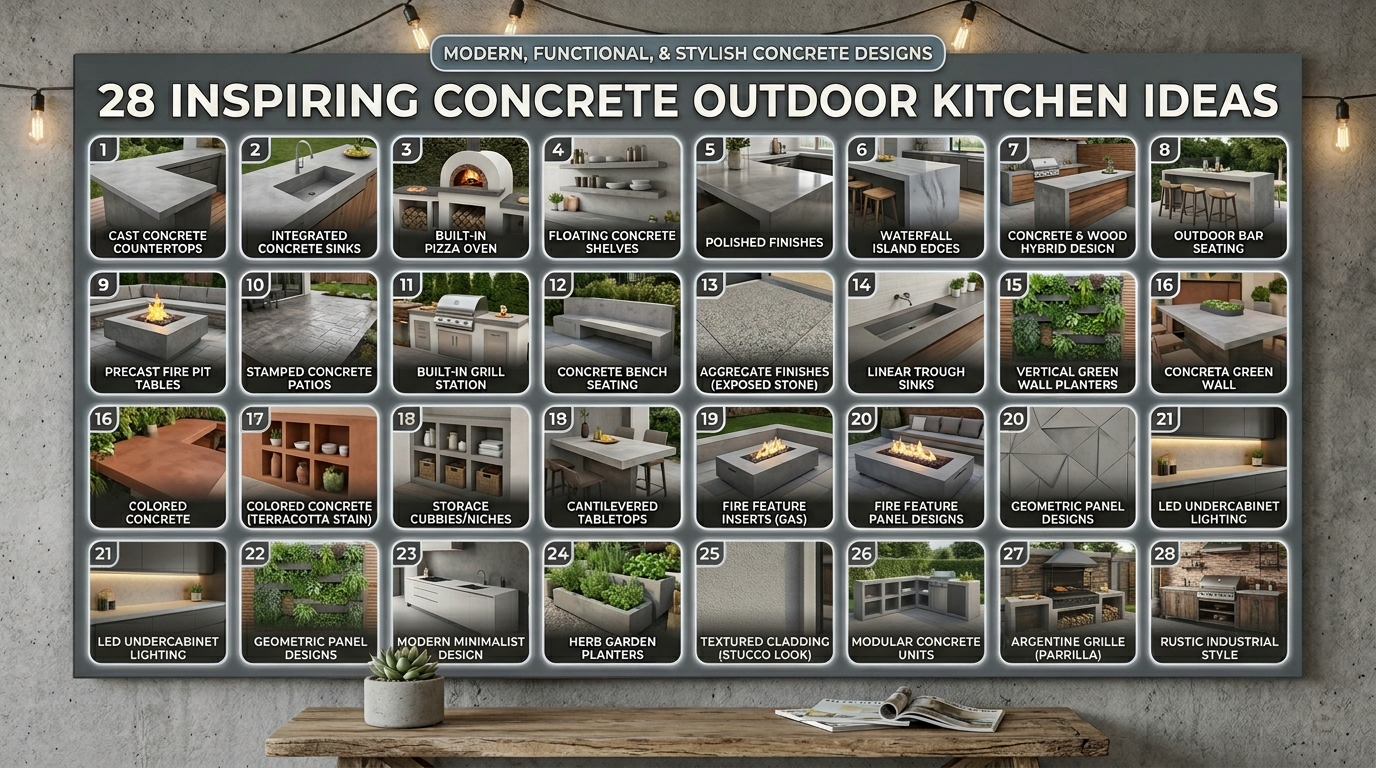
A concrete outdoor kitchen is an alfresco cooking and entertaining space where poured, precast, or board-formed concrete serves as the primary structural and surface material — countertops, frames, walls, and often the flooring are all unified by the same raw, weather-resistant material. This article gives you 28 concrete outdoor kitchen ideas covering surfaces, lighting, layout, color, furniture, accessories, and small-space solutions — everything you need to design and build one.
There is a particular confidence to a kitchen built outside in concrete. It does not apologize for weather. It does not pretend to be anything other than what it is — dense, permanent, and unapologetically honest about its materials. Concrete outdoor kitchens age the way good architecture always does: they accumulate character while everything cheaper around them fades. Here are 28 ideas worth saving — and stealing.
Why Concrete Outdoor Kitchen Design Works So Well
The concrete outdoor kitchen draws from the mid-century California modernist tradition — Richard Neutra, Case Study House architects, and later the raw-material minimalism of brutalism — where interior and exterior were united by a single continuous material language. What separates it from generic outdoor cooking setups is its insistence on permanence. Concrete is poured or formed once and remains. There is no paint to peel, no laminate to swell, no wood to rot. The aesthetic is grounded in structural truth.
The material palette is deliberately restrained. Concrete itself in warm gray, sand, charcoal, and board-formed umber anchors every surface. It is layered with blackened steel, weathered corten, brushed stainless for appliances, reclaimed wood for warmth, and dark porcelain tile for accent or functional surfaces. Colors are mineral: slate, warm greige, iron oxide, bone white, and the cool blue-gray of fresh pour concrete. Every surface is matte or lightly textured — no lacquered cabinetry, no polished chrome.
Concrete outdoor kitchens are trending now for intersecting reasons. The outdoor living movement accelerated sharply post-2020, with homeowners investing in exterior spaces as permanent extensions of usable square footage rather than seasonal afterthoughts. Simultaneously, design culture has moved toward what critics call “honest materials” — surfaces that show their construction rather than concealing it. Concrete satisfies both: it is genuinely durable for outdoor use and carries no pretense of being anything but itself.
Small outdoor spaces can absolutely achieve this style. A single concrete countertop on a compact steel frame, 6 feet wide with a built-in grill and two seats, is a complete concrete outdoor kitchen. Prioritize the countertop material first — one strong concrete surface at the right height does more for the aesthetic than any number of accessories on a lesser substrate.
Style at a Glance
| Element | Industrial Modern | Organic Warm Concrete |
| Philosophy | Raw material honesty | Softened permanence |
| Materials | Board-formed concrete, blackened steel, corten | GFRC, tadelakt, reclaimed wood, warm aggregate |
| Color palette | Charcoal, slate, iron gray, matte black | Warm greige, sand, umber, bone white |
28 Concrete Outdoor Kitchen Ideas
1. Board-Formed Concrete Countertop with Visible Wood Grain
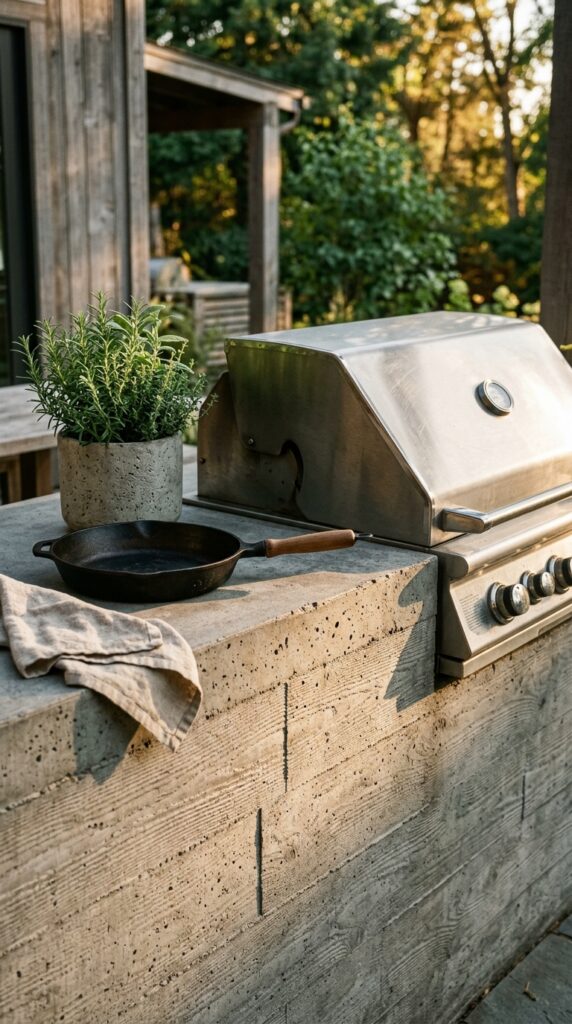
Vibe: Raw — the ghost of the wood grain in concrete is a record of how the surface was made.
Why it works: Board-forming is a concrete casting technique where rough-sawn lumber planks are used as the formwork — when the concrete is poured and the forms stripped, the wood grain, knot marks, and board seam lines transfer permanently to the concrete face. The result is a surface that carries both the industrial weight of concrete and the organic warmth of timber, simultaneously. For outdoor kitchen countertops, board-formed concrete at 2.5–3 inch thickness provides adequate thermal mass for heat resistance near grills and enough structural rigidity to span up to 5 feet unsupported.
How to get it: Use rough-sawn cedar or Douglas fir boards, 6–8 inches wide, as your form lining. Seal the wood with a release agent before pouring to prevent adhesion. After stripping forms, hone the surface to 200-grit to smooth any fins without erasing the grain texture. Seal with a penetrating concrete sealer (not a topical coat, which will peel outdoors) — Surecrete ECO-Seal 30 or similar.
💡 Quick Win: A concrete countertop sealer in a matte finish (under $35 at most hardware stores) applied to any existing poured slab immediately enriches the color and gives the board-formed effect 30% more visual contrast.
Shop The Look
| Product |
| Cast iron skillet 12 inch pre-seasoned outdoor |
| Concrete penetrating sealer matte exterior |
| Potted herb planter set outdoor concrete look |
| Linen bar towel set natural neutral |
| Matte black grill cover fitted heavy duty |
2. Poured-in-Place Concrete Outdoor Kitchen Island
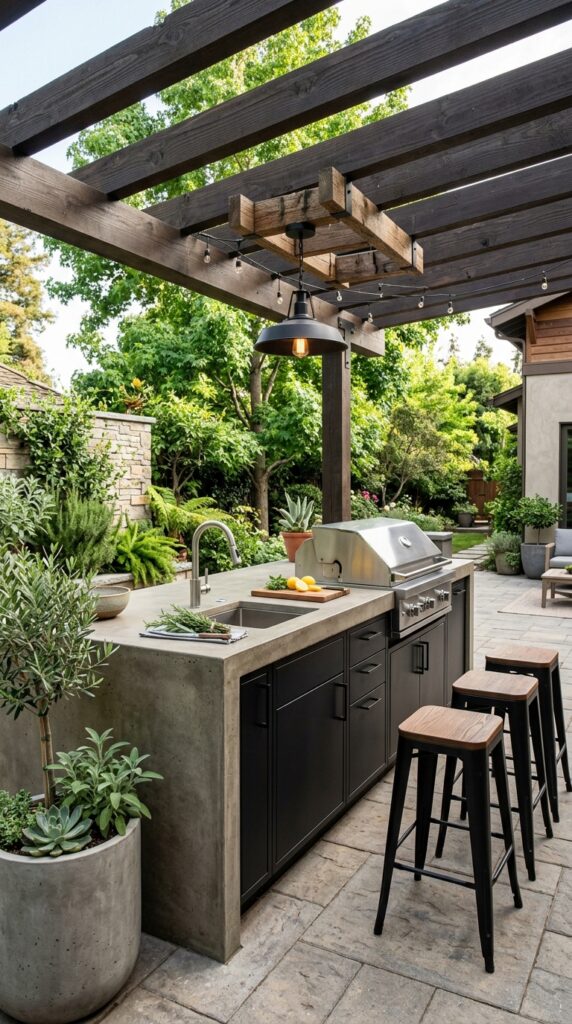
Vibe: Confident — a monolithic concrete island announces that this outdoor kitchen is a permanent room, not a seasonal arrangement.
Why it works: Poured-in-place concrete islands use the countertop and structural frame as a single unified pour, eliminating the visual joint between substrate and surface. This monolithic quality is the hallmark of serious concrete outdoor kitchen design — the island looks grown from the ground rather than assembled. Integral color pigment added to the concrete mix produces color throughout the material depth, so chips and scratches reveal the same tone rather than exposing a gray core beneath a stained surface.
How to get it: Use a 4,000 PSI concrete mix with a water-to-cement ratio below 0.45 for outdoor durability. Add 1–2% integral color by weight of cement — iron oxide in warm gray or buff produces the most natural-looking result. Reinforce with #3 rebar on 12-inch centers and fiber mesh in the mix to prevent cracking. Allow 28 days full cure before applying sealer.
Shop The Look
| Product |
| Blackened steel bar stool outdoor set of 2 |
| Undermount stainless kitchen sink 16 gauge |
| Outdoor pendant light black metal waterproof |
| Concrete integral color pigment iron oxide gray |
| Rebar tie wire roll concrete reinforcement |
3. Concrete Countertop with Embedded Aggregate Finish
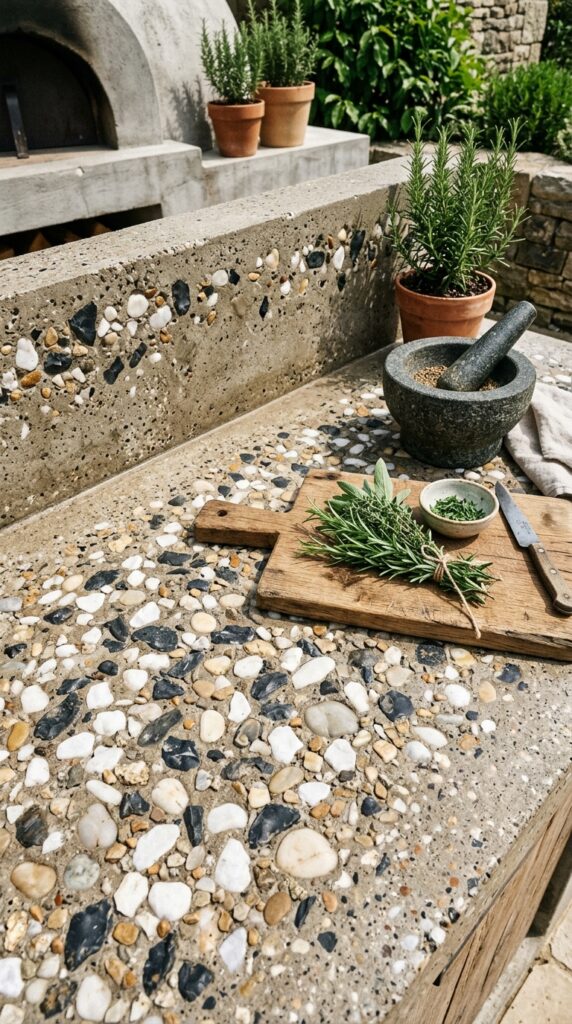
Vibe: Textural — exposed aggregate is the concrete equivalent of terrazzo, and it rewards close attention.
Why it works: Exposed aggregate concrete is created by seeding decorative stone into the surface of fresh concrete and then washing back the cement paste before it fully cures, revealing the embedded aggregate. For outdoor kitchens, this technique produces a slip-resistant surface (important around grills and sinks), natural color variation from the mixed stone, and a texture that visually integrates with a garden environment better than smooth concrete. The aggregate can be specified to match the project’s palette — white quartz for brightness, dark basalt for drama, warm river pebble for naturalism.
How to get it: Press selected aggregate into the fresh concrete surface approximately 45 minutes after pouring, then use a surface retarder spray — Brickform Expose or similar — to slow the surface cure. Wash back the cement paste 4–8 hours later with a stiff brush and water. Diamond-grind and seal for a cleaner, more refined version of the same technique.
Shop The Look
| Product |
| Stone mortar and pestle large granite natural |
| Teak outdoor cutting board large natural |
| Concrete surface retarder spray exposed aggregate |
| Decorative white quartz aggregate outdoor |
| Stainless steel outdoor prep tool set |
4. Outdoor Concrete Kitchen with Pizza Oven Integration
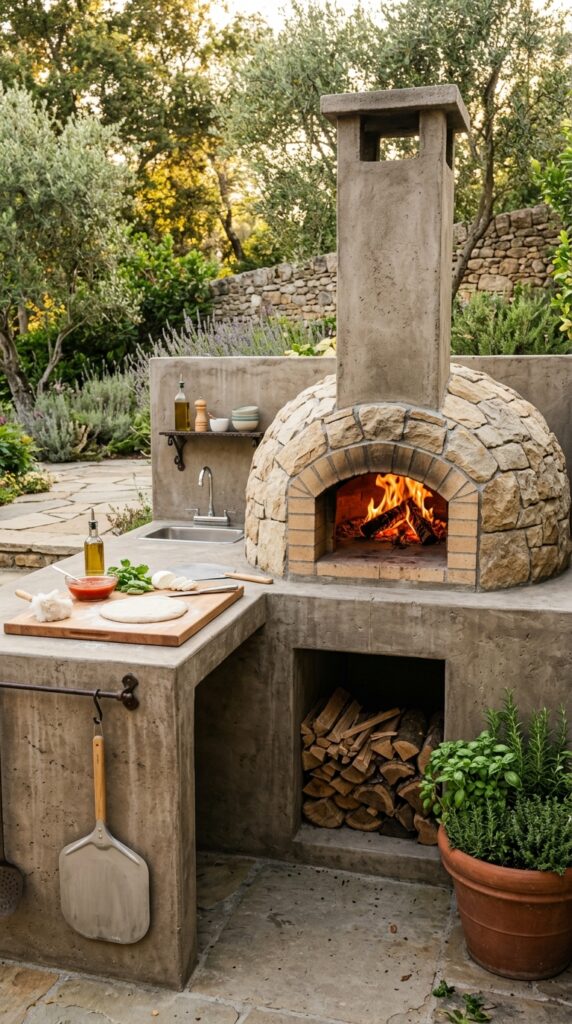
Vibe: Sun-warmed — a wood-fired oven in a concrete structure reads less like cooking equipment and more like architecture.
Why it works: Integrating a pizza oven into the concrete kitchen structure requires planning the oven foundation at the design stage — the oven floor must sit at a comfortable working height (typically 42–48 inches from grade), and the concrete surround must be reinforced to bear the oven’s significant weight (a standard 39-inch Forno Bravo oven weighs 600–900 lbs). The concrete counter running beside the oven at the same height creates a continuous work surface for prep and plating, uniting the oven architecturally with the rest of the kitchen.
How to get it: Build the oven base as a concrete stem wall with rebar reinforcement, topped with a 4-inch poured concrete slab as the oven support platform. Use refractory concrete (rated for sustained high temperatures) for the immediate oven surround. Leave an open wood storage niche in the concrete base below the oven — functional and visually balancing the mass.
💡 Quick Win: A tabletop Ooni Koda pizza oven (under $399, but the base standalone model starts around $299) placed on any concrete surface delivers authentic wood-fired cooking while you plan the permanent build.
Shop The Look
| Product |
| Long wood pizza peel aluminum handle |
| Outdoor wood storage rack steel large |
| Refractory cement high temp mortar quart |
| Pizza stone cordierite round 16 inch |
| Fireproof outdoor glove heat resistant pair |
5. Charcoal Concrete with Matte Black Fixtures
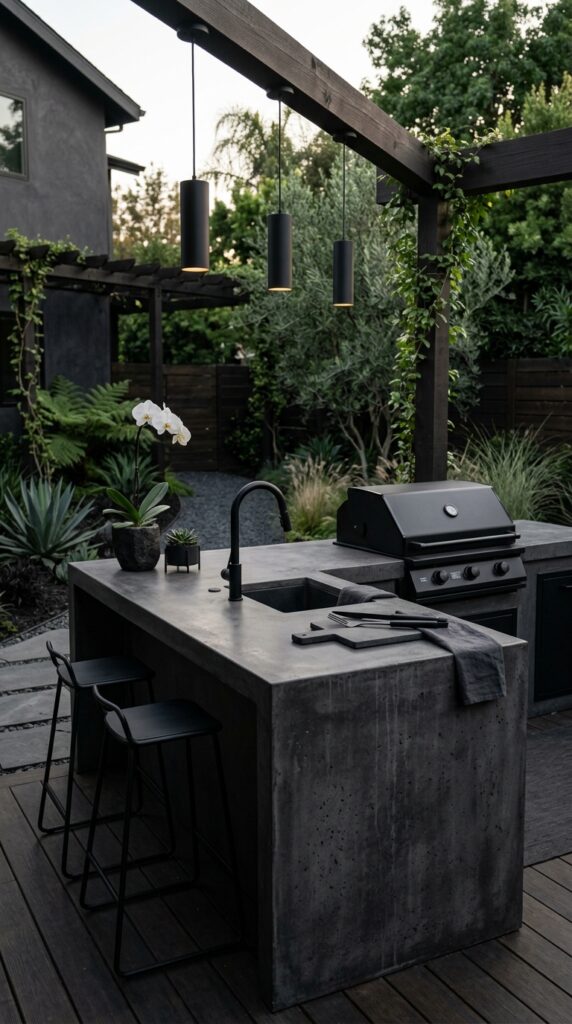
Vibe: Moody — charcoal concrete and matte black create a tonal depth that reads dramatically different at noon versus dusk.
Why it works: The charcoal concrete and matte black palette works because it eliminates all reflective surfaces from the outdoor kitchen, making the space read as a single sculptural object rather than an assembly of components. Dark integral color concrete (achieved with carbon black or lampblack pigment at 2–3% by cement weight) absorbs solar heat more readily than pale concrete — a consideration in hot climates, but an advantage in cooler ones where the stored heat extends outdoor kitchen usability into evening. Every fixture — faucet, grill frame, lighting, hardware — must be matte to maintain tonal consistency.
How to get it: Specify Brickform Color Hardener in Charcoal or Dark Gray, or use 2.5% lampblack integral pigment. Pair with Kichler or similar outdoor-rated matte black pendant fixtures (verify IP65 waterproof rating minimum). Seal the concrete with a charcoal-enhancing sealer — Surecrete XS-327 deepens dark integral color by approximately 20%.
Shop The Look
| Product |
| Matte black outdoor kitchen faucet pull-down |
| Outdoor pendant light matte black waterproof IP65 |
| Blackened steel bar stool outdoor modern |
| Dark iron planter large square outdoor |
| Charcoal concrete color hardener pigment |
6. Warm Sand Concrete with Teak Wood Accents
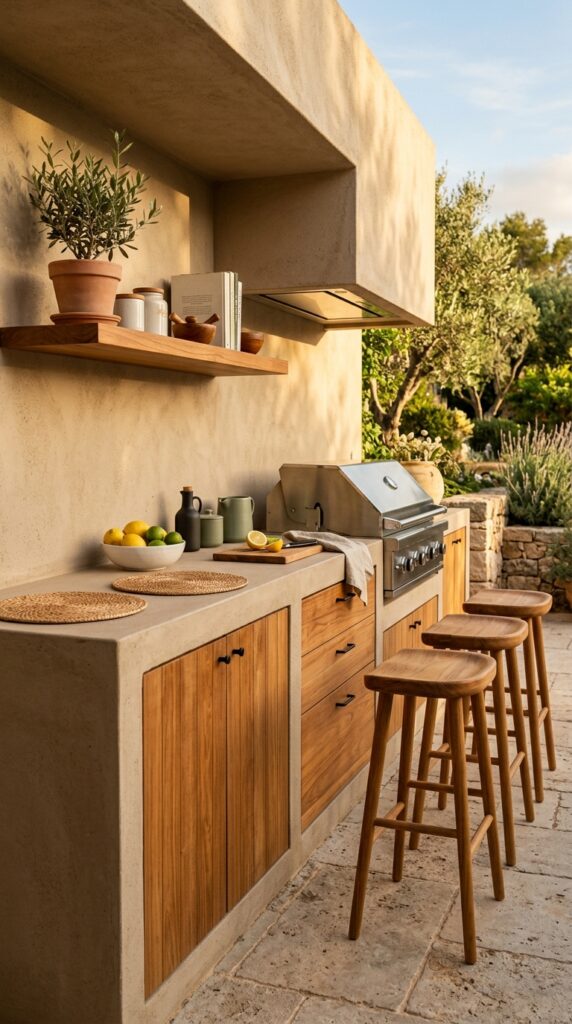
Vibe: Sun-warmed — the warmth of teak against sand concrete is the outdoor palette equivalent of linen on limestone.
Why it works: Teak is one of the few hardwoods genuinely suited for outdoor cabinetry — its high silica content and natural teak oil make it dimensionally stable in humidity and resistant to water infiltration without any applied finish. Against the mineral cool of concrete, teak introduces warmth through a completely different material logic: its visual warmth comes from organic growth-ring variation, not from pigment. The pairing satisfies the eye by offering both geological permanence and biological warmth in a single space.
How to get it: Use teak for any elements that will be routinely touched — shelf surfaces, lower cabinet fronts, bar overhang fascia — and leave concrete for countertops and structural elements that take more abuse. Treat teak annually with Danish oil or teak oil rather than any film-forming finish, which will peel with outdoor temperature cycling.
Shop The Look
| Product |
| Teak outdoor serving tray large rectangle |
| Teak oil furniture finish exterior quart |
| Woven outdoor placemat set natural rattan |
| Ceramic serving bowl set neutral tone |
| Citrus fruit bowl ceramic large outdoor |
7. Concrete Outdoor Kitchen with Pergola Integration
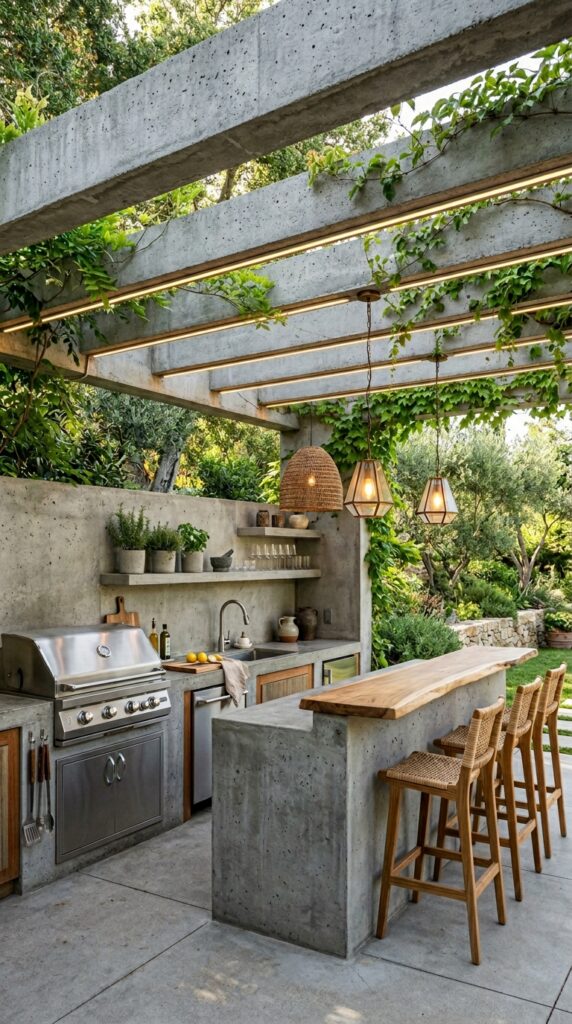
Vibe: Layered — when the kitchen and its overhead structure share the same material, the space reads as a single room, not an appliance under a frame.
Why it works: Designing the pergola and kitchen as a unified concrete pour — or at minimum using matching concrete board for both — creates visual continuity that separates serious outdoor kitchen design from bolt-together kit systems. The pergola provides shade for the cook, defines the kitchen as a distinct room within the garden, and offers a structural anchor for pendant lighting, hanging planters, and eventually, wisteria or grapevines whose organic softness contrasts deliberately with the raw concrete.
How to get it: Design the pergola columns to emerge from the kitchen structure’s corners — this eliminates the visual gap between kitchen and shade structure. Use 6″×6″ precast concrete columns or pour square columns in place. Specify all concrete in the same mix design and color to ensure uniform aging. Install LED strip lighting on the underside of pergola beams on a weatherproof driver — this is your primary evening kitchen light source.
Shop The Look
| Product |
| Outdoor LED strip light warm white waterproof 16ft |
| Hanging planter concrete look outdoor set |
| Wicker outdoor pendant shade natural large |
| Outdoor dining set concrete look table |
| Trailing pothos plant faux outdoor hanging |
8. Concrete Outdoor Kitchen: All-White Palette
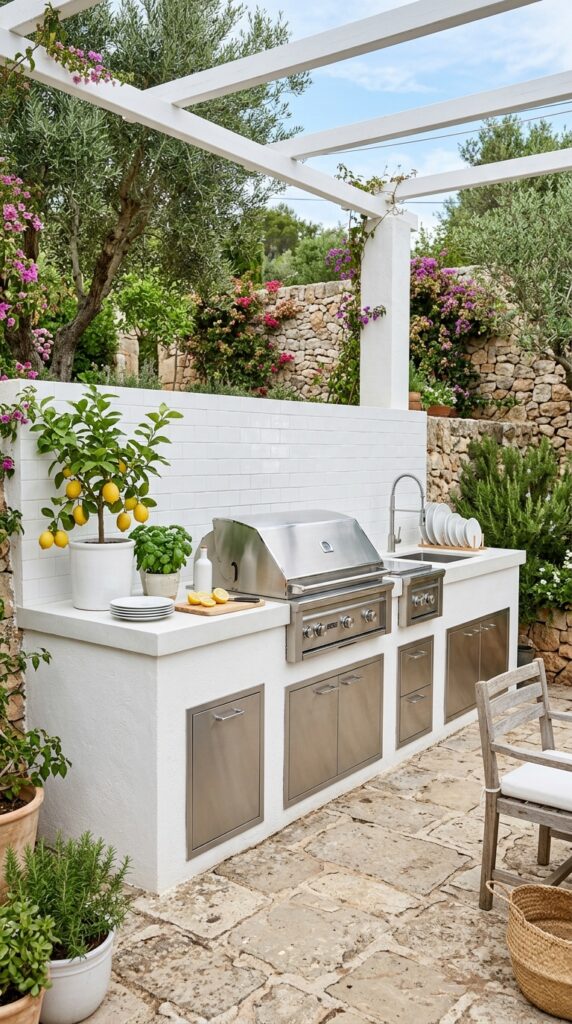
Vibe: Airy — a white concrete outdoor kitchen in strong sunlight achieves the quality of bleached Mediterranean architecture.
Why it works: White concrete — poured with white Portland cement rather than standard gray — has a luminous quality in natural light that standard concrete cannot match. It reflects rather than absorbs solar heat, making it a better choice for hot-climate outdoor kitchens, and it reads as cleaner and more connected to the garden environment. The critical challenge with white outdoor concrete is staining — oil from cooking, plant matter, and weathering all darken white surfaces. A penetrating densifier sealer applied before use and an annual topcoat of a nano-sealer (Prosoco’s SB600 or similar) manages this effectively.
How to get it: Specify white Portland cement Type 1 (available from specialty concrete suppliers) and use white silica sand as the fine aggregate — standard yellow sand will read as cream, not white. Add 0.5% titanium dioxide by cement weight for the most brilliant white. Seal with a white-concrete-specific penetrating sealer within 28 days of curing.
💡 Quick Win: White limewash exterior paint (under $40 per quart) applied to an existing rendered masonry outdoor kitchen base immediately achieves the bleached Mediterranean look without re-pouring anything.
Shop The Look
| Product |
| White outdoor ceramic planter large round |
| White Portland cement type 1 specialty |
| Brushed stainless outdoor faucet kitchen |
| Fresh basil herb live plant 4 inch |
| White ceramic serving platter large outdoor |
9. Linear Concrete Outdoor Kitchen Against a Wall
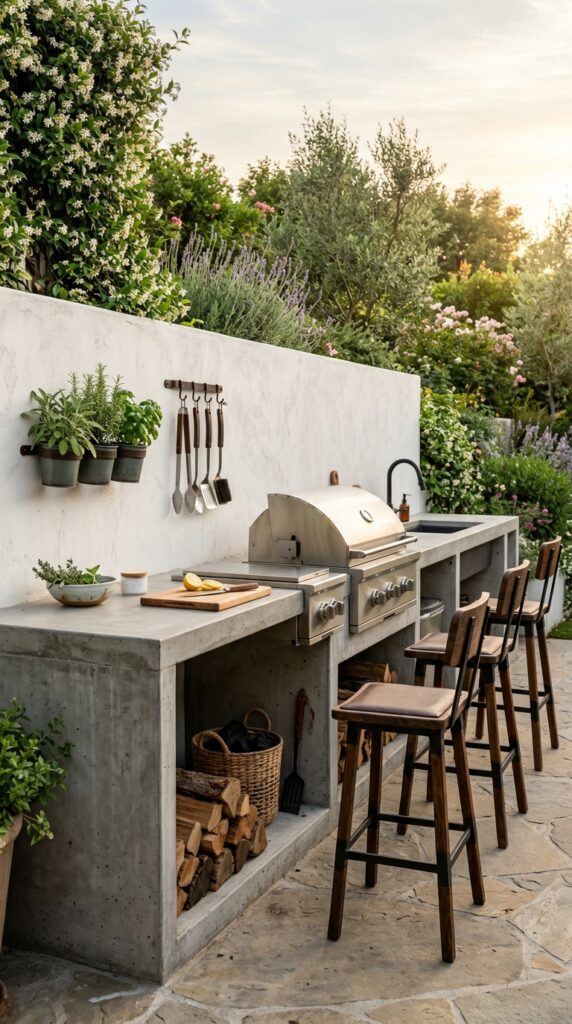
Vibe: Grounded — a linear kitchen flush to a wall compresses the whole program into one decisive line.
Why it works: The linear layout against a garden wall is the most spatially efficient configuration for an outdoor kitchen — it consolidates all cooking, prep, and storage functions along a single axis, leaving the remaining outdoor space entirely free for dining and lounging. The wall itself handles structure and weather protection for one side of the kitchen, reducing the amount of concrete or masonry work required. A 10–12 foot run can accommodate a full grill, two-burner side cooktop, prep sink, and 4 feet of open prep counter — a complete cooking station with no wasted square footage.
How to get it: Anchor the kitchen base to the garden wall using embedded threaded rods at 24-inch intervals before the concrete counter pour. Keep the base 12 inches away from the wall face to allow for plumbing access and prevent moisture transfer. Design the bar overhang at 12 inches beyond the kitchen frame to allow bar stool seating on the room side without obstructing the cook.
Shop The Look
| Product |
| Iron S-hook tool rail outdoor kitchen |
| Wall-mounted herb planter vertical set |
| Outdoor bar stool backless iron black |
| Built-in grill stainless 30 inch natural gas |
| Concrete counter overhang support bracket |
10. Concrete Outdoor Kitchen with Corten Steel Accents
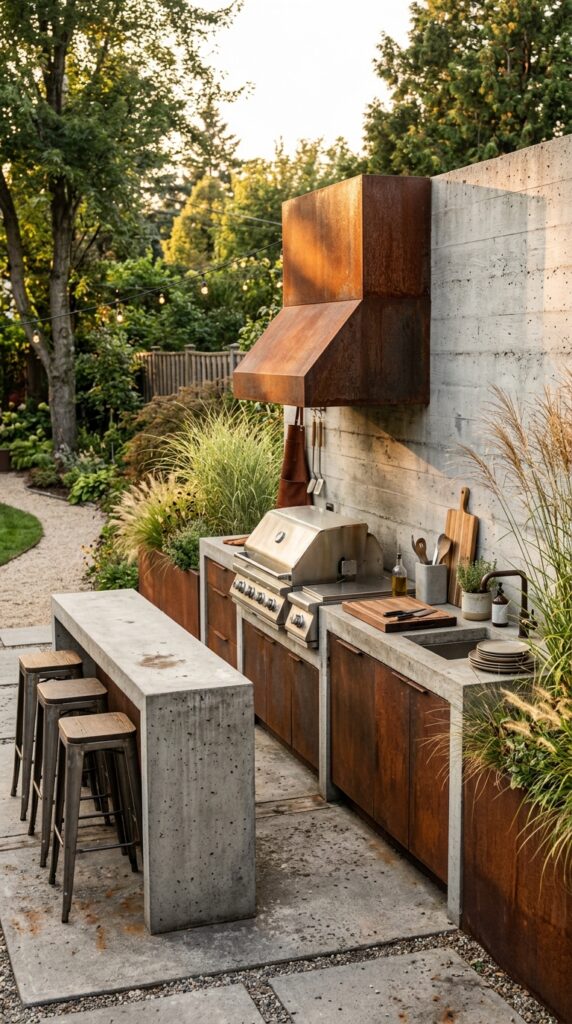
Vibe: Raw — the rust patina of corten steel against concrete is the outdoor kitchen’s most geologically honest material pairing.
Why it works: Corten (weathering steel) and concrete share a fundamental design truth: both are improved by time and weather. Corten develops its characteristic rust-orange patina in the first 2–3 years of outdoor exposure, then stabilizes — the patina itself becomes the protective layer, requiring no paint or coating. Against concrete gray, the warm rust of corten creates a thermal color contrast — warm against cool, organic against mineral — that gives the outdoor kitchen visual movement without any decorative intervention.
How to get it: Use 3/16-inch corten plate for outdoor kitchen panels — enough thickness to hold form without framing support. Allow corten to develop its patina naturally before installation to avoid rust staining adjacent concrete surfaces; accelerate patination with a diluted muriatic acid wash followed by neutralization. Never seal corten — the surface must breathe to maintain its protective oxide layer.
Shop The Look
| Product |
| Corten steel planter box large outdoor |
| Raw steel industrial bar stool outdoor |
| Ornamental grass live plant outdoor large |
| Weathering steel panel sheet thin 12×24 |
| Outdoor range hood stainless industrial |
11. Concrete Outdoor Kitchen Lighting: Edison Bulb Canopy
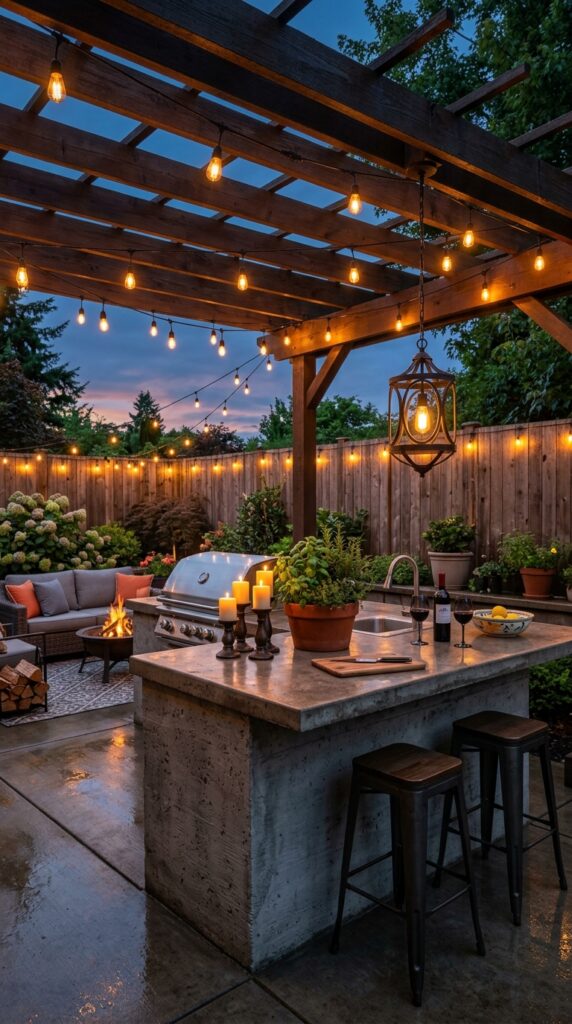
Vibe: Warm — Edison bulb canopy lighting at dusk turns a concrete outdoor kitchen into something that makes people stay longer than they planned.
Why it works: Overhead string lights in a canopy configuration solve the outdoor kitchen’s most persistent lighting challenge: providing enough ambient light for cooking while creating an atmospheric quality that overhead spot lighting destroys. The key is bulb specification — ST64 or G40 Edison-style bulbs at 2200K (warm amber, not the 2700K of standard warm white) produce a distinctly golden light that flatters food, skin tones, and concrete surfaces simultaneously. String at 8–9 feet above grade over the kitchen and dining zone for optimal distribution.
How to get it: Anchor canopy string lights to the pergola beams and a fence or secondary post rather than draped loosely — wind-driven sag allows bulbs to contact the concrete countertop. Use outdoor-rated 14-gauge wire (not the lighter-gauge decorative strings) for spans over 20 feet. Pair with a single weatherproof pendant lantern directly over the prep area for focused task illumination.
💡 Quick Win: A 50-foot outdoor Edison string light set at 2200K (under $35 on Amazon) draped over any concrete outdoor kitchen immediately transforms the evening atmosphere — it’s the single highest-impact lighting upgrade available at any budget.
Shop The Look
| Product |
| Outdoor Edison string lights 50ft 2200K waterproof |
| Weatherproof outdoor pendant lantern matte black |
| String light mounting hook outdoor heavy duty |
| Outdoor dimmer switch weatherproof plug-in |
| Concrete planter large with drainage hole outdoor |
12. Concrete Outdoor Bar with Integrated Ice Trough
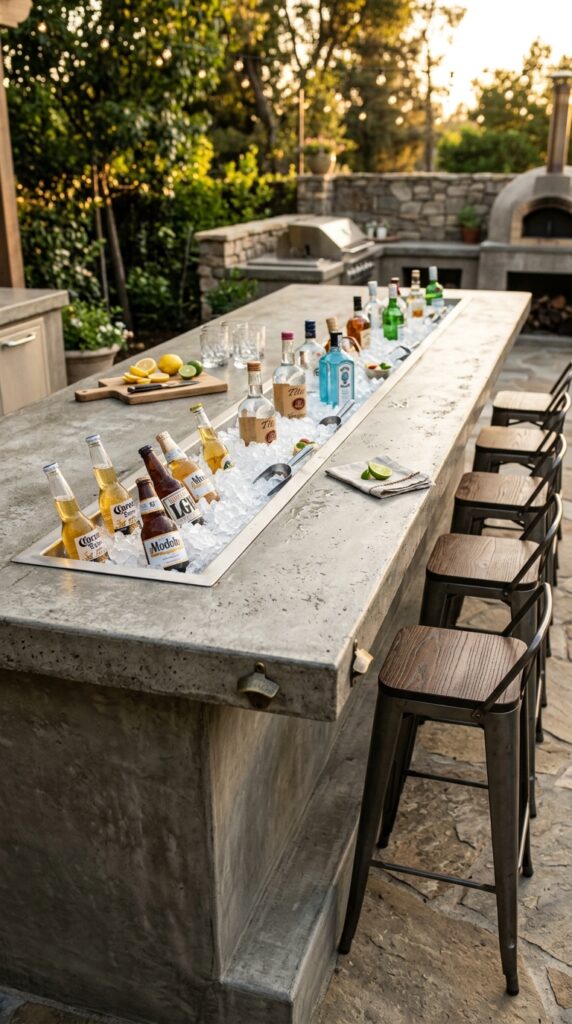
Vibe: Confident — a bar counter built to hold ice is a bar counter that means it.
Why it works: An integrated ice trough is a linear stainless steel insert dropped into a formed recess in the concrete countertop during the pour, set flush with the surface once cured and sealed around. The result is functionally superior to any freestanding ice bucket — it holds 20+ bottles at serving temperature, keeps the counter surface clear, and looks as though the bar was designed to be this way from the beginning. The concrete countertop provides an ideal setting: its thermal mass stays cool and its surface texture reads as substantial around the precision of the stainless insert.
How to get it: Form the ice trough recess using foam board cut to your insert dimensions, embedded in the concrete during the pour and removed after curing. Use a stainless steel restaurant pan (full hotel pan size) as the liner insert — these are standard, replaceable, and allow plumbing a drain through the concrete base below. Specify the drain at the pour stage.
Shop The Look
| Product |
| Full hotel pan stainless steel 4 inch deep |
| Countertop bottle opener bar mount stainless |
| Iron outdoor bar stool set of 4 |
| Bar ice scoop stainless large professional |
| Slate serving board large rectangle outdoor bar |
13. Concrete and Mosaic Tile Backsplash Combination
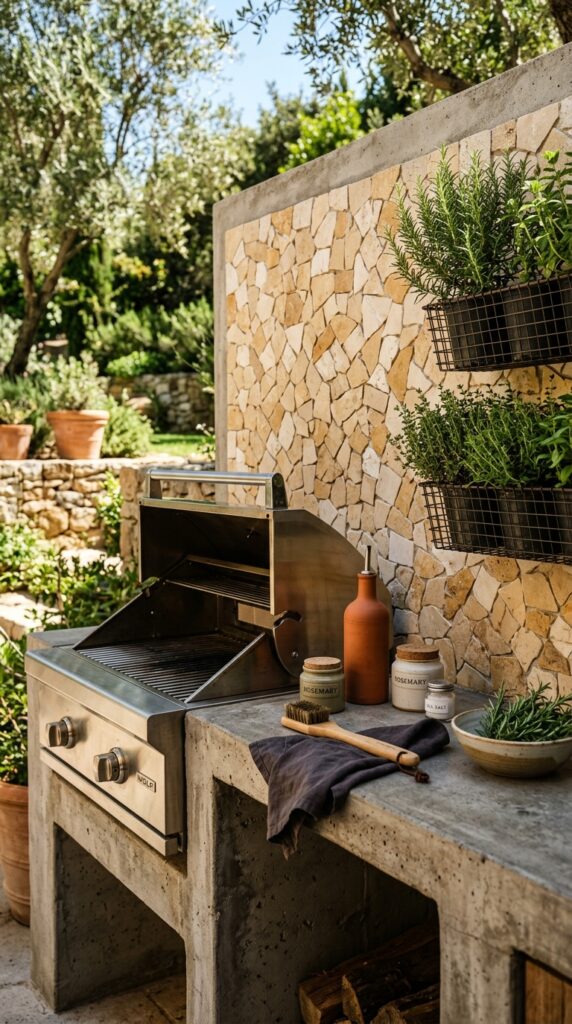
Vibe: Textural — a mosaic backsplash behind a grill station takes the most utilitarian wall surface and makes it the visual center of the kitchen.
Why it works: The contrast between the monolithic smooth concrete countertop and the intricate, light-catching surface of a stone mosaic backsplash follows a classical design principle: a complex surface needs a quiet surface beside it to read at its best. The mosaic handles the visual complexity; the concrete provides the calm. For outdoor kitchens, specify stone mosaic (not ceramic or glass tile) for the area directly behind the grill — stone’s matte surface handles the combination of heat, grease, and weather that glass tile struggles with over time.
How to get it: Use a 1-inch or 2-inch irregular cut mosaic in tumbled travertine or honed limestone, set in exterior-rated thin-set mortar. Grout in an unsanded, stain-resistant grout in a tone matching the tile’s mid-value — neither the lightest nor darkest stone in the mosaic. Seal with a natural-look stone sealer annually to prevent grease absorption.
Shop The Look
| Product |
| Travertine stone mosaic tile set natural 12×12 |
| Exterior tile thin-set mortar gray 50lb |
| Wall-mounted herb planter terracotta outdoor |
| Ceramic spice jar set with labels outdoor |
| Terracotta olive oil dispenser bottle |
14. Small-Space Concrete Outdoor Kitchen: 6-Foot Counter and Grill
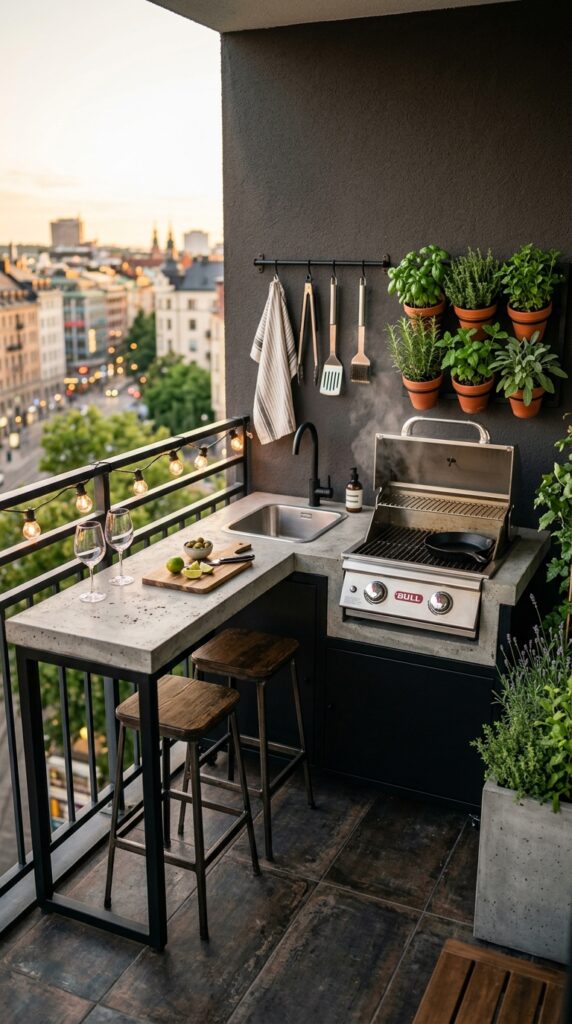
Vibe: Grounded — a small concrete kitchen with a clear program does more with 6 feet than a sprawling setup does with twenty.
Why it works: The 6-foot concrete outdoor kitchen is the most buildable version of this style for the majority of homeowners — it fits on patios as small as 8×10 feet, requires no planning permission in most jurisdictions (under 200 square feet), and can be completed in a weekend by two people with basic concrete skills. The key to making it read as intentional rather than incomplete is the bar overhang — 12 inches of concrete cantilevering over the guest side, at standard bar height (42 inches), transforms a cooking counter into a social space where the cook faces their guests.
How to get it: Build a steel tube frame (2″×2″ square steel tube, powder-coated black) to support the concrete slab pour. Cast the countertop off-site on a melamine-lined form table, cure for 7 days, then lift onto the frame using two people and heavy furniture straps. Seal before installation. Total material cost for this scale typically runs $400–$700 before appliance costs.
Shop The Look
| Product |
| Compact outdoor grill 2 burner stainless |
| Small outdoor prep sink stainless undermount |
| Melamine-lined concrete form table DIY |
| Concrete countertop mix bag 50lb outdoor |
| Steel tube powder-coated square 2×2 metal |
15. Concrete Outdoor Kitchen with Living Plant Wall

Vibe: Layered — a living wall of herbs directly behind a concrete kitchen collapses the distance between garden and cooking surface to zero.
Why it works: Integrating a living herb wall into the concrete kitchen structure addresses both the aesthetic and functional requirements of outdoor cooking simultaneously. Architecturally, the green density of a planted wall provides the strongest possible color and texture contrast to raw concrete — soft against hard, living against mineral, warm green against cool gray. Functionally, herbs within arm’s reach of the cook eliminate the distance between garden and plate. Rosemary, thyme, sage, and oregano are particularly well-suited — they tolerate the reflected heat and light of a south-facing kitchen wall.
How to get it: Install a modular concrete or terracotta wall planter system (Living Wall Planter or similar) directly to the concrete back wall of the kitchen. Use a drip irrigation line from the kitchen water supply to automate watering. Space planter pockets 8 inches apart minimum for root expansion. Plant in lightweight potting mix (not garden soil, which compacts) and fertilize monthly during the growing season.
Shop The Look
| Product |
| Modular wall planter system outdoor concrete |
| Copper watering can garden small |
| Woven harvest basket natural handle |
| Drip irrigation kit garden wall planter |
| Herb seed kit rosemary thyme oregano basil |
16. Concrete Outdoor Kitchen: Layout for Large-Scale Entertaining

Vibe: Confident — a U-shaped concrete outdoor kitchen is not a cooking station — it is an outdoor room.
Why it works: The L-shaped or U-shaped layout creates defined zones within the outdoor kitchen — a hot zone anchored by the grill and pizza oven, a cold zone with the prep sink and refrigeration, and a social zone at the bar overhang — that keep the cook’s workflow clear while allowing guests to occupy different parts of the kitchen without interrupting production. Concrete unifies all three zones visually, making what would read as a complex assembly of equipment read instead as a single continuous structure.
How to get it: Plan the working triangle — grill, sink, and prep surface — within 12 feet of each other, regardless of the total kitchen length. Specify the bar overhang on the side facing the dining area, not the cooking side. Allow 42-inch walkway clearance between the back of bar stools and any other kitchen surface — crowds compress this quickly.
💡 Quick Win: A concrete outdoor dining table (precast or poured-in-place) positioned at the end of the kitchen run, sharing a common concrete surface level, extends the entertainment zone without requiring additional construction — the table and kitchen read as one structure.
Shop The Look
| Product |
| Outdoor concrete look dining table large modern |
| Built-in outdoor refrigerator stainless 24 inch |
| Stainless steel side burner outdoor 2 burner |
| Outdoor kitchen modular drawer system stainless |
| Concrete dining bench outdoor long |
17. Polished Concrete Countertop with Integral Sink

Vibe: Clean — a monolithic sink-and-counter pour is the outdoor equivalent of a Boffi kitchen — the appliance disappears into the architecture.
Why it works: Pouring the sink as an integral part of the countertop eliminates the undermount joint — the single most common failure point in outdoor kitchen construction where water infiltration causes the counter base to degrade. The integral approach requires forming a void in the pour using a foam or wax form, then grinding and polishing the interior basin after demolding. Polishing to 800-grit produces a surface smooth enough to clean but matte enough to read as concrete rather than terrazzo — the target finish for an outdoor kitchen is functional elegance, not decorative gloss.
How to get it: Form the sink void using a foam core template (available from concrete countertop supply companies) attached to the form bottom. After demolding and initial cure, grind the interior basin with diamond pads progressing from 50-grit to 800-grit, then apply a food-safe penetrating sealer specifically rated for sink applications (Surecrete XS-327 Food Safe or similar).
Shop The Look
| Product |
| Natural fiber dish brush wooden handle |
| Ceramic liquid soap dispenser outdoor |
| Concrete food-safe penetrating sealer quart |
| Stainless steel pull-down outdoor kitchen faucet |
| Concrete countertop integral sink foam form |
18. Concrete Outdoor Kitchen with Fireplace End Cap

Vibe: Warm — connecting the kitchen and fireplace in a continuous concrete run makes fire part of the cooking zone, not an afterthought.
Why it works: The fireplace end cap transforms a linear outdoor kitchen from a single-function cooking structure into a full outdoor living wall — one end for cooking, one end for warmth, a continuous concrete surface connecting them. The structural logic is efficient: the kitchen base and fireplace base share the same concrete stem wall construction, with only the firebox requiring a refractory liner and separate flue. The design unites the most primal outdoor activities — fire and cooking — in a single architectural gesture.
How to get it: Design the fireplace firebox opening at 32–36 inches wide by 28–32 inches tall for a proportional outdoor scale. Use a UL-listed prefabricated steel firebox insert (Superior or Heatilator brand) set into the concrete structure — this handles the combustion engineering while the concrete provides the architectural surround. Finish the firebox surround in the same concrete or use honed limestone or slate at the immediate firebox face as a heat-resistant accent.
Shop The Look
| Product |
| Iron fireplace tool set 5 piece outdoor |
| Outdoor firewood rack steel black large |
| Sheepskin throw outdoor chair weather resistant |
| Heatproof refractory mortar tube 10oz |
| Concrete hearth sealer heat resistant quart |
19. GFRC Lightweight Concrete Outdoor Kitchen

Vibe: Clean — GFRC concrete achieves the same visual authority as standard concrete at a fraction of the weight, which is the whole point.
Why it works: Glass fiber reinforced concrete (GFRC) replaces the steel rebar reinforcement of standard concrete with alkali-resistant glass fibers, allowing countertops to be cast as thin as 1–1.5 inches (versus 2.5 inches minimum for standard reinforced concrete) at roughly 75% less weight. This makes GFRC the correct choice for rooftop kitchens, elevated decks, and balconies where structural load limits preclude standard concrete. Despite its reduced weight, GFRC has superior flexural strength to standard concrete and is less prone to cracking under thermal cycling.
How to get it: GFRC mix design is more complex than standard countertop concrete — use a pre-blended GFRC mix (Buddy Rhodes or SureCrete offer kits) rather than attempting to formulate from scratch. The face coat is applied first, then the structural backing coat containing the glass fiber strands. Work in sections no longer than 8 feet to allow the initial tack before the next panel application.
Shop The Look
| Product |
| GFRC mix kit premixed fiber reinforced concrete |
| Slim iron outdoor bar stool backless modern |
| Ornamental grass live fountain grass large |
| Alkali-resistant glass fiber concrete reinforcement |
| Concrete countertop edge strip form melamine |
20. Concrete Outdoor Kitchen with Stacked Stone Base

Vibe: Grounded — dry-stacked stone beneath concrete makes the kitchen look as if it grew from the garden wall.
Why it works: The combination of dry-stacked natural stone for the kitchen base and poured concrete for the countertop exploits the contrasting textures of both materials: the rough, irregular surface of the stone reads as geological and ancient, while the smooth, precise plane of the concrete countertop reads as architectural and modern. This contrast — ancient below, precise above — is more visually sophisticated than using either material alone throughout. Structurally, the stone base is built over a poured concrete stem wall for stability, with the stone serving as cladding rather than load-bearing structure.
How to get it: Build the concrete block or poured concrete structural base first, then clad with natural fieldstone using thinset mortar on the back of each stone (despite the dry-stacked appearance — the mortar is hidden within the joint). Use irregular ledgestone in sizes varying from 4–16 inches for an authentic dry-stack look, and avoid any stone more than 4 inches in thickness to keep load manageable.
💡 Quick Win: Peel-and-stick stacked stone panel veneer (under $8 per square foot at home improvement stores) applied to any masonry outdoor kitchen base gives the dry-stack appearance without any mortar work.
Shop The Look
| Product |
| Natural stacked stone ledger panel peel stick |
| Iron grill tool set 3 piece hook mount |
| Dried lavender bunch large decorative |
| Terracotta herb pot set 3 sizes natural |
| Stone thinset mortar exterior gray 50lb |
21. Concrete Outdoor Kitchen: Warm Greige and Brass Palette

Vibe: Warm — greige concrete with brass is the outdoor kitchen’s equivalent of linen with gold — restrained luxury.
Why it works: Warm greige (a concrete color achieved with a blend of buff and warm gray integral pigments) is the most livable of all outdoor concrete tones — it reads brown in warm light, gray in cool light, and never reads industrial. Against unlacquered brass fixtures — which oxidize through warm amber to a rich patina — the greige concrete always appears warmer by contrast, making the space feel welcoming in a way that pure gray concrete cannot. This palette reads as sophisticated without effort, which is its primary design value.
How to get it: Mix buff and warm gray integral color pigments at a 60:40 ratio to achieve a true greige in concrete. Verify the tone in a sample slab before committing to the full pour — concrete dries significantly lighter than it appears wet. Source unlacquered brass fixtures labeled “living finish” or “PVD unlacquered brass” — never lacquered brass, which reads as fake outdoors once the lacquer begins to peel.
Shop The Look
| Product |
| Unlacquered brass outdoor kitchen faucet living finish |
| Brass outdoor pendant light waterproof |
| Warm greige concrete integral color pigment kit |
| Brass herb planter wall hook outdoor |
| Cream ceramic outdoor serving bowl large |
22. Concrete Outdoor Kitchen with Shade Sail Integration

Vibe: Airy — a shade sail over concrete is the outdoor kitchen version of a clerestory window: controlled light with geometric precision.
Why it works: Shade sail integration solves the outdoor kitchen’s primary ergonomic challenge — cooking in direct sunlight is hot, squint-inducing, and often miserable, while overhead structures add cost and visual weight. HDPE shade sail fabric blocks 90–95% of UV radiation while allowing air movement, keeping the cook 15–20°F cooler than in full sun. Anchoring the sail masts directly into the concrete kitchen structure (pre-sleeved during the pour) eliminates separate footing requirements and creates the visual impression of the shade being an integral part of the kitchen rather than an afterthought.
How to get it: Pre-sleeve 2-inch steel pipe into the concrete kitchen structure corners during the pour, 24 inches deep with rebar reinforcement below. Insert 10-foot powder-coated steel mast poles after cure. Tension shade sails between mast tops and a fence or wall anchor — pull to minimum 5% sag for clean geometry and adequate drainage.
Shop The Look
| Product |
| Shade sail large triangle UV resistant outdoor |
| Stainless tensioning hardware shade sail kit |
| Shade sail steel post set powder-coated |
| Outdoor anti-fatigue mat kitchen concrete proof |
| Sun-resistant outdoor bar chair set 2 |
23. Concrete Outdoor Kitchen at Night: Landscape Lighting

Vibe: Moody — concrete at night, lit from below, looks like a monolith — it has a presence that daylight does not reveal.
Why it works: Landscape uplighting directed at a concrete outdoor kitchen from below exploits the material’s surface texture in a way that overhead or flood lighting cannot — raking light from a low angle catches every texture variation, grain impression, and aggregate particle, creating a surface that reads as rich and three-dimensional. LED uplighting at 2700K positioned 12–18 inches from the kitchen base and angled at 30–45 degrees produces this effect most dramatically. Under-bar LED strip lighting on a separate circuit provides functional illumination for guests seated at the bar.
How to get it: Install low-voltage LED landscape flood fixtures (Kichler or Cast Lighting are reliable outdoor brands) on ground stakes positioned in line with the kitchen’s base structure. Run 12-gauge landscape wire in conduit before laying the patio surface. Put bar LED strips on a separate dimmer switch from the uplights — uplighting for drama, bar LEDs for task — both at 2700K for consistency.
Shop The Look
| Product |
| Landscape uplight LED 2700K stake outdoor |
| Under-cabinet LED strip light warm white 2700K |
| Low voltage transformer 150W landscape |
| Outdoor dimmer switch dual zone weatherproof |
| Path light set low voltage 6 pack warm |
24. Concrete Outdoor Kitchen with Built-In Planter Boxes

Vibe: Grounded — when the kitchen grows its own herbs, the boundary between cooking and garden disappears.
Why it works: Integral planter boxes — poured as part of the kitchen structure during the main concrete pour — anchor the outdoor kitchen to its landscape setting in a way that no freestanding planter can replicate. They make the kitchen appear to have grown from the garden rather than been installed in it. Structurally, the planter boxes add to the kitchen base’s visual mass and thermal weight, making the structure read as more permanent. They must be waterproofed on all interior surfaces (Crystalline waterproofing compound added to the mix, or a cementitious waterproofing membrane applied post-cure) to prevent moisture migration into the adjacent kitchen structure.
How to get it: Size planter boxes at a minimum of 18 inches deep, 16 inches wide, and 18 inches tall for sufficient root volume for rosemary, lavender, or small citrus. Include a 2-inch drainage hole in the planter base during the pour. Use lightweight potting mix (not garden soil) to reduce structural load, and install a drip irrigation line from the kitchen water supply.
💡 Quick Win: A pair of precast concrete cube planters (available for $30–$45 each at garden centers) placed at each end of any outdoor kitchen achieves the same anchored-to-landscape effect without any construction.
Shop The Look
| Product |
| Precast concrete cube planter outdoor large |
| Rosemary live plant large outdoor hardy |
| Lightweight potting mix bag outdoor planters |
| Drip irrigation timer outdoor automatic |
| Crystalline waterproofing compound concrete |
25. Concrete Outdoor Kitchen with Roof Tile Overhang

Vibe: Sun-warmed — terracotta tiles over concrete is the exact material pairing that defines Spanish Colonial and Mediterranean outdoor architecture.
Why it works: The combination of terracotta roof tiles — warm orange-rust fired clay — over warm buff concrete borrows directly from Spanish Colonial California, Moroccan riad, and Italian farmhouse traditions. Both materials are fired or mineral-based, both age in the same direction (darkening and mellowing with weather), and both absorb and release heat at similar rates, creating a unified thermal envelope. The overhang provides rain protection for the cook and appliances while the open sides maintain the outdoor quality of the space.
How to get it: Build a simple timber or steel post-and-beam structure over the kitchen area, and lay traditional terracotta barrel tiles over timber purlins at 4-inch spacing. Do not cement the tiles — traditional installation is dry-laid with mortar only at the eave and ridge, allowing tiles to be replaced individually. Use warm buff concrete pigment in the kitchen countertop to echo the tile color.
Shop The Look
| Product |
| Terracotta pot collection outdoor large set |
| Dried chile ristra hanging decorative red |
| Iron outdoor wall lantern Mediterranean style |
| Dried herb bundle hanging decorative kitchen |
| Warm buff concrete integral pigment outdoor |
26. Compact Balcony Concrete Outdoor Kitchen

Vibe: Efficient — a concrete outdoor kitchen on a 60-square-foot balcony is a statement about priorities: quality over footprint.
Why it works: Balcony outdoor kitchen design operates under strict constraints — structural load limits (typically 40–60 lbs per square foot for residential balconies), wind load, drainage, and gas connection regulations — that all favor lightweight GFRC over standard concrete. A GFRC countertop 1.5 inches thick at 30 lbs per square foot fits within most balcony structural allowances while delivering the same visual authority as a thicker pour. The fold-down teak extension shelf — mounted on hinges to the kitchen side — adds prep or serving surface only when needed, returning to flush when the kitchen is not in use.
How to get it: Confirm your balcony’s structural rating with a structural engineer before installing any permanent outdoor kitchen. Design for maximum 25 lbs per square foot total kitchen weight including all components. Specify a GFRC counter in a gray tone matching the building’s concrete or render for visual integration with the architecture.
Shop The Look
| Product |
| Fold-down teak wall shelf bracket hinged outdoor |
| Compact 2-burner portable gas grill stainless |
| Slim iron bar stool folding outdoor |
| Small herb pot concrete look single |
| Compact outdoor sink portable tabletop stainless |
27. Concrete Outdoor Kitchen with Integrated Dining Table

Vibe: Confident — a kitchen and dining table poured as one surface is the outdoor equivalent of a chef’s counter: cooking and eating occupy the same architectural moment.
Why it works: The integrated kitchen-to-dining table is the most spatially efficient outdoor entertaining configuration available — it eliminates the gap between cooking zone and eating zone entirely, allows the cook to serve directly across the counter, and creates a single visual object that reads as architectural rather than furnished. The height transition from kitchen counter (36 inches) to dining table (30 inches) is achieved with a formed step in the pour — both surfaces are the same width, same finish, same material, stepped 6 inches in height along a clean horizontal break.
How to get it: Engineer the step transition with a 3-inch horizontal ledge at the height change point — this provides a visual break and prevents a sharp vertical face that would look unresolved. Reinforce heavily at the transition point with a #4 rebar cage — this is the structural weak point of the pour. Seat the dining table end on concrete bench bases poured simultaneously, or on powder-coated steel bench frames for flexibility.
Shop The Look
| Product |
| Long outdoor linen table runner natural |
| Ceramic serving dish set large outdoor neutral |
| Outdoor concrete dining bench modern |
| Olive tree live large outdoor potted |
| Stainless steel platter large outdoor serving |
28. Concrete Outdoor Kitchen: Monochrome Gray and Green

Vibe: Moody — dark concrete paired with deep hunter green is the outdoor kitchen palette that reads as most sophisticated in overcast or dappled garden light.
Why it works: The charcoal concrete and hunter green combination is exceptional in garden settings because both tones belong to the same cool-dark family — one mineral, one botanical — and neither competes for dominance. The contrast between the engineered surface of the concrete and the living, breathing quality of the surrounding green planting is the whole effect. Hunter green glazed tile for the backsplash (Benjamin Moore’s Newburyport Green or Sherwin-Williams’ Cascades in glaze) bridges the concrete and the garden, carrying the color palette from the built structure into the natural one.
How to get it: Specify charcoal integral color concrete (lampblack pigment at 2% cement weight) for the countertop and pair with hunter green 3″×6″ handmade ceramic subway tile for the backsplash. Plant the surrounding garden with green-toned specimens — boxwood, olive, rosemary, and clipped myrtle — in the same tonal family, avoiding any warm-toned or flowering plants that would break the monochrome palette.
Shop The Look
| Product |
| Hunter green ceramic subway tile 3×6 handmade |
| Cast iron grill pan outdoor large |
| Dark green ceramic bowl set outdoor |
| Boxwood topiary ball live large outdoor |
| Iron plant hook wall mount garden |
How to Start Your Concrete Outdoor Kitchen Transformation
The single best first move is to pour one concrete countertop slab — just the surface, 2.5 inches thick, on whatever base you currently have or intend to build — before committing to any other element of the design. This one surface does more to define the character of the finished kitchen than any appliance, tile, or fixture choice, because it establishes the material tone and finish against which everything else will be selected. A warm greige slab tells you immediately whether you need the warmth of teak accents or the contrast of blackened steel — no amount of planning on paper resolves that question the way a physical sample does.
The most common beginner mistake is over-specifying the concrete too soon. Many first-time builders choose a polished or highly pigmented finish they saw in a magazine and commit to it before seeing how that finish behaves in their specific climate and light conditions. Polished concrete in a north-facing shaded yard reads flat and cold. A charcoal concrete under intense afternoon sun accumulates surface heat to the point of being uncomfortable. Fix this by sourcing a 12″×12″ sample slab in your chosen mix and sealer, placing it in your actual outdoor kitchen location for two weeks, and observing it at different times of day and in different weather before pouring the full surface.
Three immediate-impact items under $50: a 50-foot outdoor Edison string light set at 2200K ($28–$38), a genuine sheepskin seat cushion for a bar stool ($35–$45), and a living rosemary plant in a concrete-look planter pot ($12–$18 at garden centers). Each of these changes the atmosphere of any outdoor kitchen space without touching the structure.
A single-weekend transformation — sealing an existing concrete surface, adding lighting, restyling accessories — is achievable for $100–$300. A complete new concrete outdoor kitchen build with countertop pour, grill, and sink typically runs $3,500–$8,000 in materials and professional labor for a 10–12 foot linear run. A full entertainer’s kitchen with pizza oven, bar, and integrated dining table runs $15,000–$35,000 depending on finish level and region.
Frequently Asked Questions About Concrete Outdoor Kitchens
What is a concrete outdoor kitchen and how is it different from a standard outdoor kitchen?
A concrete outdoor kitchen uses poured, precast, or glass fiber reinforced concrete (GFRC) as its primary structural and surface material — countertops, frames, base walls, and often floors are all concrete. Standard outdoor kitchens typically use a stucco or tile over concrete block structure with a separate countertop in granite, tile, or polymer. The difference is material continuity: a concrete outdoor kitchen reads as a single architectural object, while a standard outdoor kitchen reads as a cabinet assembly. Concrete is also more durable long-term — it requires no paint, develops character with weather, and has a design lifespan measured in decades rather than years.
What colors work best for concrete outdoor kitchen countertops?
The most versatile concrete countertop colors for outdoor kitchens are warm greige (achieved with a 60:40 blend of buff and warm gray pigments), warm medium gray (iron oxide gray at 1.5% by cement weight), and natural concrete gray (no pigment — the color of the cement itself). Charcoal and deep black read dramatically well in modern gardens but accumulate surface heat in hot climates — test a sample before committing. Avoid stark white in high-use cooking areas, as staining from oil, smoke, and plant matter is accelerated on pale surfaces without aggressive sealing maintenance.
How much does a concrete outdoor kitchen cost to build?
A DIY concrete countertop for an existing outdoor kitchen base costs $400–$900 in materials (concrete, reinforcement, forms, sealer). A professionally installed 10-foot linear outdoor kitchen with concrete countertop, built-in grill, and prep sink runs approximately $4,500–$9,000 in most U.S. markets. Adding a pizza oven integration adds $2,500–$6,000 to the project depending on oven brand and size. A full large-scale entertaining kitchen with fireplace, bar, and integrated dining typically runs $18,000–$40,000 for a complete professional build in premium materials.
Can concrete outdoor kitchens handle outdoor weather, heat, and moisture?
Yes, properly sealed and designed concrete is one of the most weather-resistant outdoor kitchen materials available. The critical requirements are: a penetrating (not topical) concrete sealer rated for outdoor use, reapplied annually; a water-to-cement ratio below 0.45 in the mix for density; and fiber mesh reinforcement or GFRC construction to minimize thermal cracking. In freeze-thaw climates (below 32°F regularly), use an air-entrained concrete mix — the 4–6% air void content accommodates ice expansion. In direct coastal environments, use a Type V sulfate-resistant cement to resist salt air degradation.
What is the best concrete finish for an outdoor kitchen countertop?
For most outdoor kitchens, a honed concrete finish at 400-grit is the practical optimum — smooth enough to clean effectively, matte enough to not show scratches, and textured enough to provide slight grip near a sink. Board-formed concrete (which preserves the wood-grain impression) is the best choice for maximum visual interest. Polished concrete (800-grit and above) looks excellent but requires more frequent resealing in outdoor conditions, especially in sun-exposed locations where UV degrades topical sealers. Exposed aggregate provides the best slip resistance and visual integration with garden environments, and is the most maintenance-tolerant of all finishes.
Ready to Create Your Dream Concrete Outdoor Kitchen?
These 28 ideas have moved across the full range of what concrete outdoor kitchens can be — from board-formed countertops and charcoal monochromes to GFRC balcony builds, integrated dining tables, and fireplace end caps. Every transformation begins with a single decision rather than an overhaul — and choosing your concrete finish, tone, and texture before anything else is the move that makes every subsequent choice easier. Today, pour or order a concrete countertop sample slab in the color you’ve been drawn to in this article and place it in your outdoor space for a week — nothing clarifies a material choice faster than living with it. When your kitchen is finished and you’re cooking over fire in a space built to outlast every other element of your home, it won’t feel like something you decorated — it will feel like something you poured. Save the ideas involving the fireplace end cap and the Edison light canopy — those are the ones you’ll come back to when the first version is done and you’re already planning what’s next.