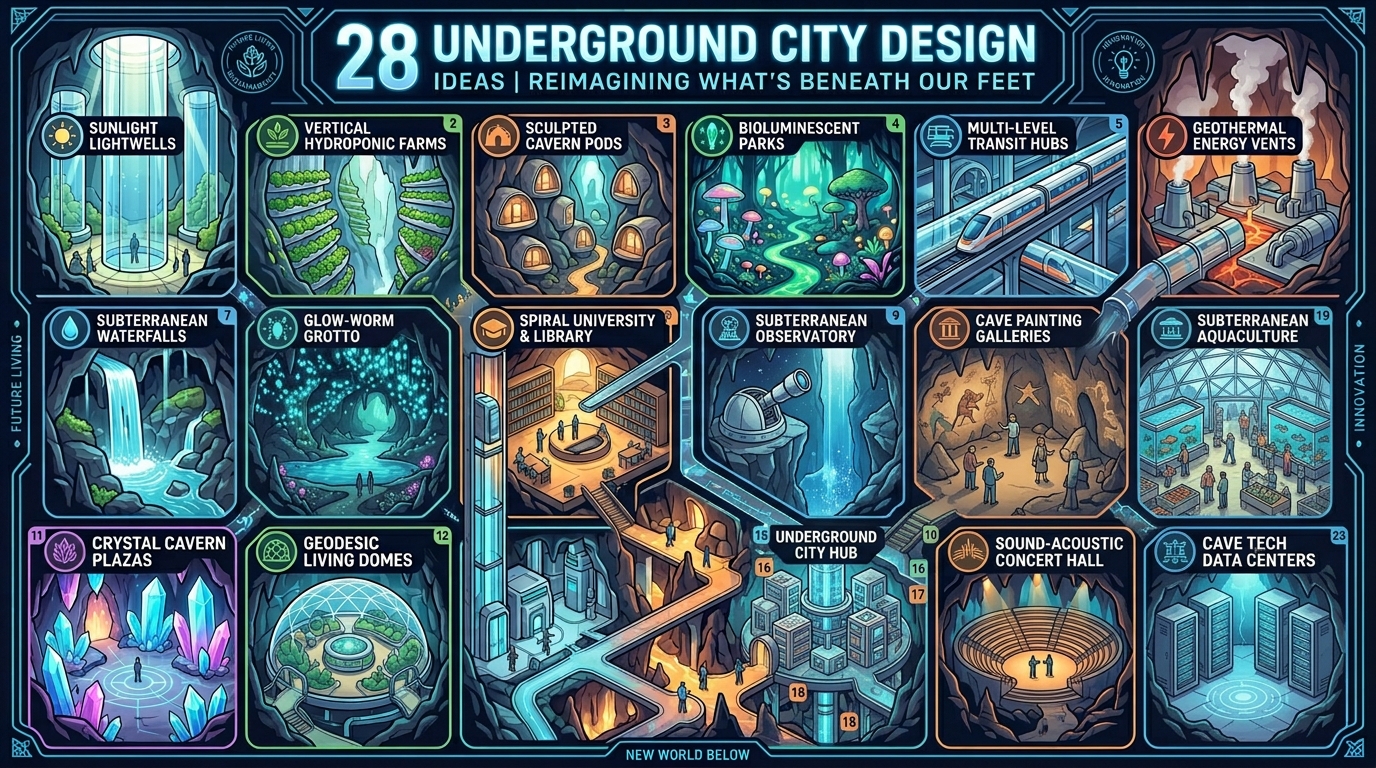
An underground city design is the architectural and urban planning discipline of building livable, functional human environments below the earth’s surface — integrating civic infrastructure, residential zones, green space, transit, and community life into a subterranean world engineered for human comfort and long-term habitability. These 28 underground city design ideas cover structural palettes, biophilic systems, lighting innovations, spatial layouts, material strategies, and compact zone adaptations — with specific design principles you can apply to every scale of underground thinking, from speculative cities to basement conversions.
There’s something primal about the idea of life underground — not the bunker, not the basement, but the fully realized world beneath the surface. Corridors that open into vaulted civic plazas. Light that arrives from impossible angles. Stone walls polished smooth by a thousand years of imagined hands. The underground city doesn’t feel like hiding — it feels like discovering that the world had another floor all along. Here are 28 ideas worth saving — and stealing.
Why Underground City Design Works So Well
Underground city design as a serious architectural and urban planning discipline emerged from two distinct historical threads: the ancient engineering traditions of cities like Derinkuyu in Cappadocia — a fully inhabited underground city carved from volcanic tuff housing up to 20,000 people — and the modernist infrastructure projects of the twentieth century, including Montreal’s underground RÉSO network and Helsinki’s extensive subterranean city plan. Contemporary underground design draws from both traditions while adding climate resilience engineering, biophilic architecture, and passive environmental control systems that make subterranean living genuinely attractive rather than merely functional. What distinguishes visionary underground city design from a glorified tunnel system is the commitment to human-scale atmosphere — light quality, material warmth, spatial generosity, and living systems that sustain wellbeing below grade.
The core material palette of underground city design runs from raw basalt and carved limestone at the structural register through polished concrete, engineered timber, and translucent polycarbonate at the finish layer. Flooring materials range from honed travertine and dark slate to resin-sealed aggregate and heated stone tile. Structural surfaces favor exposed rock faces, formed concrete with board-form texture, and fiber-reinforced polymer panels. Hardware and fixture finishes trend toward brushed steel, aged brass, and oxidized copper — materials that patinate authentically over time and develop character within a closed environmental system where natural weathering is absent.
The cultural moment for underground city design has arrived with genuine urgency. Climate change, urban density crises, and extreme surface weather events have moved subterranean urban planning from speculative science fiction to mainstream architectural discourse. Cities including Singapore, Helsinki, Oslo, and Shenzhen have active underground masterplans that extend transportation, commerce, and civic space below grade as practical responses to surface constraints. Meanwhile, on the speculative and residential scale, Pinterest searches for “underground living” and “earth-sheltered home design” have grown over 300% since 2020, tracking the broader cultural appetite for resilient, climate-controlled, and architecturally distinctive living environments.
Even at the residential or small-scale design level, underground city design principles translate directly: earth-sheltered homes, basement conversions with high design ambition, and subterranean studio spaces all benefit from the same design vocabulary — light simulation, material warmth, biophilic layering, and spatial generosity strategies that prevent underground spaces from reading as confined or institutional. The honest limitation is ceiling height: any underground space with a ceiling below 10 feet requires specific design interventions — reflective surfaces, vertical light sources, and horizontal material emphasis — to prevent compression. Above 10 feet, the full underground city design vocabulary opens completely.
Style at a Glance
| Element | Raw & Structural | Livable & Biophilic |
| Philosophy | Geological honesty | Human atmosphere |
| Materials | Basalt, formed concrete, brushed steel | Engineered timber, living wall, travertine |
| Color Palette | Obsidian black, slate gray, raw stone | Warm amber, biophilic green, bioluminescent blue |
28 Underground City Design Ideas
1. Bioluminescent Blue + Obsidian Black Civic Palette
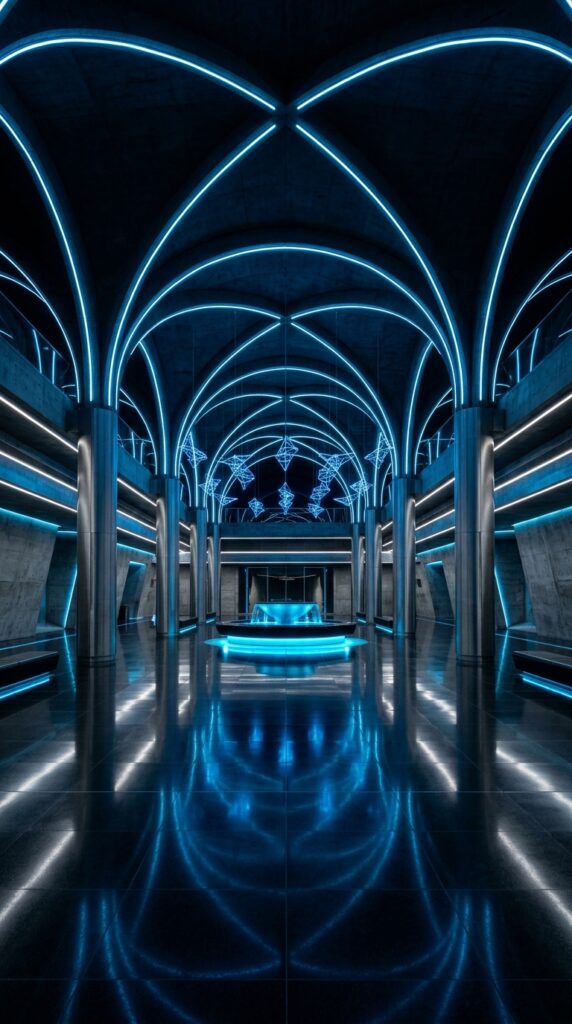
Vibe: Luminous — the specific grandeur of a city that learned to make its own light.
Why it works: The obsidian black and bioluminescent blue palette operates on the design principle of tonal void with luminous interruption: the black polished stone floor and dark concrete ceiling absorb all ambient light, making the embedded blue LEDs in wall channels and floor edge details appear to glow with organic intensity — as if the rock itself were alive with bioluminescence. This is precisely the visual effect that distinguishes underground city design from a lit tunnel: the light is not applied to the surface, it appears to emanate from within it. The obsidian floor’s mirror-like reflectivity doubles the apparent height of the vault by reflecting its ceiling back upward.
How to get it: Specify fiber-reinforced polished black concrete for the floor at a minimum Class 5 polish level — this produces the semi-mirror reflectivity that activates the bioluminescent light effect. Channel LED strips (minimum 1200 lumens per meter at 450nm blue wavelength) into routed grooves in wall surfaces rather than surface-mounting, ensuring the light source itself is never visible — only its glow registers.
💡 Quick Win: In a basement or residential underground space, LED strip lighting in a cool blue (450–470nm) routed into a single floor-edge channel along one wall immediately creates the bioluminescent effect for under $45 in materials.
Shop The Look
| Product |
| Blue LED strip light 450nm bioluminescent color 16 foot |
| Black polished concrete floor wax sealer mirror finish |
| LED channel extrusion aluminum recessed wall groove |
| Geometric pendant light sculpture modern suspended |
| Brushed steel cylindrical column wrap architectural |
2. Carved Basalt Tunnel Wall Architecture
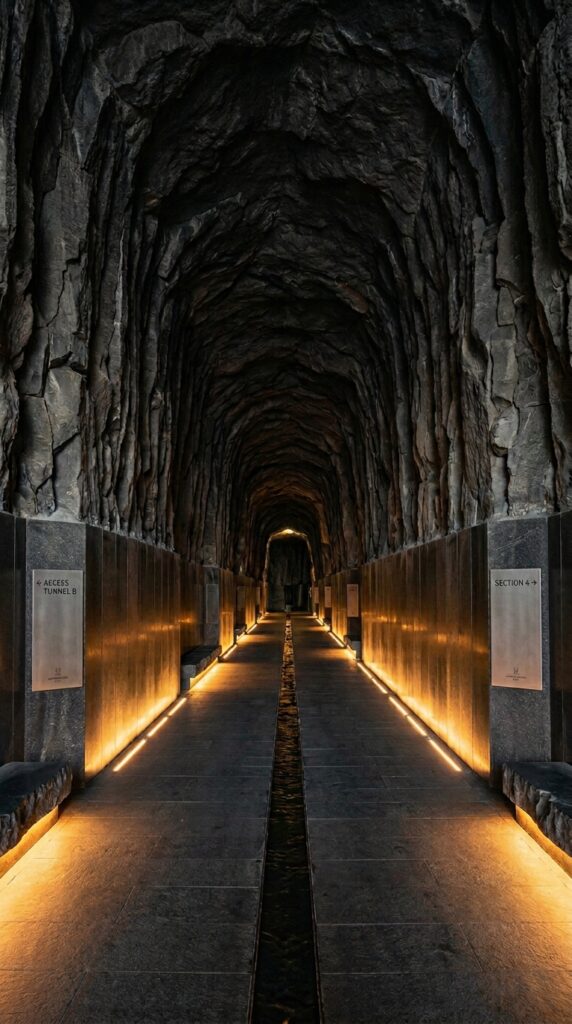
Vibe: Raw — the authority of a city built from the very rock it displaced.
Why it works: Basalt’s columnar jointing — the natural hexagonal fracture pattern formed as volcanic rock cools — provides an inherent geometric order to a carved tunnel wall that reads as both geological and architectural simultaneously. The design principle of material transition at mid-wall (polished lower half, rough-hewn upper half) creates a surface that communicates different information at two heights: the polished lower section reflects warm uplighting upward while remaining cleanly touchable and legible at human scale; the rough upper section absorbs light and reads as the raw geological material it is, reinforcing the underground city’s relationship to the earth around it.
How to get it: In architectural applications using stone-look materials, specify large-format dark basalt-look porcelain tile (24×48 inches minimum) with a split-face mosaic on the upper register and a honed finish on the lower register — this replicates the material transition effect at a fraction of the cost and structural complexity of carved volcanic rock. Apply warm amber (2200K) LED floor-level uplighters at 36-inch intervals to activate the surface texture.
Shop The Look
| Product |
| Dark basalt look large format porcelain tile 24×48 |
| Split face stone mosaic tile dark volcanic texture |
| Warm amber 2200K LED floor uplight recessed |
| Brushed steel wayfinding sign blank architectural |
| Thin stone water channel liner dark slate |
3. Solar Tube Skylight Shafts for Daylight Underground
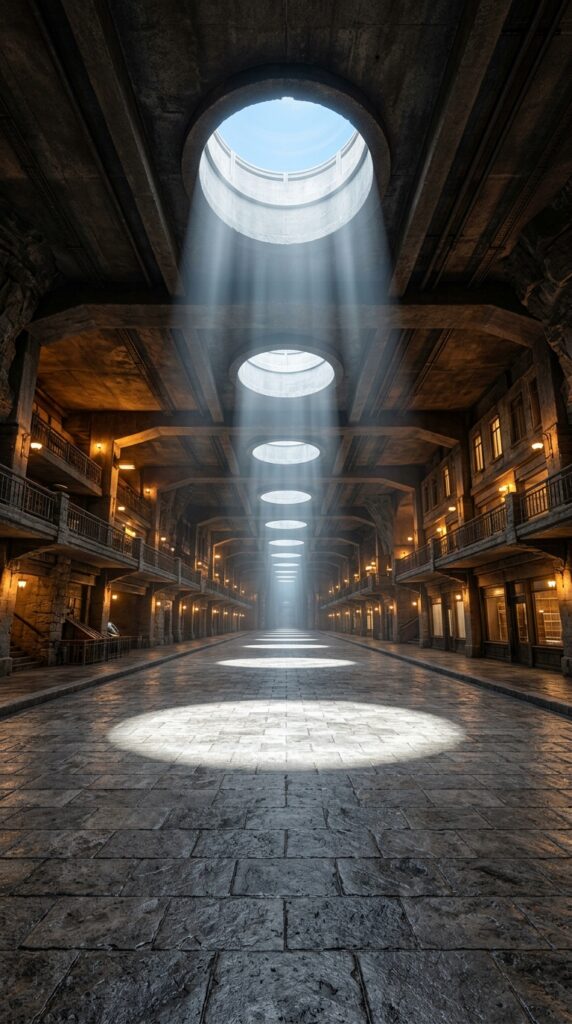
Vibe: Serene — daylight that arrives underground like a gift the surface decided to share.
Why it works: Daylight shafts are the single most psychologically significant design element in underground city planning because they resolve the most fundamental human concern about subterranean living: the loss of connection to the sky and natural light cycles. A daylight shaft at 30-foot intervals along a primary boulevard provides circadian-rhythm-supporting natural light to occupants below while functioning as visual punctuation that gives the underground street a rhythm and scale reference. The contrast between the natural daylight column (5500–6500K) and the warm ambient lighting at each side (2700–3000K) creates a color temperature gradient that makes the daylight shafts visually irresistible — the eye is drawn to them the way eyes are always drawn to windows.
How to get it: In residential underground or earth-sheltered applications, a 14-inch tubular daylighting device (TDD) delivers the equivalent of approximately 400 watts of daylight through a highly reflective aluminum tube — one unit per 200 square feet of floor area maintains adequate daylight levels for circadian rhythm support. Install at ceiling height over the primary circulation path, not over fixed furniture, to maximize the sensory impact of the light columns.
Shop The Look
| Product |
| Solar tube skylight 14 inch tubular daylighting kit |
| Highly reflective aluminum tube extension 24 inch kit |
| Daylight simulation ceiling diffuser lens prismatic |
| Circadian rhythm daylight LED supplement 6500K panel |
| Underground light shaft architectural model scale kit |
4. Concentric Ring City Plan Around a Central Atrium
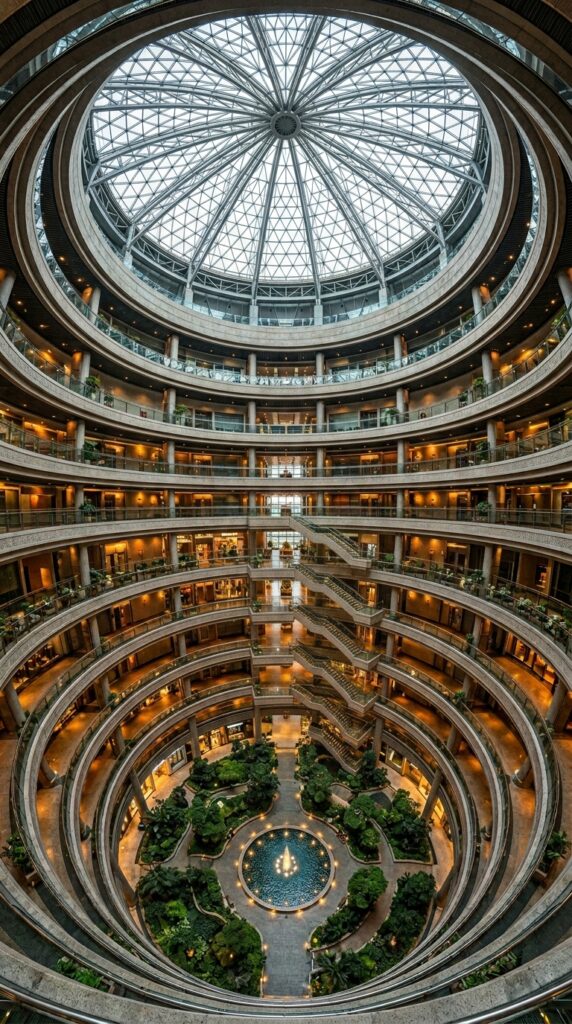
Vibe: Architectural — the underground city that solved its own sky problem by putting one in the middle.
Why it works: The concentric ring atrium plan is the most structurally elegant solution to underground city design’s central challenge: providing all residents with visual access to a vertical light source and shared open space simultaneously. By arranging residential and commercial rings around a central void, every unit at every level has a sightline to the atrium floor and upward to the glass dome — replicating the psychological function of a window onto open space. The atrium floor functions as the city’s public park and civic heart, visible from all 360 degrees and all levels simultaneously, making it the shared reference point that gives the underground community its spatial identity.
How to get it: At the residential scale, a circular skylight well punched through multiple floors of a multi-story structure — with each floor’s opening surrounded by a railing-edged gallery — creates the same concentric-ring spatial logic at house scale. The central void should be a minimum of 12 feet in diameter to feel genuinely open rather than confined; below this dimension, the well reads as a light shaft rather than an atrium.
Shop The Look
| Product |
| Underground city architectural concept art print large |
| Circular skylight dome double glazed structural glass |
| Atrium railing kit stainless cable modern |
| Scale architectural model building kit multi-level |
| Underground city masterplan design book architecture |
5. Warm Amber + Concrete Gray Underground Residential Zone
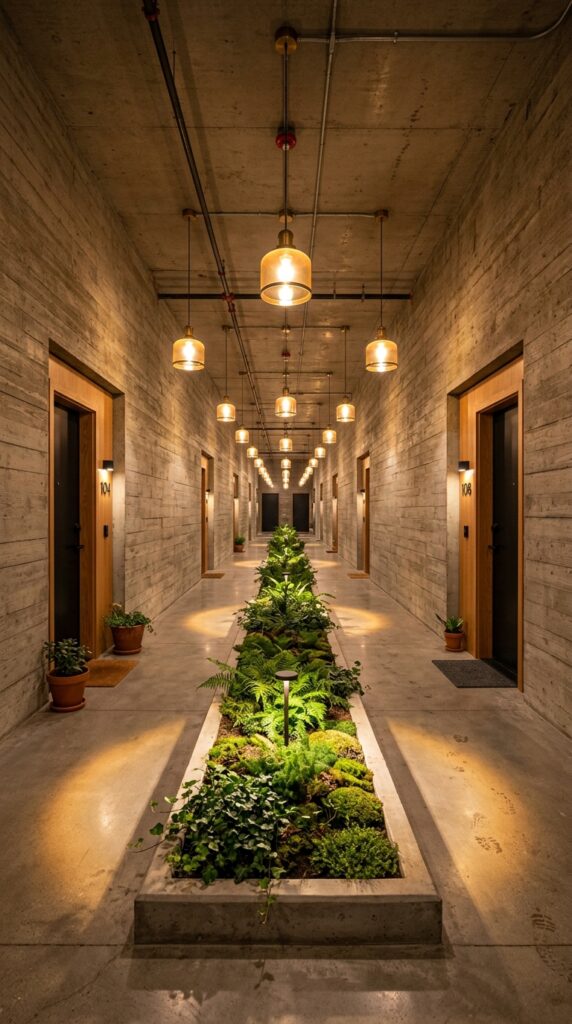
Vibe: Warm — the underground street that learned to feel like home by deciding to act like one.
Why it works: Warm amber and concrete gray is the residential zone palette that most effectively humanizes underground city corridors — concrete provides the material honesty that the subterranean context demands, while warm amber light (2700K) at pendant height creates the residential light quality that signals habitation rather than infrastructure. The design principle is light level differentiation by zone: public transit corridors operate at 5000K cool white for safety and legibility; residential zones drop to 2700K warm amber for comfort and domesticity. This color temperature shift is the fastest, least expensive method of communicating zone identity to inhabitants navigating a complex underground environment.
How to get it: Specify pendant lights at 2700K and position them at 7.5-foot drop height from a 10-foot ceiling — this brings the light source to a domestic eye-level rather than institutional overhead position, fundamentally shifting the corridor’s experiential quality. Plant the median strip with species that thrive in low-light conditions: shade ferns, moss, and creeping jenny maintain a planted appearance under 150–250 foot-candle illumination.
Shop The Look
| Product |
| Concrete effect wallpaper panel board form texture gray |
| Warm amber 2700K pendant light industrial cord modern |
| Indoor shade fern live plant low light |
| Preserved sheet moss panel green natural wall |
| Matte black flush door pull handle set modern |
6. Living Green Wall Biophilic Corridor System
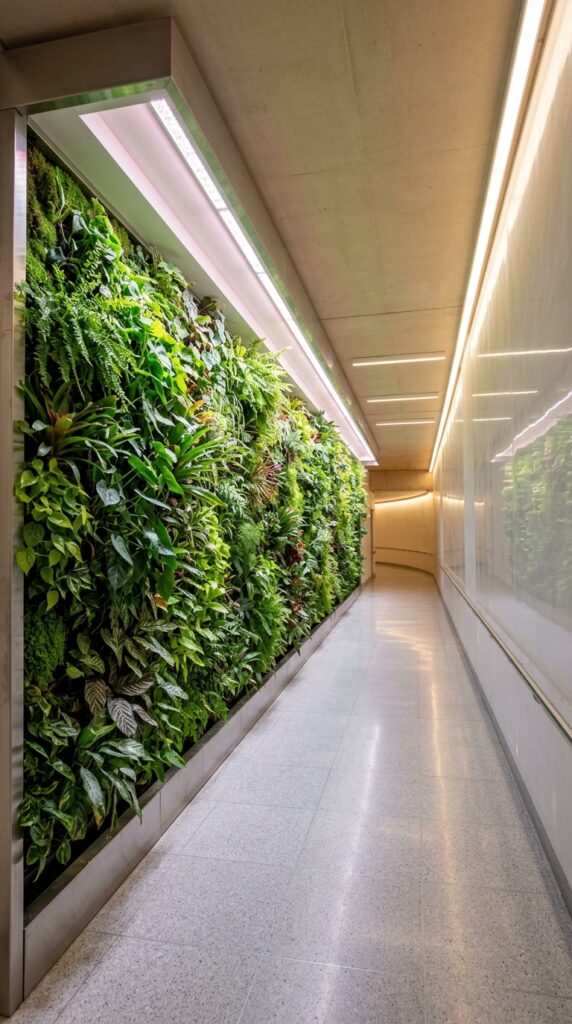
Vibe: Lush — the underground space that answered every concern about nature by filling one entire wall with it.
Why it works: A full-height living green wall in an underground corridor addresses the biophilic deficit of subterranean environments more effectively than any other single design intervention because it delivers multiple simultaneous benefits: visual connection to living plant material, measurable air quality improvement through phytoremediation, acoustic dampening from the plant mass and growing medium, and humidity regulation that moderates the dry air quality common in mechanically ventilated underground spaces. The design principle of wall-scale biophilic density — one entire wall surface dedicated to plant life — creates what environmental psychologists call a restorative environment: a space that actively reduces physiological stress markers in occupants moving through it.
How to get it: A modular felt pocket living wall system — where individual plant pockets attach to a waterproof backing panel with drip irrigation integrated — can be installed on any structurally sound wall and maintained with minimal access. Specify a full-spectrum LED grow light panel (400–700nm PAR range) set back behind a 6-inch deep reveal at the wall top for concealed illumination that appears to be natural overhead light rather than grow lighting.
💡 Quick Win: A 4×4-foot modular living wall kit with integrated drip irrigation and 16 plant pockets ($120–180) transforms a basement or underground space immediately — the plant mass alone shifts the room’s atmosphere from subterranean to biophilic within weeks of establishment.
Shop The Look
| Product |
| Modular felt pocket living wall system 4×4 kit |
| Full spectrum LED grow light panel 400-700nm PAR |
| Drip irrigation kit for living wall indoor |
| Assorted tropical low-light plant set for living wall |
| White concrete effect large format wall panel |
7. Underground Hydroponic Food Forest Zone
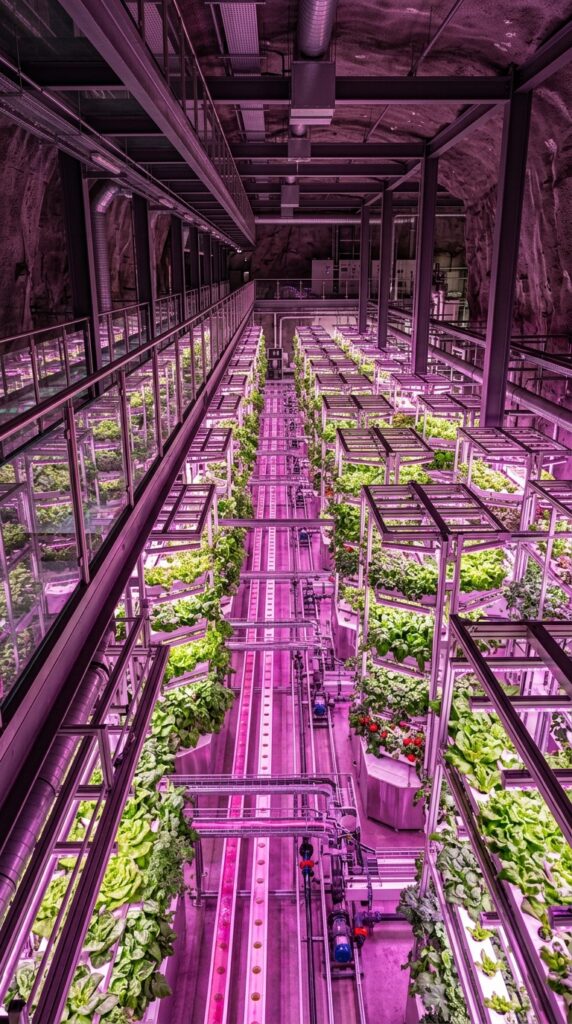
Vibe: Purposeful — a city that decided food sovereignty was an infrastructure project.
Why it works: An underground hydroponic food forest solves the most critical long-term challenge in underground city habitability: food system independence from surface climate and weather disruption. The vertical tower growing system multiplies productive area by 10–20× versus equivalent surface greenhouse space because the grow medium is stacked vertically rather than spread horizontally — a 1,000-square-foot underground footprint in a vertical system produces what would require 15,000 square feet of conventional surface agriculture. The pink-purple grow light spectrum (a combination of 450nm blue and 660nm red LEDs) is specifically calibrated to the chlorophyll absorption peaks of leafy greens and fruiting plants, producing maximum yield per watt of electrical input.
How to get it: For a residential-scale underground grow zone, a 72-inch tall hydroponic tower garden system with a 45-plant capacity fits in a 2×2-foot floor footprint and produces fresh greens year-round under a 60-watt LED grow light. Full-spectrum 400–700nm panels at 18 inches above the growing surface maintain adequate PAR (photosynthetically active radiation) for most fruiting and leafy crops.
Shop The Look
| Product |
| Vertical hydroponic tower garden system 45 plant |
| Full spectrum LED grow light panel pink purple 60W |
| Hydroponic nutrient solution concentrate all-purpose |
| Stainless steel nutrient channel hydroponic NFT kit |
| Grow tent indoor basement hydroponics 4×4 |
8. Multi-Level Civic Platform Public Space Design
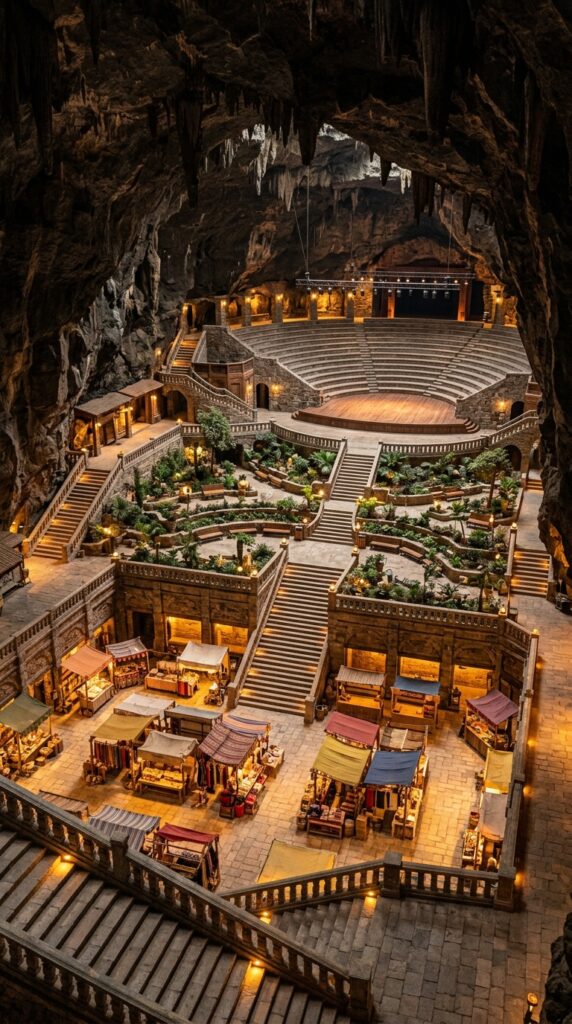
Vibe: Civic — the underground city that organized its public life by how high you wanted to be.
Why it works: Multi-level civic platform design applies the design principle of sectional programming — assigning distinct social functions to distinct vertical levels within a single spatial volume — which creates a naturally zoned public realm without walls or enclosures. In an underground cavern setting, this exploits the irregular vertical profile of the carved space: platforms at different heights use the natural geometry of the rock rather than fighting it, and the variety of ceiling heights across levels creates genuinely different spatial characters at each zone. The market level with its lower ceiling feels active and commercial; the garden platform with greater overhead clearance feels expansive and restorative — two different rooms within one geological space.
How to get it: In a basement conversion context, a split-level floor plan with a 24–36-inch step change between zones creates the multi-platform civic feeling at domestic scale. Use consistent stair and ramp profiles throughout — the same tread depth and riser height at every level change creates a unified architectural language across the level differentiation.
Shop The Look
| Product |
| Concrete step mold form DIY casting kit |
| Multi-level modular deck platform system outdoor |
| Stone look step coping tile natural travertine |
| Underground civic space scale model architecture kit |
| Warm amber outdoor step light fixture set recessed |
9. Artificial Sky Ceiling LED Dome Simulation
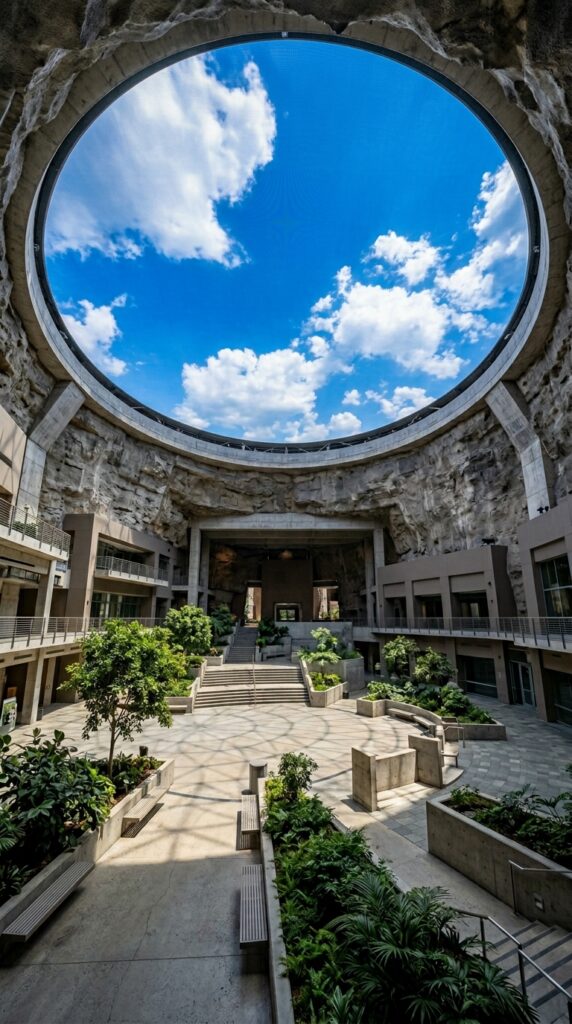
Vibe: Disorienting — the underground space that convinced you the sky was simply closer today.
Why it works: An LED sky dome simulation resolves the most profound psychological challenge of underground city living — the absence of a visible sky — through high-resolution digital mimicry at architectural scale. The critical specification is dynamic sky simulation: a static blue panel reads as a ceiling after the first day; a system that cycles through sunrise, midday, afternoon, sunset, and twilight in real time provides genuine circadian rhythm support because the changing light color and intensity signal time of day exactly as outdoor sky conditions do. Modern LED sky panels at 4K pixel density per panel achieve a cloud texture resolution indistinguishable from actual sky photography at viewing distances over 15 feet.
How to get it: For smaller residential applications, a programmable circadian rhythm LED ceiling panel (minimum 24×48 inches) that shifts from 6500K blue-sky white at noon to 2700K amber at sunset provides the biological light cycle cues of an actual sky window within a fixed ceiling footprint. Pair with a dynamic blue-sky wallpaper mural on adjacent walls to extend the sky impression beyond the panel’s edge.
Shop The Look
| Product |
| Circadian rhythm programmable LED panel sky simulation |
| Blue sky cloud photorealistic ceiling mural wallpaper |
| Dynamic color temperature LED driver controller |
| Sky simulation LED light box architectural grade |
| Sunrise sunset programmable smart bulb system |
10. Deep Indigo + Brushed Steel Industrial Palette
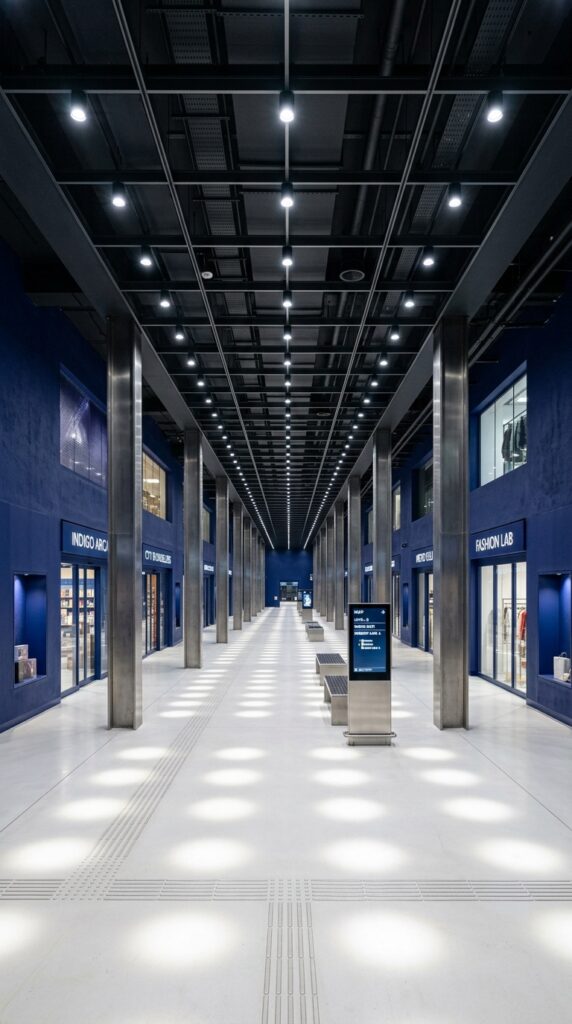
Vibe: Purposeful — the commercial underground that took the concept of a city block seriously enough to design it at night.
Why it works: Deep indigo and brushed steel creates the commercial zone identity palette in underground city design — communicating through color and material that this is a destination for activity and transaction rather than passage or residence. Indigo’s strong blue saturation reads as active and alert at the commercial brightness levels (4000K, 50+ foot-candles) used in underground retail and commercial zones; it would feel oppressive at the lower residential light levels (2700K, 15–20 foot-candles). The brushed steel structural column is the signature material of serious underground engineering — it is also what it appears to be: a load-bearing element in a space carved from the earth — and its visibility communicates structural honesty that the underground context makes meaningful.
How to get it: Apply deep indigo (Farrow & Ball “Pitch Blue” No. 220 or Benjamin Moore “Newburyport Blue” HC-155) in a semi-gloss finish to commercial underground wall surfaces — semi-gloss resists the condensation and humidity fluctuations common in mechanically ventilated underground environments. Pair with brushed (not polished) steel column wraps at 4×4-inch square profile, secured with concealed clip systems.
Shop The Look
| Product |
| Deep indigo blue semi-gloss interior paint |
| Brushed steel column wrap panel decorative 4×4 |
| Matte black suspended ceiling grid T-bar kit |
| Commercial LED downlight 4000K recessed 6 inch |
| White polished concrete floor sealer high gloss |
11. Translucent Polycarbonate Panel Partition System
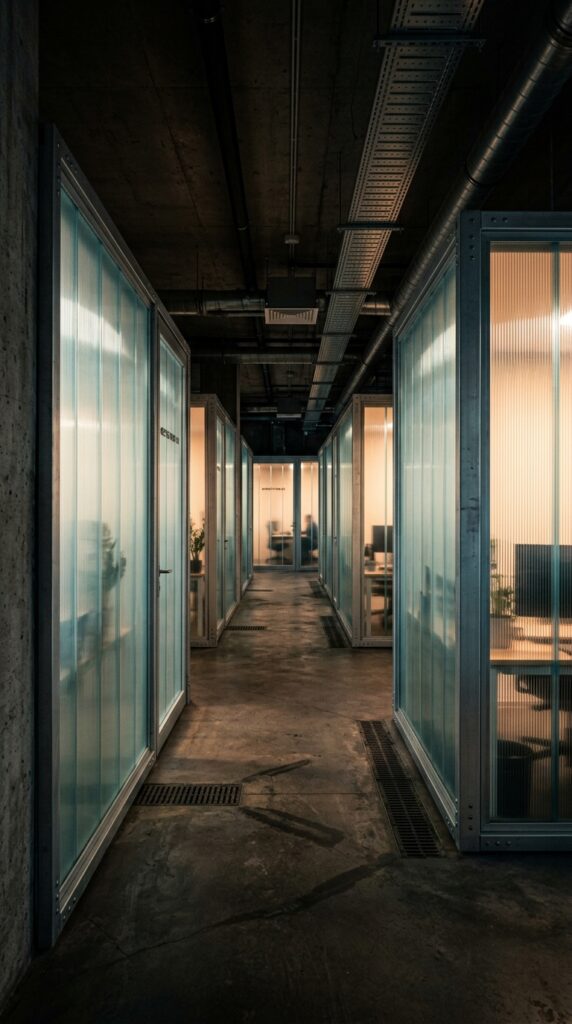
Vibe: Luminous — partitions that share their light rather than hoarding it.
Why it works: Translucent polycarbonate twin-wall panels as interior partitions in an underground city apply the design principle of light sharing across zone boundaries: in an environment where light is an expensive, engineered resource rather than a free atmospheric condition, partitions that transmit diffused light from well-lit zones into adjacent darker corridors make the entire system more luminously efficient. The twin-wall channel structure of standard glazing polycarbonate creates a frosted-glass appearance that maintains visual privacy while transmitting 50–80% of the light striking its surface — making it a partition that also functions as a light distribution system.
How to get it: Specify 16mm twin-wall polycarbonate panels in opal (frosted white) rather than clear — opal diffuses light uniformly across the panel face without creating visible hot-spots from point light sources behind it. Frame panels in 1×1-inch aluminum T-section extrusion for a clean, industrial edge profile that reads as architecturally considered without requiring custom fabrication.
Shop The Look
| Product |
| Twin wall polycarbonate panel opal frosted 16mm |
| Aluminum T-section extrusion frame glazing 1 inch |
| Polycarbonate panel trim end cap closure strip |
| LED light bar behind panel diffuser low profile |
| Polycarbonate cleaning and UV protection spray |
12. Compact Underground Micro-Pod Living Unit
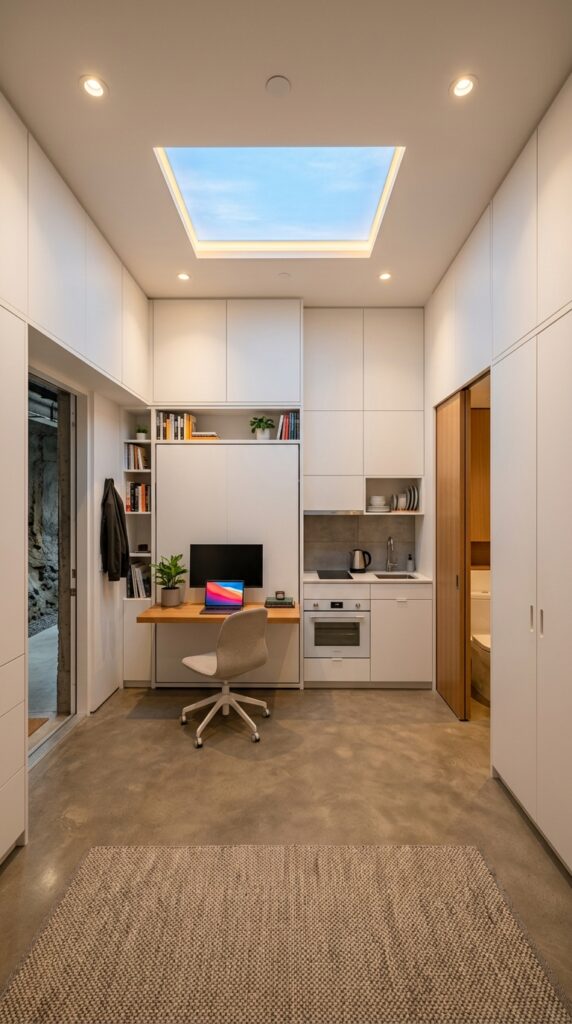
Vibe: Serene — the 200-square-foot room that contains everything and apologizes for nothing.
Why it works: The compact underground micro-pod applies maximum zone compression: every wall surface carries a function, every millimeter of vertical height is used, and the floor remains completely clear. The 9.5-foot ceiling height — taller than standard residential construction — is the most critical specification in a micro-pod unit because it prevents the psychological compression that afflicts small-footprint rooms with standard 8-foot ceilings. In an underground city context, the ceiling height investment pays the highest dividends precisely in the smallest units: a compact room with generous height reads as a considered choice; a compact room with a low ceiling reads as confinement. The circadian sky panel above the bed provides the sky connection that the absence of windows denies.
How to get it: Design every surface as a functional system before selecting any finish: Murphy bed system first, kitchen layout second, storage third, bathroom placement last. All systems in consistent matte white create the visual simplicity that prevents a 200-square-foot space from reading as cluttered even when fully furnished and equipped.
💡 Quick Win: A circadian rhythm LED panel (24×48 inches) mounted above a bed in any windowless room — set to shift from blue-white morning to amber evening — reduces the psychological weight of sleeping without natural light access for under $180 in hardware.
Shop The Look
| Product |
| Murphy wall bed queen with integrated desk cabinet |
| Matte white modular wall cabinet system full height |
| Compact micro kitchen unit all-in-one indoor |
| Sliding pocket door hardware kit concealed |
| Circadian LED panel programmable 24×48 inch |
13. Underground River and Water Feature Canal System
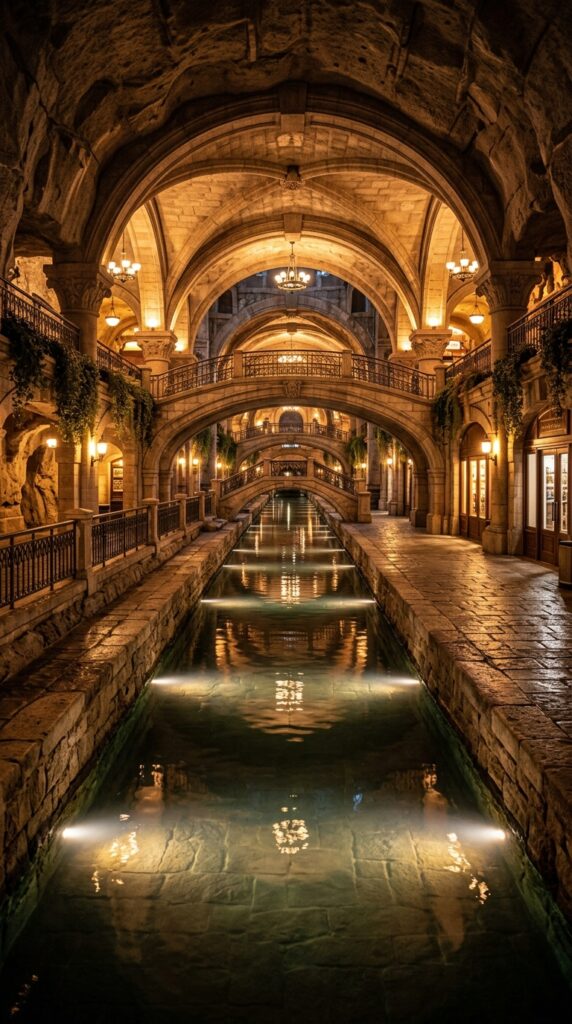
Vibe: Serene — the underground city that understood the sound of moving water was worth the engineering.
Why it works: An underground canal system addresses three distinct underground city design challenges simultaneously: it provides a continuous acoustic environment of flowing water that masks mechanical ventilation noise (one of the most complained-about aspects of subterranean environments); it creates a navigational landmark that allows inhabitants to orient themselves within the underground plan by reference to the water’s direction; and it introduces passive humidity management — a controlled water surface of 50 square feet evaporates approximately 1–2 liters of water per day into the underground atmosphere, moderating the low-humidity conditions created by mechanical air handling systems. The canal functions as civil infrastructure, acoustic design, and biophilic feature simultaneously.
How to get it: At the architectural scale, a 24-inch-wide by 12-inch-deep recirculating water channel running the length of a basement corridor or underground passage provides the acoustic and biophilic benefit of a canal without the structural complexity. Specify a matte dark stone liner (slate or honed black granite) for the channel walls and a submersible LED strip at the channel base for warm underwater uplighting.
Shop The Look
| Product |
| Indoor recirculating water channel kit dark stone |
| Submersible underwater LED strip warm white |
| Dark slate channel liner tile natural cleft |
| Submersible water pump fountain recirculating |
| Stone paving tile dark basalt look path set |
14. Linear Boulevard Underground Main Street Design
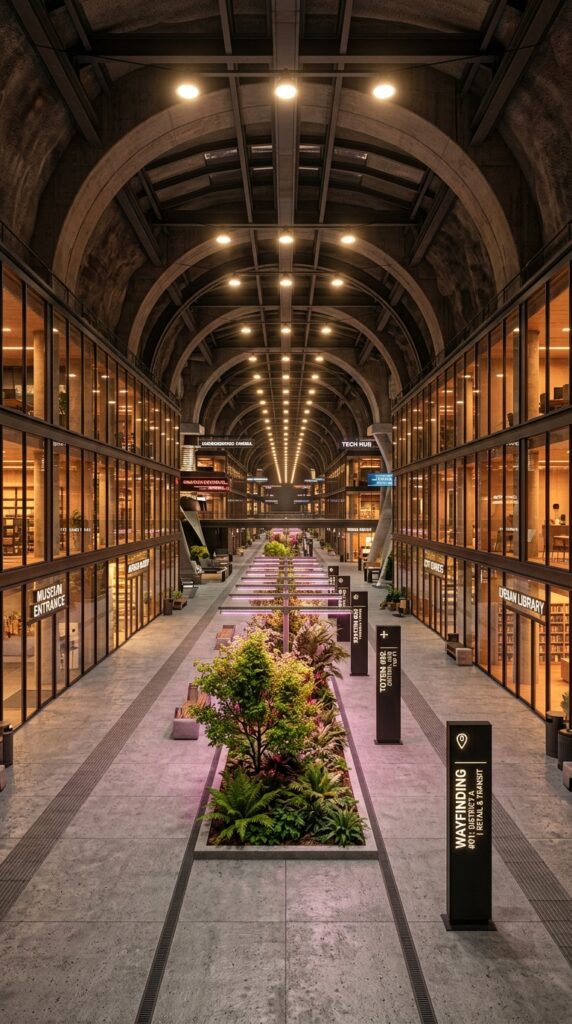
Vibe: Urban — the underground street that stopped pretending it wasn’t a city.
Why it works: The linear underground boulevard applies the most proven principle of urban street design — the activated ground floor with retail and civic use on both sides — to the subterranean context. The critical design decision is retail facade transparency: glass storefronts with warm interior lighting create the “eyes on the street” effect that Jane Jacobs identified as the foundation of felt safety in urban environments, which applies with equal force underground. The planted median trees under grow lighting serve a function beyond aesthetics: vertical plant material at the boulevard center establishes the sense of scale that wide underground spaces otherwise lose — without the trees, a 60-foot-wide underground boulevard reads as a corridor; with them, it reads as a street.
How to get it: Specify a boulevard width of minimum 40 feet for the underground main street effect — narrower widths prevent the spatial proportions that distinguish a street from a corridor. The 1:1 ratio of width to ceiling height (40-foot boulevard, 40-foot ceiling) creates the most generous subterranean urban proportion, but a 1:0.5 ratio (40-foot width, 20-foot ceiling) remains livable and is achievable in standard underground construction.
Shop The Look
| Product |
| Underground city streetscape architectural model kit |
| Indoor tree grow light full spectrum floor stand |
| Wayfinding totem sign post matte black modern |
| Retail glass facade architectural film privacy |
| Underground boulevard design concept art print |
15. Biophilic Green + Natural Stone Neutral Palette
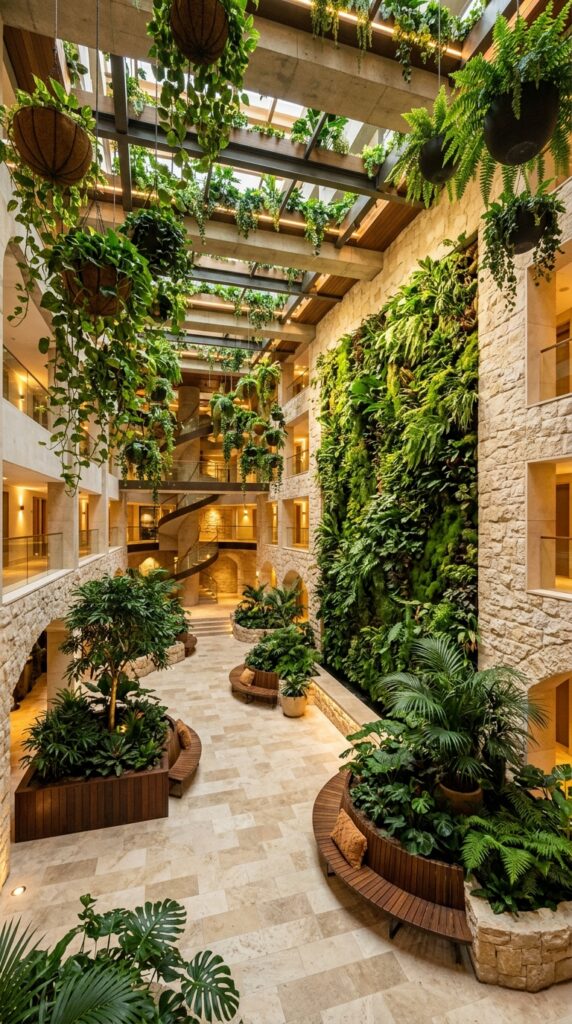
Vibe: Natural — a space that forgot it was underground because the green kept reminding it otherwise.
Why it works: The biophilic green and natural stone neutral palette creates the most livable underground residential atmosphere because both tones have warm undertones that prevent the grey-institutional reading that concrete alone produces. Travertine — a limestone formed from mineral spring deposits — is geologically appropriate to an underground context in a way that no surface-derived material is, making it the correct natural stone choice for underground city residential applications. The palette’s restfulness comes from tonal unity: cream stone and deep plant green are both nature-derived tones that share the same organic warmth register, making them naturally harmonious without any design effort beyond the selection decision.
How to get it: Specify honed (not polished) travertine for underground floors — the matte finish reveals the stone’s natural warm cream tone while providing adequate slip resistance on a surface where condensation risk exists. Pair with shade-tolerant hanging plants (Pothos, Philodendron, Tradescantia) at multiple heights to create the layered vertical green density that distinguishes a biophilic environment from a room with one plant in it.
Shop The Look
| Product |
| Honed travertine floor tile cream natural 18×18 |
| Hanging planter set macramé natural fiber set of 3 |
| Large floor planter indoor dark modern 18 inch |
| Pothos golden live plant low light hanging |
| Natural stone look wall panel travertine cream |
16. Exposed Concrete Brutalist Underground Architecture
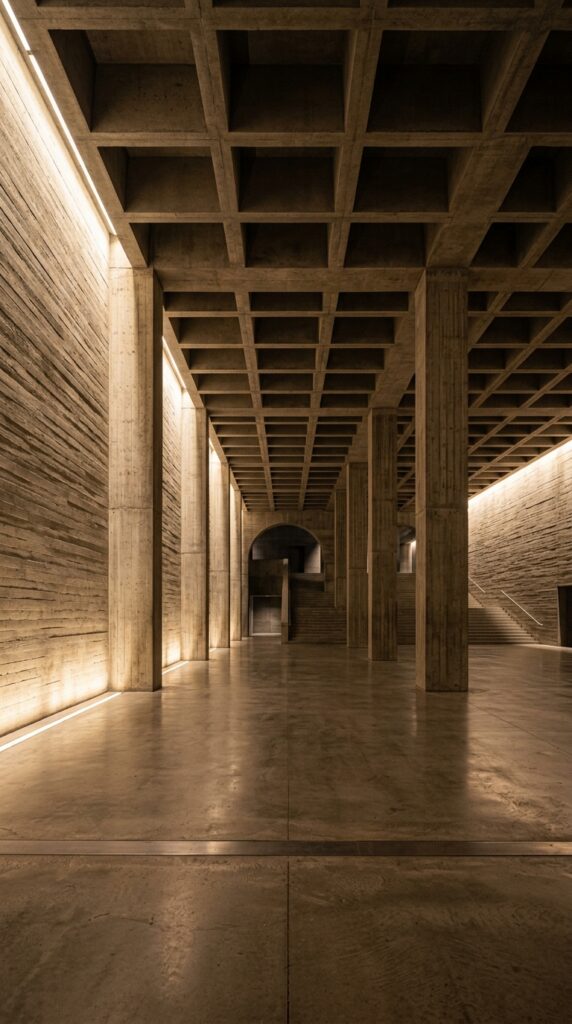
Vibe: Monumental — the underground room that understood that concrete is not a limitation but a position.
Why it works: Brutalist concrete architecture is philosophically aligned with underground city design because both disciplines share a commitment to structural honesty — the building shows exactly what it is made of and how it holds itself up. In an underground context where the surrounding geology is the actual structure, a concrete interior that similarly reveals its own structural logic creates a spatial experience of embedded authenticity: you understand where you are and how the space is held. The raking sidelight technique — concealing narrow-aperture linear light sources at the floor-wall and ceiling-wall junctions — activates board-form concrete texture more effectively than any other lighting approach, creating micro-shadows in every plank impression at a 15-degree grazing angle.
How to get it: Board-form concrete texture is achievable in residential applications using large-format concrete-look porcelain tile with an embossed board-form pattern — apply in a staggered running bond with 1/16-inch grout joints in a matching charcoal tone for maximum authenticity. Specify linear LED slots at baseboard and ceiling positions directed to graze the wall surface at 15 degrees from horizontal.
Shop The Look
| Product |
| Board form concrete look porcelain tile large format |
| Linear LED floor slot fixture grazing light |
| Concrete wall texture paint applied roller system |
| Concrete ceiling cofferboard mold form system |
| Brutalist architecture design book monograph |
17. Fiber Optic Starfield Tunnel Ceiling Installation
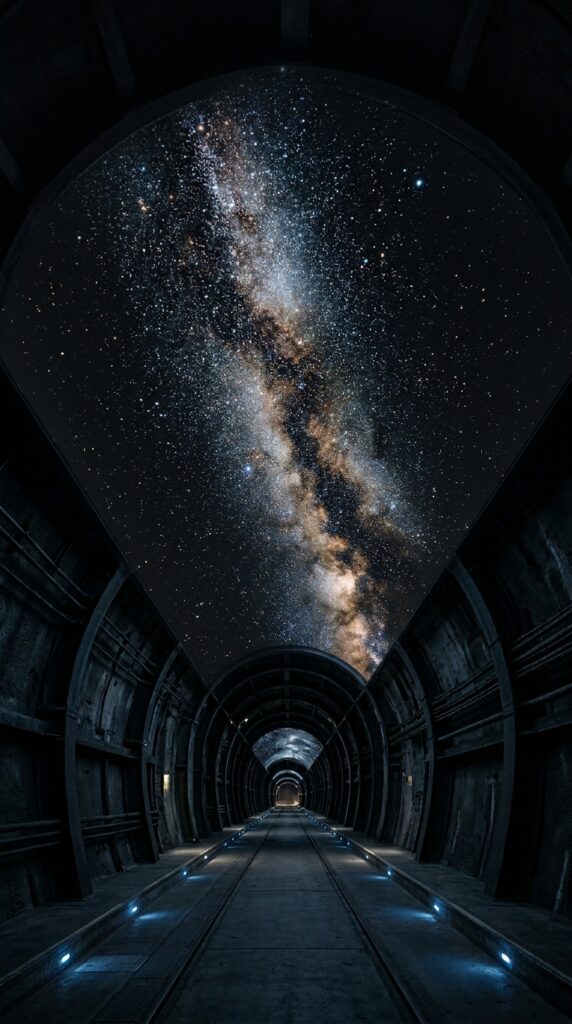
Vibe: Awe-inspiring — the underground tunnel that answered the absent sky with a better one.
Why it works: A fiber optic starfield ceiling installation addresses the sky-loss of underground living by substituting not a facsimile of daytime sky (as LED sky panels do) but a night sky — which is itself a form of sky connection with its own circadian significance. The visual effect of thousands of individual fiber optic points at different brightness levels (simulating actual stellar magnitude variation) creates a depth illusion: the ceiling appears to dissolve into void, eliminating the physical surface overhead and replacing it with apparent infinite distance. This is the underground space that feels larger than it is because its ceiling has been replaced with the universe.
How to get it: Residential fiber optic starfield kits deliver genuine star effect in basement ceilings using a single illuminator box (mounted in an adjacent mechanical space) that drives 200–600 individual fiber strands through the ceiling drywall, each fiber ending flush with the ceiling surface at a needle-point diameter. A 400-strand kit covers approximately 150 square feet of ceiling in a density that reads as a genuine night sky at most viewing distances.
Shop The Look
| Product |
| Fiber optic star ceiling kit 400 strand LED illuminator |
| Star ceiling panel pre-drilled black 24×24 inch |
| Fiber optic illuminator box LED RGB shooting stars |
| Fiber strand ceiling installation drill guide kit |
| Deep space ceiling mural black photorealistic night |
18. Amphitheater-Style Underground Community Space
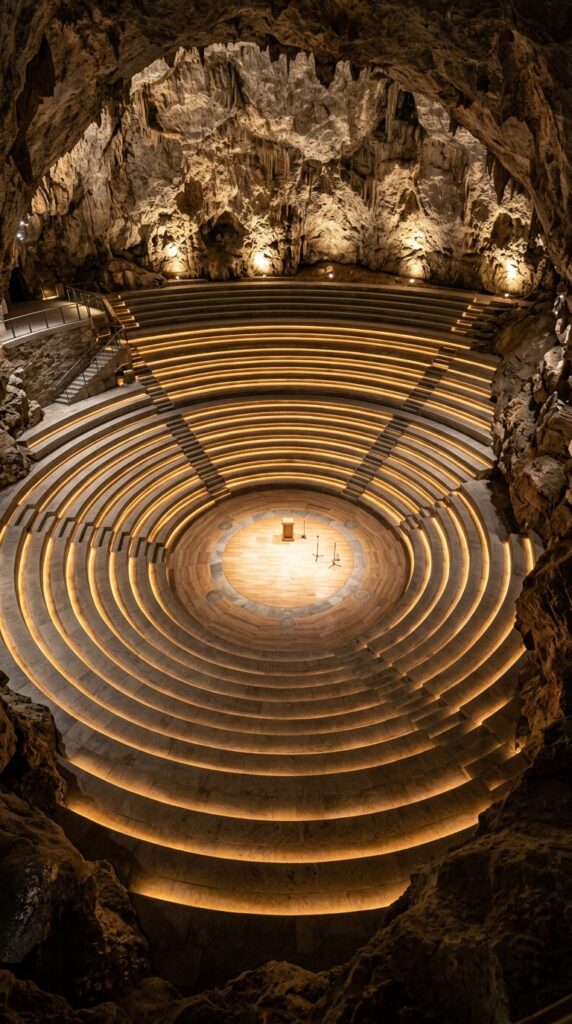
Vibe: Civic — the underground room that understood community requires a place to face each other.
Why it works: An amphitheater configuration in an underground space exploits the inherent acoustic properties of enclosed rock surfaces — the sound reflection qualities of a stone-walled circular space create natural amplification and a warm reverb characteristic that outdoor amphitheaters work hard to engineer artificially. The tiered seating geometry also solves the underground space’s most persistent sightline challenge: in a flat-floor gathering space underground, rear-row occupants feel separated from the central activity. In a tiered amphitheater, every position has an unobstructed view of the performance floor, making the community event experience as good in the upper stone tiers as in the front row.
How to get it: At the residential or small-scale civic level, a sunken conversation pit with three stepped levels — each step at 18-inch height and 24-inch depth — creates the amphitheater spatial principle at living room scale, directing every seated position toward the central lower floor. Clad each step face and tread in honed stone or large-format tile for the material continuity that reads as carved rather than constructed.
Shop The Look
| Product |
| Sunken conversation pit step tile honed stone |
| Tiered stone seating platform outdoor indoor |
| Theater spot light warm adjustable stage |
| Underground amphitheater acoustic panel stone look |
| Civic amphitheater architectural concept model kit |
19. Warm Terracotta + Travertine Underground Residential Palette
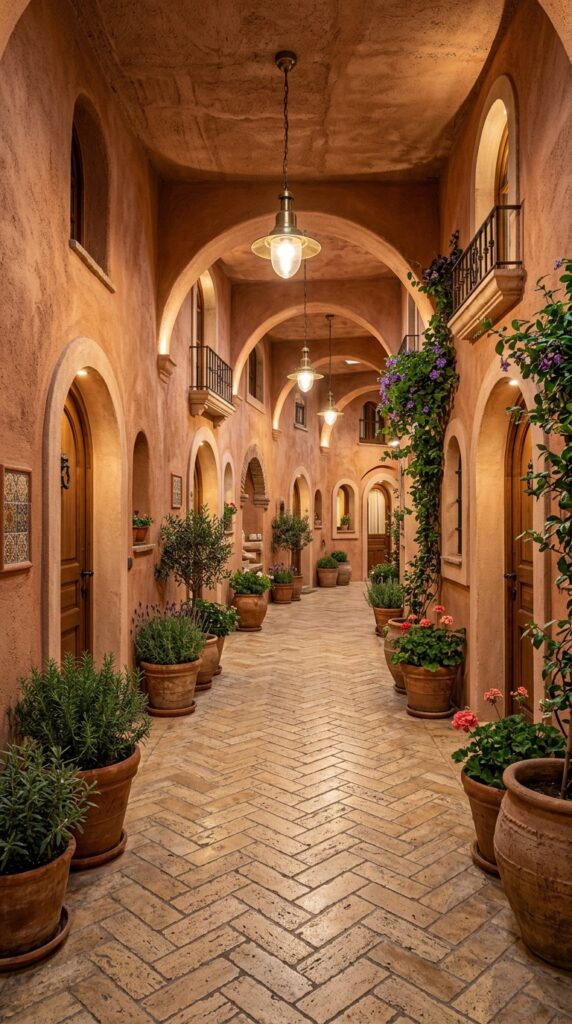
Vibe: Warm — the underground district that chose to feel like Cappadocia rather than a data center.
Why it works: The terracotta and travertine palette is historically the most authentic underground residential material combination — Cappadocia’s ancient carved cities used volcanic tuff plastered with clay, and the warm red-orange of terracotta against the cream-buff of travertine stone is derived from the same geological palette as the earth being displaced to build the underground space. Using it in contemporary underground city design creates what could be called geological resonance: the interior materials match the geological context of the surrounding rock, making the space feel geologically native rather than inserted. The arched doorway is the structural vocabulary of underground construction — an arch distributes the load of the rock above in compression, and its honest expression in the interior reinforces the design’s structural authenticity.
How to get it: Apply venetian plaster in a warm terracotta tone (mix red iron oxide pigment into a standard venetian plaster base at 3% by weight) over standard drywall in residential underground applications — the smooth polished surface of venetian plaster reflects warm light more richly than flat paint and develops a surface depth that improves with age.
Shop The Look
| Product |
| Venetian plaster terracotta warm clay finish kit |
| Travertine tile herringbone cream natural 4×8 inch |
| Aged brass pendant light Mediterranean style |
| Terracotta pot large indoor Mediterranean plant |
| Arched doorway casing molding architectural trim |
20. Mirrored Surface Corridor Expansion Technique
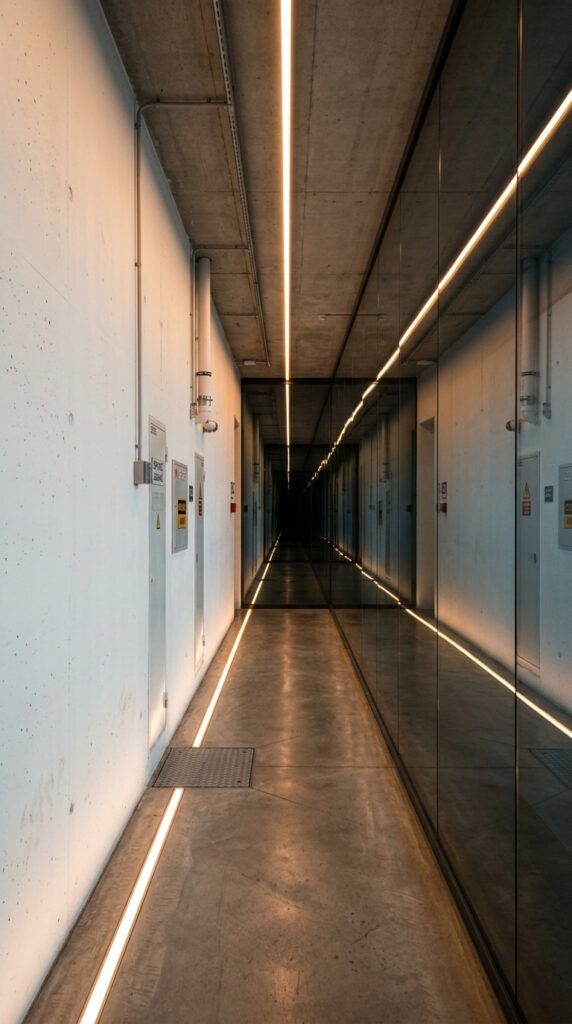
Vibe: Expanded — the narrow corridor that found more of itself in its own reflection.
Why it works: Mirror application in constrained underground corridors operates on the most direct spatial illusion available to interior design: visual doubling. A mirrored wall in a 6-foot-wide corridor produces the perception of a 12-foot-wide corridor — the eye cannot distinguish reflected space from real space at normal walking distances. The smoked or antiqued mirror specification (rather than standard clear mirror) is critical: clear mirror in an underground space creates a reflective surface that feels clinical and institutional; the slight dark tint of smoked mirror softens the reflection and introduces a depth quality that reads as architectural rather than utilitarian. Linear LED strips reflected in the mirror create an infinity-corridor light effect that additionally increases the perceived depth of the space.
How to get it: Apply 1/4-inch smoked mirror glass to the longest wall of any constrained underground space using mirror adhesive — avoid silicone adhesive, which off-gasses and damages mirror backing over time. Specify a minimum 60-inch mirror height; shorter mirrors terminate the illusion at the most critical visual field, eliminating the expansion effect precisely where it’s most needed.
💡 Quick Win: A single 60×80-inch smoked mirror panel leaned against the far wall of a basement or underground room costs $80–140 and immediately demonstrates the spatial expansion effect before committing to adhesive installation.
Shop The Look
| Product |
| Smoked mirror glass panel 60×80 inch large |
| Mirror adhesive mastic non-silicone formula |
| Polished concrete paint white high gloss finish |
| Linear LED strip ceiling floor warm amber |
| Mirror safety backing film adhesive transparent |
21. Underground Transit Hub with Wayfinding System
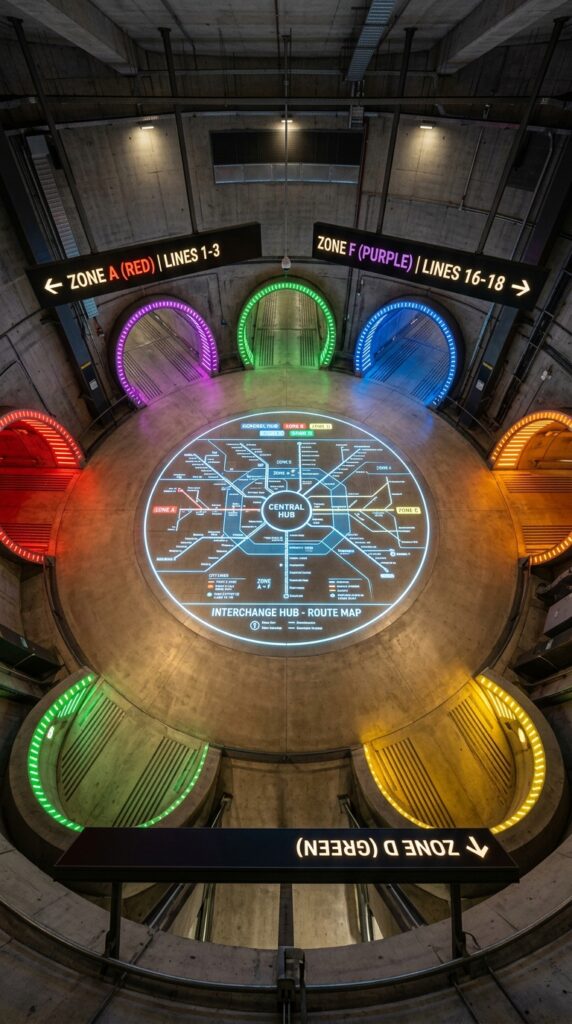
Vibe: Urban — the node that makes the network make sense.
Why it works: An underground transit hub requires what urban planners call legibility design: the spatial arrangement and signage system must communicate the hub’s structure instantaneously to a newcomer with no prior knowledge. Color-coded zone lighting at each tunnel entrance — one color per destination zone, consistent across the entire underground city network — allows wayfinding by color rather than by text, removing literacy barriers and reducing cognitive load in high-traffic conditions. The illuminated floor map at the concourse center provides the city-scale spatial context that orientates inhabitants within the underground plan — a feature that surface cities provide through glimpsed skylines and sun direction but that underground cities must engineer deliberately.
How to get it: Apply colored LED accent lighting at the entrance arch of each corridor leading from a central basement junction — one color per corridor destination — using color-coded LED tape in identifiable tones (blue for living, green for garden, amber for dining, red for exit). This system-scale color coding makes navigation intuitive without any signage.
Shop The Look
| Product |
| Color changing RGB LED strip addressable zone set |
| Matte black backlit LED wayfinding sign modern |
| Floor map inlay vinyl decal custom architectural |
| Underground city transit network art print design |
| LED color zone controller smart hub system |
22. Vertical Stack Residential Tower Underground
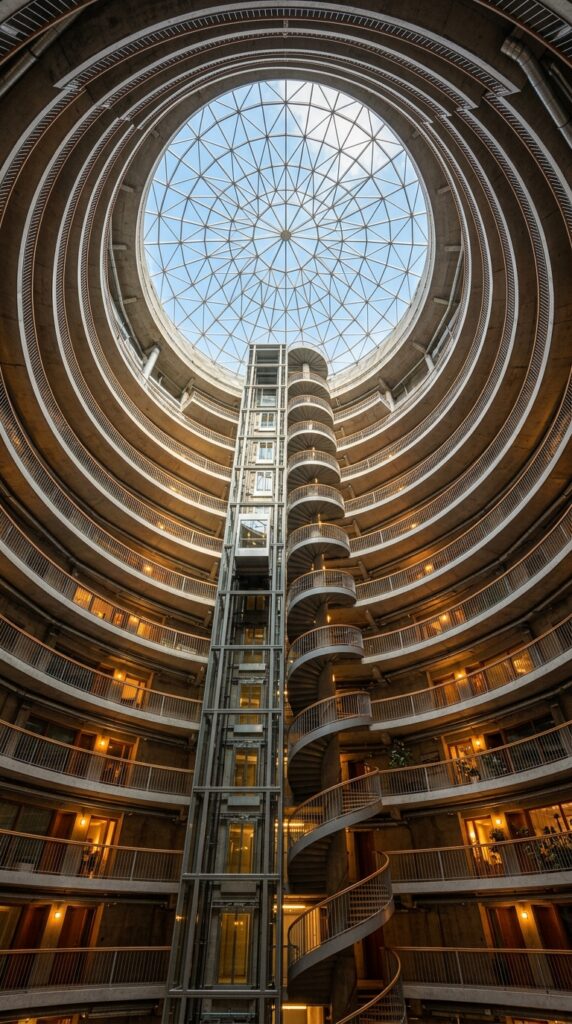
Vibe: Architectural — the building that went deep instead of high and ended up looking at the sky anyway.
Why it works: The vertical stack underground residential tower inverts the logic of surface high-rise construction: instead of building upward against gravity into open air, it builds downward within the earth, with the structural containment of the geological shaft providing the lateral stability that above-ground towers spend enormous structural budget achieving through shear walls and cores. The central daylight shaft — the diameter of the excavated cylinder — provides all residential units with a shared visual connection to both the sky above and the shared community floors below, creating vertical community cohesion that standard apartment towers achieve only through shared corridors.
How to get it: At the residential scale, a light well punched vertically through a multi-story underground extension — with glazed floor panels at each intermediate level — creates the vertical shaft light principle at domestic scale. Each glazed floor panel must be rated for live load (minimum 75 pounds per square foot) and uses 1.5-inch-thick structural glass with a wire or fritted pattern for safety while maintaining light transmission.
Shop The Look
| Product |
| Structural glass floor panel walkable 24×24 inch |
| Vertical shaft skylight glazing dome structural |
| Residential stair handrail steel cable modern |
| Vertical underground architecture concept print |
| Underground residential unit interior model kit |
23. Circadian Rhythm Dynamic Lighting System
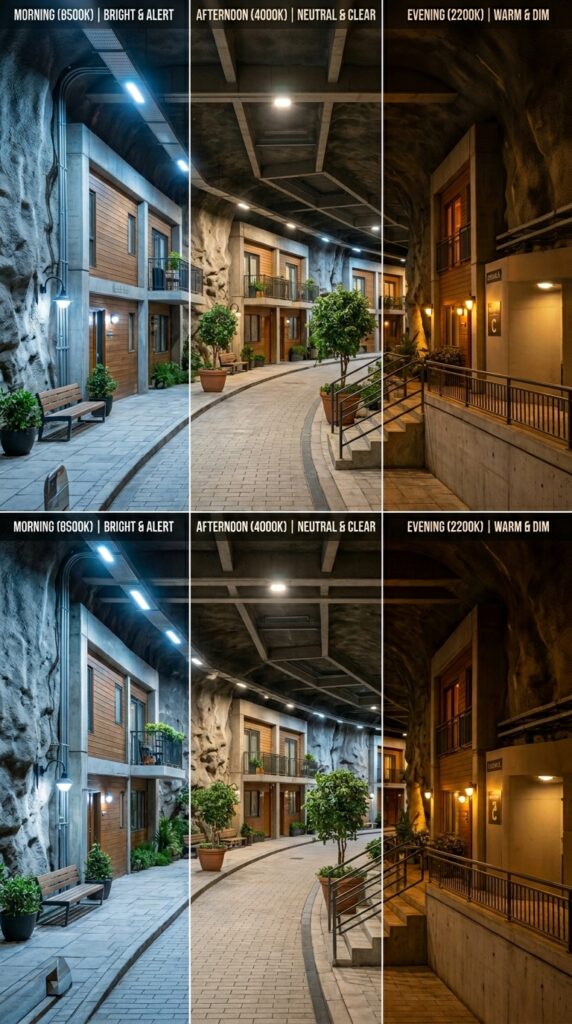
Vibe: Considered — the underground street that understood that time of day is a design material.
Why it works: A full circadian rhythm dynamic lighting system is the most physiologically critical infrastructure investment in underground city design — without it, the artificial light environment of a permanently enclosed underground space suppresses melatonin production continuously, disrupting sleep cycles and producing measurable long-term health consequences. The system cycles through six distinct lighting states corresponding to natural sky conditions: deep blue 6500K dawn (triggers cortisol and alertness), neutral white 5000K morning (high productivity light), warm white 4000K midday (comfortable working light), warm 3000K late afternoon, amber 2700K dusk (begins melatonin ramp), and deep amber 2200K evening (maximum melatonin production support). The transition between states is continuous rather than stepped — a 30-minute gradual shift mirrors the actual rate of color temperature change in natural sky.
How to get it: Smart LED systems using tunable white technology (capable of outputting any color temperature between 2200K and 6500K from the same fixture) paired with a centralized daylight clock controller can be installed in any residential underground space. Specify a minimum CRI of 90 across the full tunable range — low-CRI tunable systems produce color temperature without accurate color rendering, which undermines the biological effect.
Shop The Look
| Product |
| Tunable white LED bulb 2200-6500K smart dimmable |
| Circadian rhythm smart lighting hub controller |
| Smart LED panel tunable white 24×24 inch ceiling |
| Sunrise alarm clock light therapy 10000 lux |
| Circadian rhythm lighting design guide book |
24. Engineered Timber Warm Zone Underground
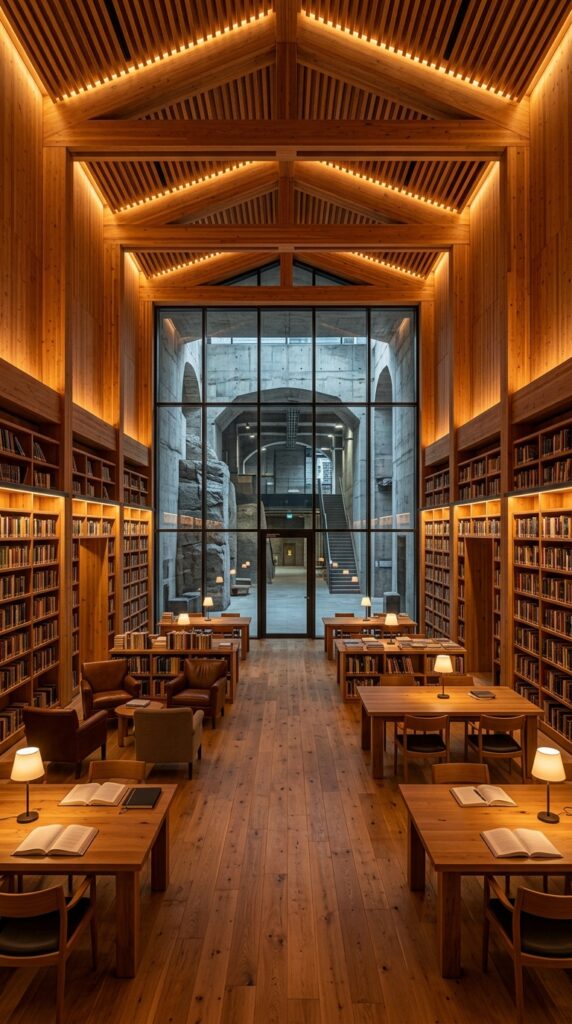
Vibe: Hushed — the warmest room in the underground city, by design and by material.
Why it works: Cross-laminated timber (CLT) in an underground zone creates what environmental psychologists identify as a refuge space — a warm, enclosed, material-rich environment that provides restorative contrast to the harder concrete and stone surfaces of the surrounding underground infrastructure. Timber’s warm amber tone, visible grain, and natural scent (CLT retains a subtle forest fragrance even after manufacturing) engage multiple senses simultaneously in a way that no inorganic material achieves. The design principle is material contrast at zone boundaries: transitioning from stone and concrete into a CLT-lined space creates an experiential shift that signals a change in social function — from transit to refuge — through material language alone.
How to get it: Specify CLT panels at minimum 5-ply thickness (6.75 inches) for structural wall applications and 3-ply (4.125 inches) for non-structural cladding. Apply a clear hard-wax oil finish — not polyurethane — to maintain the timber’s natural surface character and scent. The concealed LED detail should run in a continuous reveal at the ceiling-wall junction, directed upward to wash the timber ceiling surface in warm light rather than downward onto occupants.
Shop The Look
| Product |
| Cross laminated timber wall panel architectural grade |
| Hard wax oil clear finish timber panel protection |
| Warm 2700K LED cove lighting strip architectural |
| Timber acoustic ceiling batten system warm wood |
| Modern library reading chair warm wood frame |
25. Arctic White + Ice Blue Polar Underground Palette
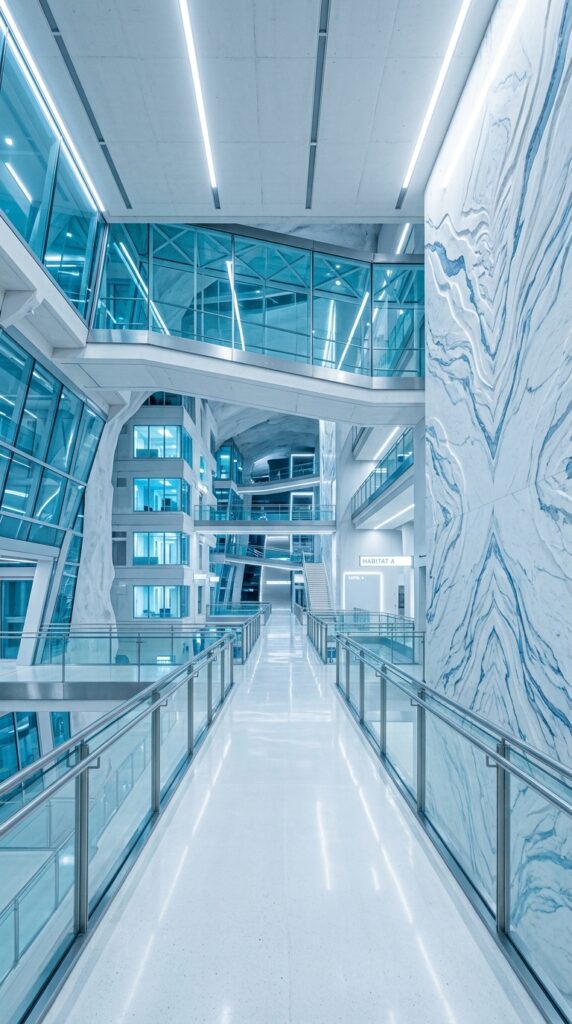
Vibe: Crisp — the underground city that leaned into its climate rather than apologizing for it.
Why it works: The arctic white and ice blue palette is the correct design response for underground cities in polar or sub-arctic climates — Scandinavia’s underground city projects, including Helsinki’s extensive subterranean network, have found that attempting to recreate Mediterranean warmth underground in a cold-climate context reads as incongruous rather than comforting. Embracing the cool, bright, ice-light quality of polar environments underground creates design authenticity: the interior conditions match the exterior climate’s character if not its temperature. Cool 5000K lighting at high levels (75+ foot-candles) replicates the flat, directionless quality of overcast northern daylight — precisely the light that polar inhabitants are neurologically calibrated to function well within.
How to get it: Apply white polished concrete finish (Class 6 mirror polish) to floors in cool-climate underground spaces — the high reflectivity at white adds measurable luminance to any space, effectively multiplying the lumen output of overhead fixtures by bouncing light back upward from the floor. Specify 5000K LED panels at minimum 50 foot-candles for a polar district lighting standard.
Shop The Look
| Product |
| Arctic white polished concrete floor kit mirror finish |
| Ice blue structural glass panel tinted architectural |
| Cool white 5000K LED panel flat ceiling 24×48 |
| White marble wall tile blue vein Carrara style |
| Polar underground design architecture book Nordic |
26. Underground Park with Artificial Sunlight Growing System
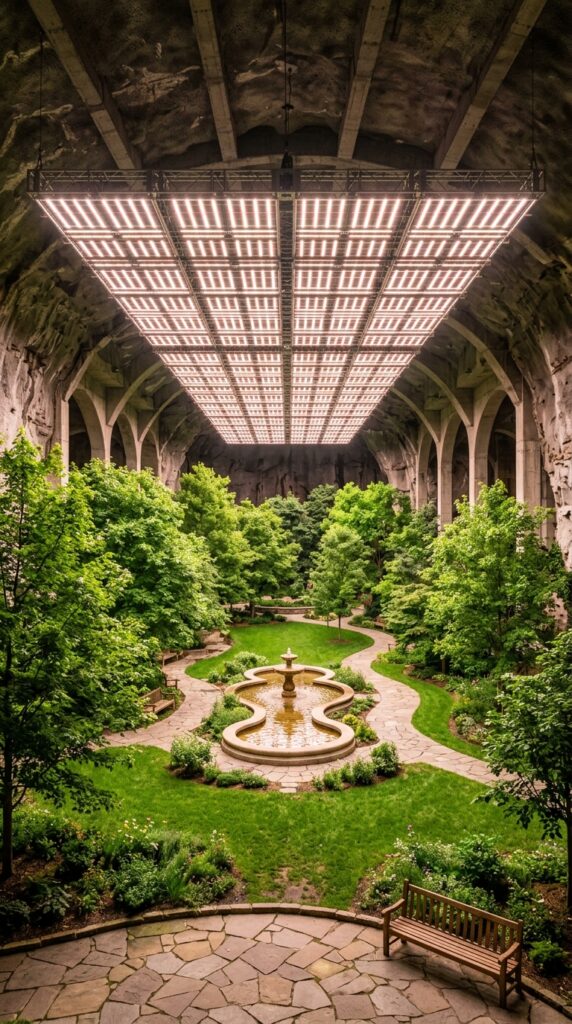
Vibe: Extraordinary — a park that chose to exist underground and brought everything a park needs along with it.
Why it works: An underground park with a full-spectrum artificial sunlight growing array is the highest-ambition biophilic design intervention in underground city planning — it delivers not just plant material and green views but the full experiential spectrum of a park: grass underfoot, tree canopy overhead, open sky-equivalent above, birdsong (via acoustic systems), and moving air (via directional fans replicating wind). The growing light array must deliver a minimum 10,000 lux at canopy height for deciduous tree health — equivalent to a bright overcast day on the surface — which requires a high-density LED array at approximately 25 watts per square foot of park floor. The psychological and public health impact of access to genuine outdoor-equivalent park space underground is comparable to surface park access in urban health research.
How to get it: At the residential scale, a basement or underground room with a full-spectrum grow light panel (minimum 50 watts output, 400–700nm full PAR range) at 24-inch mounting height supports a lush indoor garden of shade-tolerant trees, ferns, and ground cover — creating the closest residential approximation of the underground park experience.
Shop The Look
| Product |
| Full spectrum LED grow light panel 200W 400-700nm |
| Indoor tree grow light tower stand adjustable |
| Artificial grass mat indoor premium realistic |
| Indoor park bench solid wood modern slat |
| Directional desk fan breeze simulation indoor |
27. Convertible Multi-Function Underground Public Furniture
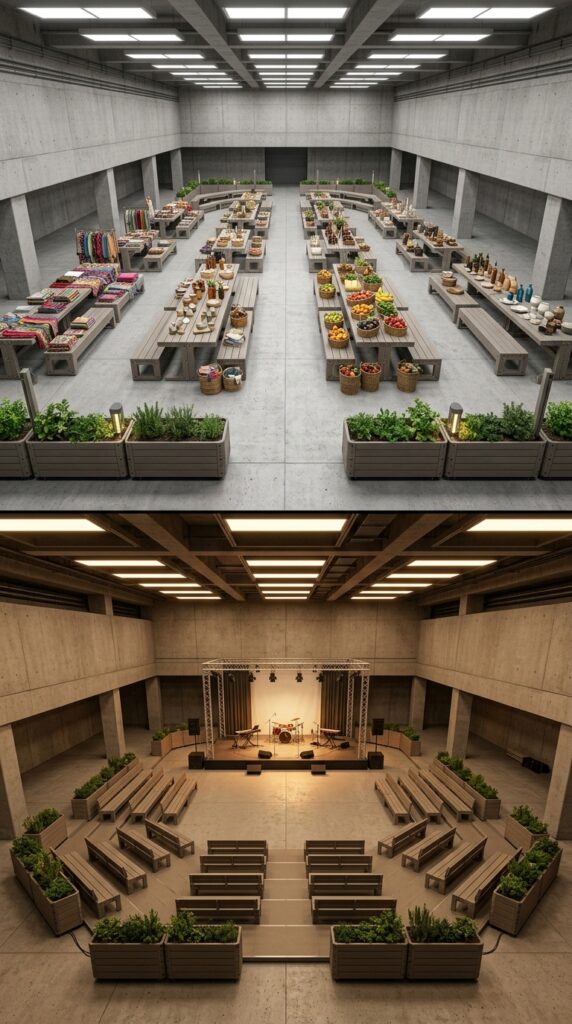
Vibe: Flexible — the public space that refuses to be only one thing at a time.
Why it works: Convertible multi-function furniture is particularly critical in underground city design because underground public space is more expensive per square foot than surface space — every square foot must justify itself across as many use scenarios as possible. Modular public furniture that reconfigures from market stalls to performance seating to casual civic space without removal or storage allows the same physical footprint to serve six to eight distinct social functions across a weekly schedule, multiplying the social return on the spatial investment. The design principle is functional polymorphism: one object, multiple configurations, each communicating its current function through the furniture arrangement rather than through dedicated zone construction.
How to get it: Specify concrete-fiber composite modular furniture units — available from commercial outdoor furniture suppliers — in a single color family. The key design discipline: all units must share identical leg height and connection hardware, enabling any combination to lock together without gaps or level differences. Connection via stainless steel alignment pins at each unit’s corner creates a tool-free connection system.
Shop The Look
| Product |
| Modular outdoor concrete composite bench system |
| Convertible bench table outdoor public furniture |
| Stainless steel alignment pin furniture connector kit |
| Modular planter barrier unit indoor outdoor |
| Public space furniture design architecture book |
28. Neon Accent Wayfinding and Zone Identity Lighting
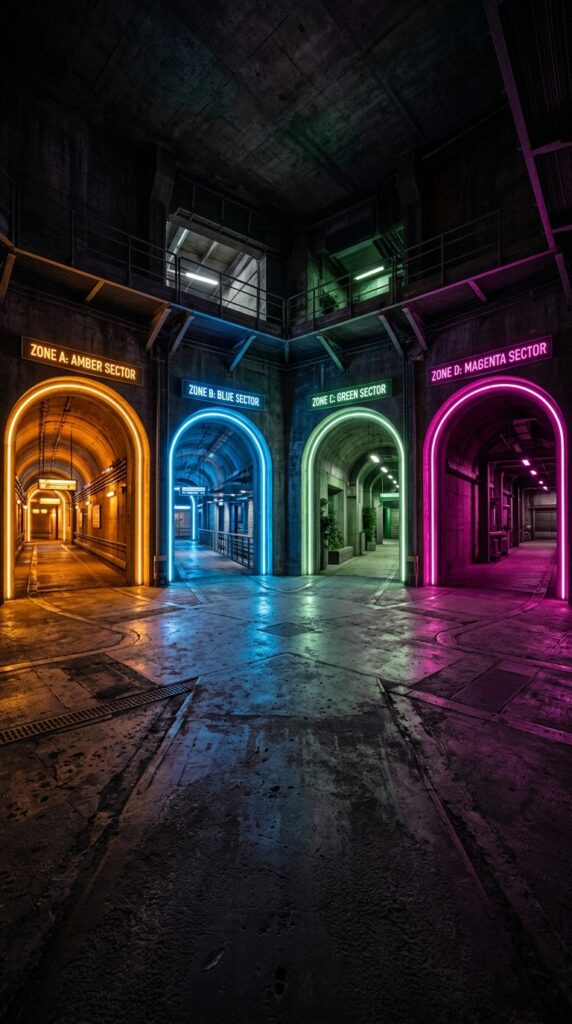
Vibe: Urban — the junction that taught the underground city to speak in color.
Why it works: Neon-accent zone identity lighting is the most immediately legible wayfinding system in underground city design — more legible than signage at distance, more memorable than floor markings, and more atmospherically rich than both. The design principle is chromatic address: each zone of the underground city receives a specific color identity expressed through a consistent accent LED tone at every entrance arch, corridor edge, and zone boundary throughout that zone’s extent. A person navigating the underground city navigates by color as much as by direction — “follow the amber” to the residential zone, “follow the green” to the park — creating an instinctive navigation system that bypasses the cognitive effort of text-based signage entirely.
How to get it: Apply a single color of LED strip lighting (color-consistent within each zone) at every junction arch and corridor ceiling edge within a defined basement or underground layout — even a four-room basement plan becomes instantly navigable when each room’s entry is identified by a different color accent. Use smart LED strips with color-memory function so the zone color is consistent across power cycles.
💡 Quick Win: Four different LED smart strip colors at four basement room entries — amber, blue, green, and magenta — costs $60–90 total and immediately turns a confusing multi-room underground space into an intuitively navigable one without a single sign.
Shop The Look
| Product |
| Smart LED color strip addressable multizone set |
| Neon flex LED rope light amber warm color |
| Neon flex LED rope light cool blue |
| Neon flex LED rope light soft green |
| Smart LED zone controller color memory function |
How to Start Your Underground City Design Transformation
Your single first move is to install a circadian rhythm lighting system. Before any material selection, any layout planning, or any structural decision — get the light right. Every underground space, from a basement bedroom to a speculative city district, is defined first and most fundamentally by its light quality, and the circadian system establishes the temporal rhythm that makes the space habitable rather than merely usable. Specifically: a tunable white LED panel capable of shifting from 6500K at 7 AM to 2200K at 9 PM, paired with a daylight clock controller, is the irreplaceable biological infrastructure that all subsequent design — materials, palette, biophilic systems — builds from. Without it, the most beautifully designed underground space remains physiologically stressful; with it, every other design decision becomes more effective because the occupants’ nervous systems are correctly calibrated.
The most common and most damaging mistake in underground design at every scale is treating ceiling height as a given. Specifically: accepting a standard 8-foot ceiling in an underground or basement space without investigating whether the structural floor above can be reconfigured to achieve 10 or 12 feet. An 8-foot underground ceiling requires significant design intervention — mirrored surfaces, vertical light sources, horizontal material emphasis — to prevent compression; a 10-foot ceiling removes this constraint almost entirely and opens the full underground design vocabulary without any compensatory technique. If raising the structural ceiling is not feasible, the correct fix is painting the ceiling in the same color as the walls — eliminating the visible ceiling plane entirely — and directing all lighting upward from floor level rather than downward from ceiling fixtures.
Three specific items under $50 that create immediate underground design impact: a 24×48-inch programmable circadian LED panel that shifts from blue-white morning to amber evening ($35–48) placed flat on a ceiling or wall; a 400-strand fiber optic starfield ceiling kit for a 150-square-foot ceiling ($40–55) that replaces the oppressive ceiling plane with apparent infinite sky depth; and a modular felt pocket living wall starter kit of 16 pockets ($38–52) that transforms a single wall from concrete to biophilic in one afternoon.
A basement-scale underground design transformation — circadian lighting, biophilic wall, reflective surfaces, and a material palette of warm concrete and timber — takes two committed weekends and a budget of $800–$2,500. A residential earth-sheltered home underground extension with daylight shafts, a living wall system, and polished concrete floors runs $15,000–$45,000 depending on structural scope. Full speculative underground city district planning at the architectural scale operates in a budget range of $200–$800 per square foot of finished underground space — comparable to premium above-ground commercial construction, with significant long-term operational savings from thermal stability and climate protection. The entry point that delivers the most physiological and aesthetic return: the circadian lighting system first, the biophilic wall second, and everything else in deliberate sequence after that.
Frequently Asked Questions About Underground City Design Ideas
What exactly is underground city design and do real underground cities exist today?
Underground city design is the architectural and urban planning discipline of creating fully functional human environments below grade — combining residential, commercial, civic, transit, food production, and recreational space within a subterranean structure. Real underground cities exist at significant scale today: Montreal’s RÉSO underground city spans over 33 kilometers of passages and connects 80 buildings, 2,000 shops, and 200 restaurants; Helsinki has a city-scale underground masterplan extending civic facilities 30 meters below grade; and Singapore’s Long-Term Plan designates underground space for defense, utilities, and eventually residential use. The Cappadocian underground cities of Turkey — including Derinkuyu, which housed up to 20,000 people at depths of 85 meters — demonstrate that fully self-contained underground habitation has been technically achievable for over 2,000 years.
What colors and palettes work best in underground city design?
The most psychologically effective underground design palettes balance two competing imperatives: warmth and luminosity. Warm tones — terracotta, amber, timber, travertine cream — prevent the institutional gray-concrete reading that most underground spaces default to. Simultaneously, high-reflectivity surfaces in warm white or pale stone multiply the effect of every artificial light source, reducing the lumen output required to achieve comfortable light levels. Deep saturated colors — obsidian black, indigo, deep forest green — work in underground design when paired with high-contrast embedded lighting that makes the dark surface read as atmospheric rather than gloomy. The universal rule: avoid cool grays with blue undertones, which amplify the subterranean atmosphere in its least comfortable direction — toward coldness and confinement rather than warmth and shelter.
How much does underground construction cost compared to surface building?
Underground construction costs range from $200 to $800 per square foot of finished space depending on depth, soil conditions, and finish level — compared to $150–$400 per square foot for premium above-ground construction in major markets. The cost premium is offset by significant operational advantages: underground spaces maintain a consistent temperature of 50–60°F year-round in most climates without active HVAC (reducing heating and cooling costs by 50–70% versus surface buildings), require no exterior weatherproofing maintenance, and provide inherent protection from extreme weather events. At the residential scale, a basement conversion to a fully designed underground living space runs $50–$150 per square foot for cosmetic-to-mid-range renovation and $150–$350 per square foot for full structural modification including ceiling height increase and daylight shaft installation.
Can underground spaces be designed to feel genuinely comfortable for long-term habitation?
Yes — with the correct sequence of design interventions: circadian rhythm dynamic lighting (the most critical), biophilic systems including living walls and grow-light plant spaces (second priority), natural or simulated daylight access (third), and warm material palettes (fourth). Research from Helsinki’s underground city users and from isolated Antarctic research stations — the closest analogue to permanent underground habitation — shows that occupants adapt well to underground living when these four conditions are met, with self-reported wellbeing comparable to surface dwelling. The primary psychological challenges are sky-loss (addressed by circadian lighting and LED sky panels) and the absence of spatial variety in early underground designs (addressed by the multi-zone design strategies in this article).
What is the most important single element in underground city design?
Lighting — specifically, circadian-aligned dynamic lighting that shifts color temperature and intensity across the day in correspondence with natural daylight cycles. Every other design element in underground city planning — material selection, biophilic systems, spatial layout, color palette — operates in service of the light environment because light is the primary physiological regulator of human health, mood, and performance. A beautifully materialed underground space with poor or static lighting remains physiologically stressful. A modestly detailed underground space with a correctly calibrated circadian lighting system is immediately more livable. The international standard for underground habitation lighting — developed by researchers at institutions including MIT’s Media Lab and the Fraunhofer Institute — specifies a minimum color rendering index of 90 (CRI 90+) across the full tunable range, minimum 300 lux for morning wake stimulus, and a minimum 2-hour gradual sunset transition ending at 2200K at planned sleep time.
Ready to Create Your Dream Underground City Design?
These 28 underground city design ideas have traveled the full spectrum of subterranean possibility — from bioluminescent civic palettes and carved basalt corridors to circadian lighting systems, living green wall biophilic installations, fiber optic starfield ceilings, underground parks with full-spectrum growing arrays, and the compact micro-pod unit engineered for dignified small-footprint underground living. Transformation at any scale — from a basement room to a city district — begins with the same first decision: get the light right before any other choice is made, because every subsequent design element is seen, felt, and judged through the quality of the light that surrounds it. Start today by replacing one light fixture in your underground or basement space with a tunable white bulb set to shift from cool morning to amber evening — one afternoon change that immediately shows you what the space can become when the light respects the biology of the person inside it. When it’s finished — at whatever scale you build it — you’ll have a space that proves the most compelling thing about underground design: the surface was never the only place worth living. Save the ideas that match the depth you’re willing to go — in underground city design, the most ambitious ideas are always the most honest about what human beings actually need to thrive.