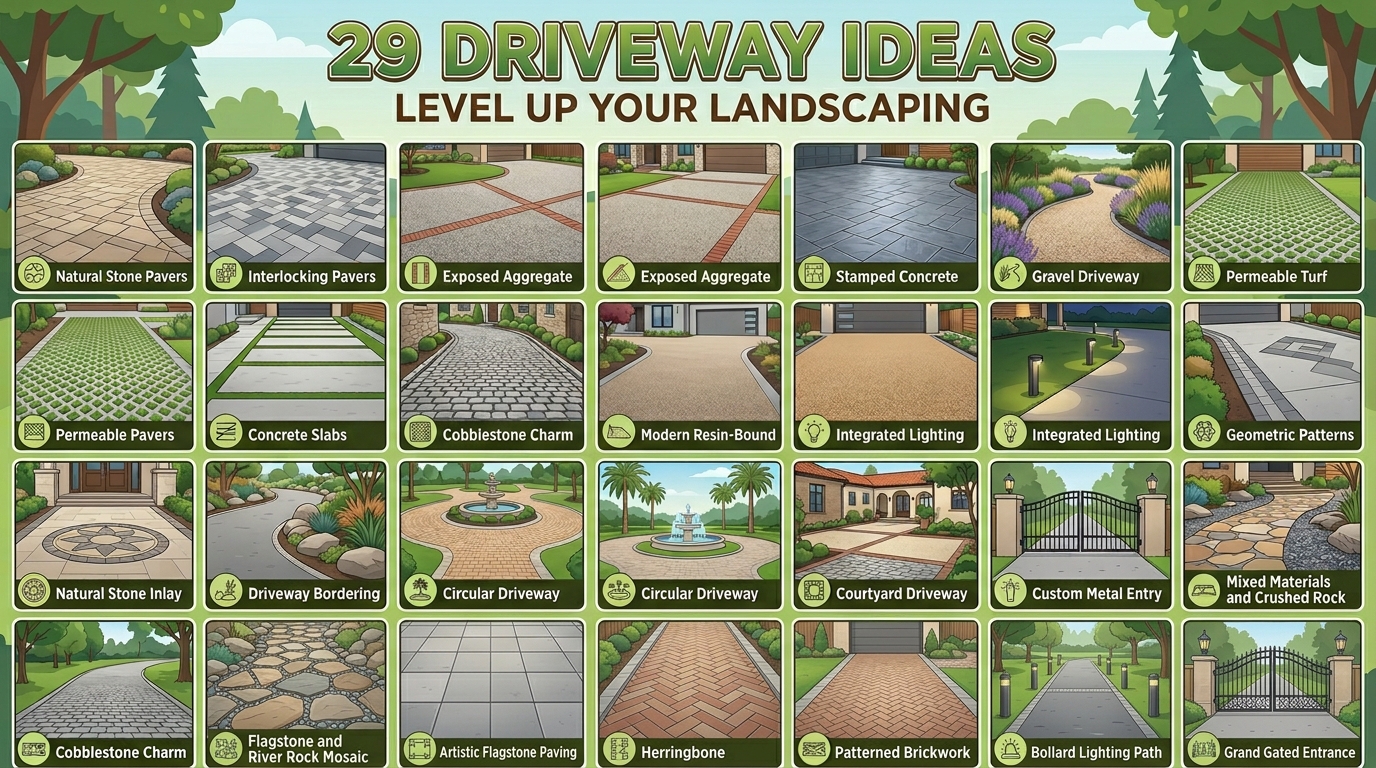
A driveway idea that levels up your landscaping is any design choice — material, border, planting, or lighting — that transforms a purely functional entry path into a deliberate part of your home’s outdoor aesthetic. This article gives you 29 specific, actionable driveway landscaping ideas covering materials, edging, plants, lighting, layout, and small-space solutions to elevate your curb appeal from the street to the front door.
First impressions happen before anyone steps out of the car. A well-designed driveway doesn’t just connect the street to your home — it sets the tone for everything behind it, telling a story about what kind of house this is and who lives in it. The right combination of material, border, and planting can make a modest home look considered and intentional, and a large home look genuinely welcoming rather than imposing. Here are 29 ideas worth saving — and stealing.
Why Driveway Landscaping Works So Well
Driveway landscaping as a design discipline draws from both hardscape architecture (the study of paved, built outdoor surfaces) and residential landscape design. It’s distinct from garden design in that it must solve a functional problem — vehicle access, drainage, load-bearing — while simultaneously serving as the primary visual introduction to a property. The best driveway designs borrow from estate landscaping traditions, Japanese entry garden philosophy, and modern landscape architecture to create entries that are simultaneously beautiful and practical.
The material vocabulary of a well-landscaped driveway is highly specific. Pavers come in concrete, natural bluestone, tumbled travertine, or clay brick. Gravel options range from decomposed granite in warm tan to crushed white limestone to dark grey pea gravel. Borders use Japanese boxwood, dwarf mondo grass, ornamental grasses like Karl Foerster, or low-growing lavender Hidcote. Metal edging in Corten steel or galvanized aluminum creates the cleanest possible material transition. Colors range from warm buff and sand tones to charcoal grey, aged brick red, and cool bluestone slate.
Driveway landscaping is surging right now for three converging reasons. Post-pandemic, homeowners invested heavily in exterior spaces — the driveway became the first room, not an afterthought. Simultaneously, the rise of real estate photography and Zillow browsing has made curb appeal a measurable financial asset. Pinterest data consistently ranks “driveway ideas” and “driveway landscaping” among the top growing exterior search terms year over year, driven by homeowners who want their approach to feel designed rather than default.
Small or narrow driveways can absolutely achieve high-impact landscaping — sometimes more elegantly than wide ones. Narrow entries benefit most from vertical elements (tall ornamental grasses, columnar hornbeam hedges, climbing roses on a simple arch) because they draw the eye upward rather than focusing attention on the width constraint. A single strong border material — consistent black steel edging with a uniform gravel strip — does more for a narrow driveway than multiple competing elements.
Style at a Glance
| Element | Trait |
| Philosophy | Functional beauty from street to door |
| Key Materials | Pavers, gravel, steel edging, natural stone |
| Key Colors | Warm buff, charcoal grey, aged brick, bluestone slate |
29 Driveway Landscaping Ideas Worth Stealing
1. Tumbled Concrete Paver Driveway with Grass Joints
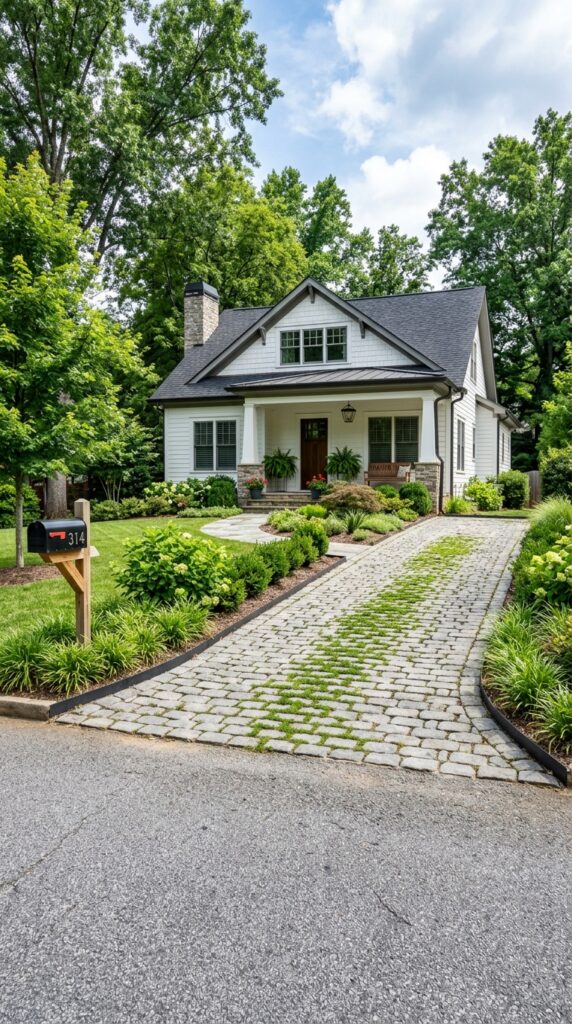
Vibe: Grounded. A paver driveway with planted joints looks like it grew into place rather than was poured.
Why it works: Grass or creeping thyme planted between pavers softens the hardscape with living material, dramatically reducing the visual weight of the paved surface. This technique also solves a real engineering problem: planted joints improve drainage by allowing water to percolate between units rather than running off the surface in sheets. The design principle is permeability — a driveway that lets water through is a better landscape citizen and a more visually interesting one.
How to get it: Specify tumbled or aged-finish concrete pavers rather than smooth ones — the tumbled edge catches light differently and reads closer to natural stone. Space pavers 1.5 to 2 inches apart and fill joints with a mixture of topsoil and sand, then seed with creeping thyme (Thymus serpyllum) or dwarf mondo grass. Both tolerate light vehicle traffic once established.
💡 Quick Win: If you have an existing concrete driveway, a masonry saw can score a grid of 2-inch channels which you then fill with soil and creeping thyme — a planted-joint look without a full repave.
🛍️ Shop the Look — Amazon Product Ideas
| # | Product Search Phrase | Why It Fits |
| 1 | creeping thyme ground cover seeds driveway joints | Planted joint ground cover |
| 2 | black aluminum landscape edging driveway border | Clean hardscape edge |
| 3 | paver joint sand polymeric stabilizing | Joint setting material |
| 4 | tumbled concrete stepping stone grey | Single paver reference |
| 5 | dwarf mondo grass plugs border low-growing | Alternative joint plant |
2. Gravel Driveway with Steel Edging Borders
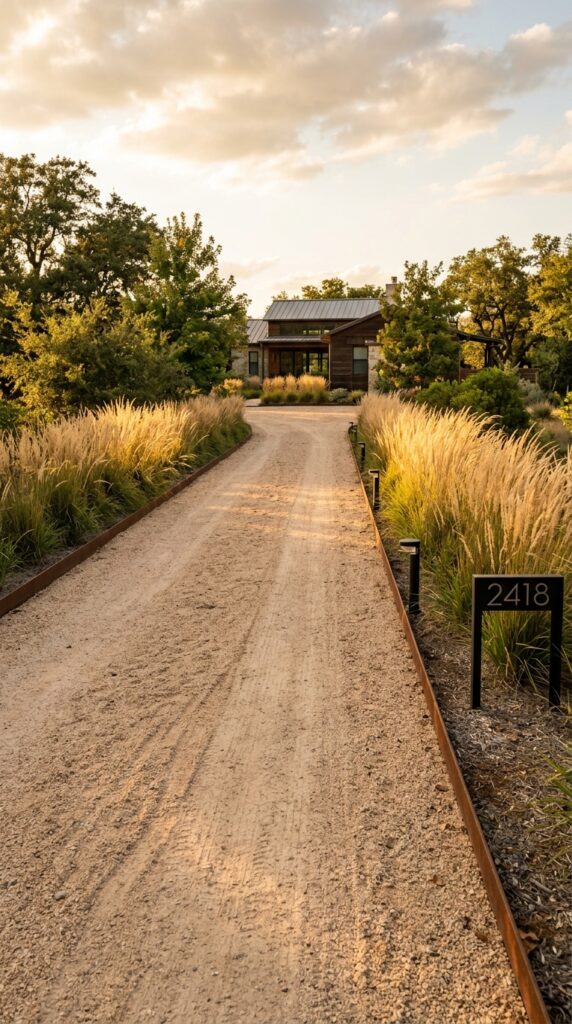
Vibe: Architectural. A gravel driveway contained by steel edging reads as deliberate design, not a temporary fix.
Why it works: The Corten steel edging strip acts as a material transition line — the driveway’s hardest working design element — creating a razor-sharp visual separation between gravel and planting bed. Decomposed granite gravel in warm tan (also sold as DG or “crusher fines”) compacts firmly underfoot and under tire while maintaining a loose, natural appearance. The combination of warm gravel and Corten’s rust patina creates a palette that improves with age rather than fighting it.
How to get it: Install 4-inch deep steel edging (not the flexible plastic variety, which curves and fails) staked every 24 inches with galvanized steel stakes. For a driveway, use 14-gauge Corten or galvanized aluminum edging — both hold a straight line under the lateral pressure of gravel. Lay a weed-suppressing landscape fabric beneath the gravel layer before installing.
🛍️ Shop the Look — Amazon Product Ideas
| # | Product Search Phrase | Why It Fits |
| 1 | Corten steel landscape edging strip 4 inch | Architectural driveway border |
| 2 | decomposed granite gravel tan landscape | Core driveway surface material |
| 3 | landscape fabric weed barrier heavy duty driveway | Sub-gravel weed control |
| 4 | Karl Foerster ornamental grass plug | Driveway border planting |
| 5 | black modern house number sign exterior | Entry architectural detail |
3. Brick Paver Driveway with Herringbone Pattern
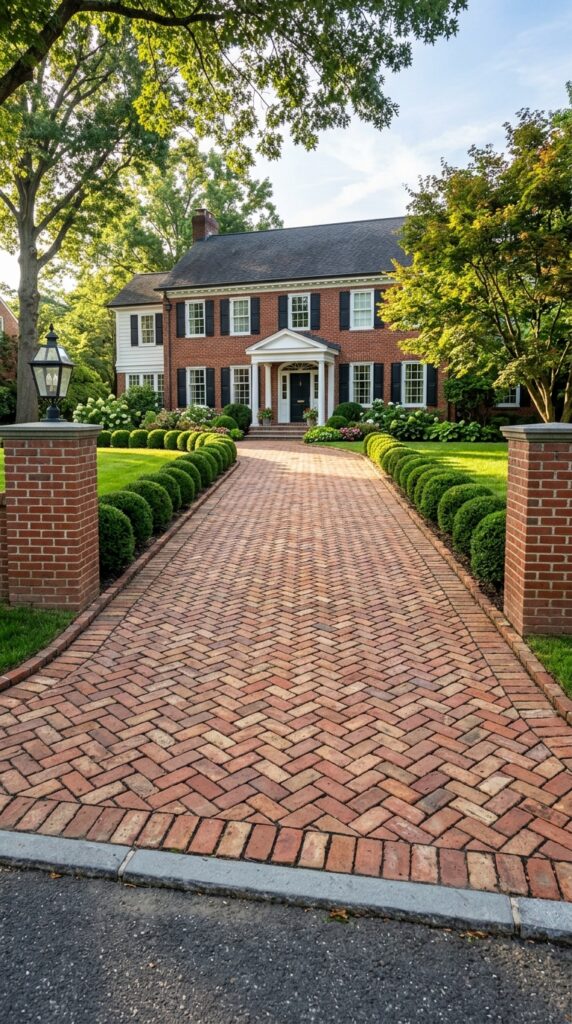
Vibe: Warm. A herringbone brick driveway is the kind of surface that makes every approach to the house feel like an arrival.
Why it works: Herringbone is the strongest interlocking pattern for brick pavers under vehicular load — the diagonal arrangement distributes weight across more units simultaneously, resisting the creep and separation that parallel brick patterns develop over time. Visually, the 45-degree diagonal also creates a dynamic forward motion when viewed from the street, pulling the eye toward the house rather than sitting static.
How to get it: Clay brick pavers in a range of warm reds — rather than uniform single-color concrete brick — develop natural patina and color variation over time that concrete cannot replicate. Look for “tumbled clay pavers” or “reclaimed brick pavers” from masonry suppliers; reclaimed bricks from demolished structures have the most beautiful surface variation immediately.
🛍️ Shop the Look — Amazon Product Ideas
| # | Product Search Phrase | Why It Fits |
| 1 | clay brick pavers driveway red tumbled | Herringbone surface material |
| 2 | dwarf boxwood shrub globe shaped low | Classic driveway border plant |
| 3 | black cast iron lantern post light outdoor | Traditional entry light |
| 4 | brick pillar cap stone decorative | Entry pillar topper detail |
| 5 | polymeric jointing sand brick pavers | Mortar joint stabilizer |
4. Tree-Lined Driveway with Columnar Trees
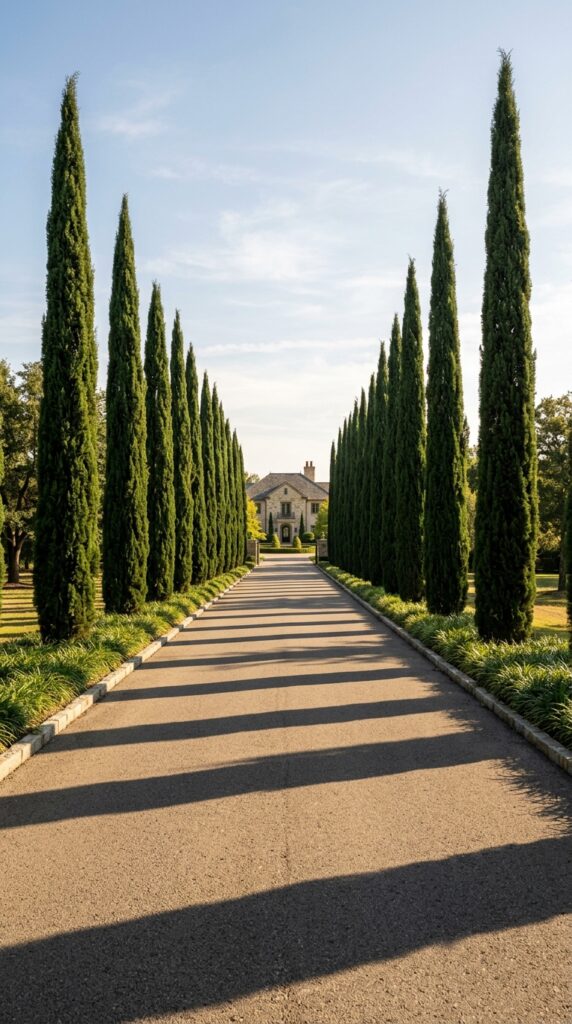
Vibe: Dramatic. A tree-lined driveway allée makes the approach to any house feel like an event.
Why it works: The allée — a formal avenue of trees planted at regular intervals flanking a path — is one of the oldest landscape devices in Western garden design, used since 17th-century French formal gardens to create perspective, depth, and ceremony. It works because the brain responds to bilateral symmetry and converging parallel lines as signs of intention and order. Even a modest 60-foot driveway benefits from this principle because the trees frame and extend the perceived depth of the property.
How to get it: For columnar trees that stay narrow, choose Carpinus betulus ‘Fastigiata’ (European hornbeam, very hardy) or Cupressus sempervirens (Italian cypress, zones 7–11). Space pairs 12–15 feet apart along the driveway. Plant trees 3–4 feet from the paved edge to allow root development without heaving the surface over time.
💡 Quick Win: Even two pairs of columnar trees (four trees total) at the driveway entrance create an implied allée effect — the entry statement is established in the first 20 feet.
🛍️ Shop the Look — Amazon Product Ideas
| # | Product Search Phrase | Why It Fits |
| 1 | columnar hornbeam tree live nursery | Formal allée tree |
| 2 | Italian cypress tree live potted | Columnar evergreen alternative |
| 3 | tree root barrier underground driveway protection | Root heave prevention |
| 4 | ground cover pachysandra low-growing under trees | Tree base underplanting |
| 5 | stone landscape curbing edging strip | Tree border edging |
5. Lavender Border Driveway Edging
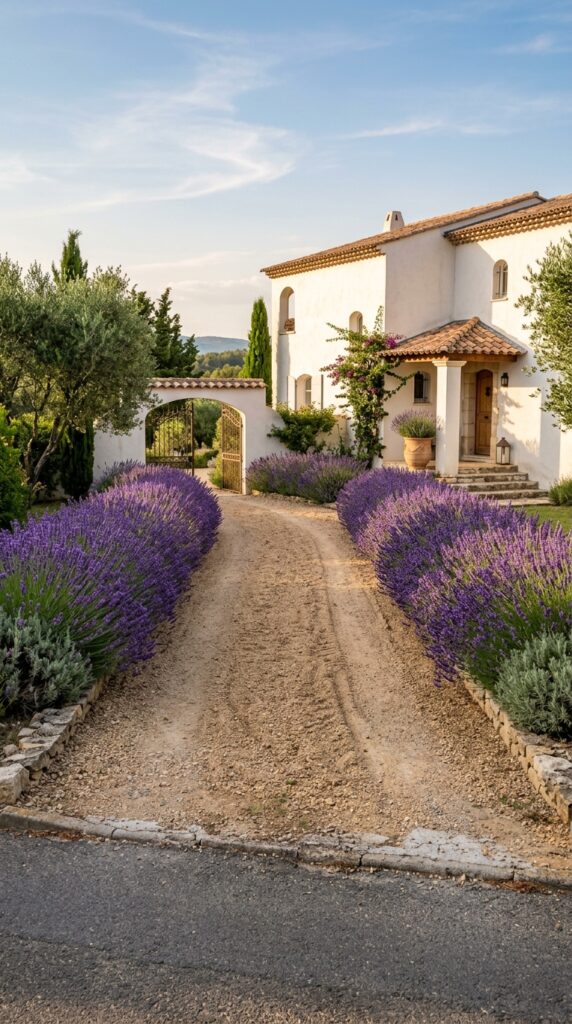
Vibe: Sun-warmed. A lavender-edged driveway hits three senses simultaneously — sight, smell, and sound (the bees).
Why it works: Lavender is the most effective driveway border plant for several practical reasons: it’s drought-tolerant once established, requires no irrigation in most climates, stays low and compact in the Hidcote variety (18 inches tall and wide), blooms reliably from late spring through midsummer, and its grey-green foliage provides year-round structure even when not in bloom. The repeated mass planting principle — a continuous row of one species rather than mixed species — creates the strongest visual border.
How to get it: Plant Lavandula angustifolia ‘Hidcote’ in full sun, spaced 18 inches apart for a tight continuous border that fills in within one season. Avoid planting in clay-heavy soil — amend with sand and gravel for the fast drainage lavender requires. Cut back by one-third after the first bloom flush to encourage a second flush and maintain compact form.
🛍️ Shop the Look — Amazon Product Ideas
| # | Product Search Phrase | Why It Fits |
| 1 | Hidcote lavender live plant 4 inch pot | Primary border plant |
| 2 | low stone landscape edging natural | Below-lavender edging |
| 3 | coarse sand horticultural drainage amendment | Lavender soil amendment |
| 4 | terracotta pot large entry door outdoor | Driveway entry accent |
| 5 | wrought iron gate garden entry decorative | Entry architectural element |
6. Concrete Driveway with Exposed Aggregate Finish
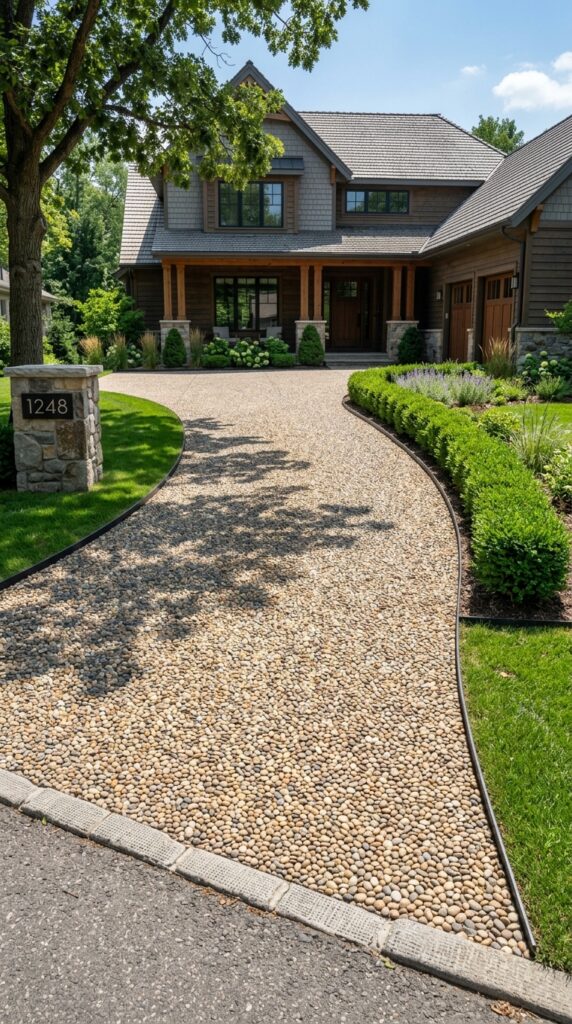
Vibe: Airy. Exposed aggregate concrete has all the substance of plain concrete with none of the visual dullness.
Why it works: Exposed aggregate is achieved by washing the concrete surface before it fully cures, revealing the rounded river stones or crushed granite mixed into the concrete pour. The resulting texture catches light directionally — it looks completely different at noon versus late afternoon — which means the driveway surface reads as dynamic rather than flat. It also provides natural slip resistance and hides tyre marks, oil stains, and weathering far better than smooth-trowelled concrete.
How to get it: Exposed aggregate is a finish choice made at the time of the concrete pour and requires a contractor experienced with the technique — the timing of the surface wash is critical and cannot be corrected afterward. Specify the aggregate color and size at the design stage: warm buff river pebble reads warm and residential; dark grey crushed granite reads contemporary and architectural.
🛍️ Shop the Look — Amazon Product Ideas
| # | Product Search Phrase | Why It Fits |
| 1 | concrete aggregate sealer exterior driveway | Surface protection and sheen |
| 2 | black steel lawn driveway edging 4 inch | Border definition strip |
| 3 | dwarf Japanese boxwood hedge shrub | Low border planting |
| 4 | modern exterior house number plaque stone | Entry pillar number detail |
| 5 | oil stain remover concrete driveway cleaner | Surface maintenance product |
7. Curved Driveway with Sweeping Planting Beds
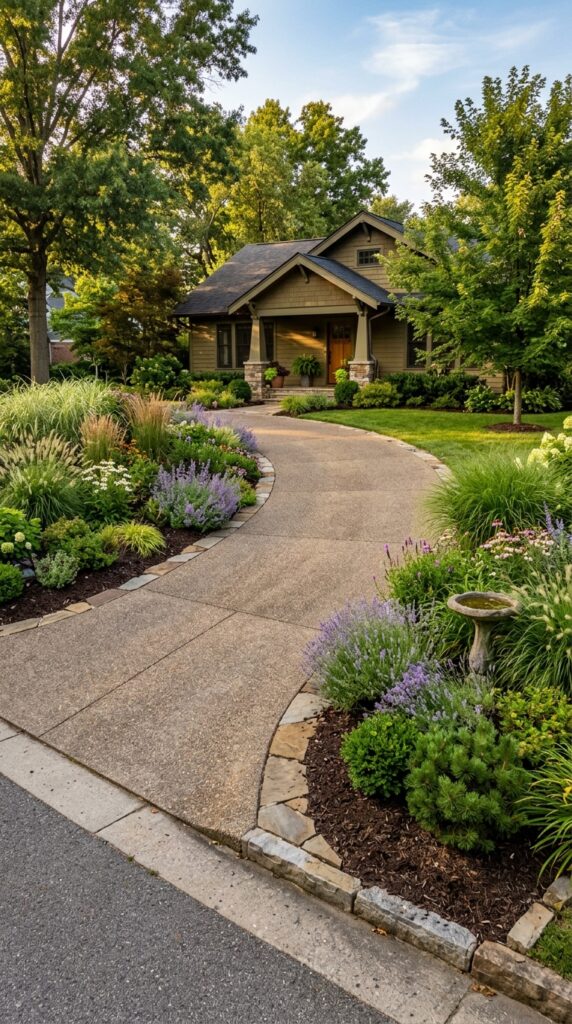
Vibe: Organic. A curved driveway with planted beds makes the approach to a house feel like moving through a garden, not a parking lot.
Why it works: Curved driveways generate natural planting opportunities — the inside of every curve creates a sheltered, triangular bed that anchors the turn with mass planting. The design rule for curved driveway beds is to layer plants by height from the driveway edge outward: ground cover (6 inches) to low shrubs (24 inches) to medium shrubs (48 inches). This layered profile prevents any single plant from dominating while creating visual depth from every angle.
How to get it: The inside curve bed is the most important to plant densely — it’s what the driver sees as they navigate the turn and what visitors approaching on foot read first. Use three to five species maximum in repeated masses rather than a mixed assortment, which reads as busy rather than designed.
🛍️ Shop the Look — Amazon Product Ideas
| # | Product Search Phrase | Why It Fits |
| 1 | rubber landscape edging flexible curved beds | Curved bed edging material |
| 2 | premium wood chip mulch landscape bulk bag | Bed surface material |
| 3 | ornamental grass miscanthus live plant | Mid-height bed planting |
| 4 | coneflower echinacea mixed perennial live | Flowering bed layer |
| 5 | birdbath pedestal stone garden accent | Focal point in planting bed |
8. Solar-Powered Bollard Lights Along the Driveway
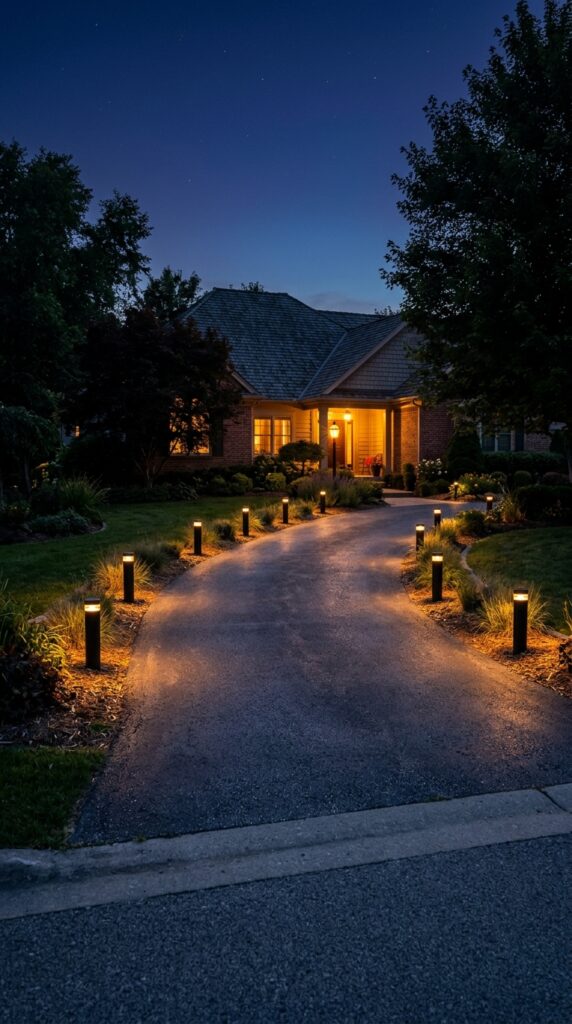
Vibe: Luminous. A driveway lit by bollard lights at dusk doesn’t just look welcoming — it looks cinematic.
Why it works: Driveway lighting at ground level — rather than from overhead fixtures — creates the most flattering and functional exterior illumination because it marks the edge of the driveway without flooding the space with harsh overhead light. Bollard lights specifically cast light downward and outward in a cone, which illuminates the driveway surface and its border planting without creating glare for approaching drivers. Solar bollards have improved dramatically in output quality and are now a viable permanent installation.
How to get it: Space bollard lights 8–10 feet apart along the driveway edge for a consistent rhythm that reads as designed rather than random. Matte black or dark bronze finishes photograph best against both light and dark driveway surfaces. Stake them 3–4 inches from the paved edge so they’re protected from tire contact.
💡 Quick Win: Six solar bollard lights installed along one side of a driveway — available as a complete set for under $60 — transforms the after-dark curb appeal immediately without any wiring or electrician.
🛍️ Shop the Look — Amazon Product Ideas
| # | Product Search Phrase | Why It Fits |
| 1 | solar bollard path light matte black driveway | Primary driveway lighting |
| 2 | low voltage LED driveway edge light hardwired | Permanent wired alternative |
| 3 | landscape light timer automatic outdoor | Lighting automation control |
| 4 | low ornamental grass liriope border | Between-bollard planting |
| 5 | black solar spotlight garden uplighting | Accent lighting companion |
9. Bluestone Driveway with Moss Joints
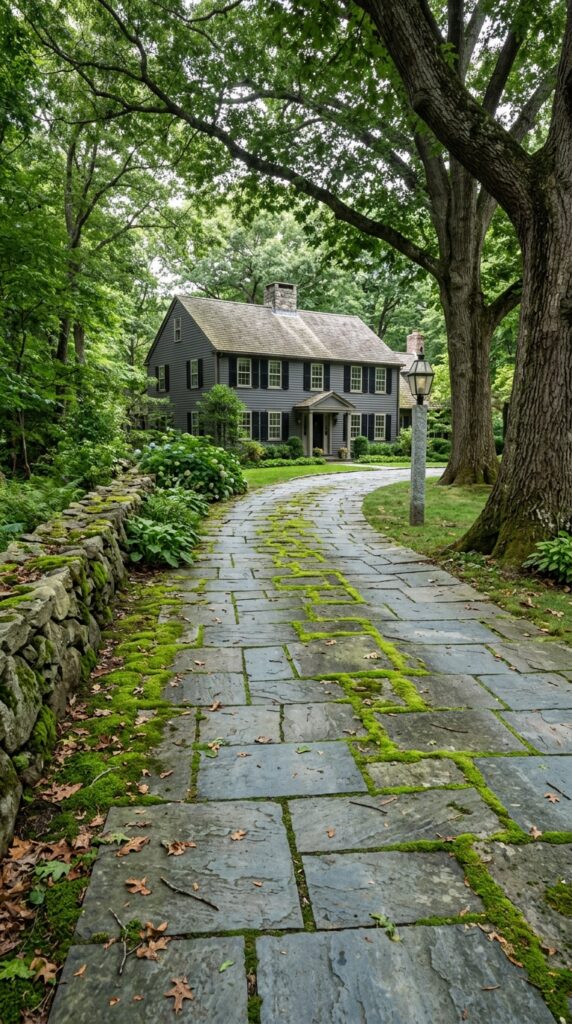
Vibe: Serene. Bluestone with moss joints looks like something the forest decided to allow a driveway to be.
Why it works: Pennsylvania bluestone is one of the most visually sophisticated driveway materials available — its natural cleft surface, cool grey-blue tone, and irregular slab dimensions create a completely non-repeating surface pattern that improves with age. Moss grows naturally in the joints of shaded bluestone driveways in wetter climates; in drier settings it can be encouraged with buttermilk-and-moss slurry painted into the joints.
How to get it: Bluestone is one of the most expensive driveway materials at $15–$30 per square foot installed. For a more accessible version, bluestone-look porcelain pavers (around $5–$8/sq ft) replicate the color and texture convincingly and can be installed on a standard mortar bed. Natural bluestone requires a proper aggregate base of 6–8 inches for driveway applications.
🛍️ Shop the Look — Amazon Product Ideas
| # | Product Search Phrase | Why It Fits |
| 1 | bluestone look porcelain paver tile outdoor | Budget bluestone alternative |
| 2 | moss spore powder garden joints stone | Joint moss establishment |
| 3 | black iron lamp post outdoor driveway | Shaded entry lighting |
| 4 | dry stacked stone wall edging landscape | Stone wall companion element |
| 5 | leaf blower handheld lightweight yard | Stone driveway maintenance |
10. White Gravel Driveway with Black Metal Gate
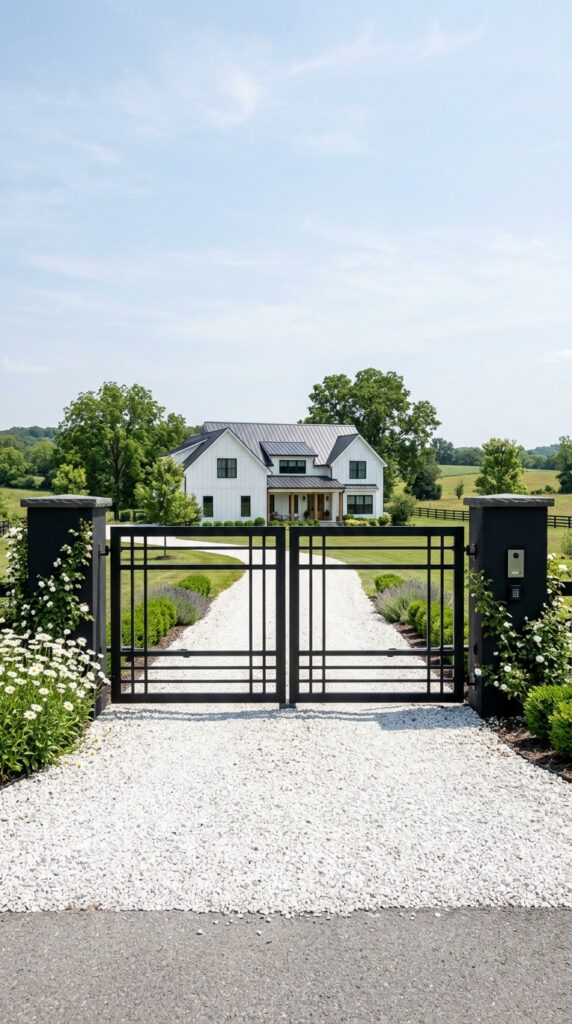
Vibe: Crisp. The contrast of white gravel against black steel is the exterior design equivalent of a sharp white shirt with black trim.
Why it works: White crushed limestone gravel maximizes light reflection, making a driveway appear brighter and more spacious than its actual dimensions — particularly valuable for narrow or shorter driveways. The high contrast with dark steel or iron gates creates a graphic visual statement visible from significant distance. Limestone gravel also has the practical benefit of self-compacting over time and remaining visually clean longer than tan or buff gravels because surface dust shows less on white.
How to get it: Specify white crushed limestone in 3/8-inch chip size — larger chips allow for better drainage and stay put under tire movement better than fine decomposed granite, which scatters. Lay on a compacted road base layer at minimum 4 inches depth with landscape fabric beneath to prevent ground-level weed penetration.
🛍️ Shop the Look — Amazon Product Ideas
| # | Product Search Phrase | Why It Fits |
| 1 | white crushed limestone gravel landscape bag | Primary white surface material |
| 2 | matte black driveway gate steel modern | Entry gate anchor |
| 3 | black square steel fence post gate pillar | Gate pillar support |
| 4 | climbing rose live plant white entry pillar | Pillar softening planting |
| 5 | driveway intercom system wireless gate | Entry access function |
11. Narrow Driveway Landscaping with Vertical Plants
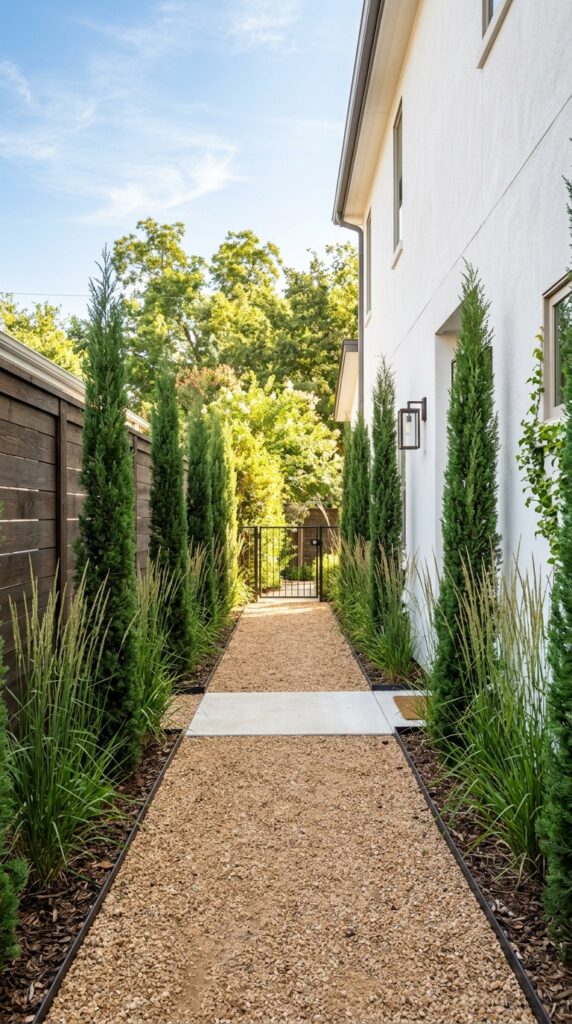
Vibe: Airy. A narrow driveway planted with vertical forms reads as intentionally intimate rather than cramped.
Why it works: Vertical planting along a narrow driveway exploits the same optical principle as vertical stripes in clothing — it draws the eye along the length and height of the space rather than across its narrow width. Columnar plants like Sky Pencil holly, columnar blue spruce, or ‘Graham Blandy’ boxwood stay under 24 inches wide while reaching 6–10 feet in height, giving maximum visual impact with minimum footprint encroachment on the usable drive surface.
How to get it: For a narrow driveway, the most important choice is keeping the driveway surface material light-colored (pale gravel or light concrete) so it visually widens the passage. Dark surfaces in narrow spaces read as tunnels; light surfaces read as paths. Plant columnar forms 36 inches from the drive edge to allow car doors to open without damaging foliage.
🛍️ Shop the Look — Amazon Product Ideas
| # | Product Search Phrase | Why It Fits |
| 1 | Sky Pencil holly columnar shrub live | Narrow vertical border plant |
| 2 | columnar blue spruce evergreen narrow | Evergreen vertical form |
| 3 | ornamental grass prairie dropseed narrow | Vertical grass border |
| 4 | wall mount outdoor light fixture modern | Narrow space wall lighting |
| 5 | black narrow garden gate metal | End-of-drive entry gate |
12. Driveway Entrance Pillars with Lighting
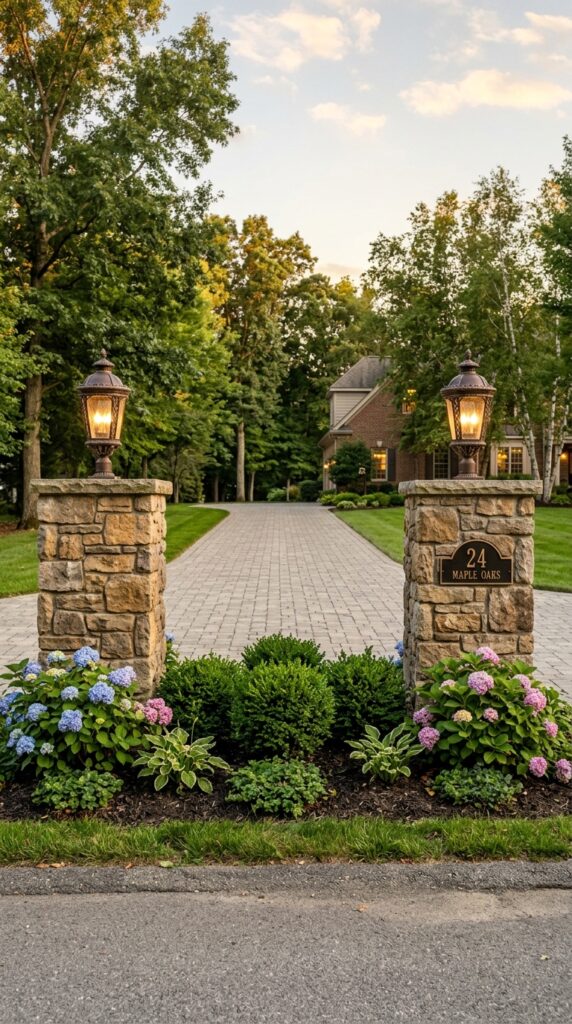
Vibe: Warm. Entry pillars transform a driveway opening from a gap in a fence into an architectural moment.
Why it works: Driveway entry pillars perform the same psychological function as a building’s entrance threshold — they signal a transition between public and private space, which creates a sense of arrival that a plain driveway opening simply cannot. The pillars frame the view of the house beyond, creating a picture-frame effect that controls the first impression. Integrated lighting doubles their function: structure by day, warm wayfinding by night.
How to get it: Prefabricated stacked stone pillar forms — available as hollow masonry forms that stack around a steel post — allow a DIY installation that looks custom-built. Top them with a cap stone (bluestone, granite, or limestone) and a hardwired or solar lantern. Plant one mass of the same shrub (boxwood globe, hydrangea, or ornamental grass) at the base of both pillars for symmetrical framing.
💡 Quick Win: Freestanding stacked stone pillar planters positioned at the driveway entrance — no construction required — achieve an entry-pillar visual with ceramic or concrete forms filled with seasonal plants.
🛍️ Shop the Look — Amazon Product Ideas
| # | Product Search Phrase | Why It Fits |
| 1 | stacked stone driveway pillar form decorative | Entry pillar structure |
| 2 | outdoor lantern post top light bronze | Pillar cap lighting |
| 3 | house number plaque stone address sign | Pillar number detail |
| 4 | boxwood globe shrub entry landscape | Symmetrical pillar planting |
| 5 | capstone flat natural stone landscape | Pillar top cap stone |
13. Resin-Bound Gravel Driveway
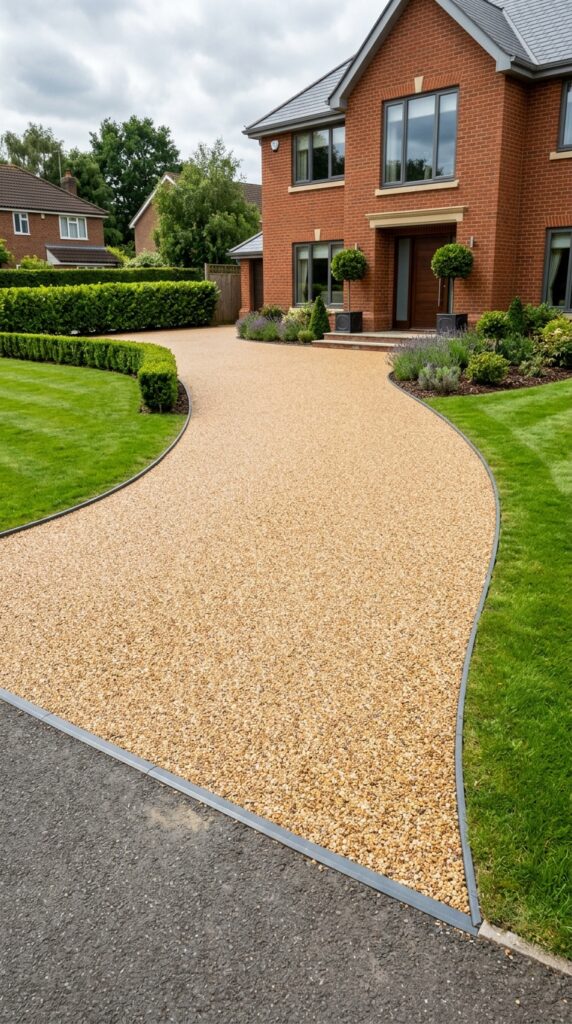
Vibe: Polished. Resin-bound gravel looks like loose gravel that decided to grow up.
Why it works: Resin-bound aggregate combines individual stone aggregate — in any color from honey buff to dark charcoal — with a clear UV-stable resin binder applied on-site. The result is a permeable, smooth, weed-free surface that looks like loose gravel but stays completely in place. It requires no edging to contain, doesn’t scatter onto lawns or paths, and is SUDS (Sustainable Urban Drainage System) compliant in the UK. Maintenance is minimal — an annual resin sealant coat and a power wash.
How to get it: Resin-bound surfacing requires professional installation — it cannot be DIY’d reliably because the mix ratio and surface prep are critical. In the US it’s less common than in the UK, so look for specialist driveway contractors; expect to pay $10–$18 per square foot. Choose an aggregate color three shades lighter than your house facade color for the best tonal relationship.
🛍️ Shop the Look — Amazon Product Ideas
| # | Product Search Phrase | Why It Fits |
| 1 | resin bound aggregate sealer clear UV stable | Surface maintenance sealer |
| 2 | ball topiary standard artificial outdoor UV | Entry topiary accent |
| 3 | power washer surface cleaner attachment | Annual cleaning maintenance |
| 4 | clipped hedge artificial boxwood privacy | Low hedge border element |
| 5 | house number modern brushed steel exterior | Clean entry number display |
14. Wildflower Border Driveway Landscaping
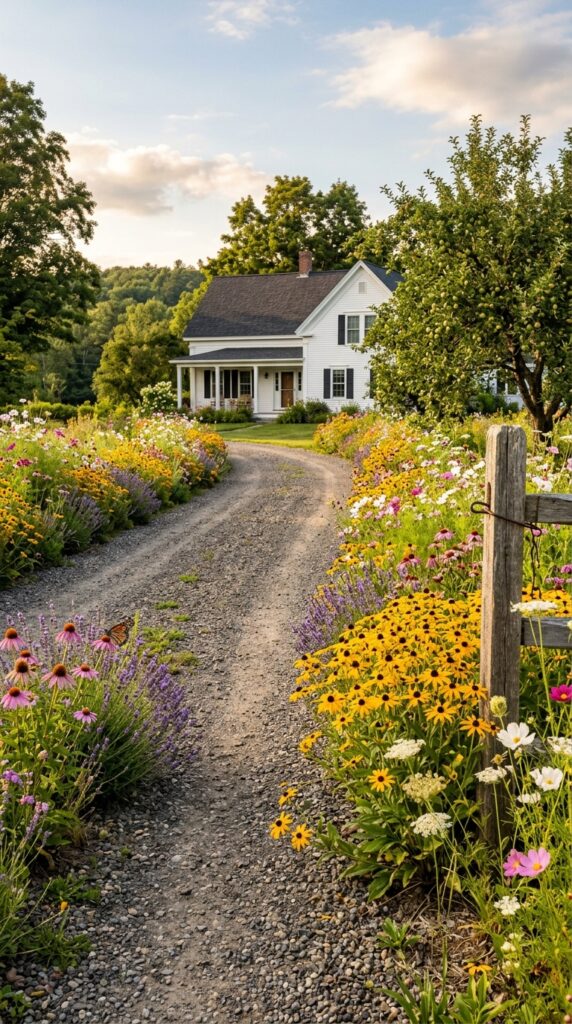
Vibe: Abundant. A wildflower-bordered driveway makes the approach to a home feel genuinely alive.
Why it works: Naturalistic wildflower borders work because they exploit what landscape designers call “controlled chaos” — the plants are chosen and positioned deliberately but allowed to self-seed, shift, and evolve naturally within the border. The result reads as richer and more complex than a manicured border precisely because it looks like it belongs there. Wildlife — pollinators, birds, and beneficial insects — are attracted immediately, which adds visible life and movement to the driveway experience.
How to get it: Establish a wildflower driveway border from seed in autumn (many wildflowers need a cold stratification period) or plant 4-inch perennial plugs in spring. Prepare the bed by removing lawn, loosening soil, and adding no compost — wildflowers prefer lean soil that doesn’t encourage excessive leaf growth over bloom.
🛍️ Shop the Look — Amazon Product Ideas
| # | Product Search Phrase | Why It Fits |
| 1 | wildflower seed mix perennial sun driveway border | Primary planting material |
| 2 | black-eyed Susan Rudbeckia live plant | Reliable border wildflower |
| 3 | echinacea coneflower live plug mixed | Pollinator border plant |
| 4 | natural wood fence post decorative entry | Rustic entry accent |
| 5 | landscape fabric pin staple anchor | Weed control under border |
15. Modern Concrete Driveway with Black Expansion Joints
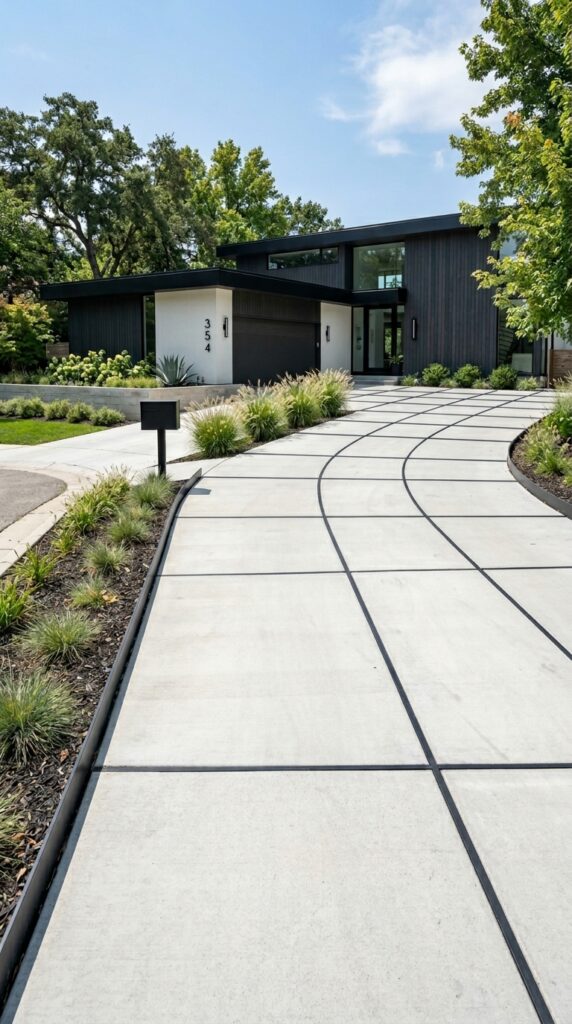
Vibe: Architectural. A modern concrete driveway with deliberate black jointing turns a utilitarian surface into a graphic design element.
Why it works: Concrete expansion joints are a structural necessity, but their color and placement can be treated as a design decision rather than an afterthought. Specifying black rubber or ebony-colored caulk joints on a light concrete driveway creates a grid pattern that directly references contemporary architectural detailing — the same visual language as a Japanese tatami floor or a Le Corbusier window grid. The contrast makes the concrete surface intentional rather than default.
How to get it: Standard grey concrete can be upgraded at pour time by specifying a lighter aggregate or by adding a white pigment admixture to move the color toward pale stone rather than standard battleship grey. Black expansion joint sealant is available at any hardware store and can replace existing beige or grey joint filler in an existing concrete driveway for under $30 in materials.
💡 Quick Win: Replacing the existing grey or deteriorated expansion joint filler in an existing concrete driveway with black polyurethane sealant is a single afternoon project that makes the entire surface read as designed.
🛍️ Shop the Look — Amazon Product Ideas
| # | Product Search Phrase | Why It Fits |
| 1 | black polyurethane concrete joint sealant exterior | Graphic joint upgrade material |
| 2 | concrete driveway resurfacer white light grey | Surface color refresh |
| 3 | Pennisetum ornamental grass clump live | Contemporary border plant |
| 4 | sleek modern address number steel exterior | Minimalist entry number |
| 5 | black steel mailbox modern wall mount | Contemporary entry detail |
16. Driveway Turnaround Circle with Center Planting
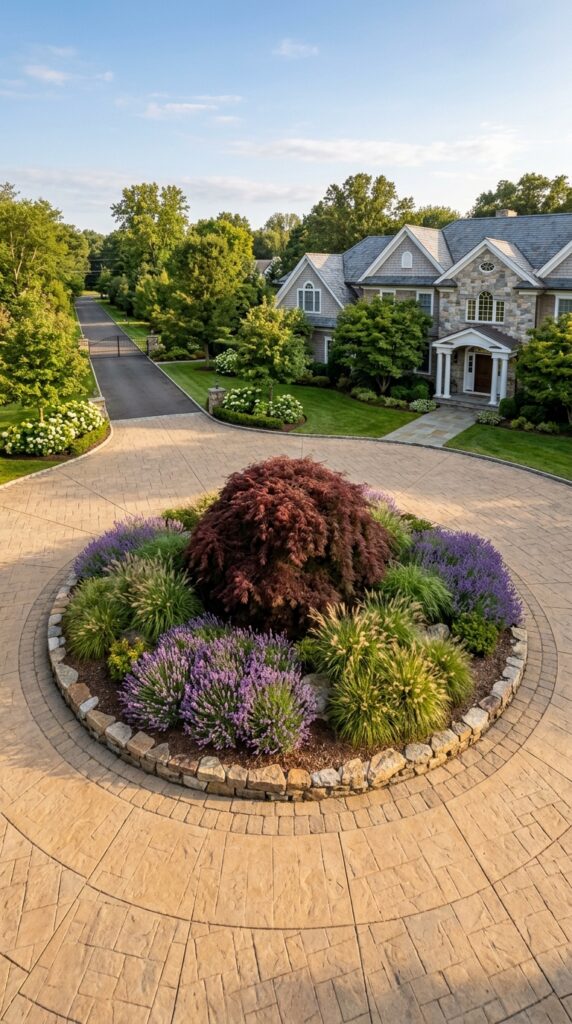
Vibe: Grand. A driveway circle with a center island planting is the outdoor equivalent of a foyer chandelier.
Why it works: The circular driveway turnaround performs a genuine function — allowing vehicles to exit forward rather than reversing onto a street — while creating the single most dramatic landscaping opportunity on any property. The center island planting uses the design principle of a focal specimen (one structurally distinctive tree or large shrub as the centerpiece) surrounded by lower mass plantings, creating layered visual interest from all 360 degrees of approach.
How to get it: A weeping Japanese maple (Acer palmatum var. dissectum) is the ideal center island specimen: it stays under 10 feet in height and width, has spectacular year-round interest (spring green, summer red, autumn orange), and its weeping branching structure is readable as a focal point from across the driveway circle. Surround it with three repeating masses — one ground cover, one low shrub, one medium ornamental grass — for a complete island planting.
🛍️ Shop the Look — Amazon Product Ideas
| # | Product Search Phrase | Why It Fits |
| 1 | weeping Japanese maple tree live potted | Center island focal specimen |
| 2 | flexible driveway edging circle round | Circular island border |
| 3 | river rock decorative landscape stone bag | Center island mulch alternative |
| 4 | low-growing sedum ground cover live | Island perimeter ground cover |
| 5 | ornamental grass feather reed live plug | Mid-layer island planting |
17. Driveway with Side Pergola or Arbor Entry
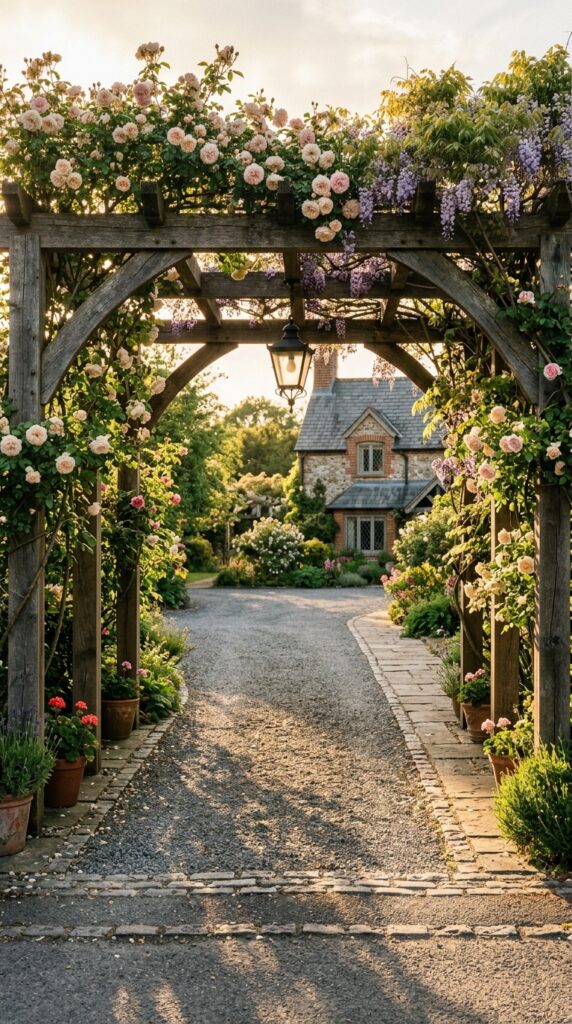
Vibe: Romantic. A pergola at the driveway entry transforms a car park into a garden entry.
Why it works: An overhead structure at the driveway entry creates the third dimension that ground-plane landscaping cannot: height. The pergola frames the sky above the driveway opening, creating an architectural gateway that signals arrival and slows the visual experience of entering the property. Climbing plants — particularly roses, wisteria, or star jasmine — add seasonal bloom, fragrance, and the specific quality of light through a vine canopy that no other design element provides.
How to get it: For a driveway pergola, use pressure-treated or naturally rot-resistant cedar posts set in concrete footings at minimum 18 inches below grade. The opening width must accommodate the widest vehicle expected — a minimum of 12 feet for standard vehicles, 14 feet if accommodating trucks or SUVs. ‘New Dawn’ climbing rose is the most reliable and vigorous choice for a pergola in most US zones.
🛍️ Shop the Look — Amazon Product Ideas
| # | Product Search Phrase | Why It Fits |
| 1 | cedar wood pergola kit entry arch garden | Driveway entry structure |
| 2 | climbing rose live plant New Dawn pink | Pergola flowering vine |
| 3 | hanging outdoor lantern ceiling mount | Pergola overhead light |
| 4 | vine wire trellis attachment kit | Climbing plant support |
| 5 | post concrete anchor bracket galvanized | Pergola post foundation |
18. Parking Court with Permeable Pavers
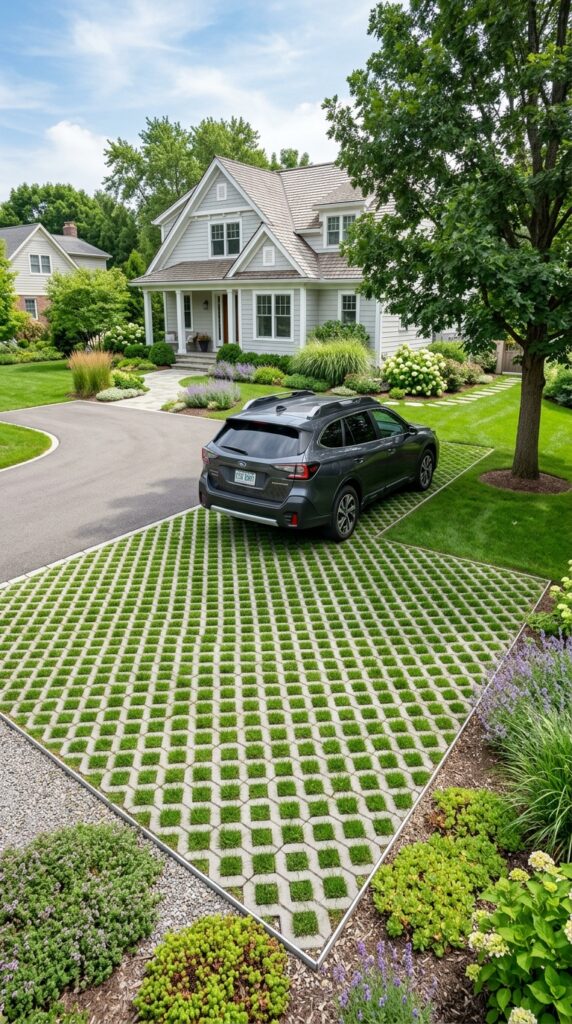
Vibe: Grounded. A grass-grid parking court is the most sustainable, visually generous solution to the extra-cars-on-the-weekend problem.
Why it works: Permeable grass-grid pavers solve the front yard paving problem that plagues properties with multiple drivers: how do you create hard-standing for additional vehicles without paving over valuable green space? The plastic or concrete grid form distributes vehicle load across the ground while allowing grass to grow through each cell, creating a surface that reads as lawn at a glance but handles full vehicle weight without rutting.
How to get it: Plastic permeable grid pavers (made from recycled polyethylene) are available in roll or panel form and install directly onto compacted stone base — no mortar required. Fill cells with topsoil, seed with a hard-wearing turf grass variety, and maintain with regular low mowing. The initial grass establishment period takes 4–8 weeks.
🛍️ Shop the Look — Amazon Product Ideas
| # | Product Search Phrase | Why It Fits |
| 1 | permeable grass grid paver driveway plastic | Core parking court surface |
| 2 | hard wearing turf grass seed vehicle traffic | Cell grass seeding material |
| 3 | compacted gravel road base landscape bag | Sub-grid base material |
| 4 | shade tree live planted small form | Parking court canopy |
| 5 | ground cover perennial low sedum border | Court perimeter planting |
19. Driveway Edged with River Rock and Boulders
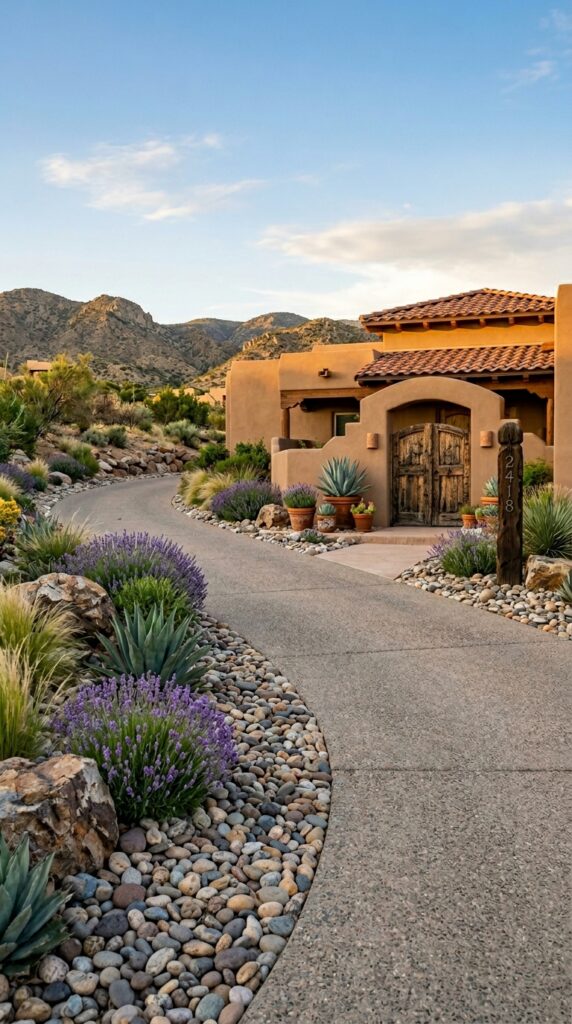
Vibe: Grounded. A river rock driveway border feels geological — like the landscape decided where the drive should go.
Why it works: Large-scale rock placement along a driveway creates the most natural-looking landscape transition because it mimics the way rocky outcroppings appear at the edges of natural paths and streams. The key design rule is variation: mixing three rock sizes (small river rock as the bed, medium accent rocks at intervals, and one or two large boulders as punctuation) creates natural-looking randomness within a designed framework. Drought-tolerant plants woven between the rocks complete the naturalistic effect.
How to get it: Place the largest boulders first — these anchor the composition — then fill between them with medium rock, and flood the bed surface with small river rock last. A single boulder looks isolated; groups of three in varying sizes read as natural stone outcropping. Work with a local landscape supplier who can deliver and place large boulders by machine for safety and precision.
🛍️ Shop the Look — Amazon Product Ideas
| # | Product Search Phrase | Why It Fits |
| 1 | river rock decorative landscape stone large bag | Primary rock bed material |
| 2 | small landscape accent boulder decorative | Mid-size accent boulder |
| 3 | agave live plant drought tolerant succulent | Xeriscape driveway planting |
| 4 | ornamental grass blue fescue live | Low drought-tolerant grass |
| 5 | carved wood house number post rustic | Rustic entry number detail |
20. Driveway with Flower Pot Lining
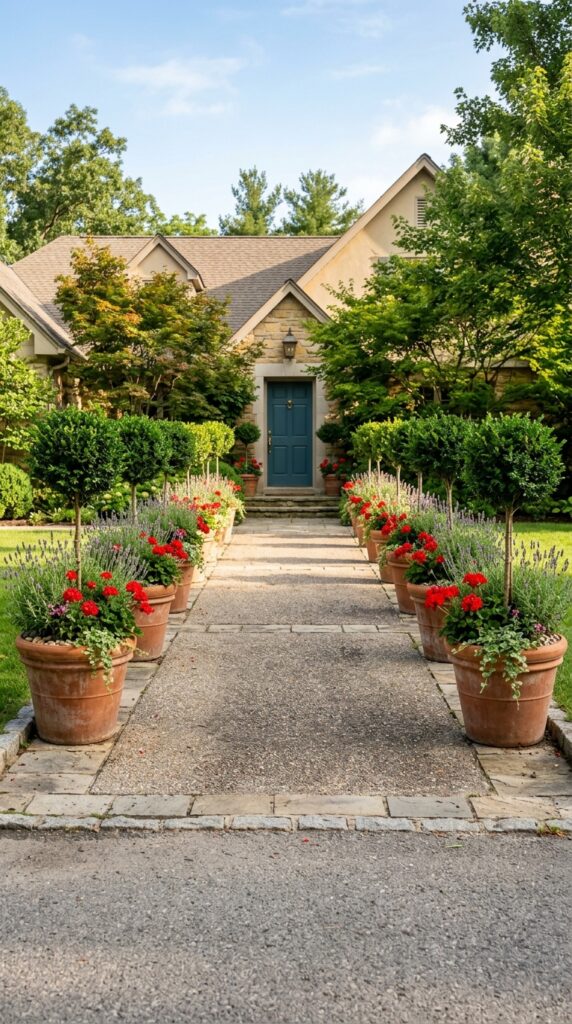
Vibe: Warm. A driveway lined with matching pots turns an approach into a procession.
Why it works: Matching pot lining works through the design principle of repetition creating rhythm — when the same pot form appears at regular intervals down both sides of a driveway, the eye follows the pattern automatically toward the destination (the front door). Unlike permanent border planting, pot lining can be updated seasonally, moved during extreme weather, and reconfigured without landscape work. The pots also provide an anchor for seasonal color changes.
How to get it: Use the same pot form on both sides — variation in pot style breaks the rhythm that makes this technique effective. Terracotta performs best in climates without hard freezes (it cracks in freeze-thaw cycles); glazed ceramic or fiberglass pots work in all climates. Space pots 6–8 feet apart for a stately effect, or 4 feet apart for a more intimate, festive feel.
💡 Quick Win: Four matching terracotta pots planted with standard boxwood topiary balls, placed at the driveway corners and door, cost under $120 and establish the pot-lining principle immediately.
🛍️ Shop the Look — Amazon Product Ideas
| # | Product Search Phrase | Why It Fits |
| 1 | large terracotta pot outdoor planter 14 inch | Primary lining pot form |
| 2 | standard boxwood topiary ball potted live | Evergreen pot specimen |
| 3 | geranium annual red live plant 6 pack | Seasonal color planting |
| 4 | fiberglass pot planter frost resistant large | Cold climate pot option |
| 5 | pot feet raisers terracotta drainage | Pot drainage improvement |
21. Black Asphalt Driveway with White Limestone Border Strip
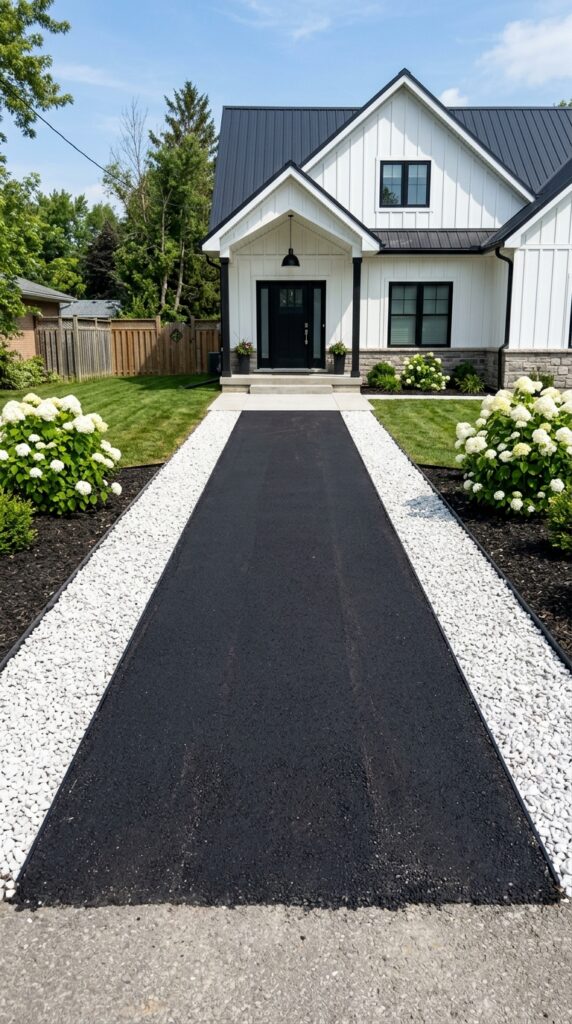
Vibe: Crisp. A white limestone border against black asphalt is the most graphic driveway upgrade achievable in a single afternoon.
Why it works: Most asphalt driveways look dark, heavy, and visually shapeless from the street. A border strip of white crushed limestone, contained between steel edging strips on both sides, defines the edges of the asphalt precisely — giving the driveway a clear boundary and visual shape that the plain asphalt surface cannot provide. This high-contrast border is visible from significant distance and immediately reads as designed rather than default.
How to get it: Install 4-inch steel edging on the outer edge of the border strip (between the limestone and the lawn or planting bed) and use the asphalt edge itself as the inner boundary. Fill the strip with white crushed limestone to a depth of 2 inches and top up annually. A 12-inch-wide border strip on each side of a standard 18-foot-wide driveway uses approximately 2 tons of limestone.
🛍️ Shop the Look — Amazon Product Ideas
| # | Product Search Phrase | Why It Fits |
| 1 | white crushed limestone border gravel bag | Contrast border material |
| 2 | galvanized steel edging 4 inch landscape | Inner and outer edging strip |
| 3 | asphalt crack filler sealant black | Asphalt surface maintenance |
| 4 | white hydrangea Annabelle live shrub | White border companion plant |
| 5 | asphalt sealer black driveway reseal | Asphalt color refresh |
22. Driveway Hedge with Low Clipped Yew or Privet
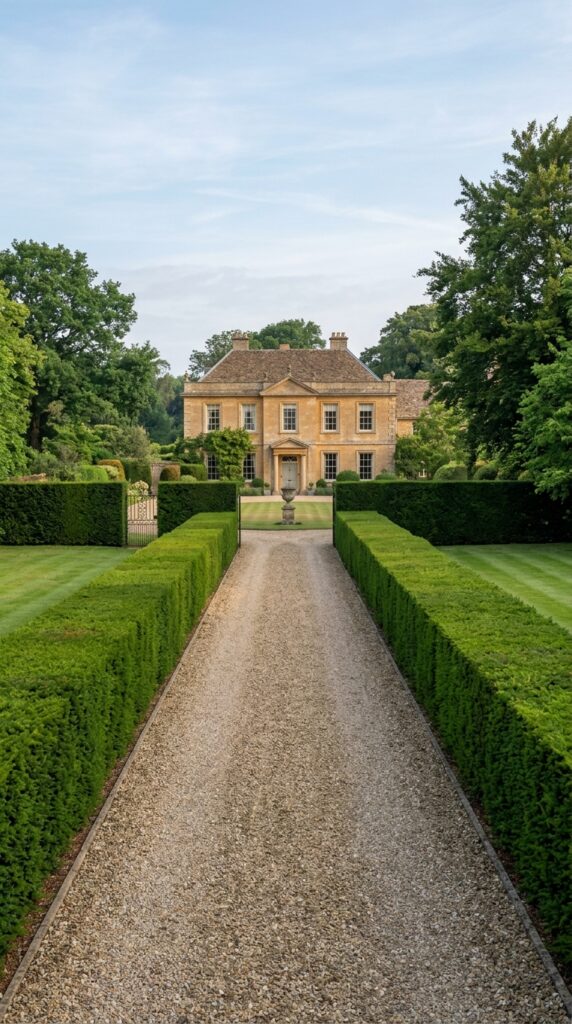
Vibe: Serene. A clipped driveway hedge is the most architectural use of a living plant — a green wall that behaves like a structure.
Why it works: A formally clipped hedge flanking a driveway exploits the tension between living material and architectural precision — the hedge reads simultaneously as plant and as built element. English yew (Taxus baccata) and common privet (Ligustrum vulgare) are the two most reliable choices for clipped driveway hedges: both tolerate hard annual clipping, fill densely, and maintain a flat top and sheer face when regularly maintained. Yew is the longer-lasting choice (centuries of use in European estate gardens confirm this).
How to get it: Plant hedging at 18 inches spacing for yew, 12 inches for privet. Train to the desired height over 3–5 years by clipping lightly twice yearly, encouraging lateral density before allowing the hedge to reach its final height. A string line and spirit level are essential for maintaining the perfectly flat top that makes formal hedge work read as designed rather than overgrown.
🛍️ Shop the Look — Amazon Product Ideas
| # | Product Search Phrase | Why It Fits |
| 1 | English yew hedge plug plant live bare root | Primary formal hedge plant |
| 2 | electric hedge trimmer cordless flat top | Formal clipping tool |
| 3 | hedge trimming guide string level garden | Straight clip guide tool |
| 4 | stone garden urn planter large pedestal | Formal entry accent piece |
| 5 | wrought iron driveway gate garden set | Hedge gate integration |
23. Driveway with Uplighting on Flanking Trees
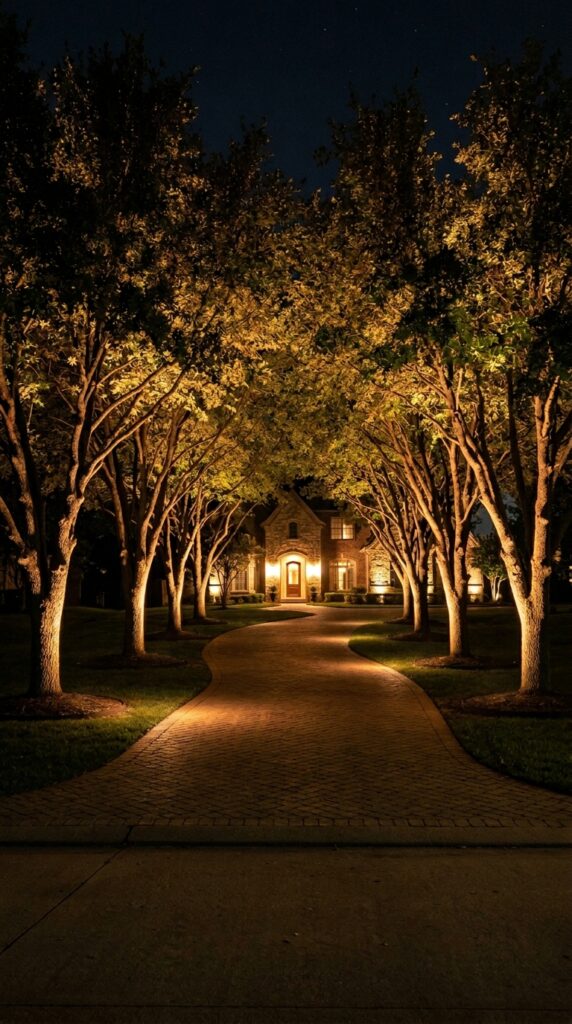
Vibe: Dramatic. Uplighting flanking driveway trees is the single most transformative exterior lighting move available after dark.
Why it works: Tree uplighting works on a simple optical principle: light from below a tree canopy reveals the interior structure of the branching — the negative space between branches — which is invisible in flat daylight. The effect is deeply architectural, reading like a cathedral vault from below. Strategically placed uplights at the base of four to six trees flanking a driveway turn an ordinary approach into a night experience that bears no resemblance to what the driveway looks like at noon.
How to get it: Aim uplights at a 45-degree angle toward the primary trunk or branch structure — not straight up through the center of the canopy, which creates unnatural hot spots. Use warm-white LEDs at 2700–3000K only; cool white uplighting reads harsh and institutional at night. For trees over 30 feet tall, use a 20-watt spotlight minimum to penetrate the full canopy.
🛍️ Shop the Look — Amazon Product Ideas
| # | Product Search Phrase | Why It Fits |
| 1 | ground mount LED spotlight uplighting tree outdoor | Primary uplight fixture |
| 2 | low voltage transformer outdoor landscaping | Uplight power supply |
| 3 | directional spotlight stake outdoor 2700K | Warm-tone tree accent |
| 4 | low voltage landscape wire direct burial | Underground cable run |
| 5 | landscape light timer photocell automatic | Automatic dusk-to-dawn control |
24. Driveway with Rose-Covered Fence Edging
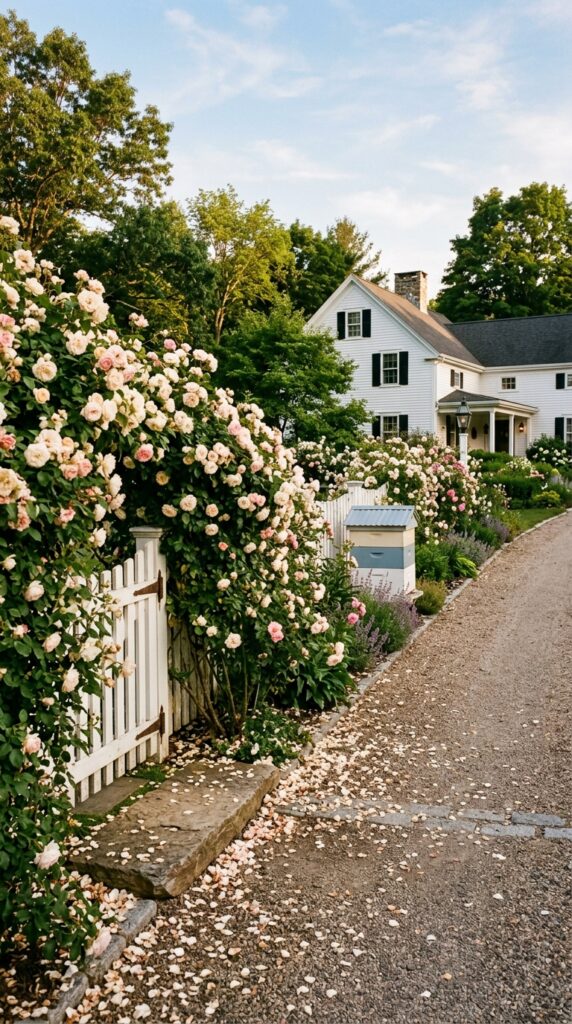
Vibe: Romantic. A rose-covered fence alongside a driveway is summer’s best welcome.
Why it works: Training climbing roses along a driveway fence creates a sequential bloom experience that unfolds across weeks — opening from the base upward and along the fence length — rather than delivering all its visual impact at once. This means the driveway transforms gradually through the season rather than looking the same every day. ‘Cecile Brunner’ (a climbing polyantha rose) and ‘American Pillar’ are particularly reliable fence roses that bloom prolifically on low-maintenance canes.
How to get it: Plant climbing roses on the sun-facing side of the fence, 8 feet apart. Train the main canes horizontally along the fence rails rather than allowing them to grow vertically — horizontal training stimulates more lateral flowering shoots, which dramatically increases bloom density. A split-rail or picket fence at 4 feet height is the ideal climbing rose support structure.
🛍️ Shop the Look — Amazon Product Ideas
| # | Product Search Phrase | Why It Fits |
| 1 | climbing rose live plant Cecile Brunner | Prolific driveway fence rose |
| 2 | white vinyl picket fence panel low 4 foot | Driveway fence structure |
| 3 | split rail wood fence panel cedar | Rustic fence alternative |
| 4 | rose tie garden tape flexible training | Horizontal cane training |
| 5 | rose fertilizer granular long release | Climbing rose nutrition |
25. Grasscrete or Green Driveway Panels
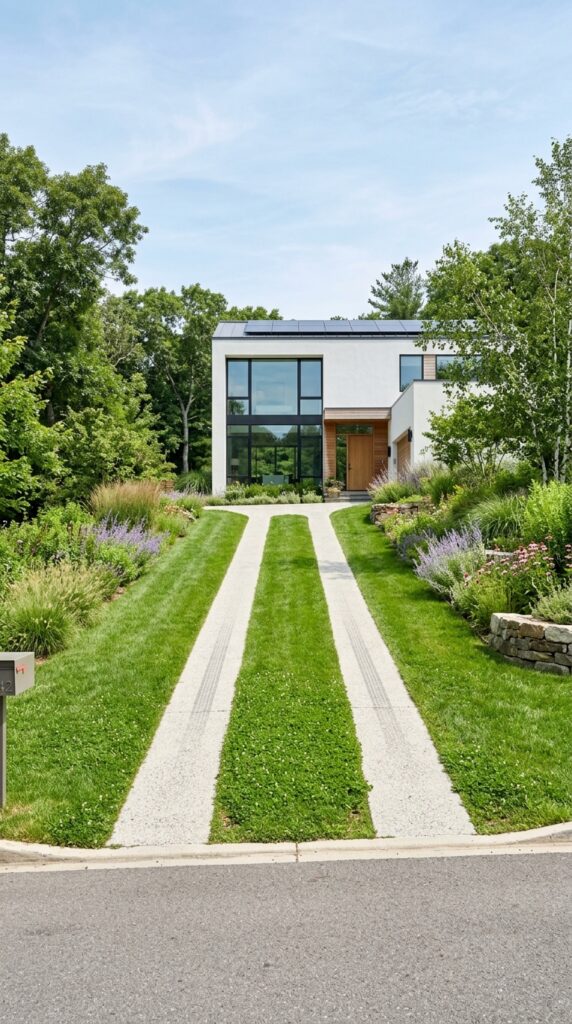
Vibe: Airy. Two concrete tire tracks with a grass center is the most honest possible driveway — it paves only exactly what the tires touch.
Why it works: The twin-track or ribbon driveway reduces impervious surface coverage by 60–70% compared to a full-width paved driveway, improving stormwater drainage and reducing heat island effect while maintaining full vehicle access. From the street, a well-maintained twin-track driveway reads as predominantly lawn — the house appears to be approached across grass rather than across asphalt. This dramatically softens the visual impact of the car-entry problem.
How to get it: Twin-track driveways work when the track width matches the specific vehicle’s wheel spacing — measure the wheel base of the primary vehicle before setting the track width. Standard spacing is 4.5 feet between track centers for most sedans and SUVs. Plant the center strip with low-growing creeping thyme, clover, or a fine fescue mix that tolerates the occasional drive-over.
🛍️ Shop the Look — Amazon Product Ideas
| # | Product Search Phrase | Why It Fits |
| 1 | creeping thyme seeds low growing center strip | Green center strip planting |
| 2 | micro white clover lawn seed | Low center strip alternative |
| 3 | concrete stepping stone set round large | Twin-track surface material |
| 4 | lawn edging concrete form strip mold | Poured track edging form |
| 5 | drought tolerant fescue grass seed fine | Low-mow center strip grass |
26. Driveway with Ornamental Grasses as Pillars
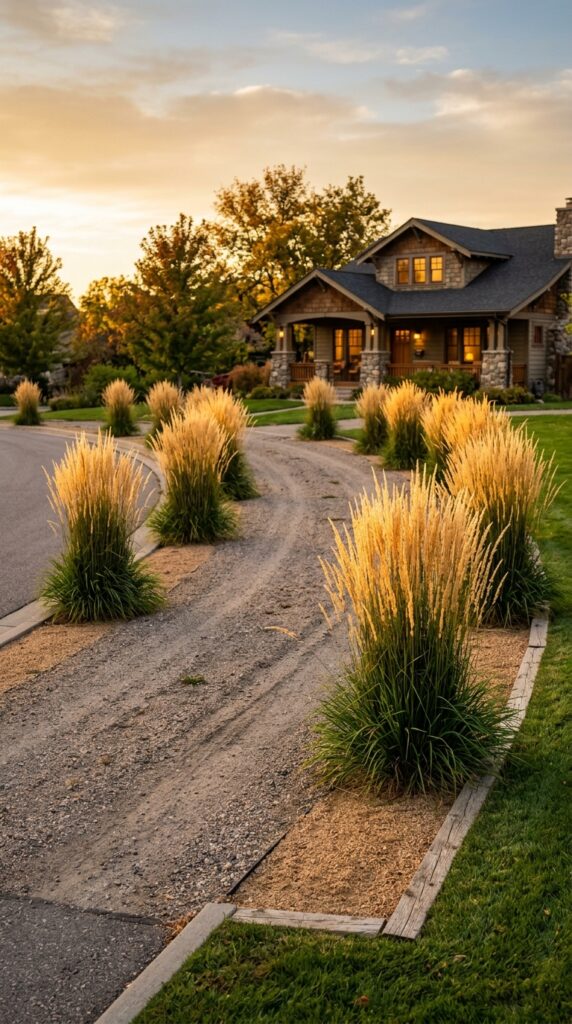
Vibe: Sun-warmed. Ornamental grass clumps at a driveway entry move in the wind, introducing a quality that no other landscape material provides.
Why it works: Ornamental grasses used as punctuation points — planted in distinct clumps at the driveway entry and at intervals along the sides — function visually like columns or pillars: they define space without enclosing it, and their form is clear and readable from a distance. Calamagrostis x acutiflora ‘Karl Foerster’ is the standard recommendation because it’s among the earliest grasses to show its upright form in spring, holds its structure through winter, and performs in zones 4–9.
How to get it: Plant grasses in groups of three or five clumps at the entry rather than a single specimen — odd-numbered groupings always look more natural than even numbers or singletons. Cut clumps back hard to 4–6 inches in late February before new growth emerges; this annual cut is the only significant maintenance required.
🛍️ Shop the Look — Amazon Product Ideas
| # | Product Search Phrase | Why It Fits |
| 1 | Karl Foerster feather reed grass live plant | Core vertical driveway plant |
| 2 | miscanthus maiden grass clump live | Alternative tall grass form |
| 3 | low stone timber edging natural landscape | Grass clump base edging |
| 4 | gravel pea stone tan driveway strip | Between-clump surface fill |
| 5 | garden pruner sharp bypass large grass | Annual grass cut-back tool |
27. Small Driveway Apron Upgrade with Decorative Pavers
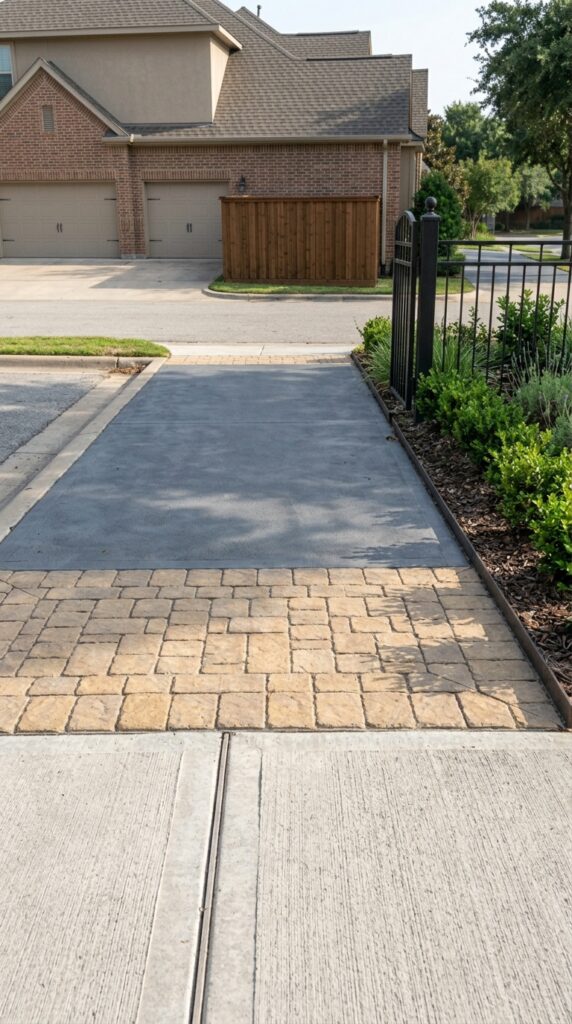
Vibe: Crisp. A decorative apron border at the street end of a short driveway turns a 4-foot transition zone into a proper entry statement.
Why it works: In urban settings with short driveways or city setback restrictions, the apron — the section of driveway between the public sidewalk and the property line — is often the only space available for a landscape design statement. A decorative paver band across the apron (a contrasting color, pattern, or material from the main driveway surface) creates a visual threshold that says: the designed space begins here. It’s the driveway equivalent of a welcome mat.
How to get it: Install the decorative apron band as a 24–36 inch strip across the full driveway width, using a paver material in a contrasting color to the main driveway surface. Buff or charcoal pavers against a plain concrete drive create the clearest possible threshold effect. This section can often be DIY-installed without disturbing the main driveway surface.
💡 Quick Win: Paver edging stones — single-course 4×8-inch clay pavers — can be mortared or dry-set across the width of a concrete driveway apron in one afternoon for under $50 in materials.
🛍️ Shop the Look — Amazon Product Ideas
| # | Product Search Phrase | Why It Fits |
| 1 | clay brick paver 4×8 inch red buff | Decorative apron border paver |
| 2 | rapid set concrete mortar dry mix | Paver dry-set mortar base |
| 3 | paver edging pin spike anchor | Border paver stabilizer |
| 4 | low-growing thyme ground cover plug apron | Apron border softening plant |
| 5 | short driveway gate low fence decorative | Urban entry boundary element |
28. Driveway with Native Plant Landscaping
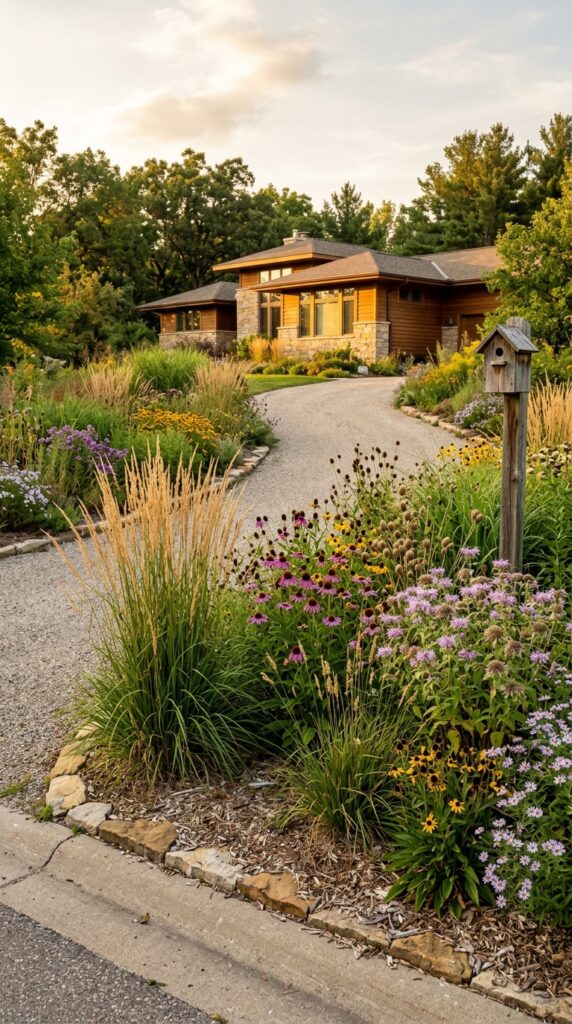
Vibe: Abundant. A native plant driveway border makes your property a working ecosystem, not just a landscape.
Why it works: Native plant driveway borders require less water, no fertilizer, and minimal maintenance once established — because native plants evolved for the precise soil, climate, and rainfall conditions of their region. They also support 10–50 times more wildlife than equivalent non-native plantings, which means your driveway border actively feeds birds, butterflies, and native bees throughout the season. The seasonal change in native plantings — spring shoots, summer bloom, autumn seed head, winter structural skeleton — means the border looks completely different each month.
How to get it: Source regionally appropriate native plants from a local native plant nursery rather than a general garden center — what counts as “native” is highly regional. For most of the central and eastern US, the Big Four driveway border natives are Echinacea purpurea (coneflower), Schizachyrium scoparium (little bluestem grass), Rudbeckia hirta (black-eyed Susan), and Asclepias tuberosa (butterfly weed).
🛍️ Shop the Look — Amazon Product Ideas
| # | Product Search Phrase | Why It Fits |
| 1 | native wildflower mix seeds prairie driveway | Regional native seed blend |
| 2 | little bluestem grass live plant native | Structural native grass |
| 3 | butterfly weed Asclepias live plant native | Monarch host plant |
| 4 | birdhouse post wooden garden entry | Wildlife habitat accent |
| 5 | natural wood chip mulch landscape 2 cubic ft | Native bed surface material |
29. Driveway Refresh with Paint and Stencil Pattern
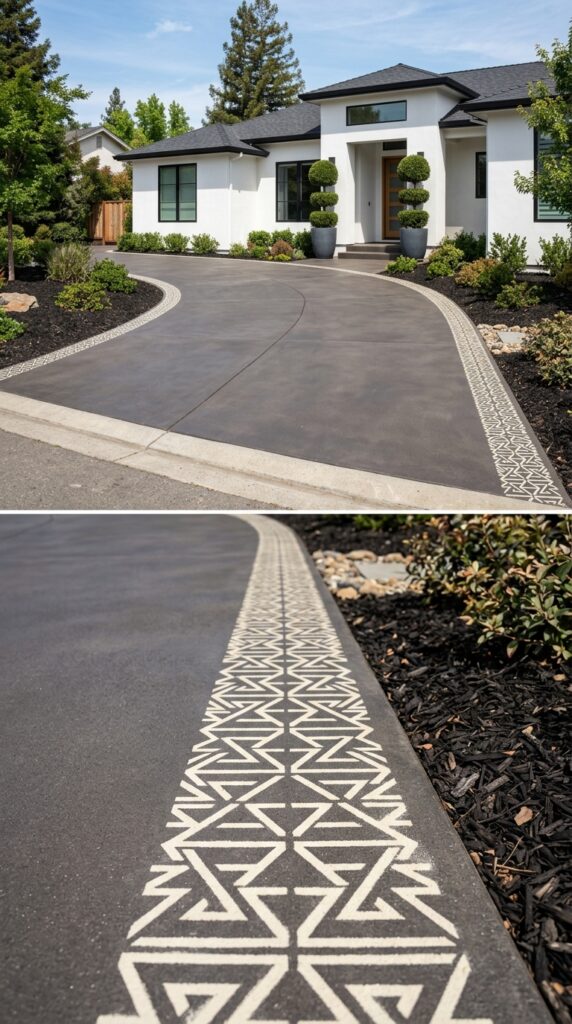
Vibe: Crisp. A stenciled driveway border turns a plain concrete surface into something that looks considered from the street.
Why it works: Concrete staining and stenciling exploit the same principle as a framed rug in an interior — they add a border line and color transformation to an existing surface without requiring replacement or major construction. A charcoal concrete stain dramatically reduces the weathered-grey look of aged concrete while a stenciled border at the driveway edges creates the visual definition that plain concrete lacks. The border stencil makes the driveway appear designed; the stain makes it appear intentionally colored.
How to get it: Acid stain or water-based concrete stain penetrates the concrete surface permanently (unlike paint, which peels). Clean the concrete thoroughly with a pressure washer, etch the surface lightly with concrete cleaner, apply the stain per manufacturer instructions, then use a concrete border stencil in a geometric pattern along both edges. Seal with a UV-stable concrete sealer to protect both stain and stencil. Total materials cost is typically $80–$150 for a standard two-car driveway.
🛍️ Shop the Look — Amazon Product Ideas
| # | Product Search Phrase | Why It Fits |
| 1 | concrete acid stain charcoal grey outdoor | Driveway surface color refresh |
| 2 | concrete border stencil geometric pattern large | Edge pattern template |
| 3 | concrete sealer UV stable exterior satin | Stain and stencil protection |
| 4 | concrete etching cleaner prep solution | Pre-stain surface prep |
| 5 | pressure washer detergent concrete cleaner | Surface preparation product |
How to Start Your Driveway Landscaping Transformation
The single best first move for any driveway landscaping project is installing a continuous black steel edging strip on both sides of the driveway from the street to the house. This one element — before any planting, lighting, or paving change — gives the driveway a defined edge that transforms its relationship to the surrounding lawn or bed. Without edge definition, all subsequent landscaping improvements look applied; with it, they look integrated. A 50-foot run of 4-inch steel edging costs under $80 in materials and can be installed in a single afternoon.
The most common mistake in driveway landscaping is choosing plants that are too wide for the space. A viburnum or forsythia that looks compact in a nursery pot will span 6–8 feet at maturity, encroaching on the drive surface and requiring constant cutting back that destroys the plant’s natural form. Always verify the mature width of any plant placed within 6 feet of the driveway edge — choose plants with a mature spread under 3 feet for anything within the inner border zone.
Three items under $50 that create immediate driveway impact: a bag of white crushed limestone poured as a 6-inch border strip along the existing driveway edge (under $25 at garden centers), a set of six solar bollard lights spaced along one side of the drive (under $50), and a flat of creeping thyme plugs to plant in the expansion joints of an existing concrete driveway ($20–$35 for a 32-plug flat).
A realistic driveway landscaping budget for a starter transformation (edging, gravel border, four flanking plants, two bollard lights) runs $150–$400 and can be fully installed in a weekend. A mid-range project adding paver work, significant planting, and wired lighting typically costs $2,000–$8,000 with professional installation. A full redesign with new paving material, structural planting, and an entry feature (pillars, gate, or pergola) realistically runs $12,000–$40,000 depending on driveway length and material choice. Paving is the highest-cost line item — plants and lighting are often less than 20% of the total.
Frequently Asked Questions About Driveway Landscaping Ideas
What is the best low-maintenance driveway landscaping idea for a busy homeowner?
A decomposed granite gravel driveway with Corten steel edging and mass-planted lavender borders is the lowest-maintenance combination available. Once the steel edging is installed and the gravel is laid on landscape fabric, the only ongoing tasks are annual weed pulling (typically minimal with proper fabric installation) and cutting the lavender back by one-third after its first bloom. There’s no mowing, no irrigation required in most climates after the lavender is established, and the gravel surface requires no sealing or repainting. Initial material cost for this combination runs $800–$2,500 depending on driveway length and local labor costs.
What plants work best alongside a driveway?
The most effective driveway border plants combine structure, low maintenance, and seasonal interest. For formal driveways: clipped dwarf boxwood (Buxus sempervirens ‘Suffruticosa’) in warm green, or columnar hornbeam for vertical form. For naturalistic driveways: lavender Hidcote, Karl Foerster ornamental grass, and Echinacea purpurea. For shade: hostas, astilbe, or Hydrangea anomala petiolaris (climbing hydrangea on a side fence). The universal rule is to specify the mature width before planting — anything over 3 feet wide belongs at least 4 feet from the paved edge.
How much does driveway landscaping cost?
Driveway landscaping cost varies enormously with scope. A simple DIY border planting with edging and mulch runs $200–$600 in materials. Adding a new gravel surface to an existing driveway (edging, landscape fabric, gravel) runs $500–$2,500 depending on size. A new paver or concrete driveway with plantings, lighting, and an entry feature like pillars or a gate typically costs $15,000–$50,000 professionally installed. The highest-impact, lowest-cost upgrades are always edging ($80–$120 in materials) and driveway lighting ($50–$200 for solar bollards) — both transform curb appeal immediately at minimal expense.
Can driveway landscaping increase home value?
Yes — curb appeal improvements including driveway landscaping consistently return 75–100% of their investment in resale value according to most real estate industry analyses. A professionally landscaped driveway approach is one of the first things buyers and appraisers assess, and a poor driveway can reduce perceived property value even when the home itself is immaculate. Entry features like stone pillars, a gated entry, or a tree-lined allée are particularly valued in higher-price markets. For maximum ROI, prioritize: new or refreshed paving surface, defined edging, a clean and healthy planting border, and functional entry lighting.
What driveway surface material lasts the longest?
Natural stone — granite, bluestone, or brick pavers — lasts the longest of any driveway surface material, with properly installed installations lasting 50–100 years or more. Clay brick pavers are the next most durable and can be individually replaced if a single unit is damaged, which makes them effectively eternal as a system. Poured concrete typically lasts 30–50 years with proper sealing every 3–5 years. Asphalt lasts 20–30 years with regular sealing and crack repair. Gravel surfaces don’t have a lifespan limit but require top-up every 2–3 years as material migrates and compacts. For a balance of durability and cost, concrete pavers (either poured or manufactured) offer 40–60 years of reliable performance at approximately half the cost of natural stone.
Ready to Level Up Your Driveway Landscaping?
These 29 driveway ideas span the full spectrum — from the choice of surface material and the precision of edging, to the plant species in the border and the warmth of the bollard light at dusk — because every element of a driveway landscape affects every other. You don’t need to redesign everything at once; installing steel edging this weekend, adding four solar bollard lights next month, and planting a lavender border in autumn is a completely legitimate transformation that builds deliberately over a season. Today, walk to the street and stand where a visitor would stand — look at your driveway as if seeing it for the first time and identify the single element that bothers you most. Start there. A driveway that’s been considered from the street in says something about everything behind it — and once yours reflects that intention, you’ll wonder why you waited. Save your favorites from this list and come back when the seasons change; driveway landscaping is at its best when it moves with the year, and there’s always one more reason to be home.