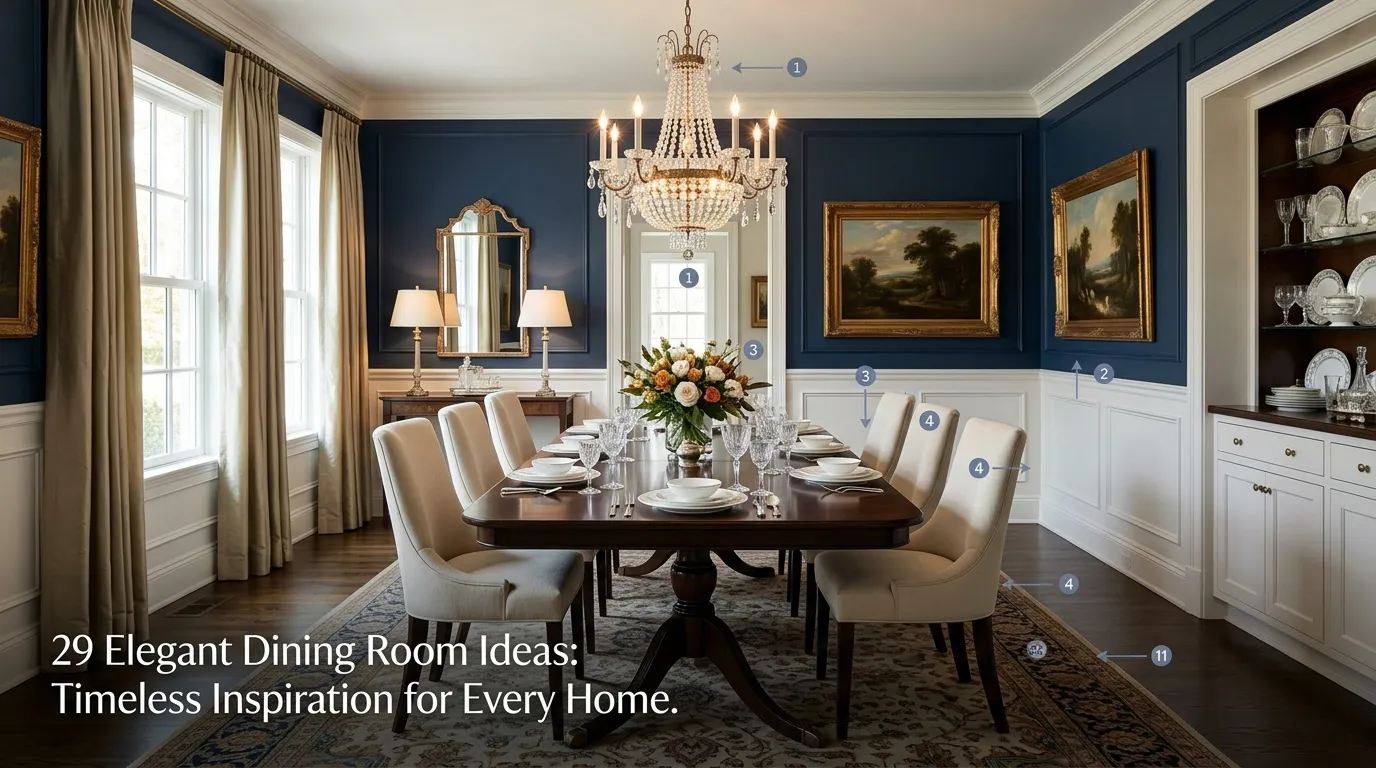
Elegant dining room design is the art of creating a space that feels refined and enduring — rooted in quality materials, deliberate proportion, and a quiet confidence that never chases trends. This article gives you exactly 29 timeless ideas spanning color, furniture, lighting, materials, and layout so you can design a dining room that impresses for decades, not just a season.
There is a particular stillness that settles over a truly elegant dining room. The light catches the edge of a polished table. Linen chairs hold their shape with quiet authority. The room invites people to sit longer, talk slower, pour another glass. It is not about opulence — it is about intention. Every surface, every shadow, every carefully chosen object says: this was thought about. Here are 29 ideas worth saving — and stealing.
Why Elegant Dining Room Design Works So Well
¶1 — What Is It? Elegant dining room design draws from the European tradition of formal entertaining spaces, refined through centuries of restraint. Unlike maximalist or eclectic styles, elegance operates through subtraction — it prioritizes what remains after the unnecessary has been removed. Its roots trace from Georgian symmetry and French neoclassicism to the mid-century American dining rooms that balanced grandeur with livability. What makes it distinct from simply “traditional” design is its emphasis on timelessness over period accuracy: an elegant dining room can feature a Louis XVI-style chair beside a slab of honed marble and feel completely coherent.
¶2 — Core Materials and Colors The palette runs from warm ivory and aged linen to soft greige, warm charcoal, and dusty slate blue. Rich tones like hunter green, deep burgundy, or inky navy appear as accent walls or upholstery. Materials include honed Calacatta marble, brushed brass hardware, unfinished white oak, aged velvet, heavy linen, and lacquered wood in dark walnut or ebony. Glass — whether in pendants, mirrors, or cabinet fronts — plays a recurring role in creating depth and amplifying light. These are materials that age beautifully rather than dating quickly.
¶3 — Why It’s Trending Now After years of the all-white minimalist interior dominating social media, there has been a strong cultural pivot toward spaces with warmth, depth, and meaning. Pinterest data consistently shows surging searches for “moody dining rooms,” “dark wood dining tables,” and “formal dining room ideas” — all signatures of the elegant aesthetic. Post-pandemic, people are investing in their homes as genuine entertaining spaces again, and that has revived the art of the considered dining room.
¶4 — Can Small Spaces Achieve This Style? Yes — with a focused approach. Small dining spaces should anchor around one hero piece (usually the table) and keep every other element subordinate. A round pedestal table in a small room reads more elegantly than a rectangular one because it eliminates visual corners and creates a natural sense of gathering. Resist the urge to fill the walls; a single large mirror or one piece of framed art will carry more elegance than a gallery wall.
Style at a Glance
| Element | Classic Elegance | Modern Elegance |
| Philosophy | Formality with warmth | Restraint with richness |
| Materials | Velvet, walnut, brass, marble | Linen, oak, matte black, stone |
| Color Palette | Ivory, burgundy, warm charcoal | Greige, slate, dusty sage, navy |
29 Elegant Dining Room Ideas
1. The Dark Walnut Statement Table

Vibe: Grounded. A dark walnut table does something no lighter surface can — it anchors the entire room, giving every other element something to orbit around.
Why it works: Dark walnut’s natural grain creates visual warmth that prevents the heaviness you might expect from a deep-toned surface. The contrast between a dark table and lighter upholstered chairs plays on the design principle of tonal layering — varying values within a cohesive family of natural materials. Walnut’s reddish undertones also respond beautifully to warm artificial light, which is why walnut dining tables look best by candlelight.
How to get it: Choose a walnut table with an oil or wax finish rather than a high-gloss lacquer — the matte surface reads as more sophisticated and hides everyday wear. Pair it with chairs in a fabric two or three shades lighter than the table top (warm ivory, pale greige, or aged linen) to maintain contrast without breaking the material harmony.
💡 Quick Win: A set of taper candles in brushed brass holders, placed directly on the table with no tray, creates instant elegance for under $30 — no florals required.
🛍️ Shop the Look — Amazon Product Ideas
| # | Product Search Phrase | Why It Fits |
| 1 | dark walnut rectangular dining table solid wood | Core statement piece |
| 2 | linen dining chair upholstered greige set of 2 | Tonal contrast seating |
| 3 | brushed brass taper candle holder set | Warm metal accent |
| 4 | beeswax taper candles ivory unscented | Elegant, non-synthetic flame |
| 5 | dried pampas and botanicals table centerpiece | Natural low-profile styling |
2. Dusty Sage Green Accent Wall

Vibe: Hushed. Sage green has a quality of absorbing light rather than reflecting it, which creates a calm, almost gallery-like atmosphere in a dining room.
Why it works: Dusty sage sits at the intersection of green and gray, giving it a desaturated quality that pairs with virtually every wood tone and metal finish without competing. The design principle here is chromatic restraint — using a muted, complex hue rather than a pure saturated color so the room feels collected rather than decorated. Sage also photographs exceptionally well in natural light, which is part of why it has dominated design imagery.
How to get it: Paint only the wall behind the buffet or the wall your table faces — not all four walls. This creates a focal point that reads as intentional rather than saturating. Benjamin Moore’s “Pale Smoke” or Farrow & Ball’s “Mizzle” are excellent dusty sage options that hold their subtlety across different lighting conditions.
🛍️ Shop the Look — Amazon Product Ideas
| # | Product Search Phrase | Why It Fits |
| 1 | sage green matte wall paint sample pots | Test before committing |
| 2 | white oak buffet sideboard with gold hardware | Anchors the accent wall |
| 3 | gold ornate rectangular mirror leaner | Reflects light beautifully |
| 4 | cream matte ceramic bud vase set | Neutral tone on sage |
| 5 | dried eucalyptus stems bundle for decor | Organic tone echo |
3. Sculptural Chandelier as Room Anchor

Vibe: Luminous. A sculptural chandelier transforms the ceiling into an active participant in the room’s design rather than a blank afterthought.
Why it works: Chandeliers operate on the principle of visual hierarchy — they command attention and draw the eye upward, which makes dining rooms feel taller and more ceremonial. A sculptural form (as opposed to a simple drum shade) introduces movement and silhouette, adding visual complexity without clutter. The warm color temperature of brass against a white or cream ceiling creates the same effect as candlelight — it makes skin tones glow and food look more appetizing.
How to get it: The fixture should span roughly one-half to two-thirds the diameter of the table — never smaller. Hang it 30 to 34 inches above the tabletop surface. Choose bulbs in the 2,200K–2,700K range (amber-warm) rather than cool white, which flattens the drama of brass and kills the mood instantly.
💡 Quick Win: Swap the bulbs in your existing chandelier to amber-warm Edison-style bulbs before replacing the fixture — the improvement in atmosphere is immediate and costs under $15.
🛍️ Shop the Look — Amazon Product Ideas
| # | Product Search Phrase | Why It Fits |
| 1 | sculptural brass chandelier dining room 5 arm | Statement ceiling piece |
| 2 | Edison filament bulb warm 2200K E26 | Warm amber lighting |
| 3 | adjustable chandelier chain extension kit | Correct hanging height |
| 4 | crystal wine glasses set of 6 | Catches chandelier light |
| 5 | cream pillar candles unscented set | Secondary warm glow |
4. Upholstered Dining Chairs in Deep Velvet

Vibe: Layered. Velvet dining chairs do something fabric or leather cannot — they create depth through light, shifting color as you move around the room.
Why it works: Velvet’s pile structure absorbs and reflects light differently depending on angle, which means a green velvet chair reads as multiple shades of green across a single surface. This texture layering adds visual richness without adding visual clutter — it is complexity that comes from one material rather than many objects. Deep jewel-tone velvets (forest green, midnight blue, plum) are also highly effective at making adjacent neutral surfaces — marble, linen, plaster — feel more deliberate and curated.
How to get it: Opt for a performance velvet fabric (look for labels like “crypton velvet” or “stain-resistant velvet”) rather than pure silk velvet, which marks and damages easily at a dining table. The cleaning difference is enormous for a daily-use piece of furniture. Turned or tapered wood legs in dark walnut keep the chair grounded in the same material world as the table.
🛍️ Shop the Look — Amazon Product Ideas
| # | Product Search Phrase | Why It Fits |
| 1 | velvet dining chair forest green tufted set of 2 | Core seating piece |
| 2 | white linen placemats set of 6 hemstitched | Clean contrast on velvet |
| 3 | matte gold flatware set 20 piece | Warm metal against green |
| 4 | performance velvet fabric by the yard jewel tone | Reupholstering existing chairs |
| 5 | upholstery spray fabric protector clear | Protecting velvet investment |
5. Round Marble-Top Table for Intimate Gatherings

Vibe: Still. A round marble table creates an almost meditative focal point — a circle that draws everyone in equally, with no head of the table and no hierarchy.
Why it works: Round tables solve two persistent design challenges simultaneously: they maximize seating for their footprint (no dead corners), and they eliminate the visual tension of a rectangular table forcing traffic flow around its ends. A pedestal base amplifies this by removing the four-legged interruption entirely, allowing chairs to slide in from any angle. Calacatta marble’s bold gold veining brings pattern and movement to the table surface without any added decor.
How to get it: If real marble is outside your budget, a high-quality sintered stone or engineered marble (brands like Dekton produce excellent options) gives the same visual weight at roughly 40% of the cost. For a round table under 48 inches, a single pedestal base is ideal. Over 54 inches, two pedestals or a cross-base provides necessary structural support.
💡 Quick Win: A single large bloom — one stem of white peony or magnolia — in a matte ceramic vase reads as far more elegant on a marble table than a complex arrangement. It costs under $12 at a grocery store and photographs magnificently.
🛍️ Shop the Look — Amazon Product Ideas
| # | Product Search Phrase | Why It Fits |
| 1 | round marble dining table 48 inch pedestal base | Core hero furniture |
| 2 | marble look sintered stone table top round | Budget marble alternative |
| 3 | matte ceramic vase large white for flowers | Simple elegant centerpiece |
| 4 | cream upholstered armchair dining linen | Soft seating around round table |
| 5 | marble surface sealer food-safe countertop | Protecting real marble |
6. Warm Ivory and Antique Linen Color Story

Vibe: Sun-warmed. An all-ivory and linen palette creates a room that feels bathed in permanent afternoon light, regardless of the actual time of day.
Why it works: This is tonal dressing — building a complete color story using variations of one hue rather than introducing multiple colors. The design principle is that textural contrast (rough linen against smooth plaster against polished wood) provides the visual variation that keeps a monochromatic palette from feeling flat. Warm ivory (slightly yellow-leaning white) is warmer and more forgiving than pure white, which can read as cold and stark under artificial light in the evenings.
How to get it: The key to making a neutral palette work is varying the finish — combine matte walls, semi-gloss trim, rough-woven linen, and polished wood grain. Every surface should catch light differently. If every surface is the same matte tone, the room loses its depth and reads as unfinished rather than refined.
🛍️ Shop the Look — Amazon Product Ideas
| # | Product Search Phrase | Why It Fits |
| 1 | undyed linen dining chair slipcover set | Pure linen texture layer |
| 2 | sheer linen curtain panel ivory 96 inch | Soft light diffusion |
| 3 | turned ivory candle holders wood set of 3 | Tonal styling accent |
| 4 | woven rattan tray oval large | Natural texture contrast |
| 5 | dried wheat bundle table stem decor | Organic warm-neutral accent |
7. Gallery Wall of Framed Botanical Prints

Vibe: Collected. A well-composed gallery wall in a dining room reads less like decoration and more like the natural accumulation of a curious, traveled life.
Why it works: Botanical illustrations carry an inherent elegance — they are scientific in their precision but organic in their subject matter, a combination that suits the dining room context where nature and order coexist. The key design principle is unity within variety: keeping all frames in the same metal finish (brushed brass) and all prints in the same matte style (antique botanical on cream paper) creates cohesion, while varying frame sizes adds visual rhythm. Wall sconces flanking the arrangement signal intentionality — this is not a random collection but a considered installation.
How to get it: Use the “floor plan” method: arrange your frames on paper by tracing around each one, cut out the paper silhouettes, and tape them to the wall before committing a single nail. The center of your arrangement should sit at roughly 57–60 inches from the floor — the average eye level — not the center of the wall.
💡 Quick Win: Purchase a set of antique botanical print downloads from Etsy for $8–$15, print them on cream cardstock at a local print shop, and frame in uniform brass frames from Amazon. The total cost for a 6-frame gallery wall is under $80.
🛍️ Shop the Look — Amazon Product Ideas
| # | Product Search Phrase | Why It Fits |
| 1 | brass picture frame set thin border 5×7 8×10 | Uniform gallery wall frames |
| 2 | antique botanical print set printable art | Core gallery wall content |
| 3 | cream mat board pre-cut picture frame | Refined framing finish |
| 4 | picture hanging strips adhesive no nail | Damage-free gallery wall install |
| 5 | porcelain blue and white ginger jar set | Sideboard styling accent |
8. A Built-In China Cabinet as Architectural Feature

Vibe: Formal. Built-in cabinetry elevates a dining room from furnished space to designed room — it signals permanence, investment, and intention.
Why it works: Built-ins solve the layout problem that standalone furniture never quite manages: they fill wall space purposefully without taking up floor area, and they create architectural symmetry that makes a room feel planned from the beginning. The design principle is integration — when cabinetry reads as part of the wall rather than furniture placed against it, the room’s square footage feels dramatically larger. Glass fronts with interior shelf lighting turn functional storage into a display feature, making beautiful objects visible at dinner without crowding the table.
How to get it: If a true built-in is outside your budget, flank a buffet table with two identical tall bookcases from IKEA’s Billy range and paint everything — bookcases, buffet, and wall behind them — in the same color. The result reads as almost indistinguishable from bespoke millwork in photographs and in person.
🛍️ Shop the Look — Amazon Product Ideas
| # | Product Search Phrase | Why It Fits |
| 1 | glass front china cabinet hutch cream white | Freestanding built-in alternative |
| 2 | LED cabinet shelf lighting strip warm white | Internal shelf illumination |
| 3 | crystal stemware set 8 glasses elegant | Display-worthy glassware |
| 4 | white fine china dinner plate set 12 | Curated cabinet content |
| 5 | IKEA Billy bookcase white panel upgrade | Budget built-in base |
9. Wainscoting and Picture Rail Paneling

Vibe: Stately. Wainscoting is one of the oldest elegance signals in Western interior design — and it has never looked dated because it IS architecture, not decoration.
Why it works: Paneling introduces shadow and dimension to flat walls through the play of light across recessed and raised surfaces — a phenomenon called chiaroscuro in its architectural application. Above a chair rail painted in a deep contrasting tone (navy, forest green, deep burgundy), wainscoting creates a two-zone wall that makes ceilings appear taller and rooms feel more defined. The chair rail also serves a practical function, protecting walls from the backs of chairs while adding a horizontal datum line that gives the eye somewhere to rest.
How to get it: Traditional recessed wainscoting requires carpentry skill, but applied panel moulding — flat strips of MDF adhered in a grid pattern to a flat wall — achieves a nearly identical look for dramatically less cost and effort. Sand, prime, caulk seams, and paint in the same color as the wall for seamless panel definition.
🛍️ Shop the Look — Amazon Product Ideas
| # | Product Search Phrase | Why It Fits |
| 1 | applied panel moulding MDF strip set dining room | DIY wainscoting material |
| 2 | chair rail moulding profile white primed 8ft | Wall height divider |
| 3 | crown moulding flexible lightweight adhesive | Ceiling elegance detail |
| 4 | wall sconce brass plug-in set of 2 | Panel wall lighting |
| 5 | gilt frame antique oil painting reproduction | Above-rail wall art |
10. Linen Curtains Pooling on Hardwood Floors

Vibe: Romantic. Curtains that pool gently on the floor signal that this room was not designed to be merely functional — it was designed to be felt.
Why it works: The pooling effect communicates deliberate excess — a little more fabric than strictly necessary — which reads as luxury rather than carelessness when the fabric quality is evident. Ceiling-height curtain rods (rather than rods placed at window-frame height) dramatically increase perceived ceiling height by drawing the eye vertically. Heavy linen in a warm neutral tone softens the hard surfaces of a dining room — wood, stone, glass — without adding color complexity.
How to get it: Mount your curtain rod 4–6 inches below the ceiling, not above the window. Use a rod that extends at least 12 inches on each side of the window frame so the curtains cover only the wall when open, flooding the room with maximum natural light. For pooling curtains, add 2–3 inches to your measured floor length when ordering.
💡 Quick Win: IKEA’s AINA linen curtains in beige are one of the most recommended budget-luxury curtains in the design community — at under $40 per panel, they hang beautifully and age well.
🛍️ Shop the Look — Amazon Product Ideas
| # | Product Search Phrase | Why It Fits |
| 1 | oatmeal linen curtain panel 108 inch floor to ceiling | Pooling length curtains |
| 2 | black matte curtain rod ceiling mount 144 inch | Ceiling-height hanging hardware |
| 3 | curtain rod bracket ceiling mount adjustable | Secure high mounting |
| 4 | linen fabric steamer hand held wrinkle release | Keeping linen unwrinkled |
| 5 | blackout liner clip to curtain linen compatible | Light control addition |
11. Honed Limestone Flooring

Vibe: Ancient. Limestone flooring carries geological age into a room — it makes a new home feel like it has been standing for a century.
Why it works: Honed (as opposed to polished) limestone has a matte, soft surface that absorbs light rather than reflecting it, creating a grounded, natural look that suits the elegant aesthetic without the coldness sometimes associated with stone. Large-format tiles with minimal grout lines amplify the floor’s expansive quality — they make rooms read as significantly larger by reducing the grid-like interruption of narrow grout lines. Limestone’s natural variation in tone (cloud-like shifts from cream to warm beige to pale gray) means no two floors are identical.
How to get it: If real limestone is outside budget, rectified porcelain tiles in a limestone look (sometimes sold as “travertine-look” or “stone-look” porcelain) replicate the matte surface and natural tone variation at one-quarter of the installation cost. Choose a large format (24×24 inches minimum) for maximum impact.
🛍️ Shop the Look — Amazon Product Ideas
| # | Product Search Phrase | Why It Fits |
| 1 | limestone look porcelain tile 24×24 matte | Budget limestone floor alternative |
| 2 | natural stone sealer penetrating limestone safe | Protecting real stone |
| 3 | matching grout unsanded fine joint cream | Minimal grout line finish |
| 4 | rush seat antique dining chair set | Organic texture on stone |
| 5 | bay laurel topiary potted indoor plant | Living architectural accent |
12. Antique Mirror Above a Credenza

Vibe: Moody. An antique foxed mirror reflects light in a way that no modern mirror can — it scatters candlelight into dozens of warm amber points, making the entire room shimmer.
Why it works: Foxed mirrors — glass that has aged and developed a mottled, distressed patina — create depth through imperfection. Where a modern mirror reflects with perfect clarity, a foxed mirror diffuses and softens, which is far more flattering for evening dining. The design principle is visual tension through contrast: an aged, imperfect mirror surface against the clean lacquered line of a contemporary credenza creates exactly the kind of layered dialogue between old and new that defines sophisticated elegance.
How to get it: True antique foxed mirrors from dealers can range from $400 to several thousand dollars. A much more accessible alternative: purchase a plain mirror from a secondhand shop and apply Rust-Oleum’s Looking Glass spray paint in a patchy, imperfect technique to the reverse side of the glass. The effect is convincingly aged at a fraction of the cost.
🛍️ Shop the Look — Amazon Product Ideas
| # | Product Search Phrase | Why It Fits |
| 1 | foxed antique mirror gilt frame wall leaner | Statement mirror piece |
| 2 | looking glass mirror spray paint Rust-Oleum | DIY foxed mirror technique |
| 3 | lacquered black credenza sideboard modern | Clean contrast furniture |
| 4 | crystal taper candle holder set tall | Elegant candlelight accent |
| 5 | leather bound decorative book set stack | Textural sideboard styling |
13. Open-Plan Dining with Zone-Defining Rug

Vibe: Warm. In an open-plan home, a well-chosen rug does what walls cannot — it creates a room within a room, without closing anything off.
Why it works: Area rugs are the most powerful zoning tool in open-plan design because they define a space visually without interrupting sightlines or natural light. The rule of scale is critical here: all chair legs must remain on the rug when chairs are pulled out from the table — any rug that leaves chair legs floating on bare floor undermines the zoning effect entirely. A Persian or Persian-inspired pattern introduces pattern and warmth that holds the dining area’s identity distinct from the adjacent living zone.
How to get it: For a round table seating six, you need a rug of at least 9 feet in diameter (or a 9×12 rectangle). Use the formula: table diameter + 48 inches = minimum rug size. This accounts for 24 inches on each side, which is the minimum clearance for chairs pushed back. Wool or wool-blend rugs hold their pile best under dining chairs.
💡 Quick Win: A washable cotton flatweave rug in a warm geometric pattern anchors a dining zone just as effectively as wool at one-third the price, and survives food spills without professional cleaning — a meaningful advantage for a daily dining space.
🛍️ Shop the Look — Amazon Product Ideas
| # | Product Search Phrase | Why It Fits |
| 1 | Persian inspired area rug 9×12 wool ruby cream | Zone-defining anchor rug |
| 2 | washable flatweave rug geometric 8×10 | Practical budget alternative |
| 3 | rug pad non-slip felt hardwood floors | Prevents rug movement |
| 4 | fiddle leaf fig artificial large realistic | Living zone divider plant |
| 5 | low-profile drum pendant light linen shade | Overhead zone marker |
14. Hammered Brass Vessel Centerpiece

Vibe: Raw. A hammered brass vessel holds a particular tension between the refined and the handmade — it reminds you that something beautiful began as flat metal in a craftsperson’s hands.
Why it works: Hammered textures catch light at multiple angles simultaneously, which creates visual movement on a still object. The design principle is material interest — a textured surface does more work per square inch than a smooth one, which is why a single hammered brass vessel can read as a complete centerpiece with almost nothing else around it. Dried botanicals (rather than fresh flowers) extend the life of a centerpiece indefinitely and match the warm, aged quality of hammered brass better than fresh blooms.
How to get it: Use a single large vessel rather than a cluster of smaller ones — the statement comes from scale and singularity. If your table is over 84 inches long, add a second smaller vessel at one end. Keep arrangements asymmetric and airy — botanicals should lean out and over the vessel edge rather than sitting straight upward, which reads as stiff and formal in the wrong direction.
🛍️ Shop the Look — Amazon Product Ideas
| # | Product Search Phrase | Why It Fits |
| 1 | hammered brass vase large decorative centerpiece | Sculptural hero object |
| 2 | dried poppy seed heads bundle natural | Organic table styling |
| 3 | preserved palm frond dried stems decor | Architectural botanical stem |
| 4 | linen table runner natural beige 72 inch | Centerpiece foundation |
| 5 | brass metal polish cloth for patina care | Preserving warm brass finish |
15. Inky Navy Blue Dining Room with Gold Accents

Vibe: Enveloping. A deep navy dining room wraps around you like a theater — it tells you that what happens in this room matters.
Why it works: Dark saturated walls in a dining room work specifically because dining rooms are used primarily in the evening under artificial light — the context in which dark rooms perform best. Navy blue has a particular quality of making white and gold accents sing with extraordinary clarity, creating a contrast ratio that reads as both dramatic and sophisticated. The design principle is tonal inversion: where most rooms work light-to-dark (light walls, dark furniture), navy inverts this entirely, making the furniture appear to float against a deep backdrop.
How to get it: The success of a dark dining room depends on lighting quality above everything else. Install your chandelier on a dimmer, add wall sconces at two points around the room, and use candles freely. Without three light sources minimum, a dark-walled room simply reads as dim. With them, it reads as intimate.
🛍️ Shop the Look — Amazon Product Ideas
| # | Product Search Phrase | Why It Fits |
| 1 | navy blue matte interior paint sample quart | Test wall color accuracy |
| 2 | gold leaf ceiling paint gilding effect | Dramatic ceiling treatment |
| 3 | brass crystal chandelier dining room 6 light | Navy’s perfect companion |
| 4 | dimmer switch chandelier compatible smart | Essential dark room tool |
| 5 | white porcelain dinner plate set rimmed | Maximum contrast tableware |
16. Banquette Seating Built Into a Nook

Vibe: Intimate. A banquette nook compresses space in the best possible way — it creates a destination within a room, a place that feels like it was built specifically for the ritual of sitting together.
Why it works: Banquette seating solves the small dining space problem with elegance: it converts corner or bay window space that typically goes unused into functional, comfortable seating. Built-in benches with upholstered backs and storage below provide seating density — more people per square foot than individual chairs — without sacrificing the visual quality that the elegant aesthetic demands. The psychological effect of being enclosed on two or three sides creates a sense of cosseting that free-standing dining chairs simply cannot replicate.
How to get it: A carpenter-built banquette can cost $2,000–$5,000. A convincing alternative is to build a platform from two IKEA Kallax units (for the bench base with storage), add a custom foam cushion cut to size (foam inserts and fabric are available online), and upholster the back wall section in the same fabric. Total cost for a medium nook: approximately $400–$700.
💡 Quick Win: Even without building a banquette, placing a long upholstered bench against one wall of a dining room instantly increases seating capacity and creates a softer, more gathered feeling — a bench plus two chairs can seat four people at a small table.
🛍️ Shop the Look — Amazon Product Ideas
| # | Product Search Phrase | Why It Fits |
| 1 | upholstered storage bench dining velvet teal | Banquette seating alternative |
| 2 | high density foam bench cushion cut to size | DIY banquette seat material |
| 3 | silk throw cushion cream and gold 18×18 | Banquette styling pillows |
| 4 | IKEA Kallax insert drawer | Storage bench base unit |
| 5 | velvet fabric by yard teal performance | Banquette upholstery material |
17. Pendant Lights in Smoked Glass

Vibe: Hushed. Smoked glass pendants filter light as if it has traveled through honey — they create warmth without brightness, which is exactly the quality a dining room needs after 7pm.
Why it works: Smoked glass introduces color into light itself, warming the entire spectrum of everything below the pendant. This is different from a warm bulb inside clear glass — smoked glass wraps the room in amber at the source rather than allowing white light to disperse. The design principle is light behavior: when light passes through colored material, the color quality changes the emotional temperature of the room. Hanging two pendants at slightly varied heights over a long table (rather than a single centered light) creates visual movement and suggests informal intimacy.
How to get it: When using multiple pendants over a dining table, the bottom of each pendant should hang 28–32 inches above the tabletop. Space them at roughly one-third and two-thirds the table length for a natural distribution. Ensure each pendant is on the same circuit and controlled by a single dimmer switch.
🛍️ Shop the Look — Amazon Product Ideas
| # | Product Search Phrase | Why It Fits |
| 1 | smoked amber glass globe pendant light brass | Core lighting statement |
| 2 | pendant light canopy kit adjustable cord | Hanging height adjustment |
| 3 | dimmer switch compatible LED warm white | Light mood control |
| 4 | amber LED filament bulb E26 warm 2200K | Bulb that suits smoked glass |
| 5 | pillar candle set unscented cream 3 sizes | Table-level secondary glow |
18. Rattan and Cane Chair Backs for Casual Elegance

Vibe: Airy. Cane dining chairs bring a lightness that upholstered chairs cannot — they let light pass through them, which makes a dining room feel significantly less crowded even when fully seated.
Why it works: Cane and rattan are among the most historically elegant materials in furniture making — present in Georgian and Regency interiors, French provincial chairs, and mid-century Italian design. Their open weave creates what designers call visual negative space in a chair’s silhouette — the eye can travel through the back of the chair rather than stopping at it, which reduces the visual weight of the seating dramatically. Paired with a solid wood frame and linen seat cushion, a cane chair achieves the elegant balance between the natural and the refined.
How to get it: Cane must be maintained with light moisture — too dry and it cracks, too damp and it sags. Once or twice a year, mist the cane lightly with water and let it dry in tension. This simple step extends cane furniture’s life by decades. Avoid placement directly beside a radiator or under a heating vent.
🛍️ Shop the Look — Amazon Product Ideas
| # | Product Search Phrase | Why It Fits |
| 1 | rattan cane back dining chair walnut legs set of 2 | Core natural material seating |
| 2 | natural linen dining chair cushion tie on | Seat comfort and style |
| 3 | white oak oval dining table 72 inch | Companion surface |
| 4 | cane repair kit rattan restoration | Maintaining cane integrity |
| 5 | potted olive tree artificial realistic indoor | Living architectural accent |
19. A Single Oversized Statement Artwork

Vibe: Confident. A single large work of art on a clean wall communicates confidence — it says the room needs no backup plan.
Why it works: Over-scaled art is one of the most immediately effective moves in elegant dining room design because it removes the visual clutter of a gallery wall arrangement while delivering the same quantity of visual interest. The design principle is focal point singularity: when one element commands attention completely, everything else in the room recedes gracefully into supporting roles. Warm abstract paintings in ochre, burnt sienna, and terra cotta tones complement both light wood and dark wood dining tables and bring organic color to a neutral room.
How to get it: Artwork should be 50–75% of the width of the furniture below it. Above a 72-inch dining table, a painting between 36 and 54 inches wide is ideal. Use a battery-powered or hardwired picture light mounted to the frame or wall directly above — it elevates a print or reproduction to near-gallery presentation quality.
💡 Quick Win: Large-scale print reproductions of museum artworks are available on stretched canvas from Minted, Society6, or Etsy for $60–$150 in sizes up to 48×60 inches — effectively identical in impact to a gallery original at a dining-room distance.
🛍️ Shop the Look — Amazon Product Ideas
| # | Product Search Phrase | Why It Fits |
| 1 | large abstract oil painting canvas ochre warm | Oversized statement wall art |
| 2 | battery powered LED picture light brass | Museum-style art illumination |
| 3 | gallery art print reproductions large canvas | Budget art alternative |
| 4 | walnut picture frame 24×36 flat moulding | Simple elegant framing |
| 5 | canvas stretcher bars DIY large format | Stretching print reproductions |
20. Compact Dining Room with a Round Table Strategy

Vibe: Light. Small dining rooms done right feel intentional rather than compromised — every element chosen for its visual efficiency.
Why it works: The single most effective tool for small dining rooms is the mirror illusion: a large mirror on one wall effectively doubles the apparent depth of the space, creating the perception of a room twice its actual size. Paired with a round table (which eliminates the visual mass of rectangular corners) and two or four bentwood chairs (which have a low visual weight due to their thin silhouette and circular cane seats), a small room can seat four with genuine elegance. The key design principle is visual lightness — choosing furniture with thin profiles and open silhouettes that the eye can travel through or past.
How to get it: In rooms under 120 square feet, limit yourself to a maximum of four pieces of furniture: table, two to four chairs, and one wall-mounted shelf or console. Every additional piece multiplies the sense of crowding exponentially. A single large mirror is more effective than any amount of careful furniture editing.
🛍️ Shop the Look — Amazon Product Ideas
| # | Product Search Phrase | Why It Fits |
| 1 | round marble bistro table small 36 inch | Right-sized small room table |
| 2 | bentwood cafe chair wood set of 2 | Light silhouette small room seating |
| 3 | large leaning floor mirror arched gold frame | Room-doubling mirror strategy |
| 4 | wall-mounted narrow floating shelf small dining | Minimal storage without bulk |
| 5 | single stem bud vase ceramic minimalist | Scaled-down centerpiece |
21. Natural Linen Table Runners and Layered Textiles

Vibe: Tactile. A dining table dressed in layered linen textures invites touch before a single plate of food arrives — it communicates care through the most literal possible channel.
Why it works: Textile layering on a dining table works on the principle of tonal proximity — keeping all fabrics within the same color family but in different textures and weave weights creates richness without conflict. A rough linen runner beneath a smoother woven placemat beneath a pressed napkin creates three distinct tactile experiences in a single glance, adding perceptual complexity to what might otherwise be a bare wood surface. This approach also photographs extraordinarily well, which is why it dominates aspirational dining content across all platforms.
How to get it: Use the “thirds rule” for table textile layering: runner covers the center third of the table lengthwise; placemats define each place setting; napkins fold or roll on or beside the plate. Keep all three textiles within two shades of each other — the differentiation comes from texture, not color.
🛍️ Shop the Look — Amazon Product Ideas
| # | Product Search Phrase | Why It Fits |
| 1 | rough linen table runner oatmeal fringe 72 inch | Central table textile |
| 2 | woven jute placemat set of 6 round | Layered placemat base |
| 3 | gray linen napkin set of 8 stone washed | Tone variation fabric layer |
| 4 | napkin ring set wooden or rattan natural | Finishing textile detail |
| 5 | white ceramic dinnerware set matte finish | Clean surface against linen layers |
22. A Brass Bar Cart for Graceful Entertaining

Vibe: Gracious. A bar cart signals that someone was anticipated — that drinks were considered before you arrived, and comfort was planned rather than improvised.
Why it works: A bar cart is a piece of furniture that earns its place through both function and display — it makes the act of entertaining look effortless. In the dining room specifically, it keeps bottles, glasses, and bar tools organized and accessible without invading the table’s visual territory. The design principle is objects in relationship: a brass frame with crystal glass creates a natural color tension (warm metal, cool glass) that generates visual interest at the room’s perimeter. Crystal decanters catch and scatter light across the room in the same way a chandelier does, multiplying your light sources with no additional wiring.
How to get it: Style a bar cart with the rule of odd numbers: three decanters, or two with one floral accent. Mix heights — a tall decanter beside a short ice bucket beside a mid-height vase. Keep the top tier more styled (display items) and the bottom tier more functional (napkins, a wine stopper, backup glasses). Vary but limit: never more than three different metals on one cart.
🛍️ Shop the Look — Amazon Product Ideas
| # | Product Search Phrase | Why It Fits |
| 1 | brass bar cart two tier glass shelf gold | Essential entertaining furniture |
| 2 | crystal whiskey decanter set with stopper | Display-worthy bar piece |
| 3 | silver plated ice bucket small bar size | Functional stylish bar element |
| 4 | crystal wine glass set 6 piece long stem | Cart display and use |
| 5 | linen bar towel set white with fringe | Styled bar detail under $20 |
23. Concealed Buffet Storage with Clean Lines

Vibe: Quiet. A buffet without visible hardware is one of those rooms elements that you register as “right” without quite knowing why — its absence of detail is itself the detail.
Why it works: Handleless cabinetry with push-to-open mechanisms reads as highly architectural — it makes furniture look like it was designed as part of the building rather than added afterward. The design principle is visual continuity: unbroken horizontal grain running across multiple doors on a low sideboard draws the eye along the wall rather than interrupting it, making the room appear wider. This approach also performs exceptionally well beside a gallery wall or statement artwork, because it does not compete for attention.
How to get it: Push-to-open hardware mechanisms (often called “touch latch” or “push-catch” systems) are inexpensive and available at any hardware supplier — retrofitting existing cabinetry requires only removing existing handles and installing a push-catch per door. The result is immediately more architectural and far easier to keep clean.
💡 Quick Win: Replace the hardware on an existing buffet table with push-to-open catches and apply a wood-grain contact paper in white oak finish to the door fronts. This $40 update photographs as a bespoke millwork piece.
🛍️ Shop the Look — Amazon Product Ideas
| # | Product Search Phrase | Why It Fits |
| 1 | white oak sideboard buffet handleless modern | Core architectural buffet |
| 2 | push to open touch latch cabinet hardware | Handle-free mechanism |
| 3 | wood grain contact paper white oak self-adhesive | Door front transformation |
| 4 | matte white ceramic table lamp set of 2 | Symmetrical lamp styling |
| 5 | sculptural object decorative single piece resin | Centered visual anchor |
24. Tall Candelabra for Height and Drama

Vibe: Ceremonial. Few objects command a table like a tall candelabra — it gives candlelight elevation, which transforms the quality of light in the entire room.
Why it works: Height in a centerpiece works against the pull of visual gravity in a way that low arrangements cannot. A candelabra that rises 30–36 inches above the table surface introduces a vertical line that connects the table to the chandelier overhead, unifying the room’s vertical space. The principle is visual axis: tall objects on a table create a visual ladder that the eye climbs between the table level and the ceiling level, making low-ceilinged rooms feel taller and high-ceilinged rooms feel more populated. Candlelight at eye height also flatters faces at the table in a way that overhead light cannot.
How to get it: Choose a candelabra narrow enough not to obstruct sightlines across the table — no wider than 14 inches at its widest. The height should not exceed the eyeline of a seated adult (approximately 42 inches from floor, or 18–24 inches above table surface). For safety with tall candles, use dripless taper candles in beeswax — they burn more cleanly and consistently than paraffin.
🛍️ Shop the Look — Amazon Product Ideas
| # | Product Search Phrase | Why It Fits |
| 1 | wrought iron tall candelabra centerpiece 5 arm | Dramatic height centerpiece |
| 2 | beeswax ivory taper candles dripless set of 12 | Clean long-burning taper |
| 3 | taper candle extinguisher snuffer brass | Elegant flame management |
| 4 | burgundy linen napkins set of 6 hemstitched | Deep tonal table contrast |
| 5 | crystal wine glass set clear hand-blown style | Light-catching table setting |
25. Deep Burgundy Upholstered Host Chairs at Table Ends

Vibe: Authoritative. The end chairs in a different fabric or color — often called “host and hostess chairs” — is one of the oldest theatrical gestures in dining room design.
Why it works: Differentiating the head chairs creates visual anchors at each end of the table, framing the composition and giving the room a clearly intentional structure. The design principle is dominant and subordinate: the accent chairs establish hierarchy (not literally, but visually) that makes the whole arrangement feel curated rather than simply purchased as a set. Deep burgundy against cream side chairs also creates a warm color contrast that photographs like a magazine spread without requiring any additional styling.
How to get it: The host chairs should be slightly larger in scale than the side chairs (add a few inches of seat width and a taller back), which amplifies the visual emphasis at each end. The chair color should draw from the room’s existing palette — burgundy works beside warm walnut, dark navy beside cool-toned marble, forest green beside natural oak.
🛍️ Shop the Look — Amazon Product Ideas
| # | Product Search Phrase | Why It Fits |
| 1 | burgundy velvet upholstered dining armchair host | End-of-table statement chair |
| 2 | cream upholstered dining chair set of 4 | Subordinate side seating |
| 3 | mixed dining chair set host side walnut leg | Ready-paired contrasting set |
| 4 | gold stainless tray centerpiece rectangular | Between-chairs visual axis |
| 5 | crystal water glasses set clear tall 12 oz | Elegant setting detail |
26. Hardwood Floors in a Wide-Plank White Oak Finish

Vibe: Refined. Wide-plank white oak flooring is the single most enduring material investment you can make in a dining room — it improves with age, wear, and time.
Why it works: Wide planks (anything over 5 inches, though 6–8 inches is the premium sweet spot) create visual horizontality that makes rooms appear wider and longer. The wire-brushed finish adds tactile texture to the grain while eliminating the plastic appearance of high-gloss polyurethane, which dates quickly. White oak specifically has a cooler, more neutral tone than red oak or pine — it pairs equally well with warm and cool furnishings, making it one of the most versatile choices for a permanent floor investment.
How to get it: For an existing floor upgrade, a natural oil finish (Rubio Monocoat is the industry benchmark) can be applied over sanded hardwood and produces the matte, enhancing quality of a wire-brushed floor without the custom milling cost. Rubio “Pure” or “White” oil lightens existing wood toward a white oak tone while protecting it indefinitely with annual refresh maintenance.
💡 Quick Win: A good quality hardwood floor cleaning routine with a microfiber mop and Bona hardwood cleaner extends floor life significantly and restores the matte clarity that heavy-use floors lose over time — for under $25 this is the single most impactful floor maintenance step.
🛍️ Shop the Look — Amazon Product Ideas
| # | Product Search Phrase | Why It Fits |
| 1 | wide plank white oak hardwood flooring sample | Floor material reference |
| 2 | Rubio Monocoat oil finish wood floor | Matte natural wood protection |
| 3 | Bona hardwood floor cleaner concentrate | Regular floor maintenance |
| 4 | microfiber flat floor mop hardwood safe | Proper cleaning method |
| 5 | floor felt pads dining chair leg non-scratch | Floor surface protection |
27. Moody Warm Charcoal Walls with White Trim

Vibe: Warm. Warm charcoal — distinguished from cool gray by its brown and clay undertones — is one of the most flattering wall colors for a dining room because it makes faces glow in evening light.
Why it works: The undertone of a dark wall color is the deciding factor between a room that feels cozy and one that feels cold. Warm charcoal (look for colors described as “greige-gray” or “brown-gray” such as Benjamin Moore’s “Kendall Charcoal” or Farrow & Ball’s “Mole’s Breath”) adds warmth that bounces candlelight and artificial light in the amber range. Crisp white trim against charcoal walls creates what designers call a “frame within a frame” effect — it makes every wall appear to be a picture, with the dining table and furnishings inside it.
How to get it: Paint the ceiling the same crisp white as the trim — not a shade darker. A slightly warmer ceiling (intentionally matched to the trim) bridges between walls and ceiling cleanly and avoids the “floating room” effect of a ceiling that appears disconnected from the walls.
🛍️ Shop the Look — Amazon Product Ideas
| # | Product Search Phrase | Why It Fits |
| 1 | warm charcoal interior paint sample quart brown undertone | Right warm dark wall tone |
| 2 | antique brass wall sconce hardwired set of 2 | Warm metal on dark wall |
| 3 | white semi-gloss trim paint gallon | Trim white contrast |
| 4 | gold ornate frame large oil painting reproduction | Dark wall statement art |
| 5 | crown moulding white primed 4 inch profile | Architectural white line |
28. Potted Olive Tree as Living Dining Room Sculpture

Vibe: Mediterranean. A mature olive tree in a dining room feels like someone brought the outside in without explaining themselves — and was right to do it.
Why it works: Large-scale plants in dining rooms perform the same function as a tall piece of furniture without the visual weight: they add height, fill corners, and create a sense of life and scale. The olive tree’s silver-green leaf color sits in perfect tonal harmony with most elegant dining room palettes — it reads as both neutral and alive. Its gnarled, character-rich trunk adds the kind of organic visual interest that no manufactured object can replicate, contributing the element of age and story that defines truly elegant spaces.
How to get it: Olive trees require bright, direct light — position within 6 feet of a south or west-facing window. If your dining room lacks this light condition, a high-quality artificial olive tree in a realistic terracotta pot performs visually almost identically. Water real olives deeply but infrequently (every 2–3 weeks) and keep them in a well-draining potting mix.
🛍️ Shop the Look — Amazon Product Ideas
| # | Product Search Phrase | Why It Fits |
| 1 | artificial olive tree large 6 foot realistic indoor | Low-maintenance living look |
| 2 | real olive tree potted 3-4 foot indoor container | Authentic plant choice |
| 3 | terracotta planter large 16 inch aged finish | Organic classical container |
| 4 | indoor plant drainage saucer large terracotta | Floor protection beneath pot |
| 5 | well-draining potting mix container trees | Proper olive tree soil |
29. Fireplace Surround as Dining Room Focal Point

Vibe: Formal. A dining room built around a fireplace is a room built around an experience — it is the oldest and most universal form of gathering made architectural.
Why it works: A fireplace in a dining room solves one of the most persistent design challenges: what does the eye rest on between courses? A working fireplace creates ambient light, ambient sound, and ambient warmth — three sensory dimensions that no piece of furniture or art can replicate. The design principle is axial organization: orienting the dining table to face the fireplace gives the room a clear primary axis and secondary axis (parallel to table), creating the layered sightlines that make a room feel designed rather than assembled. Even a non-working fireplace surround, framing a cluster of pillar candles, achieves most of this effect.
How to get it: If your dining room has a fireplace but you’ve positioned your table without regard to it, reorient the table to face the firebox — even a 90-degree rotation can dramatically improve the room’s sense of ceremony. Style the mantelpiece with the rule of symmetry: two matching objects flanking a central mirror or art piece, at two slightly different heights, creates immediate elegance.
💡 Quick Win: For a non-working fireplace, fill the firebox opening with a cluster of 8–12 pillar candles in varying heights, all in the same cream or ivory color. Lit together, they create nearly the same visual warmth as a real fire and cost under $40 total.
🛍️ Shop the Look — Amazon Product Ideas
| # | Product Search Phrase | Why It Fits |
| 1 | marble fireplace surround mantel white classical | Hero architectural element |
| 2 | convex round mirror gold frame large mantle | Traditional above-mantel mirror |
| 3 | matching urn pair mantelpiece decorative ceramic | Symmetrical mantel styling |
| 4 | pillar candle set ivory cream varied height | Non-working firebox styling |
| 5 | wrought iron floor candelabra fireplace side | Flanking fireplace accent |
How to Start Your Elegant Dining Room Transformation
Your single first move should be the dining table. Not the chandelier, not the paint color, not the curtains — the table. It is the piece every other object in the room must answer to, and choosing a wrong one makes every subsequent decision harder. A solid dark walnut or white oak table with a genuine wood top (not a veneer over particle board) gives you a material anchor that works with virtually every style direction available within the elegant aesthetic and improves in character over years of daily use.
The most common mistake beginners make is selecting paint color before furniture. They fall in love with a deep navy or warm charcoal and paint the room — only to discover that their existing table, inherited from a different house and different aesthetic, reads as completely wrong underneath. Always choose your dominant furniture piece first, test two or three paint swatches in large samples beside it in the actual room light, and then commit to color. The undertones of dark paint colors change completely between morning north light and evening tungsten light, and only testing in your actual space reveals this.
Three items under $50 that create immediate elegant impact: a set of six stone-washed linen napkins in ivory or warm gray ($28–$35), a pair of unscented beeswax taper candles in brushed brass holders ($18–$24), and a single stem of a fresh or dried architectural flower — a white peony, a magnolia branch, or a stem of dried protea — placed in a matte ceramic vase you already own. These three additions will transform an ordinary dining table into one that looks considered.
A realistic starter transformation — new rug, chandelier, paint, and new chairs — will run approximately $800–$1,800 and requires two dedicated weekends. A complete room transformation including a new dining table costs $2,500–$6,000 for a mid-range approach, or $8,000–$20,000 for premium materials and lighting. Most of the visual impact can be achieved at the lower end with strategic choices.
Frequently Asked Questions About Elegant Dining Room Design
What is the difference between an elegant dining room and a traditional dining room?
Traditional dining rooms typically reference specific historical periods — Georgian, Victorian, French Provincial — with period-accurate furniture silhouettes and ornamental detail. Elegant dining room design is not period-specific. It can incorporate traditional elements (a carved chair leg, a crystal chandelier) alongside contemporary ones (a marble slab table, a minimalist sideboard) and remain coherent as long as the underlying principles of quality materials, restraint, and deliberate proportion are maintained. The distinction is that elegance is a quality of execution, not a historical reference.
What are the best paint colors for an elegant dining room?
The most consistently successful paint colors for elegant dining rooms are warm neutrals and jewel tones used in their muted registers. Specifically: Benjamin Moore “Pale Smoke” (a warm, desaturated sage), Farrow & Ball “Mole’s Breath” (a warm gray-charcoal), Farrow & Ball “Railings” (an inky near-black navy), and Benjamin Moore “Revere Pewter” (a warm, complex greige). Avoid pure cool grays (which read as corporate rather than residential), stark white (which lacks the warmth that good dining room design requires), and highly saturated accent colors without a strong neutral to anchor them.
How much does it cost to create an elegant dining room?
A genuinely elegant dining room begins at approximately $2,500 for furniture, lighting, and accessories at the entry-to-mid level. The single largest investment is typically the dining table — a solid wood table that qualifies as an heirloom piece starts around $800 and rises to $3,000–$8,000 for custom or artisan work. A very credible, visually complete elegant dining room is achievable for $3,500–$6,000 with strategic shopping across retail, vintage, and secondhand markets. The ceiling for a fully custom, designer-furnished dining room is unlimited, but the point of diminishing visual return is typically reached at around $12,000–$15,000 for a medium-sized room.
Can modern furniture work in an elegant dining room?
Absolutely, and in many cases the combination of modern furniture silhouettes with elegant materials is more interesting than a purely period-correct approach. A streamlined contemporary table in dark walnut becomes elegant through material quality and proportion. Upholstered chairs with tight, clean upholstery and tapered legs read as sophisticated rather than period-specific. The key compatibility test is material quality: modern furniture that uses solid wood, genuine metals, and natural fabrics qualifies for the elegant aesthetic regardless of its silhouette. Modern furniture in engineered wood, chrome, or synthetic fabric does not, regardless of its price point.
What size chandelier do I need for my dining room?
The standard rule is: add the room’s length and width in feet, and that sum in inches gives you the approximate chandelier diameter. For example, a 12×14 foot dining room calls for a chandelier roughly 26 inches in diameter. Over the dining table specifically, the chandelier should span approximately half to two-thirds the table width — for a 42-inch-wide table, a 22–28-inch diameter fixture. Hang it so the bottom of the fixture sits 30–34 inches above the tabletop surface. This range maintains the visual connection between light and table without obstructing sightlines across seated guests.
Ready to Create Your Dream Elegant Dining Room?
These 29 ideas have moved through the full range of what makes an elegant dining room — the color decisions that change a room’s emotional temperature, the specific materials that hold their quality through decades of daily use, the lighting layering that transforms an ordinary dinner into an occasion, and the layout strategies that make a room feel larger and more composed than its square footage suggests. Transformation in this direction is always incremental — starting with one great linen runner, or finally painting that accent wall the dusty sage you’ve been circling for a year, is not a compromise; it is the right approach, and it compounds beautifully over time.
Today, do this one thing: order paint swatches in three of the colors from this article and tape them in large squares to your actual dining room wall. Photograph them in morning light, afternoon light, and evening with your lights on — you will immediately see which one belongs to your room, and that decision alone will clarify everything that follows. When this room is finally done — when the table is set, the candles are lit, and the people you love are sitting in it — you will feel what every elegant dining room is ultimately designed to produce: the sense that you are exactly where you are supposed to be. Save the ideas that stopped you mid-scroll, pin the image prompts that made you see your room differently, and start with the one that felt most like home.