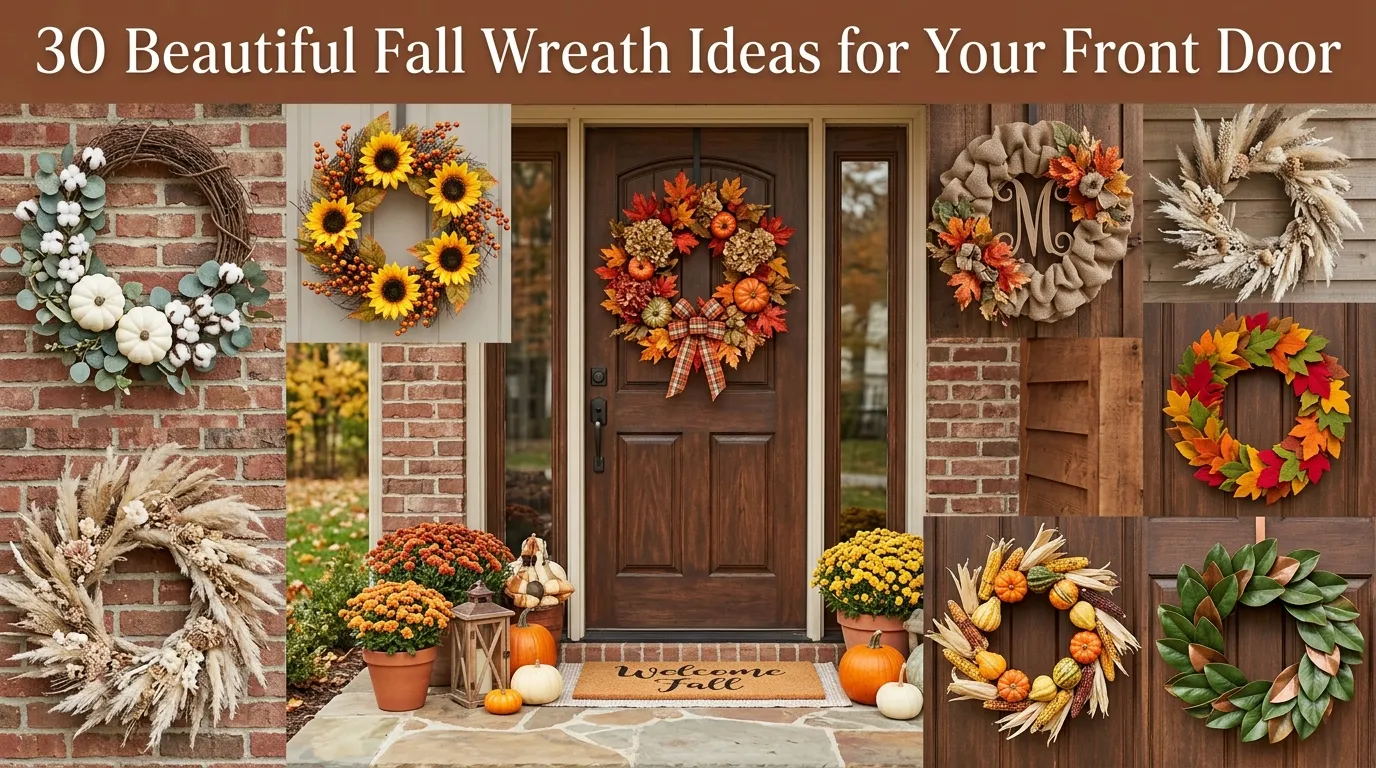
Fall wreaths are decorative door arrangements made from seasonal foliage, botanicals, and natural or dried materials, designed to celebrate the autumn palette of warm, fading color. This article delivers 30 specific fall wreath ideas for your front door, covering materials, color palettes, styles, and exactly how to recreate each one.
Think the hush of a October morning — dried leaves releasing their last pigment, the weight of a well-made wreath on a painted door, the smell of eucalyptus and cedar drifting across a porch. Fall wreath design has moved well beyond orange plastic leaves on a wire ring. Today’s front door wreaths are layered, textural, and often beautiful enough to display indoors. Here are 30 ideas worth saving — and stealing.
Why Fall Wreath Design Works So Well
Fall wreath design sits at the intersection of floral art and seasonal styling — a tradition rooted in ancient harvest customs that has evolved into one of the most practiced forms of domestic decoration in North America. The autumn wreath as a front door statement draws from the English country house tradition of using foraged seasonal materials in architectural arrangements, updated by contemporary maximalist floral design and the “dried botanicals” movement that swept through interior design post-2020.
The material vocabulary is specific and rich: dried pampas grass, preserved eucalyptus, bittersweet vine, dried cotton bolls, leucadendron, tallow berry, burgundy cockscomb, and natural grapevine base rings. The color palette centers on warm amber, burnt sienna, dusty mauve, deep burgundy, copper, muted mustard, and the chalky warm gray of dried seed pods — always anchored by at least one dark tone to prevent the arrangement from reading as uniformly bright.
The trend is driven by a convergence of forces: the sustainability movement’s embrace of dried and preserved materials over silk fakes, the rise of “cottagecore” and harvest aesthetics on Pinterest and TikTok, and a broader post-pandemic investment in the home’s exterior as a designed space. Dried botanical wreaths in particular have surged because they last the entire season — even the entire year — without water, wilting, or maintenance.
Small front doors are excellent candidates for fall wreaths. The key constraint is scale: a door under 32 inches wide reads best with a wreath of 18–22 inches diameter. Go larger and the wreath dominates; go smaller and it disappears against the door plane.
Style at a Glance
| Element | Naturalistic | Maximalist |
| Philosophy | Foraged, honest, seasonal | Layered, abundant, textured |
| Materials | Dried vine, seed pods, grasses | Velvet ribbon, cockscomb, pampas |
| Color palette | Amber, wheat, warm gray | Burgundy, copper, deep rust, mauve |
30 Fall Wreath Ideas for a Beautiful Front Door
1. Dried Pampas Grass and Eucalyptus Neutral Wreath

Vibe: Hushed. This wreath is the visual equivalent of a deep exhale — all soft edges and whisper tones.
Why it works: The combination of pampas grass and eucalyptus exploits a principle called tonal harmony — both materials exist within the same silver-cream-gray family, which means the arrangement reads as unified rather than composed. The varying textures — wispy pampas plume versus smooth round eucalyptus leaf — provide the visual interest that color contrast would normally deliver. The grapevine base contributes a warm tan that prevents the arrangement from reading as cool or wintry.
How to get it: Purchase a 24-inch natural grapevine wreath base ($12–$18) and use floral wire to attach four to five pampas plumes at varying heights — the tallest at 12 o’clock, shorter ones at 9 and 3. Fill gaps with silver dollar eucalyptus stems wired in clusters of three. No ribbon needed; the materials speak clearly on their own.
💡 Quick Win: A bundle of dried pampas grass ($8–$14 at craft stores) cut into 6-inch sections and hot-glued directly onto a foam wreath form creates a full, lush arrangement in under 30 minutes.
🛍️ Shop the Look — Amazon Product Ideas
| # | Product Search Phrase | Why It Fits |
| 1 | natural grapevine wreath base 24 inch | Wreath foundation ring |
| 2 | dried pampas grass bundle cream | Wispy wreath filler |
| 3 | preserved silver dollar eucalyptus bunch | Botanical texture layer |
| 4 | floral paddle wire green 24 gauge | Botanical attachment wire |
| 5 | wreath hanger over door adjustable | No-nail door mount |
2. Burgundy and Copper Maximalist Fall Wreath

Vibe: Rich. This wreath commands attention the way a well-set dinner table does — through deliberate abundance.
Why it works: The pairing of burgundy cockscomb and copper metallic elements exploits the analogous relationship between red-orange and red-violet on the color wheel — tones close enough to feel harmonious, distinct enough to create depth. Cockscomb’s velvety, brain-like texture absorbs rather than reflects light, which makes the copper pinecones and ribbon appear to glow by contrast. This light-and-matte interplay is the defining design move of high-end fall arrangements.
How to get it: Build on a 22-inch grapevine or foam base. Wire cockscomb heads first as the dominant material, covering approximately 60% of the base. Insert copper-sprayed pinecones (spray with Rust-Oleum metallic copper, let dry 24 hours) in clusters of three. Add dried rose heads at even intervals. Tie a 4-inch-wide copper wired ribbon bow and wire it at 8 o’clock position for asymmetric balance.
🛍️ Shop the Look — Amazon Product Ideas
| # | Product Search Phrase | Why It Fits |
| 1 | dried burgundy cockscomb bunch | Velvety wreath centerpiece |
| 2 | copper metallic spray paint pinecone | Metallic wreath accent |
| 3 | dried red rose heads bulk | Deep crimson floral layer |
| 4 | copper wired ribbon 4 inch satin | Maximalist wreath bow |
| 5 | preserved dark magnolia leaves bunch | Dark foliage base layer |
3. Simple Twig and Bare Branch Minimalist Wreath

Vibe: Still. Nothing decorative about it — and that restraint is exactly the point.
Why it works: A bare twig wreath succeeds through the design principle of negative space as content — the open areas within the circular form are as compositionally important as the twigs themselves. The circular silhouette of the wreath reads immediately as intentional even without embellishment, because the human eye interprets a perfect circle as designed rather than accidental. Against a dark door, the warm brown twig color creates a subtle but clear contrast that registers without demanding attention.
How to get it: Cut thin branches (dogwood, willow, or birch work best — flexible enough to curve without snapping) in 18-inch lengths during late fall when they’re dormant. Soak in water for two hours to increase flexibility. Wrap around a 12-inch form and secure with natural jute twine. The result is an entirely free wreath from yard pruning.
💡 Quick Win: Bundles of birch or willow branches cost $6–$10 at craft stores and wrap into a wreath form in 15 minutes — the most affordable fall wreath possible.
🛍️ Shop the Look — Amazon Product Ideas
| # | Product Search Phrase | Why It Fits |
| 1 | willow branch bundle craft floral | Flexible wreath branch |
| 2 | birch twig bunch natural | Pale bark twig texture |
| 3 | natural jute twine roll 100 ft | Wreath binding material |
| 4 | 12 inch wire wreath form bare | Internal wreath structure |
| 5 | charcoal exterior door paint sample | Door color complement |
4. Sunflower and Wheat Stalk Harvest Wreath

Vibe: Warm. This is harvest season distilled into a single object — elemental and unapologetic.
Why it works: Sunflower and wheat represent the two dominant visual languages of the autumn harvest — one botanical, one agricultural — and combining them references a design tradition stretching from Victorian harvest home décor through contemporary farmhouse styling. The sunflower’s round seed center mirrors the circular wreath form itself, creating a satisfying visual echo at the center of the arrangement. Dried wheat bundles add a vertical element that breaks the wreath’s circular plane — the only material that points outward rather than following the curve.
How to get it: Use a 22-inch straw wreath form wrapped in burlap ribbon as the base. Wire three dried sunflower heads (purchase pre-dried or dry fresh sunflowers upside-down for three weeks) in a triangular cluster at the lower half of the wreath. Bundle six to eight dried wheat stems, wrap with natural twine at the base of the bundle, and wire it horizontally across the lower third. Tuck dried amber leaves into any visible gaps.
🛍️ Shop the Look — Amazon Product Ideas
| # | Product Search Phrase | Why It Fits |
| 1 | dried sunflower head bunch natural | Harvest wreath focal point |
| 2 | dried wheat bundle natural stalk | Agricultural texture element |
| 3 | straw wreath form 22 inch | Country harvest base |
| 4 | burlap ribbon roll 4 inch | Wreath base wrap |
| 5 | dried fall leaves amber orange bag | Gap-filling foliage |
5. Monochromatic Deep Rust Wreath

Vibe: Grounded. The monochromatic commitment gives this wreath a confidence that mixed-color arrangements rarely achieve.
Why it works: Monochromatic arrangements succeed through the principle of textural contrast as substitute for color contrast — when all materials share the same hue family, the eye focuses instead on the differences in surface quality: smooth petal versus rough pod versus papery leaf. This is a technique borrowed directly from contemporary floral design, where monochromatic bouquets have largely replaced the rainbow arrangements of previous decades. The one critical rule: use at least four different materials within the same hue family to prevent the arrangement from reading as flat.
How to get it: Select four rust-tone materials: dried orange marigold or dahlia heads, dried rust-toned leaves, terracotta dried lotus pods, and burnt sienna burlap or velvet ribbon. Wire each material type in separate clusters around the grapevine base, rotating through materials as you go around the ring. The rotation creates visual rhythm without breaking color unity.
🛍️ Shop the Look — Amazon Product Ideas
| # | Product Search Phrase | Why It Fits |
| 1 | dried orange marigold heads bulk | Rust bloom focal element |
| 2 | terracotta dried lotus pod natural | Textural pod accent |
| 3 | burnt sienna velvet ribbon 3 inch | Monochromatic bow material |
| 4 | rust faux fall leaf garland | Filler leaf layer |
| 5 | sage green exterior door paint sample | Complementary door color |
6. Bittersweet Vine Wild Foraged Wreath

Vibe: Raw. Bittersweet vine looks like it arrived on your door from the woods — because essentially it did.
Why it works: American bittersweet (Celastrus scandens) is botanically spectacular in autumn — its orange husks split to reveal scarlet berries in a two-tone display that no manufactured material convincingly replicates. The design appeal is authentic seasonality: a wreath that could only exist in October and November in a specific geographic region, which makes it feel genuinely rooted in place rather than purchasable in August. The vine’s irregular, reaching form makes every bittersweet wreath slightly different.
How to get it: Harvest bittersweet in mid-October when the husks are just beginning to split. Wear gloves — the vine’s bark can irritate skin. Loosely wind harvested vine around a 22-inch grapevine base and secure with floral wire at three anchor points. Leave several stem ends loose at the bottom to trail naturally. Note: use American bittersweet only — Asian bittersweet (Celastrus orbiculatus) is an invasive species; do not plant or spread it.
🛍️ Shop the Look — Amazon Product Ideas
| # | Product Search Phrase | Why It Fits |
| 1 | bittersweet vine bunch dried floral | Signature seasonal material |
| 2 | grapevine wreath base 22 inch natural | Organic base form |
| 3 | wrought iron door knocker antique | Dark door hardware complement |
| 4 | dried leaf doormat fall natural jute | Entry zone layering |
| 5 | gardening gloves thorn resistant | Bittersweet harvest protection |
7. Velvet Pumpkin and Berry Cluster Wreath

Vibe: Layered. Every glance at this wreath finds something new — a pumpkin stem, a berry cluster, a ribbon loop hiding behind a leaf.
Why it works: Velvet pumpkins introduce a tactile quality to a front door wreath that dried botanicals alone cannot achieve — the soft, light-absorbing surface of velvet against the small round spheres creates a material tension that draws the hand as well as the eye. From a design standpoint, adding three-dimensional objects (rather than flat materials) to a wreath base creates depth and shadow, making the arrangement read differently throughout the day as light angle changes. Grouping the pumpkins in odd numbers (three) follows the fundamental visual weight rule of floral design.
How to get it: Purchase or make velvet pumpkins using fabric-covered Styrofoam balls with twig stems. Wire them in a triangular grouping on the lower two-thirds of a 20-inch grapevine base. Fill surrounding space with tallow berry sprigs and hypericum berry clusters wired in groups of five stems. Thread 1.5-inch sage green velvet ribbon loosely through the base at several points rather than tying a formal bow.
💡 Quick Win: A set of three velvet pumpkins ($18–$25 on Amazon) hot-glued directly onto an existing bare grapevine wreath form creates an instantly seasonal wreath with zero wiring skill required.
🛍️ Shop the Look — Amazon Product Ideas
| # | Product Search Phrase | Why It Fits |
| 1 | velvet fabric pumpkin set fall décor | 3D wreath focal pumpkins |
| 2 | dried tallow berry bunch white natural | Small berry wreath filler |
| 3 | hypericum berry bunch dried amber | Berry cluster accent |
| 4 | sage green velvet ribbon 1.5 inch | Soft ribbon weave |
| 5 | preserved boxwood stem bunch | Dense green filler base |
8. Dried Citrus Slice and Rosemary Aromatic Wreath

🖼️ IMAGE PROMPT: A photorealistic, ultra-detailed photograph of a fall front door wreath made of dried orange and lemon citrus slices, dried rosemary sprigs, cinnamon sticks, and dried apple slices on a greenery wreath base, hung on a white Dutch door. Lighting: soft morning. Camera angle: eye-level, straight-on. Mood: warm and aromatic. Key details: orange citrus slices showing translucent segments when backlit, cinnamon stick bundles tied with twine, dried apple slices fan-shaped. Decor accents: small welcome sign, potted rosemary topiary, warm amber candle lantern. Color palette: orange citrus, cream apple, sage rosemary green, cinnamon brown. Style tags: photorealistic, 8K resolution, Pinterest vertical 2:3 ratio, no people, magazine quality.
Vibe: Aromatic. This wreath engages smell before sight — passing guests notice the cinnamon before they see it.
Why it works: A dried citrus and spice wreath is built on the design principle of multisensory layering — it delivers visual beauty and aromatic presence simultaneously. The translucency of dried orange slices is uniquely beautiful: backlit by afternoon sun, they glow amber like stained glass. Cinnamon sticks introduce a warm brown tone and coarse texture that grounds the brighter citrus colors. This combination evokes warmth and domesticity in a way that purely botanical arrangements don’t — it communicates that people inside bake things.
How to get it: Dry orange and apple slices in an oven at 200°F for 4–6 hours, turning once, until fully desiccated but not browned. Wire onto a preserved boxwood or fresh evergreen wreath base. Bundle cinnamon sticks in groups of three with natural twine. Dried citrus wreaths are best suited to covered porches — rain will rehydrate the slices and encourage mold within days.
🛍️ Shop the Look — Amazon Product Ideas
| # | Product Search Phrase | Why It Fits |
| 1 | dried orange slice bulk bag natural | Citrus wreath centerpiece |
| 2 | cinnamon stick bundle 6 inch | Aromatic wreath spice |
| 3 | preserved boxwood wreath base 20 inch | Dense green foundation |
| 4 | dried apple slice bag craft | Pale wreath accent slice |
| 5 | natural twine baker’s twine thin | Bundle binding material |
9. Preserved Magnolia Leaf Wreath in Deep Green

Vibe: Elegant. This wreath is the botanical equivalent of a perfectly tailored coat — quietly authoritative.
Why it works: A magnolia leaf wreath succeeds through the design principle of pattern and repetition — when every leaf is laid in the same direction and overlapped at the same angle (like fish scales or roof shingles), the eye reads the wreath as a unified form rather than an assembly of parts. The preserved leaves’ two-tone quality — deep green on top, russet brown underneath — allows the color to shift across the surface as leaves catch light from different angles. This makes the wreath appear more complex than its single-material construction would suggest.
How to get it: Purchase preserved magnolia leaf stems (not fresh — they will curl and brown within a week). Starting at 12 o’clock, wire individual leaves to a 24-inch grapevine base in a clockwise direction, each leaf overlapping the previous by one-third. Use 22-gauge floral wire looped through the stem. A 24-inch wreath requires approximately 80–100 leaves.
🛍️ Shop the Look — Amazon Product Ideas
| # | Product Search Phrase | Why It Fits |
| 1 | preserved magnolia leaf stem bunch | Wreath primary material |
| 2 | grapevine wreath 24 inch flat | Shingle-style leaf base |
| 3 | 22 gauge floral wire green | Leaf attachment wire |
| 4 | brass door knocker oval | Elegant dark door hardware |
| 5 | stone urn planter outdoor large | Formal door flanking |
10. Cotton Boll and Lambs Ear Soft Neutral Wreath

Vibe: Serene. This wreath is what happens when a fall arrangement refuses to raise its voice.
Why it works: Cotton bolls and lambs ear both work through tactile visual appeal — their surfaces invite touch even in a photograph. Cotton’s fiber openness and lambs ear’s velvet nap create two contrasting forms of softness that complement rather than compete. The design principle is value contrast without color contrast: all materials exist within the same white-gray-green family, but their different light behaviors (cotton reflects, lambs ear diffuses, dusty miller refracts through its lacy edges) create visual movement without introducing a new hue.
How to get it: Build on a 20-inch preserved olive branch or sage wreath base, which provides a subtle silver-green foundation. Wire cotton boll stems in a loose cascade from 10 o’clock to 4 o’clock — the diagonal creates movement. Tuck lambs ear stems at even intervals and fill with dried dusty miller fronds. Avoid hot glue on cotton bolls — the heat can scorch the fibers.
💡 Quick Win: A $14 bundle of dried cotton bolls from a craft store, simply wired to a pre-made preserved eucalyptus wreath, takes under ten minutes and reads as a considered design decision.
🛍️ Shop the Look — Amazon Product Ideas
| # | Product Search Phrase | Why It Fits |
| 1 | dried cotton boll stems bunch | Signature soft wreath element |
| 2 | dried lambs ear silver leaves bundle | Velvety texture layer |
| 3 | dried dusty miller bunch silver | Lacy silver foliage filler |
| 4 | preserved olive branch wreath base | Subtle green foundation |
| 5 | pale blue gray exterior door paint | Complementary door tone |
11. Asymmetric Spray Wreath with Long Trailing Stems

Vibe: Dynamic. The asymmetry makes this wreath feel like it’s mid-motion — caught in the act of arranging itself.
Why it works: Traditional wreaths distribute materials evenly around the ring — asymmetric wreaths deliberately violate that expectation, creating tension between the full and empty portions of the composition. This tension is what contemporary floral designers call negative space activation — the empty areas become compositionally active rather than merely absent. The long trailing spray introduces a vertical element that extends the wreath’s reach beyond its circular form, making a 22-inch base wreath visually occupy a 40-inch space.
How to get it: Wire all materials to one side — the lower left quadrant through the bottom and slightly into the lower right — leaving the upper right of the ring completely bare. The bare grapevine in that zone reads as intentional rather than unfinished when the rest of the composition is dense. Extend three to four long-stemmed materials (dried grasses, berry branches) 14–18 inches below the ring.
🛍️ Shop the Look — Amazon Product Ideas
| # | Product Search Phrase | Why It Fits |
| 1 | dried phalaris canary grass bunch | Long trailing spray grass |
| 2 | fall berry branch dried stem bunch | Trailing berry accent |
| 3 | grapevine wreath base 22 inch | Asymmetric wreath foundation |
| 4 | brass wreath hanger adjustable large | Door mounting hardware |
| 5 | preserved eucalyptus seeded blue | Cool-tone asymmetric filler |
12. Classic Orange and Brown Maple Leaf Wreath

Vibe: Classic. This wreath is fall without apology or irony — the original and still the standard.
Why it works: A maple leaf wreath works through seasonal authenticity — the colors are not chosen to complement a door or a porch palette; they are the literal colors of October, which makes the wreath feel like evidence of the season rather than decoration for it. The overlapping shingle technique (used here as in the magnolia leaf wreath, Idea #9) creates dimension and shadow that gives the flat leaves a three-dimensional presence. The warm analog color palette — orange through red through amber — is one of the most universally appealing in human visual preference research.
How to get it: Press and dry real maple leaves by layering between newsprint under a heavy book for ten days. Alternatively, use high-quality preserved faux maple leaves (the realistic ones, not the plastic-looking ones — check the stem texture). Apply leaves from the outer edge inward using a hot glue gun, angling each leaf consistently clockwise and overlapping by one-third.
🛍️ Shop the Look — Amazon Product Ideas
| # | Product Search Phrase | Why It Fits |
| 1 | artificial maple leaf bunch fall colors realistic | High-quality leaf wreath material |
| 2 | foam wreath form 22 inch flat | Leaf-covering foundation |
| 3 | hot glue gun high temp 40 watt | Leaf attachment tool |
| 4 | low temperature hot glue sticks bulk | Leaf glue (low-temp for faux) |
| 5 | black door knocker colonial style | Classic white door hardware |
13. Lavender and Dried Herb Cottage Wreath

Vibe: Cottage-warm. This is the wreath that smells as good as it looks — an olfactory front door welcome.
Why it works: A dried herb wreath makes a design argument that most fall wreaths don’t attempt: that beauty and function can coexist in the same object. Every material here is edible or medicinal as well as ornamental, which gives the arrangement a sense of lived life that purely decorative wreaths can’t replicate. The color palette — dusty lavender, silver sage, dark bay — is unusually sophisticated for a fall wreath, occupying the cool-silver-green end of the autumn spectrum rather than the warm orange-amber range.
How to get it: Dry lavender, sage, and rosemary by hanging in small bundles upside-down in a warm, dark space for two weeks. Wire dried bundles of each herb separately, then wire the bundles onto a 20-inch grapevine base in alternating types. The repetition of bundle-bundle-bundle around the ring creates rhythm. Mist lightly with water-based fixative spray to set the materials and prevent shedding.
🛍️ Shop the Look — Amazon Product Ideas
| # | Product Search Phrase | Why It Fits |
| 1 | dried lavender bundle French | Fragrant wreath element |
| 2 | dried sage bunch culinary | Silver-green herb texture |
| 3 | dried bay leaf bunch wreath quality | Dark green herb filler |
| 4 | dried rosemary bunch aromatic | Needle-texture contrast herb |
| 5 | floral fixative spray dried botanicals | Botanical preservation spray |
14. Black and Orange Halloween-to-Thanksgiving Transition Wreath

Vibe: Moody. Dark enough for late October, warm enough for November — designed to earn its place for two full months.
Why it works: A transition wreath solves a real practical problem — most October wreaths look out of place the moment November 1 arrives, which means two sets of seasonal décor, two purchases, two storage problems. The design solution is a palette that reads as dramatic rather than themed: matte black and deep orange is inherently autumnal without being explicitly Halloween. No carved pumpkin motifs, no cartoon characters — just a color story dark enough for October and warm enough for November.
How to get it: Spray-paint pinecones and small seed pods with matte black spray paint (not gloss — the flat finish reads as sophisticated). Wire them among deep orange dried dahlias and dark burgundy preserved leaves on a grapevine base. Tie a 3-inch black grosgrain ribbon with a narrow orange edge — the restrained stripe keeps it from reading as childish.
💡 Quick Win: Matte black spray paint ($5) transforms a bag of ordinary pinecones into dramatic wreath components in 20 minutes — the fastest way to add a moody, sophisticated tone to any existing wreath.
🛍️ Shop the Look — Amazon Product Ideas
| # | Product Search Phrase | Why It Fits |
| 1 | matte black spray paint pinecones craft | Moody wreath accent material |
| 2 | dried orange dahlia head bunch | Deep orange floral focal |
| 3 | preserved burgundy preserved leaf stem | Dark foliage transition layer |
| 4 | black grosgrain ribbon orange edge | Transition wreath bow |
| 5 | black outdoor lantern LED candle set | Dark-door flanking accent |
15. Feathered Pheasant and Plume Wreath

Vibe: Rich. Feathers bring a quality of light to a wreath that dried botanicals simply cannot match — iridescent, directional, alive-feeling.
Why it works: Natural feathers introduce iridescence to a fall wreath — a quality where color shifts depending on viewing angle and light direction. Pheasant tail feathers are particularly spectacular: their base color is a warm rust-brown, but at certain angles they shift to green-gold. This iridescence means the wreath appears different in morning light versus afternoon light, giving it an unusual visual liveliness. The long feathers also extend far beyond the wreath’s circular frame, giving it a visual footprint much larger than its base suggests.
How to get it: Wire pheasant tail feathers (available at fly-fishing and craft stores — these are commercially raised feathers, not wild-harvested) to a 24-inch grapevine base at the lower two-thirds, angling outward from the center. Layer guinea fowl feathers as mid-size filler and tuck dried pampas plumes in between. A wide copper wired ribbon bow at 9 o’clock anchors the warm tone of the feathers.
🛍️ Shop the Look — Amazon Product Ideas
| # | Product Search Phrase | Why It Fits |
| 1 | natural pheasant tail feathers bulk craft | Iridescent wreath focal element |
| 2 | guinea fowl feathers spotted natural | Mid-size textural filler |
| 3 | copper metallic wired ribbon 4 inch | Warm-tone bow material |
| 4 | hunter green exterior door paint | Jewel-tone door complement |
| 5 | antler coat hooks cast iron door | Rustic door hardware accent |
16. Tallow Berry and Seeded Eucalyptus Silver Wreath

Vibe: Ethereal. Silver and white in autumn feels radical — and that’s precisely why it works.
Why it works: A silver-white wreath in a season dominated by orange and red succeeds through chromatic contrast with its context — it reads against the season itself, which makes it more memorable than any arrangement built within expected fall colors. Lunaria seed pods (the “silver dollar plant”) are one of the most optically remarkable dried materials available: their translucent seed membrane catches and diffracts light in a way that reads as luminous even in flat light conditions. Pairing them with white tallow berries and blue-gray eucalyptus keeps the palette cohesive while introducing three distinct forms of luminosity.
How to get it: Dry lunaria by hanging the entire plant stem upside-down until the outer seed coverings fall away, revealing the translucent membrane disc. Wire lunaria discs very gently — they are fragile — using thin 26-gauge wire looped through the stem, not around the disc. Build the eucalyptus and tallow berry framework first; add lunaria last as the final decorative layer.
🛍️ Shop the Look — Amazon Product Ideas
| # | Product Search Phrase | Why It Fits |
| 1 | dried tallow berry branch white natural | Small white berry cluster |
| 2 | seeded eucalyptus preserved blue | Blue-silver eucalyptus filler |
| 3 | dried lunaria silver dollar plant | Translucent wreath disc accent |
| 4 | 26 gauge floral wire thin silver | Delicate material attachment |
| 5 | mercury glass lantern door silver | Silver-tone door accessory |
17. Corn Husk and Dried Maize Rustic Wreath

Vibe: Raw. This wreath looks like it was assembled at the farm rather than at a craft table — which is its entire appeal.
Why it works: Corn husks and Indian corn are materials with zero design pretense — they are exactly what they look like, and that agricultural honesty is the source of their charm. The design principle is material integrity: using a material in its most elemental form, without painting, glittering, or reshaping it, produces an authenticity that manufactured alternatives cannot replicate. Indian corn’s multi-colored kernels — blue, red, yellow, purple, white on a single cob — create an unusual palette that reads as naturally complex without any curation.
How to get it: Soak dried corn husks in water for 20 minutes to make them pliable. Fold each husk lengthwise and wrap around a straw wreath form, securing with raffia. Once the base is covered, wire small Indian corn cobs at evenly spaced intervals around the ring — typically six to eight cobs on a 20-inch base. Tie a raffia bow at the top. Allow to fully dry for 48 hours before hanging.
🛍️ Shop the Look — Amazon Product Ideas
| # | Product Search Phrase | Why It Fits |
| 1 | dried corn husk bulk natural | Wreath base covering material |
| 2 | Indian corn cob dried mini decorative | Wreath botanical focal elements |
| 3 | natural raffia ribbon bundle | Rustic tying and bow material |
| 4 | straw wreath form 20 inch | Agricultural base ring |
| 5 | broom corn bundle decorative | Door side harvest accent |
18. Dried Hydrangea Mophead Bloom Wreath

Vibe: Romantic. Dried hydrangea has a quality of faded grandeur — the best version of beautiful-past-its-peak.
Why it works: Dried hydrangea blooms achieve their distinctive color range — the greens, mauves, and creams that fresh hydrangea never shows — through the gradual chlorophyll breakdown and anthocyanin expression that occurs during drying. This natural chemical transformation is the source of the material’s unique visual appeal; it cannot be manufactured. The design principle here is monochromatic complexity: all blooms exist within a related color family, but the natural variation within that family creates enough visual interest to make a single-material wreath feel richly layered.
How to get it: Dry hydrangea by placing cut stems in a vase with 2 inches of water and allowing the water to evaporate completely — this “dry in water” method produces the most even, fully open blooms. Wire dried heads onto a 22-inch foam base, placing the largest blooms first and filling gaps with smaller blooms. Mist with hairspray as a fixative to reduce petal shedding.
💡 Quick Win: Three fresh hydrangea stems ($6–$9 from a grocery store floral department), dried in a vase using the water-evaporation method, produce enough blooms for a small 16-inch wreath with no additional materials required.
🛍️ Shop the Look — Amazon Product Ideas
| # | Product Search Phrase | Why It Fits |
| 1 | dried hydrangea heads bulk natural | Wreath primary bloom |
| 2 | foam wreath form 22 inch round | Dense bloom foundation |
| 3 | floral hairspray fixative dried flower | Petal shedding prevention |
| 4 | brass house number door set | Navy door hardware accent |
| 5 | navy exterior door paint sample | Romantic door backdrop color |
19. Acorn and Oak Leaf Forest Floor Wreath

Vibe: Grounded. This wreath brings the feeling of walking through October woods directly to the front door.
Why it works: A forest floor wreath uses the design principle of found object curation — assembling materials that belong together naturally but have never been arranged together deliberately. Acorns, oak leaves, and woodland mushrooms exist within feet of each other in any oak woodland in autumn; placing them together on a wreath triggers a powerful association with that specific seasonal environment. The preserved moss filling creates a believable ground-cover quality that makes the wreath read as a miniature landscape rather than a decoration.
How to get it: Collect acorns with caps still attached from beneath oak trees in late September. Dry in a 200°F oven for one hour to kill any insects or larvae. Hot-glue caps back onto acorns as needed. Wire dried oak leaves and acorns onto a 20-inch grapevine base, filling gaps with preserved sheet moss glued in small patches. Use dried oyster mushroom slices (from health food stores) as the mushroom element — they are stable, dry, and food-safe.
🛍️ Shop the Look — Amazon Product Ideas
| # | Product Search Phrase | Why It Fits |
| 1 | preserved sheet moss craft decoration | Forest floor ground cover |
| 2 | artificial acorns with cap bulk | Forest wreath focal detail |
| 3 | dried mushroom slices oyster bulk | Woodland wreath accent |
| 4 | bronze faux oak leaf stem bunch | Forest floor leaf layer |
| 5 | dark cedar stain exterior door | Complementary door finish |
20. Woven Rattan and Dried Floral Boho Wreath

Vibe: Free. This wreath feels hand-assembled and personal — impossible to replicate exactly, which is the entire point.
Why it works: A boho-style wreath differs from traditional fall wreaths in its relationship to the base: rather than covering the base completely, it uses the base as a visible design element. The woven rattan ring’s texture — visible between botanical clusters — contributes to the overall composition. Dried protea heads are a sophisticated boho-fall choice: their scale is large (4–6 inches across) and their texture is architecturally complex, meaning one or two heads provide substantial visual impact without requiring dense coverage.
How to get it: Begin with a 16-inch rattan or bamboo ring. Wrap sections of the ring with natural macramé cord (3mm single strand), leaving other sections of the rattan bare. Wire dried pampas tufts and protea heads in loose, irregular groupings. At the base of the ring, attach three to five long feathers (12–18 inches) with wire covered in cord — these hang freely and move in the breeze.
🛍️ Shop the Look — Amazon Product Ideas
| # | Product Search Phrase | Why It Fits |
| 1 | rattan ring wreath base 16 inch natural | Boho visible base element |
| 2 | natural macramé cord 3mm single strand | Ring wrapping material |
| 3 | dried protea head bunch craft | Large boho floral focal |
| 4 | long natural feathers 14 inch craft | Hanging base drape |
| 5 | woven jute door mat natural boho | Entry floor texture match |
21. Winter Squash and Gourd Novelty Wreath

Vibe: Playful. Nothing signals harvest abundance quite like the lumpy, cheerful irregularity of a decorative gourd.
Why it works: Dried ornamental gourds and mini squash introduce sculptural three-dimensionality to a front door wreath — objects with mass and shadow, rather than flat or low-profile botanical materials. The design principle is surprise through material choice: gourds are not traditionally thought of as wreath materials, which makes their appearance on a wreath immediately engaging. Their irregular, warty surfaces catch light in complex ways, creating an object that rewards close inspection.
How to get it: Small ornamental gourds (purchased in September at farm markets) can be dried for wreath use by placing in a single layer on a wire rack in a warm, well-ventilated space for 4–6 weeks. Rotate weekly. Fully dried gourds are lightweight and hollow-sounding. Wire through the stem base using 20-gauge wire to secure to the wreath ring. If gourds show mold during drying, wipe with a dilute bleach solution.
🛍️ Shop the Look — Amazon Product Ideas
| # | Product Search Phrase | Why It Fits |
| 1 | decorative dried gourds mini assorted | Novelty wreath focal elements |
| 2 | mini ornamental pumpkin artificial set | Reliable gourd alternative |
| 3 | 20 gauge floral wire stem wrap | Heavy botanical attachment |
| 4 | large grapevine wreath base 28 inch | Wide base for gourd weight |
| 5 | heirloom pumpkin decorative set | Porch step flanking display |
22. Monogram Letter Fall Wreath

Vibe: Personal. The monogram turns a seasonal wreath into a statement about who lives here.
Why it works: A monogram letter at the wreath’s center converts the arrangement from a seasonal decoration into a piece of personalized architectural signage — it says something specific about the household rather than just announcing the season. The design principle is focal point clarity: the letter gives the eye an immediate landing point, which means the surrounding botanical ring can be simpler than it would need to be in a wreath without a center element. The letter and the ring are in visual dialogue; each needs the other to be complete.
How to get it: Purchase an unfinished wooden letter (10–12 inches works well for most wreath sizes) and paint with chalk paint in deep burgundy or warm copper. Sand lightly when dry for a matte finish. Wire the letter to the center of a 24-inch grapevine base before adding botanical material — secure with figure-eight wire loops at the letter’s top and bottom. The botanicals frame the letter; don’t obscure it.
💡 Quick Win: A painted wooden letter ($4–$8 at craft stores) hot-glued directly to any existing pre-made fall wreath adds personalization instantly — the highest-impact upgrade per dollar in fall wreath decoration.
🛍️ Shop the Look — Amazon Product Ideas
| # | Product Search Phrase | Why It Fits |
| 1 | unfinished wood letter large 12 inch | Monogram wreath centerpiece |
| 2 | chalk paint deep burgundy small pot | Letter painting medium |
| 3 | fall botanical wreath pre-made base | Botanical surround base |
| 4 | copper wired ribbon craft 3 inch | Bow above monogram |
| 5 | personalized welcome doormat initial | Coordinating entry mat |
23. Preserved Olive Branch and Fig Leaf Wreath

Vibe: Warm. Mediterranean botanical materials bring a different quality of light — older, slower, more golden — than typical fall choices.
Why it works: Olive branches and fig leaves reference a design tradition entirely separate from the American fall-harvest aesthetic — Mediterranean and Middle Eastern botanical symbolism, where these plants carry associations with abundance, peace, and antiquity. Using them in an autumn wreath creates an unexpected cultural layering that reads as well-traveled and considered. The two-tone quality of olive leaves — silver-green on top, pale silver underneath — produces a shimmering, wind-like effect as the arrangement moves slightly.
How to get it: Preserved olive branches (professionally preserved, not fresh cut — fresh olive leaves brown quickly) are available from specialty floral suppliers and some import stores. Wire them in overlapping layers around a 22-inch grapevine base, allowing the natural branch curves to create organic movement. Add dried fig halves (sliced and dried at 175°F for 8 hours) on their stems as an unusual focal element.
🛍️ Shop the Look — Amazon Product Ideas
| # | Product Search Phrase | Why It Fits |
| 1 | preserved olive branch stem bunch | Mediterranean wreath primary |
| 2 | preserved fig leaf artificial bunch | Large lobed leaf accent |
| 3 | artificial olive pick with fruit | Wreath olive accent detail |
| 4 | terracotta urn planter outdoor | Mediterranean door flanking |
| 5 | iron wall lantern Mediterranean | Door zone lighting accent |
24. Dried Pods and Seed Head Architectural Wreath

Vibe: Architectural. Seed pods are autumn’s most underused material — structurally complex objects that reward slow looking.
Why it works: Dried seed pods are the skeletal remains of a plant’s reproductive system — their forms are determined entirely by function, which is why they are so visually compelling. Lotus pods’ honeycomb chambers, nigella’s angular ridged spheres, and poppy pods’ crown-topped capsules are all structurally specific in ways that purely decorative objects rarely are. A wreath composed entirely of these materials reads as a natural history display as much as seasonal decoration — intellectual as well as beautiful.
How to get it: Source lotus pods, nigella seed pods (love-in-a-mist), and poppy pods from dried floral wholesalers or farmers markets in late summer. Wire stems with 22-gauge wire to extend their reach. Build the wreath using the largest pods (lotus) as anchors and smaller pods as filler, rotating between types to avoid clusters of identical material. The natural color range is sufficient — no paint or spray required.
🛍️ Shop the Look — Amazon Product Ideas
| # | Product Search Phrase | Why It Fits |
| 1 | dried lotus pod bunch natural | Architectural wreath anchor |
| 2 | dried nigella seed pod bunch | Spherical pod texture layer |
| 3 | dried poppy pod bunch natural | Capsule pod accent |
| 4 | dried thistle head bunch silver | Silver-fuzz texture element |
| 5 | espresso dark brown door paint sample | Rich-tone door complement |
25. Hops Vine and Barley Fall Wreath

Vibe: Harvest-warm. Hops vine is one of autumn’s most underrated botanical materials — papery, fragrant, and unmistakably seasonal.
Why it works: Dried hops cones have a quality unique in the wreath-making world: they are papery and semi-translucent, which makes them catch and transmit light differently from solid botanical forms. The pale green-gold color is unusual for fall — most autumn materials range from orange through deep red — which makes a hops wreath visually distinctive even within a fall-decorated porch. Hops also retain a faint, pleasant herbal scent when dried, adding the aromatic dimension that most purely visual wreaths lack.
How to get it: Purchase hops vine (Humulus lupulus) in September from homebrew supply stores — they sell dried hops in quantity at low cost. Loosely wind vine portions around a 22-inch grapevine base, allowing cones to face outward. Add dried barley stalks (from farm supply or craft stores) in two or three loose bunches tied with natural twine and wired to the lower portion of the ring.
🛍️ Shop the Look — Amazon Product Ideas
| # | Product Search Phrase | Why It Fits |
| 1 | dried hops whole cone bulk natural | Distinctive fall hop material |
| 2 | dried barley stalk bunch craft | Agricultural grain accent |
| 3 | amber satin ribbon 3 inch wired | Warm tone bow material |
| 4 | antique amber glass jug decorative | Entry zone rustic accent |
| 5 | script welcome sign wooden door | Personal entry signage |
26. Autumn Berry and Rosehip Foraged Wreath

Vibe: Wild. This wreath looks plucked from a hedgerow — exactly the quality it’s trying to convey.
Why it works: Berry-heavy wreaths exploit the jewel effect in botanical design — small, intensely colored spheres against a neutral or green background function like gemstones in a setting, concentrating color into points rather than distributing it in masses. Rosehips are botanically specific to late autumn (they redden after the first frost), which gives this wreath a precise seasonal authenticity. The thorny stems of rosehip are typically considered a handling challenge — here they’re a design asset, contributing to the wild, unmanicured quality.
How to get it: Harvest rosehips after the first hard frost — they are softer and more pliable at this stage and will dry in place on the wreath. Wear thick gardening gloves. Wire thorny stems to the grapevine base carefully, anchoring at the non-thorny portions. Add dried hawthorn berry clusters and bittersweet vine sections for variety. This wreath is best on a covered porch — moisture will cause the hips to rot if exposed to repeated rain.
💡 Quick Win: A single bundle of dried rosehip stems ($8–$12 at craft stores) wired to a plain grapevine ring creates an instant foraged look with zero additional materials needed.
🛍️ Shop the Look — Amazon Product Ideas
| # | Product Search Phrase | Why It Fits |
| 1 | dried rosehip branch stem bunch | Wild berry wreath centerpiece |
| 2 | hawthorn berry cluster dried artificial | Secondary berry element |
| 3 | thick thorn-proof garden gloves | Safe rosehip handling |
| 4 | cottage sage green door paint | Wild wreath door color |
| 5 | iron boot scraper outdoor entry | Cottage entry accent |
27. Buffalo Check Ribbon and Pinecone Lodge Wreath

Vibe: Cozy. This wreath announces warmth before the door opens — fire, flannel, and pine.
Why it works: Buffalo check ribbon has become one of the defining decorative elements of the farmhouse-to-lodge aesthetic continuum — its bold graphic pattern (large squares in high contrast) creates a visual anchor that coordinates all other materials around it. The pattern is large enough to read at 20 feet (from the street) and distinctive enough to set the wreath’s tone immediately. Pairing it with natural pinecones and evergreen creates an indoor-outdoor material conversation: the textile (ribbon) references the warm interior while the botanicals reference the cold exterior.
How to get it: Build on a 24-inch fresh or preserved evergreen wreath base. Wire five to seven large pinecones at irregular intervals around the ring. Insert red winterberry or holly berry clusters at alternating points. Tie a generous bow from 4-inch-wide wired buffalo check ribbon — a bow with 5-inch loops and 8-inch tails reads proportionally on a 24-inch base. Attach the bow at the 10 o’clock position.
🛍️ Shop the Look — Amazon Product Ideas
| # | Product Search Phrase | Why It Fits |
| 1 | buffalo check ribbon 4 inch wired black red | Signature lodge bow material |
| 2 | large pinecone natural ponderosa | Lodge wreath anchor element |
| 3 | preserved evergreen wreath base 24 inch | Dense green foundation |
| 4 | red winterberry branch artificial | Red berry wreath accent |
| 5 | antler wreath hanger door rustic | Lodge-style door mounting |
28. Minimalist Single-Element Eucalyptus Ring Wreath

Vibe: Calm. This wreath is a whisper in a season that tends to shout — and it carries further for it.
Why it works: A single-element wreath is the most demanding form of seasonal decoration to execute well, because there is nothing to hide behind — the material choice, the circular form, and the binding technique are all fully exposed. The design principle is confident minimalism: the assumption that one well-chosen material, presented cleanly, communicates more than ten materials competing for attention. Blue-gray eucalyptus is the optimal choice for this treatment — its leaf color is unusual enough to be interesting and its form is consistent enough to read as a unified whole.
How to get it: Bind 20–25 preserved eucalyptus stems into a tight bundle and shape into a circle approximately 18 inches in diameter, securing the overlap with 3mm natural jute twine. Wrap the twine at 1-inch intervals around the entire ring to compress the stems and prevent splaying. Hang with a simple loop of the same jute twine. No base ring needed — the stems support themselves.
🛍️ Shop the Look — Amazon Product Ideas
| # | Product Search Phrase | Why It Fits |
| 1 | preserved eucalyptus stem bunch blue gray | Single-element wreath material |
| 2 | 3mm jute twine natural 100 ft | Wreath binding material |
| 3 | gold brass door knocker oval | Minimalist door hardware |
| 4 | preserved boxwood topiary ball 8 inch | Door side flanking accent |
| 5 | forest green exterior door paint | Eucalyptus complement color |
29. Thanksgiving-Specific Gratitude Wreath with Text Element

Vibe: Meaningful. A Thanksgiving wreath should say something — this one says it in copper wire at the center of the arrangement.
Why it works: Introducing a word element to a wreath gives the arrangement a communicative dimension that purely botanical compositions lack. The copper wire script exploits material-message alignment: copper reads as warm, handcrafted, and valuable — it elevates the word “grateful” from a sentiment to a small work of art. Surrounding the word with harvest materials (corn, wheat, gourds) places it explicitly in the American Thanksgiving tradition while the copper finish keeps the arrangement from feeling kitschy.
How to get it: Copper wire word signs are widely available as standalone decorative objects — mount the word sign to the wreath center using two points of 22-gauge wire looped behind the sign. Build the botanical base first, leaving the center of the grapevine ring open for the sign. Use dried mini corn cobs, wheat bundles, and amber fall leaves as the primary materials — each references the harvest origin of the Thanksgiving holiday specifically.
🛍️ Shop the Look — Amazon Product Ideas
| # | Product Search Phrase | Why It Fits |
| 1 | copper wire word sign grateful script | Thanksgiving focal text element |
| 2 | mini dried corn cob decorative bunch | Harvest wreath accent |
| 3 | dried wheat bundle natural Thanksgiving | Agricultural gratitude symbol |
| 4 | fall amber leaf garland bundle | Warm tone base filler |
| 5 | woven door mat autumn tones | Entry floor complement |
30. Layered Year-Round Base with Swappable Seasonal Center

Vibe: Considered. The smartest wreath idea on this list — one investment, four seasons of seasonal front door character.
Why it works: A modular wreath solves the fundamental economics of seasonal decoration: instead of purchasing, storing, and discarding a new wreath for each season, the outer ring stays permanent while only the center cluster changes. The design principle is structural permanence with surface changeability — the wreath’s silhouette and scale are consistent year-round, which means the door develops a visual identity, while the seasonal center communicates the current time of year. A preserved evergreen and eucalyptus base ring looks appropriate in every season and requires no seasonal storage.
How to get it: Invest in a high-quality 24-inch preserved evergreen or dried boxwood base ring ($25–$40). Fashion a simple wire hook attachment system using two bent S-hooks that clip to the inner edge of the ring. Create four small seasonal clusters — one per season — each approximately 8–10 inches wide on a small grapevine ring, attached with the same S-hook system. Store three clusters while displaying one. The seasonal center clusters cost $8–$15 each in materials.
💡 Quick Win: A small pre-made seasonal pick cluster ($6–$10 at craft stores) clipped to any existing evergreen wreath with a single floral wire hook achieves the same swappable concept without building a dedicated clip system.
🛍️ Shop the Look — Amazon Product Ideas
| # | Product Search Phrase | Why It Fits |
| 1 | preserved boxwood wreath base 24 inch | Permanent year-round foundation |
| 2 | S hook stainless 2 inch set | Swappable center attachment |
| 3 | small grapevine ring 10 inch | Seasonal cluster base |
| 4 | fall botanical pick cluster orange | Autumn swappable center |
| 5 | wreath storage bag 30 inch zippered | Year-round wreath storage |
How to Start Your Fall Wreath Transformation
The single best first move is selecting the right base ring before any materials — and the right base for almost every fall wreath is a 22-inch natural grapevine ring. This specific diameter and material anchors everything else: it is large enough to read from the street, proportionally correct for most standard door widths, and its warm tan color works behind any fall palette without competing. Changing to a straw form or a foam form changes the tonal foundation of the entire arrangement; start with grapevine and work forward.
The most common beginner mistake is using too many materials in too many colors simultaneously. A wreath with six botanical types in four unrelated colors reads as a craft project rather than a composed design object. The fix is the 3-material rule: choose three botanical materials maximum, establish one dominant (covering 50–60% of the base), one secondary (20–30%), and one accent (10–15%). This proportion creates visual hierarchy without restriction.
Three items under $50 that create immediate wreath-quality impact: a bundle of dried pampas grass ($8–$12) in cream or blush, a spool of 3-inch wired velvet ribbon in burgundy or copper ($9–$14), and a 22-inch natural grapevine wreath base ($12–$18). These three items alone produce the foundation for at least six of the wreaths in this article.
Realistically, a first fall wreath takes 45–90 minutes to assemble with pre-gathered materials. A full seasonal switch of four or five wreaths takes 2–3 hours total if materials are organized. Budget-wise, a DIY fall wreath using the grapevine-plus-three-materials approach costs $25–$55, versus $65–$180 for a comparable pre-made wreath at a home décor retailer. The modular wreath from Idea #30 is the highest long-term value: one $35–$40 base investment yields four years of seasonal changes for $8–$15 per cluster.
Frequently Asked Questions About Fall Wreath Front Door Ideas
What is the difference between a fall wreath and a harvest wreath?
A fall wreath is a broad category covering any seasonal arrangement for autumn, from minimalist twig rings to bohemian botanical compositions. A harvest wreath is a specific subcategory that emphasizes agricultural materials — corn, wheat, gourds, dried grains — referencing the literal harvest season. All harvest wreaths are fall wreaths, but fall wreaths with pampas grass, eucalyptus, or preserved florals are not harvest wreaths. If your goal is a porch that reads as warm and seasonal rather than specifically farm and harvest, choose fall-palette botanical materials over strictly agricultural ones.
What color ribbon looks best on a fall wreath?
The three most universally effective ribbon choices for fall wreaths are: 3-inch wired velvet ribbon in burgundy (deepens any fall palette, works on both light and dark doors), 4-inch wired satin ribbon in copper metallic (adds warmth and glamour to neutral botanical wreaths), and 2.5-inch wired grosgrain in black-and-red buffalo check (grounds lodge-style and farmhouse arrangements). Avoid shiny satin in orange — it reads as Halloween-specific rather than fall-general. Wired ribbon is always worth the slight price premium over unwired: the wire holds the bow loops open, which means the bow reads three times larger at the door’s viewing distance.
How much does a fall wreath cost to make versus buy?
A well-made DIY fall wreath using a 22-inch grapevine base and three botanical materials costs $25–$55 in supplies, with tools (wire cutters, paddle wire, hot glue gun) adding $20–$35 for a first-time builder. A comparable pre-made fall wreath at a home goods retailer costs $65–$180; at an artisan market or Etsy, $85–$250. The break-even point is approximately two DIY wreaths — after that, the tool investment has paid for itself and each subsequent wreath costs materials only.
Can I leave a fall wreath outside in rain?
It depends on the materials. Preserved eucalyptus, dried pampas grass, dried seed pods, and faux-leaf arrangements handle light rain reasonably well on covered porches. Dried citrus slices (Idea #8), corn husks (Idea #17), dried hydrangea (Idea #18), and bittersweet vine (Idea #6) are significantly more moisture-sensitive and should be positioned under a covered overhang or brought inside during heavy rain. As a general rule: any wreath made primarily of paper-textured botanicals needs rain protection; any wreath made of woody or resin-coated materials can tolerate moderate exposure.
Which fall wreath material lasts the longest?
Preserved magnolia leaves (Idea #9) and preserved boxwood are the most durable fall wreath materials available — professionally preserved with glycerin, they hold their form and color for two to three years with minimal fading. Dried pampas grass lasts one to two full seasons. Dried citrus slices, fresh-dried florals, and natural corn husks last one season at most. The longest-lasting wreath overall is the modular evergreen base from Idea #30 — the preserved boxwood or evergreen ring itself can last three to five years, with only the seasonal center cluster requiring annual replacement.
Ready to Create Your Dream Fall Front Door Wreath?
These 30 ideas cover the full range of fall wreath design — from monochromatic color stories and single-material minimalism to layered maximalist arrangements and foraged botanical compositions. A front door transformation doesn’t require committing to a full 30-wreath project; one well-chosen wreath in the right scale for your door width changes the entire visual character of your home’s entry. This week, pick up a 22-inch grapevine wreath base and one bundle of dried pampas grass or preserved eucalyptus — that’s the entire materials investment for your first fall wreath. Done well, a fall wreath doesn’t just decorate a door — it signals that the people inside pay attention to the season, to materials, to the small beautiful things. Pin the ideas that made you pause longest — the ones that matched your door color, your porch character, your instinct for whether you want warm abundance or quiet restraint.