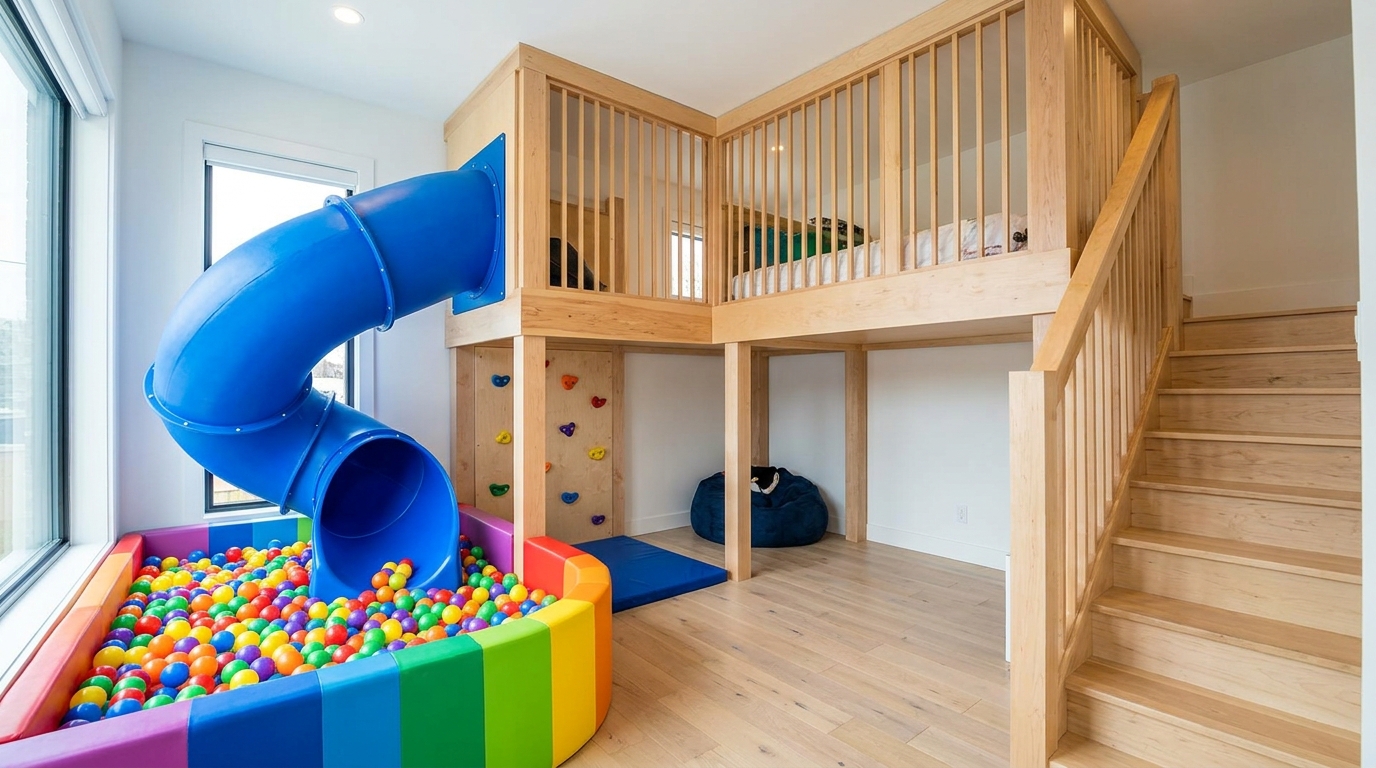
A playroom is a dedicated space designed to spark imagination, contain creative chaos, and give kids a world that feels entirely their own. This article gives you exactly 28 playroom ideas — spanning color, storage, lighting, furniture, layout, and more — so you can build a space your child will actually want to live in.
There’s a particular kind of magic in a well-designed playroom. It hums with color and invitation, every corner holding a quiet promise of adventure. It’s the room where a cardboard box becomes a spaceship and the floor is lava at least three times a week. Here are 28 ideas worth saving — and stealing.
Why a Thoughtfully Designed Playroom Works So Well
A great playroom isn’t just a room with toys in it. It’s an environment deliberately engineered to support how children actually play — which is messily, loudly, in phases, and all at once. The best playroom design draws from Montessori principles (child-led, accessible, orderly), Scandinavian nursery aesthetics (clean, natural, calm without being sterile), and the creative freedom of the maker-space movement. What sets it apart from a cluttered spare room is intentionality: every surface, zone, and storage solution has a job to do.
Materials in a well-designed playroom are tactile and durable: natural birch plywood for shelving, soft bouclé or wool rugs underfoot, matte-painted walls in dusty sage or warm white that won’t show scuffs. Color matters enormously — studies in environmental psychology consistently show that oversaturated, high-contrast rooms increase agitation in children, while mid-tone, earthy palettes (terracotta, soft yellow-green, warm cream) support focused, sustained play.
The playroom is trending harder than ever right now because post-pandemic families rethought how their homes function. With more time at home, parents invested in dedicated play spaces that could serve multiple functions — creative studio, reading nook, homework corner — rather than a catch-all toy dump. Pinterest searches for “playroom ideas” have been consistently among the top home decor queries for three consecutive years.
Even small spaces can achieve a genuinely functional playroom. The priority for compact rooms is vertical storage and zone definition — a single wall of low, open shelving creates dedicated toy zones without eating floor space. What small rooms can’t always accommodate is a separate reading alcove and an active play zone simultaneously; in that case, a foldable climbing structure or a loft bed with a play area underneath is the smartest square-footage investment you can make.
Style at a Glance
| Element | Detail |
| Philosophy | Child-led, organized, imaginative |
| Materials | Birch plywood, wool felt, cotton canvas, rubber flooring |
| Color palette | Warm white, dusty sage, terracotta, soft mustard, natural oak |
28 Genius Playroom Ideas Kids Will Love
1. The Color-Blocked Accent Wall
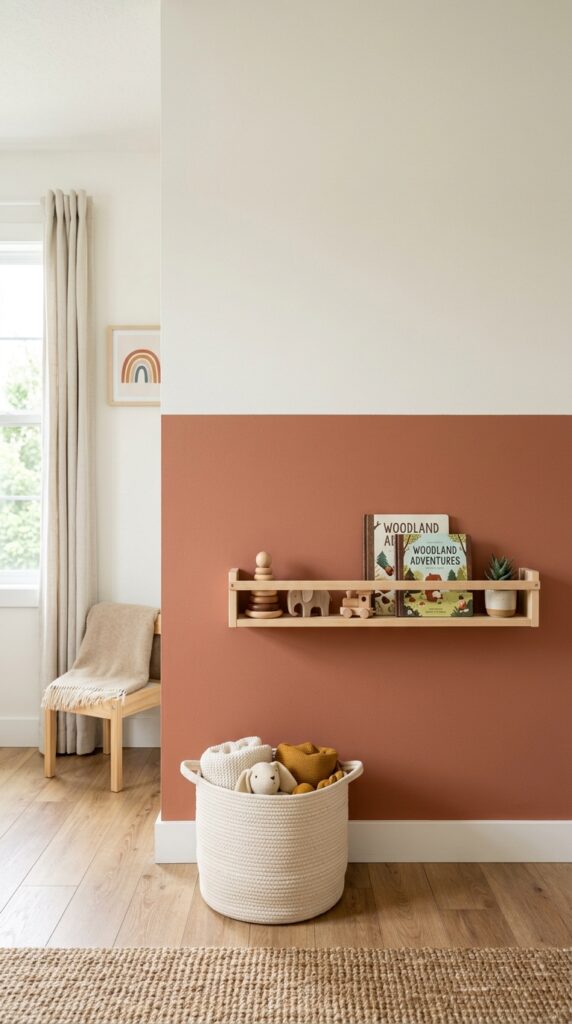
Grounded. A color-blocked wall gives a playroom its emotional anchor without requiring a single piece of furniture to do the heavy lifting.
The design principle here is visual weight management. By placing the deeper, warmer tone (terracotta, dusty rose, or mushroom) on the lower half of the wall at chair-rail height — roughly 36 inches up — you’re mimicking the natural color gradient of the earth, which reads as inherently stable. The upper pale tone keeps the room feeling tall and airy. This technique comes directly from classic two-tone wainscoting, updated for a more graphic, modern sensibility.
To execute it, use a laser level to score a clean horizontal line at 36 inches, tape precisely, and apply Benjamin Moore’s “Pale Oak” OC-20 on top and “Pueblo” 2175-30 below. Two coats of matte finish on each side. The edge between them becomes a design feature, not a flaw.
💡 Quick Win: Painter’s tape + a laser level = a perfectly clean color-block edge for under $15. Roll on two separate colors in one afternoon.
🛍️ Shop the Look — Amazon Product Ideas
| # | Product Search Phrase | Why It Fits |
| 1 | Terracotta matte wall paint sample set | Tone tests before committing |
| 2 | Low wooden Montessori toy shelf birch | Anchors the lower tone zone |
| 3 | Woven cotton storage basket terracotta | Repeats accent wall color |
| 4 | Laser level wall painting tool | Clean color block edge |
| 5 | Wall-mounted pegboard small hooks playroom | Adds function to the feature wall |
2. Low Open Shelving for Independent Access
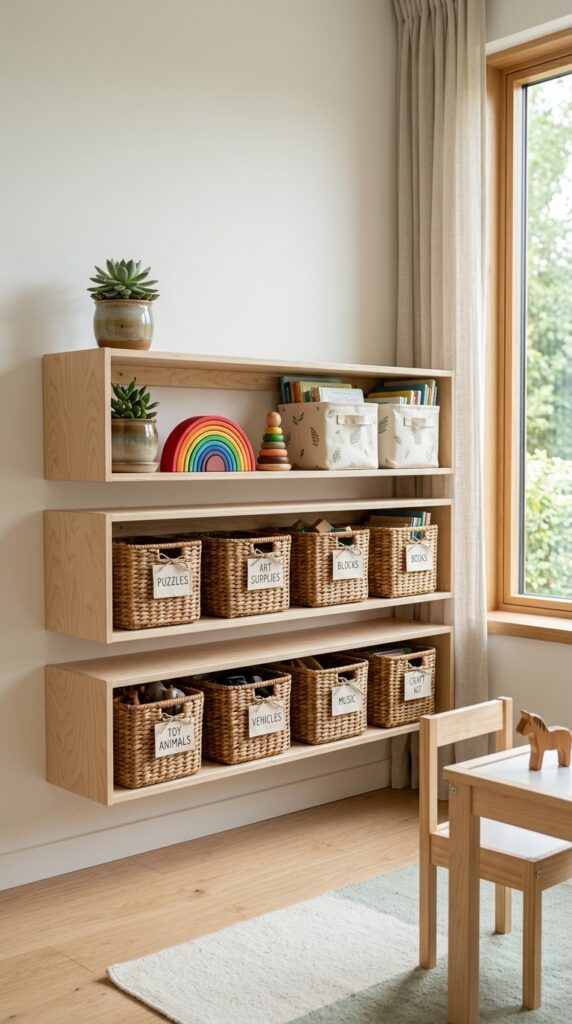
Orderly. Low, open shelving is the single most impactful structural choice you can make in a playroom — it gives children physical and psychological access to their own things.
The Montessori philosophy of “a place for everything, visible and reachable” is what drives this choice. When toys are behind closed cabinet doors or in deep bins, they become invisible and forgotten — which is why the playroom floor ends up buried. Open shelving at 8–12 inches off the ground means a three-year-old can find, use, and return toys independently. Visual organization also reduces the “I’m bored” refrain, because children can actually see their options.
Use IKEA’s KALLAX unit turned on its side, or build custom shelving from 3/4-inch birch plywood with a single 1-inch rounded front edge. Mount it securely to wall studs with L-brackets. Label wicker bins with picture labels (not just words) for pre-readers.
🛍️ Shop the Look — Amazon Product Ideas
| # | Product Search Phrase | Why It Fits |
| 1 | Low wooden Montessori open bookshelf natural birch | Core piece of this idea |
| 2 | Wicker storage basket with handles small | Open bin storage on shelves |
| 3 | Chalkboard labels self-adhesive bins | Picture/word labeling system |
| 4 | Wooden toy organizer divider tray | Keeps shelf zones defined |
| 5 | Anti-tip furniture wall anchor strap | Safety mounting for shelves |
3. A Dedicated Reading Nook with a Canopy
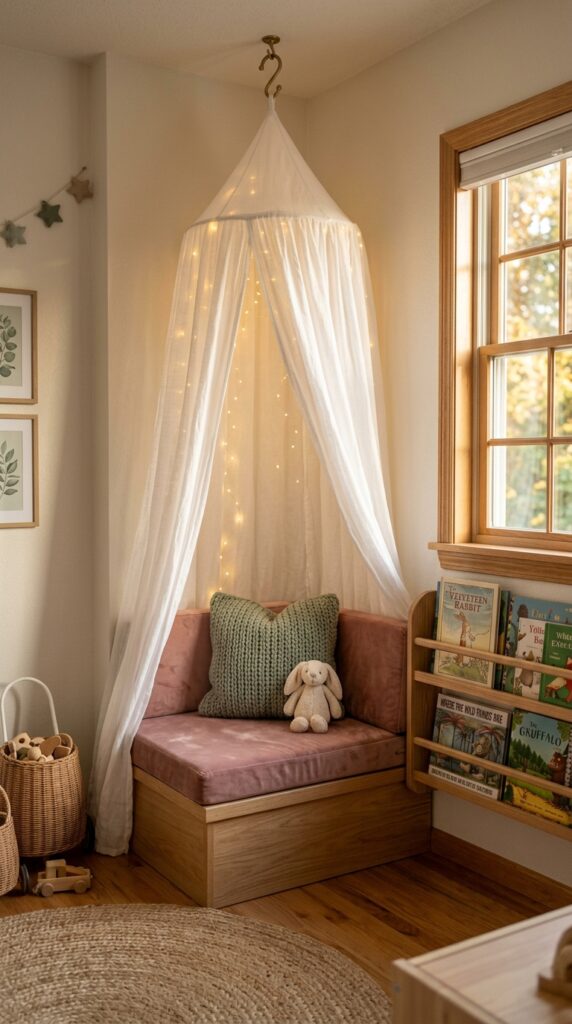
Hushed. A reading nook signals to a child’s nervous system: this is a place to be still, and that contrast with active play is developmentally priceless.
The canopy overhead creates what designers call “enclosure without confinement” — it defines a cozy micro-space within the larger room without walls or doors, triggering a sense of safety and calm. The human brain responds to overhead coverage at around 7 feet or lower as intimate and sheltering. A full ceiling room (9+ feet) reads as activating; a canopied corner reads as restful.
Mount a single ceiling hook, then drape a 2-panel white linen or sheer cotton canopy (sold as mosquito netting or bed canopies) over it in a tent shape. Keep the cushion low — around 8 inches of seat height — so small children climb in independently. Add a forward-facing book ledge at knee height beside it.
💡 Quick Win: A $20 bed canopy from Amazon, one ceiling hook, and a throw pillow creates a complete reading nook in 20 minutes.
🛍️ Shop the Look — Amazon Product Ideas
| # | Product Search Phrase | Why It Fits |
| 1 | White linen bed canopy ceiling hook kids | The defining element of this nook |
| 2 | Floor cushion kids reading nook velvet dusty rose | Low, soft seating |
| 3 | Forward-facing wall mounted book ledge white | Books as decoration + access |
| 4 | Warm white fairy string lights battery operated | Canopy lighting detail |
| 5 | Small knit throw pillow neutral nursery | Soft texture layering |
4. Soft Rubber Flooring Tiles in a Warm Neutral
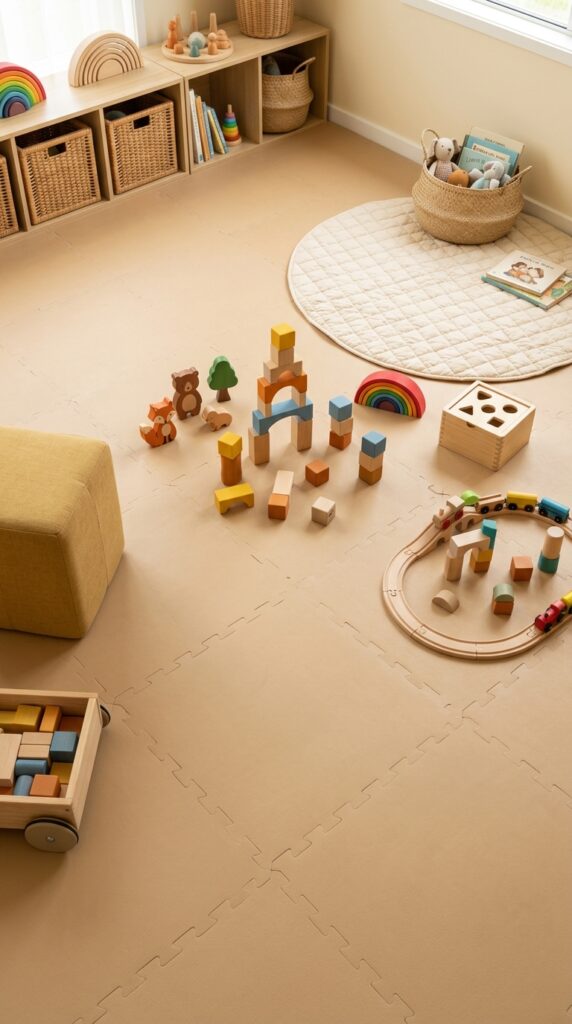
Cushioned. Rubber or EVA foam flooring tiles in a neutral tone do the unglamorous but essential work of making a playroom safe, quiet, and warm underfoot — while looking far more considered than the primary-colored patchwork you might expect.
The design principle is base layer neutrality. By keeping the floor in a warm, quiet tone — sandy beige, pale gray, or oatmeal — you’re creating a visual reset button that makes colorful toys and decor read as intentional rather than chaotic. Bright foam tiles compete visually with everything placed on top; neutral ones recede and let the room’s color story unfold through furniture and accessories instead.
Look for Greatmats or Norsk brand interlocking rubber tiles in sizes 2×2 feet; a 9×9 foot room needs about 20 tiles. Avoid the ultra-bright primary-color sets. The matte rubber finish is more durable and easier to clean than EVA foam for toddler-and-up rooms.
🛍️ Shop the Look — Amazon Product Ideas
| # | Product Search Phrase | Why It Fits |
| 1 | Interlocking foam floor tiles neutral beige playroom | Core flooring element |
| 2 | Rubber gym floor tile 2×2 foot matte | More durable flooring alternative |
| 3 | Round cotton braided area rug playroom cream | Soft zone on top of tiles |
| 4 | Foam puzzle mat with borders neutral | Edge-finishing pieces |
| 5 | Toy storage caddy with wheels neutral | Moveable storage on hard floor |
5. A Chalkboard Wall Panel for Open-Ended Art
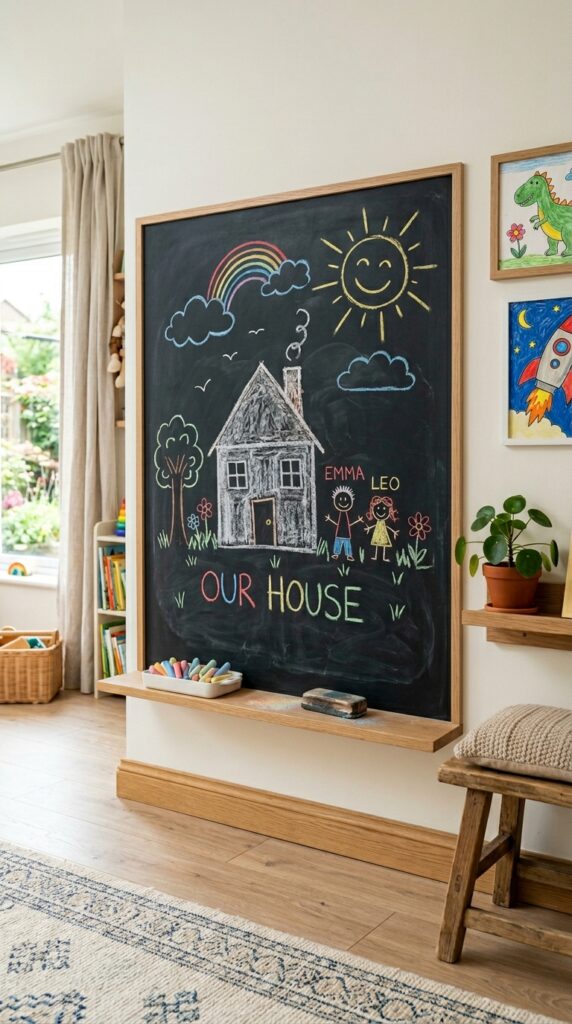
Creative. A chalkboard panel on the lower wall transforms an otherwise static surface into the most-used design feature in the room — one that regenerates itself endlessly.
The key design move here is framing. Chalkboard paint applied as a full-wall feature can feel utilitarian and cold; bordered with simple 1×3-inch poplar or pine molding painted white, it becomes a purposeful element that reads as intentional art installation rather than afterthought. The frame also visually contains the drawing activity, signaling to children that this is the designated space for it — which subtly redirects them from the walls they shouldn’t be drawing on.
Apply two coats of Rust-Oleum Chalkboard Spray Paint or brush-on formula in matte black, let cure for 48 hours, then “season” the surface by rubbing chalk sideways across the whole panel and erasing it before first use. This prevents ghost images from permanent first drawings.
💡 Quick Win: Rust-Oleum Chalkboard Paint in a quart can covers about 12 square feet. A 3×4-foot panel costs under $15 in paint and transforms a blank wall entirely.
🛍️ Shop the Look — Amazon Product Ideas
| # | Product Search Phrase | Why It Fits |
| 1 | Chalkboard paint quart brush-on black | Core material for this idea |
| 2 | Wood wall molding trim paintable pine 8 foot | Framing the chalkboard panel |
| 3 | Chalk sticks colored non-toxic classroom | Tools for the wall |
| 4 | Small wooden wall ledge art display | Holds chalk + finished drawings |
| 5 | Magnetic chalkboard board with wood frame | Alternative to painted wall |
6. A Loft Bed with a Play Zone Underneath
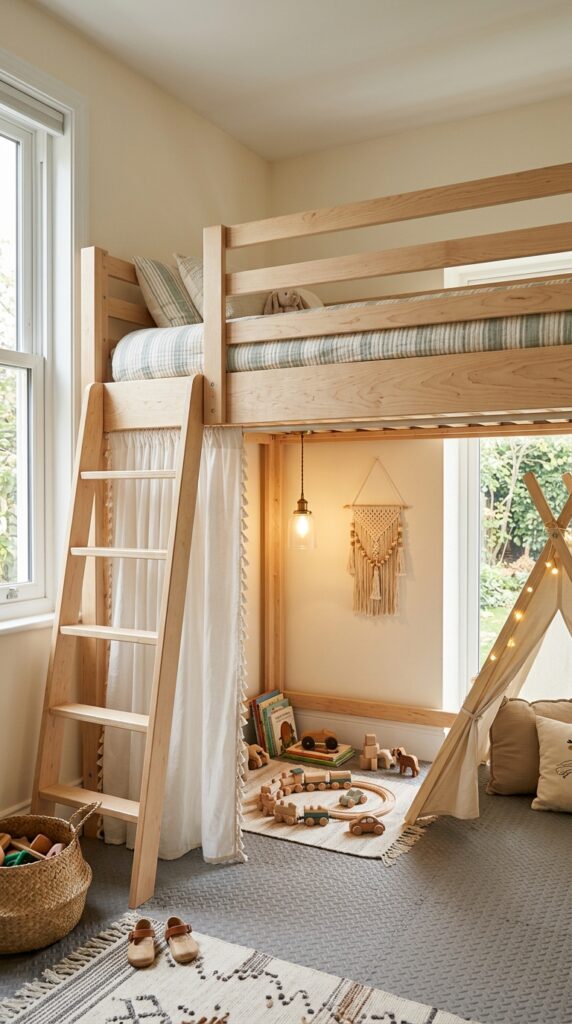
Adventurous. A loft bed is one of the most efficient square-footage moves in a small playroom — it stacks the sleeping zone above the play zone, literally doubling the functional area of a single room.
The design principle is vertical zoning. Children instinctively respond to the under-loft space as a den or hideout — a lower-ceiling enclosure that creates psychological safety and focused play. Hang a simple white cotton curtain from the loft frame on a tension rod to make the space feel like its own room-within-a-room. This “curtained den” technique dramatically increases the time children spend in independent, imaginative play because it triggers the “secret space” response in the brain.
Choose a loft bed with a clearance of at least 48 inches below (not the full room height) — enough for a child to sit, stand, and move. STOMPA or CABIN BED brands make solid wood options with this clearance. Mount a small battery-operated puck light under the loft for reading or sensory play.
🛍️ Shop the Look — Amazon Product Ideas
| # | Product Search Phrase | Why It Fits |
| 1 | Solid wood loft bed with ladder kids natural | Core furniture piece |
| 2 | Tension rod curtain panel cotton white with tassels | Creates the den curtain |
| 3 | Battery operated LED puck lights warm white | Under-loft lighting |
| 4 | Small teepee kids play tent cotton | Further defining the play zone |
| 5 | Round woven jute rug small natural | Grounds the under-loft floor zone |
7. A Soft Mustard Ceiling for Unexpected Warmth
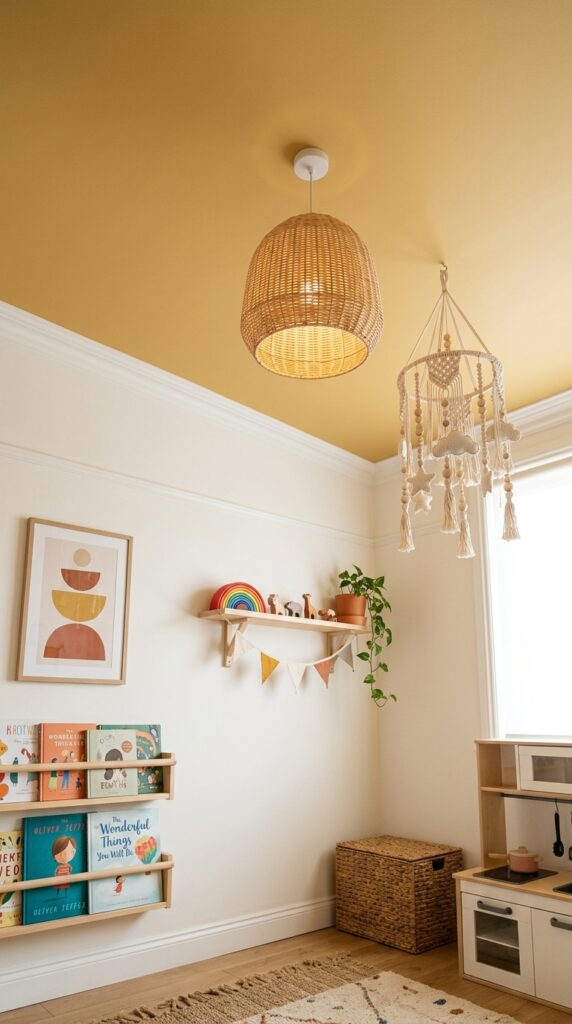
Sun-warmed. Painting a ceiling in a soft, warm tone is the sleeper move in playroom design — almost nobody does it, which means it reads as genuinely considered rather than copied from a trend board.
The design mechanic at work is color reflection. A mustard or warm ochre ceiling bounces a golden quality of light down onto all four walls, making even north-facing rooms feel bathed in afternoon warmth. This is the same principle used in restaurant design to make food look more appealing — warm ceiling color shifts the ambient light toward the red/yellow end of the spectrum, which the brain reads as cozy and inviting. The ceiling also “lowers” visually, making tall rooms feel more intimate and play-focused.
Use Benjamin Moore “Golden Straw” 2152-40 or Farrow & Ball “Babouche” No. 223 in an eggshell or matte finish. Apply ceiling paint first before tackling walls to avoid cutting in twice. One gallon covers a 10×10-foot ceiling with one coat.
💡 Quick Win: A single quart of ceiling paint in soft mustard ($12–18) transforms the entire mood of a playroom for the cost of an afternoon project.
🛍️ Shop the Look — Amazon Product Ideas
| # | Product Search Phrase | Why It Fits |
| 1 | Rattan pendant light shade ceiling fixture | Warm material to pair with yellow ceiling |
| 2 | Macramé hanging mobile kids room nursery | Ceiling-hung decor detail |
| 3 | Ceiling paint roller extension pole kit | Tool for the ceiling project |
| 4 | Wall color fan deck warm white undertones | Matching wall paint to mustard ceiling |
| 5 | Plush stuffed animal mobile ceiling hang | Visual play with the ceiling zone |
8. A Gallery Wall at Kid Height
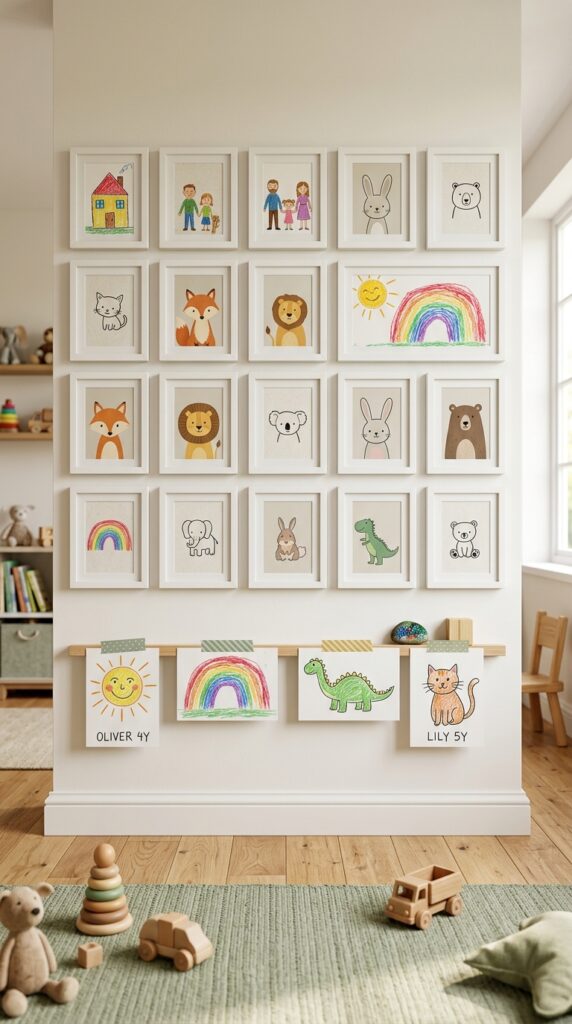
Personal. Mounting art at child height rather than adult height isn’t just charming — it’s a fundamental act of respect for the child’s perspective that they feel without being able to articulate.
The design principle is scale empathy. Most playrooms still hang pictures at adult eye level (56–60 inches), which means a three-year-old never actually connects with the art in their own room. Dropping the gallery to 24–36 inches creates a room that literally speaks to its occupant at their level. Include a mix of framed prints and framed samples of the child’s own artwork — rotating the latter through a simple clip-frame system makes the wall feel alive and evolving.
Use removable adhesive strips (Command Strips, large size, 5-lb capacity) rather than nails so the gallery can be easily updated as the child grows and their artwork evolves. A consistent frame style — all white, all natural wood, or all black — reads as curated even when the content inside is wildly varied.
🛍️ Shop the Look — Amazon Product Ideas
| # | Product Search Phrase | Why It Fits |
| 1 | White thin-border photo frame set 4×6 5×7 | Gallery wall core frame |
| 2 | Command strips large picture hanging adhesive | No-nail mounting for kids rooms |
| 3 | Children’s art print animal illustration sage | Curated print to mix with artwork |
| 4 | Clip frame front-loading kids artwork display | Easy art rotation system |
| 5 | Wall art ledge white small floating | Rotating display shelf below gallery |
9. A Sensory Corner with Textured Basket Storage
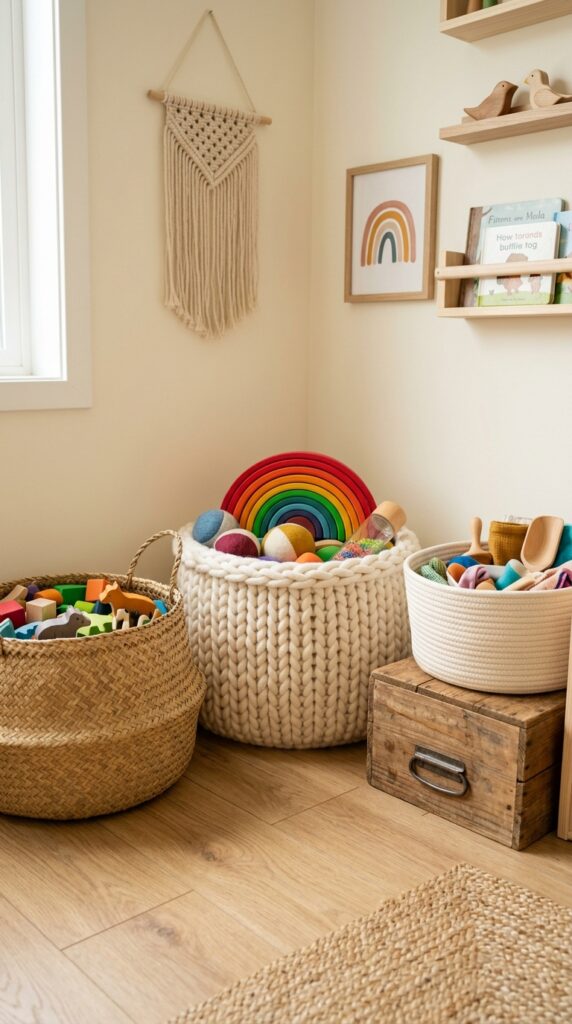
Tactile. A sensory corner organized through varied basket textures does double duty — it provides genuinely valuable tactile input for children while looking like a considered design feature rather than a storage dumping ground.
The concept draws from occupational therapy principles about sensory integration: children (especially those who are sensory-seeking) benefit from materials that vary in texture, weight, and flexibility. Organizing toys into baskets that are themselves textually differentiated — a chunky-knit bin for soft toys, a rigid seagrass bin for building blocks, a smooth cotton-rope bin for art supplies — creates an intuitive sorting system that children internalize quickly because the container feels like its contents.
Use baskets in three or four complementary neutral textures at floor level in a corner, arranged in a loose semicircle. The key is restraint in color — keep baskets in naturals (cream, tan, sand, warm gray) so the variation reads through texture rather than competing through hue.
💡 Quick Win: Three texture-varied baskets from the same neutral palette ($12–18 each) instantly organize a messy corner into something that looks intentional.
🛍️ Shop the Look — Amazon Product Ideas
| # | Product Search Phrase | Why It Fits |
| 1 | Seagrass storage basket with handles large | Rigid texture bin for blocks |
| 2 | Chunky knit storage basket cream nursery | Soft texture for plush toys |
| 3 | Cotton rope woven basket natural large | Smooth contrast texture |
| 4 | Wooden toy crate small stackable | Adds a wood material variation |
| 5 | Sensory toy set toddler tactile exploration | Fills the sensory corner with purpose |
10. Magnetic Paint + Magnet Wall for STEM Play
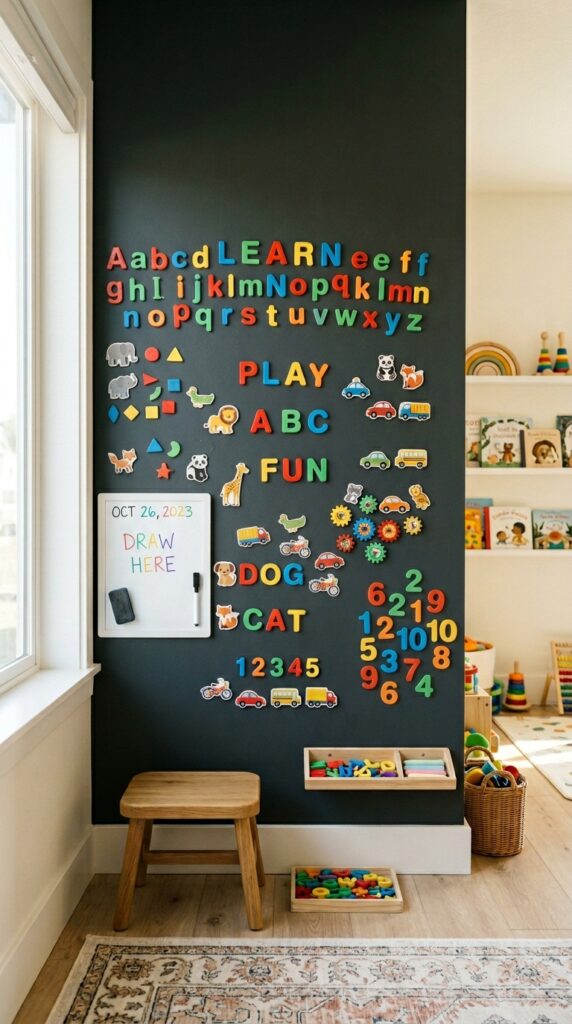
Curious. A magnetic wall panel is the kind of playroom feature that sounds like a gimmick until you watch a child spend 45 uninterrupted minutes rearranging letters — then it becomes the most valuable square foot in the house.
The design logic is open-ended engagement. Unlike toys with a single correct outcome, a magnetic wall has no rules: it’s a reconfigurable surface that supports phonics, story-building, spatial reasoning, and simple cause-and-effect exploration simultaneously. The charcoal magnetic paint tone is intentional — it makes the primary colors of educational magnets pop visually, and reads as a considered design accent rather than a grey accident.
Apply Rust-Oleum Magnetic Primer in three to four coats (more coats = stronger magnetic pull), then topcoat with a matte latex paint in Sherwin-Williams “Tricorn Black” SW-6258 or a softer charcoal to tone it down. The primer alone has weak magnetic hold; four coats raises it substantially. Limit the magnetic zone to one wall section (3×4 feet) to maintain design clarity.
🛍️ Shop the Look — Amazon Product Ideas
| # | Product Search Phrase | Why It Fits |
| 1 | Rust-Oleum magnetic primer paint 30 oz | Core functional material |
| 2 | Foam magnetic alphabet letter set uppercase | Age-appropriate STEM magnets |
| 3 | Magnetic dry erase whiteboard sheet wall | Dual-function add-on surface |
| 4 | Magnetic number puzzle tiles colorful | Math play for the magnetic wall |
| 5 | Magnetic tile building set kids STEM | Compatible floor-and-wall toy |
11. Warm-Toned String Lights as Ambient Lighting
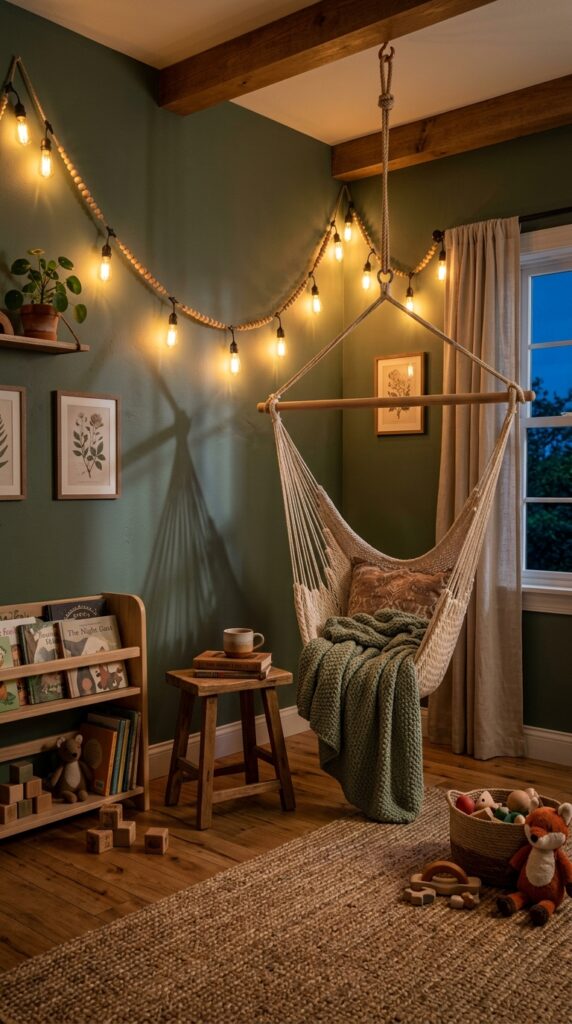
Luminous. String lights in a playroom aren’t a decoration — they’re a lighting layer that gives children (and parents) control over the mood of the space in a way that a ceiling fixture simply cannot.
The lighting design principle here is layered ambient light. Most playrooms rely on a single overhead ceiling fixture that produces flat, even, somewhat institutional illumination. String lights along the upper wall perimeter or in a swag pattern create what’s called “perimeter lighting” — the eye is drawn to the edges of the room rather than the center, which makes the space feel wider, more contained, and dramatically cozier. Warm 2200K Edison-style bulbs produce a golden quality of light that reduces cortisol — genuinely helpful for winding down before nap or bedtime.
Use plug-in string lights with a long enough cord to hide along crown molding or baseboards. Command hooks at 8-inch intervals keep swags consistent. Choose 25-foot or 33-foot lengths to create graceful catenary curves rather than taut, utilitarian runs.
💡 Quick Win: A $15 set of warm white plug-in string lights and a box of Command hooks transforms a flat-lit playroom into a layered, magical space in under an hour.
🛍️ Shop the Look — Amazon Product Ideas
| # | Product Search Phrase | Why It Fits |
| 1 | Warm white Edison string lights plug in 25 feet | Core lighting element |
| 2 | Command hooks small wire adhesive pack | Swag mounting without nails |
| 3 | Woven cotton hammock chair kids hanging | Pairs with the cozy lighting corner |
| 4 | Rattan hanging pendant lamp shade kids | Permanent warm-toned fixture |
| 5 | Wooden bead curtain natural window room | Texture accent in lit corner |
12. A Modular Climbing Wall on One Surface
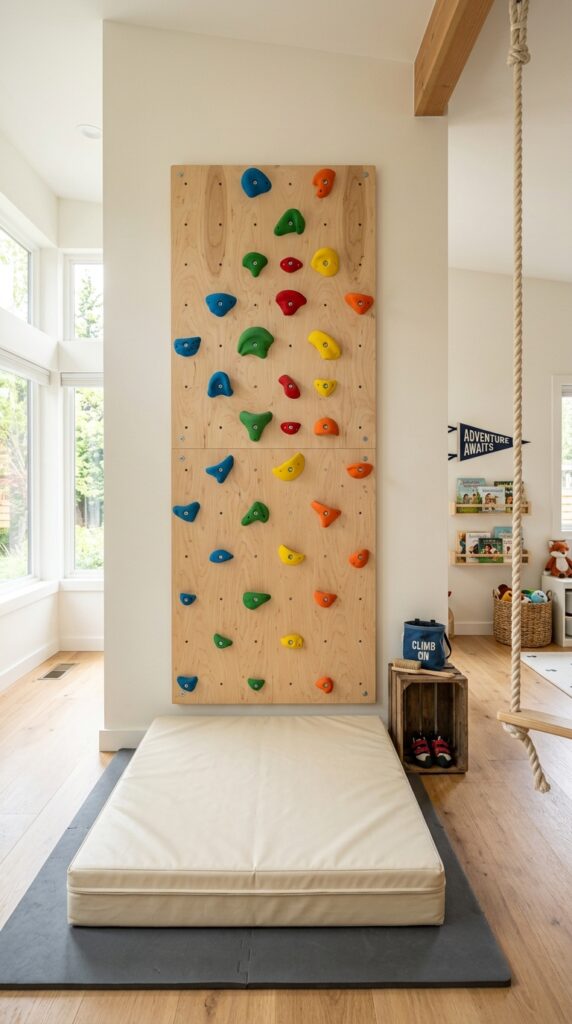
Raw. A climbing wall is the most honest response to the fact that children’s bodies need to move vertically as much as horizontally — and mounting one indoors transforms the most-dreaded rainy afternoon into the highlight of the week.
The design principle is proprioceptive function. Climbing involves whole-body problem-solving — reading the hold positions, planning the sequence, managing weight distribution — that develops coordination, spatial reasoning, and risk assessment simultaneously. Confining this activity to a single, dedicated wall (rather than the furniture) also protects the rest of the room from becoming a climbing gym. A 4×8-foot birch plywood panel, properly anchored into wall studs with lag bolts, can safely support a child’s weight with the right holds.
Buy a pre-drilled climbing wall plywood kit (brands like Kilter or Everlast make them) or purchase 3/4-inch Baltic birch plywood and drill T-nut holes yourself in a regular pattern. Set holds in a beginner-friendly diagonal progression. A 2-inch-thick foam crash mat immediately below is non-negotiable.
🛍️ Shop the Look — Amazon Product Ideas
| # | Product Search Phrase | Why It Fits |
| 1 | Kids indoor climbing wall panel with holds | Complete kit for one wall section |
| 2 | T-nut climbing holds set colorful 20 piece | Add-on holds for custom wall |
| 3 | Foam crash mat gymnastics 2 inch thick | Safety mat below climbing wall |
| 4 | Lag bolt anchor hardware kit plywood wall | Secure mounting hardware |
| 5 | Indoor rope swing hang ceiling kids | Complementary active play element |
13. A “Calm Corner” with Sensory Lighting
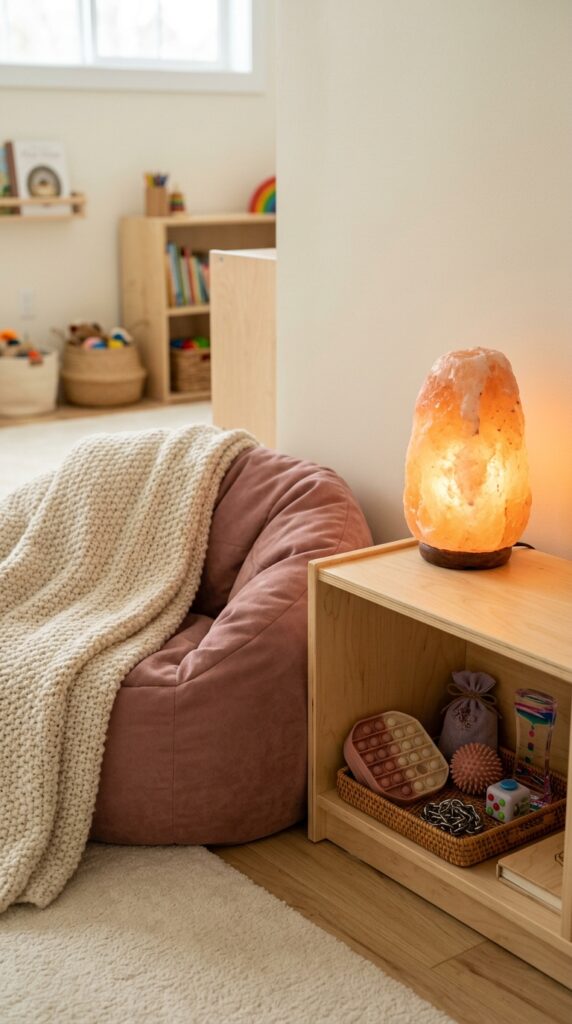
Still. A calm corner gives children — especially those who are sensory-sensitive or emotionally dysregulated — a designated space to return to themselves, which is a skill that serves them for life.
The principle is sanctuary by design. Rather than treating emotional regulation as a disciplinary measure (“go to your room and calm down”), building a calm corner into the playroom normalizes self-regulation as a neutral, available option. The warm amber glow of a Himalayan salt lamp produces low-intensity light in the 2000–2200K range, which reliably reduces cortisol in children. The weighted blanket, if used, applies deep pressure that activates the parasympathetic nervous system. These aren’t fringe wellness claims — they’re evidence-based tools used in occupational therapy settings.
Position the calm corner furthest from the active play zones, ideally in a corner with two walls for maximum enclosure. Resist the urge to add books, toys, or distractions. The corner works because of what’s NOT there.
💡 Quick Win: A small Himalayan salt lamp ($15–25) plugged into this corner provides the sensory lighting anchor the entire concept needs, and doubles as a nightlight.
🛍️ Shop the Look — Amazon Product Ideas
| # | Product Search Phrase | Why It Fits |
| 1 | Himalayan salt lamp small warm glow USB | Core sensory lighting element |
| 2 | Bean bag chair microfiber kids dusty rose | Soft seating for the corner |
| 3 | Weighted lap blanket kids 5 lb sensory | Deep pressure calming tool |
| 4 | Silicone sensory fidget set calm corner | Tactile self-regulation tools |
| 5 | Wicker shallow tray display natural small | Organizing the sensory tools neatly |
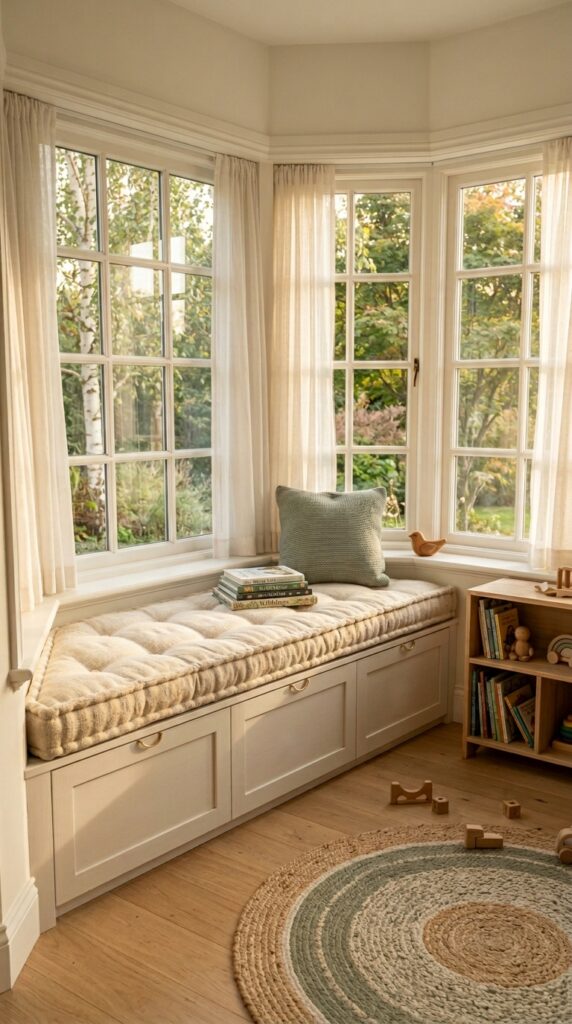
14. Built-In Window Seat with Toy Storage Below
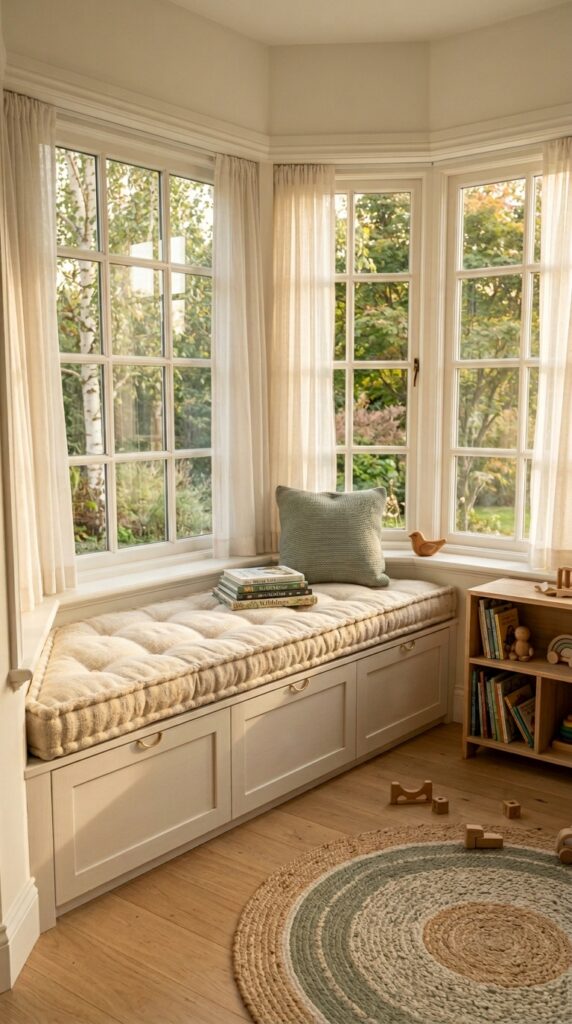
Sun-warmed. A window seat with built-in storage is the playroom’s most versatile square footage — it offers seating, natural light, storage, and a view from a single piece of architecture.
The design principle is multi-function per square foot, which is the governing logic of all smart small-space design. The seat height (typically 18 inches) is comfortable for adults sitting to read alongside children, while a child can climb up independently at around age three. The lift-top storage below is ideal for bulky or seasonal toy categories — dress-up costumes, building sets, puzzles — that don’t need daily access but shouldn’t be banished to a closet.
A beginner-level DIY version uses a standard Expedit or Kallax unit on its back, topped with a plywood panel and 3-inch foam upholstered in a durable linen (Crypton-backed linen handles spills). A simple piano hinge on the foam lid creates lift-top access. Professional versions use MDF cabinet construction with full-extension drawer slides.
🛍️ Shop the Look — Amazon Product Ideas
| # | Product Search Phrase | Why It Fits |
| 1 | Storage bench seat with flip lid toy chest | Ready-made version of this idea |
| 2 | Upholstery foam 3 inch sheet cut-to-size | DIY seat cushion material |
| 3 | Piano hinge heavy duty storage chest lid | Lift-top mechanism hardware |
| 4 | Sheer cotton curtain panel rod pocket white | Window treatment for the seat area |
| 5 | Linen fabric by yard crypton performance | DIY cushion upholstery material |
15. Pegboard Organization Wall with Hooks and Baskets
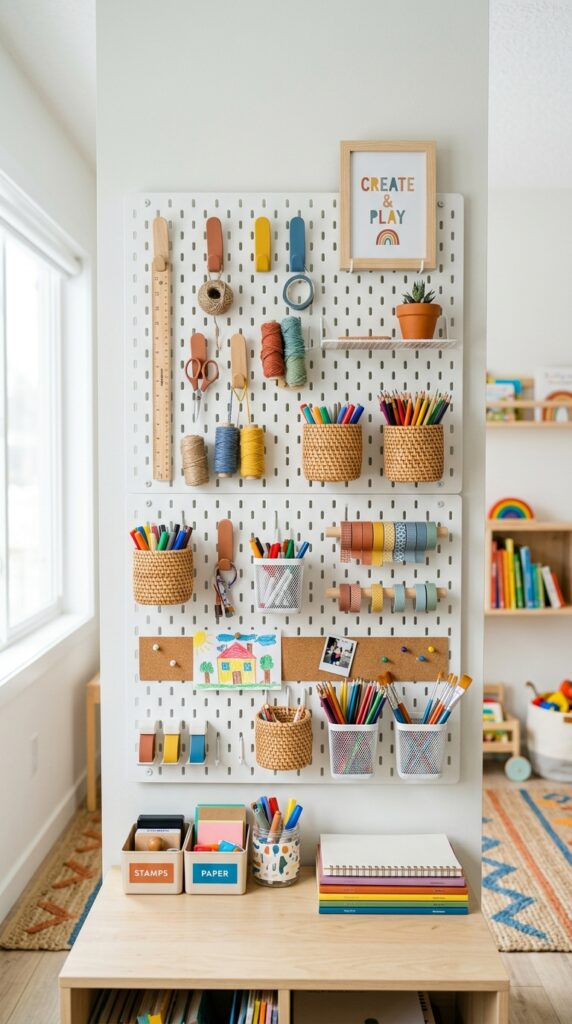
Organized. A pegboard art supply wall is the intersection of function and display — it makes the creative tools of the playroom visible, accessible, and beautiful simultaneously.
Pegboard works on the principle of frictionless accessibility. When art supplies require opening drawers or cabinets, children skip using them. When they’re mounted at eye height in visible, reachable cups and hooks, they become the default creative tool of choice. Studies in child development show that visible, accessible art materials dramatically increase the frequency and duration of creative play in children between ages 3 and 8.
Mount a 4×4-foot sheet of 1/4-inch pegboard (pre-primed and painted white) at child-appropriate height — top edge at 60 inches, so most of the board is reachable from floor level. Use wooden dowel hooks rather than wire hooks for a warmer aesthetic. Small wooden or mesh cups hold crayons, markers, scissors, and glue sticks vertically.
🛍️ Shop the Look — Amazon Product Ideas
| # | Product Search Phrase | Why It Fits |
| 1 | White pegboard panel 24×24 inch with hardware | Core wall element |
| 2 | Wooden peg hooks 1/4 inch board accessories | Warm-toned hooks |
| 3 | Metal mesh cup pegboard holder small | Art supply cup for the board |
| 4 | Washi tape decorative roll set kids | Displayed on the board |
| 5 | Non-toxic washable markers kids 20 color | Supplies to fill the cups with |
16. A Dusty Sage Green Feature Wall
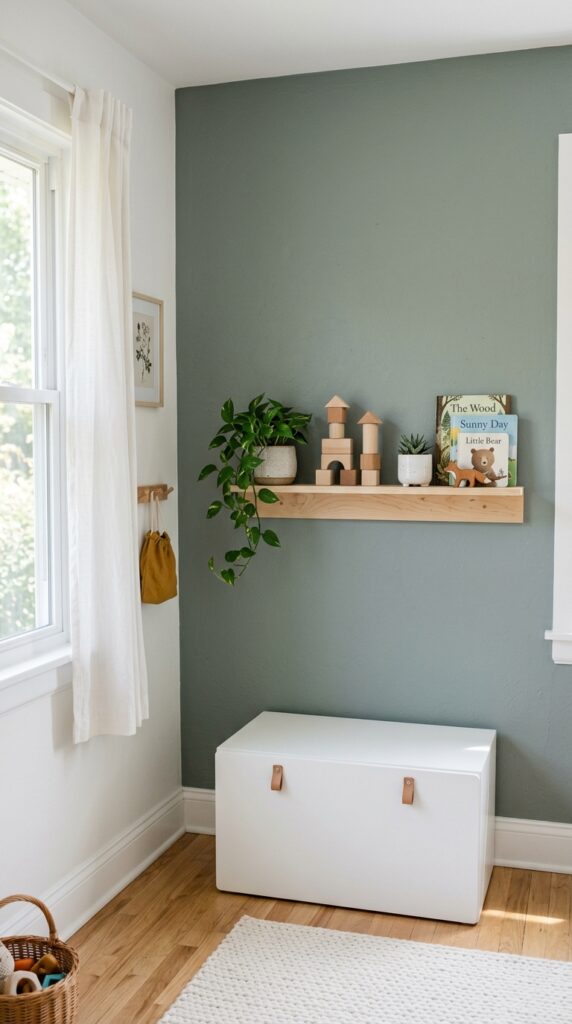
Grounded. Dusty sage green is the most enduring neutral accent color in contemporary children’s room design — it reads as both calming and alive, nature-adjacent without being novelty, and it ages gracefully as children grow from toddler to tween.
The science of this color choice is psychoacoustic. Muted greens with a gray undertone — think Benjamin Moore “Saybrook Sage” HC-114 or Farrow & Ball “Mizzle” No. 266 — sit in the same color family as foliage and moss, which the human visual system has evolved to read as a “rest state” environment. This is in contrast to pure greens or lime tones, which increase alertness. For a space where you want both active play and quiet concentration, dusty sage threads the needle.
Paint one wall only, all other walls remaining in warm white. The contrast between the sage wall and the white woodwork (baseboards, window trim, door casing) must be crisp — use semi-gloss white trim paint for a clean boundary.
💡 Quick Win: A single sample pot of sage green paint ($5–8) lets you test a large swatch before committing — paint a 2×2-foot patch and live with it for 24 hours across different lighting conditions.
🛍️ Shop the Look — Amazon Product Ideas
| # | Product Search Phrase | Why It Fits |
| 1 | Peel and stick wallpaper sage green textured | Non-commitment sage accent option |
| 2 | Wall paint sample pots muted green gray | Color testing before full commitment |
| 3 | Ceramic plant pot small white matte kids shelf | Decor for the sage wall shelf |
| 4 | Small pothos trailing plant starter | Living green accent on sage wall |
| 5 | White trim paint semi-gloss quart | Crisp contrast woodwork |
17. A Corner Teepee as a Quiet Play Zone
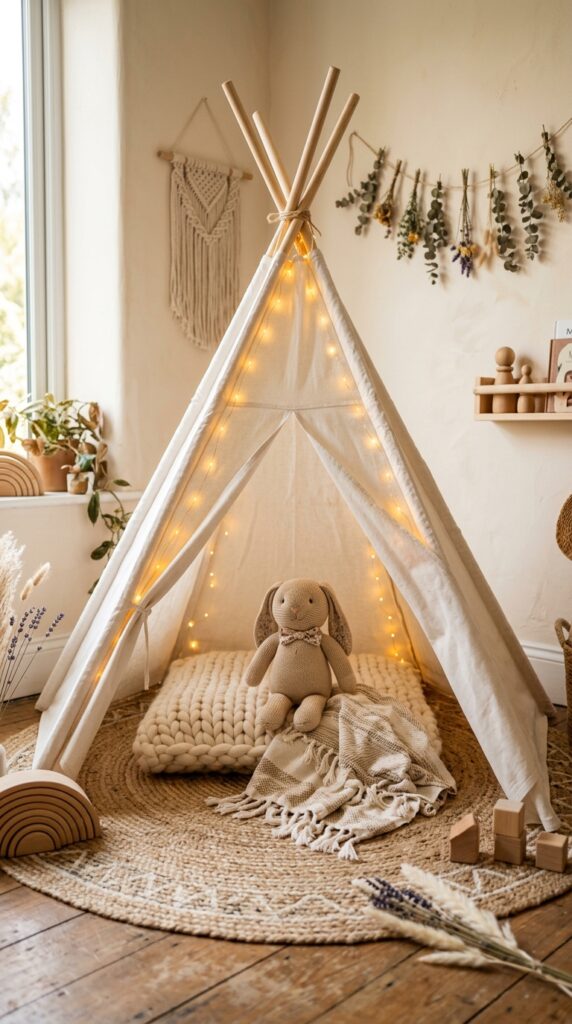
Magical. A cotton teepee occupies about 9 square feet of floor space and delivers an outsized return in imaginative play value — it transforms a corner into an entire world.
The developmental case for enclosed play spaces is robust: children between 2 and 7 years are in Piaget’s “preoperational stage” of development, during which symbolic and imaginative play reaches its peak. A teepee or other defined enclosure activates the brain’s “place cell” system — the child’s mind assigns a narrative identity to the contained space (fort, spaceship, shop) and sustains play in that narrative for dramatically longer than in open floor space.
Choose a teepee with a natural cotton canvas (not shiny polyester) and a real wood pole frame — the material authenticity matters for both the aesthetic and the durability. Add a small battery-powered fairy light string inside for the warm glow that makes the interior feel inhabited. Size should be at least 40 inches diameter at the base for comfortable sitting.
🛍️ Shop the Look — Amazon Product Ideas
| # | Product Search Phrase | Why It Fits |
| 1 | Cotton canvas teepee play tent kids white wood poles | Core element of this idea |
| 2 | Fairy lights battery operated warm white 10 ft | Interior teepee lighting |
| 3 | Round knit floor cushion kids cream large | Soft seating inside the teepee |
| 4 | Small round woven rug jute natural | Ground treatment below the teepee |
| 5 | Dried pampas grass bundle small decor | Soft boho accent near the teepee |
18. Wallpaper with a Large-Scale Botanical or Animal Print
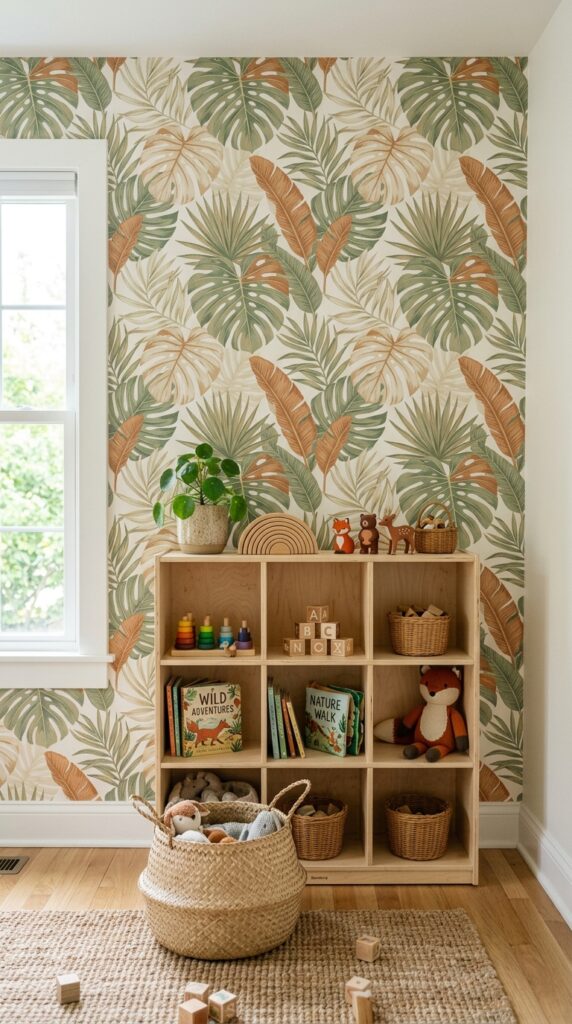
Layered. Large-scale peel-and-stick botanical wallpaper on a single accent wall is the highest-impact-per-square-inch move in playroom design, and the peel-and-stick format means it’s also fully reversible as the child’s taste evolves.
The visual principle is scale contrast. A large botanical print — oversized leaves, graphic animal shapes, bold repeat patterns — in a room filled with small-scale objects (toys, books, blocks) creates a visual dynamism that makes the space feel designed rather than decorated. The walls become art. Interior designers call this technique “macro/micro layering” — the eye moves between the big pattern on the wall and the smaller-scaled objects in the room, creating perpetual visual interest.
Choose prints in colors that complement your existing palette rather than competing with it. A sage and cream botanical on one wall pairs with a warm white on the other three. Avoid busy prints on all four walls — that’s the interior equivalent of shouting.
🛍️ Shop the Look — Amazon Product Ideas
| # | Product Search Phrase | Why It Fits |
| 1 | Peel and stick botanical leaf wallpaper sage cream | Core element, removable format |
| 2 | Large scale jungle animal wallpaper kids removable | Alternative print for younger children |
| 3 | Wallpaper smoothing tool bubble removal | Application tool |
| 4 | Wicker storage basket medium natural | Grounding decor in front of wallpaper |
| 5 | Simple wooden shelf floating white small | Display shelf against wallpapered wall |
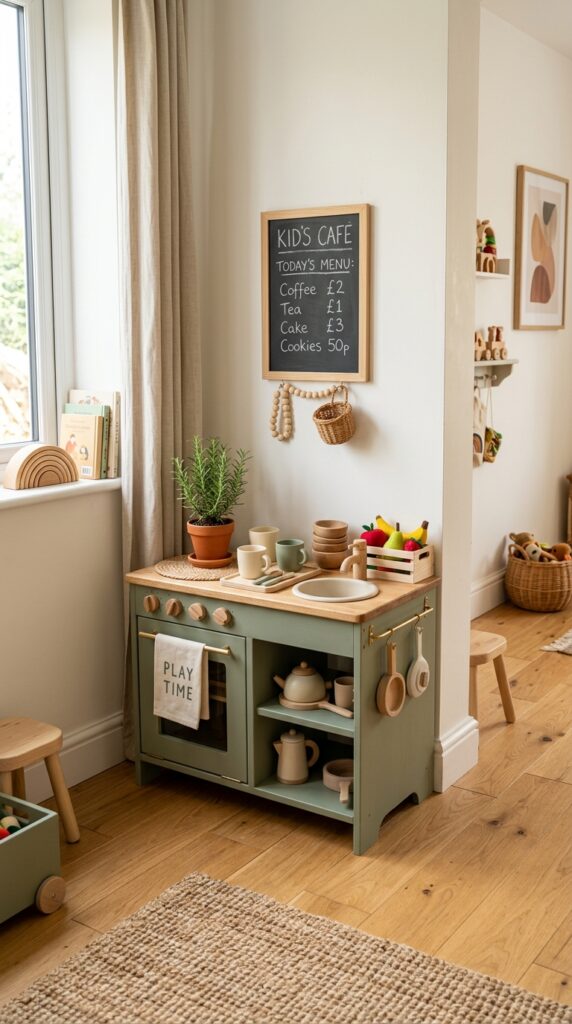
19. A Mini Kitchen or Play Store Corner
Playful. A play kitchen or market corner is the most socially rich toy a playroom can have — it naturally invites role play, cooperative play, language development, and the early scaffolding of domestic knowledge.
The design thinking here is zone definition through furniture. By physically anchoring the dramatic play area around a piece of furniture that defines its narrative (a kitchen, a market counter, a workbench), you create a “stage” that children return to repeatedly because the space itself holds the story. Loose dramatic play materials scattered across the floor don’t sustain play in the same way because there’s no spatial anchor.
Choose a play kitchen in a painted wood finish (sage, white, or terracotta) rather than the ubiquitous red plastic — the material and color palette make it read as a considered piece of furniture rather than a primary-colored accessory. KidKraft, Hape, and PlanToys all make solid wood options.
💡 Quick Win: A small chalkboard sign mounted above the play kitchen that says “Today’s Menu” or “Open for Business” costs under $10 and dramatically increases engagement time in the dramatic play zone.
🛍️ Shop the Look — Amazon Product Ideas
| # | Product Search Phrase | Why It Fits |
| 1 | Wooden play kitchen set painted sage green kids | Core dramatic play furniture |
| 2 | Wooden pretend play food set fruits vegetables | Kitchen accessory |
| 3 | Mini chalkboard sign wood frame small | Menu board above the kitchen |
| 4 | Play dishes ceramic-style set kids | Realistic prop set |
| 5 | Small woven placemat round natural | Counter or floor staging detail |
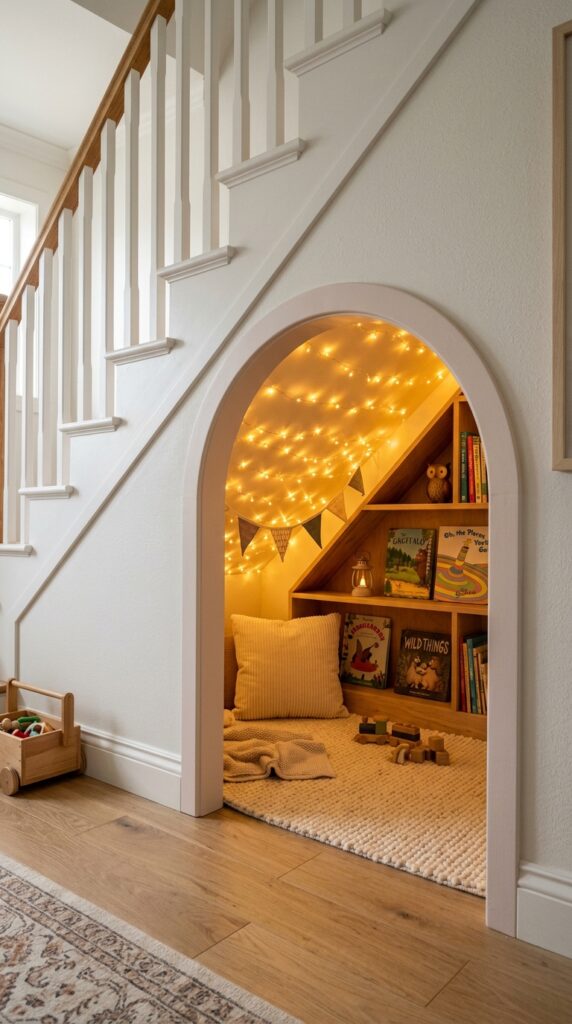
20. Under-Stair Storage Converted to a Play Hideout
Secret. Converting under-stair dead space into a child’s play hideout is one of the most genuinely transformative small-space interventions available — it takes square footage that otherwise holds a pile of shoes and turns it into the most-requested corner in the house.
The design principle is threshold psychology. An arched opening (rather than a rectangular door) signals “not a normal room” to a child’s brain — it’s a portal, not an entrance, which activates the narrative play response immediately. The low ceiling inside (usually 48–60 inches at the peak) provides just the right level of enclosure. Installing a simple string of warm lights and a small bookshelf built to fit the triangular footprint maximizes the space functionally.
The structural modification — cutting an arched opening into the drywall — requires confirming there are no load-bearing elements or utilities in the wall. A framer or structural engineer can confirm this in a single consultation. The actual drywall cut is a simple DIY job with a jigsaw.
🛍️ Shop the Look — Amazon Product Ideas
| # | Product Search Phrase | Why It Fits |
| 1 | Battery powered string lights fairy plug in warm | Hideout interior lighting |
| 2 | Low profile triangle corner bookshelf custom | Fits the triangular space |
| 3 | Kids floor cushion small square velvet dusty | Seating inside the hideout |
| 4 | Jigsaw tool arch drywall cutting kit | Tool for the opening cut |
| 5 | Chalkboard paint small can arch frame accent | Optional painted arch surround |
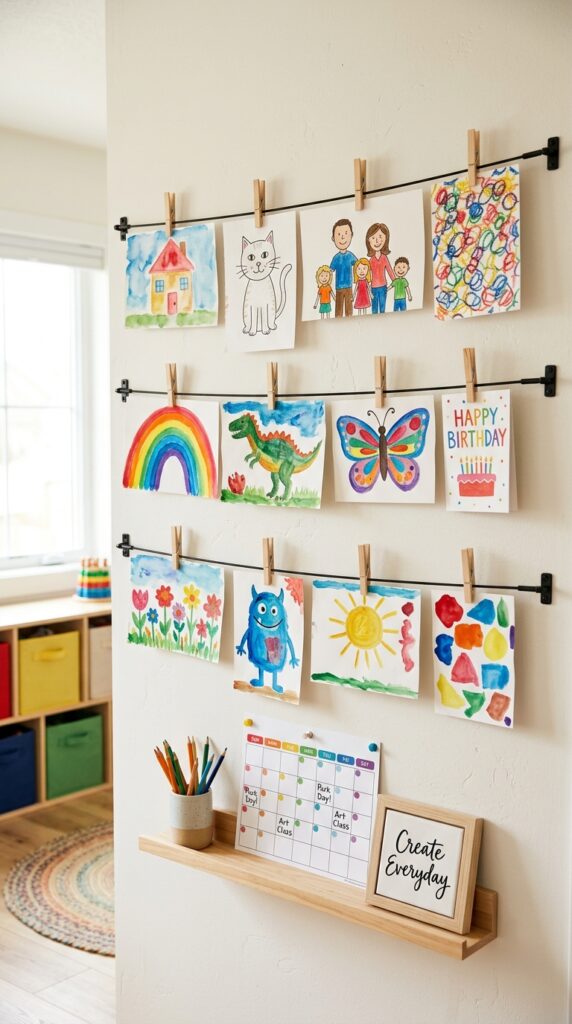
21. A Rotating Art Display System
Personal. A dedicated artwork display system — as opposed to taping drawings to the fridge — signals to a child that their creative work has genuine value, which is one of the most powerful confidence-building investments a playroom can make.
The design mechanism is curation through system. A defined, consistent display method (three parallel wires with wooden clips, for example) makes any artwork look considered when displayed within it. The wire-and-clip system allows effortless rotation without damage to the artwork or the wall, and the visible archive of changing work creates a timeline narrative of the child’s creative development. Leave a small table or flat surface beneath it with the materials needed to make the next piece.
Use 1.5mm black galvanized wire (sold as “picture hanging wire” or “craft wire”) stretched between two small cup hooks at eye height. Three horizontal lines with 8-inch vertical spacing creates a gallery capable of displaying 9–12 pieces simultaneously.
🛍️ Shop the Look — Amazon Product Ideas
| # | Product Search Phrase | Why It Fits |
| 1 | Art display wire with wooden clips wall gallery | Core system for this idea |
| 2 | Small wooden clothespins natural 50 pack | Clips for the wire system |
| 3 | Cup hook small brass wall picture wire mount | Anchors for the wire ends |
| 4 | Watercolor paint set kids non-toxic 24 colors | Art supply to fuel the display |
| 5 | Artist portfolio folder kids artwork storage | Archiving works that come off the wall |
22. A Light Table Station for Sensory Play
Luminous. A light table is the most quietly extraordinary playroom investment available — it converts light itself into a play material, and children who encounter one for the first time will sit down and not get up for an hour.
The design and developmental principle is translucency as discovery. When objects are backlit on a light table — colored tiles, nature specimens, loose parts, watercolors — they reveal optical properties invisible in normal lighting: grain, layering, color mixing, shadow geometry. This engages the visual cortex in a qualitatively different mode than normal ambient play. Occupational therapists routinely use light tables for sensory integration work because the combination of visual stimulation and fine motor manipulation (arranging small objects on the surface) is developmentally rich.
Position the light table low to the floor (under 18 inches tall) so it’s accessible to toddlers kneeling or sitting. Pair it with a dedicated tray of translucent loose parts — jewel-tone acrylic tiles, colored fabric swatches, clear glass pebbles.
💡 Quick Win: A set of translucent colorful building tiles ($20–30) is the single best accessory for a light table, and also works brilliantly on a regular table near a window.
🛍️ Shop the Look — Amazon Product Ideas
| # | Product Search Phrase | Why It Fits |
| 1 | LED light table for kids sensory play low profile | Core element of this idea |
| 2 | Translucent color tiles acrylic building set | Primary light table play material |
| 3 | Colorful loose parts sensory tray set | Light table accessory tray |
| 4 | Clear glass gems flat marbles sensory | Translucent loose parts for the light |
| 5 | Small wooden tray display natural | Organizing loose parts beside the table |
23. A Soft Pastel Color Palette for a Calm, Non-Gendered Space
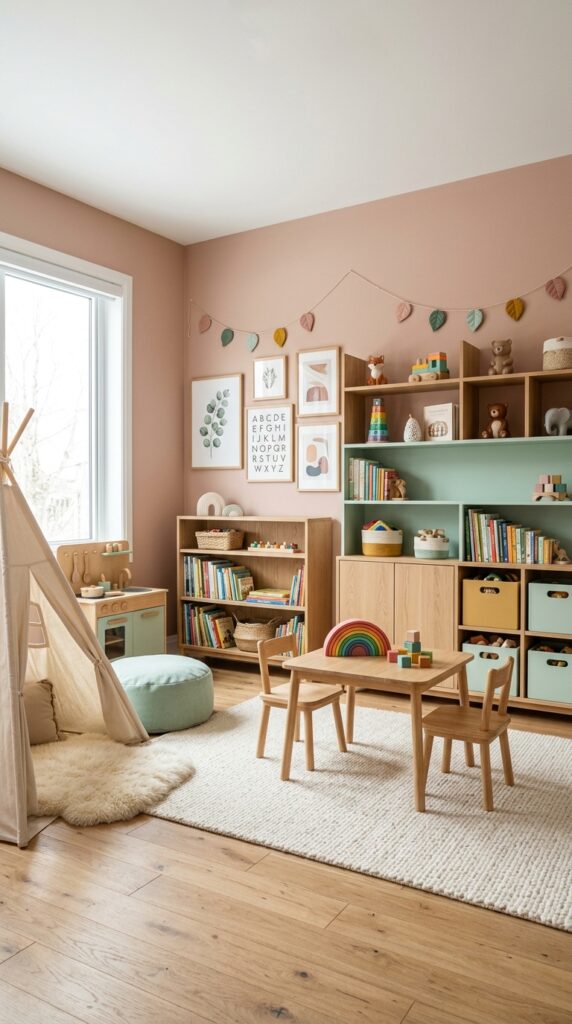
Airy. A muted, pastel-toned playroom that avoids primary-color overload is one of the most significant shifts in contemporary children’s room design — parents are increasingly designing rooms that will feel as relevant at age 10 as at age 2.
The design principle is color longevity. Oversaturated primary colors — the default register of most mass-market children’s rooms — read as “babyish” by around age 5 and trigger repeated redesign requests from children who want to grow into their rooms. Muted pastels and soft naturals (warm blush, dusty mint, pale ochre) are tonally related to adult design palettes, meaning a room painted in these tones can evolve through accessories and art as the child ages without requiring a full repaint.
The specific palette choice: Benjamin Moore “Elephant Pink” 2173-60 for walls, “Breath of Fresh Air” 806 as a soft mint accent shelf or trim, and “Hawthorne Yellow” HC-4 on the ceiling (the unexpected warm element that prevents the pastels from reading as cold).
🛍️ Shop the Look — Amazon Product Ideas
| # | Product Search Phrase | Why It Fits |
| 1 | Matte blush pink wall paint sample interior | Core color of the palette |
| 2 | Soft mint wooden bookshelf painted kids | Accent color element in furniture |
| 3 | Natural oak wood toy storage unit round | Neutral furniture base for the palette |
| 4 | Cream cotton floor pouf large round | Soft seating in the neutral register |
| 5 | Ceramic animal figurine set shelf decor | Small-scale decor in the pastel tones |
24. A LEGO Display and Build Station
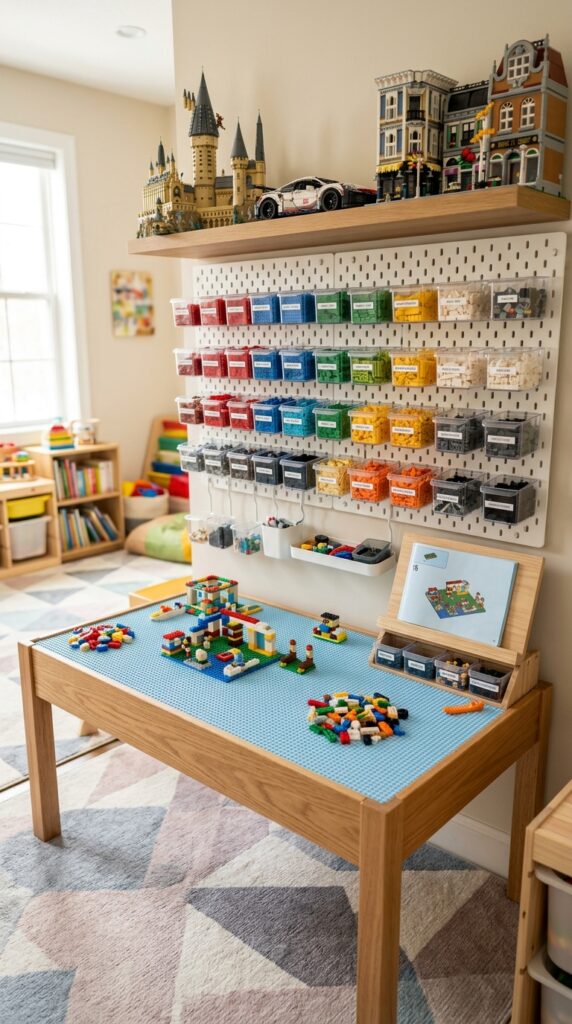
Focused. A dedicated LEGO build station solves one of the most persistent frustrations in family life: the scattered, stepped-on, impossible-to-find-a-piece system that kills creative momentum before a build even begins.
The design logic is friction reduction. Studies on creative flow in children consistently show that the threshold barrier — the effort required to begin — is the single biggest determinant of whether a child engages with a creative activity. A dedicated LEGO table with sorted, accessible brick storage in small bins (organized by color or type) reduces the setup time from 10 minutes to 10 seconds. The result is more building, longer sessions, and more complex constructions.
Use a TROFAST storage unit mounted on the wall at elbow height for sorted brick bins. Mount a LEGO baseplate (green or gray, 48-stud size) directly to the table surface with double-sided foam tape — it won’t move during building, which is a significant UX improvement over building on a bare table.
🛍️ Shop the Look — Amazon Product Ideas
| # | Product Search Phrase | Why It Fits |
| 1 | LEGO baseplate gray large 48×48 stud | Mounting the build surface |
| 2 | Small plastic sorting bins with labels set | Color-sorted brick storage |
| 3 | Kids activity table wooden sturdy low | The build station surface |
| 4 | Wall mounted storage rail with small bins white | Vertical brick storage system |
| 5 | LEGO display shelf clear floating acrylic | Displaying completed builds above the station |
25. A Projector Nightlight for Ceiling Storytelling

Vast. A ceiling projector nightlight turns the overhead surface of a playroom — the most underused design surface in any room — into a dynamic, narrative environment that transforms the quality of winding-down time.
The design principle is environmental storytelling. A static ceiling has no character; a projected galaxy or forest canopy creates an immersive overhead narrative that children engage with in exactly the same way they engage with picture books — constructing scenes, naming constellations, inventing stories. This is genuinely distinct from screen-based entertainment because it requires the child to project the narrative rather than receive it.
Look for a projector with 360-degree rotation capability and multiple projection modes (galaxy, ocean, forest floor). The best units allow the child to independently select and adjust the pattern, which transfers ownership of the bedtime environment to them — a surprisingly effective tool for managing transition resistance.
💡 Quick Win: A $25–40 galaxy projector nightlight is one of the highest ROI purchases in this article — it functions as nightlight, storytelling prop, and transition tool simultaneously.
🛍️ Shop the Look — Amazon Product Ideas
| # | Product Search Phrase | Why It Fits |
| 1 | Galaxy projector kids nightlight ceiling stars | Core element of this idea |
| 2 | Star constellation projector rotating 360 kids | Alternative with rotation feature |
| 3 | Blackout curtains kids room navy blue | Maximizes projection visibility |
| 4 | Floor cushion large round bohemian kids | Lying on the floor watching the ceiling |
| 5 | Star mobile hanging ceiling kids room wood | Complements the ceiling theme |
26. A Traffic-Flow Layout with a Central Open Floor Zone
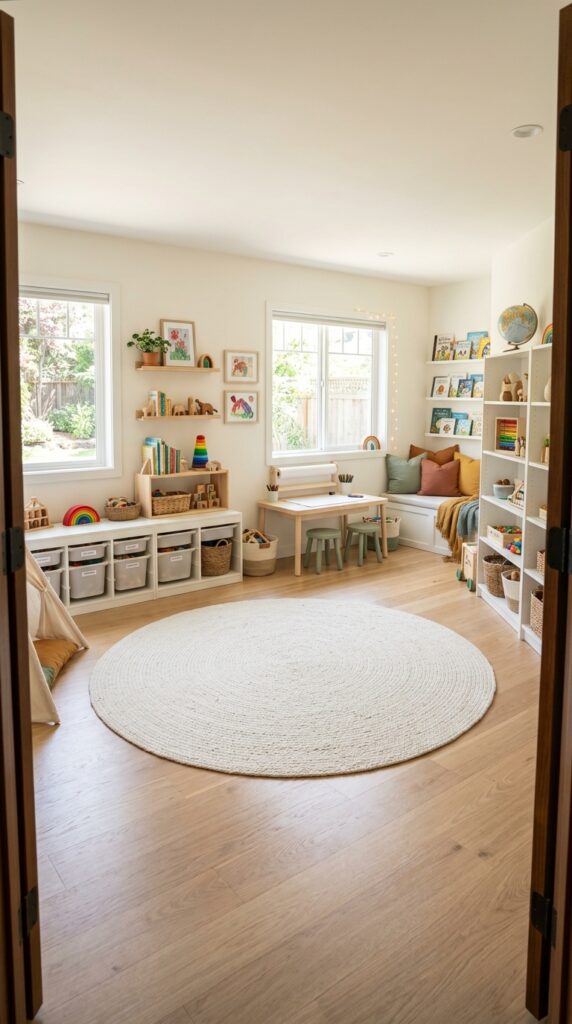
Open. The most undervalued design decision in a playroom has nothing to do with what you buy — it’s about what you keep clear. A central open floor zone is the single most important spatial choice you can make.
The traffic flow and play psychology principle is territory definition through negative space. Children play more expansively, cooperatively, and for longer durations when there is a clear, unobstructed floor area at the center of the room. When furniture is clustered in the middle (the instinct is to float a table and chairs there), children play around the perimeter in isolated patches. When the center is clear, they pull resources from the perimeter and bring them into the central zone — which is how complex, multi-element play develops.
The rule of thumb is: at least 60% of the playroom floor should be clear. In a 10×10-foot room, that means furniture and storage should occupy no more than a 4-foot-deep perimeter along the walls, with the central 6×6 feet kept free.
🛍️ Shop the Look — Amazon Product Ideas
| # | Product Search Phrase | Why It Fits |
| 1 | Large round area rug kids room cream 6 foot | Anchoring the central open zone |
| 2 | Slim profile wall-mount toy storage 12 inch deep | Perimeter storage that doesn’t eat floor space |
| 3 | Flat-pack activity table low profile kids | Perimeter activity station |
| 4 | Corner floor cushion set stacking kids | Perimeter seating that doesn’t obstruct flow |
| 5 | Toy rotation bin system labeled stackable | Managing toy volume so floor stays clear |
27. A Fold-Down Wall Desk for Homework and Craft
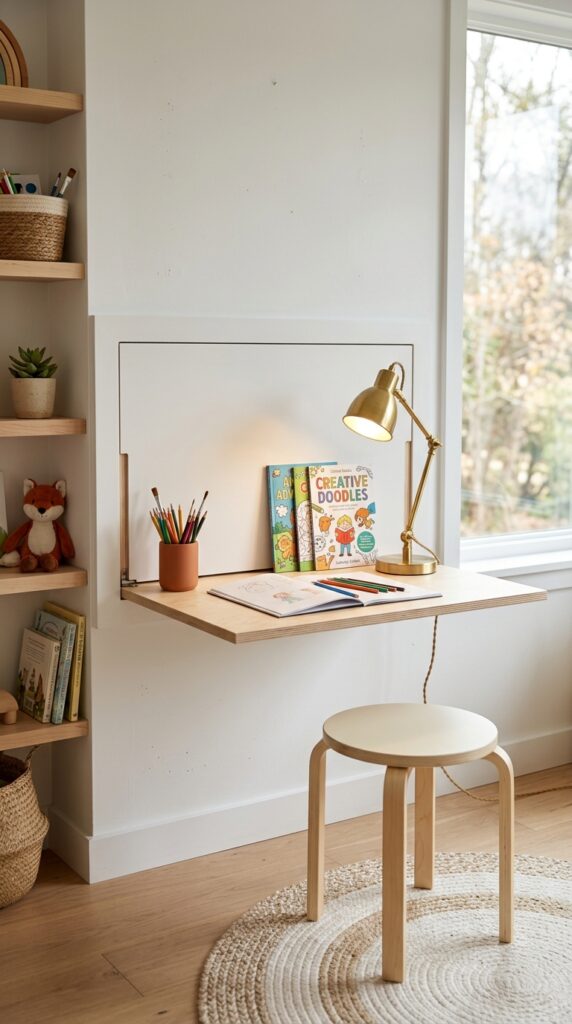
Purposeful. A fold-down wall desk is the most spatially intelligent craft station solution for a playroom that must also serve a small floor plan — it provides a full work surface that disappears completely when not in use.
The design principle is conditional space: the desk only exists when it’s needed, and the floor space it would otherwise consume remains open for active play at all other times. This is especially powerful in rooms under 120 square feet, where a fixed desk and chair would permanently consume 10–15% of the usable floor area. Murphy-desk mechanisms have become far more accessible — IKEA’s NORBERG fold-down wall table ($40) is the most popular starter option, though custom birch plywood versions with a piano hinge look significantly more finished.
Mount it at 26 inches from the floor for children aged 3–6 using a small stool, or 30 inches for ages 6 and up. Ensure at least 4 inches of clearance from any electrical outlets and confirm two wall studs are available for secure anchoring.
🛍️ Shop the Look — Amazon Product Ideas
| # | Product Search Phrase | Why It Fits |
| 1 | Fold down wall mounted desk kids Murphy style | Core small-space furniture piece |
| 2 | Small wooden stool adjustable height kids | Pairs with the fold-down desk |
| 3 | Clip-on task lamp warm light USB kids desk | Focused task lighting |
| 4 | Pencil cup ceramic matte white small | Desk accessory storage |
| 5 | Art supply organizer wall mount small | Mounted beside the fold-down desk |
28. Natural Wood Block and Loose Parts Play Station
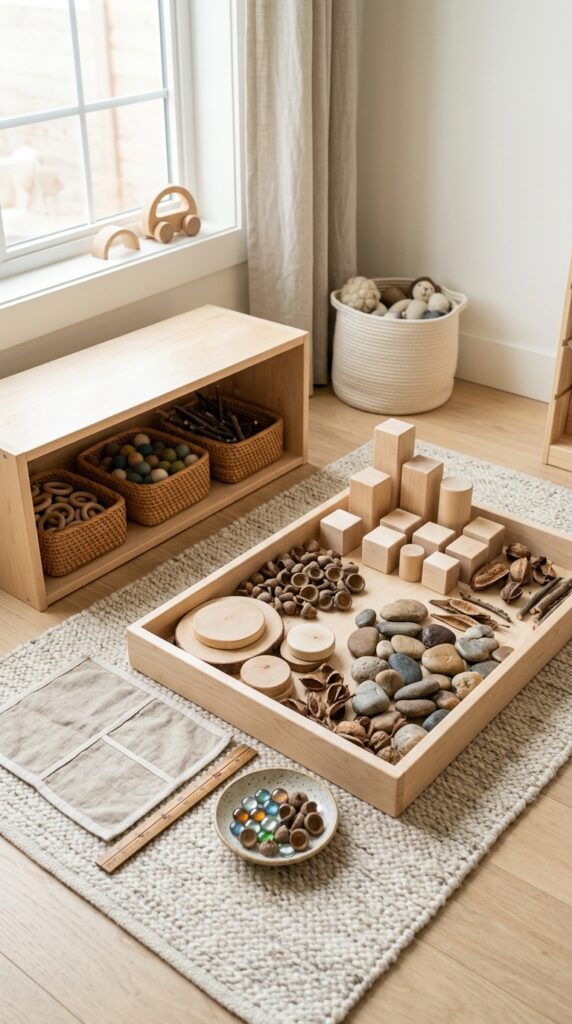
Raw. A loose parts play station — stocked with unit blocks, natural objects, and open-ended materials with no prescribed use — is the most developmentally rich thing you can put on a playroom floor, bar none.
The theoretical foundation comes from architect Simon Nicholson’s “theory of loose parts” (1972): the more variable and open-ended the materials in an environment, the more creative and inventive the play they generate. Unlike toys with a single correct interaction (press button, get sound), loose parts have infinite possible combinations. Children who regularly access loose parts play demonstrate higher spatial reasoning, greater creative confidence, and more sophisticated narrative construction than those restricted to single-use toys.
Build the station from a wide, shallow wooden tray (a wooden serving tray or shallow crate works perfectly) placed directly on the floor with a linen mat around it. Stock it with natural unit blocks (unfinished maple or beech), organic loose parts (acorn caps, smooth river stones, dried seed pods), and simple geometric wooden shapes. Rotate seasonal items quarterly to maintain novelty.
💡 Quick Win: A small bag of smooth river stones ($8–12) and a shallow wooden tray ($10–15) is the most immediate and affordable way to begin a loose parts station today.
🛍️ Shop the Look — Amazon Product Ideas
| # | Product Search Phrase | Why It Fits |
| 1 | Natural wooden unit blocks maple set 100 piece | Core building material for the station |
| 2 | Smooth river stones polished small bag sensory | Natural loose part for the tray |
| 3 | Wooden sorting tray shallow crate natural | Container for the loose parts play |
| 4 | Linen play mat flat open-ended | Defines the floor play zone |
| 5 | Wooden geometric shapes set unfinished beech | Open-ended building shapes |
How to Start Your Playroom Transformation
Begin with the floor. Specifically: clear the central floor zone before buying a single new item. Remove any furniture that is not flush against a wall, and take stock of what’s remaining. The single first move that anchors everything else is defining that open central zone — often marked with a large round rug in a warm neutral. That rug becomes the spatial anchor for every other decision: how large the open space is, where the perimeter storage goes, and what the room’s color story should build around. This is why it comes first, not last.
The most common mistake beginners make is buying individual storage pieces without a unified storage system. Mismatched bins, baskets, and cube organizers in five different materials and three different heights create visual noise that makes even an organized room feel cluttered. Fix it by choosing a single material for all primary storage — all wicker, all cotton canvas, all natural wood — and limiting colors to two or three tones from the same palette.
Three items under $50 that create immediate playroom impact: a round cotton braid rug in warm cream (clearly defines the play zone); a set of three seagrass baskets in one consistent size (instantly unifies the storage); and a battery-powered strand of warm white string lights (adds a lighting layer that transforms the room’s mood at dusk).
A realistic playroom transformation takes a full weekend for the furniture rearrangement and painting, with 2–4 weeks for ordered pieces to arrive. A starter version — rug, rug, storage reorganization, paint one accent wall — can be accomplished for $150–300 and done in one weekend. A full transformation with new furniture and built-ins runs $800–2,500 depending on room size and whether you DIY the shelving.
Frequently Asked Questions About Playroom Ideas
What’s the difference between a playroom and a toy room?
A toy room is simply a room where toys are kept — it’s a storage designation. A playroom is a designed environment intentionally structured to support different types of play: active, creative, dramatic, and quiet. The distinction matters because a playroom organizes play zones (art corner, reading nook, building area) while a toy room is typically an undifferentiated collection of things. The design principles in this article are specifically aimed at creating playrooms, not toy rooms.
What colors are best for a kids playroom?
Research in environmental psychology consistently supports muted, mid-tone palettes for spaces where both concentration and activity occur. Warm white, dusty sage, terracotta, and soft mustard are the most enduring choices — they read as calm without being sterile, and they age gracefully as children grow. Oversaturated primary colors (pure red, electric blue, acid yellow) increase stimulation and can make focused, sustained play more difficult. Benjamin Moore “Saybrook Sage” HC-114 and “Pale Oak” OC-20 are two of the most popular starting points among interior designers for playroom wall colors.
How much does it cost to set up a playroom?
A starter playroom transformation — rug, storage reorganization, one accent wall repaint, and string lights — can be accomplished for $150–300. A mid-range room with new furniture, a dedicated reading nook, and pegboard organization runs $500–1,200. A fully designed playroom with built-in shelving, a loft bed play zone, and custom storage typically costs $1,500–3,500+. The most impactful investments at every budget level are the floor treatment, the storage system, and the wall color — in that order.
Can playroom ideas work in a small space or shared room?
Yes — small spaces can absolutely achieve a well-designed playroom, but the strategy shifts. In a room under 100 square feet, or in a playroom that shares space with a bedroom, the priorities are vertical storage (low open shelving on every available wall), zone definition (a rug marking the play zone, a canopy marking the reading zone), and convertible furniture (fold-down desks, loft beds). The ideas in this article most suited to small spaces are: the fold-down wall desk (idea 27), the loft bed with play zone (idea 6), the low open shelving (idea 2), and the corner teepee (idea 17).
What type of flooring is best for a playroom?
Interlocking rubber or EVA foam tiles in a neutral tone are the most practical primary flooring choice for active playrooms — they provide fall cushioning, noise reduction, and thermal warmth underfoot, and they can be removed and replaced in sections when damaged. For a more finished look, engineered hardwood with a large area rug over the central zone is the designer’s choice: the hardwood is durable and easy to sweep, while the rug provides softness and zone definition. Avoid polished tile or hardwood without rugs in active play spaces — the acoustic hardness increases noise and the surface is unforgiving for falls.
Ready to Create Your Dream Playroom?
These 28 ideas span color strategy, material choices, storage systems, lighting layers, furniture selection, zone layout, and small-space solutions — the full palette of a well-considered playroom, not just a shopping list. Transformation doesn’t require doing all 28 at once; picking one idea that solves your most pressing problem — the chaos, the boredom claims, the toy avalanche — and executing it fully is exactly the right approach. This weekend, start with the central floor zone: remove one piece of furniture that’s blocking the middle of the room, put down a round rug, and stand back. That single move will change how the space feels before you’ve spent a dollar on anything new. A well-designed playroom is one where children enter, make a choice, and get lost in play — which means a calmer household, a more confident child, and a space the whole family is genuinely glad exists. Save the ideas that spoke to you — the ones that made you picture a specific child, a specific corner, a specific quiet afternoon — those are the ones worth building first.