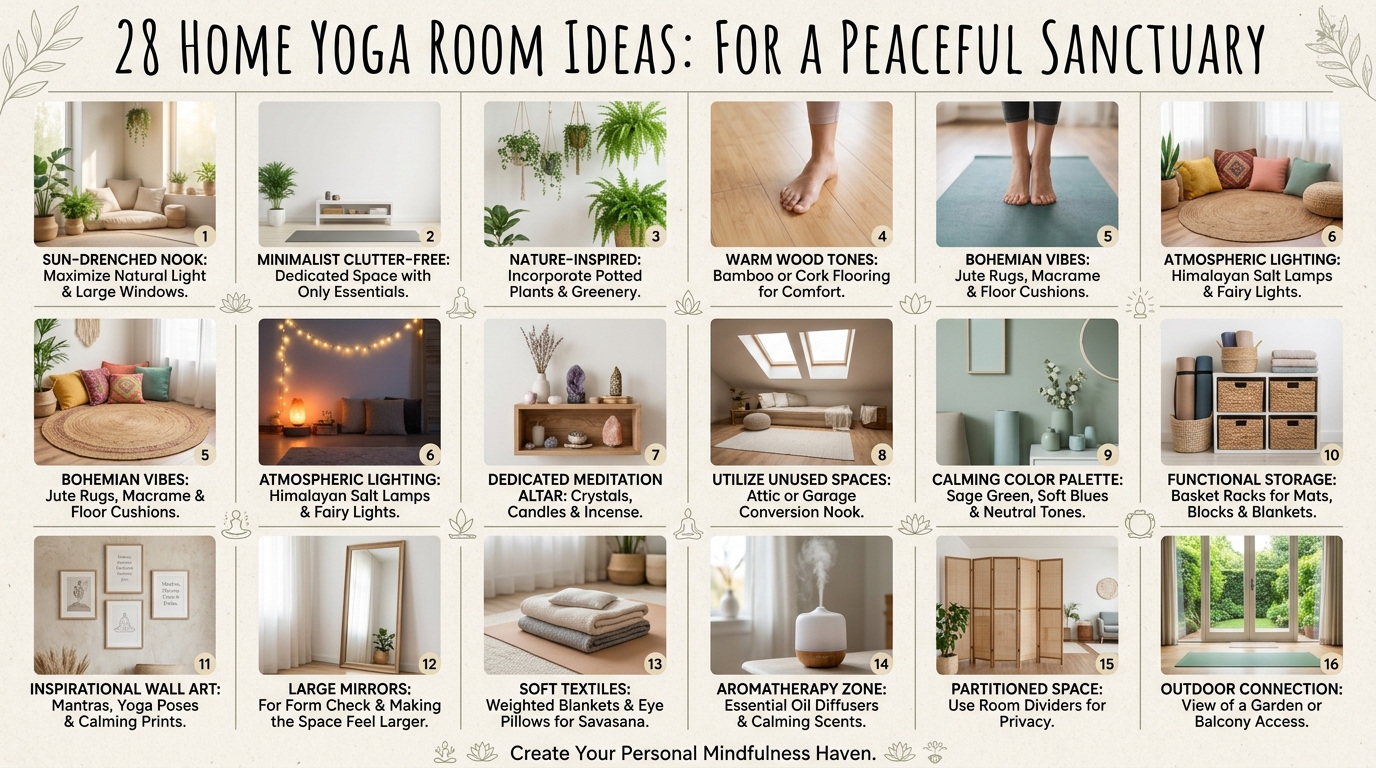
A home yoga room is a dedicated personal space designed to support mindful movement, breathwork, and stillness — stripped of distraction and shaped by intention. This article gives you exactly 28 fresh, actionable ideas spanning layout, materials, color, lighting, and accessories to help you create a genuinely peaceful sanctuary at home.
There is a particular quality of quiet that a well-designed yoga room holds. The light is soft but present. The floor is warm underfoot. The air carries something faint — sandalwood, cedar, or simply clean space — and the moment you step inside, your nervous system knows: this is somewhere different. That is what a home yoga room does at its best. Here are 28 ideas worth saving — and stealing.
Why a Home Yoga Room Works So Well
The home yoga room draws from several intersecting design philosophies: the Japanese concept of ma (negative space as an active presence), Ayurvedic principles of sensory harmony, and the slow-living interiors movement that emerged from Scandinavian and Japandi aesthetics. What distinguishes it from a general wellness space is its commitment to removal — of furniture, visual noise, color complexity, and digital intrusion. Every element present must earn its place by either supporting practice or deepening stillness.
The core materials are grounding and natural. Think unfinished white oak or cork flooring, undyed hemp or jute mats, linen curtains in warm white or oat, raw cotton bolsters, unglazed terracotta incense holders, and bamboo shelving with minimal profile. Color palettes are deliberately restrained: warm white, soft greige, dusty sage, pale clay, and muted sand — tones that recede visually and allow the mind to settle. Nothing competes for attention.
This style is surging in cultural relevance for an entirely understandable reason. Post-pandemic life rewired people’s relationship to home as a site of full-spectrum living — not just sleeping and eating, but recovering, breathing, and restoring. Pinterest searches for “home yoga room” and “meditation corner ideas” have grown year-over-year since 2020, and the broader wellness interiors movement has moved the conversation from gym equipment toward intentional sensory design. The yoga room is where architecture and inner life meet.
Small spaces are well-suited to this aesthetic, perhaps better than large ones. A dedicated yoga practice requires only a 2m × 1m footprint — the length of a mat. A spare bedroom corner, a basement nook, or even a cleared hallway alcove can become a genuine sanctuary when the design priorities are correct: clear the floor, control the light, anchor the senses.
Style at a Glance
| Element | Trait |
| Philosophy | Stillness through subtraction |
| Materials | Cork, hemp, linen, unfinished oak, bamboo |
| Color palette | Warm white, dusty sage, pale clay, soft greige |
28 Home Yoga Room Ideas for a Peaceful Sanctuary
1. Cork Flooring as the Foundation of Warmth
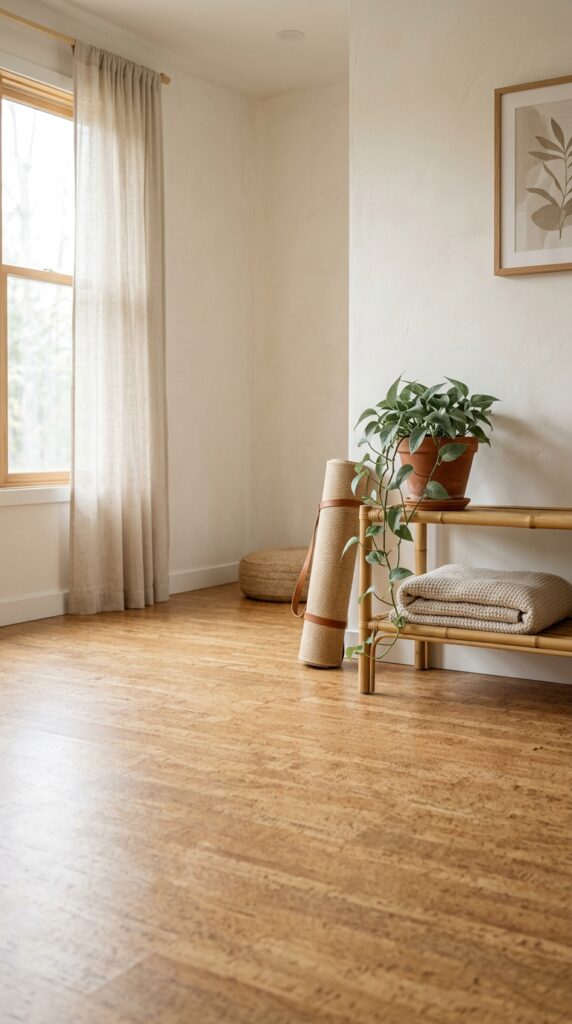
Vibe: Grounded — the room that meets your bare feet with warmth every single morning.
Why it works: Cork is one of the most considered flooring choices for a yoga room because it operates on three levels simultaneously: thermal (it stays warm underfoot regardless of season), acoustic (it absorbs sound and vibration, which deepens stillness), and tactile (its natural micro-texture provides gentle grip without the need for a mat for gentler practices). The visual warmth of its honey-amber tone also anchors the room’s palette without introducing color complexity. Cork’s natural cellular structure is also sustainably harvested, which aligns with the ethical underpinning of most yoga practice.
How to get it: Floating cork floor tiles are the most accessible format — they click together without adhesive, can be installed over most existing subfloors in a single afternoon, and are widely available on Amazon in thicknesses of 6–10mm. Choose a natural, unsealed finish for the warmest look; avoid polyurethane-coated cork, which reads plastic under natural light.
💡 Quick Win: Cork yoga mat tiles ($25–40 for a 4-pack) placed over existing flooring create the same underfoot warmth without committing to a full floor installation.
🛍️ Shop the Look — Amazon Product Ideas
| # | Product Search Phrase | Why It Fits |
| 1 | Natural cork floor tiles interlocking 6mm | Warm grounding foundation |
| 2 | Hemp yoga mat natural undyed | Surface on cork base |
| 3 | Bamboo low shelf unit narrow | Minimal storage accent |
| 4 | Terracotta plant pot small with saucer | Grounding corner detail |
| 5 | Oat cotton blanket throw for yoga | Warm folded accent |
2. A Feature Wall in Warm Clay Paint
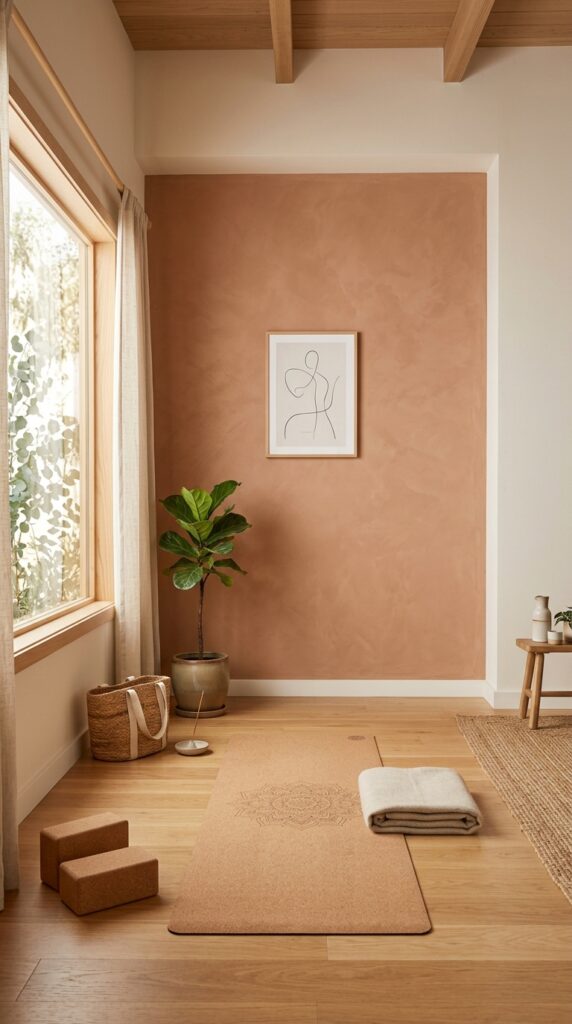
Vibe: Warm and still — like practicing inside a pot.
Why it works: A single clay-toned accent wall uses the principle of directional warmth: by painting only the wall you face during practice, you create a focal point that grounds the gaze without overwhelming the room. Clay and terracotta tones carry the warm-grey undertone that reads as earthy rather than orange under natural light — a critical distinction. Benjamin Moore’s “Pale Terra Cotta” or Farrow & Ball’s “Red Earth” are close analogues; for budget-friendly options, look for any matte paint in the terracotta-beige family under “clay paint” or “warm sand” on Amazon.
How to get it: Paint only one wall — the one you face most during practice. Use a matte or flat finish rather than eggshell, which adds a slight reflectance that makes the tone cooler under light. Two coats over a white base will be sufficient for full coverage. Hang one piece of simple, minimal art at eye level — abstract line work in a thin natural wood or brushed brass frame.
🛍️ Shop the Look — Amazon Product Ideas
| # | Product Search Phrase | Why It Fits |
| 1 | Terracotta clay wall paint matte sample pots | Feature wall color |
| 2 | Abstract line art print minimal boho yoga | Focal wall art |
| 3 | Thin natural wood frame 8×10 for prints | Warm minimal framing |
| 4 | Foam paint roller set flat finish walls | Application tool |
| 5 | Warm white matte interior paint sample | Complementary wall color |
3. Natural Light Control With Sheer Linen Panels
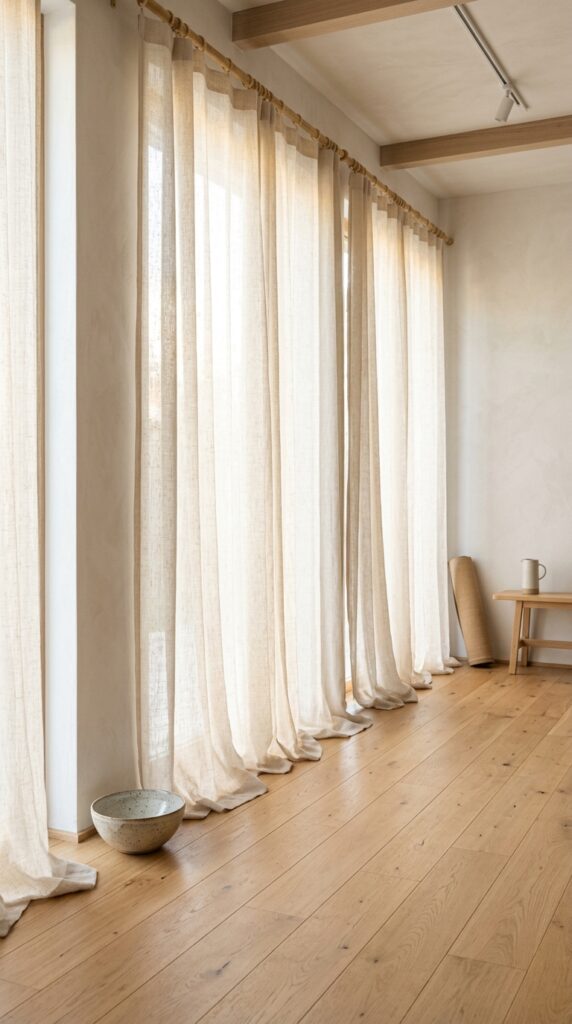
Vibe: Luminous — the room that turns sunlight into something softer than sunlight.
Why it works: Sheer linen panels serve a precise optical function in a yoga room: they transform direct, high-contrast window light into diffused, enveloping light that eliminates harsh shadows on the floor during practice. This matters practically — shadow bands across the floor during balancing poses create visual interference — and atmospherically. The warm yellow undertone of natural linen also shifts daylight toward the golden spectrum, which reduces visual stimulation and supports a parasympathetic (calm) nervous system state.
How to get it: Hang panels from ceiling height to the floor regardless of window size — floor-to-ceiling curtains make any window feel like an architectural feature and dramatically increase the room’s sense of height and airiness. Choose 100% linen panels rather than cotton voile, which reads cooler and more domestic. A simple bamboo or matte black curtain rod keeps the hardware recessive.
💡 Quick Win: Two linen-look sheer panels from Amazon ($25–35 total) hung on a tension rod at ceiling height immediately transform the quality of light in any room without drilling.
🛍️ Shop the Look — Amazon Product Ideas
| # | Product Search Phrase | Why It Fits |
| 1 | Sheer linen curtain panels floor length white | Soft light diffusion |
| 2 | Bamboo curtain rod natural finish | Recessive warm hardware |
| 3 | Tension curtain rod ceiling mount no-drill | No-hardware installation |
| 4 | Linen curtain tie-back natural rope | Gathered light option |
| 5 | Low ceramic bowl white matte minimalist | Quiet floor detail |
4. A Dedicated Prop Storage Ladder
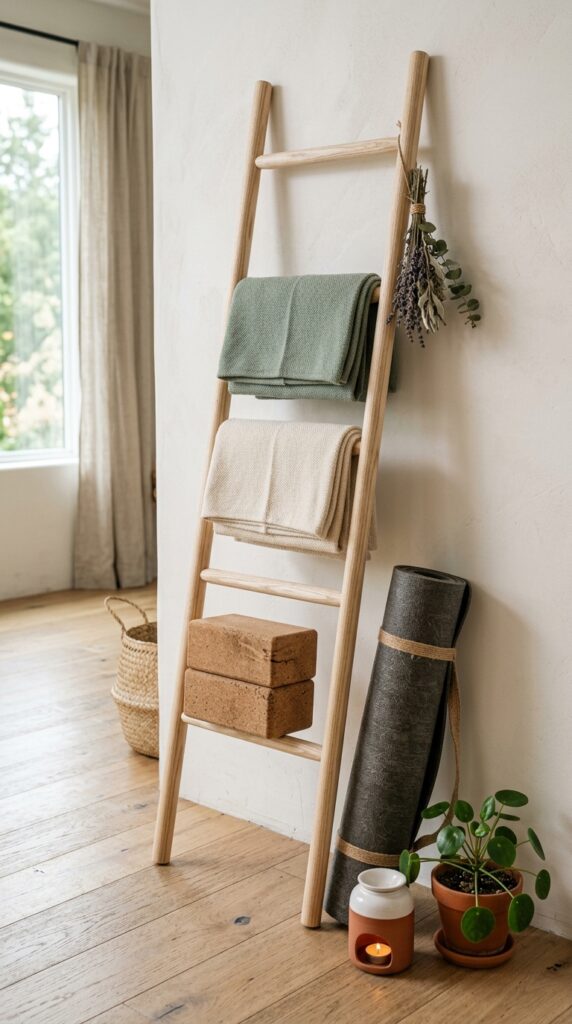
Vibe: Calm and organized — the room where everything has a place and the place is beautiful.
Why it works: A leaning ladder as prop storage applies the principle of vertical display: it occupies floor space equivalent to a single chair while storing six to eight yoga props in a visually curated way. The open, visible nature of ladder storage also makes prop selection a conscious ritual rather than a rummage through a bin — which matters in a practice space where intention is everything. Unfinished ash or whitewashed wood keeps the ladder visually light, and the staggered heights of rungs naturally accommodate varying prop sizes.
How to get it: Position the ladder against the wall you don’t face during practice — ideally the wall behind you or to the side — so props are accessible without becoming a visual distraction. Fold blankets in uniform thirds and drape them over the upper rungs. Store blocks stacked by pairs. A single dried herb bundle hung from the top rung (eucalyptus, rosemary, or lavender) adds fragrance and organic form.
🛍️ Shop the Look — Amazon Product Ideas
| # | Product Search Phrase | Why It Fits |
| 1 | Wooden blanket ladder natural ash slim | Prop display storage |
| 2 | Organic cotton yoga blanket sage set 2 | Folded prop storage |
| 3 | Cork yoga block set 2 natural | Stacked rung prop |
| 4 | Hemp yoga mat rolled natural | Ladder base mat storage |
| 5 | Dried eucalyptus bundle fragrant decor | Aromatic ladder accent |
5. Himalayan Salt Lamp for Ambient Glow
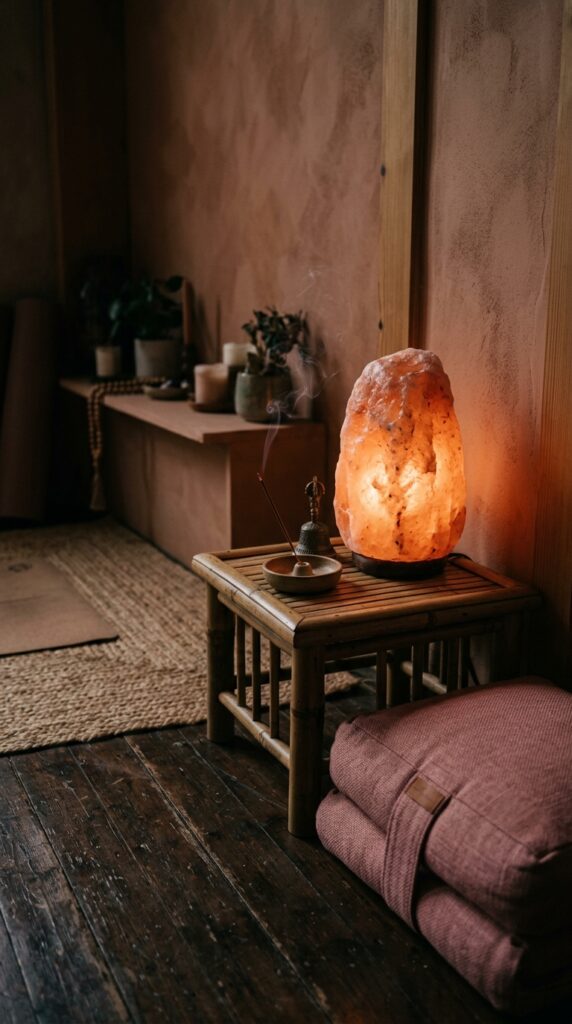
Vibe: Hushed — the kind of glow you don’t want to turn off.
Why it works: Himalayan salt lamps emit light in the 2200–2700K range — the warmest end of the visible spectrum, equivalent to candlelight — which triggers the same physiological response as firelight: reduced cortisol, slower heart rate, and a natural preparation for rest or meditation. The rough, irregular surface of the crystal diffuses light organically rather than projecting it in a beam, which creates the enveloping, sourceless glow that flat overhead lighting can never achieve. Place it at floor level or on a low table to keep the light below eye height.
How to get it: Choose a lamp between 2–5kg for a yoga room — smaller lamps glow faintly and can feel like an afterthought; larger ones can feel too prominent. Position it in a corner or against a wall you don’t face directly during practice, so its glow is peripheral and atmospheric rather than frontal. Use it during candlelit or restorative practice; pair with overhead dimmer lighting for a layered approach.
🛍️ Shop the Look — Amazon Product Ideas
| # | Product Search Phrase | Why It Fits |
| 1 | Himalayan salt lamp large 3-5kg natural | Warm ambient glow source |
| 2 | Low bamboo side table small yoga room | Lamp display surface |
| 3 | Meditation floor cushion zafu cotton dusty rose | Seated practice cushion |
| 4 | Ceramic incense holder stick ash catcher | Aromatic sensory accent |
| 5 | Dimmer switch plug-in for lamps | Layered light control |
6. An Uncluttered Layout With Only What You Need
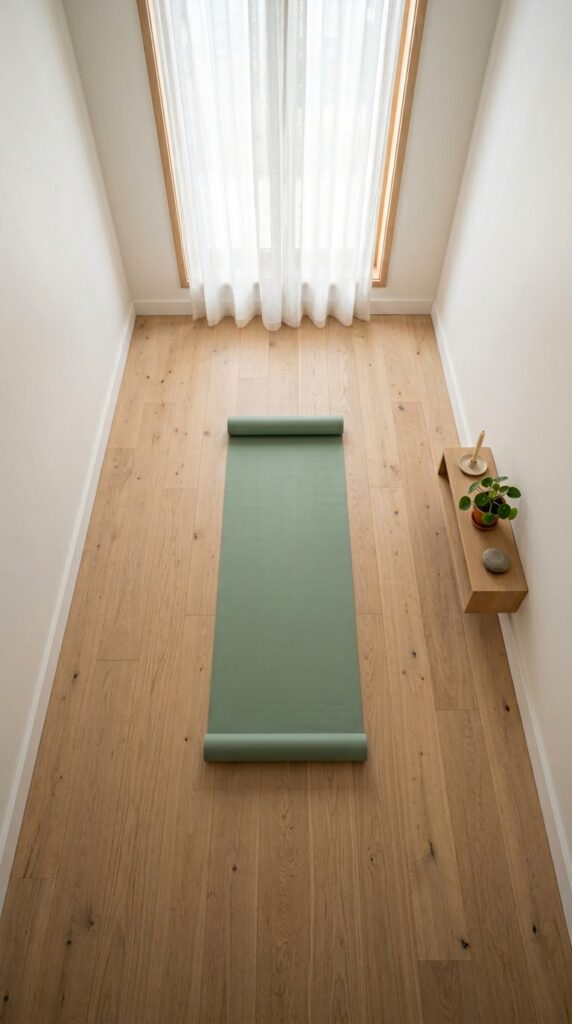
Vibe: Still — the rarest and most deliberate kind of room.
Why it works: Radical subtraction is itself a design principle, not the absence of one. A yoga room with a cleared floor, a single mat, and three carefully chosen objects on one shelf applies the Japanese concept of ma — the idea that empty space is not absence but presence, and that what you remove from a room is as intentional as what you add. Neurologically, visual complexity activates the arousal system; a visually quiet room genuinely lowers the nervous system’s baseline before practice begins. Every object that doesn’t serve practice is making practice harder.
How to get it: Apply the rule of three: no surface in the room holds more than three objects. Remove everything from the floor except your mat. If you cannot remove it, cover it — a simple linen cloth over stacked boxes creates visual calm from disorder. Perform a scan of the room from the doorway: anything your eye catches and holds is competing for your attention during practice.
💡 Quick Win: Spend 20 minutes removing everything from your practice space, place only your mat and one candle, and practice once. The difference is immediate and free.
🛍️ Shop the Look — Amazon Product Ideas
| # | Product Search Phrase | Why It Fits |
| 1 | Natural rubber yoga mat non-slip thick 6mm | Sole floor surface |
| 2 | Low floating wall shelf minimal white oak | Three-object rule shelf |
| 3 | Smooth river stones set natural grey | Minimal shelf object |
| 4 | Linen storage cover box set neutral | Visual clutter concealment |
| 5 | Single taper candle holder ceramic white | One-light focus point |
7. Ceiling-Mounted Yoga Swing or Aerial Hammock
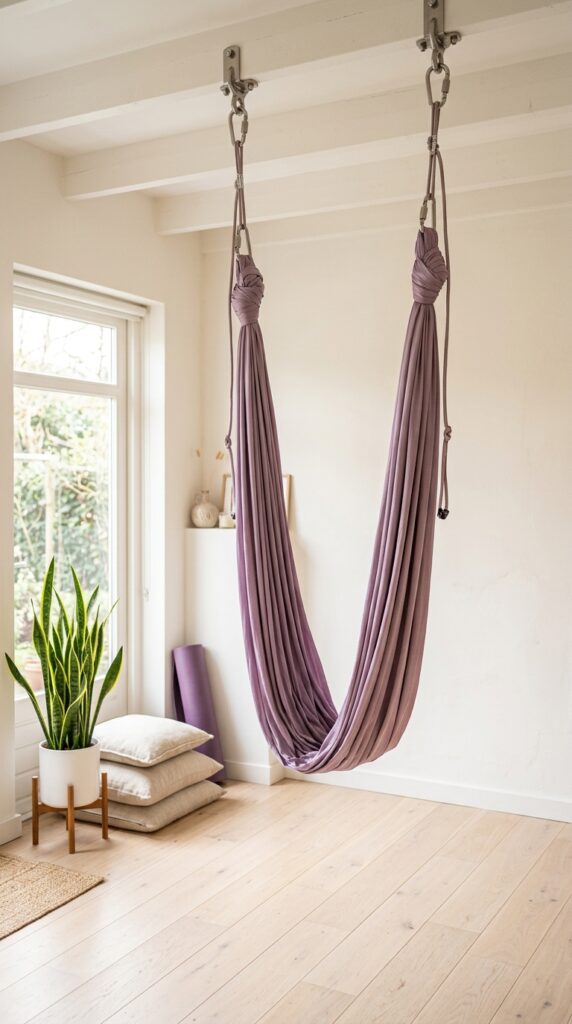
Vibe: Airy — the room that makes gravity feel like a suggestion.
Why it works: An aerial yoga hammock introduces both functional and sculptural value: it enables inversion practice, restorative hanging, and aerial flow while functioning as a piece of fabric sculpture when not in use. The gathered silk at two ceiling points creates a sinuous, draped form that becomes the room’s primary visual statement — more interesting than any piece of wall art. This is the principle of the functional object as decoration: the hammock is doing two jobs simultaneously, and it’s doing both beautifully.
How to get it: Ceiling mounting requires locating joists or installing a load-rated beam — this is non-negotiable for safety, as aerial hammocks must support dynamic body weight. Hammock mounting hardware kits (including carabiners, daisy chains, and ceiling hooks rated to 300–500kg) are available on Amazon and straightforward to install with a stud finder and appropriate anchor bolts. Choose silk or nylon hammocks in neutral or muted tones — dusty lilac, sage, or warm white are the most versatile for a yoga room palette.
🛍️ Shop the Look — Amazon Product Ideas
| # | Product Search Phrase | Why It Fits |
| 1 | Aerial yoga hammock silk nylon set with hardware | Core swing installation |
| 2 | Ceiling mount yoga swing hardware kit rated | Safety anchor set |
| 3 | Stud finder wall scanner digital | Joist location tool |
| 4 | Dusty lilac aerial fabric yoga swing | Muted tone hammock |
| 5 | Snake plant artificial tall white pot | Grounding corner plant |
8. Layered Meditation Cushion Corner
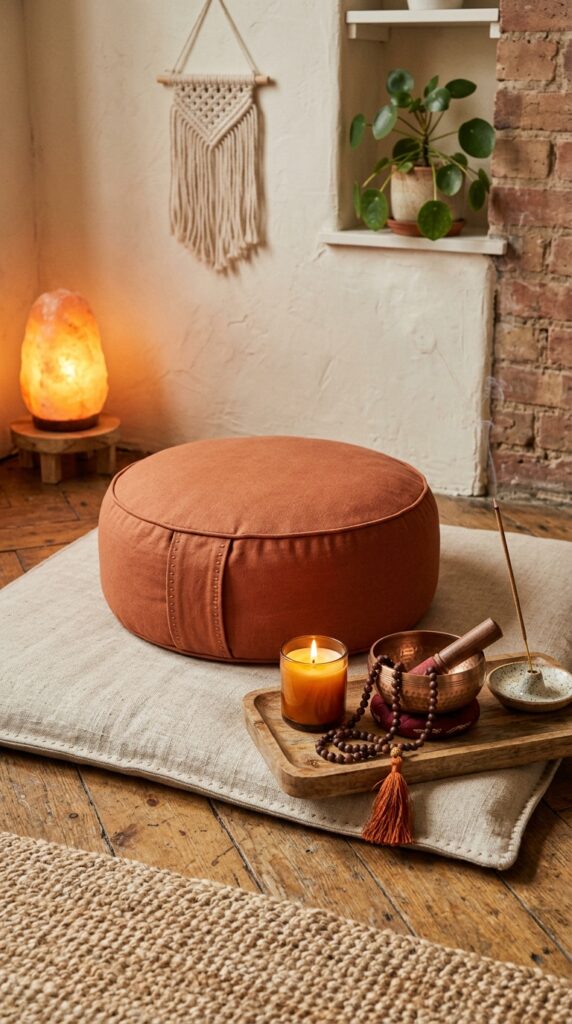
Vibe: Intimate and warm — the corner that holds you.
Why it works: A dedicated meditation corner within a yoga room uses the design principle of zone definition: by creating a spatially distinct seating area with its own lighting and accessories, you physically and psychologically separate seated meditation from active practice. The layered cushion arrangement (zafu on zabuton) replicates the traditional setup of Zen meditation halls — the elevated zafu encourages neutral pelvis tilt, which reduces lower back strain during extended sitting. The small tray corrals ritual objects and keeps the corner from reading as an accumulation of things.
How to get it: Position the meditation corner in the warmest, most sheltered part of the room — typically a corner away from the door. Use a small low tray (mango wood or bamboo) to group no more than four ritual objects: a candle, an incense holder, one tactile object (mala beads or a smooth stone), and a small vessel. The tray creates visual intentionality from what would otherwise be a scatter.
🛍️ Shop the Look — Amazon Product Ideas
| # | Product Search Phrase | Why It Fits |
| 1 | Zafu meditation cushion buckwheat filled terracotta | Elevated seated support |
| 2 | Zabuton meditation mat cotton linen natural | Flat base cushioning |
| 3 | Small mango wood tray low decorative | Object corralling tray |
| 4 | Tibetan singing bowl set with mallet | Sonic ritual object |
| 5 | Mala beads 108 sandalwood natural | Tactile meditation focus |
9. Living Plant Wall as a Green Focal Point
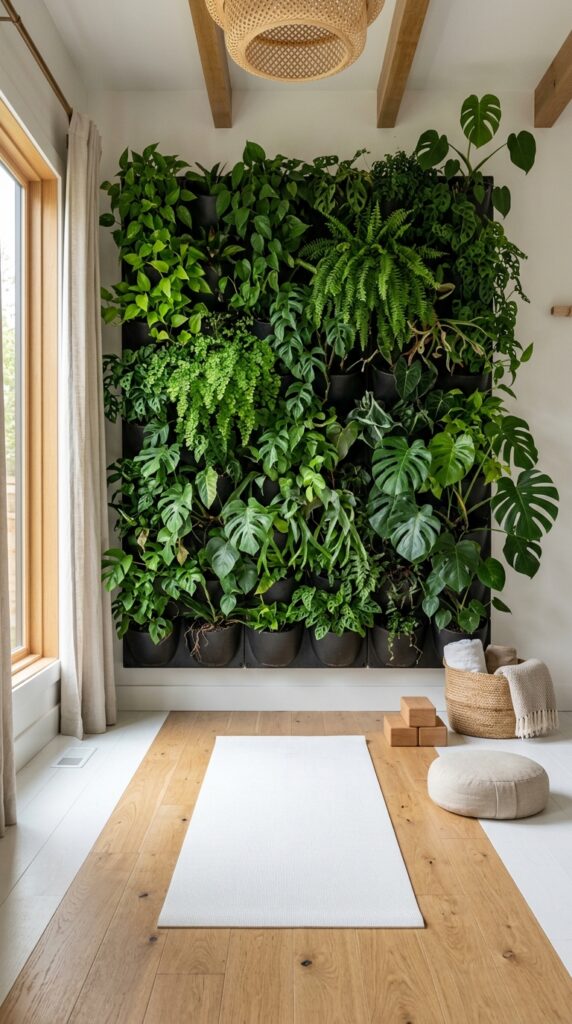
Vibe: Lush and grounding — the room that breathes with you.
Why it works: A living plant wall introduces biophilic design at its most direct: visual immersion in natural greenery has been shown in environmental psychology research to reduce perceived stress and increase focus — making it genuinely functional for a yoga room, not merely decorative. From a design standpoint, the textured, irregular surface of a plant wall adds dimensional interest to what is otherwise the flattest element of any room. The varied leaf shapes, sizes, and shades of green create organic visual complexity that rests rather than stimulates the eye.
How to get it: Modular wall planter panel systems (available on Amazon from $40–80 for a starter panel) use pocket-style planters that mount directly onto the wall. Choose low-light tolerant species — pothos, heartleaf philodendron, and Boston fern all thrive without direct sun. Install a drip tray system behind the panels. Begin with one 60cm × 60cm panel and expand over time. Alternatively, a large-scale faux plant wall panel ($35–60) delivers the same visual effect with zero maintenance.
💡 Quick Win: Three wall-mounted ceramic planter pockets (under $30 total) arranged in a triangular cluster create a micro-plant-wall effect without the full panel system.
🛍️ Shop the Look — Amazon Product Ideas
| # | Product Search Phrase | Why It Fits |
| 1 | Modular wall planter pocket panel set | Living green wall base |
| 2 | Pothos trailing plant artificial realistic | Low-maintenance green fill |
| 3 | Wall mount ceramic planter pocket dark matte | Minimal planter accent |
| 4 | Faux plant wall panel green backdrop | Zero-maintenance alternative |
| 5 | Self-watering wall planter system indoor | Irrigation-integrated option |
10. Warm Wood Accent Wall With Horizontal Slats
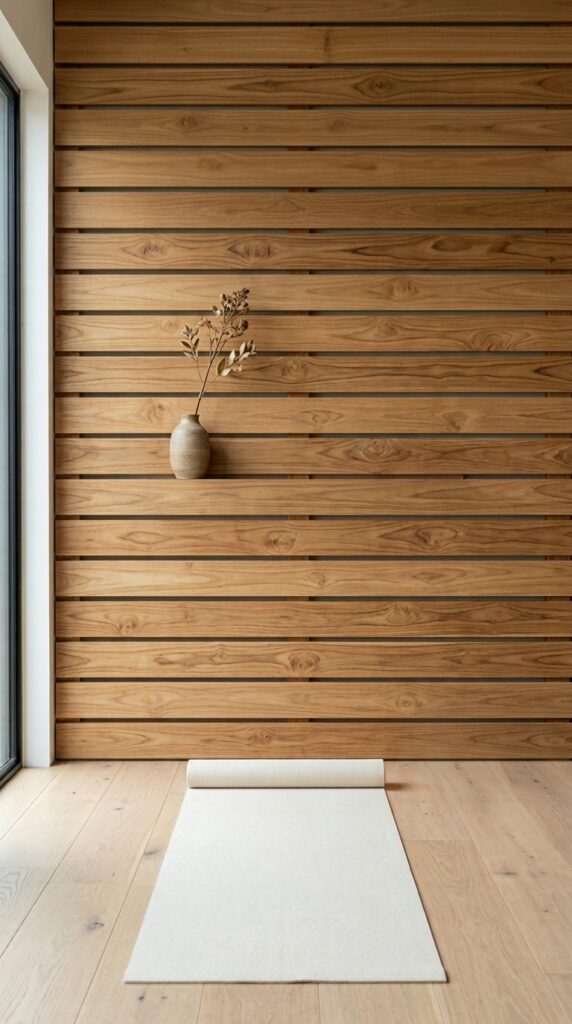
Vibe: Grounded and warm — a wall that feels like a forest without trying to be one.
Why it works: Horizontal wood slat cladding on a single wall uses the principle of natural texture as visual anchor: the warmth of teak or oak draws the eye to a specific surface, creating a focal point that grounds the room without introducing pattern or color complexity. The shadow lines between horizontal slats also introduce a subtle rhythm — a visual frequency that is calming rather than stimulating, similar to the effect of vertical timber in traditional Japanese architecture. The gaps between slats also provide hidden mounting points for small shelves without visible hardware.
How to get it: DIY teak slat wall panels are available on Amazon as peel-and-stick or screw-mount systems that cover a standard wall in an afternoon. Focus on the wall you face during seated meditation or savasana. Use a natural oil or wax finish rather than lacquer — it deepens the grain without creating the plastic sheen that undermines the organic effect. Mount one small floating shelf within the slat grid for a candle or single plant.
🛍️ Shop the Look — Amazon Product Ideas
| # | Product Search Phrase | Why It Fits |
| 1 | Teak wood wall panels slatted horizontal | Warm focal wall treatment |
| 2 | Natural teak wood oil finish interior | Grain-deepening finish |
| 3 | Narrow floating shelf minimal bracket | Between-slat shelf mount |
| 4 | White yoga mat thick cushioned non-slip | Surface on warm floor |
| 5 | Dried stem single botanical minimal vase | Shelf accent detail |
11. Candles in Sand or Stone Vessels
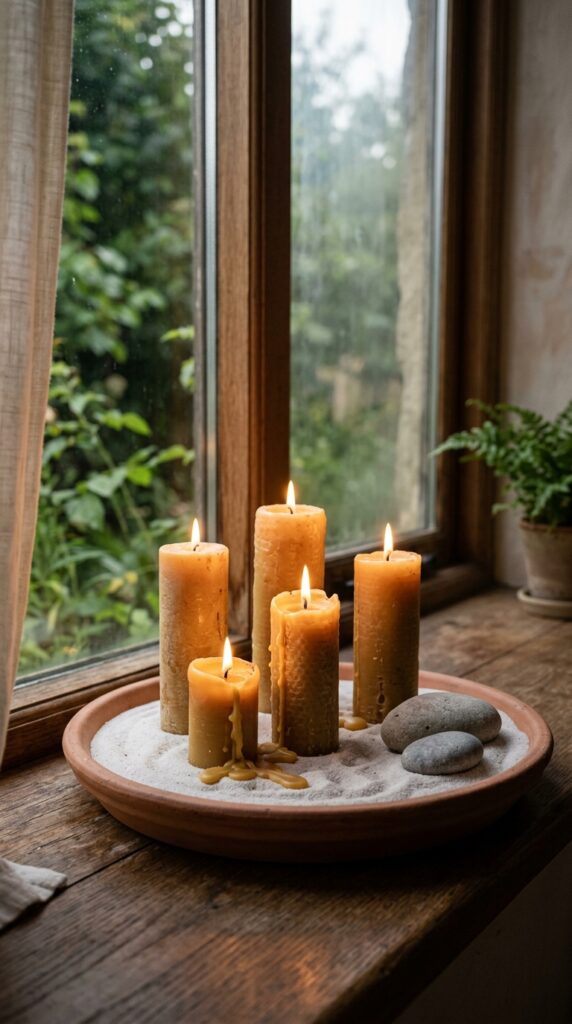
Vibe: Meditative — the ritual that starts before the mat is unrolled.
Why it works: Setting pillar candles in a shallow tray of sand or fine gravel uses the principle of elemental grounding: sand references earth and shore simultaneously, and the act of lighting candles from a composed, altar-like arrangement transforms preparation into practice. Practically, the sand catches wax drips without damage to any surface, and the cluster of varying heights creates an organic composition that a candlestick row cannot replicate. Beeswax specifically burns cleaner than paraffin and emits negative ions shown to have mild mood-regulating effects.
How to get it: Use a wide, low-sided terracotta dish or a shallow ceramic tray filled with 3–4cm of white sand or fine pea gravel. Press three to five beeswax pillar candles of varying widths and heights into the sand, ensuring they are stable. Embed one or two smooth stones to anchor the composition. Keep the arrangement near the room entrance or on a dedicated low table — not on the floor where it becomes a fire hazard during active practice.
🛍️ Shop the Look — Amazon Product Ideas
| # | Product Search Phrase | Why It Fits |
| 1 | Beeswax pillar candles assorted sizes natural | Core elemental candle |
| 2 | Shallow terracotta tray dish large | Sand container vessel |
| 3 | White decorative sand fine craft | Candle stabilizing medium |
| 4 | Smooth river stones polished natural grey | Sand composition accent |
| 5 | Wide low ceramic tray decor neutral | Alternative tray option |
12. A Mirrored Wall for Alignment Feedback
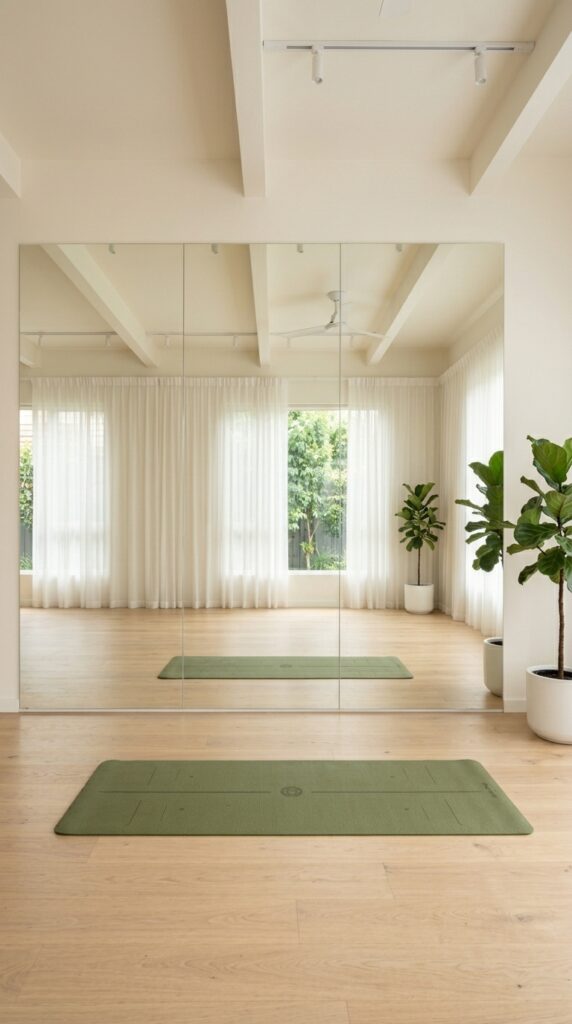
Vibe: Open and expanded — the room that appears twice as large as it is.
Why it works: A mirrored wall serves a dual function that is unique among yoga room design elements: it gives alignment feedback during practice (allowing you to self-correct posture without an instructor) while visually doubling the apparent size of the room. The reflected light also effectively doubles the room’s natural light, which is transformative in north-facing or smaller rooms. Frameless mirror panels installed flush create the cleanest, most architectural effect — the joins are nearly invisible and the mirror reads as a single surface rather than a patchwork.
How to get it: Frameless mirror tiles (typically 30cm × 30cm or 60cm × 30cm) adhere directly to a flat wall using mirror-safe adhesive or mounting clips and can cover a full wall for $80–150. Measure and mark your layout before adhering, leaving no gaps — even small gaps between tiles interrupt the alignment-feedback function. Position the mirrored wall directly opposite your mat placement.
💡 Quick Win: A single full-length leaning mirror ($35–60) propped against the front wall gives alignment feedback without permanent installation and can be repositioned as the room evolves.
🛍️ Shop the Look — Amazon Product Ideas
| # | Product Search Phrase | Why It Fits |
| 1 | Frameless mirror tiles wall panels adhesive | Light-doubling surface |
| 2 | Full length mirror leaning floor minimal | Non-permanent alternative |
| 3 | Mirror adhesive mounting strips heavy duty | Secure tile installation |
| 4 | Tall fiddle leaf fig artificial large | Reflected corner plant |
| 5 | Mirror level tool hanging picture | Installation accuracy |
13. Small Space Yoga Nook Under the Stairs
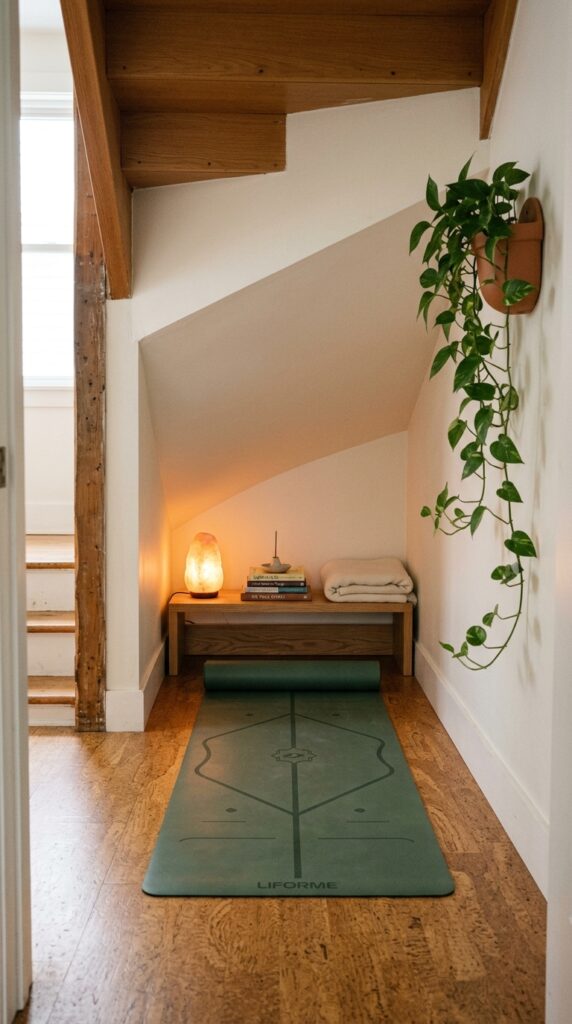
Vibe: Hushed and contained — the room-within-a-room that asks the world to wait.
Why it works: An under-stair yoga alcove exploits the spatial principle of enclosure as sanctuary: the lower ceiling and contained proportions create an instinctive sense of shelter that large open rooms cannot replicate. This is directly analogous to the Japanese concept of tokonoma — the alcove as an elevated, dedicated space within a larger room. The sloped ceiling, far from being a limitation, creates a cove-like atmosphere that makes the space feel intentionally designed rather than opportunistically used.
How to get it: The minimum footprint for a yoga mat is 180cm × 60cm — check your under-stair dimensions before committing. Install cork floor tiles over the existing surface. Paint the alcove interior in a warm white or pale clay different from the surrounding room to reinforce the sense of spatial separation. A low-voltage plug-in salt lamp on a small shelf handles lighting without requiring an electrician.
🛍️ Shop the Look — Amazon Product Ideas
| # | Product Search Phrase | Why It Fits |
| 1 | Cork floor tiles adhesive 6mm natural | Warm nook flooring |
| 2 | Himalayan salt lamp small plug-in | Alcove atmospheric light |
| 3 | Narrow low shelf small space wall mount | Sloped ceiling storage |
| 4 | Wall mount plant holder trailing small | Vertical green accent |
| 5 | Extra long yoga mat 200cm natural rubber | Full-length mat option |
14. Aromatherapy Diffuser as a Sensory Anchor
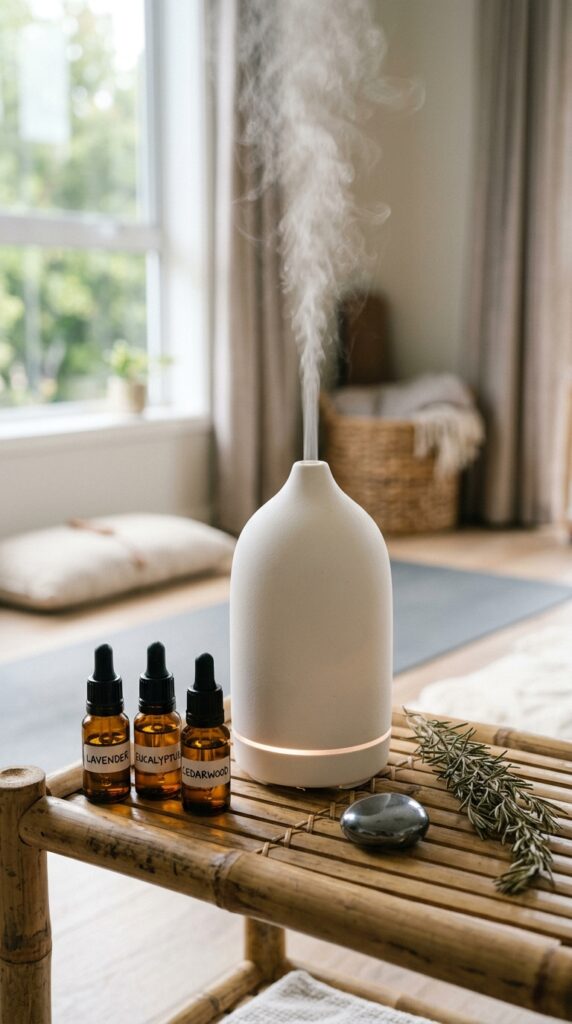
Vibe: Sensory and still — the breath you take before you begin.
Why it works: Aromatherapy in a yoga room engages the olfactory system — the only sense with a direct neural pathway to the limbic system (the brain’s emotional and memory center) without passing through the thalamic relay. This makes scent the fastest route to a shifted mental state, faster than visual or auditory input. Lavender and cedarwood lower cortisol measurably in clinical settings; eucalyptus supports respiratory opening for pranayama practice. The diffuser itself, in a matte ceramic form, functions as a small sculptural object on the shelf — form serving function serving atmosphere.
How to get it: Use an ultrasonic ceramic diffuser rather than a reed diffuser for a yoga room — ultrasonic diffusers humidify as well as scent, which benefits breathing during practice. Start with three oils: lavender (relaxation), eucalyptus (respiratory), and frankincense (focus and depth). Run the diffuser for 15 minutes before practice begins, then turn it off — diffusing throughout practice can overwhelm the senses.
🛍️ Shop the Look — Amazon Product Ideas
| # | Product Search Phrase | Why It Fits |
| 1 | Ceramic ultrasonic essential oil diffuser white | Sensory atmosphere anchor |
| 2 | Lavender essential oil pure 100ml | Relaxation practice scent |
| 3 | Eucalyptus essential oil pure 100ml | Respiratory opening scent |
| 4 | Frankincense essential oil pure 30ml | Focus and depth scent |
| 5 | Amber glass essential oil bottles set | Shelf styling vessels |
15. Exposed Wooden Ceiling Beams for Warmth Above
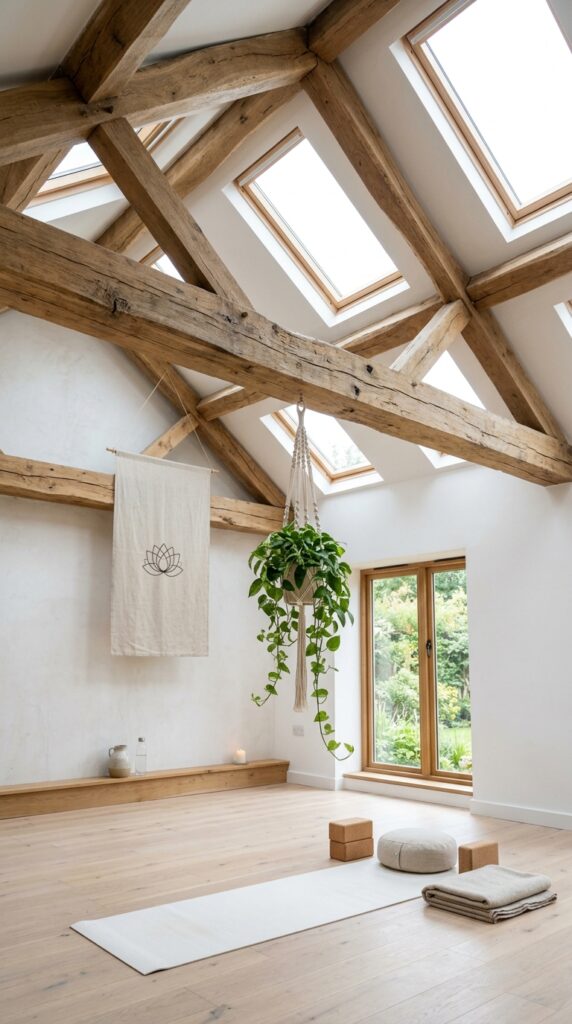
Vibe: Warm and open — the room that feels both sheltered and expansive at once.
Why it works: Exposed ceiling beams introduce visual warmth and structural rhythm to the uppermost plane of a room — the one that expands during upward-facing poses and savasana. The visual rhythm of repeated horizontal beams at regular intervals creates a calm, ordered overhead experience that painted ceilings simply can’t provide. From a spatial psychology standpoint, beams also lower the perceived ceiling height slightly, creating a sense of shelter that supports inward focus during meditation. If beams are not structural, faux wood beam covers achieve the identical effect with adhesive installation.
How to get it: Faux wood beam covers (hollow polyurethane shells finished to look like reclaimed oak or pine) install over existing ceiling with construction adhesive and are available on Amazon for $40–80 per 3m length. Choose a warm honey or medium oak tone — avoid very dark beams in small rooms, which press the ceiling down visually. Hang a single macramé plant hanger from one beam for scale and organic form.
🛍️ Shop the Look — Amazon Product Ideas
| # | Product Search Phrase | Why It Fits |
| 1 | Faux wood ceiling beam cover polyurethane oak | Structural warmth overhead |
| 2 | Construction adhesive heavy duty interior | Beam installation adhesive |
| 3 | Macramé hanging plant holder ceiling | Beam-hung organic detail |
| 4 | Linen wall banner minimal symbol yoga | Soft wall focal accent |
| 5 | Skylight window film frosted diffused | Light control for skylights |
16. A Dedicated Reading and Intention-Setting Nook
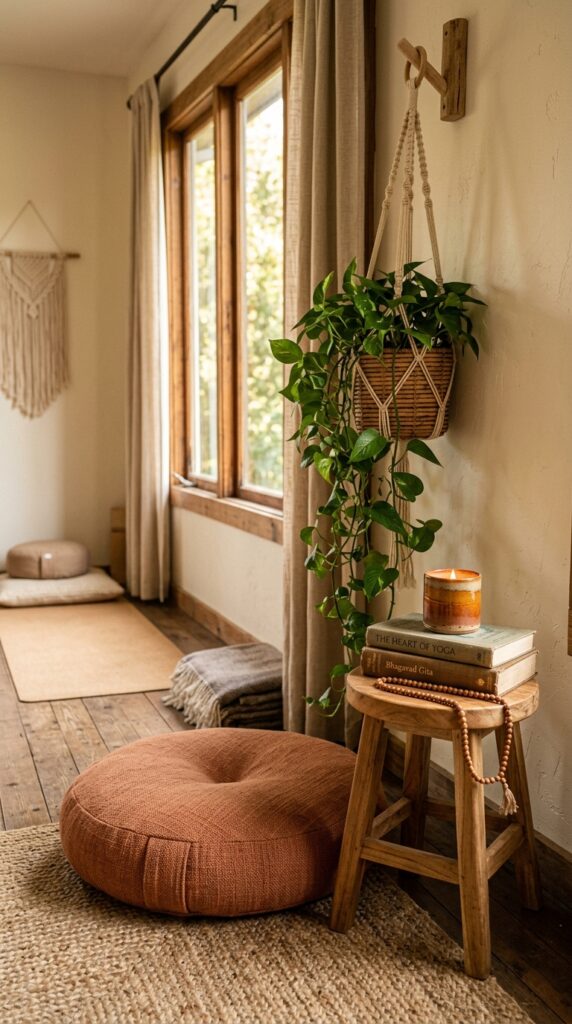
Vibe: Unhurried — the part of the room that invites you to stay a little longer.
Why it works: A reading nook adjacent to the practice space uses the principle of transitional zones: by creating a physically distinct space for pre-practice intention-setting or post-practice journaling, you give the entire room a beginning, middle, and end — like a well-structured class. The low floor cushion rather than a chair keeps the body close to the ground, which maintains the grounded, settled state that practice builds. The small wooden stool at cushion height corrals the ritual objects that belong to this moment: a book, a candle, something tactile.
How to get it: This nook requires only a 70cm × 70cm floor footprint — a low cushion and a small stool. Keep the book stack to two volumes. A reading lamp or plug-in salt lamp positioned at floor height maintains the ambient quality of the space rather than introducing task lighting that reads as office-like.
🛍️ Shop the Look — Amazon Product Ideas
| # | Product Search Phrase | Why It Fits |
| 1 | Large floor cushion pouf terracotta cotton | Low reading seat |
| 2 | Small wood stool side table low natural | Stool-height surface |
| 3 | Handmade ceramic candle container soy | Ritual candle object |
| 4 | Rattan hanging plant holder macramé | Behind-nook green drape |
| 5 | Mala prayer beads sandalwood 108 | Tactile nook accent |
17. Sage Green Walls as the Room’s Quiet Foundation
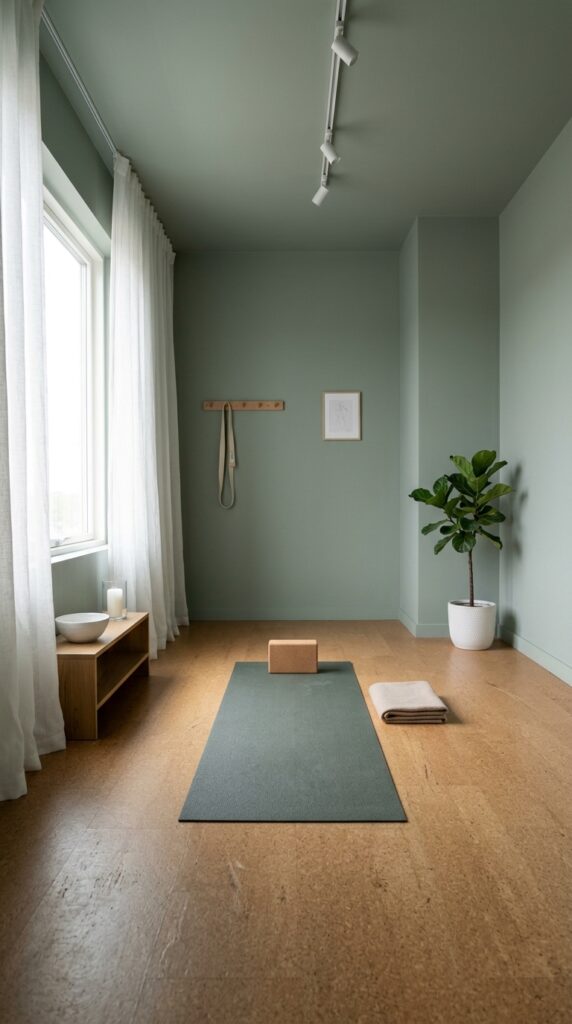
Vibe: Enveloping and serene — the color that wraps rather than stimulates.
Why it works: Painting all four walls and the ceiling the same muted sage green uses the principle of tonal immersion: when the color boundary between wall and ceiling disappears, the room feels larger and more cocoon-like simultaneously. Dusty sage with a warm grey undertone — such as Farrow & Ball “Mizzle” or Benjamin Moore “Pale Eucalyptus” — sits at the precise midpoint between warm and cool that makes it neurologically neutral: it neither excites nor depresses, which makes it ideal for a space designed to support equanimity. All-sage rooms also photograph magnificently.
How to get it: Use the same paint on walls and ceiling, applied with a flat/matte finish throughout. The matte finish is critical — eggshell or satin on sage walls reads cooler and more formal. Bring in warm white accents only: white ceramic, white linen, natural cork. Avoid adding grey accents, which push the sage cool; avoid terracotta, which fights the green.
🛍️ Shop the Look — Amazon Product Ideas
| # | Product Search Phrase | Why It Fits |
| 1 | Dusty sage green matte interior paint sample | Room color foundation |
| 2 | White ceramic bowl low wide minimal | White accent on sage |
| 3 | Sheer white linen curtain panels long | Light-softening contrast |
| 4 | Natural cork yoga mat thick sustainable | Warm floor complement |
| 5 | White pillar candle unscented wide | Tonal accent candle |
18. A Wall-Mounted Sound System for Practice Music
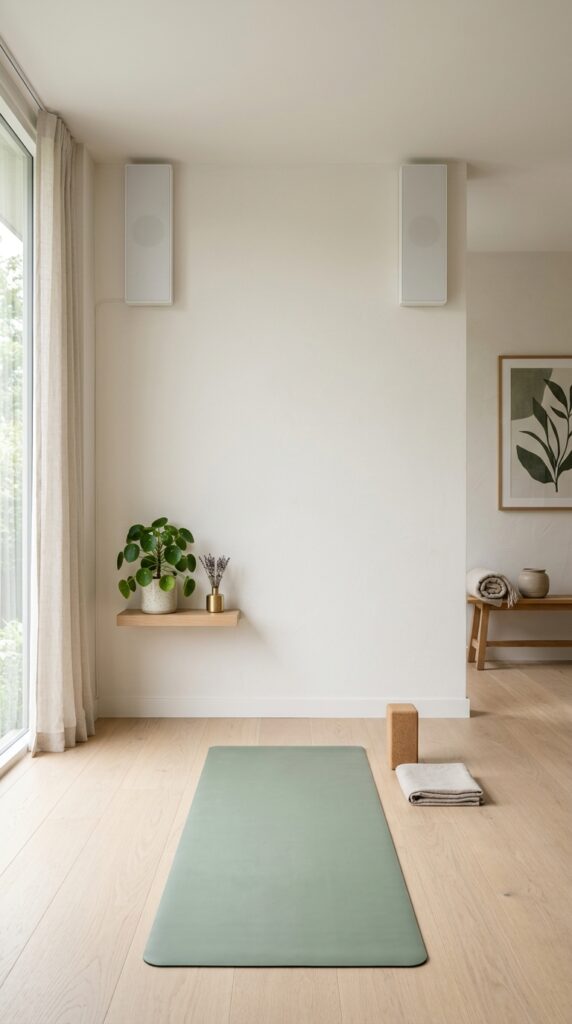
Vibe: Clean and considered — the room where sound arrives from everywhere and nowhere at once.
Why it works: Wall-mounted speakers at high-corner placement use the principle of immersive sound distribution: positioned above ear height and angled downward, they create an enveloping acoustic field rather than the directional “stereo beam” of desktop speakers. This matters during yoga because directional sound creates a psychological anchor to one side of the room, subtly disrupting the spatial neutrality that a good practice space needs. Matte white or matching-wall finishes make speakers visually recessive — the sound is present; the source is not.
How to get it: Slim wireless wall-mount speakers (Sonos Era 100 or affordable alternatives on Amazon) attach to a standard wall with a single bracket and connect via WiFi or Bluetooth — no receiver or amplifier required. Run cable through the wall if possible; if not, a slim cable channel in matching wall color conceals the cable for under $15. Mount at 2m height in opposing corners.
💡 Quick Win: A single Bluetooth speaker in a matte ceramic or fabric housing placed on a high shelf ($30–55) creates directional ambient sound for practice without any installation at all.
🛍️ Shop the Look — Amazon Product Ideas
| # | Product Search Phrase | Why It Fits |
| 1 | Slim wall mount Bluetooth speaker wireless white | Recessive sound source |
| 2 | Cable channel cover wall paint-over white | Cable concealment strip |
| 3 | Small wireless speaker ceramic housing | Shelf-placed alternative |
| 4 | Wall speaker mount bracket adjustable | Installation hardware |
| 5 | Yoga meditation music playlist Bluetooth speaker | Atmospheric sound pairing |
19. A Minimalist Altar or Intention Shelf
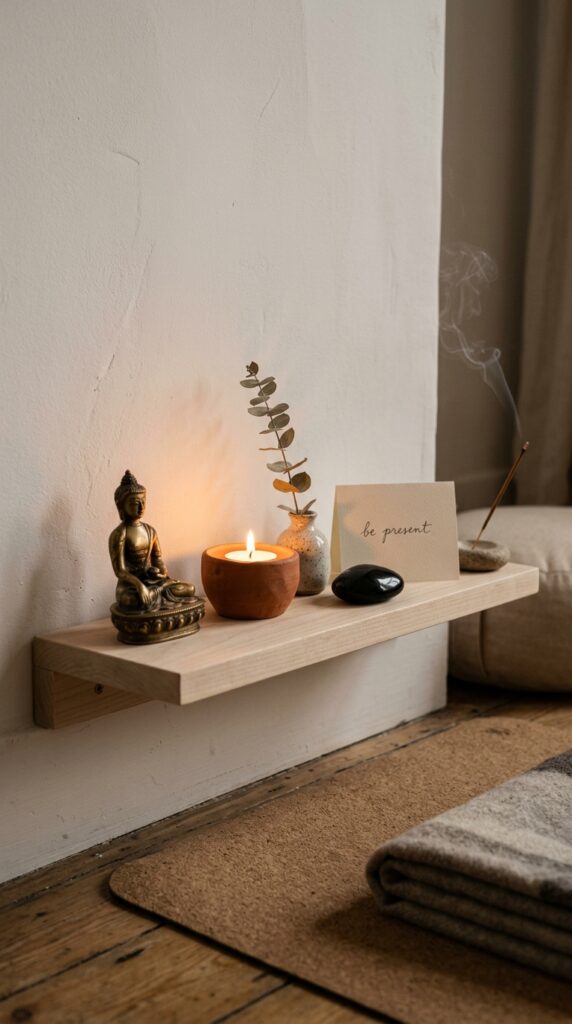
Vibe: Still and intimate — the shelf that holds the things you practice toward.
Why it works: A physical intention shelf applies the design principle of the focused vignette: a small collection of objects chosen for personal meaning creates a visual anchor that signals to the nervous system that this space is different from every other room. Research in environmental psychology confirms that personal ritual objects in a dedicated space significantly increase follow-through on habit formation — the altar isn’t spiritual decoration; it’s behavioral architecture. Keep it at eye level during seated meditation (roughly 30–40cm from the floor).
How to get it: Mount a single narrow floating shelf (no deeper than 20cm) at knee height — low enough to be at eye level during seated meditation. Style with the rule of five: maximum five objects, minimum one representing each sense (visual, tactile, aromatic, sonic if a small bell, and written intention). Replace the written card monthly.
🛍️ Shop the Look — Amazon Product Ideas
| # | Product Search Phrase | Why It Fits |
| 1 | Small floating shelf narrow pale wood | Altar shelf base |
| 2 | Obsidian smooth palm stone natural | Tactile grounding object |
| 3 | Clay tea light candle holder small | Warm altar candle |
| 4 | Tiny ceramic bud vase single stem | Visual floral accent |
| 5 | Brass meditation bell small clear tone | Sonic ritual object |
20. Textural Contrast: Smooth Walls, Rough Jute
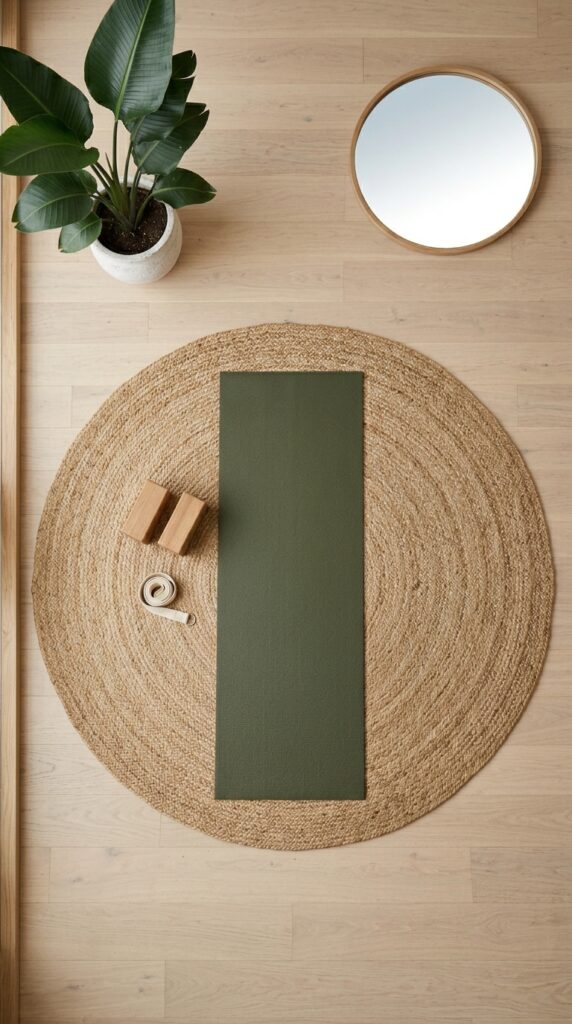
Vibe: Serene and layered — the room that rewards touch as much as sight.
Why it works: Pairing smooth plastered walls with a coarse jute rug uses textural counterpoint: the eye and hand register the difference between surfaces, creating sensory richness without color or pattern complexity. This is one of the most sophisticated moves in minimalist interiors — achieving visual interest through material contrast rather than decorative accumulation. A large round jute rug in the center of a yoga room also softens the acoustics of the space, reducing echo and creating a warmer, more contained sound environment during practice.
How to get it: Choose a round jute rug at least 180cm in diameter — large enough that your mat sits fully within its bounds when centered. Natural jute is appropriately rough for barefoot use and becomes softer with use. If jute feels too scratchy, a sisal-cotton blend achieves a similar visual effect with a slightly softer hand. Position the mat in the center of the rug rather than offset — symmetry is grounding in a practice space.
🛍️ Shop the Look — Amazon Product Ideas
| # | Product Search Phrase | Why It Fits |
| 1 | Round jute rug large 180cm natural | Textural floor anchor |
| 2 | Sisal cotton blend round rug natural | Softer jute alternative |
| 3 | Non-slip rug pad round natural | Rug grip safety layer |
| 4 | White ceramic plant pot large tall | Clean corner planter |
| 5 | Large tropical leaf artificial plant | Bold corner green accent |
21. Skylights or Sun Tunnel for Overhead Natural Light
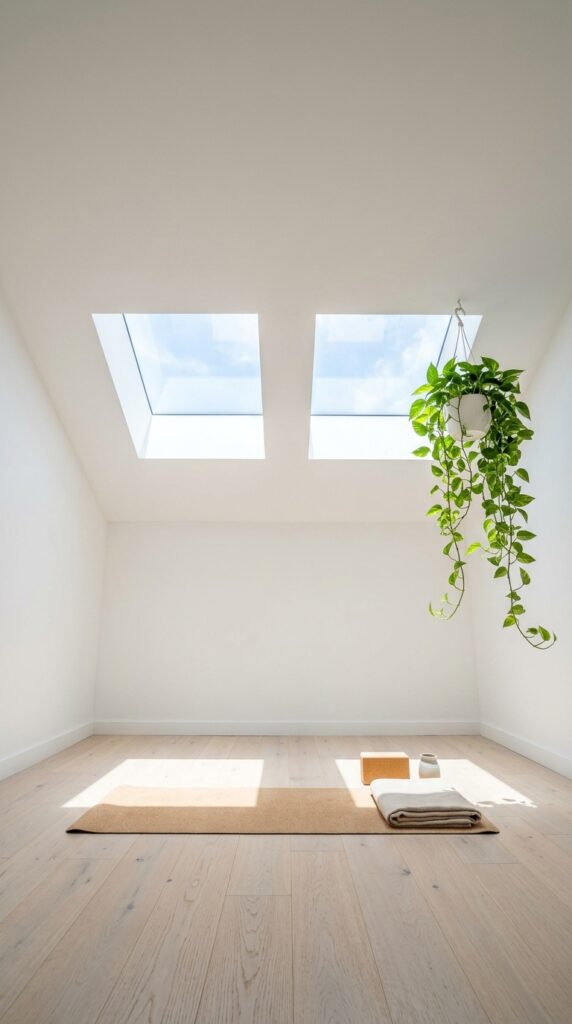
Vibe: Luminous — the room lit from heaven rather than from the wall.
Why it works: Overhead natural light from a skylight or sun tunnel creates the most even, shadow-free illumination possible for a yoga practice space. Unlike side-window light, which creates a gradient from bright to dim across the room and casts shadows during lateral poses, overhead light falls vertically and distributes evenly across the mat. This is the lighting condition found in purpose-built yoga studios for exactly this reason — it removes the perceptual distraction of moving shadows during flow sequences and supports savasana with a quality of light that feels both active and still.
How to get it: A sun tunnel (tubular skylight) is the accessible entry point — it requires a 35cm ceiling penetration, no structural modification, and costs $150–300 installed versus $2,000+ for a traditional skylight. Sun tunnels deliver remarkable daylight even on overcast days and can be fitted in a single day. For a non-renovation alternative, a daylight spectrum LED panel ceiling light ($40–80) mimics skylight color temperature at 6500K.
🛍️ Shop the Look — Amazon Product Ideas
| # | Product Search Phrase | Why It Fits |
| 1 | Daylight LED ceiling panel flush mount 6500K | Skylight color alternative |
| 2 | Sun tunnel skylight kit DIY 10 inch | Real overhead natural light |
| 3 | Trailing pothos artificial skylight hanging | Overhead light-catching plant |
| 4 | White ceiling paint ultra flat matte | Light-reflective surface |
| 5 | Ceiling hook anchor for hanging plants | Plant suspension hardware |
22. Japandi-Inspired Neutral Palette Throughout
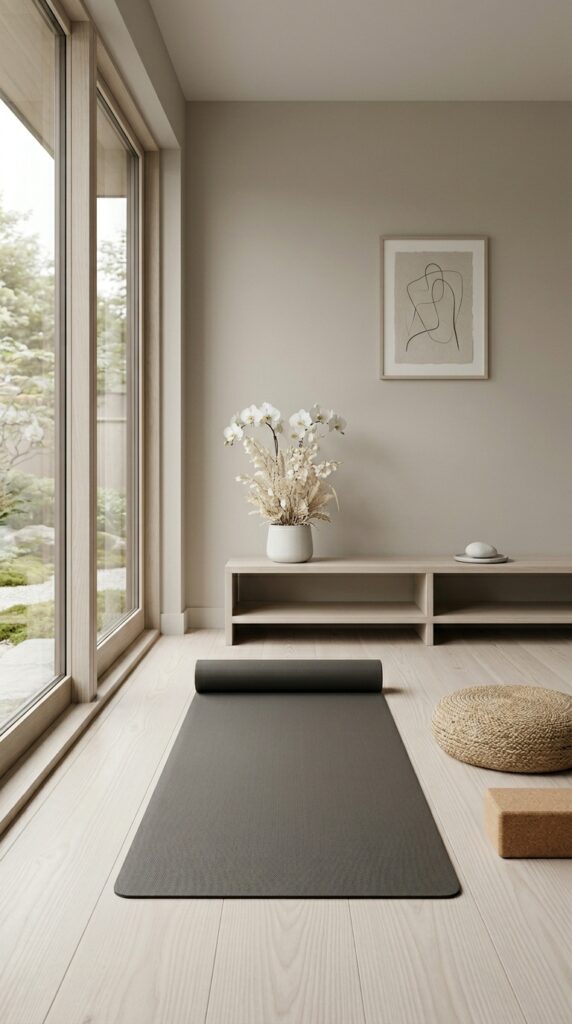
Vibe: Calm and meditative — a room that has already arrived at peace.
Why it works: A full Japandi palette — warm white, ash wood, warm greige, and natural charcoal — uses the principle of tonal harmony: all tones belong to the same warm-neutral family, so the room reads as a single unified composition regardless of where the eye rests. The Japandi style’s specific genius is in its use of charcoal as the darkest tone rather than black — charcoal retains warmth while providing contrast, whereas black introduces a visual sharpness that disrupts the meditative quality. One orchid in white ceramic is the only “decoration” a Japandi yoga room needs.
How to get it: Build the palette from the floor up: pale ash or oak flooring, warm greige walls (Benjamin Moore “Pale Oak” OC-20 is a benchmark reference), natural rubber mat in charcoal or slate, white ceramic vessels and shelf objects. Introduce no pattern, no bright color, and no reflective surface other than glass. The orchid is not optional — one living thing, simply placed, completes the composition in a way no object can.
🛍️ Shop the Look — Amazon Product Ideas
| # | Product Search Phrase | Why It Fits |
| 1 | Natural rubber yoga mat slate charcoal | Darkest palette tone |
| 2 | White phalaenopsis orchid artificial realistic | Living composition element |
| 3 | White ceramic planter round minimalist | Orchid vessel |
| 4 | Low bamboo shelf narrow Japandi style | Warm wood surface |
| 5 | Smooth white river stone large decorative | Minimal shelf object |
23. String Lights for Soft Evening Practice
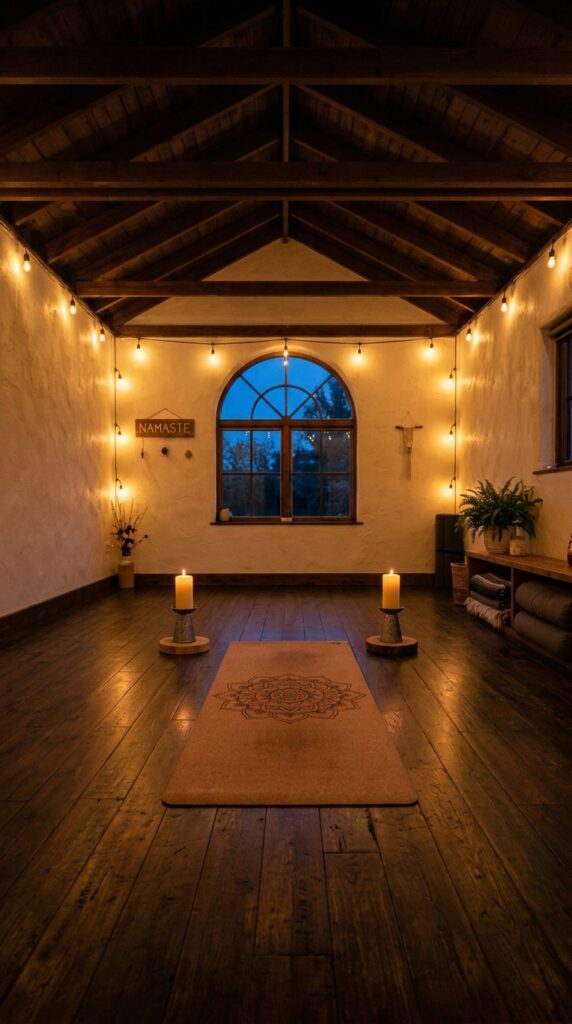
Vibe: Warm and intimate — the kind of light that makes you forget it’s evening.
Why it works: Running Edison string lights along the ceiling perimeter creates a halo of warm, peripheral light that is below the 2700K threshold associated with melatonin suppression — making it genuinely supportive for evening practice and wind-down yoga. The warm filament glow at ceiling height exploits the visual principle of edge illumination: by lighting the perimeter rather than the center, the light defines the room’s boundary while leaving the practice space in soft, shadow-rich ambient light. This is the technique used in high-end wellness spas, and it translates directly to a home room.
How to get it: Use string lights with S14 or G40 Edison bulbs rather than small fairy lights — the larger bulb size creates a bolder, more architectural statement at ceiling height. Run them on a dimmer switch (plug-in dimmers for string lights are available for under $15) so you can adjust from yoga to restorative to near-dark for savasana.
🛍️ Shop the Look — Amazon Product Ideas
| # | Product Search Phrase | Why It Fits |
| 1 | Edison bulb string lights S14 warm white outdoor | Ceiling perimeter lighting |
| 2 | Plug-in dimmer switch string lights compatible | Light level control |
| 3 | Ceiling clip hooks clear string light | Non-damage ceiling mount |
| 4 | Large pillar candles ivory unscented set 3 | Floor-level warm accent |
| 5 | Warm amber LED bulb E26 2200K set 6 | Replacement warm bulbs |
24. A Vertical Garden Tower in the Corner
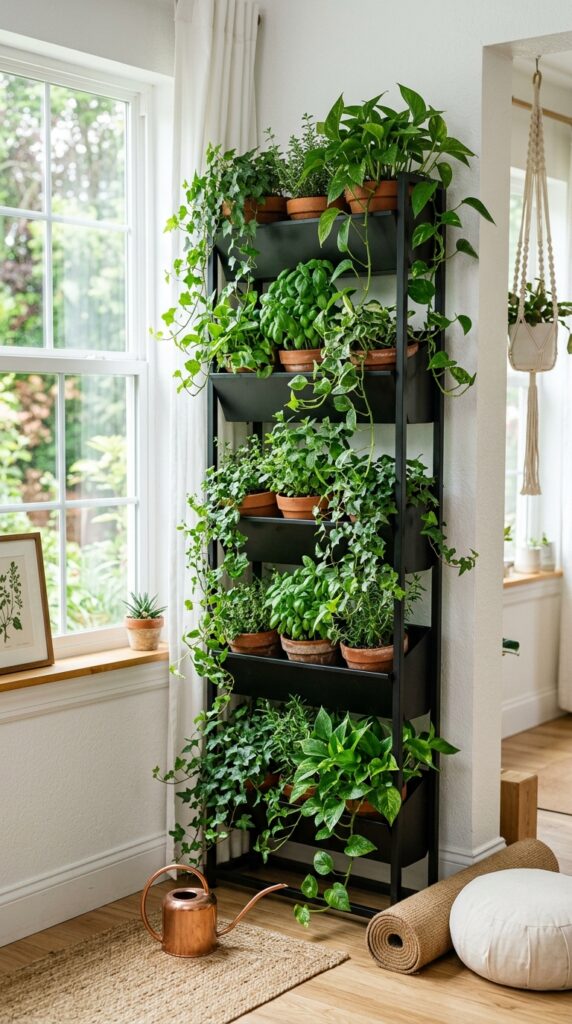
Vibe: Alive and abundant — the corner that grows.
Why it works: A tiered vertical garden tower uses the principle of concentrated biophilic density: by stacking plants vertically in a small footprint, you achieve the visual impact of a large plant grouping in a corner space of just 40cm × 40cm. This is the ideal solution for yoga rooms where floor space is at a premium — the tower occupies the corner dead zone that no mat or piece of furniture would use, while filling it with the oxygen-producing, visually calming presence of massed greenery. The visual rhythm of cascading plants at multiple heights also creates a natural focal point that draws the eye upward — supportive for standing balance postures.
How to get it: A 5-tier vertical garden tower in matte black or natural iron typically stands 120–160cm tall and fits in a standard corner with a 40cm diameter footprint. Choose a mix of trailing (ivy, pothos) and upright (herbs, small succulents) plants for varied silhouette at each level. Position within 1m of a window — most indoor plants need indirect light even if they tolerate shade.
🛍️ Shop the Look — Amazon Product Ideas
| # | Product Search Phrase | Why It Fits |
| 1 | Vertical plant tower stand tiered 5 level | Corner biophilic tower |
| 2 | Trailing ivy artificial plant realistic | Cascading green fill |
| 3 | Small terracotta pot set 6 with saucer | Tier planter vessels |
| 4 | Copper watering can small indoor plants | Functional corner accent |
| 5 | Pothos artificial trailing plant long | Low-maintenance tier fill |
25. Folded Blanket and Bolster Display
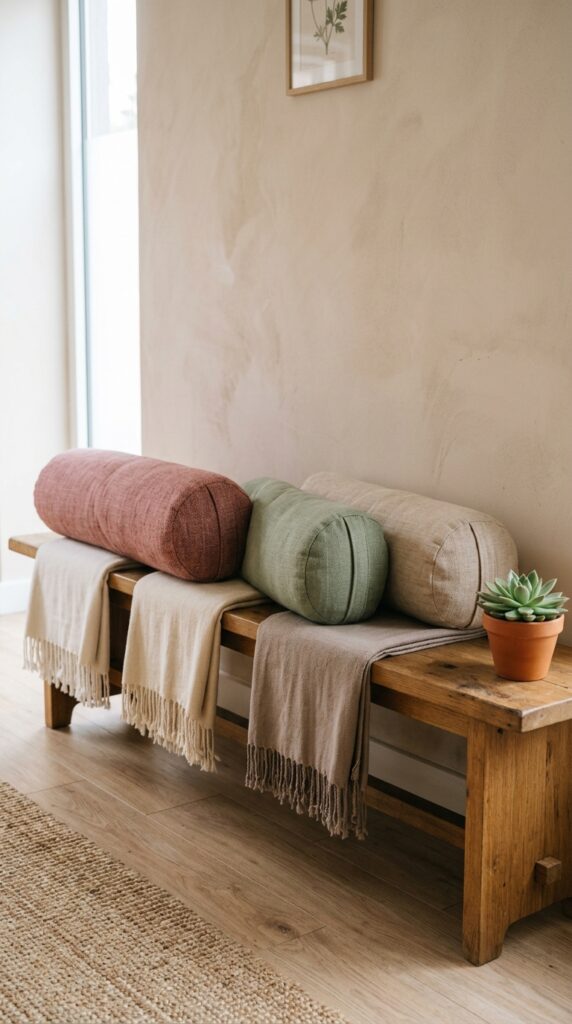
Vibe: Calm and welcoming — the room that has already prepared for your practice.
Why it works: Displaying bolsters and folded blankets on a low bench rather than storing them in a cupboard uses the principle of the prepared space: when props are visible and accessible, they become an invitation to practice rather than an obstacle. The color-coordinated display (bolsters in complementary muted tones, blankets folded to uniform size) transforms utilitarian props into a composed still life. Low bench-level display also keeps the room’s visual weight grounded, which supports the calm, earthward quality of a meditation and yoga space.
How to get it: Choose a low wooden bench (45–50cm high, at least 120cm long) with a simple, unadorned profile — the bench should recede, not dominate. Display bolsters on their sides rather than standing upright, and fold blankets to identical width and depth. A single small succulent at one end of the bench breaks the linearity and adds organic form.
💡 Quick Win: A wooden storage bench ($45–80) along one wall instantly organizes all yoga props while creating a composed, studio-quality visual when styled with folded blankets.
🛍️ Shop the Look — Amazon Product Ideas
| # | Product Search Phrase | Why It Fits |
| 1 | Yoga bolster cylindrical linen sage green | Displayed prop centerpiece |
| 2 | Cotton yoga blanket dusty rose woven | Color-coordinated blanket |
| 3 | Low wooden bench simple minimal | Prop display surface |
| 4 | Natural yoga blanket linen cotton woven | Third color bolster option |
| 5 | Small succulent arrangement pot white ceramic | Bench end organic accent |
26. A Bamboo Room Divider for Defined Practice Space
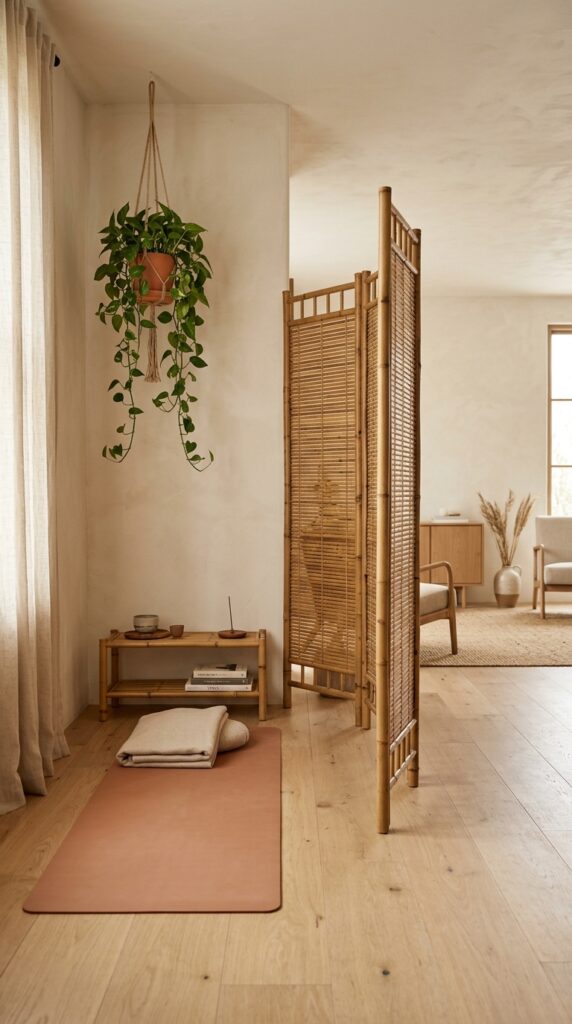
Vibe: Defined and calm — the sanctuary within the room.
Why it works: A bamboo room divider creates spatial enclosure in an open-plan space without permanent construction, exploiting the principle of psychological containment: even a partial visual barrier (one that doesn’t reach the ceiling, or has gaps in its weave) is sufficient to signal to the nervous system that this is a separate zone. Research in environmental psychology shows that partial enclosures reduce ambient distraction by limiting peripheral vision — which directly supports focus during practice. Bamboo specifically is the material of choice because its warm tone, natural texture, and cultural association with meditation and martial arts spaces all reinforce the room’s intended atmosphere.
How to get it: Choose a natural bamboo divider at least 170cm tall and 150cm wide (three panels) so it genuinely frames the practice space rather than suggesting it. Position it to block sightlines to the rest of the room — typically between the yoga space and the doorway or main living area. Avoid painted or lacquered bamboo dividers, which lose the organic quality.
🛍️ Shop the Look — Amazon Product Ideas
| # | Product Search Phrase | Why It Fits |
| 1 | Natural bamboo room divider screen 3 panel tall | Space-defining partition |
| 2 | Bamboo room divider folding 170cm natural | Height-appropriate option |
| 3 | Hanging trailing plant artificial long vine | Above-mat green canopy |
| 4 | Low bamboo shelf small narrow | Inside-corner storage |
| 5 | Natural rubber yoga mat dark slate | Surface within defined space |
27. Blackout Curtains for Restorative and Yin Practice
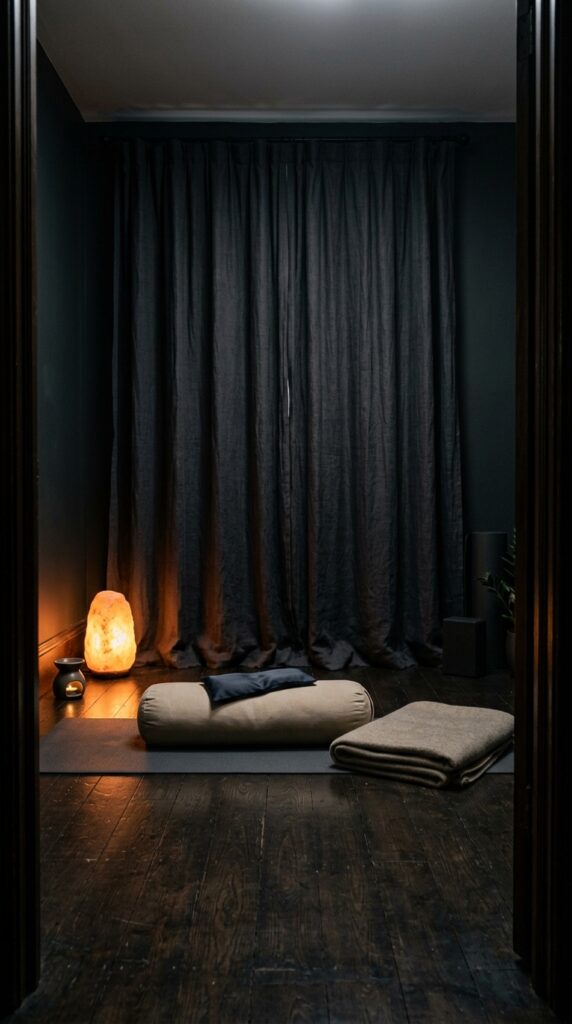
Vibe: Deeply restful — the kind of dark that asks nothing of you.
Why it works: Blackout curtains for a yoga room serve a specific therapeutic function that sheer panels cannot: they enable true darkness for yoga nidra, yin yoga, and restorative savasana — practices where ambient light stimulation prevents the deepest states of relaxation. The melatonin suppression threshold is crossed even by low ambient light (around 10 lux), which means that curtains that “seem dark enough” during evening practice are still preventing physiological rest. Charcoal or deep sage blackout curtains in a linen weave maintain the room’s organic aesthetic while performing their functional role.
How to get it: Install blackout curtains on a separate track or rod inside your existing sheer curtain layer so you can choose between diffused natural light (sheers) and total darkness (blackout) without removing either. Ensure curtains extend at least 10cm beyond the window frame on each side and have no light gap at the bottom. Charcoal linen-look blackout panels achieve the blackout function without the heavy, hotel-drape aesthetic of traditional blackout fabric.
🛍️ Shop the Look — Amazon Product Ideas
| # | Product Search Phrase | Why It Fits |
| 1 | Blackout curtain panels charcoal linen look | Total darkness enabler |
| 2 | Double curtain rod set for two layers | Sheer and blackout track |
| 3 | Lavender eye pillow silk weighted | Restorative practice prop |
| 4 | Yoga bolster rectangular natural | Restorative support prop |
| 5 | Aromatherapy diffuser ceramic small white | Restful scent during yin |
28. A Personalized Symbol or Mantra on the Wall
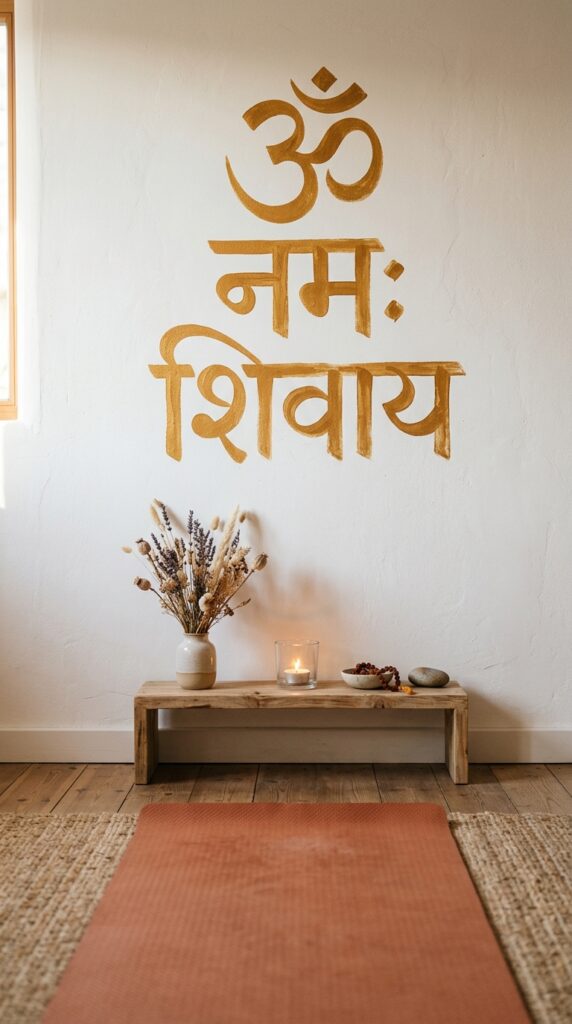
Vibe: Intimate and devotional — the wall that speaks before practice begins.
Why it works: A single hand-painted symbol, mantra, or word on the focal wall uses the principle of meaning-embedded space: a room that carries personal significance is psychologically different from one that is merely aesthetically pleasing. Research in positive psychology confirms that environmental cues associated with intention and values increase motivation and follow-through. The wall becomes a visual anchor for why you practice — and that “why” is the most powerful practice aid of all. Hand-painted rather than printed wall art matters: the irregularity of a brushstroke communicates human presence in a way laser-cut vinyl cannot.
How to get it: Commission a hand-lettered piece from an Etsy calligrapher (typically $30–80 for a custom piece on watercolor paper, ready to frame) or use a large stencil and paint directly onto the wall. Gold, warm white, or terracotta tones work best on white or sage walls. The symbol should be centered on the wall you face during meditation and positioned at eye level when seated — approximately 100–120cm from the floor.
🛍️ Shop the Look — Amazon Product Ideas
| # | Product Search Phrase | Why It Fits |
| 1 | Sanskrit mantra calligraphy print gold on white | Meaningful focal wall art |
| 2 | Large wall stencil botanical mantra yoga | DIY painted wall option |
| 3 | Metallic gold craft paint brush calligraphy | Wall painting material |
| 4 | Thin natural wood frame large print 18×24 | Warm minimal art mount |
| 5 | Dried botanical arrangement framed wall art | Secondary wall detail |
How to Start Your Home Yoga Room Transformation
Your single best first move is to clear the floor completely — every object, every piece of furniture — and roll out your mat in the center of whatever space you have. This is not preliminary tidying; it is the design act. A cleared floor reveals the room’s true dimensions, its light quality, and its architectural bones — and it immediately communicates whether you have enough space, where the natural focal point is, and what the room actually needs. Everything else builds from that empty floor.
The most common mistake beginners make is adding before subtracting. New yoga rooms filled with props, plants, cushions, candles, and wall art all purchased simultaneously rarely feel peaceful — they feel like a wellness store. The problem is visual density: too many elements at the same tonal weight compete for attention, and the room never settles. The fix is sequencing: add one element, practice with it for a week, assess whether it serves the space, then consider one more. Restraint is the practice.
Three items under $50 that create immediate sanctuary impact: a large round jute rug ($25–35) that defines your practice zone, a Himalayan salt lamp small enough to hold in one hand ($18–25) for ambient evening glow, and a single good-quality beeswax pillar candle in a clay holder ($8–12) for ritual presence. These three together shift the room’s atmosphere more effectively than any furniture purchase.
A single-space yoga corner with a mat, a salt lamp, and a cleared floor can be achieved in a weekend for under $100. A dedicated room with cork flooring, wall treatment, pendant lighting, and a full prop display takes four to eight weeks of staged purchasing and realistically costs $400–800 at the accessible end. What matters is that you begin — the first mat on the floor is the room.
Frequently Asked Questions About Home Yoga Room Decor
What’s the difference between a home yoga room and a meditation room?
A yoga room is designed for active movement practice — it prioritizes a cleared floor, good natural light for alignment visibility, and enough square footage for a mat plus some lateral reach. A meditation room prioritizes stillness and seated comfort — it often has more seating elements (zafu cushions, low chairs), softer and dimmer lighting, and less floor clearance. Many home practitioners combine both in one space using a zone approach: a cleared center for movement and a cushioned corner for seated practice. The design principles overlap significantly, with the main difference being the importance of the floor in a yoga-first space.
What colors are most calming for a home yoga room?
The most neurologically calm colors for a practice space are warm neutrals and muted naturals with warm grey undertones: dusty sage, pale clay, warm greige, and soft warm white. Avoid cool whites (with blue or green undertones), which read as clinical, and avoid saturated colors in any hue, which increase visual stimulation. If you want one color to carry the room, dusty sage painted on all four walls and the ceiling in a flat matte finish is the most universally calming choice — it’s warm enough to feel enveloping but muted enough to recede during inward practice.
How much does it cost to set up a basic home yoga room?
A basic but genuinely functional home yoga room — cleared floor, a quality yoga mat, one salt lamp, a jute rug, and two or three small accessories — costs $80–150 in total. A more considered setup adding cork flooring tiles, a wooden prop ladder, a meditation cushion set, a ceramic diffuser, and simple wall treatment runs $250–450. A professionally finished room with a feature wall, custom flooring, ceiling-mounted hammock or swing, quality sound system, and full prop display can reach $800–1,500. The greatest cost is not money but the discipline to keep removing rather than adding.
Can I create a yoga room in a small space or apartment?
A yoga mat requires a footprint of 180cm × 60cm — that’s genuinely all the floor space active practice demands, and it fits in almost any room, hallway alcove, or under-stair space. The key constraints are ceiling height (you need at least 210cm for arm-extended poses and more for inversions), and a surface you can unroll a mat on. An apartment yoga corner can be defined with a jute rug, a bamboo room divider, and a wall-mounted shelf with three objects — no construction, no permanent changes, and reversible if you move. Small dedicated spaces often feel more sanctuary-like than large ones.
What type of flooring is best for a home yoga room?
Natural cork flooring is the gold standard for a home yoga room: it provides cushioning for joints during floor poses, warmth underfoot, grip without stickiness, and excellent acoustic absorption. Unfinished white oak or bamboo flooring are strong alternatives — harder than cork but visually warmer than tile or laminate. Standard carpet is the worst option: it destabilizes balance poses, holds moisture from practice, and harbors allergens. If you’re working with existing carpet and can’t replace it, high-density cork interlocking tiles placed directly over carpet create a firm, warm surface for practice.
Ready to Create Your Dream Home Yoga Room Sanctuary?
These 28 ideas move across the full design spectrum — from flooring and color palette choices like dusty sage walls and cork foundations, to material decisions around bamboo dividers and jute rugs, to lighting layered from skylights and salt lamps to Edison perimeter strings, to the intimate accessories that make a room genuinely feel like yours. You don’t need all 28, and you don’t need them at once — beginning with one cleared floor and one good candle is enough to feel the shift, and that first shift is the most important one. Today, clear everything from your practice area, roll out your mat, and sit for five minutes in the space before you add anything back — let the room tell you what it needs. When a home yoga room is done right, you’ll feel it the moment you cross the threshold: a settling, a slowing, a sense that this room was made for returning to yourself. Pin the ideas that spoke to you — especially the ones about light and emptiness, which are the hardest to find and the most worth saving.