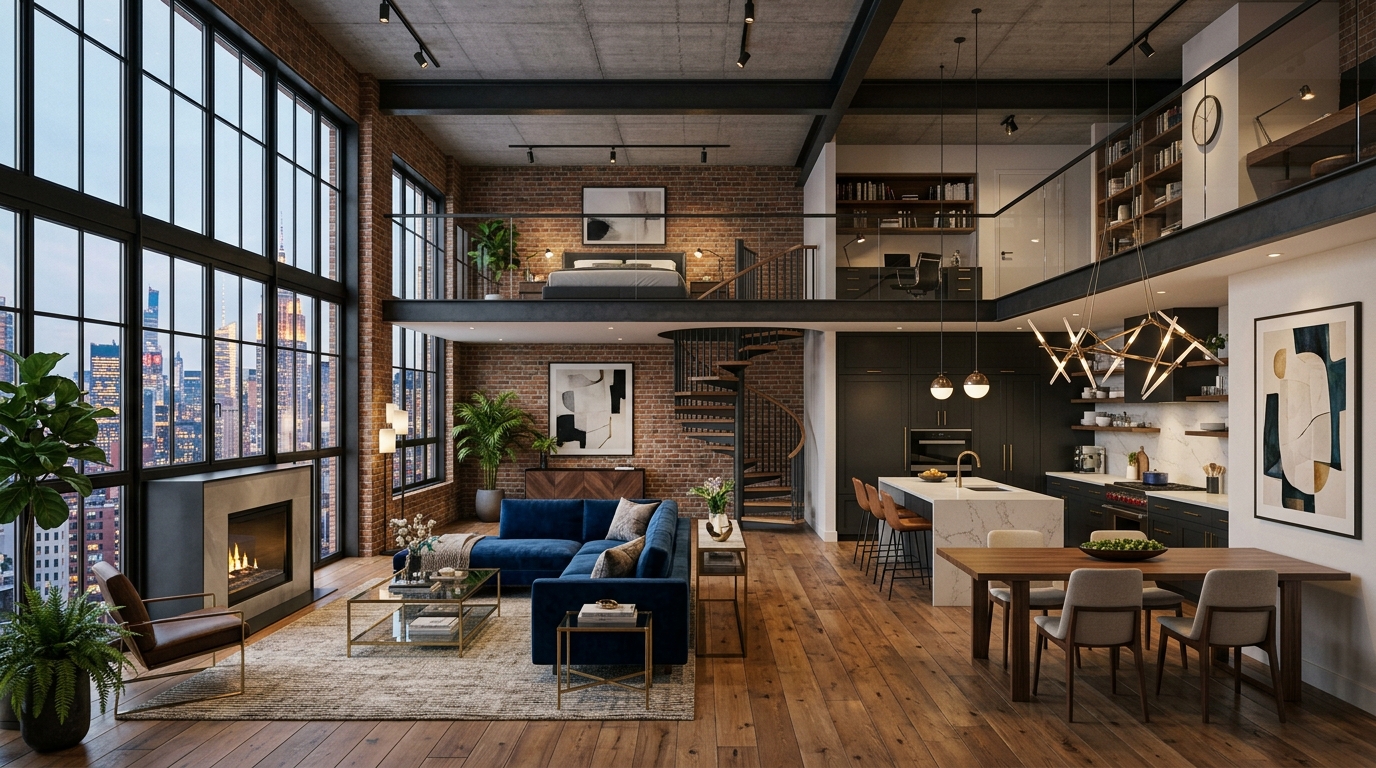
A sophisticated loft is an open-plan urban living space that transforms raw architectural elements — exposed brick, concrete ceilings, steel beams, and industrial-scale windows — into a refined, layered interior through deliberate material choices, thoughtful zone definition, and an elevated design sensibility. This article gives you exactly 24 sophisticated loft design ideas spanning color, material, furniture, lighting, layout, and small-space strategy — each one designed to elevate an open-plan space from merely spacious to genuinely compelling.
There is a particular tension in a well-designed loft that no other interior achieves. The bones are industrial — raw, unfinished, indifferent — and the life lived inside is warm, considered, and deeply personal. Getting that tension right is what separates a loft that photographs well from one that actually feels like somewhere worth living. The best sophisticated loft interiors do not decorate over their rawness. They lean into it, then layer against it until the room holds both.
Here are 24 ideas worth saving — and stealing.
Why Sophisticated Loft Style Works So Well
The sophisticated loft interior draws from a specific lineage: the artist lofts of 1970s SoHo, the converted industrial spaces of London’s Shoreditch and Berlin’s Mitte, and the high-design residential loft projects that emerged as urban living became aspirational rather than provisional in the 1990s and 2000s. What distinguishes a sophisticated loft from a merely converted one is intentionality — the decision to treat the space’s industrial archaeology as a design asset rather than a problem to be covered. Exposed concrete, cast iron columns, steel-framed windows, and raw brick are not the shell of the interior; they are its primary decorative layer.
The material vocabulary of sophisticated loft design is specific and tactile. Concrete appears in floors (polished to 400–800 grit), ceiling soffits, and cast furniture bases. Steel reads in window frames, stair stringers, sliding barn door hardware, and shelving systems. Wood — specifically wide-plank white oak, reclaimed Douglas fir, or smoked walnut — appears in floors, furniture, and floating shelves, bringing the warmth that industrial materials cannot provide. Leather in cognac, tobacco, and dark espresso anchors seating. Textiles in heavyweight linen, raw silk, and Mongolian wool introduce softness. The palette runs from warm charcoal (#2C2C2C) and raw concrete grey (#8C8C87) through warm white (#F2EDE6), aged brass, and amber — with deliberate injections of warm terracotta, deep navy, or forest green as accent.
The sophisticated loft is experiencing a particularly strong cultural moment right now. Post-pandemic urban return has renewed interest in the loft typology, as remote workers seek home environments that feel genuinely different from conventional apartment living. Simultaneously, the sustainability movement has valorized adaptive reuse — the conversion of industrial buildings into residential and live/work spaces rather than demolition — making the loft interior not just stylistically desirable but ethically resonant. Pinterest searches for “sophisticated loft design” and “industrial chic interior” have climbed consistently since 2022.
Even compact lofts — studios and one-bedrooms under 800 square feet — achieve sophisticated loft character because the style’s most powerful elements operate at an architectural rather than a decorative scale. Exposed ceiling height, raw material surfaces, and steel-framed windows deliver sophistication regardless of floor area. Small loft dwellers should invest first in the floor finish, the primary lighting fixture, and one strong furniture anchor — the rest follows.
| Element | Classic Industrial Loft | Sophisticated Loft |
| Philosophy | Raw preservation, minimal intervention | Deliberate tension between raw and refined |
| Materials | Exposed brick, concrete, steel, reclaimed wood | Polished concrete, aged brass, linen, smoked oak |
| Color palette | Raw grey, rust, black, warm white | Warm charcoal, cognac, aged brass, deep navy accent |
24 Sophisticated Loft Design Ideas
1. Polished Concrete Floors with Radiant Heat
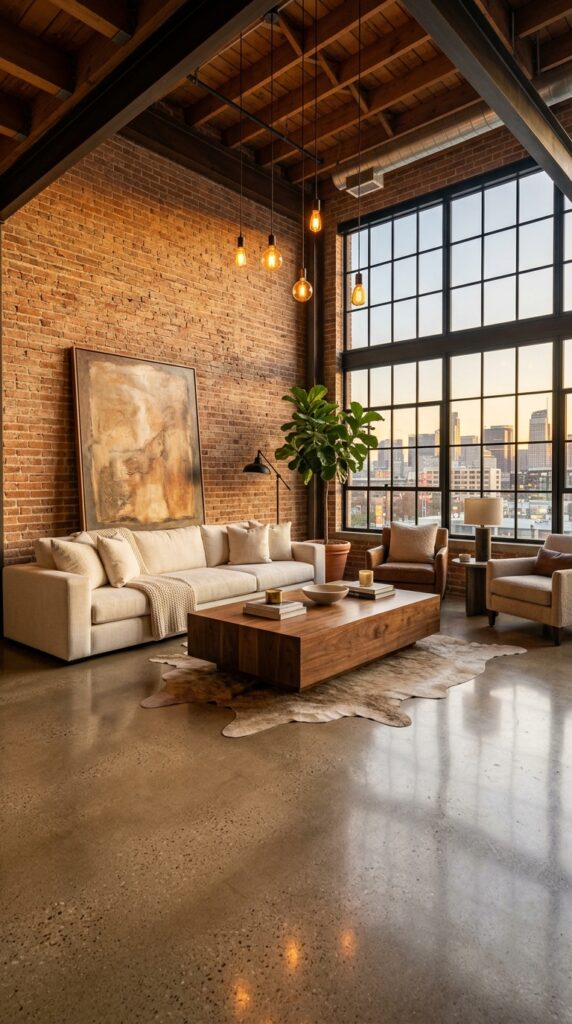
Vibe: Warm and luminous — the floor that makes the entire room feel like it was poured rather than assembled.
Why it works: Polished concrete is the foundational material choice for a sophisticated loft because it performs multiple simultaneous design functions: it visually extends the floor plane without seams (no grout lines, no pattern interruption), it reflects light upward and amplifies the room’s ambient luminosity, and it references the industrial heritage of the building while being distinctly refined in its finished state. The difference between 400-grit and 800-grit polishing is significant — 400-grit produces a matte stone-like finish, while 800-grit produces the luminous satin that catches light without becoming a mirror. Radiant heat beneath polished concrete eliminates the material’s primary comfort objection and makes it a genuinely livable floor year-round.
How to get it: Existing concrete subfloors can be ground and polished in place by a concrete flooring specialist — typical costs run $3–$8 per square foot depending on the existing concrete’s condition. Specify a densifier application between grinding stages to harden the surface and improve reflectivity. A penetrating sealer (not a topical coating) protects against staining without adding the plastic-look sheen that undermines the material’s authentic character. A cowhide rug or large-format wool rug defines the seating zone without interrupting the floor plane.
💡 Quick Win: A concrete floor wax in a warm amber tone — applied to an existing matte concrete floor — costs $40–$80 in product and dramatically improves reflectivity and warmth without full polishing, creating 60% of the visual effect at 10% of the cost.
🛍️ Shop the Look — Amazon Product Ideas
| # | Product Search Phrase | Why It Fits |
| 1 | concrete floor densifier sealer penetrating | Polish-finish protection |
| 2 | cowhide rug large natural black white | Zone-defining floor layer |
| 3 | concrete floor wax warm tone applicator | Budget reflectivity boost |
| 4 | smoked walnut coffee table low profile | Warm floor complement |
| 5 | large linen floor cushion natural | Additional floor softening |
2. Exposed Steel Beam Ceiling as a Design Feature
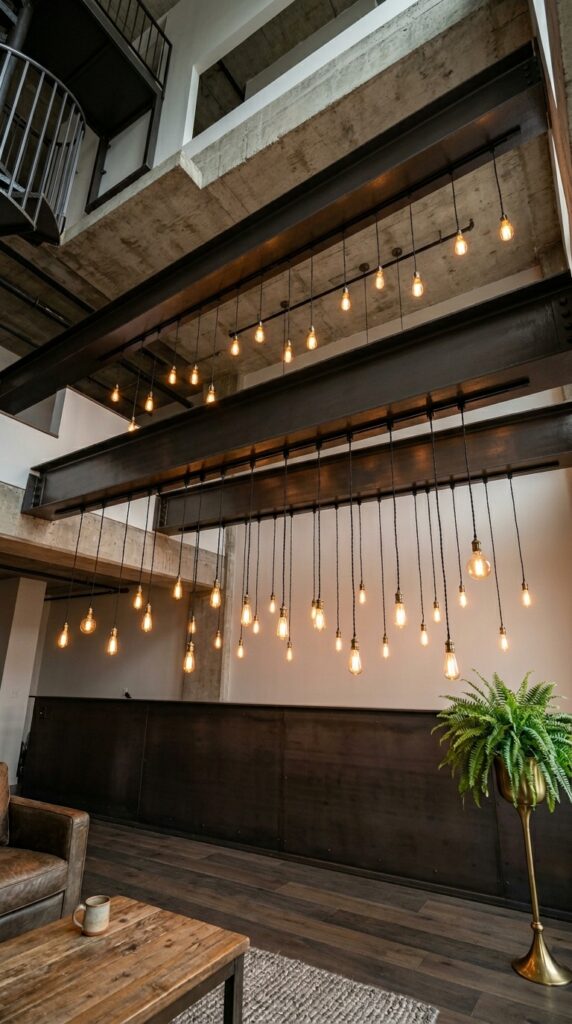
Vibe: Industrial and theatrical — a ceiling that makes looking up one of the room’s best experiences.
Why it works: Exposed steel beams are the most architecturally significant element in most loft ceilings, and painting them in a warm charcoal rather than leaving them in raw mill finish or painting them black makes the critical distinction between sophisticated and merely industrial. Warm charcoal (a black with brown or green undertones, not blue) reads as a deliberate color choice rather than an absence of color, and it allows the beam’s structural form — the wide flange profile, the web, the connection plates — to read as sculptural without becoming visually dominant. Pendant lights hung at varied lengths from beam-mounted track create a rhythm that reinforces the beam’s linear geometry while introducing warmth through filament glow.
How to get it: Sherwin-Williams Tricorn Black SW 6258 and Benjamin Moore Wrought Iron 2124-10 are both warm near-blacks appropriate for steel beam painting. Apply with a brush rather than a roller to reach the beam’s web and flange recesses — spray application is faster but requires significant masking. Install beam-mounted track lighting using a track adapter that clips to the beam flange without drilling into structural steel.
🛍️ Shop the Look — Amazon Product Ideas
| # | Product Search Phrase | Why It Fits |
| 1 | Edison globe pendant light black fabric cord | Beam-hung warm light |
| 2 | pendant light cord set adjustable length | Variable height hanging |
| 3 | beam clamp electrical track mount | Non-drilling beam attachment |
| 4 | warm charcoal black metal paint quart | Beam painting material |
| 5 | tall brass plant stand indoor large | Floor accent at beam base |
3. The Floating Bedroom Platform in an Open Loft
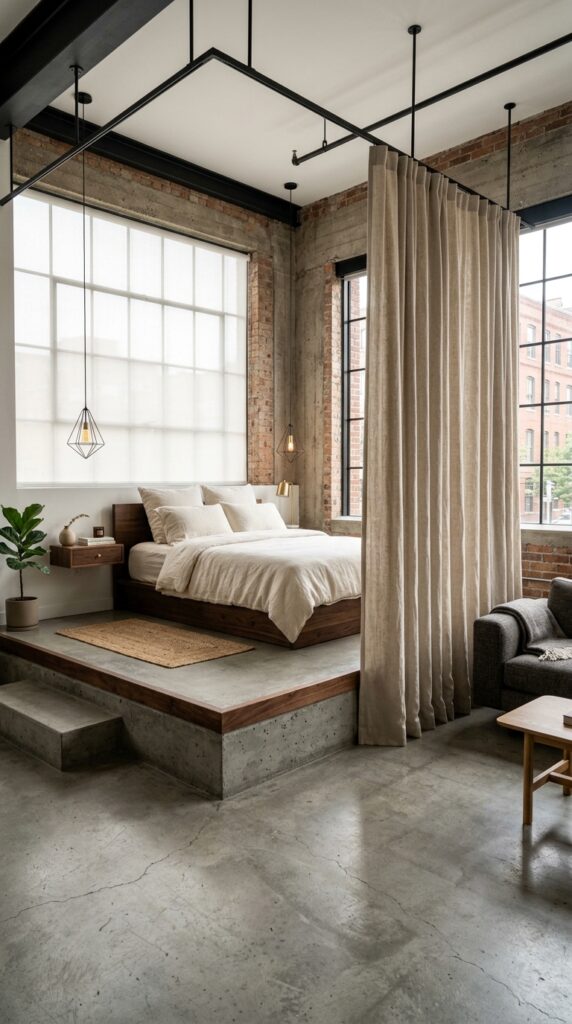
Vibe: Serene and layered — a sleeping space that feels genuinely private without closing off the room.
Why it works: Elevating the sleeping zone on a platform rather than walling it off uses a vertical transition — a level change — to create psychological separation while maintaining the spatial continuity that defines loft living. The 18-inch elevation is the sweet spot: enough to signal a zone change and create a distinct floor plane, not so much as to feel like a stage. The hanging linen curtain provides privacy without permanent construction, maintaining the loft’s flexible, open character. This is the design principle of implied enclosure: the zone feels private without being walled.
How to get it: A sleeping platform can be constructed with a steel frame and poured concrete topping slab (most authentic), or with a plywood deck finished in wide-plank oak or painted concrete-look finish (more accessible). The platform edge — the riser visible from the main floor — should be clad in a material that bridges the two zones: dark walnut if the living area floor is warm-toned, polished concrete edge if the living area floor is grey-toned.
🛍️ Shop the Look — Amazon Product Ideas
| # | Product Search Phrase | Why It Fits |
| 1 | heavyweight linen curtain panel natural 108 inch | Zone-dividing curtain |
| 2 | black steel ceiling curtain rod industrial | Curtain hanging hardware |
| 3 | platform bed dark walnut low profile | Elevated sleeping surface |
| 4 | wall mount bedside shelf brass hardware | Platform wall fixture |
| 5 | small pendant light bedroom cord set | Bedside ambient light |
4. Floor-to-Ceiling Steel-Framed Windows
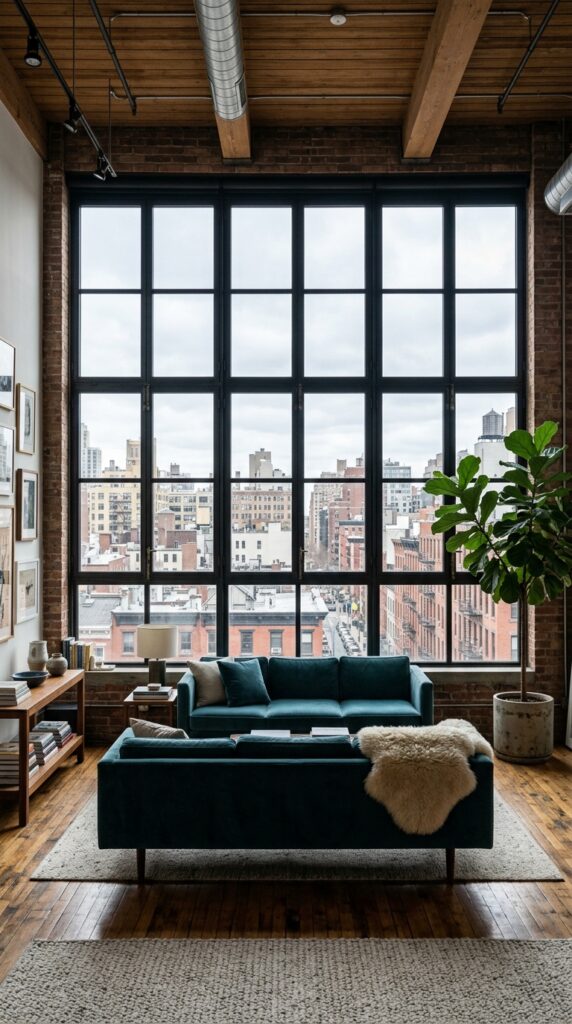
Vibe: Urban and expansive — a window wall that turns the city into the room’s most dynamic artwork.
Why it works: Steel-framed factory windows — Crittall-style, with their characteristic thin sightlines and geometric grid — are the most architecturally defining single element in a loft conversion. They perform simultaneously as a source of abundant natural light, as a visual connection to the urban landscape beyond, and as a graphic element in their own right: the black steel grid divides the view into a composed series of frames that reads like a contact sheet of the city. The design principle is architecture as artwork: these windows require nothing placed in front of them to be compelling. A single large plant in the corner and a low sofa that faces the view is sufficient — anything more competes with the window.
How to get it: Existing factory windows in converted buildings should be preserved and restored rather than replaced with modern aluminum or vinyl equivalents — the steel frame is irreplaceable and its removal diminishes the loft’s primary architectural asset by approximately 30% of its design value. If replacement is necessary for energy efficiency, specify Crittall or a modern equivalent (Hope’s Windows, or Steel Windows of America) — the additional cost over standard windows is justified by the architectural result.
🛍️ Shop the Look — Amazon Product Ideas
| # | Product Search Phrase | Why It Fits |
| 1 | crittall style room divider steel frame | Interior steel window partition |
| 2 | concrete indoor planter large tall | Window corner plant vessel |
| 3 | deep teal velvet sofa low profile | Window-facing seating |
| 4 | sheepskin throw natural white oversized | Sofa arm texture layer |
| 5 | fiddle leaf fig indoor tree large | Statement window corner plant |
5. The Statement Brick Wall — Painted vs. Raw
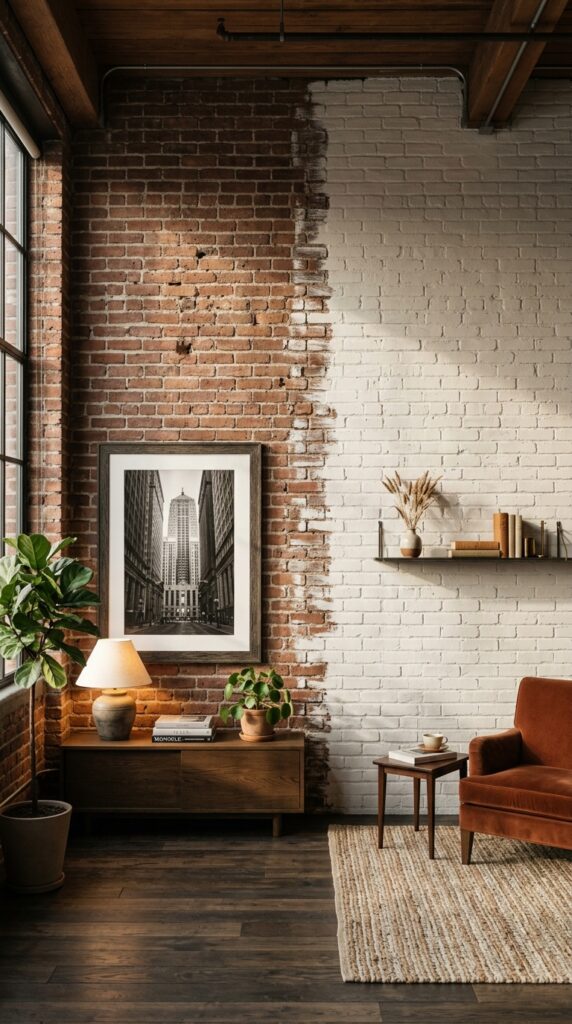
Vibe: Textural and artful — a wall treatment that looks like a design decision and an archaeological discovery at the same time.
Why it works: The debate between raw and painted brick in a loft context is resolved by understanding what each version contributes. Raw brick maximizes warmth and material authenticity — the color variation between individual bricks, the texture of the mortar joints, and the patina of age create a surface that no manufactured material can replicate. Painted brick (specifically limewash, not flat latex) allows the texture to remain while brightening a dark room and providing a neutral backdrop for artwork. The most sophisticated approach uses both: raw brick as a primary texture surface, limewash on an adjacent section to create tonal variation within the same material.
How to get it: Limewash paint (not standard latex) is essential — it penetrates the brick rather than coating it, preserving the texture and allowing the brick tone to influence the final color. Romabio Classico Limewash is the most widely specified product for this application. Apply in a dry-brush technique with visible brush direction for maximum texture retention. Never use standard flat latex on brick — it seals the surface, traps moisture, and peels within two to three years.
💡 Quick Win: A single gallon of limewash paint covers approximately 200–300 square feet of brick and costs $45–$80 — transforming a dark raw-brick feature wall into a bright, textured backdrop in one afternoon.
🛍️ Shop the Look — Amazon Product Ideas
| # | Product Search Phrase | Why It Fits |
| 1 | limewash paint white interior brick wall | Authentic brick paint |
| 2 | large format monochrome photo print canvas | Leaning wall artwork |
| 3 | slim floating wall shelf black steel | Against-wall shelf accent |
| 4 | brick mortar repair pointing tool | Raw brick maintenance |
| 5 | wide bristle brush natural fiber limewash | Dry-brush paint technique |
6. The Loft Kitchen: Open Shelving on Black Steel
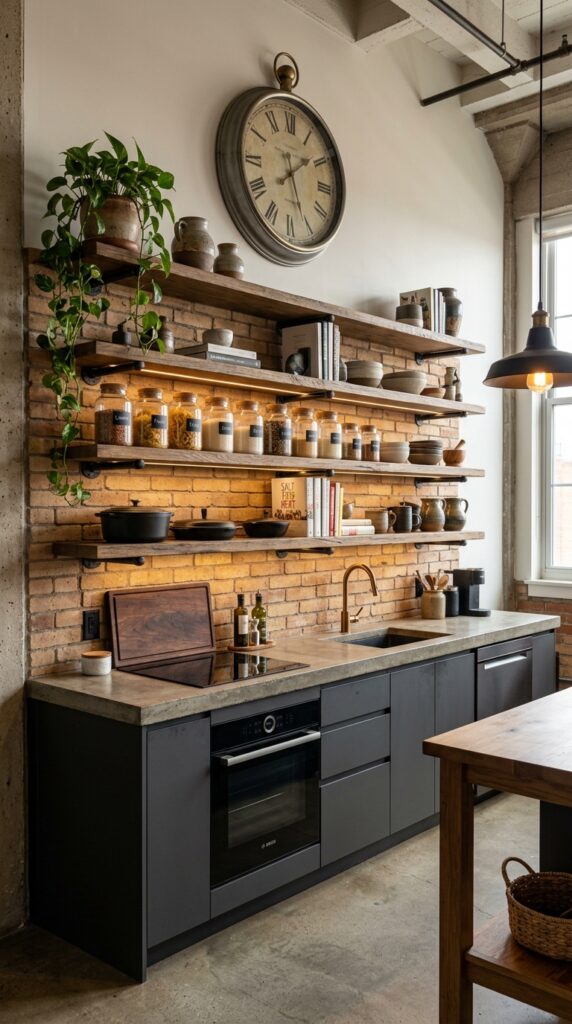
Vibe: Utilitarian and refined — a kitchen that looks like it was designed by someone who cooks seriously and thinks carefully.
Why it works: Replacing upper kitchen cabinets with open steel-and-wood shelving is the single most impactful move in a loft kitchen because it maintains the spatial openness that defines loft living — enclosed upper cabinets chop the wall plane into furniture-scale sections, while open shelving allows the wall surface (brick, concrete, or plaster) to read continuously from floor to ceiling. The steel pipe bracket is the correct hardware choice: it references the industrial vocabulary of the building, creates a visible structural logic, and allows the shelf to be loaded generously without appearing to float unsupported.
How to get it: Black steel pipe shelf brackets (3/4-inch pipe, floor-flanged) provide the most authentic industrial look. Pair with 2-inch-thick smoked oak or walnut shelving cut to the exact width of the kitchen run. Fasten directly into the masonry or stud wall — not into drywall alone — using masonry anchors for a secure load-bearing installation. Curate shelf contents: three categories maximum per shelf (ceramics, cookware, storage jars) and align the front edges of all objects to the same depth.
🛍️ Shop the Look — Amazon Product Ideas
| # | Product Search Phrase | Why It Fits |
| 1 | black steel pipe shelf bracket industrial | Kitchen open shelf hardware |
| 2 | smoked oak floating shelf board 2 inch thick | Warm dark shelf surface |
| 3 | matte charcoal kitchen cabinet paint | Lower cabinet color |
| 4 | uniform glass storage jar set kitchen | Curated shelf storage |
| 5 | under shelf LED strip warm white | Shelf task lighting |
7. Defining Zones with an Oversized Area Rug
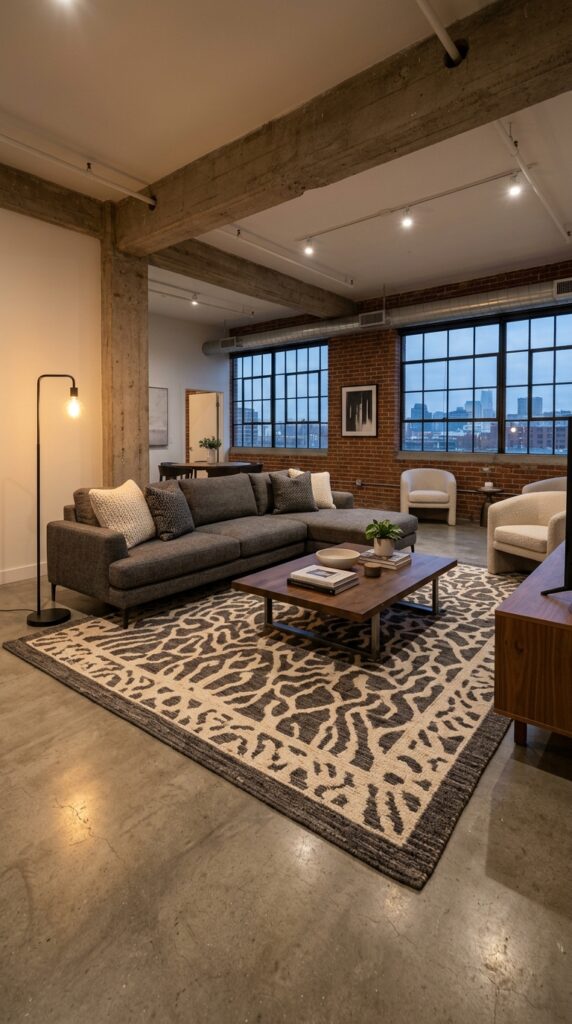
Vibe: Grounded and composed — the rug that turns an open floor plan into a room within a room.
Why it works: An oversized area rug is the primary zone-definition tool in an open loft plan — it performs the function of a room without requiring walls. The critical sizing rule is that the rug must be large enough for all four legs of the primary seating piece to rest on it — a rug that only catches the front legs of the sofa creates a visual disconnection that reads as accidental. In a sophisticated loft where polished concrete or hardwood floors are the primary surface, the rug should contrast clearly with the floor in texture rather than simply in color — a flat-weave rug on a polished floor reads as thin; a hand-knotted or high-pile wool rug reads as deliberately luxurious.
How to get it: For a standard loft living area with a three-seat sofa, an 8×10-foot rug is the minimum workable size; a 9×12 or 10×14 is more resolved. Source hand-knotted wool rugs from Moroccan or Turkish suppliers for authentic material quality at competitive price points — a 9×12 hand-knotted Moroccan rug runs $400–$1,200, significantly less than a comparable retail equivalent. Place on a thick rug pad to prevent movement and add underfoot cushioning on hard floors.
🛍️ Shop the Look — Amazon Product Ideas
| # | Product Search Phrase | Why It Fits |
| 1 | wool area rug abstract charcoal cream 9×12 | Zone-defining floor layer |
| 2 | thick non slip rug pad 9×12 | Hard floor rug grip |
| 3 | oversized Moroccan wool rug hand knotted | Authentic texture option |
| 4 | arc floor lamp brass industrial | Seating zone lighting |
| 5 | textured throw pillow set linen wool | Sofa surface softening |
8. Loft Library: The Floor-to-Ceiling Bookshelf Wall
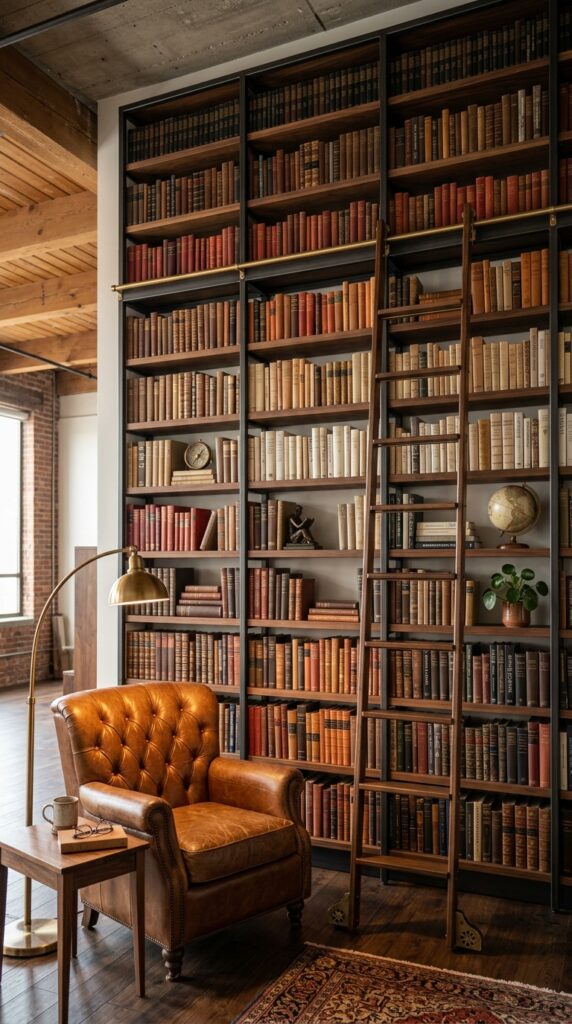
Vibe: Intellectual and immersive — a wall that makes the room feel like the best version of itself even before you sit down.
Why it works: A floor-to-ceiling bookshelf wall exploits the loft’s primary architectural asset — ceiling height — to create a feature that is simultaneously functional and emotionally compelling. Books organized by spine tone (rather than alphabetically or by subject) create a visual texture that reads as warm pattern from across the room and reveals its organizational logic only up close — an elegantly layered information hierarchy. The rolling library ladder is the functional element that validates the height: without it, upper shelves read as inaccessible decoration; with it, the full wall participates in daily life.
How to get it: A custom steel-and-walnut floor-to-ceiling shelf system runs $3,000–$8,000 fabricated; IKEA Billy bookcases floor-to-ceiling with custom fronts run $600–$1,500 as a budget alternative. Rolling ladder hardware kits (rail, ladder, brackets) start at $250 and can be fitted to any shelf system with a continuous horizontal rail. Specify a brass-finish rail rather than nickel or chrome — aged brass is the only metal that remains warm against dark walnut at this scale.
🛍️ Shop the Look — Amazon Product Ideas
| # | Product Search Phrase | Why It Fits |
| 1 | rolling library ladder kit brass rail hardware | Bookshelf ladder system |
| 2 | leather reading chair cognac brown | Library seating piece |
| 3 | arc floor lamp brass adjustable reading | Reading light source |
| 4 | floating shelf walnut dark 12 inch deep | Warm shelf surface |
| 5 | small bronze sculpture decorative shelf | Shelf object accent |
9. Concrete and Brass: The Loft’s Core Material Pairing
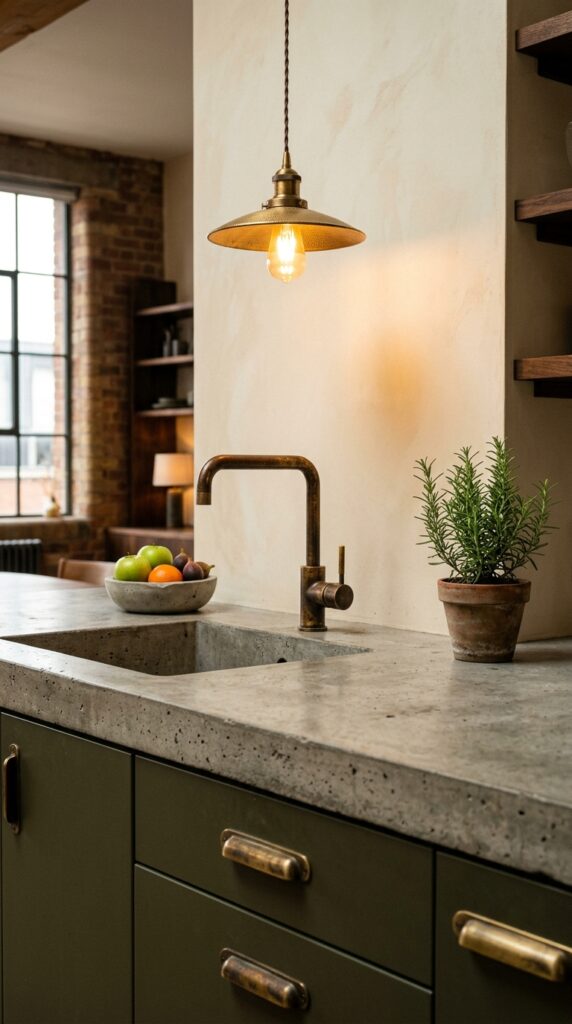
Vibe: Refined and material-focused — a kitchen that reads as curated rather than equipped.
Why it works: Concrete and aged brass is the foundational material pairing of the sophisticated loft because it resolves the style’s central design tension: concrete is cool, grey, and industrial; aged brass is warm, golden, and domestic. Together, they create a temperature balance that neither material achieves alone. The critical distinction is aged brass rather than polished or lacquered brass — aged brass has a matte warmth that absorbs light, while polished brass reflects it harshly and reads as a different era entirely. Unlacquered brass specified for fixtures will develop a natural patina within six to eighteen months of use that deepens this warmth further.
How to get it: Specify unlacquered brass fixtures (Rocky Mountain Hardware, Waterworks, or Rejuvenation all offer appropriate options) — the unlacquered finish will patina naturally and authentically. For concrete countertops, a 1.5–2-inch thickness is required for visual weight appropriate to a loft scale — thinner slabs look like a veneer. Concrete countertops should be sealed with a penetrating sealer, not a topical coating, to prevent the glossy plastic appearance that undermines the material’s authenticity.
🛍️ Shop the Look — Amazon Product Ideas
| # | Product Search Phrase | Why It Fits |
| 1 | unlacquered brass bar faucet kitchen | Patina-developing fixture |
| 2 | aged brass cabinet pull set | Hardware material pairing |
| 3 | concrete countertop sealer penetrating | Surface protection finish |
| 4 | concrete mixing kit countertop DIY | Budget concrete surface |
| 5 | aged brass pendant light kitchen | Above-island material match |
10. The Loft Bathroom: Raw Concrete and Black Steel
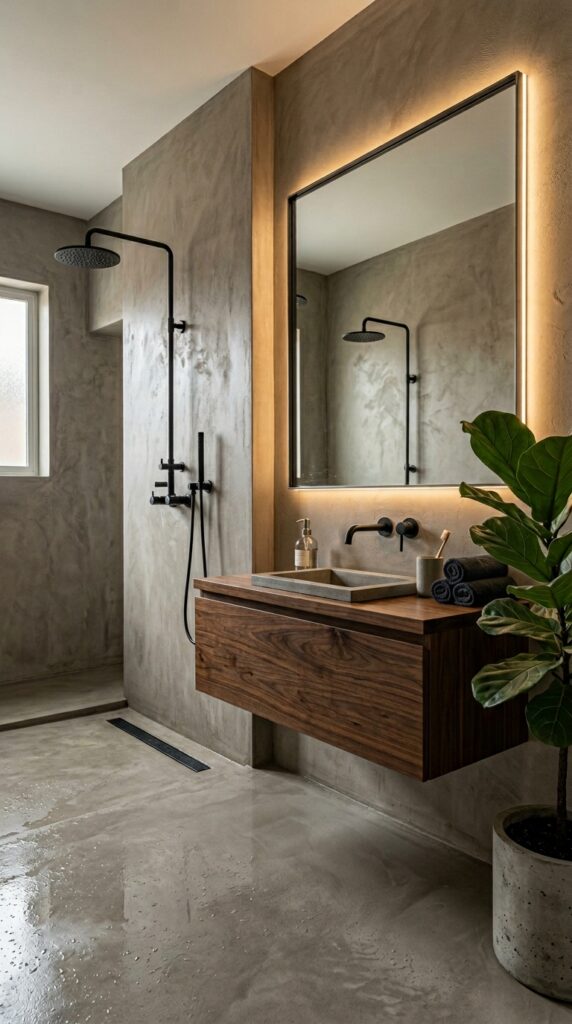
Vibe: Spa-like and raw — a bathroom that feels like a private wellness retreat inside an industrial building.
Why it works: Micro-cement — a thin-coat cementitious overlay applied over existing substrates — is the bathroom material that most faithfully extends the loft’s raw concrete aesthetic into a wet environment while meeting the practical requirements of a bathroom surface. Unlike standard concrete, micro-cement is seamless (no grout lines), waterproof when properly sealed, and available in a range of warm grey tones that can be calibrated to the loft’s main space. Matte black exposed-pipe fixtures are the correct plumbing aesthetic for this context: they reference the industrial plumbing vocabulary of the building and read as deliberately chosen rather than standard.
How to get it: Micro-cement application is a specialist trade requiring a skilled applicator — typical costs run $15–$30 per square foot applied. The surface requires a minimum of three coats (base, finish, sealer) and must be allowed to cure fully before water exposure. Specify a sealer formulated specifically for wet room micro-cement — standard penetrating sealers are insufficient for sustained water exposure at shower floor level.
💡 Quick Win: A large steel-framed mirror mounted above the vanity costs $80–$200 and immediately introduces the loft’s industrial vocabulary into a bathroom that has no other raw architectural features — it is the single highest-impact bathroom addition for a sophisticated loft aesthetic.
🛍️ Shop the Look — Amazon Product Ideas
| # | Product Search Phrase | Why It Fits |
| 1 | steel frame bathroom mirror large industrial | Vanity architectural mirror |
| 2 | matte black rain shower head wall mount | Period-correct fixture |
| 3 | matte black exposed pipe faucet bathroom | Industrial plumbing aesthetic |
| 4 | dark walnut floating vanity 36 inch | Warm bathroom furniture |
| 5 | micro cement overlay kit bathroom | DIY wet-room surface kit |
11. Industrial Pendant Lighting Over the Dining Table
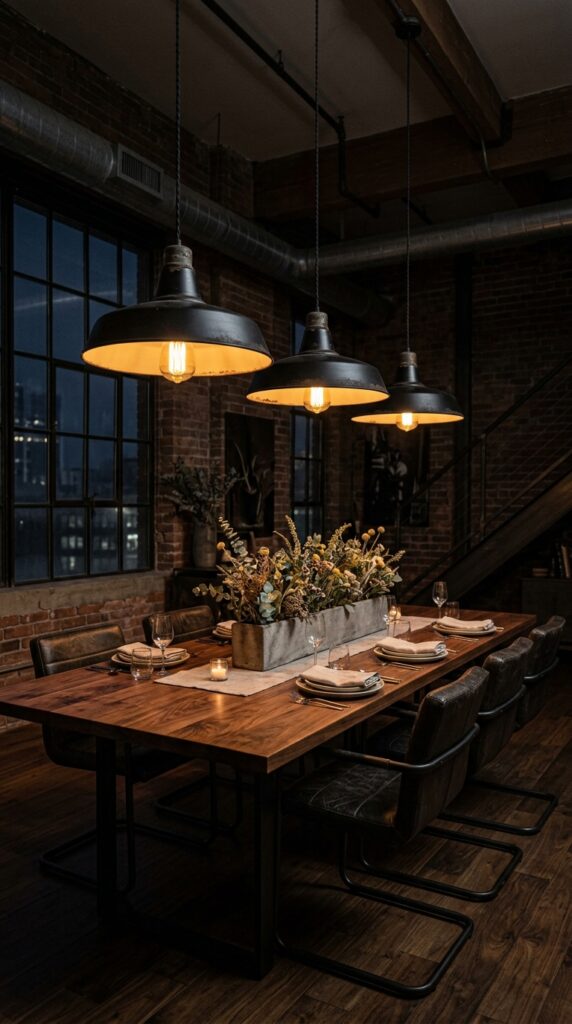
Vibe: Dramatic and convivial — dining under these pendants makes even a Tuesday dinner feel considered.
Why it works: The dining table pendant is the most emotionally resonant lighting fixture in a loft because it creates a pool of warmth in an otherwise vast space — it is the architectural equivalent of a campfire, drawing people into a defined zone of light and warmth. Three pendants over a long dining table follow the compositional rule of odd numbers, and hanging them at exactly 32 inches above the table surface (not 24, not 48) places them in the precise visual relationship to seated diners that reads as intimate without being obstructive. Matte black enamel shades reference industrial factory lighting without the nostalgic excess of reproduction warehouse pendants.
How to get it: Specify the pendant height at rough-in stage, before ceiling is finished, so the cord length can be set precisely. If retrofitting, use a ceiling canopy with a cord-shortening mechanism rather than looping excess cord. For a dining table over 84 inches long, three pendants are the minimum — two read as inadequate at this scale.
🛍️ Shop the Look — Amazon Product Ideas
| # | Product Search Phrase | Why It Fits |
| 1 | matte black enamel pendant light industrial large | Dining zone pendant |
| 2 | solid walnut dining table 96 inch | Hero dining surface |
| 3 | black leather dining chair industrial set | Table seating material |
| 4 | long concrete planter centerpiece table | Table runner vessel |
| 5 | Edison filament bulb E26 warm 2200K | Pendant bulb specification |
12. The Loft Home Office: Floating Steel Desk

Vibe: Focused and purposeful — a workspace that makes concentrated thought feel like a design achievement.
Why it works: A floating desk mounted directly to a brick wall uses the architecture as furniture structure — one of the most elegant expressions of the loft design principle that the building’s existing elements should participate in the interior’s functional life. The visible black steel angle brackets are deliberately exposed rather than hidden, referencing the industrial structural honesty that pervades the loft vocabulary. A 2-inch-thick walnut board provides sufficient visual mass to read as serious furniture at this scale — thinner boards look like shelves pressed into desk service.
How to get it: Use 3/8-inch black steel angle brackets with a minimum 12-inch horizontal projection, mounted into the brick with masonry anchors spaced 16 inches apart. For brick walls, a structural engineer should confirm that the anchor pattern is appropriate for the load — a 84-inch walnut desk plank weighs 40–60 pounds before any objects are placed on it. The desk surface should be finished with a hardwax oil (Rubio Monocoat) rather than polyurethane — it maintains the wood’s natural feel underhand while providing adequate protection.
🛍️ Shop the Look — Amazon Product Ideas
| # | Product Search Phrase | Why It Fits |
| 1 | black steel heavy duty shelf bracket angled | Desk mounting bracket |
| 2 | walnut board live edge desk surface | Floating desk material |
| 3 | Rubio Monocoat wood hardwax oil finish | Desk surface protection |
| 4 | masonry anchor bolt kit brick wall | Heavy load wall anchor |
| 5 | adjustable task lamp brass industrial | Desk task lighting |
13. The Mezzanine Level — Loft Within a Loft
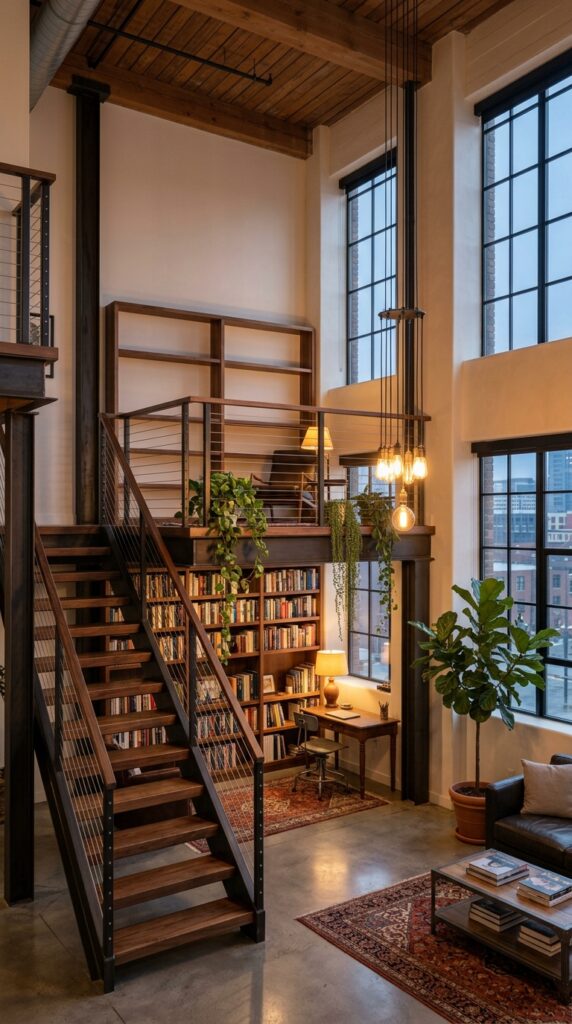
Vibe: Spatial and architecturally ambitious — the loft intervention that makes a double-height space feel genuinely inhabited at every level.
Why it works: A mezzanine level in a double-height loft achieves what no furniture arrangement can: it activates the vertical dimension of the space, turning ceiling height from a passive architectural quality into a functional asset. The mezzanine creates two experiential zones within one continuous volume — the main floor’s expansive horizontality and the mezzanine’s more intimate, elevated enclosure — each enriching the other through contrast. Open-tread stairs and cable railings preserve visual connection between levels while maintaining the spatial transparency that is the loft’s defining quality.
How to get it: A structural engineer and building permit are required for any mezzanine addition in an existing building. The mezzanine framing should be in steel rather than wood — steel’s slender section size minimizes visual intrusion while maximizing structural efficiency, and it maintains the building’s industrial material vocabulary. Walnut stair treads on steel stringers bridge the material gap between the raw structure and the warm interior.
🛍️ Shop the Look — Amazon Product Ideas
| # | Product Search Phrase | Why It Fits |
| 1 | steel cable railing kit indoor mezzanine | Transparent mezzanine rail |
| 2 | walnut stair tread set open rise | Warm stair tread material |
| 3 | hanging planter indoor trailing plant | Mezzanine edge planting |
| 4 | mid-height pendant light adjustable cord | Between-level lighting |
| 5 | open riser stair stringer steel fabricated | Stair structure option |
14. Velvet and Leather — The Loft’s Textile Story
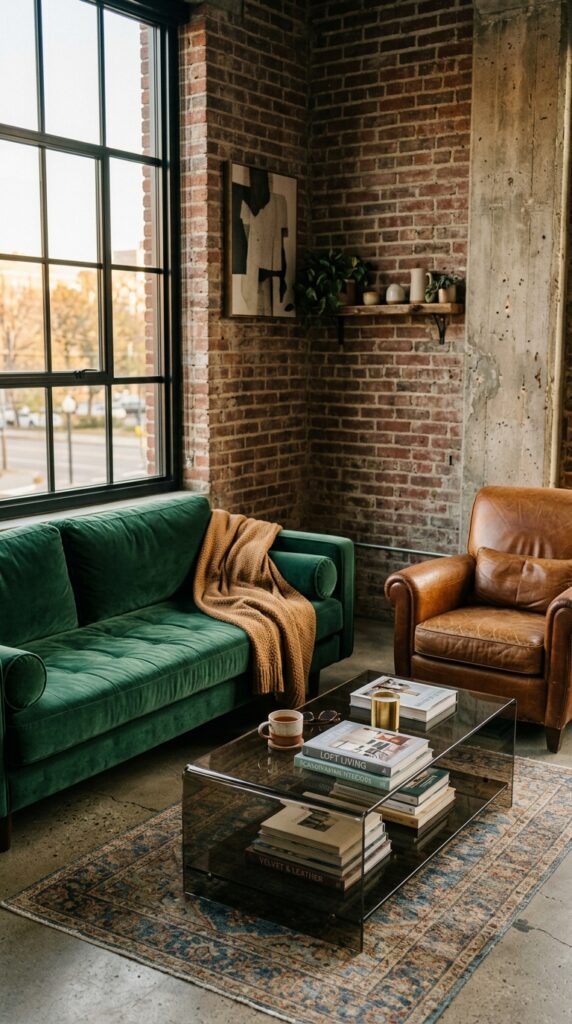
Vibe: Rich and layered — a seating combination that makes the rawness of the loft feel like a backdrop rather than a limitation.
Why it works: The pairing of velvet and leather in a loft seating group exploits the contrast between two high-status materials that share warmth but differ dramatically in texture and light response. Velvet absorbs light and reads as deep and enveloping; leather reflects light and reads as structured and durable. Placed together, they create a seating group where each piece enhances the other’s qualities — the velvet appears softer against the leather, the leather appears more refined against the velvet. Emerald green velvet is specifically powerful in a loft context because it introduces a plant-derived, organic color into an entirely mineral environment.
How to get it: Specify velvet sofas with a performance velvet fabric (Crypton or similar) rather than pure silk or cotton velvet for a loft environment — performance velvet holds up to daily use without the fragility of luxury-grade velvet. For the leather armchair, top-grain full-aniline leather (not corrected grain) develops a more interesting patina and feels warmer than semi-aniline or bonded options.
🛍️ Shop the Look — Amazon Product Ideas
| # | Product Search Phrase | Why It Fits |
| 1 | emerald green velvet sofa 3 seat | Hero seating textile |
| 2 | cognac leather armchair full grain | Contrasting seating piece |
| 3 | smoked glass coffee table low | Between-seat surface |
| 4 | caramel wool throw large natural | Sofa arm softening |
| 5 | oversized art book coffee table design | Table surface layer |
15. Loft Dining Area: The Concrete Table
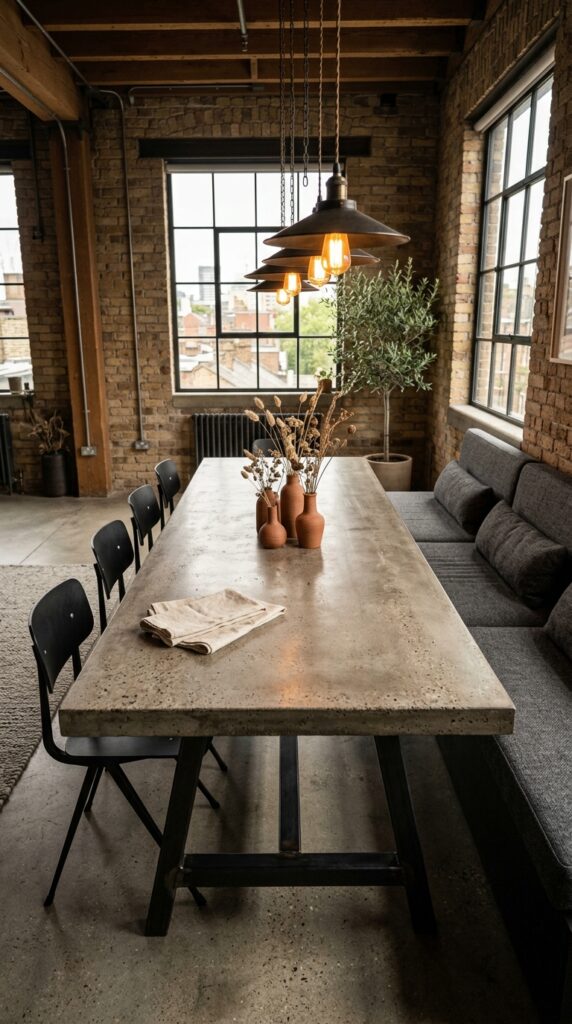
Vibe: Sculptural and warm — a dining table that is the room’s primary artwork as much as its primary surface.
Why it works: A concrete dining table is the loft’s most committed material statement — a piece of furniture that simultaneously references the building’s structure, anchors the dining zone with substantial visual weight, and develops character over time as the surface acquires patina, minor scratches, and the evidence of meals. The steel trestle base is essential to the table’s sophistication: a concrete top on four standard legs reads as heavy; on a welded steel trestle, the visual mass of the top appears to float, creating a tension between material weight and structural elegance. Mixed seating — metal chairs on the window side, a wall-fixed upholstered bench on the kitchen side — creates a convivial, restaurant-adjacent dining atmosphere.
How to get it: Custom concrete dining tables from local concrete fabricators run $2,500–$6,000 depending on size and finish detail. A GFRC (glass fiber reinforced concrete) table is a lighter alternative at comparable cost that reduces the structural loading on upper-floor lofts. Seal with a penetrating food-safe sealer and re-apply annually to maintain stain resistance.
🛍️ Shop the Look — Amazon Product Ideas
| # | Product Search Phrase | Why It Fits |
| 1 | concrete dining table modern industrial | Raw material table option |
| 2 | black metal dining chair set industrial | Mixed seating metal side |
| 3 | long clay bud vase narrow table runner | Dining surface centerpiece |
| 4 | linen napkin set natural unbleached | Table textile accent |
| 5 | food safe concrete sealer penetrating | Table surface protection |
16. Large-Scale Abstract Art in the Loft
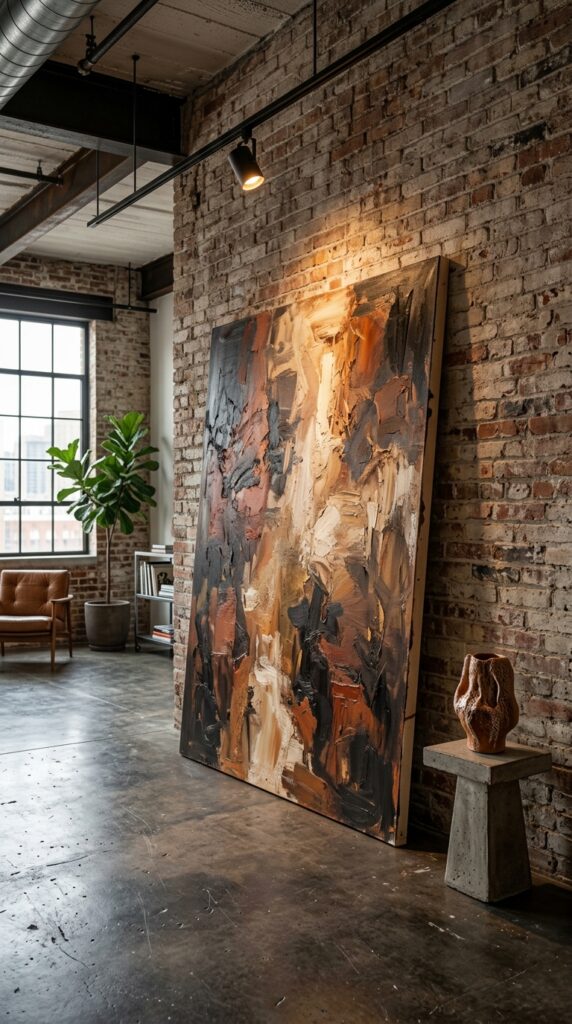
Vibe: Bold and gallery-like — a painting that makes the room stop.
Why it works: Large-scale abstract art in a loft works because the space’s scale demands it — a 24×36-inch print on a 12-foot brick wall reads as a postage stamp, while a 60×84-inch canvas commands the space appropriately. Leaning rather than hanging a large canvas introduces a quality of impermanence and artistic process — the painting appears to be being considered, not displayed, which is simultaneously more relaxed and more sophisticated than a formally mounted piece. Directing a single track light at the canvas from above creates a gallery condition that elevates the work and the room simultaneously.
How to get it: Source large-scale abstract paintings from emerging artists on Saatchi Art, Artfinder, or local gallery open studio events — original work in the 48×60-inch range from emerging artists runs $400–$1,500. Unframed canvases on stretcher bars are the correct presentation for a loft context: a frame would add a domestic formality that conflicts with the raw environment. A piece in the loft’s own material palette (warm charcoal, terracotta, umber) reads as site-specific even if it wasn’t made for the space.
💡 Quick Win: A large blank canvas in the 48×60-inch range costs $30–$60; a tube of raw umber, titanium white, and burnt sienna acrylic costs $25. A self-made abstract — gestural brushwork in your loft’s palette — creates a site-specific artwork for under $90 that no one else owns.
🛍️ Shop the Look — Amazon Product Ideas
| # | Product Search Phrase | Why It Fits |
| 1 | large blank canvas stretched 48×60 inch | DIY or artist base |
| 2 | acrylic paint set earth tones artist | Abstract painting medium |
| 3 | adjustable track lighting head directional | Artwork spotlight |
| 4 | sculptural ceramic vase handmade organic | Pedestal accent beside art |
| 5 | large abstract canvas print warm tones | Ready-made art option |
17. The Loft Bedroom: Canopy Without a Frame
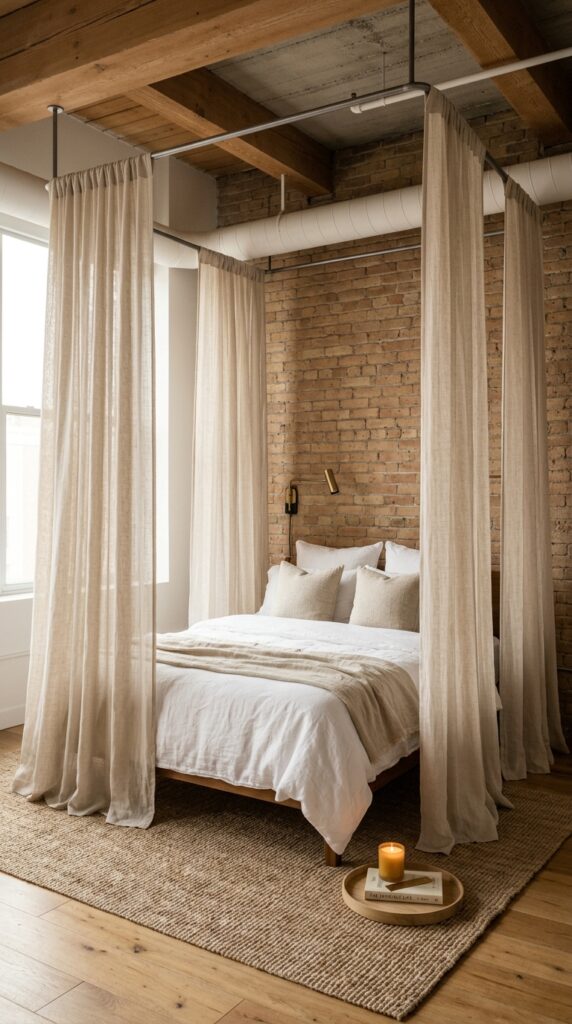
Vibe: Ethereal and intimate — a bedroom treatment that makes the sleeping zone feel like a private world within the open loft.
Why it works: A ceiling-mounted linen canopy creates an intimate, softly enclosed sleeping environment in an open loft without any permanent construction — it uses fabric, gravity, and light to define a zone. The sheer linen panels filter morning light rather than blocking it, creating a luminous glow around the bed at dawn that no blackout curtain achieves. The steel ceiling rod is deliberately visible — its raw material and ceiling-mounted position reference the loft’s structural vocabulary rather than pretending to be a traditional curtain rail. This is the design principle of honest construction: the mechanism is shown, not hidden.
How to get it: Mount a 1-inch diameter steel rod at ceiling height using flanged pipe fittings — the same plumbing-derived hardware used in the kitchen open shelving. Hang four sheer linen panels using simple ring clips rather than a rod pocket to maintain the intentionally raw aesthetic. Panels should hang from ceiling to floor without breaking — hem at exactly 1 inch above the floor for the cleanest fall.
🛍️ Shop the Look — Amazon Product Ideas
| # | Product Search Phrase | Why It Fits |
| 1 | sheer linen curtain panel oatmeal 108 inch | Canopy fabric panels |
| 2 | ceiling mount curtain rod flange industrial | Ceiling-mounted rod hardware |
| 3 | curtain ring clip set matte black | Panel hanging clips |
| 4 | bedside tray low floor serving natural | Floor-level nightstand |
| 5 | wall mount reading light adjustable arm | Headboard-free bed light |
18. The Sophisticated Studio: Murphy Bed with Steel Frame
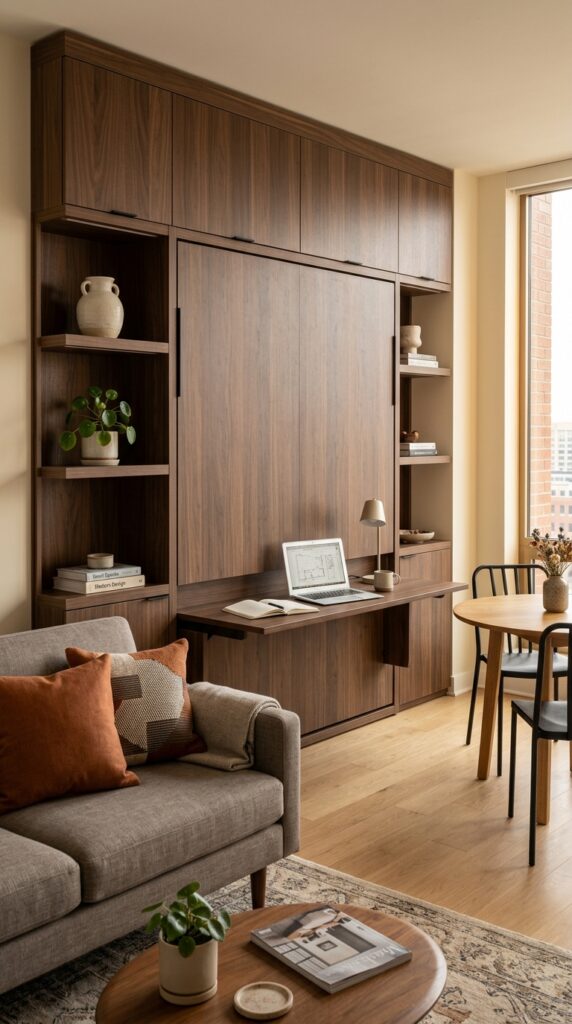
Vibe: Clever and refined — the small loft solution that looks intentional rather than compromised.
Why it works: A Murphy bed in a sophisticated loft should be indistinguishable from a built-in furniture wall when closed — the design challenge is hiding the mechanism so completely that the unit reads as a deliberate storage and shelving composition. Integrating a fold-down desk into the unit adds a functional layer that makes the wall work harder: the same surface serves as a workspace when the bed is closed and disappears when the bed is open. Dark walnut as the panel material is essential — a white or painted Murphy unit reads as a closet; a walnut unit reads as furniture.
How to get it: Murphy bed mechanism kits (Resource Furniture, Ori Systems, or cabinet-mounted alternatives from Rockler Woodworking) start at $800–$1,500 for the mechanical component and can be built into custom cabinetry. The flanking shelf units should be built at the same depth as the closed bed panel — typically 12 inches — so the entire wall reads as a single planar composition rather than a bed flanked by mismatched shelving.
🛍️ Shop the Look — Amazon Product Ideas
| # | Product Search Phrase | Why It Fits |
| 1 | Murphy bed wall bed mechanism kit queen | Bed mechanism hardware |
| 2 | dark walnut cabinet panel door overlay | Unit panel material |
| 3 | fold down wall desk bracket hardware | Integrated desk mechanism |
| 4 | compact sofa apartment small space | Studio living seating |
| 5 | wall mount shelf bracket flush dark | Flanking shelf hardware |
19. Raw Wood and Black Steel: The Loft’s Furniture Grammar
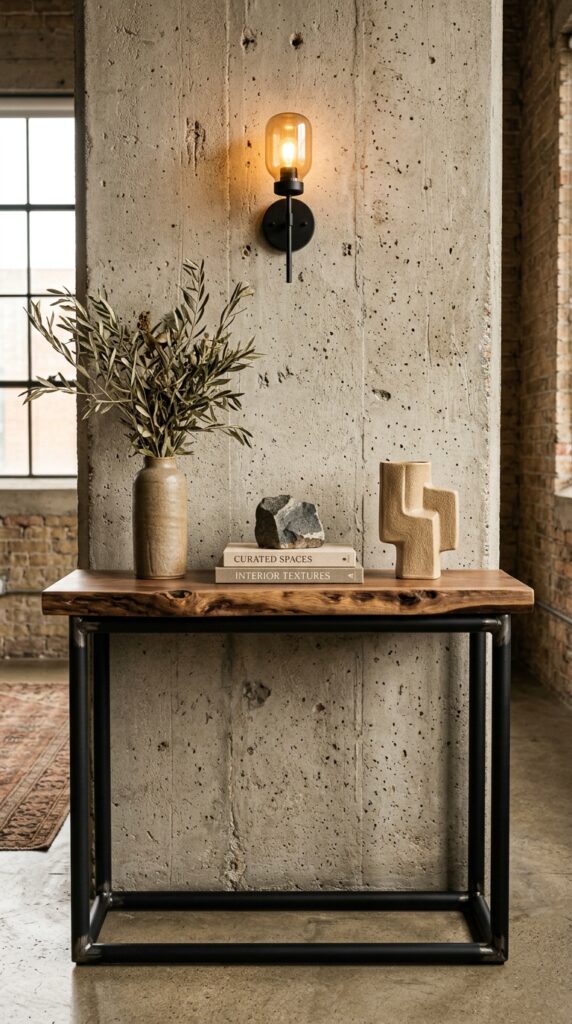
Vibe: Editorial and warm — furniture that looks like it was made specifically for this column in this loft.
Why it works: The pairing of raw wood and black steel is the loft’s foundational furniture grammar because it directly references the building’s own material logic: the structural steel of the building’s frame and the wood of its original flooring and formwork. Furniture that uses these same materials in refined, purposeful forms creates a sense of material continuity between the architecture and its contents — the pieces belong to the space rather than being placed in it. Live-edge wood is the specifically appropriate wood form for this context: its natural slab edge references the timber’s origin and introduces organic form into an otherwise geometric composition.
🛍️ Shop the Look — Amazon Product Ideas
| # | Product Search Phrase | Why It Fits |
| 1 | black steel frame console table industrial | Raw material furniture |
| 2 | live edge walnut slab small furniture | Natural wood slab top |
| 3 | raw stone paperweight decorative | Surface object detail |
| 4 | narrow ceramic vase tall matte | Console surface element |
| 5 | wall sconce black industrial single | Column-adjacent lighting |
20. The Loft’s Color Accent: Deep Navy in an Open Plan
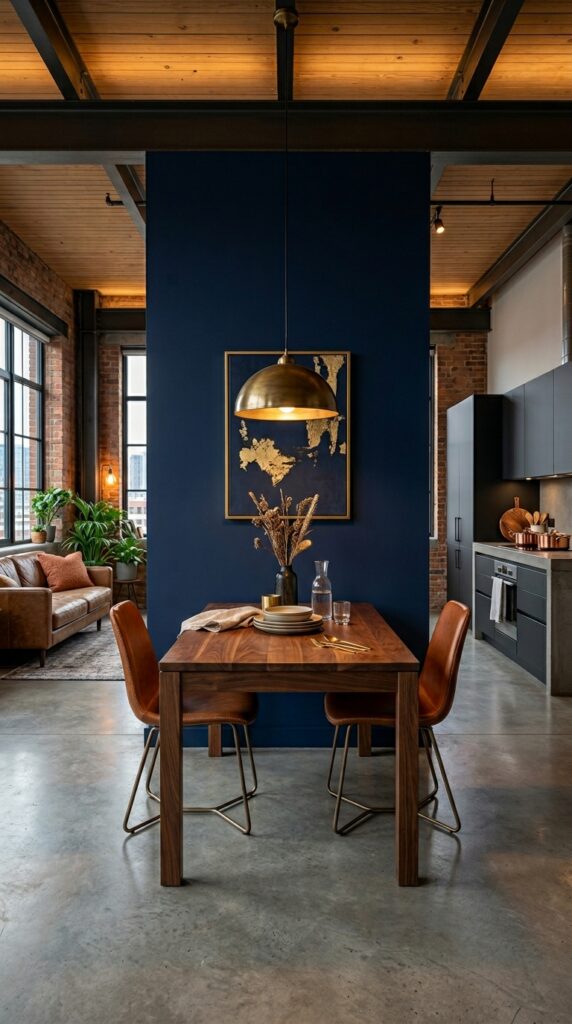
Vibe: Bold and anchored — a single color decision that organizes the entire open plan.
Why it works: A single deep navy accent wall in an open-plan loft performs the same function as a room partition without any structural implication — it creates a visual terminus for the dining zone that tells the eye where one area ends and another begins. Deep navy is the correct accent color for a sophisticated loft because it is sufficiently dark to contrast with raw concrete and brick without competing with them, and its cool depth makes warm wood and leather tones appear richer by comparison. The design principle is chromatic anchor: one fully committed color decision in an otherwise neutral palette does more organizational work than several partial color choices.
How to get it: Farrow & Ball Hague Blue No.30 and Benjamin Moore Hale Navy HC-154 are the two most widely specified deep navies for sophisticated interiors — both have enough warmth in their base to prevent the wall from reading as cold or corporate. Apply in a flat or matte finish (not eggshell) — the matte surface makes the deep color appear richer and more saturated. The navy should appear on one wall only; navy on two walls in a loft reads as a design decision that went too far.
🛍️ Shop the Look — Amazon Product Ideas
| # | Product Search Phrase | Why It Fits |
| 1 | deep navy interior paint matte finish | Accent wall color |
| 2 | gold frame art print abstract | Navy wall art element |
| 3 | cognac leather dining chair set | Warm seating against navy |
| 4 | brass pendant light dining room | Warm metal above table |
| 5 | walnut dining table rectangular 72 inch | Warm surface against navy |
21. The Loft Entry: Concrete Bench and Steel Hook Rail
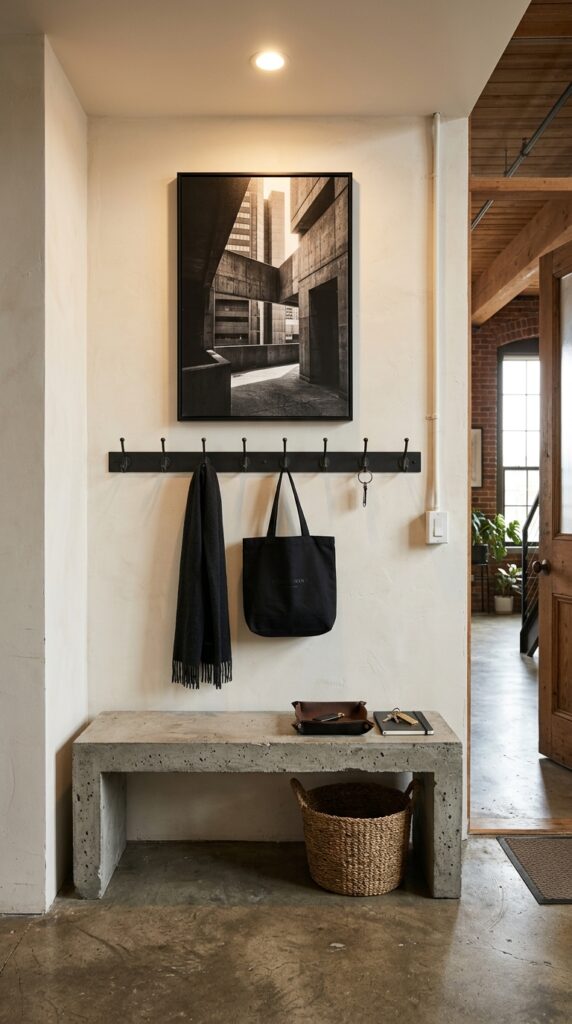
Vibe: Purposeful and minimal — an entry that communicates design intelligence before you’ve taken your coat off.
Why it works: A loft entry defined by a concrete bench and steel hook rail is a functional vignette that makes an everyday necessity — hanging coats, removing shoes — into a designed ritual. The concrete bench introduces the loft’s primary material at the very first point of contact with the space, establishing the material story immediately. The steel hook rail above it applies the same grammar: a visible, honest structure that makes no attempt to disguise its function. Together, they create an entry that reads as coherent and considered rather than assembled from catalog decisions.
How to get it: A concrete bench can be cast in place using a simple plywood form — a 48x16x18-inch solid pour requires approximately two 60-pound bags of concrete and one form-building session. Pre-fabricated cast concrete benches are also available from concrete furniture suppliers at $400–$900. The steel hook rail should be a 1.5-inch square steel tube, wall-mounted with visible lag screws into studs, with hooks welded on at 6-inch spacing.
🛍️ Shop the Look — Amazon Product Ideas
| # | Product Search Phrase | Why It Fits |
| 1 | black industrial coat hook wall mount set | Hook rail element |
| 2 | concrete bench entryway indoor outdoor | Cast entry bench |
| 3 | woven basket large natural entry storage | Under-bench storage |
| 4 | leather tray flat rectangular | Bench surface organizer |
| 5 | large format black white photo print | Above-rail wall art |
22. Loft Acoustics: Textile Walls and Sound Absorption
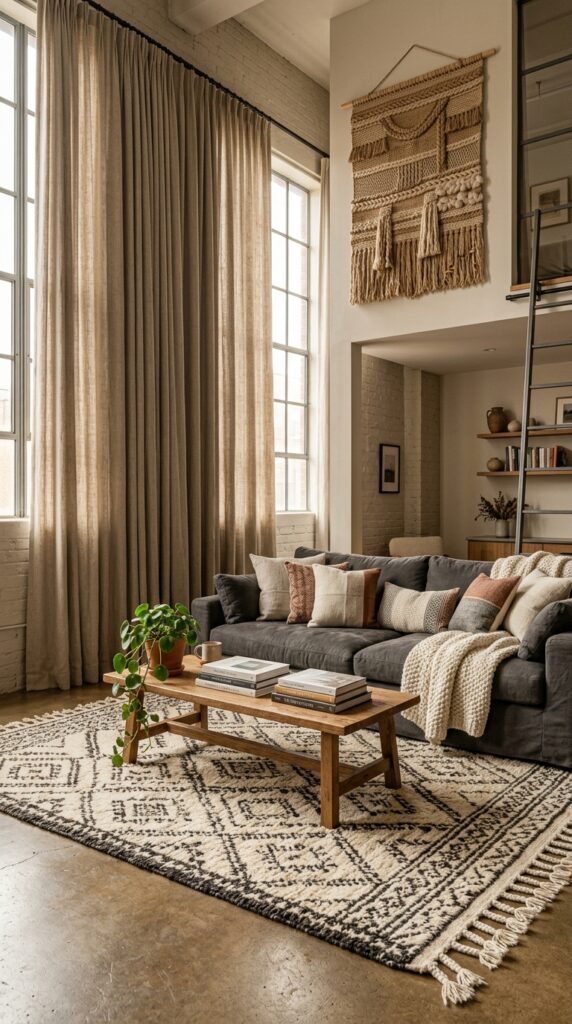
Vibe: Warm and layered — the acoustic challenge turned into the room’s greatest textural richness.
Why it works: Acoustic management is the most commonly overlooked functional challenge in loft interiors — high concrete ceilings, polished floors, and minimal soft furnishings create reverberation times of two to four seconds that make conversation uncomfortable and music unlistenable. The sophisticated solution is not acoustic tile panels (which read as corporate) but a deliberate accumulation of textile surfaces that absorb sound: heavy wool rugs (minimum 60 oz face weight), full-height linen curtains on at least one wall, deep cushioned upholstery, and woven textile wall hangings. Each textile surface reduces reverberation incrementally; together, they achieve a comfortable acoustic environment without any visible acoustic treatment.
How to get it: Prioritize by acoustic impact: a large wool rug is the highest single-item acoustic contributor, followed by full-height curtains on a hard wall. A woven wall hanging contributes meaningfully at high frequencies — choose one in a tightly woven material (wool or cotton tapestry, not open-weave macramé) for maximum absorption. A target reverberation time for a loft living area is 0.5–0.8 seconds — achievable with the textile layering described above.
💡 Quick Win: A large woven jute or wool wall hanging costs $80–$200 and reduces high-frequency reverberation by 20–30% in a typical loft living area — the single highest acoustic-impact decorating purchase available.
🛍️ Shop the Look — Amazon Product Ideas
| # | Product Search Phrase | Why It Fits |
| 1 | large woven wall hanging textile wool | High-frequency absorber |
| 2 | heavy wool Berber rug area 9×12 | Primary acoustic surface |
| 3 | heavy linen curtain panel 108 inch | Wall acoustic treatment |
| 4 | deep seat sofa cushioned large | Upholstered absorption |
| 5 | chunky knit throw wool oversized | Surface softening layer |
23. The Loft Terrace: Industrial Materials Outdoors
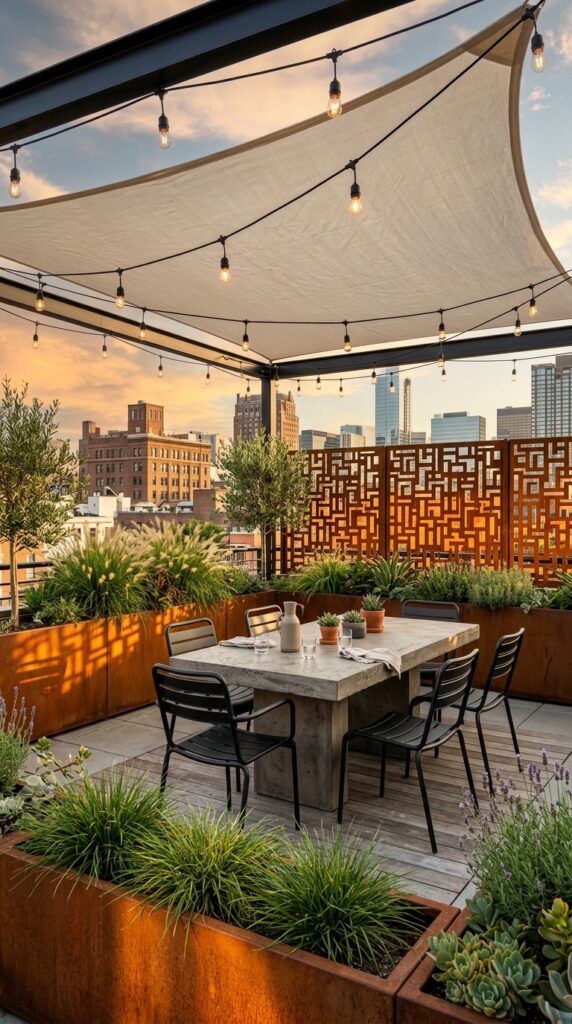
Vibe: Urban and material-rich — an outdoor space that extends the loft’s design philosophy into the open air.
Why it works: A loft rooftop terrace designed with the same material vocabulary as the interior — concrete, steel, raw material — creates a seamless indoor-outdoor connection that reinforces the overall design identity of the home. Corten steel planter boxes are the ideal outdoor material for this context: they begin as a warm orange-red and weather over one to two years to a rich, stable dark brown that is visually related to the warm tones of aged brick and walnut inside. The privacy screen in weathering steel creates a boundary that develops character over time, unlike painted steel or aluminum.
How to get it: Corten steel planter boxes are available from steel fabricators and specialty outdoor furniture suppliers — specify a minimum 1/8-inch steel gauge for containers that will hold soil. Allow corten to weather naturally for 12–18 months before it stabilizes to its final dark brown patina. Position corten planters away from surfaces where rust runoff would stain — the patina period produces orange water that marks concrete and stone.
🛍️ Shop the Look — Amazon Product Ideas
| # | Product Search Phrase | Why It Fits |
| 1 | corten steel planter box outdoor large | Weathering terrace planter |
| 2 | concrete outdoor dining table modern | Terrace material extension |
| 3 | black steel outdoor dining chair set | Terrace seating material |
| 4 | canvas shade sail triangle outdoor | Terrace sun protection |
| 5 | outdoor Edison string lights warm terrace | Evening terrace ambience |
24. The Fully Realized Sophisticated Loft: Every Layer Working Together
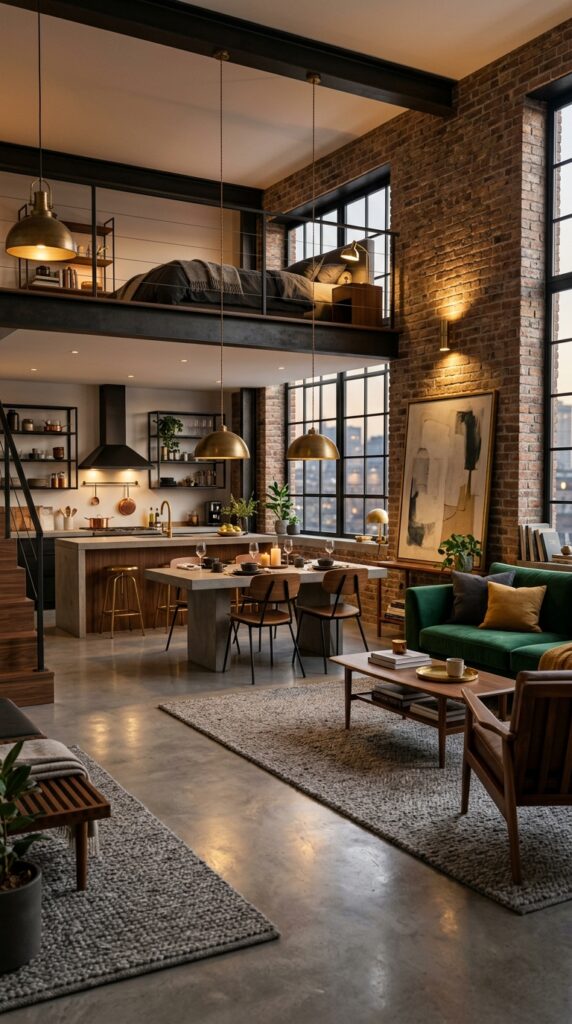
Vibe: Complete and deeply inhabitable — the loft where every element has been considered and every zone tells the same material story.
Why it works: The fully realized sophisticated loft succeeds not because any single element is exceptional — though each is thoughtful — but because the material and lighting decisions made at every scale reinforce each other: the aged brass pendant above the dining table references the aged brass cabinet pulls in the kitchen; the walnut dining table references the walnut stair treads on the mezzanine; the warm charcoal of the painted beams references the charcoal of the lower cabinet fronts. This is material coherence at architectural scale — the entire home is a single curated material palette expressed across multiple zones and functional contexts.
How to get it: The path to the fully realized sophisticated loft is sequential, not simultaneous. Begin with the floor — polished concrete or wide-plank hardwood establishes the thermal palette for everything above it. Add the primary lighting — pendants that establish the light quality of the space. Then the primary seating and its rug — the zone-defining anchor of the living area. Then the kitchen surfaces and shelving. Then the sleeping platform or mezzanine. Then the art, the textiles, the plants, the books. Each layer added in the correct material vocabulary accumulates toward the fully realized interior — and the loft, unlike any other residential typology, has the raw material to earn it.
🛍️ Shop the Look — Amazon Product Ideas
| # | Product Search Phrase | Why It Fits |
| 1 | aged brass pendant light industrial large | Cohesive lighting anchor |
| 2 | wide plank white oak flooring engineered | Warm floor palette base |
| 3 | concrete countertop mix kit kitchen | Material continuity surface |
| 4 | emerald velvet sofa deep seat | Primary zone anchor |
| 5 | smoked walnut shelf board floating | Multi-zone warm wood |
How to Start Your Sophisticated Loft Transformation
The single most important first move is addressing the floor — before furniture, before lighting, before any surface treatment or artwork. The floor is the largest continuous surface in the loft and sets the thermal palette (warm or cool), the material register (raw or refined), and the reflective quality of the entire space. A polished concrete floor or wide-plank smoked oak hardwood immediately establishes the design language that every subsequent decision will reinforce or contradict. Polish your existing concrete or lay your floor before any furniture is purchased — every furniture choice will feel more natural and resolved once the floor is established.
The most common beginner mistake is buying furniture that is too small for the loft’s scale. Loft spaces have ceiling heights of 10–16 feet and open floor plans of 800–2,000 square feet — standard apartment-scale furniture (a 72-inch sofa, a 36-inch coffee table, a single 60-watt pendant) reads as doll furniture in these proportions. Every piece should be sized up: a 90-inch sofa minimum, a coffee table at least 48 inches in its longest dimension, pendant lights with shades at least 16 inches in diameter. Under-scaled furniture is the single most common and most immediately fixable sophisticated loft error.
Three specific items under $50 that create immediate sophisticated loft character: A set of three matte black Edison globe pendants on adjustable fabric cords ($35–$48) hung at varied heights from a beam or ceiling — they immediately establish the warm, industrial-refined atmosphere that defines the style. A large raw concrete candle holder or vessel ($18–$35) placed on the coffee table or kitchen counter — it introduces the loft’s primary material in its most accessible and affordable form. A single large-scale art print in earth tones (warm charcoal, terracotta, raw umber) downloaded and printed at a local print shop, placed unframed on the floor leaning against the primary wall ($15–$30 total) — the leaning, unframed presentation is more sophisticated than a framed and hung equivalent three times the price.
Realistic expectations: A floor treatment (concrete polishing or hardwood installation) runs $2,000–$8,000 for a typical 800–1,200-square-foot loft. A primary lighting upgrade (three to five pendants over key zones) runs $400–$1,200 in fixtures plus installation. A primary furniture package (sofa, coffee table, dining table and chairs, rugs) in appropriate loft-scale pieces runs $4,000–$15,000 depending on material quality. A fully realized sophisticated loft interior with custom elements — concrete counters, steel shelving, mezzanine, polished floors — represents a $30,000–$80,000 investment over two to five years. The style rewards patience and accumulation far more than a single large budget spent at once.
Frequently Asked Questions About Sophisticated Loft Design
What is the difference between an industrial loft and a sophisticated loft interior?
An industrial loft preserves raw architectural elements — brick, concrete, steel, ductwork — with minimal intervention and furnished with utilitarian or vintage-industrial pieces: factory carts repurposed as coffee tables, raw pipe shelving, exposed bulb lighting. A sophisticated loft begins from the same architectural bones but adds deliberate material refinement: polished concrete rather than raw concrete, aged brass rather than raw steel for hardware and fixtures, linen and velvet rather than canvas and leather for textiles, and original artwork rather than vintage signage. The sophisticated loft does not deny its industrial heritage — it uses that heritage as a backdrop against which refined materials read with exceptional clarity. The tension between raw and refined is the style’s defining characteristic.
What colors work best in a sophisticated loft interior?
The most successful sophisticated loft palettes are built on warm neutrals with one deliberate accent. The base palette should read as warm — warm concrete grey (#8C8C87 with a brown undertone, not a blue one), warm white (#F2EDE6 rather than #FFFFFF), aged brass, and smoked walnut — because the raw architectural materials (brick, concrete, steel) are inherently cool and benefit from warm counterbalancing tones in the furnishings and surfaces. One accent color in a fully saturated, dark hue — deep navy, forest green, warm terracotta, or bordeaux — placed on a single partition wall or in the primary seating textile, provides the color moment that prevents the palette from reading as grey and characterless.
How do you divide zones in an open-plan loft without building walls?
Zone definition in an open loft uses five non-structural tools in combination: level changes (a sleeping platform 18 inches above the main floor creates psychological separation), area rugs (a large wool rug defines the living zone as precisely as four walls would), lighting differentiation (pendant lights over the dining table, a floor lamp in the reading corner, recessed downlights in the kitchen create distinct light environments for each zone), material transitions (polished concrete in the kitchen and living area, wide-plank wood on the sleeping platform), and hanging textiles (a full-height linen curtain on a ceiling-mounted rail provides privacy without permanence). Used together, these tools create a multi-zone loft experience that feels as spatially varied as a conventionally walled apartment.
How much does it cost to design and furnish a sophisticated loft?
The total investment range for a sophisticated loft transformation spans significantly by scope. Floor treatment alone — polished concrete or hardwood — runs $2–$8 per square foot. Lighting (five to eight key fixture positions) runs $800–$3,000. Primary furniture (sofa, dining table, chairs, beds, rugs) in appropriate loft-scale pieces runs $5,000–$20,000 depending on material quality. Kitchen and bathroom surface upgrades (concrete counters, micro-cement walls, open steel shelving) run $3,000–$12,000. A mezzanine addition is a $15,000–$40,000 structural project. A complete sophisticated loft transformation from blank industrial space to fully realized interior runs $40,000–$120,000. Incremental improvement — investing in one zone at a time over two to four years — produces superior results to a single rushed renovation budget.
What plants work best in a sophisticated loft interior?
Plants in a sophisticated loft should be chosen for scale, form, and material reference rather than simply for greenery. Large-scale specimens with strong silhouettes work best in the loft’s generous volumes: a fiddle leaf fig (Ficus lyrata) in a 16-inch concrete pot at a window corner, an olive tree in a terracotta or concrete planter as a dining or living room focal point, or a large-leaf monstera or rubber plant (Ficus elastica in the burgundy or dark green varieties) against a raw brick wall. Trailing plants (pothos or philodendron) are valuable on high shelves and mezzanine edges, where their cascading form introduces organic movement at height. Avoid small, fussy arrangements of multiple small plants — they read as apartment-scaled rather than loft-scaled and require constant maintenance that fragments the design focus.
Ready to Create Your Sophisticated Loft Interior?
These 24 ideas span the full range of sophisticated loft design — from the foundational floor treatment and structural ceiling detail to the textile layering, zone definition, mezzanine strategy, and fully realized multi-zone interior — giving you a comprehensive toolkit whether you are beginning with raw space or refining an existing conversion. Every transformation begins with the floor and the light: establish the material palette underfoot and the quality of light overhead, and every subsequent decision will be guided by those two anchors rather than made in isolation. This weekend, look at your floor and your primary lighting fixture — if either conflicts with the sophisticated loft vocabulary, that is where you begin. When the full composition comes together — raw concrete in dialogue with aged brass, linen softening steel, amber candlelight pooling across a polished floor — you will feel the particular satisfaction of a space that is genuinely, irreducibly itself. Pin the ideas that stopped you longest; your loft’s design story is already there in the bones — you are simply revealing it.