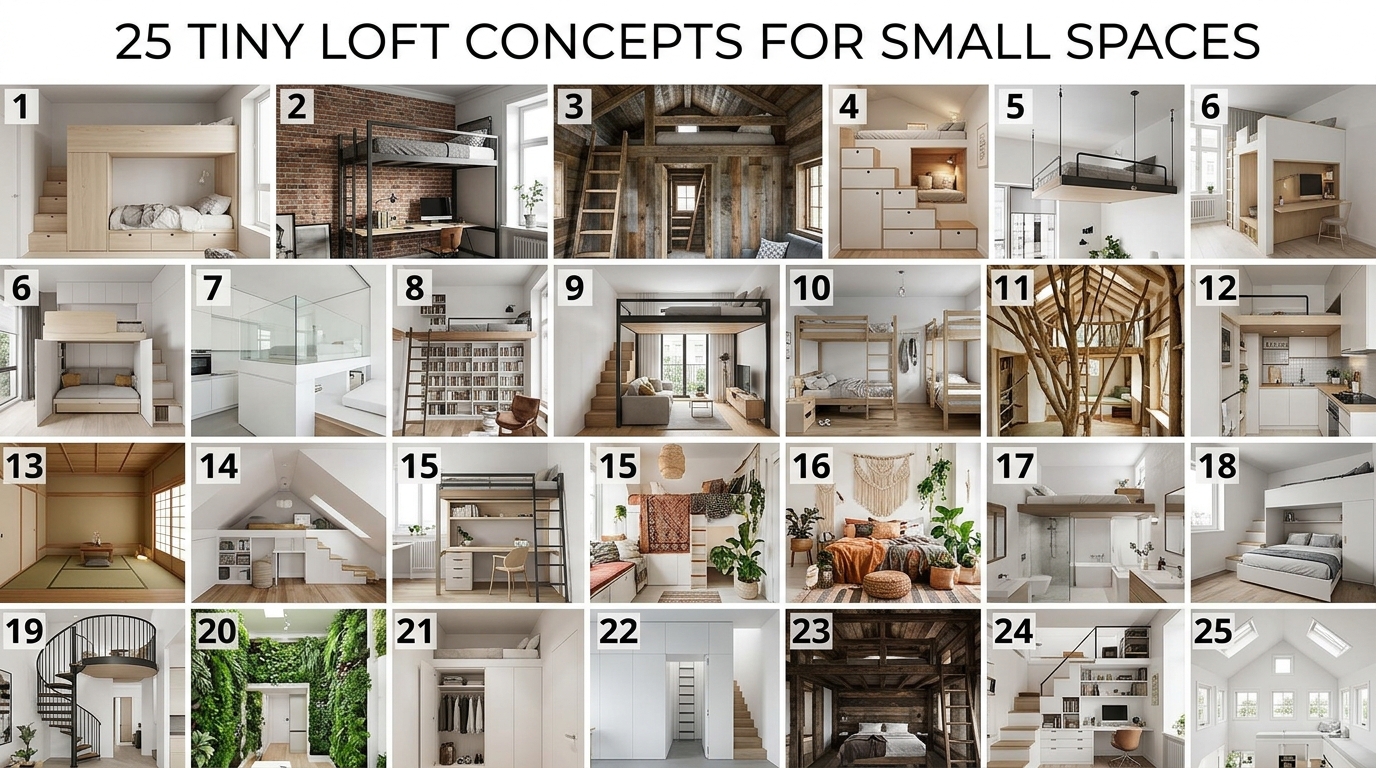
A tiny loft is a compact elevated sleeping or living platform built within a single-story space — typically constructed above a lower functional zone to maximize vertical square footage that would otherwise go unused. This article gives you exactly 25 tiny loft concepts spanning structural sleeping lofts, reading nooks, studio apartments, and micro-dwelling solutions, with product picks for every idea.
There’s a peculiar freedom that comes with a small space designed vertically rather than horizontally. When the ceiling becomes the resource — when the 8 feet between floor and roofline gets split into a working layer and a sleeping layer — the ordinary arithmetic of square footage stops mattering. A tiny loft holds warmth differently, filters morning light at a different angle, turns the act of climbing into something almost ceremonial. Every cubic inch is deliberate. Here are 25 concepts worth saving — and stealing.
Why Tiny Loft Design Works So Well
The tiny loft concept draws from one of the most enduring principles in architecture: section design, the idea that a building’s cross-section — the vertical slice through its interior — is as important as its floor plan. Where conventional small-space design fights for floor area, loft design abandons that contest entirely and claims the vertical dimension instead. It’s the same insight that drove the design of Japanese capsule hotels, Parisian student chambres de bonne, and the sleeping lofts of medieval Scandinavian farmhouses: elevation solves problems that floor plans cannot.
The aesthetic and structural roots of contemporary tiny loft culture run through several converging streams. The New York City loft movement of the 1960s and 70s — when artists colonized abandoned SoHo warehouses and created open-plan living within industrial shells — established the design vocabulary of exposed structure, open sleeping galleries, and visible industrial material. That vocabulary filtered into mainstream residential design, shrinking in scale as urban housing costs increased and the demand for density-compatible living solutions intensified.
Today the tiny loft concept is accelerating because it aligns with several simultaneous cultural forces: the tiny house movement’s rejection of spatial excess, the remote-work shift that demands a dedicated work zone within a single-room dwelling, the material sustainability argument for building less floor area, and the aesthetic appeal — particularly on platforms like Pinterest and Instagram — of spaces that look designed rather than merely furnished. A well-executed tiny loft photographs extraordinarily well because its vertical geometry creates natural visual layers that flat spaces lack.
Small spaces are the natural habitat of the loft concept — but the specific constraints of genuinely tiny footprints (under 400 square feet) demand particular design honesty. The most common failure in tiny loft projects is treating the loft as an afterthought rather than the primary design generator: the loft should be designed first and the space below arranged to serve it, not the reverse. Ceiling height is the non-negotiable minimum — 13 feet of floor-to-ceiling height is the practical minimum for a full sleep-and-live stacked arrangement; 10–11 feet allows a sleeping loft with limited headroom that works for lying down but not sitting upright.
Style at a Glance
| Element | Detail |
| Philosophy | Vertical space is the most underused resource in small dwellings |
| Key Materials | Unfinished white oak, structural steel, birch plywood, tempered glass, raw concrete |
| Key Colors | Warm white, natural wood tone, warm charcoal, concrete gray, aged brass |
25 Tiny Loft Concepts for Small Spaces
1. The Staircase-as-Storage Sleeping Loft
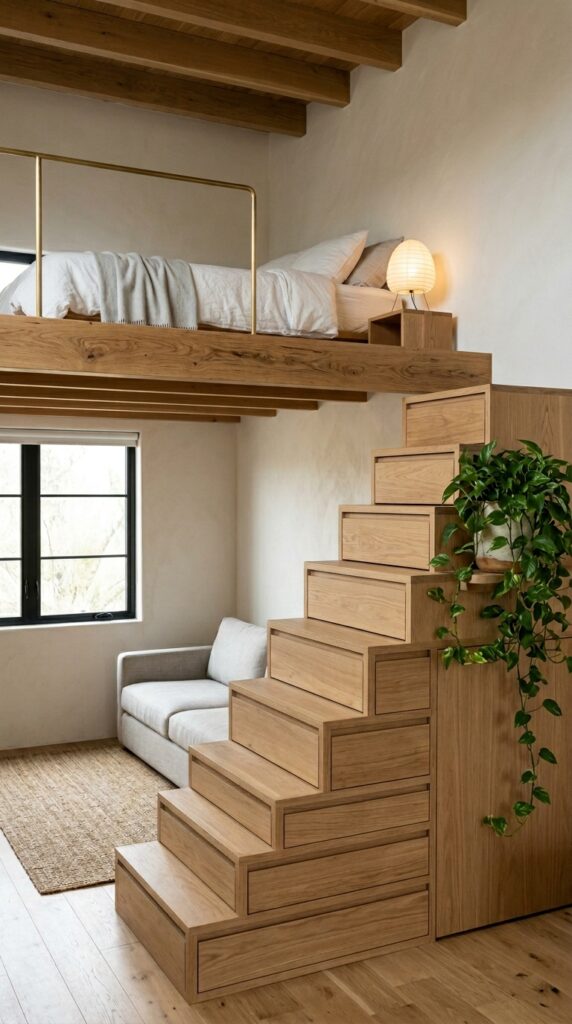
Vibe: Serene — a staircase that earns every inch of floor space it occupies.
Why it works: In a tiny loft, a conventional ladder trades safety and storage for floor area, while a conventional staircase costs floor space it cannot justify. The stair-as-storage concept resolves this through multifunctional section design — each tread becomes a drawer front, converting the structural volume of the stair into the equivalent of a full chest of drawers. This is not a stylistic choice but a spatial logic: the stair must exist, so it must also work. The unfinished white oak used across both stair and loft deck creates visual continuity that makes the entire vertical journey read as a single unified architectural element rather than a stair attached to a platform.
How to get it: Build stair drawers on full-extension ball-bearing slides rated for at least 75 lbs — the drawers will hold heavy items like sweaters, shoes, and bedding. Each tread-drawer should be at minimum 14 inches deep (following the stair tread depth) and 18–24 inches wide. Commission a local joiner to build this as a single unit rather than attempting modular assembly — the stair tolerances require site-specific fitting.
💡 Quick Win: Pre-made stair storage units — available from IKEA’s KALLAX system adapted to stair configurations, or from specialty loft stair suppliers like Arke — allow this concept without custom joinery, at a cost of $800–2,000 versus $3,000–8,000 for fully custom work.
🛍️ Shop the Look — Amazon Product Ideas
| # | Product Search Phrase | Why It Fits |
| 1 | full extension drawer slides 18 inch heavy duty | Stair drawer mechanism |
| 2 | brass flush pull cabinet hardware small | Tread drawer pull hardware |
| 3 | white oak hardwood plywood sheet 4×8 | Loft deck material |
| 4 | white linen duvet cover set king | Loft bedding |
| 5 | paper pendant lamp shade natural tan | Low-profile loft light |
2. The Glass-Railed Open Loft for Light Preservation
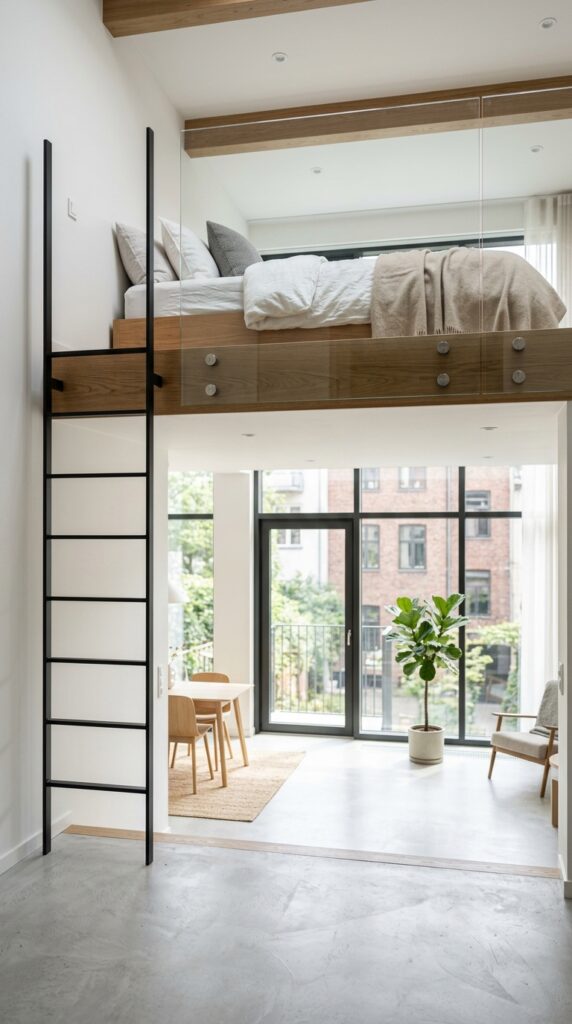
Vibe: Luminous — a loft that takes nothing from the room below except the floor space.
Why it works: The most common loft design error is creating a solid-front platform that blocks light from windows below, effectively putting the sleeping zone in a dark overhang. Frameless tempered glass railings solve this through material transparency as spatial generosity — the visual boundary required for safety becomes physically invisible to light, allowing windows below to illuminate both zones simultaneously. The structural principle is that a 10mm tempered glass panel with steel standoff fixings is rated for residential railing loads (200 lbs linear) at considerably lower visual weight than any solid alternative.
How to get it: Frameless glass railing systems use stainless steel standoff fixings attached to the loft deck edge, with glass panels slotted into base channel tracks. The critical specification is 10mm tempered or 8.76mm laminated safety glass — both are code-compliant for residential railings in most jurisdictions. Budget $120–180 per linear foot for professionally installed frameless glass railing, or $60–90 per linear foot for a DIY standoff system with hardware purchased separately.
🛍️ Shop the Look — Amazon Product Ideas
| # | Product Search Phrase | Why It Fits |
| 1 | frameless glass railing standoff fitting set | Transparent railing hardware |
| 2 | tempered glass panel 36 inch tall custom | Railing glass panel |
| 3 | brushed steel cable railing kit alternative | Lower-cost transparent railing |
| 4 | minimal black steel loft ladder hook | Lean-to ladder option |
| 5 | concrete look self-leveling floor compound | Below-loft floor treatment |
3. The Under-Loft Home Office Nook
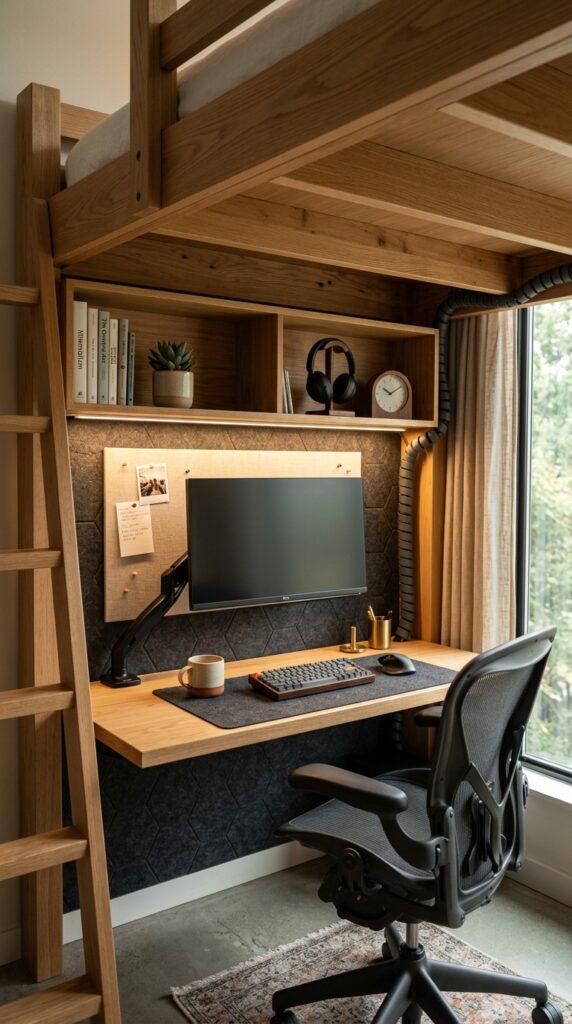
Vibe: Focused — the most useful 30 square feet of floor plan a studio apartment can contain.
Why it works: The space directly beneath a sleeping loft — typically 5.5–6.5 feet of clearance in a loft built within a standard 10-foot ceiling — is exactly the right height for seated work but inconvenient for any activity requiring standing headroom. Matching the function to the dimensional constraint is the key design logic: seated desk work requires 29 inches of desk height and 48–54 inches of clearance above the seated head — precisely what the under-loft zone provides. A floating desk anchored to the loft support posts and rear wall eliminates all floor-contact furniture legs, keeping the zone visually open from the doorway.
How to get it: Build the desk as a structural shelf anchored to the loft’s vertical support posts using steel angle brackets, rather than as a freestanding unit. This eliminates desk legs and their associated floor footprint. Mount the monitor on an arm attached to the loft underside — freeing the entire desk surface — and run cables through a surface-mounted aluminum cable management channel along the loft beam.
💡 Quick Win: A $35 under-shelf LED light strip stuck to the loft underside directly above the desk surface creates perfectly positioned task lighting with no pendant or floor lamp required — the single most impactful accessory in an under-loft work zone.
🛍️ Shop the Look — Amazon Product Ideas
| # | Product Search Phrase | Why It Fits |
| 1 | under shelf LED light strip warm white adhesive | Integrated task lighting |
| 2 | monitor arm desk mount dual pole | Monitor space-saving arm |
| 3 | cable management raceway wall mount aluminum | Clean wire routing |
| 4 | floating shelf bracket heavy duty steel 24 inch | Desk structural support |
| 5 | linen pinboard cork frame 24×36 | Inspiration above desk |
4. The Murphy-Bed-Plus-Loft Hybrid for Ultra-Small Studios
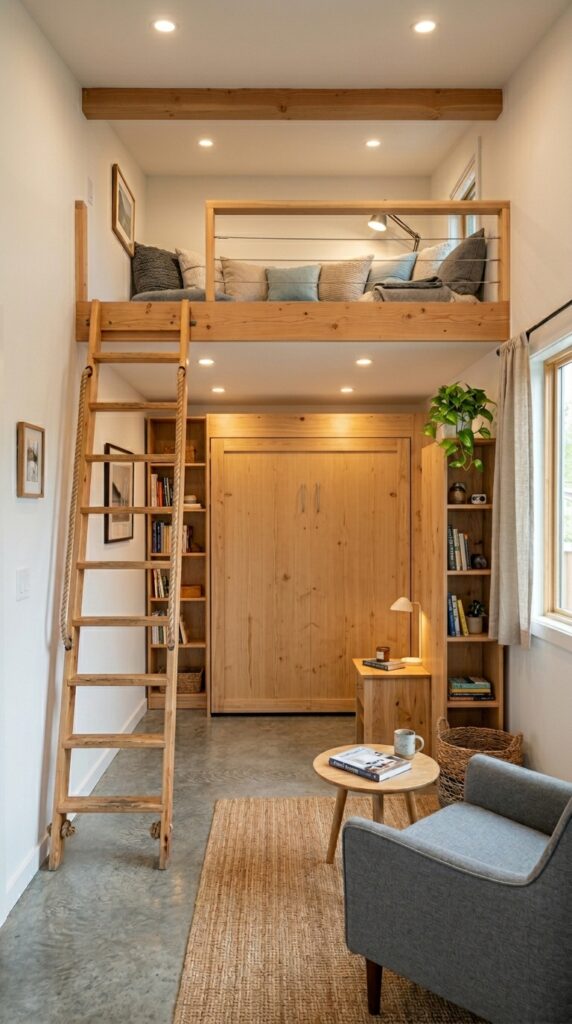
Vibe: Ingeniously resolved — a room that seems to have thought of everything twice.
Why it works: A Murphy-plus-loft hybrid solves a problem that neither solution alone can address: the loft provides always-available sleeping for one, while the Murphy bed provides a separate sleeping zone for a guest or partner that folds away when not needed, returning its floor area to the living space. This redundant-function-as-flexibility approach is the most spatially efficient sleeping solution possible in a studio under 300 square feet. The loft in this configuration doesn’t need full bedroom height — it functions as a sitting platform or reading loft during the day, requiring only 42–48 inches of clearance above the mattress surface.
How to get it: The Murphy bed wall and the loft should be planned as an integrated system — the Murphy cabinet depth (typically 18 inches) must not conflict with loft support posts or the stair/ladder footprint. A narrow ship’s ladder (12–14 inches wide) is the right loft access solution here, minimizing floor footprint to a single 14×14-inch base point rather than a full stair width.
🛍️ Shop the Look — Amazon Product Ideas
| # | Product Search Phrase | Why It Fits |
| 1 | Murphy bed wall bed hardware kit queen | Fold-down bed mechanism |
| 2 | ship ladder vertical loft wood rope | Narrow footprint loft access |
| 3 | Murphy bed cabinet panel white 84 inch | Cabinet surround panel |
| 4 | loft platform mattress 6 inch low profile | Low-clearance sleep surface |
| 5 | fold-down Murphy bed with shelving kit | Integrated storage system |
5. The Cantilevered Micro-Loft Without Vertical Posts
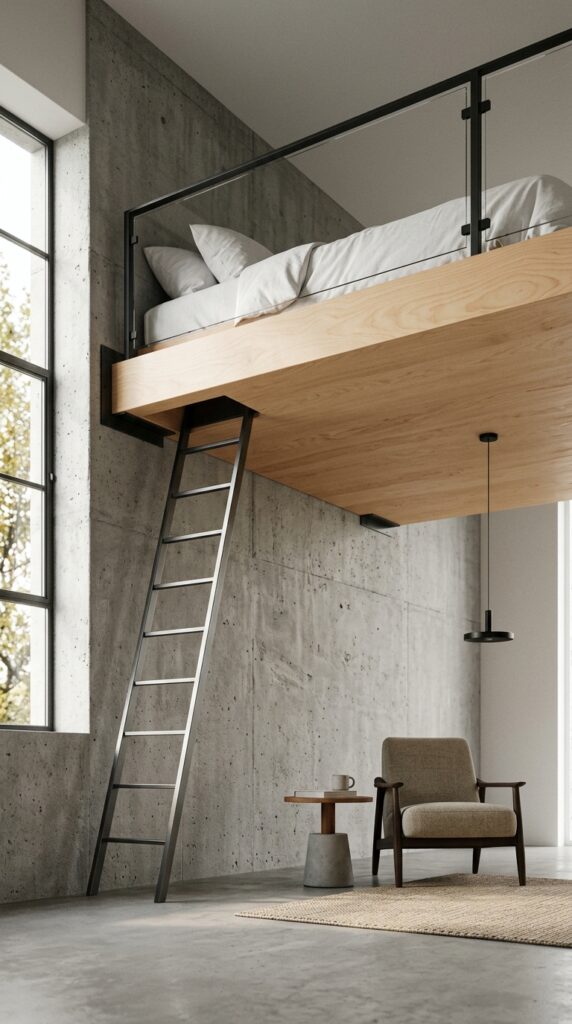
Vibe: Still — a horizontal plane held in the air by architecture instead of furniture.
Why it works: Conventional loft platforms rest on four vertical posts that inevitably create spatial subdivisions in the floor plan below — the posts mark off the under-loft zone from the rest of the room and make the space feel partitioned. A cantilevered loft eliminates all posts by transferring its structural load entirely into the rear wall through concealed steel plate connections — a technique used in mezzanine construction at architectural scale, adapted here to residential loft dimensions. The visual result is profound: the loft appears weightless, and the floor plan below is completely unobstructed.
How to get it: Cantilever engineering for a residential loft requires a structural engineer’s assessment — the rear wall must be capable of receiving the cantilever moment (typically requiring a reinforced concrete or structural steel stud wall behind the finished surface). Budget $1,500–3,500 for engineering, fabrication of steel plate connections, and installation. This is not a DIY project but is achievable for a loft span of up to 10 feet with a competent structural engineer.
🛍️ Shop the Look — Amazon Product Ideas
| # | Product Search Phrase | Why It Fits |
| 1 | structural steel plate custom fabrication | Cantilever connection hardware |
| 2 | birch plywood 3/4 inch 4×8 sheet | Loft deck substrate |
| 3 | concrete microcement wall coating kit | Below-loft wall finish |
| 4 | black pendant cord set adjustable | Hanging loft-edge light |
| 5 | structural engineer consultation residential | Professional load assessment |
6. The Reading Loft Nook for Children’s Rooms
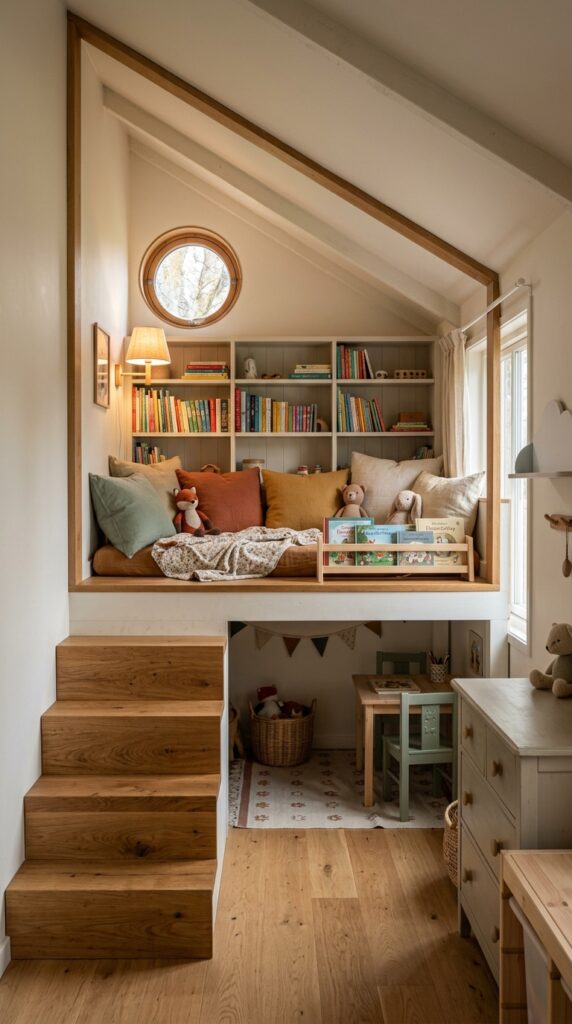
Vibe: Warm — the secret space every child draws in their imagination and deserves in their bedroom.
Why it works: Children’s reading lofts operate on a completely different design logic from adult sleeping lofts — they prioritize enclosure and privacy over efficiency and view. A reading loft that wraps its occupant on three sides (back wall with bookshelves, two side walls) creates what developmental psychologists call a den environment: a semi-enclosed space that children find simultaneously safe and exciting. The loft-height window is the critical element — it gives the loft its own relationship with the outside world, independent from the adult-height windows below, reinforcing the child’s sense of territorial ownership.
How to get it: Set the loft deck at 5 feet from the floor for children ages 6–12 — high enough to feel elevated and private, low enough that a fall from the edge is not dangerous, and low enough that a parent can see onto the platform easily. Build the platform at 90 inches of ceiling clearance minimum above it; 36 inches of deck-to-ceiling space is sufficient for a child to sit comfortably and read.
💡 Quick Win: A $40 string light set — battery-operated, draped along the loft ceiling — transforms a plain wooden platform into a magical space instantly, with no electrical work required.
🛍️ Shop the Look — Amazon Product Ideas
| # | Product Search Phrase | Why It Fits |
| 1 | battery LED string lights warm white bedroom | Magical loft atmosphere light |
| 2 | children reading cushion floor set | Soft loft seating |
| 3 | small low-profile bookshelf white 3-shelf | Loft-built-in book storage |
| 4 | clip-on reading light flexible neck | Loft task light |
| 5 | wooden step stool 3-step white child | Safe child-scale loft access |
7. The Industrial Steel Frame Loft — Exposed Structure
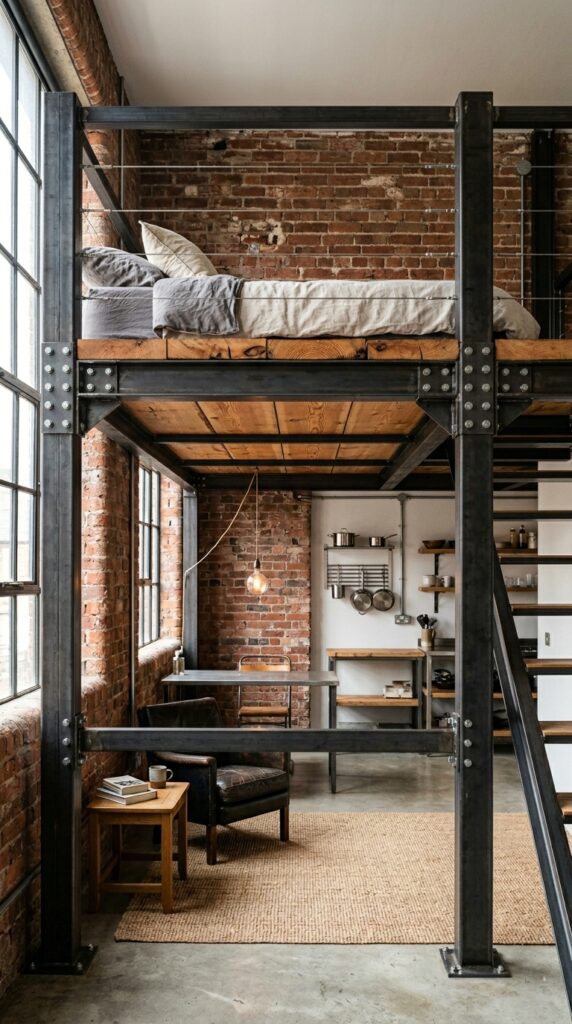
Vibe: Raw — structural honesty as the entire design statement.
Why it works: A steel tube frame loft makes its engineering visible rather than concealing it — the design principle of expressed structure treats the structural connections and members as aesthetic elements rather than problems to hide. This is architecturally honest in the tradition of Louis Kahn and the Pompidou Centre: the building shows how it works. Square-section steel tube (typically 2×2 or 3×3 inch, 3mm wall) is both structurally appropriate for loft spans up to 12 feet and visually compelling — the uniform section, bolted connections, and mill scale surface read as both industrial and contemporary.
How to get it: Commission a local metalwork fabricator rather than attempting DIY steel tube construction — the bolted connections require precise drilling at exact centers, and the frame must be designed to transfer loads safely to existing floor and ceiling structures. A typical fabricated steel loft frame for a 10×12-foot platform costs $2,500–5,000 from a fabricator, considerably less than a carpenter-built equivalent in solid wood.
🛍️ Shop the Look — Amazon Product Ideas
| # | Product Search Phrase | Why It Fits |
| 1 | black steel tube pipe floor flange fitting | Frame connection hardware |
| 2 | Douglas fir decking board 2×6 rough cut | Loft deck surface material |
| 3 | Edison bulb pendant black cord set | Industrial lighting fixture |
| 4 | jute area rug natural 6×9 | Warm below-loft textile |
| 5 | hex bolt assortment steel M8 galvanized | Frame connection hardware |
8. The Sleeping Loft with Integrated Wardrobe Below
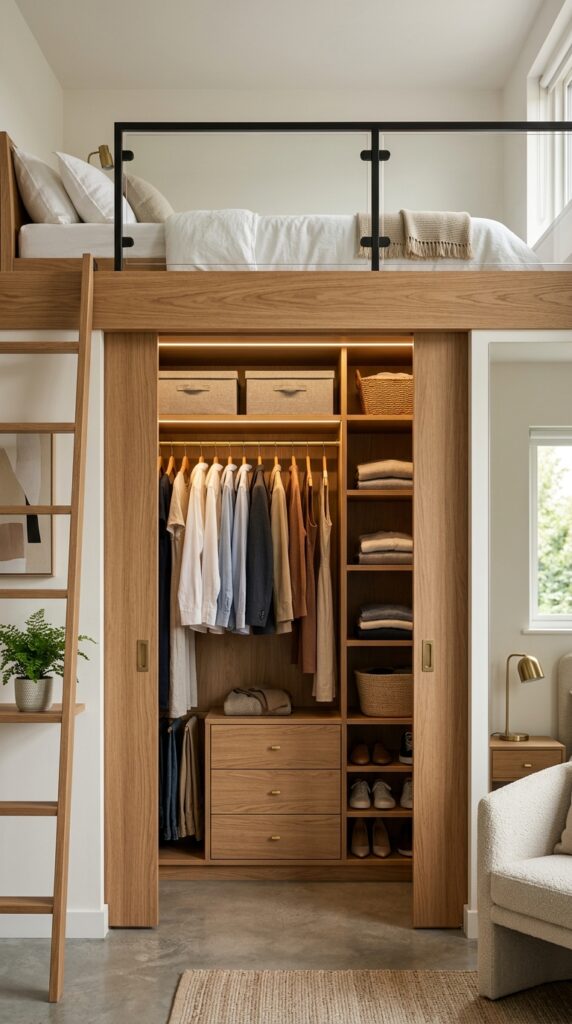
Vibe: Organized — the studio apartment that has found a place for everything without compromising anything.
Why it works: The space beneath a sleeping loft is the ideal location for a full-height wardrobe because the loft underside provides the ceiling — eliminating the need for a freestanding wardrobe that would otherwise occupy 24–30 inches of floor depth against a separate wall. This vertical integration of storage with sleeping structure is one of the highest-efficiency design moves available in a studio: both the loft and the wardrobe occupy the same vertical column of space, each serving the other structurally. The sliding door is mandatory rather than optional — a swing door would consume 28 inches of floor clearance that the studio cannot afford.
How to get it: Build the loft structure with its vertical support posts forming the wardrobe’s interior corner columns, and close between them with floor-to-loft-underside panels that become the wardrobe’s sides and rear wall. The loft deck is the wardrobe’s ceiling. Size the wardrobe opening for a standard 30-inch sliding door unit — IKEA’s PAX system with sliding doors can often be adapted to fit this configuration with custom-cut panels.
🛍️ Shop the Look — Amazon Product Ideas
| # | Product Search Phrase | Why It Fits |
| 1 | sliding door track hardware kit 6 foot | Wardrobe door mechanism |
| 2 | IKEA PAX wardrobe interior fitting set | Modular wardrobe internals |
| 3 | LED strip light closet cabinet warm white | Interior wardrobe lighting |
| 4 | soft-close bottom track sliding door | Silent door mechanism |
| 5 | oak veneer furniture panel sheet | Matching door face material |
9. The Tiny Loft on Wheels — Mobile Micro-Dwelling
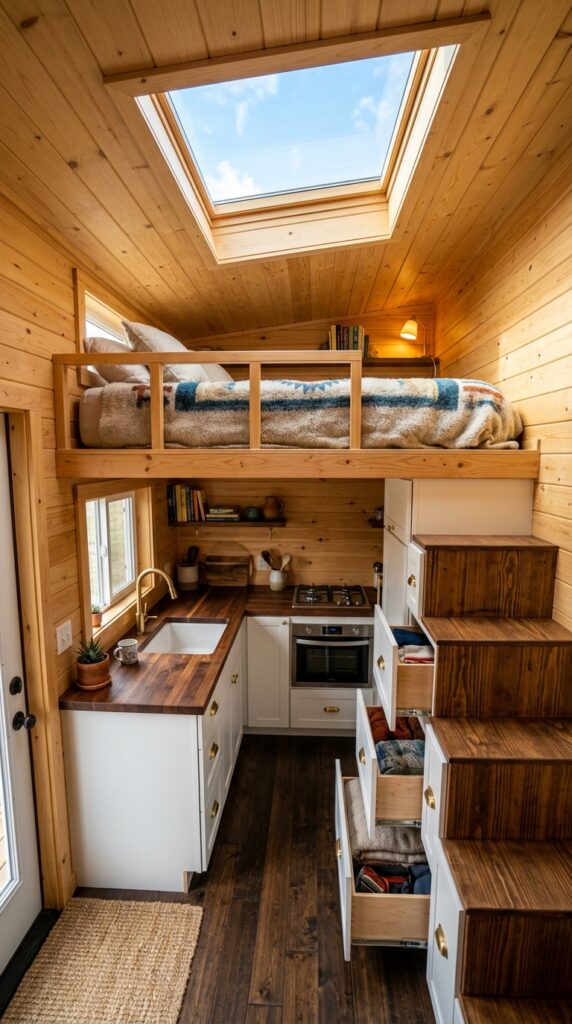
Vibe: Grounded — the specific contentment of lying in a small warm space and knowing exactly where everything is.
Why it works: A tiny house loft works because it accepts its constraints without apology — a 4-foot clearance above a loft mattress is not a compromise but a deliberate dimensional match between function and space. Lying down requires exactly zero inches of headroom above the mattress when the person is horizontal. The skylight positioned directly above the pillow is the transformative detail: it makes the loft ceiling disappear and replaces it with sky, which eliminates the psychological claustrophobia that a solid ceiling 4 feet overhead would create. This is light as spatial strategy rather than lighting as illumination.
How to get it: In a tiny house or RV loft, the skylight is the single most important specification decision. Choose a fixed skylight (no operable mechanism to add height) with low-E glass for thermal efficiency, sized at minimum 14×22 inches to create a genuine view of sky rather than a porthole. Velux and ACM make fixed units in this range at $180–350 — the most impactful $300 investment in a mobile loft.
💡 Quick Win: A $25 string of warm fairy lights tucked along the loft perimeter replaces a hardwired ceiling light in a tiny house loft, adds warmth rather than harsh overhead illumination, and runs on USB power from a small hub clipped to the loft wall.
🛍️ Shop the Look — Amazon Product Ideas
| # | Product Search Phrase | Why It Fits |
| 1 | fixed skylight residential 14×22 low-E glass | Essential loft daylight source |
| 2 | ship steps loft ladder steep treads | Tiny house vertical access |
| 3 | wool blanket natural herringbone throw | Warm loft bedding textile |
| 4 | tongue and groove pine paneling 4 inch | Warm ceiling cladding |
| 5 | butcher block countertop 4 foot natural | Below-loft kitchen surface |
10. The Corner Loft — Maximizing Two-Wall Structure
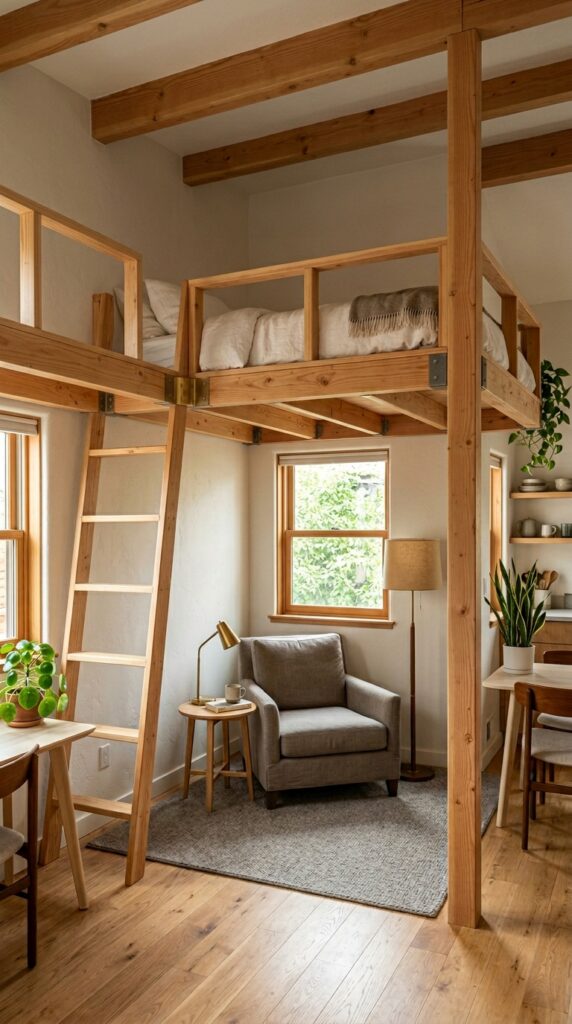
Vibe: Nestled — the particular comfort of a space that fits around you rather than simply containing you.
Why it works: A corner loft is structurally superior to a center-room loft because two of its four sides are supported by existing structural walls — requiring only two additional posts rather than four, reducing the number of floor-contact points by half. This structural opportunism — using the room’s existing geometry as part of the loft’s engineering — also creates a superior sleeping environment: two solid walls behind and beside the sleeping zone create an enclosure with acoustic and psychological properties that an open-platform loft cannot replicate. The corner provides inherent calm and definition.
How to get it: Anchor the rear two edges of the loft deck into existing wall studs using structural ledger boards — a 2×8 ledger lagged into studs at 16-inch centers can carry loft loads of 40 psf without additional support. The front two posts then carry only a fraction of the total load, allowing them to be reduced to 4×4-inch timber rather than the heavier section required for a fully post-supported platform.
🛍️ Shop the Look — Amazon Product Ideas
| # | Product Search Phrase | Why It Fits |
| 1 | structural ledger board lag bolt kit | Wall-anchored loft support |
| 2 | 4×4 pine post 8 foot structural | Front support post |
| 3 | reading armchair compact linen gray | Under-loft seating zone |
| 4 | arc floor lamp warm shade adjustable | Below-loft task light |
| 5 | joist hanger connector set 2×8 | Deck-to-ledger framing |
11. The All-White Minimalist Loft — Tone as Architecture
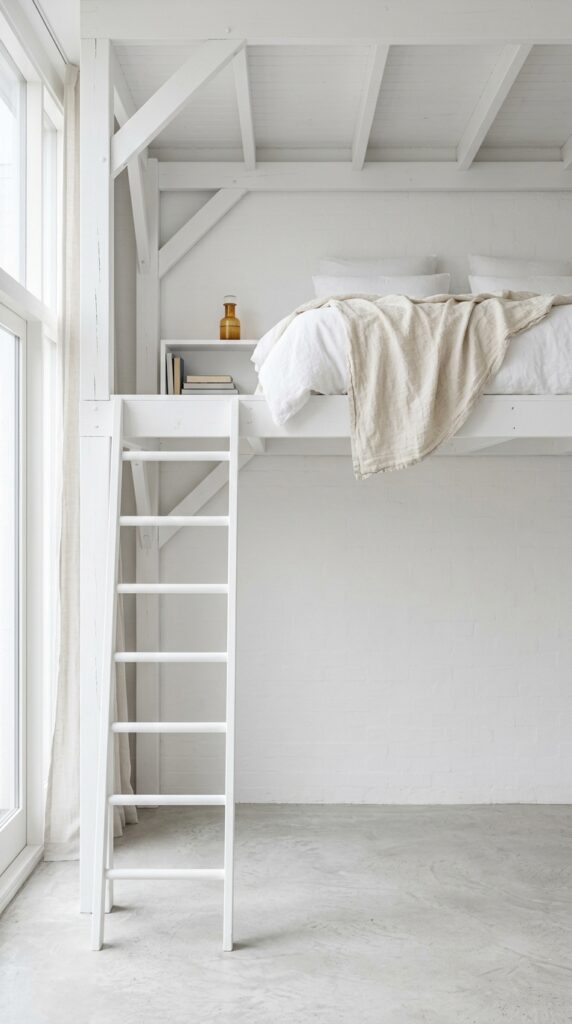
Vibe: Still — the kind of quiet that white rooms have when they mean it.
Why it works: A uniformly white loft uses color elimination as spatial expansion — when every surface is the same tone, the eye cannot find the edges of forms and spatial boundaries become ambiguous. The loft frame, which in a natural timber finish would read as a series of distinct structural elements inserted into the room, painted white recedes into the walls and reads as a continuous architectural element rather than furniture. This is the same principle used by white-on-white rooms in gallery design: the absence of color contrast allows form and light to become the sole design variables.
How to get it: The specific white matters. A blue-toned white (like Farrow & Ball All White or Benjamin Moore Chantilly Lace) will read cool and crisp; a warm-toned white (like Farrow & Ball Pointing or Benjamin Moore White Dove) reads softer and more inhabitable. For a loft in a north-facing space, always choose a warm-white — the cool northern light will cool any paint, and a blue-toned white in northern light reads as clinical rather than serene.
🛍️ Shop the Look — Amazon Product Ideas
| # | Product Search Phrase | Why It Fits |
| 1 | Benjamin Moore White Dove paint sample | Warm white loft paint |
| 2 | natural linen throw blanket woven | Texture-only contrast element |
| 3 | amber glass water carafe 1 liter | Single warm accent piece |
| 4 | white wood paint matte eggshell quart | Frame and ladder finish |
| 5 | low profile white loft mattress 6 inch | White-scheme bedding base |
12. The Split-Level Micro-Studio — Two Half-Floors
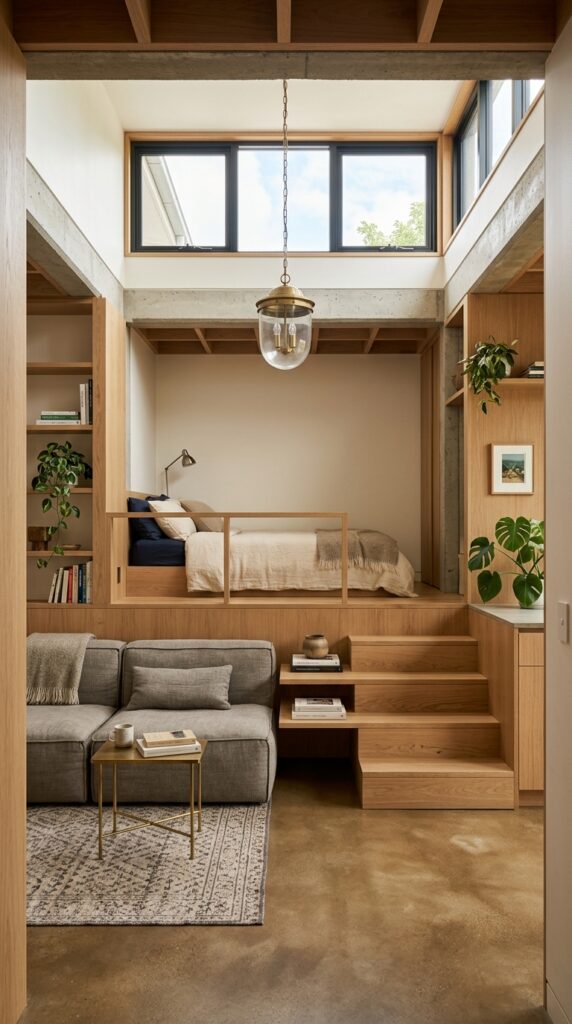
Vibe: Considered — a room that solves the studio apartment’s fundamental problem (one zone for everything) without a single partition wall.
Why it works: A split-level design uses vertical zone definition — the change in floor level between areas does the spatial separation work of a wall without consuming any floor plan area for partitions. The step between sleeping and living zones creates a psychological threshold: you cross a step to enter a different zone, and that kinesthetic transition is enough to make each space feel distinct and purposeful. In a micro-studio with 12-foot ceilings, raising the sleeping platform by 4.5 feet (half the ceiling height) gives both zones equal ceiling height — the upper zone has 7.5 feet above the raised floor, the lower zone has 7.5 feet above ground level.
How to get it: The structural requirement for a raised platform 4.5 feet above ground level is identical to that for a conventional sleeping loft — it requires engineered framing designed to the local building code’s residential floor load (typically 40 psf for sleeping areas, 60 psf for living areas). Treat it as a mezzanine floor rather than a platform, with appropriate structural depth in the floor assembly.
🛍️ Shop the Look — Amazon Product Ideas
| # | Product Search Phrase | Why It Fits |
| 1 | low profile sofa compact 72 inch | Sunken-zone seating |
| 2 | white oak hardwood stair tread 48 inch | Split-level step surface |
| 3 | aged brass floor lamp arc adjustable | Between-level ambient light |
| 4 | concrete microcement floor finish kit | Split-level floor unifier |
| 5 | clerestory window privacy film frosted | High-window light diffusion |
13. The Bookshelf Loft — Library Climbed to Sleeping
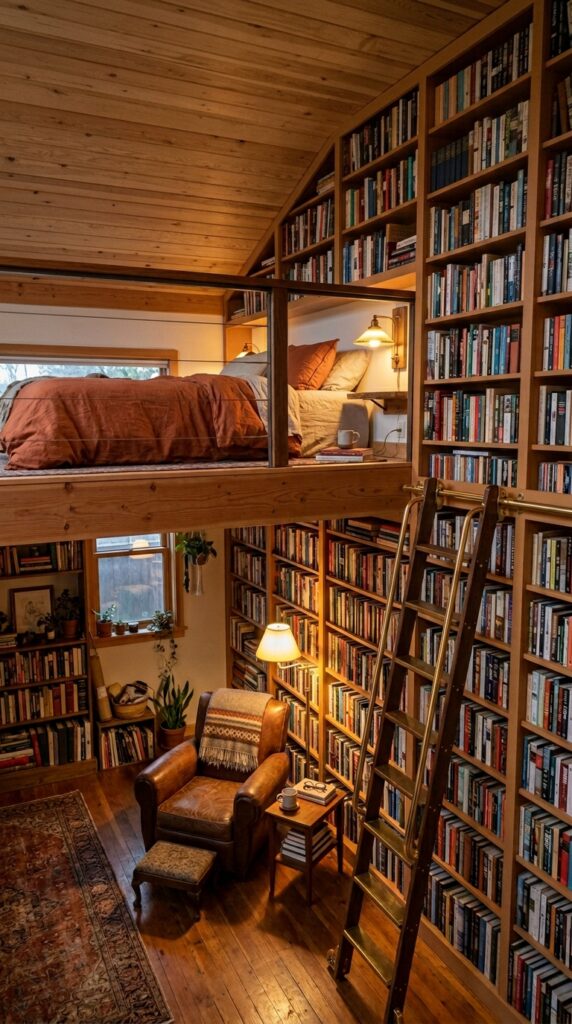
Vibe: Layered — a room that understands that a library and a sleeping loft are fundamentally the same idea.
Why it works: A floor-to-ceiling bookshelf used as structural loft support exploits multifunctional load-bearing design — the shelf unit carries both its own load and contributes lateral support to the adjacent loft platform, while simultaneously providing accessible book storage at every height between floor and loft. The rolling library ladder is structurally appropriate as primary loft access only when the loft is designated for sleeping use rather than frequent daytime occupation — it’s not safe for multiple daily trips but is perfectly suited to the one or two uses of a sleep loft.
How to get it: Build the bookshelf wall from 3/4-inch plywood with dadoed shelf slots — the dado construction (where shelves slot into grooves in the vertical side panels) is far more structurally rigid than bracket-mounted shelves and can carry the lateral load contribution required for loft support. Install the library ladder rail at the loft deck height, ensuring the rail is rated for the library ladder hardware you purchase.
💡 Quick Win: A $45 rolling library ladder kit (aluminum with universal rail clip) converts any existing floor-to-ceiling shelf into a functional loft access system without rebuilding the shelf — the most elegant loft access upgrade available at any price.
🛍️ Shop the Look — Amazon Product Ideas
| # | Product Search Phrase | Why It Fits |
| 1 | rolling library ladder kit brass rail hardware | Signature loft access system |
| 2 | library ladder rail track 6 foot steel | Ladder mounting rail |
| 3 | plywood bookshelf dado construction plans | Structural shelf guidance |
| 4 | compact reading chair small-space armchair | Below-loft library seating |
| 5 | brass bookend set heavy library | Shelf accessory detail |
14. The Tiny Loft Bed with Desk Below — Student Studio
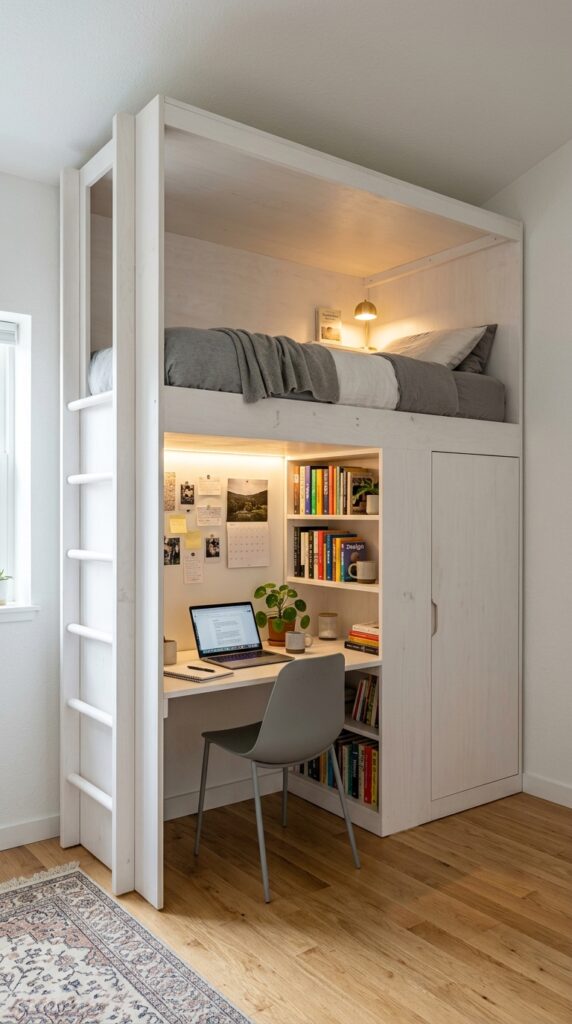
Vibe: Efficiently joyful — the small space that knows exactly what it is and does it without apology.
Why it works: A purpose-built loft bed unit resolves the fundamental challenge of a single-room student studio: the room must simultaneously be a bedroom, study, wardrobe, and living space in a footprint typically under 200 square feet. By stacking sleeping over working over storage in a single self-contained unit, the loft bed frees the remaining floor plan for a sofa, dining, or living zone. The critical design quality is integration — a loft bed that looks like a single built-in piece of furniture reads as architecture; a loft bed that looks like a standard bed raised on legs reads as furniture.
How to get it: Birch plywood is the correct structural and aesthetic material for this unit — strong enough for structural panels at 3/4-inch thickness, light enough to be manageable during construction, and fine-grained enough to take a smooth white paint finish that reads as quality cabinetry. Build the unit as a complete box rather than a frame, using the panels themselves as the structure.
🛍️ Shop the Look — Amazon Product Ideas
| # | Product Search Phrase | Why It Fits |
| 1 | birch plywood 3/4 inch furniture grade sheet | Structural unit material |
| 2 | integrated LED desk lamp clamp arm | Below-loft task light |
| 3 | low loft bed high sleeper desk combo | Reference unit guide |
| 4 | small plant succulent desk pot | Compact living accent |
| 5 | push-to-open cabinet latch no handle | Flush-face door mechanism |
15. The Netting Floor Loft — Transparent Hammock Platform
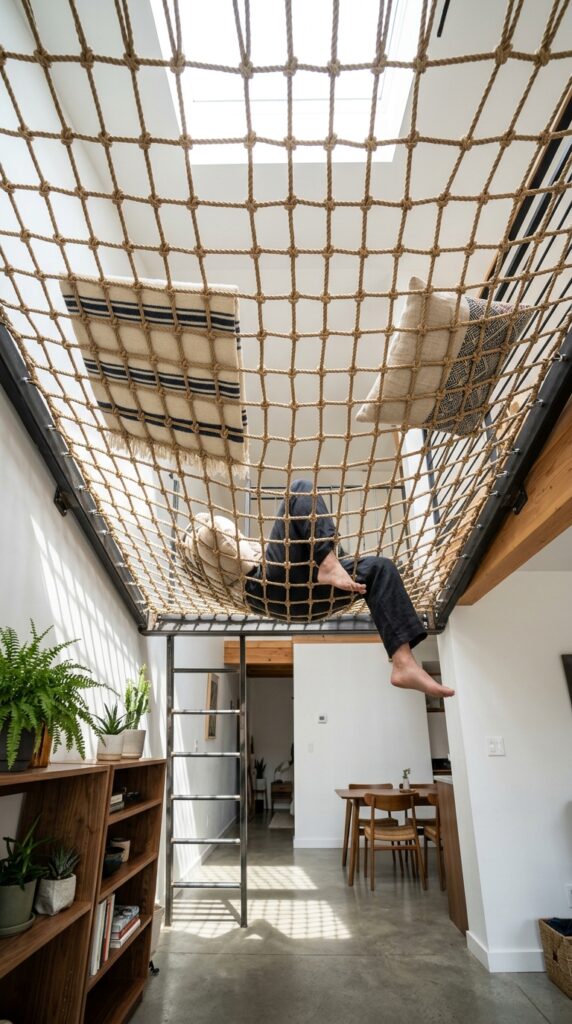
Vibe: Unexpected — the concept that makes first-time visitors stop in the doorway.
Why it works: A netting floor loft replaces the solid deck with marine-grade knotted rope netting — a technique used in several celebrated architectural projects including the CasaLoft in Barcelona — creating a permeable horizontal plane that preserves light passage and visual connection between levels while providing a functional lounging and sleeping surface. The structural logic is that a net under tension distributes point loads across its entire perimeter frame rather than concentrating them at posts, making it appropriate for adult body weight across a rectangular opening. It is not suitable as a primary sleeping surface for children under 12.
How to get it: Marine-grade knotted polyester rope netting (1-inch mesh, 3/8-inch rope diameter) is rated for loads exceeding 200 lbs per square foot when properly tensioned — far exceeding residential floor load requirements. The perimeter steel frame must be engineered to handle the net’s tension forces, which pull inward at the top of each frame member. Consult a structural engineer for frame sizing before installation.
🛍️ Shop the Look — Amazon Product Ideas
| # | Product Search Phrase | Why It Fits |
| 1 | marine rope netting knotted polyester 1 inch mesh | Loft floor net material |
| 2 | black powder coat steel tube 2×2 | Perimeter frame material |
| 3 | netting tension clamp lashing hardware | Net-to-frame connection |
| 4 | outdoor throw pillow UV resistant tan | Net floor cushioning |
| 5 | rope thimble rigging hardware set | Net perimeter tension fitting |
16. The Sauna-and-Loft Micro-Retreat
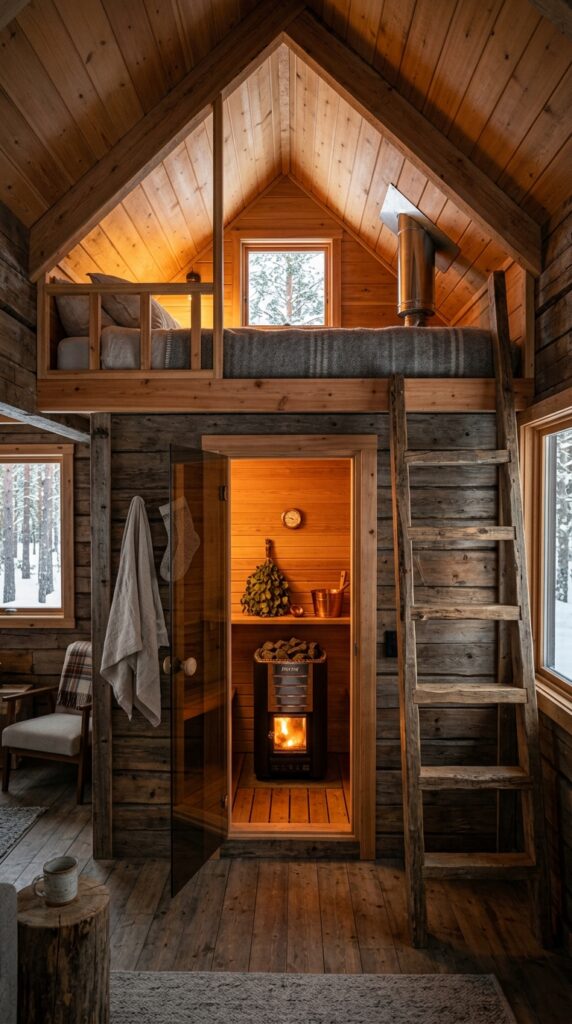
Vibe: Hushed — the warmest place on earth, and you can sleep there.
Why it works: A sauna-topped sleeping loft is a uniquely Scandinavian design concept that exploits thermal mass stacking — the sauna room’s heat rises naturally into the loft above, and the sauna’s timber structure forms both the thermal mass and the structural floor of the sleeping zone above. This eliminates the need for separate heating in the sleeping loft in cold climates, as residual sauna heat maintains the loft at a comfortable sleeping temperature for hours after use. It also creates an extraordinary sensory experience — sleeping above the cedar-scented warmth of a sauna in cold weather is among the most compelling small-space experiences available.
How to get it: The sauna room must be designed with the loft in mind from the start — the sauna ceiling must be constructed to residential floor load standards (not just as a sauna ceiling), and the heat chimney from the sauna stove must be routed to one side with sufficient clearance from combustibles. Consult a sauna specialist and a structural engineer simultaneously for this dual-function design.
🛍️ Shop the Look — Amazon Product Ideas
| # | Product Search Phrase | Why It Fits |
| 1 | cedar sauna wood panel tongue groove | Sauna wall and loft floor material |
| 2 | sauna stove wood-burning small indoor | Heat source and thermal mass |
| 3 | sauna bucket and ladle birch set | Traditional sauna accessory |
| 4 | wool cabin blanket natural gray throw | Warm loft bedding textile |
| 5 | sauna thermometer hygrometer wood | Sauna environment monitor |
17. The Micro-Apartment Loft with Hidden Kitchen Below
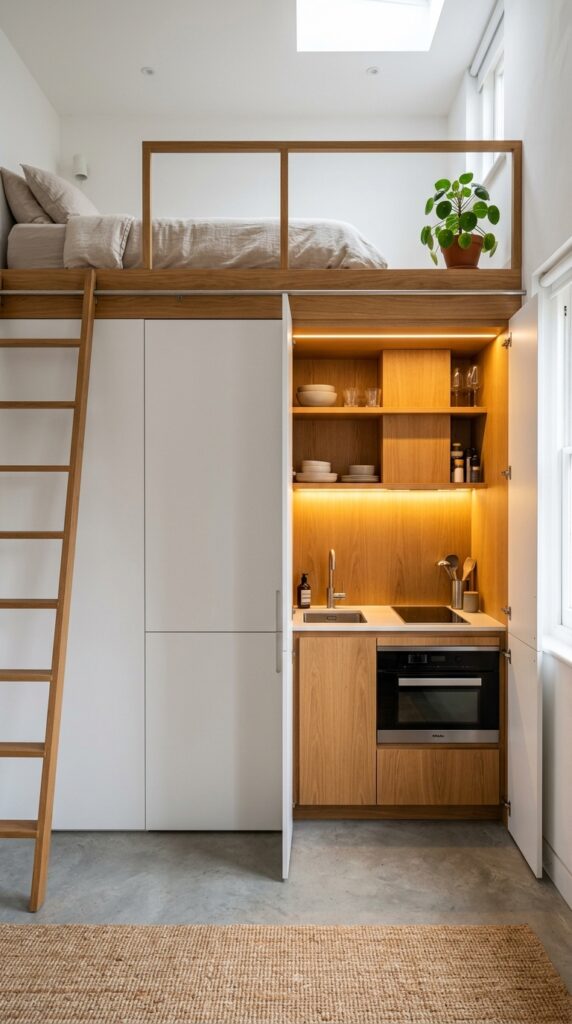
Vibe: Ingeniously resolved — the apartment that reveals itself only to those who know where to look.
Why it works: Concealing a kitchen within under-loft cabinetry uses fold-away function — a design strategy that allows a space to serve multiple purposes sequentially rather than simultaneously. The flush-panel exterior reads as architecture (a wall with minimal joinery) rather than furniture (a kitchen), which makes the under-loft zone feel uncluttered even in a 200-square-foot apartment. This concealment strategy also makes the small apartment photographically larger — a room with no visible kitchen reads as larger than a room with the same kitchen fully exposed.
How to get it: The concealed kitchen must incorporate only under-counter height appliances: a two-burner induction hob, a counter-depth 24-inch refrigerator, and a single-bowl under-mount sink, all integrated into a 36-inch-deep cabinet unit that fits within the 7-foot under-loft clearance. Ventilation is the critical specification — ensure a recirculating range hood is installed and that cabinet doors have ventilation slots when closed to prevent moisture accumulation.
💡 Quick Win: Push-to-open cabinet latches ($2–4 each) on the kitchen cabinet doors eliminate all visible hardware from the exterior face — the single most impactful detail in making a concealed kitchen look like a wall.
🛍️ Shop the Look — Amazon Product Ideas
| # | Product Search Phrase | Why It Fits |
| 1 | push-to-open latch touch cabinet no handle | Handle-free door mechanism |
| 2 | two-burner induction cooktop 12 inch | Under-counter compact cooking |
| 3 | counter depth mini refrigerator 24 inch | Space-appropriate cooling |
| 4 | recirculating range hood compact under-cabinet | Ductless kitchen ventilation |
| 5 | single bowl undermount sink 15 inch | Compact kitchen sink |
18. The Loft with Integrated Bathtub Below — Luxury Micro
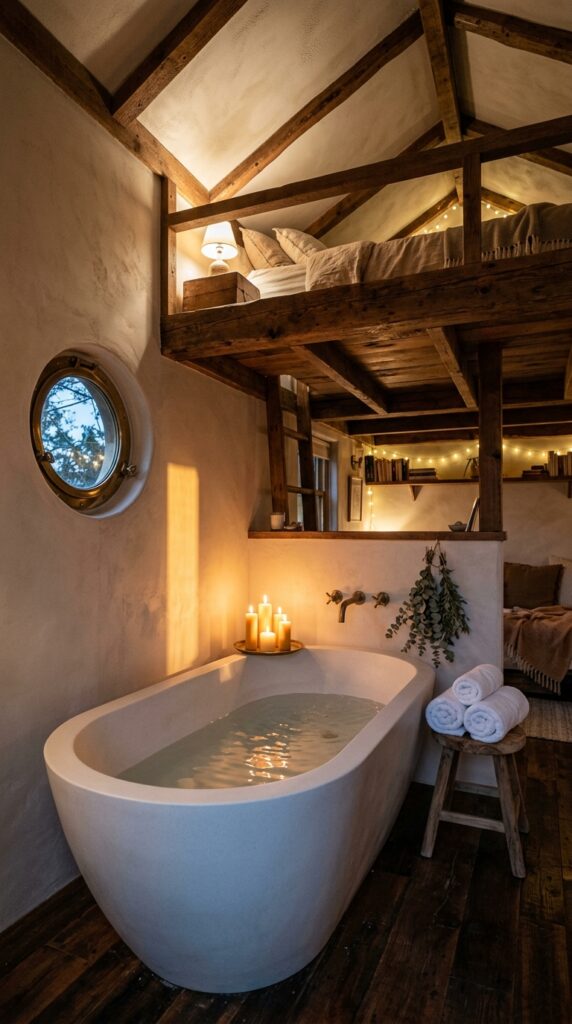
Vibe: Romantic — the most unexpected room in a tiny apartment, and the best one.
Why it works: Placing a bathtub below a sleeping loft is a deliberate spatial inversion — it takes the most private, luxurious domestic ritual and gives it the most architecturally protected position in the apartment, tucked under the solid platform of the loft. The loft acts as a canopy over the tub, creating an enclosure that a bathroom installed in a separate room could never achieve in a micro-apartment. The porthole window cut through the loft side wall is the critical detail: it gives the bather a defined framed view, making the bathing experience feel curated rather than utilitarian.
How to get it: This configuration requires careful waterproofing of the loft deck above the tub zone — apply a liquid waterproof membrane (Schluter Kerdi or Redgard) to the underside of the loft deck and extend 12 inches up the loft side walls before finishing. The porthole window is cut through the loft side panel and framed with a simple 2×4 frame before being covered with drywall — a residential contractor can execute this in a half-day.
🛍️ Shop the Look — Amazon Product Ideas
| # | Product Search Phrase | Why It Fits |
| 1 | freestanding soaking tub stone resin matte white 55 inch | Compact freestanding bathtub |
| 2 | liquid waterproof membrane paint 1 gallon | Loft deck waterproofing |
| 3 | porthole round mirror 12 inch brass | Porthole window frame option |
| 4 | teak wood bath stool towel holder | Below-loft bath accessory |
| 5 | eucalyptus bundle shower spa set | Aromatic bath accent |
19. The Loft with Rope Handrail — Tactile Navigation
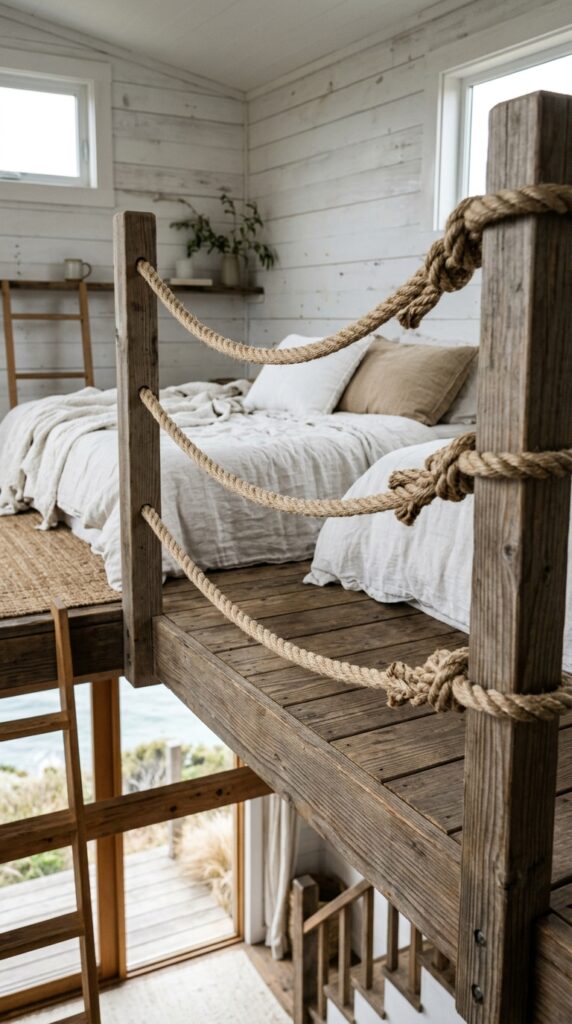
Vibe: Airy — a loft edge you can put your hand on and feel, not just see.
Why it works: Rope handrails use tactile material as spatial boundary — the natural hemp rope is softer, warmer, and more sensory than any glass or metal railing alternative. The catenary curve of the rope between posts (it sags naturally under its own weight) is mathematically beautiful and absolutely honest — unlike a taut cable that requires significant tension hardware, a knotted rope railing at residential heights is self-tensioning through its own weight distribution. The rope must meet railing height requirements (36 inches minimum at residential loft edges), which the three-horizontal-run configuration achieves.
How to get it: Use 1.5-inch natural manila or hemp rope (both rated at 2,000+ lbs tensile strength) for residential rope railings — the aesthetic quality of natural fiber is irreplaceable and the strength far exceeds the requirement. Thread each rope through pre-drilled holes in the end posts and tie with a bowline knot — the strongest fixed loop knot, which will not slip under load.
🛍️ Shop the Look — Amazon Product Ideas
| # | Product Search Phrase | Why It Fits |
| 1 | natural manila rope 1.5 inch diameter 50 foot | Rope railing material |
| 2 | wood post cap 4×4 turned decorative | Rope post top detail |
| 3 | stainless eye bolt wall anchor marine | Rope terminal anchor |
| 4 | knot tying guide maritime rope | Bowline knot reference |
| 5 | rope thimble terminal splice hardware | Professional rope end fitting |
20. The Loft Pod — Enclosed Sleeping Box Within a Room
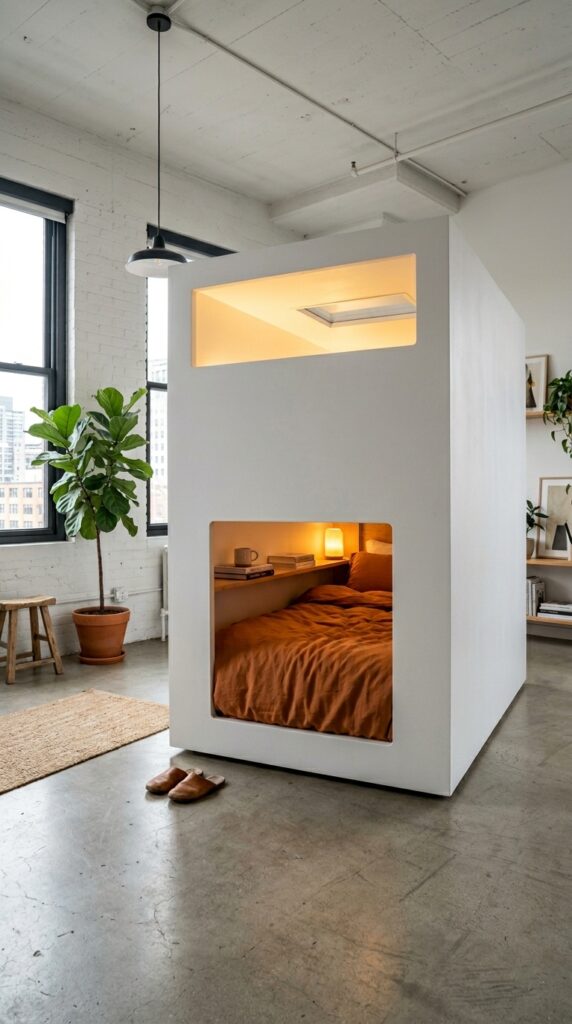
Vibe: Contained — an architecture of complete privacy within a shared or open space.
Why it works: A sleeping pod that sits on the floor rather than being elevated is technically not a loft, but it solves the same problem a loft does in a different direction: instead of going up, it goes inward. The enclosed pod creates an independent microenvironment — acoustically isolated, thermally distinct, completely private — within a studio or co-living space. The interior skylight is structurally the same idea as the tiny house skylight: it replaces a solid ceiling with sky, psychologically expanding an interior 45 inches tall into something that feels open. The pod is relevant here because it represents the ultimate application of the tiny loft’s core principle: that vertical and enclosed space serves human sleep better than horizontal open space.
How to get it: Build the pod from 18mm MDF with internal timber framing at corners — the MDF panels give a smooth, paint-ready surface and enough rigidity for a freestanding structure. The acrylic skylight panel sits in a simple rebated frame at the pod roof center, sealed with silicone. Interior dimensions for a comfortable adult sleeping pod are 80 inches long, 36 inches wide, and 42 inches tall.
💡 Quick Win: A freestanding sleeping pod kit from specialist micro-furniture manufacturers like Spacedge or Zopods starts at $1,800 fully assembled — less than the material cost of a custom-built loft in many markets.
🛍️ Shop the Look — Amazon Product Ideas
| # | Product Search Phrase | Why It Fits |
| 1 | acrylic sheet clear 3/16 inch 24×36 | Pod skylight panel |
| 2 | 18mm MDF board furniture grade sheet | Pod wall panel material |
| 3 | internal corner bracket steel 90 degree | Pod frame connection |
| 4 | warm LED strip light battery operated | Pod interior ambient light |
| 5 | silicone sealant clear waterproof | Skylight panel sealing |
21. The Green Loft — Living Wall Below the Platform
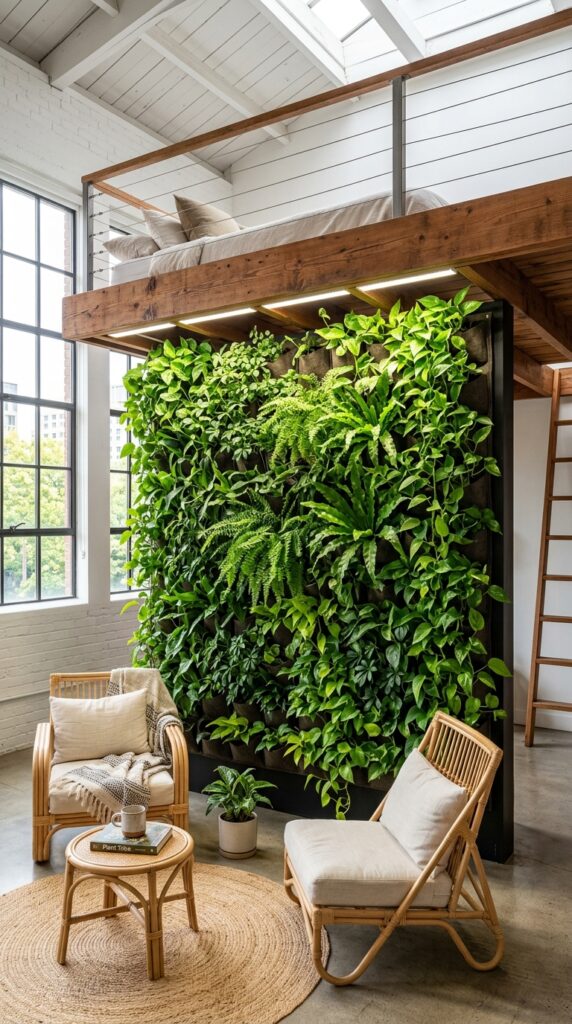
Vibe: Layered — a loft face that grows.
Why it works: A living plant wall on the vertical face of a sleeping loft platform is a functional surface rather than pure decoration — it provides genuine biophilic benefit (air quality, humidity regulation, psychological restoration), and it transforms an otherwise plain plywood panel into a room’s most visually compelling element. The critical enabling technology is the full-spectrum grow light integrated into the loft underside — it illuminates both the plants below and the living zone simultaneously, solving both horticultural and architectural lighting requirements with one installation.
How to get it: Modular felt pocket planting systems (Woolly Pocket and Florafelt are established brands) attach to a vertical surface with screws and can be irrigated through a simple drip system that connects at the top row and gravity-feeds downward. Plant selection is critical — choose species tolerant of consistent interior conditions: pothos, heartleaf philodendron, bird’s nest fern, and peace lily all thrive in this configuration without direct natural light.
🛍️ Shop the Look — Amazon Product Ideas
| # | Product Search Phrase | Why It Fits |
| 1 | felt vertical plant pocket wall system | Living wall planting module |
| 2 | full spectrum LED grow light bar strip | Plant wall illumination |
| 3 | pothos devil’s ivy 6 inch pot live | Trailing plant wall species |
| 4 | drip irrigation kit indoor vertical garden | Plant wall watering system |
| 5 | bird’s nest fern live plant 4 inch | Compact textural wall plant |
22. The Meditation Loft — Elevated Floor for Practice

Vibe: Serene — the specific stillness of a room that begins from the floor.
Why it works: A 30-inch elevated platform is not a loft in the structural sense but operates on the identical spatial principle: a change in floor level creates zone definition and spatial identity without any wall. The tatami-surfaced elevation follows a Japanese design tradition — the tokonoma alcove, the raised tea room floor — that uses floor level as spatial hierarchy. Sleeping at floor level on a futon is not a compromise in this context but a deliberate practice embedded in a distinct material system: tatami mat, shoji screen, low altar. The ceiling height of 9 feet or more above this platform is ample, and the single step of access is safe and gentle.
How to get it: Build the 30-inch platform from a simple timber frame covered with 3/4-inch plywood, topped with traditional tatami mats cut to fit (standard tatami is 35.5×71 inches). Tatami mats require a firm, flat substrate and should not flex underfoot — use blocking between floor joists at 12-inch centers beneath the platform for adequate support. Source authentic igusa grass tatami mats from Japanese home goods suppliers for the correct sensory quality.
🛍️ Shop the Look — Amazon Product Ideas
| # | Product Search Phrase | Why It Fits |
| 1 | traditional igusa tatami mat set natural | Elevated floor surface |
| 2 | shoji screen room divider natural wood | Window light filter |
| 3 | Japanese futon mattress roll set | Platform sleeping surface |
| 4 | small walnut altar shelf floating | Meditation focal shelf |
| 5 | unscented beeswax candle set natural | Low-altar flame element |
23. The Skylight Loft — Positioned Under a Roof Window
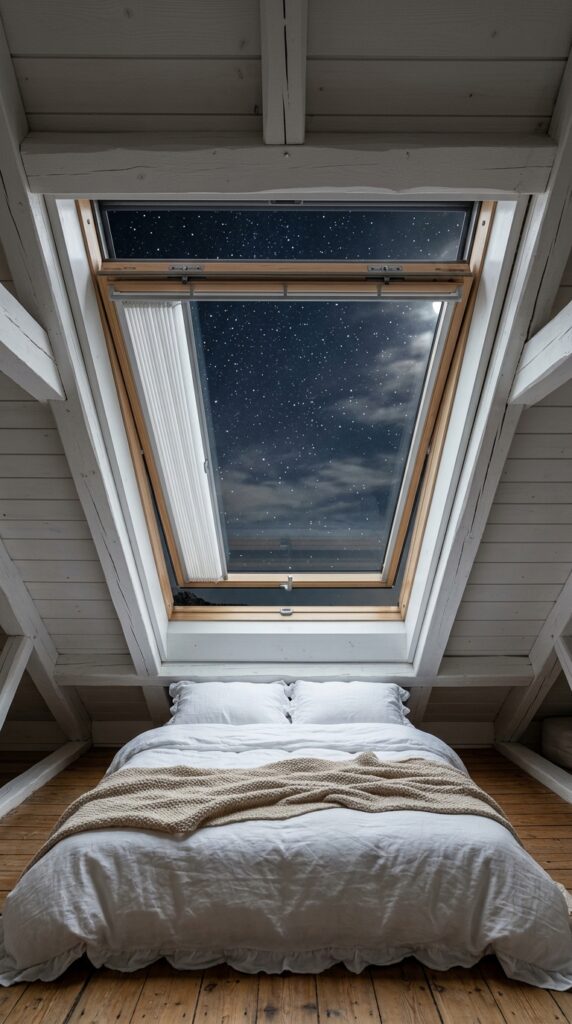
Vibe: Luminous — the room where the ceiling tells you what the weather is before you’ve decided to care.
Why it works: The skylight loft is the most powerful single design idea on this list for converting a genuinely tiny attic or sloped-ceiling space into a desirable sleeping zone. The skylight positioned directly above the mattress uses vertical view as spatial expansion — the glass opening replaces the ceiling with sky, eliminating the psychologically compressive quality of a low ceiling and replacing it with unlimited vertical depth. Studies on hospital room design have confirmed what every attic bedroom occupant already knows: a view of sky from a lying position improves sleep quality, mood, and the subjective experience of space.
How to get it: Position the skylight so its inner edge is directly above the pillow position — you want to see sky when lying on your back, not the roof structure beside the opening. Specify an electrically operated blind for the skylight (not manual cord-operated, which is inaccessible from a lying position) so light control can be managed without leaving the mattress. Velux’s GPS Solar-powered blind system is the standard specification for this application.
💡 Quick Win: A Velux fixed skylight installed in an existing attic ceiling by a roofer costs $800–1,400 installed — it is the single highest-impact and most permanent upgrade to any attic loft sleeping zone.
🛍️ Shop the Look — Amazon Product Ideas
| # | Product Search Phrase | Why It Fits |
| 1 | Velux GPS solar skylight blind blackout | Motorized blind for skylight |
| 2 | skylight installation flashing kit universal | Weatherproof skylight surround |
| 3 | white knit weighted blanket throw | Loft cozy bedding layer |
| 4 | white linen pillow case set standard | Clean white sleep surface |
| 5 | roof window thermometer temperature monitor | Loft climate awareness |
24. The Two-Person Loft — Wide Platform for Shared Sleeping
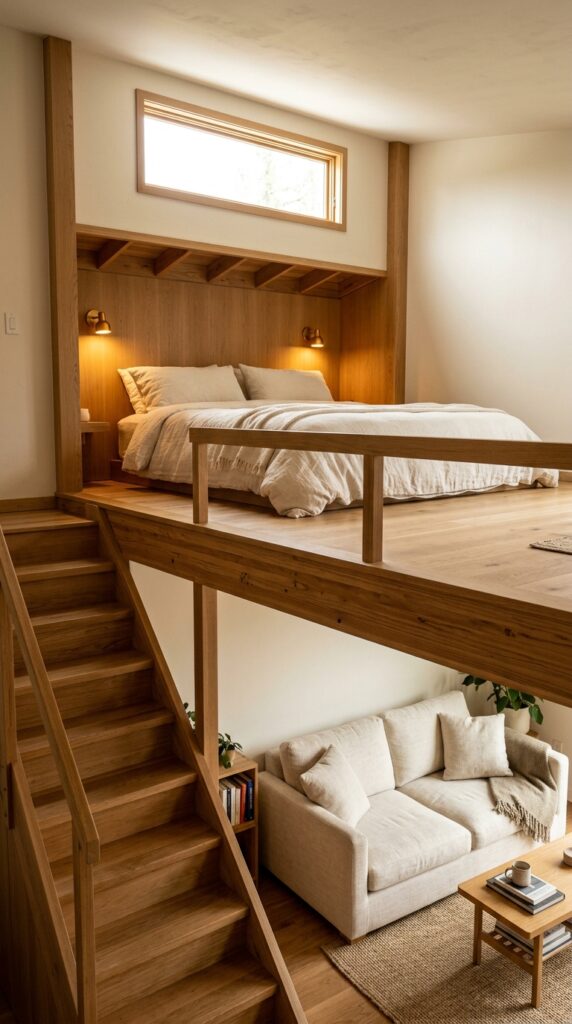
Vibe: Warm — a loft that doesn’t ask anyone to sleep alone.
Why it works: A two-person sleeping loft requires 80 inches of platform width (king-size) and a minimum of 90 inches of ceiling height above the deck for comfortable getting-in and getting-out. The structural implication of the wider platform is significant: an 80-inch span without intermediate support requires either 4×8 or engineered LVL floor joists at the deck level rather than standard 2×6 lumber. The wide platform also demands a proper staircase rather than a ladder — safe bilateral bed entry and exit is impossible from a ladder for a couple unless one person always gets out on the same side.
How to get it: Specify the loft deck framing with LVL (laminated veneer lumber) joists at 12-inch centers for an 80-inch span — this will eliminate deck flex, which is both structurally important and essential for a shared sleeping surface where motion transfer between two people is amplified by any deck deflection. LVL joists cost more than dimensional lumber but eliminate the problem entirely.
🛍️ Shop the Look — Amazon Product Ideas
| # | Product Search Phrase | Why It Fits |
| 1 | LVL laminated veneer lumber joist 1.75×9.25 | Wide-span rigid deck framing |
| 2 | king size linen duvet cover white | Wide loft bedding |
| 3 | wall-mounted reading light plug-in two-arm | Dual bedside loft lighting |
| 4 | compact two-seat sofa apartment 60 inch | Below-loft seating pair |
| 5 | clerestory window film daylight diffuse | High-window light quality |
25. The Floating Loft Bed in a High-Ceiling Victorian Room
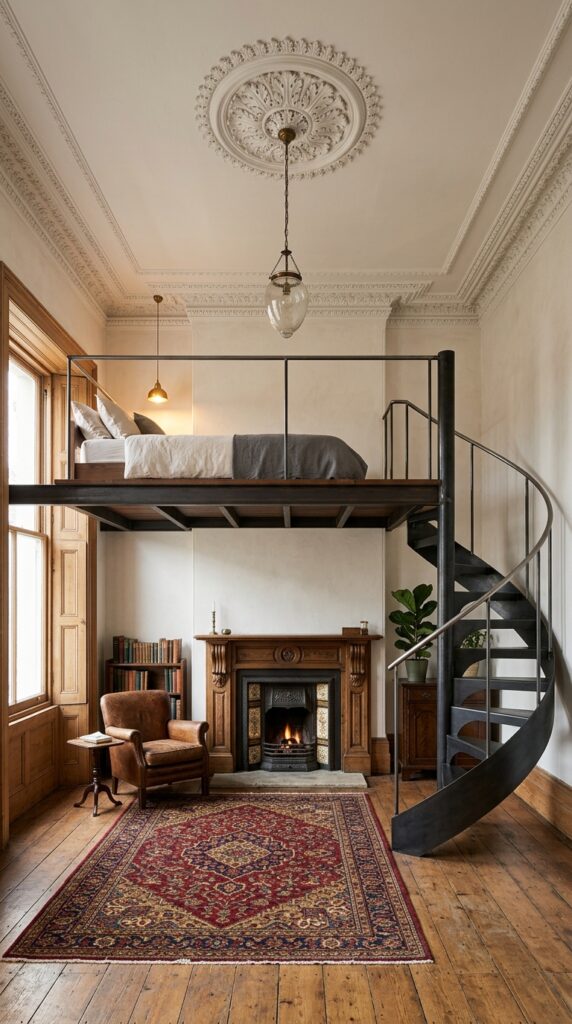
Vibe: Layered — the meeting of two centuries in one room, each making the other look better.
Why it works: A Victorian room with 14-foot ceilings contains enough vertical volume for a full-height living zone below the loft (9 feet clearance) and a comfortable sleeping zone above it (5 feet clearance from loft deck to ceiling). The inserted loft reads as a contemporary object within a historical container — the deliberate contrast between the period Victorian plasterwork and the inserted steel or timber loft structure is the design’s central tension, and it works because neither element tries to be the other. The spiral staircase is architecturally correct here: it has a significantly smaller floor footprint than any other stair type (typically 52–60 inches in diameter) while delivering safe access at the 9-foot deck height that ladders cannot safely serve.
How to get it: Victorian rooms present a specific planning challenge — loft structures must not damage or obscure original period features (cornicing, picture rails, architraves). Anchor the loft to the room’s load-bearing walls using surface-mounted structural brackets rather than penetrating the plaster, and specify the loft deck at a height that leaves the full cornice visible above it. The original ceiling rose, if present, becomes the focal point of the loft’s ceiling — an extraordinary decorative element experienced from a completely new vantage point.
💡 Quick Win: A spiral staircase kit in powder-coated steel (Arke Kompact or similar) at $1,200–2,000 is the most affordable way to access a 9-foot loft safely — and in a Victorian room, its circular geometry echoes period ceiling medallions and balustrade forms in a way that feels surprisingly appropriate.
🛍️ Shop the Look — Amazon Product Ideas
| # | Product Search Phrase | Why It Fits |
| 1 | spiral staircase kit steel powder coat black 9 foot | Compact Victorian-appropriate access |
| 2 | surface mount structural bracket steel heavy duty | No-penetration wall anchor |
| 3 | Persian style area rug 8×10 traditional | Below-loft period textile |
| 4 | Victorian ceiling rose plaster replacement | Period detail restoration |
| 5 | white linen bedding set simple contemporary | Clean-contrast loft bedding |
How to Start Your Tiny Loft Transformation
Begin with ceiling height measurement — specifically, the distance from your finished floor to the underside of any ceiling obstruction (beams, ducts, joinery). This single number is the non-negotiable constraint from which every loft design decision follows. If your ceiling height is below 10 feet, a fully standing loft with comfortable headroom above the deck is not achievable — but a sleeping-only loft with 42 inches of clearance above the mattress works perfectly and remains comfortable for any activity performed horizontally. If your height exceeds 12 feet, you have genuine design freedom. Measure before you sketch or budget anything else.
The most common mistake in a first tiny loft project is underestimating the structural cost relative to the finish cost. Beginners allocate budget for the visible parts — the deck surface, the railing, the ladder — and underestimate the structural engineering, the floor framing, the connection hardware, and the fasteners. In a typical residential sleeping loft, the invisible structural elements cost between 40 and 60 percent of the total build cost. If your budget doesn’t accommodate this proportion, reduce the loft’s footprint rather than compromising the structural specification — a smaller, properly engineered loft is always safer and more durable than a larger, under-engineered one.
Three specific items under $50 that meaningfully improve any tiny loft before anything more significant is addressed: a clip-on reading light with a flexible neck ($18–28) that attaches to the loft railing and directs light onto the mattress without requiring electrical work; a small battery-operated LED puck light ($12 for a three-pack) pressed-and-clicked to the loft underside as task lighting for the zone below; and a roll of thin drawer liner in a non-slip surface ($8–14) applied to any loft ladder treads, which dramatically improves safety on descent with no tools or modification required.
A basic sleeping loft built by a competent carpenter — platform, posts, railing, ladder — in a room with adequate ceiling height should take two to three weekends for construction and $1,500–3,500 in materials depending on finish quality. A custom-engineered cantilevered or multi-function loft with integrated storage, concealed kitchen, or structural glass elements should be budgeted at $5,000–15,000 and will take four to eight weeks from design to occupation. The DIY weekend build is genuinely achievable with standard woodworking skills; anything involving steel fabrication or structural engineering requires professional involvement.
Frequently Asked Questions About Tiny Loft Concepts for Small Spaces
What is the minimum ceiling height needed for a tiny sleeping loft?
The absolute minimum ceiling height for a functional sleeping loft is 10 feet from finished floor to ceiling — this allows approximately 6.5 feet of clearance below the loft deck (for comfortable standing) and 42 inches above the mattress (sufficient for sitting upright in bed). At 10 feet, there is no margin for error in the structural assembly, and every inch must be accounted for: the deck framing (typically 9–11 inches of structural depth), the deck finish material (3/4 inch plywood), and the mattress thickness (8–12 inches for a standard mattress). A 12-foot ceiling gives genuine design freedom, allowing both full standing headroom below (8 feet) and comfortable headroom above (approximately 54 inches). Anything below 10 feet limits the loft to a sleeping-only function with the occupant fully reclined.
How much weight can a DIY sleeping loft safely hold?
A correctly engineered residential sleeping loft is designed to a floor live load of 30–40 psf (pounds per square foot), which is the standard residential bedroom load in most building codes. For a 10×8-foot loft deck, this translates to a minimum capacity of 2,400–3,200 lbs — far exceeding any realistic load from mattress, bedding, and occupants. The critical variable is not the design specification but the execution: the structural connections (joist hangers, post caps, lag bolts into wall studs) must be rated to match the design load, and every connection must be installed correctly. A loft built with undersized hardware at every connection point fails long before the lumber does. Always use hardware rated at a minimum of 1.5 times the calculated load.
Is a loft legal in a rental apartment?
In most jurisdictions, adding a loft to a rented apartment requires the landlord’s written permission and, depending on local building codes, may also require a building permit. Permit requirements typically depend on the loft’s footprint (structures over a certain square footage require permits), whether the structure is freestanding or attached to the building’s structure, and whether any electrical, plumbing, or structural work is involved. Freestanding loft bed units — those that attach to no walls and make no structural modifications — are typically exempt from permitting in most US jurisdictions. Wall-attached loft platforms are subject to permit requirements. Always check with your local building department before beginning any construction, and with your landlord before purchasing any materials.
What is the safest type of access for a tiny loft?
Safety of loft access is determined by two variables: the height of the loft deck above the floor, and the frequency of use. For lofts under 6 feet of deck height, a wide ship’s ladder (65–75 degrees from horizontal) is safe and appropriate. For lofts between 6 and 8 feet, a proper alternating-tread stair (a steep stair with offset left-right treads) provides significantly more safety than a ladder while consuming less floor space than a conventional stair. For lofts above 8 feet, a conventional staircase with a handrail on both sides is the code-required and architecturally appropriate solution. Rolling library ladders are appropriate only for loft platforms used infrequently — their straight, near-vertical pitch is not suitable for regular nightly use by a sleeping loft occupant.
Can a tiny loft be added to a space with no structural walls nearby?
Yes, but the structural solution changes significantly depending on the available anchor points. A loft with no adjacent structural walls must be entirely self-supporting — a freestanding structure that transfers all loads to the existing floor through its own posts. This approach requires larger-section posts (minimum 4×4, preferably 4×6 for spans over 8 feet), a more robust perimeter frame at the deck level, and cross-bracing on at least one face of the structure to resist lateral loads. The floor beneath the loft posts must be capable of receiving concentrated point loads — a concrete slab or timber floor over a basement handles this without modification, while a wood-frame floor over a crawlspace may require blocking between joists directly beneath each post location to distribute the load.
Ready to Create Your Dream Tiny Loft Space?
These 25 tiny loft concepts have covered the full geometry of small-space vertical design — from the structural logic of cantilevered platforms and the material honesty of industrial steel frames to the sensory rewards of skylight positioning and the spatial generosity of concealed kitchens — and the consistent principle underneath all of them is that vertical space is not a bonus in a small dwelling but its primary resource. Start small and specific: measure your ceiling height today, write the number down, and let that single dimension tell you which of these 25 ideas belongs to your room. Even a weekend sleeping loft built at basic specification will change how a small space feels to live in — the act of elevation, of sleeping above rather than inside a room, reorganizes everything below it and makes the square footage feel, paradoxically, larger. Pin the concept that made you reconsider what your ceiling was for — and then go measure.