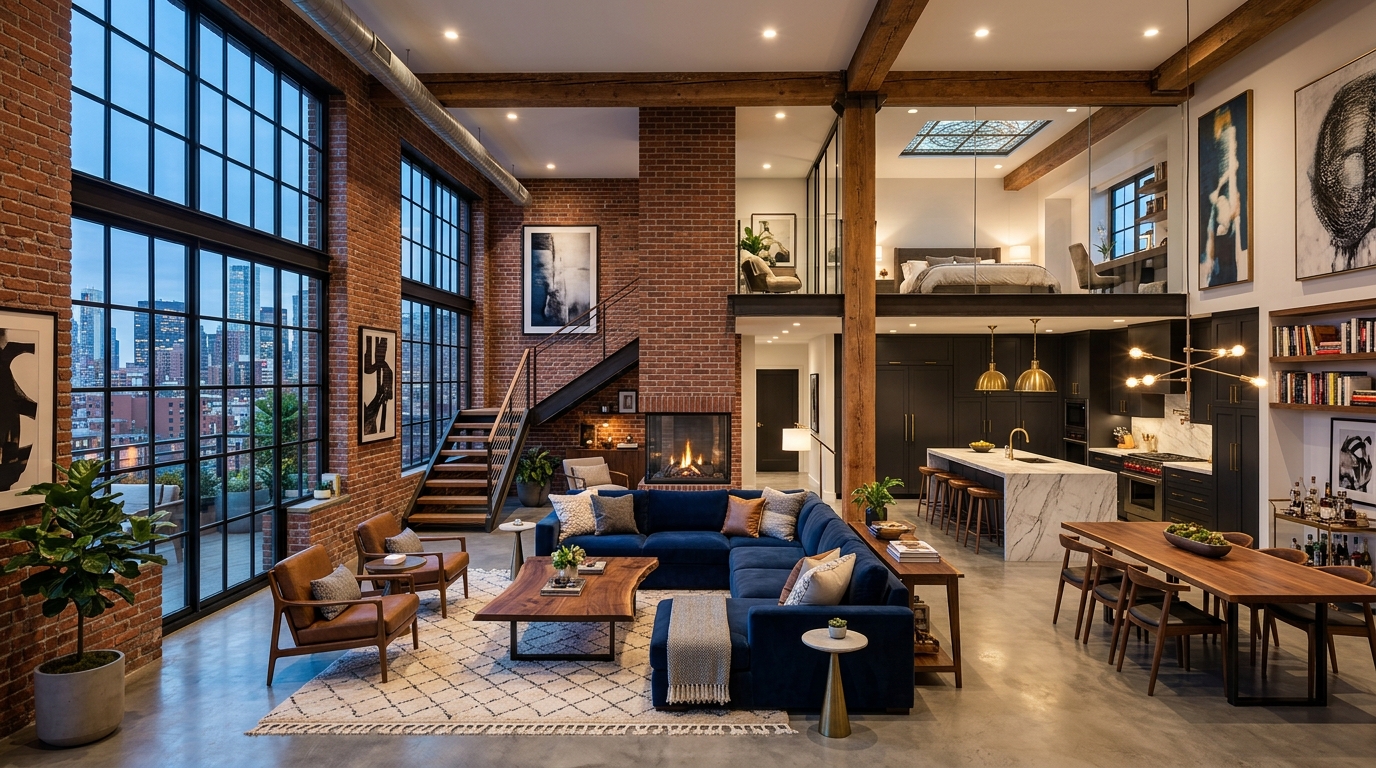
A luxe loft apartment merges the raw, open-volume architecture of industrial loft spaces — exposed brick, soaring ceilings, structural columns — with the refined materiality and deliberate warmth of high-end residential design. This article delivers exactly 26 luxe loft apartment ideas spanning color, materials, lighting, furniture, layout, and small-space strategies, every one of them specific enough to act on today.
There’s a particular electricity to a well-designed loft — the feeling of standing in a space that hasn’t decided to be small, hasn’t apologized for its bones, hasn’t hidden its structure behind drywall and convention. Light falls differently here. Scale operates on its own terms. Here are 26 ideas worth saving — and stealing.
Why Luxe Loft Design Works So Well
The luxe loft aesthetic sits at the intersection of two powerful design lineages: the converted industrial spaces of SoHo and Tribeca in the 1970s, where artists colonized former factories and warehouses and refused to domesticate them entirely, and the contemporary luxury residential movement that followed — which recognized that the spatial drama of those raw spaces was not a problem to be solved but a quality to be amplified. What distinguishes a luxe loft from a simply large apartment or a purely industrial space is the deliberate layering of refinement over rawness: polished concrete beneath a cashmere rug, exposed steel beside hand-stitched leather, raw brick behind a museum-quality artwork.
The material vocabulary of a truly considered luxe loft is specific and uncompromising. Honed concrete or large-format porcelain flooring in warm charcoal or pale ash. Exposed structural steel in a natural oxidized finish or painted warm black. Brick left raw and sealed or limewashed in a dusty pale tone. Unfinished white oak millwork and shelving. Aged leather in tobacco or cognac. Linen, mohair, and bouclé upholstery. Unlacquered brass and oxidized bronze hardware. Warm charcoal, dusty ivory, cognac, forest sage, and deep slate as the defining color tones — never stark white, never primary colors, nothing that shouts.
The luxe loft aesthetic is experiencing a sustained design moment for reasons that feel genuinely cultural rather than merely cyclical. As urban living has become denser and apartment footprints have shrunk, the open loft plan — which refuses partition walls and celebrates spatial generosity — has become aspirational in a new way. The wellness-driven emphasis on natural materials, authentic surfaces, and spaces that support rather than suppress the feeling of being alive has aligned perfectly with loft design’s inherent material honesty. Pinterest data consistently places loft interiors among the highest-saved design categories, and the aesthetic’s influence extends well beyond actual converted buildings into new-construction apartments that architecturally reference the loft tradition.
Standard-height apartments can absolutely achieve the luxe loft aesthetic — with one honest qualification: the soaring ceiling is difficult to fake, and attempting to suggest it with tricks often reads as effortful rather than authentic. What smaller-scale spaces can achieve instead is the material palette and the spatial philosophy: large-format flooring that eliminates visual interruptions, furniture arranged in conversational islands rather than along walls, raw or textured surfaces paired with refined textiles, and the strategic absence of upper cabinets that allows walls to breathe. The visual generosity of loft design lives as much in what is absent as in what is present.
Style at a Glance
| Element | Core Trait 1 | Core Trait 2 |
| Philosophy | Raw architecture celebrated, not concealed | Refinement layered over industrial bones |
| Materials | Honed concrete, exposed brick, structural steel | White oak, aged leather, unlacquered brass |
| Color palette | Warm charcoal, dusty ivory, cognac | Forest sage, deep slate, oxidized bronze |
26 Luxe Loft Apartment Ideas You’ll Love
1. Exposed Brick Wall as the Room’s Defining Backdrop
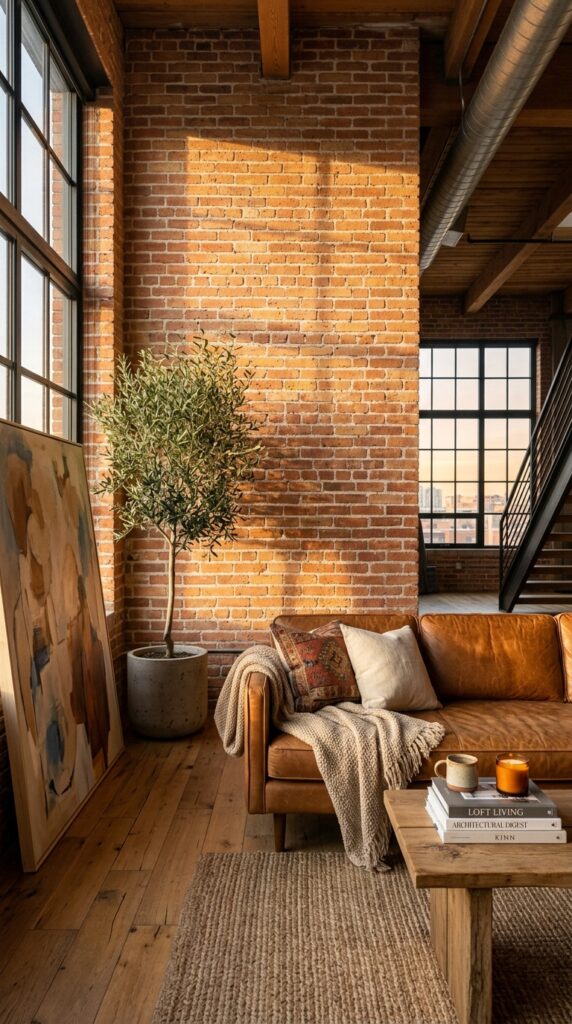
Vibe: Grounded — the wall that makes everything placed in front of it feel chosen.
Why it works: Exposed brick is the architectural signature of the loft tradition — its presence communicates that the building has a history, that the space was something before it became a home, and that decision to preserve rather than cover it is a design philosophy rather than an oversight. The sealed matte finish is the critical refinement detail: raw unsealed brick sheds dust and crumbles at the mortar joints over time; a clear penetrating sealer preserves the surface appearance while eliminating maintenance issues. The pairing of aged terracotta brick with cognac leather is a tone-on-tone strategy — both materials occupy the warm orange-brown family, creating visual harmony through material affinity rather than contrast.
How to get it: Clean brick thoroughly with a TSP substitute before sealing — any dirt or efflorescence sealed in will be permanently visible. Apply a clear penetrating masonry sealer (not a film-forming sealer, which creates a plastic-looking surface) in two coats with 24 hours between applications. For renters, a limewash treatment in dusty white or pale blush over existing brick creates a refined interpretation of the raw brick aesthetic that’s fully reversible.
💡 Quick Win: A single oversized canvas print or original artwork leaned against the brick (rather than hung) at floor level instantly creates the art-studio quality that defines luxe loft living — the lean communicates casualness and confidence simultaneously.
🛍️ Shop the Look — Amazon Product Ideas
| # | Product Search Phrase | Why It Fits |
| 1 | clear penetrating masonry sealer interior brick | Brick preservation product |
| 2 | cognac leather sofa mid-century low profile | Primary seating anchor |
| 3 | oversized canvas wall art abstract warm | Brick-leaning art element |
| 4 | concrete planter tall indoor olive tree | Organic floor accent |
| 5 | large format art book stack coffee table | Casual intellectual detail |
2. Polished Concrete Floors with Radiant Warmth
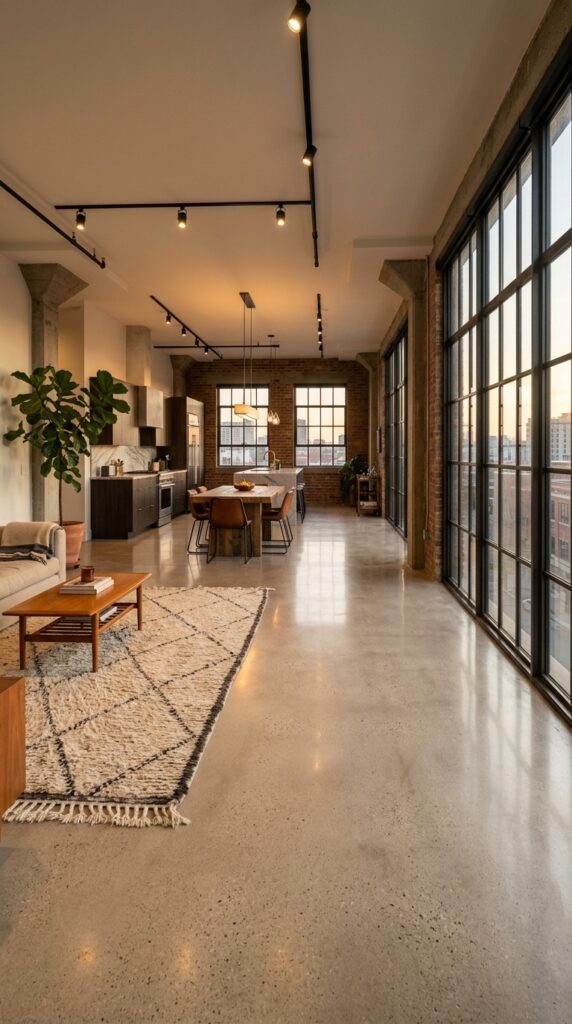
Vibe: Expansive — the floor that makes the room feel larger than its square footage.
Why it works: Seamless concrete flooring is the single most spatially generous flooring decision available in loft design — the absence of transition strips, grout lines, or plank edges across the entire floor plane creates a visual continuity that makes the space read as one unified volume rather than a collection of zones. Polished concrete in a warm ash tone (achieved through integral pigment or acid staining before polishing) avoids the cold, industrial quality of natural gray concrete by introducing the warm undertones that make the floor a complement to the room’s textile and wood elements rather than a contrast to them. The polished surface reflects ambient light at a low angle, amplifying the depth of the space in a way that matte floors cannot.
How to get it: For existing concrete subfloors, diamond-grinding and polishing with a penetrating densifier and topical sealer can be completed by a flooring contractor in 2–4 days. Specify a “salt and pepper” aggregate exposure level (light grinding) rather than a deep aggregate exposure, which can read as rough rather than refined. Large-format porcelain tiles in a concrete-look finish (60×60 cm minimum) provide a similar visual result for wood-framed floors that cannot support polished concrete.
🛍️ Shop the Look — Amazon Product Ideas
| # | Product Search Phrase | Why It Fits |
| 1 | large format concrete look porcelain tile 24×24 | Concrete floor alternative |
| 2 | concrete floor sealer topical matte sheen | Surface finish product |
| 3 | large Moroccan wool rug living room warm | Zone-defining textile |
| 4 | low teak coffee table rectangular | Warm wood floor anchor |
| 5 | fiddle leaf fig tree large indoor pot | Organic vertical accent |
3. Double-Height Steel Window Wall for Dramatic Light
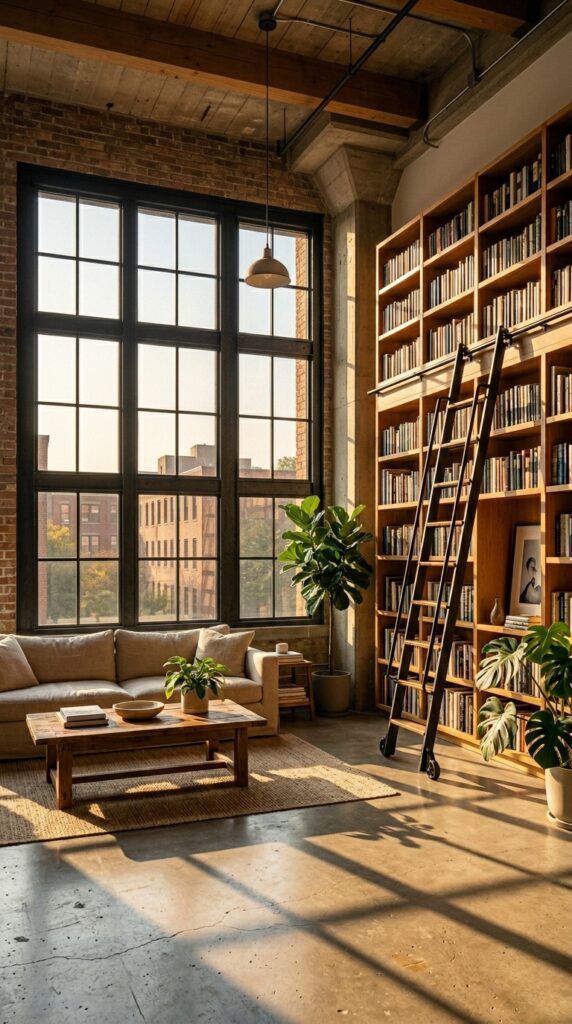
Vibe: Luminous — the room breathing in its own vertical space.
Why it works: Double-height steel window walls are the defining spatial feature of true industrial loft architecture — they exist because factory buildings required maximum natural light for working conditions, and their preservation in residential conversion creates a quality of interior light that no standard window configuration can replicate. The grid of steel mullions creates a graphic pattern against the sky that functions as architectural art: shadow lines from the mullions move across the concrete floor throughout the day, providing a built-in dynamic that changes the room’s character from morning to evening. A rolling library ladder on an adjacent bookshelf wall references the functional hardware of industrial spaces while serving as an active design element with strong visual presence.
How to get it: For spaces without existing steel windows, floor-to-ceiling steel Crittal-style windows are available from manufacturers including Hope’s Windows and Brombal — a significant investment ($800–$1,500 per linear foot installed) that defines the space architecturally. Interior steel-frame window partitions are a more budget-accessible alternative ($200–$500 per panel) for creating the steel grid visual between interior zones.
🛍️ Shop the Look — Amazon Product Ideas
| # | Product Search Phrase | Why It Fits |
| 1 | steel window frame interior partition black | Steel grid visual element |
| 2 | rolling library ladder track hardware set | Functional architectural detail |
| 3 | large linen sofa sectional natural | Primary window-facing seating |
| 4 | concrete look floor lamp tall industrial | Floor-level ambient light |
| 5 | black steel bookshelf wall unit large | Library ladder anchor |
4. Floating Mezzanine Bedroom with Steel Railing
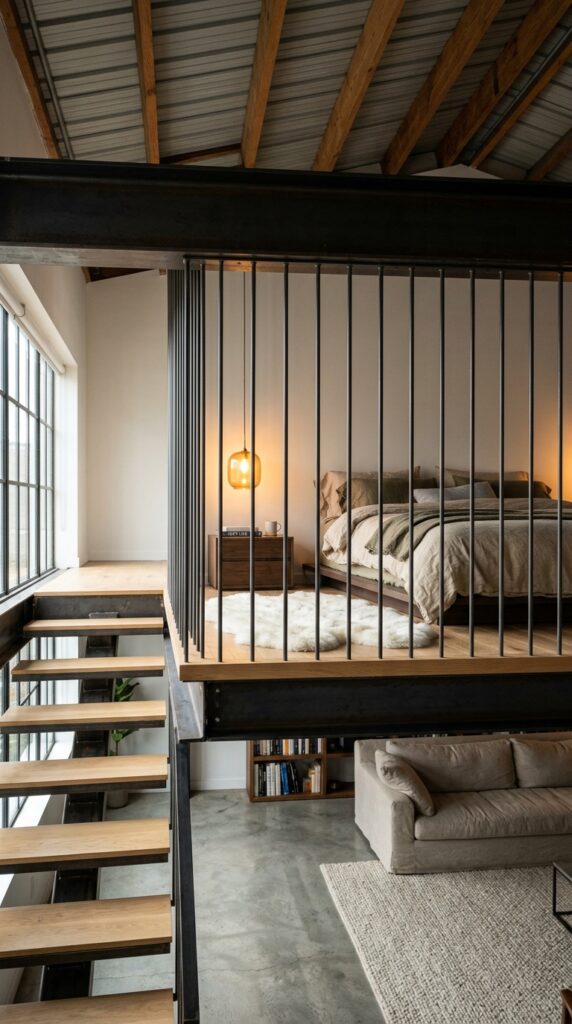
Vibe: Architectural — the bedroom that earns its separation by floating above everything else.
Why it works: A floating mezzanine bedroom resolves one of the core spatial challenges of open-plan loft living: the need for private sleeping space without the visual and spatial cost of partition walls. The steel railing system is the critical design element — thin vertical bars provide safety and definition without creating a solid visual barrier, preserving the sightline through the mezzanine and maintaining the spatial connection between levels. White oak flooring on the mezzanine introduces warm material contrast against the steel structure, preventing the sleeping zone from reading as cold and industrial. The visual compression of a low platform bed on an upper level reinforces the cozy, intentional quality that elevated sleeping spaces naturally possess.
How to get it: Mezzanine structural requirements vary significantly by building type — consult a structural engineer before construction. Standard residential loft mezzanines require a minimum 7-foot clearance above the lower floor and 7-foot clearance under the mezzanine deck. Steel stair stringers with white oak treads are the most material-honest combination for access.
💡 Quick Win: A simple steel cable railing system ($45–$80 per linear foot in hardware only) provides the industrial-refined railing aesthetic at significantly lower cost than fabricated flat steel bar railings, and the horizontal cable lines emphasize the loft’s horizontal volume.
🛍️ Shop the Look — Amazon Product Ideas
| # | Product Search Phrase | Why It Fits |
| 1 | steel cable railing kit horizontal indoor | Mezzanine railing system |
| 2 | low platform bed frame white oak queen | Mezzanine sleeping anchor |
| 3 | linen duvet cover set natural warm | Mezzanine bedding tone |
| 4 | small plug-in pendant light bedside | Mezzanine task lighting |
| 5 | natural sheepskin rug mezzanine floor | Warm floor accent above |
5. Oversized Sectional Sofa to Honor Loft Scale
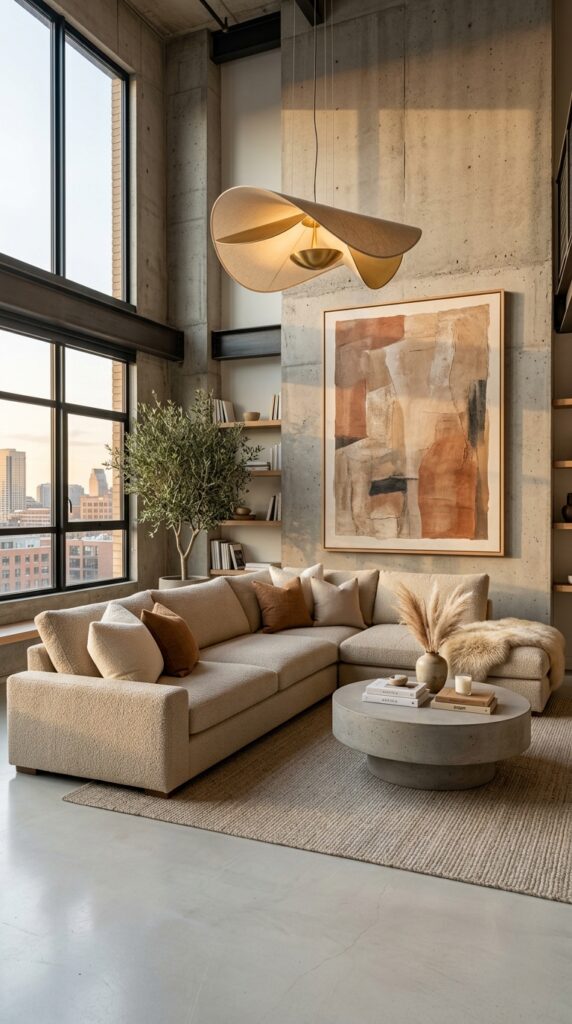
Vibe: Enveloping — furniture that finally matches the ambition of the room around it.
Why it works: Scale is the most commonly mismanaged element in loft apartment design — the single most damaging mistake is furnishing a large loft with standard-sized residential furniture that reads as doll-house proportion against soaring ceilings and long open floor plates. An oversized L-shaped sectional (long side minimum 120–140 inches) provides the visual mass necessary to anchor a large living zone and create the proportion relationship between furniture and architecture that makes a loft feel inhabited rather than echoing. Bouclé upholstery introduces the tactile organic warmth — its looping, slightly nubbled surface absorbs light unevenly — that softens the industrial rawness of concrete and steel throughout the space.
How to get it: Size the sectional by measuring the room and following the 2:3 rule — the sofa’s longest dimension should be approximately two-thirds the length of the wall it faces or floats against. For a 20-foot loft living zone, this means a sectional of approximately 130–140 inches on the long side. Modular sectionals (HAY, Restoration Hardware, Article) allow configuration adjustments over time as the space evolves.
🛍️ Shop the Look — Amazon Product Ideas
| # | Product Search Phrase | Why It Fits |
| 1 | large L-shaped sectional sofa bouclé oatmeal | Primary scale anchor |
| 2 | round concrete effect coffee table large | Industrial material echo |
| 3 | oversized throw pillow set cognac ivory | Tonal upholstery layers |
| 4 | natural sheepskin throw extra large | Tactile textile layer |
| 5 | sculptural pendant light large ceiling loft | Overhead scale companion |
6. Industrial Track Lighting on Exposed Ceiling Joists
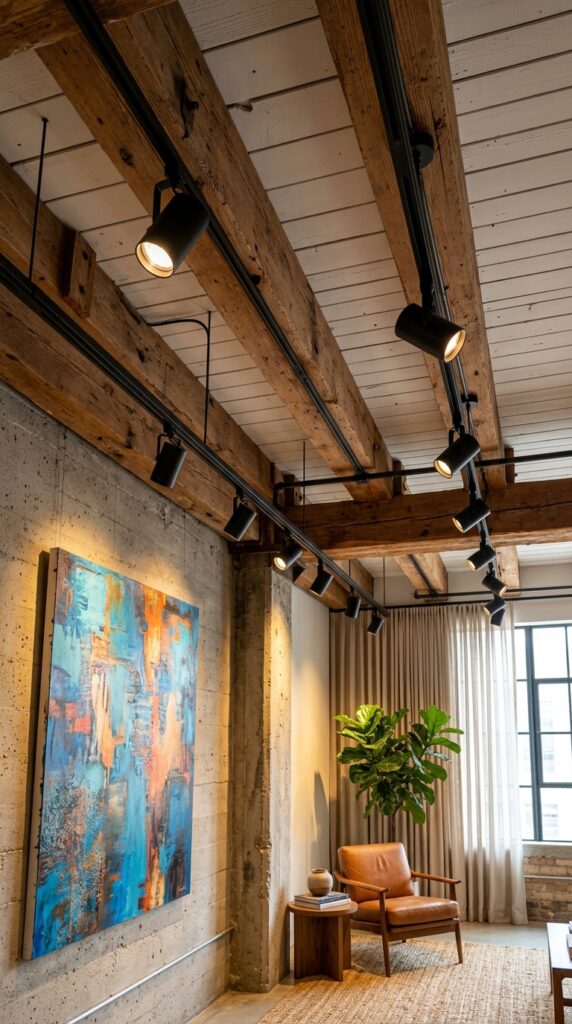
Vibe: Warm — precision light that turns an open floor plan into a gallery.
Why it works: Track lighting on exposed joists is the functionally correct lighting solution for loft apartments for two specific reasons: it requires no ceiling penetration (critical when exposed structural elements can’t be cut into) and it is fully adjustable and repositionable as furniture arrangements evolve over time. The matte black track system is the correct finish choice — it reads as deliberate industrial hardware rather than residential utility lighting, maintaining visual continuity with the steel railing and window frame elements throughout the loft. Positioning tracks parallel to rather than perpendicular to the joists creates a clean, organized ceiling plane that respects the structural geometry.
How to get it: Specify a track lighting system with a minimum 90 CRI rating for 2700K heads — this color rendering quality ensures that artwork, textiles, and natural materials are illuminated with color accuracy rather than the flat, washed quality of lower-CRI track heads. Monorail systems (flexible track routing) allow more complex lighting layouts; standard H/J/L track systems are simpler to install and reconfigure.
🛍️ Shop the Look — Amazon Product Ideas
| # | Product Search Phrase | Why It Fits |
| 1 | matte black track lighting system adjustable heads | Core ceiling lighting system |
| 2 | track light head 2700K 90 CRI GU10 | High-quality bulb specification |
| 3 | track lighting power feed connector black | System installation hardware |
| 4 | ceiling track light extension rod | Joist-to-track distance kit |
| 5 | track lighting dimmer switch compatible | Lighting control element |
7. Aged Leather Furniture for Material Warmth
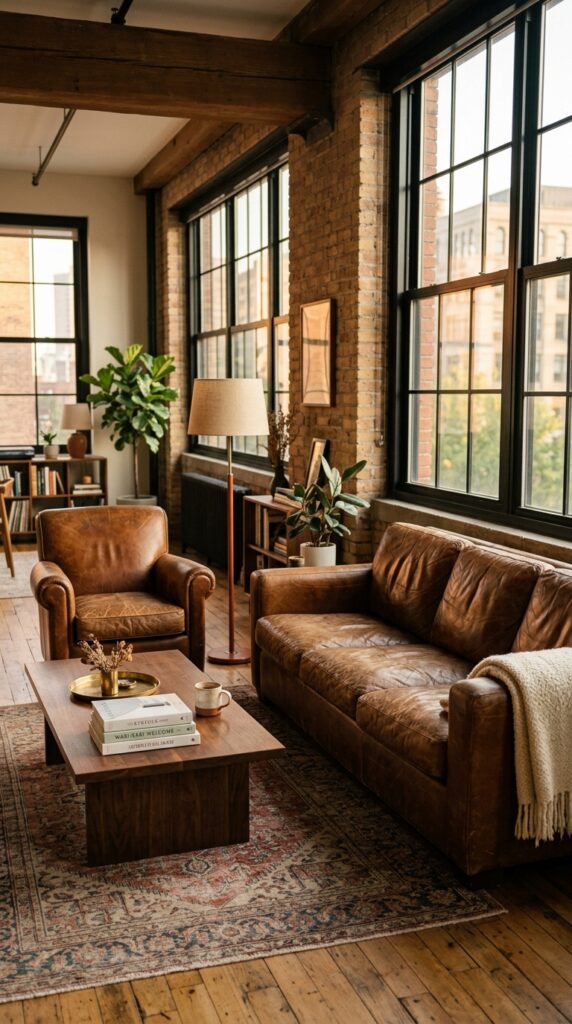
Vibe: Collected — the furniture that looks like it arrived here through a life lived rather than a shopping cart.
Why it works: Full-grain aged leather is the most material-honest upholstery choice for luxe loft design because it ages in the same manner as the building itself — developing patina, deepening in color at wear points, and gaining character rather than simply wearing out. This aging quality aligns philosophically with the loft aesthetic’s core principle: authenticity over perfection. The tobacco-cognac color family is critical — it occupies the warm brown zone that bridges the terracotta of exposed brick, the honey of oak wood, and the amber of brass hardware without competing with any of them. Semi-aniline or aniline leather (which retains visible grain and accepts patina naturally) is significantly more appropriate for loft design than corrected-grain leather, which has a uniform, plastic-adjacent surface that conflicts with the raw material authenticity throughout the space.
How to get it: Semi-aniline leather sofas are available from RH (Restoration Hardware), Design Within Reach, and Article. Annual conditioning with a leather conditioner (Leather Honey or Chamberlain’s Leather Milk) preserves flexibility and deepens the warm tone over time. Avoid leather in a cool gray or black for loft spaces — the warm brown family provides the material warmth the space depends on.
🛍️ Shop the Look — Amazon Product Ideas
| # | Product Search Phrase | Why It Fits |
| 1 | cognac leather club chair aged full grain | Warm material statement |
| 2 | leather conditioner cream furniture care | Patina maintenance product |
| 3 | dark walnut coffee table low rectangular | Material ground anchor |
| 4 | woven wool throw blanket tobacco natural | Textile warmth contrast |
| 5 | terracotta ceramic floor lamp warm | Organic light source |
8. Raw Concrete Accent Wall with Embedded Shelving
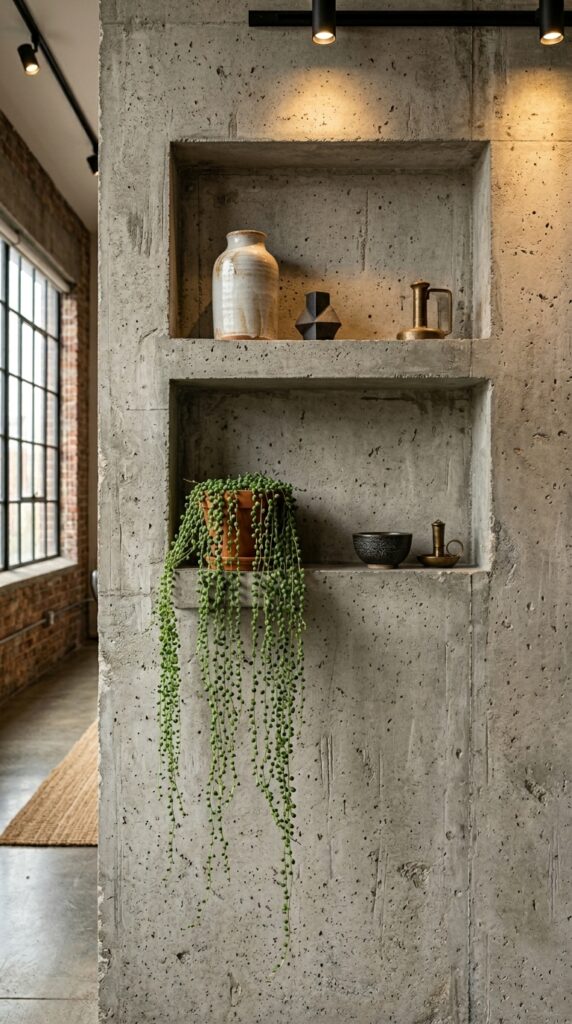
Vibe: Raw — the wall that looks like it was made for exactly the objects placed on it.
Why it works: An embedded concrete shelf — where the shelf is poured as part of the wall rather than mounted to it — creates an architectural quality that no bracket-mounted shelf can replicate: the shelf appears to grow from the wall rather than being added to it. This monolithic continuity between wall and shelf surface reinforces the material honesty at the center of luxe loft design. Sparse styling on concrete shelves is non-negotiable: concrete’s own surface texture and color variation is itself the primary display — objects placed too densely compete with the wall rather than inhabiting it. The rule of negative space applies with maximum force here; each object should have a clear visual field around it.
How to get it: Microcement applied over an existing drywall surface can create the appearance of a poured concrete wall without structural modification. Integrated shelf niches can be built into the drywall framing before microcement application. Alternatively, floating shelves in a concrete-look porcelain slab ($40–$90 per shelf) mounted flush with minimal visible hardware create a close visual approximation at significantly lower cost and complexity.
🛍️ Shop the Look — Amazon Product Ideas
| # | Product Search Phrase | Why It Fits |
| 1 | microcement wall kit interior DIY concrete | Concrete wall alternative |
| 2 | concrete look floating shelf porcelain | Shelf material echo |
| 3 | tall stoneware vase matte natural | Shelf anchor object |
| 4 | small ceramic sculpture abstract organic | Sparse display element |
| 5 | string of pearls trailing plant 4 inch pot | Shelf organic living accent |
9. Statement Dining Table for Loft-Scale Entertaining
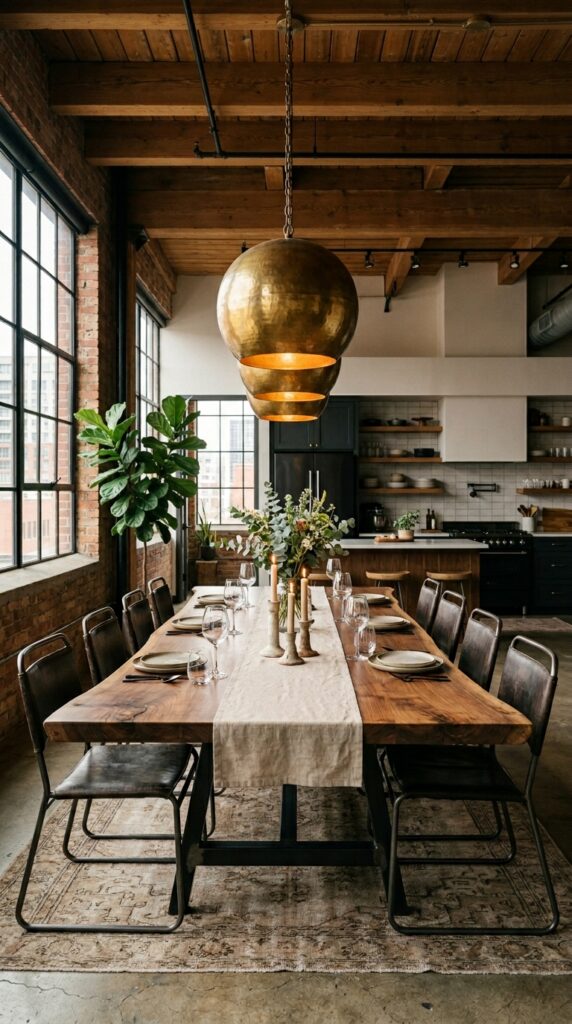
Vibe: Convivial — the table that makes the act of sitting down feel significant.
Why it works: A live-edge dining table is the single piece of furniture that most completely expresses the luxe loft philosophy — it brings the material honesty and organic irregularity of raw nature into a refined interior context, and its scale (the live edge is always the full width of the original tree slab) makes it inherently appropriate for loft proportions. The blackened steel trestle base provides the industrial material reference without overwhelming the organic quality of the wood — blackening (achieved through chemical oxidation or heat treatment) is a more refined alternative to painted steel because it preserves the metal’s natural surface variation. Three aged brass globe pendants positioned at consistent intervals above the table create the warm zone lighting that separates a dining space in an open loft without requiring walls or physical partitions.
How to get it: Live-edge walnut slabs are available from specialty lumber dealers and custom furniture makers. For a 10-seat table, specify a slab of minimum 40-inch width and 96-inch length. Finish with a matte or satin hardwax oil (Rubio Monocoat) rather than polyurethane, which creates a plastic-looking film over the natural grain.
🛍️ Shop the Look — Amazon Product Ideas
| # | Product Search Phrase | Why It Fits |
| 1 | aged brass globe pendant light large 12 inch | Dining zone anchor light |
| 2 | blackened steel trestle table base dining | Industrial base element |
| 3 | linen table runner natural undyed | Table textile layer |
| 4 | ceramic candlestick holder set of 3 | Table organic accent |
| 5 | hardwax oil finish walnut matte | Wood surface maintenance |
10. Gallery Wall with Museum-Quality Framing
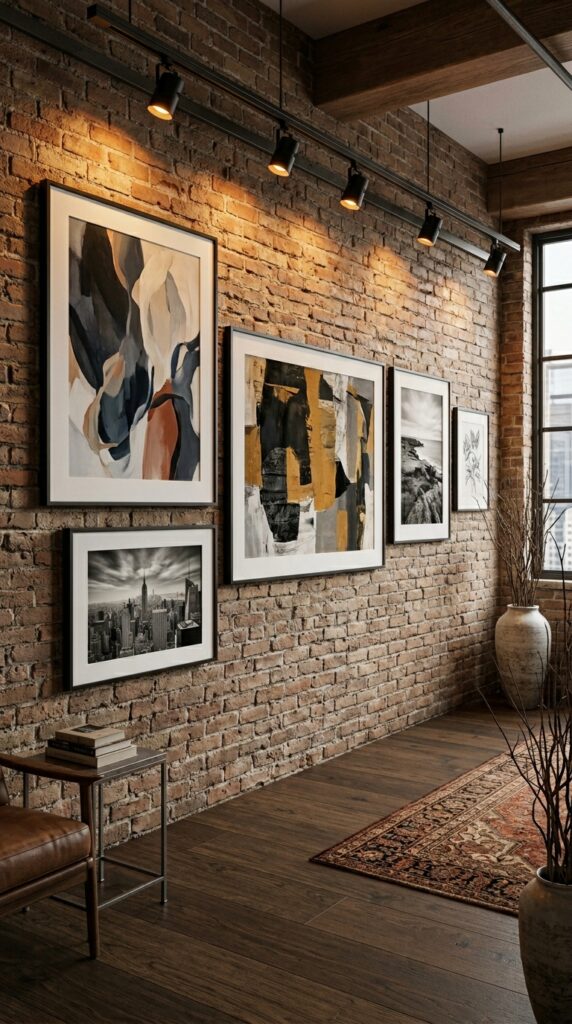
Vibe: Intellectual — the wall that tells you something about the person who lives here before they say a word.
Why it works: A gallery wall in a luxe loft succeeds or fails on the quality of its framing and matting rather than the art itself — museum-quality presentation (consistent thin black or natural metal frames, deep white mats of 3–4 inches) elevates even modest prints to a level of visual seriousness that mismatched frames and narrow mats cannot approach. The deep mat is the single most impactful upgrade available: it creates a breathing space between the artwork and the frame that forces the viewer’s eye to the image rather than the boundary, communicating gallery-level respect for the content. Asymmetric but deliberately considered spacing — where larger works receive more visual field around them and smaller works cluster — creates compositional rhythm that a grid arrangement can never achieve.
How to get it: Commission custom framing with conservation-quality UV glass for original works and archival paper for prints. For a gallery wall over exposed brick, a continuous picture rail (mounted into mortar joints, not brick faces) allows hooks to be repositioned without additional drilling and provides a clean architectural line that unifies the arrangement.
💡 Quick Win: A single large-format abstract print ($35–$80) in a deep-mat black frame ($50–$90 in a 24×30 standard size) has more visual presence than six small prints without professional framing — one well-framed large work outperforms many small ones.
🛍️ Shop the Look — Amazon Product Ideas
| # | Product Search Phrase | Why It Fits |
| 1 | thin black frame 24×30 with white mat | Museum-quality framing |
| 2 | picture rail hook system wall mount | Gallery hanging system |
| 3 | large abstract art print warm tones | Primary gallery wall art |
| 4 | UV glass picture frame 18×24 | Conservation framing detail |
| 5 | dried eucalyptus branch tall arrangement | Gallery wall organic companion |
11. Integrated Kitchen with Black Steel Open Shelving
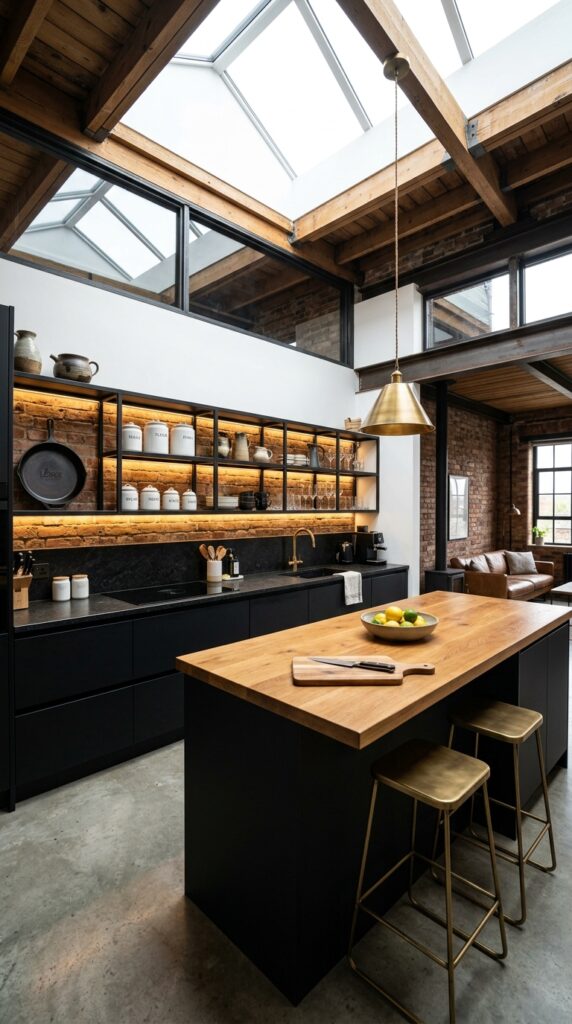
Vibe: Bold — a kitchen that treats itself as architecture, not appliance.
Why it works: An all-black kitchen in a loft context succeeds where it might overwhelm in a standard apartment because the open spatial volume prevents the darkness from compressing the space — there is always a visual escape to the broader loft volume beyond the kitchen zone. Open black steel shelving replaces upper cabinets on one wall, creating a visual connection between the kitchen and the exposed architectural elements (brick, concrete, steel) throughout the loft and allowing the kitchen to breathe rather than form a closed cabinet wall. The white oak island top is the essential material balance element — warm, organic, and tactile against the relentless dark surfaces of the kitchen run.
How to get it: Black flat-front kitchen cabinets in a matte lacquer finish are available from IKEA’s Kungsbacka range (thermofoil, budget-accessible) through to custom cabinet makers. Open steel shelving can be fabricated by a local metalworker or sourced as bracket-and-board systems with steel J-bar brackets and oak shelf boards.
🛍️ Shop the Look — Amazon Product Ideas
| # | Product Search Phrase | Why It Fits |
| 1 | matte black kitchen cabinet paint eggshell | Cabinet color finish |
| 2 | black steel open shelf bracket J-bar | Open shelving system |
| 3 | white oak butcher block island top | Warm counter contrast |
| 4 | white ceramic storage jar set kitchen | Shelf display storage |
| 5 | black honed granite countertop edge sample | Counter material reference |
12. Warm Wool Area Rug to Zone the Living Space
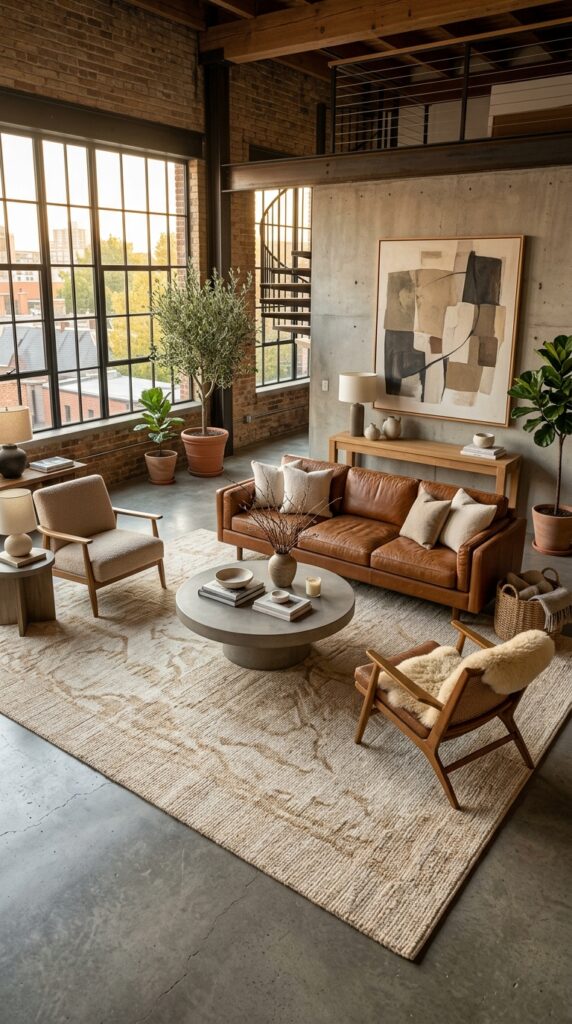
Vibe: Grounded — the rug that turns square footage into a room.
Why it works: In an open loft plan, the area rug is the primary architectural element that defines zones without walls — it creates a visual and psychological boundary that signals “this is the living room” in a space without the partitions that typically communicate that information. The critical sizing rule for loft rugs: all primary furniture legs must sit on the rug, not partially off it. A rug that only partially supports the furniture arrangement reads as too small and makes the furniture appear to float without anchor. A 10×14-foot minimum rug under a standard loft living arrangement provides the visual mass necessary to hold the furniture in spatial relationship and separate the living zone from surrounding circulation and other activity areas.
How to get it: Hand-knotted wool rugs in the 10×14 and 12×15 sizes are available at accessible price points through Rugs USA, Loloi, and Jaipur Living. Specify wool rather than synthetic fibers — wool holds its pile structure under furniture weight, whereas polypropylene compresses permanently. A 1/4-inch felt and rubber pad beneath the rug prevents movement on polished concrete and adds acoustic softening that open loft spaces benefit from significantly.
🛍️ Shop the Look — Amazon Product Ideas
| # | Product Search Phrase | Why It Fits |
| 1 | large wool area rug 10×14 ivory abstract | Primary zone-defining textile |
| 2 | felt rubber rug pad 10×14 non-slip | Under-rug safety and sound |
| 3 | rug gripper pad concrete floor adhesive | Smooth floor anchor |
| 4 | wool rug stain protector spray | Fiber maintenance product |
| 5 | rug corner gripper tape double-sided | Edge flatness control |
13. Dramatic Pendant Cluster Over the Living Zone
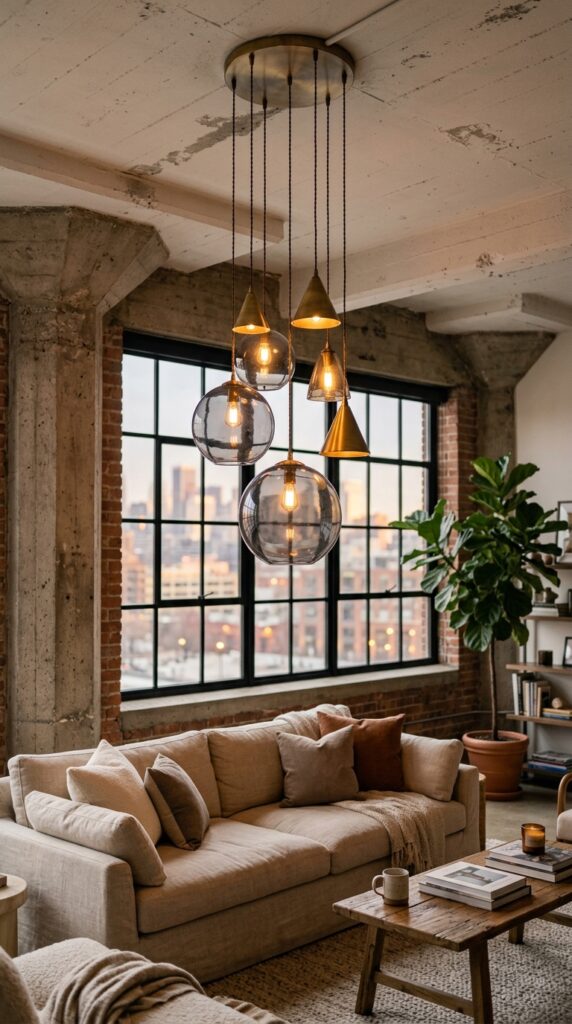
Vibe: Dramatic — the ceiling arrangement that makes the floor plan irrelevant.
Why it works: A multi-pendant cluster at varying heights is the correct lighting response to a loft’s double-height or high ceiling — a single pendant hung from a 14-foot ceiling reads as isolated and small-scale, while a cluster of seven at staggered heights fills the vertical volume with light and presence. The mixing of pendant types within a single cluster (large smoked glass globes + small aged brass cones) is the design move that distinguishes a curated installation from a simple multi-pendant fixture: different pendant profiles at the same warmth temperature create visual complexity without tonal discord. The single-canopy installation (all cords emerging from one ceiling plate) maintains architectural discipline in the ceiling plane.
How to get it: Multi-cord ceiling canopies (available from West Elm, CB2, and specialty lighting suppliers) allow 5–12 pendant cords to emerge from a single mounting plate. Specify all bulbs at the same color temperature (2700K) even when mixing pendant styles — tonal consistency in light color is what unifies a mixed-pendant cluster into a cohesive installation.
🛍️ Shop the Look — Amazon Product Ideas
| # | Product Search Phrase | Why It Fits |
| 1 | multi-pendant ceiling canopy 7-light cluster | Core pendant system |
| 2 | smoked glass globe pendant light 8 inch | Cluster glass element |
| 3 | small aged brass cone pendant light | Cluster brass element |
| 4 | pendant cord extension set black adjustable | Cord length control |
| 5 | 2700K dimmable LED bulb small globe E26 | Unified bulb specification |
14. Exposed Structural Steel Beams Left Raw
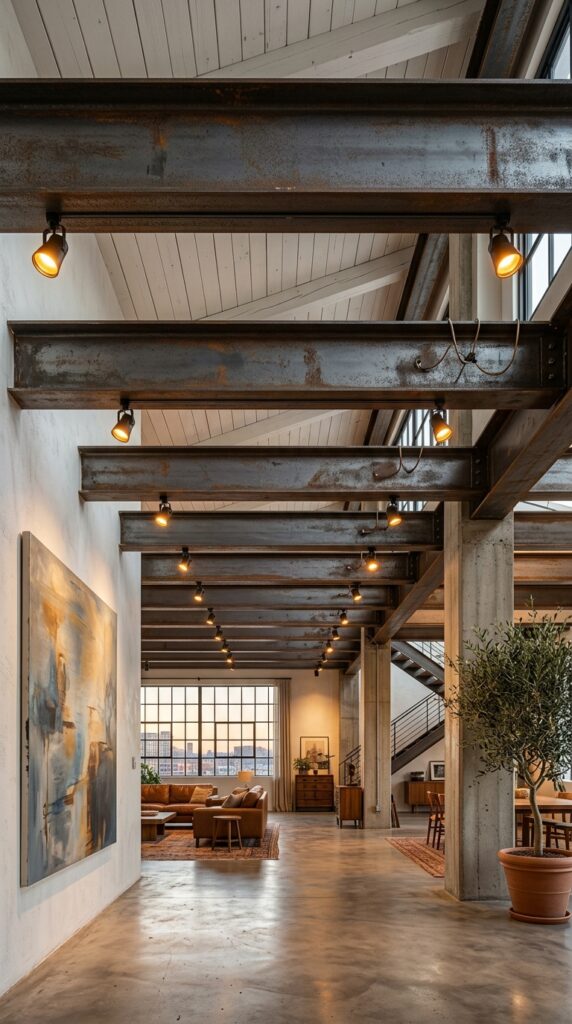
Vibe: Raw — the building’s skeleton as the room’s most honest decoration.
Why it works: Leaving structural steel beams in their natural mill finish — the dark warm-gray surface with subtle oxidation that steel develops as it ages — is a more sophisticated choice than painting them black or coating them in a uniform finish. The mill finish retains the material’s identity as a structural industrial element, with slight surface variation that communicates genuine manufacturing history rather than decorative application. Track lighting mounted directly to the lower flange of the I-beam is functionally correct (the beam provides rigid, level mounting without ceiling penetration) and visually appropriate (the mechanical attachment references the beam’s industrial origin). Wide-flange I-beams have significantly more visual presence than standard tube steel or angle iron — their cruciform profile creates strong shadows under directional light that emphasize the structural depth.
How to get it: Existing painted steel beams can be returned to a raw appearance by media blasting (sandblasting) and sealing with a clear matte rust-inhibiting sealer that preserves the natural metal surface. New decorative steel beam covers in a realistic wide-flange profile are available from architectural millwork suppliers for non-structural installation.
🛍️ Shop the Look — Amazon Product Ideas
| # | Product Search Phrase | Why It Fits |
| 1 | clear rust-inhibiting sealer steel metal | Beam surface protector |
| 2 | beam clamp track lighting adapter black | Beam-mount light system |
| 3 | steel beam clamp hook ceiling mount | Beam accessory mount |
| 4 | wide flange steel decorative beam cover | Non-structural beam element |
| 5 | industrial track light clip mount system | Beam lighting installation |
15. Floor-to-Ceiling Bookshelves as a Living Wall
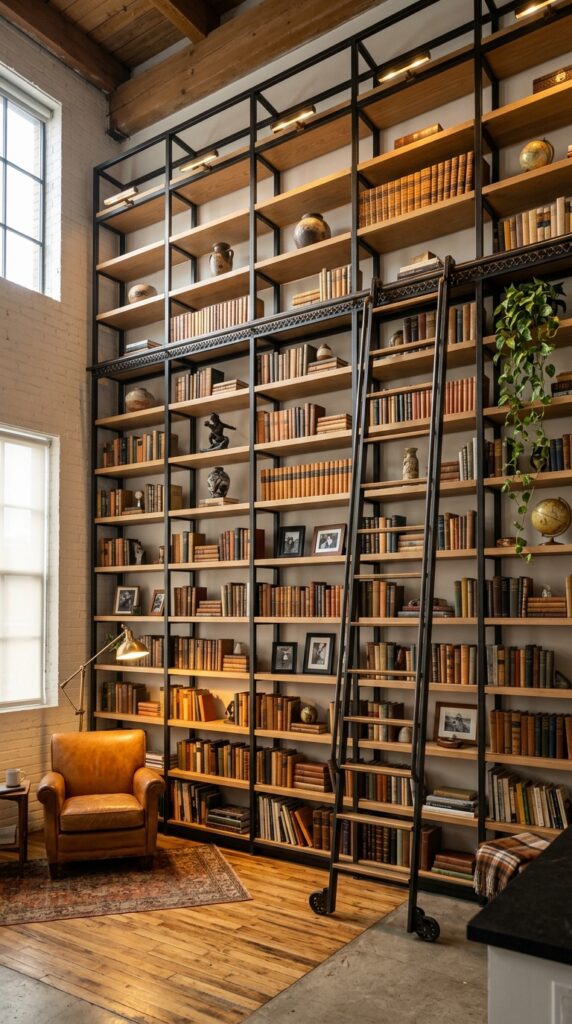
Vibe: Intellectual — the wall that makes a loft feel like someone actually lives — and thinks — here.
Why it works: A floor-to-ceiling bookshelf wall is the most effective zone-definition and character-establishment element available in loft design — it fills vertical space that high ceilings would otherwise leave visually unresolved, creates a warm material backdrop of book spines and object surfaces, and communicates intellectual life in a way that purely decorative surfaces cannot. The blackened steel frame with white oak shelves is the correct material combination: the steel provides the industrial reference and structural authority, while the oak provides warmth and organic material contrast. Styling the shelves with alternating book-dense sections and more open object-display sections (approximately 70% books to 30% objects) creates visual rhythm and prevents the wall from reading as storage rather than design.
How to get it: Custom built-in bookshelves are the ideal solution but can be expensive ($200–$600 per linear foot installed). IKEA’s BILLY bookcase system with custom steel frame surrounds provides an accessible foundation; aftermarket doors and frames from Semihandmade or Reform allow significant customization. The rolling ladder track must be anchored to a structural horizontal member — a continuous steel angle welded to the frame or bolted to a header beam.
🛍️ Shop the Look — Amazon Product Ideas
| # | Product Search Phrase | Why It Fits |
| 1 | rolling library ladder hardware kit 8 foot | Ladder system for tall shelf |
| 2 | white oak shelf board 48 inch floating | Bookshelf surface material |
| 3 | small bronze abstract sculpture bookshelf | Shelf sculptural object |
| 4 | trailing pothos plant small 3 inch pot | Upper shelf living accent |
| 5 | warm leather journal set desk display | Shelf warm material detail |
16. Concrete and Wood Open Kitchen Island
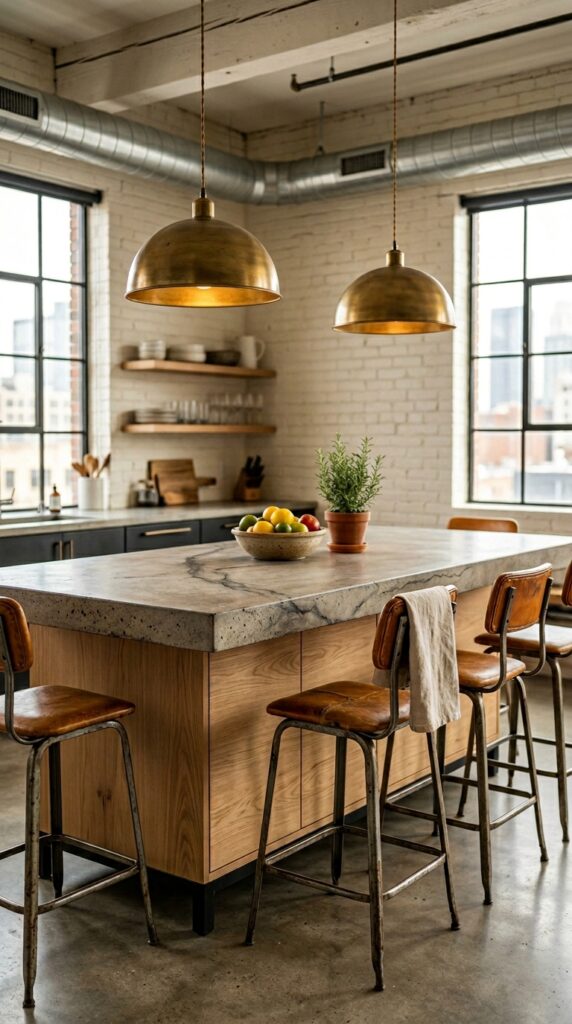
Vibe: Warm — two honest materials finding common ground.
Why it works: The pairing of a concrete countertop with an oak cabinet base in a kitchen island is a material layering strategy that expresses the luxe loft philosophy in concentrated form: the raw (concrete, with its industrial associations and mineral qualities) is placed directly above the warm (oak, with its organic grain and craft associations), creating a conversation between materials that a single-material island cannot achieve. Vintage-style steel and leather bar stools echo both materials simultaneously — the steel referencing the concrete’s industrial lineage, the leather warm-toning with the oak below. The result is an island that reads as both industrial and domestic, both raw and refined — which is precisely the luxe loft tension at its most successful.
How to get it: Concrete countertops are typically cast in place or precast and installed — budget $75–$150 per square foot installed for custom poured concrete. Concrete overlay products (Ardex Feather Finish, SureCrete Design Products) applied over existing countertop surfaces are a significantly more accessible alternative at $5–$20 per square foot in materials.
💡 Quick Win: A concrete countertop overlay kit ($45–$80) applied over an existing laminate island top creates the concrete aesthetic without replacement — the process takes one weekend and requires no professional help.
🛍️ Shop the Look — Amazon Product Ideas
| # | Product Search Phrase | Why It Fits |
| 1 | concrete countertop overlay kit DIY | Budget concrete surface |
| 2 | vintage steel leather bar stool set of 4 | Island seating material |
| 3 | aged brass kitchen pendant light | Island overhead warm light |
| 4 | large ceramic bowl fruit display | Island surface styling |
| 5 | flat front door oak kitchen cabinet | Island cabinet surface |
17. Moody Forest Green Accent Zone in the Loft
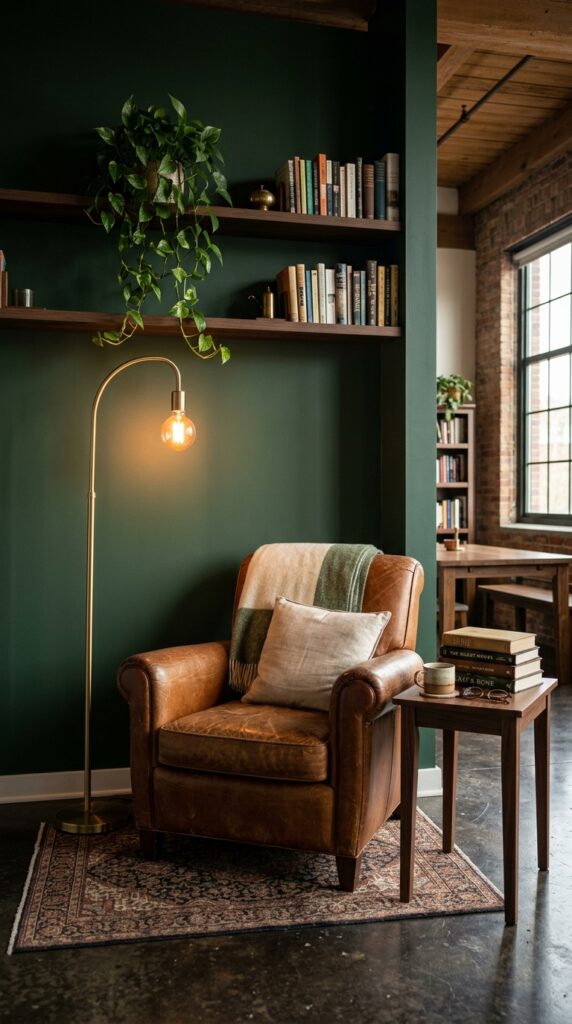
Vibe: Intimate — a room within a room, carved from color alone.
Why it works: A deep forest green accent zone in an open loft plan creates zone definition through color alone — without any partition walls or physical boundaries, the color shift from the neutral loft palette to the saturated green signals a distinct spatial destination. This technique (color zoning) is particularly effective in lofts because it provides the psychological enclosure that open plans otherwise lack, creating a sense of arrival and separation without sacrificing the spatial generosity of the open floor plate. Deep forest green (specifically a matte, slightly blue-green such as Farrow & Ball “Chaste Green” or Sherwin-Williams “Hunt Club”) reads warm under incandescent light despite its coolness in daylight — critical for a reading zone that will often be used in the evening.
How to get it: Paint only the single wall behind the reading chair — a full-room repaint would overwhelm the loft’s neutral industrial palette. The green wall should extend to the full ceiling height to maintain the loft’s sense of vertical volume. Apply in a flat or matte finish to maximize the depth of the color.
🛍️ Shop the Look — Amazon Product Ideas
| # | Product Search Phrase | Why It Fits |
| 1 | deep forest green matte wall paint sample | Zone color anchor |
| 2 | worn leather reading armchair cognac | Zone seating element |
| 3 | brass arc floor lamp reading warm | Zone task lighting |
| 4 | small walnut side table round | Zone surface anchor |
| 5 | hardcover design book set styled | Zone intellectual accent |
18. Vintage Kilim Rug for Pattern and Cultural Warmth
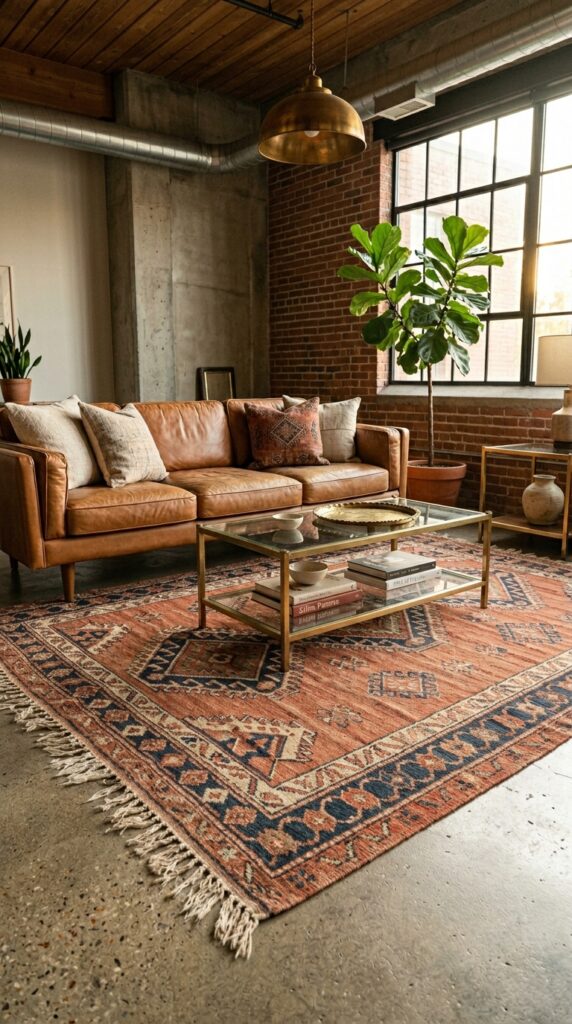
Vibe: Collected — the rug that makes the loft feel like it has been somewhere.
Why it works: A vintage kilim introduces the one quality most absent from purely industrial loft aesthetics: cultural history and human handcraft. The flat-weave geometric patterns of Turkish or Moroccan kilims are produced on hand looms, creating slight irregularities in pattern and density that machine-made rugs never replicate — these imperfections communicate human origin in a way that registers viscerally even without articulation. The terracotta-navy-ivory color combination is specifically effective in loft spaces because it echoes the terracotta of exposed brick, the dark tone of steel and iron, and the pale neutrality of concrete — three of the loft palette’s dominant materials — simultaneously. The rug becomes a material synthesis of the room’s own material vocabulary.
How to get it: Authentic vintage kilims are available through Etsy sellers (search “vintage Turkish kilim 8×10”), specialist rug dealers, and estate sales. New kilim-style rugs from Loloi and Dash & Albert replicate the flat-weave structure and geometric pattern at a significantly lower price point. For a loft living zone, size 9×12 or 10×14 is the minimum for proper furniture anchoring.
🛍️ Shop the Look — Amazon Product Ideas
| # | Product Search Phrase | Why It Fits |
| 1 | vintage kilim style rug terracotta navy 9×12 | Core cultural textile |
| 2 | flat weave wool rug geometric pattern large | Authentic weave material |
| 3 | mid-century low sofa leather tobacco | Rug-adjacent furniture |
| 4 | brass side table round small | Warm metal zone accent |
| 5 | rug binding tape fringe protector | Kilim maintenance detail |
19. Limewashed Brick for a Softer Industrial Palette
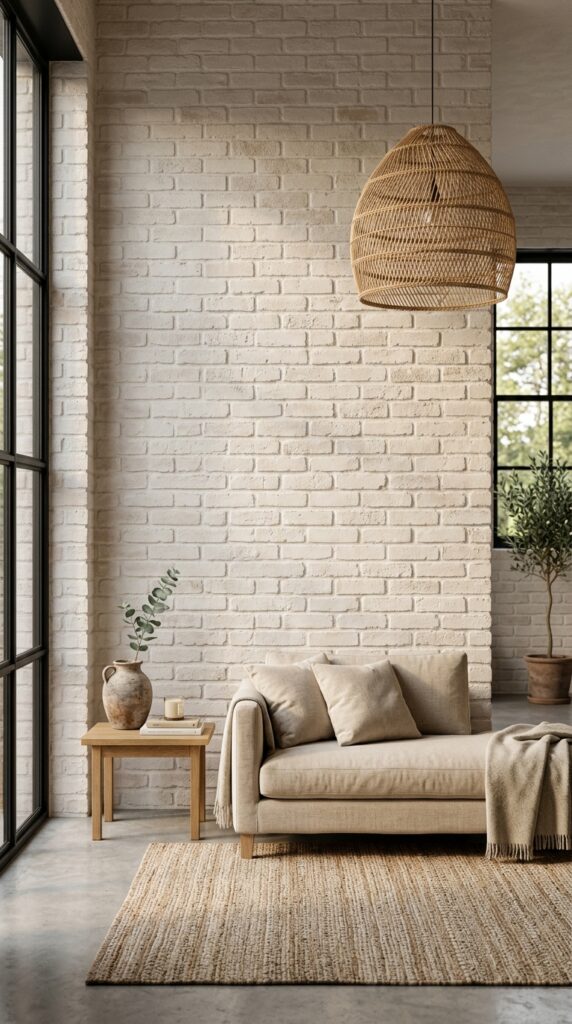
Vibe: Serene — raw brick that decided to grow softer with age.
Why it works: Limewashing brick is the refinement move that transforms a raw industrial surface into something with the chalky, aged patina of European farmhouse walls — it retains all of the brick’s dimensional texture and visual depth while softening its terracotta warmth to a dusty, pale quality that reads as serenely beautiful rather than simply historic. The tonal variation from brick to brick — some receiving more wash coverage than others — creates the natural imperfection that makes limewash appear as something the wall developed over decades rather than something applied over a weekend. For lofts where the raw brick reads as too heavy or too orange against the intended interior palette, limewash provides material refinement without surface replacement.
How to get it: Limewash paint (Portola Paints “Roman Clay,” Romabio “Classico Limewash”) is applied with a damp brush in irregular, overlapping strokes — the technique is important, as a flat brush-out destroys the tonal variation that makes limewash work. Apply one coat, allow to dry fully, then selectively water-back areas for more transparency before the second coat. The full process takes approximately 4–6 hours per 100 square feet.
🛍️ Shop the Look — Amazon Product Ideas
| # | Product Search Phrase | Why It Fits |
| 1 | limewash paint interior brick wall warm white | Core limewash product |
| 2 | natural bristle brush large limewash application | Correct application brush |
| 3 | linen sofa slipcover natural beige | Soft surface complement |
| 4 | rattan pendant light shade natural large | Organic ceiling element |
| 5 | ceramic tall vase single stem matte | Minimal surface accent |
20. Open-Plan Bedroom Zone with Curtain Separation
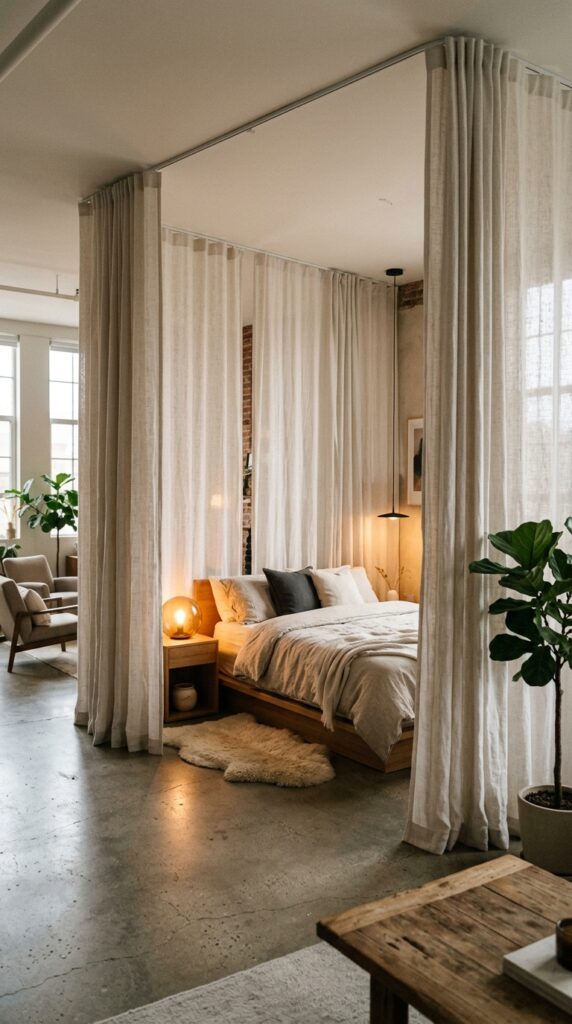
Vibe: Intimate — separation without sacrifice, privacy without walls.
Why it works: Floor-to-ceiling curtain panels on a ceiling-flush track are the most spatially generous method of creating a bedroom zone in an open loft — they provide complete visual separation when closed, the impression of an architectural wall (because the floor-to-ceiling height makes them read as solid partitions), and full spatial openness when drawn back. The pale natural linen is the correct fabric choice because its slight translucency maintains a luminous quality — warm bedside light glows softly through it when the curtain is closed, creating an atmospheric beacon visible from the living zone that communicates warmth and habitation rather than simply barrier. This glow effect is the luxe quality that distinguishes linen panels from blackout curtains in this application.
How to get it: Ceiling-flush curtain tracks (Silent Gliss, Kvadrat Febrik, or IKEA KVARTAL systems) mount directly to the ceiling without a visible rod gap. Specify curtain panels in a 140-inch length minimum for standard 9.5-foot ceilings — panels that don’t reach the ceiling break the wall illusion. Linen weight should be medium-heavy (200–280 GSM) for sufficient drape and visual presence.
🛍️ Shop the Look — Amazon Product Ideas
| # | Product Search Phrase | Why It Fits |
| 1 | ceiling mount curtain track system flush | Zone separation hardware |
| 2 | floor-to-ceiling linen panel 108 inch natural | Room-dividing curtain fabric |
| 3 | linen curtain pleat tape heading tape | Curtain heading finish |
| 4 | platform bed low profile natural oak | Behind-curtain sleeping anchor |
| 5 | warm bedside pendant light plug-in | Glow-through zone lighting |
21. Sculptural Staircase as Loft Architecture
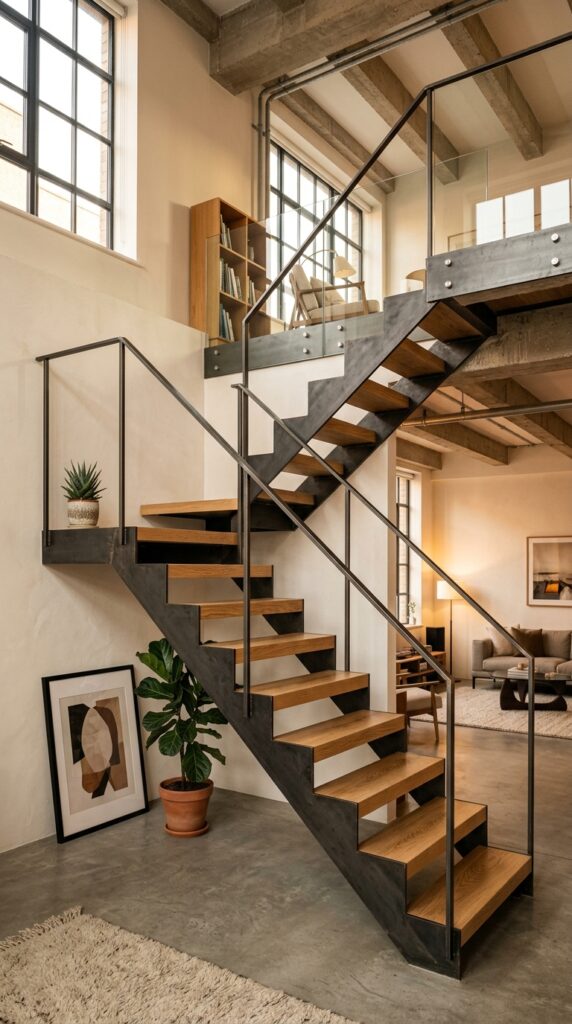
Vibe: Architectural — the staircase as the room’s most honest sculpture.
Why it works: An open-riser staircase with flat steel stringers and white oak treads is the correct architectural expression of the luxe loft material vocabulary — steel and oak, raw and refined, industrial and warm — in a form that must perform structurally as well as visually. Open risers are critical to the loft aesthetic: solid risers create a mass of material that interrupts the floor plane and reads as a heavy, domestic object; open risers allow the floor plane to read through the stair structure, maintaining the spatial continuity of the loft. The thin flat steel handrail (as opposed to a round pipe rail or a traditional baluster system) is the detail that signals architectural intention — it provides code-required safety with minimum visual material, keeping the staircase feeling light despite its structural significance.
How to get it: Custom steel staircase fabrication ranges from $8,000 to $25,000+ installed, depending on complexity and span. The stair stringer must be engineered for the specific span and load — work with a structural engineer and a certified fabricator. White oak treads should be a minimum 1.5-inch thickness at the nosing for code compliance in most jurisdictions.
🛍️ Shop the Look — Amazon Product Ideas
| # | Product Search Phrase | Why It Fits |
| 1 | white oak stair tread 48 inch solid | Core tread material |
| 2 | flat steel handrail bracket wall mount | Railing support hardware |
| 3 | stair nosing trim oak matching | Tread edge safety detail |
| 4 | stair carpet runner natural wool | Optional tread softening |
| 5 | concrete floor sealer stair landing | Landing surface finish |
22. Warm Brass and Smoked Glass Bar Cart
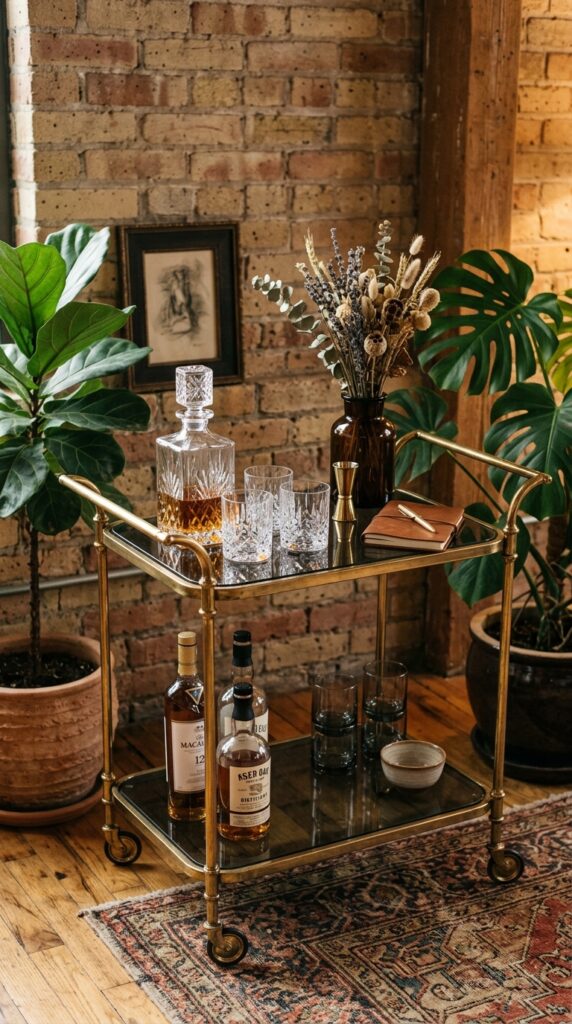
Vibe: Collected — the corner that turns a drink into a ceremony.
Why it works: A bar cart serves both a functional and a compositional role in a loft interior — it provides a dedicated hospitality zone that communicates a particular quality of living, and it acts as a still-life composition that can be styled and refined continuously. The brass and smoked glass combination is specifically effective against exposed brick because both materials draw warmth from their surroundings: brass reflects the amber tones of the brick while smoked glass absorbs and filters the light passing through crystal decanters. The height of a bar cart (typically 32–36 inches) positions the display at a scale that reads across a large open loft floor plate without requiring wall mounting or significant floor footprint — it is visually generous relative to its physical size.
How to get it: Vintage brass bar carts (1960s–70s production) are available through estate sales, Chairish, and 1stDibs. New production versions in a warm brass finish are available from CB2, West Elm, and Amazon at multiple price points. Specify smoked glass shelves rather than clear glass — the tonal depth of smoked glass reads more sophisticated in loft lighting conditions.
💡 Quick Win: A single crystal whisky decanter ($35–$65) on any surface instantly elevates the immediate area — the faceted glass catches and throws warm light at multiple angles, functioning as a passive light-scattering accent.
🛍️ Shop the Look — Amazon Product Ideas
| # | Product Search Phrase | Why It Fits |
| 1 | brass smoked glass bar cart vintage style | Core hospitality element |
| 2 | crystal whisky decanter set stoppered | Light-catching bar display |
| 3 | smoked glass tumbler set of 4 | Bar cart glassware |
| 4 | dried botanical arrangement tall bar decor | Organic cart accent |
| 5 | small framed art print warm abstract | Brick-leaning behind cart |
23. Integrated Home Office in the Loft Mezzanine
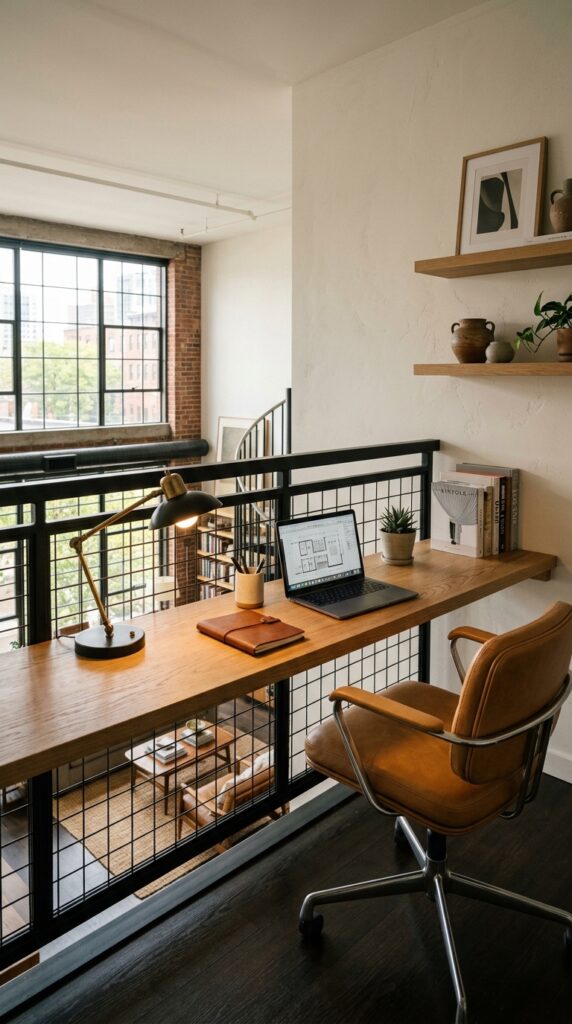
Vibe: Warm — the desk that makes work feel like a privilege.
Why it works: Integrating a home office into the mezzanine level of a loft is a zone-definition strategy that exploits the elevated position to create psychological separation between work and domestic life without any partition walls. The elevated vantage point — looking out over the living space below — provides the kind of spatial awareness that energizes focused work in a way that a closed room cannot. A wall-mounted floating desk running the full length of the railing wall maximizes the available surface area on the mezzanine without adding furniture mass that would make the upper level feel crowded. The steel railing immediately in front of the desk functions as a transparency screen: the view through it connects the office zone to the loft volume while the railing itself provides the psychological boundary that defines the workspace.
How to get it: A wall-mounted floating desk at 30 inches height requires wall blocking in the framing behind the drywall — plan this during initial mezzanine construction. White oak plywood with a solid oak edge band provides the same visual quality as solid oak at approximately 40% of the cost and better dimensional stability.
🛍️ Shop the Look — Amazon Product Ideas
| # | Product Search Phrase | Why It Fits |
| 1 | wall mounted floating desk white oak 60 inch | Core work surface |
| 2 | leather task chair cognac swivel | Warm desk chair |
| 3 | warm task lamp architect arm black | Desk task lighting |
| 4 | small ceramic pen holder organizer | Desk surface detail |
| 5 | white oak open wall shelf 36 inch | Above-desk storage |
24. Oversized Vintage Mirror to Amplify Loft Volume
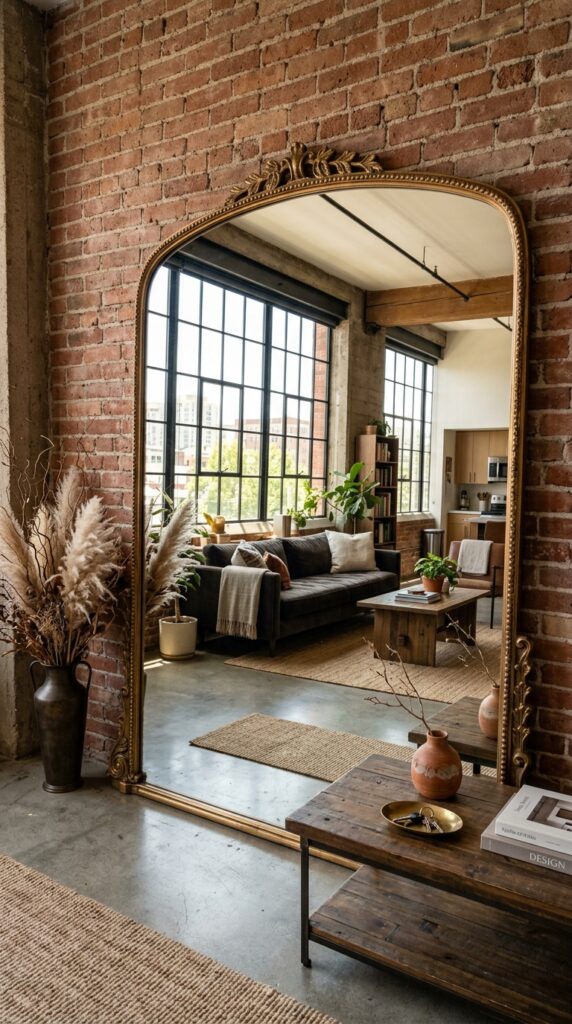
Vibe: Expansive — the room finding more of itself than it expected.
Why it works: An oversized vintage mirror in a loft entry zone performs three simultaneous functions: it amplifies natural light by reflecting the window wall back across the space, it extends the perceived depth of the loft by effectively doubling the visual volume in the mirror’s field, and it provides a compositional focal point for the entry zone that makes arrival in the space feel deliberate and considered. The lean (rather than hang) is the correct installation choice for a very large mirror — it reads as casual confidence rather than formal decoration, communicating the anti-precious quality central to loft living. A warm gold vintage frame bridges the terracotta of the brick and the brass of the hardware throughout the loft, maintaining material continuity in the framing element itself.
How to get it: Mirrors of this scale should be safety-backed (a shatter-resistant film applied to the reverse side) and secured with a floor-contact foot stop and a wall anchor at the top to prevent tipping. Never lean an unsecured large mirror in a high-traffic area. Antique and vintage mirrors with appropriate frame character are available from Chairish, 1stDibs, and specialty antique dealers.
🛍️ Shop the Look — Amazon Product Ideas
| # | Product Search Phrase | Why It Fits |
| 1 | large arched floor mirror gold frame 65 inch | Primary volume-amplifier |
| 2 | mirror anti-tip wall anchor strap | Safety leaning hardware |
| 3 | mirror safety backing film shatter resistant | Surface protection product |
| 4 | narrow console table dark walnut 48 inch | Mirror base surface |
| 5 | tall ceramic vase dried branch floor | Console organic accent |
25. Acoustic Treatment with Textile Wall Panels
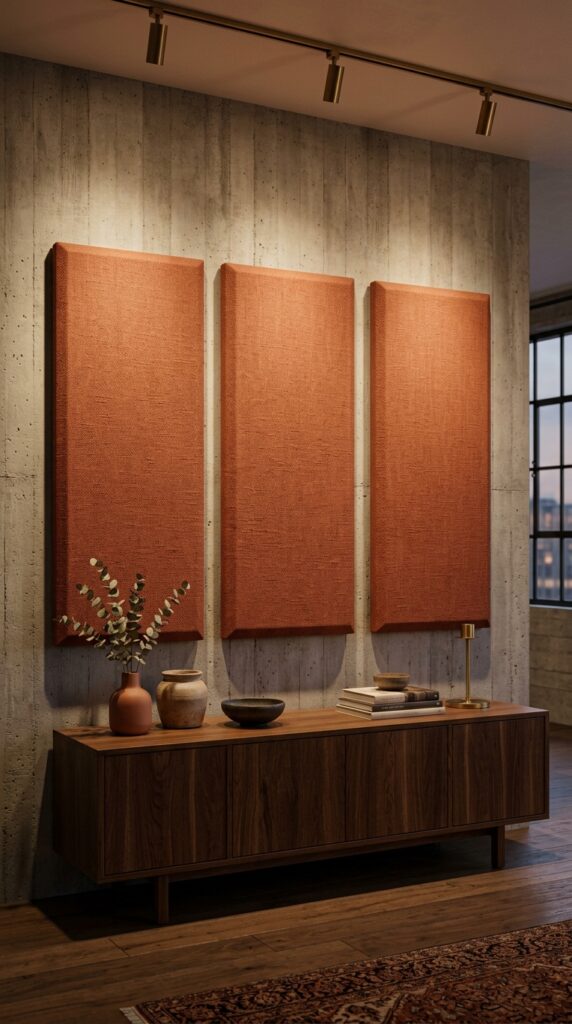
Vibe: Refined — the room that solved an acoustic problem and made it beautiful.
Why it works: Loft apartments are notoriously poor acoustic environments — hard surfaces throughout (concrete, brick, steel, glass) create reverberation times that make conversation uncomfortable and music listening difficult. Upholstered acoustic panels address this problem while simultaneously adding textile warmth and wall composition in a space where both are needed. The design principle is dual function: each panel performs as both sound absorption (the fabric-wrapped acoustic foam reduces mid-to-high frequency reverberation) and textile art (the fabric color and texture create a warm, dimensional wall surface). Positioning three panels in a considered asymmetric arrangement above a sideboard creates a composed vignette that reads as gallery-level wall design rather than acoustic treatment.
How to get it: DIY acoustic panels are constructed from 2-inch-thick rigid fiberglass insulation (Owens Corning 703) or compressed mineral wool (Rockwool Safe ‘n’ Sound) wrapped in stretched fabric and mounted in a simple wood frame. Fabric choice is critical for acoustic performance: woven open-structure fabrics (linen, wool tweed, acoustic velvet) allow sound waves to pass through; tightly woven fabrics reflect sound and reduce effectiveness.
🛍️ Shop the Look — Amazon Product Ideas
| # | Product Search Phrase | Why It Fits |
| 1 | rigid fiberglass acoustic panel 2 inch 24×48 | Acoustic absorption core |
| 2 | wool acoustic fabric terracotta yardage | Panel covering material |
| 3 | acoustic panel wood frame kit DIY | Panel construction frame |
| 4 | low sideboard dark oak 60 inch | Below-panel surface anchor |
| 5 | small ceramic object set display shelf | Sideboard surface styling |
26. Monochrome Warm Gray Palette for Cohesive Loft Unity
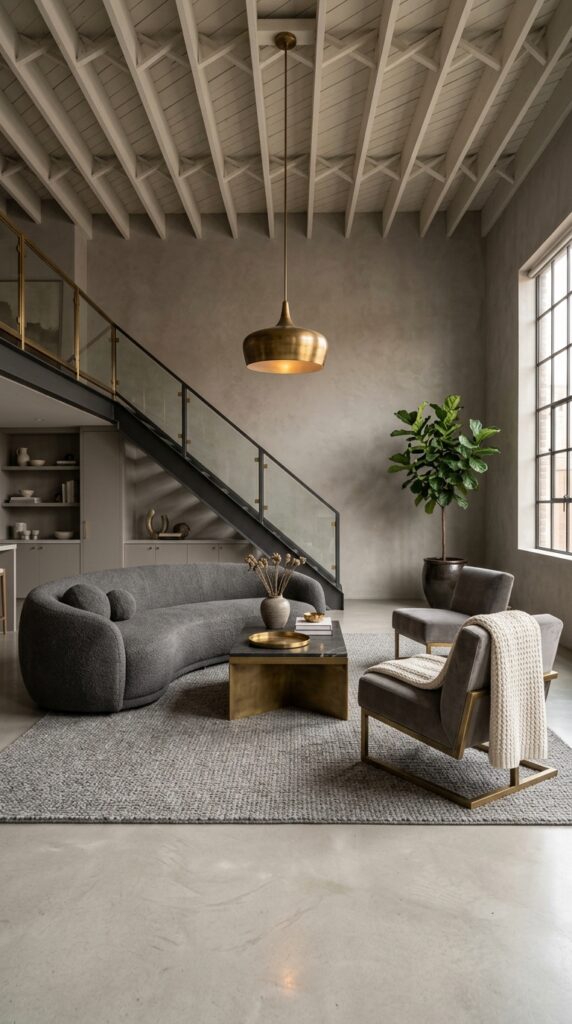
Vibe: Serene — the loft that found its voice by deciding what to remove.
Why it works: A warm monochrome palette — all surfaces and textiles within the warm gray family from pale ash to deep charcoal — is the most sophisticated color strategy available in luxe loft design because it shifts focus entirely from color contrast to material and textural contrast. When color is removed as a variable, the eye reads texture with far greater sensitivity: the difference between a smooth concrete floor, a nubbled bouclé sofa, a woven wool rug, and a velvet accent chair becomes the primary design conversation. Aged brass as the sole metallic accent performs with disproportionate impact precisely because it is the only warm departure from the neutral field — every piece of brass in the room reads as a deliberate accent rather than a material choice competing with other warm tones.
How to get it: Build the palette from the floor up: pale ash concrete or large-format porcelain tile as the floor base, walls in a warm gray two shades deeper, upholstery in charcoal and medium gray across different textile types (bouclé, velvet, woven wool), and all metal in aged brass without exception. The critical rule: no cool gray, no blue-gray, no silver metal — every element must occupy the warm side of the gray family or the palette loses its cohesive warmth.
💡 Quick Win: Replacing all existing light bulbs with 2700K warm white LEDs — before any furniture or surface change — immediately unifies an existing loft space under a single warm tone, making all existing neutral elements read as a more cohesive palette than they did under mixed-temperature lighting.
🛍️ Shop the Look — Amazon Product Ideas
| # | Product Search Phrase | Why It Fits |
| 1 | charcoal bouclé sofa large sectional | Primary monochrome anchor |
| 2 | warm gray woven wool rug 10×14 | Mid-tone floor layer |
| 3 | smoke velvet accent chair low profile | Textural variation seat |
| 4 | aged brass coffee table geometric base | Sole metallic accent |
| 5 | ivory oversized throw blanket linen | Light tonal layer detail |
How to Start Your Luxe Loft Transformation
Your single first move: Replace every light bulb in your loft with 2700K warm white LEDs before changing a single surface, piece of furniture, or architectural element. This decision — which costs $20–$50 total — is not supplementary preparation; it is the foundational act that makes every other decision in a loft transformation visible in its correct form. Warm amber lighting is what transforms dark concrete and raw brick from cold industrial materials into warm, enveloping surfaces. It is the difference between a loft that feels like a workspace and a loft that feels like a life being lived. Every paint sample, textile choice, and furniture decision you make after this step will be evaluated under the correct conditions.
The most common beginner mistake: Purchasing residential-scale furniture for a loft space — standard 84-inch sofas, 36-inch dining tables, table lamps on standard-height end tables — and then wondering why the space feels sparse and echoey rather than grand and enveloping. The fix is to scale every major furniture piece to 120–150% of what feels instinctively appropriate: a sofa that seems enormous in the showroom will read correctly in a loft. Standard-scale furniture in a high-ceiling open-plan space creates the specific uncomfortable quality of furniture placed in a room too large for it — which is the visual definition of a space that hasn’t been designed yet.
Three specific items under $50 that create immediate luxe loft impact: A single large-leaf indoor plant (fiddle leaf fig or olive tree) in a matte concrete-effect pot ($20–$40 for the pot, $15–$35 for a 6-inch plant), one genuine vintage kilim-style runner in terracotta and navy placed in the entry zone ($30–$45 for a 2.5×8 foot runner), and a warm 2700K Edison-style bulb replacing the existing overhead fixture bulb ($8–$15).
Realistic expectations: A lighting and accessory refresh — new bulbs, one large plant, one oversized rug — takes a single weekend and $200–$400 and produces a measurably different atmosphere. A mid-range transformation adding new furniture, acoustic panels, and surface treatments realistically spans 2–3 months and $3,000–$8,000 in materials. A comprehensive loft renovation including concrete floors, custom steel shelving, mezzanine construction, and integrated kitchen runs $40,000–$150,000+ depending on scope, ceiling height, structural conditions, and material specifications.
Frequently Asked Questions About Luxe Loft Apartments
What makes a loft apartment “luxe” versus simply industrial or raw?
The distinction between a raw industrial loft and a luxe loft is the deliberate layering of refined materials over the existing rawness rather than the removal of either quality. A luxe loft preserves and celebrates the exposed brick, steel beams, and concrete floors of industrial architecture while introducing hand-knotted wool rugs, semi-aniline leather furniture, aged brass fixtures, and museum-quality framing. The rawness and the refinement coexist in productive tension — neither sanitized into a conventional apartment nor left untouched as a purely industrial space. Specific material indicators of luxe quality: full-grain leather (not bonded), solid white oak (not veneer on MDF), unlacquered or aged brass (not polished chrome), and hand-knotted textiles (not machine-made).
What colors work best in a luxe loft apartment?
The most effective luxe loft palette centers on warm neutrals — pale ash, warm ivory, dusty greige, warm charcoal — as the primary field across floors, walls, and large upholstery pieces. Against this neutral field, one to two accent tones are introduced: cognac or tobacco leather as a warm brown, forest green or dusty sage as a muted saturated note, and aged brass or oxidized bronze as the sole metallic. Avoid cool grays with blue undertones, stark bright whites, and any primary color — these all conflict with the warm, material-focused quality that defines the aesthetic. The palette should feel as if it grew from the building’s own material palette rather than being applied over it.
How much does it cost to furnish a luxe loft apartment?
A starter luxe loft furnishing — quality leather or bouclé sofa, large wool rug, adjustable track lighting, a statement dining table, and foundational accessories — runs $8,000–$20,000 for a 1,000–1,500 square foot loft. A mid-range full furnishing with quality pieces in every zone runs $20,000–$50,000. A full specification with custom millwork, bespoke leather pieces, original artwork, vintage kilims, and professional lighting design ranges from $75,000 to $200,000+. The single highest-ROI furniture investment in a loft is always the primary sofa — a well-scaled, quality material sofa ($3,000–$8,000) does more for the perceived quality of the entire space than any other single piece.
Can a standard-ceiling apartment achieve the luxe loft aesthetic?
Yes, with deliberate material and spatial choices that reference the loft tradition without requiring its architectural conditions. The approach: use large-format flooring (no transitions, no narrow-plank wood) to replicate the seamless floor plane; expose at least one textural surface (brick, concrete, limewash) for material rawness; eliminate upper kitchen cabinets on at least one wall and replace with open steel shelving; use floor-to-ceiling curtain panels to create zone definition; and scale furniture to the larger end of standard residential sizing. The one quality that cannot be faked is ceiling height — but by eliminating the visual elements that emphasize a low ceiling (upper cabinets, overhead lighting fixtures hung low, large-scale hanging art), the space can feel significantly more generous than its dimensions suggest.
What lighting works best in an open-plan loft apartment?
The most effective lighting strategy for an open loft plan uses four distinct layers at different heights and for different functions: adjustable track lighting on the ceiling for task and accent illumination (aimed at artwork, seating zones, and kitchen surfaces); pendant clusters or statement pendants at mid-height to create zone definition without walls; floor lamps positioned at the perimeter of seating arrangements to provide warm ambient fill at eye level; and under-shelf or under-counter LED strips to illuminate surfaces and create a secondary light plane at the horizontal level. All light sources should be specified at 2700K maximum — mixing color temperatures in an open plan creates visual discontinuity between zones that undermines the spatial unity the open plan is designed to provide.
Ready to Create Your Dream Luxe Loft?
These 26 ideas cover the full range of what transforms an open space into a genuinely lived luxe loft — from the foundational architectural decisions of concrete floors and exposed steel beams to the finishing layers of warm kilim rugs, smoked glass bar carts, and pendant clusters that give the space its specific atmospheric character. Every great loft transformation begins with one honest act of commitment rather than a comprehensive overhaul: today, replace every bulb in your space with 2700K warm amber LEDs, stand in the room at night under that light, and see what the space is already trying to tell you. When the full vision comes together — the leather and the concrete, the steel and the oak, the raw and the refined in their most considered conversation — you’ll have created something that most apartments never become: a space with a point of view, a place that knows exactly what it is and makes no apology for any of it. Save the ideas that made you slow down — the smoked glass cluster, the limewashed brick, the floor-to-ceiling linen curtain catching the bedside glow — because those pauses are the beginning of your loft.