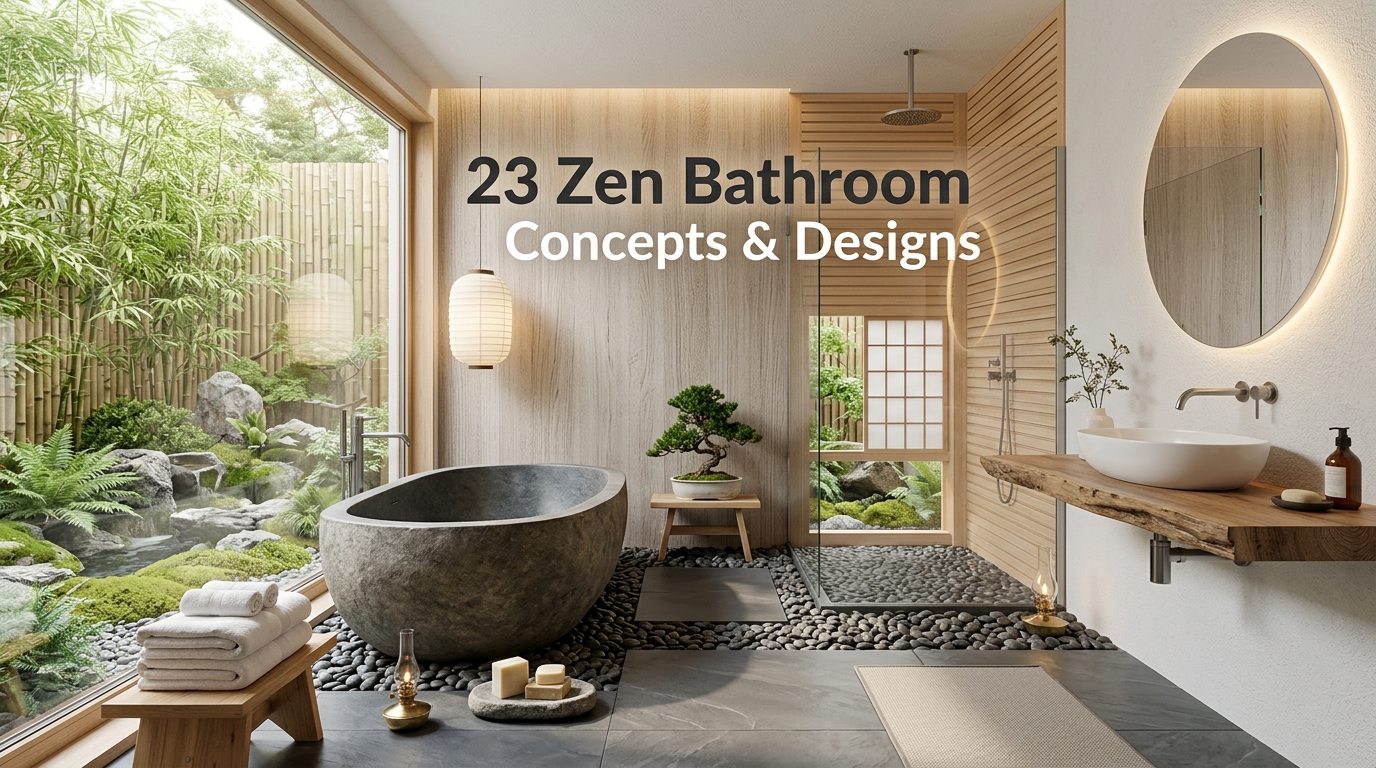
A Zen bathroom is a minimalist sanctuary rooted in Japanese wabi-sabi and Zen Buddhist philosophy — a space stripped of excess, designed around natural materials, quiet color, and the deliberate cultivation of stillness. This article delivers exactly 23 Zen bathroom concepts and designs covering materials, lighting, color, layout, fixtures, and small-space solutions so you can transform your bathroom into a genuine retreat for daily restoration.
There is a particular quality of silence that a Zen bathroom holds. Water sounds different in it. Steam feels intentional. The light lands without glare, the stone is cool underfoot, and the single branch in a narrow vase says more than a shelf full of products ever could. This is a style that asks you to take your time. Here are 23 concepts worth saving — and stealing.
Why Zen Bathroom Design Works So Well
Zen bathroom design draws from two interlocking traditions: the Japanese philosophy of ma — the deliberate use of negative space and pause — and the ancient practice of misogi, ritual water purification that elevated bathing from hygiene to ceremony. These traditions were formalized into interior design through the Mingei folk craft movement and later through the influence of modernist Japanese architects like Tadao Ando, whose unadorned concrete buildings demonstrated that reduction could be deeply expressive. The result is a design language in which restraint is not poverty but precision — every element present because it earns its place, every absence as considered as every presence.
The material vocabulary of a Zen bathroom is specific, tactile, and drawn almost entirely from nature. Think honed black granite and tumbled river stone underfoot, unfinished hinoki cypress (the sacred Japanese bath wood, naturally antimicrobial and honeyed in scent) for soaking tubs and bath stools, raw concrete walls in warm greige, matte white or warm sand ceramic tile in large format, and matte black or unlacquered brass fixtures. Textiles are undyed organic cotton or linen — no bright whites, no patterns. The palette is narrow by design: warm white, warm gray, charcoal, dusty sand, soft moss green, and the natural tone of unfinished wood.
Zen bathroom design is trending now for reasons that are entirely cultural and structural. Screen fatigue, always-on work culture, and the post-pandemic recalibration of home as sanctuary have made the bathroom — previously the most overlooked room in the design hierarchy — the space where people are now most willing to invest in genuine calm. Pinterest data shows “Japanese bathroom ideas” and “Zen spa bathroom” among the fastest-growing home search categories since 2022. The bathroom has become the room people design not for guests but for themselves.
Small bathrooms are, in many ways, the natural home of Zen design. The philosophy is fundamentally about doing more with less — one material executed flawlessly, one plant positioned with precision, negative space treated as an asset. A 50-square-foot bathroom with a single honed stone tile floor, a wall-mounted faucet, and a narrow shelf holding three objects can be more Zen than a 200-square-foot bathroom cluttered with products and competing surfaces. Scale is irrelevant; intention is everything.
Style at a Glance
| Element | Wabi-Sabi Warmth | Minimalist Stillness |
| Philosophy | Beauty in imperfection and impermanence | Reduction as the highest form of design |
| Materials | Hinoki cypress, river stone, raw linen, warm concrete | Honed granite, matte ceramic, unfinished oak, black steel |
| Color Palette | Warm sand, undyed linen, soft moss, aged wood honey | Warm white, warm charcoal, greige, matte black |
23 Zen Bathroom Concepts & Designs
1. Honed Black Granite Floor with River Stone Inlay
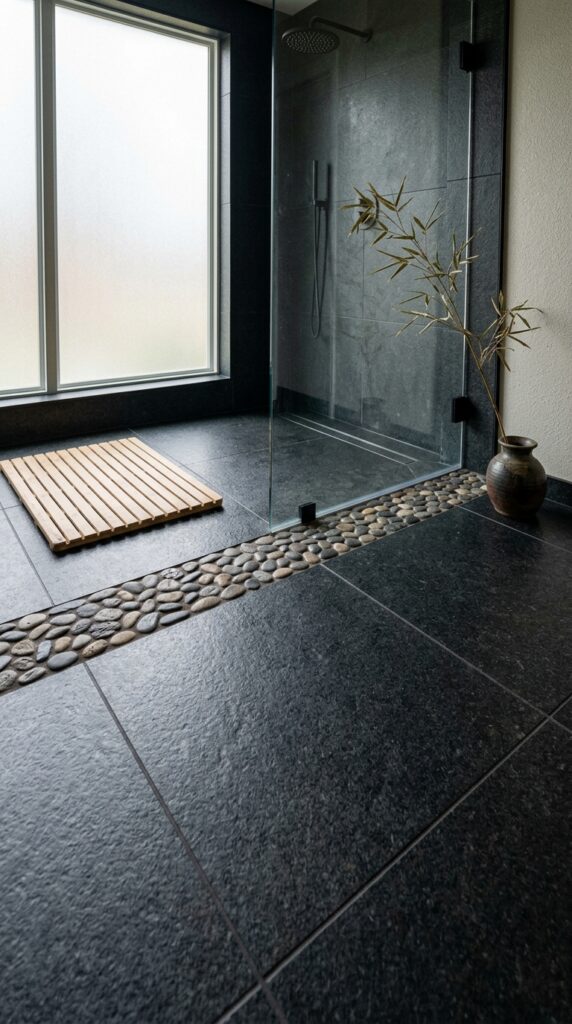
Vibe: Elemental and grounded — the floor that makes you feel the earth before you’ve even turned on the water.
Why it works: Honed black granite achieves what polished stone cannot: a surface that absorbs light rather than reflecting it, which reduces visual noise and creates the matte, quiet presence that Zen design requires. The river stone inlay border operates on the wabi-sabi principle of controlled imperfection — each stone is slightly irregular, slightly different in tone, arranged in a pattern that references natural riverbeds rather than manufactured precision. This material contrast between the flat geometry of the granite tiles and the organic roundness of the river stones is the kind of quiet tension that Zen interiors sustain beautifully.
How to get it: Specify honed rather than polished black granite at 24×24-inch format for large, clean tile planes with minimal grout lines. Set the river stone inlay strip in unsanded dark charcoal grout at approximately 6 inches wide — wide enough to read as intentional, narrow enough to function as a border rather than a field.
💡 Quick Win: A single river stone bath mat — loose stones set in a rubber grid base — placed outside the shower mimics the sensory effect of a stone inlay for under $40 with zero installation.
🛍️ Shop the Look — Amazon Product Ideas
| # | Product Search Phrase | Why It Fits |
| 1 | Honed black granite floor tile 12×12 matte | Core Zen floor material |
| 2 | Natural river stone pebble bath mat drainage | Stone floor accent mat |
| 3 | Dark charcoal unsanded grout powder | Tile joint color match |
| 4 | Bamboo bath mat natural slatted | Organic floor layer |
| 5 | Single branch dried natural narrow vase | Minimal botanical accent |
2. Hinoki Cypress Soaking Tub
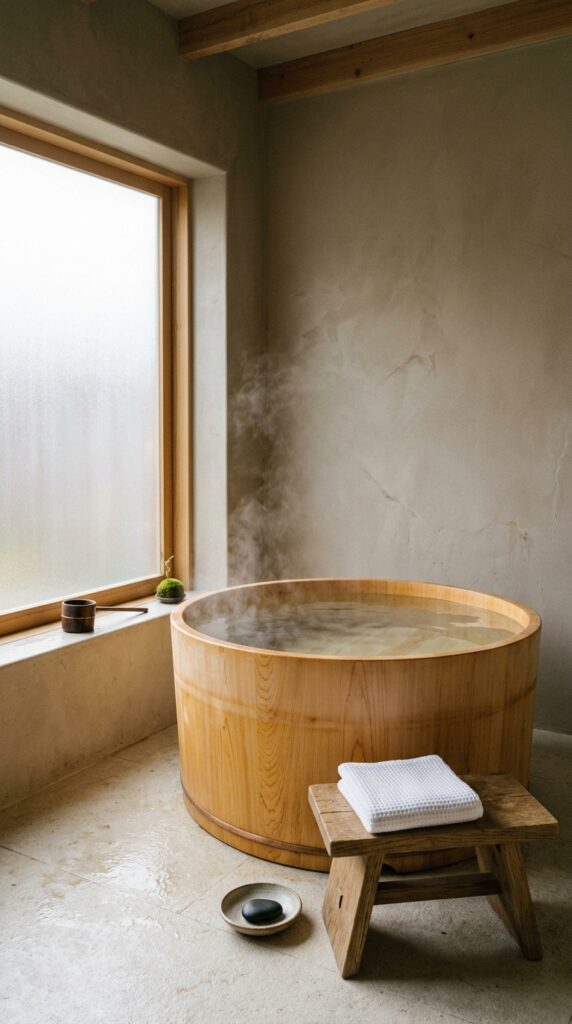
Vibe: Ceremonial and still — bathing elevated into something that deserves your full attention.
Why it works: The hinoki cypress soaking tub is the defining object of Zen bathroom design. Hinoki (Chamaecyparis obtusa) is the sacred wood of Japanese Shinto shrines and traditional bathhouses — it releases a natural essential oil called hinokitiol that is both antimicrobial and deeply aromatic, filling a steamed bathroom with a scent described as cedar and lemon combined. The ofuro’s proportions — deep (typically 26 inches) and narrow — are designed for sitting upright submerged to the shoulders, which is a fundamentally different relationship to bathing than the reclined Western tub format. That posture difference alone changes what bathing feels like.
How to get it: Authentic hinoki tubs require oiling with food-grade mineral oil or natural tung oil every 3–6 months to prevent cracking; this maintenance ritual is itself a Zen practice. If full hinoki is beyond budget, a hinoki bath stool and bath bucket (oke) beside a standard soaking tub creates the sensory and ceremonial elements at a fraction of the cost.
🛍️ Shop the Look — Amazon Product Ideas
| # | Product Search Phrase | Why It Fits |
| 1 | Hinoki wood bath stool Japanese cedar natural | Tub-side ritual seat |
| 2 | Japanese ofuro wooden bath bucket hinoki oke | Bathing ceremony vessel |
| 3 | Food grade mineral oil wood conditioner clear | Hinoki maintenance oil |
| 4 | Deep Japanese soaking tub freestanding | Core tub form |
| 5 | Low profile tub filler faucet matte black floor | Tub floor-mount faucet |
3. Warm Concrete Walls with Integrated Niche
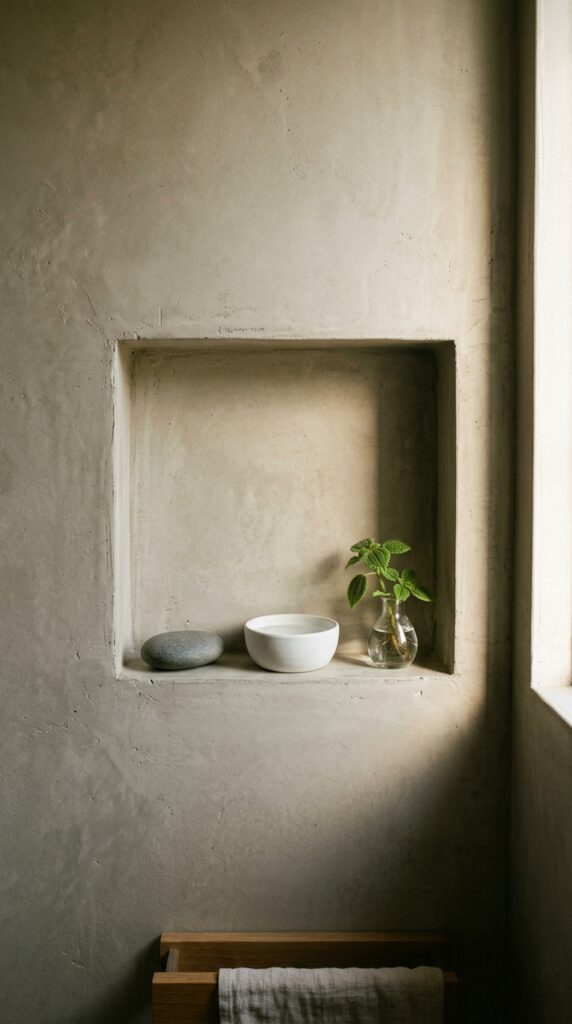
Vibe: Meditative — a surface that has decided what it wants to hold and refuses everything else.
Why it works: Concrete walls in a Zen bathroom succeed because raw concrete is the closest interior wall surface to the unpolished stone walls of Japanese mountain retreats — it has texture, tonal variation, and a quality of permanence that painted drywall cannot approximate. The warm greige micro-topping formula (rather than cold gray Portland cement) is essential: cold gray reads as industrial in a bathroom; warm greige reads as elemental and grounding. The integrated niche is the design move that transforms a concrete wall from blunt to architectural — a shadow-box recess that functions as a three-dimensional still life, inviting the eye to rest on three carefully chosen objects.
How to get it: Apply Ardex Feather Finish or Westcoat EC-12 micro-topping over primed drywall in two thin coats — this achieves the concrete aesthetic without the structural requirements of poured concrete. Tint with a warm cream or greige pigment (Universal Tinting Color in “Raw Umber” at 1–2% concentration) to avoid the cold blue undertone that standard concrete finishes carry.
🛍️ Shop the Look — Amazon Product Ideas
| # | Product Search Phrase | Why It Fits |
| 1 | Concrete micro-topping wall finish warm gray kit | Concrete wall treatment |
| 2 | Universal tinting color raw umber pigment | Warm greige concrete tint |
| 3 | Recessed wall niche shower insert waterproof | Integrated display niche |
| 4 | Small smooth river stone single display | Niche minimal object |
| 5 | Matte ceramic shallow dish white small | Niche water dish object |
4. Matte Black Fixtures Against Warm White Tile
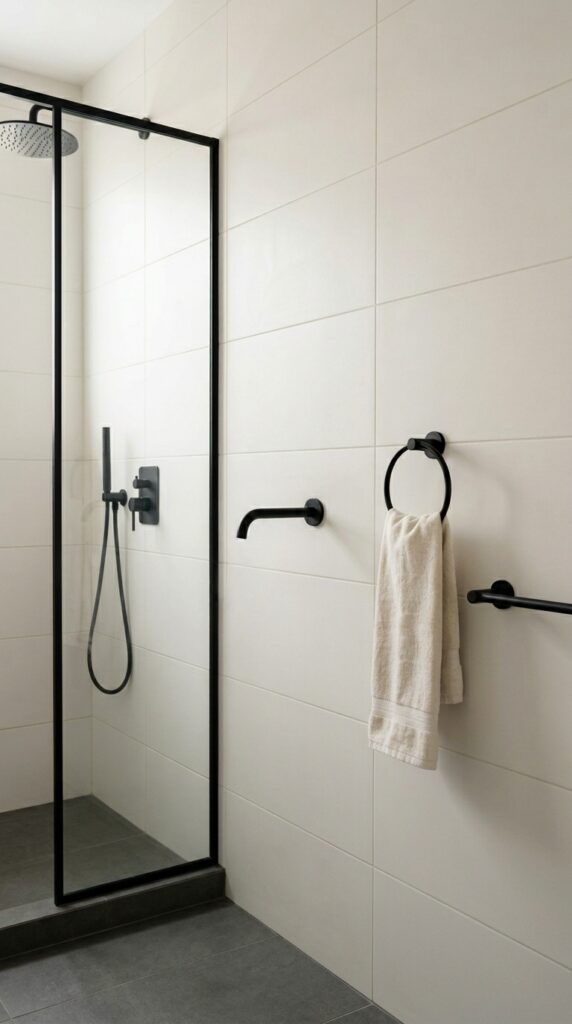
Vibe: Crisp and spare — the bathroom that has made exactly one decision and committed to it completely.
Why it works: Matte black fixtures against warm white tile is the Zen bathroom’s most powerful material binary: maximum contrast, zero decoration. The critical specification is matte rather than glossy or satin for both surfaces — glossy black reads as aggressive, glossy white reads as clinical. Matte on matte keeps both surfaces absorbing light rather than competing for it, which creates the calm that Zen design requires. Wall-mounting the faucet is not merely aesthetic — it eliminates the deck plate, the escutcheons, and the visual clutter that deck-mount faucets introduce, reducing the counter to a clean horizontal plane.
How to get it: Source all fixtures from a single product line to guarantee finish consistency — powder-coat matte black varies slightly between manufacturers, and mismatched black tones are more visible than mismatched chrome. Specify large-format 12×24 tiles laid in a horizontal stack bond (brick pattern) with 1/16-inch grout joints in matching white for the most seamless wall surface.
💡 Quick Win: Replacing a chrome or brushed nickel towel bar and toilet paper holder with matte black equivalents — same model, same finish — takes 30 minutes and immediately shifts a neutral bathroom toward Zen territory for under $60.
🛍️ Shop the Look — Amazon Product Ideas
| # | Product Search Phrase | Why It Fits |
| 1 | Matte black wall mount bathroom faucet | Core Zen fixture finish |
| 2 | Matte black towel bar 24 inch powder coat | Consistent fixture finish |
| 3 | Large format matte white ceramic tile 12×24 | Clean wall tile surface |
| 4 | White unsanded grout fine joint tile | Minimal grout line |
| 5 | Matte black toilet paper holder wall mount | Complete fixture suite |
5. Vertical Bamboo Screen as Privacy Partition
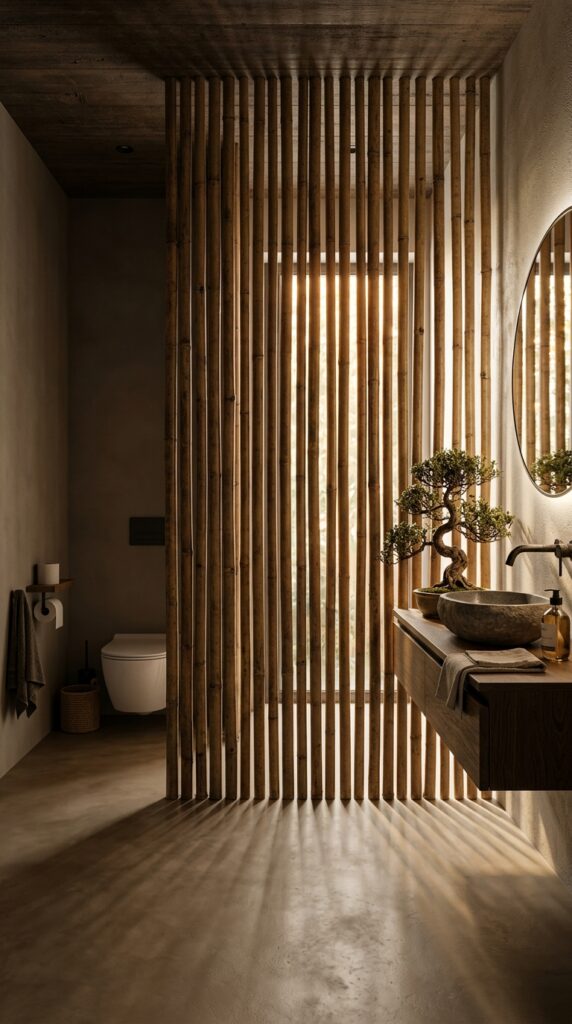
Vibe: Serene and layered — light moving through bamboo is the visual sound of stillness.
Why it works: A bamboo privacy screen in a bathroom resolves the Zen design challenge of creating spatial separation without the visual weight of a full wall. The gaps between bamboo poles allow light and air to pass through both zones of the bathroom, which maintains the sense of open, breathable space while defining distinct functional areas. Carbonized bamboo — the dark-treated variety — provides the warm brown-black tones that align with the Zen palette, and its surface variation (each pole slightly different in diameter and texture) delivers the controlled natural imperfection of wabi-sabi. Light playing through the bamboo gaps creates moving shadow patterns that are different every hour of the day.
How to get it: Source carbonized bamboo poles in 1.5–2-inch diameter and mount in a simple top-and-bottom channel rail. Floor-to-ceiling installation is critical — anything shorter reads as a decorative screen rather than a functional architectural partition. Seal with tung oil for bathroom humidity resistance.
🛍️ Shop the Look — Amazon Product Ideas
| # | Product Search Phrase | Why It Fits |
| 1 | Carbonized bamboo poles 1.5 inch natural dark | Screen partition material |
| 2 | Bamboo roll fence screen privacy panel | Ready-made bamboo screen |
| 3 | Tung oil natural wood sealant waterproof | Bamboo humidity protection |
| 4 | Floor ceiling channel mounting track metal | Screen installation hardware |
| 5 | Small bonsai tree ficus live indoor | Zen counter botanical |
6. Warm Indirect Cove Lighting at Ceiling Level
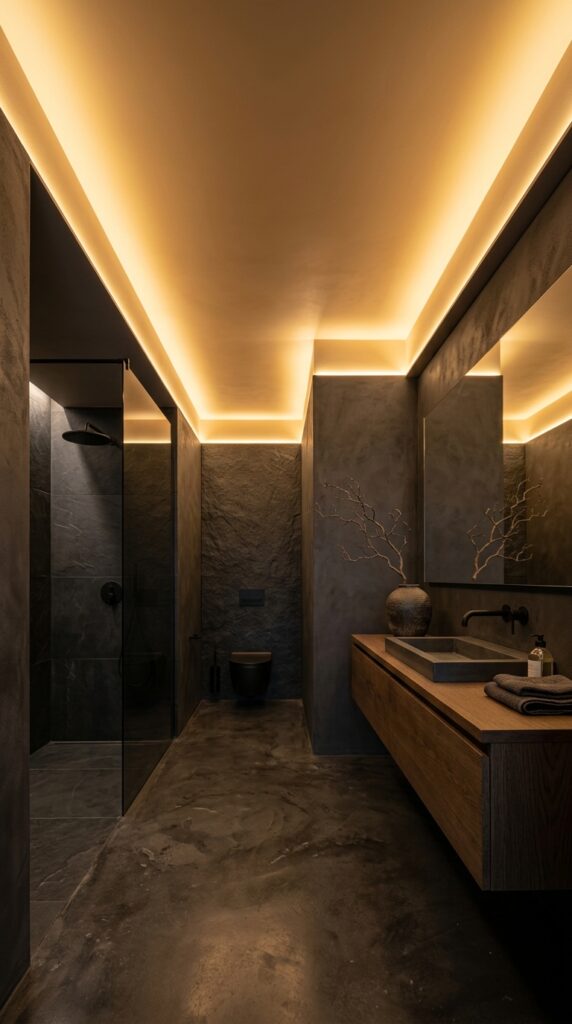
Vibe: Luminous and sourceless — light that seems to come from the architecture itself rather than from anything you could point to.
Why it works: Cove lighting is the Zen bathroom’s ideal illumination strategy because it removes the light source from the visual field entirely — you experience the warmth and brightness without ever looking at a bulb or fixture. This elimination of visible hardware is fundamental to Zen design, which treats any unnecessary object — including light fixtures — as visual noise. Warm 2700K LEDs in the ceiling cove cast the room in amber light that is flattering, calming, and physiologically appropriate for the pre-sleep bathing rituals that a Zen bathroom is designed to support. The ceiling becomes the light source, which is architecturally elegant.
How to get it: Build a simple plywood cove detail at the ceiling perimeter — a 4-inch-deep ledge that faces inward and upward — and install continuous 2700K LED strip lighting on the inward-facing surface. Use a high CRI (90+) warm white strip for accurate material rendering. Install on a dimmer for full evening ritual control.
🛍️ Shop the Look — Amazon Product Ideas
| # | Product Search Phrase | Why It Fits |
| 1 | LED strip light warm white 2700K high CRI 90+ | Cove light source |
| 2 | LED dimmer switch inline compatible | Cove light dimming |
| 3 | LED corner channel aluminum diffuser 6ft | Strip light housing |
| 4 | LED power supply 12V constant voltage | Strip light driver |
| 5 | Warm white LED strip connector kit waterproof | Bathroom-safe LED connection |
7. Japanese Soaking Tub Layout with Cedar Decking
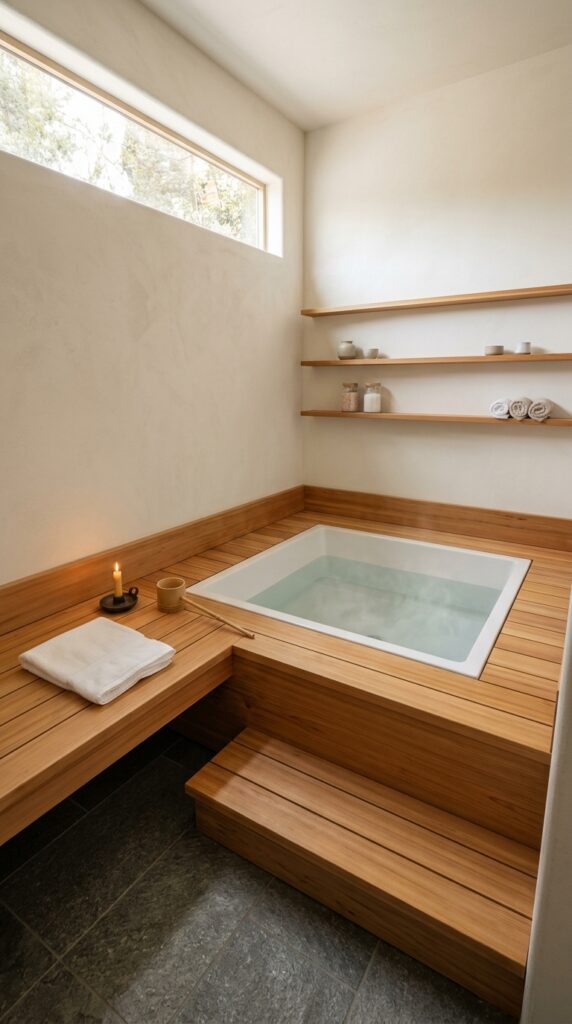
Vibe: Ceremonial and deeply warm — a bath that has been given its own floor, its own platform, its own ritual space.
Why it works: Raising a soaking tub on a cedar deck platform is the layout strategy that elevates bathing from a routine to a ceremony — the step up creates a physical threshold that signals a change of pace and purpose. The surrounding cedar deck serves as a preparation and resting surface, mirroring the traditional Japanese sento (public bath) layout where washing and soaking happen in distinct zones. Cedar’s natural antimicrobial properties make it genuinely appropriate for wet bathroom environments, and its aromatic oils intensify when wet — the act of bathing becomes olfactory as well as physical.
How to get it: Build the cedar deck platform on a concrete substrate with a continuous waterproof membrane beneath. Use 1×4 clear cedar boards with 1/8-inch gaps for drainage and air circulation — this prevents the standing water that causes wood rot in bathroom environments. Finish with a penetrating oil rather than a surface seal to maintain the wood’s natural texture and scent.
🛍️ Shop the Look — Amazon Product Ideas
| # | Product Search Phrase | Why It Fits |
| 1 | Deep square soaking tub freestanding 27 inch | Core Japanese tub form |
| 2 | Clear cedar deck board 1×4 smooth finish | Platform decking material |
| 3 | Waterproof membrane shower liner kit | Under-deck moisture protection |
| 4 | Teak oil natural finish waterproof wood sealant | Cedar platform protection |
| 5 | Bamboo water dipper ladle natural handle | Bathing ceremony tool |
8. Moss Wall Panel as a Living Zen Element
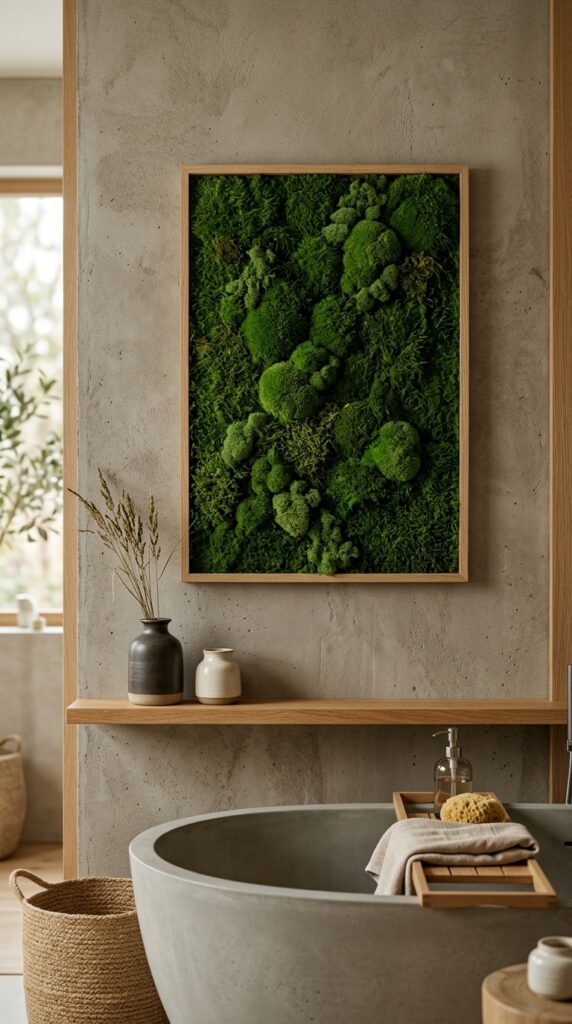
Vibe: Quietly alive — the wall that breathes without asking anything of you in return.
Why it works: A preserved moss panel introduces the single most Zen of all design elements — living nature — in a form that requires zero maintenance, an act of material philosophy that is itself deeply wabi-sabi. Preserved moss retains its color, texture, and organic variation indefinitely without water or light, which means it can function as a true wall element rather than a fragile plant requiring care. Its deep velvet green provides the one color note that a Zen bathroom often needs against a warm neutral palette — not as decoration but as a reference to the mountain forest that is the spiritual home of Zen practice.
How to get it: Preserved moss panels are sold in standard frame sizes — choose a thin natural oak or walnut frame rather than black or white for maximum material warmth. Mount above the tub or behind the sink at eye height. Avoid humid shower zones where water spray will contact the moss directly; preserved moss handles ambient bathroom humidity but not direct water exposure.
💡 Quick Win: A 12×16-inch preserved moss frame ($25–40) on the bathroom wall above the towel bar costs almost nothing and immediately introduces the organic green element that completes the Zen palette.
🛍️ Shop the Look — Amazon Product Ideas
| # | Product Search Phrase | Why It Fits |
| 1 | Preserved moss wall panel framed natural green | Living wall element |
| 2 | Sheet moss preserved green mixed texture | DIY moss panel material |
| 3 | Natural wood thin frame for moss art 16×20 | Organic frame for panel |
| 4 | Preserved pillow moss decorative jar | Smaller moss accent |
| 5 | Moss graffiti paint recipe substrate medium | DIY moss growth medium |
9. Vessel Sink in Hand-Thrown Ceramic
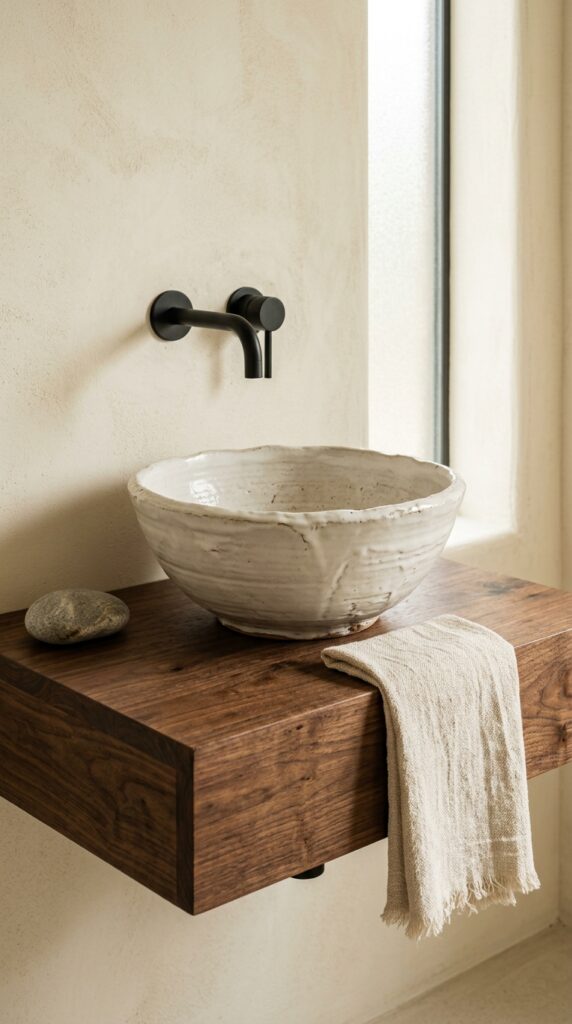
Vibe: Handcrafted and spare — the sink that makes you aware of the person who made it, and of the water you’re about to use.
Why it works: A hand-thrown ceramic vessel sink is the definitive wabi-sabi object in a Zen bathroom: it is imperfect, unique, and made by human hands from earth — which is precisely the material philosophy that Zen design venerates. The visible throwing marks and slight rim irregularities are not defects; they are the evidence of craft, of time, of the specific moment the object was made. Set on a dark walnut floating shelf with a single wall-mount faucet above, this sink becomes a still life — a meditation on water, clay, and the act of washing hands as a daily ritual rather than a routine.
How to get it: Source hand-thrown vessel sinks from ceramic artists on Etsy or from Japanese import specialists — authentic hand-thrown pieces range from $180–600. Verify that the ceramic has been food-safe fired (cone 6 or above) and that the glaze is non-porous. Pair with a wall-mounted faucet spout extending 3–4 inches beyond the sink rim to account for the vessel’s raised height.
🛍️ Shop the Look — Amazon Product Ideas
| # | Product Search Phrase | Why It Fits |
| 1 | Ceramic vessel sink handmade white matte round | Wabi-sabi sink form |
| 2 | Walnut floating vanity shelf 24 inch | Dark wood sink platform |
| 3 | Wall mount bathroom faucet single hole matte black | Minimal faucet pairing |
| 4 | Vessel sink drain assembly matte black | Sink drainage hardware |
| 5 | Smooth river stone single large display | Vanity wabi-sabi object |
10. Warm Neutral Color Palette: Sand, Stone, Linen
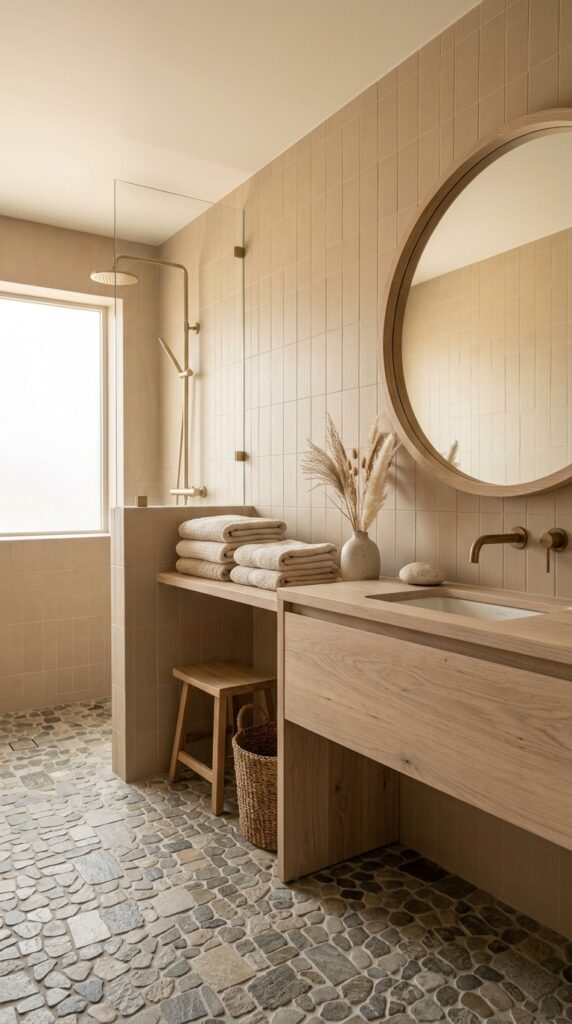
Vibe: Serene and cohesive — a bathroom that feels like the inside of a very calm, very considered mind.
Why it works: A monochromatic warm neutral palette — sand, stone, linen, unfinished wood — succeeds in a Zen bathroom because the absence of color contrast allows texture contrast to carry the entire visual interest. When every element shares the same warm beige-to-cream-to-gray-brown temperature, the eye stops scanning for focal points and begins to experience the space as a unified whole — which is the perceptual state that Zen design is engineering toward. Each material in this palette is warm by definition (stone absorbs warmth, linen holds it, wood radiates it) so the room reads as thermally unified as well as visually unified.
How to get it: Select all materials before purchasing any single one — hold tile samples, wood samples, and towel fabric together and confirm they all share the same warm undertone. The palette fails if even one element has a cool blue or green undertone that breaks the warm unity. Test in your specific bathroom’s light direction, as north-facing bathrooms will pull warm neutrals toward gray.
🛍️ Shop the Look — Amazon Product Ideas
| # | Product Search Phrase | Why It Fits |
| 1 | Warm sand matte ceramic wall tile 4×12 subway | Warm neutral wall tile |
| 2 | Undyed organic linen hand towel set natural | Neutral textile layer |
| 3 | Unfinished white oak bathroom shelf 18 inch | Pale wood accent shelf |
| 4 | Dried reed grass stem natural tall | Organic neutral botanical |
| 5 | Warm stone mosaic floor tile natural | Neutral floor texture |
11. Open Wet Room with Linear Drain
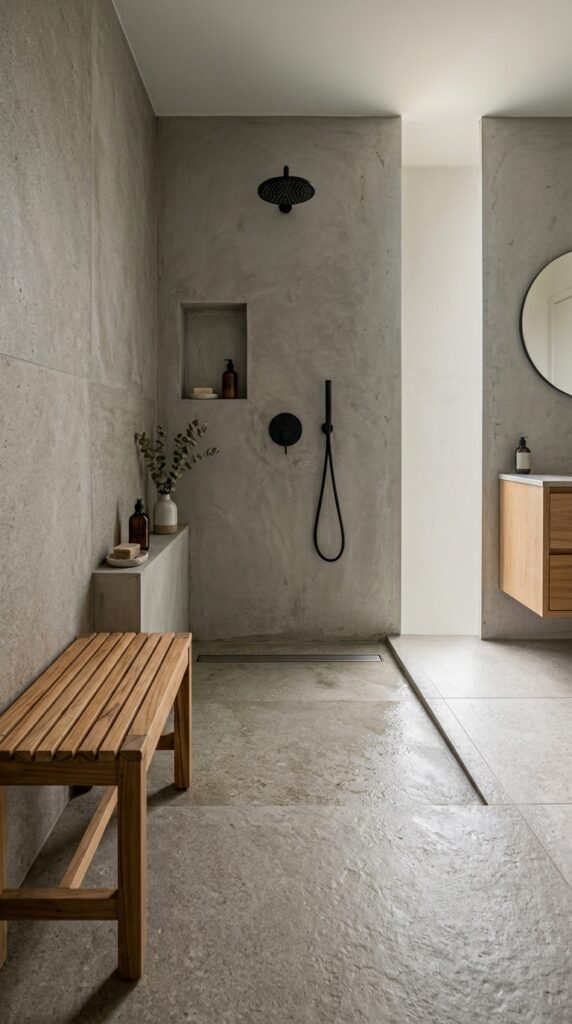
Vibe: Open and elemental — showering as a weather event rather than an appliance interaction.
Why it works: An open wet room with no shower enclosure is the spatial expression of Zen bathroom philosophy at its most committed: by removing the glass barrier and door, the shower dissolves into the room rather than being contained by it. The continuous floor plane — identical tile inside and outside the shower zone — eliminates the visual interruption of a threshold and makes the entire bathroom feel larger and more unified. The linear drain is the functional element that makes this work technically: its narrow profile is almost invisible while handling all water drainage efficiently. This is a bathroom that prioritizes the experience of bathing over the practicality of keeping things dry.
How to get it: A wet room requires a continuous waterproof tanking system applied over the entire floor and lower wall areas before tiling — this is a professional waterproofing job that cannot be skipped. The floor must slope toward the linear drain at a minimum 1/4-inch per foot pitch. Install a heated towel rail on the wall farthest from the drain to ensure towels remain dry.
🛍️ Shop the Look — Amazon Product Ideas
| # | Product Search Phrase | Why It Fits |
| 1 | Linear shower drain stainless slim 48 inch | Wet room drainage |
| 2 | Waterproof tanking membrane kit bathroom | Wet room waterproofing |
| 3 | Rainfall shower head ceiling mount matte black | Overhead shower element |
| 4 | Teak shower bench folding wall mount | Wet room seating |
| 5 | Large format porcelain tile concrete look 24×24 | Continuous floor surface |
12. Single Branch Ikebana as Bathroom Art
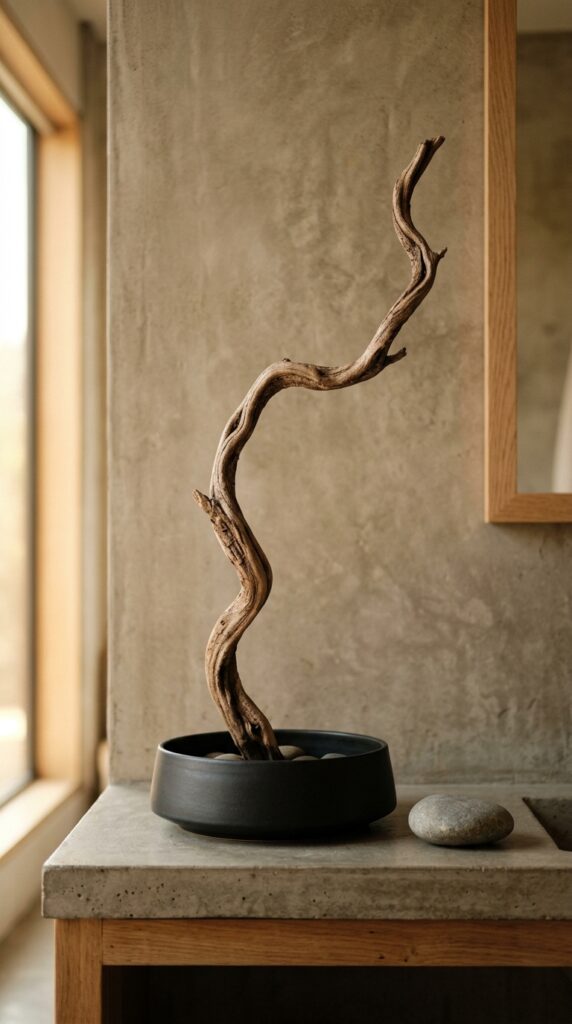
Vibe: Still and perfectly composed — the art that achieves more by including less.
Why it works: Ikebana, the Japanese art of flower arrangement, operates on the principle that the space around the plant is as important as the plant itself — the negative space is compositional. A single curved branch in a low ceramic vessel is the most reduced possible expression of this philosophy and the most powerful: there is nothing to distract from the branch’s natural line, the vessel’s material presence, and the shadow they cast together. This arrangement works in a bathroom specifically because the room’s reflective surfaces and moisture create a quality of light that makes a single organic object read with unusual clarity and presence.
How to get it: Source dried or preserved branches from craft stores, florists, or natural environments — twisted manzanita, cherry blossom, birch, and contorted willow all have naturally beautiful lines that require no arrangement skill. The branch should be approximately 1.5–2x the height of the vessel for proper Zen proportion. Secure in floral foam or a kenzan (pin frog) in the vessel bottom.
💡 Quick Win: A single dried manzanita branch (available online for $8–15) in any low ceramic bowl on the bathroom counter creates an instant ikebana effect with zero floral arrangement knowledge required.
🛍️ Shop the Look — Amazon Product Ideas
| # | Product Search Phrase | Why It Fits |
| 1 | Dried manzanita branch natural twisted 18 inch | Ikebana branch element |
| 2 | Low wide ceramic vessel matte black ikebana | Minimal arrangement vessel |
| 3 | Kenzan pin frog flower arrangement holder | Branch anchoring tool |
| 4 | Celadon glazed ceramic bowl low wide | Pale green alternative vessel |
| 5 | Dried contorted willow branch natural | Elegant branch alternative |
13. Warm Wood Floating Vanity in Unfinished Oak
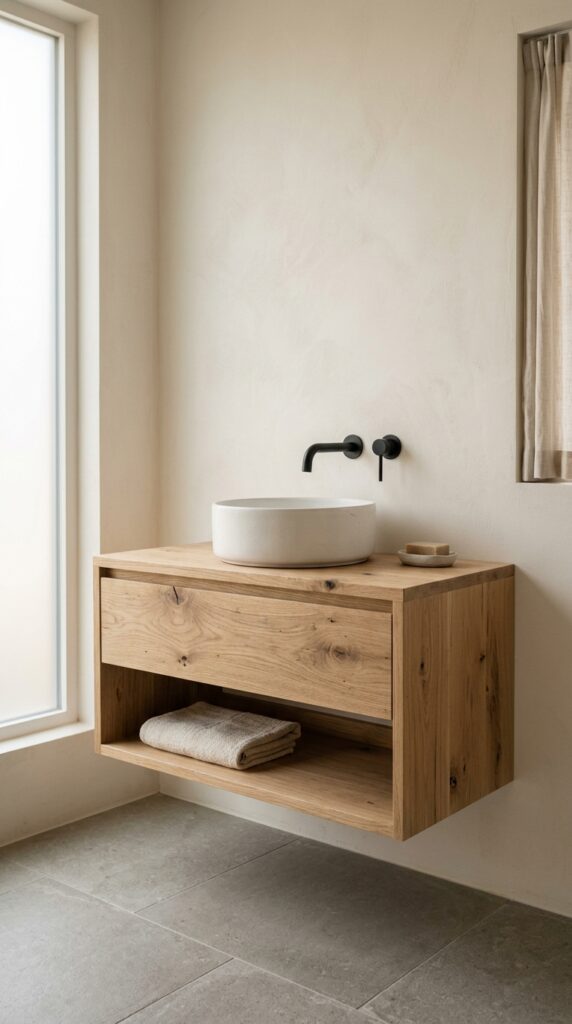
Vibe: Spare and warmly grounded — the vanity that makes the entire room feel like it was built rather than assembled.
Why it works: A floating vanity in unfinished white oak achieves three Zen design objectives simultaneously: it elevates the furniture off the floor (creating the visual breathing room of negative space beneath), it introduces warm natural wood grain as the room’s primary organic material, and it refuses the decorative language of painted or lacquered cabinetry — this vanity is visually honest about what it is made of. The absence of hardware on the drawer is the wabi-sabi touch: a small routed groove serves as the pull, which is both more minimal and more tactilely satisfying than a metal handle.
How to get it: White oak floating vanities should be finished with Rubio Monocoat in “Pure” or Osmo Polyx-Oil in clear — these penetrating oils protect the wood while preserving the unfinished, grain-forward aesthetic. Avoid polyurethane or lacquer on Zen bathroom woodwork, as these create a plastic surface sheen that destroys the natural material quality.
🛍️ Shop the Look — Amazon Product Ideas
| # | Product Search Phrase | Why It Fits |
| 1 | Floating bathroom vanity white oak natural wood | Core Zen vanity form |
| 2 | Rubio Monocoat pure natural wood oil finish | Natural oak treatment |
| 3 | Matte ceramic soap dish white handmade | Vanity minimal accessory |
| 4 | Undyed organic cotton hand towel natural | Linen textile accent |
| 5 | Wall mount vanity bracket floating hardware | Vanity installation support |
14. Frosted Glass Wall for Diffused Natural Light
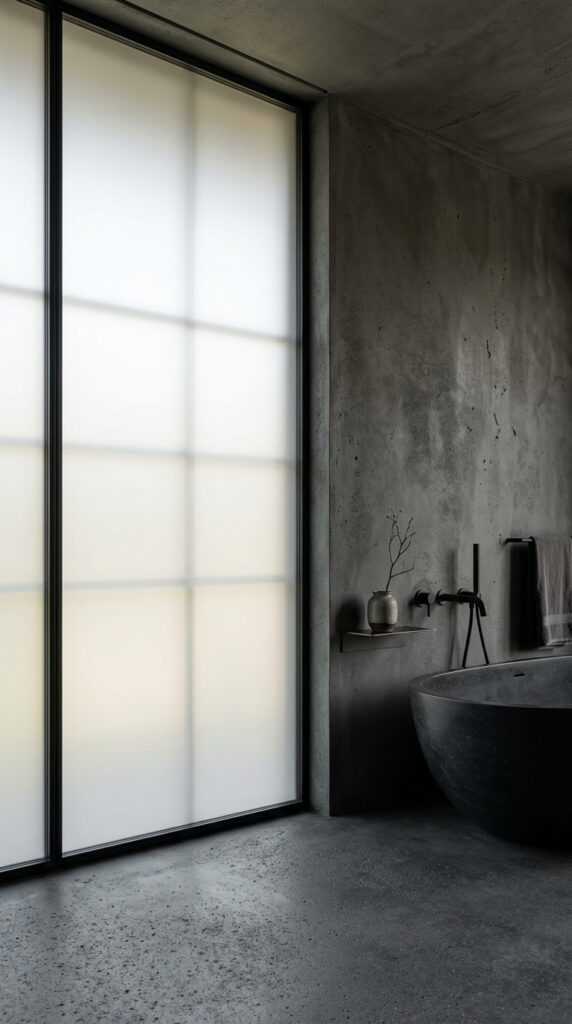
Vibe: Luminous and sourceless — light as an experience rather than a utility.
Why it works: Frosted glass is the material that transforms light from a practical resource into a design element — it removes the sun’s directional quality and replaces it with an even, shadowless luminosity that behaves like the interior light of a paper lantern. In a Zen bathroom, this quality of light is architecturally essential: harsh directional sunlight creates shadows that compete with the room’s minimalist surfaces; diffused light through frosted glass allows every material to be seen at its best simultaneously. A full-height frosted glass panel functions as both a privacy wall and a natural light source, eliminating the need for artificial supplementary lighting during daylight hours.
How to get it: Specify acid-etched glass rather than sandblasted for bathroom applications — acid-etched has a harder surface that resists moisture marking and fingerprints more effectively. A 3/8-inch tempered acid-etched glass panel in a thin matte black steel frame is the optimal specification for a Zen aesthetic.
🛍️ Shop the Look — Amazon Product Ideas
| # | Product Search Phrase | Why It Fits |
| 1 | Frosted glass window film privacy etched | Light-diffusing window treatment |
| 2 | Acid etched glass panel custom bathroom | Full frosted glass wall |
| 3 | Thin steel frame glass panel divider | Steel-framed glass partition |
| 4 | Privacy window film self-adhesive frosted | DIY frosted glass option |
| 5 | Frosted glass interior barn door sliding | Glass door Zen option |
15. Wabi-Sabi Cracked Glaze Ceramic Accessories
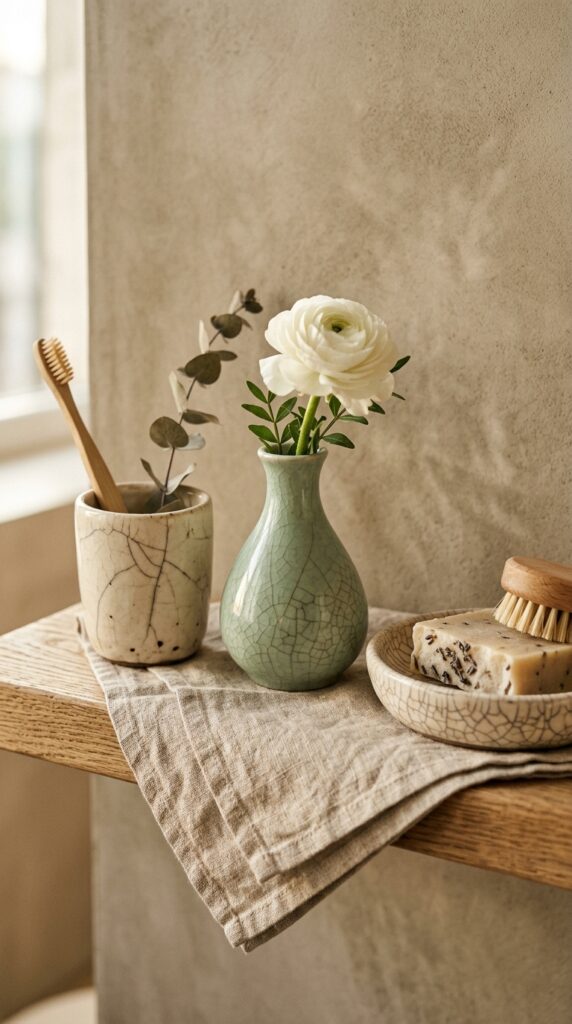
Vibe: Still and quietly beautiful — objects that have agreed to show their age without apology.
Why it works: Crackle-glaze ceramics are the material embodiment of wabi-sabi — the Japanese aesthetic that finds beauty in transience, imperfection, and the evidence of time. The crazing pattern in a crackle glaze is not damage; it is a record of the thermal stresses the ceramic experienced during firing, as legible as the rings of a tree. Grouping three crackle-glaze pieces on a single shelf — soap dish, bud vase, cup — creates a wabi-sabi still life that is both philosophically coherent and visually elegant: the irregular pattern of each glaze is different, which means the group reads as collected over time rather than purchased as a set.
How to get it: Look for crackle glaze ceramics specifically in cream, celadon (pale jade green), and warm ivory tones — these align with the Zen bathroom palette. Authentic Japanese crackle ware (kan’nyū) is available through specialist importers; comparable domestic ceramics can be found through independent studio potters at farmers markets and craft fairs.
🛍️ Shop the Look — Amazon Product Ideas
| # | Product Search Phrase | Why It Fits |
| 1 | Crackle glaze ceramic soap dish cream handmade | Wabi-sabi soap holder |
| 2 | Celadon crackle glaze bud vase small | Pale green ceramic vessel |
| 3 | Japanese crackle ceramic cup small tea | Celadon ceramic cup |
| 4 | Crackle glaze white ceramic toothbrush holder | Coordinating accessory |
| 5 | Wabi-sabi ceramic tray irregular edge natural | Imperfect surface tray |
16. Dark Charcoal Ceiling for Cave-Like Intimacy
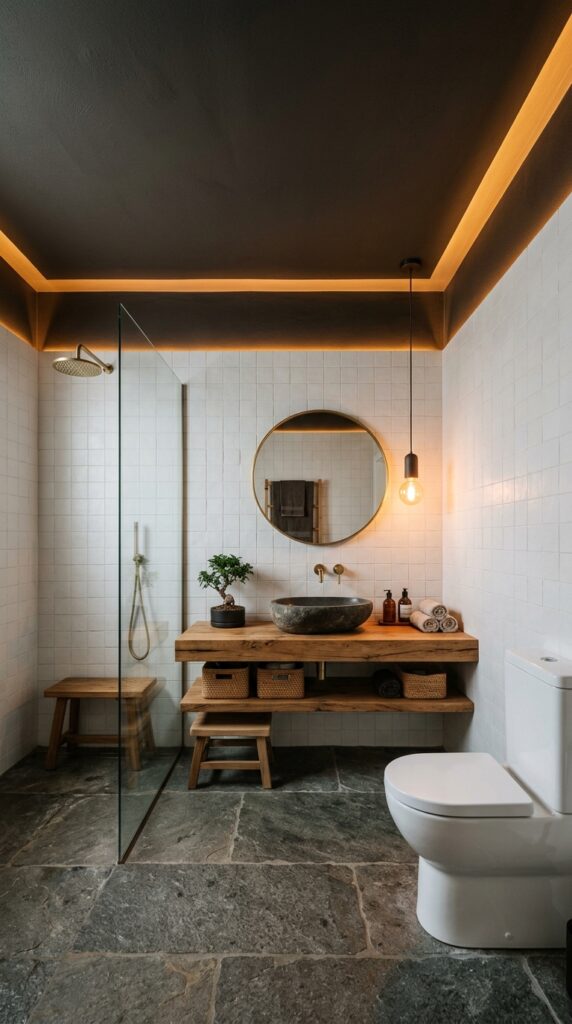
Vibe: Intimate and cocooning — a bathroom where the ceiling wraps around you rather than towering above.
Why it works: A dark charcoal ceiling in a bathroom creates the cave-like intimacy that Zen philosophy associates with meditation spaces — enclosed, protected, quiet. The perceptual effect of a dark ceiling is that it visually lowers the room’s height, which in a bathroom — unlike a bedroom or living room — reads as enveloping rather than oppressive because the room is already compact. White walls and a warm stone floor remain fully bright and clean, so the room does not feel dark overall; only the ceiling creates the intimacy overhead. Paired with warm cove lighting at the ceiling edge, the transition from light below to dark above is graduated and atmospheric.
How to get it: Use Benjamin Moore “Black Pepper” or Farrow & Ball “Off Black” in a flat matte finish for the ceiling — any sheen above flat will create reflection and glare that disrupts the intimacy. Stop the dark ceiling at the exact ceiling-wall junction with clean tape lines; any bleeding onto the white walls will read as error rather than design.
🛍️ Shop the Look — Amazon Product Ideas
| # | Product Search Phrase | Why It Fits |
| 1 | Warm charcoal ceiling paint flat matte brown-black | Intimate ceiling color |
| 2 | Ceiling paint flat finish no-drip formula | Ceiling-specific paint |
| 3 | Ceiling paint edging tape 2 inch clean line | Sharp ceiling-wall junction |
| 4 | Single pendant light matte black cord ceiling | Dark ceiling light drop |
| 5 | Matte black pendant shade minimal bathroom | Pendant fixture detail |
17. Teak Shower Bench and Bath Accessories
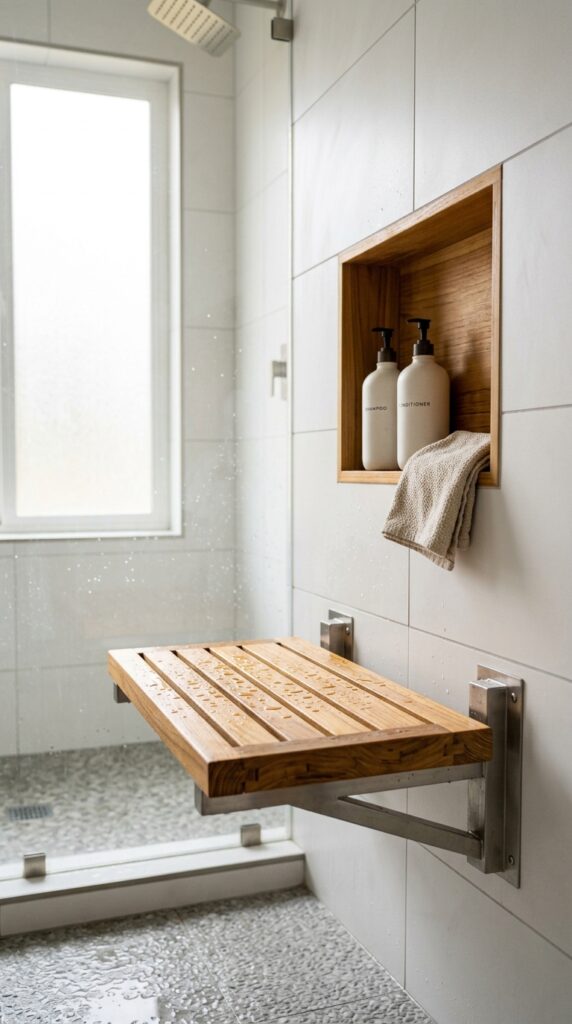
Vibe: Warm and quietly functional — wood in a wet room, which is exactly where it belongs.
Why it works: Teak in a shower environment is the material choice that most clearly signals Zen bathroom philosophy because it refuses the logic of most bathroom design, which defaults to cold, non-porous, water-repellent surfaces. Teak’s natural oils make it genuinely water-resistant without treatment — it is the wood used in ship decks, in outdoor furniture, in the traditional Scandinavian and Japanese bath environments where wood and water coexist comfortably. Its warm honey-brown tone introduces organic warmth directly into the wettest, most utilitarian zone of the bathroom, which is precisely the Zen move: finding beauty and natural material where function alone would suffice.
How to get it: Wall-mounted teak benches are preferable to floor-standing for shower installations because they allow water to drain freely underneath rather than pooling against the legs. Specify Grade A teak with tight grain and minimal knots for shower use; oil annually with natural teak oil to maintain color and water resistance.
💡 Quick Win: A freestanding teak bath tray laid across the sides of an existing bathtub ($35–55 on Amazon) transforms a standard tub into a Zen bathing environment with zero installation and immediate visual and tactile impact.
🛍️ Shop the Look — Amazon Product Ideas
| # | Product Search Phrase | Why It Fits |
| 1 | Teak shower bench wall mount fold down | Wet room wood seating |
| 2 | Teak bathtub tray bridge freestanding natural | Tub Zen accessory |
| 3 | Natural teak oil finish waterproof wood | Teak maintenance treatment |
| 4 | Matte white ceramic soap dispenser pump | Shower ceramic bottle |
| 5 | Teak corner shelf shower niche natural wood | Wet room storage detail |
18. Narrow Vertical Window with Bamboo Grove View
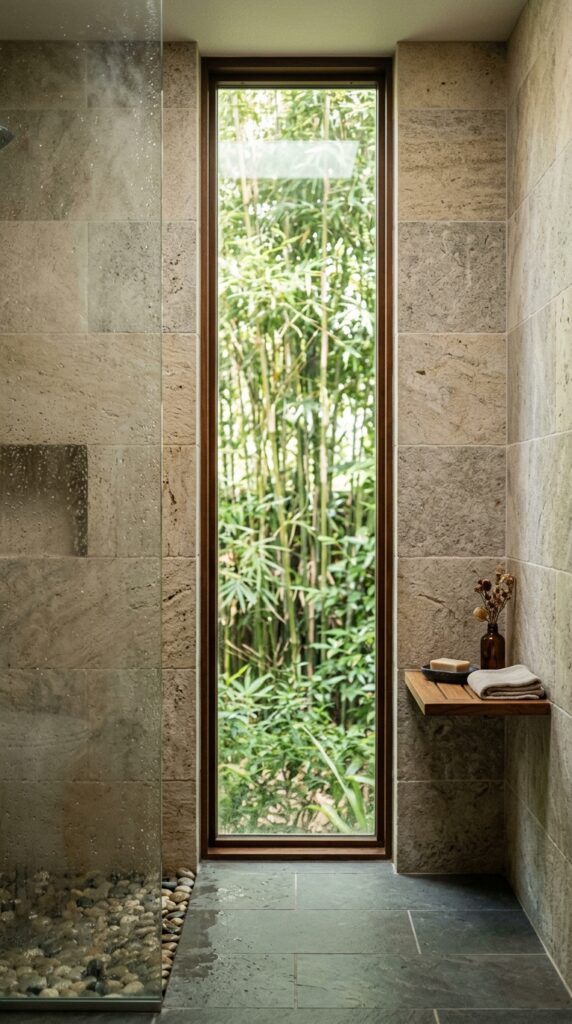
Vibe: Connected and still — the window that makes you aware of the outside world without letting it in.
Why it works: A narrow vertical window positioned to frame a specific view — bamboo, a garden tree, a stone wall — is the architectural gesture that most directly connects the Zen bathroom to its philosophical source: nature as the ultimate teacher and restorative environment. The narrowness of the window is deliberate: a wide window invites the entire landscape; a narrow window curates it into a single vertical image, like a hanging scroll. Positioned at shower height beside the shower head, this window allows bathing and nature viewing to happen simultaneously — the act of washing is experienced as participation in the garden rather than isolation from it.
How to get it: A narrow 8–12-inch vertical window can be added to most exterior bathroom walls without compromising structural integrity; consult a contractor for rough opening specifications. Position at eye level when standing (approximately 60–72 inches from floor to center) for the optimal shower-side view. Use frosted glass on the bottom half only if privacy from ground level is required.
🛍️ Shop the Look — Amazon Product Ideas
| # | Product Search Phrase | Why It Fits |
| 1 | Bamboo privacy screen outdoor garden 6ft panel | Exterior window view framing |
| 2 | Narrow vertical window privacy glass insert | Slim window glazing |
| 3 | Frosted glass film bottom half privacy window | Partial privacy window treatment |
| 4 | Lucky bamboo live plant indoor tall | Interior bathroom plant option |
| 5 | Japanese maple bonsai outdoor potted | Exterior window view plant |
19. Rainfall Shower Head with Pebble Shower Floor
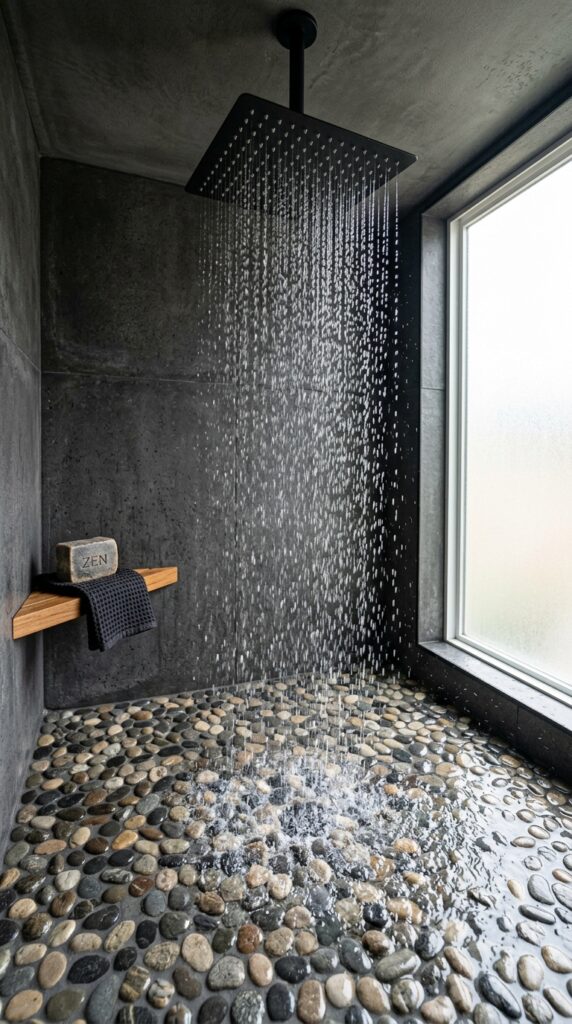
Vibe: Elemental — showering as standing in rain, with nothing between you and the sensation of water falling from above.
Why it works: A ceiling-mounted rainfall shower head paired with a pebble mosaic shower floor creates an experiential vertical axis: the water descends from directly above — as rain does — and lands on a floor whose irregular pebble texture sends it in many directions simultaneously, as a natural riverbed would. This sensory experience — water from above, irregular organic texture below, the sound of rainfall rather than a shower jet — is the closest a bathroom can come to bathing outdoors, which is the Zen bathing ideal. The large-format rainfall head (12×12 inches or larger) creates a curtain of water rather than streams, which is a categorically different experience from a standard shower head.
How to get it: Ceiling-mount rainfall heads require adequate water pressure — a minimum 45 PSI at the shower head for adequate flow. Install a pressure-balancing valve during the same plumbing visit. The pebble floor requires a shower floor with a steeper drain pitch (minimum 3/8-inch per foot) because irregular surfaces resist water flow more than flat tile.
🛍️ Shop the Look — Amazon Product Ideas
| # | Product Search Phrase | Why It Fits |
| 1 | Ceiling mount rainfall shower head 12 inch matte black | Core rain shower element |
| 2 | Natural pebble mosaic shower floor tile 12×12 | Organic floor texture |
| 3 | Pressure balancing shower valve with trim | Rainfall shower pressure control |
| 4 | Natural stone bar soap unscented | Minimal shower product |
| 5 | Teak corner shower shelf natural wood | Wet room storage accent |
20. Japanese Noren Doorway Curtain
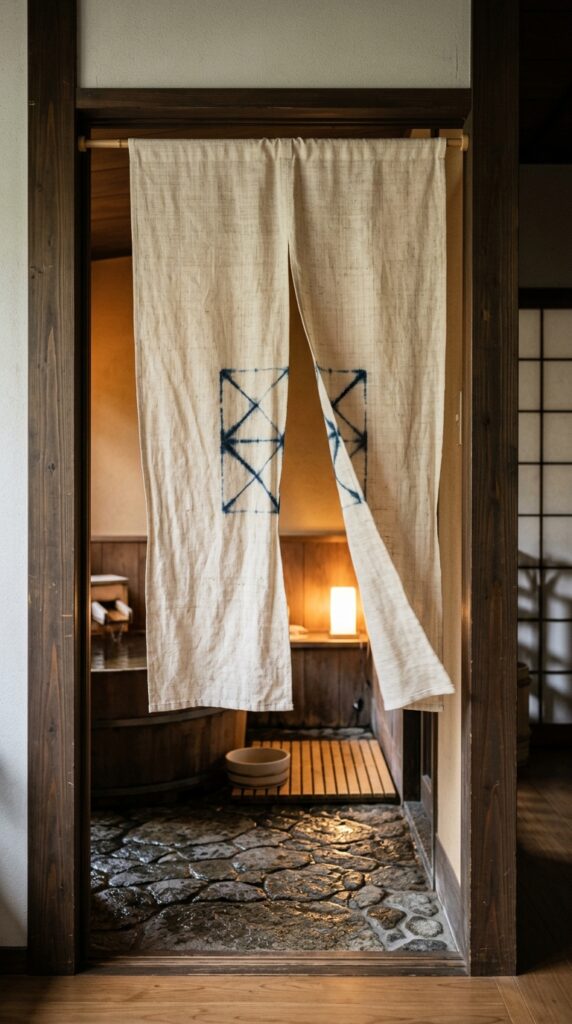
Vibe: Ceremonially separated — the threshold that asks you to change pace before entering.
Why it works: A noren — the split-panel doorway curtain of Japanese shopfronts and bathhouses — performs a specific psychological function in a Zen bathroom: it creates a threshold transition that signals the shift from daily activity to restorative ritual without the hard boundary of a closed door. The act of parting the curtain and stepping through is physically small and symbolically significant — it requires a moment of deliberate action, a small ceremony of entry. Undyed natural linen is the correct material because it admits light at the edges while maintaining the suggestion of privacy, which is the noren‘s ancient function: visible enough to signal occupancy, opaque enough to create refuge.
How to get it: A noren should hang at approximately 60% of the doorway height — not floor length, which would obstruct movement, but long enough to require a deliberate parting gesture. Mount on a natural wood curtain rod at the top of the door frame with no visible hardware on the fabric itself.
🛍️ Shop the Look — Amazon Product Ideas
| # | Product Search Phrase | Why It Fits |
| 1 | Japanese noren doorway curtain linen natural | Traditional threshold curtain |
| 2 | Shibori dye linen fabric panel natural | Hand-dyed noren fabric |
| 3 | Thin natural wood curtain rod tension | Noren mounting rod |
| 4 | Undyed cotton canvas doorway panel split | DIY noren alternative fabric |
| 5 | Japanese calligraphy ink brush for fabric | Noren personalization tool |
21. Minimalist Floating Shelf with Three Objects Rule
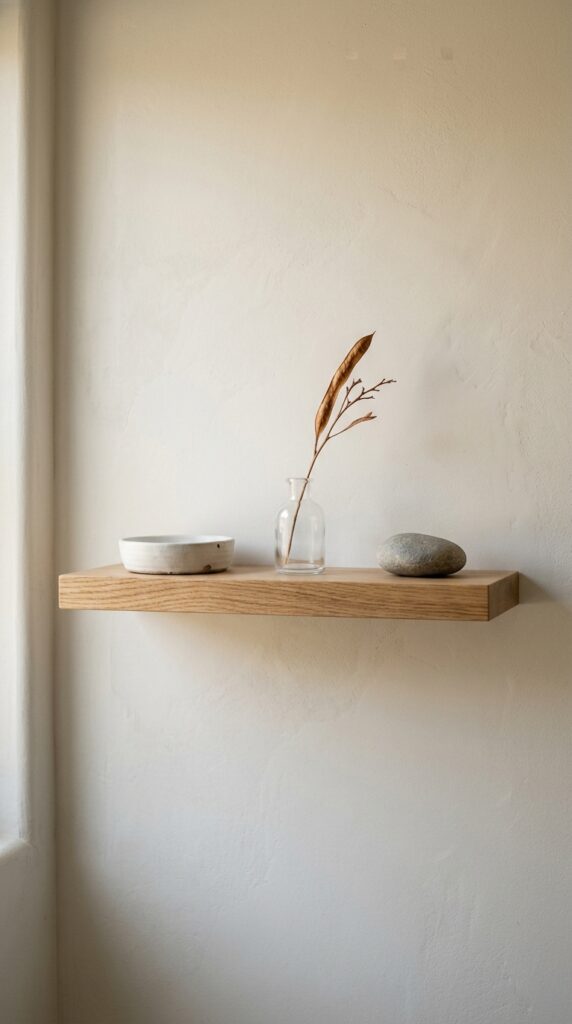
Vibe: Perfectly still — the shelf that teaches restraint by example.
Why it works: The three-object rule is the Zen bathroom’s fundamental curatorial principle, derived from Japanese tokonoma alcove composition: one tall vertical element, one horizontal or round element, one element that relates to nature. Three objects with adequate negative space between them create a still life that the eye can settle on completely; four or more objects begin to read as a collection that requires inventory. The floating shelf itself is almost invisible — thin profile, no visible brackets — which means the objects appear to hover, which amplifies their individual presence. This shelf is philosophy made physical: what you remove matters as much as what you keep.
How to get it: Install the shelf at 54–60 inches from the floor — the height at which objects are experienced at their most present, neither looking up at them nor down. Use blind shelf pins (steel rods embedded in the wall studs) rather than visible brackets. Space the three objects at unequal intervals — Zen composition avoids symmetry, which reads as artificial rather than natural.
💡 Quick Win: Clear every existing bathroom shelf of all objects. Place exactly three back. Notice what the space does. This costs nothing and is the fastest possible way to understand what a Zen bathroom is about.
🛍️ Shop the Look — Amazon Product Ideas
| # | Product Search Phrase | Why It Fits |
| 1 | White oak floating shelf thin 1 inch 18 inch | Minimal display shelf |
| 2 | Blind shelf pin steel rod set concealed | Invisible shelf mounting |
| 3 | Smooth gray river stone single large | Three-object nature element |
| 4 | Narrow bud vase ceramic matte white 6 inch | Three-object vertical element |
| 5 | Matte ceramic shallow dish minimal white | Three-object horizontal element |
22. Deep Charcoal Grout with Light Stone Tile
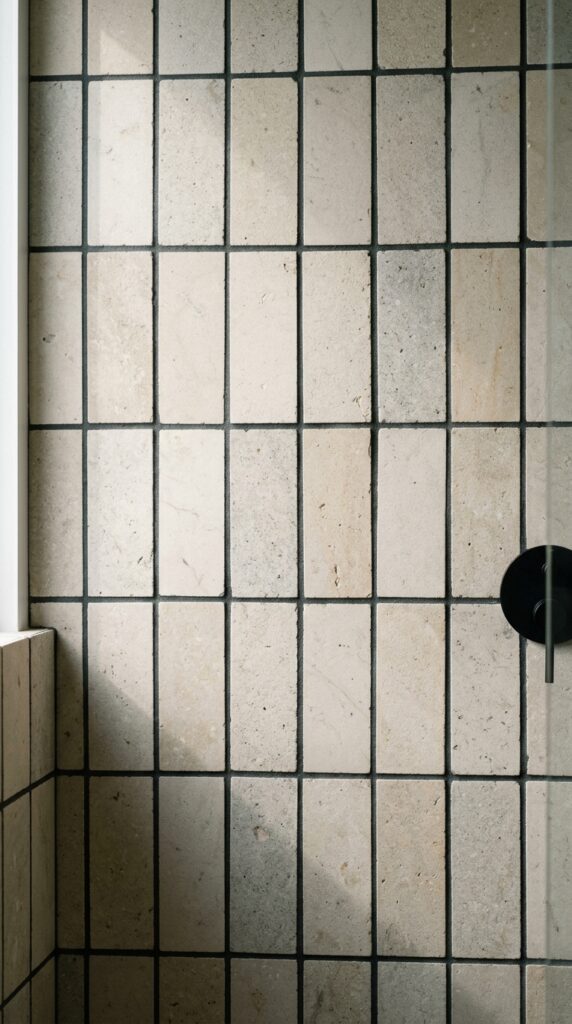
Vibe: Graphic and elemental — a surface that turns the utilitarian necessity of grout into a design decision.
Why it works: Dark grout with light tile is the Zen bathroom’s most understated material choice and one of its most powerful: the grout joint becomes a deliberate graphic element rather than a neutral gap between tiles, drawing a precise grid across the wall surface that references Japanese shoji screen geometry. The slight shadow cast by the grout recessing below the tile face adds dimensionality to the wall — when light rakes across it, the surface reads as subtly three-dimensional rather than flat. This technique works in a Zen bathroom specifically because it finds beauty in the structural necessity of grout lines rather than trying to minimize or match them.
How to get it: Specify a 3/16-inch grout joint — wide enough for the charcoal grout to read clearly but narrow enough to maintain the tile as the primary surface. Use sanded charcoal grout with a polymer additive for stain resistance. Apply a penetrating grout sealer in a matte finish within 72 hours of installation to prevent discoloration.
🛍️ Shop the Look — Amazon Product Ideas
| # | Product Search Phrase | Why It Fits |
| 1 | Charcoal dark gray sanded tile grout 10lb | Graphic grout color |
| 2 | Warm limestone ceramic wall tile 4×12 | Light tile surface |
| 3 | Penetrating grout sealer matte finish | Grout protection treatment |
| 4 | Grout float professional rubber tile | Grout application tool |
| 5 | Tile spacers 3/16 inch T-shape plastic | Consistent joint width |
23. Small Zen Bathroom: One Material, One Plant, One Light
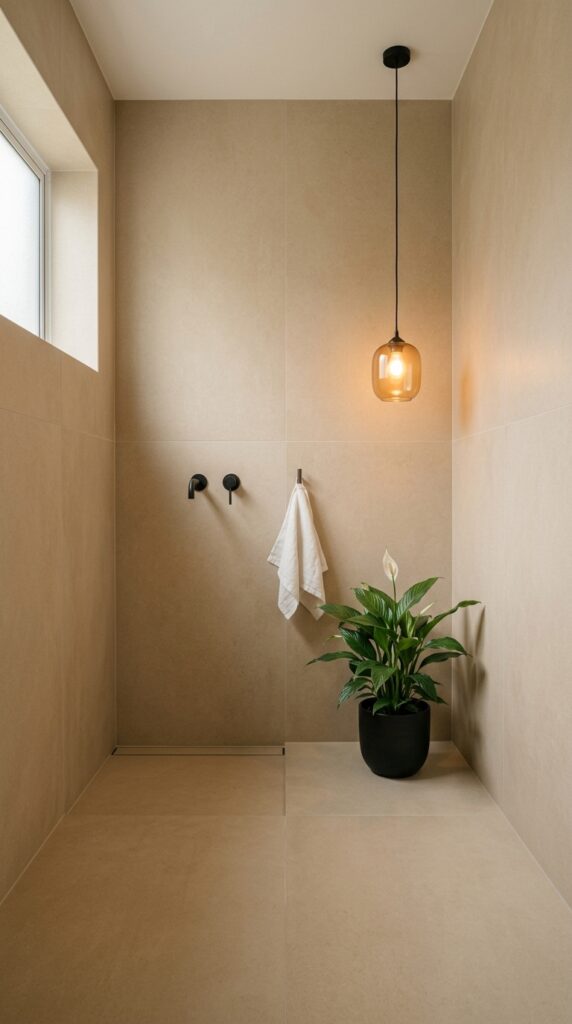
Vibe: Complete and utterly spare — the bathroom that proves the philosophy rather than just applying the aesthetic.
Why it works: The one material, one plant, one light concept is the Zen bathroom reduced to its irreducible core — and it works in a small bathroom precisely because a small space can sustain only what is essential before tipping into clutter. Running the same large-format matte tile on both the floor and walls eliminates every material transition and visual interruption, making the room read as a single continuous surface — a cave or a vessel — rather than a room assembled from parts. The single living plant introduces organic life and greenery without decoration. The single pendant provides warm, sourceless ambient light. These three decisions are all that is required to achieve a Zen bathroom. Everything else is commentary.
How to get it: Select a tile in a 24×24-inch format for both floor and wall — the larger the format, the fewer the grout lines, the more continuous the surface reads. Use the same tile on both surfaces and the same grout color in both locations so the floor-wall transition is invisible. A kokedama (Japanese moss ball) or peace lily are ideal plant choices: both thrive in the warm humidity of a bathroom with indirect light.
🛍️ Shop the Look — Amazon Product Ideas
| # | Product Search Phrase | Why It Fits |
| 1 | Large format matte porcelain tile warm sand 24×24 | Continuous floor-wall material |
| 2 | Peace lily live plant indoor low light | Bathroom-thriving plant |
| 3 | Kokedama moss ball kit Japanese live plant | Zen botanical living form |
| 4 | Matte black ceramic plant pot low wide 6 inch | Plant vessel for bathroom |
| 5 | Single pendant light warm amber glass minimal | One Zen light source |
How to Start Your Zen Bathroom Transformation
The single best first move is to clear every surface in your bathroom completely — every product bottle, every decorative object, every item that does not have a specific daily function — and live with the empty surfaces for 48 hours before adding anything back. This is not a decorating step; it is a diagnostic one. The Zen bathroom is built on intentional absence, and you cannot know what to add until you understand what the room feels like with nothing in it. What you discover in those 48 hours — which materials need addressing, what the light is actually doing, how the room functions at its baseline — is the specific design brief for your transformation.
The most common mistake in Zen bathroom design is applying the aesthetic vocabulary — a branch here, some pebbles there, a bamboo accessory — without addressing the underlying material and lighting conditions. A cluttered bathroom with poor lighting that has a single ikebana arrangement is not a Zen bathroom; it is a bathroom with a Japanese object in it. The material foundation must come first: warm-toned lighting (swap bulbs to 2700K immediately), a cleared and wiped-down surface palette, and the removal of anything with visible branding or packaging. These three actions cost nothing and must precede any purchase.
Three specific items under $50 that create immediate Zen bathroom impact: a set of three matching matte ceramic soap/dispenser vessels to replace existing branded product bottles ($22–35 for a coordinated set), a single preserved moss wall panel in a thin natural wood frame to mount above the toilet or vanity ($18–28), and a bamboo bath mat to replace a standard fabric bathmat ($12–20). Each of these replaces something that was already present with a material upgrade — no new objects, just better objects.
A focused weekend effort can achieve: cleared and cleaned surfaces, warm bulb swap, two ceramic accessory swaps, a preserved moss panel installed, and a new bamboo mat in place. This constitutes a 50% Zen transformation at a budget of $60–120. A more invested approach — floating vanity, vessel sink, matte black fixtures, and a pebble floor mosaic — runs $1,200–3,500 depending on scope and whether plumbing is involved. A full Zen bathroom renovation with wet room, cedar decking, concrete walls, and custom fixtures typically runs $8,000–20,000 and represents a 3–6-month project.
Frequently Asked Questions About Zen Bathroom Design
What is the difference between a Zen bathroom and a Japanese bathroom?
A Japanese bathroom (ofuro room) is a specific functional configuration: a wet room with a separate soaking tub, a low shower area for pre-wash before soaking, and tile or concrete surfaces throughout — the function of bathing and soaking are given separate spatial zones. A Zen bathroom is a design philosophy applied to any bathroom configuration — it draws from Japanese aesthetic principles (wabi-sabi, ma, natural materials) but is not bound to the Japanese functional format. You can create a Zen bathroom in a Western-format bathroom with a standard tub-shower combination by applying the principles of material restraint, warm neutrals, negative space, and organic elements without any structural changes.
What colors belong in a Zen bathroom?
The Zen bathroom palette is drawn entirely from nature’s most neutral register. Warm white (not cool white — look for paint colors with yellow or red rather than blue undertones), warm greige (Benjamin Moore “Pale Oak” or Sherwin-Williams “Accessible Beige”), charcoal with brown undertones (Farrow & Ball “Off Black”), soft moss green, dusty sand, and the natural tones of unfinished wood (white oak honey, teak golden brown, hinoki cedar warm ivory) are the complete palette. The guiding rule is that every color in a Zen bathroom should be findable in a natural landscape — stone, soil, bark, moss, water, sand. No synthetic colors, no bold saturation, no cool blue-gray that reads as commercial.
How much does a Zen bathroom renovation cost?
Cost scales dramatically with whether structural work is involved. A cosmetic Zen transformation — paint, new fixtures, ceramic accessories, lighting swap, a vessel sink, and a floating vanity — typically runs $800–2,500 for a standard bathroom. A mid-range renovation that adds a wet room conversion, pebble floor, cedar decking, and concrete wall micro-topping runs $4,000–9,000. A full Zen bathroom with custom hinoki tub, bespoke concrete walls, integrated cove lighting, and floor-to-ceiling frosted glass panels typically costs $15,000–35,000. The highest-value upgrades per dollar spent are consistently lighting (bulb swap to 2700K: under $20), fixture finish replacement (matte black hardware: $150–300 for a complete bathroom), and surface clearing (free).
Can a rented bathroom be made to feel Zen?
Yes — and the constraints of renting align naturally with the Zen philosophy of working with what exists rather than imposing a new vision. The most effective damage-free Zen upgrades for renters are: replacing light bulbs with 2700K warm amber LEDs ($15), adding a preserved moss panel to the wall with adhesive strips ($25), replacing the bathmat with bamboo or natural stone ($20–40), decanting all products into matching matte ceramic vessels ($30–50), adding a single ikebana branch in a low vessel ($15), and hanging a noren linen curtain in the doorway ($25–40). These six changes cost under $175 total, are fully reversible, and transform the atmosphere of a rental bathroom into something approaching Zen without touching a single wall, fixture, or fitting permanently.
What plants thrive in a Zen bathroom environment?
The Zen bathroom’s warm, humid, low-to-medium light conditions suit a specific group of plants that also align visually with the aesthetic. Peace lily (Spathiphyllum) is the most tolerant and produces elegant white flowers that suit the minimal palette. Moss balls (kokedama) are a specifically Japanese form — a plant root wrapped in living moss — that are both botanically appropriate and philosophically resonant. Lucky bamboo in a narrow ceramic vessel is the iconic Zen bathroom plant, thriving in water alone. Japanese forest grass (Hakonechloa macra) provides flowing organic line in bright indirect light. Air plants (Tillandsia) require only misting and no soil, which makes them ideal for shelf placement anywhere in the room.
Ready to Create Your Dream Zen Bathroom?
From honed black granite floors and hinoki soaking tubs to preserved moss panels, crackle-glaze ceramics, single-branch ikebana, and the radical restraint of one material, one plant, one light, these 23 concepts span the complete spectrum of what a Zen bathroom can be — from a cosmetic transformation achievable in a weekend to a full architectural renovation that changes the entire experience of bathing. The most important realization is that Zen design is not additive — it is not a matter of finding the right objects to add — it is subtractive, a practice of deciding what to remove until only what is essential remains. Start today by clearing one surface completely and leaving it clear. That empty surface is not a problem to solve. It is the beginning of the practice.