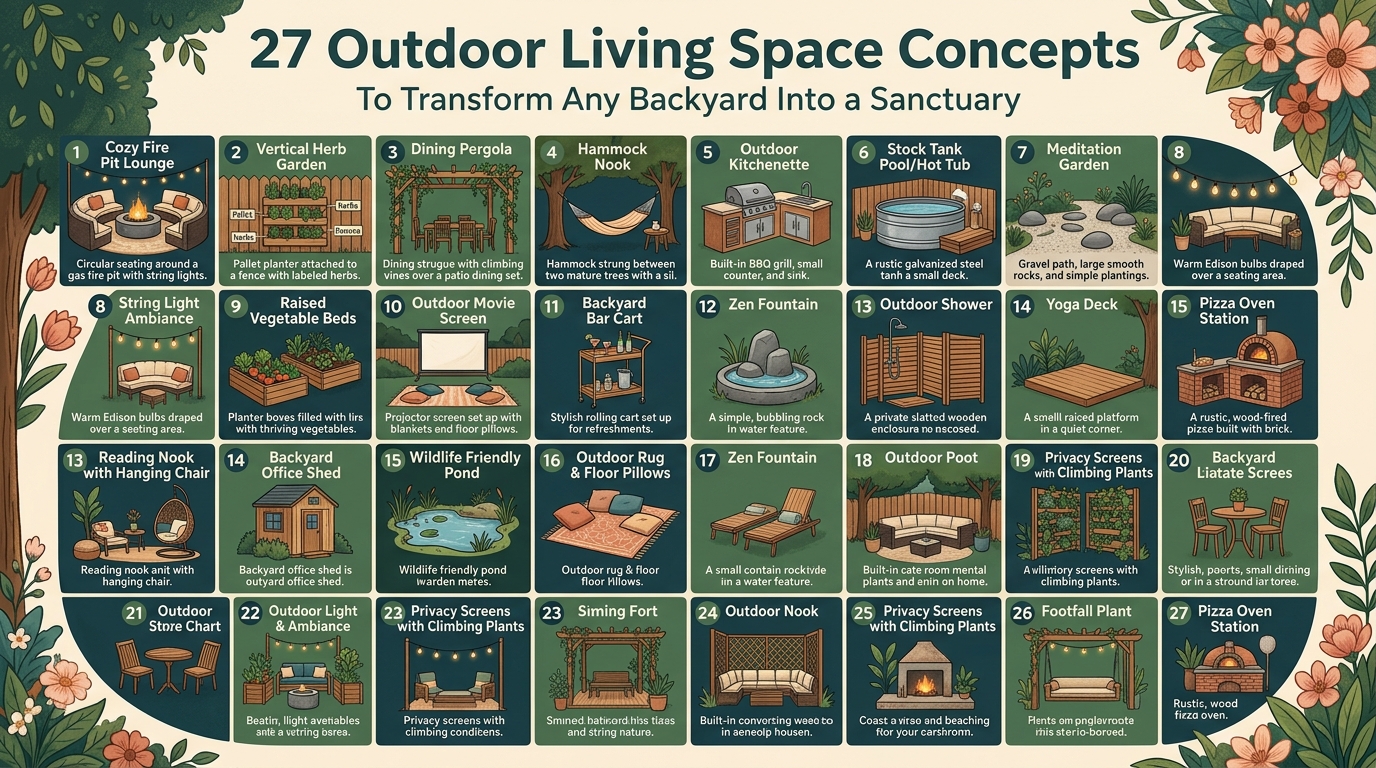
Outdoor living spaces are intentional extensions of the home — designed zones for cooking, lounging, dining, and gathering that function as true rooms under the sky. This article gives you 27 distinct outdoor living space concepts organized by category: color, material, lighting, furniture, accessories, layout, and small-space design.
There’s a particular kind of contentment that settles over you when a backyard stops being just a yard. When the air smells faintly of cedar and charcoal, when the string lights click on at dusk and the linen throws are already draped over the chairs — that’s when outdoor living becomes something you actually live in, not just walk through. It’s layered and deliberate. It rewards patience. Here are 27 ideas worth saving — and stealing.
Why Outdoor Living Space Design Works So Well
Outdoor living has roots in Mediterranean courtyard culture, Japanese garden philosophy, and the mid-century California indoor-outdoor movement — all traditions that refused to accept the wall between interior and exterior as a hard boundary. What distinguishes a designed outdoor living space from a random collection of patio furniture is intentionality: zones are defined, materials are chosen for both texture and weather resistance, and the transition from indoors to out feels continuous rather than jarring.
The material palette of high-performing outdoor spaces is grounded and specific: teak, ipe, and powder-coated steel for structural pieces; Sunbrella-grade linen, solution-dyed acrylic, and outdoor canvas for textiles. Colors lean toward the earth — warm sand, terracotta, smoky sage, weathered charcoal, and bleached bone — because those tones don’t fight the sky or the garden; they complement both.
The cultural momentum behind outdoor living is unmistakable. Post-2020, people rebuilt their relationship to home in radical ways. The backyard became the third room — office, gym, dining room — and that habit stuck. Pinterest searches for “outdoor room ideas” have grown steadily, reflecting a genuine shift in how people prioritize usable outdoor square footage over purely manicured aesthetics.
Small patios and balconies are absolutely capable of achieving this look. The key for compact spaces is choosing one anchor piece — a loveseat, a dining table for two, a single fire bowl — and building outward from it. Resist the urge to fill every inch. Negative space reads as intention in small outdoor rooms.
Style at a Glance
| Element | Trait 1 | Trait 2 |
| Philosophy | Indoor comfort, outdoor freedom | Functional zoning |
| Materials | Teak, concrete, steel, linen | Stone, rattan, cedar |
| Color palette | Warm sand, sage, terracotta | Charcoal, bleached bone |
27 Outdoor Living Space Concepts
1. Warm Terracotta Palette Patio
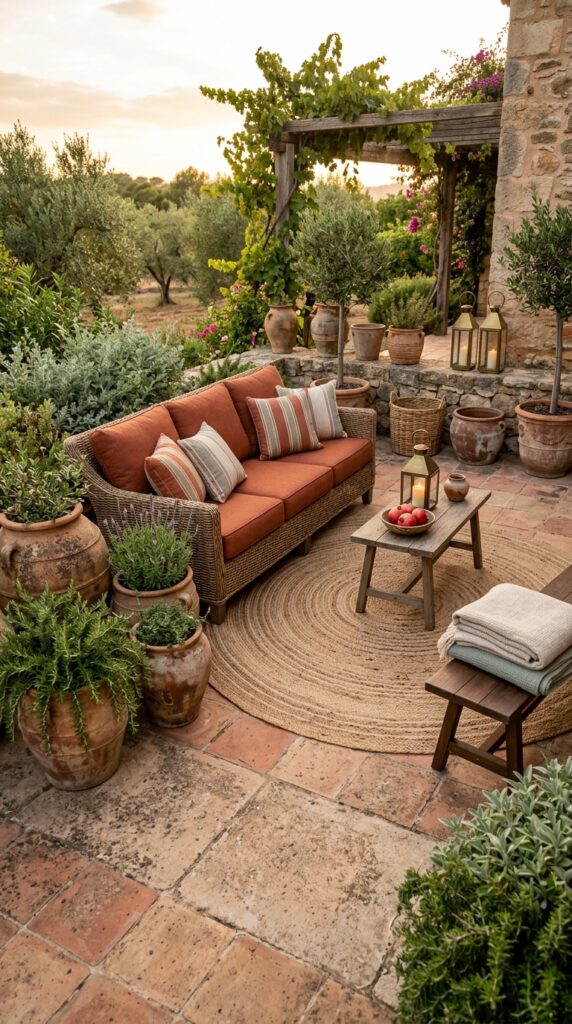
Vibe: Sun-warmed and richly grounded, this palette feels like a Tuscan courtyard that arrived without asking.
Why it works: Terracotta and warm sand operate on analogous color theory — they share orange-yellow undertones, which creates visual harmony without monotony. The key is grounding that warmth with matte charcoal or dusty sage so the space doesn’t read as a single, flat tone. Weathered clay surfaces absorb light rather than reflecting it, which gives the space depth at every hour of the day.
How to get it: Start with a rust-toned Sunbrella cushion cover in a fabric like Sunbrella Canvas Rust (color code 5432) and build upward. Add graduated clay pots — grouping three different sizes in the same terracotta family creates a sculptural cluster that needs no flowers to be interesting.
💡 Quick Win: A single large terracotta pot from a garden center, planted with a trailing rosemary or olive, costs under $30 and instantly establishes the palette.
| Shop The Look |
| Terracotta outdoor throw pillow cover set Sunbrella fabric |
| Jute outdoor area rug 5×8 natural woven |
| Aged brass lantern set outdoor tabletop |
| Matte charcoal ceramic outdoor planter large |
| Clay colored outdoor seat cushion set weatherproof |
2. Teak and Linen Lounge Zone
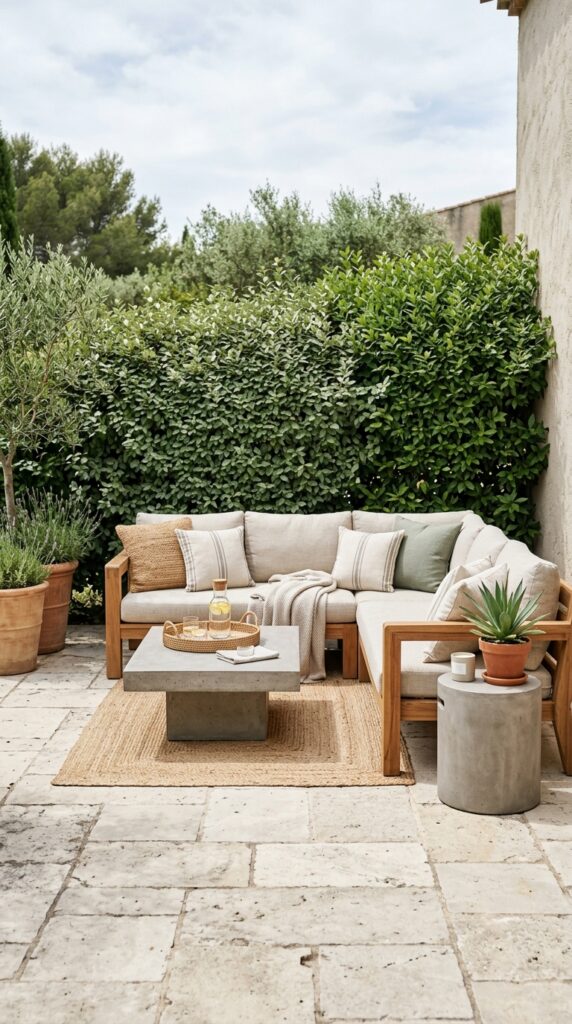
Vibe: Hushed and refined, with the particular calm that comes from knowing every material in the space was chosen to age well.
Why it works: Teak is the benchmark outdoor hardwood precisely because its natural oils resist warping, cracking, and insect damage without treatment. Paired with bleached-linen-toned Sunbrella fabric, the combination hits a neutral warmth that doesn’t require color accents to feel complete. The grain of teak and the weave of linen work as complementary textures — both organic, neither competing.
How to get it: Buy teak furniture that has been air-dried rather than kiln-dried if possible — it will grey more gradually and evenly over seasons. For cushion fabric, look for solution-dyed acrylic in Natural or Antique Beige colorways, which won’t fade unevenly under UV exposure.
| Shop The Look |
| Teak outdoor sofa loveseat natural wood |
| Outdoor linen look cushion set weather resistant |
| Concrete look outdoor side table modern |
| Woven seagrass serving tray large outdoor |
| Potted agave artificial outdoor plant realistic |
3. String Light Canopy Overhead
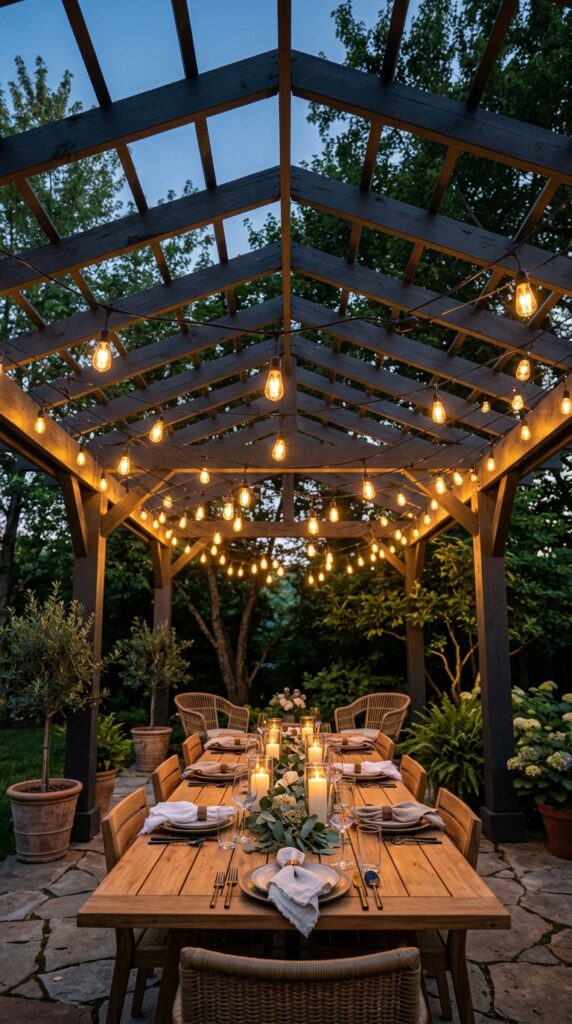
Vibe: Layered and amber, the kind of light that makes every conversation feel unhurried.
Why it works: String lights work on the principle of distributed low-level illumination — dozens of low-wattage points of light instead of one harsh overhead source. This scatters shadows softly rather than creating hard contrasts, which is why outdoor dining spaces lit this way photograph so well and feel so relaxed in person. The overhead plane defined by the lights also creates an implied “ceiling” that makes an open-air space feel like a room.
How to get it: Hang lights at no less than 8 feet above the table surface — below that, the bulbs enter your sightlines when seated and create glare. Space anchor points every 24 to 36 inches across the pergola beams to prevent excessive sagging between spans.
💡 Quick Win: Solar-powered Edison string lights with a remote timer cost under $35 and require no outlet — ideal for patios without exterior wiring.
| Shop The Look |
| Edison string lights outdoor weatherproof 50 ft |
| Solar powered outdoor string lights timer remote |
| Teak outdoor dining table 6 person rectangle |
| Pillar candle set outdoor unscented ivory |
| Linen outdoor table runner natural beige |
4. Concrete and Steel Industrial Patio
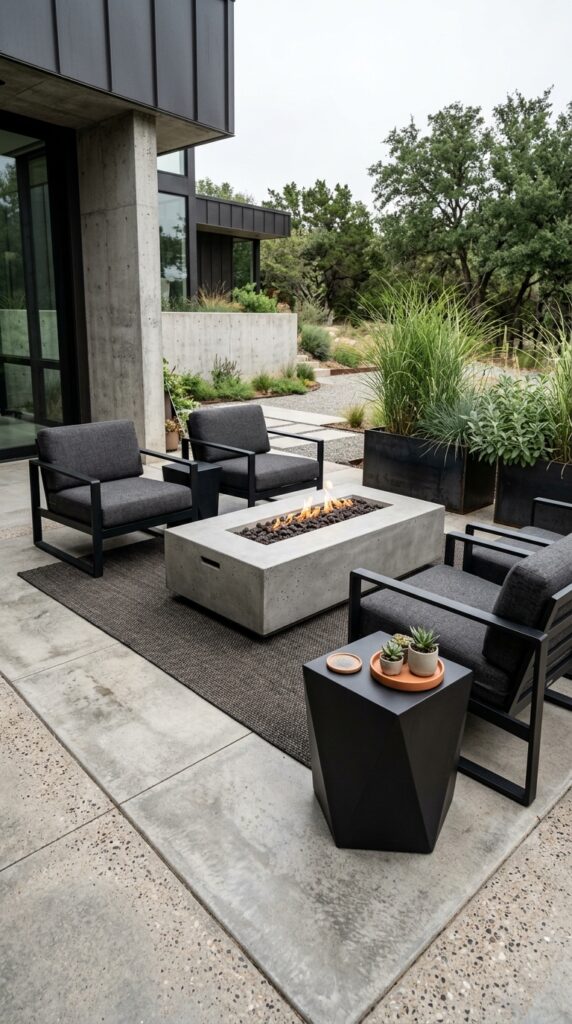
Vibe: Raw and architectural, this space uses restraint as its primary design tool.
Why it works: Industrial outdoor design borrows its logic from contrast: the roughness of concrete against the precision of welded steel, the hardness of both materials offset by living plants. Powder-coated steel in matte black doesn’t absorb heat the way dark-painted surfaces do, and it weathers with a consistent finish that actually improves with minor surface patination over time. Cast concrete, whether poured in place or as pavers, provides visual weight that grounds lighter furniture pieces.
How to get it: Use black steel planters with architectural plants — ornamental grasses, agave, or columnar arborvitae — rather than soft flowering annuals. The botanical choice should match the material language of the space.
| Shop The Look |
| Powder coated steel outdoor lounge chair matte black |
| Cast concrete fire table outdoor propane |
| Black steel rectangular planter outdoor large |
| Concrete look porcelain outdoor tile set |
| Steel outdoor side table industrial modern |
5. Layered Textile Bohemian Terrace
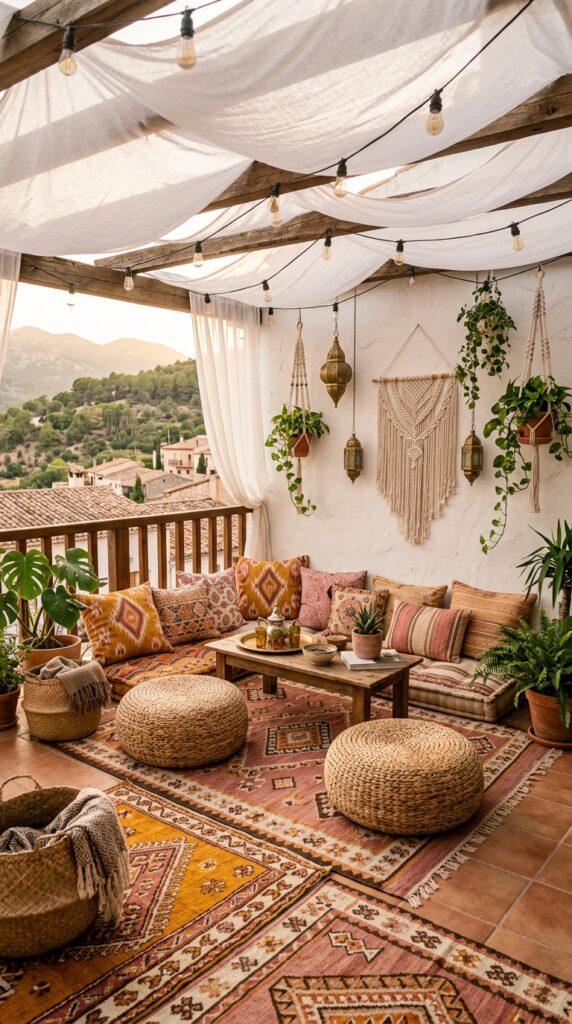
Vibe: Layered and luminous, with that particular richness that only comes from accumulated textiles.
Why it works: Bohemian outdoor spaces use textile layering as their primary spatial tool — rugs over rugs, cushions over cushions — which creates visual depth and tactile richness that hard furniture alone can’t replicate. The key design principle is tonal range: anchor the layering with one neutral (warm ivory or sand) and let the pattern pieces in saffron, dusty rose, or ochre provide the color story. Too many equal-intensity colors create chaos; one dominant neutral plus two accent tones creates movement.
How to get it: Start with a flatweave outdoor rug in a kilim-inspired pattern as your base layer, then add a smaller jute or cotton braid mat on top for depth. All outdoor rugs should be made from polypropylene or solution-dyed material to resist mildew in layered configurations.
💡 Quick Win: A macramé wall hanging in weathered cotton rope costs $25–45 online and adds the essential boho texture without furniture investment.
| Shop The Look |
| Kilim pattern outdoor rug flatweave polypropylene |
| Rattan outdoor floor pouf round large |
| Macramé wall hanging outdoor cotton rope |
| Embroidered outdoor cushion cover set saffron |
| Sheer white outdoor canopy fabric panel |
6. Symmetrical Outdoor Seating Layout
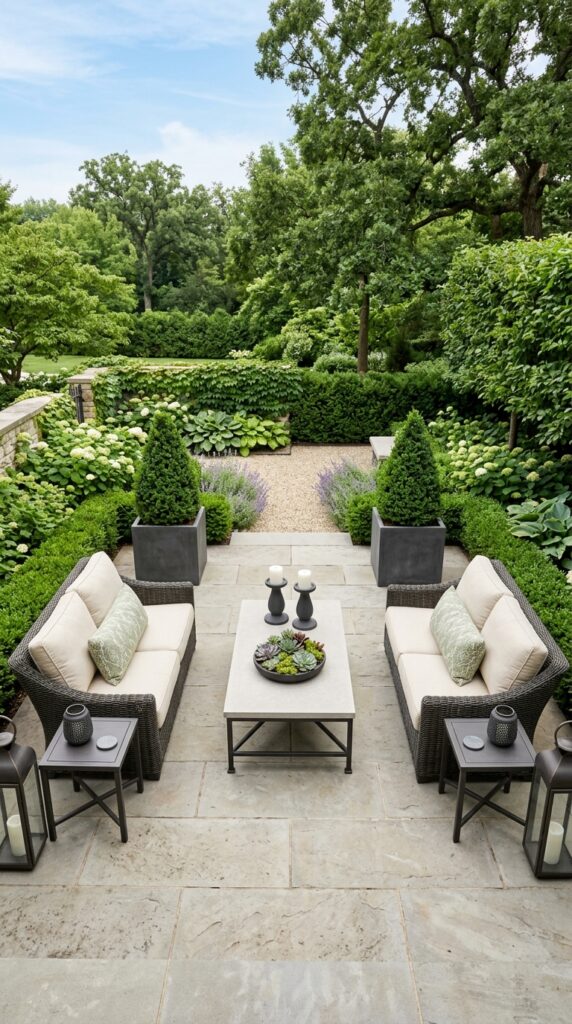
Vibe: Still and composed, with the kind of formal calm that signals the space was designed rather than assembled.
Why it works: Bilateral symmetry is one of the oldest organizing principles in garden and courtyard design — it creates an immediate sense of order and rest because the eye resolves the layout in one glance rather than scanning. Two identical loveseats facing each other across a low table establishes conversation-friendly proportions: guests face each other at roughly 5 to 6 feet of separation, which is the ideal social distance for outdoor dining without shouting. Matching flanking elements — topiaries, lanterns, side tables — reinforce the axis.
How to get it: The central coffee table should sit 14 to 18 inches below seated eye level and 16 inches from the front edge of each sofa — close enough to reach drinks without leaning, not so close that it crowds leg room.
| Shop The Look |
| Outdoor loveseat sofa set linen weatherproof matching pair |
| Square limestone look outdoor coffee table |
| Boxwood topiary ball artificial outdoor UV resistant |
| Square cement outdoor planter modern |
| Outdoor floor lantern set matching pair large |
7. Pergola Shade Structure with Climbing Vines
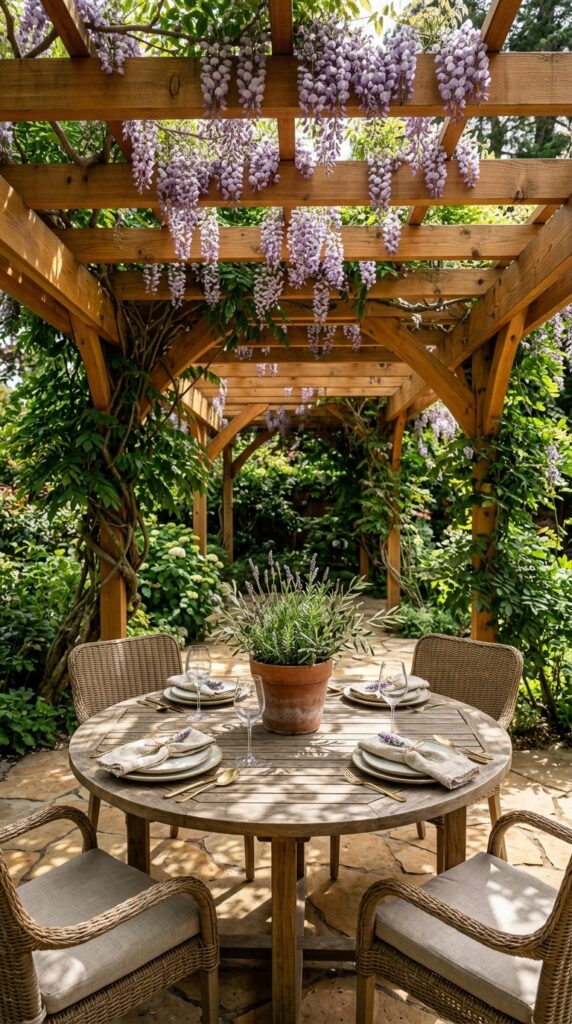
Vibe: Lush and dappled, the kind of shade that feels earned rather than manufactured.
Why it works: A pergola solves the hardest problem in outdoor living design — creating the psychological enclosure of a room without blocking airflow or blocking sky. Climbing vines like wisteria, climbing roses, or jasmine take this further by softening the structural geometry of the beams with organic, seasonal growth. The dappled light that filters through a vine-covered pergola is one of the most beloved lighting conditions in outdoor design precisely because it’s dynamic — it shifts with the sun and the breeze.
How to get it: Attach horizontal wire guides to the inner faces of the pergola beams every 18 inches before planting vines — this gives climbing plants purchase without damaging the wood, and keeps growth directional rather than tangled.
💡 Quick Win: Even a pergola kit without vines benefits from a length of outdoor curtain panels hung from the beams on each side — two linen panels per side create enclosure and shade for under $60.
| Shop The Look |
| Cedar pergola kit freestanding 10×12 outdoor |
| Outdoor linen curtain panel set natural beige |
| Round outdoor dining table teak or acacia |
| Wisteria artificial garland outdoor UV resistant |
| Hand-thrown ceramic outdoor dinnerware set |
8. Fire Pit Conversation Circle
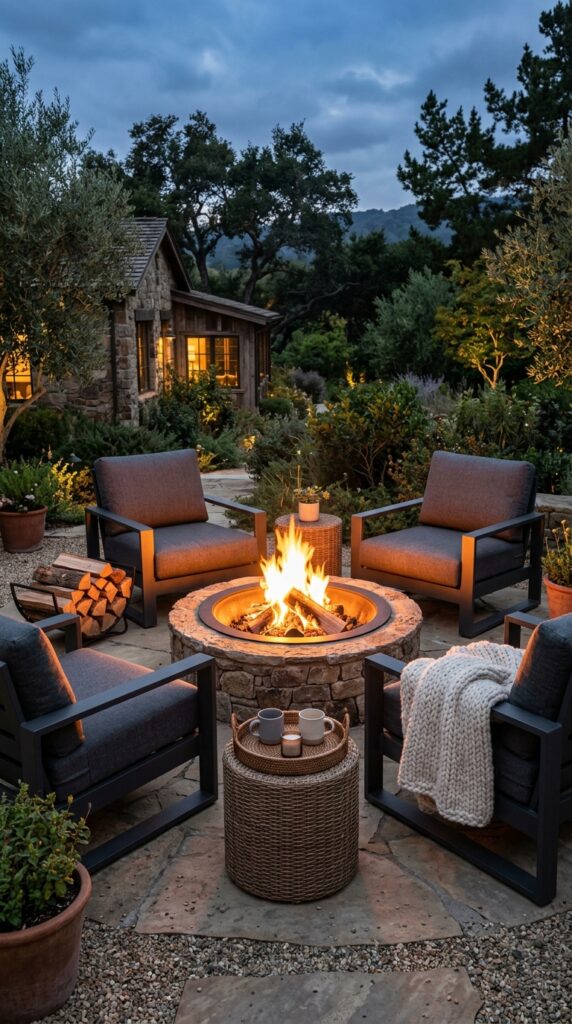
Vibe: Intimate and amber-lit, with the primal ease that comes from gathering around something warm.
Why it works: The circular arrangement around a central fire pit is the most archetypal form of human gathering — every culture across history has built social life around a central heat source. In contemporary outdoor design, this translates into a seating radius of roughly 5 to 6 feet from the center of the fire pit, which places occupants close enough to share warmth without catching sparks. Deep-seat armchairs (seat depth 24 inches minimum) with high armrests encourage the kind of slouched, relaxed posture that signals “we’re staying.”
How to get it: The fire pit itself should sit 12 to 18 inches above grade — low enough to see faces over it, high enough to contain embers safely. A 36-inch diameter fire bowl is the right size for a four-chair circle; 44-inch is the maximum before the center begins to feel too far away.
| Shop The Look |
| Round wood burning fire pit 36 inch outdoor |
| Deep seat outdoor armchair set of 4 charcoal |
| Outdoor deep seat cushion set charcoal weatherproof |
| Wicker outdoor tray round large |
| Chunky knit outdoor throw blanket ivory |
9. Rattan and Wicker Coastal Porch
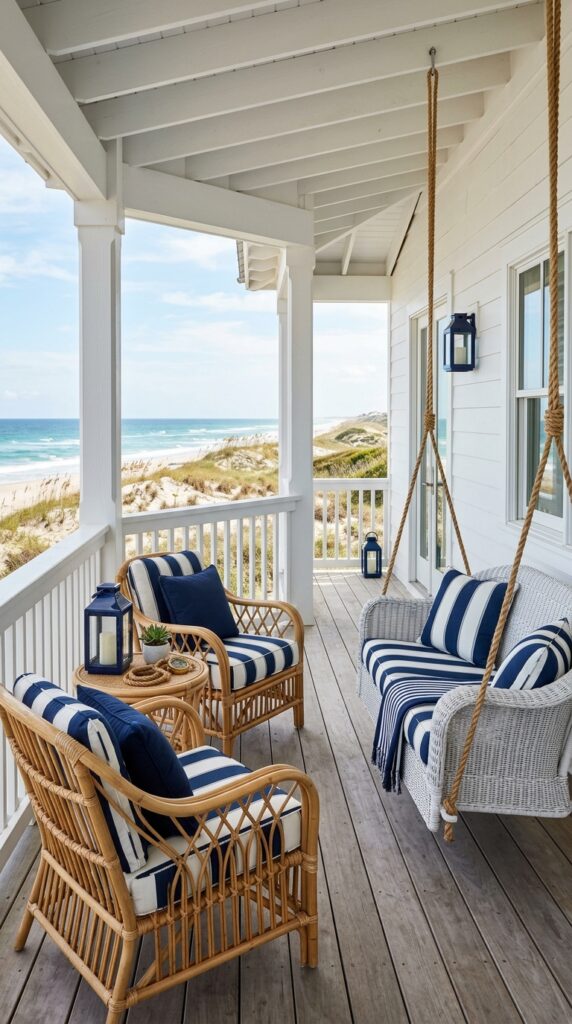
Vibe: Airy and salt-bleached, with that coastal ease that makes you feel like you should be holding something cold.
Why it works: Natural rattan is an inherently coastal material — it’s lightweight, it moves slightly in a breeze, and its honey-to-amber tonal range reads warm against white architecture without competing with it. The stripe — navy and white, or ocean-toned stripe patterns — is the most legible color story for a coastal porch because it references maritime tradition while giving the eye a clear rhythm. Whitewashed or painted wicker lightens the visual weight of the material and ties it to white architecture.
How to get it: For all-weather performance, look for “all-weather wicker” or resin rattan rather than natural rattan for any furniture that will be exposed to rain — natural rattan deteriorates quickly without a covered porch. Cushion fabric should be Sunbrella or equivalent in solution-dyed acrylic.
💡 Quick Win: A rope doormat in natural jute under $20 at any hardware store immediately establishes the coastal material palette at the entrance.
| Shop The Look |
| Outdoor rattan armchair all-weather wicker natural |
| Porch swing cushion set navy stripe weatherproof |
| Wicker porch swing whitewash finish |
| Navy outdoor ceramic lantern set |
| Jute rope outdoor doormat natural |
10. Vertical Garden Living Wall
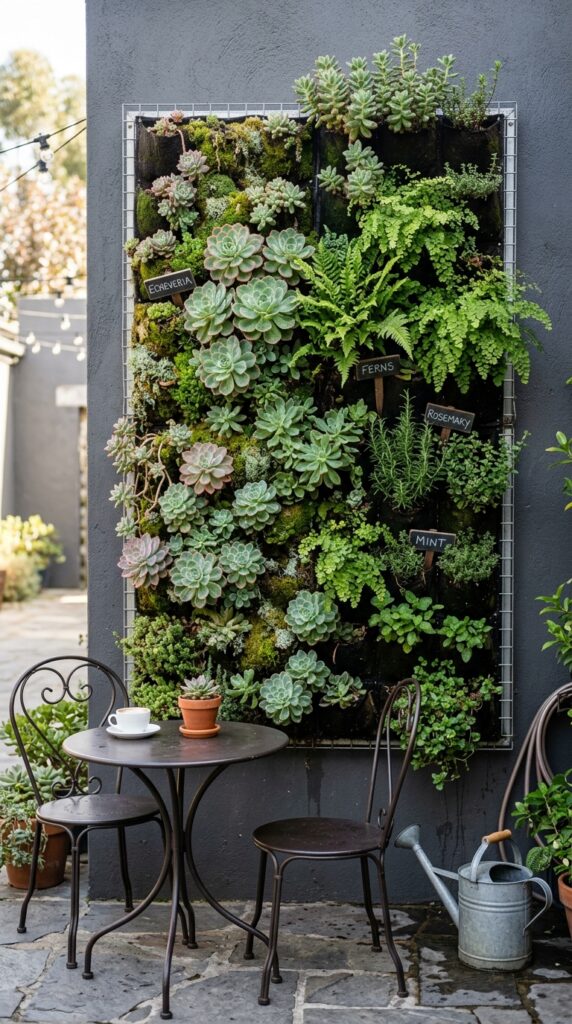
Vibe: Lush and alive, like a garden that decided to move indoors and brought the wall with it.
Why it works: A living wall solves the eternal small patio problem of wanting greenery without losing floor space. The design principle at play is vertical surface activation — transforming a dead visual plane into the most interesting element in the space. Trailing and rosette-forming plants (succulents, ferns, trailing pothos, herbs) work best in wall planters because their growth habits complement the vertical plane rather than fighting it.
How to get it: Modular felt pocket systems are the most beginner-friendly entry point — they mount directly to fence posts or masonry walls with screws and expand section by section. Begin with a 3×3 grid of drought-tolerant succulents: they require no irrigation system and survive periods of neglect.
| Shop The Look |
| Modular vertical garden planter wall mounted outdoor |
| Succulent assortment mix plants outdoor |
| Self-watering wall planter insert pocket system |
| Weathered grey outdoor wall planter row |
| Herb garden label set chalk markers outdoor |
11. Neutral Greige and Driftwood Palette
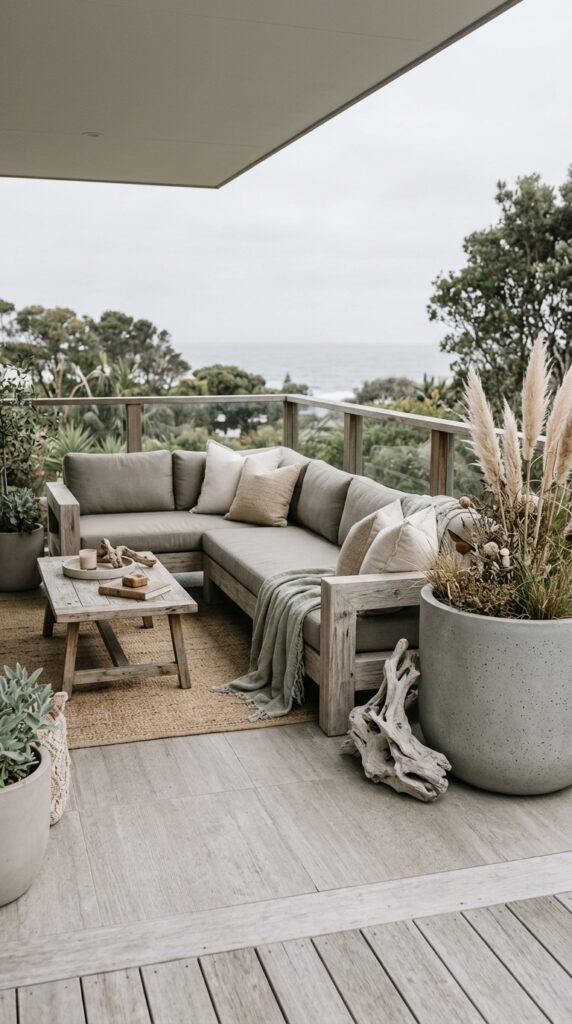
Vibe: Luminous and hushed, the color equivalent of a long exhale.
Why it works: Greige — the grey-beige midpoint — is one of the most successful outdoor palette anchors because it sits at the tonal center of nearly every natural material: it reads warmer than grey in morning light and cooler than beige at midday. When every element in a space shares this tonal territory, the space achieves the designer’s ideal of “no mistakes” — nothing clashes because nothing contrasts dramatically. Bleached wood (teak or acacia left to weather, or limewashed oak) brings the warmth; concrete anchors the cool.
How to get it: Limewash or whitewash a single piece of older outdoor furniture — a side table or bench — to achieve the bleached-wood tone without buying new. Apply diluted white exterior paint (1:2 paint to water ratio) and wipe off before it dries fully.
💡 Quick Win: Dried pampas grass stems in a large concrete pot cost under $15 and deliver instant greige-palette botanical texture with zero maintenance.
| Shop The Look |
| Bleached wood outdoor coffee table driftwood finish |
| Greige outdoor seat cushion set linen texture |
| Large concrete patio planter minimalist |
| Pampas grass dried stems tall natural |
| Stonewashed outdoor throw blanket ivory grey |
12. Built-In Outdoor Kitchen Concept
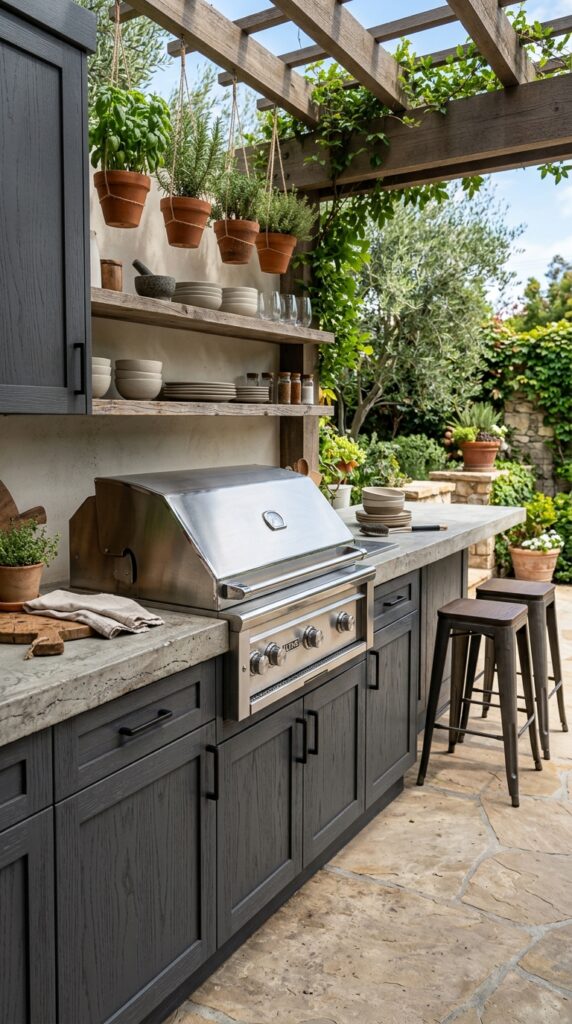
Vibe: Functional and confident, built for the person who entertains outside more than in.
Why it works: A built-in outdoor kitchen creates spatial permanence — it signals that this space was planned, not improvised. The design principle is the kitchen work triangle applied outdoors: grill, refrigerator, and prep surface should sit within a 9-foot triangle of each other to make cooking efficient without excessive movement. Concrete countertops are the dominant material choice because they tolerate heat from both the sun and cooking surfaces, age gracefully with minimal sealing, and can be poured to match any dimension.
How to get it: If a fully built-in kitchen is out of budget, a single modular concrete countertop unit with a built-in grill and two side burners achieves 80% of the functionality at a fraction of the cost — many models are freestanding and can be repositioned.
| Shop The Look |
| Outdoor kitchen island concrete countertop built-in grill |
| Stainless steel outdoor bar stool industrial set 2 |
| Outdoor storage cabinet weatherproof painted |
| Ceramic outdoor dishware set neutral tones |
| Teak wood outdoor serving board large |
13. Ambient Lantern Lighting Grid
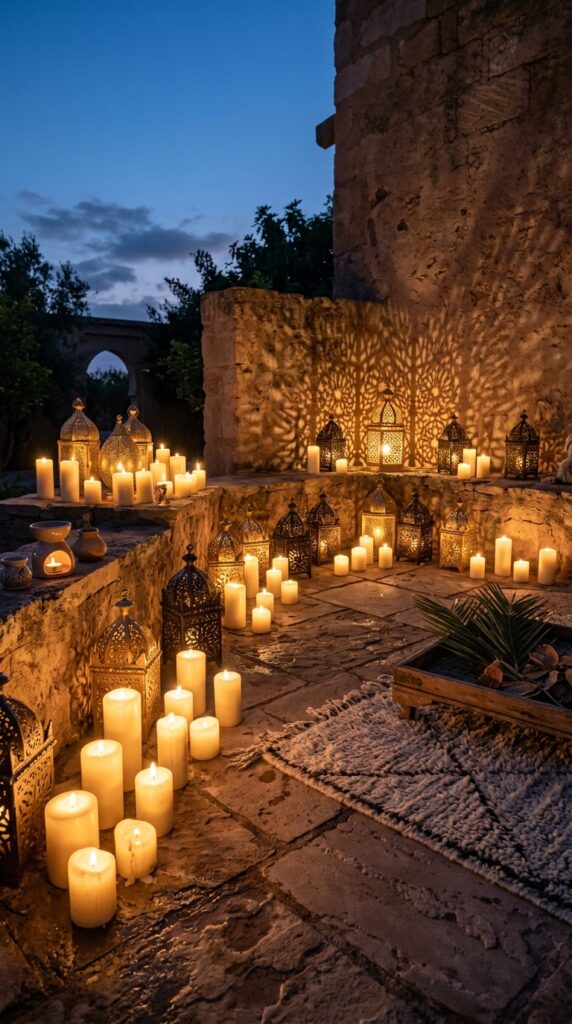
Vibe: Moody and warm, the kind of light that turns a patio into something that feels genuinely private.
Why it works: Perforated metal lanterns project pattern rather than simply producing light — the star or geometric cutouts cast shadow grids across surfaces that become part of the ambient design. This “projected decoration” principle makes the lantern do double duty: it’s a decorative object in daylight and a light-and-shadow installation at night. Grouping lanterns in odd numbers (three, five, seven) at varying heights creates a composed cluster that reads as intentional without being rigid.
How to get it: Use LED flame-flicker bulbs inside decorative lanterns rather than real candles — they replicate the amber warmth and movement of candlelight with no fire risk and can run all night on timer plugs.💡 Quick Win: Three same-family lanterns in small, medium, and large sizes grouped at one corner of the patio read as a curated cluster for under $45 total from import home stores.
| Shop The Look |
| Moroccan perforated metal lantern set outdoor large |
| LED flame flicker bulb outdoor lanterns |
| Brass hammered outdoor tabletop lantern |
| Low stone look outdoor tray table |
| Pillar candle set outdoor unscented large ivory |
14. Japandi-Inspired Minimalist Deck

Vibe: Hushed and meditative — the outdoor equivalent of a held breath.
Why it works: Japandi outdoor design is built on ma — the Japanese concept of meaningful negative space. Every element earns its place by what it removes as much as what it adds. A single teak daybed speaks more clearly than three chairs because it refuses to clutter the deck plane. This also connects to the Scandinavian hygge principle of selecting only the objects that produce genuine comfort. In practice, the design rule is: if you can remove it without losing anything functionally necessary, remove it.
How to get it: Use consistent deck board width (90mm or 120mm ipe or teak boards, installed with 5mm gaps) and let the grain of the wood provide all the visual interest the horizontal plane needs. No area rug — the deck surface itself is the texture.
| Shop The Look |
| Low profile teak outdoor daybed platform |
| Large bamboo outdoor parasol natural shade |
| White matte ceramic outdoor planter oversized |
| Raked zen garden gravel light grey coarse |
| Bamboo outdoor privacy screen panel |
15. Bold Blue and White Outdoor Color Scheme

Vibe: Sun-saturated and vibrant — this palette is the outdoor equivalent of a long, shouted laugh.
Why it works: Cobalt blue and white is the oldest chromatic pairing in Mediterranean architecture — from Greek island whitewash to Portuguese azulejo tile — and it works outdoors because both colors gain intensity in direct sunlight. The design principle is simultaneous contrast: white becomes brighter beside deep blue, and cobalt deepens beside white. When executed with pattern (stripe, tile mosaic) rather than flat color alone, the scheme has enough visual complexity to sustain close-up inspection.
How to get it: Anchor one element in true cobalt tile — a side table top, a pot, or a tiled planter — and keep everything else in the blue family. Mixing cobalt, navy, and sky blue without the grounding anchor creates a fragmented palette that reads as disorganized.
💡 Quick Win: A hand-painted cobalt tile trivet or tray from an import store costs $12–25 and introduces the color story to an existing outdoor setup immediately.
| Shop The Look |
| Cobalt blue tile top outdoor side table |
| Striped navy white outdoor cushion set |
| Outdoor fabric awning stripe blue white |
| Cobalt ceramic vase outdoor decorative |
| Navy outdoor loveseat cushion set sunbrella |
16. Compact Balcony Bistro Setup

Vibe: Intimate and considered, with the charm of a Paris side street compressed into six square feet.
Why it works: The bistro format — round café table plus two side chairs — is the most space-efficient outdoor seating configuration that still accommodates two people comfortably. The round table is critical: it eliminates the dead corner problem of rectangular tables pressed against balcony rails and allows two chairs to be pulled in at any angle without awkwardness. A 24-inch diameter top is the minimum for two coffee cups and a plate; 28 inches accommodates a full breakfast.
How to get it: Mount a wall-hung folding shelf to the interior side of the balcony rail for a secondary surface when the table is in use — it adds the equivalent of a console table in 4 inches of projection. Fold it up when not in use.
| Shop The Look |
| Round zinc top bistro table 28 inch outdoor |
| Folding steel bistro chair pair outdoor |
| Wall mounted balcony herb planter box |
| Mini outdoor cafe awning canopy wall mounted |
| Small balcony rail planter box self-watering |
17. Outdoor Dining Table for Eight

Vibe: Abundant and grounded, with the generosity that comes from a table built to accommodate everyone.
Why it works: A 96-inch (8-foot) table comfortably seats eight at 24 inches of table space per person — the minimum comfortable allocation for full place settings and elbow room. The farmhouse format (thick legs, trestle or X-cross base) works outdoors because it tolerates the movement of people pushing chairs without the wobble that hairpin-leg tables develop over time on imperfect pavers. A low centerpiece — herbs, candles, small bottles of wildflowers — keeps sightlines open across the table, which is the social design priority for a dining table that seats more than six.
How to get it: Oil an acacia outdoor dining table with tung oil or teak oil twice per season — a single coat takes 30 minutes and prevents the grey weathering that occurs when acacia dries without treatment.
💡 Quick Win: Repurposed glass bottles (wine, sauce, or olive oil bottles) make instant low-cost bud vases for a table centerpiece that looks composed and effortless.
| Shop The Look |
| Acacia wood outdoor dining table 8 person farmhouse |
| Outdoor dining chair set of 8 stackable |
| Ceramic outdoor dinnerware set mismatched neutral |
| Linen outdoor table napkin set natural |
| Brass candlestick holder set outdoor tall |
18. Privacy Screen and Hedge Wall

Vibe: Grounded and enclosed — like the garden finally learned to close its door.
Why it works: Privacy is the single most-cited desire in urban outdoor living surveys, and the most effective solutions combine hard and soft screening. Cedar slat screens (horizontally or vertically slotted) provide immediate privacy year-round while allowing airflow — the gap-to-slat ratio determines both wind resistance and visibility; a 1:1 ratio of gap to slat is the functional sweet spot. Dense hedges (boxwood, arborvitae, privet) add the organic softness that pure fencing lacks, and they absorb street noise.
How to get it: Install cedar privacy screen panels at 6 feet 6 inches minimum height — this clears the sightline of a standing person in neighboring properties. Treat the cedar with exterior wood oil before installation; it’s far easier than treating in place.
| Shop The Look |
| Cedar slat privacy screen panel 6×6 outdoor |
| Freestanding outdoor privacy fence panel cedar |
| Artificial boxwood hedge panel outdoor UV resistant |
| Stone look outdoor vessel planter large |
| Outdoor floor lantern set base weighted |
19. Hammock Lounge Corner

Vibe: Still and suspended — the outdoor experience reduced to its happiest, most horizontal form.
Why it works: A hammock corner works on the principle of destination — it creates a secondary zone in a larger garden that has its own micro-atmosphere separate from the main seating area. The key is that the hammock should feel discovered rather than planted: surrounded by mature plants, under a canopy (natural or built), with a surface for a drink within reach. Cotton rope hammocks provide the most comfortable long-session support; spreader bar styles distribute weight more evenly but lose the cocoon quality that makes hammocks restorative.
How to get it: Hang a hammock at 18 inches above the ground at the lowest sag point — this allows easy entry and exit without requiring a significant drop. Attach to trees using wide tree-friendly straps (at least 1 inch wide) rather than hardware that damages bark.
💡 Quick Win: A cotton hammock for under $40 paired with two screw-in tree hooks is the highest relaxation-per-dollar investment in outdoor living design.
| Shop The Look |
| Brazilian cotton rope hammock natural ivory outdoor |
| Hammock tree strap set heavy duty wide |
| Low teak outdoor side table small |
| Woven seagrass basket storage outdoor |
| Ceramic mug set outdoor casual |
20. Geometric Paver and Gravel Pattern

Vibe: Graphic and confident, the kind of floor that tells you exactly where the room begins and ends.
Why it works: Paving pattern is one of the highest-leverage design decisions in outdoor living because it defines the spatial boundaries of the room without walls. Alternating solid pavers with gravel panels creates a grid that reads clearly from above (important for upper-floor views) and provides excellent drainage — water passes directly through gravel joints rather than pooling on continuous hard surfaces. The pattern also creates a visual “rug” effect that defines the seating zone without requiring an actual outdoor rug.
How to get it: Use a chalk line and stakes to plot the grid before setting any pavers. The module (one paver plus one gravel band) should repeat evenly within the intended patio footprint — calculate the patio dimensions to be exact multiples of your chosen module to avoid awkward partial cuts at the edges.
| Shop The Look |
| Large format concrete outdoor paver set 24×24 |
| White marble pebble gravel outdoor landscaping |
| Steel outdoor planter box rectangular modern |
| Agave plant large artificial outdoor realistic |
| Geometric pattern outdoor rug flatweave |
21. Outdoor Bar Cart and Drink Station

Vibe: Convivial and amber-lit, the outdoor version of always being the host who thought ahead.
Why it works: A dedicated outdoor bar cart creates a service zone that keeps the host mobile and the main seating area clear — guests can self-serve without interrupting conversation, which fundamentally changes the energy of outdoor entertaining. Powder-coated steel bar carts are the correct material choice for outdoor exposure — they tolerate moisture and temperature variation without rust, and matte black finishes in particular develop no visible weathering. The lower tier handles bottles and mixers; the upper tier works as the active prep and service surface.
How to get it: Position the bar cart at the edge of the seating zone, not inside it — ideally at the entry point of the patio so arriving guests naturally see it first. Anchor it with a small potted plant on the lower tier to prevent it reading as purely utilitarian.
💡 Quick Win: A ceramic pitcher, two cut-crystal glasses, and a slate board on any existing outdoor side table creates the visual impression of a dedicated drink station for under $40.
| Shop The Look |
| Powder coated steel outdoor bar cart 2-tier black |
| Crystal cocktail glasses set outdoor safe acrylic |
| Ceramic cocktail pitcher outdoor neutral glaze |
| Slate serving board outdoor entertaining |
| Brass cocktail napkin holder tabletop |
22. Raised Cedar Deck with Built-In Bench

Vibe: Warm and integrated, built-in furniture that feels like the deck grew it naturally.
Why it works: Built-in bench seating along deck perimeters solves a fundamental outdoor living challenge: it provides seating for many people without the visual clutter of multiple chairs. The bench doubles as the deck’s railing system (for low decks under 18 inches) and defines the room’s edges with the same material as the floor — creating a unified spatial shell. Cedar is the standard choice for built-in deck benches because its natural oils resist rot without pressure treatment, and its light honey colour accepts stain evenly.
How to get it: Build the bench seat at 18 inches above the deck surface and 18 inches deep — these are the proportions of a standard dining chair seat, which means cushions designed for outdoor dining chairs will fit without custom cutting.
| Shop The Look |
| Cedar deck board set 1×6 pressure treated |
| Navy outdoor bench cushion set 72 inch |
| Outdoor propane fire table modern concrete |
| Cedar outdoor planter box built-in bench end |
| Low ceramic decorative bowl outdoor set |
23. Lush Tropical Plant Palette

Vibe: Enveloping and emerald — this space makes the outside feel wilder than it is.
Why it works: Oversized tropical foliage creates enclosure through plant mass rather than architecture — the botanical equivalent of walls and a ceiling. Bird of paradise (Strelitzia reginae) is the anchor plant for this look: its large paddle-shaped leaves provide the vertical scale (3 to 6 feet), the architectural silhouette, and the distinctive orange flower that adds color without requiring additional decorative objects. The design principle is layering at three heights: low ground covers, mid-height statement plants, and tall structural specimens.
How to get it: Plant in dark-glazed ceramic pots (charcoal, forest green, or deep navy) — the dark glaze recedes visually and makes the foliage appear to float, while light-coloured pots compete with the leaf colour. Use the largest feasible pot to allow root expansion and reduce watering frequency.
💡 Quick Win: A single large bird of paradise plant in a 14-inch black glazed ceramic pot ($45–65 at garden centers) immediately reads as a designed choice rather than a random planting.
| Shop The Look |
| Bird of paradise plant live 3-4 ft outdoor |
| Large black glazed ceramic outdoor planter |
| Elephant ear plant artificial outdoor large |
| Rattan outdoor lounge chair natural |
| Brass tabletop water fountain outdoor small |
24. Concrete Planter and Steel Raised Garden Bed

Vibe: Functional and considered, a kitchen garden that takes its design as seriously as its harvests.
Why it works: Raised garden beds placed adjacent to outdoor dining zones create a farm-to-table spatial narrative — the shortest distance between harvest and plate. Concrete planters and steel raised beds are the right pairing because both materials weather slowly and consistently, and their industrial honesty complements outdoor kitchen design without competing with it. Steel raised beds should be 11-gauge Corten or galvanized rather than thin-gauge sheet metal, which buckles within two to three seasons under soil pressure.
How to get it: Plant the raised beds closest to the dining area with herbs only — rosemary, basil, thyme, oregano — rather than vegetables, which require taller cages and look untidy. Herbs stay low, stay fragrant near the table, and are harvested lightly enough to remain decorative.
| Shop The Look |
| Steel raised garden bed outdoor galvanized |
| Concrete rectangular planter modern outdoor large |
| Cedar plant label stake set hand-painted |
| Copper outdoor watering can decorative |
| Culinary herb seed starter kit organic |
25. Hammered Metal and Lantern Moroccan Patio

Vibe: Rich and floor-level, built for the long, unhurried kind of evening.
Why it works: Moroccan outdoor design operates at the floor plane — cushions, low tables, layered rugs — which fundamentally changes the social dynamic. Seated at ground level, guests angle toward each other naturally, voices drop, and the atmosphere shifts from a dinner party to a salon. Hammered brass catches and scatters lantern light in a way polished metal doesn’t — the irregular hammer marks create micro-reflections that give the metalwork a living quality. This is the design principle of material-as-light-instrument.
How to get it: Layer a minimum of two rugs: a larger flatweave base (at least 8×10 feet) and a smaller pile rug on top. The difference in pile height between the two creates shadow depth at ground level that defines the seating zone even without furniture edges.
💡 Quick Win: A hammered brass tea tray with four matching glasses from an import store costs under $35 and immediately establishes the material language of the Moroccan aesthetic on any existing patio.
| Shop The Look |
| Moroccan hanging outdoor lantern set metal |
| Hammered brass tea tray serving set |
| Low carved wood moroccan tea table outdoor |
| Jewel tone embroidered outdoor floor cushion |
| Layered flatweave outdoor rug set |
26. Outdoor Movie Night Setup

Vibe: Warm and playful — the backyard as its own small cinema.
Why it works: A dedicated outdoor movie setup turns the largest underused surface in the backyard (the fence or blank wall) into an entertainment plane. The key design principle is seating hierarchy: raised deep-seat poufs in the back, floor cushions and beanbags in front, so no one’s sightline is blocked regardless of seating choice. The string lights overhead should be on a dimmer or smart plug so they can be reduced during screening without being turned off entirely — total darkness kills the outdoor atmosphere.
How to get it: Inflate a portable outdoor projector screen to a minimum 100-inch diagonal — below this size, the image loses legibility at the 12-to-15-foot viewing distance typical of a standard backyard. A 4K-rated pocket projector with 700+ lumens is sufficient for dusk-to-dark outdoor screening.
| Shop The Look |
| Outdoor projector screen 100 inch portable inflatable |
| Outdoor portable projector 4K compatible |
| Large outdoor floor pouf waterproof |
| Linen outdoor throw blanket set |
| Smart plug outdoor weatherproof timer dimmer |
27. Small Space Folding Furniture System

Vibe: Considered and quietly compact — proof that a small space designed well is simply a focused one.
Why it works: Wall-mounted fold-down tables are the fundamental space-planning tool for outdoor rooms under 60 square feet. When folded flush against the wall, the table occupies 4 to 6 inches of projection and frees the entire floor plane for circulation. When deployed, it creates a full dining or working surface from nothing. The design principle is kinetic architecture — furniture that changes the room’s function on demand. Pair with folding chairs that stack in two (Tolix-style or folding teak bistro chairs) and the entire dining setup stores in under 16 inches of wall depth.
How to get it: Mount the wall bracket to studs or masonry anchors rated for 80 pounds minimum — a fold-down table loaded with dishes and drinks can approach 40 to 50 pounds of dynamic load. Use a stainless or powder-coated steel bracket rather than painted wood hardware for outdoor exposure.
💡 Quick Win: A wall-mounted fold-down teak shelf from IKEA or similar (around $45) functions as a balcony desk, dining surface, and cocktail bar in 18 inches of wall width.
| Shop The Look |
| Wall mounted fold down teak table outdoor bracket |
| Folding outdoor bistro chair linen seat set 2 |
| Small balcony wall planter box self-watering |
| Stainless steel wall mount bracket heavy duty fold |
| Compact outdoor ceramic lantern small |
How to Start Your Outdoor Living Space Transformation
Your single first move should be this: define your anchor material. Choose teak, cedar, or concrete as the dominant surface and buy one hero piece in that material — a dining table, a bench, or a planter. Every subsequent purchase will either harmonize with that anchor or fight it, and having a definitive first choice eliminates the indecision that causes incoherent outdoor spaces.
The most common mistake beginners make is treating cushion color as decoration rather than as the palette-setter. Choosing cushions in four different colors across four chairs — each individually pleasant — produces visual chaos at the scale of an outdoor room. Every upholstered surface in the seating zone should be within the same color family or deliberately monochromatic. Different textures (stripe vs. solid, linen vs. canvas) add variety without breaking the palette.
Three specific items under $50 that create immediate impact: a large dried pampas grass stem in a concrete pot ($15); a set of three perforated metal lanterns in matching finishes, grouped at a corner ($35 total); and a neutral outdoor flatweave rug in jute or polypropylene, which instantly defines the seating zone on any surface ($40–50 for a 5×8).
For realistic expectations: a starter version of a well-designed outdoor living space — anchor furniture, cushions, one light source, and a few accessories — costs $600 to $1,200 and can be assembled in a weekend. A fully realized outdoor room with pergola, built-in elements, and layered planting takes 2 to 3 seasons of intentional additions and a budget of $3,000 to $8,000 depending on region and scope.
Frequently Asked Questions About Outdoor Living Spaces
What’s the difference between an outdoor living space and a regular patio?
A patio is a hardscaped surface; an outdoor living space is a patio that has been designed as a functional room with defined zones, weather-appropriate furniture, a light source, and intentional styling. The distinction is design intent. A regular patio might have four chairs and a table placed without regard for traffic flow, sightlines, or social distance. An outdoor living space plans for conversation radius (5 to 6 feet), provides ambient light for evening use, and treats the plant and accessory choices as part of the spatial design rather than afterthoughts. The cost difference between the two can be as small as $200 in cushion and accessory choices applied thoughtfully.
What colors work best for outdoor living spaces?
Earthy neutrals — warm sand, terracotta, greige, and dusty sage — are the most versatile outdoor palette anchors because they don’t compete with the natural tones of sky, lawn, and plantings. Specific paint colors that translate well to outdoor cushion fabric: Benjamin Moore’s Pale Oak (OC-20) in linen-equivalent Sunbrella fabric, or Sherwin-Williams Spatial White (SW 6259) for a bleached coastal base. If you want a bold accent color, cobalt blue and forest green are the most photogenic outdoor accent choices — both gain intensity in outdoor light rather than washing out.
How much does it cost to create an outdoor living space?
A well-designed starter outdoor living space costs $600 to $1,500, covering a loveseat or sectional ($300–700), cushions ($100–200), a coffee table ($100–250), one light source ($35–80), and accessories ($50–100). A mid-range complete space with pergola structure, dining and lounge zones, and layered planting runs $4,000 to $10,000. Full built-in outdoor kitchens, custom paving, and mature plantings can reach $20,000 to $40,000. The highest return-on-investment items — the ones most noticeable in photographs and in person — are string lights ($30–50), a large outdoor rug ($50–120), and high-quality cushion fabric ($150–300 for a set).
Can outdoor living space furniture stay outside year-round?
It depends entirely on material. Teak, ipe, powder-coated aluminum, and all-weather wicker (resin rattan) are the four materials rated for year-round outdoor exposure in most climates. Cast iron tolerates cold but requires annual rust-prevention treatment. Solid wood other than teak warps without seasonal oiling. Natural rattan degrades quickly when wet. Cushions in Sunbrella-grade solution-dyed acrylic resist fading and mildew, but even these should be stored in a breathable bag or covered during winter in wet or snowy climates — prolonged moisture and freeze-thaw cycles degrade even the best outdoor fabric over multi-season exposure.
What outdoor lighting is best for evening entertaining?
The most effective outdoor entertaining lighting combines three layers: overhead ambient (string lights or a ceiling-mounted outdoor fixture for the room plane), mid-level task or accent (lanterns on tables and built-in surfaces), and ground-level accent (path lights, up-lit plants, or in-ground LED strips along pavers). String lights alone create a warm ambient plane but leave faces in unflattering downward shadow at tables — adding a mid-height lantern at table level resolves this. For true flexibility, put string lights on a smart plug or dimmer so the light level adjusts as the evening moves from dinner to conversation.
Ready to Create Your Dream Outdoor Living Space?
These 27 concepts span the full range of what a designed outdoor room can be — from color palettes and material choices to lighting systems, furniture layouts, small-space solutions, and accessory layers, so there’s a meaningful starting point regardless of your space or budget. Transformation happens in stages: the person who starts with a single perfect lantern and an outdoor rug is already practicing the discipline that leads to a fully realized space. The one concrete action you can take today is to define your anchor material — choose teak, cedar, concrete, or rattan as the material your space will be built around, and let that decision guide every purchase that follows. When the space comes together — when the light is right and the chair is exactly where it should be — you’ll feel the particular ease of a home that extends beyond its walls into the open air. Save the ideas that made your heart move and come back to the ones built around natural materials and layered warmth — those are the choices that age into something you’ll love longer.