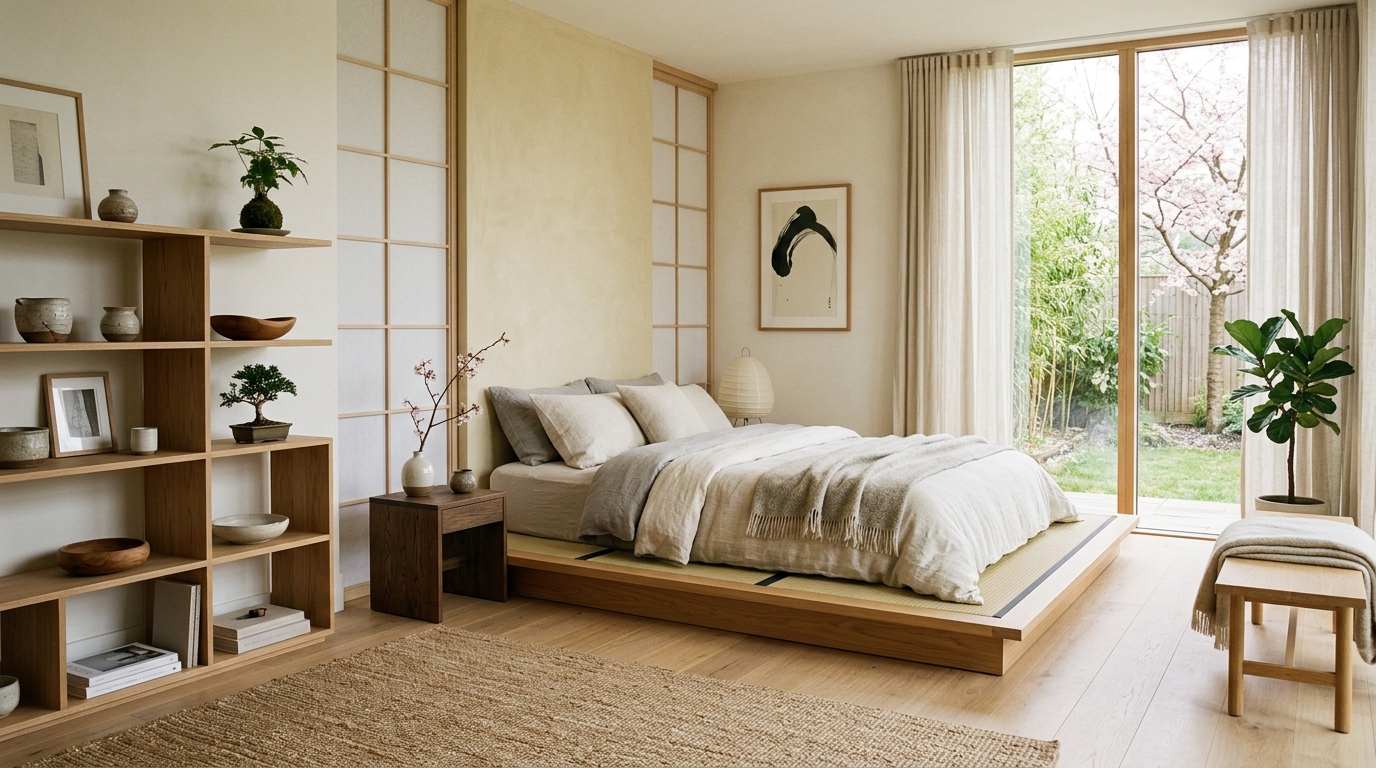
Japandi is a design hybrid born from Japanese wabi-sabi and Scandinavian hygge — a style that prizes stillness, craftsmanship, and only what is necessary. This article gives you 25 specific, actionable Japandi bedroom ideas covering color, materials, lighting, furniture, layout, accessories, and small-space solutions.
Step inside and feel the difference. The room breathes. Shadows fall softly on unfinished oak. A single linen panel diffuses afternoon light into something almost liquid. There is nothing extra — and that absence feels like a gift. Japandi doesn’t ask you to own less; it asks you to choose better. Here are 25 ideas worth saving — and stealing.
Why Japandi Works So Well in a Bedroom
Japandi emerged from a cultural conversation that had been happening quietly for decades — Japanese minimalism and Scandinavian functionalism discovering they spoke the same design language. Unlike pure Minimalism, which can feel clinical, or pure Hygge, which can tip into clutter, Japandi occupies an intentional middle ground: warmth with restraint, nature without excess, beauty through imperfection. It draws from Japan’s ma (the value of negative space) and Denmark’s emphasis on tactile comfort, producing rooms that feel simultaneously calm and deeply livable.
The material vocabulary of a Japandi bedroom is narrow but rich. Think unfinished white oak, matte black steel, hand-thrown stoneware in warm putty and ash tones, undyed linen, and woven seagrass. The color palette lives in a quiet range: warm white (think Benjamin Moore’s “White Dove”), greige, warm charcoal, dusty sage, and blush mushroom. Every surface has texture — nothing is glossy, nothing is stark, nothing competes.
Japandi is trending now for specific reasons. Post-pandemic recalibration sent millions of people searching for sanctuary at home. At the same time, a growing rejection of fast furniture and trend cycling pushed consumers toward slower, more intentional design — Pinterest searches for “Japandi bedroom” increased over 300% between 2020 and 2024. The style rewards buying less and buying better, which aligns with both sustainability values and tightening budgets.
Yes, small bedrooms can absolutely achieve this look — in fact, Japandi’s love of negative space makes it ideal for compact rooms. The priority for small-space decorators: resist the urge to fill every corner. Choose one low-profile bed frame, keep your nightstand count to one if space is tight, and let the walls breathe. Scale is everything.
Style at a Glance
| Element | Japanese Influence | Scandinavian Influence |
| Philosophy | Wabi-sabi, ma (negative space) | Hygge, functionalism |
| Materials | Bamboo, rice paper, matte ceramics | Unfinished oak, linen, wool |
| Color Palette | Warm white, ash, warm charcoal | Dusty sage, greige, warm black |
25 Japandi Bedroom Design Ideas
1. The Warm White Foundation
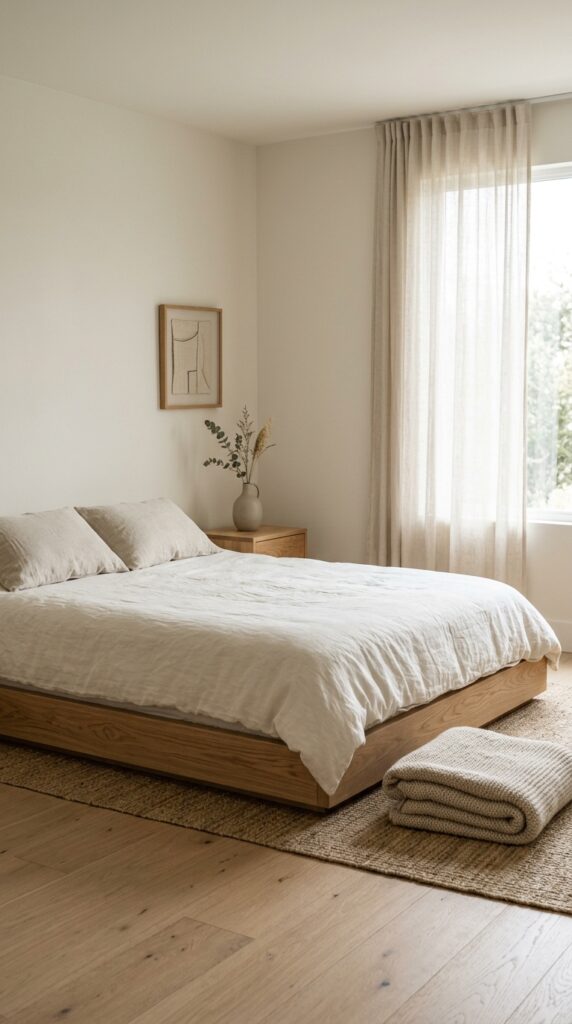
Vibe: Hushed — like the room exhaled before you walked in.
Why it works: Warm white is the foundation of Japandi because it reflects light without broadcasting it. Unlike cool bright white, which creates visual tension, warm white (Benjamin Moore “White Dove” or Farrow & Ball “Pointing”) absorbs morning light and gives it back slowly. The absence of contrast at the wall level pushes the eye toward texture — the grain of the wood frame, the weave of the linen — which is precisely where Japandi wants your attention.
How to get it: Paint walls and ceiling the same warm white tone to dissolve the corner line and make the room feel expansive. Use an eggshell or matte finish specifically — any sheen will create reflective inconsistency that breaks the meditative quality of the space.
💡 Quick Win: A $12 sample pot of Benjamin Moore “White Dove” applied to a large foam board lets you test warm white against your existing light conditions before committing.
Shop The Look
| Product |
| Ivory linen duvet cover set queen size |
| White oak platform bed frame low profile queen |
| Sheer linen curtain panels ivory grommet |
| Matte putty ceramic vase minimalist |
| Undyed wool throw blanket natural |
2. Matte Black Hardware Accents
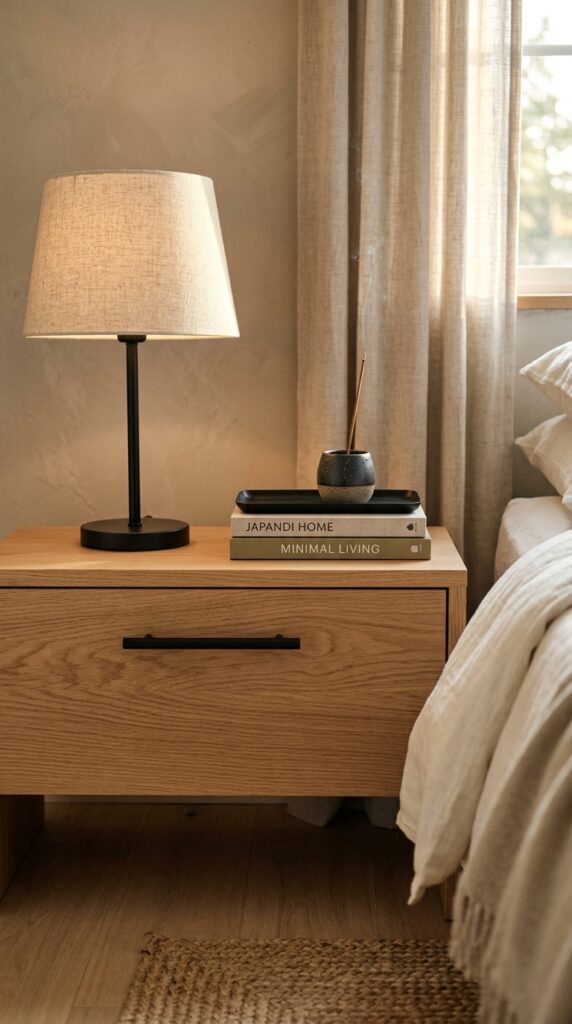
Vibe: Grounded — like someone made every small decision deliberately.
Why it works: Matte black functions in Japandi the way punctuation functions in prose — it creates rhythm and prevents the room from floating into monotony. The key design principle here is selective contrast: black appears only in hardware and small objects, never in large planes. This preserves the calm palette while giving the eye moments of definition. The matte finish is non-negotiable; gloss black would shatter the softness of the scheme.
How to get it: Replace existing brass or chrome drawer pulls with matte black bar handles (a $3–$8 per pull upgrade that transforms a basic dresser). Keep all metal finishes in the room identical — mixing matte black with brushed brass dilutes the intentional quality Japandi requires.
Shop The Look
| Product |
| Matte black bar pull cabinet hardware set 5 inch |
| Matte black table lamp linen shade minimalist |
| Matte black decorative tray rectangular small |
| White oak nightstand with drawer minimalist |
| Ceramic incense holder matte black minimal |
3. The Low-Platform Bed Frame
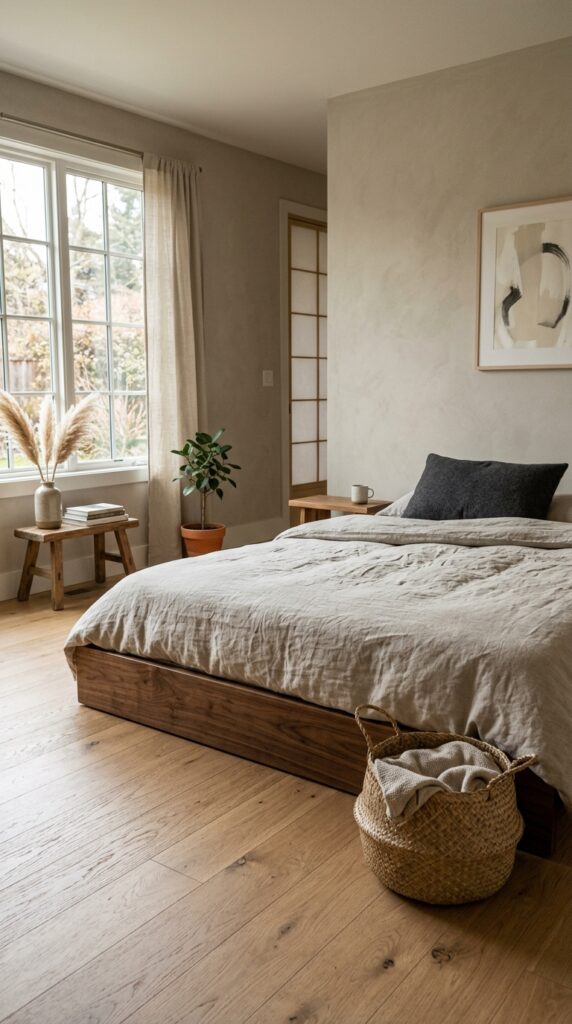
Vibe: Grounded — the whole room feels like it’s resting.
Why it works: The low-platform bed is the single most transformative Japandi furniture choice because it physically lowers the visual center of the room, creating the impression of more vertical space and establishing the Japanese concept of ma — deliberate empty space above the sleeping surface. Beds that sit high off the floor visually divide the room and make it feel busier. At 6–10 inches off the ground, the bed becomes part of the floor plane rather than competing with it.
How to get it: Look for platform beds in walnut or white oak with a clean horizontal profile and no footboard — the uninterrupted line from headboard to floor is essential. A bed without a footboard makes the room look 20–30% longer, which is especially valuable in smaller bedrooms.
💡 Quick Win: If replacing your bed frame isn’t in the budget, remove your existing box spring and use only the mattress on the frame to lower the sleep surface immediately.
Shop The Look
| Product |
| Walnut platform bed frame low profile no footboard |
| Seagrass basket round small bedroom organizer |
| Linen duvet cover natural undyed queen |
| Charcoal wool euro pillow cover |
| Walnut wood bed slats support replacement |
4. Dusty Sage as an Accent Wall
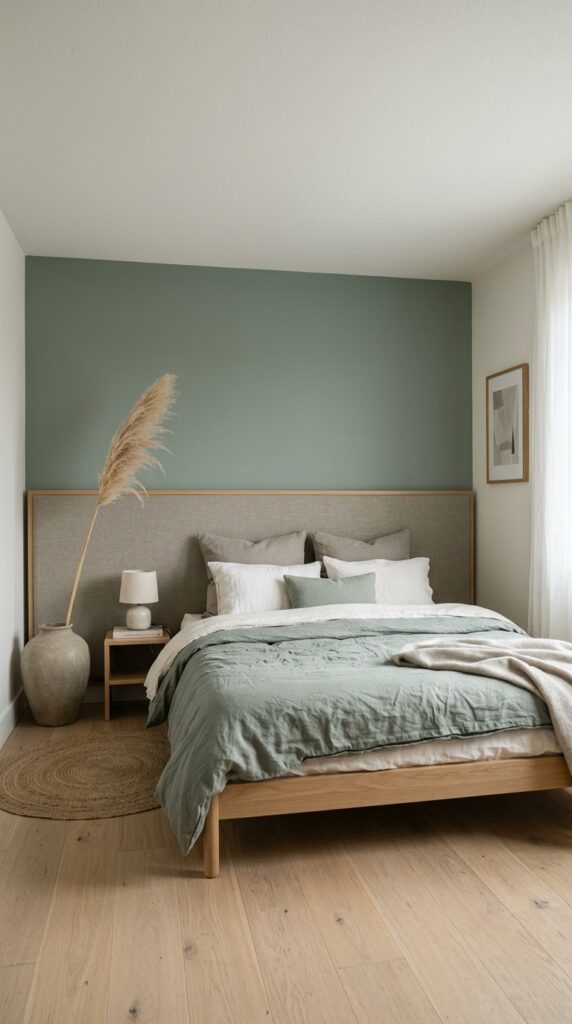
Vibe: Still — like sitting inside a Japanese garden at dusk.
Why it works: Dusty sage works in a Japandi bedroom because it reads as a muted natural tone rather than a saturated color — it evokes moss, dried botanical, aged wood. The design principle at play is tonal harmony: sage sits in the same warm-neutral family as greige and undyed linen, so it adds depth without introducing visual conflict. It advances toward the eye just enough to anchor the bed wall without demanding attention.
How to get it: Use Sherwin-Williams “Evergreen Fog” (SW 9130) or Benjamin Moore “Dried Thyme” (HC-186) in a flat or matte finish on the single wall behind your bed. Paint only one wall — the Japandi approach is always restraint, and four sage walls would overwhelm the serene neutral palette.
Shop The Look
| Product |
| Pampas grass stems dried natural decor |
| Matte stone ceramic vase tall minimalist |
| Linen headboard panel wall mount greige |
| Sage green linen throw pillow cover set |
| White oak floating shelf minimal wall mount |
5. Natural Light Filtering with Shoji-Inspired Panels
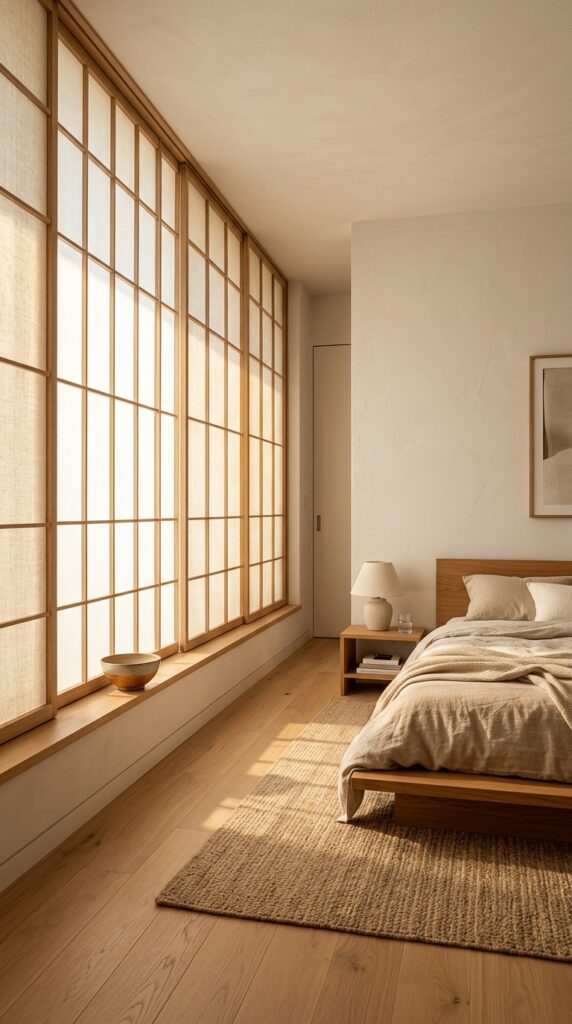
Vibe: Luminous — every surface looks like it’s lit from within.
Why it works: Shoji-inspired window panels are the lighting workhorse of a Japandi bedroom. They serve a precise design function: converting harsh direct light into soft, diffused illumination that eliminates hard shadows and reduces visual contrast throughout the room. This creates the gentle, even light quality characteristic of traditional Japanese interiors. The fabric’s texture becomes visible in the light — the weave itself becomes decoration.
How to get it: Use floor-to-ceiling natural linen or cotton voile panels rather than Roman shades or blinds. Hang the rod 4–6 inches above the window frame and extend it 8 inches beyond the frame on each side — this technique frames the window generously and allows panels to stack off the glass entirely, maximizing both light and the sense of height.
💡 Quick Win: IKEA’s LILL sheer curtain panel at $8 per pair is a surprisingly authentic starting point — layer two panels per window for appropriate opacity.
Shop The Look
| Product |
| Natural linen sheer curtain panels floor length |
| Matte black curtain rod slim profile ceiling mount |
| Rice paper room divider folding panel screen |
| Ceramic bowl matte putty small minimalist |
| Linen tab top curtain panel undyed |
6. Woven Seagrass and Jute Layered Rug
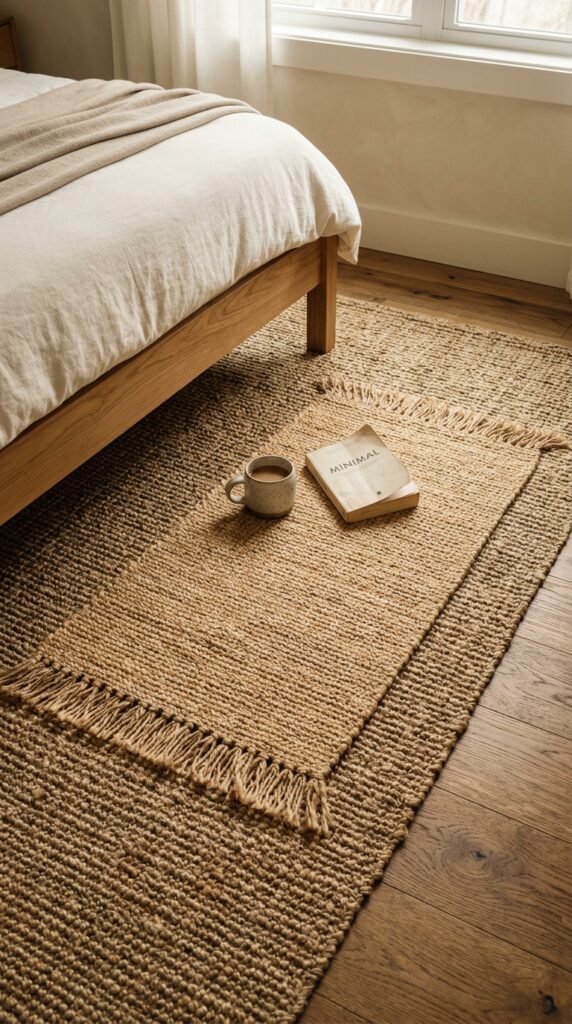
Vibe: Raw — a texture you want to walk on barefoot every morning.
Why it works: Layered natural fiber rugs introduce Japandi’s material complexity without visual complexity — the tones are nearly identical, but the texture contrast between tight seagrass weave and looser jute creates sensory richness that pulls the room together. This technique also solves a practical problem: seagrass alone can feel rough underfoot, so a softer jute or wool layer placed where feet hit the floor first creates comfort without sacrificing the natural aesthetic.
How to get it: Place a 8×10 seagrass rug as the anchor, then layer a 3×5 hand-knotted jute or wool runner centered in front of your bed. The smaller rug’s fringe should extend past the edge of the base rug by at least 2 inches — this makes the layering look deliberate rather than accidental.
Shop The Look
| Product |
| Seagrass area rug natural 8×10 flatweave |
| Jute hand-woven runner rug natural 3×5 fringe |
| Wool accent rug natural cream hand-knotted small |
| Rug pad natural felt non-slip hardwood floors |
| Seagrass storage basket rectangular flat lid |
7. Bedside Pendant Lights Instead of Table Lamps
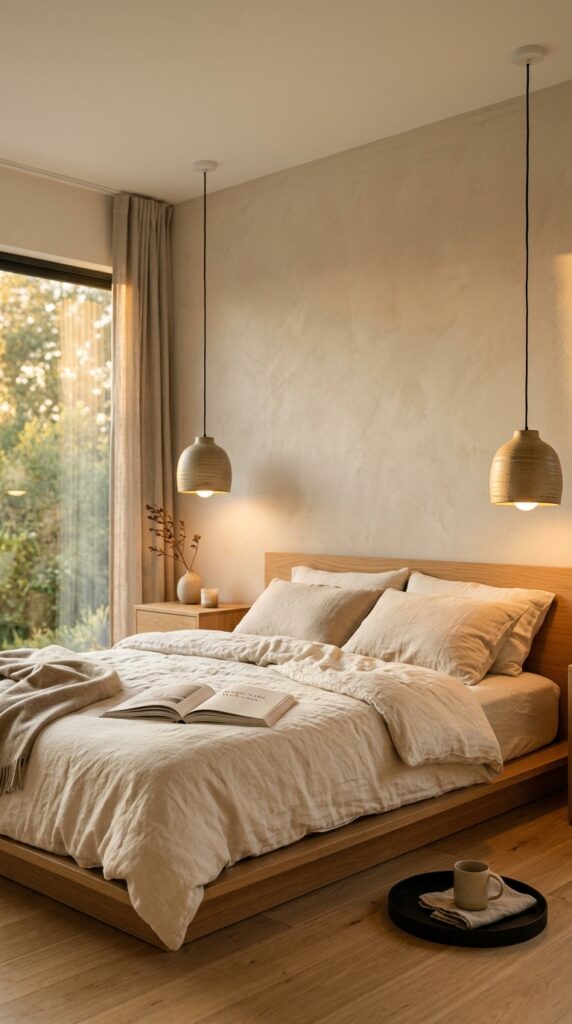
Vibe: Warm — a light source that feels considered rather than installed.
Why it works: Hanging bedside pendants free the nightstand surface entirely — a critical Japandi move because the style prizes empty horizontal surfaces. The design principle at play is visual weight distribution: table lamps sit heavy on their bases and anchor the eye downward; hanging pendants draw the eye upward in a room where the bed is already very low to the floor, restoring vertical balance. Ceramic or washi paper shades cast warm, directional light that creates soft shadow gradients on the wall — exactly the kind of subtle depth Japandi relies on.
How to get it: Install swag-style pendant hooks in the ceiling above each side of the bed and run a cloth-covered cord to a wall outlet — no electrician needed. Position the bottom of the shade at chin height when you’re sitting up in bed for reading comfort.
Shop The Look
| Product |
| Ceramic pendant light shade handmade warm putty |
| Matte black pendant cord set plug-in swag style |
| Washi paper pendant lamp shade minimal |
| Ceiling hook swag pendant hardware matte black |
| Dimmer outlet plug-in lamp control |
8. The Edited Nightstand: One Object Rule
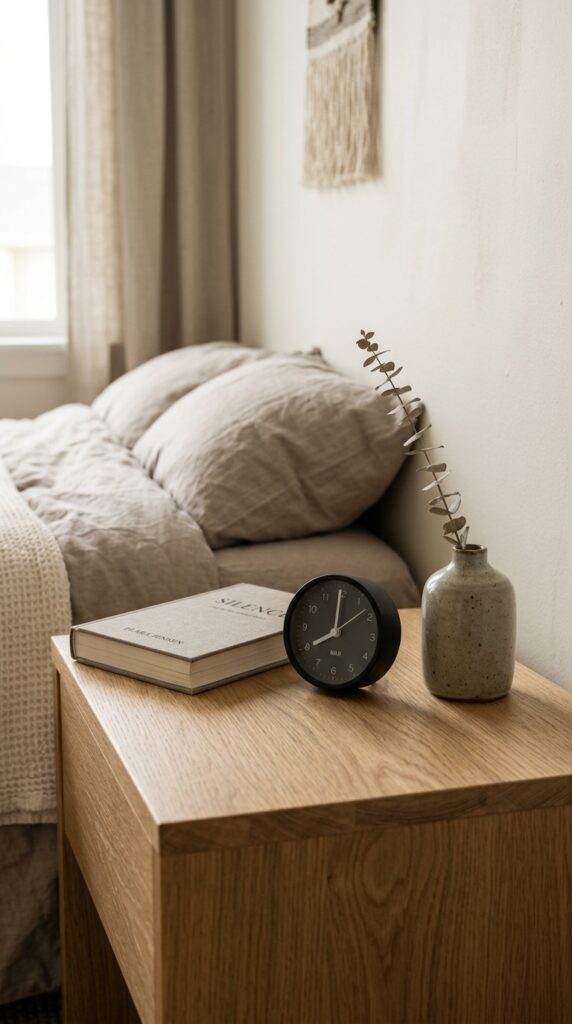
Vibe: Deliberate — every object placed as if it has nowhere else to be.
Why it works: The nightstand in a Japandi bedroom operates under the same principle as Japanese tokonoma — the display alcove where only one or two objects are ever placed because their solitary presence gives them significance. When a surface holds only three objects maximum, each object is visible, valued, and contributes to the composition rather than competing within it. The absence of clutter is not deprivation; it’s curation. Proportion matters: the nightstand itself should be low enough that its surface sits approximately even with the mattress top.
How to get it: Remove everything from your current nightstand and return only three items: a light source, one functional object (clock or phone charging dock hidden in a tray), and one organic element (a single stem or small ceramic). Remove all charger cables from the surface by running them under or behind the table.
💡 Quick Win: A ceramic bud vase under $15 with a single dried pampas stem immediately transforms the nightstand aesthetic — the dried stem requires no water and lasts months.
Shop The Look
| Product |
| White oak nightstand minimalist low profile |
| Matte black minimalist alarm clock small |
| Ceramic bud vase small warm putty matte finish |
| Dried pampas grass stem small bundle |
| Hidden cable management tray wooden bedside |
9. Warm Charcoal Bedding as the Color Anchor
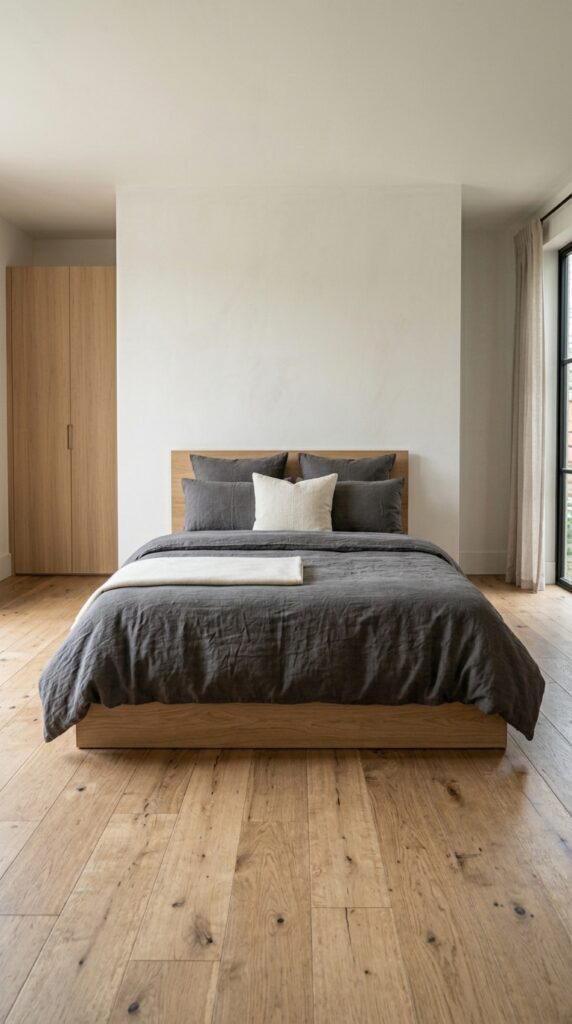
Vibe: Sun-warmed — charcoal that glows instead of absorbs.
Why it works: Warm charcoal (with brown or olive undertones, not blue) is Japandi’s version of a statement color — deep enough to anchor the entire room visually, but warm enough to never feel cold or industrial. The design principle here is tonal hierarchy: the charcoal bedding becomes the room’s darkest point, which allows every other element (oak frame, linen walls, ceramic accents) to read lighter by comparison, creating natural depth without requiring multiple colors. Blue-undertoned charcoal breaks the warmth of the palette immediately.
How to get it: Source 100% linen duvet covers — linen’s natural wrinkle texture softens the weight of a dark color. Avoid cotton percale in dark tones, which reads as corporate rather than organic. Layer one cream or undyed linen sham in front of the charcoal shams to create visual transition.
Shop The Look
| Product |
| Charcoal linen duvet cover queen 100 percent linen |
| Warm charcoal linen pillow sham set king |
| Cream linen euro pillow cover |
| Natural linen fitted sheet warm white |
| Linen waffle blanket throw charcoal |
10. Bamboo and Rattan Texture Introduction
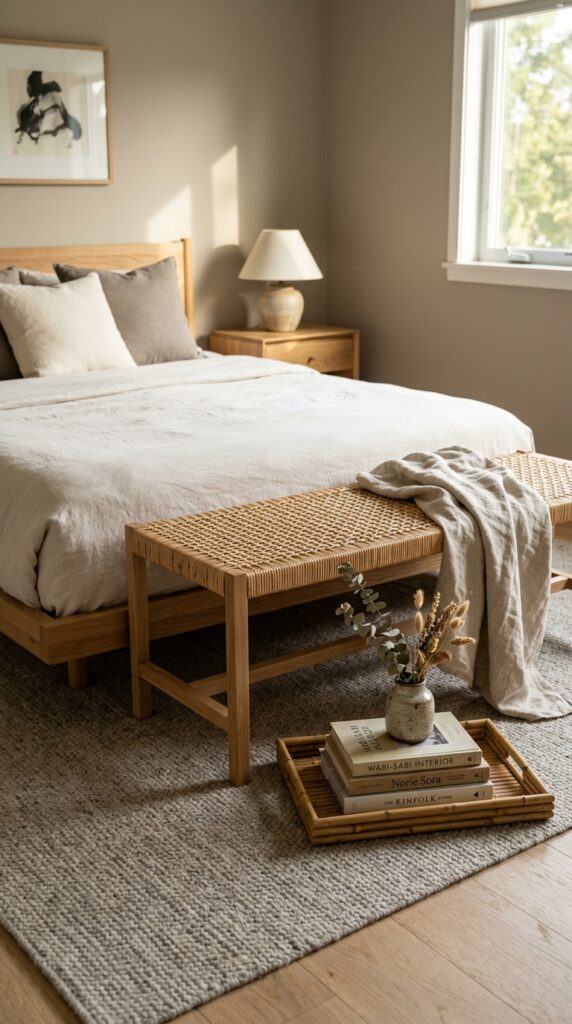
Vibe: Layered — nature brought inside without any ceremony.
Why it works: Rattan and bamboo introduce Japandi’s most important material tension: the contrast between straight, machined surfaces (the bed frame, the nightstand) and irregular, organic structures (woven rattan, split bamboo). This contrast follows the wabi-sabi principle that imperfection and irregularity are sources of beauty. Rattan’s open weave also allows light to pass through it partially, creating subtle shadow patterns on the floor that shift throughout the day.
How to get it: A low rattan storage bench at the foot of the bed (approximately 16–18 inches tall) serves double duty as seating and soft storage for extra bedding. Avoid rattan that has been lacquered or painted — the natural honey-to-warm-brown finish is the point. Wipe with a damp cloth only; oils will darken the weave unevenly.
💡 Quick Win: A $25–$40 bamboo floor tray from a home goods store, styled with two or three stacked books with their covers removed, creates an instant Japandi floor vignette.
Shop The Look
| Product |
| Rattan storage bench low profile bedroom foot of bed |
| Bamboo floor tray serving tray rectangular natural |
| Rattan laundry basket with lid bedroom |
| Woven seagrass round tray decorative |
| Rattan wall mirror round natural frame |
11. Negative Space as a Design Decision
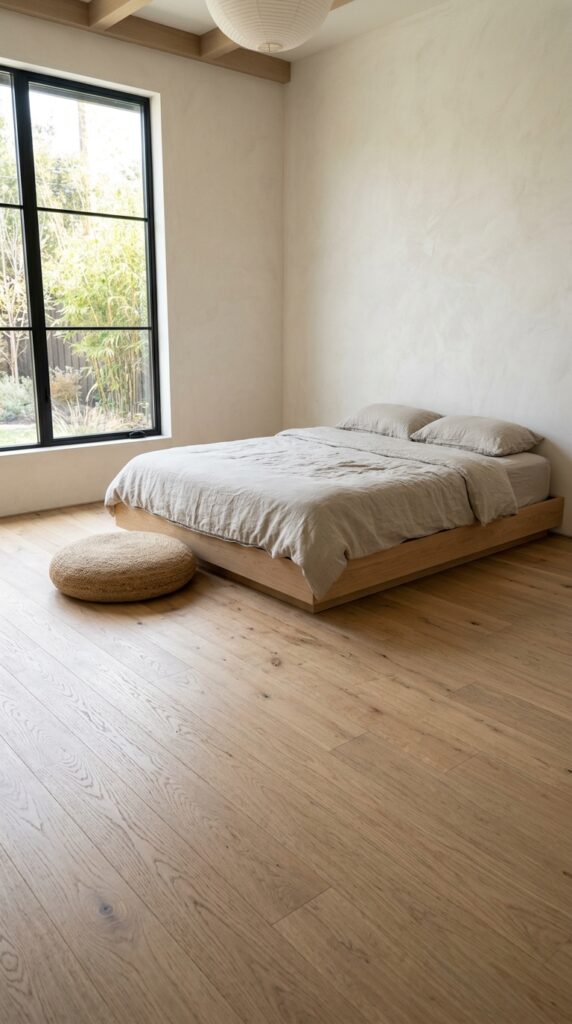
Vibe: Still — the kind of room where thoughts slow down by themselves.
Why it works: In Japanese design philosophy, ma is the concept that empty space is not absence but an active, valued presence — negative space is itself a material. In a bedroom context, this means resisting the Western impulse to furnish every corner and fill every wall. A large area of bare floor visible beside and around the bed creates visual breathing room that makes the room feel twice its actual square footage. Every item added to the room reduces this effect; every item removed restores it.
How to get it: Remove the item you’re least sure about — usually a second chair, a decorative ladder, or a throw blanket on the floor — and live without it for a week. Most people find the room immediately feels calmer. The rule is: each piece of furniture must earn its place by doing a specific job.
Shop The Look
| Product |
| Zafu floor cushion meditation round natural cotton |
| White oak hardwood floor sample plank |
| Low profile storage ottoman linen cube bedroom |
| Minimalist floor lamp arc slim matte black |
| Linen floor pillow oversized natural |
12. Hand-Thrown Ceramics as Bedside Sculpture
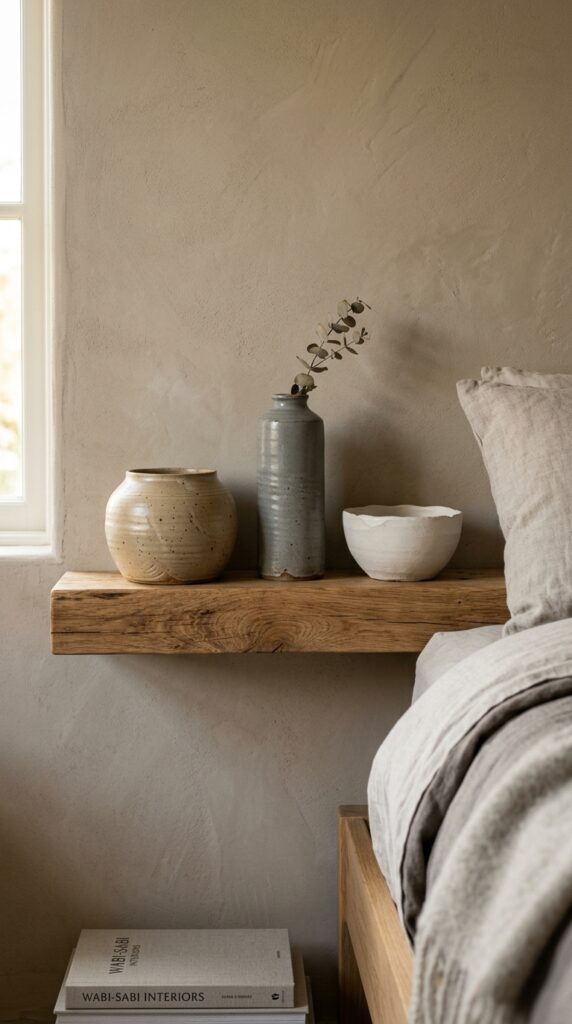
Vibe: Meditative — objects that feel made by a specific person, for no purpose other than existing.
Why it works: Hand-thrown ceramics are central to Japandi because they embody wabi-sabi — the acceptance of imperfection as beauty. Unlike mass-produced ceramics, hand-thrown vessels have variations in wall thickness, slight asymmetry, and texture from the potter’s touch that make them inherently individual. When grouped in threes (an odd number is always more visually dynamic than even), the slight variations in height create a composition that feels arranged rather than purchased as a set. The matte glaze finish connects ceramics to the rest of the Japandi material palette.
How to get it: Group ceramics by tone family, not by identical size — put a squat wide vessel beside a narrow tall one beside a low bowl. All in the same matte putty-to-ash range. Height variation should be roughly: short, medium, tall — with the tallest piece no more than twice the height of the shortest.
Shop The Look
| Product |
| Hand-thrown ceramic vase putty tone matte glaze |
| Stoneware ceramic bowl minimalist ash grey |
| Ceramic bud vase set 3 piece matte minimalist |
| Floating wall shelf white oak thin minimal |
| Stoneware mug set natural matte glaze |
13. Linen Wall Panel Headboard
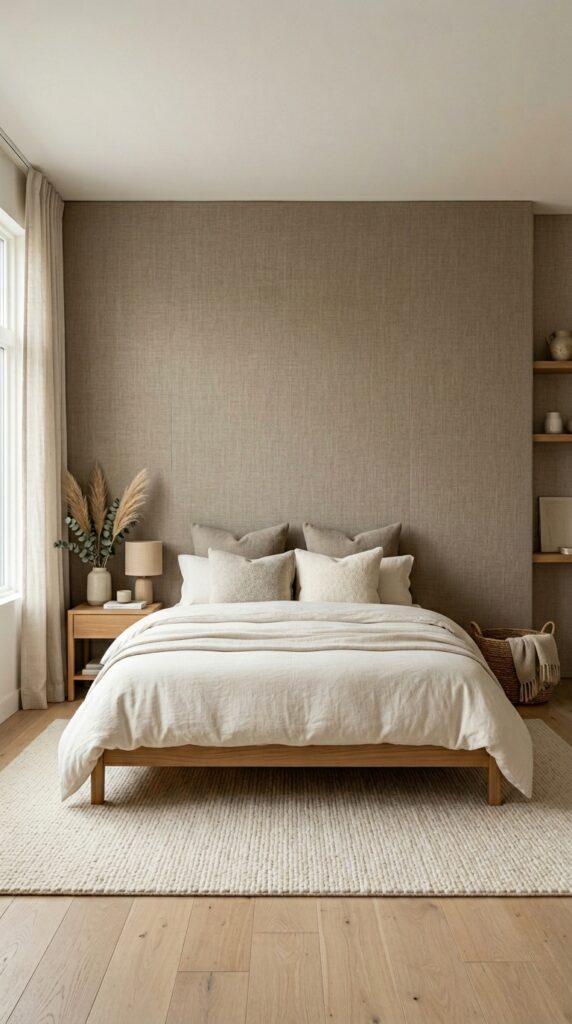
Vibe: Enveloping — the wall itself becomes soft.
Why it works: A linen wall panel headboard is a furniture-and-architecture hybrid — it functions as both a cushioned headboard and a large-scale textile art piece. The design principle at work is material continuity: when the headboard shares the same linen material as the duvet and pillowcases, the bed dissolves into the wall behind it in a way that makes the room feel larger and the distinction between furniture and architecture pleasingly ambiguous. The soft textile also improves acoustics — an underappreciated element in bedroom design.
How to get it: Hang a custom-sized plywood panel wrapped in natural linen (available at fabric stores per yard in undyed or warm greige) using French cleats mounted to wall studs. Wrap 2 inches of fabric to the back and staple gun it taut. Total cost for a king-size panel: approximately $80–$120 in materials.
💡 Quick Win: IKEA’s GRIMSBU linen fabric can be purchased off the bolt and used to wrap a plywood headboard panel for a fraction of custom upholstery pricing.
Shop The Look
| Product |
| Natural linen fabric by the yard upholstery weight |
| French cleat wall mounting system heavy duty |
| Linen upholstered headboard panel queen size |
| Staple gun upholstery heavy duty |
| Greige linen king pillow shams set |
14. The Single Pendant Statement: Washi Paper Globe
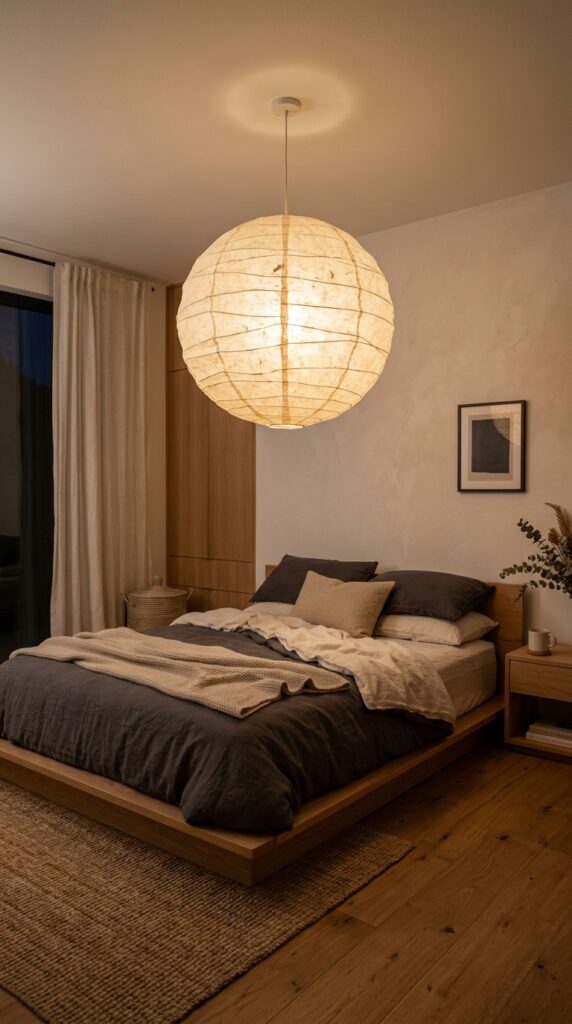
Vibe: Warm — the whole ceiling feels like it’s glowing.
Why it works: A washi paper pendant accomplishes something no other light fixture can: it makes the light source itself beautiful. Washi — handmade Japanese paper made from plant fibers — transmits light rather than blocking it, so the entire shade becomes luminous. This eliminates the harsh directional quality of exposed bulb fixtures while maintaining the visual interest of a statement pendant. The organic, slightly irregular form of hand-constructed washi pendants also introduces wabi-sabi imperfection at the largest scale in the room.
How to get it: Hang the pendant at a drop length of 7–8 feet from the finished floor — approximately 18–24 inches below a standard 9-foot ceiling. Use a warm Edison bulb (2700K or lower) on a dimmer circuit. The warm color temperature is critical: a daylight bulb (5000K) through washi paper reads clinical rather than meditative.
Shop The Look
| Product |
| Washi paper globe pendant light large 18 inch |
| Warm Edison LED bulb 2700K E26 dimmer compatible |
| Pendant light canopy ceiling kit plug-in |
| Dimmer switch single pole in-line cord |
| Rice paper lantern pendant oversized minimal |
15. Stone and Concrete Bedside Accent
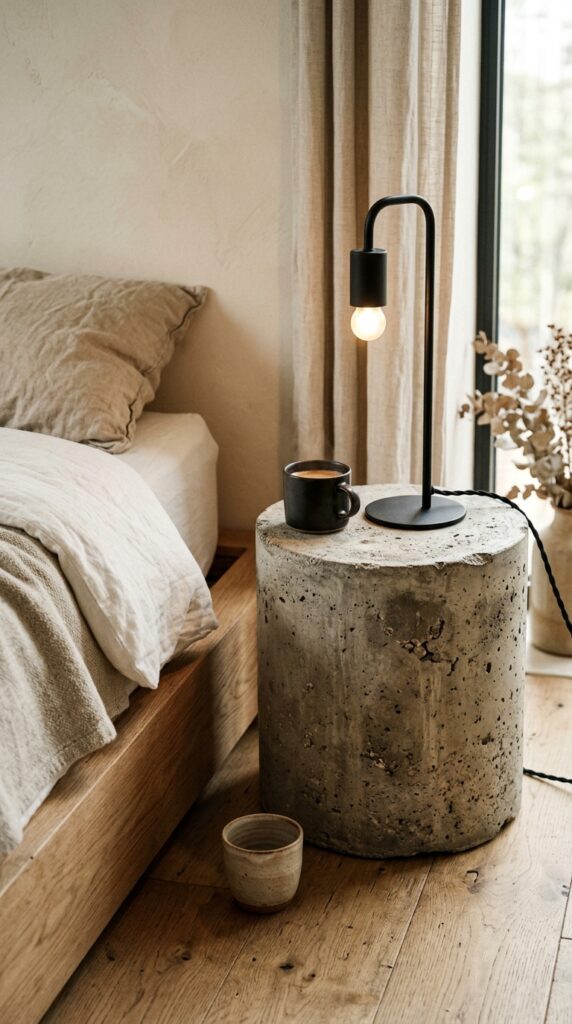
Vibe: Raw — the weight of the earth beside where you sleep.
Why it works: Concrete or stone introduces the heaviest visual weight in the Japandi material palette, and its placement matters enormously. Used as a small side table or pedestal, it creates an anchor beside the lightweight linen and wood elements — the contrast between the concrete’s mass and the bed’s low, floating quality creates a satisfying material tension. The visible aggregate in cast concrete also embodies wabi-sabi: each pour is slightly different, making every piece inherently one-of-a-kind.
How to get it: Source cast concrete side tables from independent makers on Etsy (typically $80–$150), or DIY a concrete pedestal using a cylindrical form mold available at lumber yards. Seal the surface with a food-safe concrete sealer for a matte finish that resists moisture from cups and vases.
Shop The Look
| Product |
| Cast concrete side table pedestal minimalist |
| Concrete candle holder set modern minimalist |
| Stone coaster set natural travertine |
| Concrete planter pot small indoor minimal |
| Concrete vase cylindrical grey matte |
16. Open Wardrobe with Fabric Panel Door
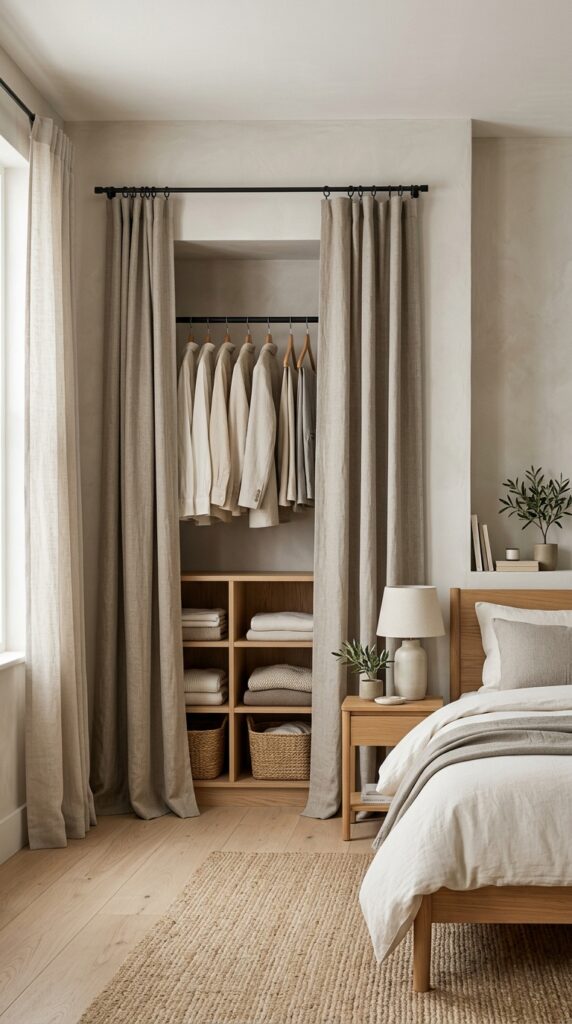
Vibe: Calm — the room holds what it needs and shows only what’s ready.
Why it works: Swapping wardrobe doors for fabric panels solves one of the most common Japandi friction points: bulky swing-out doors that break the clean wall line and interrupt traffic flow. Linen panels slide on a simple rod with zero mechanical complexity, add softness and texture to what would otherwise be a hard architectural element, and allow air circulation inside the wardrobe. The partially-drawn panel also creates an intentional reveal — a glimpse of organized interior that suggests order without demanding perfection.
How to get it: Install a slim matte black tension rod or ceiling-mounted curtain track inside the wardrobe opening. Cut natural linen panels 12 inches wider than the opening (to allow for proper gathering) and hem to floor length. The key is keeping wardrobe contents in a limited color range — neutrals only — so any visible interior reads as curated.
💡 Quick Win: A $20 IKEA ceiling track curtain system (KVARTAL) adapts easily to wardrobe openings and eliminates the need for any carpentry.
Shop The Look
| Product |
| Linen curtain panel fabric flat natural greige |
| Ceiling curtain track system matte black |
| Slim matte black tension curtain rod |
| Velvet slim hangers set natural blush |
| Open wardrobe storage rack wooden frame minimal |
17. Tatami-Inspired Bedroom Zone Definition
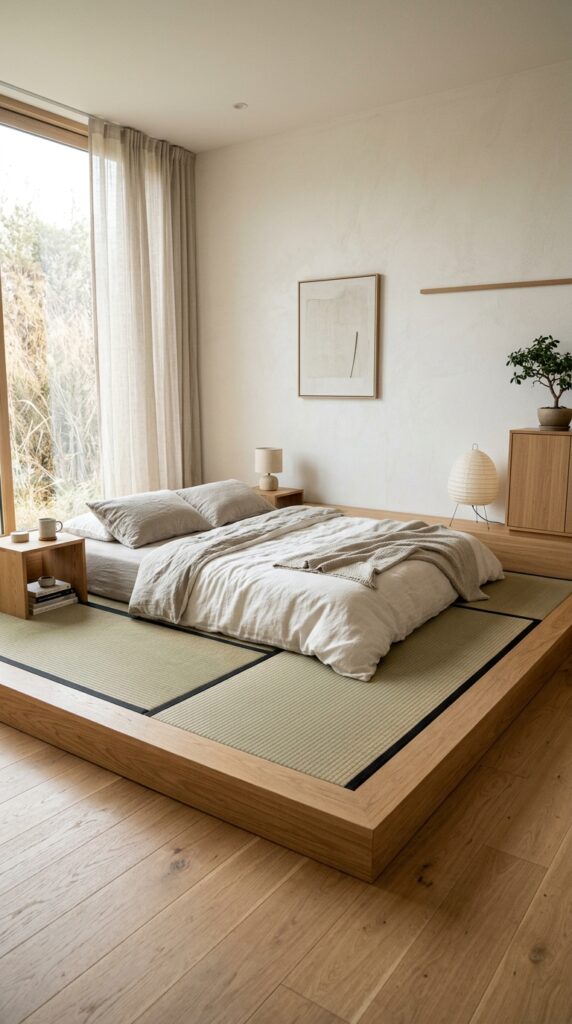
Vibe: Grounded — the bed doesn’t sit in the room; it inhabits its own world within it.
Why it works: Defining the sleeping zone with a platform or tatami-mat area draws directly from Japanese sleeping traditions and solves a layout challenge: in an open or studio bedroom, the sleeping area can feel spatially undefined. The platform creates a zone boundary without a wall, using elevation and material change to signal “this space has a specific purpose.” The tatami material — woven rush grass — introduces a distinctly Japanese texture that grounds the entire room.
How to get it: Build a simple 4-inch platform using 2×4 lumber framing and plywood decking, finished with bamboo or white oak veneer on the exposed sides. Top with traditional tatami mats (available from Japanese specialty retailers) cut to the platform dimensions. The transition from hardwood floor to tatami at the platform edge is itself a design feature — leave it clean and uncarpeted.
Shop The Look
| Product |
| Tatami mat natural rush traditional Japanese |
| Low wood platform base bed frame DIY |
| Bamboo floor mat area rug natural |
| Hardwood floor transition strip natural oak |
| Japanese rush floor cushion sitting mat |
18. Warm Mushroom and Blush Palette Layering
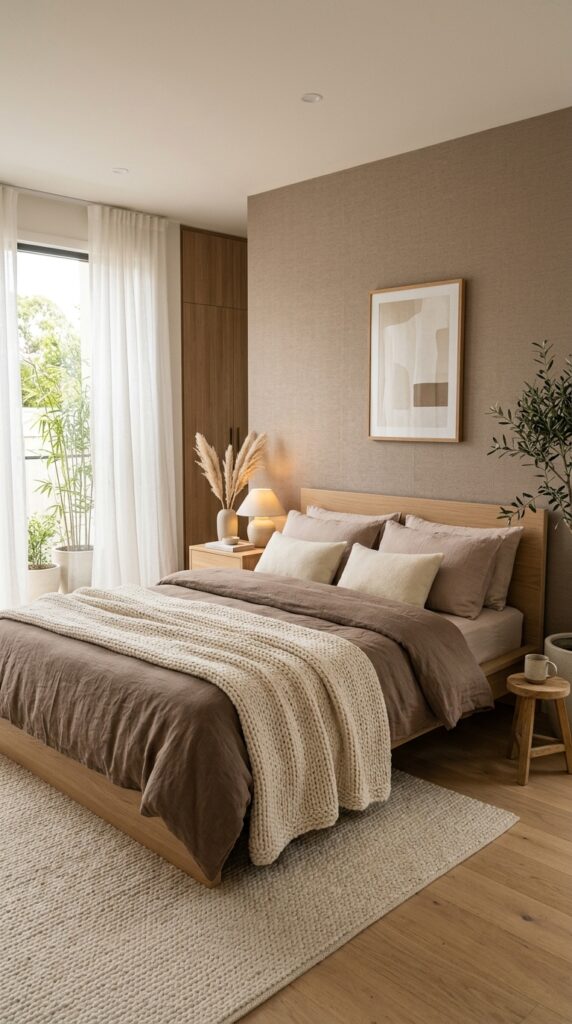
Vibe: Sun-warmed — the kind of tonal depth that took someone years to figure out.
Why it works: Layering within a single color family — mushroom, blush taupe, cream — creates what interior designers call a tonal composition: the eye perceives richness and depth without processing multiple colors. This is one of the hardest Japandi techniques to execute but produces the most sophisticated results. The critical variable is undertone consistency: every tone in the palette must share a warm (pink or yellow) undertone. Introduce a grey-undertoned mushroom and the whole arrangement reads muddy.
How to get it: Build the palette from one anchor fabric first — order a large linen swatch in your target mushroom tone and bring it home. Stack potential pillow covers and throws against it in natural light. Anything that looks grey or cool drops out; anything that glows warm stays. The final palette should look like one color seen through different translucencies.
Shop The Look
| Product |
| Mushroom linen duvet cover queen |
| Blush taupe linen pillow sham set |
| Cream chunky wool throw blanket |
| Mushroom tone linen euro pillow covers |
| Blush velvet lumbar pillow cover minimal |
19. Vertical Slatted Wood Accent Wall
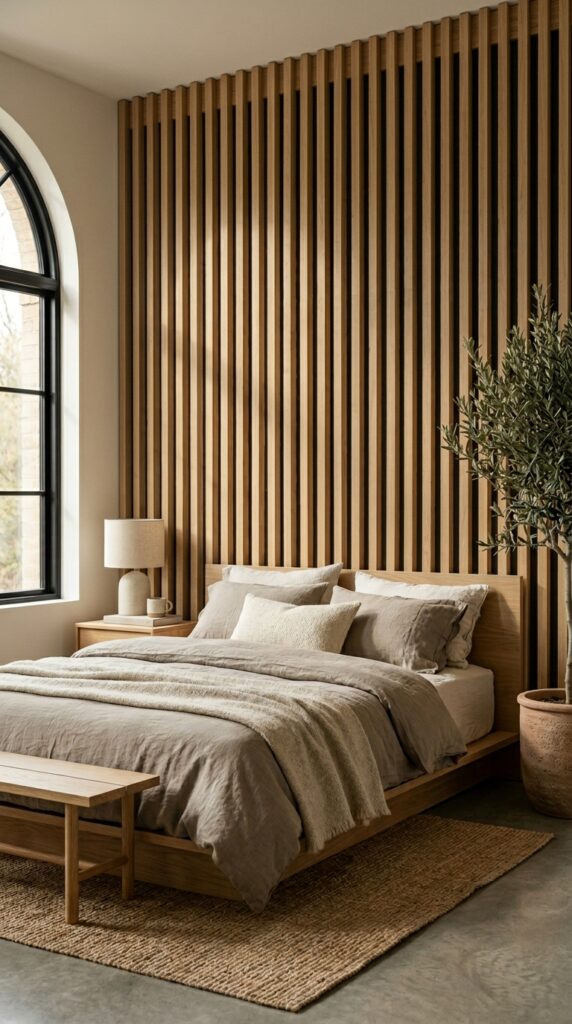
Vibe: Layered — a wall that does something different every hour as the light moves.
Why it works: Vertical wood slats introduce three design effects simultaneously: texture, depth through shadow, and a strong vertical line that visually heightens the ceiling. The spacing between slats is the key variable — 1–2 inch gaps create shadow without darkness; wider gaps reveal the wall behind (which should be a contrasting but harmonious tone, like warm charcoal or dusty sage, for maximum effect). This is a distinctly Japanese architectural detail — slatted screens and shoji frames — brought into a contemporary context.
How to get it: Use 1×2 inch white oak furring strips adhered to a plywood backer panel using construction adhesive, spaced 1.5 inches apart. Mount the panel as a unit rather than individual strips — this makes installation faster and alignment perfect. Paint the wall behind the backer a shade darker than the slats before installation.
💡 Quick Win: Pre-made wood slat wall panels in peel-and-stick or nail-up format are available at home improvement stores for approximately $30–$60 per panel — a legitimate shortcut that delivers the same effect without custom carpentry.
Shop The Look
| Product |
| Wood slat wall panel kit white oak peel stick |
| White oak 1×2 furring strip natural finish |
| Wood slatted headboard wall art panel |
| Slatted wood room divider panel screen |
| Unfinished wood wall panel accent DIY |
20. Minimalist Bedroom Fragrance: Incense and Natural Botanicals
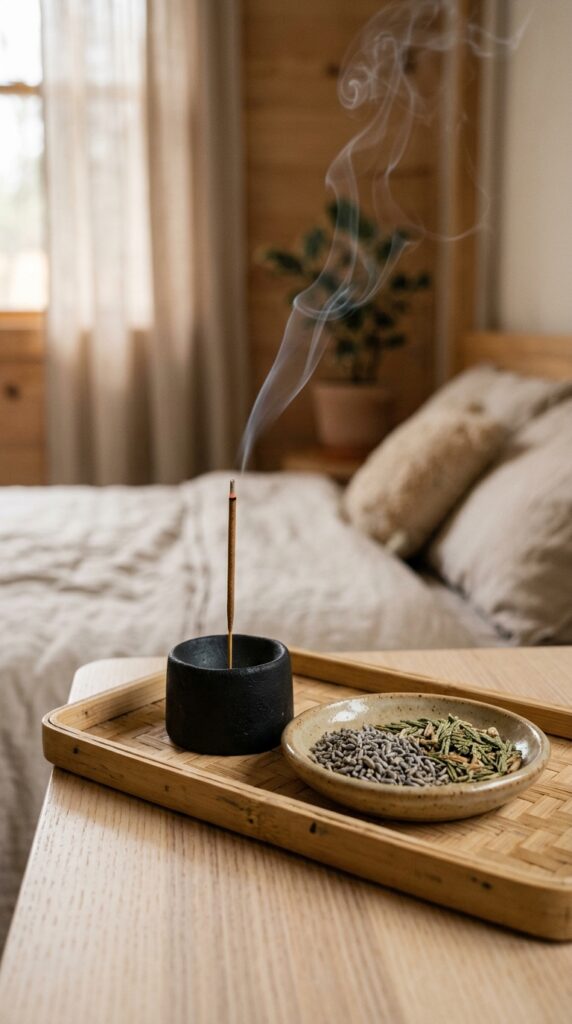
Vibe: Still — a room you can also smell.
Why it works: Japandi engages all five senses — scent is not decoration but atmosphere. Japanese incense tradition (kōdō) treats fragrance as a form of meditation, and Scandinavian design culture similarly prizes natural aromatics: cedar, spruce, dried herbs. In a Japandi bedroom, fragrance is introduced through materials rather than synthetic sprays: hinoki cypress wood (a Japanese bath wood with a clean, resinous scent), dried lavender in a ceramic dish, or natural beeswax candles. The combination creates an olfactory dimension that completes the sensory experience of the space.
How to get it: Use Japanese incense sticks (brands like Nippon Kodo or Shoyeido are easily sourced) in a ceramic holder placed on a bamboo tray to catch ash. Dry your own botanicals — bundles of lavender, eucalyptus, or dried pampas — and hang them near the window where air movement activates the fragrance.
Shop The Look
| Product |
| Japanese incense sticks natural hinoki sandalwood |
| Matte ceramic incense holder minimal |
| Dried lavender bundle sachets bedroom |
| Natural beeswax pillar candles unscented |
| Hinoki wood bath accessory block natural |
21. Studio Bedroom Zone Definition with Shoji Screen
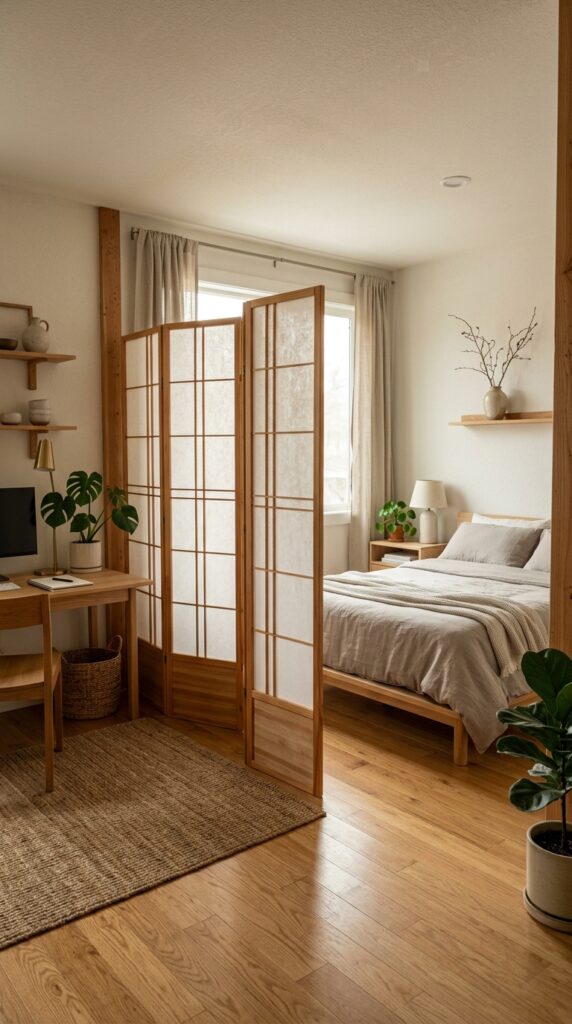
Vibe: Serene — the screen turns one room into two worlds.
Why it works: A shoji screen is the most culturally authentic Japandi solution to the open-plan bedroom problem. Beyond visual division, the rice paper panels allow light to pass through from both sides — the sleeping zone receives soft, diffused light rather than being cast into shadow, which maintains the Japandi quality of gentle illumination even without a direct window. The screen also creates a psychological threshold that tells your brain the sleeping zone has different rules than the rest of the space.
How to get it: Position the screen at an angle rather than flat across the room — a slight angled placement creates more visual interest, suggests a passage rather than a wall, and allows light to enter the sleeping zone from multiple directions. Anchor the base with a low flat stone or concrete weight if the screen tends to tip.
Shop The Look
| Product |
| Shoji screen folding room divider 3 panel natural wood |
| Rice paper replacement panels shoji screen |
| Room divider screen bamboo frame 4 panel |
| Wooden frame folding partition screen 6 feet |
| Decorative wood panel screen room divider |
22. Organic Linen Pillow Architecture
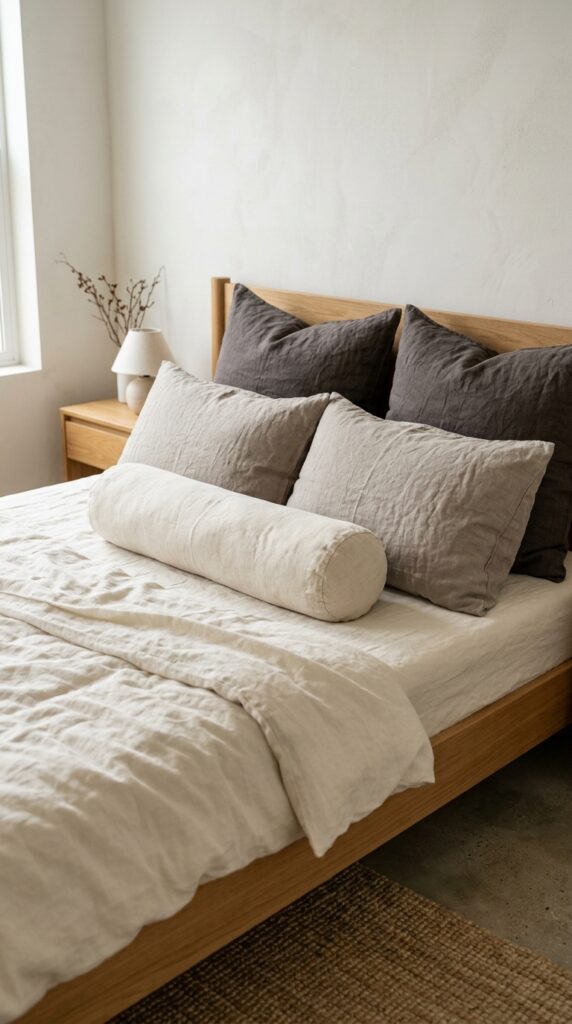
Vibe: Deliberate — the bed looks like someone thought carefully about every layer.
Why it works: Japandi pillow arrangement follows a strict restraint principle: only sleep pillows and one bolster, in two to three tonal variations of the same color family. The bolster is a distinctly Japanese element — a single horizontal cylinder that creates an intentional geometric counterpoint to the rectangular shams behind it. The arrangement feels architectural rather than decorative. Removing all throw pillows reduces morning bed-making time to under 90 seconds, which matters in a space designed for ease.
How to get it: Work in tonal steps from back to front: darkest at the back wall (charcoal king shams), moving to a mid-tone (greige standard shams), ending with the bolster in the lightest tone (undyed linen). All fabric must be linen — the natural texture variation keeps this arrangement from reading as a hotel setup.
Shop The Look
| Product |
| Linen bolster pillow cover cylindrical natural |
| Linen king pillow sham set charcoal |
| Linen standard pillowcase set greige |
| Bolster pillow insert 20 inch cylindrical |
| Linen pillow insert standard medium fill |
23. Under-Bed Storage with Minimal Profile
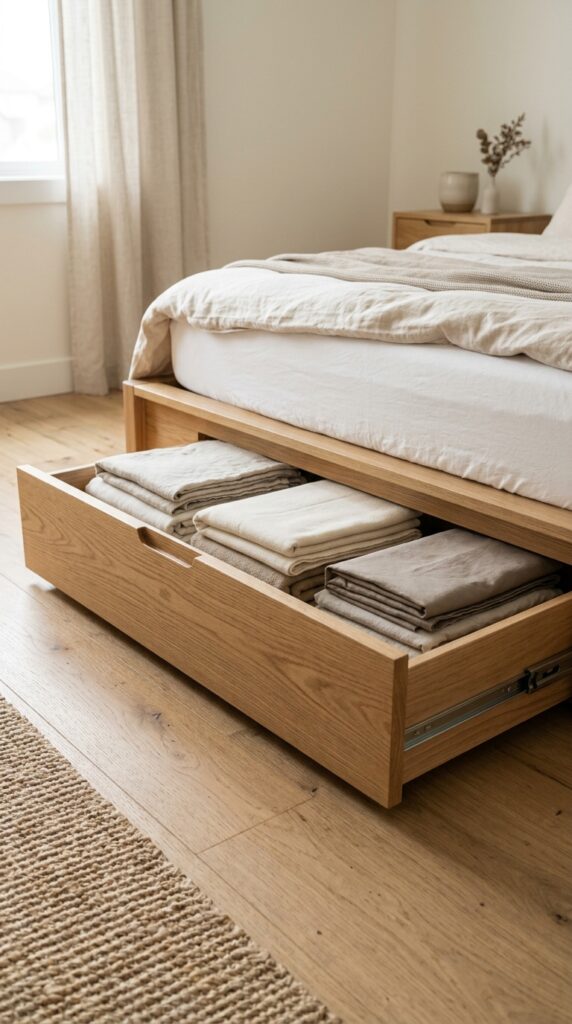
Vibe: Organized — nothing visible, nothing wasted.
Why it works: Under-bed storage in a Japandi bedroom works only under one condition: the drawer face must be invisible when closed. This requires either a flush-front drawer with a finger-pull recess (no hardware) or a platform bed designed with integrated storage — not the add-on plastic bins that expose themselves below a raised frame and immediately betray the clean floor line Japandi requires. The storage is architectural, not afterthought.
How to get it: Source platform beds with built-in under-bed drawers on smooth glide hardware — look specifically for “flush face” or “no hardware” drawer descriptions. Alternatively, add a 4-inch bed skirt panel in the same linen as your duvet to conceal standard storage containers beneath a standard bed frame.
💡 Quick Win: IKEA NORDLI bed frames include flush-front under-bed drawers in matte white — a $299–$499 investment that eliminates the need for a dresser entirely in smaller bedrooms.
Shop The Look
| Product |
| Platform bed frame with storage drawers white oak |
| Under bed storage drawer rolling thin profile |
| Linen storage bin rectangular with lid |
| Vacuum storage bags flat bedding |
| Under bed shoe storage flat box set |
24. Dried Botanical Wall Arrangement
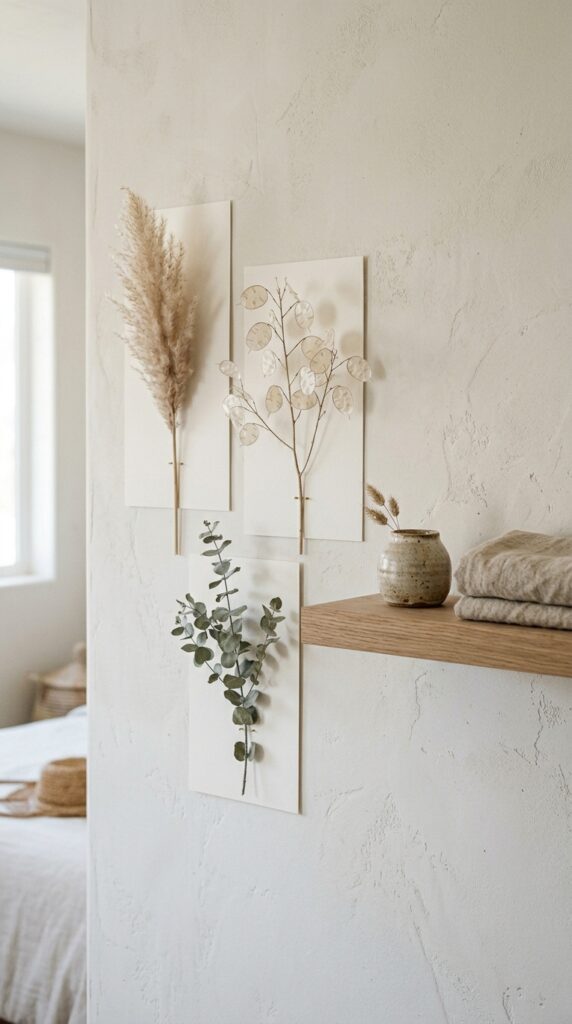
Vibe: Organic — a wall that grew slowly rather than one someone decorated.
Why it works: Dried botanicals occupy a unique position in Japandi wall art: they are simultaneously organic in origin and architecturally minimal in scale. Unlike framed prints or canvas art, dried specimens bring three-dimensional texture and natural color variation to the wall — the translucency of lunaria pods, the feathered softness of dried pampas, the structural rigidity of preserved eucalyptus. No two arrangements look the same, satisfying both wabi-sabi’s love of natural imperfection and the style’s rejection of mass-produced decoration.
How to get it: Mount dried stems directly to the wall using small picture hooks or removable adhesive strips — no frames. Arrange in a loose asymmetric cluster rather than a grid. The arrangement should include height variation: one piece nearly touching the ceiling, one at eye level, one below. Use odd numbers of specimens.
Shop The Look
| Product |
| Dried pampas grass bundle bleached natural |
| Dried lunaria honesty plant stems |
| Dried eucalyptus bunch preserved |
| Dried palm leaf stems wall decor |
| Dried bunny tail grass stems natural |
25. Compact Japandi: The One-Wall Bedroom
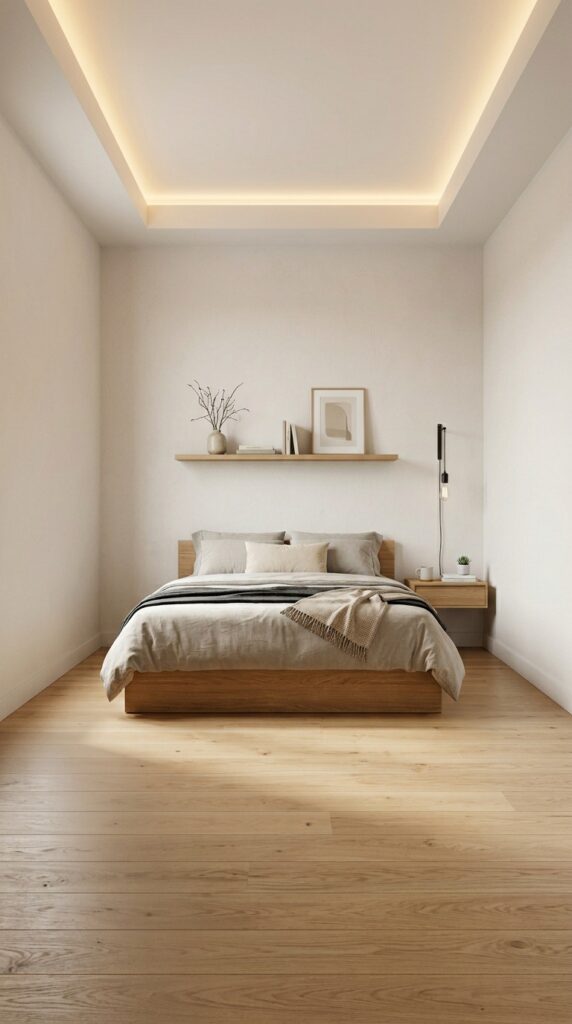
Vibe: Airy — the room breathes even though the apartment is small.
Why it works: In compact bedrooms, Japandi’s one-wall strategy concentrates all furniture and function along a single wall and leaves the remaining three walls completely bare — an application of ma at the room scale. This arrangement creates an unobstructed visual field from the doorway that makes small rooms appear to be approximately 30% larger than they are. The key technique is using wall-mounted elements (floating shelves, sconces, wall-mounted nightstands) instead of floor-standing furniture, which keeps the floor plane entirely clear and maximizes the perceived openness.
How to get it: Map your single functional wall (ideally the wall opposite the door or window, not the window wall itself) and place only: the bed, one wall-mounted light per side, and one floating shelf above the bed. Every other floor-standing piece of furniture — chairs, benches, dressers — should be reconsidered for built-in or wall-mounted alternatives.
💡 Quick Win: Replace a floor-standing nightstand with a wall-mounted floating shelf in white oak — approximately $30–$60 — and immediately reclaim 4–6 square feet of visible floor space.
Shop The Look
| Product |
| Wall mounted floating nightstand white oak small |
| Wall sconce plug-in matte black minimal |
| Floating shelf white oak wall mount 24 inch |
| Slim platform bed frame full size white oak |
| Wall mounted shelf bracket minimal hidden |
How to Start Your Japandi Bedroom Transformation
Begin with paint, not furniture. The single most impactful first move is painting your walls Benjamin Moore “White Dove” (OC-17) in a flat or matte finish. This warm white is the neutral canvas that makes every subsequent Japandi decision easier — it reflects light softly, complements both oak and walnut tones, and works with every accent color in the Japandi palette. Starting with furniture before establishing the right wall color is the most common sequencing mistake, and it makes every subsequent purchase harder to evaluate.
The most fixable beginner error is choosing a cool-toned neutral — a grey-white or blue-grey — under the impression that it reads “minimal.” Cool neutrals fight the warm wood tones that define Japandi and make the room feel corporate rather than meditative. The fix is simple: hold paint swatches beside a piece of warm oak or walnut in natural light. If the wall color looks grey or lavender beside the wood, it is too cool.
Three items under $50 that create instant Japandi impact: a set of slim matte black drawer pulls (transform any existing dresser for $15–$25), a dried pampas stem in a simple vessel from a thrift store ($8–$12 total), and a natural linen throw folded precisely at the foot of your existing bed ($20–$35 at most big-box home stores in the undyed or greige colorway).
A realistic bedroom refresh takes two weekends to feel cohesive and three to six months for a full transformation. A starter version — new bedding, updated hardware, and one botanical element — runs $150–$300. A full room with new bed frame, lighting, and rugs realistically lands between $800 and $2,500, depending on whether you source from IKEA or independent makers.
Frequently Asked Questions About Japandi Bedrooms
What is the difference between Japandi and Scandinavian design?
Both styles share a love of natural materials, neutral palettes, and functional furniture, but they diverge in philosophy and texture. Scandinavian design (hygge) leans into cozy layering — more textiles, warmer wood tones, and a slightly higher tolerance for decorative objects. Japandi is more austere: it borrows Scandinavian warmth but filters it through the Japanese principles of wabi-sabi (the beauty of imperfection) and ma (the value of empty space). The result is a quieter, more edited version of Scandinavian — less layering, more intentional restraint, and a stronger emphasis on individual objects having meaning.
What colors work best in a Japandi bedroom?
The Japandi bedroom palette centers on warm neutrals: warm white (Benjamin Moore “White Dove” OC-17 or Sherwin-Williams “Alabaster” SW 7008), greige, warm charcoal, dusty sage, blush mushroom, and undyed linen. All tones must share a warm undertone — yellow or pink base, never grey or blue. Accent colors are used in extremely limited quantities: a single dusty sage accent wall, or warm black hardware. Avoid cool greys, bright whites (which feel clinical), and any saturated color that draws attention away from the texture and material quality that define the style.
How much does a Japandi bedroom typically cost?
A starter Japandi refresh — new bedding in natural linen, updated hardware, and a few botanical accents — can be achieved for $150–$400. A mid-range transformation with a new platform bed frame, pendant lighting, and a natural fiber rug runs $800–$2,000. A full room with custom elements (upholstered linen headboard panel, built-in storage, hardwood flooring) typically lands between $3,000–$8,000. The good news: Japandi rewards restraint economically. Buying fewer, better-quality pieces — one $400 white oak bed frame instead of three $150 furniture pieces — produces a more authentic result and longer-lasting satisfaction.
Can I mix Japandi with other furniture I already own?
Yes, with one important criterion: the existing furniture must have clean lines, warm-toned wood, and no ornate details. Pieces in walnut, white oak, or warm beech can often be integrated directly. Painted furniture in warm white or warm greige also adapts well. What doesn’t integrate: furniture with visible decorative hardware, ornate carved details, cool-grey painted finishes, or high-gloss lacquer surfaces. Rather than replacing everything at once, begin by removing the pieces that most conflict with the Japandi palette and replace them incrementally over six to twelve months.
Do I need a tatami mat or low-profile bed to achieve the Japandi look?
A tatami mat is a culturally specific element that enhances authenticity but is not required for a Japandi-feeling bedroom. What is genuinely important is the low visual profile of the sleeping surface — a bed that sits no more than 18–24 inches off the floor total (mattress included). If your current bed frame is too high, remove the box spring and rest the mattress directly on the frame slats to lower the profile immediately. The floor clearance beneath the bed should be minimal — under 6 inches — so the bed reads as grounded in the space rather than elevated above it.
Ready to Create Your Dream Japandi Bedroom?
These 25 ideas have covered the full spectrum of Japandi design — from foundational color decisions and material layering to lighting philosophy, furniture proportion, layout discipline, and small-space problem solving. Transformation doesn’t demand an entirely new room on a single weekend; the most authentic Japandi spaces are built one intentional decision at a time, and starting small is not a compromise — it is the correct approach. Today, choose one wall and order a sample pot of warm white paint — that single act will clarify every furniture and textile decision that follows. When the room is finished, you will feel the difference before you can articulate it: a stillness that comes from having exactly what you need and nothing you don’t. Save the ideas that feel most like you — and revisit the ones that feel like the room you’re still becoming.