
Modern garage loft design transforms a utilitarian structure into a live-work hybrid that balances raw industrial bones with intentional comfort, layered materials, and architectural clarity. These 24 modern garage loft designs cover everything from exposed concrete finishes and mezzanine structures to lighting strategies, color palettes, and compact adaptations — with specific techniques you can act on today.
There’s something grounding about a space that shows its own skeleton. Concrete overhead, steel at the railing, daylight splitting through a clerestory window — the modern garage loft earns its atmosphere rather than decorates over it. It’s a room that makes you want to work longer, think harder, and stay home. Here are 24 ideas worth saving — and stealing.
Why Modern Garage Loft Design Works So Well
Modern garage loft design sits at the intersection of industrial architecture and residential warmth, drawing from the adaptive reuse movement that began converting factories and warehouses into living spaces in 1970s New York. What distinguishes it from standard industrial design is restraint: raw materials are selected and refined, not just exposed. The structural elements — concrete, steel, open joists — become the aesthetic, not a backdrop for furniture. It’s a style built on honesty about what a space is made of.
The core palette runs from poured concrete gray to warm charcoal, anchored by warm whites like Benjamin Moore “Chantilly Lace” and offset with raw timber tones. Materials are tactile and intentional: unfinished white oak for treads and shelving, hot-rolled steel for railings and frames, honed or polished concrete for floors, and corrugated Corten steel as an accent surface. Textiles bring the warmth — undyed linen, oatmeal wool throws, and woven jute rugs create contrast against hard surfaces without softening the industrial edge.
Post-pandemic, the garage became one of the most renovated spaces in North America — searched on Pinterest over 200% more than pre-2020 as homeowners looked for live-work-sleep flexibility without moving. The “bonus space” mentality has shifted: people want their garage to earn its square footage as a studio, a guest suite, an office loft, or all three simultaneously. Modern design is uniquely suited to this because its clean lines and open planning adapt to multiple uses without looking chaotic or overdesigned.
Yes — even a single-car garage footprint (roughly 12×22 feet) can achieve this style with the right sequence of decisions. Prioritize vertical space first: a mezzanine sleeping or working platform immediately doubles usable square footage. Choose built-in storage over freestanding wherever possible. The one honest limitation: ceilings under 10 feet compress the openness that defines this style, so in those cases, focus on the material palette and lighting rather than mezzanine construction.
Style at a Glance
| Element | Industrial Edge | Residential Warmth |
| Philosophy | Structural honesty | Intentional comfort |
| Materials | Concrete, hot-rolled steel, corrugated metal | Unfinished white oak, linen, jute |
| Color Palette | Poured concrete gray, warm charcoal | Warm white, raw timber, oatmeal |
24 Modern Garage Loft Designs
1. Concrete Gray + Warm Oak Two-Tone Palette
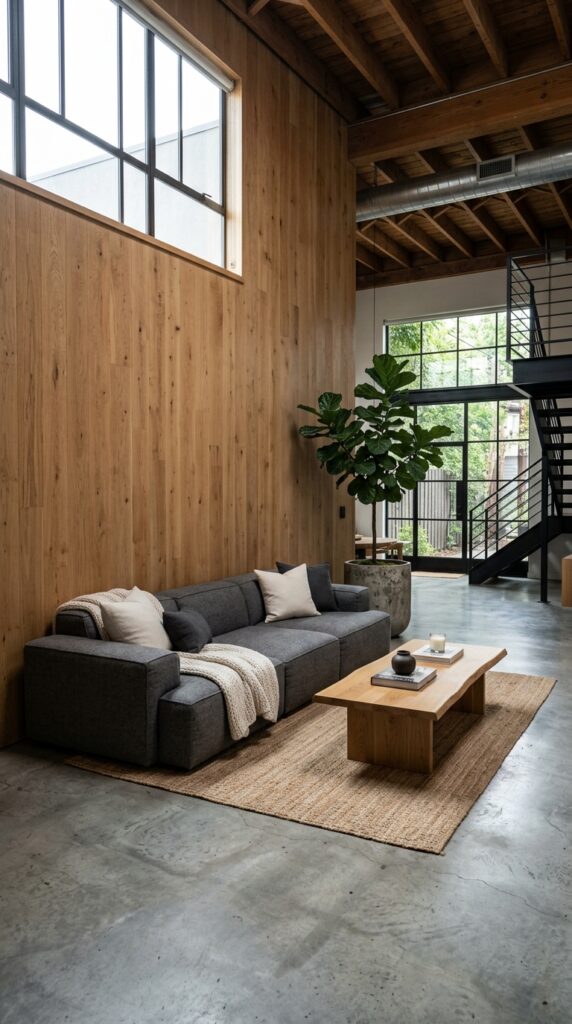
Vibe: Grounded — like standing inside a beautifully considered building site.
Why it works: The design principle at play here is tonal counterbalance: cool concrete floors pull visual weight downward while warm oak paneling on a single feature wall draws the eye up and adds organic warmth. This prevents the all-concrete look from reading as a parking structure. Keeping both materials in their natural, unfinished states — concrete with a matte sealer, oak without stain — maintains the visual authenticity this style demands and lets each material’s own color do the work.
How to get it: Choose the longest wall or the one most visible from entry and panel it floor-to-ceiling in 4-inch-wide white oak planks in a vertical run. Leave the concrete floor in its natural state but apply a matte penetrating sealer (not a glossy topcoat) to deepen the gray without adding shine.
💡 Quick Win: A large-leaf plant in a matte concrete-finish pot placed where the oak wall meets bare concrete reinforces both materials simultaneously for under $40.
Shop The Look
| Product |
| Unfinished white oak wood plank wall paneling peel and stick |
| Concrete floor penetrating sealer matte finish |
| Low-profile charcoal sectional sofa modern |
| Large concrete-finish ceramic floor planter |
| Undyed natural linen throw blanket sofa |
2. Exposed Concrete Block Feature Wall
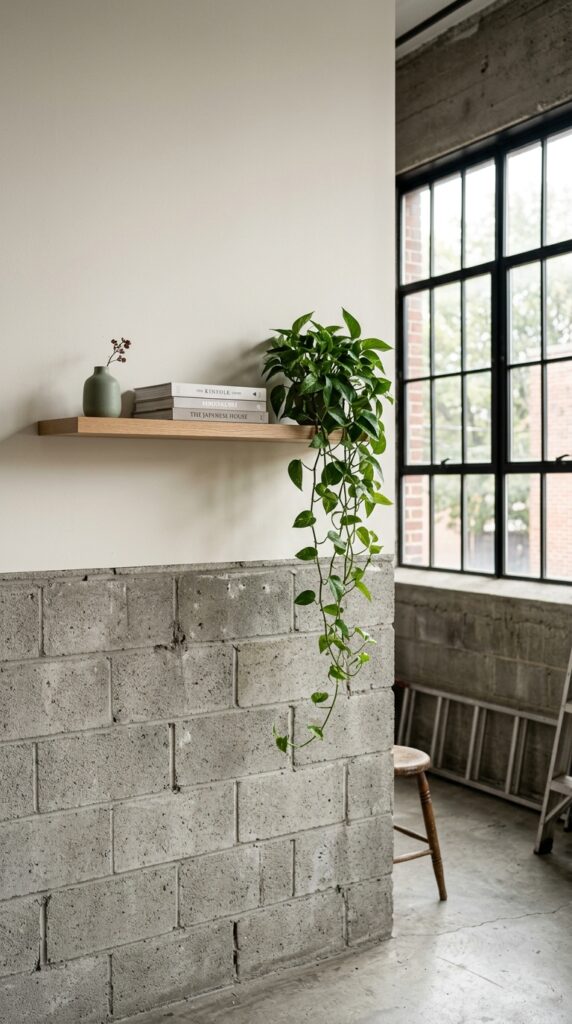
Vibe: Hushed — like a gallery that forgot to finish being built, and decided that was better.
Why it works: Concrete block walls are one of the most common structural elements in garage construction, and most homeowners rush to cover them with drywall. Leaving them exposed — or selectively painting only the upper portion in warm white while keeping the lower course raw — creates a two-zone material narrative that reads as intentional design. The mortar lines between blocks add horizontal rhythm and tactile texture that drywall simply cannot replicate. The division at roughly 54 inches from the floor aligns with the natural human sight line, making it feel proportionally deliberate.
How to get it: If your CMU wall has been painted before, strip it with a concrete-safe remover and wire brush to re-expose the block texture. For a raw wall, apply a masonry sealer only — no paint — to preserve the natural color variation while slowing moisture movement. Float a single 2-inch-thick white oak shelf using hidden brackets to complete the composition.
Shop The Look
| Product |
| Masonry concrete block wall sealer clear matte |
| Floating oak shelf wall mounted hidden bracket 24 inch |
| Minimalist ceramic bud vase set matte white |
| Trailing pothos plant hanging pot small |
| Hardcover architecture design coffee table books set |
3. Industrial Cage Pendant Cluster Over a Work Island
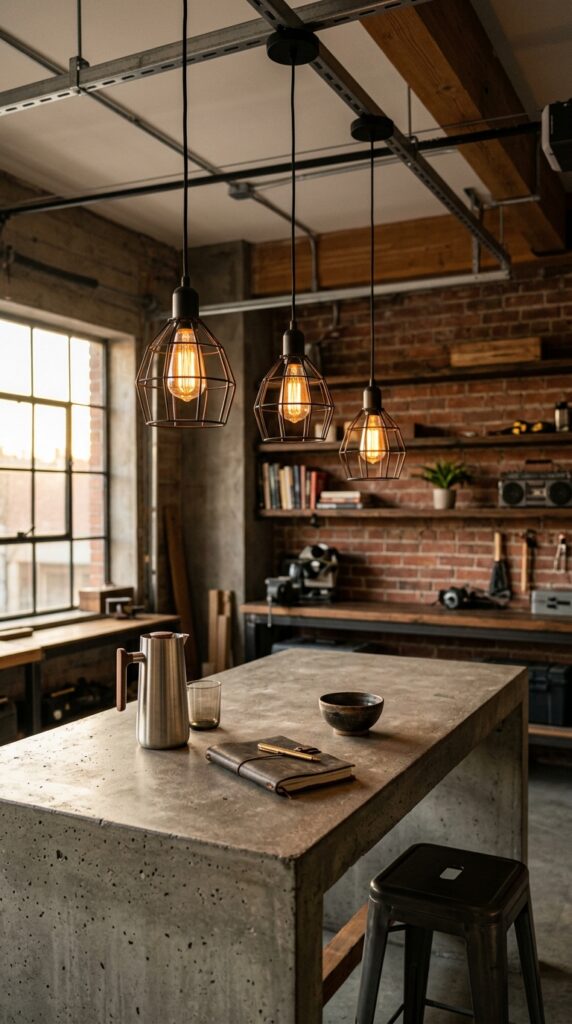
Vibe: Purposeful — a space that takes what you’re making seriously.
Why it works: Pendant cluster lighting creates visual hierarchy in an open-plan loft where architectural divisions don’t exist. Varying the drop heights of three identical matte-black cage pendants — outermost at 48 inches from ceiling, center at 36 inches — creates a cascading focal point that anchors the work zone without a wall or partition. The filament-style bulb inside each cage emits a warm amber tone (2700K) that counteracts the cool gray of concrete surfaces directly below, making the work zone feel warmer than the surrounding space.
How to get it: Use a canopy adapter plate that accepts three pendant cords from a single junction box — this avoids three separate electrical connections. Set the center pendant 30–34 inches above the island surface and offset the flanking pendants 6 inches higher. Use 2700K Edison filament LED bulbs at 40-watt equivalent.
💡 Quick Win: Plug-in pendant lights with a swag hook and ceiling clip replicate this look in an unwired space for around $45 each — no electrician required.
Shop The Look
| Product |
| Matte black cage pendant light industrial Edison bulb |
| Three pendant canopy adapter ceiling mount kit |
| Edison filament LED bulb 2700K 40W equivalent 6 pack |
| Concrete look countertop overlay resurfacing kit |
| Leather journal A5 refillable minimalist |
4. Floating Mezzanine Sleeping Platform

Vibe: Layered — the rare space that makes a single footprint feel like it has stories to tell.
Why it works: The mezzanine sleeping platform is the highest-leverage structural move in modern garage loft design: it separates living zones without a wall, preserving visual openness while doubling usable square footage. The hot-rolled steel frame reads as structural and honest rather than decorative. Open-tread stairs with steel stringers maintain sightlines through the stair body, preventing the heavy visual block that a solid staircase creates in a compact footprint. The result is vertical differentiation — two distinct zones — without any loss of the open-plan atmosphere.
How to get it: Specify a minimum ceiling height of 13 feet for a functional mezzanine — 7 feet of clearance above the sleeping surface and 6 feet minimum below for a functional office or living zone. Use a structural steel fabricator for the frame; white oak treads cut at 1.5 inches thick, sanded to 150-grit, are the correct pairing.
Shop The Look
| Product |
| Steel cable railing kit DIY stair mezzanine 36 inch |
| Low platform bed frame solid wood modern |
| Oatmeal linen duvet cover set queen natural |
| White oak stair tread solid wood unfinished 36 inch |
| Plug-in wall sconce reading light matte black |
5. Gridded Steel Partition Wall — Crittall Style
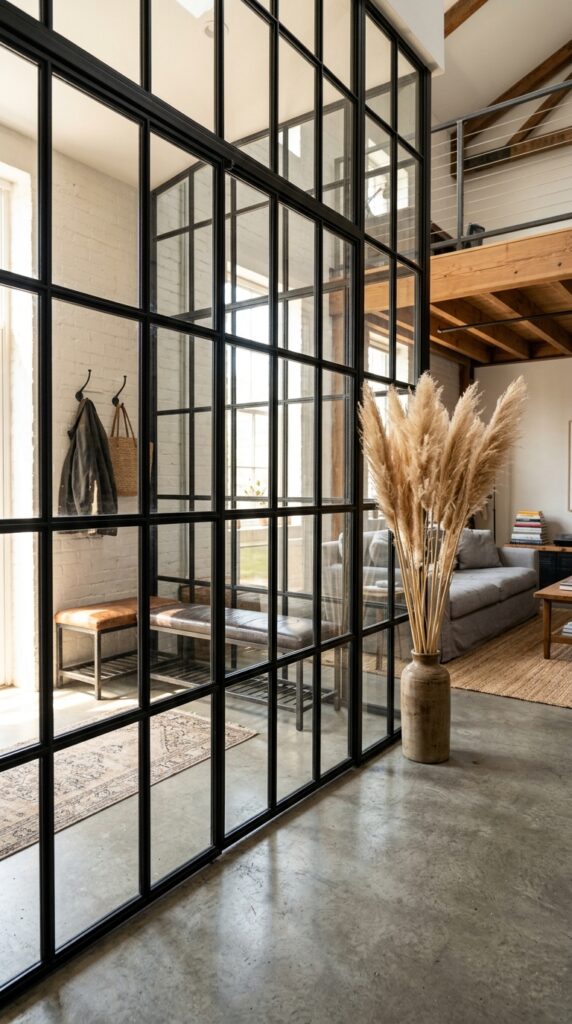
Vibe: Luminous — like the space has been cut open and light is filling the gap.
Why it works: The gridded steel partition, often called a Crittall-style divider, uses the design principle of visual permeability: it defines a zone boundary without blocking light or sightlines. In a garage loft where natural light is a premium resource (often limited to one or two exterior walls), glass partitions allow light to travel deeper into the plan. The thin matte-black steel frame adds graphic structure and visual weight without mass — you see the grid, then you see through it.
How to get it: Prefabricated steel frame partition kits can be installed by a skilled DIYer and cost significantly less than custom fabrication. For non-structural applications, specify 1/4-inch tempered safety glass panels. Seal all steel frames with a matte-black rust-inhibiting primer before installation.
💡 Quick Win: A freestanding room divider with a steel grid pattern in powder-coated black creates the same graphic vocabulary for around $180 — no installation required.
Shop The Look
| Product |
| Steel frame room divider partition black grid modern |
| Dried pampas grass tall arrangement floor vase included |
| Iron frame entryway bench modern industrial |
| Matte black rust-inhibiting metal primer spray |
| Tempered glass privacy screen freestanding modern |
6. Warm Charcoal + Cognac Leather Palette
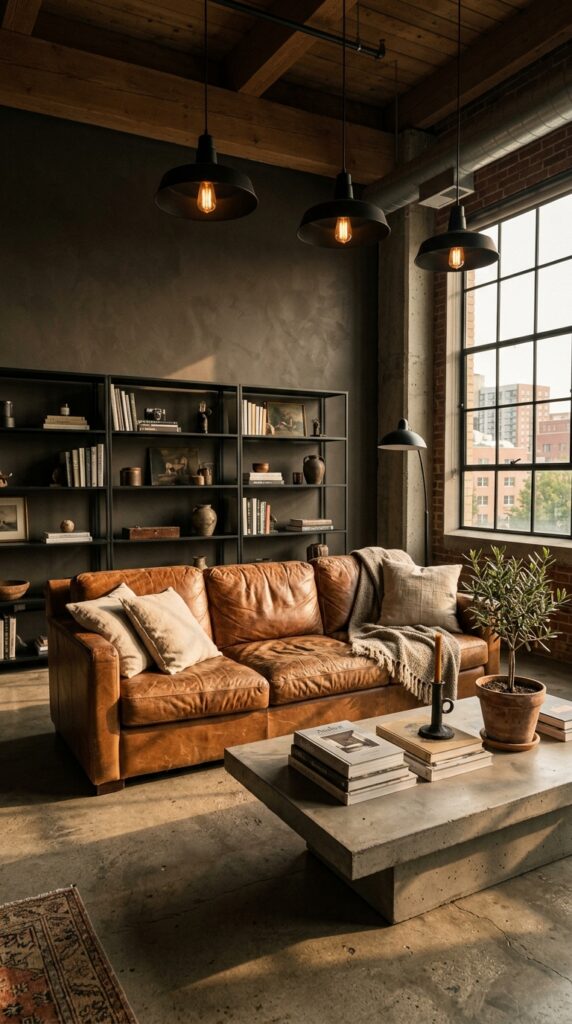
Vibe: Moody — the kind of room that makes afternoon light feel like a luxury.
Why it works: The distinction between warm charcoal and matte black is subtle but critical: charcoal walls with a warm undertone (look for LRV values between 10–20 on paint chips) absorb light softly rather than reflecting it flatly. When paired with true matte-black fixtures and steel, the tonal variation creates depth on an almost monochromatic palette — two near-blacks that behave differently under changing light. Cognac leather and terra cotta introduce warmth without breaking the anchored, dim-room atmosphere that makes this modern garage loft design so appealing in the evening.
How to get it: Benjamin Moore “Wrought Iron” (2124-10) is the benchmark warm charcoal for this palette — apply it in a flat or matte finish on walls. Paint the ceiling one shade lighter in the same family (“Kendall Charcoal” HC-166) to prevent the ceiling from pressing down visually in a garage with modest height.
Shop The Look
| Product |
| Matte black industrial wall shelving unit adjustable steel |
| Cognac brown leather sofa modern mid-century |
| Cast iron taper candle holder set modern |
| Large terra cotta pot indoor olive tree |
| Dark charcoal textured wool area rug 8×10 |
7. Hot-Rolled Steel Mezzanine Railing

Vibe: Raw — honestly remarkable in the way things look before anyone decides to finish them.
Why it works: Hot-rolled steel, unlike cold-rolled or powder-coated steel, shows its manufacturing history in subtle surface oxidation and tone variation that no factory finish can replicate. Used as a mezzanine railing at full width, it introduces material texture at room scale — 36 inches high, running the full loft width — and becomes a defining design element rather than just a safety feature. A white oak capping rail on top bridges the industrial steel to the warmer materials below without diminishing the steel’s character.
How to get it: Specify horizontal bar infill at 4-inch spacing to meet IBC code requirements. Ask your fabricator to apply a clear matte wax finish only — no paint or powder coat — to preserve the surface variation while slowing oxidation over time.
💡 Quick Win: A 6-foot flat steel bar from a local metal supplier, bent into an L-bracket profile, creates a code-compliant single guard rail for a small step change for under $60 in materials.
Shop The Look
| Product |
| Industrial steel pipe railing kit DIY horizontal bar |
| White oak handrail unfinished solid 8 foot |
| Clear matte wax furniture and metal finish |
| Trailing string of pearls succulent hanging pot |
| Raw steel finish shelf bracket floating support |
8. Murphy Bed + Fold-Down Desk Combo
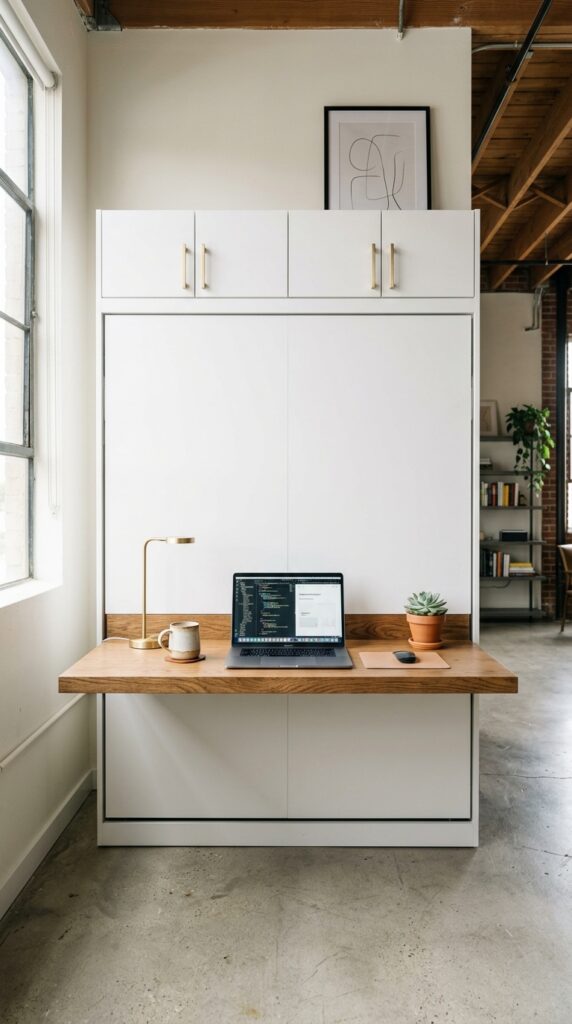
Vibe: Still — the organized clarity of a space that knows exactly what it needs to be.
Why it works: The Murphy bed plus integrated desk solves the central challenge in a garage loft without a mezzanine: sleeping and working in the same footprint without either zone compromising the other. When the bed is closed, the wall reads as a full-height cabinetry run — visually anchoring and functional without consuming floor area. The fold-down desk, when extended, delivers a full 24-inch-deep working surface. This is zone compression: maximum function with minimum visual footprint, a principle that makes small modern garage loft designs feel genuinely livable.
How to get it: Choose a Murphy system with a minimum closed depth of 14 inches so the mattress doesn’t create a bulge in the cabinet face. Pair with a 1.5-inch-thick solid oak desk surface in a pale, unfinished tone. Brushed brass bar pulls at 6-inch length and consistent spacing across all three cabinet doors create visual rhythm across the full face.
Shop The Look
| Product |
| Murphy wall bed kit queen with integrated desk fold down |
| Brushed brass cabinet bar pull handle 6 inch set of 10 |
| Solid oak floating desk surface wall mounted |
| Brass adjustable desk lamp minimalist modern |
| Small ceramic succulent planter desk size set |
9. Clerestory Windows for Deep Passive Light

Vibe: Sun-warmed — like the building itself is tracking the light across the day.
Why it works: Clerestory windows at roofline height solve a fundamental problem in garage architecture: garage doors and standard windows leave the interior naturally dark once the door is closed. Placement at the top 18–24 inches of wall height introduces light at a high angle that travels deeper into the floor plan than any eye-level window achieves. The resulting light shafts on polished concrete become a dynamic, shifting design element throughout the day — the room’s appearance literally changes hourly.
How to get it: Specify fixed aluminum-frame clerestory windows in a 1:3 height-to-width ratio — narrow and horizontal — for structural simplicity and clean proportion. A single run of four 12×48-inch fixed panes costs significantly less than operable windows of the same total area. Orient on the south or east wall for maximum morning and midday light capture.
Shop The Look
| Product |
| Solar sun tunnel skylight tube kit flexible 10 inch |
| Aluminum window sill trim kit modern interior |
| Polished concrete floor wax sealer semi-gloss |
| Sculptural arc floor lamp modern minimalist black |
| Low-profile linen sofa bench two seater |
10. Open-Plan Zones Defined by a Large Rug
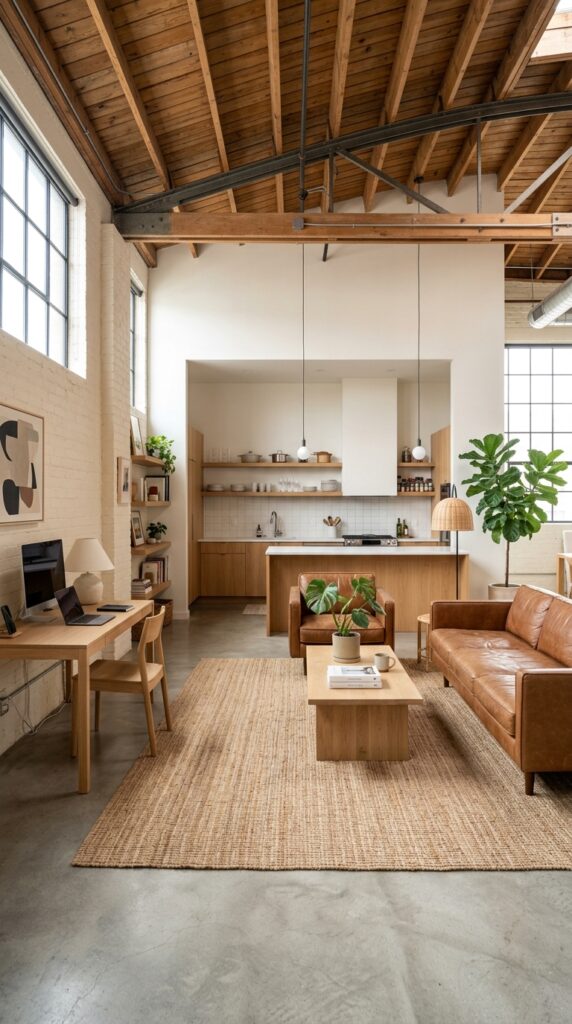
Vibe: Organized without a single partition — the architectural trick of making one room feel like several.
Why it works: In an open-plan garage loft, zone definition without walls relies on implied boundary: rugs, lighting placement, and furniture orientation create invisible room edges the eye reads as real. A large natural fiber rug (minimum 9×12 feet for a standard living zone) creates the strongest implied boundary because its texture and color contrast sharply against a concrete floor. The desk placed 18 inches outside the rug edge feels like an entirely different room while remaining visually and spatially connected to the living zone — a low-cost, commitment-free zoning strategy.
How to get it: Every furniture piece in the living zone should have at least its front legs on the rug. Position the sofa perpendicular to the garage door wall rather than parallel to it — this orients the living zone away from the entry and creates psychological depth within the open plan.
💡 Quick Win: A 9×12 natural jute rug on a concrete floor costs $150–$250 at most home stores and immediately produces the zone-definition effect — no furniture purchase required to test the concept.
Shop The Look
| Product |
| Natural jute area rug 9×12 flatweave modern rustic |
| White oak solid wood home office desk modern |
| Open kitchen floating shelf white oak wall mounted |
| Low profile leather two seater sofa modern |
| Industrial adjustable monitor arm desk mount |
11. Warm White + Raw Timber Ceiling Palette
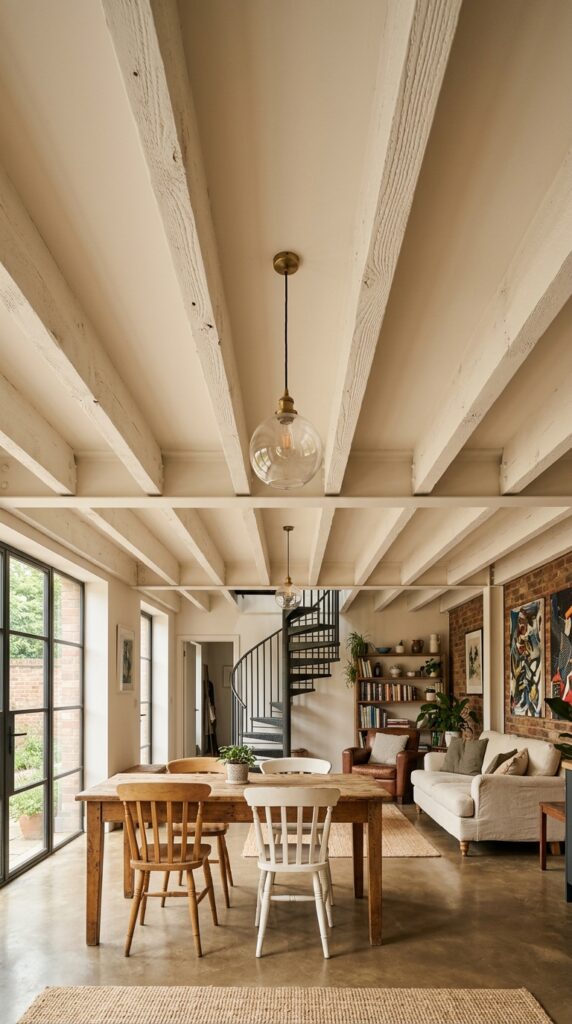
Vibe: Sun-warmed — a room where the structure overhead makes you want to look up.
Why it works: Painting exposed timber joists and the ceiling between them the same warm white creates visual unity while allowing the structural rhythm of joist spacing to read as a repeating design element. This technique — “whitewashing the bones” — opens a low garage ceiling by reflecting light from every angle rather than absorbing it. The grain and knot pattern remain visible through the white paint, preserving the material’s identity and preventing the ceiling from reading as synthetic or newly constructed.
How to get it: Use Benjamin Moore “White Dove” (OC-17) in flat finish on both the joists and the ceiling plane between them. Apply two thin coats with a brush on the timber to preserve grain visibility, and roll the flat ceiling sections between joists for efficiency.
Shop The Look
| Product |
| Flat white interior paint low VOC warm white gallon |
| Faux exposed beam ceiling plank paintable lightweight |
| Linen cream throw pillow cover 20×20 natural woven |
| Simple globe pendant light matte white modern |
| Large natural cotton canvas floor cushion |
12. Polished Concrete Floors with Exposed Aggregate
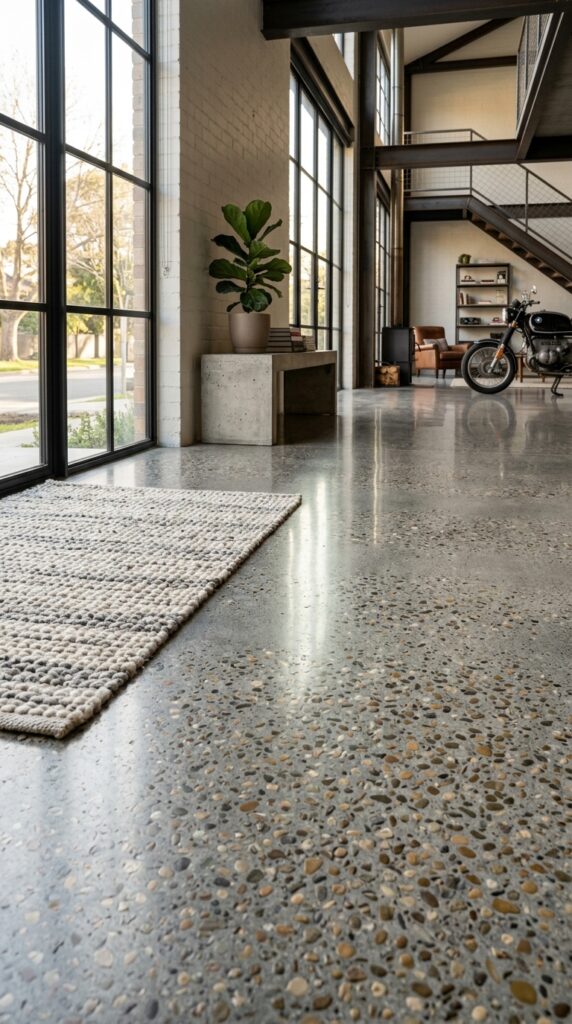
Vibe: Grounded — the kind of floor that anchors everything above it without asking for attention.
Why it works: Polishing an existing garage slab to expose the aggregate within it transforms a purely utilitarian surface into a genuinely distinctive floor material unique to that specific pour — no two are identical. The exposed aggregate creates visual micro-texture that catches light at low angles, making the floor feel alive rather than flat. A semi-gloss (not full mirror) polish retains slip resistance while achieving a premium finish that reads as considered rather than sealed-and-forgotten.
How to get it: Concrete floor polishing progresses through diamond-pad grits starting at 30 and finishing at 800 or 1500 with a densifier application in between. Rent a concrete floor grinder for a DIY approach, or budget $3–6 per square foot for a professional Level 2 polish (salt-and-pepper aggregate exposure).
💡 Quick Win: A sample patch of polished concrete in a corner — 4×4 feet — takes one afternoon and reveals exactly what your slab’s aggregate looks like before committing to the full floor.
Shop The Look
| Product |
| Concrete floor diamond polishing pad set 30-400 grit |
| Concrete densifier hardener liquid penetrating |
| Textured wool area rug neutral gray 6×9 |
| Concrete look indoor bench seat modern minimalist |
| Concrete floor sealer semi-gloss penetrating finish |
13. Deep-Seat Modular Sectional in L-Configuration
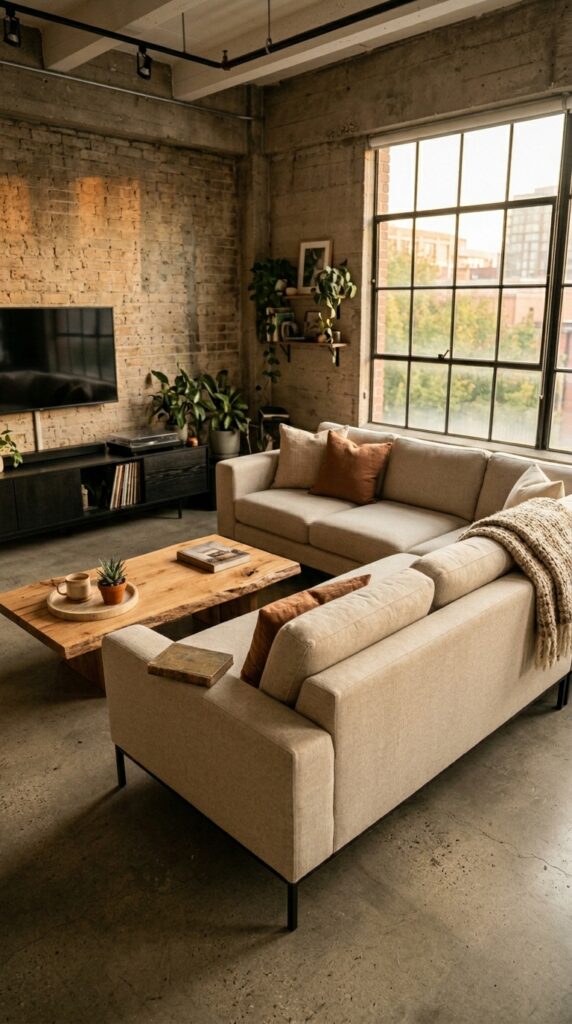
Vibe: Warm — a corner that invites staying longer than you planned.
Why it works: In an open-plan loft, the L-configuration sectional creates an implied room boundary on two sides simultaneously — the most structurally efficient furniture choice for zone definition. Deep-seat modules (minimum 38-inch seat depth) are proportionally correct for high-ceiling garage spaces: standard 32-inch sofas read as undersized when placed under 14-foot-high ceilings. Matte-black legs provide a material echo to the concrete floor and the steel fixtures elsewhere in the room, threading the furniture into the industrial palette without a visible join.
How to get it: Build the sectional from modular components rather than a fixed L-shape — this allows reconfiguration as the space evolves. Specify a performance fabric (Crypton or Sunbrella indoor) in the oatmeal or warm greige family: these fabrics resist the grit that a concrete floor inevitably generates nearby.
Shop The Look
| Product |
| Modular sectional sofa oatmeal performance fabric modern |
| Live edge wood coffee table modern steel base |
| Travertine stone decorative tray minimalist |
| Woven wool throw blanket neutral oatmeal modern |
| Low-profile walnut media console TV stand |
14. Industrial Pipe Shelving Wall
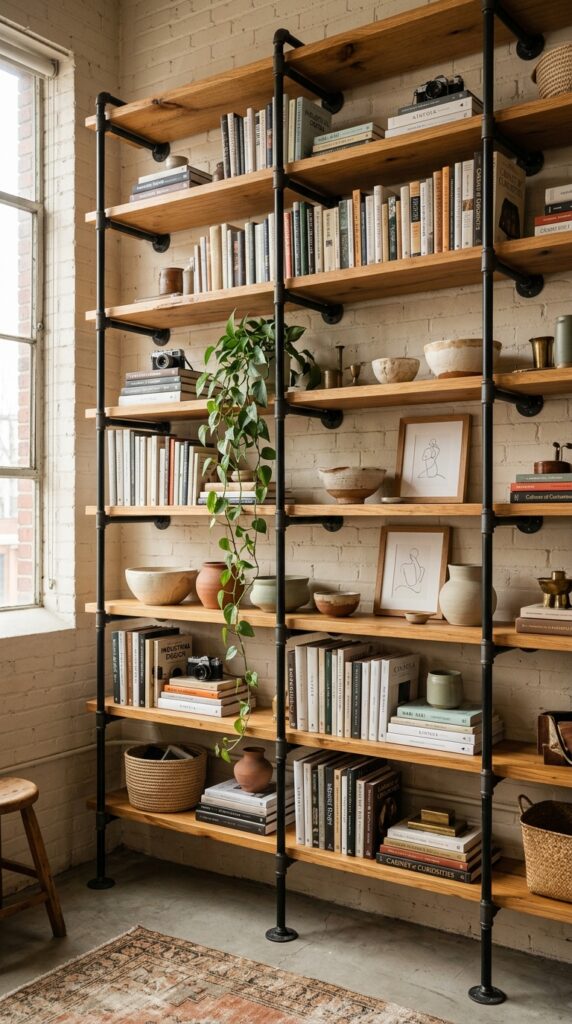
Vibe: Layered — the visible logic of a system that’s proud of how it works.
Why it works: Industrial pipe shelving reads as design in a garage loft because the material — standard black iron pipe — is honest to the building’s structural vocabulary. The system’s visible hardware (flanges, elbows, threaded connections) creates a design language of exposed mechanism that aligns with the architecture above. Floor-to-ceiling height draws the eye upward, effectively increasing the perceived height of the room through vertical emphasis — a particularly valuable technique in a garage loft where the ceiling plane may otherwise go unnoticed.
How to get it: Specify 3/4-inch black iron pipe for uprights and horizontals — 1/2-inch reads too delicate for deep shelves. Cut white oak shelves at 1.5-inch thickness and 12 inches deep, sand to 180-grit, and finish with Rubio Monocoat hard wax oil in “Raw” for a durable surface that preserves the oak’s natural tone.
Shop The Look
| Product |
| Black iron pipe shelf bracket kit industrial DIY |
| White oak shelf board solid unfinished 48 inch |
| Hard wax oil wood finish natural penetrating type |
| Wabi-sabi ceramic bowl set matte textured |
| Small minimalist line art framed drawing print |
15. Greige + Brushed Nickel Transitional Palette
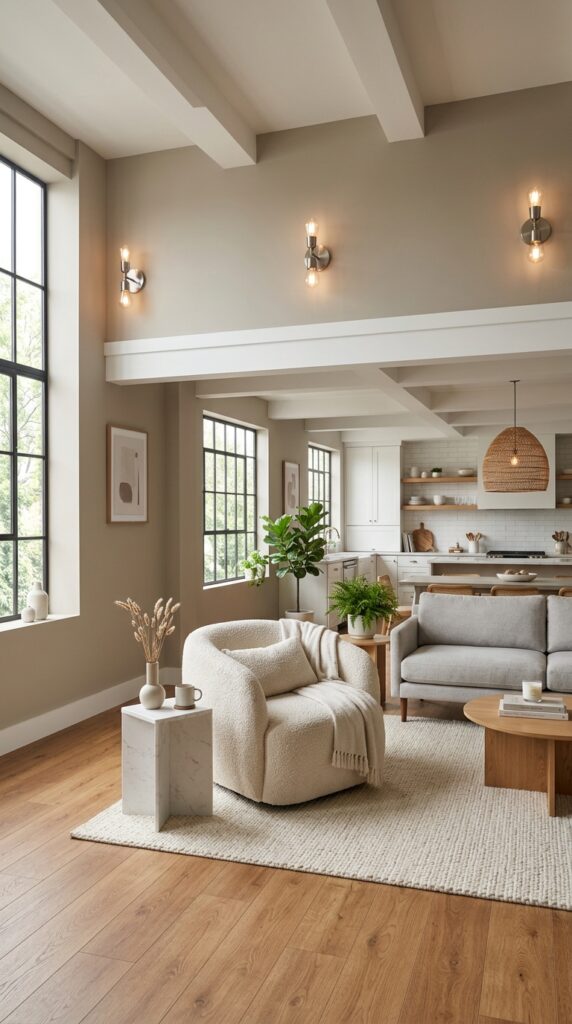
Vibe: Calm — an exhale of a room that doesn’t try to prove anything.
Why it works: The greige palette (Sherwin-Williams “Agreeable Gray” SW7029 or Benjamin Moore “Revere Pewter” HC-172) occupies the middle ground between cool industrial gray and warm residential beige — precisely why it works in a garage loft transitioning from utility to living space. It mediates between concrete floors and soft furnishings without committing to either world completely. Brushed nickel, rather than matte black, lifts the metal palette toward warmth and prevents the space from skewing too dark or too cold in rooms with limited south-facing exposure.
How to get it: Apply greige in a matte finish on all four walls and the ceiling to create a cocooning, unified envelope. Switch all hardware — light fixtures, door handles, cabinet pulls — to brushed nickel in a single afternoon for an immediate palette-wide shift.
💡 Quick Win: Replacing just three light switch and outlet cover plates with brushed nickel versions costs under $25 and lifts the tonal coherence of the whole room.
Shop The Look
| Product |
| Greige interior paint matte finish warm gray beige |
| Brushed nickel wall sconce modern hallway |
| Cream boucle accent chair modern living room |
| Brushed nickel outlet and switch plate cover set |
| Rattan pendant light shade natural woven modern |
16. Reclaimed Wood Ceiling Beams
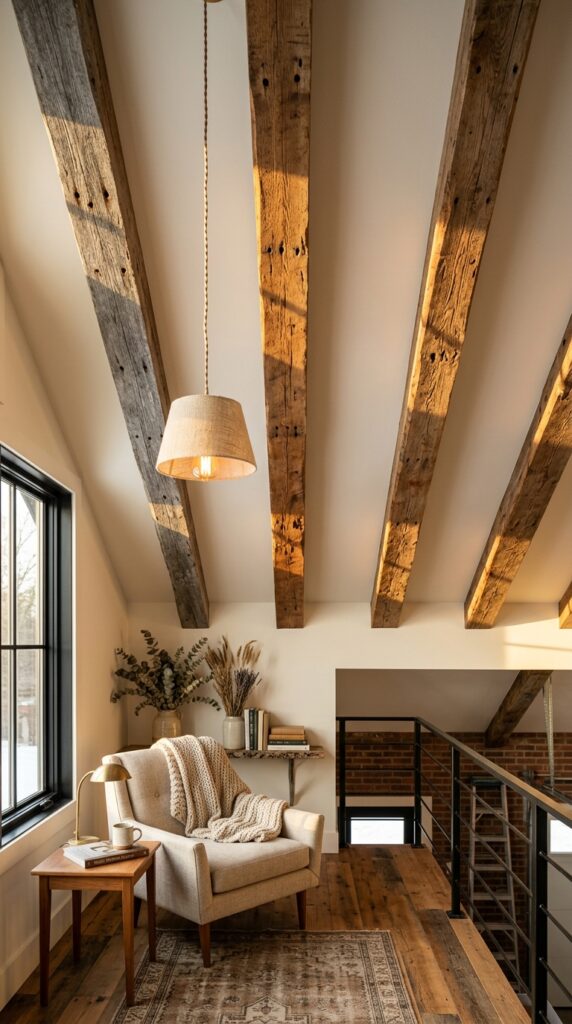
Vibe: Grounded — the kind of warmth that takes decades to earn and one afternoon to install.
Why it works: Reclaimed wood ceiling beams introduce material age — a quality no new-construction material can simulate — into a space that might otherwise read as too clinical or cold. The surface history of reclaimed barn wood (nail holes, checking cracks, color gradients from decades of weathering) creates visual complexity that enriches the ceiling plane without adding structural weight. This is patina as design: imperfection as a feature rather than a flaw, which is philosophically aligned with the modern garage loft’s honesty about raw materials.
How to get it: Hollow reclaimed wood beam wraps (three-sided boxes of reclaimed boards) install over a blocking frame attached to ceiling joists — no structural engineering required. Standard wraps run 6–8 inches wide and 4 inches deep. Sand the installation face of each wrap piece to 80-grit before applying construction adhesive and hidden screws from inside the wrap.
Shop The Look
| Product |
| Faux reclaimed wood ceiling beam wrap hollow lightweight |
| Heavy duty construction adhesive interior exterior |
| Linen hanging pendant lamp plug-in cord adjustable |
| Dried botanical bundle eucalyptus pampas natural |
| Natural linen reading accent chair modern |
17. LED Cove Lighting Along the Mezzanine Edge
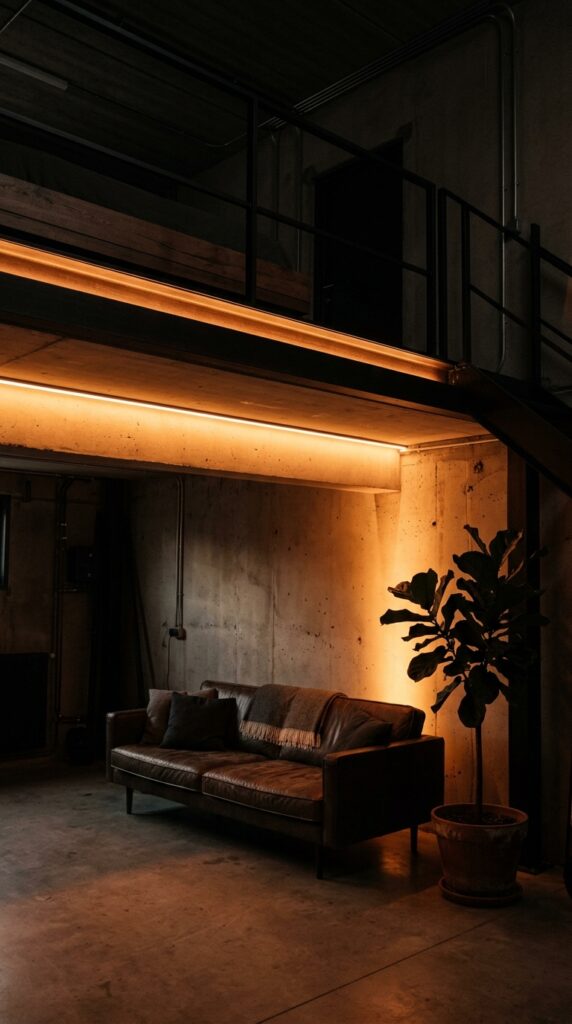
Vibe: Warm — the specific warmth of a space lit for living, not working.
Why it works: LED cove lighting at the mezzanine edge operates by the principle of indirect illumination: the light source is hidden and only its reflection off the wall surface is visible. This eliminates harsh shadows and makes the room feel larger by washing the vertical face with soft, even light. The warm amber temperature (2700K or lower) at this low position counteracts the cool concrete above and creates a visual warmth anchor precisely at eye level — where it affects the human perception of comfort most directly.
How to get it: Install a continuous channel of 2700K high-CRI (90+) LED strip in an aluminum extrusion profile with a frosted lens diffuser — the diffuser eliminates hotspots between individual diodes. Mount the channel on a 2×4 ledger board on the underside of the mezzanine and connect to a compatible dimmer switch. Cove lighting’s impact multiplies at 40–60% dimmer output rather than full brightness.
Shop The Look
| Product |
| LED strip light 2700K warm white 16 foot dimmable |
| Aluminum LED channel extrusion with frosted diffuser |
| LED compatible dimmer switch single pole |
| Foam core mounting board adhesive LED backing |
| Cognac leather sofa two seater low profile |
18. Double-Height Garage Bay with Glass Wall Conversion
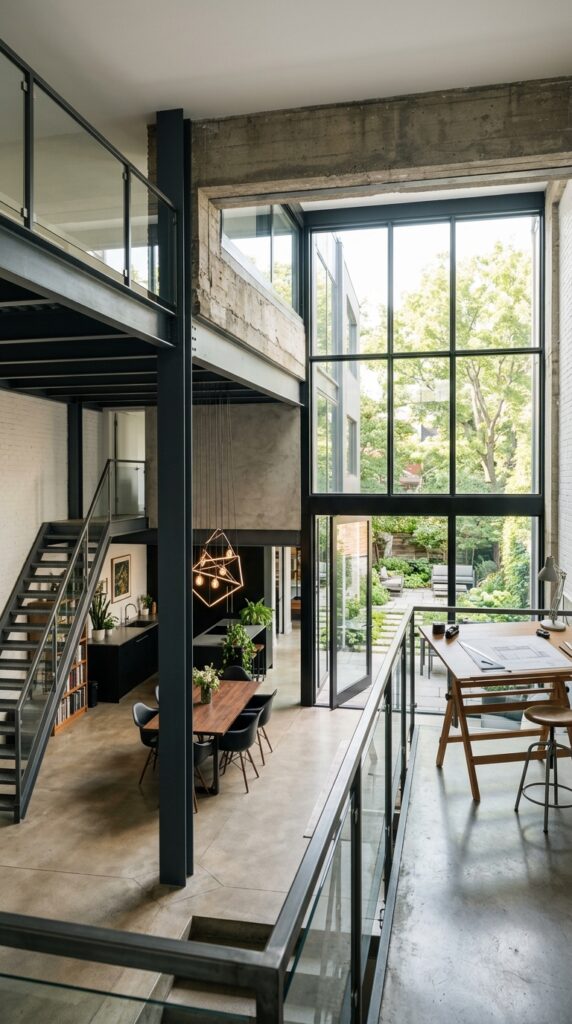
Vibe: Architectural — a space that earns the word “loft” without apology.
Why it works: Converting the original garage door opening to a full-height glass wall is the single structural move that most dramatically transforms a modern garage loft design — it retains the massive opening (typically 10 feet wide by 8 feet tall) while flooding the double-height interior with light that no conventional window wall achieves. The existing structural header above the door opening accepts a curtain wall system without additional engineering in most standard garage types. The mezzanine at 12 feet creates genuine two-story living within a single garage bay footprint.
How to get it: Always consult a structural engineer before modifying or removing a garage door header — in attached garages the header may carry roof load. Budget $8,000–$15,000 for a professionally installed aluminum curtain wall; a simpler fixed glass panel with a single pivot door insert runs $4,000–$7,000 and achieves a comparable effect.
Shop The Look
| Product |
| Floating staircase kit steel stringers open riser tread |
| Large hanging pendant light sculptural modern |
| Industrial height-adjustable drafting table modern |
| Concrete dining table modern minimalist indoor |
| Aluminum pivot door hardware kit modern |
19. Live-Edge White Oak Dining Table on Steel Base
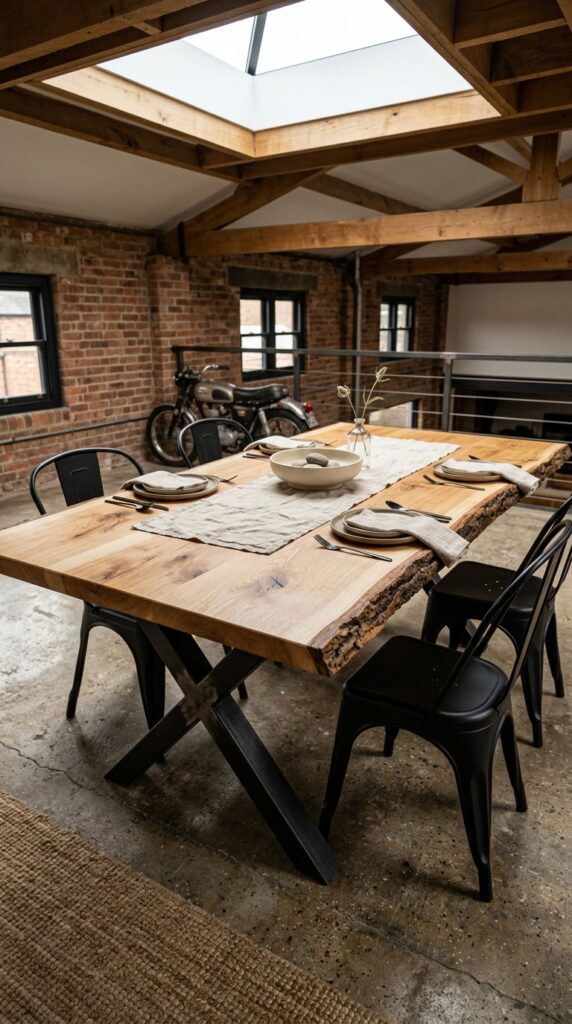
Vibe: Grounded — a table that looks like it grew into its place in the room.
Why it works: The live-edge table is the most effective single-piece introduction of organic material into an industrial loft because the natural edge functions as a visual counterpoint to every straight line in the space — the rectangular floor, the orthogonal railing, the gridded window. This contrast principle — organic against geometric — creates visual tension that makes both elements more interesting than they would be in isolation. The matte-black steel X-base echoes the industrial palette while keeping visual weight beneath the slab minimal, so the slab reads as floating.
How to get it: Source white oak live-edge slabs from regional sawmills or national slab marketplaces. For a 72-inch dining table, specify a minimum 36-inch width at the slab’s narrowest point. Finish with Rubio Monocoat in “Raw” — this penetrating oil hardens the wood without adding visible sheen and preserves the slab’s natural color.
💡 Quick Win: A live-edge white oak serving board or cutting board on a concrete countertop introduces the same material narrative at the kitchen scale for under $40 — a low-commitment way to test the palette.
Shop The Look
| Product |
| Live edge dining table solid wood modern steel base |
| Powder coated black metal dining chair set of 4 |
| Linen table runner undyed natural 72 inch |
| Low matte ceramic bowl centerpiece modern |
| Penetrating hard wax wood oil finish natural |
20. Vertical Storage Wall System
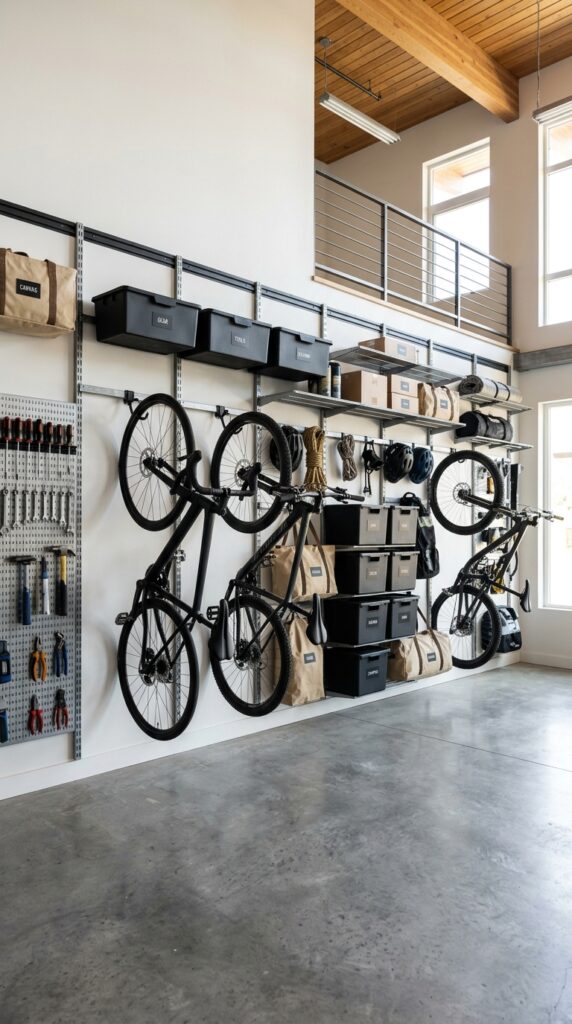
Vibe: Purposeful — organization so visible it becomes its own aesthetic.
Why it works: In a small garage loft where floor area is the premium resource, the vertical storage wall applies the principle of vertical zone utilization: every square foot of wall from floor to ceiling stores what would otherwise consume the floor below. A slotted rail system — unlike fixed shelving — allows configuration changes without new hardware, so bikes, bins, seasonal gear, and tools can all use the same rail infrastructure with different accessory attachments. Keeping the floor completely clear below the storage wall amplifies the perceived spaciousness of the room significantly.
How to get it: Install 2×4 horizontal blocking between studs at 16-inch intervals before mounting wall rails — this creates a solid substrate that accepts screws at any position along the rail. Use rails at 24-inch horizontal spacing across the full wall width, starting the lowest rail at 18 inches from the floor for clearance below hung items.
Shop The Look
| Product |
| Wall mounted storage system slotted rail modular garage |
| Vertical bike storage hook wall mount heavy duty |
| Matte black wire storage bin wall mount set |
| Canvas storage tote bag large foldable set of 4 |
| Wall anchor kit drywall stud 100 lb rated |
21. Corrugated Galvanized Steel Accent Wall
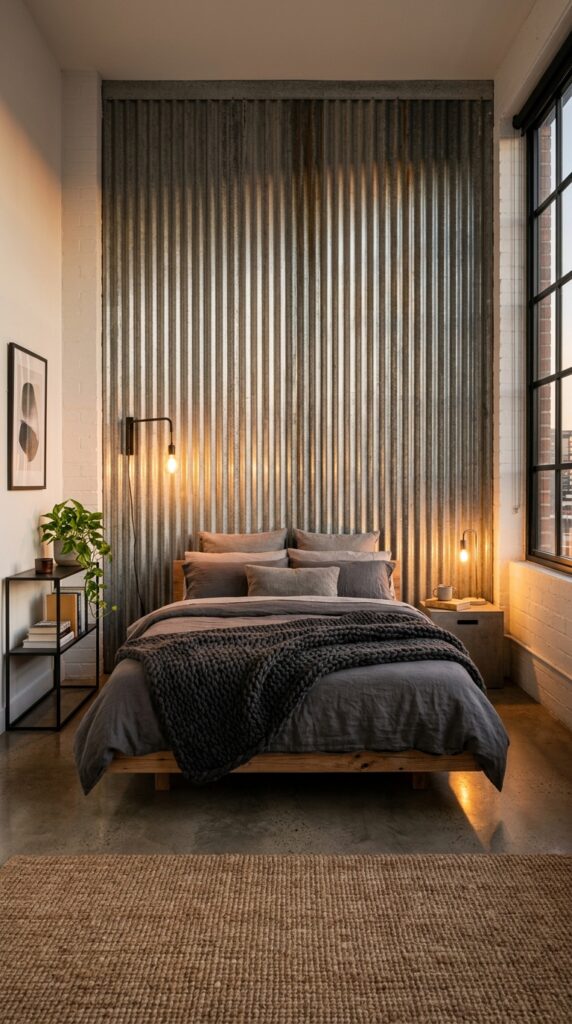
Vibe: Raw — the honest texture of a building material doing double duty as art.
Why it works: Corrugated galvanized steel is the most texturally active material in the industrial palette — its repeating ridges create a rhythmic pattern of highlight and shadow that shifts throughout the day as light angle changes. Installed as a vertical accent wall behind a bed, it functions as an architectural headboard at room scale, providing visual definition to the sleeping zone without a partition wall. The zinc variation in galvanized steel — mottled silver with occasional blue-gray tones — means no two panels look identical, giving the wall a surface life that painted drywall simply cannot achieve.
How to get it: Standard corrugated galvanized steel roofing panels (available at any building supply store for approximately $1 per square foot) mount directly to wall studs using self-tapping hex head screws. Leave 1/4-inch gaps between panel edges — these shadow lines read as intentional joinery detail. Apply a clear automotive lacquer over the galvanized surface to slow oxidation without eliminating the zinc’s natural patina.
Shop The Look
| Product |
| Corrugated metal wall panel galvanized steel sheet |
| Self-tapping hex head screws zinc plated set |
| Clear automotive lacquer spray metal protection |
| Plug-in wall reading sconce adjustable arm modern |
| Concrete look nightstand bedside table modern |
22. Oversized Rug + Low Floor Seating Zone
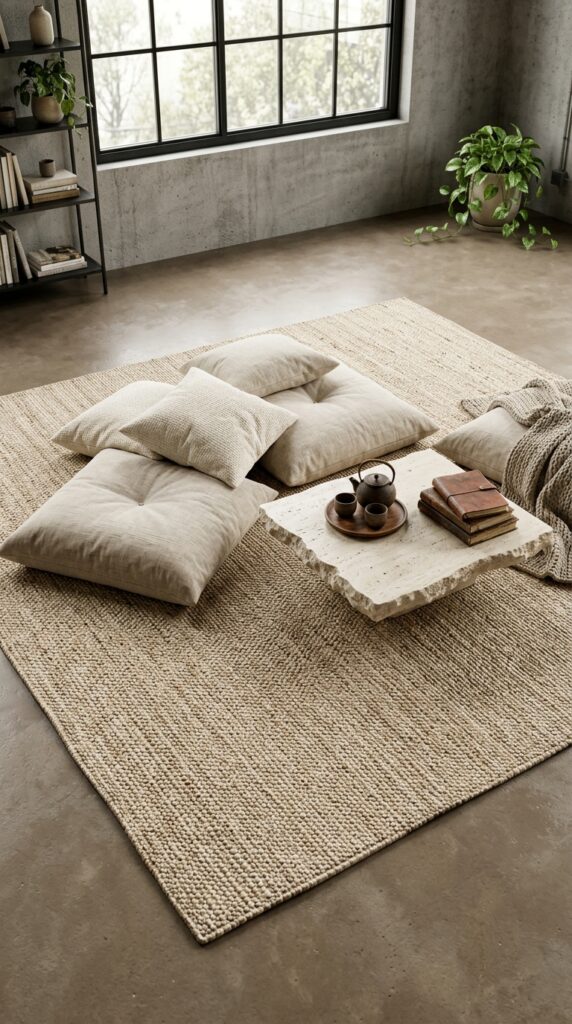
Vibe: Serene — the quiet confidence of a room that chose the floor as its furniture.
Why it works: Low floor seating in an industrial loft creates a deliberate contrast between the hardness of the structural environment — concrete, steel — and the softness placed at human scale. This material contrast principle makes both elements more pronounced: concrete looks harder next to linen cushions; the cushions feel softer against concrete. An oversized rug (minimum 10×14 feet for this configuration) ensures the entire seating arrangement sits fully within the rug boundary, creating a room-within-a-room that the eye reads as a defined zone without any vertical element.
How to get it: Layer a flatweave natural jute base rug with a plush Moroccan-style wool rug centered over it — two textures referencing the industrial-natural contrast of the loft above. Pair large floor pillows (30×30-inch) in linen against the wall for back support with medium round zafu cushions arranged in front.
💡 Quick Win: Two large linen floor pillows plus a round zafu cushion from a meditation supply retailer creates the full floor seating vignette for under $90 total — test it on your existing rug before buying the oversized base.
Shop The Look
| Product |
| Oversized natural fiber flatweave area rug 10×14 |
| Large linen floor pillow 30×30 modern boho |
| Round zafu meditation floor cushion natural set of 2 |
| Travertine stone tray side table slab modern |
| Ceramic tea set matte minimalist modern |
23. Track Lighting System for Art and Task Zones
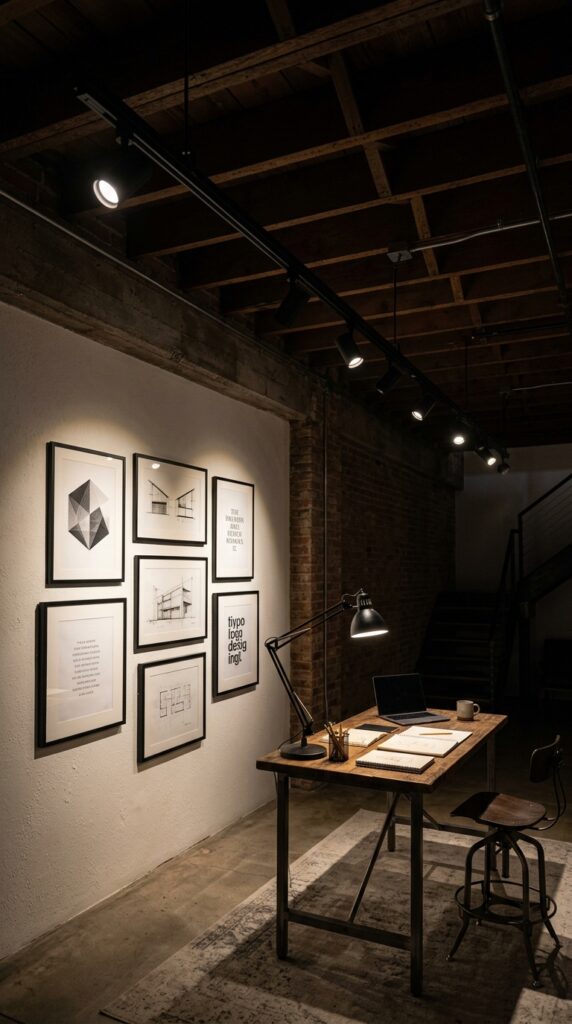
Vibe: Editorial — the light that makes everything it touches feel considered.
Why it works: Track lighting in a modern garage loft design solves the wiring challenge common to converted spaces: a single junction box serves a 12-foot track run with six to eight individually adjustable heads, eliminating the need for multiple circuits. The adjustability is the design value — track heads reposition as the layout evolves, serving an art wall one month and a work zone the next. Matte-black track hardware disappears against an exposed joist ceiling, making the light quality the focal point rather than the hardware delivering it.
How to get it: Specify PAR20 or PAR30 LED spots at 2700K in individual track heads — these produce a focused beam (25°–36° beam spread) that highlights objects precisely without washing adjacent surfaces. Angle each head to 30 degrees from vertical for proper art illumination: aim for the horizontal center of each artwork, not the top edge.
Shop The Look
| Product |
| Matte black track lighting kit 6 adjustable LED heads |
| PAR20 LED spot bulb 2700K 25 degree beam 6 pack |
| Black minimalist gallery wall frame set 11×14 |
| Black and white minimalist line art print set framed |
| Adjustable height drafting stool modern industrial |
24. Navy + Natural Oak Modern Garage Loft Design
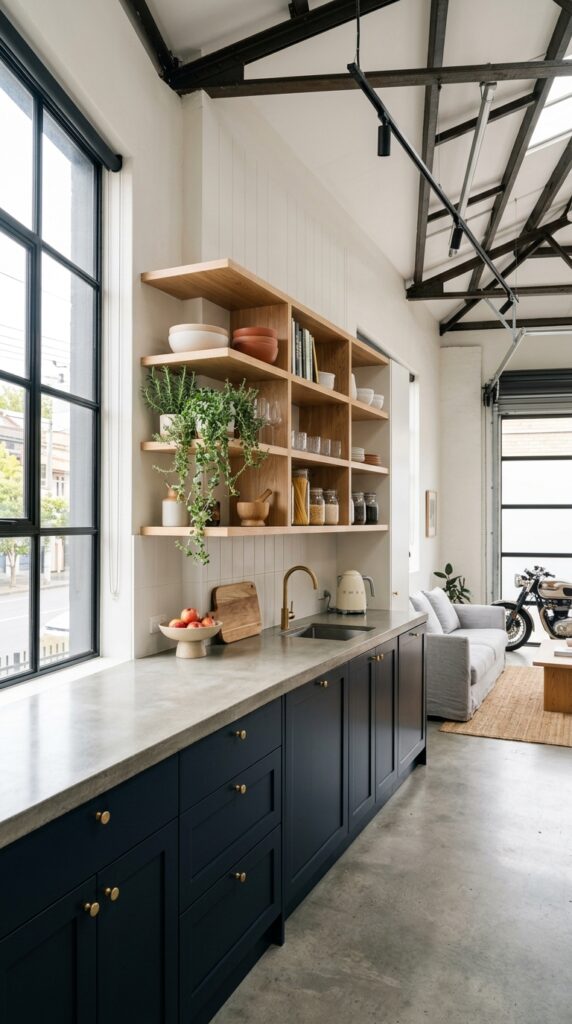
Vibe: Confident — a single color decision that makes the entire room feel intentional.
Why it works: Navy cabinetry applies the principle of tonal anchoring: a deep, saturated color on lower cabinetry draws visual weight downward, making the ceiling feel taller by contrast. Benjamin Moore “Hale Navy” (HC-154) in semi-gloss on cabinetry creates this effect while providing a durable, wipeable surface. Natural oak shelving mounted above — not painted, not stained, simply oiled — bridges the gap between the deep navy and the white walls, preventing an abrupt tonal jump that would read as too high-contrast and break the refined industrial mood.
How to get it: Paint cabinet boxes and door faces in “Hale Navy” semi-gloss only — leave cabinet interiors white to maintain brightness when doors open. Mount open oak shelves 8 inches above the top cabinet door using raw 3/8-inch steel pipe brackets for an industrial detail that ties the shelving into the loft’s material vocabulary. Brushed brass knobs at 1.25-inch diameter bridge the navy and oak without exactly matching either.
💡 Quick Win: Painting a single IKEA base cabinet unit in “Hale Navy” — properly primed first — introduces this palette for under $50 in paint costs and lets you test the navy-oak contrast at zero risk before committing to full cabinetry.
Shop The Look
| Product |
| Navy blue semi-gloss cabinet paint chalk mineral type |
| Brushed brass round cabinet knob 1.25 inch set of 10 |
| Natural oak floating shelf oiled finish 36 inch |
| Raw steel pipe shelf bracket industrial 10 inch |
| Large ceramic bowl matte modern centerpiece |
How to Start Your Modern Garage Loft Transformation
Your single first move is to measure your ceiling height and determine whether a mezzanine is structurally possible. Everything else — the palette, the furniture, the lighting — follows from this answer. A garage with 13 or more feet of ceiling height opens the full design vocabulary of this style; below 10 feet, you’re designing a modern studio, not a loft, and the decisions diverge significantly from that structural starting point.
The most common mistake is painting over all the concrete or drywalling over all the structural elements to make the space “feel more like a house.” This breaks the look because modern garage loft design derives its entire character from the contrast between raw structure and refined living — the moment you hide the concrete, you’ve eliminated the reason to design this way at all. If exposed concrete feels too cold, add warmth through textiles and warm-temperature lighting rather than covering the material itself.
Three specific items under $50 that create immediate impact: a matte-black Edison-bulb clamp lamp ($18–25) that establishes the right fixture vocabulary from day one; a concrete-finish ceramic pot in an 8-inch size ($15–20) that introduces the material palette; and a single stem of dried bleached pampas grass in a narrow floor vase ($25–35) that creates the organic-industrial contrast that defines this style’s personality.
A productive weekend is enough time to repaint one feature wall and install a pipe shelf system. A complete, fully designed single-car garage loft studio — including a mezzanine — realistically takes 3–6 months and a budget of $8,000–$20,000 depending on structural scope. A cosmetic transformation with no structural changes (materials, fixtures, textiles only) can be achieved for $2,000–$4,000 in four to six weeks.
Frequently Asked Questions About Modern Garage Loft Designs
What is the difference between a garage loft and an ADU?
A garage loft is an interior conversion of an existing garage space — typically within the existing structure’s footprint and roofline — that adds a mezzanine platform to create livable vertical space. An ADU (Accessory Dwelling Unit) is a separately permitted living space with its own entrance, kitchen, and bathroom that meets local zoning requirements for independent habitation. A garage loft may or may not qualify as an ADU depending on local codes; in most jurisdictions, adding a full kitchen and bathroom triggers ADU permitting, which adds $5,000–$15,000 in fees and inspections to the project.
What colors work best in a modern garage loft design?
The most effective palette starts with warm white walls — Benjamin Moore “White Dove” OC-17 or “Chantilly Lace” OC-65 — as the base, with concrete gray or polished concrete as the floor anchor. Avoid cool-toned whites with blue or green undertones: in concrete-floored spaces, they amplify the coldness of the slab rather than warming the room. The deep accent — warm charcoal, navy “Hale Navy,” or sage — belongs on cabinetry or a single feature wall. Secondary colors should arrive through materials (raw oak amber, jute sand, leather cognac) rather than additional paint selections.
How much does it cost to convert a garage into a modern loft?
A cosmetic conversion — floor sealer, fresh paint, new fixtures, and curated furniture — typically runs $2,000–$6,000 for a standard single-car garage. Adding a structural mezzanine floor starts at $8,000 for a basic steel and wood construction and can reach $25,000 for a fully engineered system with code-compliant stairs and railing. HVAC (required in most climates for year-round comfort) adds $3,000–$8,000 to either scenario. Change-of-use permitting — converting a garage to habitable space — costs $500–$2,500 in most jurisdictions and requires inspections at multiple stages.
Can modern garage loft design work in a two-car garage?
A two-car garage (typically 20×20 feet or 20×24 feet) actually suits this style better than a single-car footprint because the additional width allows a fully separated sleeping mezzanine over one bay while leaving the opposite bay as a double-height studio or living zone. The primary design challenge in a two-car footprint is preventing the space from reading as two disconnected rooms — use a single continuous floor finish, one consistent ceiling treatment, and a long pipe shelf system spanning both bays to maintain visual unity across the full width.
What type of flooring is best for a modern garage loft design?
Polished or sealed concrete is the definitive choice: it’s already present in virtually every garage, it’s extraordinarily durable, and it’s honest to the space’s history and character. A Level 2 concrete polish (salt-and-pepper aggregate exposure) with a semi-gloss finish costs $3–6 per square foot professionally installed and lasts decades without replacement. If the existing slab is in poor condition — major cracking or efflorescence — a self-leveling concrete overlay poured at 1/4-inch thickness achieves the same result for $2–4 per square foot in materials. Avoid LVP or laminate flooring: these materials read as incongruous with the industrial architectural vocabulary and undermine the authenticity of the style.
Ready to Create Your Dream Modern Garage Loft Design?
These 24 modern garage loft designs have covered the full material spectrum — from polished concrete floors and corrugated steel accent walls to mezzanine structures, track lighting systems, live-edge dining tables, and vertical storage walls — giving you a complete design language to build from. Transformation doesn’t require doing everything at once; the most resolved garage lofts are built incrementally, with each decision made deliberately rather than all at once in a renovation rush. Start today by measuring your ceiling height — that single number determines the entire structural path ahead of you. When it’s done, you’ll have a space that feels nothing like a standard garage and nothing like a generic apartment: it’ll have its own character, its raw materials, its own specific quality of light. Save the ideas that match your ceiling height and your material comfort zone — this style rewards the people who know which structural bones they’re working with.