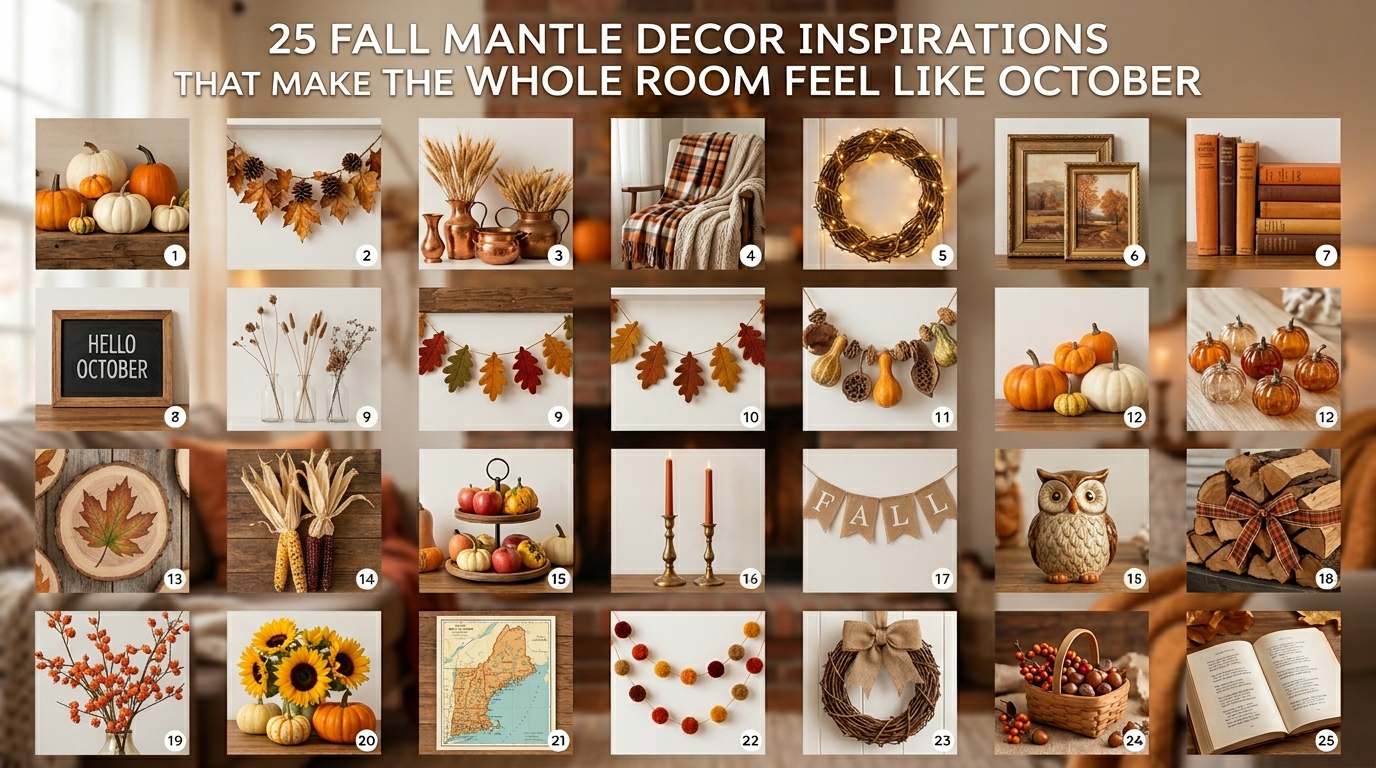
Fall mantle decor is the art of transforming a fireplace’s horizontal shelf into a seasonal focal point — using warm-toned objects, natural materials, layered heights, and autumnal color to anchor the most architecturally significant surface in a room. These 25 fall mantle decor inspirations cover rich color palettes, organic material arrangements, lighting strategies, vignette compositions, and small-space adaptations — with specific techniques you can act on before the first leaf turns.
There’s something almost ceremonial about dressing a mantle for fall. The warmth that a fireplace promises below becomes a visual warmth above — dried wheat catching the candlelight, a cluster of gourds in graduated sizes, the particular amber of a beeswax pillar at dusk. It’s the room’s most watched surface, the one guests look at first and return to all evening. Here are 25 ideas worth saving — and stealing.
Why Fall Mantle Decor Works So Well
Fall mantle decor draws from a long tradition of seasonal hearth dressing that stretches back to harvest festival culture in northern Europe, where the mantle — as the architectural center of the home’s warmth — was decorated with the season’s gathered materials: dried grasses, preserved botanicals, gourds, and candlelight. The contemporary form retains this instinct while incorporating design principles from interior styling: layered heights, tonal color cohesion, negative space, and material contrast. What distinguishes a genuinely designed fall mantle from a collection of seasonal objects is the same thing that distinguishes any well-considered vignette: intentional arrangement with a clear compositional logic.
The core fall mantle palette runs from warm terracotta and rust orange through burnished amber, cognac, deep burgundy, forest green, and warm cream. Materials are tactile and nature-derived: dried pampas and wheat stems, preserved eucalyptus and bay leaf garlands, raw beeswax pillars, unfinished wood slices, hammered brass and aged copper vessels, hand-thrown stoneware in earthy glazes, and woven jute or wool textiles as soft base layers. The material vocabulary rewards imperfection — a slightly irregular gourd, a stem that curves unexpectedly, a ceramic with uneven glaze — because organic asymmetry reads as genuinely autumnal in a way that perfect symmetry does not.
Pinterest data shows “fall mantle decor” searches peak in mid-September and surge again in late October, consistently ranking among the top five seasonal home search terms year over year. The cultural driver is the nesting instinct that autumn triggers — a widespread desire to make interior spaces feel warmer, more gathered, and more layered as the light contracts and outdoor time diminishes. The mantle is the logical first surface to address because it’s small enough to style in an afternoon, central enough to affect the entire room’s atmosphere, and high enough to be visible from every seating position.
Even a shallow or narrow mantle shelf achieves full fall impact with the right prioritization. In mantles under 4 inches deep, lean elements against the wall rather than placing them freestanding — framed art, propped botanical prints, a leaned mirror — and use only low-profile objects at the shelf’s front edge. For truly minimal shelf depth, a wall-mounted floating shelf above the fireplace at mantle height creates the same compositional surface with any depth you choose. The one honest limitation: very light-colored mantles in white or pale gray lose the warm contrast that makes fall decor sing — a simple wash of diluted warm beige paint applied to the mantle face takes one hour and transforms the backdrop.
Style at a Glance
| Element | Warm & Organic | Moody & Atmospheric |
| Philosophy | Harvest gathered | Shadow and warmth |
| Materials | Dried botanicals, raw wood, beeswax | Aged brass, stoneware, preserved foliage |
| Color Palette | Rust, amber, cream, terracotta | Burgundy, forest green, cognac, deep plum |
25 Fall Mantle Decor Inspirations
1. Deep Rust + Warm Cream Two-Tone Fall Mantle Palette
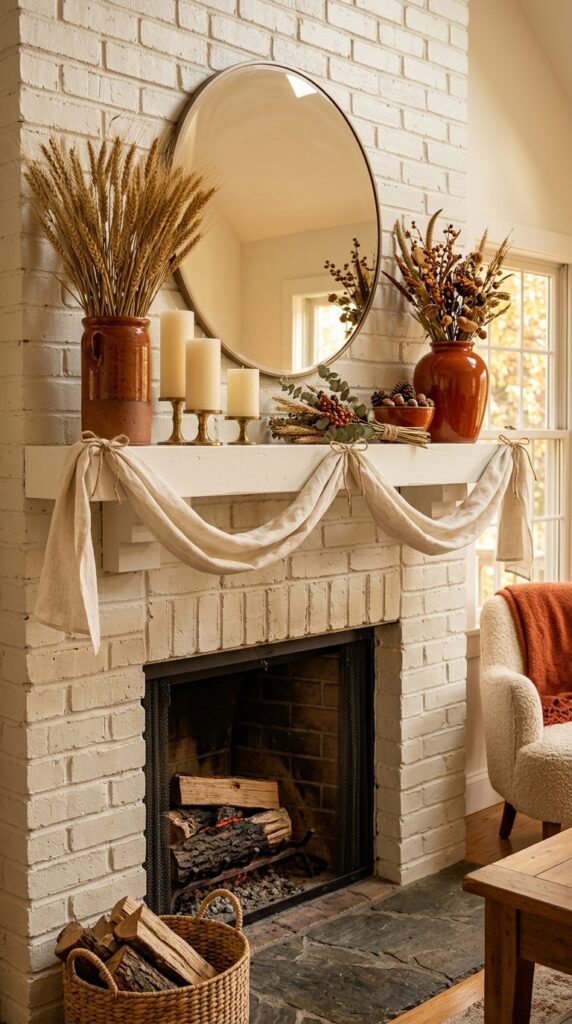
Vibe: Harvest-rich — the particular warmth of a room that committed to October completely.
Why it works: Rust and warm cream is the foundational fall mantle palette because the two tones operate on a warm-warm contrast: both have amber undertones, so they harmonize deeply while providing enough tonal separation to read as a considered two-color scheme. This is analogous color layering — two tones from adjacent sections of the warm spectrum — which creates visual coherence without the tension of complementary contrast. The rust operates as the seasonal anchor while cream prevents the palette from reading as overly dark or heavy. A dried wheat stem grouping bridges the two tones by carrying both rust warmth and cream lightness within the same botanical element.
How to get it: Paint any mismatched vessels in a single rust-toned ceramic glaze spray — one coat unifies a collection of thrifted objects into a cohesive color story in under 30 minutes. For the linen garland, loosely gather undyed linen fabric strips (1.5 inches wide, torn rather than cut for an organic edge) and drape them along the mantle shelf edge in a relaxed swag rather than a taut line.
💡 Quick Win: Three pillar candles in graduated heights — 3, 6, and 9 inches — in unscented warm cream wax grouped on a small raw wood slice creates the rust-and-cream fall palette foundation for under $18 total.
Shop The Look
| Product |
| Rust orange ceramic vase set modern fall decor |
| Dried wheat stem bundle natural harvest decor |
| Cream unscented pillar candle set 3 6 9 inch |
| Undyed natural linen fabric strip garland |
| Raw wood slice display base set varied sizes |
2. Dried Pampas and Wheat Stem Statement Arrangement
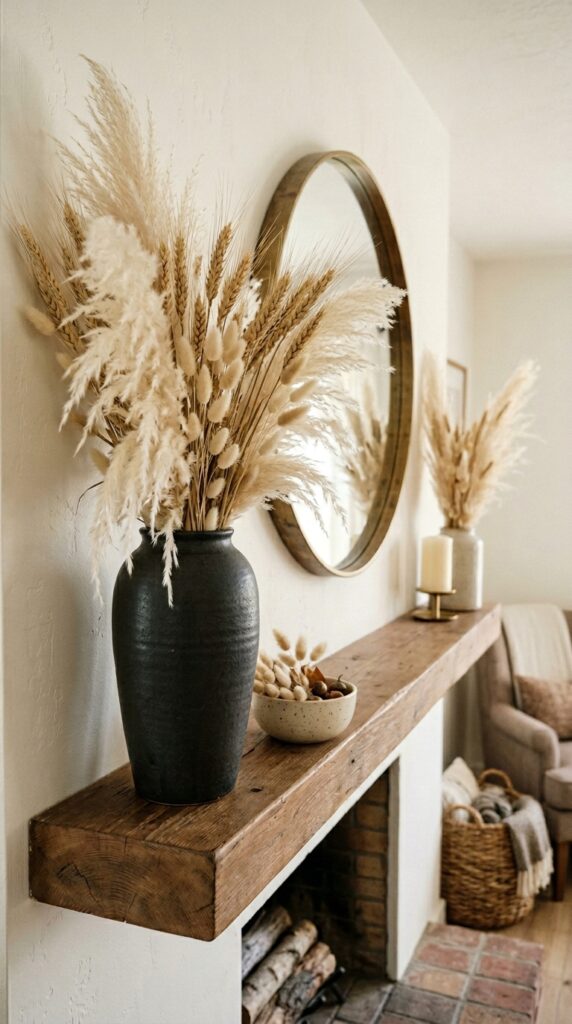
Vibe: Serene — the effortless authority of a dried stem that’s been given enough room to be itself.
Why it works: A tall dried stem arrangement at one end of the mantle introduces the design principle of dominant anchor with descending scale: the tallest element at one end creates visual weight that draws the eye left-to-right across the full shelf length, turning the mantle into a horizontal composition with a clear starting point. Pampas grass specifically earns its place in fall mantle decor through its double textural quality — the feathery plume provides softness while the stem provides height and structure, doing the work of two separate elements within a single botanical. The dark vessel grounds the arrangement at the shelf level, preventing the tall stems from appearing to float without a base.
How to get it: Secure dried stems in a vessel using a ball of chicken wire or a dry foam block cut to fit the vessel neck — this holds arrangement angles without adhesive and allows repositioning. Aim for an arrangement that reaches 1.5× the height of the mantle’s vertical clearance to the ceiling above for correct visual scale.
Shop The Look
| Product |
| Dried pampas grass bundle bleached ivory large |
| Dried bunny tail grass stems natural bundle |
| Dark charcoal ceramic tall floor vase 18 inch |
| Chicken wire floral arrangement support ball |
| Dried wheat bundle natural stems harvest |
3. Tiered Pillar Candle Cluster in Graduating Heights
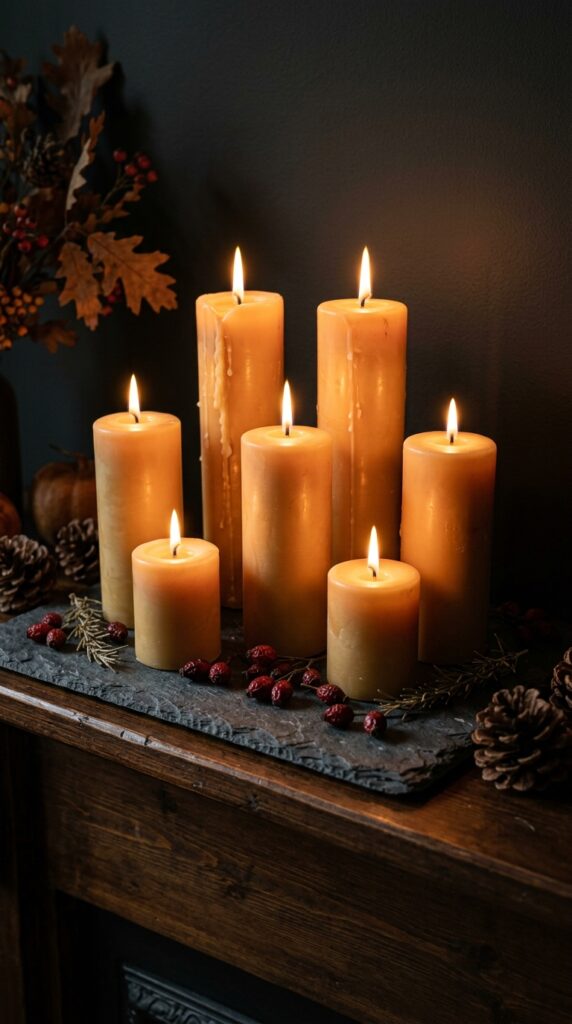
Vibe: Intimate — the warmth a room reaches only when something in it is actually burning.
Why it works: The tiered pillar candle cluster applies the design principle of height variation within a contained footprint: grouping seven candles of three distinct heights on a single tray creates a composition that reads as a single cohesive element at room scale while offering internal complexity at close range. The odd number — seven rather than six or eight — is a core styling rule for fall mantle decor groupings; even numbers create symmetry that reads as arranged, while odd numbers read as gathered. The slate tray beneath unifies the grouping visually and catches wax drips practically, allowing the candles to burn without a protective cloth beneath.
How to get it: Position the tallest candles at the back of the tray and descend in height toward the front — this creates a tiered profile when viewed at eye level from across the room. Space candles a minimum of 1 inch apart for safe burn clearance. Fill gaps between candle bases with dried rose hips, acorns, or small pinecones to eliminate the empty tray surface between candles.
💡 Quick Win: A large slate cheese board from the kitchen section at any home store ($18–28) makes the ideal candle tray — dark, heat-tolerant, and wide enough for a seven-candle grouping without buying purpose-made decor.
Shop The Look
| Product |
| Beeswax pillar candle set ivory unscented 3 pack |
| Large slate tray rectangular cheese board |
| Dried rose hip stem bundle natural red berries |
| Pinecone assorted sizes natural decor bag |
| Taper candle pillar base plate set |
4. Mini Pumpkin and Gourd Cascading Vignette
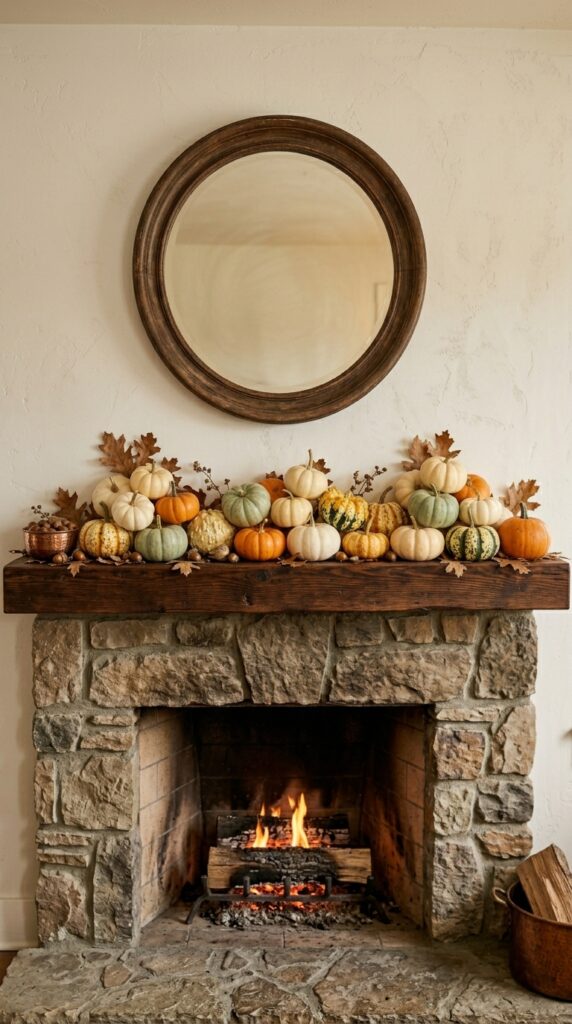
Vibe: Abundant — a shelf that looks like the last Saturday of the farmers market came home with you.
Why it works: Mini pumpkin and gourd arrangements work best when the color is restrained while the form varies: choosing white, cream, and sage green gourds alongside a few warm orange ones creates a sophisticated fall palette rather than a pure orange harvest explosion. The design principle is tonal curating within a natural material — selecting for color within the same object type creates cohesion that mixing multiple unrelated objects cannot. Grouping gourds in clusters of three or five with deliberate negative space between clusters prevents the shelf from reading as a uniform row of pumpkins, which loses the intentional design vocabulary immediately.
How to get it: Group gourds by size within each cluster — the largest gourd at the back, graduating to the smallest at the front — for depth and dimensionality. Source white and sage green pumpkin varieties from specialty grocery stores and farm stands rather than standard orange varieties; these colors elevate the palette without any additional styling effort.
Shop The Look
| Product |
| Mini white pumpkin set artificial fall decor realistic |
| Heirloom gourd assortment set decorative fall |
| Copper small decorative bowl catchall fall |
| Dried preserved oak leaf bunch fall natural |
| Acorn harvest decor set natural dried |
5. Moody Burgundy + Matte Black Fall Mantle Design
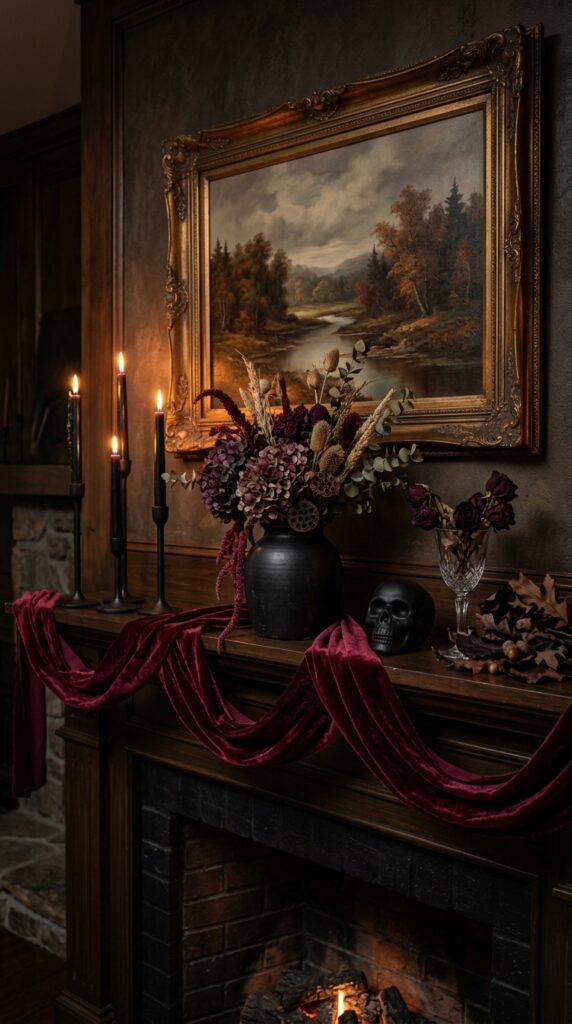
Vibe: Atmospheric — a mantle that makes October feel like it has a personality.
Why it works: Deep burgundy and matte black create the most atmospheric end of the fall mantle design spectrum — a palette that nods toward Halloween without becoming costumey because both tones are design-credible year-round. The matte finish on all dark objects is the critical detail: matte black absorbs the candlelight rather than reflecting it, creating a surface that appears to recede into the dark background while the burgundy velvet and warm candleflame read as the only light-active elements in the composition. A leaned vintage oil painting provides the backdrop scale and warmth that a bare wall cannot — even a modest dark-framed landscape elevates the mantle from a shelf of objects to a composed scene.
How to get it: Source burgundy velvet ribbon at 2.5-inch width and drape it loosely along the front shelf edge — tucking each end under the outer objects rather than tying or pinning creates the most effortless fall. Pair with matte black iron candlesticks at two different heights, always in odd numbers.
Shop The Look
| Product |
| Deep burgundy velvet wired ribbon 2.5 inch fall decor |
| Matte black iron taper candlestick set 3 heights |
| Black unscented taper candle set 12 inch |
| Matte black ceramic vase tall narrow modern |
| Vintage style dark gold ornate frame |
6. Asymmetrical Fall Mantle Layout with Tall Left Anchor
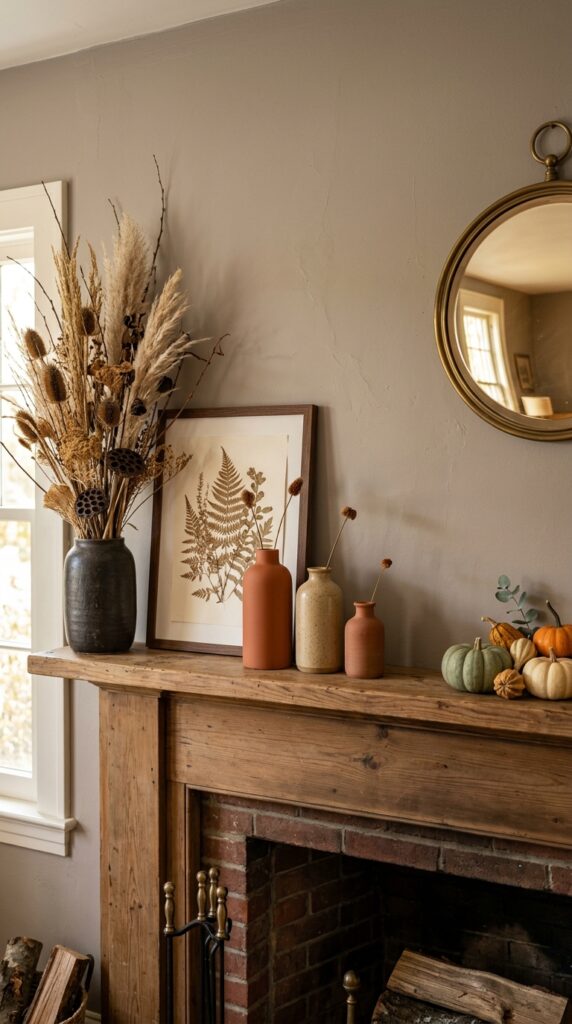
Vibe: Considered — the kind of arrangement that took fifteen minutes and looks like it always lived there.
Why it works: Asymmetrical mantle composition follows the design principle of visual triangulation: the tallest element at one end creates a high point, the graduated middle elements form the hypotenuse, and the low cluster at the opposite end completes the triangle’s base — creating a diagonal sightline across the shelf that the eye travels naturally from high-left to low-right (or reverse). This is fundamentally more dynamic than symmetrical arrangements, which create a static mirror-image that reads as formulaic on a surface seen daily. The negative space at the shorter end is not absence — it is the breath that makes the composition work, giving the eye a place to rest.
How to get it: Before placing any object, establish the tallest element first and position it at one end — this commits you to the direction of the composition and all other height decisions follow in sequence. Keep the tallest element at 1.5× to 2× the height of the second tallest for a visible and intentional height differential.
Shop The Look
| Product |
| Dried botanical mixed arrangement tall fall stems |
| Botanical fall art print framed warm tones |
| Graduated ceramic vase set 3 sizes rust brown |
| Asymmetric mantle styling kit guide booklet |
| Small gourd cluster artificial mini set 5 pack |
7. Weathered Wood Slice and Log Section Display
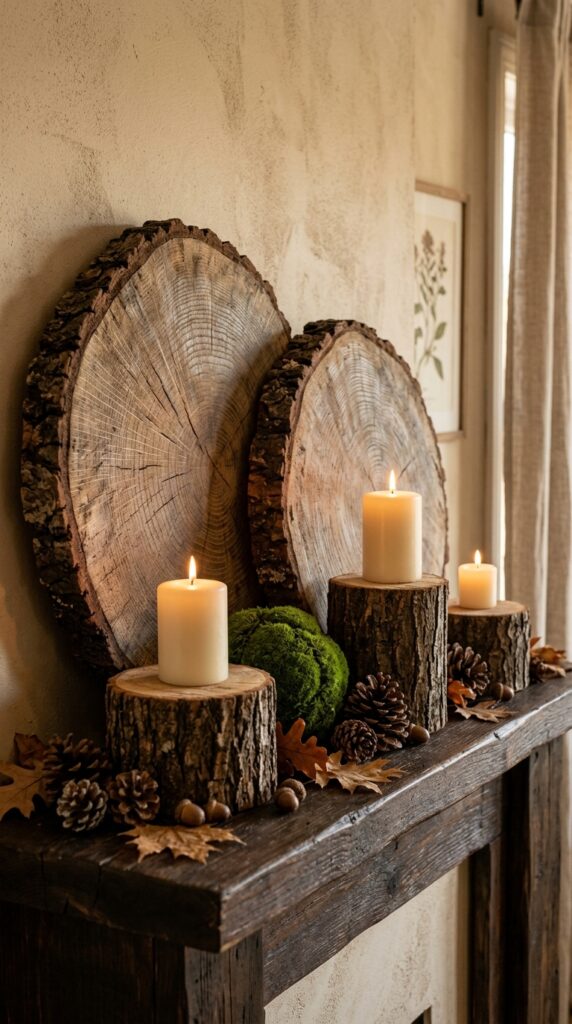
Vibe: Grounded — a mantle that brought the forest floor indoors and decided it preferred it.
Why it works: Raw wood slices leaned against the wall behind the mantle introduce material depth — the third dimension — to what is typically a flat-plane shelf composition. The bark-on edge creates a natural frame within each slice, and the visible growth rings introduce a pattern language that is organic and endlessly variable. Using smaller log rounds as candle risers rather than purchasing purpose-made risers is an application of material consistency: every elevation in the composition is made from the same raw wood vocabulary, creating a single-material story that reads as intentional rather than assembled from different sources.
How to get it: Seal raw wood slices with a single coat of matte finishing wax to prevent sap bleed and slow cracking while preserving the natural color. Slices thinner than 2 inches lean at risk of tipping — use removable adhesive putty at the base of leaned slices to hold position without damaging the mantle surface.
Shop The Look
| Product |
| Raw wood slices large bark on edge set of 3 |
| Small log round candle riser set natural bark |
| Matte finishing wax wood sealant natural |
| Preserved reindeer moss ball natural green |
| Removable adhesive putty museum wax decor |
8. LED Taper Candles in Wrought Iron Holders
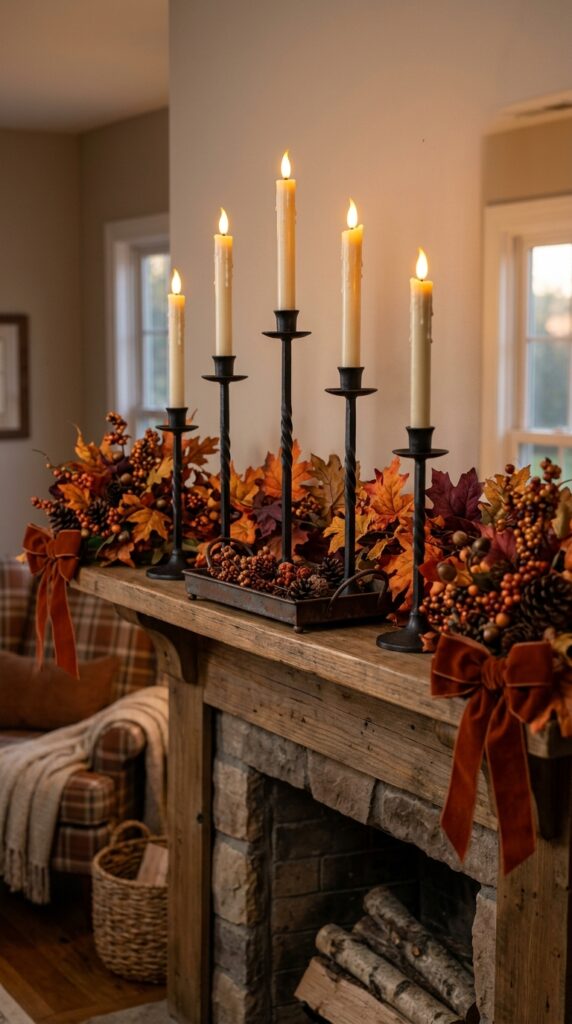
Vibe: Warm — the glow of candlelight without the obligation to watch it.
Why it works: LED taper candles in wrought iron holders deliver the full visual vocabulary of a candle-lit fall mantle — the warm amber flicker, the candlestick silhouette, the height variation — while remaining appropriate for mantles above working fireplaces where open flames alongside dry botanical materials present a genuine safety risk. The critical specification is a candle with a timer function (typically 4 hours on, 20 hours off) so the mantle lights automatically at dusk and extinguishes before midnight without manual operation. Wrought iron holders specifically, rather than brass or chrome, align with the fall palette’s warm-dark material language — the matte dark iron recedes and lets the candlelight read as the dominant element.
How to get it: Choose LED tapers with a wax-drip texture on the body and a real-wax outer casing if possible — the surface irregularity catches ambient light in a way that perfectly smooth plastic tapers do not, significantly improving the realism at close range. Size holders at 12-inch height minimum for the center piece, descending to 7-inch and 4-inch flanking holders.
Shop The Look
| Product |
| Wrought iron taper candlestick holder set 5 graduated |
| LED taper candle flickering ivory with timer set of 4 |
| Fall maple leaf garland artificial orange burgundy |
| Iron candle tray rectangle small mantle |
| Rust orange velvet ribbon bow set fall decor |
9. Vintage Brass and Copper Object Collection
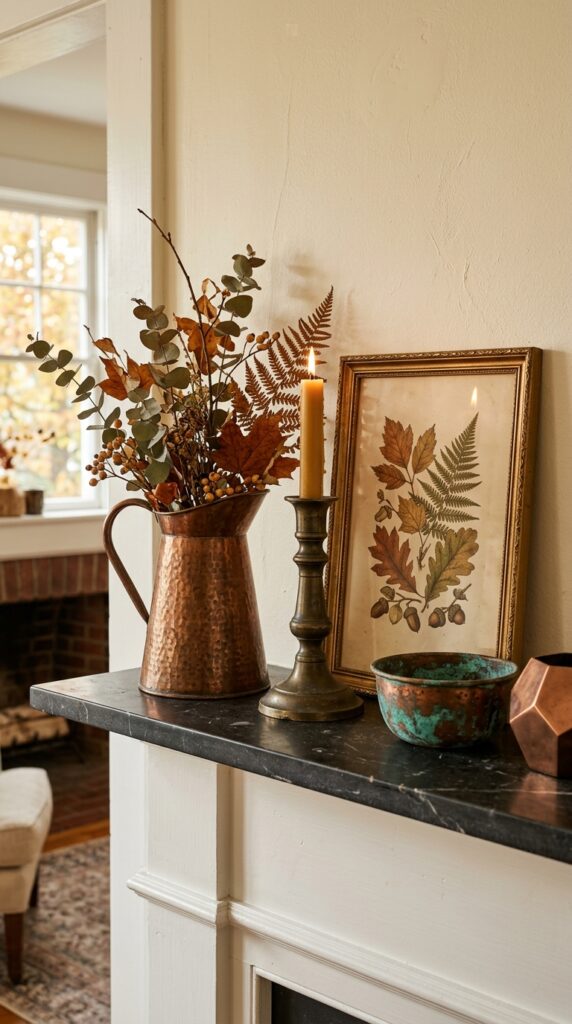
Vibe: Collected — the warm authority of objects that came from different places but ended up in the same story.
Why it works: A grouping of vintage brass and copper objects creates a fall mantle palette through metal tone alone — no seasonal novelty required. Warm brass and copper carry the amber-orange-gold register that autumn demands, and patinated or aged examples add the layered surface character that flat new objects lack. The design principle is tonal metal variation within a single warm family: mixing polished copper, aged brass, hammered brass, and verdigris-marked copper creates a surface-texture story that reads as genuinely collected across years rather than purchased in a single afternoon. A dark marble or slate base slab unifies the grouping at the shelf level.
How to get it: Source vintage brass and copper pieces individually from thrift stores, estate sales, and antique markets — a consistent patina level ties disparate objects together more than matching sets do. Group pieces on a piece of dark marble offcut (available from countertop fabricators as offcuts for $10–25) rather than directly on the mantle shelf for a composed, base-anchored vignette.
💡 Quick Win: A single vintage hammered copper pitcher from a thrift store ($6–15) introduces the entire warm metal fall palette to an existing mantle without redesigning anything around it.
Shop The Look
| Product |
| Hammered copper pitcher vase vintage style |
| Aged brass decorative candlestick single vintage |
| Verdigris copper small bowl decorative |
| Dark marble serving slab offcut display base |
| Brass geometric decorative object fall vignette |
10. Warm Amber + Forest Green Jewel Fall Palette
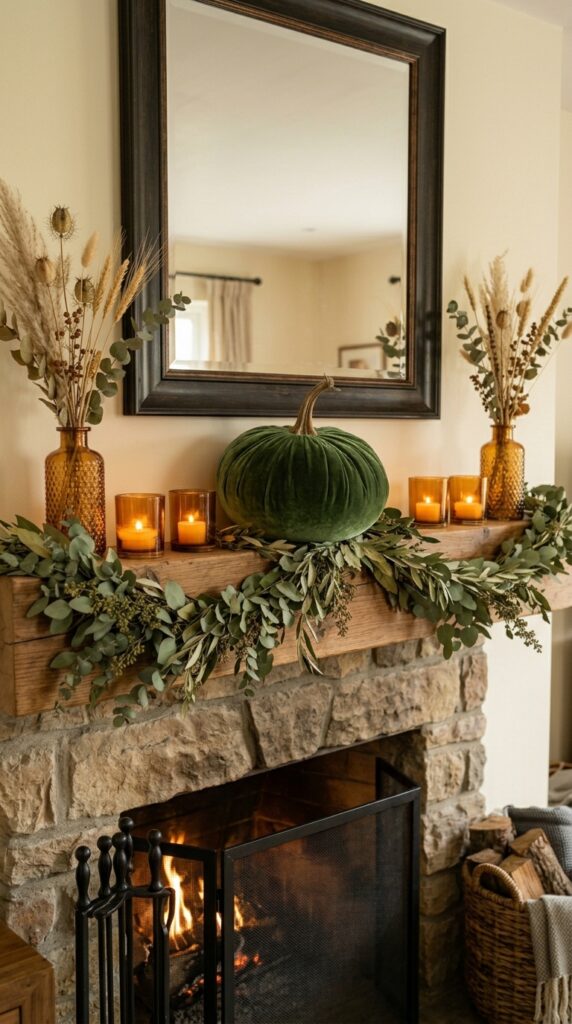
Vibe: Jewel-toned — the fall mantle for people who find orange predictable.
Why it works: Forest green and warm amber is a split-complementary fall palette — green and orange sit across the color wheel from each other, but desaturating both (forest green rather than lime; amber rather than neon orange) removes the tension of full complementary contrast and replaces it with a warm, sophisticated fall register. The velvet pumpkin introduces the seasonal reference at center stage while the green eucalyptus garland grounds the shelf edge in organic botanical material that reinforces the forest green without additional colored objects. Amber glass votives activate the palette through light — the warm glow they cast amplifies the amber tone more than any solid amber object would.
How to get it: Source velvet pumpkins in forest green from seasonal decor retailers in September — they typically sell out by early October. Preserved eucalyptus garland holds for an entire fall season without watering; apply a light misting of water every two weeks to prevent excessive brittleness.
Shop The Look
| Product |
| Velvet pumpkin large forest green fall decor |
| Amber glass votive candle holder set of 6 |
| Preserved eucalyptus garland greenery fall |
| Amber glass bud vase set of 2 small |
| Dried stem mixed fall bundle amber tan |
11. Woven Basket and Textile Layer Base
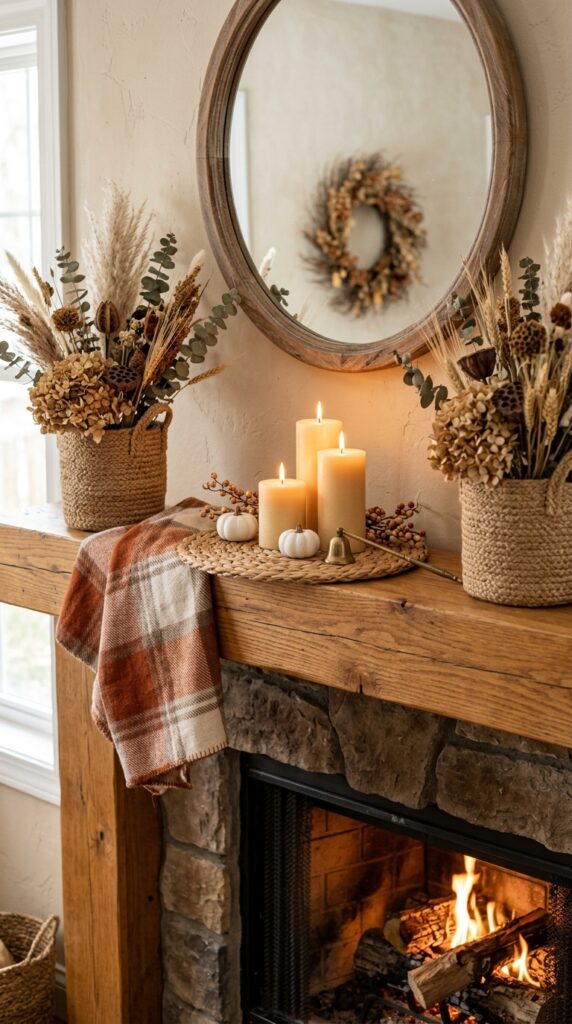
Vibe: Handcrafted — a shelf that shows the hands that made the things on it.
Why it works: Introducing woven textile materials — jute baskets, a folded wool plaid, a flat woven trivet — to a fall mantle brings tactile warmth that hard-surface objects (ceramics, metals, glass) cannot deliver. The design principle at work is material layering across texture categories: woven organic fibers alongside dried botanicals and ceramics creates a surface that rewards looking closely because every object has a different surface language. The draped folded plaid at the shelf corner is a particularly effective technique because it introduces soft color and pattern without consuming any vertical height — it reads as relaxed rather than arranged.
How to get it: Fold the textile to reveal its most interesting pattern section before placing — typically the border or center medallion. Drape it so one corner hangs below the shelf edge by 3–4 inches; this creates visual softness at the shelf’s front plane and adds a soft textile layer where every other element is hard or vertical. Mini jute baskets at 4–6 inches diameter are correctly scaled for mantle proportions.
Shop The Look
| Product |
| Mini jute woven basket set small 4 inch set of 2 |
| Wool plaid throw blanket rust cream fall colors |
| Woven rattan trivet flat round natural fiber |
| Dried botanical mini bundle basket arrangement |
| Jute twine natural roll decorative tying |
12. Narrow Mantle Minimalist Fall Edit
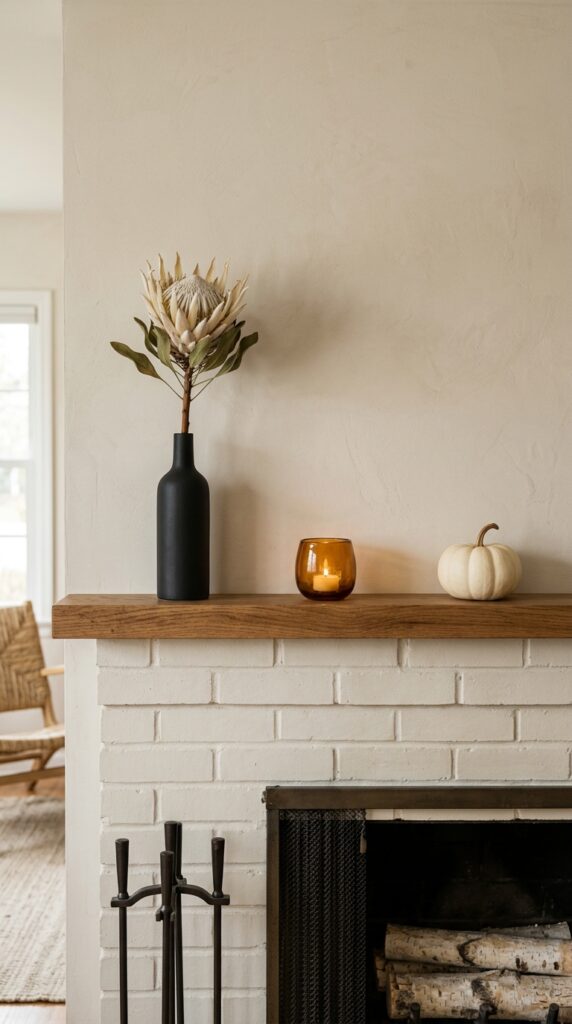
Vibe: Still — the confidence that comes from placing only what the space can hold.
Why it works: The narrow mantle presents the most common fall mantle design challenge: a shelf so shallow (under 4 inches) that standard decor objects tip forward or simply don’t fit. The solution is radical curation — limiting the total object count to three or fewer and choosing each for its silhouette rather than its decorative detail, since at narrow-shelf depth, objects are viewed primarily in profile. A single tall stem in a narrow vase provides height and seasonal botanical material without requiring shelf depth; a small low object at one end provides the grounding contrast; and the small votive provides warm light and negative space between the taller pieces.
How to get it: Lean rather than stand — on a shallow shelf, a small framed print or dried botanical bundle in a narrow frame leaned against the wall provides fall color and pattern at zero shelf-depth requirement. Use adhesive putty at the base of any freestanding object on a narrow shelf to prevent forward tipping when the fireplace creates air movement.
Shop The Look
| Product |
| Matte black narrow tall bud vase 12 inch |
| Dried protea flower stem single large |
| Small amber glass votive tealight holder |
| Mini white pumpkin artificial realistic single |
| Adhesive museum putty no-damage decor secure |
13. Lantern Cluster with Copper Fairy Light Fill
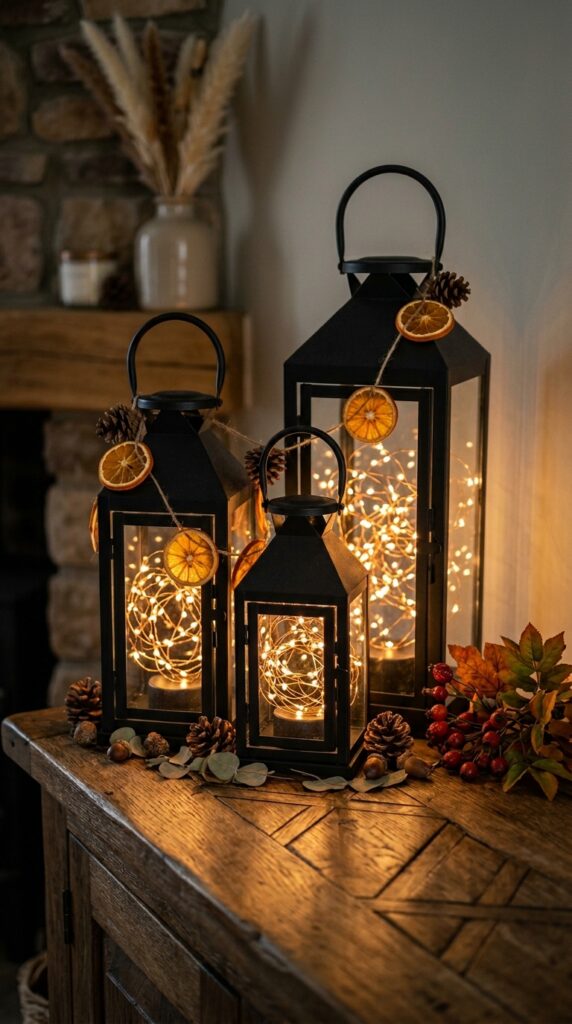
Vibe: Warm — the feeling of a room lit from the inside out.
Why it works: Black iron lanterns filled with copper fairy lights function as architectural light sculptures: the geometric iron frame divides the light into a grid pattern that projects onto surrounding surfaces, effectively making the lantern a light source that also patterns the space immediately around it. Grouping three lanterns in graduated sizes (small, medium, large) creates the same odd-number visual composition principle as candle groupings, while the consistent black iron frame across all three sizes unifies them as a single statement element. Copper-tone fairy lights (rather than warm white or yellow) specifically match the fall palette’s amber-orange register.
How to get it: Use battery-operated copper fairy lights with a remote timer inside lanterns rather than plug-in — cords emerging from lantern bases disrupt the composition and create tripping risk on mantle surfaces. Fill the bottom third of each lantern with fairy light coils resting on a bed of dried botanicals or pinecones to lift the lights toward the glass panels rather than pooling at the base.
Shop The Look
| Product |
| Black iron lantern set 3 graduated sizes fall |
| Copper fairy lights battery operated 20 foot timer |
| Dried orange slice garland natural fall decor |
| Pine cone assortment bag fill decor large |
| Dried rosehip berry stem bundle fall natural |
14. Fall Botanicals in Graduated Bud Vase Grouping
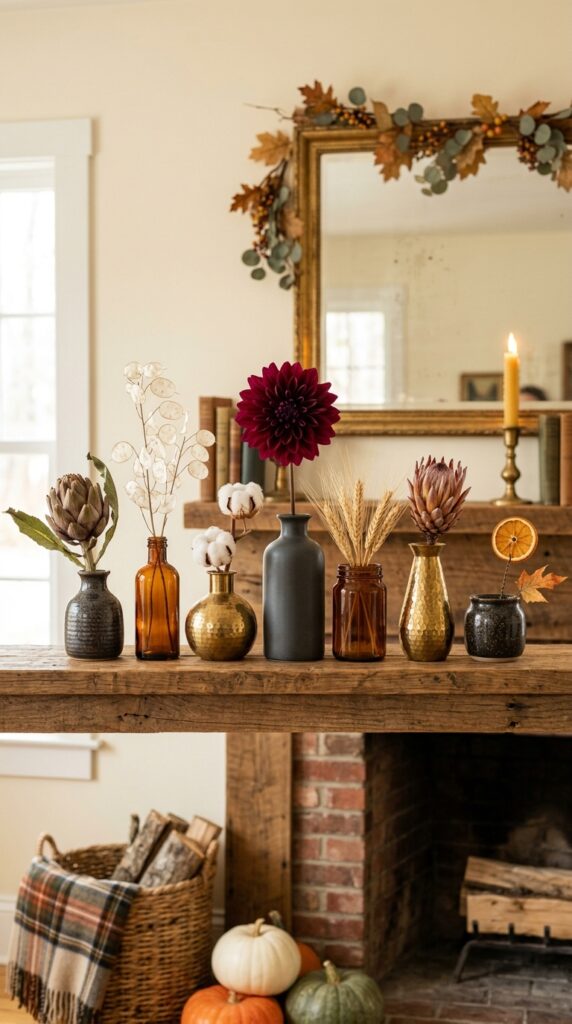
Vibe: Botanical — a mantle that reads as a very curated walk through a late October garden.
Why it works: The single-stem-per-vase rule is one of the most effective fall mantle styling techniques because it forces maximum variety within a minimum footprint — seven different botanical species each in their own vessel, versus one arrangement of seven stems in a single vase, creates far more visual information from the same number of botanical elements. The variety of vessel materials (dark ceramic, amber glass, hammered brass) echoes the botanical variety above without requiring additional objects. Positioning vases so their heights vary organically rather than stepping uniformly creates the relaxed skyline of a genuine collection rather than a styled row.
How to get it: Start with the botanical edit before choosing vases — select seven different fall textures first (smooth, fluffy, spiky, papery, round, linear, clustered) and then choose each vessel to complement its stem’s character: a broad cotton stem needs a wide-mouthed vessel; a single long wheat stem needs a narrow tall vase.
💡 Quick Win: Four dark ceramic bud vases from a dollar store or craft supply ($2–4 each) painted with chalk paint in rust and deep green create the entire vessel collection for under $20 — the botanical stems do the rest.
Shop The Look
| Product |
| Dark ceramic bud vase set varied heights fall |
| Dried cotton stem bundle white fall decor |
| Dried artichoke stem decorative fall natural |
| Dried lunaria silver dollar plant stems bundle |
| Dried protea single stem large natural |
15. Symmetrical Mirror-Image Fall Mantle Arrangement
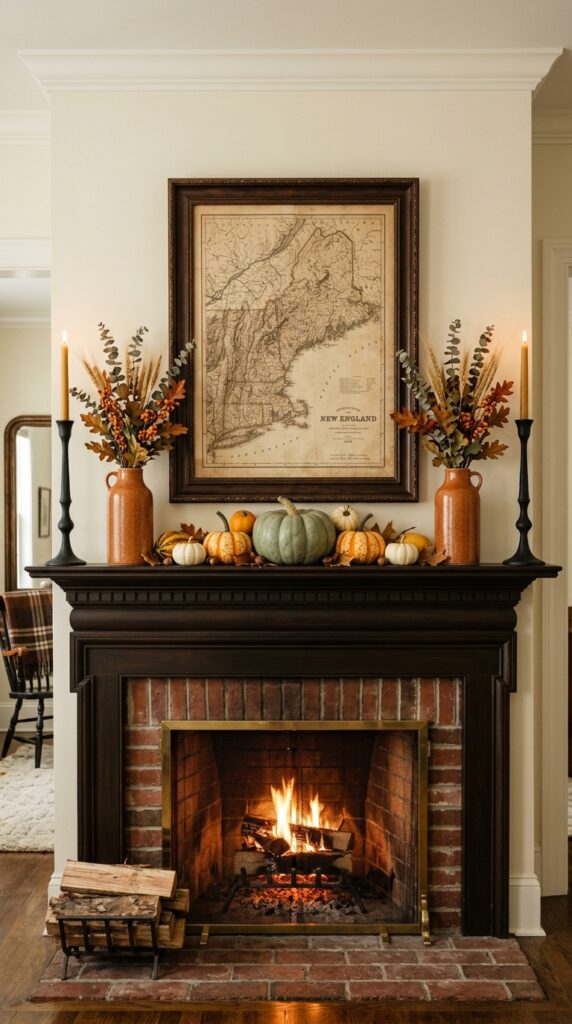
Vibe: Formal — the quiet order of a mantle that made a commitment and kept it.
Why it works: Symmetrical mantle arrangement works best when there is a strong vertical center anchor — a mirror, framed artwork, or architectural element — from which the mirrored elements extend outward on each side. Without the center anchor, symmetry reads as hesitant; with a strong center, it reads as deliberate and architecturally considered. The center anchor should be the tallest element in the composition, establishing the peak of the visual triangle from which everything descends in equal steps outward. This arrangement style suits formal living rooms, traditional architecture, and mantles with detailed millwork that already has symmetrical proportions.
How to get it: Photograph your mantle straight-on before styling and draw a vertical center line on the image — this makes the center point exact and prevents the common error of centering by eye, which always introduces a slight offset that reads as unintentional asymmetry. All matching pairs must be exact duplicates — different heights or colors in the paired elements read as errors rather than choices.
Shop The Look
| Product |
| Matching ceramic vase pair fall rust color |
| Tall black candlestick pair matching |
| Vintage map print framed warm sepia large |
| Symmetrical botanical print pair framed |
| Low gourd grouping artificial three piece set |
16. Terracotta + Cream Neutral Fall Palette
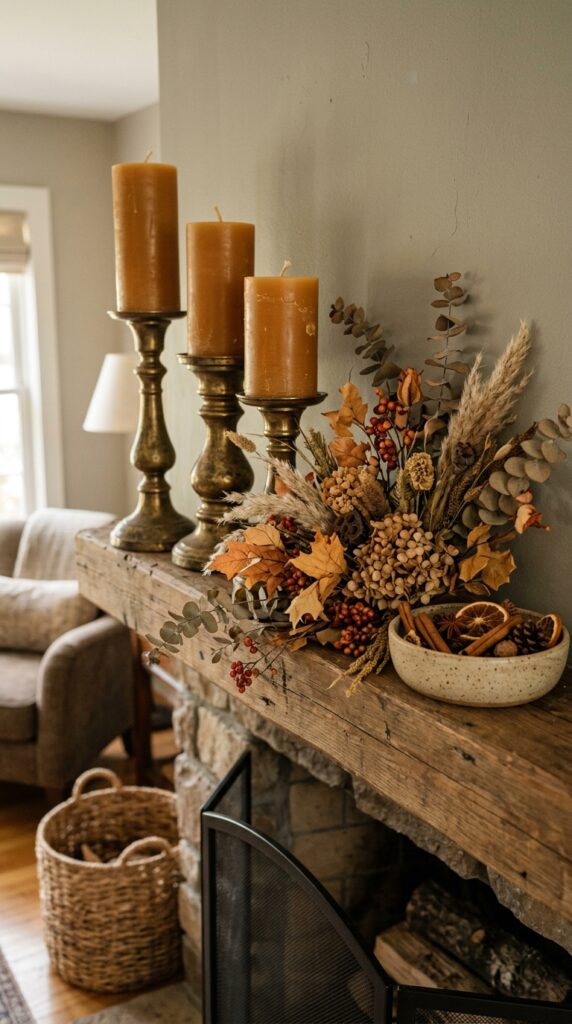
Vibe: Serene — the fall mantle that looks like it was always there, in every season, and you just now noticed it.
Why it works: The terracotta and cream neutral palette achieves fall atmosphere through material temperature rather than color saturation — every object reads warm because of its surface and form, not because it’s orange or burgundy. This is seasonal design through material choice: raw clay, undyed linen, dried botanical stems, and unbleached cotton all read as autumn without requiring a single bold color. The design principle is texture-led warmth, where the variety of surface textures across a unified tonal palette creates visual richness that substitutes for color contrast. This palette photographs exceptionally well because there are no competing bright tones to shift the camera’s exposure.
How to get it: Use unglazed terracotta pots directly from a garden center — their matte clay surface is more visually sophisticated than purpose-made decorative ceramic in the same tone. Group pots in three different sizes with their saucers underneath as a tray-equivalent base element.
Shop The Look
| Product |
| Terracotta clay pot set 3 sizes unglazed garden |
| Unbleached cotton stem bundle natural white fall |
| Cream linen ribbon spool 2.5 inch natural |
| Dried botanical bundle neutral tan cream |
| Raw unfinished wood candleholder set natural |
17. Preserved Eucalyptus and Berry Stem Garland
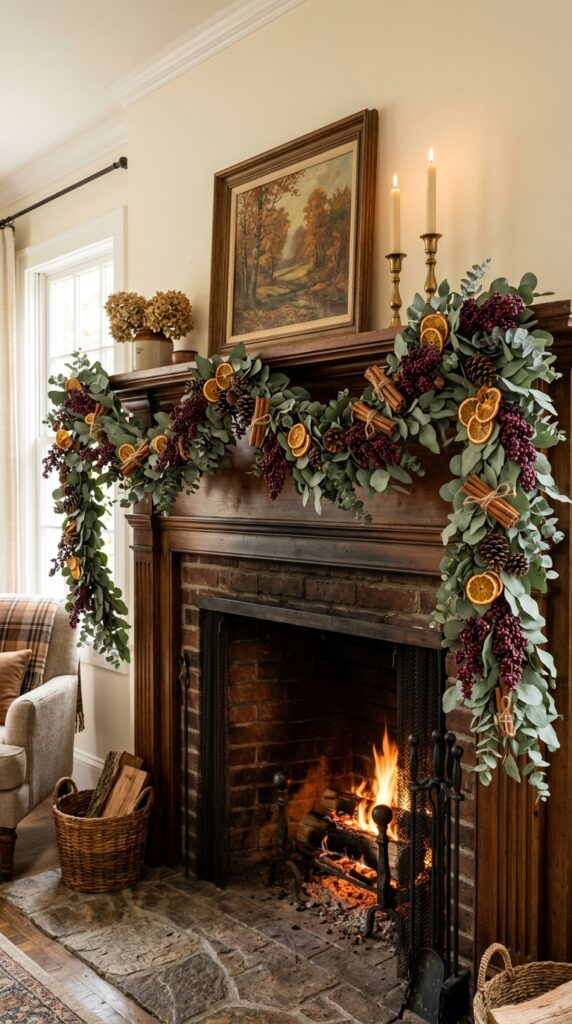
Vibe: Lush — the particular fullness of a surface that has been genuinely considered from end to end.
Why it works: A full-length garland is the single most impactful fall mantle intervention because it addresses the entire shelf length simultaneously rather than building composition from individual objects — one design decision covers 60 inches of shelf. Preserved eucalyptus is the correct base botanical because its silvery-green tone provides the ideal neutral backdrop that makes every added color element — burgundy berries, orange slices, cinnamon — appear more vibrant by contrast. The garland’s drape below the shelf edge at each end creates vertical movement that carries the eye down from the mantle rather than holding it flat on the shelf plane, giving the entire fireplace surround a more generous, considered appearance.
How to get it: Anchor the garland to the mantle using removable adhesive hooks rated for 3 pounds at the center and each end — three anchor points prevent the garland from sagging in the middle under its own weight. Tuck additional botanical elements (cinnamon bundles, pinecones, berry sprigs) into the garland after mounting, starting from the center and working outward symmetrically.
💡 Quick Win: A 6-foot preserved eucalyptus garland purchased online ($22–35) and draped without any additions immediately transforms a bare mantle into a seasonally dressed surface — the additions come later but are never strictly necessary.
Shop The Look
| Product |
| Preserved eucalyptus garland 6 foot real |
| Dried burgundy berry stem bundle fall decor |
| Cinnamon stick bundle tied natural set of 6 |
| Dried orange slice garland natural fall |
| Removable adhesive command strip hook set |
18. Beeswax Pillar Candles and Aged Brass Candlesticks
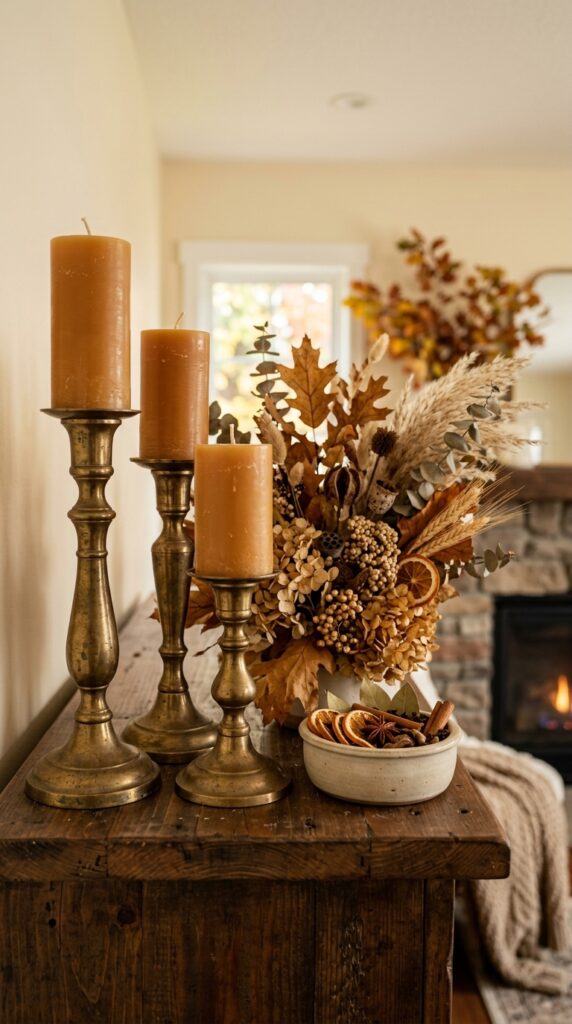
Vibe: Gathered — the warmth of things made slowly and kept carefully.
Why it works: Natural beeswax pillars are the material upgrade that most elevates a fall mantle candle grouping — the honey-amber color of raw beeswax is more complex than ivory paraffin and more warm than bleached white soy, creating a tone that exists at the exact intersection of fall’s amber-gold palette. Aged brass candlestick holders share beeswax’s warm yellow-gold family, making the material pairing a monochromatic study in the same warm spectrum — different materials, same tonal register. The slight hand-poured surface irregularity of genuine beeswax candles adds tactile interest at the close range of a mantle that a smooth cast candle cannot replicate.
How to get it: Source natural beeswax pillars from local beekeepers or artisan candle makers — these are consistently less expensive than boutique retail beeswax and often more authentically imperfect in surface texture. A beeswax pillar’s burn time is 2–3× longer than an equivalent paraffin candle, making the material investment genuinely economical across a fall season.
Shop The Look
| Product |
| Natural beeswax pillar candle set 3 sizes honey |
| Aged brass pillar candlestick holder set 3 heights |
| Stoneware small dish matte cream decorative |
| Fall potpourri dried orange cinnamon clove blend |
| Dried fall botanical bundle muted tones |
19. Ceramic and Stoneware Object Vignette
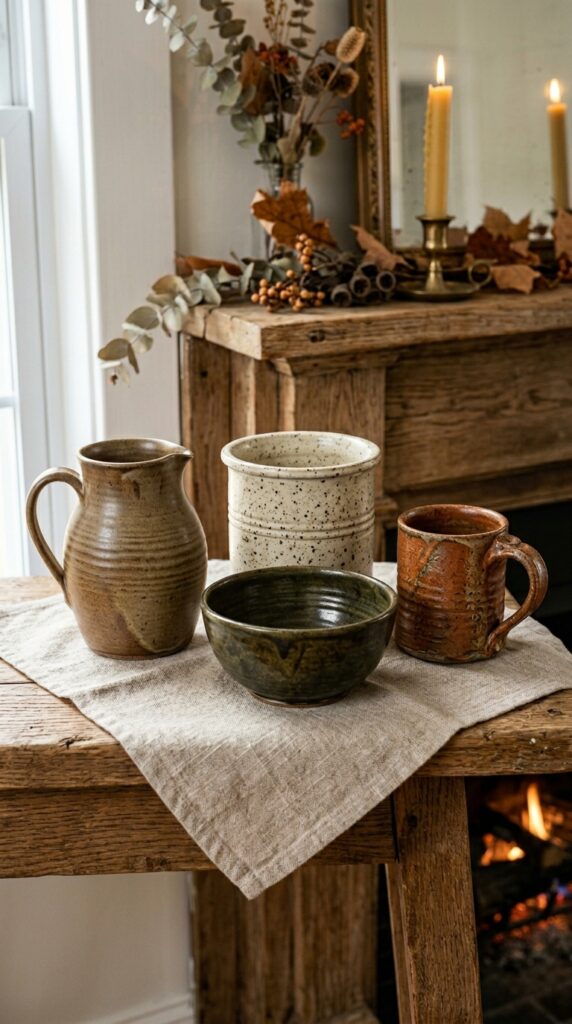
Vibe: Artisan — a group of things made by hand that found their way to the same shelf.
Why it works: Hand-thrown stoneware and ceramic vessels introduce the fall palette through glaze tone rather than explicit seasonal motif — matte earth glazes in brown, olive, cream, and rust read as autumnal because their tones are derived from natural pigments that mirror the season’s color, without requiring leaf or pumpkin iconography. The design principle is surface authenticity: the throwing lines, glaze drips, and color variations of genuine hand-thrown ceramics create visual complexity at close range that mass-produced decor objects cannot replicate. A small linen square beneath the grouping defines the vignette boundary and prevents the cluster from reading as objects placed directly on the shelf without intention.
How to get it: Source individual hand-thrown ceramic pieces from local pottery studios, farmers markets, or Etsy ceramicists — individual pieces from different makers unify naturally when chosen in the same tonal family (warm earth tones) even if their forms and glazes vary. Aim for at least three different vessel forms: a jug (with handle), a crock (wide-mouthed), and a bowl or cup for shape variety within the grouping.
Shop The Look
| Product |
| Hand-thrown stoneware jug matte brown fall |
| Speckled cream ceramic crock small farmhouse |
| Dark olive glazed ceramic bowl artisan |
| Rust orange matte ceramic mug textured |
| Natural linen table runner small mantle square |
20. Deep Olive + Cognac Leather Accent Fall Mantle
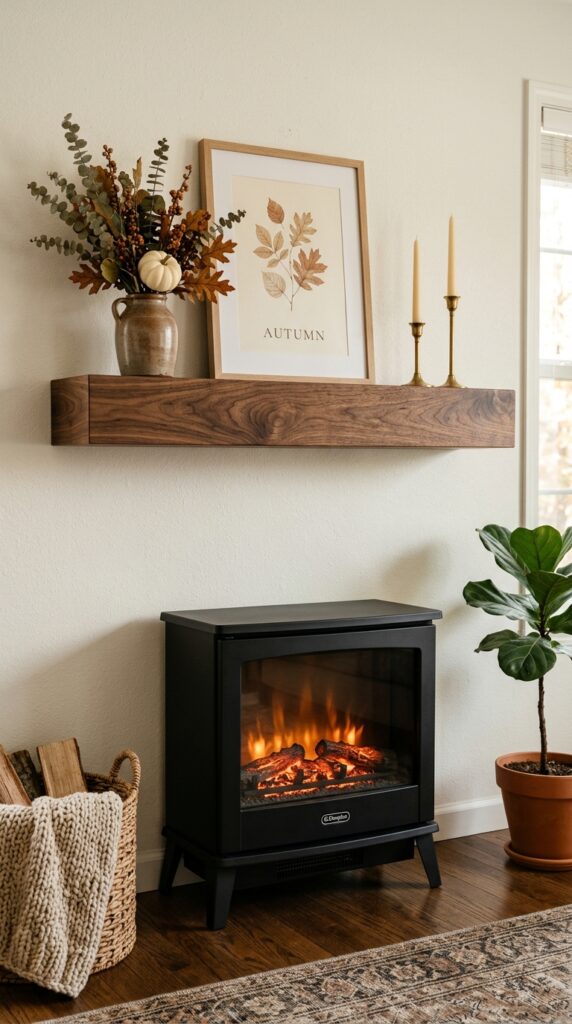
Vibe: Literary — a mantle that signals something about the person who styled it.
Why it works: Deep olive and cognac leather is the most unexpected fall mantle palette — both tones have strong brown undertones that anchor them in autumn warmth, but neither announces itself as a seasonal color. This allows the mantle to serve the fall atmosphere through material warmth and tone depth rather than seasonal novelty. Stacked leather-bound books as a riser introduces function-as-design: the book stack serves as both platform and object simultaneously, adding height variation to the composition while contributing its own warm cognac tone and textured spine pattern to the surface story.
How to get it: Spray paint a set of secondhand hardcover books in cognac and deep rust tones using chalk spray paint — this creates a unified leather-look book stack for under $20. Stack three to five books with the spines facing outward and outward-facing spines toward the room rather than the wall; this reveals the color block while concealing any surviving cover graphics.
Shop The Look
| Product |
| Dark olive green interior paint accent wall |
| Cognac leather photo frame small leaner style |
| Chalk spray paint cognac rust for book stack |
| Deep olive ceramic vase modern fall decor |
| Small brass votive holder set of 3 |
21. Pinecone and Acorn Natural Harvest Display
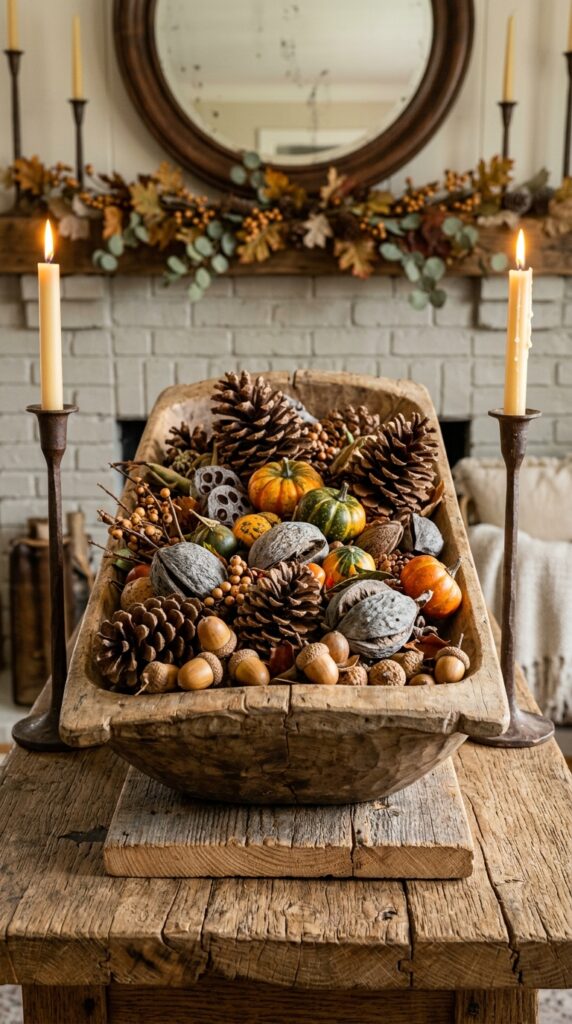
Vibe: Abundant — the harvest trough as the most honest fall object there is.
Why it works: A wooden dough bowl or trough overflowing with gathered natural elements is the original fall mantle centerpiece, predating the decorative market by centuries — and it still works because it applies the most fundamental principle of harvest display: abundance within containment. The trough provides the visual boundary that prevents a collection of loose pinecones from reading as clutter, while its wooden form is itself a material statement in the fall palette. Filling to the point of slight overflow — pinecones cresting the trough edge — creates the generous abundance that distinguishes an intentional harvest display from a tidy storage solution.
How to get it: Scent the natural elements in the trough with a few drops of essential oil — cinnamon bark, clove, or sweet orange — applied to the pinecones directly. The warmth of the room develops the scent gently throughout the day, engaging the olfactory dimension of fall atmosphere alongside the visual.
Shop The Look
| Product |
| Large wooden dough bowl trough decorative natural |
| Pinecone assortment bag large sizes natural fall |
| Dried acorn set decorative natural real |
| Dried seed pod assortment fall natural mix |
| Cinnamon bark essential oil fall scenting |
22. Floating Shelf as Mantle Alternative in Small Space
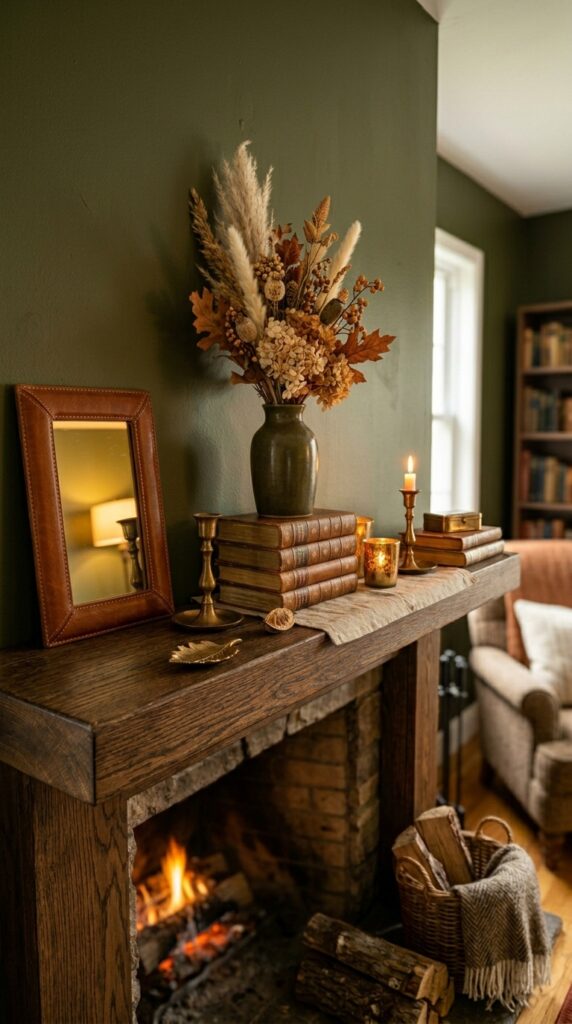
Vibe: Considered — the small room solution that creates the thing it needed rather than waiting for it.
Why it works: In apartments, small rooms, and homes without built-in fireplaces, a floating shelf mounted at mantle height (48–54 inches from the floor) over a freestanding electric fireplace creates a full mantle moment from two independent elements. The design principle is visual association: the eye connects the shelf above to the heat source below and reads them as a single architectural unit, provided the shelf width matches or slightly exceeds the fireplace width and both are centered on the same wall plane. A 10-inch shelf depth provides full compatibility with standard fall decor objects without the overhang risk of shallower alternatives.
How to get it: Mount the floating shelf using a French cleat system — a 45-degree angled cleat on both the shelf back and wall surface that locks together under the shelf’s own weight — for the cleanest possible installation with no visible brackets. The cleat allows easy removal and repositioning if the arrangement changes. Solid walnut shelving at 1.5-inch thickness reads as substantial and considered rather than builder-grade.
Shop The Look
| Product |
| Solid walnut floating shelf 10 inch depth 48 inch |
| French cleat wall mounting system shelf kit |
| Freestanding electric fireplace matte black modern |
| Small fall botanical arrangement artificial |
| Leaner frame small 8×10 dark wood modern |
23. Copper String Light Drape Along the Mantle Back
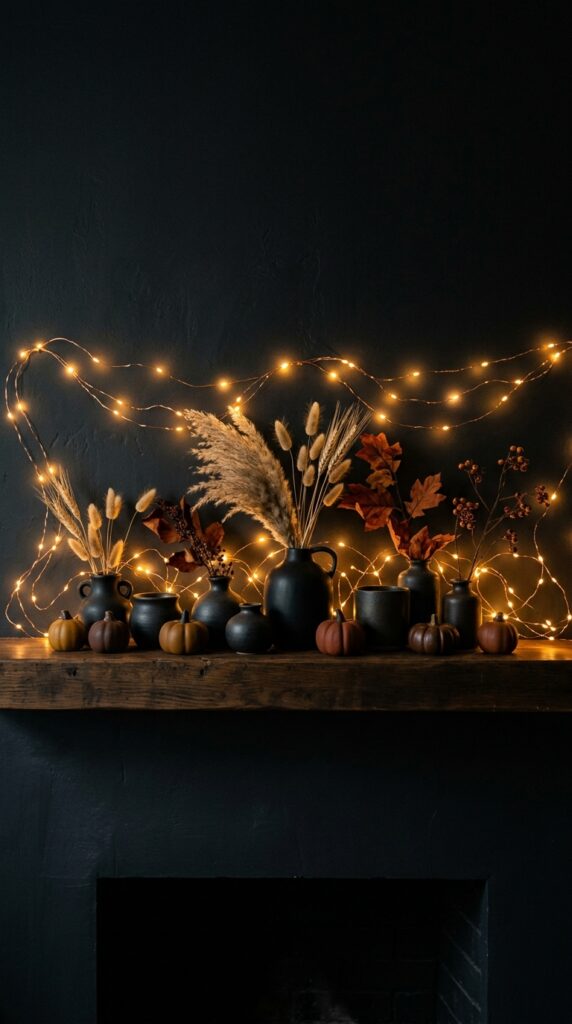
Vibe: Magical — the glow behind the objects that makes them more interesting than the objects themselves.
Why it works: A copper string light draped along the back wall of the mantle operates by the design principle of back-lighting: placing the light source behind the display objects rather than in front of or above them creates a warm halo effect that silhouettes object profiles and creates depth between the back wall and the front shelf edge. This is fundamentally more atmospheric than front-lit arrangements because shadow is as active a design element as the light itself. The copper wire specifically — rather than silver or black — contributes its own warm tone to the palette even where the bulbs are not positioned, making the wiring itself a visual material rather than something to conceal.
How to get it: Use removable adhesive clips to mount the string light at 4–5 inch intervals along the back wall at shelf height — this controls the drape pattern and prevents sagging bunches. Battery-operated fairy lights with a built-in timer allow the mantle to glow automatically at dusk without an outlet-routed cord.
Shop The Look
| Product |
| Copper string fairy lights warm white battery timer |
| Adhesive clip fairy light wall mount set |
| Matte ceramic decorative object set dark fall |
| Dried stem bundle silhouette tall dark vessel |
| Battery pack concealment tray small mantle |
24. Antique Book Stack and Magnifying Glass Vignette
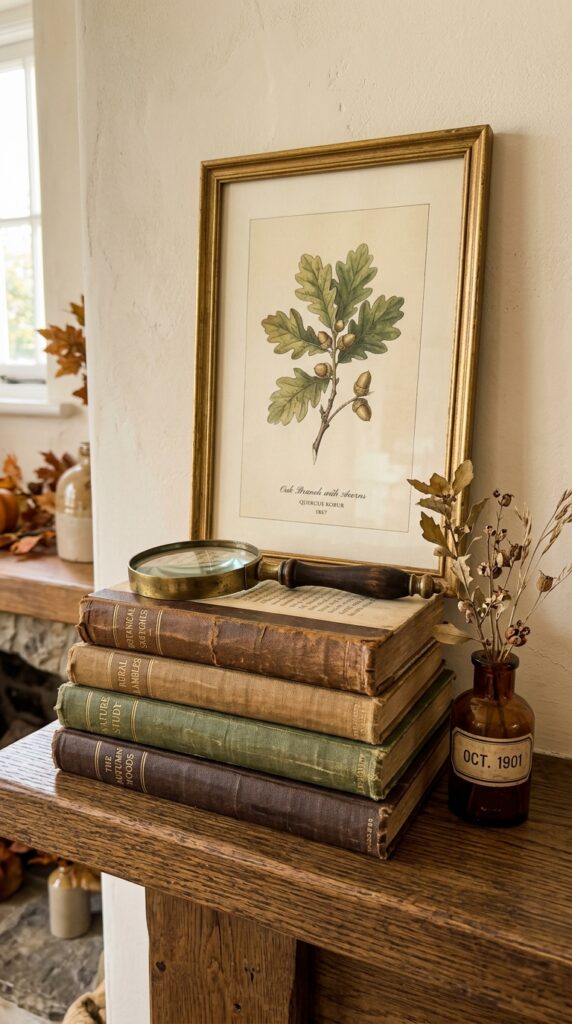
Vibe: Literary — the corner of a mantle that makes you want to know who lives here.
Why it works: The antique book stack vignette introduces narrative into the fall mantle composition — it implies a person and their habits, rather than presenting purely decorative objects. This is personal object styling: using objects that suggest use and life rather than display and purchase. The design principle is layered scale within a small footprint: the stack provides elevation, the magnifying glass provides horizontal line across the top, the small bottle provides a secondary vertical beside the stack, and the leaned framed print provides the backdrop and extends the vertical range upward — four distinct scale levels in a 10-inch footprint.
How to get it: Source genuine antique books at estate sales and charity shops — hardcovers in olive, brown, burgundy, and cream cloth bindings are most common and create the best fall palette without any modification. Stack with the widest book at the base and narrowest at the top for a stable pyramid structure that holds the magnifying glass without slipping.
💡 Quick Win: Four charity-shop hardcover books in matching tonal bindings, stacked with one angled vintage object on top, creates a complete end-of-mantle vignette in under five minutes for $4–12 in total material cost.
Shop The Look
| Product |
| Vintage brass magnifying glass decorative |
| Antique style small glass ink bottle bud vase |
| Botanical illustration art print framed vintage |
| Decorative hardcover book set fall tones |
| Small dried botanical stem single antique bottle |
25. Layered Depth Composition: Front, Middle, Back
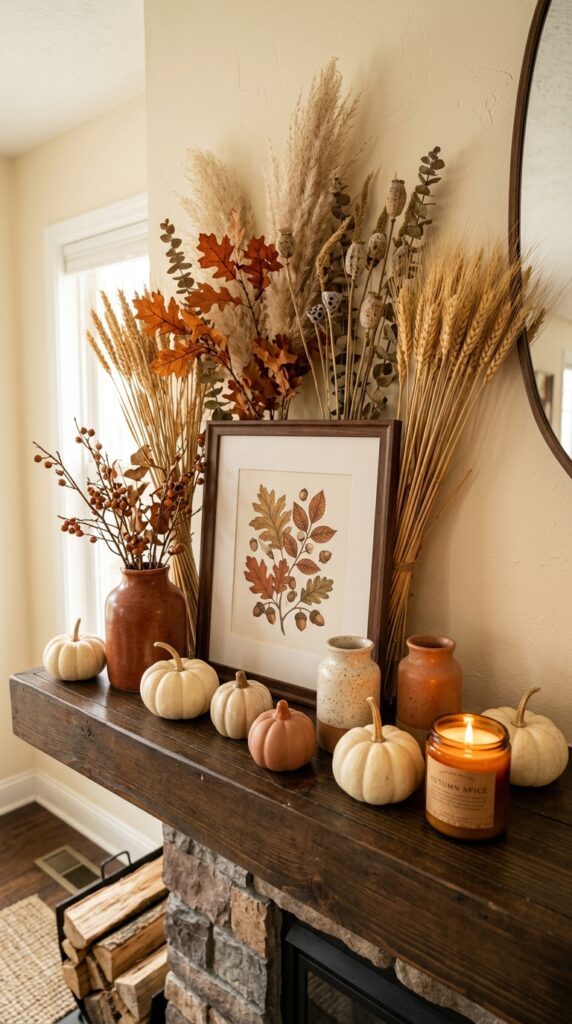
Vibe: Composed — the mantle version of a landscape with a foreground, middle ground, and sky.
Why it works: Three-layer depth composition is the most sophisticated fall mantle layout technique because it applies the visual logic of landscape painting to a horizontal shelf: a back layer (leaned elements against the wall at maximum height), a middle layer (standing objects at medium height), and a front layer (low objects at the shelf’s front edge). This depth layering makes a standard 6–8-inch-deep shelf appear to have more dimension than it physically possesses, because partially overlapping the middle and back layers creates a perspective illusion of receding space. The technique also eliminates the most common mantle styling problem — all objects at the same height creating a flat, uninteresting horizon line across the shelf.
How to get it: Always fill the back layer first — lean large botanicals, framed prints, or mirrors against the wall — before placing any other objects. The back layer defines the maximum height of the composition and the available visual backdrop for all middle and front objects. Place front-layer objects so they break the sightline to the middle layer partially — this overlap is what creates the dimensional illusion.
Shop The Look
| Product |
| Large dried pampas arrangement bundle back layer |
| Ceramic vessel set medium fall rust brown tones |
| Vintage botanical print framed for mantle lean |
| White mini pumpkin set artificial front layer |
| Cream taper candle with holder front accent |
How to Start Your Fall Mantle Decor Transformation
Your single first move is to choose your anchor botanical and place it first. Not the candles, not the pumpkins — the botanical. A dried pampas arrangement, a preserved eucalyptus garland, or a tall wheat stem bundle is the element that establishes the mantle’s height range, color register, and material character before any other decision is made. Every subsequent object — the vessels, the candles, the seasonal novelty items — finds its position in relation to what the botanical has already established, which is why choosing it first produces more cohesive results than building a mantle from the center outward with smaller objects.
The most common mistake in fall mantle decor is mixing too many color families simultaneously. Specifically: combining orange pumpkins, red berries, yellow leaves, purple asters, and green eucalyptus on the same shelf creates a color spread that reads as a craft store display rather than a designed composition. The fix is the palette rule: choose two dominant tones and one neutral, and evaluate every potential object against those three colors before it earns a place on the shelf. If a rust pumpkin, cream candle, and natural jute are your three tones, a bright orange gourd doesn’t make the cut no matter how seasonal it is.
Three specific items under $50 that create immediate fall mantle impact: a 6-foot preserved eucalyptus garland in natural silver-green ($22–34) that dresses the full shelf length in one drape; a set of three beeswax pillar candles in graduated heights in honey amber ($16–24) that establishes warm light without any additional holders; and a single large dried pampas stem in bleached ivory ($8–14) placed in an existing tall vessel at one end — these three elements together run $46–72 and produce the primary architecture of a complete fall mantle arrangement before a single additional object is considered.
A fall mantle can be completely styled in one afternoon — this is genuinely a single-session project, which makes it one of the most satisfying seasonal room interventions. Budget range: $35–80 for a curated but modest arrangement using primarily natural and dried materials; $120–250 for a fully layered mantle with garland, quality ceramics, beeswax candles, and framed art. The mantle’s small surface area means even a $150 investment is applied to approximately 8–12 square feet of display surface — the highest design impact per dollar in the entire home.
Frequently Asked Questions About Fall Mantle Decor
What is fall mantle decor and how is it different from general fall home decorating?
Fall mantle decor specifically addresses the horizontal shelf above a fireplace as a curated display surface — it’s a compositional design exercise in a constrained footprint, governed by rules of height variation, material layering, and tonal cohesion that apply to this specific surface and scale. General fall home decorating encompasses the full room: throw pillows, rugs, table arrangements, wreaths, and seasonal textiles. The mantle is the most architecturally significant individual surface in most living rooms — it’s the focal point the room was designed around — which means fall mantle decor carries disproportionate atmospheric impact relative to its size, making it the highest-leverage seasonal styling investment in the home.
What colors work best for fall mantle decor?
The most effective fall mantle palettes are built on two-tone warm combinations: rust and cream, amber and forest green, burgundy and cognac, or terracotta and warm white. The universal rule is warm undertones across every element — avoid any blue-toned gray, cool white, or silver, which read as winter or early spring regardless of the botanical content around them. For a refined, non-traditional fall palette, Benjamin Moore “Terracotta Tile” 2090-30 applied to a dough bowl or painted vessel, paired with Sherwin-Williams “Antique White” SW6119 in pillar candles and linen textiles, creates a sophisticated neutral fall register. For maximum seasonal impact, deep rust (Farrow & Ball “Red Earth” No. 64 tone) paired with warm cream achieves the most recognizably autumnal palette.
How much does it cost to style a fall mantle?
A minimalist fall mantle using primarily natural and dried materials — dried botanicals from the garden or a farm stand, a few pillar candles, and a couple of secondhand vessels — costs $15–40 in total. A mid-range curated arrangement with a preserved eucalyptus garland, quality beeswax pillars, matching ceramic vessels, and a framed botanical print runs $80–150. A fully layered fall mantle with lanterns, velvet pumpkins, a linen garland, copper string lights, and artisan stoneware runs $150–300. The most important cost note: dried botanical materials — pampas, wheat, lunaria, cotton stems — hold their appearance for multiple seasons with careful storage, reducing the annual investment significantly after the first year.
Can fall mantle decor work if my fireplace has a very white or light-colored surround?
Yes, but a light surround requires a more intentional approach to contrast. A crisp white marble or tile surround creates a neutral backdrop that makes bold-colored objects read more brilliantly — deep rust ceramics, forest green velvet pumpkins, and aged brass candlesticks all appear more saturated against white than against a dark wood mantle. The one adjustment: avoid very pale, low-contrast arrangements (cream on cream, natural tan on white) on a light surround, as these lack the tonal separation to register as designed rather than absent. If you want a neutral fall palette on a light mantle, introduce one dark-toned element — a matte black vase, a dark-framed print, a deep olive botanical — to create the contrast anchor that activates the pale tones around it.
What dried botanicals work best for fall mantle decor and how long do they last?
The most durable and visually effective dried botanicals for fall mantle decor are: dried pampas grass (lasts 1–3 years if kept away from humidity and direct sun), dried wheat stems (2–3 years), preserved eucalyptus (6–12 months before color fades), dried cotton stems (2+ years), dried lunaria silver dollar plant (2+ years), dried bunny tail grass (1–2 years), and dried protea flowers (1–2 years). Avoid fresh-cut botanicals on a mantle above a working fireplace — heat accelerates drying and can create fire risk for stems placed too close to the firebox opening. The practical rule: keep all botanical materials at least 12 inches above the top of the firebox opening, and use LED candles rather than open flame when dried botanicals are incorporated into the arrangement.
Ready to Create Your Dream Fall Mantle Decor?
These 25 fall mantle decor inspirations have moved across the full spectrum of autumn design — from deep rust and cognac palettes to moody burgundy and black, from tiered beeswax candle clusters and lantern groupings to preserved eucalyptus garlands, layered depth compositions, and minimalist narrow-shelf edits — giving you a complete seasonal styling vocabulary for every mantle type and room tone. Transformation doesn’t require starting over from scratch; the most considered fall mantles are built by adding and editing rather than replacing everything, and often the best arrangement comes from removing two objects rather than adding three more. Start today by clearing your mantle completely and placing only one botanical element — let it stand alone for a day before adding anything else, and notice what it tells you about what belongs beside it. When it’s finished, you’ll have a surface that makes the whole room feel like a considered response to the season — warm, specific, and entirely yours. Save the ideas whose palettes match the tones already living in your room — in fall mantle decor, the best arrangement always begins with what the room already knows about itself.