A small living room is any sitting space under approximately 200 square feet where every design decision carries disproportionate consequence — the wrong sofa scale, a poorly placed rug, or a single overhead light can make the room feel trapped rather than intentional. This article gives you 25 small living room decor ideas spanning layout, color, lighting, furniture, storage, accessories, and illusion techniques — everything you need to make a compact space feel considered, generous, and genuinely livable.
Small living rooms do not need to be apologized for. The best ones have a quality that large rooms rarely achieve — a sense of everything being exactly where it should be, nothing wasted, nothing forgotten. When the constraints are treated as the brief rather than the problem, small living rooms become some of the most atmospheric and human-scaled spaces in any home. Here are 25 ideas worth saving — and stealing.
Why Small Living Room Design Works So Well
Small living room design as a distinct discipline emerged from the post-war urban apartment boom — particularly in New York, London, Paris, and Tokyo — where architects and designers began treating spatial economy as a genuine design virtue rather than a concession to budget. The most influential thinking in this area came from Japanese interior culture, Scandinavian functionalism, and the Case Study House movement, all of which shared a conviction that constraint produces better design decisions than abundance. What separates a well-designed small living room from a merely tidy one is intentionality — every element is chosen for multiple purposes, and every surface is considered from at least three angles.
The material palette for small living rooms prioritizes visual lightness and spatial continuity. Light-reflective surfaces — warm white limewash, pale limewash plaster, natural linen, bleached oak, soft greige — expand the apparent volume of a room by maximizing the travel distance of natural light. Mirrors, glass-top tables, and lucite or acrylic furniture contribute transparency that the eye reads as space. Warm wood tones — pale oak, natural rattan, honey-toned cane — add material richness without visual weight. Every finish in a small room should earn its keep twice: aesthetically and spatially.
Small living rooms are experiencing a design renaissance driven by the rise of urban micro-living, the mainstreaming of the “less but better” philosophy popularized by Dieter Rams and applied to interiors by designers like Ilse Crawford and Studio McGee. Pinterest data shows searches for “small living room ideas” consistently among the top five interior design search categories globally, with particular growth in searches for “small living room layout” and “small living room storage” — signaling that people want practical solutions, not aspirational imagery.
The good news is unambiguous: small living rooms can achieve any style — from maximalist bohemian to spare Japandi — as long as scale, proportion, and spatial continuity are addressed first. Every idea in this article addresses at least one of those three fundamentals.
Style at a Glance
| Element | Space-Expanding Approach | Cozy Intimate Approach |
| Philosophy | Light, continuity, visual depth | Enclosure, layering, atmosphere |
| Materials | Pale oak, linen, glass, lucite, mirrors | Velvet, dark paint, warm timber, textiles |
| Color palette | Warm white, soft greige, pale sage, natural | Charcoal, deep green, terracotta, warm umber |
25 Small Living Room Decor Ideas
1. The Right-Size Sofa: Two-Seat or Apartment-Scale
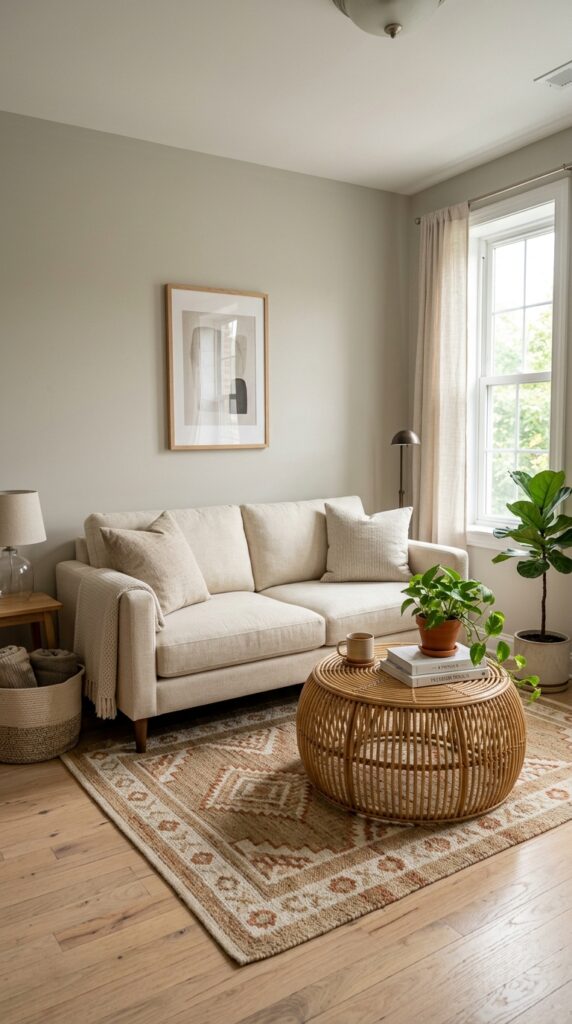
Vibe: Airy — the moment a sofa stops touching the walls on both sides, the room begins to breathe.
Why it works: Scale is the most common and most consequential error in small living rooms. A standard three-seat sofa at 84–96 inches dominates any room under 12 feet wide, leaving no visual breathing room between the furniture edge and the walls. An apartment-scale two-seat sofa at 68–76 inches preserves floor space on both sides of the piece, creating the visual impression of a room larger than its measurements — the eye reads the negative space around the sofa as generosity of space rather than absence of furniture. This is the principle of appropriate proportion: furniture scaled to the room reads as confident; oversized furniture reads as a mistake.
How to get it: Measure your room and subtract 24 inches from the width to find your maximum sofa length — this leaves 12 inches of clear floor on each side. Search specifically for “apartment sofa,” “loveseat,” or “two-seat sofa” rather than standard three-seat options. IKEA’s SÖDERHAMN at 69 inches, West Elm’s Andes Loveseat, and Article’s Sven Birch are all well-proportioned options for small rooms. Always measure the delivery path — stairwells and doorways are the most common obstacle to sofa installation in small urban apartments.
💡 Quick Win: Measure your current sofa against the 24-inch rule — if it exceeds the room width minus 24 inches, rearranging it on a different wall axis (parallel to the shorter wall rather than the longer one) may immediately open floor space that feels like a room expansion.
Shop The Look
| Product |
| Apartment scale loveseat linen ivory two-seat |
| Small round rattan coffee table natural |
| Warm ivory linen throw pillow cover set |
| Small trailing pothos plant live indoor |
| Low pile area rug neutral greige small |
2. Floating Furniture Away from Walls
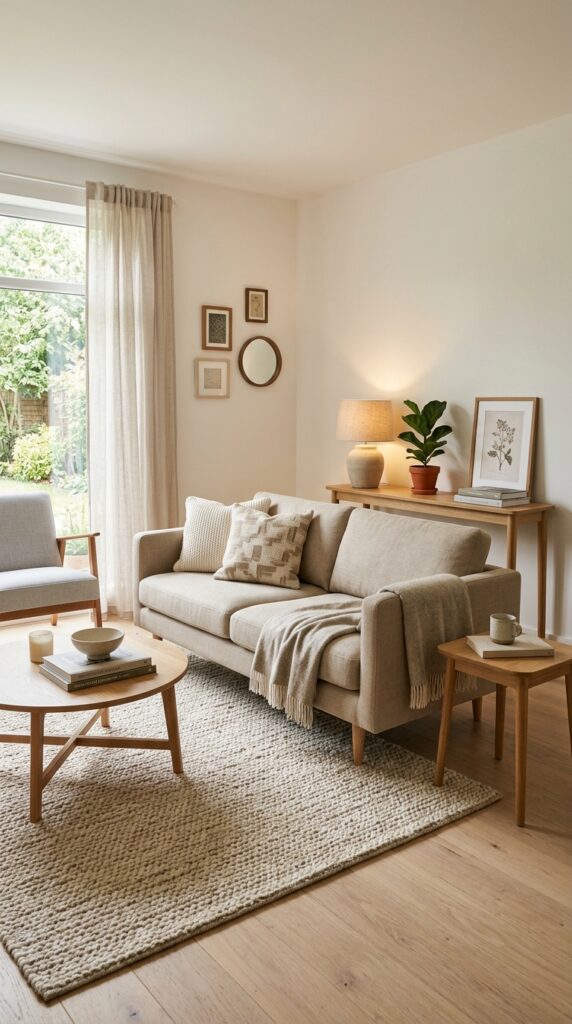
Vibe: Grounded — a sofa pulled from the wall reads as intentionally placed rather than simply stored there.
Why it works: The instinct in small rooms is to push furniture against every wall to maximize floor space — but this produces the opposite of the intended effect. Furniture tight against walls increases the apparent size of the empty floor zone in the room’s center, which reads as wasted space rather than breathing room. Floating the sofa 6–8 inches from the wall creates a zone behind the piece that allows a slim console table, visual breathing room, and — most importantly — the impression that the furniture has been arranged by someone who understood the room rather than someone who was simply trying to fit things in.
How to get it: Pull the sofa forward the minimum 6 inches and place a narrow console table (10–12 inches deep maximum) in the gap behind it. This console handles lamps, display objects, and the visual task of filling the wall zone without pushing the sofa back toward it. The arrangement costs no additional floor space on the room’s circulation side and produces a measurable improvement in the room’s spatial reading.
Shop The Look
| Product |
| Slim console table narrow 10 inch depth |
| Small table lamp warm shade console |
| Low profile sofa legs replacement screw-in |
| Decorative object set console styling |
| Thin profile art print frame console wall |
3. Warm White Limewash Walls for Visual Expansion
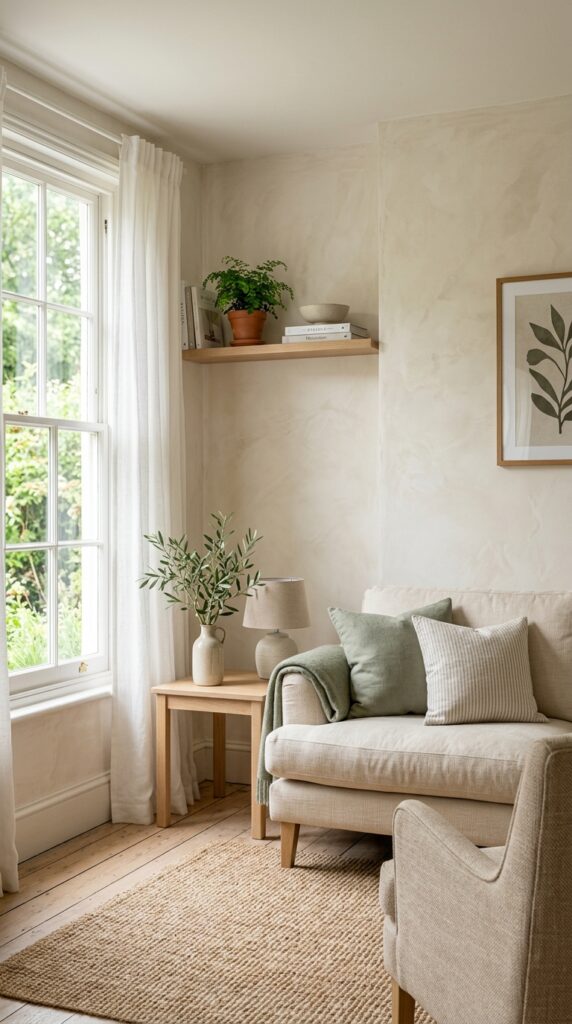
Vibe: Airy — warm white limewash walls give a small room the quality of morning light regardless of what time it actually is.
Why it works: Warm white limewash — specifically a warm rather than cool white, with a yellow or pink undertone rather than a blue one — maximizes light reflectivity in a small living room while introducing surface texture that prevents the room from reading as sterile. The calcium carbonate in limewash reflects light differently from flat emulsion paint, creating a micro-variation in tone across the surface that makes walls appear to have depth rather than just color. This depth perception expands the apparent volume of the room by making the boundaries feel less abrupt. Cool whites (with blue undertones) achieve similar reflectivity but make small rooms feel clinical rather than welcoming.
How to get it: Use Portola Paints Roman Clay in Veil (warm off-white), Pure & Original Classico Limewash in Aged White, or Farrow & Ball Lime White in their limewash formulation. Apply to all four walls and the ceiling in the same tone — painting the ceiling a different (even slightly darker) white creates a visible ceiling plane that lowers the perceived height of the room. The single wall color applied throughout is the correct strategy.
Shop The Look
| Product |
| Warm white limewash interior paint |
| Limewash application brush wide masonry |
| Natural linen sofa cushion cover warm white |
| Pale oak side table small round |
| Small potted succulent live 3 inch |
4. Large Mirror Strategically Placed
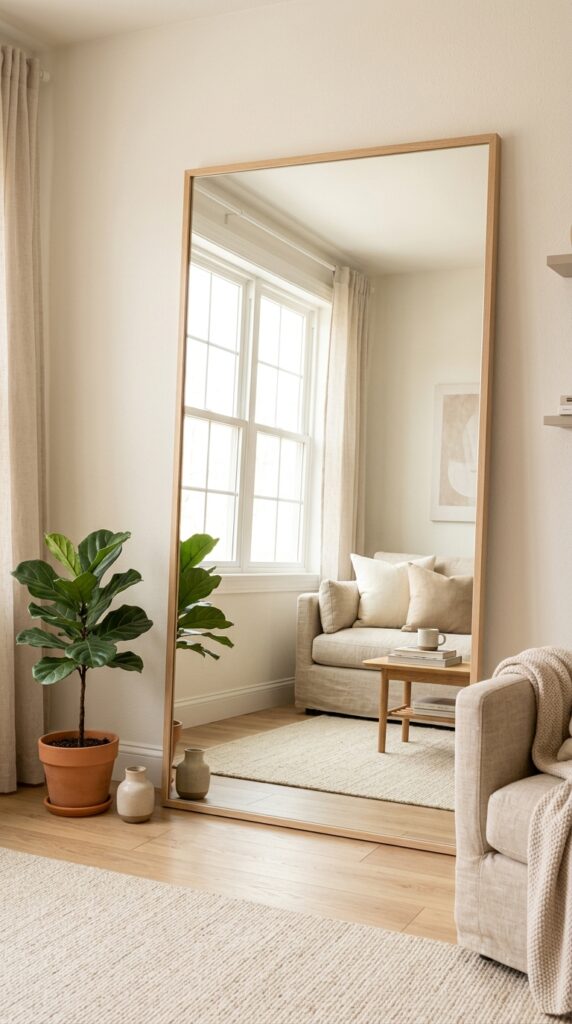
Vibe: Luminous — a large mirror placed to reflect a window does not double the room’s size; it doubles its light, which is better.
Why it works: A mirror’s spatial effect in a small living room depends entirely on what it reflects. Positioned to reflect a window, it creates the optical impression of a second light source and a view beyond the wall — the eye reads the reflection as depth, not as a reflection, and the room’s perceived boundary shifts to the reflected wall plane. The mirror must be large (minimum 36″×48″, ideally larger) to achieve this effect — small mirrors reflect small fragments of light and read as decoration rather than architecture. A leaning mirror at floor level is more spatially effective than a hung mirror because it captures both ceiling and floor in its reflection, emphasizing the room’s full vertical dimension.
How to get it: Position the mirror on the wall directly opposite or perpendicular to the room’s primary window — never on the window wall itself, which reflects the room back into the room without adding depth. A 48″×72″ or 36″×60″ leaner mirror in a thin natural wood or matte black frame is the correct scale for most small living rooms. Secure leaning mirrors with a wall anchor and a thin braided cable at the top back edge — building codes in many jurisdictions require this for mirrors over 20 lbs.
Shop The Look
| Product |
| Large leaner mirror pale wood frame floor |
| Mirror security anchor kit braided cable |
| Mirror cleaning solution streak-free large |
| Thin frame rectangular mirror minimal natural |
| Small plant stand natural wood beside mirror |
5. One Large Rug Instead of Two Small Ones
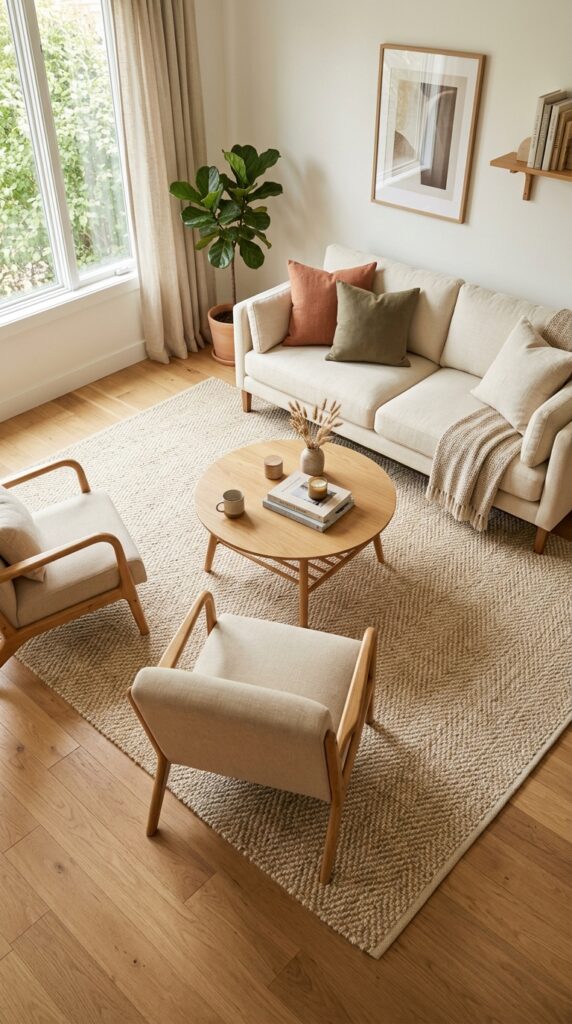
Vibe: Grounded — one large rug makes the furniture look arranged; two small rugs make it look stored.
Why it works: The single large rug is one of the most consequential scale decisions in small living room design. Multiple small rugs in a compact space create visual fragmentation — the eye processes each rug as a separate zone, making the floor appear chopped into sections and therefore smaller than its actual area. One rug that extends beneath all the primary furniture — with all front legs resting on it and the rug edge at least 6 inches beyond the furniture perimeter — creates a unified floor plane that reads as a continuous surface. The visual floor area appears larger because there are no interrupting seams or boundaries within the furniture grouping.
How to get it: In most small living rooms under 180 square feet, an 8×10 rug is the correct size — it is counterintuitive, but this size reads better than a 6×9 in rooms of this scale because it extends further toward the walls and closes the gap between furniture and wall visually. Lay the rug first, then arrange furniture on top of it. Use a rug pad cut 2 inches smaller than the rug on all sides to prevent slipping and add cushion without visible edge.
Shop The Look
| Product |
| 8×10 area rug natural warm tone living room |
| Non-slip rug pad 8×10 low profile |
| Rug gripper tape furniture leg anti-slip |
| Natural jute area rug 8×10 woven |
| Washable area rug neutral large living room |
6. Vertical Stripes or Tall Elements to Increase Perceived Height
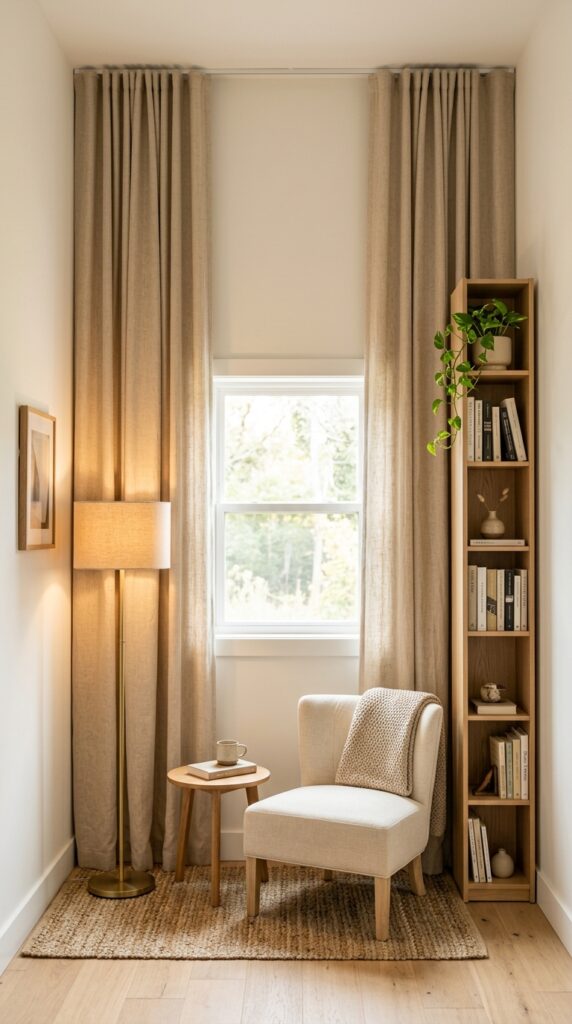
Vibe: Airy — curtains hung at ceiling height above a low window make the window look tall and the ceiling look higher, neither of which is true.
Why it works: The principle of visual height extension applies in small living rooms through multiple vertical elements working simultaneously. Curtains hung at ceiling height — even when the window itself is low on the wall — draw the eye upward along the full wall height, compressing the visual distance between the window and the ceiling and making both appear taller. A tall, narrow bookshelf (12–16 inches deep, 72–84 inches tall) performs a similar function: its vertical emphasis leads the eye up the wall rather than across it, which makes the room read as taller than it is wide. The ceiling height “lie” only fails if curtains stop at the window frame — the gap between the curtain top and ceiling is the tell.
How to get it: Mount curtain rods 2–4 inches below the ceiling (or directly on the ceiling using ceiling-mount brackets) regardless of window position. Specify curtain drop at ceiling-to-floor minus 0.5 inches — no pooling in a small living room, which reads as too large for the scale. Use a linen or cotton voile in a light tone so the curtain contributes brightness as well as vertical emphasis.
Shop The Look
| Product |
| Ceiling mount curtain rod bracket set |
| Sheer linen curtain panel floor ceiling natural |
| Tall narrow bookshelf 72 inch slim profile |
| Floor lamp tall adjustable arm warm |
| Curtain rod extender ceiling height bracket |
7. Multi-Function Furniture: Ottoman with Storage
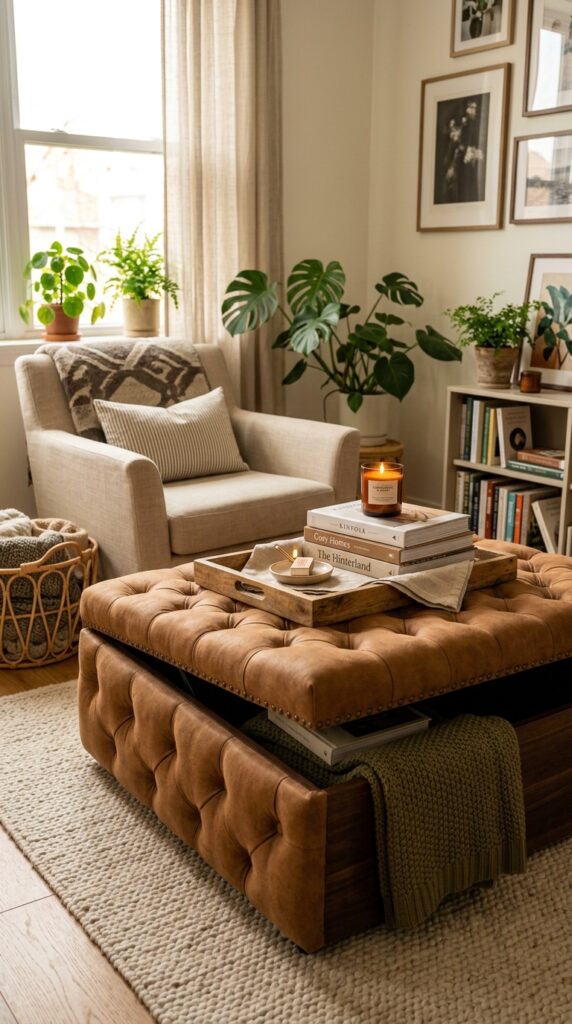
Vibe: Warm — a storage ottoman that works as coffee table, extra seat, and blanket storage is a piece of furniture that is solving three problems while looking like one.
Why it works: Multi-function furniture is the primary spatial strategy in small living rooms — every piece that performs one function at the expense of a second function is a spatial cost. A storage ottoman replaces the coffee table (which in a small room can feel like a barrier to circulation) with a soft, flexible surface that functions as a table when trayed, extra seating when needed, and hidden storage at all times. The soft surface of an ottoman also improves the livability of a small living room by removing the hard-edge coffee table that creates shin-height obstacles in tight traffic zones.
How to get it: Size the storage ottoman at approximately two-thirds the length of the sofa — a 48-inch ottoman in front of a 72-inch sofa is correctly proportioned. Avoid round ottomans as a coffee table replacement in very small rooms, where the lack of a flat tray surface makes them functionally limited. Place a 14″×20″ rectangular tray on top to create a stable coffee table surface for drinks and objects.
Shop The Look
| Product |
| Large storage ottoman square fabric caramel |
| Rectangular serving tray natural wood large |
| Decorative candle tray set living room |
| Ottoman serving tray handles wood |
| Storage ottoman liner insert organizer |
8. Soft Greige Color Palette for Spatial Continuity
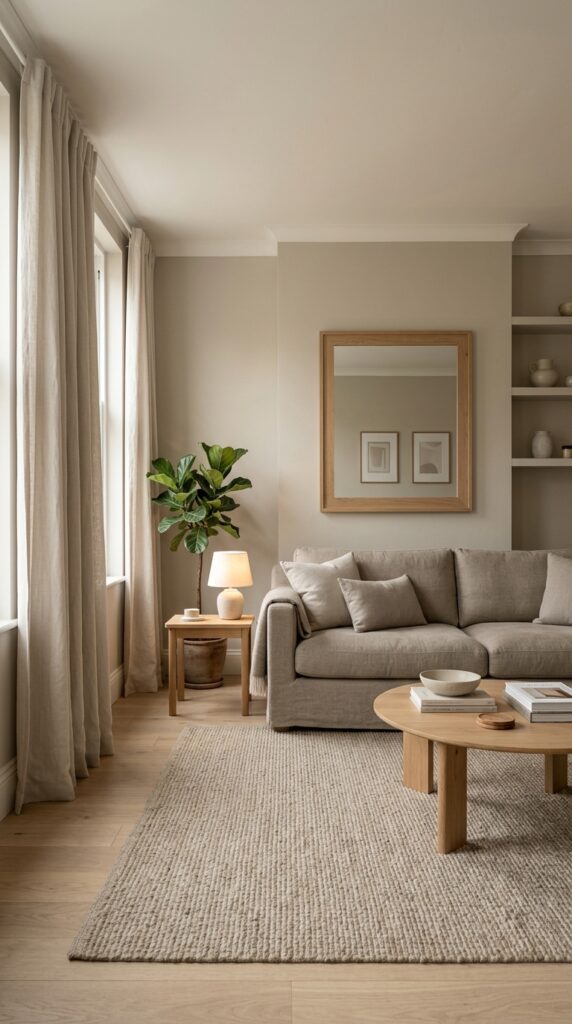
Vibe: Serene — a tonal greige room does not read as colorless; it reads as resolved, which is different and better.
Why it works: Tonal continuity — using a single color family across walls, upholstery, rugs, and window treatments within three adjacent values — is the most powerful spatial expansion technique available in small living rooms. When the boundaries between surfaces are minimized through color continuity, the eye reads the room as a single continuous volume rather than a collection of objects within a box. The room’s actual size becomes less measurable because there are no strong color contrasts to use as spatial reference points. This is the principle behind why high-end hotel rooms in compact configurations always use tonal palettes — it is not aesthetic conservatism but spatial intelligence.
How to get it: Choose one greige base (Benjamin Moore Pale Oak OC-20, Sherwin-Williams Accessible Beige SW-7036, or Farrow & Ball Elephant’s Breath No.229) and select all soft furnishings within three values of this tone — slightly lighter for curtains, slightly deeper for the sofa, matching for the rug. Introduce only natural material variation (wood, rattan, linen texture) as visual contrast rather than color contrast.
Shop The Look
| Product |
| Warm greige interior paint flat finish |
| Greige linen sofa cover slipcover neutral |
| Natural jute rug greige tone woven |
| Linen curtain panel greige warm tone |
| Natural rattan accent basket storage |
9. Wall-Mounted Shelving to Free the Floor
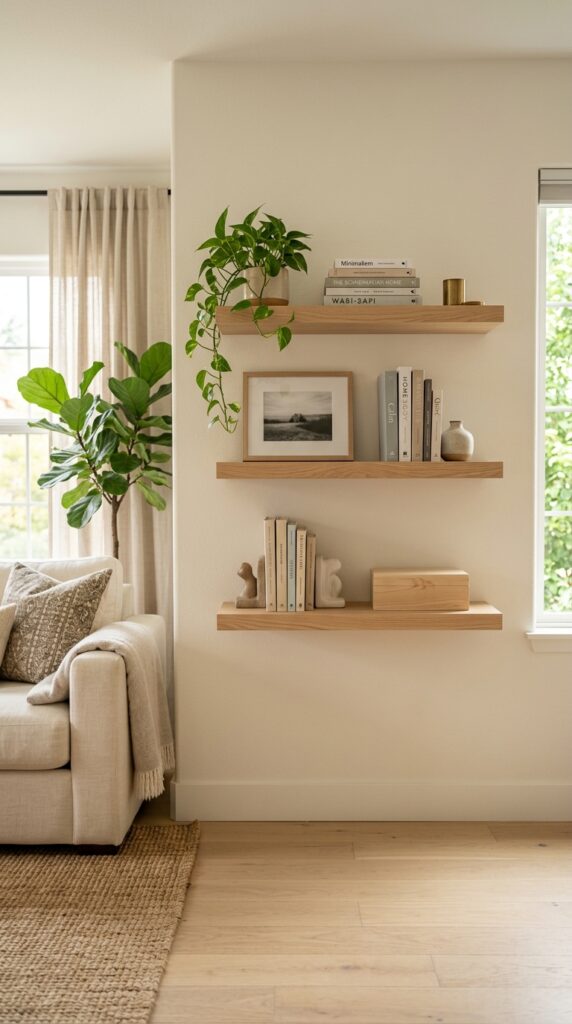
Vibe: Airy — visible floor space beneath shelving reads as room, not as absence of furniture.
Why it works: Freestanding bookcases and storage units in small living rooms consume floor space twice — once for the footprint of the unit itself, and again visually because the base of the unit visually blocks the floor plane behind it. Wall-mounted floating shelves provide equivalent storage capacity with zero floor footprint, leaving the floor plane visible from skirting to skirting. This uninterrupted floor view is one of the most effective spatial expansion techniques available — the eye reads clear floor as generous space regardless of the room’s actual square footage.
How to get it: Install floating shelves using keyhole brackets or concealed bracket systems (IKEA LACK and HAY’s New Order both offer clean, low-profile options). Stagger shelf heights — avoid equal spacing, which reads as institutional — and leave at least 12 inches between shelves for books and objects of varying heights. Critically: edit the content of wall shelves to 60–70% capacity in a small room. Overfilled shelves in a compact space read as clutter regardless of how well organized the objects are.
Shop The Look
| Product |
| Floating wall shelf pale oak set of 3 |
| Concealed shelf bracket heavy duty pair |
| Small ceramic decorative object set shelf |
| Trailing plant live ivy small shelf |
| Shelf stud finder wall anchor kit |
10. Glass or Lucite Coffee Table for Visual Transparency
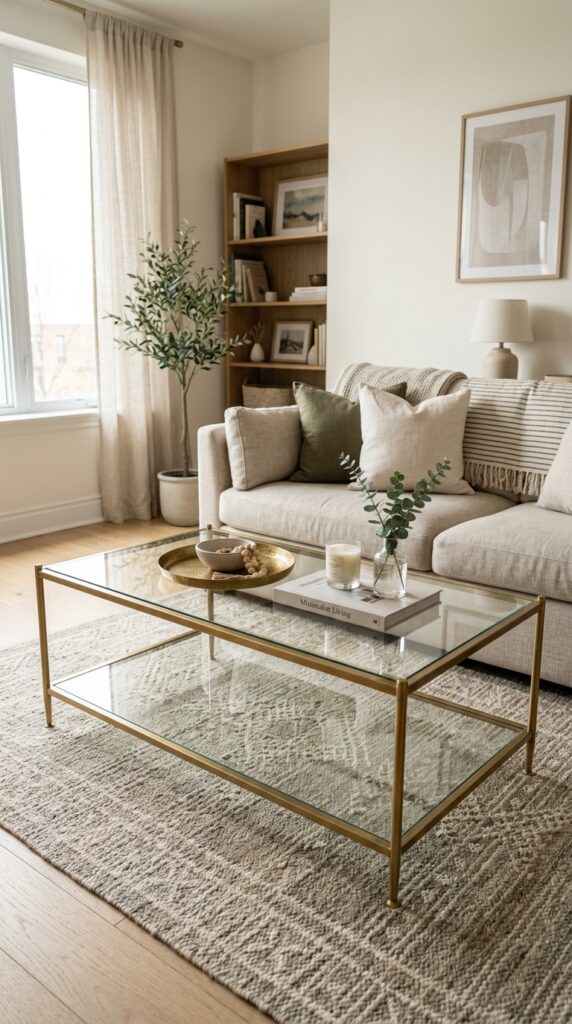
Vibe: Airy — a table you can see through is a table that takes up no visual space, which in a small room is the most valuable kind.
Why it works: A glass or acrylic coffee table eliminates the visual mass of the coffee table from the room’s spatial equation — the eye passes through the transparent surface to the rug and floor beneath, and the table’s footprint reads as floor rather than furniture. This is not a visual trick so much as a genuine reduction in visual weight: solid coffee tables in small living rooms occupy approximately 15–20 square feet of visual floor space; a glass table occupies essentially none. The frame details — brass, gold, or matte black in thin profiles — provide visual anchoring without mass.
How to get it: Choose a round glass top over a rectangular one in very small rooms — round tables have no corners to create collision points in tight traffic zones and read as less physically imposing from any angle. Specify tempered glass at 3/8-inch thickness minimum for safety and stability. Wipe with a microfiber cloth and glass cleaner weekly — glass coffee tables show fingerprints in small rooms where all surfaces are within close view.
💡 Quick Win: Replace an existing solid coffee table with a lucite or acrylic version (available from $45 on Amazon) — the visual floor space recovered from this single swap is often more dramatic than any renovation or reorganization.
Shop The Look
| Product |
| Clear acrylic lucite coffee table round |
| Glass top coffee table round brass frame |
| Glass table cleaner streak-free spray |
| Small decorative tray glass table styling |
| Microfiber cleaning cloth set furniture |
11. Built-In Seating with Under-Seat Storage
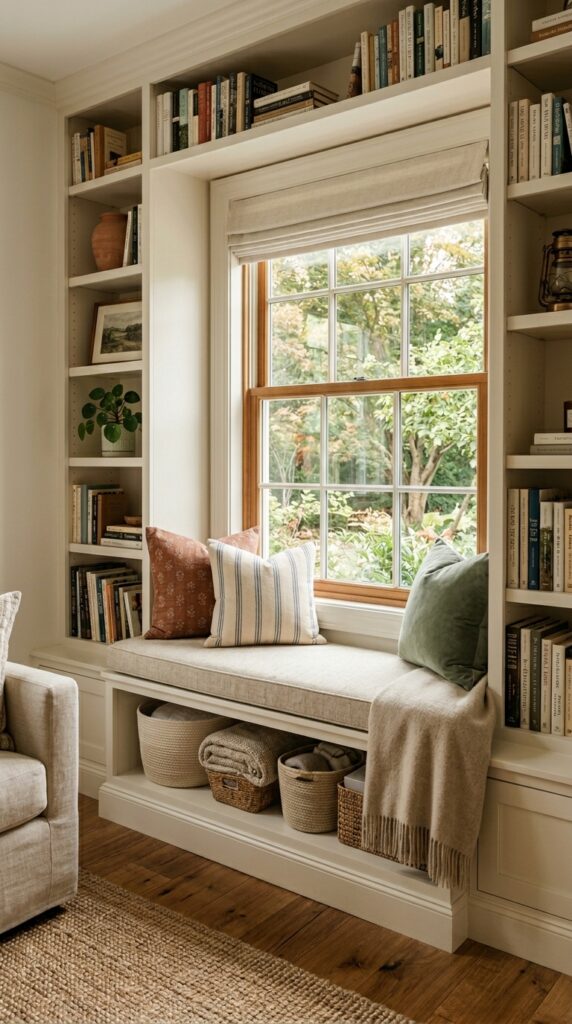
Vibe: Warm — built-in seating with hidden storage is the most efficient square footage transaction available in small living room design.
Why it works: Built-in seating replaces the footprint of a sofa or armchair with a structural element that simultaneously provides seating, storage, and wall definition — three functions from one spatial investment. The bench footprint of 18–22 inches deep is significantly smaller than a sofa’s 30–36 inch depth, recovering 12–18 inches of floor space in the room’s primary zone while maintaining equivalent seating capacity. The under-seat storage (typically 8–12 cubic feet) handles the blankets, games, seasonal items, and overflow that otherwise require additional freestanding furniture in small rooms.
How to get it: Build the bench from 3/4-inch birch plywood with a face frame in poplar or MDF, painted in the same color as the surrounding walls for spatial integration. Use piano hinges for the lift-up lid — they distribute the weight of the cushion and lid evenly across the full length and do not require finger holes that break the cushion surface. Cut the lid into two sections for a bench longer than 48 inches to make access manageable.
Shop The Look
| Product |
| Piano hinge continuous lid support heavy duty |
| Linen bench cushion custom size foam insert |
| Lift-up storage lid support hinge hydraulic |
| Bench cushion cover linen removable washable |
| Built-in shelf bracket adjustable white |
12. Dark Accent Wall to Create Depth
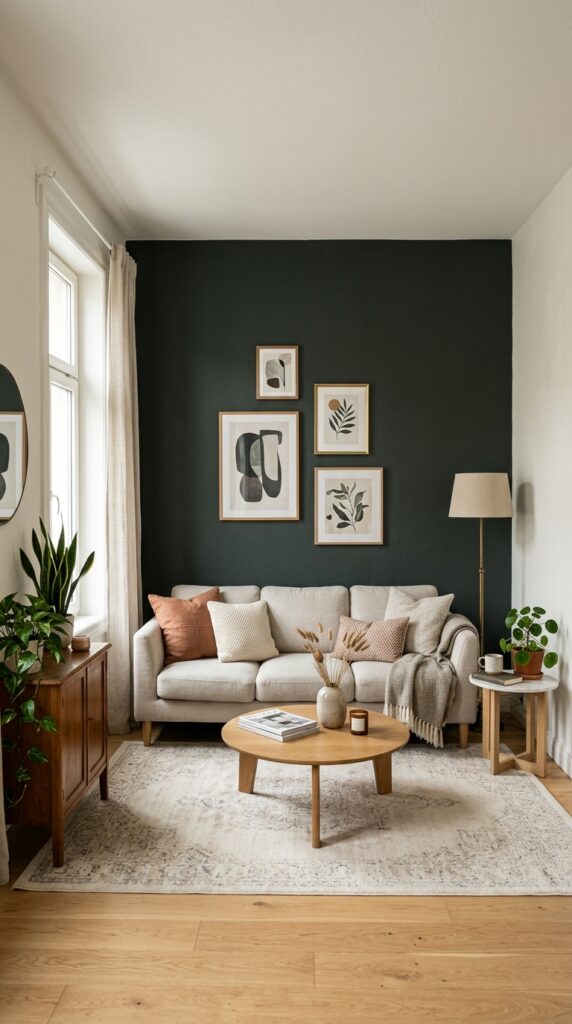
Vibe: Layered — a single dark wall in a small room creates visual depth in the same way a deep shadow in a painting creates spatial recession.
Why it works: Dark colors on the wall directly opposite a room’s entrance create the optical illusion of depth — cool, dark tones recede from the eye, making the wall appear farther away than it actually is. This effect increases the perceived length of the room by 10–20% in conditions where natural light allows the dark wall to read as genuinely shadowed. The adjacent walls must remain pale — the contrast between the pale walls and the dark end wall is what generates the recession effect. A uniformly dark room loses this spatial benefit entirely and simply reads as smaller.
How to get it: Apply the dark tone exclusively to the wall facing the room’s primary entrance — this is the wall the eye encounters first and registers as the room’s far boundary. Farrow & Ball’s Railings No.31 (near-black navy) or Studio Green No.93 (deep forest green) both create exceptional spatial recession in small rooms. Place lighter furniture (pale linen sofa, cream armchair) against the dark wall — the contrast between the dark wall and pale upholstery makes the furniture appear to float forward from the wall, increasing the sense of depth.
Shop The Look
| Product |
| Deep charcoal flat interior paint dark wall |
| Pale linen sofa slipcover light neutral |
| Brass floor lamp tall warm bedroom living |
| Light throw pillow cover set neutral pale |
| Dark wall paint sample set deep tone |
13. Pendant Lighting Instead of Overhead Fixtures
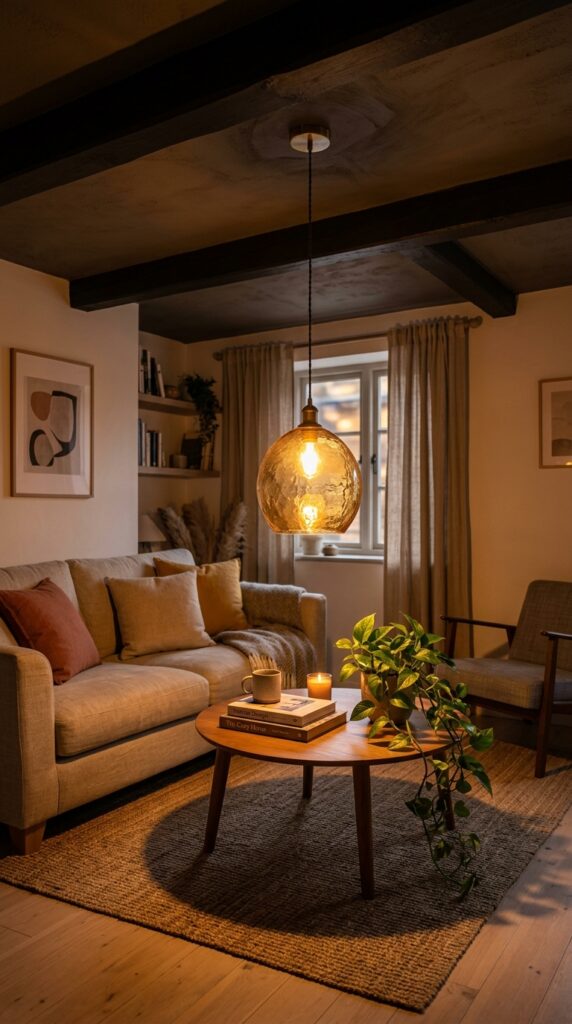
Vibe: Warm — a pendant light over the seating area creates a zone of intimacy within the room that a ceiling fixture spreads too thin to achieve.
Why it works: Standard ceiling fixtures in small living rooms illuminate the space with a downward flood of even light that eliminates shadow, flattens every surface texture, and makes the room’s boundaries — walls, corners, ceiling — starkly visible, which emphasizes the room’s dimensions. A pendant light positioned at 60 inches from the floor over the seating zone illuminates the social space without lighting the walls and ceiling — the upper room retreats into shadow, the perceived ceiling height increases, and the seating area reads as a warm, defined destination. This is how all good restaurant lighting works, applied to the domestic living room.
How to get it: Swag-mount a pendant light from a ceiling hook if a hardwired ceiling fixture is not in the correct position — a plug-in pendant on a long cord managed through a decorative cord cover is a code-compliant, renter-friendly solution. Hang at exactly 60 inches from the floor to the bottom of the shade — this is slightly lower than standard pendant height (usually 66–72 inches) and produces the most intimate light pool relative to sofa seat height.
Shop The Look
| Product |
| Plug-in pendant light warm shade swag |
| Ceiling swag hook kit adhesive strong |
| Cord cover decorative wire management |
| Warm dimmer plug-in switch pendant compatible |
| Pendant shade replacement rattan woven |
14. Corner Furniture Placement to Open Traffic Flow
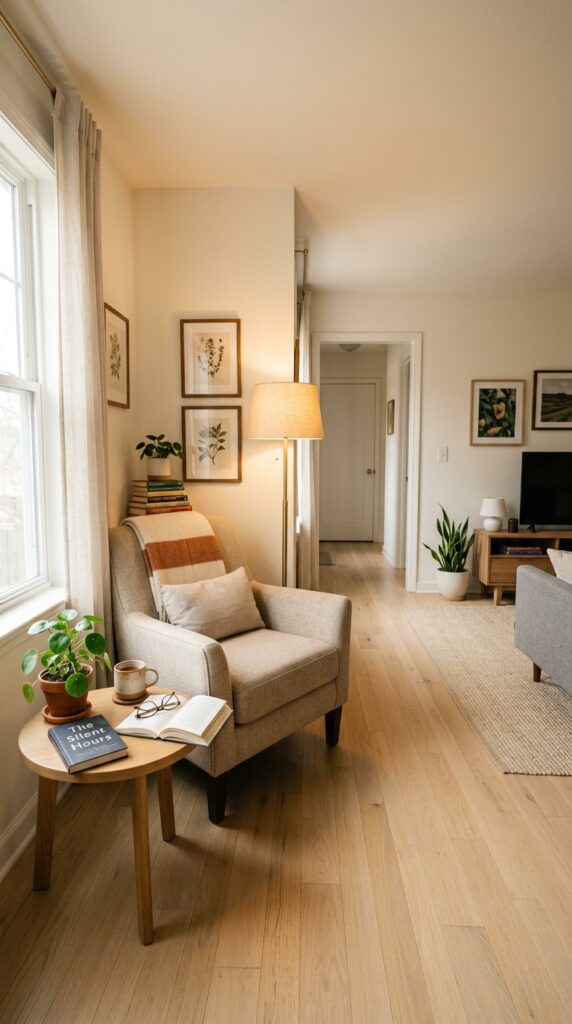
Vibe: Grounded — an armchair placed at 45 degrees in a corner activates dead space and creates a destination without consuming any additional floor area in the circulation zone.
Why it works: Corners in small living rooms are the most commonly wasted spatial resource — they accumulate small tables, plants, and orphaned objects that collectively read as clutter rather than design. A single armchair placed at a 45-degree angle into the corner activates the corner as a functional zone, requires no more floor space than a chair placed flat against the wall, and — critically — opens the traffic path along both walls adjacent to the corner, which is typically the room’s primary circulation route. The 45-degree angle also creates visual dynamism in the furniture arrangement without any additional furniture.
How to get it: Measure the chair’s diagonal footprint at 45 degrees before placing — the diagonal width is approximately 1.4 times the chair’s square footprint, so a 30″×30″ chair occupies 42 inches diagonally. Position a small round side table (18 inches diameter maximum) at the corner junction beside the chair. Place a floor lamp or tall plant directly behind the chair in the corner point for layered lighting and vertical visual interest without additional floor area.
Shop The Look
| Product |
| Accent armchair compact small space neutral |
| Small round side table 18 inch diameter |
| Corner floor lamp tall adjustable |
| Throw blanket chair drape warm |
| Small potted plant tall narrow floor |
15. Nesting Tables Instead of a Fixed Coffee Table
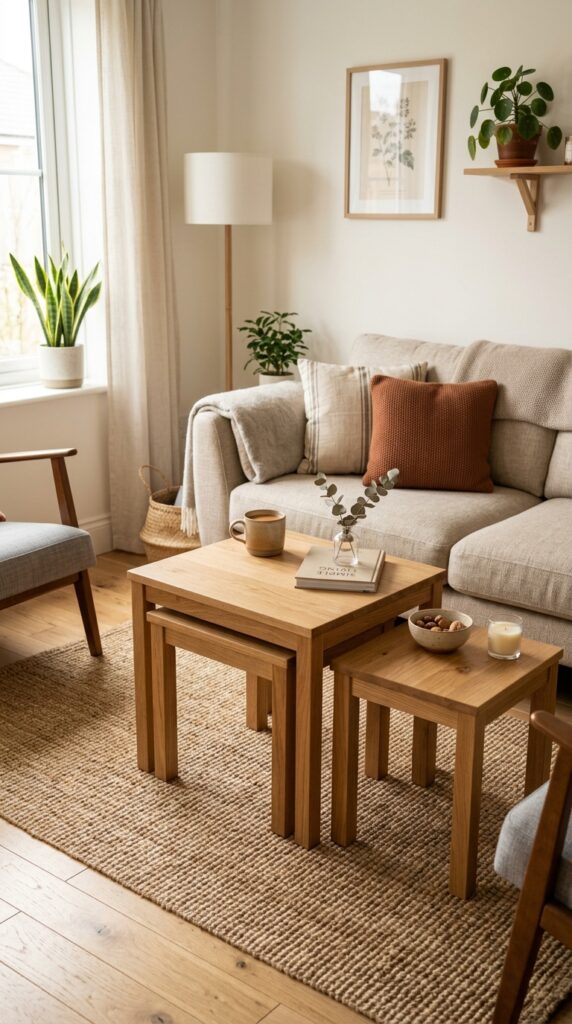
Vibe: Airy — nesting tables solve the coffee table’s worst small-room habit: taking up floor space at shin height whether or not anyone needs it.
Why it works: A fixed coffee table in a small living room occupies floor space permanently — even when the room’s occupants are standing, the table remains in the traffic zone, creating obstacle patterns that make the room feel smaller during active use. Nesting tables nest into a single compact footprint when not needed and expand into two or three surface points when entertaining — a flexibility that fixed furniture cannot match. The visual benefit is equally significant: a single small nesting table centered in front of the sofa reads as much less massive than a standard 48-inch coffee table in the same position.
How to get it: Look for nesting table sets where the larger table is 24–30 inches in diameter and the smaller is 18–22 inches — these proportions work in most small living rooms without feeling either too small to be functional or too large to be flexible. Natural oak, marble-top, or black metal options all suit different style directions. Avoid nesting tables taller than 20 inches — the correct coffee table height for a standard sofa is 1–2 inches below the sofa seat height.
💡 Quick Win: A set of two rattan or bamboo nesting tables (under $45 on Amazon) used in place of an existing coffee table immediately recovers 6–8 square feet of visible floor space in most small living rooms while providing flexible surface area for entertaining.
Shop The Look
| Product |
| Nesting coffee table set natural oak round |
| Rattan nesting table set 2 piece small |
| Metal nesting table set 3 piece modern |
| Marble top nesting side table set |
| Tray set small decorative nesting table |
16. Cohesive Bookshelf Styling for Visual Calm
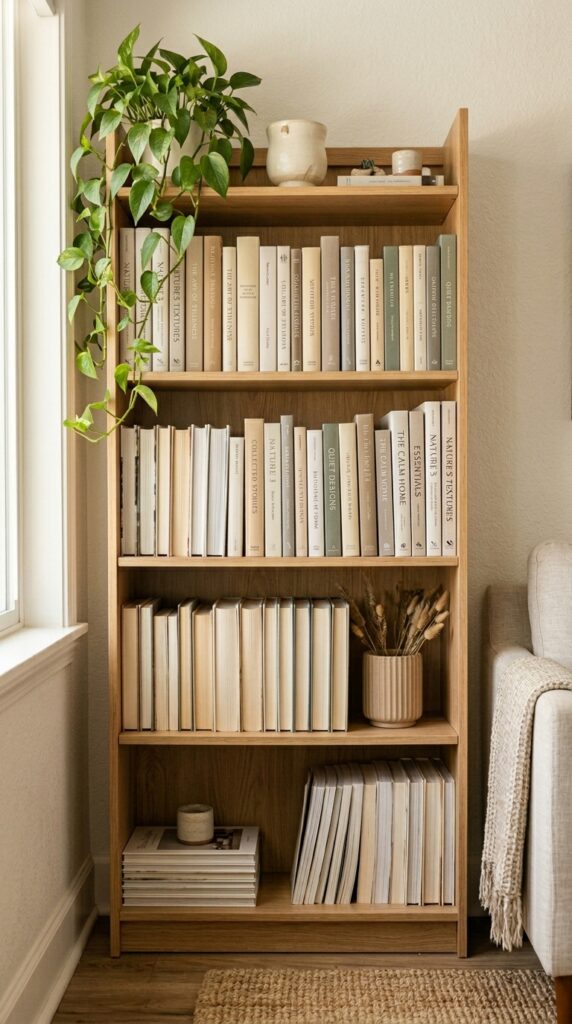
Vibe: Hushed — a bookshelf styled for calm in a small room reads as a wall of quiet, which is exactly what a living room needs to feel restful.
Why it works: An unstyled bookshelf in a small living room is visually one of the most demanding surfaces in any room — the chaos of multicolored spines, varied object sizes, and unresolved space creates visual noise that makes the entire room feel smaller and less resolved. Cohesive bookshelf styling applies a small number of consistent principles: restrict the color palette of visible spines to neutrals and one accent color, intersperse objects and books at 70/30 ratio rather than filling every shelf entirely, and alternate between books stacked horizontally and books standing vertically for visual rhythm. The result is a shelf that reads as a quiet, ordered element rather than a demanding one.
How to get it: Remove everything from the shelves and reintroduce objects in groups: a horizontal stack of three books, one small ceramic vessel, one small plant, two or three vertical books — repeat this basic unit across each shelf with variation. Face some books with their spines inward for a uniform creamy page-edge view. Edit to 65% of the shelf’s capacity — the remaining 35% negative space is as important as the objects.
Shop The Look
| Product |
| Decorative ceramic vase small shelf display |
| Small succulent pot live plant shelf |
| Bookend set natural stone marble minimal |
| Neutral linen book cover set decorative |
| Small trailing plant live shelf draping |
17. Warm Terracotta Accent for a Small Living Room
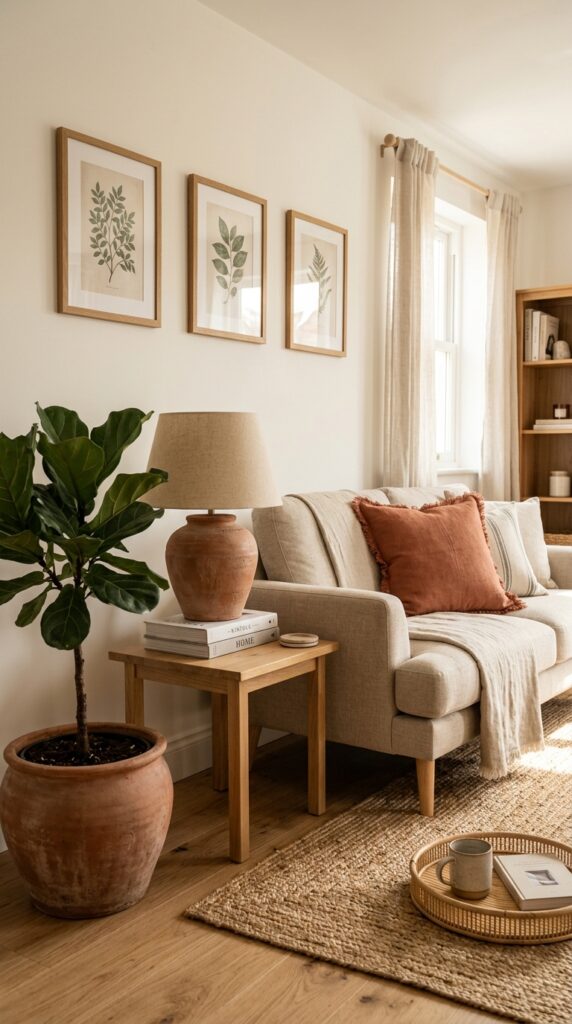
Vibe: Warm — terracotta in a neutral room does not arrive as a color; it arrives as warmth, which is different and more welcome.
Why it works: A small living room benefits from a single accent color applied at three touchpoints — lamp, pillow, and plant vessel — rather than spread across multiple competing colors that fragment the palette and increase visual noise. Terracotta is the ideal accent for warm-toned small rooms because its red-orange warmth advances visually, making the objects it appears on feel closer and the space around them feel more energized. At three touchpoints, it reads as a design decision; at one touchpoint, it reads as an accident; at five or more, it reads as a theme and loses the quality of specificity that makes it work.
How to get it: Apply the three-touchpoint rule: one large terracotta element (a 14-inch lamp base or a large floor pot at 16 inches), one medium element (a 20″×20″ throw pillow), and one small element (a 4–6 inch ceramic dish or small bud vase). Keep all three in the same terracotta tone — variation within the color family reads as indecision in a small room where everything is in close view.
Shop The Look
| Product |
| Terracotta ceramic lamp base tall living room |
| Terracotta linen throw pillow cover set |
| Large terracotta floor pot plant indoor |
| Fiddle leaf fig live plant indoor large |
| Small terracotta ceramic dish bud vase |
18. Low-Profile Furniture to Maximize Vertical Space
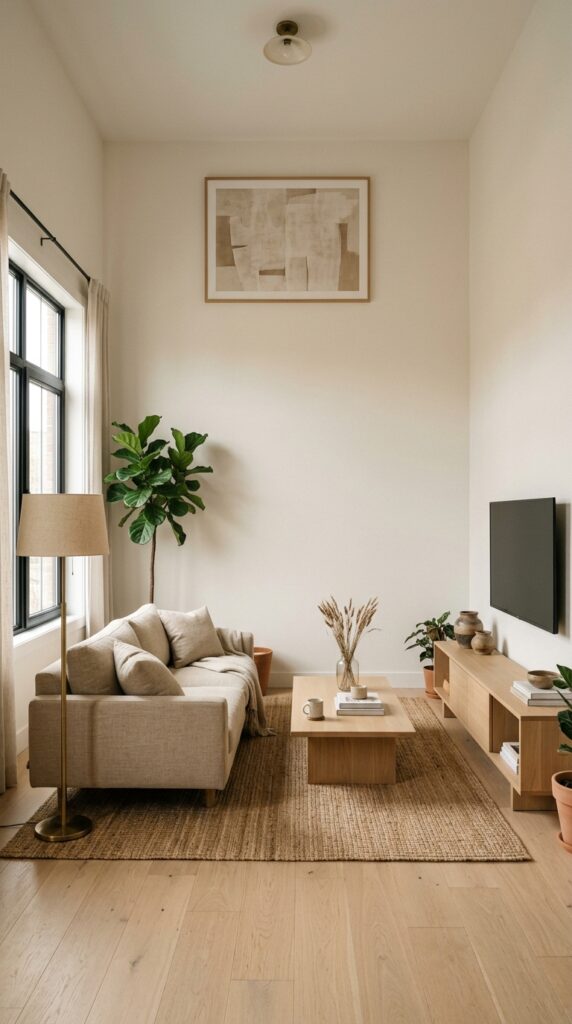
Vibe: Airy — when furniture keeps its profile below 30 inches, the room above it reads as open sky.
Why it works: Low-profile furniture in a small living room exploits the vertical dimension that the room’s square footage does not provide. When every piece of furniture sits below 30 inches, the wall surface from 30 inches to the ceiling reads as uninterrupted — which in a room with 8-foot ceilings represents 5 feet of clear wall. This wall zone becomes available for large artwork, tall plants, and vertical architectural elements that reinforce the ceiling height. High-back sofas and tall console tables in small rooms consume this wall zone and leave no vertical dimension for the eye to travel through, making the room feel categorically smaller.
How to get it: When sourcing furniture for a small living room, specify maximum seat height of 18 inches (floor to seat cushion top), maximum sofa back height of 30–32 inches (floor to sofa back top), and maximum console or media stand height of 20 inches. Japanese and Scandinavian furniture manufacturers — Muuto, HAY, Karimoku, IKEA’s KALLAX and LACK ranges — produce the most consistently low-profile options.
Shop The Look
| Product |
| Low profile sofa 28 inch height modern |
| Low flat coffee table 14 inch height |
| Low TV media console 20 inch height |
| Large wall art print oversized above sofa |
| Tall indoor plant floor large corner |
19. Biophilic Touch: One Large Plant as Focal Statement
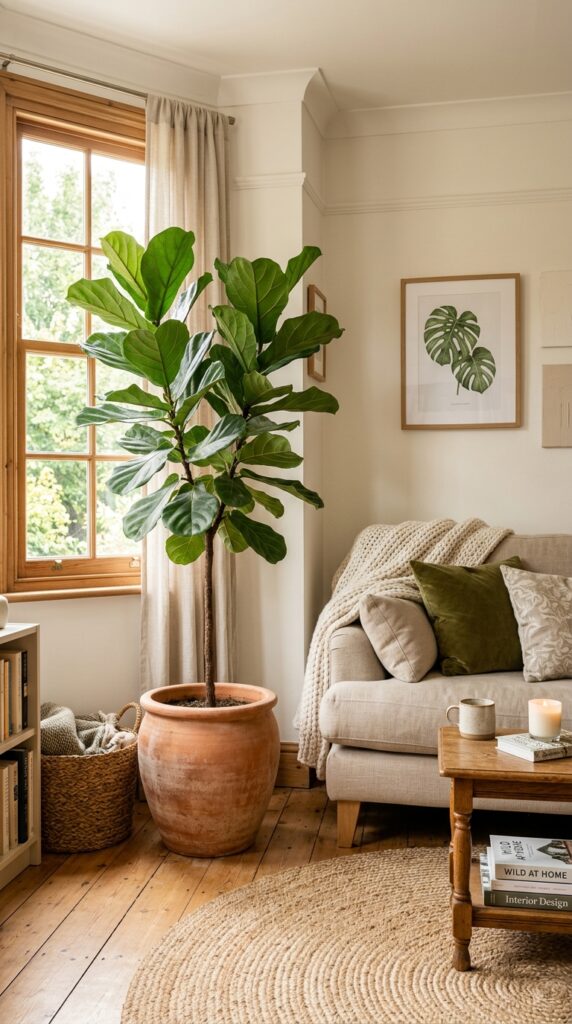
Vibe: Layered — one large plant in a small living room does more atmospheric work than a dozen small ones scattered across surfaces.
Why it works: A single large indoor plant — 4–6 feet tall, properly scaled to the room — performs multiple spatial functions simultaneously. It fills a corner vertically without occupying the corner’s floor space in the way furniture would (plant pots typically have a 10–14 inch footprint versus a chair’s 24–30 inch footprint). It introduces organic color (the specific deep green of healthy foliage) that reads as natural rather than decorative. It creates a soft, living vertical element that draws the eye upward. And — for small rooms specifically — it softens the hard geometry of corners and walls with organic form, making the room feel more inhabited and less measured.
How to get it: Choose a plant species that thrives in your room’s specific light conditions — not what photographs best. Fiddle leaf figs require bright indirect light; monsteras tolerate lower light; snake plants handle near-darkness. A plant that thrives reads as lush and alive; a plant that struggles reads as a dying prop. Place in a pot 2 inches larger than the nursery pot for appropriate scale — a 5-foot plant in a 12-inch pot reads as top-heavy and unstable.
Shop The Look
| Product |
| Large indoor fiddle leaf fig plant live |
| Monstera deliciosa live large plant |
| Large terracotta or concrete plant pot indoor |
| Plant saucer large diameter indoor |
| Plant food liquid fertilizer indoor tropical |
20. Hidden Storage: Media Console with Closed Doors
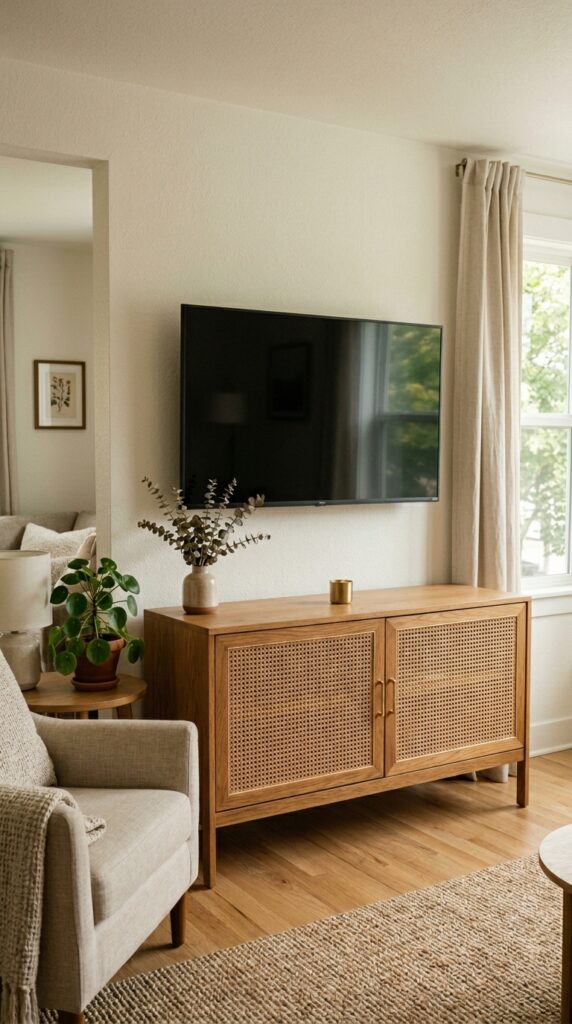
Vibe: Serene — a room where all the cables, remotes, and devices are invisible is a room that stays calm regardless of how chaotic life behind those doors actually is.
Why it works: The media console in a small living room is typically the room’s most visually chaotic surface — cables, multiple devices, remote controls, gaming equipment, and accumulated objects compete for attention on and around it. Closed-door storage conceals this chaos entirely, leaving a clean horizontal surface as the room’s lowest visual anchor point. This is particularly effective in small rooms where the media zone is often a primary focal point visible from every seat — the difference between a closed-door console and an open shelf unit of equivalent size in terms of visual calm is measurable and immediate.
How to get it: Specify cane-front or solid panel doors rather than glass — glass reveals the interior and defeats the purpose. Mount the TV on the wall above the console rather than placing it on the console surface — this recovers the console’s full top surface for display and raises the TV to optimal viewing height simultaneously. Run all cables through a wall cable management kit before mounting.
Shop The Look
| Product |
| Media console cane front doors solid wood |
| TV wall mount tilting swivel 55 inch |
| Cable management wall kit in-wall |
| Cane front cabinet furniture insert |
| Small display object set console minimal |
21. Sage Green Accent Wall for Biophilic Calm
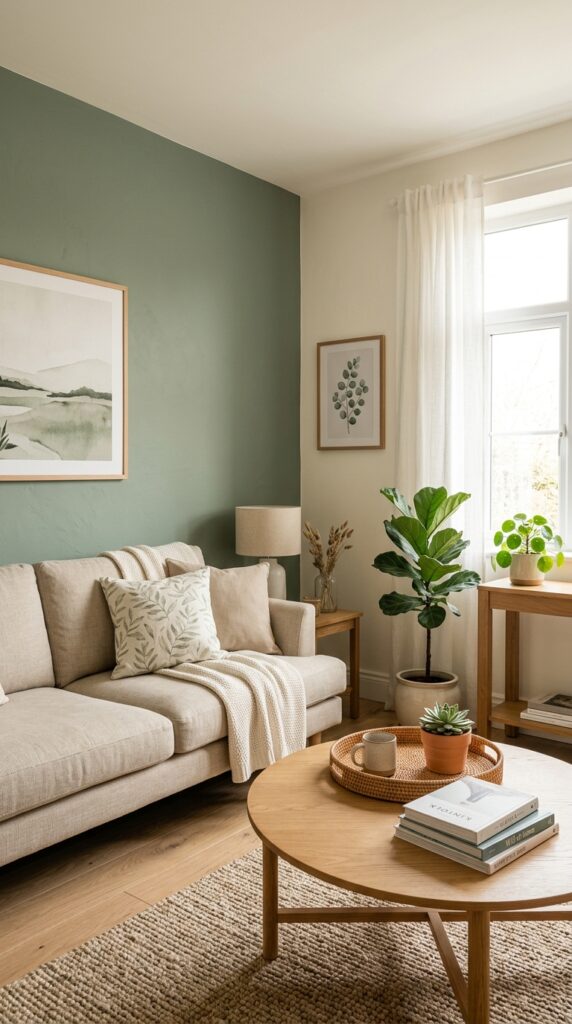
Vibe: Serene — sage green in a small living room does not darken it; it grounds it, the way a garden view grounds any interior.
Why it works: Sage green — a gray-shifted, muted green that reads as botanical rather than chromatic — is the most spatially forgiving accent color for small living rooms. Unlike saturated greens or deep forest tones (which work in moody bedrooms but can feel oppressive in living rooms that need to function through all daylight hours), sage reads as a neutral with green undertones rather than a color statement. Applied to one wall, it adds depth without sacrificing the room’s lightness. The gray shift in sage also makes it complementary to warm whites, natural linens, and rattan tones — the primary palette of light-expanding small room design.
How to get it: Farrow & Ball’s Mizzle No.266, Sherwin-Williams Clary Sage SW-6178, or Benjamin Moore’s Saybrook Sage HC-114 all deliver the correct muted, gray-shifted sage tone. Apply in flat finish only — sage in any sheen finish reads as paint rather than as a botanical color. Position the sage wall opposite the room’s primary window so the natural light hits it directly, which prevents the green from reading as dark or cool.
Shop The Look
| Product |
| Sage green flat interior paint muted botanical |
| Botanical art print framed natural |
| Rattan serving tray round large natural |
| Linen throw pillow sage green muted |
| Natural linen sofa cover neutral slipcover |
22. Gallery Wall with Consistent Frame Finish
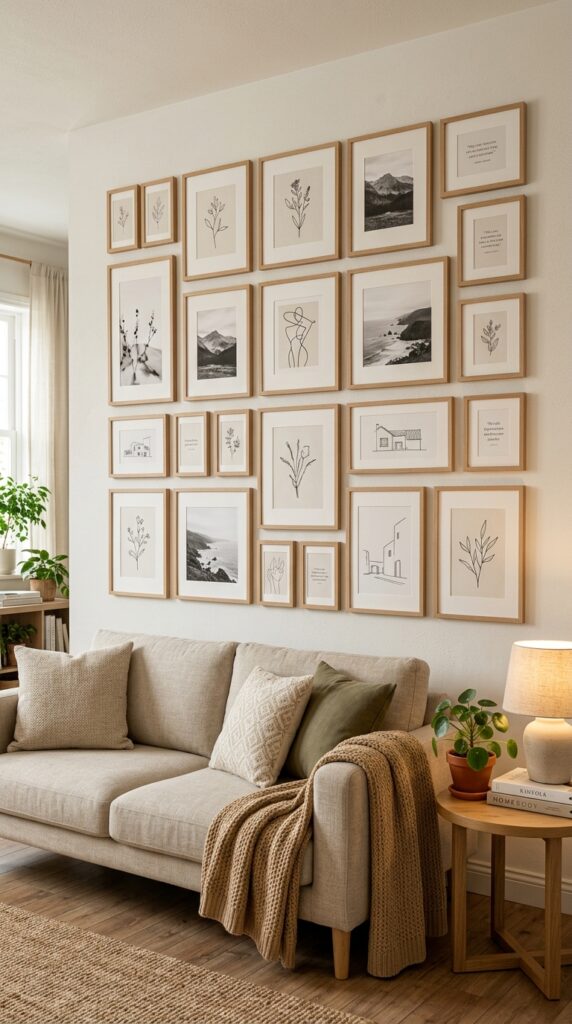
Vibe: Warm — a gallery wall with one frame finish reads as a composed panel; a gallery wall with mixed frame finishes reads as a collection of individual decisions, which is very different in a small room.
Why it works: Gallery walls in small living rooms must be treated as a single composed element rather than a collection of individual frames — otherwise the variety of frame finishes, sizes, and mat colors creates the same visual fragmentation as a mixed-color palette. Restricting all frames to one finish (all thin natural wood, all matte black, or all warm brass) unifies the gallery into one visual object, which the eye processes as a single wall element rather than as multiple competing items. This visual consolidation is critical in small rooms where every element on a wall competes for the eye’s attention.
How to get it: Choose the frame finish first (natural thin wood is most versatile), then select 5–9 frames in three sizes (small: 5″×7″, medium: 8″×10″, large: 11″×14″) all in the identical frame profile. Arrange on the floor first, photograph, and transfer to the wall using a paper template method — tape craft paper to the wall, mark the hanging positions, then remove and nail through the paper marks. Remove the paper template after all hooks are placed.
Shop The Look
| Product |
| Gallery frame set natural wood thin profile |
| Gallery wall hanging template kit |
| Picture hanging strip damage-free adhesive |
| Neutral print set downloadable art minimal |
| Gallery wall level small magnetic |
23. Maximizing Natural Light: Sheer Curtains and Reflective Surfaces
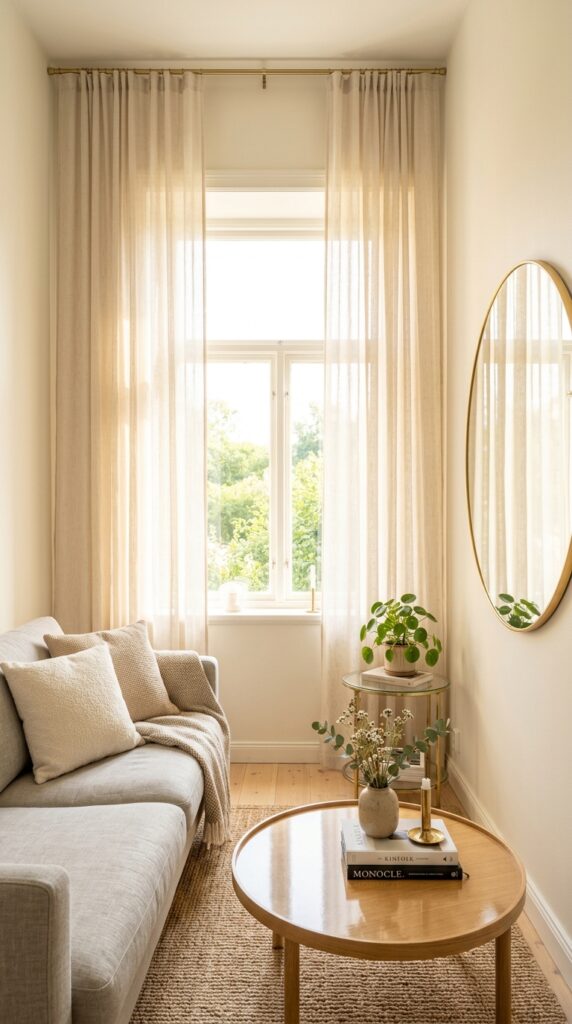
Vibe: Luminous — a small living room that captures all its available natural light reads as twice its actual size.
Why it works: Natural light is the most powerful spatial expander available in a small living room — more effective than any paint color, furniture choice, or organizational strategy. Maximizing it requires addressing every point where it is currently being blocked or absorbed: heavy curtains that partially cover the window even when “open,” furniture positioned in front of windows that casts shadows into the room, and dark or matte surfaces near the window that absorb light rather than reflecting it. Sheer linen curtains allow 70–80% of natural light through even when closed, and positioning a mirror on the wall perpendicular to the window doubles the light’s reach across the room.
How to get it: Replace any opaque curtain with a sheer linen or cotton voile panel (Pottery Barn’s Belgian Flax Linen Sheer, IKEA’s LILL or HANNALILL) hung at ceiling height. Pull furniture away from the window wall — a minimum 18-inch clearance between the back of any furniture and a window prevents shadow casting into the room interior. Introduce one reflective surface (glass table, mirror, metal lamp base) in the two meters nearest the window.
Shop The Look
| Product |
| Sheer linen curtain panel natural ivory |
| Mirror small round wall mount reflective |
| Glass side table small reflective surface |
| Pale wood furniture leg replacement set |
| Light-colored lampshade replacement warm |
24. Scent and Sensory Layering for a Room That Feels Larger
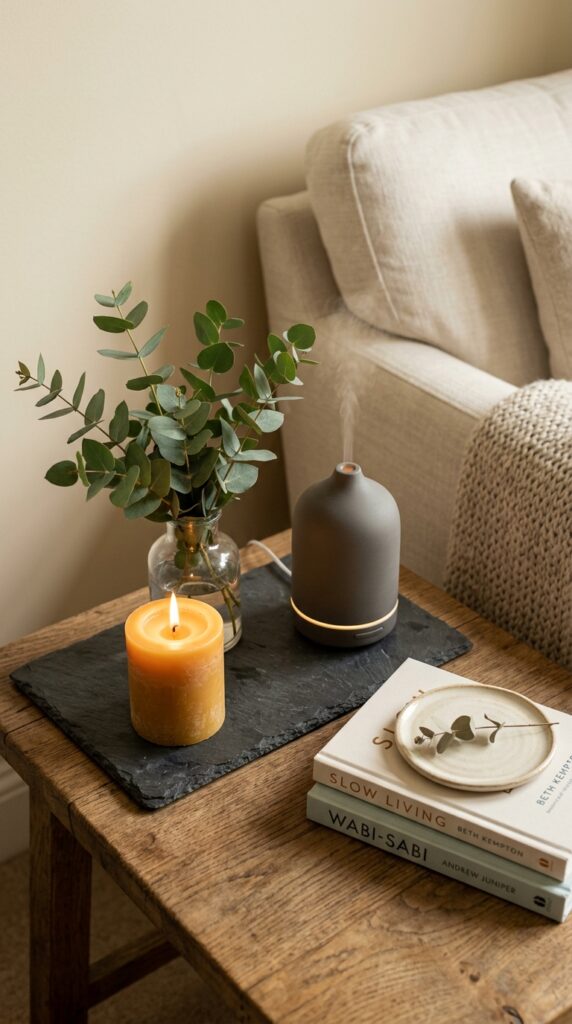
Vibe: Serene — a small room that smells like beeswax and eucalyptus is a room that feels cared for, and that feeling adds perceived space more reliably than any furniture rearrangement.
Why it works: Spatial perception is not purely visual — a room that engages multiple senses simultaneously reads as richer and more generous than a visually identical room that engages only sight. In small living rooms, where visual strategies have natural limits, sensory layering through scent and texture is a genuine spatial tool. A warm scent (beeswax, cedarwood, vetiver) triggers associations with large, warm natural environments and activates a physiological sense of calm that makes the room feel less pressured. This is not pseudoscience — research in environmental psychology consistently shows that multi-sensory environments are perceived as larger and more pleasant than single-sense environments of identical dimensions.
How to get it: Place one beeswax pillar candle (not paraffin, which produces a flat synthetic scent) on a slate or wooden tray. Add three to five eucalyptus stems in a glass bud vase beside it for a secondary, cooler green note. Keep the fragrance sources within a 12-inch radius so they read as one composed element rather than objects scattered across the room.
💡 Quick Win: A bundle of fresh eucalyptus ($8–$12 at Trader Joe’s or florists) placed in a glass vase in a small living room introduces both scent and organic visual texture for under $15 and lasts 2–3 weeks with weekly water change.
Shop The Look
| Product |
| Beeswax pillar candle large unscented natural |
| Eucalyptus stems fresh dried natural |
| Slate serving tray small candle display |
| Glass bud vase clear minimal |
| Essential oil diffuser small ceramic white |
25. The Edit: Removing What the Room Doesn’t Need
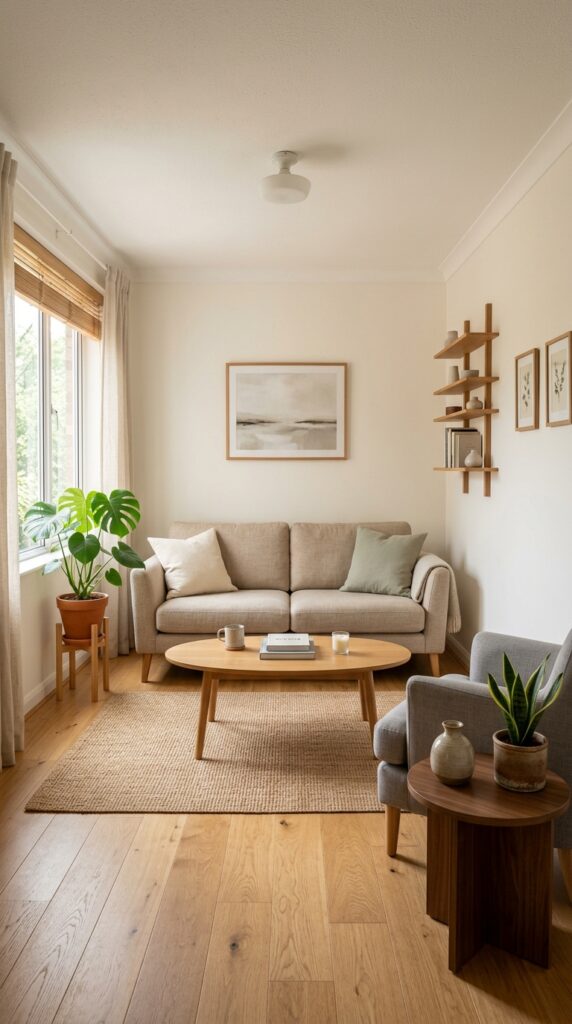
Vibe: Resolved — a small living room with too many objects does not look collected; it looks full, and full reads as small.
Why it works: The final and most consequential small living room strategy is subtraction rather than addition. Every object on a surface, every piece of art on a wall, every plant on a shelf is a visual claim on the room’s available attention — in a small room, where everything is within 10 feet of every seat, these claims accumulate rapidly into visual noise that makes the space feel crowded regardless of its actual square footage. The edit — removing everything that does not contribute essential function, material richness, or genuine personal meaning — recovers the spatial quality that all the preceding 24 strategies are trying to create. No amount of correct furniture scale, lighting design, or color choice compensates for surface clutter in a small room.
How to get it: Remove everything from every surface and every wall. Return only items that meet three criteria simultaneously: they are beautiful, they are meaningful, and they are correctly scaled to the surface they occupy. Apply the 60% rule to every surface — no surface should be more than 60% covered. Return one item at a time and assess the room after each addition. The point at which the room begins to feel slightly over-full is the point before the last item you returned — that is the room’s correct capacity.
Shop The Look
| Product |
| Minimalist storage basket hidden clutter |
| Small ceramic dish catch-all surface organizer |
| Decorative box storage coffee table |
| Wall hook set small minimal organization |
| Clear organizer bin cabinet hidden storage |
How to Start Your Small Living Room Transformation
The single best first move in a small living room transformation is measuring the room and every piece of furniture in it — precisely, to the inch — before changing anything else. This sounds administrative rather than creative, but it is the prerequisite for every other decision. The correct sofa scale, the right rug size, the furniture arrangement that allows appropriate traffic clearance — none of these can be assessed without knowing the room’s exact dimensions and how the current furniture relates to them. Draw a simple floor plan to scale on graph paper (1 inch = 1 foot) and place scaled furniture cutouts on it. This ten-minute exercise has prevented more expensive mistakes than any other single action in small living room design.
The most common beginner mistake is buying small furniture in the belief that smaller always means better in a compact room. A small sofa with spindly legs, a tiny rug that floats in the center of the floor, and a collection of small side tables all create a room that reads as tentative rather than confident. Small rooms need correctly proportioned furniture — which is often larger than the instinct suggests — placed with clarity of purpose. The correct rug for a room under 180 square feet is almost always an 8×10, not a 5×8. The correct sofa is an apartment-scale two-seater, not a loveseat. Scale down from “standard” but do not scale down from “apartment.”
Three immediate-impact items under $50: a plug-in swag pendant light in a warm tone to replace overhead lighting ($35–$45 on Amazon), a bundle of fresh eucalyptus in a clear glass vase ($10–$15), and a can of warm white limewash paint for one sample wall ($22–$30 for a quart). These three changes together — lighting, scent, and one wall surface — shift the sensory and atmospheric quality of any small living room before any furniture has moved.
A single-weekend transformation — furniture rearrangement using the floating technique, rug repositioning, lighting swap, and surface edit — achieves strong results at near-zero cost. A full small living room transformation with new sofa scale, rug, lighting, and storage solutions realistically runs $800–$2,500 depending on furniture quality. The highest-return investments in a small living room are, in order: lighting (swap overhead for layered sources), rug size (go up one size), and surface reduction (edit down to 60% capacity). These three address the three primary causes of small rooms reading as smaller than they are — flat light, fragmented floor plane, and visual noise.
Frequently Asked Questions About Small Living Room Decor
What makes a small living room feel bigger without renovation?
The three most effective non-renovation strategies are tonal color continuity (walls, sofa, rug, and curtains all in the same warm neutral family to minimize perceived boundaries), layered low lighting (replacing overhead fixtures with pendants, sconces, and floor lamps at multiple heights to keep ceiling in shadow and rooms feeling intimate rather than measured), and furniture floating (pulling all pieces 6–8 inches from walls and using a large single rug to anchor the arrangement). These three changes together can increase the perceived size of a small living room by 20–30% without moving a single wall or buying a single new piece of furniture.
What color should I paint a small living room to make it feel larger?
Warm white and warm greige are the most reliably effective colors for spatially expanding a small living room — specifically tones with yellow or pink undertones (like Benjamin Moore’s White Dove OC-17 or Pale Oak OC-20, or Farrow & Ball’s Elephant’s Breath) rather than cool whites with blue undertones, which read as clinical and cold. Apply the same tone to walls and ceiling simultaneously — a white ceiling with colored walls creates a visible horizontal boundary that lowers the perceived ceiling height. One counter-intuitive exception: a single dark accent wall on the room’s far wall (deep charcoal or forest green) can increase perceived room depth by 10–20% by making the far wall appear to recede.
How do I arrange furniture in a small living room?
Start with the sofa — position it on the wall opposite the room’s primary focal point (TV or fireplace) and pull it 6–8 inches from the wall. Place the largest rug first, then position all furniture so that at least the front legs of every piece rest on the rug, creating a unified anchored grouping. Maintain a minimum 36-inch traffic clearance between the front of the sofa and the coffee table, and 24–30 inches between any two pieces of furniture that face each other. Angle one armchair 45 degrees into a corner rather than placing it flat against the wall — this activates the corner space without consuming additional floor area in the circulation zone.
What is the best lighting for a small living room?
Layer three light sources at different heights rather than relying on a single overhead fixture. Start with a pendant or swag light at 60 inches from the floor over the seating zone — this is the primary ambient source. Add a floor lamp behind or beside the sofa at 65 inches height for reading and secondary ambient light. Include one or two table lamps on side tables or the console behind the sofa for tertiary warm accent light. All sources should be 2200–2700K (warm white to warm amber) and all should be on individual dimmers. The ceiling overhead should remain unlit — the darkness above the light sources makes the room feel taller and more atmospheric simultaneously.
How do I add storage to a small living room without making it feel cluttered?
Prioritize hidden storage over open storage at a ratio of 70:30. This means media consoles with closed doors, ottomans with lift-up storage, built-in benches with hidden compartments, and decorative boxes on shelves that conceal contents rather than displaying them. Open shelving (the 30%) should be edited to 60% capacity with objects curated for visual calm — consistent color family, varied heights, and generous negative space between groupings. The single most effective hidden storage addition in most small living rooms is replacing an open coffee table with a storage ottoman — this swap simultaneously removes a hard-edged obstacle from the circulation zone, adds 4–8 cubic feet of hidden storage, and introduces a softer surface that improves the room’s livability.
Ready to Create Your Dream Small Living Room?
These 25 ideas have moved across the full range of what small living rooms can achieve — from tonal color continuity and floating furniture arrangements to pendant lighting, transparent coffee tables, and the discipline of the edit. The most important thing this style of design teaches is that constraint is not a limitation to overcome but a condition to design within — and the rooms that accept their constraints produce better outcomes than the rooms that fight them. Today, pull your sofa 6 inches from the wall, place a throw on the newly created gap, and step back to assess: that shift alone will show you how much the room has been holding its breath. Pin the ideas that made you slow down — the large mirror opposite the window, the warm pendant at 60 inches, the single large plant in the corner — because those are the ones your room is already asking for.