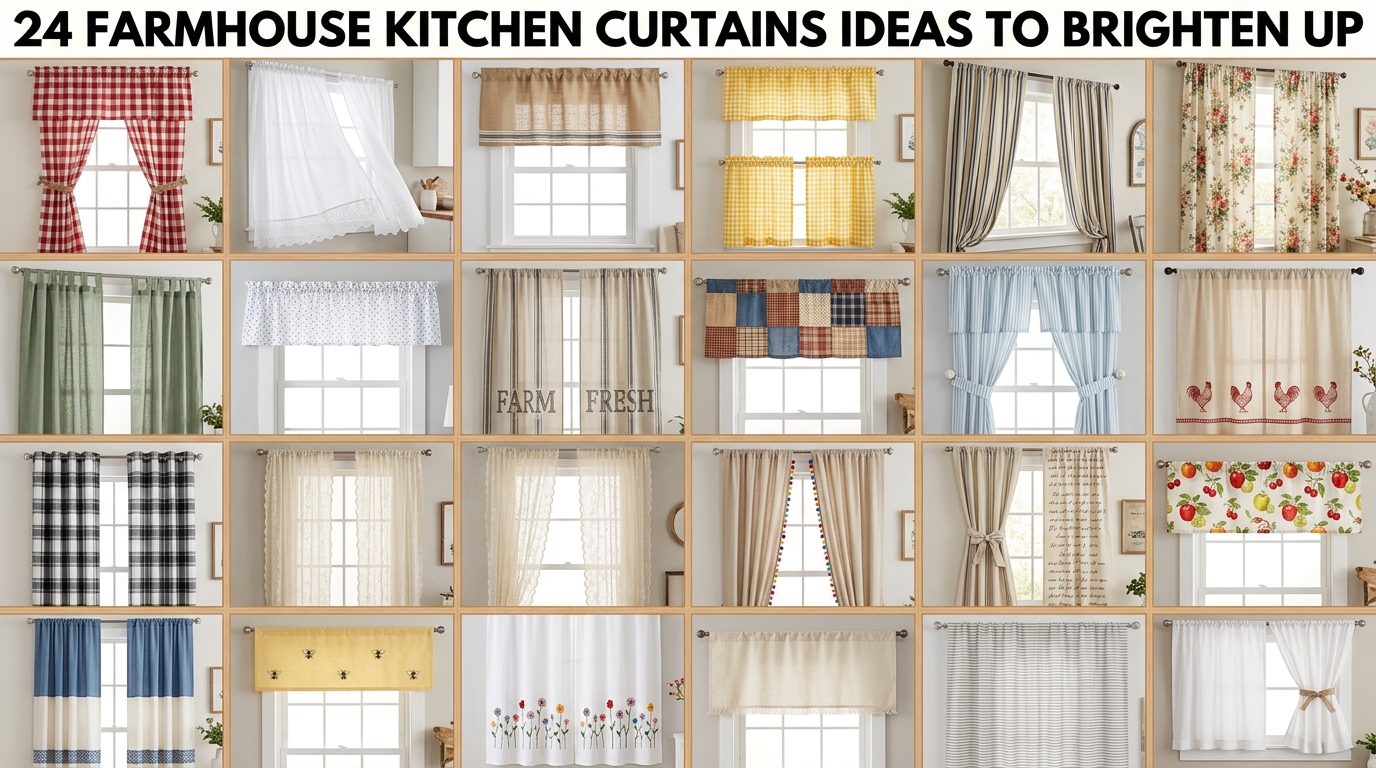
Farmhouse kitchen curtains are window treatments — panels, café curtains, valances, and sheers — that use natural fabrics, warm neutrals, and relaxed styling to make a kitchen feel grounded and welcoming rather than formal or finished. These 24 ideas show you exactly which curtain styles, materials, and hanging techniques work best for a farmhouse kitchen, whether you’re starting from scratch or refreshing what’s already there.
The right curtain in a farmhouse kitchen does something a bare window never can: it softens the hard edges of cabinetry and appliances, diffuses morning light into something that feels almost golden, and signals — without a word — that this is a room meant for warmth and gathering. Linen moves gently in a kitchen breeze. Cotton stripes carry the memory of every farmhouse pantry you’ve ever loved. Here are 24 ideas worth saving — and stealing.
Why Farmhouse Kitchen Curtains Work So Well
Farmhouse style in American homes traces back to the functional interiors of 19th-century rural households, where beauty was a byproduct of necessity rather than a decorative goal. In the kitchen specifically, window treatments served a clear purpose: privacy at the lower sash, light diffusion during the long working hours of the day. The café curtain — a short panel covering only the lower half of the window — was born in this tradition, and it remains the most authentic curtain choice for a farmhouse kitchen today.
The material language of farmhouse kitchen curtains is consistent and specific. Natural linen in undyed, oatmeal, or warm cream tones is the default. Washed cotton in blue-and-white ticking stripe, red grain sack stripe, or soft gingham are the most historically grounded patterns. Sheer cotton voile diffuses light without blocking it. Hardware is simple: thin iron or matte black rods, wooden dowels, or clip rings — never ornate finials, never chrome.
The trend is accelerating because kitchens have reclaimed their identity as the home’s emotional center. Since 2022, Pinterest searches for “farmhouse kitchen window treatments” have climbed consistently, driven by a cultural appetite for spaces that feel genuinely lived-in rather than staged. The curtain is one of the most personal elements in a kitchen — it moves, it filters light, it carries the room’s tone.
Small kitchen windows absolutely benefit from this style. Prioritize a single café curtain panel in natural linen rather than heavy floor-length drapes, which overwhelm compact windows. The style’s light-filtering philosophy is inherently space-friendly.
Style at a Glance
| Element | Key Trait | Key Trait |
| Philosophy | Functional beauty, lived-in warmth | Privacy without blocking light |
| Materials | Undyed linen, washed cotton, cotton voile | Matte black iron rod, wooden dowel |
| Color Palette | Oatmeal, warm cream, blue-white stripe | Grain sack red, soft gingham, sage |
1. Classic Linen Café Curtains on a Thin Black Rod
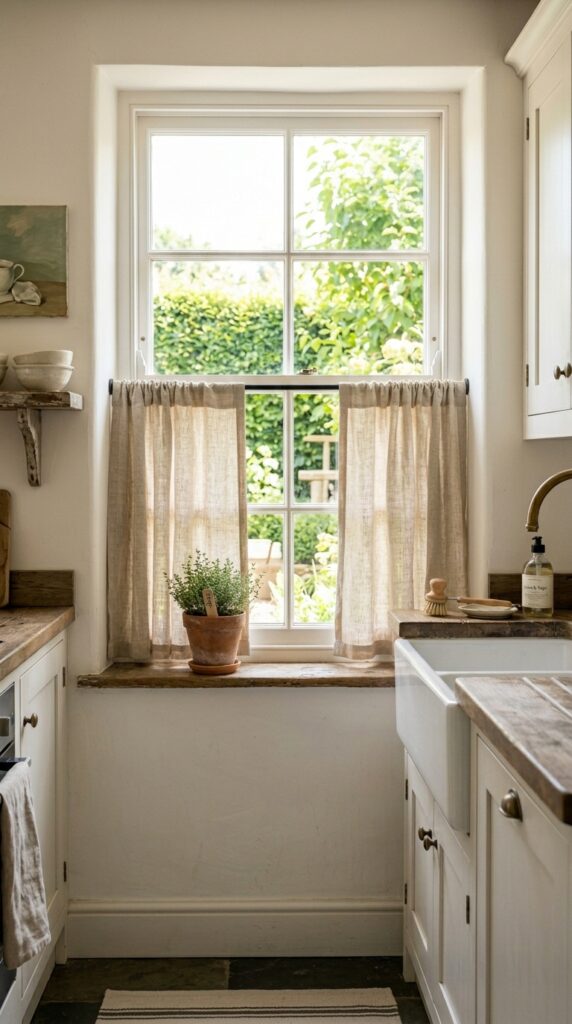
Vibe: Sun-warmed and quietly domestic — the curtain that invented farmhouse.
Why it works: The café curtain format covers only the lower sash, which means the upper half of the window remains completely open to natural light — this is a light-behavior principle that keeps kitchens bright without sacrificing privacy at eye level. Natural linen’s slight translucency softens the light that does pass through it, producing the warm, diffused glow that defines the farmhouse kitchen aesthetic. A thin matte black rod at the exact midpoint of the window frame maintains the hardware consistency the style depends on.
How to get it: Measure to the exact midpoint of your window frame and mount the rod there — not above it as you would for a full-length curtain. Cut or hem panels to land just below the windowsill for the classic farmhouse café proportion. Undyed or oatmeal linen panels are available from Etsy shops for approximately $8–$14 per yard; two 18-inch panels cover most standard kitchen windows.
💡 Quick Win: IKEA’s HANNALILL sheer curtain panels in white (under $20 for two) can be hemmed to café length with iron-on hem tape in under 15 minutes — no sewing required.
🛍️ Shop the Look — Amazon Product Ideas
| # | Product Search Phrase | Why It Fits |
| 1 | natural linen café curtain panels short kitchen | Core curtain material |
| 2 | matte black thin curtain rod 28-48 inch adjustable | Period-correct hardware |
| 3 | terracotta herb pot small drainage windowsill | Sill accent plant |
| 4 | wooden dish brush natural bristle kitchen sink | Counter functional detail |
| 5 | iron-on hem tape white fabric no-sew | Curtain length adjustment |
2. Blue and White Ticking Stripe Full Panel Curtains
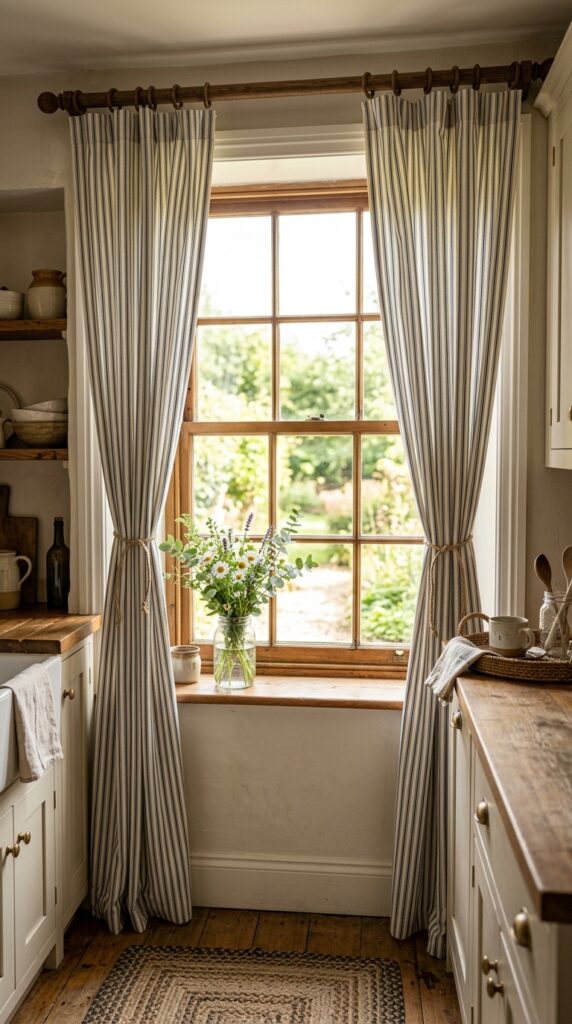
Vibe: Layered and warm — a pattern that carries a century of farmhouse history in its weave.
Why it works: Ticking stripe is one of the oldest American textile patterns — originally used for mattress ticking on working farms, it moved into domestic curtains and linens because of its durability and clean graphic quality. In a kitchen dominated by warm neutrals, the vertical stripe introduces the only line direction that adds perceived height, making the ceiling feel taller and the window feel larger. Navy-on-white is the most historically grounded colorway and the most complementary to the warm wood and white cabinetry common in farmhouse kitchens.
How to get it: Hang ticking stripe panels on a wooden dowel rod (stained in Minwax “Early American”) rather than a metal rod — the warm wood tone prevents the stripe from reading too graphic or crisp, which softens the overall effect. Tie back with a simple loop of natural jute cord rather than a decorative metal tieback.
🛍️ Shop the Look — Amazon Product Ideas
| # | Product Search Phrase | Why It Fits |
| 1 | blue white ticking stripe cotton curtain panels | Core curtain pattern |
| 2 | natural wood curtain rod dowel style 48-84 inch | Warm rod complement |
| 3 | jute rope curtain tieback natural set of 2 | Tieback material |
| 4 | mason jar glass vase wildflowers small windowsill | Sill styling detail |
| 5 | woven tray natural fiber small counter | Counter accent piece |
3. Sheer White Cotton Voile for Maximum Light
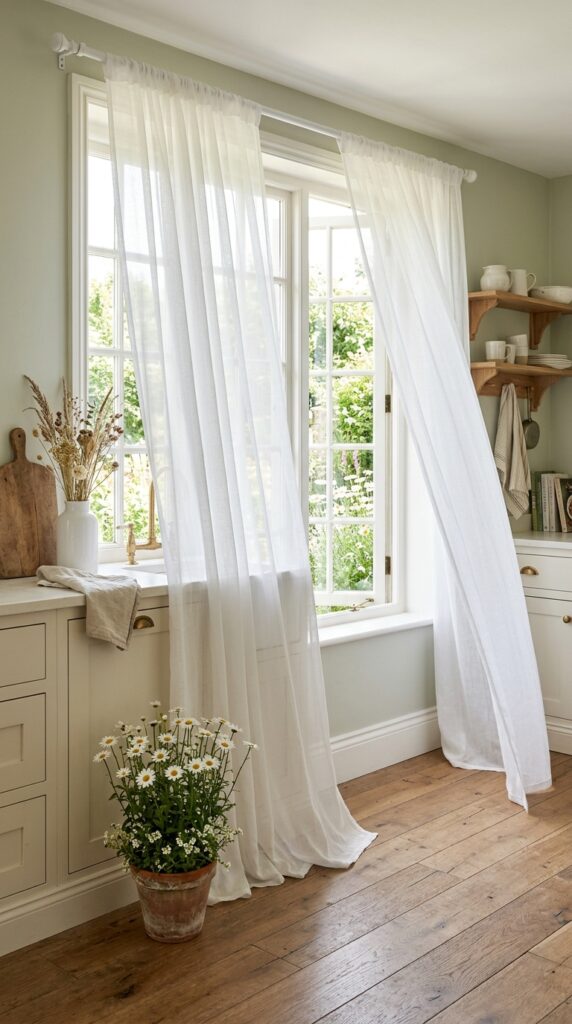
Vibe: Luminous and still — the curtain equivalent of filtered morning light.
Why it works: Cotton voile is the lightest woven cotton fabric — its open weave allows approximately 80% of natural light to pass through while still softening the view and adding the textile layer the farmhouse kitchen needs to feel complete. The design principle at work is diffusion without obstruction: the curtain filters without blocking, which keeps the kitchen bright and connected to the outdoors. Floor-length voile panels in a kitchen feel unexpectedly elevated — the material is too light to feel heavy, which prevents the formal association that full-length curtains typically carry.
How to get it: Use a white rod with white rings so the hardware disappears against the wall and the fabric reads as floating. Hang panels at ceiling height (within 2–4 inches of the ceiling) and let them pool 1–2 inches on the floor for the relaxed, romantic proportion that works in farmhouse kitchens with adequate natural light.
💡 Quick Win: Two white sheer panels from Amazon in 84-inch length cost $15–$25 total, and hung at ceiling height on a tension rod, they transform any kitchen window in under 10 minutes with zero tools.
🛍️ Shop the Look — Amazon Product Ideas
| # | Product Search Phrase | Why It Fits |
| 1 | white sheer cotton voile curtain panels 84 inch | Core sheer material |
| 2 | white curtain rod ceiling mount bracket set | Ceiling-height installation |
| 3 | white ceramic vase small modern kitchen counter | Counter accent |
| 4 | white daisy potted plant indoor small | Curtain base plant |
| 5 | tension rod white adjustable no-drill window | Tool-free hanging option |
4. Red Grain Sack Stripe for Bold Farmhouse Color
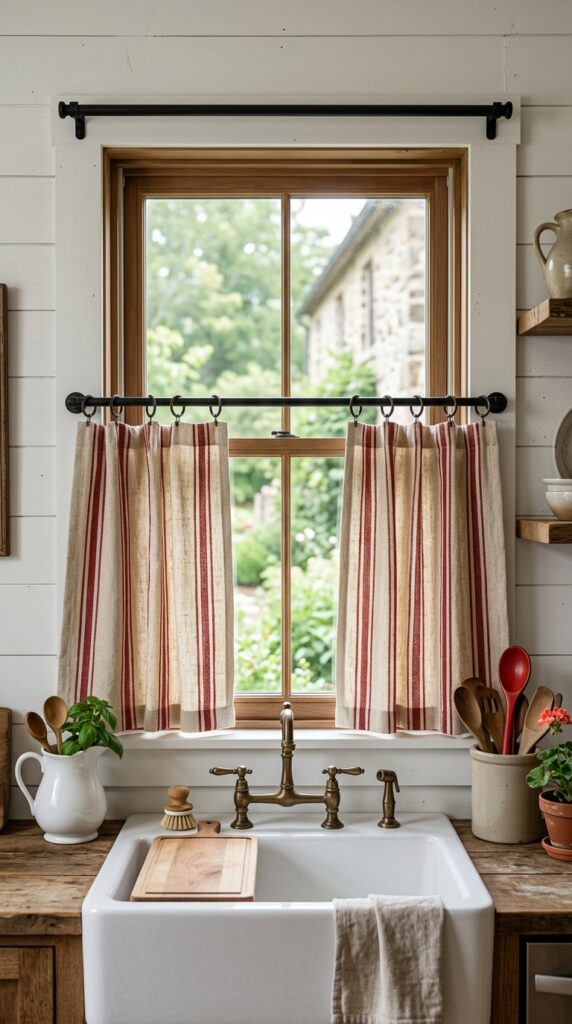
Vibe: Warm and grounded — the color of a working barn brought inside.
Why it works: The grain sack stripe references actual 19th-century American grain storage fabric — coarse cotton printed with bold stripes for identification. As a curtain material, it introduces the deepest color in the farmhouse palette (barn red or dusty navy) without pattern complexity, which means it reads as historic rather than decorative. The thick vertical stripe creates strong visual rhythm at the window, giving the kitchen a focal point without requiring any additional wall decor in the same zone.
How to get it: Pair red grain sack stripe curtains exclusively with white or warm white cabinetry and walls — the red only works when the surrounding palette is calm and neutral. Against cream or greige walls, the stripe reads as intentional; against colored cabinetry, it competes. Use black iron curtain rings rather than a rod pocket for an authentic farmhouse hanging detail.
🛍️ Shop the Look — Amazon Product Ideas
| # | Product Search Phrase | Why It Fits |
| 1 | red grain sack stripe curtain panels farmhouse | Core curtain pattern |
| 2 | black iron curtain rings clip set of 10 | Authentic hanging detail |
| 3 | white ironstone pitcher farmhouse kitchen decor | Window styling accent |
| 4 | red handle wooden kitchen utensils set | Complementary color detail |
| 5 | stoneware utensil crock white kitchen counter | Crock for utensil styling |
5. Sage Green Linen for an Earthy Kitchen Palette
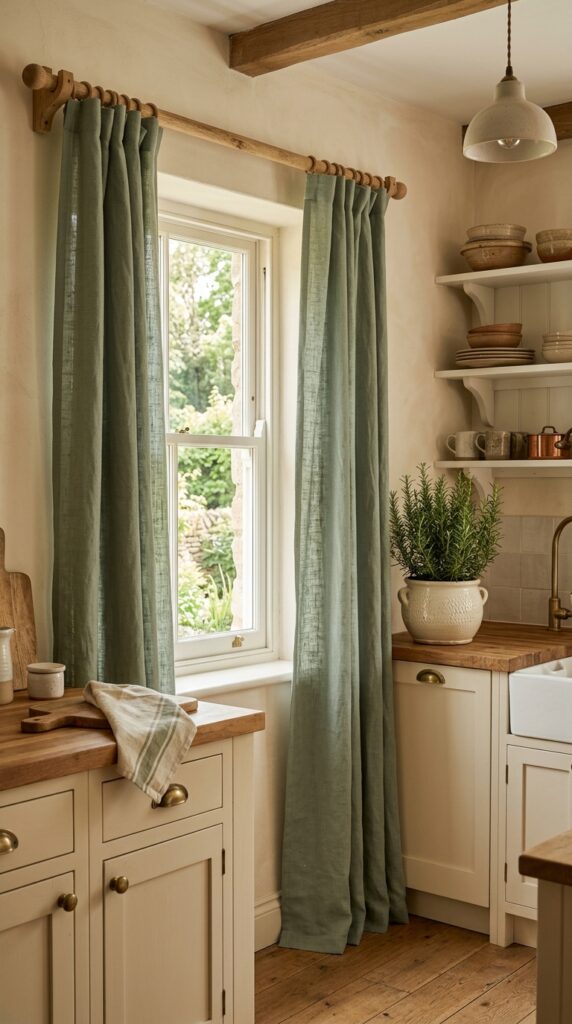
Vibe: Earthy and hushed — color that feels pulled from the garden just outside.
Why it works: Dusty sage green (the desaturated, gray-green tone found in Sherwin-Williams “Privilege Green” or Benjamin Moore “Soft Fern”) functions as a neutral in a farmhouse kitchen palette — it’s warm enough to integrate with wood tones and warm whites, and earthy enough to carry the agricultural spirit of the style. As a curtain color, it introduces the one organic color note the kitchen needs without the decorative intensity of a pattern. Unlined linen in this tone allows warm light to pass through, giving the fabric a translucent green-gold quality when backlit.
How to get it: Match your sage curtain linen to the undertone of your cabinet or wall color rather than treating it as a contrast. If your cabinets are warm white (yellow-cream base), choose a sage with a yellow-green base tone; if your walls are cool white, choose sage with a blue-green base. This undertone matching is what prevents the color from looking “off” in your specific light.
💡 Quick Win: A single sage green linen panel (sold individually) hung on one side of a narrow kitchen window as a half-curtain costs $20–$35 and changes the room’s color temperature immediately.
🛍️ Shop the Look — Amazon Product Ideas
| # | Product Search Phrase | Why It Fits |
| 1 | sage green linen curtain panels unlined farmhouse | Core curtain color |
| 2 | natural wood curtain rod rings set farmhouse | Warm rod hardware |
| 3 | cream ceramic planter pot windowsill herb | Counter plant styling |
| 4 | rosemary herb plant small indoor kitchen | Live herb accent |
| 5 | white floating shelf open kitchen wall mount | Shelf visible in scene |
6. Buffalo Check Curtains in Black and White
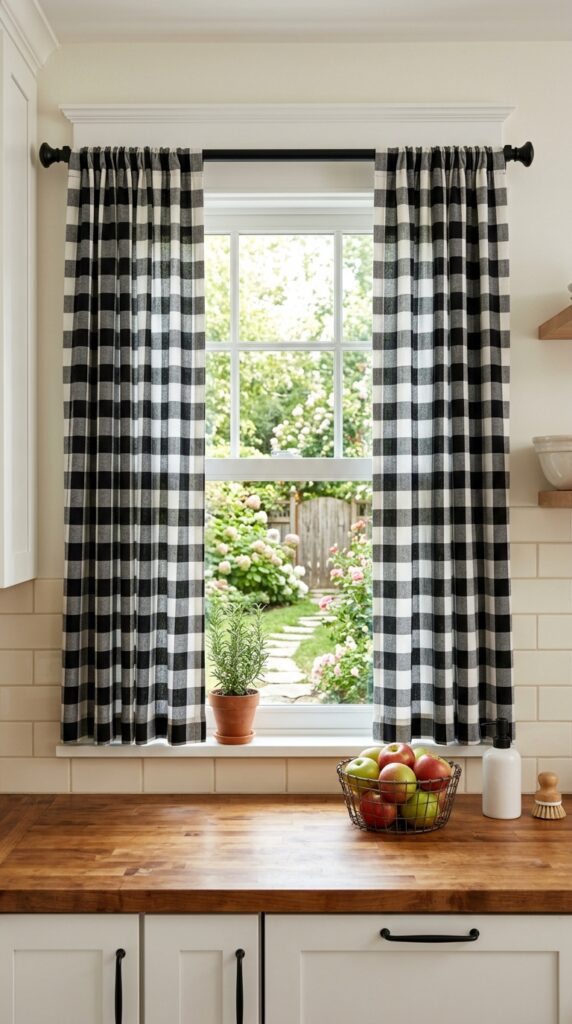
Vibe: Crisp and grounded — the graphic pattern that keeps farmhouse from going too soft.
Why it works: Buffalo check is a woven plaid pattern with equal-sized squares in two contrasting tones — historically a working-class textile used in wool blankets and work shirts. As a kitchen curtain material, the large-scale check introduces pattern at the window without the complexity of a floral or geometric print; the eye reads the check as a single texture rather than a repeated motif, which keeps the room feeling calm rather than decorated. Black-on-white is the most graphic and modern-farmhouse appropriate colorway, adding the tonal punctuation the style uses across hardware and fixtures.
How to get it: Scale the check to the window size — a large window can carry a 2-inch check; a small kitchen window reads better with a 1-inch check. Use a matte black curtain rod with matching black rings to extend the graphic quality of the pattern into the hardware.
🛍️ Shop the Look — Amazon Product Ideas
| # | Product Search Phrase | Why It Fits |
| 1 | black white buffalo check curtain panels farmhouse | Core check curtain |
| 2 | matte black curtain rod with rings set | Hardware complement |
| 3 | wire fruit basket counter apples farmhouse style | Counter styling detail |
| 4 | white ceramic pump soap dispenser kitchen | Counter functional accent |
| 5 | butcher block cutting board large natural wood | Counter material anchor |
7. Layered Curtain and Roman Shade Combination
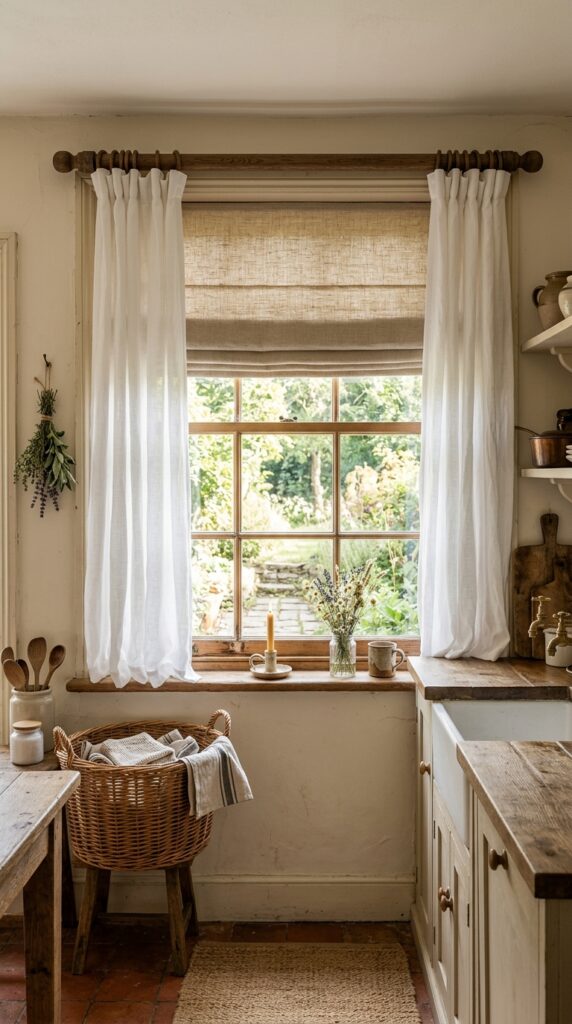
Vibe: Layered and warm — a window treatment with the depth of something considered over time.
Why it works: Layering a Roman shade with side panels is the most functional and visually sophisticated approach to farmhouse kitchen window dressing. The shade controls light and privacy precisely (roll it down when needed, up when not), while the side panels soften the window’s edges and add the textile fullness that a shade alone can’t provide. The design principle is layered material depth — the combination creates visual richness at the window without requiring any additional wall decor nearby.
How to get it: Mount the Roman shade inside the window frame for a clean, built-in look, and hang the side panels on a rod mounted above and outside the frame at ceiling height. This creates the full, layered proportion without the window looking overwhelmed. Choose both in the same natural linen tone for cohesion, or use a shade in a slightly warmer tone than the panels for subtle tonal depth.
💡 Quick Win: A pre-made natural linen Roman shade from Amazon in your exact window width costs $35–$65 and installs in minutes with no sewing — pair it with any existing white panel for an instant layered look.
🛍️ Shop the Look — Amazon Product Ideas
| # | Product Search Phrase | Why It Fits |
| 1 | natural linen Roman shade cordless custom size | Core shade layer |
| 2 | white linen sheer panel set side curtains | Side panel layer |
| 3 | dried herb bundle hanging wall kitchen farmhouse | Wall adjacent decor |
| 4 | small ceramic candle holder windowsill | Sill candle detail |
| 5 | wicker storage basket medium kitchen counter | Counter storage below |
8. Ruffled Cotton Curtains for a Soft Farmhouse Feel
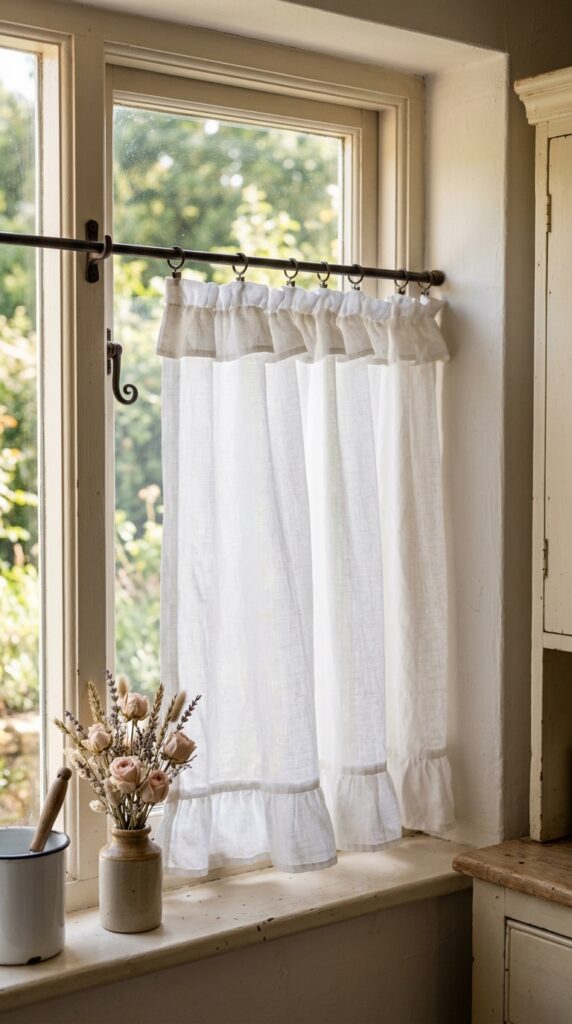
Vibe: Soft and domestic — a curtain detail that belongs in a room where things are made by hand.
Why it works: The ruffled edge is a distinctly American farmhouse textile tradition — it references the domestic craft of sewing household linens with decorative trim, a practice common in rural homes from the early 1800s through the mid-20th century. In a contemporary farmhouse kitchen, a single ruffle trim along the top and bottom of a café panel adds softness and handmade quality without the ornate complexity that would tip the room toward “country cottage.” White cotton is the right base fabric — the ruffle reads as texture, not decoration, when the base fabric is kept plain.
How to get it: Look for pre-ruffled panels in white cotton rather than polyester — the material difference is immediately visible in how the ruffle hangs and moves. Cotton ruffles drape gently; polyester ruffles hold their shape too stiffly and read as manufactured. Many farmhouse-specific linen shops on Etsy offer custom ruffle café panels for $30–$60 per panel.
🛍️ Shop the Look — Amazon Product Ideas
| # | Product Search Phrase | Why It Fits |
| 1 | white ruffled cotton café curtain panel kitchen | Core ruffle curtain |
| 2 | thin black iron curtain rod 24-36 inch | Hardware for short panel |
| 3 | dried flower arrangement small window decor | Sill floral accent |
| 4 | white enamel container kitchen counter storage | Counter functional piece |
| 5 | white cotton curtain fabric yard ruffled trim | DIY curtain material |
9. Farmhouse Kitchen Curtains in a Narrow Galley Layout
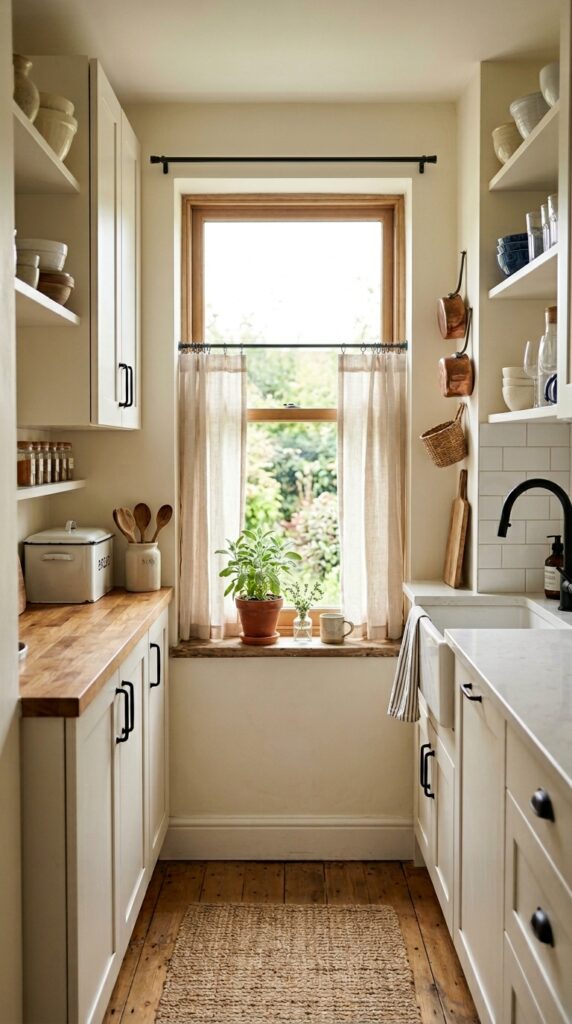
Vibe: Efficient and light-filled — every inch working exactly as hard as it should.
Why it works: In a galley kitchen, the window at the terminal end is the room’s primary light source and its only visual depth cue — it makes the narrow space feel like it continues beyond its actual walls. Heavy or full-length curtains would interrupt this borrowed depth and make the kitchen feel shorter. A single café panel in lightweight sheer linen at the lower sash maintains privacy while keeping the upper glass completely open, preserving both light and the sense of spatial extension. The curtain becomes invisible when open; when closed, it’s a soft texture note rather than a visual barrier.
How to get it: In a galley layout, choose curtain fabric by light transmission rather than by visual weight — the lighter and more transparent the fabric, the more the window does its spatial work. Mount the rod at the exact window midpoint on a bracket that extends no more than 1 inch beyond the frame on each side; in a narrow galley, even curtain hardware that extends too far reads as crowding.
💡 Quick Win: A single 24-inch-wide sheer linen panel ($15–$22) hemmed to café length and hung on a tension rod inside the window frame requires no drilling and adds the textile layer without consuming any visual space in a tight galley layout.
🛍️ Shop the Look — Amazon Product Ideas
| # | Product Search Phrase | Why It Fits |
| 1 | sheer linen panel single light filtering short | Galley light maximizer |
| 2 | tension rod white no-drill inside mount | No-drill galley install |
| 3 | small windowsill herb garden planter single | End-wall sill plant |
| 4 | narrow spice rack wall mount galley kitchen | Galley storage addition |
| 5 | slim magnetic knife strip wall mount kitchen | Space-saving galley tool |
10. Curtains With Wooden Rings on a Dowel Rod
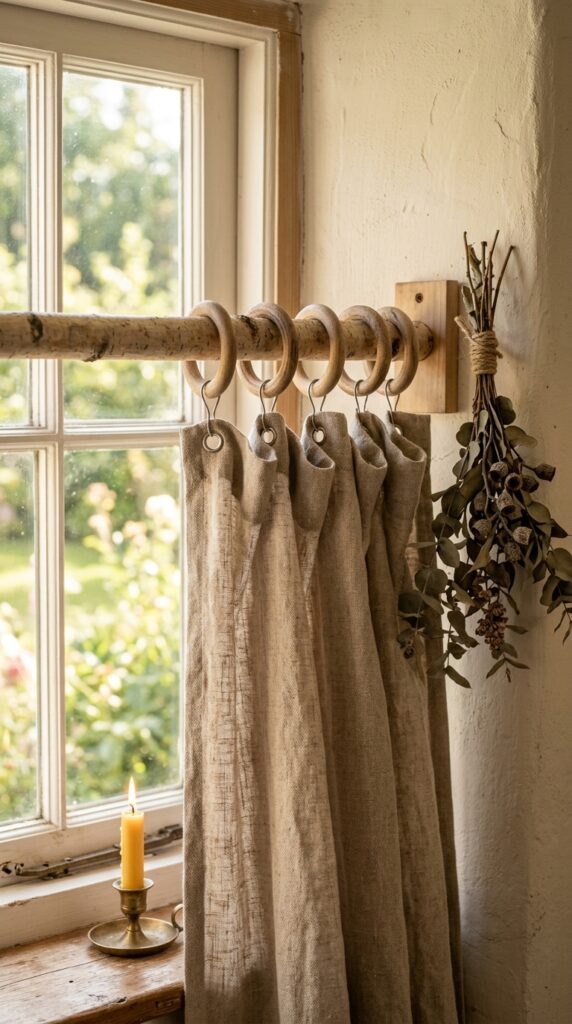
Vibe: Handcrafted and warm — a hanging detail that makes the whole curtain feel considered.
Why it works: Wooden curtain rings and a dowel rod replace the manufactured precision of a standard curtain rod with something that reads as genuinely handmade — which is the highest compliment a farmhouse detail can earn. The birch or oak dowel introduces another instance of raw natural wood into the room’s material vocabulary, threading the organic quality through the space at ceiling level. Wooden rings allow the curtain panels to slide easily while showing a warm material grain detail that metal rings simply don’t offer.
How to get it: Source unfinished birch dowel rods from any hardware store ($4–$8 for a 48-inch length) and cut to width plus 6 inches for overhang. Mount on simple wooden or iron L-brackets and leave the rod unfinished or apply a single coat of tung oil for a richer warm tone. Wooden curtain rings are available in sets of 10 on Amazon for $8–$15.
🛍️ Shop the Look — Amazon Product Ideas
| # | Product Search Phrase | Why It Fits |
| 1 | wooden curtain rings set of 10 birch clip | Core hanging hardware |
| 2 | unfinished birch dowel rod 1 inch diameter | DIY rod material |
| 3 | dried eucalyptus bundle hanging decor | Rod-end styling detail |
| 4 | beeswax candle pillar natural white | Sill candle accent |
| 5 | tung oil finish natural wood conditioner | Rod finish option |
11. Full-Length Linen Panels for a Tall Kitchen Window
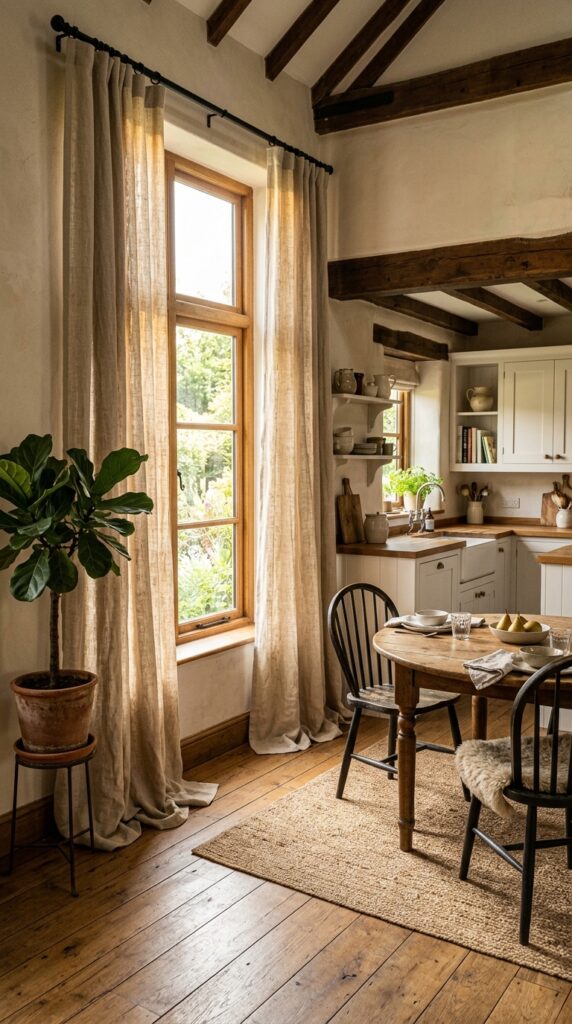
Vibe: Elevated and warm — a tall window finally given its proportional due.
Why it works: Floor-length linen panels are typically avoided in kitchens for practical reasons (proximity to water, cooking, and traffic), but in a kitchen with a tall window beside a dining nook or seating area rather than directly above a sink, they are the most impactful proportion choice available. Hanging the rod at ceiling height and allowing panels to pool slightly at the floor draws the eye all the way up, making low ceilings feel taller and transforming a functional window into an architectural feature. Undyed linen — the fabric in its natural state before any bleaching or dyeing — has the warmest, most organic tone of any curtain material choice.
How to get it: Position full-length panels only at windows that are not directly above sinks or cooking surfaces. Install the rod 2–4 inches from the ceiling and use panels that are 6–8 inches longer than the floor distance — the extra length pools naturally and prevents the curtain from looking too short when it hangs.
💡 Quick Win: Add 6 extra inches to any curtain panel order and let it puddle on the floor rather than trimming to exact floor length — the relaxed pool reads as intentional and expensive, and requires no hemming.
🛍️ Shop the Look — Amazon Product Ideas
| # | Product Search Phrase | Why It Fits |
| 1 | undyed natural linen curtain panel 96 inch floor | Full-length core panel |
| 2 | ceiling mount curtain bracket set black | High rod installation |
| 3 | wooden bench window seat natural farmhouse | Window seating piece |
| 4 | fiddle leaf fig tree potted indoor large | Window base plant |
| 5 | matte black curtain rod 72-144 inch wide | Wide window rod |
12. Gingham Check in Soft Sage or Dusty Blue
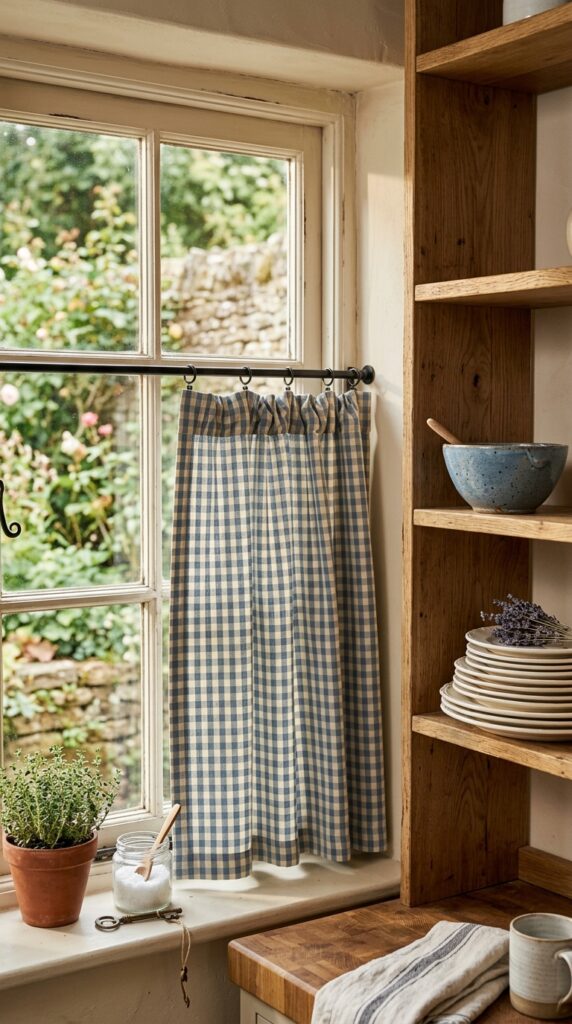
Vibe: Warm and nostalgic — pattern that earns its place by feeling genuinely historic.
Why it works: Gingham is one of the most historically authentic farmhouse textile patterns — it appears in American domestic interiors as far back as the early 19th century as apron fabric, curtaining, and tablecloth material. As a curtain pattern for farmhouse kitchens, small-scale gingham (1-inch check or smaller) reads as refined and authentic; large-scale gingham reads as picnic tablecloth. Dusty blue or soft sage gingham works better than a bright or saturated version because the desaturated tone integrates with the warm neutral palette without introducing jarring color contrast.
How to get it: Shop for gingham curtains in 100% cotton rather than a cotton-poly blend — the natural fiber has the correct weight and slight softness that makes gingham drape authentically. A poly blend keeps too much shape and reads as stiff and manufactured. Pre-wash the curtains once before hanging to achieve the slight fading and softening that makes the pattern feel genuinely farmhouse rather than brand new.
🛍️ Shop the Look — Amazon Product Ideas
| # | Product Search Phrase | Why It Fits |
| 1 | dusty blue gingham check curtain panels kitchen | Core gingham curtain |
| 2 | small blue ceramic bowl farmhouse kitchen decor | Adjacent shelf accent |
| 3 | white stacking plates set kitchen open shelf | Shelf styling piece |
| 4 | thin black cafe curtain rod 18-36 inch | Short window hardware |
| 5 | gingham cotton fabric yard blue white | DIY curtain yardage |
13. No-Sew Burlap Valance for a Rustic Touch
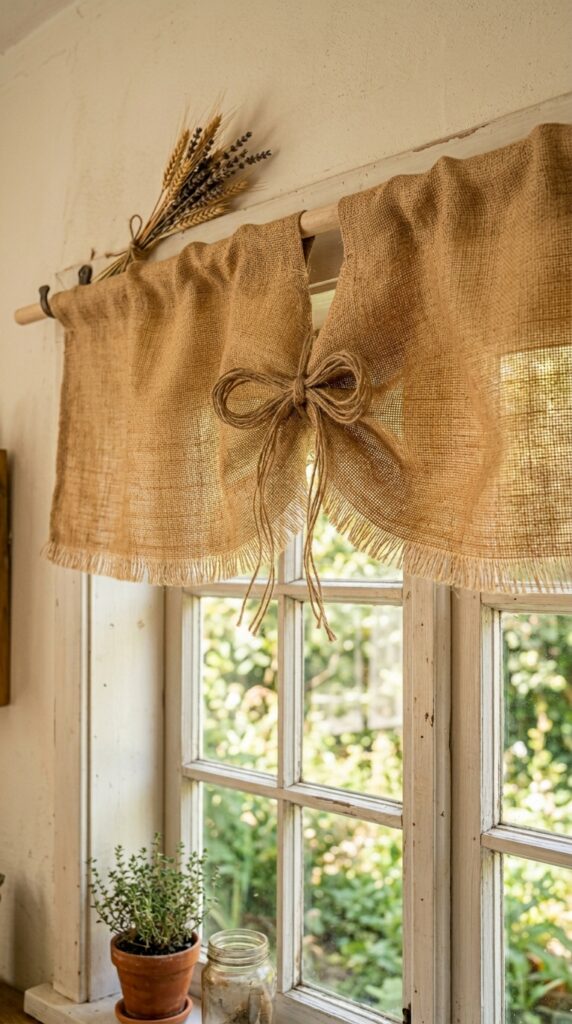
Vibe: Raw and handcrafted — a window treatment that looks like something you made on a Sunday afternoon.
Why it works: A burlap valance covers only the top 12–18 inches of a window, which means it adds a farmhouse textile note to the room while leaving the majority of the glass completely open to light. Burlap is the most agriculturally authentic material in the farmhouse vocabulary — it’s the fabric of grain and coffee sacks, and its rough open weave carries the honest imperfection the style values. A raw hem edge (cut but not sewn) reinforces the handcrafted quality rather than hiding it, which is exactly the right move for this material.
How to get it: Cut a strip of natural burlap fabric to twice the window width and 18 inches in height. Fold in half lengthwise and rod-pocket the fold over a wooden dowel. Leave all other edges raw — the fraying over time only improves the authentic quality. Tie a simple double-loop jute bow at the center and tuck a few dried wheat stems or lavender sprigs behind the rod for styling.
💡 Quick Win: A yard of natural burlap fabric from a craft store costs $4–$8 and makes a valance in 20 minutes with no sewing — just cut, fold, and slide onto a dowel rod already mounted above the window.
🛍️ Shop the Look — Amazon Product Ideas
| # | Product Search Phrase | Why It Fits |
| 1 | natural burlap fabric yard roll jute material | Core valance material |
| 2 | jute twine natural rope 3-ply craft decor | Bow and detail tie |
| 3 | dried wheat stalks bundle farmhouse window decor | Rod-end styling |
| 4 | wooden dowel rod 1 inch natural birch 36 inch | Valance rod |
| 5 | antique window latch hook farmhouse style | Window hardware detail |
14. Embroidered or Trimmed Linen Curtains
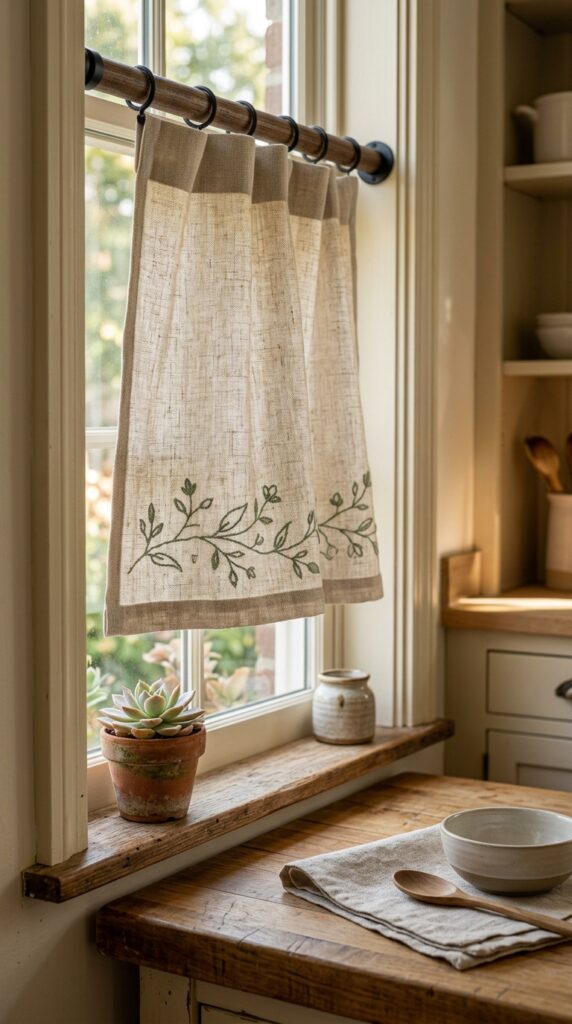
Vibe: Handcrafted and still — decoration that rewards looking closely.
Why it works: Embroidered trim on linen curtains introduces the most personal possible farmhouse detail — evidence of someone’s hands at work. The principle at play is scale of detail: the embroidery is visible only at close range, which creates a layer of richness that rewards the curious without announcing itself across the room. A single botanical motif — a simple herb sprig, a leaf stem, a daisy outline — in sage green or dusty blue thread is the correct register; anything more complex or colorful would tip the curtain from understated to decorative.
How to get it: Transfer a simple botanical design using a water-soluble fabric pen and embroider in a single strand of sage or cream thread using a basic running stitch or backstitch. If embroidery isn’t your skill, Etsy has numerous shops offering pre-embroidered linen curtain panels starting around $35–$55 per panel.
🛍️ Shop the Look — Amazon Product Ideas
| # | Product Search Phrase | Why It Fits |
| 1 | linen curtain panel embroidered botanical edge | Core embroidered curtain |
| 2 | embroidery thread sage green cotton 6-strand | DIY embroidery thread |
| 3 | water soluble fabric pen for embroidery transfer | Transfer tool |
| 4 | small succulent pot windowsill self-watering | Sill plant accent |
| 5 | linen napkin set natural unbleached kitchen | Counter textile layer |
15. Curtain Valance With a Scalloped Hem Edge
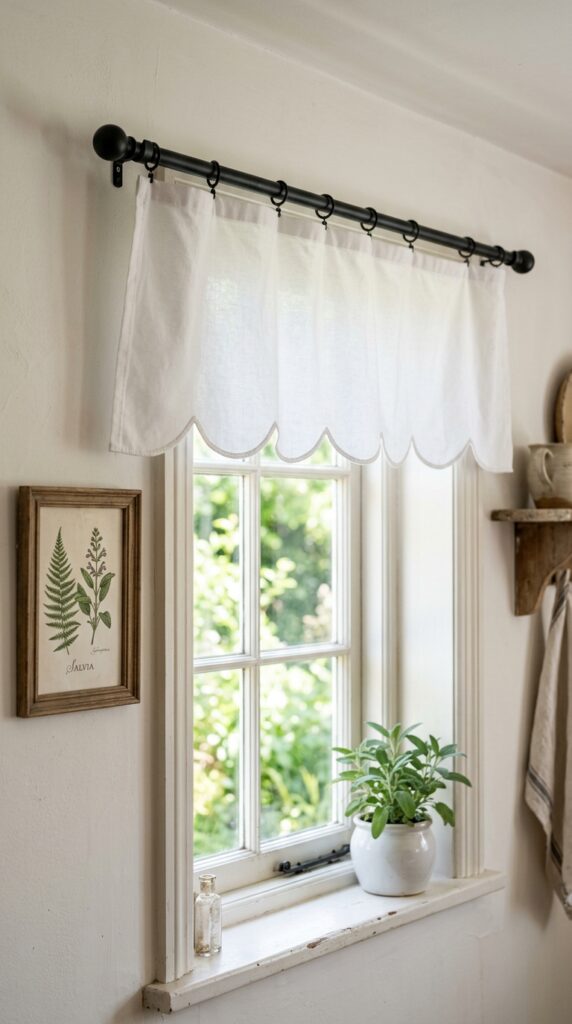
Vibe: Clean and quietly charming — a detail that takes a plain window and makes it a room feature.
Why it works: The scalloped hemline is a traditional American domestic sewing detail found in farmhouse kitchens, bedrooms, and pantries throughout the 19th and early 20th centuries. As a valance shape, the repeated curved arc introduces the one organic, non-linear silhouette in a room otherwise full of vertical and horizontal lines — this contrast of form is what makes the valance feel like a design choice rather than an afterthought. White cotton keeps the valance light and fresh; a natural linen version reads warmer and works better in rooms with amber or golden light.
How to get it: Scallop a valance hem by tracing a dinner plate or bowl along the fabric edge with a fabric pen before cutting — no sewing pattern required. Cut along the curved line, hem by hand or with a serger, and press flat with a steam iron before hanging. The whole project takes 90 minutes and costs under $20 in materials.
💡 Quick Win: Scallop the edge of any plain white cotton panel you already own using fabric scissors and iron-on hem tape — the curved cut transforms a flat panel into a farmhouse-specific detail at zero cost.
🛍️ Shop the Look — Amazon Product Ideas
| # | Product Search Phrase | Why It Fits |
| 1 | white cotton scallop hem valance kitchen window | Core scalloped valance |
| 2 | iron-on hem tape white fabric no sew | DIY hem finishing |
| 3 | small botanical framed print kitchen wall art | Window adjacent art |
| 4 | white ceramic herb pot kitchen windowsill | Sill planter |
| 5 | fabric scissors sharp professional dressmaking | DIY curtain cutting tool |
16. Macramé Wall Hanging as a Curtain Alternative
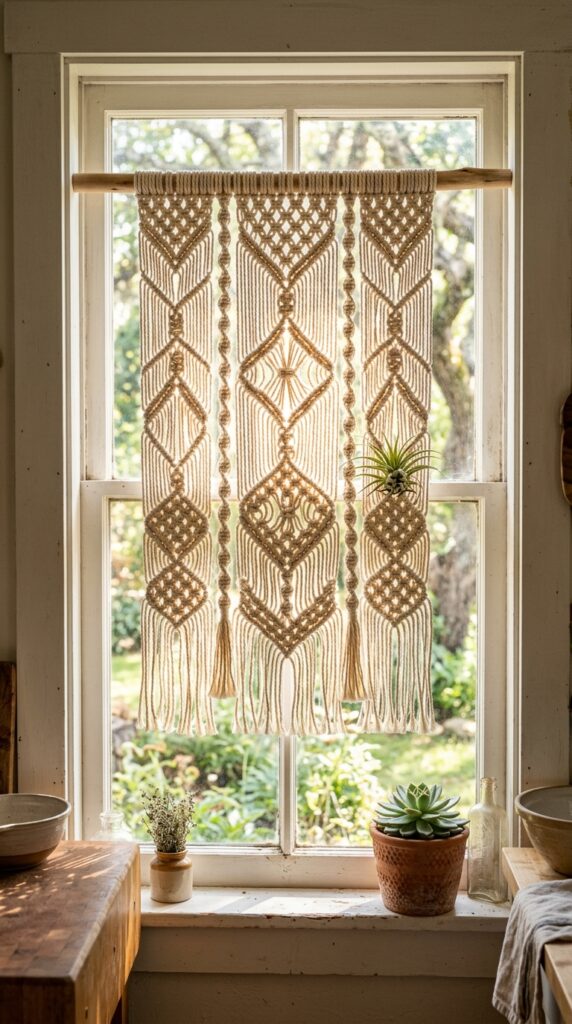
Vibe: Organic and layered — light filtered through handwork rather than fabric.
Why it works: Macramé as a window treatment is the farmhouse approach to the curtain problem when you want maximum light and maximum texture simultaneously. The open knot structure allows most light to pass through freely while creating shifting shadow patterns on the walls and counter as the sun moves — this is light behavior used as decorative element, which no solid fabric curtain can replicate. Natural cotton rope in the undyed cream tone connects to the farmhouse palette’s earthy, unprocessed aesthetic.
How to get it: Hang macramé on a wooden dowel fitted inside the window frame with command strips or small L-brackets — no permanent installation required. Size the macramé panel to the exact window width for a built-in look, or allow 10–15% extra width for a slightly gathered, softer silhouette.
🛍️ Shop the Look — Amazon Product Ideas
| # | Product Search Phrase | Why It Fits |
| 1 | macramé window panel wall hanging natural cotton | Core macramé curtain |
| 2 | wooden dowel rod thin 24 inch natural | Macramé hanging rod |
| 3 | air plant tillandsia small variety set | Macramé detail plant |
| 4 | terracotta pot small windowsill no drainage hole | Sill plant container |
| 5 | command strips large removable hooks | No-drill install system |
17. Curtain Tieback Ideas: Jute, Leather, and Linen
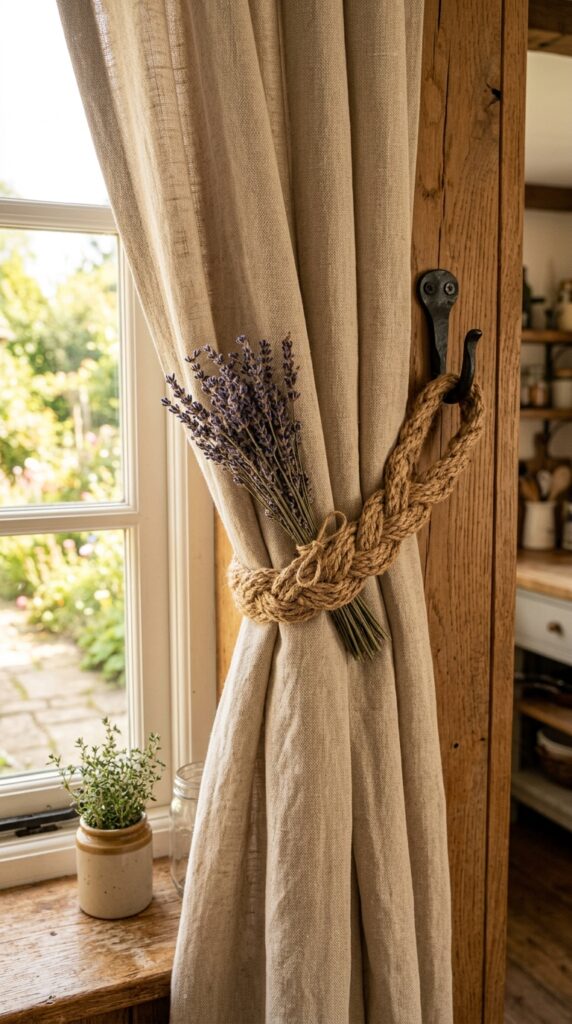
Vibe: Tactile and warm — the small detail that tells you someone thought about every inch.
Why it works: A tieback isn’t just functional — it’s the styling decision that controls how the curtain panel reads from across the room. A jute tieback keeps the panel gathered loosely rather than tightly, which is the correct farmhouse proportion: the gather should look relaxed, never cinched. The material itself — natural braided jute — connects to the rope and binding traditions of the agricultural roots of the style, making even a simple tieback a historically grounded choice. An iron wall hook rather than a plastic or chrome mount maintains hardware consistency.
How to get it: Braid three strands of 3-ply jute twine (each strand 36 inches long) and knot the ends — this makes a tieback in under 10 minutes for under $2 in materials. Mount a simple matte black iron wall hook 6–8 inches to the side of the window frame at the height where you want the curtain to gather — higher means a more formal proportion, lower means a relaxed, pooling look.
💡 Quick Win: A bunch of dried lavender (under $10 at Trader Joe’s or Amazon) tied into a jute tieback with a simple knot adds a sensory farmhouse detail — the scent is functional, the color is incidentally correct.
🛍️ Shop the Look — Amazon Product Ideas
| # | Product Search Phrase | Why It Fits |
| 1 | jute rope braided curtain tieback set of 2 | Core tieback material |
| 2 | matte black iron wall hook curtain tieback mount | Tieback mounting hardware |
| 3 | dried lavender bunch natural purple decor | Tieback botanical detail |
| 4 | leather curtain tieback strap farmhouse style | Alternative tieback option |
| 5 | linen ribbon roll natural unbleached 2 inch | Soft tieback alternative |
18. Patterned Block Print Linen in a Farmhouse Kitchen
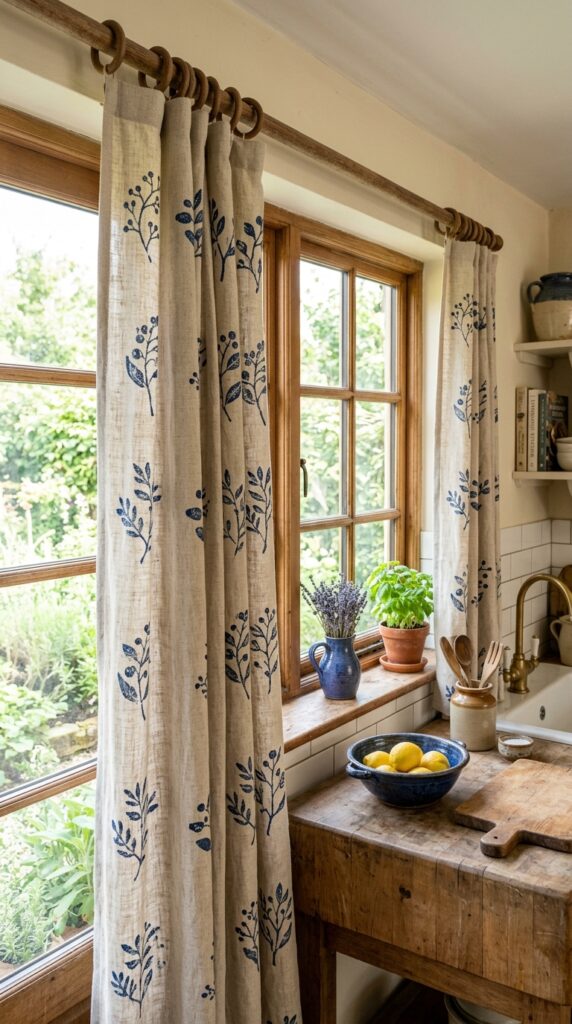
Vibe: Artisanal and warm — pattern that looks like it arrived from a craft fair rather than a factory.
Why it works: Block print linen introduces the print imperfection that signals handmade — the slight variation in ink density from one stamp to the next is the quality that distinguishes it from a digitally printed fabric. A small botanical block print (a simple leaf, a sprig, a daisy) in indigo or soft terracotta on natural linen base fits the farmhouse palette because the print color has enough saturation to be visible but enough desaturation to integrate with the neutral palette. The key design principle is controlled irregularity: pattern that has rhythm but not precision.
How to get it: Block print your own linen curtains using a carved foam stamp and fabric-safe ink (Speedball brand is widely available at craft stores for $6–$10 per color). Stamp in a random-walking pattern rather than a grid — staggered, slightly imprecise placement is what creates the handmade quality. Pre-wash the linen before stamping to prevent dye bleed, and heat-set with an iron after the ink dries.
🛍️ Shop the Look — Amazon Product Ideas
| # | Product Search Phrase | Why It Fits |
| 1 | block print linen curtain panel botanical indigo | Core patterned curtain |
| 2 | indigo blue ceramic bowl kitchen decor | Counter color echo |
| 3 | fabric block printing ink indigo washable | DIY printing ink |
| 4 | small indigo pottery jug farmhouse kitchen | Windowsill color accent |
| 5 | foam stamp carving block craft DIY | DIY printing tool |
19. Curtains in a Kitchen With Dark Cabinets
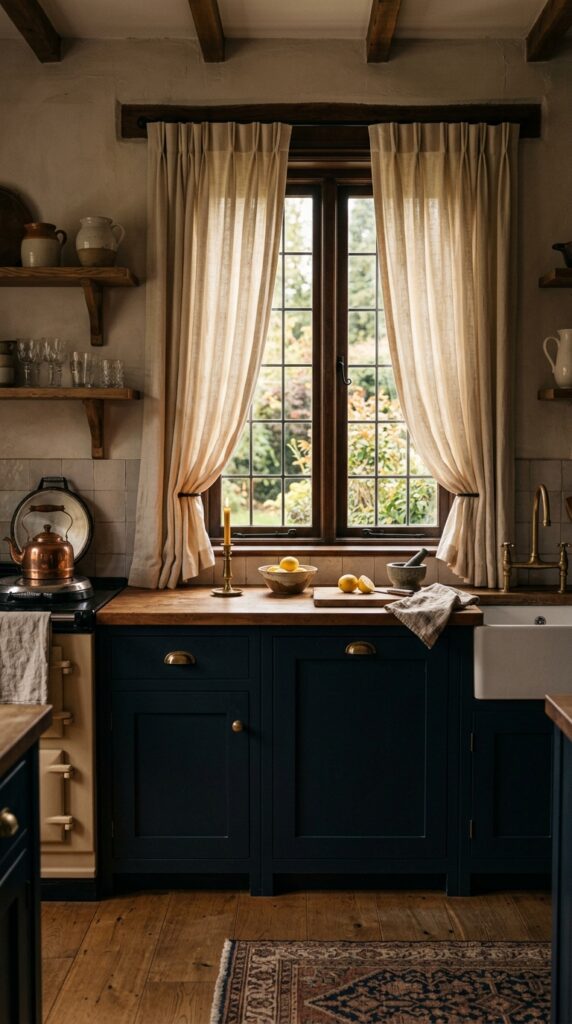
Vibe: Warm and grounded — curtains that make dark cabinetry feel rich rather than heavy.
Why it works: Dark cabinets absorb light, which means the window becomes the most important source of brightness in the kitchen — and the curtain treatment must support rather than compete with that function. Warm cream linen panels (lighter than the cabinetry but warmer than white) create a tonal gradient between the dark cabinet faces and the bright window light, softening the contrast rather than sharpening it. This contrast management is the critical design principle in dark-cabinet kitchens: the curtain should bridge the tonal gap, not widen it.
How to get it: Choose curtain fabric in a tone 2–3 steps lighter than your cabinet color in the same warm family — if cabinets are navy, choose cream; if charcoal, choose warm white with a gray undertone; if forest green, choose natural linen with a yellow-cream tone. Avoid bright white in dark-cabinet kitchens — the contrast is too sharp and makes the window look like a gap rather than a soft light source.
💡 Quick Win: In a dark-cabinet kitchen, hang curtain panels in a fabric that’s slightly heavier than linen — a medium-weight canvas in warm cream reads as substantial and grounded, matching the visual weight of the dark cabinetry without overwhelming it.
🛍️ Shop the Look — Amazon Product Ideas
| # | Product Search Phrase | Why It Fits |
| 1 | cream linen curtain panel heavy weight pleat | Core curtain for dark kitchen |
| 2 | brushed brass cabinet pulls bar handle kitchen | Dark cabinet hardware |
| 3 | brass candlestick holder small kitchen counter | Counter accent piece |
| 4 | canvas curtain panel warm cream natural color | Alternative heavier fabric |
| 5 | dark navy cabinet paint chalk finish matte | Cabinet color reference |
20. Tie-Top Curtains on a Rustic Branch Rod
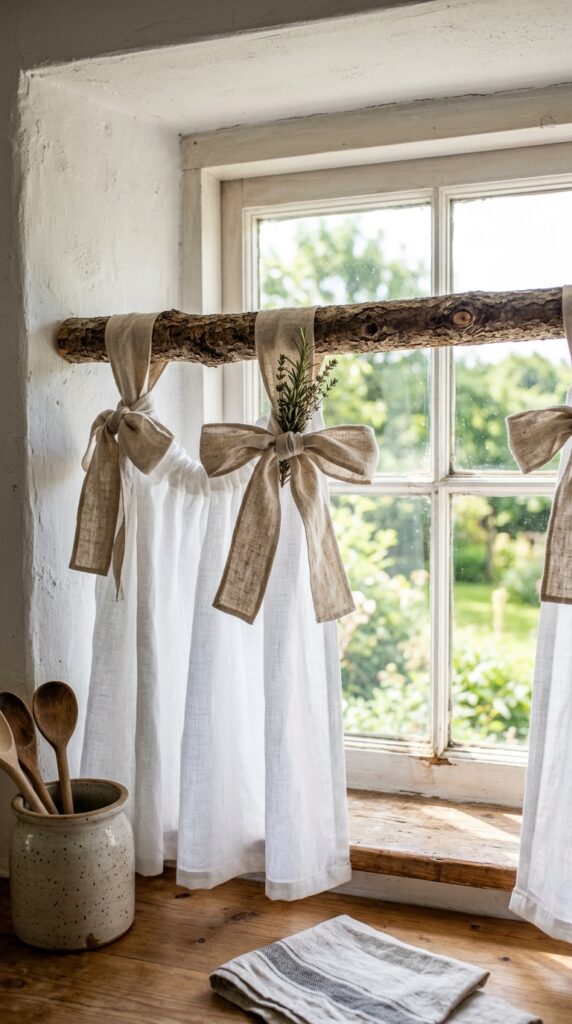
Vibe: Rustic and playful — a window treatment that looks like nature walked in and stayed.
Why it works: A natural branch used as a curtain rod is the ultimate farmhouse commitment — it prioritizes authenticity of material over finish or polish. The irregular silhouette of a branch (slight curve, visible knots, varied diameter) creates the organic imperfection the style values, and the material cost is zero if you have access to any wooded outdoor space. Tie-top curtains — panels with fabric strips sewn at the top that tie directly onto the rod — eliminate the need for rings or rod pockets, making the hanging detail part of the visual design of the curtain.
How to get it: Find a straight-ish branch at least 1 inch in diameter and 6–8 inches wider than your window frame. Allow it to dry for 2–3 weeks before hanging to prevent warping. Mount on simple iron pipe flanges (hardware store, $4–$6 each) screwed into the wall at each end of the branch. Sand any sharp edges lightly and leave the bark intact for texture.
🛍️ Shop the Look — Amazon Product Ideas
| # | Product Search Phrase | Why It Fits |
| 1 | tie top curtain panels white cotton farmhouse | Core tie-top curtain |
| 2 | iron pipe flange wall mount 1 inch | Branch rod mounting hardware |
| 3 | dried rosemary bundle herb decor kitchen | Tie bow botanical detail |
| 4 | small white ceramic crock kitchen storage | Counter styling piece |
| 5 | natural branch wall curtain rod driftwood style | Alternative pre-made option |
21. Curtain Plus Open Shelving: The Layered Window Wall
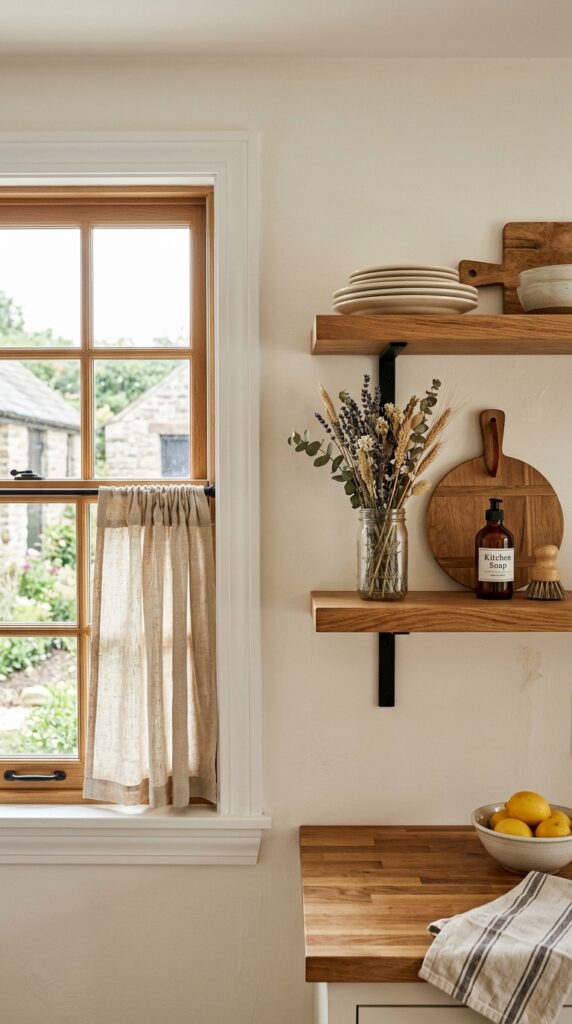
Vibe: Composed and warm — a wall that functions as a complete design moment.
Why it works: When open shelving flanks a curtained window, the curtain becomes part of a composed wall vignette rather than an isolated window treatment — this is the zone definition principle applied to a window wall. The curtain’s soft, organic texture creates a visual counterpoint to the harder surfaces of ceramic and wood on the shelves, and the neutral linen color connects the curtain to the shelf styling materials (ironstone, natural wood) without requiring any additional color to be introduced. The result is a window wall that photographs as a single, cohesive moment.
How to get it: Mount shelves so their inner edges frame the window — 4–6 inches away from the window frame on each side — and use the same hardware finish (matte black) for both shelf brackets and the curtain rod. Style the shelves with items in the same tonal family as the curtain: warm whites, natural wood, and dried botanicals keep the composed wall cohesive.
💡 Quick Win: If your kitchen already has open shelving beside a window, simply adding a single café curtain panel in natural linen below the sill takes the wall from functional to composed — a 20-minute transformation.
🛍️ Shop the Look — Amazon Product Ideas
| # | Product Search Phrase | Why It Fits |
| 1 | natural linen café panel single short kitchen | Curtain for window wall |
| 2 | white oak floating shelf matte black bracket | Shelf material |
| 3 | white ironstone serving plate set display | Shelf styling ceramic |
| 4 | dried flower mason jar kitchen shelf decor | Shelf botanical accent |
| 5 | wooden trivet round natural handle kitchen | Shelf functional detail |
22. Pom-Pom Trim Curtains for Playful Farmhouse Charm
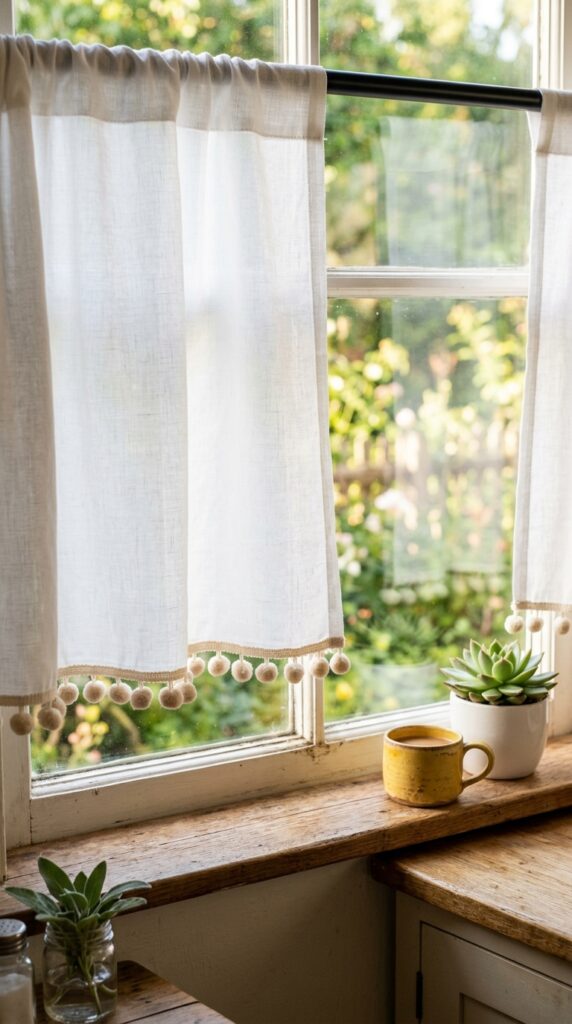
Vibe: Warm and charming — the curtain detail that makes the kitchen feel genuinely joyful.
Why it works: Pom-pom trim adds dimensional texture at the curtain’s hem edge — the small spheres catch light and cast small shadows, giving the curtain a material depth that plain hemmed fabric doesn’t have. Natural cotton pom-poms in cream or undyed white sit perfectly within the farmhouse palette because they read as handmade rather than manufactured, which is the quality the style values most. This detail works specifically in kitchens (rather than living rooms) because the scale is small enough to feel domestic and unpretentious — farmhouse, not formal.
How to get it: Add pom-pom trim to any existing curtain panel by simply stitching or using fabric glue to attach a strip of pre-made pom-pom fringe along the hem — $4–$8 per yard at craft stores. Alternatively, sew individual pom-poms at 2-inch intervals for a sparser, more handcrafted look.
🛍️ Shop the Look — Amazon Product Ideas
| # | Product Search Phrase | Why It Fits |
| 1 | white curtain panel pom pom trim cotton kitchen | Core pom-pom curtain |
| 2 | cotton pom pom trim fringe yard natural cream | DIY trim to add |
| 3 | small yellow ceramic coffee mug farmhouse | Counter color accent |
| 4 | white pot succulent small self-watering | Sill plant detail |
| 5 | fabric glue washable clear no-sew permanent | No-sew trim attachment |
23. Curtain in a Farmhouse Kitchen With a Bay Window
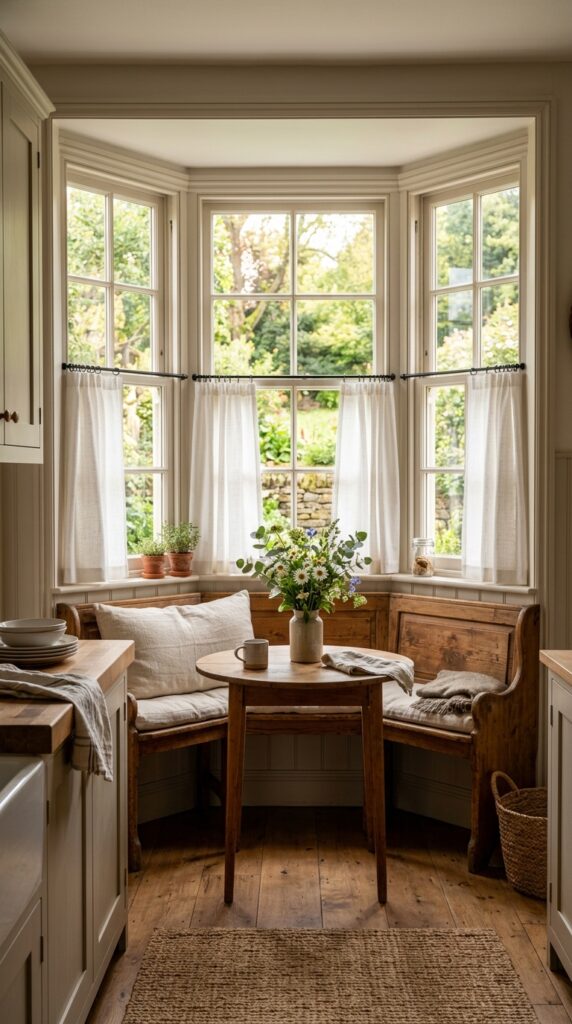
Vibe: Warm and gathered — a bay window finally treated as the feature it is.
Why it works: Bay windows present a specific curtain challenge: treating them as a single window (with one continuous rod) creates a cramped, awkward installation; treating each pane individually (with separate short rods) gives each section its own correct proportion. The farmhouse approach is always the second option — individual café panels on each section of the bay, hung at the same height with the same fabric, creates visual rhythm across the bay while honoring the architecture. The breakfast nook that typically sits inside a kitchen bay window becomes a composed, inviting zone when the window treatment is correctly proportioned.
How to get it: Install three separate adjustable tension rods or short cafe rods — one per bay section — at the exact midpoint of each window pane. Use the same curtain panels throughout for visual consistency. The outer two panels can be tied back toward the walls of the bay; the center panel is best left untied.
💡 Quick Win: Three tension rods (one per bay section) at $8–$12 each, combined with three matching café panel pairs from Amazon at $15–$20 each, complete a bay window curtain treatment for under $80 total with no drilling.
🛍️ Shop the Look — Amazon Product Ideas
| # | Product Search Phrase | Why It Fits |
| 1 | white cotton café curtain panel set of 2 short | Bay section curtain |
| 2 | tension rod white adjustable 18-28 inch | Each bay section rod |
| 3 | farmhouse round dining table small white pedestal | Bay nook table |
| 4 | linen bench cushion natural window seat | Bay seating cushion |
| 5 | small bud vase ceramic white flower table | Bay table centerpiece |
24. Seasonal Curtain Refresh: Swapping for Summer and Winter
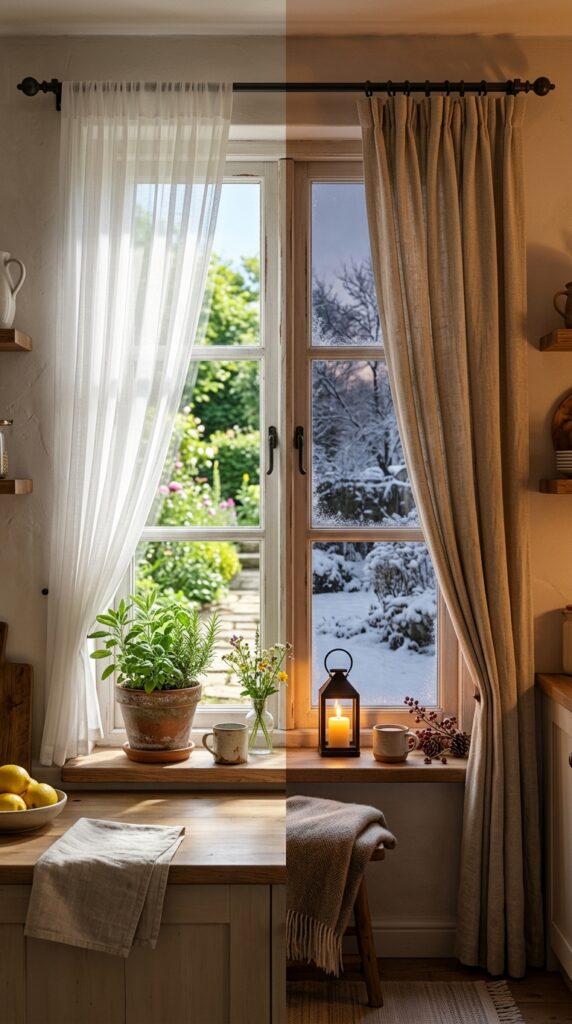
Vibe: Seasonal and considered — a kitchen that changes with the year rather than resisting it.
Why it works: The farmhouse kitchen’s reliance on natural materials makes it inherently seasonal — the same philosophy that calls for wool in winter and cotton in summer applies perfectly to window treatments. A lightweight sheer cotton voile in summer keeps the kitchen light-flooded and fresh; swapping to a heavier oatmeal linen in the colder months adds visual and thermal warmth to the room. The rod hardware stays constant; only the panels change — this is the most practical and economical way to refresh the kitchen’s feeling twice a year.
How to get it: Store your seasonal curtain panels folded in a labeled cotton storage bag when not in use — hanging in a closet leads to permanent fold creases in linen. The swap itself takes under 10 minutes per window. Use the same rod, same rings, and same tieback hardware for both seasonal versions to keep the transition seamless.
🛍️ Shop the Look — Amazon Product Ideas
| # | Product Search Phrase | Why It Fits |
| 1 | sheer white voile curtain panel lightweight summer | Summer seasonal panel |
| 2 | heavy oatmeal linen curtain panel winter warm | Winter seasonal panel |
| 3 | cotton storage bag curtain linen large zippered | Off-season panel storage |
| 4 | small candle lantern farmhouse kitchen winter decor | Winter window styling |
| 5 | fresh herb pot terracotta summer kitchen window | Summer window styling |
How to Start Your Farmhouse Kitchen Curtain Transformation
Start with a single café curtain in natural linen at your most-used kitchen window. This one specific move — a short linen panel covering only the lower sash of an above-sink window — establishes the farmhouse curtain language for your kitchen before you commit to any additional window treatments. It costs $20–$40 for a basic panel, installs in under 10 minutes on a tension rod, and immediately tells you whether the style and proportion are right for your space before you invest further.
The most common mistake is choosing curtain fabric that’s too heavy for the kitchen scale. Floor-length velvet or thick blackout panels in a kitchen feel wrong because the material weight doesn’t match the room’s function — kitchens are active, light-dependent spaces, and the curtain should honor that. The fix is straightforward: choose fabric by its light-transmission quality first, and its visual weight second. Linen, cotton voile, and washed cotton are the three materials that function correctly in a kitchen environment.
Three specific items under $50 for an immediate farmhouse curtain impact: a set of two natural linen café panels from Amazon ($18–$25); a thin matte black curtain rod adjustable to your window width ($12–$18); and a braided jute tieback set of two ($8–$12). Together, these three items complete a window treatment for under $55 total.
A full kitchen curtain refresh — replacing all windows with coordinated farmhouse panels — is realistically a single weekend project with a budget of $80–$250 depending on window count and fabric choice. Custom or handmade options (embroidered panels, block-print linen) add 2–4 weeks of lead time if ordering from Etsy.
Frequently Asked Questions About Farmhouse Kitchen Curtains
What is the difference between farmhouse curtains and country curtains?
Farmhouse and country curtains share some overlap but differ in tone and detail. Country curtains tend toward heavier pattern — larger florals, ruffles, valances with gathered skirts — and often use polyester or cotton-poly blend fabrics. Farmhouse curtains prioritize honest, natural materials (linen, cotton, canvas), simpler profiles (café length, flat panels), and a more restrained color palette anchored in warm neutrals like oatmeal and warm cream. The distinction is essentially between decorative (country) and material-driven (farmhouse). If a curtain has a printed calico pattern or a gathered ruffle skirt, it’s more country than farmhouse.
What colors work best for farmhouse kitchen curtains?
The most effective farmhouse kitchen curtain colors are in the warm neutral family: natural undyed linen (oatmeal-cream), warm white cotton, and soft greige. Pattern options that work include classic ticking stripe in navy-on-white or red-on-cream, small-scale gingham in dusty blue or sage, and grain sack stripe in red-and-cream. Avoid bright or saturated colors — they fight the organic warmth of natural wood and ceramic that define the farmhouse kitchen palette. If you want a color moment, choose a desaturated version: dusty sage rather than bright green, barn red rather than cherry red.
How much do farmhouse kitchen curtains cost?
The range is wide. Ready-made farmhouse-style curtain panels on Amazon run $15–$45 per panel in cotton or cotton-linen blends. Mid-range linen panels from specialty linen shops or Etsy run $35–$80 per panel for natural or undyed versions. Custom hand-embroidered or block-printed linen panels from independent artisans run $55–$120 per panel. Hardware (rod plus brackets) adds $10–$40 for a basic installation. A full kitchen curtain treatment on a budget — two café panels, one tension rod — can be completed for under $50; a curated natural linen installation across three kitchen windows typically runs $150–$300.
Can I use farmhouse curtains in a modern kitchen?
Yes, and the contrast often improves both styles. A modern kitchen with flat-front cabinetry and clean hardware benefits enormously from the organic texture that a natural linen café curtain introduces — the curtain softens the hard lines without disrupting the clean layout. The key is to keep the curtain simple: a flat panel or basic café length in natural linen, on a thin rod, with no ruffles or patterns. Avoid mixing heavy decorative farmhouse elements (burlap valances, grain sack stripe) with a genuinely minimal modern kitchen — the styles conflict at the extreme ends, but a simple linen panel bridges the gap gracefully.
What length should farmhouse kitchen curtains be?
The two most appropriate lengths for farmhouse kitchen curtains are café length (covering the lower half of the window, typically 18–30 inches) and full-panel length (floor to ceiling, 84–96 inches). Sill-length curtains — ending exactly at the windowsill — are the most common mistake in farmhouse kitchens because they read as too short without being a deliberate café length. If you’re going below the sill, go to the floor. If you want privacy, go café. The in-between lengths (below sill, above floor) have no historic farmhouse precedent and read as visually unresolved.
Ready to Create Your Dream Farmhouse Kitchen Curtains?
These 24 ideas covered the full spectrum of what farmhouse kitchen curtains can be — from material and fabric choices to pattern, length, hardware, color, and seasonal strategy — because the curtain that’s right for your kitchen depends on more than just the fabric you like. A single café curtain panel in natural linen is all it takes to start; the rest of the style follows naturally once the first textile layer is in place. Today, measure your most-used kitchen window from top to midpoint and order a natural linen café panel in that exact width — your window will look different by tomorrow morning. When the kitchen is fully dressed in its farmhouse curtains, you’ll feel the shift in the room’s warmth before you consciously register what changed — the light is softer, the room is quieter, the space finally feels like yours. Pin the ideas that stopped you mid-scroll — especially the ones with a wooden rod and a jute tieback, because those small details are where farmhouse style lives.