
28 Garage Loft Designs for Modern Living
A garage loft is an upper-level platform or mezzanine built within a garage’s vertical airspace, transforming dead overhead cubic footage into a livable, workable, or storable second layer. Here are 28 garage loft design ideas — spanning layout, lighting, furniture, materials, color, and small-space strategies — so you can build smarter, not bigger.
Think raw concrete underfoot, steel cable railings catching afternoon light, and exposed joists overhead that feel intentional rather than unfinished. Modern garage loft design sits at the intersection of industrial pragmatism and residential warmth — a space that works hard and still looks considered. There is something quietly satisfying about a room that began as a car park and became something you actually want to spend time in. Here are 28 ideas worth saving — and stealing.
Why Modern Garage Loft Design Works So Well
Modern garage loft design draws from mid-century functionalism and the industrial loft movement that reshaped urban living in the 1980s and 90s. Unlike traditional attic conversions, the garage loft embraces the bones of a working space — high ceilings, wide spans, utilitarian structure — and uses them as aesthetic assets rather than problems to hide. It sits distinct from the farmhouse trend by rejecting nostalgia, and from Scandinavian minimalism by allowing rawness and material contrast.
The material vocabulary is specific: poured or polished concrete, unfinished Douglas fir, blackened steel, tempered glass, and natural white oak for warmth. Colors lean into the industrial palette — warm charcoal (#3C3C3C to #5A5A5A), aged white, raw umber, dusty slate blue, and warm greige. Textural contrast is everything: a smooth concrete floor against a live-edge oak shelf, or matte black hardware against natural linen. Every surface choice should create friction with at least one adjacent surface.
Post-pandemic, people began demanding more from their garages — not just storage, but home gyms, workshops, studios, and guest quarters. Garage lofts answer that demand without expanding the footprint. Pinterest data consistently shows spikes in searches for “garage conversion ideas” and “garage apartment loft,” reflecting a cultural shift toward maximizing existing square footage rather than building out.
Small garages — single-car footprints under 300 square feet — can absolutely achieve this style, but they require ruthless editing. Prioritize vertical storage, compact stair solutions (ship’s ladder or alternating-tread stairs), and a single strong material as the loft’s visual anchor. Trying to do too much in a small garage loft will kill the modern feel immediately.
Style at a Glance
| Element | Core Trait 1 | Core Trait 2 |
| Philosophy | Function made visible | Honest materiality |
| Materials | Concrete, blackened steel, white oak | Tempered glass, raw linen, cable wire |
| Color palette | Warm charcoal, aged white, greige | Dusty slate, raw umber, warm black |
28 Garage Loft Design Ideas for Modern Spaces
1. Exposed Steel Beam Mezzanine
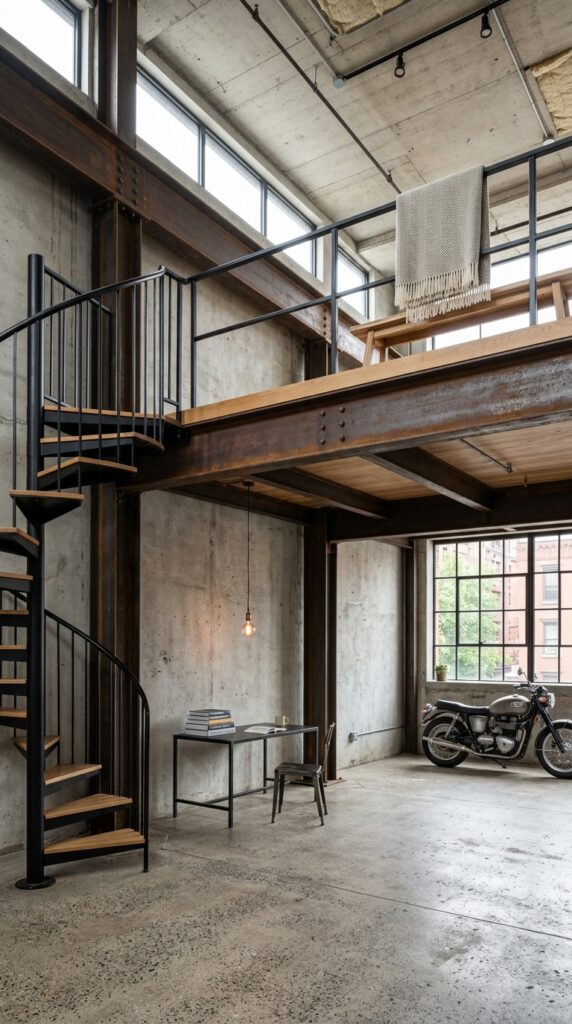
Vibe: Raw and load-bearing — this loft reads as engineered confidence.
Why it works: Structural steel I-beams are honest — they do the work visibly, and in a modern loft that visibility becomes the design statement. The contrast between heavy, dark steel and the lighter decking material above creates visual weight distribution that feels intentional. Exposed connections (bolt plates, gussets) add industrial detail without decoration.
How to get it: Source reclaimed or new wide-flange steel beams and have them sandblasted to remove mill scale, then sealed with a matte clear coat to prevent rust transfer. Pair the beam color — typically a warm charcoal or olive-black — with white oak or Douglas fir decking for warmth.
Shop the Look
| Product |
| Matte black steel pipe shelf bracket industrial heavy duty |
| White oak floating shelf natural edge modern |
| Concrete look floor paint epoxy charcoal gray |
| Industrial wire pendant light black steel Edison |
| Charcoal wool throw blanket chunky knit modern |
2. Warm Greige and White Oak Color Story
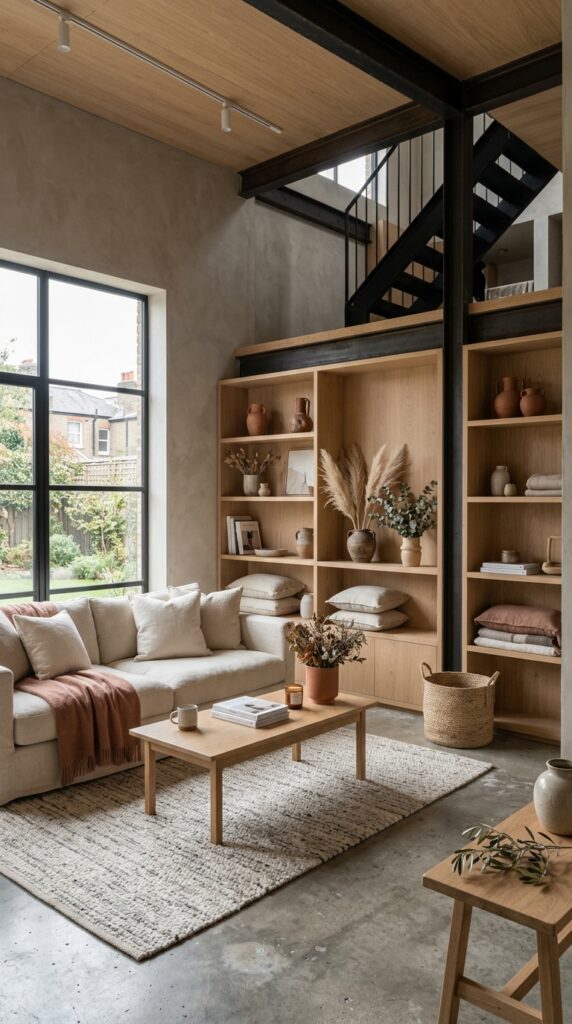
Vibe: Sun-warmed — like a working studio that has been lived in long enough to feel soft.
Why it works: Greige (warm beige with gray undertones, approximately Benjamin Moore HC-83 Pale Oak or Sherwin-Williams SW 7015 Repose Gray) works in garage lofts because it bridges the industrial structure with organic warmth. It reads neutral without going cold, and it makes white oak grain sing rather than yellow. The color relationship between greige walls and natural oak is low-contrast but high-texture — satisfying to look at from every angle.
How to get it: Start with the walls. Apply a limewash or matte plaster paint in warm greige (try Portola Paints Roman Clay in Parchment or Alabaster) rather than flat latex — the texture depth makes concrete-adjacent spaces feel intentional, not unfinished. Then layer white oak wherever possible: shelving, stair treads, a desktop.
💡 Quick Win: A single white oak floating shelf ($40–70 at IKEA or Home Depot) installed at eye level against a greige wall immediately reads “designed.” Add three objects — a ceramic, a small plant, one book spine-out — and the vibe arrives instantly.
Shop the Look
| Product |
| Limewash paint warm greige interior matte |
| White oak wall shelf floating natural finish modern |
| Terracotta ceramic vase matte modern minimalist |
| Cream linen throw pillow cover 18×18 natural |
| Dried pampas grass bunch boho modern neutral |
3. Ship’s Ladder Stair as Sculptural Element
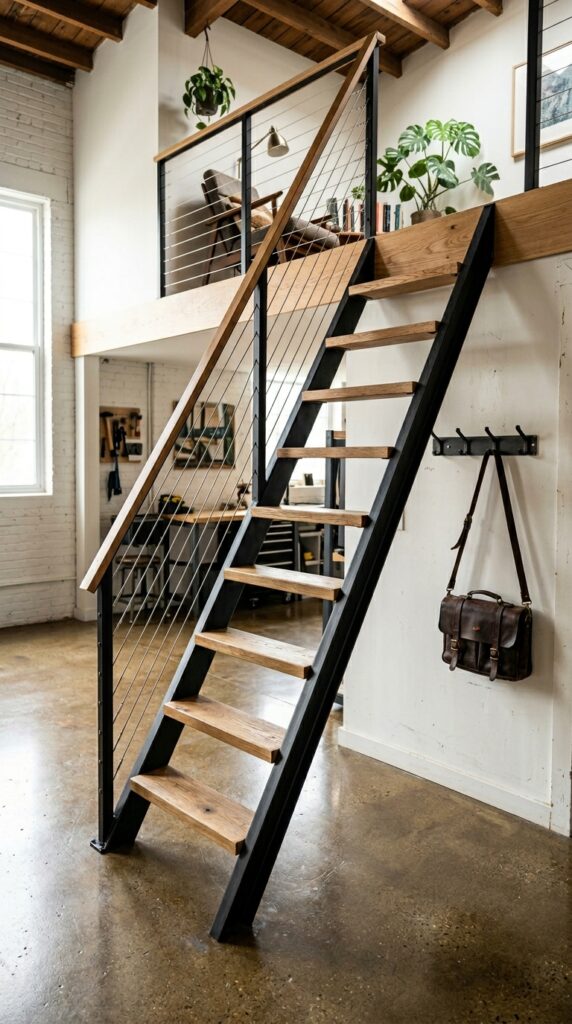
Vibe: Compact and purposeful — every inch is intentional.
Why it works: A ship’s ladder — steep (60–75° pitch) with alternating or perpendicular rungs — solves the single biggest small-garage loft problem: a conventional staircase eats 40–60 square feet of floor space. The ladder’s vertical profile takes roughly 8 square feet. Beyond function, the exposed steel and wood rung combination creates an object worth looking at. Visual weight is concentrated in a small footprint, leaving the floor plan breathing room.
How to get it: Fabricate from 1.5″ square steel tube with ¾” white oak dowel rungs, or purchase from a company like Ladder Loft or FGD Group. Mount a horizontal grab bar at loft-platform level for safe dismounting. Finish the steel in matte black powder coat and seal the oak rungs with Rubio Monocoat in Natural for durability.
Shop the Look
| Product |
| Wall mounted coat hook rack black steel industrial |
| Leather weekend bag tan minimalist unisex |
| Blackened steel bookshelf bracket heavy duty |
| Rubio Monocoat wood oil natural finish |
| Anti-slip stair tread tape black adhesive |
4. Polished Concrete Floor with Radiant Heat
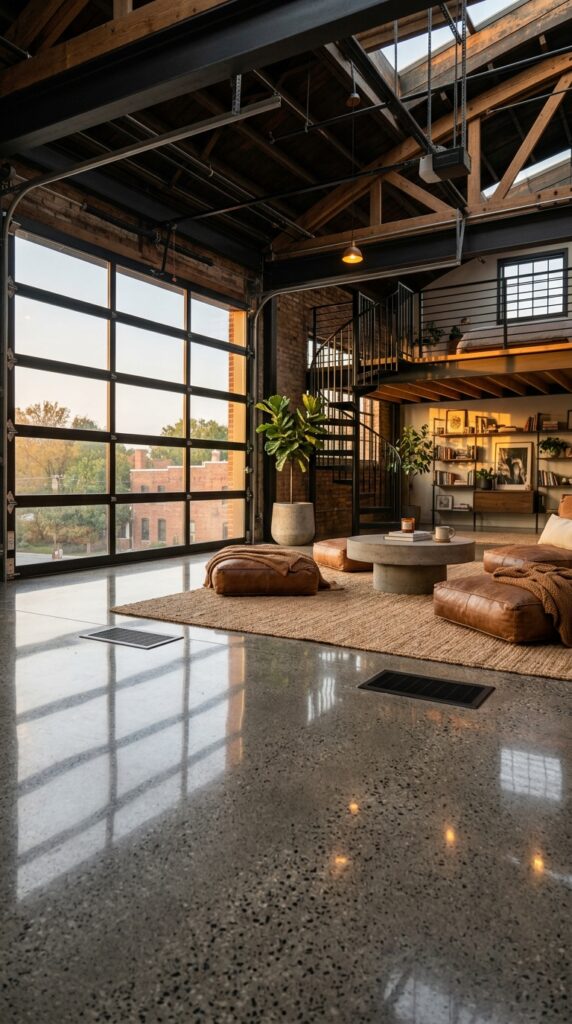
Vibe: Still — like the whole room exhales.
Why it works: Polished concrete at Level 3 or 4 (salt-and-pepper to cream aggregate visible) reflects light upward, which in a high-ceiling garage loft makes the space feel taller and more luminous rather than darker and cave-like. The self-leveling quality of concrete unifies the entire footprint visually — no grout lines, no transitions — which is the fastest way to make a converted garage read as intentional living space. Adding in-slab hydronic radiant heat eliminates the need for forced-air systems that would disrupt the loft’s clean aesthetic.
How to get it: If pouring new, specify a 4″ minimum slab with PEX tubing layout before pouring. If working with existing concrete, have it diamond-polished by a professional flooring contractor — expect $4–8 per square foot for a Level 3 finish in most markets.
Shop the Look
| Product |
| Natural jute area rug 8×10 chunky weave modern |
| Low profile concrete look coffee table rectangle |
| Leather floor cushion black modern meditation |
| Concrete planter large modern outdoor indoor |
| Black steel floor vent cover modern register |
5. Cable Railing System with Glass Panels
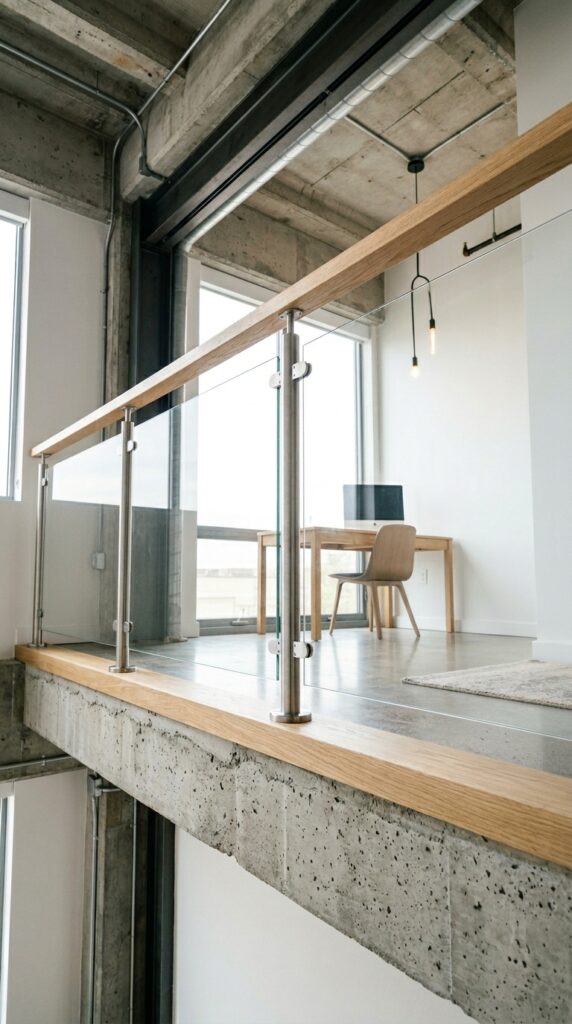
Vibe: Luminous — the whole upper level floats.
Why it works: The combination of 3/16″ stainless cable with tempered glass panels uses negative space as a design material. From below, you maintain sightlines to the loft above — the space reads as continuous rather than divided into two distinct rooms. This matters enormously in garage conversions where ceiling heights are often 12–18 feet: blocking that vertical visual flow with solid railings halves the perceived volume. Cable tension also creates an almost musical quality — horizontal lines that the eye reads as rhythm.
How to get it: Specify 1×19 stainless steel wire rope at 3/16″ diameter with swageless fittings — no welding required, fully DIY-possible with the right hand tools. Space posts no more than 36″ apart per most residential codes. Top rail in natural white oak (1.5″ × 3.5″ profile) ties the system to the wood elements elsewhere in the loft.
💡 Quick Win: Cable railing kits from DesignRail or Keuka Studios start around $150–200 per linear foot installed, with DIY hardware kits available from $40 per foot — a high-visual-impact detail that dramatically elevates the loft’s perceived quality.
Shop the Look
| Product |
| Stainless steel cable railing kit DIY deck modern |
| Tempered glass railing panel clear 36-inch |
| White oak handrail flat profile modern |
| Brushed nickel post cap stair modern |
| Adjustable cable tensioner stainless swageless |
6. Blackened Steel and Douglas Fir Desk Setup
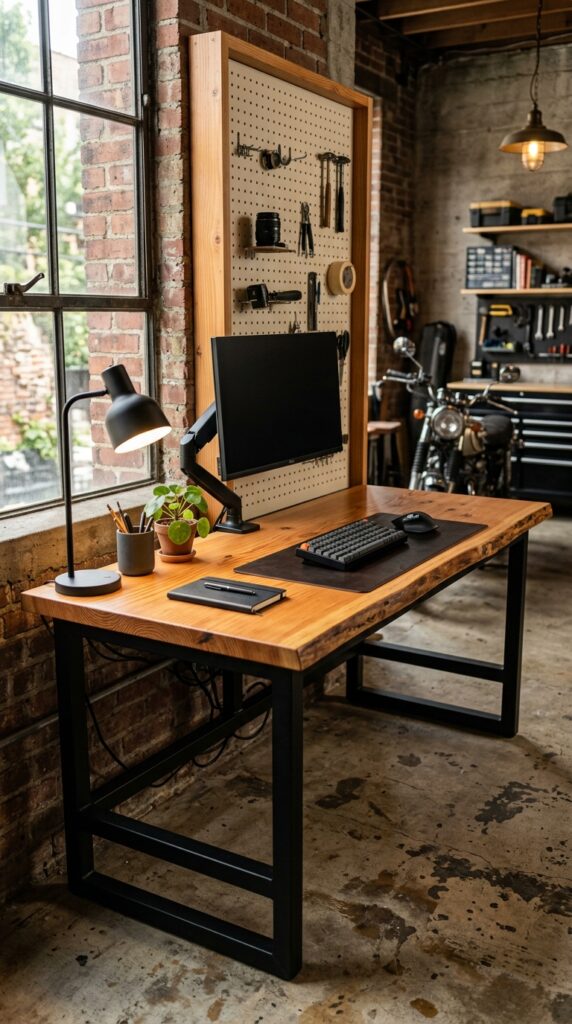
Vibe: Grounded — a workspace that makes you feel competent just by sitting at it.
Why it works: The contrast between amber-toned Douglas fir (tighter grain than pine, warmer than oak) and flat matte black steel creates visual tension through material honesty — each material is doing exactly what it does best, and the combination reads as purposeful rather than styled. The steel frame eliminates any visual bulk that a wood-only desk would carry, keeping the loft feeling open even with a large work surface.
How to get it: Weld or bolt a desk frame from 1.5″ square steel tube at 29.5″ height, prime with self-etching primer, finish with matte black powder coat. Source a Douglas fir slab from a local lumber yard — 1.5″ thickness is the minimum for a span over 36″. Seal with Waterlox Original Sealer/Finish in satin for durability without plastic-looking gloss.
Shop the Look
| Product |
| Matte black monitor arm dual or single articulating |
| Douglas fir live edge desktop slab natural |
| Leather desk pad mouse pad natural tan |
| Ceramic pen cup matte black minimalist |
| Adjustable LED desk lamp black articulating arm |
7. Pendant Lighting Cluster Over a Loft Seating Zone
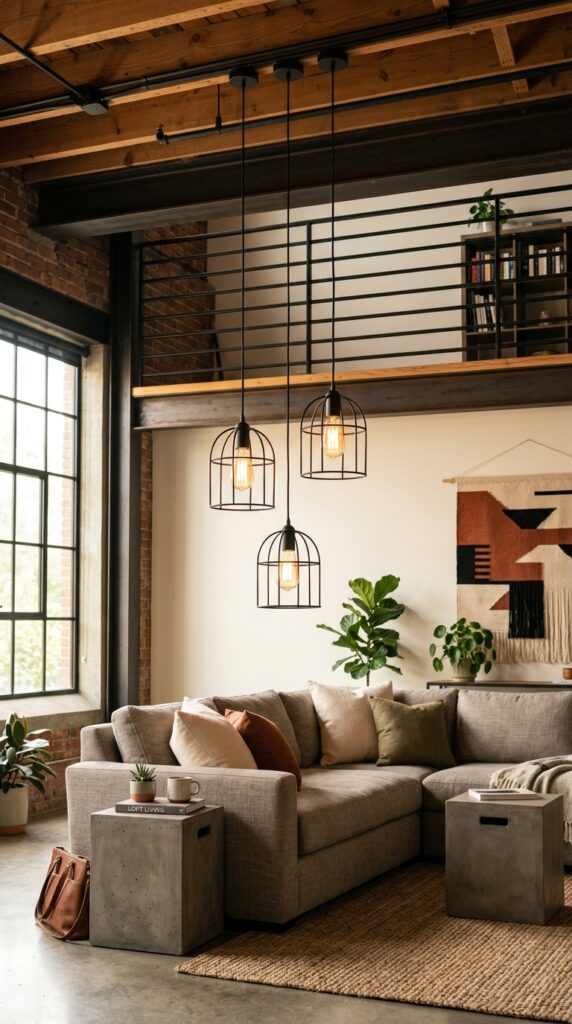
Vibe: Layered — the light makes the space feel inhabited.
Why it works: In a garage loft with 14+ foot ceilings, a single centered fixture reads as institutional. A cluster of pendants at varied drop heights (ranging 24″–48″ from ceiling) brings the light source down to human scale without lowering the ceiling visually. The staggered arrangement also creates movement — the eye travels from pendant to pendant before settling on the seating area below, which feels designed-for-habitation rather than merely lit.
How to get it: Run 3-5 pendant drops from a multi-canopy ceiling plate or individual surface-mount boxes wired to a single circuit with a dimmer. Use Edison-style 2700K LED bulbs (not incandescent — the heat in a closed space is significant). Vary drop lengths in 6″ increments for an organic, non-uniform cluster. Matte black cage pendants from brands like Schoolhouse or Rejuvenation hit this aesthetic precisely.
Shop the Look
| Product |
| Black cage pendant light industrial modern set of 3 |
| Smart dimmer switch compatible Philips Hue |
| Warm white LED Edison bulb 2700K vintage |
| Exposed conduit electrical pipe black steel |
| Abstract woven textile wall art neutral modern |
8. Micro-Unit Garage Loft Apartment Layout
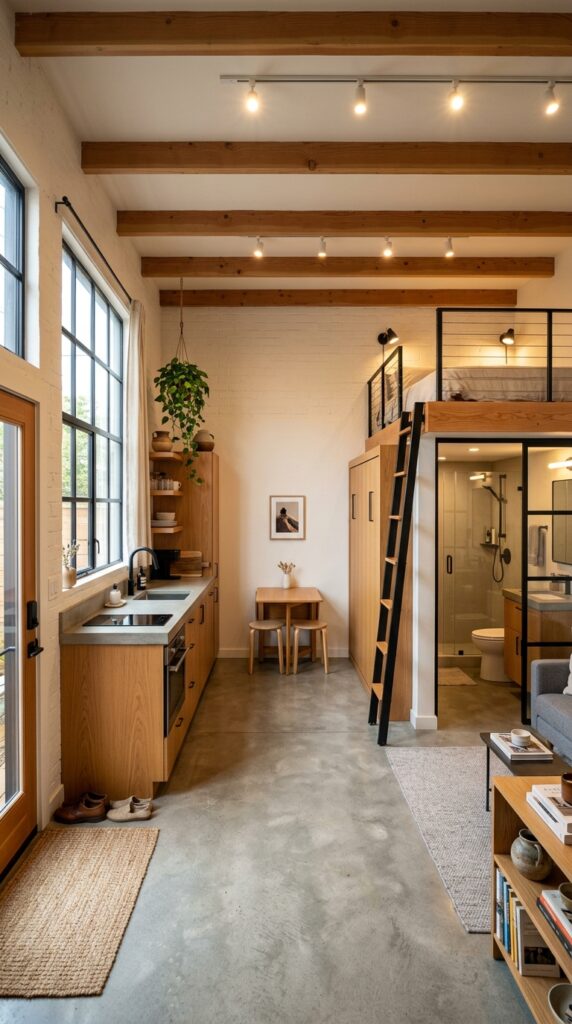
Vibe: Hushed — like a ship’s cabin that someone made into a home.
Why it works: A standard two-car garage (20’×20′ = 400 square feet) can accommodate a complete micro-unit when the vertical dimension is brought into the spatial equation. The loft platform — typically at 7’–8′ above finished floor — handles sleeping, while the lower level holds all activity zones. The key layout principle is zone compression with visual separation: each function zone is smaller than conventional but separated by material or level change rather than by walls, which preserves the open industrial volume that makes garage lofts feel special.
How to get it: Prioritize the kitchen placement first — it requires plumbing and ventilation, so it dictates where everything else goes. Position the loft platform over a non-kitchen, non-bathroom zone (typically above a living/work area). Use folding or wall-mounted furniture (Murphy bed, fold-down dining table) to recover square footage during different times of day.
💡 Quick Win: A wall-mounted fold-down desk from IKEA’s NORBERG series ($59) eliminates the need for a dedicated desk footprint — critical in sub-400 square foot garage loft conversions.
Shop the Look
| Product |
| Murphy bed kit queen wall mounted modern |
| Fold down wall mounted dining table small |
| Compact kitchen cabinet set flat panel modern |
| Over-toilet bathroom storage tower modern white |
| Hanging planter ceiling hook modern ceramic |
9. Concrete Block Accent Wall with Sealed Finish
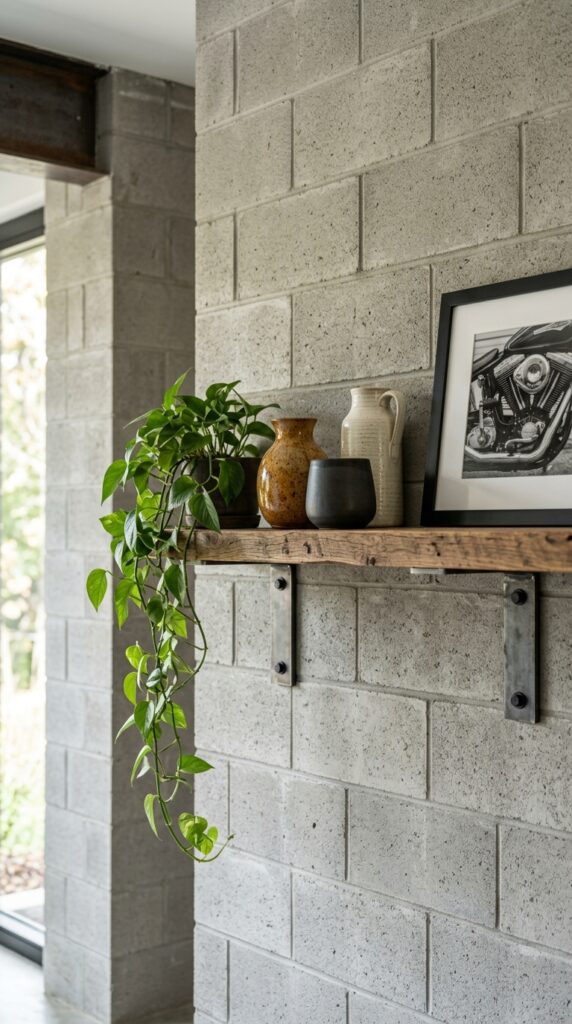
Vibe: Raw — intentionally incomplete in the most resolved way.
Why it works: CMU (concrete masonry unit) block accepts a matte sealer that deepens the aggregate color slightly while eliminating dust transfer — leaving the raw, architectural look intact. The block’s module (8″×8″×16″) creates a built-in grid that gives any attached shelving or hardware a visual datum to align to. Unlike painted drywall, sealed CMU reads as structural — the wall appears load-bearing even if it isn’t, which grounds the modern industrial aesthetic with genuine material honesty.
How to get it: If the garage already has CMU walls (many do), have the surface ground flat with a diamond grinder and apply Thoroseal Foundation Coating ($35/bag, covers 50–65 sq ft) in two coats for moisture resistance. Follow with a penetrating matte sealer. Mount shelves using ½” sleeve anchors set in pre-drilled holes.
Shop the Look
| Product |
| Concrete penetrating sealer matte clear masonry |
| Black powder coat shelf bracket heavy duty industrial |
| Ceramic sculptural vase set of 3 modern gray |
| Black and white art print abstract gallery modern |
| Trailing pothos plant pot hanging wall planter |
10. Track Lighting on Exposed Ceiling Joists
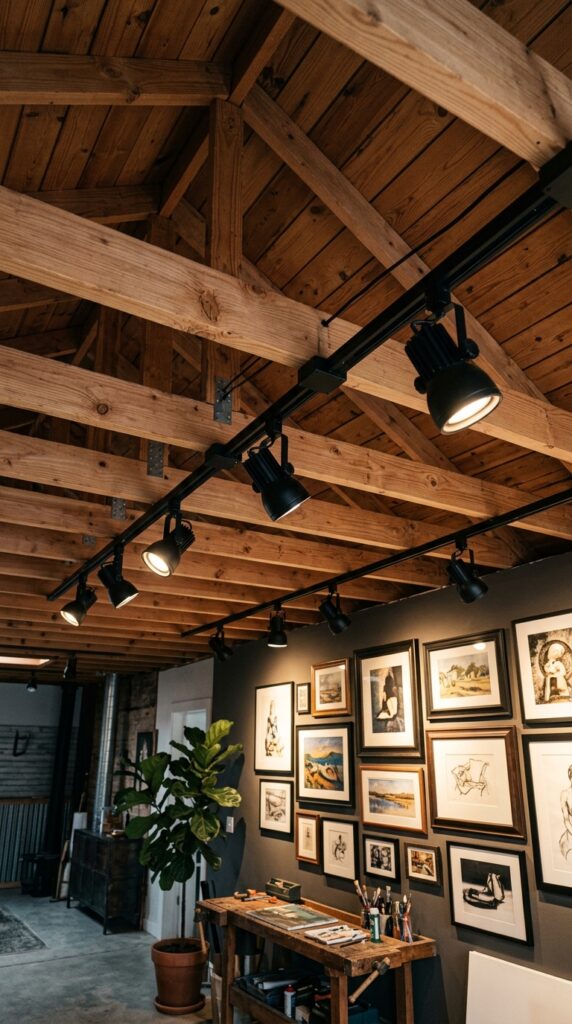
Vibe: Moody — a gallery that happens to be a garage.
Why it works: Track lighting on exposed joists solves the modern loft’s core lighting challenge: in a space with no drywall ceiling to recess fixtures into, track is the most flexible system available. Individual heads rotate 350°, allowing a single track run to serve multiple functions — highlighting a desk, washing a gallery wall, and providing general fill simultaneously. The exposed track itself, in matte black, becomes part of the industrial ceiling composition rather than something to hide.
How to get it: Run a straight 8-foot track section (Halo or Lithonia brands) parallel to the primary joist direction, mounted to a joist with toggle bolts. Specify 2700K–3000K LED PAR20 or GU10 heads with a narrow 25–36° beam angle for defined, non-spill task or accent light. Add a separate dimmer per track circuit for layered control.
Shop the Look
| Product |
| Matte black track lighting system adjustable heads |
| LED PAR20 spotlight bulb 2700K 36 degree beam |
| Gallery wall frame set mixed sizes black modern |
| Fiddle leaf fig plant medium indoor tall |
| Track lighting dimmer switch single pole |
11. Loft Sleeping Platform with Integrated Storage
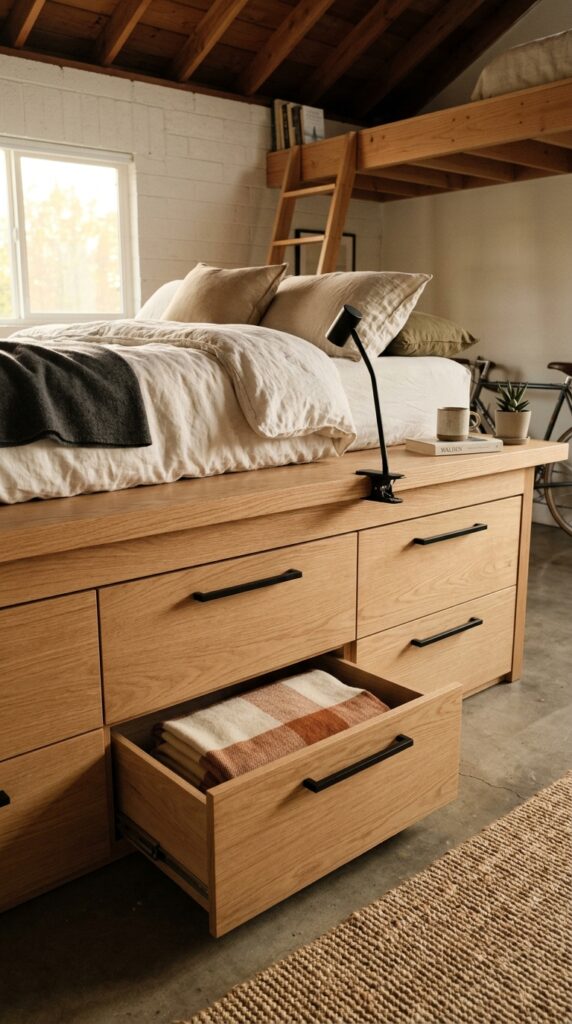
Vibe: Still — like a berth designed by someone who thought carefully about where everything goes.
Why it works: Building storage directly into the platform structure eliminates the need for any freestanding furniture in a sleeping loft, which matters because the sleeping zone — typically above a 7-foot platform — has limited headroom (often only 36″–48″ of clearance). Full-extension drawer slides mounted to the underside framing turn wasted structural depth into usable storage: a 12″-deep platform frame holds enough storage for a full wardrobe when combined with 6–8 drawers. This is the design principle of embedded function — objects that do two things simultaneously.
How to get it: Frame the platform with 2×8 lumber on 16″ centers, skin it with ¾” birch or oak plywood, and face the drawer fronts in matching solid-wood panels. Use soft-close undermount drawer slides rated for 75–100 lbs. Edge-band all exposed plywood edges with iron-on oak veneer tape for a furniture-quality appearance.
Shop the Look
| Product |
| Soft close drawer slides full extension undermount |
| Linen duvet cover set natural white queen king |
| Black bar pull drawer handle set modern minimalist |
| LED reading light clip-on rechargeable modern |
| Oak veneer iron-on edge banding roll natural |
12. Industrial Sliding Barn Door on Exposed Hardware
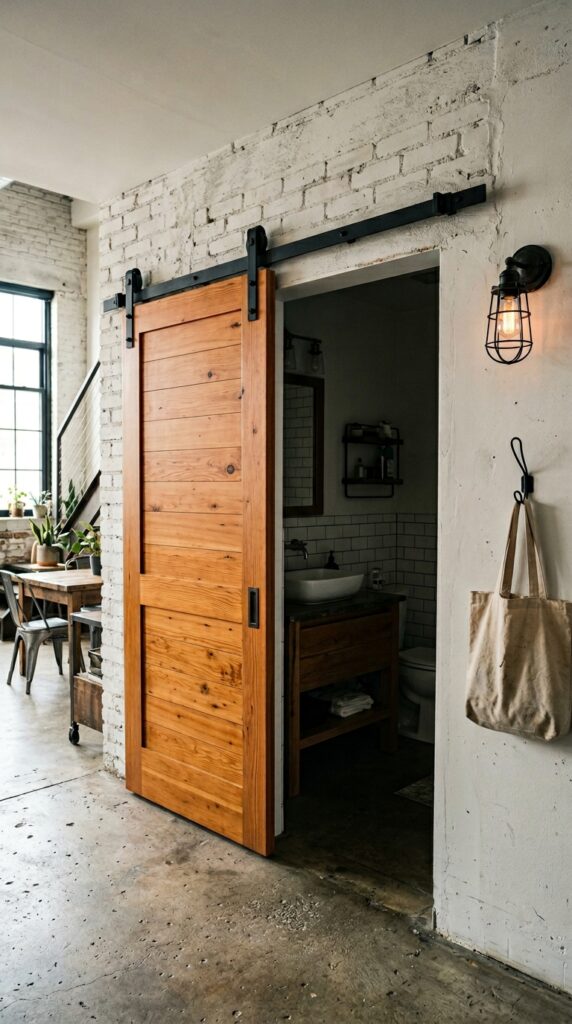
Vibe: Purposeful — the door announces the space it guards.
Why it works: Sliding barn doors solve the garage loft’s biggest privacy problem — the need to separate a bathroom or bedroom zone without swinging doors that consume floor space. The exposed track hardware in matte black becomes a deliberate design element: a linear rail that draws the eye along the wall and makes the transition from industrial structure to domestic space feel earned rather than arbitrary. The horizontal rail pattern on the door itself creates visual rhythm that echoes the structural geometry of the loft.
How to get it: Build the door panel from 1×6 Douglas fir tongue-and-groove boards face-mounted to a Z-brace frame (two diagonals + top rail). Order a bypass barn door hardware kit — track length should be double the door width to allow full clearance. Sand the fir to 120 grit and finish with Rubio Monocoat in Walnut for a warm, amber tone that deepens over time.
💡 Quick Win: A pre-made bypass barn door hardware kit from National Hardware or Richelieu runs $80–130 and fits standard 1¾” door thickness — significantly cheaper than custom fabrication and fully DIY-installable in an afternoon.
Shop the Look
| Product |
| Matte black barn door hardware track kit bypass |
| Douglas fir tongue groove board 1×6 natural |
| Industrial wall sconce black steel modern |
| Steel wall hook single matte black modern |
| Barn door floor guide bottom roller no drill |
13. Clerestory Window Wall for Natural Light
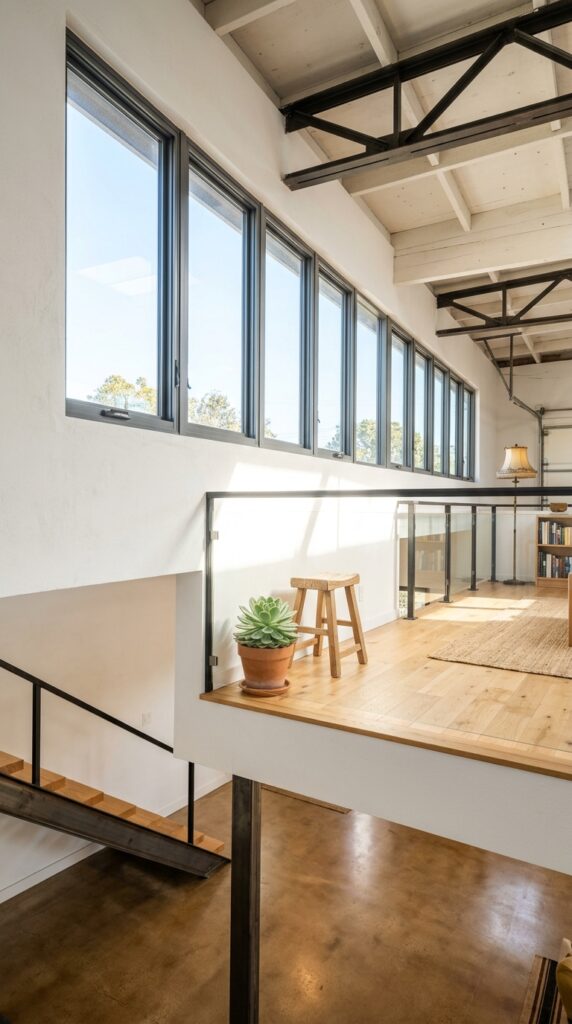
Vibe: Luminous — the whole space exhales when the light comes through.
Why it works: Clerestory windows (installed above normal head height, typically at 8’–10′ above floor in a 12’–14′ garage) solve a critical problem in garage-to-loft conversions: the original building may have had no windows above the garage door, leaving the upper level dark. A band of fixed clerestory glazing introduces natural light at the level where the loft platform lives, washing the sleeping or working surface in direct sunlight during morning hours. Because clerestory light enters from above and washes down, it creates a gradient — brighter at the top, softer below — that reads as sophisticated and architecturally considered.
How to get it: Standard 36″×12″ fixed aluminum-frame windows work perfectly for clerestory bands and can be installed by a competent DIYer by cutting the stud bays, installing a header, and framing the rough opening. Run them in a continuous horizontal band rather than centering individual windows for maximum visual impact.
Shop the Look
| Product |
| Aluminum frame fixed glass window modern thin profile |
| White interior window trim modern flat casing |
| Succulent plant set small modern indoor |
| Minimal wooden stool natural oak modern |
| Low-VOC white wall paint flat finish |
14. Slate Blue Accent Wall on Upper Loft Level
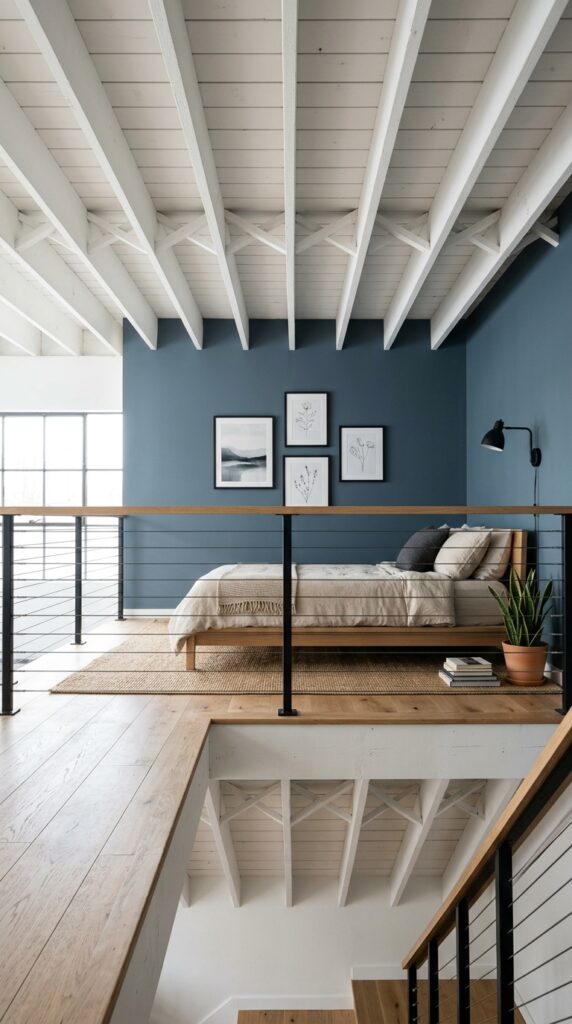
Vibe: Serene — the color tells the body to slow down.
Why it works: Placing a deep color accent wall on the upper loft level rather than the lower level uses color’s visual weight correctly — dark tones appear to lower and compress a surface, so a dark blue on the upper loft wall makes that level feel cozier and more enclosed (appropriate for sleeping), while the lower level remains visually expansive. This is the design principle of color as spatial modifier: using hue and value to shape perceived volume without structural change. The contrast between slate blue above and warm white below also creates a clear visual horizon line that gives the two-level space a sense of vertical order.
How to get it: Benjamin Moore Newburyport Blue HC-155 or Farrow & Ball Hague Blue No. 30 applied in matte finish (not eggshell) will absorb light in a way that makes the sleeping loft feel cocoon-like. Apply two coats of shellac primer first on any concrete or CMU surfaces — the alkalinity will cause standard primers to fail.
Shop the Look
| Product |
| Slate blue wall paint matte interior sample pint |
| Black frame gallery wall set 5×7 8×10 modern |
| Low profile platform bed frame natural oak modern |
| Shellac-based primer spray interior sealer |
| White linen pillow sham set minimalist modern |
15. Pegboard Organization Wall in Workshop Loft
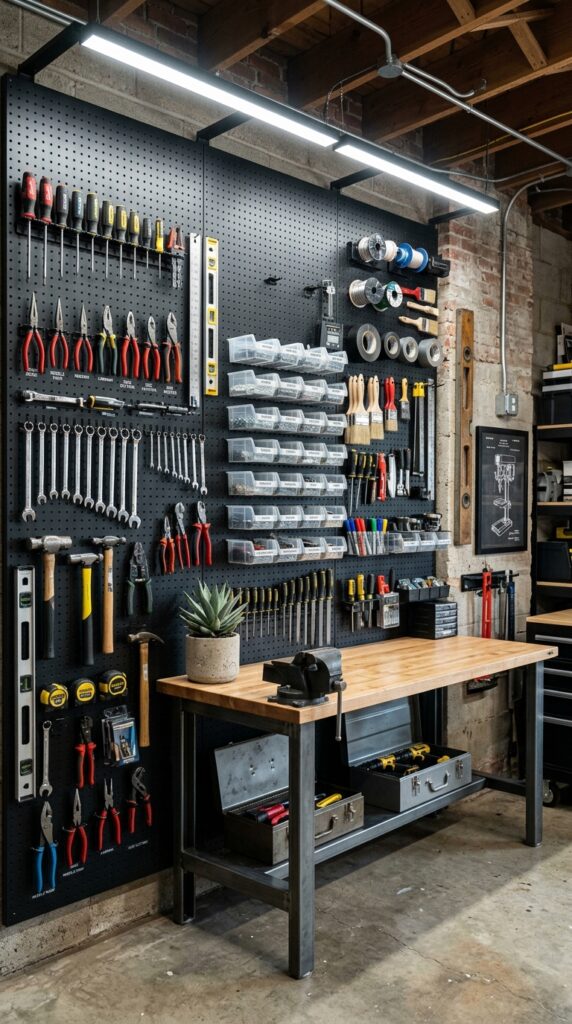
Vibe: Grounded — a place where work actually gets done, and you can tell.
Why it works: Steel or powder-coated metal pegboard (not the Masonite variant from hardware stores) is load-rated for up to 100 lbs per square foot and resists oil, humidity, and the temperature swings common in garage environments. The modular hook system embodies the modern principle of adaptive flexibility: the organization system reconfigures as the work changes, which is essential in a garage loft that may serve as workshop, studio, or hobby space over time. Visually, a full-height pegboard wall reads as an architectural feature — purposeful and graphic — rather than functional clutter.
How to get it: Source ¼” steel pegboard panels in 2’×4′ or 4’×8′ sheets from FlexiMounts or REIBII. Mount on 1″ standoff spacers from the wall using ½” toggle bolts into studs. Coordinate all hooks and bins in a single color (matte black or brushed steel) for visual unity — mixing finishes destroys the graphic quality.
💡 Quick Win: Replace all existing mismatched garage storage with a single $45 REIBII steel pegboard panel and a matching hook kit — the visual transformation from cluttered to organized is immediate and dramatic.
Shop the Look
| Product |
| Metal pegboard panel black steel 2×4 modular |
| Pegboard hook set assorted black powder coat |
| Pegboard bin container set black organizer |
| Steel workbench with shelf adjustable height |
| Vintage steel level wall art industrial decor |
16. Open-Riser Wood and Steel Staircase
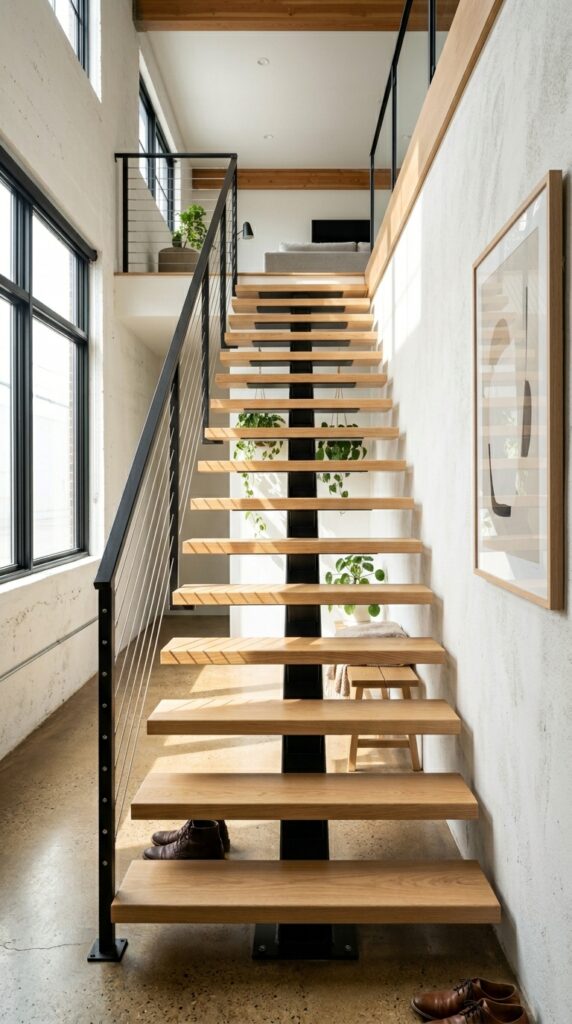
Vibe: Airy — the stairs seem to climb without effort.
Why it works: Open-riser stairs use negative space as a structural material — the absence of risers makes the staircase visually lightweight, which in a garage loft (where stairs are often the most spatially prominent element) prevents the stair from dominating the room. The monostring steel stringer (a single welded plate running beneath the treads) concentrates all visible structure in one thin plane, reinforcing the sense of lightness. Light passes through the treads from multiple directions, which connects the lower and upper levels visually even when no one is on the stair.
How to get it: A monostring staircase requires 3/16″ or ¼” steel flat bar (typically 10″–12″ wide) welded with tread support brackets, then anchored to a concrete floor at the base and a structural beam at the top. Treads should be a minimum 1.5″ thick white oak for rigidity without bounce. Have the stringer hot-dip galvanized then powder-coated matte black for longevity.
Shop the Look
| Product |
| White oak stair tread solid wood 36 inch unfinished |
| Stair tread non-slip adhesive pad clear modern |
| Black steel stair bracket floating tread hardware |
| Wall mounted hanging planter modern indoor |
| Gallery art print black frame abstract minimal |
17. Warm Amber Lighting with Edison Filament Bulbs
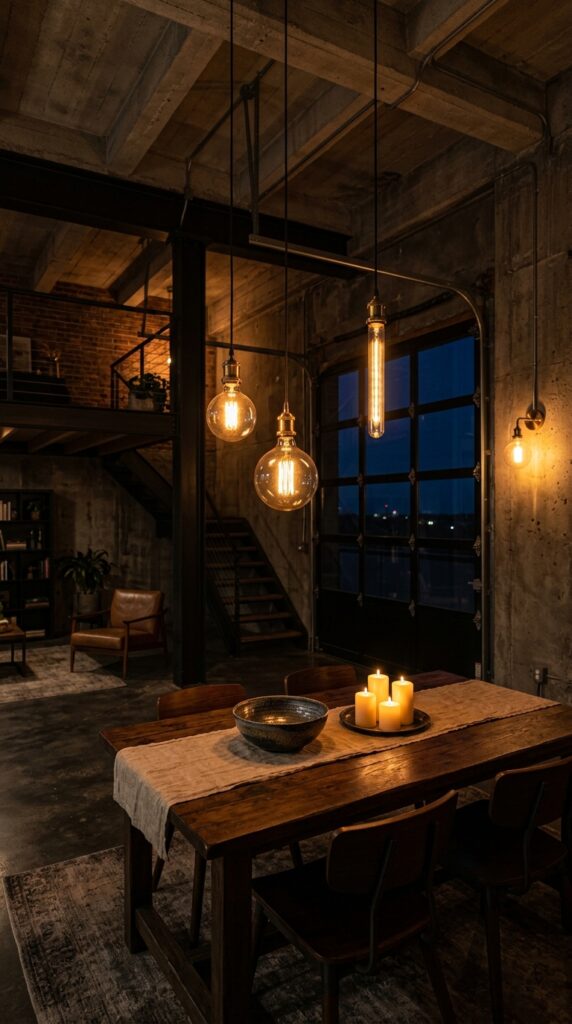
Vibe: Warm — the room feels like it’s holding its breath in the best way.
Why it works: 2200K filament-style LED bulbs create a light quality that is dramatically different from the 4000K–5000K cool white that garage spaces usually have. At 2200K, shadows are deeper, surfaces glow rather than illuminate, and the industrial materials — concrete, steel, dark wood — take on warmth that makes them feel inhabitable rather than institutional. Strategically, amber lighting performs best against the cool-gray and charcoal palette of modern garage lofts because it introduces contrast across the warm-cool spectrum without requiring any color on the walls.
How to get it: Replace all fixtures with 2200K–2400K LED filament bulbs. Feit Electric’s ST19 and G25 globe styles offer the most visible filament. Wire all fixtures to a single Lutron Caseta dimmer circuit so the entire loft’s warmth can be dialed up or down — at 20% dim, the 2200K color temperature shifts even warmer toward 1800K for evening ambiance.
Shop the Look
| Product |
| LED Edison filament bulb 2200K ST19 vintage |
| Lutron Caseta smart dimmer switch single pole |
| Globe pendant light clear glass black socket |
| Dark walnut wood dining table modern solid |
| Ceramic serving bowl large matte modern neutral |
18. Garage Door Glass Panel Upgrade for Interior Light
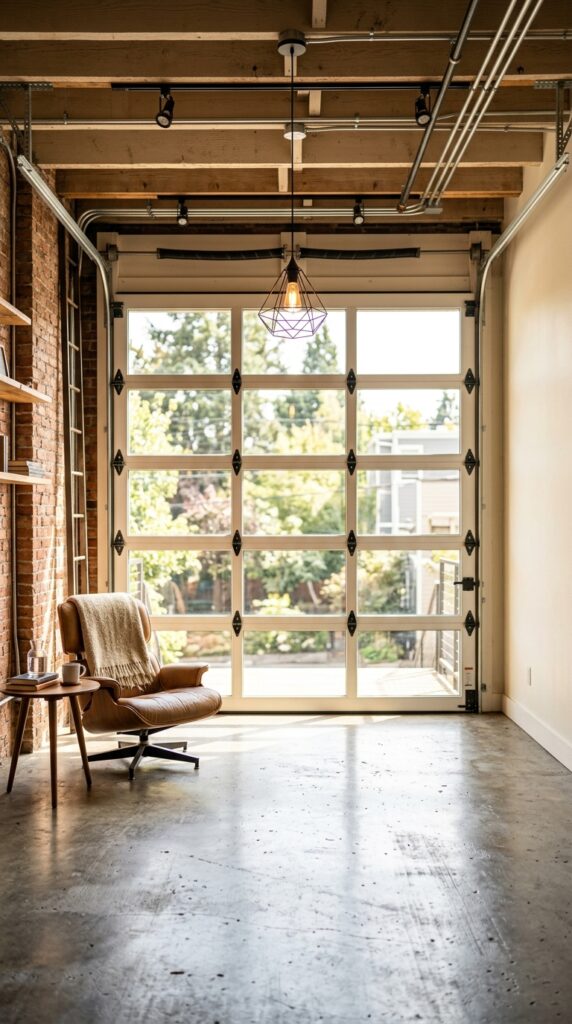
Vibe: Luminous — the whole room is a window.
Why it works: A full-view aluminum glass garage door is the single highest-impact light intervention in a garage loft conversion. A standard 16’×7′ opening glazed with clear tempered lites introduces north or south light (depending on orientation) across the entire facade — effectively replacing a solid wall with glass. The aluminum frame continues the industrial language of the loft’s steel structure, while the glass visually extends the interior floor plane to the driveway or yard beyond, making even a modest garage footprint read as significantly larger than its actual square footage.
How to get it: Clopay’s Avante Series and Wayne Dalton’s Model 8450 are the most accessible full-view glass garage door systems available through big-box dealers. Specify low-E glass (not clear) if the door faces west or south — low-E reduces heat gain by 60–70% without changing the visible light quality significantly. Expect $2,500–$5,000 installed for a standard double-car width.
💡 Quick Win: Even replacing just the top two horizontal sections of an existing garage door with glass panels (a “lite kit”) adds significant natural light for under $400, without replacing the entire door.
Shop the Look
| Product |
| Full view glass garage door section insulated aluminum |
| Low-e glass garage window insert panel kit |
| Modern reading chair minimalist low profile linen |
| Ceiling hanging pendant hook swag kit adjustable |
| Concrete floor cleaner degreaser industrial |
19. Floating Wall-Mounted Shelving System
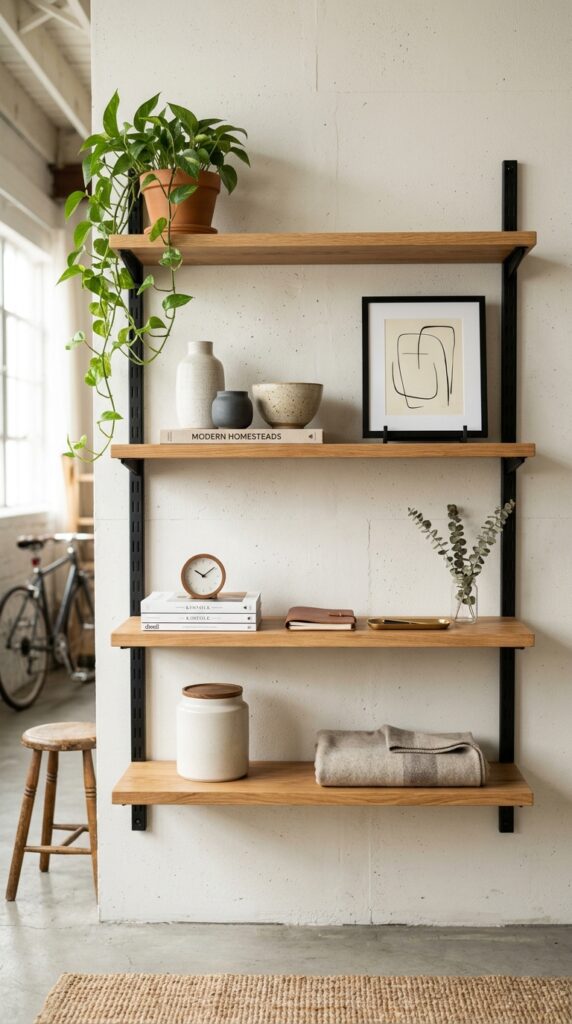
Vibe: Still — a wall that knows exactly what it wants to hold.
Why it works: Wall-mounted shelving removes legs from the floor plane entirely, which in a garage loft (where floor space is often the scarce resource) is the most efficient possible use of vertical wall surface. The modular rail system allows shelf height to be reconfigured without new holes — critical in a multi-use space where storage needs shift. The combination of matte black steel rails and solid white oak boards creates a warm-industrial balance: the steel provides precision and visual weight, the oak introduces natural warmth that prevents the system from reading as storage-room functional.
How to get it: Rakks, Capita, and HAY’s New Order system all offer wall-mount rail shelving in matte black. Mount rails into studs at 16″ on-center spacing using 3″ structural screws. Source solid white oak boards (not veneer) from a hardwood dealer — 1.5″ thick, 10″–12″ deep — and finish with two coats of Osmo Polyx-Oil in 3062 Clear Satin for a water-resistant, furniture-quality surface.
Shop the Look
| Product |
| Wall mounted shelving bracket rail system black steel |
| Solid white oak shelf board natural modern 12 inch |
| Trailing pothos hanging shelf plant small pot |
| Ceramic bud vase set of 3 matte off white |
| Coffee table architecture book modern design |
20. Dual-Zone Layout: Work Below, Sleep Above
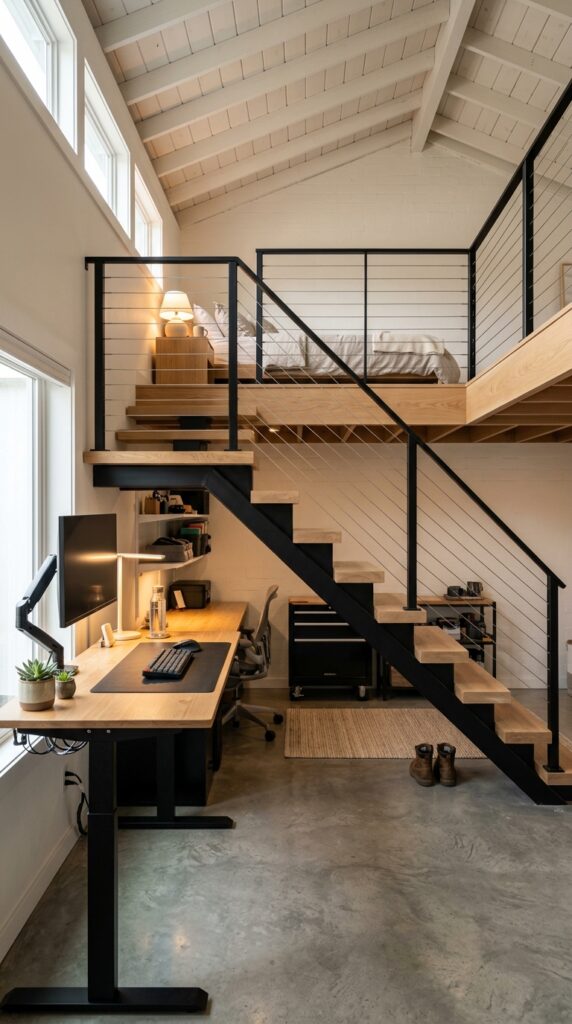
Vibe: Efficient — every cubic foot is earning its keep.
Why it works: Separating the work and sleep zones vertically rather than horizontally uses the garage loft’s most valuable asset — its height — while keeping the floor plan simple. The visual and acoustic separation between levels is meaningful even without a physical wall: the act of climbing a stair creates a cognitive reset between work mode and rest mode that a horizontal layout (work area behind a curtain, sleeping behind a bookcase divider) rarely achieves as effectively. This is the design principle of level-as-boundary: vertical movement performs the same separating function as a door.
How to get it: Position the work zone on the lower level directly beneath the loft platform — the overhead platform provides acoustic dampening and visual enclosure that makes the work zone feel purposeful. Place the loft sleeping platform over the quietest corner (away from the garage door and any mechanical equipment). Minimum platform clearance for sleeping: 36″ — 42″ is preferable for seated comfort.
Shop the Look
| Product |
| Standing desk converter black adjustable modern |
| Monitor arm single black matte cable management |
| Linen comforter duvet set white queen modern |
| Small nightstand shelf floating oak wall mounted |
| Cable management desk clips adhesive black |
21. Concrete Countertop Wet Bar on Lower Level
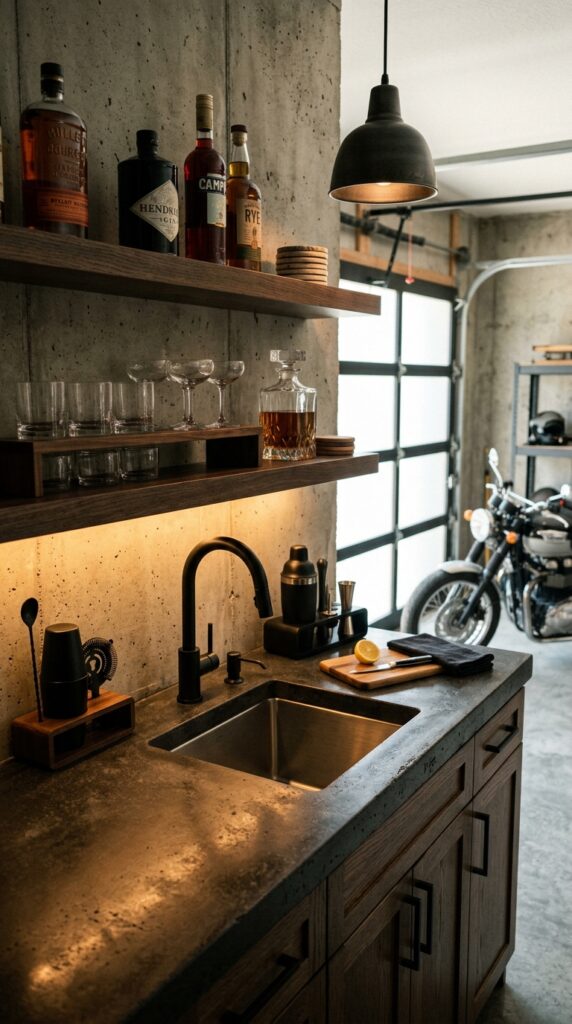
Vibe: Grounded — a bar that takes itself exactly as seriously as it should.
Why it works: A wet bar on the lower level of a garage loft serves dual function: it extends the social and hospitality uses of the space while also housing the only plumbing in the lower level, which simplifies rough-in costs significantly (the pipe runs stay on one level). Poured concrete countertops are one of the rare materials that look better in a garage context than in a conventional kitchen — the rawness of the concrete is appropriate to the industrial loft aesthetic rather than something to disguise with more refined materials. The charcoal-tinted finish deepens the visual weight at counter level, grounding the composition.
How to get it: DIY concrete countertop mixes from Buddy Rhodes or Quikrete countertop mix can produce professional results in a standard mold pour. Seal with Countertop Epoxy or a penetrating polyurea sealer for food-contact durability. Matte black fixtures (Kohler Purist or Kingston Brass Concord series) tie the bar hardware to the rest of the loft’s matte black finish scheme.
Shop the Look
| Product |
| Concrete countertop mix Buddy Rhodes DIY kit |
| Matte black bar faucet modern single hole |
| Undermount bar sink stainless steel small |
| Clear glass whiskey decanter set modern |
| LED under cabinet light strip warm white adhesive |
22. Acoustic Panel Ceiling Treatment
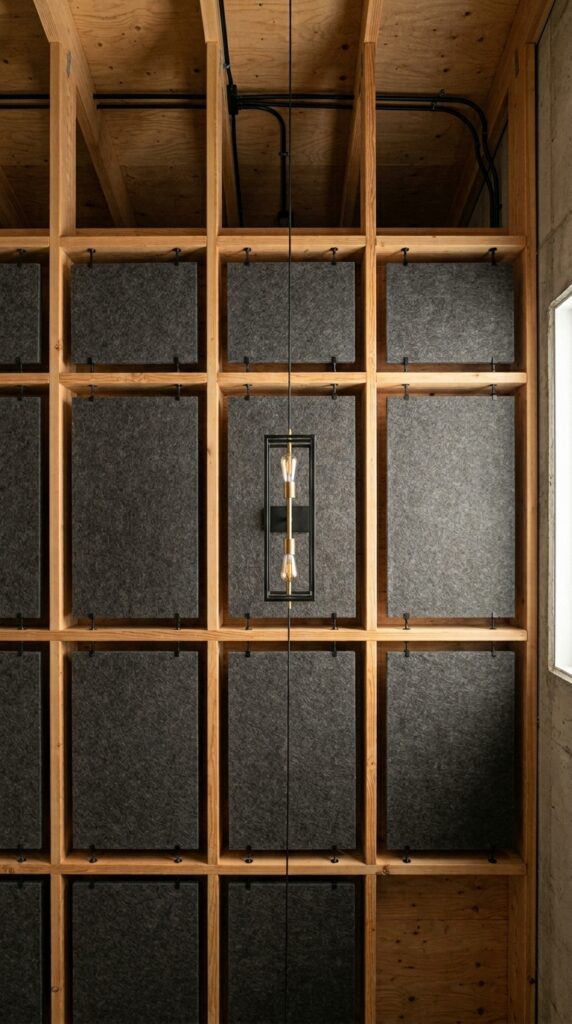
Vibe: Hushed — the sound of the room changes before you notice you’re listening.
Why it works: Concrete, steel, and wood — the primary materials of a modern garage loft — are all acoustically reflective. Without treatment, the space will have a reverberation time of 1.5–2.5 seconds (comparable to a medium bathroom), which makes conversation, music, and focus work exhausting. Ceiling-mounted acoustic panels in architectural felt reduce reverberation time to under 0.6 seconds with 40–50% coverage. Crucially, in a modern loft aesthetic, the panels become a design element: the grid of felt panels between exposed joists reads as a texture composition rather than foam on a ceiling.
How to get it: Guilford of Maine’s Anchorage series or BAUX Acoustic Tiles offer architectural-quality felt panels in a range of neutral tones. Mount 2’×4′ or custom-cut panels to ¾” plywood backer boards, then hang with black J-hooks screwed into joists. Warm charcoal or heathered gray panels complement the loft’s material palette without competing with it.
💡 Quick Win: Two 24″×48″ acoustic panels from FOAM FACTORY or ATS Acoustics ($35–50 each) hung above a work or conversation zone reduce reflection meaningfully — you’ll feel the difference before you measure it.
Shop the Look
| Product |
| Acoustic panel felt wall ceiling tile charcoal gray |
| Ceiling panel hanging kit black hook hardware |
| Acoustic ceiling tile adhesive mounting strip |
| Geometric pendant light black steel minimal |
| Architectural felt fabric by the yard charcoal |
23. Rustic-Industrial Mixed Wood Tones
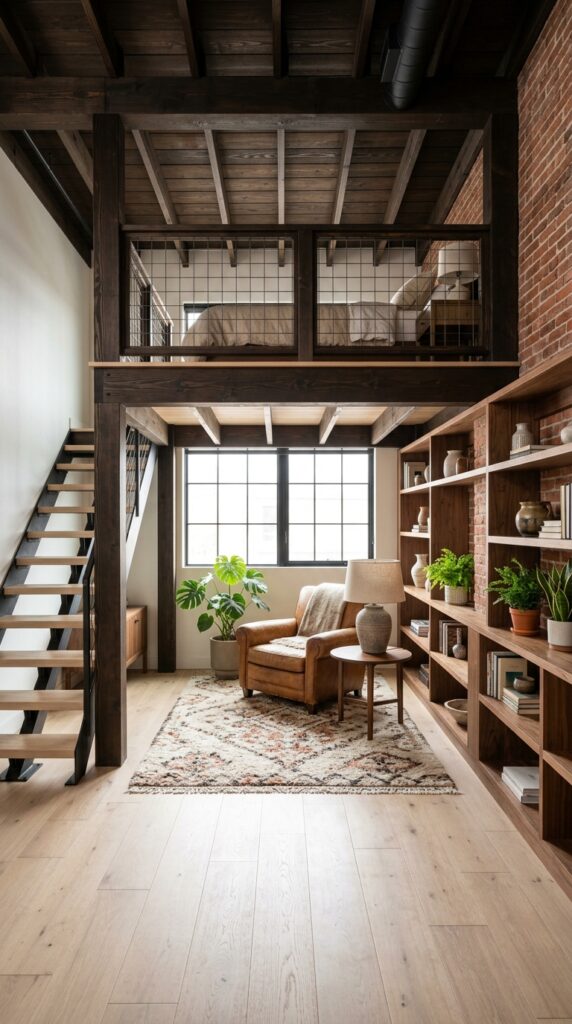
Vibe: Layered — like a room that was built over time by someone with taste.
Why it works: Mixing wood tones is the most misunderstood element of modern interior design, and in garage lofts it is almost inevitable — the structural lumber, the decking, and the furniture are rarely the same species. The rule isn’t to match woods; it’s to separate them with contrast. A pale white oak floor works beside dark walnut shelving because the value difference (light vs. dark) is so large that the eye reads them as categorically different rather than accidentally mismatched. The mistake is choosing two medium-toned woods (warm pine next to medium oak) where the proximity of tones creates visual tension without resolution.
How to get it: Choose three wood tones that span the value range: light (white oak or maple), medium (natural oak or Douglas fir), dark (walnut or espresso-stained pine). Apply them to different elements — flooring, shelving, structural accents respectively — so the logic of the tonal layering is immediately legible.
Shop the Look
| Product |
| Walnut floating shelf board natural oiled solid |
| White oak engineered hardwood floor plank modern |
| Dark leather accent armchair mid-century modern |
| Wool area rug 6×9 natural heathered gray modern |
| Ceramic table lamp matte off-white modern |
24. Zinc and Copper Metal Accent Details
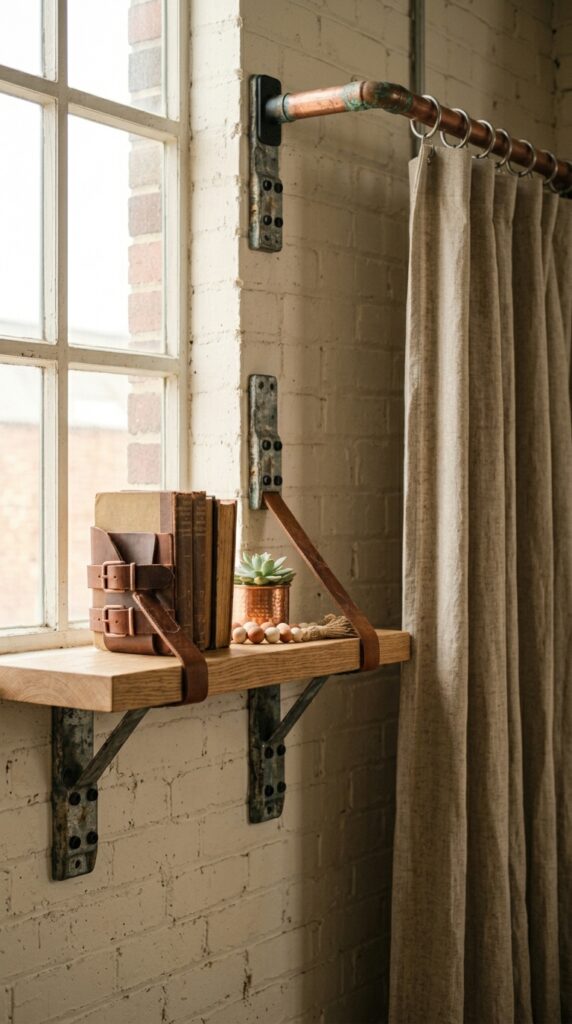
Vibe: Raw — the room feels like it was built by someone who understood materials.
Why it works: Zinc and copper are patinating metals — they age visibly and continuously, developing surface character that manufactured finishes can’t replicate. In a modern garage loft aesthetic, this aging quality is precisely the point: the materials are honest about time and use. Zinc develops a soft matte pewter-gray patina; copper moves through salmon, amber, and eventually toward verdigris green. Using them as accent details (hardware, small shelf brackets, pipe runs) introduces warm metallic tones that balance the cooler stainless or black steel found in structural elements, preventing the palette from reading as too monochromatic.
How to get it: Source raw copper pipe at any plumbing supplier and use it as curtain rods, shelf supports, or small decorative items — no treatment required, it will age on its own. Zinc sheet metal (26-gauge) can be cut to size and used as a countertop insert or shelf liner. Seal copper items you want to keep at their current patina stage with Everbrite Metal Coating in satin.
Shop the Look
| Product |
| Raw copper pipe 3/4 inch curtain rod modern DIY |
| Zinc sheet metal 26 gauge flat modern shelf liner |
| Copper succulent planter small modern |
| Leather book strap holder decorative modern |
| Everbrite metal coating clear satin sealer |
25. Murphy Bed with Built-In Desk for Studio Loft
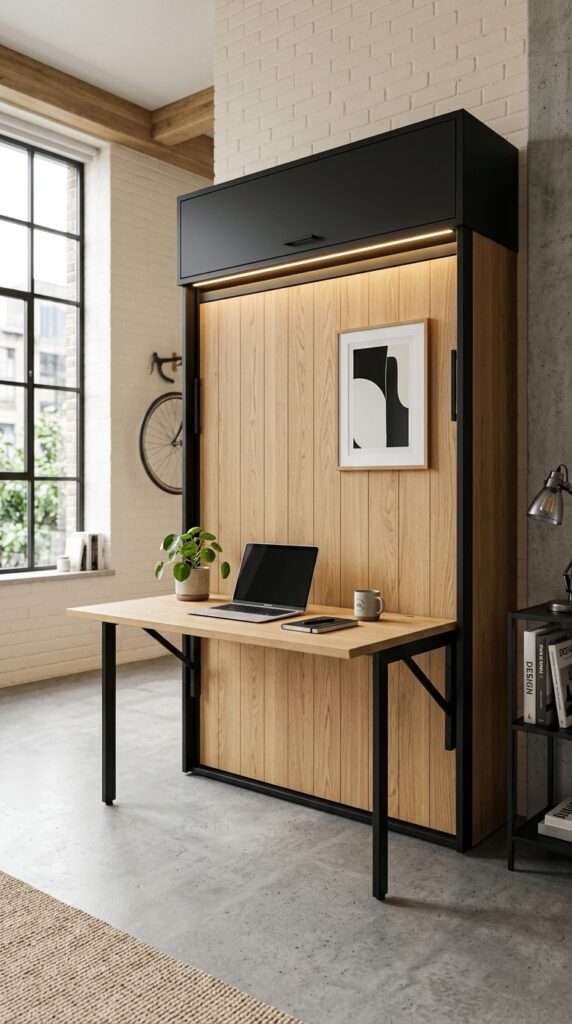
Vibe: Efficient — the room reconfigures itself with a single gesture.
Why it works: The Murphy bed and fold-down desk combination is the most space-efficient solution for a studio garage loft where the lower level needs to serve both work and sleep functions. When the bed is raised, the desk surface deploys from the face panel, converting the sleeping zone into a full work station. The entire function shift happens in one plane of the wall, leaving the floor plan completely clear — and in a 200–400 square foot studio loft, an unobstructed floor plan is what separates a space that feels livable from one that feels cramped.
How to get it: Resource Furniture, Clei, and BedderWall all make studio Murphy bed + desk systems in modern finishes. For DIY, the Create & Barrel Murphy system ($800–1,200) provides hardware kits that can be fitted with custom-made cabinetry fronts in any material — specify ¾” white oak plywood panels with matching edge banding for a custom-built appearance at a fraction of the cost.
💡 Quick Win: Adding a puck-style magnetic push-catch to existing Murphy bed hardware (about $8 at Rockler Woodworking) eliminates the most common complaint — the bed rattling open under its own weight — instantly improving the daily-use experience.
Shop the Look
| Product |
| Murphy bed hardware kit queen wall mount DIY |
| Fold-down desk wall mounted white oak modern |
| Magnetic push catch cabinet hardware modern |
| LED light strip under cabinet warm white USB |
| Small modern desk plant succulent concrete pot |
26. Shou Sugi Ban Wood Feature Wall
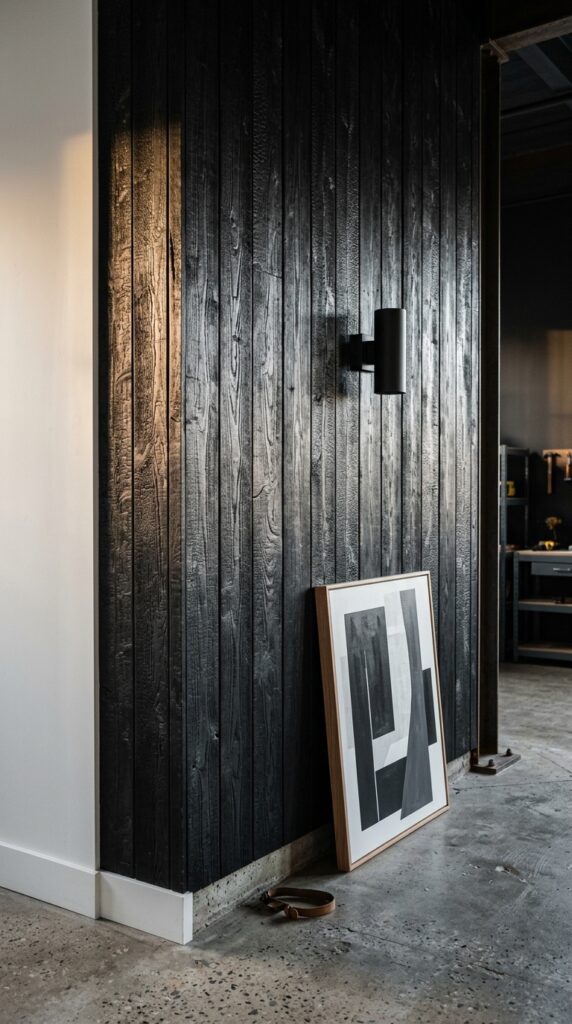
Vibe: Moody — the wall holds light like embers.
Why it works: Shou sugi ban (Japanese charred wood technique, or “yakisugi”) creates a surface with a paradoxical quality: it is deeply black at the macro scale but reveals complex silver and amber grain at close range. This dual visual register — bold from across the room, intricate up close — makes it one of the most visually rewarding wall materials in modern interior design. In a garage loft where other surfaces are concrete or plaster, the charred wood introduces organic texture and deep color contrast without requiring paint or applied decoration.
How to get it: Shou sugi ban cedar planks are available pre-charred through suppliers like Pioneer Millworks or Finish Systems. Alternatively, torch standard 1×6 cedar boards with a propane torch to your desired char depth, wire-brush the surface to reveal grain, and seal with Rubio Monocoat Pure Oil at 1:3 dilution to protect without glossing. Install vertically with a 1/8″ gap between boards for shadow-line depth.
Shop the Look
| Product |
| Shou sugi ban charred cedar plank wall cladding |
| Propane torch plumbing canning outdoor DIY |
| Wire brush wood finishing grain texture tool |
| Black wall sconce industrial modern up-down |
| Lean-against canvas artwork abstract modern large |
27. Retractable Glass Wall System for Indoor-Outdoor Living
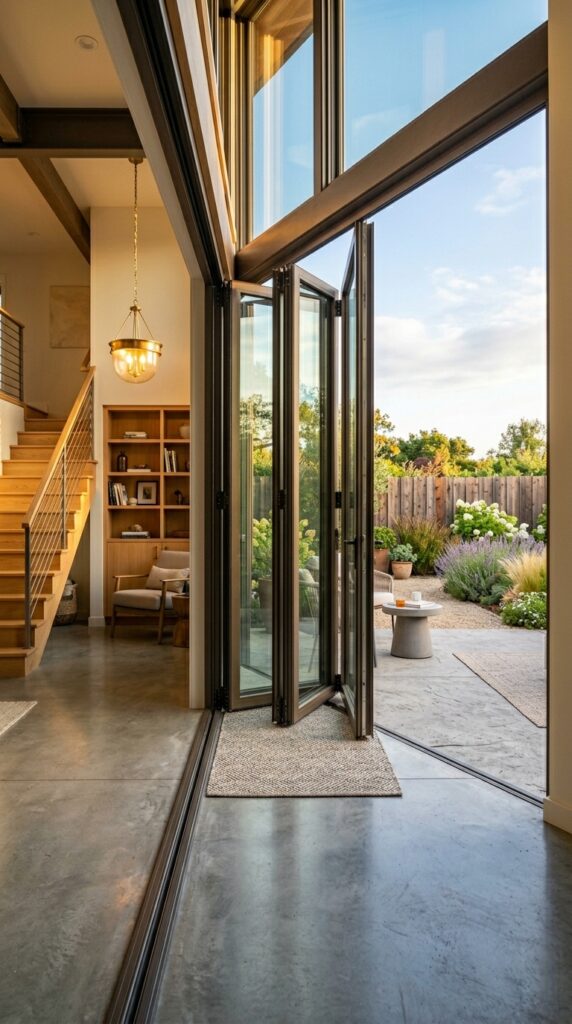
Vibe: Expansive — the room borrows the outdoors without asking.
Why it works: A retractable glass wall system transforms the garage door opening — the loft’s most prominent architectural feature — from a functional element into a spatial one. When fully open, the system dissolves the boundary between interior loft and exterior patio, effectively doubling the perceived living area without adding square footage. The design principle at work is borrowed space: the eye cannot easily determine where the interior ends and the exterior begins, which reads as spatial generosity. For a garage loft used as an entertainment or social space, this transformation is among the highest-ROI investments possible.
How to get it: NanaWall, LaCantina Doors, and PGT Innovations all make residential folding glass wall systems designed to fit standard garage door rough openings. Specify thermally broken frames for any climate that experiences winter — unbroken aluminum will transmit cold significantly. Budget $350–$600 per lineal foot installed, or $5,000–$12,000 for a standard 16-foot opening.
Shop the Look
| Product |
| Indoor outdoor area rug gray modern geometric |
| Concrete look outdoor bench modern minimalist |
| Low-profile door threshold transition strip modern |
| Outdoor pendant light weatherproof black modern |
| Retractable glass door weatherstrip seal kit |
28. Minimalist Small-Space Garage Loft Under 250 Square Feet
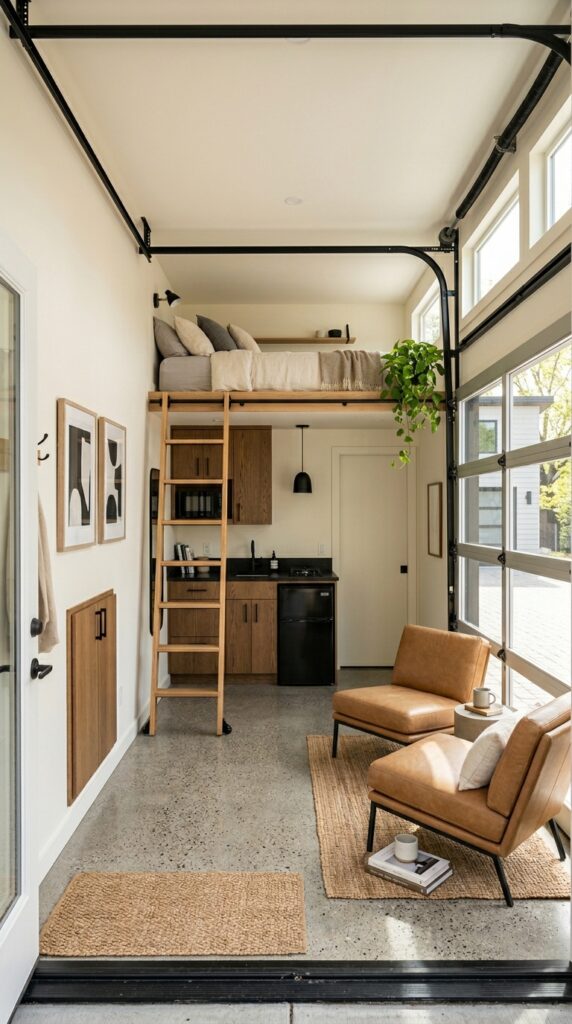
Vibe: Still — a space that knows it has exactly enough.
Why it works: A single-car garage (typically 12’×20′ = 240 square feet) forces design discipline that larger spaces never require, and the result — when done well — often feels more resolved than a larger, less considered loft. The spatial hierarchy is clear: the loft platform assigns sleeping above, activity below, with no ambiguity. Every material choice reads more significantly at this scale because there is less surface to absorb a poor decision. The three design rules for sub-250 square foot garage lofts are: one dominant material (let concrete do the most work), one dominant color (white or greige), and zero unnecessary objects.
How to get it: The alternating-tread stair is the most space-efficient stair design for small garages — it occupies approximately 4 square feet of floor space compared to 20–40 square feet for a conventional stair. Source from companies like Arke or Salter Spiral Stair. Choose a mini-kitchen (24″ refrigerator, two-burner induction cooktop, and a compact drawer dishwasher) to keep the lower level functional without overwhelming the floor plan.
💡 Quick Win: A two-burner induction cooktop ($45–75) set into a compact countertop is the single most space-efficient kitchen solution for a sub-250 square foot garage loft — it recesses flush, generates no exhaust heat, and requires no gas line.
Shop the Look
| Product |
| Alternating tread stair kit modern industrial |
| Two burner induction cooktop portable compact |
| Mini refrigerator compact 24 inch stainless modern |
| Compact drawer dishwasher 18 inch modern |
| Single lounge chair reading modern compact linen |
How to Start Your Modern Garage Loft Transformation
Your single most important first move is the floor. Polished concrete — specifically, having your existing slab diamond-ground to a Level 2 or Level 3 finish — anchors the entire loft aesthetic before a single piece of furniture enters the space. The floor is the largest continuous surface; once it reads as designed, the industrial-modern logic of every material decision that follows becomes self-evident. Nothing says “this was intentional” faster than a floor that was clearly chosen.
The most common mistake beginners make in garage loft conversions is mixing stainless steel and brushed nickel hardware in the same space. They look identical in the store but create visible tension when adjacent — the undertones differ, with stainless reading warm-cool and nickel reading yellow-warm. Pick one metallic finish system (matte black is the safest for modern loft aesthetics) and apply it to every piece of hardware: stair railings, shelf brackets, light fixtures, cabinet pulls. Breaking this rule even once — one chrome faucet among matte black fixtures — undermines the coherence of the whole palette.
For under $50, three items deliver immediate modern-loft impact: a single matte black cage pendant light ($25–35 on Amazon), a bag of Quikrete Vinyl Concrete Patcher in charcoal to fill and repair cracked garage floor sections before sealing ($18), and a roll of butcher paper to plan your loft platform dimensions before committing to any lumber purchase ($8).
A realistic starter garage loft transformation — loft platform, new floor finish, lighting upgrade, and fresh paint — takes 4–6 weekends for a competent DIYer and costs $3,500–$8,000 depending on finish level. A full conversion with plumbing (wet bar or bathroom), custom stair, and professional concrete polish takes 3–6 months and typically runs $25,000–$65,000. The good news: the design impact of Phase 1 alone (floor, light, loft platform) is 80% of the visual transformation.
Frequently Asked Questions About Modern Garage Loft Designs
What is the difference between a garage loft and a garage apartment?
A garage loft refers to a mezzanine or upper-level platform built within the existing airspace of a garage, typically without full plumbing or separate utility connections. A garage apartment is a fully independent living unit with its own kitchen, bathroom, and often a separate entrance — it meets the building code definition of a dwelling unit. The loft is a spatial concept; the apartment is a legal one. Many garage lofts begin as lofts and are later upgraded to full apartment status when plumbing is added and the conversion is permitted as an accessory dwelling unit (ADU).
What colors work best for a modern garage loft interior?
The most successful modern garage loft palettes lean on warm neutrals with one structural dark: warm white or greige (try Sherwin-Williams Agreeable Gray SW 7029) for walls and ceiling, polished concrete gray for floors, and matte black or charcoal for all hardware and structural accents. A single color accent — dusty slate blue (Benjamin Moore Newburyport Blue HC-155), sage, or terracotta — applied to one upper wall adds depth without competing with the industrial material palette. Avoid cool whites (with blue or green undertones) — they make concrete and steel feel institutional rather than residential.
How much does it cost to build a garage loft platform?
A basic structural loft platform — framed with 2×8 lumber at 16″ on-center, supported by steel posts, with plywood decking — typically costs $2,500–$6,000 for a 200–300 square foot sleeping platform, including materials and professional labor. DIY material-only costs are typically $800–$1,800 for the same size. Adding a cable railing system adds $1,500–$4,000; an open-riser stair adds $3,000–$8,000 depending on materials. Permitting costs vary by municipality but typically run $200–$800 for structural addition permits.
Can a modern garage loft work with a low ceiling height?
Yes, but 10 feet is the practical minimum for a functional sleeping loft — 7-foot platform height leaves 36″ of clearance above the mattress, which is usable but tight. At 10 feet, the loft platform sits at 7’–7.5″, leaving 5’–5.5″ of upper clearance — enough to sit up and move around. Below 10-foot ceiling height, consider an alternative approach: a raised platform bed at 36″–42″ with drawer storage underneath (no structural loft required), which captures most of the spatial efficiency with none of the structural complexity. Ceilings above 12 feet open up full design freedom.
What kind of flooring works best under a garage loft platform?
Polished concrete is the optimal choice for both aesthetic and practical reasons — it is already on-site in most garages, requires no additional height (critical for clearance calculations), and is extremely durable under the mechanical loads of a workshop or gym. For areas under the loft platform where moisture may concentrate, apply a penetrating silane-siloxane sealer (Radonseal or SiloXane) before polishing to prevent moisture wicking. If existing concrete is too damaged to polish effectively, 12″×24″ large-format porcelain tile in a concrete-look pattern (Floors & Decor’s Cementmix series, $2.50–$4.50/sq ft) is the most convincing and cost-effective alternative.
Ready to Create Your Dream Modern Garage Loft?
These 28 ideas span the full spectrum of what a modern garage loft can be — from the material drama of shou sugi ban walls and polished concrete floors to the practical intelligence of ship’s ladder stairs and embedded platform storage, from lighting that transforms atmosphere to color choices that regulate the feel of the entire vertical space. Transformation is incremental, and starting with a single strong move — the floor finish, the loft platform, one dramatic material — is not a compromise, it’s the right approach. Today: tape out your loft platform dimensions on the garage floor with painter’s tape, stand inside the rectangle, and see how it actually feels to be in that footprint before cutting a single board. When this space is finished, the experience of walking into it — that combination of rawness and deliberateness, of industrial structure made habitable — is one of those rare rooms that changes how you want to spend your time. Save the ideas that stopped you mid-scroll, because in a modern garage loft, the best design choices are always the ones that felt inevitable.