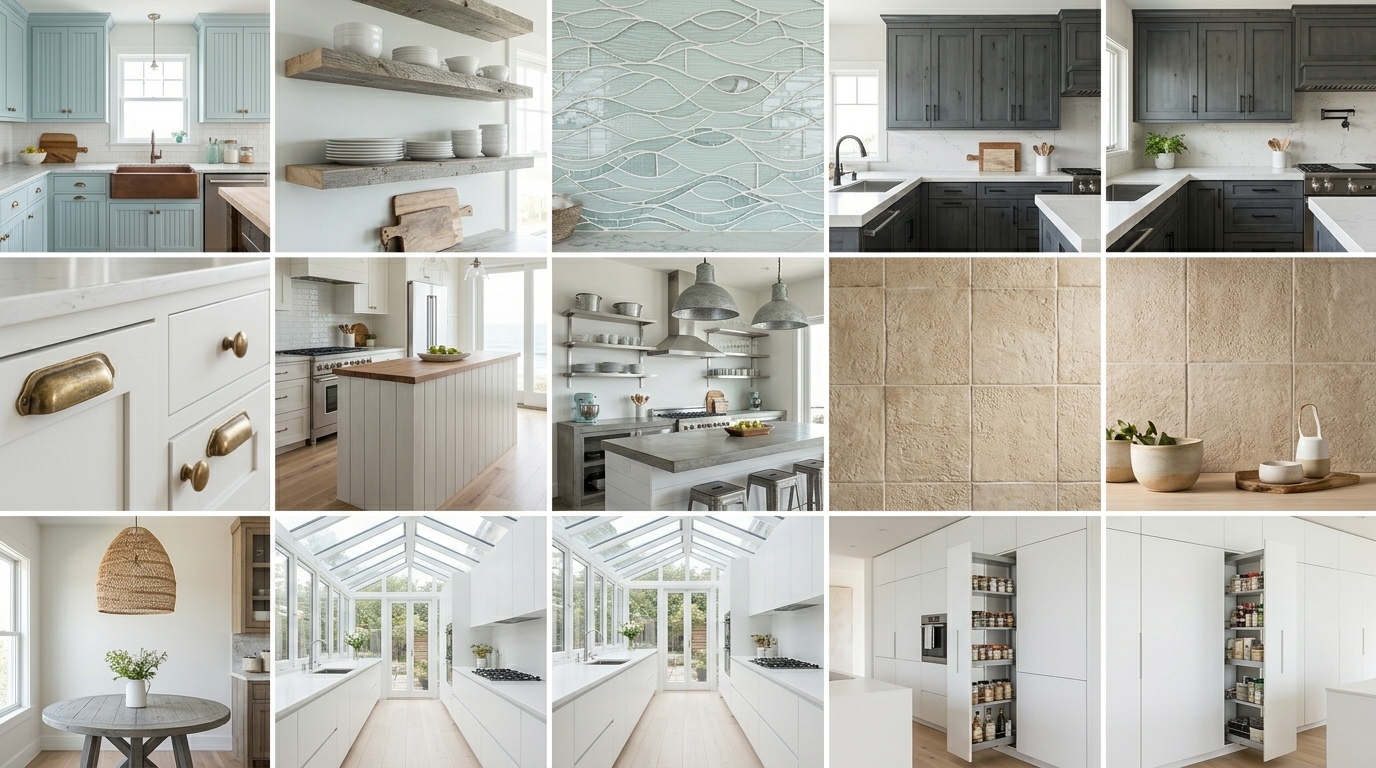
A coastal kitchen is a design approach that translates the sensory vocabulary of the shoreline — bleached driftwood, salt-air light, wave-worn stone, and the particular blue-green of shallow water — into a fully functional domestic kitchen. This guide delivers 23 specific coastal kitchen design concepts spanning color palettes, materials, lighting, cabinetry, layout, accessories, and small-space adaptations.
There is a quality of light in a coastal kitchen that exists nowhere else in the house — the way a pale aqua backsplash holds morning sun differently than it holds afternoon, the way white-painted shiplap reads as warm rather than clinical because the grain beneath it still shows. A coastal kitchen is not a beach house cliché of starfish and rope. It is a room that breathes, moves light generously, and feels like it was built for a long summer morning with nowhere particular to be. Here are 23 concepts worth saving — and stealing.
Why Coastal Kitchen Design Works So Well
Coastal kitchen design draws from a convergence of architectural traditions: the New England shingle-style farmhouse, the Bahamian pastel colonial, the Australian Hamptons beach house, and the whitewashed Greek island kitchen with its rough plaster walls and ceramic vessels. What unifies these regional expressions is a shared response to the same environmental conditions — intense reflected light from water, salt air that ages materials visibly, and the constant indoor-outdoor movement of people who live near the shore. The style’s design logic is environmental before it is aesthetic, which is precisely why it ages so well: its choices are rooted in practical responses to place rather than trend.
The material palette is specific and honest. White-painted or natural shaker cabinetry, bleached or white-oiled white oak, honed Carrara or Calacatta marble and its porcelain equivalents, subway tile in warm white or soft aqua glaze, unlacquered brass and brushed bronze hardware, rattan and seagrass in accent furniture and pendant lighting. Colors are drawn from the literal coastal palette: Nantucket fog white, Benjamin Moore “Palladian Blue” (HC-144), Farrow & Ball “Borrowed Light” (No. 235), soft driftwood greige, navy, and the pale sage green of beach grass at low tide. These colors share a bleached, slightly desaturated quality — as though the light off the water has been working on them for a season.
The cultural current is running strongly toward coastal design. The pandemic-era migration toward coastal and lake communities created a sustained design interest in beach house aesthetics that has extended well beyond coastal geography into landlocked homes that aspire to the relaxed openness the style represents. Pinterest’s coastal kitchen category is among the platform’s most saved home content categories, and the style has continued to evolve from its earlier shell-and-anchor literalism into a more sophisticated material-led interpretation that holds up in the most discerning design contexts.
Compact coastal kitchens — those under 150 square feet — actually benefit from the style’s material discipline. The palette’s light-reflective quality (pale cabinetry, white or aqua tile, reflective brass hardware, open shelving) counteracts the visual compression of a small footprint more effectively than almost any other kitchen design language. In a small coastal kitchen, the two highest-return moves are maximizing the light-reflective surfaces and eliminating upper cabinet doors in favor of open shelving — both of which expand perceived space while remaining entirely authentic to the aesthetic.
Style at a Glance
| Element | Core Trait 1 | Core Trait 2 |
| Philosophy | Environmental response, relaxed openness | Light-maximizing, indoor-outdoor continuity |
| Materials | White oak, shiplap, honed marble | Subway tile, rattan, unlacquered brass |
| Color palette | Nantucket white, Palladian blue, driftwood | Soft aqua, navy, pale beach-grass sage |
23 Coastal Kitchen Design Concepts
1. White Shaker Cabinets with Unlacquered Brass Hardware
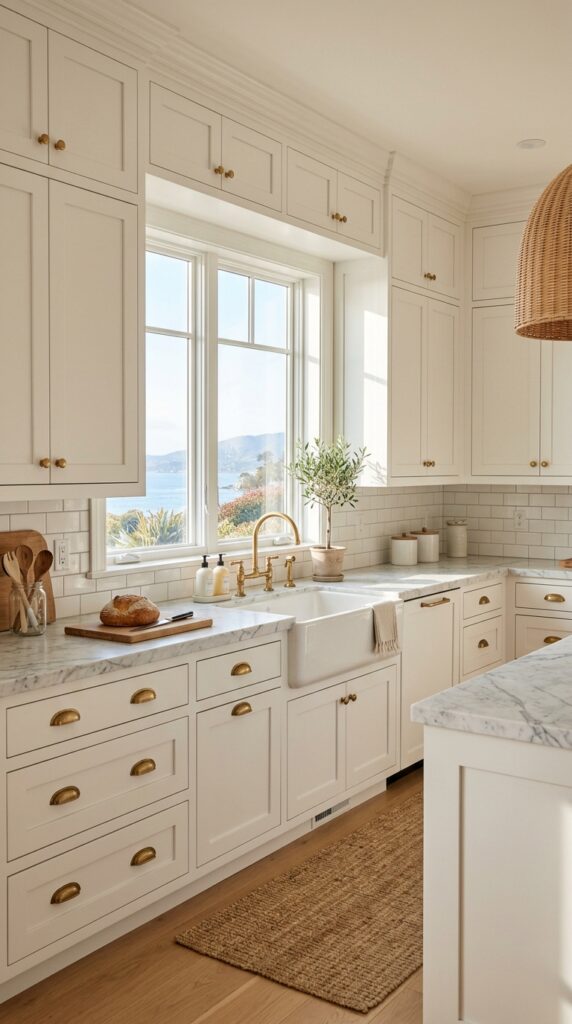
Vibe: Airy and warm — a kitchen that feels like it has been loved for decades.
Why it works: White shaker cabinetry is the structural backbone of coastal kitchen design because its raised-panel profile references the wainscoting and millwork of traditional New England coastal architecture without the formality of more ornate cabinet styles. The shaker’s visible rail-and-panel detail reads as handcrafted at close range — a quality that distinguishes it from flat-panel modern cabinetry and connects it to the material honesty that coastal design demands. Unlacquered brass hardware is the critical finish choice: unlike lacquered brass, which maintains an artificially uniform gold tone indefinitely, unlacquered brass develops a warm, slightly uneven patina over 12–18 months of handling that deepens the aged, salt-air-worn quality central to the coastal aesthetic.
How to get it: Paint existing shaker cabinets in Benjamin Moore “Chantilly Lace” (OC-65) in a semi-gloss finish — this is the benchmark coastal kitchen white, warm enough to read as cream in morning light without yellowing in artificial light. Replace existing hardware with unlacquered brass cup pulls in a 3-inch center-to-center size; Rejuvenation and House of Antique Hardware both carry authentic unlacquered brass in this specification.
💡 Quick Win: Replacing hardware on existing white cabinets with unlacquered brass cup pulls costs $8–$18 per pull and delivers 80% of the full coastal kitchen aesthetic upgrade without touching the cabinets, countertops, or backsplash.
Shop The Look
| Product |
| Unlacquered brass cup pull cabinet hardware 3 inch |
| White shaker cabinet door replacement set |
| Benjamin Moore Chantilly Lace paint semi-gloss |
| Honed Carrara marble look porcelain countertop tile |
| White subway tile 3×6 glossy glaze |
2. Soft Aqua Backsplash Tile as the Color Anchor
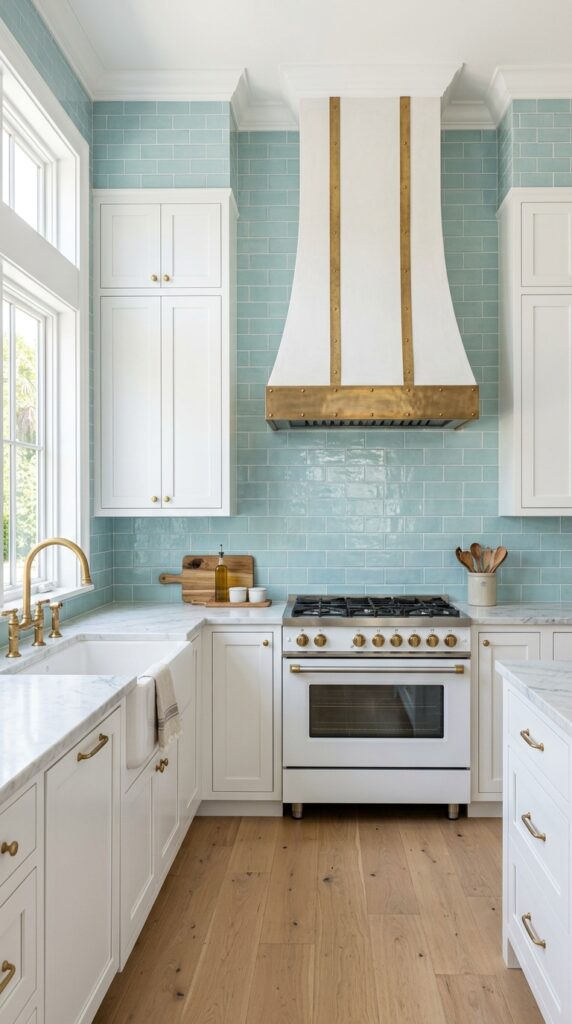
Vibe: Luminous and fresh — a wall that holds the color of shallow water in morning light.
Why it works: A soft aqua backsplash performs the most important single color function in a coastal kitchen: it introduces the palette’s chromatic anchor — the blue-green of the sea — in the most architecturally integrated position available, the backsplash, rather than through accessories that can be removed or changed. Subway tile in aqua glaze references the handmade ceramic tile tradition of colonial coastal architecture while providing a modern, grout-maintainable surface. The slight glaze variation between individual tiles — a characteristic of quality ceramic glaze application — creates the same tonal richness that makes natural materials compelling: no two tiles are precisely the same, which prevents the flatness of a uniform manufactured surface.
How to get it: Specify a handmade-style glazed subway tile rather than a machine-pressed variety — the slight surface warping and glaze pooling of handmade tiles creates a more authentic coastal texture. Tile manufacturer Fireclay Tile produces a “Sea Glass” glaze in exactly the correct soft aqua tone. Use a warm white grout (not bright white) at 1/16-inch joint width for maximum tile visibility and minimum grout accumulation.
Shop The Look
| Product |
| Soft aqua glazed subway tile 3×6 handmade style |
| Sea glass aqua ceramic tile backsplash |
| Warm white sanded grout 1/16 inch joint |
| White farmhouse apron sink porcelain 30 inch |
| Aqua blue glass mosaic tile backsplash sheet |
3. Open Shelving in White-Oiled Oak for Displayed Storage
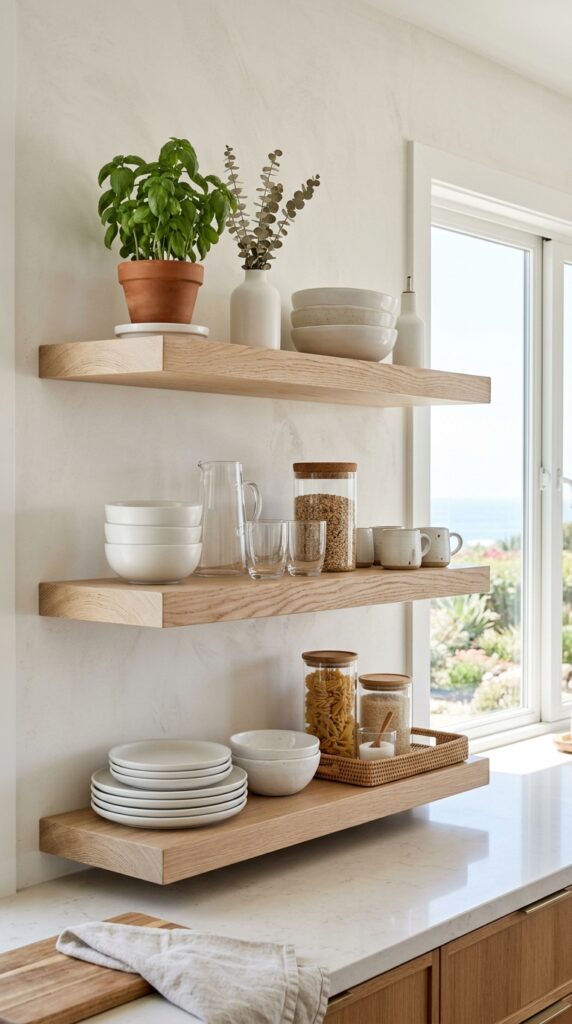
Vibe: Airy and curated — a wall that breathes where a cabinet would close.
Why it works: Open shelving in a coastal kitchen replaces the visual mass of upper cabinet boxes — which occupy significant wall area and create a wall of closed doors — with a lighter, more transparent storage arrangement that allows the eye to travel through and past the shelf contents to the wall behind. White-oiled oak is the ideal coastal open shelf material: the white oil finish bleaches the natural yellow tones from the wood, creating the pale, driftwood-like coloration of timber that has been exposed to salt air and sun, while the visible grain through the finish maintains material warmth and authenticity. The styling discipline required by open shelving — only visually consistent, curated items can live on display — also enforces the organized minimalism that makes small coastal kitchens feel spacious.
How to get it: Apply Rubio Monocoat “White” or Osmo Polyx Oil “White” to natural white oak boards — two thin coats with a lint-free cloth, wiping off the excess after 15 minutes, produces the authentic bleached-oak finish. Mount shelves with heavy-duty concealed floating brackets rated for at least 50 lbs per bracket, anchored into wall studs.
Shop The Look
| Product |
| White oak floating shelf 36 inch thick profile |
| Rubio Monocoat white oil wood finish |
| White ceramic dinner plate set stacking |
| Clear glass pantry storage jar set |
| Woven rattan tray rectangular kitchen shelf |
4. Shiplap Kitchen Island with Painted Tongue-and-Groove
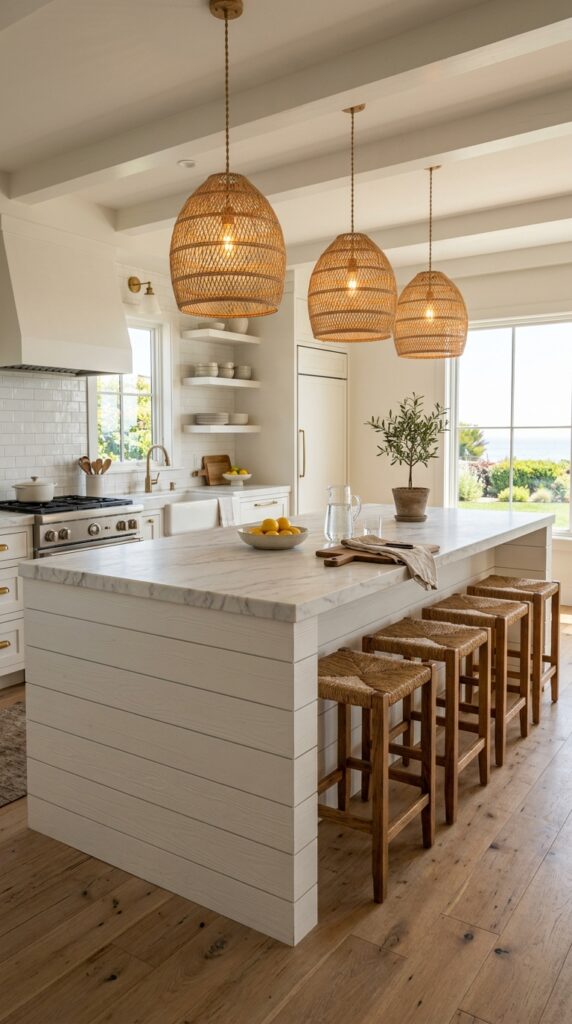
Vibe: Warm and casual — an island that looks like it grew from the floor rather than arrived from a showroom.
Why it works: Shiplap cladding on a kitchen island introduces the exterior architectural vocabulary of coastal vernacular buildings — the painted horizontal boarding of beach houses and coastal cottages — into the interior of the kitchen, creating a material continuity between inside and outside that is the defining experiential quality of great coastal homes. The shadow groove between shiplap boards (a 1/4-inch reveal between overlapping boards) creates a horizontal line pattern that visually anchors the island to the floor and adds surface texture at a scale appropriate for the island’s mass. An island with shiplap sides reads as built-in to the house — part of the architecture — rather than as a piece of furniture placed in the room.
How to get it: Apply 4-inch-wide shiplap boards (available as pre-milled tongue-and-groove boards or as 1×4 ripped with a rabbet) horizontally to an existing kitchen island using construction adhesive and 18-gauge finish nails. Prime and paint in the same color as the surrounding cabinetry for a unified palette, or in a contrasting tone (such as a soft navy) to distinguish the island as a separate design element.
💡 Quick Win: Pre-primed shiplap wall panels (peel-and-stick or nail-on) applied to the visible sides of an existing kitchen island cost $2–$4 per square foot in materials and transform the island’s architectural character in a single afternoon without removing or replacing any cabinetry.
Shop The Look
| Product |
| White shiplap wall panel pre-primed 4 inch |
| Peel and stick shiplap panel white painted |
| Rattan pendant light set of 3 kitchen island |
| Honed marble island countertop slab |
| White semi-gloss paint interior shiplap |
5. Navy Lower Cabinets with White Uppers for Two-Tone Drama
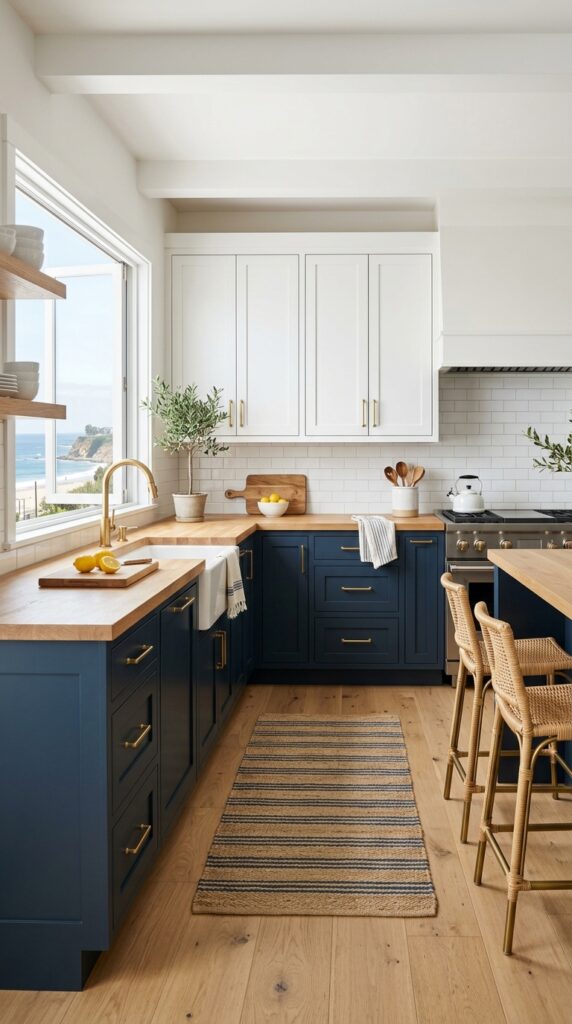
Vibe: Crisp and bold — a kitchen that commits to the sea without wearing it as a costume.
Why it works: Navy lower cabinets with white uppers is the most architecturally sophisticated coastal kitchen palette combination because it references the nautical color language — the deep hull-blue of wooden boats against white superstructure — without introducing literal maritime decoration. The two-tone split at counter height creates a visual horizon line that divides the kitchen into two chromatic zones, mirroring the actual horizon of sea against sky. Deep navy on the lowers also grounds the kitchen visually: the darkest tone at floor level creates stability, allowing the white uppers and ceiling to read as light and lifted rather than floating.
How to get it: Paint lower cabinets in Farrow & Ball “Hague Blue” (No. 30) or Benjamin Moore “Hale Navy” (HC-154) — both are warm-undertone navies that read as sophisticated rather than cold in kitchen environments with warm oak, brass, and white elements. Apply in a semi-gloss finish on lower cabinets for durability; uppers in eggshell for a softer sheen differential that reinforces the two-tone distinction.
Shop The Look
| Product |
| Navy blue cabinet paint semi-gloss Hale Navy |
| Brass bar pull cabinet hardware 5 inch |
| White oak butcher block countertop section |
| White upper shaker cabinet replacement door |
| Two-tone kitchen island navy and white |
6. Rattan Pendant Lights in a Cluster Above the Island
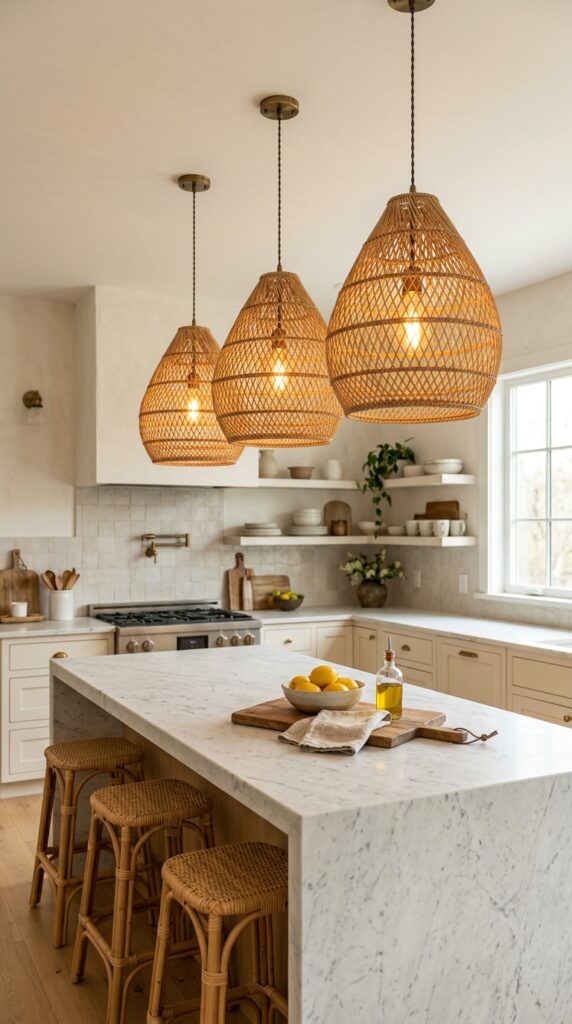
Vibe: Warm and layered — pendant lights that feel hand-selected rather than installed.
Why it works: Rattan pendant lights introduce the only truly organic, hand-woven element available in kitchen lighting — their woven fiber surface casts a pattern of small light and shadow across the ceiling and adjacent surfaces that no manufactured metal or glass fixture replicates. The slightly staggered hanging heights (4-inch intervals between pendants) creates a visual movement that a rigid uniform installation lacks, referencing the casual, non-formal arrangement philosophy of coastal interior design. The warm 2200K filament bulb color temperature is essential: it renders the rattan’s honey tones warmly and creates an amber pool of light over the island that shifts the kitchen’s atmosphere from utilitarian to intimate as the day progresses toward evening.
How to get it: Hang rattan pendants so the bottom of each shade sits at 30–34 inches above the island countertop — this height balances task illumination with visual presence. Space three pendants at approximately 24-inch intervals across the island length, centering the group on the island’s midpoint rather than distributing to the edges, which creates a more focused visual composition.
Shop The Look
| Product |
| Natural rattan teardrop pendant light 18 inch |
| Woven rattan kitchen island pendant set of 3 |
| Vintage filament bulb E26 2200K ST64 |
| Pendant light canopy kit adjustable height |
| Rattan pendant light large 24 inch coastal |
7. White Farmhouse Apron Sink as the Kitchen Focal Point
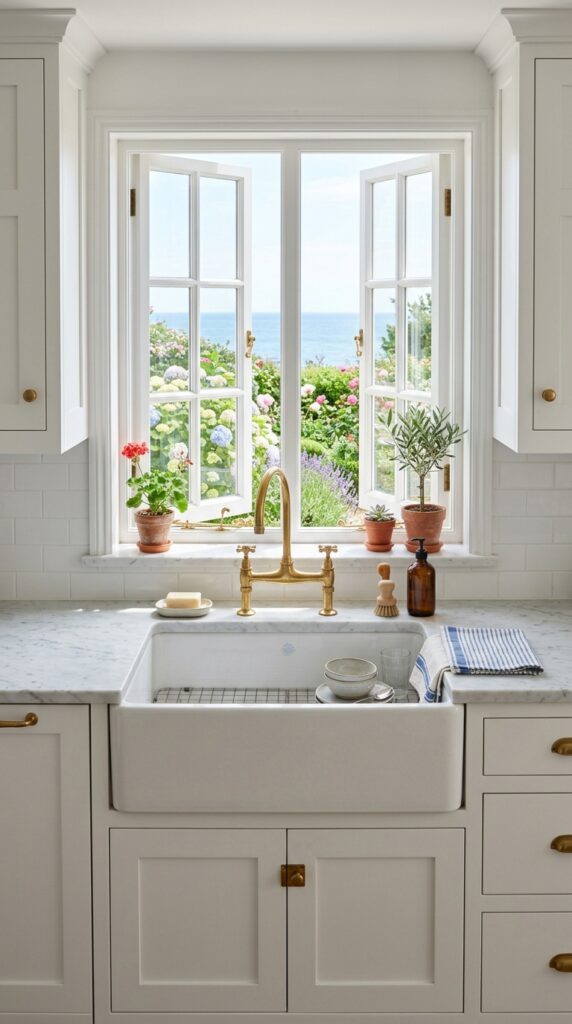
Vibe: Classic and luminous — a sink that makes the act of washing dishes feel pastoral.
Why it works: The white fireclay apron sink is the single most architecturally defining fixture in a coastal kitchen because its exposed front apron face introduces a period reference — the working farmhouse and cottage kitchen of the 18th and 19th centuries — that is authentic to the historical origins of coastal vernacular domestic architecture. Fireclay’s bright white, slightly textured surface is also one of the most light-reflective materials in a kitchen, picking up and amplifying whatever light enters the window above the sink. The bridge faucet — with its separate hot and cold handles bridged by a central spout — reinforces the period reference while positioning the unlacquered brass as a feature element at the kitchen’s visual center.
How to get it: Specify a fireclay apron sink rather than a cast iron or acrylic equivalent — fireclay maintains its white color without yellowing or chipping over decades of use, is entirely non-porous and stain-resistant, and has the thermal mass that keeps water warm during long soaking. Shaws and Rohl both produce benchmark fireclay apron sinks in the 30–33-inch width range appropriate for most coastal kitchen base cabinet runs.
Shop The Look
| Product |
| White fireclay apron farmhouse sink 30 inch |
| Unlacquered brass bridge kitchen faucet cross handle |
| Apron sink base cabinet replacement 30 inch |
| White fireclay kitchen sink single basin 33 inch |
| Brass kitchen faucet bridge style deck mount |
8. Honed Marble Countertops with an Eased Edge Profile
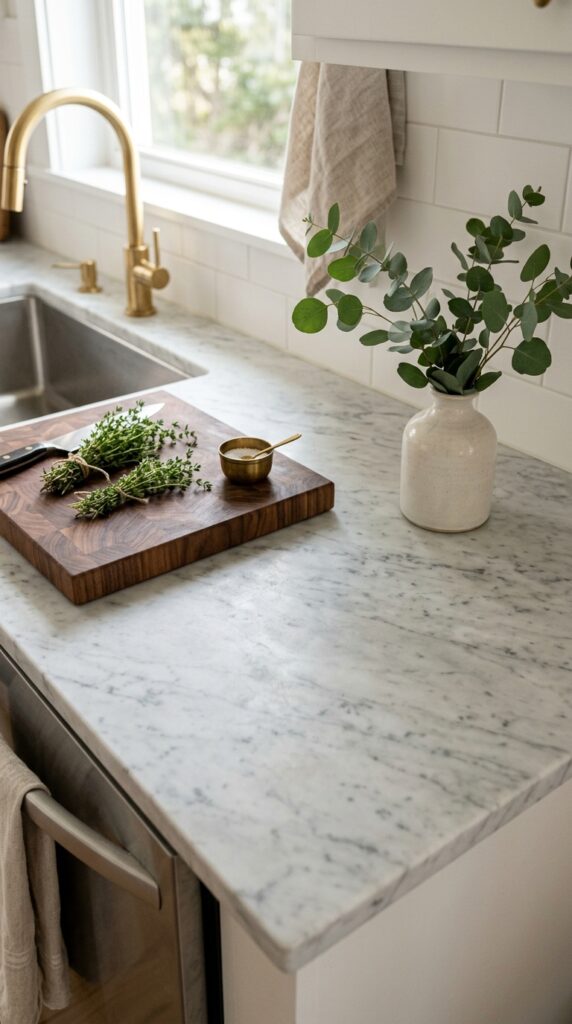
Vibe: Serene and material-rich — a surface that gets more interesting with every season of use.
Why it works: Honed marble — matte rather than polished — is the authentic coastal kitchen countertop finish because its matte surface references the way stone appears at the shoreline: worn by water and weather into a smooth, light-absorbing patina rather than a light-reflecting polish. The honed finish also develops an etching and aging character over time that polished marble resists through its surface gloss — in a coastal kitchen, this aging reads as material authenticity rather than damage. The eased edge profile (a slight 1/8-inch radius rather than a sharp 90-degree edge) is the correct coastal specification: sharper profiles (ogee, bullnose, waterfall) introduce a formality inconsistent with the relaxed coastal aesthetic.
How to get it: Seal honed marble with an impregnating stone sealer (such as Tenax Proseal or StoneTech BulletProof) at installation and reseal every 12–18 months — honed marble is more porous than polished marble and requires consistent sealing to resist the cooking oils and acidic foods that etch unsealed stone. Accept that etching and minor staining will develop over time — this is the material’s lived-in character, not a maintenance failure.
Shop The Look
| Product |
| Honed Carrara marble countertop tile slab |
| Stone impregnating sealer honed marble |
| Marble look porcelain countertop honed 2cm |
| Natural wood cutting board large kitchen |
| White ceramic bud vase small kitchen counter |
9. Coastal Color Palette: Palladian Blue Painted Walls
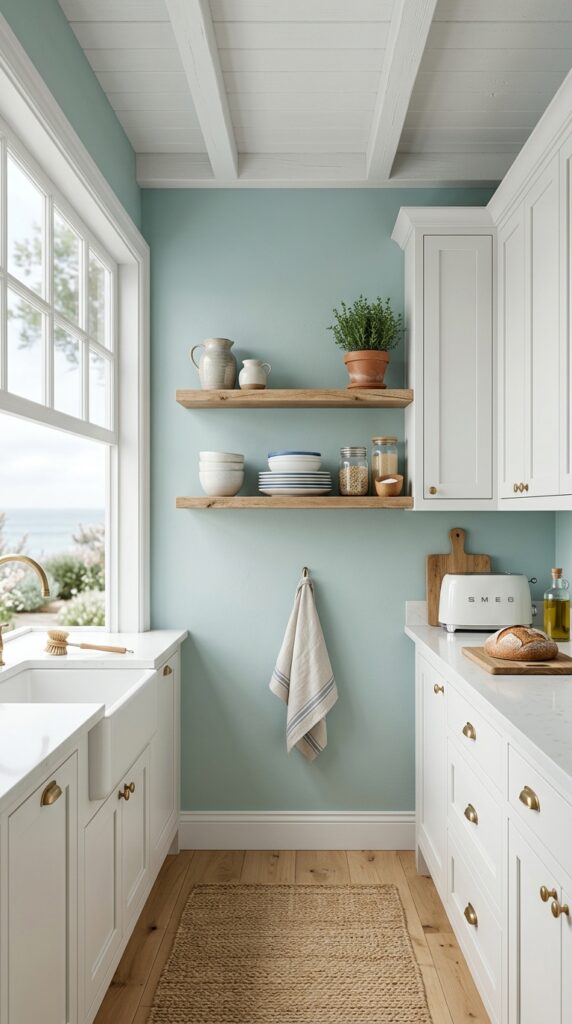
Vibe: Serene and luminous — walls that hold the color of sea glass at 7 AM.
Why it works: Benjamin Moore “Palladian Blue” (HC-144) is the benchmark coastal kitchen wall color because it occupies a precise chromatic position — neither clearly blue nor clearly green, but the exact transitional hue of very shallow water over white sand — that reads differently across the day as light conditions change. In the morning, it appears almost gray-green; in full afternoon sun, it resolves to a clear aqua; in evening lamplight, it deepens toward a muted teal. This chromatic mobility is the quality that makes it feel alive rather than flat. Against white cabinetry and natural oak, it provides just enough color to establish the coastal palette without overwhelming the brightness that small kitchen spaces require.
How to get it: Apply “Palladian Blue” in an eggshell finish on kitchen walls — matte finishes absorb light and can make a small kitchen feel darker; eggshell provides a slight reflectance that amplifies the color’s brightness without the wipeable surface of semi-gloss, which reads as too shiny for a wall application in this palette. Paint the ceiling in Benjamin Moore “White Dove” (OC-17) for a warm white that sits harmoniously with the blue-green wall.
Shop The Look
| Product |
| Benjamin Moore Palladian Blue paint sample HC-144 |
| Eggshell interior paint coastal blue green |
| White Dove ceiling paint Benjamin Moore OC-17 |
| Coastal blue kitchen wall paint eggshell gallon |
| Paint roller set interior walls professional |
10. Driftwood-Finish Kitchen Island Legs
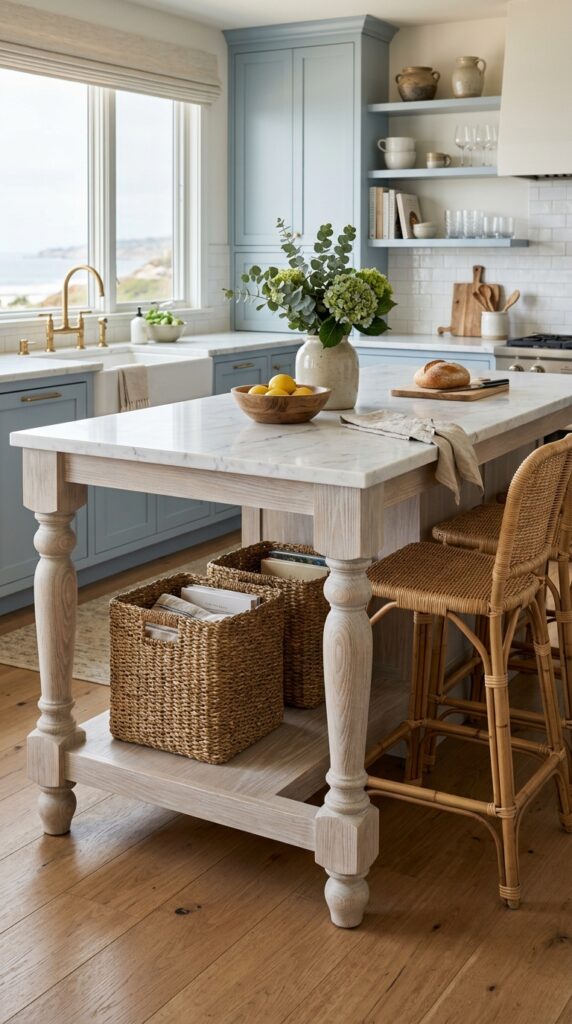
Vibe: Casual and warm — an island that looks like it belongs in a beach cottage that gets used hard and loved well.
Why it works: Turned wooden island legs are the detail that most effectively communicates the furniture-style design philosophy of coastal kitchens — the idea that kitchen islands should look like they were made from repurposed furniture rather than installed as architectural fixtures. The driftwood-gray finish on turned legs references the silver-gray weathering of timber exposed to salt air, the specific aging process of all wooden surfaces in coastal environments. This finish positions the island as something that belongs to the coast’s material history rather than arriving from a manufacturer. The open lower shelf between the legs — a direct reference to old butcher blocks and bakers’ tables — provides basket storage while reinforcing the furniture-rather-than-fixture reading.
How to get it: Apply a diluted white wash (one part flat white latex paint to three parts water, wiped on and partially wiped off while wet) to existing stained or raw wood island legs to achieve the driftwood tone — the diluted application allows grain to show through while depositing enough white pigment to bleach the natural wood tone toward the cool gray of weathered timber.
Shop The Look
| Product |
| Turned wood kitchen island legs set of 4 |
| Driftwood gray wood stain exterior interior |
| White wash wood paint dilutable interior |
| Seagrass storage basket with handles set |
| Rattan counter height barstool set of 2 |
11. Casement Windows Above the Sink for Maximum Light
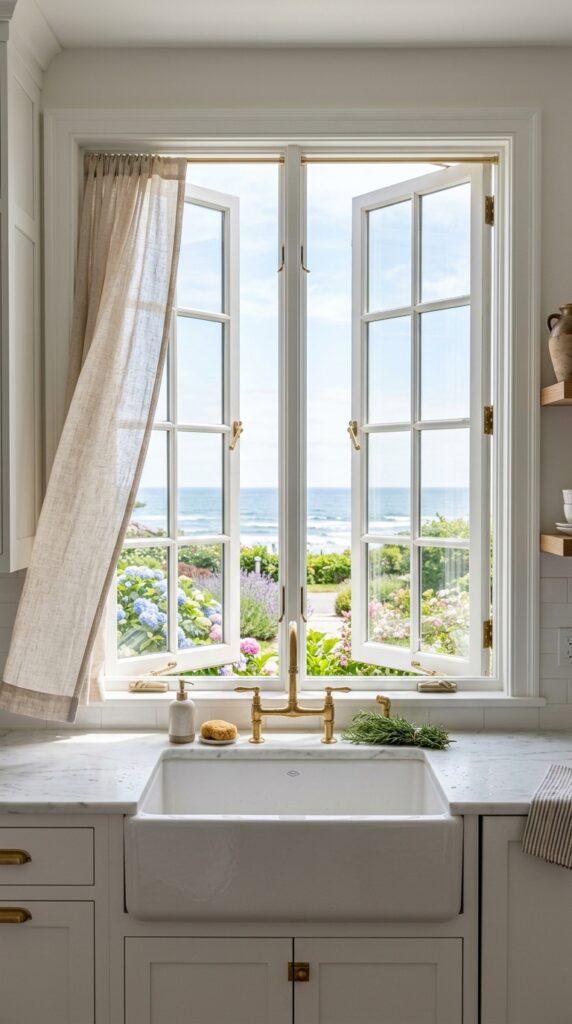
Vibe: Luminous and breezy — the feeling that the kitchen is half inside, half out.
Why it works: Casement windows above the kitchen sink are the architectural feature most directly responsible for the coastal kitchen’s characteristic light quality — they admit light from directly above the primary work surface, which eliminates the shadows cast by standard windows positioned to the side of the sink, and they open on a crank mechanism that allows full ventilation without requiring the homeowner to reach over the sink and strain. The divided-light pane detail (multiple small panes within each sash) references traditional cottage and colonial coastal architecture, reinforcing the historical material vocabulary of the style. The sheer linen curtain at the window edge — always one panel, never two, always off to one side — introduces fabric texture without blocking light.
How to get it: When specifying new casement windows for a coastal kitchen, choose white-painted wood rather than vinyl or aluminum clad — the paint texture and shadow depth of a wood frame reads as architecturally warm in a way that vinyl’s flat extruded surface never does. Specify divided-light bars in a 6-over-6 or 4-over-4 pane configuration for the most authentic coastal cottage reference.
Shop The Look
| Product |
| White sheer linen kitchen curtain panel single |
| Casement window crank operator replacement |
| White painted wood window frame kit |
| Linen sheer curtain panel 84 inch white |
| Window sill extender board white oak |
12. Penny Tile Floor in Warm White and Soft Aqua
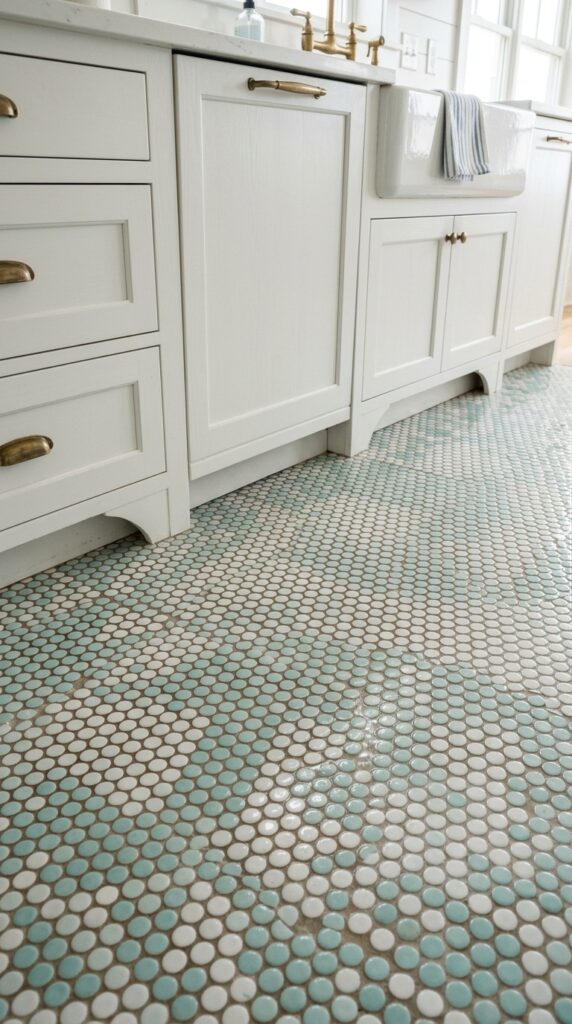
Vibe: Playful and warm — a floor that holds the coastal palette underfoot where you least expect it.
Why it works: Penny tile flooring introduces the coastal color palette at the floor plane — the surface that most occupies peripheral vision during kitchen use — through a format small enough to create texture rather than blocks of color. The two-tone mix of warm white and soft aqua penny tiles in a random distribution creates the same visual effect as sea glass scattered on sand: individual colored pieces visible within a dominant neutral field, with no forced pattern or repeat that would make the design feel calculated. Penny tile’s small diameter and correspondingly high grout joint ratio also makes it one of the most slip-resistant tile formats available — a practical advantage in a kitchen that sees wet-foot traffic from an adjacent pool or beach.
How to get it: Install penny tile on a properly waterproofed floor with a medium-bed mortar (not standard thin-set, which is insufficient for floor tile in a high-traffic kitchen environment). Use a warm gray unsanded grout at 1/8-inch joint width — bright white grout between penny tiles creates excessive visual contrast that reads as busy rather than textured.
Shop The Look
| Product |
| Penny tile floor mosaic white aqua mix |
| Penny round mosaic tile sheet soft aqua |
| Warm gray unsanded grout bathroom floor |
| Penny tile mesh backed sheet 12×12 |
| Non-slip penny tile floor mat kitchen |
13. Built-In Banquette Seating with Coastal Cushions
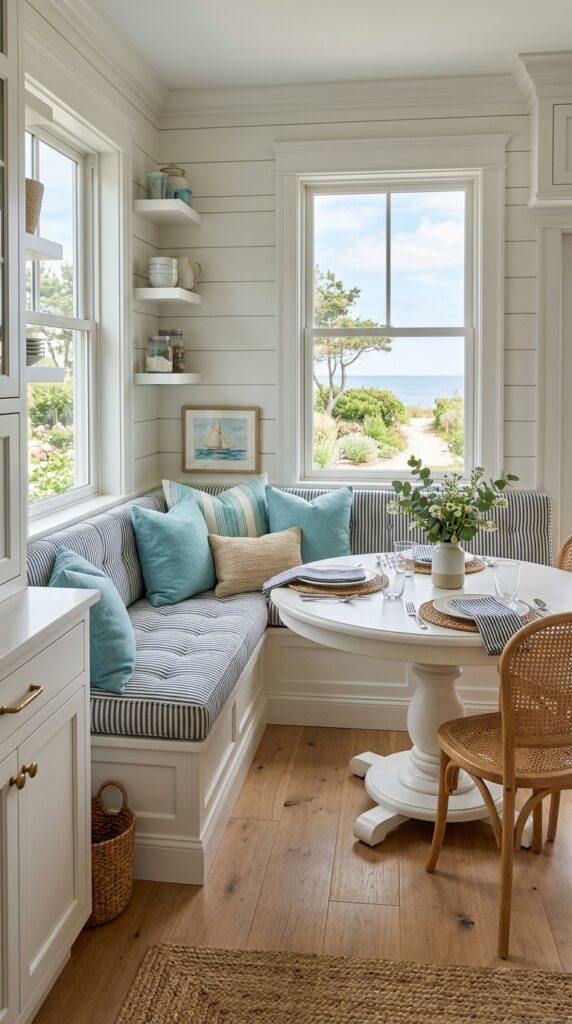
Vibe: Warm and inviting — the corner of the kitchen that becomes the entire reason for the room.
Why it works: A built-in banquette in a coastal kitchen solves the dining-in-a-small-kitchen problem more efficiently than any freestanding furniture arrangement: it uses the corner volume of the kitchen — typically a dead zone for a standard table-and-chairs configuration — to provide seating for four to six people in a footprint that a round table with two chairs would otherwise occupy. The built-in nature of the banquette also integrates the dining zone architecturally into the kitchen’s design language, making it read as part of the room’s structure rather than as furniture placed in a room. Ticking stripe cushions in navy and white are the most authentically coastal upholstery choice — they reference the traditional mattress ticking fabric of coastal working households and have been a defining textile of East Coast beach house design for over a century.
How to get it: Build the banquette frame from 3/4-inch plywood with a face frame of 1×3 poplar or pine, painted to match the kitchen cabinetry. Set the bench height at 18 inches from the finished floor and the seat depth at 20 inches — these dimensions pair correctly with a standard 30-inch dining table height. Use a 4-inch-thick high-density foam cushion (2 lbs per cubic foot minimum) rather than a standard 2-inch cushion; the additional thickness is the difference between comfortable extended seating and a surface that feels like a step.
Shop The Look
| Product |
| Navy white ticking stripe bench cushion 60 inch |
| Aqua linen throw pillow cover set outdoor rated |
| Round white pedestal dining table 42 inch |
| High density foam cushion 4 inch bench seat |
| Banquette bench storage hinge lid lift set |
14. Woven Seagrass Bar Stools at the Kitchen Island
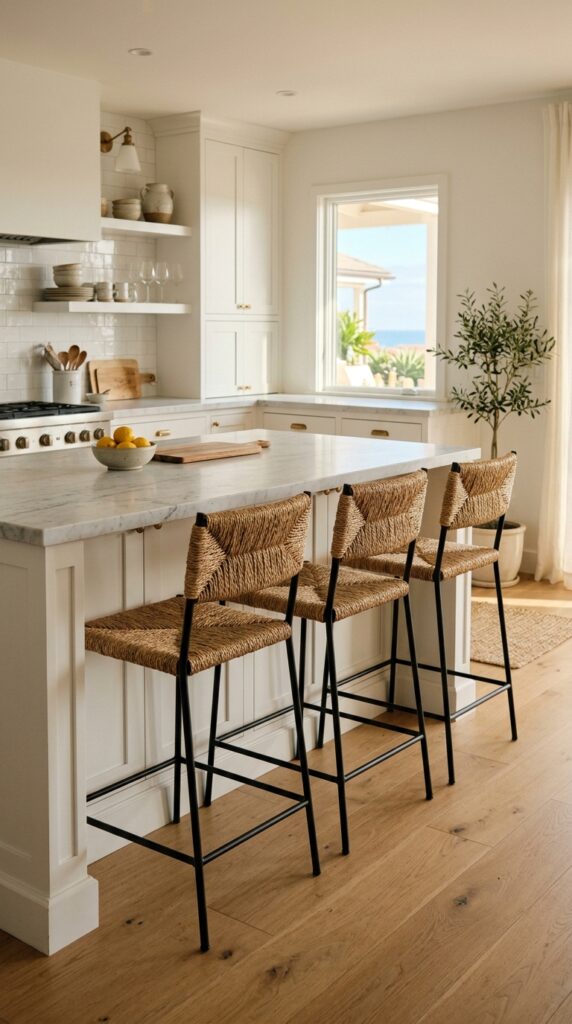
Vibe: Casual and warm — seating that makes the kitchen feel like a place people want to stay.
Why it works: Seagrass woven bar stools introduce the coastal palette’s natural fiber element at the island seating zone — the most socially active surface in a kitchen — where their texture is both visible and tactile to everyone who sits there. The combination of natural seagrass weave with a matte black iron frame creates the correct material tension for coastal design: organic warmth of the natural fiber balanced against the structural clarity of the metal base. This combination also works across multiple kitchen palette variations — the natural seagrass tone is neutral enough to read correctly against white, navy, aqua, or greige cabinetry without requiring reselection as the kitchen palette evolves.
How to get it: Specify stools at 26 inches seat height for standard 36-inch counter height, or 30 inches for bar-height 42-inch islands — the correct relationship is 9–12 inches between the seat surface and the underside of the counter. Space three stools at equal intervals across the island seating side, with a minimum 6 inches of clearance between stool edges to allow comfortable seated occupancy without shoulder contact.
Shop The Look
| Product |
| Seagrass woven counter stool matte black frame |
| Natural rattan bar stool counter height set of 2 |
| Woven seagrass seat barstool 26 inch |
| Counter height island stool natural fiber |
| Rattan swivel counter stool with back |
15. Coastal Herb Garden in the Kitchen Window
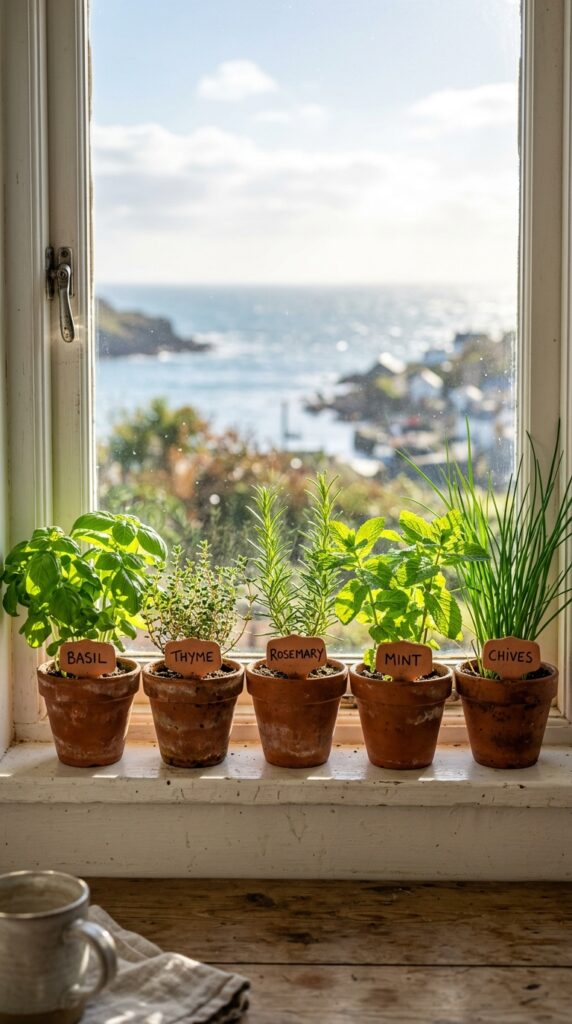
Vibe: Warm and alive — a window sill that makes the kitchen smell like the garden outside.
Why it works: A kitchen herb garden on the window sill introduces living plant material to the kitchen’s most light-rich surface — the window — where the combination of natural light from behind and the organic irregularity of growing plants creates a visual warmth that no decorative object can replicate. In a coastal kitchen, terracotta pots are the only appropriate container for a window sill herb collection: their warm red-orange clay tone sits directly in the coastal material palette (terracotta references the sun-warmed earth of coastal landscapes), their porous material regulates soil moisture, and their modest scale maintains the sill as a functional window rather than a blocked one. The backlit herb leaves also cast small colored shadows onto the counter and floor below — a dynamic, living light effect that changes through the day.
How to get it: Use a windowsill tray or waterproof liner beneath the pots to protect the painted sill from water drainage — terracotta pots drain freely after watering, and standing water on a painted window sill creates paint failure within one growing season. Choose pots in a uniform terracotta diameter (3.5 inch for a standard 5-inch-deep sill) to maintain the visual rhythm of the collection.
💡 Quick Win: Five 3.5-inch terracotta pots planted with common kitchen herbs cost under $25 total and immediately transform a bare window sill into the defining sensory element of a coastal kitchen — fragrance, texture, backlit color, and function in a single five-minute arrangement.
Shop The Look
| Product |
| Small terracotta herb pot set 3.5 inch set of 6 |
| Kitchen herb starter plant set 5 varieties |
| Waterproof window sill tray liner terracotta |
| Hand-written clay herb marker set |
| Window herb garden kit terracotta indoor |
16. Tongue-and-Groove Ceiling for Architectural Warmth
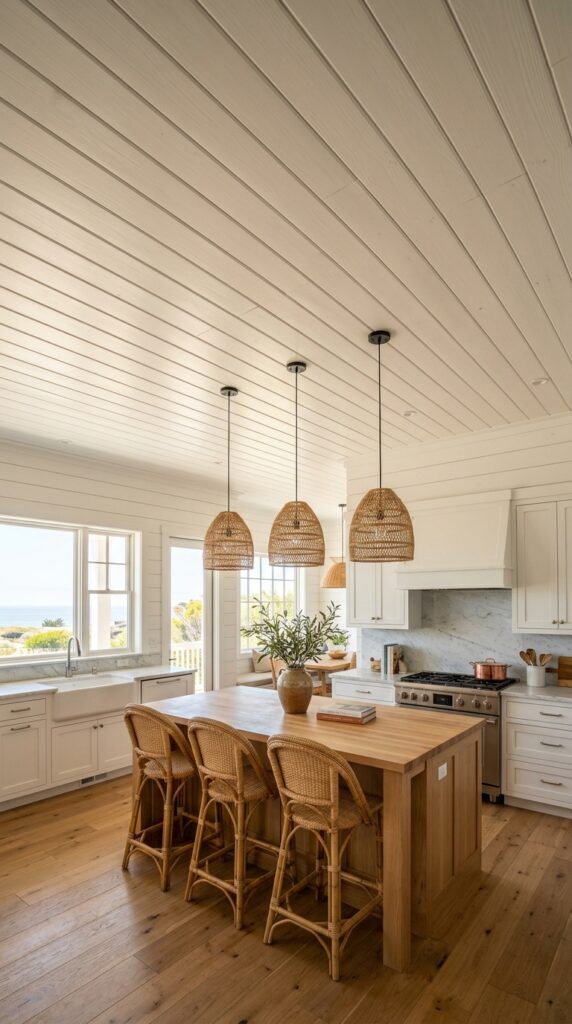
Vibe: Warm and architectural — a ceiling that makes the room feel finished from every direction.
Why it works: A white-painted tongue-and-groove ceiling is the indoor expression of the porch ceiling — one of coastal architecture’s most beloved elements — and its horizontal joint lines add a layer of linear texture to the one surface in a kitchen that most design approaches leave entirely undeveloped. The repetitive line pattern created by the T&G joints at 3-inch spacing reads as a subtle wainscoting for the ceiling plane, adding visual depth without color contrast. White painted T&G also reflects and diffuses light more richly than a flat painted ceiling due to the micro-shadow created at each board joint — the ceiling appears to glow rather than simply reflect.
How to get it: Install tongue-and-groove pine ceiling boards perpendicular to the room’s main view axis — if the kitchen is entered from the short end, run the boards along the long dimension so they lead the eye deeper into the space. Use 1×4 or 1×6 pre-primed pine T&G boards, blind-nailed at the tongue of each board into ceiling joists for a fastener-free face appearance.
Shop The Look
| Product |
| Tongue and groove ceiling board pine 1×4 white |
| Pre-primed pine T&G board kit ceiling |
| White porch ceiling paint exterior grade |
| Blind nail finish nailer kit T&G installation |
| White beadboard ceiling panel peel stick |
17. Brass Range Hood with a Shiplap Surround
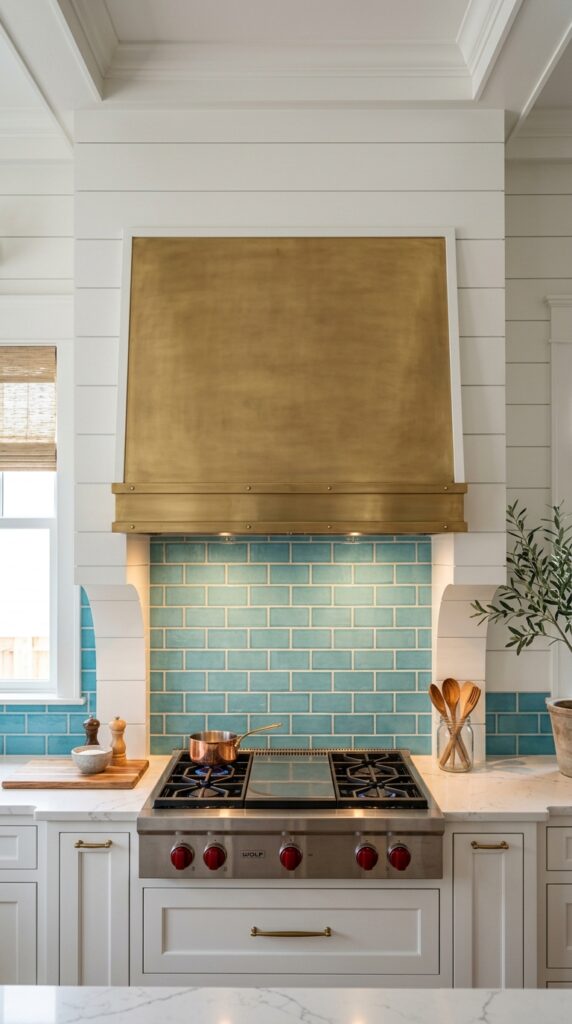
Vibe: Warm and architectural — a range wall that makes cooking feel ceremonial.
Why it works: A shiplap-surround range hood extending from counter height to the ceiling creates a full-height architectural feature wall that anchors the kitchen’s primary work zone as its visual focal point. The shiplap boarding at this scale — floor-to-ceiling on the most prominent wall — transforms what would otherwise be a ventilation appliance into a built-in architectural element with the presence of a fireplace surround. The brass face panel on the hood body bridges the shiplap’s casual material language with the precision of a metal object, introducing a material distinction that prevents the all-white shiplap wall from reading as flat or unfinished.
How to get it: Frame the hood surround box from 3/4-inch plywood, clad with 4-inch shiplap boards, and paint in the same color as the surrounding cabinetry. For the brass face panel, use a 22-gauge brushed brass sheet cut to the hood face dimensions — local metal suppliers cut to size, and a 24×30-inch panel costs approximately $80–$140 in brushed brass sheet stock.
Shop The Look
| Product |
| Brushed brass sheet metal panel 22 gauge |
| White shiplap range hood surround kit |
| Range hood insert liner stainless 600 CFM |
| Brass trim strip adhesive mount |
| Shiplap board 4 inch pre-primed pine |
18. Open Pot Rack Above the Island for Functional Display
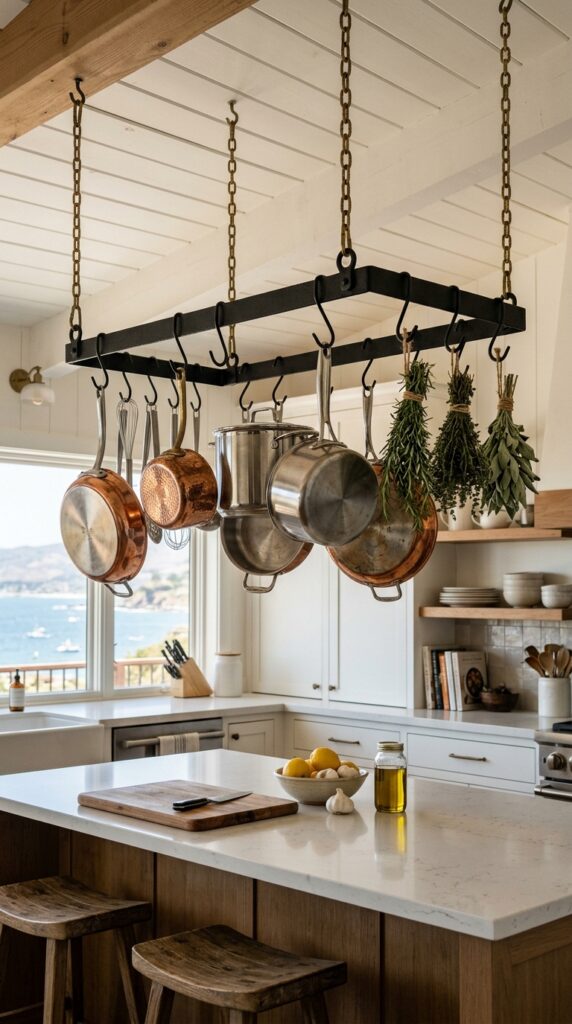
Vibe: Warm and functional — a kitchen that keeps its tools visible and its character honest.
Why it works: A ceiling-mounted pot rack is the coastal kitchen’s equivalent of the open shelf — it keeps functional items visible and accessible rather than hidden in a cabinet, treating cookware as part of the kitchen’s aesthetic rather than something to be concealed. Copper cookware against a matte black iron rack creates the strongest coastal kitchen material contrast available: the warm rose-gold of copper against the structural black iron references the maritime tradition of brass fittings against iron hull hardware. Dried herb bundles hung alongside the cookware also add an olfactory dimension to the kitchen environment, releasing fragrance when the heat from cooking rises through them.
How to get it: Mount the pot rack directly into ceiling joists — a fully loaded rack can weigh 80–120 lbs and requires structural ceiling anchors, not drywall anchors. Position the rack at 42–48 inches above the countertop for clearance when reaching into pots during cooking while maintaining adequate headroom below the cookware for standing at the island.
Shop The Look
| Product |
| Black iron ceiling pot rack rectangular |
| Brass chain ceiling pot rack suspension set |
| Copper stainless cookware set kitchen |
| Matte black pot rack S-hook set of 12 |
| Dried herb bundle kitchen hanging set |
19. Compact Coastal Kitchen in Under 100 Square Feet
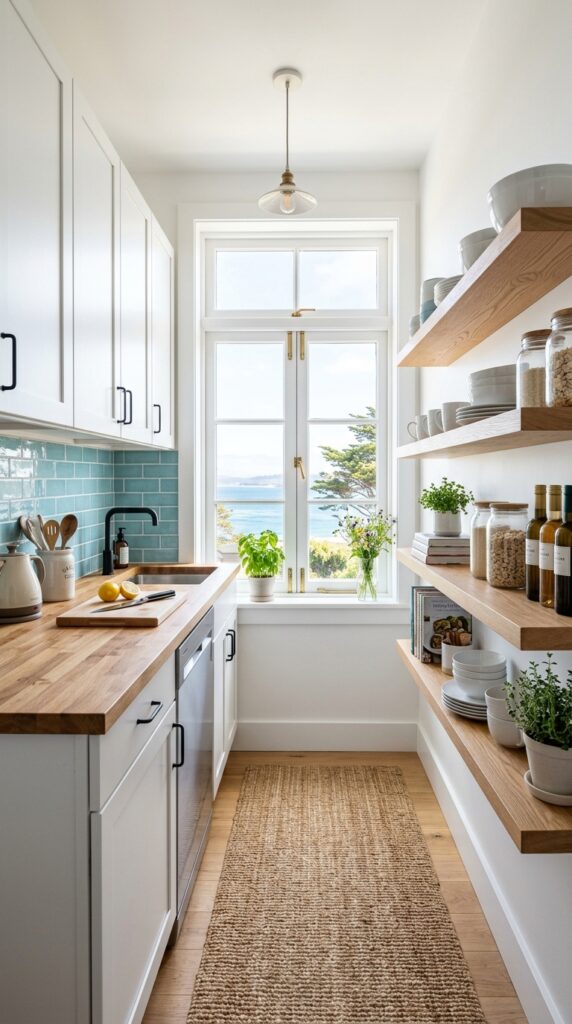
Vibe: Airy and efficient — a small kitchen that feels generous because it gives light priority over storage.
Why it works: In a kitchen under 100 square feet, the design moves that most expand perceived space are the same moves that most authentically express the coastal aesthetic: replacing upper cabinets on one wall with open shelving (which allows the eye to travel to the wall surface rather than terminating at a cabinet face), maximizing window area at the terminal wall of a galley (which creates a light-filled visual terminus that tricks the eye into perceiving additional depth beyond the kitchen’s actual end), and using a continuous material palette on all surfaces (white cabinetry, aqua backsplash, white-oiled shelves) that reads as a single designed object rather than a collection of separate elements.
How to get it: In a galley layout under 100 square feet, apply the one-wall rule: upper cabinets on one wall only, open shelving on the opposite wall. This asymmetry breaks the tunnel effect of a double-sided galley with upper cabinets on both walls, which is the primary source of visual compression in compact kitchens. The open shelf wall also allows the backsplash color (aqua tile or painted wall) to be visible for the full length of the kitchen, distributing the color accent throughout the space rather than concentrating it behind the range only.
Shop The Look
| Product |
| Compact galley kitchen cabinet set white shaker |
| Small kitchen open shelf white oak 24 inch |
| Aqua subway tile small kitchen backsplash |
| Compact kitchen countertop marble look 96 inch |
| Small kitchen casement window kit white |
20. Vintage Coastal Finds as Kitchen Accessories
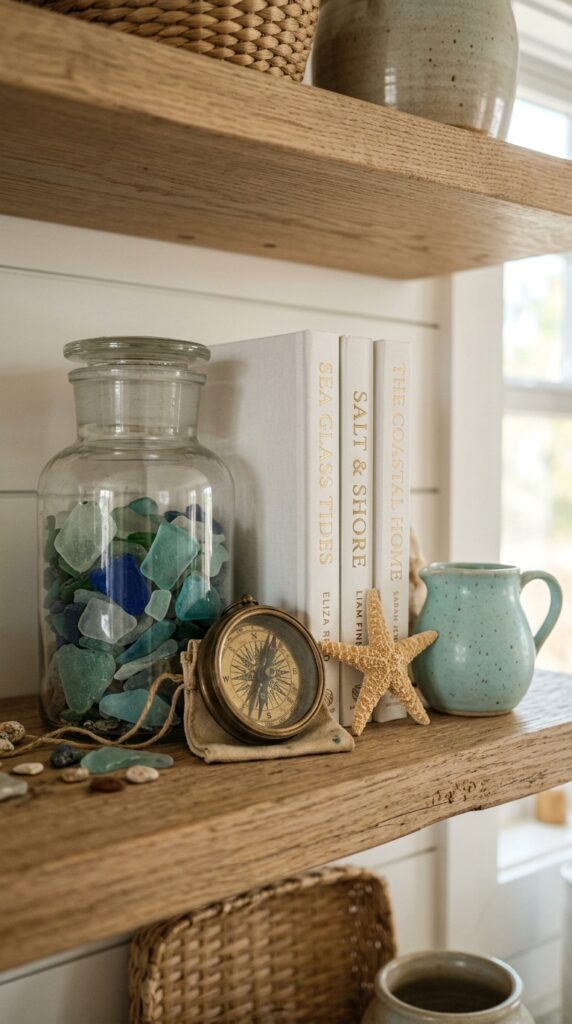
Vibe: Curated and nostalgic — a shelf that tells a story without explaining it.
Why it works: Coastal kitchen accessories work best when they reference the shore through material and provenance rather than through literal iconography — a jar of collected sea glass is more powerful than a manufactured sea glass vase because the real sea glass carries evidence of the actual shore: its frosted edges worn by wave action, its irregular pieces accumulated over multiple beach visits. The vintage brass compass and small ceramic pitcher in aqua glaze share a material authenticity that mass-produced coastal decorations lack — they are old, used objects or handmade objects whose imperfections communicate a relationship to the coast that perfect manufactured goods cannot replicate. The dried starfish is the one acceptable literal coastal object, because its form and texture are entirely natural rather than decorative.
How to get it: Build this style of shelf vignette using the rule of five elements: one vessel (the glass jar), one natural object (the starfish), one utilitarian object elevated to decorative use (the compass), one reading material (the book stack), and one ceramic in the palette color (the aqua pitcher). This formula produces a shelf composition that reads as personal rather than staged, which is the essential quality distinguishing genuine coastal interiors from catalog simulations.
Shop The Look
| Product |
| Clear glass apothecary jar large with lid |
| Sea glass collection mixed colors coastal |
| Aqua glaze ceramic pitcher small kitchen |
| Vintage brass compass decorative object |
| Dried natural starfish set coastal decor |
21. White Oak Floating Kitchen Shelves with Brass Brackets
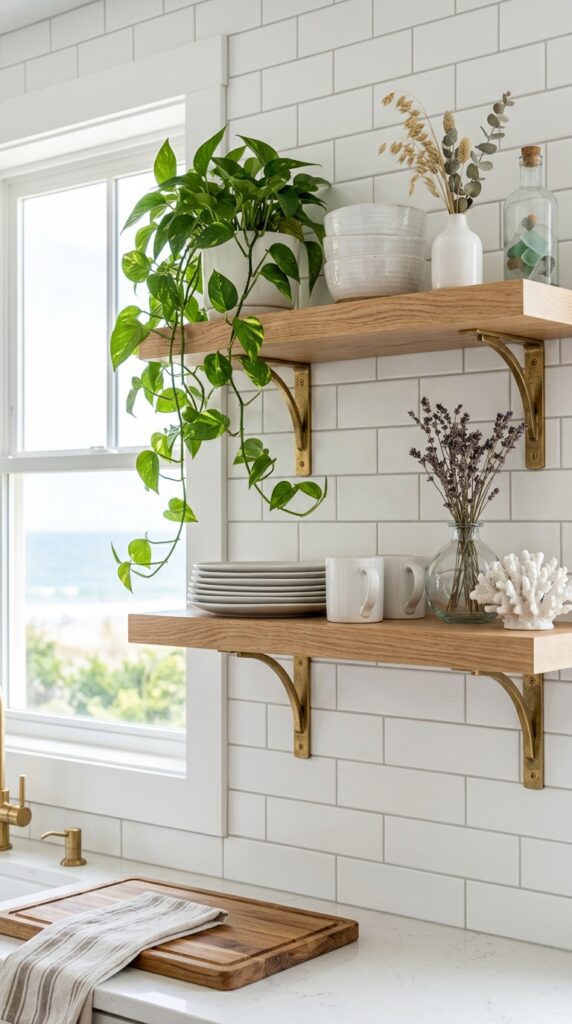
Vibe: Warm and considered — shelves where the bracket is part of the design.
Why it works: Exposed decorative shelf brackets — rather than the concealed floating brackets used in contemporary minimal interiors — are the authentic coastal kitchen shelf hardware choice because they reference the visible structural elements of coastal architecture: the exposed rafter tails, the visible knee braces of porch structures, and the functional hardware of working boats and coastal buildings where structural elements are never hidden. Brushed brass J-brackets on white oak shelves create a material pairing that is specific to the coastal palette — warm metal against bleached wood — and the brackets’ visibility adds a vertical design element to the shelf zone that concealed hardware eliminates. The 2-inch shelf thickness is critical for proportional credibility at this scale.
How to get it: Source brushed brass J-brackets (also called shelf corbels) in a 7–8-inch horizontal reach and a 6-inch vertical height — this proportion provides adequate support for a 10–12-inch-deep shelf loaded with ceramic dinnerware. Mount brackets directly into studs at 16-inch centers; at 24-inch stud spacing, add a horizontal backing board of 3/4-inch plywood into the studs first, then mount brackets into the backing board at any position.
Shop The Look
| Product |
| Brushed brass J-bracket shelf support decorative |
| White oak shelf board 2 inch thick 48 inch |
| Brass shelf corbel bracket decorative |
| White ceramic bowl set kitchen display |
| Trailing pothos plant white ceramic pot |
22. Subway Tile in a Vertical Stack Bond Pattern
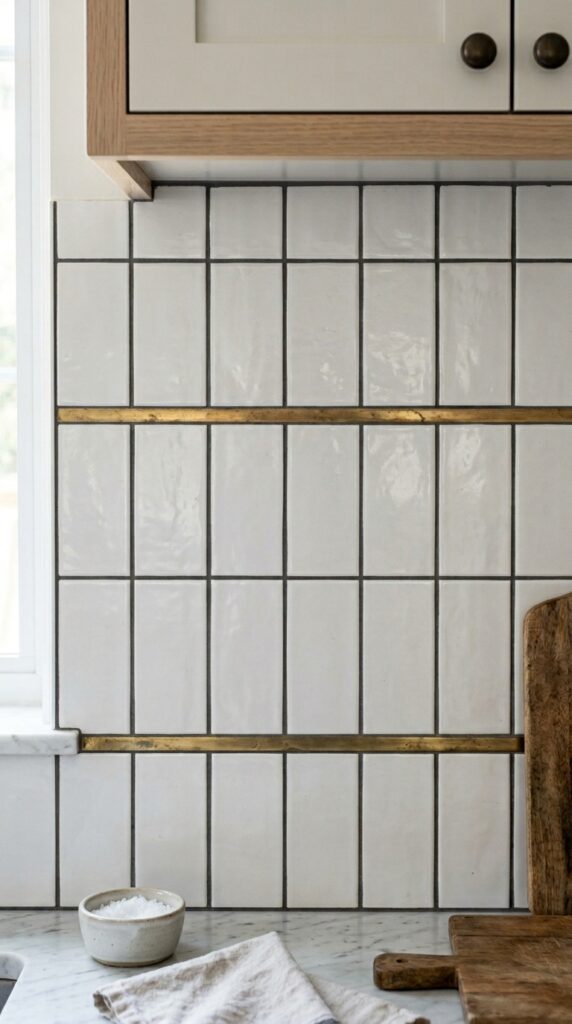
Vibe: Crisp and considered — a classic material installed in a way that makes it feel current.
Why it works: Subway tile installed in a vertical stack bond — tiles stacked directly above each other rather than in the standard offset brick pattern — creates a stronger vertical rhythm that draws the eye upward, visually heightening the backsplash zone and making kitchen ceilings appear higher. The continuous vertical grout joints also reference the vertical boarding of coastal exterior cladding — shiplap, clapboard, board-and-batten — making the backsplash read as materially consistent with the coastal architectural vocabulary of the kitchen’s other surfaces. Dark gray grout (rather than the typical white or light gray) sharpens every tile edge and makes the pattern read as a deliberate design choice rather than a background element.
How to get it: Stack bond installation requires perfectly level and plumb tile layout — any drift in the wall’s plumb will be dramatically amplified by the continuous vertical joint lines, making a 1/8-inch-out-of-plumb condition visible across the full height of the backsplash. Use a laser level for the layout and check plumb at every fourth course during installation.
Shop The Look
| Product |
| White 3×6 subway tile glossy glaze case |
| Dark gray sanded grout 1/16 inch |
| Subway tile vertical stack bond layout tool |
| Unlacquered brass tile trim strip insert |
| White subway tile installation kit adhesive |
23. Coastal Scent and Sensory Details: Linen, Herbs, and Light
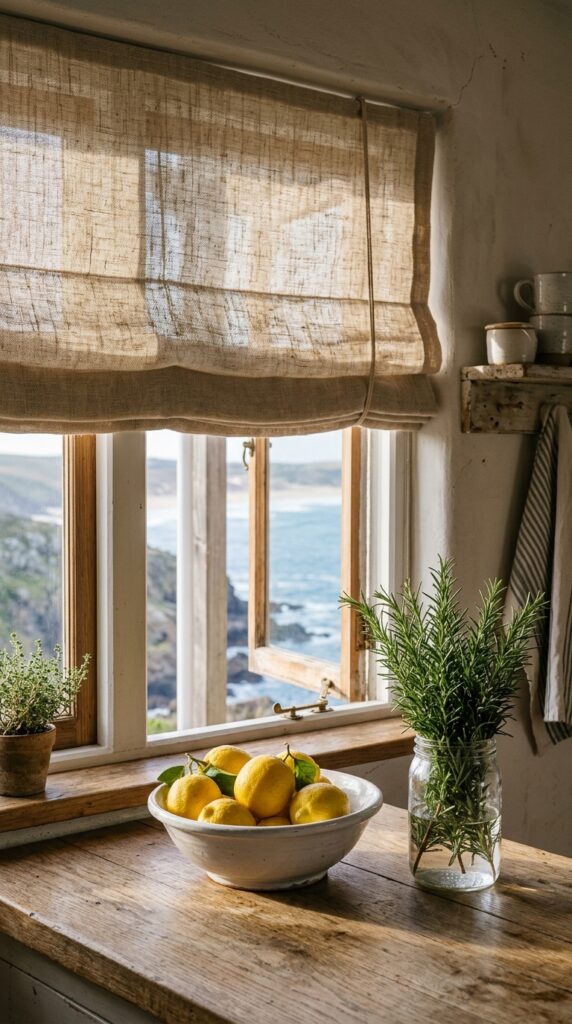
Vibe: Slow and sensory — a kitchen that engages more than just the eye.
Why it works: The final and most often overlooked dimension of coastal kitchen design is the sensory layer that operates beyond the visual: the specific scent of fresh lemon and rosemary on a kitchen counter, the warm-filtered light quality of natural linen fabric, the sound of a breeze through an open window. These elements are not decorative additions — they are the experiential substance that determines whether a coastal kitchen feels genuinely inhabited by someone who lives near the shore or merely resembles one. A natural linen Roman shade is the ideal coastal window treatment because its undyed, slightly rough weave texture diffuses light into a warm amber glow that no other fabric replicates, and because its Roman fold — a series of clean horizontal creases — references the folded sails and stacked canvas of traditional coastal working life.
How to get it: Specify a natural linen Roman shade in an undyed or oatmeal tone — not ecru, which has a slightly yellow cast, and not white, which loses the material warmth of the natural fiber. The shade should be made from a minimum 180 GSM linen for adequate light diffusion; lighter weights are too transparent and heavier weights block too much light. Mount the shade inside the window reveal rather than on the wall above for maximum light filtration and a tighter architectural integration with the window frame.
Shop The Look
| Product |
| Natural linen Roman shade undyed oatmeal |
| Linen Roman shade inside mount kit |
| White ceramic fruit bowl kitchen counter |
| Fresh rosemary bundle kitchen herb |
| Linen window shade cord hardware kit |
How to Start Your Coastal Kitchen Transformation
The single most effective first move is replacing existing cabinet hardware with unlacquered brass cup pulls throughout the kitchen. More than any other single change — paint color, backsplash, lighting — hardware replacement is the action that most immediately shifts the kitchen’s design register from generic to coastal-specific. Unlacquered brass cup pulls cost $8–$18 per pull, require only a screwdriver, and take approximately 45 minutes to replace throughout a standard kitchen. Every subsequent upgrade — shiplap island cladding, a rattan pendant, aqua backsplash — will reference the brass hardware as its palette anchor, making the hardware replacement not just the first move but the most structurally important one in the transformation sequence.
The most common mistake is using too much blue — specifically, applying the coastal blue-green palette to walls, cabinetry, backsplash, and accessories simultaneously, which creates a saturated, thematic result that feels more like a resort hotel than a kitchen. The fix is the 70-20-10 rule applied specifically to coastal color: 70% of all surfaces in neutral white, cream, or natural wood tones; 20% in the coastal blue-green applied to one dominant surface (backsplash or lower cabinets or wall paint, never more than one simultaneously); and 10% in accent colors introduced through accessories, plants, and hardware. This distribution is what distinguishes sophisticated coastal design from its more literal coastal-themed counterpart.
Three specific items under $50 for immediate coastal kitchen impact: a bundle of five 3.5-inch terracotta pots with herb plants for the window sill ($25 total), a set of unlacquered brass cup pulls for the two most visible cabinet doors ($16–$36 for four pulls), and a large round seagrass basket for towel or produce storage on the counter or floor beside the island ($22–$35).
Realistically, a cosmetic coastal kitchen refresh — new hardware, rattan pendants, open shelf styling, a linen Roman shade, and counter accessories — costs $400–$1,200 and can be completed over two weekends without any contractor involvement. A mid-level transformation adding a new backsplash tile, painted cabinets, and a farmhouse sink runs $3,000–$9,000 and requires a tile setter and plumber. A full coastal kitchen renovation with new cabinetry, shiplap island cladding, marble countertops, and custom range hood runs $25,000–$75,000+ and should be treated as a 3–6 month project.
Frequently Asked Questions About Coastal Kitchen Design
What is the difference between a coastal kitchen and a beach house kitchen?
A coastal kitchen is a design approach defined by a specific material palette and architectural vocabulary — white shaker cabinetry, unlacquered brass hardware, honed marble or stone countertops, natural fiber lighting, and a blue-green-white color story drawn from the shoreline environment. It is a design language applicable in any geography. A beach house kitchen is a kitchen in a literal beach house, which may or may not be designed in a coastal aesthetic — many beach houses have entirely contemporary, farmhouse, or even industrial kitchens. The coastal kitchen design concept is most accurately understood as the aesthetic language of the best beach houses rather than as a description of any kitchen that happens to be near a beach.
What are the best paint colors for a coastal kitchen?
The three most architecturally accurate coastal kitchen paint colors are Benjamin Moore “Palladian Blue” (HC-144) for walls and accents — a warm blue-green that reads differently throughout the day; Benjamin Moore “Chantilly Lace” (OC-65) for white cabinetry — a warm white with sufficient brightness to reflect coastal light without yellowing; and Farrow & Ball “Hague Blue” (No. 30) for navy lower cabinets — a deep warm-undertone navy that references traditional boat hull color. For kitchens with significant natural light, these colors perform exactly as intended. In kitchens with limited natural light, shift each color one step lighter: “Palladian Blue” toward “Stolen Moments” (2129-40), and “Hague Blue” toward “Hale Navy” (HC-154).
How much does a coastal kitchen renovation cost?
The range is wide depending on scope. A hardware-only refresh (replacing all cabinet pulls and knobs with unlacquered brass) costs $200–$600 for a standard kitchen. Adding painted cabinets, a new backsplash, and rattan pendant lighting runs $2,500–$6,000. A mid-scope renovation adding a farmhouse sink, marble countertops, and open shelving runs $8,000–$20,000. A full coastal kitchen with new cabinetry, custom shiplap island, marble counters, fireclay sink, brass fixtures, and tongue-and-groove ceiling runs $40,000–$100,000+ for a kitchen over 200 square feet. The highest return-on-investment upgrades in the coastal kitchen category are hardware replacement (lowest cost, highest visual impact per dollar) and pendant lighting replacement (second lowest cost, transforms the kitchen’s atmosphere most dramatically after dark).
Can a coastal kitchen work in a landlocked home?
Absolutely, and this is increasingly how the style is applied — the coastal kitchen’s design logic is fundamentally about light maximization, material honesty, and the relaxed openness of a kitchen that treats indoor and outdoor as a continuum. These are design qualities desirable in any geography. The key to a successful coastal kitchen in a landlocked home is avoiding literal coastal iconography — no seashell hardware, no anchor motifs, no rope accents — and instead committing to the material palette: the specific whites, the unlacquered brass, the natural fibers, the blue-green tile. A kitchen that uses these materials speaks the coastal language without requiring a view of the water to justify it.
What countertop material is most authentic to the coastal kitchen aesthetic?
Honed Carrara or Calacatta marble is the most historically authentic coastal kitchen countertop material, referencing the traditional stone surfaces of Greek island kitchens, Italian coastal villas, and New England summer houses. Its matte, slightly porous surface develops a lived-in patina over time that is precisely appropriate for the coastal design philosophy of materials that improve with use. For those unwilling to accept marble’s maintenance requirements, the best alternative is a honed marble-look porcelain in a 2 cm thickness — specify brands such as Atlas Plan “Statuario” or Dekton “Entzo” for the most convincing marble visual at the honed finish. White oak butcher block is the second most authentic choice for island countertops specifically, referencing the traditional working surfaces of coastal farmhouse and cottage kitchens.
Ready to Create Your Dream Coastal Kitchen?
These 23 concepts span the full material and design vocabulary of coastal kitchen design — from the chromatic architecture of a Palladian blue wall and a soft aqua subway tile backsplash, to the sensory completeness of a natural linen Roman shade and a terracotta window sill herb garden, to the structural gestures of a shiplap island cladding and a tongue-and-groove ceiling. Every coastal kitchen transformation begins with a single honest material decision rather than a comprehensive plan — and the most honest first decision available is always the hardware. Today, measure the center-to-center distance of your existing cabinet hardware and order one set of unlacquered brass cup pulls in that specification — one drawer, one cabinet, placed where you will see them every morning, to understand what the material change actually feels like before committing to the room. When a coastal kitchen is right, it delivers the quality that makes the best beach houses irreplaceable: the feeling that the kitchen is part of somewhere, not just a room in a house. Pin the ideas that made you slow down — especially the ones involving morning light, linen, and the particular warm weight of unlacquered brass — because those are the details that hold up every single day.