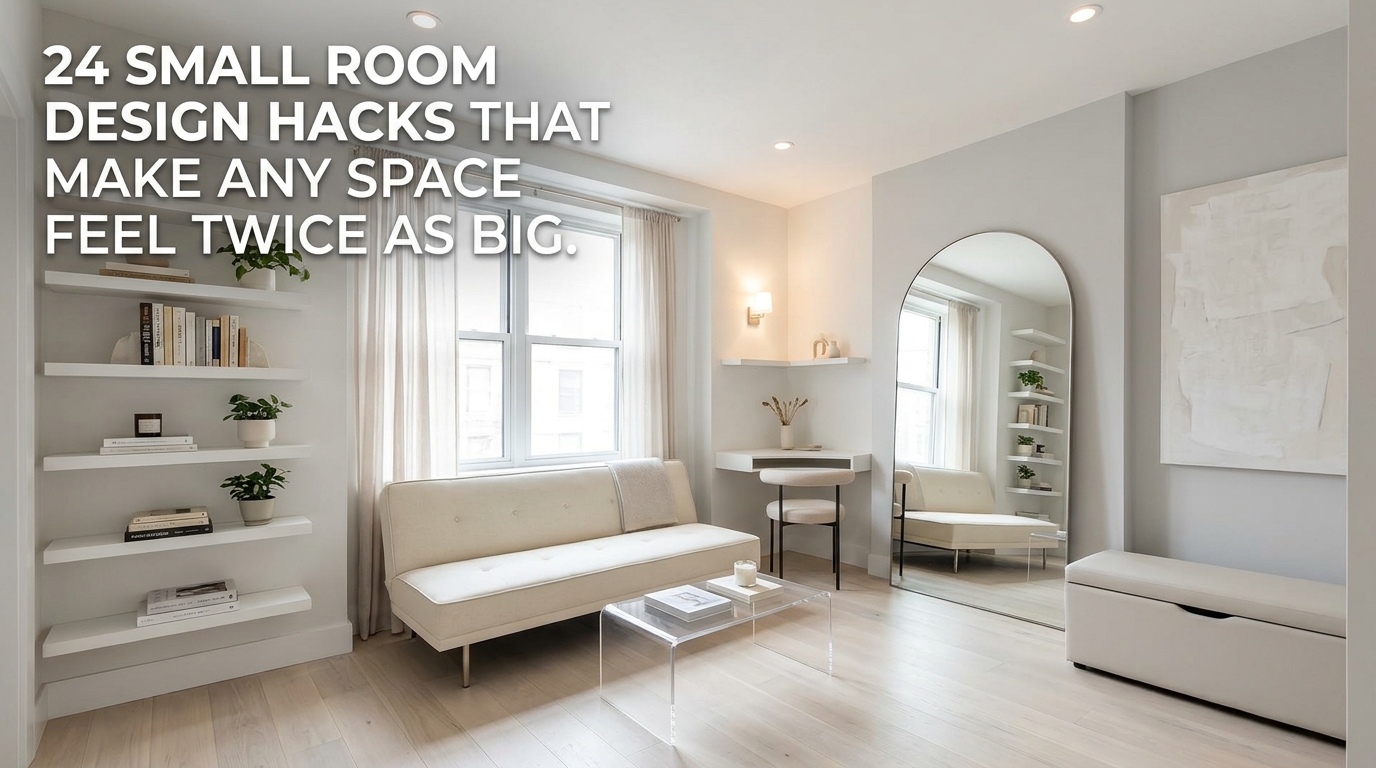
Small room design is the discipline of using proportion, light, material, and spatial psychology to make compact spaces feel generous, intentional, and genuinely livable — not just functional but deeply comfortable. This article gives you 24 distinct small room design hacks spanning color, material, lighting, furniture, accessories, layout, and space-maximizing techniques.
There’s a particular satisfaction in a small room that works. The ceiling feels taller than it is. The walls don’t close in. Every object has a reason for being exactly where it is, and nothing — not a single drawer or ledge — goes unused. A well-designed small room isn’t a compromise. It’s a form of precision. Here are 24 ideas worth saving — and stealing.
Why Small Room Design Works So Well
Small room design draws from three converging disciplines: Japanese spatial philosophy, which treats compact living as an opportunity for intentional simplicity rather than a constraint to overcome; Scandinavian functionalism, which insists that every object in a limited space must earn its place through usefulness as much as beauty; and the practical innovations of urban architecture — New York loft conversions, London Georgian terrace apartments, Tokyo micro-apartments — where designers have spent decades solving the same problems with increasingly elegant results. What unifies these traditions is a shared understanding that perceived spaciousness is a psychological condition created by specific design choices, not a fixed property of square footage.
The material vocabulary of successful small rooms is precise. Think light-reflective surfaces — high-sheen lacquer, mirror, polished plaster, and pale limed oak — for wall and floor treatments. Furniture in slim profiles with visible legs: tapered mid-century legs, hairpin steel, or natural rattan frames that allow the eye to see floor beneath them. Hardware and fittings in a single consistent metal finish — warm brass, matte black, or brushed nickel — so that every metallic element reinforces rather than competes. Paint references for small rooms: Farrow & Ball Wimborne White (No. 239) for a warm expansive white, Benjamin Moore Pale Oak (OC-20) for a warm greige that reads as neutral without shrinking the room, and SW Repose Gray (SW 7015) for a cool-neutral that gains calm in compact spaces.
The cultural moment for small room design has never been stronger. Urban housing costs have pushed more people into smaller spaces than at any previous point in modern history, and the design response has evolved from apology to ambition — small rooms are now treated as design challenges worth solving with creativity and investment rather than necessity to tolerate. Pinterest searches for “small room hacks,” “studio apartment design,” and “maximise small space” consistently rank among the platform’s highest-volume home categories, reflecting a genuine, sustained demand for spatial intelligence.
The foundational principle — applicable to every hack that follows — is that perceived space is determined more by what you remove than what you add. Every object that stays in a small room should justify its presence through function, beauty, or both. Everything that stays without justification is a tax on the room’s spaciousness.
Style at a Glance
| Element | Trait 1 | Trait 2 |
| Philosophy | Perceived space over actual space | Every object earns its place |
| Materials | Mirror, pale limed oak, high-sheen plaster | Slim steel legs, rattan, light linen |
| Color palette | Warm white, pale greige, soft sage | Tonal neutrals, single accent color |
24 Small Room Design Hacks
1. Paint Walls, Ceiling, and Trim the Same Color
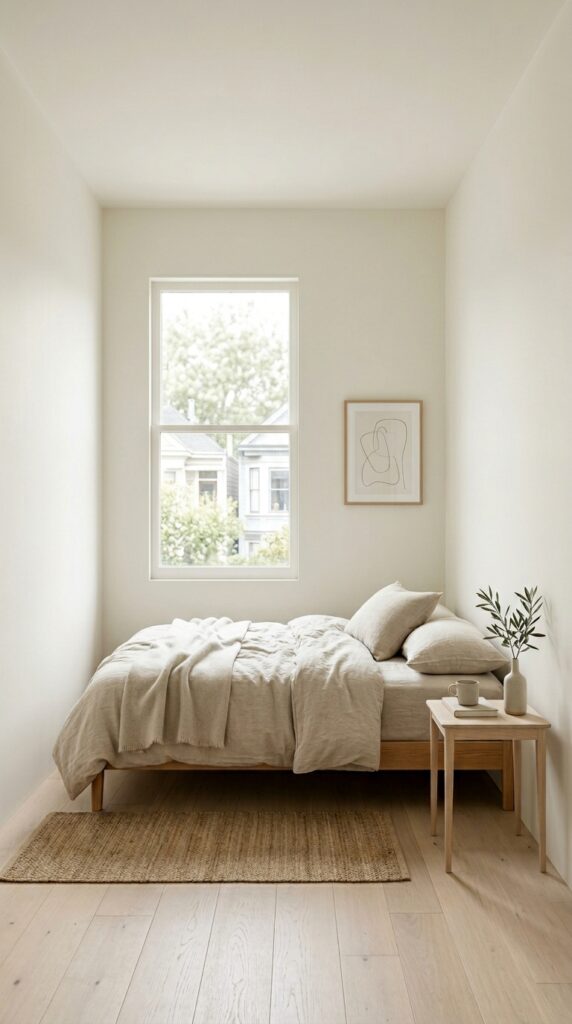
Vibe: Expansive and unified — the room that erased its own edges.
Why it works: Painting walls, ceiling, and trim in a single color removes the visual boundary lines that define where surfaces end and begin — the cornice line, the skirting board, the window frame — which are the primary cues the eye uses to measure a room’s dimensions. When those cues disappear into a continuous tonal envelope, the brain loses its reference points for scale and the room appears larger. The design principle is perceptual boundary dissolution: the eye cannot measure what it cannot define. This is the single highest-impact small room intervention because it costs the same as any other paint job and affects every surface simultaneously.
How to get it: Use the same paint color in the same finish on all surfaces — eggshell throughout works for walls, ceiling, and trim without the sheen variation that mixing flat and gloss finishes produces. Benjamin Moore Pale Oak (OC-20) in eggshell is the warmest, most forgiving single-color envelope for small rooms with imperfect natural light.
💡 Quick Win: If repainting the entire room feels excessive, start with just the ceiling — painting the ceiling the same color as the walls (most rooms default to a brighter white ceiling) removes the most significant visual boundary in the room and immediately raises the apparent ceiling height.
| Shop The Look |
| Warm white eggshell paint walls ceiling trim small room |
| Benjamin Moore Pale Oak paint sample peel stick |
| Slim linen low bed frame small bedroom |
| Single framed art print small room minimal |
| Pale oak floating shelf small room wall |
2. Mirrors Placed to Double Natural Light
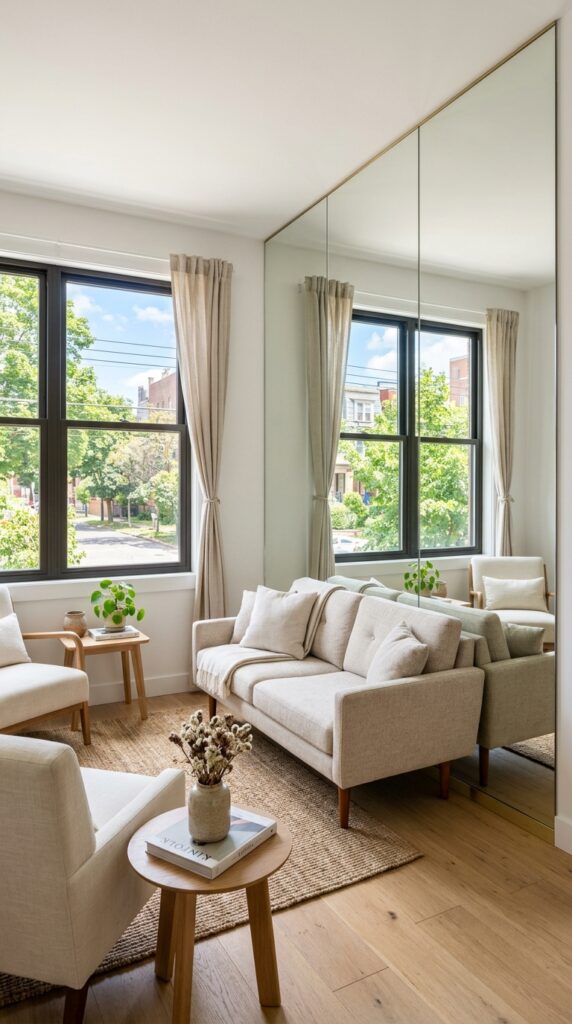
Vibe: Luminous and expanded — the wall that borrowed a window from the opposite side of the room.
Why it works: A large mirror positioned directly opposite a window performs two spatial operations simultaneously: it reflects the natural light source back into the room, approximately doubling the effective illumination of the space, and it introduces a second apparent view — the mirror reflection of the window reads perceptually as a second window opening onto the same light source. This creates the spatial impression of a room with windows on two walls rather than one, which is the primary design condition associated with generosity and airiness in residential space. Floor-to-ceiling height is critical — a half-height mirror reflects the room; a full-height mirror reflects the room’s vertical dimension, which is where perceived spaciousness lives.
How to get it: Position the mirror so its center aligns with the center of the window opposite — this maximises the reflection of the window itself rather than the wall beside it. A frameless mirror or one with a very slim (under 20mm) frame minimises the visual weight of the mirror as an object and maximises its function as a reflective plane.
| Shop The Look |
| Floor to ceiling full length mirror frameless large |
| Large wall mirror slim brass frame small room |
| Mirror wall panel adhesive frameless room |
| Leaner mirror full length bedroom small space |
| Slim mirror wall mount hardware minimal |
3. Furniture with Exposed Legs
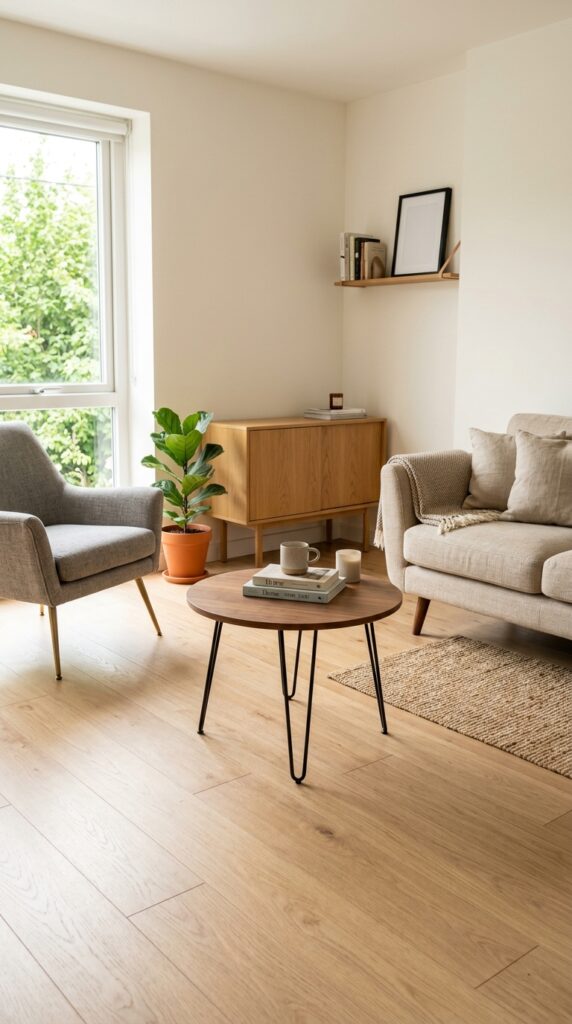
Vibe: Airy and grounded simultaneously — furniture that floats above the floor while anchoring the room.
Why it works: Furniture on visible legs allows the floor plane to continue visually beneath every piece, which means the eye reads the full floor area of the room rather than only the exposed floor area between furniture bases. This is the principle of visual floor continuity: a sofa on a platform base hides 200cm × 90cm of floor and makes the room feel smaller; the same sofa on 15cm tapered legs reveals that entire floor area, and the room reads as larger. The effect compounds when every furniture piece in the room contributes visible floor clearance — the cumulative impact is a room that feels as though it has significantly more floor area than its actual dimensions.
How to get it: Replace furniture legs on existing pieces using aftermarket tapered or hairpin leg sets — most sofas, sideboards, and bed frames accept standard M8 or M10 leg inserts. A set of four 15cm tapered walnut legs costs $30 to $50 and installs in under 30 minutes, transforming the spatial quality of any furniture piece that currently sits on a plinth base.
| Shop The Look |
| Tapered walnut furniture legs replacement set 4 |
| Hairpin coffee table legs steel set 4 |
| Angled brass sofa legs replacement set |
| Slim profile sofa tapered legs small room |
| Hairpin leg side table small room minimal |
4. Vertical Storage from Floor to Ceiling
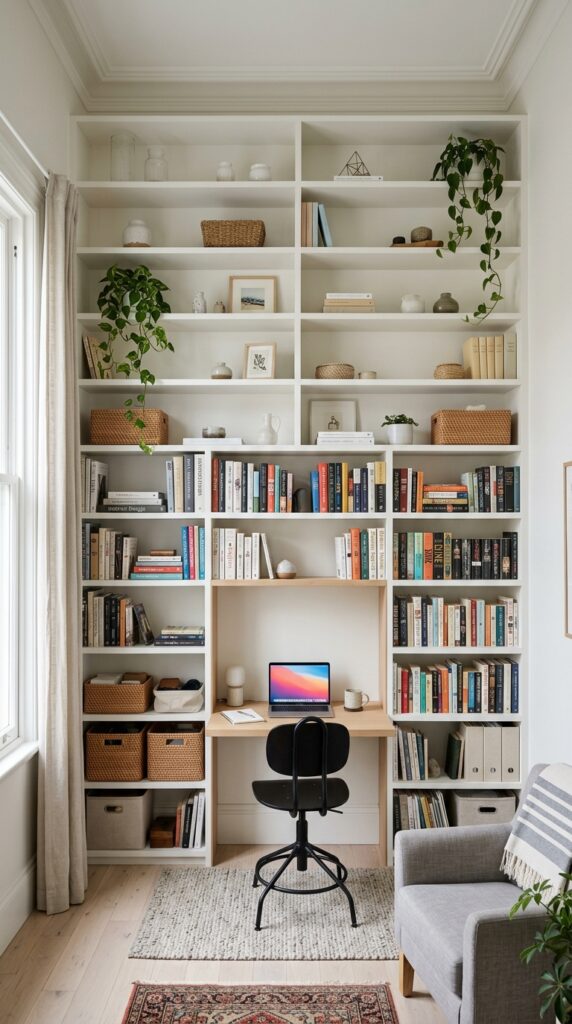
Vibe: Organised and vertically expansive — shelving that turns the ceiling into an asset.
Why it works: Floor-to-ceiling vertical storage applies the principle of eye-line extension — bookshelves or cabinetry that reach the ceiling force the eye to travel upward to read the full height of the unit, which trains the brain to register the room’s full vertical dimension rather than the conventional eye-level stopping point. This makes ceilings feel higher. Simultaneously, the vertical storage consolidates what would otherwise be multiple smaller storage pieces scattered throughout the room, freeing floor area and reducing visual complexity. The design rule is: paint the shelving unit the same color as the wall behind it — this makes the storage read as an architectural feature rather than furniture, and the color continuity prevents the unit from visually shrinking the room it serves.
How to get it: Extend shelving to within 5cm of the ceiling maximum — visible gap above the top shelf reads as incomplete and breaks the floor-to-ceiling continuity that drives the height perception effect. A thin scribe molding between the top shelf and the ceiling creates a clean, custom-built appearance.
💡 Quick Win: Stack two standard IKEA BILLY bookcases vertically — one 202cm unit with an extension unit above it — to achieve near-floor-to-ceiling shelving at $120 to $180 per stack, painted to match the wall in any color.
| Shop The Look |
| Floor to ceiling bookcase white small room |
| Floating shelf set wall to ceiling vertical |
| Adjustable shelving system floor ceiling bracket |
| Shelf extension unit add-on ceiling small room |
| White bookcase paint match wall minimal |
5. Pale, Warm Flooring to Expand the Floor Plane
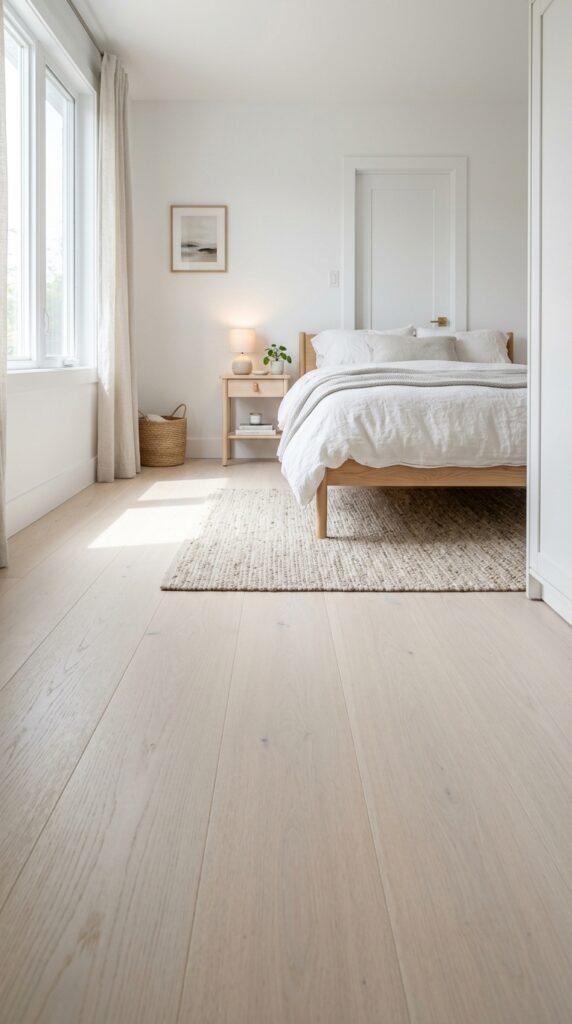
Vibe: Airy and grounded — a pale floor that seems to push the walls outward as you look across it.
Why it works: Pale flooring expands perceived floor area through light reflectivity — a warm ivory or whitewashed floor surface reflects light upward and outward, which makes the floor plane appear both brighter and larger than its actual dimensions. Wide-plank format amplifies this effect by reducing the number of visible joint lines that cross the floor surface: a narrow-plank floor with joints every 80mm creates a grid that the eye uses to measure floor area; a wide-plank floor with joints every 180 to 200mm provides fewer reference points and appears more expansive. The additional warmth of a whitewash finish prevents the pale floor from reading as cold or clinical.
How to get it: For existing dark or medium-toned timber floors, a wood lightening or whitewash treatment kit ($40 to $80) applied over a lightly sanded surface can shift the floor tone significantly toward pale without full floor replacement. Test on an inconspicuous area first — the outcome varies considerably depending on the existing floor species and finish.
| Shop The Look |
| Wide plank whitewashed oak flooring small room |
| Wood whitewash kit floor lightening treatment |
| Pale timber floor white oil finish natural |
| Large format pale wood effect vinyl plank floor |
| Wood floor whitewash wax finishing kit |
6. Transparent and Ghost Furniture
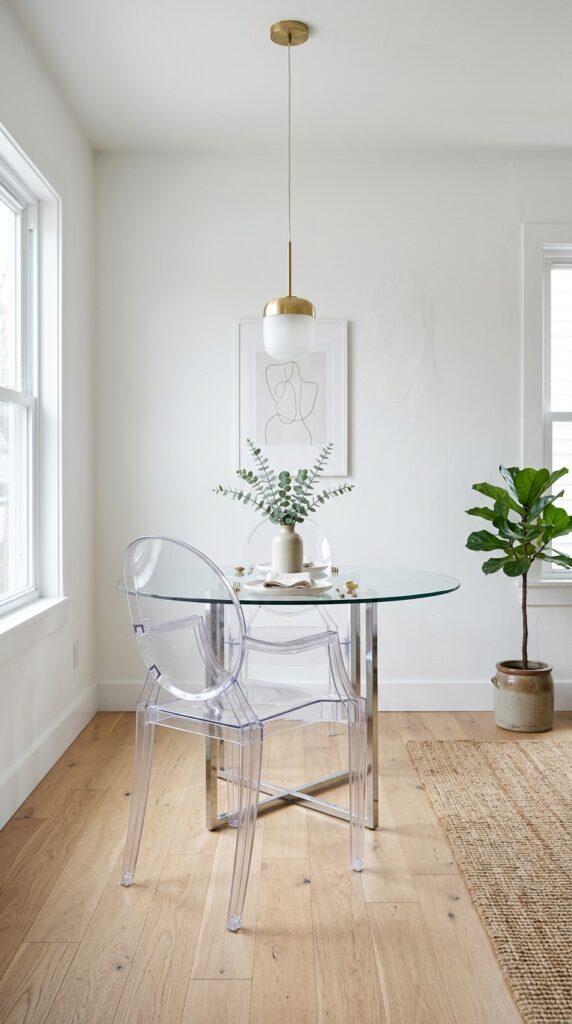
Vibe: Airy and modern — furniture that takes up space without appearing to.
Why it works: Transparent and ghost furniture exploits the principle of visual subtraction — a clear acrylic chair physically occupies the same volume as an opaque chair, but the eye reads through the chair to the wall and floor behind it, registering the space as continuous rather than occupied. This is one of the most effective techniques in small room design because it provides functional furniture without the visual mass that makes rooms feel crowded. The Kartell Louis Ghost chair is the canonical example, but any clear acrylic seating or glass-topped tables achieve the same spatial effect. The technique works best in dining areas and living rooms where seating is the primary space-consumer.
How to get it: Use ghost chairs and glass tables as a complete set for maximum spatial benefit — mixing transparent and opaque furniture in the same seating group dilutes the effect. Reserve opaque furniture for one anchor piece (a sofa, a bed) and fill all secondary furniture needs with transparent alternatives.
| Shop The Look |
| Clear acrylic ghost chair set dining room |
| Glass top dining table small room clear |
| Acrylic side table transparent small room |
| Ghost style chair clear acrylic set of 2 |
| Glass and brass coffee table small living room |
7. Single Oversized Rug Instead of Multiple Small Ones
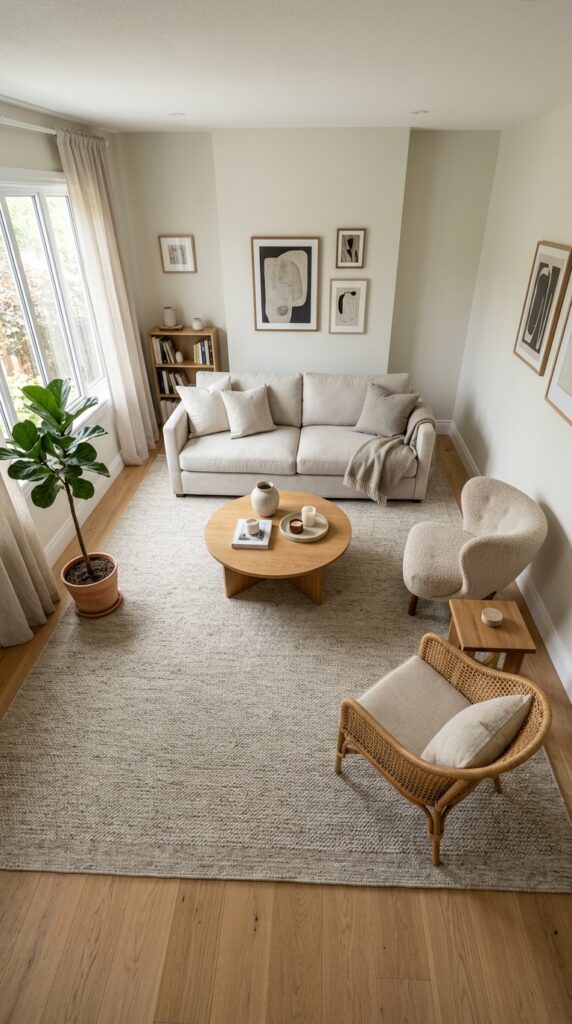
Vibe: Unified and spacious — the single rug that convinces a room it’s larger than it measured.
Why it works: One large rug used correctly — extending beneath all furniture pieces with its edge 25 to 35cm from each wall — reads as the room’s floor covering rather than as an accessory placed on the floor. This is a critical perceptual distinction: a rug that reads as a floor covering makes the room feel like a complete, well-scaled space; a rug that reads as an object placed on the floor makes the room feel smaller because it defines a zone within the room rather than becoming the room. Multiple small rugs compound the problem by creating multiple zone-definitions that fragment the floor plane and make the room feel cellular rather than open.
How to get it: The minimum rug size for a living room where all furniture sits on the rug is 8×10 feet; 9×12 is more generous. When choosing, err larger rather than smaller — the most common small room rug mistake is buying a rug that is too small, which creates the floor-fragment effect rather than the floor-covering effect.
| Shop The Look |
| Large area rug 9×12 neutral tonal small room |
| Rug 8×10 natural jute sisal small living room |
| Non slip rug pad large 9×12 small room |
| Neutral flatweave rug large small living room |
| Low pile area rug large small room neutral |
8. Wall-Mounted Bedside Tables to Free Floor Space
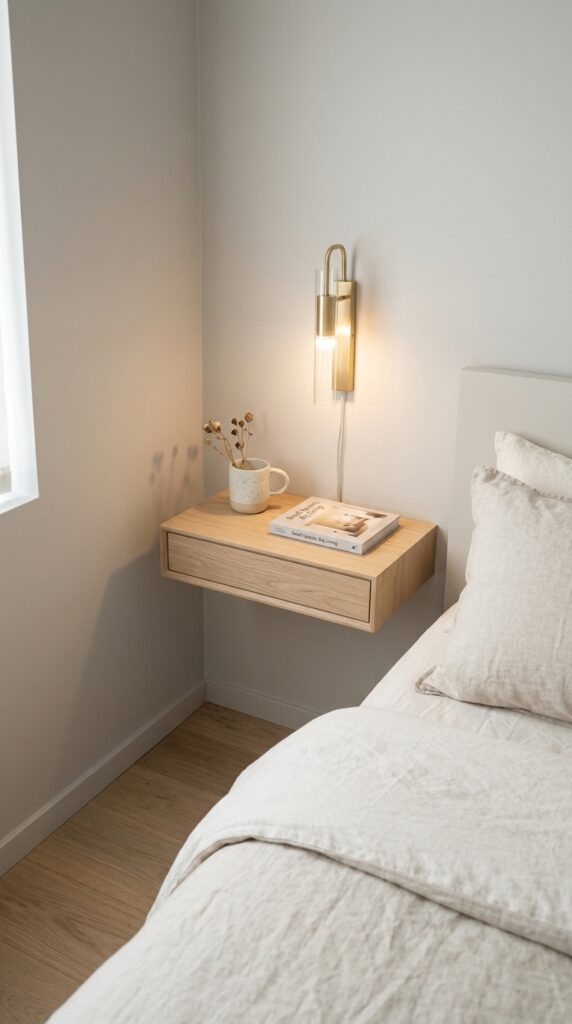
Vibe: Light and resolved — the bedroom that found 60 centimetres of floor it didn’t know it had.
Why it works: A standard freestanding bedside table occupies 45 to 55cm of floor depth and 40 to 50cm of floor width on each side of the bed — in a small bedroom, this can represent 10 to 15% of the room’s total floor area consumed by two small tables whose only function is to hold a lamp and a phone. Wall-mounted floating shelves at mattress height perform the identical functional role in 20 to 25cm of depth with zero floor footprint, recovering that floor area entirely. Visible floor beside a bed is one of the primary cues the eye uses to assess bedroom size — a bed floating in clear floor space reads as generously sized; a bed hemmed in by furniture on both sides reads as cramped regardless of actual dimensions.
How to get it: Mount shelves at mattress-top height — typically 55 to 65cm from the floor depending on mattress depth — so that a seated occupant reaches the shelf without stretching. Install into wall studs for shelves that will hold a lamp; drywall anchors alone are insufficient for the lateral load of a table lamp base.
| Shop The Look |
| Floating wall mounted bedside shelf small bedroom |
| White oak wall shelf bedside small room |
| Wall mounted lamp bedside swing arm small room |
| Invisible shelf bracket floating small bedroom |
| Small ceramic object bedside shelf minimal |
9. Curtains Hung at Ceiling Height
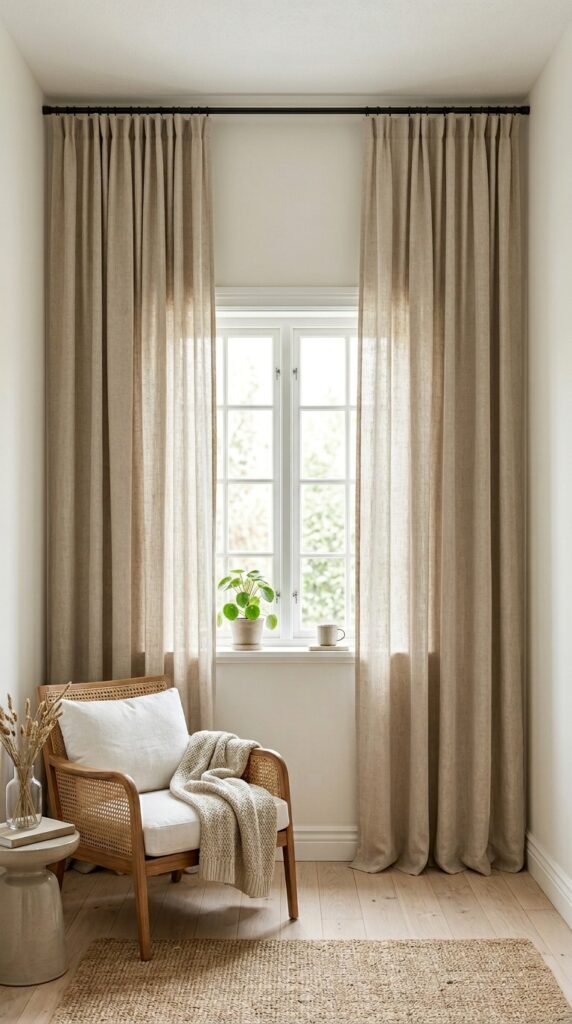
Vibe: Tall and airy — the visual trick that adds a foot to your ceiling without touching it.
Why it works: Hanging curtains at ceiling height rather than window-header height creates the perception of significantly taller windows and higher ceilings by establishing a continuous vertical element that runs from ceiling to floor. The eye follows the curtain fabric from its ceiling-level origin down to the floor, registering the full room height as part of the window zone. This works because windows are the primary reference point for ceiling height — when the curtain suggests the window begins at the ceiling, the brain infers a taller room. The window’s actual header position becomes invisible behind the curtain in its open state, and the eye has no reference point to measure it accurately.
How to get it: Mount the curtain rod 5 to 10cm below the ceiling — any closer than 5cm is difficult to install cleanly; any lower than 10cm reduces the ceiling-height illusion. Use full-length curtains that graze or pool slightly on the floor — curtains that hang short of the floor reveal the actual window proportion and defeat the technique.
💡 Quick Win: Moving an existing curtain rod from window-header height to ceiling height costs nothing and takes 20 minutes — the impact on perceived ceiling height and room scale is immediate and significant.
| Shop The Look |
| Linen floor length curtain panel ceiling mount |
| Ceiling height curtain rod extendable small room |
| Curtain rod bracket ceiling mount small room |
| Sheer linen curtain panel floor length natural |
| Ceiling track curtain system rail small room |
10. Multifunctional Ottoman with Storage
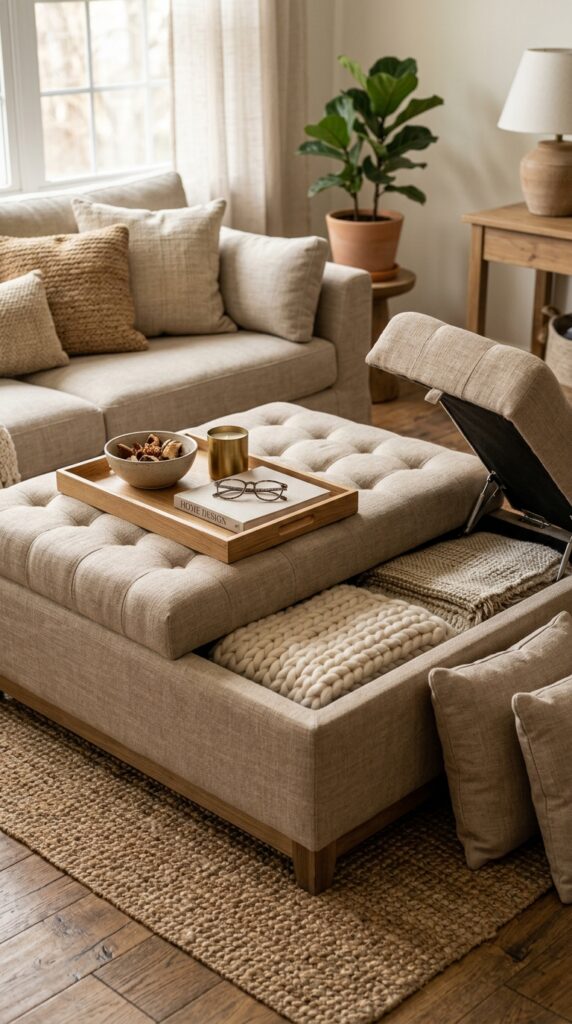
Vibe: Warm and ingenious — the object that does the work of three without looking like it’s trying.
Why it works: A large storage ottoman at the center of a small living room performs the small room designer’s highest ambition: one object serving multiple functions simultaneously — coffee table, additional seating, and blanket or textile storage. The design principle is functional layering: by serving three roles in the space footprint of one, the ottoman allows the removal of a separate coffee table, a storage chest, and overflow seating, recovering both the floor space those pieces would have occupied and the visual complexity they would have added. A tray placed on top converts the soft surface into a stable surface for drinks and books without requiring a separate side table.
How to get it: Choose an ottoman in a neutral linen, bouclé, or velvet that matches the room’s sofa tone — a storage ottoman that reads as a matching set with the sofa looks designed; one that contrasts in color or material reads as a practical afterthought. Size the ottoman to be at least 80% of the sofa’s seat-run length for correct proportional balance.
| Shop The Look |
| Large storage ottoman linen small living room |
| Ottoman tray wooden serving rectangular |
| Square storage ottoman coffee table small room |
| Tufted storage ottoman bedroom small room |
| Linen storage ottoman with lid small living room |
11. Built-In Seating with Under-Seat Storage
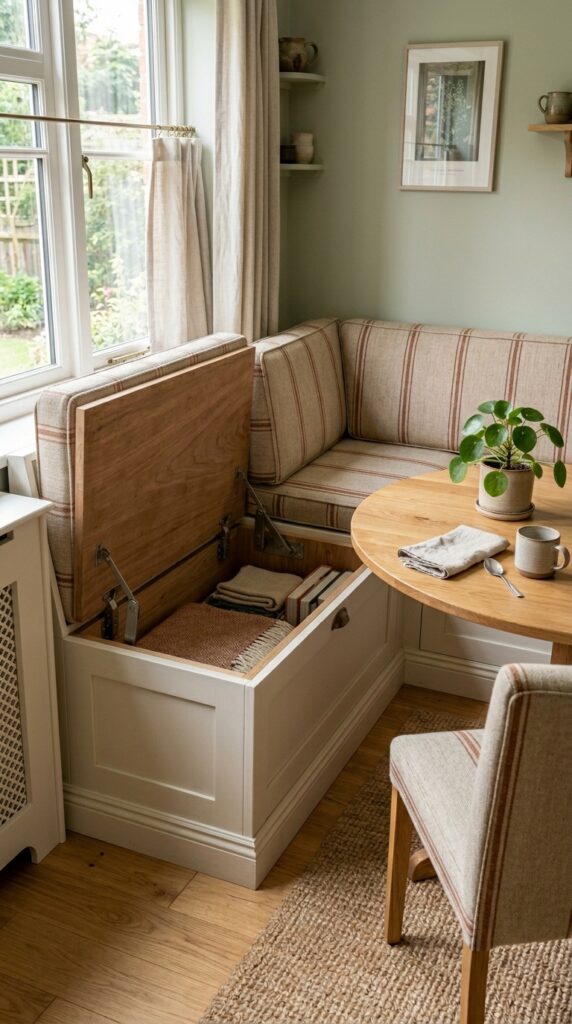
Vibe: Ingenious and warm — the seat that holds half a season’s worth of linens and still offers you breakfast.
Why it works: Built-in banquette seating with under-seat storage solves the small dining room’s primary dilemma — chair-and-table arrangements require circulation space on all four sides of the table, which in compact rooms means the table must be significantly smaller than needed. A corner banquette requires circulation space only on the open sides, allowing the table to push into the corner and serve the same number of diners in 30 to 40% less floor area. The under-seat storage — typically 30 to 40 litres of accessible volume per linear metre of seating — recovers storage capacity equivalent to two or three large drawers without adding any furniture to the room.
How to get it: Build banquette seats at 45 to 48cm seat height and 50cm minimum seat depth — below these dimensions, the seating is uncomfortable for extended dining. Use a piano hinge along the full seat-front edge for the storage lid rather than a point hinge, which creates a more even lift and prevents lid warping over time.
| Shop The Look |
| Built in banquette seating cushion set small kitchen |
| Storage bench seat lift up hinge mechanism |
| Dining bench with storage small room |
| Corner banquette cushion set striped fabric |
| Under seat storage box hinge lid small room |
12. Doorless Wardrobe with Curtain Closure
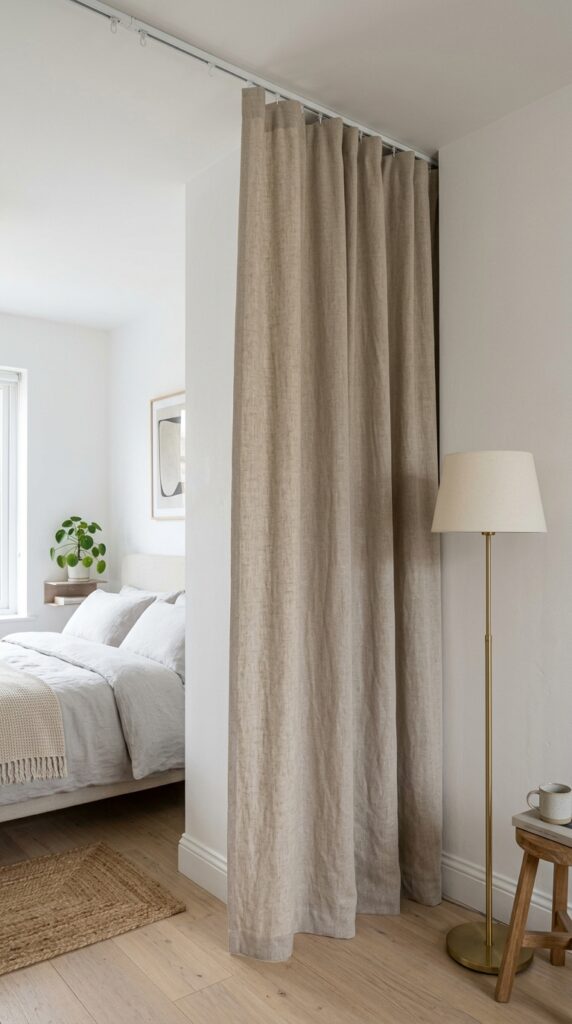
Vibe: Considered and soft — the wardrobe that disappeared behind a curtain and made the room larger in doing so.
Why it works: A traditional hinged wardrobe door requires its own swing radius as free floor space — a standard 60cm-wide door needs 60cm of clearance in front of it to open fully, which in a small bedroom can represent a significant constraint on furniture placement and traffic flow. A ceiling-mounted curtain track and linen panel eliminates this swing radius entirely, recovering the full clearance area as usable floor space. The curtain also softens the visual weight of the storage zone — a closed wardrobe reads as a solid mass; a linen curtain reads as a soft plane that the eye moves past rather than stopping at.
How to get it: Mount the curtain track at ceiling height directly above the wardrobe opening — flush ceiling mounting makes the curtain read as a wall rather than a room divider. Use linen or cotton-linen fabric with enough body to hang without bunching — sheer fabrics collapse into folds when drawn closed and reveal the wardrobe contents through the fabric.
| Shop The Look |
| Ceiling mount curtain track wardrobe closure |
| Linen curtain panel wardrobe alcove floor length |
| Wardrobe alcove open shelf system small bedroom |
| Curtain track ceiling rail small room kit |
| Natural linen panel curtain closure wardrobe |
13. One Dark Accent Wall to Create Depth
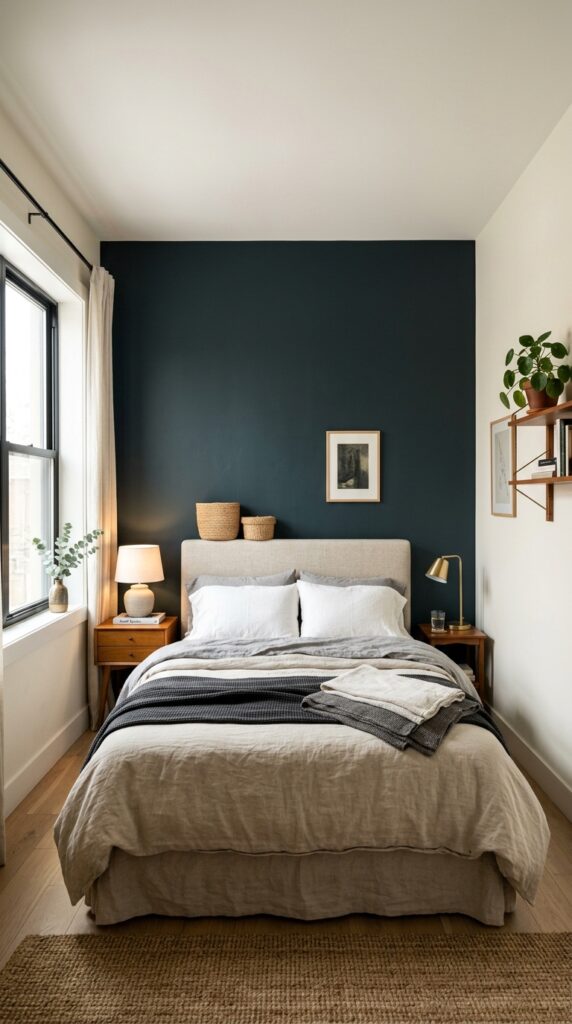
Vibe: Dramatic and deeper — the dark wall that makes the room feel as though it has a far end.
Why it works: A single dark accent wall creates depth through the principle of atmospheric perspective — dark tones recede visually in the same way that distant landscapes appear darker than foreground elements. When the far wall of a room is painted in a deep, saturated tone, the eye perceives it as further away than the pale side walls, which stretches the room’s apparent length. This is particularly effective on the wall behind the bed or sofa — the room’s primary focal wall — because it places the depth effect exactly where the eye travels when it scans the room from the entry point. Critically, the ceiling must remain pale: a dark ceiling compresses the room vertically, which defeats the depth effect achieved horizontally.
How to get it: Choose a dark accent color with a warm undertone — deep charcoal (Farrow & Ball Railings No. 31), dusty petrol blue (F&B Hague Blue No. 30), or forest green (F&B Studio Green No. 93) all recede effectively without reading as cold or oppressive in compact rooms. Cool-toned darks (blue-blacks, pure greys) can produce a contracting, tunnel-like effect rather than a depth effect.
| Shop The Look |
| Deep charcoal bedroom accent wall paint small room |
| Farrow Ball dark paint sample bedroom |
| Petrol blue accent wall paint bedroom small |
| Forest green dark accent wall bedroom paint |
| Dark accent wall bedroom matte finish paint |
14. Pocket Doors to Recover Floor Space
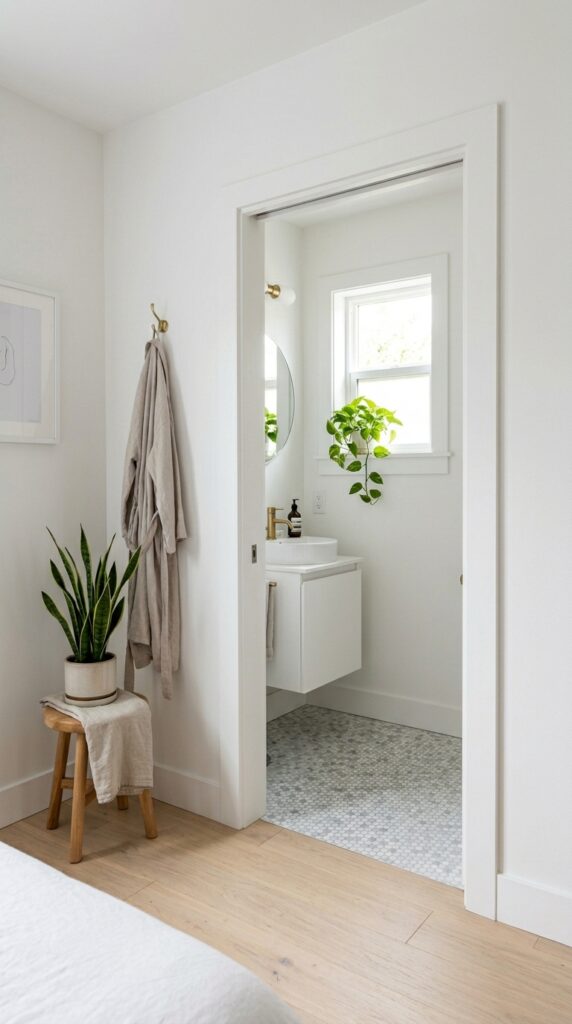
Vibe: Resolved and spacious — the door that got out of the way entirely.
Why it works: A standard hinged door in a small room creates two simultaneous spatial problems: it requires its swing arc as permanently reserved floor space (approximately 0.5 to 0.8 square metres depending on door width), and it creates a dead zone on the wall behind it where no furniture can be placed. A pocket door sliding into a wall cavity eliminates both problems — the floor space is recovered, and the wall on either side of the opening becomes fully usable for furniture or storage. In rooms under 12 square metres, this intervention can represent a 5 to 8% recovery of total floor area from a single architectural change.
How to get it: Pocket door kits for retrofit installation are available for $150 to $400 and require the removal of the existing door frame and approximately 10cm of interior wall on the latch side for the door cavity. This is a half-day installation for an experienced DIYer or a plumber; the spatial benefit justifies the one-time construction effort in any small room.
💡 Quick Win: If a pocket door is not feasible, a barn-style sliding door on a wall-mounted track achieves the same door-swing elimination at lower installation complexity — the door slides flat against the wall face rather than into a cavity, recovering the swing-arc floor space even though the door itself remains visible when open.
| Shop The Look |
| Pocket door kit retrofit installation small room |
| Sliding barn door track wall mount small room |
| Barn door hardware kit minimal matte black |
| Pocket door flush pull handle minimal |
| Sliding door panel white small room |
15. All-White Kitchen to Dissolve Boundaries
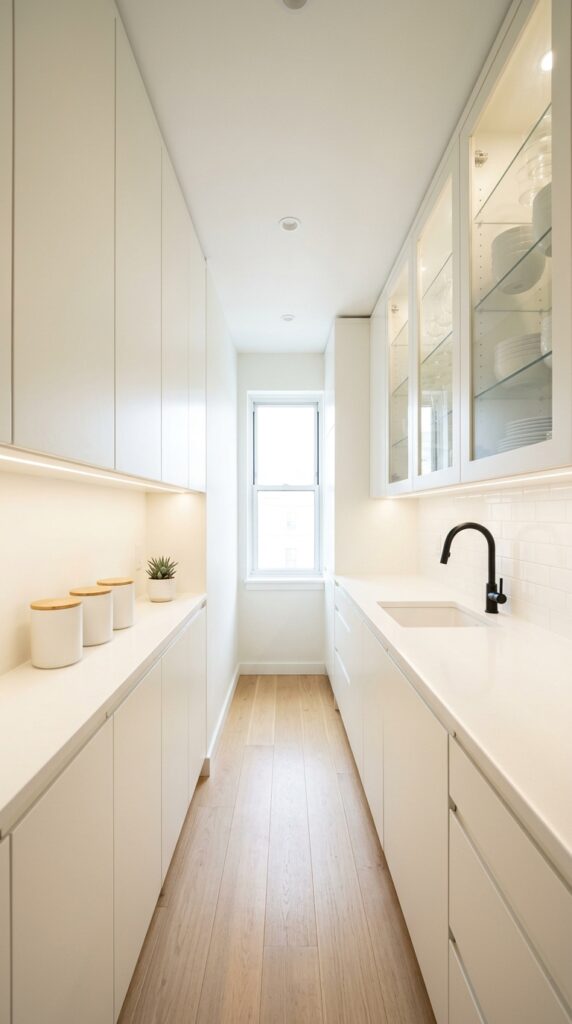
Vibe: Expansive and clean — the kitchen where the walls learned to share a color and stopped arguing about space.
Why it works: In a galley kitchen, the two parallel cabinet runs are typically the room’s largest visual masses and, when finished in different colors or materials from the walls, they define the kitchen’s narrow width by creating a clearly visible channel. Making all surfaces — cabinets, walls, ceiling, and splashback — the same white dissolves the distinction between the cabinet mass and the wall surface, removing the visual definition of the channel’s width. The eye can no longer easily identify where the cabinet ends and the wall begins, which makes the kitchen’s width ambiguous and therefore apparently larger. This is boundary dissolution applied to the room’s most spatially challenging configuration.
How to get it: Use the same warm white on every surface including the inside of any glass-fronted upper cabinets — a contrasting cabinet interior visible through glass doors reintroduces the cabinet-as-mass effect and breaks the all-white boundary dissolution.
| Shop The Look |
| White kitchen cabinet paint all surfaces match |
| White grout splashback tile small kitchen |
| White countertop laminate galley kitchen |
| Matte black kitchen faucet small white kitchen |
| White kitchen canister set three piece |
16. Slim Console Table as Room Divider
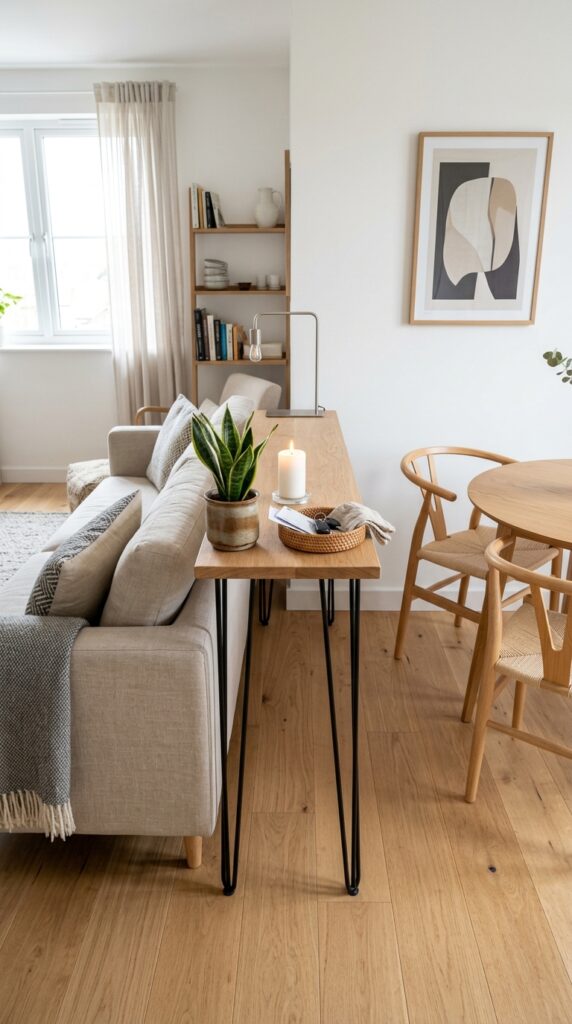
Vibe: Clever and considered — the table that divided a studio without stealing any of it.
Why it works: A slim console table positioned behind a sofa in an open-plan studio performs zone definition — separating the living area from the dining or sleeping area — using an object that is only 20 to 25cm deep and therefore adds minimal mass to the floor plan. The design principle is furniture as architecture: rather than using a room divider screen (which blocks light and consumes floor depth on both sides) or a bookcase (which requires 30 to 40cm depth), the console table marks the zone boundary with a visual line that furniture, lamps, and objects reinforce without physically partitioning the space. Hairpin legs maintain floor visibility beneath, preventing the console from reading as a barrier.
How to get it: The console table should align with the sofa back height as closely as possible — a table that is lower than the sofa back disappears; one that is higher reads as a shelf rather than a table. Standard sofa back heights run 85 to 95cm, and console tables are typically 80 to 85cm, which provides a workable alignment in most configurations.
| Shop The Look |
| Slim console table 25cm deep hairpin leg |
| Narrow console sofa back table small room |
| Hairpin leg console table natural oak slim |
| Console table room divider studio apartment |
| Small lamp console table zone divider accent |
17. Recessed Shelving Between Wall Studs
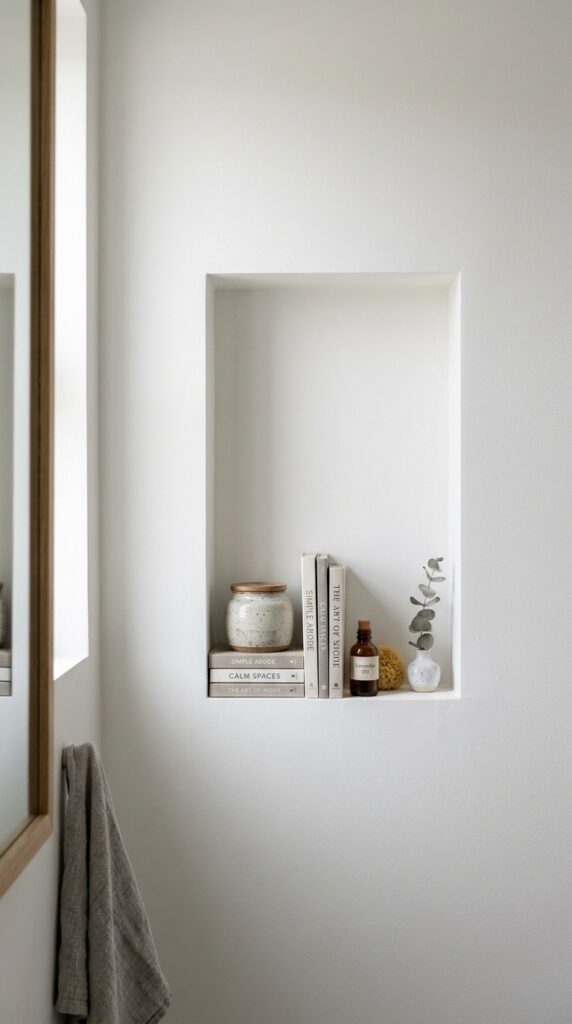
Vibe: Ingenious and resolved — storage that lives inside the wall rather than in front of it.
Why it works: Recessed shelving between wall studs recovers the 90mm (3.5 inches) of empty space within a standard timber-frame wall cavity and converts it into display or storage depth without projecting anything into the room. In a bathroom, this depth is sufficient for toiletry bottles, soap dispensers, and small ceramic objects — in a bedroom, for books, ceramics, and small framed pieces. The design principle is dead-space recovery: the wall cavity already exists and currently does nothing; a recessed niche activates it without adding to the room’s physical footprint. Finished to match the surrounding wall in paint or tile, the niche reads as an architectural feature rather than an afterthought.
How to get it: A niche between two standard studs at 400mm or 600mm centres provides 340mm or 540mm of niche width respectively. Create the niche with a drywall saw, a simple timber frame, a MDF niche box, and joint compound finishing — a straightforward weekend project that costs $40 to $80 in materials per niche.
| Shop The Look |
| Recessed wall niche kit display small room |
| In wall shelf niche MDF box install |
| Recessed shelf small bathroom wall storage |
| Wall niche plaster finish kit small room |
| Small ceramic set display recessed niche |
18. Vertical Stripes to Raise Apparent Ceiling Height
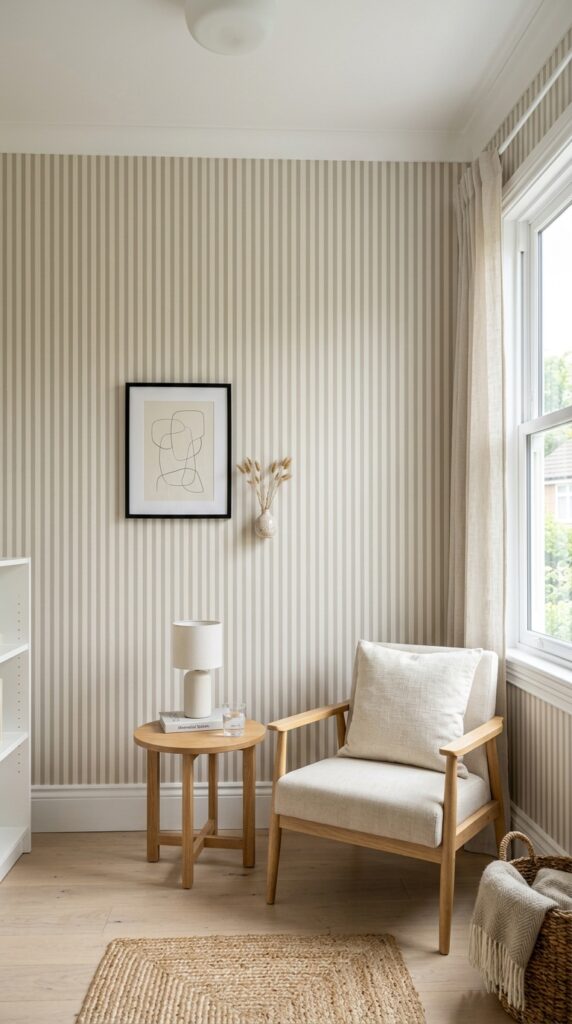
Vibe: Taller and more considered — the stripe that convinced the ceiling to move upward without any structural involvement.
Why it works: Vertical stripes on walls exploit the Helmholtz illusion — the same optical phenomenon that makes vertical lines in clothing appear slimming. Narrow vertical stripes on a room’s walls lead the eye upward in a repeating rhythm, creating a visual dynamic that makes the ceiling appear further from the floor than it actually is. Critically, the stripes should be tonal (two values of the same colour) rather than high-contrast (white and navy, for example) — high-contrast stripes create a graphic pattern that reads as decoration; tonal stripes create a subtle texture that reads as height without announcing itself as a design technique.
How to get it: Apply tonal stripe wallpaper in a 50mm to 75mm stripe width — narrower than 50mm creates a visual buzz rather than a height effect; wider than 100mm reads as blocks rather than stripes. Alternatively, use a stripe painter’s tape technique with two tones of the same wall colour — one flat, one satin — for the same tonal effect without wallpaper.
💡 Quick Win: Peel-and-stick vertical stripe wallpaper in a tonal ivory or greige colorway installs in a day and is renter-friendly, making this ceiling-height hack accessible in any small room without permanent modification.
| Shop The Look |
| Vertical stripe wallpaper tonal warm white small room |
| Peel stick vertical stripe wallpaper removable |
| Subtle vertical stripe wallpaper greige bedroom |
| Vertical stripe paint tape technique kit |
| Tonal stripe wallpaper natural small bedroom |
19. Fold-Down Murphy Bed with Integrated Desk
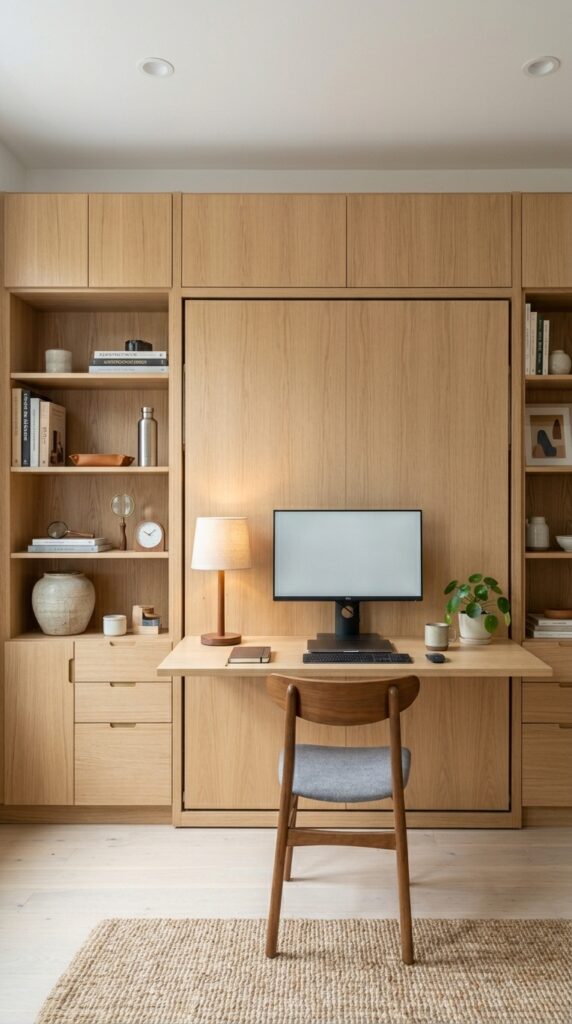
Vibe: Ingenious and resolved — the room that is a bedroom at night and an office by day without being a compromise either way.
Why it works: A Murphy bed with an integrated fold-down desk occupies the same floor footprint for two completely different functions at different times — at night, the bed deploys and the sleeping function uses the floor zone; during the day, the bed folds away and the desk deploys from the panel face, using the same zone for work. The design principle is temporal multiplexing: two functions sharing one spatial allocation through time-based alternation rather than simultaneous occupation. This is the most spatially efficient solution available for studio apartments where work-from-home and sleeping needs must coexist.
How to get it: Choose a Murphy bed system where the desk remains in position when the bed is deployed — this allows the desk to function as a bedside surface at night without requiring the desk to be cleared before the bed can be lowered. Systems where the desk folds flat against the panel when the bed comes down are the most spatially efficient but require desk-clearing before deployment.
| Shop The Look |
| Murphy bed with integrated desk small studio |
| Wall bed fold down desk unit white oak |
| Murphy bed kit horizontal small room |
| Fold down desk wall mount studio apartment |
| Murphy bed panel system white integrated |
20. Sconce Lights Instead of Floor Lamps
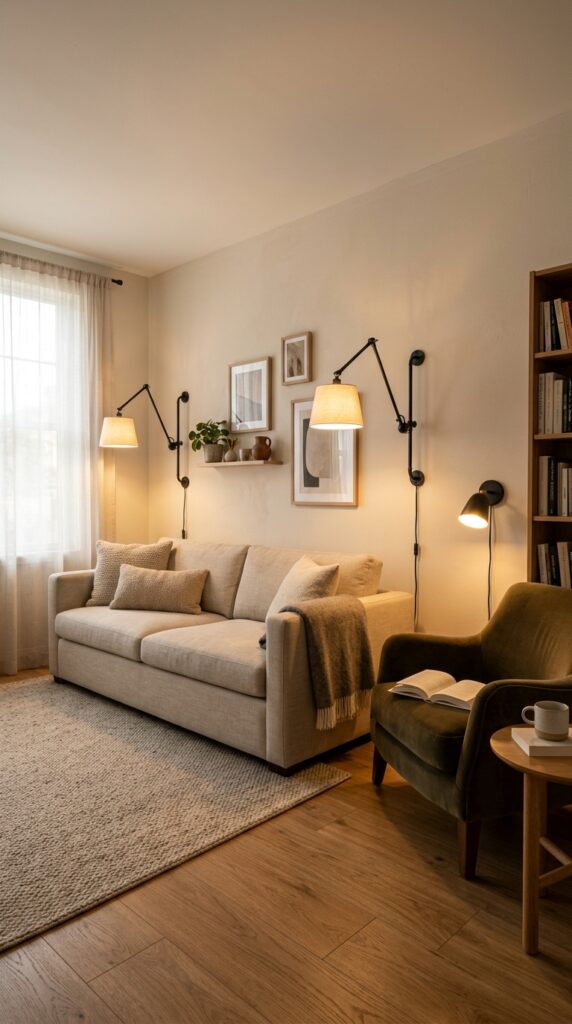
Vibe: Warm and spatially free — the room that moved its light off the floor and found space it didn’t know it had.
Why it works: Floor lamps and table lamps together consume significant floor and surface area — a standard floor lamp occupies 30 to 40cm of floor diameter and requires 60cm of clearance around it; a table lamp occupies 30 to 40cm of the bedside or side table surface it sits on. Wall-mounted sconces eliminate both footprints entirely, mounting the light source to the wall at the correct illumination height without any floor or surface claim. In a small room, removing two floor lamps and two table lamps can recover 0.5 to 1.0 square metres of effective floor and surface area while providing equivalent or superior lighting quality from wall-positioned sources.
How to get it: Hardwired wall sconces require electrical work; plug-in swing-arm sconces with a fabric cord and wall-mounted hook achieve the same visual effect with no electrician required. Look for plug-in sconces with a cord management clip that keeps the cord flat to the wall between the sconce and the floor outlet.
| Shop The Look |
| Plug in swing arm wall sconce small room |
| Wall sconce pair bedside bedroom small room |
| Matte black swing arm sconce plug in |
| Brushed brass wall sconce plug in small room |
| Adjustable wall lamp sconce reading light small room |
21. Dual-Purpose Dining Table and Desk
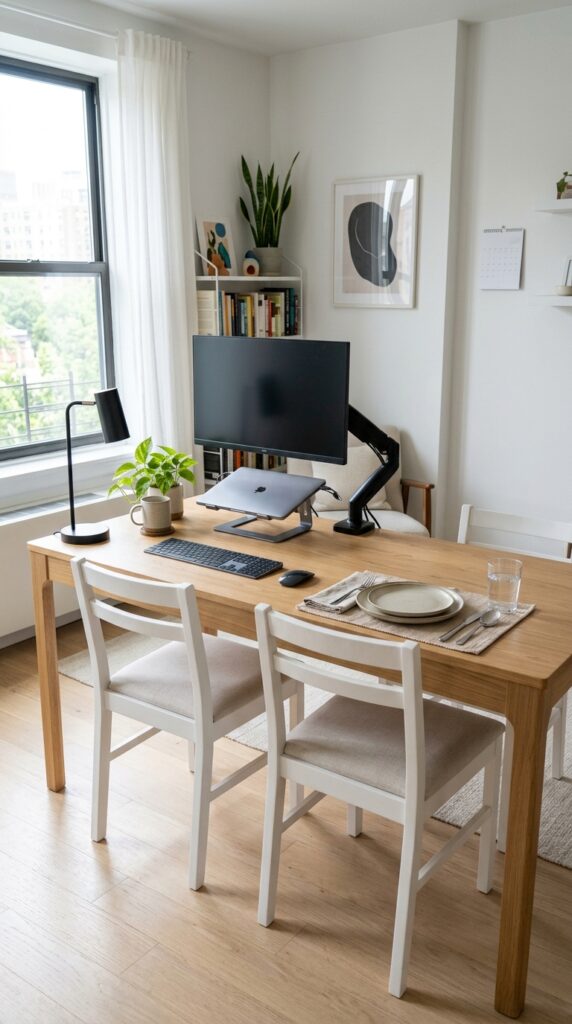
Vibe: Efficient and resolved — one table, two lives, no apology.
Why it works: A dining table that also functions as a work desk is the correct solution for studio apartments and one-bedroom spaces where a separate home office is not available — provided the table is sized and positioned correctly for both functions. The critical dimension is depth: 60cm is the minimum for comfortable dining and for a monitor at correct ergonomic viewing distance (50 to 70cm from seated eye). A monitor arm rather than a monitor stand is essential — it allows the monitor to swing away during meals without moving the monitor off the table, and returns to working position without reconfiguration.
How to get it: Choose a table with a clean, uncluttered surface that transitions visually between work and dining contexts without evidence of its previous use — avoid tables with visible cable management holes or fixed monitor mounts that permanently signal one function over the other.
| Shop The Look |
| Slim dining desk table dual purpose 120x60cm |
| Monitor arm desk clamp small room |
| Chair set dining work small room compact |
| Cable management clip under desk table small |
| Small dining desk lamp minimal small room |
22. Mirrored Cabinet Fronts in Small Bathrooms
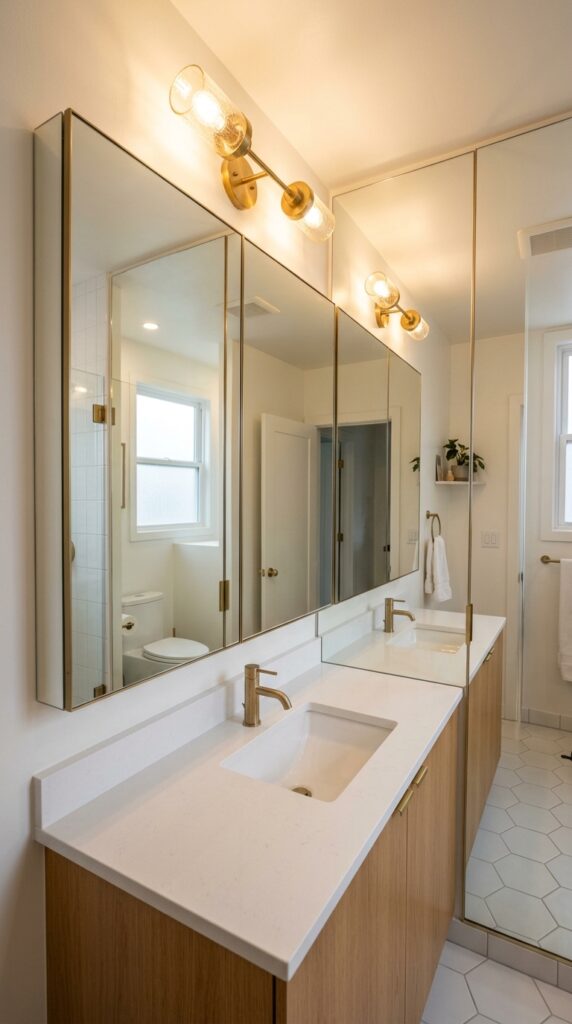
Vibe: Expanded and clean — the bathroom that borrowed the depth of the room behind it.
Why it works: A full-wall mirrored medicine cabinet in a small bathroom performs three simultaneous spatial operations: it doubles the apparent depth of the room through reflection; it provides generous accessible storage for all counter objects; and it creates a continuous reflective surface that maximises the effect of the vanity lighting. The design principle is surface efficiency — every square centimetre of the cabinet face performs as a mirror while every cubic centimetre behind it stores. This replaces a separate wall mirror (which provides reflection only) and open shelving (which stores but visually clutters) with a single element that does both without compromise.
How to get it: Specify a recessed medicine cabinet with at least 10cm depth — this accommodates standard toiletry bottle heights. A cabinet flush-mounted in a wall recess reads as a mirror feature rather than a cabinet; a surface-mounted cabinet projects from the wall and diminishes the spatial effect.
💡 Quick Win: A frameless full-width surface-mounted mirrored cabinet ($80 to $180 at bathroom retailers) installed above the vanity in lieu of a single mirror immediately doubles bathroom storage and creates the double-depth effect without a wall recess.
| Shop The Look |
| Full wall mirrored medicine cabinet bathroom |
| Recessed mirror cabinet bathroom small |
| Frameless mirrored bathroom cabinet surface mount |
| Wide bathroom mirror cabinet storage small |
| Mirrored cabinet door replacement bathroom |
23. Monochromatic Styling to Reduce Visual Noise
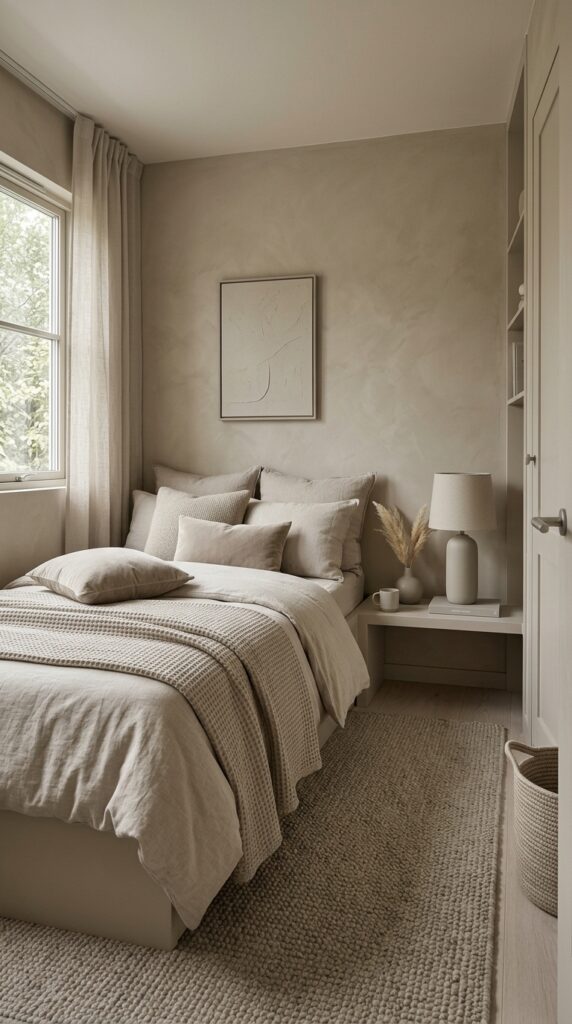
Vibe: Hushed and expanded — the room that achieved spaciousness by ceasing to argue with itself.
Why it works: Monochromatic styling in a small room reduces visual noise — the fragmented, attention-demanding quality that multi-color rooms produce — by eliminating the color contrast cues that the eye uses to distinguish between objects and surfaces. When everything occupies the same tonal territory, the eye sweeps the room in a single visual pass rather than stopping to register each color change, which makes the room feel calmer and less densely occupied than its actual object count would suggest. This is the principle of visual quieting: the same number of objects in a room reads as less cluttered when they share a tonal family than when they contrast with each other.
How to get it: Choose one base tone (warm greige, soft sage, or pale ivory) and source every object in the room from within two tonal values of that base — slightly lighter or slightly darker, but never introducing a new hue. Texture variation (linen, waffle-knit, ceramic, timber grain) provides sufficient visual interest within the monochromatic palette.
| Shop The Look |
| Greige linen bedding set monochromatic small bedroom |
| Neutral tonal throw blanket small room |
| Matte ceramic lamp base greige small room |
| Warm greige wall paint monochromatic small room |
| Tonal cushion set monochromatic bedroom small |
24. Under-Bed Storage with Lift System
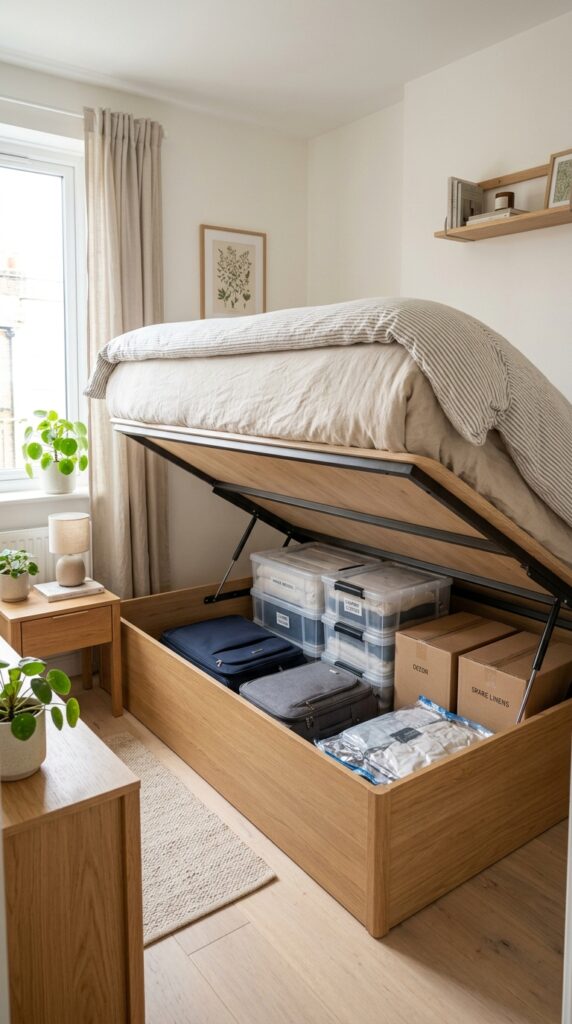
Vibe: Ingenious and resolved — the bed that holds a whole season of storage and never shows it.
Why it works: The space beneath a standard bed — typically 25 to 35cm of height across a 140×200cm or 160×200cm floor area — represents 2.8 to 3.2 square metres of potential storage volume that most bedrooms leave entirely unused. A platform bed with a hydraulic gas-strut lift mechanism converts this dead volume into the room’s primary storage system — accessible with one hand, fully visible when open, completely concealed when closed. In a small bedroom where a wardrobe and chest of drawers would normally compete for wall space, under-bed lift storage can replace one or both of those pieces, freeing 0.5 to 1.0 square metres of floor area.
How to get it: Choose a lift storage bed with a single-piece platform (the entire mattress base raises as one panel) rather than a foot-end-only opening — single-piece lift access makes the full storage depth accessible from one side, while foot-end-only designs limit access to the front third of the cavity. Ensure the gas struts are rated for the combined weight of the mattress and bedding — underrated struts fail to hold the platform open.
| Shop The Look |
| Platform bed with hydraulic lift storage small bedroom |
| Gas strut lift bed storage mechanism kit |
| Storage bed platform lift small bedroom |
| Under bed storage organiser box small bedroom |
| Lift bed storage system queen small bedroom |
How to Start Your Small Room Design Transformation
Your single first move is this: paint the ceiling the same color as the walls. This one action — costing the same as any other ceiling paint job — removes the room’s most significant visual boundary line, the cornice where the wall color ends and the conventional white ceiling begins. That line is the primary cue the brain uses to measure ceiling height, and removing it immediately raises the apparent ceiling height of any room. Do this first, before buying any furniture, any storage, or any accessories — because it changes the baseline spatial quality of everything that follows.
The most common small room mistake is buying too much furniture that is too small. Instinct in a small room pushes toward smaller furniture to leave more floor space visible — but a room filled with small-scale furniture reads as a room that couldn’t afford the right size, not as a generously proportioned space. The counter-intuitive rule is to choose fewer pieces at correct scale: one properly proportioned sofa rather than two undersized chairs, one well-sized dining table rather than a fold-away card table. Correct-scale furniture anchors the room and gives it authority; undersized furniture makes it feel tentative.
Three specific items under $50 for immediate spatial impact: a set of four aftermarket tapered furniture legs in walnut or brass ($25 to $35) to replace the plinth base on an existing sofa or sideboard, revealing floor beneath and expanding the perceived room size immediately; a set of two plug-in swing-arm wall sconces ($20 to $45 each) to replace floor lamps and recover 60cm of floor area per lamp; and one large natural jute or sisal rug in 8×10 feet ($50 to $80, often available at discount) sized correctly to define the full seating zone rather than sit as a small object within it.
Realistic expectations: a meaningful small room refresh — ceiling repaint, furniture leg replacement, rug upsizing, and curtain rod re-hanging — costs $150 to $400 and takes a single weekend. A more complete transformation with built-in storage, new furniture, and wall-mounted lighting runs $1,200 to $3,500. Architectural interventions — pocket doors, recessed niches, Murphy bed installation — add $500 to $3,000 per element but produce permanent spatial improvements that outlast any styling change. The most important timeline truth in small room design: the highest-impact changes are almost always subtractive — removing objects, clearing surfaces, editing furniture — and cost nothing. Begin there, always.
Frequently Asked Questions About Small Room Design
What makes a small room feel bigger without renovation?
The five highest-impact non-renovation interventions are: painting walls and ceiling the same warm white color (removes boundary perception); hanging curtains at ceiling height rather than window-header height (raises apparent ceiling); replacing floor lamps with wall sconces (recovers floor area); choosing one large rug that extends under all furniture rather than multiple small rugs (unifies the floor plane); and removing every object from surfaces that does not serve a daily function (reduces visual noise). None of these require construction, and together they can transform the spatial quality of a small room in a single weekend.
What colors make a small room look bigger?
Warm whites and pale warm neutrals — specifically those with a yellow-beige undertone rather than a blue or grey undertone — are the most reliable small room colors because they reflect light without producing the cold, clinical effect of cool whites. Benjamin Moore White Dove (OC-17), Farrow & Ball Wimborne White (No. 239), and SW Alabaster (SW 7008) are the three most consistently successful small room white references. Contrary to intuition, a single dark accent wall (the far wall from the room’s entry point) can make a room feel deeper and therefore larger by creating apparent depth — provided the three remaining walls and the ceiling stay pale. The rule: pale all around with one receding dark wall is more spatially effective than medium-tone all around.
What furniture arrangement makes a small room feel larger?
The arrangement principles that most reliably increase perceived space are: pushing all furniture against the walls rather than floating it in the centre (this actually shrinks rooms by eliminating circulation space from the centre — counter-intuitively, floating furniture away from walls with clear floor visible on all sides reads as more spacious); choosing furniture on visible legs rather than plinth bases; ensuring every furniture piece serves at least two functions; and using the largest single rug the floor plan can accommodate with 25 to 35cm of hard floor border visible at the walls. The most impactful arrangement change for a small living room is moving the sofa slightly away from the wall — even 10cm of visible floor behind the sofa makes the room read as more generous.
How do you add storage to a small room without making it feel cluttered?
The correct approach is vertical consolidation — building storage upward on one wall to ceiling height rather than spreading low storage pieces across multiple walls. One floor-to-ceiling shelving unit, painted to match the wall, reads as an architectural feature rather than furniture and provides the storage of three or four separate pieces while maintaining clear floor area everywhere else in the room. Built-in storage — recessed niches, under-bed lift storage, banquette under-seat storage — is always preferable to freestanding storage in small rooms because it uses space that already exists (wall cavities, under-furniture void) rather than consuming floor area that the room cannot spare.
Is it worth investing in custom built-in storage for a small room?
Yes, for rooms you will occupy for more than two to three years — the spatial return on built-in storage investment in a small room typically exceeds the equivalent investment in any other design element. A floor-to-ceiling built-in wardrobe eliminates the need for freestanding wardrobes, dressers, and storage chests, recovering 0.5 to 1.5 square metres of floor area and providing a continuous, architecturally resolved wall surface in exchange. Custom built-ins in small rooms typically cost $1,500 to $5,000 depending on complexity and specification, and they increase the spatial quality and perceived value of the room proportionally more than in larger rooms where the floor-area recovery represents a smaller percentage of the total.
Ready to Create Your Dream Small Room Design?
These 24 hacks span the full toolkit of small room spatial design — from the color and surface decisions that reshape perceived boundaries, to the lighting placements, furniture choices, and storage integrations that recover floor area and visual calm without reducing the room’s function or comfort. The transformation always begins with removal rather than addition: the room you clear is the room that reveals what it actually needs, and in almost every small space, the first discovery is that it needs less than it currently holds. The single action you can take today is to remove the ceiling’s different white and repaint it to match the walls — a change that costs one tin of paint and one afternoon, and makes every room it touches feel as though someone finally understood its geometry. When the space eventually achieves what you’re building toward — when the floor reads clearly beneath the furniture and the ceiling doesn’t announce its own height and every object is exactly where it should be — the room will feel not small but precise. Save the hacks that made you look at your room differently, and return especially to the ones built on removing rather than adding — those are the decisions that compound.