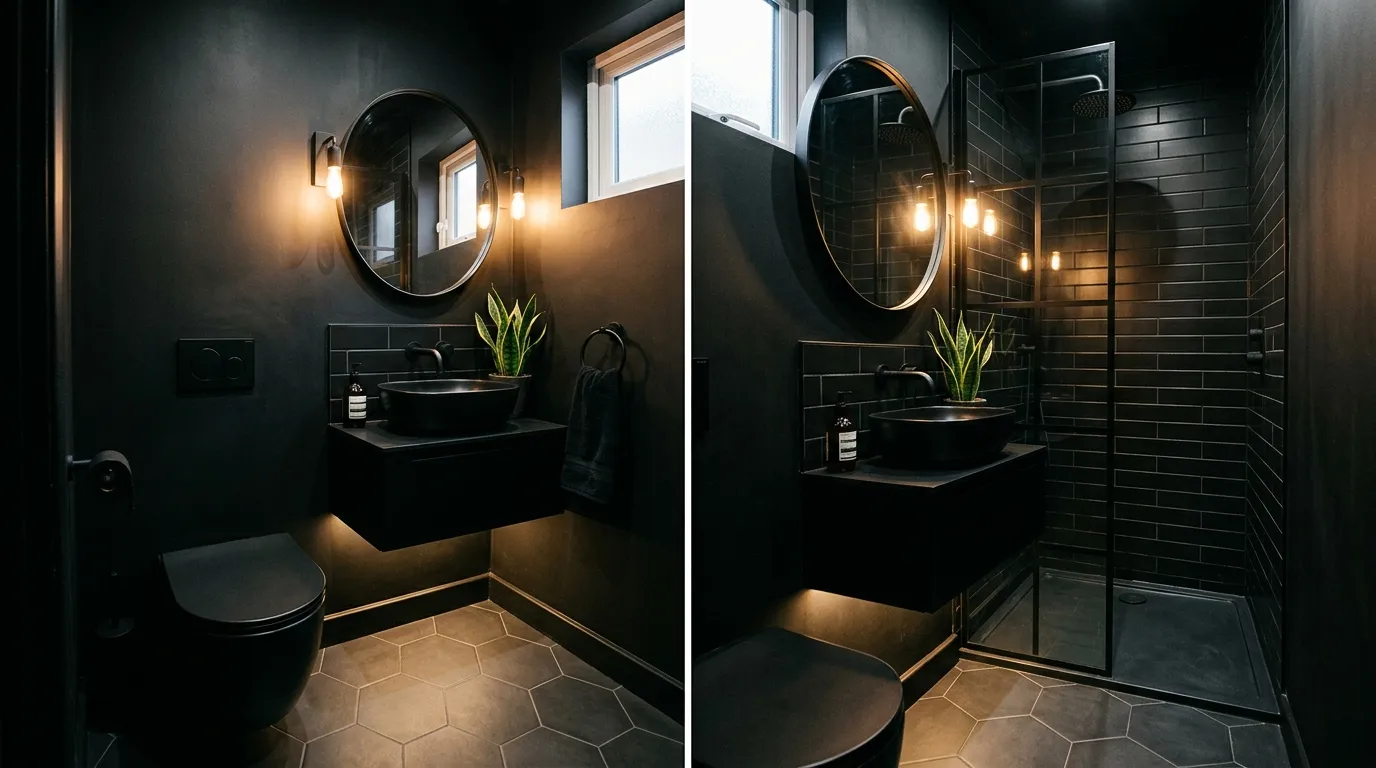
A small all black bathroom is a fully dark-toned bathroom — walls, fixtures, and finishes in black, charcoal, and deep near-black tones — that uses darkness deliberately to create intimacy rather than fighting it. This article gives you exactly 23 small all black bathroom ideas covering tile, fixtures, lighting, layout, and finishing details that make compact dark bathrooms feel designed, not just painted over.
Most people are told to keep small bathrooms light. That advice is wrong — or at least, it’s incomplete. A small room painted black doesn’t shrink; it loses its edges. The walls disappear, the boundaries blur, and what’s left is a space that feels intentionally enclosed rather than accidentally tight. All black bathroom design borrows from the same logic as a candlelit restaurant or a jeweler’s display case: darkness makes the things inside it more vivid, more considered, and more present. Here are 23 ideas worth saving — and stealing.
Why Small All Black Bathroom Design Works So Well
The all black bathroom as a residential design statement has its roots in early 2000s luxury hotel design — specifically the boutique hotel movement that rejected the pale neutrals of chain hospitality in favor of moody, immersive spaces that felt like genuine environments rather than functional rooms. Designers like Axel Vervoordt and Kelly Wearstler brought the concept into residential interiors through editorial exposure, and the aesthetic has been descending from high-end custom builds into accessible design territory ever since. What makes it distinct from simply “dark bathroom design” is total commitment — not one dark wall, but a unified dark field across all surfaces.
The core materials palette for a small all black bathroom is specific: matte black ceramic or porcelain tile (either large-format 24×48 or small-format 2×2 mosaic), honed black granite or blackened limestone for any stone surfaces, brushed or matte black hardware in powder-coated steel or blackened brass, and black or near-black grout (never white, which creates a grid pattern that visually shrinks the space). Warm accent materials — unlacquered brass, aged bronze, warm white oak, natural linen — prevent the palette from reading as clinical or oppressive.
The timing of this trend is not accidental. After years of all-white, Carrara-marble, bright-and-airy bathroom design dominating every platform, a significant counter-movement emerged. Pinterest data shows “black bathroom” searches have grown substantially year over year as homeowners seek spaces that feel genuinely different from the Nordic-minimalist whiteness that saturated the 2010s. The post-pandemic investment in home interiors also pushed people toward more committed, experiential design choices — spaces that feel like something, not just spaces that photograph well.
A small bathroom — under 50 square feet — is actually the ideal canvas for this style, not a limitation. The all-black palette works because the room’s boundaries visually dissolve, eliminating the psychological sense of constriction that affects light-colored small rooms. Prioritize matte finishes over gloss (which reflects light and reinstates the boundary problem), and invest in one warm-toned accent material — brass, oak, or warm white — to prevent the space from feeling airless.
Style at a Glance
| Element | Key Trait | Detail |
| Philosophy | Darkness as spatial tool | Dissolve edges, create intimacy |
| Key Materials | Matte tile, blackened brass, honed stone | No gloss, warm accents essential |
| Key Colors | Matte black, warm charcoal, deep slate | Unlacquered brass as foil |
23 Small All Black Bathroom Ideas
1. Matte Black Subway Tile Floor to Ceiling
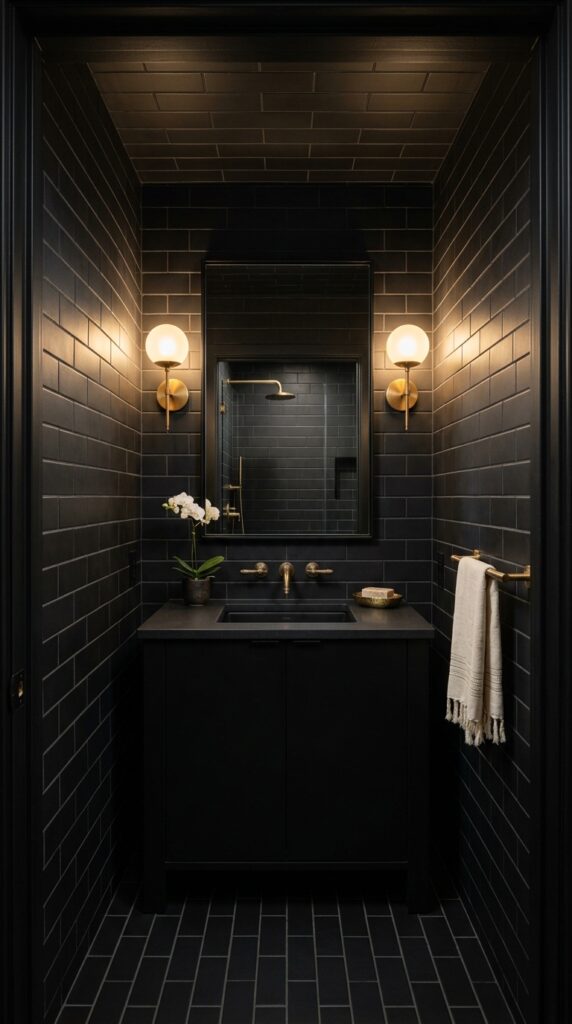
Vibe: Enveloping — a room that wraps around you like a decision made with complete conviction.
Why it works: Running matte black subway tile from floor to ceiling without interruption eliminates the horizontal datum line (where wall tile ends and a different surface begins) that normally defines the room’s boundaries and makes small spaces feel measurably smaller. The continuous vertical surface creates a visual field rather than a collection of planes — the eye reads the room as a volume rather than four walls. Dark grout (charcoal or near-black) is non-negotiable here: white grout creates a grid that reinstates the boundary problem, while dark grout allows the tiles to read as a unified surface with subtle texture.
How to get it: Specify a matte-finish ceramic subway tile — not glossy, which reflects light and creates a cold, clinical quality entirely at odds with this aesthetic. Grout in a dark charcoal (Mapei “Charcoal” or similar) matched as closely as possible to the tile tone. Seal the grout with a penetrating sealer before use to prevent lightening from moisture exposure.
💡 Quick Win: Extending the tile a single course above the shower niche into the ceiling costs very little during installation and completes the immersive effect — tile contractors often stop at the shower ceiling line by default unless explicitly instructed otherwise.
Shop The Look
| Product |
| Matte black subway tile 3×6 ceramic wall floor |
| Dark charcoal sanded grout bag 10lb |
| Brushed brass bathroom tap single hole |
| Matte black floating vanity cabinet 24 inch |
| White ceramic orchid pot bathroom accent |
2. Blackened Brass Fixtures Against Dark Slate Tile
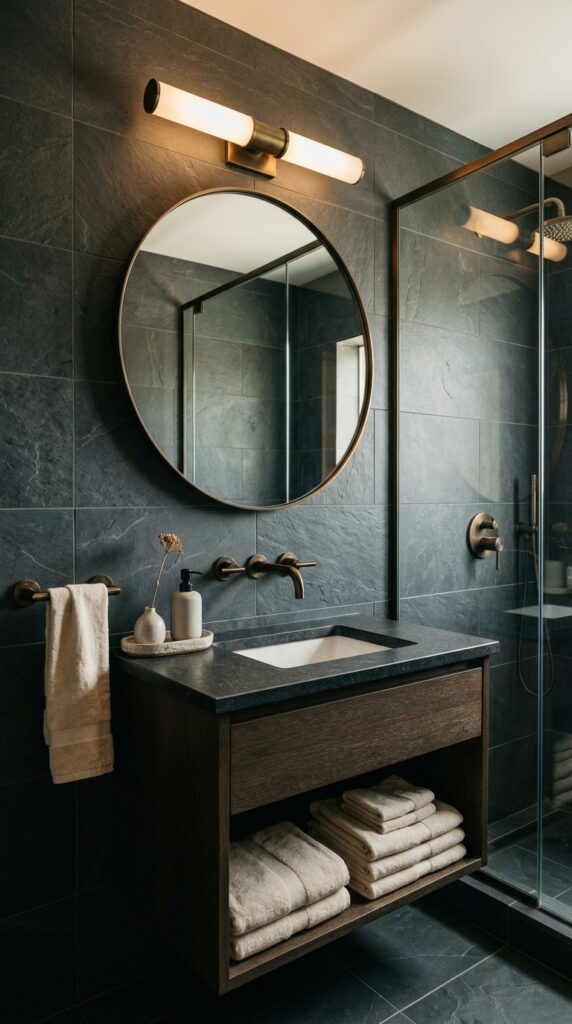
Vibe: Sophisticated — the warmth of brass turned down to a whisper.
Why it works: Blackened brass occupies a precise tonal position between matte black hardware and standard warm brass — it has a dark, aged appearance with a visible warm golden undertone that emerges in certain light conditions. This quality makes it the most versatile fixture finish for an all black bathroom: it reads as dark and cohesive with the overall palette while introducing warmth that prevents the space from becoming monotonously cold. Against deep slate grey tile (a blue-grey near-black with natural stone variation), the blackened brass creates a subtle warm-cool contrast that gives the room depth.
How to get it: Source blackened brass fixtures as a complete set — tap, shower head, towel bar, robe hook, and toilet roll holder — from a single manufacturer to ensure finish consistency. Mixing blackened brass from different suppliers produces visible tonal differences at close range that undermine the curated quality of the palette.
Shop The Look
| Product |
| Blackened brass bathroom tap wall mount |
| Deep slate grey porcelain tile 12×24 |
| Blackened brass towel bar 24 inch |
| Honed black granite vanity top undermount sink |
| Blackened brass soap pump dispenser |
3. Micro Mosaic Black Floor With Dark Plaster Walls
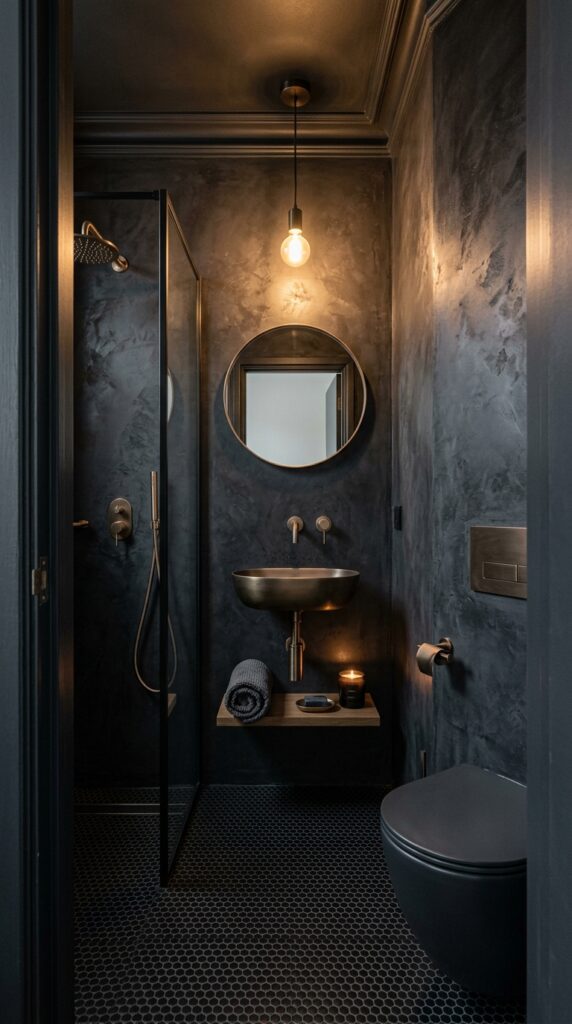
Vibe: Raw — a bathroom that feels excavated from something older and more serious.
Why it works: The combination of a smooth, organically varied wall surface (tadelakt or venetian plaster, both ancient plastering traditions) with a precision-set micro mosaic floor creates a material dialogue between the handmade and the geometric. Tadelakt plaster — a Moroccan lime plaster that is waterproof when burnished — has a subtle tonal variation and slight sheen that catches light differently at different angles, giving a dark wall surface the depth that flat paint cannot achieve. The penny mosaic floor introduces a fine-scale geometric pattern that adds visual interest without introducing color, keeping the palette unified.
How to get it: Dark tadelakt or venetian plaster application requires a skilled specialty plasterer — budget $800–2,000 for a small bathroom depending on your location. A convincing alternative is a dark microtopping plaster kit (available for DIY application over existing tile at $150–300 for a small bathroom), which produces a similar visual result with considerably less skill required.
💡 Quick Win: Dark grout on a standard tile floor (re-grouting an existing white or light-grouted floor) costs $150–300 and shifts the floor toward the all-black palette without any tile replacement — the most impactful bathroom change per dollar available.
Shop The Look
| Product |
| Penny round mosaic tile matte black 12×12 sheet |
| Dark microtopping plaster wall kit DIY |
| Bronze bathroom soap dish tray countertop |
| Dark linen hand towel charcoal set of 2 |
| Venetian plaster trowel stainless steel |
4. All-Black Wet Room With Open Shower Design
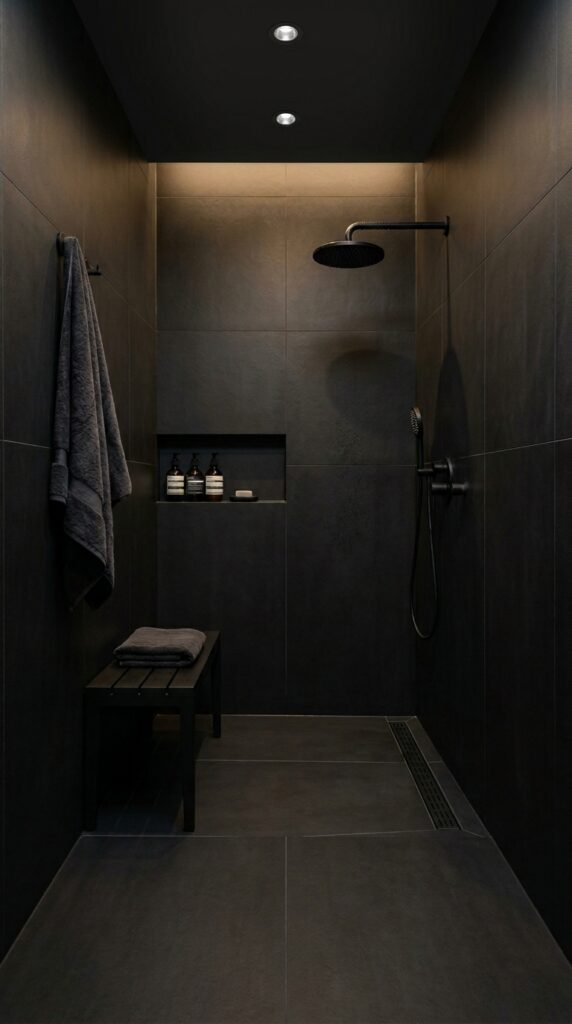
Vibe: Architectural — a shower with no walls because it doesn’t need them.
Why it works: A wet room (an open shower zone integrated into the bathroom floor without a glass enclosure) maximizes the perceived size of a small bathroom by eliminating the glass barrier that divides the room into two smaller zones. In an all-black bathroom, this approach amplifies the effect dramatically — without the glass panel creating a visual interruption, the continuous dark tile surface reads as a single unified volume. The linear floor drain, set flush with the tile, disappears into the dark surface rather than announcing itself as a functional object.
How to get it: A wet room requires a properly waterproofed floor with a minimum 1:100 gradient toward the drain — this is a structural requirement that must be specified before tile installation. The drain channel position should be planned as part of the initial design, ideally along one wall rather than in the center of the room, which interrupts the tile pattern less visibly.
Shop The Look
| Product |
| Linear floor drain stainless matte black tile insert |
| Large format matte black porcelain tile 24×48 |
| Matte black rain shower head wall mount |
| Black teak shower bench compact slatted |
| Waterproof membrane bathroom floor kit |
5. Contrast: Warm White Oak Vanity in an All-Black Bathroom
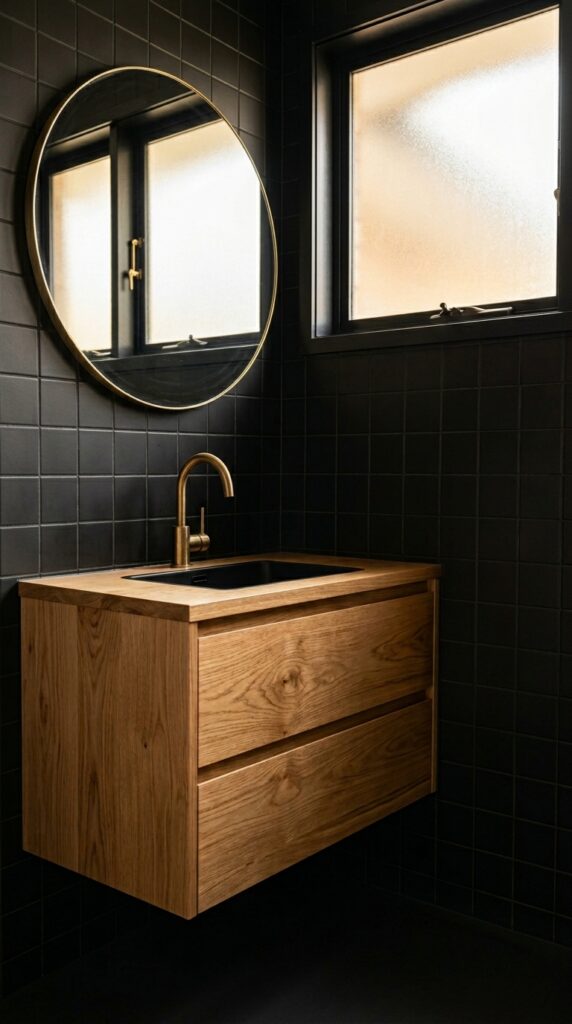
Vibe: Resolved — the oak vanity is the one warm thing in the room, and it earns every inch of attention.
Why it works: In an all-black bathroom, a single contrasting element in a warm natural material functions as the visual anchor the eye needs to calibrate the rest of the space. White oak (specifically a wire-brushed or natural-oiled finish that emphasizes the grain rather than coating it) introduces biological warmth — the brain responds to natural wood grain as it does to other organic materials, with a measurable drop in perceived stress. The contrast principle at work is chromatic and material simultaneously: warm vs. cool, organic vs. mineral, textured vs. smooth. The vanity becomes the hero of the room because everything else in the room has stepped back to let it be.
How to get it: Specify a floating vanity (wall-mounted, not floor-standing) in white oak with a solid wood face frame — not veneer, which reads differently at close range. Floating installation adds approximately $200–400 to the cost versus floor-standing but creates the visual lightness that prevents the wood from competing with the dark floor below it.
💡 Quick Win: Replace an existing bathroom vanity door panel with a white oak or warm timber panel insert — companies like Semihandmade sell replacement door fronts for standard vanity boxes that transform the look without cabinet replacement.
Shop The Look
| Product |
| White oak floating bathroom vanity 24 inch |
| Matte black undermount bathroom sink oval |
| Brushed brass bathroom tap single hole |
| Warm ivory linen hand towel set |
| White ceramic toothbrush holder countertop |
6. Recessed Niche With Brass Shelf in Black Tile Shower
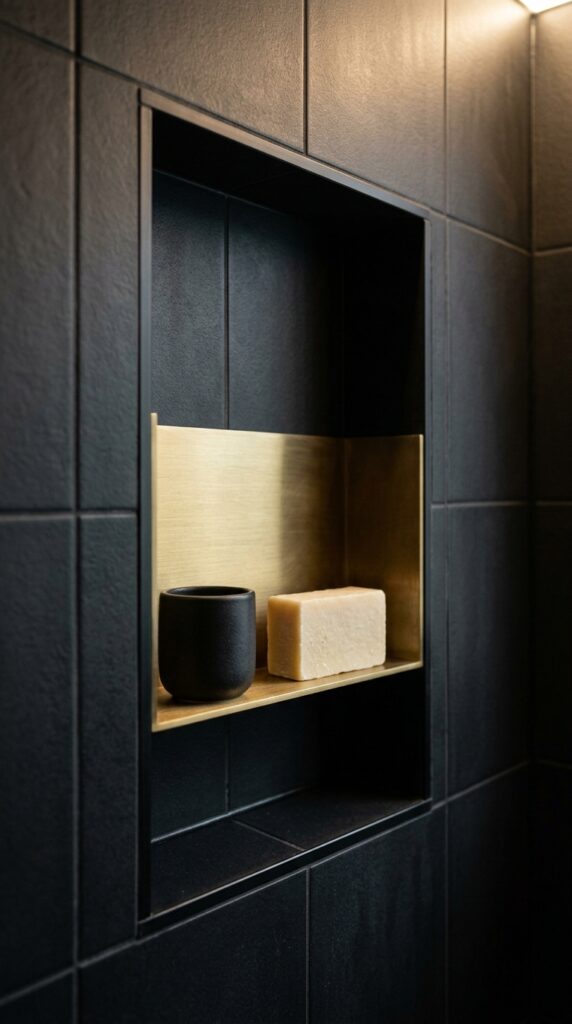
Vibe: Composed — a niche styled this precisely makes the entire shower feel considered.
Why it works: A shower niche is a standard functional element that most bathrooms treat as purely utilitarian — a place to put shampoo bottles in whatever container they arrived in. In an all-black bathroom, the niche becomes an architectural detail and a styling opportunity. The recessed void in the dark tile wall creates a frame for whatever is placed within it, functioning as a built-in display case. A single brass shelf insert (rather than tiling the niche floor) introduces the warm metal accent at eye level, precisely where it creates the most visual impact in the shower zone.
How to get it: The niche must be waterproofed independently during construction — a waterproofing membrane applied to all niche surfaces before tile installation prevents water ingress into the wall cavity. Tile the niche in the same matte black tile as the surrounding wall, using the same dark grout, so the niche reads as a shadow in the wall rather than a contrasting insert.
Shop The Look
| Product |
| Shower niche shelf insert brass single tier |
| Matte black ceramic shower niche tile |
| Small black ceramic bathroom container lid |
| Brushed brass shower niche frame trim |
| Natural bar soap minimal packaging artisan |
7. Backlit Mirror as the Sole Light Source
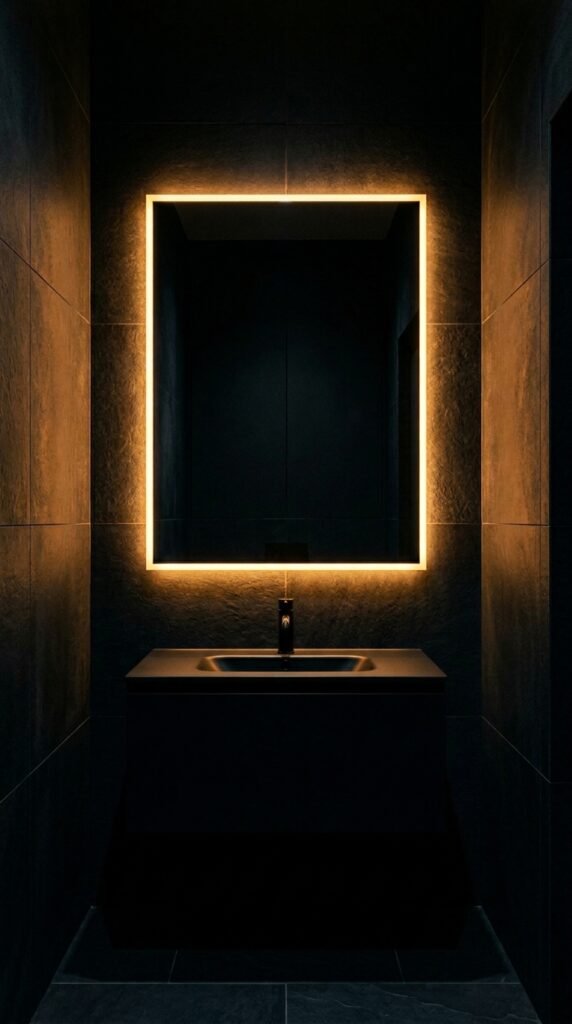
Vibe: Intimate — the backlit mirror turns the bathroom into something you’d find in a film noir.
Why it works: A backlit mirror used as the primary (or sole) light source in a small dark bathroom creates what lighting designers call halo illumination — the light source is hidden behind the mirror, and only its warm wash on the surrounding dark wall is visible. This technique eliminates harsh direct light on the face (which produces unflattering shadows in standard overhead bathroom lighting) while simultaneously creating a dramatic dark-room atmosphere. The warm LED halo (2700K or warmer) against the dark tile wall creates a luminous focal point that makes the mirror appear to float rather than hang.
How to get it: Specify a backlit LED mirror with a color temperature selector — 2700K for the moody, warm amber effect versus 4000K for task accuracy when applying makeup or skincare. A mirror with both settings and a dimmer function covers all use cases. Mount the mirror flush to the wall with no gap on the sides — the halo effect requires the light to project only behind and slightly around the mirror, not visibly around the frame.
💡 Quick Win: A plug-in LED backlit mirror ($85–180 at most home goods retailers) requires no electrician and no installation — it’s a single swap that transforms the entire character of a dark bathroom without touching a wall.
Shop The Look
| Product |
| Backlit LED bathroom mirror rectangular 24×36 |
| LED mirror with dimmer and color temperature |
| Matte black mirror mounting hardware kit |
| Warm LED strip light 2700K adhesive back |
| Bathroom mirror anti-fog pad heated |
8. Zellige Black Tile for Handmade Texture
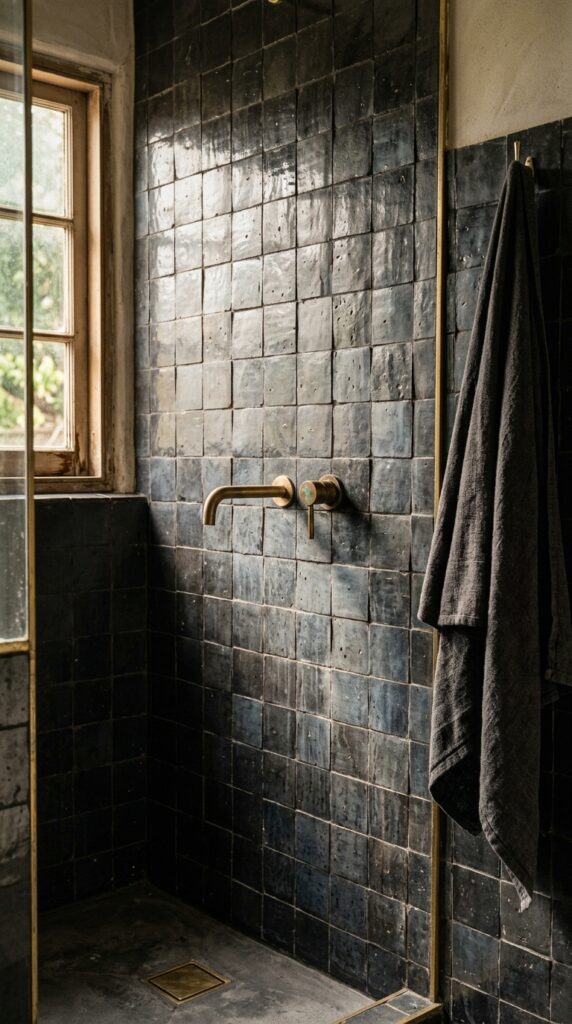
Vibe: Artisanal — a wall that looks different every time the light changes.
Why it works: Zellige tile — hand-cut from terracotta and individually glazed in Morocco — has surface irregularities and tonal variations that industrial tile cannot replicate: each piece is slightly different in thickness, glaze depth, and surface plane. When used in black or deep charcoal, these variations create a wall surface that absorbs and reflects light differently across its face, producing depth and movement in what would otherwise be a flat dark surface. This is the material equivalent of the difference between a hand-bound book and a mass-produced paperback — the imperfection is the quality signal.
How to get it: Zellige tile requires a more skilled setter than standard ceramic tile — the dimensional variation means each piece must be individually adjusted for level and plane, which takes significantly longer than setting regular tile. Budget for a 30–40% premium on the tiling labor cost and source from a specialist tile importer (Cle Tile, Mosaic House) rather than a general tile retailer.
Shop The Look
| Product |
| Handmade zellige tile black charcoal 4×4 |
| Tile adhesive flexible white polymer modified |
| Brass wall spout bathroom tap minimal |
| Charcoal linen hand towel set bathroom |
| Grout sealer penetrating clear tile protection |
9. Powder Room: Full Black Lacquer Walls and Ceiling
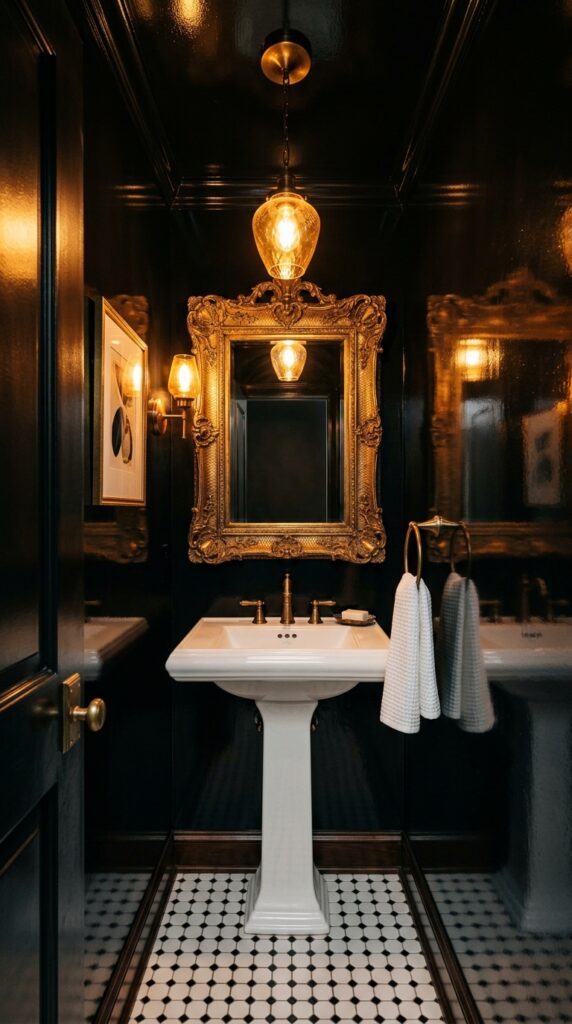
Vibe: Jewel-like — a powder room that stops guests mid-sentence.
Why it works: A powder room (a half bath used only for guests, not daily washing) is the ideal space for the most committed version of black bathroom design because it doesn’t require the functional durability of a primary bathroom. Gloss black lacquer paint — unlike matte, which absorbs light — reflects it from every surface, creating an infinite-mirror quality that dramatically amplifies the space. The white pedestal sink reads as the most vivid object in the room against the dark surround, making it appear to glow. This is the chromatic reversal principle: on a black field, white appears luminous; on a white field, it simply appears present.
How to get it: Gloss lacquer paint requires meticulous surface preparation — any imperfection in the drywall is amplified by the reflective finish. Skim-coat the walls to a perfectly smooth surface before painting, apply three coats of high-gloss paint, and sand lightly between coats. This is not a weekend DIY project; the preparation phase alone takes more time than the painting.
Shop The Look
| Product |
| High gloss black interior paint lacquer finish |
| White porcelain pedestal sink bathroom classic |
| Aged brass ornate bathroom mirror oval |
| Warm pendant light brass globe small |
| White cotton hand towel set guest bathroom |
10. Floating Matte Black Vanity With Negative Space Below
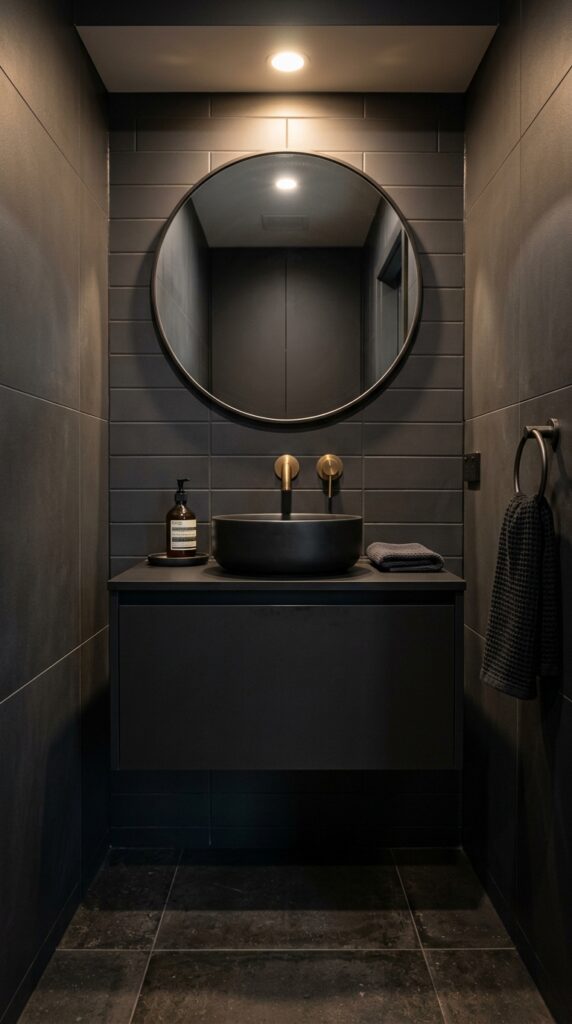
Vibe: Clean — a floating vanity in a small dark room is the spatial equivalent of a held breath.
Why it works: A floating (wall-mounted) vanity creates visible negative space between the cabinet base and the floor — in a small bathroom, this gap of clear floor plane makes the room feel measurably larger because the eye reads the continuous floor surface as extending under the vanity rather than being interrupted by it. In an all-black bathroom where the floor and vanity share the same dark tone, the negative space appears as a dark horizontal band that emphasizes the vanity’s architectural quality. The floating installation also simplifies floor cleaning — no base to clean around — which matters more than it sounds in a small bathroom.
How to get it: A floating vanity requires wall mounting into studs or with heavy-duty wall anchors rated for the combined weight of the cabinet, sink, and water. Confirm your wall construction (stud framing versus masonry) before purchasing — masonry walls require a different mounting system and typically a stronger anchor specification.
💡 Quick Win: Replace an existing floor-standing vanity with a wall-mounted bracket system that lifts the existing cabinet off the floor by 6 inches — this negative space trick works on many existing vanities without a full replacement and costs $80–150 in hardware.
Shop The Look
| Product |
| Floating wall mount bathroom vanity matte black 30 inch |
| Matte black vessel sink ceramic round |
| Wall mount vanity bracket heavy duty steel |
| Dark tile floor 12×24 matte black porcelain |
| Matte black single hole bathroom faucet |
11. Black Shiplap Accent Wall in a Small Bathroom
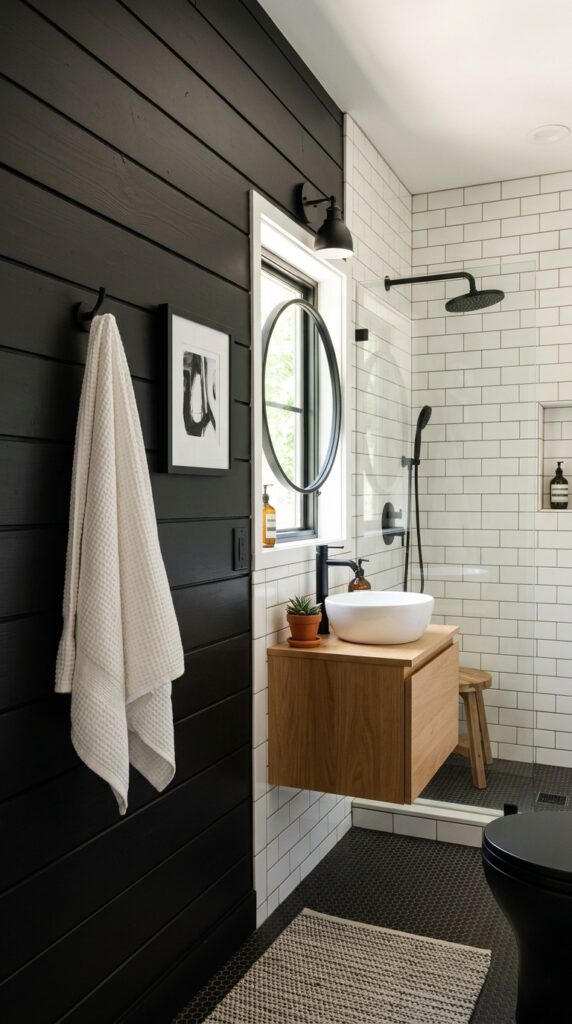
Vibe: Textural — shiplap in black does what shiplap in white never could: it recedes and advances at the same time.
Why it works: Black shiplap introduces two design elements simultaneously: the horizontal shadow gap between each board creates a fine rhythmic texture across the wall surface that flat paint cannot replicate, and the dark color makes those horizontal lines read as depth rather than protrusion. In a small bathroom that doesn’t warrant a full black tile renovation, a single black shiplap accent wall (typically the wall behind the vanity or the wall facing the door) introduces the all-black aesthetic at a fraction of the cost and with the reversibility of painted wood rather than tile. The contrast between this wall and standard white tile on adjacent walls creates a graphic, high-contrast composition.
How to get it: Install 1×6 inch shiplap boards (or standard pine boards with a 1/8-inch reveal gap between each) horizontally, sand smooth, prime with a shellac-based primer, and paint in flat black latex paint (two coats minimum). The flat finish is essential — any sheen in the paint picks up light and breaks the moody quality of the dark surface.
Shop The Look
| Product |
| Shiplap wall board pine 1×6 primed |
| Flat black interior latex paint wall |
| Matte black towel hook bathroom single |
| Shiplap installation brad nail gun kit |
| White subway tile 3×6 classic bathroom wall |
12. Dark Grout Transformation on Existing White Tile
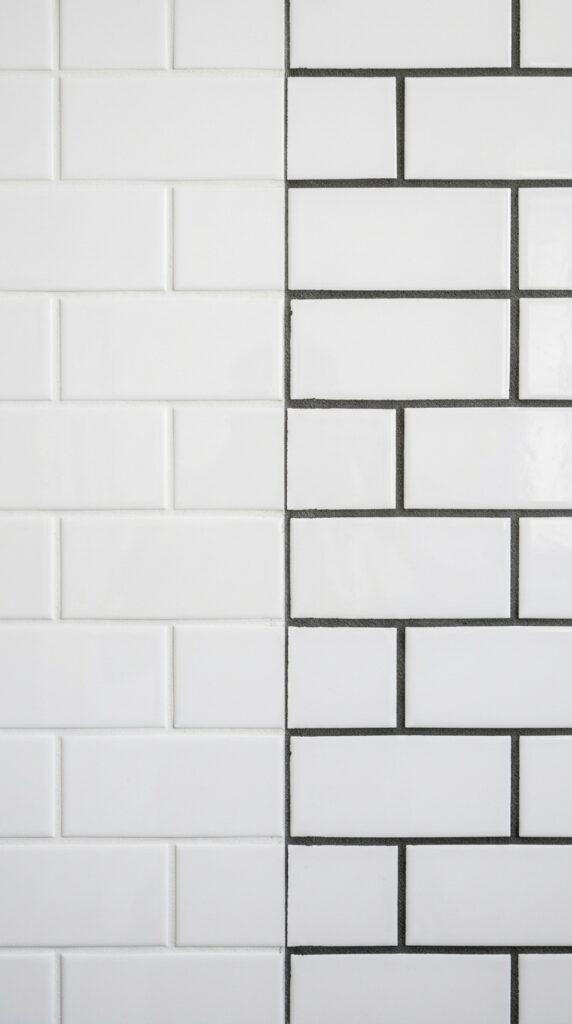
Vibe: Transformative — dark grout is the renovation secret that doesn’t require a renovation.
Why it works: Grout color is the single most underestimated variable in bathroom tile design. White or light grout on white tile creates a uniform grid that defines every tile boundary — emphasizing the tile pattern and the room’s scale simultaneously. Dark charcoal grout on the same white tile dramatically reduces the visual prominence of the grout lines, allowing the tile surface to read more as a continuous plane. In the context of moving toward an all-black bathroom, this change alone shifts the aesthetic register significantly without replacing any tile. It works because grout covers 10–15% of any tiled surface — changing its color changes 10–15% of the room’s tonal value.
How to get it: Grout can be darkened by applying a grout colorant/stain over existing grout (products like Polyblend Grout Renew are widely available for $15–25 per bottle) or by re-grouting entirely. The colorant approach works on unsanded grout in good condition; re-grouting is required if existing grout is cracked or crumbling.
💡 Quick Win: A single bottle of dark grout colorant ($15–20) applied to one tiled wall transforms a bathroom’s atmosphere in two hours with no tile removal — the highest-impact, lowest-cost bathroom change available.
Shop The Look
| Product |
| Grout colorant dark charcoal tile renew bottle |
| Grout brush scrubbing tool narrow head |
| Grout sealer penetrating clear 16oz |
| Dark charcoal sanded grout 25lb bag |
| Grout removal tool oscillating attachment |
13. Black Ceiling in an Otherwise White Bathroom
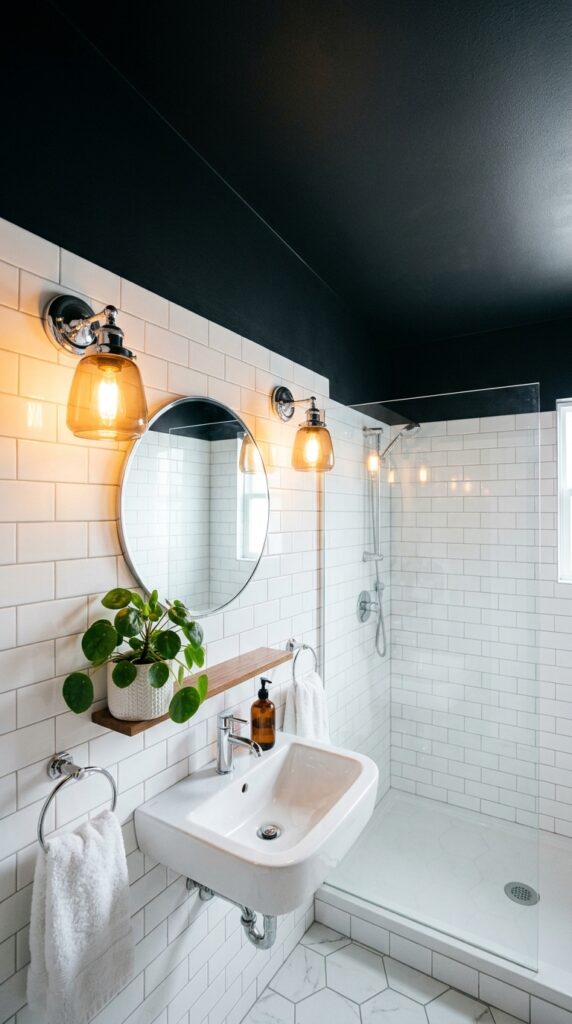
Vibe: Unexpected — a black ceiling in a white bathroom is the design move that changes how the whole room feels.
Why it works: Painting the ceiling black in a light-colored bathroom applies the principle of visual compression in the vertical plane — the dark ceiling appears lower than it actually is, creating a sense of enclosure that reads as intimate rather than cramped. More importantly, the strong contrast between a matte black ceiling and white tile walls makes the white appear more luminous by chromatic contrast (the darkest dark makes adjacent lights appear brighter). This is the most commitment-free entry point into the all-black bathroom aesthetic: it requires only a can of ceiling paint and a roller.
How to get it: Use a flat or matte ceiling paint in the darkest black available — avoid eggshell or semi-gloss, which create an unpleasant sheen overhead. Extend the black 2–3 inches down onto the top of each wall (just below the ceiling line) so the ceiling color bleeds slightly, preventing a hard edge that looks painted rather than architectural.
Shop The Look
| Product |
| Matte black ceiling paint flat finish |
| Paint roller kit ceiling application |
| Angled paint brush 2.5 inch edging |
| Chrome wall sconce bathroom plug in |
| White subway tile 3×6 glossy bathroom |
14. Terrazzo Black Floor With Dark Walls
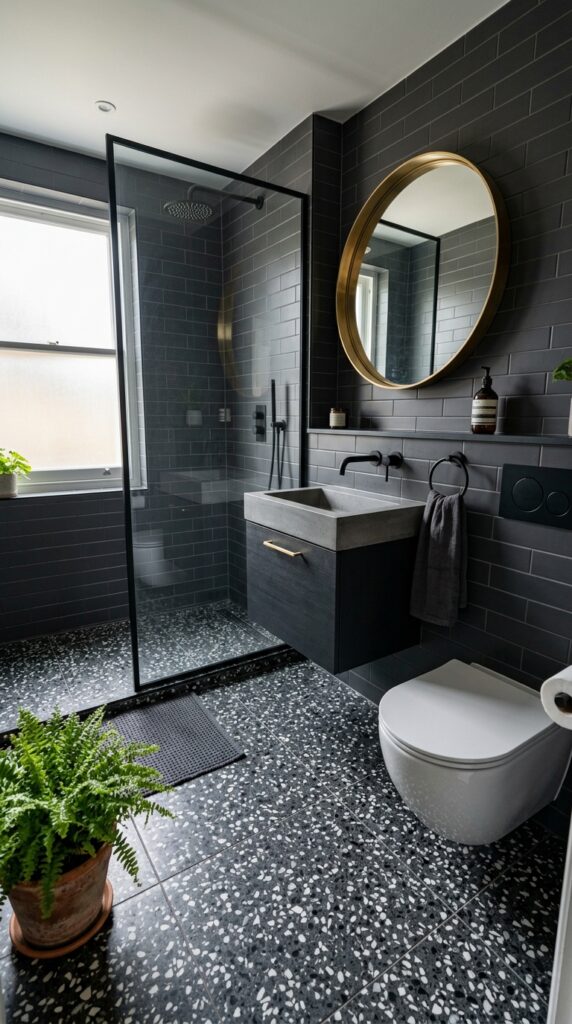
Vibe: Textural — terrazzo in black is the detail that makes people crouch down and look closer.
Why it works: Terrazzo in a dark colorway (charcoal or black cement base with lighter aggregate chips) introduces micro-scale tonal variation into the floor plane that prevents a fully dark bathroom from feeling monotonous. The light aggregate chips — white, grey, or warm cream marble fragments — catch bathroom light and sparkle subtly, creating a floor surface that reads as dark from a distance but reveals complexity at close range. This is the material principle of hidden detail — the floor rewards the observer who looks carefully, which is precisely the quality that distinguishes designed spaces from merely decorated ones.
How to get it: Terrazzo tiles (as opposed to poured-in-place terrazzo) are available in large-format porcelain versions that mimic authentic terrazzo visually — specify a dark grey or charcoal base colorway with lighter chip sizes of 0.5–1cm for the most refined appearance. Avoid oversized chip patterns (3cm+), which read as bold and graphic rather than refined in small bathroom spaces.
Shop The Look
| Product |
| Terrazzo look porcelain tile dark charcoal 24×24 |
| Brass oval bathroom mirror wall mount |
| Matte black toilet roll holder wall mount |
| Small fern live plant bathroom shade tolerant |
| Charcoal wall tile matte porcelain 12×24 |
15. Matte Black Freestanding Bathtub as Statement Piece
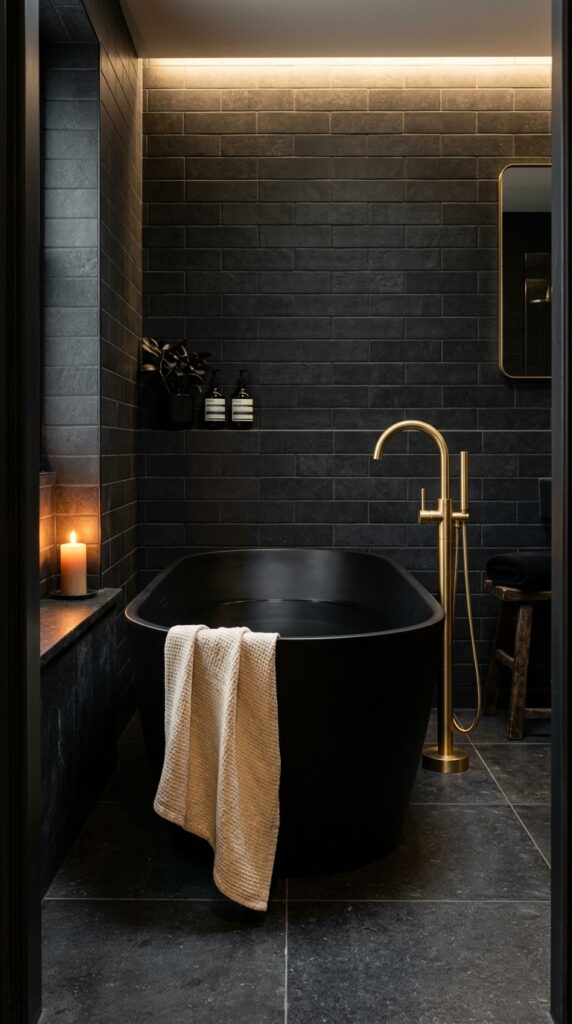
Vibe: Indulgent — the black freestanding tub is the piece the room was built around.
Why it works: A matte black freestanding bathtub is the highest-visual-impact single object available in bathroom design — it functions simultaneously as furniture, sculpture, and functional fixture. In an all-black bathroom, the tub’s matte exterior blends with the surrounding dark surfaces but its three-dimensional form creates a sculptural presence that a recessed alcove tub cannot achieve. The floor-mounted brass tap placed beside the tub (rather than wall-mounted) maintains the tub’s freestanding sculptural quality and introduces the warm brass accent at floor level, where it creates a grounding warmth.
How to get it: A matte black exterior bathtub requires specific care to maintain its finish — standard bathroom cleaners will etch the matte coating over time. Use only pH-neutral, non-abrasive cleaners (diluted dish soap or products specifically labeled safe for matte finishes) and dry the exterior after each use to prevent water spot buildup on the dark surface.
💡 Quick Win: A matte black tub refinishing spray kit ($45–80) can transform an existing white alcove tub’s exterior into a matte black surface — not the interior, but the exterior visible end, which creates a significant visual shift in the room without any plumbing work.
Shop The Look
| Product |
| Matte black freestanding bathtub slipper style |
| Brass floor mount tub filler tap freestanding |
| Warm linen bath sheet oversized charcoal |
| Pillar candle holder black concrete round |
| pH neutral matte surface bathroom cleaner |
16. Black Hexagon Floor Tile With Dark Grout
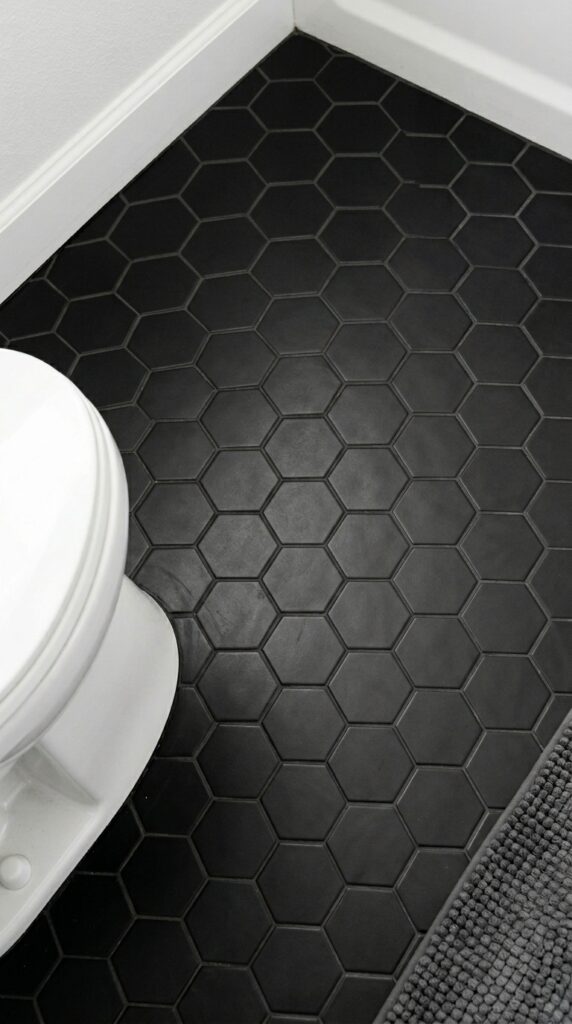
Vibe: Geometric — a floor pattern that looks deliberate from every angle.
Why it works: Hexagonal tile creates a geometric pattern that has no directional orientation — unlike rectangular subway tile (which can run horizontal, vertical, or herringbone), hex tile reads the same from every viewpoint, making it particularly effective in small bathrooms where the visitor enters from different positions. In a small all-black bathroom, the 2-inch hex scale is the most refined option — smaller than 1-inch (which creates a busy micro-pattern) and larger than 4-inch (which requires fewer tiles and reveals the geometry less clearly). Dark grout matched closely to the tile tone unifies the surface while the tile geometry creates subtle texture.
How to get it: Hexagon tile requires more cuts at room edges than rectangular tile, which increases installation labor by approximately 15–20%. Order 15% more tile than the measured area calculation to account for edge cuts and potential breakage — hex tile is more susceptible to corner chipping during cutting than rectangular formats.
Shop The Look
| Product |
| Matte black hexagon ceramic tile 2 inch mosaic sheet |
| Hex tile grout float tool installation |
| Dark grey unsanded grout 10lb bag |
| Tile spacer cross set hex floor installation |
| White porcelain toilet two piece round |
17. Single Dramatic Plant in a Dark Bathroom Corner
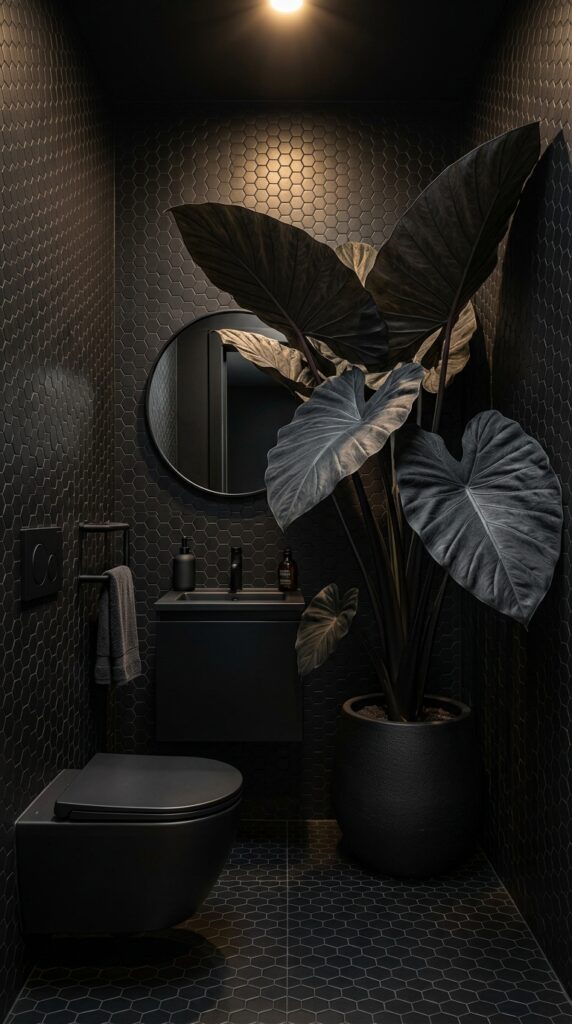
Vibe: Dramatic — one large dark plant in a dark room is more powerful than ten small ones scattered around a light one.
Why it works: A large-leaved tropical plant in a dark bathroom exploits the principle of tonal proximity — dark green leaves against dark tile walls create a near-monochromatic relationship that reads as intentional rather than random. Species with deep, dark-toned foliage (Black Velvet elephant ear, Black Cardinal philodendron, or a standard heartleaf philodendron in low light) visually merge with the dark walls while their organic leaf shapes create texture and movement. The plant’s three-dimensionality — leaves extending outward from the wall — introduces genuine depth that flat surfaces cannot create.
How to get it: Choose a humidity-tolerant species for a bathroom environment: heartleaf philodendron, pothos, or peace lily all tolerate the high humidity and low-to-medium light of most bathrooms. Place the plant in the corner farthest from the shower to minimize direct water splash on the leaves.
Shop The Look
| Product |
| Black velvet elephant ear live plant indoor |
| Matte black ceramic plant pot large 10 inch |
| Black cardinal philodendron live tropical |
| Plant humidity tray pebble moisture black |
| Tropical potting mix premium indoor blend |
18. Matte Black Fixtures — The Complete Replacement Guide
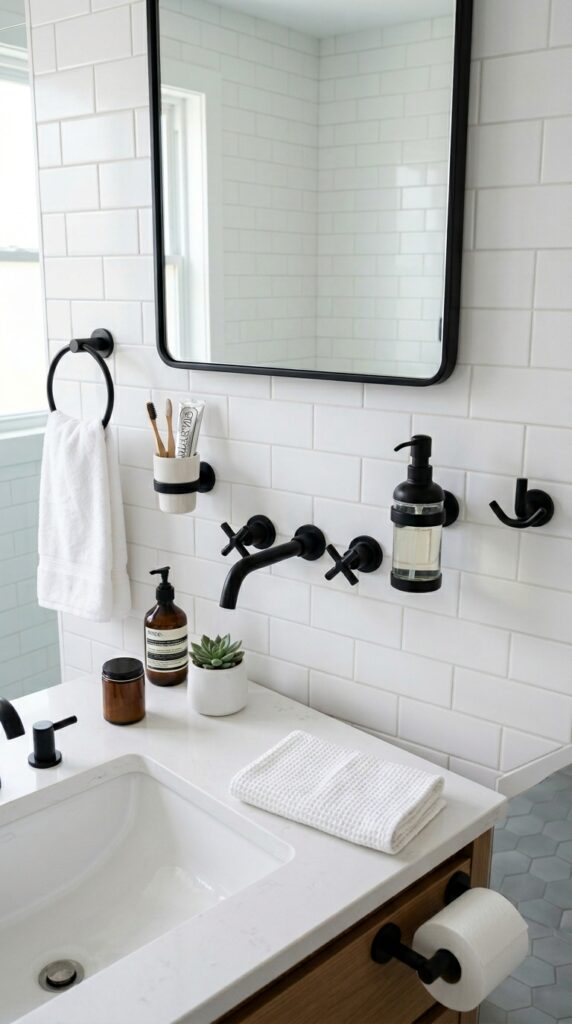
Vibe: Cohesive — when every metal in the bathroom speaks the same language, the room stops feeling assembled and starts feeling designed.
Why it works: Fixture finish consistency is the fastest way to transform a standard bathroom toward an all-black aesthetic without touching the tile or walls. A bathroom with chrome taps, brushed nickel towel bars, and brass soap dispensers has three competing metal languages fighting each other — replacing all of them with a single matte black finish creates immediate visual coherence through the principle of material unity. This works even in a white or light-colored bathroom: matte black fixtures on white tile create a graphic, high-contrast composition that reads as intentional rather than accidental.
How to get it: Purchase fixtures as a set from a single manufacturer — collections sold as coordinated sets (tap, towel bar, robe hook, toilet roll holder, towel ring) guarantee finish consistency across all pieces. Mixing individual pieces from different manufacturers, even when both are labeled “matte black,” frequently produces visible tonal differences at close range.
💡 Quick Win: Start with just the toilet roll holder and towel ring — these two fixtures are the cheapest to replace ($15–35 each) and are both at eye level where inconsistent finish reads most strongly. Replace these first and assess the impact before committing to a full set.
Shop The Look
| Product |
| Matte black bathroom hardware set 6 piece |
| Matte black toilet paper roll holder wall |
| Matte black towel ring wall mount bathroom |
| Matte black robe hook single wall bathroom |
| Matte black soap dispenser pump countertop |
19. Moody All-Black Shower With Glass-Free Curtain Entry
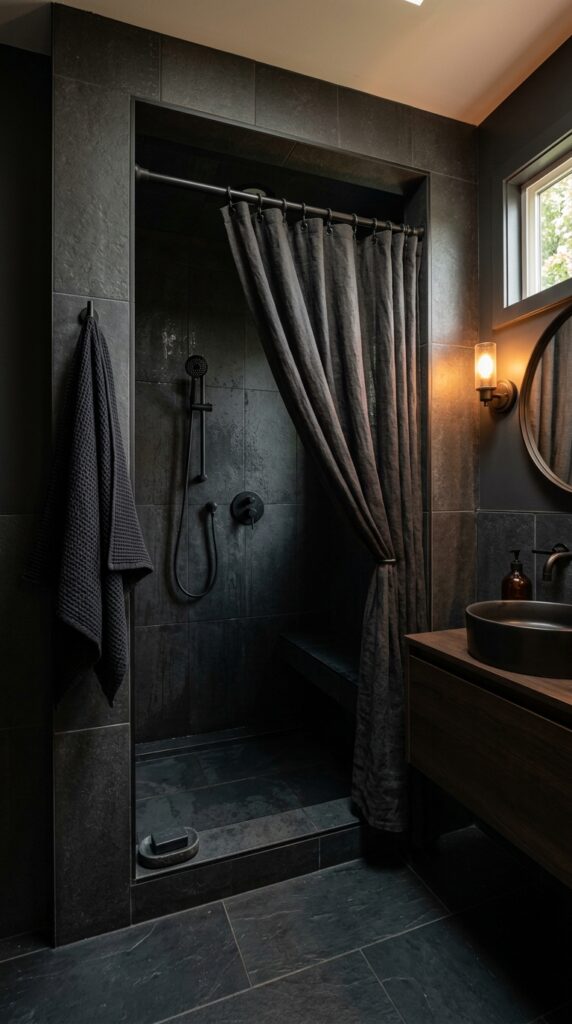
Vibe: Layered — the linen curtain does in texture what the tile does in tone.
Why it works: A shower curtain in a dark linen or cotton-linen blend (specifically charcoal or near-black in a heavyweight, visible-weave fabric) introduces a textile layer into the all-black bathroom that glass cannot provide — warmth, texture, and movement. In a small bathroom, a curtain also has a spatial advantage over a glass door: it can extend beyond the shower opening width when open, creating the illusion that the shower is wider than it is. A matte black curtain rod and rings complete the hardware palette, maintaining the all-black register without introducing a contrasting finish.
How to get it: Use a weighted hem shower curtain (lead weights sewn into the hem, or a magnetized bottom) to prevent the linen from billowing into the shower zone during use. Wash the curtain on a gentle cycle monthly to prevent mildew buildup in the fabric — linen is naturally mildew-resistant but not mildew-proof in continuous moisture exposure.
Shop The Look
| Product |
| Charcoal linen shower curtain weighted hem |
| Matte black shower curtain rod tension mount |
| Matte black shower curtain rings set 12 |
| Dark towel hook matte black double arm |
| Linen shower curtain liner waterproof dark |
20. Tonal Layering: Three Black Tones in One Bathroom
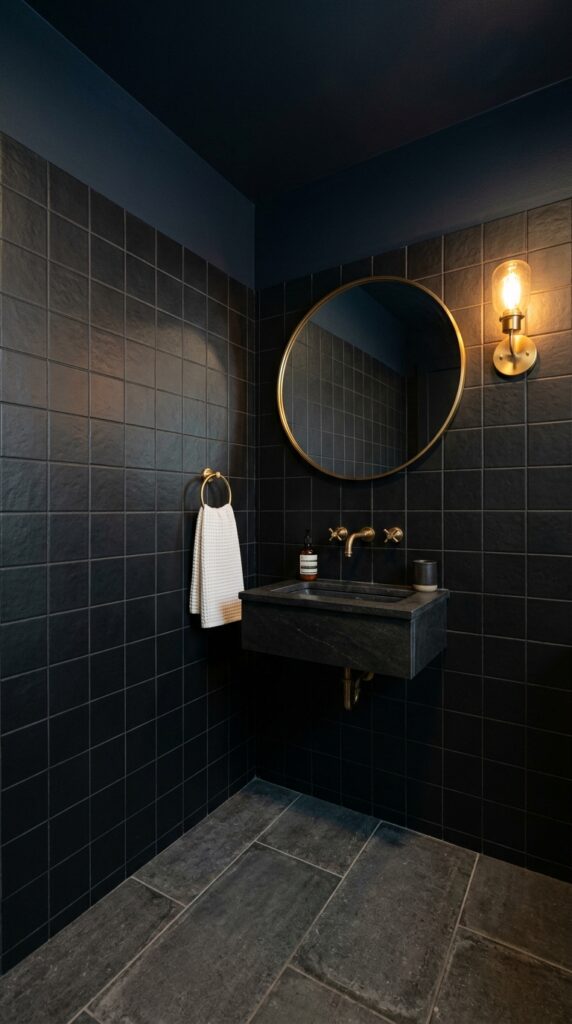
Vibe: Sophisticated — a room where darkness has been treated as a material with its own range of expression.
Why it works: A common mistake in all-black bathroom design is treating “black” as a single uniform color rather than a family of tones. The most sophisticated all-black bathrooms use two or three distinct dark tones — a true matte black on the walls, a warmer charcoal or dark grey on the floor, and a deep near-black (charcoal, dark navy, or deep forest) on the ceiling — creating tonal layering that prevents the space from feeling flat or oppressive. The brain reads slight tonal variation within a dark palette as intentional depth; it reads a completely uniform dark field as either technical limitation or lack of design resolution.
How to get it: Choose a cooler black for vertical surfaces (walls) and a slightly warmer dark tone (charcoal grey, dark taupe) for the floor — this mimics the natural light behavior of real spaces, where floors are always slightly warmer than vertical surfaces. The ceiling can be the darkest or most chromatic tone (deep navy, deep forest) to create the sense of a cap pressing down, amplifying the enclosure.
Shop The Look
| Product |
| Matte black wall tile porcelain 12×24 |
| Dark charcoal grey floor tile 24×24 porcelain |
| Deep navy ceiling paint matte interior |
| Brass bathroom mirror rectangular 24×32 |
| White cotton hand towel bathroom luxury |
21. Open Shelving in Warm Walnut Against Black Tile
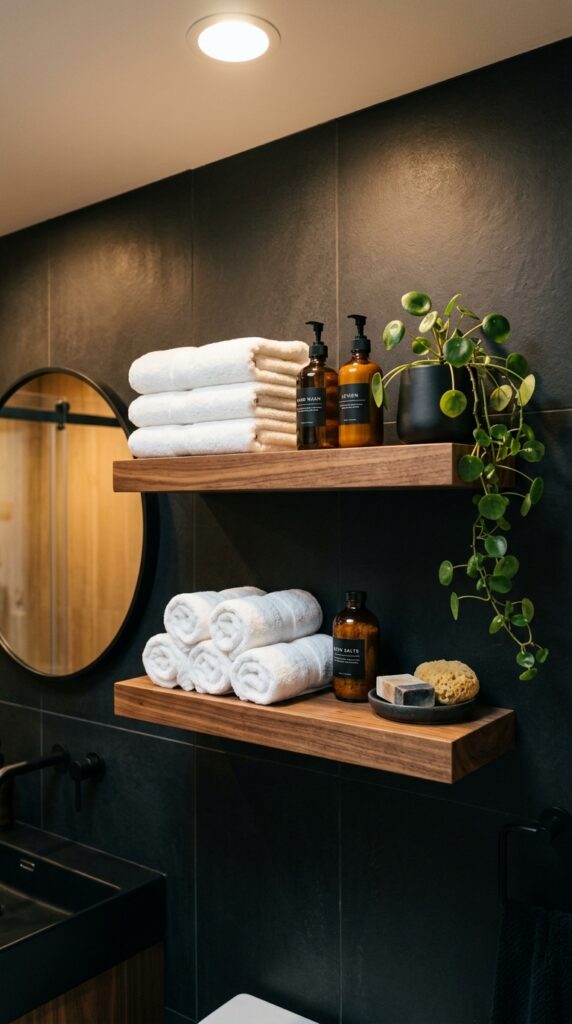
Vibe: Warm — walnut shelves against black tile are the design equivalent of firelight in a dark room.
Why it works: Open floating shelves in warm walnut (or white oak in a natural, un-stained finish) on a black tile wall create the maximum possible warm-cool, organic-mineral contrast at eye level — precisely where the eye rests most often in a bathroom. The warm wood tone reads against the dark tile the way candlelight reads in a dark room: it becomes the focal point the eye returns to. Organized white towels and amber glass bottles on these shelves maintain the tonal restraint while adding soft warm accents. The walnut shelves also serve a functional purpose, removing the need for a cabinet in a small bathroom by providing visible, accessible storage.
How to get it: Mount floating shelves using concealed bracket systems (blind shelf supports insert into a channel routed in the shelf back) — visible metal brackets interrupt the clean floating appearance that makes this detail work. Specify walnut boards at minimum 1.5 inches thick so the shelf has visual weight proportional to the scale of the dark tile wall it occupies.
Shop The Look
| Product |
| Walnut floating bathroom shelf 24 inch thick |
| Concealed shelf bracket floating mount set |
| Amber glass soap dispenser and bottle set |
| White cotton towel set rolled display |
| Small trailing pothos bathroom shelf plant |
22. Black Wainscoting With Dark Painted Upper Walls
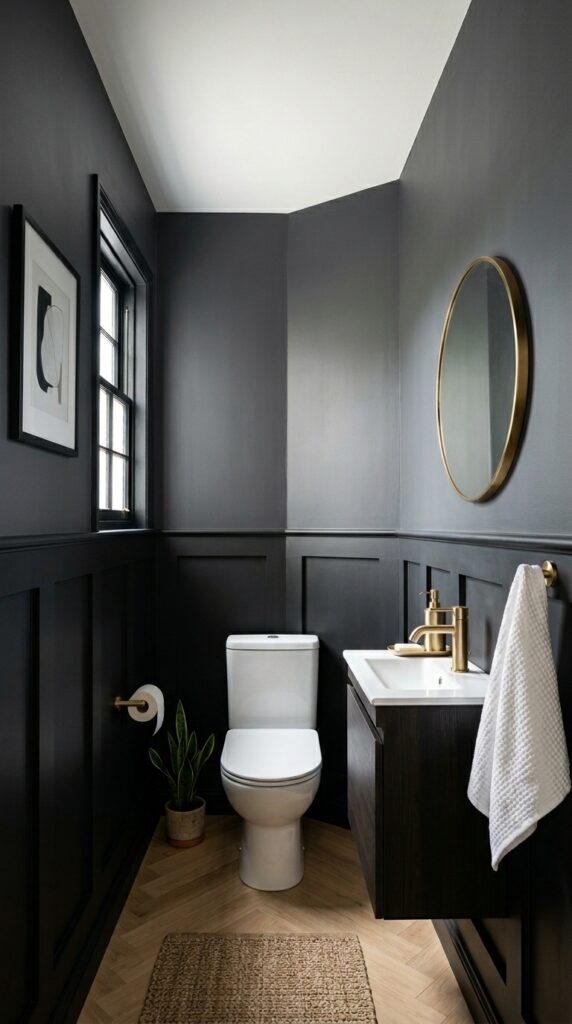
Vibe: Architectural — a bathroom wall that has been thought about, not just painted.
Why it works: Wainscoting — the division of a wall into an upper and lower zone using a chair rail — is a classical architectural detail that brings proportion and structure to any room. In a dark bathroom, black wainscoting on the lower half against a slightly lighter dark tone (deep charcoal, dark slate grey) on the upper half creates a graduated vertical composition that grounds the room without making it feel uniformly oppressive. The white ceiling becomes the lightest element in a three-step gradation from black to charcoal to white, creating tonal depth in the vertical dimension.
How to get it: The chair rail division height should sit at 32–36 inches from the floor — the standard chair rail height that maintains historical proportion. Above this line, paint the walls in deep charcoal (two full tones lighter than the wainscoting black). The tonal step between the two surfaces must be clearly visible; if the difference is too subtle, the effect reads as an uneven paint job rather than an intentional design decision.
💡 Quick Win: Painter’s tape and two cans of paint — flat black for below the rail, deep charcoal for above — complete this entire transformation in one weekend for under $60 in materials, making it the most architecturally sophisticated bathroom change available at low cost.
Shop The Look
| Product |
| Matte black trim paint wainscoting interior |
| Deep charcoal interior paint wall above rail |
| Chair rail molding MDF primed 8ft length |
| Matte black small bathroom art frame 5×7 |
| Paint edger tool clean line wall ceiling |
23. Small All-Black Bathroom With a Single Skylight
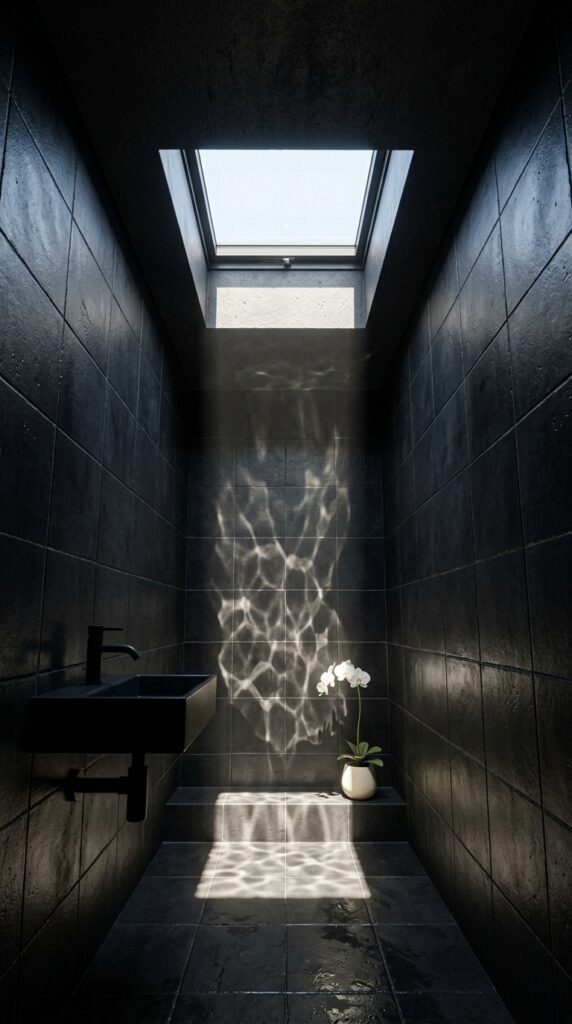
Vibe: Luminous — a single skylight in a black room is the most dramatic thing natural light can do.
Why it works: Introducing a single overhead natural light source into a fully dark bathroom creates the most visually dramatic effect available in interior design: the contrast between the bright shaft of daylight and the surrounding dark surfaces produces an almost theatrical quality — the light appears to pour into the space rather than simply illuminate it. On matte black tile, natural light creates caustic patterns (the organic, shifting light-reflections that appear on dark wet surfaces) that make the room appear alive and dimensional in a way no artificial lighting can replicate. This is darkness used as a canvas for light.
How to get it: A tubular skylight (a reflective tube that channels daylight from the roof into an interior space) can be installed in most roof structures for $400–800 including installation — significantly less than a structural skylight. The tube terminates in a diffuser lens at the ceiling, which produces a soft pool of natural light in the room below without structural modification. In an all-black bathroom, even a 10-inch diameter tube skylight delivers a visually dramatic amount of daylight contrast.
Shop The Look
| Product |
| Tubular skylight kit 10 inch DIY installation |
| White orchid artificial plant pot bathroom |
| Skylight diffuser lens replacement kit |
| Black matte ceiling paint interior flat |
| Matte black large format wall tile 24×48 |
How to Start Your Small All Black Bathroom Transformation
The single best first move is to repaint the ceiling matte black. It costs one can of flat black ceiling paint ($25–35), takes two hours, and immediately transforms the room’s atmosphere in a way that nothing else achieves at that price point. The ceiling is the one surface that influences how every other surface in the room reads — darkening it changes the perceived quality of the walls, the fixtures, and the light simultaneously. Start there, live with it for a week, and use what you learn about your room’s light behavior to guide every subsequent decision.
The most common mistake in small all-black bathroom design is using gloss or semi-gloss tile finishes on the walls in an attempt to brighten the space. Gloss tile in a dark bathroom reflects light from every surface simultaneously, creating a competing, fragmented reflection pattern that makes the room feel chaotic and smaller rather than immersive and intimate. The correct finish for all surfaces is matte — matte tile, matte paint, matte fixtures. The only exception is a deliberate gloss element used as a single statement (a gloss lacquer ceiling in a powder room, as in idea 9) where the reflection is the design intention.
Three items under $50 that create immediate all-black bathroom impact: a bottle of dark charcoal grout colorant ($15–20) applied to existing light-grouted tile in one afternoon; a complete set of matte black curtain rod and rings ($28–40) replacing a chrome or white shower rod; and one matte black toilet roll holder ($18–30) replacing whatever is currently on the wall — the most-noticed bathroom fixture at eye level.
A single-weekend transformation (ceiling paint, grout colorant, and hardware swaps) runs $80–150 and shifts the aesthetic register of almost any bathroom toward the all-black palette. A full tile and fixture renovation in a small bathroom runs $3,500–8,000 depending on tile selection and fixture quality, and takes three to five weeks of professional installation. The most impactful investment at any budget level is always the tile — it covers the most surface area and sets the tone for every other decision.
Frequently Asked Questions About Small All Black Bathrooms
What is the difference between an all-black bathroom and a dark bathroom?
An all-black bathroom applies the dark palette across all primary surfaces simultaneously — walls, floor, ceiling, and fixtures — creating a unified dark field rather than a dark accent or feature wall. A dark bathroom may have one or two dark surfaces against a lighter background. The distinction matters because the all-black approach works through the principle of edge dissolution: when all surfaces are dark, the room’s boundaries visually disappear, which makes a small space feel larger. A partially dark bathroom, by contrast, emphasizes the contrast between dark and light surfaces, which can actually make a small room feel more segmented.
What colors work as accents in an all-black bathroom?
Warm metallics — specifically unlacquered brass, blackened brass, or aged bronze — are the most effective accent colors in an all-black bathroom because their warm yellow-orange tone creates maximum chromatic contrast against the cool dark field. Warm white (specifically ivory or cream, never stark cool white) in towels, a sink basin, or a single ceramic object provides the lightest possible accent that the eye needs to calibrate the darkness of the surrounding surfaces. Natural warm wood (white oak, walnut) works as a larger accent material for a vanity or shelving. Avoid cool silver chrome, which reads as cold and clinical against dark tile and competes with the warmth the palette requires.
How much does a small all-black bathroom renovation cost?
A budget-focused all-black bathroom transformation using paint, grout colorant, and fixture replacement runs $150–400 and can be completed in two weekends. A mid-range renovation replacing floor tile (keeping existing wall tile, painting it, or adding a dark overlay plaster) plus all fixtures runs $2,000–4,500. A full renovation — new tile on all surfaces, new vanity, new fixtures, new lighting — in a small bathroom (under 50 square feet) runs $5,000–12,000 depending on tile quality and fixture specification. The tile selection is the variable with the largest budget range: basic matte black ceramic costs $2–5 per square foot; handmade zellige runs $25–45 per square foot.
Will an all-black bathroom make my small bathroom feel smaller?
Counter-intuitively, no — when done correctly with matte finishes, a dark bathroom dissolves its own boundaries and reads as a contained, intimate volume rather than a shrunken room. The key variables are finish (matte absorbs light and eliminates the perception of room edges; gloss reflects light and reinstates them) and lighting (warm, layered lighting prevents the space from feeling like a void). The most common mistake is using insufficient lighting — a dark bathroom needs more deliberate lighting design than a light one, not less. A backlit mirror, a warm pendant, or well-placed sconces all prevent the darkness from becoming oppressive.
What plants survive in a small all-black bathroom?
Humidity-tolerant tropical plants that handle low to medium indirect light are the correct choice for any dark bathroom: pothos (Epipremnum aureum), heartleaf philodendron, ZZ plant (Zamioculcas zamiifolia), and peace lily all survive consistently in bathroom conditions. In a dark-toned bathroom specifically, plants with darker-toned foliage — Black Velvet elephant ear, Black Cardinal philodendron, or dark-leaved prayer plants — create a tonal harmony with the surrounding surfaces while their organic leaf shapes provide textural contrast. A single large-leaved plant in a matte black ceramic pot is more visually powerful than three small plants in a dark bathroom — scale amplifies impact in an already high-contrast environment.
Ready to Create Your Dream Small All Black Bathroom?
These 23 ideas cover the full spectrum of how darkness works as a design material — from the foundational tile and finish decisions that dissolve boundaries, to the lighting techniques that make dark rooms feel warm rather than void, to the small accent choices in brass, wood, and linen that give the palette its warmth and resolution. Every transformation in this direction starts with one committed choice — a black ceiling, a dark grout colorant, a complete matte black fixture set — and builds from there. Today, hold a matte black paint chip against your bathroom wall at different times of day and observe what happens to the room’s light quality when the surface absorbs rather than reflects. When the transformation is complete and all the surfaces are resolved and warm and deliberate, you’ll find yourself lingering in the bathroom longer than you ever did before — not because it’s functional, but because it feels like somewhere. Pin the ideas that made the concept click for you, especially the lighting and material details — in an all-black bathroom, those are the choices that determine whether darkness feels designed or simply dark.