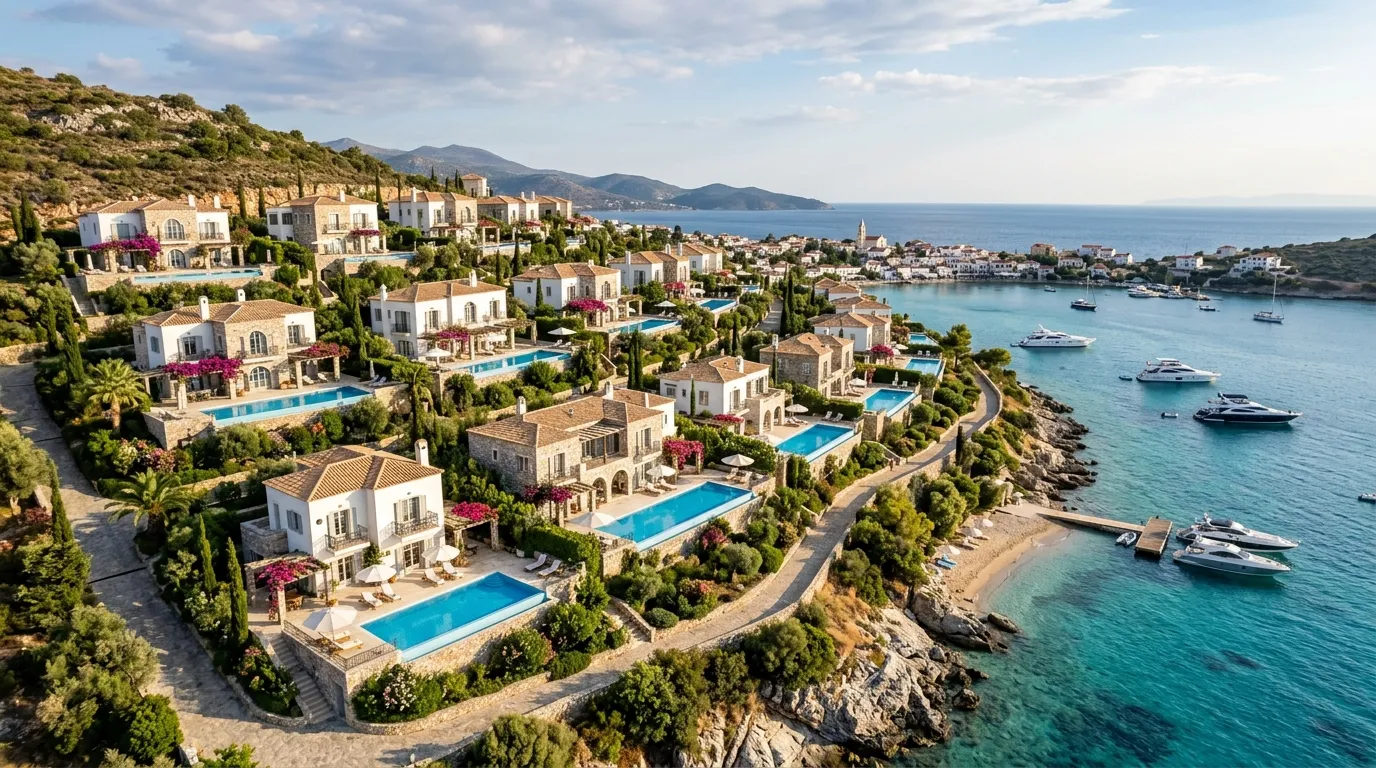
A Mediterranean luxury pool villa is a high-end residential or resort property defined by its seamless fusion of indoor living and outdoor water features, drawing from the coastal architecture of southern Europe — Spain, Greece, Italy, and the French Riviera. This guide delivers 26 specific ideas spanning color palettes, materials, lighting, furniture, layout, accessories, and small-space solutions for creating or styling a Mediterranean luxury pool villa aesthetic.
Imagine whitewashed stone warmed by afternoon sun, a cerulean pool reflecting the geometry of cypress trees, the weight of hand-forged iron against terracotta that has been underfoot for a century. A Mediterranean luxury pool villa doesn’t announce itself — it simply exists, unhurried and certain, at the intersection of ancient craft and effortless living. Here are 26 ideas worth saving — and stealing.
Why Mediterranean Luxury Pool Villa Design Works So Well
Mediterranean luxury pool villa design draws from one of the world’s oldest continuous architectural traditions — spanning Greek island vernacular, Italian Renaissance garden design, Moorish palace architecture, and French Provençal estate building. What unifies these regional expressions is a shared philosophy: that architecture should respond to climate, that indoor and outdoor living are a single continuous experience, and that beauty is achieved through material honesty rather than ornamentation. The style is distinguishable from generic “tropical resort” design by its specificity of material and its structural vocabulary — arches, pergolas, loggia, and colonnades are as essential as any furniture choice.
The material palette is ancient and precise. Limestone and travertine in their tumbled and honed forms, rough-plastered white stucco, unglazed terracotta tile, hand-forged wrought iron, reclaimed olive wood, and hand-thrown ceramic in cobalt, ivory, and ochre. Colors reference the landscape directly: Santorini blue-white, Provençal lavender-gray, Tuscan sienna and gold, Moorish cobalt and terracotta. These are not trend colors — they are pigments extracted from the Mediterranean geology itself, which is precisely why they never date.
The style is experiencing a renaissance driven by multiple cultural forces: the explosion of villa rental culture on platforms like Airbnb Luxe and Mr & Mrs Smith, the resurgence of interest in slow travel and destination living, and the broader design world’s pivot away from the cold neutrality of Scandinavian minimalism toward material warmth and historical rootedness. Architects and interior designers from Axel Vervoordt to Alberto Pinto have reintroduced Mediterranean principles to international audiences at the highest level of luxury.
In compact villa footprints — those under 2,000 square feet — the Mediterranean aesthetic is actually easier to achieve than in large, sprawling layouts, because the style depends on density of material quality rather than square footage. A 12-foot loggia with a stone-tile floor and hand-forged iron lanterns reads as luxurious at any scale. Prioritize one strong architectural element — an arched doorway, a tiled pool surround, a pergola — and build from there.
Style at a Glance
| Element | Core Trait 1 | Core Trait 2 |
| Philosophy | Indoor-outdoor continuum | Climate-responsive, material honesty |
| Materials | Limestone, travertine, terracotta | Wrought iron, olive wood, hand-thrown ceramic |
| Color palette | Cerulean blue, Santorini white | Tuscan sienna, cobalt, Provençal lavender-gray |
26 Mediterranean Luxury Pool Villa Ideas
1. Infinity Pool with Limestone Coping and Cerulean Water
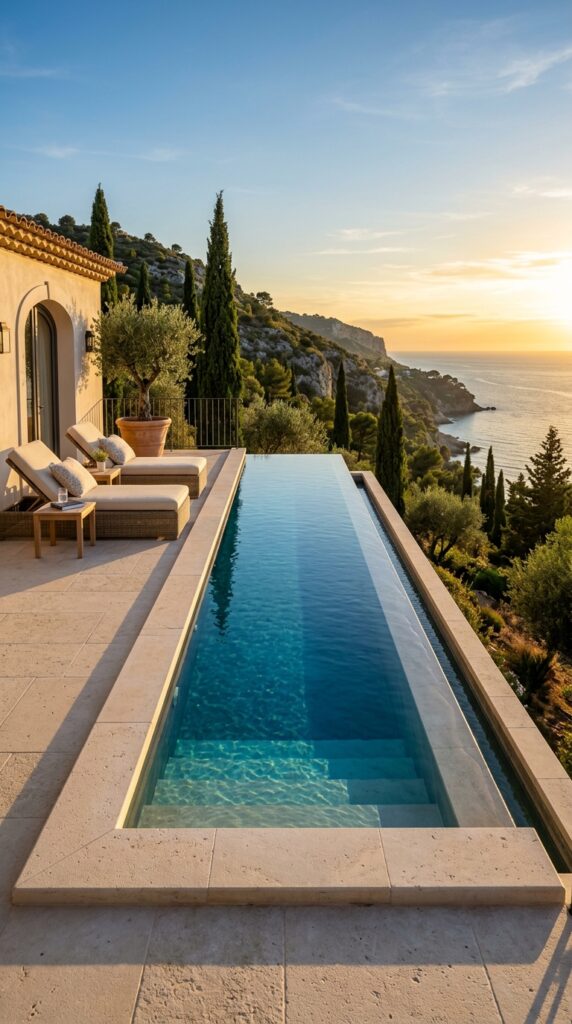
Vibe: Grand and serene — the feeling of standing at the edge of everything.
Why it works: An infinity pool’s vanishing edge eliminates the visual boundary between water and landscape, creating the illusion that the pool extends to the horizon — particularly powerful on hillside Mediterranean sites where the actual sea is visible beyond. Limestone coping is the correct surround material because its warm ivory tone is thermally comfortable barefoot (unlike dark stone, which absorbs heat), and its slight surface texture provides grip without the harshness of concrete. The cerulean pool finish references the exact blue of the Aegean and Ionian seas, anchoring the property visually in its regional identity.
How to get it: Specify a glass-mosaic cerulean pool finish (such as Bisazza’s “Piscina” line in shade “5038” or similar) rather than a painted plaster finish — glass mosaic maintains its color saturation indefinitely and reflects light with a luminosity that painted surfaces cannot replicate. Pair with honed (not polished) limestone coping to prevent glare and slipping on wet surfaces.
💡 Quick Win: Cerulean blue pool dye tablets (under $35) added to an existing light-colored plaster pool temporarily shift the water color toward the deep Mediterranean blue without resurfacing — ideal for photography or seasonal enhancement.
Shop The Look
| Product |
| Cerulean blue glass mosaic pool tile sheet |
| Honed limestone pool coping tile 12×24 |
| Infinity pool waterline tile cobalt blue |
| Pool mosaic tile grout unsanded ivory |
| Travertine pool deck tile tumbled 18×18 |
2. Whitewashed Stone Exterior with Bougainvillea Climbing the Facade
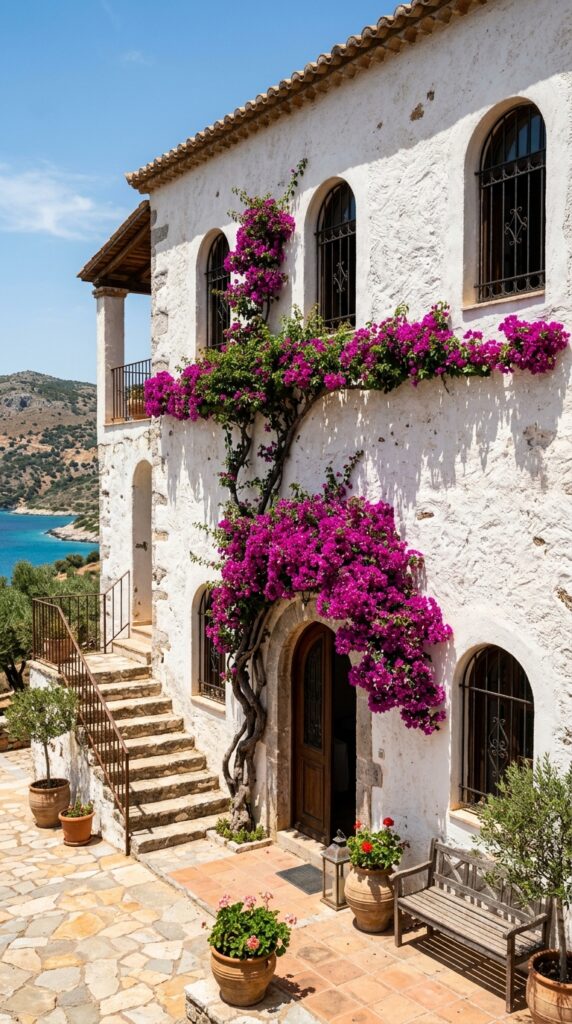
Vibe: Romantic and sun-baked — a facade that looks as though the bougainvillea chose it, not the other way around.
Why it works: Whitewashed stucco over rough stone is the defining exterior treatment of Mediterranean architecture because it serves a climate function first and an aesthetic function second: the bright white reflects solar radiation, keeping interior temperatures manageable in high-summer heat, while the rough aggregate texture provides surface for climbing plants to grip. Bougainvillea is botanically ideal for Mediterranean facades because its woody trunk and thorned stems self-anchor to rough stucco, and its magenta bracts provide a color counterpoint to white that no other climbing plant matches at the same scale.
How to get it: Apply a traditional lime-based exterior limewash (not latex paint) over rough stucco — lime wash allows the wall to breathe and develops a beautiful chalky, slightly translucent quality as it weathers that latex paint cannot replicate. Reapply every 5–7 years for maintenance rather than full repainting.
Shop The Look
| Product |
| Exterior lime wash paint bright white gallon |
| Bougainvillea plant magenta large 3-gallon |
| Wrought iron window grille decorative arch |
| Exterior rough texture stucco additive |
| Wall anchor vine training kit garden |
3. Terracotta Tile Pool Surround with Cobalt Blue Accents
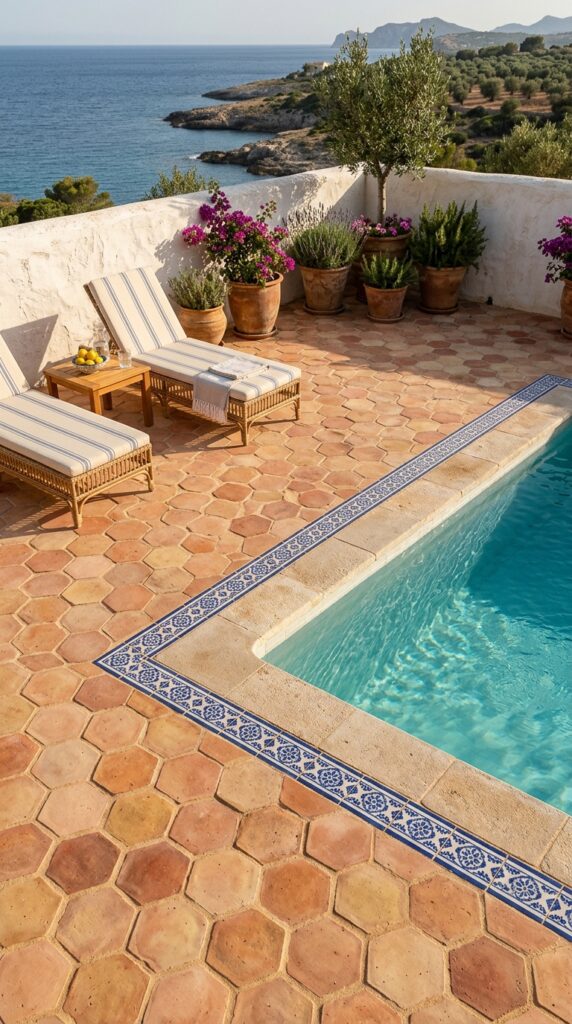
Vibe: Sun-warmed and richly colored — a pool deck that belongs to the land it sits on.
Why it works: Terracotta’s natural color variation — ranging from pale salmon to deep rust within a single installation — means no two sections of pool surround look identical, creating an organic warmth that manufactured tiles cannot replicate. The cobalt blue border band at the pool edge performs a design function beyond decoration: it creates a visual threshold between the dry terrace and the water, clearly delineating the transition and anchoring the pool’s edge architecturally. This is a technique borrowed directly from traditional Moroccan and Andalusian riad design.
How to get it: Seal unglazed terracotta with a penetrating silicone-based impregnator before and after grouting — terracotta is highly porous and will absorb pool chemicals, sunscreen, and food stains permanently if left unsealed. Use a wide joint (3/8 inch minimum) with a warm sand-toned unsanded grout to maintain the traditional appearance.
Shop The Look
| Product |
| Unglazed terracotta hexagonal floor tile |
| Hand-painted cobalt blue border decorative tile |
| Terracotta tile penetrating sealer exterior |
| Sand tone tile grout unsanded wide joint |
| Terracotta tile cleaning solution concentrate |
4. Outdoor Living Room Under a Pergola with Climbing Jasmine
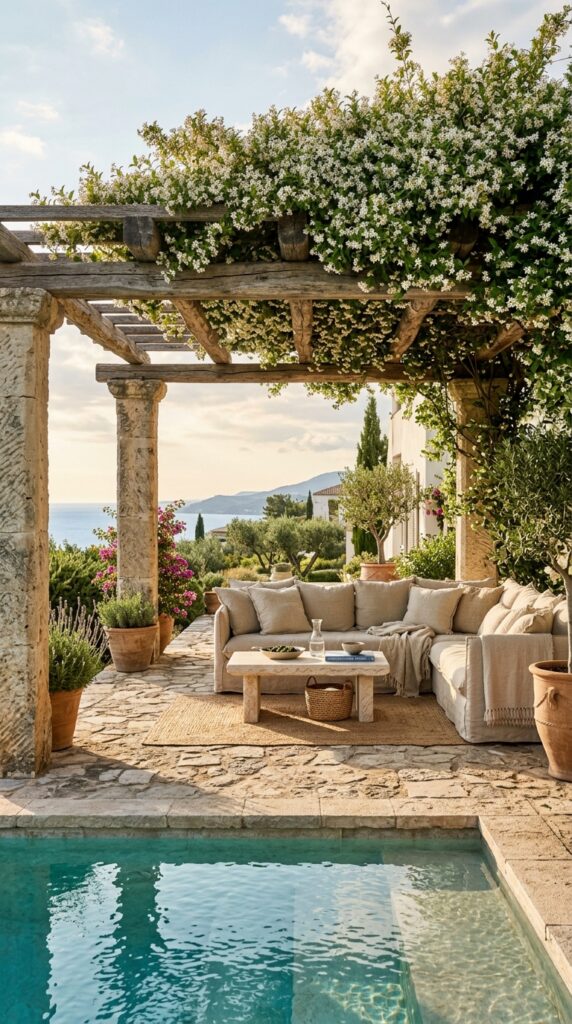
Vibe: Lush and serene — the most beautiful ceiling in the world.
Why it works: A pergola-covered outdoor living room is the architectural heart of Mediterranean villa design — it provides shade without enclosure, allowing the cross-breeze that makes outdoor living viable in summer heat while defining a spatial zone that reads as a room despite having no walls. Climbing jasmine is the ideal Mediterranean pergola plant: its white flowers bloom in summer (precisely when the shade is needed most), its fragrance defines the nighttime garden experience, and its density provides approximately 70% shade coverage when mature. Olive wood beams add tonal warmth impossible to replicate with pine or cedar.
How to get it: Train jasmine onto the pergola structure using horizontal wire guides spaced 12 inches apart — jasmine’s twining stems will self-attach within one growing season. Underplant the pergola columns with lavender for a layered fragrance experience that compounds with the jasmine overhead.
💡 Quick Win: A mature potted jasmine vine trained onto a portable trellis panel (available for $45–$75) can be positioned beside any pergola or shade structure to immediately introduce the fragrance and visual softness of a trained climbing plant while the permanent vine establishes.
Shop The Look
| Product |
| White jasmine climbing vine plant |
| Outdoor linen sofa deep seat sectional |
| Carved stone look coffee table outdoor |
| Pergola wire guide training kit horizontal |
| Outdoor linen throw pillow set ivory |
5. Moroccan Lantern Lighting Along the Pool Terrace
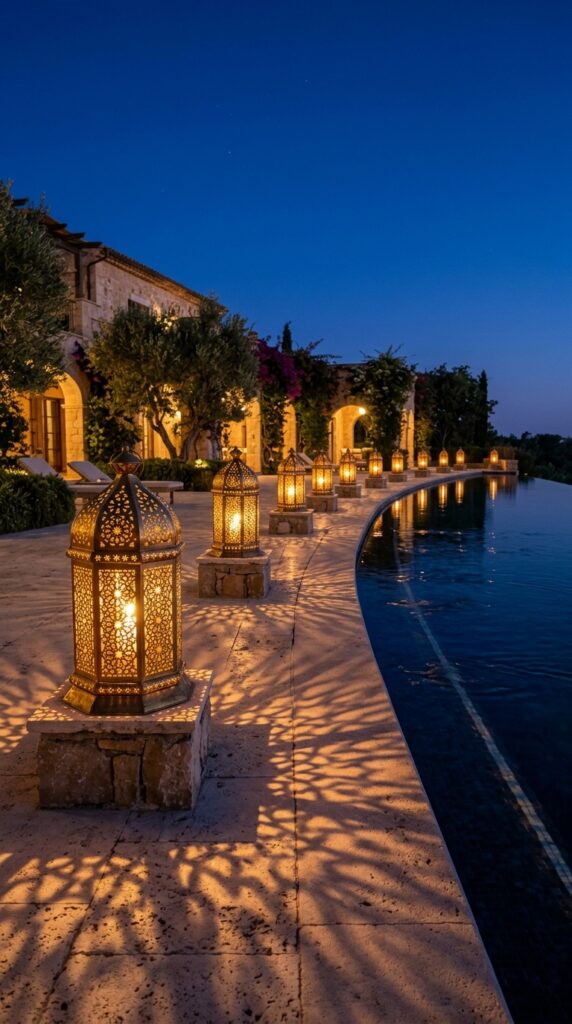
Vibe: Magical and warm — a terrace that becomes a different world after sunset.
Why it works: Moroccan lanterns at low height along a pool terrace introduce two design elements simultaneously: the geometric light patterns they cast onto the deck create a secondary layer of visual decoration that exists only at night, and their hammered brass surface catches and amplifies the warm candlelight, creating a soft radiance visible from across the pool. The positioning at terrace edge also provides wayfinding light that guides movement safely without the harshness of recessed deck lighting. This technique is borrowed directly from traditional riad and palace garden design in Marrakech and Fez.
How to get it: Use pillar candles in a diameter that fits snugly inside the lantern’s base (typically 3–4 inches) to prevent movement in the evening breeze. For a permanent installation, retrofit each lantern with a low-voltage LED flame-effect bulb on a timer — this eliminates wax management while preserving the visual quality of candlelight.
Shop The Look
| Product |
| Large hammered brass Moroccan lantern 24 inch |
| LED flame effect bulb E12 candelabra base |
| Stone pedestal lantern stand outdoor |
| Pillar candle set large ivory unscented |
| Low voltage outdoor timer plug-in |
6. Hand-Painted Tile Dining Table Under an Olive Tree
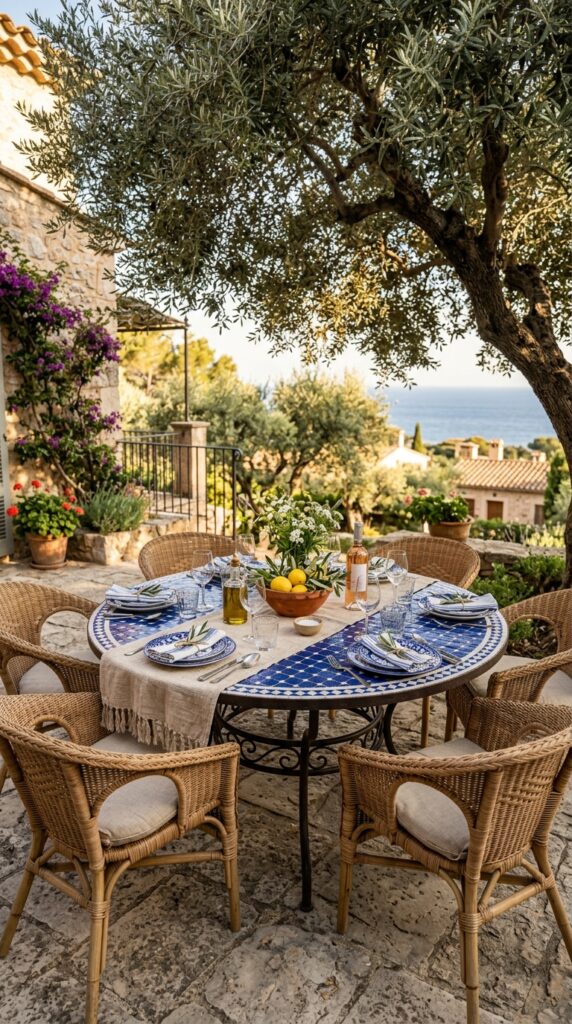
Vibe: Intimate and sun-dappled — a table where lunch turns into a three-hour conversation.
Why it works: A hand-painted ceramic tile tabletop is weatherproof, heat-resistant, and the most distinctively Mediterranean surface available for outdoor dining — the pattern tradition of Andalusian azulejos, Moroccan zellige, and Italian majolica all converge in the hand-painted cobalt-and-white motif. The olive tree as a dining canopy is irreplaceable: its silver-green leaves provide a dappled shade that shifts with the breeze, the gnarled trunk provides a visual anchor beside the table, and the tree’s deep cultural resonance in Mediterranean civilization gives the dining vignette a sense of rootedness no pergola can match.
How to get it: Custom tile tabletops can be commissioned from Moroccan or Spanish tile makers for $400–$1,200 depending on size and complexity, or assembled from hand-painted tile inserts set into a wrought iron frame. Seal the grout joints with an epoxy grout to prevent staining from olive oil and red wine.
Shop The Look
| Product |
| Hand-painted cobalt blue ceramic tile set Moroccan |
| Wrought iron outdoor round dining table base |
| Woven rattan outdoor dining chair set of 4 |
| Linen table runner fringe edge natural |
| Epoxy tile grout white food-safe outdoor |
7. Arched Doorways and Loggia for Indoor-Outdoor Flow
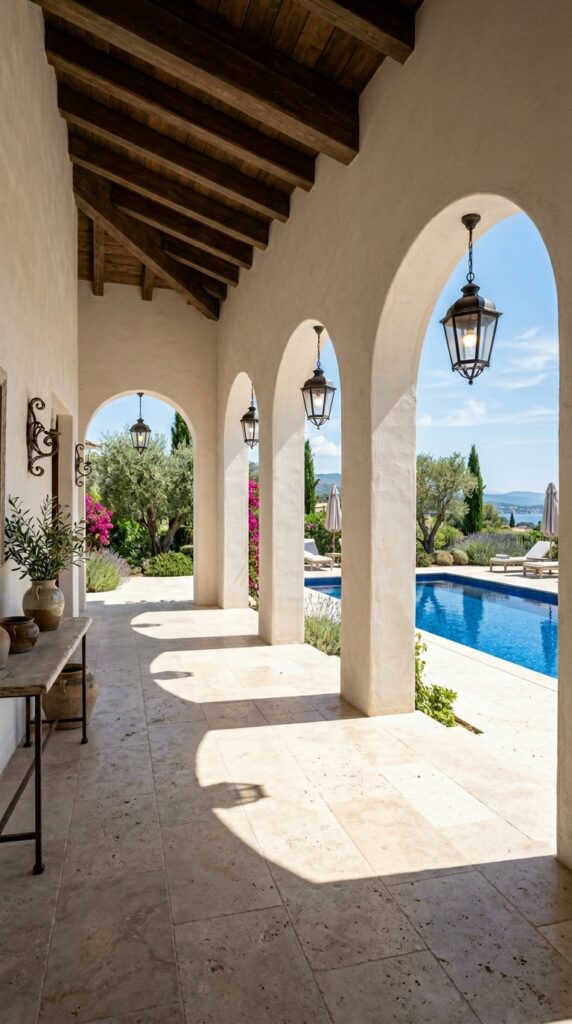
Vibe: Grand and luminous — architecture that frames the landscape like a series of paintings.
Why it works: The loggia — a covered exterior gallery open on one side — is the single most important architectural element in Mediterranean villa design because it solves the climate challenge elegantly: it provides full shade while remaining completely open to cross-ventilation and view. A series of arched openings in a loggia creates a rhythmic colonnade that frames the pool and landscape beyond as a sequence of framed views, turning every moment of transit through the space into an aesthetic experience. Continuous travertine flooring from interior to exterior eliminates the visual threshold between inside and outside, making the living space feel larger.
How to get it: In renovation contexts, arched openings can be introduced into existing square doorways using a steel arched frame and plaster skim — a process that takes 2–3 days per arch and dramatically transforms the architectural character of a space. Use a semicircular arch (the Roman arch) rather than a pointed arch for Mediterranean authenticity; pointed arches read as Gothic or Moorish only.
Shop The Look
| Product |
| Honed travertine floor tile 18×18 indoor outdoor |
| Arched door frame kit plaster ready |
| Wrought iron lantern pendant arch mount |
| Travertine tile sealer penetrating stone |
| Indoor outdoor threshold transition strip stone |
8. Cerulean Blue and Ivory Color Palette Throughout Interiors
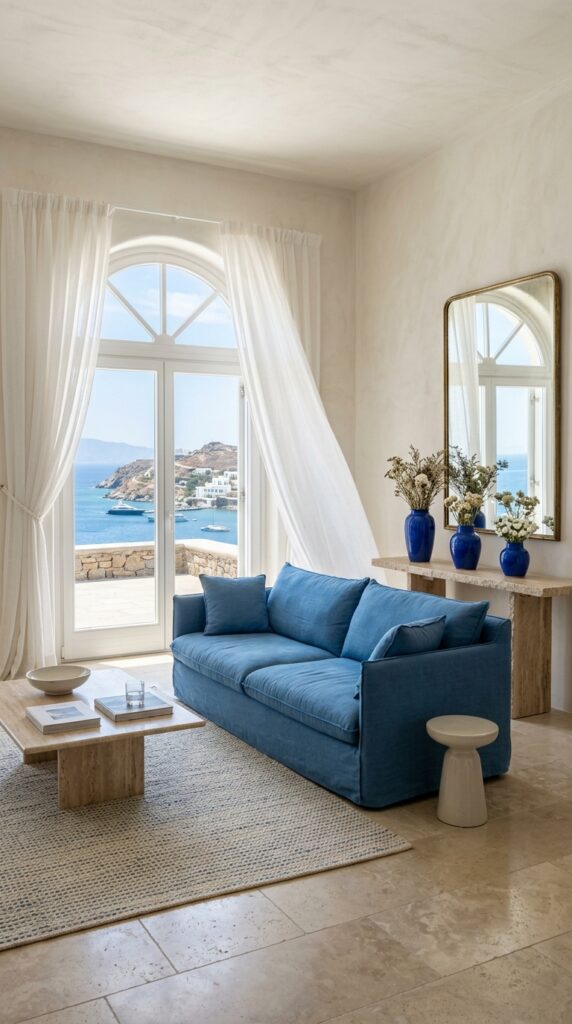
Vibe: Luminous and airy — rooms that feel like they were designed by the sea itself.
Why it works: The cerulean-and-ivory palette is the most architecturally faithful expression of Greek island villa design — specifically the Cycladic aesthetic of Santorini and Mykonos, where the blue-and-white chromatic rule is architectural ordinance, not merely design preference. Cerulean linen upholstery references the Aegean without the formality of navy or the coldness of royal blue; its warmth is maintained by the soft, naturally variable surface of linen. The ivory plaster wall provides a warm (never stark white) backdrop that absorbs the warm tones of Mediterranean sunlight rather than reflecting them as glare.
How to get it: For the ivory wall tone, use a limewash or mineral paint with a slight warm yellow undertone rather than a pure bright white — Portola Paints “Roman Plaster” in “Ivory Coast” or similar delivers the correct warm limewash depth. Introduce cerulean through one dominant upholstery piece (sofa or daybed) and repeat in ceramics only — not in curtains, which should remain ivory to maintain the light quality.
💡 Quick Win: A pair of hand-thrown cobalt blue ceramic vases in varying heights (available from Mediterranean import shops for $30–$65 each) placed on a travertine or stone console immediately anchors a neutral room in the Mediterranean palette without any upholstery or paint changes.
Shop The Look
| Product |
| Cerulean blue linen throw pillow covers set |
| Hand-thrown cobalt blue ceramic vase tall |
| Ivory limewash paint warm white interior |
| Cobalt blue ceramic decorative bowl large |
| White linen curtain panel sheer 96 inch |
9. Stone Outdoor Shower with a Carved Niche and Rain Head
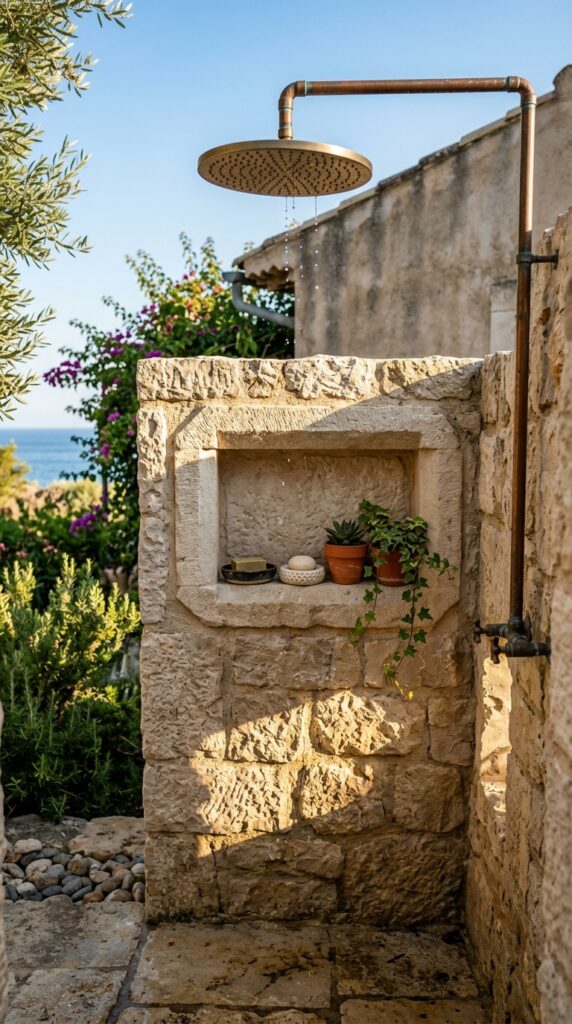
Vibe: Raw and spa-like — a shower that makes the act of rinsing off feel ceremonial.
Why it works: A stone outdoor shower enclosure is one of the most powerful architectural gestures in a Mediterranean villa because it transforms a purely functional necessity into a design moment. Rough-cut limestone is the correct material because its texture creates tactile contrast with the water and the bronze hardware, and its natural color variation — from pale cream to warm gray — references the quarried stone of Greek and Italian building traditions. A carved niche within the stone wall introduces the same logic as a traditional hammam: beauty and function integrated into the structure itself, never added afterward.
How to get it: Source rough-cut limestone blocks from a stone supplier in 4–6-inch thicknesses and dry-stack or mortar them with a wide joint to create the irregular coursing that reads as traditional Mediterranean masonry. Use a brushed bronze (not polished) rain head — the patina of brushed bronze complements rough stone precisely as polished chrome does not.
Shop The Look
| Product |
| Brushed bronze rain shower head 12 inch round |
| Rough limestone block wall cladding panel |
| Recessed niche insert shower waterproof |
| Terracotta mini planter pot set shower |
| Copper pipe fitting exposed shower arm |
10. Low-Slung Outdoor Daybed with Canopy Drapery
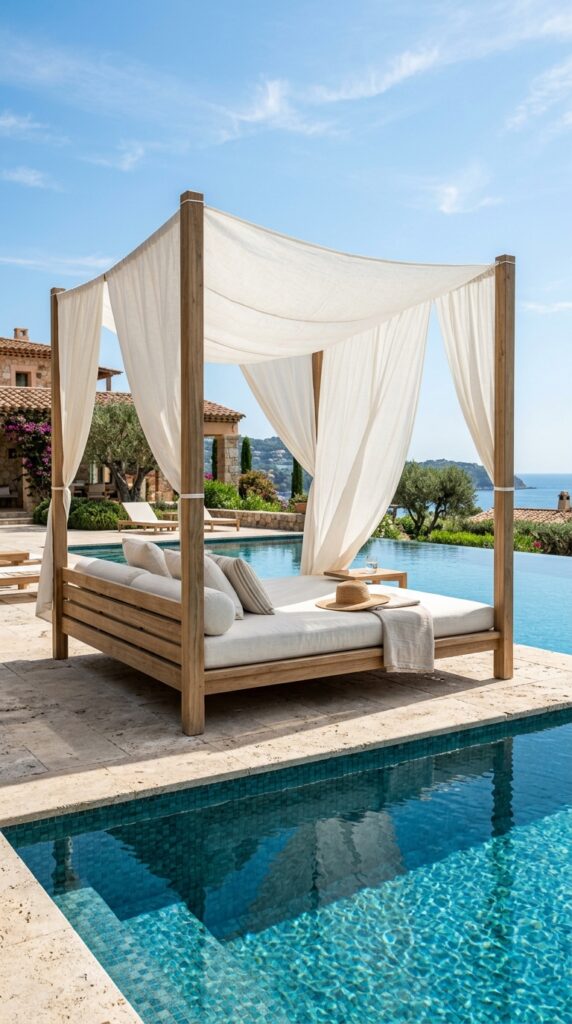
Vibe: Resort-like and serene — a daybed that makes the concept of urgency irrelevant.
Why it works: A canopied daybed at the pool’s edge is the signature furniture statement of Mediterranean luxury villa design — it combines the most desirable elements of the outdoor experience (pool proximity, horizontal rest, natural breeze) while providing filtered shade that makes extended poolside staying genuinely comfortable in high summer. The linen canopy’s translucency is critical: it filters direct sunlight to a soft, diffused glow while remaining visually light and airy, unlike solid umbrellas or fixed pergolas that block both sun and view. Heavyweight linen (minimum 280 GSM) is required to move beautifully in light breezes without bunching.
How to get it: Mount the canopy posts in weighted base sleeves rather than permanent footings — this allows repositioning as the sun moves throughout the day and enables seasonal removal without leaving post holes in the terrace. Use stainless steel cable tensioners at each corner to maintain consistent drape tension.
Shop The Look
| Product |
| Teak outdoor daybed oversized with cushion |
| Heavyweight linen canopy panel ivory outdoor |
| Outdoor canopy post set 4 piece with base |
| Cylindrical bolster pillow outdoor fabric |
| Stainless cable tensioner set canopy |
11. Reclaimed Olive Wood Dining Table for Indoor-Outdoor Dining
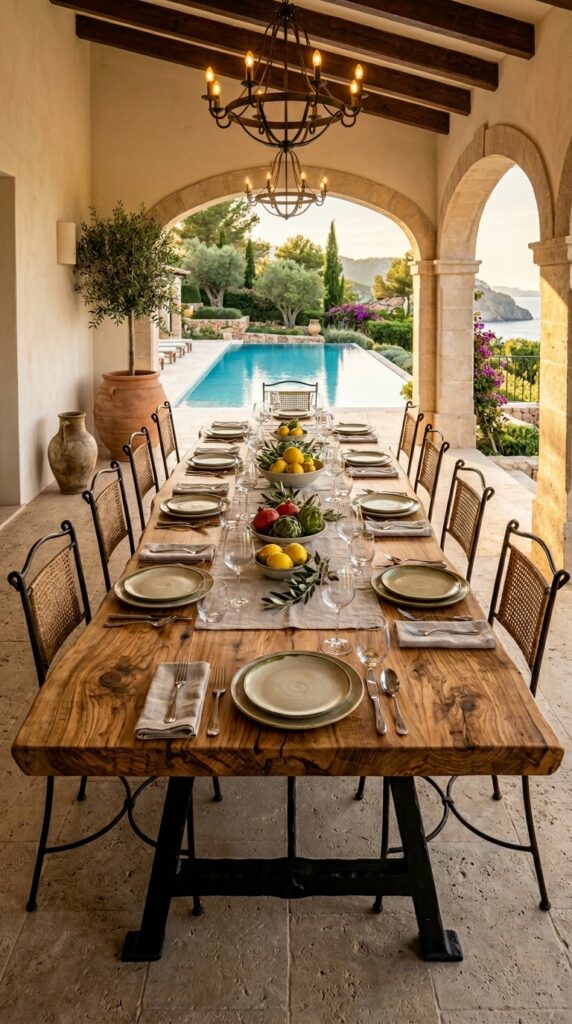
Vibe: Warm and grand — a table that makes every meal feel like an occasion.
Why it works: Reclaimed olive wood is the most culturally specific material choice available for Mediterranean dining furniture: the olive tree has been central to the economy, cuisine, and mythology of Mediterranean civilization for 8,000 years, and its wood’s distinctive swirling gray-brown grain carries that history in its surface. The live edge preserves the tree’s natural profile, making each table a unique object rather than a manufactured product. The material’s density and weight also provide the acoustic gravitas of a serious dining surface — the sound of tableware on olive wood is fundamentally different from glass or lacquered timber.
How to get it: Source reclaimed or salvaged olive wood from Italian or Spanish furniture makers — fresh olive wood from agricultural pruning is available, but requires 3–5 years of drying before it can be used for furniture without cracking. Finish with a penetrating oil (Danish oil or Rubio Monocoat) rather than a film finish, which would mask the natural surface texture.
Shop The Look
| Product |
| Live edge olive wood dining table large |
| Wrought iron trestle table base dining |
| Rubio Monocoat oil finish wood natural |
| Woven leather dining chair set of 6 |
| Linen tablecloth long dining natural fringe |
12. Mosaic-Tiled Pool Interior with Geometric Zellige Pattern
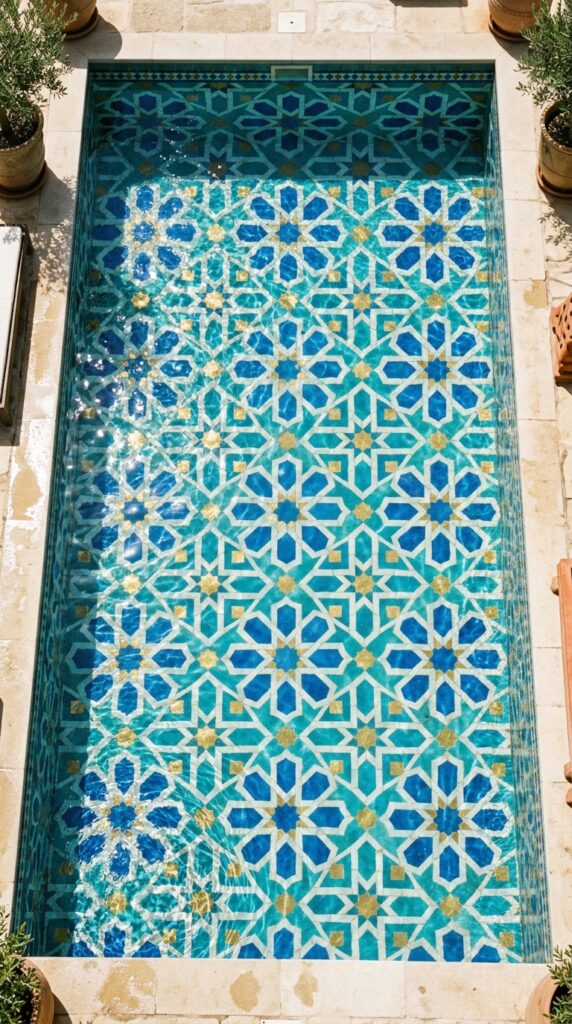
Vibe: Jewel-like and luminous — a pool you swim inside a piece of art.
Why it works: Zellige mosaic on a pool interior is the highest expression of the Moroccan-Mediterranean luxury aesthetic because it transforms the pool from a utilitarian water feature into a visual centerpiece visible from every point on the terrace. The slight natural irregularities of hand-cut zellige tiles — no two pieces are precisely the same thickness or dimension — create a surface that refracts light differently across the pool floor throughout the day, producing a living, shifting visual effect that machine-cut tiles simply cannot replicate. The geometric star-and-cross pattern (the Moorish eight-pointed star) is one of the oldest continuous design motifs in Mediterranean history.
How to get it: Commission zellige pool tiles from a Moroccan manufacturer in Fez — the primary production center for authentic hand-cut zellige. Specify pool-grade zellige with a vitrified clay body (not standard earthenware) rated for continuous water immersion. Install with a white epoxy grout to keep the joints tight and chemical-resistant.
💡 Quick Win: Zellige-look porcelain mosaic tile sheets (available from Spanish and Italian tile distributors for $12–$25 per square foot) replicate the surface variation and pattern of authentic zellige at a fraction of the cost and with superior moisture resistance for pool applications.
Shop The Look
| Product |
| Moroccan zellige mosaic pool tile cobalt blue |
| Hand-cut star pattern mosaic tile sheet |
| Epoxy grout white pool rated |
| Turquoise glass mosaic pool waterline tile |
| Pool tile adhesive white flex bond |
13. Provençal Lavender Planted in Terracotta Urns Along the Terrace
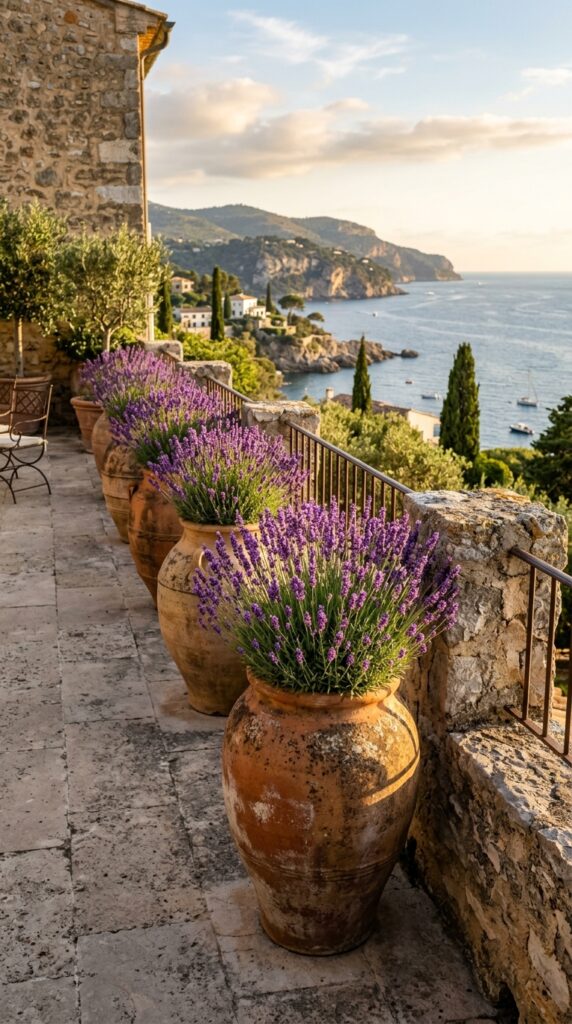
Vibe: Fragrant and warm — a terrace edge that engages all five senses.
Why it works: Provençal lavender in aged terracotta urns is one of the most emotionally powerful landscape gestures in Mediterranean villa design because it introduces fragrance as an architectural element — the scent of lavender in evening warmth is as defining as any visual detail. The aged terracotta’s salt efflorescence and weather patina signals permanence and rootedness, suggesting the urns have occupied their positions for decades rather than seasons. Varying the urn heights creates a silhouette rhythm along the terrace perimeter that reads as a living colonnade from a distance.
How to get it: Use Lavandula angustifolia ‘Hidcote’ or ‘Vera’ varieties specifically — these are the true Provençal cultivars with the deepest purple flower spikes and the most intense fragrance, as opposed to hybrid lavandin varieties, which are taller but less fragrant. Plant in a gritty, free-draining mix (50% standard potting soil, 50% horticultural grit) to replicate the limestone-based soil of southern France.
Shop The Look
| Product |
| Large aged terracotta urn planter 24 inch |
| Provençal lavender plant set of 3 |
| Horticultural grit drainage mix bag |
| Terracotta saucer large 18 inch |
| Lavender essential oil diffuser outdoor |
14. Hand-Forged Wrought Iron Furniture for the Terrace
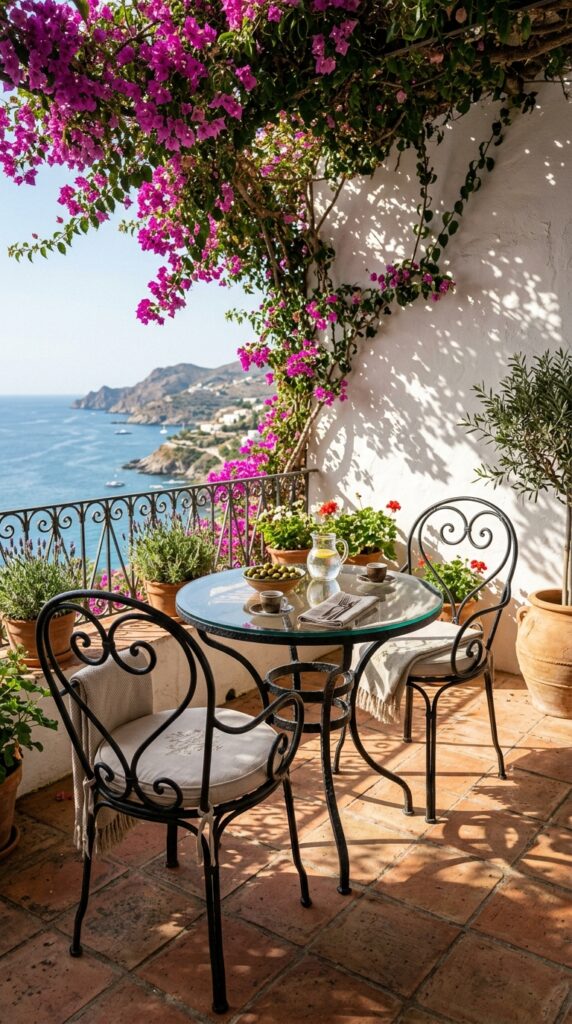
Vibe: Timeless and warm — furniture that looks as though it has always been there.
Why it works: Hand-forged wrought iron is the only outdoor furniture material that improves aesthetically as it weathers: the visible hammer texture on each piece deepens as a surface patina develops, and any rust that forms adds warmth rather than degrading the appearance. The scrolled back detail on traditional Mediterranean iron chairs references the ironwork traditions of Granada, Seville, and Marseille — a cultural specificity that mass-produced aluminum furniture cannot reference at any price. Iron also has the correct visual weight for Mediterranean architecture: its density balances stone walls and terracotta floors in a way that lightweight materials never do.
How to get it: Apply a furniture wax or clear lacquer specifically formulated for outdoor iron annually to slow the development of orange rust — if you prefer the aged iron look, apply a single coat of dark paste wax (Briwax “Dark Brown”) to redirect the oxidation toward a warm brown patina rather than orange.
Shop The Look
| Product |
| Hand-forged wrought iron bistro table outdoor |
| Wrought iron scrolled back bistro chair pair |
| Outdoor iron furniture wax protective |
| Glass tabletop round replacement cut |
| Wrought iron candle holder wall sconce outdoor |
15. Barrel-Vaulted Ceiling in the Master Bedroom
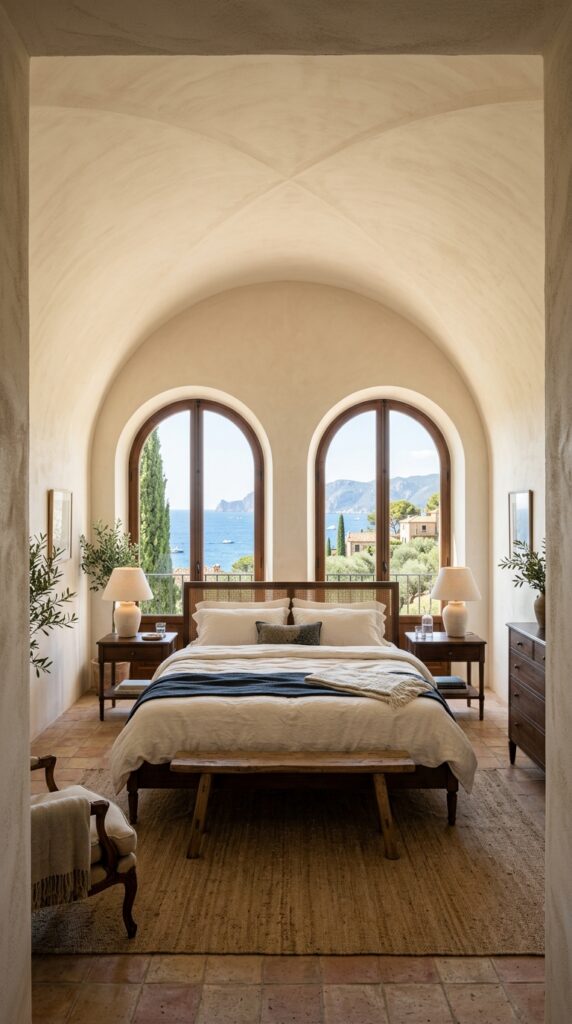
Vibe: Grand and serene — a ceiling that makes the act of waking up feel significant.
Why it works: The barrel vault is the most intimate of the grand architectural gestures: unlike a flat ceiling, which creates a uniform plane above the sleeper, a vault creates a curved canopy that wraps the space, producing a psychological enveloping quality similar to being inside a large shell. The limewash plaster surface catches the light that enters through arched windows and distributes it in a gradual gradient from the brightest point (the vault’s face closest to the window) to the deepest (the far end), creating a natural dawn light effect that has been used in Mediterranean religious and residential architecture for 2,000 years.
How to get it: In new construction, a barrel vault is formed using steel rebar shaped to the desired radius and poured or sprayed with lightweight concrete — a structural engineer must be consulted for span calculations. In renovation, a faux barrel vault can be created using curved MDF formwork and a thick plaster skim, achievable in rooms up to 14 feet wide without structural modification.
Shop The Look
| Product |
| Ivory limewash plaster interior barrel vault |
| White linen king bedding set luxury |
| Arched window grille decorative iron |
| Mediterranean blue ceramic table lamp pair |
| Barrel vault plaster mix smooth finish |
16. Cobalt Blue Shutters Against White Stucco Walls
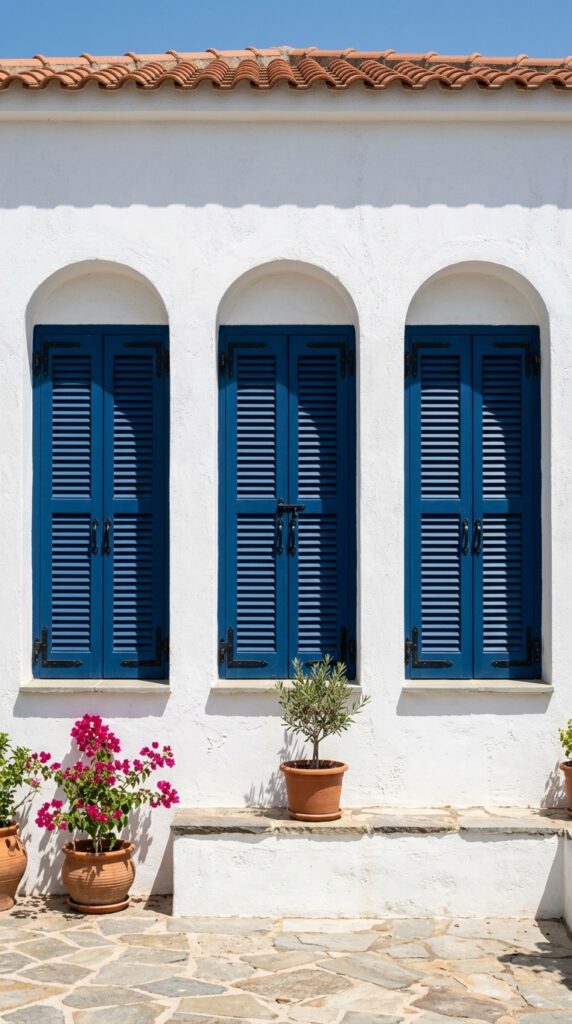
Vibe: Crisp and vivid — a facade that photographs from across a hillside.
Why it works: Cobalt blue shutters against white stucco walls is the most recognizable chromatic signature of Greek island architecture — specifically the Cycladic villages of Mykonos, Paros, and Santorini — and carries the strongest regional identity of any single exterior detail available. The louvered design performs a critical climate function: the angled blades direct airflow into the interior while blocking direct solar radiation, reducing interior temperatures by as much as 8°C on a south-facing elevation. The louvered shadow pattern also introduces visual texture to the facade at close range, preventing the blue-and-white palette from reading as flat.
How to get it: Paint existing timber shutters with a high-build exterior enamel in a custom-mixed cobalt blue — Benjamin Moore’s “Brilliant Blue” (2065-20) mixed at 120% strength delivers the correct deep Aegean cobalt without reading as electric or bright. Apply two coats of exterior enamel for UV resistance and use stainless steel hardware to prevent rust streaking on the white wall.
Shop The Look
| Product |
| Timber louvered exterior shutters pair |
| Cobalt blue exterior enamel paint gallon |
| Stainless steel shutter hinge set |
| Exterior shutter bar and holdback iron |
| White limewash exterior paint stucco finish |
17. Sunken Seating Area Beside the Pool in Limestone
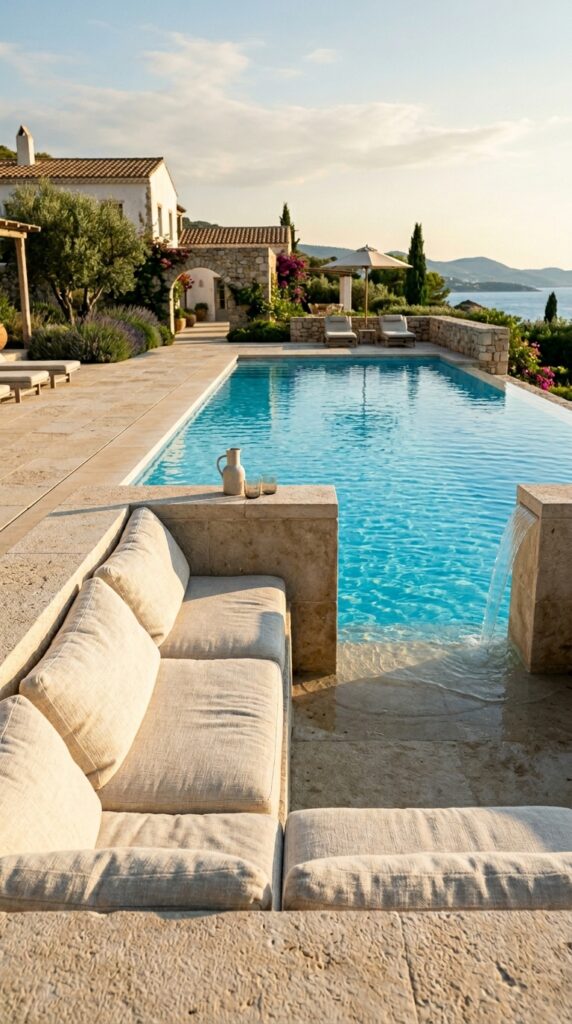
Vibe: Grounded and intimate — a seating area that makes the pool feel like a lake you belong beside.
Why it works: A sunken seating area beside a pool positions guests at water level, creating an immersive visual relationship between the seating zone and the pool that above-grade furniture cannot replicate. When seated in a sunken pit at the correct depth (approximately 18 inches below terrace grade), the pool water surface appears at eye level — the same perspective that makes sitting in a natural body of water feel so psychologically grounding. Building the pit from the same limestone as the pool surround creates a monolithic material continuity that reads as architecturally integrated rather than accessorized.
How to get it: A sunken seating area can be created in an existing terrace by excavating 18–24 inches in a defined zone and lining the walls and floor with the same material as the surrounding terrace — the key is matching the stone dimensions and grout joint width exactly, so the pit reads as a continuation of the terrace rather than an insertion into it.
💡 Quick Win: Deep-seat outdoor cushions in natural linen (6-inch thickness, 72 inches long) placed on a standard low garden wall can approximate the sunken seating aesthetic — position the wall so seated eye level aligns with pool water surface for the same visual relationship.
Shop The Look
| Product |
| Deep seat outdoor cushion natural linen 6 inch |
| Honed limestone wall cladding tile |
| Outdoor fabric waterproof natural linen |
| Low profile outdoor furniture base platform |
| Stone masonry adhesive exterior grade |
18. Wisteria-Covered Pergola Over the Dining Terrace
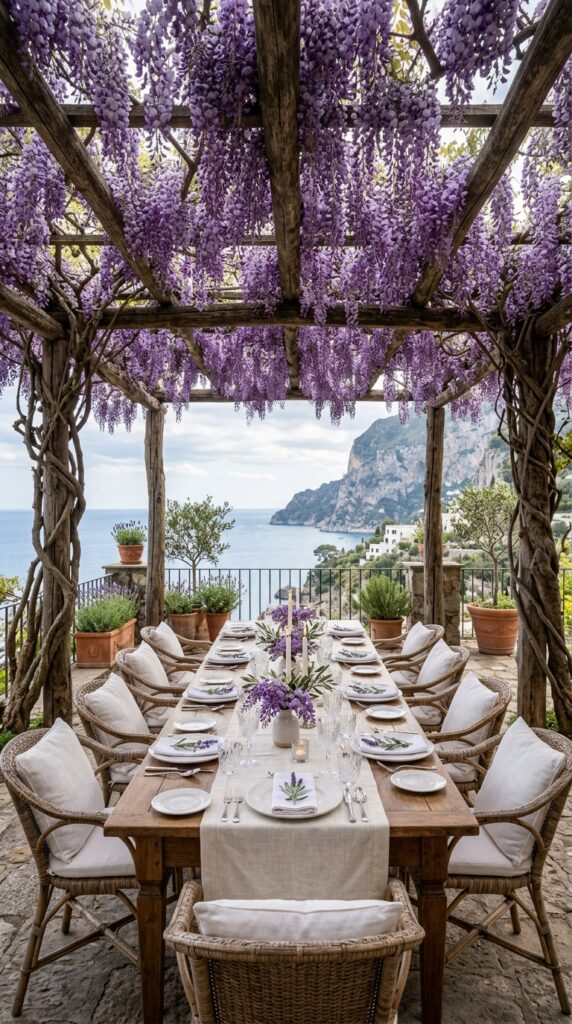
Vibe: Romantic and lush — a dining room that exists only in the most beautiful weeks of the year.
Why it works: A mature wisteria in full bloom is the single most dramatic seasonal transformation available in Mediterranean garden design — when the cascade of violet flower racemes reaches maximum density, the pergola beneath becomes a jewel-box enclosure of filtered violet light and intoxicating fragrance that no manufactured canopy can approximate. Wisteria sinensis (Chinese wisteria) blooms before leafing out, meaning the flower display occurs in maximum light rather than filtered through foliage — the visual impact is entirely unobstructed. The gnarled woody trunk that develops on each post over years of growth becomes a sculptural element in its own right.
How to get it: Wisteria requires a minimum of 3–5 years from planting to reach pergola-covering density — purchase the largest available specimen (a 15-gallon pot with an established trunk) to accelerate establishment. Train the primary leaders horizontally along the pergola beams with soft ties, never wire, to prevent girdling as the stems thicken.
Shop The Look
| Product |
| Wisteria sinensis climbing plant 3-gallon |
| Soft plant training ties garden pack |
| Pergola beam mounting bracket heavy duty |
| White ceramic dinner plate set outdoor |
| Ivory linen tablecloth long 120 inch |
19. Compact Pool with Built-In Sun Shelf and Plunge Zone
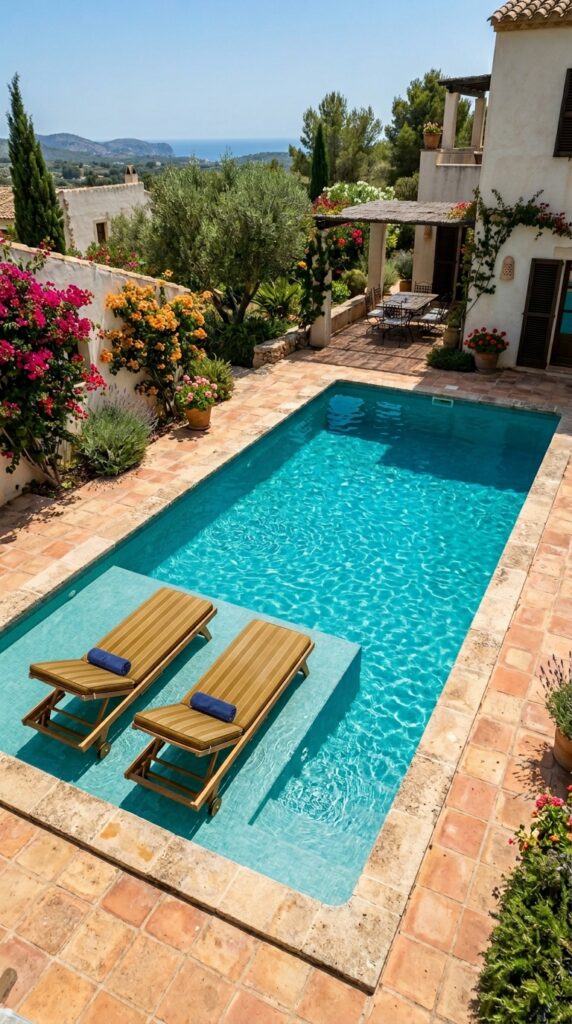
Vibe: Sun-warmed and resort-like — a small pool that punches well above its size.
Why it works: A sun shelf — also called a tanning ledge or Baja shelf — transforms a compact pool from a swimming-only feature into a multi-function aquatic zone that accommodates both immersion and water lounging simultaneously. In small villas with pools under 400 square feet of water surface, the sun shelf can occupy up to 30% of the total pool area without compromising the plunge experience because guests typically use one zone or the other, not both simultaneously. Teak submerged lounge chairs are the correct furniture choice: the wood’s natural oil resistance makes it the only timber that can be permanently submerged without swelling or delaminating.
How to get it: Specify the sun shelf at exactly 18 inches of water depth — shallower (under 12 inches) makes reclining chairs look perched rather than immersed; deeper (over 22 inches) reduces the solar-heating effect that makes sun shelves pleasant for extended use. Use a lighter pool finish on the sun shelf zone to visually differentiate it from the deeper plunge section.
Shop The Look
| Product |
| Teak submerged pool lounge chair sun shelf |
| Sun shelf pool umbrella anchor sleeve |
| Aqua blue pool mosaic tile sun shelf |
| Pool depth marker tile set |
| Travertine pool coping sun shelf edge |
20. Hand-Thrown Ceramic Tableware for Al Fresco Dining
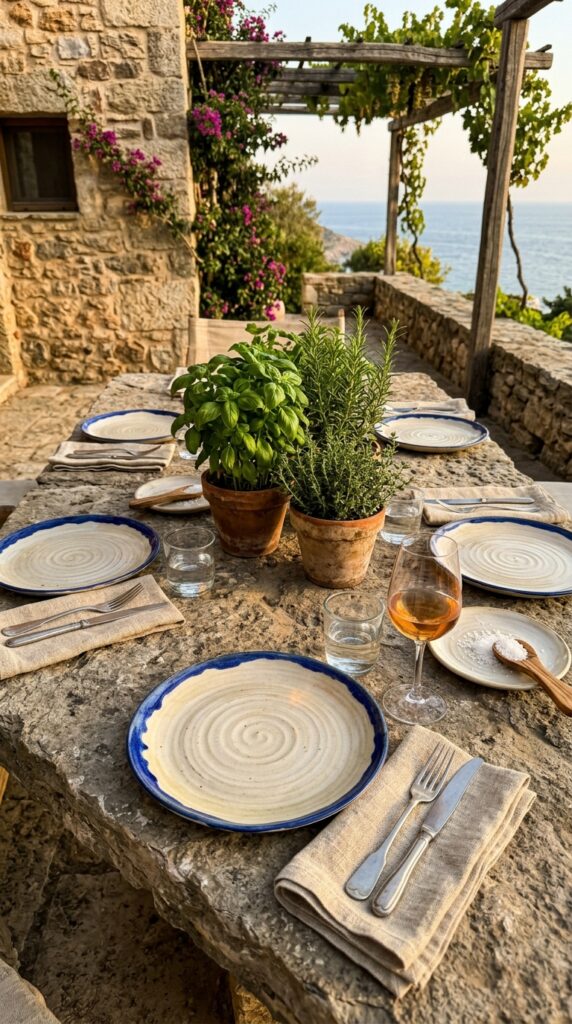
Vibe: Artisanal and warm — a table setting that makes the meal a ceremony.
Why it works: Hand-thrown ceramics introduce a human dimension to outdoor dining that machine-made tableware cannot approximate — the slight irregularities in rim height, the variation in glaze pooling, and the visible throwing marks on the interior surface are evidence of the maker’s hand that adds warmth and authenticity. Cobalt blue rim detailing on an ivory body is the direct expression of traditional Mediterranean majolica and Portuguese azulejo color relationships, connecting the table to the architectural palette of the villa simultaneously. Small terracotta herb pots as a centerpiece replace cut flowers with living plants, which are more appropriate to the informal grandeur of al fresco Mediterranean dining.
How to get it: Portuguese, Italian, and Spanish ceramic suppliers maintain the oldest continuous production traditions for hand-thrown Mediterranean tableware — look for pieces marked “fatto a mano” (Italian) or “hecho a mano” (Spanish) to confirm hand production. Linen napkins in unbleached natural fiber rather than white reinforces the earthen palette of the hand-thrown pieces.
Shop The Look
| Product |
| Hand-thrown ceramic dinner plate set cobalt |
| Handmade ceramic mug set Mediterranean blue |
| Unbleached natural linen napkin set of 6 |
| Small terracotta herb pot set of 3 |
| Hand-thrown ceramic serving bowl large |
21. Curved White Stucco Walls with Integrated Bench Seating
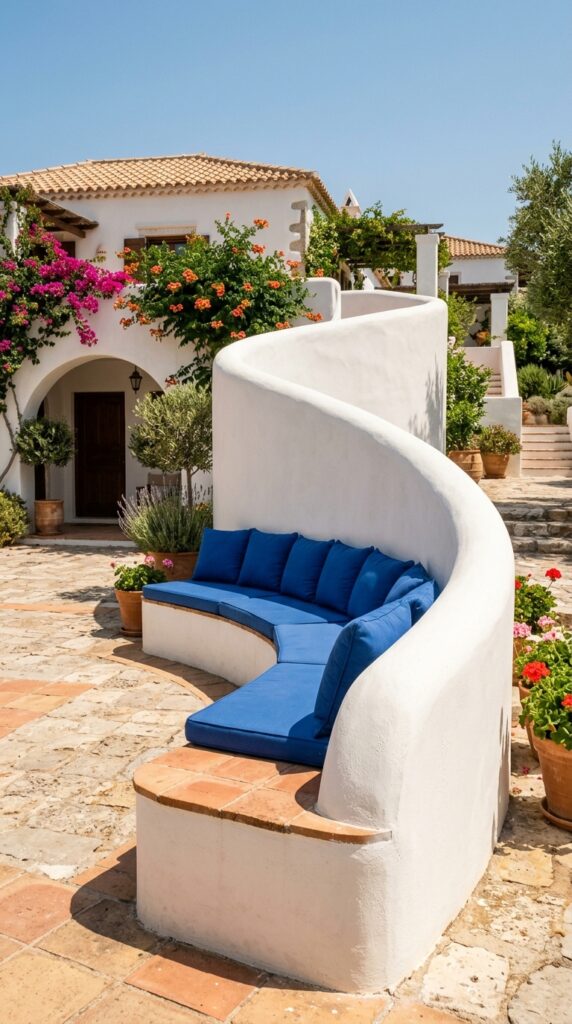
Vibe: Serene and architectural — a wall that becomes furniture.
Why it works: Curved stucco walls with integrated bench seating are a direct borrowing from Cycladic Greek island architecture, where the same lime plaster that builds the wall forms the bench, the seat, the step, and the planting box — everything emerging from a single continuous material in organic, curved forms that resist the right-angle rigidity of conventional construction. This monolithic quality is what gives Greek island villages their distinctive sculptural appearance, and it is achievable in villa design through the same technique: a steel rebar armature covered in a render base coat and finished with a smooth lime plaster. The cobalt cushions fulfill both the chromatic and comfort requirements.
How to get it: Built-in stucco bench seating should be formed at 18 inches high by 20 inches deep — the standard ergonomic seat dimensions. Use a hydraulic lime plaster rather than gypsum for exterior bench applications, as hydraulic lime is inherently water-resistant and does not require additional sealing.
Shop The Look
| Product |
| Hydraulic lime plaster exterior grade |
| Cobalt blue outdoor bench cushion 20 inch deep |
| Smooth finish plaster trowel set |
| White exterior stucco paint lime based |
| Outdoor cushion foam insert waterproof |
22. Cypress Tree Avenue Leading to the Villa Entrance
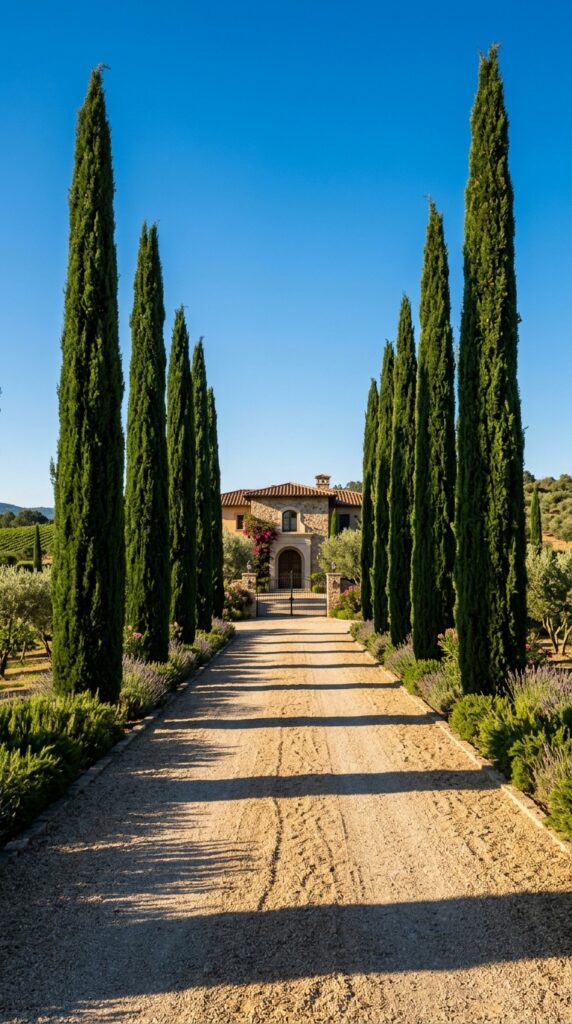
Vibe: Grand and formal — an entrance that tells you exactly where you are before you arrive.
Why it works: Italian cypress (Cupressus sempervirens ‘Stricta’) is the defining vertical element of Mediterranean landscape design — its columnar form, deep bottle-green color, and association with Tuscan hillside estates gives any approach road an immediate sense of arrival and architectural intent. A formal avenue of paired cypresses creates a green colonnade that mirrors the stone colonnade of a loggia in plant form, reinforcing the villa’s design language through landscape rather than architecture. The cypresses also function as windbreaks for the terrace beyond, reducing the impact of the prevailing sea winds that can make open Mediterranean terraces uncomfortable.
How to get it: Plant Italian cypress at 8–10-foot centers for a formal avenue effect — closer spacing creates a dense hedge rather than individual trees. Specify 10-gallon specimens at a minimum of 8 feet in height for immediate visual impact; smaller specimens are less expensive but take 3–5 seasons to read as a proper avenue.
Shop The Look
| Product |
| Italian cypress tree Cupressus sempervirens |
| Limestone gravel pathway decorative 40 lb bag |
| Tree stake and tie kit planting set |
| Drip irrigation kit tree line |
| Cypress fertilizer slow release granular |
23. Blue-and-White Tiled Fountain as a Terrace Focal Point
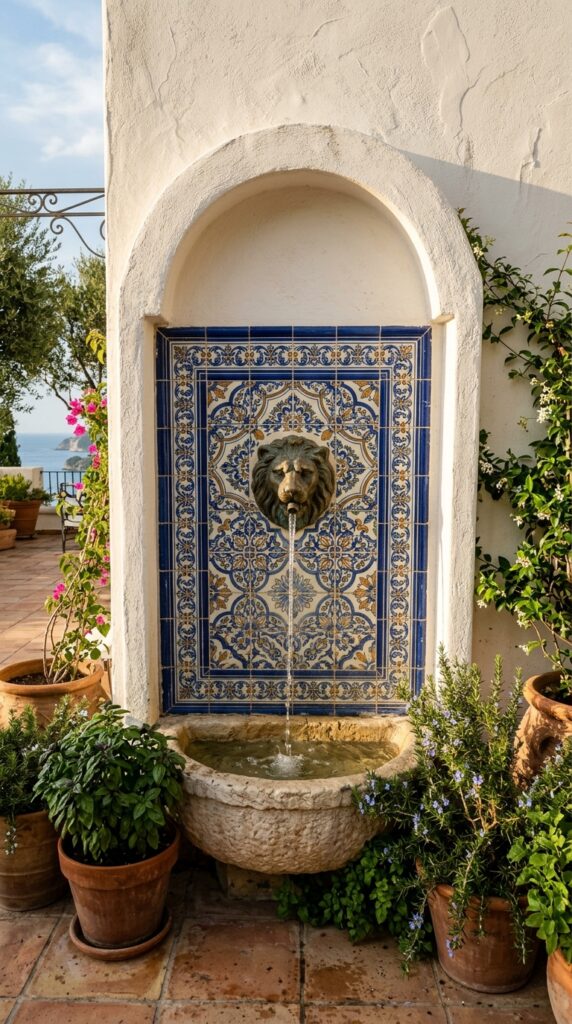
Vibe: Serene and cooling — the sound of water on a hot afternoon.
Why it works: A wall-mounted tile fountain introduces the sound of moving water into the terrace environment — a design element as powerful as any visual choice and one that fundamentally transforms the acoustic character of a space. In Mediterranean design tradition, the fountain is always positioned as a focal terminus: at the end of a garden axis, centered on a wall, or framed by a niche — never placed randomly. The blue-and-white Talavera tile surround references the Spanish-Moorish architectural tradition directly, and the lion’s head spout maintains the Mediterranean’s long history of figural water features that dates to Roman antiquity.
How to get it: A wall fountain can be installed into any stucco wall by routing a recirculating pump and reservoir behind the plaster surface — the visible components are the tile surround, the spout, and the basin. Use a submersible pump rated for 200–400 GPH for a visually satisfying flow rate without excessive noise or splashing.
Shop The Look
| Product |
| Talavera blue white ceramic tile set wall fountain |
| Wall mounted outdoor fountain with basin stone |
| Brass lion head water spout outdoor |
| Submersible fountain pump 300 GPH |
| Carved stone wall fountain basin |
24. Hammam-Inspired Bathroom with Tadelakt Plaster and Brass Fixtures
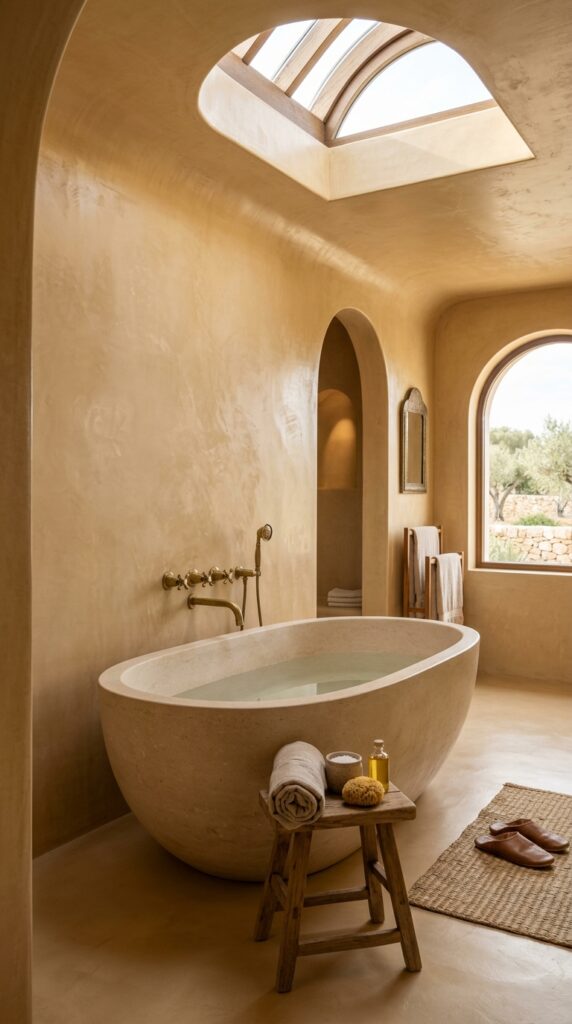
Vibe: Spa-like and warm — a bathroom that makes every bath feel like a ritual.
Why it works: Tadelakt is a traditional Moroccan waterproof lime plaster that, when hand-polished with a smooth river stone and treated with black soap, develops a sealed, soap-resistant surface suitable for wet areas including showers and baths — without tiles. Its continuous, seamless surface eliminates grout lines entirely, creating the most luxurious and architecturally pure bathroom finish available. The warm honey tone of natural tadelakt (achieved with yellow ochre pigment) amplifies the warmth of unlacquered brass fixtures and makes the bathroom feel like an ancient thermal bath rather than a modern wet room.
How to get it: Tadelakt must be applied by a trained plasterer — the multi-stage process involves application of the lime plaster, shaping with a wooden float, polishing with a smooth stone while the plaster is semi-cured, then treating with black olive oil soap. The entire process takes 3–5 days for a bathroom and requires controlled drying conditions. Budget $80–$200 per square meter for skilled installation.
Shop The Look
| Product |
| Tadelakt lime plaster kit authentic Moroccan |
| Unlacquered brass wall mount bathroom faucet |
| Oval honed limestone freestanding bath |
| Black soap savon beldi Moroccan authentic |
| Brass towel ring wall mount vintage |
25. Statement Outdoor Fireplace Built into the Terrace Wall
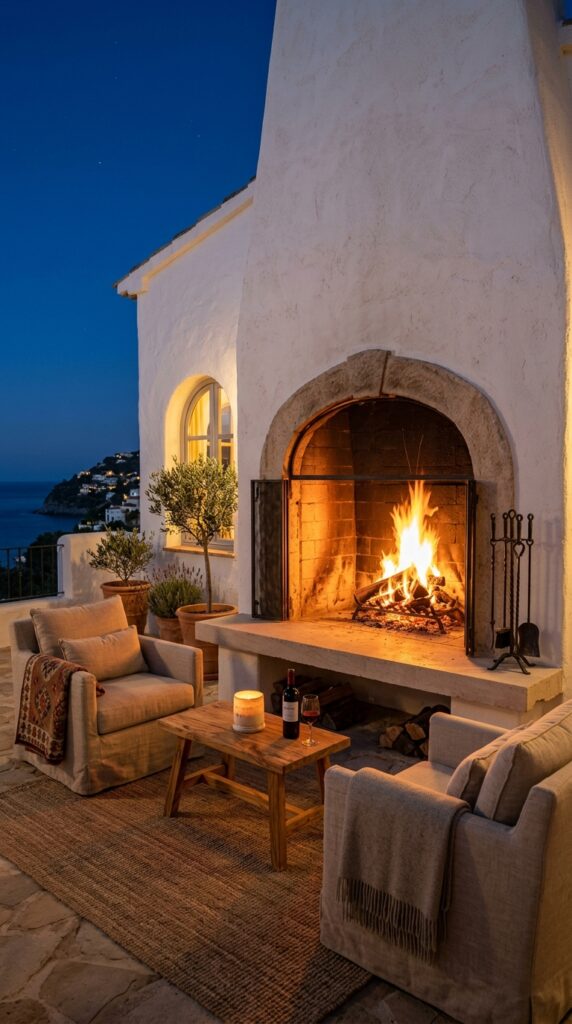
Vibe: Warm and dramatic — a terrace that earns its place in every season.
Why it works: A built-in outdoor fireplace extends the usable season of a Mediterranean villa terrace from the summer months into the shoulder seasons — spring and autumn — when evening temperatures drop to the point where an open-air fire becomes a functional necessity rather than a luxury gesture. The arched firebox opening maintains the architectural vocabulary of the villa’s loggia and doorways, making the fireplace read as integrated into the structure rather than added to it. The wide limestone hearth at 24 inches deep provides a generous staging surface for firewood, candles, and wine glasses that is entirely absent from freestanding fire pit alternatives.
How to get it: The firebox opening should be sized at a minimum of 36 inches wide by 28 inches high for a functional fire — smaller openings produce insufficient draw and result in a smoky terrace. Use a refractory brick firebox interior with a cast iron damper rather than an open-back design; the controlled air supply dramatically improves combustion efficiency and reduces smoke.
Shop The Look
| Product |
| Refractory fire brick set outdoor fireplace |
| Cast iron outdoor fireplace damper |
| Hand-forged wrought iron fire tool set |
| Limestone hearth tile slab 24×48 |
| Deep linen outdoor chair set pair |
26. Rooftop Terrace with 360-Degree Views and a Plunge Pool
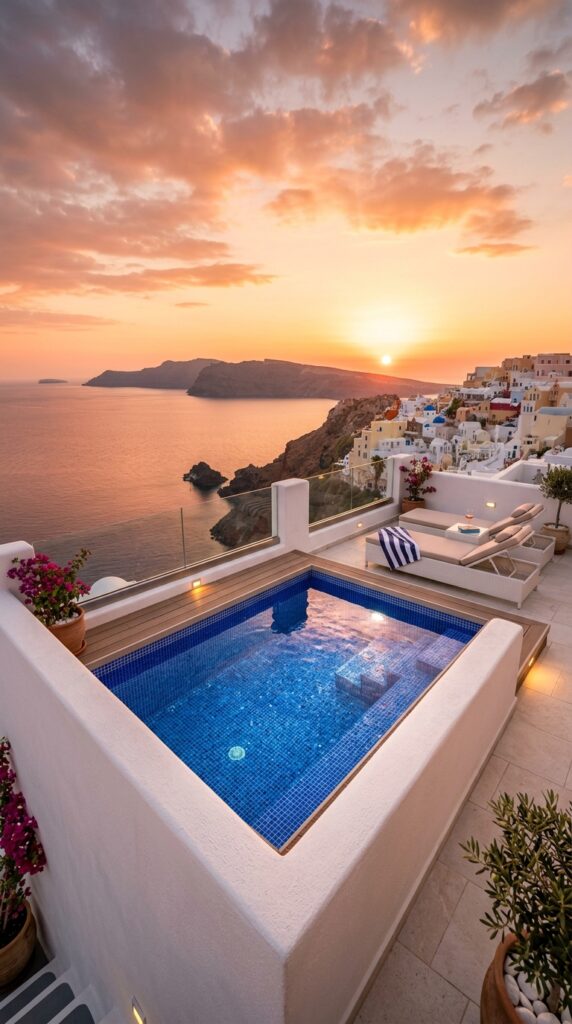
Vibe: Grand and free — the feeling that the entire Mediterranean belongs to you for this hour.
Why it works: A rooftop terrace plunge pool in a compact villa footprint maximizes the relationship between water and view that is the defining aspiration of Mediterranean luxury living. By positioning the pool at rooftop level — above the garden, above the lower terrace, above the villa walls — the water surface becomes a mirror for the sky and the surrounding landscape simultaneously. The compact 8×12-foot footprint is precisely the correct scale for a rooftop plunge pool: large enough to cool and immerse fully, small enough to be structurally viable on a masonry roof with proper engineering.
How to get it: Rooftop pools require structural engineering to verify the existing roof slab’s load-bearing capacity — a filled 8×12-foot pool to 4 feet depth weighs approximately 28,000 pounds, which exceeds the typical residential roof load rating and will require reinforcement in most cases. Use a stainless steel pool shell rather than a concrete shell for weight reduction and ease of installation in a rooftop context.
💡 Quick Win: A freestanding stainless steel plunge pool tub (the Dutchtub or similar thermally efficient compact design, available for $4,000–$9,000) can be positioned on an engineered rooftop deck without permanent construction, delivering the rooftop plunge pool experience with a fraction of the structural intervention.
Shop The Look
| Product |
| Compact plunge pool stainless steel freestanding |
| White rattan sun lounger low profile outdoor |
| Cobalt blue pool mosaic tile compact pool |
| White outdoor parapet wall paint exterior |
| Rooftop deck tile interlocking porcelain |
How to Start Your Mediterranean Luxury Pool Villa Transformation
The single most powerful first move is replacing any painted or standard ceramic pool coping with honed limestone or travertine. More than any other single change, the material surrounding the pool defines whether the water reads as a backyard feature or a Mediterranean one — limestone’s warm ivory tone, its thermal comfort underfoot, and its material continuity with the broader Mediterranean building tradition immediately shift the entire property’s visual register. Every other element — furniture, planting, lighting — calibrates upward against this material foundation.
The most common mistake is using bright white paint rather than a lime-based limewash or mineral paint on exterior stucco walls. Bright white latex paint creates a flat, reflective surface that looks suburban and temporary against Mediterranean architecture — it reads as painted, not plastered. Lime wash develops depth, tonal variation, and a chalky translucency that latex paint cannot replicate at any price. The specific error is choosing a paint with a blue undertone (standard “bright white”) rather than a warm yellow or cream undertone — in direct Mediterranean sun, a blue-undertone white reads as cold and artificial, while a warm-undertone white reads as ancient stone.
Three specific items under $50 for immediate Mediterranean impact: a pair of hand-thrown cobalt blue ceramic vases in varying heights for a stone surface ($35–$65 each, but one is enough), a bag of ivory limestone gravel to replace existing pathway material ($28 per 40 lb bag), and a mature lavender plant in a simple terracotta pot positioned beside any exterior door ($18–$25).
Realistically, a cosmetic Mediterranean villa refresh — new coping tile, limewash paint, lavender urns, ceramic lighting, and iron hardware — runs $3,000–$12,000 for a standard terrace and pool area and can be completed over 4–6 weeks. A full architectural transformation including loggia construction, zellige pool interior, custom iron work, and stone outdoor shower runs $80,000–$300,000+ and should be treated as an 18–36-month project requiring an architect experienced in Mediterranean vernacular construction.
Frequently Asked Questions About Mediterranean Luxury Pool Villas
What makes a pool villa “Mediterranean” versus a generic luxury villa?
A Mediterranean luxury pool villa is defined by its use of regionally specific materials — limestone, travertine, terracotta, tadelakt, hand-forged iron, and hand-thrown ceramic — and its architectural vocabulary of arches, loggias, pergolas, and colonnades. Generic luxury villas may use imported marble, glass, and polished steel in a universally applicable modern idiom that could exist in Dubai, Miami, or Singapore equally. A Mediterranean villa is architecturally site-specific: its forms, materials, and plant palette are all drawn from the building traditions of southern Europe, and it reads as belonging to a particular landscape and climate rather than expressing a globally applicable luxury standard.
What are the best pool tile colors for a Mediterranean aesthetic?
The most authentically Mediterranean pool colors are achieved through glass mosaic or hand-cut zellige tile in cerulean blue, cobalt, and aquamarine tones — specifically colors that reference the Aegean, Ionian, or Tyrrhenian seas. Bisazza’s “Piscina” line and Trend Group’s glass mosaic collections offer the closest commercially available equivalents to custom zellige at $15–$35 per square foot. Avoid generic pool plaster in white or pale blue — these read as suburban American pool aesthetics rather than Mediterranean. The water color is determined by the pool finish, not the water itself: a cobalt mosaic interior produces deep Aegean blue water, while a light aquamarine mosaic produces the lighter turquoise of the Adriatic.
How much does it cost to create a Mediterranean luxury pool villa aesthetic?
The range is enormous depending on whether you are building new, renovating, or styling an existing property. A styling refresh — ceramics, textiles, planting, lighting, and hardware — runs $5,000–$25,000 for a complete terrace and pool area. A partial renovation adding limestone coping, limewash paint, iron fixtures, and a pergola runs $30,000–$100,000. A full architectural transformation with a new loggia, arched openings, tadelakt bathrooms, custom zellige pool, and wrought iron work runs $200,000–$800,000+ for a mid-size villa. The best return on investment comes from material substitution — replacing synthetic materials (composite decking, aluminum furniture, ceramic tile surrounds) with authentic Mediterranean materials (limestone, wrought iron, terracotta) at the same scale.
Can a compact property (under 2,000 sq ft) achieve a Mediterranean luxury aesthetic?
Compact properties are, in many ways, better suited to the Mediterranean aesthetic than large modern open-plan villas because the style’s power comes from the density and quality of individual materials rather than from spatial grandeur. A 400-square-foot terrace with limestone coping, a Moroccan lantern, a pergola with jasmine, and two hand-forged iron chairs achieves the complete Mediterranean experiential effect — the scale is that of a Greek island courtyard, which is one of the world’s most celebrated small-space luxury precedents. Prioritize one strong architectural move (an arched opening, a built-in bench, a tiled fountain niche) and execute it in authentic materials over adding many elements in substitute materials.
What plants are essential for an authentic Mediterranean villa garden?
The Mediterranean plant palette is defined by five essential genera: lavender (Lavandula angustifolia) for fragrance and purple-silver color, Italian cypress (Cupressus sempervirens) for vertical structure and regional identity, olive (Olea europaea) as the primary tree form, bougainvillea for color and climbing coverage, and rosemary (Rosmarinus officinalis, now Salvia rosmarinus) for fragrance and structural hedging. These five plants together constitute the visual and olfactory signature of the Mediterranean landscape and are commercially available in most warm-climate regions. All are drought-tolerant once established, making them as practical as they are beautiful — a material honesty that is itself consistent with the Mediterranean design philosophy.
Ready to Create Your Dream Mediterranean Luxury Pool Villa?
These 26 ideas span the full architectural and decorative vocabulary of Mediterranean luxury — from the grand gestures of an infinity pool with limestone coping and a barrel-vaulted master bedroom, to the intimately sensory details of a hand-thrown ceramic table setting and a hammam tadelakt bathroom. Every transformation of this scale begins with a single material commitment — one authentic element that sets the standard for everything that follows. Today, identify the one surface in your existing outdoor space that most undermines the Mediterranean aesthetic and price its replacement in the correct material: limestone coping where there is concrete, a limewash coat where there is latex paint, a terracotta urn where there is plastic. The philosophy of Mediterranean design has always been that beauty is a by-product of material honesty — when you commit to the right materials, even in a single location, the aesthetic follows without effort. Pin the ideas that made you feel the Mediterranean sun, especially the ones that involve stone, water, and the scent of jasmine — because those are the layers that make a villa feel like it has always been exactly what it is.