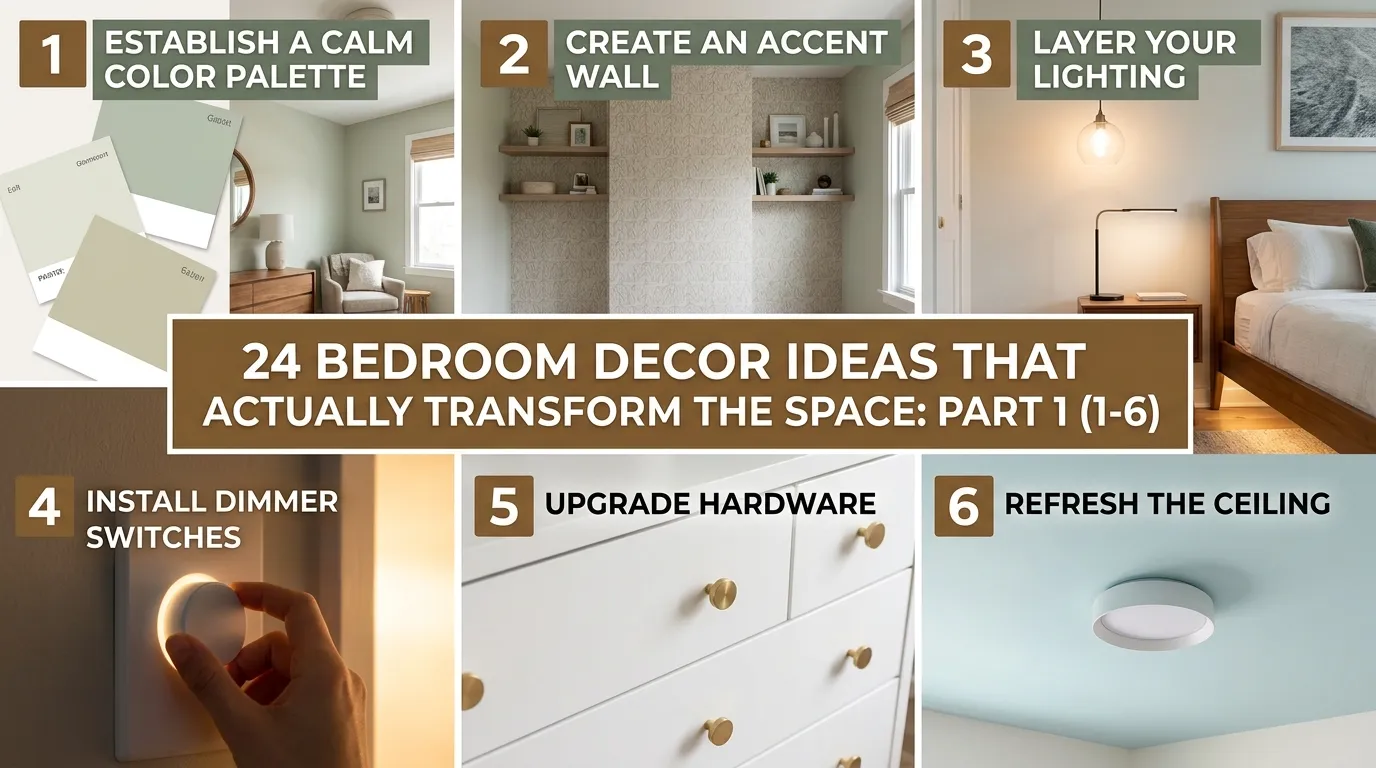
Decorating a bedroom means making deliberate choices about color, furniture, lighting, textiles, and layout that work together to create a space that feels restful, personal, and visually resolved. This article delivers exactly 24 bedroom decorating ideas covering every layer of the room — from the foundational decisions that anchor everything else to the finishing details that make a bedroom feel genuinely complete.
A bedroom done well has a quality that’s hard to name and immediately felt — the moment you walk in, the room tells you what it’s for. The light is right. The textures invite touch. Nothing is there without a reason, and everything that is there feels chosen. Decorating a bedroom isn’t about following trends or filling space — it’s about editing down to what the room actually needs and executing each element with enough care that the whole thing holds together. Here are 24 ideas worth saving — and stealing.
Why Bedroom Decorating Works So Well
The bedroom as a designed space — rather than merely a functional sleeping room — has roots in several converging design traditions. The Arts and Crafts movement of the late 19th century first argued that every domestic room deserved thoughtful material consideration; Scandinavian modernism of the 20th century introduced the principle that a bedroom should serve rest above all other functions, stripping away decorative excess in favor of quality materials and calm proportion; and the contemporary wellness design movement has brought scientific backing to what good designers always knew intuitively — that the visual and tactile environment of the room where we sleep directly influences sleep quality, stress levels, and morning disposition. The bedroom is now understood as the room with the highest return on design investment per hour spent in it.
The materials palette for a well-decorated bedroom is specific and warm: unfinished or lightly oiled white oak or walnut for furniture and flooring, heavyweight linen or brushed cotton in warm neutrals (greige, warm ivory, dusty rose, slate blue) for bedding and curtains, natural wool or cotton for rugs, aged or unlacquered brass or matte black for hardware and lighting. Color comes in two registers — the wall color that sets the room’s atmospheric temperature, and the textile palette that introduces warmth, depth, and personal character. These materials age and soften with use in a way that synthetic alternatives do not, which is part of what makes a bedroom feel genuinely inhabited rather than recently installed.
Bedroom decorating is at a cultural inflection point: after years of the all-white, Scandinavian-minimalist bedroom dominating every platform, a significant counter-movement toward warmer, moodier, more layered spaces has emerged. Pinterest data shows searches for “cozy bedroom ideas,” “warm bedroom color palette,” and “dark bedroom decor” growing substantially, driven by a post-pandemic reassessment of the bedroom as a genuine sanctuary rather than a recovery space. People are now investing in their bedrooms with the same seriousness once reserved for living rooms and kitchens.
A small bedroom — under 120 square feet — can achieve every idea in this list, but the approach requires priority-setting. The bed frame profile, wall color, and lighting are the three elements that do the most work in a small bedroom; furniture quantity and accessory volume should be reduced, not the quality of what remains. A 10×10 bedroom with one excellent bed, one quality lamp, and a thoughtfully chosen wall color outperforms a larger room full of mediocre choices every time.
Style at a Glance
| Element | Key Trait | Detail |
| Philosophy | Rest above all, then beauty | Edit ruthlessly, invest in quality |
| Key Materials | Linen, oak, wool, brass | Natural, tactile, built to age well |
| Key Colors | Greige, warm white, slate, dusty rose | Warm neutrals, deep anchors |
24 How to Decorate a Bedroom Ideas
1. Choose the Wall Color Last, Not First

Vibe: Deliberate — choosing wall color in response to existing materials rather than in isolation is the single shift that separates resolved bedrooms from accidentally decorated ones.
Why it works: Wall color is the decision most people make first — and it should be made last. The wall color’s job is to respond to the fixed elements of the room: the floor tone, the furniture wood species, the bedding palette, the light direction and quality. A warm greige wall reads differently beside a white oak floor than beside dark walnut; it reads differently in a north-facing room than a south-facing one. The principle of chromatic response — choosing color in reaction to what already exists rather than imposing it onto a blank canvas — is the foundational technique of professional interior design and the source of most amateur decorating’s most common failure.
How to get it: Paint a minimum of four 12×12-inch sample swatches on the actual wall and observe them at three different times of day — morning, midday, and evening under lamp light. The swatch that works best across all three lighting conditions, not just the one you liked in the paint store, is the correct choice. Never select wall color from a chip alone.
💡 Quick Win: Before purchasing any paint, bring home the largest sample chip available (most paint retailers offer 4×6-inch chips) and tape it directly beside the room’s dominant material — the bed frame, the rug, or the floor. The relationship between the chip and the material tells you more than any online color preview.
Shop The Look
| Product |
| Paint sample pot set neutral tones bedroom |
| Warm greige interior paint matte finish |
| Paint swatch organizer binder ring |
| Painter’s tape blue 2 inch low tack |
| Color matching fan deck interior paint neutral |
2. Invest in the Bed Frame Before Anything Else

Vibe: Grounded — a bed frame with genuine material quality anchors every other decision in the room without trying.
Why it works: The bed frame is the room’s primary piece of furniture — it occupies more floor area than any other object, carries the most visual weight, and sets the scale against which every other element in the room is read. A quality bed frame in solid white oak, dark walnut, or a well-fabricated upholstered design communicates the room’s entire design philosophy in a single object. The most common decorating mistake is allocating budget to accessories and art before the bed frame — the result is a room where the central object is clearly underinvested while the perimeter is over-decorated. The bed frame should receive 30–40% of the total bedroom decorating budget.
How to get it: Choose a bed frame with a headboard height proportional to the ceiling — in a standard 8-foot room, a headboard of 48–54 inches reads as substantial without overwhelming; in a room with 10-foot ceilings, a 60–72-inch headboard begins to feel correct. A low-profile platform bed (18 inches from floor to mattress top) makes a small room feel larger by keeping the visual center of gravity low.
Shop The Look
| Product |
| White oak platform bed frame low profile queen |
| Solid walnut bed frame with headboard king |
| Linen upholstered bed frame with headboard queen |
| Bed frame center support leg steel |
| White oak furniture oil maintenance kit |
3. Layer Bedding in Three Distinct Textures

Vibe: Tactile — a bed dressed in three textures makes you want to get into it the moment you see it.
Why it works: Textile layering in bedding creates visual depth through the design principle of texture contrast — the eye reads three different surface characters (smooth, woven, knitted) as a composed composition rather than a flat surface. All three layers should share a tonal family (warm neutrals — ivory, greige, oat, warm grey) so the color reads as unified while the texture creates variation. The specific order matters: the smoothest layer closest to the body (fitted sheet), the medium-texture layer as the primary covering (duvet), and the roughest or most characterful layer as the finishing element at the foot (wool throw or quilted coverlet). This mirrors the natural layering logic of traditional bed-making and produces the result that magazines call “effortless” because the logic behind it is sound.
How to get it: Specify heavyweight linen (minimum 175 GSM) for the duvet cover — lighter linen reads as cheap and lacks the drape and texture that give linen its visual character. Wash all linen bedding before first use and line dry — pre-washed linen has the relaxed, slightly crumpled quality that reads as genuine rather than newly purchased.
💡 Quick Win: A single chunky knit or waffle-weave throw folded in thirds and draped across the foot of an existing bed ($35–65) adds a texture layer that immediately makes the bed look styled rather than simply made.
Shop The Look
| Product |
| Heavyweight linen duvet cover greige washed king |
| Chunky knit wool throw blanket oat natural |
| Linen fitted sheet warm ivory king |
| Waffle weave cotton blanket bedroom layer |
| Euro sham linen pillowcase set of 2 |
4. Create a Focal Wall Behind the Bed

Vibe: Architectural — a deep-toned focal wall behind the bed makes the sleeping zone feel like it was designed into the room rather than placed in it.
Why it works: A focal wall — a single wall treated differently from the remaining three — creates visual hierarchy in the bedroom by identifying the bed wall as the room’s primary plane. This is the most powerful single-wall paint technique in bedroom design because it frames the bed architecturally, functioning as a full-wall headboard that gives the bed a sense of place within the room. Deep tones (forest green, navy, warm charcoal, dusty teal) are most effective because they advance visually, pulling the wall toward the viewer and creating depth behind the bed. The remaining three walls should be painted in a lighter, related tone — not white, which creates too much contrast, but a warm neutral that reads as the focal wall’s background.
How to get it: Paint only the wall behind the bed — floor to ceiling, wall to wall, with no chair rail or partial treatment. Partial treatments (lower half only, or a rectangle behind the headboard) read as indecisive. Commit to the full plane. Use a flat or matte finish; eggshell or satin on a focal wall creates an uneven light reflection that undermines the depth effect.
Shop The Look
| Product |
| Forest green interior paint matte deep |
| Navy blue bedroom wall paint flat finish |
| Warm charcoal interior paint bedroom wall |
| Paint roller kit bedroom wall application |
| Matte paint finish sealer bedroom wall |
5. Use Linen Curtains That Pool Slightly on the Floor

Vibe: Serene — linen curtains hung from the ceiling and pooling on the floor make a bedroom window into the room’s most calming feature.
Why it works: Curtain height is the single most impactful curtain decision — and the most commonly wrong one. Curtains hung at window height rather than ceiling height make the ceiling appear lower and the window appear smaller simultaneously, two effects that actively diminish a bedroom’s quality. Ceiling-mounted curtain rods (installed 2–4 inches below the ceiling line) create the maximum possible visual height for the window and the room. The slight floor pool (2–3 inches of extra length) adds a softness and considered quality — the curtains appear generous and unhurried — that precise-hemmed curtains never achieve. Heavyweight linen (300 GSM minimum) in warm ivory or warm white allows morning light to filter through while maintaining privacy.
How to get it: Mount the curtain rod bracket 2–4 inches below the ceiling, not at the top of the window frame. Measure from this height to the floor, add 2–3 inches for the pool, and hem or order accordingly. Use a rod diameter of at least 1 inch to prevent curtain-weight sagging at the center, which is the primary structural failure of ceiling-height installations.
Shop The Look
| Product |
| Heavyweight linen curtain panel ivory floor length |
| Ceiling mount curtain rod bracket set |
| Curtain rod 1 inch diameter matte black 72 inch |
| Linen curtain ring eyelet clip set chrome |
| Curtain hem tape iron-on invisible |
6. Mount Bedside Lighting on the Wall, Not the Nightstand

Vibe: Refined — wall-mounted bedside lighting is the detail that separates a decorated bedroom from a designed one.
Why it works: A bedside table lamp uses approximately one-third of the nightstand surface — the most valuable real estate in the bedroom’s daily-use zone — for a purely structural purpose: holding the lamp base off the surface it illuminates. Wall-mounted sconces eliminate this trade-off entirely: the light source moves to the wall, the nightstand surface becomes fully available, and the light position (always at the correct reading height, always directed correctly) is better than any table lamp can provide. Adjustable-arm sconces allow the light to be directed precisely at the reading zone without disturbing a sleeping partner — a functional advantage that table lamps cannot match.
How to get it: Mount the sconce center at 55–60 inches from the floor, which places the light at the correct height for reading when sitting up in bed against pillows (approximately 20–24 inches above a standard mattress height). Install with a plug-in model if hardwiring isn’t feasible — quality plug-in sconces with fabric-covered cords are nearly indistinguishable from hardwired versions when the cord is managed along the wall edge.
💡 Quick Win: A plug-in wall sconce ($45–120) installs without any electrical work — mount with two screws into a stud, run the fabric cord along the wall edge with small adhesive cord clips, and plug into the nearest outlet behind the nightstand.
Shop The Look
| Product |
| Brushed brass plug in wall sconce reading arm |
| Adjustable arm wall sconce matte black bedroom |
| Adhesive cord clip wall cable management |
| Slim walnut floating nightstand wall mount |
| Fabric cord cover wall sleeve bedroom |
7. Size the Bedroom Rug Correctly

Vibe: Anchored — a correctly sized bedroom rug makes the bed look intentionally placed rather than arbitrarily positioned.
Why it works: Rug sizing is the bedroom decorating mistake made most frequently and noticed most immediately by anyone with design training. An undersized rug — the most common error, where only the front legs of the bed sit on the rug — reads as a bath mat dropped in the middle of a room rather than a designed floor element. The correct rule: the rug should extend a minimum of 18–24 inches beyond the bed on both sides and at the foot, with all four bed frame legs sitting fully on the rug surface. This makes the rug the floor element that defines the bedroom’s sleeping zone, anchoring the bed within it the way a room’s walls anchor the room itself.
How to get it: For a queen bed, a 9×12-foot rug is the standard minimum size that achieves correct proportioning — smaller rugs will inevitably read as undersized regardless of pattern or material quality. Place the rug so its center aligns with the center of the bed, then position the bed on the rug rather than the reverse.
Shop The Look
| Product |
| Wool area rug 9×12 natural flatweave bedroom |
| Jute rug 9×12 natural fiber bedroom |
| Non-slip rug pad 8×10 hardwood floor bedroom |
| Vintage style area rug 9×12 warm neutral |
| Rug grip tape double sided anti-slip |
8. Use a Single Oversized Piece of Art Correctly

Vibe: Confident — one large piece of art placed correctly is always more powerful than three small pieces placed hopefully.
Why it works: Art sizing and placement are where most bedroom decorating loses its nerve — defaulting to small or medium prints in multiple frames that produce a fragmented visual field rather than a single resolved statement. A piece of art in a bedroom should be large enough to be seen and considered from the doorway — minimum 36 inches wide for a standard bedroom, 48 inches for a large bedroom. Hung at 57 inches from the floor to the art’s center (the standard museum hanging height, calibrated to average human eye level), the art sits in the correct visual zone regardless of the furniture height beneath it. The rule is one piece per wall — two pieces on the same wall always looks like a decision that couldn’t be made.
How to get it: If a piece feels too expensive at the size the room requires, source a large-format print on canvas from an independent artist platform (Saatchi Art, Society6, Etsy) — a 48×60-inch canvas print from an emerging artist costs $80–300 and reads as original from across a room. Float frame in simple matte black or natural oak.
Shop The Look
| Product |
| Large abstract canvas print 48×60 dark tones |
| Oversized art print canvas bedroom wall |
| Matte black float frame 24×36 gallery |
| Picture hanging strip heavy duty 16lb |
| Picture level tool hanging accurate |
9. Add a Bedroom Reading Corner

Vibe: Inviting — a reading corner turns a bedroom from a room with a bed into a room with a life.
Why it works: A bedroom reading corner introduces a secondary activity zone that distinguishes the room from a purely functional sleeping space — it communicates that the room is designed for inhabiting, not just recovering. The corner location is deliberate: corners are the most structurally resolved positions in a room (defined on two sides by walls), requiring only furniture to complete the enclosure rather than any additional architectural element. A single accent chair with a floor lamp and side table creates a fully functional reading zone in a footprint of approximately 36×48 inches — achievable in any bedroom with a 10-foot-square floor plan or larger.
How to get it: Choose an accent chair with a tighter profile (a slipper chair or a small-scale armchair, not a club chair or oversized lounge) proportioned to bedroom scale. The chair’s seat height should be compatible with the arc lamp’s light position — the lamp’s bulb should sit approximately 20 inches above the seated eye level for comfortable reading illumination.
Shop The Look
| Product |
| Linen accent chair slipper style oatmeal |
| Brass arc floor lamp reading modern |
| Small round side table natural wood 18 inch |
| Wool throw blanket reading chair drape |
| Ceramic mug large warm neutral glaze |
10. Style the Nightstand With a Maximum of Four Objects

Vibe: Still — a nightstand styled to four objects is the bedroom equivalent of a sentence that says exactly what it means.
Why it works: The nightstand is the most-seen surface in a bedroom — it’s in direct sightline from the pillow and from the doorway simultaneously. Its visual state communicates the room’s organizational philosophy more than any other surface. The four-object rule (lamp, one thing you’re currently reading, one small decorative object, one drink) applies the negative space principle at micro scale: the empty surface area around the four objects gives each one individual visual importance that no object on a crowded nightstand receives. The objects themselves should be chosen for material quality rather than utility — a hand-thrown ceramic glass rather than a plastic water bottle, a quality linen lampshade rather than a paper one.
How to get it: Clear the nightstand completely. Replace only what you use every single night — not what you might use, not what seems like it belongs there. The lamp, the book, the water, and one personal object. Everything else finds a different home.
💡 Quick Win: Replace a plastic or generic water glass on the nightstand with a simple ceramic tumbler or handblown glass ($12–25) — the nightstand immediately reads as styled rather than functional.
Shop The Look
| Product |
| Ceramic table lamp warm linen shade |
| Hand thrown ceramic tumbler glass matte |
| Dried botanical stem small ceramic vessel |
| Walnut floating nightstand slim wall mount |
| Linen lampshade replacement drum white |
11. Introduce a Warm Metallic Accent Finish

Vibe: Cohesive — a single warm metallic accent repeated across five points in a bedroom creates the design thread that ties everything together.
Why it works: Metallic accent finishes in a bedroom function as a visual connector — when the same finish appears on the lamp, the curtain rod hardware, the picture frame, the wall sconce, and the drawer pull, the eye reads these five separate objects as belonging to a single designed system. This is the finish continuity principle applied at bedroom scale: the room gains coherence not because the objects are similar but because they share a material language. Brushed brass (warm, slightly matte, with a golden undertone that reads differently from polished brass’s high shine) is the most versatile warm metallic for bedroom use — it works with every wall color and every textile palette.
How to get it: Audit every metal surface in the bedroom — lamp bases, curtain hardware, picture frames, door handles, drawer pulls, hooks — and identify which are in a warm brass tone. Replace any that aren’t with an equivalent in brushed brass. This can be done incrementally, starting with the most visible items: the bedside lamp and the curtain rod hardware.
Shop The Look
| Product |
| Brushed brass curtain rod finial set |
| Brass drawer pull handle bedroom furniture |
| Brushed gold picture frame 8×10 set of 2 |
| Brass candle holder taper slim set |
| Brass lamp base replacement hardware |
12. Hang a Canopy or Fabric Panel Above the Bed

Vibe: Serene — a fabric canopy turns the bed into a destination within the room rather than just its largest piece of furniture.
Why it works: A fabric canopy above the bed creates a zone within a zone — the sleeping area becomes a defined, enclosed space within the larger bedroom, producing a sense of intimacy and shelter that a bed without a canopy cannot provide. The design principle is vertical enclosure: by adding a ceiling-level element directly above the sleeping zone, the canopy lowers the perceived ceiling height within the canopy’s boundary, creating the cocooning quality associated with the most comforting sleep environments. Two ceiling-mounted hooks 48–60 inches apart above the bed center are all the installation required — the fabric hangs from a single ring on each hook, draping naturally to the floor.
How to get it: Use sheer linen or lightweight cotton in warm ivory or white — the fabric needs to be light enough to drape fluidly and translucent enough to allow light to pass through when drawn. A single 4-meter panel of sheer linen fabric (available from fabric retailers for $40–80) cut and folded over a ceiling hook creates a four-panel drape without any sewing.
Shop The Look
| Product |
| Sheer linen canopy fabric panel ivory bedroom |
| Ceiling hook swag screw in canopy mount |
| Bed canopy drape white cotton sheer |
| Canopy ring ceiling mount set |
| Linen fabric by yard sheer natural white |
13. Design the Dresser Top as a Styled Surface

Vibe: Composed — a styled dresser top reads as a designed surface rather than a horizontal surface where things accumulate.
Why it works: A dresser is the second-most-used furniture surface in a bedroom and typically the most visually chaotic — it accumulates items by default rather than by design. Treating the dresser top as a styled surface (a composition with intentional objects rather than a collection of things placed without thought) applies the same vignette principle used in retail and editorial design: a deliberate grouping of objects at varied heights, occupying two-thirds of the available surface with the remaining third left deliberately empty. The empty space is as important as the objects — it gives the composition visual breathing room and signals that the arrangement was chosen rather than accumulated.
How to get it: Remove everything from the dresser. Create a triangle composition: one tall element (a mirror leaning against the wall, or a tall vase), one medium element (a ceramic vessel or small plant), and one low element (a tray with small objects). Replace only items that belong to the composition. Store everything else in the drawers or in another room.
Shop The Look
| Product |
| Oval mirror brass frame bedroom dresser lean |
| Ceramic vessel set tall and short matte neutral |
| Small decorative tray perfume organizer |
| Trailing pothos plant small pot bedroom |
| Wooden dresser with mirror natural oak |
14. Install Dimmer Switches on Every Bedroom Light

Vibe: Intimate — a bedroom with every light on a dimmer has more atmospheric range than any single light source at full brightness can provide.
Why it works: Lighting is the most transformative and most underinvested element in bedroom decorating. A bedroom with three light sources all on dimmers can produce a completely different atmospheric character at different settings: full brightness for dressing and getting ready, 50% for reading, 20% for the hour before sleep when research consistently shows that dim warm light supports melatonin production and sleep onset. The dimmer switch is not a comfort feature — it is a physiological sleep tool. Every light in the bedroom should be on a dimmer, and every bulb should be a warm color temperature (2200–2700K) so that dimmed light shifts further toward amber rather than toward grey.
How to get it: Install a rotary or slide dimmer switch ($15–35 per switch) in place of existing standard switches — most LED-compatible dimmers replace standard switches with no additional wiring changes. Verify that all existing bulbs are labeled “dimmable” before installing dimmers — non-dimmable LEDs will flicker or fail on a dimmer circuit.
💡 Quick Win: A smart bulb with built-in dimming and color temperature adjustment ($12–20 each) installed in an existing lamp allows full dimming control from a phone without any electrical work — no switch replacement required.
Shop The Look
| Product |
| Rotary dimmer switch LED compatible single pole |
| Smart LED bulb dimmable warm white E26 |
| Dimmable LED bulb 2700K warm A19 set of 4 |
| Dimmer switch cover plate white standard |
| Smart plug dimmer outlet adapter |
15. Use Paint to Create an Architectural Headboard

Vibe: Architectural — a painted headboard arch turns a blank wall into the room’s most interesting feature with nothing more than a brush and painter’s tape.
Why it works: A painted arch or rectangle behind the bed creates the visual effect of a headboard niche — an architectural recess that frames and defines the sleeping position — without any physical construction. The shape (typically an arch 48–60 inches wide and 60–72 inches tall, centered on the wall behind the bed) reads as an architectural element when the paint is applied cleanly with crisp edges, especially in a deep tone against a lighter surrounding wall. This technique is particularly effective in rooms without a physical headboard — the painted shape performs the headboard’s design function at a fraction of the cost and with complete reversibility.
How to get it: Use a large compass (a string tied to a pencil, anchored at the arch’s center point) to draw the arch curve on the wall, then apply painter’s tape along the inside edge of the curve. Paint within the taped area with two coats, removing the tape while the final coat is still slightly wet to prevent edge chipping. The inside of the arch should be the deeper color; the wall outside remains the lighter background tone.
Shop The Look
| Product |
| Dusty teal interior paint matte bedroom |
| Painter’s tape fine edge 1 inch blue |
| Arch template stencil large bedroom wall |
| Small paint roller 4 inch foam tight spaces |
| Paint touch up pen interior wall |
16. Incorporate Natural Wood Tones at Multiple Scales

Vibe: Organic — a bedroom with wood at three scales feels like it grew rather than was assembled.
Why it works: Wood tones in a bedroom work best when they are varied rather than matched — the design principle of tonal wood layering. Three wood tones (a light, a medium, and a dark) within the same warm family (all warm-undertone species: white oak, walnut, teak, cherry) create a depth and richness that a room using one consistent wood tone cannot achieve. The key constraint is family consistency: all three tones should be warm-undertone species — mixing a warm walnut with a cool grey-toned ash creates chromatic tension that reads as a mistake rather than a choice. Light tones at the largest scale (bed frame), medium at the mid scale (nightstand, dresser), and dark at the smallest scale (tray, smaller accessories) creates a graduated composition that feels resolved.
How to get it: Identify the dominant wood species already in the room (usually the floor or the bed frame) and source secondary pieces within two tones of it — one lighter, one darker. Never buy furniture in isolation from the existing wood; bring a photo of the existing piece to any furniture purchase.
Shop The Look
| Product |
| White oak nightstand small bedside natural |
| Walnut wood tray rectangle bedroom dresser |
| Natural oak desk organizer small bedroom |
| Wood finish comparison fan deck furniture |
| Teak wood conditioner oil furniture |
17. Decorate the Ceiling as a Fifth Wall

Vibe: Enveloping — a painted ceiling is the bedroom’s most unexpected design move and its most memorable.
Why it works: The ceiling is the largest uninterrupted surface in a bedroom and the one surface that receives the least design consideration — in most bedrooms it is simply white, by default rather than by decision. Painting the ceiling a warm tone (a dusty terracotta, a soft dusty rose, a warm pale sage) one to two shades lighter than the walls creates a warm overhead envelope — the room reads as a complete, enclosed environment rather than a box with a white lid. The ceiling’s warm color also reflects color into the room, warming the ambient light quality in a way that no amount of lamp layering can achieve.
How to get it: Paint the ceiling in a tone 20–30% lighter than the wall color — this creates visible differentiation without the stark contrast of a completely different hue. Use a flat ceiling paint specifically (not wall paint applied to the ceiling) for the most even, non-reflective result. Cut in the ceiling edge carefully before rolling — the line between ceiling and wall is visible from every position in the room.
Shop The Look
| Product |
| Terracotta warm ceiling paint flat finish |
| Dusty rose ceiling paint soft bedroom |
| Ceiling paint roller extension pole set |
| Ceiling brush angled 3 inch cut in |
| Paint drop cloth bedroom floor protection |
18. Small Bedroom Solution: Mirrors to Expand Space

Vibe: Airy — a large mirror in a small bedroom is the closest thing to a spatial renovation that requires no construction.
Why it works: Mirrors in a bedroom work on the most straightforward principle in interior design: they reflect the room’s most visually valuable element — the window and its light — back into the space, creating the impression of a second window and doubling the perceived depth of the room. A large floor mirror (24×72 inches minimum) leaned against the wall opposite or adjacent to the window achieves this effect most powerfully because its size allows a complete reflection of the window opening. The lean (rather than hung) position reads as deliberately casual — the mirror appears to be a resident of the space rather than an installation.
How to get it: Position the mirror so it reflects the room’s window, not the room’s dark wall — this is the positioning decision that determines whether the mirror adds light or simply adds reflection. Angle the mirror’s lean 3–5 degrees from vertical so the reflection captures ceiling and floor simultaneously, giving the room its full vertical depth.
💡 Quick Win: A full-length mirror from a thrift store or discount retailer ($25–60) leaned against the wall opposite the window is the single highest-impact-per-dollar spatial intervention in any small bedroom.
Shop The Look
| Product |
| Full length floor mirror lean against wall 24×72 |
| Oval arch floor mirror lean bedroom large |
| Brass frame full length mirror bedroom |
| Mirror safety backing film shatter proof |
| Mirror lean anchor wall safety strap |
19. Create a Cohesive Color Palette Across All Textiles

Vibe: Harmonious — a bedroom where all textiles share one color family feels like a room that was designed rather than decorated.
Why it works: Textile cohesion — the principle that all soft surfaces in a room share a single color family, varying in shade and texture rather than in hue — is the technique that most reliably produces a resolved, professional-quality bedroom. It works because the eye processes a unified color field as a single deliberate statement rather than multiple separate choices competing for attention. Within a warm palette (dusty rose, warm ivory, pale terracotta), the variation between a dusty rose duvet, a warm ivory curtain, and a pale terracotta throw is sufficient to create visual interest while the shared warm undertone creates unity. Introducing a single strongly contrasting hue (a cool blue pillow in a warm rose room) breaks the palette’s coherence immediately.
How to get it: Choose one color family and commit to it across all bedroom textiles — bedding, curtains, rug, throw, and any decorative pillows. Allow variation in shade (lighter, medium, and deeper tones within the family) and in texture (smooth linen, chunky knit, flatweave rug) to create the visual interest that a monochromatic palette can otherwise lack.
Shop The Look
| Product |
| Dusty rose linen duvet cover washed queen |
| Pale terracotta wool throw bedroom |
| Blush pink euro sham pillow cover set of 2 |
| Warm ivory linen curtain panel bedroom |
| Blush flatweave area rug 8×10 bedroom |
20. Build a Simple Gallery Wall That Actually Works

Vibe: Resolved — a gallery wall built on consistent constraints looks like a single design decision, not seven separate ones.
Why it works: Gallery walls fail when they break two rules simultaneously: mixed frame finishes and mixed subject matter. When the frames are identical in finish (all warm oak, all matte black, all brass) and the prints share a tonal family (all black-and-white, all sepia, all a single color palette), the gallery reads as a unified composition rather than a collection of things the occupant likes. The arrangement itself should follow a horizontal band format (all frames centered on a single horizontal line at eye level) rather than the irregular stacked arrangement that typically looks unresolved — the horizontal band is the simpler format and reads as more architecturally deliberate.
How to get it: Template the gallery wall before hanging anything. Trace each frame size on kraft paper, cut them out, and arrange them on the wall with painter’s tape until the composition is resolved. Transfer the template positions to picture hooks — this method eliminates the unnecessary nail holes that accumulate during a freehand gallery installation.
Shop The Look
| Product |
| Gallery wall frame set oak finish 7 piece |
| White mat board set for frames 8×10 |
| Gallery wall hanging template kit |
| Gallery wall art print set black white botanical |
| Picture hook nail set assorted sizes |
21. Add a Bedroom Plant at Architectural Scale

Vibe: Alive — a large plant in a bedroom corner does what no piece of art or furniture can: it grows.
Why it works: Plants in a bedroom work on two registers simultaneously — the visual (organic form and color providing biophilic warmth that manufactured objects cannot replicate) and the physiological (certain species demonstrably improve air quality by absorbing carbon dioxide and releasing oxygen). At architectural scale — a plant 4–6 feet tall in a pot 14–18 inches in diameter — the plant becomes a design element with genuine spatial presence, filling a corner that would otherwise read as an empty architectural leftover. A single large plant always outperforms multiple small plants in a bedroom: one well-chosen specimen at the correct scale reads as a decision; three small plants on a windowsill reads as a collection.
How to get it: Choose species with documented air-purifying qualities and tolerance for bedroom light conditions — snake plant (Sansevieria), peace lily (Spathiphyllum), or rubber plant (Ficus elastica) in dark-leaved varieties are the most forgiving choices for low-to-medium bedroom light. Pot in a container visually proportional to the plant: for a 5-foot specimen, a 14-inch diameter pot is the minimum for visual balance.
Shop The Look
| Product |
| Fiddle leaf fig live large 10 inch pot |
| Matte black planter pot large 14 inch indoor |
| Warm terracotta pot large indoor plant |
| Plant stand wooden elevated indoor bedroom |
| Indoor plant potting mix premium tropical |
22. Organize the Closet as Part of the Bedroom Design

Vibe: Deliberate — a closet organized to the same standard as the bedroom it belongs to makes the entire room feel coherent.
Why it works: An open or visible closet is part of the bedroom’s visual field — it is seen every morning and every evening, and its state of organization (or disorganization) contributes to or detracts from the room’s overall atmosphere. The same design discipline that applies to the nightstand and the dresser top applies to the closet: uniform hangers in a single material (natural cedar, dark walnut, or black velvet), clothing grouped by color from light to dark, folded items in uniform stacks. This is not perfectionism — it’s the recognition that visual order in the space where you prepare for the day has measurable effects on morning disposition and decision-making clarity.
How to get it: Replace all closet hangers with a single matching set (natural cedar hangers cost $28–40 for 30 pieces) in one session — this single change, taking 20 minutes, produces the most dramatic visible improvement per unit of effort in any closet organization project. Remove all clothing not worn in the past 12 months before rehanging.
💡 Quick Win: Turn all hangers to face the same direction after replacing them — the uniform direction creates the visual discipline of a retail display and costs nothing beyond the decision to do it.
Shop The Look
| Product |
| Cedar wood clothes hanger set 30 natural |
| Shelf divider wardrobe organizer set acrylic |
| Leather valet tray closet accessories organizer |
| Velvet slim hanger space saving set 50 |
| Closet label set adhesive wardrobe organizer |
23. Layer Lighting in Three Distinct Zones

Vibe: Layered — a bedroom lit from three zones has more atmospheric depth than any single light source can create regardless of its quality.
Why it works: Lighting in three zones (overhead, mid-level, and task) creates the same visual complexity that natural light produces in a room throughout the day — multiple sources at different heights producing shadows, highlights, and gradations of warmth that a single overhead light cannot replicate. The overhead light (a ceiling pendant or flush mount) handles ambient fill at low dimmer setting; the wall sconces handle bedside reading; the floor or table lamp in the reading corner handles task light. All three should be warm color temperature (2700K or below) and all three should be on dimmers — the room’s entire atmospheric character can then be adjusted between full-brightness functionality and intimate evening warmth without changing any bulbs or fixtures.
How to get it: Identify the three zone positions in the bedroom — ceiling, bedside, and one additional task zone. Install or confirm a light source in each. Connect all to dimmers. The specific fixture style matters far less than having three zones — a simple ceiling light on a dimmer with plug-in sconces beside the bed and a $40 table lamp in the corner achieves the layered lighting effect that a single expensive pendant cannot.
Shop The Look
| Product |
| Pendant ceiling light bedroom warm shade |
| Plug in wall sconce set of 2 bedroom brass |
| Arc floor lamp reading corner bedroom |
| Three way dimmer switch LED bedroom |
| Edison filament bulb 2700K A19 dimmable |
24. Edit Until the Room Feels Right, Then Stop

Vibe: Complete — the most resolved bedroom rooms are the ones that had the discipline to stop before they were full.
Why it works: The final principle of bedroom decorating is the hardest to practice and the most important to understand: a bedroom is finished not when there is nothing left to add but when there is nothing left to remove. Over-decoration — too many decorative pillows, too many small objects on surfaces, too many competing patterns, too many pieces of art — produces visual noise that the brain registers as low-grade stress rather than warmth. The negative space in a well-decorated bedroom (the empty surface area on a nightstand, the clear floor beside the bed, the bare section of wall between the art and the corner) is not absence of design — it is the design. Every object in the room should earn its place by contributing something the room would lack without it.
How to get it: Stand in the bedroom doorway and identify the three things that draw your eye first. If any of them is something you don’t want to be the room’s focal point, remove it. Then repeat. Continue until the three things that draw your eye first are all things you deliberately want to be seen — and then stop.
Shop The Look
| Product |
| Decorative object tray display ceramic neutral |
| Minimalist candle holder bedroom surface |
| Single stem dried botanical vase bedroom |
| Neutral linen decorative pillow cover 18×18 |
| Bedroom organization box hidden storage |
How to Start Your Bedroom Decorating Transformation
The single most important first move in decorating a bedroom is to choose and commit to the bedding. Bedding is the room’s largest textile surface and its most-seen design element — it sets the tonal palette, the texture register, and the atmospheric quality that every other decision must respond to. Invest in a heavyweight linen duvet cover in warm greige or warm ivory (Cultiver, Parachute, and similar quality linen brands offer options from $120–220 for a king cover) before buying a single accessory, piece of art, or additional furniture. Everything else in the room will be chosen in response to this one decision, which is exactly how professional interior designers approach a bedroom brief.
The most common mistake in bedroom decorating is beginning with accessories — throw pillows, wall art, candles, decorative objects — before the foundational elements (wall color, bed frame, bedding, curtains, rug) are resolved. Accessories in an unresolved room don’t improve it; they add visual noise to an already unclear palette. The fix is sequence: resolve the five foundational elements first, live with them for two to four weeks, and then add accessories only to solve a specific visual problem (the room needs warmth in this corner, this surface needs a vertical element) rather than to fill space.
Three items under $50 that create immediate bedroom decorating impact: a single chunky wool throw in warm oatmeal ($35–50) draped across the foot of the existing bed — it adds a texture layer that makes any bedding look deliberately styled; a set of matching cedar wood hangers ($28–40) that transform an open wardrobe overnight; and a warm 2700K Edison LED bulb ($6–10) swapped into the existing bedside lamp — the shift from cool white to warm amber changes the bedroom’s entire evening atmosphere in 30 seconds.
A single-weekend bedroom transformation — new bedding, wall paint, curtain rod raised to ceiling height, and dimmer switch installation — runs $250–500 and changes the character of the room more completely than any amount of accessory shopping. A full bedroom decoration from a blank state (bed frame, bedding, curtains, rug, lighting, art, and accessories) takes three to six months done thoughtfully, at a budget of $2,000–6,000 for mid-range quality across all elements. Patience is part of the process — a room decorated over time, with each element chosen deliberately, consistently outperforms one furnished all at once.
Frequently Asked Questions About How to Decorate a Bedroom
What is the correct order to decorate a bedroom?
The correct sequence for bedroom decorating is: bed frame first, then bedding, then wall color, then curtains and rug, then lighting, and finally accessories and art. This order ensures that each decision responds to what is already resolved rather than being made in isolation. The most common sequencing mistake is choosing wall color before the furniture and textiles are decided — wall color’s job is to respond to the fixed elements of the room, not to set the palette that everything else must match. The bed frame and bedding together establish the room’s tonal center; the wall color is then chosen to complement them.
What colors make a bedroom feel most restful?
Warm, mid-depth tones consistently produce the most restful bedroom atmospheres — specifically warm greige (a grey-beige with more beige than grey), warm sage (a grey-green with low saturation), dusty blue-grey, and soft dusty rose. These tones share a common quality: they have enough color to feel intentional but enough grey in their composition to avoid visual excitement. Cool, highly saturated colors (bright blue, vivid green, stark white) are associated with alertness rather than rest and tend to work against sleep quality. The most researched color for sleep environments is a warm, low-saturation blue-grey — close in character to the color of twilight sky in a temperate climate.
How much should I spend decorating a bedroom?
A foundational bedroom decoration covering the five essential elements (bed frame, bedding, curtains, rug, and bedside lighting) runs $1,200–3,500 at mid-range quality — a range where genuine material quality (solid wood, heavyweight linen, natural fiber rugs) is achievable without custom or designer pricing. The highest-priority investment is the bed frame (30–35% of budget) followed by bedding (20–25%), then lighting (15%), curtains (15%), and rug (15%). Art and accessories should receive what remains after the foundational elements are resolved — typically $150–400 for a few quality pieces rather than many inexpensive ones.
Can I decorate a bedroom without buying new furniture?
Yes — the highest-impact bedroom decorating changes require no new furniture: wall paint (transforming the room’s atmosphere for $40–80), ceiling-height curtain rod repositioning (moving an existing rod from window height to ceiling height for under $20 in new hardware), dimmer switch installation ($15–35 per switch), bedding upgrade ($120–220 for quality linen), and closet organization ($30–50 in hangers and organizers). These five changes alone produce a more resolved, more restful bedroom than most furniture purchases do — they address the room’s atmosphere, light quality, and visual organization rather than adding more objects to an existing problem.
What is the most common bedroom decorating mistake?
The single most common bedroom decorating mistake is undersizing the rug — placing a rug that is too small for the bed it’s meant to anchor, so that only the front legs of the bed sit on it or, worse, no bed legs sit on it at all. An undersized rug reads as a mat dropped in the middle of the room rather than a designed floor element and makes the room appear smaller, not larger. The correct size for a queen bed is a minimum 9×12-foot rug; for a king bed, a 10×14-foot rug. All four bed frame legs should sit fully on the rug surface, with the rug extending at least 18–24 inches beyond the bed on both sides and at the foot.
Ready to Create Your Dream Bedroom?
These 24 ideas cover the full range of what genuinely transforms a bedroom — from the foundational sequence of color, furniture, and textile decisions that establish the room’s atmospheric character, to the lighting discipline and spatial editing that determine how the room feels to inhabit daily. Every bedroom transformation starts with one honest decision: identifying the element that is most wrong about the current room and fixing it with the best possible version of the right answer — not the most decorated version, but the most resolved one. Today, raise your curtain rod to ceiling height if it isn’t already there — this single change, costing under $20 in new bracket hardware and 30 minutes of time, will immediately make the room feel taller, more deliberate, and more designed than it did before. When every element in the bedroom is resolved and each object has genuinely earned its place, the room will produce a specific feeling every time you walk into it — the feeling of a space that knows what it’s for. Pin the ideas that shifted your thinking about a room you’ve been living in rather than designing — those are the ones worth acting on first.