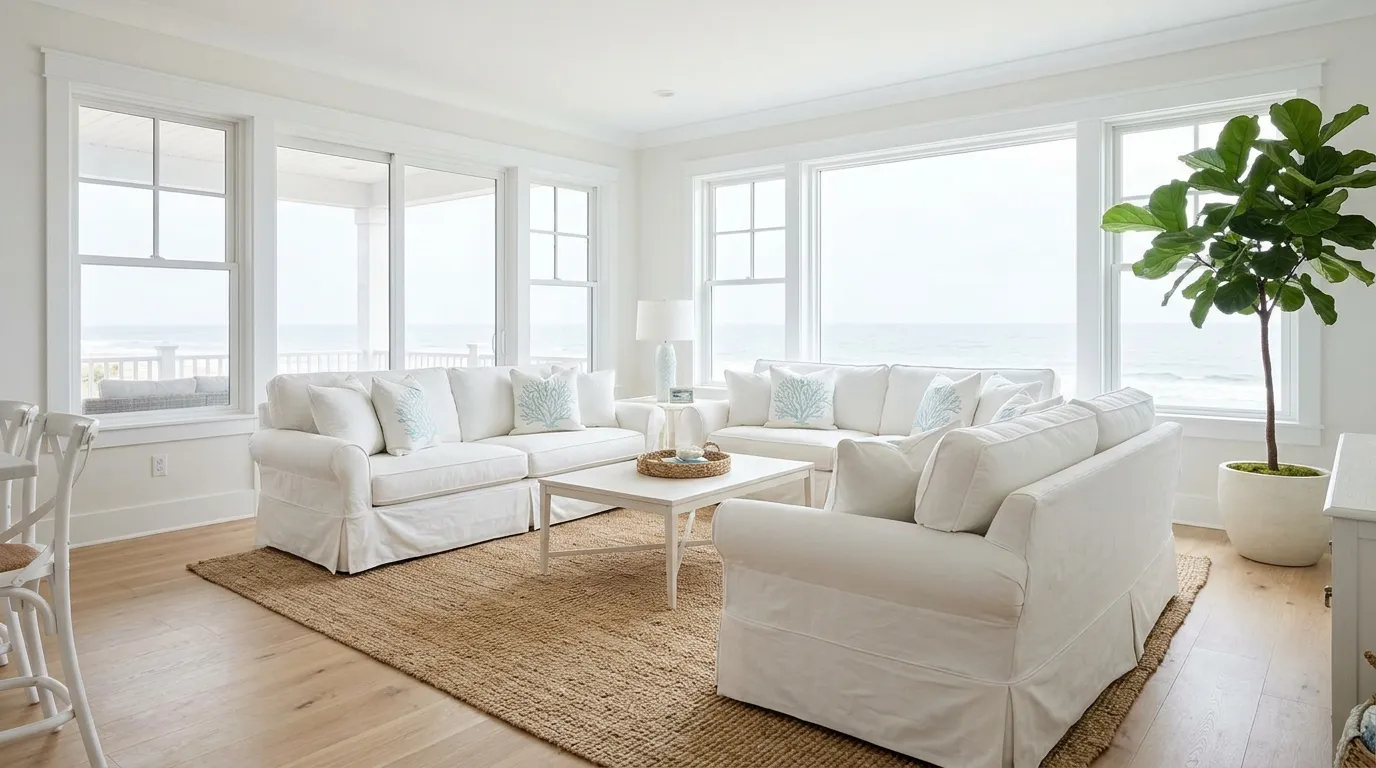
Beach house living room design is the art of creating a space that feels simultaneously relaxed and considered — one that holds the light, texture, and unhurried atmosphere of coastal living without resorting to generic nautical clichés. Here are 26 specific ideas, from foundational material choices to spatial arrangements and atmospheric details, to help you build a living room that genuinely feels like the coast rather than merely referencing it.
There is a specific quality of ease in a well-executed beach house living room — the way bleached oak floors carry afternoon light from the window to the far wall, the weight of a linen sofa that has held a hundred lazy afternoons, the sound of a ceiling fan turning slowly above a space that asks nothing of the person inside it. It is a style that earns its looseness through careful material choices and deliberate restraint. Here are 26 ideas worth saving — and stealing.
Why Beach House Living Room Design Works So Well
Beach house living room design draws from a specific intersection of coastal vernacular architecture, Californian casual modernism, and the bleached-wood-and-linen aesthetic of Australian coastal interiors. Its design ancestors include the open-plan Malibu beach houses of the 1960s, the whitewashed Greek island rooms that influenced a generation of interior designers, and the airy timber-framed beach cottages of the New England coast. What separates an authentic beach house living room from a generic coastal-themed space is the same quality that distinguishes honest architecture from decorated building: the materials are chosen for what they genuinely are, not for what they reference.
The material vocabulary is specific and non-negotiable. Bleached or whitewashed white oak for floors and ceiling beams, raw linen and washed cotton canvas for upholstery, rattan and woven seagrass for furniture and accessories, driftwood and smooth river stone as natural accent objects, handblown sea-glass and ceramic in ocean-derived tones. Colours hold in the natural coastal range: warm white, sun-bleached bone, pale driftwood grey, aqua and deep teal, sage green, and the particular sandy warmth of natural sisal and jute. Warm ambient light — from large windows, ceiling fans, and low-wattage warm bulbs — is the atmospheric foundation that makes every material choice read correctly.
The style’s enduring relevance connects to something deeper than aesthetic preference. In an era of increasing screen saturation and urban density, the beach house living room represents a genuine alternative model of domestic life — slower, lighter, more connected to natural light and natural materials. Pinterest searches for “beach house living room” and “coastal casual interior” have remained among the top home décor queries for five consecutive years, driven not by trend but by a persistent cultural appetite for spaces that feel genuinely restful.
Small living rooms achieve this style most naturally when the editing principle is applied rigorously: fewer, better pieces of furniture with enough space between them for the room to breathe, walls kept pale and reflective to maximise natural light, and one or two strong material statements (a rattan pendant light, a handwoven rug, a driftwood coffee table) rather than a surface covered in coastal accessories. The beach house living room at its best is not decorated — it is furnished and lit.
| Element | Core Trait 1 | Core Trait 2 |
| Philosophy | Earned ease | Material honesty |
| Materials | Bleached white oak, raw linen, rattan | Woven seagrass, driftwood, handblown sea-glass |
| Color palette | Warm white, sun-bleached bone, pale aqua | Driftwood grey, sage green, warm sand |
26 Beach House Living Room Ideas
1. Whitewashed Plank Walls and Bleached Oak Floors

Vibe: Sun-bleached — a room that looks as though the coast came inside and rearranged the light.
Why it works: Whitewashed horizontal plank walls and bleached oak floors form the foundational material combination of the authentic beach house living room because both materials perform the same spatial function: they reflect and scatter natural light across their surfaces rather than absorbing it, creating a luminous quality that painted drywall and stained wood floors cannot replicate. The visible grain of the wood beneath the whitewash provides texture without colour, giving the room visual complexity that reads as earned rather than applied. The horizontal plank direction reinforces the room’s orientation toward its windows and views, while the bleached floor continues the pale horizontal plane all the way to the skirting.
How to get it: Apply DIY whitewash to existing timber walls or planks using Benjamin Moore White Dove thinned 1:1 with water, applied with a wide brush in the grain direction and wiped back with a dry cloth before full drying. For floors, use a white hardwax oil (Rubio Monocoat White or Bona NordicSeal) applied to sanded bare oak — this penetrates the wood rather than sitting on the surface, maintaining the natural grain and providing a matte, non-plastic finish.
💡 Quick Win: A single whitewashed plank accent wall behind the sofa — 8 to 10 horizontal planks in 1×6 pine, whitewashed and installed with 3mm gaps — costs $80–$140 in materials and immediately establishes the beach house material language of the entire room.
Shop the Look
| Product |
| White hardwax floor oil bleached finish |
| Horizontal shiplap plank wall board set |
| Natural linen sofa slipcover neutral |
| Rattan coffee table natural woven |
| Large indoor palm plant terracotta pot |
2. Oversized Linen Sofa in Natural Bone

Vibe: Deeply relaxed — a sofa that makes sitting down feel like a decision you made correctly.
Why it works: An oversized linen sofa in natural bone is the anchor piece of every successful beach house living room because it establishes the room’s fundamental register: generous in scale, natural in material, and slightly imperfect in arrangement. The deep seat — 36 inches minimum from front to back — is what distinguishes a beach house sofa from a formal living room sofa; the extra depth allows fully horizontal lounging and signals that this room takes rest seriously. Natural bone linen upholstery develops character over time — wrinkling slightly with use, softening with washing — and this evolution is the point rather than a flaw. A sofa that looks better in year three than it did in year one is the right material for this style.
How to get it: Specify loose-fill back cushions (feather and down, or a feather-wrapped foam core) rather than tight-back construction — the ability of loose cushions to be plumped, rearranged, and casually pushed aside is fundamental to the lived-in beach house aesthetic. Wash linen slipcovers at 40°C every 6 to 8 weeks to maintain the soft, slightly worn quality that distinguishes authentic linen from stiff new fabric.
Shop the Look
| Product |
| Natural linen sofa cover slipcover bone |
| Oversized linen throw cushion cover set |
| Chunky cotton throw blanket natural white |
| Feather down sofa cushion insert large |
| Seagrass area rug 9×12 natural |
3. Rattan Pendant Light Above the Seating Area

Vibe: Tropical — light filtered through rattan produces a room-wide dappled warmth.
Why it works: A large rattan pendant light is the beach house living room’s most impactful single purchase because it simultaneously addresses lighting, texture, and atmosphere in one object — and it does so through the specific quality of diffused light that rattan’s open weave produces. The pattern of warm light and shadow cast by a rattan pendant on the ceiling and upper walls creates a room-wide warmth that no other pendant material replicates: it references the dappled quality of sunlight through palm fronds, the filtered light of a beach cabana, the shade of a woven sunhat. Hung at 7 feet from the floor over a seating area, it creates a defined zone of warmth overhead that makes the sofa below feel anchored and enveloped.
How to get it: Specify a pendant with an open weave rather than a tightly woven shade — the light pattern depends on the gaps in the weave, and a tight weave simply produces a dark dome with a bright opening at the bottom. Hang at 7 feet from floor (not the standard 6 feet for dining pendants) over a living room seating area for the correct height relationship with seated occupants.
Shop the Look
| Product |
| Rattan pendant light large open weave |
| Pendant light cord fabric white ceiling kit |
| Edison filament bulb warm 2700K large |
| Ceiling rose hook white minimal |
| Woven rattan lamp shade replacement |
4. Sea Glass and Driftwood Vignette

Vibe: Collected — a composition built one beach walk at a time.
Why it works: A sea glass and driftwood vignette is the most personal possible beach house living room decoration — it is a direct material record of time spent at the coast, and the biographical quality of gathered objects communicates a genuine relationship to the sea that no purchased coastal decoration can replicate. Driftwood’s sculptural form — shaped by water, salt, and time into surfaces that are simultaneously smooth and irregular — makes it the most architecturally interesting natural object available for interior styling at this scale. The sea glass pieces, backlit by window light, produce the same inner-glow quality in a living room as they do on a beach held against the sun — frosted translucency that changes with every shift in light.
How to get it: Arrange the vignette using the rule of three heights: one tall element (a piece of driftwood standing upright at 8 to 12 inches), one medium element (a handblown glass vessel at 5 to 7 inches), and one low element (a grouping of sea glass and stones at table level). Group the low objects tightly — sea glass scattered across a surface reads as debris; sea glass clustered in a small ceramic tray or bowl reads as collection.
Shop the Look
| Product |
| Sea glass collection mixed aqua natural |
| Handblown glass vase coastal aqua |
| Driftwood piece decorative sculptural |
| River stone smooth grey set |
| Small ceramic tray collection display |
5. Shiplap Ceiling with Exposed Beams

Vibe: Airy — a ceiling that opens the room upward rather than pressing it down.
Why it works: A white-painted shiplap ceiling with exposed beams is the architectural treatment that most directly transforms a standard living room into a beach house interior — it takes the ceiling from a flat terminating plane to an active architectural surface that adds height, texture, rhythm, and the specific quality of a beach cottage interior that a flat drywall ceiling cannot provide. The exposed beams — painted white rather than stained dark, which would create a heavy, lodge-like quality inappropriate to this style — provide structure and shadow lines that the flat shiplap surface between them needs for visual definition. The rattan ceiling fan is both functional and material: it keeps the coastal natural-material vocabulary consistent even at ceiling height.
How to get it: Install shiplap ceiling boards parallel to the room’s longest dimension — this reinforces the room’s horizontal orientation and makes the space read as longer. Paint the shiplap and the decorative beams in the same white (Benjamin Moore White Dove or Sherwin-Williams Alabaster) to read as a unified architectural surface rather than two contrasting materials at the ceiling plane.
Shop the Look
| Product |
| Rattan ceiling fan large with light kit |
| Shiplap ceiling board tongue groove pine |
| White ceiling beam wrap decorative faux |
| Ceiling fan remote control kit |
| White ceiling paint ultra flat finish |
6. Layered Natural Rugs — Seagrass Under Jute

Vibe: Warm — two natural textures competing gently and both winning.
Why it works: Layering natural fibre rugs in a beach house living room provides the textile depth that a single rug cannot achieve — the base layer provides the room-scale field of natural warmth, while the top layer creates the furniture-scale zone of defined texture within it. Seagrass and jute are the optimal pairing because they share the same warm neutral colour family while differing substantially in surface texture: seagrass is tightly woven and slightly hard underfoot, reading as floor-adjacent; jute is looser and softer, reading as furniture-adjacent. The 12-inch offset of the top rug toward the primary seating ensures the layered zone is centred on the sofa rather than the coffee table, making the most-used sitting position the most texturally considered.
How to get it: The base rug should extend 18 to 24 inches beyond the furniture group on all sides for full room-scale coverage. The top rug should sit entirely within the furniture’s footprint, allowing the seagrass perimeter to remain visible as a distinct material. Use a non-slip pad between both layers to prevent movement of the top rug.
Shop the Look
| Product |
| Natural seagrass area rug 10×14 |
| Handwoven jute rug 8×10 natural |
| Non-slip rug pad layering |
| Rug gripper pad corners adhesive |
| Natural fiber rug binding tape edge |
7. Washed Blue and White Stripe Textiles

Vibe: Breezy — the textile equivalent of a sailing flag in the wind.
Why it works: Washed blue and white stripe textiles in a beach house living room draw from the longest continuous tradition in coastal European design — the Breton stripe of French maritime culture, the ticking stripes of New England beach houses, and the cabana stripe of Mediterranean resort architecture all share the same formal vocabulary and the same reference point: the visual rhythm of sunlight and shadow through vertical beach structures, sails, and awnings. The key to avoiding the dated nautical-themed quality that blue and white stripes can produce is material and finish: sun-faded, washed linen in varied stripe widths reads as accumulated and genuine; crisp, uniform navy-and-white stripes on synthetic fabric reads as themed. The mix of stripe widths across different cushions is what produces the collected quality.
How to get it: Vary stripe widths across the cushion group — no two cushions should have identical stripe spacing. Source washed linen stripe fabric and sew your own covers for the most resolved finish: the washed quality of hand-sourced linen stripe cannot be replicated by most commercial cushion products, which tend toward stiff, heavy cotton canvas that reads as too formal for this style.
Shop the Look
| Product |
| Blue white stripe linen cushion cover set |
| Ticking stripe cotton throw blanket |
| Pale aqua solid linen cushion cover |
| Washed linen fabric blue stripe by yard |
| Lumbar cushion cover natural linen |
8. Driftwood Coffee Table

Vibe: Raw — a table shaped by the sea before it arrived in this room.
Why it works: A sculptural driftwood coffee table is the beach house living room’s most materially specific furniture choice — it is an object shaped entirely by natural processes (water, salt, UV exposure, and the abrasion of sand) rather than by a designer or manufacturer, and this difference is legible in the object’s surface and form. The natural edge of a driftwood tabletop, its silver-grey bleached surface, and the slight imperfection of its support structure communicate a direct relationship to the coastal environment that no manufactured table can achieve. As a furniture piece it also carries practical advantages: its irregular surface encourages casual use rather than precious treatment, and its natural material ages gracefully rather than showing wear.
How to get it: Source large driftwood pieces from coastal salvage dealers or beach-walk collection (where legally permitted) — the tabletop piece should be a minimum 36 inches long and 16 inches wide for coffee table function. Seal the driftwood with a penetrating matte finish (Rubio Monocoat in Natural or Raw finish) to prevent surface dust absorption while maintaining the bleached grey colour and natural surface texture.
Shop the Look
| Product |
| Driftwood coffee table natural sculptural |
| Matte wood finish sealer natural clear |
| Large white ceramic bowl decorative |
| Architectural coffee table book set |
| Driftwood log set decorative natural |
9. Indoor-Outdoor Flow — Open Bifold Doors

Vibe: Open — the room and the ocean are in the same conversation.
Why it works: Floor-to-ceiling bifold doors that fully open the beach house living room to a deck or garden are the architectural feature that most completely fulfils the beach house’s fundamental purpose: dissolving the boundary between interior shelter and exterior environment. When the doors are folded flat and the interior and deck share the same floor level (no threshold step), the living room genuinely extends into the outdoor space — the sofa’s footprint and the outdoor seating become nodes in a single large room. The visual depth created by the ocean view through the open room is the most powerful compositional element in coastal residential design: the eye travels from the interior through the transitional deck to the horizon in a single uninterrupted axis.
How to get it: Specify bifold doors with a maximum panel width of 900mm — wider panels sag on their track over time and require frequent realignment. The floor track should be a low-profile flush track, not a raised threshold, which creates a tripping hazard and interrupts the floor plane continuity. Install full-height doors rather than transom-plus-door combinations to maximise the visual connection to the exterior at all eye levels, including seated.
Shop the Look
| Product |
| White aluminium bifold door track hardware |
| Timber deck board weatherproof hardwood |
| Outdoor teak armchair set |
| Floor threshold strip flush aluminium |
| Bifold door handle set white modern |
10. Coastal Blue Accent Wall

Vibe: Immersive — one wall holding the depth of the ocean.
Why it works: A single deep coastal blue accent wall in a beach house living room achieves a specific spatial effect that no other colour at any other scale produces — it creates the sensation of depth behind the furniture, as though the sofa is positioned at the water’s edge and the deep ocean begins at the wall. Farrow & Ball Hague Blue, Benjamin Moore Newburyport Blue, or similar tones with a blue-green undertone (not blue-grey, which reads as urban rather than coastal) provide the right register. The critical design decision is restraint: this deep blue on one wall only, with white on all other surfaces and a pale floor, creates a focal point and depth effect. Applied to all four walls, the same colour becomes overwhelming and loses its spatial impact.
How to get it: Apply the accent colour in an eggshell or satin finish rather than flat — the slight sheen prevents the deep colour from absorbing light in a way that makes the wall appear to advance aggressively into the room. Apply over a tinted primer in a mid-blue tone to reduce the number of topcoats required for full coverage over white.
Shop the Look
| Product |
| Deep coastal blue interior paint eggshell |
| Bleached oak floating shelf set |
| White ceramic vessel set coastal |
| Sea glass display bowl large |
| Coastal landscape art print framed |
11. Oversized Tropical Plant Styling

Vibe: Lush — a corner that brings the tropics inside without an apology.
Why it works: Large-leaf tropical plants in a beach house living room serve the same function that architectural details serve in formal interiors — they provide scale, vertical interest, and material complexity that furniture cannot achieve. The bird of paradise at 6 feet fills the upper corner zone that furniture leaves empty, and its large paddle leaves create a silhouette with genuine sculptural presence that transforms a dead corner into a focal point. The three-plant corner composition — one tall, one medium, one trailing at height — creates a botanical installation that changes daily as the plants orient toward light and produce new growth, giving the room a living quality that no static decoration achieves.
How to get it: Position the tallest plant within 6 feet of a bright indirect light source — direct coastal sun through south-facing windows burns large tropical leaves within weeks. Terracotta pots for the floor plants allow roots to breathe and develop the natural salt-bloom patina that connects them visually to the sea glass and driftwood elsewhere in the room. Water when the top 5cm of soil is dry — tropical plants in beach house environments often dry faster than expected due to the regular sea breeze ventilation.
Shop the Look
| Product |
| Bird of paradise plant large indoor |
| Monstera deliciosa plant medium |
| Large terracotta floor pot drainage |
| Woven seagrass plant basket pot cover |
| Trailing pothos plant small indoor |
12. Natural Colour Palette — Sand, Stone, and White

Vibe: Serene — the palette of the beach itself, brought indoors without translation.
Why it works: A sand, stone, and white natural palette is the most materially honest colour approach available to beach house living room design because it does not interpret or reference the coast — it directly uses the coast’s own colour range. The warm white of sea foam, the sand tone of dried beach sand, the stone grey of smoothed coastal rock, and the bleached non-colour of driftwood are the four foundational tones of every coastal environment worldwide, and using them in a living room creates an immediate, pre-verbal sense of place. This palette also ages better than colour-specific coastal palettes: as textiles fade and materials develop patina, they move further into the natural range rather than away from it.
How to get it: The key distinction between a natural beach palette and a bland beige room is material texture — all four tones (white, sand, stone, bleached oak) must be represented in different surface qualities: smooth wall plaster, woven linen, chunky wool pile, and open-grain wood. Without texture variation, tonal similarity produces flatness rather than serenity.
💡 Quick Win: A dried pampas grass stem in a large white ceramic vase ($35–$55 for stem and vase combined) is the single most effective natural palette accessory in a beach house living room — its warm ivory plume adds height, movement, and organic texture that connects the room’s material palette to the natural coastal landscape without colour.
Shop the Look
| Product |
| Warm white interior paint Benjamin Moore |
| Sand linen throw cushion cover set |
| Stone grey chunky wool rug natural |
| Dried pampas grass stem large |
| White ceramic floor vase large minimal |
13. Ceiling Fan as Architectural Feature

Vibe: Tropical — the fan turning slowly overhead is the sound of a beach afternoon.
Why it works: A rattan-blade ceiling fan in a beach house living room is both a functional climate control device and an architectural statement — at 52 inches in diameter, it occupies a zone of the ceiling that nothing else can reach, and its slow rotation creates the specific ambient movement and gentle cooling that defines coastal living at its most atmospheric. The rattan blade material connects the fan to the natural fibre vocabulary of the room’s rugs, baskets, and pendant light, creating material continuity at ceiling height. The brushed brass motor housing provides a warm metal accent at the ceiling plane, connecting to any brass hardware elsewhere in the room. Critically, a ceiling fan in this style should always be running when the room is occupied — static, it is decoration; moving, it is atmosphere.
How to get it: Install ceiling fans in beach house living rooms at a minimum ceiling height of 8 feet — the blade clearance requirement (12 inches minimum between blade tip and any wall or obstruction) means the fan should be sized to leave that clearance on all sides. Use a flush-mount canopy on ceilings 8 to 9 feet; use a downrod on ceilings above 9 feet to bring the fan to the correct operating height of 7 to 8 feet above the floor.
Shop the Look
| Product |
| Rattan blade ceiling fan 52 inch brushed brass |
| Ceiling fan downrod brushed brass finish |
| Ceiling fan remote control wall switch |
| Ceiling fan light kit warm bulb |
| Ceiling fan installation bracket canopy |
14. Coastal Art — Large Format Ocean Photography

Vibe: Serene — the ocean is present in the room without the room being about the ocean.
Why it works: Large format ocean photography in a beach house living room is the art choice that most honestly and directly references the coastal environment — it brings the actual visual experience of the sea into the room at a scale that small prints and decorative coastal motifs cannot achieve. A pale dawn seascape in aqua and bone tones adds the room’s most significant colour element at a scale (48×36 inches minimum) that reads as architectural rather than decorative. The critical selection criteria is colour register: the photograph should share the room’s existing tonal palette (pale aqua, bone, warm grey) rather than introducing colours not present elsewhere. An ocean photograph that looks like it was taken at the room’s own beach — rather than a generic tropical stock image — carries the biographical quality that this style prizes.
How to get it: Commission or source a photograph from a local coastal photographer rather than a generic stock image — the specific quality of light at a known beach, the particular colour of the local water, the identifiable horizon quality of a familiar coastline, gives the artwork a specificity that generic ocean photography lacks. Print at 48×36 inches minimum on fine art matte paper (not glossy) for the most resolved wall presence.
Shop the Look
| Product |
| Large format coastal photography print |
| Thin natural oak picture frame 48×36 |
| Art hanging hardware picture rail system |
| Fine art matte paper print service |
| Coastal photographer print limited edition |
15. Woven Seagrass and Rattan Storage Baskets

Vibe: Organised — storage that is itself decoration.
Why it works: Woven seagrass and rattan storage in a beach house living room solves the storage problem that all living rooms face — blankets, remotes, books, chargers — without introducing materials that break the room’s natural palette. The woven surface texture of seagrass and rattan baskets continues the natural fibre vocabulary of the rug and pendant light into the storage zone, creating material consistency across every object in the room. A large lidded basket as a side table is the beach house’s version of the industrial trunk as coffee table — a functional storage object elevated to furniture status by its material quality and its placement in a primary position within the room.
How to get it: Source matching seagrass baskets in three sizes (small, medium, large) from the same maker — slight variation in weave tightness and tone between different manufacturers reads as mismatched rather than collected. Store similar categories in the same basket type: blankets and throws in the largest, magazines and books in the medium, remotes and small electronics in the smallest.
Shop the Look
| Product |
| Woven seagrass basket set three sizes |
| Large lidded woven basket side table |
| Rattan magazine holder floor standing |
| Seagrass storage basket with handles |
| Woven basket shelf liner natural |
16. Slatted Timber Privacy Screen as Room Divider

Vibe: Architectural — light through vertical slats produces the beach house’s signature interior shadow.
Why it works: A slatted timber screen as a room divider in a beach house living room references the most characteristic architectural element of coastal building — the slatted timber wall, fence, and screen that is ubiquitous in beach houses worldwide as a privacy and wind-management device — and brings it inside as a spatial element. The vertical slat shadow pattern cast on the floor by natural light through the screen is the signature interior experience of this architectural type: the same pattern produced by sunlight through a timber-slatted beach shack wall. This shadow pattern changes through the day as the sun moves, turning the floor into an active light display that no paint colour or rug pattern produces.
How to get it: Build the screen frame in 90×45mm dressed pine, with 60mm × 20mm whitewashed oak slats fixed vertically at 20mm intervals. Mount the frame on adjustable feet for stability on any floor surface. The slat gap-to-width ratio of 1:3 produces the most resolved shadow pattern — wider gaps allow too much visual access, narrower gaps prevent the light effect.
Shop the Look
| Product |
| Slatted timber privacy screen freestanding |
| Adjustable furniture feet levelling |
| Whitewash wood stain exterior grade |
| Slatted room divider natural wood |
| Floor lamp natural behind screen |
17. Pale Aqua and White — The Classic Beach Palette

Vibe: Classic — the original beach house colour story, executed precisely.
Why it works: Pale aqua walls with crisp white trim is the most enduring beach house colour palette precisely because it references the specific colour relationship of ocean water and sea foam — the pale blue-green of shallow clear water against white sand and white wave crests. The specific aqua tone matters: it should be grey-toned rather than saturated (Benjamin Moore Seafoam or Farrow & Ball Pale Powder provide the right register), and applied at a slightly lower saturation than the designer’s instinct suggests — the room’s existing natural light will appear to increase the colour’s saturation once it is surrounded by the reflecting surfaces of white trim and pale floors. White linen upholstery against aqua walls produces the sea foam-against-ocean visual relationship at room scale.
How to get it: Apply aqua wall colour in an eggshell finish and the white trim in a semi-gloss — the contrast between the slight wall sheen and the higher trim sheen creates the visual separation between wall plane and trim profile that this palette depends on. Match the ceiling to the trim white exactly rather than using a dedicated ceiling white — the unified white of trim and ceiling makes the aqua walls read as contained rather than dominant.
Shop the Look
| Product |
| Pale aqua interior wall paint Benjamin Moore |
| White semi gloss trim paint |
| White linen armchair slipcover |
| White ceramic vessel set varied sizes |
| Sea glass display collection bowl |
18. Hemp and Macramé Wall Textile

Vibe: Handcrafted — a wall textile that carries the warmth of the hands that made it.
Why it works: A hemp macramé wall hanging above the sofa occupies the position of the primary artwork without competing with the room’s material vocabulary — its natural fibre connects it to the seagrass rug, the rattan pendant, and the woven storage baskets, making it feel like a continuation of the room’s material language rather than a decoration applied to a different aesthetic. At 36 inches wide and 42 inches long, it achieves the scale of a significant artwork while costing a fraction of the equivalent canvas and providing a three-dimensional tactile quality that flat art cannot match. The bleached driftwood dowel as the mounting element connects the hanging directly to the room’s coastal object collection.
How to get it: When commissioning or sourcing macramé for a beach house, specify natural undyed hemp or jute — the warm tan colour is integral to the material and connects it to the beach house palette. A macramé piece in bleached or dyed-white cotton reads as more urban and interior-specific; the natural hemp tone is what makes the piece feel genuinely coastal.
Shop the Look
| Product |
| Natural hemp macramé wall hanging large |
| Bleached driftwood dowel display branch |
| Hemp rope 6mm natural roll craft |
| Macramé wall art boho coastal |
| Hanging hook brass wall mount picture |
19. Casual Book and Magazine Display

Vibe: Lived-in — books chosen and read, not purchased for their covers.
Why it works: A casually styled book stack on a beach house coffee table communicates intellectual engagement with the natural world — the specific subject matter of coastal and natural history books (marine biology, surf culture, coastal photography, tidal ecology) signals a genuine relationship to the coastal environment that purely decorative accessories cannot convey. The small rattan tray beside the stack serves as a containment device for the smaller objects (sea glass, candle, stone) that would otherwise read as scattered — the tray draws a boundary around the composition that makes the casual arrangement read as intended. The entire composition costs nothing beyond the books and a tray, and can be assembled in 10 minutes from objects already in a beach house.
How to get it: Stack books with the largest format at the base and decrease in size toward the top — this creates a stable physical pyramid and a visually resolved silhouette. Allow the top book to be slightly rotated from perpendicular alignment with the books below — the slight angle communicates that the stack is used rather than staged. Leave a book open on a side table nearby for the same reason.
Shop the Look
| Product |
| Coastal photography large format coffee table book |
| Ocean natural history book hardcover |
| Small rattan display tray natural |
| Sea glass decorative collection aqua |
| White stone smooth large single |
20. Warm Timber Panelling on One Wall

Vibe: Warm — a wall that earns its material presence through the quality of the light it holds.
Why it works: Vertical timber panelling on a single feature wall in a beach house living room provides the warmest possible architectural material statement — the continuous grain of natural wood from floor to ceiling creates a surface that changes tone with every light condition, reading as pale and airy in bright daylight and warm and amber in evening light. Vertical installation (rather than horizontal) connects the panel direction to the slatted screen’s vertical language and provides a formal balance to the horizontal shiplap ceiling, grounding the room between two orthogonal timber directions. Placed behind a floating media console, the panelled wall resolves the perennial problem of television placement in a designed interior by making the TV wall a considered architectural surface rather than a black rectangle on a white wall.
How to get it: Use 90mm tongue-and-groove boards in light pine or white oak, installed with a 2mm pencil rod gap between boards for a shadow line rather than butting boards tightly together. Apply a single coat of Rubio Monocoat in Natural finish to maintain the wood’s pale tone and prevent yellowing over time — standard clear varnishes yellow significantly on pine within 2 to 3 years.
Shop the Look
| Product |
| Tongue and groove timber panel wall boards |
| Natural wood finish oil Rubio Monocoat |
| Floating media console bleached oak |
| LED strip light warm behind console |
| Small ceramic vessel set console decor |
21. Hammock Chair by the Window

Vibe: Relaxed — a corner that makes an argument for the afternoon being wasted wisely.
Why it works: A hammock chair beside a large window is the beach house living room’s most direct domestic expression of the coastal lifestyle’s relationship to leisure — it combines the view, the light, and the physical sensation of gentle swinging movement into a single corner composition that makes doing nothing feel like the right thing to do. The natural cotton rope chair references the hammock culture of tropical and coastal living with a material honesty that a manufactured swing chair or hanging egg chair does not achieve. Positioned beside the room’s best window — ideally with an ocean or garden view — it creates a destination within the living room that the sofa cannot occupy.
How to get it: Mount the hammock chair from a single structural ceiling beam using a galvanized screw hook rated to 400 lbs — the peak load on a hammock chair (from swinging or abrupt sitting) can significantly exceed the occupant’s static weight. Install a swivel hook between the ceiling hook and the chair’s hanging rope to allow free rotation without twisting the suspension.
Shop the Look
| Product |
| Natural cotton rope hammock chair indoor |
| Ceiling beam screw hook forged 400lb rated |
| Hammock chair swivel hook hardware |
| Small rattan side table round low |
| Trailing plant indoor window shelf |
22. Whitewashed Brick Fireplace Surround

Vibe: Warm — a fireplace that holds the memory of every cold night at the beach.
Why it works: A whitewashed brick fireplace in a beach house living room achieves the specific quality of the seaside cottage fireplace that has warmed generations of coastal holidays — the brick’s texture visible through the white, the honest structural mass of the surround, and the warmth of an actual fire in a room otherwise dedicated to breezy lightness. The whitewash treatment — which preserves the brick texture while neutralising the red-orange tone that would compete with the room’s pale palette — is the material treatment that makes a traditional brick fireplace compatible with a contemporary beach house interior. The floating white oak mantle at 54 inches provides a single horizontal shelf at fireplace height without the ornate mouldings of traditional mantlepiece profiles.
How to get it: Whitewash existing brick with a 1:3 ratio of white latex paint to water, applied with a stiff brush and worked into the mortar joints. Do not wipe back immediately — allow the wash to settle for 10 minutes and then lightly distress with a dry brush to create variation in coverage that reads as weathered rather than painted. Apply one coat only — two coats begins to obscure the brick texture.
Shop the Look
| Product |
| White latex paint fireplace whitewash |
| White oak floating mantle shelf custom |
| Mantle shelf bracket steel hidden |
| Ceramic vessel fireplace mantle decor |
| Driftwood decorative piece mantle |
23. Compact Beach House Living Room — Small Space

Vibe: Warm — a small room that commits to one idea and executes it with confidence.
Why it works: In a small beach house living room, the design principle is radical material editing rather than scale reduction — choose one colour accent (a single aqua wall), one natural material statement (a wall-mounted rattan shelf), and one organic element (a large floor plant), and keep every other surface white and every other material neutral. This three-element approach fills the small room’s three compositional zones — the focal wall, the storage wall, and the floor level — without overcrowding any of them. The wall-mounted rattan shelf is specifically important in small spaces: it provides storage and display at the crucial mid-height zone without consuming floor space that a freestanding shelf would occupy.
How to get it: In a small beach house living room under 150 square feet, keep all furniture on legs rather than plinths — the visual floor clearance beneath sofas, side tables, and storage units significantly increases the perceived size of the room by extending the visible floor plane. Choose a sofa no longer than 72 inches for rooms under 14 feet wide, and position it to maintain at least 36 inches of clear floor between the sofa front and the coffee table or opposite wall.
💡 Quick Win: A single rattan wall shelf (18 to 24 inches wide, $35–$65) mounted at 60 inches height with three sea glass pieces and a trailing plant creates the complete small beach house living room accessory composition in one object and two items — zero floor space consumed.
Shop the Look
| Product |
| Rattan wall shelf natural small mounted |
| Compact two seat linen sofa natural |
| Pale aqua accent wall paint sample |
| Natural coir doormat rectangle |
| Sea glass collection small display |
24. Natural Linen Curtains, Floor to Ceiling

Vibe: Luminous — linen panels backlit by coastal light produce the room’s most beautiful light.
Why it works: Floor-to-ceiling natural linen curtains in a beach house living room perform three functions simultaneously: they diffuse direct coastal sunlight into a warm, even ambient light when closed; they increase the perceived ceiling height dramatically when mounted 2 inches from the ceiling and allowed to fall to the floor; and their slight movement in cross-ventilation introduces the quality of outdoor breeze into the interior space without any mechanical assistance. The pooling of the curtain panels on the floor — 3 inches is the correct beach house pool depth — communicates a relaxed attitude toward perfect presentation that is entirely consistent with the style’s earned-ease philosophy. Backlit by strong coastal sun, natural linen becomes translucent and produces the room’s warmest and most beautiful light effect.
How to get it: Mount the curtain rod as close to the ceiling as structural attachment allows — ideally within 2 inches of the ceiling cornice or framing. Use a ceiling-mounted bracket rather than a wall-mounted bracket for this position. Specify a linen weight of 280 to 320g per square metre — lighter linen becomes see-through in strong sunlight, heavier linen loses the translucency that produces the backlit glow effect.
Shop the Look
| Product |
| Natural linen curtain panel floor length flax |
| Ceiling mount curtain rod bracket |
| Linen curtain rod natural wood |
| Linen curtain heading tape pinch pleat |
| Curtain ring clip set natural finish |
25. Coastal Art Gallery Wall — Black and White

Vibe: Storied — a wall that holds the specific visual history of a particular coast.
Why it works: A black and white coastal photography gallery wall achieves two things simultaneously: it provides the visual complexity and narrative interest of a gallery arrangement without introducing colour that would compete with the room’s carefully considered palette, and it communicates a specific, personal relationship to the coast through the subject matter of the images rather than through decorative coastal motifs. Black and white photography reduces the ocean to pure tonal values — the near-white of foam, the deep charcoal of wave faces, the middle grey of a tide pool surface — which creates a graphic quality that reads as designed rather than decorative. Natural oak frames provide the warm material anchor that prevents the monochrome prints from reading as cold.
How to get it: Arrange the gallery on the floor before mounting — place the largest print at the visual centre of the arrangement, then build outward asymmetrically, keeping the outer edge of the group within a rectangular boundary. The space between prints should be consistent: 2 to 3 inches between all prints regardless of size creates cohesion without rigidity.
Shop the Look
| Product |
| Black white coastal photography print set |
| Thin natural oak picture frame set |
| Picture hanging strip adhesive set |
| Gallery wall layout planning template |
| Small driftwood floating shelf natural |
26. Warm Evening Lighting — Layered Lamps and Candles

Vibe: Deeply warm — the beach house at night holds a different quality than the beach house in the day.
Why it works: Layered evening lighting in a beach house living room — no overhead light, multiple low-level warm sources — creates the atmospheric quality that is the complement to the room’s bright daytime character. During the day, the beach house living room is about maximising and distributing natural light; in the evening, it is about creating pools of warm amber that give the room depth, shadow, and the quality of candlelit warmth. The four-source layering system — floor lamp, table lamp, pillar candles, LED strip — provides enough light for reading and conversation while maintaining the moody, low-contrast quality that distinguishes a genuinely atmospheric room from a brightly but flatly lit one. All sources should be 2700K maximum; cooler temperatures immediately destroy the warm coastal evening quality.
How to get it: Wire the four lighting circuits to individual switches so each zone can be controlled independently — the ability to use only candles and the console strip for a very low-light evening setting is as important as the ability to use all sources simultaneously for a well-lit social setting. Dimmer switches on all lamp circuits extend the range of light levels available from each zone.
Shop the Look
| Product |
| Rattan floor lamp shade natural large |
| Ceramic table lamp base coastal neutral |
| White pillar candle set three sizes |
| Wooden candle tray flat natural |
| LED strip warm 2700K console light |
How to Start Your Beach House Living Room Transformation
Start with one material decision that anchors everything else: replace your existing curtains with floor-to-ceiling natural linen panels in undyed flax, mounted as close to the ceiling as possible. This single change does more to establish the beach house living room’s fundamental character than any furniture purchase — it introduces the room’s defining material (natural linen), maximises the ceiling height, and immediately changes the quality of light in the room as the panels filter direct sun into the soft, warm glow that the style depends on. Once the linen is in place and the light has changed, every subsequent decision becomes easier to evaluate in the room’s actual atmosphere rather than against its previous character.
The most common mistake in beach house living room design is introducing too many coastal motifs — anchor cushions, lighthouse prints, shell-shaped ceramics, rope-wrapped accessories — in an attempt to communicate the coastal theme explicitly. The specific error is treating the style as a collection of references rather than a set of material decisions, and the result is a room that reads as themed rather than genuinely coastal. The fix is material substitution: remove every object that references the coast symbolically and replace it with one object that is authentically coastal in its material — a piece of driftwood, a sea glass collection, a rattan pendant, a natural linen throw. One genuine object outperforms ten thematic ones every time.
Three specific items under $50 that create immediate beach house living room impact: a large dried pampas grass stem in a white ceramic vase ($22–$35 for stem and vase together), which adds height, organic movement, and warm ivory tone that connects the room to the coastal natural palette instantly; a set of four flickering LED pillar candles on a flat wooden tray ($28–$40), which creates the warm layered evening lighting foundation that the style’s atmospheric quality depends on; and a single piece of sculptural driftwood ($12–$20 from a coastal gift shop or beach walk), placed on the coffee table as a natural object of genuine character.
A complete beach house living room transformation — new textile treatments, key furniture pieces in appropriate materials, lighting layer, and accessory edit — runs $1,500–$4,000 for a mid-size room. A full architectural treatment including whitewashed plank walls, bleached floors, shiplap ceiling, and bifold doors runs $15,000–$40,000 depending on scope and region. The material investments that deliver the highest impact-per-dollar are always the textiles first (linen curtains, natural rug, throw and cushion covers), followed by lighting (rattan pendant, floor lamp, candle cluster), followed by a single quality natural accessory (driftwood table, handblown sea glass vessel, macramé wall hanging). Begin with textiles and lighting — the architecture can wait.
Frequently Asked Questions About Beach House Living Room Design
What is the difference between beach house style and coastal or nautical décor?
Beach house style is an architectural and material approach — it uses the actual materials of coastal construction (bleached timber, natural fibre, whitewashed plaster) to create an interior that genuinely feels like the coast. Coastal décor is a thematic approach — it references the coast through motifs (anchors, lighthouses, shells, ropes, starfish) applied to standard furniture and surfaces. Nautical décor is a specific subcategory of coastal theming, drawing from maritime rather than residential coastal culture, and using navy and white with brass hardware. The clearest distinction: a beach house living room does not need a single shell or anchor to communicate its identity — the bleached floor, the linen sofa, and the rattan pendant do all the communicating through material rather than symbol.
What colours work best for a beach house living room?
The most successful beach house living room palettes work in layers. The base layer — covering 70% of the room’s surfaces — should be warm white to pale bone: Benjamin Moore White Dove, Sherwin-Williams Alabaster, or Farrow & Ball All White. The mid layer — walls, large textiles — works best in one of three coastal tone families: pale aqua (Benjamin Moore Seafoam, Farrow & Ball Pale Powder), warm sand (Benjamin Moore Pale Straw, Farrow & Ball Savage Ground), or driftwood grey (Farrow & Ball Mole’s Breath). The accent layer — one or two objects or a single accent wall — can go deeper: coastal blue (Farrow & Ball Hague Blue), teal, or deep sage. Avoid mixing more than two tonal families — the beach house palette’s power comes from its restraint.
How do I make a beach house living room work in a landlocked location?
The beach house living room’s material language — rattan, seagrass, linen, bleached timber, natural fibre — is not geographically restricted. It is a material and atmospheric vocabulary that creates the quality of coastal ease through sensory experience (natural light, natural texture, organic forms, warm amber light) rather than geographic proximity to the sea. A landlocked beach house living room with linen curtains, bleached oak floors, a rattan pendant, and a sea glass collection on the windowsill communicates the coastal lifestyle as effectively as the same room on the coast — the materials are the message, not the location.
What are the most important furniture pieces to invest in for a beach house living room?
In order of impact: the sofa first — an oversized natural linen sofa is the room’s central object and its most used surface, and investing in a quality piece with a deep seat and quality loose-fill cushions pays dividends in daily use for 10 to 15 years. The rug second — a natural seagrass or jute rug at the correct room scale (extending 18 to 24 inches beyond the furniture group) defines the room’s spatial structure and provides the natural fibre texture foundation for everything else. The lighting third — a quality rattan pendant over the seating zone and a floor lamp in the room’s reading corner create the layered light quality that the style’s evening atmosphere depends on. Everything else — coffee tables, side tables, storage — can be sourced gradually and inexpensively from natural material suppliers, salvage dealers, and coastal markets without compromising the room’s quality if these three investments are made correctly.
How do I style a beach house living room for year-round use rather than just summer?
The beach house living room that works year-round uses layering rather than seasonal swapping — the same natural linen and seagrass base palette with seasonal textile additions for warmth. In winter, add a chunky wool throw in warm grey or sand tone over the linen sofa, replace the summer sea glass vignette with a grouping of pillar candles and dried botanicals on the coffee table, and maximise the evening lighting system — more candles, dimmer switch settings, and a fire in the fireplace if available. The bleached timber and natural material palette holds its coastal quality through all seasons precisely because it references the year-round character of a real beach — which is cold and atmospheric in winter as well as warm and bright in summer.
Ready to Create Your Dream Beach House Living Room?
These 26 ideas have moved through every dimension of the style — from the foundational architectural decisions of whitewashed plank walls and bleached oak floors, through the spatial intelligence of indoor-outdoor bifold door flow and slatted timber screens, to the atmospheric specifics of rattan pendant light patterns on a white ceiling, the warm layered evening glow of candles and low lamps, and the particular quality of natural linen backlit by coastal afternoon sun. Real beach house living room transformation begins with a single material substitution rather than a complete overhaul — replace one synthetic element with a natural one this week, hang one floor-to-ceiling linen panel, or place one piece of driftwood on the coffee table and allow the room to begin its own conversation about what it wants to become. When the style lands fully, the living room stops performing and starts simply being — the bleached floor warm in afternoon light, the linen sofa holding the specific ease of a space that has been thought about carefully and then deliberately left alone. Save the ideas that made you pause at your own room rather than at someone else’s — those are always the ones worth building.