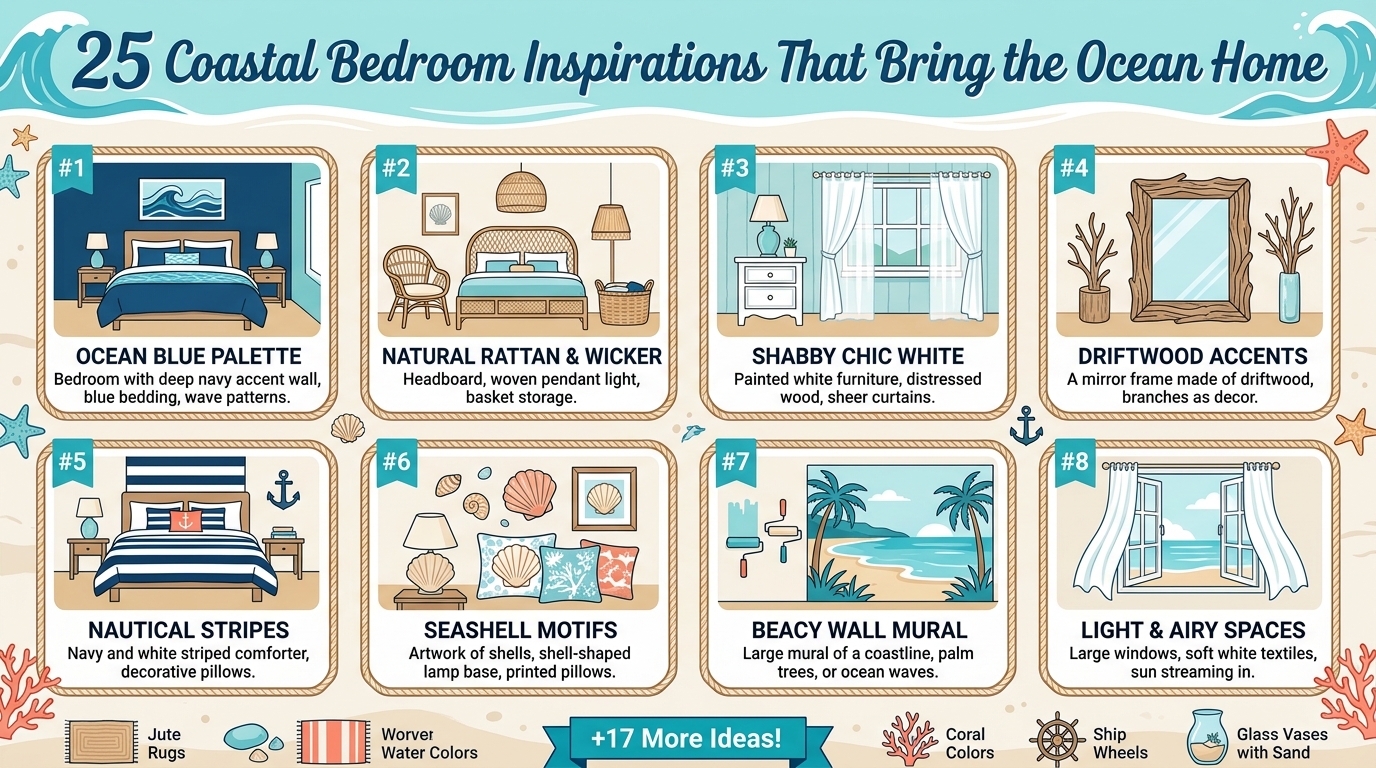
Coastal bedroom design is the art of translating the sensory experience of being near the ocean — the light, the texture, the unhurried quiet — into a sleeping space that feels genuinely restorative rather than merely nautical-themed. This article gives you 25 distinct coastal bedroom inspirations spanning color, material, lighting, furniture, accessories, layout, and small-space design.
There’s a particular quality of rest that happens in rooms near water. The light is softer and more horizontal. The textiles feel heavier, salted somehow, even when they’re fresh. The colors are neither warm nor cool but both at once — the grey-blue of early morning, the bleached ivory of driftwood, the faded green of sea glass found and pocketed. Coastal bedroom design captures that specific quality of stillness. Here are 25 ideas worth saving — and stealing.
Why Coastal Bedroom Design Works So Well
Coastal interior design draws from the vernacular architecture of seaside communities across three distinct traditions: the whitewashed simplicity of Mediterranean fishing villages, the weathered shingle-and-cedar aesthetic of New England coastal homes, and the airy, bleached-wood lightness of Australian beach house design. What unifies these traditions is a shared response to the same environmental conditions — intense natural light, salt air, and the psychological effect of proximity to open water. Coastal bedroom design translates these responses into interior choices: pale, light-reflective surfaces, natural fibers that age gracefully, and a palette that references the specific colors of water, sand, sky, and bleached organic material.
The material vocabulary is precise and shoppable. Think white-washed or limed oak for furniture; linen, waffle-cotton, and stonewashed cotton for bedding; sea-grass, jute, and sisal for rugs; rattan and cane for accent furniture. Hardware in brushed nickel, aged brass, or raw iron references maritime fittings. Specific color references: Benjamin Moore Sea Salt (2123-40) for a muted aqua wall, Farrow & Ball Borrowed Light (No. 235) for a pale blue-grey ceiling, SW Accessible Beige (SW 7036) for a warm sand base tone, and Sherwin-Williams Sea Serpent (SW 7615) for a deeper ocean-toned accent.
The cultural pull toward coastal bedrooms is consistent and durable — Pinterest searches for “coastal bedroom” and “beach house bedroom” sustain year-round rather than spiking seasonally, reflecting a genuine aspiration to live in the emotional register of a holiday even in an everyday bedroom. The trend has matured past its earlier, more literal expression (anchors, rope accents, starfish on every surface) toward a more sophisticated and genuinely livable interpretation that prioritizes atmosphere over motif.
Small bedrooms handle coastal design exceptionally well. The style’s dependence on light — pale walls, reflective surfaces, sheer window treatments — naturally expands perceived space. The material restraint of genuine coastal design (fewer decorative objects, more emphasis on textile quality and surface character) aligns perfectly with compact room constraints. Start with pale walls, linen bedding, and one natural-fiber rug before adding anything else.
Style at a Glance
| Element | Trait 1 | Trait 2 |
| Philosophy | Atmosphere over motif | Light and material honesty |
| Materials | Limed oak, linen, rattan, sea-grass | Waffle cotton, cane, aged brass, raw iron |
| Color palette | Bleached ivory, sea-glass blue, warm sand | Driftwood grey, ocean teal, soft white |
25 Coastal Bedroom Inspirations
1. Bleached Linen Bedding Foundation
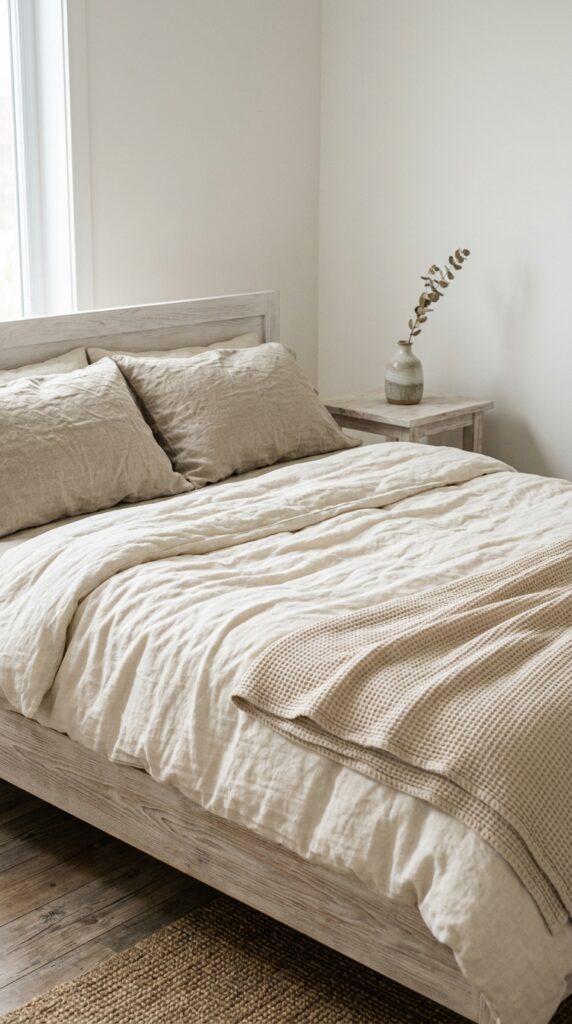
Vibe: Salt-bleached and serene — linen bedding that looks like it has been washed in the sea and dried in the sun a hundred times.
Why it works: Washed linen is the foundational coastal bedroom textile because its deliberate imperfection — the wrinkle, the softness, the slight unevenness of the weave — references the texture of weathered natural materials without requiring any specific coastal motif. The design principle is material authenticity: linen that has been stone-washed or enzyme-washed develops a surface character that reads as genuinely used and genuinely comfortable, which produces the relaxed quality that coastal bedrooms depend on. A low bed frame keeps the visual center of gravity close to the floor, amplifying the sense of horizontal ease.
How to get it: Choose 100% linen rather than linen-cotton blends — pure linen washes to a softer, more characterful texture than blends, which retain a slight stiffness from the cotton content. Look for OEKO-TEX certified linen in natural or undyed colorways; undyed linen has a warm, slightly golden tone that reads more authentically coastal than bright white.
💡 Quick Win: A single washed linen duvet cover in natural or bleached ivory ($45 to $90) transforms any bed into a coastal foundation — linen’s texture does more atmospheric work per object than any other coastal bedroom textile.
| Shop The Look |
| Washed linen duvet cover set natural ivory coastal |
| Stone washed linen pillowcase set natural |
| Waffle cotton throw blanket sand coastal bedroom |
| Whitewashed oak bed frame low profile |
| Ceramic bud vase small coastal neutral |
2. Sea-Glass Blue and White Palette
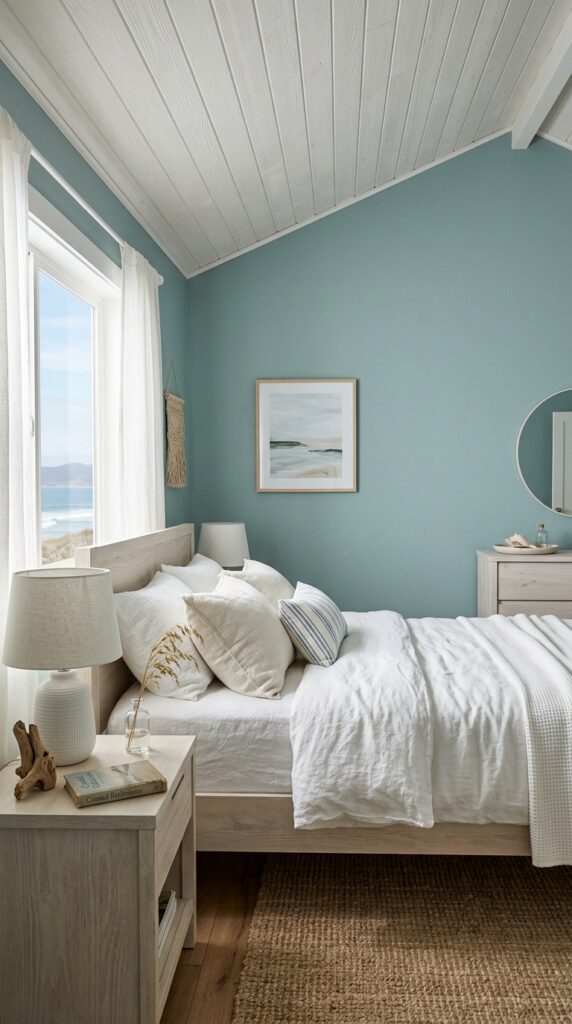
Vibe: Airy and quietly vivid — the color of the ocean at 7 in the morning, held on a wall all day.
Why it works: Sea-glass blue-green works in a coastal bedroom because it occupies the precise tonal territory between blue and green where water exists in nature — it is neither definitively one nor the other, which gives it the ambiguity and depth that makes ocean colors so visually interesting across changing light conditions. Against white ceiling and linen bedding, a muted sea-glass wall reads as a cool accent that recedes slightly, making the room feel larger while providing unmistakable coastal atmosphere. The muted, slightly grey quality of sea-glass colors (as opposed to turquoise or bright teal) is what keeps them elegant rather than tropical.
How to get it: Benjamin Moore Sea Salt (2123-40) and Farrow & Ball Dix Blue (No. 82) are the two most reliable sea-glass paint references. Apply in eggshell finish — flat reads too chalky for a color with this much blue-green depth; satin produces too much sheen.
| Shop The Look |
| Sea glass blue green bedroom wall paint matte |
| White linen bedding set coastal bedroom |
| Sheer white linen curtain panel bedroom coastal |
| White ceramic table lamp coastal bedroom |
| Driftwood decorative piece small coastal accent |
3. Rattan Bed Frame Statement
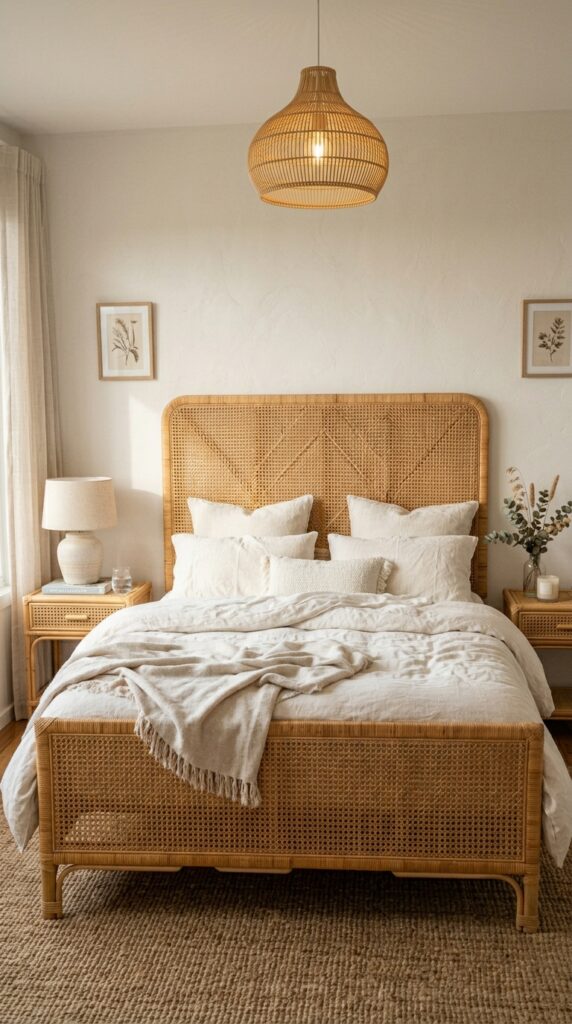
Vibe: Warm and organic — the bed frame that makes the room feel like it arrived from somewhere better.
Why it works: A rattan or cane bed frame is the single most impactful furniture investment in a coastal bedroom because the headboard is the room’s dominant focal surface and rattan’s natural weave pattern provides extraordinary visual texture — each individual cane strand is visible, creating a micro-pattern that rewards close inspection while reading as warm and unified from across the room. Rattan’s natural honey-to-amber tone introduces warmth that prevents the coastal palette from reading as cold, and its handmade quality carries the authenticity that machine-made furniture cannot replicate. The design principle is material as narrative — rattan tells you immediately where the room’s aesthetic allegiance lies.
How to get it: Choose rattan with a natural rather than lacquered finish — a clear matte coating allows the natural colour variation of the cane to remain visible, while high-gloss lacquer flattens the tone and makes the material look synthetic. Natural rattan also lightens slightly over years of UV exposure, which improves its character rather than degrading it.
| Shop The Look |
| Rattan bed frame natural honey woven headboard |
| Rattan bedside table natural coastal bedroom |
| Sea grass area rug bedroom coastal neutral |
| Rattan pendant light natural bedroom coastal |
| White linen bedroom cushion set coastal |
4. Driftwood Grey and Warm White Palette
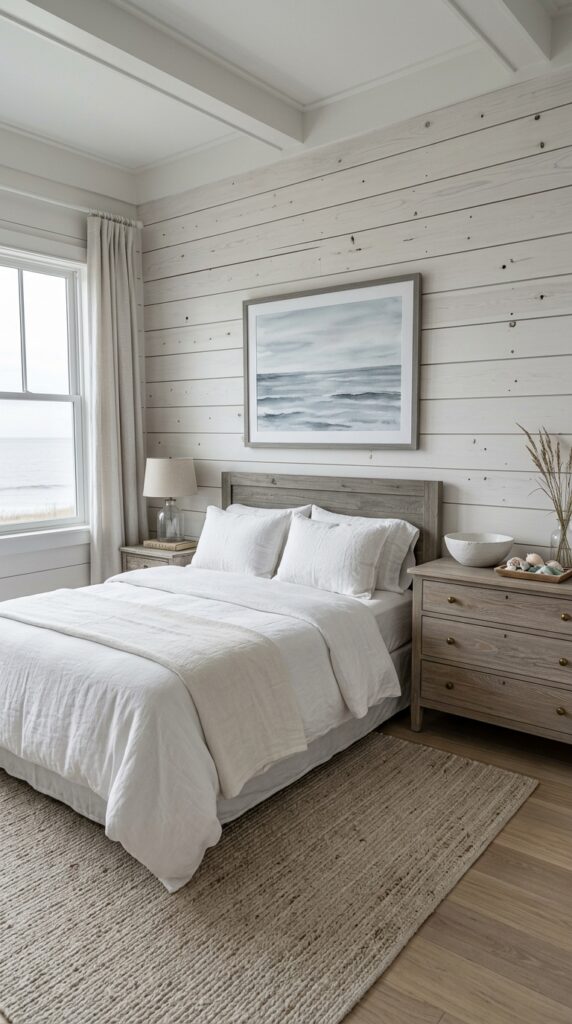
Vibe: Calm and coastal-grey — the palette of a beach walk at dawn before the colour has fully arrived.
Why it works: Driftwood grey is one of the most distinctly coastal tones because it references a specific material process — wood bleached by sun and salt over years — that carries a visible history of exposure and time. In a bedroom palette, driftwood grey operates as a warm neutral that reads cooler than beige but warmer than true grey, which allows it to work with both warm whites and sea-blue accents without creating tension. The design principle is material reference without imitation — the palette evokes the driftwood process without placing actual driftwood everywhere.
How to get it: Achieve driftwood grey on a dresser or furniture piece by applying a diluted white-grey exterior wood stain (1 part stain to 3 parts water) over a lightly sanded raw or previously painted surface, then wiping back before it dries — the technique deposits grey pigment in the wood grain while leaving the surface predominantly natural, replicating the bleached-grey quality of genuine driftwood.
| Shop The Look |
| Bleached grey oak bedroom dresser coastal |
| Driftwood grey wood stain outdoor coastal finish |
| Natural sisal bedroom rug neutral coastal |
| White ceramic bowl bedside table coastal |
| Framed coastal watercolour print bedroom |
5. Sheer White Canopy Over the Bed
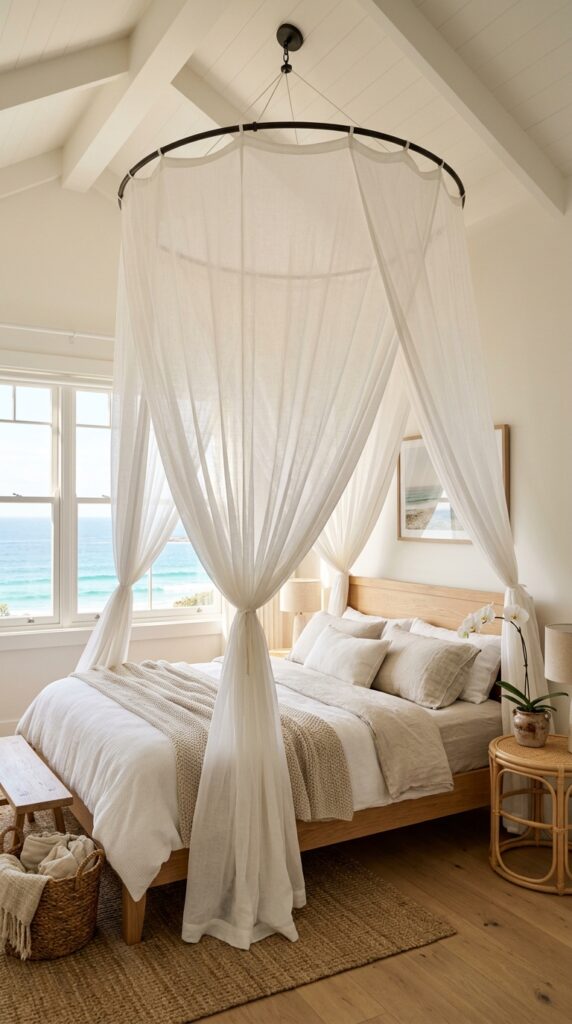
Vibe: Luminous and softly enclosed — the canopy that turns a bedroom into something that feels deliberately apart from the day.
Why it works: A bed canopy in a coastal bedroom applies the design principle of soft enclosure — creating the psychological intimacy of a room-within-a-room at the bed using only fabric rather than architecture. Sheer white linen is the correct material because it filters rather than blocks light, which means the canopy maintains the airiness and brightness that coastal bedrooms require while providing the enclosed quality that promotes rest. The ceiling-mount ring installation (a single hook or recessed ceiling mount) keeps the canopy hardware invisible and the gesture architecturally clean.
How to get it: Use a 24-inch embroidery hoop, a ceiling-mounted curtain ring, or a purpose-built canopy ceiling mount as the anchor. Four panels of 110-inch-long sheer linen (two facing the room, two at the wall side) provide the correct visual weight without creating a heavy, tent-like enclosure.
💡 Quick Win: A single ceiling hook ($3) and four meters of sheer white linen fabric ($18 to $25 per meter) creates a complete bed canopy for under $60 — one of the highest atmosphere-per-dollar investments in coastal bedroom design.
| Shop The Look |
| Sheer white linen bed canopy panels set coastal |
| Ceiling mount canopy ring bed coastal bedroom |
| White orchid plant ceramic pot coastal bedroom |
| Natural linen bedding set white coastal |
| Rattan nightstand small coastal bedroom |
6. Coastal Gallery Wall with Natural Frames
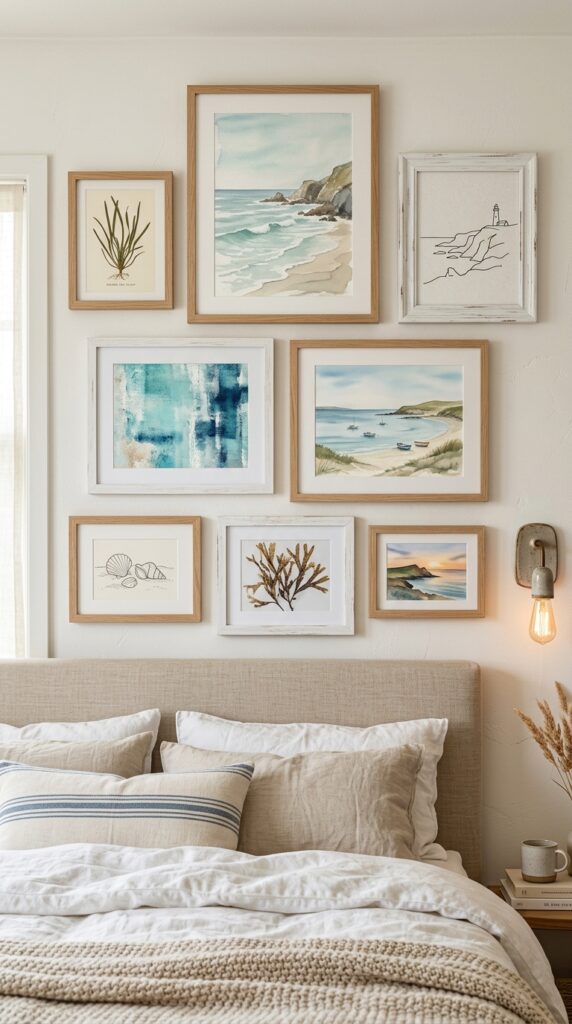
Vibe: Curated and personal — the wall that looks like it was assembled over years of looking at things carefully.
Why it works: A coastal gallery wall succeeds through subject and material cohesion — every piece referencing water, coast, or marine botanical subjects in the same muted blue-green-sand palette, and every frame in the same two-material family (natural timber and bleached white). The design principle is variety within constraint: the subjects differ (landscape, botanical, abstract, drawing) but the palette and frame materials unify the arrangement. Loose, organic hanging arrangements (staggered heights, mixed frame sizes, some pieces overlapping slightly in visual density) read as personally assembled rather than professionally styled, which is the exact quality that makes a gallery wall feel inhabited.
How to get it: Before hanging, arrange all pieces on the floor and photograph from directly above to assess the composition. Maintain 2 to 3 inches between frames throughout — too little gap makes the arrangement read as crowded; too much loses the cohesion of a gallery grouping.
| Shop The Look |
| Natural timber frame gallery wall set coastal |
| Bleached white distressed frame set coastal |
| Coastal watercolour seascape art print set |
| Pressed sea plant botanical framed art coastal |
| Abstract blue tonal art print bedroom coastal |
7. Woven Seagrass Headboard
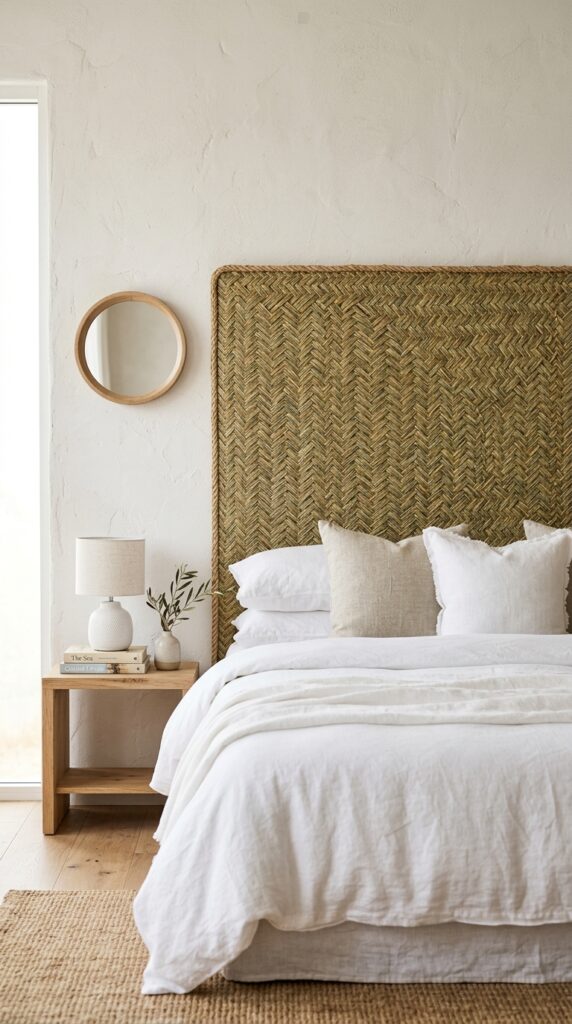
Vibe: Natural and textured — a headboard woven from the same material as the beach beneath you.
Why it works: Seagrass introduces a specific coastal material narrative — it is literally a marine plant, and its gold-green natural tone and basket-weave texture reference tidal pools, woven fishing traps, and beach mats in a way that no manufactured material replicates. As a headboard material, seagrass provides extraordinary tactile and visual texture at the room’s focal surface without introducing color — its natural tone is a warm neutral that recedes against white walls while still registering clearly as organic and coastal. The herringbone or basket weave pattern creates a geometric order that prevents the material from reading as purely rustic.
How to get it: Wall-mount the headboard using heavy-duty picture-hanging hardware rated for the panel weight — seagrass headboard panels are typically 6 to 12kg and require two or three anchor points into studs or wall anchors. A thin French cleat mounted horizontally behind the headboard panel provides the most secure and level installation.
| Shop The Look |
| Woven seagrass headboard wall mount coastal |
| White linen bedding set coastal beach house |
| Raw wood bedside table natural coastal |
| White ceramic table lamp coastal bedroom |
| Linen scatter pillow set natural coastal bedroom |
8. Coastal Blue Limewash Accent Wall
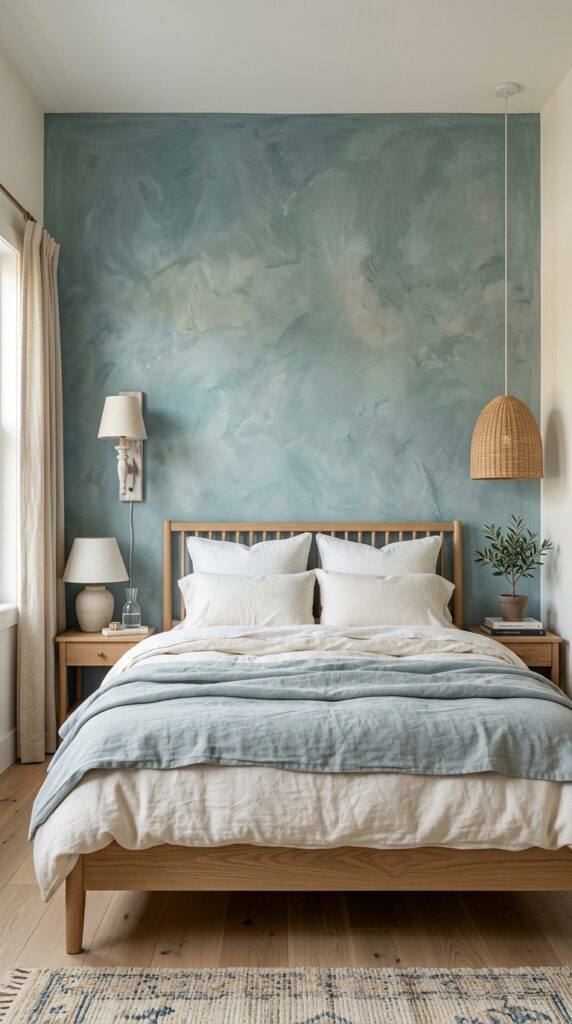
Vibe: Soft and materially rich — a wall that shifts between blue and grey like the water does on an overcast day.
Why it works: Limewash in a coastal blue-grey tone is the most nuanced way to introduce ocean color into a bedroom because its layered application creates tonal variation — the surface reads as lighter in bright morning light and deeper in the softer light of evening, mimicking the way water changes color through the day. This application of light-responsive surface character aligns perfectly with coastal design’s core principle: that the room should respond to the quality of natural light around it rather than presenting a static color story. Portola Paints Roman Clay in a blue-grey tone or Farrow & Ball Limewash in Borrowed Light are the most reliable coastal references.
How to get it: Apply coastal blue limewash in two or three layers, allowing each coat to dry partially before applying the next — full drying between coats produces a flatter, more uniform result than the layered tonal depth that makes limewash distinctive. The final layer should be applied in random cross-hatched strokes at varying opacity.
| Shop The Look |
| Coastal blue grey limewash wall paint mineral |
| White oak bed frame low coastal bedroom |
| Whitewashed wood wall sconce coastal bedroom |
| Rattan pendant light bedroom natural coastal |
| Linen bedding cushion set ivory coastal |
9. Natural Rope and Jute Textile Accents
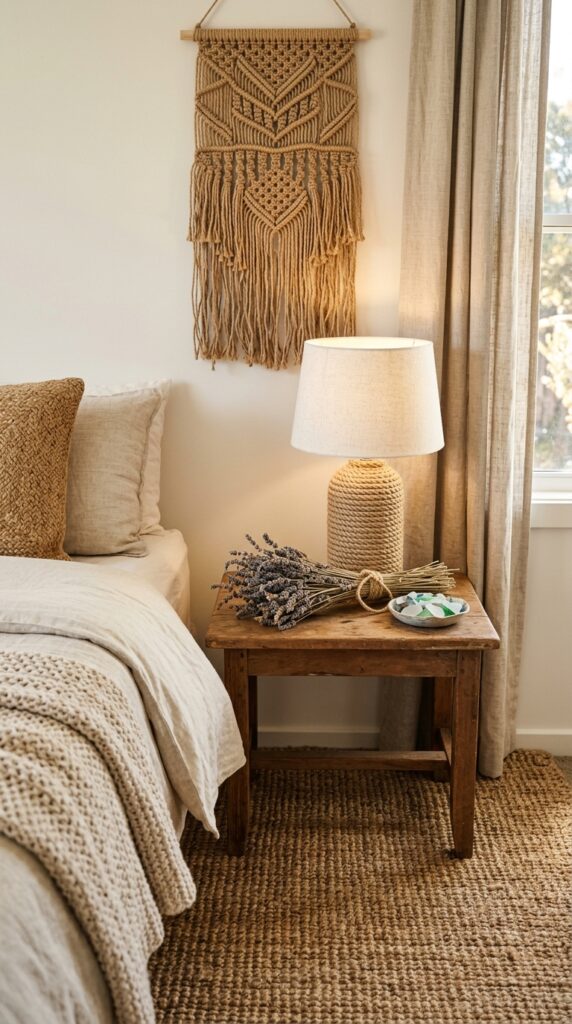
Vibe: Warm and tactile — the corner that smells of salt and dried flowers even when it doesn’t.
Why it works: Natural rope and jute accents work in a coastal bedroom through the principle of material family cohesion — jute, sisal, hemp, and natural cotton rope all share the same undyed warm-tan colour family and the same fibrous, hand-made quality. When multiple objects in a room share this material language, the room develops an organic warmth that feels genuinely coastal rather than decorated for coastal appearance. The key is keeping all rope and jute accents undyed and natural — the moment one piece is painted or dyed, it steps out of the material family and the coherence breaks.
How to get it: A rope-wrapped lamp base is a straightforward DIY: wrap a standard ceramic lamp base with thick natural cotton rope ($8 to $15 for 10 metres), starting at the base and working upward with marine adhesive applied in sections. The result is indistinguishable from purpose-made rope lamps that cost significantly more.
| Shop The Look |
| Natural jute area rug bedroom coastal neutral |
| Rope wrapped table lamp base coastal bedroom |
| Woven jute wall hanging bedroom coastal |
| Dried sea lavender bundle natural coastal |
| Sea glass collection display dish coastal |
10. White Shiplap Feature Wall
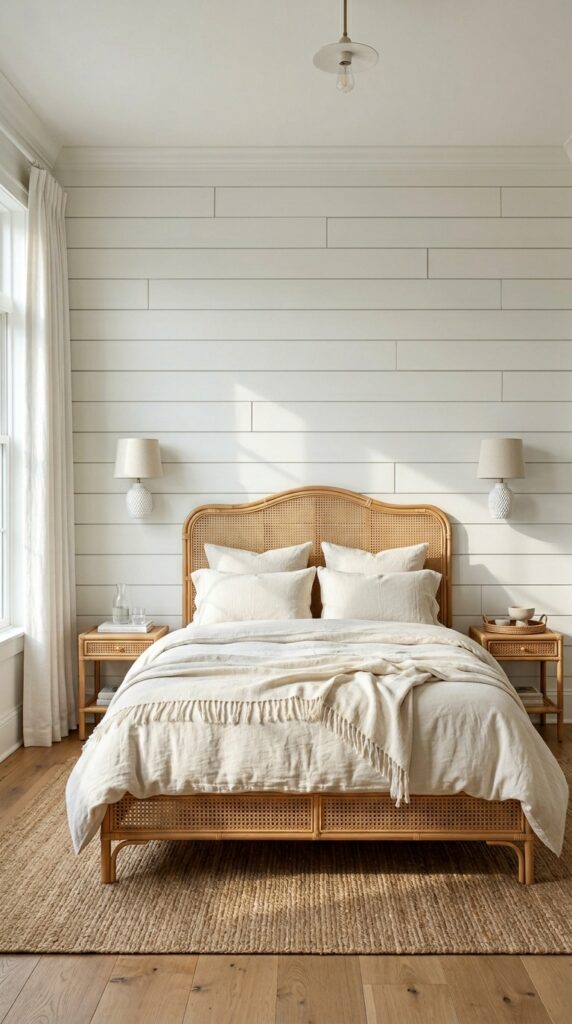
Vibe: Clean and architecturally coastal — shiplap that references the weatherboard cladding of every great beach house.
Why it works: White shiplap in a coastal bedroom works on the principle of architectural reference — the horizontal boards evoke the weatherboard siding of traditional seaside architecture, which carries the entire coastal narrative without requiring any decorative objects to support it. The shadow grooves between each board create a horizontal rhythm that makes rooms feel wider while also providing the subtle surface texture that distinguishes a shiplap wall from a flat painted surface. White paint on shiplap — specifically a warm white rather than a cool white — maximises light reflection and creates the bright, sun-filled quality that coastal bedrooms require.
How to get it: Install shiplap boards with a consistent 3mm shadow gap between each course — this gap is what creates the defining horizontal shadow line that gives shiplap its visual rhythm. Use 90mm-wide tongue-and-groove pine boards for the most authentic weatherboard proportion, and paint in Benjamin Moore Chantilly Lace (OC-17) for the warmest white result.
💡 Quick Win: Peel-and-stick shiplap panels in a whitewashed finish ($35 to $60 per panel) install in hours with no carpentry skill and create the full shiplap visual effect — a genuinely effective shortcut for renters or those unwilling to commit to fixed wall modification.
| Shop The Look |
| White shiplap wall panelling coastal bedroom |
| Peel stick shiplap panel whitewash coastal |
| White ceramic wall sconce pair coastal bedroom |
| Rattan bed frame honey natural coastal |
| Natural linen bedding set bedroom coastal |
11. Coastal Bedroom in Warm Sand and Terracotta
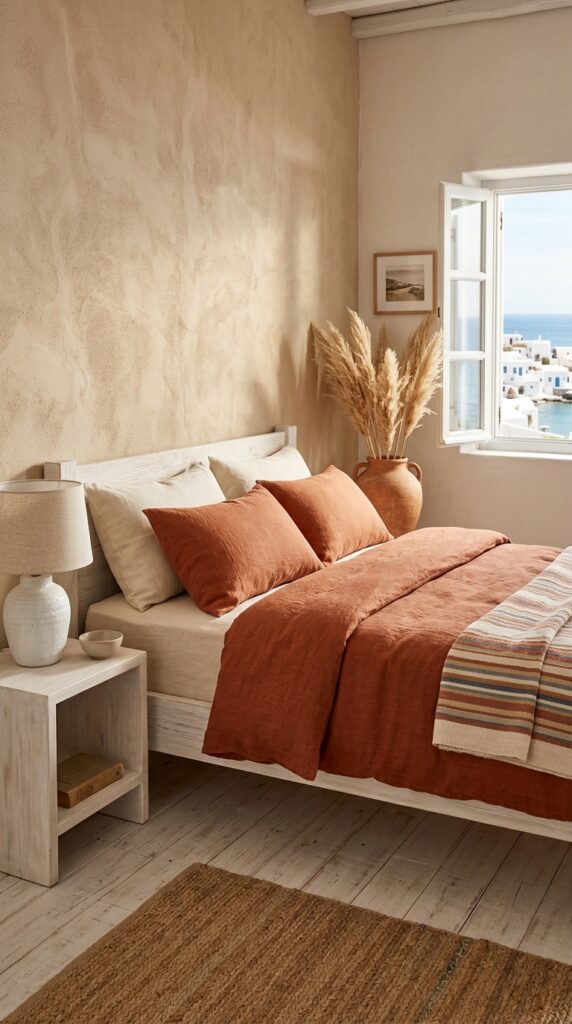
Vibe: Sun-warm and grounded — the bedroom palette of a whitewashed village above the sea.
Why it works: Terracotta and warm sand are the Mediterranean expression of coastal design — they reference the dry, sun-bleached earth of coastal cliffs and village walls rather than the cooler blue-grey tones of northern Atlantic design. This palette works in a bedroom because both terracotta and sand are warm neutrals that create genuine psychological warmth under both natural and artificial light. The design principle is climate reference: Mediterranean coastal design draws colour from the land (terracotta, ochre, sand) as much as from the sea, which produces a more grounded, earthy version of coastal atmosphere than purely blue-and-white schemes.
How to get it: Use terracotta as the bedding accent color rather than the wall color — terracotta walls in a bedroom can read as warm to the point of heaviness under evening light. Terracotta linen in bedding, cushions, and throws is portable and reversible; terracotta walls require repainting to change.
| Shop The Look |
| Terracotta linen duvet cover set coastal bedroom |
| Large terracotta floor vase bedroom coastal |
| Dried pampas grass bundle tall natural coastal |
| Woven cotton blanket warm stripe coastal |
| Sand tone mineral plaster wall paint bedroom |
12. Cane and Wicker Bedroom Furniture Set
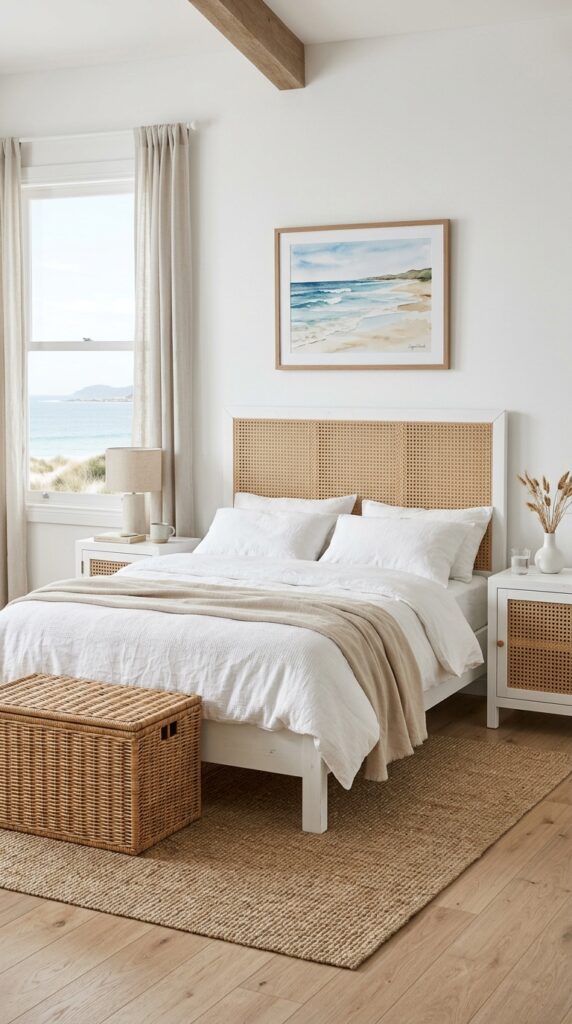
Vibe: Airy and timeless — the furniture set that looks as right in 1975 as it does today.
Why it works: Cane-panel furniture in a coastal bedroom applies the principle of material repetition across the furniture set — when the headboard, bedside tables, and storage pieces all share the cane panel as their defining material detail, the room achieves a furniture-family cohesion that reads as designed rather than assembled. Cane has a graphic quality — the hexagonal or square grid of the woven panel — that provides pattern in a room that would otherwise rely entirely on textiles for visual interest. White-painted timber frames around the cane panels keep the furniture within the coastal palette while adding structural definition.
How to get it: If purchasing cane furniture from different sources, ensure all pieces use the same cane weave style — open hexagonal weave and closed square weave read as fundamentally different patterns and will appear mismatched when placed in the same room.
| Shop The Look |
| Cane bed frame white painted timber coastal |
| Cane panel bedside table white coastal bedroom |
| Wicker storage basket bedroom foot coastal |
| Natural seagrass rug bedroom coastal |
| Coastal watercolour art print bedroom wall |
13. Pendant Lantern Lighting Over the Bed
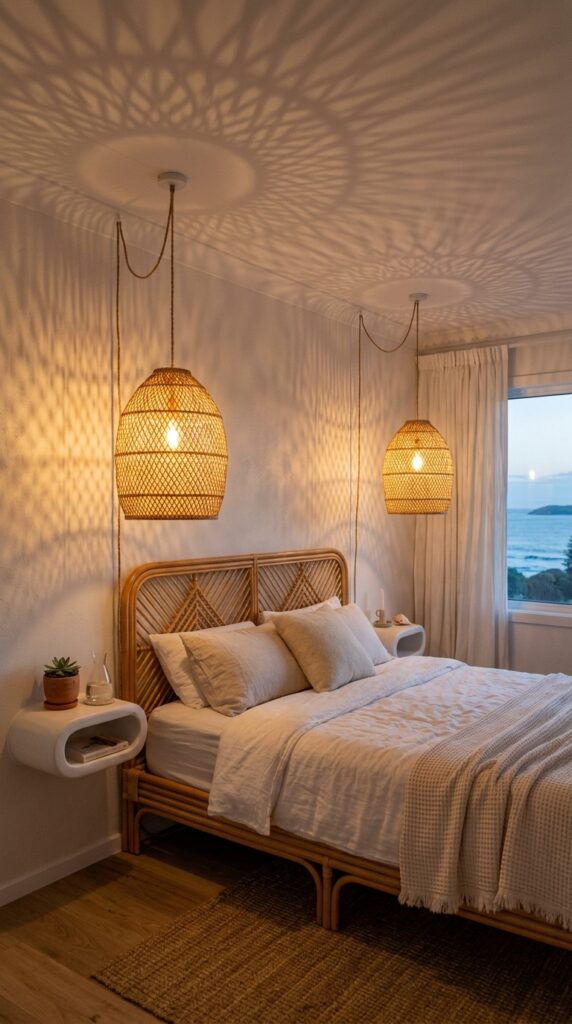
Vibe: Warm and patterned — the light that turns the ceiling into the most interesting surface in the room.
Why it works: Woven rattan pendant lanterns over the bedside function as lighting, furniture, and decoration simultaneously — they replace the bedside table lamp (freeing the surface entirely), provide warm task light for reading, and project the rattan weave pattern as decorative shadow onto the ceiling and walls. This is the design principle of light as material — the pendant’s material (rattan) actively shapes the light it emits and produces a secondary decorative effect (shadow pattern) that makes the lamp’s contribution to the room greater than simple illumination. Hanging pendants at different heights on either side of the bed creates dynamic asymmetry rather than mirror-image rigidity.
How to get it: Wire pendant lights over the bedside require ceiling junction boxes — if hardwiring is not feasible, plug-in pendant lights with a fabric cord and ceiling hook achieve the same visual effect without electrical work. Ensure the pendant hangs with its lower edge at 140 to 150cm from the floor — high enough to clear a seated reading position, low enough to provide focused light on the bedside surface.
| Shop The Look |
| Rattan pendant lantern woven bedroom coastal |
| Plug in pendant light fabric cord coastal |
| White ceramic wall shelf bedside floating |
| Rattan bed frame bedroom natural coastal |
| White linen bedding set natural coastal |
14. Coastal Bedroom with Exposed Timber Ceiling
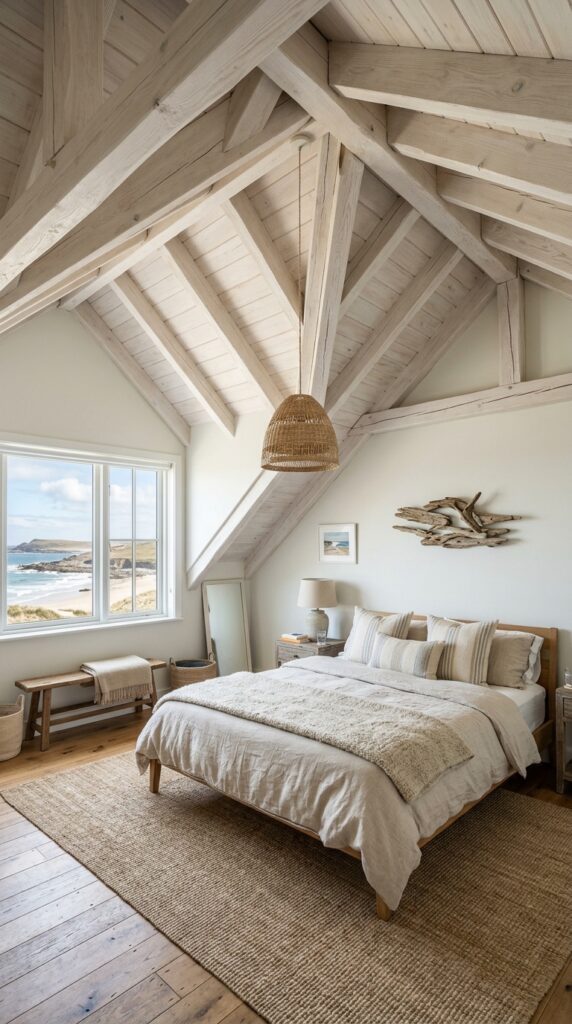
Vibe: Airy and architecturally rich — the ceiling that makes the room feel like it was always a beach house, even if it wasn’t.
Why it works: An exposed whitewashed timber ceiling activates the room’s most underused surface — the ceiling — as an architectural feature that does significant atmospheric work. The horizontal rhythm of ceiling boards (or the sculptural quality of exposed beams) references the structural character of traditional coastal vernacular architecture — weatherboard beach houses, converted fishing sheds, and seaside bungalows. Whitewashing rather than painting the timber preserves visible grain character while lightening the tone enough to prevent the ceiling from feeling heavy or dark.
How to get it: Whitewash timber ceiling boards by applying a diluted white exterior paint (1 part paint to 2 parts water), brushing on in the direction of the grain and wiping back immediately with a damp cloth — the technique deposits white pigment in the grain while leaving the wood surface predominantly natural, creating the correct translucent whitewash quality.
| Shop The Look |
| Whitewash timber ceiling board coastal bedroom |
| Tongue groove ceiling panelling white coastal |
| Rattan hanging pendant ceiling coastal bedroom |
| Worn sisal rug bedroom natural coastal |
| Driftwood wall art piece coastal bedroom |
15. Blue and White Stripe Textile Accents
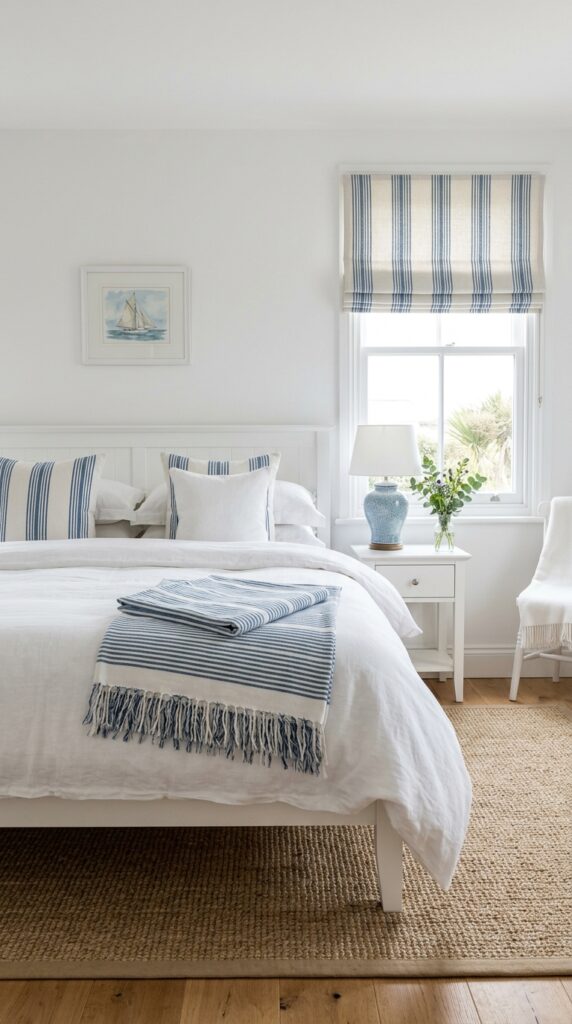
Vibe: Crisp and coastal-classic — the stripe that has been right for coastal rooms since the first sailor went home.
Why it works: Blue-and-white stripe is the most historically grounded coastal textile pattern — it originated in 19th-century Breton fishing villages as the marinière stripe of sailors’ shirts and has remained the defining coastal textile reference across two centuries of interior design. In a bedroom, the stripe works best when applied to soft furnishings at 30% of the room’s textile volume — cushions, one throw, and one window treatment — against a predominantly white or neutral base. This proportion allows the stripe to read as a confident coastal reference without dominating the room’s visual field, which is what happens when stripe is overused.
How to get it: Choose a stripe in which the blue tone carries a slightly grey or faded quality rather than saturated navy — true coastal stripe is closer to the blue of faded maritime paint than to a crisp graphic navy. Stonewashed or pre-washed linen stripe achieves this quality more convincingly than cotton.
💡 Quick Win: A set of two blue-and-white stripe linen cushion covers ($25 to $40 total) on a white or linen-toned bed instantly establishes the coastal textile palette without any further investment.
| Shop The Look |
| Blue white stripe linen cushion cover set coastal |
| Cotton stripe throw blanket coastal bedroom |
| Stripe linen roman blind coastal bedroom |
| White bed frame coastal bedroom simple |
| Natural sisal rug bedroom coastal neutral |
16. Low Driftwood Platform Bed
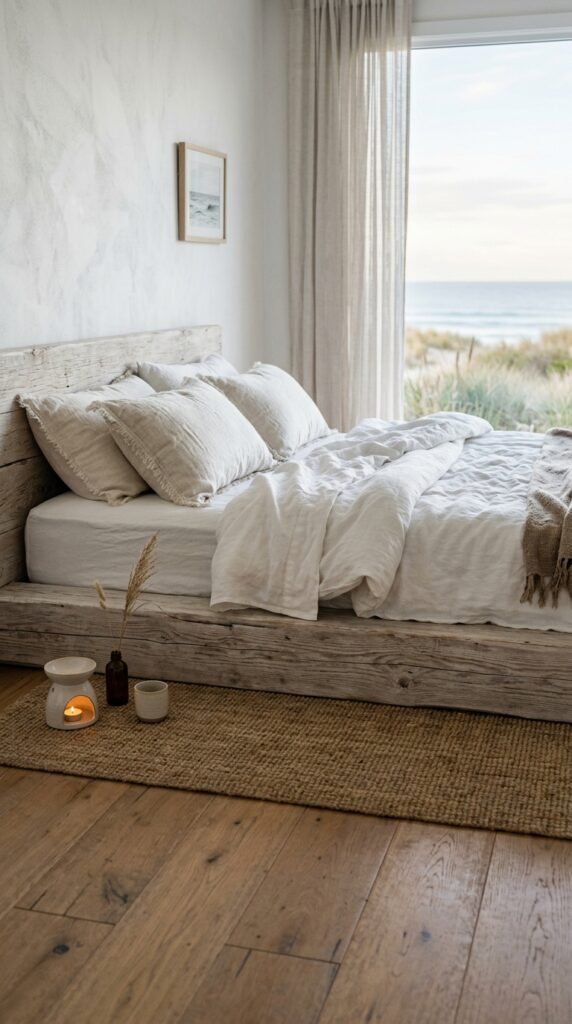
Vibe: Grounded and quietly elemental — the bed that puts you as close to the floor as the sea puts you to the earth.
Why it works: A low platform bed in a coastal bedroom applies both literal and symbolic grounding — literally reducing the sleeping surface to near-floor level, and symbolically referencing the sleeping arrangements of beach and coastal cultures where low, mat-level sleeping is traditional. The driftwood finish achieves the bleached, weathered quality of genuine driftwood through a controlled surface treatment rather than relying on actual salvaged material, which ensures dimensional consistency while maintaining the material narrative. At platform height, the ceiling appears dramatically higher, which amplifies the airy coastal quality of the room.
How to get it: A platform bed under 12 inches in total height requires a mattress with some internal rigidity (latex or pocket-spring) rather than an all-foam mattress — very soft foam mattresses compress to the point of feeling like floor-sleeping at low platform heights. A 25cm mattress on a 10cm platform provides adequate sleeping comfort while maintaining the visual floor-proximity aesthetic.
| Shop The Look |
| Low platform bed driftwood finish bleached coastal |
| Flat woven seagrass mat bedroom floor coastal |
| Low ceramic oil burner floor coastal bedroom |
| Bleached timber driftwood finish bed slat base |
| White linen bedding deep platform coastal |
17. Coastal Bedroom Scent and Sensory Layer
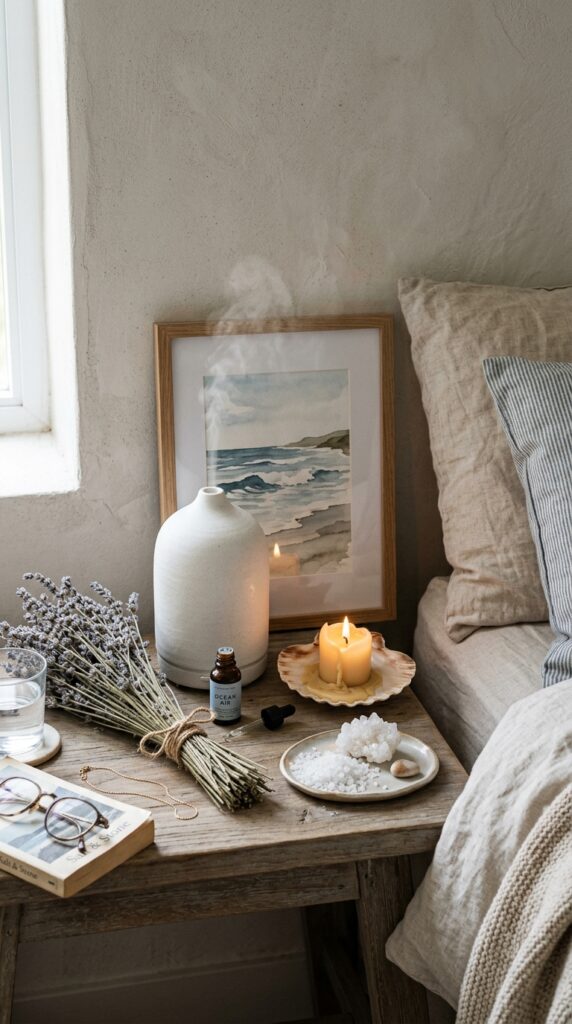
Vibe: Serene and sensory — the bedside that engages every sense quietly before it engages any of them loudly.
Why it works: A coastal bedroom’s atmospheric quality depends on sensory completeness — not just the visual but also the olfactory and tactile. Grouping a diffuser, dried botanicals, and a candle on the bedside table creates what designers call a sensory anchor: a vignette with a clear scent and tactile narrative. Sea lavender, beeswax, and sea salt as combined scent references produce a genuinely marine-botanical olfactory landscape that reinforces the visual coastal palette. The design principle is multi-sensory coherence — everything in the vignette should support the same experiential atmosphere.
How to get it: Use a reed diffuser with a coastal fragrance profile (sea salt, driftwood, marine accord) rather than a plug-in or candle as the primary scent delivery — reed diffusers maintain a consistent scent level without requiring active lighting or monitoring, which is particularly suited to bedroom use where the occupant may sleep while the scent is active.
| Shop The Look |
| White ceramic reed diffuser coastal bedroom |
| Dried sea lavender bundle bedroom coastal |
| Raw sea salt crystal decorative dish |
| Beeswax candle shell form holder coastal |
| Small coastal framed art print bedside |
18. Linen Roman Blind with Timber Hardware
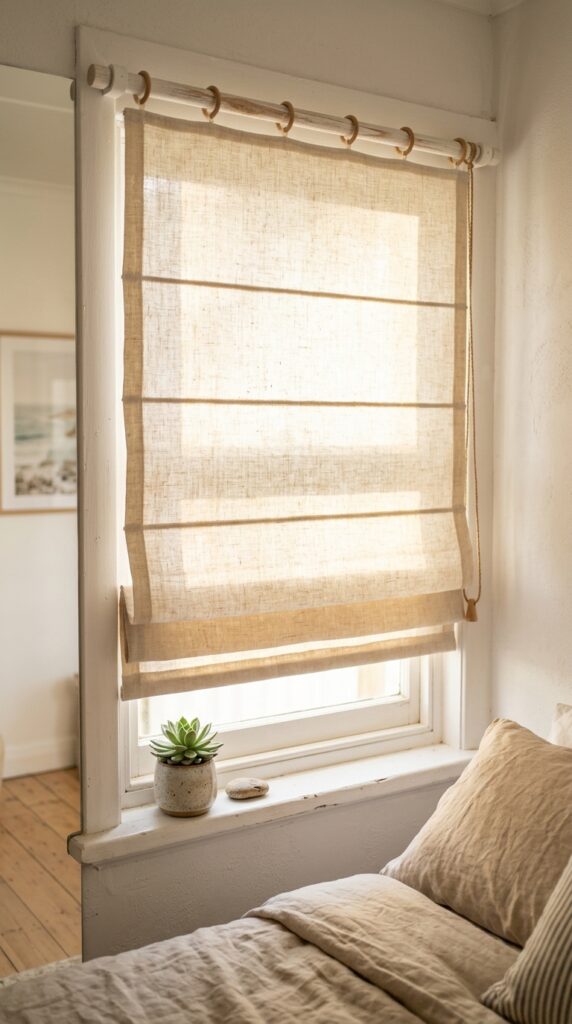
Vibe: Warm and luminous — the window treatment that turns morning light into something worth waking for.
Why it works: A natural linen roman blind on a timber hardware rod is the most resolved coastal window treatment because it combines the correct material (linen), the correct light quality (filtered, warm, diffused), and the correct hardware material (timber) into a single window element that needs nothing else to complete it. The roman blind’s horizontal fold lines when raised echo the shiplap wall and ceiling board rhythms common in coastal bedrooms, creating a coherent horizontal language throughout the room. Timber ring-and-rod hardware replaces metal hardware aesthetically while maintaining the same mechanical function.
How to get it: Mount the blind rod at ceiling height rather than at the window header — extending the blind from ceiling to sill makes the window appear significantly taller and the room more generous in proportion, even if the actual window height is standard.
| Shop The Look |
| Natural linen roman blind bedroom coastal |
| Timber curtain rod wooden ring coastal bedroom |
| Small ceramic pot window ledge coastal bedroom |
| Undyed linen roman blind kit natural |
| White painted timber curtain hardware coastal |
19. Compact Coastal Bedroom with Built-In Window Seat
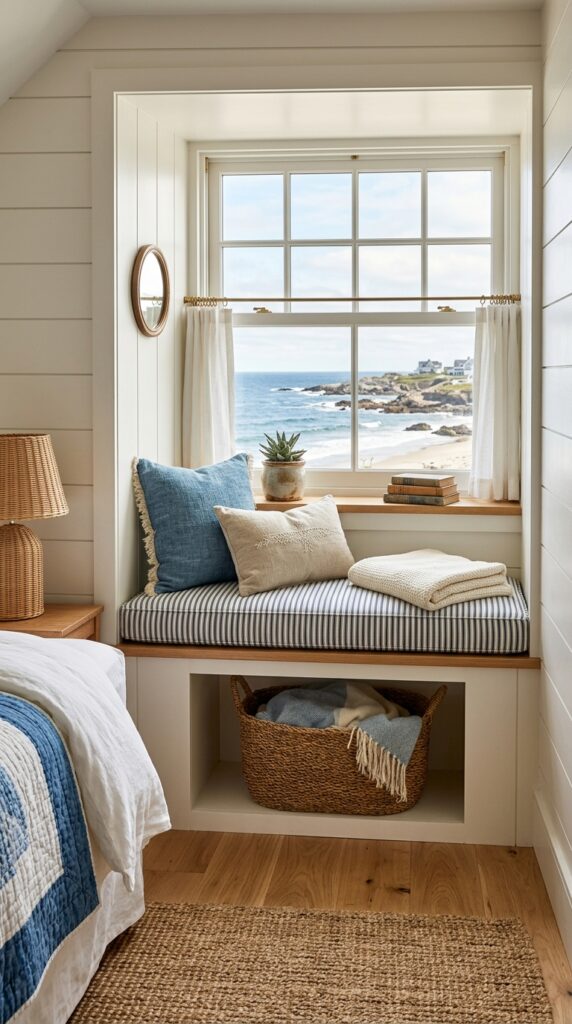
Vibe: Cosy and coastal — the window seat that makes you choose between the bed and itself every morning.
Why it works: A built-in window seat in a compact coastal bedroom solves two problems simultaneously — it creates additional seating and a dedicated daytime rest zone without consuming floor space, and it activates the window as a destination rather than just a light source. The design principle is spatial multiplication: one architectural element (the window seat) performs the functions of a chair, a storage chest (with lift-lid compartments below), and a reading nook, which is exactly the kind of multi-function thinking that compact rooms require. Ticking stripe in navy and white on the seat cushion introduces coastal pattern at exactly the right scale — prominent enough to define the zone, restrained enough not to dominate.
How to get it: Build the window seat at 450mm seat height and 550mm minimum seat depth for comfortable lounging — below these dimensions, the seat functions only as a perch rather than as a genuine rest surface.
💡 Quick Win: A storage ottoman in a ticking-stripe or natural linen fabric placed below a bedroom window replicates the visual and functional effect of a built-in window seat without construction — it also stores seasonal bedding and provides overflow seating.
| Shop The Look |
| Ticking stripe window seat cushion coastal |
| Coastal blue linen cushion cover set bedroom |
| Storage ottoman window seat coastal bedroom |
| Lift lid storage bench bedroom coastal |
| Small bedroom plant ceramic pot windowsill |
20. Whitewashed Plank Floor in Bedroom
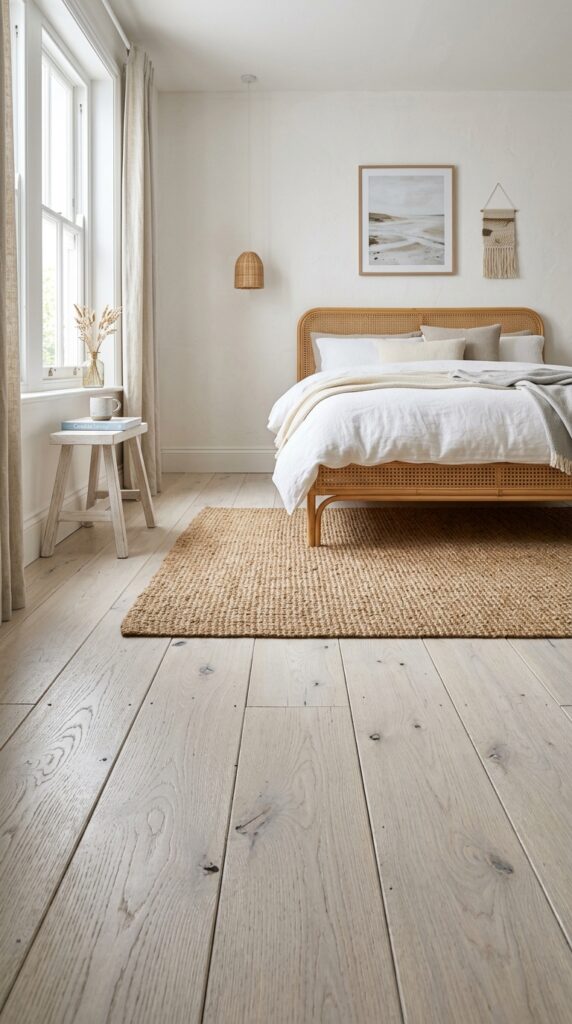
Vibe: Bleached and airy — the floor that looks like decades of barefoot mornings across sun-warmed boards.
Why it works: Wide-plank whitewashed oak flooring is the coastal bedroom’s most impactful single investment because it covers the largest surface in the room and establishes the room’s material foundation before any furniture or textile decisions are made. The whitewash finish — a semi-transparent white stain that penetrates the wood grain rather than coating it — produces a bleached, salt-air quality that references seaside architecture authentically while maintaining the warmth of natural oak grain beneath. Wide planks (150mm minimum, 200mm ideal) reduce the number of visible joint lines, creating a more open, expansive floor plane.
How to get it: For existing floors, a wood whitewashing kit applied over a lightly sanded surface ($40 to $80) achieves a convincing whitewash result on any light-toned timber. Dark-stained or treated timber floors require stripping before whitewashing — the existing stain will prevent the white pigment from penetrating the grain correctly.
| Shop The Look |
| Wide plank whitewashed oak flooring bedroom |
| Wood whitewash kit timber floor coastal |
| Natural jute rug bedroom large coastal |
| Low rattan bed frame coastal bedroom |
| Whitewash floor stain water based coastal |
21. Coastal Bedroom with Outdoor-Indoor Connection
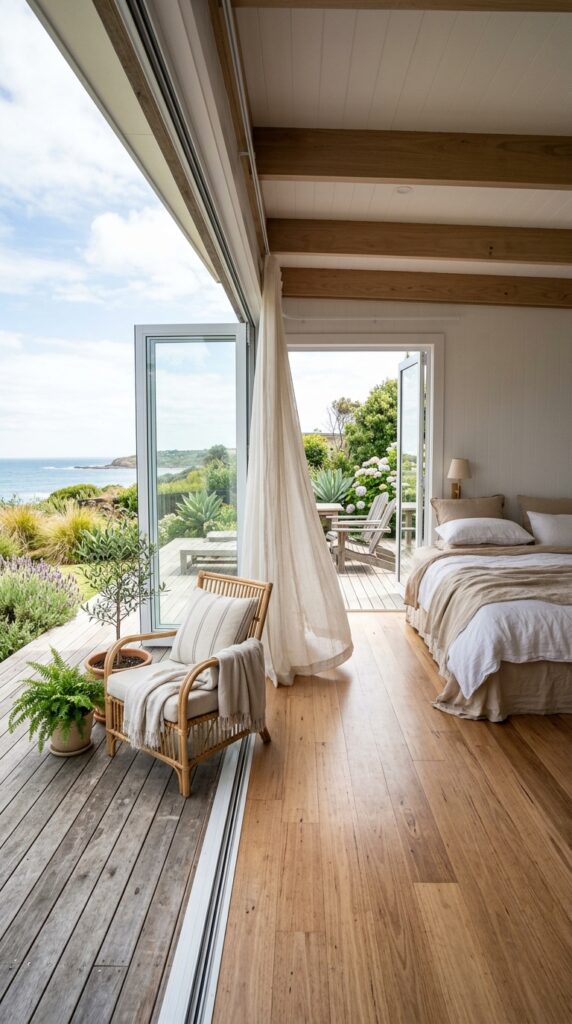
Vibe: Open and luminous — the bedroom that makes the distance between inside and outside entirely negotiable.
Why it works: Direct bedroom-to-outdoor connection applies the fundamental coastal design principle of dissolving the interior-exterior boundary — the most defining characteristic of authentic coastal homes that separates them from coastal-themed interiors. When bedroom floor material, palette, and furniture continue onto an adjoining deck or terrace, the sleeping space expands psychologically to include the outdoor air. Sheer linen curtain panels that billow in the opening create a physical threshold while maintaining visual and atmospheric continuity between the two zones.
How to get it: Continue the same flooring material from the interior bedroom to the exterior deck for maximum boundary dissolution — use a timber species rated for both indoor and outdoor use (teak, ipe, or treated pine) finished with a UV-stable oil that reads consistently in both light conditions.
| Shop The Look |
| Sheer linen panel bedroom outdoor door coastal |
| Rattan armchair indoor coastal bedroom |
| Bifold door threshold timber strip indoor outdoor |
| Outdoor floor timber teak deck boards coastal |
| Threshold plant pot set indoor outdoor coastal |
22. Shell and Stone Decorative Collection
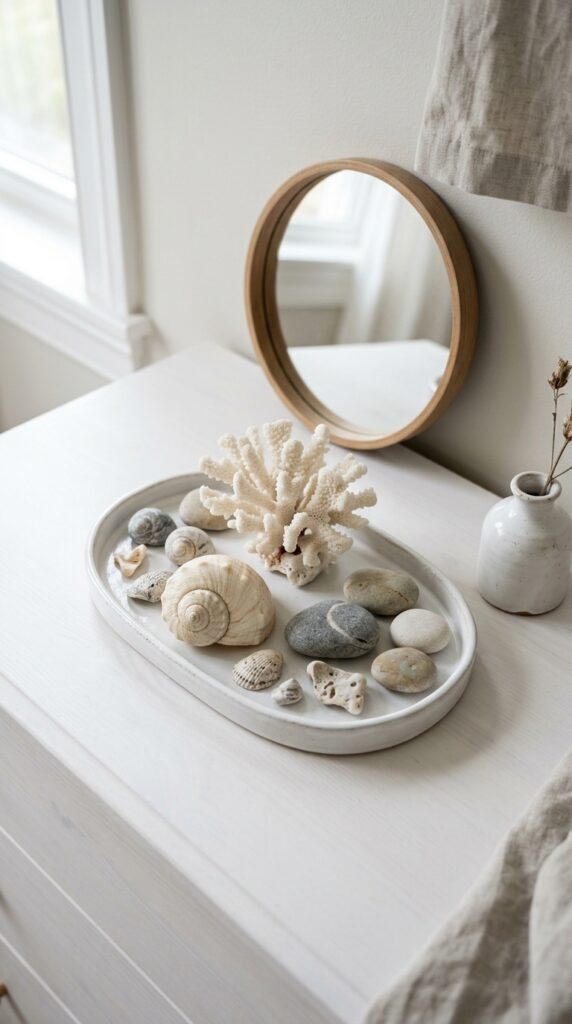
Vibe: Composed and quietly natural — a collection that looks found rather than bought.
Why it works: A curated shell and stone collection in a coastal bedroom succeeds or fails entirely on curation — the difference between a composed coastal still life and a cluttered seaside souvenir shelf is editing. Three to five shells of genuinely interesting form (spiral cowrie, ridged scallop, smooth nautilus), two or three ocean-smoothed stones of varied size, and one piece of coral or sea glass in a single containing vessel create a composed still life with a clear visual hierarchy: the tray defines the collection’s boundary, the largest shell provides the anchor, and the stones provide grounded contrast. The principle is intentional selection over accumulation.
How to get it: Restrict the collection to one containing vessel — a white ceramic tray, a flat wooden board, or a glass cloche — and edit strictly to objects that differ in form, texture, or scale from each other. Two similar shells side by side read as a repetition; one shell and one smooth stone beside each other read as a composition.
| Shop The Look |
| White ceramic display tray coastal bedroom |
| Natural shell collection decorative coastal |
| Ocean smooth stone set decorative coastal |
| White coral piece decorative coastal bedroom |
| Ceramic bud vase small bedroom coastal |
23. Coastal Bedroom with Arch Window Feature
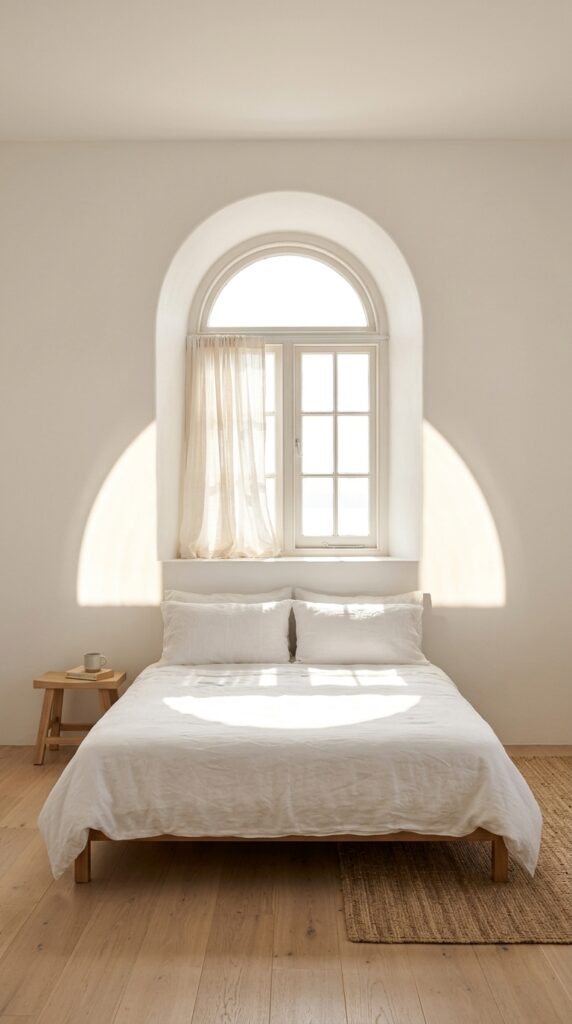
Vibe: Luminous and architectural — an arched window that turns the wall into a frame for the sky.
Why it works: An arched window in a coastal bedroom applies the design principle of architectural light sculpture — the arch shape projects its own geometric pattern onto the white interior surfaces as the sun moves, creating a dynamic light installation that changes through the day without any decoration. The arch also references Mediterranean and North African coastal architectural traditions — the curved aperture is as old as coastal habitation itself and carries that history in its form. A bare or sheer-only arched window is the most resolved treatment: any elaborate window dressing would obscure the arch’s defining geometric quality.
How to get it: If adding an arched window to an existing room is outside scope, an arched full-length mirror ($80 to $200) positioned to reflect an existing window creates the visual impression of an arched aperture and doubles the natural light in the room simultaneously.
| Shop The Look |
| Arched window frame bedroom coastal white |
| Sheer linen panel arch window coastal bedroom |
| Arched full length mirror coastal bedroom |
| White low bed frame coastal arch window |
| White plaster smooth wall finish coastal |
24. Nautical Rope Lighting Detail

Vibe: Warm and craftsman — the light fitting that carries its own material story in the cord.
Why it works: Rope-wrapped pendant cords work in a coastal bedroom on the principle of detail as decoration — the pendant fitting itself is simple (a glass globe or linen shade), but the rope-wrapped cord transforms the utilitarian cord into the fitting’s primary visual feature. This is a coastal design approach to the concept of “honest materials” — rather than concealing the electrical cord or running it through the ceiling, the cord is wrapped in natural cotton rope and made visually prominent. The rope’s hand-twist detail and warm tan tone add material warmth at ceiling height, where a plain cord would simply disappear.
How to get it: Wrap a standard electrical pendant cord with 8mm natural cotton rope using a tight spiral technique, securing each wrap with a small dab of clear-drying adhesive every 15 to 20 wraps — the completed cord should have no visible electrical cable beneath the rope wrapping. This is a straightforward DIY that costs $10 to $20 in materials.
💡 Quick Win: Pre-made rope pendant cord sets (rope-wrapped cord with pendant socket and ceiling canopy) are available for $18 to $35 online — a complete coastal lighting upgrade requiring only a replacement bulb and a ceiling hook.
| Shop The Look |
| Rope wrapped pendant cord ceiling light coastal |
| Natural cotton rope pendant light kit coastal |
| Glass globe pendant shade clear bedroom |
| Edison bulb vintage filament E27 warm |
| Rope pendant ceiling canopy mount coastal |
25. Tiny Coastal Bedroom with Full-Wall Wardrobe
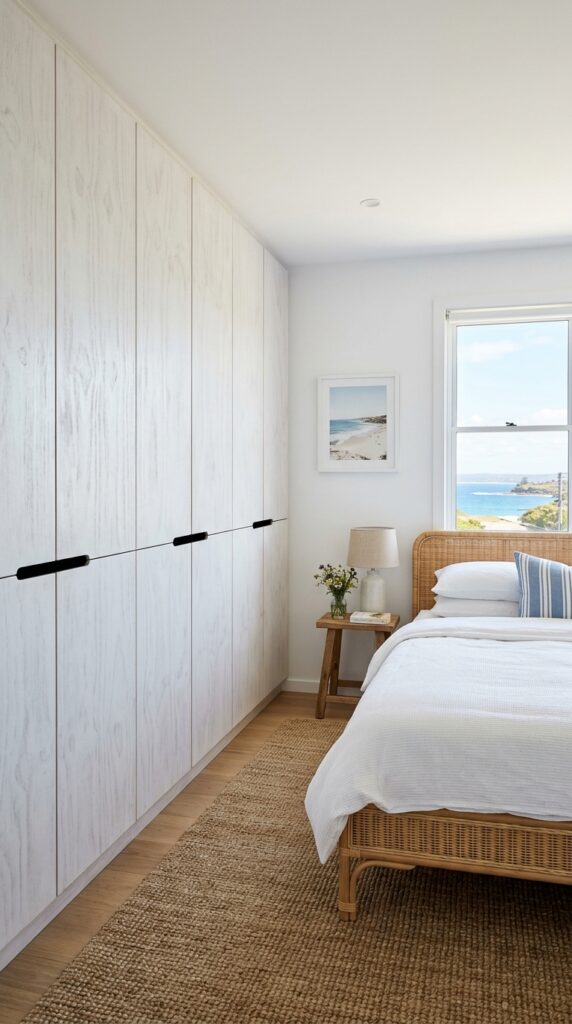
Vibe: Resolved and airy — the small room that solved its own problem and came out the other side looking easy.
Why it works: A full-wall built-in wardrobe in a small coastal bedroom applies the principle of storage consolidation — concentrating all clothing and textile storage into one continuous wall-length unit frees every other wall surface and the entire floor plan for the room’s living and sleeping functions. Whitewashed plywood doors maintain the coastal palette while providing the warm grain character that painted MDF cannot replicate — the ply grain reads as a material rather than a blank painted surface. Recessed finger-pull handles (no visible hardware) maintain the wall’s clean surface continuity.
How to get it: Use 18mm birch plywood for wardrobe doors in a whitewashed finish — birch ply has a finer, more even grain than structural ply and takes the whitewash treatment more consistently. Apply the same whitewash formula used on furniture (1 part white paint to 3 parts water, wiped back) in the direction of the face veneer grain for the most natural, bleached result.
| Shop The Look |
| Whitewashed plywood wardrobe door coastal bedroom |
| Full wall built in wardrobe coastal bedroom |
| Recessed handle finger pull wardrobe hardware |
| Rattan bed frame single small coastal bedroom |
| Natural seagrass rug small coastal bedroom |
How to Start Your Coastal Bedroom Transformation
Your single first move is this: replace your current bedding with a washed linen duvet cover in natural, bleached ivory, or warm white. This one change — which costs $60 to $120 for a quality set — does more atmospheric work than any wall paint, furniture purchase, or decorative accessory in the coastal bedroom toolkit. Linen’s texture, its deliberate wrinkle, and its organic warmth establish the room’s sensory register immediately. Every subsequent coastal decision — the rattan lamp, the sea-glass wall color, the jute rug — will feel coherent once the bedding is correct, and incoherent until it is.
The most common mistake in coastal bedroom design is over-literalism — filling the room with anchor motifs, decorative rope coils, starfish on every surface, and framed prints of sailing ships. This approach produces a themed room rather than a genuinely coastal one, and the distinction is felt immediately. Authentic coastal design is about material and atmosphere — the specific quality of bleached, weathered, natural things — not about marine iconography. The rule: if it came from a gift shop at a seaside tourist market, it almost certainly doesn’t belong in a considered coastal bedroom.
Three specific items under $50 for immediate coastal impact: a set of two blue-and-white stripe linen cushion covers in a stonewashed finish ($25 to $40), which introduce the foundational coastal textile pattern without committing to a full palette change; a bundle of dried sea lavender in a simple white ceramic vessel ($12 to $20 total), which provides both botanical texture and a genuine coastal scent; and a single natural jute or sisal rug in 2×3 feet, placed beside the bed as a landing mat ($18 to $35), which introduces the natural-fibre floor texture that grounds the entire coastal material palette.
Realistic expectations: a coastal bedroom refresh — new bedding, two or three textile additions, paint on one wall, and a jute rug — takes one weekend and costs $250 to $600. A more complete transformation with new furniture (rattan or whitewashed bed frame, matching bedside tables), new flooring, and built-in elements runs $2,500 to $7,000. The single investment with the highest return in a coastal bedroom is the bed frame — a rattan, cane, or whitewashed-oak bed frame in the correct proportion for the room is the decision that makes the coastal atmosphere feel architectural rather than styled.
Frequently Asked Questions About Coastal Bedrooms
What is the difference between coastal bedroom design and nautical bedroom design?
Coastal bedroom design is about atmosphere, material, and light — the sensory experience of proximity to the ocean translated into interior choices. It relies on natural materials (linen, rattan, jute, sea-grass), a palette drawn from natural coastal tones (bleached ivory, driftwood grey, sea-glass blue, warm sand), and the quality of light and air rather than specific maritime symbols. Nautical bedroom design is a themed subset that uses explicit maritime iconography — anchors, rope, ship wheels, striped flags, and marine prints — to create a room that signals the ocean through motif rather than atmosphere. Most designers and homeowners find that coastal design produces a more livable, sophisticated, and durable result than nautical theming, which tends to feel date-stamped and novelty-reliant within a few seasons.
What colors work best for a coastal bedroom?
The most successful coastal bedroom palettes are built on four tonal anchors: a warm white or bleached ivory as the base (Benjamin Moore White Dove OC-17 is the benchmark); a sea-glass blue-green as the primary color accent (Benjamin Moore Sea Salt 2123-40 or Farrow & Ball Borrowed Light No. 235); a warm sand or driftwood grey as the grounding neutral (SW Accessible Beige SW 7036 or Farrow & Ball Elephant’s Breath No. 229); and natural material tones — rattan honey, jute tan, sea-grass gold-green — as the material layer. The foundational rule is that coastal colors should read as naturally bleached and salt-weathered rather than saturated or vivid — any coastal color that reads as brighter than its equivalent found in nature is too saturated.
How much does a coastal bedroom makeover cost?
A meaningful coastal refresh — linen bedding, a jute rug, one paint wall in sea-glass blue, and two to three accessory additions — costs $300 to $700 and can be completed in a weekend. A mid-range coastal transformation with a rattan or whitewashed bed frame, new bedside tables, a window treatment change, and gallery wall costs $1,500 to $3,500. A complete coastal bedroom renovation with new flooring (whitewashed wide-plank oak), new built-in storage, custom window treatments, and all new furniture runs $8,000 to $20,000 depending on size and specification. The highest impact-per-dollar investment at any budget level is washed linen bedding — it transforms the room’s atmosphere more fundamentally than any other single purchase.
Can coastal bedroom design work in a city apartment with no ocean view?
Absolutely — and the style’s dependence on material and palette rather than context means it is entirely independent of physical proximity to water. The psychological effect of a coastal bedroom (the restfulness, the airiness, the sense of unhurried calm) is produced by specific design choices rather than by location. In a city apartment, the key adaptations are: maximising any available natural light through sheer window treatments rather than blocking it; choosing the palest possible wall color to compensate for lower light levels; and investing in quality natural-fiber textiles (linen, jute, sea-grass) whose material warmth provides the sensory quality that coastal design depends on. The ocean view is optional — the linen, the rattan, and the sea-glass palette are not.
What is the single most important design decision in a coastal bedroom?
The bedding material. In a coastal bedroom, the bed occupies the largest visual surface in the room and the most tactilely significant object — the material you sleep under and wake up in determines the room’s sensory register more fundamentally than any wall color, furniture choice, or accessory decision. Washed linen in a natural or bleached ivory is the non-negotiable coastal bedding standard: its texture, its warmth, its deliberate wrinkle, and its ability to soften and improve with every wash produce the specific material quality that authentic coastal bedrooms depend on. A coastal bedroom can succeed with modest furniture, simple walls, and minimal accessories if the linen is right. It cannot succeed with premium rattan furniture and gallery walls if the bedding is polyester or cotton sateen.
Ready to Create Your Dream Coastal Bedroom?
These 25 inspirations span the full sensory and material range of coastal bedroom design — from the bleached linen foundations and sea-glass palettes that establish the atmosphere, to the rattan furniture, rope lighting details, and shiplap architectural moments that give the style its specific material character. A coastal bedroom transformation is always most honest when it starts with subtraction — removing the objects and textiles that actively fight the coastal register before adding anything new — and then builds from one quality anchor piece outward. The single action you can take today is to strip your bed of its current bedding, fold it away, and order a washed linen duvet cover in natural or bleached ivory: the room will already feel different before the new bedding arrives simply because the old one is gone. When the transformation finally coheres — when the light comes through the sheer panels and falls on the linen in that particular bleached, unhurried way — the bedroom will feel less designed than remembered, the way the best coastal rooms always do. Save the ideas that made you slow down as you read them, and return especially to the ones built on honest, weathered materials — those are the choices that improve with time, just like the real thing.