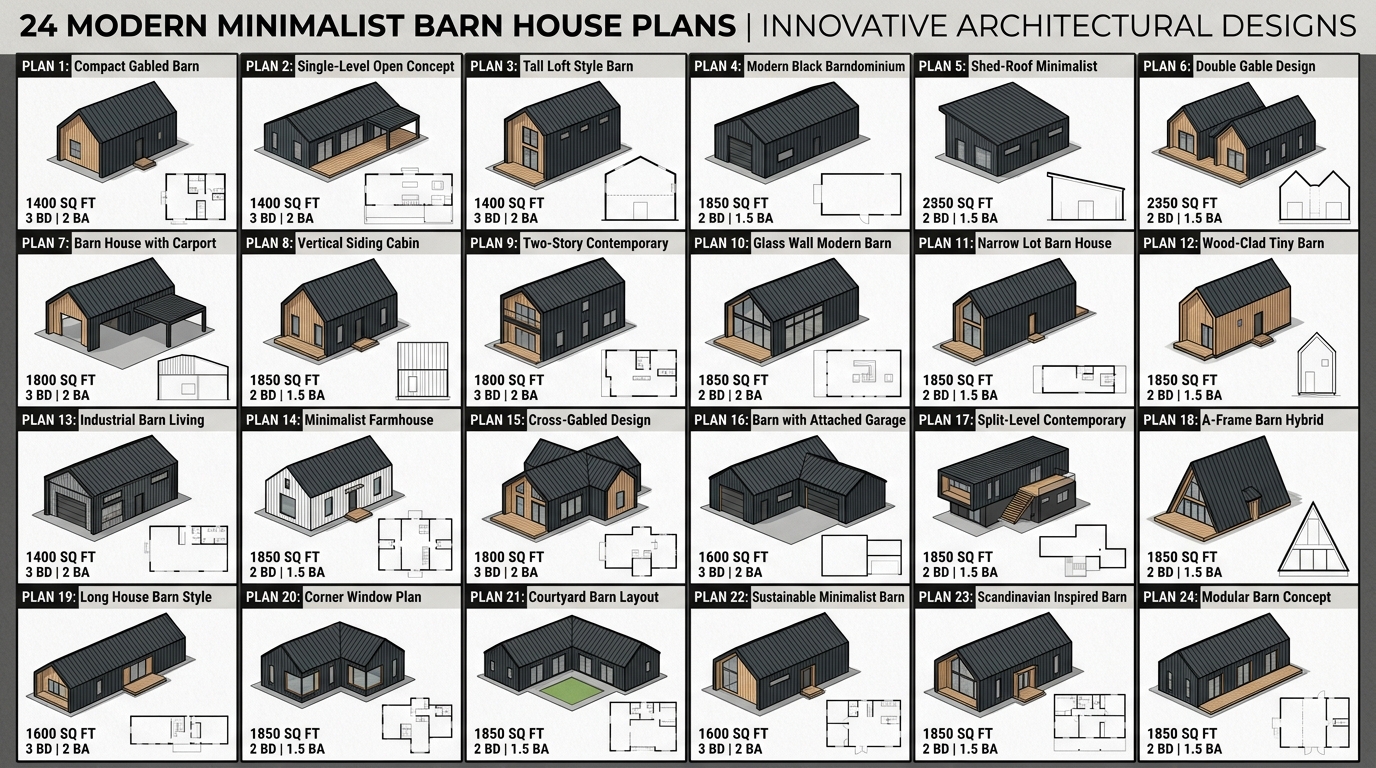
Modern minimalist barn house plans blend the structural bones of agricultural architecture — wide gable roofs, board-and-batten cladding, open volumes — with a restrained, contemporary interior language that strips everything back to what matters. This article gives you 24 specific plan ideas, design principles, and actionable styling strategies to help you build or reimagine a barn-inspired home with modern clarity.
There is a particular stillness inside a well-executed minimalist barn house. Raw timber meets smooth plaster. A cathedral ceiling amplifies natural light. The exterior reads as honest and grounded — dark steel, weathered wood, open sky — while the interior holds a careful quiet that feels nothing like ordinary. Here are 24 ideas worth saving — and stealing.
Why the Modern Minimalist Barn House Style Works So Well
The modern minimalist barn house is not farmhouse décor repurposed — it is a genuine architectural hybrid. It draws from Scandinavian functionalism, Japanese wabi-sabi philosophy, and the American vernacular barn tradition, combining exposed structural honesty with the clean restraint of contemporary design. What separates it from rustic farmhouse is the discipline: no decorative excess, no shiplap for shiplap’s sake, only elements that serve both structure and atmosphere.
The material palette is narrow and intentional. Think unfinished white oak for floors and ceilings, blackened steel window frames and hardware, poured concrete or honed limestone for surfaces, and raw linen or undyed wool for soft furnishings. Color runs in a tight range: warm white (similar to Benjamin Moore’s White Dove), deep charcoal (Sherwin-Williams Iron Ore), and the natural mid-tones of untreated wood and stone. These are materials you can source, not mood board abstractions.
It is trending sharply right now because of a genuine cultural shift. Post-pandemic, people began craving homes that feel both grounded and spacious — a reaction to years of cluttered small-space living. Pinterest searches for “barn house interior” grew over 200% between 2021 and 2024, and the movement connects directly to a broader appetite for sustainability: natural materials, passive solar orientation, and durable construction over fast-fashion finishes.
Small spaces can absolutely achieve this style — with one essential rule: prioritize ceiling height over square footage. Even a 900-square-foot barn conversion reads as expansive if the ceiling soars to 14 feet and the window-to-wall ratio is generous. Where volume cannot be added, use monochrome surfaces, minimal furniture profiles, and deliberate negative space to create the feeling of breath.
| Element | Core Trait 1 | Core Trait 2 |
| Philosophy | Structural honesty | Intentional restraint |
| Materials | Unfinished white oak, blackened steel, raw linen | Poured concrete, honed limestone, undyed wool |
| Color palette | Warm white, deep charcoal, natural wood mid-tones | Dusty sage accent, aged iron |
24 Modern Minimalist Barn House Plans
1. The Single-Gable Open-Plan Floor
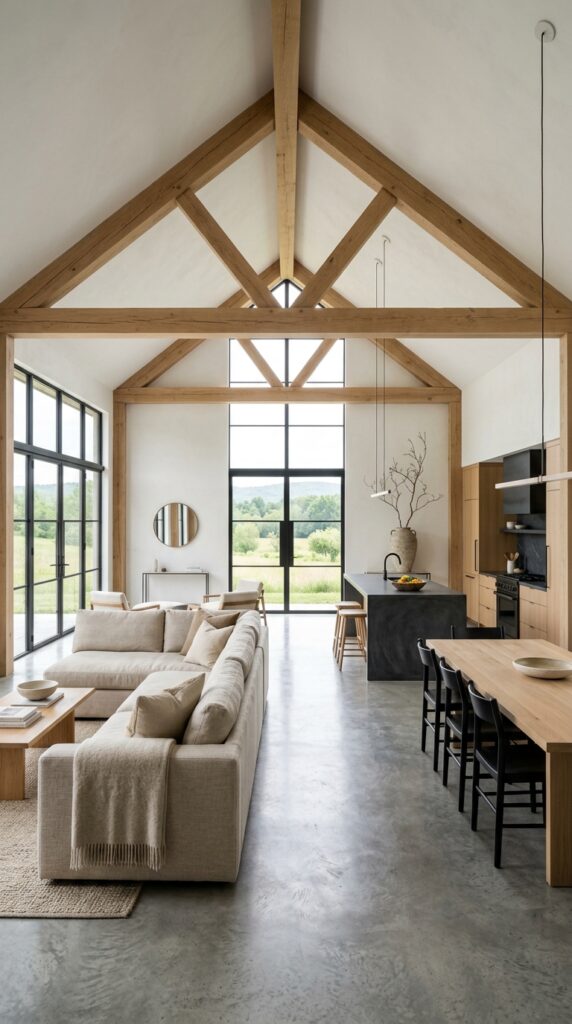
Vibe: Still — the kind of space where sound seems to slow down at the threshold.
Why it works: The single gable creates one unbroken roofline that delivers maximum interior volume without structural complexity, and orienting it east-to-west allows morning light to rake the length of the floor plan. The open layout uses visual weight rather than walls to define zones — a poured concrete kitchen island anchors one end, an oversized rug defines the seating, and the dining table floats midway between them. There are no partitions to interrupt the cathedral ceiling’s drama.
How to get it: When planning this layout, position the kitchen at the north end and living zone toward the south-facing gable wall. Install black steel-framed windows in the full gable face to turn that wall into a light source rather than a barrier.
💡 Quick Win: A single unfinished white oak beam spanning the ridge — even a decorative laminated version — costs roughly $400–$800 installed and immediately reads as architectural authenticity.
Shop the Look
| Product |
| White oak live edge dining table modern minimalist |
| Black steel frame floor mirror barn house |
| Poured concrete look coffee table indoor |
| Linen upholstered sectional sofa natural oatmeal |
| Tall ceramic floor vase matte white modern |
2. Blackened Steel Window Wall
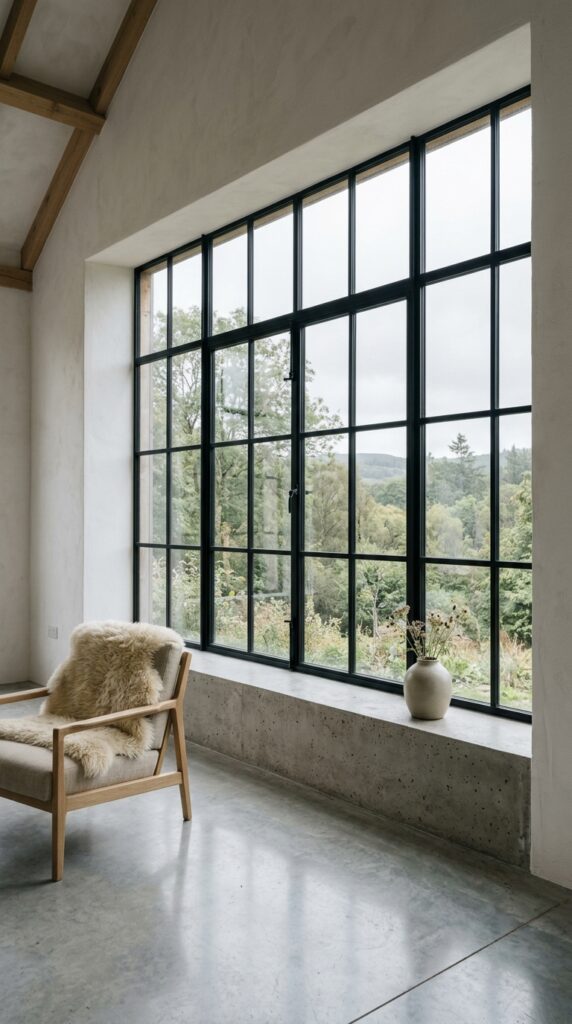
Vibe: Luminous — light arrives with weight and intention through the steel grid.
Why it works: Blackened steel windows are the defining material detail of this style because they perform double duty: structurally they allow thin profiles that maximize glass area, and visually they frame the landscape like a series of paintings without ornamentation. The deep reveal — ideally 6 to 8 inches of plastered wall return — creates shadow and depth that flat-frame windows cannot match. This contrast between dark steel and warm plaster is the tension that makes the room feel resolved rather than sparse.
How to get it: If custom steel windows exceed budget, source powder-coated aluminum in “matte black” — it reads nearly identically in person at a fraction of the cost. Look for profiles under 2 inches wide to preserve the slim steel aesthetic.
Shop the Look
| Product |
| Matte black steel-look window curtain rod set |
| Charcoal linen blackout curtain panels grommet top |
| Concrete window sill tray minimalist modern |
| Sheepskin throw rug natural ivory |
| Black iron candle holder set minimalist |
3. Board-and-Batten Dark Exterior Cladding
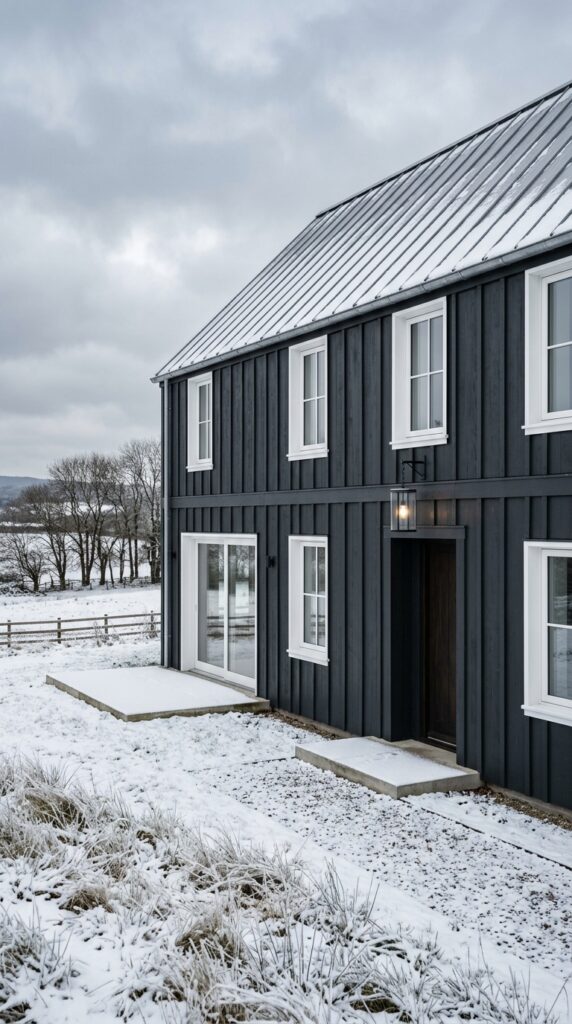
Vibe: Raw — a home that looks as though it grew from the land rather than was placed on it.
Why it works: Board-and-batten has structural logic behind its look — the wide boards and narrow covering battens were originally used to seal exterior walls against weather, and that honest purpose is exactly what gives it visual authority. Painted in deep charcoal or near-black (Benjamin Moore’s Wrought Iron is a benchmark tone), it recedes into the landscape while the white window reveals advance, creating a graphic tension between solid and void. Scale the batten spacing to the house height: 12-inch board widths with 2-inch battens on a one-story, wider on a two-story.
How to get it: Use fiber cement board-and-batten panels pre-primed for exterior use — they hold dark paint without the warping risk of real timber in wet climates, and come in widths from 6 to 12 inches for authentic proportions.
💡 Quick Win: A single deep charcoal exterior paint refresh on an existing wood-sided house runs $3,000–$6,000 and transforms the entire character of a building without touching the roof or structure.
Shop the Look
| Product |
| Matte black exterior house number modern farmhouse |
| Aged steel wall lantern exterior minimalist |
| Dark charcoal outdoor welcome mat natural fiber |
| Black aluminum gutter downspout extension |
| Wrought iron door knocker square modern |
4. Polished Concrete Floor Plan
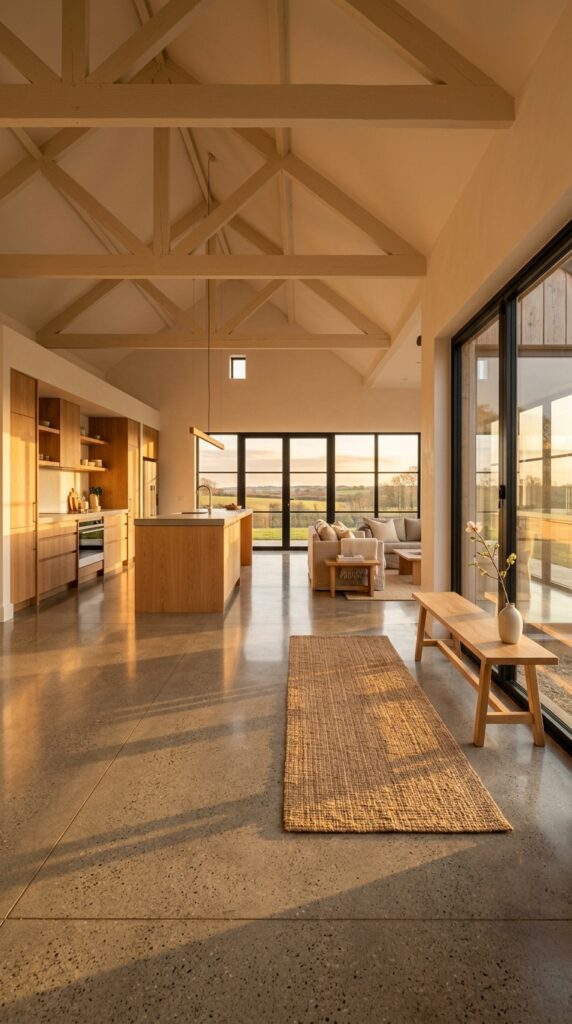
Vibe: Sun-warmed — the kind of floor that holds heat in winter and radiates it slowly through the afternoon.
Why it works: Polished concrete in a barn-plan house does something no other flooring achieves: it reads as both interior and exterior simultaneously, reinforcing the building’s agricultural DNA. The continuous surface — no grout lines, no transitions — makes any open-plan layout feel uninterrupted and larger. Paired with radiant floor heating, it becomes the most practical as well as the most architecturally coherent choice for this typology.
How to get it: Specify a minimum 4-inch slab with integral color added before pouring — “warm grey” concrete mix with iron oxide pigment in ochre achieves a tone that does not read as cold or industrial. After polishing, seal with a penetrating silane sealer (not a topcoat film) to allow the aggregate character to remain visible.
Shop the Look
| Product |
| Natural jute area rug 8×10 modern barn |
| Low profile platform bed frame dark walnut |
| Concrete look side table indoor modern |
| Oak wood bench entryway minimalist |
| Matte terracotta planter set indoor modern |
5. Vaulted Ceiling with Exposed Timber Trusses
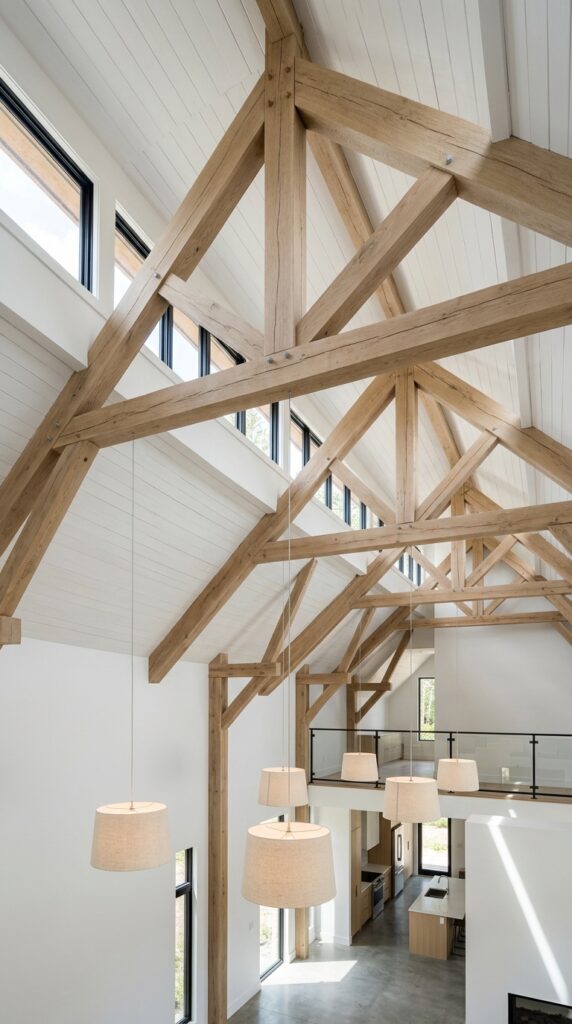
Vibe: Airy — every glance upward reveals structure turned to sculpture.
Why it works: Exposed king post or queen post trusses in a minimalist barn plan serve a specific design function beyond structural necessity: they create rhythm across the ceiling plane, dividing the volume into legible bays that give scale to an otherwise undifferentiated open space. The contrast between the structural logic overhead and the emptiness below is the central compositional tension of this style. Leaving trusses in unfinished white oak while painting the decking between them white maximizes the light-reflective capacity of the ceiling without flattening the wood’s warmth.
How to get it: For new builds, specify glulam truss members in Douglas fir or white oak — they hold dimension better than sawn lumber and require no finishing. For retrofits, decorative steel king post tie-rods can be added to existing scissor trusses to read as structural at a fraction of the cost.
💡 Quick Win: Hanging pendant lights on aircraft cable between truss bays rather than flush-mounting fixtures costs under $80 per pendant and turns every light source into a deliberate punctuation mark.
Shop the Look
| Product |
| Aircraft cable pendant light fixture matte black |
| Linen drum pendant shade minimalist |
| White oak wood ceiling plank paneling |
| Exposed beam wood faux decorative wrap |
| Black iron ceiling hook hardware barn style |
6. The Double-Height Entry Barn Volume
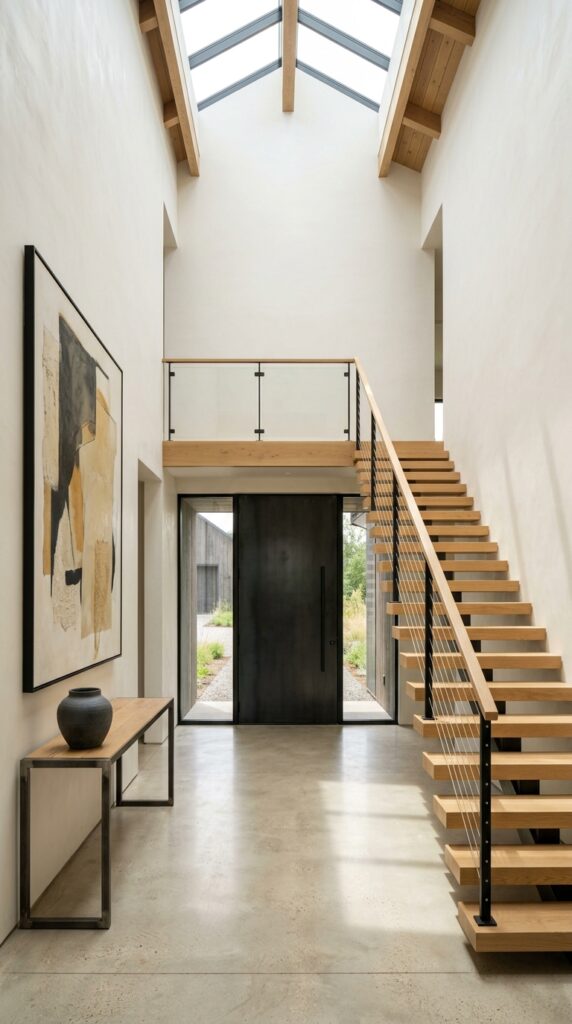
Vibe: Monumental — arriving home feels like entering a place built with intention.
Why it works: In a barn plan, the double-height volume at the entry communicates the architectural ambition of the entire house before a single room has been seen. The pivot door — ideally in blackened steel with a minimal handle — creates a threshold that requires physical participation, reinforcing the transition from outside to inside. A single overhead skylight placed directly above this volume creates a natural spotlight that shifts through the day and makes no additional decoration necessary.
How to get it: If full custom pivot doors exceed budget, a standard 8-foot door hung on a concealed closer with a solid steel pull bar achieves 80% of the same effect. Keep the entry volume strictly empty — no coat racks, no benches in this space. Let the architecture perform.
Shop the Look
| Product |
| Steel pivot door pull handle matte black modern |
| Large format abstract canvas wall art neutral |
| Floating shelf white oak wall mounted minimal |
| Sculptural ceramic vessel modern minimalist |
| Dome skylight flat roof tubular white |
7. Warm Greige and Charcoal Tonal Interior
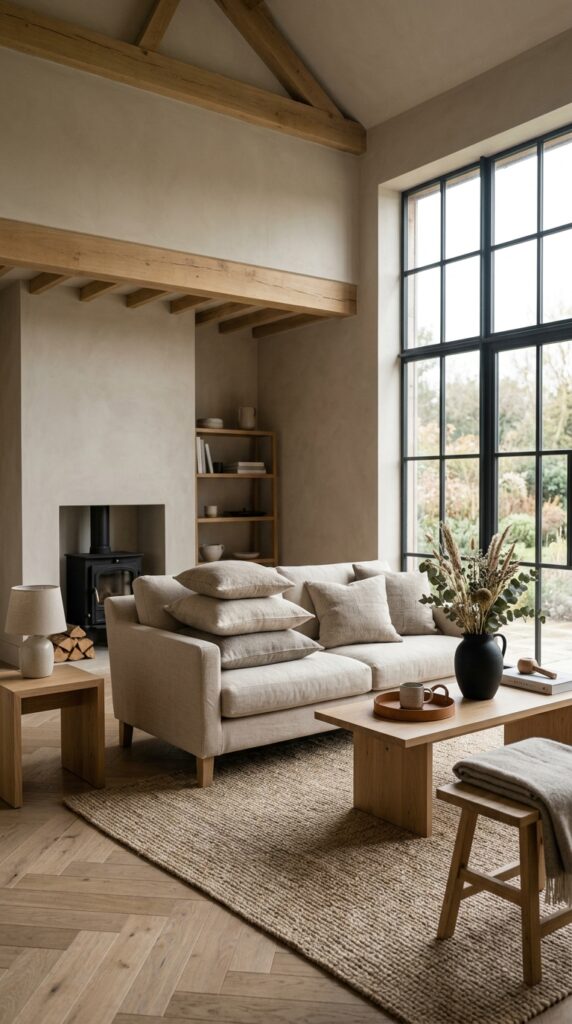
Vibe: Layered — depth achieved not through contrast but through carefully tuned tonal warmth.
Why it works: The warm greige-to-charcoal palette is one of the most considered choices in this architectural style because it avoids the cold, clinical quality that minimalism can produce when executed in pure white and grey. Warm greige — Farrow & Ball Elephants Breath or Benjamin Moore Revere Pewter are the benchmarks — adds an almost imperceptible yellow-red undertone that makes concrete and iron feel approachable rather than austere. The tonal range from wall to floor to furniture stays within a 3-stop value range, creating cohesion rather than contrast.
How to get it: The rule is: walls one stop lighter than floors, furniture one stop lighter than walls. In this palette, that means greige plaster, natural oak floors, and undyed linen upholstery — all reading as different values of the same warm neutral.
💡 Quick Win: A single can of Farrow & Ball Elephants Breath ($120/gallon) applied to one feature wall in an otherwise white room immediately shifts the entire space into this warmer register without full commitment.
Shop the Look
| Product |
| Undyed natural linen throw pillow cover set |
| Matte black ceramic vase dried botanicals |
| Leather decorative tray brown small |
| Warm gray wool area rug natural fiber woven |
| Iron candlestick holder set minimalist dark |
8. Sliding Steel Barn Door Interior
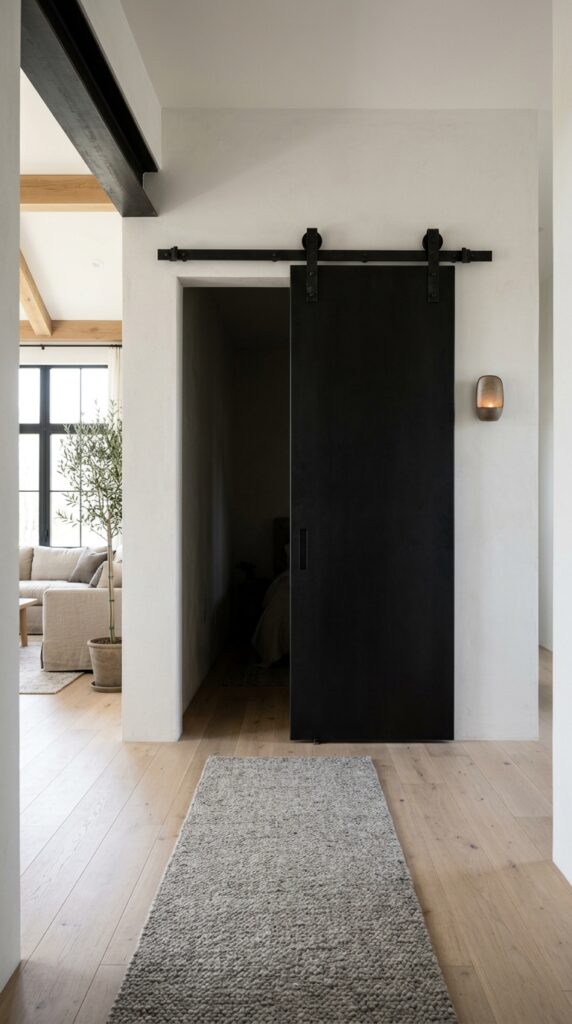
Vibe: Hushed — the movement of the door is slow and deliberate, and the room responds.
Why it works: A flat steel sliding door achieves what a traditional hinged door cannot in a barn plan: it disappears into the wall plane when open, preserving the visual flow of a long hallway or open room. The exposed track hardware — blackened to match window frames — is structural honesty made aesthetic, the same logic that leaves trusses exposed overhead. The key proportion rule is that the door panel should be 2 inches taller than the opening on each side, so the top track aligns with the door head height and reads as part of the room’s horizontal datum.
How to get it: Fabricate the panel in 16-gauge cold-rolled steel, left natural with a clear matte wax finish — it develops a subtle patina over years that no powder coat can replicate. Mount the track a full 3 inches above the door head to avoid the gap problem common in budget hardware kits.
Shop the Look
| Product |
| Flat steel sliding barn door flat panel matte black |
| Blackened steel barn door track hardware kit |
| Recessed flush pull handle steel modern |
| Natural wool hallway runner grey minimal |
| Ceramic wall sconce matte black modern |
9. Clerestory Windows for Passive Light
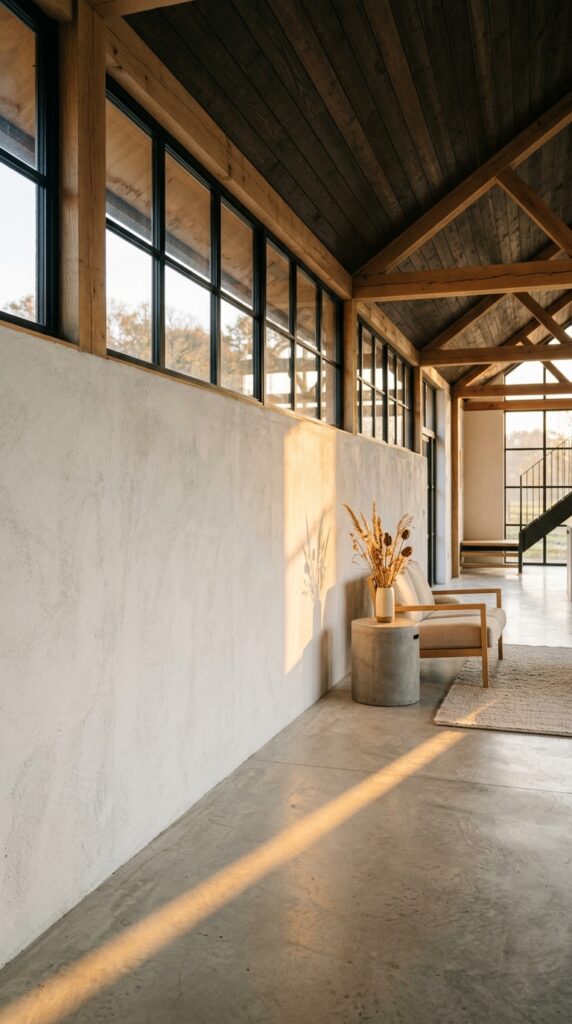
Vibe: Still — the light inside this room is something you watch change.
Why it works: Clerestory windows in a minimalist barn plan solve a specific problem: how to bring light into a building whose ground-level walls must remain private or largely closed to the exterior. By placing fixed glass above eye level, you capture the full arc of daylight — morning light at low angles, noon light overhead, late afternoon at steep raking angles — without compromising privacy or wall surface for art and furniture. The light behaves dynamically, creating moving shadows and illuminated stripes that change the room’s character hourly.
How to get it: Orient clerestory windows on the south-facing wall and use 3-inch-deep steel frames with low-e glass rated at SHGC 0.30 or below — this admits light without the heat gain that makes south-facing glass a liability in summer months.
💡 Quick Win: Even a single 48-inch-wide clerestory window installed over an existing interior door opening costs $800–$1,200 and fundamentally changes how light behaves in a room below a high ceiling.
Shop the Look
| Product |
| Fixed glass skylight panel blackened frame |
| Concrete look accent side table minimalist |
| Dried botanical arrangement tall arrangement |
| White plaster texture wall paint interior |
| Matte black window handle hardware set |
10. Open Loft Plan Above Main Volume
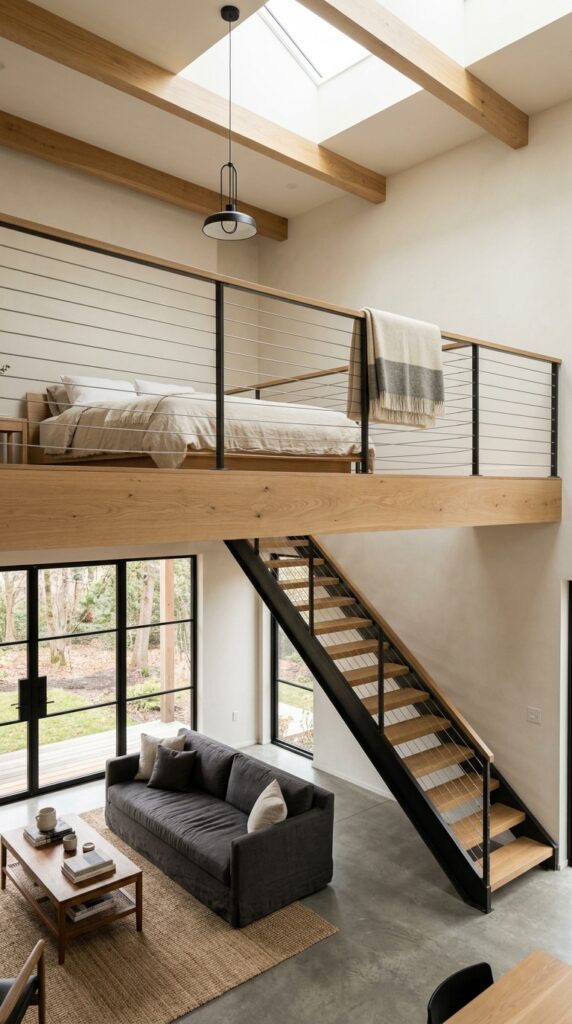
Vibe: Layered — the house has a secret upper world visible but not reached from below.
Why it works: An open loft plan uses the barn’s inherent vertical volume productively, placing private sleeping space above the living zone without losing the architectural drama of the double height. The critical design decision is the railing: a horizontal cable railing at 36 inches maintains sightlines from both levels, preserving the spatial connection that makes the volume feel unified. A solid parapet wall at the loft edge would divide the volume into two separate experiences and defeat the purpose entirely.
How to get it: Size the loft to occupy no more than 40% of the main floor’s area — this preserves the double-height character beneath while giving the upper level genuine utility. Use white oak engineered boards for the loft floor, which span up to 12 feet without visible support.
Shop the Look
| Product |
| Steel cable railing kit stainless modern |
| White oak engineered wood flooring wide plank |
| Linen duvet cover white neutral minimalist |
| Industrial pendant light black wire cage |
| Woven throw blanket natural tan chunky knit |
11. The Monochrome White Plaster Interior
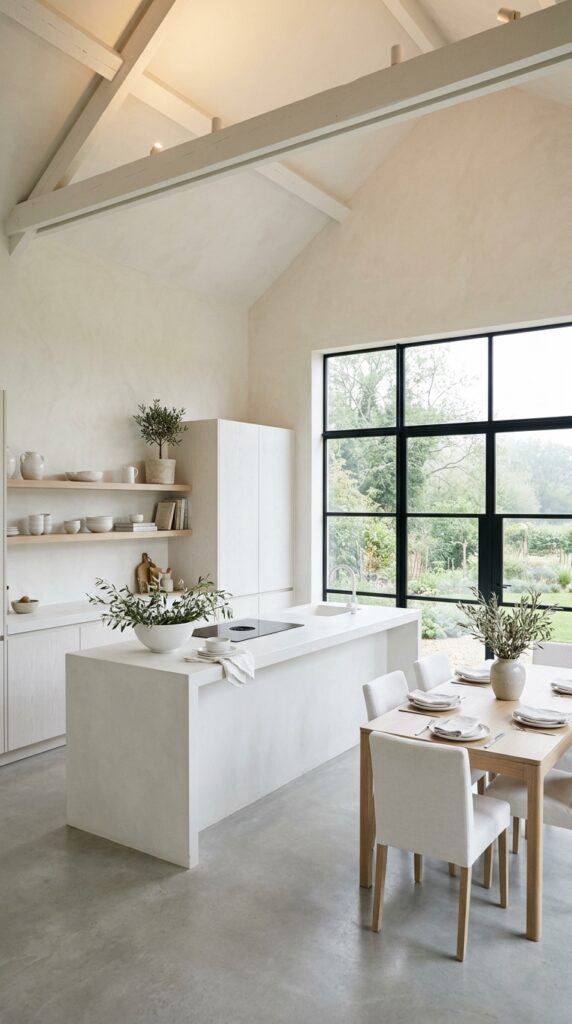
Vibe: Luminous — the room seems to generate its own light from within.
Why it works: The all-white interior works in a barn house plan precisely because the architecture is already so materially specific — the volume, the structural elements, the window geometry provide all the visual complexity needed. A monochrome palette does not flatten the room but amplifies its spatial qualities: every corner, every reveal, every surface change becomes visible through light and shadow rather than color. The key is ensuring that “white” in this context means several different whites — warm white walls, natural white oak cabinetry, cooler white concrete — so the room reads as layered, not sterile.
How to get it: Specify Benjamin Moore White Dove OC-17 for plaster, Sherwin-Williams Alabaster for cabinetry, and leave concrete counters unpigmented. These three whites differ enough in undertone to read as intentional rather than mismatched.
💡 Quick Win: Replacing standard upper kitchen cabinets with 12-inch floating white oak shelves at two heights — $200–$350 per 48-inch shelf, installed — creates the open, architecturally light character of this look immediately.
Shop the Look
| Product |
| White oak floating shelf bracket wall mount kitchen |
| White ceramic kitchen canister set modern |
| Raw plaster look indoor plant pot large |
| White linen napkins set 12 modern |
| Concrete look countertop cutting board white |
12. Compressed Entryway — Expand into Volume
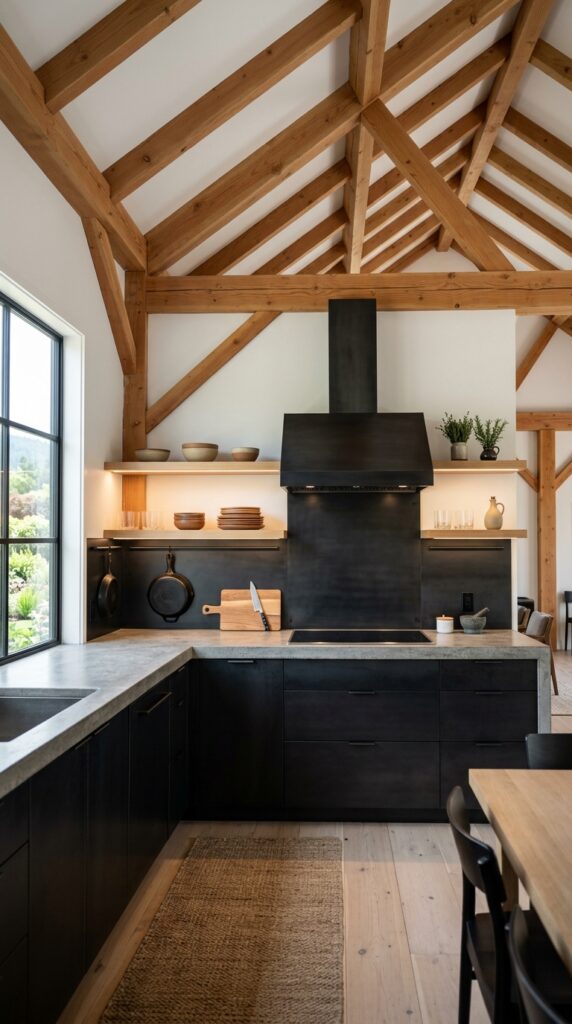
Vibe: Grounded — the compression of the entry makes what comes next feel like a release.
Why it works: This is a layout technique borrowed directly from traditional Japanese architecture: the deliberate compression of an entry space to heighten the perceptual impact of the main volume beyond. At 7 feet of ceiling height in the entry, the human body feels contained. Stepping through to a 16-foot cathedral ceiling creates a kinesthetic response — the space genuinely expands around you — that a uniformly high-ceilinged house cannot generate. The step down reinforces this by engaging the body physically in the spatial transition.
How to get it: In new construction, pull the entry utility zone — coats, boots, storage — under the lower section of the gable end. The primary living volume occupies the full ridge height. This costs nothing architecturally and delivers the most memorable spatial experience in the house.
Shop the Look
| Product |
| Blackened iron wall hook set minimalist |
| Narrow console table dark walnut entryway |
| Low profile entryway bench black |
| Single hook wall coat rack modern minimalist |
| Doormat natural coir rectangle minimal |
13. Dusty Sage Green Accent Wall
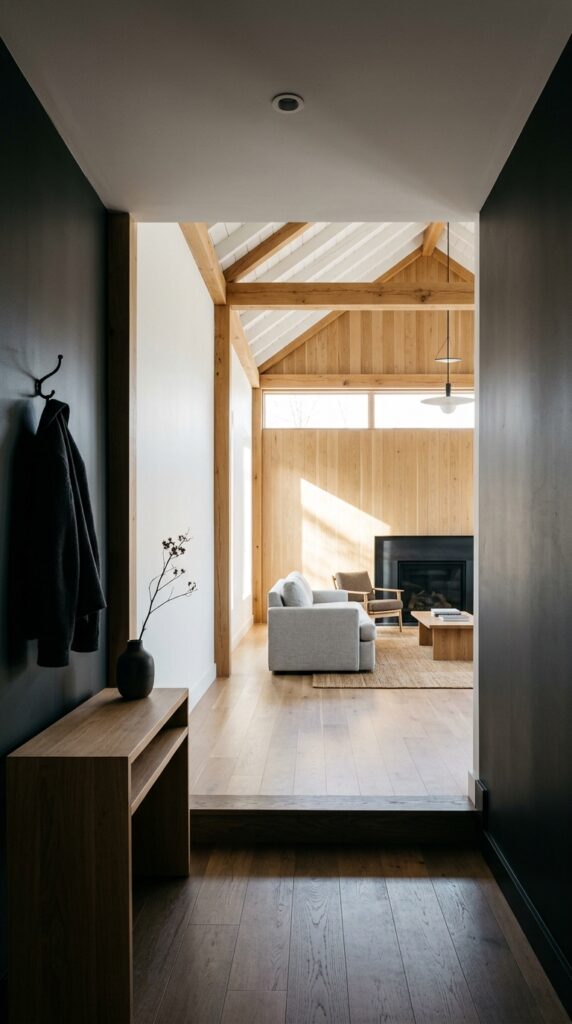
Vibe: Serene — the color holds the quality of late afternoon light in early spring.
Why it works: Dusty sage — specifically the grey-green range of Farrow & Ball Mizzle or Benjamin Moore Pale Avocado — functions as a neutral in a minimalist barn interior because it reads differently in different lights. Under overcast conditions it is almost stone grey. In warm morning or afternoon light it reads as a gentle plant green. This perceptual variability gives the room a quality of life that flat color cannot match. Applied in limewash finish rather than standard paint, the tone shifts subtly across the surface, adding micro-texture without pattern.
How to get it: Apply Portola Paints Roman Clay or Limerock in “sage” tone using a 12-inch trowel in two coats, varying the pressure to create visible variation. This costs $80–$120 per gallon and covers roughly 200 square feet per coat.
💡 Quick Win: A single limewash accent wall in a bedroom can be done in a weekend with no prior plastering experience — use Portola’s Roman Clay and a wide taping knife. Budget $200 for supplies for a standard 10×10 wall.
Shop the Look
| Product |
| Low profile white oak platform bed frame queen |
| Undyed natural linen duvet cover set neutral |
| Dried olive branch arrangement small vessel |
| Concrete look bedside table minimalist |
| Chunky wool throw blanket warm grey |
14. Blackened Steel Kitchen with Concrete Counters
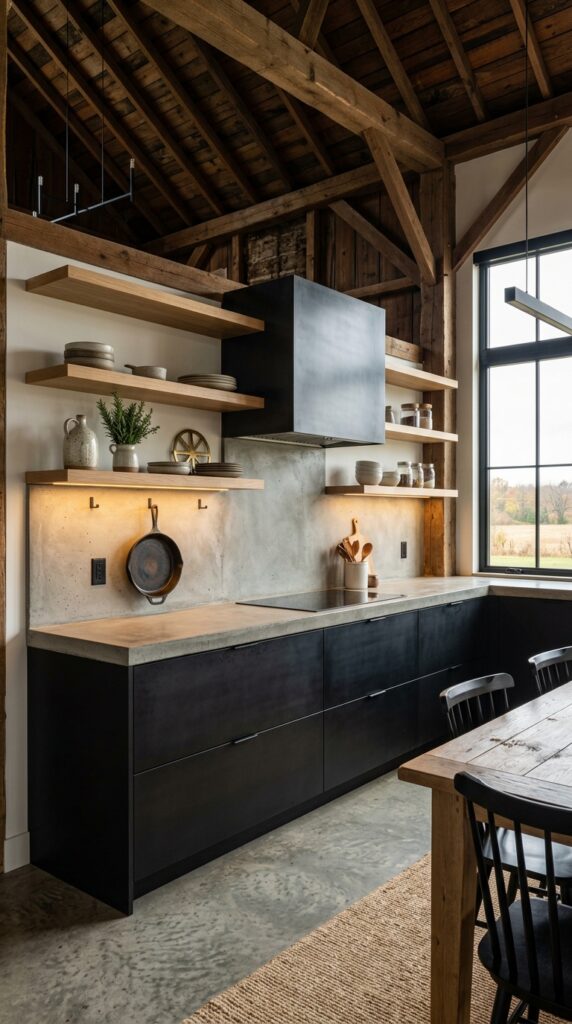
Vibe: Warm — a kitchen that takes cooking seriously without ceremony.
Why it works: Matte black steel cabinet fronts are one of the few kitchen choices that get better with time in this style — they develop micro-scratches and handling marks that read as patina rather than damage, reinforcing the honest-material philosophy of the entire house. Combined with unpigmented poured concrete countertops (sealed with a food-safe penetrating sealer, not an epoxy topcoat), the kitchen achieves a material specificity that no standard product kitchen replicates. The white oak open shelves above provide the warmth and organic relief this high-contrast pairing needs.
How to get it: Source flat 5mm cold-rolled steel panels from a local steel fabricator and mount them on standard cabinet boxes — this costs roughly $400–$700 for a full kitchen set of fronts, versus $4,000+ for custom steel cabinetry.
Shop the Look
| Product |
| Cast iron skillet hanging wall hook set |
| Ceramic oil and vinegar jug set kitchen |
| Matte black steel kitchen shelf bracket |
| Concrete countertop DIY mix bag grey |
| Herb garden planter set window sill ceramic |
15. Covered Outdoor Barn Breezeway
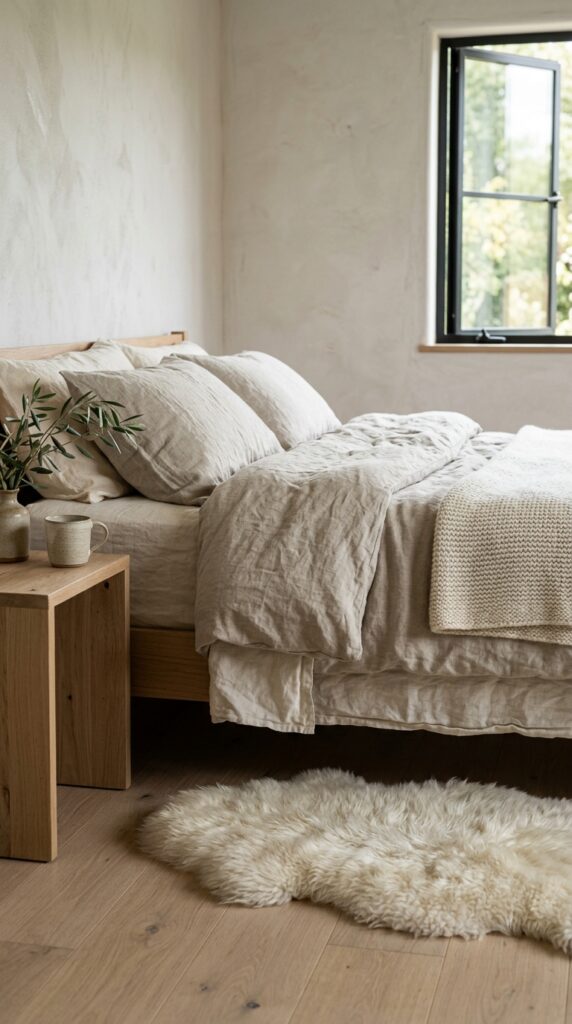
Vibe: Connected — the breezeway is where inside and outside negotiate a truce.
Why it works: A covered breezeway in a barn plan serves a specific architectural function: it creates a protected outdoor space that is neither fully inside nor outside, expanding the livable territory of the home into the landscape without enclosing it. The rafter tails of the breezeway roof, left exposed and painted to match the board-and-batten exterior, extend the architectural language of the main structure rather than introducing a new vocabulary. This creates visual continuity that makes the house feel considered rather than assembled.
How to get it: Design the breezeway with a minimum 12-foot clear height and 10-foot structural width — anything narrower reads as a corridor rather than a room. Use raw steel posts at 8-foot spacing and let them develop a surface rust patina, then seal with clear matte wax annually.
💡 Quick Win: String matte-socket bistro lights along the breezeway ceiling at $35–$55 for a 25-foot strand — they add warmth and definition at night without requiring electrical fixture installation.
Shop the Look
| Product |
| Matte black powder coated outdoor chair modern |
| String light bistro outdoor weatherproof |
| Large agave planter set outdoor modern |
| Steel outdoor side table round minimal |
| Cedar outdoor ceiling plank board natural |
16. Raw Linen and Undyed Wool Layering
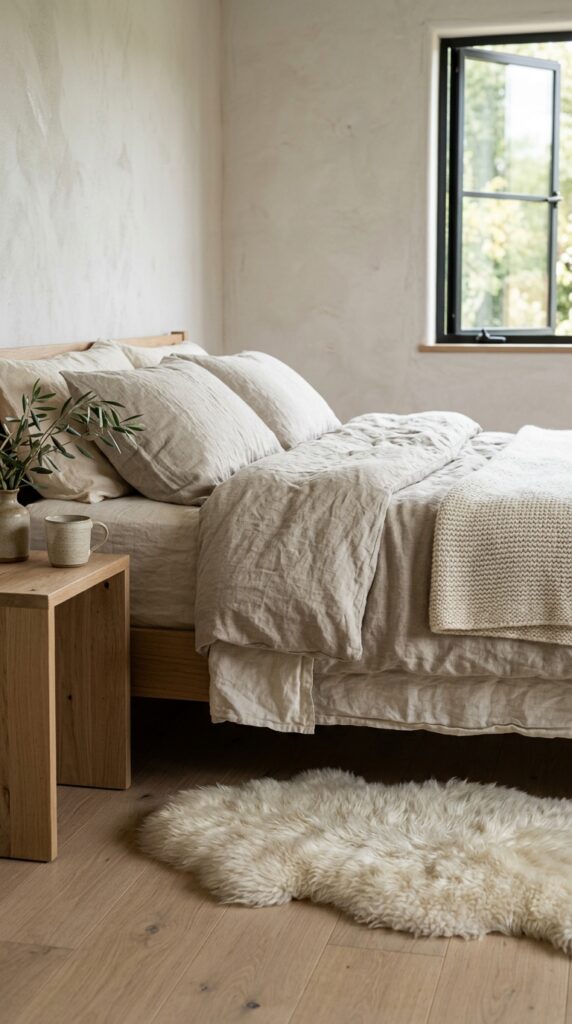
Vibe: Tactile — every surface in this room invites contact.
Why it works: Textile layering in a minimalist barn interior works through material contrast rather than color contrast. Raw European linen (ideally undyed or washed in chamomile to achieve a natural flax tone), merino wool in undyed cream, and natural sheepskin exist in a very close value range but differ radically in texture: the linen is matte and crisp, the wool is soft and slightly fuzzy at the surface, the sheepskin is dimensional and almost architectural. Stacking these three materials in a single space creates sensory richness without visual noise — which is the central problem minimalism must solve.
How to get it: Source undyed linen from Rough Linen or Libeco — European grown and woven linen has a weight and hand that polyester-linen blends cannot replicate. Buy bedding two sizes up: a queen linen duvet on a queen bed creates the casual, full-pooling drape this style depends on.
Shop the Look
| Product |
| European flax linen duvet cover natural oatmeal |
| Merino wool throw undyed cream natural |
| Natural sheepskin rug floor Icelandic style |
| Ceramic mug minimalist white morning |
| Low profile white oak floating nightstand |
17. Minimalist Barn Bathroom with Concrete Basin
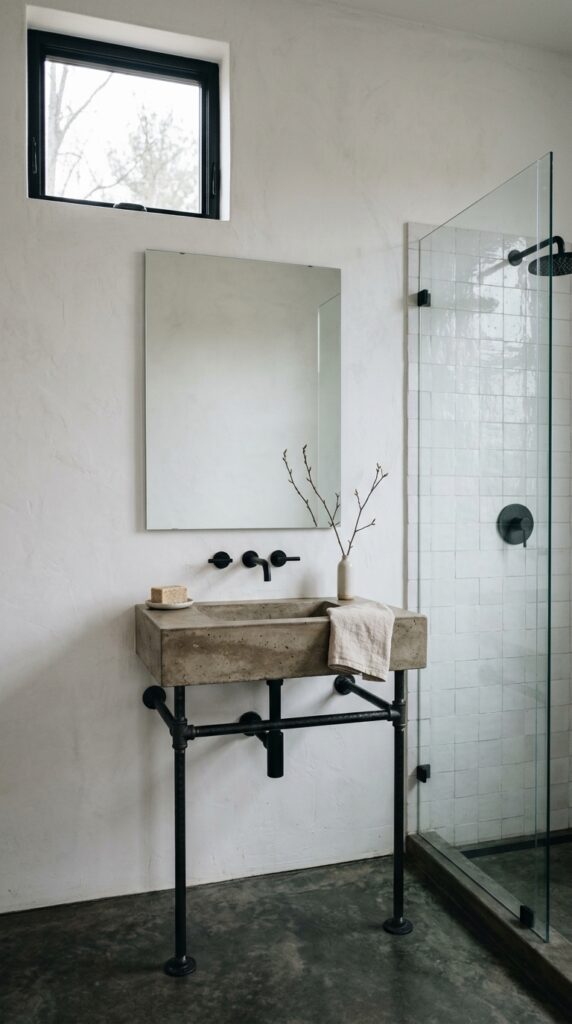
Vibe: Raw — a bathroom that strips the morning ritual to its essentials.
Why it works: A hand-formed concrete basin is the bathroom’s equivalent of the exposed timber truss: it makes material honesty the point. The concrete is not pretending to be anything other than what it is — formed, cast, and sealed — and that directness communicates the philosophy of the entire house in a single object. Pairing it with a blackened steel pipe stand rather than a conventional vanity cabinet keeps the plumbing visible and legible, continuing the building’s commitment to structural transparency. Zellige tiles — hand-pressed Moroccan ceramic with natural color variation — in the shower provide the only surface complexity in an otherwise spare room.
How to get it: Source hand-formed concrete sinks from small studio makers on Etsy or from concrete artisans in your region — budget $300–$600 for a custom piece. Seal with a penetrating sealer and apply carnauba wax monthly for water resistance.
💡 Quick Win: Replace a framed bathroom mirror with a simple 24×30 inch frameless mirror glass panel, cut to size by a local glass company for $80–$120. It reads as more refined and more minimal than any framed option.
Shop the Look
| Product |
| Concrete vessel sink basin hand formed grey |
| Blackened steel pipe bath vanity stand |
| Frameless wall mirror 24×36 rectangular |
| Zellige ceramic tile white shower |
| Linen hand towel set natural flax |
18. Floating White Oak Staircase
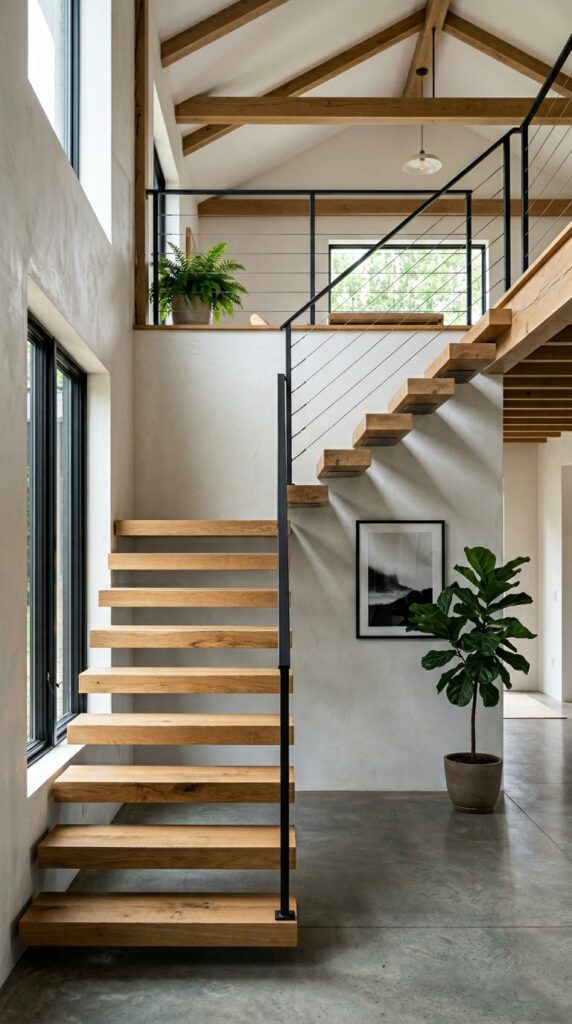
Vibe: Precise — the staircase is architecture reduced to its most essential geometry.
Why it works: Open-riser floating stairs are the architectural element that most clearly separates a genuinely minimalist barn house from a decorative farmhouse interpretation. By eliminating the riser, you preserve the visual continuity of the wall behind and allow light to travel through the stair volume rather than being blocked by it. The cantilevered mount — a single structural steel stringer embedded in the plaster wall — conveys precision and confidence. Each tread appears to emerge from the wall without visible means of support, which makes the stair’s engineering as interesting as its appearance.
How to get it: Specify 2-inch solid white oak treads in 12-inch depth minimum — shallower treads look underscaled. The stringer must be structural steel embedded in the wall framing: consult a structural engineer for the connection detail, as this is not a DIY installation.
Shop the Look
| Product |
| Stainless cable rail system balustrade kit |
| White oak solid wood stair tread 48 inch |
| Black steel stair stringer wall mount |
| Fern indoor plant modern minimalist |
| Minimalist art print black white geometric |
19. Long Horizontal Windows at Ground Level
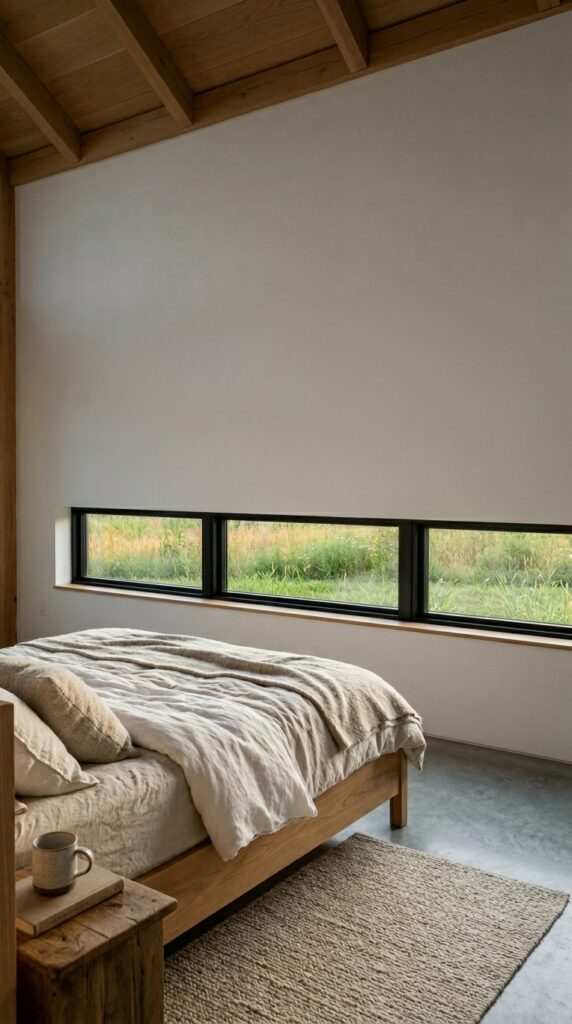
Vibe: Grounded — this room belongs to the earth, not the sky.
Why it works: Horizontal bands of fixed windows placed low in a bedroom wall — at 12 to 18 inches above floor level — create a specific visual relationship with the landscape that standard window heights never achieve. The view is of grass, roots, and low terrain rather than sky and horizon, which produces a quality of groundedness and privacy simultaneously. From the bed, the occupant sees the landscape as a wide cinematic strip, which is visually stronger than a single large window. This placement also prevents glare on screens and eliminates the need for window treatments.
How to get it: Use fixed glass panels in this application — there is no reason to open a low-lying bedroom window, and the fixed panel allows a slimmer steel frame profile and better acoustic seal than an operable unit.
💡 Quick Win: In an existing room with standard windows, hanging a wool floor-level rug right up to the wall base and placing the bed low (platform or even a floor mattress) recreates the perceptual groundedness of this window placement for $0 in construction cost.
Shop the Look
| Product |
| Low platform bed frame natural wood no headboard |
| Woven jute and wool rug natural gray |
| Fixed glass panel window blackened steel frame |
| Blackout roller shade black minimal hardware |
| Minimalist wood nightstand tray small |
20. Integrated Bookshelf Wall in Barn Plan Library
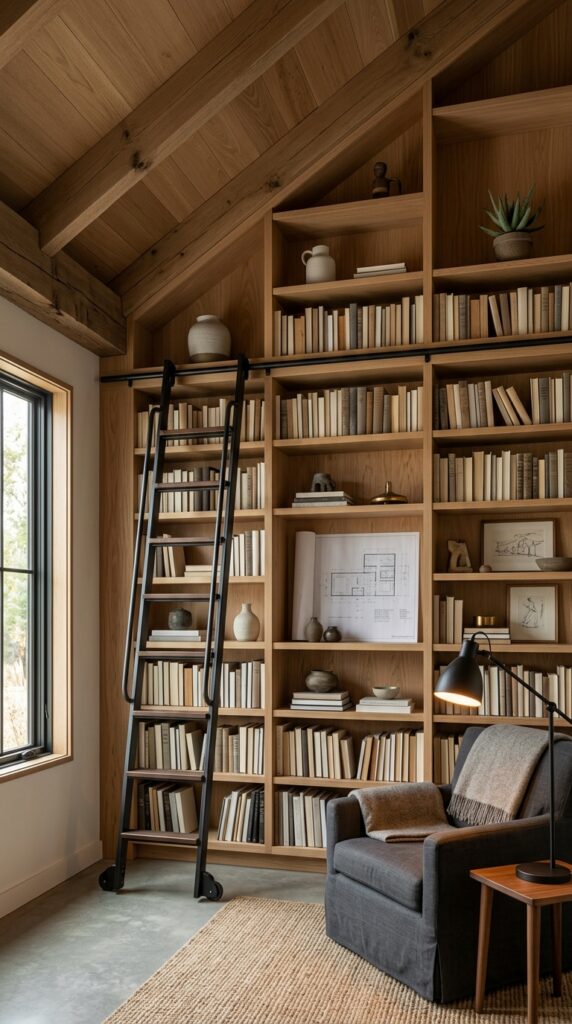
Vibe: Warm — a room that holds both knowledge and quiet in the same measure.
Why it works: A floor-to-ceiling library wall in a barn plan study uses the sloped ceiling as an asset rather than a problem: the highest shelves, reachable only by ladder, become the archive, while the reading-height shelves hold daily-use books. The rolling ladder gives the room kinetic possibility — it is the only moveable element in a largely fixed space, and its presence implies use and engagement. White oak plywood shelves (not solid wood, which warps) in natural finish warm the room without competing with the books themselves.
How to get it: Build the shelves in ¾-inch Baltic birch plywood and face with 2-inch solid white oak edge banding — this costs roughly 40% less than solid oak shelving while reading identically in a finished room. Install the ladder track before building the shelf returns, as track mounting to the wall frame must be independent of the shelf structure.
Shop the Look
| Product |
| Library rolling ladder track hardware kit blackened |
| White oak floating bookshelf wall set |
| Architect floor lamp black minimalist |
| Ceramic book end set minimalist modern |
| Natural linen book cover set neutral |
21. Murphy Bed Barn Plan Guest Room
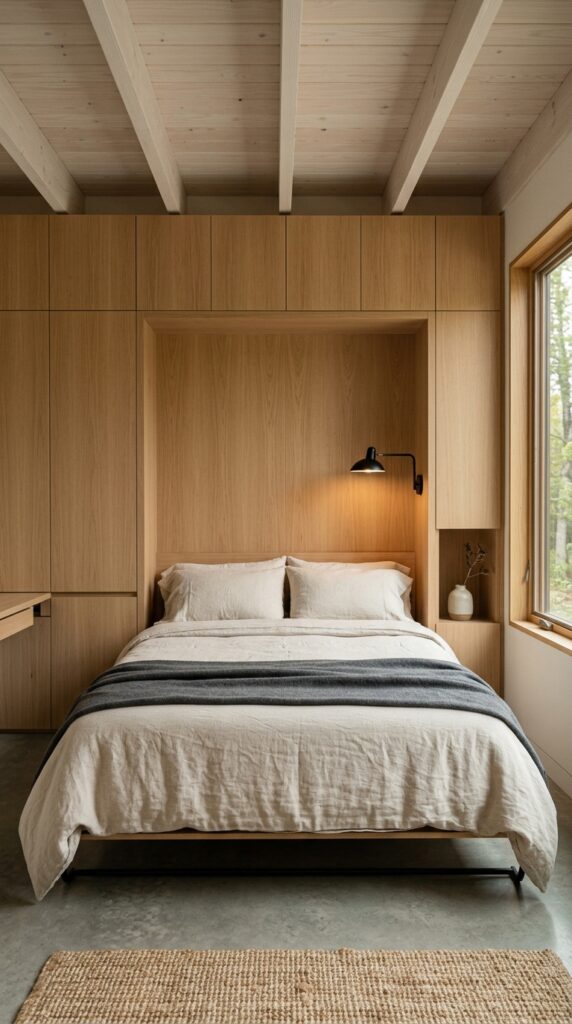
Vibe: Serene — a small room that holds everything it needs and nothing it doesn’t.
Why it works: In a barn plan where every square foot earns its allocation, the Murphy bed is not a compromise but a planning strategy. A 12×10-foot room with a Murphy bed is a full-function home office during the day and a comfortable private guest room at night — two programs in the footprint of one. The key to maintaining the minimalist character is integrating the bed wall with flanking cabinets in the same material and the same finish, so the wall reads as a unified architectural element rather than a piece of furniture placed against a wall.
How to get it: Source a European-mechanism Murphy bed kit (IKEA PAX-based or similar) and clad the surround in ¾-inch white oak plywood with a fine saw-tooth grain orientation — consistent grain direction across all panels is what makes the assembly read as built-in millwork.
💡 Quick Win: Adding two wall-mounted reading sconces (blackened steel, $45–$90 each) on either side of a Murphy bed gives the room hotel-suite quality without hardwiring — use plug-in sconces with a black cord that runs vertically down the wall behind the cabinet panel.
Shop the Look
| Product |
| Murphy wall bed kit with cabinet hardware |
| Plug-in wall sconce matte black reading |
| Natural linen guest bedding set queen |
| Minimalist wall hook oak wood modern |
| White oak cabinet knob hardware set |
22. Rammed Earth Accent Wall
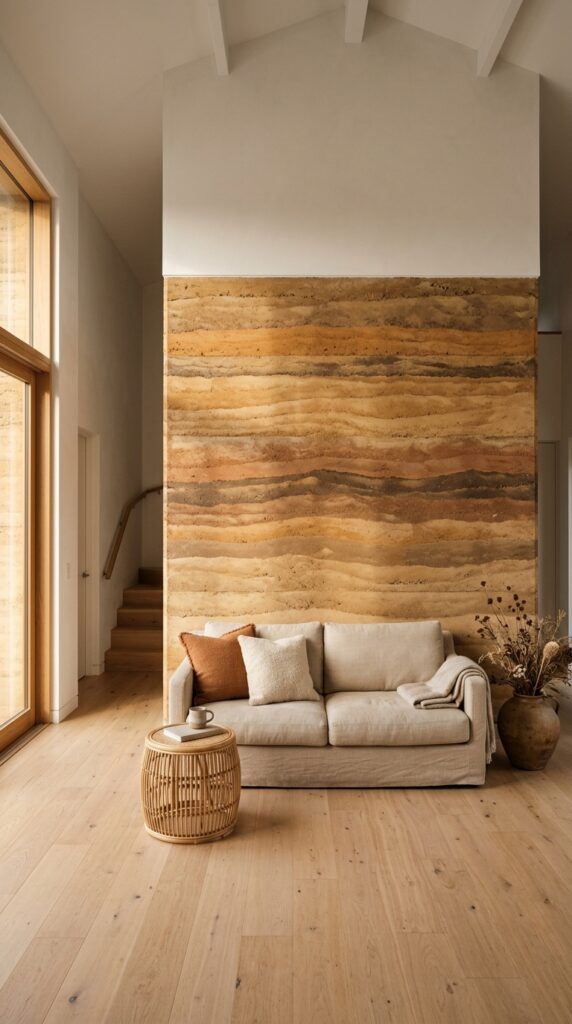
Vibe: Elemental — a wall that looks as if it was compressed from the ground it stands on.
Why it works: A rammed earth accent wall in a minimalist barn interior delivers maximum material honesty: the visible compression layers, the embedded aggregate, the tonal variation between ochre, sienna, and sand — all communicate a direct relationship between building and landscape that no manufactured surface replicates. The horizontal stratification also reinforces the barn’s strong horizontal datum lines, echoing the low window bands and floating shelves. Rammed earth has thermal mass properties that reduce temperature swings, making it a practical as well as philosophical material choice.
How to get it: If on-site rammed earth construction exceeds budget (it typically costs $70–$150 per square foot), source compressed earth block panels from SIREWALL or similar fabricators and apply them as a cladding layer to a standard framed wall — the visual result is indistinguishable and the cost is 30–50% lower.
Shop the Look
| Product |
| Rattan side table round natural modern |
| Linen sofa slipcover natural oatmeal |
| Large ceramic vessel floor vase terracotta |
| Woven sisal wall hanging minimal |
| Earth tone pillow cover set ochre rust |
23. Track Lighting on Exposed Steel Rails
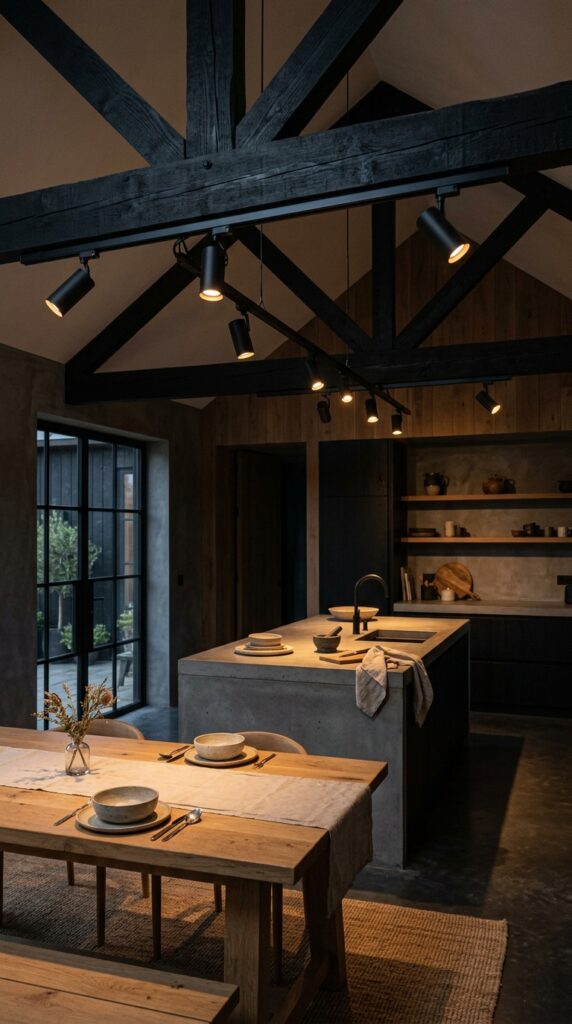
Vibe: Moody — the room is lit the way a stage is lit, with deliberate pools and deliberate shadow.
Why it works: Surface-mounted track lighting on exposed steel rails or timber beams is the lighting strategy that makes a barn interior feel like a gallery or a restaurant in the best sense: carefully directed, atmospherically intentional. The key design decision is to light surfaces and objects — the dining table, the concrete island, a wall, a work of art — and allow the ceiling and upper zone to remain in shadow. This creates depth and drama that recessed lighting cannot achieve, because recessed fixtures light the room uniformly, eliminating the contrast that makes space readable.
How to get it: Specify magnetic track lighting for maximum flexibility — the heads reposition without tools, allowing light to be adjusted seasonally as the sun changes angle through the barn’s windows. Set dimmer controls for the track at 60% maximum operational output to preserve the moody quality even at full throw.
💡 Quick Win: A single IKEA SKURUP track rail in matte black with three adjustable spotlights costs $120 total and mounts in two hours — it reads as architectural-grade in a barn interior and transforms kitchen ambient light entirely.
Shop the Look
| Product |
| Matte black magnetic track lighting kit 3 heads |
| Black dimmer switch modern minimal |
| Natural linen table runner long modern |
| Ceramic serving bowl set minimalist |
| Spot light adjustable head black modern |
24. The Studio Barn Plan — Single Room Living
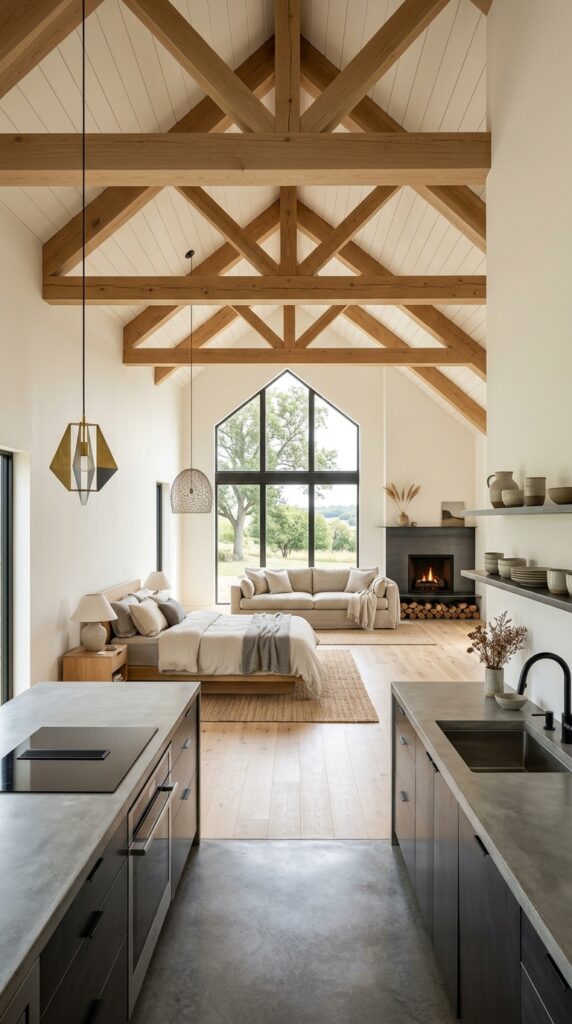
Vibe: Serene — the whole life of a person organized into one architecturally unified room.
Why it works: The studio barn plan is the purest expression of the architectural type: one room, one roof, three programs (kitchen, sleeping, living) organized along a single axis without partitions. Zone definition is achieved through material change rather than walls — concrete at the kitchen end, a wool rug defining the living zone, white oak planking beneath the bed. Ceiling pendants hung at different heights mark the center of each zone from above, creating vertical anchors that make the open volume feel organized without dividing it. This plan also has the lowest construction cost per program of any barn house type.
How to get it: Orient the sleeping zone away from both gable ends to prevent morning and evening sun from striking the bed directly — place it in the center third of the building, roughly 8 feet from a side wall, with the head of the bed against a solid plaster wall rather than a window. This creates privacy within the open plan without a single partition.
Shop the Look
| Product |
| Adjustable pendant light height minimalist black |
| Area rug wool natural grey 9×12 |
| Compact kitchen island bar cart mobile |
| White oak platform bed minimal no footboard |
| Simple fireplace hearth surround plaster modern |
How to Start Your Modern Minimalist Barn House Transformation
Start with one decision: the window and door hardware finish. Choose blackened steel — matte, not polished — and apply it to every operable element in the house simultaneously. This single material choice unifies the entire interior before a single piece of furniture is selected, because the hardware is the consistent thread connecting wall to wall, room to room. Once the hardware is resolved, every subsequent purchase orients itself around that anchor.
The most common mistake in this style is using cool-grey or blue-white light bulbs. Minimalist barn interiors depend on warm tonal unity — warm white walls, warm wood floors, warm concrete — and a 4000K “cool white” LED strips the warmth from every surface instantly, making the room read as institutional rather than grounded. Replace every bulb in the house with 2700K warm white LEDs from the moment you begin.
Three specific items under $50 that create immediate impact: a set of four matte black metal outlet and switch cover plates ($18–$24 for a set, available at any hardware store), which replace the standard white plastic ones that break the visual discipline of any wall; a bundle of dried pampas grass in a recycled glass floor bottle ($30–$40 at most home goods stores), which adds organic dimension without living plant maintenance; and a single bar of Aesop Resurrection Aromatique soap ($35) on a concrete tray in the bathroom, which shifts the entire register of the space through scent and object quality.
A realistic starter transformation — hardware, paint color, lighting, and two or three key accessories — runs $800–$2,000 and takes two dedicated weekends. A full room-level transformation including key furniture pieces and architectural details runs $8,000–$20,000 for a living room and takes three to six months of sourcing and installation. New construction of a modest barn house plan (1,200–1,800 square feet) typically runs $250–$400 per square foot depending on region and specification level.
Frequently Asked Questions About Modern Minimalist Barn House Plans
What is the difference between a modern minimalist barn house and a farmhouse-style home?
A farmhouse-style home is primarily a decorating vocabulary — shiplap walls, subway tile, mason jars, and rustic vintage accessories applied to a conventional floor plan. A modern minimalist barn house is an architectural typology: a building designed around the spatial character of an agricultural barn — high ceilings, open volumes, structural honesty, large openings — with a contemporary interior language that removes decorative excess. The farmhouse style adds to existing architecture; the barn house plan begins with the architecture itself as the primary design material.
What colors work best for a modern minimalist barn house interior?
The most successful palettes stay within a tight warm neutral range: Benjamin Moore White Dove OC-17 for primary walls, Farrow & Ball Elephants Breath as a secondary tone in bedrooms or studies, and Sherwin-Williams Iron Ore for any accent structural element. Wood finishes should stay in the natural white oak to light ash range — avoid dark walnut stains, which read as heavy and compete with the architectural elements. A single dusty sage green accent (Farrow & Ball Mizzle or similar) is the most common successful deviation from this palette.
How much does it cost to build a modern minimalist barn house plan?
A modest 1,200–1,500-square-foot single-story barn house plan in the United States runs $300,000–$600,000 to construct at construction-ready specification in 2025, depending heavily on region, material grade, and glazing budget. The blackened steel window systems alone typically represent $30,000–$80,000 of that total. A post-and-beam structure with prefabricated components can reduce the cost to $180–$250 per square foot at base specification. Budget renovation of an existing agricultural barn into a liveable barn house typically runs $150–$250 per square foot for a full interior transformation.
Can modern minimalist barn house plans work for families with children?
Yes, with specific planning adjustments. Open-plan barn designs require acoustic zoning rather than acoustic isolation — specify concrete or stone flooring in active zones and use heavy wool rugs, linen curtains, and textile-dense sleeping areas to absorb sound. Lofts above main living spaces need a solid safety parapet (not just cable railing) for children under 10. The material honesty of the style actually benefits family homes: polished concrete, honed stone, and steel are all highly durable materials that do not show the wear that carpet and painted wood do.
What are the best barn house plan roof profiles for a minimalist look?
The simple symmetrical gable is the most architecturally resolved choice — one ridge line, two slopes, maximum interior volume. The standing-seam metal roof in charcoal or weathering steel is the material standard for this style: it reads as contemporary and durable, connects to the agricultural tradition, and requires no maintenance for 40–50 years. Monitor roofs (a raised center section with windows on both sides) add clerestory light and create the classic barn silhouette but add 15–20% to structural cost. Shed roofs work on secondary structures but rarely carry the full architectural ambition of the main barn volume alone.
Ready to Create Your Dream Modern Minimalist Barn House?
These 24 ideas have moved through every layer of the design — from structural floor plans and exterior cladding choices through tonal color work, material selection, lighting strategy, and the carefully considered small details that make a space feel lived-in with intention, not decorated. Real transformation does not require doing everything at once: choosing one material truth — the right hardware finish, the right wall tone, the right window — and holding it consistently is how this style takes hold. The first concrete action you can take today is to replace every light bulb in one room with 2700K warm white LEDs and observe how the existing surfaces change. When the philosophy of this architecture lands, it lands in how a space makes you feel when you step into it — grounded, uncluttered, and exactly where you should be. Save the ideas that stopped you mid-scroll — in this style, the instinct that makes you pause is the right one.