A modern farmhouse kitchen blends the warmth and handcrafted character of traditional rural design with the clean lines and functional efficiency of contemporary spaces. This article delivers exactly 25 modern farmhouse kitchen ideas spanning color, materials, lighting, layout, cabinetry, and small-space solutions — every one of them actionable and shop-ready.
There’s a specific kind of calm that settles over a well-done modern farmhouse kitchen. It smells like old wood and fresh coffee. It has surfaces that show their history — a little worn, a little warm, exactly right. The white and the wood and the matte black hardware all agree with each other without trying too hard. Here are 25 ideas worth saving — and stealing.
Why Modern Farmhouse Kitchen Design Works So Well
Modern farmhouse design emerged from the collision of two powerful aesthetic movements: the American farmhouse tradition — rooted in practicality, natural materials, and unpretentious warmth — and the contemporary design philosophy of clean lines, restrained color palettes, and intentional negative space. What makes it distinct from pure rustic or pure Shaker design is its refusal to choose between the two. It keeps the warmth of one and the discipline of the other, which is exactly why it translates so well across house styles, budgets, and family sizes.
The material vocabulary of a modern farmhouse kitchen is precise. Unfinished or wire-brushed white oak for open shelving and flooring. Shiplap or vertical nickel-gap paneling in warm white or soft cream. Unlacquered brass or matte black hardware — never polished chrome. Farmhouse apron-front sinks in fireclay white. Surfaces in honed Carrara marble, butcher block, or concrete. Colors that anchor the palette: warm white (not cool stark white), creamy greige, aged linen, dusty navy, muted sage, and warm charcoal. Every material has texture; none of them shine.
Modern farmhouse is trending with particular momentum because it answers a cultural appetite that intensified through the past several years: the desire to make home feel genuinely inhabitable rather than staged. As people spent more time at home, the hyper-minimal kitchen — all flat fronts, hidden storage, and lacquered surfaces — began to feel cold. Modern farmhouse gives a kitchen personality without the maintenance burden of truly antique materials. Pinterest data consistently ranks it among the top-searched kitchen aesthetics, and its influence is visible in everything from major appliance finishes (matte black, brushed nickel, retro cream) to tile trends (subway, handmade ceramic, zellige).
Small kitchens can absolutely achieve the modern farmhouse aesthetic — but they require strategic restraint. The first priority in a compact farmhouse kitchen is to limit the wood tones to one family (either light oak or dark walnut, not both) and use open shelving on one wall only, keeping cabinets on all others. Overcrowding the visible surfaces with too many materials — mixing shiplap, reclaimed wood, butcher block, and open shelving all at once — collapses the clean restraint that keeps modern farmhouse from reading as cluttered country.
Style at a Glance
| Element | Core Trait 1 | Core Trait 2 |
| Philosophy | Warmth with restraint | Handcrafted, not fussy |
| Materials | Wire-brushed oak, fireclay, shiplap | Butcher block, honed marble, linen |
| Color palette | Warm white, creamy greige, aged linen | Dusty navy, muted sage, warm charcoal |
25 Modern Farmhouse Kitchen Ideas
1. White Shaker Cabinets with Matte Black Hardware
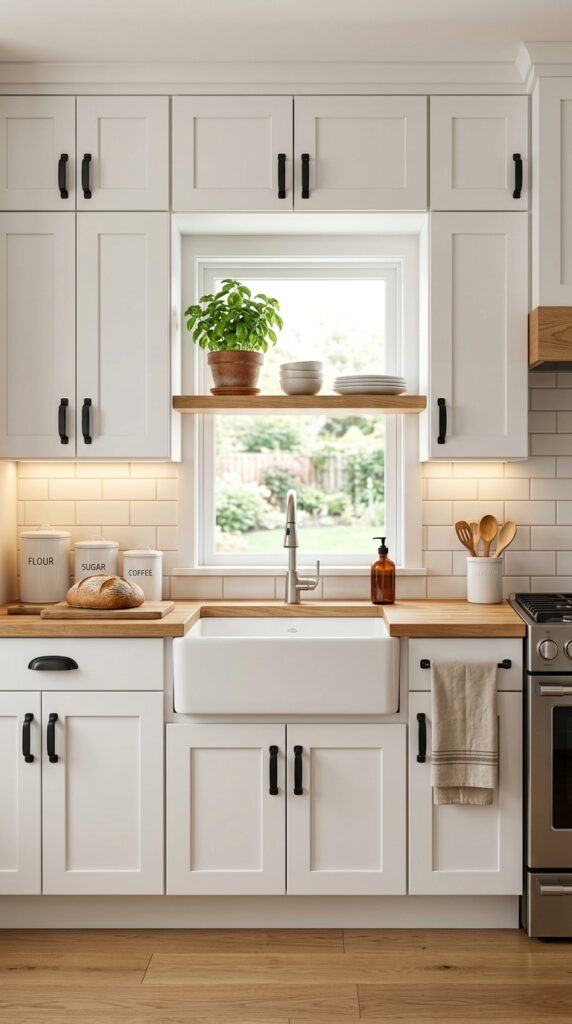
Vibe: Clean — the visual equivalent of a deep breath.
Why it works: White Shaker cabinets are the defining furniture piece of modern farmhouse kitchen design, and the pairing with matte black hardware is what pulls them out of traditional and into the modern half of the equation. The recessed panel profile of Shaker doors introduces surface shadow without ornamentation — it’s architectural texture achieved through subtraction rather than addition. Matte black hardware reads as contemporary rather than industrial because it absorbs light rather than reflecting it, keeping the visual temperature of the kitchen warm and soft. The combination succeeds through contrast of tone (white cabinet, black hardware) with unity of finish quality (both surfaces matte).
How to get it: Specify a flat or eggshell finish on cabinet doors — never satin or semi-gloss, which reads too contemporary and shows every fingerprint. Bin pulls in a 3.75-inch center-to-center spacing are the most proportionally accurate choice for standard Shaker door sizes. Source matte black bin pulls in a solid zinc alloy rather than hollow steel — they have significantly more visual weight and age better.
💡 Quick Win: Replacing existing cabinet hardware with matte black bin pulls ($2–$5 per pull on Amazon) is the single fastest way to shift an existing kitchen toward modern farmhouse — no painting or renovation required.
🛍️ Shop the Look — Amazon Product Ideas
| # | Product Search Phrase | Why It Fits |
| 1 | matte black bin pull cabinet hardware 3.75 inch | Core hardware element |
| 2 | white Shaker cabinet door paint flat finish | Cabinet color anchor |
| 3 | terracotta herb planter small countertop | Earthy organic accent |
| 4 | white ceramic canister set kitchen counter | Classic farmhouse storage |
| 5 | linen dish towel set natural stripe | Textile warmth detail |
2. Farmhouse Apron-Front Sink in Fireclay White
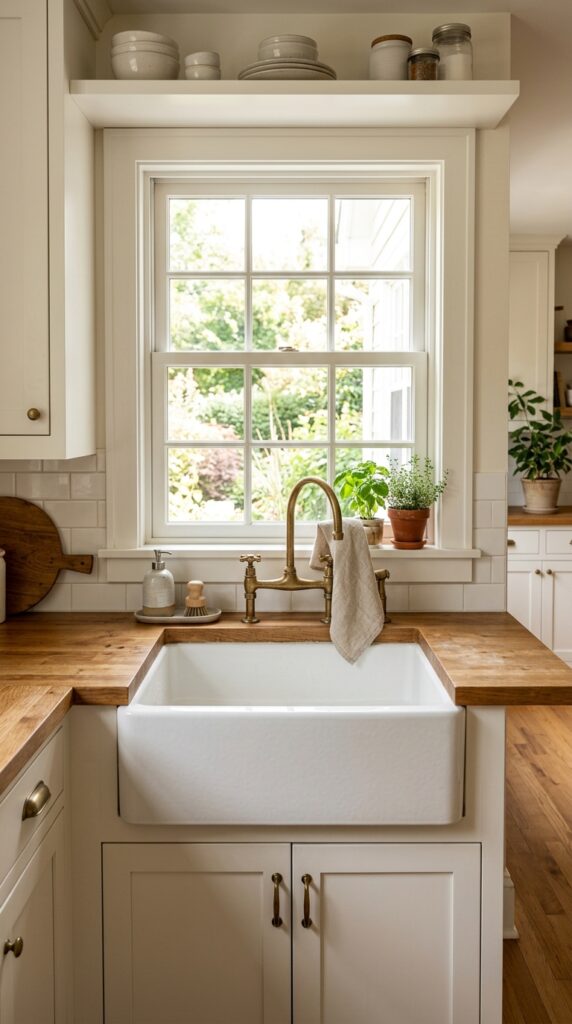
Vibe: Grounded — the sink that makes the kitchen feel like it was always here.
Why it works: The apron-front farmhouse sink is architecturally significant rather than merely decorative: its exposed front face replaces what would otherwise be a blank cabinet door, creating a strong visual anchor in the sink run. Fireclay construction (as opposed to cast iron or stainless) is the correct material choice for modern farmhouse because it has a slightly organic surface texture, resists chipping better than cast iron, and ages with character rather than simply wearing. The pairing with an aged brass bridge faucet introduces a second warm metal tone that bridges the gap between the warm white sink and the wood-toned countertop elements on either side.
How to get it: Size the apron sink to match your base cabinet width precisely — standard single-basin farmhouse sinks come in 30-inch and 33-inch widths. The 33-inch single basin is the most functional for family kitchens. Install a butcher block or honed marble countertop on either side of the sink, not stone slab all the way — the material transition reinforces the layered quality central to modern farmhouse design.
🛍️ Shop the Look — Amazon Product Ideas
| # | Product Search Phrase | Why It Fits |
| 1 | fireclay apron front farmhouse sink 33 inch white | Core sink element |
| 2 | aged brass bridge kitchen faucet two handle | Faucet hardware pairing |
| 3 | butcher block countertop end grain small section | Counter material anchor |
| 4 | ceramic soap dispenser white matte farmhouse | Sink-adjacent detail |
| 5 | windowsill herb planter wood divided tray | Above-sink styling |
3. Open Wood Shelving with Curated Ceramic Display
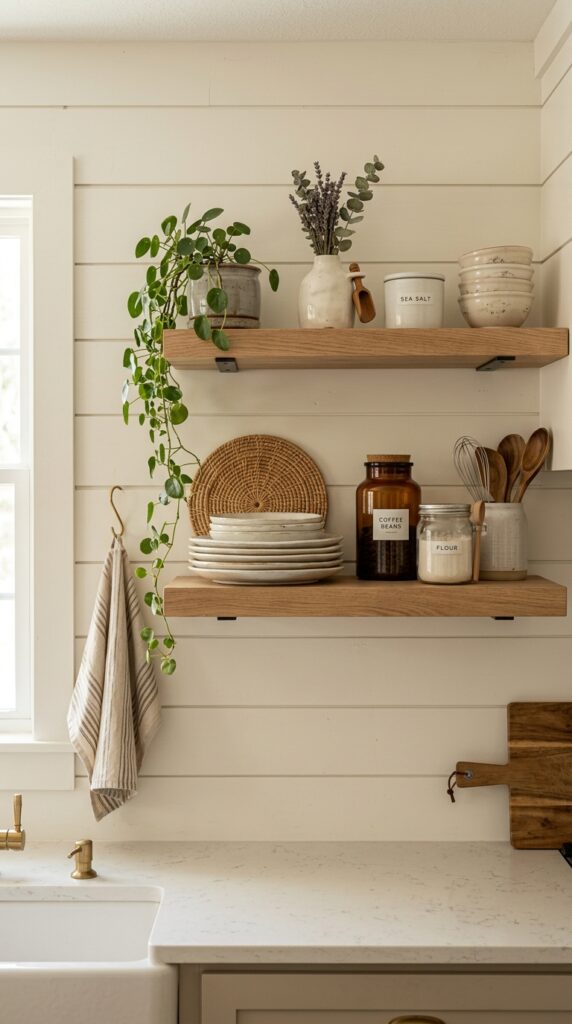
Vibe: Collected — the shelves that make a kitchen feel genuinely lived in.
Why it works: Open shelving in a modern farmhouse kitchen succeeds on the principle of curated imperfection — items arranged with intentional breathing room between them, mixing functional objects (plates, jars) with purely decorative ones (bud vases, dried herbs) in a way that communicates someone thoughtful lives here. Wire-brushed white oak shelves are the correct material choice because the brushing process removes the soft grain and leaves the hard grain elevated, giving the shelf visible texture that smooth sanded oak lacks. Steel floating brackets (rather than wood corbels) provide the contemporary counterpoint that keeps the look modern rather than country.
How to get it: Style each shelf using the rule of three: one tall element (a vase, a jar of dried pasta), one medium cluster (stacked plates or bowls), and one horizontal element (a book, a woven trivet). Leave at least 4 inches of visible shelf surface between groupings — negative space is what keeps open shelving from reading as cluttered.
💡 Quick Win: A set of matching cream ceramic mugs ($18–$28 for four) stacked or hung on hooks beneath an open shelf is the single most effective styling move — they add warmth, repetition, and function simultaneously.
🛍️ Shop the Look — Amazon Product Ideas
| # | Product Search Phrase | Why It Fits |
| 1 | floating shelf bracket steel black 10 inch | Contemporary support detail |
| 2 | wire-brushed white oak shelf board 36 inch | Core shelf material |
| 3 | cream stoneware mug set of 4 | Shelf styling anchor |
| 4 | glass storage jar set with lid kitchen | Functional shelf display |
| 5 | dried herb bundle kitchen decor | Organic shelf detail |
4. Shiplap Kitchen Island with Painted Base
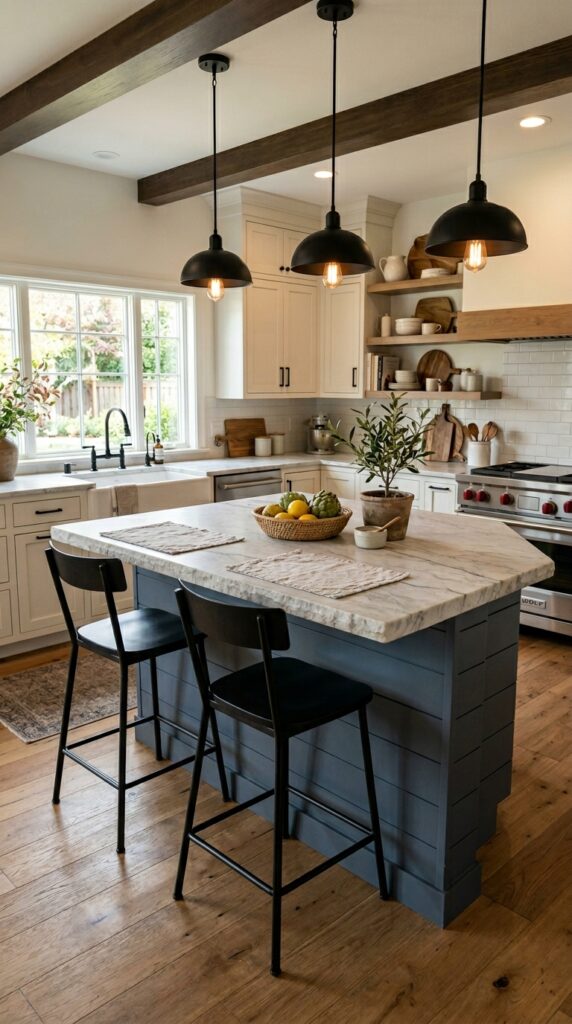
Vibe: Grounded — an island that looks like it was built rather than delivered.
Why it works: A shiplap-paneled island base creates architectural distinction between the island and the surrounding cabinetry — it transforms what could be a floating box into a piece of furniture with character and visual weight. Painting the island in a contrasting tone (dusty navy, warm charcoal, or sage green) while keeping perimeter cabinets in warm white is a foundational modern farmhouse design technique: it gives the kitchen a focal point and avoids the monotony of single-color cabinetry throughout. The honed marble countertop is critical — polished marble reads too formal and contemporary; honed keeps the texture honest and farmhouse-appropriate.
How to get it: Apply 1×4 pine shiplap boards horizontally to all visible island sides with a 1/8-inch shadow gap. Paint in Benjamin Moore “Hale Navy” HC-154 for the most reliably warm dusty navy in any light condition. Top with a honed Carrara marble slab at a minimum 1.5-inch thickness for visual presence.
🛍️ Shop the Look — Amazon Product Ideas
| # | Product Search Phrase | Why It Fits |
| 1 | dusty navy matte cabinet paint sample | Island color anchor |
| 2 | matte black counter bar stool set of 3 | Island seating element |
| 3 | woven rattan bowl large centerpiece | Island styling detail |
| 4 | honed marble effect contact paper countertop | Budget marble alternative |
| 5 | shiplap peel and stick wall panel white | Island paneling option |
5. Vintage-Style Pendant Lights Over the Island
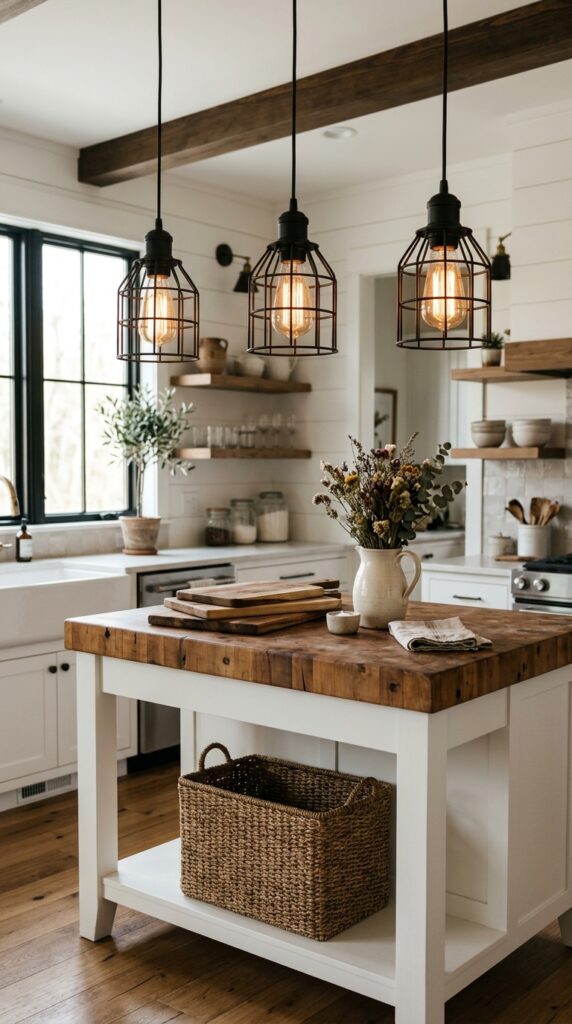
Vibe: Warm — the kind of light that makes food look like it was made with care.
Why it works: Pendant lighting over an island is the most impactful single lighting decision in a modern farmhouse kitchen because it performs three functions simultaneously: task lighting, ambient warmth contribution, and visual rhythm. The rule of three pendants over a standard island is grounded in proportion — one pendant reads lonely, two creates uncomfortable symmetry that draws attention to the space between them, while three creates rhythm and visual weight that anchors the island as the room’s focal point. Cage-style pendants in matte black allow the Edison bulb’s warm filament to remain visible, contributing warm amber light even when unlit.
How to get it: Hang pendants so the bottom of the shade sits 32–36 inches above the countertop surface. Space three pendants evenly across the island length — for a 60-inch island, center them at 15, 30, and 45 inches from one end. Specify 2200K Edison-style LED bulbs (not incandescent — they run too hot over a food prep surface).
💡 Quick Win: Plug-in pendant lights with a cord cover ($35–$65) allow island pendant installation without an electrician — the cord runs up to the ceiling and along it to the nearest outlet.
🛍️ Shop the Look — Amazon Product Ideas
| # | Product Search Phrase | Why It Fits |
| 1 | matte black cage pendant light Edison bulb | Core lighting fixture |
| 2 | 2200K Edison LED bulb E26 warm filament | Correct bulb temperature |
| 3 | pendant light canopy ceiling kit adjustable cord | Installation hardware |
| 4 | large woven seagrass basket open storage | Island lower shelf |
| 5 | stacked cutting board set walnut acacia | Island surface styling |
6. Butcher Block Countertops in Warm End-Grain Oak
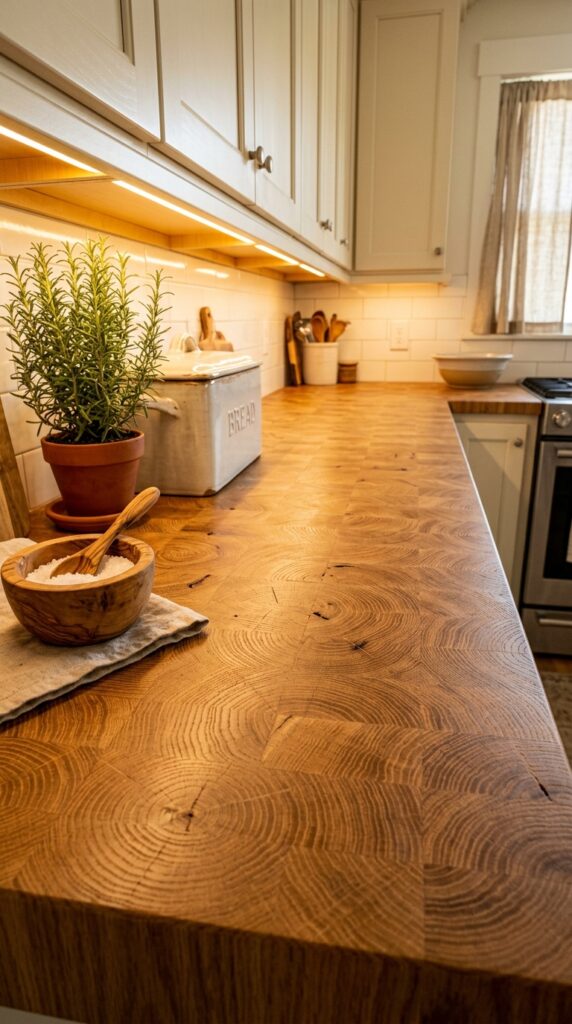
Vibe: Handcrafted — a surface that tells the story of the tree it came from.
Why it works: End-grain butcher block is the most texturally honest countertop material available for modern farmhouse kitchens — the cross-cut surface exposes the tree’s growth rings in a mosaic pattern that no manufactured surface can replicate. Unlike edge-grain butcher block (which shows the side of the plank), end-grain is significantly more durable, self-healing to light knife marks, and visually more complex because the grain circles create a geometric pattern independent of any finish. White oak is the correct species choice over maple or walnut because its warmer tone bridges white cabinetry and any brass or aged-metal hardware without pulling either direction too strongly.
How to get it: Seal end-grain butcher block with a food-safe penetrating oil (Howard Butcher Block Conditioner or pure food-grade mineral oil) rather than a film-forming polyurethane — polyurethane traps moisture under the surface and eventually cracks. Re-oil every 3–6 months. Sand lightly with 220-grit between oiling to maintain the surface.
🛍️ Shop the Look — Amazon Product Ideas
| # | Product Search Phrase | Why It Fits |
| 1 | end grain butcher block countertop white oak | Core countertop material |
| 2 | food safe butcher block oil conditioner | Wood maintenance essential |
| 3 | ceramic bread box white farmhouse | Counter storage accent |
| 4 | wooden salt cellar with spoon small | Functional farmhouse detail |
| 5 | potted rosemary herb kitchen counter | Aromatic organic accent |
7. Subway Tile Backsplash in a Running Bond Pattern
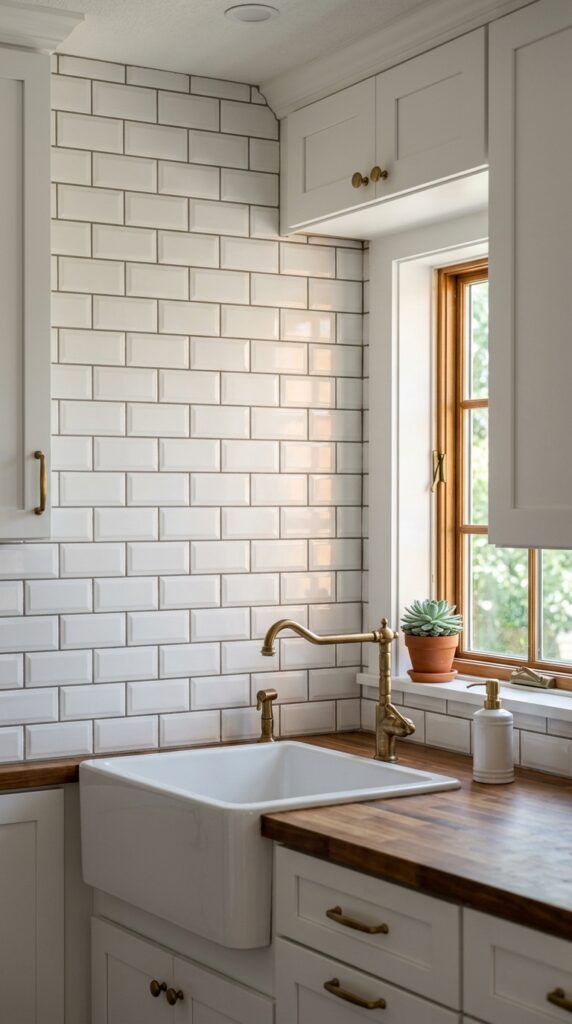
Vibe: Still — the backsplash that asks nothing of you and gives everything.
Why it works: Subway tile in a running bond (brick) pattern is to modern farmhouse kitchens what Shaker cabinets are to the cabinetry — the correct foundation choice that enables everything else around it to feel considered rather than competed with. The critical detail that separates modern farmhouse subway tile from dated subway tile is the grout color: warm gray (such as Custom Building Products “Delorean Gray”) rather than bright white grout. White grout makes subway tile read like a sterile clinical surface; warm gray grout adds visual texture that makes the field of tile look hand-laid and intentional. The running bond pattern (offset by half a tile each row) reinforces the handcrafted quality central to the farmhouse aesthetic.
How to get it: Install 3×6 beveled subway tile (the slight bevel catches light and adds dimension that flat tiles lack) with an 1/8-inch joint and warm gray grout. Run tile floor-to-ceiling behind the stove — not just to the underside of upper cabinets — for maximum architectural impact.
🛍️ Shop the Look — Amazon Product Ideas
| # | Product Search Phrase | Why It Fits |
| 1 | white beveled subway tile 3×6 box | Core backsplash material |
| 2 | warm gray unsanded tile grout kitchen | Grout color anchor |
| 3 | tile leveling spacer system 1/8 inch | Installation precision tool |
| 4 | grout sealer kitchen backsplash penetrating | Long-term maintenance |
| 5 | grout cleaning brush set kitchen tile | Maintenance accessory |
8. Reclaimed Wood Floating Shelves with Iron Brackets
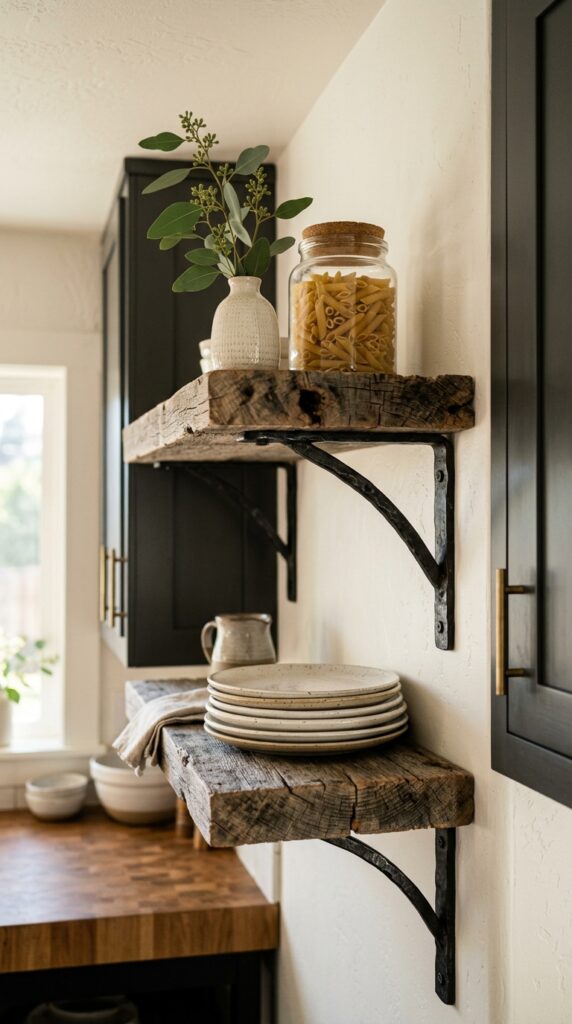
Vibe: Raw — the shelf that looks like it came from somewhere real.
Why it works: Reclaimed wood introduces material history that new construction can’t manufacture — the weathered grain, natural color variation, and visible knots communicate age and authenticity in a way that even high-quality new wood can’t fully replicate. Pairing with forged iron J-brackets rather than steel floating brackets reinforces the handcrafted quality: forged iron has slight irregularities in its surface that distinguish it from machine-cut steel. The design principle at play is material contrast — rough, aged, organic wood against flat, smooth, painted white cabinetry creates the tension that makes a kitchen feel designed rather than assembled from a catalogue.
How to get it: Source reclaimed wood from local architectural salvage yards or lumber dealers who carry barn wood specifically — specify a minimum 2-inch thickness for shelves carrying any real weight. Seal with a matte wax or penetrating oil finish only; polyurethane or lacquer will destroy the aged appearance. Forged iron J-brackets are available through blacksmith shops or specialty hardware retailers like Rejuvenation.
🛍️ Shop the Look — Amazon Product Ideas
| # | Product Search Phrase | Why It Fits |
| 1 | forged iron J bracket shelf support rustic | Core bracket element |
| 2 | reclaimed barnwood shelf board natural finish | Aged wood surface |
| 3 | matte finishing wax clear wood sealer | Preserves aged look |
| 4 | stoneware pasta bowl set cream farmhouse | Shelf display anchor |
| 5 | glass pasta storage jar tall clear lid | Functional shelf display |
9. Sage Green Lower Cabinets with White Uppers
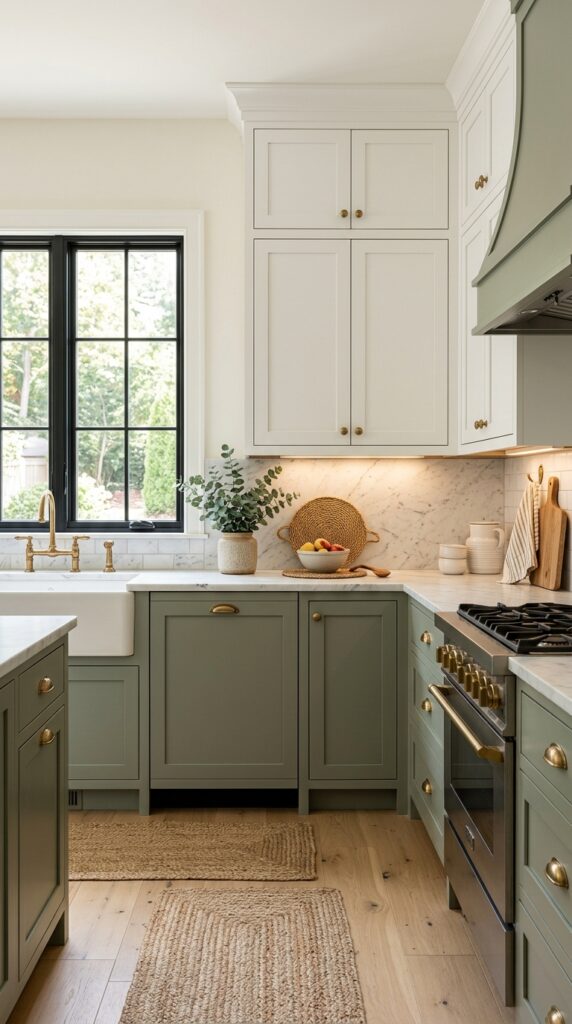
Vibe: Serene — green that feels grown rather than painted.
Why it works: Two-tone cabinetry with a muted sage lower and warm white upper is one of the most effective color strategies in modern farmhouse kitchen design because it follows the natural visual logic of the outdoors — earth tones at the ground level, lighter tones above. The sage lower cabinets visually ground the kitchen while keeping the overall space feeling light and open, since the upper cabinets and wall surfaces remain bright. Muted sage (specifically a dusty, gray-leaning green rather than a yellow-green) works in artificial light conditions that would make more saturated greens appear vivid and jarring. The aged brass hardware ties both cabinet tones together with a warm metal note that bridges cool green and warm white.
How to get it: Sherwin-Williams “Clary Sage” SW 6178 is the most reliably muted sage for kitchen lower cabinets — it sits in the gray-green family and reads consistently warm under both natural and artificial light. Paint uppers in Benjamin Moore “White Dove” OC-17 for warmth without stark brightness.
💡 Quick Win: Painting only the lower cabinets (leaving uppers white) costs roughly half of a full kitchen repaint and delivers nearly the same design impact — it’s the highest-ROI paint project in kitchen renovation.
🛍️ Shop the Look — Amazon Product Ideas
| # | Product Search Phrase | Why It Fits |
| 1 | sage green cabinet paint sample matte kitchen | Lower cabinet color |
| 2 | aged brass cup pull cabinet hardware set | Warm metal hardware |
| 3 | marble contact paper countertop white gray vein | Budget marble surface |
| 4 | potted eucalyptus plant small countertop | Organic sage echo |
| 5 | woven jute placemat set of 4 natural | Earthy table layer |
10. Shiplap Kitchen Ceiling for Dramatic Texture
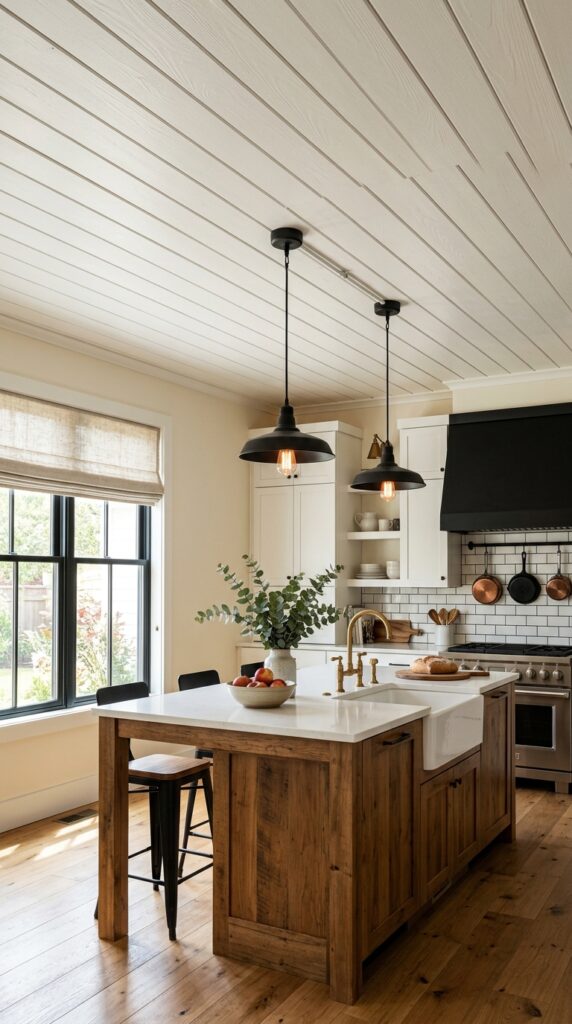
Vibe: Luminous — a ceiling that earns its place in the room.
Why it works: Installing shiplap on the ceiling rather than the wall is a more unexpected and visually striking application of the material — it adds architectural texture overhead without consuming wall real estate needed for cabinetry or windows. The horizontal board rhythm on the ceiling creates the same elongating effect as horizontal wainscoting, making the kitchen feel wider. Shadow lines between boards catch light from pendants and windows at different angles throughout the day, creating a living quality in what is typically the room’s most static surface. This technique is particularly effective in kitchens with standard 8-foot ceilings that would otherwise feel low.
How to get it: Use 1×6 pine shiplap boards (pre-primed for easier painting) applied perpendicular to the ceiling joists for structural attachment. Paint in a flat or matte finish — satin catches light unevenly on a horizontal surface and emphasizes any imperfection in ceiling level. Install pendant lights from ceiling boxes before boarding to allow wire routing.
🛍️ Shop the Look — Amazon Product Ideas
| # | Product Search Phrase | Why It Fits |
| 1 | peel and stick shiplap ceiling panel white paintable | Renter-friendly ceiling option |
| 2 | ceiling mount pendant light black cord kit | Shiplap ceiling light |
| 3 | flat white ceiling paint low sheen gallon | Correct ceiling finish |
| 4 | cast iron pot rack ceiling mount | Functional overhead accent |
| 5 | linen roman shade white natural | Window softening element |
11. Vintage-Look Range Hood as Kitchen Focal Point
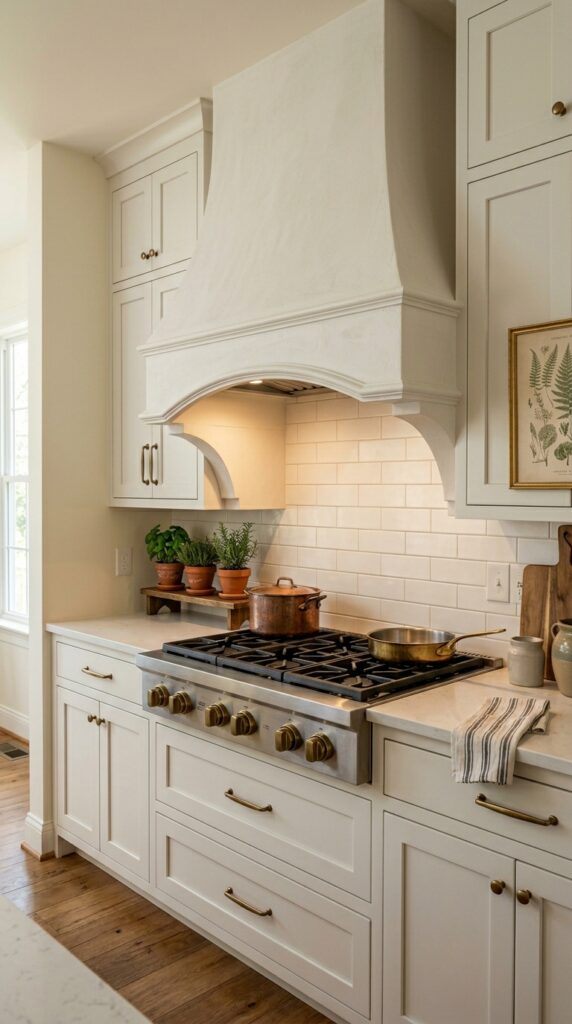
Vibe: Grounded — the piece that makes every other detail feel like it was planned around it.
Why it works: A statement range hood is the single highest-impact architectural feature in a modern farmhouse kitchen because it draws the eye to the cooking zone — the room’s functional center — and communicates that the kitchen was designed with intention. Custom-style hoods (arched base profile, painted wood or plaster finish) create a furniture-quality presence that stock stainless steel hoods can’t approach. The arched bottom opening is the key detail: it softens what would otherwise be a boxy architectural element and connects the hood to the organic curves found throughout well-composed farmhouse interiors.
How to get it: Hood insert kits (the ventilation mechanism) can be purchased separately from the decorative surround, allowing a custom-built hood box at a fraction of the cost of a manufactured piece. Build the box from MDF, add simple flat molding to the base, and paint in a flat warm white. Insert a liner rated for your range’s BTU output.
🛍️ Shop the Look — Amazon Product Ideas
| # | Product Search Phrase | Why It Fits |
| 1 | range hood insert liner 30 inch white | Ventilation mechanism core |
| 2 | decorative crown molding MDF paintable trim | Hood surround detail |
| 3 | warm white flat cabinet paint quart | Hood finish color |
| 4 | copper pot small farmhouse kitchen decor | Range surface accent |
| 5 | framed botanical print kitchen wall art | Adjacent wall styling |
12. Warm White Beadboard on the Kitchen Island
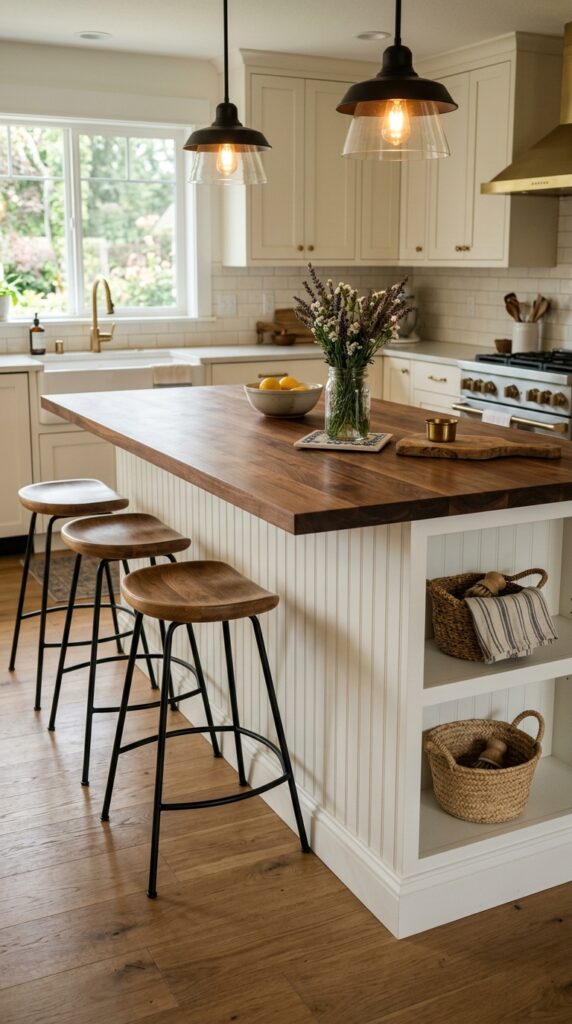
Vibe: Warm — the island that feels like it came with the house.
Why it works: Beadboard paneling on a kitchen island base creates a texture and visual rhythm distinct from shiplap — the narrow vertical groove pattern (typically 1/8-inch grooves on 1.5-inch centers) introduces fine-grained surface detail that reads as traditional craftsmanship. Orienting the beadboard vertically on an island (rather than horizontally) draws the eye upward, visually increasing the island’s perceived height — critical for maintaining proportion when using low bar stools. The contrast between the crisp, white beadboard base and a thick dark walnut butcher block top is a near-perfect expression of the modern farmhouse principle: the old and new, the light and dark, collaborating through contrast.
How to get it: Beadboard sheets (4×8 panels) available at any home improvement store can be cut and applied to island sides with construction adhesive and finishing nails. Caulk all seams and joints before painting for a seamless appearance. Paint in a flat finish — beadboard’s fine groove pattern shows every sheen variation.
🛍️ Shop the Look — Amazon Product Ideas
| # | Product Search Phrase | Why It Fits |
| 1 | beadboard wall panel sheet 4×8 paintable | Island panel material |
| 2 | dark walnut butcher block small section island | Island countertop anchor |
| 3 | matte black metal bar stool set of 3 | Island seating element |
| 4 | woven seagrass basket with handle storage | Under-island storage detail |
| 5 | dried lavender bunch glass jar | Island centerpiece organic |
13. Unlacquered Brass Fixtures for a Lived-In Feel
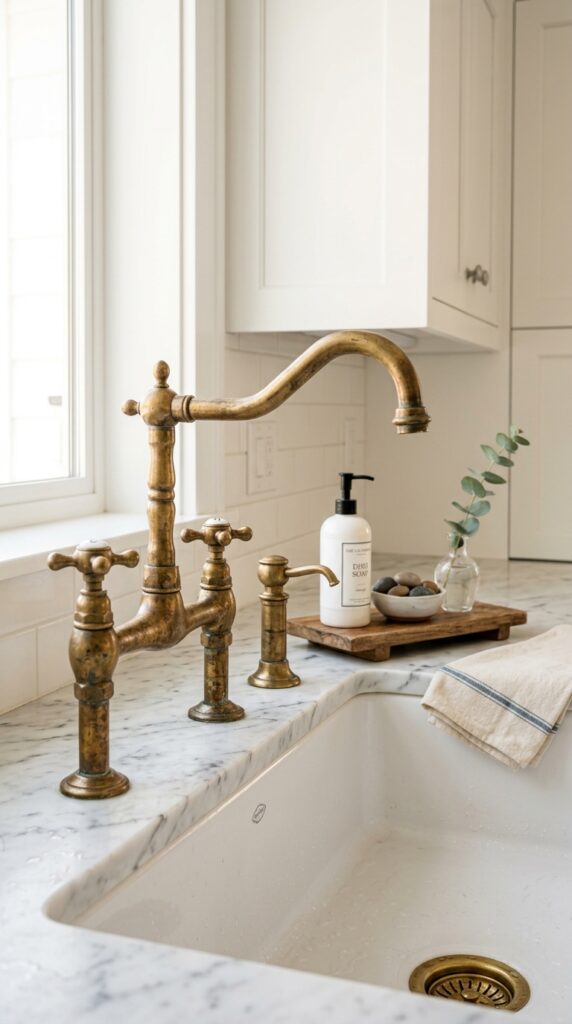
Vibe: Warm — the hardware that looks better with every year of use.
Why it works: Unlacquered brass is fundamentally different from polished or lacquered brass: the absence of a protective coating allows the metal to develop a natural patina over time, darkening at low-touch points and brightening at high-wear areas. This living quality — the idea that the fixture changes and improves with use — is philosophically aligned with the modern farmhouse aesthetic’s celebration of materials that age authentically. Unlike polished brass (which reads as dated) or brushed brass (which reads as contemporary but static), unlacquered brass reads as genuinely antique even when brand new, and only improves with time.
How to get it: Rohl and Waterworks carry unlacquered brass kitchen fixtures; for a significantly lower price point, search for “living brass” or “natural brass” finishes specifically — these are the unlacquered versions. Maintain with a simple wax paste (Renaissance Wax) once a year to slow but not stop the patina process.
💡 Quick Win: An unlacquered brass soap dispenser ($22–$40) paired with an existing faucet is the fastest single way to test the warm-metal direction in a kitchen before committing to full fixture replacement.
🛍️ Shop the Look — Amazon Product Ideas
| # | Product Search Phrase | Why It Fits |
| 1 | unlacquered brass kitchen faucet bridge style | Core living finish fixture |
| 2 | natural brass soap dispenser pump kitchen | Patina accent element |
| 3 | brass pot filler wall mount kitchen | Range-adjacent brass detail |
| 4 | Renaissance wax metal protectant clear | Patina maintenance product |
| 5 | river stone tray small decorative kitchen | Sink-adjacent styling |
14. Dark-Stained Kitchen Island Contrast Piece
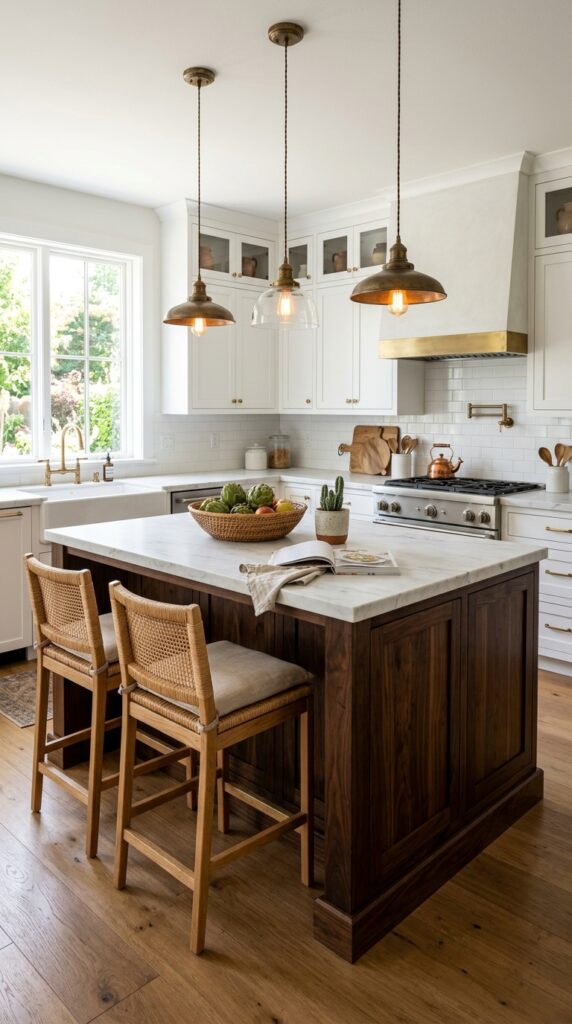
Vibe: Bold — the island that holds the room together by not matching anything.
Why it works: A dark-stained island against white perimeter cabinetry creates the maximum tonal contrast possible within the modern farmhouse palette — it’s the most decisive single color choice in kitchen design, and it works because it follows natural visual logic: the island, being a freestanding piece of furniture, should read as furniture rather than cabinetry. Deep espresso or walnut stains on solid wood (as opposed to painted finishes) maintain the grain visibility that keeps the contrast from reading as graphic and contemporary, anchoring it firmly in the handcrafted, natural-material world of farmhouse design.
How to get it: If working from existing cabinets, a gel stain applied over an existing finish can shift the color significantly — Varathane “Dark Walnut” gel stain works over painted surfaces with proper preparation. For new construction, specify a custom stain over flat-cut white oak or white ash for the richest grain expression.
🛍️ Shop the Look — Amazon Product Ideas
| # | Product Search Phrase | Why It Fits |
| 1 | dark walnut gel stain wood cabinets | Island stain color |
| 2 | aged brass dome pendant light kitchen | Warm island lighting |
| 3 | rattan woven serving bowl large | Island centerpiece |
| 4 | linen bar stool cushion tie-on | Seating comfort layer |
| 5 | small ceramic planter succulent farmhouse | Island organic accent |
15. Farmhouse Kitchen with Exposed Brick Accent Wall
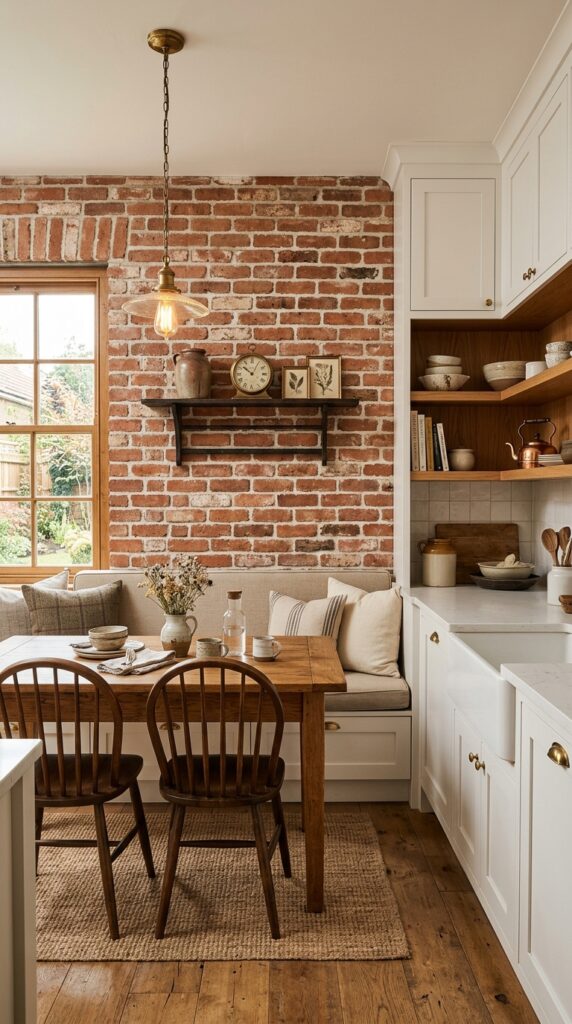
Vibe: Warm — the wall that makes the room feel it was built on top of something real.
Why it works: Exposed brick is the most historically grounded farmhouse material available — its presence communicates age, permanence, and organic warmth that no painted surface can replicate. In a modern farmhouse kitchen, a single brick accent wall (rather than brick on all surfaces) maintains the contemporary restraint that distinguishes the style from pure rustic or industrial design. The mortar color is the design-critical detail: white or pale gray mortar keeps brick reading warm and light; dark mortar pulls it toward industrial. An oak shelf mounted directly to brick — visible brackets and all — reinforces the material honesty at the core of farmhouse design.
How to get it: If no original brick is present, thin brick veneer panels (sold in 8×24-inch sheets) create an authentic appearance at a fraction of the cost of true masonry. Specify an aged red-orange color blend rather than a single uniform brick tone — variation is what makes brick read as real.
🛍️ Shop the Look — Amazon Product Ideas
| # | Product Search Phrase | Why It Fits |
| 1 | thin brick veneer panel aged red fireplace kitchen | Brick surface material |
| 2 | white mortar grout trowel brick | Mortar color control |
| 3 | iron wall mounted shelf bracket heavy duty | Brick-mounted shelf |
| 4 | vintage wall clock farmhouse kitchen large | Brick wall styling |
| 5 | ceramic vessel pitcher large cream | Shelf-on-brick accent |
16. Compact Modern Farmhouse Kitchen with Smart Storage
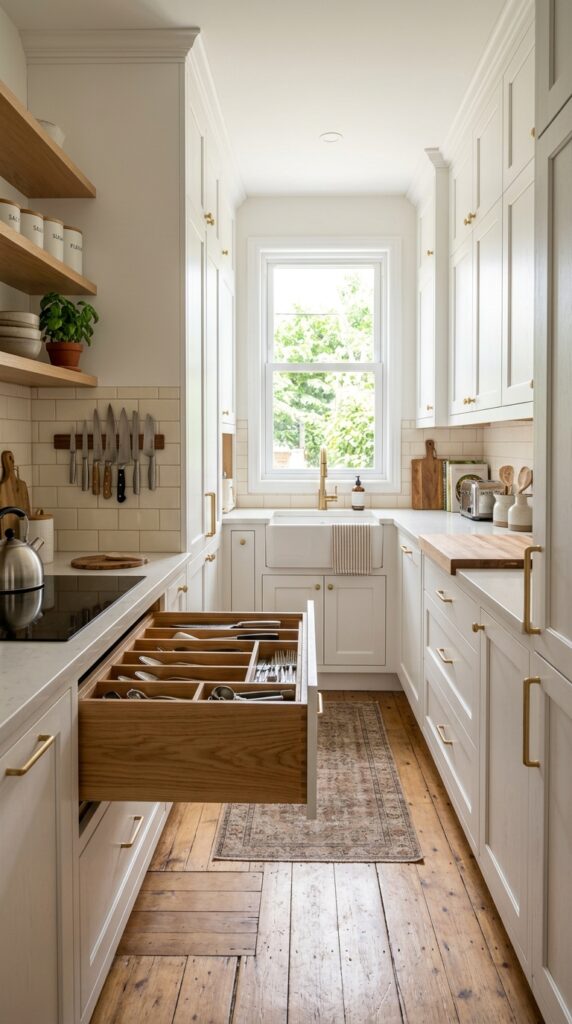
Vibe: Organized — the small kitchen that wastes nothing.
Why it works: Small farmhouse kitchens succeed through storage discipline rather than display restraint — the key distinction between a small kitchen that feels curated and one that feels cramped is whether storage systems are specific enough to eliminate countertop clutter entirely. Pull-out drawer inserts (for spices, utensils, or cookware) inside base cabinets utilize the full depth of the cabinet without requiring door swings into the working aisle. A single section of open shelving (rather than multiple open sections) gives the kitchen personality while keeping most storage closed and visually calm. A wall-mounted magnetic knife strip eliminates the knife block that consumes 4–6 inches of irreplaceable counter space.
How to get it: Measure every base cabinet interior before purchasing pull-out organizers — standard widths are 9, 12, 15, 18, and 21 inches. The most space-efficient base cabinet configuration for small farmhouse kitchens is two deep drawers (rather than a door + shelf) for all lower storage, which provides 40% better access to stored items.
💡 Quick Win: A wall-mounted magnetic knife strip in black walnut wood ($25–$40) frees counter space and adds a beautiful natural material detail at the same time.
🛍️ Shop the Look — Amazon Product Ideas
| # | Product Search Phrase | Why It Fits |
| 1 | pull-out cabinet drawer organizer kitchen base | Storage efficiency system |
| 2 | walnut magnetic knife strip wall mount | Counter space liberator |
| 3 | over-door spice rack organizer slim | Vertical storage element |
| 4 | small ceramic canister set farmhouse | Counter-top storage styling |
| 5 | compact farmhouse sink 24 inch single basin | Small kitchen sink option |
17. Warm Wood Flooring in Wide-Plank White Oak
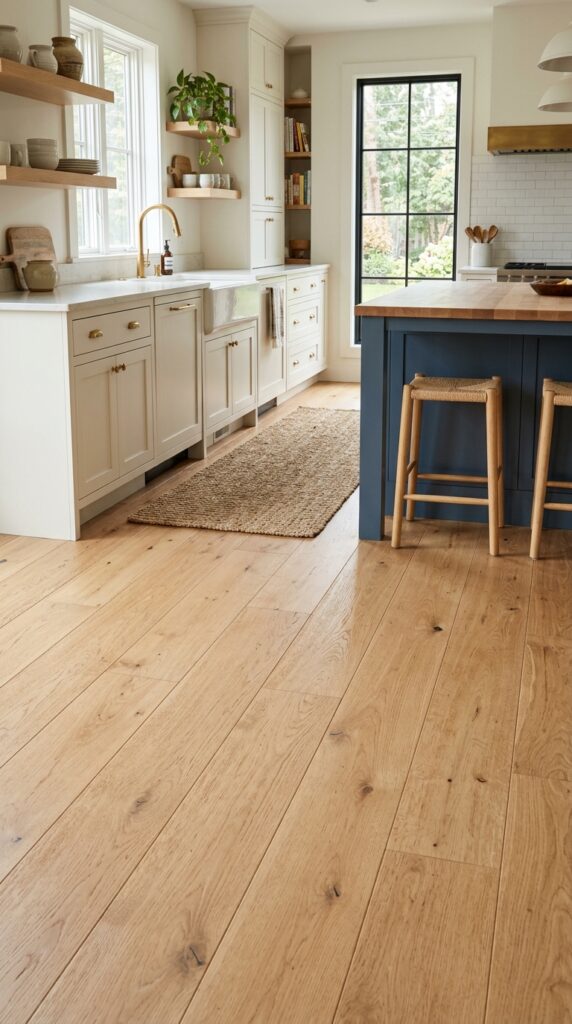
Vibe: Sun-warmed — the floor that makes bare feet a pleasure at 6am.
Why it works: Wide-plank white oak flooring is the most grounding material decision in a farmhouse kitchen renovation — it establishes the room’s warmth from the floor up, which means every cabinet and countertop choice above it is already working with a warm foundation. Six-inch-wide planks are the minimum width that reads as farmhouse-appropriate; narrower planks (3 or 4 inches) read as contemporary or traditional depending on context. Wire-brushed surface texture is the critical processing choice: it removes the soft grain fibers and reveals the hard grain in slight relief, adding visual depth and making the floor more resistant to visible scratching in a high-traffic kitchen environment.
How to get it: Specify a “live sawn” or “flat sawn” cutting method for the widest grain pattern expression — these cuts show the full medullary ray fleck characteristic of white oak that makes it visually distinct from red oak or maple. Finish with a hardwax oil (Rubio Monocoat or Bona) rather than polyurethane for a matte, penetrating finish that ages gracefully.
🛍️ Shop the Look — Amazon Product Ideas
| # | Product Search Phrase | Why It Fits |
| 1 | wide plank white oak flooring engineered 6 inch | Core flooring material |
| 2 | hardwax oil finish matte floor natural | Correct floor finish |
| 3 | natural fiber runner rug kitchen sink 2×6 | Sink-zone comfort layer |
| 4 | floor stain sample kit white oak compatible | Color testing tool |
| 5 | felt furniture pad set hardwood floor | Floor protection detail |
18. Oversized Farmhouse Lantern Pendant
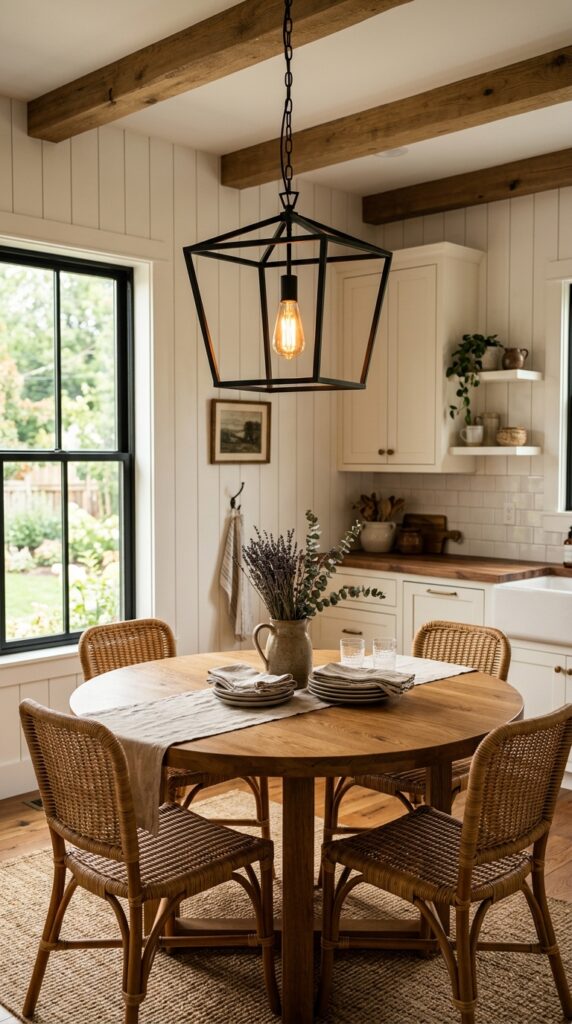
Vibe: Intimate — the light that makes dinner feel like it matters.
Why it works: An oversized lantern pendant — significantly larger in scale than the table or seating arrangement below it — creates the same visual anchor over a dining area that a statement chandelier provides in a formal dining room, but with the unpretentious character essential to farmhouse design. The black cage or lantern silhouette reads as outdoor architectural lighting brought inside, which is a deeply farmhouse-aligned design reference: old barns and farmhouses used outdoor-scale fixtures indoors out of practicality, and that same proportion reads as authentic. Scale is the design principle: the fixture should be at minimum 12 inches wider than would feel proportional — it’s the deliberate overscaling that creates impact.
How to get it: Hang the bottom of the lantern shade 60–66 inches from the floor over a dining table — low enough to feel intimate but high enough to clear seated eye level. For an 8-foot ceiling, this means 18–24 inches of cord or chain between the ceiling canopy and the fixture top.
🛍️ Shop the Look — Amazon Product Ideas
| # | Product Search Phrase | Why It Fits |
| 1 | large black cage lantern pendant light 18 inch | Core dining light fixture |
| 2 | woven rattan dining chair set of 2 | Organic dining seating |
| 3 | round farmhouse kitchen table solid oak | Dining zone anchor |
| 4 | linen table runner natural stripe | Table textile detail |
| 5 | ceramic pitcher large cream centerpiece | Table organic accent |
19. Leathered Quartzite Countertops for Organic Texture
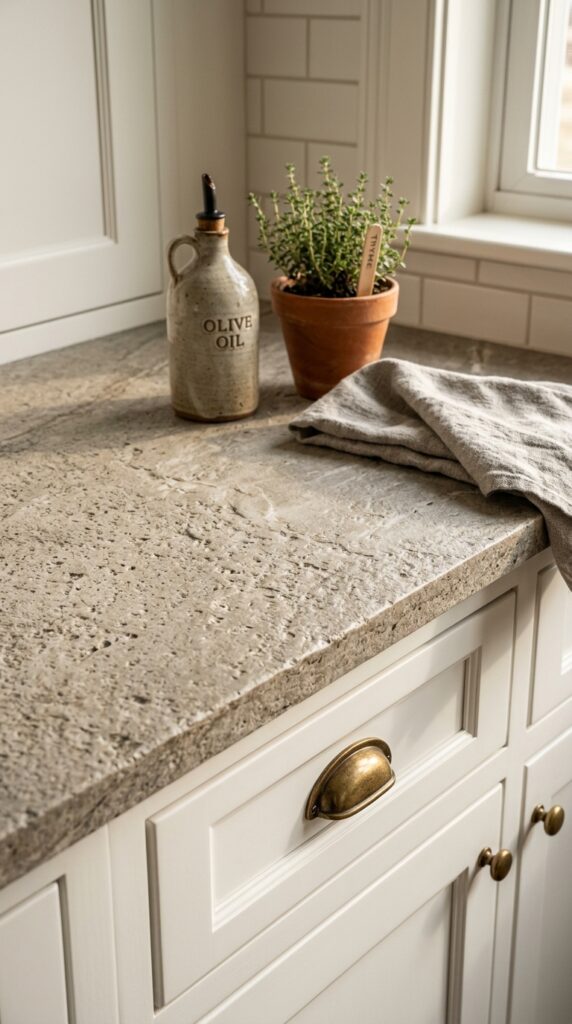
Vibe: Tactile — stone that demands to be touched, not just looked at.
Why it works: Leathered quartzite is the most texturally sophisticated countertop choice available within the modern farmhouse palette. The leathering process (brushing the stone surface with diamond-tipped abrasives after cutting) closes the pores of the stone, increases its stain resistance, and — critically — creates a topographic surface texture that catches and scatters light rather than reflecting it in sheets. This eliminates the visual coldness that polished stone introduces and replaces it with a warm, matte quality that reads as natural and unprocessed. The gray-beige color family (found in quartzite varieties like Taj Mahal, White Macaubas, or Super White) bridges warm wood and white cabinetry without pulling either direction.
How to get it: Specify the leathered finish explicitly when ordering — it is processed separately from honed and polished options and costs approximately the same. Leathered stone requires a pH-neutral cleaner and annual sealing; its surface texture makes it more forgiving of light scratches and water marks than polished alternatives.
💡 Quick Win: Leathered granite samples ($8–$15 each from stone yards) can be used as decorative cutting boards or serving boards — a functional way to test the material’s look and feel before committing to full countertop installation.
🛍️ Shop the Look — Amazon Product Ideas
| # | Product Search Phrase | Why It Fits |
| 1 | pH neutral stone cleaner countertop spray | Leathered stone maintenance |
| 2 | natural stone countertop sealer penetrating | Annual seal product |
| 3 | ceramic olive oil dispenser kitchen farmhouse | Counter functional decor |
| 4 | linen cloth napkin set undyed natural | Counter textile layer |
| 5 | small terracotta herb pot kitchen countertop | Organic stone complement |
20. Open Shelving Around the Kitchen Window
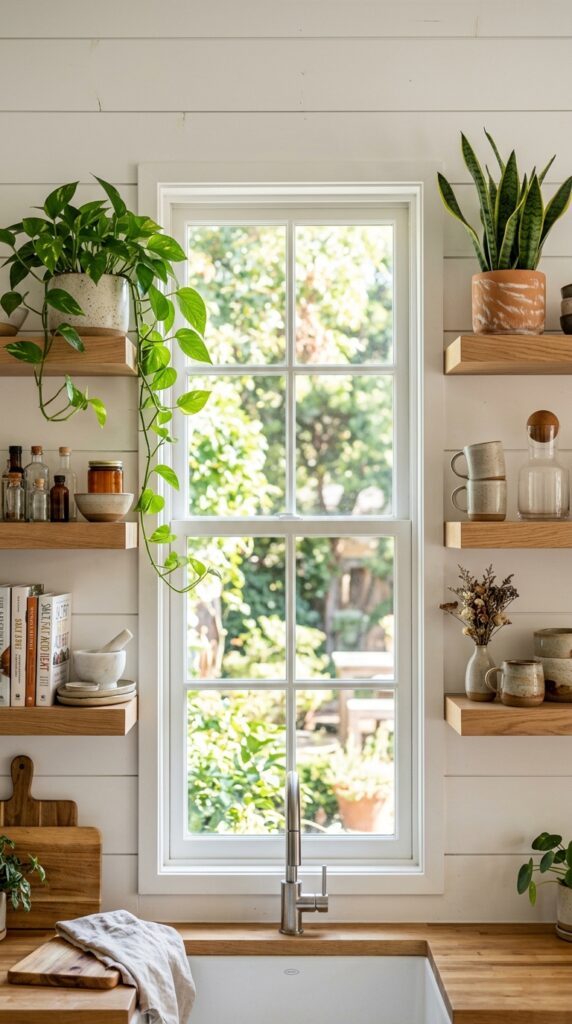
Vibe: Airy — the shelf arrangement that brings the light inside the display.
Why it works: Shelves flanking a window rather than replacing it is a space-planning solution that maximizes both storage and natural light simultaneously — the two resources most often in conflict in small to medium kitchen designs. By mounting shelves at the sides of the window rather than in front of it, the window’s full light contribution is preserved while the flanking wall space (typically wasted) becomes functional. The visual effect of daylight illuminating shelf items from behind — creating a glow-from-behind quality in the ceramics and glass — is a design dividend that overhead-lit shelves never deliver.
How to get it: Mount flanking shelves so the inner edge of each shelf aligns with the outer edge of the window casing. Use the same oak and steel bracket system as the main open shelving to maintain visual continuity. Place trailing plants on upper shelves so foliage cascades toward the window — the plant appears to reach for light naturally.
🛍️ Shop the Look — Amazon Product Ideas
| # | Product Search Phrase | Why It Fits |
| 1 | white oak floating shelf 24 inch natural | Window-flank shelf material |
| 2 | trailing pothos plant 4 inch pot | Natural light-seeking plant |
| 3 | small glass bottle bud vase set clear | Light-catching shelf display |
| 4 | steel floating shelf bracket black 8 inch | Clean shelf support |
| 5 | ceramic small pitcher white farmhouse | Window-shelf styling anchor |
21. Warm Greige Painted Kitchen with Cream Trim
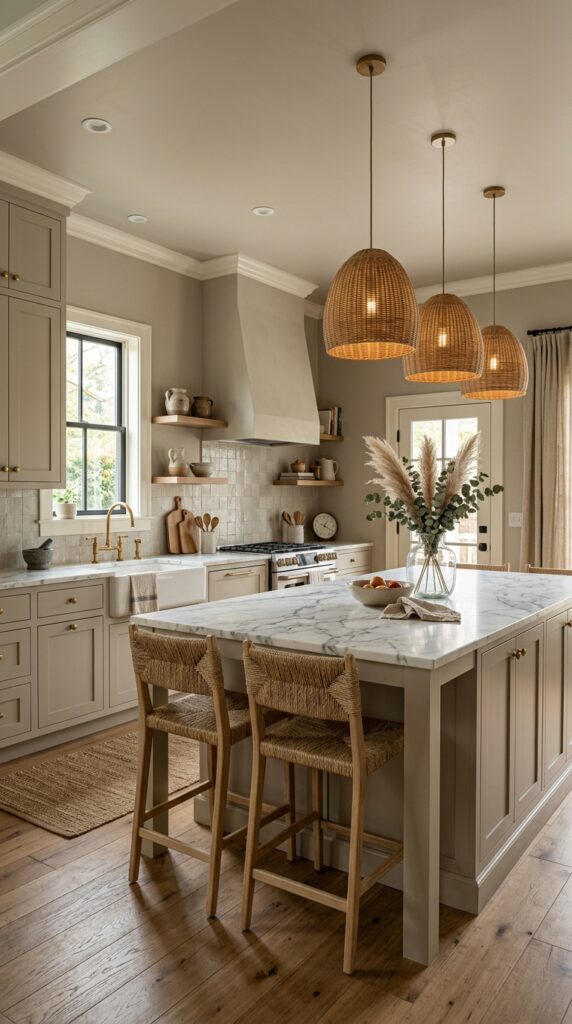
Vibe: Enveloping — the kitchen that wraps you in warmth the moment you enter.
Why it works: An all-greige kitchen — cabinetry, walls, and surfaces within the same tonal family — is an advanced color technique called color drenching, where consistency of tone across multiple surfaces creates a sense of immersive warmth that distinct contrast colors can’t achieve. The greige family (a warm blend of gray and beige, leaning toward the warm side) is the ideal candidate for this technique in farmhouse kitchens because it absorbs warm artificial light and reflects it back at a golden frequency rather than a cool one. The white marble island and cream trim provide the contrast that prevents the technique from reading as monotonous while keeping the overall warmth intact.
How to get it: Use Benjamin Moore “Pale Oak” OC-20 for cabinetry and apply the same color two shades lighter on the walls — this is the interior design formula for cohesive tonal rooms. The cream trim (Benjamin Moore “White Dove” OC-17) reads as bright only in contrast to the greige field; against white walls it would read off-white.
🛍️ Shop the Look — Amazon Product Ideas
| # | Product Search Phrase | Why It Fits |
| 1 | warm greige cabinet paint sample Benjamin Moore | Wall and cabinet tone |
| 2 | dried pampas grass arrangement tall vase | Warm tonal decor accent |
| 3 | woven pendant lamp shade natural fiber | Ceiling tone complement |
| 4 | linen curtain panel cream 84 inch | Tone-consistent window |
| 5 | cream beeswax pillar candle set | Tonal greige complement |
22. Vintage Wooden Bar Stools with Iron Footrests

Vibe: Collected — the stools that look like they were found, not bought.
Why it works: Counter stool selection is one of the most overlooked furniture decisions in kitchen design, and the wrong choice can undermine an otherwise well-composed modern farmhouse kitchen. Turned wood legs with iron footrest rings are the most material-authentic option for the style because they introduce two of the farmhouse palette’s core materials (wood and iron) in a single piece, while the turned-leg profile references traditional woodcraft without being overtly country or rustic. The slight wearing or distressing on the finish is functional as well as aesthetic: it prevents the stools from reading as precious, maintaining the approachable quality that defines lived-in farmhouse design.
How to get it: Counter stools should sit 10–12 inches below the countertop surface for comfortable seating — measure your island height before purchasing. For a 36-inch island height (standard counter height), 24-inch seat-height stools are correct. For a 42-inch bar height, 30-inch stools are needed.
💡 Quick Win: A set of tie-on linen cushion pads ($18–$28 for two) transforms inexpensive wood stools into the warm, layered version without replacing the stools themselves.
🛍️ Shop the Look — Amazon Product Ideas
| # | Product Search Phrase | Why It Fits |
| 1 | wood counter stool iron footrest ring 24 inch | Core seating element |
| 2 | linen tie-on chair cushion farmhouse | Comfort and texture layer |
| 3 | wood stain dark walnut tobacco touch up | Finish enhancement product |
| 4 | rattan pendant light natural small | Above-island complement |
| 5 | marble trivet honed 8 inch round | Island functional decor |
23. Modern Farmhouse Kitchen with Dark Charcoal Cabinets
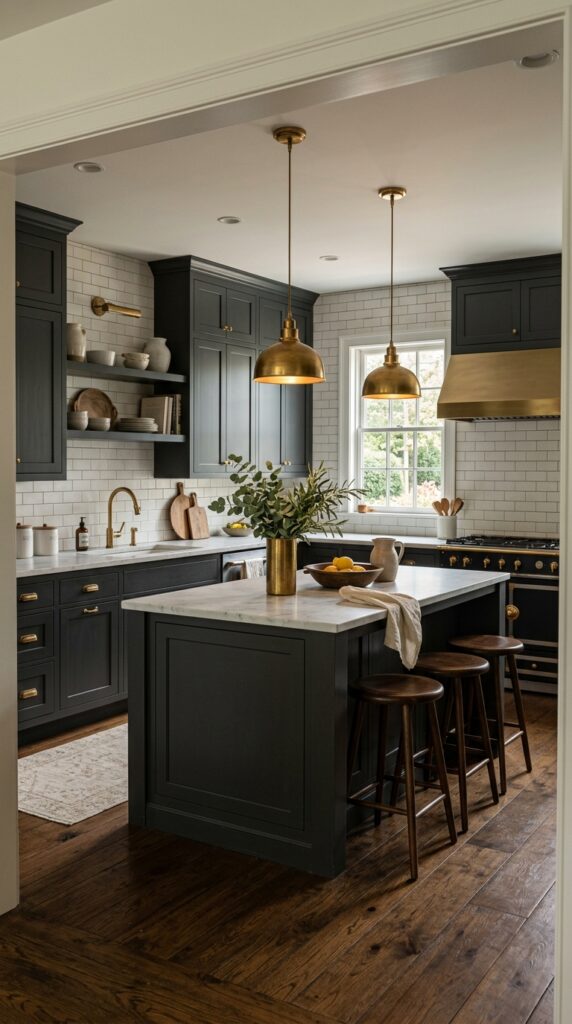
Vibe: Moody — a kitchen that doesn’t apologize for knowing exactly what it wants to be.
Why it works: All-charcoal cabinetry in a modern farmhouse kitchen is the most design-forward expression of the style — it retains every farmhouse material (Shaker profiles, subway tile, marble, aged brass) while flipping the expected light-and-bright palette to its inverse. The design principle is confident contrast: dark cabinets against white tile, white marble, and warm brass create the same push-pull tension as white cabinets against dark hardware, but at a much more dramatic scale. The warm charcoal (Benjamin Moore “Wrought Iron” AF-595 is the most reliable choice) reads as sophisticated rather than oppressive because the white countertop and tile provide constant visual relief throughout the room.
How to get it: In a dark-cabinet kitchen, the lighting plan is more critical than in a light kitchen. Specify 2700K recessed lighting at a minimum of 90 CRI rating — this color rendering index ensures the brass hardware and natural materials read with accurate warmth rather than going flat under lower-quality light.
🛍️ Shop the Look — Amazon Product Ideas
| # | Product Search Phrase | Why It Fits |
| 1 | warm charcoal matte cabinet paint quart | Dark cabinet color anchor |
| 2 | 2700K LED recessed light 90 CRI 6 inch | High-CRI kitchen lighting |
| 3 | unlacquered brass cup pull set cabinet | Warm hardware on dark |
| 4 | white marble pastry board large kitchen | Counter surface accent |
| 5 | cream linen kitchen runner rug 2×4 | Floor warmth under dark |
24. Corner Kitchen Window Seat with Storage Bench
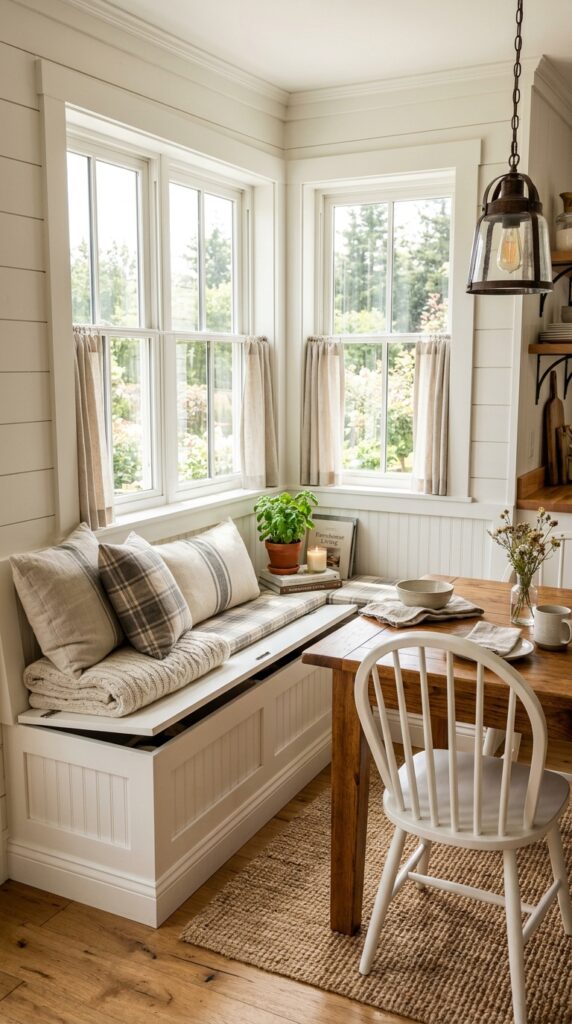
Vibe: Intimate — the corner that becomes everyone’s favorite seat in the house.
Why it works: A corner window seat in a farmhouse kitchen is the clearest possible expression of the zone-definition principle: it carves a dedicated eating and gathering space from what would otherwise be dead corner square footage, and it does so with a piece that contributes both seating and storage simultaneously. The lift-top storage bench is the practical farmhouse solution — it stores linens, rarely-used servingware, or seasonal items while providing seating with a depth (typically 20–22 inches) that makes lingering at the table comfortable in a way standard dining chairs rarely achieve. The corner window placement multiplies natural light and gives occupants a view of the outdoors that standard kitchen seating rarely provides.
How to get it: Build the bench frame from 3/4-inch plywood with a 1×4 face frame to match cabinetry profiles. Install piano hinge along the back of the seat panel for smooth lift-top operation. Commission a 4-inch foam cushion cut to fit and covered in a durable indoor-outdoor linen or stripe fabric that can be removed and washed.
🛍️ Shop the Look — Amazon Product Ideas
| # | Product Search Phrase | Why It Fits |
| 1 | bench seat cushion custom foam cut stripe linen | Corner seat comfort layer |
| 2 | piano hinge long stainless steel | Lift-top bench mechanism |
| 3 | farmhouse round pedestal dining table white oak | Nook table anchor |
| 4 | small potted plant indoor low light kitchen | Nook organic accent |
| 5 | linen stripe throw pillow farmhouse 18 inch | Bench cushion accent |
25. Heirloom-Style Kitchen Display with Open Plate Rack
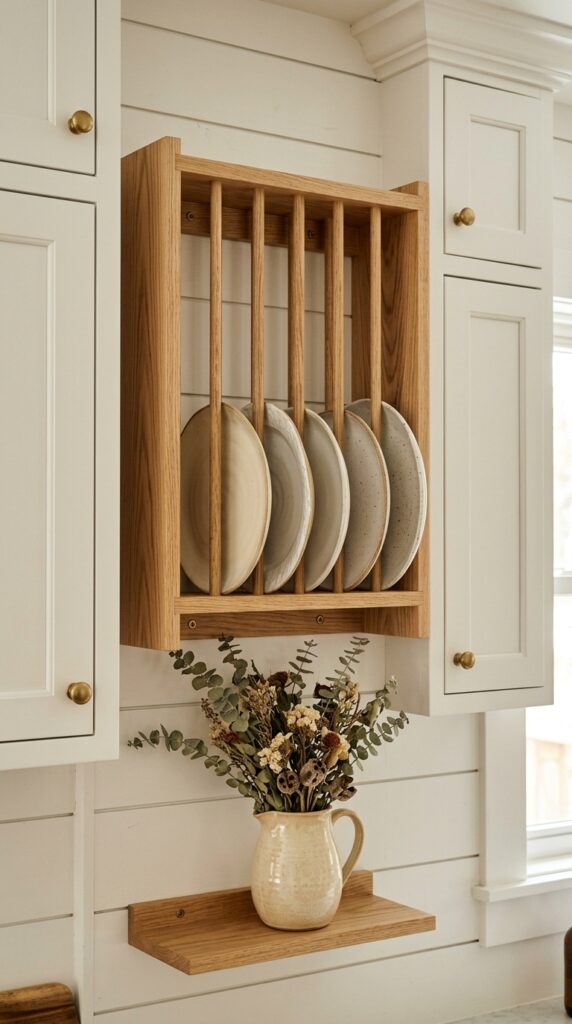
Vibe: Heirloom — the kitchen wall that quietly insists these things are worth displaying.
Why it works: A wall-mounted plate rack is the most authentically farmhouse-aligned display element available — it references the functional plate racks found in working farm kitchens of the 19th century while serving the contemporary design goal of bringing texture and organic material onto an otherwise flat wall surface. The key design decision is to display plates with slight tonal variation — cream plates in two or three slightly different glazes rather than a perfectly matched set — which communicates the collected quality of real heirloom dishware rather than the uniformity of a department store purchase. The white oak construction of the rack itself adds warm wood tone at eye level, a height where wood is often absent between lower cabinets and upper shelving.
How to get it: Wall-mounted plate racks need a minimum of 24 inches of wall width and 18 inches of vertical height for six standard dinner plates. Mount into wall studs (not drywall anchors) — a fully loaded plate rack with six ceramic dinner plates weighs 10–15 pounds. Pair with a small floating shelf directly below to create a composed vignette.
💡 Quick Win: A set of three mismatched cream stoneware dinner plates from different thrift stores ($3–$8 each) displayed in a plate rack creates the collected vintage aesthetic that no matched set from a big-box retailer can replicate.
🛍️ Shop the Look — Amazon Product Ideas
| # | Product Search Phrase | Why It Fits |
| 1 | wall mounted plate rack wood display kitchen | Core display element |
| 2 | cream stoneware dinner plate set matte glaze | Display-worthy dishware |
| 3 | white oak floating shelf 18 inch below rack | Vignette base shelf |
| 4 | ceramic cream pitcher large vintage style | Shelf-below accent piece |
| 5 | dried eucalyptus bunch natural stem bundle | Organic shelf styling |
How to Start Your Modern Farmhouse Kitchen Transformation
Your single first move: Replace your cabinet hardware before you do anything else. Swapping every existing pull and knob for matte black bin pulls is the fastest, cheapest, and most reversible way to shift a kitchen toward modern farmhouse — and it costs as little as $40–$80 for a full kitchen. New hardware doesn’t require painting, renovation, or a weekend; it takes two hours with a screwdriver. More importantly, it establishes the metal tone for every subsequent decision — once you have matte black hardware as your anchor, choosing light fixtures, faucets, and accessories becomes dramatically easier because you have a defined direction to build around.
The most common beginner mistake: Mixing too many wood tones — pairing warm honey oak shelves with dark walnut cabinets, then adding a medium-brown butcher block, all in the same sightline. Each individual choice might be correct on its own, but three competing wood tones in the same room cancel out the warmth they were supposed to create and produce visual noise instead. The fix is a one-wood-family rule: choose either the light (white oak, honey oak) or dark (walnut, espresso oak) family and keep every wood element in that family for the entire room. Metal finishes can vary (one matte black, one aged brass); wood tones should not.
Three specific items under $50 that create immediate modern farmhouse impact: A set of four cream stoneware mugs in a matte glaze ($24–$36) styled on an open shelf or hanging from small hooks, a 24-inch natural-fiber jute runner in front of the sink ($18–$28), and a single dried pampas grass stem in a matte terracotta bud vase ($12–$20 for both) placed on the counter near the window.
Realistic expectations: Swapping hardware, adding a runner, and restyling open shelves can be accomplished in a single focused Saturday — this level of effort produces a noticeably different kitchen. A mid-range transformation involving cabinet repainting, new countertops, and backsplash tile realistically takes 2–4 weekends and $800–$2,500 in materials. A full modern farmhouse kitchen renovation with new cabinetry, farmhouse sink, wide-plank flooring, and custom range hood ranges from $8,000 to $30,000+ depending on scale.
Frequently Asked Questions About Modern Farmhouse Kitchens
What is a modern farmhouse kitchen and how is it different from traditional farmhouse?
A modern farmhouse kitchen combines the warm, handcrafted materials and unpretentious character of traditional farmhouse design — shiplap, apron sinks, wooden shelving, natural stone — with the clean lines, restrained palettes, and functional minimalism of contemporary design. The distinction from purely traditional farmhouse is primarily in scale and restraint: modern farmhouse uses fewer ornamental details (no carved corbels, no country-style rooster motifs), cleaner cabinet profiles (Shaker rather than raised panel or beaded inset), and a more limited color palette. The result is a kitchen that feels warm and personal without feeling thematic or costume-like.
What colors work best in a modern farmhouse kitchen?
The most reliable modern farmhouse kitchen color palette anchors around warm white for upper cabinets (Benjamin Moore “White Dove” OC-17 or Sherwin-Williams “Alabaster” SW 7008) with one contrasting color on the island or lower cabinets. The most popular contrast colors currently are dusty navy (Benjamin Moore “Hale Navy” HC-154), muted sage (Sherwin-Williams “Clary Sage” SW 6178), and warm charcoal (Benjamin Moore “Wrought Iron” AF-595). Avoid cool grays with blue undertones — they read as contemporary rather than farmhouse and drain warmth from the space.
How much does a modern farmhouse kitchen renovation cost?
Cost varies dramatically by scope. A cosmetic refresh (new hardware, paint, open shelving addition) runs $200–$800. A mid-range renovation (cabinet repainting, new backsplash, countertop upgrade, farmhouse sink) typically costs $3,000–$8,000 in materials and $5,000–$15,000 with labor. A full gut renovation with new cabinetry, wide-plank flooring, custom range hood, and professional-grade appliances ranges from $25,000 to $60,000+. The highest return-on-investment upgrades, in order, are: new hardware, cabinet paint, backsplash tile, and farmhouse sink.
Can modern farmhouse kitchen design work in a small or galley kitchen?
Yes, but small modern farmhouse kitchens require stricter material discipline than larger ones. The core rules for small spaces: limit wood tones to one family only, use open shelving on one wall maximum (too many open surfaces in a small kitchen creates visual chaos rather than warmth), choose a single metal finish for all hardware and fixtures, and prioritize a light, warm-white paint color for cabinets to preserve the sense of openness. A farmhouse apron sink scaled correctly (24–30 inches wide rather than 33 inches) fits most galley kitchens and delivers the aesthetic anchor of the style without overwhelming a compact layout.
What backsplash works best in a modern farmhouse kitchen?
The three most appropriate backsplash choices for modern farmhouse kitchens, in order of authenticity and design impact, are: classic 3×6 beveled white subway tile with warm gray grout (the most versatile and historically aligned), handmade ceramic tile in an off-white or cream tone with irregular edges and visible glaze variation (more artisanal and expressive), and zellige tile in a warm white or soft sage (the most contemporary option within the farmhouse palette, with light-scattering surface variation that no machine-cut tile can match). Avoid polished stone slab backsplashes — the reflective surface quality conflicts with the matte, handcrafted aesthetic at the core of farmhouse design.
Ready to Create Your Dream Modern Farmhouse Kitchen?
These 25 ideas cover the full spectrum of what makes a modern farmhouse kitchen work — from foundational decisions like wide-plank flooring and Shaker cabinet profiles to the finishing layers of unlacquered brass patina, layered open shelving, and warm-tone paint strategies that tie it all together. Every meaningful kitchen transformation begins with one small, deliberate move rather than a complete overhaul: start today by ordering a matte black hardware sample set and holding it against your existing cabinetry in your actual kitchen light — that single test will clarify your direction faster than any amount of inspiration-board browsing. When the full vision comes together, you’ll have created a kitchen with a quality that modern farmhouse uniquely delivers — warmth that looks casual but was quietly, carefully built, one honest material at a time. Save the ideas that made you pause longest — the shiplap island, the unlacquered brass faucet, the sage green lowers — because those instinctive responses are your kitchen telling you what it wants to become.