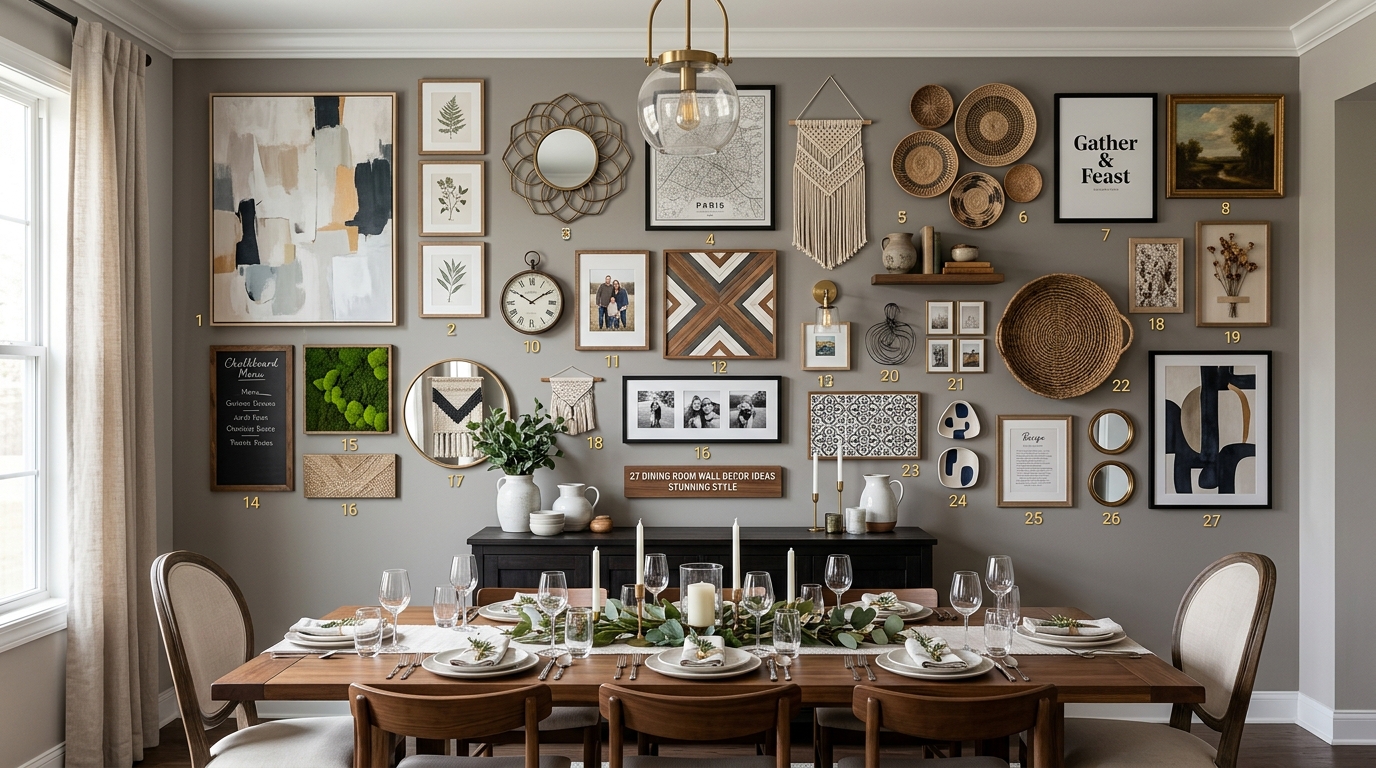
Dining room wall decor is the art of dressing the vertical surfaces of your most social room — transforming blank walls into a backdrop that makes every meal feel like an occasion. This article delivers exactly 27 dining room wall decor ideas spanning color, material, lighting, art, mirrors, textiles, and small-space solutions so you can find the combination that makes your dining room feel fully alive.
There is something particular about a well-dressed dining room wall — the way a large-scale artwork catches candlelight during dinner, the way a gallery wall holds the history of a family in plain sight, the way a painted arch transforms a rental into something that feels genuinely chosen. Dining room wall decor operates at the intersection of architecture and atmosphere, creating the stage on which every shared meal unfolds. Here are 27 ideas worth saving — and stealing.
Why Dining Room Wall Decor Works So Well as a Design Statement
Dining room wall decoration has roots in the grandest traditions of domestic architecture — the tapestry-hung great halls of medieval Europe, the painted fresco dining rooms of Pompeii, the hand-blocked wallpapers of 18th-century English manor houses. What distinguishes dining room walls from those of any other room is their relationship to ritual: because dining rooms are used at specific, meaningful times — dinner parties, holidays, family meals — their walls are registered more consciously and remembered more vividly than walls in rooms we pass through casually.
The core materials of elevated dining room wall decor include handmade ceramics, unlacquered brass and bronze hardware, linen and velvet textiles for wall-hung pieces, unframed natural canvas, limewash and Roman clay paint, handblown glass sconces, and raw wood panels. The palette spans warm terracotta, deep forest green, dusty plum, warm greige, antique gold, aged burgundy, and the creamy warm whites of limewashed plaster. Every material should feel like it earned its place on the wall through texture, age, or artisan origin.
Dining room wall decor searches have surged on Pinterest since 2022 as part of the broader cultural shift toward considered entertaining at home. Post-pandemic households reinvested in their dining rooms as primary social spaces — not the pass-through rooms of earlier decades but deliberately designed gathering places. Searches for “dining room gallery wall,” “limewash dining room,” and “sconces dining room” have grown year-over-year, reflecting an appetite for rooms that feel personal, layered, and worth sitting inside for several hours.
Small dining rooms benefit enormously from deliberate wall treatment because walls are proportionally more present when floor space is limited. In a compact dining room, prioritize one dominant wall — the one the eye lands on when entering the room — and treat it as the hero surface. Keep the remaining walls simpler so the primary wall registers as a composed decision rather than a crowded one.
Style at a Glance
| Element | Core Trait |
| Philosophy | Walls as backdrop for ritual; beauty earned through material and intention |
| Key Materials | Handmade ceramics, linen, limewash, brass, raw canvas, handblown glass |
| Key Colors | Warm terracotta, deep forest green, dusty plum, antique gold, warm greige |
27 Dining Room Wall Decor Ideas
1. Oversized Abstract Canvas Art Above a Sideboard
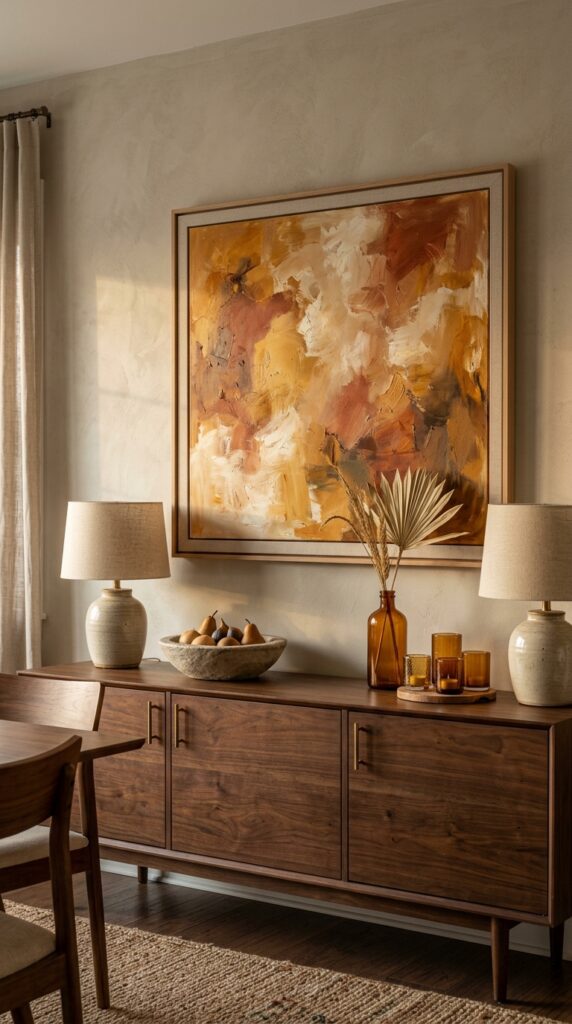
Vibe: The wall reads grounded — the canvas absorbing warm afternoon light the way a fire does, slowly and completely.
Why it works: An oversized canvas above a sideboard uses the design principle of visual anchor — a single dominant artwork creates a focal wall that organizes the entire room’s attention without requiring any additional decoration on that surface. The scale rule is specific: the artwork should span at least 70% of the sideboard’s width to read as intentionally proportioned rather than accidentally undersized. Warm ochre and rust tones on a limewashed greige wall stay within a tonal family, preventing the canvas from competing with the architecture and instead deepening it.
How to get it: Source large abstract canvas art from Society6, Minted, or independent Etsy artists in the 48×60-inch or larger format. Hang at 57 inches from the floor to the canvas center — the museum hanging standard — regardless of the sideboard height below. A natural wood float frame (1-inch depth, raw finish) adds dimensional shadow without competing with the artwork’s color.
💡 Quick Win: A single large canvas leaned against the wall on the sideboard rather than hung — overlapping the wall and the surface — costs zero installation and reads as deliberately casual and editorial.
🛍️ Shop the Look — Amazon Product Ideas
| # | Product Search Phrase | Why It Fits |
| 1 | Large abstract canvas wall art ochre rust | Hero artwork anchor |
| 2 | Dark walnut sideboard buffet console 60 inch | Sideboard foundation |
| 3 | Linen shade table lamp ceramic base warm | Sideboard lamp pair |
| 4 | Amber glass votive candle holder set | Warm light accent cluster |
| 5 | Natural wood float frame 48×60 canvas | Minimal artwork frame |
2. Gallery Wall of Vintage Botanical Prints
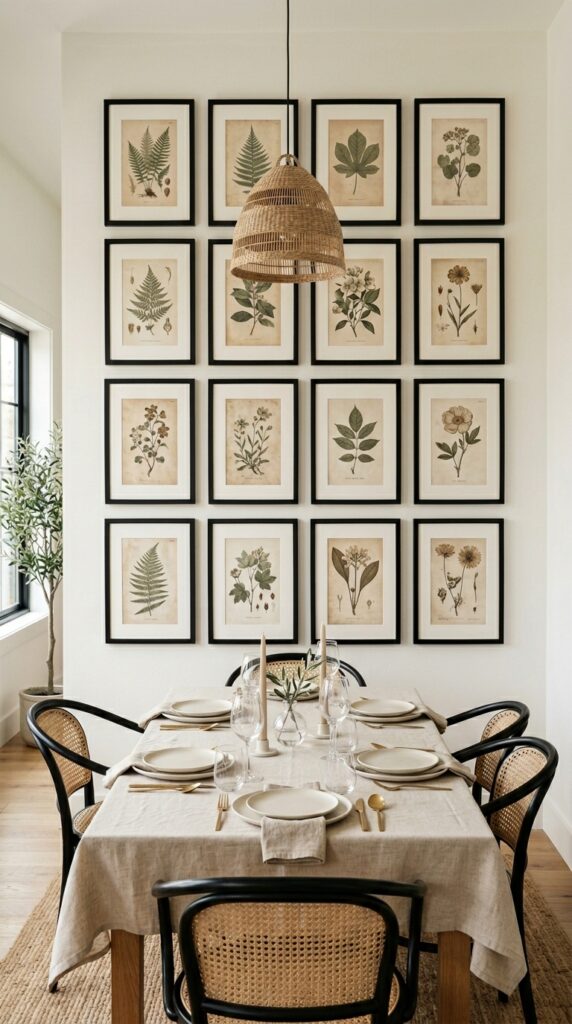
Vibe: The wall reads collected — the kind of arrangement that suggests a person who has been paying quiet attention for years.
Why it works: A grid gallery wall succeeds over an organic arrangement in a dining room because the dining table and chairs already provide strong horizontal and vertical structure — a grid gallery echoes that geometry and reinforces the room’s compositional order. The design principle at work is visual rhythm: consistent frame sizing and spacing creates a regular beat across the wall that the eye finds satisfying. Vintage botanical prints work specifically because their aged palette (sepia, dusty sage, cream paper) relates naturally to dining room materials — linen, wood, ceramic — rather than competing with them.
How to get it: Download vintage botanical illustrations from the Biodiversity Heritage Library (free, public domain) and print at 8×10 or 11×14 inches at a local print shop for $3–8 per print. Use identical black 1-inch gallery frames throughout — consistency of frame is the single non-negotiable that makes a grid gallery read as intentional rather than assembled over time.
🛍️ Shop the Look — Amazon Product Ideas
| # | Product Search Phrase | Why It Fits |
| 1 | Vintage botanical print set framed 8×10 | Gallery wall artwork |
| 2 | Black gallery frame 11×14 thin profile | Consistent frame system |
| 3 | Rattan pendant light woven natural shade | Dining table overhead |
| 4 | Linen tablecloth natural ivory rectangular | Coordinating table textile |
| 5 | Single bud vase ceramic white small | Minimal table accent |
3. Limewash Paint in Deep Forest Green
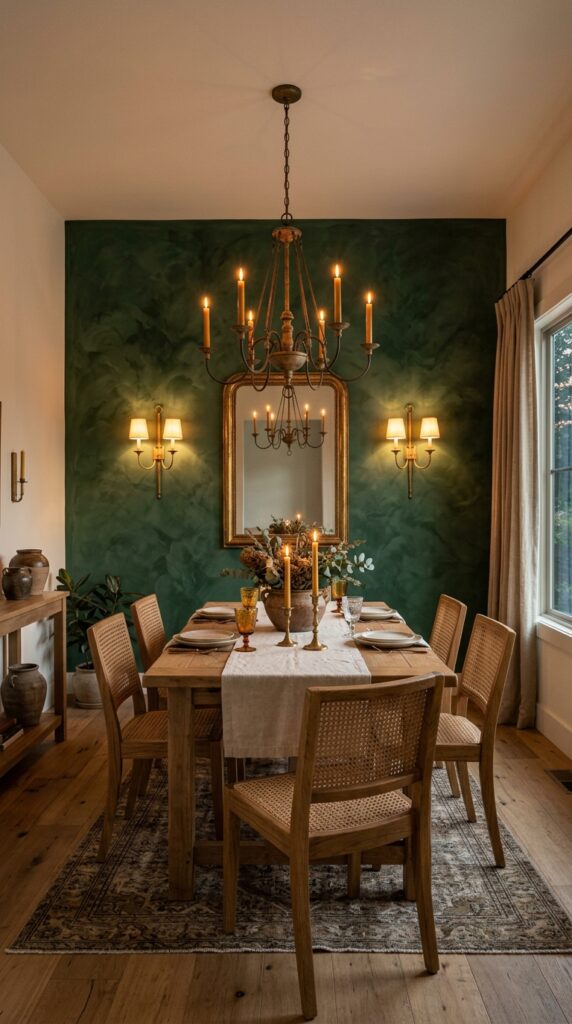
Vibe: The wall reads ancient — the kind of green that belongs to old libraries and overgrown gardens in equal measure.
Why it works: Limewash paint on a dining room accent wall uses the principle of surface depth — the cloudlike variation of the finish creates a wall that reads differently at every hour of the day as the light quality changes, meaning the room is never visually static. Deep forest green specifically creates a sense of enclosure and warmth that flatters food, candlelight, and skin tones simultaneously — a consideration unique to dining rooms where the wall color is always seen in company with people and a lit table. The matte, chalky texture also absorbs rather than reflects light, keeping the room warm rather than bright.
How to get it: Portola Paints “Lime Wash” in “Hedgerow” or Romabio “Classico Limewash” in “Pino Verde” applied in two coats with opposing brush-stroke directions achieves the signature cloudlike variation. Apply with a natural bristle brush — synthetic brushes deposit paint too evenly and lose the characteristic movement. No primer is needed on previously painted drywall.
💡 Quick Win: Testing a $15 sample pot of limewash paint on a 24×24-inch section of wall behind the dining table gives an accurate preview of the full effect in that room’s specific light quality before any commitment.
🛍️ Shop the Look — Amazon Product Ideas
| # | Product Search Phrase | Why It Fits |
| 1 | Limewash paint deep green interior wall | Signature accent wall |
| 2 | Brass wall sconce dining room pair hardwire | Flanking wall light pair |
| 3 | Large oval mirror antique gold frame dining | Wall mirror anchor |
| 4 | Brass taper candle holder set dining table | Warm flame accent |
| 5 | Natural bristle paintbrush limewash wall | Application tool |
4. Woven Wall Tapestry for Texture and Warmth
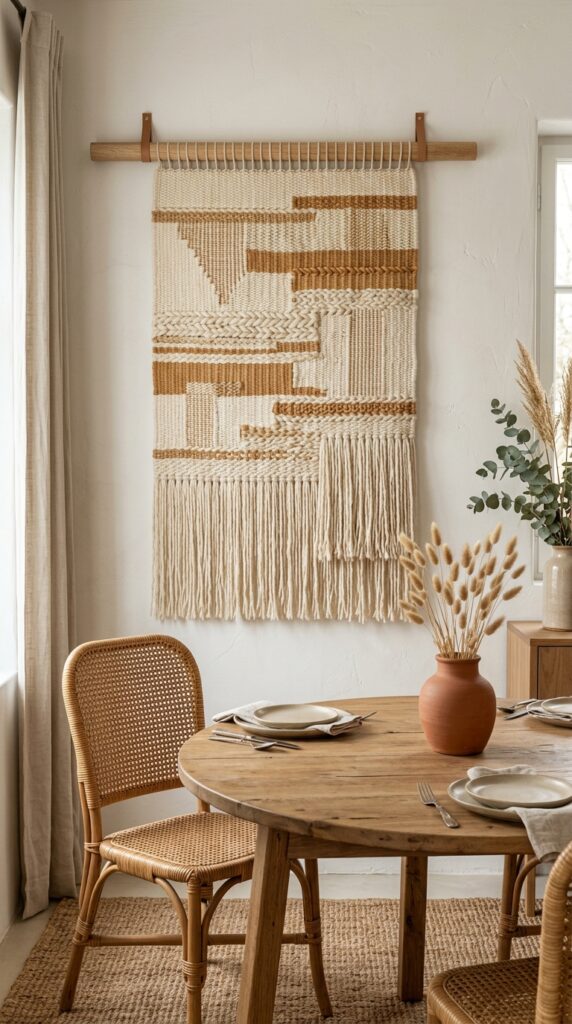
Vibe: The wall reads hushed — the textile absorbing sound and softening the room the way a first snowfall quiets a neighborhood.
Why it works: A large woven tapestry introduces the design principle of acoustic texture — textile wall hangings are one of the few wall decor elements that physically change the sonic quality of a room, reducing echo and adding warmth to both sound and appearance. In dining rooms, where hard surfaces (tile floors, glass windows, ceramic dinnerware) can create an uncomfortable acoustic environment during lively meals, a large textile on the primary wall makes the room genuinely more pleasant to be in. Natural undyed wool in cream and caramel tones sits in the same warm family as wood, linen, and terracotta without competing with any of them.
How to get it: Source handwoven wall tapestries from Etsy makers who work in natural wool, or from shops like Amber Interiors’ trade collection or McGee & Co’s textile line. Hang on a raw 1.5-inch oak or ash dowel using concealed brackets at each wall anchor point — the dowel becomes part of the aesthetic and should be cut 2 inches wider than the tapestry on each side.
🛍️ Shop the Look — Amazon Product Ideas
| # | Product Search Phrase | Why It Fits |
| 1 | Woven wall tapestry natural wool cream large | Textile wall anchor |
| 2 | Raw oak dowel rod curtain rod natural 48 inch | Tapestry hanging rod |
| 3 | Round dining table natural wood 48 inch | Room furniture pairing |
| 4 | Terracotta ceramic bowl centerpiece large | Earthy table accent |
| 5 | Dried bunny tail grass bundle natural | Organic table styling |
5. Pair of Oversized Brass Wall Sconces
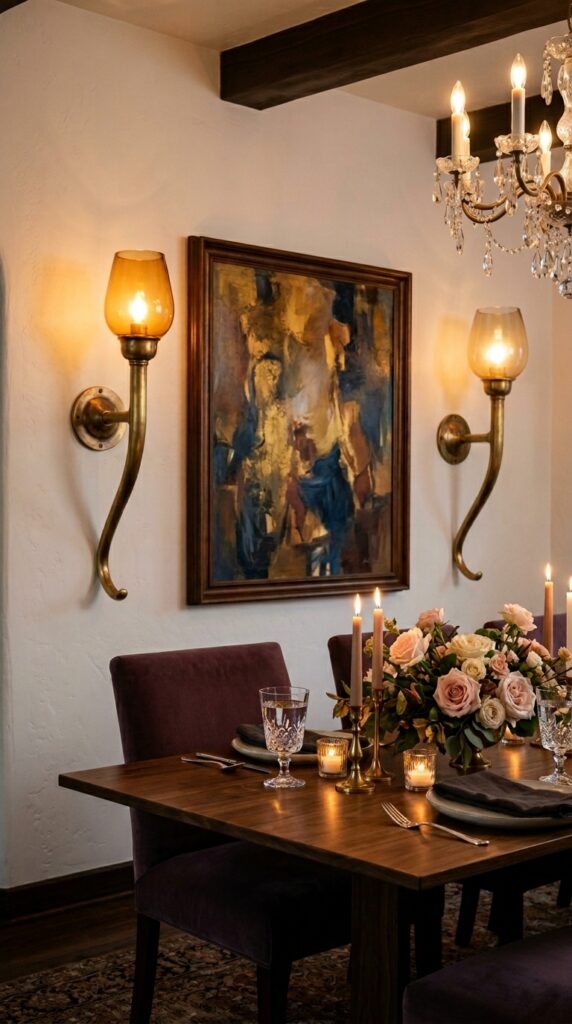
Vibe: The room reads romantic — every surface lit from the sides so shadows fall the way they do in a painting by Vermeer.
Why it works: Flanking wall sconces on the primary dining room wall apply the principle of bilateral symmetry as formal intention — the paired placement signals that the room has been deliberately composed rather than furnished piecemeal. Unlacquered brass is the specific material choice that ages most gracefully in a dining environment: the natural patina that develops on unlacquered surfaces over months reads as aristocratic and earned rather than artificially antiqued. Amber glass shades specifically cast warm orange-toned light that flatters food and complexions better than any other shade color.
How to get it: Rejuvenation and Schoolhouse Electric both offer unlacquered brass sconces in the $200–500 range per fixture. For hardwiring without an electrician, plug-in sconce versions with a fabric-wrapped cord can be mounted and the cord dressed along the wall with a cord cover painted to match the wall color — making the installation look hardwired from a distance.
🛍️ Shop the Look — Amazon Product Ideas
| # | Product Search Phrase | Why It Fits |
| 1 | Unlacquered brass wall sconce plug-in dining | Warm patina wall lighting |
| 2 | Amber glass shade wall light replacement | Warm-tone shade option |
| 3 | Deep plum velvet dining chair upholstered | Rich upholstered seating |
| 4 | Fabric cord cover wall self-adhesive | Plug-in cord concealment |
| 5 | Low garden rose centerpiece bowl floral | Romantic table styling |
6. Floating Shelf Styled as a Wall Vignette
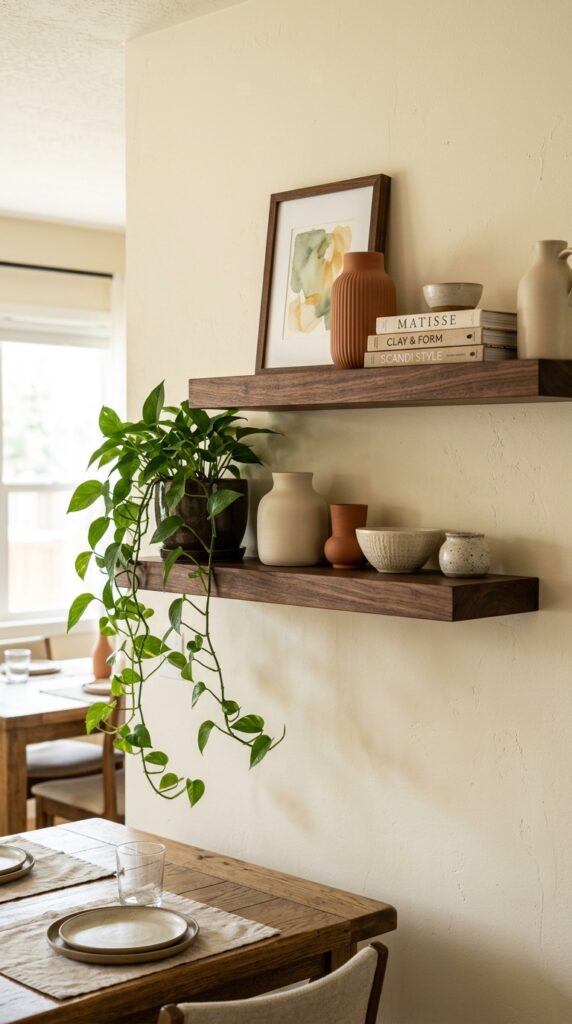
Vibe: The shelves read lived-in — the kind of arrangement that suggests these objects arrived here naturally over time rather than being placed on a Tuesday afternoon.
Why it works: A floating shelf vignette beside a dining table applies the principle of proximate interest — placing a styled surface at eye level beside the space where guests are seated means the arrangement is observed and appreciated up close during the meal, creating conversational focus and a sense of a room full of considered objects. The design rule for shelf styling is variation in three dimensions: height (tall, medium, short), depth (objects placed at the front, middle, and back of the shelf), and category (vessel, printed image, botanical, book). Two shelves at staggered heights create compositional movement that a single shelf cannot.
How to get it: Install 10-inch-deep floating shelves in dark walnut veneer using hidden bracket systems (IKEA’s BERGSHULT system or Floating Shelf Co’s hardware) at heights of approximately 60 inches and 48 inches from the floor — the stagger creates a visual diagonal that is more dynamic than parallel placement. Limit the ceramic collection to a maximum of five objects per shelf to maintain the negative space that makes each piece readable.
🛍️ Shop the Look — Amazon Product Ideas
| # | Product Search Phrase | Why It Fits |
| 1 | Floating shelf walnut dark wood 36 inch | Wall vignette foundation |
| 2 | Cream earthenware jug vase ceramic tall | Shelf ceramic anchor |
| 3 | Terracotta ribbed vase ceramic small | Shelf accent vessel |
| 4 | Trailing pothos plant small pot shelf | Cascading green detail |
| 5 | Invisible floating shelf bracket heavy duty | Hidden mounting hardware |
7. Painted Arch as a Budget Statement Wall
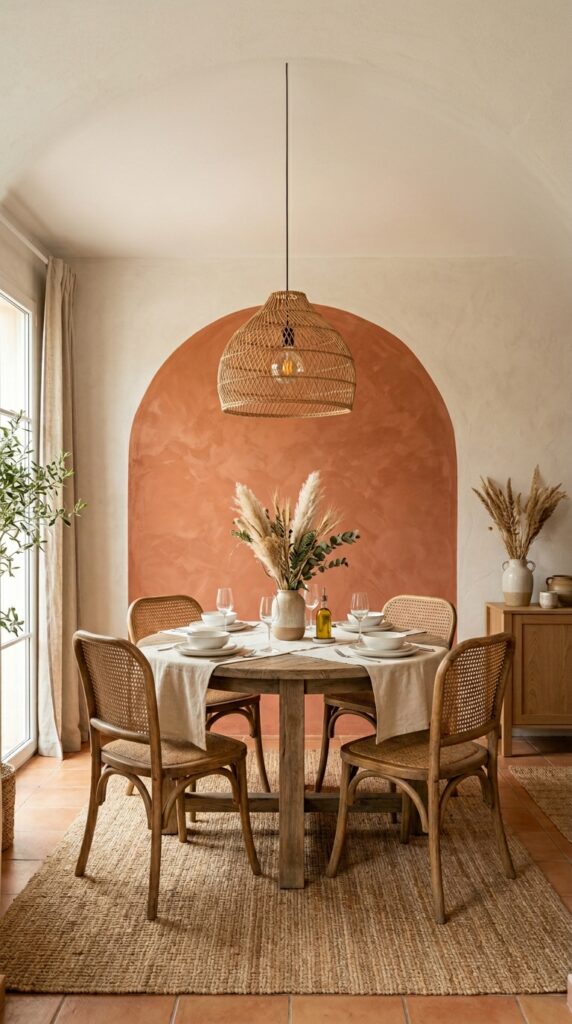
Vibe: The arch reads architectural — as though the room was always meant to have a dining alcove and the painter simply revealed it.
Why it works: A painted arch uses the design principle of implied spatial definition — the arch creates the impression of a distinct dining zone within an open room without any physical partition or construction. It is the most cost-effective architectural intervention available to a renter or a homeowner who doesn’t want to build: a painted arch can be completed in an afternoon with a $15 sample pot of paint and repainted over just as easily. The terracotta tone warming the arch interior makes the dining space feel enclosed and intimate in a way that four plain white walls cannot achieve.
How to get it: Draw the arch using a pencil tied to a string anchored at the center point of the wall (a low-tech compass method). The arch base width should be approximately 1.5–2 feet wider than the dining table on each side. Use painter’s tape along the curve and fill with two coats of the accent color using a small 2-inch brush for edge precision. Limewash applied inside the arch and regular paint outside creates a beautiful material contrast with minimal extra effort.
💡 Quick Win: A 4-inch round level and painter’s tape used to create a simple half-circle arch outline costs under $8 in materials and can be completed in under 30 minutes of preparation before painting — the entire arch project is achievable in a single morning.
🛍️ Shop the Look — Amazon Product Ideas
| # | Product Search Phrase | Why It Fits |
| 1 | Terracotta limewash paint interior sample pot | Arch accent paint |
| 2 | Painter’s tape curved arch wall medium tack | Arch edge masking |
| 3 | Rattan pendant light natural woven 16 inch | Arch ceiling feature |
| 4 | Dried wheat grass tall bundle vase | Vertical natural accent |
| 5 | White ceramic dinner plate set 4 simple | Clean table setting |
8. Antique Mirror as the Dining Room Focal Point
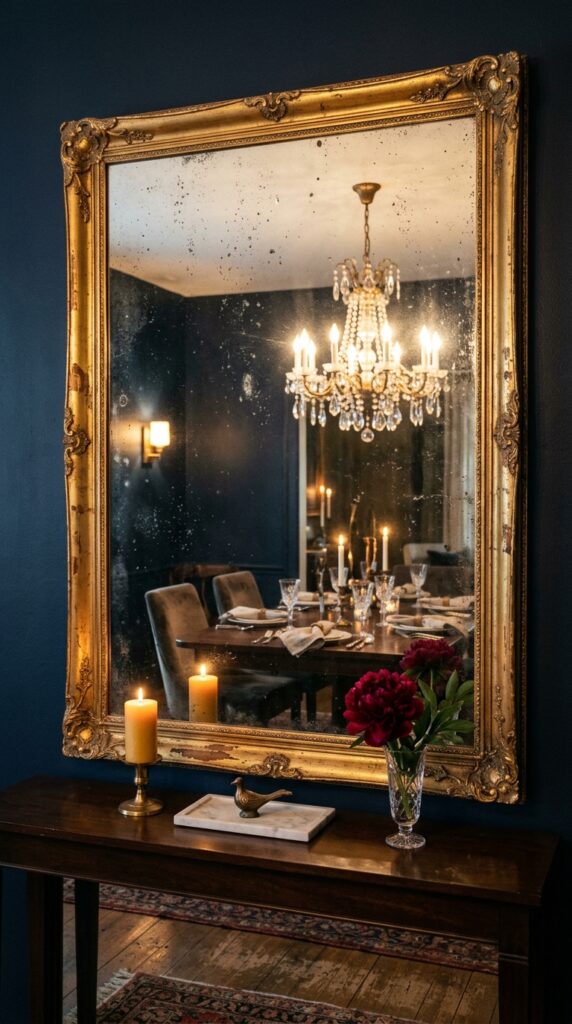
Vibe: The room reads doubled — the mirror performing the rare trick of making the space feel simultaneously larger and more intimate.
Why it works: An oversized antique mirror on the primary dining room wall exploits two simultaneous design principles: spatial expansion through reflection and light amplification through doubling. The mirror reflects the chandelier and any candles on the table, effectively doubling the number of light sources visible from any seat — which is precisely why mirrors were placed in dining rooms of Georgian and Federal-era houses. Antique foxing on the mirror glass softens the reflection so it reads as atmospheric rather than literal, adding depth rather than simply replicating the room.
How to get it: Source oversized antiqued mirrors from Chairish, 1stDibs, or local estate sales. For a new construction option, Custom Mirror offers made-to-order mirrors with antique glass finishes from $200–600 depending on size. Hang with a French cleat system rated for the mirror’s weight — most oversized mirrors require wall studs at both mounting points.
🛍️ Shop the Look — Amazon Product Ideas
| # | Product Search Phrase | Why It Fits |
| 1 | Antique gold frame large wall mirror 48×60 | Focal wall mirror |
| 2 | French cleat heavy mirror wall mounting | Secure heavy mirror hanging |
| 3 | Tall pillar candle ivory unscented set | Console candle pair |
| 4 | Crystal bud vase small flower dining | Elegant floral vessel |
| 5 | Marble tray small console styling | Console surface organizer |
9. Handmade Ceramic Wall Plates as a Collection
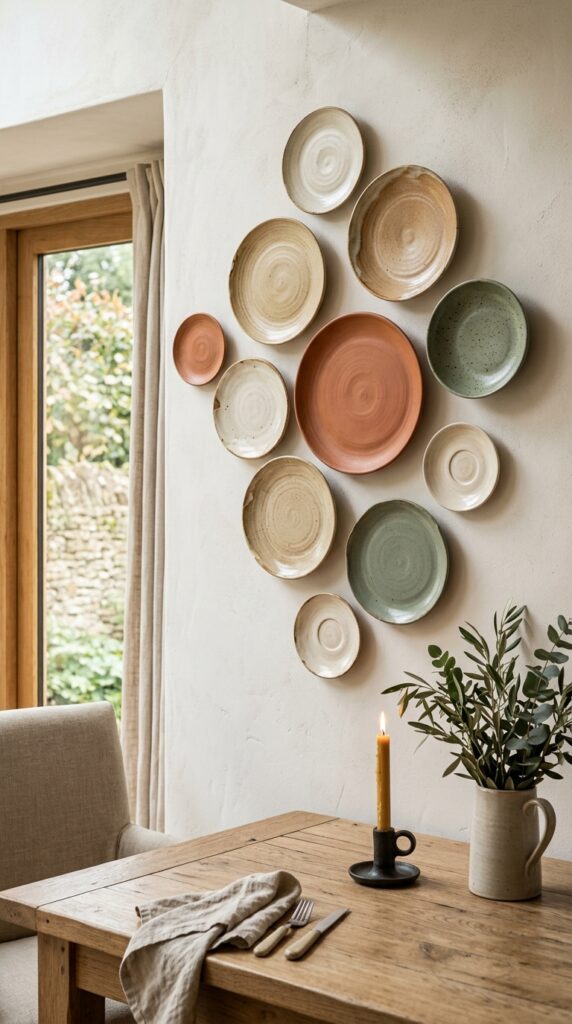
Vibe: The wall reads gathered — the plates suggesting a long relationship with makers and markets and the slow acquisition of beautiful objects.
Why it works: A ceramic plate wall collection applies the principle of organic curation — unlike a grid gallery, an organic cluster arrangement follows no geometric rule and reads as accumulated over time rather than purchased as a set. This is the wall equivalent of a well-worn bookshelf: it communicates that the room belongs to someone rather than having been styled for a photograph. Handmade ceramic plates are the ideal wall object for dining rooms specifically because they are simultaneously decorative and functional in their material language — they belong in a room about food and gathering.
How to get it: Mix plate sizes from 6-inch to 14-inch diameter for maximum compositional variety. Use spring-steel plate hangers ($2–4 each) sized to each plate — they are nearly invisible from the front and hold securely without adhesive. Lay the full arrangement on the floor before hanging to finalize the composition, then use a paper template system (trace each plate on kraft paper, cut out, tape to wall) to map the hanging positions before driving a single nail.
🛍️ Shop the Look — Amazon Product Ideas
| # | Product Search Phrase | Why It Fits |
| 1 | Handmade ceramic wall plate terracotta set | Plate wall collection |
| 2 | Spring steel plate hanger wall mount | Plate hanging hardware |
| 3 | Sage green ceramic plate handmade | Color variant plate |
| 4 | Raw wood dining table natural edge | Room furniture anchor |
| 5 | Ceramic candlestick holder dining table | Material echo in decor |
10. Dark Moody Wallpaper for a Dramatic Dining Room
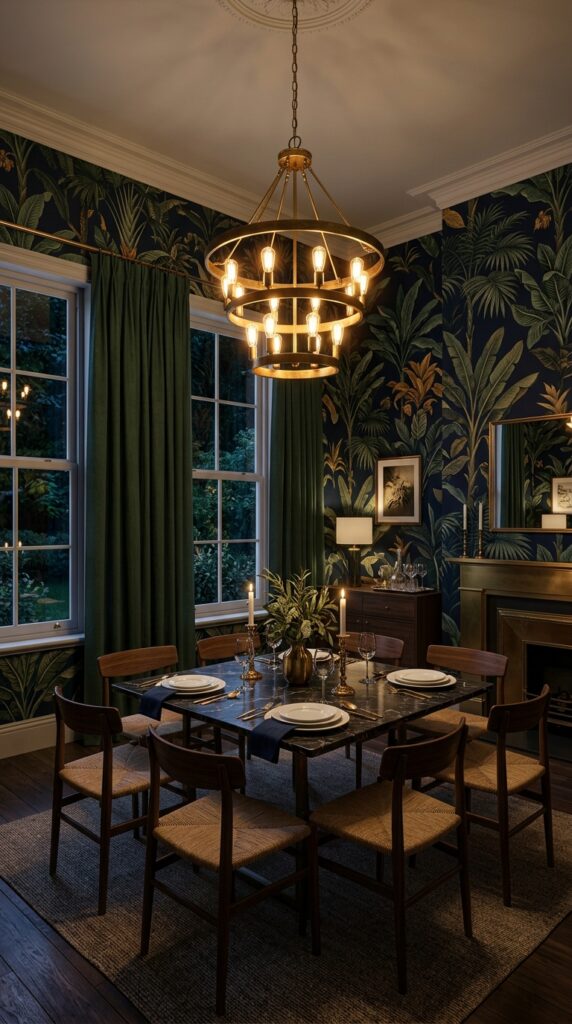
Vibe: The room reads immersive — dinner here feels like eating in a garden at midnight, surrounded and held.
Why it works: Dark botanical wallpaper in a dining room applies the principle of enveloping enclosure — when all four walls are treated with a rich, patterned surface, the room wraps around its occupants rather than simply containing them, creating a psychological intimacy that plain walls can never achieve. Dining rooms are the one residential space where all-over dark wallpaper is most appropriate because the room is typically used in the evening when artificial light — specifically warm chandelier and candlelight — activates the depth of a dark surface far more than daylight does. The botanical pattern specifically flatters dining because it brings the feeling of abundance and natural growth into a room about nourishment.
How to get it: Brewster Home Fashions, Graham & Brown, and Rifle Paper Co. all offer dark botanical wallpapers in the $60–150 per single roll range. For a dining room approximately 12×14 feet, budget for 9–12 double rolls. Use a professional wallpaper hanger for dark pattern-match wallpapers — seam alignment on dark backgrounds is unforgiving of amateur installation.
🛍️ Shop the Look — Amazon Product Ideas
| # | Product Search Phrase | Why It Fits |
| 1 | Dark botanical wallpaper navy leaf dining | Immersive wall treatment |
| 2 | Unlacquered brass chandelier dining room 6 light | Warm ceiling fixture |
| 3 | Forest green linen curtain panel 96 inch | Floor-length drapery |
| 4 | Marble top dining table 72 inch rectangular | Luxe table surface |
| 5 | Rush seat dark wood dining chair set | Natural texture seating |
11. Vertical Shiplap Wall in Warm White
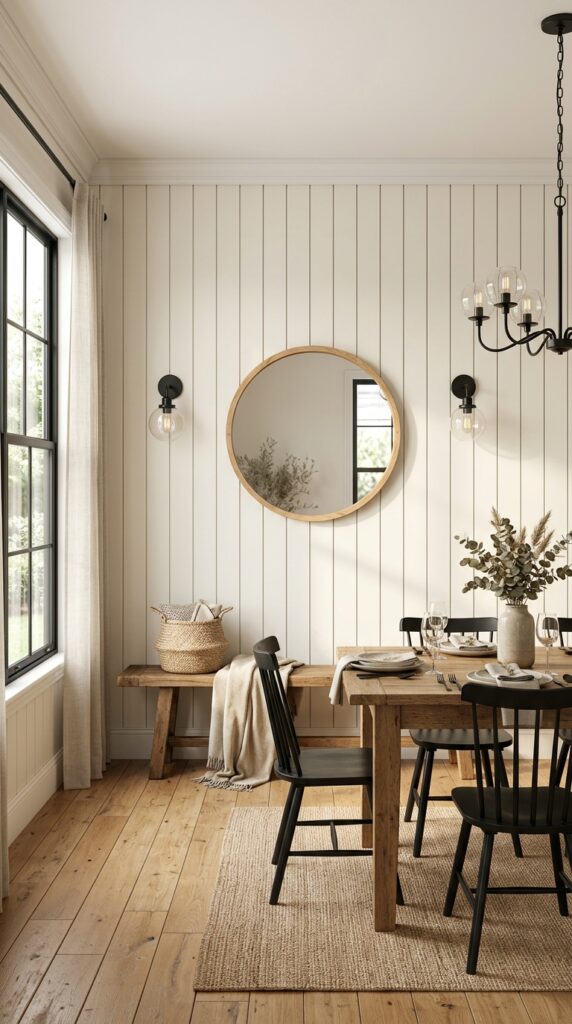
Vibe: The wall reads grounded — the vertical boards doing the quiet work of making everything feel a little more permanent.
Why it works: Vertical shiplap (as opposed to the more common horizontal installation) applies the design principle of height amplification through directional line — vertical boards draw the eye upward and make standard 8-foot ceilings read as taller than they are. The shadow gap between each board creates a repeating linear texture that is dimensional in raking light but virtually invisible in direct overhead light, meaning the wall has a quality that changes throughout the day. Warm white paint on shiplap reads as warmer than flat paint on drywall because the board edges catch shadow and create depth.
How to get it: Use 1×6 or 1×4 select pine boards with a shiplap router profile (or tongue-and-groove pine boards) installed vertically on a horizontal 1×2 furring strip nailer grid. Paint the boards and the gaps behind them in the same warm white before installation — this prevents the raw wood gaps from showing as dark lines through the paint. Benjamin Moore “White Dove” OC-17 is the correct warm white for shiplap.
🛍️ Shop the Look — Amazon Product Ideas
| # | Product Search Phrase | Why It Fits |
| 1 | Tongue groove pine shiplap board 1×6 white | Wall cladding material |
| 2 | Round wood frame mirror 30 inch wall | Centered wall mirror |
| 3 | Matte black wall sconce plug-in farmhouse | Flanking wall light |
| 4 | Farmhouse wood bench dining entryway | Under-mirror furniture |
| 5 | Warm white interior paint Benjamin Moore | Shiplap paint color |
12. Framed Vintage Map or Architectural Drawing
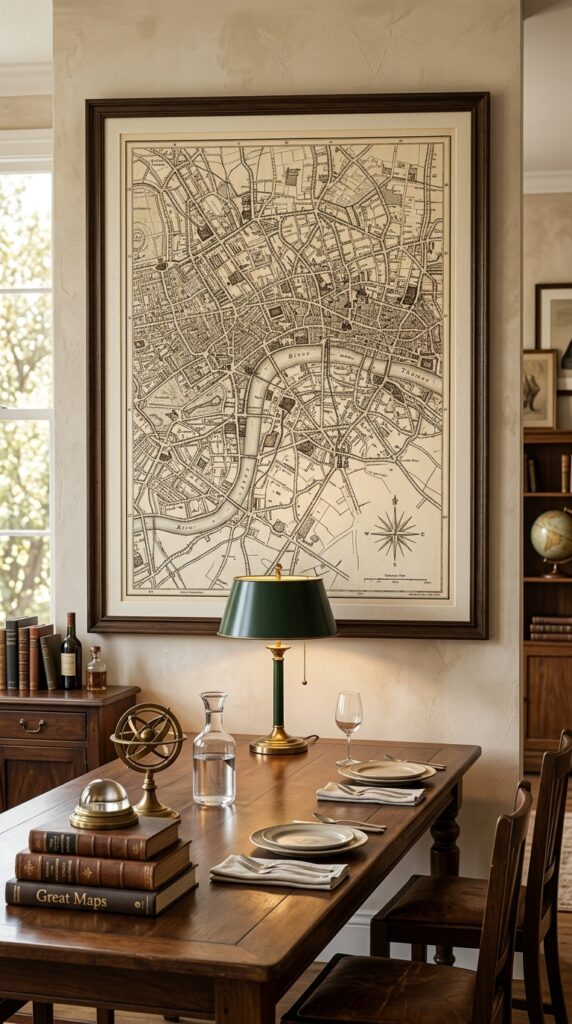
Vibe: The room reads intellectual — dinner here inevitably becomes a conversation about somewhere else, some other time.
Why it works: A large-format vintage map or architectural drawing deploys the principle of narrative invitation — unlike abstract art, a map or architectural plan contains specific places and histories that generate conversation naturally, making it an unusually appropriate choice for a dining room where conversation is the primary activity. The warm sepia tones of aged paper pair directly with the natural wood, leather, and brass palette of a traditional dining room without requiring any color coordination effort. Scale matters enormously: at 40×60 inches or larger, the map reads as an artwork; at 18×24 inches, it reads as a document.
How to get it: David Rumsey Map Collection and the Library of Congress digital archives offer high-resolution vintage maps in the public domain — download and print at a large-format print shop for $20–60 depending on size. Frame in a dark walnut wood frame with an off-white or cream mat board cut to leave a 3-inch border around the image.
💡 Quick Win: A $12 tube of aged paper-look printing from a print shop, combined with a $25 clip frame from IKEA, produces a large-format vintage map display for under $40 total in materials.
🛍️ Shop the Look — Amazon Product Ideas
| # | Product Search Phrase | Why It Fits |
| 1 | Vintage map large framed print dining wall | Narrative wall artwork |
| 2 | Dark walnut picture frame large 40×60 | Map framing option |
| 3 | Green banker library lamp brass base | Study-style accent light |
| 4 | Leather-bound blank journal stack decor | Intellectual prop styling |
| 5 | Cream mat board frame insert 40×50 | Map framing material |
13. Floor-to-Ceiling Curtains as a Backdrop Wall
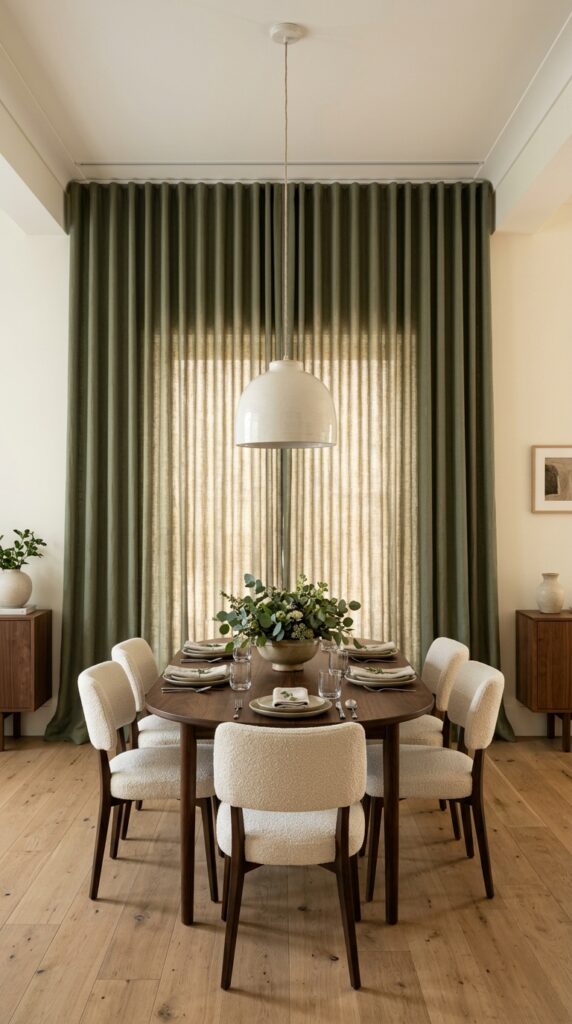
Vibe: The wall reads soft — a room that breathes rather than stands still, the linen moving imperceptibly with every door opening.
Why it works: Floor-to-ceiling curtain panels used as a wall treatment apply the principle of textile architecture — fabric creates warmth, acoustic softness, and visual movement that no painted or papered wall can replicate. A full-width curtain wall also provides flexible function: if concealing a storage wall or an awkward window configuration, the curtains unify disparate elements behind a single coherent surface. Deep sage linen specifically filters natural light to a warm, green-tinted glow that makes morning dining feel calm and evening dining feel intimate.
How to get it: Install a ceiling-mounted curtain rod at the ceiling line — not at the standard 6-inch above-window-frame height — and use panels with a 120-inch drop minimum for standard 9-foot ceilings. Order 2.5–3× the wall width in total fabric for a properly full, gathered look. IKEA’s DYTÅG and AINA linen curtains in natural or sage tones are the accessible entry point at $30–60 per panel.
🛍️ Shop the Look — Amazon Product Ideas
| # | Product Search Phrase | Why It Fits |
| 1 | Sage linen curtain panel 96 inch floor length | Textile wall backdrop |
| 2 | Ceiling mount curtain rod black 144 inch | Full-wall rod installation |
| 3 | Oval dark wood dining table 72 inch | Room furniture pairing |
| 4 | Cream boucle dining chair upholstered | Soft texture seating |
| 5 | Ceramic pendant light dining room round | Overhead ceiling fixture |
14. Sculptural Woven Wall Art in Natural Fiber
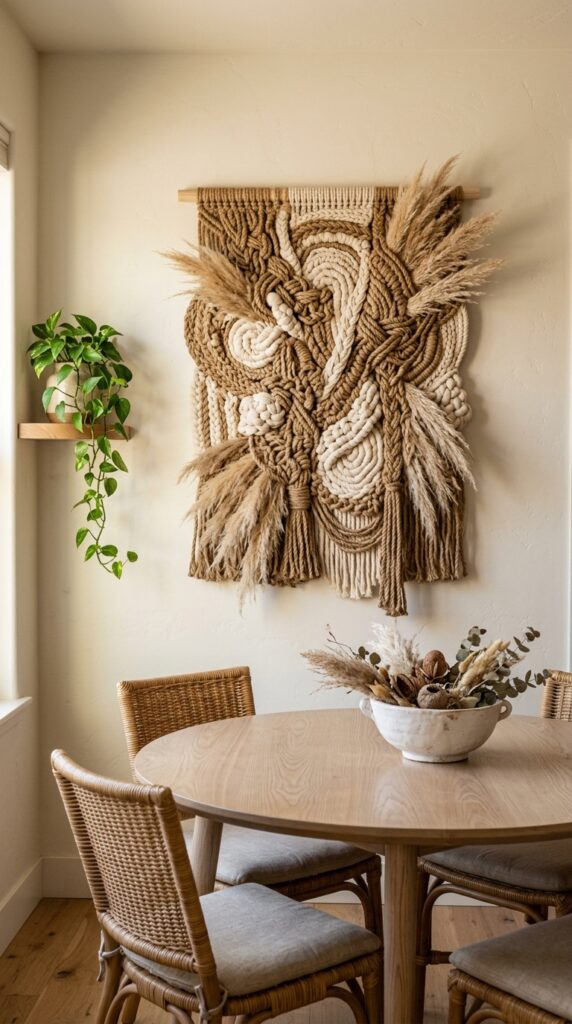
Vibe: The piece reads dimensional — more sculpture than artwork, casting shadows that shift with the light and make the wall itself seem to breathe.
Why it works: Sculptural fiber art applies the principle of dimensional shadow play — unlike framed flat art, a dimensional woven piece casts its own shadows on the wall behind it, creating a secondary artwork in negative space that changes continuously with the light angle. This makes a single piece do the visual work of both artwork and lighting accent simultaneously. Natural fiber materials (jute, undyed cotton rope, dried plant material) connect the wall to the dining table’s organic material language — wood, ceramic, linen — creating a room where every surface speaks the same material dialect.
How to get it: Commission or purchase from Etsy fiber artists who work in natural macramé and weaving — search “large wall hanging natural fiber dining room.” Hang from a single centered hook using the piece’s own hanging loop, ensuring the top of the piece sits at eye level when standing (approximately 65–67 inches from the floor). Allow 3–4 inches of clearance from the wall behind for the dimensional elements to cast their full shadow.
🛍️ Shop the Look — Amazon Product Ideas
| # | Product Search Phrase | Why It Fits |
| 1 | Large macrame wall hanging natural fiber 36 inch | Sculptural textile art |
| 2 | Light ash wood round dining table 54 inch | Organic table pairing |
| 3 | Rattan dining chair natural woven | Natural fiber seating echo |
| 4 | Dried pampas grass arrangement centerpiece | Organic table styling |
| 5 | White ceramic bowl large low centerpiece | Simple table anchor |
15. Painted Color Block Panels for a Graphic Dining Room

Vibe: The wall reads composed — three decisions made with confidence, as if the room has always known exactly what it wanted to be.
Why it works: Painted color block panels apply the design principle of proportion play — by dividing the wall into three vertical panels of deliberately unequal width (a wider center and narrower flanking fields), the composition creates a visual tension that reads as designed rather than accidental. The center panel frames the dining table from behind, creating a natural spotlight effect that draws attention to the table as the room’s central object. The terracotta and forest green palette is a complementary pairing drawn from opposite sides of the warm earth family, creating contrast without discord.
How to get it: Use Benjamin Moore “Pueblo” (2175-30) for the terracotta center and “Tarrytown Green” (HC-134) for the flanking green panels. Apply painter’s tape vertically at the panel edges and use a 4-inch foam roller for each panel color. Paint the terracotta first, let dry fully, then tape and paint the green panels. The center panel should span approximately 60% of the total wall width; each flanking panel takes 20%.
💡 Quick Win: A two-color block treatment using just the lower third of the dining room wall as a color band (essentially a painted wainscot in a bold tone) achieves a similar graphic quality at half the commitment — repaintable in a single afternoon.
🛍️ Shop the Look — Amazon Product Ideas
| # | Product Search Phrase | Why It Fits |
| 1 | Terracotta interior paint matte sample quart | Color block center panel |
| 2 | Forest green interior paint matte wall | Color block flanking panel |
| 3 | Precision painter’s tape sharp edge 1 inch | Clean edge masking |
| 4 | Dark metal pendant light dining industrial | Graphic fixture match |
| 5 | Hanging ceiling plant basket woven jute | Overhead organic accent |
16. Oversized Clock as a Functional Wall Statement
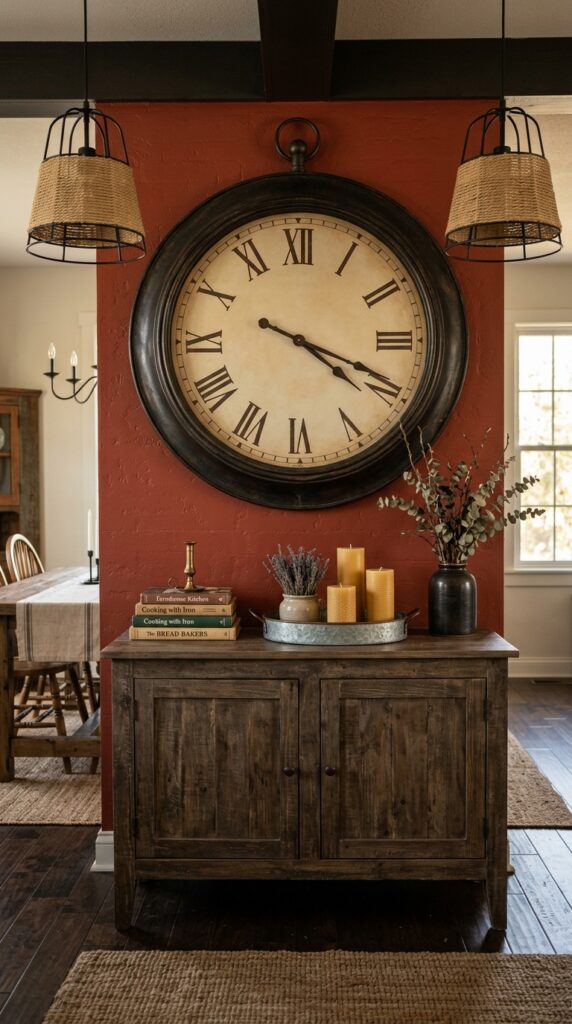
Vibe: The room reads purposeful — the clock telling time the way a tavern clock did, large enough to read from any seat at the table.
Why it works: An oversized wall clock in a dining room exploits the design principle of functional sculpture — an object that earns its wall space through simultaneous utility and visual weight. At 36 inches or larger, a clock transitions from furniture accessory to architectural element, anchoring the wall with the same authority as a large artwork but with the added dimension of movement (the hands) and the social function of time-keeping during meals and entertaining. The industrial aged-iron finish reads as appropriately patinated in a dining context where objects should suggest they have been used.
How to get it: Oversized industrial clocks are available from Pottery Barn, CB2, and Amazon in the $80–250 range at 30–36-inch diameters. Ensure the clock mechanism uses a high-torque (HT) quartz movement rated for dials over 18 inches — standard clock mechanisms cannot drive hands on oversized dials. Hang using a French cleat or a single 3/16-inch lag bolt into a stud for clocks over 10 pounds.
🛍️ Shop the Look — Amazon Product Ideas
| # | Product Search Phrase | Why It Fits |
| 1 | Large wall clock 36 inch industrial iron | Functional wall sculpture |
| 2 | Weathered wood sideboard buffet farmhouse | Room foundation furniture |
| 3 | Galvanized metal tray large rectangular | Industrial surface styling |
| 4 | Woven pendant light set of 2 dining | Flanking overhead accents |
| 5 | Vintage cookbook stack display decor | Dining room reading stack |
17. Neon Sign or LED Light Word Art
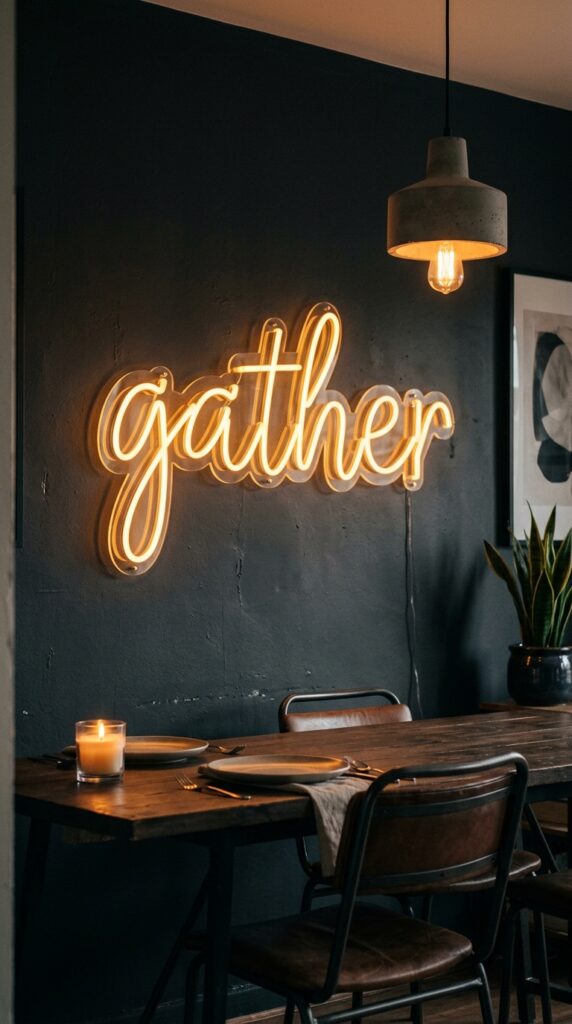
Vibe: The room reads inviting — the word glowing there like an instruction you were glad to follow.
Why it works: A dining room neon sign applies the principle of literal invitation — the word “gather,” “feast,” “bon appétit,” or simply a family name placed in glowing script on the primary wall makes the room’s social purpose explicit in a way that is both design-forward and emotionally warm. Warm amber or warm white neon (as opposed to cool blue or green) is the specific color choice that reads as welcoming rather than commercial. Against a dark charcoal wall, the neon creates a localized warm glow that functions as both artwork and ambient light during evening meals.
How to get it: Custom LED neon signs (which use flexible LED tubing rather than glass neon for lower heat and shipping safety) are available from Etsy shops and NeonSignCo.com for $60–200 depending on size and word length. Specify warm white (2700K) or amber LEDs rather than “white” which defaults to cool blue-white. Mount with the included clear acrylic backing using two screws into the wall.
🛍️ Shop the Look — Amazon Product Ideas
| # | Product Search Phrase | Why It Fits |
| 1 | Custom LED neon sign gather dining warm white | Word art light feature |
| 2 | Dark charcoal interior paint matte wall | Dark backdrop paint |
| 3 | Concrete pendant light dining modern | Industrial ceiling fixture |
| 4 | Metal dining chair leather seat dark | Modern casual seating |
| 5 | Glass votive candle holder clear set | Warm candlelight accent |
18. Rattan or Bamboo Wall Panel as a Natural Accent
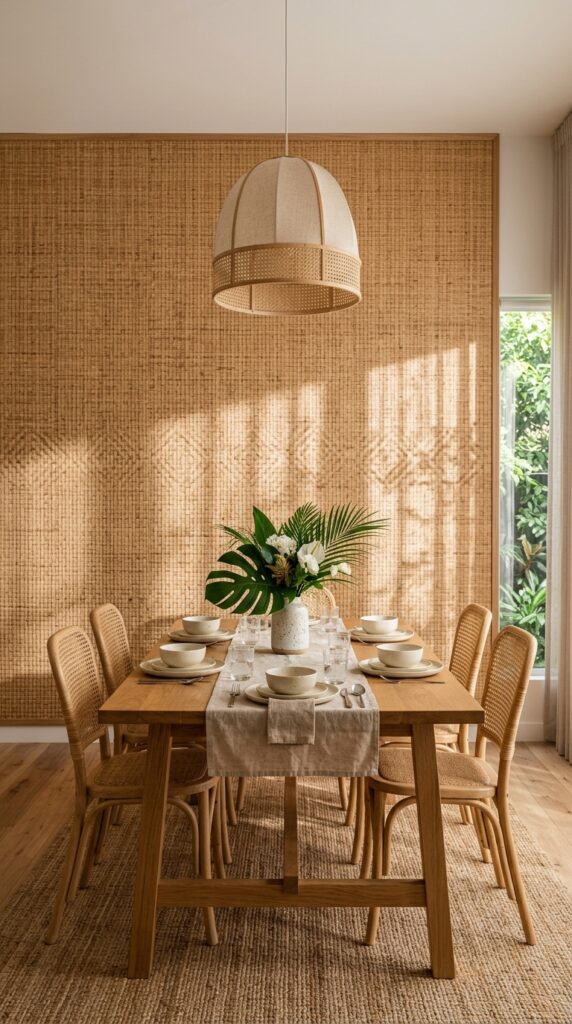
Vibe: The wall reads tropical and grounded — the kind of surface that makes every meal feel slightly like it’s happening outdoors.
Why it works: Natural rattan or bamboo wall panels use the principle of material atmosphere — the woven basketweave pattern introduces a reference to craft and nature that transforms the thermal quality of the room, making it feel both warmer and more exotic simultaneously. Rattan specifically has an association with relaxed, unhurried dining — the material of resort dining rooms and colonial verandas — that shifts the social temperature of the space toward ease. The repeating pattern creates visual texture at a scale that reads from across the room while remaining interesting at close range.
How to get it: Woven rattan wall panels are available in 4×8-foot sheets from specialty suppliers like Cane-Line and The Rattan Guys, or as peel-and-stick rattan wallpaper panels from Etsy shops for a renter-friendly application. Install full sheets from floor to ceiling with a thin 1×2 natural wood trim at all edges to create a finished frame. Apply panels with panel adhesive and finish nails at the top and bottom edges.
💡 Quick Win: A single 24×48-inch framed rattan panel purchased pre-made ($35–60) hung above the sideboard introduces the material palette of a full rattan wall with zero installation complexity.
🛍️ Shop the Look — Amazon Product Ideas
| # | Product Search Phrase | Why It Fits |
| 1 | Rattan wall panel woven 4×8 natural cane | Accent wall material |
| 2 | Cane linen pendant light dining natural | Matching ceiling fixture |
| 3 | Natural rattan dining chair set of 2 | Material echo seating |
| 4 | Tropical leaf real or faux centerpiece | Botanical table anchor |
| 5 | Wood trim 1×2 natural pine finishing | Panel edge trim |
19. Single Dramatic Artwork at Oversized Scale
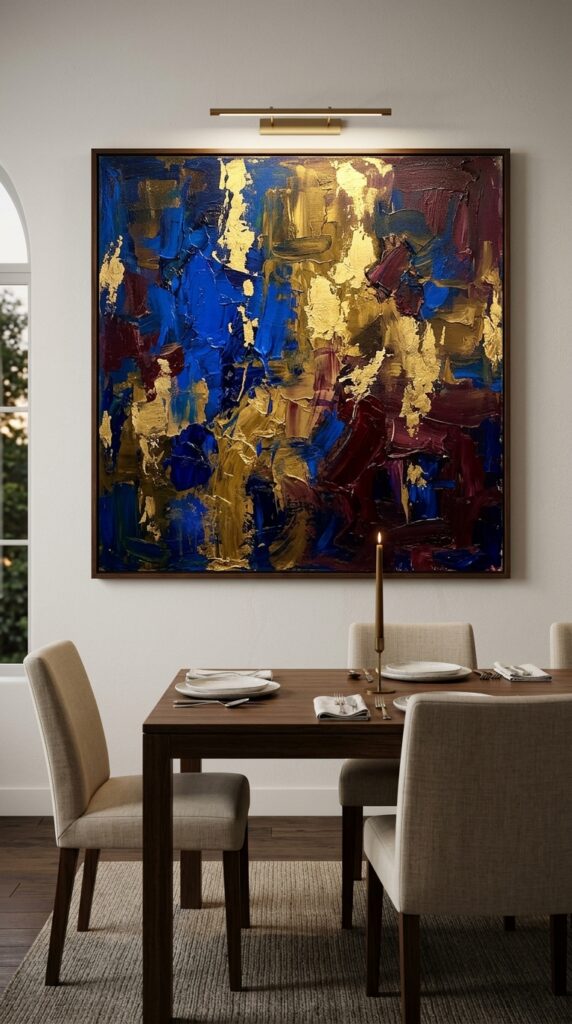
Vibe: The room reads confident — one decision made at full volume, every other surface the respectful silence around it.
Why it works: A single oversized artwork in an otherwise spare dining room applies the maximalist version of the minimalist principle — the negative space around the artwork makes the artwork itself more powerful, not less. This is the museum principle of negative space amplification: removing all competing wall elements allows a single piece to expand into the room’s full visual field. A picture light mounted above the canvas creates directional illumination that separates the artwork from the wall plane, making it appear to float and glow rather than sit flat against the surface.
How to get it: A picture light should be sized to span approximately 60% of the artwork’s width — for a 72-inch wide canvas, a 42–48-inch picture light. Specify a warm-white (2700K) LED picture light for oil paintings to flatter the pigment without UV damage. Mount the light on the wall above the canvas rather than clipped to the frame for oversized works — this allows the light beam to wash the full canvas surface without shadowing from the frame.
🛍️ Shop the Look — Amazon Product Ideas
| # | Product Search Phrase | Why It Fits |
| 1 | Large abstract oil painting canvas 60×60 | Oversized hero artwork |
| 2 | LED picture light warm white 36 inch wall | Artwork illumination |
| 3 | Linen upholstered dining chair set 4 | Spare upholstered seating |
| 4 | Tall taper candle holder brass 12 inch | Minimal table accent |
| 5 | White linen napkin set 4 hemstitch | Dining textile detail |
20. Compact Dining Room: Mirrored Wall Panel to Double Space
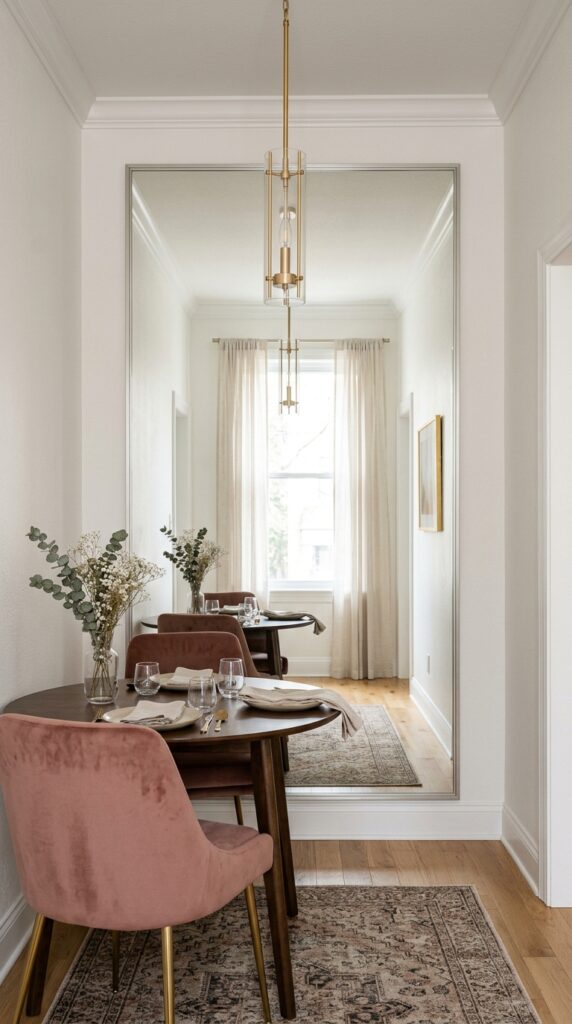
Vibe: The room reads expanded — the mirror performing the most generous spatial trick in decorating, doubling everything it sees.
Why it works: A large mirror panel on one wall of a small dining room is the most powerful small-space intervention available because it applies two principles simultaneously: depth extension through reflection and light doubling through surface. A mirror reflecting a window doubles the perceived natural light in the room; a mirror reflecting the chandelier doubles the apparent number of light sources. For maximum effect, the mirror should be mounted on the wall directly opposite or at 90 degrees to the primary window — this positions the reflected light source at its most impactful angle relative to seated diners.
How to get it: Specify a mirror panel with a thin (1-inch or less) brushed silver or polished nickel frame — heavy ornate frames make the mirror read as artwork rather than architecture. Install at floor level with the bottom edge sitting on the baseboard and the mirror running to within 6 inches of the ceiling for maximum spatial extension. Anchor to wall studs using a French cleat system with safety clips.
🛍️ Shop the Look — Amazon Product Ideas
| # | Product Search Phrase | Why It Fits |
| 1 | Full length wall mirror large 48×72 silver frame | Space-expanding mirror |
| 2 | Small round dining table 36 inch two person | Compact dining furniture |
| 3 | Dusty rose velvet dining chair set 2 | Intimate seating pair |
| 4 | Slim gold chandelier small dining room | Space-appropriate fixture |
| 5 | French cleat heavy mirror wall mounting kit | Secure large mirror mount |
21. Chalkboard Wall for a Casual Family Dining Room
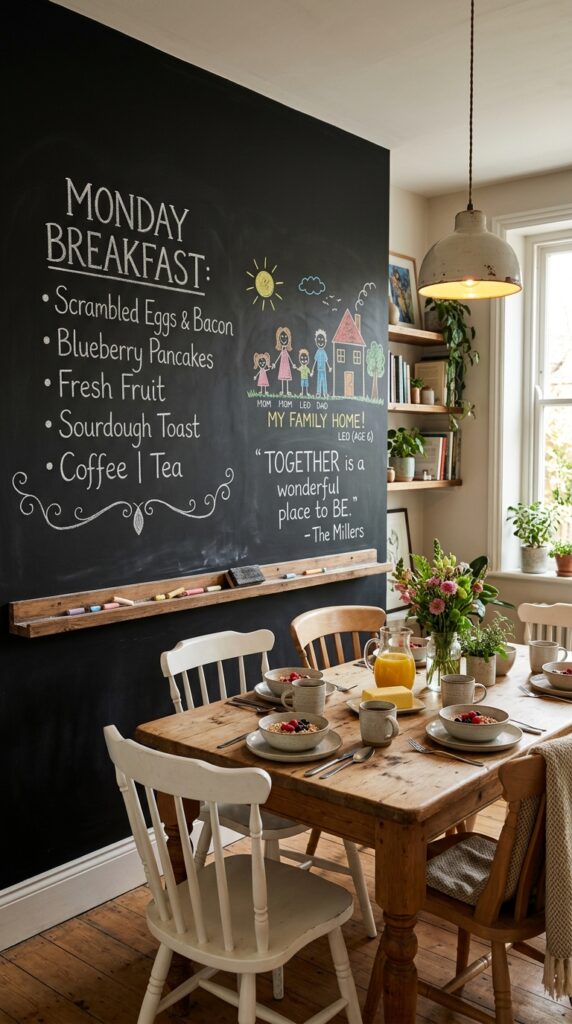
Vibe: The wall reads alive — the kind of surface that changes with the season, the week, and whoever had the chalk last.
Why it works: A chalkboard wall in a family dining room applies the principle of participatory decoration — rather than a fixed artwork that the room’s occupants observe, a chalkboard is a surface the occupants actively change and contribute to, making the wall an ongoing expression of family life. This is the most genuinely personal wall treatment available because no two families’ chalkboard walls ever look the same. The matte black paint also serves as a strong graphic anchor that makes every other warm material in the room — wood, ceramic, linen — read as warmer by contrast.
How to get it: Apply Rust-Oleum Chalkboard Paint in black to a primed, smooth wall surface using a foam roller — two coats. After curing (24 hours), season the surface by rubbing a full stick of white chalk over the entire surface and then wiping clean with a damp cloth — this prevents ghost images from the first content written on the wall. Install a narrow wooden chalk ledge ($15–25) along the bottom of the wall at 48 inches from the floor.
🛍️ Shop the Look — Amazon Product Ideas
| # | Product Search Phrase | Why It Fits |
| 1 | Chalkboard paint black interior wall Rust-Oleum | Chalkboard wall paint |
| 2 | Chalk sticks white round classroom set | Writing material |
| 3 | Wood chalk ledge tray wall mount | Chalk storage ledge |
| 4 | Farmhouse wood dining table 6 person | Casual family table |
| 5 | Ceramic pendant light white simple round | Clean ceiling fixture |
22. Leather-Strap Hanging Shelves for an Artisan Touch
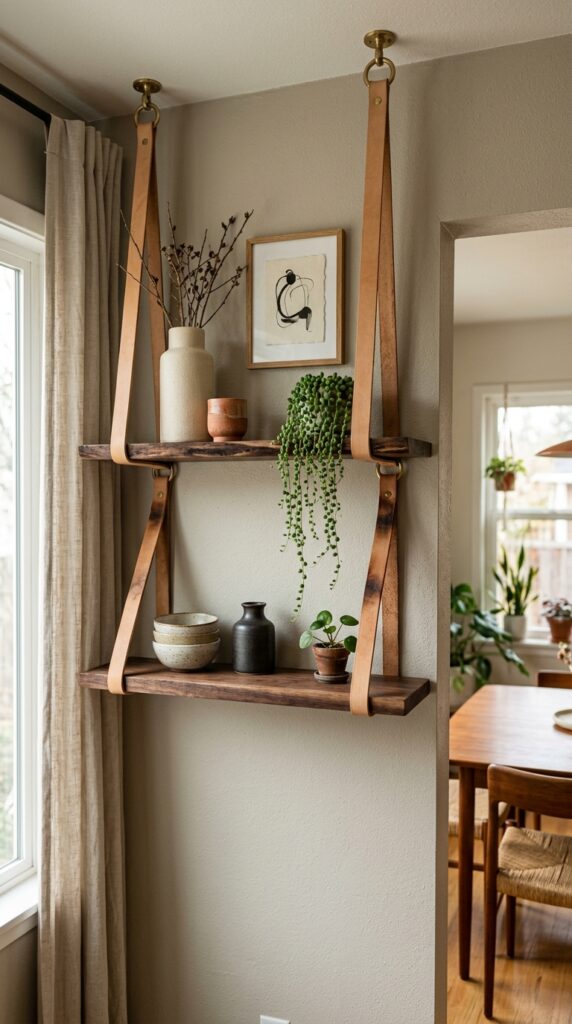
Vibe: The shelves read handcrafted — suspended with the kind of deliberate material honesty that makes you want to understand how they were made.
Why it works: Leather-strap hanging shelves apply the principle of exposed joinery as decoration — by making the suspension system (the leather strap and brass hardware) a visible and intentional aesthetic element rather than concealing it, the shelf becomes an object of craft rather than simply a storage surface. Live-edge walnut planks on leather straps create a material conversation between the organic (the irregular wood edge, the natural leather) and the architectural (the vertical strap, the horizontal shelf plane). This is a dining room wall solution that reads as both functional and gallery-worthy.
How to get it: DIY leather-strap shelves require a 2-inch-wide vegetable-tanned leather strap cut to length, a 2-inch brass ring at the ceiling mount point, and 3/8-inch holes drilled through the shelf plank for the strap to pass through and knot beneath. The ceiling mount hardware should be a ceiling hook into a joist — not a drywall anchor — for load-bearing security. A 24×8-inch live-edge walnut shelf plank is available from Etsy woodworkers for $45–80.
💡 Quick Win: Pre-made leather-strap shelf kits ($35–55 on Amazon) in light or dark leather come with all hardware and can be installed on any existing shelf plank you already own — updating an existing shelf’s hanging system is a 20-minute project.
🛍️ Shop the Look — Amazon Product Ideas
| # | Product Search Phrase | Why It Fits |
| 1 | Leather strap shelf kit hanging hardware brass | Strap shelf mounting system |
| 2 | Live edge walnut shelf plank 24 inch | Natural wood shelf plank |
| 3 | String of pearls succulent small trailing | Cascading plant detail |
| 4 | Cream earthenware ceramic vessel tall | Shelf ceramic anchor |
| 5 | Small abstract ink framed print 5×7 | Propped artwork detail |
23. Wainscoting with Contrasting Upper Wall Color
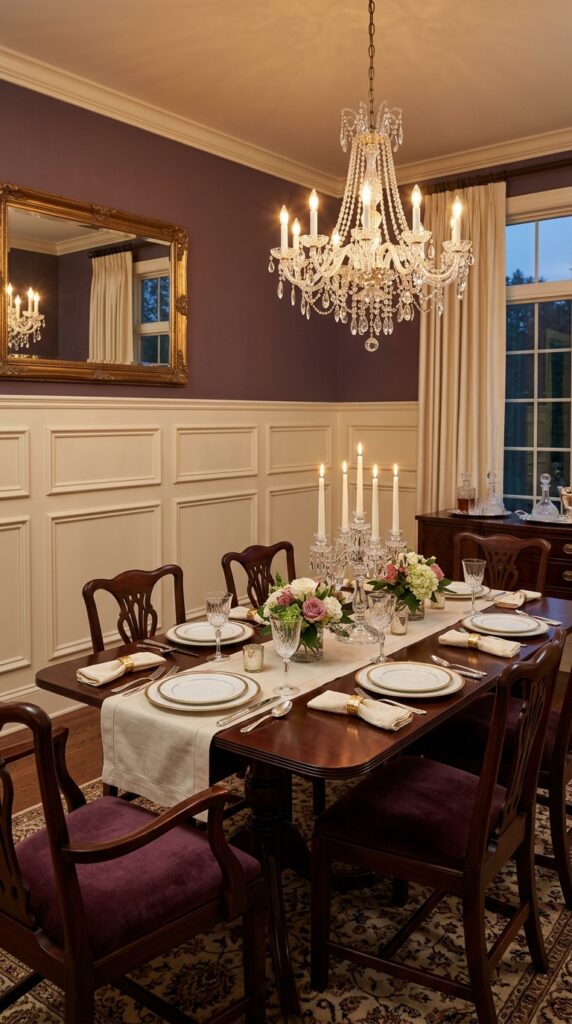
Vibe: The room reads formal without stiffness — the kind of dining room that sets expectations the moment you walk in.
Why it works: Wainscoting with a contrasting upper wall color applies the classical architectural principle of base-field division: the lower wall reads as a heavy structural element that grounds the room, while the upper colored field reads as the atmospheric surface that sets the mood. At 54 inches, the wainscot height is above the traditional 36-inch chair-rail height — this taller proportion is the Georgian and Federal-era standard for formal dining rooms and creates a much stronger sense of architectural enclosure. Deep dusty plum above warm cream creates a warm jewel-box effect that is specifically suited to candlelit evening dining.
How to get it: Picture-frame wainscoting using standard MDF panel molding (3/4-inch profile) applied to flat drywall with panel adhesive creates the formal molded look for approximately $1.50–2.50 per linear foot in materials. Paint the entire lower wall (including the applied molding) in a single warm cream for correct formal character — painting the recessed panels a different color from the molding reads as contemporary interpretation, not classical.
🛍️ Shop the Look — Amazon Product Ideas
| # | Product Search Phrase | Why It Fits |
| 1 | MDF panel molding picture frame wainscot | Wainscot molding material |
| 2 | Dusty plum interior paint matte quart | Upper wall paint color |
| 3 | Crystal chandelier dining room 6 light | Formal ceiling fixture |
| 4 | Velvet seat pad dining chair dusty purple | Textile upholstery echo |
| 5 | Crystal taper candle holder set 2 formal | Formal table lighting |
24. Raw Brick Wall (Real or Faux) as a Textural Backdrop
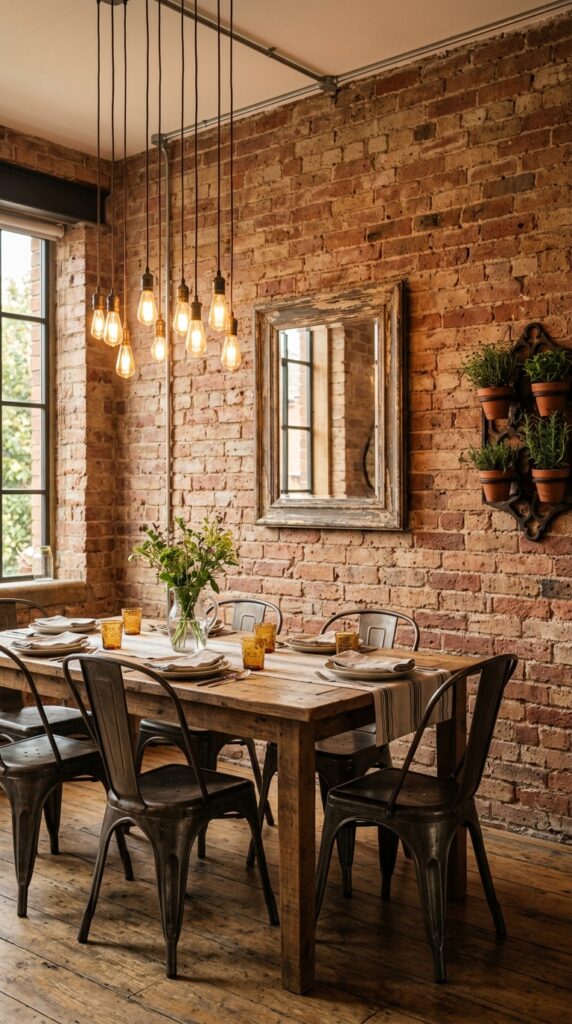
Vibe: The wall reads earned — a surface that communicates the building’s history before a single piece of furniture was moved in.
Why it works: An exposed brick wall in a dining room uses the design principle of geological authenticity — a material that cannot be convincingly faked at close inspection carries a weight of presence and history that manufactured surfaces cannot achieve. Brick’s warm red and tan tones create a naturally flattering backdrop for food, candlelight, and wood, which is why exposed brick has been the defining aesthetic of the urban restaurant dining experience for decades. The varied color of individual bricks prevents the wall from reading as a flat pattern — every section is different.
How to get it: If genuine exposed brick exists behind plaster or drywall, mechanical demo and cleaning is the path (budget $500–2,000 for professional brick exposure and pointing). For faux brick, German Schmear technique (applying a thin wash of white or cream mortar over standard brick veneer panels) creates an aged, European character that is more convincing than flat brick wallpaper at close range. Brick veneer panels from MSI or Coronado Stone install over standard drywall substrate.
🛍️ Shop the Look — Amazon Product Ideas
| # | Product Search Phrase | Why It Fits |
| 1 | Faux brick veneer panel wall interior red | Budget brick alternative |
| 2 | Reclaimed wood dining table farmhouse 72 inch | Authentic material table |
| 3 | Industrial metal dining chair set black | Urban dining seating |
| 4 | Edison bulb pendant light cluster 3 pendant | Industrial ceiling fixture |
| 5 | Distressed wood frame mirror large vintage | Period-correct mirror |
25. Fabric-Wrapped Wall Panel for Acoustic Softness
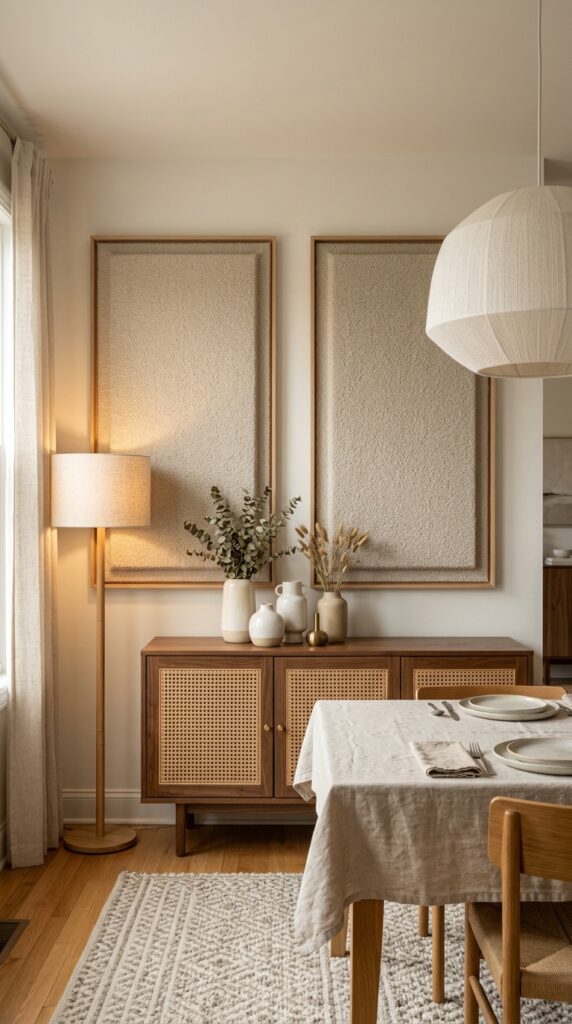
Vibe: The room reads soft — as though someone turned the acoustic dial down to a whisper and the walls are the reason.
Why it works: Fabric-wrapped wall panels in a dining room apply the principle of acoustic architecture — the thick fabric and foam batting underneath absorb sound waves, reducing the echo and reverberant quality that hard surfaces (tile, glass, plaster) create in a room full of conversation and tableware. This makes the room genuinely more pleasant for extended meals and lively conversation — a functional improvement invisible to the eye but immediately felt by the ear. Bouclé fabric specifically reads as textural without being directional — unlike a woven pattern, bouclé has no grain that can read unevenly, making installation foolproof.
How to get it: DIY fabric panels use a 1.5-inch thick foam board (Owens Corning 703 acoustic board gives maximum sound absorption) cut to the panel size, covered in fabric pulled taut and stapled to the back. Mount in a simple 1×2 wood frame painted to match the wall. The entire project for two 24×48-inch panels runs approximately $80–120 in materials and takes one afternoon.
🛍️ Shop the Look — Amazon Product Ideas
| # | Product Search Phrase | Why It Fits |
| 1 | Bouclé fabric upholstery oatmeal by yard | Panel fabric material |
| 2 | Acoustic foam board 703 owens corning 2×4 | Sound absorption core |
| 3 | Natural wood frame picture frame large custom | Panel frame surround |
| 4 | Linen floor lamp shade warm cream | Ambient room lighting |
| 5 | Ceramic vase set 3 varying heights neutral | Sideboard styling set |
26. Kids’ Art Gallery Wall for a Family Dining Space
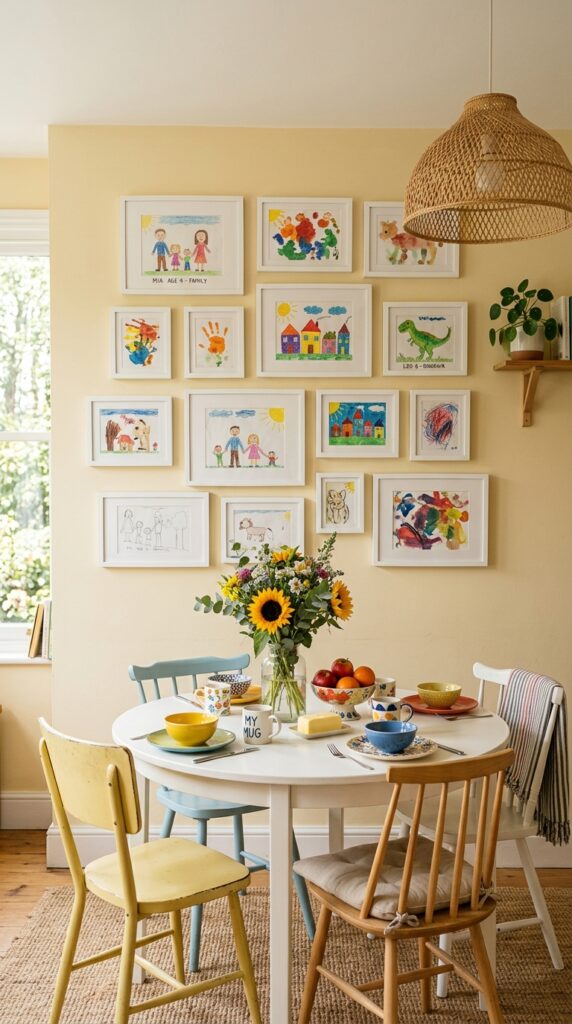
Vibe: The wall reads joyful — the kind of gallery that makes guests smile before they’ve sat down.
Why it works: A children’s art gallery wall in a family dining room applies the principle of meaningful provenance — artwork made by the people who eat in the room creates an emotional connection between the space and its occupants that purchased artwork never achieves. The key design decision is consistent framing: by placing all children’s art in identical simple white frames, the gallery reads as a composed design decision rather than a refrigerator door, elevating the artworks to the status of a curated collection. This single framing choice transforms a sentimental collection into an actual design feature.
How to get it: Use identical 5×7, 8×10, or 11×14 white gallery frames throughout — the frame uniformity does all the curatorial work. Rotate artworks seasonally to keep the wall current and make children feel that their work is genuinely valued. Arrange in an organic cluster (not a strict grid) to suggest the casual accumulation of a real art collection rather than an organized display.
💡 Quick Win: Ten identical white 8×10 frames ($2–4 each at IKEA or Amazon) cost $20–40 total and transform any collection of artworks into a gallery wall — the most affordable wall decor transformation available anywhere.
🛍️ Shop the Look — Amazon Product Ideas
| # | Product Search Phrase | Why It Fits |
| 1 | White gallery frame 8×10 set of 10 simple | Uniform gallery framing |
| 2 | Round white dining table family 48 inch | Family dining furniture |
| 3 | Colorful wooden children’s dining chair | Playful seating option |
| 4 | Ceramic fruit bowl large white | Cheerful table anchor |
| 5 | Sunflower stem artificial realistic vase | Warm floral accent |
27. Decorative Metal Wall Sculpture for Dimensional Interest
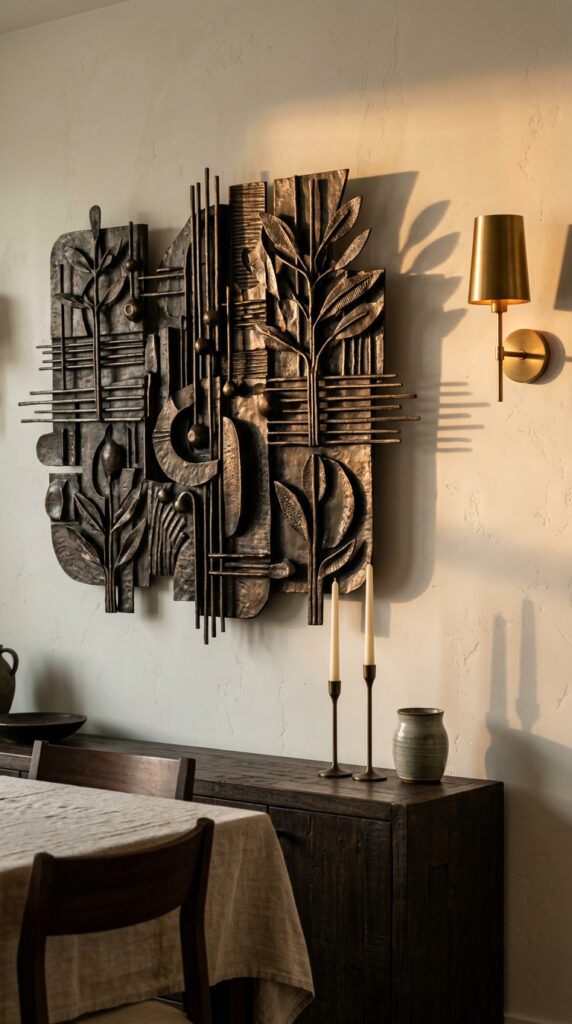
Vibe: The sculpture reads alive — the directional light turning the flat wall into a composition of shadow and material that changes as you move around the table.
Why it works: A dimensional metal wall sculpture applies the most advanced version of the principle of shadow as decoration — a piece with physical relief creates a secondary artwork in shadow that exists on the wall behind it and shifts continuously with the ambient and directional light quality of the room. This means a single sculpture effectively provides two visual experiences: the object itself and its shadow composition. Dark bronze or antique iron finishes are specifically appropriate in a dining room because they warm rather than cool the ambient light quality, catching warm sconce and candlelight at their dimensional edges and ridges.
How to get it: Source large abstract metal wall sculptures from artisan metalwork suppliers on Etsy or from decorative arts galleries. Pair with a dedicated directional wall sconce positioned 18–24 inches to one side of the sculpture — this raking light is what activates the dimensional shadow effect. Without directional light, a dimensional sculpture reads as flat as a framed print.
🛍️ Shop the Look — Amazon Product Ideas
| # | Product Search Phrase | Why It Fits |
| 1 | Metal wall sculpture abstract large bronze dining | Dimensional wall art |
| 2 | Directional wall sconce adjustable arm warm | Raking sculpture light |
| 3 | Brass taper candle holder tall set 2 | Warm flanking accent |
| 4 | Dark wood dining chair set 4 upholstered | Rich seating foundation |
| 5 | Ceramic vessel medium neutral greige | Sideboard material accent |
How to Start Your Dining Room Wall Decor Transformation
The single most powerful first move is choosing your primary wall’s finish — paint color or wall treatment — before purchasing any artwork, mirror, or decor. The wall surface is the stage on which every other decision performs, and a deep forest green limewash or a warm terracotta color block will transform the room’s atmosphere more completely than any collection of accessories. Benjamin Moore “Salamander” (2050-10), a deep forest green with warm brown undertones, is the specific color that consistently elevates dining rooms from furnished to designed.
The most common beginner mistake is hanging artwork too high. Most people hang wall art at the height they can comfortably reach, which places the piece’s center at 70–72 inches from the floor — far above the museum standard of 57 inches. In a dining room where guests are primarily seated, this mistake is amplified: artwork hung at standard wall height reads above the eyeline of a seated person and disconnects from the dining experience entirely. The fix is to remount every piece 8–12 inches lower than your instinct suggests.
For under $50: a $15 sample pot of limewash paint to test a 24×24-inch section of the primary wall, a set of ten identical white 8×10 gallery frames from Amazon for $20–30, and a bundle of dried botanicals in a simple glass bottle for $12–18 placed on the sideboard as an immediate organic accent.
A weekend can accomplish a painted arch, a limewash accent wall, or a gallery wall installation. A full dining room wall transformation — new paint, new lighting fixtures, artwork sourcing, and a wainscot addition — realistically takes 4–8 weeks from planning to completion and runs $800–3,500 for a room treated thoughtfully rather than expensively.
Frequently Asked Questions About Dining Room Wall Decor
What is the difference between dining room wall decor and living room wall decor?
Dining room wall decor operates under a unique set of conditions: the room is experienced primarily while seated, in artificial or candlelight, during social occasions. This means artwork scale, lighting placement, and color choices that read well in a dining context often differ from living room choices. Dining room walls benefit from warmer, deeper tones (terracotta, plum, forest green) and materials that reflect candlelight (brass, mirror, glazed ceramics), while living rooms — experienced during the day, often in natural light — accommodate a broader palette. The seated eye level of approximately 48 inches also means dining room art should hang 6–8 inches lower than living room art.
What wall color works best in a dining room to make it feel warm and welcoming?
The most consistently successful dining room wall colors are deep, warm, and slightly saturated — Benjamin Moore “Salamander” (2050-10) in deep forest green, Farrow & Ball “Sulking Room Pink” (No.295) in dusty mauve, and Sherwin-Williams “Cavern Clay” (SW 7701) in warm terracotta all read as welcoming in candlelit evening settings. Avoid cool grays and blue-whites in dining rooms — these tones read as cold against warm artificial light and are unflattering to food and complexion. The warm shadow that a rich color creates in the corners of a dining room is part of its hospitality.
How much should I spend on dining room wall decor?
A well-decorated dining room wall can be achieved at any budget: a painted arch or limewash accent wall costs $15–30 in materials; a gallery wall of printed vintage botanicals in uniform frames runs $40–120; original artwork appropriate for a dining room (36×48 inches and larger) from emerging artists on Etsy or Saatchi Art ranges from $200–1,500. The highest-impact investment for most dining rooms is the wall paint color itself — a professional paint job on one accent wall runs $200–400 and changes the room more completely than any artwork purchase.
Can I mix different styles of wall decor in one dining room?
Yes, with one guiding constraint: mix styles freely but maintain material and color consistency. A vintage botanical print collection, a handmade ceramic plate, and a woven tapestry read as cohesively curated when they share a palette (warm greige, sage, terracotta) and a material sensibility (natural, handmade, organic). The same three pieces in a mismatched palette — a bright modern print, a chrome-framed botanical, and a bright blue tapestry — would read as chaotic. The unifying thread is never style consistency but always color and material family.
What size artwork is right for a dining room wall?
The minimum effective size for a standalone artwork above a dining sideboard or buffet is 36 inches wide — anything smaller reads as undersized relative to the furniture below and the room’s scale. Above a long dining table on the primary wall, a single artwork should span at least 60% of the table’s length (for a 72-inch table, that means a canvas at least 43 inches wide). Gallery walls are the exception — a collection of 8×10 and 11×14 pieces can successfully cover a wall when the total composition reaches the required scale, even if no individual piece does.
Ready to Create Your Dream Dining Room Wall Decor?
These 27 dining room wall decor ideas span the full range of what makes a dining room wall sing — from color moves like deep forest green limewash and terracotta color blocking, to material decisions in handmade ceramics, raw brick, woven rattan, and dimensional metal sculpture, to layout techniques like painted arches, wainscoting, and full curtain walls. Starting with a single wall — the one the eye lands on first when entering the room — is not a partial approach; it is the right approach, because one well-resolved wall sets the design key that every subsequent decision can follow. Today’s concrete action: stand at the entry of your dining room and identify which wall you see first — then decide what that wall should feel like before choosing a single object to put on it. When the work is done, your dining room will feel like what it was always meant to be: a room worth lingering in long after the plates are cleared. Save the ideas that made you pause — especially the ones that felt slightly too bold — because in dining rooms, the bolder choice is almost always the right one.