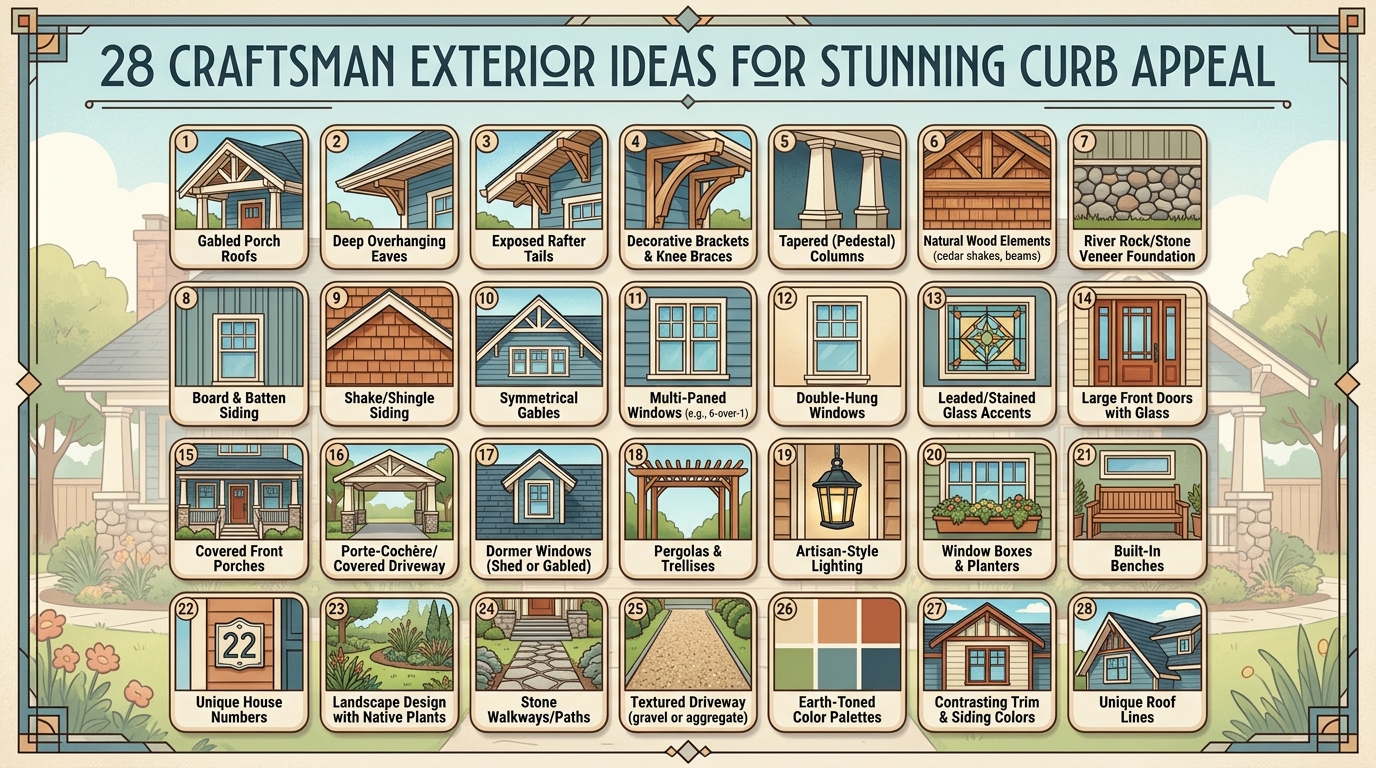
A Craftsman exterior is an architectural style defined by handcrafted details, natural materials, and a strong connection between the home and its landscape — characterized by wide overhanging eaves, exposed rafter tails, tapered porch columns on stone bases, and earth-rooted color palettes. This article gives you exactly 28 Craftsman exterior ideas across color, materials, landscaping, lighting, and architectural detail — each one designed to elevate curb appeal in a way that honors the style’s core philosophy.
There is something deeply satisfying about a Craftsman home done right. The wide front porch draws you in before you reach the steps. The natural wood, stone, and painted shingles feel like they grew from the ground rather than were assembled above it. Every bracket, every column, every window divided by true wood muntins speaks of intention and craft. It is an architecture that rewards slowing down to look.
Here are 28 ideas worth saving — and stealing.
Why Craftsman Exterior Style Works So Well
The Craftsman style emerged from the American Arts and Crafts movement of the late 19th and early 20th centuries — a direct philosophical response to the industrial revolution’s mass production and ornamental excess of Victorian architecture. Pioneered by designers like Gustav Stickley and popularized through the pattern-book bungalows of Charles and Henry Greene, Craftsman architecture argued that beauty should be inseparable from function, that materials should be shown honestly rather than hidden, and that a home should sit comfortably within its natural surroundings rather than dominate them.
The material vocabulary of a Craftsman exterior is specific and tactile. Siding materials include cedar shingles in natural or painted finishes, horizontal lap siding in fiber cement or painted wood, and board-and-batten accents at gable ends. Stone appears in river rock, fieldstone, or stacked slate — used for column bases, porch piers, chimney surrounds, and foundation skirts. Colors run through warm sage (#7A8C6A), forest green, deep olive, warm taupe, brick red, mustard gold, dark chocolate brown, and slate blue — all earthen tones that reference the surrounding landscape.
The Craftsman style is experiencing a remarkable resurgence right now, driven by three converging forces: the growing preference for homes with authentic material character over builder-grade uniformity, the sustainability movement’s alignment with Craftsman’s use of natural and durable materials, and the sharp increase in people investing in exterior improvements post-pandemic as curb appeal became tied to both pride of ownership and property value. Pinterest searches for “Craftsman exterior ideas” have grown consistently alongside searches for “natural home exterior” and “bungalow curb appeal.”
Even compact Craftsman homes — the original bungalow footprint was often 800–1,200 square feet — achieve exceptional curb appeal because the style’s most powerful elements operate at close range: the porch detail, the column profile, the front door color, and the window trim are all experienced within 30 feet of the home. Small Craftsman homes should invest first in these close-range details rather than sweeping landscape gestures.
| Element | Classic Craftsman | Modern Craftsman |
| Philosophy | Honest materials, handcraft, nature connection | Refined simplicity, updated palette, clean lines |
| Materials | River rock, cedar shingles, fir beams, painted wood | Fiber cement, corten steel accents, dark metal windows |
| Color palette | Sage, forest green, warm taupe, brick red, mustard | Charcoal, warm black, aged bronze, slate blue, warm white |
28 Craftsman Exterior Ideas for Stunning Curb Appeal
1. The Classic Sage Green and Cream Craftsman Color Scheme
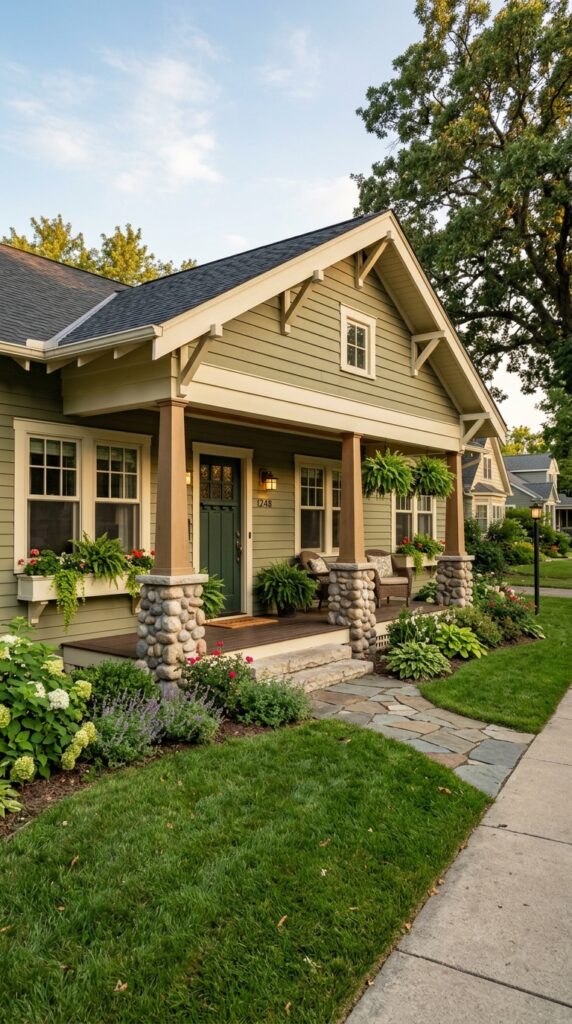
Vibe: Warm and grounded — the Craftsman palette that has anchored neighborhoods for a century and still stops people on the sidewalk.
Why it works: Sage green siding with cream trim is the foundational Craftsman color relationship because it mirrors the palette of the natural landscape — the green references foliage, the cream references birch bark and limestone — creating an exterior that reads as grown rather than painted. The design principle at work is tonal harmony between the built and natural environment: a Craftsman home in this palette looks as though it has been on this particular lot since the trees were saplings. Dark forest green on the front door deepens the palette and creates a clear focal point at the entry.
How to get it: Use Benjamin Moore’s Saybrook Sage HC-114 or Sherwin-Williams Rosemary SW 6187 for the siding. Specify cream (not pure white — Sherwin-Williams Antique White SW 6119 is ideal) for all trim: fascia, corner boards, window surrounds, and porch beam soffits. The door should be one to two shades deeper than the siding — Benjamin Moore’s Tarrytown Green HC-134 works perfectly against sage siding.
💡 Quick Win: Painting the front door a deeper version of your siding color — rather than a completely different hue — is the fastest, most cohesive Craftsman color move available for under $50 in paint.
🛍️ Shop the Look — Amazon Product Ideas
| # | Product Search Phrase | Why It Fits |
| 1 | exterior paint sage green satin finish | Siding color reference |
| 2 | hanging fern basket outdoor large | Classic porch plant |
| 3 | window box planter cedar wood large | Siding-mounted planter |
| 4 | river rock column base stone veneer | Authentic pier material |
| 5 | brass door knocker craftsman style | Entry hardware detail |
2. Exposed Rafter Tails and Deep Eave Detail
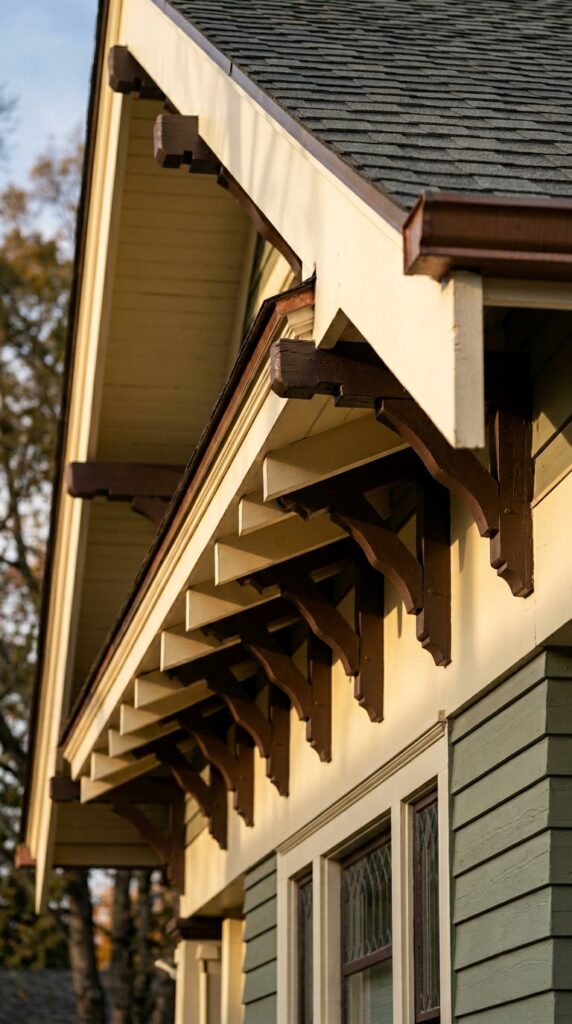
Vibe: Architectural and textural — the detail that tells the street this home was built with intention, not speed.
Why it works: Exposed rafter tails are the single most recognizable Craftsman exterior element and do more visual work than almost any decorating choice. They create a rhythmic pattern along the roofline — a repeating vertical element at regular intervals — that draws the eye along the full width of the home and communicates handcraft before any other detail registers. The shadow each rafter tail casts on the soffit below it changes throughout the day, giving the eave a dynamic quality that flat, enclosed eaves entirely lack.
How to get it: On existing homes with enclosed eaves, rafter tails can be added as applied decorative elements — dimensional lumber cut to a Craftsman profile and mounted to the existing fascia at 24-inch intervals. Use Douglas fir or cedar, prime all surfaces before painting, and paint dark to match exposed structural wood elsewhere on the home. The cut profile matters: a simple angled notch at the bottom reads as Craftsman; a flat square cut reads as generic.
🛍️ Shop the Look — Amazon Product Ideas
| # | Product Search Phrase | Why It Fits |
| 1 | craftsman rafter tail bracket decorative wood | Applied rafter tail detail |
| 2 | exterior wood stain dark walnut oil based | Rafter tail staining option |
| 3 | cedar lumber 2×6 dimensional exterior | DIY rafter tail material |
| 4 | exterior wood primer paintable all surface | Pre-paint wood treatment |
| 5 | craftsman gable bracket decorative exterior | Complementary gable detail |
3. River Rock Column Bases and Porch Piers
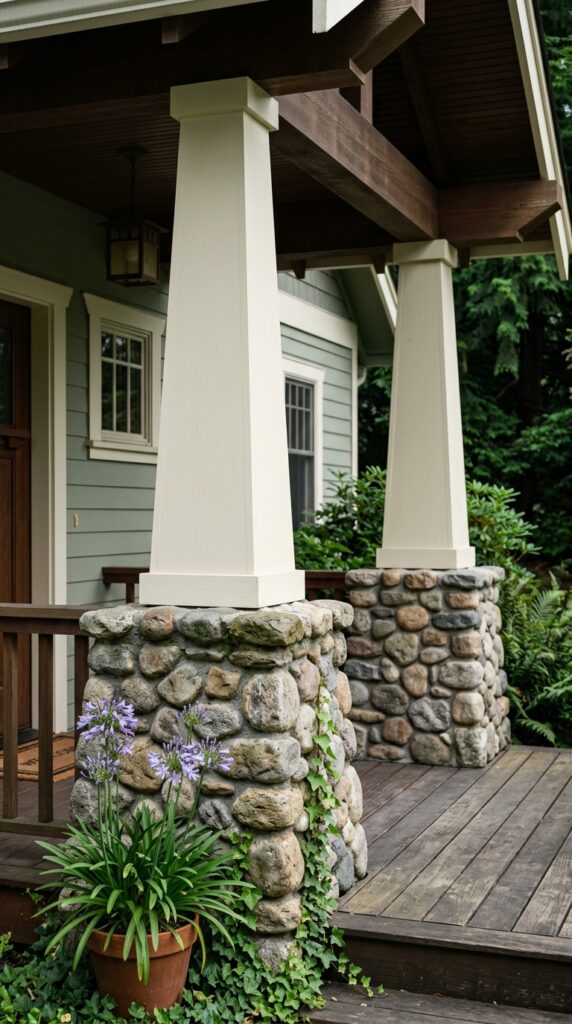
Vibe: Solid and timeless — porch columns that look as though the mountain came to the house.
Why it works: River rock column bases are the most materially authentic Craftsman exterior element because they introduce genuinely natural, locally sourced stone into the architecture — fulfilling the Arts and Crafts principle of honest material use. The visual effect of a tapered wood column rising from a solid rock base is a powerful study in material contrast: the light, smooth painted wood against the heavy, textured stone creates a hierarchy that reads as architecturally sophisticated. The taper of the column — wider at the base than the capital — echoes classical proportions while remaining distinctly American in character.
How to get it: River rock column bases on existing porch columns can be achieved with stone veneer panels — interlocking panels of genuine split stone or cast stone that adhere to an existing concrete or CMU pier. Natural river rock veneer panels run $8–$15 per square foot installed and are available through masonry supply companies. The mortar joint color matters: use a grey-brown mortar that matches the stone’s shadow tones rather than a bright white that would visually separate the stones.
🛍️ Shop the Look — Amazon Product Ideas
| # | Product Search Phrase | Why It Fits |
| 1 | river rock stone veneer panel exterior | Column base cladding |
| 2 | gray brown mortar mix stone veneer | Authentic joint color |
| 3 | craftsman porch column tapered square | Column profile option |
| 4 | outdoor potted agapanthus blue lily | Base planting accent |
| 5 | trailing ivy outdoor pot base planting | Softening column base |
4. Dark Charcoal Modern Craftsman Exterior
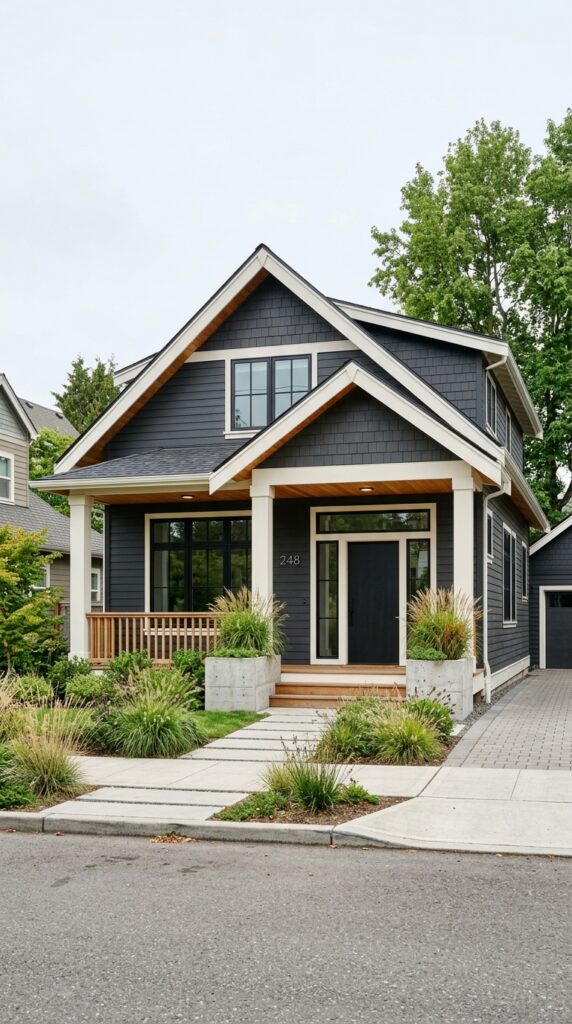
Vibe: Dramatic and refined — the Craftsman home that makes the neighborhood do a double take.
Why it works: A dark, near-black exterior applied to a Craftsman bungalow preserves all the architectural character of the style — the wide eaves, the tapered columns, the deep porch — while achieving a contemporary sophistication that traditional earth-tone palettes cannot. The design principle is silhouette revelation: a dark exterior makes the home’s profile — its roofline, its porch depth, its column spacing — read with exceptional clarity against the sky and landscape. White trim at this contrast level is graphic rather than merely decorative.
How to get it: Sherwin-Williams Tricorn Black SW 6258 and Iron Ore SW 7069 are the two most commonly specified near-black exterior colors for modern Craftsman homes. Iron Ore’s warm brown undertone is specifically better suited to Craftsman architecture than cooler blue-black options. Use the same color on the porch columns — not white — to maintain the dark, enveloping quality of the palette. Reserve warm white strictly for trim: fascia, window surrounds, and corner boards.
💡 Quick Win: Painting only the front door matte black on a dark-siding home creates zero contrast and loses the entry focal point — always use a contrasting door color. Warm white, rich navy, or forest green read powerfully against a charcoal exterior.
🛍️ Shop the Look — Amazon Product Ideas
| # | Product Search Phrase | Why It Fits |
| 1 | fiber cement lap siding dark charcoal | Modern Craftsman siding |
| 2 | black steel window frame exterior | Graphic trim detail |
| 3 | architectural concrete planter large outdoor | Bold entry planting vessel |
| 4 | ornamental grass clump pampas outdoor | Softening landscape element |
| 5 | matte black exterior door hardware set | Cohesive entry hardware |
5. Cedar Shingle Gable Accent
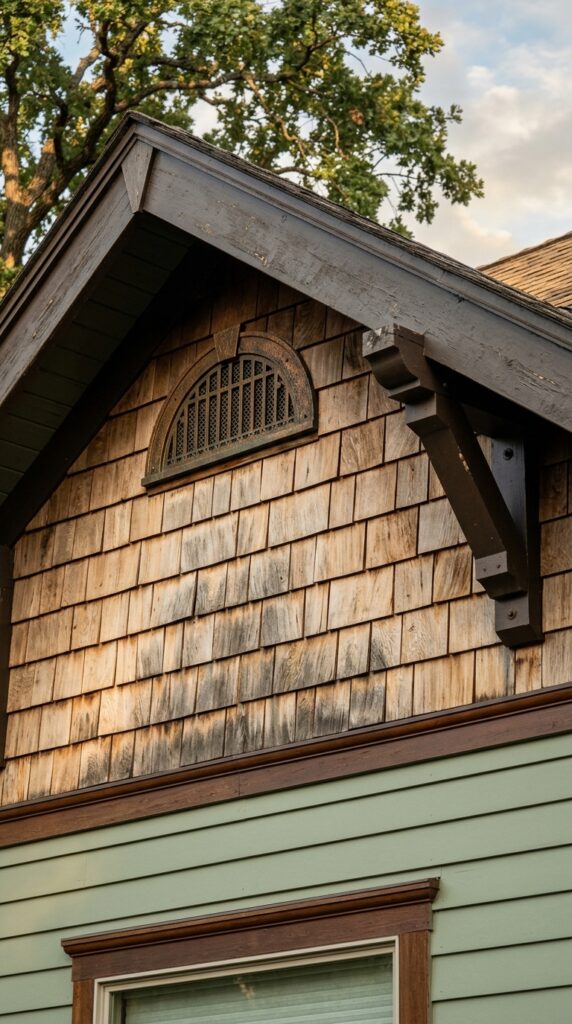
Vibe: Textural and handcrafted — the gable detail that earns a second look from the street.
Why it works: Applying cedar shingles to the gable face while retaining lap siding on the main body walls creates a material transition that is one of Craftsman architecture’s most distinctive features. The gable shingles introduce a fine-scale texture at the highest, most visible part of the façade — the apex where the rooflines meet — and the staggered courses create a pattern that reads as hand-set rather than machine-applied. Knee brace brackets at the gable corners provide a strong shadow line that emphasizes the gable’s triangular geometry.
How to get it: Cedar shingles in the gable can be left to weather naturally to a silver-grey over several years, or stained with a semi-transparent exterior stain (Cabot Australian Timber Oil in Honey Teak gives a warm preliminary tone that weathers gracefully). Knee brace brackets are available as pre-made wood or urethane decorative elements from specialty millwork suppliers — size them so the bracket spans at least 30% of the rafter tail’s exposed length.
🛍️ Shop the Look — Amazon Product Ideas
| # | Product Search Phrase | Why It Fits |
| 1 | cedar shingle bundle natural exterior | Gable shingle material |
| 2 | craftsman knee brace bracket wood decorative | Gable corner bracket |
| 3 | semi transparent exterior wood stain honey | Cedar natural stain |
| 4 | craftsman gable vent bronze metal decorative | Gable vent detail |
| 5 | exterior cedar shingle stain weathering grey | Natural grey cedar finish |
6. The Craftsman Front Porch Swing Setup
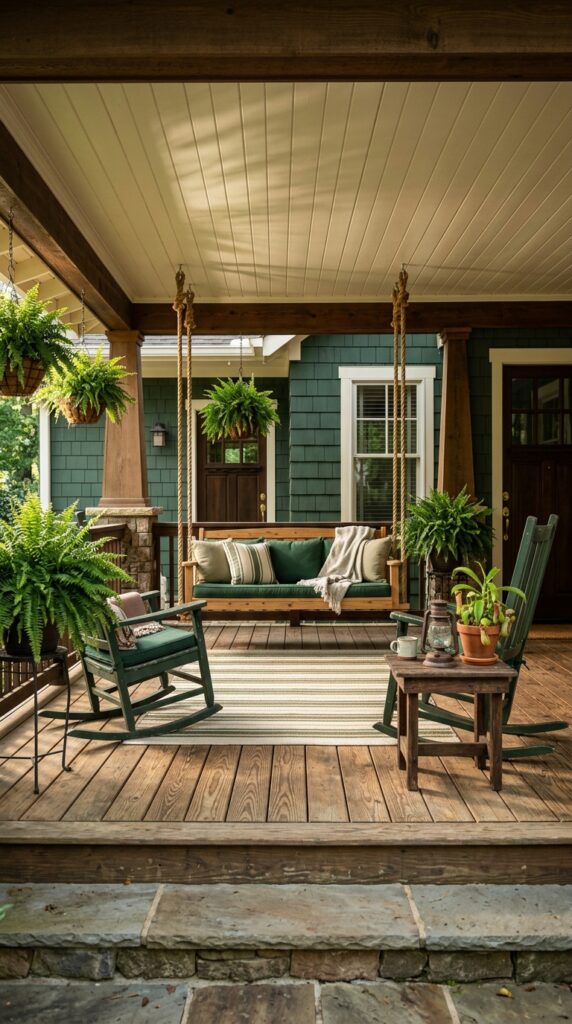
Vibe: Welcoming and nostalgic — a porch that makes people slow their pace from half a block away.
Why it works: A furnished front porch is the Craftsman home’s most powerful curb appeal tool because it communicates livability — this is a home where people actually sit outside, where hospitality is built into the architecture. The porch swing introduces movement (it sways in a breeze) that no static object can replicate, creating a dynamic quality that draws the eye even before you consciously register what you’re seeing. Dark green rocking chairs reference the home’s exterior color palette, tying the porch furniture to the architecture and preventing the porch from looking like a furniture showroom placed outside.
How to get it: Hang a porch swing from a structural ceiling joist — not decorative tongue-and-groove — using 3/8-inch galvanized eyebolts rated for 500 pounds minimum. Use a 3-inch manila or cotton rope rather than chain for a more authentic Craftsman character. The swing seat should be unfinished or lightly oiled cedar rather than painted — natural wood on a painted porch creates a valuable material counterpoint.
🛍️ Shop the Look — Amazon Product Ideas
| # | Product Search Phrase | Why It Fits |
| 1 | cedar porch swing natural wood 5 foot | Hero porch seating |
| 2 | thick cotton rope porch swing hanging kit | Authentic rope hanging |
| 3 | dark green outdoor rocking chair wood | Palette-matched seating |
| 4 | outdoor fern hanging basket large | Classic porch planting |
| 5 | striped outdoor porch rug 4×6 | Porch floor definition |
7. Craftsman Front Door with Sidelights and Transom
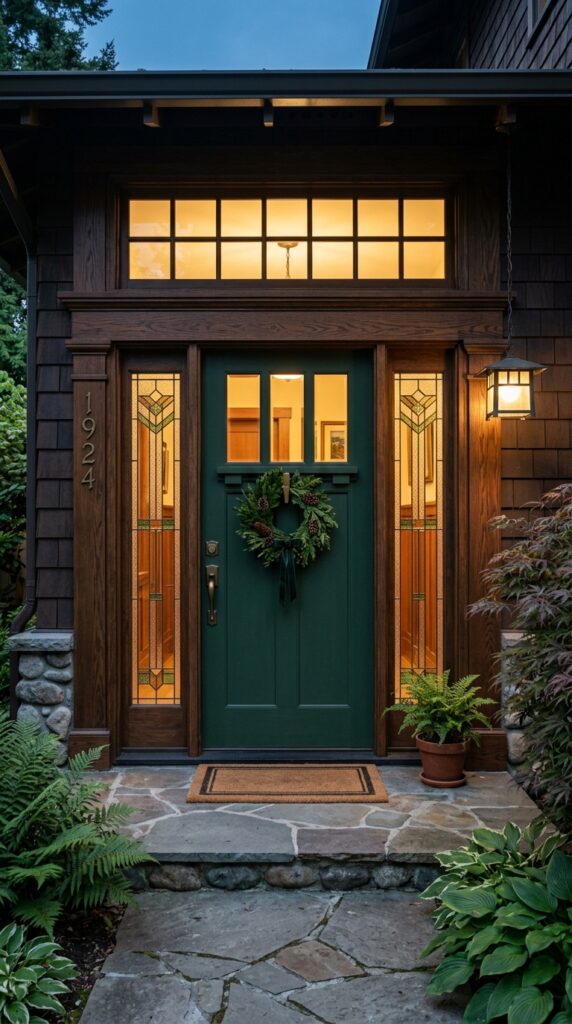
Vibe: Warm and architectural — a front door assembly that makes the entry feel like the beginning of something considered.
Why it works: A Craftsman entry door with sidelights and a transom creates an entry composition rather than a single door — the full assembly spans the door surround and reads as a unified architectural feature from the street. Art glass sidelights in geometric patterns (not Victorian florals — crisp rectangles and squares) introduce color and filtered light into the entry without sacrificing privacy. At dusk, when interior light glows through the glass panels, the entry becomes the most luminous and welcoming feature of the façade.
How to get it: Craftsman-appropriate door glass features divided lights in the upper portion only — the lower two-thirds of the door should be solid panel. Avoid full-lite doors, which read as contemporary rather than Craftsman. Art glass sidelights with warm amber, green, or caramel tones in simple geometric patterns are available from specialty door suppliers and run $400–$1,200 for a sidelight pair. Pair with a Baldwin or Emtek handleset in oil-rubbed bronze or aged brass.
🛍️ Shop the Look — Amazon Product Ideas
| # | Product Search Phrase | Why It Fits |
| 1 | craftsman style front door fiberglass green | Door style reference |
| 2 | oil rubbed bronze door handleset craftsman | Authentic entry hardware |
| 3 | craftsman house number address plaques brass | Period-appropriate address |
| 4 | art glass sidelight panel geometric amber | Sidelight glass detail |
| 5 | craftsman wreath natural greenery front door | Entry seasonal accent |
8. Board-and-Batten Accent on Gable Ends
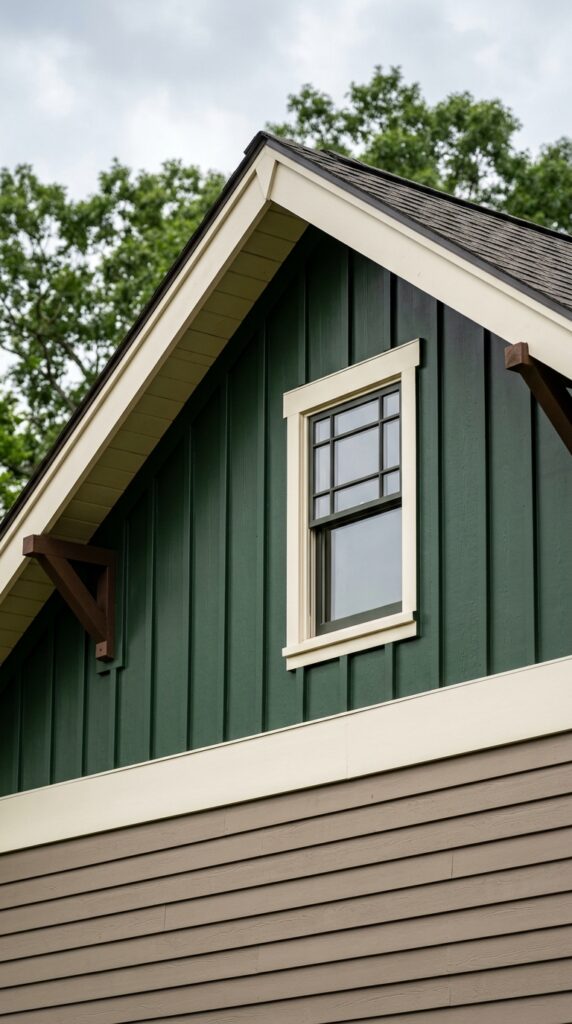
Vibe: Graphic and bold — a siding transition that turns the gable into the home’s most distinctive feature.
Why it works: Board-and-batten at the gable introduces vertical line in a composition that is otherwise dominated by horizontal lap siding — and this vertical-versus-horizontal contrast is precisely the design tension Craftsman architecture exploits at the gable. The battens’ shadow reveals create a fine-scale texture that reads differently from the lap siding below, and the horizontal separation band between the two materials provides a strong, clean line that makes the transition look deliberate. Using a darker color for the board-and-batten zone draws the eye upward and makes the home’s roofline appear to engage more dramatically with the facade.
How to get it: Use 1×6 boards with 1×2 battens for a traditional Craftsman scale — wider boards read as farmhouse, narrower reads as Victorian. The board-and-batten zone should begin at the top plate of the second floor or immediately above the porch beam line and extend to the ridge. Prime all six sides of every board before installing to prevent moisture infiltration at cut ends.
🛍️ Shop the Look — Amazon Product Ideas
| # | Product Search Phrase | Why It Fits |
| 1 | 1×6 cedar board exterior primed | Board-and-batten material |
| 2 | 1×2 cedar batten strip exterior | Batten cover strip |
| 3 | exterior wood primer all six sides | Moisture protection |
| 4 | craftsman gable window fixed decorative | Gable window accent |
| 5 | exterior paint forest green deep satin | Gable accent color |
9. Craftsman Landscaping: Layered Beds with Native Plants
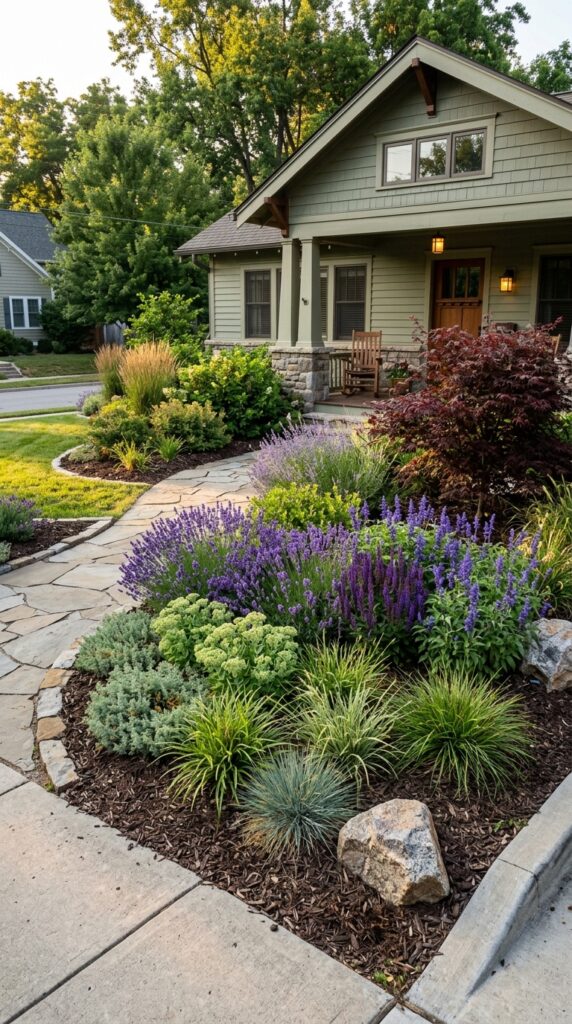
Vibe: Naturalistic and grounded — landscaping that looks like it belongs to the land rather than performing for the street.
Why it works: Craftsman landscaping philosophy mirrors the architecture’s core principle: materials and forms should appear naturally derived rather than artificially imposed. Three-tiered planting beds using native and naturalistic plants achieve this because the layered height sequence — low groundcover, mid-height perennials, tall shrubs — mimics the edge of a natural woodland. Dark shredded bark mulch grounds the beds and prevents the bare-soil look that makes new plantings appear unresolved. A Japanese maple as a focal specimen provides year-round structure and the burgundy-to-crimson fall color that complements nearly every Craftsman palette.
How to get it: Design beds with curved edges rather than straight-line borders — Craftsman design references natural organic forms, and a curved bed edge reads as landscape-derived while a straight edge reads as contractor-installed. Use three plants per species in a triangular grouping rather than single specimens, which look planted rather than grown. Mulch to a 3-inch depth — deep enough to suppress weeds, shallow enough not to volcano around tree bases.
🛍️ Shop the Look — Amazon Product Ideas
| # | Product Search Phrase | Why It Fits |
| 1 | Japanese maple ornamental tree potted | Focal landscape specimen |
| 2 | lavender plant perennial outdoor | Mid-height bed layer |
| 3 | ornamental grass clump native outdoor | Layered bed backdrop |
| 4 | dark shredded bark mulch bag | Bed groundcover finish |
| 5 | landscape edging steel curved bed | Organic bed edge definition |
10. Craftsman Porch Ceiling in Painted Beadboard
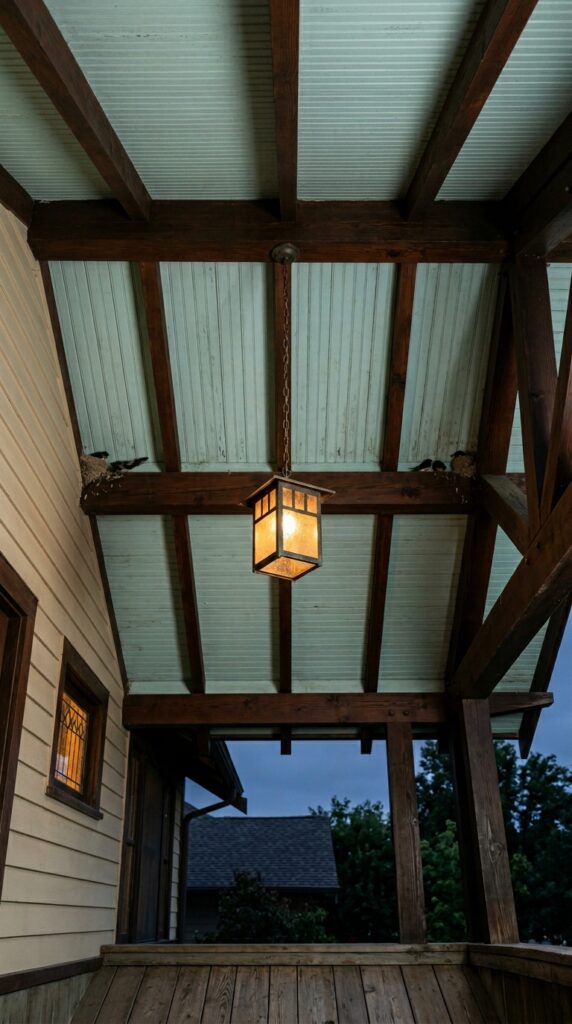
Vibe: Serene and sky-like — a porch ceiling that turns looking up into a small moment of pleasure.
Why it works: Haint blue on a porch ceiling is a Southern American tradition with genuine historical roots — the pale blue-green tone was believed to ward off evil spirits, but its contemporary design rationale is equally compelling: pale blue-green reflects and amplifies natural sky light, making the porch ceiling feel open and luminous rather than heavy and enclosing. Against dark-stained fir beams, haint blue creates a warm-cool contrast that prevents the porch ceiling from reading as either purely rustic or purely formal. A seeded glass lantern provides period-correct illumination without visible LED glare.
How to get it: Sherwin-Williams Comfort Gray SW 6205 and Valspar Woodlawn Colonial Blue are the two most historically referenced haint blue tones for porch ceilings — both read as unmistakably blue-green in shade conditions. Apply to tongue-and-groove beadboard rather than flat drywall for authenticity; the bead groove creates a shadow line that adds scale to the ceiling plane.
💡 Quick Win: Replacing a painted flat-white porch ceiling with haint blue paint costs $30–$50 in materials and ranks among the most impactful single-day exterior improvements available to a Craftsman homeowner.
🛍️ Shop the Look — Amazon Product Ideas
| # | Product Search Phrase | Why It Fits |
| 1 | haint blue exterior ceiling paint porch | Authentic ceiling color |
| 2 | tongue and groove beadboard ceiling planks | Period porch ceiling material |
| 3 | craftsman seeded glass porch lantern bronze | Pendant porch light |
| 4 | dark walnut exterior stain wood beam | Beam staining material |
| 5 | ceiling fan outdoor craftsman style bronze | Functional ceiling addition |
11. Craftsman Address Numbers and Mailbox Details
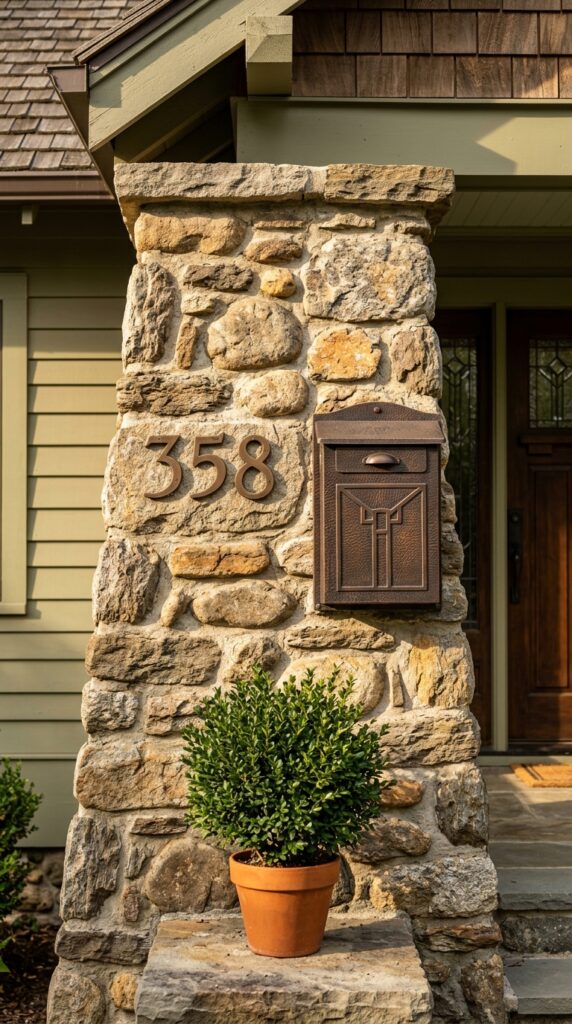
Vibe: Detailed and considered — the hardware that tells visitors the homeowner cares about every square inch.
Why it works: Address numbers and a mailbox are the two closest-range details on any home’s exterior and are evaluated unconsciously by every visitor — their finish, scale, and style either confirm or contradict the home’s design story. On a Craftsman home, address numbers in an Arts and Crafts-influenced typeface (slightly blocky, with visible weight variation) in aged bronze or oil-rubbed bronze complete the period narrative. Generic silver modern numbers in a minimalist font interrupt the Craftsman character as visibly as a wrong-color front door.
How to get it: Source address numbers from Rocky Mountain Hardware, House of Antique Hardware, or Rejuvenation — all offer period-appropriate Arts and Crafts options in oil-rubbed bronze. Mount at 54 inches from grade on the column face rather than beside the door, where they’re seen from the street. Match the mailbox finish exactly to the door hardware finish — mixing aged brass with oil-rubbed bronze within the same entry reads as accidental.
🛍️ Shop the Look — Amazon Product Ideas
| # | Product Search Phrase | Why It Fits |
| 1 | craftsman house numbers oil rubbed bronze 4 inch | Period address numbers |
| 2 | craftsman wall mount mailbox oil rubbed bronze | Matching mailbox finish |
| 3 | arts and crafts door knocker bronze | Entry hardware companion |
| 4 | small potted boxwood evergreen outdoor | Column base planting |
| 5 | exterior number mounting screws bronze finish | Hardware mounting detail |
12. The Craftsman Walkway in Flagstone and Brick
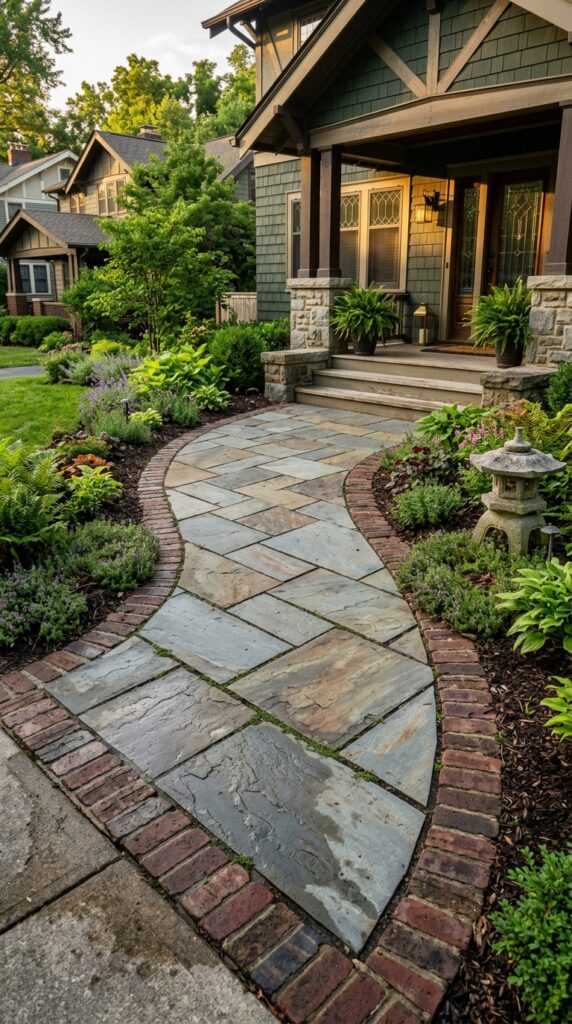
Vibe: Welcoming and naturalistic — a walkway that makes the approach to the front door feel like its own designed experience.
Why it works: The walkway is the primary transitional element between the street and the home — and a Craftsman walkway in irregular flagstone communicates the style’s core values before a visitor reaches the porch. Natural stone irregularity references hand-selection and craft; a slight curve in the path alignment references organic landscape form rather than grid planning. Brick soldier-course edging grounds the stone path and references the masonry tradition that appears elsewhere in the home’s column bases and chimney. Creeping thyme or moss growing in the joints adds an organic, time-worn quality that no new installation can purchase but that grows naturally within one or two seasons.
How to get it: Pennsylvania bluestone is the most period-appropriate flagstone choice for Craftsman homes — its blue-grey tone complements nearly every Craftsman palette. Set slabs in a dry-laid sand-set base for a budget approach, or in a mortar bed for permanence. Minimum path width should be 48 inches — narrow paths read as secondary routes, not primary entries.
🛍️ Shop the Look — Amazon Product Ideas
| # | Product Search Phrase | Why It Fits |
| 1 | Pennsylvania bluestone flagstone stepping stone | Authentic path material |
| 2 | red brick paver edging landscape | Path border material |
| 3 | creeping thyme ground cover plant | Joint-filling plant |
| 4 | dark sand bedding compound flagstone | Stone setting base |
| 5 | Japanese stone garden lantern outdoor | Path edge accent |
13. Craftsman Exterior in Warm Taupe and Dark Brown
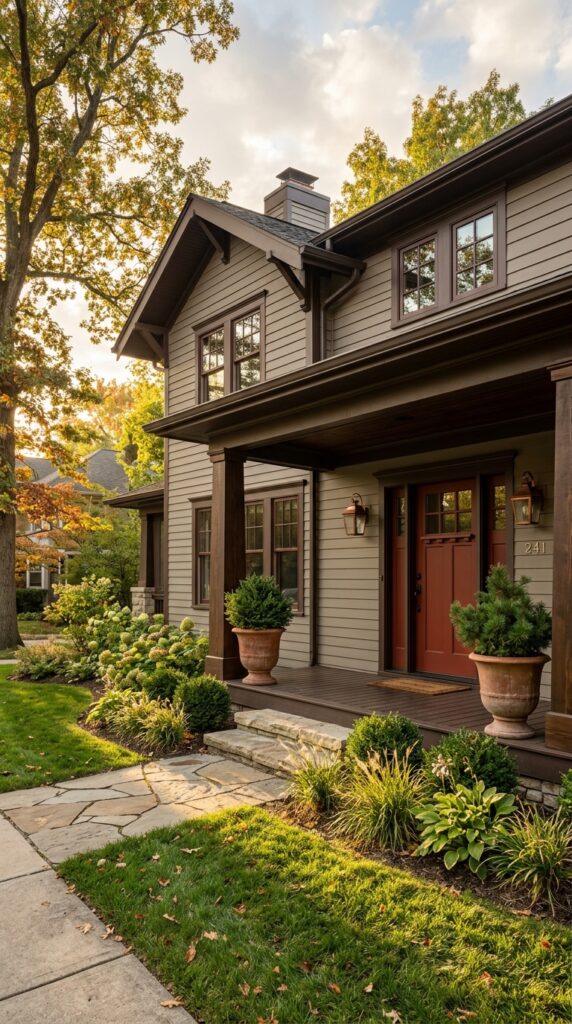
Vibe: Rich and dignified — an earthy Craftsman palette that deepens beautifully with afternoon light.
Why it works: The warm taupe and dark brown combination is one of the most sophisticated Craftsman palettes precisely because it avoids the expected sage-and-cream combination while remaining entirely within the style’s earth-tone philosophy. Dark brown trim — rather than the conventional cream or white — creates a dramatically different visual relationship with the siding: instead of high contrast, it creates a tonal depth where the trim reads as a shadow definition rather than a bright outline. This lower-contrast approach makes the home appear more architecturally unified from the street.
How to get it: Sherwin-Williams Accessible Beige SW 7036 or Balanced Beige SW 7037 for the siding; Sherwin-Williams Umber SW 7058 or Dark Mahogany SW 6103 for the trim. The door should be the only high-chroma element — Sherwin-Williams Antique Red SW 0006 or Benjamin Moore Heritage Red HC-181 maintains period authenticity while providing the necessary contrast at the entry.
🛍️ Shop the Look — Amazon Product Ideas
| # | Product Search Phrase | Why It Fits |
| 1 | copper wall lantern outdoor large craftsman | Warm entry light |
| 2 | terracotta urn planter large outdoor | Earthy entry planter |
| 3 | dark brown exterior paint trim satin | Deep trim color |
| 4 | brick red exterior door paint quart | Entry door accent |
| 5 | evergreen topiary spiral outdoor potted | Formal entry planting |
14. Window Boxes Planted for All-Season Interest
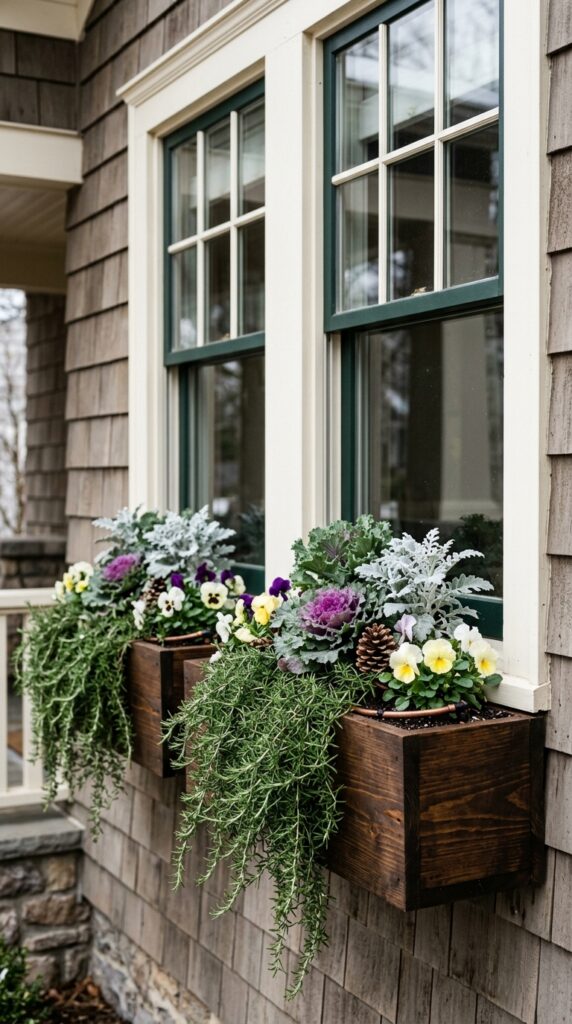
Vibe: Fresh and tended — the detail that signals a home is actively cared for, month by month.
Why it works: Window boxes on a Craftsman home perform the critical design function of softening the sharp transition between painted wood trim and sky — trailing plants cascade down and over the box face, introducing organic, flowing lines into a composition that is otherwise structured by straight lines and right angles. They also scale the home’s fenestration: a window that reads as architecturally plain from the street becomes a feature with a properly planted window box below it. The cedar box material is essential — plastic or metal window boxes immediately read as wrong-period for Craftsman architecture.
How to get it: Size window boxes at the full width of the window opening plus the width of the trim on each side — the box should be as wide as the window unit in its surround, not just the glass width. Mount with lag screws into the window rough framing through the siding — not into the trim — for a stable, load-bearing installation. Plant at 150% density to achieve immediate fullness.
🛍️ Shop the Look — Amazon Product Ideas
| # | Product Search Phrase | Why It Fits |
| 1 | cedar window box planter 36 inch dark stain | Period-appropriate box |
| 2 | trailing rosemary plant outdoor | Cascading fragrant plant |
| 3 | ornamental kale winter planting outdoor | Cool season color |
| 4 | dusty miller silver annual plant | Textural silver filler |
| 5 | window box bracket heavy duty wood mount | Secure mounting hardware |
15. Craftsman Porch Lighting: Period Lanterns
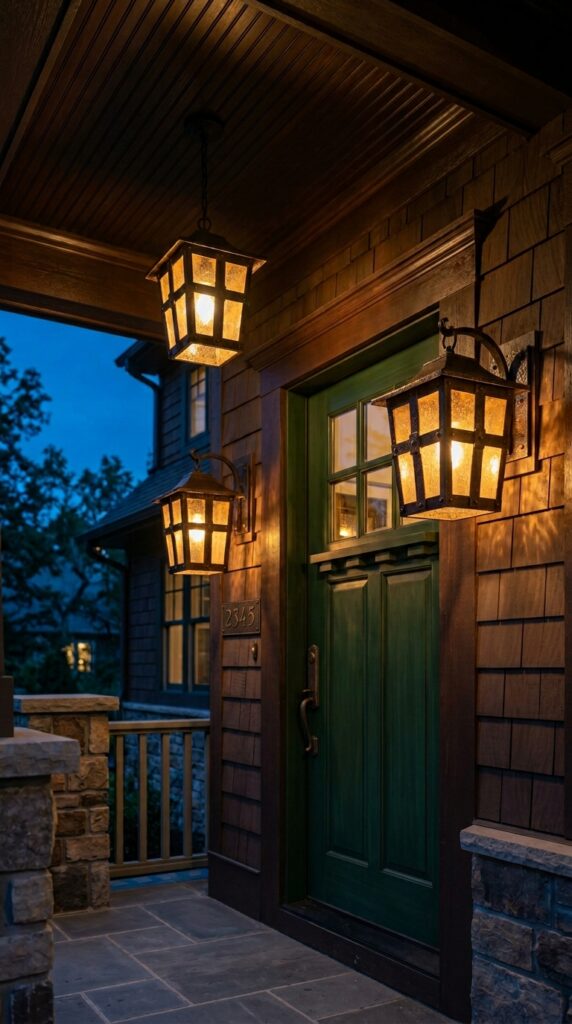
Vibe: Warm and period-evocative — the lights that make the porch feel inhabited and welcoming from a full block away.
Why it works: Craftsman-appropriate exterior lighting fixtures feature three identifying characteristics: a square or rectangular lantern profile (not round or drum-shaped), hand-forged-style metal construction in oil-rubbed bronze or aged copper, and amber seeded or textured glass rather than clear glass. Seeded glass diffuses LED light into a warm, even glow that eliminates the harsh point-source look of a visible bulb — crucial for a style that prizes warmth and craft over spectacle. Matching the pendant overhead to the wall flankers creates a unified lighting composition that reads as designed rather than assembled from different purchase decisions.
How to get it: Rejuvenation, Visual Comfort, and Progress Lighting all offer period-correct Craftsman exterior fixtures. Specify a bulb in 2200K (amber) or 2700K (warm white) — anything above 3000K will appear cold against warm wood and stone surfaces. Use dimmable LED filament bulbs for the most authentic appearance.
🛍️ Shop the Look — Amazon Product Ideas
| # | Product Search Phrase | Why It Fits |
| 1 | craftsman wall lantern oil rubbed bronze seeded glass | Period porch wall light |
| 2 | craftsman outdoor pendant lantern ceiling | Matching entry pendant |
| 3 | amber LED filament bulb 2200K dimmable | Warm authentic bulb |
| 4 | outdoor motion sensor dimmer switch | Practical porch control |
| 5 | craftsman post lantern oil rubbed bronze | Path edge lighting |
16. The Craftsman Garage Door Upgrade
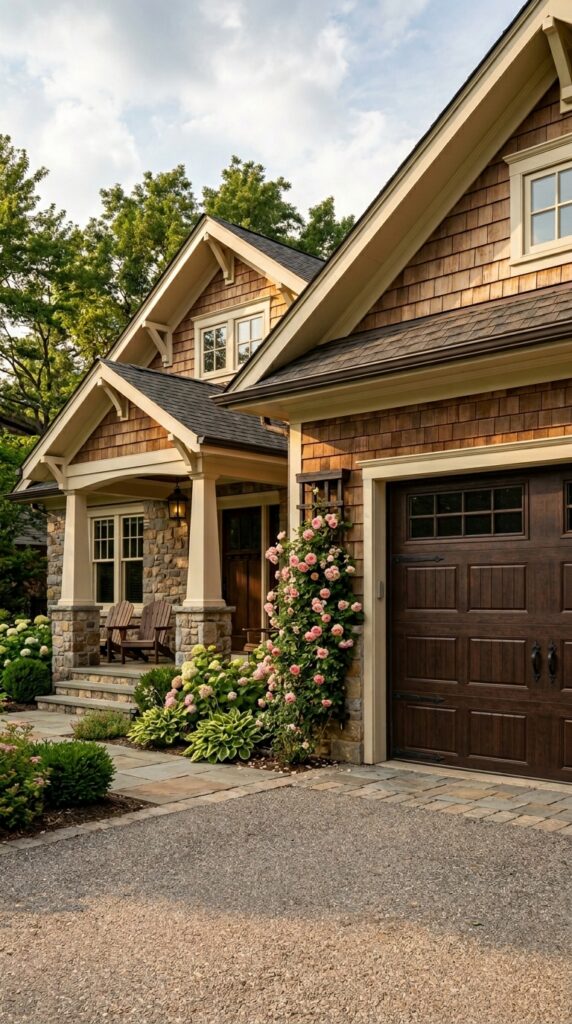
Vibe: Cohesive and upgraded — a garage that completes the home rather than competing with it.
Why it works: A garage door occupies 30–40% of many Craftsman homes’ street-facing elevation — making it the largest single visual element on the façade and the most impactful upgrade available. Replacing a flat, raised-panel or flat-panel garage door with a carriage-style door in a dark wood finish transforms the entire street elevation. Decorative iron hardware straps — strap hinges and handles that span the full panel width — create the visual impression of a real carriage door without requiring actual swing-out mechanics. The divided-light window panels at the top of each door section echo the divided lights in the home’s other windows, maintaining visual consistency.
How to get it: Clopay and Wayne Dalton both offer steel carriage-style garage doors with realistic wood-grain embossing that accept stain-finish paint techniques. Genuine wood doors (Carriage House Door Company) offer the most authentic appearance but require annual maintenance. Specify decorative hardware straps in matte black or oil-rubbed bronze — they should span at least 60% of the panel width to read as genuine from the street.
💡 Quick Win: Adding decorative magnetic carriage hardware straps to an existing flat garage door costs $60–$120 and creates 80% of the carriage door visual effect without replacement — a temporary upgrade that dramatically improves curb appeal.
🛍️ Shop the Look — Amazon Product Ideas
| # | Product Search Phrase | Why It Fits |
| 1 | magnetic garage door carriage hardware straps black | Decorative door detail |
| 2 | carriage style garage door replacement panel | Door style upgrade |
| 3 | climbing rose trellis wall mount wood | Garage corner softening |
| 4 | garage door stain dark walnut oil based | Wood-tone garage finish |
| 5 | carriage door handle garage decorative black | Door pull hardware |
17. Stone Foundation Skirt Around the Home Base
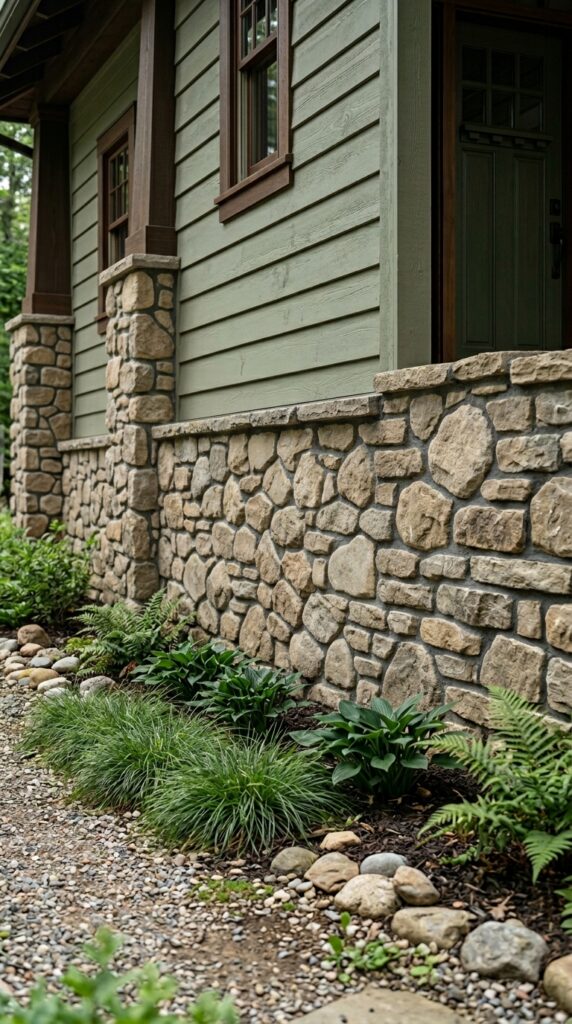
Vibe: Rooted and solid — the visual anchor that makes the whole house feel like it emerged from the earth.
Why it works: A continuous stone foundation skirt creates the visual impression that the home grows from the ground — one of the Craftsman style’s most fundamental aesthetic goals. Where a flat siding façade meeting a bare concrete foundation looks unresolved from the street, a stone skirt provides a transitional material layer that reads as the house’s root system. The design principle is visual weight distribution: stone at the base grounds the home visually and makes the lighter siding above appear to float with appropriate lightness.
How to get it: Ledgestone or fieldstone veneer panels adhere to existing poured concrete or CMU foundations using polymer-modified mortar — no structural work required. The veneer should begin at grade level and terminate at the bottom of the siding at the mudsill height. A water-table trim board (a sloped wood cap) between the stone and the siding beginning creates a clean, professional transition and protects the mortar from water infiltration.
🛍️ Shop the Look — Amazon Product Ideas
| # | Product Search Phrase | Why It Fits |
| 1 | fieldstone ledgestone veneer panel exterior | Foundation stone material |
| 2 | grey brown mortar mix stone veneer | Joint color material |
| 3 | water table trim board PVC exterior | Stone-to-siding cap trim |
| 4 | low ornamental fescue grass plant | Stone base planting |
| 5 | stone veneer adhesive polymer modified | Veneer bonding material |
18. Craftsman Exterior in Slate Blue and White
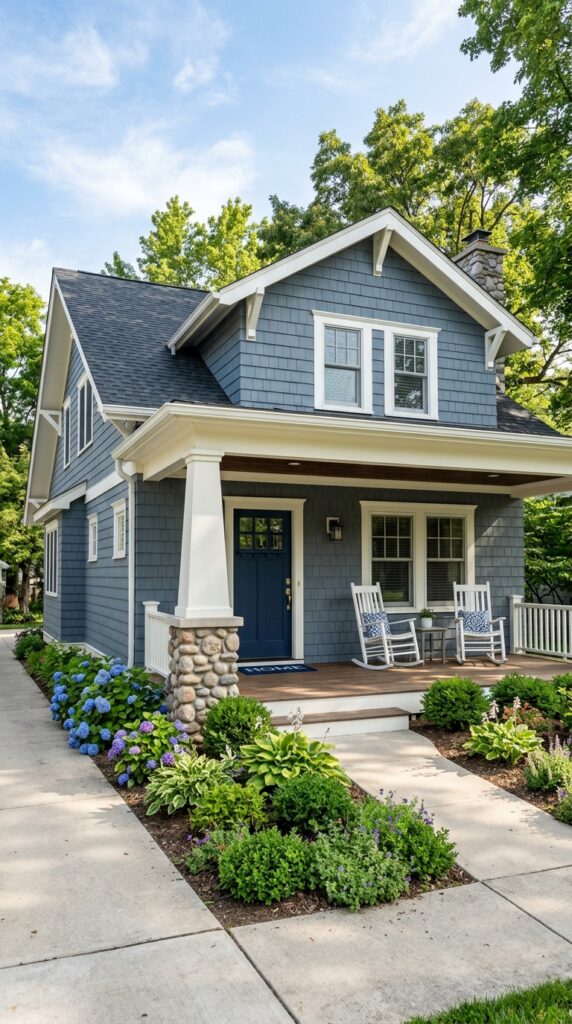
Vibe: Crisp and quietly memorable — the Craftsman palette that holds its own from summer through winter.
Why it works: Slate blue occupies a specific design position in the Craftsman palette — it references the grey-blue of weathered cedar shingles while bringing a freshness that green and taupe palettes cannot. Used on lap siding with warm white trim, it creates a high-contrast palette that reads as crisp and well-maintained from the street. The deep navy door is the critical choice: it relates to the blue siding by sharing the same hue family while being dramatically darker, creating a tone-on-tone relationship between siding and door that green or red door colors on a blue house cannot achieve.
How to get it: Benjamin Moore Smoky Blue 1648 and Sherwin-Williams Watery SW 6478 are the most commonly specified slate blues for Craftsman homes. Both have enough grey in them to prevent the exterior from reading as too primary-blue. Specify a satin sheen for siding and semi-gloss for all trim elements — the sheen differential helps visually separate the two elements in even light.
🛍️ Shop the Look — Amazon Product Ideas
| # | Product Search Phrase | Why It Fits |
| 1 | slate blue exterior house paint satin | Siding color option |
| 2 | white outdoor rocking chair set two | Porch seating accent |
| 3 | blue hydrangea planting pot outdoor | Palette-matched planting |
| 4 | navy blue exterior door paint quart | Deep entry door color |
| 5 | white column wrap craftsman tapered | Column cladding option |
19. Craftsman Bungalow Fence and Gate
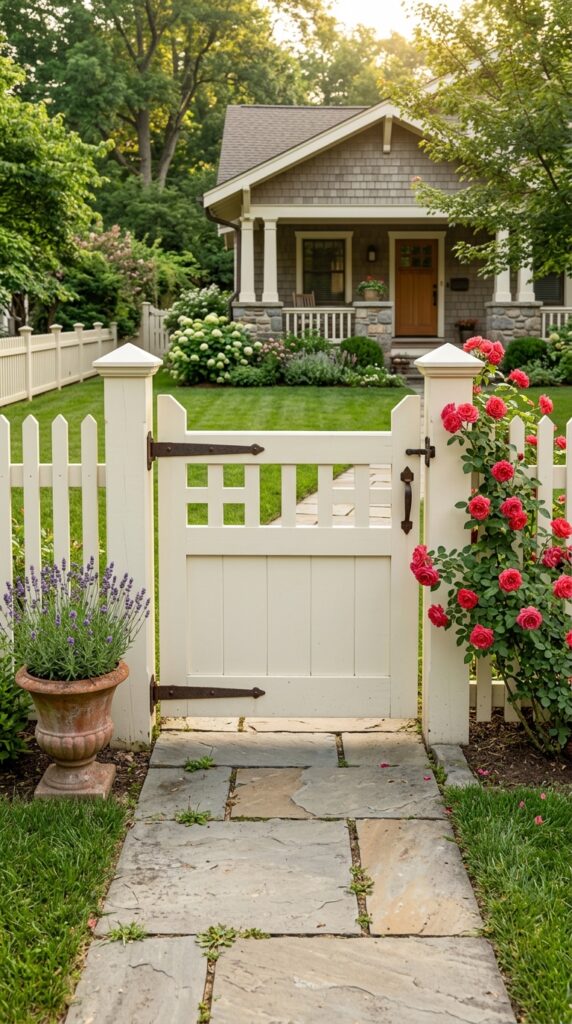
Vibe: Welcoming and charming — a fence that defines the property edge without ever feeling like a barrier.
Why it works: A Craftsman fence is low by design — never taller than 36–42 inches — because its purpose is property definition rather than privacy or exclusion. The Arts and Crafts philosophy favored open, community-engaged streetscapes, and a low picket fence expresses this value while providing a formal edge to the front garden. Square post caps with a pyramidal profile are the single most recognizable Craftsman fence detail and distinguish this style from Victorian (turned finials) and contemporary (flat cap) alternatives.
How to get it: Pre-made Craftsman-style fence sections are available from fence specialty suppliers and home centers. Gate hardware must be heavier gauge than standard — a gate will sag over time if hung on undersized hinges. Specify galvanized or stainless hardware regardless of finish coating. Paint the fence the same cream or white as the home’s trim — not the siding color — so it reads as part of the trim architecture rather than a separate element.
🛍️ Shop the Look — Amazon Product Ideas
| # | Product Search Phrase | Why It Fits |
| 1 | craftsman fence post cap square pyramid wood | Post cap detail |
| 2 | wood picket fence section pre-built primed | Ready-to-install section |
| 3 | heavy duty gate hinge galvanized black | Gate hanging hardware |
| 4 | climbing rose plant outdoor trellis | Gate post planting |
| 5 | small terracotta urn planter entry gate | Gate base accent |
20. Mixed Material Chimney as Exterior Focal Feature
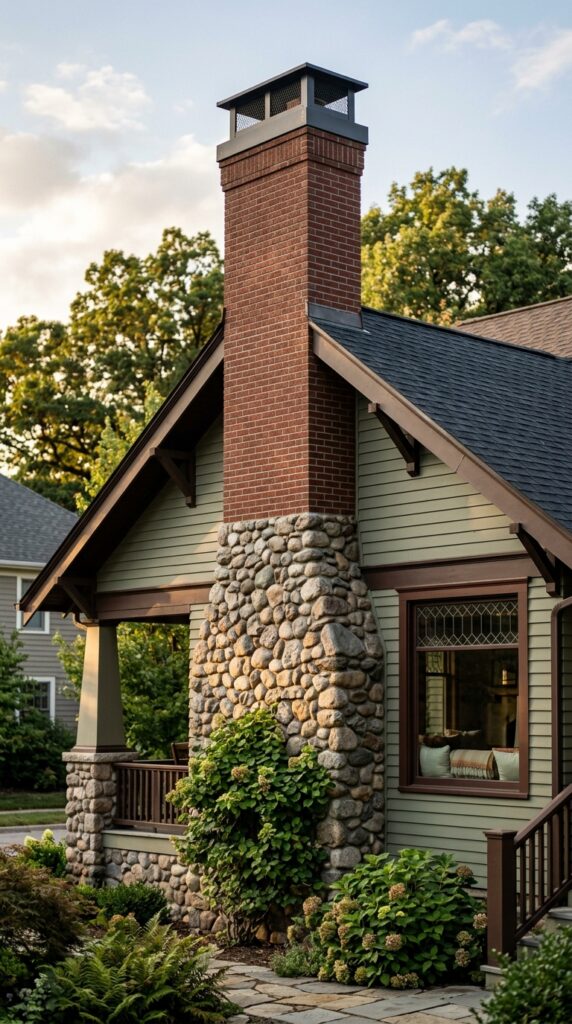
Vibe: Monumental and textural — a chimney that earns its vertical weight by being the most interesting surface on the home.
Why it works: A Craftsman chimney is not a structural afterthought — it is one of the home’s primary architectural features, designed to be read as a massive, earthen anchor rising through the roofline. The mixed material approach — river rock at the base transitioning to brick above — mirrors the column base detail and creates material consistency across the entire elevation. A chimney of genuine mass (24 inches wide minimum) reads as architecturally significant; a thin chimney reads as utilitarian.
How to get it: On existing chimneys, river rock or fieldstone veneer can be applied to the exterior face up to the roofline transition. The brick above should match or complement the stone in tone — a cooler grey brick against warm brown river rock looks disconnected; a warm red-brown brick reads as a natural material transition. A wide metal chimney cap in dark painted steel or copper is the finishing detail — it should project at least 4 inches beyond the chimney face on all sides.
🛍️ Shop the Look — Amazon Product Ideas
| # | Product Search Phrase | Why It Fits |
| 1 | river rock veneer panel chimney exterior | Chimney stone cladding |
| 2 | chimney cap dark metal galvanized large | Chimney top finish |
| 3 | climbing hydrangea vine outdoor plant | Chimney base softening |
| 4 | red face brick veneer panel exterior | Brick transition material |
| 5 | exterior stone veneer adhesive masonry | Stone attachment medium |
21. Craftsman Exterior Trim Detail: Wide Fascia and Frieze
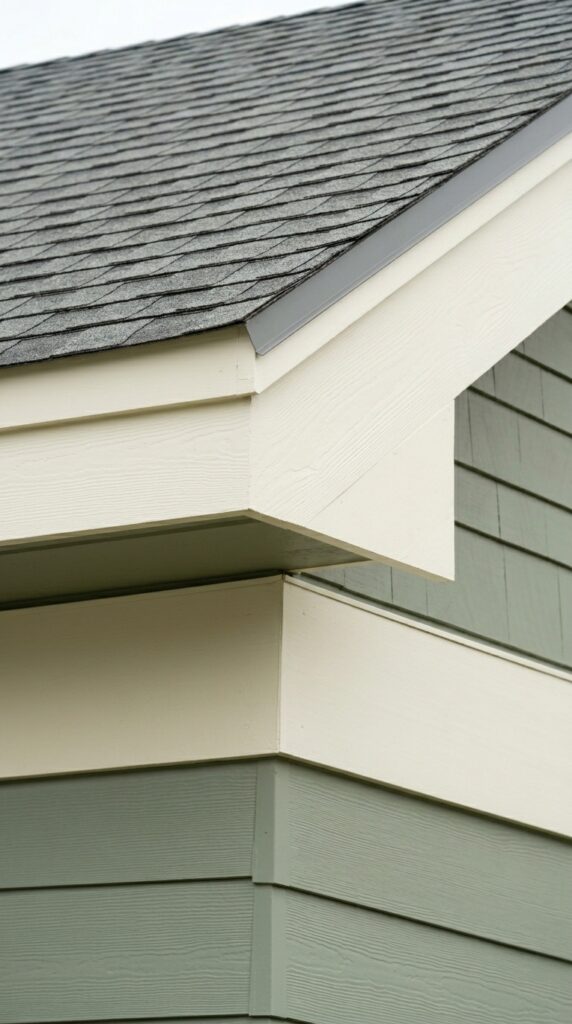
Vibe: Architectural and precise — the trim detail that communicates quality before a guest reaches the porch steps.
Why it works: Wide trim boards are one of the most reliably impactful Craftsman exterior improvements because they are immediately visible from the street and communicate material abundance — the opposite of contractor-grade narrow trim. A 10-inch fascia board paired with an 8-inch frieze board below creates an 18-inch horizontal trim band at the roofline that has visual authority equivalent to a cornice on a classical building. The shadow cast at the fascia-to-soffit junction deepens throughout the day, giving the roofline three-dimensional presence that 4-inch trim simply cannot achieve.
How to get it: Upgrade existing 4–6-inch fascia boards to 8–10-inch boards — this requires removing and replacing gutters as well, which should be considered a combined project. Use PVC trim board (Azek or Versatex) rather than wood for fascia — it holds paint indefinitely, resists moisture, and won’t warp or rot. Paint in a semi-gloss finish to differentiate it from the satin-finish siding.
💡 Quick Win: Adding a 6-inch frieze board below the existing fascia — without replacing the fascia itself — is a single-afternoon project that visually doubles the apparent width of the roofline trim band for under $200 in materials.
🛍️ Shop the Look — Amazon Product Ideas
| # | Product Search Phrase | Why It Fits |
| 1 | PVC trim board 1×10 exterior Azek | Wide fascia material |
| 2 | PVC trim board 1×8 exterior frieze | Frieze board material |
| 3 | exterior trim paint semi gloss cream | Trim paint finish |
| 4 | trim coil aluminum gutter fascia white | Gutter-fascia integration |
| 5 | nail gun finish 15 gauge exterior trim | Trim installation tool |
22. Craftsman Home with a Dramatic Red Front Door
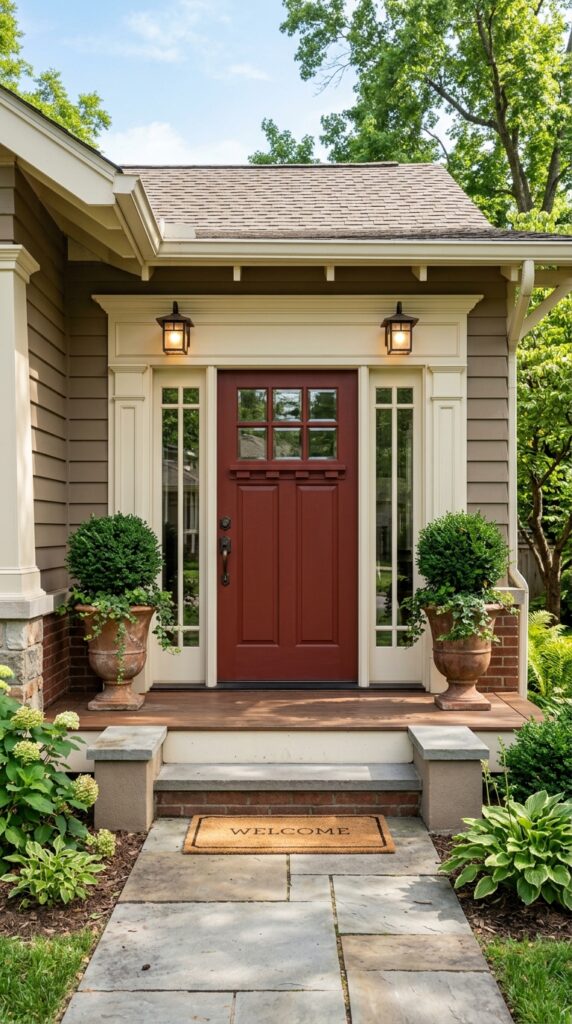
Vibe: Bold and welcoming — a front door that makes the entire street more interesting.
Why it works: A heritage brick red front door on a Craftsman home is not a trend — it is a historically grounded choice that references the red brick and terracotta of Arts and Crafts architecture’s material tradition. The specific red matters enormously: a blue-red (too cool) or orange-red (too bright) misses the warmth of traditional brick pigment. The ideal Craftsman red sits at a medium-dark value with warm, brown undertones — a color that appears richer and deeper as you approach the door and lighter at distance, creating a dynamic entry experience.
How to get it: Benjamin Moore’s Caliente AF-290 and Sherwin-Williams Antique Red SW 0006 are the two most period-appropriate Craftsman door reds. Both have enough brown in their base to prevent them reading as fire-engine or tomato. Apply in a satin finish — matte reds on an exterior door absorb too much light and look flat; semi-gloss reads as commercial.
🛍️ Shop the Look — Amazon Product Ideas
| # | Product Search Phrase | Why It Fits |
| 1 | heritage red exterior door paint quart | Door color reference |
| 2 | large terracotta urn planter entry pair | Flanking entry planter |
| 3 | topiary ball boxwood outdoor potted | Formal door planting |
| 4 | craftsman door surround pilaster trim kit | Entry surround detail |
| 5 | oil rubbed bronze deadbolt entry set | Hardware finish match |
23. Craftsman Landscape: The Front Path Garden
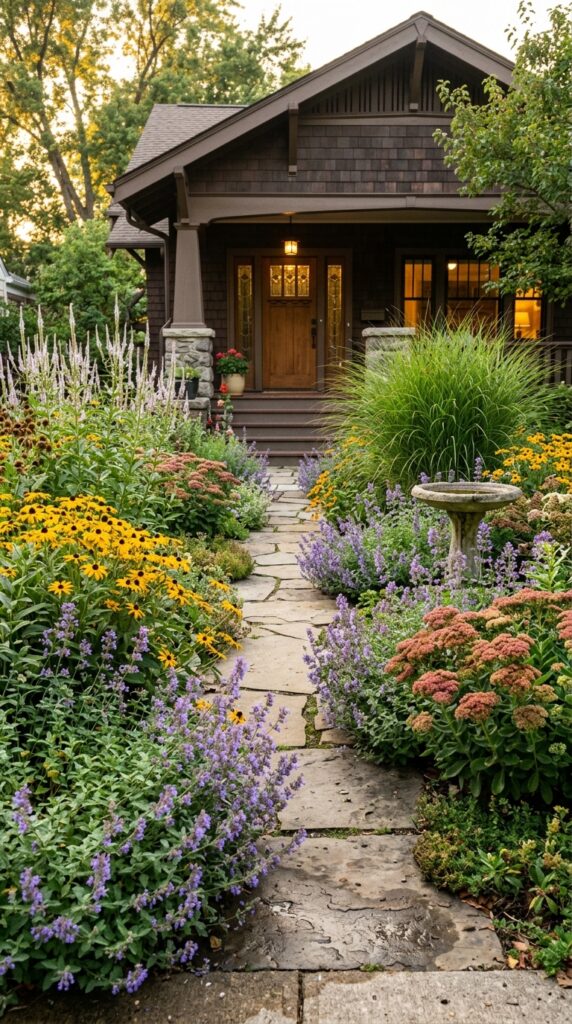
Vibe: Exuberant and lush — a front garden that makes the walk to the door its own small pleasure.
Why it works: A path garden flanking the front walkway is the Craftsman landscape equivalent of a grand gesture — it transforms what is functionally a utility path into an experiential sequence. The key design principle is controlled naturalism: plants should be perennials that self-organize over seasons, but their placement should follow clear height and color progressions. Allowing plants to spill slightly over the path edge is intentional — it softens the stone-to-soil transition and signals that the garden is alive, not installed.
How to get it: Plant in drifts of five to seven plants per species rather than single specimens — drifts read as naturalistic while solo plants read as specimen-planted. Place taller species (ornamental grasses, veronicastrum) at the back of the bed nearest the house, mid-height perennials in the middle, and low edge spillers like catmint or creeping phlox at the path front. Avoid manicured annuals — they require constant replacement and read as too formal for the Craftsman character.
🛍️ Shop the Look — Amazon Product Ideas
| # | Product Search Phrase | Why It Fits |
| 1 | black eyed Susan perennial plant outdoor | Path garden mid layer |
| 2 | catmint perennial low spreading outdoor | Path edge spiller |
| 3 | autumn sedum perennial drought tolerant | Seasonal interest plant |
| 4 | birdbath cast stone outdoor garden | Path midpoint focal |
| 5 | Karl Foerster grass ornamental landscape | Punctuation grass plant |
24. Second Story Craftsman Shed Dormer Detail
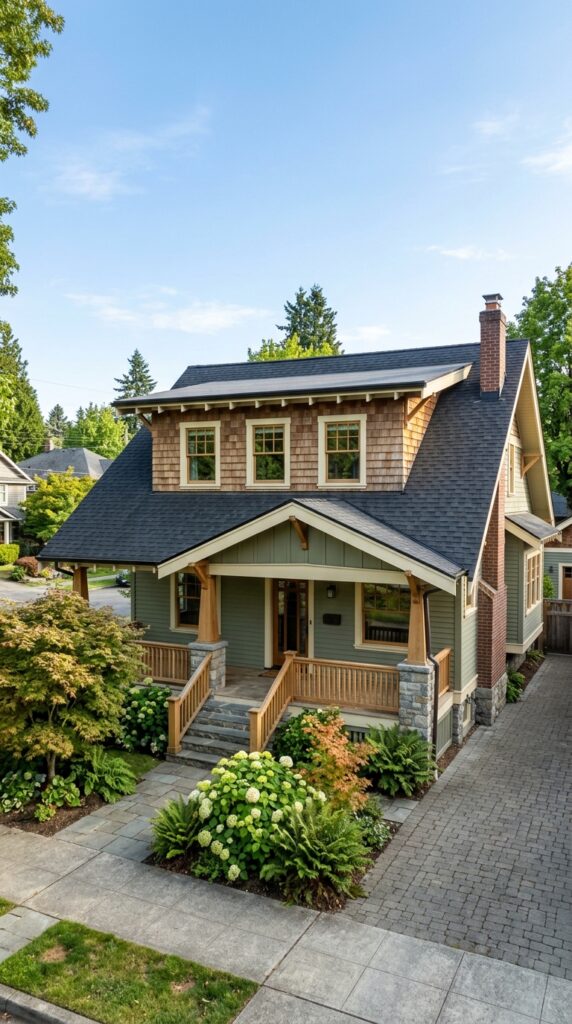
Vibe: Distinctive and architecturally confident — the roofline detail that makes a one-story bungalow look twice its age in the best possible sense.
Why it works: A shed dormer on a Craftsman bungalow is one of the most characterful architectural features available — it transforms a simple side-gable roofline into a complex composition of horizontal and pitched planes while providing significant upper-floor living space. From the street, the shed dormer reads as a strong horizontal band of windows at the roofline that grounds the upper portion of the façade and creates a strong visual connection between the roof and the walls below. Cedar shingles on the dormer face introduce material variety at the upper level, reinforcing the Craftsman tradition of gable shingles.
How to get it: On existing homes, a shed dormer is a significant structural and roofing project requiring architectural planning and permits. For homes that already have a shed dormer, the focus should be on its finish details: cedar shingles on the face (installed correctly with 5-inch weather exposure), wide divided-light windows with genuine wood muntins, and matching trim profiles to the main body of the house.
🛍️ Shop the Look — Amazon Product Ideas
| # | Product Search Phrase | Why It Fits |
| 1 | cedar shingles bundle staggered cut exterior | Dormer face material |
| 2 | craftsman double hung window exterior | Dormer window style |
| 3 | divided light window grille insert | Window divided light kit |
| 4 | craftsman exterior window trim surround | Dormer window surround |
| 5 | dark architectural shingle roofing | Roof color complement |
25. Craftsman Color: Mustard Gold and Deep Brown
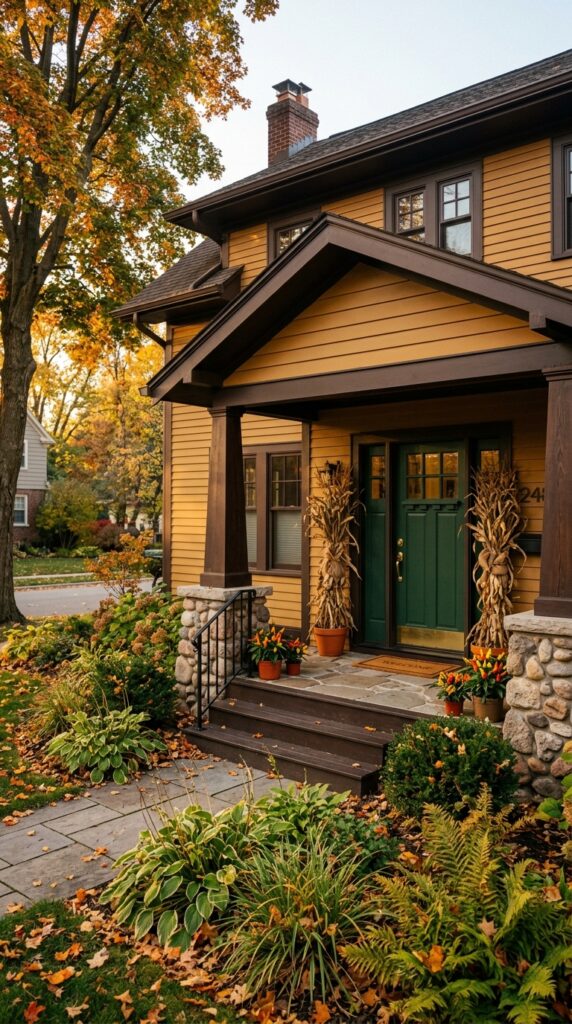
Vibe: Warm and harvest-rich — a palette that belongs to autumn and holds beautifully through winter.
Why it works: Mustard gold is the most historically resonant Craftsman exterior color — it references the actual Arts and Crafts movement’s embrace of golden California light and the warm, ochre tones of natural earth pigments. Against near-black trim, mustard gold siding creates an extremely bold contrast that is entirely within the Craftsman palette tradition. The visual principle is analogous to how Stickley furniture used golden quarter-sawn oak against dark iron hardware — warm material, dark structural accent, natural material at the base.
How to get it: Sherwin-Williams Antique Gold SW 6380 and Benjamin Moore Hawthorne Yellow HC-4 are both period-appropriate mustard golds with the necessary brown undertone to prevent them from reading as primary yellow. The trim must be very dark — Sherwin-Williams Caviar SW 6990 or Benjamin Moore Wrought Iron 2124-10 — for the contrast to achieve its full dramatic effect. Pure black trim is too stark; very dark warm brown reads as richer and more Craftsman-appropriate.
🛍️ Shop the Look — Amazon Product Ideas
| # | Product Search Phrase | Why It Fits |
| 1 | mustard gold exterior satin house paint | Siding color option |
| 2 | terracotta planter pot large set | Entry planting vessels |
| 3 | ornamental pepper plant outdoor | Warm-toned entry plant |
| 4 | dark espresso brown exterior trim paint | Deep trim color |
| 5 | brass door handle lever set exterior | Warm hardware match |
26. Craftsman Porch Steps and Landing in Brick and Stone
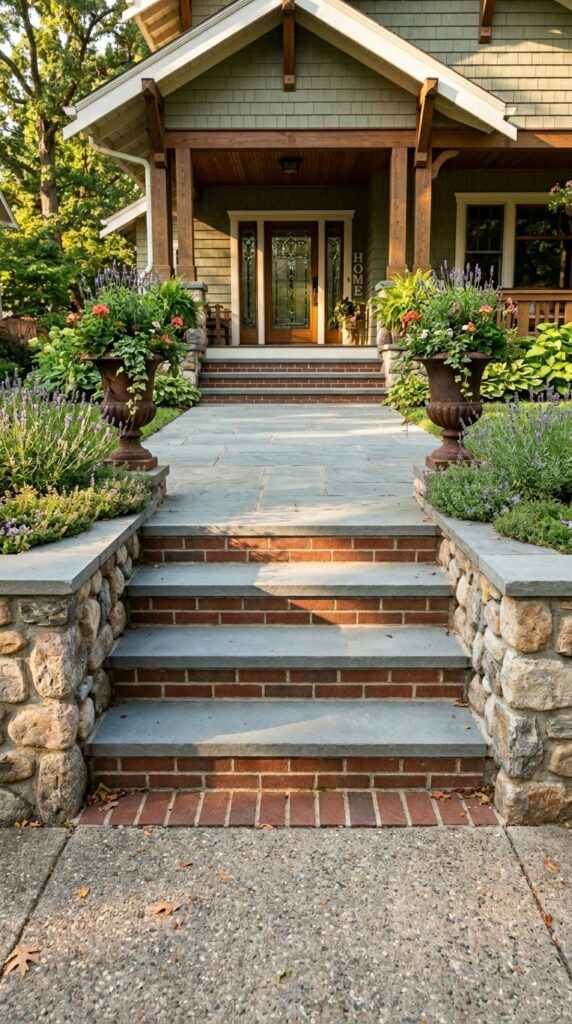
Vibe: Welcoming and grand — steps that make the approach to the front door feel ceremonial without being imposing.
Why it works: Front porch steps are the most physically experienced architectural element on any home — every visitor walks up them, every resident descends them daily. Wide steps (60 inches minimum for a Craftsman home) communicate generosity and welcome: a narrow staircase to a front door reads as reluctant hospitality. The brick-riser, bluestone-tread combination layers two natural masonry materials that share an earthen palette while offering contrasting textures — rough brick versus smooth stone — that reference the mixed-material Craftsman philosophy.
How to get it: Porch steps should be designed with a maximum riser height of 7 inches and a minimum tread depth of 11 inches for comfortable ascent. Bluestone tread caps should overhang the brick riser face by 1 inch and slope forward 1/8 inch per foot for drainage. Flanking low walls at 18 inches height provide a natural place to set bags or rest, and their flat stone cap creates a seat-able surface — a genuinely functional Craftsman detail.
🛍️ Shop the Look — Amazon Product Ideas
| # | Product Search Phrase | Why It Fits |
| 1 | bluestone step tread natural stone | Step cap material |
| 2 | red brick paver step riser | Step riser material |
| 3 | cast stone urn outdoor large landing | Landing planter |
| 4 | lavender perennial plant outdoor | Stair flanking planting |
| 5 | stone cap flat landscape wall topper | Retaining wall cap |
27. Craftsman Exterior Lighting: Path and Landscape
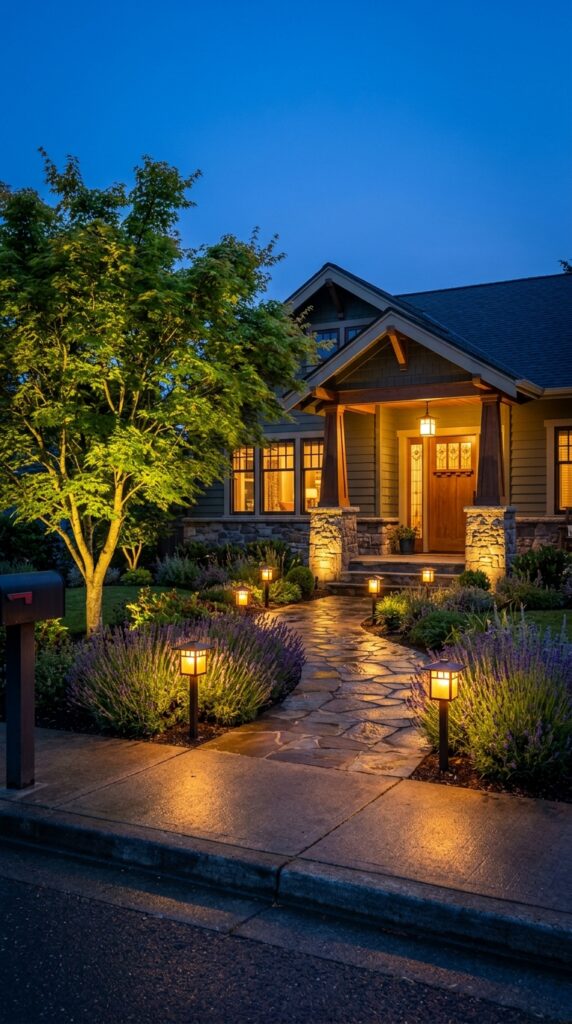
Vibe: Warm and designed — a front yard at dusk that looks like a staged photograph from a design magazine every single evening.
Why it works: Landscape lighting on a Craftsman home transforms the property’s curb appeal for the approximately 12–14 hours per day that it is dark during winter months. Path lights serve both safety and design functions: at 6-foot intervals along the walkway, they create a rhythmic sequence of amber light pools that guide visitors and define the path edge. Uplighting a Japanese maple or similar specimen tree creates a dramatically backlit botanical silhouette that reads from the street as one of the most sophisticated landscape gestures available.
How to get it: Use a low-voltage (12V) landscape lighting system with a timer and dusk-to-dawn sensor. Craftsman-style path lights with amber or seeded glass tops are available from Kichler, Hinkley, and Vista Outdoor Lighting. Specify warm LED sources at 2700K maximum — cooler light temperatures look institutional against warm wood and stone. Uplighting should be positioned to avoid shining directly up into the tree canopy; angle at 45 degrees from the trunk base for the most natural-looking illumination.
💡 Quick Win: A set of six solar Craftsman-style path lights in oil-rubbed bronze costs $60–$120 and can be installed in 30 minutes with no wiring — providing immediate dusk curb appeal improvement with zero electrical work.
🛍️ Shop the Look — Amazon Product Ideas
| # | Product Search Phrase | Why It Fits |
| 1 | craftsman path light oil rubbed bronze low voltage | Period walkway lighting |
| 2 | landscape uplight spot LED warm white | Specimen tree lighting |
| 3 | solar path light craftsman bronze set 6 | No-wire quick install |
| 4 | low voltage landscape transformer timer | System control unit |
| 5 | directional uplight ground spike 12V | Column base uplight |
28. The Fully Realized Craftsman Exterior: Every Detail Working Together
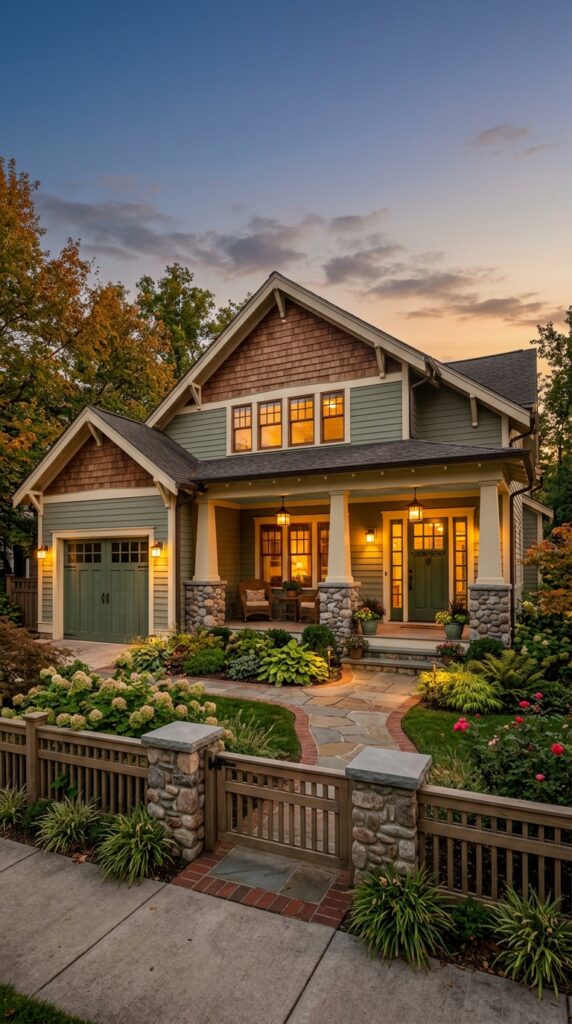
Vibe: Complete and deeply satisfying — the Craftsman home where every element has been considered and every detail earns its place.
Why it works: The fully realized Craftsman exterior succeeds not because any single element is exceptional — though each is thoughtful — but because every element speaks the same design language. River rock column bases reference the stone foundation skirt; the cedar shingles in the gable reference the cedar window boxes; the oil-rubbed bronze lanterns reference the oil-rubbed bronze door hardware; the haint blue porch ceiling references the slate-blue of the window trim. This is the design principle of material and color coherence applied at architectural scale: a home where repetition of material, color, and detail creates the impression of a total design rather than accumulated decisions.
How to get it: Achieve this level of integration incrementally, starting with the highest-impact changes first: the front door color and hardware, then the porch lighting, then the column bases, then the landscaping. Prioritize the elements most visible from the street (door, porch, lighting, front beds) over those requiring structural work (eave details, dormers, foundation skirt). Each element added in the correct material and finish vocabulary accumulates toward the fully realized exterior — the journey is as satisfying as the destination.
🛍️ Shop the Look — Amazon Product Ideas
| # | Product Search Phrase | Why It Fits |
| 1 | craftsman bungalow exterior paint kit sage | Cohesive siding color start |
| 2 | craftsman porch lantern set wall and pendant | Complete lighting package |
| 3 | river rock veneer panel column and foundation | Stone material for both uses |
| 4 | low voltage landscape lighting starter kit | Dusk lighting system |
| 5 | craftsman fence gate section pre-built | Property edge definition |
How to Start Your Craftsman Exterior Transformation
The single most important first move is painting your front door in a period-correct Craftsman color — either a deep forest green, heritage brick red, mustard gold, or dark navy — in a satin finish, paired with oil-rubbed bronze hardware. The front door is the highest-impact, lowest-cost Craftsman upgrade available, because it immediately anchors a specific design story and makes every subsequent improvement feel coordinated rather than incidental. A $60 door paint project with $180 in replacement hardware produces a result that changes how the entire house reads from the street.
The most common beginner mistake is painting the trim a bright, cool white that clashes with warm earth-tone siding. Craftsman architecture calls for warm white (Benjamin Moore White Dove OC-17 or Sherwin-Williams Antique White SW 6119) — not pure #FFFFFF white. A cool, blue-toned white against sage or taupe siding looks harsh and contemporary rather than warm and period-correct. The fix is simple: tint the trim a warm cream or choose a white with a yellow or tan undertone rather than a blue or grey undertone.
Three specific items under $50 that create immediate Craftsman curb appeal: A set of four decorative magnetic carriage hardware straps for your existing garage door ($35–$45) that immediately reads as a period upgrade from the street. A single large potted Japanese blood grass or compact ornamental grass in a terracotta pot for the porch ($18–$30) that introduces naturalistic texture. A Craftsman-style house number set in oil-rubbed bronze ($22–$45) that replaces the builder-grade silver numbers most homes default to.
Realistic expectations: A front door repaint with new hardware — the single best first project — takes one weekend and costs $180–$280 total. A full landscape bed re-installation with layered perennials runs $400–$1,200 depending on plant density and bed size. A complete exterior repaint including color consultation costs $3,000–$8,000 for a typical Craftsman bungalow. A porch lighting upgrade with two period-correct lanterns and path lights runs $300–$600 installed. The fully realized exterior with all architectural details — stone veneer, cedar shingles, carriage garage door — represents a multi-year, $15,000–$40,000 investment that adds genuine and lasting property value.
Frequently Asked Questions About Craftsman Exterior Style
What is the difference between Craftsman and Farmhouse exterior style?
Craftsman exteriors are defined by Arts and Crafts philosophy — horizontal massing, exposed structural elements (rafter tails, knee brackets), tapered columns on masonry bases, and earth-tone palettes tied to natural landscape. Farmhouse exteriors are defined by rural American vernacular — board-and-batten siding, metal roofing, simple gable profiles, and a palette of barn white, black, and natural wood. The two styles share an emphasis on honest materials, but Craftsman is more architecturally ornate and horizontally composed, while farmhouse is more vertically simple and functionally spare. A key distinguishing detail: Craftsman homes have wide, deep covered porches as a central architectural feature; farmhouse homes may have a covered porch but it is secondary to the barn-influenced gable form.
What exterior colors are most authentic to Craftsman style?
The most historically authentic Craftsman exterior colors are drawn from the natural landscape: warm sage green (Sherwin-Williams Rosemary SW 6187), forest green, warm taupe (Accessible Beige SW 7036), mustard gold (Antique Gold SW 6380), warm terracotta, slate blue, and deep olive. Trim is warm white (White Dove OC-17) or cream, never cool blue-white. Dark chocolate brown, near-black, and dark forest green are also correct as dominant siding colors in the modern Craftsman interpretation. The one color to avoid is bright, blue-toned white as a primary siding color — it reads as contemporary rather than Craftsman.
How much does a full Craftsman exterior renovation cost?
Budget ranges vary significantly by scope. A paint-only exterior renovation (new siding color, trim, door) runs $3,000–$8,000 for a professional repaint of a typical 1,500-square-foot bungalow. Adding stone veneer to column bases and foundation runs $2,500–$7,000 depending on linear footage. A new carriage-style garage door with decorative hardware costs $1,800–$4,500 installed. Complete landscape renovation with layered beds, a flagstone walkway, and period fencing runs $8,000–$20,000. A full exterior transformation covering all elements — siding, stone, lighting, landscape, garage door, windows — typically runs $25,000–$60,000 for a Craftsman bungalow of average size, representing one of the highest return-on-investment exterior improvements in residential architecture.
Can a non-Craftsman house be styled with Craftsman exterior details?
Yes, and this approach works best on ranch-style homes from the 1950s and 1960s, which share the Craftsman home’s horizontal massing and low-pitched roofline. Adding tapered column wraps to existing posts, installing decorative rafter tail brackets along the eave, applying stone veneer to foundation and porch piers, and repainting in a Craftsman earth-tone palette can produce a convincingly Craftsman reading on an architecturally neutral house. The most important transplantable elements are the front door assembly (solid door with divided upper lights, flanking sidelights), the period lighting fixtures, and the earth-tone palette. Details that require genuine structural Craftsman bones — wide overhanging eaves, a deep front porch — are more difficult to retrofit convincingly.
What is the most important Craftsman exterior detail for curb appeal?
The front porch, in its totality, is the single most important Craftsman curb appeal element — more than any paint color, landscaping choice, or architectural detail. A deep (8-foot minimum), covered, furnished front porch with period lighting, haint blue ceiling, tapered columns on stone bases, and a wide front door assembly creates a complete entry composition that reads immediately as Craftsman from the street and communicates welcome, character, and craft simultaneously. If a home has one project budget to spend on Craftsman curb appeal, it should address the front porch: paint the ceiling haint blue, add period lanterns, furnish with a swing and rocking chairs, and plant hanging ferns. This single investment produces more Craftsman character per dollar than any other exterior improvement.
Ready to Transform Your Craftsman Exterior’s Curb Appeal?
These 28 ideas span every scale of Craftsman exterior design — from close-range hardware choices and paint colors to landscape architecture, lighting systems, and structural details like dormers and stone veneer — giving you a complete toolkit whether you’re starting with a $50 paint project or planning a multi-season renovation. Every transformation begins with one well-chosen detail that anchors the rest: paint the front door this weekend in a heritage forest green or brick red, swap the builder hardware for oil-rubbed bronze, and watch how immediately the home’s personality sharpens. When the full palette, the layered landscape, the glowing porch lanterns, and the river rock column bases come together, you will feel the Craftsman philosophy at work — a home that is genuinely of its place, honestly built, and deeply worth coming home to. Save and pin the ideas that made you pause longest; the Craftsman exterior is not a style you apply — it is a story you build, detail by detail, season by season.