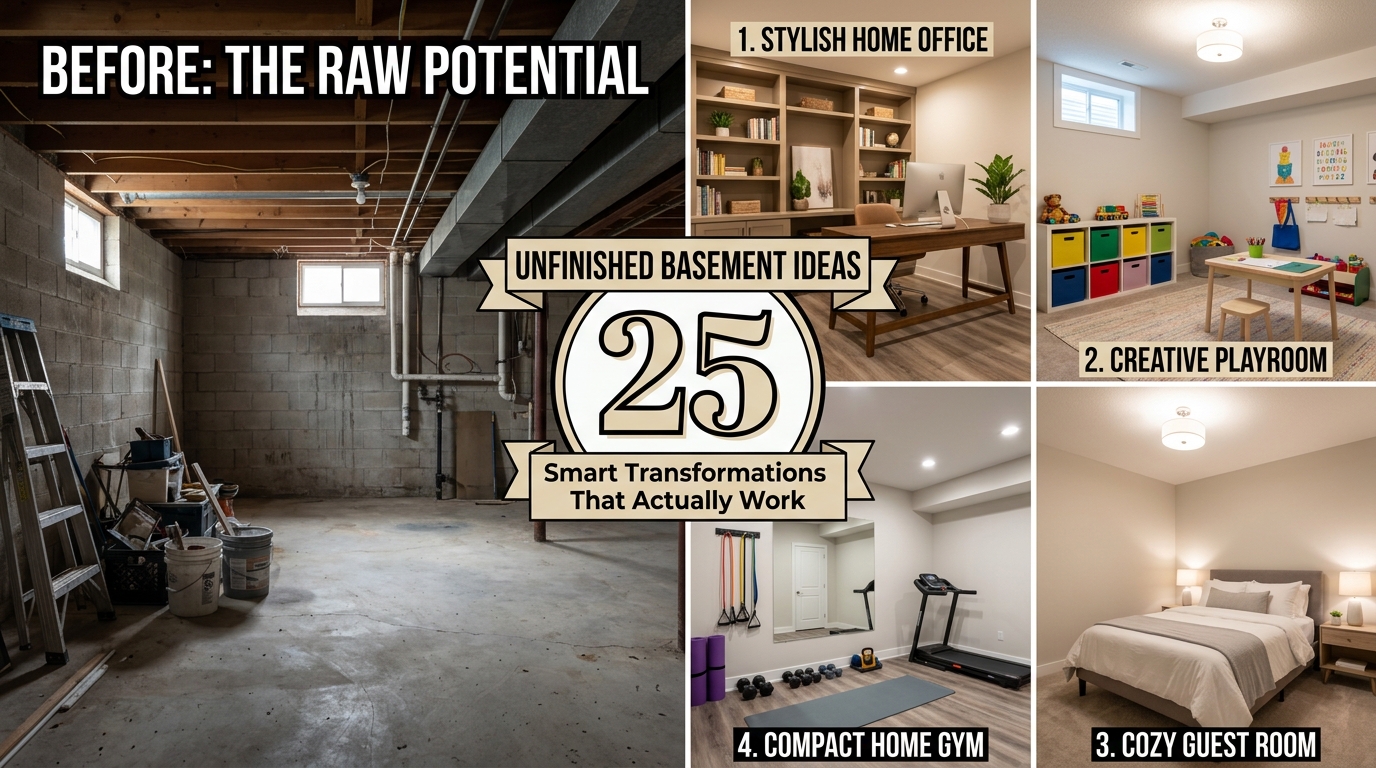
An unfinished basement is raw potential — concrete floors, exposed joists, utility pipes running every which way — and transforming it means working with that industrial honesty rather than hiding it entirely. This article gives you exactly 25 unfinished basement ideas spanning lighting, materials, layout, color, furniture, storage, and small-space strategy, so you can find your entry point no matter your budget.
There is something quietly magnetic about a space that stops pretending to be something it isn’t. Unfinished basement design leans into the bones of a home — the rough pour of concrete underfoot, the skeletal rhythm of ceiling joists overhead, the utilitarian pipes that run like veins through the walls. It feels grounded, honest, and layered in the way that only real materials can feel. Here are 25 ideas worth saving — and stealing.
Why Unfinished Basement Design Works So Well
The aesthetic of the unfinished basement isn’t accidental minimalism — it draws from industrial loft design, mid-century raw-space living, and the modern movement toward authenticity over polish. Unlike a finished basement that tries to replicate the floors above, an unfinished approach embraces the existing architecture: poured concrete, structural columns, overhead mechanicals. It is a design philosophy rooted in “reveal rather than conceal,” related to Brutalist residential interiors and Scandinavian utility spaces.
Its core materials are the space itself: concrete slab floors (sealed or left raw), unfinished or whitewashed CMU block walls, exposed wooden ceiling joists in warm oak or pine, bare steel columns, and galvanized metal pipe. Colors follow naturally: warm charcoal, concrete gray, aged linen, raw umber, muted rust, and the occasional off-white to lighten a heavy element. These are tones you can pull from a Benjamin Moore palette — think “Iron Mountain” or “Platinum Gray” — and layer without fear.
Unfinished basement ideas have surged precisely because post-pandemic homeowners stopped waiting for perfection. Pinterest search data shows a consistent rise in searches for “basement without drywall,” “exposed ceiling basement,” and “concrete floor basement living.” People want to actually use these spaces — for home gyms, creative studios, family rooms — without a full renovation price tag.
Small basements can absolutely achieve this look, and often better than large ones. The key is prioritizing one bold functional zone — a gym corner, a reading nook, a bar setup — rather than trying to do everything at once. The style rewards decisiveness.
| Element | Trait 1 | Trait 2 |
| Philosophy | Reveal, don’t conceal | Authenticity over polish |
| Materials | Concrete, exposed joists, galvanized metal | Sealed wood, raw steel, linen |
| Color palette | Warm charcoal, concrete gray | Raw umber, off-white, muted rust |
25 Unfinished Basement Ideas: Smart Transformations
1. Sealed Concrete Floors With Warm Area Rugs
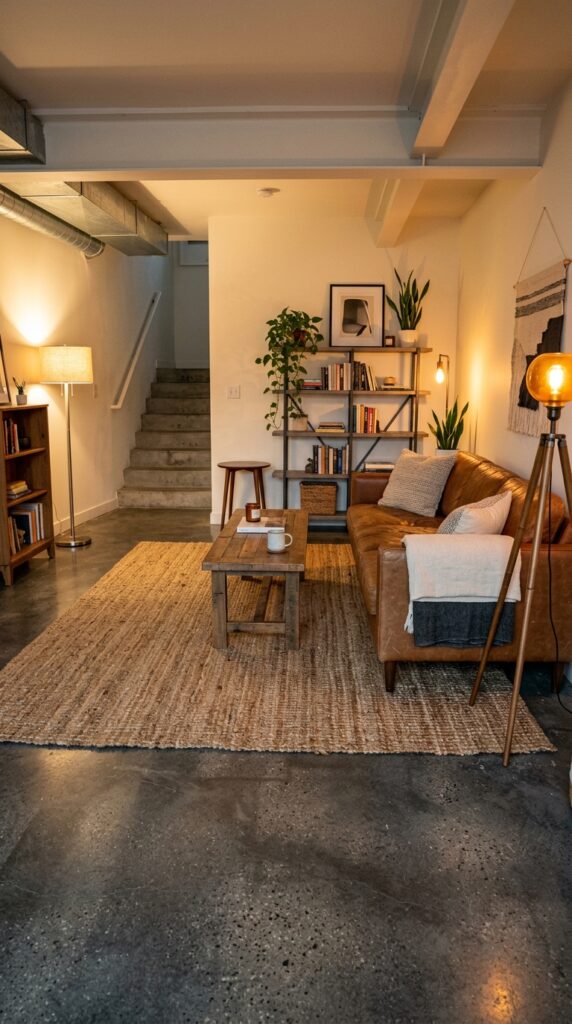
Vibe: Grounded — the room feels anchored and intentional even without a single wall treatment.
A sealed concrete floor has a quiet authority that drywall-covered rooms rarely achieve. The design principle here is contrast through softness: the hard thermal mass of concrete becomes livable the moment a large organic-fiber rug interrupts it, creating a visual “room within a room” that zones the space without any construction. A jute or wool rug in a warm wheat or undyed natural tone absorbs sound and warmth simultaneously, which is critical in a space that can feel acoustically cold. Apply a water-based polyurethane sealer in a satin finish — not high-gloss, which reads as commercial — to protect the slab while preserving its honest gray color. Then layer your rug at a generous scale: in basement living rooms, most people go too small, which makes the seating feel unmoored. Aim for at least 8×10 feet.
💡 Quick Win: A large jute area rug from a discount home retailer (search “8×10 natural jute rug flatweave”) in the $80–$120 range immediately transforms the room’s comfort level without any floor prep.
🛍️ Shop the Look — Amazon Product Ideas
| # | Product Search Phrase | Why It Fits |
| 1 | Large natural jute area rug 8×10 | Organic texture, neutral tone |
| 2 | Water-based concrete floor sealer satin | Protects raw slab |
| 3 | Leather tufted floor pouf ottoman | Low-profile, durable |
| 4 | Oversized linen throw blanket greige | Soft contrast on concrete |
| 5 | Wooden round side table raw oak | Warm material pairing |
2. Exposed Ceiling Joists Painted Matte Black
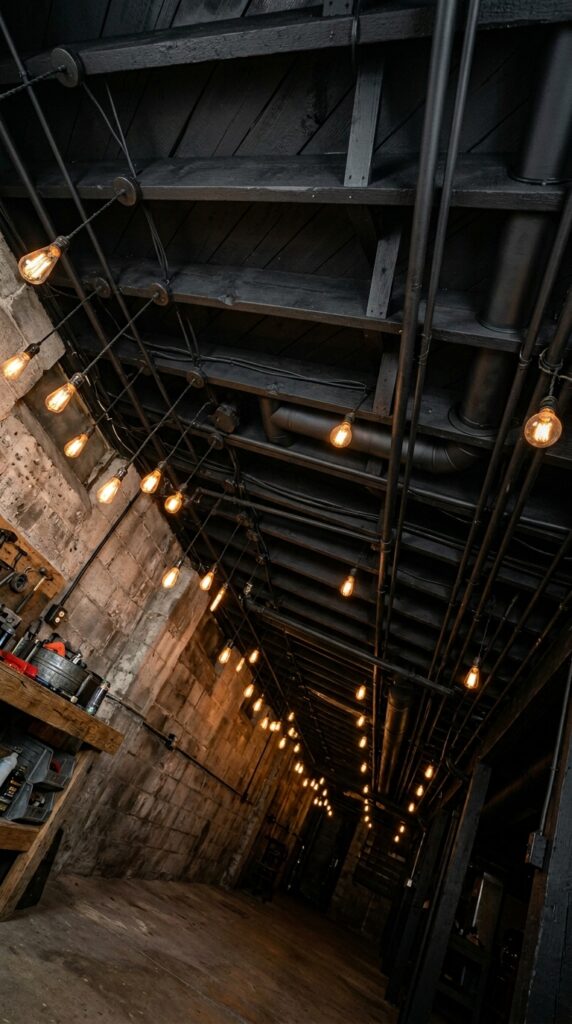
Vibe: Hushed — like the mechanical ceiling disappeared entirely into shadow.
The single most cost-effective visual transformation in an unfinished basement is painting the ceiling — joists, ducts, pipes, conduit, and all — in a uniform flat or matte black. The design principle is visual recession: a dark ceiling plane pushes upward optically, making the space feel taller than it is, while simultaneously disguising the complexity of mechanicals that would otherwise read as clutter. Flat black absorbs light rather than reflecting it, which keeps the ceiling from drawing the eye and lets your furnishings become the visual subject. Use a low-VOC spray paint or a brush-applied matte ceiling paint in “Carbon Copy” by Sherwin-Williams or similar — the key is full saturation of every surface, including pipe sides and duct flanges, so nothing interrupts the uniform darkness. Drop pendant lights at three different heights to create visual rhythm within that dark field.
🛍️ Shop the Look — Amazon Product Ideas
| # | Product Search Phrase | Why It Fits |
| 1 | Matte black spray paint low VOC interior | Uniform ceiling coverage |
| 2 | Industrial Edison bulb pendant light black cord | Hangs from exposed joists |
| 3 | Vintage filament LED Edison bulb ST64 | Warm amber tone |
| 4 | Black adjustable swag cord ceiling hook | No wiring required |
| 5 | Industrial pipe ceiling light fixture matte black | Matches mechanical pipes |
3. Concrete Block Accent Wall With Limewash
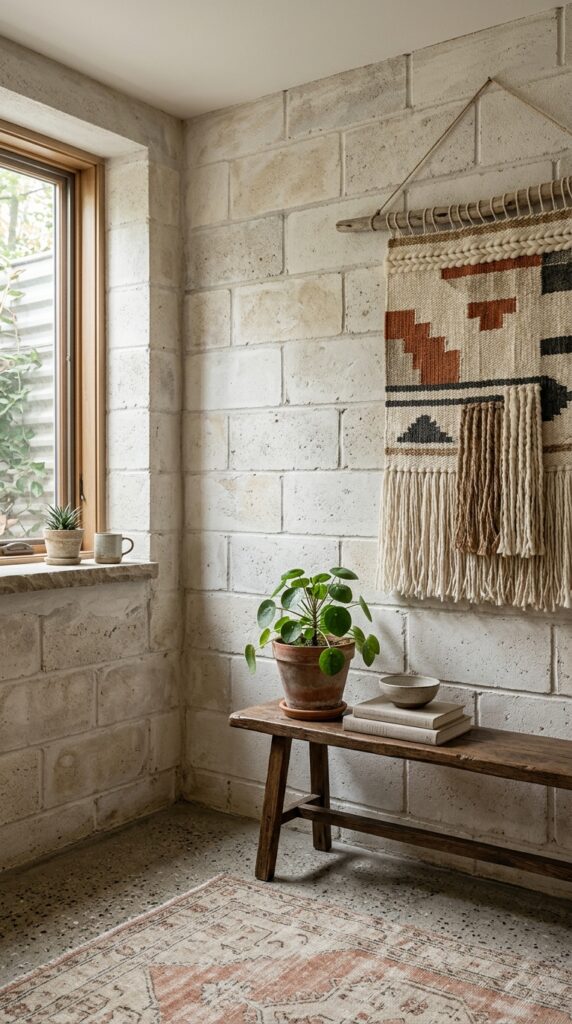
Vibe: Still — like a stone cellar that aged beautifully over decades.
Limewash applied to raw CMU block creates one of the most textured, mineral-rich wall finishes available at minimal cost. The design principle is texture as decoration: instead of covering the block with drywall, you enhance what’s already there, using the irregular surface of the concrete masonry units to create natural variation in the paint’s absorption and depth. Unlike regular latex, limewash is a calcium carbonate solution that bonds chemically to masonry, creating a matte, chalky finish that actually improves with age and slight moisture. Apply Portola Paints’ limewash or a DIY mix of hydrated lime and water in two crossed layers — the second application should go in a perpendicular direction with a damp brush to vary the coverage intentionally. The result reads as Tuscan, Provençal, or Scandinavian depending on your furnishings.
💡 Quick Win: Portola Paints’ Classico Limewash in “Linen” costs around $45 per quart and covers approximately 50 square feet — enough to do a small accent wall as a weekend project with zero prior experience.
🛍️ Shop the Look — Amazon Product Ideas
| # | Product Search Phrase | Why It Fits |
| 1 | Limewash paint interior white masonry | Textured mineral finish |
| 2 | Natural bristle wide paintbrush masonry | Limewash application tool |
| 3 | Woven wall hanging macramé neutral | Textile texture layering |
| 4 | Terracotta ceramic planter large | Warm earthy accent |
| 5 | Low platform wooden bench raw oak | Natural material pairing |
4. Pegboard Workshop Wall for Functional Storage
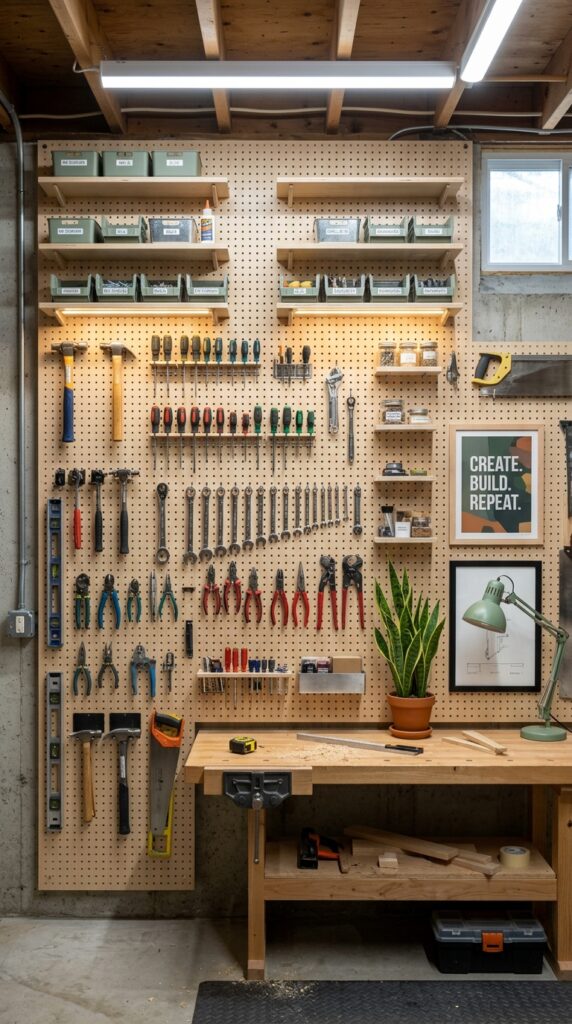
Vibe: Efficient — every inch earns its place and nothing is hidden.
A pegboard wall turns raw storage necessity into a visual system that actually makes the basement feel more intentional, not less. The design principle is visible organization as decor: when tools, supplies, or craft materials are arranged with care on a grid, the grid itself becomes the wall treatment. Use 1/4-inch hardboard pegboard mounted with 1-inch standoffs (critical — without standoffs, hooks have no room to seat properly) and paint it in a warm white like Benjamin Moore’s “White Dove” before mounting. The key styling move is mixing hook types — vary between long double hooks for larger items, short single hooks for small tools, and custom-cut wood shelves that slot into the grid for bins and plants. Adding one or two non-functional decorative elements — a framed print, a trailing plant — signals that the wall was designed, not just assembled.
🛍️ Shop the Look — Amazon Product Ideas
| # | Product Search Phrase | Why It Fits |
| 1 | Pegboard wall organizer kit with hooks | Core storage system |
| 2 | Pegboard shelf insert natural wood | Adds surface within grid |
| 3 | Metal pegboard bins small galvanized | Industrial storage accent |
| 4 | LED under-shelf strip light plug-in | Task lighting at pegboard |
| 5 | Pegboard standoff mounting hardware kit | Required for hook function |
5. Edison Bulb String Lights Along Joists
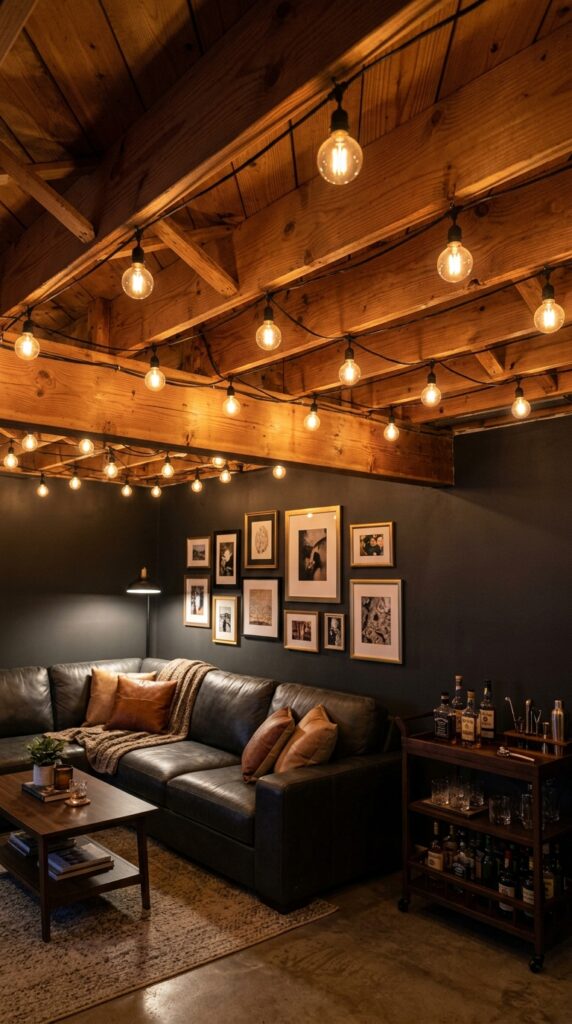
Vibe: Sun-warmed — the room holds the feeling of a long summer evening even underground.
String lights are one of the fastest transformations available in an unfinished basement because they require zero electrical work and exploit the existing joist infrastructure. The design principle is ambient light layering: Edison string lights at ceiling level create a warm base layer of diffused ambient illumination that makes the raw architecture feel curated rather than neglected. Use G40 globe-style bulbs on a black fabric-wrapped cord — not the cheap green holiday wire — and run parallel lines across the joists spaced roughly 18 inches apart, stapling the cord to the wood with insulated cable staples. The slight natural droop between staple points creates visual rhythm. For maximum warmth, choose bulbs rated 2200K (extra warm white), not the cooler 2700K standard warm white.
💡 Quick Win: A 100-foot reel of G40 Edison string lights with black fabric cord runs about $35–$45 on Amazon and can light a 400 square foot basement ceiling with two parallel runs — no electrician required.
🛍️ Shop the Look — Amazon Product Ideas
| # | Product Search Phrase | Why It Fits |
| 1 | G40 Edison string lights black fabric cord outdoor | Warm basement ceiling lighting |
| 2 | Insulated cable staples wood black | Secures cord to joists cleanly |
| 3 | LED filament globe bulb 2200K warm amber | Ultra-warm Edison glow |
| 4 | Dimmer switch plug-in cord inline | Controls ambiance easily |
| 5 | Leather bar cart wooden shelf industrial | Anchors basement social zone |
6. Split Basement Zones With Painted Floor Rectangles
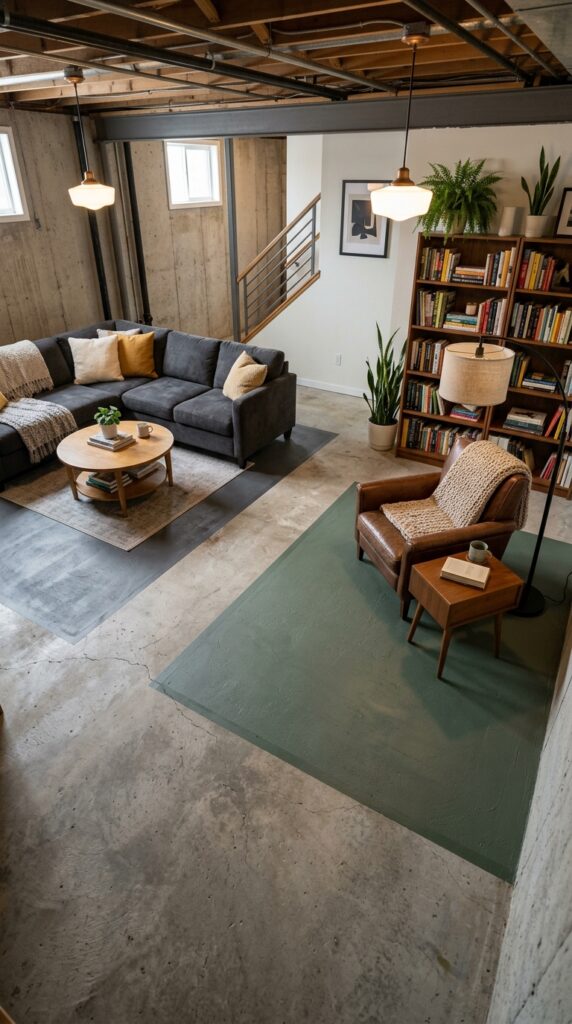
Vibe: Intentional — the space reads as designed even without a wall between uses.
Painted floor zones are one of the most underused layout tools in basement design, and they cost almost nothing. The design principle is implied architecture: instead of building walls or buying expensive area rugs to define zones, you use color on the concrete slab itself to establish distinct “rooms” visually. Use a concrete floor paint or porch-and-floor enamel in two complementary tones — a deeper one for the primary gathering zone and a lighter or contrasting one for a secondary nook — and use painter’s tape applied very carefully along a measured line to create crisp edges. The raw unpainted concrete between the zones acts as a visual corridor, completing the architectural illusion. Each zone should then receive its own overhead light source so the lighting reinforces the visual boundary.
🛍️ Shop the Look — Amazon Product Ideas
| # | Product Search Phrase | Why It Fits |
| 1 | Concrete floor paint charcoal interior | Zone-defining floor color |
| 2 | Porch and floor enamel sage green | Secondary zone accent |
| 3 | Premium painter’s tape 1.5 inch wide | Crisp floor paint edges |
| 4 | Pendant light plug-in hanging black cord | Zone lighting, no wiring |
| 5 | Low-profile floor lamp industrial black | Zone accent lighting |
7. Open Steel Shelving for Functional Display
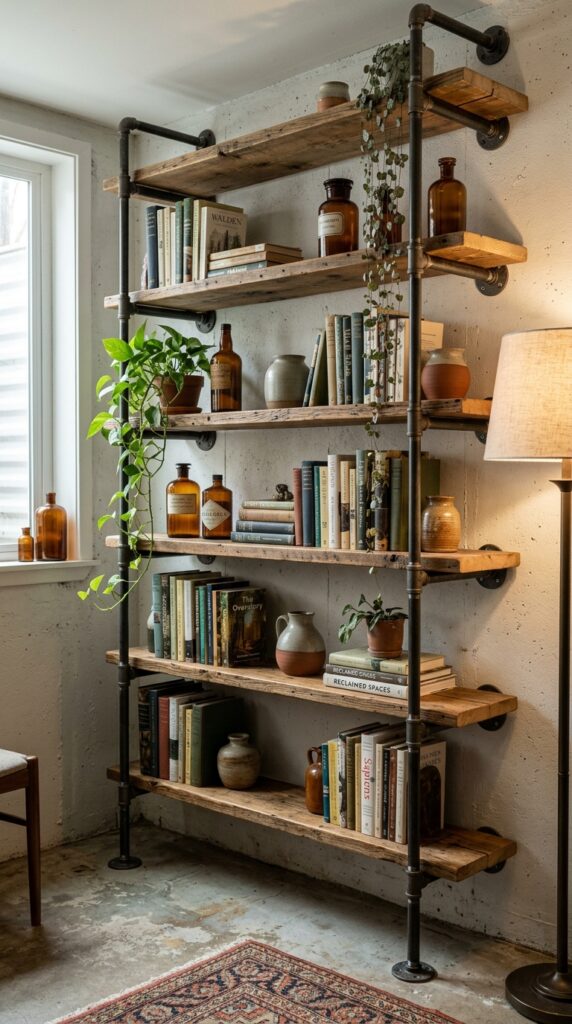
Vibe: Layered — the shelves feel like they accumulated over years, not a single shopping trip.
Steel pipe shelving mounted directly into concrete block or stud framing is the ideal furniture choice for an unfinished basement because it speaks the same material language as the space itself. The design principle is material continuity: using galvanized or black-iron pipe flanges with reclaimed wood plank shelves creates a visual echo between the exposed pipes overhead and the shelving hardware at eye level, making the space feel cohesive rather than mismatched. Mount the flanges at staggered heights — not all shelves at uniform intervals — to give the installation a custom, built-over-time quality. Style with a mixture of functional and decorative objects: books on one shelf, amber glass vessels on the next, a trailing pothos on the top. The plant softens the industrial material and introduces the only real organic curve in an otherwise angular composition.
💡 Quick Win: Pre-made pipe shelf bracket kits (search “industrial pipe shelf bracket kit black iron 10 inch”) cost $12–$18 per pair and mount to any wall material with the right anchor type — no custom fabrication needed.
🛍️ Shop the Look — Amazon Product Ideas
| # | Product Search Phrase | Why It Fits |
| 1 | Black iron pipe shelf bracket industrial 10 inch | Core hardware for shelving |
| 2 | Reclaimed wood plank shelf board rustic | Warm shelf surface material |
| 3 | Amber glass apothecary bottle set | Warm tonal shelf styling |
| 4 | Trailing pothos plant in nursery pot | Organic softening element |
| 5 | Concrete wall anchor toggle bolt kit | Secure mounting in CMU block |
8. Deep Navy Accent Wall on One Concrete Block Face
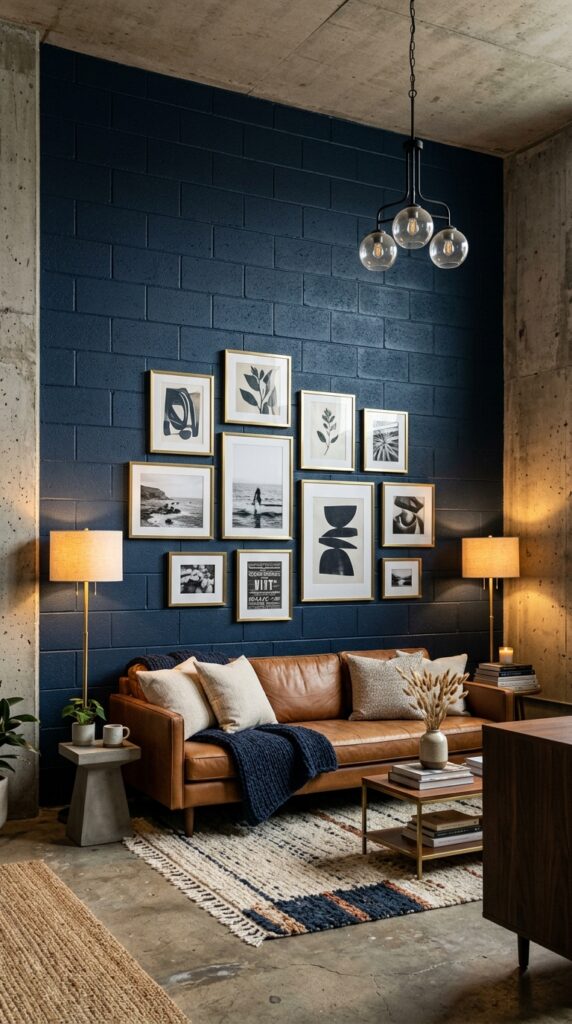
Vibe: Grounded — the navy wall makes everything in front of it feel purposeful and composed.
A single deeply saturated wall in a raw basement space does something that no amount of decoration can replicate: it creates an immediate visual anchor. The design principle is contrast and weight: navy — particularly Benjamin Moore’s “Hale Navy” or Sherwin-Williams’ “Naval” — provides enough visual weight to make raw concrete walls look intentionally restrained by comparison, rather than unfinished. The critical execution detail is surface prep — CMU block paint requires a masonry primer first, otherwise the porous block absorbs paint unevenly and the color appears washed out. Apply the primer, then two full coats of a masonry-formulated or universal interior paint. Position your main seating arrangement in front of this wall so it functions as a headboard-style backdrop, making the furniture composition read like a designed vignette.
🛍️ Shop the Look — Amazon Product Ideas
| # | Product Search Phrase | Why It Fits |
| 1 | Masonry block primer interior gray | Essential prep for CMU walls |
| 2 | Deep navy interior paint quart | Accent wall color |
| 3 | Brushed brass gallery frame set black mat | Navy backdrop complement |
| 4 | Low linen sofa mid-century style | Front anchor for accent wall |
| 5 | Brass arc floor lamp black base | Warm metal pairing with navy |
9. Basement Home Gym With Rubber Flooring Tiles
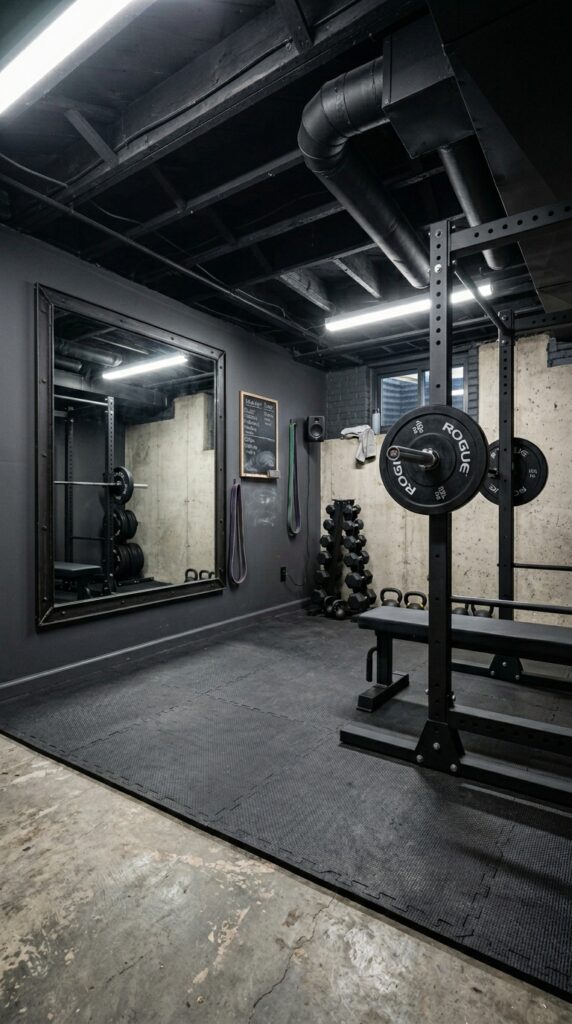
Vibe: Raw — the space has the honest gravity of a real training environment.
The unfinished basement is perhaps the most natural home gym setting that exists, and the material choices here lean fully into that advantage rather than fighting it. The design principle is functional zoning with material definition: interlocking rubber flooring tiles delineate the gym area from the rest of the basement the way a rug defines a living room, but they also serve genuine functional purposes — floor protection, noise dampening, and grip underfoot. Use 3/4-inch thick vulcanized rubber tiles (not the thin foam kind, which compress under barbell weight) in black or dark charcoal. Mount a frameless or industrial-framed mirror panel on one wall — this doubles the visual depth of the space and provides form-checking utility. Shop lighting mounted to the exposed joists provides the correct overhead illumination without the warmth softening that a gym zone doesn’t need.
🛍️ Shop the Look — Amazon Product Ideas
| # | Product Search Phrase | Why It Fits |
| 1 | Interlocking rubber gym floor tiles 3/4 inch black | Core gym flooring material |
| 2 | Frameless gym mirror panel wall mount large | Visual depth and form checking |
| 3 | LED shop light fixture plug-in 5000K | Bright task lighting for joists |
| 4 | Weight plate storage wall bracket | Organized equipment storage |
| 5 | Black foam roller high density | Recovery tool for gym zone |
10. Utility Pipe Wrapped in Hemp or Sisal Rope

Vibe: Tactile — the rope transforms a utility element into something you want to run your hand along.
Exposed pipes in a basement are either a problem to hide or a material to transform — this idea does the latter. The design principle is material reframing: by wrapping galvanized or copper utility pipes in natural sisal or hemp rope, you shift their visual category from “industrial infrastructure” to “intentional texture,” essentially giving the pipe a new identity that aligns with a warm, organic aesthetic. This works particularly well on pipes that run horizontally at ceiling level or that serve as partial room dividers in open-plan basements. Use 1/4-inch or 3/8-inch natural sisal rope (not manila, which is rougher and coarser) and apply a line of hot glue at the start and end points to secure the wrap without visible hardware. Work in tight, even coils, butting each turn against the last with no gaps. The result can cover 6–8 feet of pipe per small spool.
💡 Quick Win: A 100-foot spool of 1/4-inch natural sisal rope costs under $12 and wraps approximately 8 feet of standard 2-inch pipe — start with one visible overhead run as a test and see how it reads in your specific space.
🛍️ Shop the Look — Amazon Product Ideas
| # | Product Search Phrase | Why It Fits |
| 1 | Natural sisal rope 1/4 inch 100 foot spool | Core pipe wrapping material |
| 2 | Hot glue gun heavy duty sticks | Secures rope start and end |
| 3 | Macramé wall hanging large natural cotton | Continues the organic texture |
| 4 | Vintage cage pendant lantern black | Complements organic material mix |
| 5 | Jute twine ball natural rustic | Matching organic accent detail |
11. Industrial Bar Cart Corner With Concrete and Metal
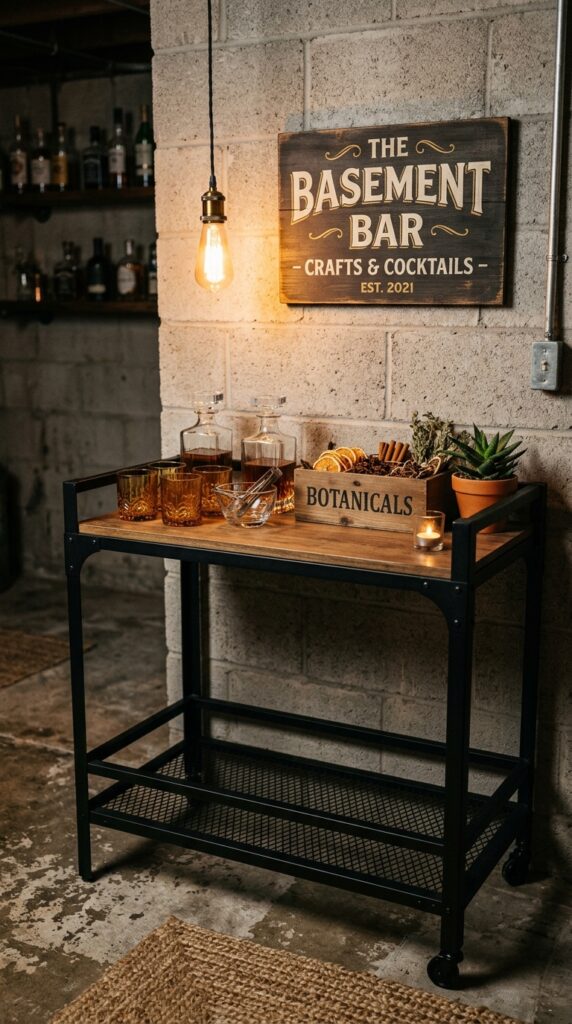
Vibe: Warm — this corner pulls people toward it the way an open fire does.
A bar cart corner is the social anchor point that makes a basement feel worth spending time in, and in an unfinished space it works best when it speaks the same material language as the room. The design principle is focal point through curation: a single well-styled corner creates a destination that makes visitors unconsciously identify the room as a gathering space. Choose a welded-steel bar cart with a mesh or open-wire shelf in matte black — the material echoes the exposed metal overhead while the open structure keeps the piece from feeling heavy in the space. The styling follows a tight rule: warm amber tones dominate (whiskey decanters, amber glassware, wood tray), one living element appears (a small succulent or trailing plant in a terracotta pot), and one piece of text — a small vintage sign or chalkboard — grounds the corner with personality. Nothing on the cart should be purely decorative; every item should be functional.
🛍️ Shop the Look — Amazon Product Ideas
| # | Product Search Phrase | Why It Fits |
| 1 | Black metal bar cart rolling industrial 2 tier | Core furniture piece |
| 2 | Amber whiskey decanter set glass stopper | Warm tonal bar styling |
| 3 | Small succulent in terracotta pot | Living element for the cart |
| 4 | Rustic wood serving tray black handles | Organizes bar surface |
| 5 | Vintage bar sign metal neon-free wall decor | Personality anchor point |
12. Whitewashed Brick or Block Wall Technique
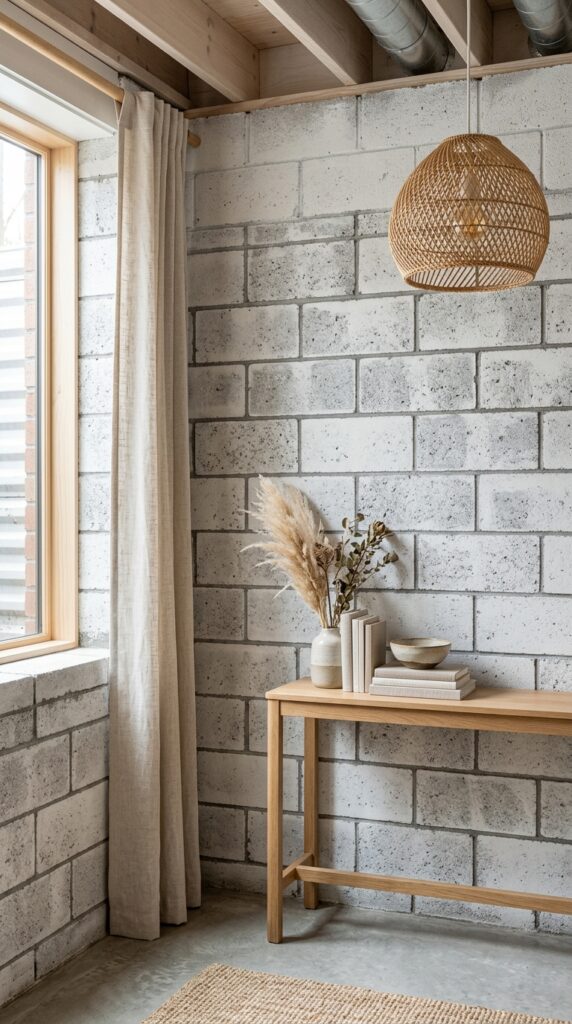
Vibe: Luminous — the wall feels like it’s lit from within even without direct sunlight.
Whitewashing differs from full paint coverage in one critical way: intentional incompleteness. The design principle is transparency as texture — a 50/50 mixture of white latex paint and water applied with a bristle brush and immediately wiped back with a damp rag creates a semi-transparent film over the block that lightens the wall dramatically without erasing its texture or color variation. This technique is particularly valuable in basements that lack natural light, because the semi-white surface bounces whatever ambient light exists more effectively than raw concrete gray. The mortar lines between blocks remain visible and actually become a positive design element — a grid of gray against the milky white surface that reads as intentional pattern. Mix Benjamin Moore “Chantilly Lace” (OC-65) with equal parts water for a nearly invisible film, or increase paint ratio to 70/30 for more coverage.
💡 Quick Win: A single quart of white latex paint diluted 50/50 covers approximately 100 square feet of CMU block in a whitewash finish — enough for a small basement accent wall for under $15 in material cost.
🛍️ Shop the Look — Amazon Product Ideas
| # | Product Search Phrase | Why It Fits |
| 1 | White interior latex paint quart flat | Whitewash base material |
| 2 | Natural bristle brush 4 inch masonry | Textured whitewash application |
| 3 | Rattan pendant light shade large | Soft organic overhead fixture |
| 4 | Linen curtain panel rod-pocket natural | Soft texture against white wall |
| 5 | Solid oak console narrow entryway | Warm material at whitewashed wall |
13. Floating Plywood Desk Built Into Joists
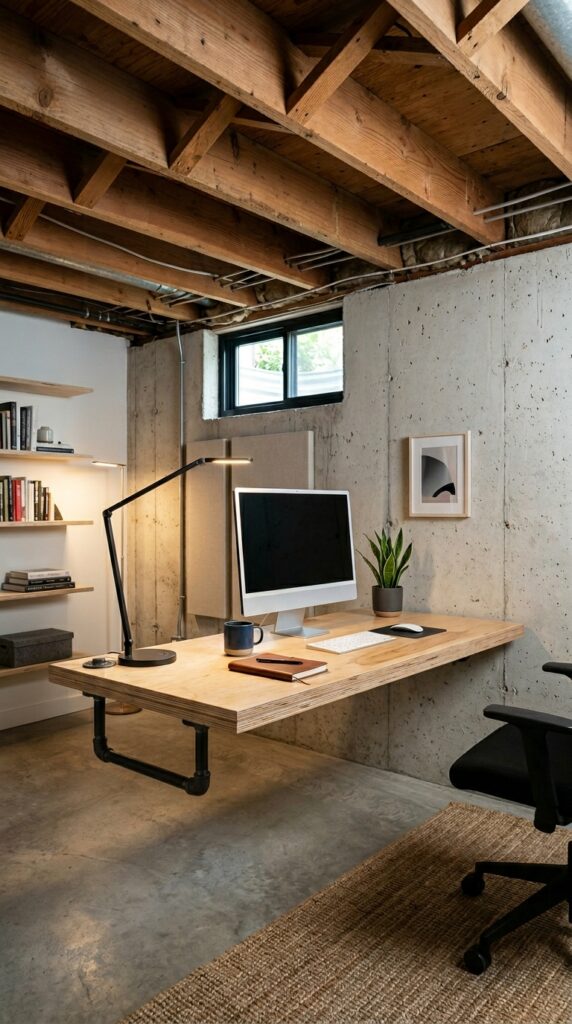
Vibe: Focused — the workspace has the clarity of a place built for one specific purpose.
A wall-mounted floating desk in an unfinished basement does double work: it creates a functional workspace and it makes the exposed joists look intentional by involving them structurally. The design principle is integration over addition: instead of placing a freestanding desk against a wall, you build the desk into the architecture itself — using the joists as the anchor point from above and the wall studs or block as the anchor from below. Use 3/4-inch birch plywood for the desktop surface (lighter than solid wood, stronger than MDF, and it finishes beautifully with two coats of water-based polyurethane in a satin sheen). Support it with black iron pipe brackets at two or three points along the wall face. The no-leg design keeps the concrete floor completely open beneath the desk, making the basement feel less cluttered and the workspace feel more architectural.
🛍️ Shop the Look — Amazon Product Ideas
| # | Product Search Phrase | Why It Fits |
| 1 | Birch plywood sheet 3/4 inch smooth one side | Floating desk surface material |
| 2 | Floating wall shelf bracket heavy duty black | Desk support without legs |
| 3 | Water-based polyurethane clear satin finish | Desktop protective coating |
| 4 | Minimalist desk lamp adjustable arm black | Focused task lighting |
| 5 | Cable management box wooden desktop | Hides cord clutter cleanly |
14. Warm Gray Concrete Walls Left Bare and Styled
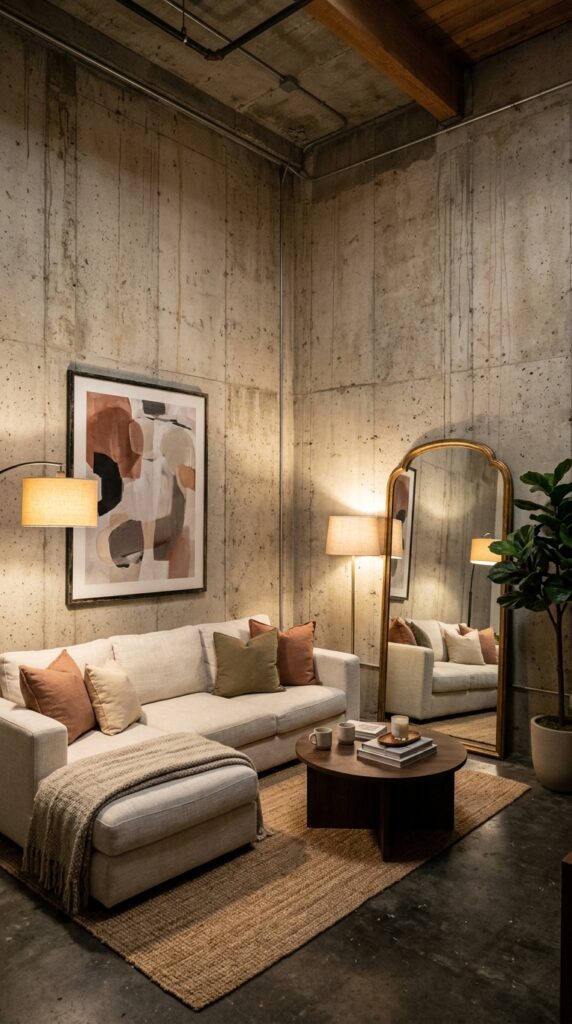
Vibe: Raw — the room has the cool confidence of something that needs no apology.
Bare poured concrete walls — the kind that show form tie holes, pour lines, and aggregate variation — are genuinely beautiful when styled with the right companions. The design principle is negative contrast: the more textural, complex, and raw the wall, the more graphic and oversized the art needs to be to hold visual weight against it. Small art reads as afterthought on concrete; one large abstract print in muted tones of terracotta, warm white, and charcoal creates a deliberate dialogue with the wall’s own color palette. A leaning arched floor mirror compounds the effect by doubling the perceived depth and light in the space. For the furniture, choose natural linen upholstery — the softness of the textile against the hardness of the wall is the fundamental pairing that makes this feel considered rather than austere.
🛍️ Shop the Look — Amazon Product Ideas
| # | Product Search Phrase | Why It Fits |
| 1 | Large abstract art print canvas framed neutral | Statement piece for raw concrete |
| 2 | Arched floor mirror leaning large | Depth and light multiplier |
| 3 | Linen sofa natural beige modern | Soft contrast to hard walls |
| 4 | Concrete wall sealer clear matte | Protects bare wall from moisture |
| 5 | Aged gold picture frame large gallery | Warm metal against cool concrete |
15. Floating Reading Nook With Floor Cushion and Curtain Enclosure
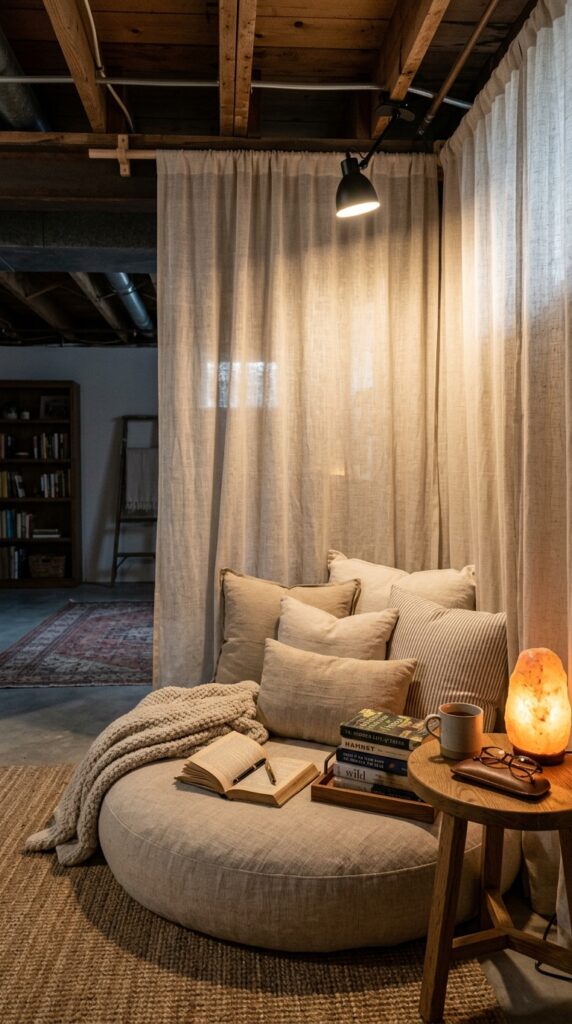
Vibe: Hushed — the curtain makes the nook feel separate from the world, not just from the room.
A curtain hung from an exposed joist creates a room within a room at essentially zero construction cost, which makes it one of the most effective small-space tools available in an unfinished basement. The design principle is implied enclosure through fabric: a semi-sheer or linen curtain panel that hangs from a tension rod or joist-mounted curtain rod signals “separate zone” to the brain without blocking light or air, making a corner feel both private and open simultaneously. The nook itself requires only a large floor cushion (60×60 inches minimum for adult use) in a natural linen or cotton canvas, a low side table at drink height, and a clip-on reading light. The curtain rod can be a simple dowel rod attached to the joist with two cup hooks — no hardware store run required beyond the cup hooks and a hand drill.
💡 Quick Win: Two $8 cup hooks screwed into a joist, a $5 wooden dowel rod, and a $25 sheer linen curtain panel from any home goods store create this enclosure in under 20 minutes.
🛍️ Shop the Look — Amazon Product Ideas
| # | Product Search Phrase | Why It Fits |
| 1 | Large floor cushion linen natural 60 inch | Primary seating in the nook |
| 2 | Sheer linen curtain panel natural white | Nook enclosure fabric |
| 3 | Wooden dowel rod 1 inch diameter natural | Simple curtain rod from joists |
| 4 | Clip-on reading lamp warm white LED | Task lighting without outlet |
| 5 | Round wooden tray teak small | Surface for drinks and books |
16. Warm Wood Slat Ceiling Panel on One Section
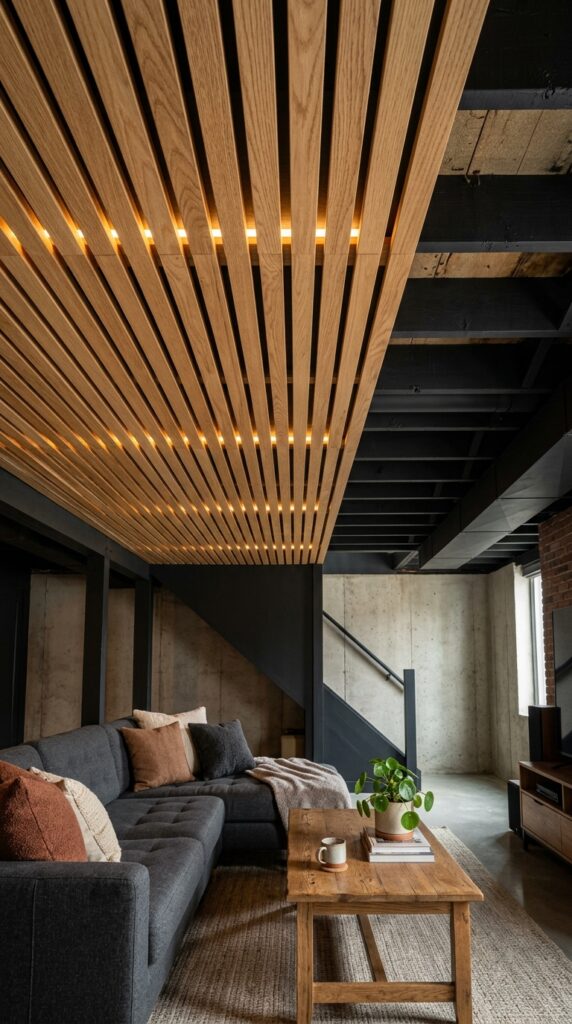
Vibe: Considered — the wood ceiling feels like a deliberate architectural gesture, not an afterthought.
Installing wood slat panels on one section of the basement ceiling — specifically above a primary seating or dining area — creates an architectural moment that signals “designed space” without covering the entire ceiling. The design principle is selective warmth through material accent: the natural oak tone of the slat panels provides a warm visual counterpoint to the matte black exposed joists elsewhere, and the contrast between the two treatments makes both look more intentional. Modern wood slat panels come in peel-and-stick or staple-to-joist formats using real oak, walnut, or pine veneer over a thin MDF backer — they are not the same as vinyl laminate and they read accordingly. Install LED strip lighting behind the first and last slat row so light bleeds through the gaps in the panel, creating a dramatic indirect glow that warms the zone below at night.
🛍️ Shop the Look — Amazon Product Ideas
| # | Product Search Phrase | Why It Fits |
| 1 | Wood slat ceiling panel oak veneer peel stick | Warm ceiling material |
| 2 | LED strip light warm white 2700K adhesive | Behind-slat indirect lighting |
| 3 | Brad nailer finish nails 18 gauge | Secure slat installation tool |
| 4 | Wood finish oil Danish natural oak | Tonal wood treatment |
| 5 | Recessed LED puck light low profile | Supplemental ceiling light |
17. Herringbone Pattern Painted on Concrete Floor
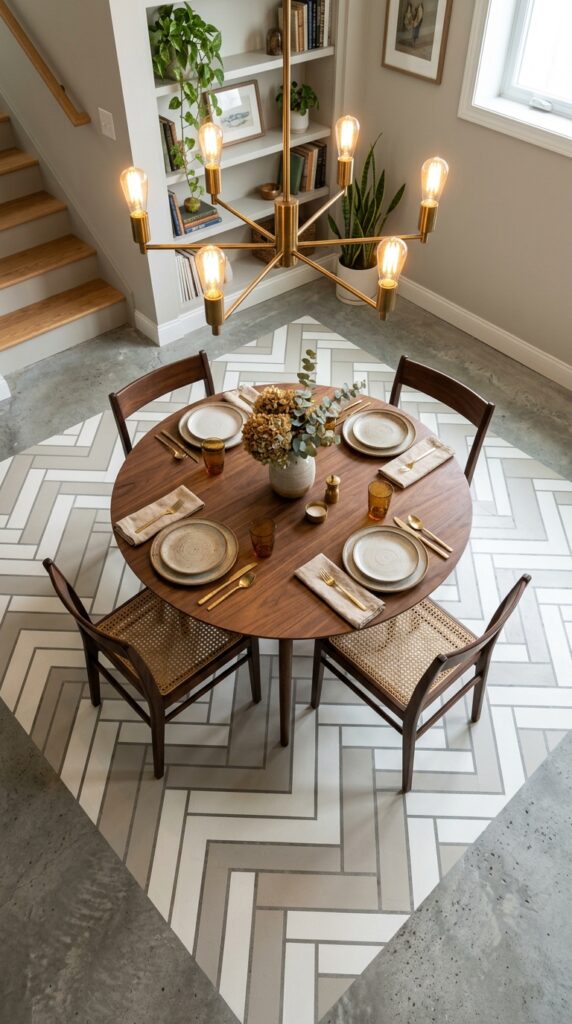
Vibe: Elevated — the floor pattern makes the entire room read more finished than any wall treatment could.
A painted herringbone pattern on concrete is the single highest-impact floor treatment available under $50, and it requires only floor paint, painter’s tape, and a ruler. The design principle is pattern as architecture: a geometric floor pattern creates the same visual grounding effect as an area rug but with permanent presence and zero cost over time. Map the pattern using two tones from the same warm family — “White Dove” and “Pale Oak” from Benjamin Moore, for example — leaving the raw concrete color as the visible “grout line” between tape lines (typically 3–4 inches of concrete between painted rectangles). The herringbone layout requires careful measuring from a center line outward, but each individual rectangle is simply a masked-off parallelogram, which any beginner can execute cleanly with high-quality painter’s tape.
💡 Quick Win: Map your herringbone pattern using a chalk line snapped across the floor as the center axis before laying any tape — this single step ensures the pattern stays symmetrical even if your walls aren’t perfectly square, which they almost certainly aren’t.
🛍️ Shop the Look — Amazon Product Ideas
| # | Product Search Phrase | Why It Fits |
| 1 | Concrete floor paint warm white porch enamel | Herringbone pattern base color |
| 2 | Frog tape painter’s tape delicate surface | Crisp pattern edge lines |
| 3 | Chalk line reel floor marking | Pattern center axis guide |
| 4 | Foam roller 4 inch low nap | Even floor paint application |
| 5 | Concrete floor sealer water-based satin | Protects finished pattern |
18. Basement Laundry Nook Made Functional and Considered
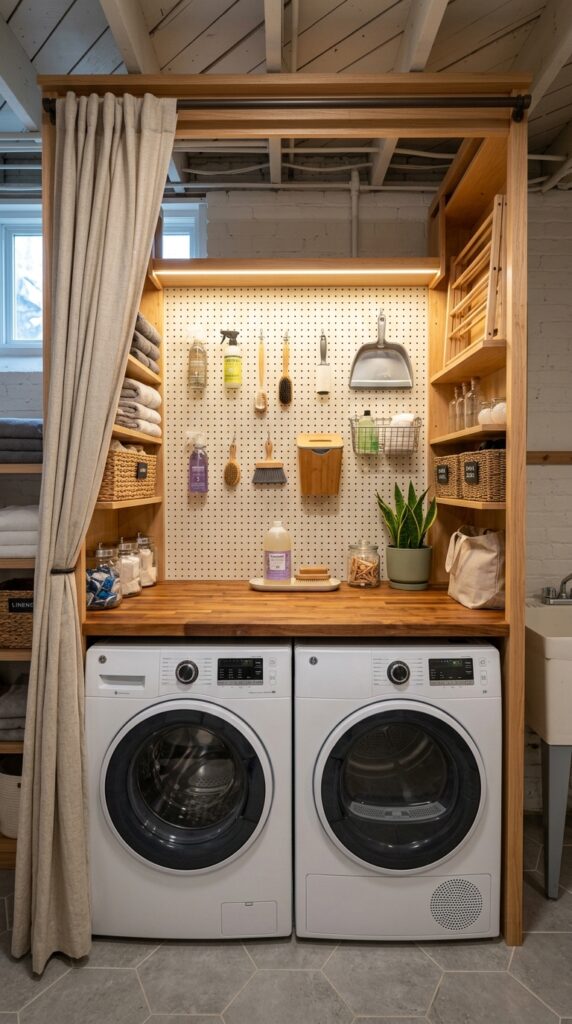
Vibe: Efficient — the utility zone feels thoughtful rather than tolerated.
Most unfinished basements contain a laundry zone that gets entirely ignored from a design perspective — which is a missed opportunity, because a styled laundry nook makes the entire basement feel more resolved. The design principle is zone definition through framing: by flanking the washer and dryer with open shelving units and adding a butcher block counter above them, you transform a pair of appliances into a built-in alcove that reads as intentional cabinetry. A linen curtain panel on a tension rod provides instant concealment for days when the aesthetic needs to disappear. Under-shelf LED strip lighting in the 3000K warm white range illuminates the work surface practically while also warming the zone visually. On the shelving, keep detergents in matching glass or ceramic containers — the visual consistency matters as much as the organization.
🛍️ Shop the Look — Amazon Product Ideas
| # | Product Search Phrase | Why It Fits |
| 1 | Butcher block counter 25 inch depth unfinished | Laundry zone countertop |
| 2 | Open wood laundry room shelving unit | Flanking shelf towers |
| 3 | Ceramic laundry detergent storage canister | Consistent container styling |
| 4 | Under shelf LED light bar plug-in warm | Task lighting for laundry zone |
| 5 | Linen curtain tension rod kit | Instant zone concealment |
19. Vertical Garden Wall Using PVC Pipe Planters
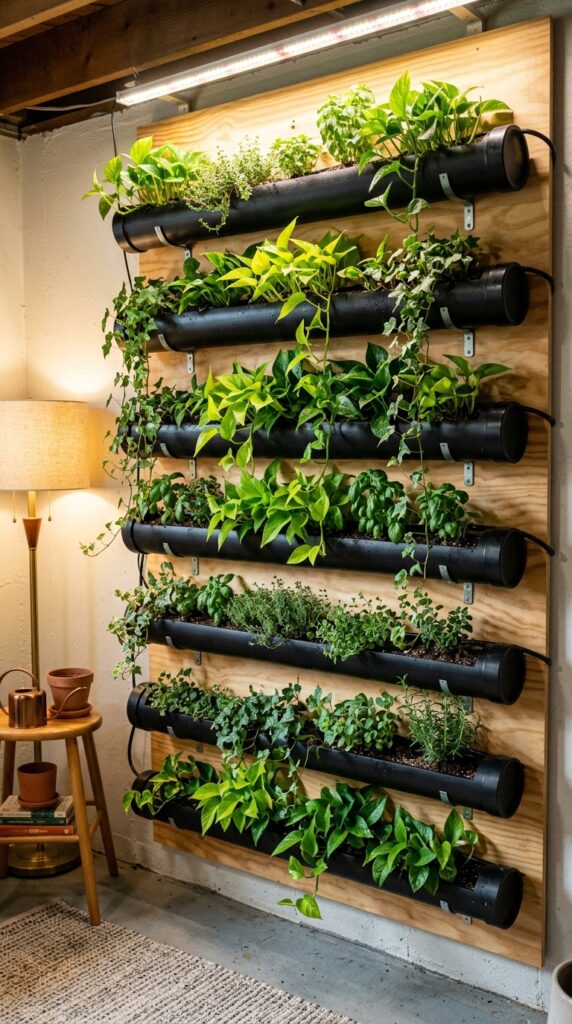
Vibe: Living — the wall breathes in a way that no other basement feature does.
A vertical plant wall is the only basement design element that actively improves the space’s air quality while functioning as decor, which makes it a particularly smart choice in a below-grade space. The design principle is biophilic anchoring: the human response to living plant material in an otherwise hard, gray, industrial environment is measurably positive — plants introduce scale, movement, organic color, and the psychological benefit of a living thing. Build the system using 4-inch PVC pipe halved lengthwise and painted matte black, mounted horizontally on staggered rows across a plywood backing board. Fill each channel with drainage gravel, potting mix, and low-light plants: pothos, heartleaf philodendron, or herbs like mint and basil. A single full-spectrum LED grow light strip mounted at the top is sufficient for most low-light varieties.
🛍️ Shop the Look — Amazon Product Ideas
| # | Product Search Phrase | Why It Fits |
| 1 | Full spectrum LED grow light strip bar | Basement plant lighting |
| 2 | PVC pipe 4 inch diameter 10 foot | Vertical planter tube material |
| 3 | Pothos plant live low light indoor | Hardy trailing plant for wall |
| 4 | Moisture retaining indoor potting mix | Plant substrate for planters |
| 5 | Matte black spray paint plastic adhesion | Pipe surface treatment |
20. Polished Concrete Island or Bar Counter DIY
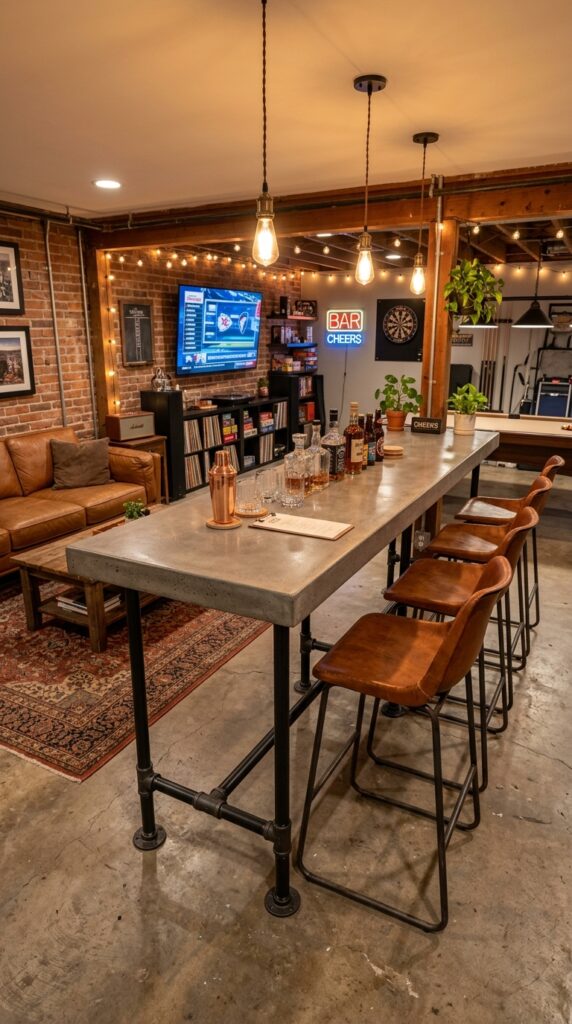
Vibe: Social — the bar counter turns the basement into a destination, not just a room.
A concrete island or bar counter in an unfinished basement is the furniture equivalent of a commitment — it says the space is worth inhabiting long-term, and it pays that sentiment back with function and visual presence. The design principle is material echo: a concrete countertop in a concrete-floored basement creates visual continuity between horizontal planes, making the entire space feel intentionally monolithic rather than assembled from disparate parts. The DIY approach uses pre-blended concrete countertop mix poured into a melamine form to achieve a smooth, even slab. Once cured and polished with 200-grit and 400-grit wet sandpaper followed by a penetrating concrete sealer, the surface is food-safe, stain-resistant, and visually close to commercial quality. Mount on welded black steel pipe legs for a frame that matches the mechanical overhead.
🛍️ Shop the Look — Amazon Product Ideas
| # | Product Search Phrase | Why It Fits |
| 1 | Concrete countertop mix DIY gray bag | Counter slab material |
| 2 | Concrete countertop penetrating sealer | Protective food-safe finish |
| 3 | Industrial bar stool aged leather iron legs | Social seating at counter |
| 4 | Melamine board 3/4 inch form building | DIY pour mold material |
| 5 | Wet dry sandpaper set 200-400 grit | Countertop polishing surface |
21. Moody Burgundy or Terracotta Paint on One Structural Column
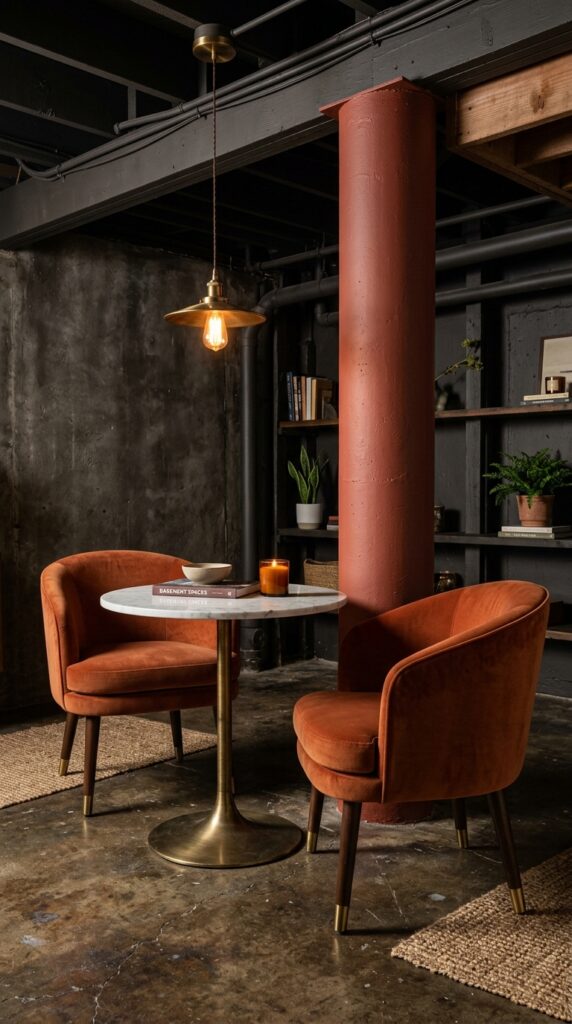
Vibe: Warm — the column stops being a structural intrusion and becomes the reason for the room’s best corner.
Structural columns in an unfinished basement are often treated as problems to disguise, but they are more usefully treated as vertical design elements. The design principle is obstruction as focal point: by painting a column in a saturated, warm tone — terracotta, deep burgundy, or olive — and then furniture-grouping around it rather than despite it, you transform the column from an obstacle into a room anchor. Use a clay-based paint like Bauwerk or Keim for terracotta columns (the matte, chalk-like finish reads as architectural rather than painted), and arrange a small bistro table with two curved chairs directly around the column’s footprint. The pendant light hung above the column-and-table grouping creates a defined social vignette that people naturally gravitate toward.
💡 Quick Win: Painting a single structural column costs almost nothing in paint ($8–$12 for a quart of clay paint is ample for a standard 8-foot column) and the visual transformation it creates is disproportionate to the effort.
🛍️ Shop the Look — Amazon Product Ideas
| # | Product Search Phrase | Why It Fits |
| 1 | Clay paint terracotta interior matte finish | Column accent color |
| 2 | Round marble top bistro table small | Column-side gathering surface |
| 3 | Curved velvet accent chair rust orange | Warm pairing for terracotta column |
| 4 | Brass pendant light black cord adjustable | Column grouping overhead light |
| 5 | Column wrap decorative trim molding | Softens raw column profile |
22. Reclaimed Wood Plank Feature Wall
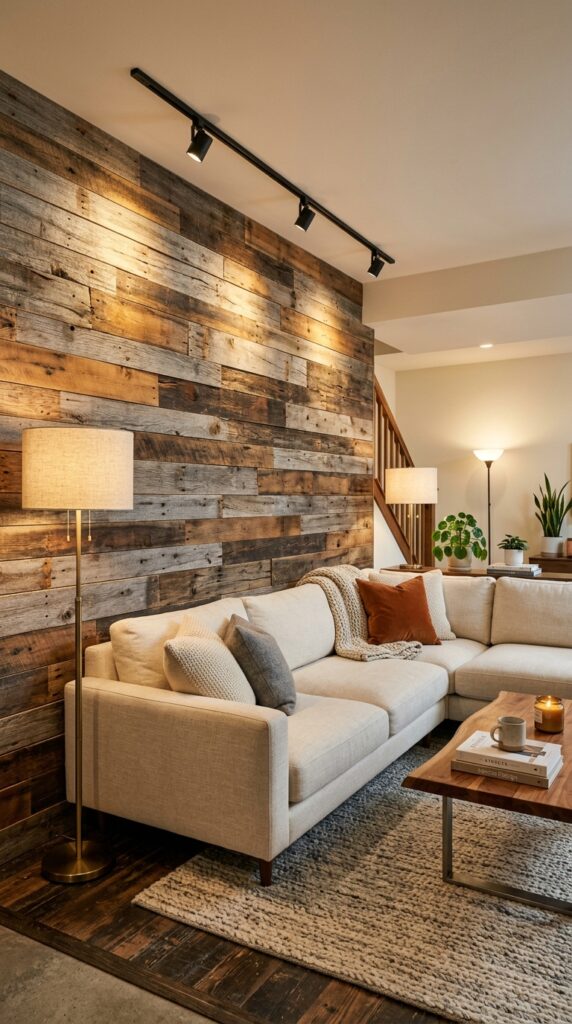
Vibe: Layered — the wall reads like it has been built up over decades rather than installed in a weekend.
Reclaimed wood plank walls in a basement do something that new material cannot replicate: they bring visible time into a space, creating the feeling of a room with history. The design principle is tonal variation as texture — the installation’s visual richness comes not from a single plank color but from the deliberate mixing of weathered gray, warm caramel, and dark walnut tones within the same horizontal plank run. Source genuine reclaimed barn wood from a regional salvage yard or an online reclaimed lumber supplier, and install with a pneumatic brad nailer directly into wall studs or through a plywood backer board on concrete. The key installation rule: randomize plank widths (alternating 2-inch, 4-inch, and 6-inch boards) so the wall reads as found material rather than a uniform product. Apply a clear matte topcoat to stabilize loose fibers without adding any sheen.
🛍️ Shop the Look — Amazon Product Ideas
| # | Product Search Phrase | Why It Fits |
| 1 | Reclaimed wood wall panel peel stick rustic | Accessible plank wall product |
| 2 | Brad nailer pneumatic 18 gauge finish | Plank installation tool |
| 3 | Clear matte wood sealer spray | Stabilizes reclaimed wood surface |
| 4 | Modern sectional sofa L-shape gray linen | Primary seating against plank wall |
| 5 | Directional wall wash ceiling spotlight | Highlights wood wall texture |
23. Under-Stair Storage Nook With Open Shelves
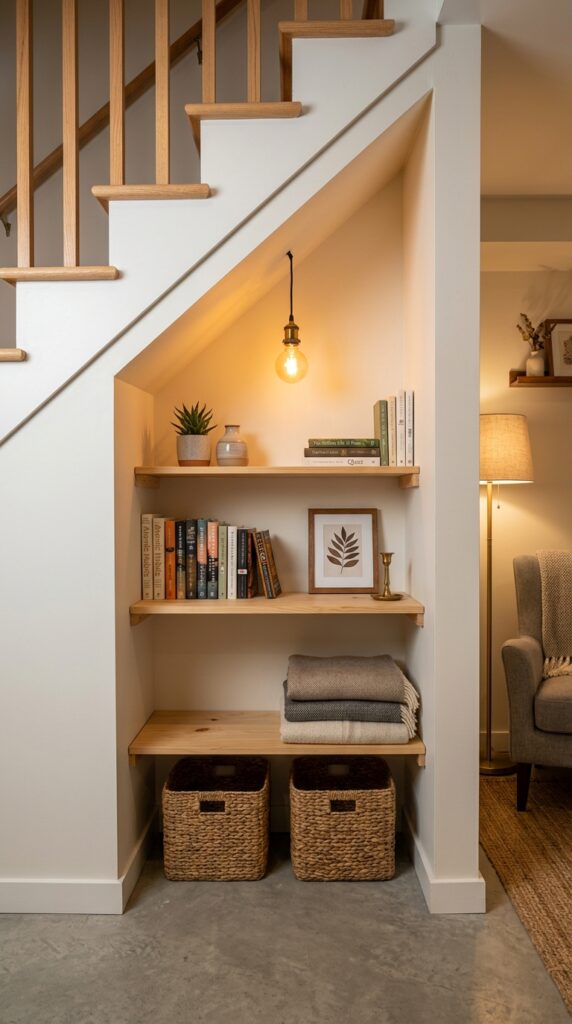
Vibe: Efficient — the dead space under the stairs becomes the most organized corner in the house.
The triangular void beneath basement stairs is one of the most overlooked storage opportunities in residential design. The design principle is small-space activation: by installing shelves that step up in depth as the stair rises (shorter shelves near the low point, deeper ones near the tall end), you create a fully functional storage alcove that uses otherwise wasted cubic footage. Paint the interior of the void in a warm white — “Swiss Coffee” or similar — to maximize light reflection within the shallow space. Add a single pendant light on a swag hook at the highest interior point. Then style across the shelves with a consistent container system: matching woven baskets for items you want to conceal, open stacks of books and ceramics for items worth displaying. The visual rhythm of consistency transforms a catch-all into a feature.
🛍️ Shop the Look — Amazon Product Ideas
| # | Product Search Phrase | Why It Fits |
| 1 | Adjustable bookshelf small wall mount bracket | Under-stair shelf hardware |
| 2 | Woven seagrass storage basket with handle | Organized concealed storage |
| 3 | Swag pendant light hook adjustable cord | Under-stair nook lighting |
| 4 | Warm white interior paint quart flat | Bright nook interior |
| 5 | Small ceramic decorative object set neutral | Open shelf styling elements |
24. Freestanding Bookshelf as Room Divider
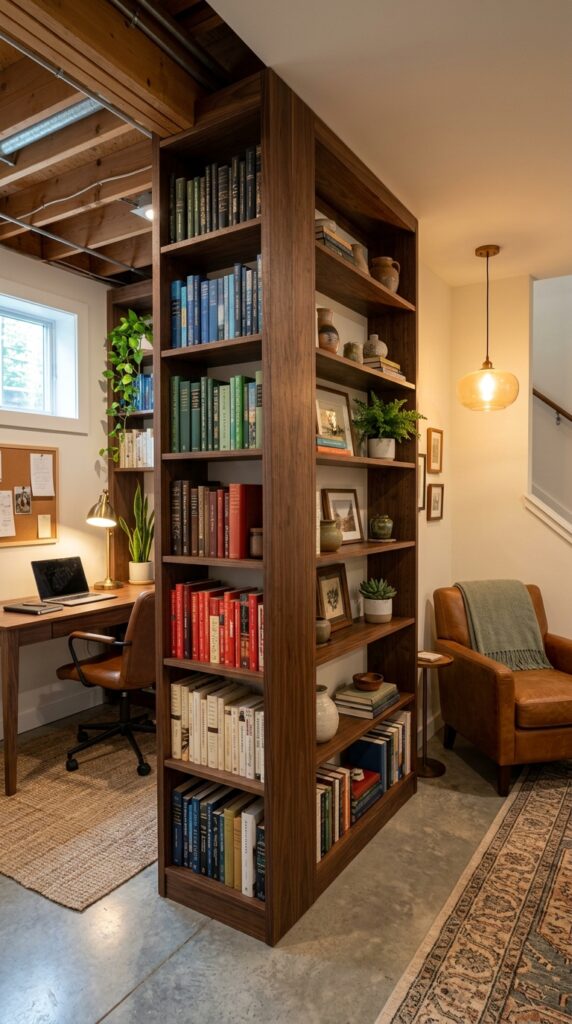
Vibe: Warm — the shelf divides without separating, making both zones feel connected to the same room.
An open-back freestanding bookshelf used as a room divider is one of the most versatile layout tools available for an open-plan basement. The design principle is permeable division: unlike a solid partition, an open bookshelf allows light, air, and visual connection to pass through while still providing the spatial definition that makes two distinct zones feel like distinct rooms. The shelf needs to be tall enough to visually read as a “wall” — minimum 72 inches — and it must be secured to a joist or wall with an anti-tip bracket for safety. The key styling move is using both faces deliberately: color-organize books on the side facing the office zone (which creates a composed, pattern-like appearance from that angle) and arrange ceramics, plants, and objects on the living room face (which creates a warmer, more decorative surface from that side). Each face tells a different story about the zone it faces.
🛍️ Shop the Look — Amazon Product Ideas
| # | Product Search Phrase | Why It Fits |
| 1 | Tall open bookshelf 6 shelf dark walnut | Primary room divider furniture |
| 2 | Anti-tip furniture anchor strap kit | Safety securing for tall shelf |
| 3 | Book organization by color system | Visual pattern on office face |
| 4 | Ceramic vessel set matte earthy tones | Object styling on living face |
| 5 | Trailing hanging plant hanger shelf insert | Organic element in bookshelf display |
25. Compact Basement Media Zone With Low Profile Furniture
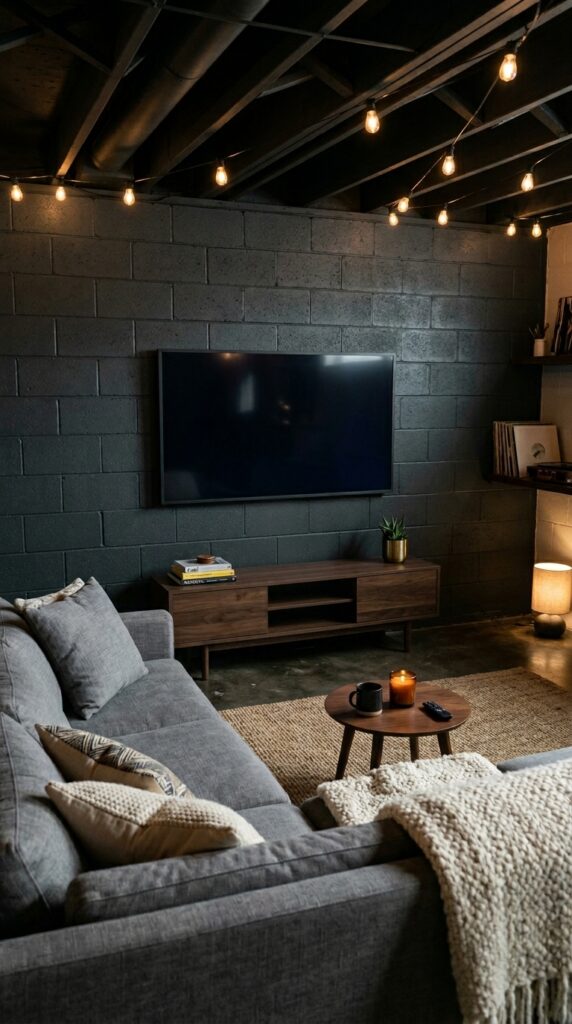
Vibe: Cozy — the low furniture makes the ceiling feel generous and the room feel composed around the screen.
A compact basement media zone is the most functional and most-used unfinished basement transformation, and the critical design decision is furniture height. The design principle is vertical proportion management: low-profile furniture — sofas with a seat height of 28 inches or less, media consoles with legs rather than box bases, coffee tables that barely clear the floor — makes a basement with standard 7-foot ceilings feel significantly more spacious by keeping the eye traveling horizontally rather than vertically. The TV wall benefits from a single dark paint treatment — even just one coat of dark charcoal in “Peppercorn” (Sherwin-Williams) directly on the CMU block — which visually recedes the wall and makes the screen appear to float. Group the sofa close to the screen (8–10 feet for standard 65-inch displays rather than the 14-foot spacing people instinctively use), which makes the viewing experience more immersive and the room feel intentionally cozy rather than cavernous.
🛍️ Shop the Look — Amazon Product Ideas
| # | Product Search Phrase | Why It Fits |
| 1 | Low profile media console dark walnut legs | Right-height TV furniture |
| 2 | Low sectional sofa 28 inch seat height gray | Compact media zone seating |
| 3 | TV wall mount tilting articulating black | Flush TV mounting bracket |
| 4 | Cable management raceway paintable | Hidden cord run on wall |
| 5 | Wool throw blanket chunky gray | Cozy textile for media viewing |
How to Start Your Unfinished Basement Transformation
Your single first move should be painting the ceiling matte black. Not the floor, not the walls, not buying furniture — the ceiling. This one decision costs under $80 in paint and a weekend of labor, and it instantly transforms the way the entire space feels by making exposed joists, pipes, and ducts recede into a unified dark field rather than reading as a collection of competing objects. Everything else you add after that — lighting, furniture, rugs — will immediately look better against a resolved ceiling backdrop.
The most common beginner mistake is buying furniture that is too tall. People shop for basement furniture the same way they shop for upstairs rooms, and then wonder why the space feels cramped. In a basement with 8-foot ceilings, a sofa with a 36-inch back or a bookshelf that reaches the ceiling without clearance creates a boxing-in sensation that undermines every other design choice. Scale down aggressively: 28-inch seat heights, consoles under 36 inches, rugs that end 18 inches from the walls rather than sitting tightly against them.
For immediate impact under $50: a large flat-weave jute rug runner ($35–$45 on Amazon) laid along the main walking path, a set of clip-on reading lights in warm white for the seating zone ($12–$18), and a can of matte black spray paint to start the ceiling transformation (one 12-oz can, $8).
A starter basement transformation — ceiling paint, one rug, string lights, and a few styled shelves — can realistically be achieved in two focused weekends with a budget of $200–$400. A fuller transformation involving flooring treatments, a media zone, furniture, and a functional gym corner realistically runs $800–$2,000 and takes several weekends spread over two to three months.
Frequently Asked Questions About Unfinished Basement Transformations
What is the difference between an unfinished basement and a finished basement in design terms?
An unfinished basement retains its raw structural elements — exposed concrete floors and walls, visible joists, open mechanicals — as visible design components rather than concealing them behind drywall, drop ceilings, and carpet. A finished basement typically involves enclosing all structural and mechanical elements to create a space that resembles the rooms above. The unfinished design approach costs significantly less (often 60–80% less than a full finish-out) while achieving a distinct industrial-residential aesthetic that many homeowners now prefer for its authenticity and visual interest.
What colors work best on unfinished basement walls?
The most effective colors for raw concrete or CMU block walls fall into two groups: light and reflective (warm whites like Benjamin Moore “White Dove” OC-17 or limewash in natural stone tones) for basements with limited natural light, or deep and saturated (navy “Hale Navy” BM 1647, charcoal “Iron Mountain” BM 2134-30, or terracotta clay tones) for basements used as entertainment or media spaces where a dramatic atmosphere is the goal. Avoid cool-toned whites or grays — they amplify the coldness inherent in below-grade spaces. Always use masonry-specific primer before any paint on CMU block.
How much does it realistically cost to transform an unfinished basement without fully finishing it?
A cosmetic transformation — painting the ceiling, sealing or painting the floor, adding lighting and furniture — typically runs $300–$800 for a 400–600 square foot basement if you DIY most of the work. Adding a simple zone-defined gym or media setup brings the total to $800–$2,000. Full transformation with custom shelving, a bar counter, and high-quality furniture can reach $3,000–$6,000 — still a fraction of the $15,000–$40,000 cost of a professionally finished basement. The biggest cost variable is flooring: rubber gym tiles or painted concrete are inexpensive, while polished or stained concrete professionally applied can run $3–$8 per square foot.
Can an unfinished basement style work with modern or contemporary home decor?
It integrates naturally with several contemporary styles — particularly industrial-modern, Japandi-industrial, and raw minimalism — because the exposed materials (concrete, steel, wood joists) are themselves foundational to those aesthetics. Where it requires more deliberate bridging is in traditionally finished homes with craftsman or traditional decor, where the raw basement can feel tonally disconnected from the rest of the house. The solution is a warm material bridge: bring one material from upstairs into the basement (the same wood species as your main floor furniture, for example) so the spaces feel related even if their finishes differ.
Do I need to waterproof my unfinished basement before decorating it?
Before investing in any furniture or decorative elements, test for moisture intrusion with a simple plastic sheet test: tape a 12×12-inch square of plastic sheeting to the concrete floor and wall with duct tape, seal all edges, and leave for 48–72 hours. If moisture appears on the underside of the plastic (between plastic and concrete), you have active moisture coming through the slab or wall and should address it before decorating — a penetrating concrete waterproofing sealer ($40–$80 for most basement-sized applications) is the first step for minor seepage. If moisture appears on the top surface of the plastic, it’s airborne condensation, which is managed with a dehumidifier rather than a floor treatment.
Ready to Create Your Dream Unfinished Basement?
These 25 ideas cover the full range of what an unfinished basement transformation can look like — from painted ceilings and sealed concrete floors to rope-wrapped pipes and vertical plant walls, from media zones to gym corners to reading nooks enclosed in linen curtains. Start with what your space already has — exposed joists, a raw concrete floor, structural columns — and choose the one idea that addresses the most visible element first. That first move matters more than any subsequent decision because it sets the visual tone that everything else must respond to. Today: buy one can of matte black ceiling paint and apply it to a 4×4-foot test patch on your basement ceiling — see how it changes the character of the space before committing to a full application. When the transformation is complete, an unfinished basement done with intention doesn’t feel like a compromise — it feels like the most authentic room in the house, grounded in real material and real function. Pin the ideas that made you stop scrolling, especially the concrete and material details — they are the ones that will still feel right in ten years.