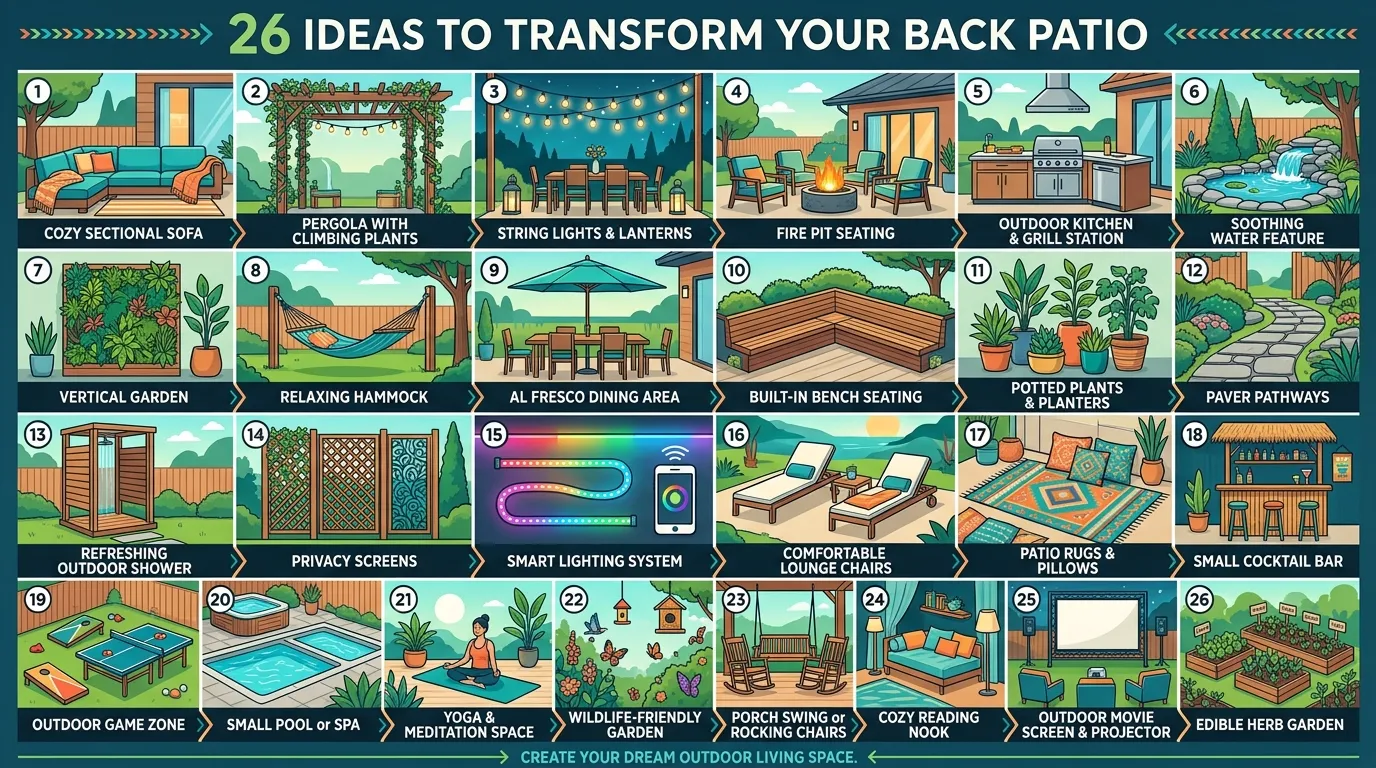
A back patio is any outdoor surface — concrete, pavers, brick, or wood decking — immediately behind your home that serves as an extension of your interior living space. This article gives you exactly 26 back patio ideas spanning materials, lighting, furniture, color, layout, and accessories so you can design a space you’ll actually use.
There’s something about a well-designed back patio that pulls you outside before you’ve even thought about it. The texture of natural stone underfoot, the scent of climbing jasmine, the low amber glow of a string light reflected in a glass at dusk — it all conspires to slow you down. A patio done right isn’t a backyard feature. It’s a room without walls. Here are 26 ideas worth saving — and stealing.
Why a Thoughtfully Designed Back Patio Works So Well
The back patio has quietly become the most-used room in many homes. Unlike a front yard — performative, public-facing — the back patio is personal. It’s where real life happens: barefoot mornings, late dinners, the slow Sunday that stretches into dark.
Design-wise, back patios sit at the intersection of architecture and landscape, inheriting principles from both. The best examples draw on mid-century modernism (clean geometry, indoor-outdoor continuity), Japandi minimalism (natural materials, purposeful restraint), and Mediterranean terrace living (layered textiles, shade structures, communal seating). What unifies all of them is the same idea: treat the patio as a proper room, with zones, lighting, and material hierarchy.
The palette language of outdoor design is earthy and warm. Concrete grey, warm sand, weathered teak, terracotta blush, dusty sage, off-white linen, and oxidized iron are the tones that age well, resist trend fatigue, and photograph beautifully in natural light. Materials should be tactile: tumbled limestone, rough-sawn cedar, woven all-weather wicker, brushed stainless, and glazed ceramic. Run your hand along any surface and it should tell you something.
Patios are trending harder now than at any point in a decade. Post-pandemic, the outdoor room became non-negotiable — not a luxury, but a functional necessity. Pinterest searches for “back patio ideas” have consistently ranked among the top home improvement categories since 2021, with particular momentum around the “quiet luxury outdoor” and “soft landscaping” aesthetics. People want stillness, and they want it accessible from the kitchen door.
Small patios — even 8×10 feet — can absolutely achieve a finished, intentional look. The key is to prioritize one anchor piece (a single good sofa or a round bistro table, not both), keep your surface material consistent to avoid visual fragmentation, and use vertical elements like wall-mounted planters or a trellis to create the sense of enclosure without eating floor space.
Style at a Glance
| Element | Trait 1 | Trait 2 |
| Philosophy | Indoor comfort, outdoor context | Purposeful, liveable design |
| Materials | Natural stone, teak, cedar, wicker | Ceramic, linen, brushed metal |
| Color palette | Warm sand, concrete grey, dusty sage | Terracotta, off-white, oxidized iron |
26 Back Patio Ideas to Transform Your Outdoor Living Space
1. Layered Terracotta Tile Flooring with Contrasting Grout

Vibe: Sun-warmed. This floor radiates heat long after the sun drops below the fence line.
Why it works: Terracotta is among the oldest patio materials in the world, and it earns its continued relevance through thermal mass — it absorbs heat during the day and radiates warmth into the evening. The irregular surface creates micro-shadows that give the floor visual depth without any decorative effort. Pale grey grout (rather than matching terracotta or stark white) unifies the tiles while letting each individual piece remain distinct — a principle called “selective contrast” that makes a repeating pattern feel artisanal rather than uniform.
How to get it: Source handmade or tumbled terracotta tiles rather than machine-cut — the slight variation in thickness and edge creates the character. Use a grey grout in the range of Mapei #09 Silver or #10 Aluminum, which reads warm in direct sun and cool in shade, bridging the terracotta tone across lighting conditions.
💡 Quick Win: A single sample tile (often free or under $5 at tile suppliers) placed on your existing patio surface for a week tells you more about tone-matching than any photo can. Terracotta shifts dramatically from dry to wet and from morning to afternoon light.
🛍️ Shop the Look — Amazon Product Ideas
| # | Product Search Phrase | Why It Fits |
| 1 | terracotta hex floor tiles handmade | Authentic material, warm tone |
| 2 | pale grey unsanded tile grout bag | Contrast without clashing |
| 3 | terracotta planter with drainage saucer | Continues tile colorway |
| 4 | natural rattan outdoor accent chair | Textural counterpoint |
| 5 | outdoor tile sealer matte finish | Protects and deepens color |
2. Overhead String Lights on a Cedar Pergola

Vibe: Luminous. Every conversation held under this patio ceiling feels like it matters.
Why it works: String lights work on the principle of distributed low-level ambient lighting — rather than one harsh overhead source, you get dozens of small warm pools that flatten unflattering shadows and make faces glow. Strung in parallel lines (not looped randomly) on a pergola, they create implied ceiling geometry that anchors the space visually, giving it the same psychological enclosure as a roof without blocking sky or airflow. Cedar specifically ages to a silvery grey that contrasts richly with warm-white bulb tones.
How to get it: Run strings perpendicular to the longest pergola beam, spaced 16–18 inches apart, and use S-hooks rather than zip ties so you can adjust tension. Choose bulbs with a color temperature of 2200K (amber-warm) rather than 2700K (standard warm white) — the difference is subtle in photography but palpable in person.
🛍️ Shop the Look — Amazon Product Ideas
| # | Product Search Phrase | Why It Fits |
| 1 | outdoor Edison string lights 50ft S14 bulb | Core lighting element |
| 2 | cedar pergola kit freestanding 10×12 | Structural anchor for lights |
| 3 | outdoor S-hook set stainless steel | Adjustable, rust-resistant |
| 4 | linen outdoor sofa cushion set | Soft textile contrast |
| 5 | concrete round side table outdoor | Minimalist surface beneath |
3. Defined Dining Zone with a Round Teak Table

Vibe: Grounded. A round teak table outside feels like an invitation that never expires.
Why it works: Round tables eliminate the hierarchy problem of rectangular outdoor furniture — there’s no “head of the table,” which subtly equalizes conversation and encourages lingering. Teak is one of the few hardwoods that requires no sealing or oiling to remain structurally sound outdoors; left untreated, it weathers to a uniform silver-grey that actually improves over time and coordinates beautifully with both concrete and stone surfaces.
How to get it: Define the dining zone by centering the table on a contrasting rug — an outdoor flatweave in warm sand or terracotta defines the zone without requiring any construction. Leave at least 36 inches between chair backs and any wall or planter to allow comfortable movement when someone stands up.
💡 Quick Win: An outdoor jute or flatweave rug under $45 on Amazon defines a dining zone on any patio surface and makes the furniture arrangement feel intentional rather than simply placed. Look for UV-stabilized polypropylene weaves that mimic jute texture without the mold risk.
🛍️ Shop the Look — Amazon Product Ideas
| # | Product Search Phrase | Why It Fits |
| 1 | round teak outdoor dining table 48 inch | Core furniture anchor |
| 2 | teak outdoor dining chairs set of 4 | Matching material language |
| 3 | outdoor flatweave rug sand color | Zone definition |
| 4 | ceramic olive branch table centerpiece | Organic sculptural accent |
| 5 | off-white linen outdoor placemat set | Textured table layering |
4. Dusty Sage Exterior Paint as a Patio Backdrop

Vibe: Still. A sage backdrop quiets everything set against it.
Why it works: Dusty sage — specifically the grey-green range found in colors like Benjamin Moore HC-114 Aganthus Green or Farrow & Ball Mizzle — functions as a neutral in outdoor contexts. Its muted quality means it recedes visually, making furniture and plantings pop without competing for attention. It also ages gracefully: sage is deeply forgiving of chalking, fading, and weathering in a way that saturated greens never are.
How to get it: For stucco or masonry walls, use an exterior elastomeric paint rather than standard exterior latex — it flexes with temperature expansion and prevents cracking. Apply two coats in the cooler part of the day to avoid lap marks. Pair with terracotta planters and off-white trim for a palette that requires no rethinking season to season.
🛍️ Shop the Look — Amazon Product Ideas
| # | Product Search Phrase | Why It Fits |
| 1 | dusty sage exterior paint matte finish | Core backdrop color |
| 2 | white ceramic wall sconce outdoor waterproof | Clean wall-mounted accent |
| 3 | large white ceramic outdoor planter with drainage | Base-of-wall planting |
| 4 | climbing rose trellis wall mounted | Softens painted surface |
| 5 | elastomeric masonry exterior paint brush set | Proper application tools |
5. Built-In Concrete Bench with Cushion Seating

Vibe: Architectural. This bench doesn’t look added — it looks grown from the patio itself.
Why it works: Built-in seating performs a critical layout function: it defines the boundary of a space without requiring a fence or wall. The L-shape creates corner enclosure — the psychological equivalent of sitting with your back to a wall, which is consistently rated as the most comfortable seating position in environmental psychology research. Concrete as a bench material has near-zero maintenance requirements, accepts any cushion depth, and creates a visual weight that prevents lighter furniture nearby from looking unanchored.
How to get it: Commission a local concrete contractor to pour an L-shaped bench at 18 inches high and 22 inches deep — these are the standard seat height and depth dimensions for comfortable outdoor seating. Order custom cushions in Sunbrella Linen or similar performance fabric, which is solution-dyed and can be left outside year-round in most climates.
🛍️ Shop the Look — Amazon Product Ideas
| # | Product Search Phrase | Why It Fits |
| 1 | custom outdoor bench cushion sunbrella fabric | Performance seating comfort |
| 2 | outdoor throw blanket woven cotton | Tactile layering accessory |
| 3 | terracotta cluster pot set outdoor | Warm material at bench end |
| 4 | concrete repair and sealer outdoor bench | Surface maintenance |
| 5 | outdoor lumbar pillow performance linen cream | Comfort and tone-matching |
6. Japanese-Inspired Gravel Garden Inset

Vibe: Meditative. This small inset introduces a pocket of intentional stillness within a larger patio.
Why it works: The contrast between the fixed hardscape patio and the “soft” gravel garden inset creates visual rhythm — your eye moves between the structured patio geometry and the organic stone placement, and that movement is what makes the overall design feel considered rather than formulaic. From a practical standpoint, inset gravel areas also manage drainage elegantly, absorbing rainfall that would otherwise pond on a sealed surface.
How to get it: Cut a rectangular or square opening in an existing concrete patio using a diamond blade wet saw, then fill with 3–4 inches of decomposed granite or fine gravel over a layer of landscape fabric. Steel edging keeps gravel contained. Size the inset to at least 4×4 feet — smaller than this and the proportions read as a planting bed rather than a design feature.
💡 Quick Win: A 50-pound bag of pea gravel or fine white granite chips (under $20 at most garden centers) can fill a 3×3-foot framed wood inset on an existing patio as a test run before committing to any cutting.
🛍️ Shop the Look — Amazon Product Ideas
| # | Product Search Phrase | Why It Fits |
| 1 | matte black steel landscape edging strips | Clean gravel boundary |
| 2 | fine white decomposed granite 50lb bag | Core gravel fill |
| 3 | dark river stones decorative rocks | Asymmetric stone placement |
| 4 | ceramic outdoor lantern matte black | Focal point beside maple |
| 5 | bamboo garden rake mini Zen style | Gravel raking tool |
7. Vertical Herb Wall as a Fragrant Patio Feature

Vibe: Layered. A herb wall turns a blank fence into a living texture you can smell from across the patio.
Why it works: Vertical planting exploits the one dimension most patio decorators ignore — height. A herb wall instantly adds what landscape designers call “the third dimension” to a flat, horizontal patio environment, and it does it at zero floor space cost. Fragrant herbs (rosemary, thyme, lemon balm) also function as passive insect deterrents, particularly relevant near a dining area.
How to get it: Use a modular steel planter frame (available in 4-foot and 8-foot widths) mounted into fence studs with lag bolts rather than screws — the weight of wet soil is significant. Mix herbs by growth rate, placing slow-growing woody herbs (rosemary, thyme) at the top where maintenance is harder to reach, and fast-growing soft herbs (basil, cilantro) at eye level where regular harvesting keeps them in check.
🛍️ Shop the Look — Amazon Product Ideas
| # | Product Search Phrase | Why It Fits |
| 1 | vertical garden wall planter modular steel frame | Core structural element |
| 2 | terracotta pocket herb pot set | Warm-toned individual pots |
| 3 | herb seed starter kit outdoor garden | Immediate planting setup |
| 4 | wall-mounted wooden garden shelf outdoor | Supplementary surface below |
| 5 | small copper watering can outdoor use | Functional decorative accent |
8. Woven Outdoor Rug in Warm Sand and Terracotta Stripe

Vibe: Sun-warmed. Stripes on an outdoor rug create visual ground that anchors furniture without requiring any anchoring at all.
Why it works: Outdoor rugs perform a room-defining function that is genuinely irreplaceable — they draw an invisible boundary around a furniture grouping that tells visitors “this is the living area” in the same way walls would indoors. Stripes specifically create linear direction, which helps elongate or widen a space depending on which way you orient them. Horizontal stripes (parallel to the widest dimension) read as expansive; vertical stripes (parallel to the narrowest) read as lengthening.
How to get it: Choose a polypropylene flatweave in a UV-stabilized construction — these are the only outdoor rug materials that don’t require covering during rain. Size the rug so that all front legs of every piece of furniture sit on it: this is the single most common outdoor rug sizing mistake. For an average seating arrangement, this means a minimum 8×10 foot rug.
🛍️ Shop the Look — Amazon Product Ideas
| # | Product Search Phrase | Why It Fits |
| 1 | outdoor flatweave rug striped terracotta sand 8×10 | Core zone-defining textile |
| 2 | all-weather rattan outdoor sofa with cushions | Furniture over rug |
| 3 | round teak outdoor coffee table low | Anchor piece on rug |
| 4 | ceramic outdoor succulent bowl planter | Organic table accent |
| 5 | outdoor rug pad non-slip hard surface | Prevents rug movement |
9. Solar-Powered Pathway Lanterns in Matte Black

Vibe: Romantic. A lit pathway creates arrival — the feeling of being drawn somewhere worth going.
Why it works: Pathway lighting does more than illuminate a walking surface. It creates spatial sequence — a sense that the patio is a destination reached through an experience, not simply a surface you step onto from the back door. Matte black lanterns specifically work because they disappear in daylight (no visual clutter) and reappear in the dark as warm, intentional glowing objects. The contrast between their dark bodies and the warm light they emit is visually arresting without being theatrical.
How to get it: Space pathway lanterns at 6-foot intervals, alternating sides of the path for visual rhythm. Solar models now charge adequately even in partial shade conditions — look for lanterns with a minimum 6-hour battery life and warm white (2700K or lower) LEDs. Avoid cool white (5000K) solar lights, which create a harsh, institutional quality at night.
💡 Quick Win: Four solar pathway lanterns under $35 total (about $8–$10 each from most Amazon suppliers) can transform any patio approach in an afternoon with zero wiring. Stake them into a prepared bed, not directly into gravel — they hold more securely.
🛍️ Shop the Look — Amazon Product Ideas
| # | Product Search Phrase | Why It Fits |
| 1 | matte black solar pathway lantern set of 6 | Core lighting installation |
| 2 | ornamental grass outdoor potted | Softens path edges |
| 3 | pea gravel pathway fill bag | Path surface material |
| 4 | landscape edging matte black flexible | Path definition |
| 5 | solar spotlight warm white low voltage | Supplementary accent light |
10. Small Patio Bistro Corner with Mosaic Tile Table

Vibe: Intimate. This corner has the energy of a Parisian café transplanted to your back garden.
Why it works: Bistro setups exploit corner geometry — two walls meeting at 90 degrees create a “backed” seating experience that is inherently more restful than seating in open space. For small patios, a 24-inch mosaic table and two chairs occupies roughly 36 square feet total, making it one of the most space-efficient ways to create a complete, finished seating vignette. The mosaic surface introduces artisanal handcraft into a garden setting — something that plants alone cannot replicate.
How to get it: Source a ready-made mosaic bistro table in a Moroccan or Mediterranean pattern from specialty garden retailers rather than mass-market sources — the difference in tile quality and grout workmanship is significant. Pair with wrought iron café chairs, which are lightweight enough to move but heavy enough to not blow over in a breeze.
🛍️ Shop the Look — Amazon Product Ideas
| # | Product Search Phrase | Why It Fits |
| 1 | mosaic tile round bistro table outdoor 24 inch | Core vignette focal point |
| 2 | wrought iron cafe chair outdoor bistro set | Period-appropriate seating |
| 3 | ceramic bud vase for outdoor use | Tabletop organic accent |
| 4 | outdoor wall sconce Spanish style white | Wall-mounted lighting |
| 5 | lavender plant in terracotta pot small | Fragrant bistro companion |
11. Neutral Concrete Pavers with Warm Sand Mortar Joints

Vibe: Raw. The shadow lines created by wide mortar joints give this floor its own quiet geometry.
Why it works: Large-format pavers with intentionally wide joints operate on the principle of visual rhythm — the joint pattern creates a grid that the eye follows as it reads the space, which makes even a small patio feel ordered and expansive. Sand-colored mortar (as opposed to grey, which reads cold) bridges the warmth gap between the concrete grey paver surface and any warm-toned furniture or plantings nearby. The staggered bond pattern specifically avoids continuous grout lines, which can make a patio look like a commercial car park.
How to get it: Specify 2-inch thick pavers for ground-level installations — thinner pavers crack under point loads from chair legs. Mix mortar joints with a polymer-modified sand (Sakrete Polymeric Sand is widely available) rather than standard masonry sand, which washes out in rain and requires regular resanding.
🛍️ Shop the Look — Amazon Product Ideas
| # | Product Search Phrase | Why It Fits |
| 1 | polymeric joint sand for pavers large format | Stable joint material |
| 2 | white powder-coated steel outdoor lounge chair | Clean minimal furniture |
| 3 | tall ornamental grass container black planter | Vertical element beside patio |
| 4 | concrete paver sealer penetrating matte | Surface protection |
| 5 | level tool rubber mallet paver installation kit | DIY installation prep |
12. Warm White Outdoor Wall Sconces Flanking Doors

Vibe: Welcoming. Flanking sconces give a back door the sense of ceremony usually reserved for front entries.
Why it works: Symmetrical lighting flanking a doorway creates what lighting designers call “gateway framing” — the eye reads the matching sconces as columns, creating an implied portal that elevates the status of a simple door. The key is keeping the mounting height consistent at 65–70 inches above the threshold, which puts the light source at eye level and prevents the harsh upward or downward shadows that result from incorrect placement.
How to get it: Choose sconces rated IP65 or higher for outdoor use — this rating ensures they’re resistant to water jets, not just light rain. Wire to a smart switch (Lutron Caseta is reliable and wide-spec compatible) so you can set them on a dusk-to-dawn schedule without a separate photocell.
💡 Quick Win: A set of two matching solar wall sconces under $40 total can be installed in 20 minutes with no wiring — just mount to any wall surface using the included hardware. Performance has improved dramatically for the symmetrical flanking look; just confirm both units face the same solar direction.
🛍️ Shop the Look — Amazon Product Ideas
| # | Product Search Phrase | Why It Fits |
| 1 | ceramic outdoor wall sconce matte white matte black arm | Core flanking light |
| 2 | smart outdoor light switch dusk to dawn | Scheduling capability |
| 3 | small olive tree in square black planter | Doorway framing plants |
| 4 | brushed brass door handle set exterior | Warm metal hardware accent |
| 5 | Edison bulb outdoor rated warm 2200K | Lamp tone specification |
13. Fire Pit Circle with Moveable Teak Seats

Vibe: Communal. A fire circle compresses social distance in a way that no other patio arrangement manages.
Why it works: Fire pit circles work on a combination of centripetal geometry and radiant warmth. All seating oriented toward a central point eliminates the awkward “who do I face” problem of linear seating arrangements, while the fire provides both a focal point for attention and a practical heat source that extends patio use by weeks on either end of the season. The key design principle is equidistance — each seat the same distance from the fire and from each other.
How to get it: Leave a minimum 7-foot diameter clear zone around any fire pit — this is both a safety standard and a comfort requirement, as chairs at 3.5 feet from the fire edge are comfortably warm rather than hot. Use moveable seating (rather than built-in) so the arrangement can be reconfigured for smaller or larger groups.
🛍️ Shop the Look — Amazon Product Ideas
| # | Product Search Phrase | Why It Fits |
| 1 | concrete fire pit bowl outdoor 24 inch | Core fire feature |
| 2 | teak curved outdoor bench moveable | Curved seating for circle |
| 3 | log rack outdoor split wood holder | Firewood storage element |
| 4 | long reach fireplace matches outdoor | Safe fire-starting tool |
| 5 | round concrete side table outdoor low | Drink surface by fire seat |
14. Trailing Pothos and Ferns in Hanging Wicker Baskets

Vibe: Layered. Suspended plants turn a flat overhead into a living canopy that changes the entire quality of the light reaching you.
Why it works: Hanging planters introduce plant life at eye and overhead level, completing the vertical dimension that ground-level pots leave unaddressed. The visual principle at work is “stacking planes” — ground layer (rug, floor), mid layer (furniture, upright pots), overhead layer (hanging plants) — which replicates the sense of enclosure found in a forest and gives any open patio a feeling of shelter and intimacy. Trailing plants specifically are more effective than upright types because their downward growth visually connects the overhead layer to the mid layer.
How to get it: Use moisture-sensing wicker liners rather than solid coco liner for hanging baskets that will stay out in rain — they self-drain while retaining enough moisture to prevent cycle watering. Mix three plant types per basket: one trailing (pothos or string of pearls), one mounding (fern or asparagus fern), and one upright (a small dracaena or ti plant) for a naturally varied silhouette.
🛍️ Shop the Look — Amazon Product Ideas
| # | Product Search Phrase | Why It Fits |
| 1 | wicker hanging basket planter with coco liner set of 3 | Core hanging planter |
| 2 | golden pothos live plant trailing | Fast-trailing primary plant |
| 3 | Boston fern live outdoor plant hanging | Classic companion fern |
| 4 | adjustable hanging basket chain hook | Height-variable suspension |
| 5 | slow-release outdoor fertilizer pellets | Plant health maintenance |
15. Compact Outdoor Kitchen Cart on Wheels

Vibe: Functional. A grill cart makes the cooking zone feel deliberate — like someone thought it through — rather than improvised.
Why it works: A kitchen cart beside a grill solves one of outdoor cooking’s persistent friction points: no prep surface. By giving the chef a dedicated work station, you transform grilling from a standing-while-waiting experience into an active cooking ritual, which changes how long people linger near the grill and how the social energy of the patio flows. Porcelain tile tops are resistant to heat, grease, and UV fading in a way that natural wood or painted surfaces never fully achieve.
How to get it: Choose a cart with a weight rating of at least 150 pounds for the top surface — this accommodates a full cutting board, a mixing bowl, and a drink without any concern. Locking casters are non-negotiable: even slight wind can move an unlocked cart, particularly on a smooth paver surface.
💡 Quick Win: A magnetic stainless tool strip ($15–$20) mounted on the side of any existing surface — even a fence post near the grill — immediately organizes tools and creates the visual signal of a proper outdoor kitchen without any cart purchase required.
🛍️ Shop the Look — Amazon Product Ideas
| # | Product Search Phrase | Why It Fits |
| 1 | outdoor kitchen cart stainless steel with wheels | Core functional unit |
| 2 | porcelain tile cutting board outdoor use | Heat-resistant prep surface |
| 3 | outdoor grill tool set with hanging hooks | Organized tool storage |
| 4 | magnetic tool strip stainless outdoor use | Side-mount tool holder |
| 5 | outdoor condiment caddy stainless steel | Tabletop organization |
16. Charcoal and White Color Story for a Modern Edge

Vibe: Confident. A charcoal and white patio doesn’t ask for your approval — it simply is what it is.
Why it works: Two-tone palettes are among the most powerful design tools available because they eliminate decision fatigue entirely — every element either stays in the palette or becomes an accent. Charcoal specifically (not black, which reads harshly outdoors) is warm enough to feel liveable while dark enough to create strong contrast against white metal and pale stone. This palette also reads differently in every lighting condition: crisp and graphic at noon, moody and deep at dusk.
How to get it: Keep to no more than two textures within this palette — one matte (pavers, concrete planter) and one semi-gloss (plant pots, cushion fabric). More surface finishes dilute the directness that makes this palette powerful. Introduce one warm accent — a single terracotta pot, a wood tray — to prevent the space from reading cold.
🛍️ Shop the Look — Amazon Product Ideas
| # | Product Search Phrase | Why It Fits |
| 1 | charcoal grey large format concrete paver | Core floor surface |
| 2 | white powder-coated steel outdoor sofa frame | Structural color contrast |
| 3 | charcoal grey outdoor sofa cushion set waterproof | Tone-matching upholstery |
| 4 | glossy white large ceramic planter outdoor | High-contrast planter form |
| 5 | black mondo grass plant | Dark foliage for white pots |
17. Pergola Side Panel with Climbing Jasmine

Vibe: Romantic. Jasmine doesn’t announce itself visually — it announces itself before you’ve even seen it.
Why it works: A vine-covered pergola panel functions simultaneously as a privacy screen, a fragrance source, and a textural backdrop — three design roles filled by one element. Trachelospermum jasminoides (star jasmine) is particularly well-suited to this application because it is evergreen, grows densely without becoming invasive, and blooms heavily enough in late spring to effectively tile the entire lattice surface with white flowers. The fragrance radius is approximately 15–20 feet on a warm evening.
How to get it: Plant star jasmine at the base of the lattice in groups of three rather than one — this fills the panel two to three times faster. Guide early growth with loose garden twine, securing new growth every two to three weeks. Full coverage of a 6×8-foot panel takes one to two growing seasons from established 1-gallon starts.
🛍️ Shop the Look — Amazon Product Ideas
| # | Product Search Phrase | Why It Fits |
| 1 | star jasmine trachelospermum live plant 1 gallon | Core climbing fragrant vine |
| 2 | cedar wood lattice panel outdoor 4×8 | Climbing surface structure |
| 3 | soft garden twine biodegradable | Vine training material |
| 4 | tall candle floor stand outdoor use | Intimate evening lighting |
| 5 | rattan armchair outdoor with cushion | Seating beside green wall |
18. Deep Teal as an Accent Color on Furniture and Pots

Vibe: Vibrant. Teal is the one color that reads bold in sun and soothing in shade — a rare thing in outdoor design.
Why it works: Teal (blue-green in the range of Benjamin Moore 2053-20 or Farrow & Ball Vardo) performs two roles at once outdoors. It functions as a receding cool tone that makes a space feel larger and more serene, while also functioning as a saturated accent that creates visual energy against sand, stone, and rattan neutrals. This double function makes it uniquely effective as an outdoor accent — most colors are either calming or vibrant, not both.
How to get it: Use teal in three forms maximum per patio: one large (a planter), one medium (a throw pillow or side table), one small (a candle holder or tray). This is the “rule of three” applied to a single color — enough to register as a theme, not so much that it becomes a color block.
🛍️ Shop the Look — Amazon Product Ideas
| # | Product Search Phrase | Why It Fits |
| 1 | deep teal glazed ceramic outdoor planter large | Primary accent color object |
| 2 | teal striped outdoor throw pillow UV resistant | Textile color accent |
| 3 | teal iron side table outdoor small | Furniture accent piece |
| 4 | natural rattan outdoor lounge chair | Warm neutral backdrop |
| 5 | white alyssum annual plant live 4-pack | Contrast bloom in teal pot |
19. Low Cedar Platform with Built-In Planter Border

Vibe: Grounded. A platform deck with a planter edge feels grown rather than built — like it always belonged there.
Why it works: A built-in planter at the deck perimeter solves the visual hardness problem that raw deck edges create. The abrupt transition from wood to ground is softened by the planting zone, creating a graduated edge that mimics how landscapes naturally work — a principle called “edge softening.” Functionally, the planter also demarcates the boundary of the deck space without requiring a railing, keeping sight lines open and the overall form low and horizontal.
How to get it: Use cedar for both the decking and the planter box — it’s naturally rot-resistant for ground contact and does not require pressure treatment. Line the planter box interior with pond liner, not landscape fabric alone, to prevent moisture from wicking into the structural members. Plant lavender for fragrance and drought tolerance; it thrives in well-drained elevated planters.
💡 Quick Win: A pressure-treated wood planter box kit (widely available under $40) mounted to the front edge of an existing deck with exterior screws immediately creates the built-in planter border look without any carpentry.
🛍️ Shop the Look — Amazon Product Ideas
| # | Product Search Phrase | Why It Fits |
| 1 | cedar deck planter box built-in style | Core perimeter planting |
| 2 | lavender live plant 6-inch pot | Primary planter content |
| 3 | pond liner roll garden planter waterproof | Internal planter protection |
| 4 | sisal outdoor rug for deck use | Soft layer on wood deck |
| 5 | wicker serving tray with handles outdoor | Surface styling on deck |
20. Mirror Panel to Double a Narrow Patio Visually

Vibe: Airy. A patio mirror borrows the garden behind you and doubles it.
Why it works: Mirrors in outdoor spaces work on the same principle they do in small interiors — they borrow visual depth from the opposite direction, effectively doubling the perceived length of a narrow space. Outdoors, this effect is amplified because the reflection captures sky, garden, and movement, all of which read as “away” rather than “wall.” The key technical requirement is an outdoor-rated mirror with a sealed frame, as standard interior mirrors delaminate rapidly when exposed to moisture.
How to get it: Use an acrylic mirror panel (also sold as “outdoor mirror”) rather than glass for larger installations — lighter, shatter-resistant, and safe near children. Frame it in weathered teak or powder-coated black to protect the edges. Position it to reflect the most visually interesting part of your garden, not the back door.
🛍️ Shop the Look — Amazon Product Ideas
| # | Product Search Phrase | Why It Fits |
| 1 | large outdoor mirror weathered teak frame | Core space-expanding element |
| 2 | acrylic outdoor mirror panel UV resistant | Shatterproof large version |
| 3 | narrow outdoor console table teak | Below-mirror surface |
| 4 | tall outdoor lantern pair black | Flanking mirror symmetry |
| 5 | mirror mounting clips outdoor rust-proof | Secure wall attachment |
21. Sculptural Cactus Garden in Grouped Glazed Pots
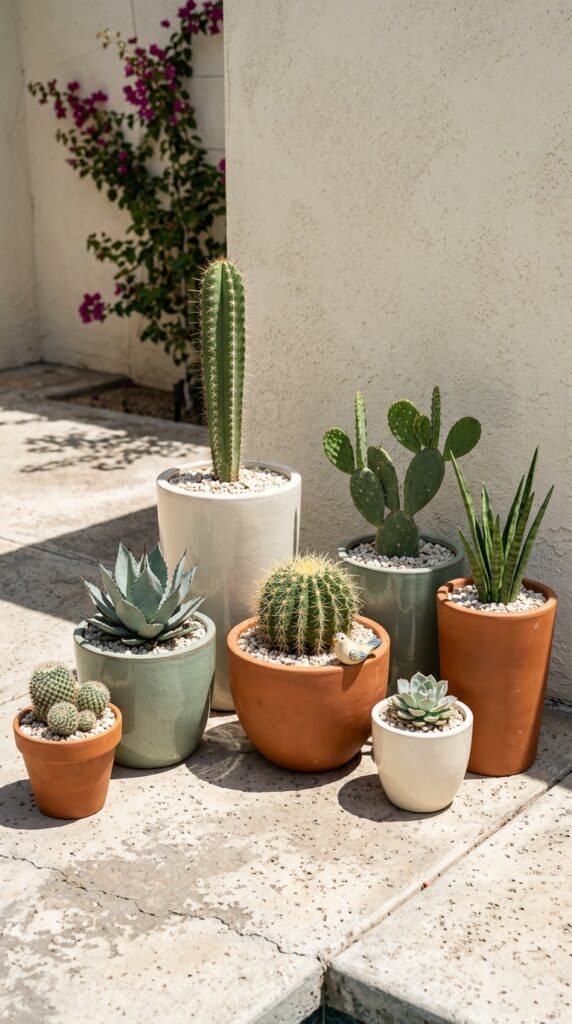
Vibe: Sculptural. A grouped cactus corner turns a corner of the patio into a living still-life.
Why it works: Grouped plantings in varied heights create what garden designers call a “tiered plant tableau” — the visual principle where the eye moves naturally from the tallest element at the back to the shortest at the front, creating depth within a contained horizontal footprint. Cacti are particularly effective in this application because their architectural forms hold visual interest year-round without requiring seasonal replanting, and their varied textures (ribbed columnar, round and spined, smooth agave) create textural contrast within a single color family.
How to get it: Group seven pots in odd numbers — three sizes: three large, two medium, two small. Place the tallest at the back left (not dead center, which looks symmetrical and formal) and graduate downward toward the front. Use glazed pots in three related tones from the same warm family — white, sage, terracotta — rather than matching pots, which flatten the grouping.
🛍️ Shop the Look — Amazon Product Ideas
| # | Product Search Phrase | Why It Fits |
| 1 | glazed terracotta outdoor ceramic planter set varying heights | Grouped pot arrangement |
| 2 | tall columnar cactus live plant 12 inch | Tall back sculptural anchor |
| 3 | barrel cactus live plant outdoor | Round mid-height form |
| 4 | white marble gravel mulch for pots | Pot top surface finish |
| 5 | agave plant blue agave live | Low flat-form contrast |
22. Floating Shelf Wall with Ceramics and Trailing Plants
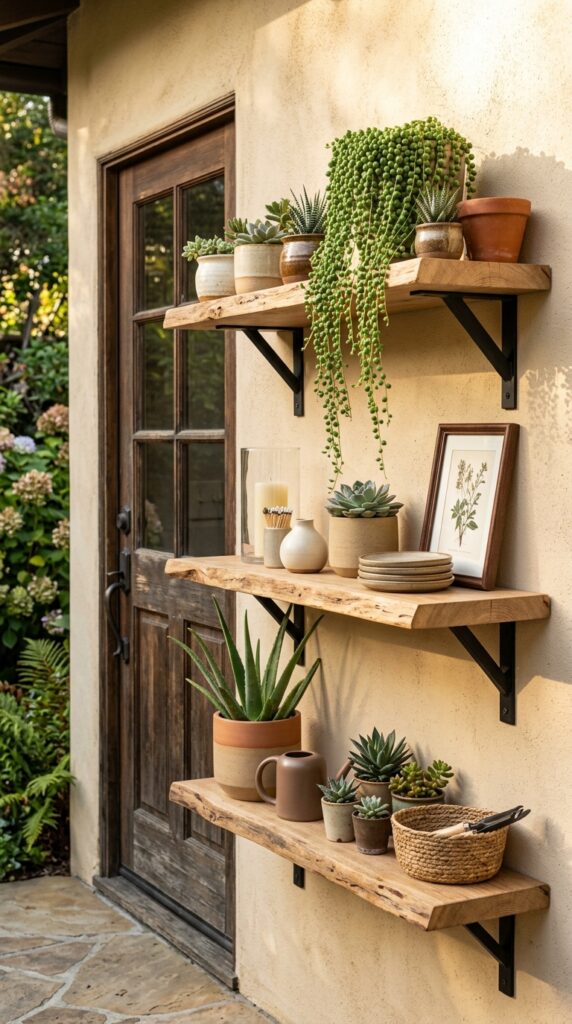
Vibe: Curated. This shelf wall looks like the patio belongs to someone with very good taste and a generous weekend afternoon.
Why it works: Outdoor floating shelves borrow their design logic from gallery walls — they convert a vertical surface from background to feature, adding collected, layered interest at eye height where guests look naturally. The combination of matte ceramics (which absorb light) and trailing plants (which create downward movement and organic texture) creates the same “gathered-over-time” aesthetic that takes indoor interiors years to develop, but can be staged outdoors in a single afternoon.
How to get it: Mount shelves into exterior wall studs, not just into siding — the load of pots with wet soil is heavier than it looks. Use stainless steel lag bolts and coat the shelf bracket contact points with exterior silicone to prevent moisture from wicking behind the brackets. Seal the shelf underside with exterior oil (outdoor furniture oil works well) to prevent checking.
🛍️ Shop the Look — Amazon Product Ideas
| # | Product Search Phrase | Why It Fits |
| 1 | floating wood shelf raw edge white oak outdoor | Core shelf surface |
| 2 | matte black angle bracket heavy duty set of 6 | Industrial mounting hardware |
| 3 | matte cream ceramic vase set outdoor | Earth-tone ceramics for shelves |
| 4 | string of pearls live plant small pot | Trailing plant for top shelf |
| 5 | glass hurricane candle holder outdoor | Ambient evening light |
23. Warm Off-White Limewash Finish on a Brick Wall
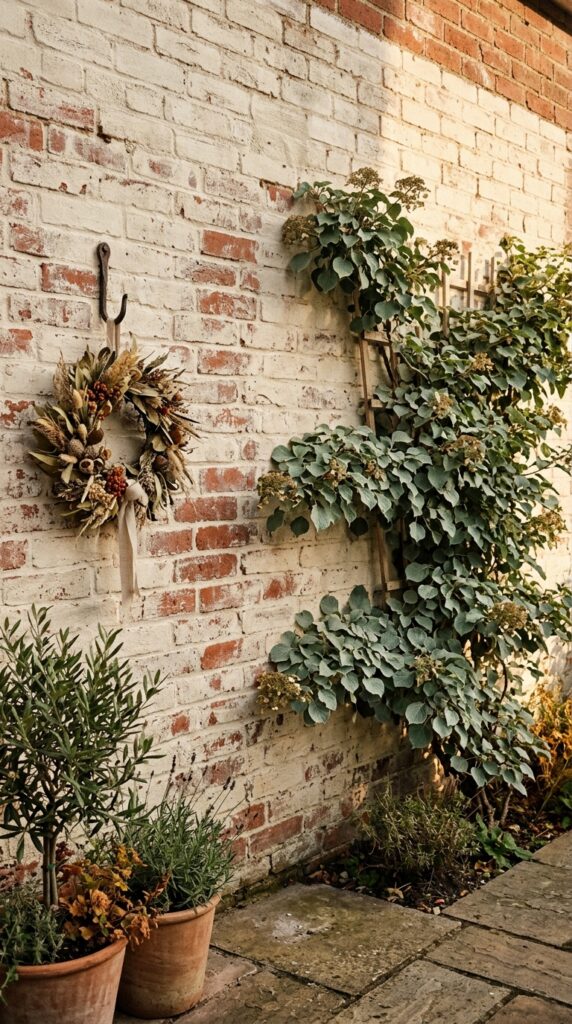
Vibe: Aged. A limewashed brick wall looks like it has been beautiful for 200 years and plans to continue.
Why it works: Limewash on brick works by partially filling the surface porosity with calcium carbonate, which creates a translucent finish rather than an opaque painted one. This means the brick’s natural texture, joint lines, and tonal variation remain readable beneath the finish — the wall looks refined without being erased. Unlike paint, limewash weathers in ways that actually improve over time: rain creates natural fade variation that enhances the artisanal quality.
How to get it: Use a purpose-formulated exterior limewash (Portola Paints or Roman Sénat are both widely available) rather than watered-down latex paint, which lacks the calcite chemistry that creates the authentic mottled texture. Apply with a large masonry brush in X-strokes, allowing coverage to vary deliberately — areas of thin application are part of the design, not a mistake.
🛍️ Shop the Look — Amazon Product Ideas
| # | Product Search Phrase | Why It Fits |
| 1 | exterior limewash paint off-white masonry | Core wall treatment material |
| 2 | wide masonry brush for limewash application | Correct application tool |
| 3 | climbing hydrangea live plant outdoor | Wall-trained green accent |
| 4 | iron wall hook antique outdoor | Rustic hanging hardware |
| 5 | dried eucalyptus wreath outdoor door | Natural textural wall hanging |
24. Low-Profile Outdoor Daybed with Canopy Frame
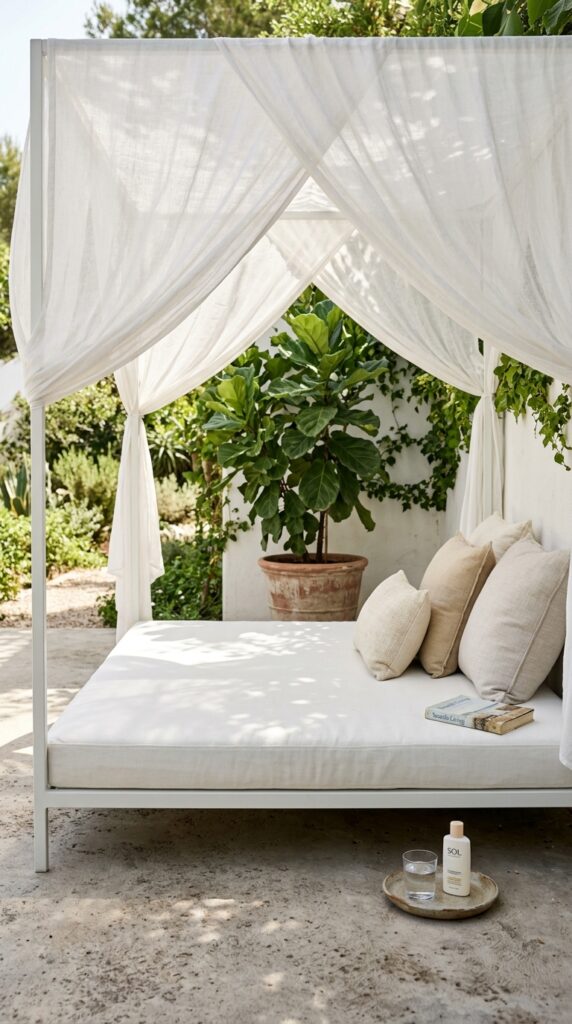
Vibe: Serene. An outdoor daybed with a canopy creates the one thing patios almost never have: shade you want to be in.
Why it works: The canopy daybed performs a microclimatic function — it creates a localized shaded zone within a sun-exposed patio without requiring a permanent structure. The sheer linen drape softens direct UV exposure while still admitting breeze, which makes it genuinely comfortable rather than just visually appealing in the midday heat common to most climates. Positioning the daybed lengthwise along the longest patio dimension also fills a substantial layout zone with a single piece, preventing the underfurnished appearance common in large flat patios.
How to get it: Choose a canopy daybed frame rated for outdoor use in aluminium rather than steel if you live in a humid coastal climate — even powder-coated steel will develop pinhole rust at joints within two to three seasons in salt air. Sunbrella canvas in a 6-inch depth cushion is the most durable and cleanable option for the mattress surface.
🛍️ Shop the Look — Amazon Product Ideas
| # | Product Search Phrase | Why It Fits |
| 1 | outdoor daybed with canopy frame white aluminium | Core furniture and shade piece |
| 2 | outdoor mattress cushion sunbrella canvas white | Durable daybed surface |
| 3 | sheer linen canopy panel outdoor | Canopy drape material |
| 4 | ceramic tray outdoor serving low profile | Bedside surface element |
| 5 | ficus standard tree large outdoor pot | Vertical backdrop beside daybed |
25. Terracotta and Cobalt Blue Moroccan Pattern Tiles on a Wall
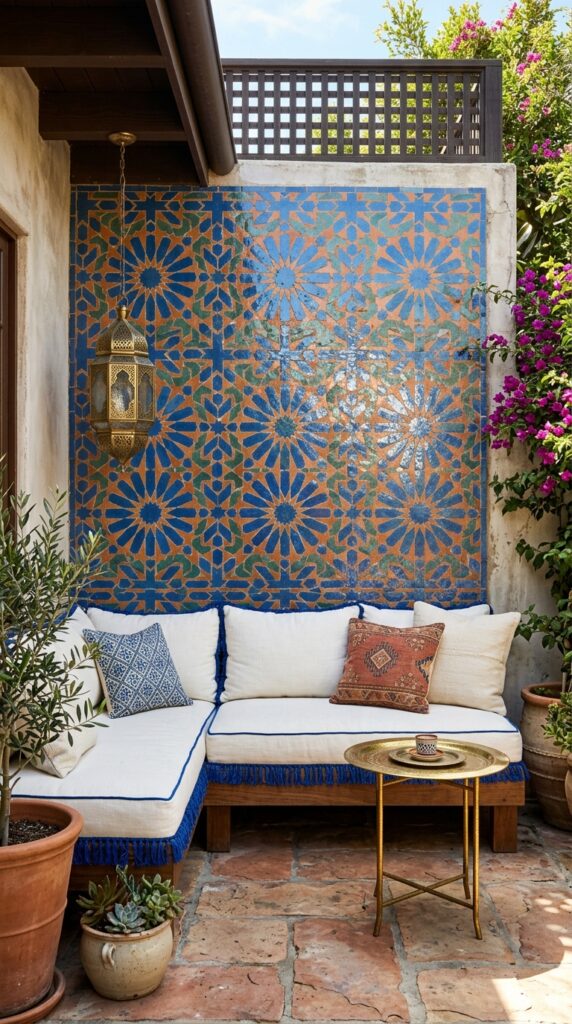
Vibe: Vibrant. This tile wall is the patio’s entire personality made visible in one surface.
Why it works: A single tiled feature wall on a patio operates on the principle of “maximum impact, minimum footprint.” By concentrating decorative intensity on one surface, you create a focal point that orients the entire space — all seating naturally turns toward it — without requiring that every surface carry decorative weight. Zellige tiles specifically (handmade Moroccan clay tiles with faceted, irregular surfaces) create a unique light behavior: each tile’s slight angular variation means the wall catches and releases light as the sun moves, giving the surface an almost kinetic quality.
How to get it: Use zellige tiles only on a covered or semi-covered wall — repeated freeze-thaw cycles cause the porous clay body to spall if water infiltrates and freezes. In frost-prone climates, substitute a porcelain zellige-look tile (widely available and frost-rated) for the same aesthetic without the durability risk.
💡 Quick Win: A 6-tile sampler from a zellige or Moroccan tile supplier (usually under $25 shipped) lets you test both the color and the light behavior of handmade tile in your specific patio light conditions before committing to a full wall order.
🛍️ Shop the Look — Amazon Product Ideas
| # | Product Search Phrase | Why It Fits |
| 1 | Moroccan zellige tile cobalt terracotta 4×4 | Core feature wall material |
| 2 | Moroccan brass hanging lantern outdoor | Period-authentic lighting |
| 3 | white cushion outdoor bench low profile | Seating to face tile wall |
| 4 | small brass side table outdoor round | Surface in Moroccan context |
| 5 | cobalt blue outdoor throw pillow with fringe | Tile-matching textile |
26. Two-Tone Painted Concrete Floor for a Graphic Statement
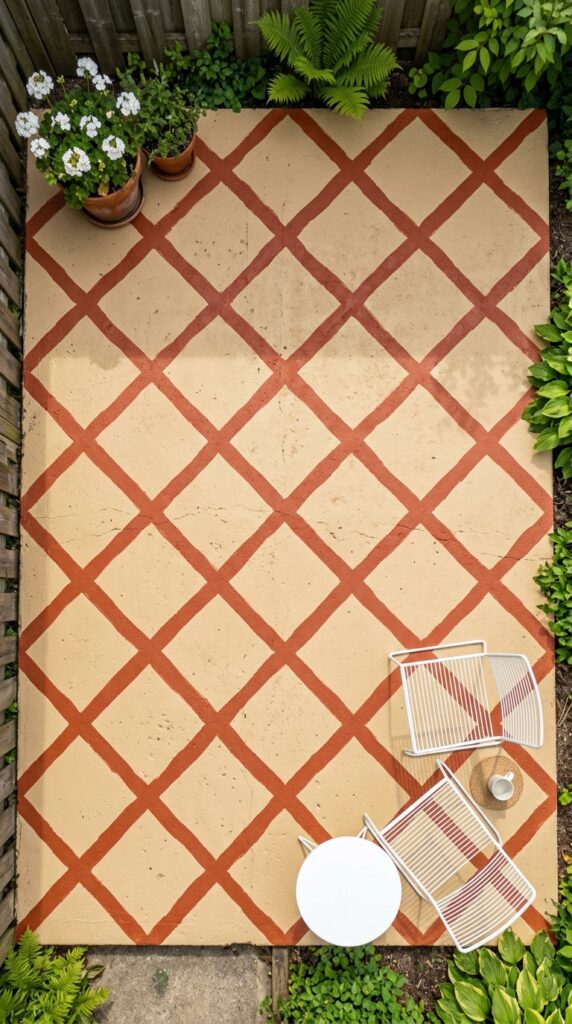
Vibe: Bold. A painted concrete floor is the patio equivalent of an artist signing their work.
Why it works: Painting a geometric pattern on an existing concrete patio surface is one of the highest return-on-investment moves in outdoor design — it transforms a utilitarian surface into a graphic textile with an afternoon’s work and a pot of paint. The diamond grid is specifically effective outdoors because it creates diagonal visual lines that push the eye toward the patio’s corners, making the space read as wider than its actual dimensions. A two-tone painted floor also means that rugs become optional rather than necessary, freeing up budget for other elements.
How to get it: Use a chalk line to snap grid lines at a 45-degree diagonal across the patio, then fill alternate diamonds with a second tone of exterior masonry paint. Farrow & Ball’s exterior masonry range includes several compatible sand/terracotta pairs (Lime White with Red Earth, or Savage Ground with Dead Salmon) that coordinate naturally. Finish with two coats of exterior matte clear sealer to protect the painted surface from UV and foot traffic.
🛍️ Shop the Look — Amazon Product Ideas
| # | Product Search Phrase | Why It Fits |
| 1 | exterior concrete paint matte sand terracotta | Two paint colors for pattern |
| 2 | chalk line reel for floor layout | Grid alignment tool |
| 3 | concrete floor sealer matte clear exterior | Pattern protection coat |
| 4 | white steel minimal outdoor dining chair | Clean contrast on bold floor |
| 5 | wide painter’s tape floor masking | Clean edge for diamond grid |
How to Start Your Back Patio Transformation
The single most impactful first move you can make is choosing your patio floor surface or treatment — not furniture, not lighting. The floor is the foundation of visual logic that every other decision flows from. Specifically: if you have existing concrete, either paint it (idea 26) or lay large-format pavers over it using a concrete bonding adhesive. This one decision anchors your palette, determines what furniture scale is appropriate, and sets the tone language for every accessory choice that follows.
The most common beginner mistake is buying furniture that’s too small for the patio. A dining table that would fill a living room floor reads as a side table when placed outside — outdoor scale needs to be generous because the sky is the ceiling and its scale is infinite. A table that’s 12 inches wider and a sofa that’s 8 inches deeper will feel right in a way that standard-size indoor pieces never do outdoors, even when they’re technically “outdoor” rated.
For immediate, under-$50 impact, start with: a terracotta planter in a 16-inch diameter planted with trailing rosemary (around $18 including the plant), four solar pathway lanterns in matte black ($22–$30 for a set of four), and a single bag of decorative pea gravel spread as a mulch ring around any existing base planting ($12). These three additions alone transform a bare patio from default to considered.
A basic patio transformation is achievable in a weekend — furniture arrangement, rug, lighting, and plantings can all be completed in two days if products arrive in advance. A full transformation including new flooring, built-in seating, or a pergola realistically takes two to three months and a budget of $2,000–$6,000 for a mid-range result. A starter version with painted floors, solar lighting, and good outdoor furniture can be accomplished for $400–$800.
Frequently Asked Questions About Back Patio Ideas
What is the difference between a back patio and a back deck?
A patio is a ground-level outdoor surface, typically made from stone, concrete, brick, or pavers, and sits at or near grade. A deck is an elevated wood or composite platform structure that is typically supported by posts and framing and raised above ground level. Functionally, they serve the same purpose — an outdoor living extension of your home — but the construction, cost, and maintenance differ significantly. Patios are generally lower-maintenance and less expensive to install, with concrete patios averaging $6–$10 per square foot installed versus wood decks at $15–$35 per square foot.
What colors work best on a back patio?
The most durable outdoor palettes build from one neutral base and add one or two accent tones. Concrete grey, warm sand, and off-white are the most reliable bases because they read differently across lighting conditions — warm at dusk, crisp at noon — without ever looking wrong. For accents, dusty sage, terracotta, and deep teal are consistently popular because they all age well in UV exposure, look good against natural materials like teak and wicker, and coordinate with most flowering plants. Avoid bright saturated primaries outdoors — they fade unevenly and can read garish against a sky backdrop.
How much does it cost to improve a back patio on a budget?
Significant visual improvements are achievable for under $500. Specific entry points: an outdoor flatweave rug in a warm stripe pattern runs $45–$90 for an 8×10-foot size; a set of four solar pathway lanterns costs $25–$35; exterior concrete paint for a 150-square-foot patio runs $40–$60 for two cans. A set of four terracotta planters in graduated sizes costs $30–$50 and can be planted for another $30 in herbs or ornamental grasses. For under $300 total, you can add a rug, lights, and three planted pots — which is genuinely enough to transform the experience of a bare concrete slab.
Can a small back patio look good with minimal space?
A patio as small as 6×8 feet can look finished and intentional with the right approach. Prioritize: one anchor furniture piece (a bistro table and two chairs, or a loveseat with a small coffee table — not both), a single consistent floor surface with no transitions or breaks, and vertical interest via a trellis, wall-mounted planters, or a floating shelf. The most common small-patio error is over-furnishing — two chairs on an 8×10 patio with a rug and a side table is complete; adding a sofa and a dining table creates spatial anxiety rather than comfort.
What outdoor plants work best in containers on a back patio?
The most reliable container plants for patios combine visual presence with low maintenance. Olive trees (Olea europaea) in a large ceramic pot provide year-round sculptural interest and handle drought well once established. Lavender (Lavandula angustifolia) performs in most climates, provides fragrance, and tolerates full sun in a pot. Trailing rosemary fills horizontal edges naturally. For color and foliage drama, Japanese forest grass (Hakonechloa macra ‘Aureola’) in a matte black or terracotta container provides movement in a breeze and shifts from gold to amber across seasons. All four are available at most garden centers for $8–$25 per plant.
Ready to Create Your Dream Back Patio?
These 26 back patio ideas span floor surfaces, lighting, furniture scale, color palettes, plantings, and small-space solutions — meaning there’s a starting point here regardless of what your patio looks like today or what your budget allows. Real transformation is incremental, and starting with one well-chosen element — a painted floor, a hanging herb wall, a fire circle — is not just acceptable, it’s the smarter approach than trying to do everything at once. Today, pick one idea from this list, search for the first product in its Shop the Look table, and put it in your cart. That small commitment is what starts a patio that eventually becomes the room your whole household gravitates toward. A back patio designed with intention gives you something that a perfectly furnished interior almost never can: the feeling of being both sheltered and open at the same time, at once contained and part of something larger. Pin the ideas that felt like they were already yours — the ones where you thought “that’s exactly what I mean.”