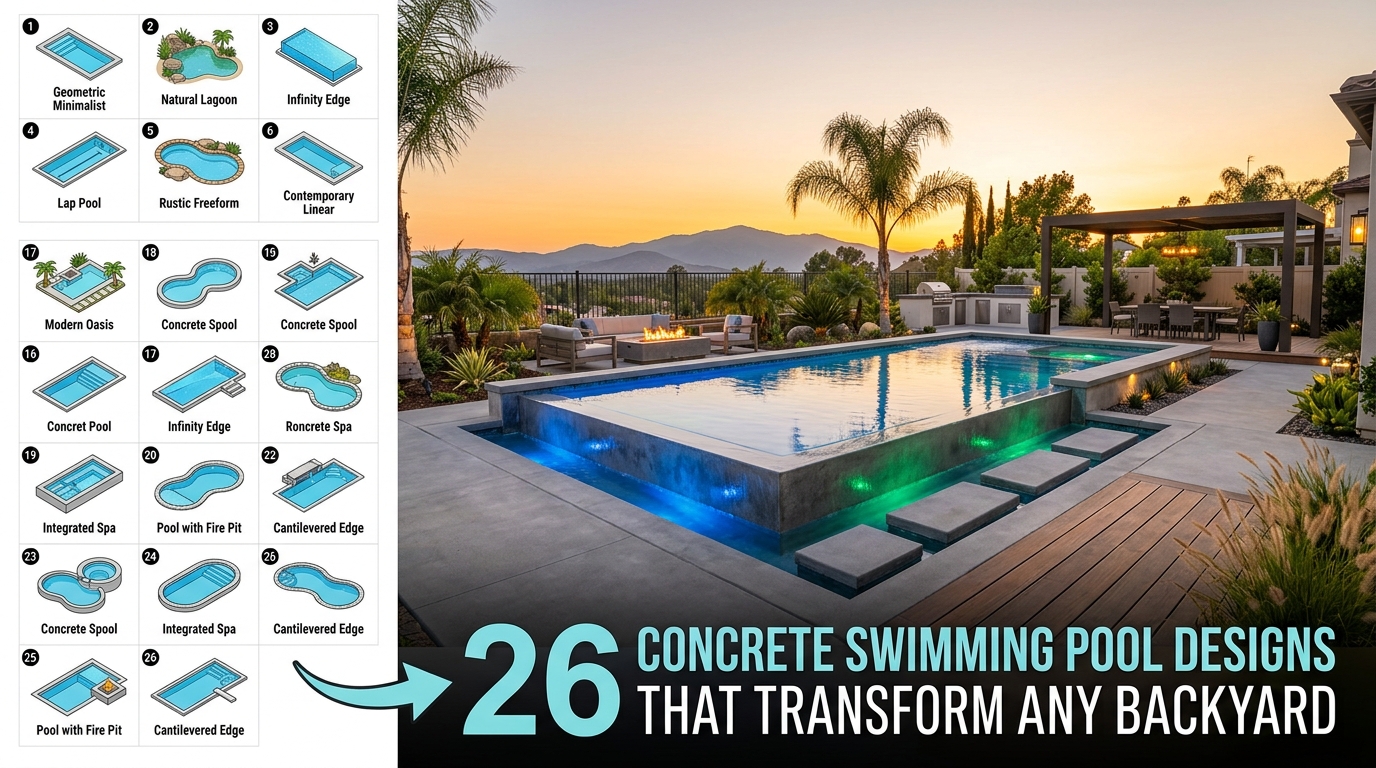
Concrete swimming pools are custom-built structures poured or gunited in place, giving homeowners complete control over shape, depth, and finish. This article delivers exactly 26 concrete pool design ideas — spanning color, materials, lighting, layout, and finishing details — to help you plan a pool that works as hard as it looks.
There’s something unhurried about a concrete pool done right. The weight of the water, the roughness of exposed aggregate underfoot, the way coping stone catches the last hour of afternoon light — it all adds up to a space that feels permanent, considered, and genuinely worth building. Concrete allows curves that fiberglass can’t, finishes that vinyl wouldn’t dare attempt, and dimensions tailored to your exact slice of land. Here are 26 ideas worth saving — and stealing.
Why Concrete Swimming Pool Design Works So Well
Concrete pools trace their roots to early 20th-century resort and civic architecture, when gunite technology made freeform shapes possible at scale. Unlike fiberglass shells (prefabricated offsite) or vinyl-lined frames, a concrete pool is built in place — either by hand-packed shotcrete or poured into formwork — making it the only pool type with truly unlimited shape potential. That flexibility separates concrete pools from every alternative on the market.
The materials palette is what gives concrete pools their design range. Interior finishes include pebble aggregate (available in charcoal, ivory, or ocean blue tones), smooth white plaster, quartz blend in warm greige or soft slate, and exposed stone. Coping choices span honed travertine, brushed limestone, porcelain pavers in cool oyster, and raw bluestone. Water color is dictated by the interior finish: a charcoal aggregate pool reads midnight blue; a white plaster pool reads turquoise; a black pebble finish reads almost obsidian in low light.
Concrete pools are experiencing a resurgence because people are investing in their outdoor living spaces with the same seriousness once reserved for interiors. Post-pandemic shifts toward home-based retreat culture, combined with elevated interest in natural stone and earthy architectural materials, have made the refined, permanent aesthetic of concrete pools feel more relevant than ever. Pinterest searches for “geometric concrete pool” have grown significantly year over year.
Even a modest backyard can support a concrete pool, though it requires prioritizing wisely. A plunge pool or lap pool format (as narrow as 8 feet wide) uses concrete’s custom-sizing advantage to fit tight lots. In compact spaces, the key decisions are coping edge style (flush coping creates the illusion of more ground plane), interior finish color (darker interiors make small pools feel deeper), and eliminating bulky equipment by enclosing it in a flush-mounted box. Small doesn’t mean compromised — it often forces better design.
Style at a Glance
| Element | Characteristic | Detail |
| Philosophy | Permanence | Built-in-place, custom geometry |
| Materials | Aggregate, stone, plaster | Travertine, bluestone, pebble |
| Color Palette | Water-influenced tones | Charcoal, oyster, ivory, slate |
26 Concrete Swimming Pool Designs
1. Charcoal Pebble Finish With Infinity Edge
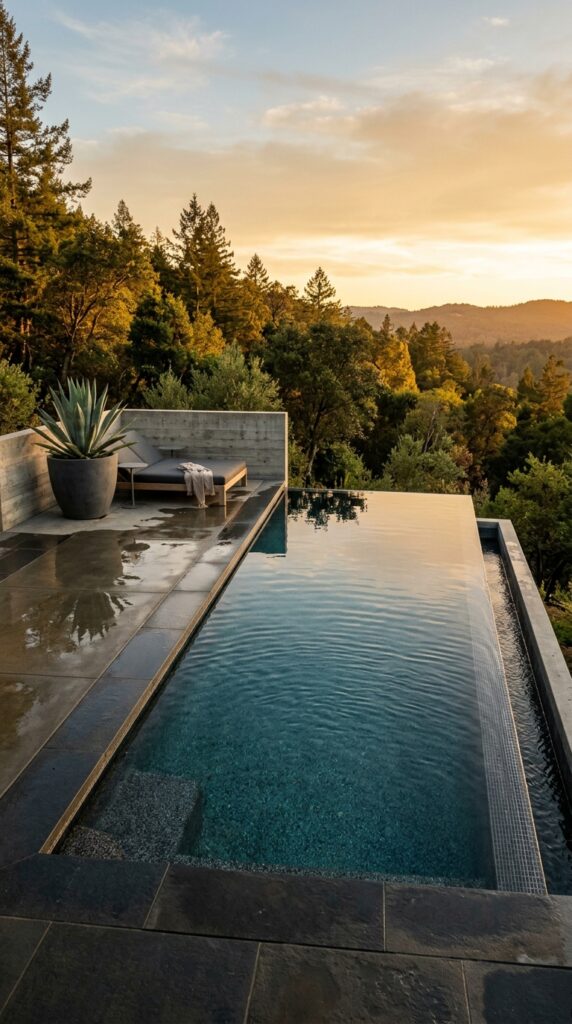
Vibe: Hushed — this pool drinks in the sky and asks nothing of the person standing beside it.
Why it works: The charcoal pebble aggregate interior absorbs light rather than reflecting it, turning the water a deep, saturated blue-green that intensifies at dusk. The infinity edge eliminates the visual barrier between water and landscape, creating a horizontal compression that makes the pool feel twice as wide as it is. Dark interior finishes are a masterclass in visual weight — they anchor an elevated pool deck without heavy surrounding hardscape.
How to get it: Specify a black or dark grey pebble aggregate (brands like Pebble Tec’s “Black Onyx” or “Caribbean Blue” will take you there) paired with honed black granite or bluestone coping set flush with the deck — no raised lip. The infinity edge requires a catch basin and additional pump, so factor that into the structural budget from day one.
💡 Quick Win: Before committing to a finish color, ask your pool builder for a wet sample tile — aggregate colors look dramatically different dry versus submerged.
Shop The Look
| Product |
| Teak outdoor lounge chair weatherproof sling |
| Concrete planter extra large architectural outdoor |
| Dark slate porcelain outdoor tile 24×24 |
| Black matte outdoor wall sconce waterproof |
| Outdoor privacy screen slat natural wood tone |
2. Roman-End Pool With Travertine Coping
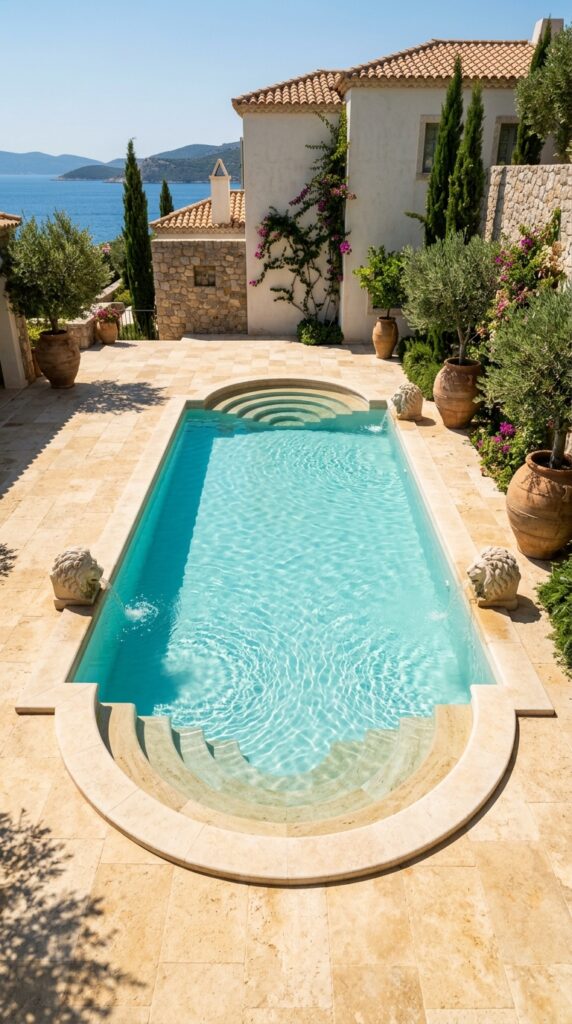
Vibe: Sun-warmed — the kind of pool that feels like it belongs to a Provençal country house.
Why it works: Roman ends (the gentle semicircular steps at each short end) solve the entry problem elegantly: they’re structurally integrated, visually softening, and functionally superior to a standard ladder. Pairing them with honed travertine coping ties the design to classical European architecture — travertine’s warm honey-to-ivory range reads as aged and intentional against a white plaster interior. The visual rhythm of the curved steps also breaks the hard-line geometry that can make rectangular pools feel institutional.
How to get it: Specify a white marble plaster or Diamond Brite “French Gray” interior (it reads turquoise in water, warm ivory when dry) to complement the travertine’s warmth. Ask your concrete contractor to pour the Roman ends monolithically with the pool shell — never as a separate addition, which creates structural crack risk at the joint.
Shop The Look
| Product |
| Travertine stone outdoor tile honed 18×18 |
| Terracotta garden urn large outdoor planter |
| Outdoor umbrella market cantilever sand beige |
| Cast aluminum bistro side table weather resistant |
| Ivory outdoor rug 8×10 flatweave UV resistant |
3. Geometric Pool With Raised Spa and Spillway
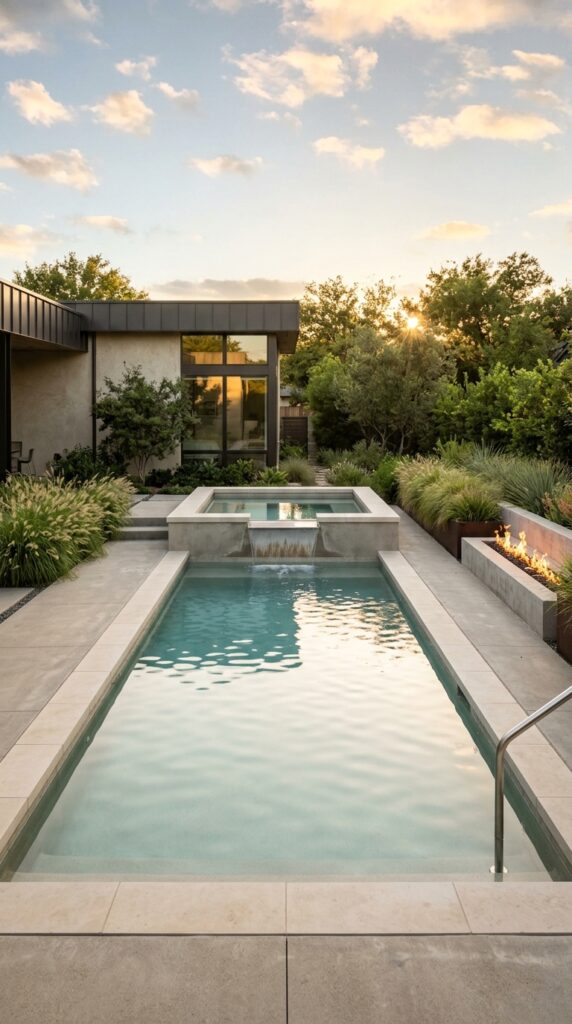
Vibe: Grounded — the raised spa adds architectural mass that makes the overall composition feel sculpted rather than merely dug.
Why it works: A raised spa creates visual hierarchy — it gives the pool design a focal point without requiring a separate structure. The spillway between spa and pool does double duty: it aerates the water (improving filtration) and adds continuous ambient sound, which is a genuine quality-of-life upgrade in suburban settings. The contrast between the elevated solid form and the horizontal water plane is a fundamental principle of landscape architecture — mass and void in dialogue.
How to get it: The raised spa wall must be engineered with waterproofing on both interior and exterior faces — standard pool plaster on the exterior will crack and stain within two seasons. Use a crystalline waterproofing additive in the concrete mix and tile the spillway face with 1×1 stainless mosaic for a blade-thin, clean pour line.
💡 Quick Win: A single thin-blade spillway (3–4 inches of freefall height) produces a whisper-level sheet of sound; increase the height to 8–12 inches for an audible water feature without going theatrical.
Shop The Look
| Product |
| Outdoor linear fire pit rectangular propane |
| Ornamental grass fountain grass potted outdoor |
| Stainless steel outdoor wall sconce waterproof modern |
| Limestone porcelain pavers 24×24 outdoor |
| Teak outdoor sectional sofa weatherproof |
4. Dark Interior Lap Pool With Lane Lines
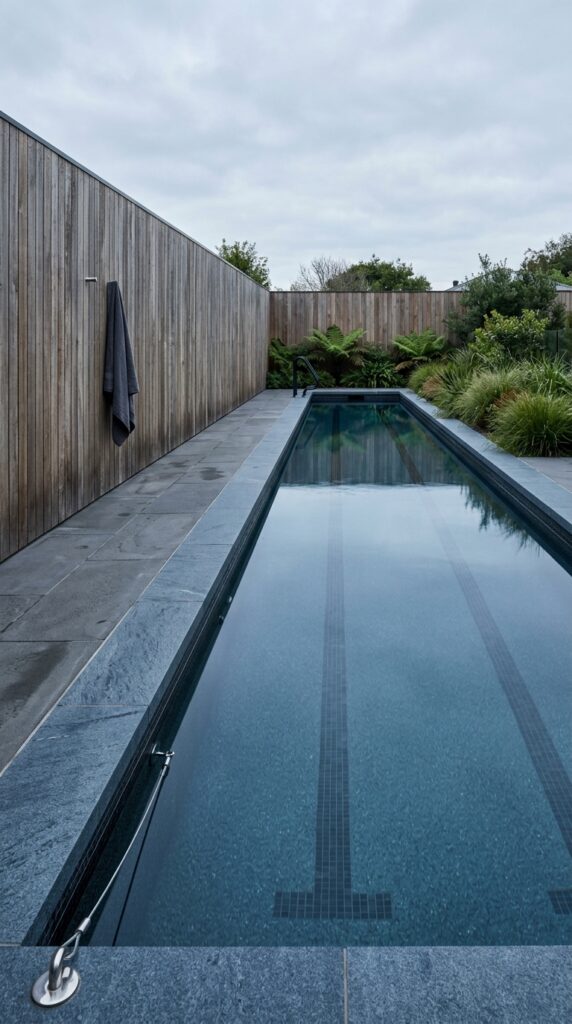
Vibe: Still — a lap pool stripped to its essential function, where every visual line pulls the eye forward.
Why it works: Lane lines recessed into the plaster finish serve both a functional and compositional role: they give the swimmer visual orientation underwater and create strong perspective lines when viewed from the pool deck. The narrow format (typically 8–10 feet wide) combined with a dark interior makes the water appear bottomless and focused, amplifying the pool’s single purpose. This is design through restraint — the absence of decoration is the decoration.
How to get it: Lay a 2-inch-wide band of 1×1 glass mosaic tile in a contrasting color (pearl white or cobalt on a dark field) down the centerline and along each gutter edge during the plaster application phase. The tile must be set before plaster, so coordinate with your tile contractor before the finish crew arrives.
Shop The Look
| Product |
| Waterproof outdoor shower brushed stainless wall mount |
| Cedar outdoor privacy screen panel fencing |
| Stainless steel towel bar outdoor rust proof |
| Pool lane rope floating PVC competition |
| Outdoor rubber mat anti-slip gray pool deck |
5. Natural Rock Grotto With Waterfall Feature
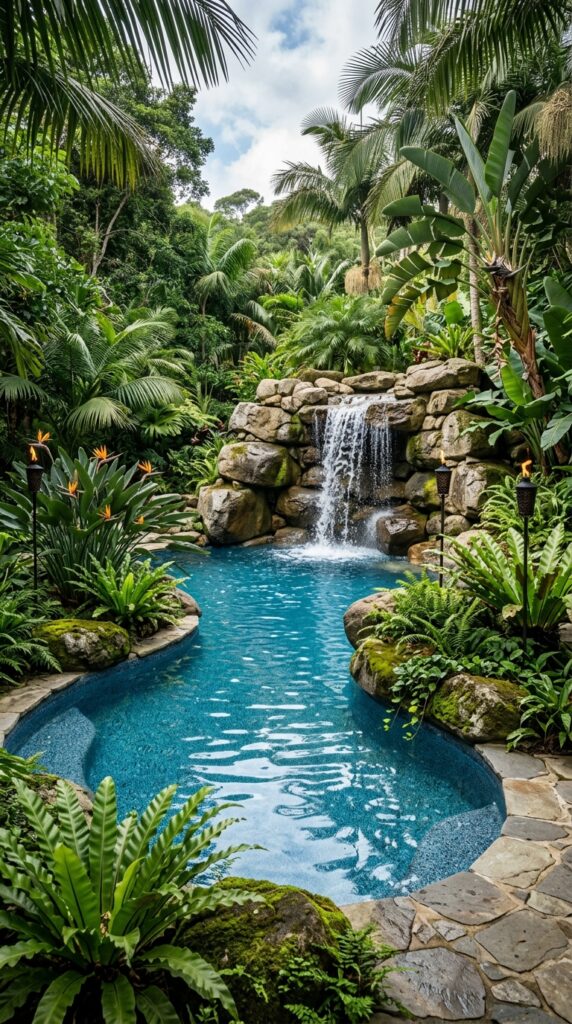
Vibe: Layered — the grotto adds genuine depth, both spatial and sensory.
Why it works: Grotto designs succeed because they borrow from the logic of natural water features — the water source appears to originate from somewhere meaningful, creating a narrative. The concrete pool shell is sculpted to transition gradually into the rock formation; when done well, there’s no visible seam between the engineered and the geological. The waterfall face breaks water into sound and aeration, making the pool feel alive even when no one is swimming.
How to get it: Natural boulders must be professionally placed before concrete is poured — they need to be integrated into the shell structure, not leaned against it. Specify a licensed landscape contractor who has completed grotto work previously; the structural engineering of a rock feature above a pool cavity is not standard pool builder territory.
💡 Quick Win: Add a colored LED light behind the waterfall face during construction — it costs almost nothing at rough-in and allows dramatic illumination effects at night.
Shop The Look
| Product |
| Tropical bird of paradise outdoor plant large |
| Solar tiki torch set outdoor waterproof 4 pack |
| Outdoor fountain pump submersible adjustable flow |
| Lava rock landscaping decorative black 20lb bag |
| Outdoor fern hanging basket tropical shade |
6. Negative-Space Zero-Edge Perimeter Overflow
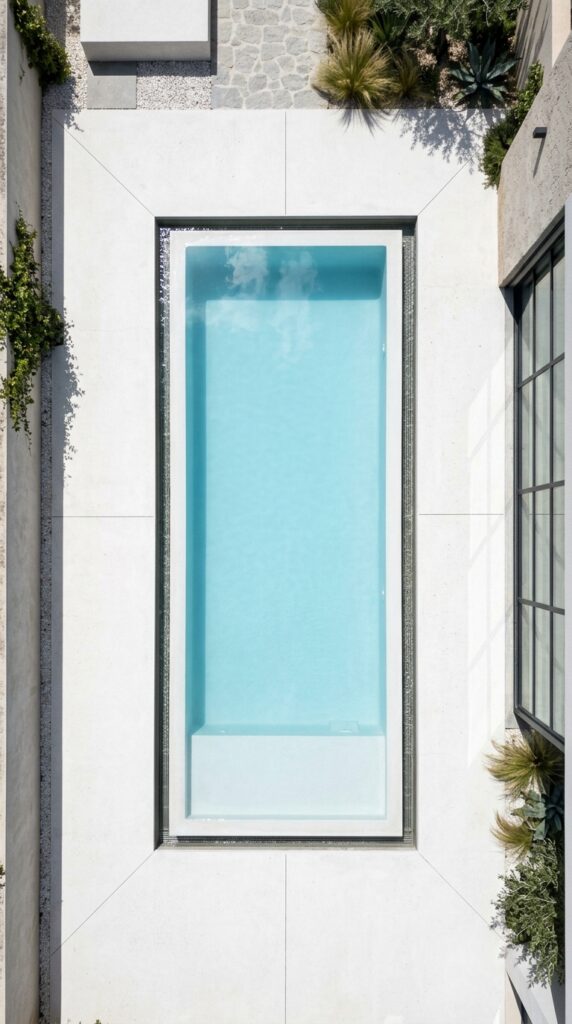
Vibe: Luminous — the pool surface becomes a mirror that dissolves the boundary between water and sky.
Why it works: A full perimeter overflow pool has no visible edge — the water level sits flush with the surrounding deck, and excess water drains invisibly into a concealed trough. This technique, borrowed from luxury resort design, uses the principle of visual continuity: eliminating the coping edge removes the visual interruption that normally separates the pool from the landscape. The effect is maximized with a light interior plaster that reflects sky color rather than absorbing it.
How to get it: A perimeter overflow requires a hidden catch basin equal in volume to approximately 10% of the pool’s total water volume — budget and excavate for this during the initial dig. The weir height (the millimeter-level precision of the overflow lip) must be laser-leveled on all four sides simultaneously; this is not a job for a standard level and string line.
Shop The Look
| Product |
| White concrete outdoor planter extra large rectangular |
| Outdoor chaise lounge modern minimalist white |
| LED underwater pool light ring remote color change |
| White porcelain paver 24×24 outdoor slip resistant |
| Modern outdoor privacy screen powder coated steel |
7. Warm Amber Lighting With Submerged LED Niche Lights
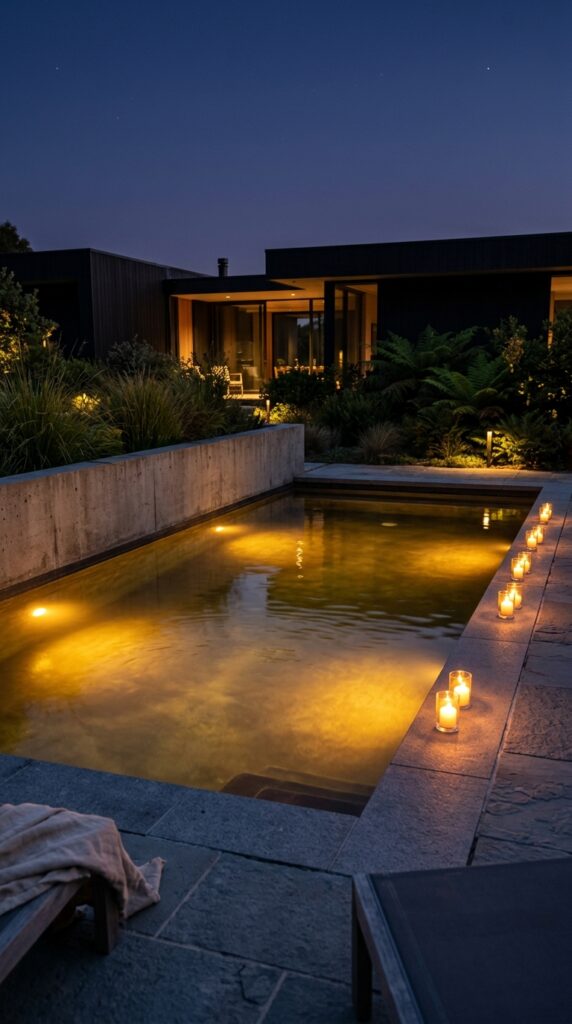
Vibe: Romantic — a pool that looks better at 9pm than it does at noon.
Why it works: Submerged LED niche lights positioned on the pool walls (not the floor) cast light upward through the water column, creating the warm, jewel-box glow associated with the best boutique hotel pools. The amber/warm white color temperature (around 2700–3000K) transforms a utilitarian space into a designed environment after dark. Positioning lights at the mid-wall height prevents the harsh downward-shadowing that floor-mounted lights produce.
How to get it: Install a minimum of six niche lights in a 400–500 square foot pool, spacing them evenly along both long walls at 18–24 inches below the waterline. Specify color-changing RGBW LEDs so you retain flexibility — the amber setting is stunning, but pure white is useful for night swimming. Rough in the conduit during the gunite phase; retrofitting conduit is expensive.
💡 Quick Win: Add a simple WiFi-enabled pool light controller ($120–180 at pool supply retailers) so you can schedule warm amber lights to activate at sunset automatically.
Shop The Look
| Product |
| Underwater LED pool light color changing RGBW remote |
| Outdoor pillar candle holder lantern brass |
| Low voltage landscape path light warm white set of 6 |
| Outdoor string lights Edison bulb warm 48ft |
| Copper fire bowl outdoor tabletop accent |
8. Baja Shelf (Sun Shelf) With Umbrella Sleeve
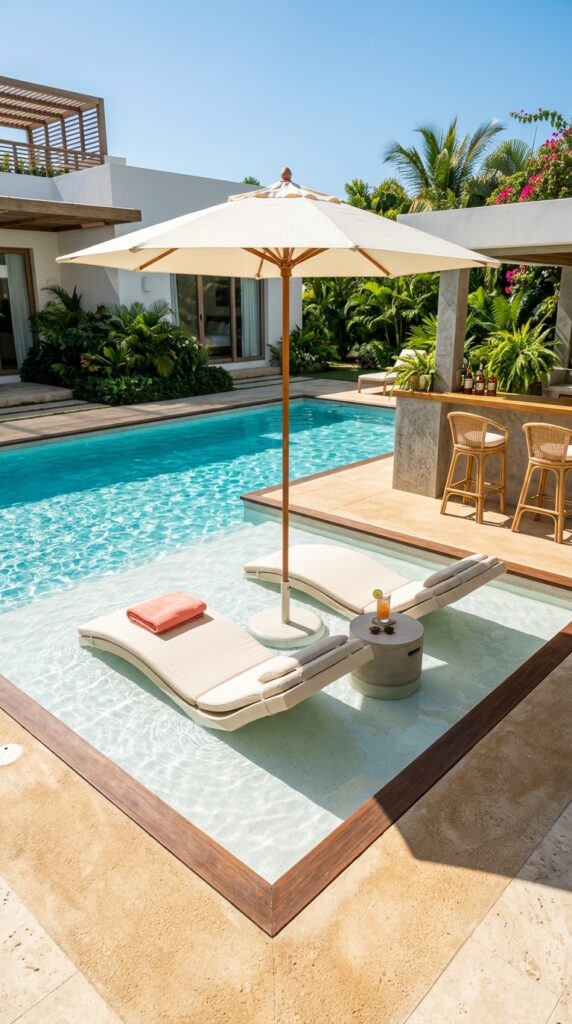
Vibe: Sun-warmed — the Baja shelf turns the pool entry into the best seat in the house.
Why it works: The Baja shelf (or tanning ledge) is a structural concrete platform poured 6–9 inches below the waterline, wide enough to place a chaise lounge or umbrella in the water. It creates a social zone distinct from the swimming area — people who don’t want to swim can participate in the pool experience without committing to it. The umbrella sleeve, poured into the concrete shelf at the rough-in phase, makes this space functional in full sun. This is one of the highest-return features in residential pool design.
How to get it: The standard Baja shelf is 4 feet deep (front-to-back) and spans the full width of one short end. Specify the umbrella sleeve location before gunite is sprayed — it’s a simple PVC pipe in the concrete that costs almost nothing during construction and can’t be easily added afterward. Choose white or light ivory plaster on the shelf to maximize the turquoise water color effect.
Shop The Look
| Product |
| Submersible pool lounge chair set of 2 |
| Market umbrella 9ft fade resistant SPF50 |
| Outdoor cocktail tray table side waterproof |
| Pool floating waterproof Bluetooth speaker |
| Sunscreen SPF 50 reef safe water resistant |
9. Geometric L-Shaped Pool With Shallow Wading Zone
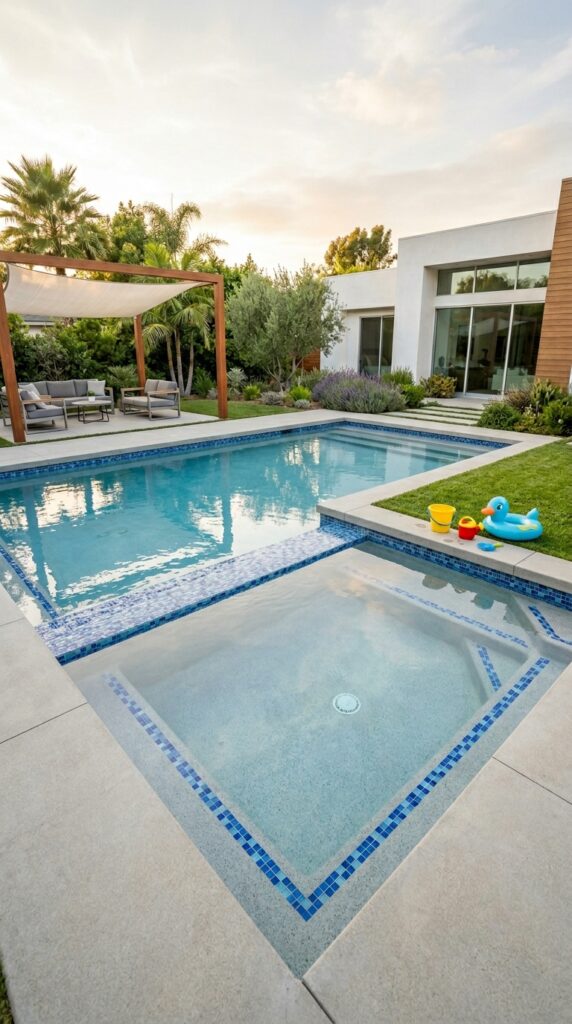
Vibe: Layered — one pool doing two jobs, with each zone respecting the other’s purpose.
Why it works: An L-shaped pool solves the multi-generational use problem in a single concrete shell. The short arm of the L can be poured to a consistent 18–24-inch depth (a genuine wading zone, not a step ledge), while the long arm maintains adult swimming depth. A low submerged concrete bench wall between zones serves as both a physical cue and a resting spot. The L-shape also makes efficient use of awkward lot footprints where a standard rectangle wouldn’t maximize the available space.
How to get it: Specify the bench wall at 12–14 inches above the floor of the shallow zone — this creates a natural seat height when the wading area is filled. Use a contrasting tile color on the bench wall top to make the zone boundary visible underwater; cobalt or turquoise glass mosaic on a light grey shell reads clearly without being garish.
💡 Quick Win: A 2-inch waterline tile band (glass mosaic in a complementary blue) applied where the water surface meets the pool wall covers the inevitable calcium line and adds a finished architectural detail for under $800 in materials.
Shop The Look
| Product |
| Glass mosaic tile pool waterline cobalt blue 1×1 |
| Kids outdoor splash pad mat play zone |
| Shade sail triangle UV block 12×12 stone color |
| Outdoor storage bench pool toys weatherproof |
| Floating pool basketball game set |
10. Exposed Aggregate Concrete Deck With Barefoot Finish
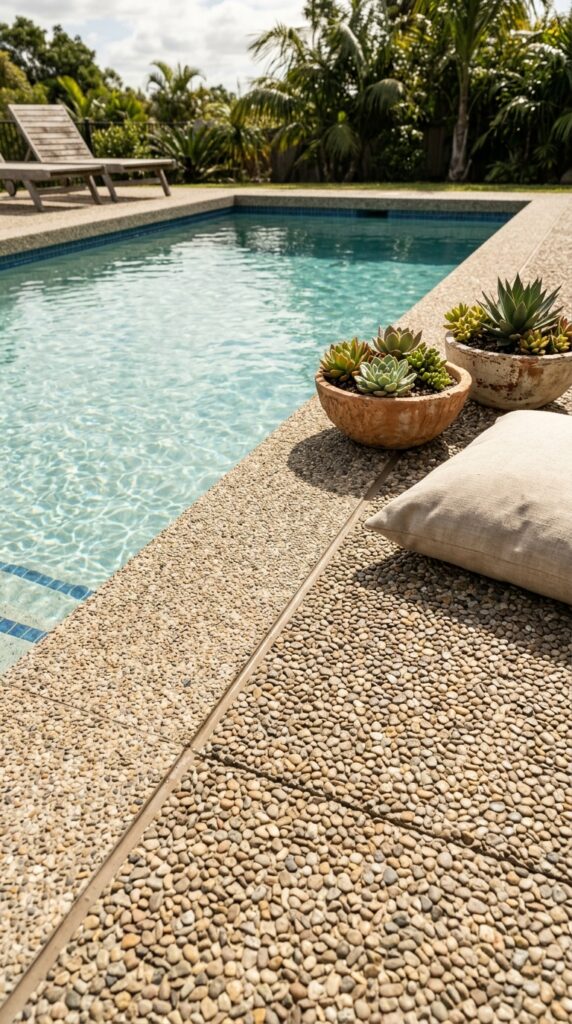
Vibe: Raw — the barefoot texture of exposed aggregate grounds the entire outdoor space in material honesty.
Why it works: Exposed aggregate concrete achieves something smooth concrete cannot: it stays cool underfoot (the pebble texture breaks direct contact with the slab surface) and remains slip-resistant when wet without applied coatings. Using the same aggregate in both the deck and the pool coping creates material continuity — the pool reads as part of the landscape rather than dropped into it. This is a principle called material coherence, and it’s what separates designed pools from merely built ones.
How to get it: The aggregate is specified by pebble size (3/8 inch is the standard barefoot-comfortable size), stone type (river pebble is smooth; crushed granite is more textural), and color blend. Order a sample section poured and washed before committing to the full deck — aggregate color shifts between wet and dry states, and the cured, washed result is what you’ll live with.
Shop The Look
| Product |
| Outdoor terracotta succulent planter set of 3 |
| Linen outdoor throw pillow covers weather resistant |
| Outdoor concrete side table round modern |
| Solar stake garden light warm amber 12 pack |
| Outdoor porch swing with stand taupe cushion |
11. Glass Tile Interior in Deep Cobalt Blue
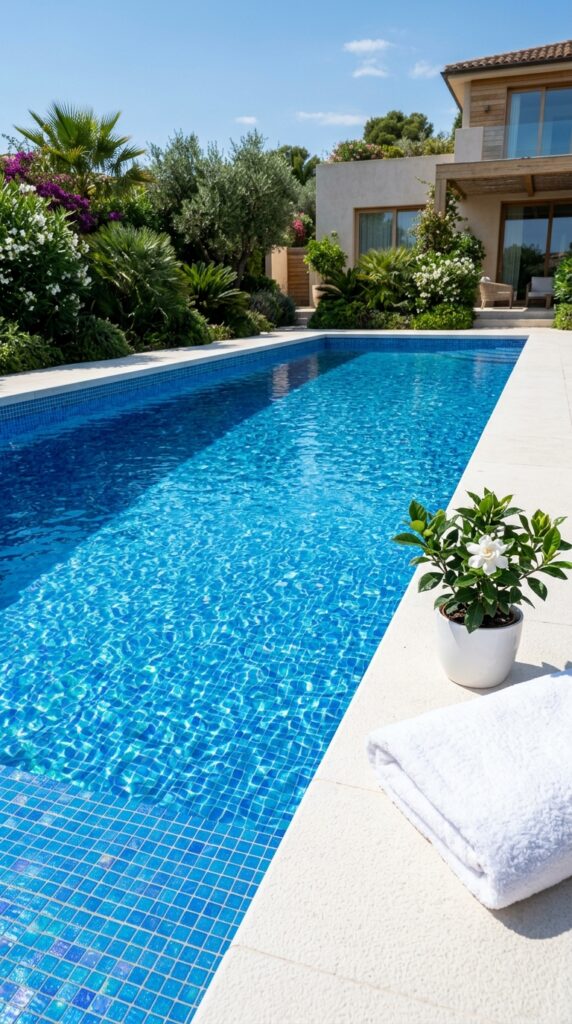
Vibe: Luminous — the water looks lit from within, as though the pool is generating its own light.
Why it works: Full-surface glass mosaic tile interiors are the most premium concrete pool finish available — and the most visually transformative. Glass tile doesn’t absorb light the way plaster does; it refracts it, creating an iridescent, color-shifting effect as the sun moves across the day. The cobalt blue finish produces water color that shifts from bright turquoise at midday to deep sapphire at dusk. Pairing cobalt glass with crisp white limestone coping maximizes the contrast and makes the color appear even more saturated.
How to get it: Full-surface glass tile is a significant upcharge (plan for 3–4x the cost of plaster) and requires a specialty tile setter who has worked on pool shells — the application technique for wet-environment glass mosaic is different from standard tile. Specify a waterproof polymer-modified thinset and sanded epoxy grout in a matching cobalt to prevent grout joints from reading as a grid on the pool floor.
Shop The Look
| Product |
| Glass mosaic tile cobalt blue iridescent 1×1 pool |
| White limestone outdoor tile 18×18 honed |
| Cobalt blue ceramic decorative bowl outdoor |
| White outdoor umbrella 9ft market fade resistant |
| Pool water test kit professional pH alkalinity |
12. Fire and Water Feature With Raised Bond Beam
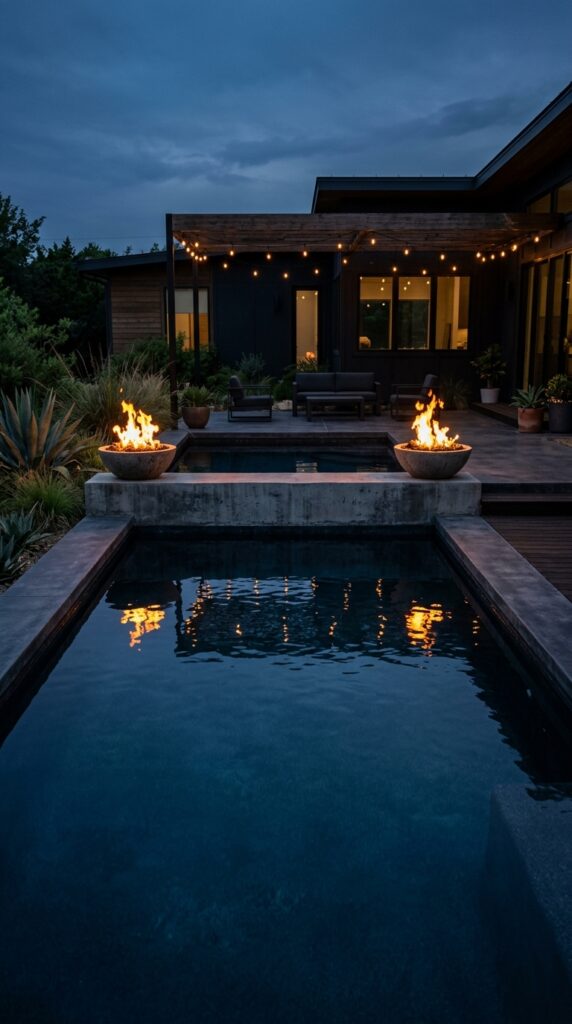
Vibe: Moody — fire above, water below, and the reflection making it impossible to know where one ends.
Why it works: The raised bond beam — the structural concrete wall that edges the pool above deck level — becomes an architectural opportunity when used as a plinth for fire features. Concrete fire bowls sit on this raised wall, and their reflection in the dark pool water creates a doubling effect that amplifies the drama dramatically. The contrast between the warmth of fire (amber, orange) and the cool depth of dark water (charcoal plaster) is a textbook application of warm-cool contrast — the principle that makes paintings by Caravaggio and Rembrandt impossible to look away from.
How to get it: Gas supply lines must be roughed in through the bond beam during the initial concrete pour — there’s no clean way to retrofit them. Specify a 3/4-inch gas line for each fire bowl location (even if you plan only one bowl initially) so you have the infrastructure to add features later without breaking concrete.
💡 Quick Win: A single cast concrete fire bowl on a raised wall costs $400–700 in materials when roughed in during construction; the same feature costs $3,000–5,000 as a retrofit. Build the infrastructure now.
Shop The Look
| Product |
| Outdoor propane fire bowl concrete finish round |
| Outdoor string lights globe 48ft warm white |
| Dark charcoal outdoor sectional weather resistant |
| Outdoor side table cast iron round |
| Stainless steel outdoor gas line cover cap |
13. Plunge Pool With Thermal Contrast Spa
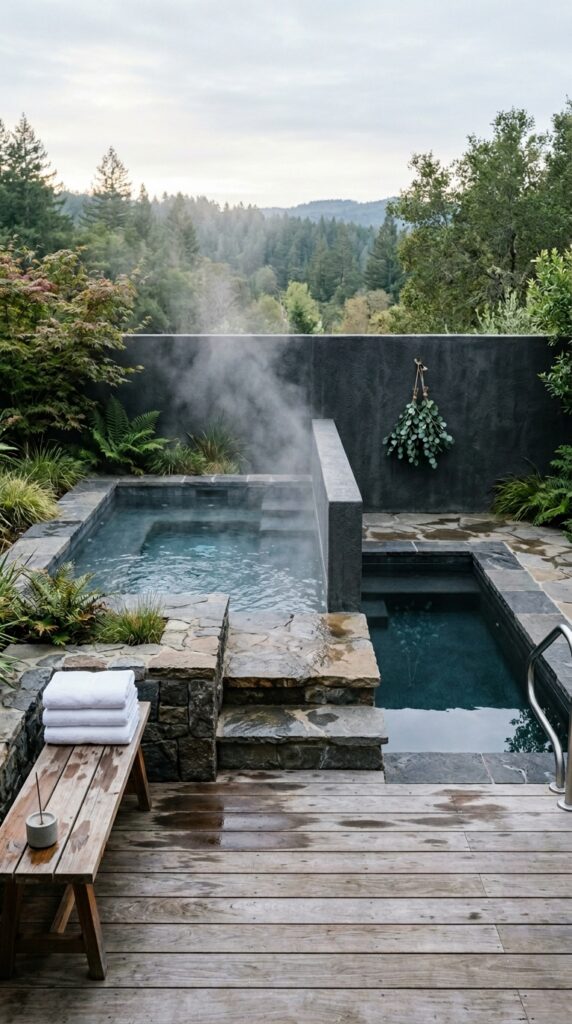
Vibe: Hushed — the discipline of thermal contrast made architectural, no gym locker room required.
Why it works: Thermal contrast bathing (alternating between hot and cold water immersion) has genuine physiological benefits for circulation and muscle recovery, which has driven a significant premium residential wellness market. Building the cold plunge and hot spa as a connected concrete system — sharing a wall and coping material — unifies what could be two separate objects into a single architectural composition. The shared material language (same plaster finish, same coping stone) makes the design read as intentional rather than additive.
How to get it: The cold plunge requires its own chiller unit (typically 1–2 ton capacity) and separate filtration from the hot spa — cross-contamination of the temperature systems will prevent either from performing correctly. Plan the equipment pad size for both units from the start; stacking the mechanical systems side by side reduces plumbing run lengths significantly.
Shop The Look
| Product |
| Cedar outdoor bench with storage outdoor natural |
| Eucalyptus bundle spa wellness wall decor |
| Waffle weave bath towel set white oversized |
| Outdoor wall mounted shower stainless steel |
| Cold plunge thermometer digital waterproof |
14. Cantilevered Concrete Deck Over Pool Edge
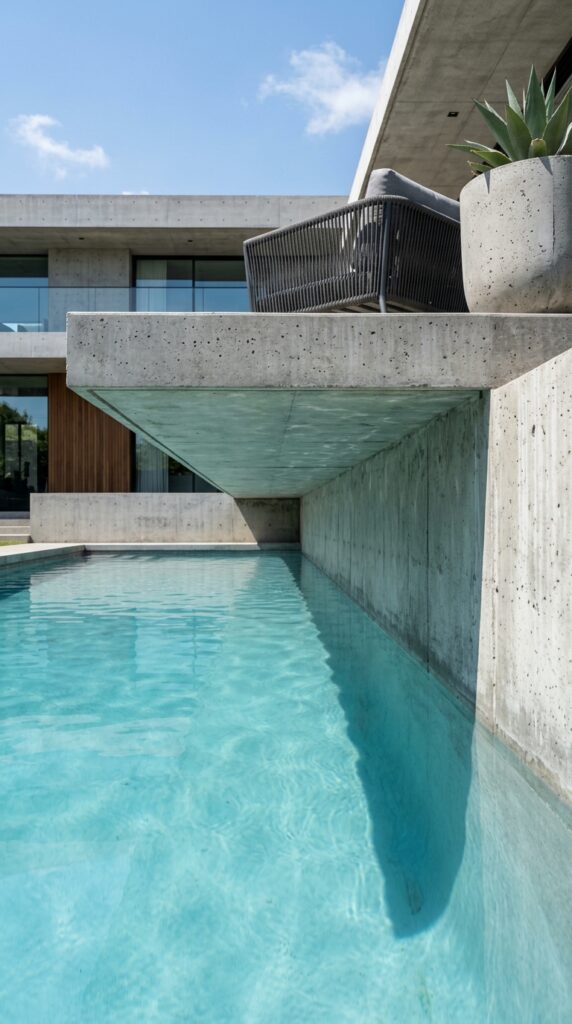
Vibe: Architectural — the pool feels like a building detail, not a backyard addition.
Why it works: A cantilevered deck edge (where the concrete slab overhangs the pool wall without visible support below) eliminates the coping profile entirely from the waterline view, producing a blade-thin edge that looks structurally impossible and therefore visually exciting. The overhang creates a shadow line on the pool wall that changes character throughout the day — in morning light it’s sharp; by afternoon it softens. This is a technique borrowed directly from modernist residential architecture.
How to get it: A cantilevered concrete overhang of 18 inches or more must be engineered by a structural engineer — it’s not a standard pool detail and cannot be improvised. The slab requires internal steel reinforcement (rebar or post-tensioned cable) calculated to the specific overhang distance and dead load. Budget for the engineering fee ($1,500–3,000) as a non-negotiable line item.
💡 Quick Win: Even without a full cantilever, a 4-inch overhang (a “bull-nose” coping set proud of the pool wall) creates a subtle shadow line that makes the pool edge read as more refined from inside the water.
Shop The Look
| Product |
| Modern outdoor lounge chair concrete look finish |
| Architectural concrete planter rectangle large |
| Outdoor concrete finish side table low profile |
| Waterproof outdoor rug grey minimalist 5×8 |
| Brushed stainless steel outdoor railing post |
15. Mosaic Medallion Feature on Pool Floor
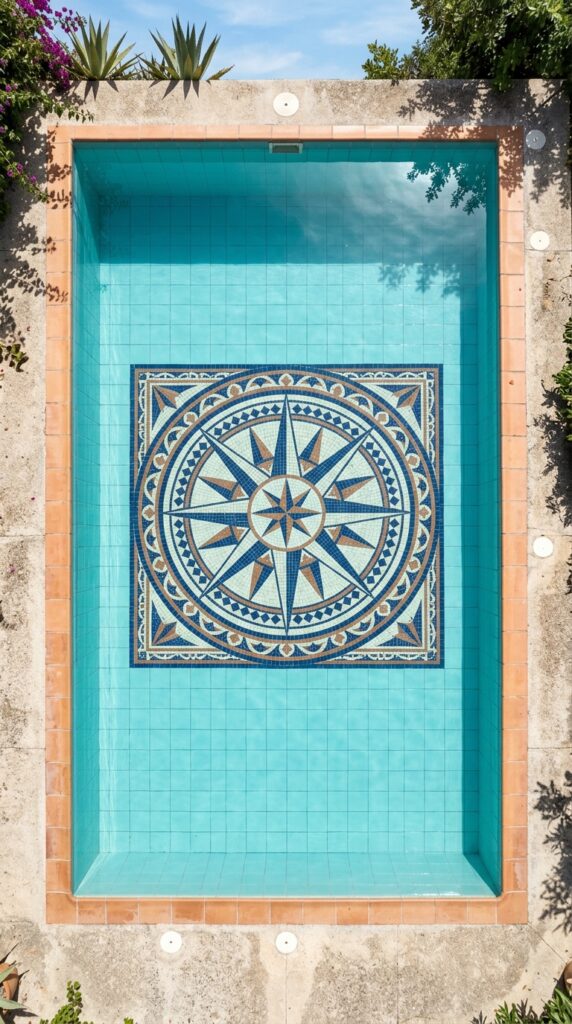
Vibe: Artisanal — the pool floor becomes a canvas, visible through the water like a painting under glass.
Why it works: A floor medallion in a pool exploits the water’s lens effect — the slight refraction of light through water makes flat art appear to shimmer and shift as the water moves. The design reads differently still versus in motion, creating an ever-changing focal point on the pool floor. Mosaic medallions are a classical decorative tradition (Roman baths used them extensively) that reads as historically grounded rather than trendy — they age into the pool rather than dating it.
How to get it: Commission the medallion as a prefabricated mesh-mounted mosaic panel from a specialty tile studio — having it pre-mounted on fiberglass mesh allows installation in a single session at the bottom of the shell before plaster is applied. The medallion must be set in waterproof thinset rated for continuous submersion; standard wall tile thinset will delaminate within two seasons.
Shop The Look
| Product |
| Ceramic mosaic tile sheet navy ivory mix 12×12 |
| Mosaic tile compass rose pattern navy and ivory |
| Pool waterline accent tile hand-painted |
| Antique brass outdoor lantern large pillar |
| Mediterranean ceramic decorative plate set wall art |
16. Zero-Step Ramp Entry With Beach Entry Finish
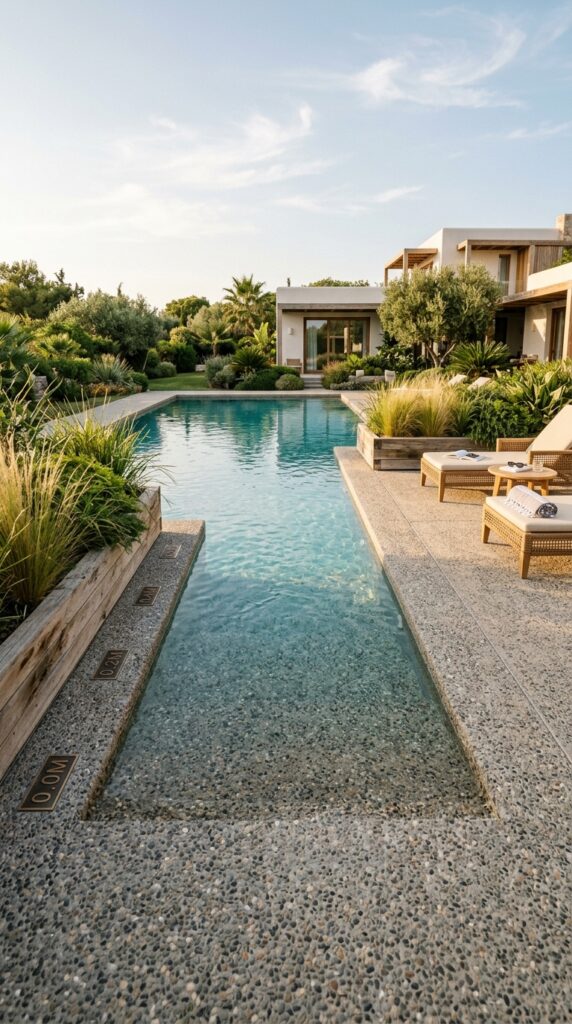
Vibe: Welcoming — a pool that erases the distinction between land and water, one step at a time.
Why it works: A beach entry (zero-entry) ramp requires significant additional concrete and excavation, but the payoff is access equity — toddlers, seniors, and anyone who finds ladders or steps uncomfortable can enter the water on their own terms. The aggregate finish on the ramp (matching the pool deck) creates material continuity that makes the transition from dry to wet space feel intentional rather than abrupt. This is design serving function without sacrificing form.
How to get it: The beach entry ramp requires a slope of 1:12 (one inch of rise per foot of run) to remain ADA-accessible and non-slip. The rough aggregate finish provides natural traction. Allow minimum 4 feet of width for the ramp to feel generous rather than cramped. The additional concrete volume adds approximately 10–15% to the total pool structural cost.
💡 Quick Win: Add a single mosaic depth marker tile (reading “0 inches” or “Shallow”) at the water’s edge of the ramp — it’s both a safety feature and a finished architectural detail.
Shop The Look
| Product |
| Sea grass outdoor planter large round |
| Teak beach style folding chair outdoor |
| Depth marker tile set pool ceramic |
| Non-slip outdoor aggregate mat grey |
| Outdoor solar post cap lights warm 4 pack |
17. Negative Space: Pool as Architectural Centerpiece in Compact Courtyard
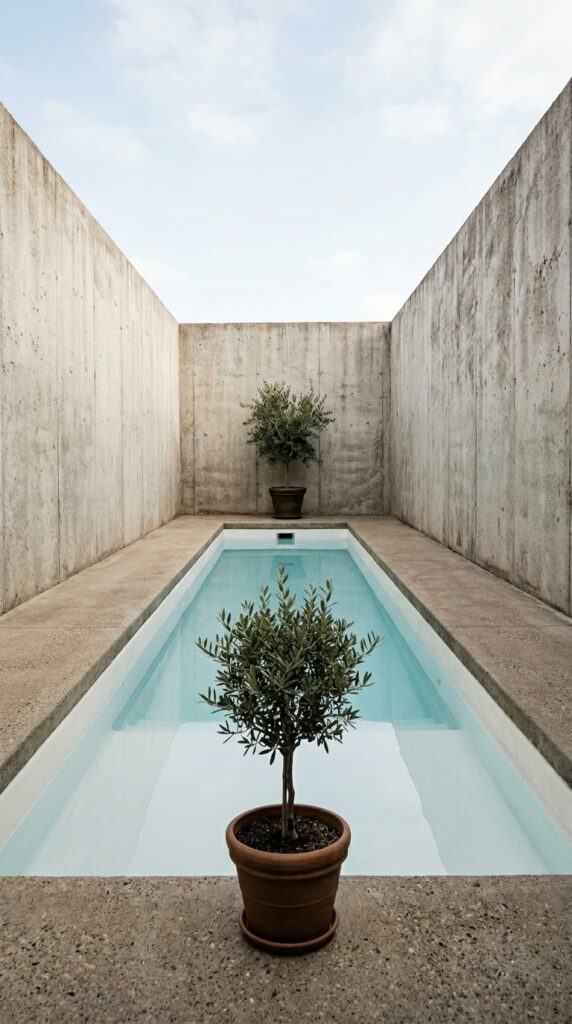
Vibe: Meditative — the pool stops being a pool and starts being the room.
Why it works: In a small urban courtyard (under 600 square feet), conventional pool design (pool + surrounding deck + furniture) leaves no room for any of those elements to feel adequate. The solution is to commit fully to one: make the pool the floor of the courtyard, with minimal walkway, and let the water surface serve as both the visual focal point and the design statement. This technique creates maximum psychological impact from minimum square footage by using the pool as a spatial device, not just a water feature.
How to get it: A 2-foot walkway on each long side is the minimum functional clearance for single-file movement. Raise the coping to exactly flush with the courtyard floor surface — no raised lip, no edge differentiation — so the transition from hardscape to water is as seamless as possible. This flush detail requires precision leveling and is worth specifying explicitly in the pool contract.
Shop The Look
| Product |
| Olive tree potted large artificial outdoor UV |
| White outdoor planter architectural tall slim |
| Concrete wall-mounted water feature minimal |
| Outdoor wall candle sconce weatherproof set of 2 |
| Recessed LED step light bronze outdoor set of 6 |
18. Lap Pool With Submerged Concrete Bench Seating Zone
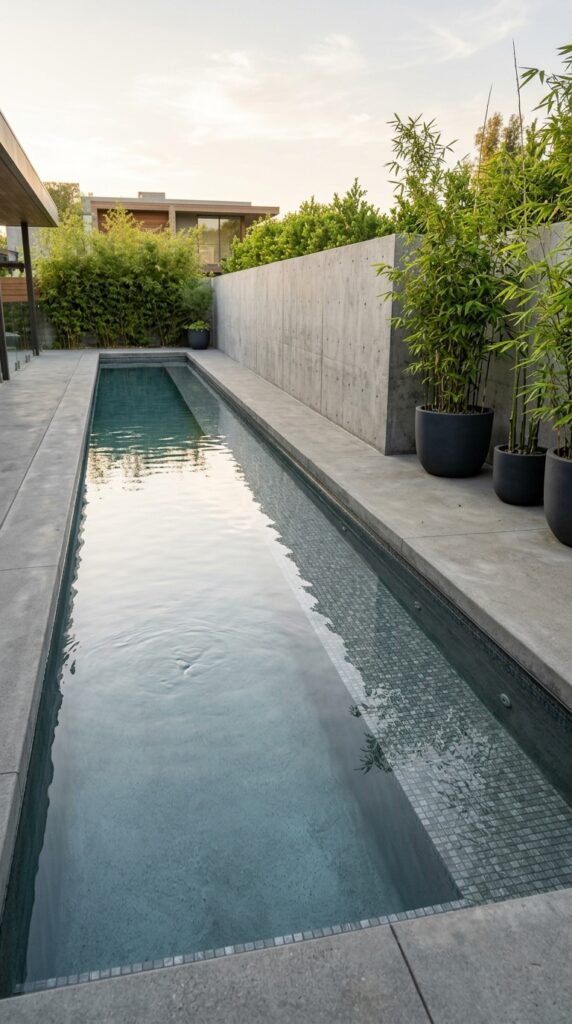
Vibe: Serene — the bench turns a lap pool into a thinking space.
Why it works: A submerged bench poured integrally with the pool shell (not a separate added element) solves the social-functional tension of a lap pool: it gives non-swimmers a place to participate in the pool space comfortably while the lane stays clear for swimming. The bench also acts as a hydrotherapy seat when jets are positioned in the pool wall behind it. Running the bench the full length of one long wall creates a strong horizontal line that emphasizes the pool’s length and makes the space feel larger than it is.
How to get it: Specify the bench at 18 inches above the pool floor (seat height) and 12 inches in depth (seat width). Finish the bench top surface with a 2×2 glass or porcelain mosaic tile in a contrasting color to mark it visually as a seating zone — this also makes the seat edge visible underwater for safety. Tile must be set before plaster application.
Shop The Look
| Product |
| Bamboo outdoor potted plant artificial UV resistant |
| Waterproof pool speaker floating Bluetooth |
| Pool handrail stainless steel mount wall |
| Outdoor bench cushion grey water repellent |
| Umbrella stand base heavy duty 50lb concrete |
19. Illuminated Coping With Linear LED Strip Under Edge
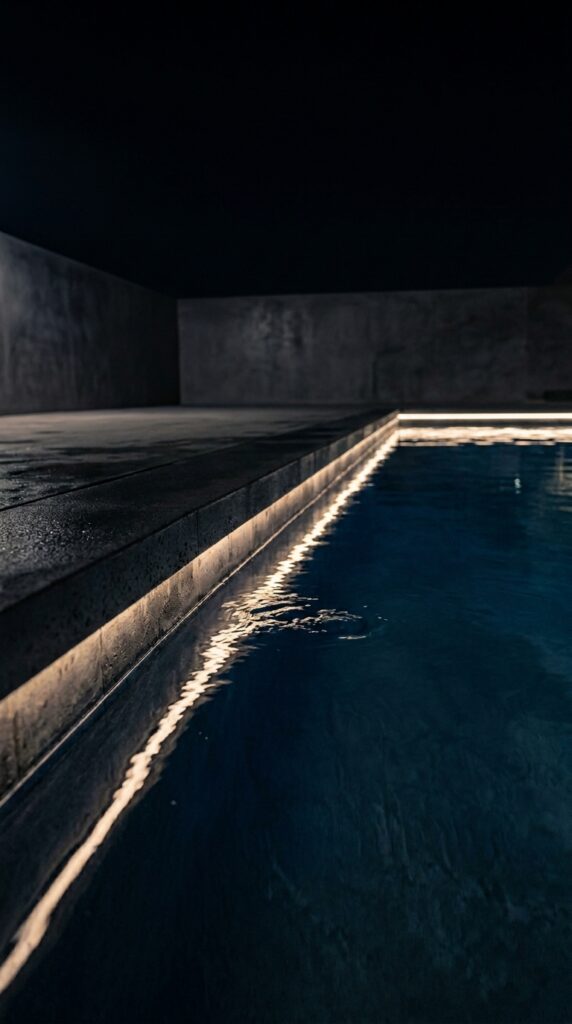
Vibe: Moody — the pool edge glows like a floating platform, detached from the ground.
Why it works: Coping-integrated LED strips use the principle of indirect lighting — the light source is hidden, and only the warm wash on the pool wall is visible. This technique, borrowed from hospitality architecture, makes the coping appear to float above the water, creating visual levitation. The warm wash on the pool wall below the coping interacts with the submerged pool lights to produce layered, depth-giving illumination that flat overhead lighting can never achieve.
How to get it: The LED strip channel must be routed in the underside of the coping stone during fabrication — this is a custom order from your stone supplier, not a standard profile. Specify a 1-inch-deep channel routed 3/4 inch from the front face. Use IP68-rated LED strip (fully waterproof) even though the strip is above the waterline — humidity and splash exposure will destroy a lower-rated product within one season.
💡 Quick Win: LED coping lighting on one long side of the pool only (rather than full perimeter) achieves the visual effect at approximately 40% of the cost.
Shop The Look
| Product |
| IP68 waterproof LED strip light warm white 16ft |
| LED strip channel aluminum recessed slim |
| Smart outdoor LED controller dimmable WiFi |
| Low voltage transformer outdoor 150w |
| Outdoor wall LED wash light warm white |
20. Classic Rectangle With Traditional Dark Plaster and White Trim Tile
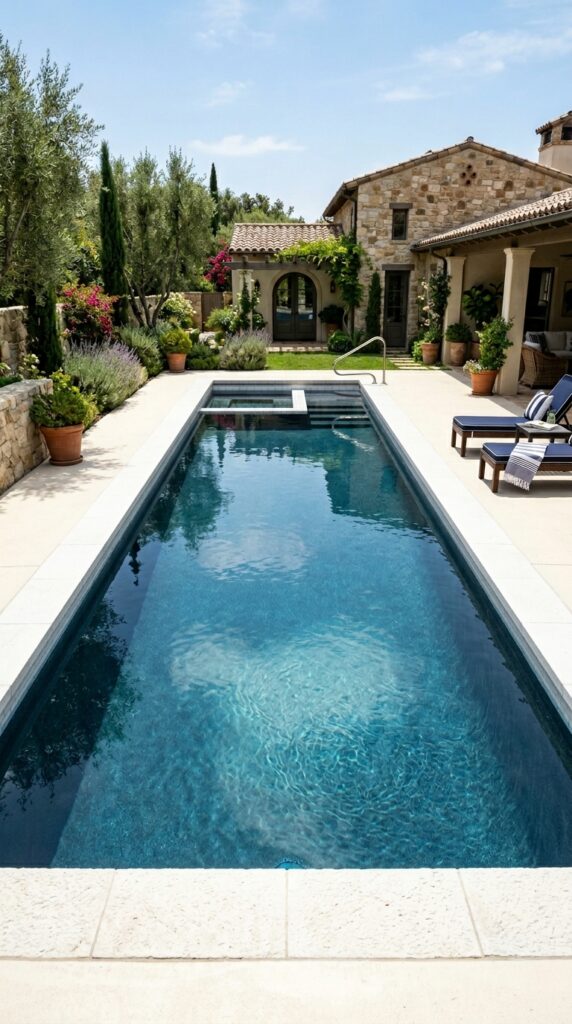
Vibe: Grounded — the kind of pool that has been here thirty years and will be here thirty more.
Why it works: The traditional formula — dark plaster interior, white ceramic waterline tile, white or stone coping — endures because each element serves a function. The dark plaster produces the deepest, most saturated water color (near-navy at depth, rich turquoise at the steps). The white ceramic waterline tile defines the water’s surface level and makes the calcium line easy to clean. The light coping creates maximum contrast with the dark water, making the pool edge visually legible from across the yard. This is resolved design, not trends.
How to get it: Specify Diamond Brite “Blue Quartz” or “Deep Blue” (both are standard industry products) for the interior finish — these are the plaster colors that produce the classic dark navy effect. The waterline tile band should be set at 4–6 inches in height with a standard bullnose edge at the top; this detail has been in pool design for 80 years because it works.
Shop The Look
| Product |
| Classic white ceramic pool tile 6×6 bullnose |
| Limestone outdoor coping tile 6×24 |
| Traditional pool skimmer basket stainless steel |
| White painted wood outdoor chair Adirondack |
| Pool thermometer floating traditional dial |
21. Flush Coping With Deck-Level Entry for Small Backyard
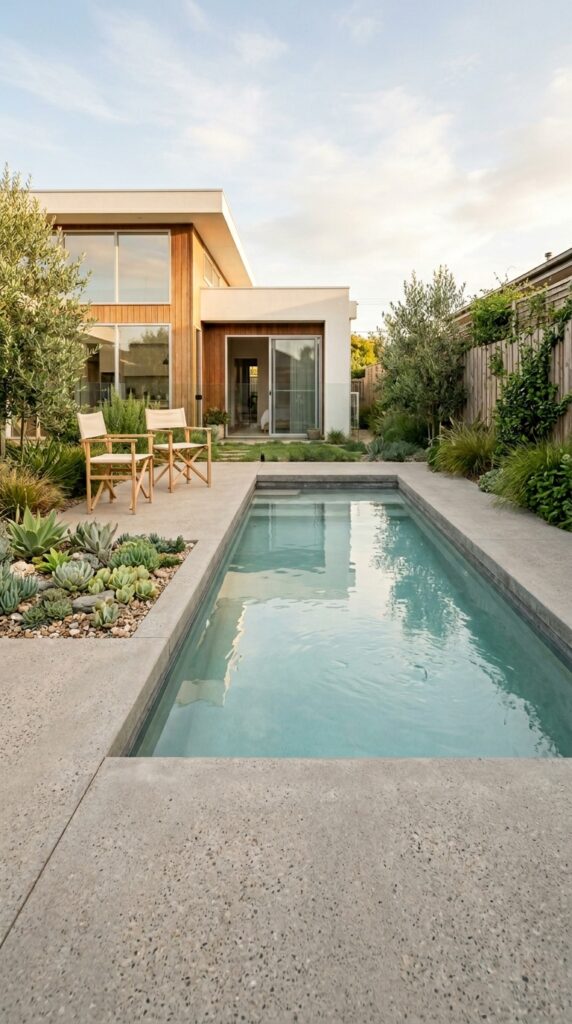
Vibe: Airy — a small yard that doesn’t feel small because the pool is part of the floor, not an obstacle in it.
Why it works: Flush coping — where the top of the coping stone sits at exactly the same level as the surrounding deck surface — creates the illusion of more ground plane because there’s no raised barrier interrupting the sightline across the yard. In a small backyard (under 40×40 feet), this single detail makes the pool feel less like an intrusion and more like an integrated feature of the landscape. The visual principle at work is continuity of horizontal plane — the eye reads the deck and pool as one surface.
How to get it: Flush coping requires precise elevation coordination between the pool contractor and the deck contractor — both must work from the same benchmark elevation. This level of coordination is often where small-budget pools cut corners; specify it explicitly in both contracts and have the project manager confirm the benchmark elevation in writing before any concrete is poured.
💡 Quick Win: Paint a small existing deck in a pale cool grey (similar to Sherwin-Williams “Spatial White”) to create the visual impression of flush continuity with the pool surface before investing in hardscape renovation.
Shop The Look
| Product |
| Compact folding outdoor chair weatherproof set of 2 |
| Succulent assorted outdoor planter set |
| Small patio bistro set 3-piece folding |
| Grey outdoor mat non-slip deck use 4×6 |
| Compact pool vacuum handheld battery |
22. Natural Stone Coping in Irregular Bluestone
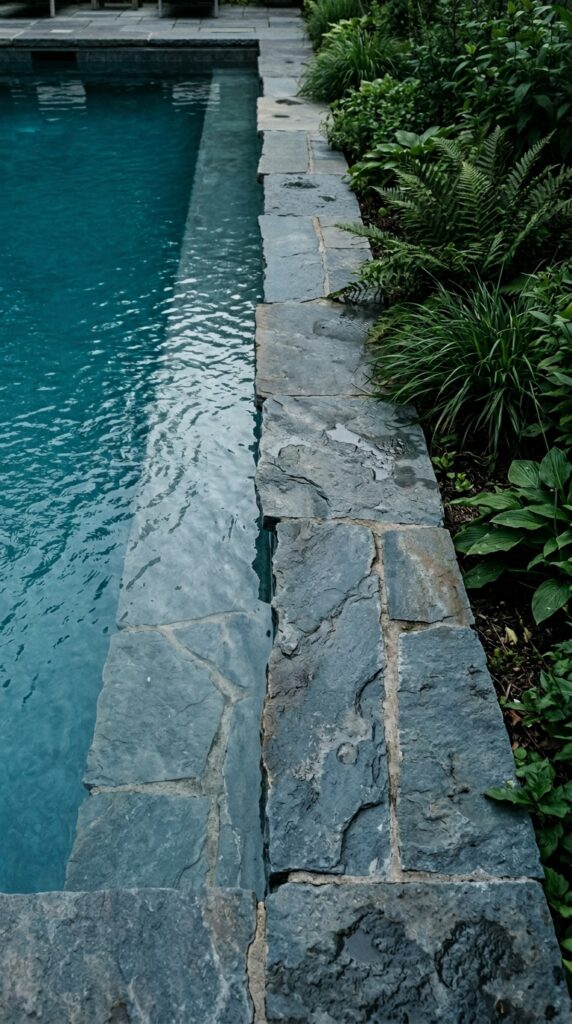
Vibe: Raw — a pool that looks like it was always part of the geology of the yard.
Why it works: Natural cleft bluestone (split along its natural grain rather than sawn) produces an irregular, slightly uneven surface that references geological formations. The color range in Pennsylvania bluestone — from blue-grey to greenish to warm charcoal — creates tonal variation across the coping that makes the edge look like it evolved rather than was installed. This is a fundamentally different visual language from the precision of sawn stone or porcelain tile, and it connects the pool to the natural landscape rather than distinguishing it from it.
How to get it: Order irregular-cut bluestone (also called “flagging”) in 1.5-inch thickness for structural stability as coping. The pieces will vary in size — this is correct. Use a pattern with pieces no smaller than 12 inches in any dimension to avoid a small-scale busy-ness. Set with a polymeric sand joint, not grout — the flexible joint accommodates the natural dimensional variation in real stone.
Shop The Look
| Product |
| Natural cleft bluestone outdoor stepping pad |
| Polymeric sand jointing compound 50lb bag |
| Perennial ornamental grass outdoor potted |
| Cast iron wall bracket outdoor planter mount |
| Stone look outdoor lantern large floor |
23. Fiesta Color: Vivid Waterline Tile in Terracotta and Hand-Painted Azulejo
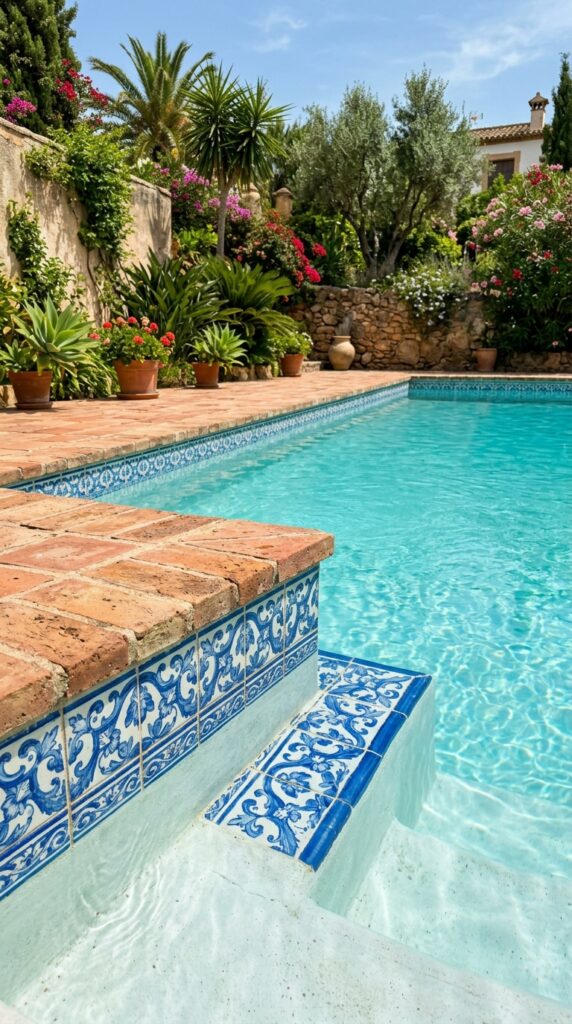
Vibe: Celebratory — the kind of pool that makes the rest of the backyard feel like a festival.
Why it works: Hand-painted azulejo tile (the traditional blue-and-white painted ceramic of Spain and Portugal) applied at the waterline band transforms the pool’s perimeter into an art installation visible from across the yard. The contrast principle at work is pure — cobalt on white on turquoise water — but it’s the cultural reference that gives the design its depth. The terracotta coping continues the warm Mediterranean material story, balancing the coolness of the blue tile with genuine warmth. This is a pool with a point of view.
How to get it: Source hand-painted azulejo tiles from specialty importers or tile studios — the authentic painted ceramic versions will chip and fade less than printed digital imitations in a wet pool environment. Set them with an epoxy grout in bright white (never grey) to maintain the crisp contrast between tile and grout joint that makes the pattern legible.
💡 Quick Win: Even a single row of azulejo tile (rather than a full 6-inch band) at the waterline creates the visual effect for significantly less material cost — one row reads as an intentional design accent.
Shop The Look
| Product |
| Hand painted azulejo ceramic tile 4×4 blue white |
| Terracotta paver outdoor tile 12×12 |
| Ceramic decorative platter blue white Mediterranean |
| Outdoor lantern hanging terracotta finish |
| Citrus potted tree lemon outdoor large |
24. Minimalist Pool House Integration With Concrete Folding Wall
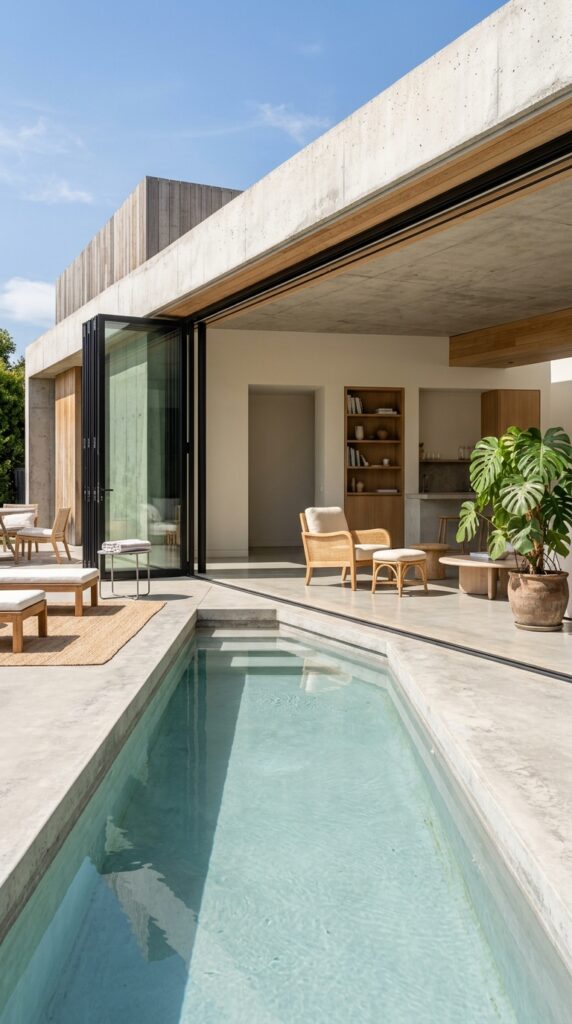
Vibe: Airy — the pool and the room are the same thing, just one is wet.
Why it works: Extending the pool to the threshold of an interior structure — separated only by a few inches — is a feat of structural and waterproofing engineering that produces the most seamless indoor-outdoor transition possible. The visual principle is continuity: the eye follows the horizontal water plane directly into the interior space, erasing the boundary. This design only works when the floor level of the interior structure and the pool deck are at the same elevation, requiring precise coordination from the foundation pour.
How to get it: The pool shell must be waterproofed against the pool house foundation with a flexible expansion joint (not rigid sealant, which will crack as the two structures move independently over time). Specify a EPDM rubber waterstop at the joint between the pool shell and the building foundation — this is a technical specification that should be reviewed by a structural engineer before construction begins.
Shop The Look
| Product |
| Monstera deliciosa indoor plant large potted |
| Outdoor indoor rug grey flatweave 6×9 |
| Folding glass door hardware track modern |
| Pool-side indoor-outdoor sofa weatherproof |
| Architectural concrete floor lamp modern indoor |
25. Mosaic Wave Band With Ombre Interior Plaster
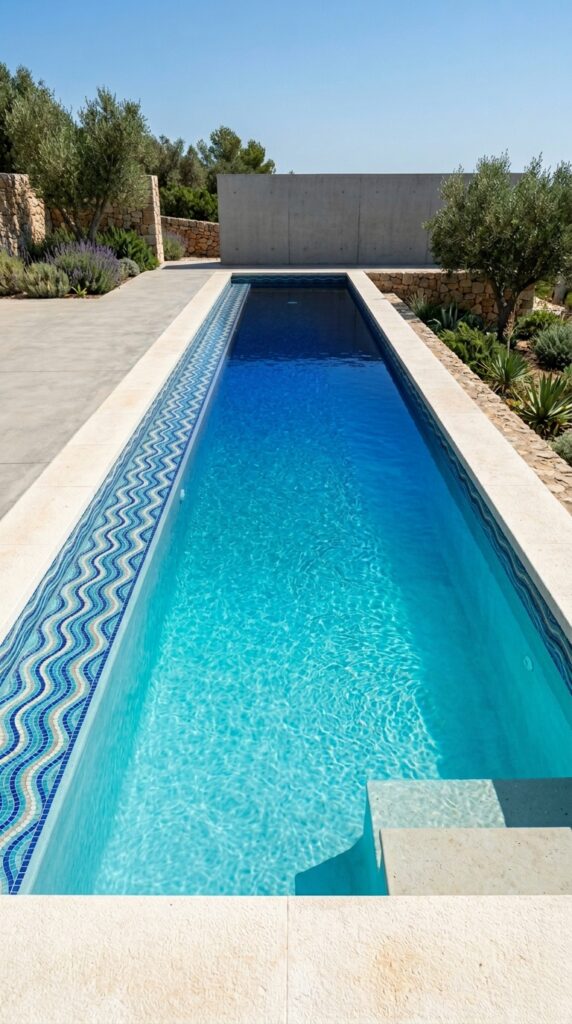
Vibe: Artistic — when the pool itself is the piece.
Why it works: An ombre plaster interior — where two different plaster colors are feathered together during application, transitioning from a lighter shade at the shallow end to a deeper tone at the deep end — mimics the natural behavior of water depth. In nature, shallow water appears lighter (you can see the sandy bottom) and deep water appears darker (the bottom absorbs rather than reflects light). The ombre plaster creates this depth gradient artificially, making a pool that reads the way the ocean does. The mosaic wave band reinforces the water metaphor at the eye-level waterline.
How to get it: The ombre plaster application requires a skilled finish crew who has executed this technique before — it’s a two-plasterer application where the crews must work simultaneously from opposite ends and feather at the center. Specify the exact transition point (typically at the mid-point of the pool, near the break from shallow to deep) in the contract to avoid a hard line at the junction.
Shop The Look
| Product |
| Glass mosaic tile wave pattern multi-blue 1×1 |
| Aqua blue pool float inflatable premium |
| Waterproof outdoor art print coastal wave canvas |
| Blue ceramic vase set outdoor living tabletop |
| Ocean blue outdoor throw pillow set 2 |
26. Converted Basement Pool With Overhead Skylight Illumination
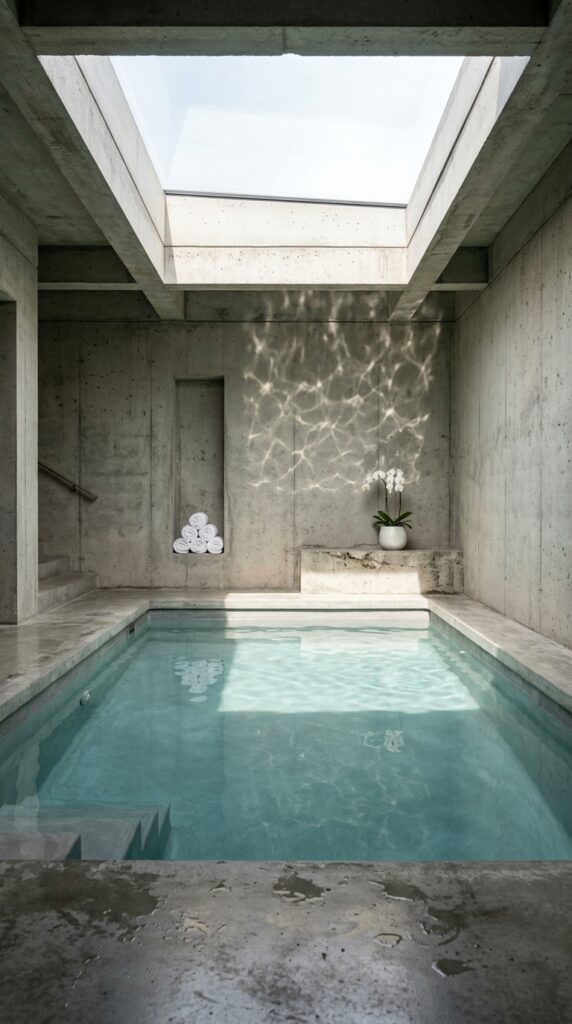
Vibe: Still — the water glows from above like something sacred, the light pattern shifting with the weather outside.
Why it works: An indoor below-grade concrete pool lit by a skylight overhead creates a caustic light phenomenon: sunlight entering through water-adjacent glazing refracts and creates moving, wave-like patterns on the surrounding concrete walls and ceiling. This effect requires no technology — it’s pure physics. The contrast between the weight of concrete walls and the delicate, shimmering caustic light pattern creates one of the most architecturally compelling interior pool experiences possible. It is impossible to replicate with artificial light.
How to get it: The skylight should be positioned directly over the pool’s center, framed in a light well (a vertical shaft in the building structure above) if the pool is multiple floors below grade. Structural glazing (floor-to-ceiling frameless glass) rather than a surface-mounted skylight frame produces the cleanest light quality and the most unobstructed caustic patterns on the walls. This is a project requiring both a structural engineer and an architect — not a contractor-led design decision.
💡 Quick Win: Even a modest sun tube (a flexible tube that channels daylight from the roof into a below-grade space) can produce caustic wall patterns in a below-grade pool room for a fraction of the cost of a structural skylight.
Shop The Look
| Product |
| White orchid artificial plant pot indoor |
| White waffle weave towel set luxury oversized |
| Concrete finish wall tile indoor 24×24 |
| Recessed niche shelf bathroom concrete look |
| Indoor pool air dehumidifier 70 pint |
How to Start Your Concrete Pool Transformation
The single most important first decision in any concrete pool project is the interior finish color — and the answer is to get a wet sample before anything else. Order a 12×12 wet sample of your shortlisted plaster finish (your pool builder can provide this, or you can request samples from manufacturers like NPT or Diamond Brite), submerge it in a bucket of water, and observe it at different times of day. The interior finish dictates the perceived water color for the life of the pool. Everything else — coping, deck, features — responds to this foundational choice. This is the decision you cannot change without replastering.
The most common mistake in concrete pool design is scaling features to the pool’s actual size rather than to the overall outdoor space. A homeowner with a 50-foot backyard installs a pool with a 3-foot coping border, leaving no room for furniture, planting, or movement — then wonders why the result feels cramped. The pool itself should not exceed 60% of the available outdoor floor area; 50% is better. The remaining space is what makes the pool livable.
Three items under $50 that create immediate pool-area design impact: a pair of brushed bronze hose bib covers (around $18 a pair — they eliminate the eyesore of raw valves visible from the deck); a bag of river pebble to dress a bare equipment pad surround ($22 per bag at landscaping centers); and a single large architectural agave in a concrete pot, which you can find at big-box garden centers for $35–45 and which reads as a $200 specimen planting from 20 feet away.
Realistically, a starter concrete pool (rectangular, 12×24 feet, plaster interior, basic coping, no features) takes 6–10 weeks to build and costs $45,000–65,000 in most U.S. markets. A mid-range pool with one or two features (Baja shelf, raised spa, or infinity edge — not all three) runs $80,000–120,000. A full custom pool with premium finishes, multiple water features, and integrated lighting sits at $150,000–300,000+. A weekend can accomplish getting competitive bids and selecting a finish color. A complete transformation, landscaping included, takes 3–5 months realistically.
Frequently Asked Questions About Concrete Swimming Pool Design
What is the difference between a concrete pool and a gunite pool?
These terms refer to the same basic structure. “Gunite” describes the application method — dry cement mix is projected through a hose and mixed with water at the nozzle before being sprayed onto the rebar framework. “Shotcrete” is the wet-mix equivalent. Both produce a concrete shell that can be finished in plaster, aggregate, tile, or a combination. When a pool company says “gunite pool,” they simply mean a concrete pool built using the gunite spray method rather than poured-in-place formwork.
What interior finish produces the best water color in a concrete pool?
Water color is determined by the interior finish color combined with the depth of the water. Dark charcoal or black aggregate finishes (like Pebble Tec’s “Black Onyx”) produce deep, saturated blue-to-midnight colors. Mid-range blues and greiges (like Diamond Brite “French Gray” or NPT “Tahoe Blue”) produce the classic turquoise-to-teal palette. Pure white plaster produces bright, Carribean-turquoise water in shallow areas and pale teal at depth. There is no single “best” — the right choice depends on whether you want dramatic, classic, or bright water color.
What does a concrete pool cost compared to fiberglass?
A concrete pool typically costs 20–40% more than a fiberglass pool of equivalent size, with national averages ranging from $50,000–$150,000+ for concrete versus $35,000–$85,000 for fiberglass. The premium buys unlimited shape flexibility, a wider range of interior finishes, and the ability to add custom features (infinity edges, grottos, perimeter overflow) that fiberglass shells cannot accommodate. Ongoing maintenance costs are also higher for concrete — concrete pools require resurfacing every 10–15 years ($10,000–20,000) and consume more chemicals due to the porous plaster surface.
Can I add a concrete pool to an existing landscaped backyard without starting over?
Yes, but the scope of disturbance is significant and should be planned honestly. Excavation equipment (typically a full-size excavator) must access the pool site, which means removing any hardscape, mature plants, or structures in the access path. The good news is that existing trees with root systems more than 15 feet from the excavation zone are generally safe; within that radius, root damage is likely. A phased approach works: excavate and build the pool shell first, then re-landscape around the completed structure. Budget for landscaping restoration (typically 15–25% of the pool cost) from the beginning.
What is the most durable coping material for a concrete pool?
Porcelain pavers are currently the most durable coping choice for most climates — they don’t absorb water (which means no freeze-thaw cracking), don’t stain, and are available in large-format sizes that minimize grout joints. Honed travertine is the most historically proven natural stone for pool coping (it has been used since Roman bathhouse construction) but requires annual sealing in climates with freeze-thaw cycles. Natural bluestone is extremely durable but develops mineral staining near waterline chemistry equipment if left unsealed. Avoid poured concrete coping without a high-quality sealer — raw concrete at the pool edge stains within two seasons from chemistry exposure.
Ready to Create Your Dream Concrete Pool?
These 26 concrete swimming pool designs cover the full range of what concrete makes possible — from the color decision at the interior finish level, to the material choices at the coping and deck, to the spatial logic of layouts that work on compact lots and sprawling properties alike. Transformation in a concrete pool project is genuinely incremental — the smartest owners start with a resolved shell (the right shape, the right interior finish, the right coping) and add features in subsequent seasons, which is not a compromise but a strategy for getting each element right. Today, request wet plaster samples from two or three finish manufacturers and compare them side by side in your actual outdoor light — that single step will inform every other decision downstream. When a concrete pool is done well, you’ll stop thinking about it as a pool and start thinking about it as the organizing center of your outdoor life. Pin the designs that made your breath catch — those instincts are your design brief.