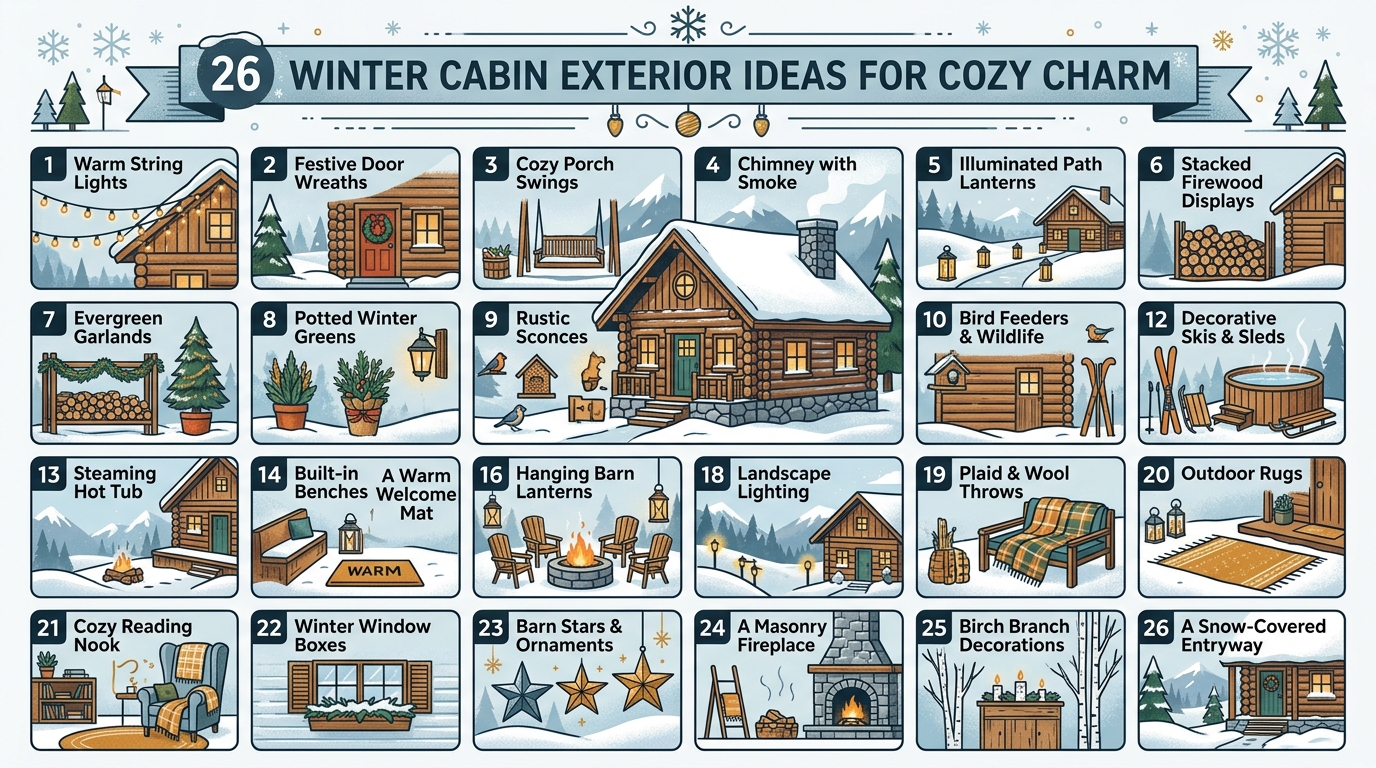
Winter cabin exterior style is the art of designing an outdoor facade that radiates warmth, rugged character, and deep belonging — equal parts shelter and invitation. This article delivers exactly 26 winter cabin exterior ideas spanning color, material, lighting, architecture, and small-space adaptations so you can steal the look that speaks to you.
There’s a particular kind of magic in a cabin at dusk in winter — amber light spilling from a frost-edged window, smoke curling from a stone chimney, the crunch of snow underfoot. Winter cabin exteriors feel earned. They feel like something the landscape chose rather than a homeowner decided. Rough-hewn, warm-glowing, quietly proud — this aesthetic is less about perfection and more about presence. Here are 26 ideas worth saving — and stealing.
Why Winter Cabin Exterior Style Works So Well
The winter cabin exterior tradition draws from Scandinavian vernacular architecture, Appalachian craft-building, and the Arts and Crafts movement’s insistence that structures speak honestly about their materials. Unlike modern farmhouse or coastal styles, cabin exteriors resist the polished and the pristine. Exposed timber joinery, stacked stone, and aged metal are not imperfections — they are the entire point. This is a style rooted in the idea that a shelter should look like it belongs where it stands.
The palette is entirely anchored in the natural world: warm charcoal, raw umber, slate gray, deep spruce green, and the burnt sienna of aged cedar. Underscoring those tones are materials like unfinished white oak, hand-split cedar shingles, board-and-batten pine, reclaimed fieldstone, and aged Corten steel. Every surface should appear as though it has weathered at least one hard winter, yet held firm.
This style’s current surge is no accident. Post-pandemic homeowners rediscovered the emotional weight of “home as refuge,” and social searches for cozy, grounded aesthetics spiked dramatically after 2020. Pinterest reports that searches for “cabin exterior” and “rustic mountain home” have grown year-over-year since 2021, reflecting a cultural hunger for spaces that feel deliberately disconnected from the digital pace of modern life.
Even a modest one-story home can achieve this aesthetic. The key for smaller structures is to commit to two or three strong material moments — a stone foundation, a board-and-batten upper section, cedar shake details around the gable — rather than spreading the budget thin. Scale honestly: a massive timber frame portal looks absurd on a 900-square-foot cottage. Choose details proportional to the structure and they will read as intentional.
Style at a Glance
| Element | Core Trait |
| Philosophy | Honest materiality; beauty through function |
| Materials | Cedar shingles, fieldstone, reclaimed timber, Corten steel |
| Color Palette | Warm charcoal, deep spruce green, raw umber, slate gray |
26 Winter Cabin Exterior Ideas
1. Deep Spruce Green Board-and-Batten Siding
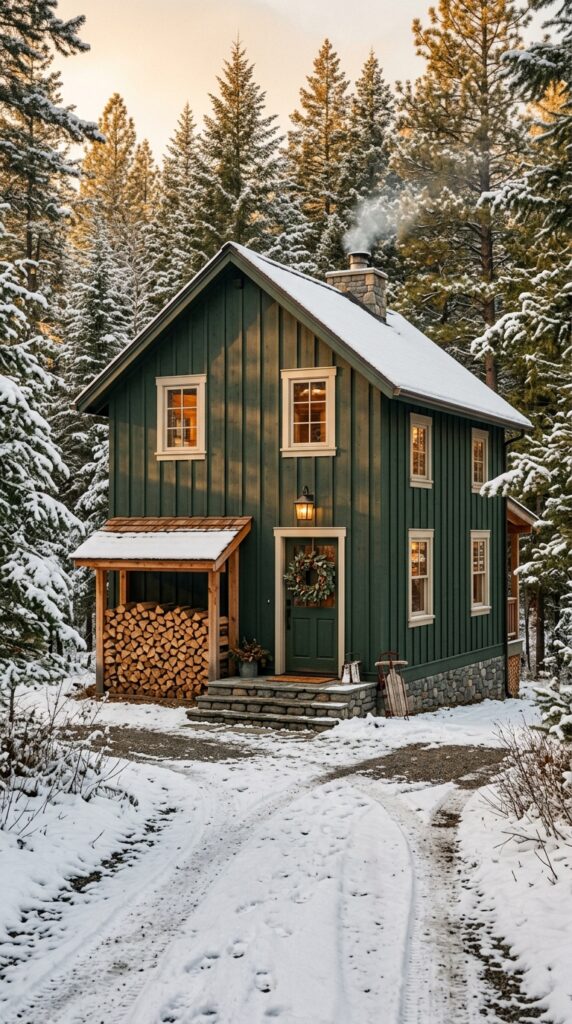
Vibe: This facade feels rooted — like the house grew from the same soil as the trees flanking it.
Why it works: The vertical lines of board-and-batten siding create upward visual movement that makes a one-story structure read taller. Deep spruce green is a classic in vernacular mountain architecture because it pulls from the surrounding conifer palette, creating a visual dialogue between the man-made and the natural. The contrast between matte dark siding and crisp white window trim gives the facade definition without resorting to fussiness.
How to get it: Choose a paint with a flat or low-sheen finish — high gloss reads urban and too clean. Benjamin Moore’s “Tarrytown Green” (HC-134) or Sherwin-Williams “Hunt Club” (SW 6468) are both period-appropriate tones with warm undertones that glow gold under winter light. Use white cedar battens at 12-inch centers for proportionally correct shadow lines on a standard single-story home.
💡 Quick Win: A five-dollar bundle of wreath wire and a $20 bundle of fresh pine boughs from a garden center will give you a fragrant, authentic winter wreath in under 20 minutes — no craft store required.
🛍️ Shop the Look — Amazon Product Ideas
| # | Product Search Phrase | Why It Fits |
| 1 | Matte black outdoor wall lantern sconce | Matches cabin aesthetic |
| 2 | Cedar firewood log rack outdoor | Functional rustic accent |
| 3 | Eucalyptus dried wreath front door | Natural winter greenery |
| 4 | Board and batten exterior house numbers black | Clean rustic signage |
| 5 | Outdoor doormat coir natural fiber | Earthy entryway texture |
2. Fieldstone Foundation with Timber Frame Accents
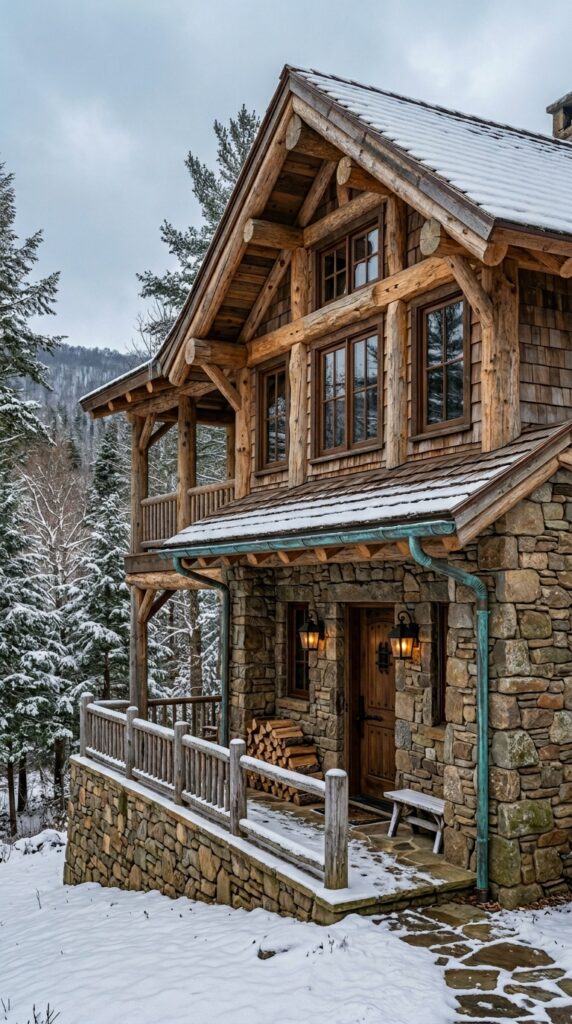
Vibe: The facade feels ancient — like a place that absorbed several generations of winters and is entirely unbothered by one more.
Why it works: Stone and timber are the original cabin pairing because each material reinforces the structural honesty of the other. Stone communicates permanence and thermal mass; exposed timber communicates craft and warmth. Mixing the two creates a visual hierarchy — the eye reads the stone as foundation, then travels upward to the warmth of wood. This is the design principle of material layering at its most effective.
How to get it: If full fieldstone construction isn’t in the budget, cultured stone veneer panels from brands like Eldorado Stone or Cultured Stone offer a convincing 4–6-inch veneer alternative. Apply it from grade to the window sill line for maximum visual impact. Complete the look with rough-sawn 6×6 cedar or Douglas fir posts at the porch corners.
🛍️ Shop the Look — Amazon Product Ideas
| # | Product Search Phrase | Why It Fits |
| 1 | Cast iron coach house lantern wall mount | Period-correct exterior light |
| 2 | Split rail cedar fence post porch railing | Authentic rustic railing |
| 3 | Copper rain chain downspout replacement | Aged metal accent |
| 4 | Stone texture outdoor address plaque | Stone-matched house numbers |
| 5 | Black wrought iron door hardware set | Matching dark metal hardware |
3. Warm Amber Porch Lighting Against Dark Siding
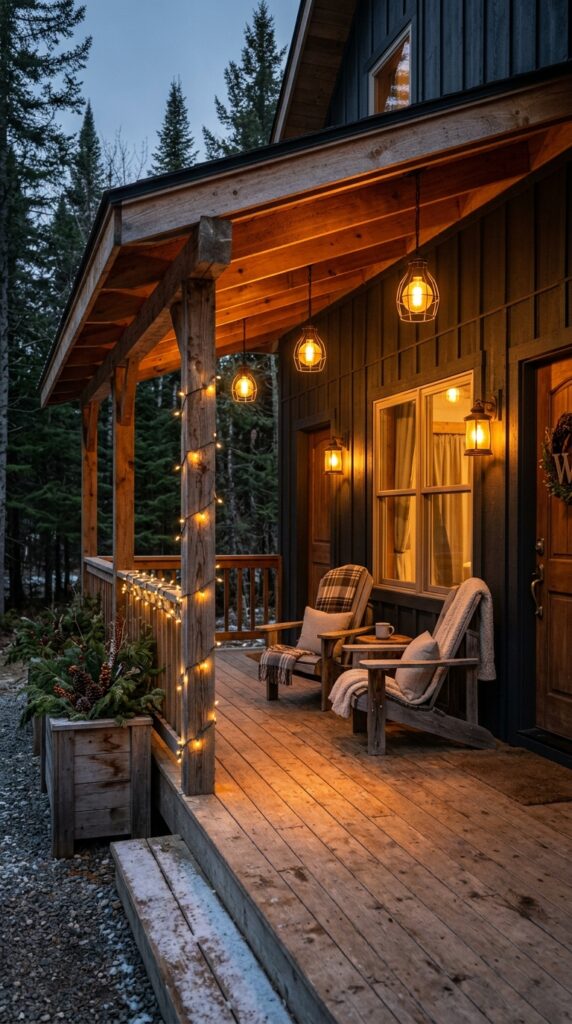
Vibe: The porch glows hushed against the winter dark — like a lighthouse, but one that signals comfort rather than warning.
Why it works: Warm-spectrum bulbs (2700K or lower) do something remarkable against dark exterior siding at dusk: they create a stage-like glow that makes even a simple porch read as deeply intentional. This is the lighting principle of contrast ratio at work — the darker the surround, the more luminous the source. Cage-style pendants with Edison filament bulbs add visual texture because the filament coil becomes a decorative element in itself.
How to get it: Swap any existing porch fixtures to cage-style or vintage cage Edison pendants using 40-watt-equivalent LED filament bulbs in the 2200–2700K range. Hang a secondary strand of outdoor Edison string lights along the porch ceiling perimeter at 12-inch spacing — this doubles the light level without adding a fixture.
💡 Quick Win: A $15 smart plug with a dusk-to-dawn schedule ensures your amber porch lights come on automatically at sunset — no timer programming required.
🛍️ Shop the Look — Amazon Product Ideas
| # | Product Search Phrase | Why It Fits |
| 1 | Outdoor Edison string lights weatherproof 25ft | Warm porch ambiance |
| 2 | Cage pendant outdoor porch light black | Industrial rustic fixture |
| 3 | LED filament bulb 2700K amber warm | Correct color temperature |
| 4 | Adirondack chair outdoor wood folding | Classic porch seating |
| 5 | Outdoor wool plaid throw blanket porch | Layered winter texture |
4. Cedar Shake Shingles on Gable Ends
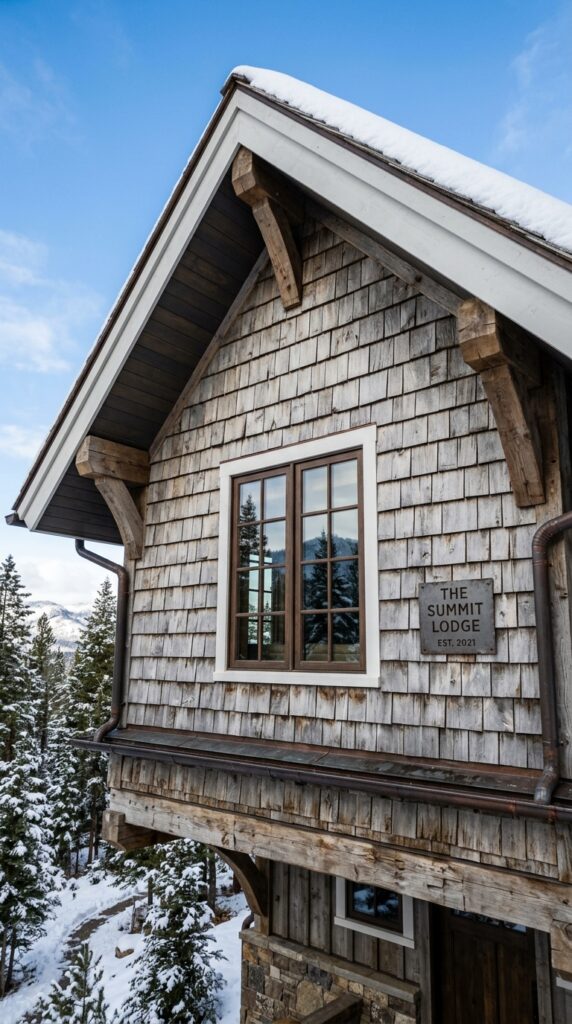
Vibe: The gable end reads handmade — irregular, alive with grain and shadow, like something assembled over an unhurried summer.
Why it works: Cedar shingles on gable ends deploy the design principle of texture contrast — when the main body of the house is a flat painted surface, a fully shingled gable introduces rich depth and shadow play that the eye naturally gravitates toward. Naturally weathered cedar ages from warm honey to a distinguished silver-gray over three to five years outdoors, which only deepens the cabin character over time. This patina cannot be convincingly faked, which makes it genuinely prestigious in a way painted finishes are not.
How to get it: Use 18-inch or 24-inch hand-split cedar shakes (not sawn-face shingles, which are too uniform) at a 7.5-inch exposure for residential gable applications. If you want to accelerate the silver weathering, apply a single coat of Cabot’s Australian Timber Oil in “Clear” thinned 10 percent — it opens the grain and begins the silver oxidation process within the first season.
🛍️ Shop the Look — Amazon Product Ideas
| # | Product Search Phrase | Why It Fits |
| 1 | Timber wood corbel bracket eave decorative | Structural gable accent |
| 2 | Cedar wood stain weathering gray exterior | Accelerate silver patina |
| 3 | Copper gutter downspout elbow K-style | Aged metal complement |
| 4 | Metal cabin mountain sign exterior wall | Rustic identity marker |
| 5 | Exterior wood trim primer cedar-compatible | Proper prep for trim |
5. A Covered Entry Porch with Timber Columns
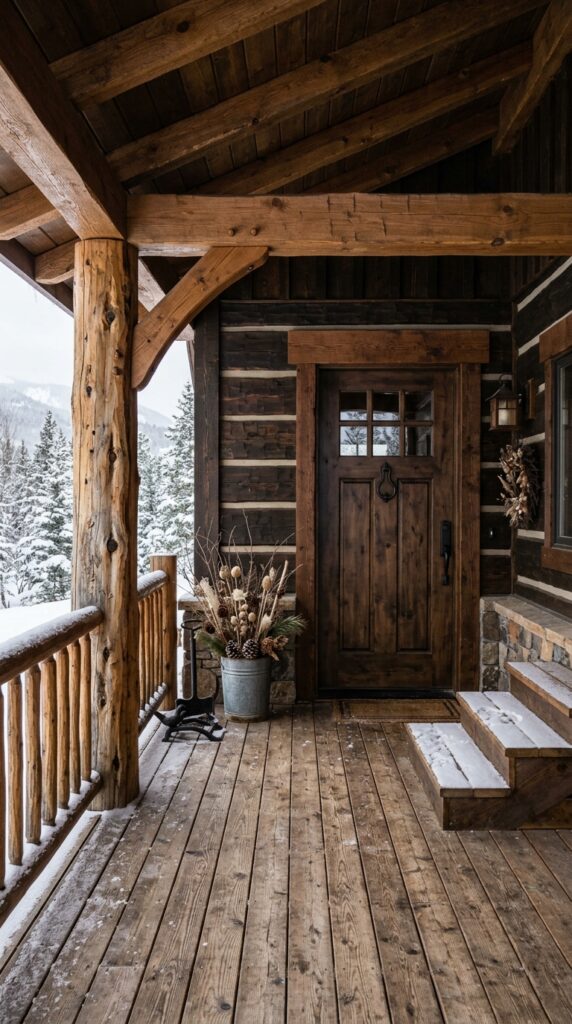
Vibe: The porch feels inevitable — the kind of threshold that makes arriving feel like exhaling.
Why it works: A covered entry porch solves a functional problem — keeping snow off the entry — while simultaneously creating the transitional zone that all great cabin architecture provides. This is the design principle of arrival sequence: the progression from exterior to porch to interior slows entry down and makes each space feel more distinct. Timber columns with visible joinery communicate craft and permanence in a way that a standard 4×4 pressure-treated post simply cannot.
How to get it: Source full-diameter peeled log columns (6–8 inch diameter) from a local sawmill or log home supplier rather than home centers. Pair them with pre-fabricated knee braces in Douglas fir — available through architectural millwork suppliers — and attach them with through-bolted hardware for a structural appearance without custom carpentry costs.
💡 Quick Win: A $25 cast iron boot scraper beside the front door is one of the highest-impact, lowest-cost rustic details available — it communicates the whole cabin lifestyle in a single object.
🛍️ Shop the Look — Amazon Product Ideas
| # | Product Search Phrase | Why It Fits |
| 1 | Cast iron boot scraper decorative outdoor | Rustic entry detail |
| 2 | Galvanized steel bucket planter outdoor | Farmhouse/cabin planter |
| 3 | Timber wood bracket knee brace decorative | Porch structural accent |
| 4 | Heavy duty door knocker iron antique style | Character entry hardware |
| 5 | Cedar porch swing outdoor wood natural | Classic covered porch furniture |
6. Charcoal and Cream Color Blocking
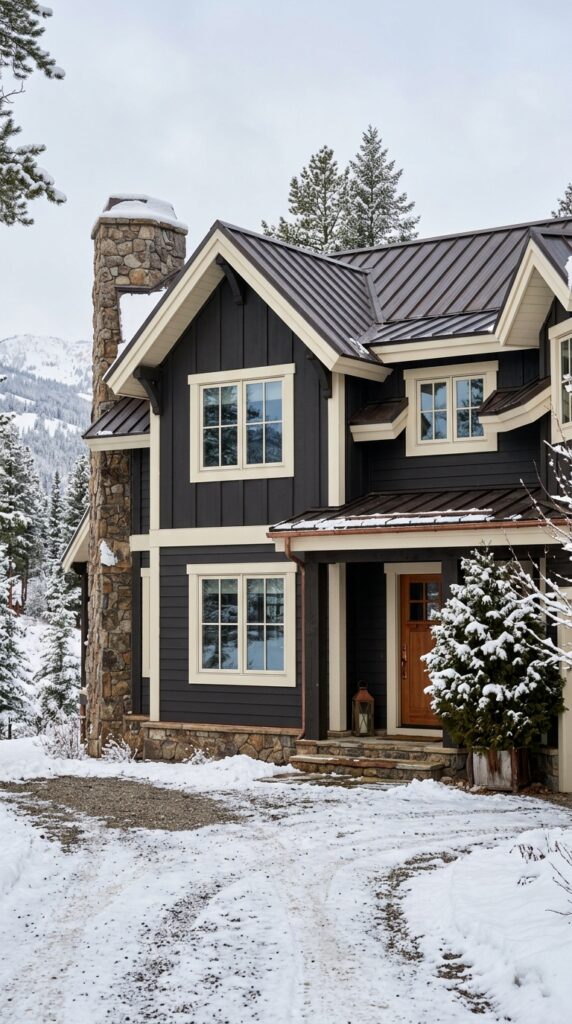
Vibe: The facade reads deliberate — the kind of restraint that signals deep confidence in a design decision.
Why it works: Two-tone exteriors succeed because they use the design principle of contrast at the threshold — every edge where charcoal meets cream catches the eye and reads as intentional architecture. Warm charcoal (a color that leans brown rather than blue-gray) reads as organic against a snowy winter landscape rather than industrial. The cream trim acts as the frame that defines each architectural element: windows become artwork, corners become punctuation marks.
How to get it: Use Benjamin Moore “Black Iron” (2130-20) for the body — it is a charcoal that pulls warm-brown rather than cool-purple at different light angles. Pair it with “Antique White” (OC-75) for all trim. Apply a dedicated exterior alkyd enamel to trim boards for sharper lines and better durability against winter moisture.
🛍️ Shop the Look — Amazon Product Ideas
| # | Product Search Phrase | Why It Fits |
| 1 | Copper lever door handle set exterior | Warm metal complement |
| 2 | Black steel exterior kick plate door | Dark metal trim detail |
| 3 | Arborvitae emerald green shrub ball | Vertical evergreen accent |
| 4 | Standing seam metal roof panel charcoal | Dark roofing match |
| 5 | Exterior window box planter dark metal | Contrast window detail |
7. Reclaimed Wood Window Shutters
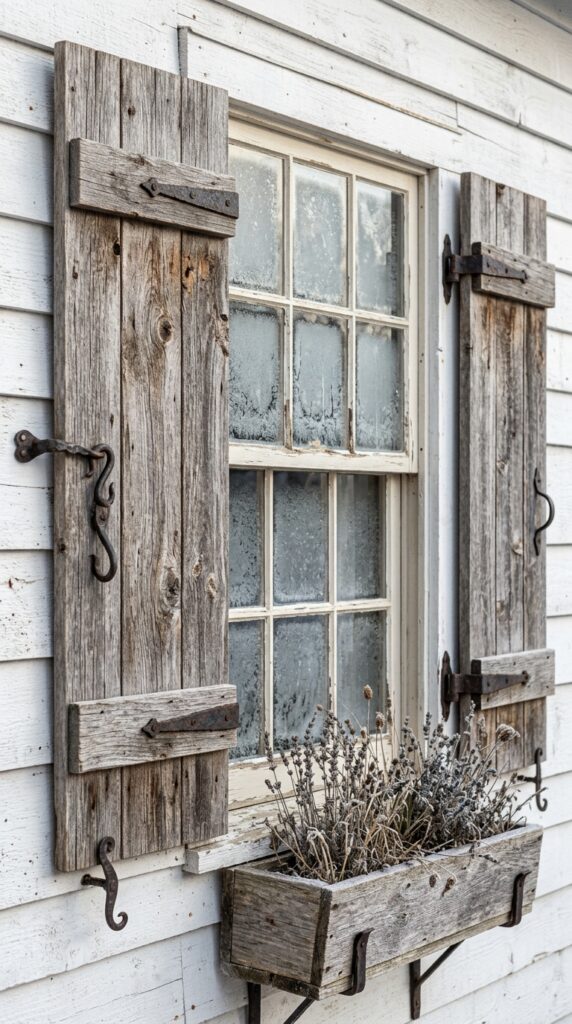
Vibe: The window reads sun-warmed and imperfect — each board a slightly different gray, each knot a small story.
Why it works: Reclaimed wood shutters introduce the design principle of material age contrast — placing visibly old wood against a fresh painted surface creates a layered temporal quality that new materials alone can never achieve. The visual weight of the shutter frames the window and gives the facade a horizontal rhythm that connects across the facade. Functional shutter dogs (the small iron catches that hold shutters open against the wall) communicate that these were once weather-hardened and intentional, not decorative appliqués.
How to get it: Salvage yard planks in 1×6 or 1×8 widths assembled with horizontal z-bar battens on the back make convincing reclaimed shutters for under $40 per pair in materials. Stain them with one wash coat of gray-toned exterior stain to unify the boards, then let them weather naturally from there. Size them to the actual window width for proper proportion.
💡 Quick Win: Iron shutter dogs from a blacksmith supply or architectural hardware site cost $12–18 each and immediately make shutters read as functional rather than decorative — the single detail that separates a real shutter from a flat panel.
🛍️ Shop the Look — Amazon Product Ideas
| # | Product Search Phrase | Why It Fits |
| 1 | Wrought iron shutter dog pintle hinge | Authentic shutter hardware |
| 2 | Gray exterior wood stain weathered finish | Aged wood treatment |
| 3 | Cedar window box planter outdoor 24 inch | Window ledge planting |
| 4 | Dried lavender bundle wreath decor | Natural winter windowscape |
| 5 | Black forged iron window shutter hinge | Period-correct pivot hardware |
8. Metal Roof in Aged Copper or Weathering Steel
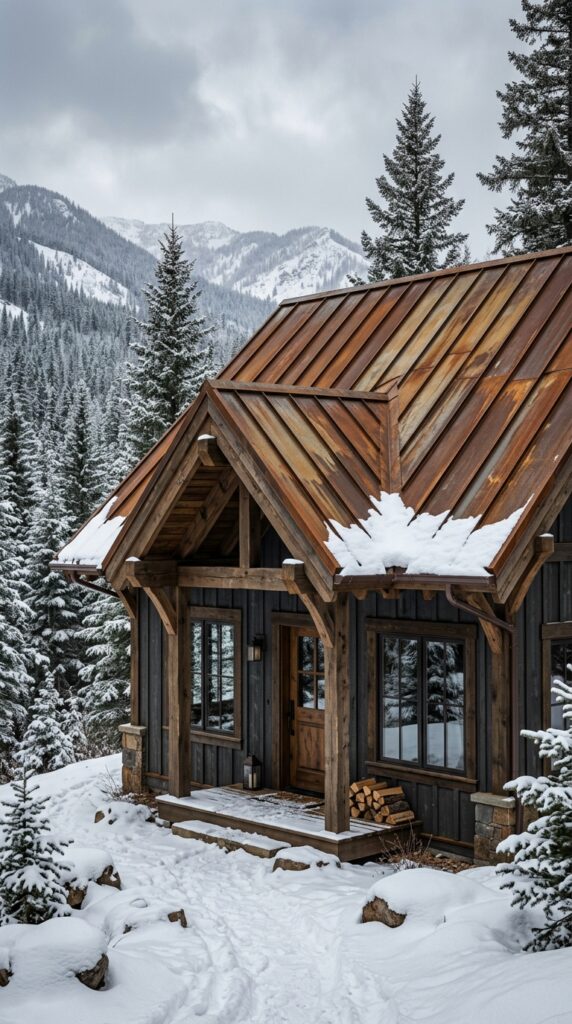
Vibe: The roof reads permanent — weathered to something the landscape itself would choose.
Why it works: Metal roofing — especially in Corten weathering steel or aged copper tones — introduces the principle of material integrity: a surface that ages into its finish rather than failing it. The visual mass of a standing-seam metal roof gives cabin architecture its structural authority, especially under a snow load where the heavy horizontal line at the eave creates a clear boundary between shelter and sky. Standing seam profiles also cast linear shadow ribs that add texture to what might otherwise be a flat uninteresting field.
How to get it: Kynar-finish steel panels in a Corten-look color (such as McElroy Metal’s “Rusted” or AEP Span’s “Antique Copper”) achieve the patina aesthetic without the structural maintenance requirements of real Corten. Specify 24-gauge panels at 16-inch standing seam spacing for the proportionally correct shadow rib scale on a residential-sized roof.
🛍️ Shop the Look — Amazon Product Ideas
| # | Product Search Phrase | Why It Fits |
| 1 | Standing seam metal roof panel 24 gauge | Authentic roofing material |
| 2 | Copper ridge cap flashing roofing | Distinctive roof accent |
| 3 | Decorative rafter tail bracket wood exterior | Eave character detail |
| 4 | Snow guard roof bracket metal cabin | Functional safety detail |
| 5 | Corten weathering steel garden edging | Matching material in garden |
9. Warm Russet and Amber Exterior Color Palette
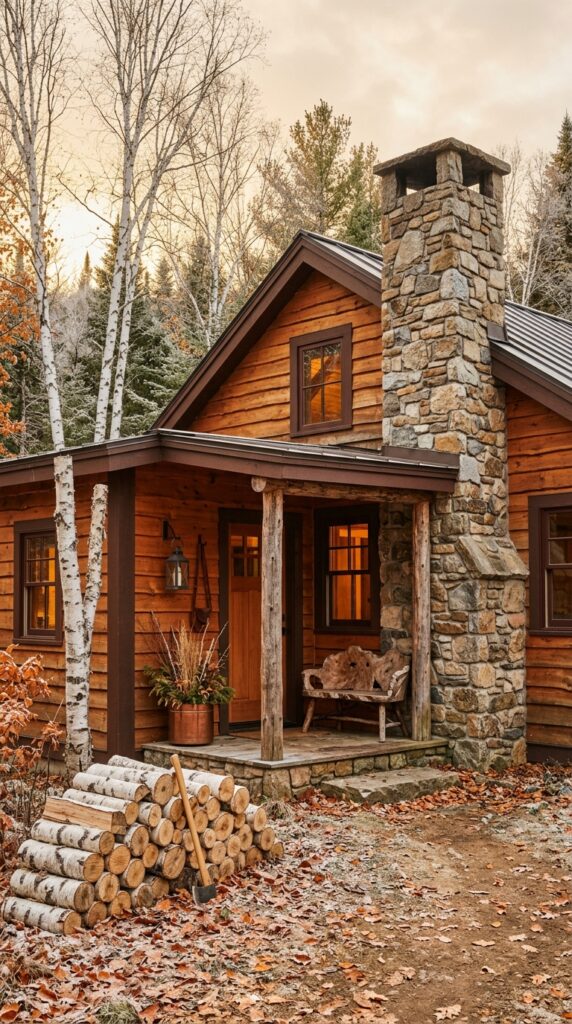
Vibe: The cabin reads sun-warmed even on a gray December day, pulling all of winter’s amber light into its surfaces.
Why it works: Warm earth tones exploit the principle of seasonal harmony — in a winter landscape stripped of green, a warm amber or russet cabin draws color from the same palette as bare birch bark, dried oak leaves, and morning ice. The result is a house that feels composed rather than imposed. A transparent wood stain in russet tones (rather than paint) allows grain to read through the color, adding a depth that flat paint can’t replicate.
How to get it: Apply Sikkens Cetol 1 followed by Cetol 23 Plus in the color “Teak” or “Dark Oak” for a transparent amber finish with 5–7 year exterior durability on cedar or pine lap siding. Finish with a solid-color dark brown stain (such as “Rustic Brown” in Ready Seal) on all trim for clean contrast.
💡 Quick Win: A $30 copper outdoor planter filled with dried ornamental grasses (available at any garden center in late fall) placed beside the front door introduces the amber palette at eye level immediately and requires zero installation.
🛍️ Shop the Look — Amazon Product Ideas
| # | Product Search Phrase | Why It Fits |
| 1 | Semi-transparent cedar stain russet brown | Amber wood exterior finish |
| 2 | Copper outdoor planter self-watering large | Entry palette accent |
| 3 | Burl wood natural edge bench outdoor | Organic entry furniture |
| 4 | Dried ornamental grass bundle decor | Warm winter plant material |
| 5 | Leather strap outdoor lantern wall sconce | Warm material mix |
10. Oversized Timber-Framed Picture Window
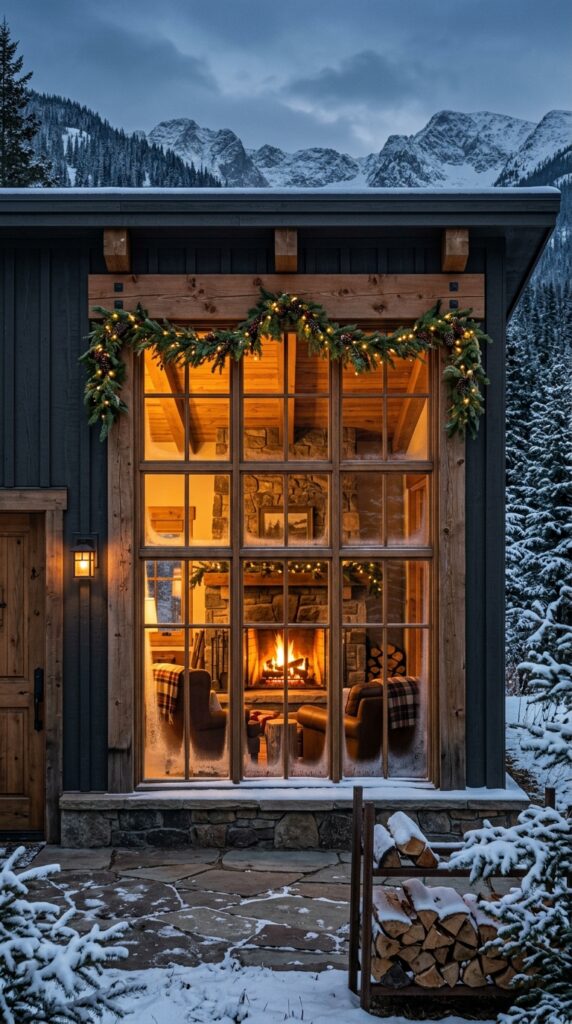
Vibe: The window reads luminous — a warm frame within a frame, making the interior itself into the artwork.
Why it works: An oversized picture window is simultaneously an architectural statement and a lighting technique. From outside, the amber interior glow becomes a beacon — the light source that gives any cabin exterior its signature winter warmth in dusk and evening photography. From a design principle standpoint, the large opening creates negative space in the facade that makes the surrounding solid walls read as more substantial by contrast. Thick timber window casing emphasizes the wall’s depth and implies a structure built to last.
How to get it: If a structural window enlargement isn’t in scope, you can approximate the visual effect by adding a heavy timber box casing (minimum 5-inch width) around an existing window in Douglas fir or painted to match the trim. Install interior Edison pendant lights or a floor lamp positioned close to the window to ensure the “glowing from within” effect is visible from outside.
🛍️ Shop the Look — Amazon Product Ideas
| # | Product Search Phrase | Why It Fits |
| 1 | Timber window casing surround exterior wood | Frame window like cabin |
| 2 | Edison floor lamp warm 2700K living room | Creates the interior glow |
| 3 | Fresh pine garland 9ft door window exterior | Winter header dressing |
| 4 | Dark iron window hardware lag bolt decorative | Structural visual detail |
| 5 | Window frost spray decorative holiday | Frost-edge window detail |
11. Snow-Ready Covered Breezeway or Mudroom Entry
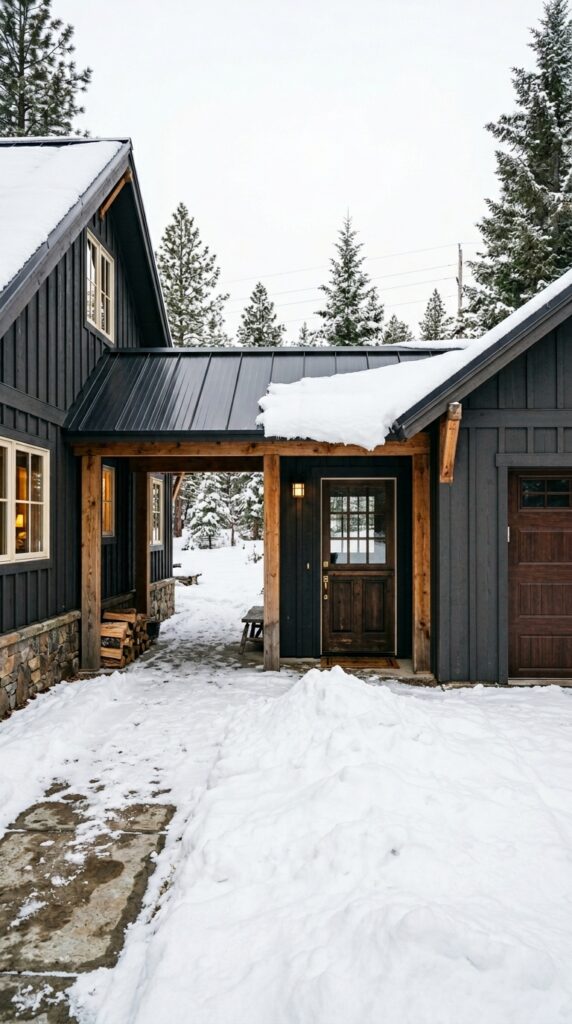
Vibe: This entryway feels purposeful — built around the reality of winter rather than designed in spite of it.
Why it works: A covered breezeway solves the fundamental tension of cabin living: deep winter requires gear storage and transition before entering the main space. This is the design principle of programmatic honesty — every architectural element should be doing real work. The breezeway also creates an intermediate scale between the house and the outdoors, a transitional zone that makes the main entry feel more sheltered and dignified than a door punched directly into an exterior wall.
How to get it: A lean-to shed addition with a 4:12 pitch minimum and metal roofing requires a building permit in most jurisdictions but can be framed with standard 2×6 lumber and finished to match the house in a single weekend for material costs under $1,500 in most markets. Use the same siding material and color as the main house to read as integrated rather than added-on.
💡 Quick Win: A $45 wall-mount double-arm coat rack in black iron beside the exterior door accomplishes the mudroom feeling with zero construction — an instant signal that the entry has been thoughtfully prepared for winter life.
🛍️ Shop the Look — Amazon Product Ideas
| # | Product Search Phrase | Why It Fits |
| 1 | Dutch door exterior wood rustic cabin | Iconic cabin entry door |
| 2 | Wall mount coat rack double arm black iron | Mudroom entry storage |
| 3 | Boot tray outdoor large entryway rustic | Winter gear organization |
| 4 | Galvanized metal bin wall mount storage | Lean-to gear holder |
| 5 | Exterior door weatherstrip winter seal | Draft and cold blocking |
12. Dark Stained Log Siding with Chinking Detail
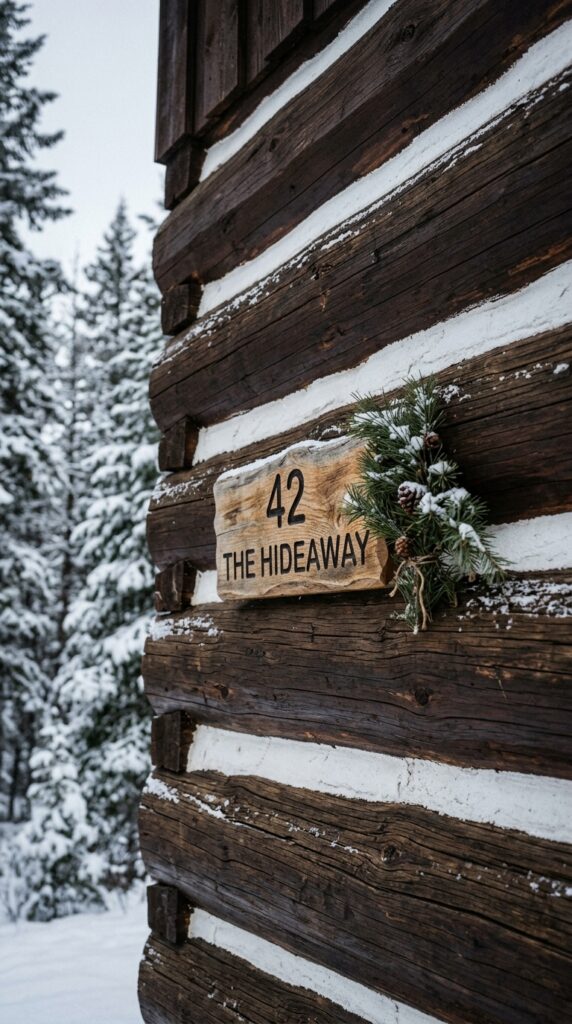
Vibe: The surface reads layered — the horizontal rhythm of log and chink as organized as handwriting, just in wood.
Why it works: Half-log or D-log siding creates the visual effect of full log construction at a fraction of the cost, and the white chinking detail introduces a horizontal banding pattern across the facade that reads as structured and intentional. This banding is the design principle of repetitive rhythm — the consistent spacing of the chinking lines creates a visual tempo across the exterior that the eye finds deeply satisfying, similar to coursed brick or wainscoting on an interior. A deep espresso stain also makes the facade read as more three-dimensional because shadows pool between courses.
How to get it: Apply TWO coats of a penetrating exterior log oil such as Perma-Chink’s “Log Wash” followed by “Lifeline Ultra-2” in a walnut or dark brown tone. For the chinking lines, Perma-Chink’s pre-mixed chinking compound in “White” or “Antique White” applied with a 4-inch putty knife over backer rod produces clean, authentic results even for a DIY application.
🛍️ Shop the Look — Amazon Product Ideas
| # | Product Search Phrase | Why It Fits |
| 1 | Log home chinking compound white sealant | Authentic chinking material |
| 2 | Exterior log oil stain dark walnut cabin | Deep log stain color |
| 3 | Hand carved wood address sign rustic | Cabin identity marker |
| 4 | Foam backer rod sealant log cabin | Chinking prep material |
| 5 | Log home maintenance brush applicator | Stain application tool |
13. Stone Chimney as the Architectural Anchor
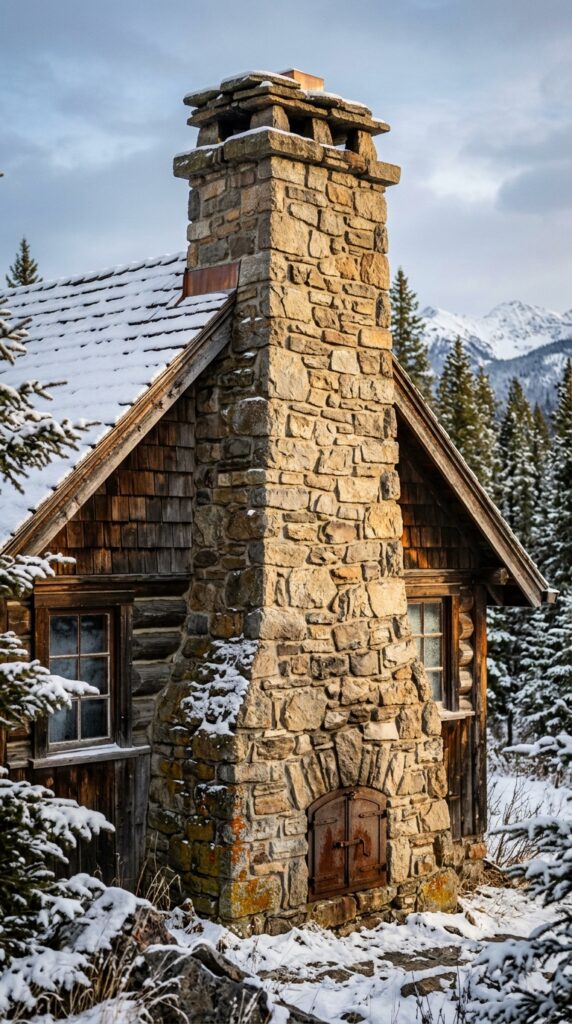
Vibe: The chimney feels immovable — older than the house it serves, borrowed from the mountain itself.
Why it works: An oversized chimney is the single most powerful element in cabin exterior design because it introduces the principle of visual anchor — one dominant vertical element that organizes everything else around it. When the chimney is built from the same fieldstone as the local geology, it creates a material continuity with the site that no other architectural choice can replicate. Wide, raked mortar joints (joints recessed 3/4 inch from the face) create shadow depth that makes the stone read as genuinely hand-laid rather than machine-applied.
How to get it: If budget or structure doesn’t permit a full masonry chimney, a steel direct-vent fireplace with a Corten steel or black metal chimney enclosure framed in stone veneer achieves the visual mass with modern fireplace efficiency. Use cultured stone from Boral or Eldorado in a “Ledgestone” or “Country Rubble” profile — their 5–6-inch profiles are deep enough to read convincingly in strong light.
🛍️ Shop the Look — Amazon Product Ideas
| # | Product Search Phrase | Why It Fits |
| 1 | Cultured stone veneer ledgestone panel exterior | Stone chimney alternative |
| 2 | Chimney cap stainless steel copper tone | Finished top detail |
| 3 | Masonry stain sealant waterproof stone | Stone maintenance product |
| 4 | Iron clean-out door fireplace access | Authentic chimney detail |
| 5 | Stone texture exterior paint roller sleeve | Textured siding application |
14. Screened Sleeping Porch on the Second Story
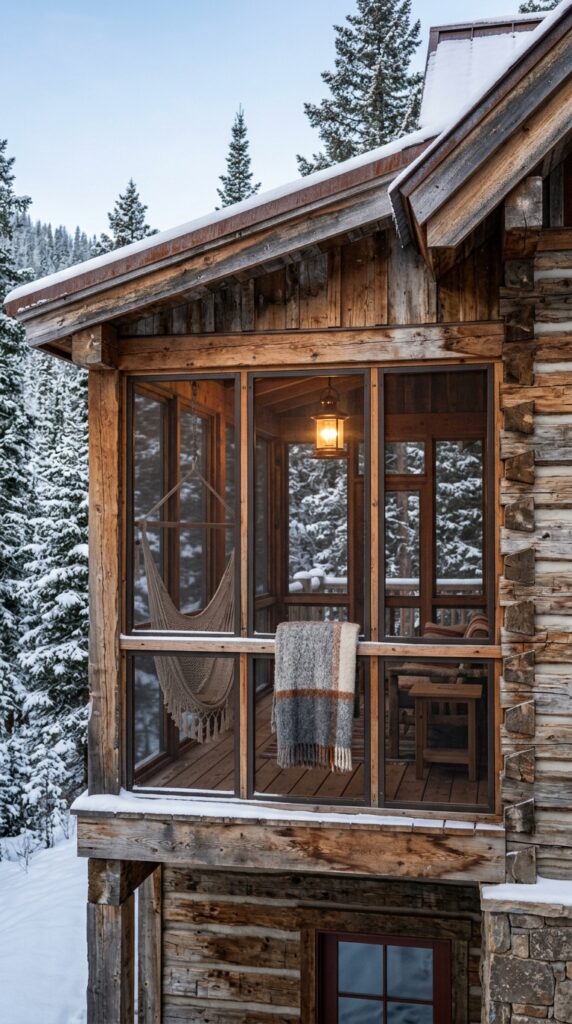
Vibe: The sleeping porch reads transitional — suspended between the warmth of the cabin and the cold breath of the mountain.
Why it works: A second-story screened porch adds a layer of visual complexity to the facade that makes a simple cabin read as architecturally rich. From a design principle standpoint, this is additive layering — the screen panels create a semi-transparent plane that allows light to play through in ways solid walls cannot. In winter, the partial enclosure with its snow-capped railing cap and warm lantern glow communicates the essential romance of the winter cabin: warm inside, aware of the cold outside.
How to get it: Screen panels in 1×4 cedar frames with aluminum insect screen stapled taut and capped with a 3/4-inch cedar bead are the most durable and authentic solution. Hang them on a simple continuous hinge at the top and a barrel bolt at the bottom. Total material cost for a 12-foot porch bay runs approximately $180–250.
💡 Quick Win: A $35 hanging rope chair or hammock swing placed on any existing covered porch immediately suggests the sleeping porch aesthetic and requires only a single ceiling hook to install.
🛍️ Shop the Look — Amazon Product Ideas
| # | Product Search Phrase | Why It Fits |
| 1 | Outdoor rope swing hanging chair porch | Signature porch seating |
| 2 | Cedar screen door frame natural wood | Screened porch material |
| 3 | Porch ceiling fan outdoor silent motor | Summer-to-winter porch comfort |
| 4 | Copper hanging lantern outdoor porch | Warm interior porch light |
| 5 | Waterproof outdoor throw blanket plaid | Layered porch textile |
15. Ice-White and Silver-Gray for a Nordic Palette
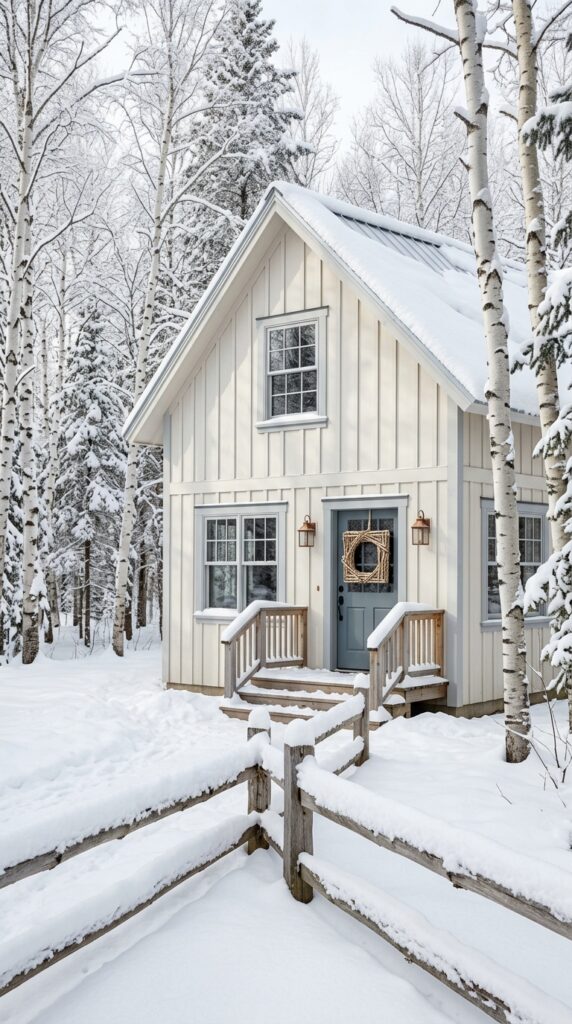
Vibe: The cabin reads still — spare and honest in the way that Scandinavian design always chooses silence over decoration.
Why it works: A white or near-white cabin in a snow landscape uses the design principle of positive-negative reversal: the house disappears into the white and what registers is its pure silhouette — the roofline, the chimney stack, the window openings. This is a high-risk, high-reward approach. It requires absolute confidence in the building’s proportions because there is no color, texture, or material richness to compensate for poor massing. It works best on cabins with well-considered asymmetry, interesting rooflines, and minimal ornamentation.
How to get it: Use a warm white rather than a cool blue-white — Benjamin Moore “Chantilly Lace” (OC-65) or Sherwin-Williams “Alabaster” (SW 7008) both have enough warmth to read golden under winter sun rather than clinical. Pair with dark gunmetal window and door hardware in an unlacquered steel or bronze finish.
🛍️ Shop the Look — Amazon Product Ideas
| # | Product Search Phrase | Why It Fits |
| 1 | Birch branch wreath natural winter door | Nordic wreath material |
| 2 | Gunmetal door hardware lever set exterior | Dark contrast hardware |
| 3 | White board and batten exterior siding wrap | Facade cladding option |
| 4 | Split rail fence post cedar white 8ft | Nordic fence detail |
| 5 | Minimal copper wall sconce outdoor flush | Simple Nordic lighting |
16. Firewood Stack as a Landscape Design Element
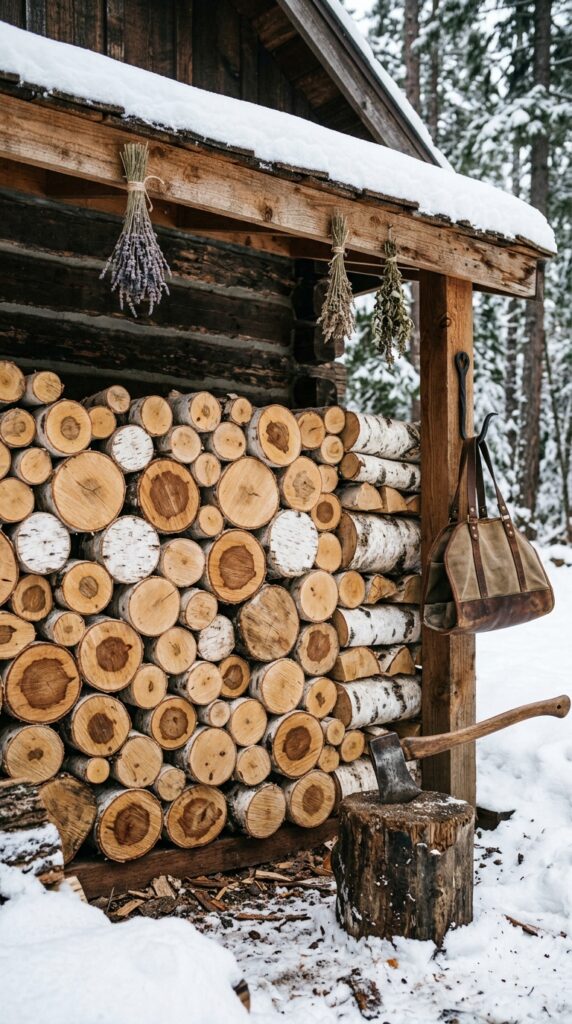
Vibe: The woodpile reads purposeful beauty — useful in the fullest sense, and arranged like someone took quiet pride in it.
Why it works: A curated firewood stack is one of cabin design’s most powerful accessories because it operates at both the practical and the symbolic level simultaneously. This is the principle of functional decoration — objects that earn their place by doing real work but are arranged with aesthetic intention. Alternating white birch rounds with oak or cherry end-grain introduces a natural color pattern: cream, tan, warm brown. A dedicated lean-to cover keeps the wood usable and signals that the exterior space has been as carefully considered as the interior.
How to get it: Build a simple lean-to wood storage structure using four 4×4 cedar posts, a 2×6 rafter, and three courses of 1×6 cedar decking on the roof. Face the structure with a piece of reclaimed corrugated metal roofing for extra cabin character. Keep wood stacked 6 inches away from the house to prevent pest infiltration.
💡 Quick Win: Stacking birch logs in an outdoor wicker or galvanized metal firewood rack beside the front door — even 10–12 rounds — costs nothing and instantly signals the whole winter cabin aesthetic.
🛍️ Shop the Look — Amazon Product Ideas
| # | Product Search Phrase | Why It Fits |
| 1 | Outdoor firewood log rack galvanized steel | Rustic firewood storage |
| 2 | Hand forged leather log carrier tote | Functional cabin accessory |
| 3 | Birch log bundle decorative firewood | Instant cabin vignette |
| 4 | Axe wedge splitting hatchet carbon steel | Cabin lifestyle prop |
| 5 | Cedar outdoor lean-to firewood shed kit | Covered storage structure |
17. Compact A-Frame with Minimal Footprint
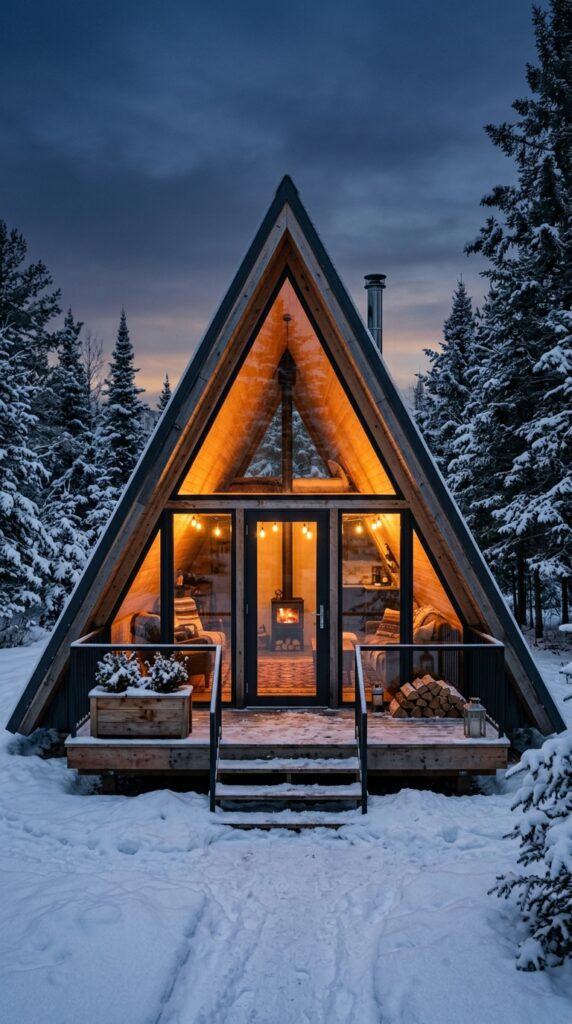
Vibe: The A-frame reads distilled — the absolute minimum of cabin required to contain warmth against the cold.
Why it works: The A-frame achieves cozy winter cabin character through pure geometry. The steep roof pitch that defines the silhouette serves a practical snow-shedding function while also creating one of the most architecturally recognizable forms in cabin culture. On a tight budget or small lot, the A-frame is the only structure that gives you dramatic interior volume, strong visual character, and a genuinely small footprint in one package. Full-height triangular glazing at the gable end is the single element that transforms a utilitarian structure into something evocative.
How to get it: For small-lot applications, an A-frame with a 30-foot footprint and 10:12 roof pitch can be delivered as a prefab kit (companies like Avrame and Beaver Homes offer structural packages) with the exterior shell completed by a local contractor in 3–4 days. Dark corrugated metal or standing-seam panel roofing over the full surface unifies the slope and makes the form read as a single sculptural object.
🛍️ Shop the Look — Amazon Product Ideas
| # | Product Search Phrase | Why It Fits |
| 1 | A-frame triangular wall clock decor | Cabin design echo indoors |
| 2 | Cantilevered deck bracket heavy duty steel | Deck structural anchor |
| 3 | Cedar wood decking plank outdoor 6ft | Warm entry deck boards |
| 4 | Outdoor string lights weather resistant 50ft | Interior visible glow |
| 5 | Oversized minimal metal door handle exterior | Minimalist A-frame hardware |
18. Black Steel Window Frames Against Light Siding
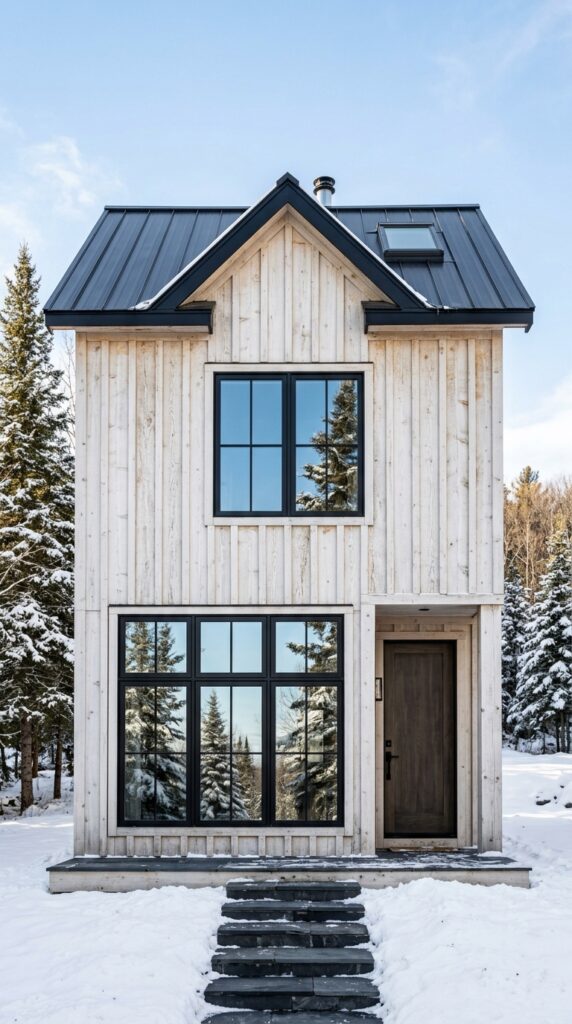
Vibe: The facade reads resolved — as though the architect made exactly one decision and stuck with it all the way through.
Why it works: Black steel windows are the intersection of industrial craft and rustic building — a material language borrowed from factory architecture and reapplied to domestic forms with enormous visual confidence. The slender frame profiles created in powder-coated steel or steel-look aluminum read as more refined than standard window frames, and the high contrast between the black frame and light siding makes every window a graphic element. This is the design principle of systematic repetition: when every window uses the same frame language, the entire facade achieves a visual coherence that elevates the architecture.
How to get it: True steel windows from companies like Crittall or Hope’s are expensive; aluminum simulations from Marvin or Andersen’s “Steel” line offer the aesthetic at roughly one-third the cost. Specify in matte black powder coat only — gloss reads too decorative. Pair with black locksets and hinges throughout for a completely consistent dark metal language.
💡 Quick Win: Painting existing window trim in Benjamin Moore “Onyx” (2133-10) flat exterior paint creates a convincing steel-window effect for under $50 in materials — the single highest-impact cosmetic exterior upgrade for a white-sided cabin.
🛍️ Shop the Look — Amazon Product Ideas
| # | Product Search Phrase | Why It Fits |
| 1 | Black window trim paint exterior matte | Steel-look window treatment |
| 2 | Black powder coat door knob exterior set | Matching dark hardware |
| 3 | Steel look aluminum window frame casement | Black frame window option |
| 4 | Black gutter downspout aluminum | Consistent dark metal detail |
| 5 | Black metal house number modern exterior | Coherent dark metal signage |
19. Wraparound Porch for Maximum Winter Presence
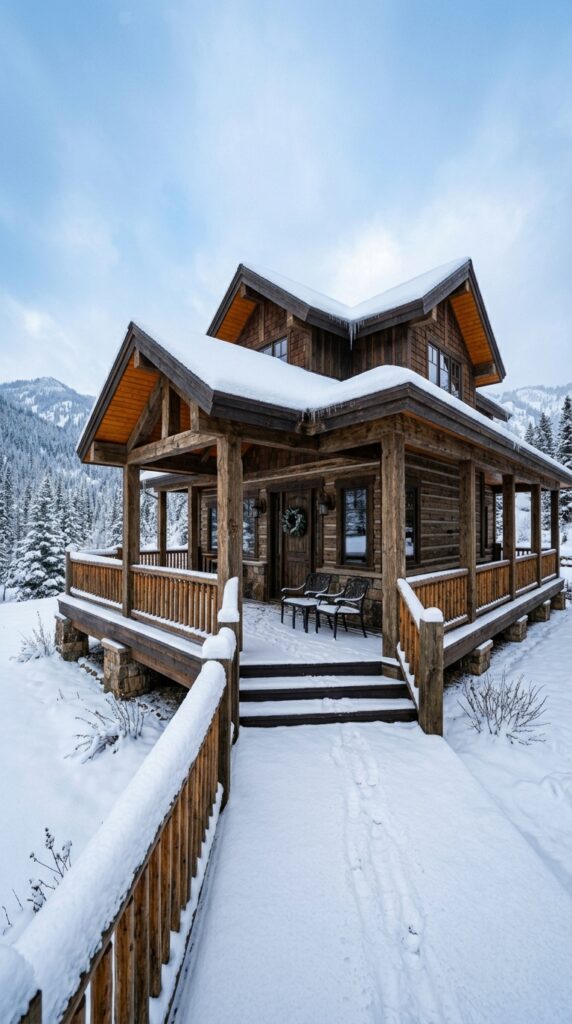
Vibe: The porch reads generous — a house that extends an arm around its landscape rather than turning its back to it.
Why it works: A wraparound porch accomplishes something structurally and aesthetically powerful: it creates a continuous horizontal band around the house that visually anchors the structure to its site. This is the principle of ground plane extension — the porch floor connects the house horizontally to the surrounding landscape in a way that makes even a two-story cabin read as settled and permanent rather than perched or imposing. The covered ceiling visible under the overhang introduces a warm-toned wood surface that catches eye from a distance and signals hospitality.
How to get it: The most budget-conscious wraparound porch option is a pressure-treated structural frame with composite decking (such as Trex Transcend in “Spiced Rum”) finished with cedar or Douglas fir tongue-and-groove ceiling boards stained in a honey tone. Real timber columns (6×6 rough-sawn cedar) should be used only at visible corners — intermediate supports can be pressure-treated and painted black.
🛍️ Shop the Look — Amazon Product Ideas
| # | Product Search Phrase | Why It Fits |
| 1 | Tongue and groove cedar porch ceiling boards | Warm porch ceiling material |
| 2 | Cast iron outdoor bistro chair set | Classic porch furniture |
| 3 | Split log wood baluster railing rustic | Cabin railing detail |
| 4 | Outdoor rug natural jute 8×10 porch | Porch floor texture layer |
| 5 | Cedar post column wrap decorative 6×6 | Column upgrade treatment |
20. Mossy Green and Forest Floor Tones
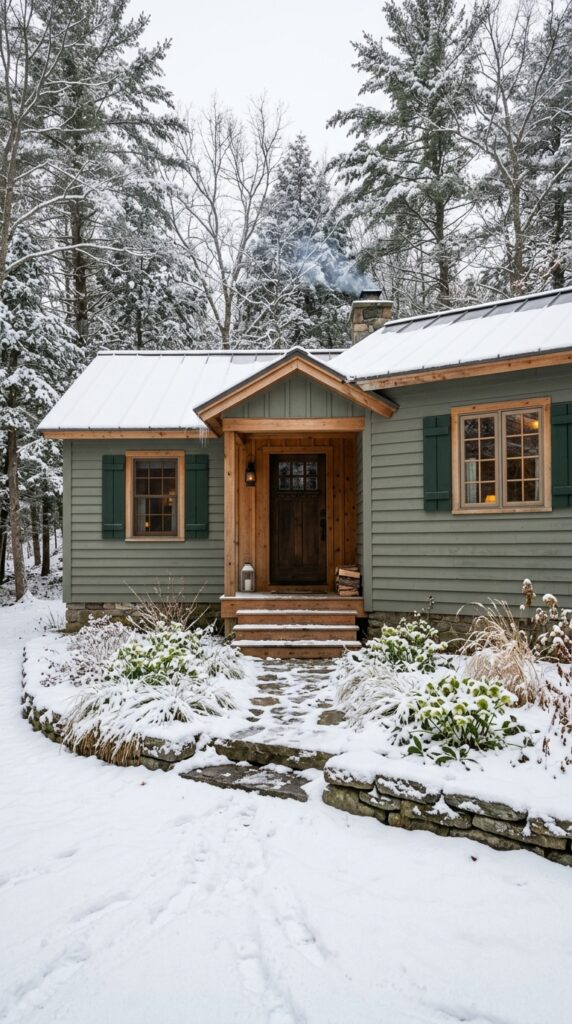
Vibe: The cabin reads settled — the color of a place that chose this clearing rather than cleared it.
Why it works: Muted sage-moss green is the most sophisticated cabin exterior color choice because it solves the visual challenge of integration without disappearing. Unlike charcoal, which creates contrast against a snowy landscape, moss green blends with the gray-green of dormant vegetation and conifer shadows while still registering as a deliberate color choice. The design principle at work is tonal alignment: pulling one color from the site palette and intensifying it slightly creates a house that feels chosen by the landscape.
How to get it: Farrow & Ball “Mizzle” (No. 266) or Benjamin Moore “Dusty Miller” (2139-40) are both gray-toned greens that read organic rather than decorative. Apply with a flat or very low sheen exterior finish — any sheen level above eggshell will make the color read brighter and more artificial than intended.
🛍️ Shop the Look — Amazon Product Ideas
| # | Product Search Phrase | Why It Fits |
| 1 | Exterior paint sage moss green flat low VOC | Cabin green color anchor |
| 2 | Stone garden border edging natural gray | Organic garden framing |
| 3 | Ornamental grass feather reed outdoor | Winter-interest entry plant |
| 4 | Hellebore lenten rose plant winter bloom | Shade tolerant entry plant |
| 5 | Cedar plank step tread outdoor natural | Entry step material |
21. Tiny Cabin Exterior: Maximum Character, Minimum Footprint
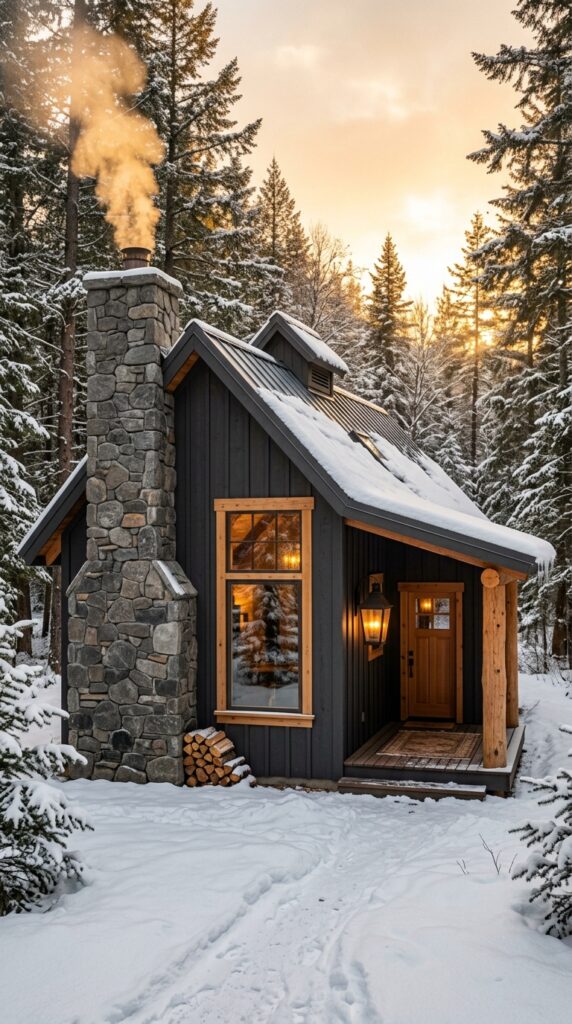
Vibe: The tiny cabin reads complete — not a scaled-down version of something larger, but a fully resolved idea in a small package.
Why it works: Small cabins succeed when they deliberately overscale their most important details. A chimney that reads large relative to the building, a porch column that seems slightly generous, a single window with heavy timber casing that takes up most of the facade — these apparent excesses create the impression of substance and confidence. This is the principle of deliberate proportion distortion: when every element is exactly right-sized, the result reads as “basic.” Controlled overscaling of two or three key elements creates drama.
How to get it: On any small structure under 400 square feet, use exterior trim and casing details that are at least 1.5× the standard size you’d spec on a full-size house. Standard 2.5-inch window casing becomes 4-inch; a 4×4 porch post becomes a 6×6. This costs minimally more in materials and produces disproportionately large visual impact.
💡 Quick Win: A single overscaled outdoor lantern sconce — 16-inch height minimum, in matte black — costs $60–90 and immediately makes a small cabin entry read as architecturally intentional rather than afterthought.
🛍️ Shop the Look — Amazon Product Ideas
| # | Product Search Phrase | Why It Fits |
| 1 | Large outdoor wall sconce 16 inch black | Overscaled entry lighting |
| 2 | 6×6 cedar post wrap column exterior | Overscaled porch column |
| 3 | Wide timber window casing trim 4 inch | Bold window framing |
| 4 | Oversized door knocker black iron antique | Entry statement detail |
| 5 | Mini Adirondack chair outdoor cedar | Proportional small porch furniture |
22. Vertical Cedar Slat Privacy Screen
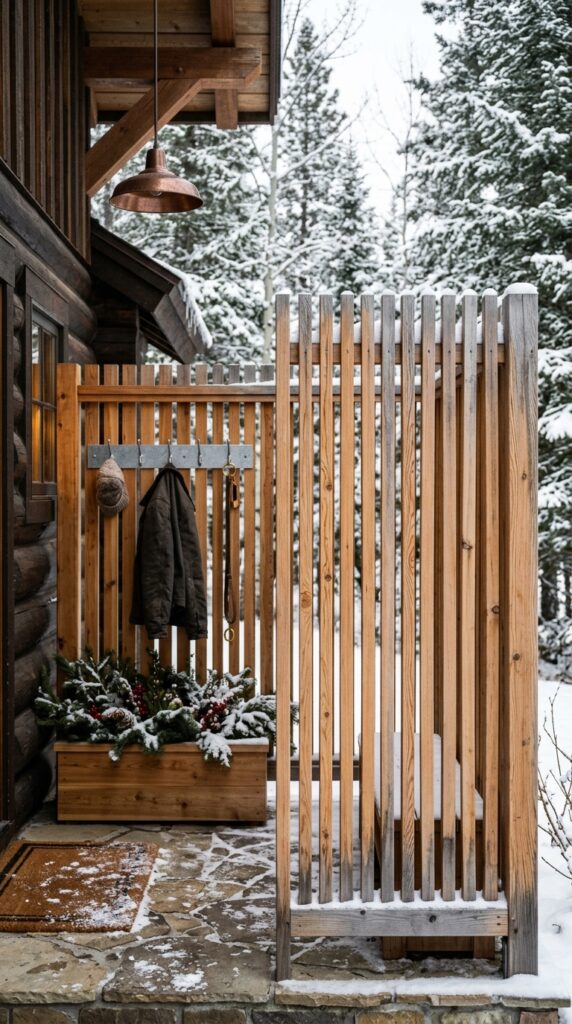
Vibe: The screen reads transparent — present and defining a space, yet permeable and alive with light and shadow.
Why it works: A vertical slat cedar screen creates spatial definition without enclosure — it implies a boundary while maintaining the transparency that cabin architecture prizes. This is the design principle of implied threshold: you don’t need a wall to make a space feel like a room. The regular spacing of the slats creates a diffraction pattern in shadow on whatever surface lies behind them, giving the entry zone constant changing visual interest as the sun angle shifts through the day. This detail is also one of the highest-impact, lowest-material additions to a flat or featureless cabin entry.
How to get it: Use 1×4 clear cedar boards at 1-inch gaps between slats, secured into a top and bottom cedar channel (a 2×4 routed with a 3/4-inch dado groove). A freestanding panel 7 feet tall and 6 feet wide uses approximately 18 boards and costs $80–110 in materials. Leave unfinished and let it weather naturally to silver.
🛍️ Shop the Look — Amazon Product Ideas
| # | Product Search Phrase | Why It Fits |
| 1 | Cedar 1×4 board lumber natural fence slat | Screen construction material |
| 2 | Galvanized wall hook panel outdoor entryway | Interior screen utility |
| 3 | Cedar planter box low garden bed | Base accent planting |
| 4 | Outdoor pendant light weatherproof cord | Overhead entry light |
| 5 | Wood slat privacy fence screen panel | Pre-made screen alternative |
23. Corrugated Metal Siding Accent Panel
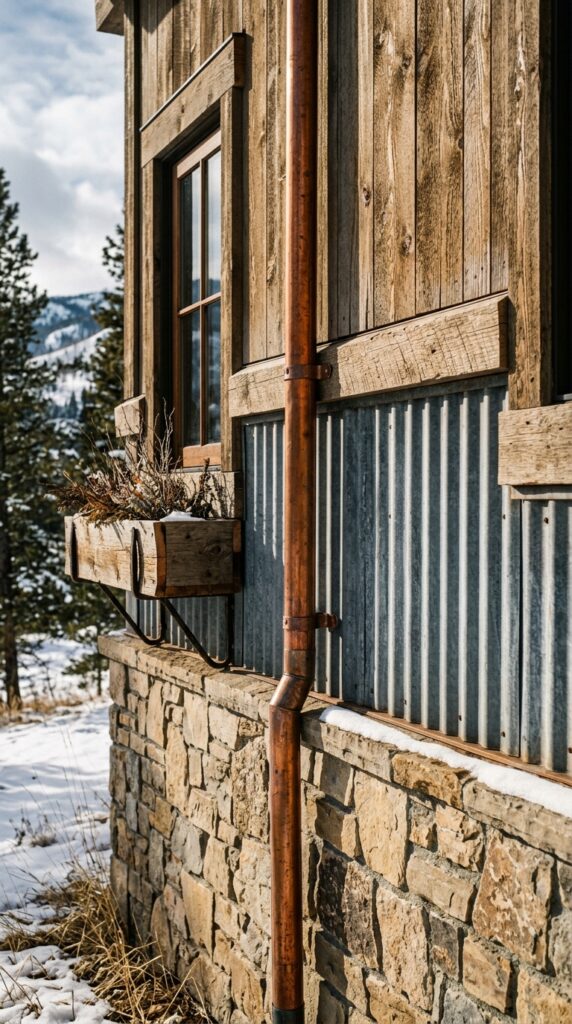
Vibe: The material transition reads industrial craft — the kind of detail that announces a builder who knew exactly what they were doing.
Why it works: Using corrugated metal as a transitional accent band between two organic materials (stone and cedar) introduces the design principle of material punctuation. The metal’s regularity and sheen contrast creates a clean visual break that allows each material zone to read more clearly as a distinct element. Corrugated zinc or Galvalume sheeting also ages into a soft pewter gray that deepens over the first few winters without rusting, making it a genuinely low-maintenance material choice that improves with age.
How to get it: Standard 26-gauge corrugated metal roofing panels available at any agricultural supply store (Tractor Supply, Rural King) run approximately $0.80 per square foot and can be applied horizontally as siding with weather-resistant screws and a 1.5-inch overlap at vertical seams. Use a piece of cedar trim at the top and bottom of the metal zone to cap the raw edges cleanly.
🛍️ Shop the Look — Amazon Product Ideas
| # | Product Search Phrase | Why It Fits |
| 1 | Corrugated metal panel galvanized siding sheet | Accent panel material |
| 2 | Zinc-coated metal trim cap flashing | Edge finishing detail |
| 3 | Aged steel window box bracket rustic | Dark metal complement |
| 4 | Screws metal roofing hex head zinc | Panel fastener |
| 5 | Industrial outdoor light cage wall mount | Metal cladding fixture match |
24. Cedar Plank Gable Decoration with Geometric Pattern
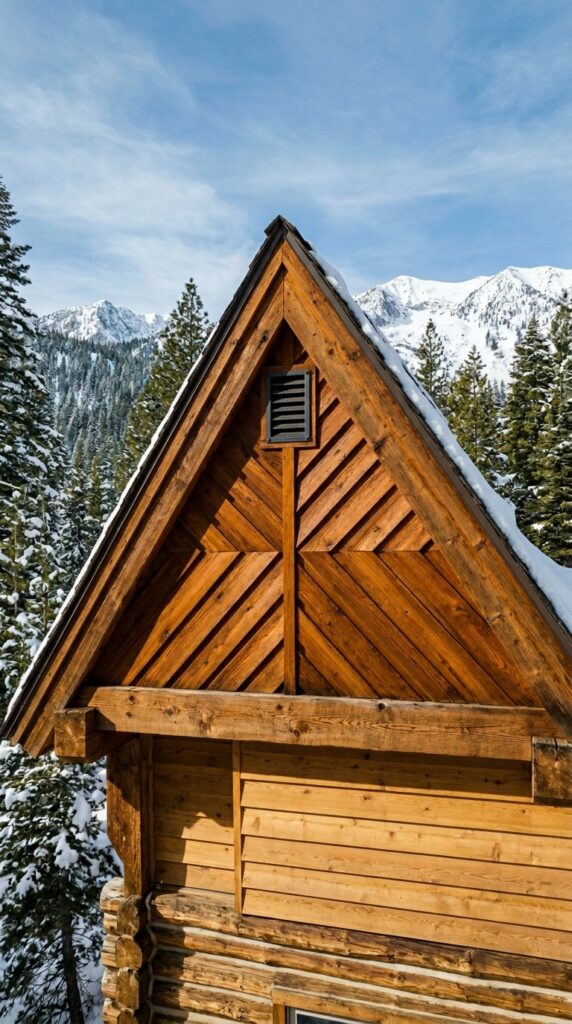
Vibe: The gable reads handmade with intent — a subtle craft signature on the highest point of the structure.
Why it works: A geometric cedar pattern in the gable end transforms what is typically a visually dead triangle into an active, interesting focal point. The design principle here is focal hierarchy: in most facades, the eye travels from the entry door upward and then loses interest at the blank gable. A patterned gable end reverses this — the eye is drawn upward and rewarded. Using two tones of the same wood species (natural cedar plus a slightly darker cedar stain) keeps the palette monochromatic while allowing the pattern to read clearly through shadow and contrast.
How to get it: A simple 45-degree chevron pattern in 1×6 cedar boards requires only a miter saw and consistent spacing. Stain alternating boards in two tones — natural cedar oil versus the same oil plus a touch of “Dark Walnut” Minwax — before installation to allow precise control over the color separation. Use 2-inch stainless ring-shank nails for clean fastening with no pop-back.
💡 Quick Win: Even a simple gable vent cover in a geometric pattern (laser-cut iron or cast iron gable vents are available on Amazon for $30–50) signals craft and intention on a flat gable without any carpentry work.
🛍️ Shop the Look — Amazon Product Ideas
| # | Product Search Phrase | Why It Fits |
| 1 | Geometric gable vent iron decorative cast | Pattern gable detail |
| 2 | Cedar stain natural honey oil exterior | Base gable board finish |
| 3 | Dark walnut wood stain exterior penetrating | Contrast tone finish |
| 4 | Rake board trim cedar exterior profile | Clean gable edge trim |
| 5 | Stainless ring shank siding nail 2 inch | Non-staining fastener |
25. Stone Pathway and Entry Landscaping in Winter
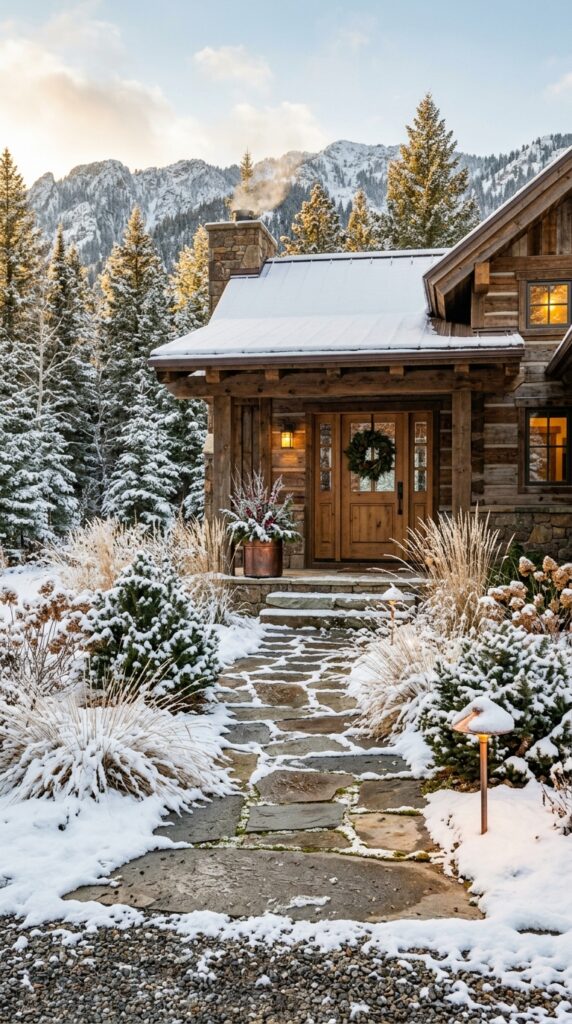
Vibe: The entry path reads invited — the curve in the stone whispering that arrival here is meant to be unhurried.
Why it works: A curved entry path is one of the most powerful tools in exterior cabin design because it controls the experience of arrival. A straight path is direct and efficient; a curved path is experiential. The design principle is procession: the slight arc forces the eye to scan the facade as you approach rather than drilling straight to the door, meaning the viewer takes in more of the house and grounds. Irregularly cut flagstone with planted moss joints completes the composition by grounding the pathway in the same geological language as the cabin’s fieldstone foundation.
How to get it: Source irregular bluestone or local fieldstone slabs from a landscape supply yard at $2–5 per square foot in most markets. Set stones in a 4-inch compacted gravel base with a 1-inch sand setting bed for frost-heave resistance. Plant low-growing sedums or creeping thyme in the joints — both are reliably winter-hardy and require no maintenance.
🛍️ Shop the Look — Amazon Product Ideas
| # | Product Search Phrase | Why It Fits |
| 1 | Low voltage copper path light outdoor stake | Warm entry path lighting |
| 2 | Stepping stone irregular natural flagstone | Pathway material |
| 3 | Creeping thyme ground cover plug | Moss joint alternative plant |
| 4 | Dried hydrangea stem bundle decor | Winter border plant interest |
| 5 | Copper outdoor planter large entryway | Entry garden focal piece |
26. Garage Door Transformed with Board-and-Batten Wood Cladding
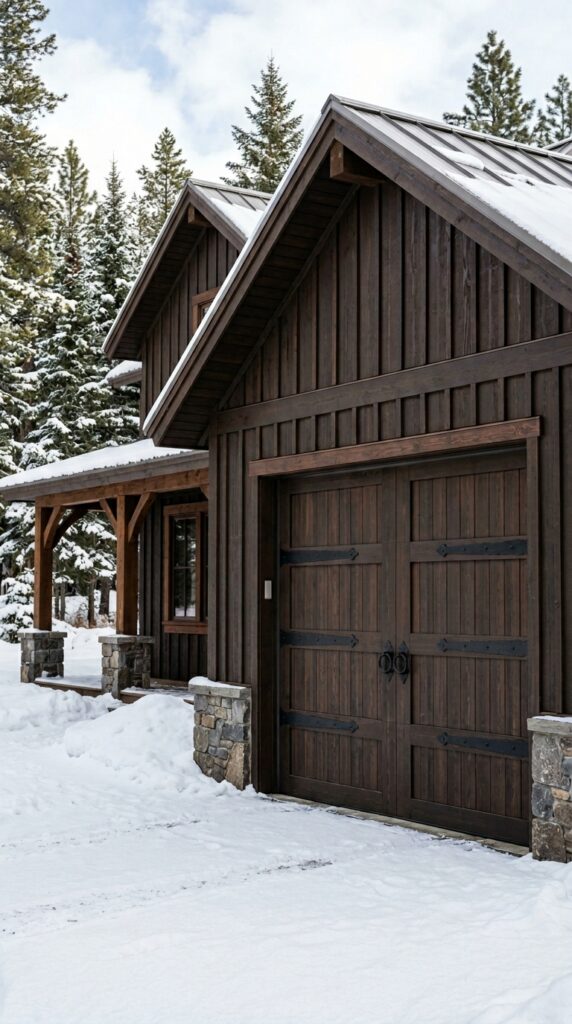
Vibe: The garage reads composed — not a utilitarian interruption of the facade but a considered part of a unified whole.
Why it works: The garage door is typically the largest single surface on a residential facade and is most often its weakest point visually. Board-and-batten wood cladding applied to an existing sectional garage door uses the principle of material continuity — aligning the garage with the language of the main structure eliminates the visual discontinuity that makes most residential garages read as afterthoughts. The vertical batten lines echo the board-and-batten of the house siding, creating horizontal connection across the full facade width.
How to get it: Apply 1×4 pine or cedar boards to an existing metal sectional door using construction adhesive (Liquid Nails Heavy Duty) and 1.25-inch trim screws. Install 1×2 battens over the seams and at 12-inch centers. The total weight addition is approximately 3–4 lbs per square foot — verify your door spring system can handle the added weight before application. Stain to match the house before installation.
💡 Quick Win: Surface-mount black iron strap hinges and ring-pull door handles — available from D-Lifestyle or similar architectural hardware sources for $35–60 per door set — applied to an existing plain garage door panel immediately suggest the carriage house aesthetic without any cladding work.
🛍️ Shop the Look — Amazon Product Ideas
| # | Product Search Phrase | Why It Fits |
| 1 | Carriage house garage door strap hinge black | Carriage door hardware |
| 2 | Ring pull handle black iron garage door | Authentic carriage detail |
| 3 | Cedar 1×4 board lumber fence gate | Door cladding boards |
| 4 | Construction adhesive heavy duty trim board | Board adhesion product |
| 5 | Dark espresso exterior stain wood fence | Matching siding stain |
How to Start Your Winter Cabin Exterior Transformation
The single most powerful first move is choosing your primary siding color and committing to it completely before touching anything else. A deep spruce green, warm charcoal, or dark espresso brown as the dominant facade color anchors every subsequent decision — hardware tone, trim color, lighting style, and material accents will all resolve naturally once the primary color is chosen. This one decision has more influence over the final result than all the decorative additions combined.
The most common beginner mistake is choosing the wrong undertone. Many people select a charcoal or brown that appears correct in the store but reads purple-gray or green-gray on the facade. This happens because they test the color in interior light rather than exterior afternoon light. Always paint a 12×12-inch sample board and observe it on the actual wall in winter afternoon sun before committing — colors read completely differently under different conditions.
For immediate impact under $50: a cast iron boot scraper beside the front door ($22–28), a pair of LED filament bulbs in warm 2200K for existing porch fixtures ($12), and a bundle of dried birch logs arranged in a galvanized bucket by the entry ($18 at any farm supply or garden center) will signal the entire winter cabin aesthetic in a single afternoon.
Realistic expectations: a full exterior transformation — new siding color, trim update, lighting fixtures, and entry landscaping — typically takes 3–6 months from planning to completion and runs $3,500–$12,000 for a standard single-story home depending on siding condition and scope. A weekend-and-$200 starter version (paint one accent element, change hardware and lighting, add a woodpile vignette) can shift the overall feeling of the facade meaningfully in a single day.
Frequently Asked Questions About Winter Cabin Exterior Style
What is the difference between a winter cabin exterior and a traditional farmhouse exterior?
Cabin exterior style prioritizes raw materials and site integration — stone, unfinished timber, weathered cedar — while farmhouse style leans toward painted surfaces, clean lines, and a more domestic refinement. Both are rooted in vernacular American architecture but farmhouse pulls from agrarian plains traditions while cabin style draws from Appalachian, Pacific Northwest, and Scandinavian mountain building. The key material difference is that cabin style celebrates imperfection and weathering; farmhouse style favors the painted and the cared-for.
What colors work best for a winter cabin exterior in a snowy climate?
The most successful winter cabin palettes use warm, dark tones that create contrast against a snowy landscape. Deep spruce green (such as Sherwin-Williams “Hunt Club” SW 6468), warm charcoal with brown undertones (Benjamin Moore “Black Iron” 2130-20), and dark espresso cedar stains in the Sikkens Cetol range all perform well because they reference natural forest shadows rather than man-made colors. Cool grays and blue-tones tend to look institutional against white snow; warm tones glow against it.
How much does it cost to achieve a winter cabin exterior look on an existing home?
A full exterior transformation runs $8,000–$25,000 for a standard 1,500-square-foot home including new siding, paint, trim, lighting, and entry landscaping. A targeted cosmetic update — new paint color, new exterior lighting fixtures, hardware replacement, and a porch styling addition — can be achieved for $1,500–$4,000. The highest-value single investment is typically exterior paint at $800–2,000 for a professional repaint, which returns more visual impact per dollar than any other change.
Can a suburban home achieve winter cabin exterior style, or does it only work in the mountains?
Any home can adopt cabin exterior character — the style is about material language and color, not geography. The adjustment for suburban contexts is restraint: choose two or three cabin material moments (a board-and-batten accent wall, cedar shake gable, stone entry path) rather than attempting a full mountain home transformation on a suburban Colonial. The goal is to pull the palette and texture language while respecting the home’s original proportions and neighborhood context.
What exterior lighting is most authentic to winter cabin style?
Cage-style or lantern-style fixtures in black, bronze, or copper finishes with Edison filament bulbs in the 2200–2700K range are the most period-appropriate choices. Avoid any fixture with a frosted glass globe in a pure white shade — these read too contemporary. The specific products that perform best are coach house lanterns (in the style of historic carriage house lighting) and cage pendant lights with visible filament. Bulb temperature matters more than fixture shape: any fixture paired with a warm 2200K filament bulb will read warmer and more authentic than a standard 4000K LED.
Ready to Create Your Dream Winter Cabin Exterior?
These 26 ideas span the full range of what makes winter cabin exteriors work — from color choices like deep spruce green and warm charcoal, to material decisions in cedar shingles, fieldstone, and Corten metal, to layout moves like covered porches, curved pathways, and screened sleeping porches. Transformation doesn’t need to happen all at once; the most satisfying cabin exteriors are built layer by layer, each addition informed by what came before it. The one thing you can do today: hold up a paint chip of deep spruce green or warm charcoal against your current siding in afternoon light and let yourself imagine it — that five-minute exercise has launched more than a few remarkable projects. When the work is done, the space will feel like it was always supposed to look this way: settled, earned, and quietly warm against whatever winter brings. Save the ideas that feel most like you — the ones that made you pause and linger — and start there.