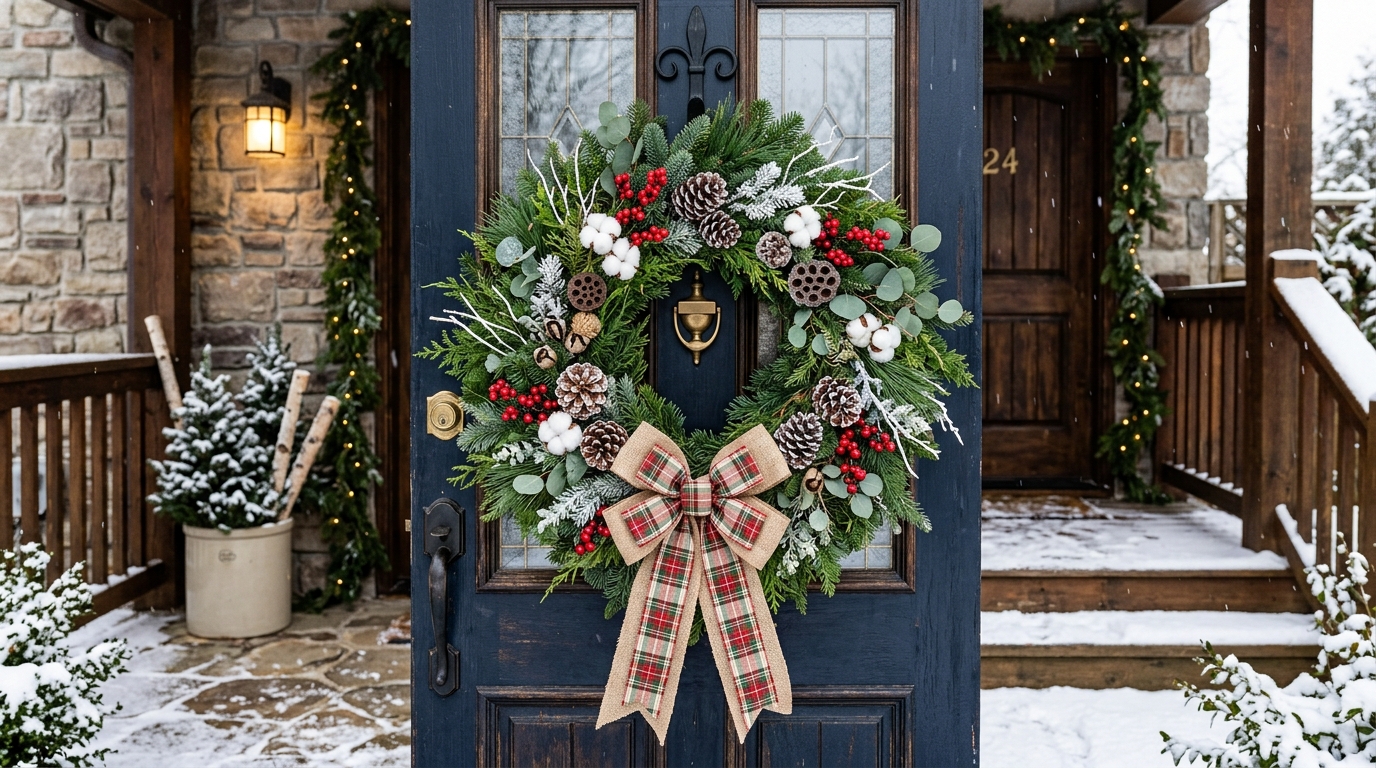
A winter wreath is any decorative circular arrangement hung on a door or wall during the colder months — typically composed of evergreens, dried botanicals, berries, ribbons, or metallic accents rather than the floral material you’d use in spring. This article gives you exactly 30 front door winter wreath ideas, spanning styles from rustic farmhouse to moody noir, with product picks for each one.
There’s something quietly powerful about a wreath on a front door in January — it says someone lives here who cares. It’s the first thing a guest sees, the last thing you pass before leaving, and on a gray winter afternoon it can shift the entire mood of a façade. Frosted pine needles, dried orange slices releasing a ghost of citrus, the soft thud of a cotton stem against painted wood — winter wreaths work through texture and scent as much as color. Here are 30 ideas worth saving — and stealing.
Why Winter Wreaths Work So Well
Winter wreaths occupy a unique niche in seasonal decor because they transform an architectural necessity — the front door — into a design statement. Unlike interior decor, a wreath must perform in low light, cold temperatures, and variable weather while still looking curated and intentional. That tension between durability and beauty is exactly what makes the craft so satisfying.
At their core, winter wreaths draw from centuries of European evergreen traditions: the Celtic practice of bringing living greenery indoors during the solstice, the Victorian fashion for elaborate dried-flower arrangements, and more recently the Scandinavian hygge aesthetic that prizes organic materials and unpretentious warmth. These converging influences explain why the style feels both ancient and contemporary. A wreath made of frosted eucalyptus and raw linen ribbon looks equally at home on a Georgian townhouse and a modern farmhouse.
Materials and palette define the style immediately. Authentic winter wreaths lean on deep forest greens (blue spruce, cedar, noble fir), silver-gray tones (dusty miller, magnolia leaf undersides, dried lunaria), warm reds and burgundies (dried rosehips, velvet ribbon, winterberry stems), and burnished golds (wheat bundles, gilded pinecones, dried citrus with a spray of gold mist). Textures mix rough bark with soft cotton, waxy magnolia with feathery cedar.
The style is trending now partly because of a broader cultural shift toward slow, handmade living — the same impulse driving sourdough starters and linen curtains. Pinterest search data shows winter wreath queries spiking year-on-year, and the sustainability angle matters: a quality preserved or dried wreath lasts multiple seasons, making it a more considered purchase than disposable fast decor.
Even small apartment doors and townhouse stoops can carry a wreath successfully. The key for constrained spaces is scale: choose a 16–18 inch wreath rather than the standard 24-inch, keep the base open rather than overstuffed, and let one strong element — a single fat velvet bow or a cluster of oversized pinecones — do the visual lifting without crowding a narrow door frame.
Style at a Glance
| Element | Detail |
| Philosophy | Organic abundance meets considered restraint |
| Key Materials | Evergreen stems, dried botanicals, velvet, raw linen, pinecones |
| Key Colors | Forest green, dusty silver-gray, burgundy, burnished gold, warm ivory |
30 Beautiful Front Door Winter Wreath Ideas
1. Frosted Noble Fir with White Berry Clusters
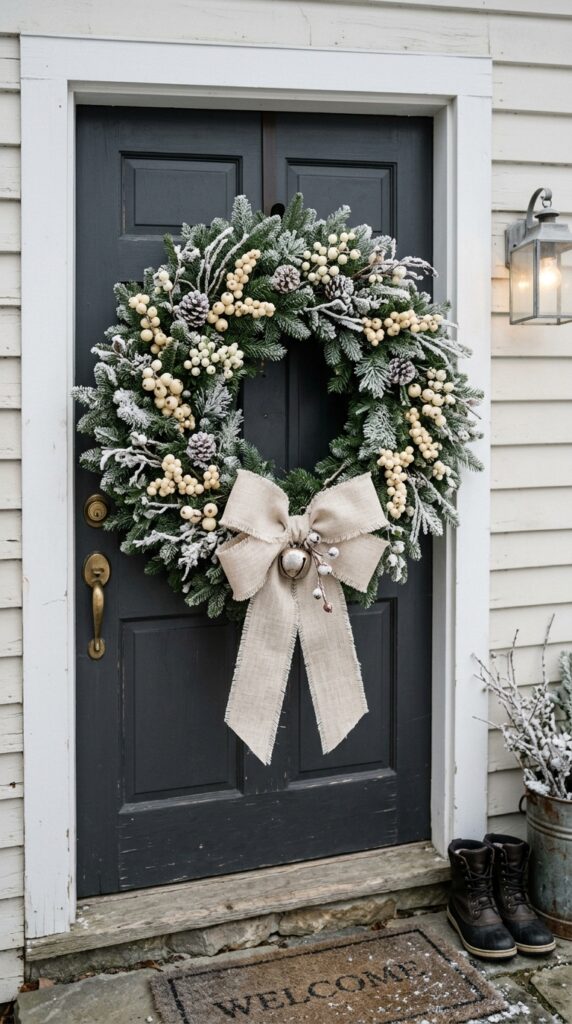
Vibe: Still — like the first morning after a snowfall, before anyone has walked through it.
Why it works: The contrast between deep forest green and chalky white creates a high-impact tonal range without relying on color at all — this is pure value contrast, and it photographs crisply even in flat winter light. Noble fir is the right base because its short, stiff needles hold artificial frost better than softer balsam varieties. White hypericum berries add a plump, three-dimensional texture that prevents the frost effect from looking flat or powdery.
How to get it: Source a fresh or preserved noble fir wreath, then use Rust-Oleum Frosted Glass spray (applied in light passes from 18 inches) to achieve a realistic crystalline frost without clumping. Tie a raw-edge linen ribbon in an asymmetric double knot rather than a structured bow — the undone quality reads more natural against the organic base.
💡 Quick Win: A $12 bundle of faux white snowberry stems from a craft store, wired into a store-bought wreath in clusters of three, transforms a plain evergreen ring into something that looks custom-made.
🛍️ Shop the Look — Amazon Product Ideas
| # | Product Search Phrase | Why It Fits |
| 1 | noble fir artificial wreath 24 inch | Realistic base greenery |
| 2 | white hypericum berry stem picks | Plump berry texture |
| 3 | Rust-Oleum frosted spray paint | DIY frost effect |
| 4 | natural raw linen ribbon 4 inch wide | Organic bow material |
| 5 | silver jingle bell wreath accent | Subtle metallic detail |
2. Dried Orange Slice and Cinnamon Garland Wreath
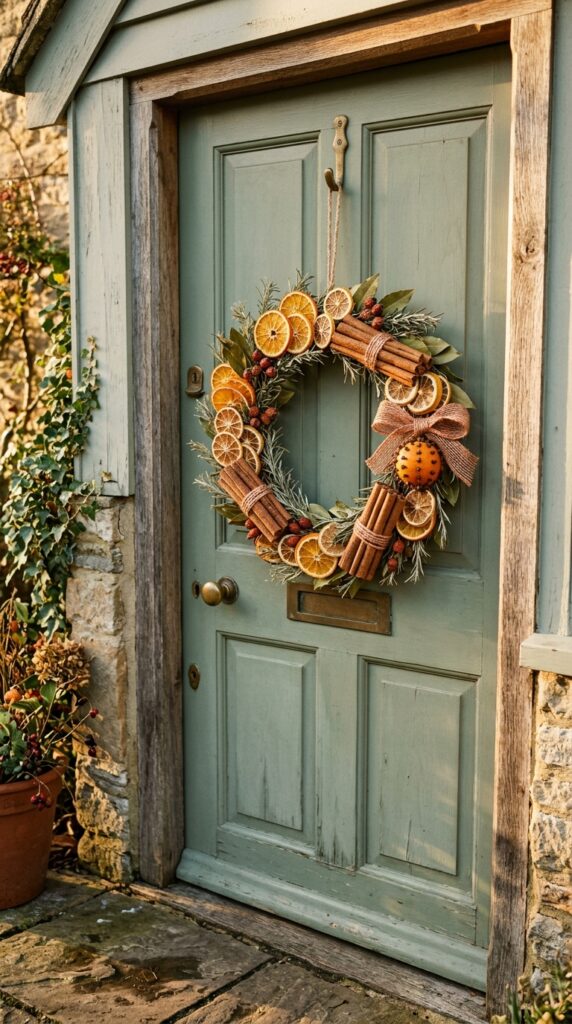
Vibe: Sun-warmed — the kind of wreath that makes your hallway smell like Christmas even before the door opens.
Why it works: Dried citrus slices are translucent when backlit by low winter sun, creating a stained-glass effect that flat ribbon or pinecones cannot replicate. This is a light-behavior principle: thin organic material becomes luminous rather than opaque, giving the wreath a glow that shifts through the day. Cinnamon sticks add both scent and a rough, architectural texture that grounds the delicacy of the citrus rounds.
How to get it: Dry orange slices in an oven at 200°F for 4–5 hours on a wire rack, then seal with a matte Mod Podge coat to prevent browning over the season. Wire them onto a grapevine wreath base (not a foam one — the woody texture reads more naturalistic) using 24-gauge floral wire, spacing slices so each one remains partially visible when viewed from an angle.
🛍️ Shop the Look — Amazon Product Ideas
| # | Product Search Phrase | Why It Fits |
| 1 | grapevine wreath base 22 inch natural | Rustic textured base |
| 2 | dried orange slices citrus wreath pack | Ready-made citrus accent |
| 3 | cinnamon sticks bundle 6 inch craft | Aromatic textural element |
| 4 | copper wire 24 gauge floral craft | Invisible attachment wire |
| 5 | natural jute twine 3-ply spool | Organic binding material |
3. Black Wreath with White Cotton Stems — Gothic Winter
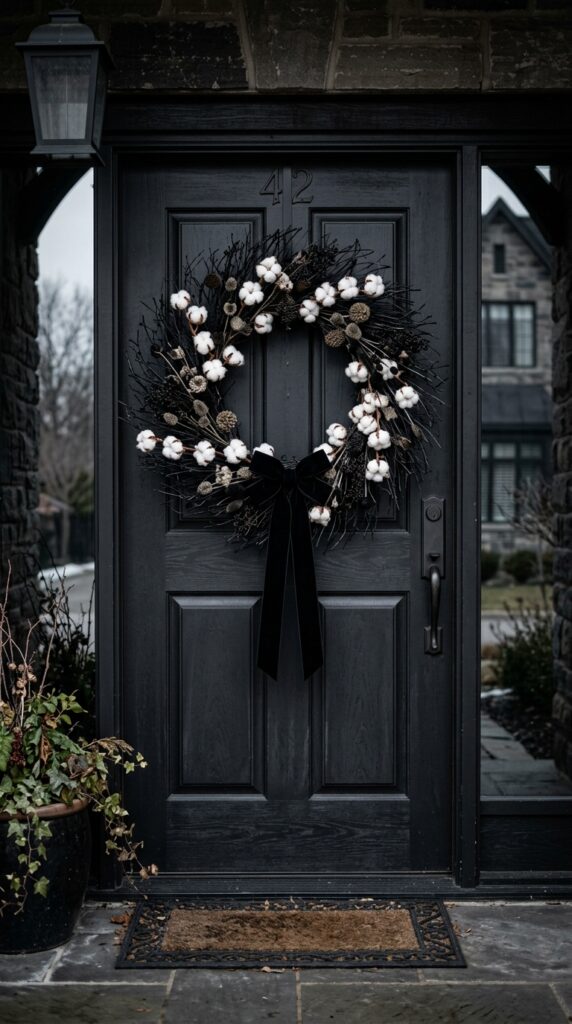
Vibe: Moody — the editorial version of a winter wreath, sharp enough to belong on a design blog cover.
Why it works: Black against white is the highest-contrast pairing possible, and on a front door it reads as confident rather than cold. The key design principle is material contrast: the soft, three-dimensional cotton bolls push forward visually against the rigid, spiky twig silhouette, creating depth without adding color. A matte finish on the twig base is non-negotiable — gloss would kill the gothic sophistication immediately.
How to get it: Start with a natural twig wreath, spray it with matte black chalk paint (Rust-Oleum Chalked in Charcoal), and let it cure for 24 hours before adding stems. Wire white cotton stems in odd-numbered clusters of three or five — odd numbers always read as more organic than even groupings. This principle works for any wreath style, not just this one.
💡 Quick Win: White cotton stem picks are widely available in craft stores for around $8 for a pack of six — they’re the fastest way to make a dark, moody wreath feel intentional rather than merely dramatic.
🛍️ Shop the Look — Amazon Product Ideas
| # | Product Search Phrase | Why It Fits |
| 1 | black twig wreath artificial 24 inch | Dark architectural base |
| 2 | white cotton stem picks craft floral | High-contrast soft texture |
| 3 | Rust-Oleum chalked matte black spray | Wreath base transformation |
| 4 | black velvet ribbon wired 4 inch | Luxe matte bow material |
| 5 | dried black elderberry sprig stems | Moody botanical accent |
4. Magnolia Leaf Wreath with Gold-Dipped Pinecones
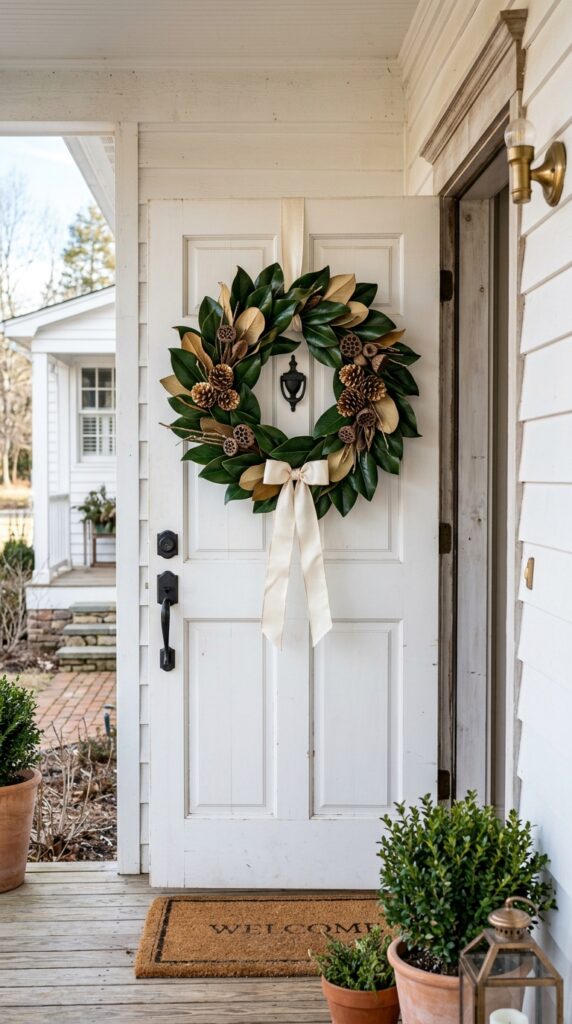
Vibe: Grounded — the wreath version of a well-pressed linen tablecloth, quiet authority without effort.
Why it works: Magnolia leaves do the work of two materials in one: the front face delivers deep, glossy bottle-green while the velvet underside reveals a warm cream-tan, giving the wreath a built-in tonal range without adding extra stems. This two-tone leaf quality is a natural material advantage that synthetic alternatives cannot replicate. Gold-dipped pinecones add celebratory warmth without toppling into excess because the gold is limited to the tips — partial gilding always reads more refined than full coverage.
How to get it: To gold-dip pinecones, dip just the tips into a shallow dish of gold craft paint (Folk Art Metallic Gold works well and dries quickly), then let them dry on parchment paper for two hours. Wire them onto the wreath in asymmetric clusters at the 4 o’clock and 8 o’clock positions — avoid centering the clusters, which looks forced.
🛍️ Shop the Look — Amazon Product Ideas
| # | Product Search Phrase | Why It Fits |
| 1 | artificial magnolia leaf wreath 26 inch | Deep green glossy base |
| 2 | natural pinecones assorted craft bag | Gilding raw material |
| 3 | Folk Art metallic gold acrylic paint | Pinecone dipping paint |
| 4 | cream satin wired ribbon 4 inch | Refined bow option |
| 5 | dried seed pod spray natural decor | Textural botanical accent |
5. Eucalyptus and Lavender Dried Botanical Wreath
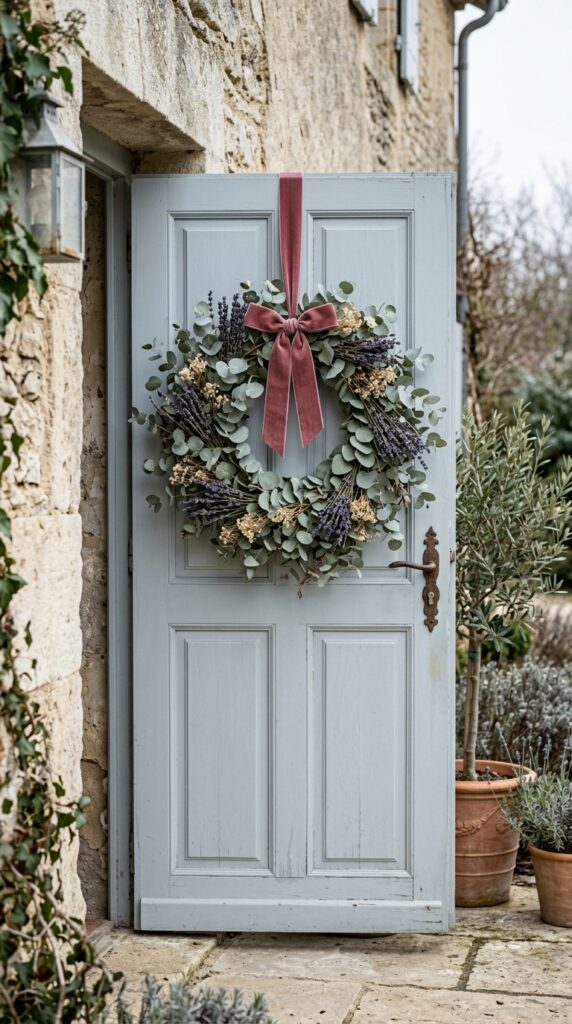
Vibe: Airy — a wreath that feels like it belongs in a Provençal farmhouse in February.
Why it works: Silver-dollar eucalyptus is one of the few materials that actually improves as it dries — the rounds contract slightly, deepen to a dustier silver-green, and become more rigid, making them structurally sound for wreath construction without wire support. The color palette here exploits tonal harmony: silver-green, dusty purple, and dusty rose are all desaturated versions of their original hues, so they sit peacefully together without competition.
How to get it: Bundle five to seven dried lavender stems with floral wire and attach bundles at 45-degree angles rather than flat against the base — angled placement creates shadow and depth that flat arrangements lack. Refresh the scent each season by misting lightly with lavender essential oil diluted in water.
💡 Quick Win: A $15 bunch of fresh silver-dollar eucalyptus from a grocery store or farmers market, left to air-dry for two weeks hanging upside down, becomes the most convincing and longest-lasting wreath material you can find.
🛍️ Shop the Look — Amazon Product Ideas
| # | Product Search Phrase | Why It Fits |
| 1 | silver dollar eucalyptus dried stems bundle | Natural wreath base |
| 2 | dried lavender bundle purple large | Aromatic textural accent |
| 3 | dusty rose velvet wired ribbon 3 inch | Muted romantic bow |
| 4 | dried baby’s breath bulk white | Airy filler material |
| 5 | floral wire green 22 gauge paddle | Stem attachment wire |
6. Birch Branch Minimalist Wreath — Scandinavian Style
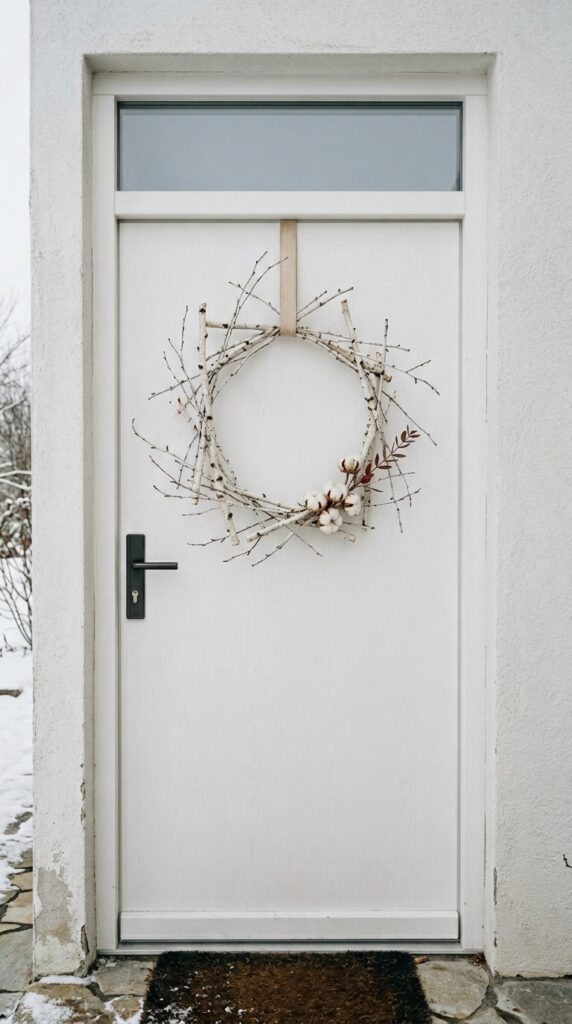
Vibe: Still — the wreath equivalent of a blank wall done on purpose.
Why it works: This is a lesson in negative space as a design element. The branches are spread open rather than packed, making the empty areas inside the form as visually active as the branches themselves. This Scandinavian approach — often called lagom (just the right amount) in Swedish design culture — reads as sophisticated because restraint requires confidence. The white birch bark brings extraordinary visual texture: those dark horizontal lenticels (the natural markings on birch) do more work than any ribbon could.
How to get it: Bend three to four fresh white birch branches into a circle while still pliable, then bind at crossing points with natural raffia rather than wire — raffia reads as warmer and more artisanal. Allow the wreath to dry in its circular form for a week before hanging. The drying process will set the shape permanently.
🛍️ Shop the Look — Amazon Product Ideas
| # | Product Search Phrase | Why It Fits |
| 1 | white birch branches bundle craft decor | Key structural material |
| 2 | natural raffia tie ribbon craft | Organic minimalist binding |
| 3 | dried cotton bolls stem pick set | Sparse botanical accent |
| 4 | faux red winterberry sprig stem | Single color pop element |
| 5 | adhesive wreath hook over-the-door metal | No-nail hanging solution |
7. Red Berry and Cedar Wreath — Classic Holiday
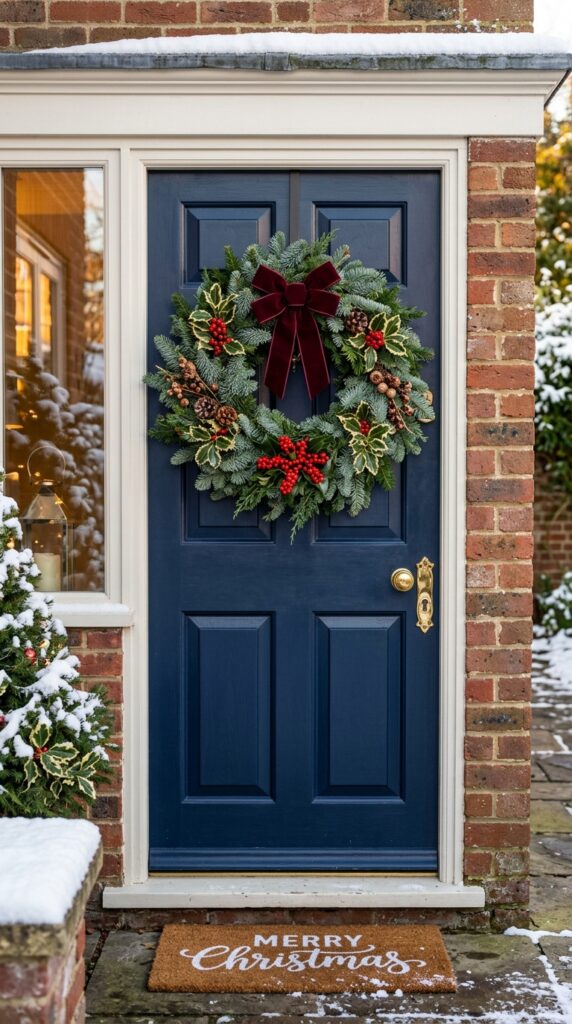
Vibe: Luminous — the way a firelit room looks from the street.
Why it works: Red and green are complementary colors, sitting directly opposite each other on the color wheel — the tension between them creates maximum vibrancy without additional complexity. Cedar specifically (rather than generic pine) gives this wreath an edge because its silvery-blue bloom shifts the green away from lime toward a cooler, more sophisticated blue-green that elevates the crimson rather than competing with it. Visual weight is concentrated at two asymmetric positions rather than distributed evenly, which prevents the symmetry fatigue that makes many traditional wreaths look stiff.
How to get it: Use fresh-cut cedar if you can access it — the natural oils release scent through December and the branches flex easily around a wire frame. Pack clusters tightly at the 6 and 11 o’clock positions and let the surrounding greenery taper, creating an organic rather than engineered distribution of mass.
💡 Quick Win: A single bundle of fresh red winterberry stems (around $6 at a florist) wired into a plain cedar wreath at one focal point adds more impact than any ribbon would.
🛍️ Shop the Look — Amazon Product Ideas
| # | Product Search Phrase | Why It Fits |
| 1 | cedar artificial wreath 24 inch realistic | Rich blue-green base |
| 2 | faux red holly berry clusters picks | Classic color accent |
| 3 | burgundy velvet wired ribbon 4 inch wide | Deep-toned bow material |
| 4 | fresh winterberry stems florist grade | Natural berry option |
| 5 | wreath hanger adjustable over-door gold | Secure hanging hardware |
8. Warm LED Light-Wrapped Wreath for Evening Curb Appeal
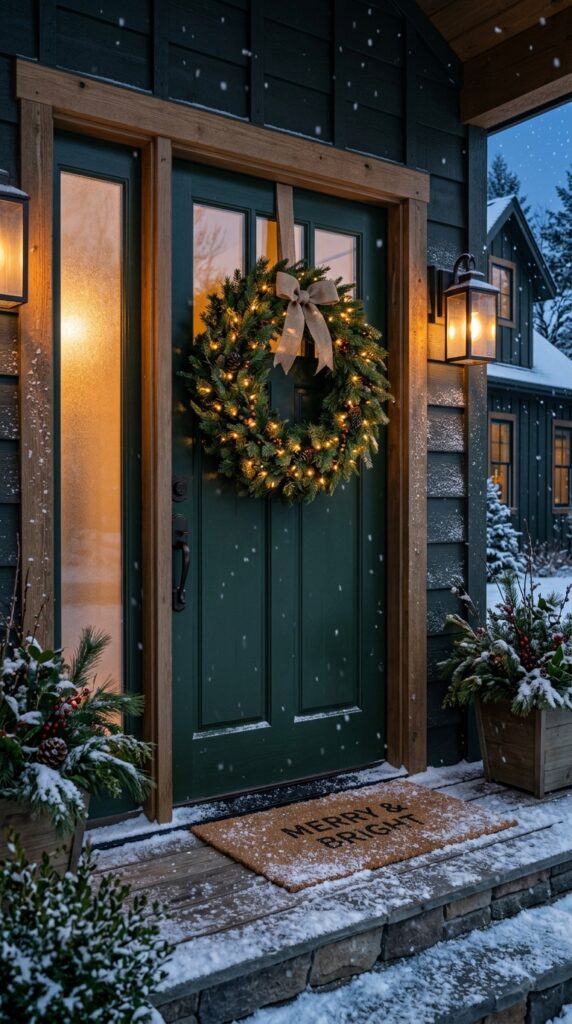
Vibe: Romantic — that specific ache of a lit window in winter dark.
Why it works: This wreath operates entirely on light behavior at dusk. At 5 PM in January, an unlit wreath disappears into shadow, while a lit one becomes the focal point of the entire façade. The critical detail is color temperature: 2700K LEDs read as warm amber rather than the cool blue-white of 5000K lights, which would make the greenery look clinical. Warm light makes frost, snow, and dark green foliage look alive rather than frozen.
How to get it: Use battery-operated micro LED lights with a built-in timer (set to illuminate at dusk for 6 hours) so you never have to think about it. Wrap the lights loosely around the wreath in a random rather than even pattern — even wrapping looks like a product display, not a home. Look for lights rated for outdoor use with an IP44 or higher weather resistance rating.
🛍️ Shop the Look — Amazon Product Ideas
| # | Product Search Phrase | Why It Fits |
| 1 | battery-operated fairy lights warm white outdoor IP65 | Weather-resistant wreath lights |
| 2 | micro LED string lights 2700K timer | Amber-tone timed option |
| 3 | evergreen artificial wreath 24 inch full | Foundational greenery base |
| 4 | natural burlap wired ribbon 4 inch | Rustic-simple bow option |
| 5 | outdoor light timer plug-in dusk dawn | Automatic dusk activation |
9. Pinecone-Only Statement Wreath in Natural Brown and Rust
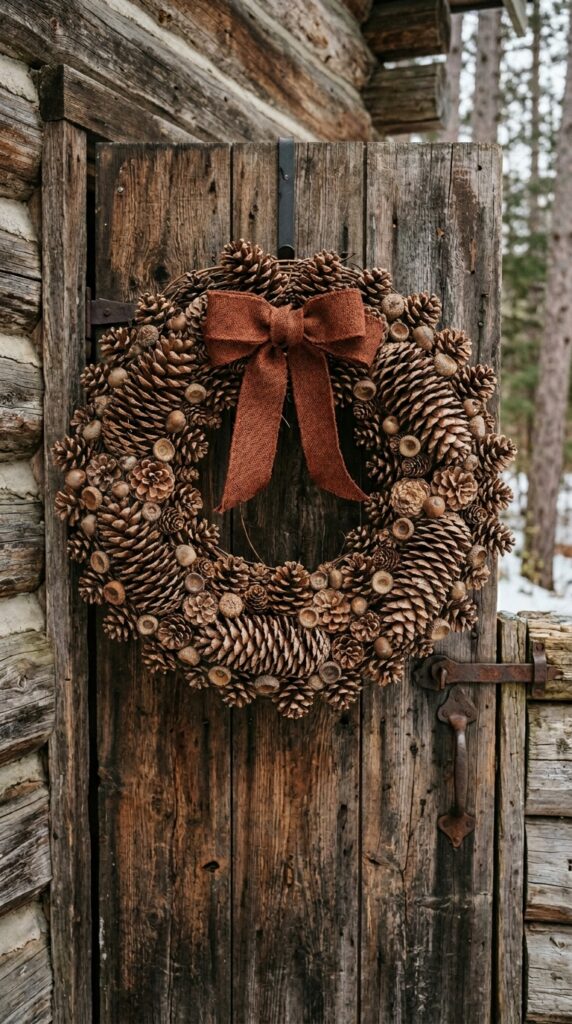
Vibe: Raw — a wreath that looks like it was gathered from the forest floor and shaped by hand.
Why it works: Monochromatic texture is an advanced design move: by eliminating color variation entirely, this wreath forces the eye to read surface detail — the spiral geometry of individual pinecone scales, the varying sizes creating a visual rhythm. This principle is called textural monotony used in service of depth, and it works because pinecone geometry is mathematically complex (Fibonacci spirals in every scale). The mix of species sizes is essential — a single-species wreath reads as repetitive rather than rhythmic.
How to get it: Wire three pinecone species of different sizes using 24-gauge floral wire, wrapping the wire around the base of each cone’s lowest scales. Attach to a straw wreath form (rather than wire, which shows through the gaps) and pack cones tightly in a herringbone pattern — alternating large-small-medium — to avoid size-clustering.
💡 Quick Win: You can bake foraged pinecones at 250°F for 30 minutes to kill any insects and fully open the scales before wiring — open cones catch light and look far more polished than closed ones.
🛍️ Shop the Look — Amazon Product Ideas
| # | Product Search Phrase | Why It Fits |
| 1 | mixed pinecone assortment bulk bag 5lb | Multi-species variety pack |
| 2 | straw wreath form 18 inch natural | Dense pinecone anchor base |
| 3 | rust orange burlap ribbon wired 3 inch | Earthy tone bow option |
| 4 | craft floral wire 24 gauge green | Cone attachment wire |
| 5 | dried acorn caps bulk woodland decor | Small-scale texture accent |
10. Small-Space Wreath: 14-Inch Compact Cedar for Apartment Doors
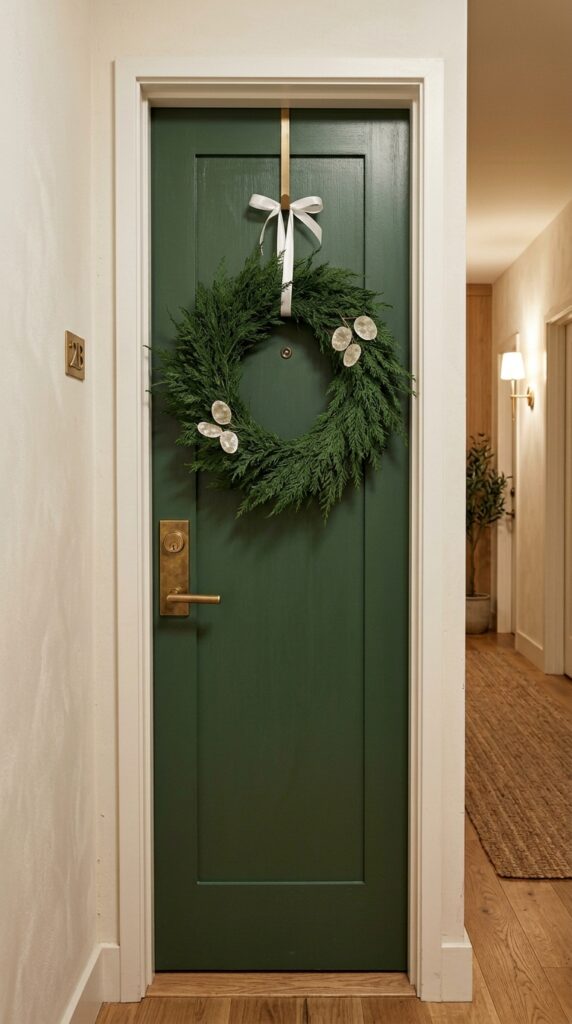
Vibe: Quiet — proof that scale doesn’t determine impact.
Why it works: Compact wreaths fail when they’re simply shrunken versions of large ones — they read as undersized rather than intentional. The key design principle here is editing to the essential: a 14-inch wreath needs one focal material (cedar), one accent material (lunaria), and zero filler. Lunaria — also known as silver dollar plant for its translucent, papery seed pods — is the ideal accent for small wreaths because its delicacy reads beautifully at close range, the distance at which apartment neighbors will actually view the door.
How to get it: Look specifically for a wreath form at or below 16 inches — most craft stores stock primarily 22–24 inch forms, so you may need to order online. Complete the wreath with just three lunaria sprigs and a simple ribbon tie rather than a full bow, which would overwhelm the smaller scale.
🛍️ Shop the Look — Amazon Product Ideas
| # | Product Search Phrase | Why It Fits |
| 1 | small cedar wreath 14 inch artificial | Compact scale foundation |
| 2 | dried lunaria silver dollar stems | Delicate light-catching accent |
| 3 | thin satin ribbon white 1.5 inch | Scale-appropriate tie |
| 4 | adhesive removable wreath hook | Apartment-safe no-damage hanging |
| 5 | mini wreath hanger over-door narrow | Fits hollow-core apartment doors |
11. Frosted Blue Spruce with Silver Ribbon — Cool-Toned Winter
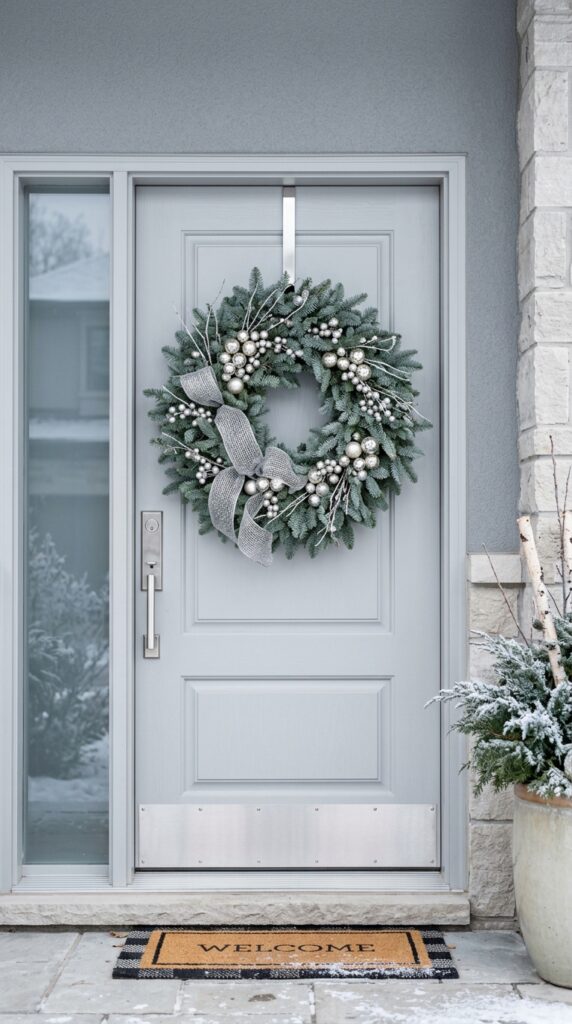
Vibe: Luminous — like midwinter light on fresh snow, clean and crystalline.
Why it works: Blue spruce is the only evergreen species with a naturally silvery-blue cast — the glaucous bloom on its needles shifts the color away from warm green and toward cool silver-green, making it uniquely suited to a cool, contemporary palette. This is a case where material selection is the design decision. Silver mesh ribbon adds dimensional layering because it can be looped and fluffed to create volume without weight, and its metallic surface reflects changing light throughout the day, making the wreath look different at noon versus dusk.
How to get it: To integrate silver ribbon without a traditional bow, thread 3-yard lengths of 4-inch silver mesh ribbon loosely through the wreath base at four or five points and fluff each loop independently. This deco mesh technique creates volume without a formal bow silhouette that would feel too traditional for a modern door.
🛍️ Shop the Look — Amazon Product Ideas
| # | Product Search Phrase | Why It Fits |
| 1 | artificial blue spruce wreath 24 inch | Silvery blue-green base |
| 2 | silver metallic deco mesh ribbon 6 inch | Volume-creating bow alternative |
| 3 | silver ball ornament mini cluster picks | Reflective accent dots |
| 4 | mercury glass berry stem silver | Vintage metallic texture |
| 5 | silver metallic spray paint matte | DIY accent transform |
12. Wheat Sheaf and Dried Grass Farmhouse Wreath
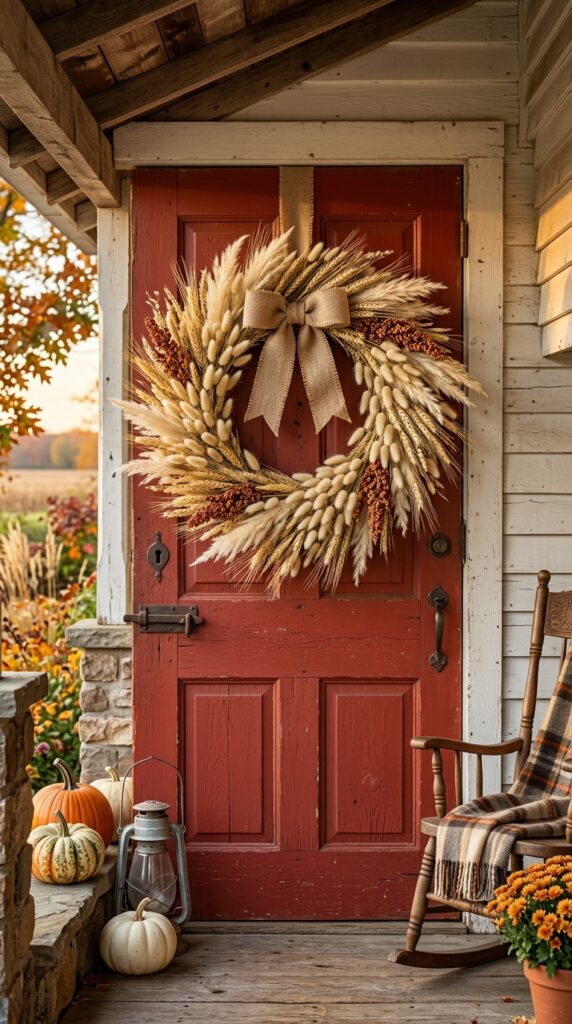
Vibe: Layered — the kind of wreath that looks like a harvest painting brought to three dimensions.
Why it works: This wreath operates through material layering — wheat, pampas, bunny tail, and sorghum are all golden-to-cream in color but radically different in texture: stiff and architectural (wheat), feathery and soft (pampas), round and tactile (bunny tail), pendulous and curved (sorghum). Using one tonal family across texturally varied materials is an advanced technique that creates sophisticated depth without color contrast. The warm barn red door creates an analogous color harmony with the golden palette — analogous colors (those adjacent on the wheel) feel harmonious rather than combative.
How to get it: Build on a grapevine or wire frame and attach dried grass materials using a hot glue gun rather than wire — hot glue holds dried stems more securely and invisibly than wire, which can crush delicate grass heads. Apply grasses in directional layers, all flowing from one point, rather than radiating symmetrically from the center.
💡 Quick Win: A $10 bundle of dried pampas grass from a craft store, hot-glued in clusters to a plain straw wreath, looks expensive and takes 15 minutes.
🛍️ Shop the Look — Amazon Product Ideas
| # | Product Search Phrase | Why It Fits |
| 1 | dried wheat bundle craft floral decor | Core golden-tone material |
| 2 | dried pampas grass stems mini bundle | Feathery soft texture accent |
| 3 | bunny tail grass dried natural cream | Round tactile detail |
| 4 | wide natural burlap ribbon wired 6 inch | Farmhouse-style bow base |
| 5 | grapevine wreath form 24 inch natural | Open organic frame |
13. Black Plum and Dusty Blush Velvet Ribbon Wreath
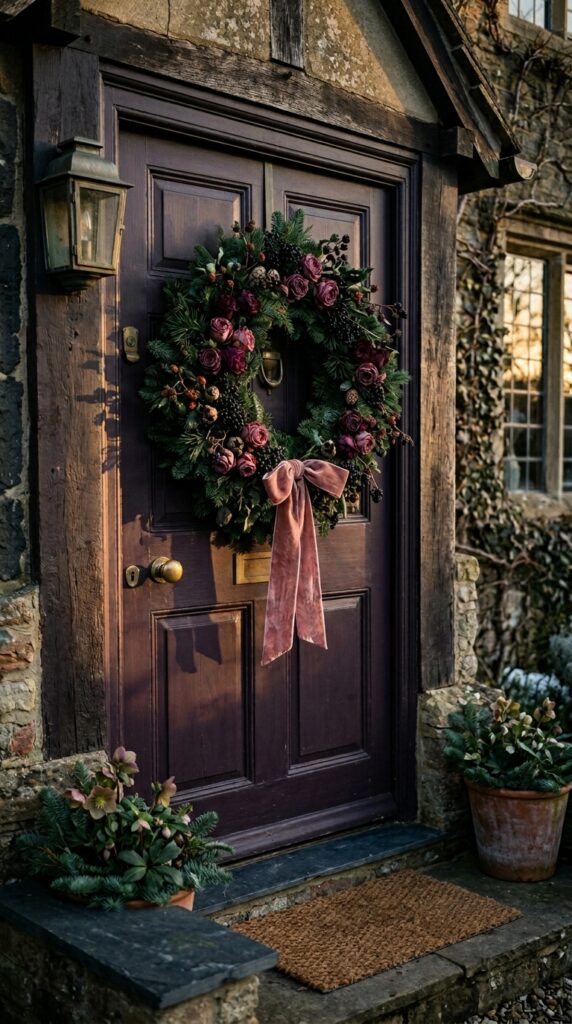
Vibe: Hushed — a wreath that seems to hold its breath.
Why it works: Dark-toned wreaths work through shadow and depth rather than saturation. Deep plum dried roses and dark berries absorb light rather than reflecting it, creating pockets of visual mystery that lighter wreaths cannot achieve. The dusty blush ribbon is the crucial counterpoint — it’s both warm enough to belong in the palette and pale enough to prevent the arrangement from becoming too heavy. This color pairing (deep plum against dusty blush) is drawn from the same technique used in dark academic interior design: contrast without conflict.
How to get it: Dry fresh roses by hanging them upside down in a warm, dark space for two to three weeks. The drying process intensifies their color toward deep burgundy-plum, and the petals contract into a denser, more sculptural rose head than fresh blooms offer. Wire them gently at the stem base, not through the flower head, to preserve petal integrity.
🛍️ Shop the Look — Amazon Product Ideas
| # | Product Search Phrase | Why It Fits |
| 1 | dried burgundy rose bunch craft floral | Dark romantic focal flowers |
| 2 | faux black elderberry stem picks | Deep shadow berry accent |
| 3 | dusty blush velvet ribbon wired 4 inch | Pale counterpoint bow |
| 4 | dark plum artificial wreath base | Deep-toned evergreen ring |
| 5 | dried blackberry stem artificial decor | Additional dark berry texture |
14. Layout Tip: Wreath Placement for Low vs. High Doors
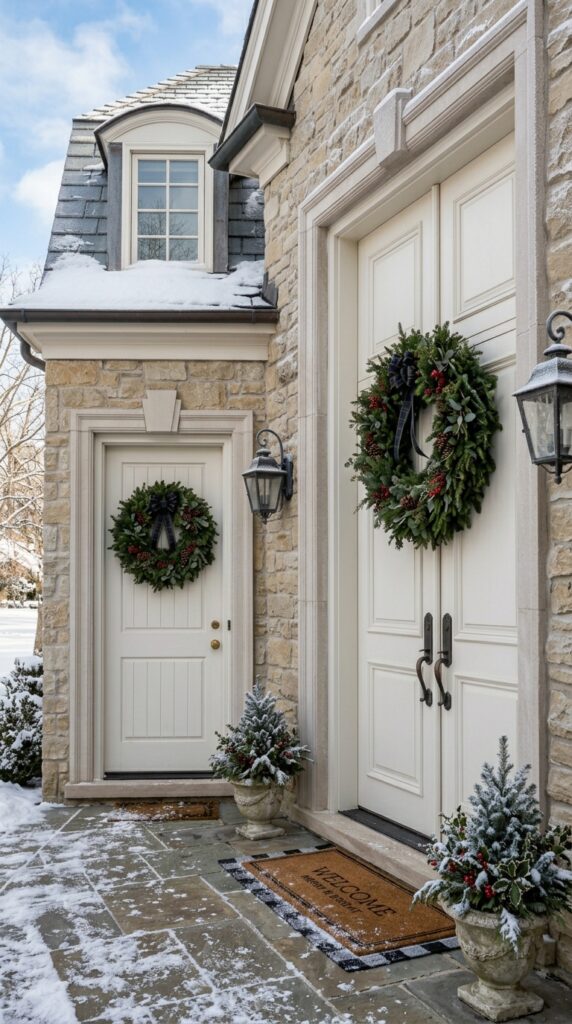
Vibe: Grounded — the kind of detail that separates a styled door from a simply decorated one.
Why it works: Wreath placement follows the same visual proportion rule as hanging art on walls: center it at eye level (approximately 5 feet from the floor) on standard 8-foot doors, but raise it to the upper third of the door panel on tall doors above 9 feet. A wreath hung at eye-level on a 10-foot door reads as stranded in empty space — the vertical proportion of the door dwarfs it. Moving it upward allows the wreath to anchor the door’s primary zone of visual interaction.
How to get it: Measure the door panel height and hang the wreath so its center sits between 55 and 62 inches from the floor for standard doors. For double doors or doors with sidelights, consider a wreath on each sidelight rather than one oversized wreath on the door itself — two smaller wreaths read as more tailored on a wide façade.
💡 Quick Win: Use a removable adhesive Command hook strip rated for 5 lbs — they work on paint, glass, and most exterior door surfaces, and they come off cleanly in spring.
🛍️ Shop the Look — Amazon Product Ideas
| # | Product Search Phrase | Why It Fits |
| 1 | adjustable wreath hanger over-door heavy duty | Universal door size fit |
| 2 | Command outdoor strip hook 5lb clear | Paint-safe no-nail option |
| 3 | magnetic wreath hanger exterior steel | Metal door solution |
| 4 | wreath hanger hook suction cup large | Glass door sidelight use |
| 5 | double wreath hanger two-hook adjustable | Double door matching pair |
15. Lemon and Kumquat Citrus Wreath — Unexpected Bright Winter
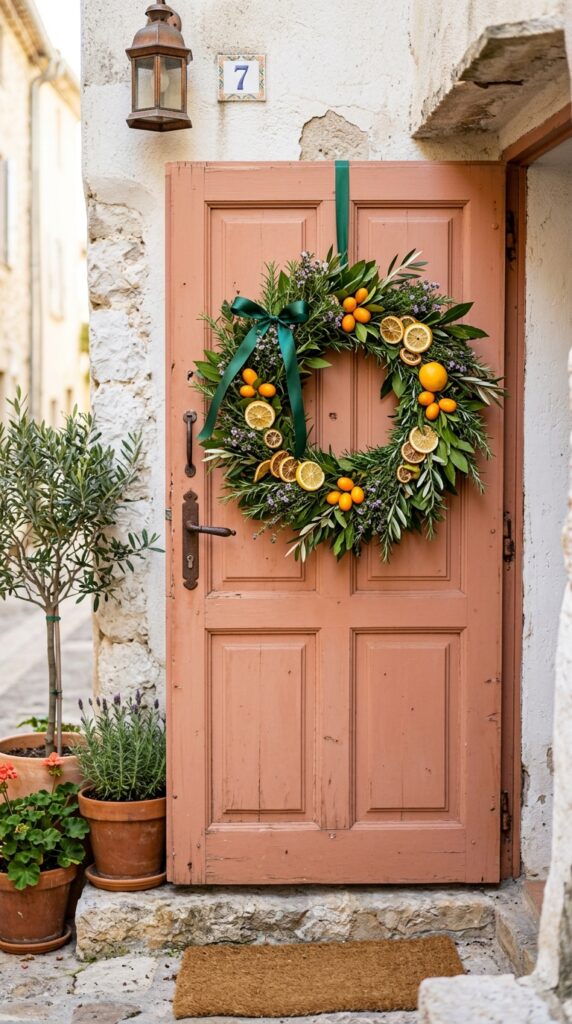
Vibe: Sun-warmed — a reminder that not every winter wreath needs to reference snow.
Why it works: Yellow and orange are warm analogous colors that read as energetic and optimistic — a sharp departure from the burgundy-and-green winter palette. This makes a citrus wreath a statement of personal style, refusing the season’s chromatic defaults. Fresh kumquats on a wreath look unexpectedly sophisticated because their small size (similar to a large olive) gives them an artisanal rather than craft-store quality. The aromatic herb sprigs — rosemary, thyme — reinforce the Mediterranean sensibility and release scent every time the door opens or closes.
How to get it: Wire kumquats in clusters by pushing 24-gauge floral wire through the fruit at the equator and twisting beneath. They will last two to three weeks fresh in cold weather before needing replacement. Alternatively, dry them in a dehydrator at 135°F for 8 hours and they’ll last the full season.
🛍️ Shop the Look — Amazon Product Ideas
| # | Product Search Phrase | Why It Fits |
| 1 | faux kumquat stem picks realistic orange | Long-lasting citrus accent |
| 2 | herb wreath base boxwood greenery | Fresh herb-compatible base |
| 3 | dried lemon slices wreath craft | Preserved citrus rounds |
| 4 | narrow green silk ribbon 1.5 inch | Understated Mediterranean tie |
| 5 | food dehydrator compact 5-tray | DIY citrus drying tool |
16. Boxwood Evergreen Topiary-Style Ring — Year-Round Foundation
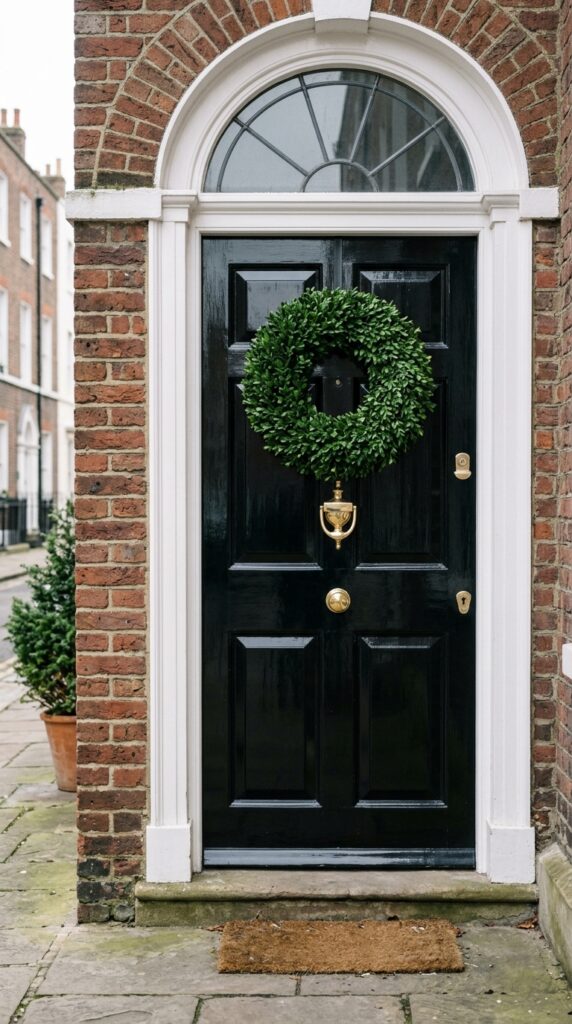
Vibe: Still — the architectural confidence of a form that needs nothing added.
Why it works: A pure boxwood wreath is an exercise in form without decoration. The design principle at work is that a perfectly circular, evenly dense form has intrinsic geometric beauty — the same principle that makes topiary and clipped hedges compelling. The deep matte green against a black lacquered door has an almost heraldic quality, reinforcing rather than decorating the architecture. This wreath works because it doesn’t try to do anything other than be exactly what it is.
How to get it: The distinction between a convincing boxwood wreath and a cheap-looking one is leaf density. Look for artificial boxwood wreaths with stems that include the characteristic small oval leaves in alternating pairs — boxwood has a very specific leaf arrangement that fakes poorly. Quality boxwood wreaths from Pottery Barn or McGee & Co. are worth the investment if you plan to use it year-round.
🛍️ Shop the Look — Amazon Product Ideas
| # | Product Search Phrase | Why It Fits |
| 1 | artificial boxwood wreath 24 inch UV resistant | Year-round evergreen ring |
| 2 | black lacquer door knocker ring pull brass | Complementary door hardware |
| 3 | invisible fishing line 40lb monofilament | Clean-hanging wreath line |
| 4 | weatherproof wreath storage bag round | Season-to-season protection |
| 5 | boxwood wreath 20 inch double-door pair | Matching door pair option |
17. Navy Ribbon and White Pine Winter Wreath — Nautical Winte

Vibe: Airy — the wreath a ship captain’s house would have in January.
Why it works: Navy and forest green are both deep, cool tones that belong to the same chromatic family — pairing them avoids contrast fatigue and creates a sophisticated tonal layering. White pine has a distinctive character among evergreens: its needles are long (3–5 inches), soft, and blue-green, falling somewhere between a spruce and a true fir in texture. That needle length creates movement in the wreath — individual needles catch air and light in a way that shorter-needled varieties cannot. The nautical accents work because they’re kept small and partially buried in greenery rather than displayed prominently.
How to get it: Source natural starfish from craft stores rather than online, where quality varies enormously. Wire them gently through one arm, not through the body, to avoid cracking. Bury each starfish approximately two-thirds into the greenery so only the upper portion shows — fully exposed accents read as obvious; partially concealed ones read as discovered.
🛍️ Shop the Look — Amazon Product Ideas
| # | Product Search Phrase | Why It Fits |
| 1 | white pine artificial wreath full 24 inch | Long-needle soft texture base |
| 2 | navy grosgrain ribbon wired 4 inch wide | Nautical-tone bow material |
| 3 | natural starfish small 2-3 inch craft pack | Subtle nautical accent |
| 4 | bleached sand dollar coastal decor | White-toned nautical element |
| 5 | dried sea lavender stems purple-gray | Coastal botanical fill |
18. All-White Winter Wreath — Snowball and Cream Cotton
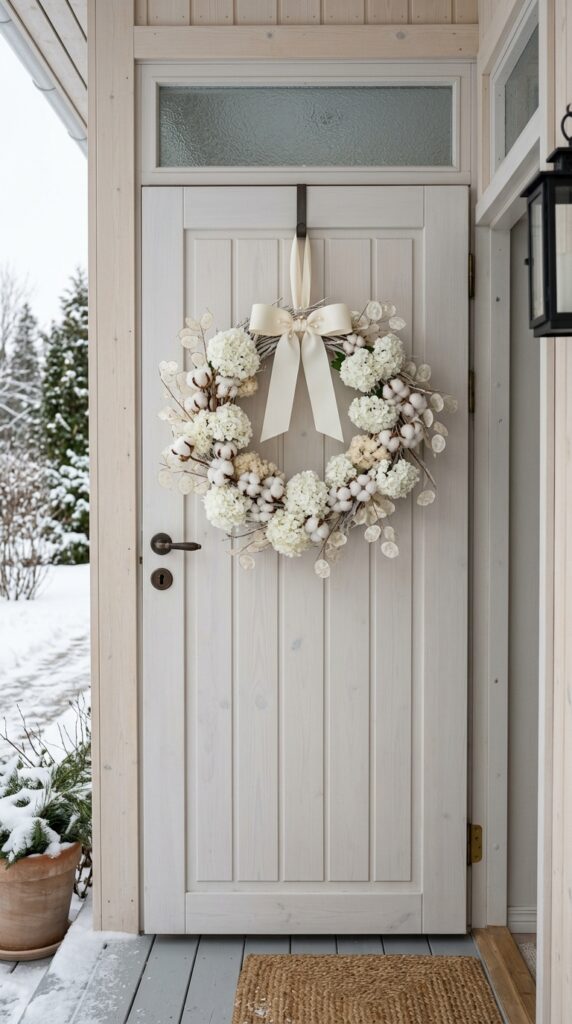
Vibe: Serene — the quiet of early morning before the house wakes.
Why it works: An all-white wreath succeeds through tonal variation within one hue — the design strategy of using warm ivory, cool bright white, and neutral cream as distinct shades that create depth without color. This is exactly how a white-on-white room avoids looking flat: by layering warm and cool variations of the same base tone. Snowball flowers (faux Viburnum heads) are ideal because their spherical form creates three-dimensional shadow that flat white elements cannot.
How to get it: Deliberately choose white materials with different temperature readings — warm ivory cotton against cooler white snowballs — rather than mixing materials randomly. Hold all your materials together before purchasing and look for at least three distinct whites. Uniform white reads as washed-out; varied whites read as intentional.
💡 Quick Win: A $9 pack of white snowball flower picks from a craft store, clustered in groups of three and wired into any white or cream base wreath, instantly elevates it to an editorial-quality monochromatic arrangement.
🛍️ Shop the Look — Amazon Product Ideas
| # | Product Search Phrase | Why It Fits |
| 1 | white snowball flower picks artificial viburnum | Three-dimensional white focal |
| 2 | cream cotton stem picks set | Warm ivory texture contrast |
| 3 | dried lunaria pods stems ivory | Translucent light element |
| 4 | ivory grosgrain wired ribbon 3 inch | Tonal ribbon option |
| 5 | white artificial wreath base undecorated | Neutral starting foundation |
19. Feather and Pearl — Glamorous Winter Wreath
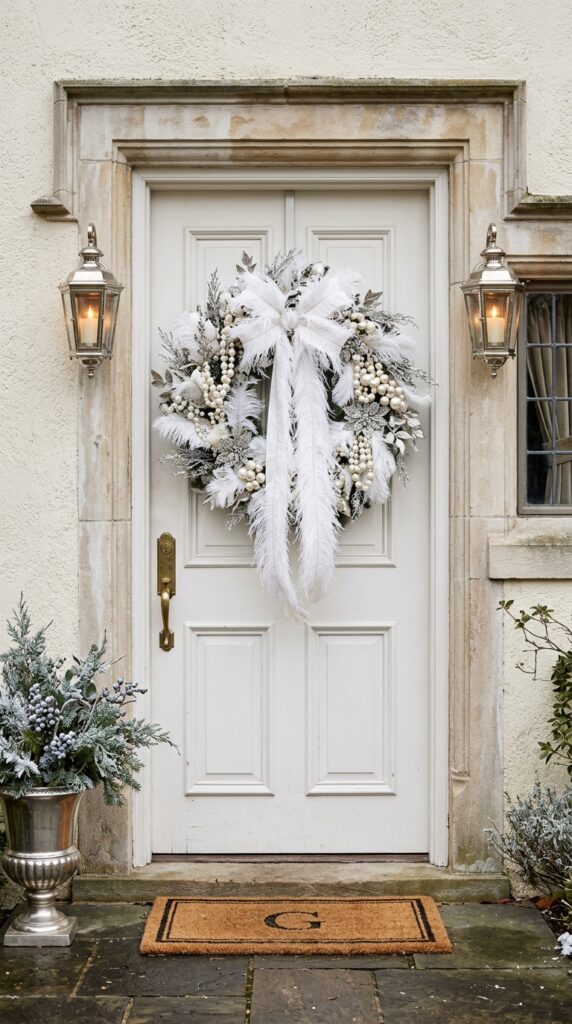
Vibe: Layered — the wreath equivalent of a fur-trimmed coat: unabashedly luxurious.
Why it works: Feathers introduce directional texture into a wreath — each feather has a midrib, creating a line that leads the eye. Layering feathers so their tips overlap creates a surface that shifts as light and viewing angle change, giving the wreath a living quality that static materials cannot achieve. Pearl clusters add a reflective, spherical element that contrasts beautifully with the soft, matte quality of feathers — matte and reflective always sharpen each other when placed in proximity.
How to get it: Wire feathers in overlapping rows, tips pointing in one consistent direction (usually upward or outward from the center), using 30-gauge craft wire that won’t damage the quill. Pearl garland can be looped through the wreath base rather than wired — thread it through the base structure three or four times so it drapes naturally rather than sitting flat.
🛍️ Shop the Look — Amazon Product Ideas
| # | Product Search Phrase | Why It Fits |
| 1 | white goose feathers craft pack 4-6 inch | Layered soft texture base |
| 2 | pearl bead garland ivory cream 6mm | Reflective glamour accent |
| 3 | silver metallic branch picks spray | Architectural shine element |
| 4 | white ostrich trim ribbon wide | Luxe bow material |
| 5 | rhinestone floral picks wreath decor | Small sparkling accent |
20. Rustic Wood Slice and Evergreen Door Wreath
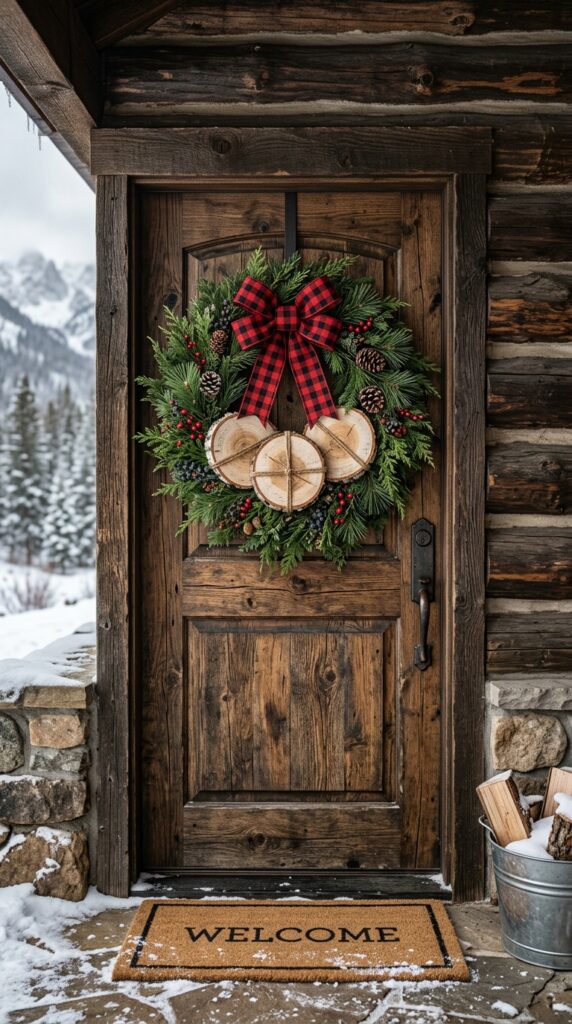
Vibe: Grounded — the wreath equivalent of a cast iron skillet: unpretentious and permanent.
Why it works: Natural wood slices introduce cross-section geometry — the visible growth rings and heartwood-to-sapwood gradient visible on a cut birch round are among the most visually compelling natural patterns available to a decorator. These circular shapes within the circular wreath create a nested geometry (circle within circle) that feels designed without being designed. Buffalo check ribbon provides bold graphic contrast that grounds the organic randomness of the natural materials with a crisp repeating pattern.
How to get it: Drill a small hole at the 12 o’clock position of each wood slice before attaching to the wreath — this allows you to wire the slice cleanly without cracking it. Seal the wood slices with matte polycrylic before hanging outdoors to protect them from moisture warping.
🛍️ Shop the Look — Amazon Product Ideas
| # | Product Search Phrase | Why It Fits |
| 1 | natural birch wood slices 3-4 inch craft | Tree ring cross-section accent |
| 2 | buffalo check ribbon red black wired 4 inch | Graphic pattern bow |
| 3 | cedar greenery preserved wreath 24 inch | Fragrant natural base |
| 4 | matte polycrylic spray sealer clear | Outdoor wood protection |
| 5 | pine needle stem picks artificial | Dense filler texture |
21. Cranberry and Sage Herb Wreath — Kitchen Garden Winter

Vibe: Warm — the scent of a kitchen where someone actually cooks.
Why it works: Sage is an underused wreath material with remarkable design qualities: its surface is covered in fine silvery hair that diffuses light, giving each leaf a soft matte glow, and its color sits at the complex intersection of green, gray, and silver that reads as sophisticated rather than simply herbal. Cranberry red against dusty sage is a muted complementary pairing — both tones are desaturated enough to avoid clashing while still delivering the energy of a complementary contrast. The result feels like a country kitchen brought to the front door.
How to get it: Fresh sage can be used directly if your winter temperatures stay below 45°F — in cold conditions it will slowly dry in place over two to three weeks, maintaining its color and scent. If you’re in a warmer climate, dry the sage first, then attach it to a bound vine base using natural jute rather than wire for a more rustic finish.
💡 Quick Win: A small bunch of fresh rosemary from the grocery store ($3–4), folded into a ring shape and bound at four points with jute twine, makes a complete 8-inch herbal wreath with zero craft supplies.
🛍️ Shop the Look — Amazon Product Ideas
| # | Product Search Phrase | Why It Fits |
| 1 | dried sage bundle silvery herb stems | Central aromatic material |
| 2 | faux cranberry branch picks red | Complementary color accent |
| 3 | natural jute twine craft 3-ply | Rustic binding and bow |
| 4 | dried rosemary stems bundle craft | Aromatic secondary herb |
| 5 | small vine wreath base 12 inch | Open herb-compatible frame |
22. Giant 30-Inch Statement Wreath for Double Doors
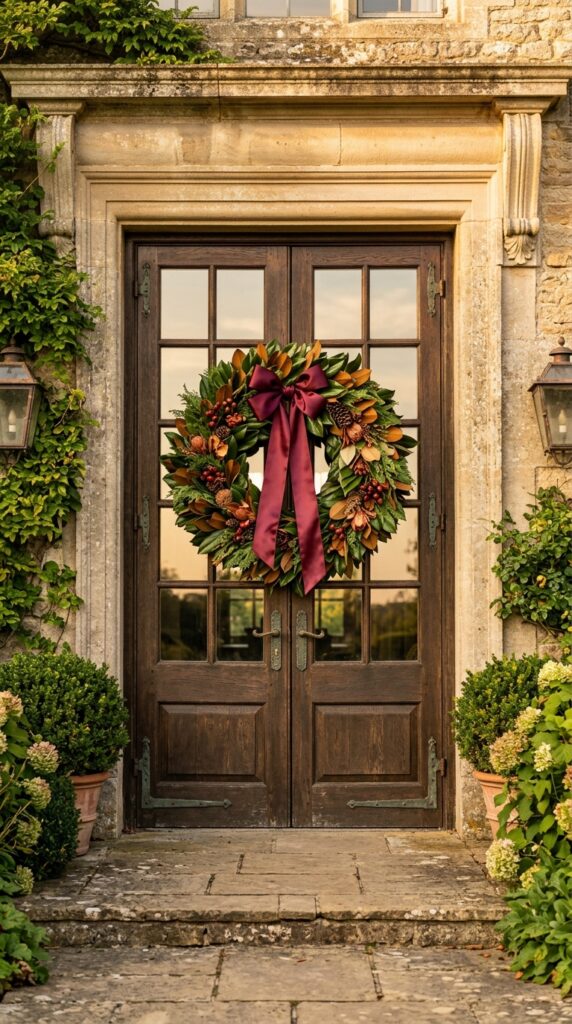
Vibe: Luminous — the scale of this wreath makes the entire façade feel like an event.
Why it works: Scale matching is the most neglected principle in wreath selection. A 24-inch wreath on a 36-inch-wide double door reads as decoratively lost — the visual proportion requires a wreath that occupies at least 70% of the door’s width when centered on the pair. A 30-inch wreath hits that proportion, allowing the architectural elements (door handles, panel molding, transom light) to remain visible and interact with the wreath. The trick is centering the wreath on the door gap rather than on either door panel — this acknowledges the double door as a unified architectural element.
How to get it: Hang a large wreath from a suction hook placed on the glass of a sidelight (if present) or from a wreath hanger centered on both doors using a wide sash that spans the door gap. A heavy wreath (over 5 lbs) needs two hanging points, not one, to prevent it swinging and scratching the door surface.
🛍️ Shop the Look — Amazon Product Ideas
| # | Product Search Phrase | Why It Fits |
| 1 | large magnolia cedar wreath 30 inch premium | Oversized statement base |
| 2 | wide burgundy silk ribbon 6 inch wired | Grand-scale bow material |
| 3 | double door wreath hanger adjustable wide | Centered double-door mounting |
| 4 | heavy duty suction cup hook 10lb outdoor | Alternative glass-door mount |
| 5 | dried rosehip cluster stems red | Scale-appropriate accent |
23. Winter Woodland Wreath with Mushroom and Fern Accents

Vibe: Raw — a wreath that looks like it grew there rather than was placed there.
Why it works: The forest-floor aesthetic depends on species specificity — a mushroom wreath looks craft-store when it uses generic fake mushrooms, and genuinely enchanting when it uses real dried specimens with visible gill structure and natural color variation. Reindeer lichen (also called caribou moss) is the key material: its silver-chartreuse color doesn’t exist in any other botanical material and immediately reads as wild and unusual. The design principle at work is ecological credibility — materials that could realistically co-exist in nature create a more convincing and evocative arrangement than materials that couldn’t.
How to get it: Reindeer lichen is sold in craft and florist supply stores, and is available preserved and glycerin-treated to maintain flexibility. Attach it in irregular organic patches rather than uniform clusters — lichen in nature doesn’t grow in neat arrangements. Dried mushroom slices can be made by slicing shiitake or portobello mushrooms and dehydrating at 135°F for six to eight hours.
🛍️ Shop the Look — Amazon Product Ideas
| # | Product Search Phrase | Why It Fits |
| 1 | preserved reindeer lichen moss natural | Signature woodland texture |
| 2 | dried mushroom slices craft decor | Unique wild-foraged accent |
| 3 | preserved dried fern frond stems | Delicate woodland structure |
| 4 | forest moss sheet preserved green | Base naturalistic cover |
| 5 | dark green cedar preserved wreath base | Deep forest foundation |
24. Pompom and Yarn Wreath — Cozy Textile Winter
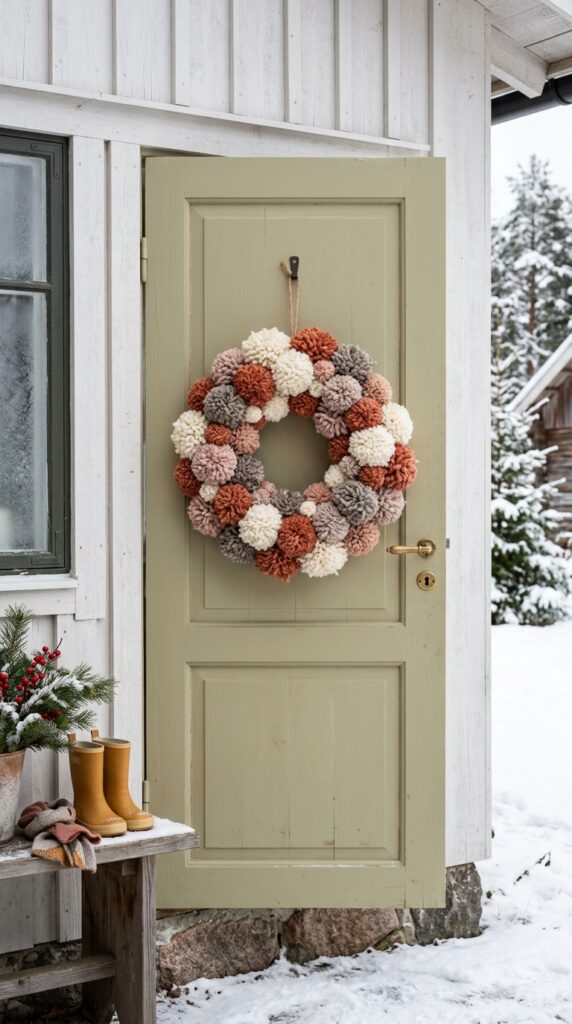
Vibe: Warm — a wreath that belongs to winter the way a knitted blanket does.
Why it works: A pompom wreath is a materials study in textile softness applied to a rigid form. The contrast between the circular geometry of the wreath frame and the soft, uneven surface of wool pompoms creates tactile tension that makes viewers want to touch it. The palette — cream, terracotta, dusty blush, warm gray — is drawn directly from Scandinavian natural wool colorways, giving it an artisanal quality that plastic or metallic alternatives can’t replicate. This wreath also works because it’s genuinely weatherproof if made from wool rather than acrylic — wool fiber actually sheds water.
How to get it: Make pompoms using a cardboard pompom maker cut to 2.5-inch diameter and chunky wool yarn. Tie each pompom tightly at the center knot using a length of the same yarn, leaving 4-inch tails that can be used to tie the pompom directly onto a wire wreath frame. Distribute colors in a broken spiral rather than in alternating rows.
💡 Quick Win: A pompom maker tool costs around $8 and lets you make consistent pompoms in 3 minutes each — the entire wreath takes an afternoon of simple, satisfying work.
🛍️ Shop the Look — Amazon Product Ideas
| # | Product Search Phrase | Why It Fits |
| 1 | chunky wool yarn bundle earthy tones | Key pompom material |
| 2 | pompom maker tool set 4 sizes | Consistent size tool |
| 3 | wire wreath frame 18 inch round | Structural base |
| 4 | terracotta wool yarn skein | Warm accent color fiber |
| 5 | dusty blush wool yarn natural | Soft rose-tone yarn option |
25. Twig and Bare Branch Winter Wreath with Single Red Bow
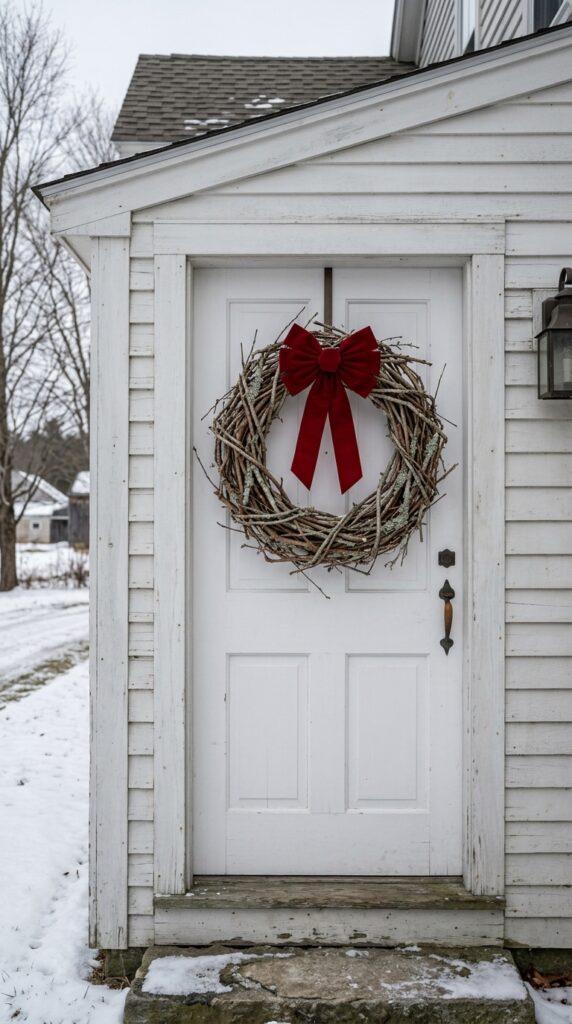
Vibe: Still — a wreath that makes you slow down to look.
Why it works: A single color accent is one of the most powerful moves in color theory: isolation amplifies. The red bow is more compelling here than it would be in a wreath crowded with multiple colors because it has no competition. The eye travels immediately to the bow, making it feel both intentional and inevitable. The bare twig base is not a design shortcut but a deliberate choice — winter branches have extraordinary surface variety (lichen patches, varied bark tone, varying thickness) that evergreen foliage would conceal.
How to get it: Source branches from dogwood, curly willow, or birch — all have interesting branch architecture. Bend them into a circle while still somewhat pliable and bind at four points with wire. The natural drying process will occur on the door over two to three weeks. Tie the bow last, with enough ribbon length (at least 24 inches on each tail) that the tails reach to the wreath’s widest point.
🛍️ Shop the Look — Amazon Product Ideas
| # | Product Search Phrase | Why It Fits |
| 1 | curly willow twig wreath natural 22 inch | Interesting bare branch base |
| 2 | deep red velvet wired ribbon 6 inch wide | Single statement bow |
| 3 | dried lichen branch decor natural gray | Natural surface texture accent |
| 4 | wreath wire frame 18 inch heavy gauge | Branch construction base |
| 5 | ribbon wiring tool florist craft | Clean professional bow tool |
26. Metallic Gold Leaf and Evergreen Luxury Wreath
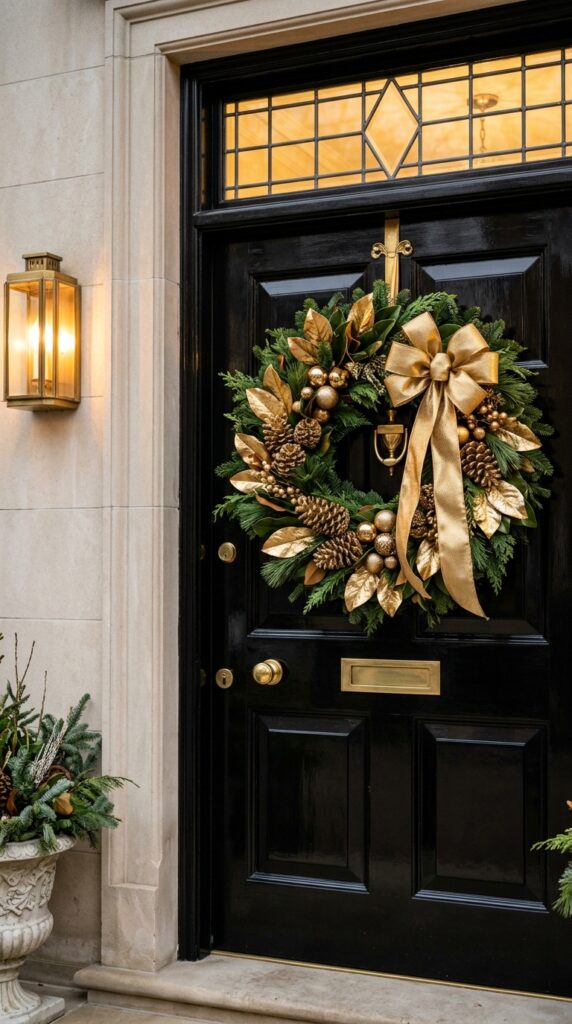
Vibe: Luminous — a wreath that catches every candle flame and street lamp.
Why it works: Gold leaf (actual metal transfer leaf, not spray paint) has a quality that no metallic spray can replicate: it’s thin enough to show the texture and surface variation of whatever it’s applied to. A magnolia leaf gilded with transfer gold retains its vein structure and surface relief, turning it into a tiny sculpture rather than a flat gold oval. This transparency of material through surface treatment is the technique that separates genuine luxury materials from their imitations.
How to get it: Apply composition gold leaf (not genuine gold — composition at $12/book is indistinguishable at wreath distance) to magnolia leaves using a size adhesive. Apply size, wait until tacky (15–20 minutes), press the leaf sheet onto the surface, then brush away excess with a soft brush. The result is far more convincing than any spray finish.
🛍️ Shop the Look — Amazon Product Ideas
| # | Product Search Phrase | Why It Fits |
| 1 | composition gold leaf sheets imitation 25 book | Surface gilding material |
| 2 | size adhesive gold leaf craft | Gilding adhesive base |
| 3 | magnolia leaves preserved large artificial | Gilding canvas leaves |
| 4 | gold wired satin ribbon 4 inch wide | Metallic-tone bow |
| 5 | gold glitter pinecone ornament picks | Pre-gilded accent option |
27. Dried Blue Thistle and Silver Dollar Wreath — Eclectic Winter
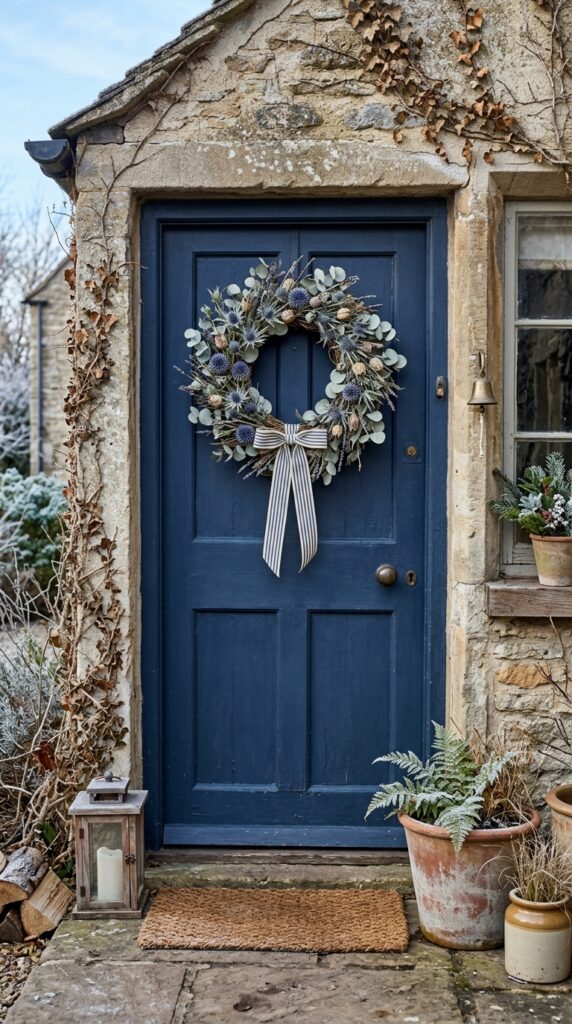
Vibe: Layered — the most complex, unusual wreath on this list, for the door that belongs to a collector.
Why it works: Blue is the rarest color in the natural botanical world, which makes blue-toned dried materials — thistle, sea holly, dried lavender — immediately arresting in a wreath context. The design principle is rarity as impact: materials the eye doesn’t expect in a botanical arrangement demand attention. Globe-form thistles also introduce a perfect sphere into a wreath that is otherwise composed of linear and irregular forms, creating geometric variety. The indigo-stripe cotton ribbon is deliberately casual — a more formal ribbon would conflict with the eclectic material selection.
How to get it: Dried thistle and sea holly are available from specialty floral suppliers and online botanical sellers. Both retain their blue-violet coloration through the drying process without any treatment — a rare quality in dried botanicals. Wire them to an open grapevine frame using 24-gauge green wire, spacing spherical thistles at intervals so each one has open space around it.
💡 Quick Win: A single bunch of dried thistle ($12–15 from a florist or craft store) wired into any plain wreath immediately makes it look curated and unusual — no other additions needed.
🛍️ Shop the Look — Amazon Product Ideas
| # | Product Search Phrase | Why It Fits |
| 1 | dried blue thistle globe stems bundle | Signature blue botanical |
| 2 | dried sea holly eryngium stems blue | Spiky violet-blue accent |
| 3 | silver dollar eucalyptus dried bunch | Silver-green round texture |
| 4 | indigo stripe cotton ribbon 2 inch | Casual eclectic tie |
| 5 | open grapevine wreath base 20 inch | Organic open frame |
28. Small-Space Wreath: Pressed Botanicals on a Twig Ring
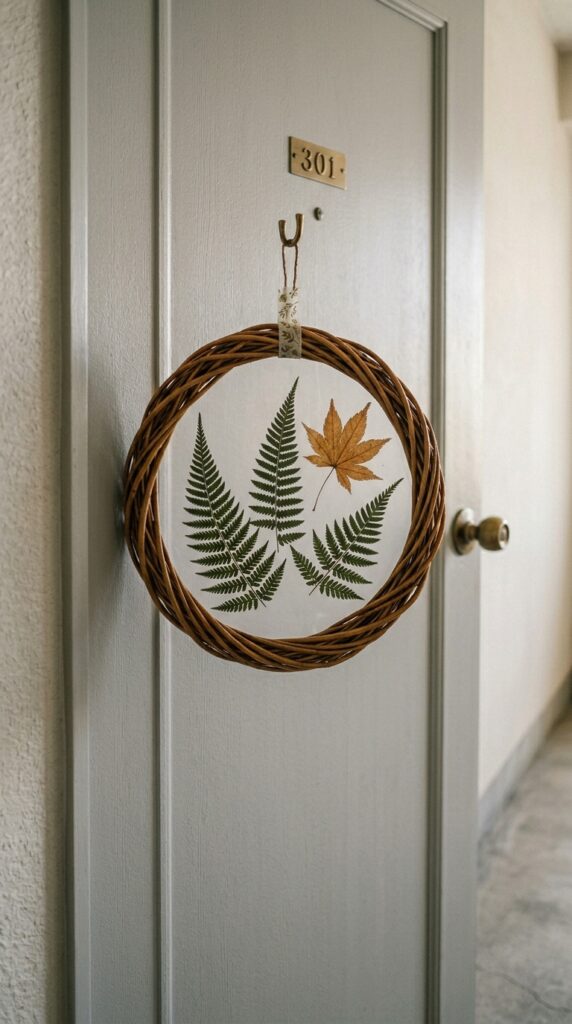
Vibe: Hushed — a wreath that whispers rather than announces.
Why it works: This wreath applies the principle of specimen display — treating natural materials as if they belong in a botanical herbarium rather than a craft arrangement. Pressed botanicals flatten into a two-dimensional form that has an inherently archival, scientific quality: each vein and margin remains legible, turning the wreath into something between a decoration and a framed print. For small doors and intimate scales, this level of visual refinement is more effective than trying to achieve the lush abundance of a large wreath in miniature.
How to get it: Press ferns and leaves between newspaper sheets under heavy books for two weeks. Once flat and fully dried, attach to a twig ring using small drops of clear-drying PVA glue, pressing gently for 30 seconds at each attachment point. The specimens should not be wire-mounted — their flat nature means they can be glued directly to the twig ring surface cleanly.
🛍️ Shop the Look — Amazon Product Ideas
| # | Product Search Phrase | Why It Fits |
| 1 | willow twig wreath ring small 10-12 inch | Delicate minimalist frame |
| 2 | plant press kit wood frame craft | Botanical pressing tool |
| 3 | PVA craft glue clear-drying pH neutral | Safe botanical adhesive |
| 4 | botanical print washi tape decorative | Fine-scale accent tape |
| 5 | clear matte finish spray Mod Podge | Pressed botanical sealer |
29. Velvet Berry and Frosted Pip Wreath — Jewel-Toned Winter
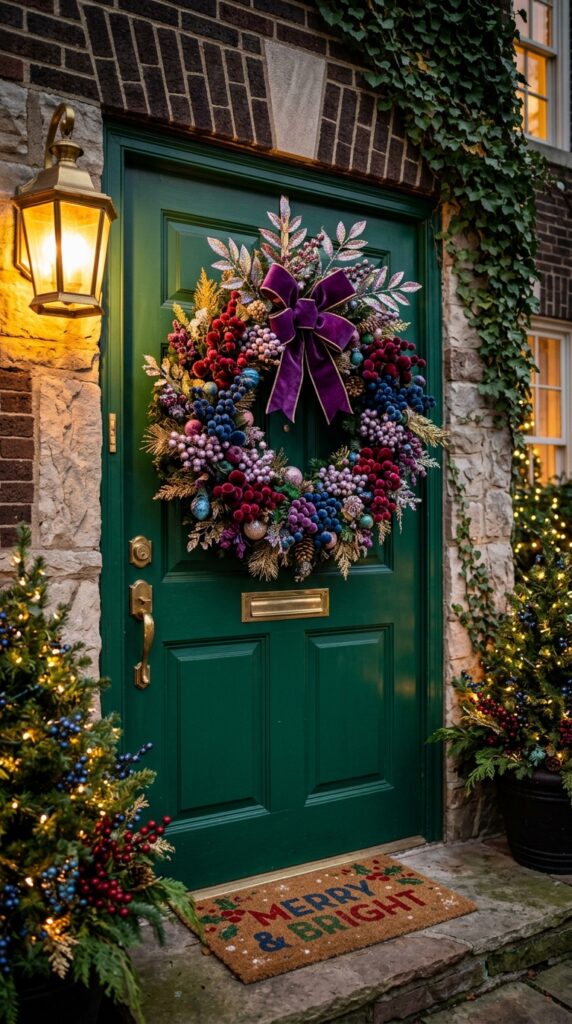
Vibe: Layered — the kind of wreath that makes children stop walking and stare.
Why it works: Jewel tones — ruby, sapphire, amethyst — are deeply saturated colors with dark underlying values that absorb and then release light dramatically, especially under warm amber porch lighting. The design principle is saturation in controlled context: these colors would be overwhelming in daylight against a light-colored wall, but against a dark emerald door and under warm evening light, they settle into a rich, harmonious depth. Velvet flocking on berry picks amplifies this effect because the pile catches light at different angles, creating a gem-like internal luminosity.
How to get it: Build this wreath in a warm porch light, not in indoor daylight — the materials that look right under amber light may look too dark in daylight. Adjust the balance under the actual lighting conditions where the wreath will be seen. Pack the wreath very densely — this is not a style that benefits from negative space.
🛍️ Shop the Look — Amazon Product Ideas
| # | Product Search Phrase | Why It Fits |
| 1 | velvet flocked berry picks jewel tones | Central tactile accent |
| 2 | frosted pip berry stems assorted wreath | Fine-scale filler accent |
| 3 | iridescent glitter foliage spray picks | Light-catching sparkle element |
| 4 | amethyst purple velvet ribbon 4 inch | Jewel-tone bow option |
| 5 | full artificial wreath base 24 inch dense | Maximum density foundation |
30. Personalized Monogram Wreath with Greenery Frame
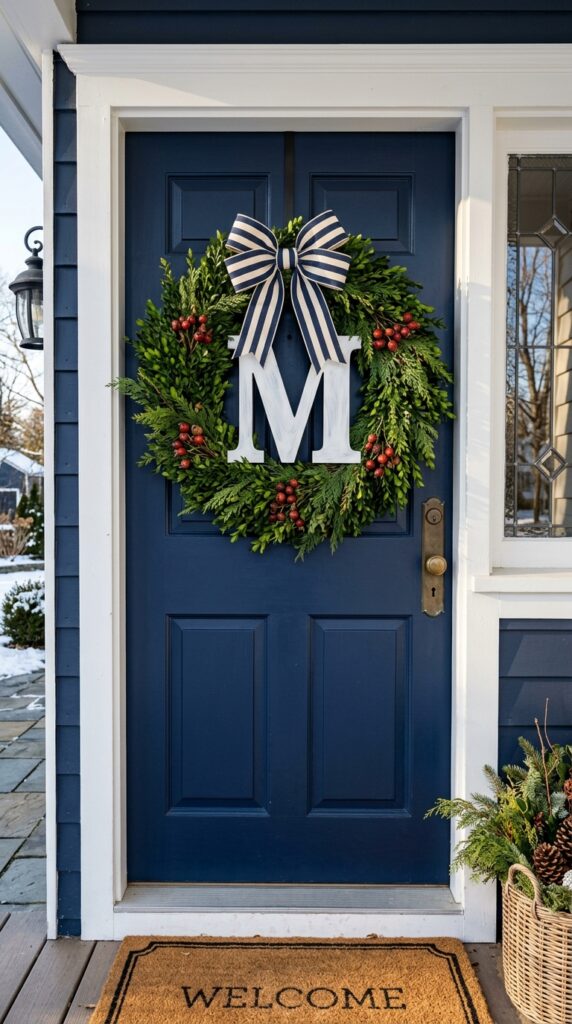
Vibe: Grounded — the front door equivalent of a welcome mat that actually means it.
Why it works: A monogram wreath works as a design object because it introduces typographic geometry — the strict, engineered lines of a letterform — into an organic botanical context. The contrast between the architectural letter and the loose, irregular greenery creates a productive tension: the letter seems more precise because the greenery is imprecise, and the greenery seems more alive because the letter is so structured. The key proportional rule is that the letter should occupy approximately 40% of the interior open space of the wreath — too small reads timid, too large eliminates the botanical frame entirely.
How to get it: Choose a wooden letter from a craft store and paint it with chalk paint (Rust-Oleum Chalked in Linen White) for a matte finish that reads well against greenery. Attach the letter to the wreath with two pieces of floral wire threaded through pre-drilled holes at the top of the letter, tying off behind the wreath base. This is more secure than glue in outdoor conditions.
💡 Quick Win: Craft store wooden letters cost $5–10. Painted white and wired into a $20 preserved boxwood wreath, this combination looks like a $75 custom piece.
🛍️ Shop the Look — Amazon Product Ideas
| # | Product Search Phrase | Why It Fits |
| 1 | wooden monogram letter craft paint grade | Personalized centerpiece letter |
| 2 | preserved boxwood wreath ring 22 inch | Dense classic greenery frame |
| 3 | navy cream stripe wired ribbon 4 inch | Preppy classic bow option |
| 4 | Rust-Oleum chalked linen white paint | Matte letter finish paint |
| 5 | dried rosehip stem picks red | Small color accent addition |
How to Start Your Winter Wreath Transformation
Begin with your door color. Before you select a single stem or ribbon, identify whether your front door is warm-toned (red, yellow-based green, tan) or cool-toned (blue, gray, black, white). This single decision is the anchor from which everything else follows — a warm door needs a wreath with warm undertones (burgundy, gold, copper, terracotta), and a cool door calls for cool companions (silver, navy, icy white, blue-green). Getting this wrong is the most common reason an otherwise well-made wreath looks “off” on a door.
The most frequent mistake beginners make is over-accessorizing a wreath until every element cancels out. Adding seven different accent types — berries, pinecones, citrus, feathers, ribbon, ornaments, and stars — on a single wreath creates visual noise rather than visual richness. Choose a maximum of three material types, let one be dominant (approximately 60% of the surface), and let the other two support it. The ribbon counts as one of the three — don’t treat it as an afterthought.
Three items under $50 that create immediate, high-quality impact: a 4-inch roll of velvet wired ribbon in a rich seasonal tone (around $12, far more impactful than satin); a bundle of dried eucalyptus from a grocery store or Trader Joe’s (around $10, and it smells extraordinary); and a bottle of Rust-Oleum chalked matte paint in a single color to unify a mismatched wreath (around $8 for enough to last several projects).
A beginner winter wreath transformation is honestly achievable in a weekend — buying a pre-made wreath base and adding three to five accent materials takes two to three hours and should cost $30–80 total. A fully custom wreath built from scratch, using preserved or dried botanicals sourced from multiple suppliers, takes a full day and runs $60–150 for something that will last two to three seasons.
Frequently Asked Questions About Winter Wreaths Front Door
What is the difference between a winter wreath and a Christmas wreath?
A Christmas wreath is typically associated with holiday-specific symbols: Santa motifs, candy canes, ornaments, and red-green-gold color schemes tied directly to Christmas iconography. A winter wreath uses seasonal materials — dried botanicals, evergreens, frosted elements, neutral ribbons — that feel appropriate from November through February without referencing any specific holiday. Winter wreaths are increasingly popular among decorators who want a refined look that doesn’t require changing on December 26th. Materials like dried eucalyptus, birch branches, and magnolia leaves all read as seasonally appropriate through early spring.
What color ribbon looks best on a winter wreath?
The best ribbon color depends entirely on your door color: burgundy velvet reads exceptionally well on black, navy, and dark green doors; ivory or cream linen works on natural wood, sage, and white doors; dusty blush complements gray and taupe doors; and deep navy grosgrain suits white and cream doors. Ribbon width matters too — doors wider than 32 inches can support a 4–6 inch ribbon without looking fussy, while narrower doors and compact wreaths should use a 2–3 inch width. Always choose wired ribbon over unwired — the internal wire allows you to shape and reshape loops, and it holds its form in winter wind.
How much should I spend on a winter wreath for my front door?
A quality winter wreath that holds up through the season and can be reused runs $35–90 for preserved or artificial options. Real fresh-cut evergreen wreaths are typically $25–60 but last only four to six weeks outdoors before browning. Dried botanical wreaths occupy the middle ground at $40–80 and often last two to three seasons if stored carefully. The best value for most homeowners is a quality artificial boxwood or cedar base ($30–50) that you embellish with seasonal dried accents each year — this approach keeps the annual cost under $25 once the base is purchased.
Can I leave a winter wreath out all season in wet or rainy climates?
Most artificial and preserved wreaths tolerate moderate rain and temperature fluctuations but should be protected from sustained soaking, which can cause ribbon dye to bleed and wire frames to rust. In wet climates (Pacific Northwest, UK, Ireland), apply a light coat of waterproofing spray (like Scotchgard Fabric Protector) to ribbon and natural materials before hanging. Fresh eucalyptus and dried citrus deteriorate fastest in wet conditions — replace these materials rather than the entire wreath if they degrade mid-season. Feather, cotton, and wool-based wreaths should not be used in consistently wet outdoor conditions.
What wreath base is best for heavy outdoor winter conditions?
For doors exposed to wind, temperature swings, and moisture, a grapevine or wire frame wreath base outperforms foam or straw in durability. Wire frames are the most structurally resilient but benefit from being fully covered so the metal doesn’t show. Grapevine bases are excellent all-rounders: they flex slightly in wind rather than cracking, they dry permanently into shape, and their organic texture works with almost any botanical material. Avoid foam bases for outdoor use — extended cold and moisture cause foam to degrade and crack within one season, which compromises the structural integrity of every material attached to it.
Ready to Create Your Dream Winter Wreath for Your Front Door?
These 30 winter wreath ideas span the full range of seasonal decorating — from the restrained sculptural beauty of a bare birch twig ring to the saturated jewel-toned abundance of a velvet berry arrangement, with color strategies, material choices, lighting effects, and space-specific solutions throughout. Remember that you don’t need to execute the most complex version first — start with one material category that resonates (a dried botanical, a textural stem, a single ribbon color) and build from there, using one of these ideas as a loose guide rather than a precise recipe. Today, your concrete action is simple: identify your door color and decide whether it reads warm or cool — that single observation will make every subsequent shopping and styling decision significantly easier. Once the wreath is up, every time you come home in the gray of a January afternoon, that circle of greenery or dried botanicals will do something quietly remarkable for your mood. Pin the ideas that match your door, your style, and your season — and if a birch twig or a dried thistle caught your eye, trust that instinct.