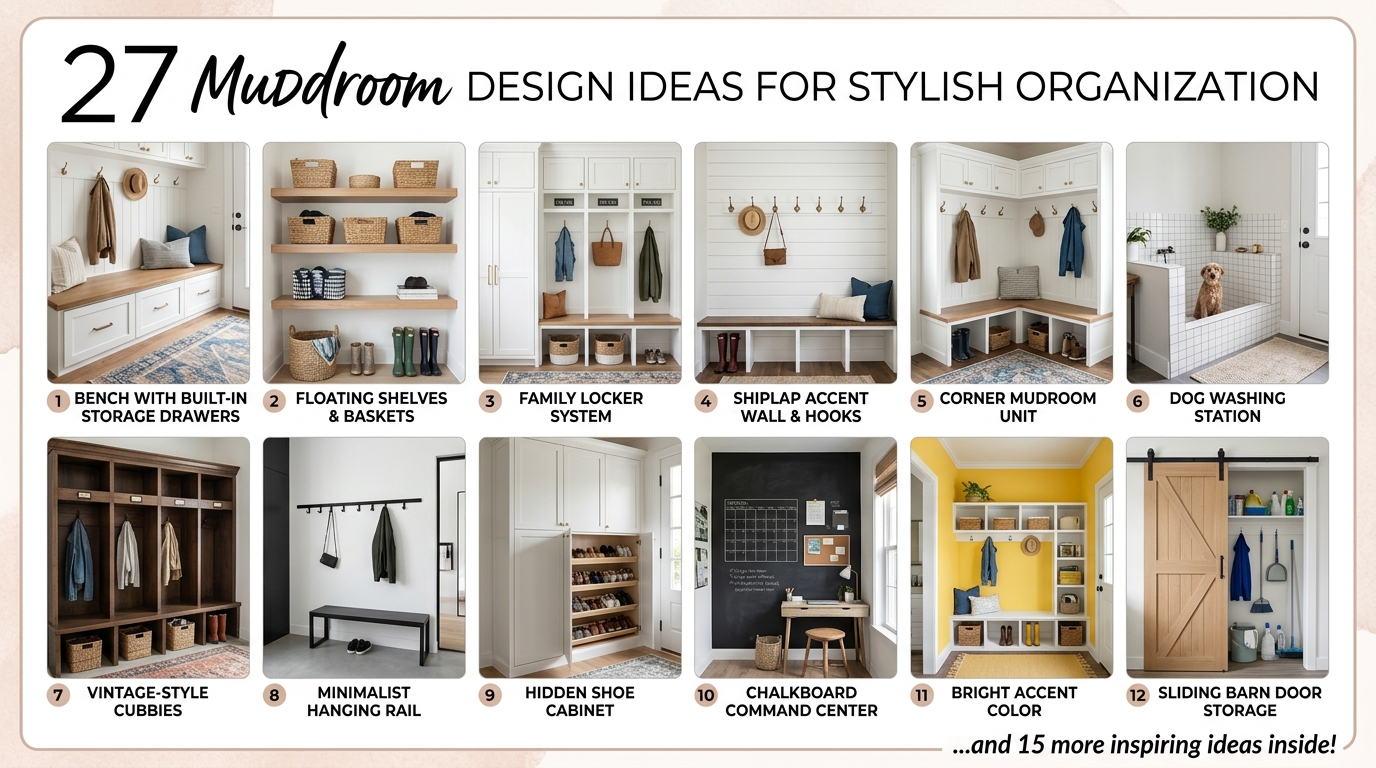
A stylish mudroom is a dedicated entry zone that handles daily chaos — coats, bags, shoes, and mail — while looking composed enough to set the tone for your entire home. This article gives you exactly 27 mudroom design ideas spanning storage furniture, material choices, lighting, color, layout, and small-space solutions.
The best mudrooms feel like a quiet exhale the moment you walk through the door — order waiting for you instead of disorder to manage. There’s a particular satisfaction in a space where every object has a place, where hooks hold weight without apology, and where the floor can actually be seen. Stylish organization isn’t about hiding everything; it’s about making the systems themselves look intentional. Here are 27 ideas worth saving — and stealing.
Why Stylish Mudroom Organization Works So Well
What is it? The modern stylish mudroom draws from two distinct design lineages: the utilitarian American back-entry hall of the early 20th century (built for working farms and urban rowhouses alike) and the Scandinavian hall tradition, where entry spaces were treated with as much care as living rooms. What makes today’s mudroom distinct from a simple storage closet is the deliberate merging of function and aesthetic — built-in cabinetry treated with the same finish care as a kitchen, lighting given the same attention as a dining room.
What are its core materials and colors? The palette centers on warm greige (a grey-beige hybrid), warm white, aged navy, and slate blue — grounded by natural materials like unfinished white oak, shiplap-profile MDF, matte black iron hardware, and woven seagrass. Bench cushions in performance linen or outdoor-grade canvas provide durability without sacrificing texture. Painted beadboard wainscoting in Benjamin Moore “White Dove” is a recurring material signature of the style.
Why is it trending now? The pandemic fundamentally changed how people enter and leave their homes — hygiene awareness, work-from-home gear, and a renewed investment in home functionality pushed mudroom searches to record Pinterest highs between 2021 and 2025. People now budget for mudrooms the way they previously budgeted only for kitchens.
Can small spaces achieve this style? Absolutely — a 4-foot-wide entry alcove is enough to install one bench, two hooks per family member, and a shelf above. Prioritize vertical wall space over floor footprint. A 12-inch-deep floating bench with shoe storage below delivers full functionality in a corridor as narrow as 36 inches.
Style at a Glance
| Element | Trait 1 | Trait 2 |
| Philosophy | Function as design | Systems that are visible and intentional |
| Materials | Unfinished white oak, shiplap, matte iron | Seagrass, performance linen, painted beadboard |
| Color Palette | Warm greige, warm white, aged navy | Slate blue, soft black, natural wood |
27 Mudroom Design Ideas
1. Built-In Locker Cubbies With Shiplap Back Panels
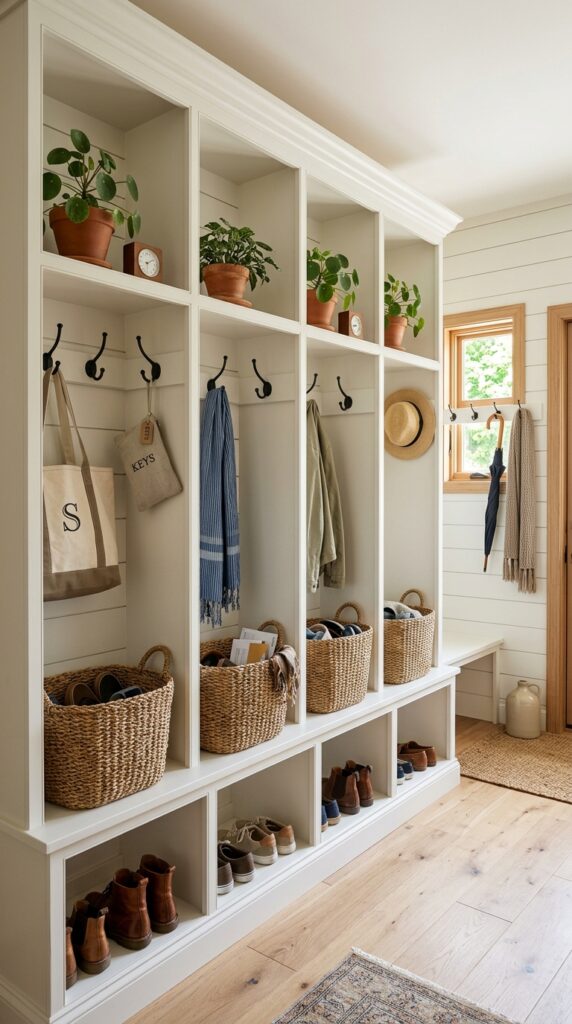
Vibe: Grounded — the kind of entry that makes the rest of the house feel possible.
Why it works: Built-in locker cubbies use the design principle of containment zones — assigning each family member a dedicated vertical column of space that handles everything from floor to eye level in one visual unit. The shiplap back panel serves double duty: it adds texture depth to what would otherwise be a flat painted cavity, and it reflects light back into the cubby interior, making dark cubbies feel open rather than cave-like. Matte black iron hooks provide strong visual contrast against white paint without the coldness of chrome.
How to get it: IKEA’s PAX wardrobe frames (painted with chalk paint in “Chantilly Lace” by Benjamin Moore) create a convincing built-in locker effect when assembled side by side and topped with a continuous crown molding strip. Fill back panels with peel-and-stick shiplap boards before assembling — the result reads as custom millwork at a fraction of the cost.
💡 Quick Win: A set of three wall-mounted coat cubbies with built-in hooks ($45–$75 each on Amazon) installed at the same height creates a locker-system effect without any carpentry — anchor directly into studs for weight capacity up to 50 lbs per unit.
🛍️ Shop the Look — Amazon Product Ideas
| # | Product Search Phrase | Why It Fits |
| 1 | Wall mount coat cubby with shelf and hooks white | Core locker unit |
| 2 | Matte black double hook wall mount iron | Hardware contrast detail |
| 3 | Seagrass rectangular storage basket with handle | Cubby bottom filler |
| 4 | Peel and stick shiplap wall panels white | Back panel texture |
| 5 | Monogram linen pouch storage small | Personal cubby identifier |
2. Aged Navy Beadboard Wainscoting
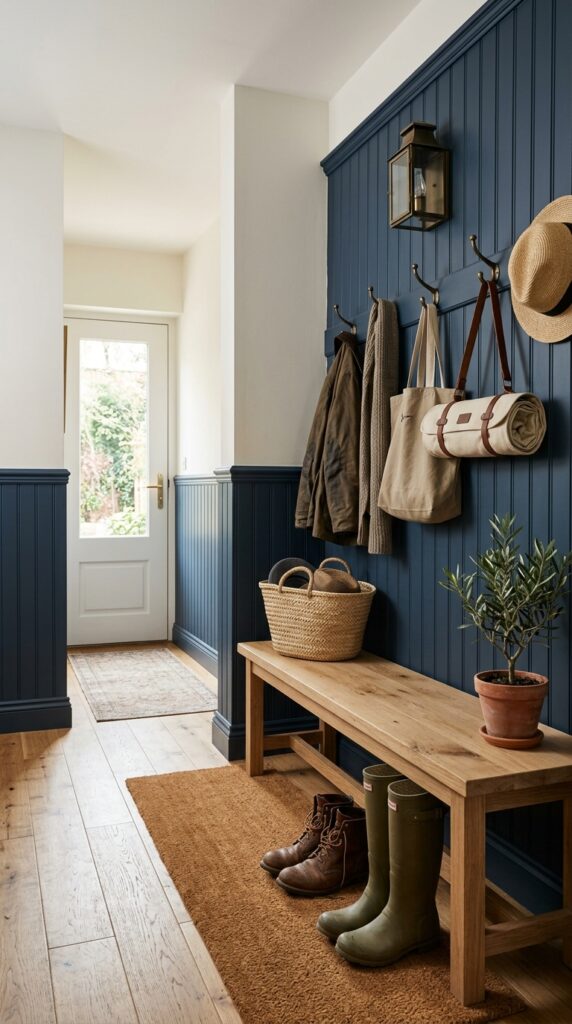
Vibe: Composed — a hallway that says “we made a decision and we committed.”
Why it works: Painting beadboard wainscoting in a deep, saturated color like aged navy uses the design principle of visual grounding — the dark lower register visually anchors the room and makes the ceiling feel higher by contrast with the warm white above. The chair-rail transition at 36 inches creates a horizontal datum line that organizes the wall into two distinct fields, which prevents the space from feeling either top-heavy or bottom-heavy. Dark brass hardware against navy is a high-contrast pairing that reads as curated rather than decorative.
How to get it: Benjamin Moore’s “Hale Navy” (HC-154) is the industry benchmark for this look — it reads as blue in natural light and as a rich near-black in evening lamplight, giving the space two moods from one paint choice. Apply in eggshell finish on the beadboard for durability; flat finish above the chair rail for a softer upper zone.
🛍️ Shop the Look — Amazon Product Ideas
| # | Product Search Phrase | Why It Fits |
| 1 | Beadboard wall panel MDF paintable wainscoting | Core wall texture |
| 2 | Dark brass coat hook wall mount antique | Navy contrast hardware |
| 3 | White oak floating bench mudroom 48 inch | Natural material bench |
| 4 | Brass wall lantern sconce indoor hallway | Warm entry lighting |
| 5 | Chair rail molding white primed MDF 8ft | Wainscoting cap detail |
3. Bench With Under-Seat Shoe Storage Cubbies
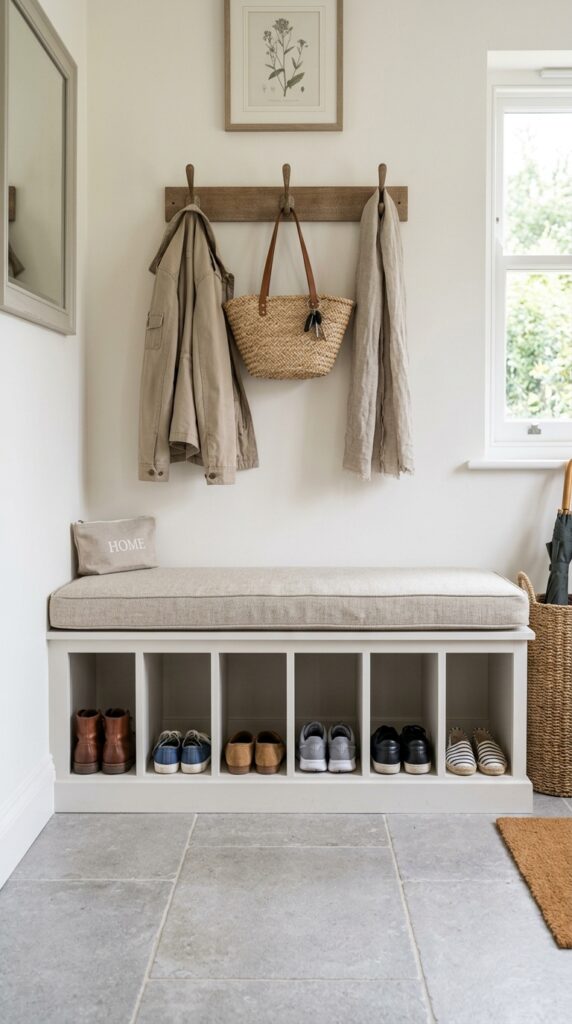
Vibe: Orderly — every pair of shoes visible, accessible, and actually put away.
Why it works: Open shoe cubbies beneath a bench eliminate the behavioral barrier of a cabinet door — when storage requires a physical action (opening a door), it’s almost never used consistently by children or rushed adults. The open-front design uses behavioral psychology alongside design: visible storage is used storage. Sizing each cubby at 12 inches wide by 6 inches tall by 14 inches deep fits most adult shoes including boots on their sides, while keeping the bench profile slim enough to not block hallway traffic.
How to get it: Build the bench frame from primed MDF sheets cut to 18-inch height (standard seat height) with interior cubby dividers spaced 12 inches apart. Use 1/4-inch plywood for the back panel. A 2-inch foam topper wrapped in Sunbrella fabric (outdoor performance grade) creates a bench cushion that repels moisture, mud, and pet hair — all three are non-negotiable in a real mudroom.
💡 Quick Win: A freestanding storage bench with shoe cubbies below and a cushioned top ($89–$149 on Amazon) can be installed in 20 minutes with no carpentry — anchor to the wall with a single L-bracket at the back for stability and it’s functionally identical to a custom built-in.
🛍️ Shop the Look — Amazon Product Ideas
| # | Product Search Phrase | Why It Fits |
| 1 | Mudroom storage bench shoe cubby underneath white | Core functional piece |
| 2 | Bench cushion cover performance linen oatmeal | Durable seat surface |
| 3 | Boot scraper mat outdoor entrance rectangular | Entry floor protection |
| 4 | Wall L-bracket anchor furniture steel | Safety wall anchoring |
| 5 | Rolled umbrella stand slim floor entry | Vertical corner use |
4. Gallery Wall of Hooks With Painted Backing Board
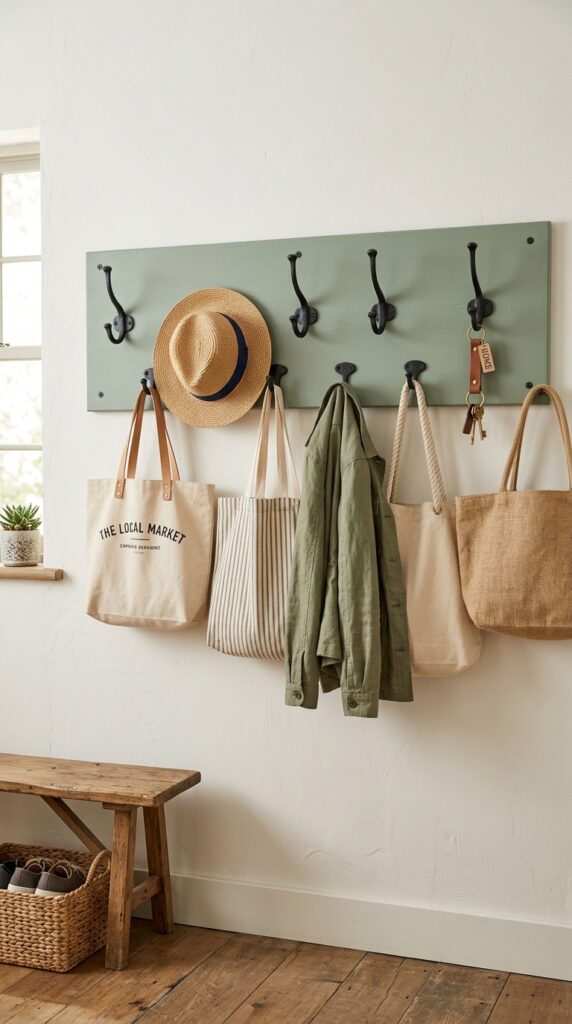
Vibe: Airy — functional without announcing how hard it’s working.
Why it works: Mounting hooks on a painted backer board rather than directly on the wall is a professional mudroom design technique that groups the hook cluster into a single visual unit, preventing the scattered-peg-rail look that makes hallways feel disorganized. The backer board also protects the wall behind high-traffic hooks — a practical consideration that pays off after the first month of daily use. Painting the board in an accent color (sage green here) allows it to function as a visual anchor without requiring any additional wall art.
How to get it: Cut a 1×8-inch pine board to your desired width, prime and paint in two coats of satin-finish paint (sage green in Sherwin-Williams “Shyshade” works well), then mount five to nine hooks using a level line. Space hooks at 6-inch intervals for a balanced distribution that leaves breathing room between hanging items.
🛍️ Shop the Look — Amazon Product Ideas
| # | Product Search Phrase | Why It Fits |
| 1 | Matte black iron wall hook large coat hall | Hook hardware set |
| 2 | Small secondary hook matte black rail single | Lower bag-level hook |
| 3 | Canvas tote bag natural cotton large reusable | Hanging bag display |
| 4 | Woven straw hat round brim natural | Seasonal hook accent |
| 5 | Key organizer wall mount wood small | End-of-board function |
5. Slate Tile Flooring With Contrasting Grout
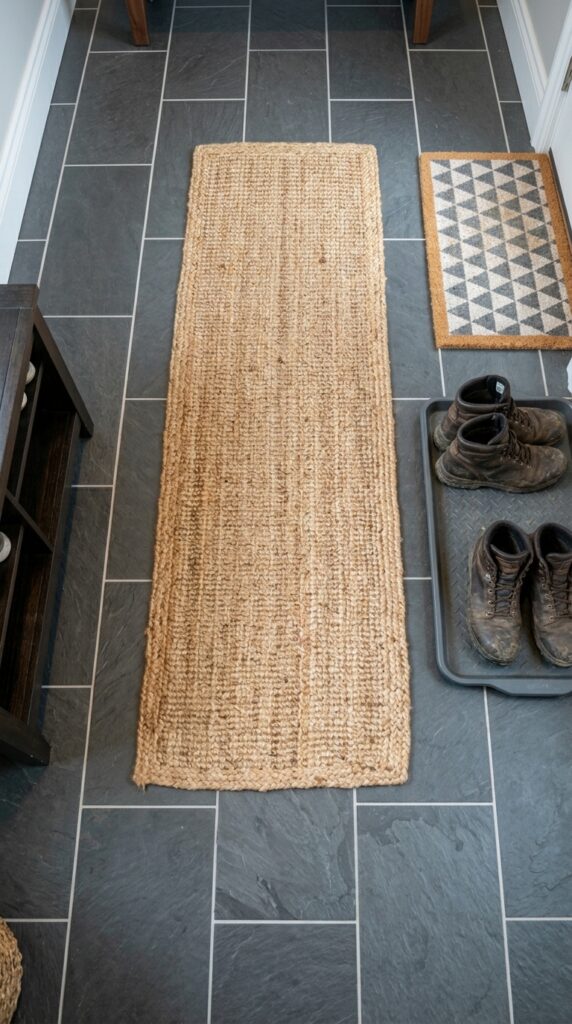
Vibe: Grounded — a floor built for real life, not the idea of real life.
Why it works: Slate-toned porcelain tile in a 12×24 format with white grout creates a graphic grid pattern on the floor that visually defines the mudroom zone from adjacent rooms — a design technique called zone delineation through material change. The large format tile minimizes grout line frequency (fewer lines per square foot than small tiles), which means less visible dirt accumulation — a genuinely practical advantage in a space where wet boots, soil, and tracked-in debris are daily realities. A natural jute runner at the center softens the hard surface while protecting the grout from the highest-traffic path.
How to get it: Choose porcelain over natural slate for a mudroom — true slate is porous and absorbs water and mud stains without annual sealing. A 12×24 porcelain tile in “Iron” or “Graphite” colorway (Marazzi or similar brand) provides the natural slate visual at a fraction of the maintenance. Use bright white non-sanded grout for maximum contrast, and seal the grout with a penetrating sealer annually.
🛍️ Shop the Look — Amazon Product Ideas
| # | Product Search Phrase | Why It Fits |
| 1 | Boot tray mudroom floor large rubber non-slip | Wet shoe containment |
| 2 | Natural jute runner rug 2×6 hallway | Center floor softening |
| 3 | Grout sealer penetrating tile bathroom floor | Grout protection |
| 4 | Geometric floor mat entryway washable | Pattern layer over tile |
| 5 | Slate grey porcelain floor tile sample 12×24 | Floor material reference |
6. Warm Wood Floating Shelves Above Hook Rail
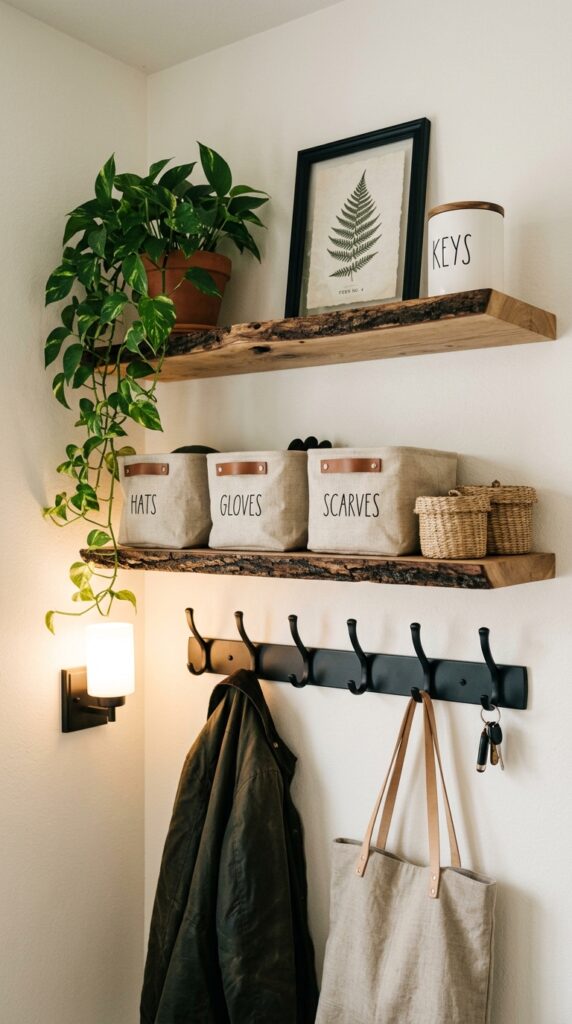
Vibe: Warm — organized in a way that still feels like someone actually lives here.
Why it works: Layering floating shelves above a hook rail creates a vertical storage zone that handles three distinct categories simultaneously — hanging storage (hooks), contained storage (bins on lower shelf), and display (upper shelf) — without requiring any floor footprint. The live-edge oak shelf introduces organic asymmetry that softens the rigid geometry of the hook rail below, creating visual tension between natural and industrial elements that is one of the defining aesthetics of the contemporary stylish mudroom.
How to get it: Mount the hook rail at 60 inches from the floor (comfortable for adult coat hooks), then the lower shelf at 72 inches, and the upper shelf at 84 inches. This creates a proportional three-tier system with 12 inches between each horizontal element — enough breathing room to prevent the wall from feeling cluttered despite housing multiple functional layers.
💡 Quick Win: Pre-made live-edge oak floating shelves are widely available on Etsy and Amazon ($35–$75 for a 24-inch piece) and can be mounted in 30 minutes with a stud finder, a level, and two heavy-duty keyhole brackets — no contractor needed.
🛍️ Shop the Look — Amazon Product Ideas
| # | Product Search Phrase | Why It Fits |
| 1 | Live edge floating shelf white oak 24 inch | Natural material shelf |
| 2 | Black powder coated hook rail wall mount 36 inch | Hanging storage bar |
| 3 | Linen storage bin with label tag set 3 | Lower shelf bins |
| 4 | Trailing pothos plant artificial realistic | Shelf greenery accent |
| 5 | White ceramic canister lid modern farmhouse | Upper shelf display |
7. Small Mudroom: The Narrow Entry Coat Closet Conversion
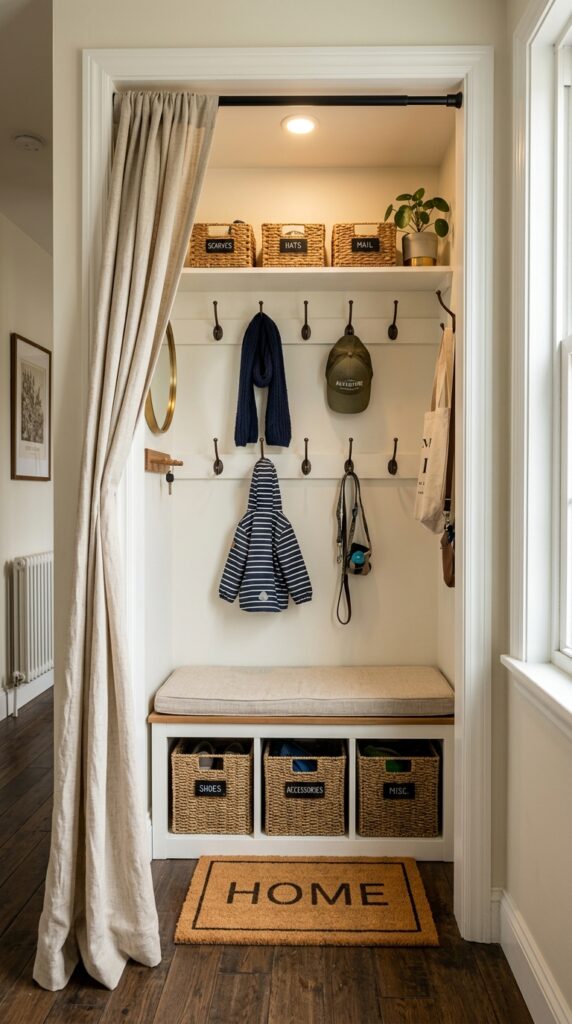
Vibe: Cozy — a closet that finally became what it was always meant to be.
Why it works: Removing a coat closet door and converting the interior into an open mudroom niche is one of the highest-return small-space design moves available in an existing home — it requires zero construction, adds approximately 12–18 inches of usable bench depth that was previously dead floor space, and replaces a single-function (hanging coats) closet with a multi-function entry hub. A linen curtain on a tension rod provides the option to conceal the niche when desired without the permanence of a door.
How to get it: Use LED puck lights with a motion sensor (battery powered, no wiring) mounted inside the niche ceiling — they activate when the curtain is opened and illuminate the interior without requiring an electrician. Mount two rows of hooks: the upper row at 65 inches for adults’ coats, the lower row at 44 inches for children’s jackets and bags.
🛍️ Shop the Look — Amazon Product Ideas
| # | Product Search Phrase | Why It Fits |
| 1 | LED puck light motion sensor battery closet | Interior niche lighting |
| 2 | Tension rod curtain mount entry 28–48 inch | No-drill curtain hanging |
| 3 | Linen curtain panel natural ivory 84 inch | Concealment option |
| 4 | Small wall mirror round wood frame entry | Niche side wall depth |
| 5 | Wicker basket with label window small set | Shelf containment bins |
8. Warm Greige Walls With White Trim — The Neutral Foundation
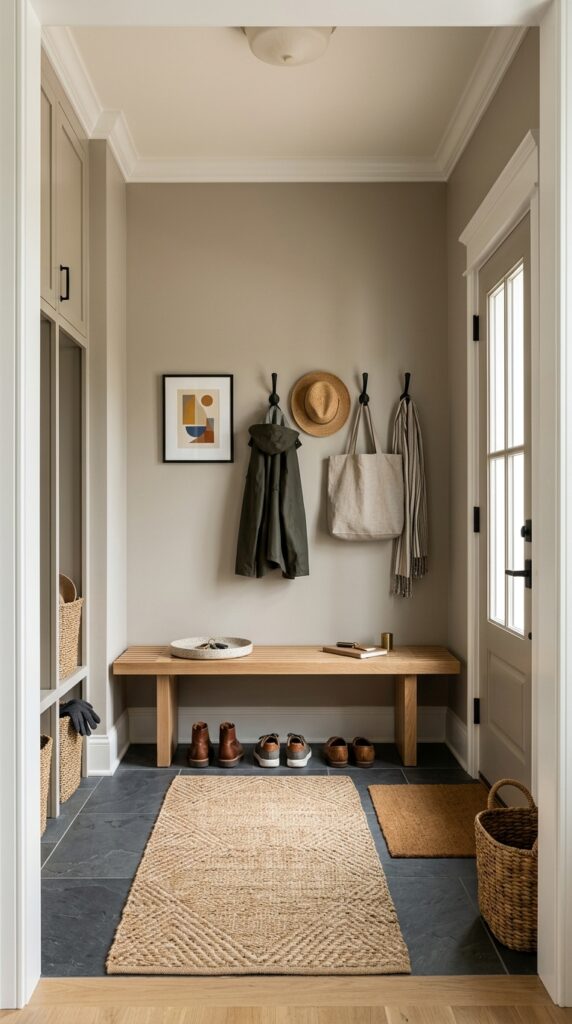
Vibe: Serene — the color version of a deep breath.
Why it works: Warm greige on walls (a blend of grey and beige that reads as neutral without being cold) paired with brilliant white trim uses tonal contrast to make architecture visible — every door frame, baseboard, and molding is highlighted, which makes even a simple entry look considered and crafted. The warm undertone of the greige ensures the space reads as welcoming rather than clinical under both natural and artificial light, which is a critical consideration for north-facing mudrooms with limited daylight.
How to get it: Benjamin Moore “Edgecomb Gray” (HC-173) is the benchmark greige for this application — it reads unmistakably warm at any light level and coordinates with virtually every wood tone and hardware finish. Paint walls in flat finish (hides scuffs), trim in semi-gloss (durable, washable), and ceiling in flat white for a three-finish strategy that professional painters use in high-traffic spaces.
💡 Quick Win: Repainting a mudroom in warm greige with fresh white trim is a one-weekend, $60–$120 project that delivers more visual impact than any furniture purchase — it’s the single most cost-effective mudroom upgrade available.
🛍️ Shop the Look — Amazon Product Ideas
| # | Product Search Phrase | Why It Fits |
| 1 | Ceramic tray oval matte white entry organization | Bench top catchall |
| 2 | Woven cotton runner rug washable hallway grey | Floor soft layering |
| 3 | Abstract art print framed neutral tones small | Above-bench wall art |
| 4 | Paint roller kit 9 inch interior walls | DIY painting tool |
| 5 | Painter’s tape precision edge trim painting | Clean trim lines tool |
9. Reclaimed Wood Bench With Iron Pipe Legs
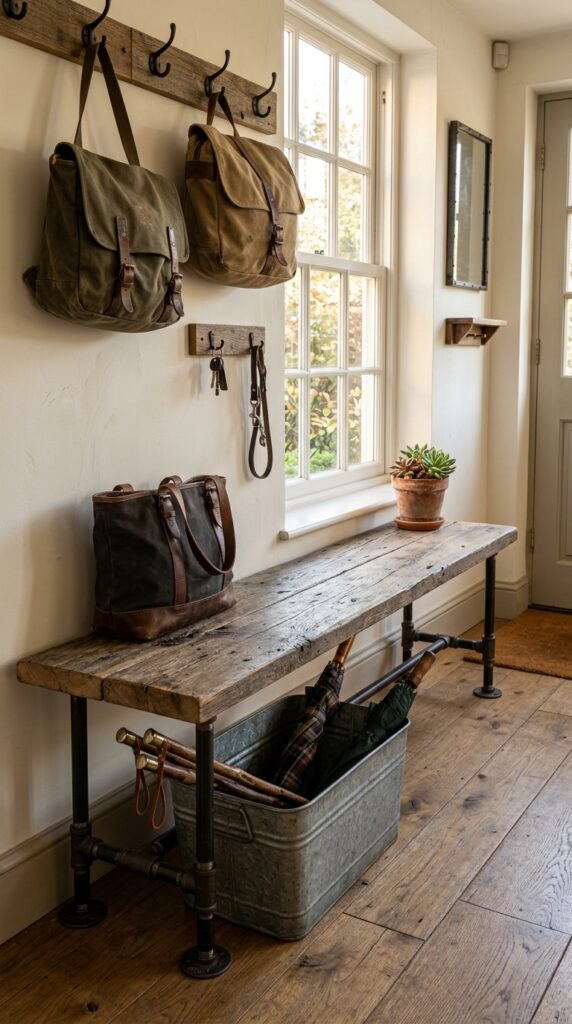
Vibe: Raw — honest materials doing honest work.
Why it works: Reclaimed wood bench tops introduce material authenticity that manufactured furniture cannot replicate — each knot, nail hole, and saw mark tells a material history that makes the space feel earned rather than assembled. The pairing with black iron pipe legs is a deliberate industrial-meets-organic contrast: the rough-hewn softness of old wood against the hard geometry of pipe fittings creates visual interest through material opposition, one of the most reliable design tension techniques in contemporary interiors. The irregularity of reclaimed wood actually functions as camouflage — scuffs and scratches from daily use are invisible against an already-imperfect surface.
How to get it: Source reclaimed wood bench tops from local architectural salvage yards or Etsy shops selling barn wood by the linear foot. A 2-inch-thick slab, 14 inches wide and 48 inches long, finished with two coats of Rubio Monocoat (a single-coat penetrating hardwax oil) provides durability with no plastic-looking polyurethane layer.
🛍️ Shop the Look — Amazon Product Ideas
| # | Product Search Phrase | Why It Fits |
| 1 | Industrial pipe bench legs black iron set 4 | Core structural base |
| 2 | Galvanized metal bucket bin large umbrella | Under-bench storage |
| 3 | Rubio Monocoat wood finish natural penetrating | Reclaimed wood sealer |
| 4 | Leather handle canvas tote bag natural | Bench top accessory |
| 5 | Terracotta pot small succulent planter 4 inch | Natural color accent |
10. Wall-Mounted Mail and Key Organization Center
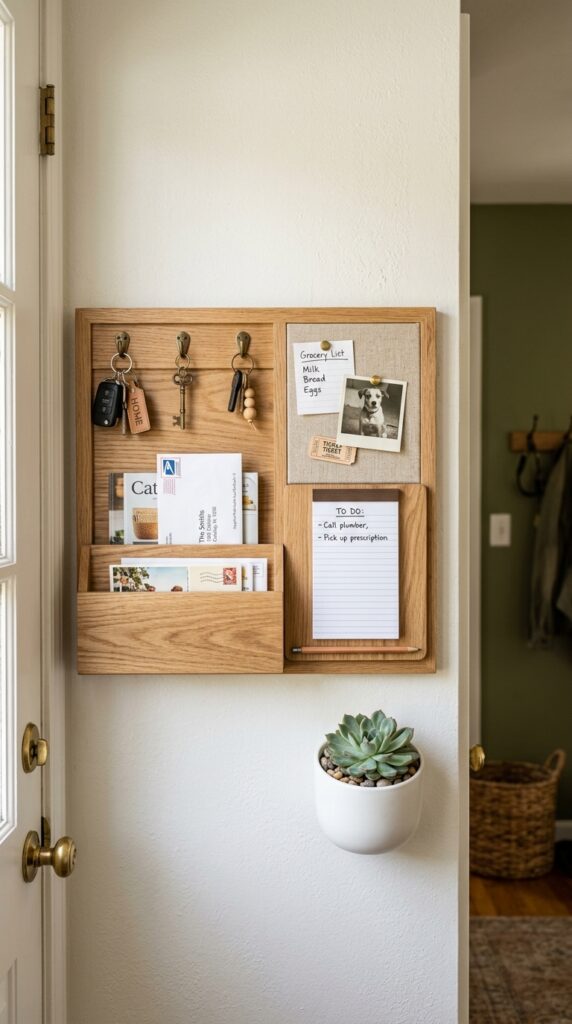
Vibe: Purposeful — the command center every household needs and almost none build correctly.
Why it works: A dedicated mail and key center placed at the entry point intercepts daily clutter before it migrates to kitchen counters, dining tables, and every other horizontal surface in the home. The design principle at work is intervention at source — solving a behavioral problem (where things get dropped) with a spatial solution (a system exactly where the dropping happens). Integrating key hooks, mail slots, and a notepad into a single panel ensures the system is used because it requires no deviation from the natural entry flow.
How to get it: Mount the organization panel at 58–62 inches from the floor — the natural eye level for most adults when looking straight ahead. This height ensures keys are visible without bending and mail is readable at a glance without the panel feeling ceiling-mounted or floor-level inconvenient.
💡 Quick Win: A wall-mounted wood key holder with mail organizer slots and a small corkboard section is available complete for $25–$45 on Amazon — install in 15 minutes with two screws into studs and immediately eliminate the “where are my keys” problem permanently.
🛍️ Shop the Look — Amazon Product Ideas
| # | Product Search Phrase | Why It Fits |
| 1 | Wall mount key holder mail organizer wood | Complete entry system |
| 2 | Brass key hook wall mount single decorative | Hardware accent upgrade |
| 3 | Linen corkboard square framed natural | Note and memo surface |
| 4 | Magnetic notepad holder fridge wall mount | Shopping list station |
| 5 | Wall mount small planter pot air plant | Beside-panel living accent |
11. Arched Mirror Above the Entry Bench
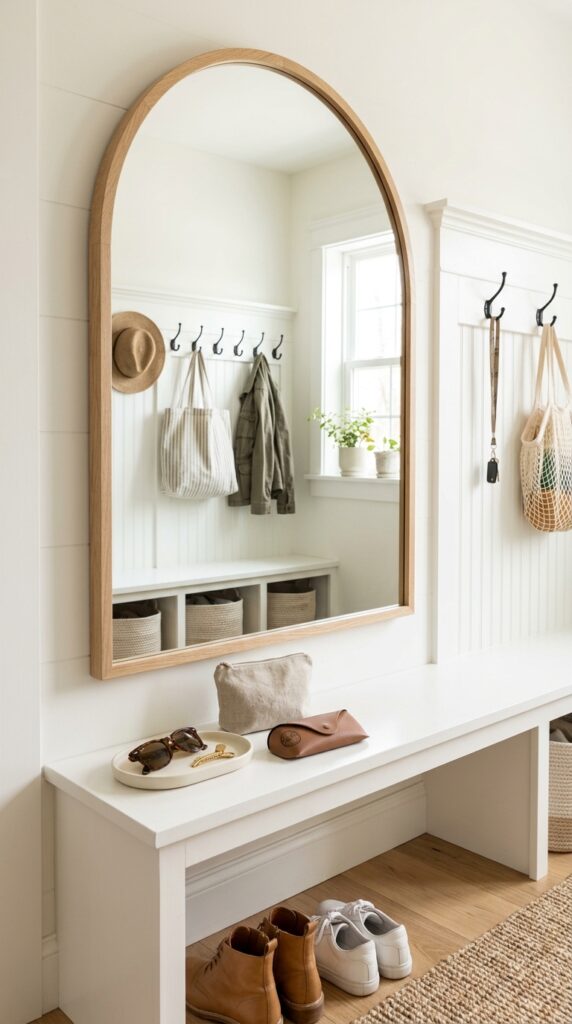
Vibe: Luminous — a mudroom that suddenly has twice as much light as it did yesterday.
Why it works: A large arched mirror above a mudroom bench serves three simultaneous functions: it reflects natural light to double a typically dark entry’s perceived brightness, provides a practical full-face check before leaving the house, and adds a vertical design element that draws the eye upward and makes ceiling height feel greater than it is. The arched form specifically softens the geometric angularity of hooks, cubby lines, and bench edges — introducing one curve into a space full of right angles is a compositional relief technique used in both interior and graphic design.
How to get it: Size the mirror to be approximately 70–80% of the bench width below it — this creates a proportional relationship between the two elements that feels anchored rather than floating. For a 48-inch bench, a 36-inch-wide arched mirror is the ideal proportion. Mount at a height that centers the arch at 72 inches from the floor.
🛍️ Shop the Look — Amazon Product Ideas
| # | Product Search Phrase | Why It Fits |
| 1 | Arched mirror natural wood frame 30×40 | Light-expanding focal piece |
| 2 | Ceramic tray rectangular matte white | Bench top catch-all |
| 3 | Sunglasses case hard shell slim neutral | Practical tray accent |
| 4 | Linen zipper pouch small natural | Tray organization insert |
| 5 | Mirror mounting kit wall heavy duty | Safe installation hardware |
12. Pegboard Wall System Painted to Match the Room
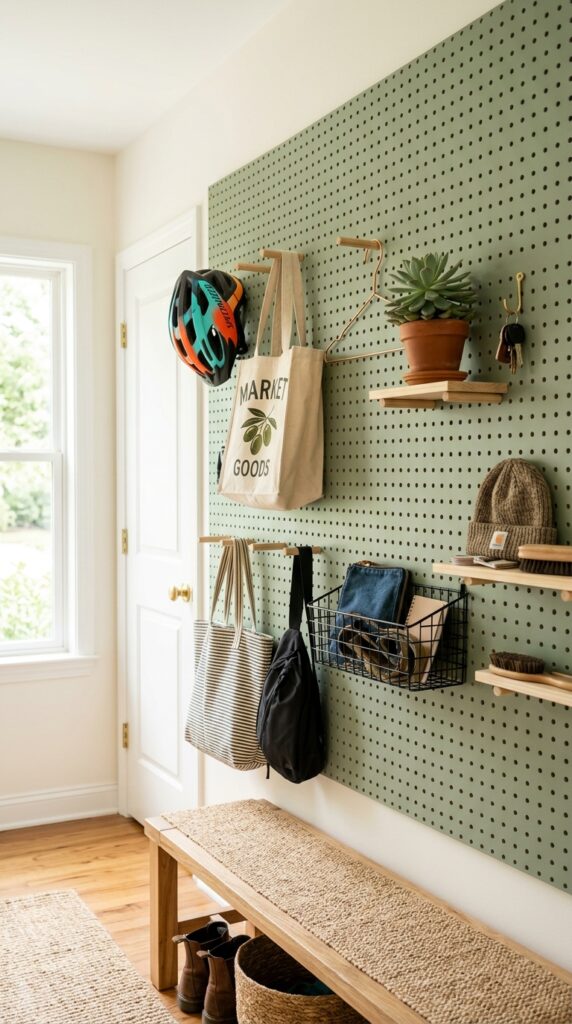
Vibe: Adaptable — the only storage system that changes as your family does.
Why it works: A pegboard system painted the same color as the wall (or in a deliberate accent color) transforms what is typically a utilitarian garage solution into a designed mudroom feature — the paint treatment elevates the pegboard from hardware-store aesthetic to intentional wall installation. The infinite configurability of pegboard is its primary design advantage in a mudroom context: as children age (and their gear changes from strollers to bicycles to sports equipment), the storage layout can be entirely reconfigured in 20 minutes without any new holes in the wall.
How to get it: Mount a 4×8-foot sheet of 1/4-inch Masonite pegboard using 1-inch-thick wood furring strips as standoffs (attached to wall studs) — the furring strips create the necessary 1-inch gap behind the board for peg insertion. Paint the entire board before mounting using a roller; touch up peg holes with a small brush after installation.
🛍️ Shop the Look — Amazon Product Ideas
| # | Product Search Phrase | Why It Fits |
| 1 | Pegboard 4×8 sheet wall organizer natural | Core system panel |
| 2 | Wooden pegboard pegs dowel natural set 20 | Warm-material hooks |
| 3 | Wire pegboard bin basket small hanging | Attached storage add-on |
| 4 | Pegboard shelf small wood attachment | Flat surface extension |
| 5 | Furring strip standoff kit pegboard mounting | Gap-mounting hardware |
13. Slate Blue Cabinetry With Integrated Bench
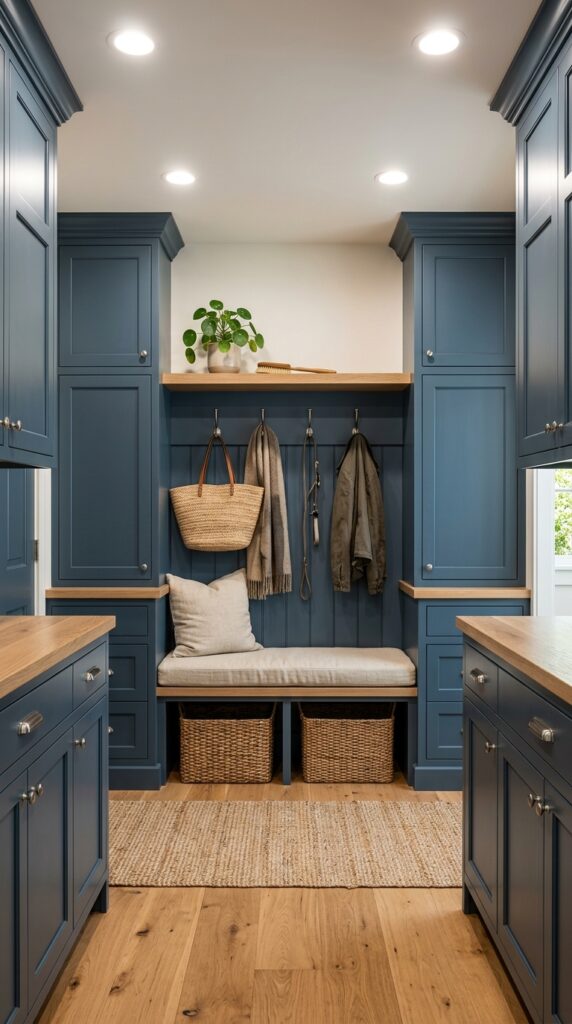
Vibe: Confident — the mudroom that finally looks like it belongs in the same house as your kitchen.
Why it works: Treating mudroom cabinetry with the same finish quality as kitchen cabinetry — shaker-profile doors, solid countertops, consistent hardware — applies the design principle of material continuity, which makes a home feel cohesive and designed throughout rather than room by room. Slate blue is a particularly effective mudroom cabinet color because it reads as both masculine and feminine, warm and cool depending on the light, making it universally adaptable across family compositions. The integrated bench niche breaks the monolithic cabinet run visually and creates a functional seating zone without sacrificing storage on either side.
How to get it: Sherwin-Williams “Uncertain Gray” (SW-6234) reads as a warm slate blue in most lights and coordinates with both warm and cool wood tones — it’s the paint choice that works whether your floors are warm honey oak or cool grey-toned ash.
💡 Quick Win: Ready-to-assemble (RTA) kitchen cabinets painted slate blue and installed as a mudroom run cost 40–60% less than custom mudroom cabinetry while delivering an identical visual result — IKEA SEKTION or Home Depot’s Hampton Bay line are both appropriate starting points.
🛍️ Shop the Look — Amazon Product Ideas
| # | Product Search Phrase | Why It Fits |
| 1 | Brushed nickel shaker cabinet pull 3 inch set | Hardware unifier |
| 2 | Wicker rectangular storage basket large lid | Cabinet-top display |
| 3 | Performance linen bench cushion cover 18×48 | Niche seat surface |
| 4 | White oak wood countertop butcher block 25 inch | Natural counter material |
| 5 | Recessed LED downlight 4 inch warm 2700K | Overhead task lighting |
14. Labeled Clear-Bin Seasonal Storage Above the Sightline
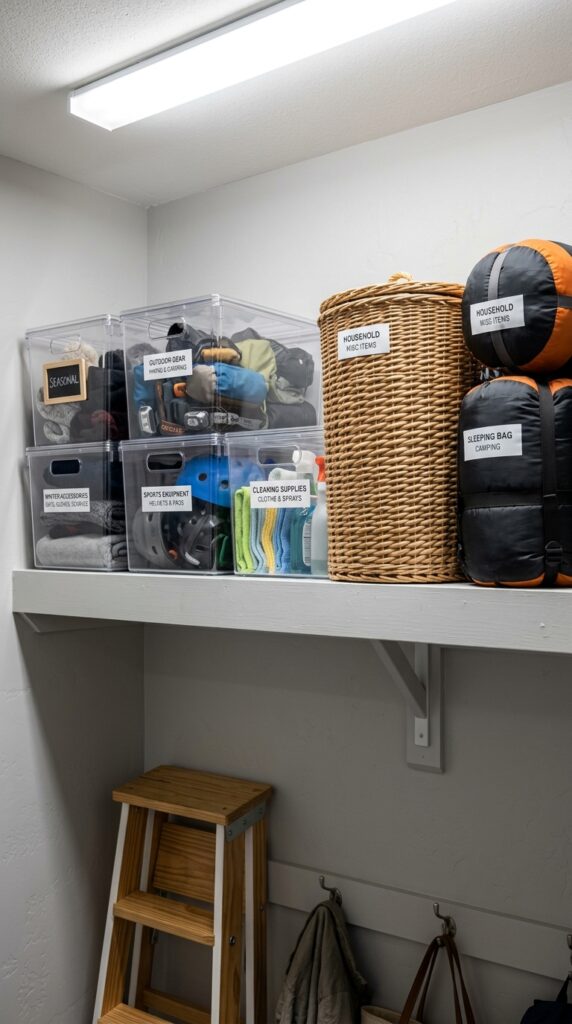
Vibe: Systematic — the kind of organization that actually stays organized six months later.
Why it works: Storing seasonal items (holiday decor, camping gear, extra blankets) above the 72-inch sightline uses the design principle of hierarchical zoning — the most-accessed items occupy the easiest-to-reach zones, while rarely-needed seasonal storage occupies the hardest-to-reach upper zone without disrupting daily function. Clear bins at this height are essential: the contents are visible from below without requiring a step stool for identification, which is the behavioral friction point that causes unlabeled storage to become mystery boxes within one season.
How to get it: Use 66-quart clear latching tote bins (Sterilite or equivalent) — large enough to be meaningful storage, clear enough to identify contents, and stackable to maximize vertical shelf depth. Print labels on a label maker in a consistent font and apply to the bin front face at a downward-visible angle (tilt the label 10 degrees toward the viewer for better readability from floor level).
🛍️ Shop the Look — Amazon Product Ideas
| # | Product Search Phrase | Why It Fits |
| 1 | Clear stackable storage bin 66 quart latch | Seasonal content storage |
| 2 | Label maker handheld white tape | Organization labeling |
| 3 | Wall mounted floating shelf 36 inch heavy duty | High-level shelf support |
| 4 | Wicker lidded basket large storage | Soft item containment |
| 5 | Folding step stool 2-step non-slip | High shelf access tool |
15. Herringbone Brick-Look Tile Entry Floor
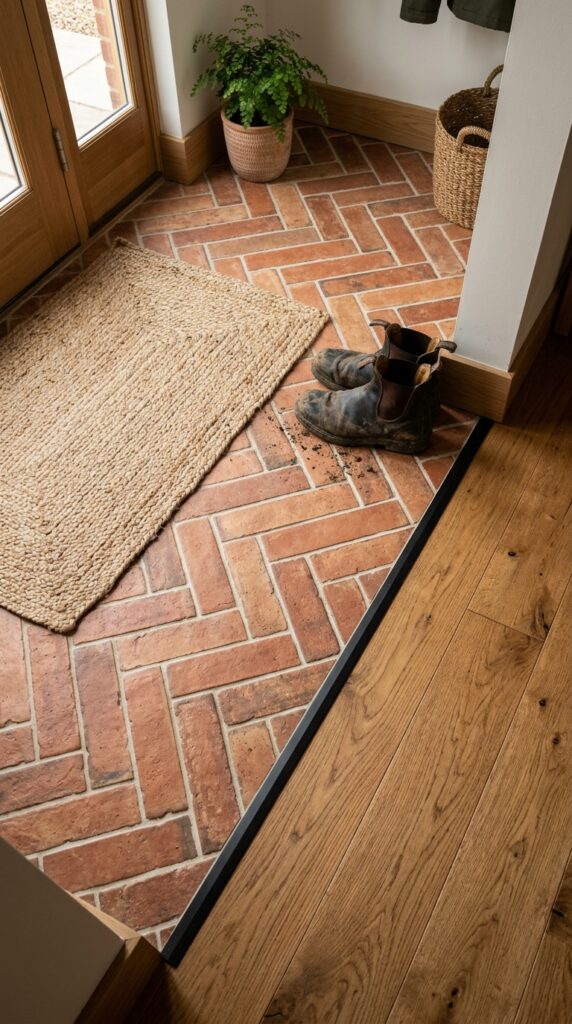
Vibe: Warm — a floor that gives the entry character from the ground up.
Why it works: A herringbone tile pattern at the entry creates a visual “rug” effect on the floor — the directional geometry of the pattern defines the entry zone as a distinct space without requiring a physical barrier or area rug that would need to be laundered. Terracotta-toned brick-look porcelain introduces warmth to what is typically the coldest-feeling zone of the home (entries are often under-lit and north-facing) through color temperature — warm ochre and rust tones read as sun-warmed even in the absence of actual sunlight.
How to get it: Lay herringbone tile starting from the center of the entry door threshold and working outward — this centers the pattern relative to the entry point, which is the natural visual focus. Use warm ivory sanded grout (not bright white) with terracotta tile to avoid the sterile hospital-tile contrast that bright white grout creates with warm-toned surfaces.
🛍️ Shop the Look — Amazon Product Ideas
| # | Product Search Phrase | Why It Fits |
| 1 | Terracotta brick look porcelain tile 4×8 inch | Floor pattern material |
| 2 | Black metal floor transition strip reducer | Material change detail |
| 3 | Natural seagrass door mat entry rectangle | Surface mat layer |
| 4 | Sanded grout warm ivory 10lb bag | Tile joint color |
| 5 | Small potted fern artificial realistic green | Door-side living accent |
16. Vertical Shoe Tower Cabinet Beside the Bench
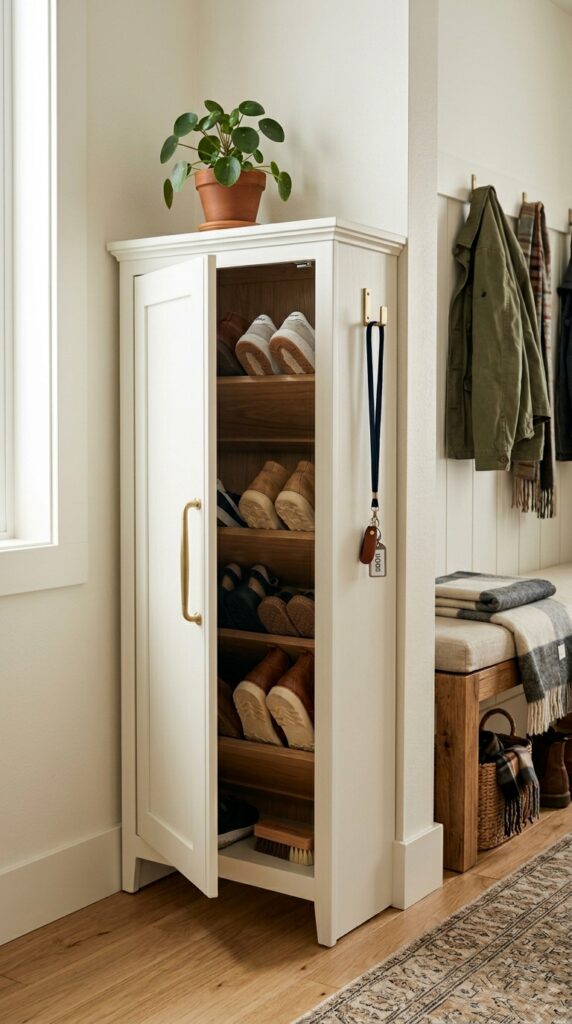
Vibe: Compact — all the functionality of an open shoe rack with none of the visual chaos.
Why it works: A vertical shoe tower with a pull-down door uses the design principle of concealed storage — all the practical disorder of shoe storage is hidden behind a clean cabinet face that reads as furniture rather than functional equipment. The angled interior tiers (typically set at 15 degrees) allow twice as many shoes per vertical inch as flat shelves, making a 12-inch-wide, 60-inch-tall cabinet capable of holding 20–24 pairs. The narrow 12-inch depth fits beside most entry benches without blocking the seated position.
How to get it: Look for shoe towers with a minimum interior depth of 14 inches to accommodate men’s size 12 shoes without the heels hanging over the shelf edge. A brushed brass pull on the pull-down door transforms a functional storage piece into a design-conscious furniture element — replace the stock hardware immediately after purchase.
💡 Quick Win: A slim shoe cabinet with pull-down door ($89–$149 on Amazon) solves the visual clutter of an open shoe pile instantly — it’s the highest-priority purchase for any mudroom redesign where shoe chaos is the primary daily frustration.
🛍️ Shop the Look — Amazon Product Ideas
| # | Product Search Phrase | Why It Fits |
| 1 | Slim shoe cabinet flip down door white 12 inch | Core storage cabinet |
| 2 | Brushed brass cabinet pull handle small | Hardware upgrade detail |
| 3 | Shoe cleaning brush set holder small | Interior cabinet care |
| 4 | Small air plant tillandsia with brass holder | Cabinet-top living accent |
| 5 | Lanyard key holder slim hook single | Cabinet side function |
17. Wainscoting + Wallpaper Combination Above Chair Rail
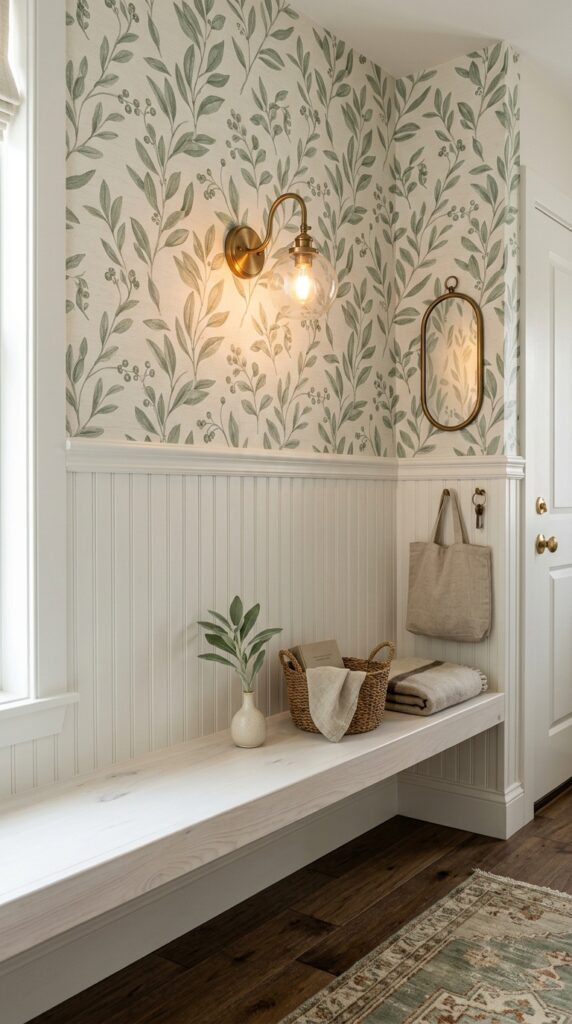
Vibe: Layered — texture meeting pattern in the most controlled possible way.
Why it works: Combining wainscoting below and wallpaper above the chair rail uses the design technique of zone stratification — each horizontal layer has a distinct visual character (texture below, pattern above, ceiling neutral) that adds dimensional richness without overwhelming the space. The chair rail acts as a visual pause between the two surfaces, preventing visual competition. Choosing a grasscloth-textured botanical wallpaper (pattern AND texture together) keeps the upper zone cohesive with the tactile lower register of the beadboard.
How to get it: Peel-and-stick wallpaper in botanical or grasscloth designs (available from Chasing Paper, Tempaper, and similar brands) makes this look achievable without a professional installer — apply above the chair rail only, which is a manageable surface area for a first-time DIY wallpaper project. Total material cost for a standard mudroom: $80–$180.
🛍️ Shop the Look — Amazon Product Ideas
| # | Product Search Phrase | Why It Fits |
| 1 | Peel and stick botanical wallpaper sage green | Above-rail feature wall |
| 2 | Brass wall sconce hardwired indoor | Warm wall lighting |
| 3 | Single stem bud vase ceramic matte white | Bench botanical accent |
| 4 | Beadboard wainscoting kit paintable wall | Below-rail texture |
| 5 | Small round mirror brass frame 18 inch | Bench-end reflector |
18. Chalkboard Wall Panel for Family Communication
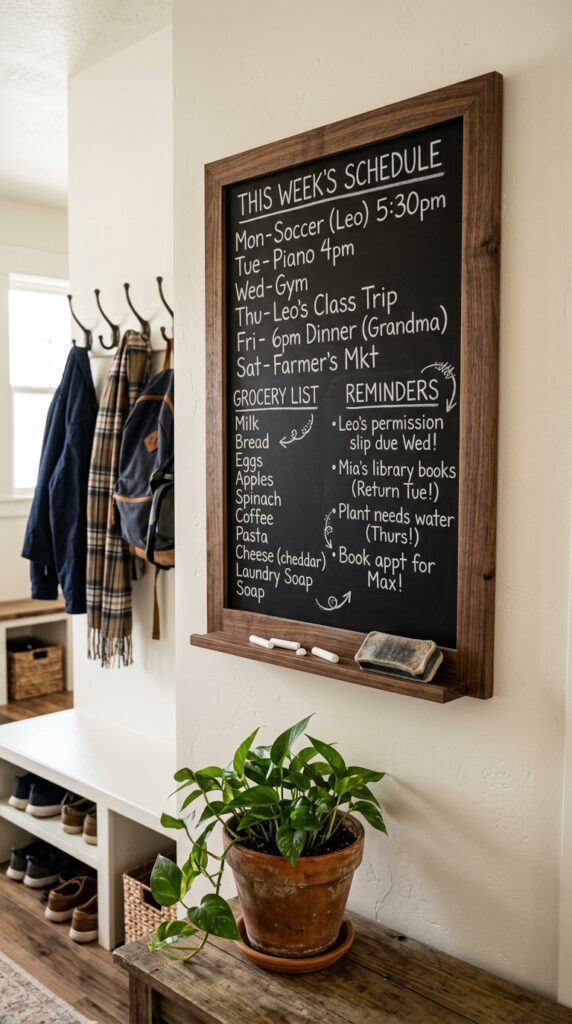
Vibe: Purposeful — a wall that works harder than most pieces of furniture.
Why it works: A dedicated chalkboard communication panel at the mudroom entry intercepts the family’s daily scheduling chaos at the natural decision point — the moment of departure and return. Framing the chalkboard in a quality dark walnut or painted wood frame elevates it from utilitarian school-supply to deliberate wall art, which is the visual difference between a mudroom that looks curated and one that looks improvised. A built-in chalk ledge eliminates the chalk-on-the-floor problem that makes most chalkboard installations less functional than they should be.
How to get it: Use chalk markers rather than traditional chalk on any framed chalkboard — they write more cleanly, erase more completely (with a damp cloth), and don’t produce the chalk dust that lands on dark coats and jackets hanging below. Reset weekly rather than erasing partially to prevent ghost text buildup.
🛍️ Shop the Look — Amazon Product Ideas
| # | Product Search Phrase | Why It Fits |
| 1 | Framed chalkboard dark walnut frame large 24×36 | Communication center |
| 2 | Chalk markers white liquid set 6 | Clean-write chalk alternative |
| 3 | Small wood ledge shelf 6 inch floating | Under-board chalk tray |
| 4 | Damp chalk eraser magnetic flat | Erasure tool |
| 5 | Terracotta pot 5 inch with saucer set | Below-board floor accent |
19. Mudroom Locker With a Personal Color Per Family Member
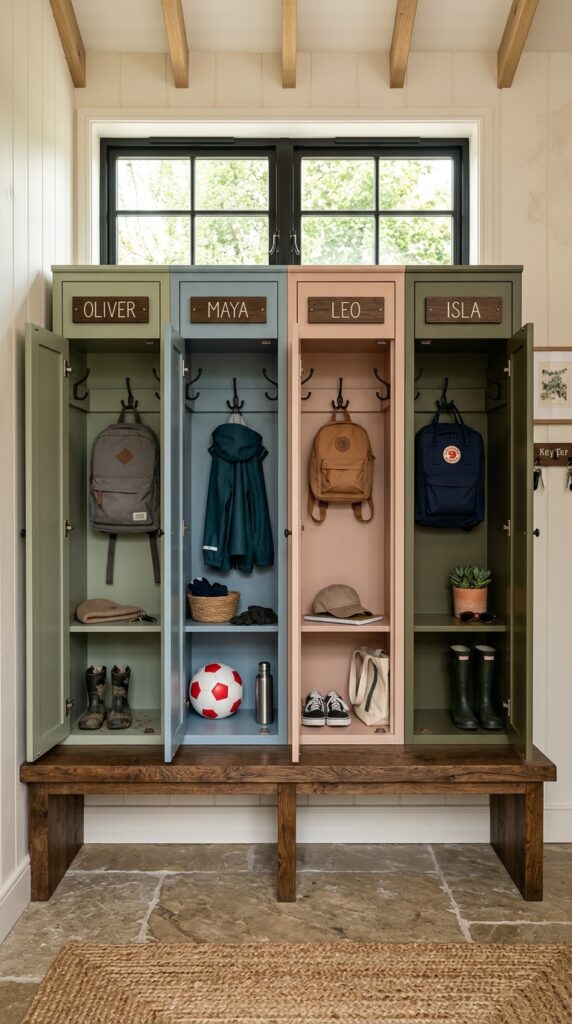
Vibe: Individual — a storage system where every person in the house feels genuinely seen.
Why it works: Assigning a distinct muted color to each family member’s locker solves the behavioral problem of shared storage systems: when everything looks identical, nothing feels owned, so nothing gets put away consistently. The key design constraint is keeping all colors within the same tonal family — all muted, all with similar saturation levels — so the multi-color arrangement reads as a deliberate palette decision rather than a chaotic assortment. Muted sage, dusty blue, blush, and olive all share a greyed, slightly desaturated quality that ties them together visually.
How to get it: Use the same base cabinet and paint each one a different color from a coordinated tonal palette. Sherwin-Williams curates “Pottery Barn Kids”-style palettes on their website — select four colors from the same “muted” or “earthy” family for a guaranteed-cohesive result.
🛍️ Shop the Look — Amazon Product Ideas
| # | Product Search Phrase | Why It Fits |
| 1 | Wood name plaque personalized mudroom locker | Identity label per child |
| 2 | Chalk paint small sample pot set muted tones | Color testing kit |
| 3 | Backpack hook double prong heavy duty wall | Inside-locker hardware |
| 4 | Small sports ball storage net bag locker | Gear containment |
| 5 | Continuous bench seat oak veneer 60 inch | Spanning locker base |
20. Window Seat Mudroom Bench With Built-In Storage
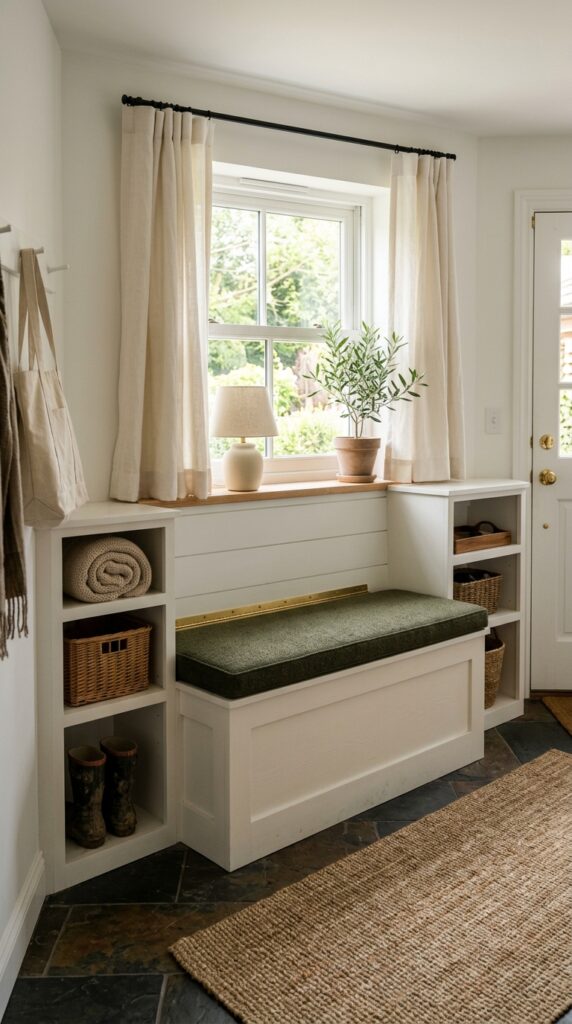
Vibe: Sun-warmed — the mudroom seat that doubles as the best spot in the house.
Why it works: A window seat mudroom bench uses the design technique of architectural integration — the bench is positioned in relationship to the architecture (the window) rather than placed against any available wall, which makes it feel designed-in rather than added-on. The lift-top storage compartment beneath the cushion creates a hidden storage zone (the interior of the bench platform) that holds out-of-season items or bulky gear without any visible storage hardware or drawer pulls. The window above provides natural light that makes the bench the brightest, most naturally inviting seat in the entry.
How to get it: Build the bench platform at exactly 18 inches in height — standard seat height — and size the interior compartment to accept 27-gallon tote bins (a standard stackable size) laid flat for maximum internal organization. Use piano hinge across the full top length for smooth, balanced lid lifting with no risk of the top falling.
💡 Quick Win: A storage ottoman with a lift-top lid ($55–$95 on Amazon) placed beneath a window and dressed with a cushion pad on top creates a functional window seat bench with 30 gallons of hidden storage in under five minutes of installation.
🛍️ Shop the Look — Amazon Product Ideas
| # | Product Search Phrase | Why It Fits |
| 1 | Storage ottoman lift top lid large fabric | Window seat alternative |
| 2 | Dark olive green bench cushion cover outdoor | Durable seat cushion |
| 3 | White linen window panel tab top 84 inch | Window soft treatment |
| 4 | Piano hinge continuous zinc 48 inch | Full-top lid hardware |
| 5 | Small ceramic table lamp warm white base | Window sill lighting |
21. Hook Rail With Individual Labeled Name Tags
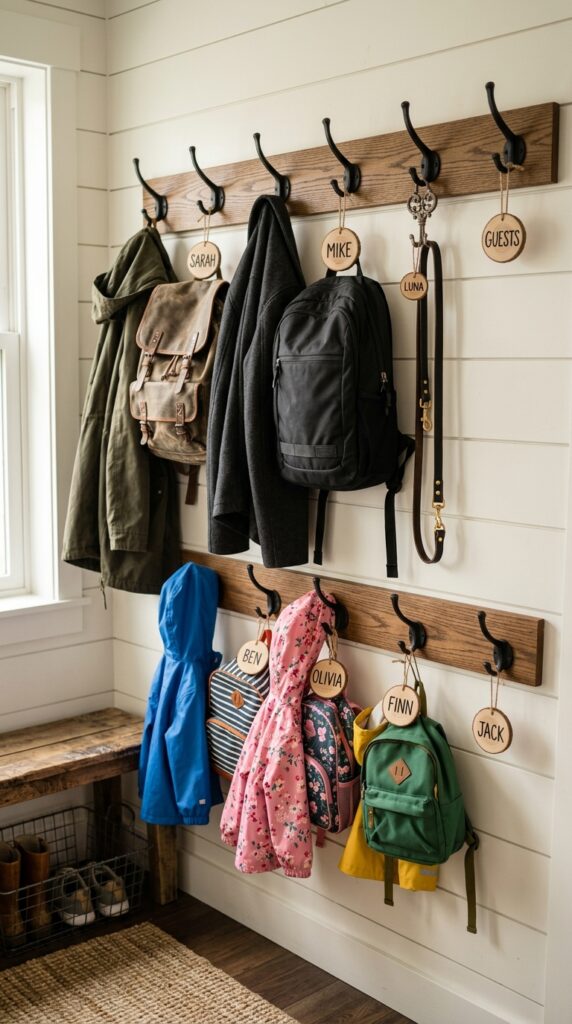
Vibe: Personal — a wall that knows who lives in this house.
Why it works: Labeled hooks solve the single most common behavioral failure of mudroom storage systems: shared hooks that no one feels responsible for clearing. The name tag creates psychological ownership — a hook with your name on it is your hook, and items left on someone else’s hook are immediately identifiable as out of place. The wood-tag-on-twine detail (versus a printed label or a sticker) adds a handmade warmth that keeps the organizational system from feeling institutional or corporate.
How to get it: Cut 3×1-inch tags from 1/4-inch birch plywood using a jigsaw or order pre-cut wood tags online. Sand smooth, write names with a fine-tip oil-based black paint marker (Posca or Molotow brand), seal with a coat of matte Mod Podge, then drill a 1/8-inch hole at the top and thread with jute twine tied to the hook base.
🛍️ Shop the Look — Amazon Product Ideas
| # | Product Search Phrase | Why It Fits |
| 1 | Wood blank gift tag small rectangle set 50 | Name tag base material |
| 2 | Black oil paint marker fine tip 0.7mm | Name writing tool |
| 3 | Jute twine natural 3-ply thin 200ft | Tag hanging cord |
| 4 | Double prong coat hook antique iron set 6 | Hook row base |
| 5 | Shiplap peel stick wall panel white | Backdrop texture panel |
22. Mudroom Laundry Transition Zone With Hamper Cabinet
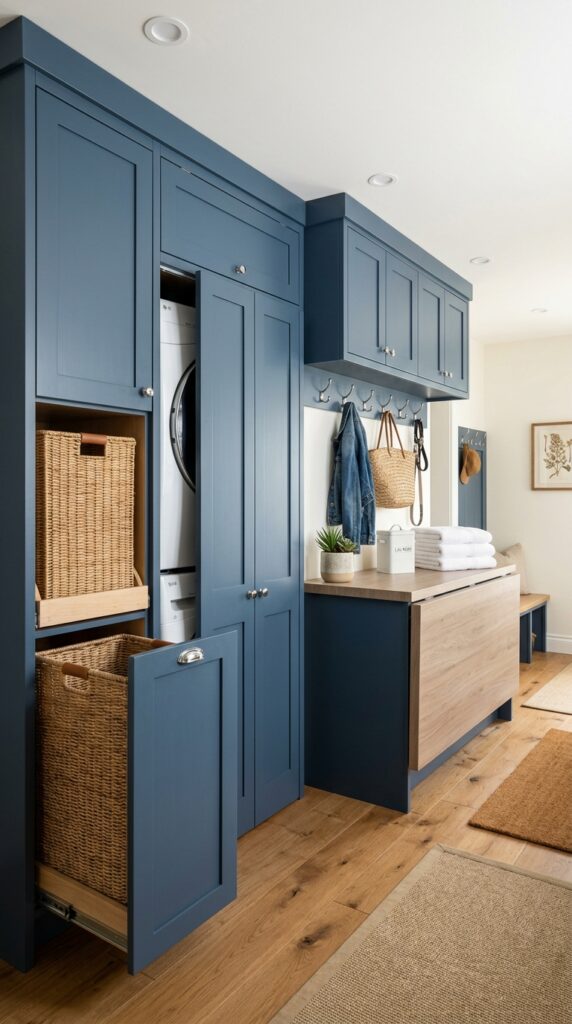
Vibe: Efficient — the rare room where daily chores feel handled before you’ve started them.
Why it works: Combining the mudroom and laundry transition into a unified zone uses the architectural design principle of adjacency planning — placing functions that share objects (dirty clothes from outdoors go directly to the hamper) in physical proximity eliminates the intermediate steps (carrying laundry from one room to another) that make routine tasks feel burdensome. Concealing the washer-dryer and hampers behind matching cabinetry maintains the design coherence of the space, so the room functions as a laundry room but reads as a mudroom.
How to get it: Size the pull-out hamper cabinet at 21 inches wide minimum to accommodate a standard 1.5-bushel wicker hamper basket on a drawer slide. Use full-extension drawer slides rated for 75 lbs — wicker hampers loaded with wet sports gear are significantly heavier than most cabinet hardware is designed for.
🛍️ Shop the Look — Amazon Product Ideas
| # | Product Search Phrase | Why It Fits |
| 1 | Pull-out hamper cabinet wicker 2-section | Concealed laundry storage |
| 2 | Bifold door hardware kit interior 24 inch | Washer-dryer concealment |
| 3 | Full extension drawer slide 75lb 20 inch | Heavy-duty hamper slide |
| 4 | Ceramic laundry detergent dispenser pump | Counter organization |
| 5 | Compact folding wall-mount table bracket | Counter surface support |
23. Antique Bench With Repurposed Church Pew
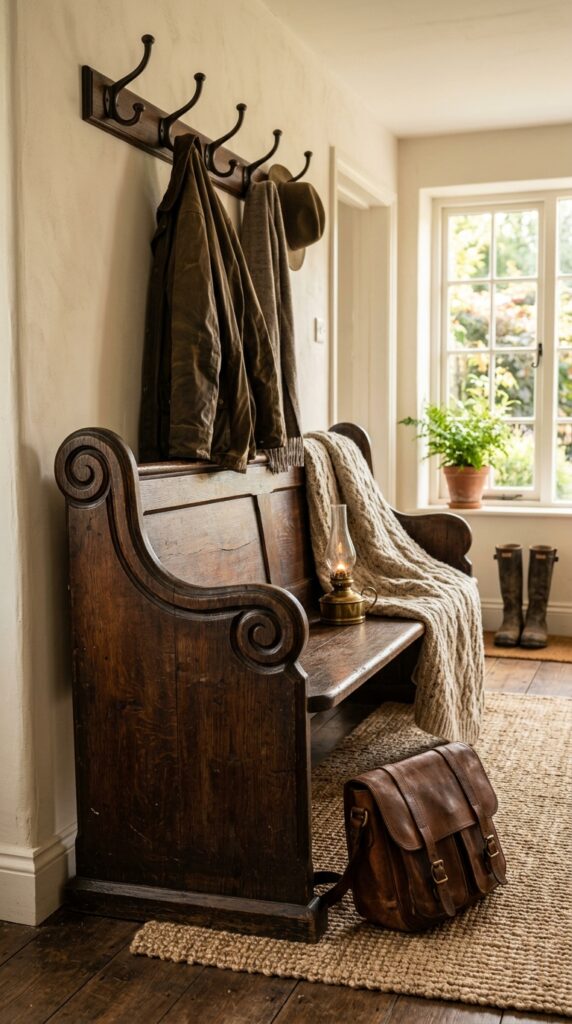
Vibe: Storied — a room that already has history the moment you install it.
Why it works: An antique church pew introduces material age into a space that could easily feel brand-new and characterless — the carved wood, worn armrests, and darkened grain create visual depth that contemporary furniture cannot manufacture. This is the principle of provenance as texture: the pew’s history is legible in its surface, and that legibility adds emotional warmth to the entry beyond what any finish or color can achieve. The pew’s naturally high back (typically 36–42 inches) also functions as a partial room divider, defining the entry zone from adjacent rooms without requiring a wall.
How to get it: Antique church pews are available from architectural salvage dealers (search “church pew salvage” locally) typically for $80–$400 depending on length and condition. Treat the wood with a single coat of furniture wax (Briwax Natural) to stabilize the existing finish without stripping the patina that makes the piece valuable.
🛍️ Shop the Look — Amazon Product Ideas
| # | Product Search Phrase | Why It Fits |
| 1 | Oil rubbed bronze double hook wall mount set | Warm period hardware |
| 2 | Briwax natural furniture wax 400ml | Antique finish preserving |
| 3 | Woven jute runner hallway natural 2×6 | Floor anchor beneath pew |
| 4 | Leather handle saddlebag tote vintage style | Period-appropriate accessory |
| 5 | Small oil lantern candle holder decorative | Armrest accent lamp |
24. Outdoor-Adjacent Mudroom With Dog Station
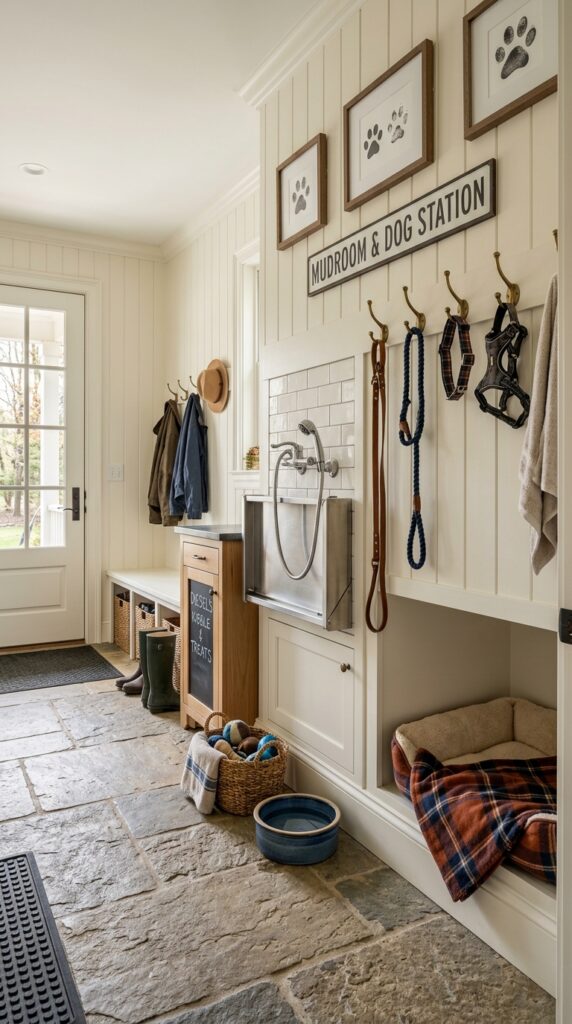
Vibe: Warm — a room that loves dogs as much as its owners do.
Why it works: A dedicated dog station at the mudroom rear entry is one of the most practical household-specific customizations available in mudroom design — it intercepts the dog’s dirt, wet fur, and leash chaos at the exterior entry point before it enters the main living areas. The fold-down wash basin uses the same design logic as fold-down ironing boards: it provides full functionality when needed and occupies zero floor space when not in use, which is essential in a space that also needs to accommodate humans and their gear.
How to get it: Install leash hooks at 30 inches from the floor — within easy reach for clipping and unclipping while the dog is standing, and below the zone that adult coat hooks occupy, creating a natural height separation between human and pet storage zones.
💡 Quick Win: A wall-mounted fold-down pet wash station with a hand-held sprayer attachment ($75–$120 on Amazon) is a weekend installation (requires a water supply line connection) that eliminates the need to bathe muddy dogs in the bathtub — one of the highest-complaint household scenarios for dog owners.
🛍️ Shop the Look — Amazon Product Ideas
| # | Product Search Phrase | Why It Fits |
| 1 | Fold-down pet wash station wall mount basin | Dog wash core piece |
| 2 | Low mounted single hook set 4 leash height | Pet leash organization |
| 3 | Stoneware dog water bowl large heavy | Floor water station |
| 4 | Plaid pet blanket flannel rust navy | Dog bed texture layer |
| 5 | Paw print framed art print mudroom | Pet space wall accent |
25. Industrial Pipe Coat Rack With Wood Shelf
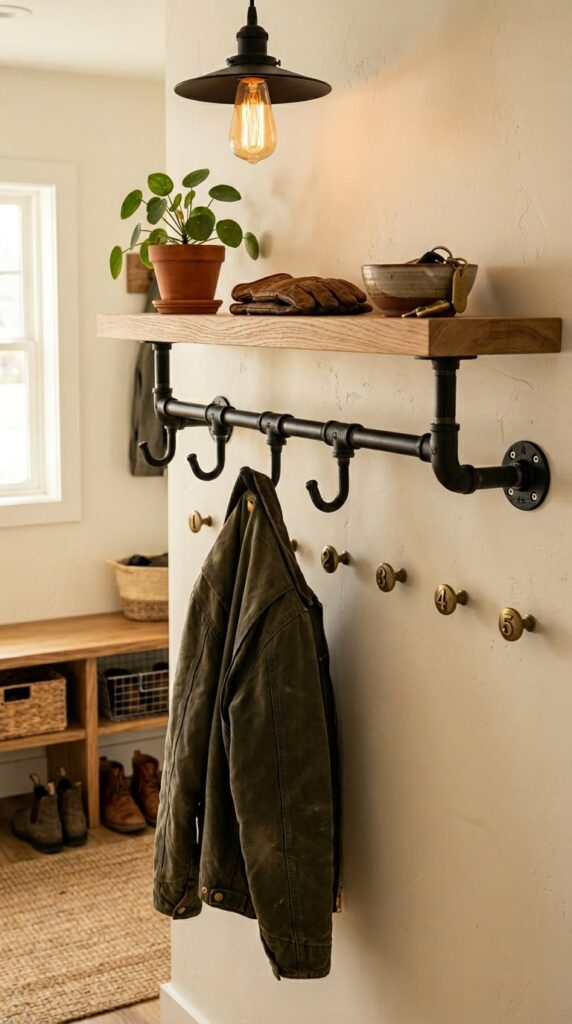
Vibe: Raw — industrial bones with just enough warmth to feel like home.
Why it works: Black iron pipe as a coat rack creates an industrial-organic material pairing when combined with a natural oak shelf: the hard, dark, geometric pipe and the warm, grained, organic wood are in visual opposition at the material level, which creates the visual interest that single-material installations cannot achieve. The numbered brass knobs (used as secondary hooks for smaller items like keys and lanyards) add a tactile detail layer that elevates the installation from functional to composed. Numbering the hooks also provides an informal organizational system that family members intuitively use.
How to get it: DIY industrial pipe coat racks can be assembled using standard 3/4-inch black iron pipe fittings from any hardware store — flanges, nipples, and J-hooks are all sold individually and thread together without welding. The pipe ships in standard 12-inch increments; plan your horizontal run and then order exact pieces. Total material cost for a 36-inch installation: $35–$55.
🛍️ Shop the Look — Amazon Product Ideas
| # | Product Search Phrase | Why It Fits |
| 1 | Black iron pipe coat rack wall mount DIY kit | Core structural element |
| 2 | Numbered brass cabinet knob 1-6 set | Secondary small hooks |
| 3 | White oak shelf floating bracket 30 inch | Above-rack surface |
| 4 | Edison bulb pendant single cord black | Above system lighting |
| 5 | Leather work gloves natural cowhide display | Shelf styling accessory |
26. Small Mudroom: The Floating Bench Illusion
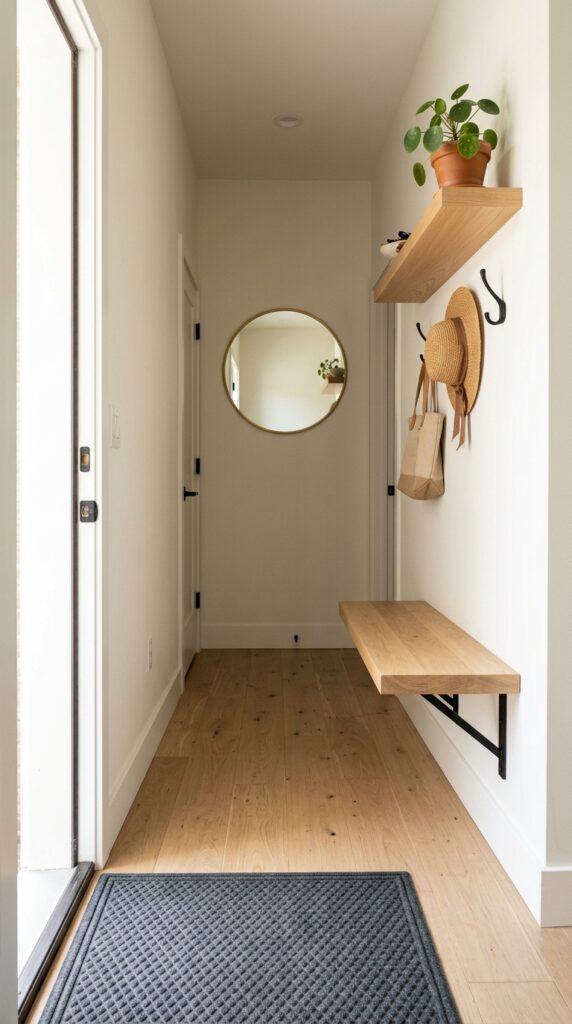
Vibe: Airy — a narrow entry that suddenly has room to breathe.
Why it works: A floating bench (wall-mounted with no legs) creates the visual illusion of a larger floor area by leaving the floor plane completely uninterrupted beneath the seat — a technique called visual floor extension that makes narrow entries feel meaningfully wider than they are. The exposed floor beneath the bench also makes the floor easier to clean, which is non-trivial in a space where muddy shoes and wet boots are a daily reality. A 12-inch depth (versus the standard 16–18 inches of a freestanding bench) is sufficient for seated shoe removal while preserving the narrow hallway’s traffic flow.
How to get it: A floating bench requires wall mounting into studs rated for the expected load — plan for 250 lbs minimum for a family-use bench. Use 3/8-inch lag bolts into studs (not drywall anchors) for a floating bench that will remain stable under daily use. Finish the bench top in a penetrating oil rather than polyurethane to avoid a plasticky sheen in a space with natural light.
🛍️ Shop the Look — Amazon Product Ideas
| # | Product Search Phrase | Why It Fits |
| 1 | Floating wall mount bench solid wood 36 inch | Space-creating seat |
| 2 | Heavy duty lag bolt 3/8 inch stainless set | Structural mounting hardware |
| 3 | Rubber threshold door mat black minimal | Entry floor protection |
| 4 | Round mirror small 18 inch wood frame entry | End-wall depth illusion |
| 5 | Trailing plant succulent artificial shelf | Above-bench greenery |
27. Sconce Lighting on Each Side of the Entry Mirror
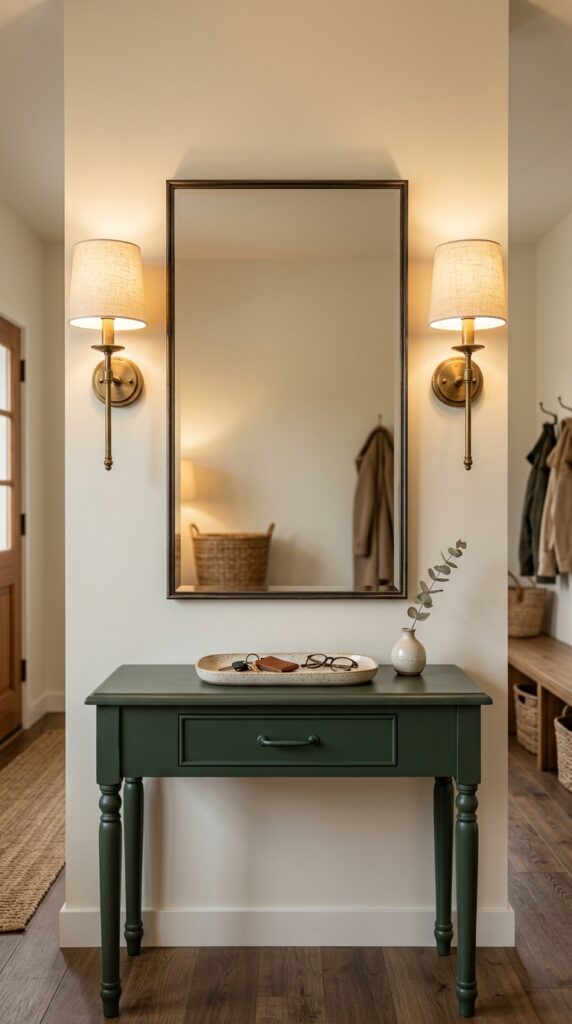
Vibe: Refined — the mudroom that finally feels like the rest of the house.
Why it works: Flanking a mudroom mirror with matching sconces uses the design principle of symmetrical visual anchoring — bilateral symmetry around a central focal point (the mirror) creates a composed, formal arrangement that elevates any entry from functional to designed. This is the same layout principle used in hotel lobby entries and high-end powder rooms: the mirror reflects both sconces simultaneously, multiplying the light source apparent count and creating a space that appears more richly lit than any overhead fixture can achieve. The warm aged brass of the sconces introduces a soft metallic note that bridges dark hardware (hooks) and lighter surfaces (wall, mirror frame).
How to get it: Position the sconces so their center is at 60–64 inches from the floor — the same height as the mirror center — so they read as belonging to the mirror composition rather than floating independently. For a 30-inch-wide mirror, mount sconces 6–8 inches from the mirror edge on each side to maintain visual proximity without overlapping the frame.
💡 Quick Win: Plug-in wall sconces with a swivel arm (no wiring required) allow sconce placement anywhere in the mudroom regardless of outlet location — the cord can be dressed along the wall with adhesive cable clips for a clean, nearly-invisible installation that reads as hardwired from across the room.
🛍️ Shop the Look — Amazon Product Ideas
| # | Product Search Phrase | Why It Fits |
| 1 | Aged brass wall sconce linen shade plug-in | Flanking entry light |
| 2 | Adhesive cable clip cord management set | Cord-hiding system |
| 3 | Dark green console table narrow entryway | Below-mirror surface |
| 4 | Rectangular mirror dark frame 24×36 | Centered wall focal piece |
| 5 | Ceramic oval catchall tray entry keys | Console top organizer |
How to Start Your Stylish Mudroom Transformation
The one first move: Install a hook rail with a painted backer board first. Before any cabinetry, bench, or flooring update, a hook rail at the entry wall gives every coat and bag a home immediately — and the visual transformation from chaotic hooks scattered across the wall to a unified hook system on a painted board is more dramatic than any single piece of furniture can deliver. Choose a color for the backer board that will anchor your eventual full-room palette, and everything else builds from that decision.
The most common mistake: Installing hooks too close together. Hooks spaced less than 5 inches apart create a crowded, unusable cluster — the coat hung on hook 2 blocks access to hook 3, which means hook 3 is never used and the system fails within a week. The correct spacing is 6 inches minimum between hook centers, which feels wider than necessary until you hang an actual winter coat and realize exactly how much clearance a parka requires.
Budget entry points under $50: A set of six matte black double prong wall hooks installed in a level row ($22) creates an instant hook rail. A cotton rope storage bin in natural white ($18) tucks under any bench for shoe containment. A pack of adhesive-backed chalkboard labels ($9) transforms any existing bin or basket into labeled, organized storage immediately.
Realistic expectations: A functional mudroom refresh — hook rail installed, one bench in place, labeled storage — can be completed in a single weekend for $150–$350. A full built-in transformation with custom cabinetry and new flooring requires 4–8 weeks of planning and installation time, and a budget of $2,500–$8,000 depending on scope and region. Start with the hook rail and bench; the cabinetry can follow.
Frequently Asked Questions About Mudroom Design Ideas
What is the difference between a mudroom and an entryway?
A mudroom is a dedicated transition zone specifically designed to handle the mess of outdoor-to-indoor movement — it prioritizes durable flooring, coat hooks, shoe storage, and often pet supplies or sports gear. An entryway is a more decorative first impression space that may include a console table, mirror, and art, but lacks the storage infrastructure to handle real family chaos. The best mudroom design ideas borrow from both: they function like a mudroom but look like a considered entryway. A small mudroom can double as an entryway with the addition of a mirror and a sconce.
What color should I paint a mudroom for a stylish look?
The most versatile mudroom paint choices for a stylish, contemporary result are warm greige (Benjamin Moore “Edgecomb Gray”), aged navy (Benjamin Moore “Hale Navy”), and slate blue (Sherwin-Williams “Uncertain Gray”). All three read as distinctly colored in natural light but shift toward neutral sophistication in evening lamp light — a key quality for an entry that’s experienced at all hours. Avoid pure grey mudroom paint in north-facing entries, as it reads cold and clinical without warm natural light to balance it.
How much does a mudroom makeover cost?
A DIY mudroom refresh — hook rail, freestanding bench, labeled bins, and new paint — typically costs $150–$450 in materials. A semi-custom update using ready-to-assemble cabinetry (IKEA PAX or similar) runs $800–$2,500 including installation. A fully custom built-in mudroom with cabinetry, integrated bench, new flooring, and electrical work costs $4,000–$12,000 depending on size and region. The highest-return starter investment is always paint plus a quality hook system — together they deliver 80% of the visual transformation at 10% of the cost of a full build.
Can mudroom organization ideas work in an apartment with no dedicated entry space?
Yes — a mudroom system can be installed in any entry area of 3 square feet or more using wall-mounted solutions that require no floor footprint. A painted backer board with hooks, a floating wall bench 12 inches deep, and a narrow shoe tower cabinet can collectively provide full mudroom functionality in a corridor as thin as 36 inches. In apartments, use removable adhesive mounting hardware where possible to protect security deposits; Command strips rated at 5 lbs per strip can reliably hold hook rails with normal household coat weight.
What type of flooring is best for a mudroom?
Porcelain tile is the professional mudroom designer’s first choice for flooring — it’s waterproof (unlike hardwood), scratch-resistant (unlike luxury vinyl in high-abrasion areas), and available in formats that look identical to natural stone, brick, or concrete at a fraction of the maintenance. A 12×24 porcelain tile in a slate grey or terracotta tone laid in a running bond or herringbone pattern handles daily mud, water, and pet traffic without staining, warping, or requiring sealing. Grout should always be sealed annually in mudroom applications regardless of tile type.
Ready to Create Your Dream Stylish Mudroom Organization?
These 27 mudroom design ideas have covered the full range of what a functional, stylish entry can be — from material choices like reclaimed barn wood and slate blue cabinetry, to layout techniques for narrow corridors, to lighting strategies that make a working entry feel as composed as any other room in the house. Transformation happens one decision at a time, and starting with a single hook rail or a bench under a window is not a compromise — it’s the right first move. Today, take fifteen minutes to measure your entry wall and identify your stud locations — that single piece of information determines every hook, shelf, and built-in that follows. When the system is finally in place and every coat has a hook with someone’s name on it, you’ll feel what good mudroom design actually delivers: not just an organized room, but a home that works with you instead of against you. Save the ideas that match your entry’s dimensions and your family’s real daily chaos — the hook arrangement, the bench depth, the labeled bins — and build toward the version that’s specifically yours.