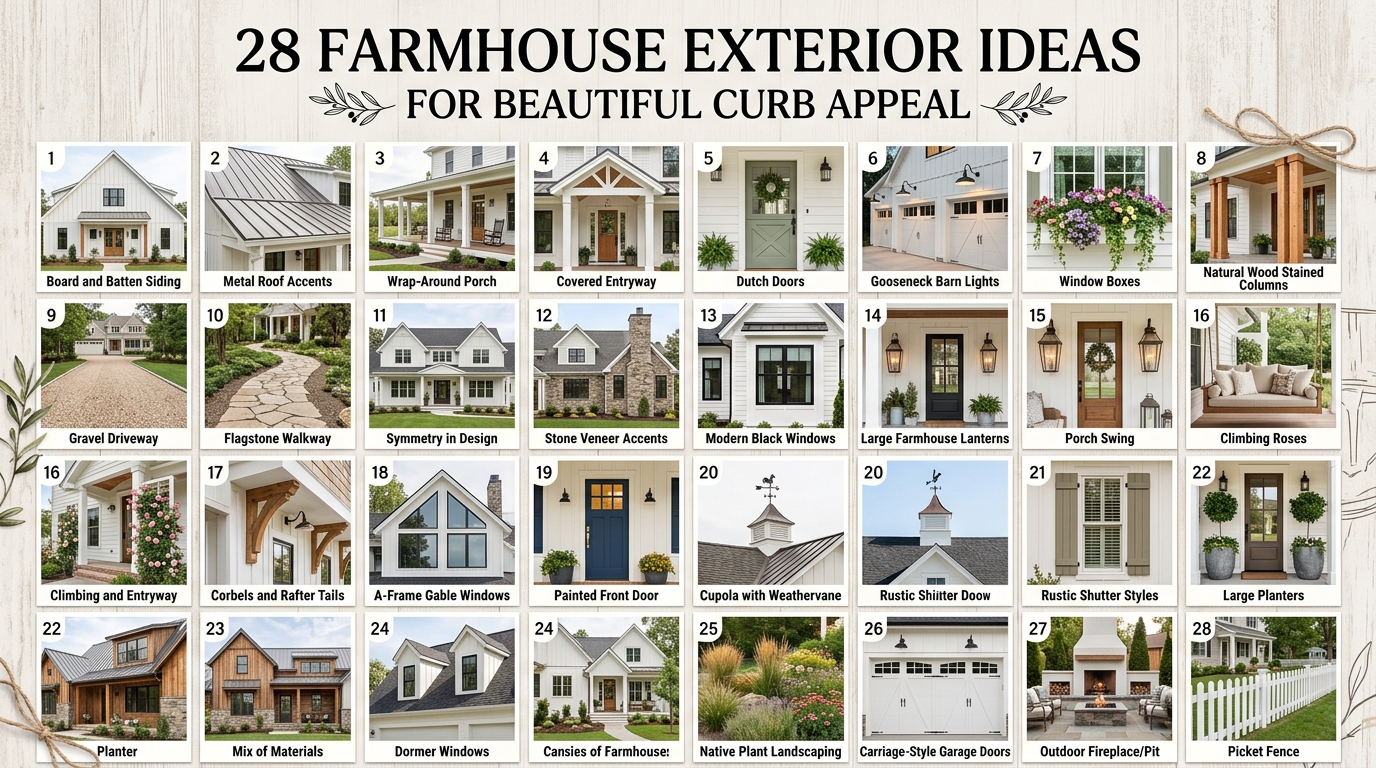
A farmhouse exterior is a residential architectural style rooted in American agricultural vernacular — characterized by a simple, symmetrical facade, a welcoming front porch, white or neutral cladding, and honest structural materials that prioritize function as much as form. This article gives you exactly 28 farmhouse exterior ideas covering siding, trim, porches, doors, rooflines, landscaping, lighting, and color so you can build the curb appeal that makes people slow down as they drive past.
There is something deeply settling about a farmhouse exterior done well. The wide porch that says come sit. The black shutters against white board-and-batten that read from the road as clean and unhurried. The window boxes spilling with herbs, the lantern casting a warm circle on the front door at dusk — all of it communicates a set of values before a single person has stepped through that door. Farmhouse style isn’t a trend. It’s a return. Here are 28 ideas worth saving — and stealing.
Why Farmhouse Exterior Style Works So Well
The farmhouse exterior is one of America’s oldest residential design traditions, with roots in the working homesteads of the 18th and 19th centuries. It draws from the vernacular architecture of German, Scandinavian, and English settlers who prioritized durability and utility — wide overhanging eaves to protect walls from rain, deep front porches for shade and ventilation, simple rectangular window grids that were easy to build and repair. Over time, these purely functional choices became the aesthetic hallmarks of the style. What separates farmhouse from other American vernacular styles (Cape Cod, Colonial Revival, Craftsman) is its emphasis on honest materiality — nothing on a farmhouse exterior is merely decorative; every element has a structural or climatic logic behind it, even if we no longer remember what it was.
The material and color language of farmhouse exteriors is deliberately restrained. White and warm off-white (specifically in tones like Benjamin Moore Chantilly Lace OC-65, Sherwin-Williams Alabaster SW7008, or Farrow & Ball All White) dominate the facade, with accents in black, charcoal, dark navy, or aged iron. Materials include rough-sawn cedar or pine board-and-batten siding, horizontal lap shiplap, fiber cement panels that mimic wood grain, unfinished white oak or weathered grey pine porch decking, black wrought iron or raw steel hardware, and painted brick in white or cream. Window trim is always bold — at least 4 inches wide — and shutters, when present, are operable-looking rather than the decorative pressed-wood afterthoughts that appear on so many homes today.
Farmhouse curb appeal is surging for reasons that go beyond aesthetics. After a decade of glass-box modernism dominating new construction, there’s a cultural hunger for architecture that communicates permanence and warmth. Pinterest data shows “farmhouse exterior” ranking in the top five home design search terms consistently since 2019. The broader “quiet luxury” movement has also pulled farmhouse style upward — the appeal of understatement, of quality materials that age rather than degrade, of a home that looks like it was built to last rather than to photograph well for a real estate listing.
Smaller homes and cottages can absolutely achieve a convincing farmhouse exterior. The key priorities for limited facades are: consistent trim color (apply it wide and evenly to all windows and corners), a minimum of one porch element even if it’s just a covered stoop with two columns, and landscape layering using large-scale plants (boxwoods, ornamental grasses, climbing roses) that give a small facade the visual mass it needs to read as grounded and settled.
Style at a Glance
| Element | Trait 1 | Trait 2 |
| Philosophy | Honest, functional, welcoming | Enduring over fashionable |
| Materials | Board-and-batten cedar, shiplap, porch pine | Wrought iron, painted brick, galvanized steel |
| Color palette | Chantilly Lace white, black trim | Warm off-white, charcoal, aged iron, dusty sage |
28 Farmhouse Exterior Ideas for Beautiful Curb Appeal
1. Classic White Board-and-Batten Siding with Black Trim
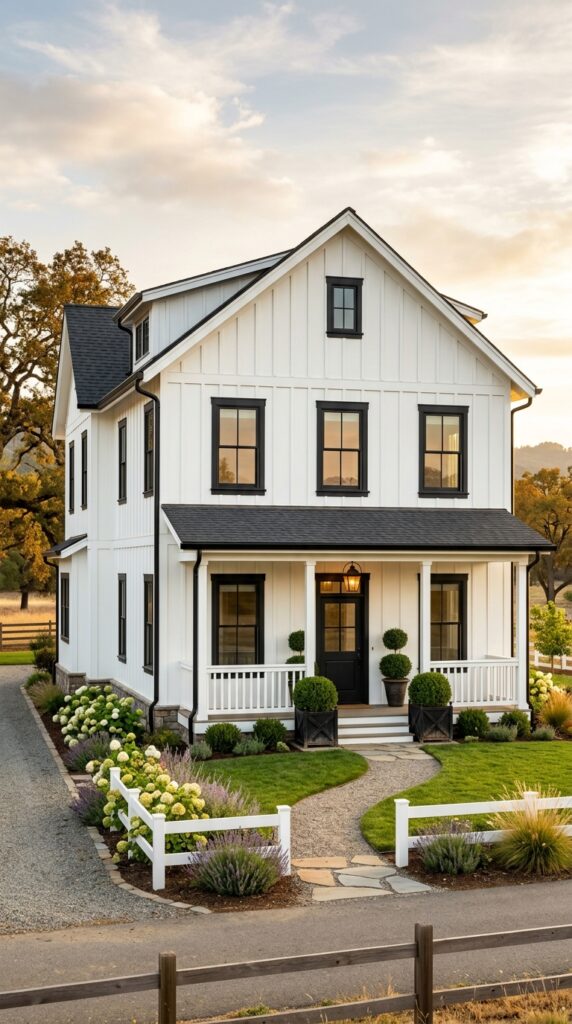
Vibe: Confident. This is the farmhouse exterior that every other farmhouse exterior is trying to reference.
Why it works: Board-and-batten is the definitive farmhouse cladding material because its vertical orientation does three things simultaneously: it reads as taller and more commanding than horizontal siding, it channels water off the facade more efficiently than any horizontal profile, and the shadow line cast by the raised batten creates visual depth across the flat wall surface — a depth that changes quality and direction across the day as light moves. Black trim against white siding creates the maximum tonal contrast available on an exterior palette, which means the architecture reads clearly from the maximum possible distance — a principle called “legibility at scale” that is especially important for homes set back from the street.
How to get it: Use 5/4-inch thick cedar or fiber cement board for the flat boards and rip 1×2-inch battens from the same material — consistency in material means consistent paint adhesion and weathering. Paint all trim in a true flat black rather than semi-gloss for an authentic farmhouse result; Sherwin-Williams Iron Ore SW7069 reads as warm charcoal-black and avoids the harsh blue-black of a pure cool black.
💡 Quick Win: Painting existing wood trim from brown or grey to Sherwin-Williams Iron Ore (roughly $45 per gallon, covers 400 square feet) is the single fastest farmhouse exterior upgrade available — it costs an afternoon and transforms a dated facade instantly.
🛍️ Shop the Look — Amazon Product Ideas
| # | Product Search Phrase | Why It Fits |
| 1 | exterior board and batten trim kit fiber cement | Core siding system |
| 2 | exterior flat black paint quart trim use | Authentic trim finish |
| 3 | boxwood topiary ball large outdoor planter | Classic flanking entry plant |
| 4 | matte black house numbers modern farmhouse | Hardware accent detail |
| 5 | exterior paintbrush set angled sash trim | Trim application tools |
2. Wraparound Front Porch with White Columns
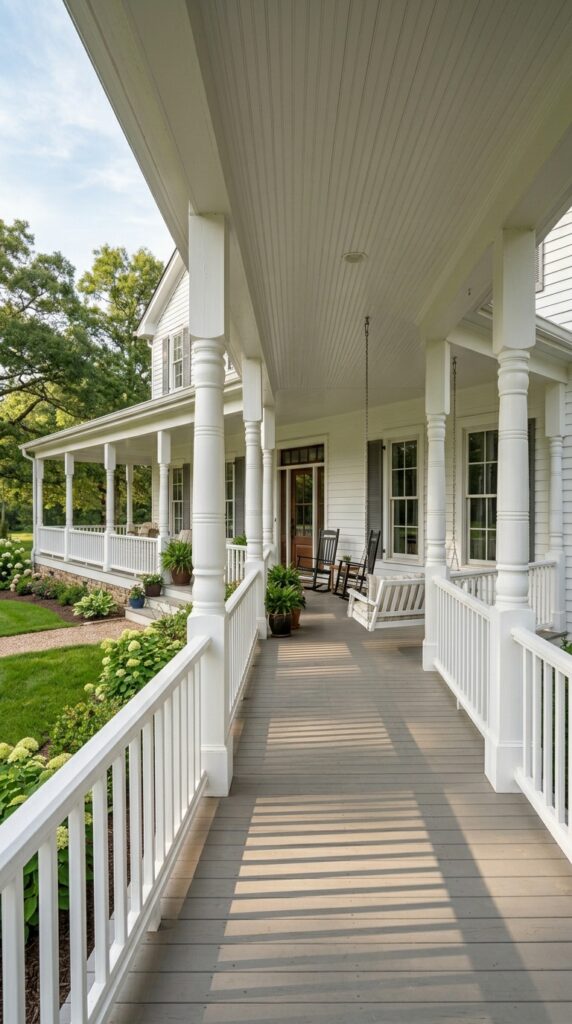
Vibe: Unhurried. A wraparound porch is a spatial argument that some things are worth taking your time over.
Why it works: The wraparound porch is the most powerful single element in farmhouse curb appeal because it extends the home’s footprint visually without expanding its floor plan — the porch makes the house read as two stories taller and significantly wider from the street. Architecturally, the columns create a colonnade rhythm that implies a civic seriousness while the rocking chairs and swing communicate domestic ease — that tension is precisely what makes the farmhouse porch so appealing. Columns at 8 feet on center create the ideal rhythm: close enough to feel structural, wide enough to feel open.
How to get it: Porch boards should run lengthwise (parallel to the house) to draw the eye along the facade’s horizontal extent. Use 5/4×6 tongue-and-groove porch decking in a pressure-treated or composite material and paint with a porch-specific enamel (Porch & Floor Enamel by Benjamin Moore dries to a hard, non-slip surface that resists both foot traffic and rain).
🛍️ Shop the Look — Amazon Product Ideas
| # | Product Search Phrase | Why It Fits |
| 1 | porch column square white PVC 8 foot | Structural column material |
| 2 | porch and floor enamel paint warm grey | Porch board finish |
| 3 | white outdoor rocking chair set of 2 | Classic porch furniture |
| 4 | hanging porch swing white with chains | Corner porch anchor piece |
| 5 | Boston fern hanging basket porch | Soft column base greenery |
3. Matte Black Front Door with a Transom Window
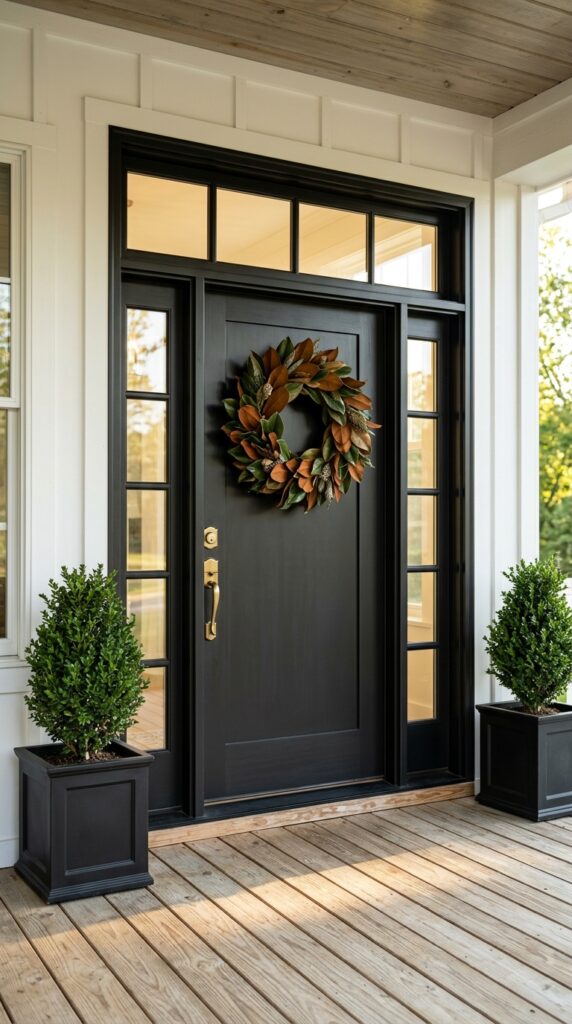
Vibe: Architectural. This door is where the farmhouse farmhouse exterior makes its most direct and personal statement.
Why it works: The front door is the strongest focal point on any exterior because it is the one element at human scale that all approach paths converge on. A matte black door against a white facade creates maximum contrast at the moment of arrival — exactly where you want attention drawn. The transom window above amplifies this by admitting light into the entry and by adding vertical height to the door composition, making the entry feel grander than a single door opening alone. Brushed brass hardware introduces warm metal against the cool matte black — a tonal contrast that makes both the door and the hardware read more distinctly than matching metals would.
How to get it: Specify fiberglass for the door body rather than solid wood if your entry gets direct sun — solid wood expands and contracts enough across seasons to affect door operation and seal integrity over time. A fiberglass door in a smooth finish takes an identical matte black paint application and performs significantly better in UV-exposed conditions.
🛍️ Shop the Look — Amazon Product Ideas
| # | Product Search Phrase | Why It Fits |
| 1 | front door matte black fiberglass exterior | Core entry focal point |
| 2 | brushed brass door handle set exterior | Warm metal hardware accent |
| 3 | dried magnolia leaf wreath large outdoor | Natural organic door wreath |
| 4 | black square planter large outdoor for topiary | Door flanking planter form |
| 5 | exterior transom window sidelite kit | Entry surround architecture |
4. Black Shutters on White Lap Siding
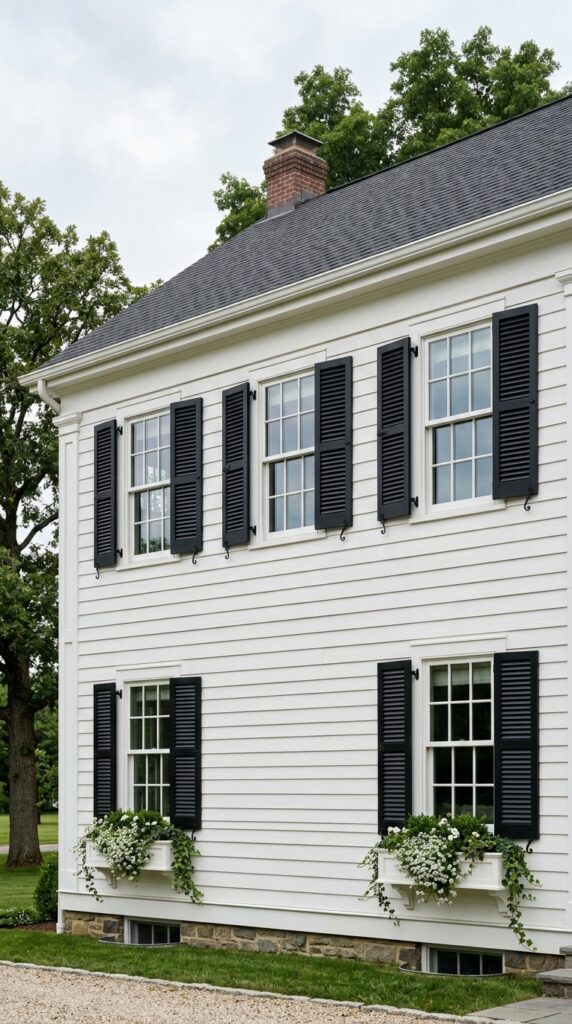
Vibe: Composed. Shutters sized to actually close are a statement about the difference between decoration and design.
Why it works: The proportion rule for shutters is the single most commonly violated principle in exterior design: each shutter must be exactly half the width of its window, so that when both shutters close, they cover the opening completely. When shutters are too narrow (as they almost universally are on builder-grade homes), they read as applied decoration rather than architectural elements, which undermines the entire farmhouse aesthetic. Correctly proportioned black shutters on white lap siding create the gridded, geometric rhythm that defines the farmhouse facade — alternating squares of dark (shutter) and light (wall) that give the exterior its characteristic visual cadence.
How to get it: Replace incorrectly sized shutters rather than repainting them — the proportion error is more visually damaging than any color choice. Cedar shutters with a fixed louver or raised panel profile are the most authentic; if budget is a constraint, composite shutters in a matching profile are far more dimensionally stable than painted wood in humid climates.
💡 Quick Win: Measuring your existing shutters against the half-window-width rule takes five minutes and determines whether a $45 can of Iron Ore will actually solve your shutter problem or whether resizing is required first.
🛍️ Shop the Look — Amazon Product Ideas
| # | Product Search Phrase | Why It Fits |
| 1 | exterior wood shutters louvered custom size black | Authentic proportion shutters |
| 2 | shutter hardware S-curve holdback pair black | Functional mounting detail |
| 3 | white window box planter wood 30 inch | Window-adjacent planting |
| 4 | trailing ivy live plant window box | Classic window box filler |
| 5 | white alyssum annual seedling 6-pack | Spilling bloom element |
5. Metal Roof in Dark Charcoal for Farmhouse Drama
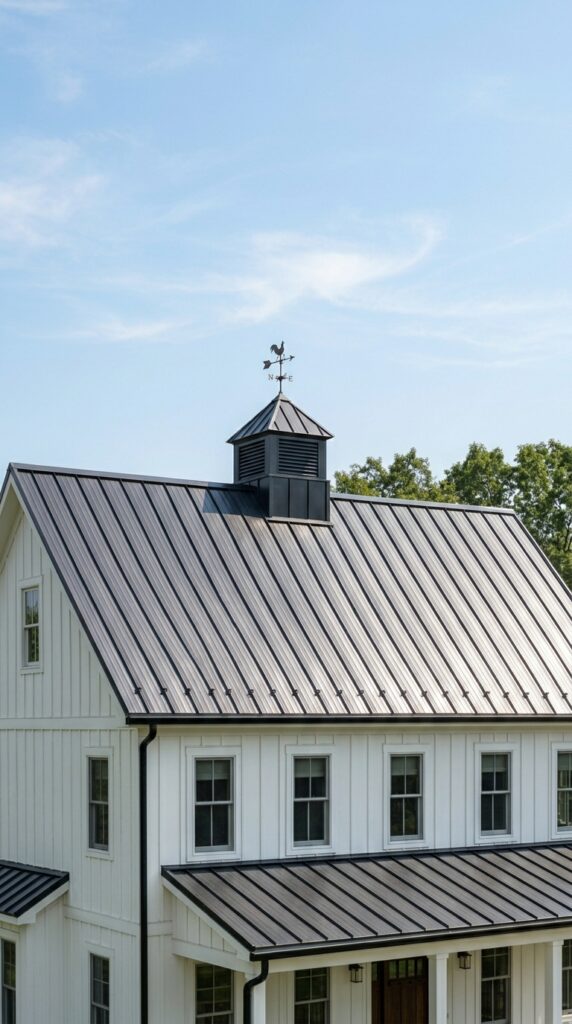
Vibe: Dramatic. A charcoal metal roof closes the farmhouse exterior with the confidence of a period at the end of a strong sentence.
Why it works: A standing-seam metal roof transforms a farmhouse exterior from “nice traditional home” to “intentional architectural statement.” The panel seam pattern provides the kind of regular visual rhythm that a shingle roof cannot — each raised seam creates a strong vertical line that runs from ridge to eave, providing contrast with the horizontal language of porch railings and lap siding. In charcoal or dark bronze, the metal roof anchors the composition from above, preventing the all-white farmhouse palette from reading as too light or ungrounded. Metal also reflects heat, shedding snow cleanly, and carries a 40–70 year lifespan — a material choice that makes the farmhouse’s “built to last” philosophy visible from the street.
How to get it: Specify Galvalume Plus (aluminum-zinc alloy coated steel) rather than plain galvanized — the aluminum content significantly improves rust resistance at panel cut edges, which is where corrosion begins. In charcoal, specify a Kynar 500 (PVDF) paint finish rather than polyester — it retains color without chalking for 30+ years.
🛍️ Shop the Look — Amazon Product Ideas
| # | Product Search Phrase | Why It Fits |
| 1 | standing seam metal roofing panel charcoal grey | Core roof material |
| 2 | metal roof cupola black farmhouse style | Ridge architectural detail |
| 3 | black aluminum gutter system K-style | Matching dark gutter system |
| 4 | metal roof sealant HVAC pipe boot | Penetration weatherproofing |
| 5 | roofing ridge cap metal standing seam | Ridge closure component |
6. White Brick Exterior with Black Window Grids
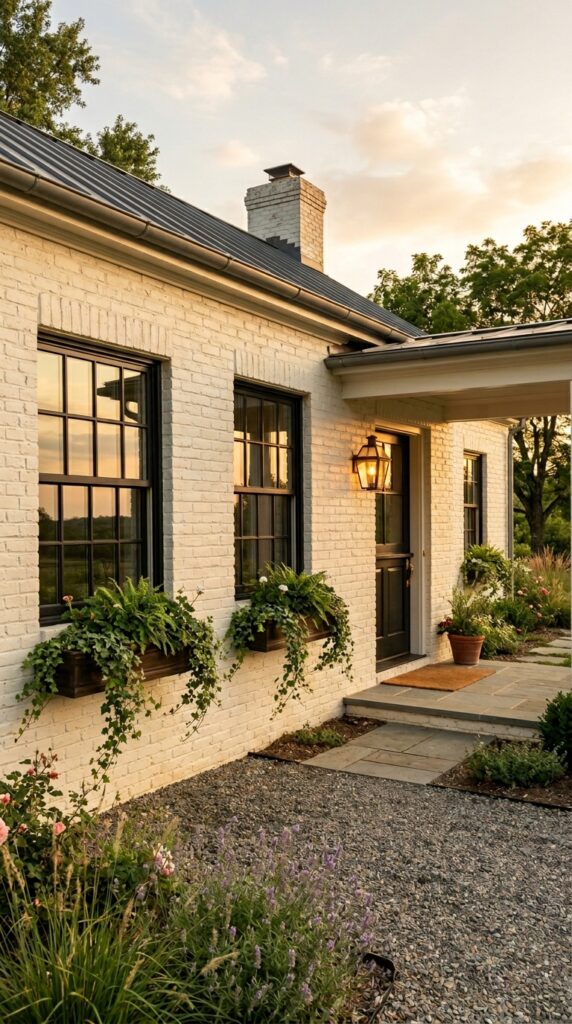
Vibe: Grounded. Painted white brick reads softer and more settled than any other farmhouse exterior surface.
Why it works: Painted white brick performs a unique textural trick — the brick surface is visible beneath the paint in a way that reads as accumulated history, not as a simply painted wall. This gives a painted brick farmhouse an authenticity that new construction vinyl or fiber cement cannot easily replicate. The mortar joints remain slightly lighter than the brick faces (even after painting) creating a subtle grid across the facade that pairs beautifully with the true divided light window grids, aligning the interior and exterior geometry.
How to get it: Paint existing brick with a 100% acrylic masonry paint that is breathable (vapor-permeable) — never use a standard latex, which traps moisture behind the surface and causes spalling. Benjamin Moore Aura Exterior or BEHR Masonry paint are both vapor-open formulations. Use a roller with a 3/4-inch nap to ensure mortar joint penetration.
🛍️ Shop the Look — Amazon Product Ideas
| # | Product Search Phrase | Why It Fits |
| 1 | masonry exterior paint white breathable acrylic | Brick-specific paint system |
| 2 | true divided light window grids black aluminum | Authentic window muntin bars |
| 3 | Dutch door exterior matte black fiberglass | Farmhouse character door type |
| 4 | gas lantern style outdoor wall sconce black | Period-authentic entry light |
| 5 | window box trailing greenery mix live plant | White brick window accent |
7. Reclaimed Wood Accent Gable
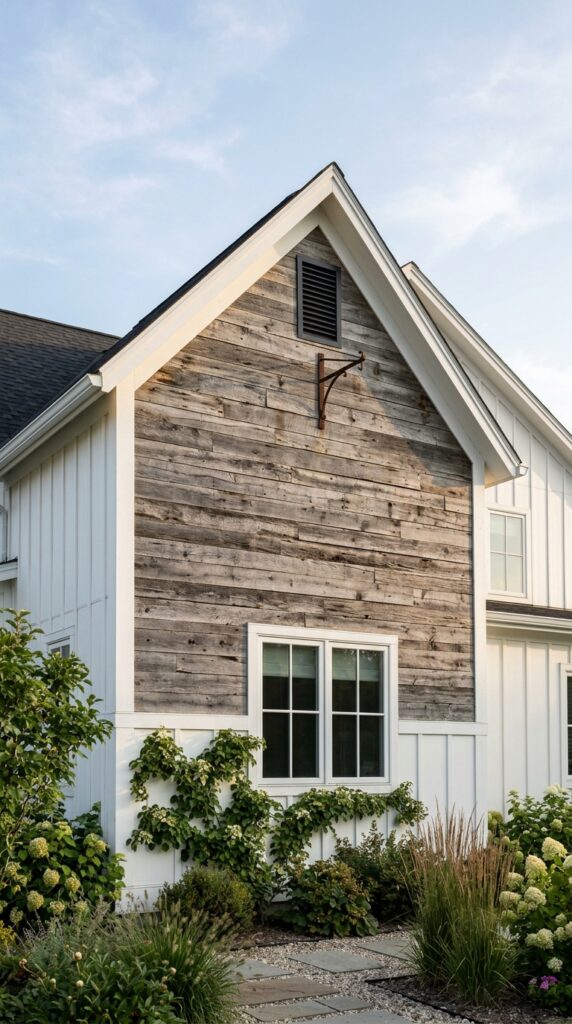
Vibe: Raw. Reclaimed wood in a gable says the house has a past worth displaying.
Why it works: Accent gables using a contrasting material — reclaimed wood against white siding — operate on the principle of material hierarchy. The primary siding establishes the base language; the accent gable creates a secondary material story that gives the facade dimension and interest without visual noise. Positioning the accent at the gable specifically is architecturally intelligent: the gable is the natural apex of visual attention on any pitched-roof facade, and the triangular geometry of the gable concentrates the reclaimed texture into a bounded, clean shape that doesn’t compete with the entry or windows below.
How to get it: Source reclaimed grey cedar from architectural salvage suppliers or lumber reclamation yards — aim for boards with visible nail holes, checking, and colour variation, as uniformity defeats the purpose. Install over a weather barrier (Tyvek or similar) using stainless ring-shank nails to prevent rust staining across the weathered grey surface.
💡 Quick Win: A pallet of fence boards (often free or under $30 at lumber yards) can be cut to gable dimensions and air-dried for two to four weeks to achieve the grey weathered tone without sourcing true reclaimed material.
🛍️ Shop the Look — Amazon Product Ideas
| # | Product Search Phrase | Why It Fits |
| 1 | reclaimed grey cedar siding boards weathered | Core accent gable material |
| 2 | stainless ring shank siding nails 2.5 inch | Rust-proof fastener |
| 3 | black steel gable vent louver triangular | Functional peak detail |
| 4 | iron decorative bracket exterior gable | Structural-look accent below ridge |
| 5 | house wrap weather barrier roll exterior | Moisture protection layer |
8. Boxwood Hedges Framing a Gravel Entry Path
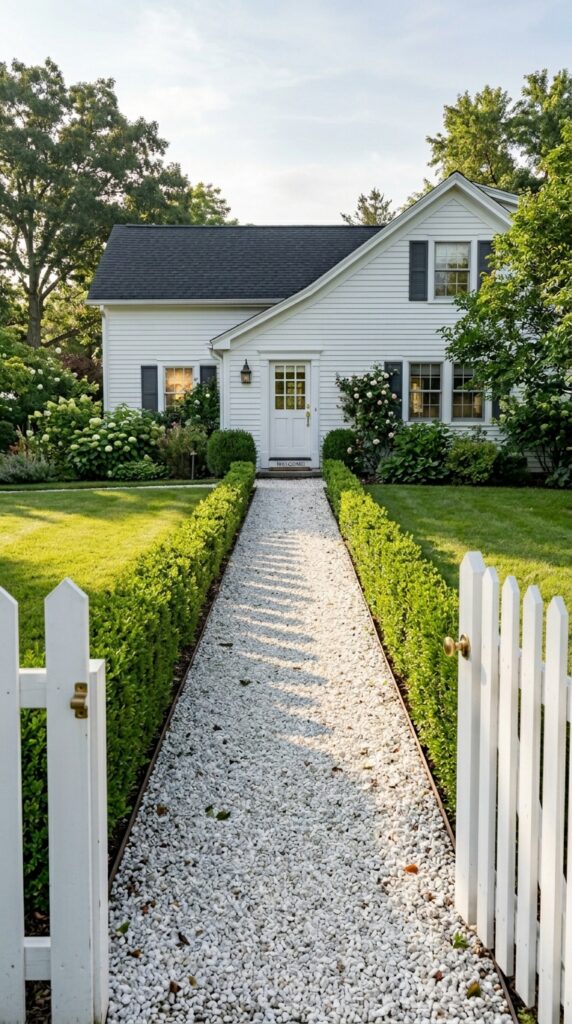
Vibe: Ordered. A boxwood-lined entry path transforms the approach to a farmhouse from a driveway crossing into an arrival experience.
Why it works: Flanking hedges on an entry path perform the same function as the colonnade on a wraparound porch — they create a visual corridor that directs movement, slows the approach, and frames the destination (the front door) as a significant endpoint. Boxwoods specifically have been the defining farmhouse landscape plant for several centuries because their tight, dark evergreen density provides year-round structure and their formal clipped form creates deliberate contrast with the relaxed, organic plantings typically found in farmhouse gardens. The gravel path rather than a paved one adds sound and texture to the approach — a sensory quality that pavers cannot replicate.
How to get it: Plant Buxus sempervirens ‘Suffruticosa’ (English dwarf boxwood) at 12-inch centers for a hedge that fills in within two growing seasons. Clip twice annually — once in late spring and once in early autumn — always with a guide string to keep the top level. Use melt-in polymeric sand or compacted crushed granite rather than pea gravel for the path surface, which stays put underfoot rather than scattering.
🛍️ Shop the Look — Amazon Product Ideas
| # | Product Search Phrase | Why It Fits |
| 1 | dwarf English boxwood live plant 1 gallon set of 6 | Hedge-forming shrub |
| 2 | white granite crushed gravel 50lb landscape | Entry path surface |
| 3 | black steel landscape edging path border | Path edge definition |
| 4 | hedge shears manual long handle | Boxwood clipping tool |
| 5 | white picket gate wood exterior | Entry path anchor point |
9. Lantern-Style Porch Lighting in Aged Bronze
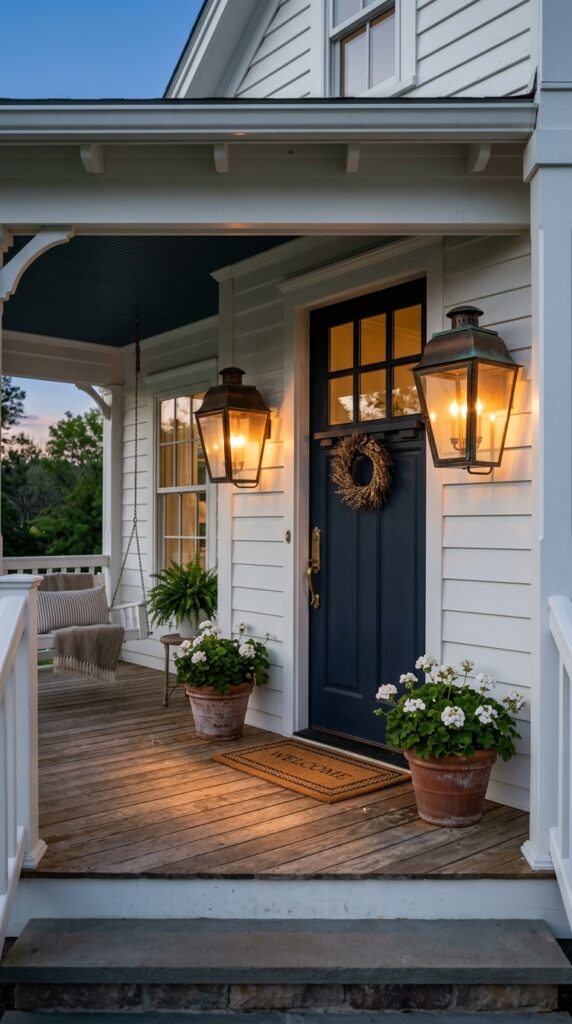
Vibe: Welcoming. Aged bronze lanterns at dusk make a farmhouse porch look like it has been glowing at this hour for generations.
Why it works: Lantern-style porch lighting succeeds because it references its own historical function honestly — these are direct descendants of the oil lanterns that farmers hung beside their doors before electrification, and their form carries that reference in every curve and panel. Aged bronze (rather than matte black) introduces a warm metal tone that picks up the honey of cedar porch boards and the warm white of the facade in a way that a cool-tone metal never achieves. The oversized scale (20 inches versus the standard builder 12-inch fixture) creates a commanding presence that reads from the street rather than disappearing against the white facade.
How to get it: Mount lanterns at 65–68 inches above the porch threshold — this places the light source at eye level and prevents harsh downward shadow on anyone standing at the door. Choose a candelabra-style Edison bulb at 2200K for the most authentic amber glow, and wire to a dusk-to-dawn photocell so the lanterns operate automatically.
🛍️ Shop the Look — Amazon Product Ideas
| # | Product Search Phrase | Why It Fits |
| 1 | large farmhouse lantern sconce aged bronze 20 inch | Core porch lighting |
| 2 | Edison candelabra bulb warm 2200K outdoor | Authentic amber lamp tone |
| 3 | dusk to dawn outdoor light socket adapter | Automatic operation |
| 4 | white porch geranium potted pair | Below-lantern planting |
| 5 | porch ceiling paint Hague Blue quart | Classic porch ceiling detail |
10. Sage Green Exterior with White Trim and Black Hardware
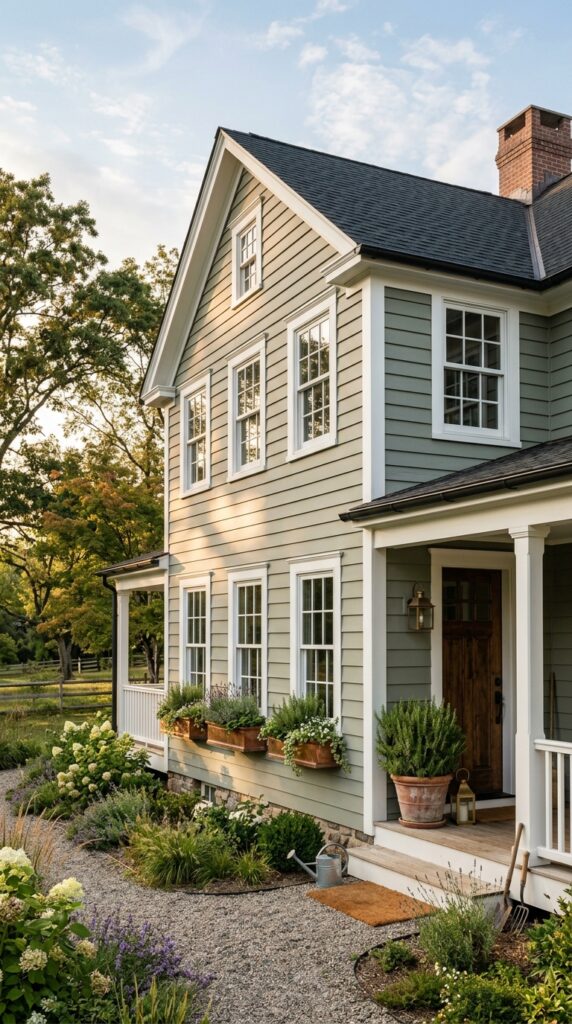
Vibe: Botanical. Sage green on a farmhouse exterior looks like the landscape itself decided to extend onto the walls.
Why it works: Sage green is the one departure from white that the farmhouse exterior accepts without losing its essential character, because sage reads as natural rather than decorative — it belongs to the same color family as the fields, gardens, and tree lines that surround traditional farmhouses. The grey undertone in muted sage (as opposed to a pure garden green) prevents it from reading as bright or summery in winter light, keeping it grounded year-round. White trim at 5-inch width creates the geometric crispness that differentiates a painted farmhouse from a simple painted house.
How to get it: Test sage paint samples across morning, midday, and evening light before committing — sage is among the most light-sensitive exterior colors, reading warm grey in overcast conditions and distinctly green in direct sun. Farrow & Ball Mizzle, Sage, and Lichen are three that behave predictably across conditions. Apply two coats of exterior 100% acrylic over a grey tinted primer that is within 2–3 shades of the final color.
🛍️ Shop the Look — Amazon Product Ideas
| # | Product Search Phrase | Why It Fits |
| 1 | exterior paint sage green matte farmhouse | Core facade color |
| 2 | white corner board trim exterior PVC 5 inch | Wide trim profile |
| 3 | matte black door hinge set exterior | Hardware accent detail |
| 4 | copper window box planter 30 inch | Warm metal plant container |
| 5 | rosemary topiary standard large outdoor | Entry botanical statement |
11. Wooden Dutch Door Painted in Deep Navy
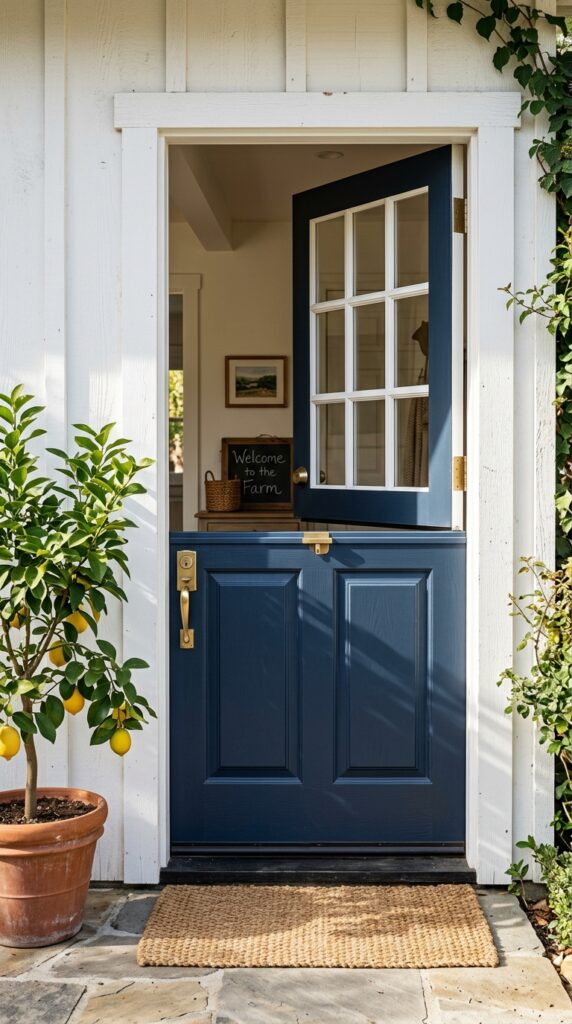
Vibe: Characterful. A Dutch door is the rare exterior feature that makes strangers smile before they’ve even knocked.
Why it works: The Dutch door’s split design is one of the most historically authentic farmhouse elements available — originally designed so the bottom could stay closed against livestock while the top remained open for ventilation and light, they pre-date glass windows as standard farmhouse features. The functional logic is gone, but the character remains: the open top half creates a layered depth to the entry composition that no solid door can match, and the horizontal split introduces a strong design line at mid-door height. Deep navy on the door creates a focused color accent that is bold enough to register as intentional without dominating the white facade.
How to get it: Specify solid wood (Douglas fir or white oak) for a Dutch door rather than fiberglass — the split rail mechanism requires precisely machined wood joinery that most fiberglass manufacturers don’t produce authentically. Apply two coats of exterior alkyd over a bonding primer, as alkyd provides a harder film than latex on a frequently touched surface like a door.
💡 Quick Win: A blackboard paint patch (about $12 per pint) applied to the inside panel of an existing Dutch door bottom half creates the chalk-message note space that defines the look immediately — no new door purchase required.
🛍️ Shop the Look — Amazon Product Ideas
| # | Product Search Phrase | Why It Fits |
| 1 | Dutch door exterior wood fiberglass navy | Core character entry element |
| 2 | brushed brass door latch thumb turn exterior | Period-authentic hardware |
| 3 | small lemon tree potted outdoor | Entry courtyard plant accent |
| 4 | jute doormat natural fiber outdoor | Textural threshold layer |
| 5 | chalk blackboard paint pint small project | Door panel chalkboard detail |
12. Corrugated Metal Wainscoting at Porch Base
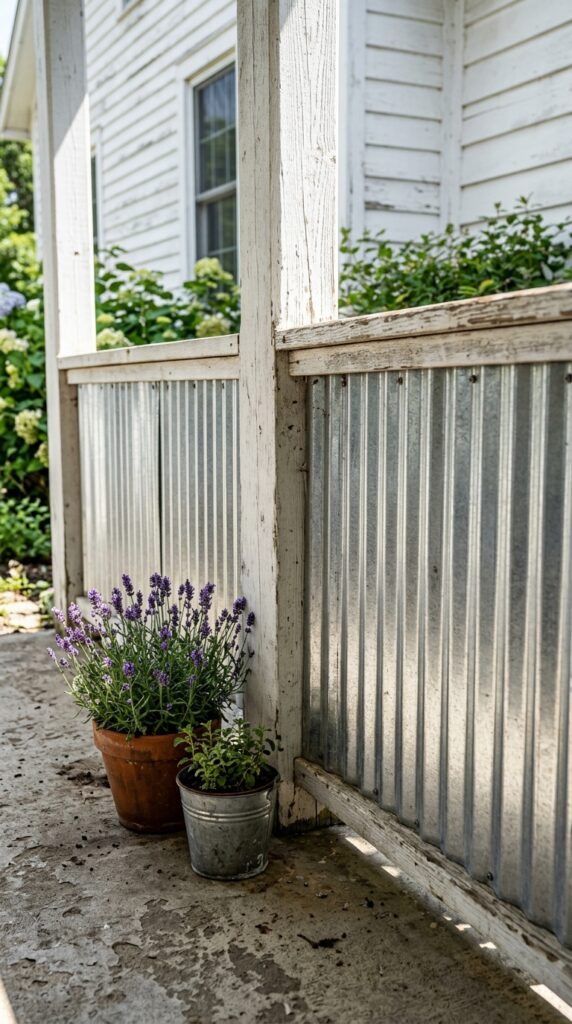
Vibe: Industrial-agricultural. Corrugated metal at the porch base grounds a farmhouse in the working landscape it came from.
Why it works: Corrugated steel panels used as porch skirt wainscoting are a material reference to the agricultural buildings — barns, grain stores, tool sheds — that surrounded original American farmhouses. Deploying the material on the porch base brings that visual vocabulary into the domestic space in a way that reads as contextually honest rather than decorative. The ribbed surface also creates strong shadow lines in direct sun that add textural depth at a level of the porch (the base, often ignored) where most designers apply nothing more interesting than lattice.
How to get it: Use standard 26-gauge corrugated roofing panels cut to wainscot height with aviation snips — panels cut cleanly and the raw edge can be concealed under a wood cap rail. Fasten with self-tapping hex head screws through the panel ridges into a pressure-treated nailer board attached between the porch posts. Leave a 1/4-inch gap at the bottom above the porch floor for drainage.
🛍️ Shop the Look — Amazon Product Ideas
| # | Product Search Phrase | Why It Fits |
| 1 | corrugated metal roofing panel galvanized 26 gauge | Core wainscoting material |
| 2 | self tapping hex head screws metal roof | Panel fastener |
| 3 | galvanized bucket planter small set of 3 | Material-matching plant container |
| 4 | lavender plant 1 gallon outdoor perennial | Porch base fragrant planting |
| 5 | white porch cap rail board 1×4 | Wainscot top edge trim |
13. Climbing Roses on a White Trellis Panel
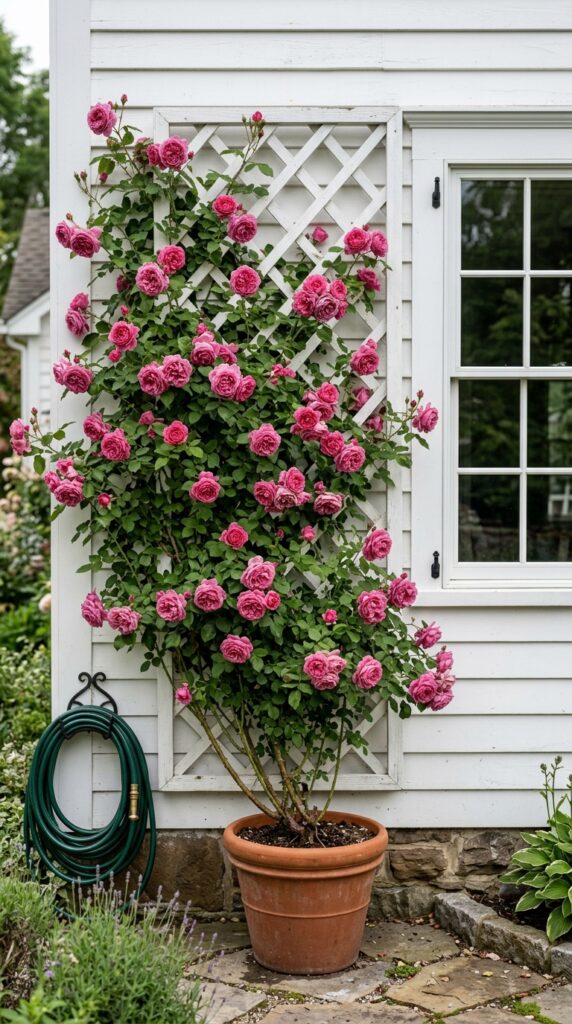
Vibe: Romantic. A climbing rose on a farmhouse facade is the image that every farmhouse exterior aspires to become.
Why it works: Climbing roses on a trellis add the one design element that no manufactured material can replicate: seasonal progression. The same wall carries bare canes in winter, full leaf in spring, heavy bloom in early summer, and colored hips in autumn — four completely different visual experiences from one planted element. Against a white wall, deep or dusty pink rose varieties (David Austin’s Gertrude Jekyll or Constance Spry are farmhouse classics) create a color register that falls perfectly between the warm and cool tones already present in a white-and-black farmhouse palette.
How to get it: Mount trellis panels 1 inch off the wall surface using standoff spacers — air circulation behind the canes is essential for black spot prevention on roses. Anchor the trellis at top and bottom into structural studs, not siding alone — a mature climbing rose in full leaf generates significant wind resistance. Feed with a high-potassium fertilizer (rose-specific granular) in early spring and again after first flush to sustain bloom.
🛍️ Shop the Look — Amazon Product Ideas
| # | Product Search Phrase | Why It Fits |
| 1 | white wood trellis panel diamond grid 4×8 | Core climbing structure |
| 2 | David Austin climbing rose live plant bare root | Farmhouse-classic rose variety |
| 3 | trellis wall standoff spacer kit | Air circulation mounting |
| 4 | rose granular fertilizer organic high potassium | Long-season bloom feeding |
| 5 | black garden hose holder wall mount | Neat base-of-wall detail |
14. Chip-and-Seal Driveway in Warm Tan
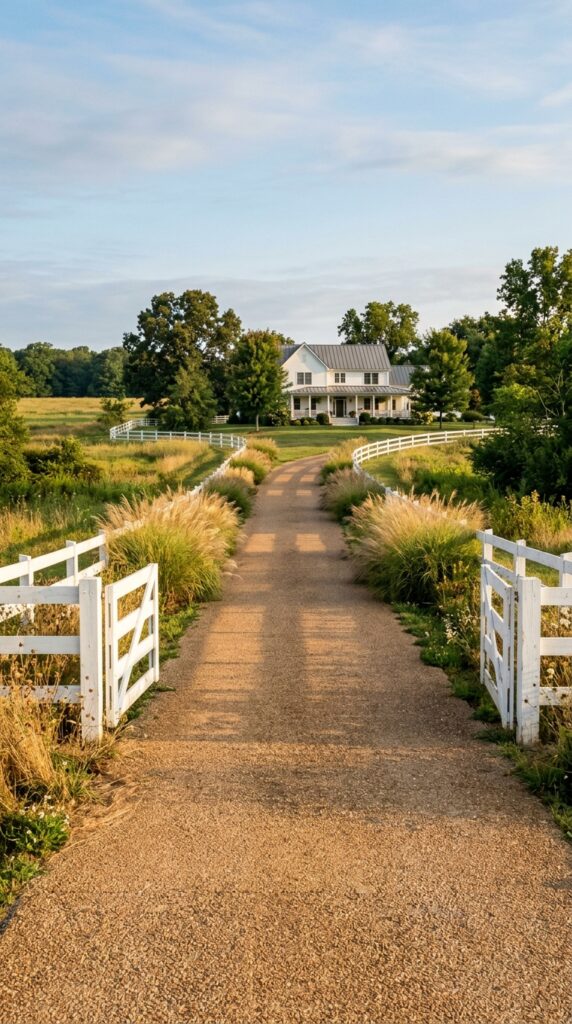
Vibe: Rural. A long chip-and-seal drive tells the story of a home before you’ve even arrived at it.
Why it works: Chip-and-seal is the most authentic driveway material for a farmhouse exterior because it is exactly how working farm driveways were finished throughout the mid-20th century — tar-and-chip (also called macadam) provided a durable, dust-free surface without the cost or formality of concrete. The warm tan aggregate tone sits naturally in any landscape, complementing both the green lawn and the white fence without the cold grey severity of asphalt or the formal crispness of concrete. The slight texture and tonal variation also prevents the driveway from reading as a hardscaped area — it retains an organic quality appropriate to the agricultural context.
How to get it: Specify the warmest available aggregate color from your regional chip-and-seal contractor — tans, creams, and pinkish gravel tones all work; avoid grey limestone aggregate which reads cold. Edge the drive with a treated timber or steel edge strip to maintain the line as the surface settles.
🛍️ Shop the Look — Amazon Product Ideas
| # | Product Search Phrase | Why It Fits |
| 1 | landscape edging timber treated driveway border | Drive edge definition |
| 2 | white split rail fence post and rail kit | Driveway flanking structure |
| 3 | ornamental grass miscanthus large outdoor | Fence base softening plant |
| 4 | driveway sealer chip and seal repair | Surface maintenance material |
| 5 | driveway reflector post white farmhouse style | Rural safety accent |
15. Large Farmhouse Numbers in Matte Black
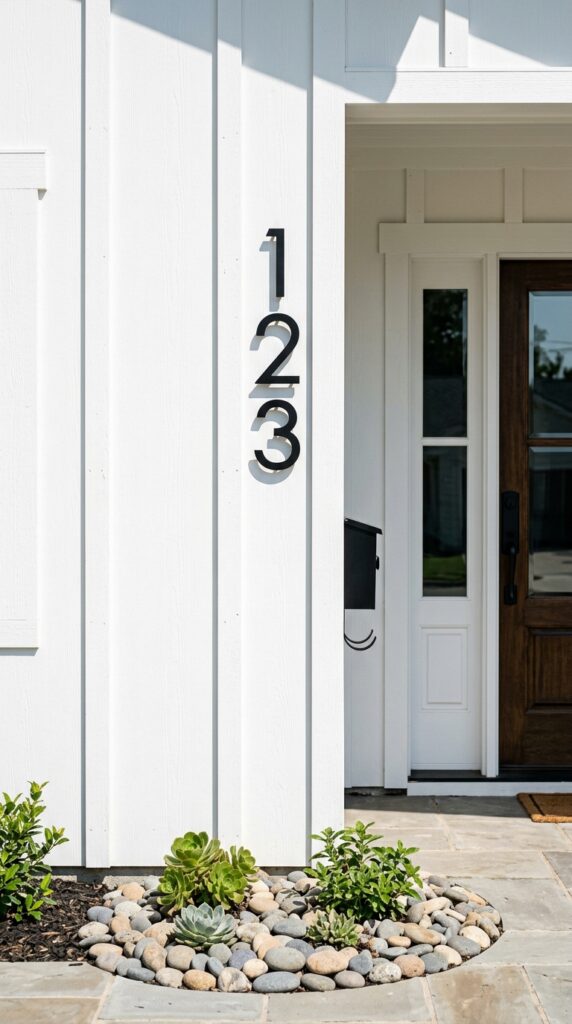
Vibe: Graphic. The right house numbers make a farmhouse exterior feel resolved — the last element that locks the composition in place.
Why it works: House numbers function as the exterior equivalent of a monogram — they are the only typographic element on a facade, and their scale, style, and finish have an outsized effect on the impression the whole exterior makes. Oversized numbers (5 inches or larger) mounted with standoffs create depth by casting a clean shadow on the wall behind them, giving a flat surface a dimensional quality. On a white farmhouse, matte black numbers in a simple sans-serif read as a bold design choice rather than a code-compliance afterthought.
How to get it: Mount numbers using a standoff of at least 1/2 inch — this is the depth that creates the defined shadow. Drill into a stud or use exterior-rated masonry anchors; the weight of metal numbers on standoffs applies significant leverage at the wall point. Space multi-digit numbers so the gap between digits equals one digit’s width — tighter or looser spacing reads as careless.
💡 Quick Win: A set of three or four matte black standoff house numbers (typically $8–$15 each) can be installed in under an hour and transformed a builder-grade facade into a farmhouse-intentional one for under $50 total.
🛍️ Shop the Look — Amazon Product Ideas
| # | Product Search Phrase | Why It Fits |
| 1 | large house numbers matte black standoff 5 inch | Core address typography |
| 2 | matte black mailbox wall mount modern | Matching metal element |
| 3 | exterior masonry anchor screw set | Secure facade mounting |
| 4 | river stone decorative landscape pebble | Number base planting ring |
| 5 | exterior level small torpedo for mounting | Accurate number alignment |
16. Window Boxes Overflowing with Trailing Vines
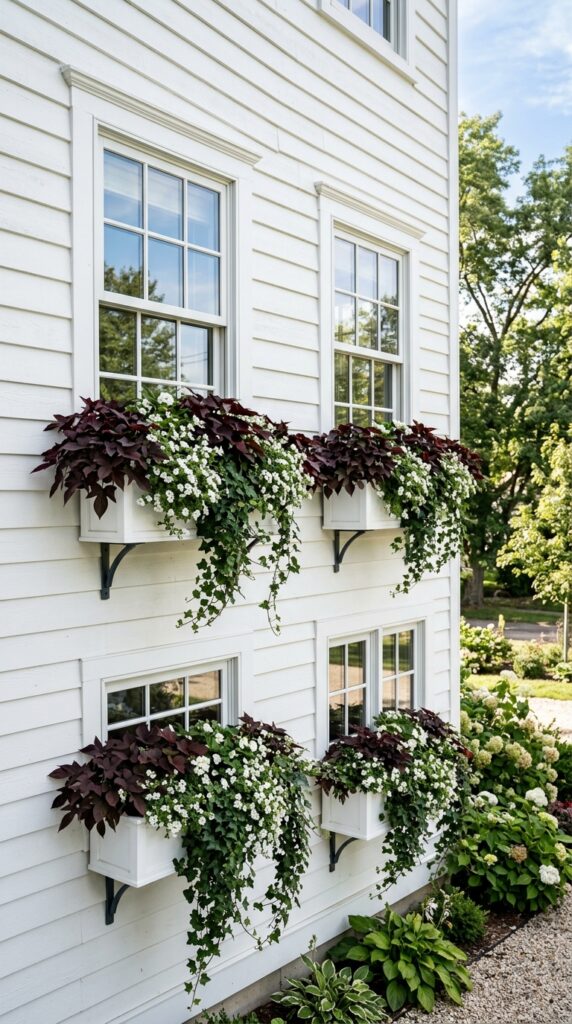
Vibe: Garden-soft. Window boxes are the farmhouse exterior detail that makes a house look like it is being actively loved.
Why it works: Window boxes perform a softening function at the facade’s most architecturally active zone — the windows — by introducing organic, trailing forms that contrast with the geometric rigidity of the sash and trim. Trailing plants specifically (sweet potato vine, bacopa, lobelia) provide vertical movement downward from the box, which visually connects the window zone to the ground and prevents the mid-wall treatment from reading as a floating decoration. The full coverage achieved by a well-planted box (as opposed to three sparse upright plants) creates the impression of abundance that is central to the farmhouse aesthetic.
How to get it: Plant window boxes in a “thriller, filler, spiller” combination: one upright structural plant (a small ornamental grass or spike plant) at the center, mounding plants (bacopa, alyssum) filling the box depth, and trailing plants (sweet potato vine, ivy) spilling forward and downward. Water daily in summer — window boxes dry out faster than ground plantings due to sun exposure and limited soil volume.
🛍️ Shop the Look — Amazon Product Ideas
| # | Product Search Phrase | Why It Fits |
| 1 | white wood window box 30 inch with brackets | Core architectural planter |
| 2 | purple sweet potato vine live annual trailing | Deep cascade element |
| 3 | white bacopa live annual filler plant | White bloom gap fill |
| 4 | window box self-watering liner insert | Moisture-retaining liner |
| 5 | painted steel window box bracket set white | Flush-mount support hardware |
17. All-White Exterior with Varying Texture for Depth
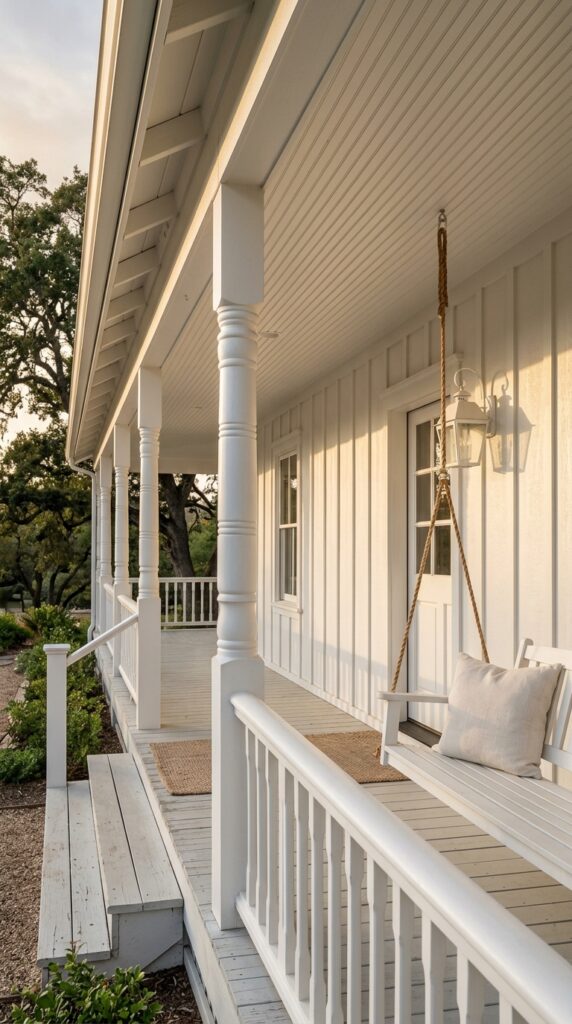
Vibe: Hushed. An all-white farmhouse exterior is the architectural equivalent of a quiet room — everything visible, nothing competing.
Why it works: A fully monochromatic white exterior succeeds by making shadow and texture do the work that color would normally do. The board-and-batten siding creates vertical shadow lines; the turned porch column creates horizontal rings of light and dark; the beadboard porch ceiling creates fine parallel channels that catch raking light in the morning and evening. All of these surfaces read as one unified composition in flat daylight and as a richly varied textural study in directional light — a palette that performs differently at every hour without changing a single paint color.
How to get it: Use the exact same paint color on every exterior surface — do not introduce a separate “trim white” or “accent white.” The visual depth comes entirely from texture and light; introducing a second white introduces a color-matching complexity that frequently fails in practice and contradicts the monochromatic premise. Benjamin Moore Chantilly Lace OC-65 is the most optically neutral white available and works across all surface types in the same batch.
🛍️ Shop the Look — Amazon Product Ideas
| # | Product Search Phrase | Why It Fits |
| 1 | exterior white paint Benjamin Moore Chantilly Lace | Primary monochromatic color |
| 2 | beadboard porch ceiling panels white primed | Textural ceiling element |
| 3 | turned porch column white PVC 8 foot | Profile texture contrast |
| 4 | white outdoor lantern large porch | Monochromatic lighting fixture |
| 5 | off-white outdoor porch swing cushion set | Tonal companion textile |
18. Gravel Garden Beds with Ornamental Grasses Along the Foundation
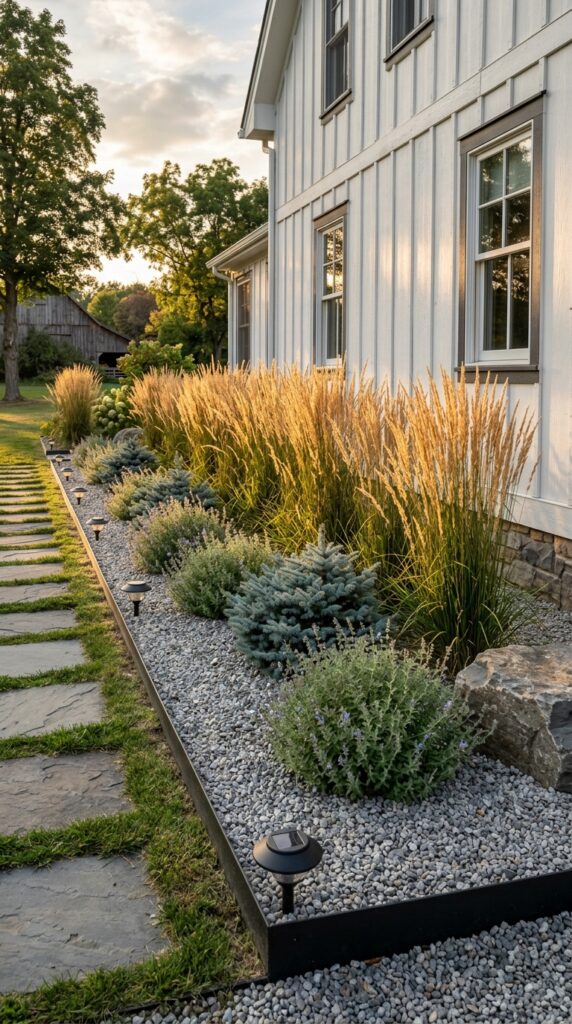
Vibe: Naturalistic. Ornamental grasses at a farmhouse foundation look like the landscape is leaning in toward the house.
Why it works: Foundation plantings define the visual base of any house, and for farmhouses the most appropriate plantings are those with agricultural associations — ornamental grasses specifically have both a visual connection to farm fields and a practical advantage of four-season interest, with summer green, autumn gold, and winter sculptural seed plume providing a continuously changing tableau. The gravel mulch bed (rather than wood chip) reads cleaner and more intentional, coordinates with a light-colored aggregate driveway, and resists the visual decay that occurs when organic mulch fades and compresses over a season.
How to get it: Plant ornamental grasses at a minimum of 36 inches from the foundation wall — they need air circulation and should not be in contact with siding as moisture accumulates where organic material meets a wall. Plant in odd-numbered groups (3 or 5) rather than single specimens for a naturalistic, mass-planted effect. Feather reed grass (Calamagrostis ‘Karl Foerster’) is the most reliable farmhouse-appropriate grass: vertical, well-behaved, winter-hardy, and reliably upright in wind.
🛍️ Shop the Look — Amazon Product Ideas
| # | Product Search Phrase | Why It Fits |
| 1 | Karl Foerster feather reed grass live plant 1 gallon | Core ornamental grass |
| 2 | light grey landscape gravel 50lb pea size | Foundation bed mulch |
| 3 | matte black steel landscape edging 4 inch | Bed definition edge |
| 4 | dwarf blue spruce live plant 1 gallon | Structural evergreen anchor |
| 5 | solar garden light stake warm white set of 4 | Low foundation bed lighting |
19. Exposed Wood Beam Porch Ceiling in Natural Cedar
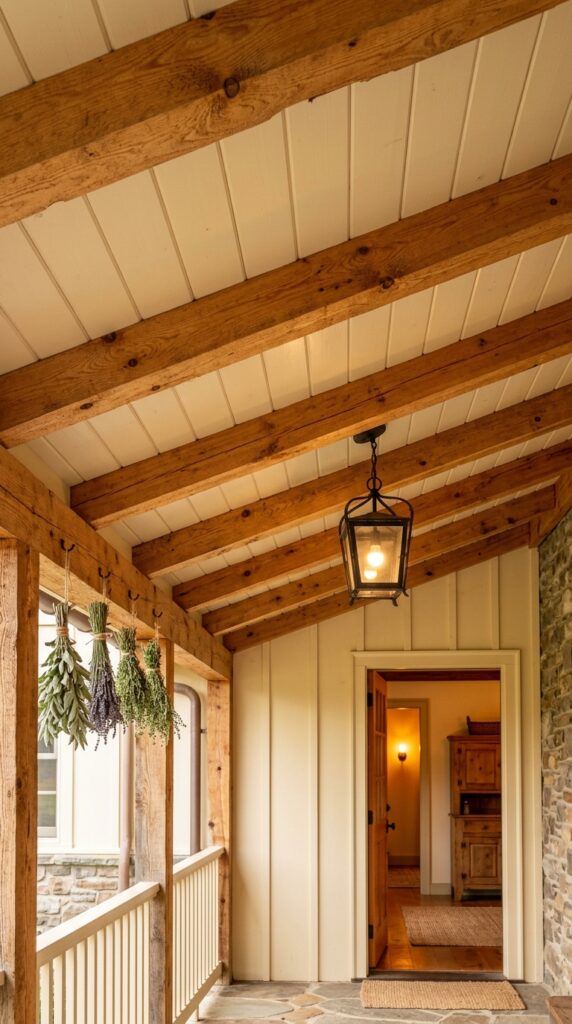
Vibe: Crafted. An exposed beam porch ceiling turns a space people pass under into one they stop and look up at.
Why it works: The porch ceiling is the one overhead surface in any home that is experienced at very close range from multiple angles — sitting, standing, approaching — and is thus more impactful as a design surface than most people realize. Exposed rough-sawn cedar beams create a coffered effect (the visual rhythm of structural members alternating with infill panels) that adds vertical depth to the ceiling plane and introduces a warm wood tone overhead. The classic porch ceiling color between beams is Haint Blue (a soft blue-grey historically believed to repel insects) or warm cream — both warm the light that bounces off the ceiling onto the porch occupants below.
How to get it: If your porch already has a flat plywood or drywall ceiling, apply faux beam wraps (hollow U-channel cedar) rather than structural beams — they achieve the identical visual effect at a fraction of the weight and cost. Secure to a nailing strip run along the ceiling before installation. Finish with exterior-grade polyurethane or tung oil rather than paint to preserve the natural grain.
🛍️ Shop the Look — Amazon Product Ideas
| # | Product Search Phrase | Why It Fits |
| 1 | cedar faux ceiling beam wrap hollow U-channel | Core ceiling beam detail |
| 2 | haint blue porch ceiling paint quart | Classic porch ceiling color |
| 3 | outdoor pendant lantern porch ceiling mount | Hanging ceiling fixture |
| 4 | dried herb bundle lavender eucalyptus wreath | Beam-hanging aromatic detail |
| 5 | tongue and groove porch ceiling boards primed | Infill ceiling panel boards |
20. Charcoal Farmhouse with Bright White Trim Reversal
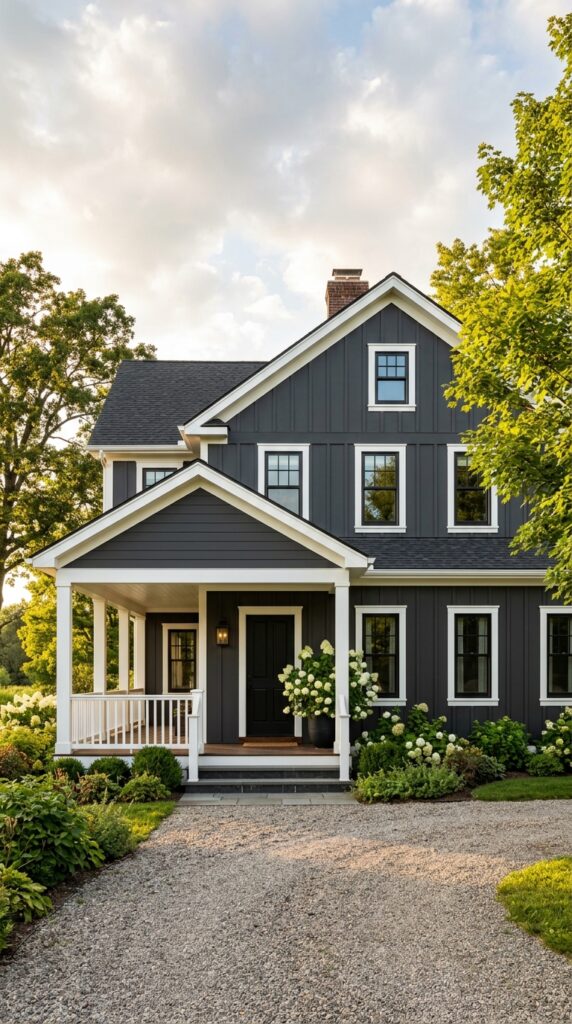
Vibe: Refined. A charcoal farmhouse is the traditional palette inverted — and it rewards every second of attention it asks for.
Why it works: Reversing the standard farmhouse color logic (white body, dark trim) to dark body with white trim creates the same high-contrast architectural geometry as the classic version but with a completely different spatial effect. Where white facades read as light and advancing, dark facades recede — making the farmhouse look embedded in its landscape rather than sitting above it. The white trim elements, now read as line drawings on a dark ground, appear almost to float independently — columns, window surrounds, and railings all become graphic elements in a way that the classic palette distributes less dramatically.
How to get it: For dark exteriors, use a foundation coat of oil-based primer before applying water-borne topcoats — dark water-based colors have a tendency to show lap marks more visibly than light ones, and an oil primer creates a more even absorption base. Sherwin-Williams Caviar SW6990 or Benjamin Moore Black Panther 2125-10 are both warm-toned charcoals that avoid the blue-black reading that can make a dark facade look cold.
🛍️ Shop the Look — Amazon Product Ideas
| # | Product Search Phrase | Why It Fits |
| 1 | deep charcoal exterior paint board and batten | Dark body siding color |
| 2 | bright white exterior trim paint semi-gloss | High-contrast trim element |
| 3 | white hydrangea live plant large outdoor | Bright bloom against dark siding |
| 4 | black square planter large outdoor set of 2 | Material-matching container |
| 5 | oil-based exterior primer dark color base | Lap-mark prevention primer |
21. Stone Veneer Foundation Skirt
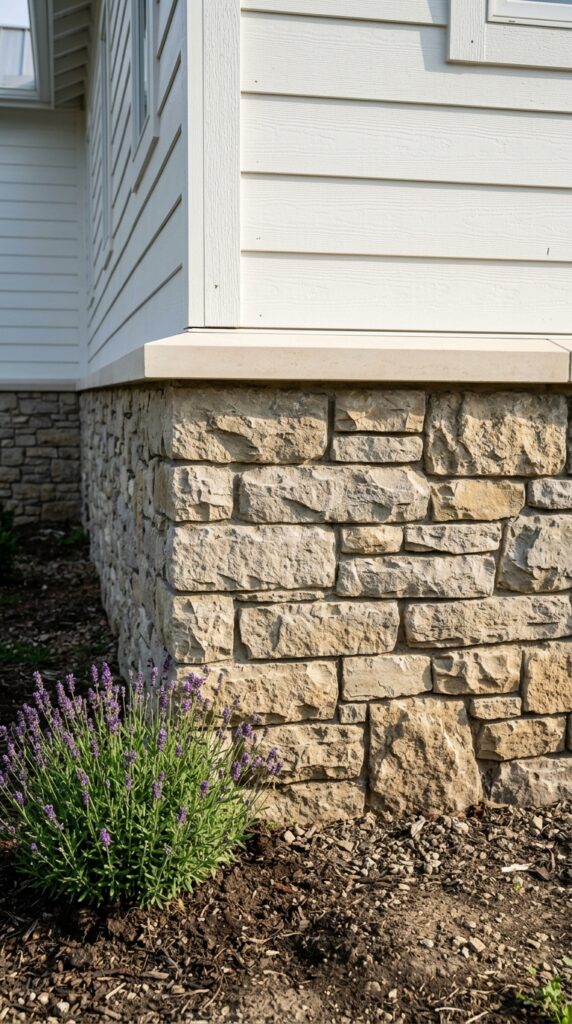
Vibe: Heavy. A stone foundation skirt gives a farmhouse the visual weight to look like it has been standing in that same field for 150 years.
Why it works: Stone at the foundation base addresses the visual problem that most residential construction creates: the house appears to float above the ground on a thin concrete stem wall, which undermines the sense of permanence and rootedness that a farmhouse should convey. A stone veneer skirt — even 18–24 inches high — visually grounds the structure, connecting it to the earth in a way that paint alone cannot. The material contrast between rough stone and smooth painted siding also creates a material hierarchy that mirrors how traditional farmhouses were actually built — stone or brick below, wood above — maintaining the style’s inherent architectural logic.
How to get it: Use a natural stone veneer product (not cast concrete) for a foundation skirt — at 18–24 inches of height, even a small variation in artificial casting texture becomes visible, whereas natural stone’s genuine variation reads as authentic regardless of viewing distance. Install with a Type S mortar mix and a 1/2-inch galvanized lath substrate fastened to the stem wall.
💡 Quick Win: Dry-stack stone veneer panels (interlocking modular units that mimic hand-laid stone) available for under $6 per square foot at most home centers allow a complete 20-linear-foot foundation skirt for under $300 in materials — achievable in a weekend for a confident DIYer.
🛍️ Shop the Look — Amazon Product Ideas
| # | Product Search Phrase | Why It Fits |
| 1 | natural stone veneer panel dry stack limestone | Core foundation material |
| 2 | Type S mortar mix exterior stone installation | Stone veneer adhesive |
| 3 | galvanized metal lath roll exterior | Substrate for veneer |
| 4 | stone cap rail natural flat limestone | Top edge cap for skirt |
| 5 | lavender plant live perennial 1 gallon | Stone base fragrant planting |
22. Navy Blue as an Accent on the Porch Ceiling Only
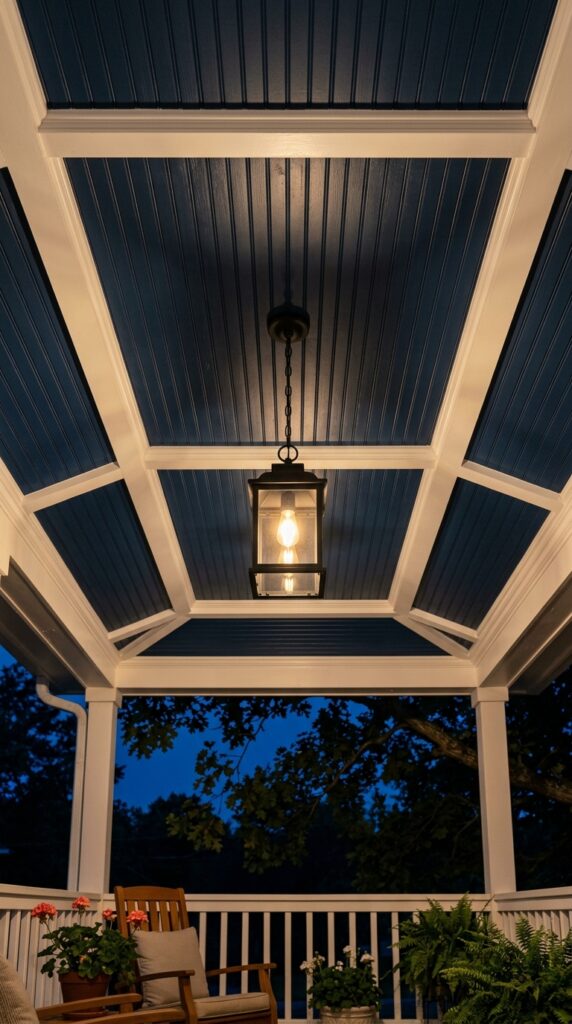
Vibe: Intimate. A dark-painted porch ceiling compresses the space above you into something that feels like shelter rather than simply overhead.
Why it works: Painting the porch ceiling in a deep navy or Hague Blue does two things simultaneously: it visually lowers the perceived ceiling height to create the intimate, sheltered feeling that a white ceiling cannot achieve, and it introduces a strong color accent that is seen only by those actually on the porch — it reads as a private, interior-scale gesture rather than a public architectural statement. Deep blue porch ceilings also have a long American farmhouse tradition as “haint blue,” a color historically painted on porch ceilings across the South to repel insects (the folklore was that wasps mistake blue for sky and don’t build nests). The tradition is largely false, but the color choice is genuinely effective.
How to get it: Apply the ceiling color to the underside of the porch ceiling only, stopping at the fascia board at the porch edge. Use an interior-grade exterior enamel (not flat exterior paint) for a ceiling surface — the slight sheen resists moisture better in an outdoor-adjacent space while maintaining a clean, non-reflective look.
🛍️ Shop the Look — Amazon Product Ideas
| # | Product Search Phrase | Why It Fits |
| 1 | exterior haint blue porch ceiling paint navy | Core ceiling color |
| 2 | black outdoor pendant lantern ceiling mount | Dark contrast hanging fixture |
| 3 | beadboard porch ceiling panel white primed | Textured ceiling surface |
| 4 | exterior ceiling paint brush 4 inch angled | Ceiling application brush |
| 5 | porch ceiling fan with light black farmhouse | Functional ceiling piece |
23. White Picket Fence with a Flared Post Cap
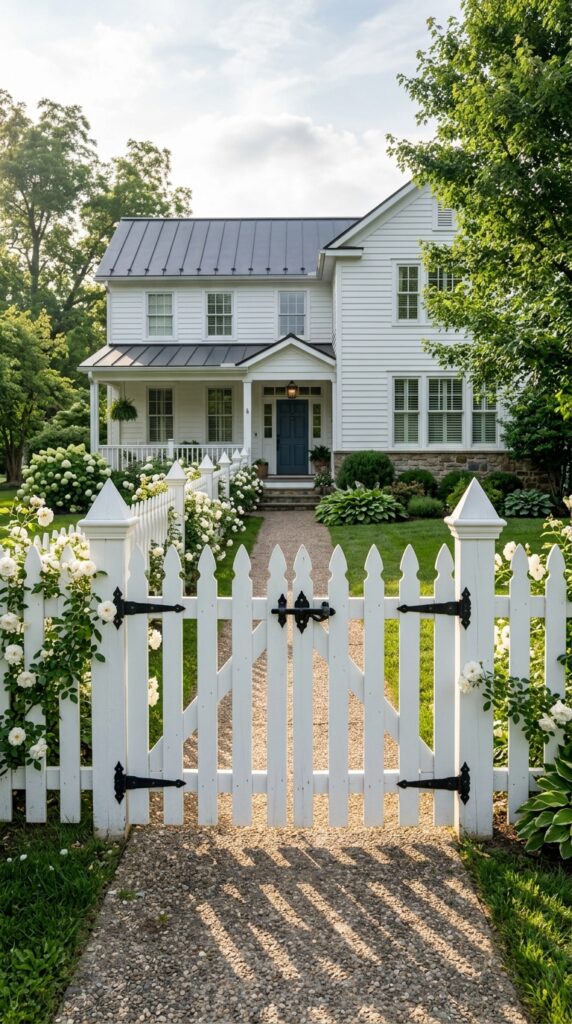
Vibe: Classic. A white picket fence is not a design choice — it is a declaration about what kind of home this is.
Why it works: The white picket fence is the most culturally loaded element in American residential design — it is simultaneously a functional enclosure, a property marker, and a symbol of a particular vision of domestic life. As a farmhouse curb appeal element, it functions most effectively when it reinforces the front entry sequence rather than simply marking a property boundary. A gate centered on the primary entry path creates a point of arrival before the front door, giving visitors the experience of entering an outer and then an inner precinct — a spatial layering that makes even a modest farmhouse feel considered and complete.
How to get it: Use cellular PVC pickets rather than wood — dimensional stability in moisture means no twisting, checking, or repainting for 20–30 years. All PVC is paintable and takes a standard exterior latex well. Set posts in concrete at 36-inch depth and space at 8 feet on center maximum; closer spacing for a shorter fence.
🛍️ Shop the Look — Amazon Product Ideas
| # | Product Search Phrase | Why It Fits |
| 1 | white PVC picket fence panel with posts 4 foot | Core perimeter fence element |
| 2 | decorative pyramid fence post cap PVC white | Distinctive post topper |
| 3 | black gate latch handle exterior hardware | Fence gate hardware detail |
| 4 | climbing rose iceberg white live plant | Fence-trained white bloom |
| 5 | fence post concrete fast set 50lb bag | Post setting material |
24. Galvanized Steel Planters Flanking the Entry Steps
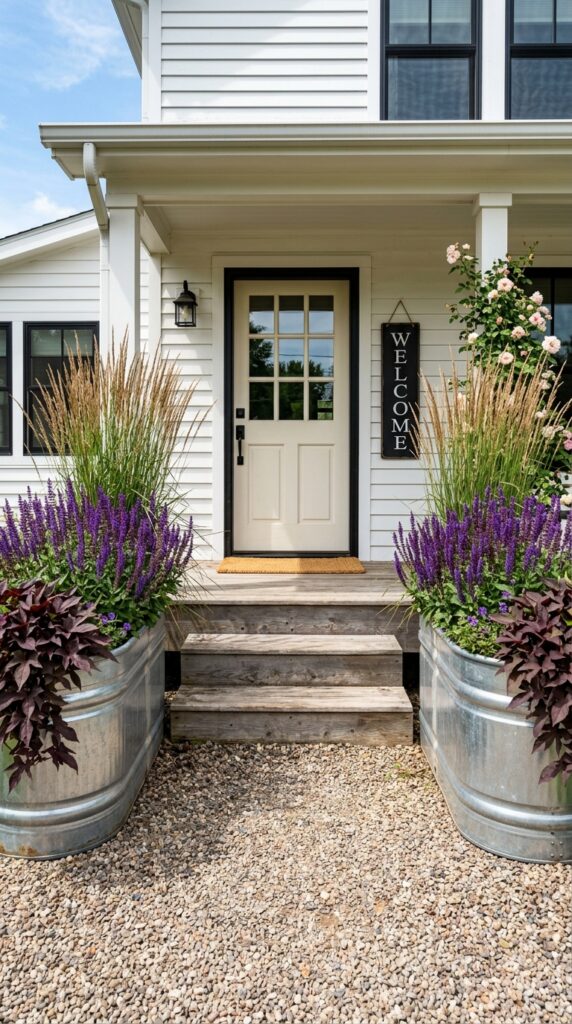
Vibe: Industrial-farmhouse. Galvanized steel planters make a farmhouse entry feel like it belongs to someone who actually knows what they’re growing.
Why it works: Galvanized steel as a planter material introduces the agricultural working vocabulary — feed troughs, stock water tanks, equipment hardware — directly into the entry experience in a way that reads as both practical and stylistically confident. Unlike ceramic or terracotta planters, galvanized steel never looks like it has been chosen to coordinate; it looks like it has been repurposed from something useful, which is entirely in keeping with the farmhouse philosophy of honest materiality. The silver-grey metal tone also bridges the warm white of the facade and the warm green of the planting without requiring a specific color match.
How to get it: Drill five to seven 1/2-inch drainage holes in the bottom of any galvanized planter before planting — the metal is thick enough to require a step drill bit rather than standard drill. Line with a coconut fiber liner to slow the natural zinc leaching that can inhibit root growth in direct-contact soil. Galvanized planters age beautifully — the surface develops a matte, slightly cloudy patina that actually improves the look over two to three seasons.
🛍️ Shop the Look — Amazon Product Ideas
| # | Product Search Phrase | Why It Fits |
| 1 | galvanized steel trough planter large 24 inch | Core entry planter form |
| 2 | coconut coir liner rectangular planter box | Planter drainage liner |
| 3 | purple salvia live annual tall garden | Bold upright color element |
| 4 | step drill bit set metal drilling | Drainage hole tool |
| 5 | black welcome sign matte farmhouse entry | Entry greeting detail |
25. Craftsman-Inspired Knee Braces Under the Porch Eave
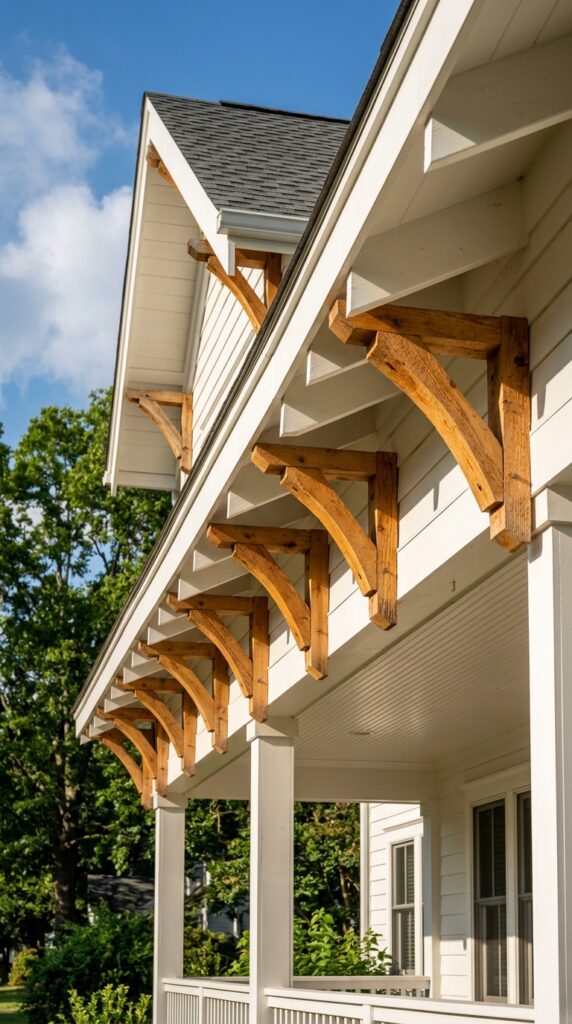
Vibe: Crafted. Knee braces at a porch eave are the detail that separates a house someone built from a house someone designed.
Why it works: Knee braces (also called rafter tail brackets) perform the same architectural function as corbels on interior cabinetry — they imply structural support at a transition point, adding visual weight and craft to a junction that would otherwise be an abrupt termination. The Craftsman design movement popularized them in American architecture in the early 20th century as farmhouse design and Craftsman bungalow design overlapped significantly in that period, so the detail is both historically authentic and visually appropriate. At the eave line, they break up the continuous horizontal fascia board into a series of smaller, more humanly-scaled intervals that give the porch’s overhead edge a composed, authored quality.
How to get it: Template knee braces from 2×8 cedar using a jigsaw — a simple right triangle with a single notch cut at the wall end creates a convincing Craftsman profile without requiring a CNC router. Attach to the rafter tail and wall blocking with 3-inch structural screws and exterior construction adhesive. Paint to match fascia for a continuous eave composition, or leave natural cedar for a material contrast element.
💡 Quick Win: Pre-cut cedar knee brace brackets are available from specialty millwork suppliers and Amazon for $8–$15 each — a set of eight brackets for a standard 20-foot porch eave runs under $120 and installs in a single afternoon.
🛍️ Shop the Look — Amazon Product Ideas
| # | Product Search Phrase | Why It Fits |
| 1 | cedar knee brace bracket porch eave craftsman | Core eave detail element |
| 2 | exterior structural screw 3 inch stainless | Bracket fastening hardware |
| 3 | exterior construction adhesive clear weatherproof | Supplemental bond |
| 4 | porch fascia board cedar 1×8 | Eave fascia material |
| 5 | jigsaw blade wood clean cut set | Bracket profile cutting |
26. Oversized Lantern Post at the End of the Driveway
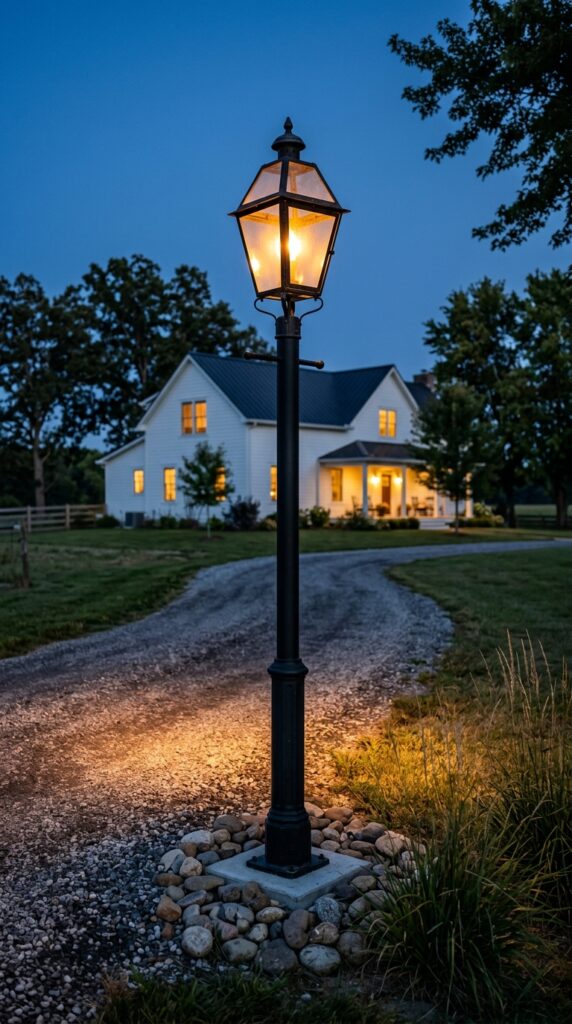
Vibe: Rural. A driveway lantern post tells guests they are arriving somewhere, not just parking somewhere.
Why it works: A post lantern at the driveway entry functions as an exterior welcome marker — it is the first light source a visitor encounters and it establishes the tone (warm, traditional, considered) before they even reach the house. The scale relationship between an 8-foot lantern post and the farmhouse beyond creates a perspective sequence that makes the home appear to recede pleasantly into its landscape, while the warm amber glow creates a welcoming directional signal visible from the street. Architecturally, the post lantern also provides the outdoor equivalent of an “address” — even in daylight its upright form marks the entry point clearly.
How to get it: Choose a solar-powered post lantern rated for 8-hour battery life with a photocell that activates automatically at dusk — this eliminates the need for underground wiring entirely. Mount on a 4×4 pressure-treated post set 24 inches in concrete, or use a decorative cast aluminum post sleeve over an existing post. Ensure the lantern head is rated IP65 or higher for direct rain exposure.
🛍️ Shop the Look — Amazon Product Ideas
| # | Product Search Phrase | Why It Fits |
| 1 | black post lantern solar outdoor 8 foot carriage style | Core driveway entry light |
| 2 | cast iron post sleeve decorative black | Post cover for visual weight |
| 3 | river stone landscape pebble bag | Lantern base concealment |
| 4 | 4×4 post cap black pyramid decorative | Post top finishing detail |
| 5 | post anchor bracket ground mount concrete | Stable post installation base |
27. Matte Black Hardware Cohesion Across the Whole Exterior
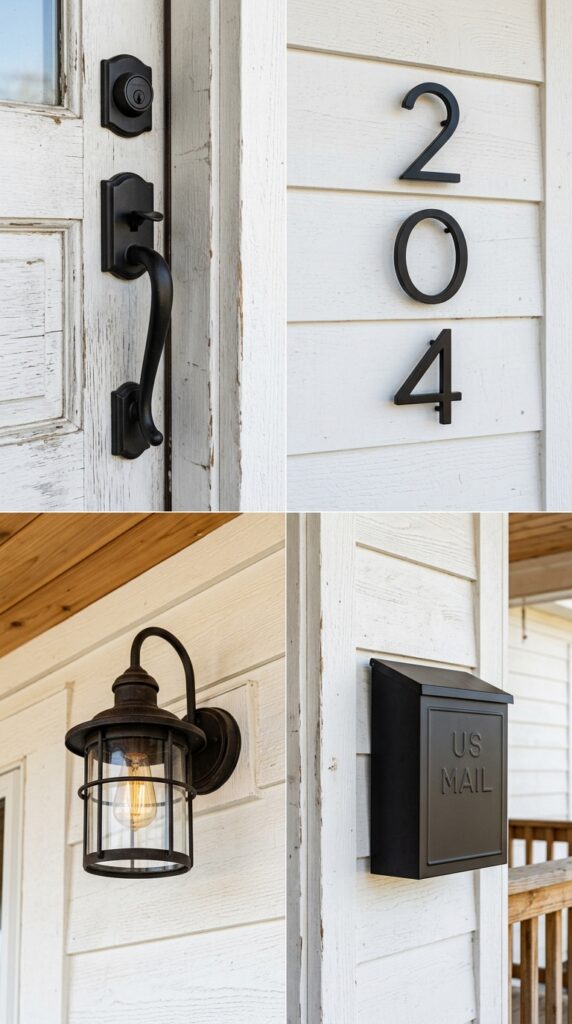
Vibe: Composed. Consistent matte black hardware across an entire farmhouse exterior is the design equivalent of a sentence with no typos.
Why it works: Exterior hardware cohesion is the most under-rated curb appeal principle: a farmhouse where the door handle, house numbers, light fixtures, mailbox, shutter hardware, and kickplate all match in both color and finish reads as intentionally designed rather than assembled over time. Matte black is the correct finish for a farmhouse (not satin, not oil-rubbed bronze, not antique brass) because it is the most neutral warm-dark finish available — it recedes against white without disappearing, and it does not carry the period-specific connotations of brass or the informal quality of nickel.
How to get it: Audit every piece of exterior hardware before purchasing new items — measure the current finish of your existing fixtures and decide whether to replace them all to match, or spray-paint the existing ones with a metal primer and a matte black Rustoleum spray paint ($6–$8 per can) for a unified appearance. Spray-painted hardware reads identical to purchased matte black hardware from normal viewing distance.
🛍️ Shop the Look — Amazon Product Ideas
| # | Product Search Phrase | Why It Fits |
| 1 | matte black exterior door handle set heavy duty | Primary entry hardware |
| 2 | matte black exterior mailbox wall mount | Address point hardware |
| 3 | matte black house number set 5 inch standoff | Typography hardware |
| 4 | matte black porch light fixture outdoor | Lighting hardware match |
| 5 | Rustoleum matte black spray paint metal | Hardware unification tool |
28. Asymmetric Porch Addition to a Simple Ranch Farmhouse
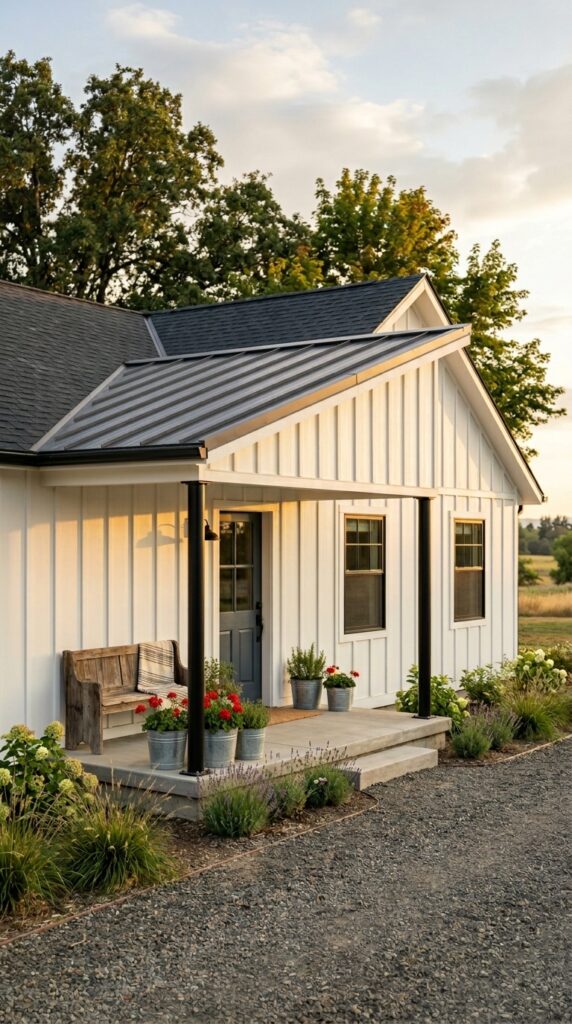
Vibe: Characterful. An asymmetric porch addition gives a plain ranch farmhouse its own personality — without apology.
Why it works: Ranch-style farmhouses (single-story, horizontal, minimal detailing) have strong bones but weak curb appeal because their flat, unbroken facades lack the vertical rhythm and layered depth of two-story farmhouses. Adding an asymmetric covered porch entry resolves both problems simultaneously: it introduces vertical elements (columns, shed roof line) and creates a layered depth (porch plane in front of wall plane) that gives the facade the visual complexity it was missing. Asymmetric placement — offset from center — is specifically more dynamic than a centered addition, which would read as a formal portico and contradict the informal farmhouse character.
How to get it: A shed-roof porch addition requires a ledger board bolted into the house rim joist at the existing wall and a beam supported by two columns at the outer edge. Black steel columns (available as structural tubular steel painted matte black) are more authentically rural than turned wood columns on a modern shed-roof porch addition — the material contrast between steel and white siding creates a satisfying industrial-farmhouse tension.
💡 Quick Win: Before any construction, mock up the porch addition using wooden stakes and a tarp draped at shed-roof pitch. Stand at the street and look at the facade with the mock-up in place for 48 hours across different light conditions — this $20 investment prevents $8,000 of buyer’s remorse.
🛍️ Shop the Look — Amazon Product Ideas
| # | Product Search Phrase | Why It Fits |
| 1 | black steel round column exterior structural 8 foot | Modern farmhouse porch post |
| 2 | standing seam shed roof metal panel charcoal | Addition roof material |
| 3 | wooden outdoor bench natural finish 48 inch | Porch seating element |
| 4 | ledger board hanger joist bracket structural | Porch framing hardware |
| 5 | galvanized bucket planter medium set of 2 | Industrial entry planters |
How to Start Your Farmhouse Exterior Transformation
The single first move is this: paint your front door matte black. Not the whole house, not the trim, just the door. A matte black front door against any existing siding — white, cream, grey, even beige — creates an immediate focal point that reads as farmhouse regardless of every other element around it. This one change orients the whole facade around a clear visual anchor, which makes every subsequent upgrade feel intentional rather than incremental. Door paint (Benjamin Moore Advance in Onyx 2133-10 or Sherwin-Williams Caviar SW6990) costs under $45 for a quart sufficient to coat a standard front door twice.
The most common and most fixable beginner mistake is choosing trim color before choosing siding color. Trim color only makes sense in relationship to the siding — yet most people walk into a paint store, choose a trim color they like independently, and then try to find a siding color that “goes with it.” This produces the greatest frequency of undertone mismatch, where a warm-white siding is paired with a cool-white trim, creating a subtle but persistent visual discord that makes the entire facade look unresolved. Always choose your siding color first, then select a trim that is either five or more values brighter (for contrast) or the exact same color (for monochromatic texture play) — no in-between.
Three under-$50 items that deliver immediate farmhouse curb appeal impact: a set of five matte black standoff house numbers in a bold sans-serif style ($30–$45 for a set of five), a 12-pound bag of crushed white granite gravel spread as a clean mulch ring around the base of any foundation planting ($12–$18 at garden centers), and one galvanized steel bucket planter with a trailing rosemary plant by the front steps ($20 together). These three additions together constitute roughly $75 and require one afternoon to install.
A complete farmhouse exterior transformation — new siding, roof, porch, and landscaping — takes 6–12 months of phased work and a budget of $15,000–$60,000 depending on house size and scope. A credible starter transformation — door, hardware, lighting, window boxes, and one landscape element — can be accomplished in a single weekend for $300–$600 and will photograph convincingly as a farmhouse exterior on Pinterest before a single piece of board-and-batten has been touched.
Frequently Asked Questions About Farmhouse Exterior Curb Appeal
What makes an exterior look farmhouse style versus just a plain white house?
The difference between a farmhouse exterior and a generic white house lies in three specific elements: the cladding profile (vertical board-and-batten or horizontal shiplap, not smooth stucco or vinyl Dutch lap), the trim weight (5-inch or wider trim on all windows and corners, not the 2.5-inch builder standard), and the hardware finish (matte black across all fixtures and fittings, not brushed nickel or chrome). A plain white house typically has narrow trim, no shutters, and mismatched hardware. Adding these three specific features — wide trim, correctly proportioned shutters, and cohesive black hardware — moves any white house meaningfully toward a farmhouse reading regardless of its original architecture.
What is the best color for farmhouse exterior paint?
Benjamin Moore Chantilly Lace OC-65 is the most widely recommended farmhouse white for a specific optical reason: it contains no dominant undertone (no pink, green, or grey cast), making it appear consistently bright across morning, midday, and afternoon light conditions. Sherwin-Williams Alabaster SW7008 is a close second with a slightly creamier quality that reads warmer in shade. For non-white farmhouse exteriors, dusty sage (Farrow & Ball Mizzle or Sage) and warm charcoal (Sherwin-Williams Iron Ore SW7069) are the most farmhouse-appropriate departures from white. Avoid bright greens, blues, or warm yellows — they carry specific style connotations that work against the farmhouse’s understated vernacular character.
How much does it cost to update a farmhouse exterior?
Updates range dramatically by scope. Hardware replacement (door handle, light fixtures, house numbers, mailbox) in matte black: $150–$400 for the entire set. Exterior repaint on a 1,500-square-foot two-story house: $4,500–$8,000 professionally, $600–$1,200 in materials for a confident DIY project. New board-and-batten siding installation (fiber cement) including labor: $8–$14 per square foot installed, or approximately $12,000–$21,000 for a 1,500-square-foot house. A wraparound porch addition ranges from $15,000–$40,000 depending on size, material quality, and regional labor costs. The best return on investment is almost always paint — professionally repainted farmhouse exteriors consistently appraise at 2–5% higher value than the paint cost alone.
Can a brick house be made to look like a farmhouse?
Absolutely — and painted white brick is one of the most compelling farmhouse exterior treatments available. The key is to use a breathable, vapor-open masonry paint (never standard latex on brick) and to apply it over thoroughly cleaned brick with a Masonry Conditioner primer coat. Benjamin Moore Aura Exterior Masonry applied in warm white over existing red or brown brick creates a softer, more textured white than board-and-batten because the brick surface remains partially visible beneath the paint. Pair with black shutters correctly sized to the windows, wide white trim, and black hardware, and a painted brick house reads unmistakably as a farmhouse exterior.
Do farmhouse shutters need to be operable?
Farmhouse shutters do not need to be mechanically operable (able to actually swing closed) but they must be correctly proportioned as if they were. Each shutter should be exactly half the width of the window it flanks — a 36-inch window needs two 18-inch shutters. This is the single most important shutter rule in farmhouse exterior design. Builder-grade decorative shutters are almost universally undersized (typically 12–14 inches wide regardless of window width), which is why they look unconvincing. Replacing them with correctly proportioned cedar or composite shutters in matte black — even if non-operable — makes an immediate and dramatic improvement to any white farmhouse facade.
Ready to Create Your Dream Farmhouse Exterior?
These 28 farmhouse exterior ideas cover the full range of what transforms curb appeal — from the broad architectural decisions like siding profile and roof material to the granular details of shutter proportion, hardware finish, and gravel path materials. Real transformation doesn’t require doing everything at once: starting with one well-chosen element — a painted door, a correctly sized shutter, a galvanized planter by the entry — is the right approach, not a compromise version of the right approach. Today, walk to the street and look at your facade for five minutes as a stranger would: identify the single element that looks most unresolved, and start there. A farmhouse exterior done well gives you something specific when it’s complete — the feeling of arriving somewhere with a point of view, somewhere that knows exactly what it is. Pin the ideas that stopped you mid-scroll — especially the ones involving board-and-batten proportions, hardware cohesion, and the entry sequence, because those are the ones that photograph beautifully in October light and keep looking better every year.