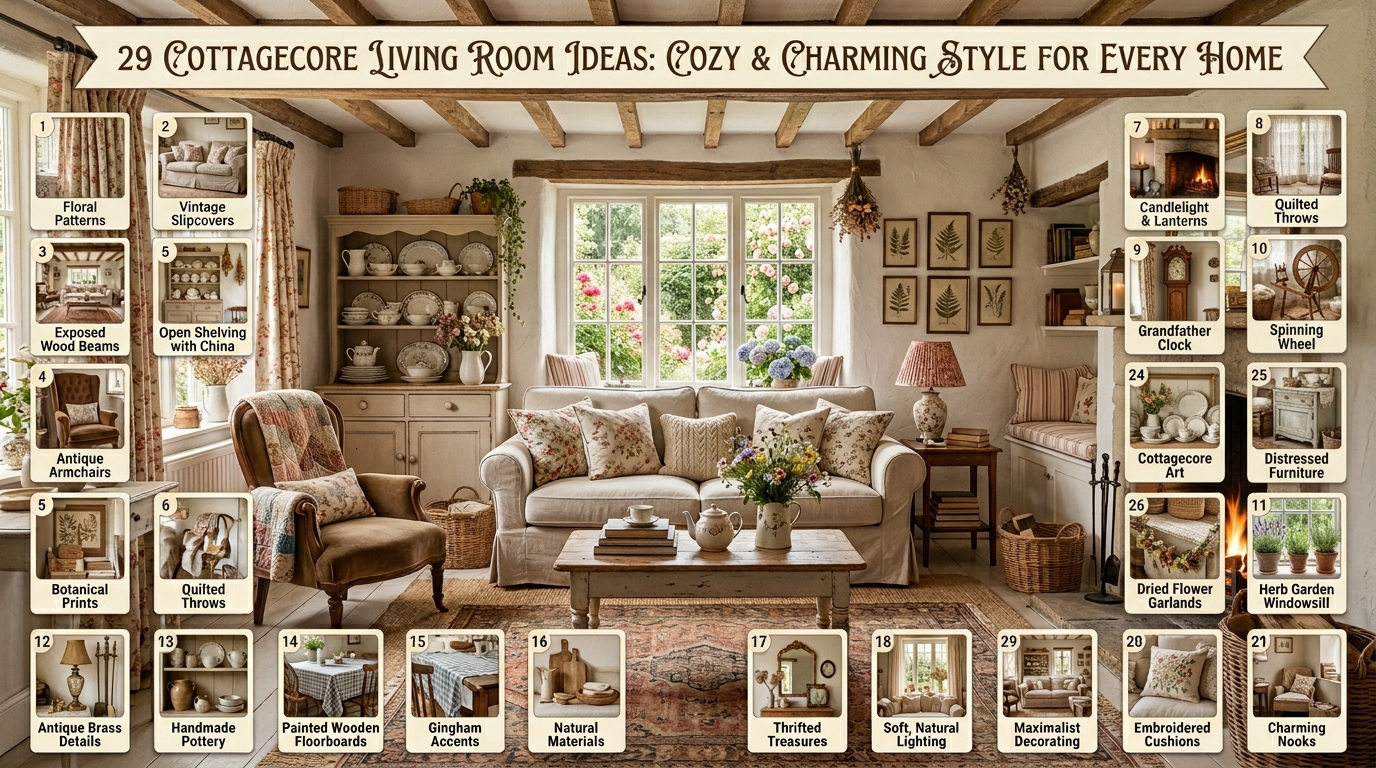
Cottagecore is a design philosophy rooted in romanticizing slow, nature-connected living — think wildflower bouquets on windowsills, mismatched vintage china, and rooms that feel like they grew rather than were decorated. This article gives you exactly 29 cottagecore living room ideas spanning color, materials, lighting, furniture, accessories, layout, and small-space adaptations so you can build a space that feels genuinely lived-in and lovingly assembled.
There is a particular magic to a cottagecore living room — the kind of room that smells faintly of dried lavender and old books, where the afternoon light falls through gauze curtains onto a worn linen sofa piled with embroidered cushions. It is not a style you buy all at once. It accumulates, like a life. Warm, layered, unhurried, and full of things that mean something. Here are 29 ideas worth saving — and stealing.
Why Cottagecore Living Room Design Works So Well
¶1 — What Is It? Cottagecore draws from the English and Northern European rural cottage tradition — specifically the aesthetic of 18th and 19th century working countryside homes, where beauty was functional and nothing was bought purely for display. It shares DNA with the Arts and Crafts movement’s reverence for handmade objects, William Morris’s belief that every domestic object should be both useful and beautiful, and the pastoral romanticism of Victorian watercolor illustration. What distinguishes it from simply “rustic” or “country” design is its deliberate sentimentality — cottagecore actively invites nostalgia, whimsy, and the suggestion of a slower, more intentional life.
¶2 — Core Materials and Colors The palette runs from warm cream and buttermilk to sage green, dusty rose, lavender mist, aged terracotta, and soft moss. Deeper accents appear in antique burgundy, forest green, and warm caramel brown. Materials are emphatically natural and imperfect: unbleached linen, worn cotton chintz, rough-hewn oak, aged pine, hand-thrown pottery, pressed dried botanicals, cane and wicker, hand-embroidered textiles, and patinated copper. Nothing should look factory-fresh — a degree of visible age, fading, or handwork is essential to the material story.
¶3 — Why It’s Trending Now Cottagecore’s surge began in 2020 and has not meaningfully receded — it speaks directly to a cultural longing for slowness, tactility, and meaning in domestic life that accelerated during the pandemic and has settled into a sustained design movement. Pinterest reports cottagecore-adjacent searches among its consistently highest-performing home categories globally. In a cultural moment saturated with algorithmically optimized, sterile interiors, cottagecore’s deliberate imperfection and warmth reads as genuinely radical.
¶4 — Can Small Spaces Achieve This Style? Small spaces are actually where cottagecore thrives best. The style depends on layering and intimacy rather than grand gestures — a small living room filled with books, soft lighting, botanical prints, and a worn linen sofa is more convincing as a cottagecore space than a large, sparsely furnished room attempting the same vocabulary. Prioritize texture layering, warm lighting, and one or two botanical focal points first. The one limitation: avoid overcrowding a small space with furniture — choose fewer, softer pieces and let the accessories and textiles carry the visual richness.
Style at a Glance
| Element | Defining Quality | Expression |
| Philosophy | Slow living, handmade beauty | Collected over time, not purchased at once |
| Materials | Linen, cane, aged pine, hand-thrown pottery, dried botanicals | Imperfect, natural, touchable |
| Color Palette | Cream, sage green, dusty rose, lavender, warm moss | Muted, botanical, faded like old fabric |
29 Cottagecore Living Room Ideas
1. A Worn Linen Sofa Piled with Embroidered Cushions
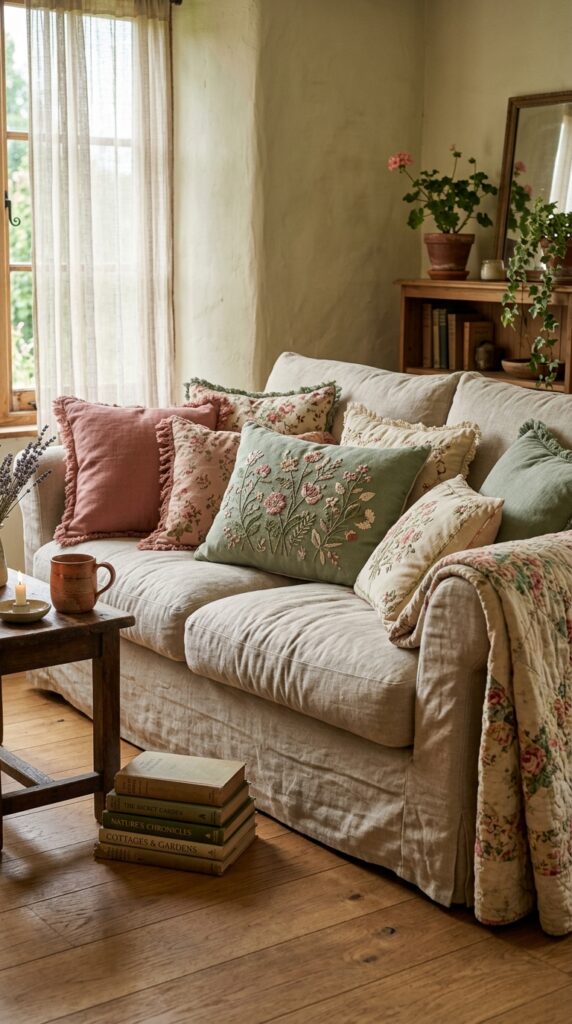
Vibe: Layered. A linen sofa that looks genuinely lived-in — slightly rumpled, generously cushioned — is the single most important object in a cottagecore living room.
Why it works: Softly structured linen upholstery wrinkles and drapes the way no synthetic fabric does, and those wrinkles are the point — they communicate ease, habitation, and the passing of comfortable time. The design principle is intentional imperfection: a linen sofa that looks perfectly unwrinkled reads as modern and controlled; one with natural drape and slouch reads as cottagecore. Embroidered cushions layer hand-craft into the composition — the visible stitchwork tells you a human hand made this, which no digitally-printed fabric can replicate.
How to get it: Look for sofas described as “loose cushion” or “down-wrapped” construction rather than “tight back” — these naturally produce the soft, generous silhouette that suits the style. Stone-washed or pre-washed linen has already done the shrinking and softening, making it significantly more forgiving in daily use. Layer cushions in odd numbers (five or seven) mixing two embroidered, two plain linen, and one vintage-looking floral or stripe.
💡 Quick Win: Buy three embroidered cushion covers on Etsy for under $35 total and add them to any existing sofa — the hand-stitched detail immediately introduces the cottagecore material language without replacing a single piece of furniture.
🛍️ Shop the Look — Amazon Product Ideas
| # | Product Search Phrase | Why It Fits |
| 1 | stone washed linen sofa cover slipcover oatmeal | Soft linen sofa surface |
| 2 | hand embroidered floral cushion cover set | Core cottagecore textile |
| 3 | down feather cushion insert 18×18 soft | Full, generous cushion feel |
| 4 | vintage floral throw pillow dusty rose | Pattern layer for sofa pile |
| 5 | cotton gauze quilt throw blanket cream | Casually draped sofa finish |
2. Sage Green Walls with White Plaster Ceiling
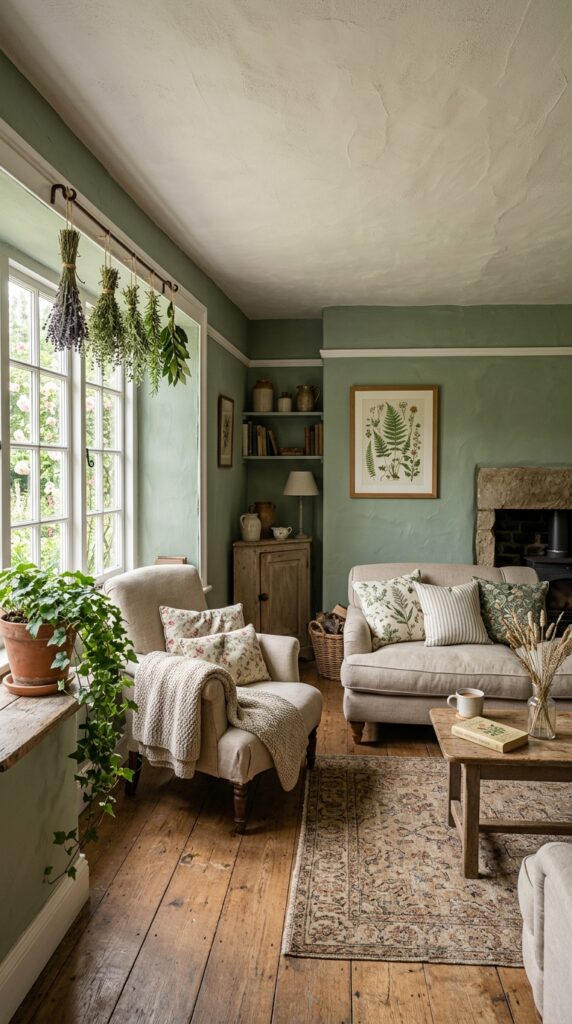
Vibe: Botanical. Sage green walls do not so much decorate a cottagecore living room as grow it — they make every natural object placed against them feel like it belongs to a single, cohesive ecosystem.
Why it works: Sage green’s desaturated, gray-green quality reads as simultaneously modern and historical — it appears in Georgian farmhouses and contemporary cottagecore apartments with equal ease. Applied in a chalky or limewash finish rather than a glossy emulsion, it adds the subtle texture and depth that suggests age and authenticity. Against warm white plaster trim and ceilings, sage green creates a botanical contrast that frames the room without dominating it — the walls become a background for living things.
How to get it: Annie Sloan’s “Chateau Grey” chalk paint or Farrow & Ball’s “Mizzle” are benchmark cottagecore sage tones — both read as genuinely complex and shift warmth depending on light direction. Apply in two coats over a mid-tone primer, finish without a top coat if using chalk paint, or use an eggshell finish emulsion for a similarly low-sheen result that wipes clean.
🛍️ Shop the Look — Amazon Product Ideas
| # | Product Search Phrase | Why It Fits |
| 1 | chalk paint sage green matte interior wall | Chalky cottage wall finish |
| 2 | Annie Sloan chalk paint Chateau Grey | Benchmark cottagecore sage |
| 3 | white limewash paint textured plaster effect | Textured ceiling or trim finish |
| 4 | botanical print framed art sage wall | Tonal wall decor |
| 5 | terracotta pot trailing ivy artificial realistic | Living botanical accent |
3. Candlelight from Every Surface
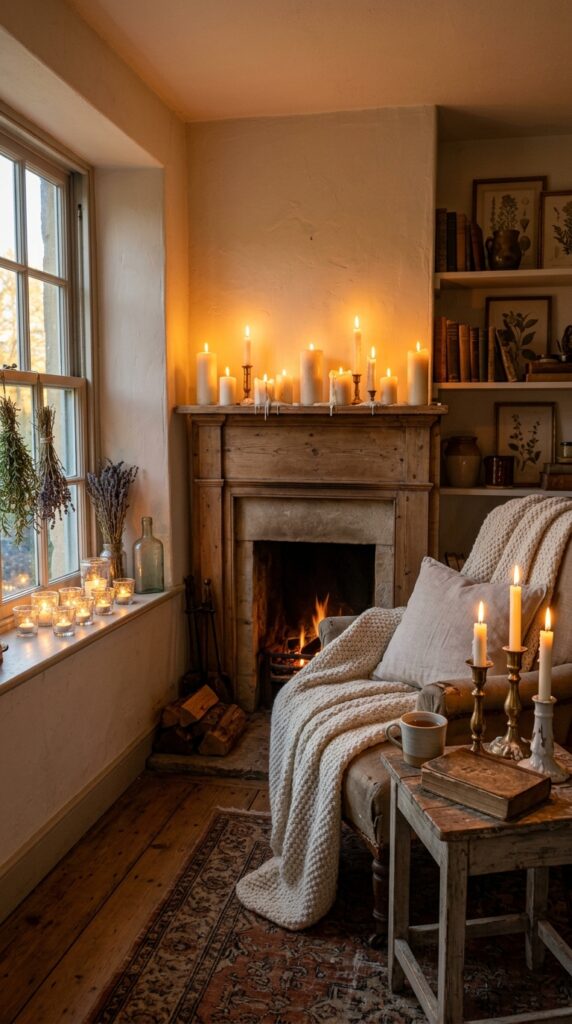
Vibe: Romantic. A cottagecore living room after dark should feel like stepping inside a lantern — warm on every surface, casting soft shadow that makes the room feel twice as intimate.
Why it works: Candlelight operates at a lower color temperature (approximately 1,800K) than any other artificial light source, which creates the amber warmth associated with hearth and home. Distributing multiple candle sources at different heights — low tea lights, mid-height votives, tall tapers — creates a layered lighting scheme that eliminates the flat, uniform effect of a single overhead source. The design principle is light at the human scale: sources at eye level and below create intimacy; overhead-only light creates a workspace, not a sanctuary.
How to get it: Use genuine wax candles (beeswax burns longest and cleanest) in a mix of pillar, taper, and tea light formats. Group tapers in mismatched vintage brass holders for an authentically collected look — they need not match as long as all are brass-toned. Flameless LED candles with a flicker setting are a practical alternative and now replicate the warm color temperature convincingly.
💡 Quick Win: A set of six mismatched brass taper holders from a charity shop or thrift store — no two identical — grouped on a wooden tray costs under $12 and creates the most convincing “collected over years” candlescape imaginable.
🛍️ Shop the Look — Amazon Product Ideas
| # | Product Search Phrase | Why It Fits |
| 1 | mismatched brass taper candle holder set vintage | Cottagecore candlescape base |
| 2 | beeswax pillar candles set cream unscented | Long-burning, clean-burning wax |
| 3 | glass votive tea light holder set of 12 | Low ambient scatter lighting |
| 4 | flameless LED taper candle flickering warm | Safe alternative flame |
| 5 | wooden tray rectangular natural for candle grouping | Candlescape organizing base |
4. Vintage Armchair Reupholstered in Floral Chintz
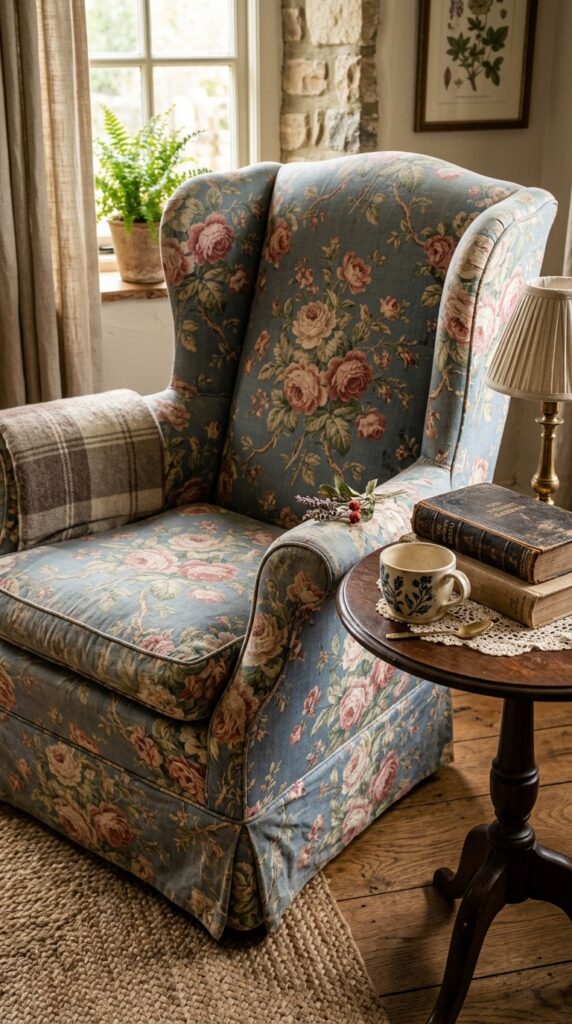
Vibe: Intimate. A chintz armchair in a cottagecore living room is not furniture — it is a destination, a place that belongs to long afternoons and good books.
Why it works: Chintz — a tightly woven cotton with a printed floral pattern, often finished to a subtle sheen — is one of the oldest and most characteristically English cottage fabrics. Its importance to the cottagecore living room is that it introduces pattern at a human scale: roses and leaves that reference the garden, rendered in faded, muted tones that suggest long exposure to light and time. The wingback silhouette adds architectural warmth, cradling its occupant in a way that open-armed contemporary chairs do not. Together, they create what designers call a sense of envelopment — the chair becomes a room within a room.
How to get it: Source a vintage wingback frame from a charity shop, estate sale, or Facebook Marketplace (often $20–$80) and reupholster in a printed cotton or linen-cotton blend chintz — Liberty of London’s floral prints are the benchmark but expensive; more accessible alternatives include Robert Allen’s “Folk Floral” or any vintage-look printed linen from online fabric retailers. Basic reupholstery of a wingback seat and arms runs $200–$400 at a local upholstery shop.
🛍️ Shop the Look — Amazon Product Ideas
| # | Product Search Phrase | Why It Fits |
| 1 | floral chintz armchair wingback vintage style | Core cottagecore reading chair |
| 2 | floral linen fabric by the yard rose dusty blue | Reupholstery source fabric |
| 3 | wingback chair slipcover floral cotton | Budget chintz chair update |
| 4 | small round wooden side table antique look | Chair companion surface |
| 5 | antique brass table lamp small base fabric shade | Warm reading light |
5. Open Wooden Bookshelves Styled with Objects and Plants
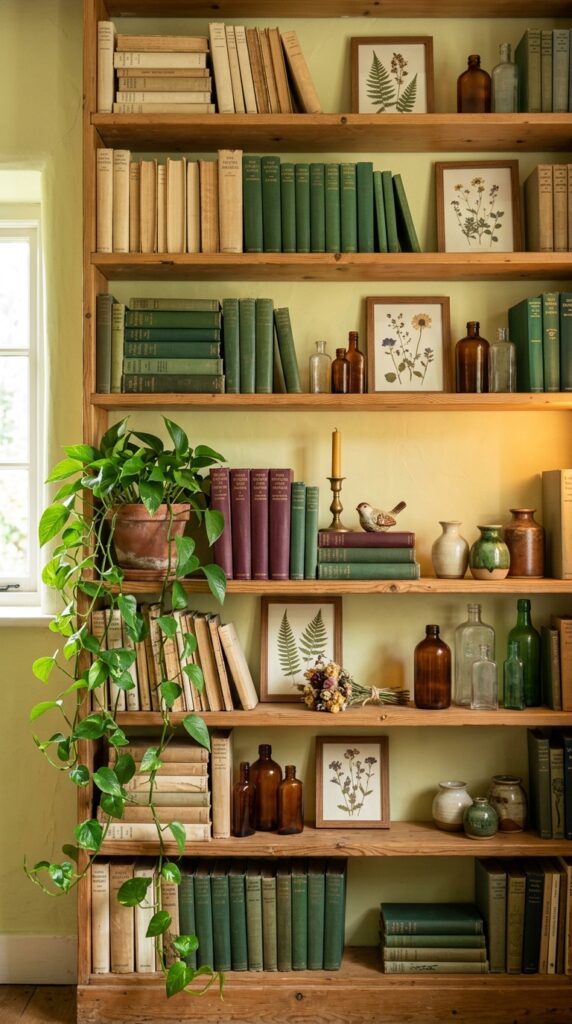
Vibe: Collected. Shelves in a cottagecore living room should look like the autobiography of someone who reads, gardens, travels, and cooks — every object a reference to a life being lived.
Why it works: Open shelving in the cottagecore context follows the principle of visual narrative — each shelf tells a small story through the relationship between books, objects, and living plants. The design rule of odd-number grouping (always three or five objects per cluster, never two or four) creates the natural asymmetry that reads as collected rather than decorated. Books arranged loosely by color tone create visual cohesion without the rigidity of purely decorative arrangements; trailing plants introduce organic interruption that breaks any suggestion of styling for show.
How to get it: Arrange each shelf in three zones: books (grouped by tone, not spine-out), small objects (one ceramic, one natural, one personal), and one living plant. The plant should trail or lean beyond the shelf edge — growth that escapes its container signals that something alive is actually thriving here, not merely placed. Use battery-powered puck lights inside closed shelves or below open ones for warm under-shelf glow that reads as intimate and intentional.
💡 Quick Win: Turn 20–30% of your books around spine-in, showing the cream or aged-paper pages outward. This immediately softens the visual of a bookshelf and creates the warm, imperfect cottage library effect at zero cost.
🛍️ Shop the Look — Amazon Product Ideas
| # | Product Search Phrase | Why It Fits |
| 1 | solid pine open bookshelf cottage style | Core storage and display piece |
| 2 | terracotta pot set small medium trailing plants | Living botanical shelf layer |
| 3 | vintage glass bottle set amber green decorative | Antique-style shelf objects |
| 4 | LED puck light warm white battery bookshelf | Under-shelf warm glow |
| 5 | pressed botanical art print set framed 5×7 | Natural theme wall art |
6. A Stone or Brick Fireplace as the Room’s Heart
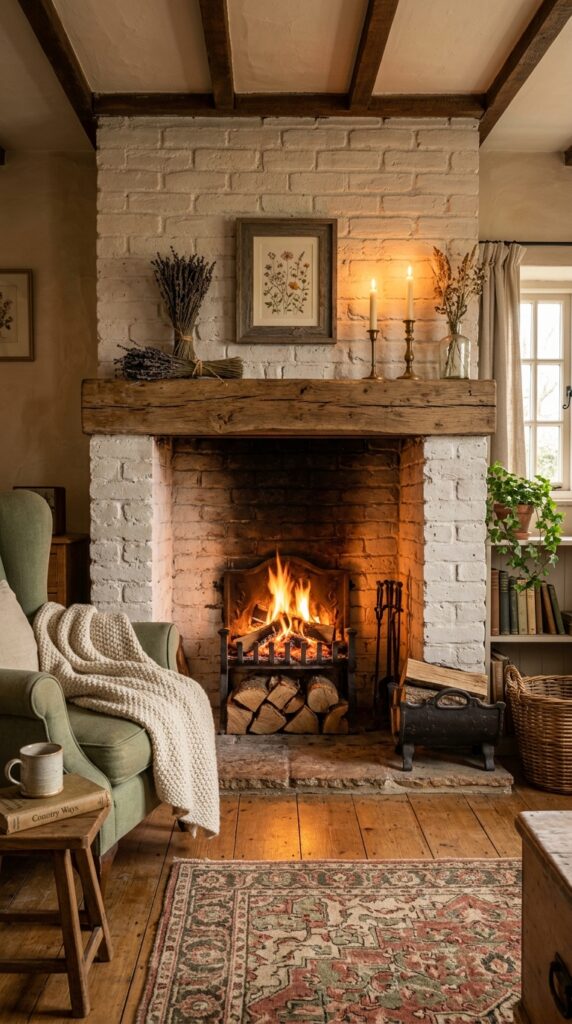
Vibe: Ancient. A fireplace in a cottagecore living room is not a decorative feature — it is the reason the room exists, the original center of domestic life around which everything else arranges itself.
Why it works: Architecturally, a fireplace creates the axial organization that a cottagecore living room needs: a clear focal wall that orients the seating, organizes the room’s symmetry, and provides a vertical anchor from floor to mantelpiece to wall above. Functionally, a working fire provides the ambiance no amount of candles or warm bulbs can replicate — real flame, real warmth, real crackling sound. Even a non-working fireplace styled with candles, botanicals, and stacked logs delivers the same visual language. The whitewashed brick finish softens the masonry without concealing its age and texture.
How to get it: Whitewash existing brick by diluting white exterior latex paint with water in a 1:1 ratio and applying with a stiff brush, working the diluted paint into the mortar joints and wiping back from the brick faces to allow the original texture to remain visible. This is reversible with further diluted coats to darken, making it a low-risk transformation.
🛍️ Shop the Look — Amazon Product Ideas
| # | Product Search Phrase | Why It Fits |
| 1 | whitewash brick effect paint kit fireplace safe | Fireplace brick transformation |
| 2 | rough hewn oak mantel shelf solid wood | Rustic mantelpiece anchor |
| 3 | cast iron log holder fireplace tools set | Functional fireside object |
| 4 | dried lavender bundle large mantelpiece decor | Signature cottagecore botanical |
| 5 | electric fireplace log insert realistic flame | Non-working fireplace solution |
7. Dusty Rose and Cream Color Palette
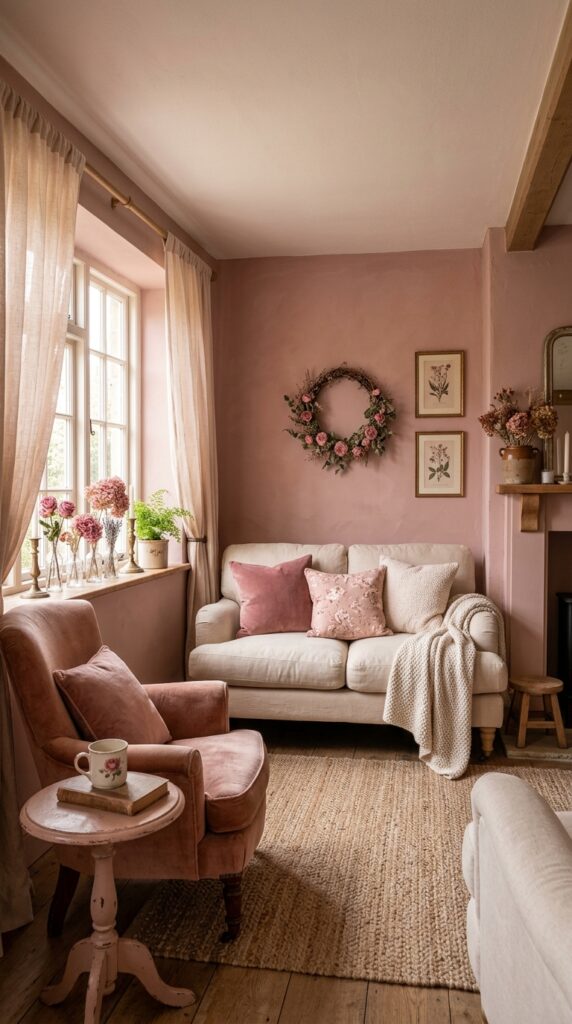
Vibe: Tender. A dusty rose and cream living room feels like the inside of a seashell — warm, enclosed, suffused with soft color that shifts with the light.
Why it works: Dusty rose sits in the most complex register of the pink family — neither candy nor terracotta, but somewhere between them, desaturated enough to read as a genuine neutral in certain lights. Combined with warm cream (specifically the slightly yellow-warm cream rather than cool white), the palette creates tonal harmony that references faded vintage textiles, pressed rose petals, and sun-bleached linen. The design principle is nostalgic color — using tones that feel like remembered things rather than purchased ones. No accent color is needed; the variation in texture carries all the visual differentiation the room requires.
How to get it: Build the palette from largest to smallest surface: matte dusty rose walls (try Benjamin Moore “Mellow Rose” or Farrow & Ball “Nancy’s Blushes”), warm cream linen upholstery, then smaller textiles in deeper rose or blush to add tonal depth at the accessory layer. Keep metallics in aged brass or copper — chrome or silver will read as cold intruders in this palette.
🛍️ Shop the Look — Amazon Product Ideas
| # | Product Search Phrase | Why It Fits |
| 1 | dusty rose matte interior paint sample wall | Tone-setting wall color |
| 2 | blush velvet armchair living room accent | Deeper tone upholstered accent |
| 3 | dried rose wreath preserved floral wall decor | Botanical tonal wall piece |
| 4 | cream knit throw blanket chunky soft | Textural cream layer |
| 5 | antique brass picture frame set small | Warm metal tone match |
8. Wildflower and Herb Arrangements in Ceramic Vessels
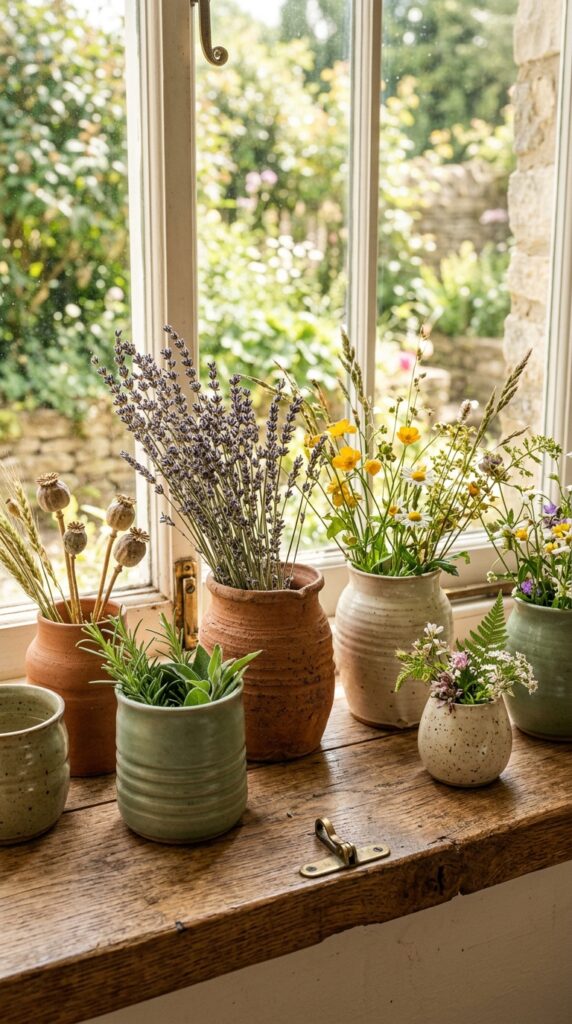
Vibe: Fresh. A collection of ceramic vessels with gathered botanicals on a windowsill is the purest expression of the cottagecore ethos — nature inside, framed by architecture, arranged with a light and knowing hand.
Why it works: Hand-thrown ceramics carry the mark of their making — slight asymmetry, visible throwing lines, uneven glaze pooling — which creates authentic material interest that machine-made vessels cannot produce. Each imperfection becomes a surface detail that catches light differently. The design principle here is contrast of scales: a cluster of different-sized vessels creates visual rhythm, while varying the height and fullness of each botanical arrangement prevents the group from reading as a formal, studied composition. This should look like someone brought these in from the garden and set them down — with charm, but without overthinking.
How to get it: Build a collection of hand-thrown ceramics gradually — one good studio piece at a time — rather than purchasing a matched set. Etsy, local pottery markets, and charity shops are all excellent sources. Aim for three to five vessels in related but not identical glazes. Fill some with fresh herbs from a grocery store (rosemary, thyme, eucalyptus), others with dried botanicals, and one or two with water and a few fresh wildflowers cut loosely.
🛍️ Shop the Look — Amazon Product Ideas
| # | Product Search Phrase | Why It Fits |
| 1 | hand thrown ceramic vase set sage terracotta | Core botanical vessel collection |
| 2 | dried lavender bundle large display | Signature cottagecore botanical |
| 3 | dried wildflower mix bundle natural colors | Loose arrangement source |
| 4 | poppy seed head stems dried natural | Architectural dried stem |
| 5 | windowsill herb planter terracotta drainage | Living herb display |
9. Patchwork and Quilted Throws as Textile Art
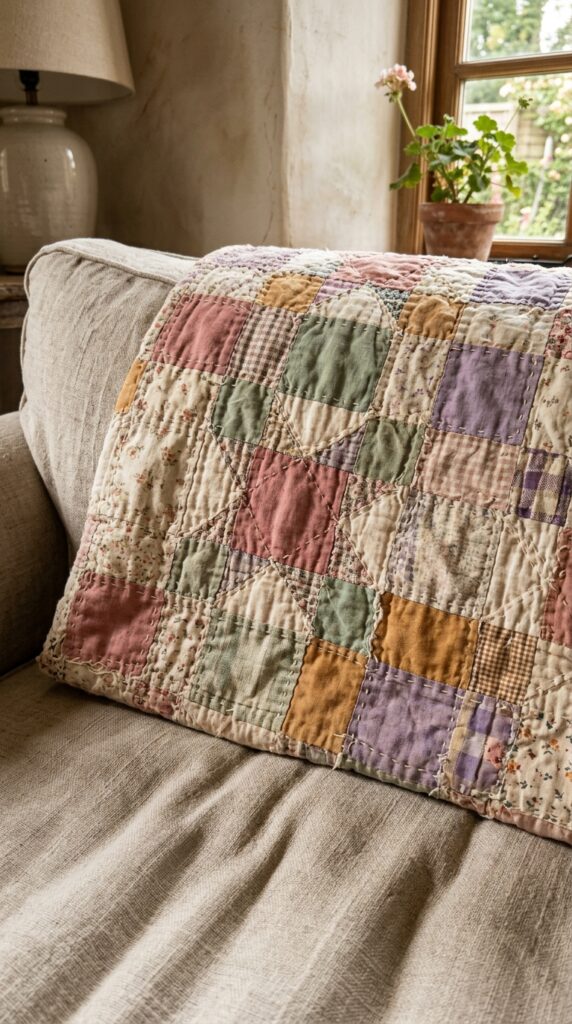
Vibe: Nostalgic. A hand-stitched quilt is not decoration — it is evidence of time, care, and the very human desire to make something beautiful out of something small.
Why it works: Quilts are among the most culturally loaded textiles in cottagecore design — they reference the tradition of making beauty from salvaged scraps, which aligns perfectly with the style’s anti-waste, handcraft ethos. Draped over a sofa back rather than laid flat, a patchwork quilt becomes a textile artwork: its irregular blocks create pattern and color at the scale of the furniture, adding warmth and complexity without requiring any additional objects. The faded quality of vintage or antique quilts is particularly valuable — it references the passage of time that new textiles cannot simulate convincingly.
How to get it: Vintage and antique quilts appear regularly at estate sales, antique markets, and charity shops, often for $20–$80 depending on condition and origin. A new quilt with genuine cottagecore character should be made from 100% cotton in an irregular patchwork rather than a precision-printed reproduction — the hand-cut quality is immediately visible, even from a distance.
💡 Quick Win: A large linen or cotton scarf in a faded floral or geometric print, draped and loosely bunched over a sofa arm, reads as a vintage quilt fragment at a small fraction of the cost — under $20, and removable when you want a different seasonal feel.
🛍️ Shop the Look — Amazon Product Ideas
| # | Product Search Phrase | Why It Fits |
| 1 | patchwork quilt vintage style 100% cotton throw | Core cottagecore textile art |
| 2 | hand quilted throw blanket floral cotton | Handcraft textile detail |
| 3 | vintage floral cotton fabric squares mixed pack | DIY quilt source material |
| 4 | embroidery hoop wall art set floral | Complementary handcraft decor |
| 5 | lavender sachet set linen for sofa cushions | Sensory cottagecore detail |
10. Reclaimed Wood Coffee Table with Character
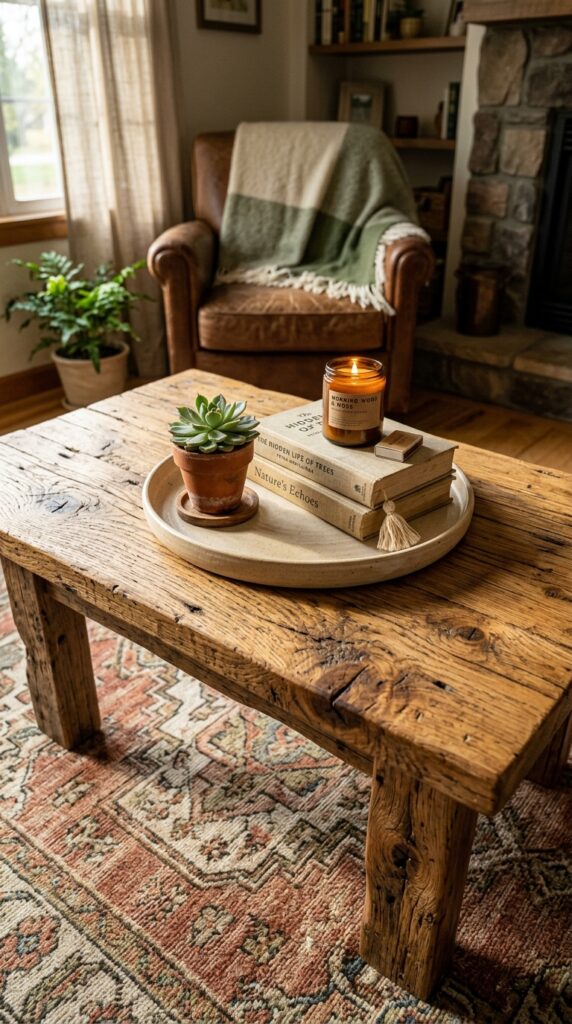
Vibe: Grounded. A reclaimed wood coffee table does something no new piece of furniture can — it brings the memory of another life into the room, whether that life was a barn floor, a church pew, or a factory beam.
Why it works: The design principle at work in reclaimed wood is material honesty — showing the marks and evidence of a material’s previous existence rather than sanding them away. Knots, checks, saw marks, and mineral staining are not flaws in the cottagecore context; they are the details that give the piece biographical depth. A coffee table in the center of a living room is also the most handled surface in the space, which makes material warmth and tactile interest especially valuable here. The slightly uneven, hand-finished surface of a reclaimed piece invites touch in a way that a factory-smooth lacquered table does not.
How to get it: Source reclaimed wood coffee tables from local architectural salvage dealers, Etsy artisans, or farm auction houses. If purchasing new, look for tables explicitly described as using “reclaimed timber” or “scaffold board” construction — these terms indicate genuine salvaged material rather than distressed-new wood, which reads as artificial on close inspection. Finish with raw linseed oil or a matte furniture wax to enhance the grain without creating a high-gloss barrier.
🛍️ Shop the Look — Amazon Product Ideas
| # | Product Search Phrase | Why It Fits |
| 1 | reclaimed wood coffee table rustic knot grain | Core living room surface |
| 2 | raw linseed oil wood finish natural | Authentic wood preservation |
| 3 | woven seagrass round tray centerpiece | Coffee table styling base |
| 4 | small terracotta succulent pot set mini | Living detail on table |
| 5 | cotton bookmark tassel handmade set | Styling accessory detail |
11. Rattan and Wicker Furniture for Airy Texture
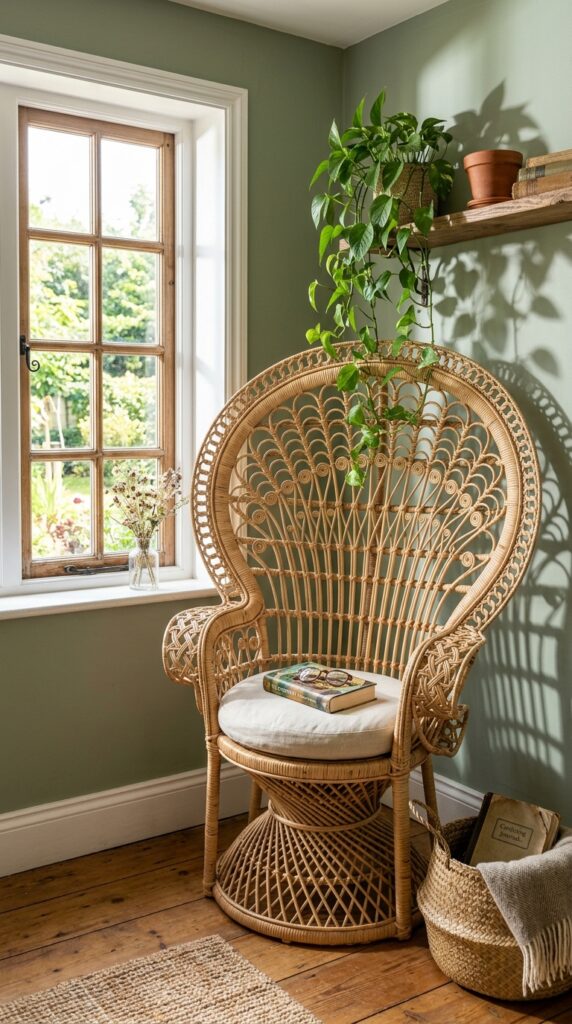
Vibe: Airy. Rattan furniture introduces a quality of light into a cottagecore room that no solid furniture can — it casts patterns, it breathes, and it makes even the shadows interesting.
Why it works: Rattan and wicker are among the most historically authentic materials for the cottagecore aesthetic — they have been present in English cottage interiors since the 19th century, particularly in sun-room and parlor contexts. Their open weave creates what designers call visual porosity — the eye passes through the material rather than stopping at it, which reduces the visual weight of a furniture piece dramatically. The peacock chair’s fan back specifically creates a radiating silhouette that works as a sculptural form even when unoccupied, earning its floor space decoratively as well as functionally.
How to get it: Rattan requires consistent humidity management to prevent brittleness — avoid placing rattan chairs directly beside radiators or heating vents. Spray the weave lightly with water once or twice a year to maintain flexibility. For outdoor-grade rattan brought inside, treat with raw linseed oil to enrich the color and protect against drying.
🛍️ Shop the Look — Amazon Product Ideas
| # | Product Search Phrase | Why It Fits |
| 1 | rattan peacock chair natural woven fan back | Iconic cottagecore seating |
| 2 | cream linen round seat cushion chair pad | Soft rattan chair comfort |
| 3 | wicker storage basket large round floor | Companion natural material piece |
| 4 | rattan side table round small natural | Lightweight companion surface |
| 5 | trailing pothos plant artificial realistic | Cascading shelf botanical |
12. Pressed Botanical Prints Gallery Wall
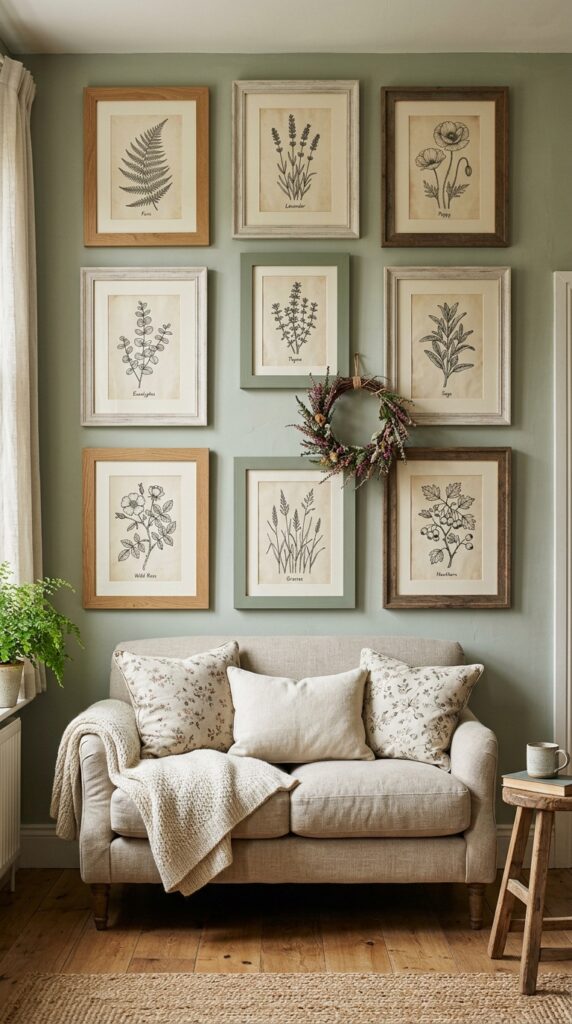
Vibe: Gentle. A botanical gallery wall in a cottagecore living room feels like the research wall of a 19th-century naturalist who also happened to be a gifted stylist.
Why it works: Botanical prints — the precise, detailed illustrations from 18th and 19th century natural history publications — carry an elegance and authority that modern art prints rarely achieve. Their subject matter (plants, flowers, ferns, mushrooms, seeds) directly echoes the cottagecore world outside the window, creating a visual conversation between the room and the natural world. Mismatched frames in slightly different woods and finishes read as accumulated over time rather than purchased as a set, which is the central authenticity signal of the cottagecore aesthetic.
How to get it: Download antique botanical illustrations from free public domain archives (Biodiversity Heritage Library, NYPL Digital Collections) and print at home or at a print shop on cream-toned matte paper. Frame in a mix of natural wood, white-painted wood, and one or two sage-painted frames for tonal variety. Space frames 2–3 inches apart for a tight, gathered arrangement.
💡 Quick Win: A single large-format pressed fern print — 11×14 inches or larger — in a simple natural wood frame, hung at eye level above a console table, delivers 80% of the botanical gallery wall impact in one piece for under $25 printed and framed.
🛍️ Shop the Look — Amazon Product Ideas
| # | Product Search Phrase | Why It Fits |
| 1 | botanical print set vintage illustration 8×10 | Gallery wall core art content |
| 2 | natural wood picture frame set mixed sizes | Mismatched frame base set |
| 3 | cream matte board picture frame insert | Gallery wall framing finish |
| 4 | sage painted wood frame 5×7 | Tonal frame variety accent |
| 5 | dried flower wreath small for wall between frames | Between-frame decorative detail |
13. A Reading Nook Built into a Corner or Alcove
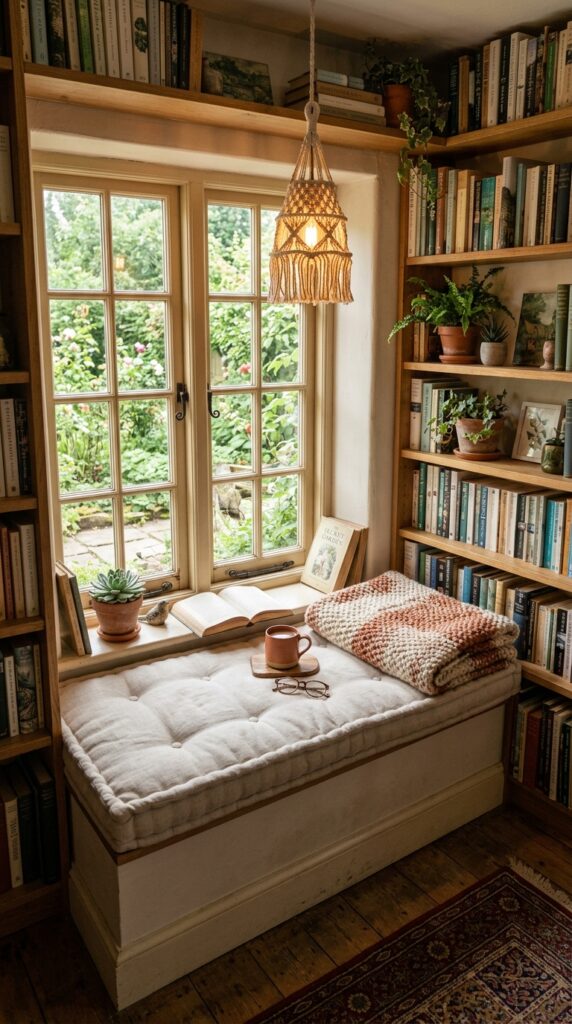
Vibe: Hushed. A reading nook is the architectural admission that some moments require their own room, even if that room is only three feet wide.
Why it works: A reading nook in a cottagecore living room works on the principle of compression — deliberately reducing the scale of a space to create intimacy that a full-sized room cannot produce. Shelves on both flanking walls visually enclose the space, books create acoustic softness (their spines literally absorb sound), and a thick, well-cushioned window seat provides the physical comfort that the experience of reading requires. A single hanging light (macramé-shaded, warm-toned) marks the nook as its own zone without harsh overhead brightness.
How to get it: If your room lacks a natural alcove, create the nook effect with two matching bookshelves placed at right angles in a corner, with a cushioned bench or window seat between them. The shelves define the space; the cushion makes it a destination. Use a battery-powered hanging lamp — no wiring required — for warm overhead light within the defined area.
🛍️ Shop the Look — Amazon Product Ideas
| # | Product Search Phrase | Why It Fits |
| 1 | window seat cushion thick tufted button cream | Reading nook seat comfort |
| 2 | macramé pendant lamp shade boho hanging light | Nook-defining overhead light |
| 3 | battery powered hanging pendant lamp warm | Wire-free nook lighting |
| 4 | small floating corner bookshelf set wood | Nook flanking storage |
| 5 | knitted chunky throw blanket cream small | Nook companion textile |
14. Stone-Effect or Limewash Walls for Ancient Texture
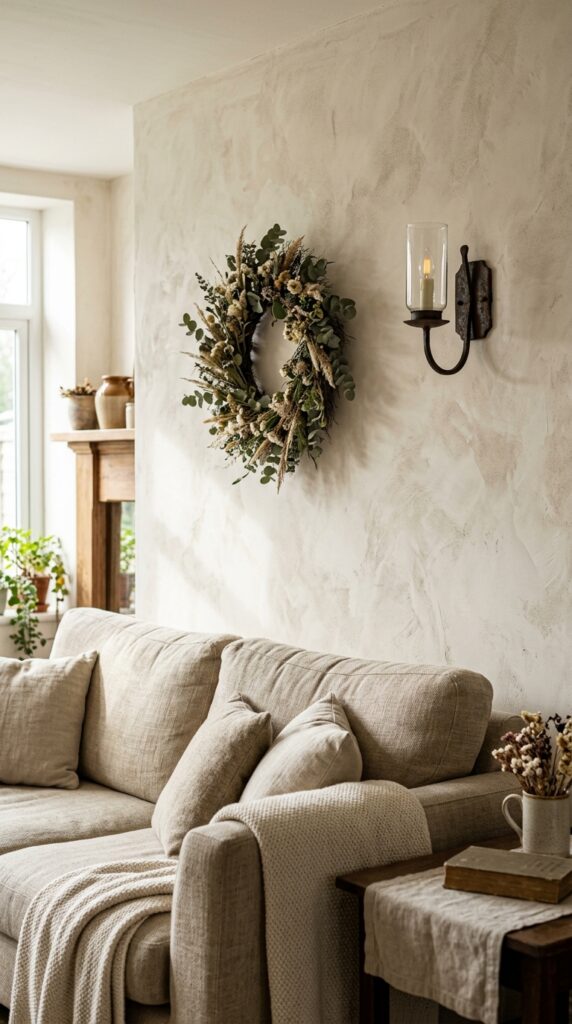
Vibe: Ancient. Limewash paint does not cover a wall — it becomes part of it, creating depth that flat paint cannot simulate and that improves the longer you look.
Why it works: Limewash is a traditional wall finish made from slaked lime, used for centuries in European farmhouses precisely because its cloudy, translucent quality creates a surface that appears to glow from within when light hits it at an angle. Unlike standard paint which creates a thin opaque film, limewash soaks into the wall surface and develops a subtle texture over time. The design principle is surface depth — a wall that appears to have dimension invites the eye in rather than stopping it flat. In a cottagecore living room, this is the difference between a painted wall and a storied one.
How to get it: Limewash paint is available pre-mixed from brands like Portola Paints (“Roman Clay”), Behr (“Venetian Plaster”), and Frenchic. Apply with a wide brush in overlapping X-strokes, working while wet to blend. One coat creates the look; a second coat deepens it. No topcoat required or recommended — the soft matte finish is the point.
🛍️ Shop the Look — Amazon Product Ideas
| # | Product Search Phrase | Why It Fits |
| 1 | limewash paint warm white interior DIY | Core ancient wall finish |
| 2 | Roman clay paint Portola sample pot | Premium limewash alternative |
| 3 | wide natural bristle brush limewash application | Correct application brush |
| 4 | aged iron wall sconce single arm | Wall texture complement |
| 5 | botanical wreath dried preserved door wall | Textured wall decorative layer |
15. Mismatched Vintage China as Display Objects
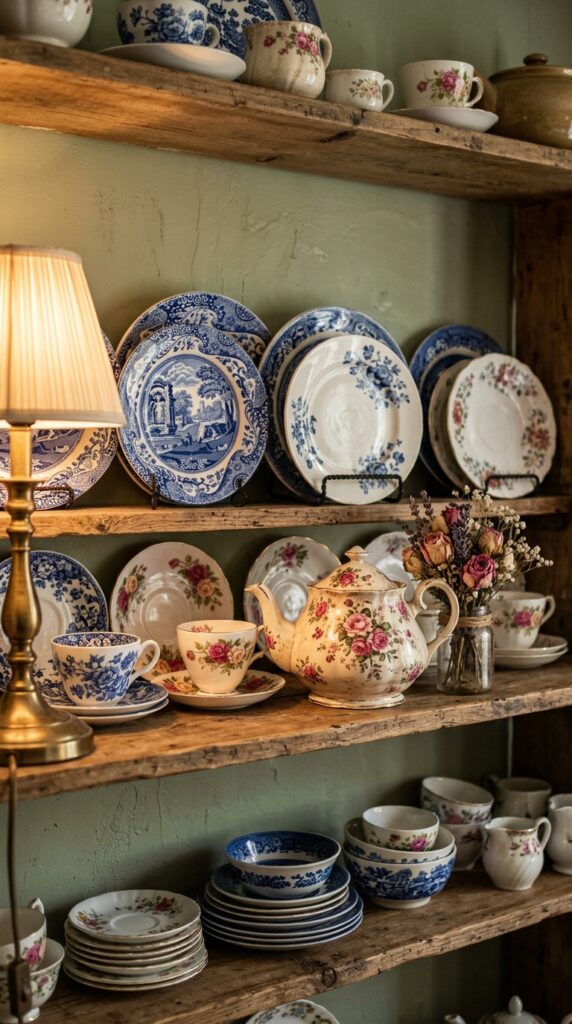
Vibe: Collected. A display of mismatched vintage china carries the visual weight of decades — it looks like someone cared enough to seek these out, one piece at a time, from different places and different moments.
Why it works: Mismatched vintage china works because variety within a shared material language creates the visual richness of a genuine collection. All pieces share the same material (fine china, bone china, earthenware), the same application (hand-painted or transfer-print florals and patterns), and the same era reference (late Victorian through mid-century) — but they need not match in pattern or color. The design principle is unity through material rather than pattern. Blue-and-white transferware beside rose-sprigged porcelain beside cream with gilt edging reads as a coherent collection because the underlying material type unifies them.
How to get it: Charity shops, car boot sales, and estate auctions are the ideal source for vintage china — individual pieces typically cost $2–$8 each. Build slowly. Display teacups on their saucers even when they don’t match — the visual language of cup-on-saucer reads as domestic and settled. Prop plates vertically using simple metal plate stands so the pattern faces outward.
🛍️ Shop the Look — Amazon Product Ideas
| # | Product Search Phrase | Why It Fits |
| 1 | vintage style blue white transferware plate set | Classic china display pattern |
| 2 | floral teacup set mismatched cottage style | Core china collection pieces |
| 3 | metal plate stand display set of 6 | Vertical plate propping |
| 4 | rose patterned vintage teapot ceramic | Centerpiece china object |
| 5 | open kitchen shelf china display floating wood | Display surface for china |
16. Compact Living Room with a Round Jute Rug
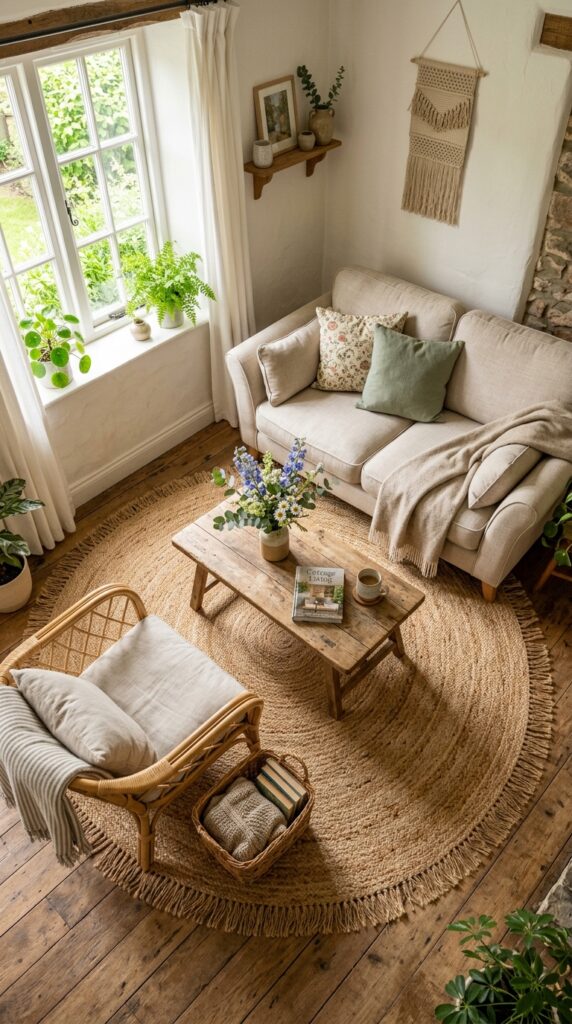
Vibe: Light. A round jute rug in a small cottagecore living room creates a natural clearing — a defined, sheltered gathering place that makes a compact room feel deliberately intimate rather than merely small.
Why it works: Round rugs solve a persistent small-room problem: they soften the rectangular rigidity of a compact space by introducing a circular form that the eye follows naturally all the way around, which creates a sense of completeness within a small area. Jute’s natural fiber color (warm honey-beige) blends with virtually every cottagecore palette without competing, while its textured surface adds tactile interest underfoot. The fringe edge of a jute rug adds visual detail at floor level that visually grounds the seating group without adding any height or bulk.
How to get it: In a small living room, a round rug should be large enough for all front legs of your seating pieces to rest on it — at minimum 6 feet in diameter for a two-seat sofa and one chair. Use a rug pad beneath jute on hardwood floors, as natural fiber rugs can slip. Note that jute is not suitable for high-humidity rooms and should not be steam-cleaned — spot clean with mild soap and air dry only.
💡 Quick Win: Rotating a rectangular rug 45 degrees in a small room — so it sits as a diamond rather than aligned with the walls — creates visual interest and makes a small room feel less boxy. This costs nothing and takes 30 seconds.
🛍️ Shop the Look — Amazon Product Ideas
| # | Product Search Phrase | Why It Fits |
| 1 | round jute rug 6 foot natural fiber fringe | Small room zone-defining rug |
| 2 | non-slip rug pad round hardwood floors | Safety under natural fiber rug |
| 3 | small linen loveseat two seater sofa | Right-sized small room seating |
| 4 | wicker log basket decorative natural | Floor-level natural texture |
| 5 | small floral arrangement dried table display | Coffee table natural styling |
17. Gathered Lace Curtains or Sheer Muslin Panels
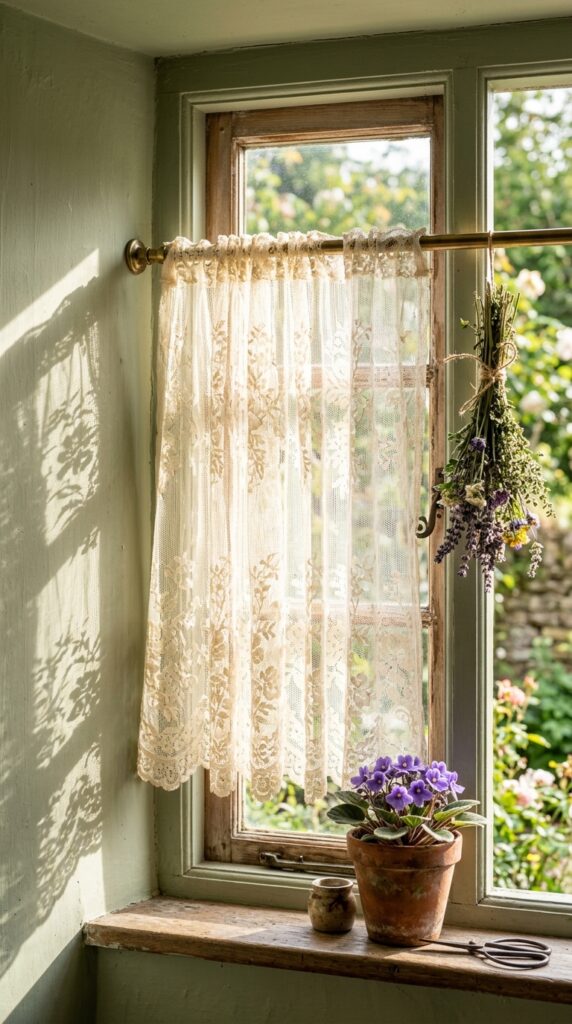
Vibe: Delicate. Lace curtains in a cottagecore living room do not block the outside world — they translate it, turning bright summer light into a moving, patterned thing.
Why it works: Lace and sheer muslin curtains operate as light modifiers rather than light blockers, which is essential in a cottagecore aesthetic that celebrates natural light and the interplay between inside and outside. The shadow pattern that lace casts on walls and floors creates an ever-shifting layer of texture that changes with the sun’s position through the day — effectively making the light itself a decorative element. Gathered (rather than flat-panel) lace curtains add fullness and softness that flat sheers cannot achieve, giving windows a generous, romantic quality.
How to get it: Source genuine cotton lace curtain panels rather than synthetic — polyester lace drapes with a stiffness that reads as inauthentic and catches no light in the same way. Gather the panels at 1.5 to 2 times the window width for proper fullness. Hang on a narrow brass or iron rod mounted close to the window frame for an authentic cottage proportion.
🛍️ Shop the Look — Amazon Product Ideas
| # | Product Search Phrase | Why It Fits |
| 1 | cotton lace curtain panel cream gathered vintage | Authentic light-filtering curtain |
| 2 | sheer muslin curtain panel white natural unbleached | Alternative soft window treatment |
| 3 | narrow brass curtain rod small window 24-48 inch | Cottage-scale curtain hardware |
| 4 | dried herb bundle hanging window decor | Curtain rod hanging botanical |
| 5 | small terracotta windowsill planter with violets | Living windowsill detail |
18. Exposed Ceiling Beams for Architectural Character
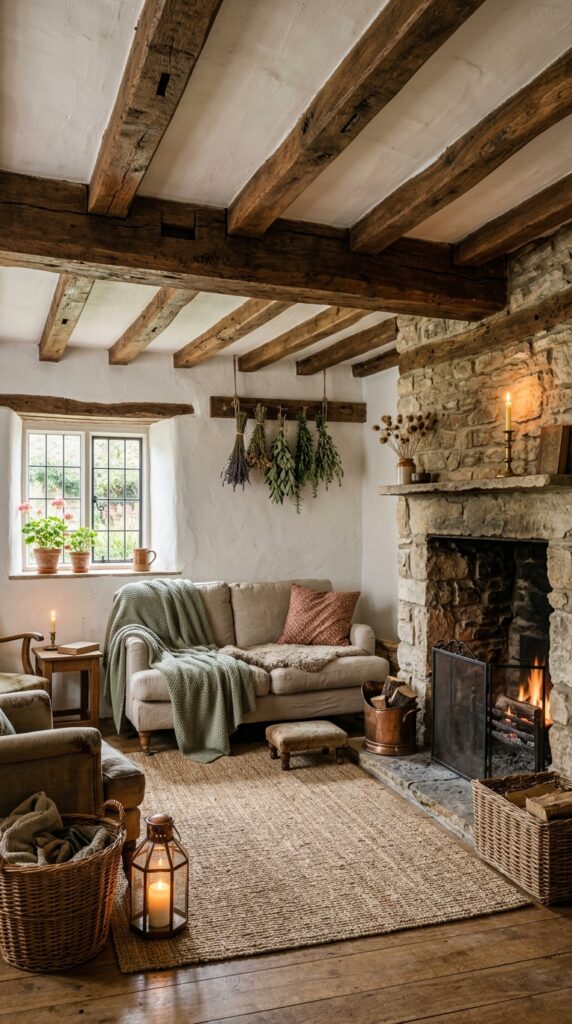
Vibe: Sheltering. Exposed ceiling beams in a cottagecore living room make the room feel held — structurally and emotionally — as if the building itself is reaching down to protect you.
Why it works: Original exposed beams are among the most coveted architectural features in the cottagecore aesthetic precisely because they cannot be bought or fabricated convincingly at scale — they represent genuine age, genuine material, and genuine construction history. Their visual function is to lower the perceived ceiling height, which creates intimacy in a room without reducing the actual square footage. The honey-brown tone of aged oak beams also introduces warm color into an otherwise neutral white or sage ceiling, grounding the room’s palette at its highest point.
How to get it: If your room lacks original beams, applied decorative beam wraps — hollow box beams in real or faux wood — install over existing ceilings without structural work. Applied box beams in real pine or cedar, stained in a medium honey tone and distressed with a wire brush, read convincingly as original beams in photographs and casual observation. Space them 36–48 inches apart for a proportional ceiling grid.
🛍️ Shop the Look — Amazon Product Ideas
| # | Product Search Phrase | Why It Fits |
| 1 | decorative wood beam wrap faux ceiling box beam | Non-structural beam installation |
| 2 | wood beam stain medium oak honey DIY | Authentic beam color treatment |
| 3 | wire brush distressing tool wood | Aging new wood beam surfaces |
| 4 | copper lantern floor standing candle | Floor-level warm light source |
| 5 | dried herb bundle hanging ceiling decor | Beam-hung botanical detail |
19. Forest Green Velvet Accent Cushions and Objects
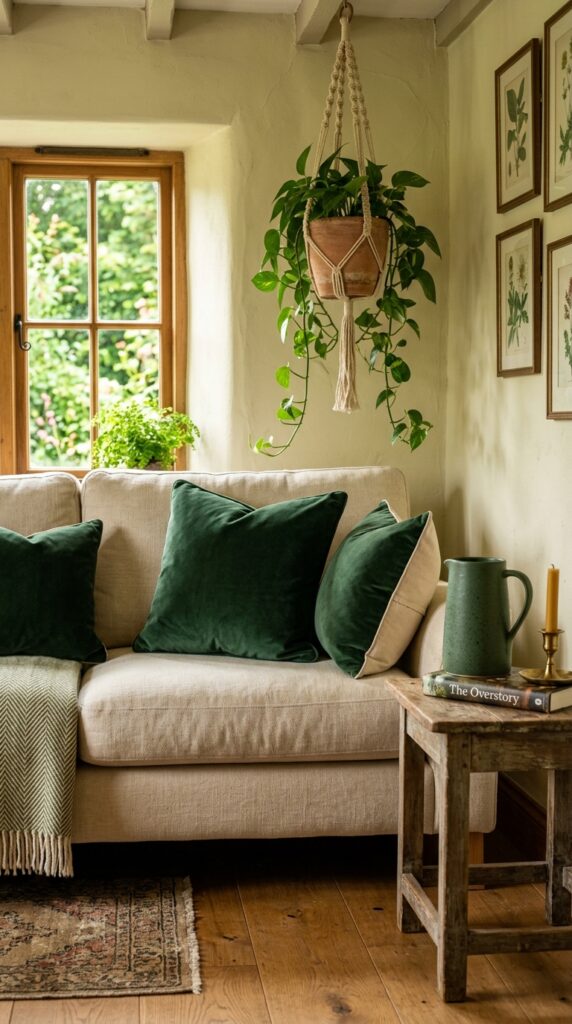
Vibe: Earthy. Forest green is the color of the world beyond the window, brought inside — moss and fern and deep woodland, contained in velvet and ceramic.
Why it works: Forest green operates as the ideal accent in a cottagecore living room because it references the natural world directly — it is the color of botanical life, which is the aesthetic’s primary inspiration. In velvet, it gains the additional quality of visual depth — the pile creates lighter and darker registers of the same green simultaneously, which adds richness without adding pattern complexity. Distributed across multiple objects at different scales (a large cushion, a medium ceramic jug, a small plant pot), forest green creates a color thread that ties the room together without a single item feeling forced.
How to get it: Use forest green in three object sizes: large (a pair of velvet cushions, 50x50cm), medium (a ceramic jug or vase, 25–30cm tall), and small (a small plant pot or candle). This distribution creates what designers call a color rhythm — the eye finds and follows the accent tone around the room, creating movement in a still space.
🛍️ Shop the Look — Amazon Product Ideas
| # | Product Search Phrase | Why It Fits |
| 1 | forest green velvet cushion cover 20×20 set of 2 | Bold accent textile layer |
| 2 | matte forest green ceramic jug vase | Medium accent object |
| 3 | hanging terracotta planter wall mounted trailing | Botanical green third layer |
| 4 | forest green beeswax candle pillar | Small green accent detail |
| 5 | deep green velvet ribbon trim cushion detail | Handcraft textile embellishment |
20. Warm Edison Bulb String Lights Indoors
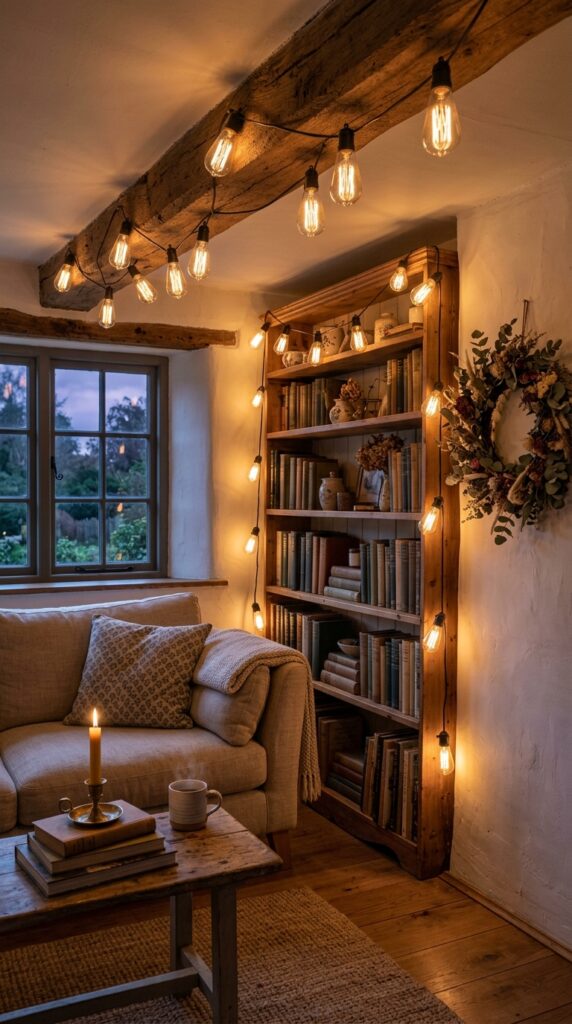
Vibe: Magical. String lights in a cottage living room are not a decoration strategy — they are a mood at the flick of a switch, the domestic equivalent of fireflies.
Why it works: Edison filament string lights operate at approximately 2,200K — the same color temperature as a candle flame — which means they produce the warmest, most flattering light of any electrical source. Draped along a beam, wound through a bookshelf, or arranged in a loose canopy above a seating area, they distribute warm light across multiple points simultaneously, eliminating the flat, directionless quality of a single ceiling source. The visible filament of a large Edison bulb also adds visual interest as an object — warm light as texture, not just illumination.
How to get it: Use string lights with large, globe or teardrop Edison bulbs (not mini fairy lights — the bulb scale matters enormously). LED Edison bulbs in the 2,200K range use a fraction of the energy of original filament bulbs and generate almost no heat, making them safe for extended use. Drape loosely rather than stringing tightly — the natural curves of a loosely hung string read as relaxed and gathered, while tight strings read as stage decoration.
🛍️ Shop the Look — Amazon Product Ideas
| # | Product Search Phrase | Why It Fits |
| 1 | Edison bulb string lights indoor globe warm 2200K | Core warm ambient lighting |
| 2 | large filament LED bulb E27 warm amber set | Energy-efficient warm bulb |
| 3 | string light dimmer switch plug in | Mood-adjustable lighting control |
| 4 | small adhesive hooks clear for string lights | Damage-free light draping |
| 5 | copper wire fairy lights warm indoor | Fine-scale supplementary glow |
21. Heirloom-Style Dried Flower Crown or Wreath
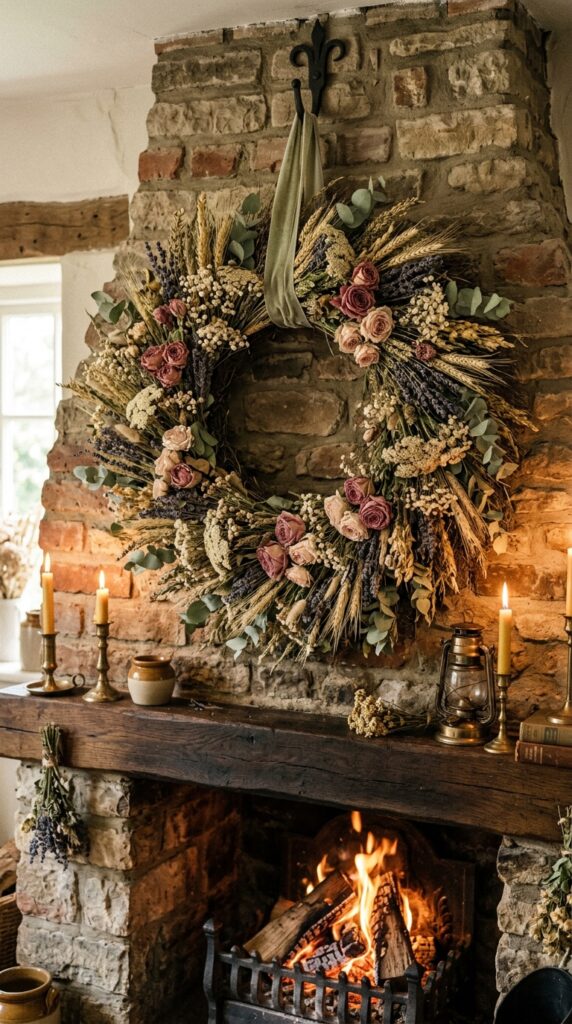
Vibe: Romantic. A dried flower wreath on a cottagecore living room wall is a declaration — this is a home where seasons are marked, where beauty is preserved, where time itself is made visible.
Why it works: A wreath is one of the most symbolically loaded objects in domestic design — it references harvest, welcome, the turning of seasons, and the very human desire to bring living things inside. Dried flowers are specifically significant in the cottagecore context because they honor the principle of preservation over consumption — a dried rose is more meaningful than a fresh one precisely because it has survived. Hung above a fireplace, a large dried wreath becomes the room’s primary botanical focal point, reading at the scale of a piece of art while retaining the soft, organic quality of a living garden.
How to get it: Build a dried flower wreath on a grapevine or wire base. Start with the largest stems (eucalyptus branches, dried grasses, wheat stalks) to establish the base volume, then layer in mid-size flowers (dried roses, preserved peonies, yarrow), finishing with the smallest detail flowers (dried lavender, baby’s breath, dried chamomile). Work in sections around the wreath rather than evenly covering the whole base — deliberate density variation reads as natural.
💡 Quick Win: Purchase a pre-made grapevine wreath base and a bundle of dried lavender — secure the lavender in clusters with floral wire at 4-inch intervals around the top two-thirds of the wreath. This single-botanical approach photographs magnificently and takes under 20 minutes.
🛍️ Shop the Look — Amazon Product Ideas
| # | Product Search Phrase | Why It Fits |
| 1 | large dried flower wreath preserved roses lavender | Ready-made botanical statement |
| 2 | grapevine wreath base natural for DIY | Wreath making foundation |
| 3 | dried rose bundle preserved mixed colors | Wreath focal flower material |
| 4 | floral wire paddle green for wreath making | Wreath construction tool |
| 5 | sage velvet ribbon wreath hanging loop | Finishing hanging detail |
22. A Wooden Ladder as a Decorative Blanket Rack
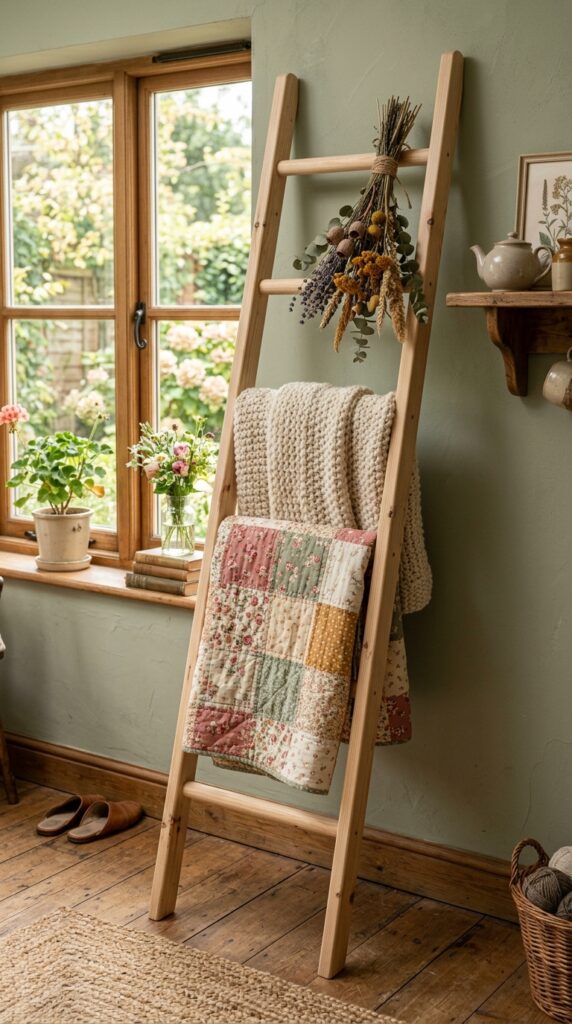
Vibe: Casual. A ladder blanket rack is the cottagecore living room’s most honest piece of furniture — it serves its purpose without pretending to be anything other than a ladder with better company.
Why it works: A wooden ladder against a wall performs the function of a blanket rack while adding vertical visual interest in the way that low furniture cannot. Its rungs create a series of horizontal lines that organize the draped textiles at different heights, which introduces layered visual rhythm without any wall damage or fixed installation. The design principle is useful beauty — an object that solves a real problem (blanket and throw storage) while also functioning as a room styling element, which is the cottagecore ideal distilled to a single object.
How to get it: A simple rustic ladder can be made from two straight-grained pine boards and five or six round dowels for under $25 in materials if basic woodworking is comfortable. Alternatively, a slim bamboo or pine decorative ladder from a home shop serves the same purpose. Lean it at a shallow angle (70–75 degrees from the floor) so draped textiles fall cleanly away from the wall.
🛍️ Shop the Look — Amazon Product Ideas
| # | Product Search Phrase | Why It Fits |
| 1 | decorative wooden blanket ladder pine natural | Core storage styling piece |
| 2 | chunky knit throw blanket cream white | Textural top-tier drape |
| 3 | patchwork cotton throw quilt vintage style | Lower rung layered drape |
| 4 | dried flower bundle twine tied rustic | Ladder top botanical accent |
| 5 | cotton rope twine natural brown roll | Tying botanical bundles |
23. Aged Copper and Patinated Metal Accents
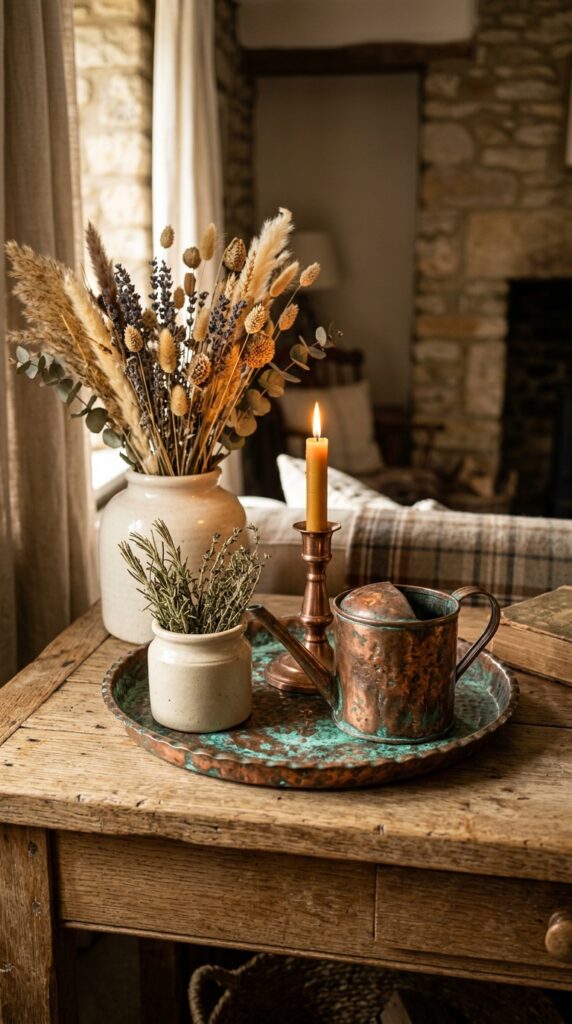
Vibe: Raw. Aged copper in a cottagecore living room does not pretend to be new — its patina is its beauty, evidence of oxidation, handling, and time.
Why it works: Patinated copper sits in a unique position in the material hierarchy of the cottagecore aesthetic — it is simultaneously ancient (copper has been used in domestic objects since the Bronze Age) and botanical (the verdigris patina of aged copper mirrors the blue-green of certain succulents and lichens). This dual reference makes copper particularly harmonious in a room that draws its palette from the natural world. The warm, reddish-brown of unpatinated copper and the cooler verdigris of fully patinated copper together create tonal complexity within a single material, which means even one copper object contributes significant color interest to a room.
How to get it: Source genuine patinated copper objects from antique markets and estate auctions — small watering cans, vases, jugs, and trays are most commonly available at $15–$60. Avoid polishing: the patina is the point. If you prefer a controlled aged look on new copper, apply a solution of salt and white vinegar to the surface and leave in the open air for 24 hours to accelerate oxidation.
🛍️ Shop the Look — Amazon Product Ideas
| # | Product Search Phrase | Why It Fits |
| 1 | copper watering can small vintage style patina | Signature cottage copper object |
| 2 | antique copper candlestick holder aged | Warm metal lighting accent |
| 3 | patinated copper tray rectangular vintage | Aged metal surface organizer |
| 4 | copper aging patina solution DIY kit | Accelerated patina on new copper |
| 5 | cream ceramic planter pot small matte | Neutral contrast to copper |
24. Layered Rugs for Warmth and Texture
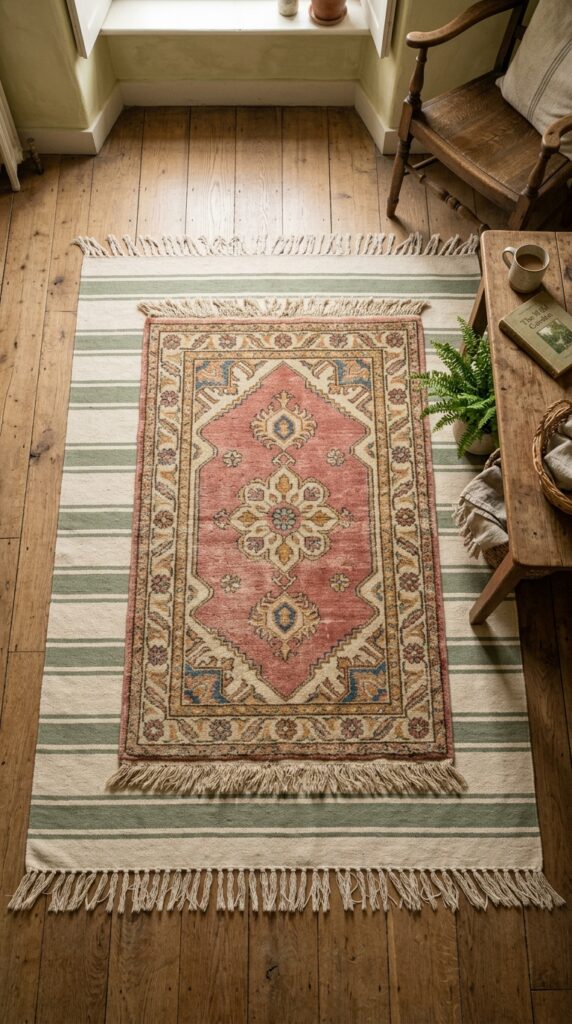
Vibe: Warm. Layered rugs are the floor equivalent of a linen sofa piled with cushions — they make the ground feel as considered and comfortable as everything above it.
Why it works: Rug layering solves the practical problem of achieving pattern and warmth with imperfect-sized rugs while also creating the visual depth of a genuinely accumulated floor covering. The design principle is intentional contrast: a flat-weave base rug provides a horizontal canvas, while a smaller pile rug on top introduces texture, pattern, and color differentiation at the room’s center. Together, they create four visible layers at floor level — two rug surfaces, two fringe or edge details — which gives the room a richness and warmth that no single rug achieves.
How to get it: Use a larger, lower-cost flat-weave or kelim rug as the base layer, then invest in a smaller, higher-quality wool or vintage Persian-style rug as the hero layer. The base rug should extend at least 12 inches beyond the hero rug on all sides. Both rugs should share at least one color to remain harmonious — typically the base is simpler and the top rug carries the pattern.
🛍️ Shop the Look — Amazon Product Ideas
| # | Product Search Phrase | Why It Fits |
| 1 | flat weave cotton kelim rug cream sage stripe | Base layer rug |
| 2 | vintage style Persian rug small 4×6 rose wool | Hero top layer rug |
| 3 | rug layering gripper pad non-slip between rugs | Prevents slipping between layers |
| 4 | wool rug fringe brush grooming | Fringe maintenance tool |
| 5 | rug binding tape no-slip edge cream | Edge finishing for flat weave |
25. A Herb Garden on the Windowsill
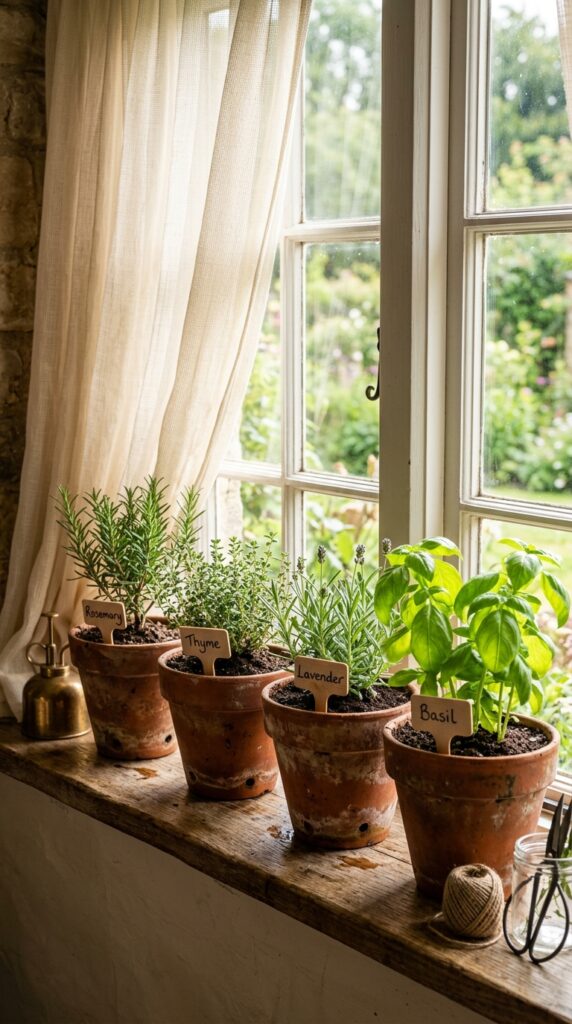
Vibe: Fresh. A windowsill herb garden is the most honest version of the cottagecore ideal — beauty that also feeds you, decoration that also scents the room, plants that earn their place.
Why it works: A windowsill herb garden introduces multiple sensory layers simultaneously: the visual of green growing things against a warm terracotta row, the scent of rosemary and lavender released as the morning sun hits the leaves, the texture of rough terracotta and soft herb foliage within arm’s reach. The design principle is purposeful beauty — every object in this composition serves a function beyond decoration. This is profoundly consistent with the cottagecore ethos, which draws from the working cottage tradition where beauty and utility were never separate categories.
How to get it: Line up terracotta pots in a graduated size sequence — alternating slightly taller and shorter — along the windowsill for visual rhythm rather than a flat uniform row. Use a handwritten chalk label or a small wooden stake with ink lettering for each herb. Choose a south or east-facing window for maximum light — most culinary herbs require at least 6 hours of direct light daily.
💡 Quick Win: Three terracotta pots with grocery-store herb plants (rosemary, thyme, and one flowering herb like lavender or chives) placed on a windowsill with a small ceramic dish for drainage costs under $18 total and transforms any window into a cottagecore vignette immediately.
🛍️ Shop the Look — Amazon Product Ideas
| # | Product Search Phrase | Why It Fits |
| 1 | terracotta herb pot set graduated sizes drainage | Core windowsill planting vessel |
| 2 | wooden herb label stake set handwritten style | Naming and styling detail |
| 3 | windowsill herb planter tray terracotta drainage | Under-pot drainage solution |
| 4 | organic herb seed kit rosemary thyme lavender | Living herb growing from seed |
| 5 | ceramic saucer set terracotta pot compatible | Indoor drainage saucers |
26. Macramé Wall Hanging as Textile Art
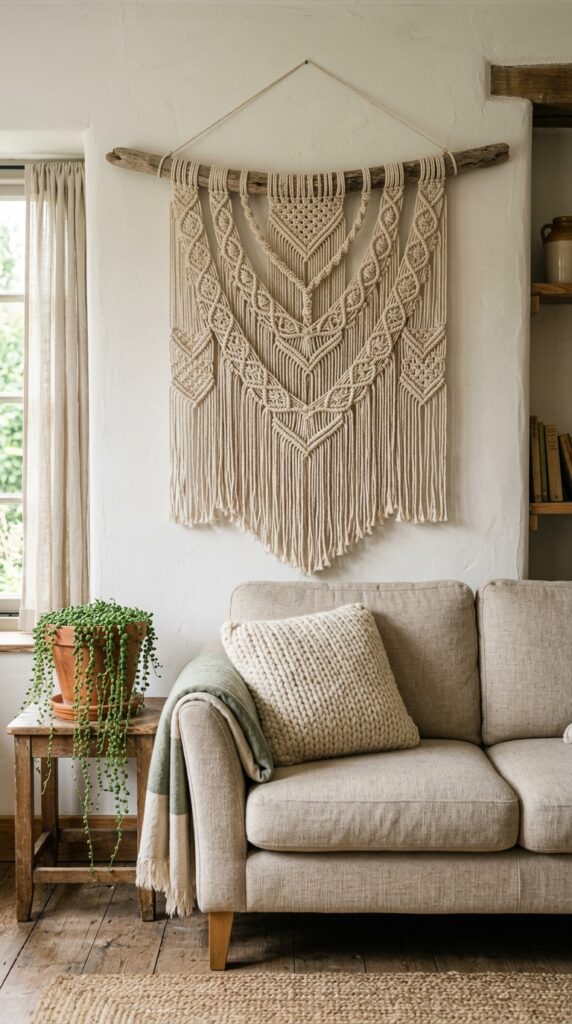
Vibe: Textural. A macramé wall hanging brings the work of hands into a room at a scale that embroidered cushions cannot — a large-format declaration that craft matters and slowness has value.
Why it works: Macramé is knotwork — purely tactile, purely handmade, impossible to automate convincingly at scale — which gives it an authenticity currency in the cottagecore context that no printed or woven equivalent achieves. Hung against a plain wall, a large macramé piece functions as the cottagecore equivalent of abstract art: it introduces pattern, texture, and dimension without color competition, which means it works harmoniously with virtually every palette. The natural cotton cord color (warm undyed cream) echoes linen, aged paper, and dried botanical tones — it belongs in the same material family as almost everything else in the cottagecore vocabulary.
How to get it: A large macramé wall hanging (approximately 24×36 inches) on a driftwood branch should hang so its top sits at approximately 65–70 inches from the floor — above sofa level, below ceiling level, centered on the wall above the furniture. Purchase from an independent maker on Etsy (supporting the handcraft ethos the piece embodies) or learn the five basic macramé knots and make one — a beginner piece with basic square and spiral knots takes approximately 8–10 hours.
🛍️ Shop the Look — Amazon Product Ideas
| # | Product Search Phrase | Why It Fits |
| 1 | large macramé wall hanging boho natural cotton | Core textural wall art |
| 2 | macramé cord natural cotton 3mm rope DIY | Making your own wall hanging |
| 3 | driftwood branch natural for macramé hanger | Authentic hanging rod |
| 4 | string of pearls plant succulent small pot | Companion trailing botanical |
| 5 | macramé beginner kit with instructions | Learning the handcraft skill |
27. A Vintage Trunk as Coffee Table and Storage
🖼️ IMAGE PROMPT: A photorealistic, ultra-detailed cottagecore interior photograph of an aged leather and wood trunk used as a coffee table in a cottage living room, its lid styled with a ceramic tray, a candle, a stack of books, and a small vase of wildflowers. Lighting: warm ambient afternoon light. Camera angle: 45-degree shot showing trunk profile and styling. Mood: storied and warm. Key details: visible leather strap hardware with aged brass buckles, worn corner brackets, natural aging marks on the leather. Decor accents: a simple ceramic tray holding a candle, a woven bookmark, a single vase of dried wild chamomile. Color palette: aged tan leather, dark wood frame, aged brass, cream ceramic. Style tags: photorealistic, 8K resolution, interior design photography, Pinterest vertical 2:3 ratio, no people, magazine quality.
Vibe: Storied. A vintage trunk as a coffee table tells a story before a single guest sits down — it suggests travel, history, and the quiet pride of keeping beautiful things functional.
Why it works: A trunk doubles the value of every square foot it occupies — it is simultaneously surface and storage, which is particularly important in a cottage living room where space is often limited and visual clutter must be managed carefully. The design principle is dual function — an object that serves two purposes simultaneously reduces the total object count without reducing storage capacity. The trunk’s irregular aging, patched corners, and worn brass hardware also contribute biographical depth that no new piece of furniture can replicate, making it a self-styling object that improves as it collects new marks and history in your home.
How to get it: Source vintage trunks from antique markets, estate sales, or luggage shops. Condition varies widely — a trunk with solid structure but worn leather surface can be cleaned with leather conditioner and used as-is, with the wear reading as character. Avoid trunks with soft or sagging lids, which cannot support the weight of objects placed on top. The ideal coffee table trunk height is 16–18 inches, matching a standard sofa seat height.
🛍️ Shop the Look — Amazon Product Ideas
| # | Product Search Phrase | Why It Fits |
| 1 | vintage leather trunk wooden coffee table storage | Core dual-function furniture |
| 2 | leather conditioner cream old luggage restoration | Trunk surface conditioning |
| 3 | ceramic serving tray oval neutral table styling | Trunk top organizational surface |
| 4 | dried chamomile bundle small vase display | Wildflower styling accent |
| 5 | leather strap replacement brass buckle hardware | Trunk restoration hardware |
28. Terracotta and Warm Ochre Accent Tones
🖼️ IMAGE PROMPT: A photorealistic, ultra-detailed cottagecore interior photograph of a living room corner accent in warm terracotta and ochre — a terracotta-walled corner with an ochre linen cushion, a cluster of terracotta pots in varying sizes, and a raw clay vessel holding dried wheat stalks. Lighting: warm late afternoon light enriching the terracotta tones. Camera angle: close-up corner detail shot. Mood: sun-warmed and ancient. Key details: matte terracotta paint on the corner wall section, unglazed clay surfaces, dried wheat pale gold against the warm tones. Color palette: terracotta orange-brown, warm ochre, dried wheat gold, sage green offset. Style tags: photorealistic, 8K resolution, interior design photography, Pinterest vertical 2:3 ratio, no people, magazine quality.
Vibe: Sun-warmed. Terracotta and ochre are the colors of earth in sunlight — they bring Mediterranean warmth and antiquity to a cottagecore living room without requiring a single piece of new furniture.
Why it works: Terracotta and ochre sit in the warm-neutral register of the color spectrum — orangey-brown and golden-yellow — which means they act as accent tones that intensify the warmth of whatever surrounds them without adding cool contrast. In a cottagecore living room dominated by cream, sage, and natural wood, a terracotta accent creates visual heat at the accessory level, enlivening the whole palette without disrupting it. These are also deeply historical colors — terracotta has been used in Mediterranean domestic architecture for thousands of years — which gives them an unforced sense of age that aligns with the cottagecore aesthetic’s reverence for the pre-industrial.
How to get it: Introduce terracotta across three scales: a large terracotta-toned pot or vessel (30cm+), medium terracotta garden pots repurposed as indoor planters (15–20cm), and small terracotta details (a tea-light holder, a clay bead garland). This three-scale distribution creates a color thread rather than an accent blob — the eye finds the tone repeatedly around the room, creating warmth at every level.
🛍️ Shop the Look — Amazon Product Ideas
| # | Product Search Phrase | Why It Fits |
| 1 | large terracotta pot tall floor vase indoor | Large-scale warm earth tone |
| 2 | terracotta paint interior matte sample | Accent wall or niche color |
| 3 | raw clay vessel handmade decorative ochre | Unglazed earthy statement piece |
| 4 | dried wheat stalks bundle decorative golden | Warm gold botanical accent |
| 5 | terracotta tea light candle holder set | Small-scale tone distribution |
29. A Wild Garden Inspired by the Room Through the Window
🖼️ IMAGE PROMPT: A photorealistic, ultra-detailed cottagecore interior photograph of a living room with a large cottage window framing a view of a wild garden — overgrown roses, foxgloves, lavender hedges — with the interior room reflecting the same botanical palette in its textiles and objects: dried roses on the table, a lavender wreath, sage green walls. Lighting: bright natural light from the window flooding the room, bringing outdoor and indoor tones into one palette. Camera angle: wide shot from the interior toward the window, framing the garden view. Mood: painterly and still. Key details: the visual connection between indoor botanical objects and outdoor plants visible through the glass. Color palette: outdoor rose pink and green echoed in indoor sage walls, dried rose objects, cream linen. Style tags: photorealistic, 8K resolution, interior design photography, Pinterest vertical 2:3 ratio, no people, magazine quality.
Vibe: Painterly. The most deeply satisfying cottagecore living rooms are not decorated — they are grown, in deliberate conversation with whatever is alive outside the window.
Why it works: The design principle at work in this idea is visual continuity between interior and exterior — deliberately mirroring the palette and botanical vocabulary of your outdoor garden (or even a neighbor’s visible planting) in your indoor choices so that inside and outside feel like two expressions of the same living system. A window that frames foxgloves, roses, and lavender becomes the room’s most valuable piece of wall art when the interior palette echoes those exact tones. This continuity creates the specific quality of the most iconic cottagecore interiors: the sense that the room did not end at the wall but grew all the way through it.
How to get it: Identify the three most dominant colors in whatever is visible from your living room window — whether that is a garden, a tree, or even a moss-covered wall. Then deliberately echo those tones in your indoor textiles, botanicals, and paint choices. You do not need a wild English garden outside your window for this principle to work; even the green of a single visible tree, echoed in sage cushions and trailing indoor plants, creates a version of this connection.
💡 Quick Win: Place a single flowering plant (a potted lavender, a blowsy geranium, or an overflowing nasturtium in a terracotta pot) on your windowsill, positioned so it sits in the frame of the window when viewed from the sofa. It costs under $8 at a garden center and creates the indoor-outdoor botanical dialogue that is the heart of the cottagecore aesthetic.
🛍️ Shop the Look — Amazon Product Ideas
| # | Product Search Phrase | Why It Fits |
| 1 | potted lavender plant indoor flowering terracotta | Indoor-outdoor botanical bridge |
| 2 | dried rose bunch preserved for indoor decor | Interior echo of garden roses |
| 3 | window box planter outdoor windowsill cottage | Extending indoor botanical garden |
| 4 | sage green cushion cover linen botanical | Interior palette mirroring garden |
| 5 | wildflower seed mix cottage garden growing | Cultivating the view itself |
How to Start Your Cottagecore Living Room Transformation
Your single first move should be replacing your existing throw cushions with a set that includes at least one hand-embroidered piece in a botanical motif — a flower, a leaf, a bird — in dusty rose, sage green, or warm cream. This is not a minor accessory decision. A cushion with visible hand-stitching introduces the material language of the entire cottagecore aesthetic — handcraft, natural subject matter, textile warmth — at the most immediate level, and it costs under $30. Everything else can build from there.
The most common mistake beginners make is purchasing everything at once from a single retailer. Cottagecore’s entire visual authority comes from the appearance of things accumulated gradually, from different sources, over time. A living room where every object came from one online order reveals itself immediately — the objects have a visual uniformity of finish and scale that betrays simultaneous purchase. Instead, mix one new piece with two vintage or secondhand finds. Visit a charity shop before clicking “add to cart.”
Three specific items under $50 that create immediate cottagecore impact: a bundle of dried lavender in a simple terracotta pot on your windowsill ($8–$12 at a garden center or florist), a hand-stitched embroidered cushion cover in any botanical motif ($15–$28 on Etsy), and a set of four mismatched vintage brass candlestick holders from a charity shop ($4–$15 total). These three additions will shift any living room meaningfully toward the aesthetic without touching the furniture.
A starter cottagecore transformation — new cushions, a rug, botanical prints, and a few ceramic and candle accents — costs $150–$450 and can be completed over a single weekend. A fuller room transformation involving a new sofa or armchair, curtains, a bookshelf, and botanical styling runs $900–$2,500. The most convincing cottagecore rooms typically take 6–18 months to assemble properly, as vintage finds and handmade pieces arrive gradually — and that gradual accumulation is not a limitation of the style but its entire point.
Frequently Asked Questions About Cottagecore Living Room Design
What is the difference between cottagecore and farmhouse style?
Farmhouse style draws from American agricultural vernacular — shiplap, galvanized metal, barn doors, and a clean, neutral palette that prioritizes practicality and rusticity. Cottagecore, by contrast, draws from the English rural cottage tradition and emphasizes romanticism, whimsy, botanical abundance, and the handmade. Where farmhouse is often stark and graphic, cottagecore is layered and soft. The clearest test: farmhouse style rarely includes embroidered cushions, vintage china, pressed botanical prints, or macramé. Cottagecore almost always includes several of these. Farmhouse palette centers on white, black, and gray; cottagecore favors sage green, dusty rose, cream, and lavender.
What colors work best for a cottagecore living room?
The most successful cottagecore palettes are built from muted, desaturated botanically-referenced tones: chalky sage green (try Benjamin Moore “Pale Smoke” or Farrow & Ball “Mizzle”), warm cream (Benjamin Moore “White Dove” with a warm primer beneath), dusty rose (Farrow & Ball “Nancy’s Blushes”), and lavender mist. These are supported by earthy accents in terracotta, warm ochre, and aged burgundy. The critical rule is saturation: cottagecore palettes are always low-to-medium saturation — any color that reads as vivid, bright, or clean will break the faded, nostalgic quality the style depends on. When in doubt, choose the dustier version.
How much does a cottagecore living room transformation cost?
A meaningful entry-level cottagecore transformation — new cushions, a jute or woven rug, botanical prints, ceramic vessels, and candle styling — costs $150–$450 and can be achieved in a weekend. A mid-range transformation that includes a new armchair (or chintz reupholstery of an existing one), curtains, open shelving, and botanical accessories runs $800–$2,000. A full room transformation with a new sofa, painted walls, vintage furniture pieces, and complete styling runs $2,500–$6,000. Importantly, because secondhand, vintage, and charity shop sourcing are not just acceptable but stylistically preferable in cottagecore, total costs can be reduced by 40–60% compared to buying everything new.
Can cottagecore work in a modern apartment without original architectural features?
Yes, and effectively. Cottagecore is not architecture-dependent — it is object and material dependent. A modern apartment with smooth walls and no original features can achieve an authentic cottagecore living room through: limewash paint applied to one or two walls (which creates the ancient plaster texture effect instantly), applied decorative beam wraps on the ceiling, floor-to-ceiling linen curtains softening the rectilinear windows, and a furniture arrangement centered around a botanical rug and a chintz armchair. The objects, textiles, and lighting carry the aesthetic; the architecture is a supporting player.
What plants work best in a cottagecore living room?
The most authentically cottagecore plants are those with soft, natural, slightly wild growth habits — trailing pothos, cascading string of pearls, unpruned rosemary, blowsy indoor roses, or a potted lavender. A fiddle-leaf fig reads as modern and architectural; a trailing pothos in a terracotta pot reads as cottagecore. Dried and preserved botanicals are equally important — dried lavender bundles, preserved eucalyptus stems, pampas grass, poppy seed heads, and dried rose bunches all contribute botanical richness without requiring light or water. Aim for a mix of at least two living plants and three to five dried botanical elements in a cottagecore living room for the fullest botanical layering.
Ready to Create Your Dream Cottagecore Living Room?
These 29 ideas have moved through the full emotional and material range of the cottagecore living room — from the chalky sage green of a botanical wall to the warm amber of a candlelit shelf, from the storied surface of a reclaimed wood coffee table to the delicate shadow cast by lace curtains on a morning wall. Transformation in this style is always incremental, and that is not a limitation — it is the method. A single embroidered cushion, a dried lavender bundle in a terracotta pot, three mismatched brass candlesticks gathered from a charity shop: each small addition shifts the room further into the world you are building. Today, do this one concrete thing: go to the nearest charity shop or antique market and allow yourself to spend $20 on one object that makes your heart feel the way this room should feel — a floral teacup, a worn paperback with a beautiful spine, a small ceramic that seems to have lived somewhere interesting. When your cottagecore living room is finally complete — or as complete as this style ever allows — it will feel like the room has always been there, waiting for you to notice it. Pin the ideas that made you feel something specific, save the image prompts that showed you something you didn’t know you wanted, and begin with the smallest, most available version of it.