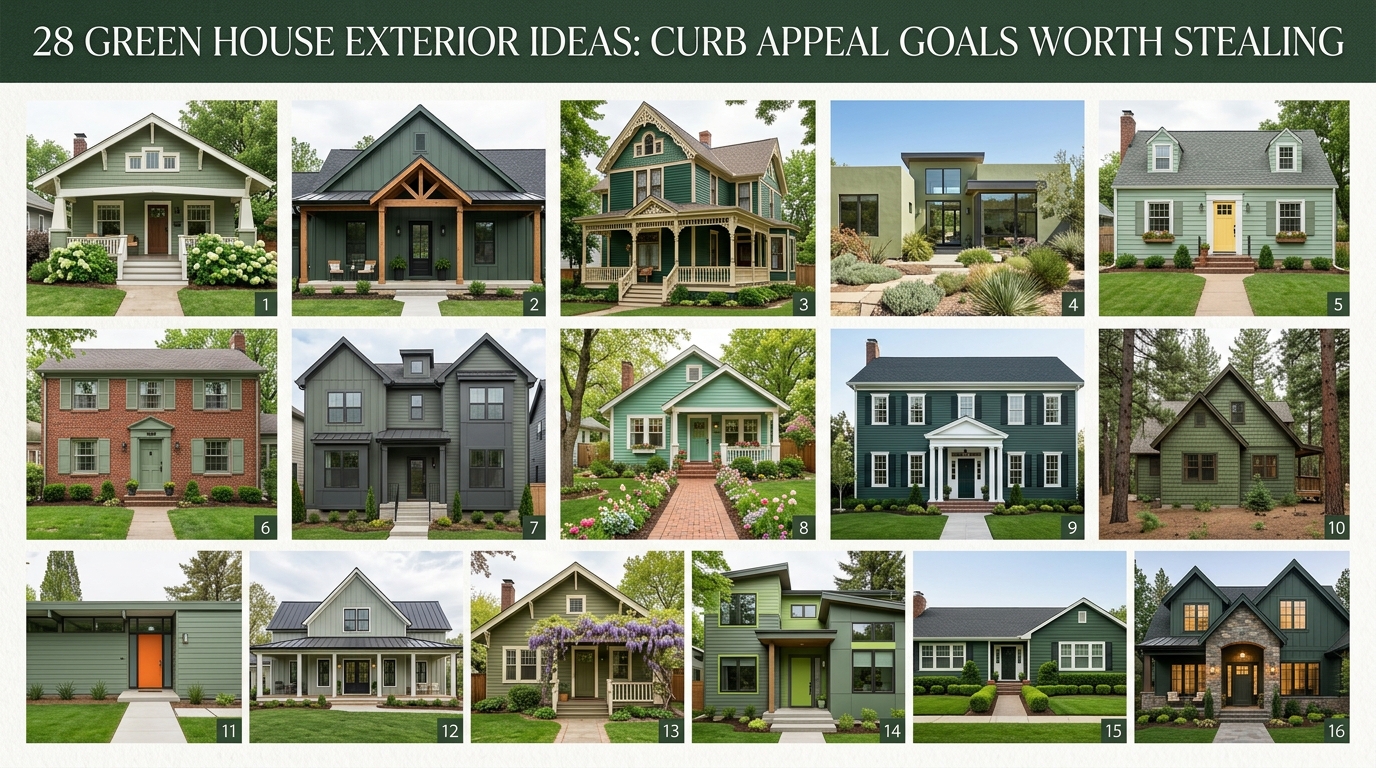
A green house exterior uses nature-drawn hues — from soft sage and olive to deep forest and hunter — applied to siding, trim, doors, or shutters to create a facade that feels grounded, organic, and quietly confident. This article gives you exactly 28 green house exterior ideas spanning color choices, materials, landscaping pairings, lighting, and architectural details to transform your home’s curb appeal.
There’s something about a green exterior that stops you in the street. It whispers of ivy-covered estates and sun-dappled cottage gardens, of homes that look like they grew there rather than were built. Whether your house is a modern farmhouse, a craftsman bungalow, or a colonial revival, green does something no other color does — it makes the architecture breathe. Here are 28 ideas worth saving — and stealing.
Why Green House Exteriors Work So Well
Green is the most versatile color in exterior design precisely because it exists in nature at every saturation level — and the human eye is evolutionarily wired to find it restful. Unlike bold reds or stark whites, green exteriors carry inherent credibility: they never look try-hard. The style draws from English country house traditions, American craftsman architecture, and the contemporary organic-modern movement, all of which share a belief that a home should feel like an extension of its landscape rather than a interruption of it.
The materials that pair best with green exteriors are honest and tactile: cedar shake siding, fiber cement board-and-batten, tumbled brick, and rough-hewn stone foundations. Trim colors range from crisp warm white and creamy linen to deep charcoal and even matte black, depending on the green’s undertone. Roof materials in weathered slate, aged copper, or dark asphalt shingle all read beautifully against green siding. Hardware and lighting in oil-rubbed bronze or aged brass complete the palette without competing with it.
Green exterior homes are trending sharply right now — Pinterest searches for “sage green house exterior” grew over 300% in recent years — partly as a reaction to the grey-and-white minimalism that dominated the 2010s. Post-pandemic, homeowners began investing more deliberately in curb appeal and outdoor connection, seeking facades that feel warm and personal rather than model-home generic. Green also aligns with sustainability aesthetics: it signals environmental consciousness visually, even before a single solar panel is installed.
Even small homes achieve this style with tremendous impact. A 1,200-square-foot ranch with a single green front door and matching shutters reads as intentional and curated. Smaller homes should prioritize one dominant green element — the door, the siding, or the shutters — rather than all three at once, which can overwhelm a modest facade.
Style at a Glance
| Element | Characteristic 1 | Characteristic 2 |
| Philosophy | Rooted in landscape | Quietly confident |
| Materials | Cedar, stone, fiber cement | Iron hardware, aged brass |
| Color Palette | Sage, olive, forest, hunter | Warm white, charcoal, terracotta trim |
28 Green House Exterior Ideas for Curb Appeal Goals
1. Sage Green Board-and-Batten Siding with White Trim
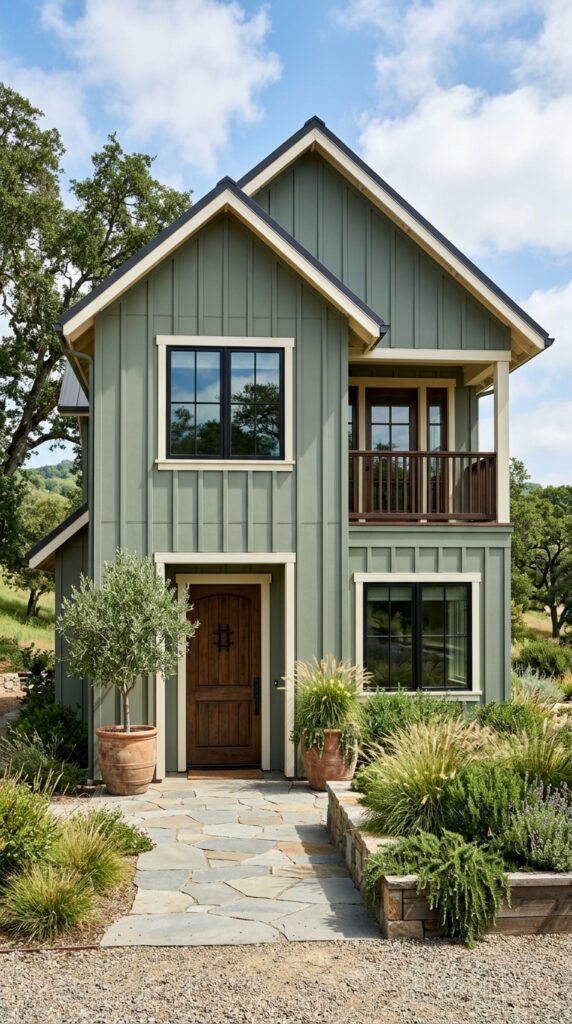
Vibe: Sun-warmed and unhurried, like a home that’s been here long enough to earn its place in the landscape.
Why it works: Board-and-batten’s strong vertical lines add height and architectural authority to any facade, and sage green’s grey-leaning undertone keeps the look sophisticated rather than cute. The contrast between matte green siding and bright white trim creates crisp visual definition without the harshness of black-and-white. Fiber cement holds color exceptionally well through UV exposure, making it the practical choice for this look.
How to get it: Use Benjamin Moore’s “Saybrook Sage” HC-114 or Sherwin-Williams “Rosemary” SW 6187 for the siding, and paint trim in a warm white like SW “Alabaster” SW 7008 — not a cool bright white, which will create an undertone clash outdoors.
💡 Quick Win: Paint just the front-facing gable in board-and-batten sage while leaving the rest of the house in a complementary neutral — it costs a fraction of full re-siding and creates a dramatic focal point.
🛍️ Shop the Look — Amazon Product Ideas
| # | Product Search Phrase | Why It Fits |
| 1 | Matte black iron door handle lever set | Anchors sage with contrast |
| 2 | Terracotta tall garden planter outdoor | Entry accent, warm tone |
| 3 | Outdoor lantern wall sconce oil rubbed bronze | Period-correct lighting |
| 4 | Ornamental grass artificial outdoor planter | Low-maintenance texture |
| 5 | White house numbers modern farmhouse placard | Clean, visible address |
2. Forest Green Dutch Door with Brass Hardware
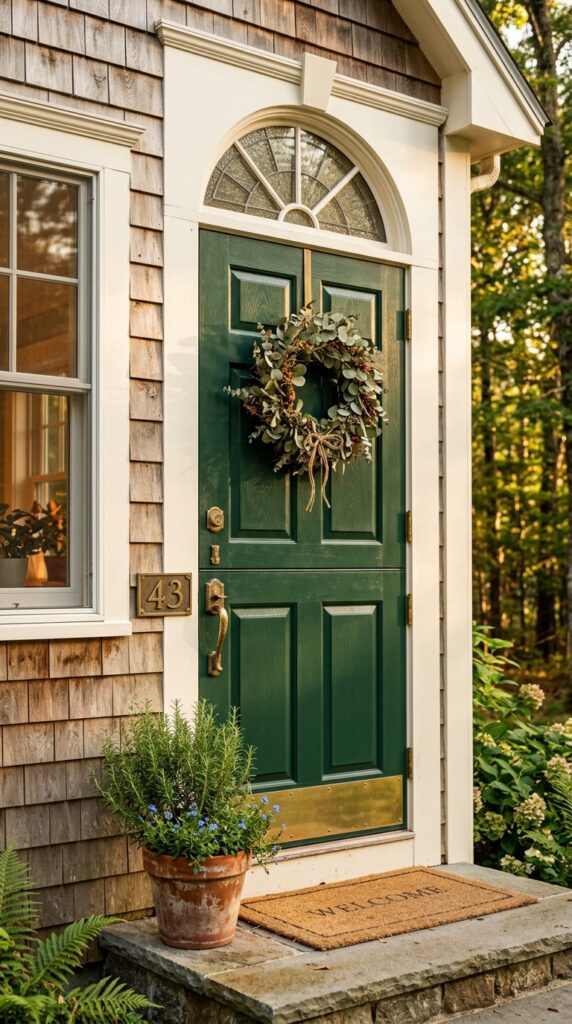
Vibe: Layered and hospitable, the visual equivalent of someone who always has fresh herbs on the windowsill.
Why it works: A Dutch door split horizontally adds charm and genuine utility — the top half opens for light and air while the bottom stays closed. Forest green in a high-gloss finish on a door does something matte siding can’t: it catches light and reads as jewel-like, almost lacquered. Aged brass hardware against deep green is one of the most reliably elegant pairings in exterior design, rooted in Georgian and Federal architectural traditions.
How to get it: Choose Farrow & Ball “Studio Green” No. 93 or Benjamin Moore “Forest Floor” 2143-20 in exterior gloss. Install unlacquered brass hardware — it will develop a natural patina that only improves over time.
🛍️ Shop the Look — Amazon Product Ideas
| # | Product Search Phrase | Why It Fits |
| 1 | Unlacquered brass door lever handle set exterior | Signature hardware choice |
| 2 | Eucalyptus dried wreath front door large | Organic, aromatic accent |
| 3 | Brass door knocker lion ring vintage | Architectural period detail |
| 4 | Brass house numbers large address plaque | Coordinates with hardware |
| 5 | Rosemary topiary outdoor potted herb plant | Fragrant, textural entry |
3. Olive Green Stucco Exterior with Terracotta Roof Tiles
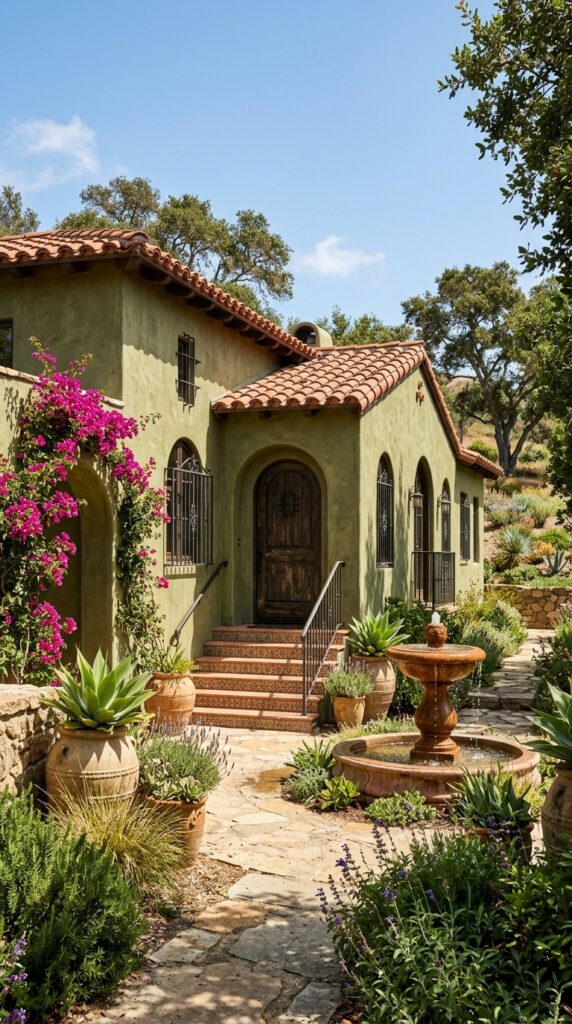
Vibe: Hushed and sun-baked, as though the house itself has slowly absorbed decades of afternoon light.
Why it works: Olive green carries yellow undertones that harmonize naturally with terracotta — both colors share the same warm, ochre-adjacent base. Smooth stucco amplifies this by reading as an earthy, monolithic surface rather than a busy one, letting the roof tiles and architectural details carry the visual interest. This combination draws from Spanish Colonial Revival and Andalusian farmhouse architecture, which were designed to sit comfortably within arid, sun-exposed landscapes.
How to get it: Tint exterior stucco using a base of Sherwin-Williams “Oakmoss” SW 6180, then pair with reclaimed terracotta barrel tiles or modern concrete tiles in a warm clay tone for the roof.
💡 Quick Win: If a full re-stucco is out of budget, repaint existing stucco in olive and replace just the entry door surround tiles with a hand-painted Talavera pattern — the combination reads as authentically Mediterranean for under $300.
🛍️ Shop the Look — Amazon Product Ideas
| # | Product Search Phrase | Why It Fits |
| 1 | Terracotta large outdoor ceramic urn planter | Mediterranean entry anchor |
| 2 | Wrought iron wall sconce outdoor lantern | Period-authentic lighting |
| 3 | Agave succulent artificial outdoor large pot | Desert-climate texture |
| 4 | Talavera ceramic tile decorative set colorful | Accent tile detail |
| 5 | Hand-painted terracotta address number plaque | Artisan entry detail |
4. Deep Hunter Green Shingle Siding on a Cape Cod
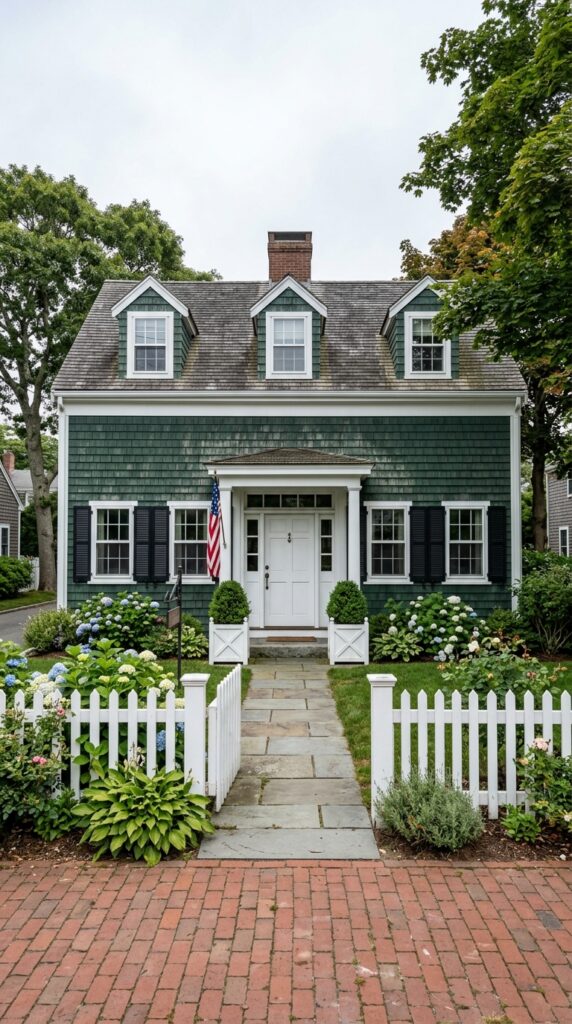
Vibe: Still and self-assured, the architectural equivalent of a wool peacoat on a grey morning.
Why it works: Cedar shake shingles create organic surface texture that softens deep, saturated colors — hunter green in clapboard reads very differently than hunter green in shingles, because the overlapping edges break the color into light and shadow rather than a flat expanse. Black shutters on a green house create one of the strongest high-contrast combinations in residential architecture, with roots in classic New England and Colonial-era color traditions. The visual weight feels rooted and permanent.
How to get it: Apply Cabot Australian Timber Oil in “Black Walnut” as a base stain on raw cedar shingles, then overpaint in Benjamin Moore “Hunter Green” 2041-10 using a flexible exterior stain-paint hybrid that moves with the wood through seasonal expansion.
🛍️ Shop the Look — Amazon Product Ideas
| # | Product Search Phrase | Why It Fits |
| 1 | Black exterior window shutters louvered set | Classic contrast detail |
| 2 | White square outdoor planter boxwood topiary | Formal entry accent |
| 3 | White picket fence section decorative garden | Framing the facade |
| 4 | Black exterior door handle deadbolt combo | Coordinates with shutters |
| 5 | Cedar shake texture exterior paint brush applicator | DIY application tool |
5. Sage and Charcoal Color-Block Exterior
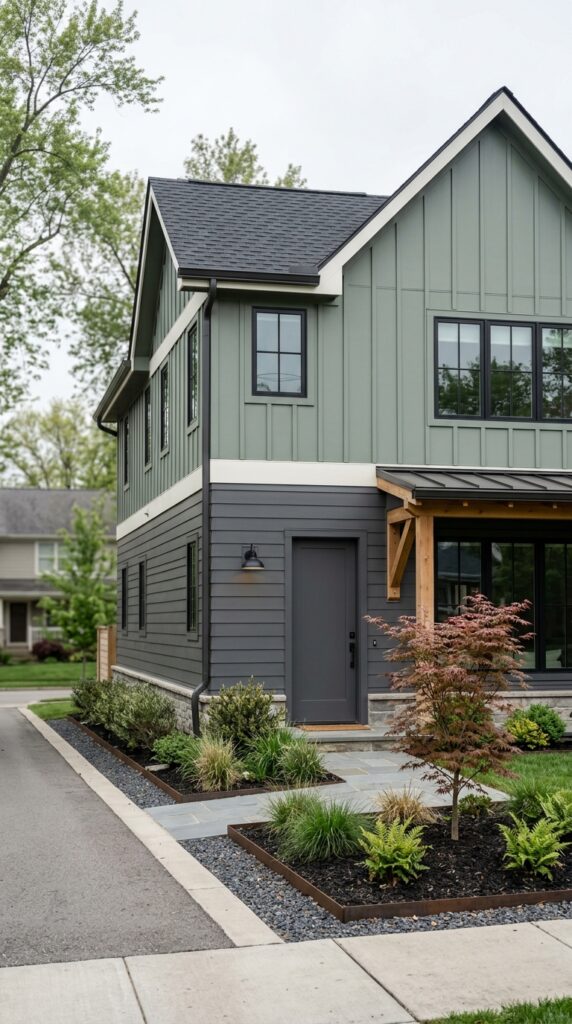
Vibe: Raw and resolved — a facade that knows exactly what it’s doing.
Why it works: Color-blocking a facade creates visual zoning that makes a house read as larger and more architecturally intentional. The sage-to-charcoal transition uses complementary neutrals — both desaturated, both earthy — so the contrast reads as tonal rather than harsh. Using different siding profiles (lap on the lower, board-and-batten on the upper) for each color zone adds a second layer of visual rhythm that photographs exceptionally well.
How to get it: Use Sherwin-Williams “Pewter Green” SW 6208 for the upper story and SW “Urbane Bronze” SW 7048 for the lower — both are warm-undertone neutrals that share enough brown in their bases to feel intentionally coordinated rather than randomly contrasted.
💡 Quick Win: Even a single-story ranch can do a version of this — paint the foundation band in a darker tone like charcoal and the main siding in sage, separated by the existing ledge trim. It reads as a full color-block effect for the cost of an extra gallon of paint.
🛍️ Shop the Look — Amazon Product Ideas
| # | Product Search Phrase | Why It Fits |
| 1 | Modern farmhouse mailbox matte black post mount | Street-facing accent |
| 2 | Japanese maple tree ornamental small container | Architectural garden accent |
| 3 | Steel lawn edging garden bed border strip | Clean, contemporary edging |
| 4 | Charcoal exterior door pivot hardware modern | Bold entry statement |
| 5 | Concrete outdoor planter rectangular modern low | Grounds the facade |
6. String Lights and Lanterns on a Green Porch
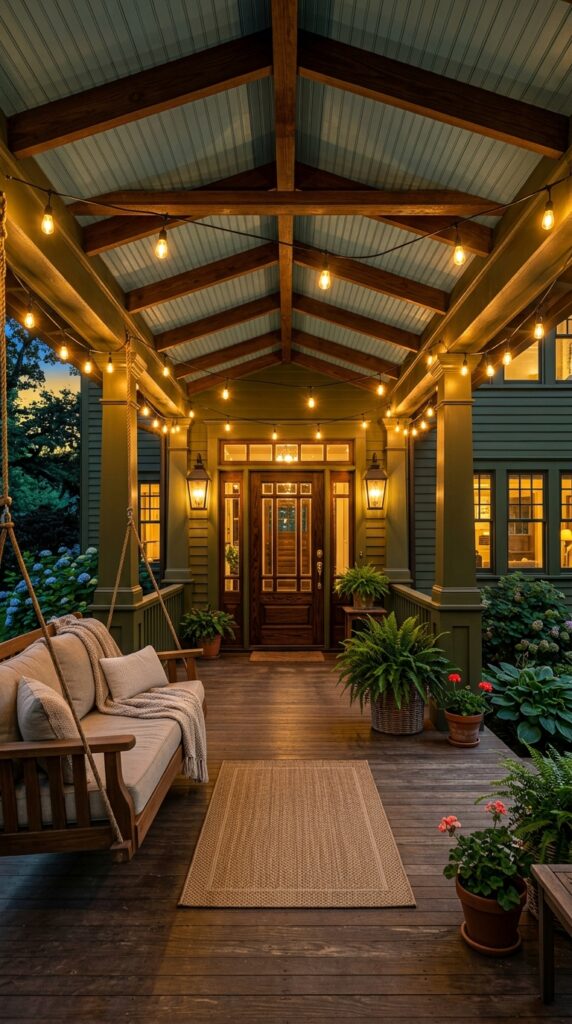
Vibe: Luminous and slow — the kind of porch that makes it impossible to go inside.
Why it works: Warm-spectrum Edison bulbs against a deep green porch ceiling create a color temperature contrast that reads as deeply atmospheric at dusk — the amber light appears even warmer against the cool undertone of haint blue (a Southern porch tradition painted to deter insects and spirits alike). Layering string lights with hardwired lanterns gives the space two light levels: ambient and mood, which is the same principle used in restaurant lighting design. The result is a porch that earns its place in every neighborhood walk.
How to get it: String S14 Edison bulb lights (25-watt equivalent LED) between porch columns at 8–9 feet high, then wire two lantern pendants at 7 feet centered on the door — the differing heights create visual layering rather than a flat plane of light.
🛍️ Shop the Look — Amazon Product Ideas
| # | Product Search Phrase | Why It Fits |
| 1 | S14 Edison string lights outdoor weatherproof 48ft | Ambient porch lighting |
| 2 | Black outdoor pendant lantern farmhouse large | Hardwired entry lighting |
| 3 | Porch swing natural wood with linen cushion | Functional porch anchor |
| 4 | Wicker basket planter stand outdoor fern | Textural green layering |
| 5 | Haint blue exterior porch ceiling paint sample | Authentic ceiling detail |
7. Green Exterior with a Bright Red Door Pop
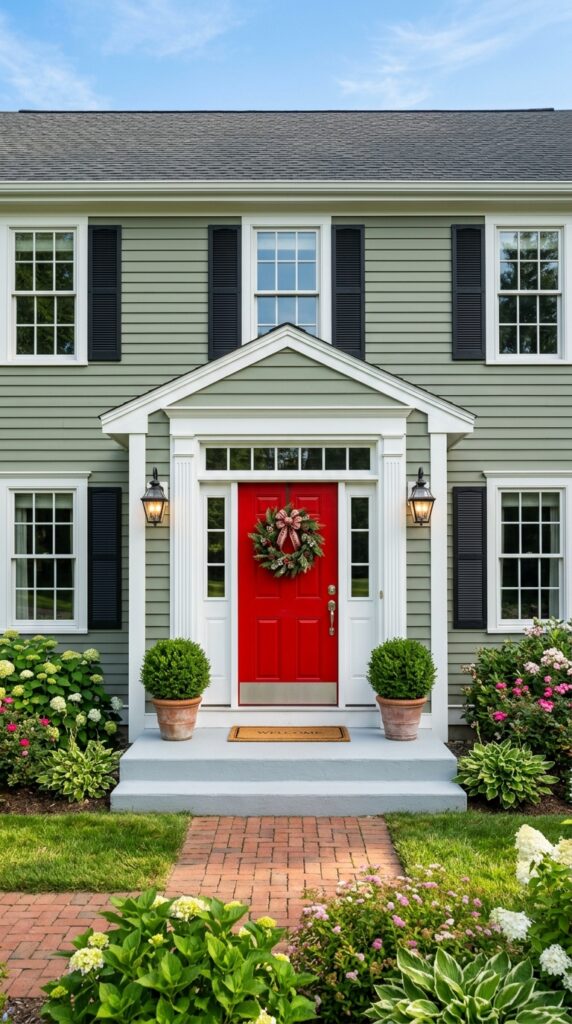
Vibe: Grounded and joyful — a house that greets you before you reach the step.
Why it works: Red and green are true complementary colors on the color wheel, meaning they maximize each other’s intensity when placed side by side — this is why a red door on a green house creates such immediate visual impact. The key is keeping the red on a small surface (the door only, not the shutters) so it functions as an accent rather than a competition. Warm white trim acts as a visual buffer that lets both colors breathe without bleeding into each other.
How to get it: Use Benjamin Moore “Caliente” AF-290 on the door in exterior semi-gloss — it’s a warm-based red with no blue in it, which prevents it from reading as cool or corporate against earthy sage siding.
💡 Quick Win: A single quart of exterior semi-gloss paint covers a standard front door twice. A quart of Caliente runs under $25 at most hardware stores — this is the highest-ROI single paint purchase in all of exterior design.
🛍️ Shop the Look — Amazon Product Ideas
| # | Product Search Phrase | Why It Fits |
| 1 | Black coach lantern outdoor wall sconce colonial | Period-correct porch lighting |
| 2 | Boxwood ball topiary outdoor set of 2 | Symmetrical entry framing |
| 3 | Seasonal door wreath year-round greenery | Door accent detail |
| 4 | Brushed nickel exterior door lever handle | Hardware contrast on red door |
| 5 | White concrete front step paint sealant | Entry surface finishing |
8. Moss Green Log Cabin Exterior
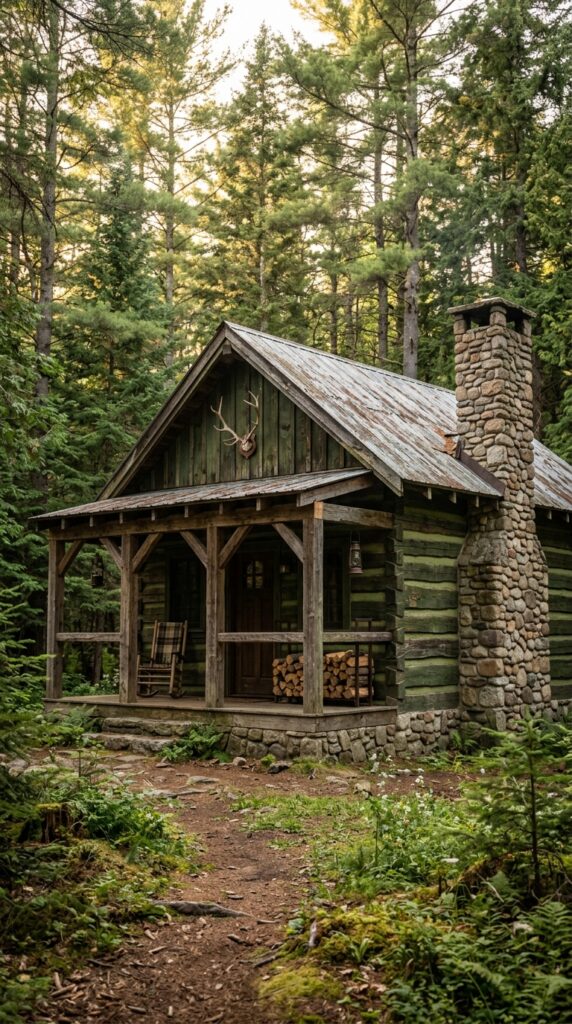
Vibe: Raw and rooted — the kind of quiet that comes from thick walls and older trees.
Why it works: Moss green chinking blends the gaps between logs with the surrounding forest, achieving the visual effect of a structure that has grown into its site rather than been placed on it. Dark green log stains protect the wood from UV degradation while deepening the natural amber-brown tones of the logs rather than masking them. Metal roofing in Corten-weathered steel or patinated copper echo the organic color story without adding any artificial brightness.
How to get it: Apply Sashco “Conceal” log home chinking in a custom-tinted moss green, then finish log surfaces with Sikkens Log & Siding in “Cedar Natural” — a transparent base that lets you tint to a mossy forest green while preserving the wood’s grain visibility.
🛍️ Shop the Look — Amazon Product Ideas
| # | Product Search Phrase | Why It Fits |
| 1 | Firewood rack outdoor log holder rustic metal | Functional porch accent |
| 2 | Antler mount wall decor rustic cabin style | Cabin entry statement |
| 3 | Natural wood rocking chair outdoor porch | Quintessential cabin seating |
| 4 | Stone chimney cap outdoor stainless steel | Functional architectural detail |
| 5 | Rustic cabin welcome sign carved wood exterior | Personality at the entry |
9. Black Window Frames on a Sage Green Victorian
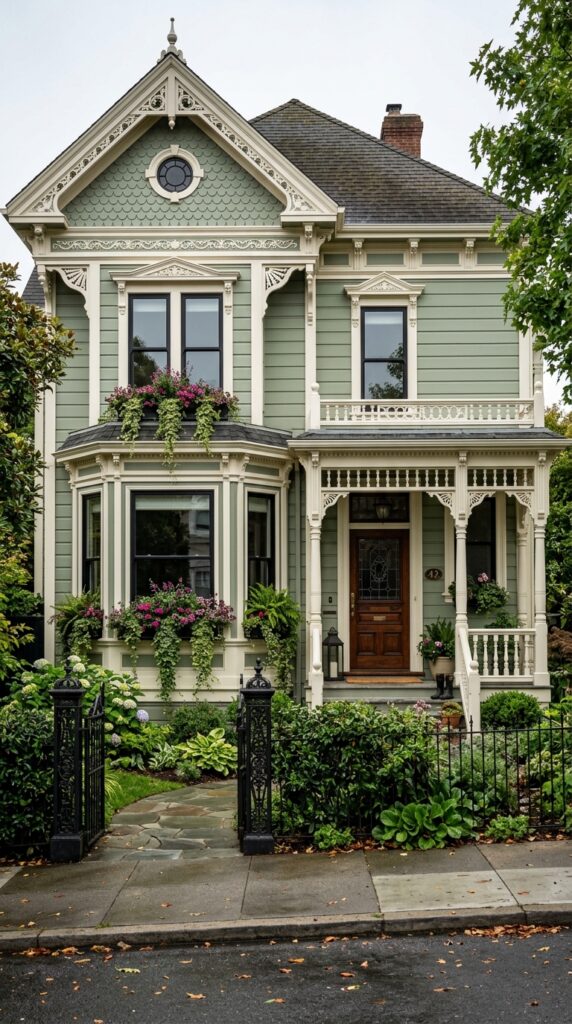
Vibe: Layered and exacting — architecture that rewards a second look.
Why it works: Matte black window frames on a Victorian facade do double duty: they visually recede the glass planes, making windows read as voids rather than surfaces, and they create a graphic, almost illustrative quality that brings the ornamental trim into sharper focus. Victorian architecture has so much surface detail that color coordination becomes crucial — using the same black on frames, ironwork, and hardware unifies the complexity rather than adding to it. Sage green reads as a resolutely modern choice for a period style, bridging historical and contemporary tastes.
How to get it: Paint window frames in Farrow & Ball “Off-Black” No. 57 — it’s a brown-black with warmth in it, which prevents frames from reading as cold or industrial against the organic green siding.
💡 Quick Win: Install window boxes beneath first-floor windows and fill with trailing English ivy — it softens the facade’s symmetry, adds texture at eye level, and costs under $40 total in plants and simple box brackets.
🛍️ Shop the Look — Amazon Product Ideas
| # | Product Search Phrase | Why It Fits |
| 1 | Black iron window box bracket exterior set | Window box hardware |
| 2 | Trailing ivy artificial window box plants | Easy exterior greenery |
| 3 | Cast iron boot scraper decorative entry | Victorian entry accent |
| 4 | Ornate black iron garden gate entry | Architectural boundary detail |
| 5 | Victorian gingerbread trim decorative wood bracket | Authentic period detail |
10. Gravel Path Through Native Grass to a Sage Door
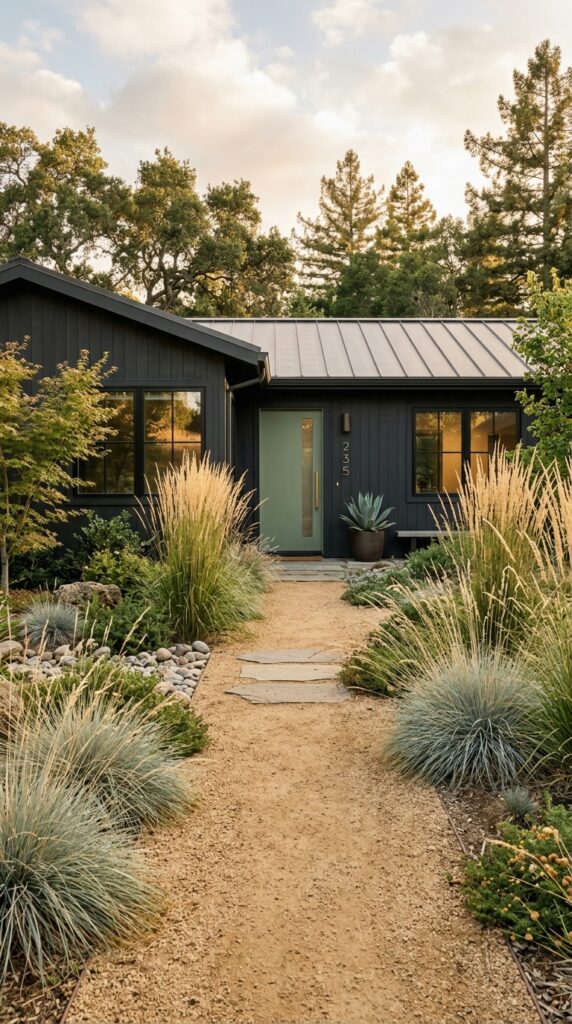
Vibe: Serene and unhurried — a front garden that makes you slow down before you arrive.
Why it works: The approach path is one of the most undervalued elements of curb appeal — it’s the only part of a facade the visitor physically moves through, so its material, direction, and planting create the entire first impression before the door is even reached. Decomposed granite in a warm buff tone reads as earthy and textural underfoot, and it contrasts beautifully with the upright linear form of feather reed grass. The sage door functions as a focal point at the path’s terminus, pulling the eye forward through the composition.
How to get it: Install flexible garden edging (Dimex EasyFlex is a reliable, budget-friendly option) to define the path edges, then fill with 2–3 inches of decomposed granite compacted in place. Plant Calamagrostis “Karl Foerster” on alternating sides every 18 inches for movement and vertical rhythm.
🛍️ Shop the Look — Amazon Product Ideas
| # | Product Search Phrase | Why It Fits |
| 1 | Flexible garden edging border steel black 40ft | Clean path edge definition |
| 2 | Feather reed grass ornamental clump pot | Pathway planting |
| 3 | Flat stepping stone set natural slate | Path surface accent |
| 4 | Brushed steel house numbers large modern | Minimal address display |
| 5 | Agave succulent artificial large outdoor pot | Sculptural entry anchor |
11. Green Garage Door That Matches the Siding
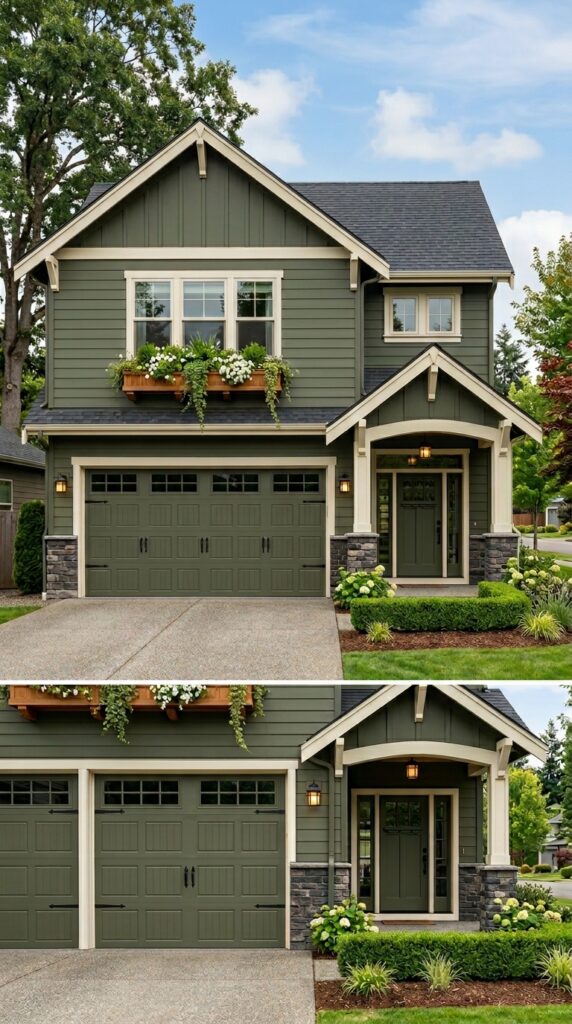
Vibe: Composed and unhurried — a facade where every surface speaks the same language.
Why it works: A garage door occupies 30–40% of the visual footprint of a standard suburban facade — it is, functionally, the largest single “wall” facing the street. Matching it to the siding color removes it visually, eliminating the most common source of facade awkwardness: a door that reads as a separate object rather than an integrated element. Carriage-style hardware in oil-rubbed bronze adds warmth and period detail that elevates what could be a flat, industrial surface.
How to get it: Order a custom-color garage door through Wayne Dalton or Clopay using their RAL color match service, specifying the same paint formula used on your siding — most manufacturers can match Benjamin Moore or Sherwin-Williams codes directly.
💡 Quick Win: If replacing the garage door isn’t in budget, repaint an existing steel door with Rust-Oleum Stops Rust Hammered spray in a dark olive tone, then add adhesive carriage-style strap hinge hardware kits (widely available for under $30) for an immediate transformation.
🛍️ Shop the Look — Amazon Product Ideas
| # | Product Search Phrase | Why It Fits |
| 1 | Carriage garage door strap hinge decorative black | Hardware upgrade kit |
| 2 | Garage door handle pull oil rubbed bronze set | Matching entry hardware |
| 3 | Outdoor wall lantern garage mount oil bronze | Garage-flanking light |
| 4 | Window box bracket galvanized steel exterior | Garage window softening |
| 5 | Boxwood hedge artificial outdoor planter row | Tidy garage base planting |
12. Green Exterior with Natural Cedar Accent Gable
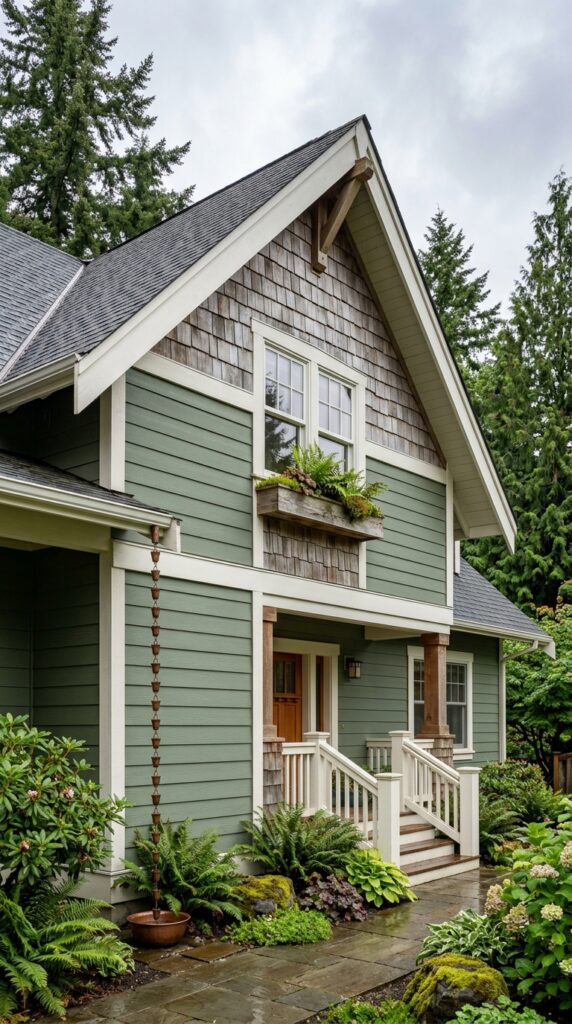
Vibe: Grounded and layered — a facade where the natural world is built into the architecture itself.
Why it works: Combining painted siding with a raw material accent creates material contrast, one of the core principles of craftsman and Arts and Crafts architecture. Western red cedar’s natural silver-grey patina as it weathers is a color no paint can replicate — it has depth and variation that reads as authentically organic. The gable is the ideal location for this treatment because it’s visually separated by the roofline, creating a natural material boundary that looks deliberate rather than unfinished.
How to get it: Install 5-inch exposure red cedar shingles on the gable field and allow them to weather naturally — no stain needed. Install white-painted cedar corner boards as a frame, and let the contrast between the weathered natural cedar and the painted sage siding do all the work.
🛍️ Shop the Look — Amazon Product Ideas
| # | Product Search Phrase | Why It Fits |
| 1 | Cedar shake decorative bracket gable wood | Craftsman gable accent |
| 2 | Copper rain chain downspout replacement decorative | Artisan drainage detail |
| 3 | Cedar window box natural wood exterior | Gable window softening |
| 4 | Western red cedar shingle bundle exterior | Gable cladding material |
| 5 | White trim board fascia primed exterior wood | Gable framing material |
13. Dark Charcoal Roof Paired with Sage Green Siding
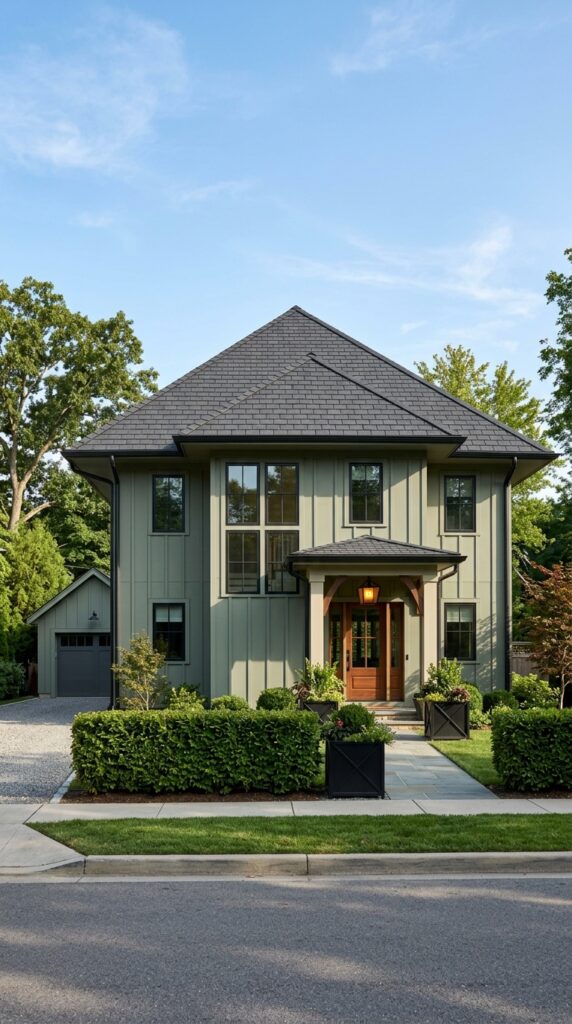
Vibe: Clean and resolved — a house where the roof is as intentional as the paint color.
Why it works: The roof occupies a substantial portion of a home’s visual mass, particularly on a single-story structure, and its color has enormous influence over how the siding reads below it. A dark charcoal architectural shingle roof creates visual weight at the top of the house that “caps” the composition and makes the green siding below it appear lighter and more luminous by contrast — a principle called simultaneous contrast. Deep eave overhangs with visible shadow lines reinforce the architectural geometry and prevent the facade from reading as flat.
How to get it: Specify CertainTeed “Moire Black” or GAF “Charcoal” in a heavyweight architectural shingle (50-year rated) — the added thickness creates shadow depth on the shingle surface that cheaper three-tab shingles can’t replicate, and it photographs dramatically better.
💡 Quick Win: If a full roof replacement isn’t imminent, paint gutters and downspouts in matte black spray paint to visually coordinate with a future dark roof intent — and to immediately sharpen the facade’s contrast story at a cost under $20.
🛍️ Shop the Look — Amazon Product Ideas
| # | Product Search Phrase | Why It Fits |
| 1 | Matte black gutter downspout paint spray exterior | Immediate contrast update |
| 2 | Black metal tall planter entry modern outdoor | Entry anchor accent |
| 3 | Clipped hornbeam artificial hedge panel outdoor | Formal entry framing |
| 4 | Matte black exterior pendant light entry | Entry lighting anchor |
| 5 | Charcoal grey architectural shingle sample | Roofing material selection |
14. Green and White Striped Awnings Over Windows
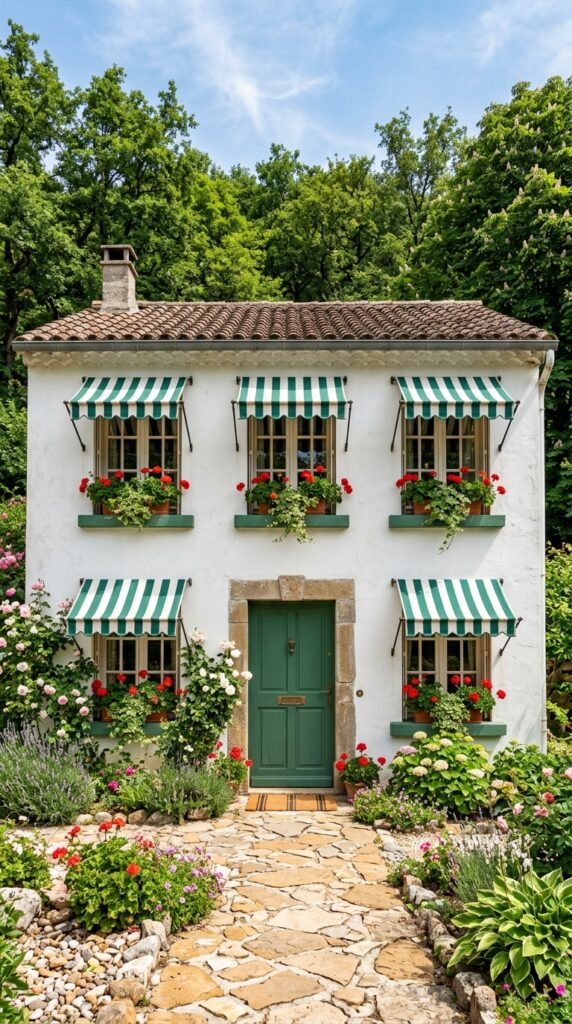
Vibe: Sun-warmed and continental — a European holiday packed into a suburban front elevation.
Why it works: Awnings are a profoundly underused exterior accessory in American residential design despite being ubiquitous throughout France, Italy, and Spain. Beyond their aesthetic value, they perform real functions: shading south- and west-facing windows reduces interior heat gain significantly in summer. The forest green and white stripe is a classic awning pattern precisely because it references the color palette of garden landscapes — it’s almost impossible to get wrong against a neutral base house color. The scalloped valance edge adds a period-appropriate softness.
How to get it: Order custom canvas awnings through a local awning fabricator (national chain pricing runs $150–$400 per window) using Sunbrella® fabric in “Forest Green/White Stripe” — it’s UV-resistant and rated for decades of exterior use without fading.
🛍️ Shop the Look — Amazon Product Ideas
| # | Product Search Phrase | Why It Fits |
| 1 | Green white striped canvas window awning retractable | Signature window accent |
| 2 | Red geranium artificial outdoor window box plant | Classic awning companion |
| 3 | Brass letter slot door mail slot decorative | Period-correct entry detail |
| 4 | European striped outdoor doormat green white | Entry continuation of pattern |
| 5 | Casement window crank handle brass replacement | Period hardware detail |
15. Climbing Roses Over a Green Arched Garden Gate
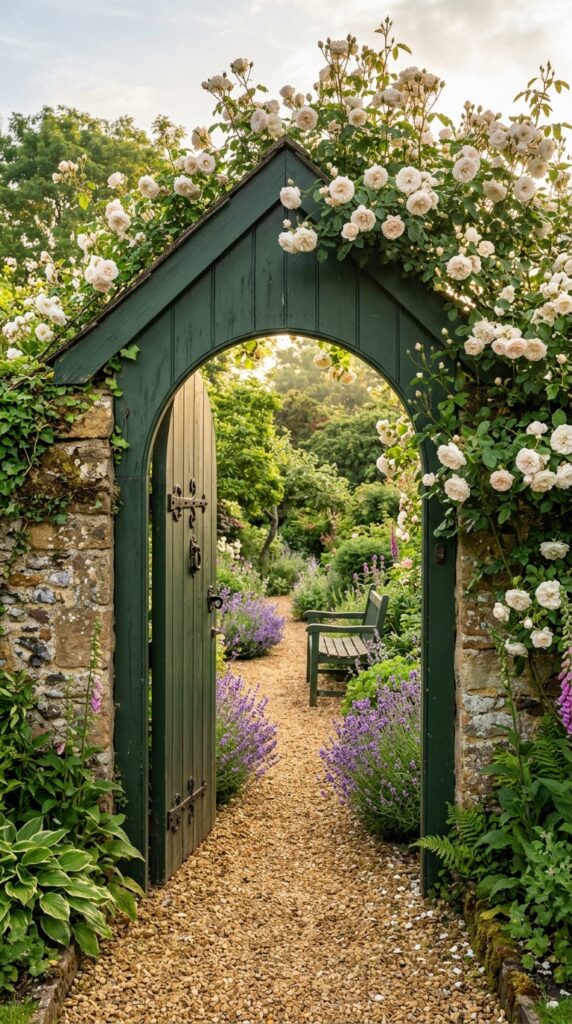
Vibe: Still and tender — an entry that feels borrowed from a walled kitchen garden in the Cotswolds.
Why it works: An arched garden gate creates a visual threshold — a moment of transition that makes arriving at a home feel ceremonial rather than incidental. Dark green paint on wooden gate architecture references walled English garden design and the Arts and Crafts movement’s philosophy of blurring indoor and outdoor space. Climbing roses trained over the arch use the arch’s form as a living scaffold, and as they mature, the arch disappears into foliage and bloom — the architecture becomes inseparable from the planting.
How to get it: Build or purchase a cedar arch (pre-made versions are widely available online) and paint in Farrow & Ball “Calke Green” No. 80. Plant “New Dawn” climbing roses at the arch base — they bloom repeatedly, are extremely cold-hardy, and reach full coverage within two to three growing seasons.
💡 Quick Win: A ready-made green steel arbor under $80 placed at the start of the front walkway, planted with a fast-growing Clematis “Jackmanii” on each side, creates an arch-and-climber entry moment in a single weekend.
🛍️ Shop the Look — Amazon Product Ideas
| # | Product Search Phrase | Why It Fits |
| 1 | Green steel garden arch arbor metal freestanding | Affordable arch framework |
| 2 | Cast iron gate latch thumb press antique style | Period-correct hardware |
| 3 | Climbing rose bare root New Dawn repeat bloom | Signature arch planting |
| 4 | Garden bench small wooden green painted | Beyond-gate accent |
| 5 | Lavender plant bundle outdoor perennial purple | Path edging planting |
16. Small Ranch House Exterior in Soft Sage
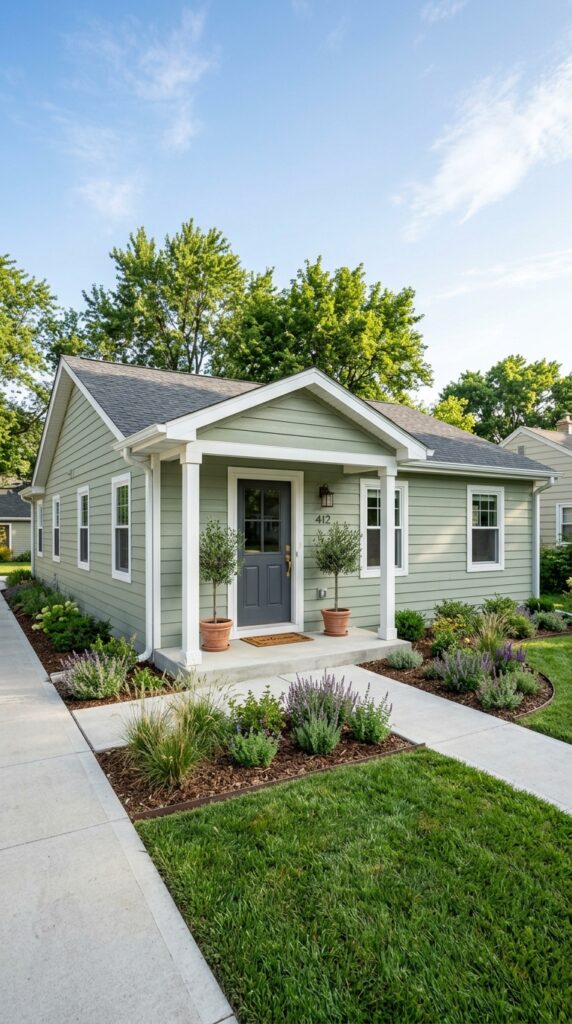
Vibe: Fresh and unassuming — proof that small and considered is always more satisfying than large and careless.
Why it works: Ranch houses present a horizontal massing challenge: their low, wide proportions can read as squat without intentional design mitigation. Soft sage green siding in a narrow horizontal lap profile emphasizes the house’s width as a feature rather than a liability — the color is light enough to prevent the facade from feeling heavy, and the warm tone prevents it from reading as cold or contemporary. Tall, narrow elements like olive trees in pots at the entry provide vertical counterpoint that lifts the eye and balances the composition.
How to get it: For the small ranch exterior, avoid shutters entirely if windows aren’t in proportion — shutterless windows with clean white trim read as more sophisticated and less cluttered than incorrectly scaled decorative shutters, which are among the most common curb appeal mistakes on ranch homes.
🛍️ Shop the Look — Amazon Product Ideas
| # | Product Search Phrase | Why It Fits |
| 1 | Artificial olive tree outdoor tall container planter | Vertical entry accent |
| 2 | Low ornamental grass artificial outdoor planter | Front bed texture |
| 3 | Charcoal exterior door paint semi gloss quart | Simple door update |
| 4 | White vinyl fascia trim board exterior | Clean trim material |
| 5 | Concrete driveway edge sealer clear exterior | Entry surface detail |
17. Exposed Brick Foundation with Sage Green Siding Above
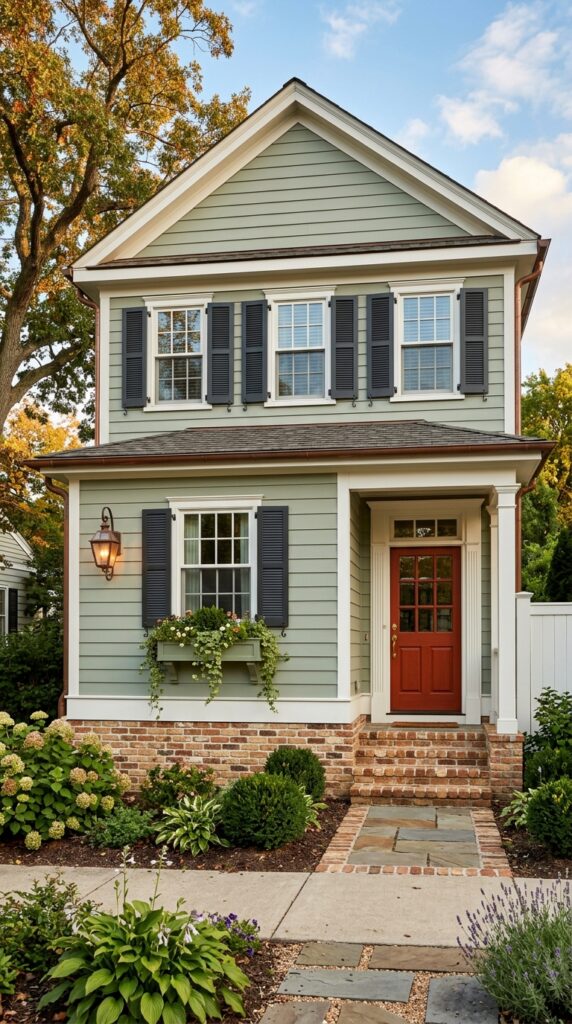
Vibe: Warm and layered — a house that carries the past in its bones and the present in its paint.
Why it works: The material contrast between masonry and painted siding is one of residential architecture’s oldest and most successful formal strategies — it grounds the house literally and visually. The brick foundation reads as the weight-bearing element (whether structurally accurate or not), and the lighter siding above reads as the sheltering element. Sage green siding paired with warm brick tones is a color relationship grounded in the natural world: green foliage against red earth is a landscape pairing with no wrong answer.
How to get it: If the original brick has been painted over, use a professional brick paint stripper (Speedheater is the preferred tool among preservation contractors) to reveal the original masonry rather than applying another paint layer, which traps moisture and accelerates deterioration.
💡 Quick Win: For houses with concrete block foundations, apply a thin-set brick veneer panel (easy peel-and-stick versions exist at major home centers for under $4 per square foot) to simulate the masonry-to-siding transition without any structural work.
🛍️ Shop the Look — Amazon Product Ideas
| # | Product Search Phrase | Why It Fits |
| 1 | Thin brick veneer panel wall exterior peel stick | Foundation accent material |
| 2 | Swedish ivy artificial trailing outdoor plant | Window box planting |
| 3 | Exterior wall bracket arm light iron black | Period-correct wall fixture |
| 4 | Tumbled brick red outdoor planter terracotta large | Material repetition in decor |
| 5 | White water table trim board primed exterior | Foundation-to-siding transition |
18. Minimalist Green Exterior: One Color, No Trim
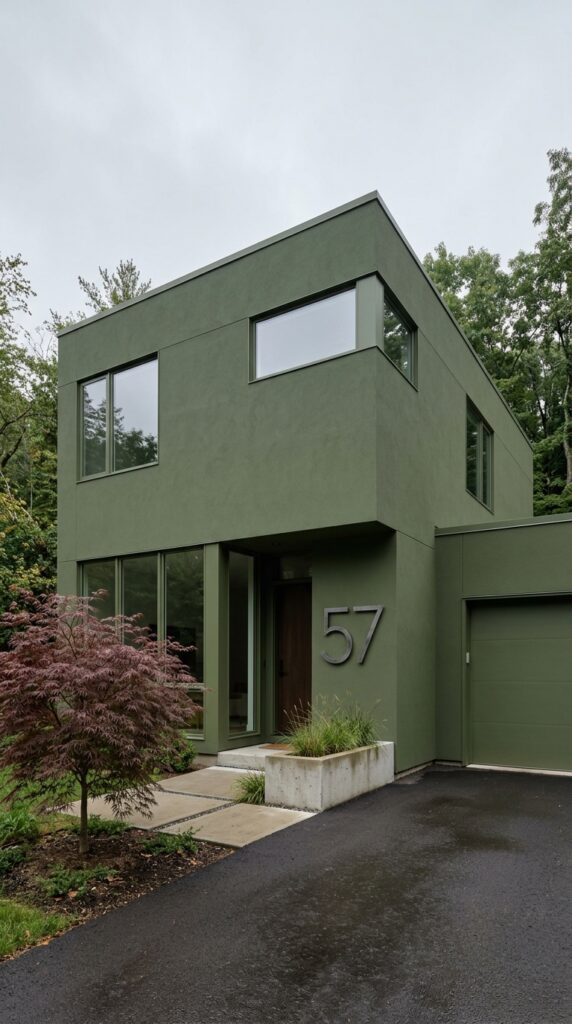
Vibe: Architectural and singular — a house that functions more like a sculpture than a building.
Why it works: Monochromatic exteriors — one color applied to every surface with no trim break — eliminate the visual fragmentation that standard two-tone painting creates, and allow the house’s architectural form to read as a pure object. This is a strategy borrowed from high-design contemporary residential architecture, where the building envelope is treated as a skin rather than a collection of parts. Deep olive green works particularly well for this treatment because it’s dark enough to read as a unified mass rather than a washed-out field.
How to get it: Specify the same paint formula across siding, trim, soffits, and fascia — use a flat or matte finish on all vertical surfaces (which reduces light reflection and emphasizes form) and a semi-gloss only on the door for a single, intentional highlight.
🛍️ Shop the Look — Amazon Product Ideas
| # | Product Search Phrase | Why It Fits |
| 1 | Raw steel address number large modern exterior | Sculptural address detail |
| 2 | Low concrete outdoor planter rectangular minimal | Minimal entry accent |
| 3 | Japanese maple tree dwarf ornamental specimen | Singular specimen planting |
| 4 | Matte exterior house paint deep olive green sample | Color selection tool |
| 5 | Flat black metal mailbox minimalist wall mount | Facade-integrated mail |
19. Green Exterior with Stone Chimney as Focal Anchor
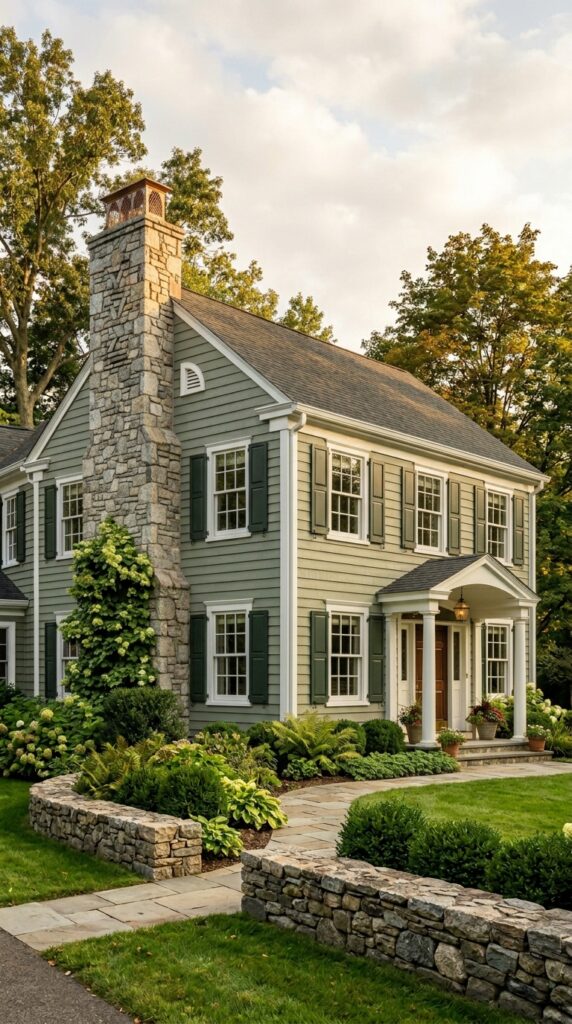
Vibe: Rooted and dignified — the kind of house that looks like it has a library.
Why it works: A stone chimney on a painted exterior creates a material anchor — it introduces raw, unprocessed texture against the smooth regularity of clapboard siding, and its vertical mass breaks the horizontal register of the facade with intentional structural weight. Sage green siding paired with grey fieldstone shares a cool, grey undertone that creates tonal harmony without color matching. The chimney’s asymmetrical placement off-center gives the facade visual dynamism and prevents the bilateral symmetry of most colonial facades from reading as rigid.
How to get it: If your chimney is existing brick that you want to re-face, consult a mason about a dry-stack fieldstone veneer application over the existing surface — this can be completed in a long weekend and transforms an ordinary chimney into a focal architectural element.
💡 Quick Win: A copper chimney cap ($60–$120 online) instantly upgrades an existing chimney’s visual quality and adds a warm metallic accent that photographs beautifully against green siding in autumn light.
🛍️ Shop the Look — Amazon Product Ideas
| # | Product Search Phrase | Why It Fits |
| 1 | Copper chimney cap standard flue square | Warm metallic chimney accent |
| 2 | Climbing hydrangea bare root plant Petiolaris | Wall-climbing anchor planting |
| 3 | Fieldstone veneer panel dry stack wall exterior | Chimney re-facing material |
| 4 | Stone garden wall border decorative edging | Material repetition outdoors |
| 5 | Sage green exterior siding clapboard paint quart | Siding color selection |
20. Wraparound Porch with Green Painted Columns and Railings
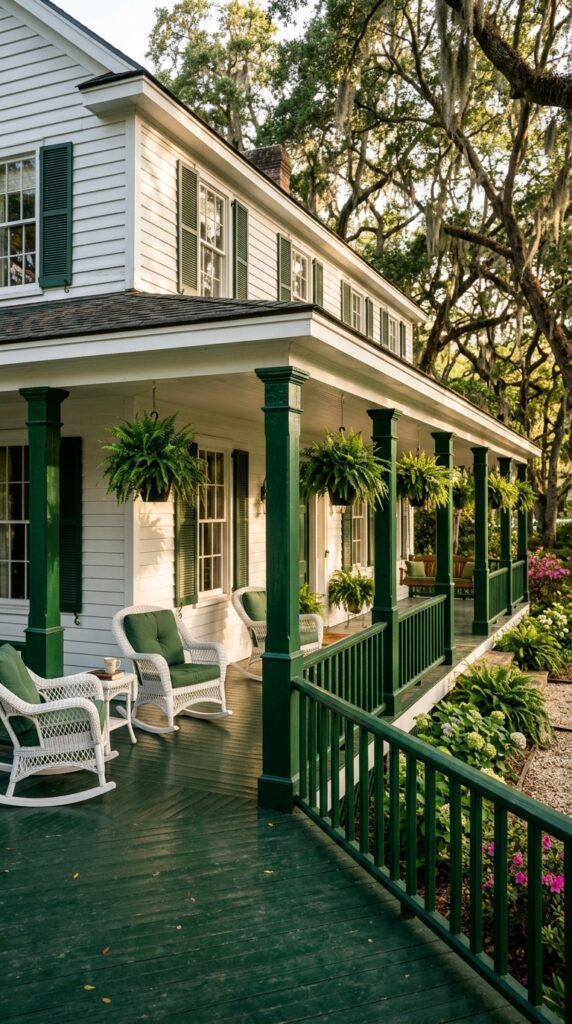
Vibe: Languid and open-armed — the architecture of Southern hospitality made physical.
Why it works: Painting porch columns, railings, and floor in a single deep green against white clapboard house siding creates a defined zone of color that makes the porch read as a room rather than a threshold. The color distinction signals: this is where you slow down. Deep green in a high-gloss exterior enamel on porch woodwork has roots in Antebellum Southern and Victorian residential architecture, and it weathers gracefully in high-humidity climates that tend to strip duller finishes. The contrast between white house body and green porch detail creates a visual frame that makes the home’s living space feel curated and intentional.
How to get it: Use Behr “Timberline” exterior gloss enamel for the columns and railings, and use Rust-Oleum “Porch & Floor” enamel in matching green for the floor — the floor formula contains anti-skid agents and is specifically hardened for foot traffic.
🛍️ Shop the Look — Amazon Product Ideas
| # | Product Search Phrase | Why It Fits |
| 1 | White wicker rocking chair outdoor porch set | Classic porch seating |
| 2 | Green outdoor seat cushion chair pad UV resistant | Porch color continuation |
| 3 | Hanging fern basket outdoor wire coco liner | Column-side planting |
| 4 | Porch swing natural wood hanging hardware set | Far-end porch anchor |
| 5 | Porch and floor enamel paint exterior green | Floor specialty finish |
21. Green Exterior Tiny Home or ADU
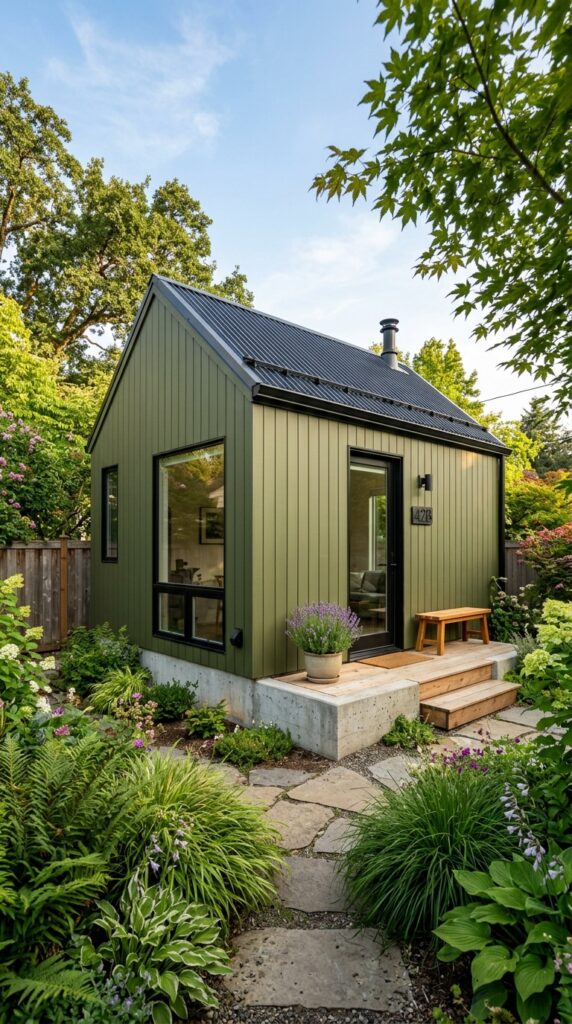
Vibe: Resolved and compact — the house as an argument for how little space you actually need.
Why it works: On a compact structure, vertical siding lines add perceived height while keeping the exterior material language simple — too much color variation on a small structure reads as visual noise. Olive green on an ADU nestles naturally into garden contexts, which is where most backyard ADUs live, allowing the structure to feel like it grew from its site rather than was dropped onto it. Large black-framed windows maximize natural light on a tight footprint while creating strong graphic contrast against the olive cladding.
How to get it: For small-structure exteriors, use vertical shiplap in 6-inch widths — narrower than standard 8-inch boards — as the tighter reveal creates a finer, more refined texture that suits smaller-scale architecture proportionally.
💡 Quick Win: A single window planter box installed below the entry window of a small ADU — filled with a single trailing plant like Scaevola or creeping thyme — adds 80% of the visual “lived-in” quality that a full landscaping plan delivers, for under $40.
🛍️ Shop the Look — Amazon Product Ideas
| # | Product Search Phrase | Why It Fits |
| 1 | Black metal address number plaque wall mount | Clean minimal address detail |
| 2 | Cedar bench outdoor small entry one-seater | Compact entry seating |
| 3 | Corrugated metal roofing panel black ridge cap | ADU roof material |
| 4 | Lavender potted outdoor plant purple | Entry step planting |
| 5 | Vertical shiplap siding primed exterior wood | Cladding material |
22. Green Window Shutters on a Neutral Stucco Home
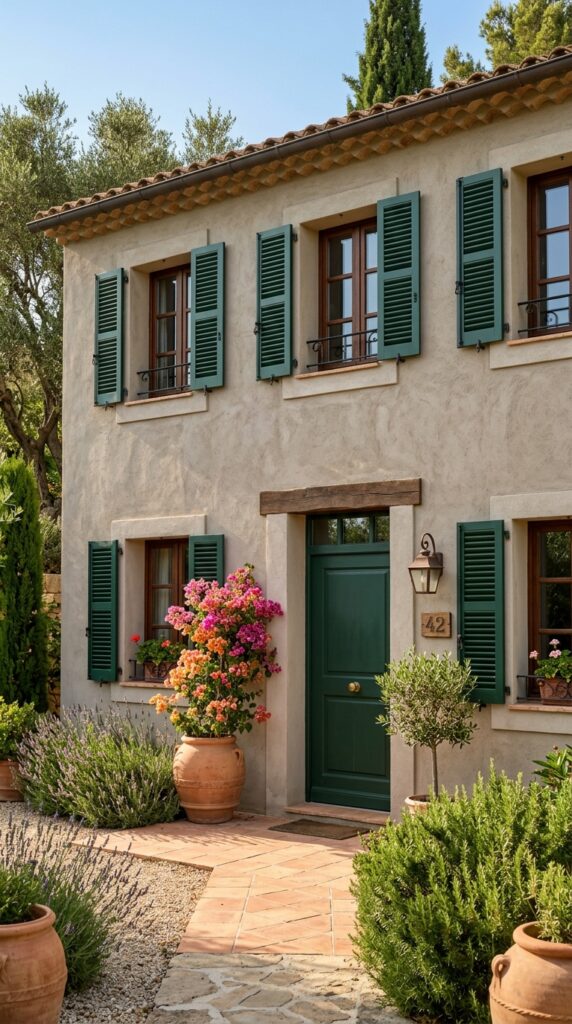
Vibe: Warm and unhurried — a house that looks like it belongs in a Provence village.
Why it works: Shutters are among the highest-ROI curb appeal updates available — they’re relatively inexpensive, require no structural work, and transform a plain facade dramatically by creating vertical green elements that frame every window with intentional color. The critical detail is proportion: shutters must be sized to actually cover the window when closed (the width of each shutter should equal half the window’s width). Decoratively sized shutters that are clearly too small read as cheap and undermine the effect entirely.
How to get it: Order shutters through Timberlane or Shuttercraft in a real wood (poplar or pine) rather than vinyl — wood holds paint better outdoors and has the dimensional heft that makes shutters read as architectural rather than decorative. Specify hunter green in any exterior semi-gloss formula.
🛍️ Shop the Look — Amazon Product Ideas
| # | Product Search Phrase | Why It Fits |
| 1 | Exterior louvered wood shutters pair green painted | Facade transformation piece |
| 2 | Shutter dog hardware decorative S-hook hold back | Authentic operational detail |
| 3 | Antique bronze outdoor wall sconce exterior | Period-correct lighting |
| 4 | Bougainvillea artificial tall outdoor planter pink | Entry floral accent |
| 5 | Warm greige exterior paint sample stucco base | Base color coordination |
23. Driveway-to-Door Lighting on a Green Exterior at Night
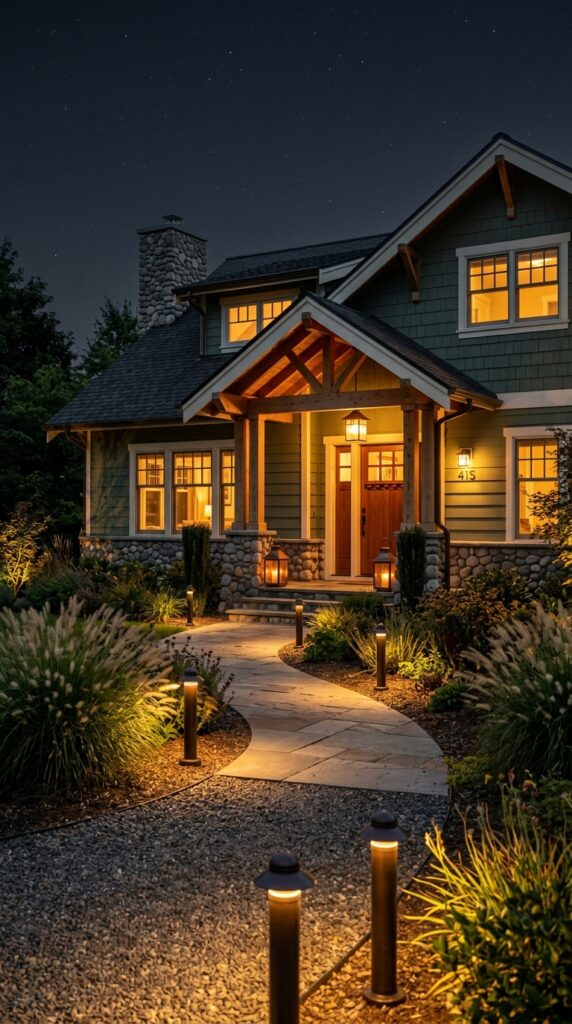
Vibe: Cinematic and warm — the house that, at night, makes everyone on the block want to be inside it.
Why it works: A home’s curb appeal exists after dark too, and green exteriors benefit enormously from thoughtful exterior lighting because the warmth of amber bulbs plays beautifully against sage and olive tones. Path lighting from the driveway to the door creates a hospitality narrative — it physically guides the visitor and communicates that the arrival experience was intentionally designed. Uplighting ornamental grasses adds drama and movement as the plants catch the light and shadow play across the facade.
How to get it: Install a 12V landscape lighting system (VOLT or Kichler are reliable brands) on a timer with dusk-to-dawn photocell activation — run the low-voltage cable under the garden edge and connect to maximum five to six fixtures per transformer output for consistent brightness.
💡 Quick Win: Two solar-powered path lights ($15–$25 each) placed on either side of the front walk, in oil-rubbed bronze, create an immediate and cost-free nighttime curb appeal upgrade that requires no wiring or electrician.
🛍️ Shop the Look — Amazon Product Ideas
| # | Product Search Phrase | Why It Fits |
| 1 | Solar path light set oil bronze garden stake | No-wire nighttime path lighting |
| 2 | Low voltage landscape uplight bronze outdoor | Uplighting for plantings |
| 3 | Copper outdoor lantern pendant front door large | Entry nighttime anchor |
| 4 | Dusk to dawn outdoor wall light sensor amber | Automatic facade lighting |
| 5 | Brass illuminated house numbers address LED | Visible lit address display |
24. Green Exterior with a White Picket Gate and Fence
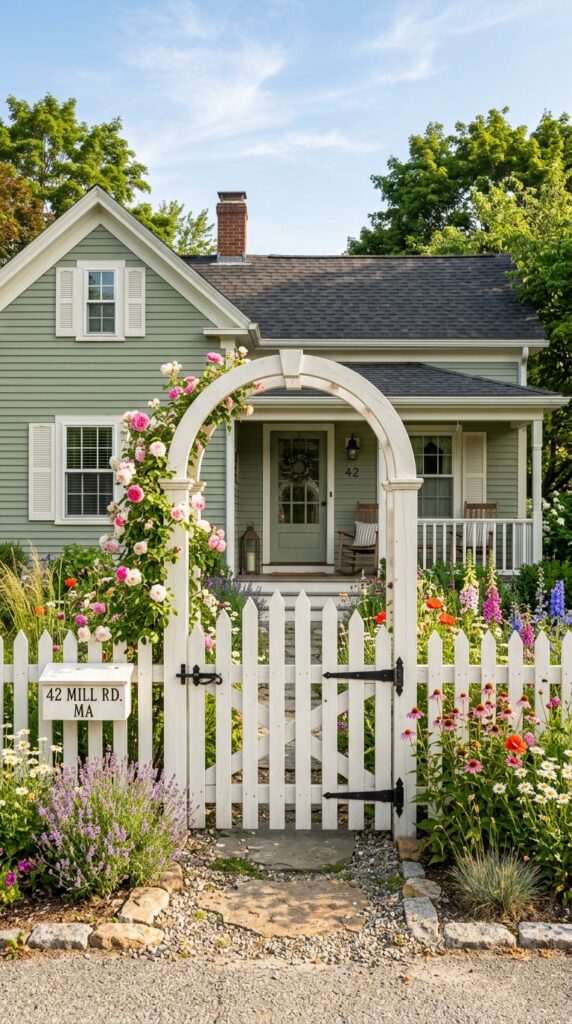
Vibe: Nostalgic and unguarded — a front yard that belongs equally to the neighborhood and to itself.
Why it works: A white picket fence in front of a green house creates a layered facade — the fence acts as a foreground plane that visually extends the home’s footprint to the street edge, turning the front garden into a curated composition rather than just a lawn. The bright white of the fence intensifies the perception of sage green behind it through simultaneous contrast. An arched gate creates a threshold moment where a straight gate would not — the curve signals entry and softens the geometry of the fence line with one simple design move.
How to get it: Use Trex Seclusions or Veranda vinyl picket fencing (no paint maintenance ever) for a practical solution, or cedar for an authentic look — if using wood, prime and paint in Benjamin Moore “Chantilly Lace” OC-65 for the brightest, cleanest white without a yellow cast.
🛍️ Shop the Look — Amazon Product Ideas
| # | Product Search Phrase | Why It Fits |
| 1 | White vinyl picket fence panel gate arched | Signature cottage boundary |
| 2 | Black iron gate latch thumb press traditional | Gate hardware detail |
| 3 | Climbing rose New Dawn bare root white | Gate post climber |
| 4 | Wildflower seed mix meadow cottage garden | Front bed planting |
| 5 | White painted mailbox post mount traditional | Fence-integrated mailbox |
25. Green Exterior with Dark Navy Accents
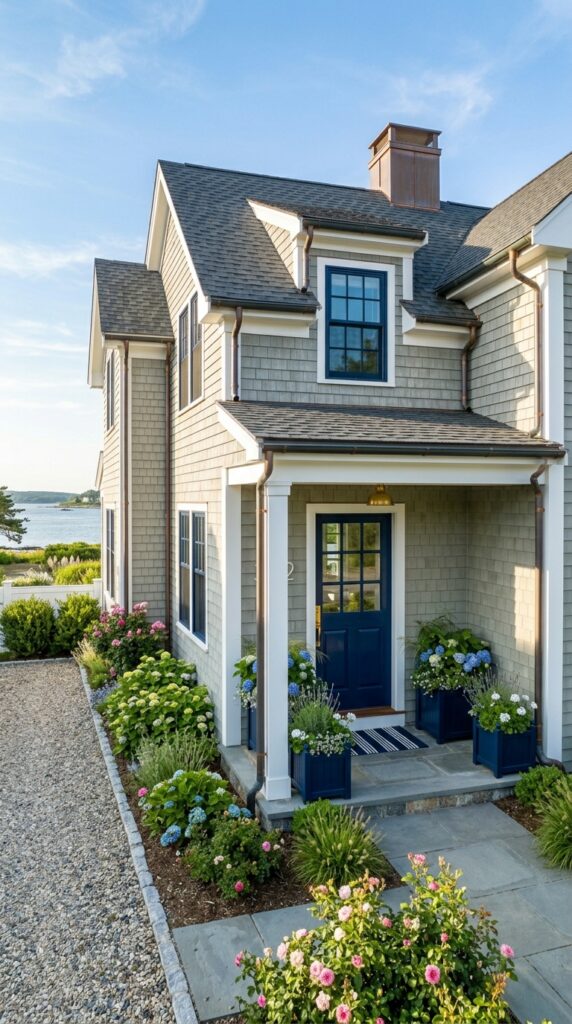
Vibe: Refined and salt-aired — a facade that looks like it has a view of the water even when it doesn’t.
Why it works: Grey-green and navy are both cool-undertone colors that sit adjacent in the visual spectrum — this creates a tonal relationship rather than a contrast one. The combination reads as coastal because it mirrors the color relationship of sea-worn cedar shingles and deep water: familiar, weathered, and inherently grounded in a landscape. Using navy on trim elements (window frames, gutters, downspouts) rather than the siding creates a graphic outline around every architectural element, which makes the facade’s geometry read with precision.
How to get it: Apply Benjamin Moore “Hale Navy” HC-154 in exterior semi-gloss to window frames, door, and all trim metal — it’s a blue with enough black in it to avoid reading as bright or preppy, and it coordinates seamlessly with grey-green cedar shingles in any weathering stage.
💡 Quick Win: Painting gutters and downspouts in navy (Rust-Oleum spray on metal) is a five-minute-per-section transformation that immediately sharpens the facade’s color story and costs under $12 per can.
🛍️ Shop the Look — Amazon Product Ideas
| # | Product Search Phrase | Why It Fits |
| 1 | Navy blue outdoor door mat striped UV resistant | Entry color continuation |
| 2 | Navy painted wood planter square tall set 2 | Entry accent pair |
| 3 | White iron house address number large script | Facade contrast detail |
| 4 | Copper gutter end cap elbow replacement fitting | Patina hardware accent |
| 5 | Hale Navy exterior paint sample quart semi gloss | Color selection tool |
26. Green Exterior with a Rustic Barn Door Entry
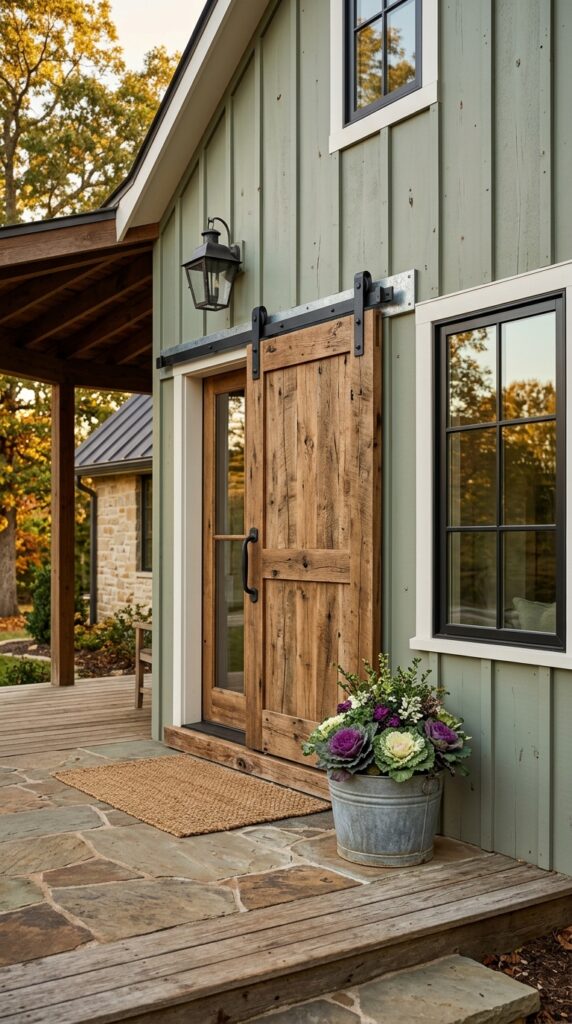
Vibe: Warm and casually resolved — the kind of entry that makes every guest feel like they already belong here.
Why it works: A sliding barn door entry is fundamentally about materiality — it introduces raw, grain-rich reclaimed wood as a tactile counterpoint to the smooth painted siding, and the exposed black steel track adds honest industrial hardware detail that the farmhouse aesthetic celebrates. The sliding mechanism also solves entry porch geometry problems that swing doors can create: on a narrow covered porch, a barn door that slides parallel to the wall maximizes usable space and keeps the entry feeling open. Against sage green siding, the warm brown of the reclaimed wood reads as grounding and natural.
How to get it: Install a full bypass exterior barn door kit (Calhome or Winsoon both make weatherproof exterior-rated track systems) with a reclaimed Douglas fir plank door — ensure the door is sealed with a penetrating exterior oil like Rubio Monocoat before hanging to protect the wood from moisture while preserving the natural color.
🛍️ Shop the Look — Amazon Product Ideas
| # | Product Search Phrase | Why It Fits |
| 1 | Exterior barn door hardware sliding track kit black | Entry door hardware |
| 2 | Reclaimed wood barn door pre-hung exterior | Entry door material |
| 3 | Zinc bucket planter large outdoor galvanized | Entry statement planting |
| 4 | Jute outdoor doormat natural braided large | Entryway surface accent |
| 5 | Matte black exterior pendant light farmhouse | Entry overhead lighting |
27. Green Trim-Only on a White Exterior for Subtle Impact
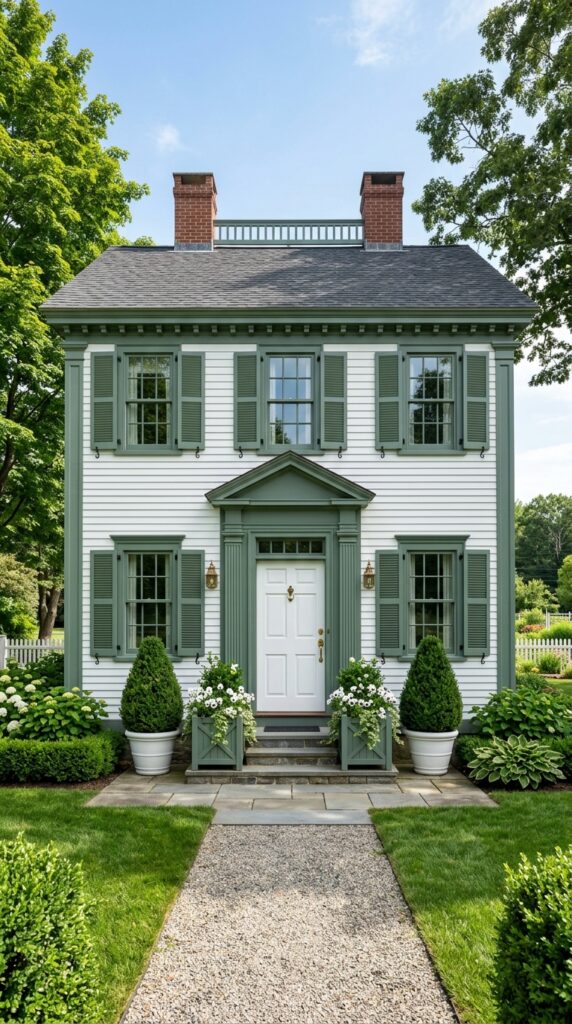
Vibe: Clean and classically ordered — the facade equivalent of a white button-down with a dark green collar.
Why it works: Reversing the conventional trim logic — white body, colored trim — creates a sophisticated inversion that reads as architecturally confident. By painting all trim elements in sage, the home’s structural anatomy becomes the focal point: corner boards, window surrounds, and door casings all pop forward as positive elements rather than receding as background. This technique draws from Georgian and Federal architecture, where trim color was the primary mode of architectural expression on predominantly white or cream-washed facades.
How to get it: Use the trim-only technique when you rent rather than own, or when you want maximum curb appeal impact from minimum surface area — trim typically represents only 10–15% of total exterior square footage, so the painting cost is a fraction of re-siding or full re-painting.
💡 Quick Win: Paint just the front door surround and front-facing shutters in sage while leaving everything else white — even this partial application creates the impression of an intentional, coordinated color scheme without committing to full trim work.
🛍️ Shop the Look — Amazon Product Ideas
| # | Product Search Phrase | Why It Fits |
| 1 | Brass door knocker lion traditional polished | Classic brass trim accent |
| 2 | White ceramic outdoor planter square tall pair | Entry symmetry planters |
| 3 | Topiary spiral cedar artificial outdoor large | Formal entry framing |
| 4 | Sage green exterior trim paint semi gloss quart | Trim color application |
| 5 | Wide primed door surround molding exterior wood | Trim width enhancement |
28. Vertical Garden Wall Beside a Green Exterior
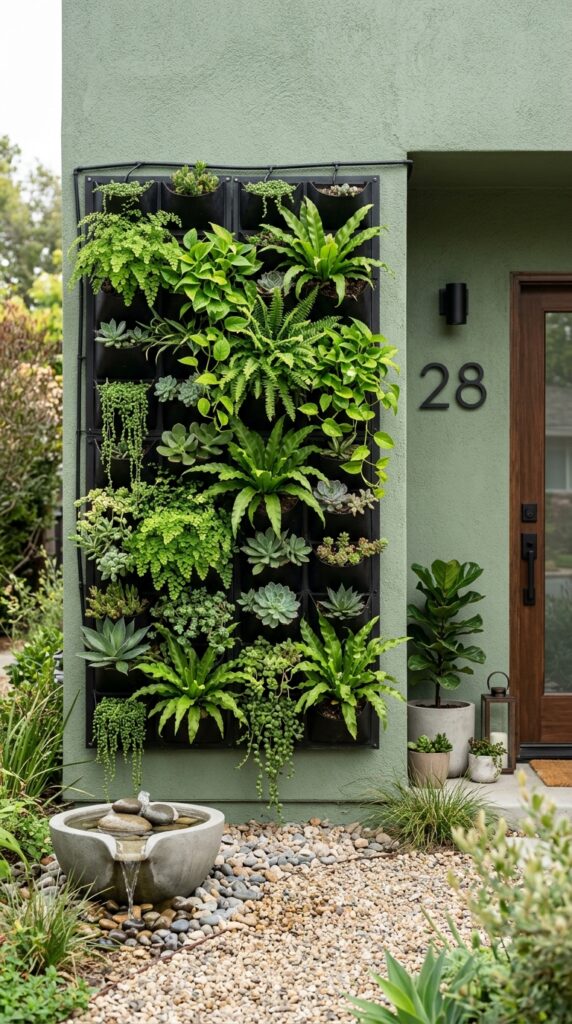
Vibe: Serene and densely alive — an entry that turns the simple act of arriving home into something restorative.
Why it works: A living wall introduces a third dimension to the facade plane — texture, depth, and biological movement that no paint or cladding can replicate. Against sage green stucco, the botanical palette of a plant wall creates a monochromatic green-on-green composition where the interest comes entirely from material contrast: smooth plaster versus velvet fern frond, matte paint versus glossy Pothos leaf. This technique draws from biophilic design principles — the intentional integration of natural elements into the built environment to reduce stress and increase occupant wellbeing.
How to get it: Install a Planters’ Choice vertical garden wall planter system (modular felt pocket systems are the most affordable option, starting around $50–$80) and plant with a combination of outdoor-appropriate shade tolerants: Boston fern, Korean rock fern, Sedum “Angelina,” and Bacopa for trailing coverage.
💡 Quick Win: A single wall-mounted planter in matte black with three pots of mixed green succulents ($25–$40 total) placed beside the front door gives you 40% of the visual impact of a full vertical garden with one afternoon of effort and no irrigation needed.
🛍️ Shop the Look — Amazon Product Ideas
| # | Product Search Phrase | Why It Fits |
| 1 | Vertical wall garden planter pocket felt outdoor | Living wall structure |
| 2 | Boston fern outdoor shade plant pot | Vertical garden anchor plant |
| 3 | Sedum succulent mix small outdoor planter set | Vertical garden filler |
| 4 | Drip irrigation kit vertical garden small system | Plant care system |
| 5 | Oversized house numbers matte black modern large | Entry address focal point |
How to Start Your Green House Exterior Transformation
The single most important first move is choosing your green. Paint a large-format sample (at least 12 by 16 inches) in your top two candidates directly on the exterior siding — not on cardboard or drywall — and observe it at morning, noon, and dusk over two days before committing. This one step prevents the most expensive and common mistake in exterior painting: choosing a green indoors that reads completely differently in full outdoor light.
That mistake — selecting paint from a chip in a hardware store — is the primary reason exterior paint projects disappoint. A green that looks muted and sophisticated on a paint chip can read as vivid and jarring on a sun-exposed south-facing facade, or as nearly black on a north-facing one. Light direction changes the color completely. Always sample on the actual surface, on the actual face of the house you’re painting.
Three specific items under $50 that create immediate curb appeal impact: a single can of Rust-Oleum “Dark Hunter Green” spray paint for your existing mailbox post ($12), a pair of matte black address numbers in a sans-serif font ($18–$28), and a natural sisal doormat with a deep border in forest green ($25–$35). Each item takes under 20 minutes to install and collectively signals a coordinated, intentional color scheme before a single exterior wall is touched.
A realistic starter transformation — door and shutters repainted in a new green, plus hardware updated — takes one weekend and runs $80–$200 in materials. A full exterior repaint by a professional painting contractor for an average home runs $3,500–$8,000 depending on square footage and surface prep needed. A full re-siding project starts around $12,000 and can reach $40,000+ for fiber cement. Begin with paint; progress to materials as budget allows.
Frequently Asked Questions About Green House Exterior Ideas
What’s the difference between sage green and olive green for an exterior?
Sage green contains more grey in its base, giving it a cool, muted, slightly blue-leaning quality that reads as soft and contemporary — Sherwin-Williams “Oyster Bay” SW 6206 is a typical sage. Olive green contains more yellow and brown in its base, reading as warmer, earthier, and more historically rooted — SW “Oakmoss” SW 6180 is a classic olive. Sage works better on light-colored homes in contemporary or coastal contexts; olive excels on traditional or Mediterranean styles and pairs naturally with terracotta and warm stone.
What trim color works best with green house exterior siding?
Warm white is the most versatile and widely successful trim color with green siding — specifically off-whites like Benjamin Moore “White Dove” OC-17 or Sherwin-Williams “Alabaster” SW 7008, which have a slight yellow or cream base that prevents them from reading as cold or stark against earthy green tones. Charcoal grey trim (SW “Urbane Bronze” or similar) works beautifully with lighter sage greens. Avoid cool bright whites (with blue undertones) on any green with warmth in it — the undertone clash will be visible from the street.
How much does it cost to paint a house exterior green?
A DIY exterior repaint runs $500–$1,500 in materials (paint, primer, tape, rollers) depending on house size and surface condition. Professional exterior painting for an average 1,500–2,000 square foot home runs $3,500–$8,000, with prep work (scraping, caulking, priming) typically comprising 60% of labor cost. High-quality exterior paint — Benjamin Moore Aura Exterior or Sherwin-Williams Emerald — runs $65–$85 per gallon but provides dramatically better coverage, color retention, and durability than budget formulas, making it cost-effective long-term.
Does a green exterior work on a red brick house?
Yes, but the relationship between the green undertone and the brick’s red-orange tone requires careful management. For warm red brick, choose a green with yellow in its base (olive or moss) rather than a cool blue-green, as the warm undertone bridge creates harmony rather than clash. Apply the green only to siding, trim, or shutters — never attempt to paint existing brick green, as masonry paint traps moisture and causes long-term structural damage. A forest green front door with existing red brick and white trim is one of the most reliably elegant exterior color combinations in American residential design.
What plants look best against a green exterior?
The most successful planting strategies against a green house exterior use contrast: silver-foliage plants like Russian Sage, Lamb’s Ear, or Blue Fescue grass read as luminous against green walls, preventing the planting from blending into the facade. Terracotta-flowered plants — orange marigolds, rust-toned Heuchera, or copper Coleus — create warm complementary contrast. White-flowered plants (white Hydrangea, white Salvia, or climbing white roses) provide the classic English garden pairing. Avoid planting another dominant green shrub directly against green siding — the lack of contrast will visually merge the planting and facade into a single undifferentiated mass.
Ready to Create Your Dream Green House Exterior?
These 28 ideas span the full range of what green can do on an exterior — from the single paint-chip power of a deep green door to the full architectural commitment of monochromatic olive on every surface, from natural cedar gable accents to living vertical plant walls at the entry. Real transformation is almost always incremental: the homeowners with the most resolved, magazine-worthy exteriors typically arrived there through a sequence of small, confident decisions made over months or years rather than one sweeping renovation. Start today by holding your top two paint samples against your actual exterior siding in morning light, giving yourself the one piece of information no color chip can provide. When you’ve made your green home feel the way you imagined — rooted, alive, and precisely itself — you’ll understand why this is the color that stops people on the street. Save the ideas that made your heart move, whether it was the climbing rose arch, the barn door entry, or the sage-and-charcoal color block — your green house story starts with the one detail you can’t stop picturing.