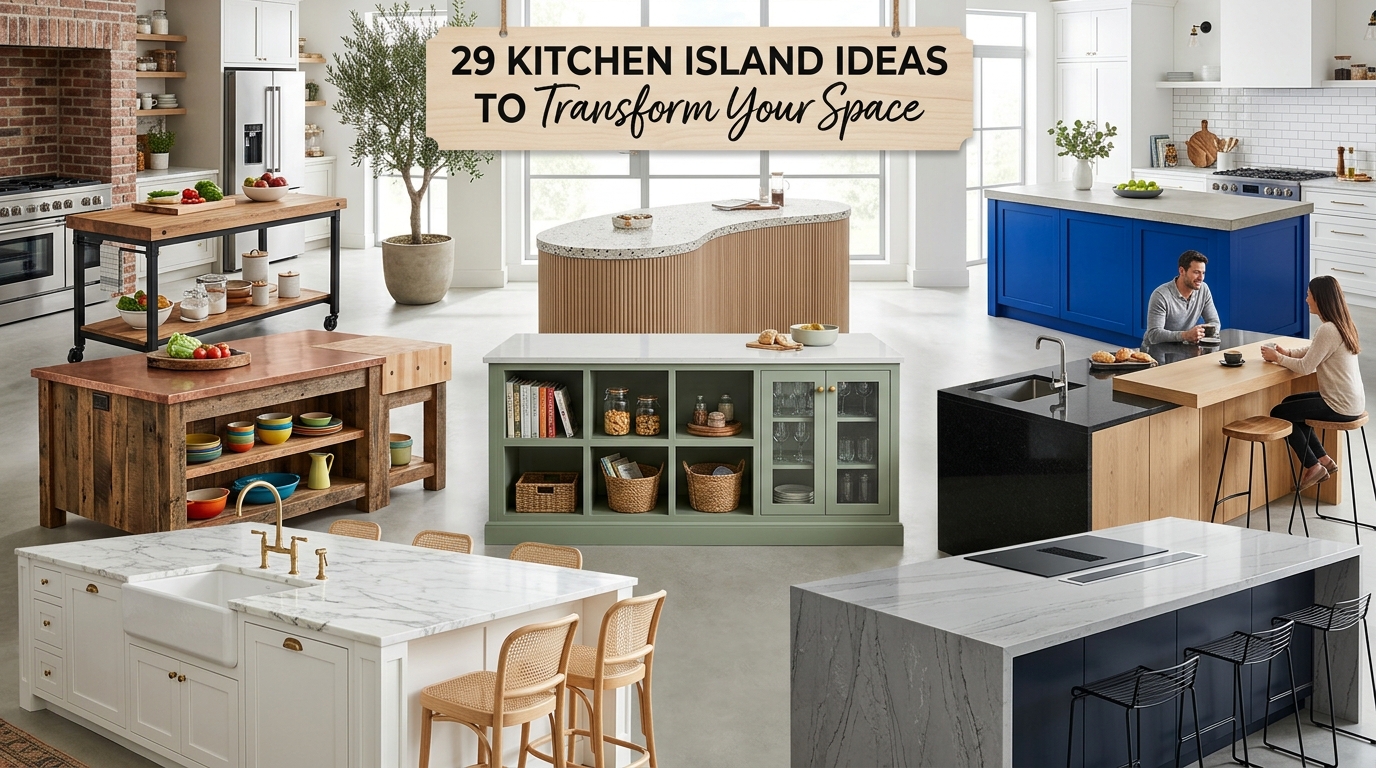
A kitchen island is any freestanding or built-in countertop structure positioned within the kitchen’s open floor plan, offering additional workspace, storage, and often seating. This article gives you exactly 29 kitchen island ideas spanning color, materials, lighting, layout, and more — so you can steal the look that fits your kitchen.
The kitchen island is the room’s gravitational center. It’s where coffee gets poured before anyone has said good morning, where homework sprawls next to cutting boards, where guests lean in during dinner parties because that’s simply where the energy is. A well-designed island doesn’t just add square footage — it changes how a kitchen feels to live in.
Here are 29 ideas worth saving — and stealing.
Why Kitchen Island Design Works So Well
The kitchen island emerged from the open-plan home revolution of the 1990s and early 2000s, when walls between kitchens and living spaces began disappearing. What was once a utilitarian work surface evolved into the most socially loaded piece of furniture in the modern home. Unlike a dining table, the island invites casual gathering — one side cooks while the other side talks. Unlike a peninsula, it breathes on all sides. That spatial freedom is the key to its enduring relevance.
The materials that define a great kitchen island are specific and purposeful. Waterfall quartz in warm white or veined Calacatta marble for the countertop. Shaker-profile cabinet doors in greige, dusty sage, navy, or warm charcoal. Hardware in brushed brass, matte black, or unlacquered bronze. Open shelving in white oak or natural walnut for the lower section. Two-tone paint, where the island reads in a contrast color against the perimeter cabinets, is the single most-used design move of the last decade.
The trend is rooted in a real cultural shift. Post-pandemic life permanently repositioned the kitchen as the home’s command center — a place for remote work, homeschooling, and intentional cooking. Simultaneously, social media accelerated the appetite for high-contrast, photographable kitchens. The island sits at the intersection of both: functional workhorse and visual focal point.
Smaller kitchens absolutely can include an island — but the math is non-negotiable. You need a minimum of 42 inches of clearance on all walkable sides (48 inches if two people cook together). In tighter spaces, a rolling butcher block island, a slimline waterfall cart, or a peninsula-style projection from the perimeter cabinetry achieves the same social and functional goals without blocking traffic flow.
Style at a Glance
| Element | Trait |
| Philosophy | Functional centerpiece that anchors the social and culinary heart of the home |
| Key Materials | Quartz, marble, white oak, shaker cabinetry, brushed brass, matte black hardware |
| Key Colors | Warm white, greige, dusty sage, navy, warm charcoal, unlacquered bronze |
29 Kitchen Island Ideas to Transform Your Space
1. Waterfall Edge Quartz in Calacatta Gold
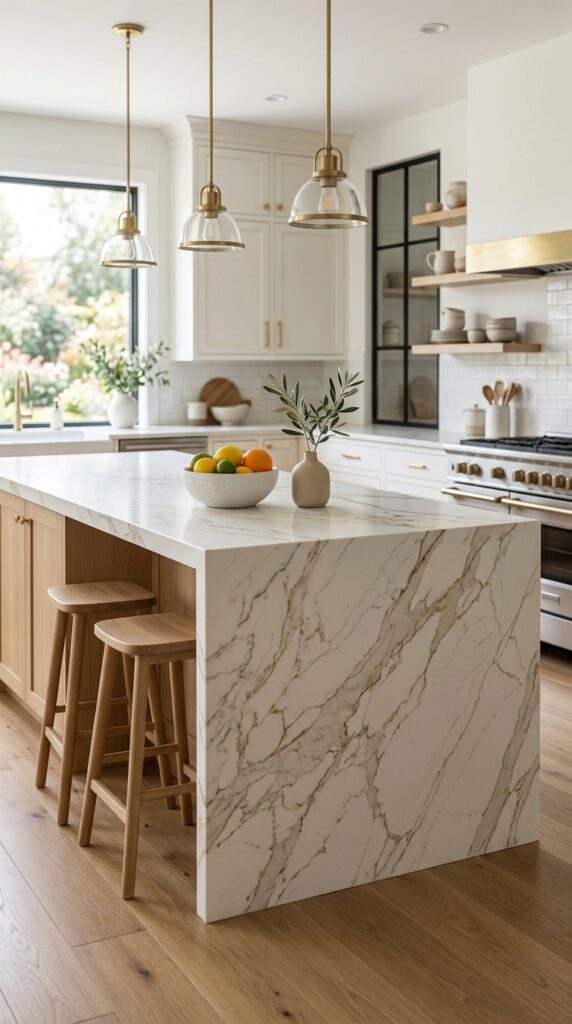
Vibe: Luminous — this island stops conversation the moment someone walks into the room.
Why it works: The waterfall edge — where the countertop slab continues vertically down the island’s side face — creates a seamless visual weight that grounds the entire kitchen. The principle is visual continuity: by eliminating the visual break between horizontal and vertical surfaces, the eye reads the island as one unified sculptural object. Calacatta Gold quartz (not natural marble) gives the same dramatic veining with significantly better stain and chip resistance, which matters on a heavily used surface.
How to get it: Choose a slab with directional veining and ask your fabricator to “bookend” or “match” the veining where the horizontal and vertical pieces meet — this is called book-matching and transforms a simple edge into a piece of art. Budget accordingly: waterfall edges require approximately 30–40% more material than a standard countertop.
💡 Quick Win: Get the look for less by using a quartz remnant piece for the waterfall face only — fabricators often sell offcuts at a significant discount, and you only need a single vertical panel.
🛍️ Shop the Look — Amazon Product Ideas
| # | Product Search Phrase | Why It Fits |
| 1 | Calacatta gold quartz contact paper peel stick countertop | Budget waterfall alternative |
| 2 | Brushed brass adjustable pendant light kitchen | Warm metallic accent above |
| 3 | White ceramic fruit bowl large modern | Clean countertop styling |
| 4 | Matte white bud vase with dried stem | Minimal organic accent |
| 5 | White oak bar stool counter height | Matching warm wood seating |
2. Two-Tone Cabinetry: Navy Island, White Perimeter
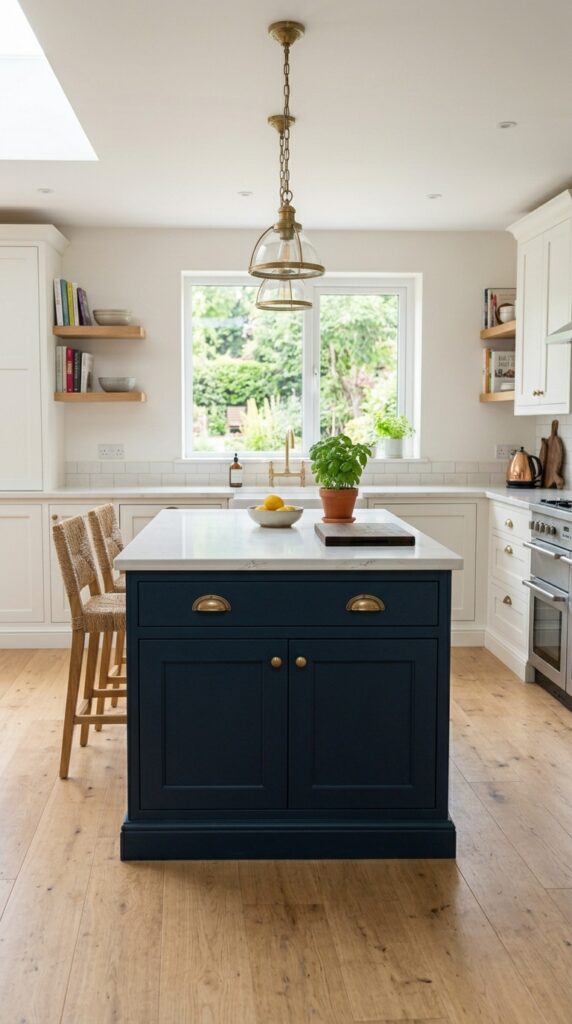
Vibe: Grounded — a deep-toned island anchors an all-white kitchen the way a bold rug anchors a neutral living room.
Why it works: Two-tone kitchens exploit the design principle of visual hierarchy — the contrast between a dark island and light perimeter cabinets tells the eye exactly where to look first, then provides visual relief in the surrounding space. Navy specifically works because it reads as a sophisticated neutral rather than a statement color, especially in daylight. The principle is that any saturated color appears less intense when surrounded by high-contrast white, which prevents the island from feeling heavy even in moderate-sized kitchens.
How to get it: The safest navy for kitchen cabinetry is Benjamin Moore’s Hale Navy (HC-154) or Sherwin-Williams Naval (SW-6244) — both have slightly warm undertones that prevent a cold, clinical read under incandescent lighting. Paint the island interior too, not just the exterior face panels.
🛍️ Shop the Look — Amazon Product Ideas
| # | Product Search Phrase | Why It Fits |
| 1 | Navy blue cabinet paint quart furniture refinishing | Island paint project starter |
| 2 | Unlacquered brass cup pull cabinet hardware 5 pack | Aged brass hardware detail |
| 3 | Seagrass counter height bar stool | Woven natural contrast seating |
| 4 | White quartz trivet pot holder marble look | Countertop functional accent |
| 5 | Potted herb planter set kitchen windowsill | Fresh organic countertop detail |
3. Butcher Block Top with Painted Base
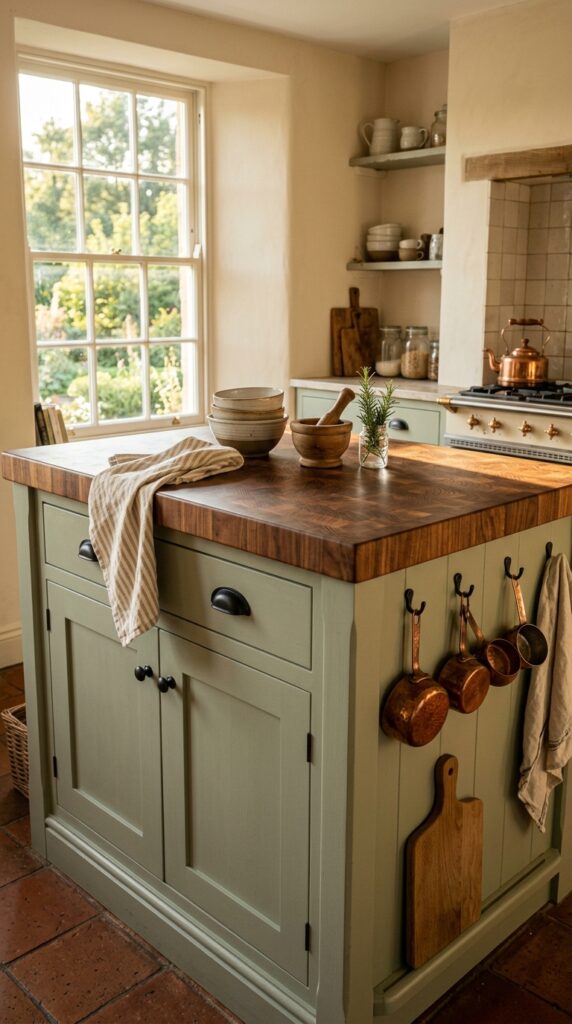
Vibe: Sun-warmed — like a kitchen that’s been loved for decades, even if it was finished last year.
Why it works: The pairing of an organic, grain-forward wood surface with a painted base works because of material contrast — the tactile warmth of walnut or maple reads completely differently from smooth painted MDF, and that contrast creates visual interest without complexity. End-grain butcher block is the most durable orientation for cutting (the wood fibers compress rather than split), and it develops a living patina over time that factory surfaces simply cannot replicate.
How to get it: Purchase a pre-made butcher block top from IKEA (the Karlby series in walnut veneer is a popular shortcut) or a solid hardwood supplier, then have a local cabinet shop build a custom painted base to match your kitchen’s door style. Seal the butcher block with food-safe mineral oil monthly for the first year, then quarterly thereafter to prevent cracking.
💡 Quick Win: IKEA’s Badelunda or Forhoja kitchen carts come with unfinished butcher block tops that you can paint the base of any color — an under-$300 island that looks custom.
🛍️ Shop the Look — Amazon Product Ideas
| # | Product Search Phrase | Why It Fits |
| 1 | Food safe butcher block mineral oil conditioning wax | Essential butcher block maintenance |
| 2 | Sage green chalk paint furniture refinishing quart | Base cabinet color match |
| 3 | Matte black bin pull cabinet hardware set | Hardware style match |
| 4 | Ceramic canister set farmhouse kitchen | Coordinated countertop storage |
| 5 | Linen dish towel set striped hanging loop | Texture and warmth accent |
4. Pendant Lighting as the Design Statement
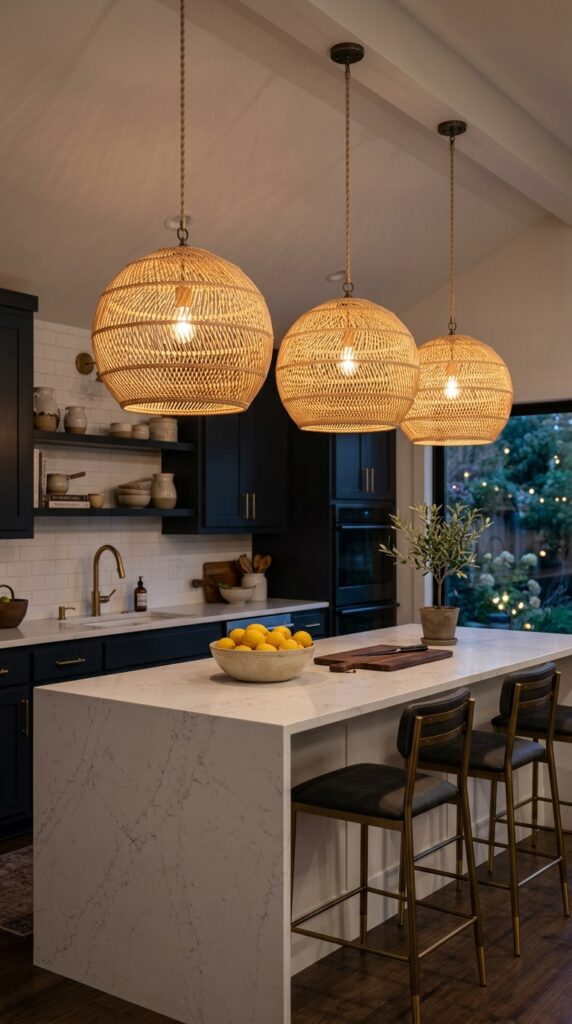
Vibe: Layered — the right pendant lighting transforms an island from a work surface into a destination.
Why it works: Pendant lights over an island operate on the design principle of scale relationship — a pendant that feels oversized in isolation reads as correctly proportioned when hung against a generous expanse of ceiling. Three pendants hung in a row create visual rhythm and a sense of intentional curation that a single centered fixture cannot achieve. The rule of thumb: pendants should hang 30–36 inches above the countertop surface and cover roughly two-thirds of the island’s length.
How to get it: Stagger three matching pendants at equal intervals, keeping the outer pendants at least 6 inches from each island end. For an 8-foot island, 24-inch intervals work well. Choose pendants with a diameter of 8–14 inches — anything smaller gets lost; anything larger overwhelms the surface.
🛍️ Shop the Look — Amazon Product Ideas
| # | Product Search Phrase | Why It Fits |
| 1 | Rattan globe pendant light set of 3 kitchen island | Exact pendant style shown |
| 2 | Adjustable pendant light cord canopy kit | Height customization hardware |
| 3 | Gold metal bar stool counter height backless | Gold accent seating below |
| 4 | Marble contact paper countertop peel stick | Affordable marble look surface |
| 5 | Lemon decorative bowl kitchen counter faux fruit | Classic countertop color pop |
5. Open Shelving on One End
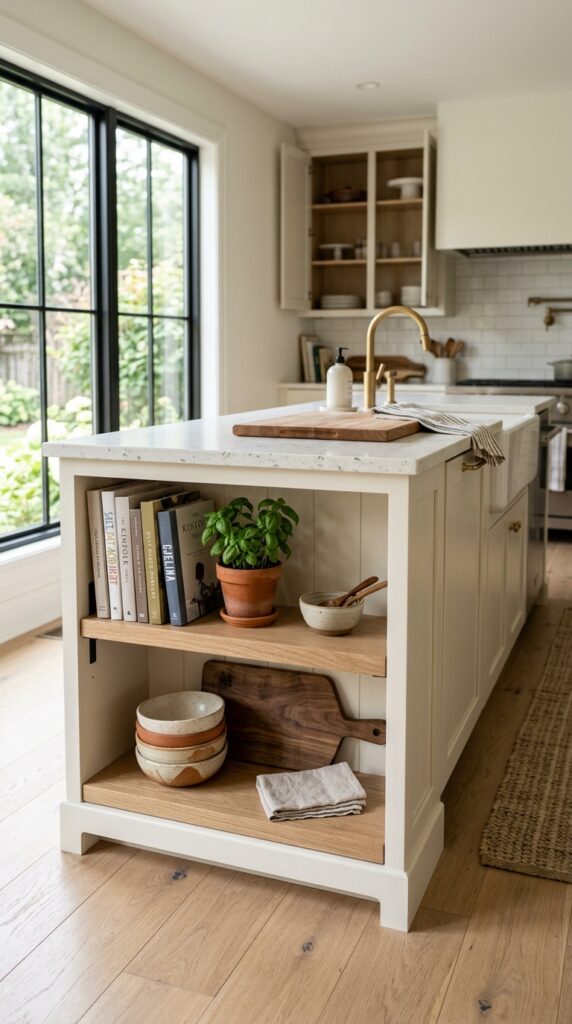
Vibe: Hushed — open shelving on an island’s end panel creates an intentional pause, a place for things that deserve to be seen.
Why it works: Incorporating open shelves into one end of an island introduces negative space — the visual break between the countertop and the items displayed below prevents the island from reading as a closed, heavy box. The design principle at play is visual breathing room: by leaving some space open and some closed, you give the eye places to rest. Open shelves on an island also serve practically, keeping frequently used items accessible from multiple sides of the kitchen.
How to get it: Limit open shelf displays to three categories: something functional (stacked bowls or plates), something organic (a plant or dried botanicals), and something textural (a linen cloth, a wooden board, or a woven basket). More than three categories and the shelf begins to read as clutter rather than curation.
💡 Quick Win: Retrofit open shelves onto an existing island end panel by removing the cabinet door and adding a simple 3/4-inch white oak shelf with a floating bracket — total materials cost under $80.
🛍️ Shop the Look — Amazon Product Ideas
| # | Product Search Phrase | Why It Fits |
| 1 | White oak floating shelf bracket set kitchen | Shelf retrofit hardware |
| 2 | Ceramic nesting bowl set matte neutral kitchen | Open shelf display staple |
| 3 | Linen-cover cookbook kitchen modern | Aesthetic shelf cookbook |
| 4 | Small terracotta pot with herb drainage hole | Organic shelf detail |
| 5 | Round wooden serving board display kitchen | Propped textural accent |
6. Sage Green Island with Brass Hardware
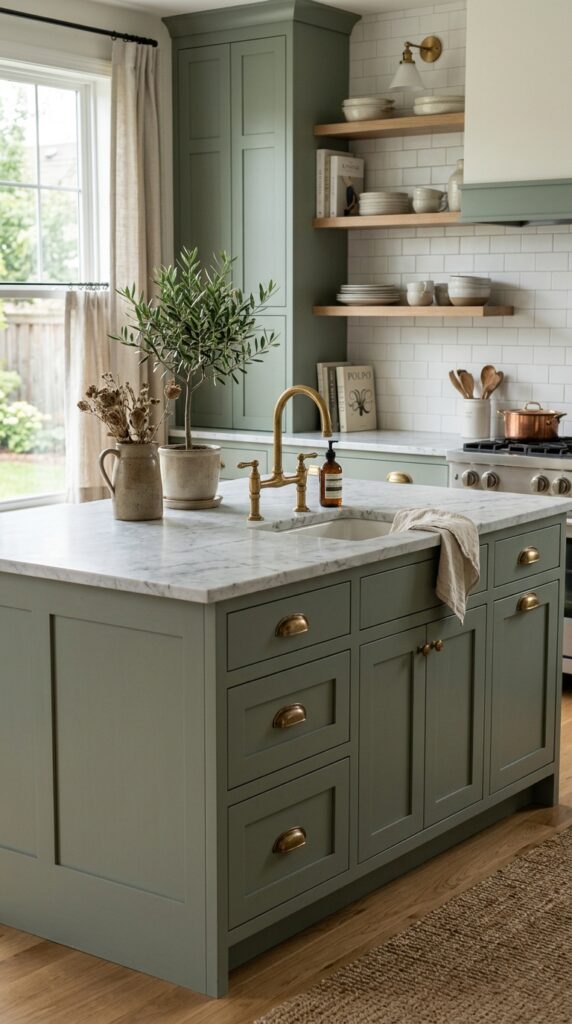
Vibe: Still — dusty sage carries the quiet authority of a color that never shouts but always gets noticed.
Why it works: Sage green sits in a rare chromatic zone — it reads as simultaneously neutral and intentional, making it compatible with nearly every kitchen perimeter color from white to warm wood to greige. The design principle is color temperature harmony: sage’s yellow-green undertone warms in natural light and cools under LED, meaning it adapts through the day without clashing. Aged brass amplifies this by adding a tonal warmth that new polished finishes would undo.
How to get it: The specific paint shade that has become the benchmark for this look is Benjamin Moore’s Saybrook Sage (HC-114). Pair it with Rejuvenation-style bin pulls in “aged brass” or “antique brass” finish — not satin brass, which reads too yellow. Keep the countertop in a warm white or honed stone to let the cabinet color do the work.
🛍️ Shop the Look — Amazon Product Ideas
| # | Product Search Phrase | Why It Fits |
| 1 | Aged brass bin pull cabinet hardware 10 pack | Exact hardware style |
| 2 | Sage green cabinet paint sample quart test | Color match test pot |
| 3 | Stoneware pitcher kitchen counter display | Organic countertop accent |
| 4 | Small indoor olive tree pot 12 inch | Statement greenery on island |
| 5 | Honed marble trivet white kitchen surface protector | Honed stone surface accent |
7. Rolling Kitchen Island for Flexible Layouts
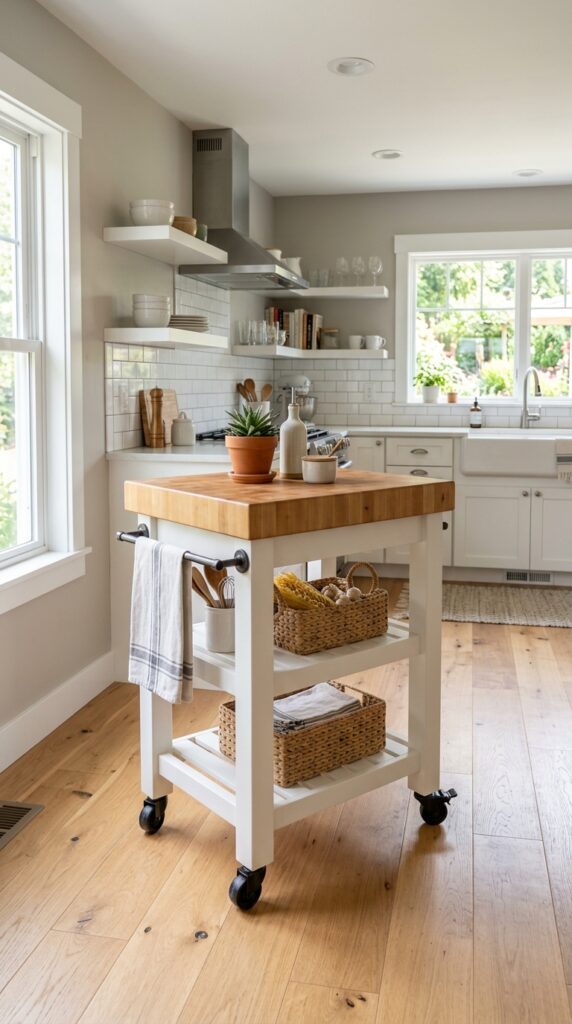
Vibe: Raw and resourceful — a rolling island turns floor plan constraints into deliberate flexibility.
Why it works: In kitchens under 200 square feet, a fixed island often violates the 42-inch clearance rule and disrupts traffic flow — but a rolling cart with locking casters solves both problems. The design principle is adaptive zoning: the island serves as prep station during cooking, gets rolled to a wall during large gatherings, and can follow the household’s actual habits rather than forcing the household to adapt to a fixed layout. Rolling islands also offer a lower financial commitment for renters or those uncertain about commitment.
How to get it: Look for carts with locking casters rated for at least 250 lbs total load. The ideal counter height for prep is 36 inches, matching standard countertops. If the cart sits lower (at 34 inches), add a thick butcher block top to bring it level. Stabilize it during use by locking all four casters before chopping.
💡 Quick Win: The IKEA Förhöja kitchen cart ($129–$169) can be customized with a fresh coat of chalk paint and new hardware in an afternoon — a rolling island with a fully custom look for under $200 total.
🛍️ Shop the Look — Amazon Product Ideas
| # | Product Search Phrase | Why It Fits |
| 1 | Butcher block rolling kitchen island cart with locking wheels | Core rolling island piece |
| 2 | Woven seagrass storage basket for kitchen shelf | Open shelf storage styling |
| 3 | Ceramic utensil holder crock kitchen counter | Countertop organization |
| 4 | Chalk paint quart white matte furniture | Cart base painting project |
| 5 | Linen kitchen towel with side hanging bar loop | Side-rail towel accent |
8. Waterfall Island in Dark Moody Tones
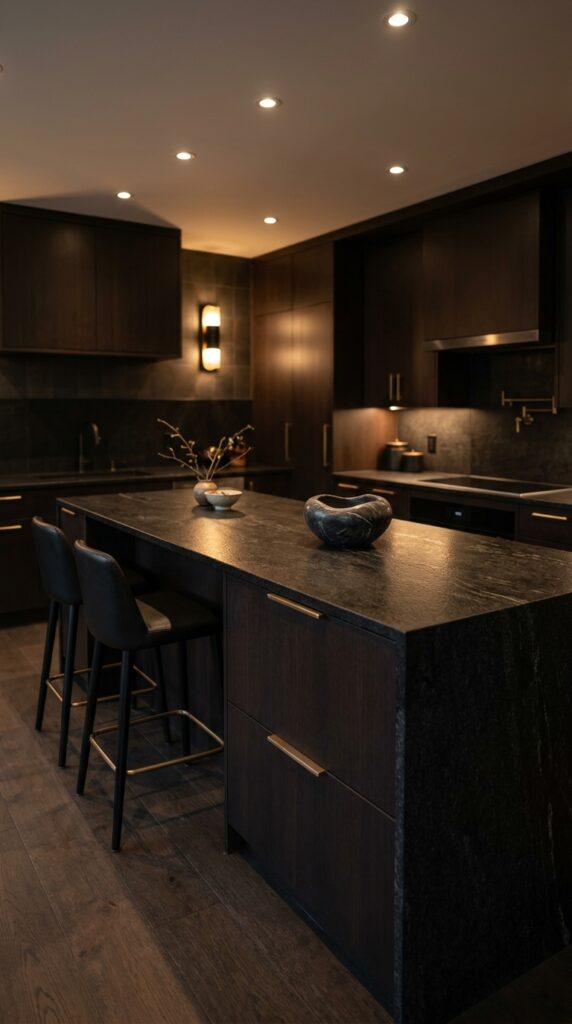
Vibe: Moody — a dark island reads like punctuation in a room, a deliberate choice that changes everything around it.
Why it works: Dark cabinetry paired with a leathered or honed black stone countertop exploits the principle of tonal layering — by keeping both surfaces within the same dark value range but using different textures (matte wood versus stone’s subtle surface variation), the design avoids the flatness that makes some all-dark kitchens feel oppressive. The leathered finish specifically is key: it softens reflections, which prevents the island from reading as heavy even in smaller kitchens.
How to get it: If doing a full dark island build is out of budget, achieve a similar effect by painting an existing island in Sherwin-Williams Iron Ore (SW-7069) — a warm, complex charcoal-brown that avoids the coldness of pure black — and replacing the hardware with champagne bronze pulls.
🛍️ Shop the Look — Amazon Product Ideas
| # | Product Search Phrase | Why It Fits |
| 1 | Champagne bronze bar pull cabinet hardware set | Warm metal hardware match |
| 2 | Dark espresso chalk paint quart furniture refinishing | Island dark paint option |
| 3 | Leathered granite contact paper countertop peel stick | Budget dark countertop look |
| 4 | Black marble sculptural vase decorative vessel | Island surface focal accent |
| 5 | Black velvet bar stool brass footrest counter height | Seating match for dark island |
9. Shiplap Island Skirt for Farmhouse Texture
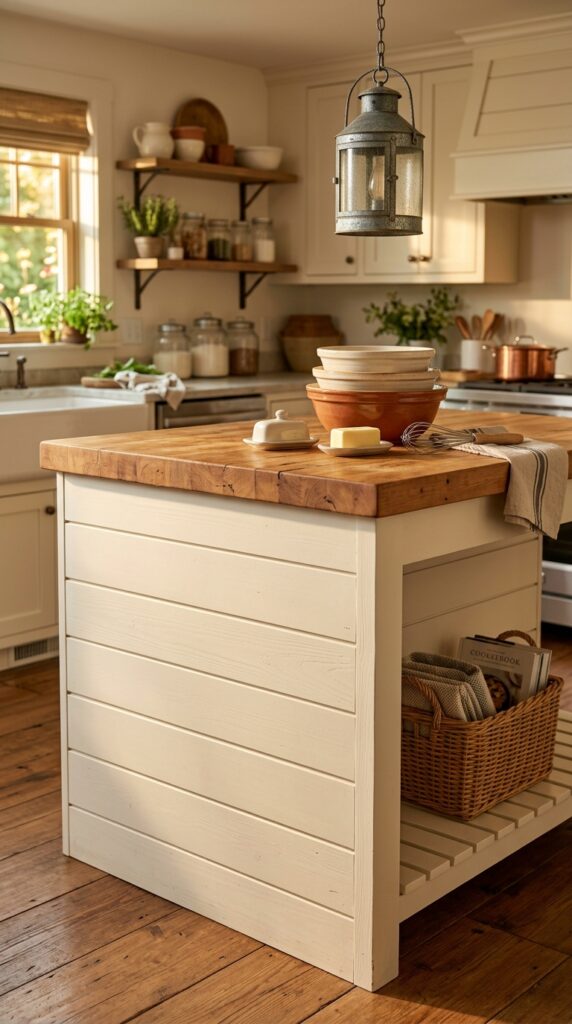
Vibe: Layered — shiplap brings the warmth of handcrafted detail to a surface that most kitchens leave completely plain.
Why it works: The island’s skirt panel — the vertical face below the countertop overhang — is one of the most underutilized design surfaces in the kitchen. Applying horizontal shiplap boards to this face introduces texture depth through the play of shadow in the reveal gaps between boards. The boards themselves add no structural complexity, but the visual dimension they create makes the island read as custom and built-in even if it was assembled from stock cabinets. White paint preserves the texture without adding color weight.
How to get it: Use 1×4 pine shiplap boards with a 1/8-inch reveal gap, applied with construction adhesive and finishing nails directly over the existing cabinet door panels. Two coats of Benjamin Moore White Dove (OC-17) in semi-gloss gives the correct farmhouse sheen while being easy to wipe down.
💡 Quick Win: Pre-primed PVC shiplap trim boards from the lumber section of any hardware store can be cut to size and glued directly over existing cabinet panels — the total materials cost for a standard 6-foot island skirt runs under $60.
🛍️ Shop the Look — Amazon Product Ideas
| # | Product Search Phrase | Why It Fits |
| 1 | Shiplap peel and stick wall panel white wood grain | No-nail shiplap alternative |
| 2 | Galvanized metal pendant light farmhouse industrial | Overhead texture complement |
| 3 | Ceramic mixing bowl set farmhouse white kitchen | Farmhouse countertop accent |
| 4 | Rattan storage basket with handle large | Lower shelf texture detail |
| 5 | White semi-gloss cabinet paint quart | Shiplap painting match |
10. Marble Hexagon Tile Skirt
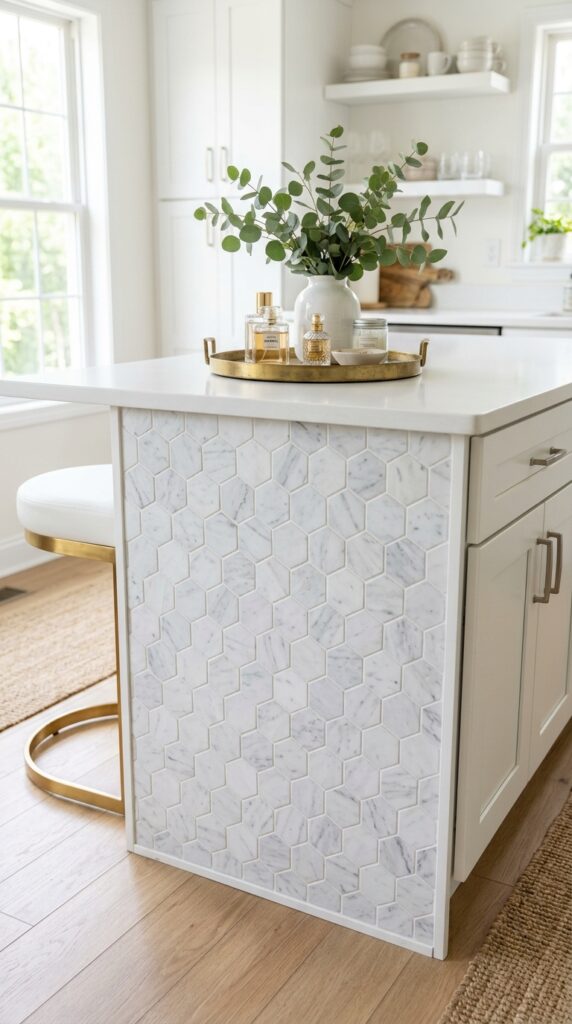
Vibe: Refined — a tile skirt turns the island’s most overlooked surface into the room’s most scrutinized detail.
Why it works: Applying tile to the island’s base panel functions as focal texture — it draws the eye downward to a surface people rarely look at and rewards the attention. Hexagon tiles in particular use the visual principle of geometric repetition: the six-sided form creates a honeycomb rhythm that reads as intricate without being busy. White marble hex with white grout keeps the color palette serene; using a contrasting charcoal grout dramatically increases the visual intensity of the same tile pattern.
How to get it: Use a tile mesh mosaic sheet (available in 12×12 inch sections) to achieve the hexagon pattern without individually placing 2-inch tiles. Apply with standard tile mastic on the existing cabinet panel after lightly sanding the surface. Seal the tiles and grout with a penetrating stone sealer annually.
🛍️ Shop the Look — Amazon Product Ideas
| # | Product Search Phrase | Why It Fits |
| 1 | White marble hexagon tile mosaic mesh sheet 12×12 | Core tile material |
| 2 | White grout unsanded tiles kitchen backsplash | Grout color match |
| 3 | Tile mastic adhesive premixed cabinet application | Tile adhesive for panels |
| 4 | Brass bar stool counter height marble kitchen | Coordinated seating |
| 5 | White ceramic vase eucalyptus stem dried | Countertop organic accent |
11. Integrated Microwave Drawer for Clean Lines
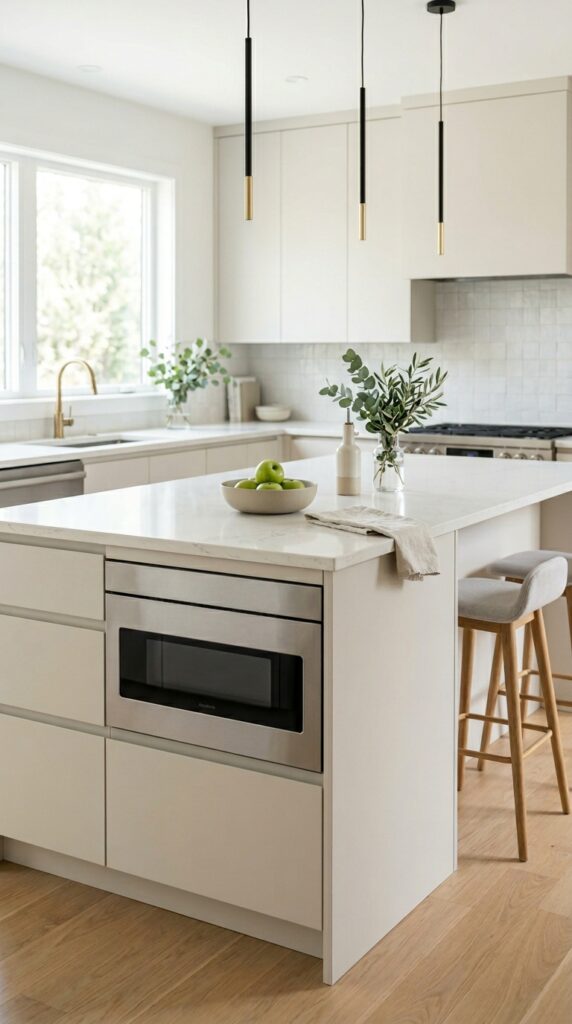
Vibe: Clean — removing the microwave from the counter doesn’t just free up space; it transforms the entire kitchen’s visual register.
Why it works: Counter appliances create what designers call visual noise — objects that interrupt a clean sightline and signal disorder even in a tidy kitchen. Integrating the microwave into the island’s lower cabinetry as a drawer unit applies the design principle of surface subtraction: removing objects from the primary horizontal plane makes the kitchen appear both larger and calmer. The microwave drawer format specifically places the appliance at a comfortable hip-height access point, which is ergonomically superior to countertop or over-range placement.
How to get it: Microwave drawers require a dedicated 20-amp circuit and a minimum rough opening of approximately 24 inches wide by 16 inches tall — always verify the exact specifications of the unit before ordering cabinetry. Sharp and Bosch both make 24-inch microwave drawer units that work within standard base cabinet dimensions.
🛍️ Shop the Look — Amazon Product Ideas
| # | Product Search Phrase | Why It Fits |
| 1 | Stainless steel microwave drawer built-in 24 inch | Core integrated appliance |
| 2 | Flat bar pull handle integrated cabinet hardware | Handle-less cabinet look |
| 3 | White quartz trivet pot holder round | Clean countertop surface accent |
| 4 | Minimalist bowl large white ceramic countertop | Single surface accent |
| 5 | Slim narrow bar stool counter height backless | Streamlined seating match |
12. Seating on Three Sides for Casual Entertaining
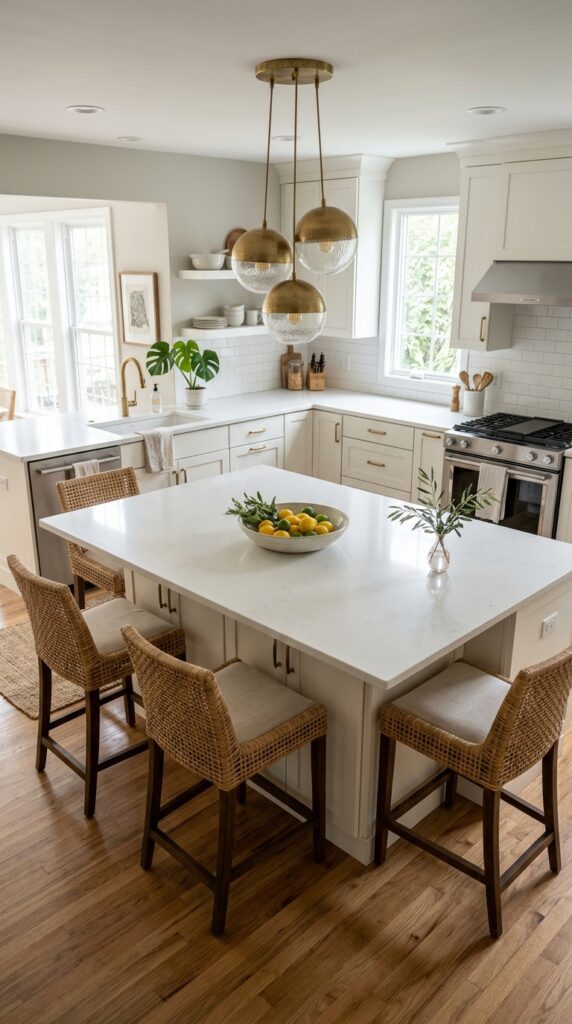
Vibe: Warm — a three-sided seating island transforms the kitchen into the room’s actual living room.
Why it works: Standard island layouts seat guests on one long side only, creating a stage-and-audience dynamic where the cook performs and the guests observe. Extending the countertop overhang to two or three sides dissolves that hierarchy — everyone is equally close to the action. For this to work practically, the countertop overhang needs a minimum of 12 inches (for knee clearance) and ideally 15 inches on seated sides. An island designed for three-sided seating typically runs 6 feet long and 3.5–4 feet wide.
How to get it: When designing for three-sided seating, position the working side of the island (where the sink or prep zone sits) on the cook-facing edge and leave the perimeter side clear of appliances. This way guests sit across from the prep zone rather than beside it, maintaining comfortable conversation distance.
💡 Quick Win: If you have an existing two-sided island, add seating to the short end by simply purchasing one additional barstool and ensuring the countertop extends at least 12 inches beyond the cabinet face — no renovation needed.
🛍️ Shop the Look — Amazon Product Ideas
| # | Product Search Phrase | Why It Fits |
| 1 | Natural rattan counter stool set of 4 swivel | Three-side seating staple |
| 2 | Wide shallow ceramic serving bowl centerpiece large | Island centerpiece accent |
| 3 | Cluster pendant light adjustable multi-head kitchen | Above-island lighting focal |
| 4 | White quartz cutting board large kitchen | Functional surface piece |
| 5 | Bud vase set small ceramic kitchen counter | End-of-island accent grouping |
13. Terracotta Accent Island in a Neutral Kitchen
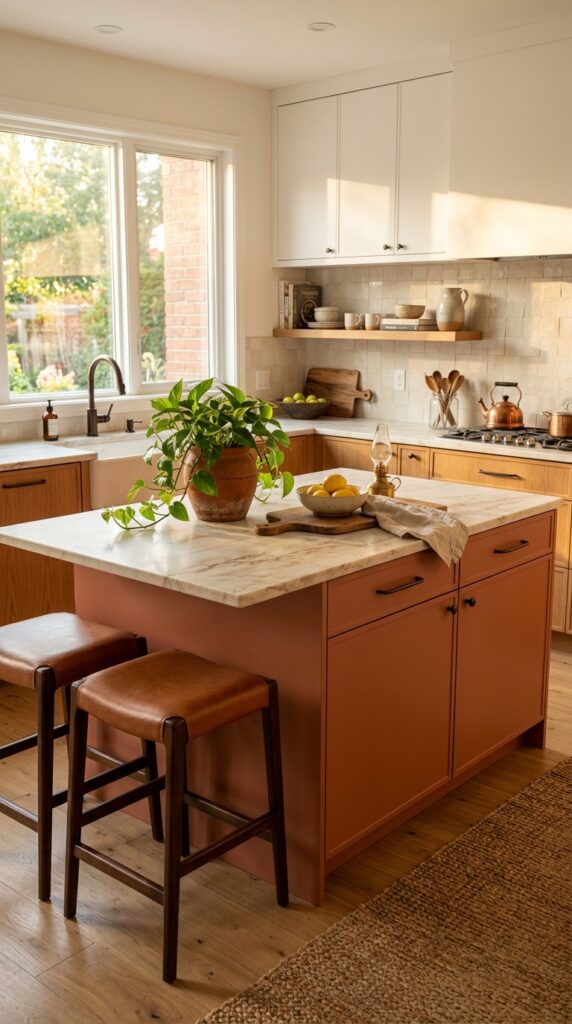
Vibe: Sun-warmed — terracotta carries the visual memory of heat and clay even in a fully modern kitchen.
Why it works: Terracotta as an island accent color works because it operates as a warm neutral rather than a true accent — it shares undertones with wood, stone, and aged metals, making it feel like a natural extension of organic materials rather than a disruptive color choice. The design principle is analogous harmony: colors with shared warm undertones (terracotta, wood, aged bronze, linen) create a cohesive palette even when the actual tones vary widely in value. Against white perimeter cabinets, terracotta reads as grounded rather than bold.
How to get it: Sherwin-Williams Cavern Clay (SW-7701) is the most widely referenced terracotta paint shade for kitchen cabinetry — it has orange-red warmth without reading as a pure red in typical kitchen lighting. Apply in a matte or satin sheen, as high-gloss amplifies the intensity of warm colors.
🛍️ Shop the Look — Amazon Product Ideas
| # | Product Search Phrase | Why It Fits |
| 1 | Terracotta paint sample quart cabinet furniture matte | Island color starting point |
| 2 | Oil rubbed bronze cup pull cabinet hardware set | Bronze hardware complement |
| 3 | Leather counter stool warm brown kitchen | Warm material seating |
| 4 | Terracotta pot trailing plant indoor kitchen | Countertop living accent |
| 5 | Jute runner rug kitchen 2×6 natural fiber | Floor anchor under island |
14. Under-Island Wine Rack Built-In
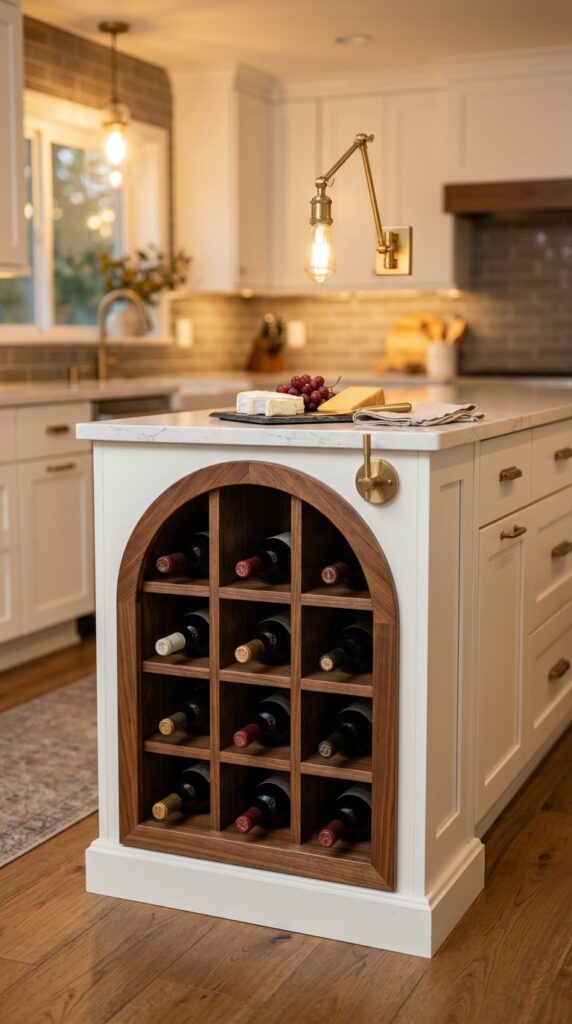
Vibe: Layered — a wine rack built into the island signals that this kitchen was designed for actual living, not just cooking.
Why it works: Integrating storage into the island’s end panel adds functional depth to a surface that is typically just a flat panel — and it does so without requiring additional floor space. The arched or grid-style wine rack specifically creates framed negative space: the openings draw the eye inward and give the island a sense of dimensional depth that flat cabinetry lacks. Storing wine at counter-height also keeps bottles accessible without a dedicated wine fridge footprint.
How to get it: Wine rack inserts are available as pre-made wooden units sized to fit standard 15-inch and 18-inch cabinet openings. Remove the existing cabinet door on one island end panel and install a wood or metal grid wine insert using wood screws from inside the cabinet box. Keep wine stored below the countertop level where temperatures are more stable — typically under 68°F.
💡 Quick Win: A free-standing stackable wine rack ($25–$45 on Amazon) slid into the open base of an existing island — after removing a bottom shelf — creates the appearance of a built-in without any carpentry.
🛍️ Shop the Look — Amazon Product Ideas
| # | Product Search Phrase | Why It Fits |
| 1 | Wood wine rack insert cabinet 12 bottle walnut | Built-in wine storage match |
| 2 | Stackable wood wine rack countertop 6 bottle | Free-standing built-in alternative |
| 3 | Slate cheese board cutting board with handles | Counter entertainment surface |
| 4 | Brass wall sconce plug in warm kitchen | Adjacent wall accent light |
| 5 | Linen wine bag gift storage set | Soft wine storage alternative |
15. Oversized Island for Serious Home Cooks
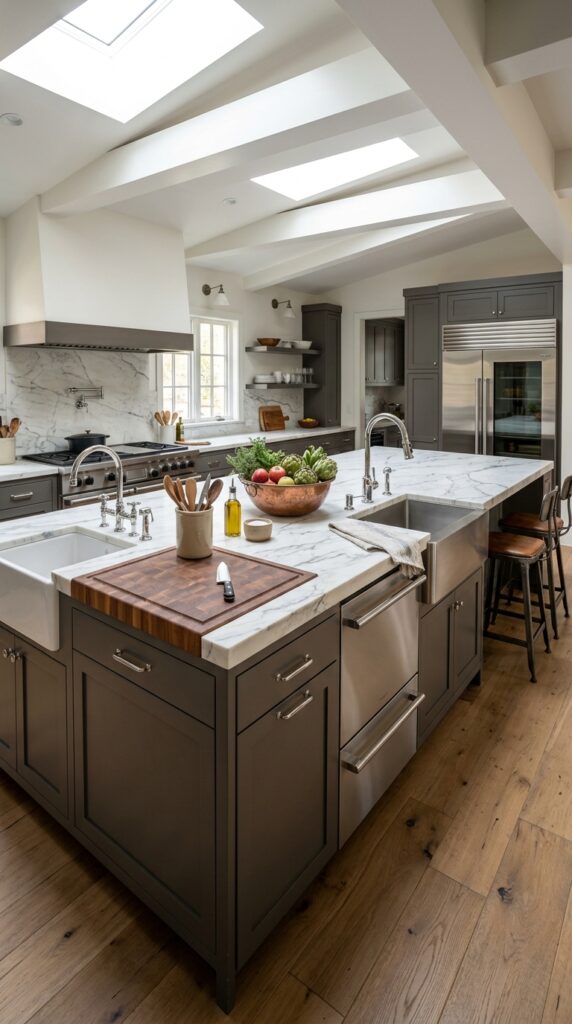
Vibe: Grounded — an oversized island anchors a kitchen the way a workhorse anchors a farm — everything else organizes around it.
Why it works: A professional kitchen places workstations along a single continuous run to eliminate unnecessary movement — and a very large home island attempts the same workflow optimization. The design principle is zone adjacency: by positioning prep, washing, and plating zones within arm’s reach of each other, an oversized island significantly reduces the number of steps a cook takes during a meal. For the design to read as intentional rather than merely large, the island needs visual weight that matches its physical footprint — thick countertops (minimum 3cm), substantial hardware, and honest, heavy materials.
How to get it: If you’re planning an oversized island, engage a kitchen designer specifically to evaluate the work triangle or work zone layout before committing to dimensions. An island that’s too deep (over 42 inches from front to back) creates dead zones in the center that nobody can comfortably reach from either side.
🛍️ Shop the Look — Amazon Product Ideas
| # | Product Search Phrase | Why It Fits |
| 1 | Large butcher block cutting board 24×18 maple inset | Oversized prep surface insert |
| 2 | Apron front stainless steel prep sink farmhouse 16 inch | Second sink option |
| 3 | Commercial bar stool industrial metal counter height | Heavy-duty professional seating |
| 4 | Copper bowl large decorative kitchen | Warm metal produce display |
| 5 | Large honed marble contact paper countertop peel stick | Oversized countertop option |
16. Black Island in an All-White Kitchen
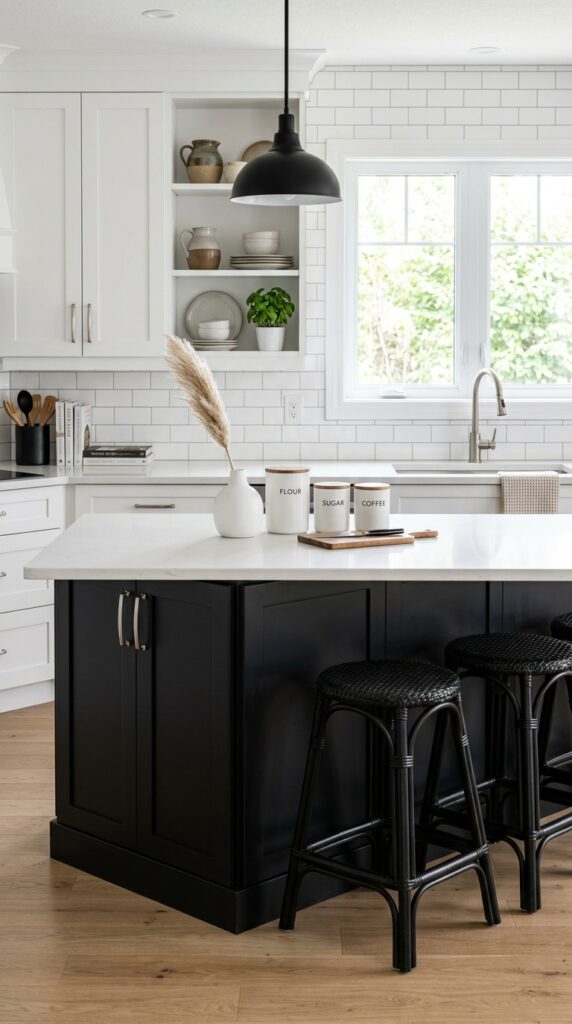
Vibe: Raw and decisive — a black island in a white kitchen is the design equivalent of a well-placed period at the end of a sentence.
Why it works: Black and white is the most extreme application of contrast ratio in interior design, and the kitchen is one of the few rooms where it works without feeling stark — because the activity and texture of cooking (herbs, produce, steam, ceramics) soften the graphic edges. The key design principle is proportion control: the black island should occupy no more than one-third of the total cabinetry area so that white remains the dominant value. A matte finish is non-negotiable here — gloss black on cabinets reads as extremely aggressive in typical kitchen scale.
How to get it: Paint the island in Benjamin Moore Onyx (2133-10) or Sherwin-Williams Tricorn Black (SW-6258) — both are warm-undertone blacks that soften under incandescent light rather than reading as cold. Use a 3-inch foam roller for cabinet doors to avoid brush marks.
🛍️ Shop the Look — Amazon Product Ideas
| # | Product Search Phrase | Why It Fits |
| 1 | Matte black cabinet paint oil based quart | Island painting starting point |
| 2 | Brushed nickel cabinet pull hardware set 10 | Nickel hardware complement |
| 3 | Black woven bar stool counter height set 2 | Seating color coordination |
| 4 | White ceramic canister set 4 piece kitchen | Counter color contrast accent |
| 5 | Dried pampas grass stem tall white vase | Neutral organic counter decor |
17. Small Kitchen Island Under 4 Feet
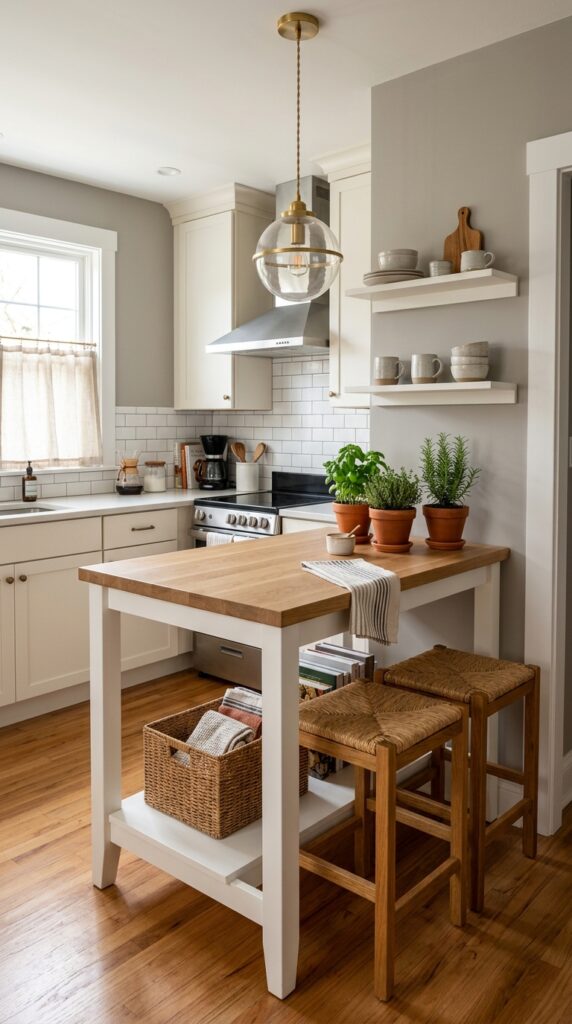
Vibe: Airy — a small island that respects the room’s proportions adds function without the room ever noticing the imposition.
Why it works: In small kitchens, scale is the single most important design variable. An undersized island — meaning one proportioned to the actual room rather than to aspirational square footage — applies the principle of visual scale matching: when every piece of furniture exists in appropriate relationship to the space, the room feels deliberate rather than constrained. A 36-inch wide by 24-inch deep island in a 10×10 kitchen serves the same functional purpose as a 6-foot island in a larger kitchen, with virtually none of the spatial sacrifice.
How to get it: Prioritize depth over length in a small kitchen island — a 24-inch deep island leaves considerably more floor space than a 36-inch deep one, while still providing a workable prep surface. If you need seating, use backless counter stools (which tuck fully under the overhang) rather than chairs, which claim floor space even when empty.
💡 Quick Win: A 3-foot by 2-foot IKEA Råskog utility cart ($50) functions as a small kitchen island for renters: it holds two shelves of storage, moves freely, and fits under standard countertop height.
🛍️ Shop the Look — Amazon Product Ideas
| # | Product Search Phrase | Why It Fits |
| 1 | Small kitchen island cart 36 inch butcher block white | Compact island starter |
| 2 | Backless counter stool low profile tuck under | Space-efficient seating |
| 3 | Small woven storage basket kitchen island shelf | Compact under-shelf storage |
| 4 | Mini terracotta herb planter set 3 pots kitchen | Counter organic small-scale accent |
| 5 | Single pendant light plug in cord kitchen | Small-scale overhead lighting |
18. Charging Station Built Into the Island
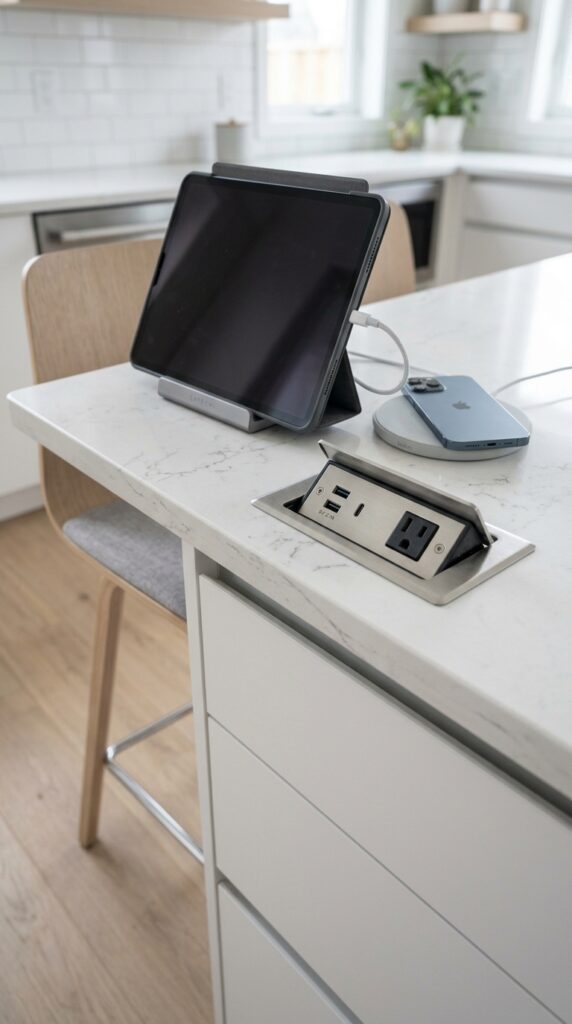
Vibe: Still — the island becomes a hub for both cooking and connected living without visible cord clutter.
Why it works: The modern kitchen island exists in two simultaneous realities: meal prep station and digital workspace. Integrating power directly into the island surface is the clearest acknowledgment of that dual role. The design principle is hidden infrastructure — by routing power to the island through a flush-mounted pop-up outlet block (which sits flush when not in use), the surface maintains its clean lines while offering full function. This is far superior to running extension cords, which create floor hazards and visual noise.
How to get it: Pop-up outlet blocks are available in stainless steel and white finish, sized for a standard 3.5-inch round or 2.9-inch x 4.7-inch cutout. They require a licensed electrician to wire the junction below, which typically costs $150–$250 in labor. Plan the outlet location during countertop fabrication, before the stone is cut, to avoid cutting into existing stone later.
🛍️ Shop the Look — Amazon Product Ideas
| # | Product Search Phrase | Why It Fits |
| 1 | Pop up outlet USB countertop island flush mount | Core charging integration |
| 2 | USB-C wireless charging pad kitchen countertop | Wireless supplement charging |
| 3 | Tablet holder stand kitchen countertop adjustable | Screen adjacent to charging |
| 4 | Cable management box white desk countertop | Cord organization backup |
| 5 | White power strip flat ultra thin countertop | Discreet additional outlets |
19. Industrial Pipe Leg Island Base
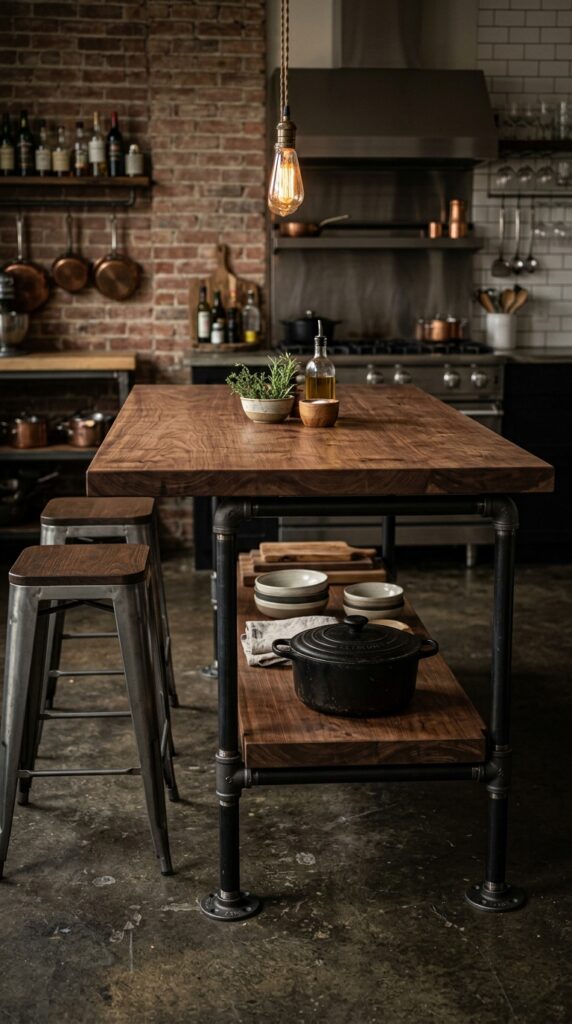
Vibe: Raw — exposed pipe legs make visible what most islands try to hide: the honest structure beneath the surface.
Why it works: The industrial design aesthetic operates on the principle of structural honesty — showing the bones of a piece rather than concealing them. Steel pipe legs support a butcher block or live-edge countertop in the same way steel beams support warehouse loft ceilings; the material communication is one of durability and permanence. This contrast between raw industrial metal and warm organic wood is one of the most enduring material pairings in modern interior design because the tension between the two materials creates visual interest that monolithic designs lack.
How to get it: Black iron pipe flanges, nipples, and elbows are available at any home improvement store and can be assembled into custom table legs without welding. A standard island leg requires a 1.5-inch diameter pipe nipple to match the height needed, plus a floor flange and ceiling flange at each end. Sand and seal the pipe threads with paste wax to prevent rust in kitchen humidity.
🛍️ Shop the Look — Amazon Product Ideas
| # | Product Search Phrase | Why It Fits |
| 1 | Black iron pipe table leg kit 28 inch set of 4 | Core structural leg material |
| 2 | Cast iron pipe floor flange 1.5 inch mounting | Pipe leg mounting hardware |
| 3 | Industrial bar stool wood seat metal frame counter height | Matching seating style |
| 4 | Edison bulb pendant light black cage industrial | Industrial overhead accent |
| 5 | Cast iron dutch oven display kitchen shelf | Functional display on open shelf |
20. Statement Island Countertop in Leathered Quartzite
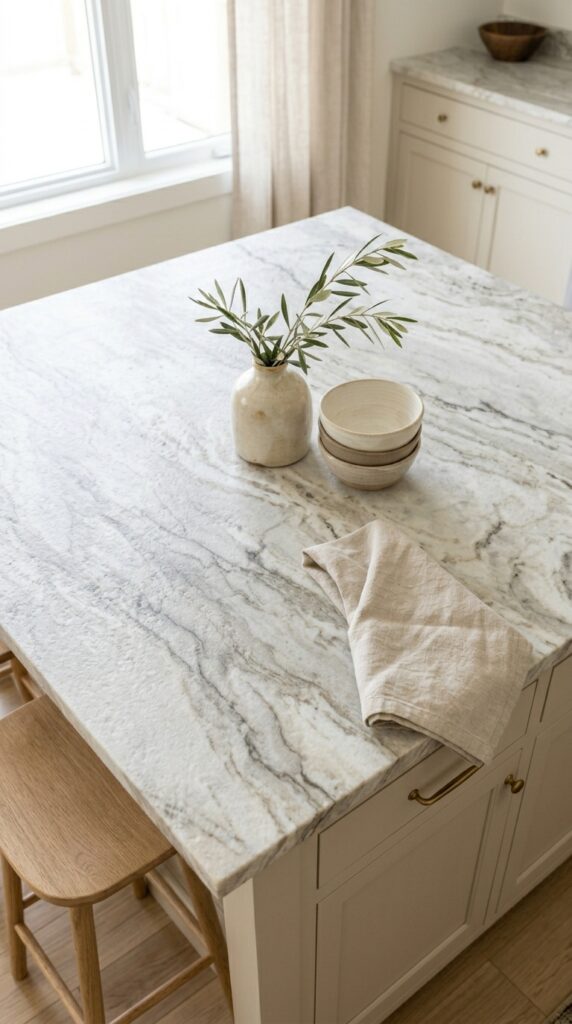
Vibe: Tactile — leathered stone is the only kitchen surface you’ll want to run your palm across before you’ve even put down your bag.
Why it works: The leathered finish on quartzite or granite is achieved by running diamond brushes across a polished surface, which opens the stone’s natural crystal structure and creates a matte, subtly textured surface. This finish serves a dual design purpose: it suppresses reflections (which makes veining read more organically) while simultaneously increasing tactile interest — the surface tells you it’s natural stone through touch alone. Unlike honed finishes, leathered quartzite is less susceptible to water spots and fingerprints, making it more practical in a kitchen environment.
How to get it: White Macaubas, Fantasy Brown, and Sea Pearl are three widely available quartzite varieties that work beautifully in a leathered finish. When visiting a stone yard, always ask to see leathered slabs specifically rather than polished — the same stone reads completely differently in each finish, and you should make your decision based on the actual finish you’ll install.
💡 Quick Win: Ask your stone yard or countertop fabricator for remnant slabs — offcuts from larger kitchen jobs are frequently sold at 30–50% discount, and a quartzite remnant can often cover an entire kitchen island at a fraction of full material cost.
🛍️ Shop the Look — Amazon Product Ideas
| # | Product Search Phrase | Why It Fits |
| 1 | Stone countertop sealer penetrating quartzite marble | Leathered stone maintenance |
| 2 | Cream ceramic bowl set matte neutral kitchen | Countertop complement accessory |
| 3 | Linen napkin set natural undyed kitchen | Texture accent on island surface |
| 4 | Short white ceramic vase olive branch dried | Organic low-profile accent |
| 5 | Natural stone coaster set kitchen island bar | Functional surface protector |
21. Kitchen Island Makeover with Paint and New Hardware
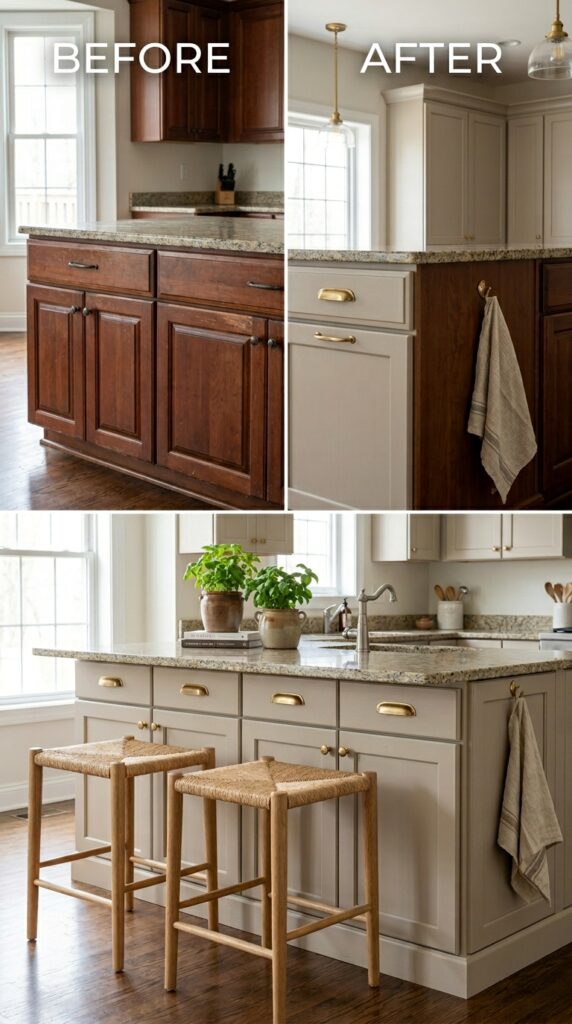
Vibe: Refreshed — a weekend of paint and one afternoon of hardware-swapping can make a ten-year-old kitchen island look like it was finished last month.
Why it works: The fresh-eyes principle in interior design holds that the elements that most dramatically change a room’s perceived quality are surfaces and hardware — not the bones of the room itself. Paint transforms color, which the brain processes before shape or material. New hardware changes the tactile and visual character of every cabinet simultaneously at relatively low cost. The combination of the two creates a compounded update effect: each change amplifies the other’s impact because the viewer can no longer rely on the familiar baseline to judge either element.
How to get it: Degloss all cabinet faces with liquid deglosser (not just sanding) before applying primer — this step is what separates professional-looking painted cabinetry from amateur results that chip and peel. Apply two coats of Zinsser Bulls Eye 1-2-3 primer, then two coats of Benjamin Moore Advance in a satin finish, which self-levels to minimize brush and roller texture.
🛍️ Shop the Look — Amazon Product Ideas
| # | Product Search Phrase | Why It Fits |
| 1 | Cabinet deglosser liquid prep paint kitchen furniture | Surface prep for painting |
| 2 | Zinsser 123 primer spray can cabinet furniture | Professional primer base |
| 3 | Unlacquered raw brass cabinet pull set 10 pack | Hardware transformation piece |
| 4 | Foam roller 4 inch cabinet door painting set | Drip-free painting applicator |
| 5 | Greige warm beige chalk paint furniture quart | Paint color option greige |
22. Waterfall Island with a Sink
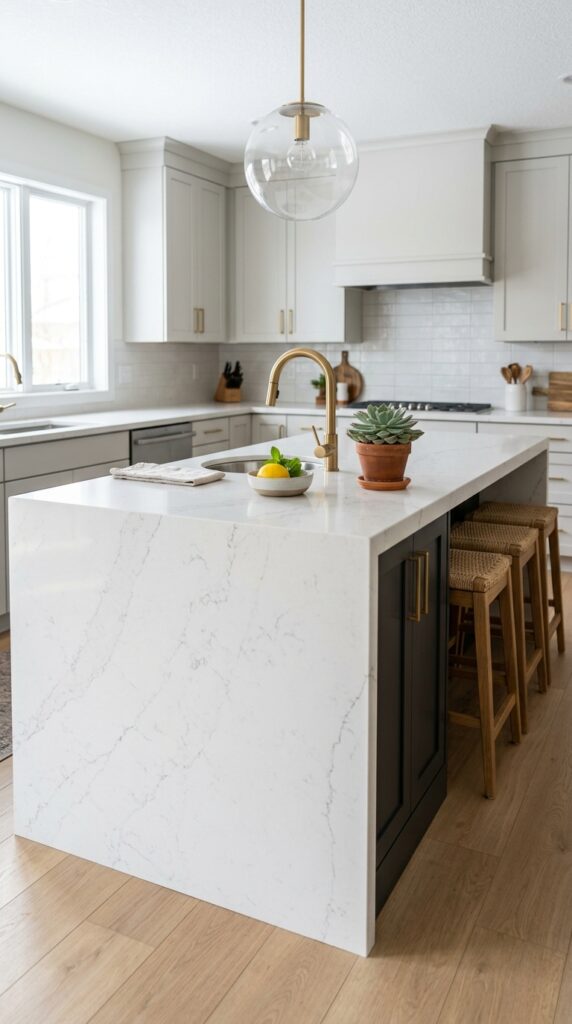
Vibe: Luminous and purposeful — an island sink repositions the cook to face the room, which changes the social experience of cooking entirely.
Why it works: Positioning a prep or bar sink in the island fundamentally alters the cook’s orientation: instead of facing the perimeter wall, they face the living space. This design decision exploits the principle of social cooking — the cook becomes part of the conversation rather than separated from it. An island sink also creates a dedicated prep-and-wash station independent of the main kitchen sink, which significantly improves workflow in households where two people cook simultaneously. The waterfall edge on a sink island requires careful waterproofing at the vertical panel joint; always use a silicone bead rather than caulk at stone joints.
How to get it: Install a 15–18 inch single-basin round or rectangular undermount sink — a prep sink rather than a full-scale dish-washing sink. Pair it with a single-hole pull-down faucet in a contrasting finish to the island hardware. Run cold water only if plumbing the hot line creates significant routing complexity — prep sinks rarely require hot water.
🛍️ Shop the Look — Amazon Product Ideas
| # | Product Search Phrase | Why It Fits |
| 1 | Small undermount prep sink 16 inch round stainless | Core island prep sink |
| 2 | Brushed gold single hole kitchen faucet pull down | Gold faucet style match |
| 3 | Kitchen sink grid bottom stainless undermount protector | Sink interior protector |
| 4 | Succulent plant small terracotta pot kitchen counter | Countertop organic accent |
| 5 | Soap dispenser built in brushed gold pump countertop | Sink accessory coordination |
23. Reclaimed Wood Island Top for Character
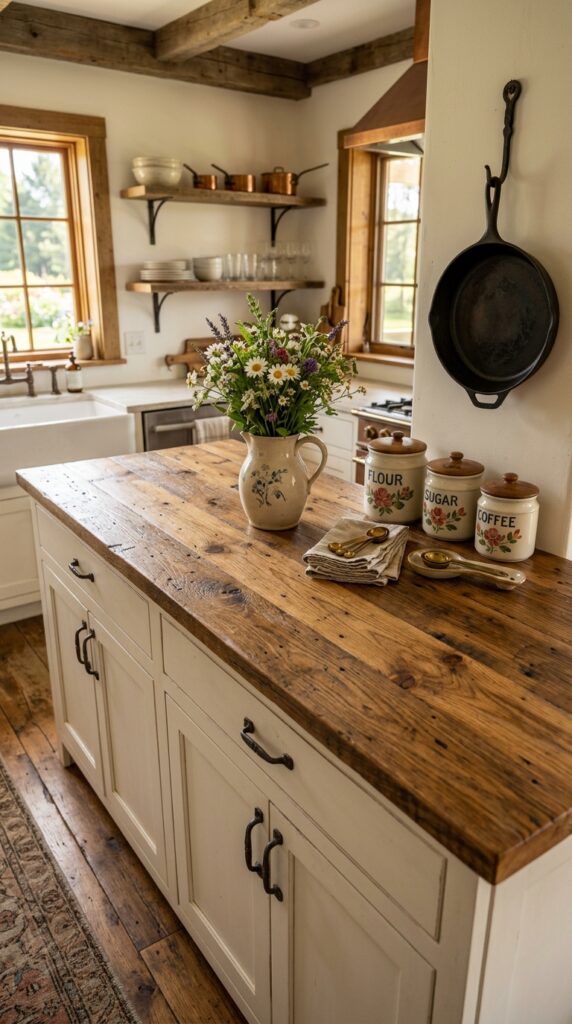
Vibe: Layered — reclaimed wood carries decades of history into a kitchen that might otherwise have none.
Why it works: Reclaimed wood operates on the design principle of authentic imperfection — the knots, nail holes, saw marks, and uneven grain aren’t flaws to hide; they are the material’s primary design value. This principle explains why reclaimed surfaces in high-end kitchens frequently command a price premium over new wood: the aging process is irreproducible by manufacturing. Mixing a reclaimed wood top with a painted white base creates material tension that drives visual interest — rough and polished, old and new, natural and manufactured.
How to get it: Source reclaimed barn wood through local salvage yards or suppliers like Elmwood Reclaimed Timber. For food-safe countertop use, have the boards milled flat, glued and joined, then finished with three coats of Rubio Monocoat (a single-coat oil finish that penetrates rather than forms a film, allowing re-oiling without stripping). Avoid polyurethane on reclaimed wood — it yellows and traps the depth that makes the material valuable.
💡 Quick Win: Purchase reclaimed wood floating shelf boards from Etsy sellers who offer pre-milled, sanded, and oiled pieces — then have a local carpenter build a simple base and attach the reclaimed top, keeping materials sourcing and fabrication separate to reduce cost.
🛍️ Shop the Look — Amazon Product Ideas
| # | Product Search Phrase | Why It Fits |
| 1 | Rubio monocoat wood oil finish natural | Reclaimed wood sealer finish |
| 2 | Reclaimed wood look peel stick plank countertop | Budget reclaimed alternative |
| 3 | Antique farmhouse pitcher ceramic wildflower vase | Countertop rustic accent |
| 4 | Hand painted stoneware canister set kitchen 3 piece | Artisan ceramic display set |
| 5 | Cast iron wall mount pot rack kitchen hook | Adjacent rustic storage display |
24. Track Lighting Over an Island for Layered Light
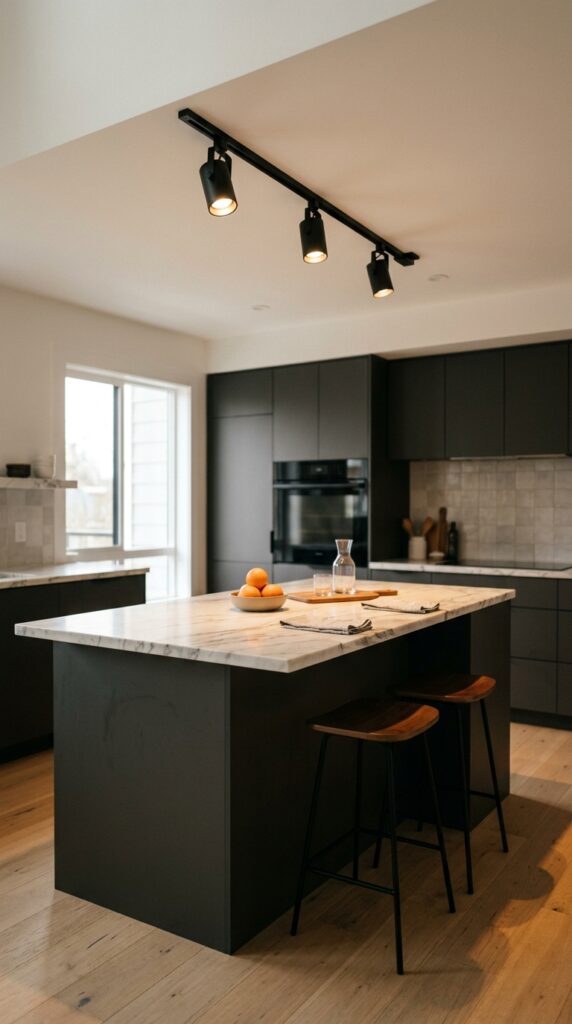
Vibe: Focused — track lighting over an island gives the kitchen a gallery-like quality where every important surface is precisely lit.
Why it works: Pendant lights introduce fixed, centered light points — useful aesthetically, but limited in their ability to direct light precisely where tasks demand it. Track lighting over an island applies the principle of directed task illumination: each head can be independently aimed at specific work zones (the cutting area, the plating corner, the bar end), allowing the same fixture to serve multiple functional purposes simultaneously. Track systems are particularly effective in kitchens without a soffit or coffered ceiling, where pendant placement lacks an obvious anchor point.
How to get it: Choose LED MR16 or PAR20 bulbs in 2700K color temperature for track heads — this is the warmest white available in LED and prevents the “office kitchen” quality that cooler 4000K temperatures create. Position the track to run parallel to the island’s long axis, centering it above the island’s width. Three heads minimum for a 6-foot island.
🛍️ Shop the Look — Amazon Product Ideas
| # | Product Search Phrase | Why It Fits |
| 1 | Matte black adjustable track lighting kit 3 light | Core overhead track fixture |
| 2 | MR16 LED bulb 2700K warm white GU10 set 6 | Warm LED replacement bulbs |
| 3 | Track lighting mounting adapter plug in cord kitchen | Cord-mounting track option |
| 4 | Marble countertop trivet white round | Illuminated surface accent |
| 5 | Minimalist kitchen island stool backless matte black | Dark seating to match track |
25. Coastal Blue Island with Rope Detail
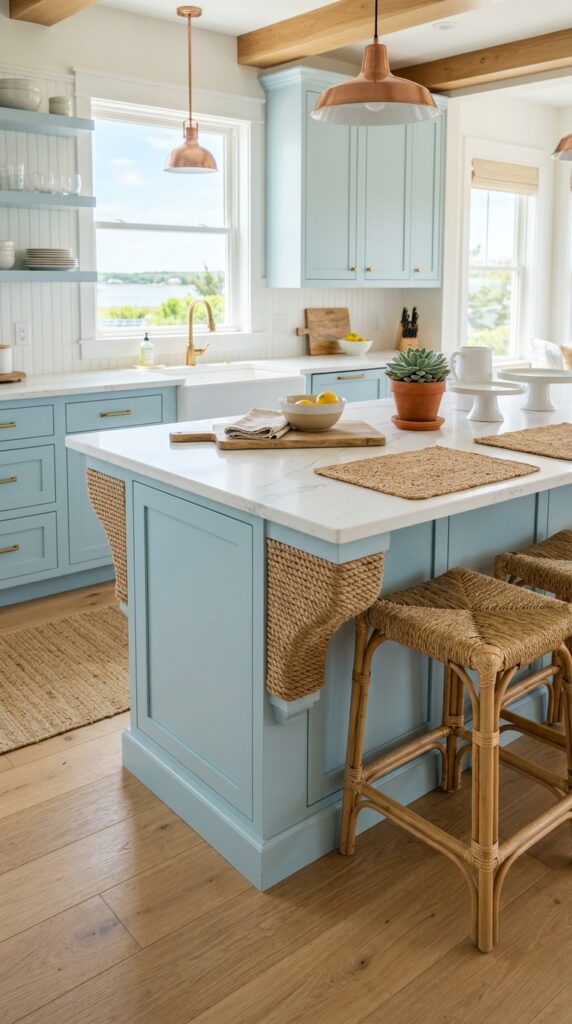
Vibe: Airy — this island carries the easy, unhurried atmosphere of a beach house kitchen even forty miles inland.
Why it works: Coastal style in kitchen design relies on material memory — materials like rope, sisal, weathered wood, and sea-glass tones carry cultural associations with ocean and shore even when deployed in completely landlocked kitchens. The design principle is evocative material selection: by choosing materials whose texture and color trigger sensory memories of seaside environments, the room creates emotional resonance that goes beyond visual design. Rope detail specifically — whether wrapped around corbels, legs, or used as drawer pulls — adds a craftsman, maritime quality that separates coastal design from merely “blue kitchen.”
How to get it: Paint the island in Benjamin Moore’s Palladian Blue (HC-144) or Sea Salt (SW-6204) by Sherwin-Williams — both are soft enough to read as architectural blues rather than bold accent colors. Add rope detail to the island by wrapping 3/4-inch natural sisal rope around existing corbels or table legs using marine-grade adhesive to fix the starting and ending points.
🛍️ Shop the Look — Amazon Product Ideas
| # | Product Search Phrase | Why It Fits |
| 1 | Sisal natural rope 3/4 inch jute decorative wrap | Rope detail material |
| 2 | Sea glass blue chalk paint furniture cabinet quart | Coastal island paint color |
| 3 | Seagrass counter stool woven natural fiber | Coastal material seating |
| 4 | Woven seagrass placemat set 4 kitchen island | Island surface texture detail |
| 5 | White ceramic coastal serving bowl wide shallow | Countertop maritime accent |
26. Mirrored Backsplash Behind the Island
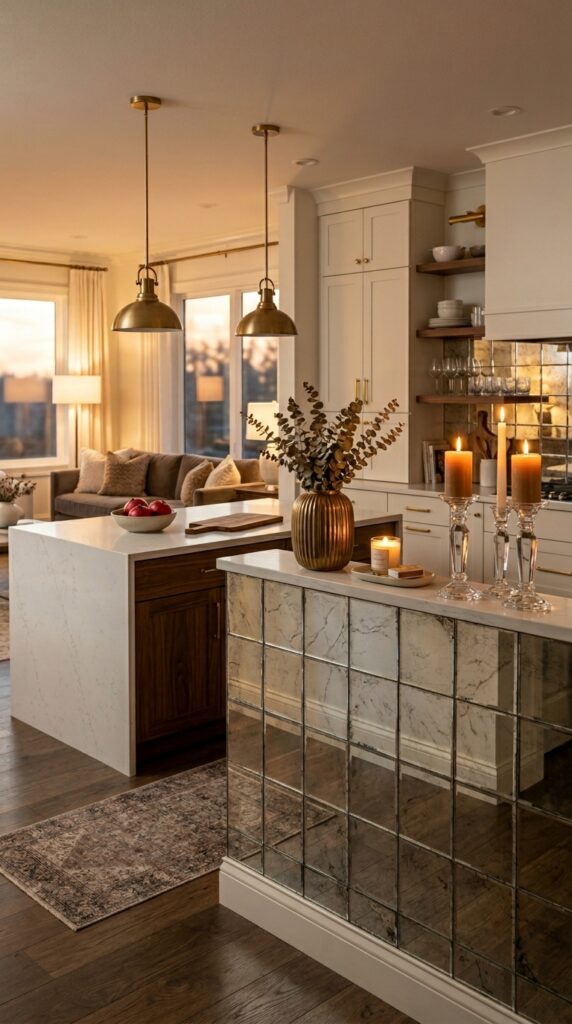
Vibe: Luminous — mirror tiles behind an island double the perceived depth of the kitchen while multiplying every candle and pendant’s light.
Why it works: Mirror as a backsplash material exploits the physics of light multiplication — every light source in the room generates a reflected counterpart, dramatically increasing perceived brightness without adding a single fixture. In kitchens that feel dark or spatially enclosed, mirrored tiles on a backsplash wall can make a room feel 20–30% larger purely through reflected light. Antiqued mirror specifically (which has slight foxing and gray variation in the reflective surface) softens the hard clarity of modern mirror, preventing the backsplash from reading as a bathroom vanity rather than a design feature.
How to get it: Install antiqued mirror tiles (available in 3×3 inch to 6×6 inch squares) using mirror adhesive — not tile mastic, which contains solvents that eat the mirror’s silver backing. Apply a bead of silicone at the edges and use mirror clips at the top for mechanical support. Keep the tile grout very narrow (1/8 inch or less) to maximize the reflective surface.
💡 Quick Win: Peel-and-stick antiqued mirror tile sheets are available for under $30 per square foot and require no adhesive or grouting — a renter-friendly solution that can transform a backsplash in an afternoon.
🛍️ Shop the Look — Amazon Product Ideas
| # | Product Search Phrase | Why It Fits |
| 1 | Peel stick mirror tile backsplash antiqued vintage | Renter-friendly mirror tile |
| 2 | Mirror tile adhesive silicone mounting squares permanent | Permanent mirror tile install |
| 3 | Metallic brass vase set decorative kitchen shelf | Reflected metallic accent |
| 4 | Crystal glass candleholder tea light set | Multiplied light from mirror |
| 5 | Warm white LED string lights bar shelf kitchen | Extra light source for mirror |
27. Curved Kitchen Island for Softened Layouts
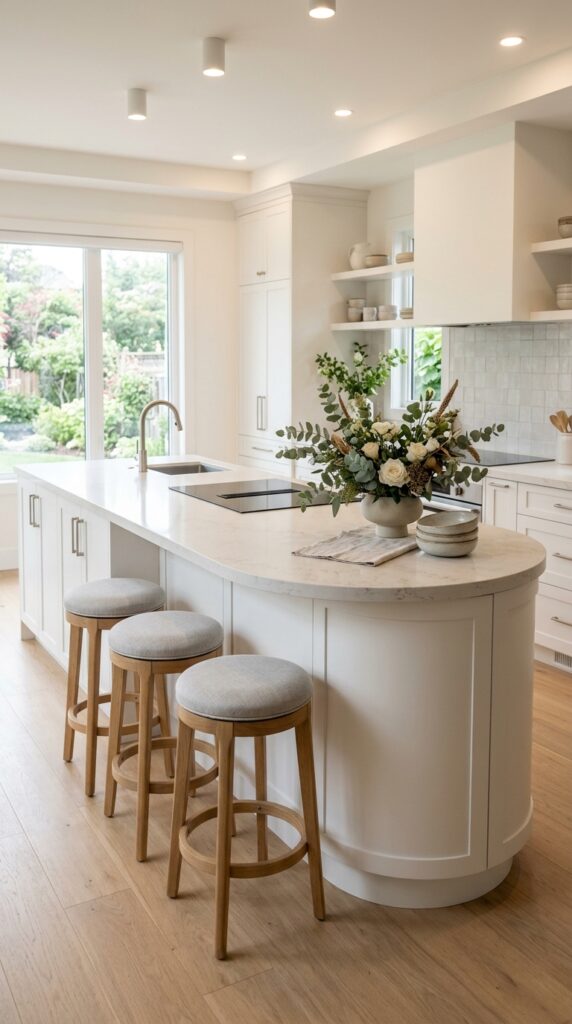
Vibe: Serene — a curved island end removes the visual aggression of a sharp corner, making the room feel both more spacious and more humane.
Why it works: Hard 90-degree corners in interior spaces create what designers call visual tension points — areas where the eye catches and lingers rather than flowing through the space. A curved or D-shaped island end removes this tension by introducing an organic, continuous radius that the eye travels around rather than stopping at. The design principle is flow geometry: curved forms guide traffic and eye movement through a space more gracefully than angular ones. Curved islands also improve safety in household with children, eliminating the sharp countertop corners that are a common source of injuries.
How to get it: A curved island end requires custom cabinetry (the curved face frame cannot be achieved with stock cabinets) and a countertop template routed in a continuous arc. When speccing the curve, a radius of 12–18 inches for a D-end reads as graceful; smaller radii appear as corners with rounded edges rather than true curves.
🛍️ Shop the Look — Amazon Product Ideas
| # | Product Search Phrase | Why It Fits |
| 1 | Round bar stool counter height swivel natural rattan | Circular stool to echo curve |
| 2 | Low wide vase arrangement dried floral kitchen counter | Curved-end display accent |
| 3 | Corner cushion protector table edge cover child safety | Interim safety on sharp end |
| 4 | White quartz lazy susan turntable countertop | Curved surface styling piece |
| 5 | Brushed nickel drawer pull set 10 pack | Coordinated hardware detail |
28. Bold Patterned Tile on Island Base
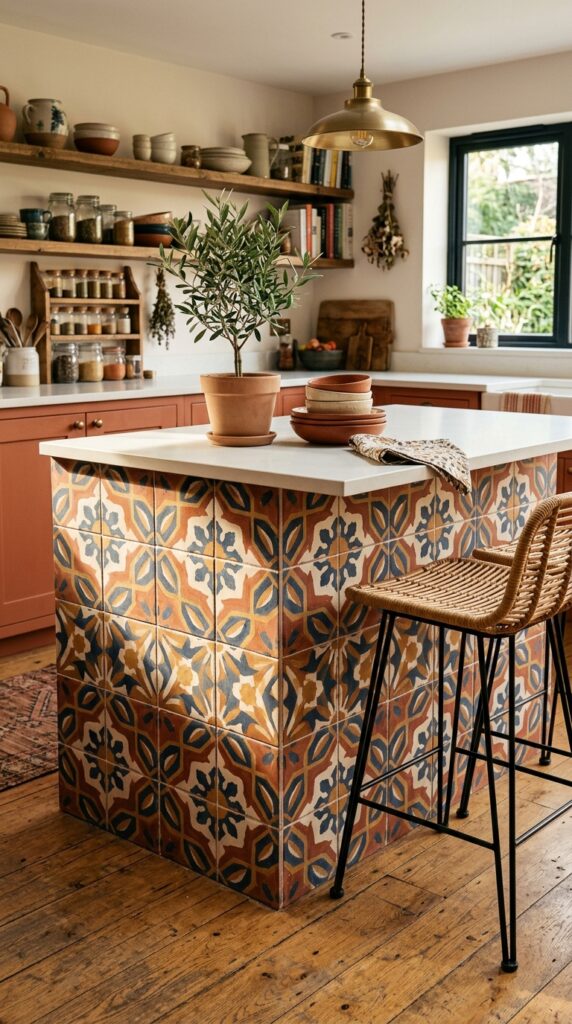
Vibe: Layered — patterned tile on the island base turns the most static surface in the kitchen into the room’s most energetic moment.
Why it works: The island base panel is structurally inert — it holds no appliances, stores nothing visible, and serves purely as a visual surface. Applying patterned tile to this face is the principle of elevation of the overlooked: by bringing maximum design energy to a surface most people treat as filler, you create surprise and delight at floor level where guests and children are most likely to notice it. The design rule for patterned base tile is that the countertop and upper elements must be kept completely neutral — a plain white quartz countertop above a bold tile base creates balance through contrast, while a busy countertop above creates chaos.
How to get it: Encaustic cement tiles require sealing before and after grouting to prevent the cement from absorbing grout pigment. Use a penetrating stone sealer before installation, a thin-set mortar adhesive rated for non-porous tiles, and seal again after grouting with a second coat of penetrating sealer. Do not use acid-based grout cleaners on cement tile — they dissolve the surface.
🛍️ Shop the Look — Amazon Product Ideas
| # | Product Search Phrase | Why It Fits |
| 1 | Encaustic cement tile peel stick panel geometric terracotta | Budget tile pattern alternative |
| 2 | Moroccan pattern wall tile sticker vinyl kitchen | Renter-friendly tile look |
| 3 | Penetrating sealer cement tile stone floor | Tile maintenance and protection |
| 4 | Simple rattan bar stool natural fiber counter height | Neutral seating for bold tile |
| 5 | White ceramic plant pot simple matte kitchen counter | Minimal countertop anchor piece |
29. Japandi Island with Integrated Pull-Out Storage
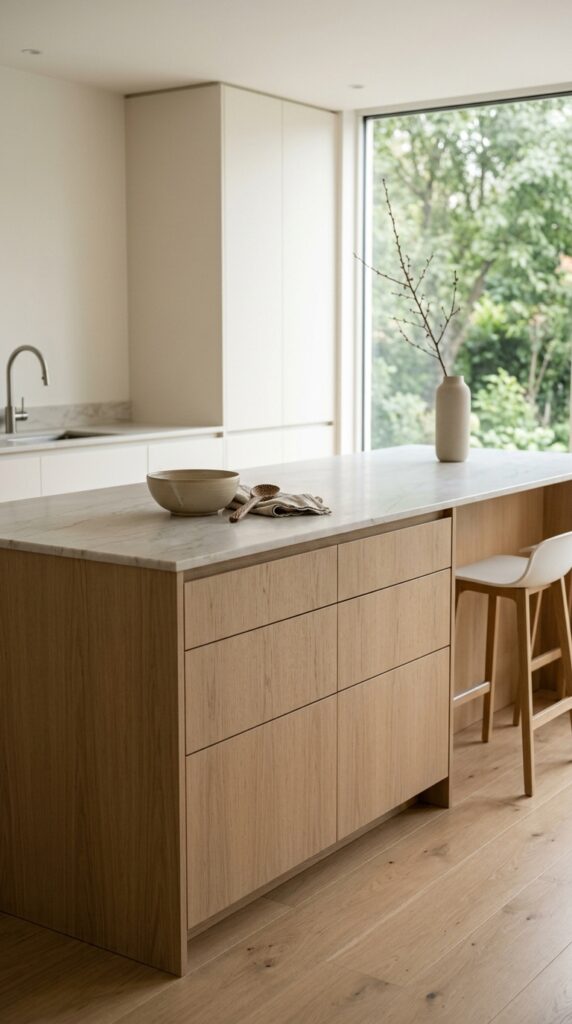
Vibe: Hushed — a Japandi island is the design equivalent of taking a breath: everything excessive removed, what remains purposeful.
Why it works: Japandi — the fusion of Japanese wabi-sabi and Scandinavian functionalism — approaches storage through the principle of intentional invisibility: if something can be hidden without sacrificing usefulness, hide it. Integrated pull-out drawers with touch-latch mechanisms (which require no visible hardware at all) achieve maximum storage capacity while maintaining a completely smooth, distraction-free exterior. The white oak material specifically bridges both design cultures — Japan’s reverence for unfinished natural wood and Scandinavia’s preference for pale, porous timber that softens under natural light.
How to get it: Touch-latch mechanisms (also called “push-to-open” drawer slides) are standard options on most European cabinetry lines and can be retrofitted onto existing cabinets. Pair flat-front doors with push-to-open hardware and white oak veneer panels for the Japandi result. The countertop should be honed — never polished — in a warm white stone. Honed White Princess quartzite is the most accessible material for this look.
💡 Quick Win: Add push-to-open drawer slide clips ($12–$25 for a pair) to existing kitchen drawers that currently use pulls — remove the hardware, install the clips, patch the hardware holes with wood filler, and repaint for a touch-latch island drawer with no visible hardware.
🛍️ Shop the Look — Amazon Product Ideas
| # | Product Search Phrase | Why It Fits |
| 1 | Push to open touch latch drawer slide soft close pair | Touch-latch hardware core |
| 2 | White oak peel stick veneer panel furniture cabinet | White oak surface material |
| 3 | Honed white quartz contact paper countertop peel stick | Honed countertop look |
| 4 | Single stem ceramic vase white minimalist tall slim | Japandi countertop accent |
| 5 | Matte white counter stool backless simple modern | Minimalist seating match |
How to Start Your Kitchen Island Transformation
Your single best first move is to paint the island a contrasting color to the perimeter cabinetry. Not new countertops, not new hardware, not a full renovation — just paint. This one decision establishes the two-tone principle that defines the look of nearly every kitchen island idea in this article, it costs under $100 in materials, and it is completely reversible if you change your mind. Pick a Benjamin Moore or Sherwin-Williams color in a cabinet-specific paint like Benjamin Moore Advance, and start there before making any other decisions.
The most common mistake beginners make is choosing an island color based on a paint chip in the store rather than testing it in the actual kitchen under actual lighting conditions. Kitchen lighting — its direction, color temperature, and how it interacts with your specific countertop and floor — changes paint color dramatically from a chip’s appearance. A color that reads as perfect greige on a chip can read pale lavender or muddy green on a cabinet in a north-facing kitchen. Always paint a 12×12 inch test area directly on the island face and observe it at multiple times of day before committing.
Three specific items under $50 that create immediate kitchen island impact: a set of five matching cabinet pulls in brushed brass or matte black to replace mismatched hardware ($18–$35 for a five-pack), a single large ceramic bowl in a neutral tone positioned as a centerpiece ($15–$30), and a set of two matching counter stools that pull up to an existing island overhang ($40–$50 each in rattan or wood at most big-box retailers).
Realistically, a painted island plus new hardware can be completed in a weekend and achieved for under $200. A countertop replacement plus paint plus hardware runs $800–$2,500 depending on material and fabrication costs, and typically takes three to four weeks to schedule and complete. A full custom island build — new cabinetry, stone countertop, lighting, seating — realistically runs $4,000–$12,000 and requires four to eight weeks of planning and lead time.
Frequently Asked Questions About Kitchen Island Design
What is the difference between a kitchen island and a kitchen peninsula?
A kitchen island is a freestanding structure with open floor space on all four sides, while a peninsula connects to the perimeter cabinetry on one end, creating an L- or U-shaped kitchen layout. Islands offer 360-degree access and better visual openness; peninsulas provide more storage and countertop continuity by attaching to existing cabinetry. For kitchens under 150 square feet, a peninsula is often the more practical choice because it requires 42 inches of clearance on only three sides rather than four.
What is the best color for a kitchen island?
The most versatile kitchen island colors are those that read as sophisticated neutrals rather than strong statements: navy blue (Benjamin Moore Hale Navy), sage green (Benjamin Moore Saybrook Sage), warm charcoal (Sherwin-Williams Iron Ore), and warm greige (Benjamin Moore Manchester Tan). The best choice depends on your perimeter cabinet color — the island should contrast with the perimeter in value or hue, not match it. As a general principle, if your perimeter cabinets are white or light, a medium-to-dark island reads best; if the perimeter is already dark, a lighter island or a white oak tone provides necessary visual relief.
How much does it cost to add a kitchen island?
A pre-made rolling kitchen island cart costs $150–$600. A custom built-in kitchen island with stock cabinets, basic countertop, and no sink costs $2,000–$5,000 for materials and basic installation. A fully custom island with stone countertop, integrated sink, and specialty features (microwave drawer, wine storage, charging station) typically runs $6,000–$15,000+ depending on material selections, local labor costs, and plumbing complexity. A paint-and-hardware island update to an existing island costs $100–$400 total.
Can I put a kitchen island in an open-plan living space?
Yes — and it often improves the spatial definition of open-plan kitchens by creating a visual and functional boundary between the kitchen zone and the living area. The key rule is clearance: maintain a minimum of 42 inches of walkable floor space on all four sides of the island, or 48 inches if two people cook together regularly. In open-plan spaces, the island countertop height can vary — standard 36-inch counter height on the cook’s side and a raised 42-inch bar-height ledge on the living-room side creates both a functional prep surface and a casual seating zone facing the room.
What countertop material is most durable for a kitchen island?
Engineered quartz (such as Silestone or Caesarstone) is widely considered the most practical island countertop material: it is non-porous (requires no sealing), highly resistant to staining and chipping, consistent in color and patterning across the full slab, and available in a wide range of finishes including honed and leathered. Natural stones like quartzite and granite offer unique character but require annual sealing. Butcher block is warmest in appearance but demands regular oiling and is susceptible to water damage around sinks. For households with young children or heavy daily use, engineered quartz in a honed finish is the most forgiving combination.
Ready to Create Your Dream Kitchen Island?
From waterfall quartz edges to touch-latch Japandi drawers, from moody dark bases to rope-wrapped coastal legs, these 29 kitchen island ideas cover every material category, color family, and space constraint you’re likely to encounter. Transformation in a kitchen doesn’t have to happen all at once — choosing one idea from this list and executing it well creates more impact than halfheartedly attempting five. Pick up a sample pot of paint today, hold it against your existing island, and see which direction the room wants to go. When the right design choice is in place, a kitchen island stops being a piece of furniture and starts being the reason the kitchen feels like home. Pin the ideas that made you stop scrolling — those instincts are always worth trusting.